
Butterflies are one of the few cake decorations that suggest movement, and that’s their whole appeal. A cake covered in flowers sits still; a few butterflies lifting off the tiers make it look like something just landed. Most of the ones you’ll see are wafer paper, gum paste or fondant, sometimes with sugar flowers, pearls or a watercolor finish underneath. Each material behaves differently on a cake and in a warm room, which matters more than most couples expect. Here are twenty butterfly designs, and what I’d watch for with each.
Wafer Paper, Gum Paste or Isomalt? What Each Butterfly Is Made Of
When a couple brings me a butterfly cake photo, the first thing I work out is what the butterflies are made from, because that decides how the cake will look by the evening. These are the materials you’ll come across.
- Wafer paper: very thin and light, with a slightly translucent wing. It can be printed or painted, and it’s the best for a floating look. It’s also the most sensitive to moisture.
- Gum paste: a sugar dough that dries hard. It holds a crisp wing angle and survives humidity much better, though it’s more work, so expect it to cost more.
- Fondant: softer than gum paste and heavier. Good for bold, larger butterflies that sit closer to the cake.
- Isomalt: a sugar that can be poured or pulled into glassy, see-through wings. It looks dramatic but is fragile, and it gets sticky in humid air.
- Printed edible images: flat but precise, useful if you want a specific butterfly species or pattern.
One thing I’d never do is put real butterflies or wire-bodied craft butterflies straight into a cake. If your baker uses non-edible decorations, they should sit on picks or a separate topper and come off before cutting.
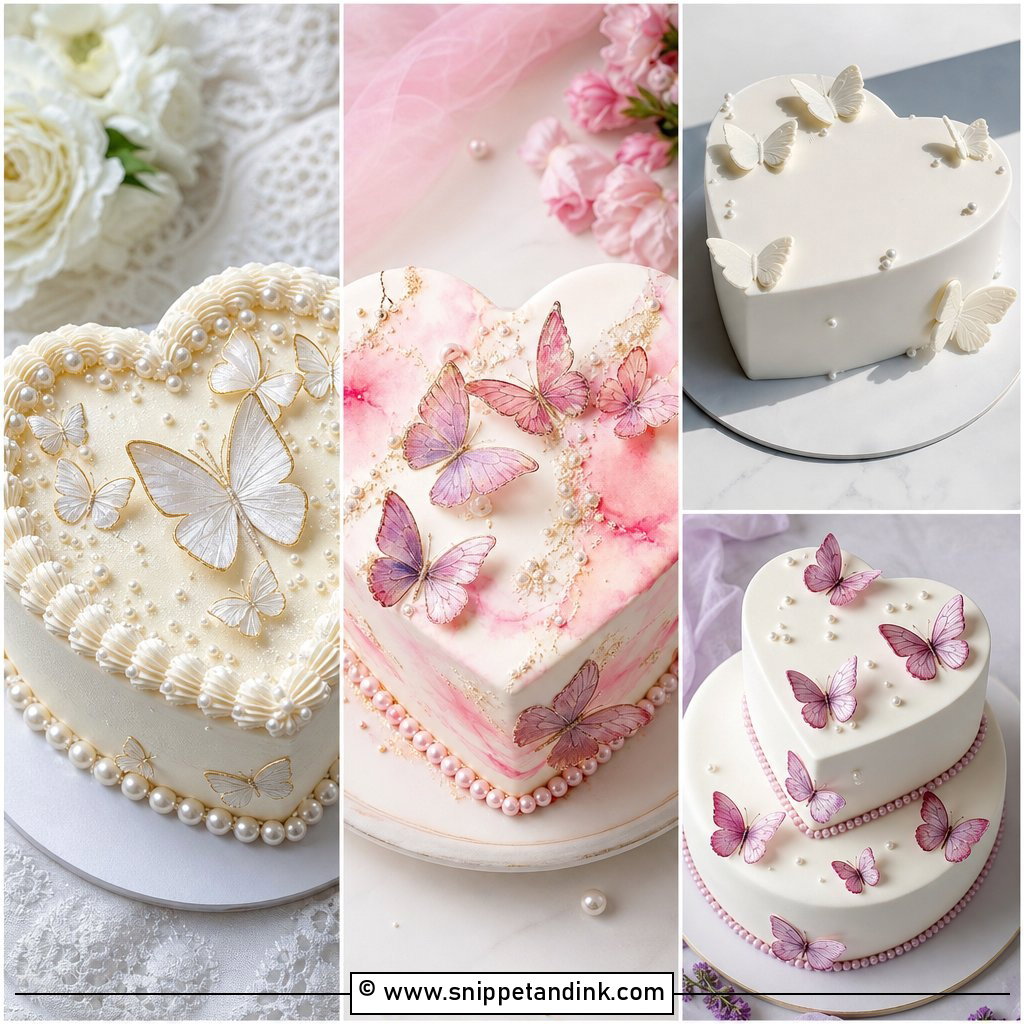
1. White Butterfly Wedding Cake
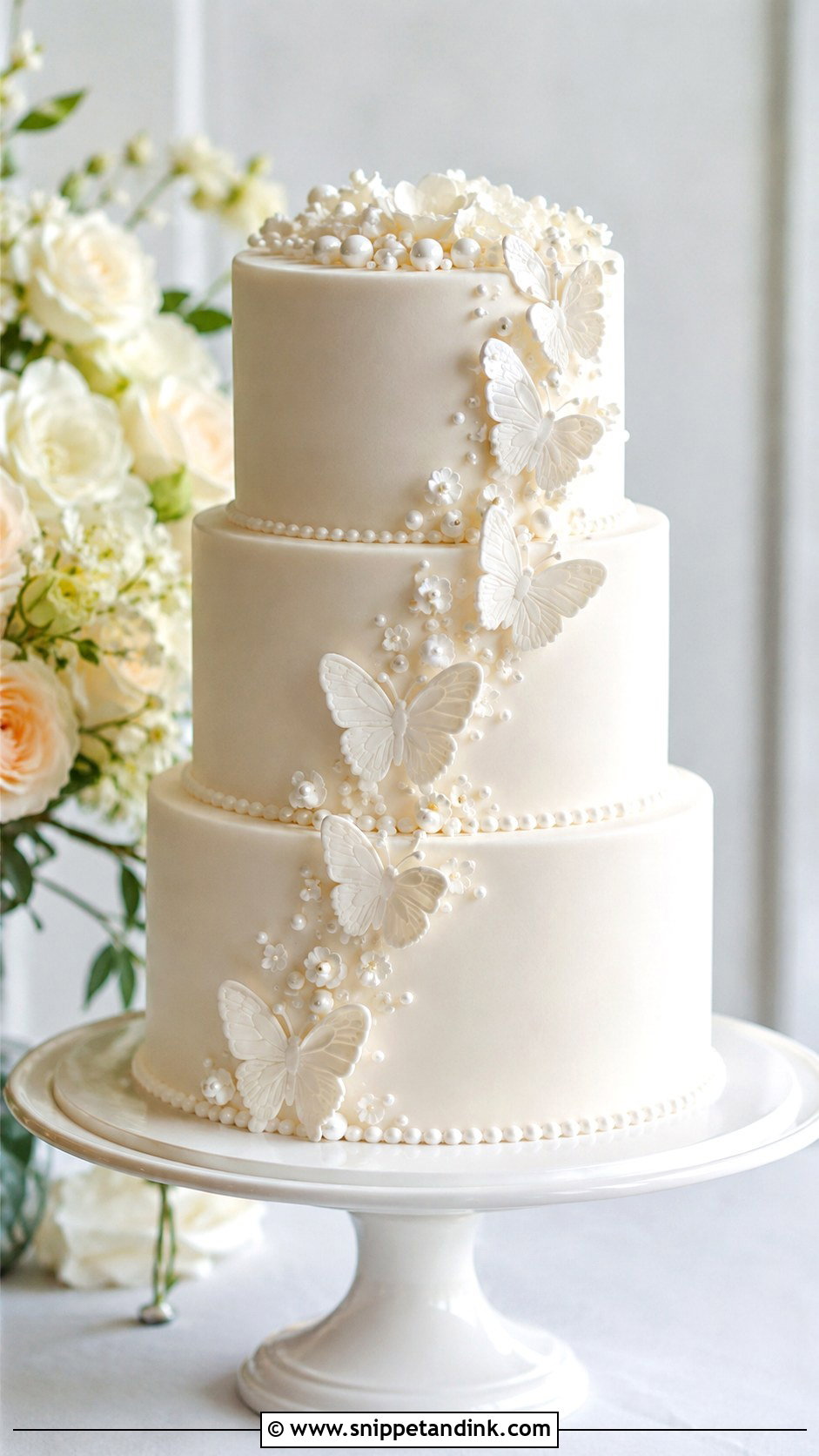
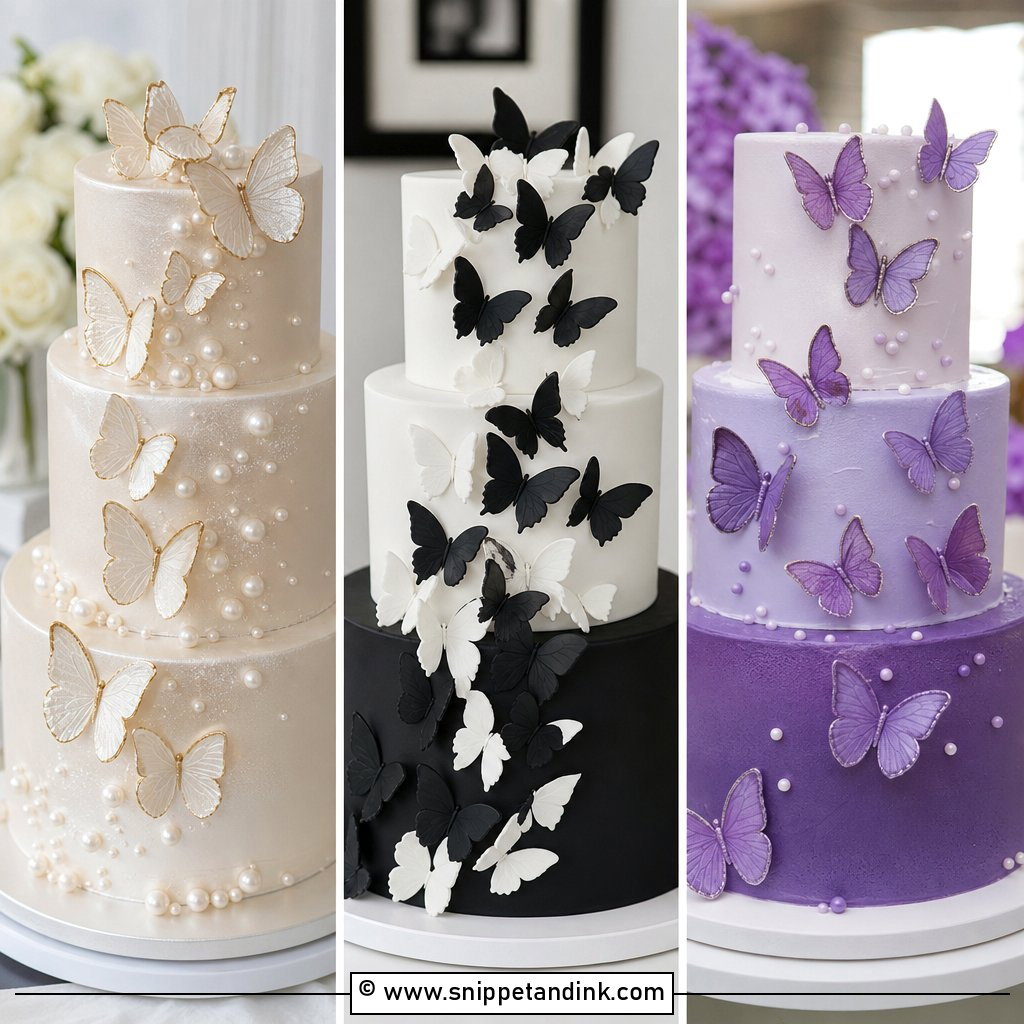
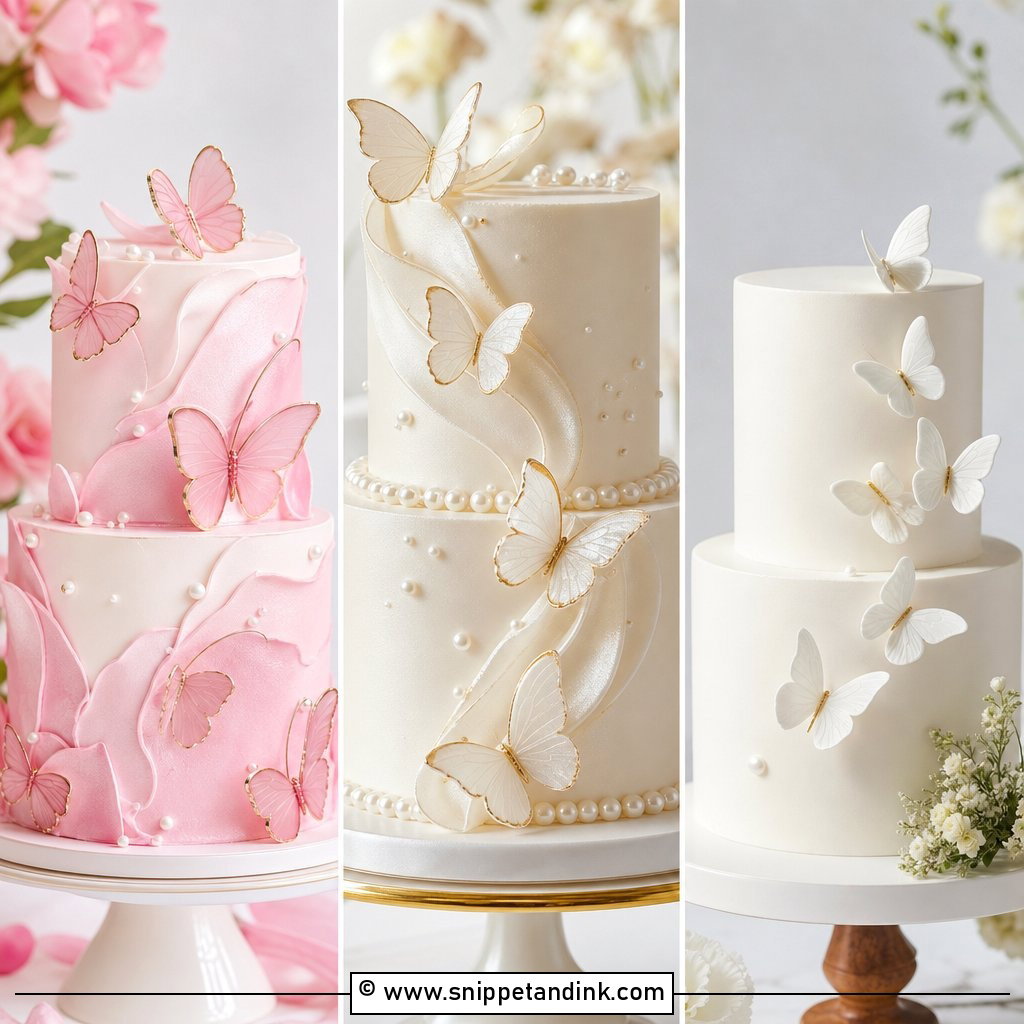
An all-white cake is where butterflies show their shape most clearly, because there’s no color to distract from the silhouette. For a white butterfly wedding cake I use two or three smooth tiers and wafer paper butterflies in mixed sizes, so the design reads as depth rather than a pattern. I place them in a loose upward trail from the bottom tier to the top. White on white can look flat under bright lights, so a few pearls or small sugar blossoms help the shapes stand out.
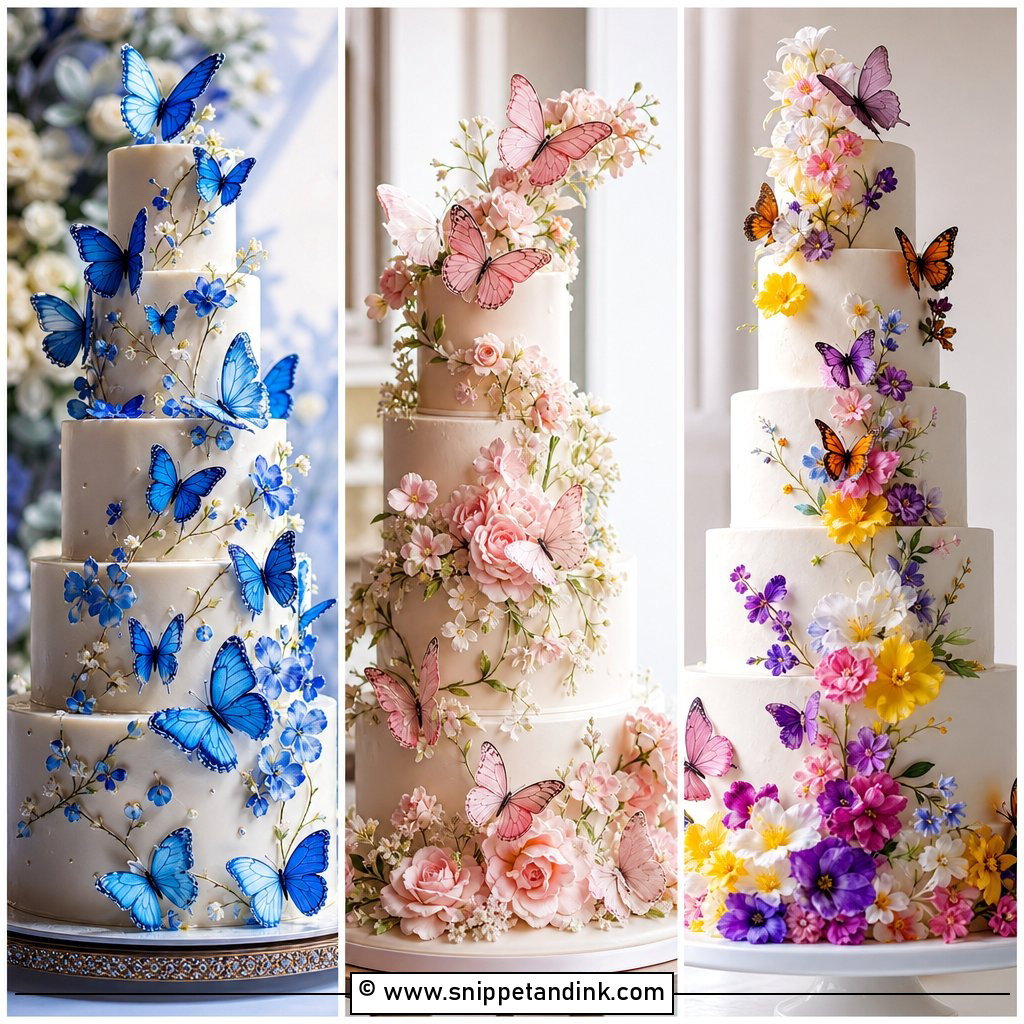
2. Blue Butterfly Wedding Cake
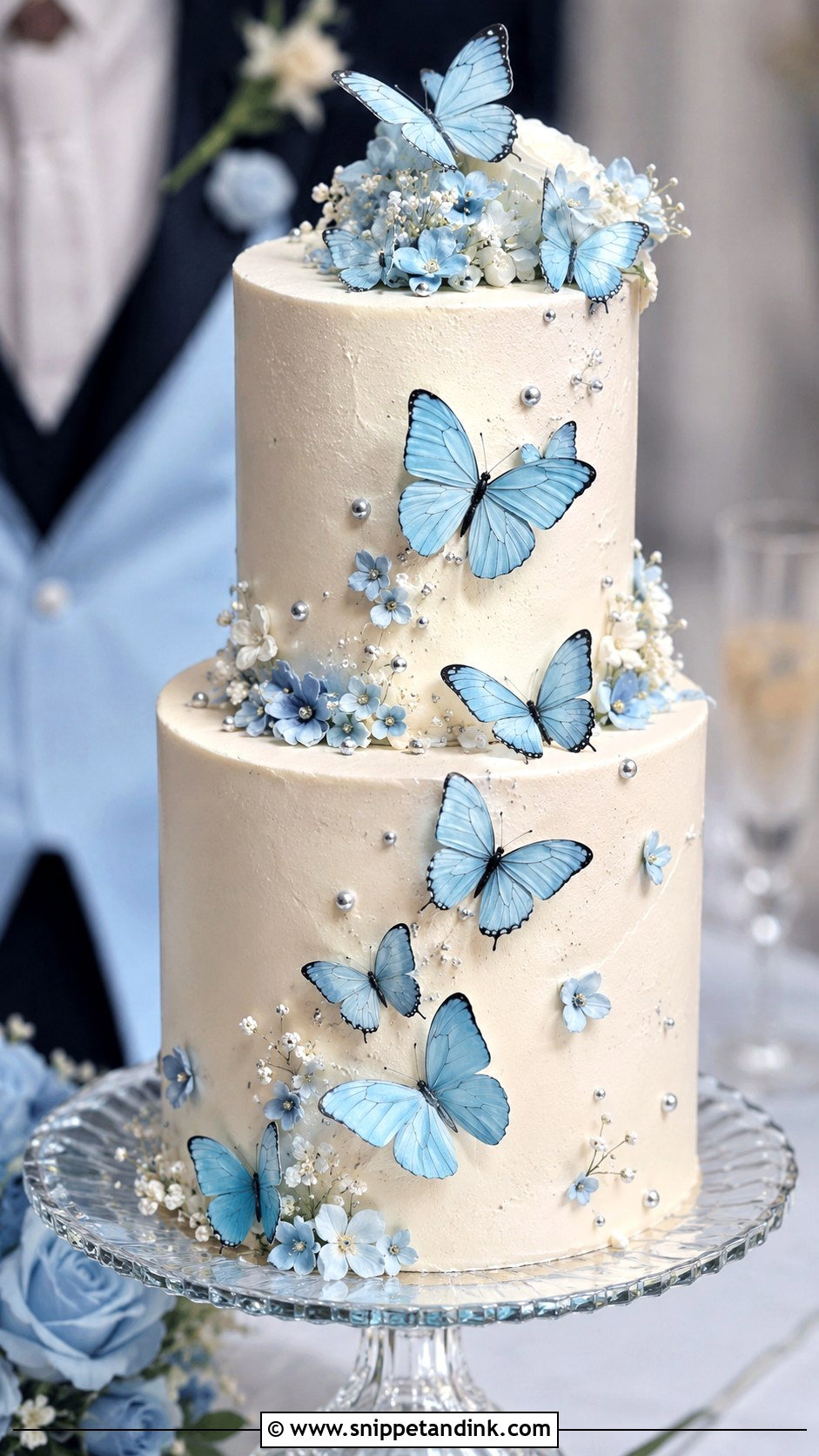
Blue butterflies stand out most against an ivory or white base, and they tie in easily with hydrangeas, delphinium or dusty blue bridesmaid dresses. I use two or three shades, powder blue through a soft grey-blue, so the cluster has depth. A word of warning: blue food coloring can shift toward purple or grey in some lighting, so I always look at a test butterfly under the venue’s kind of light if I can. Tiny silver pearls are the only extra it needs.
3. Pink Butterfly Wedding Cake
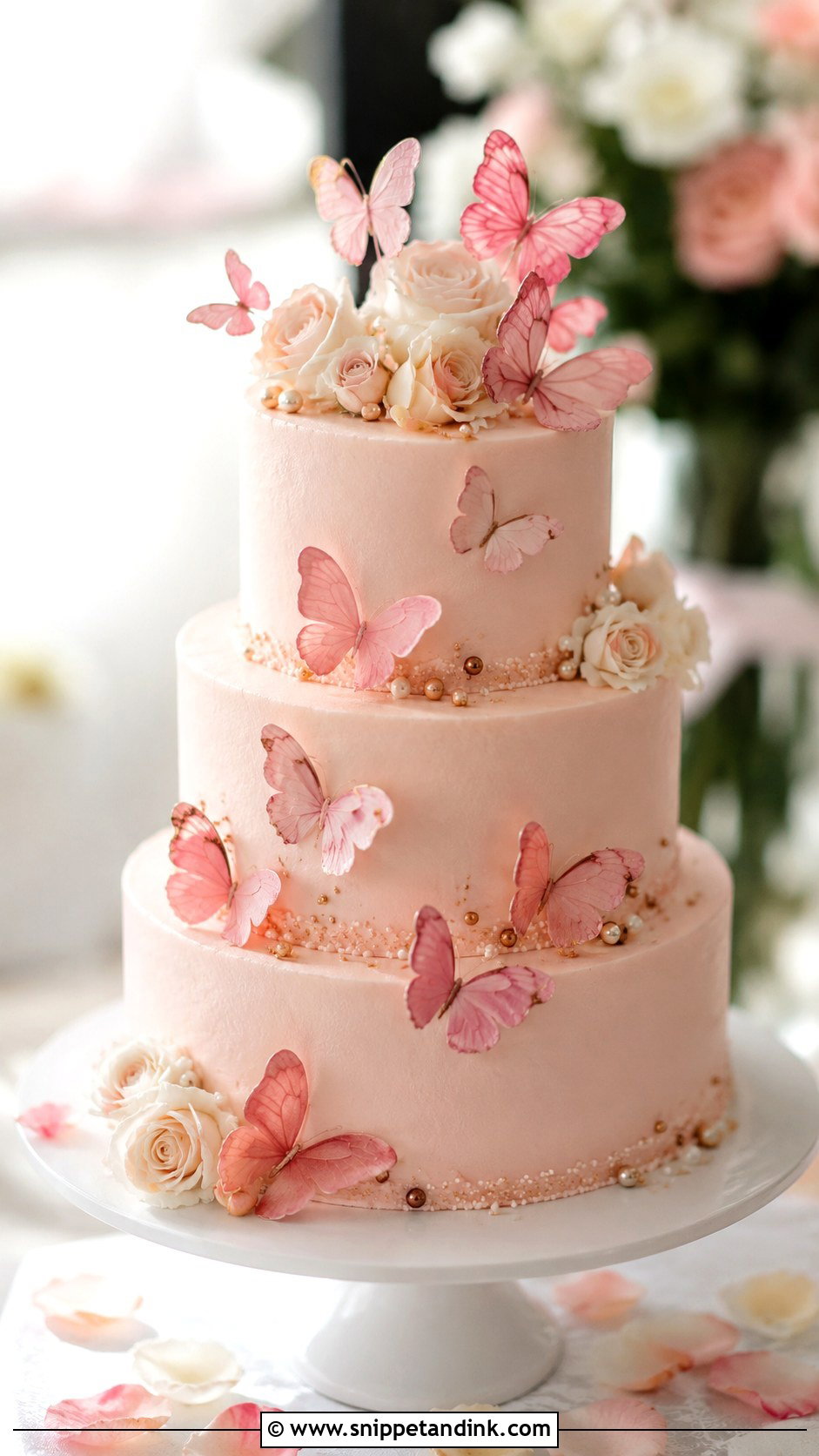
Pink is the easiest butterfly color to overdo. I keep the cake base ivory or a very pale blush and let the butterflies carry the color, in blush, rose and champagne. Roses, peonies and ranunculus sit naturally beside them. A cluster near the top tier can stand in for a topper, and a few scattered lower down tie the tiers together. If the pink starts looking sugary, white flowers or a little gold calm it down.
4. Gold Butterfly Wedding Cake
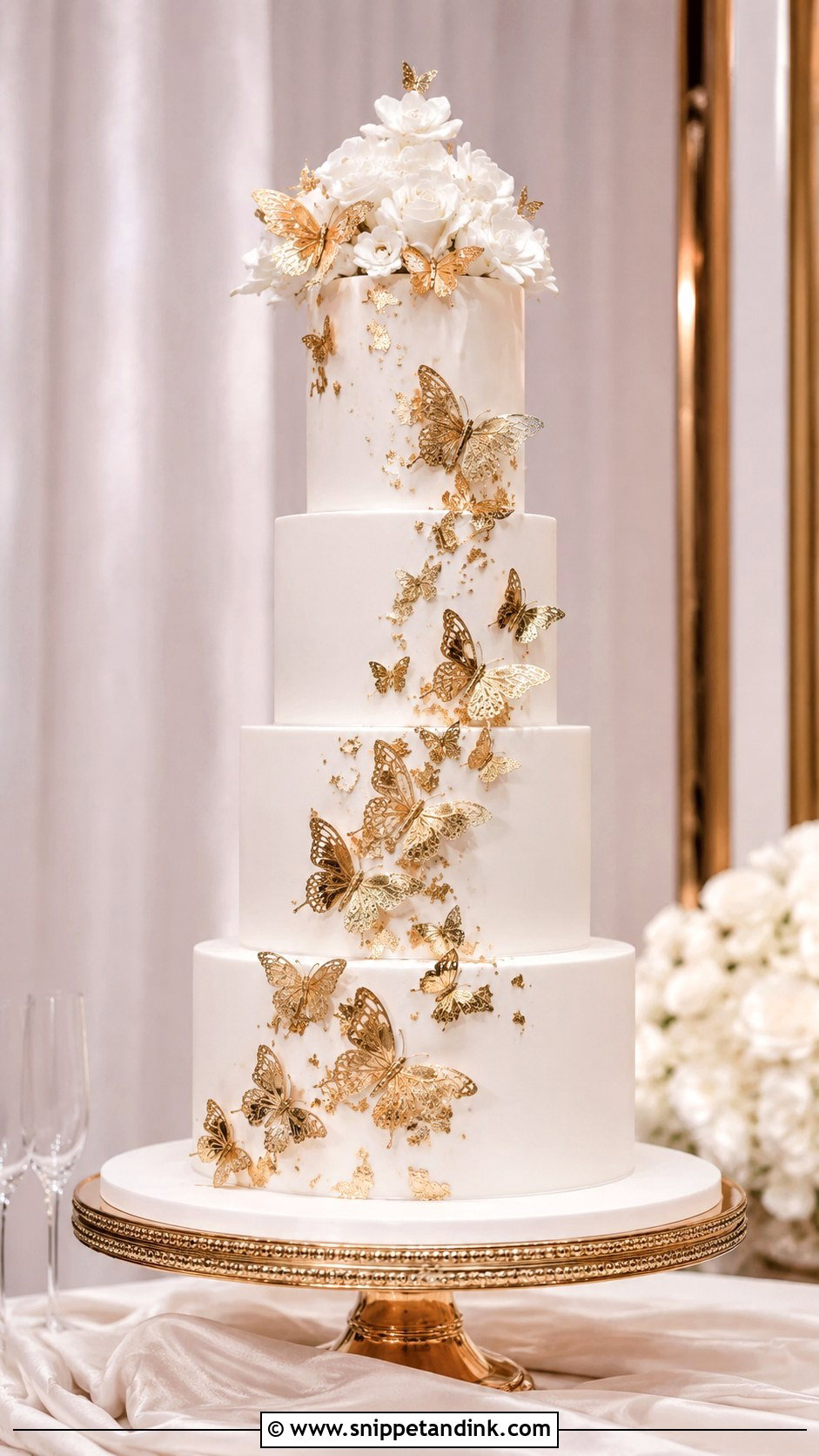
Metallic gold is where I’d use fewer, larger butterflies. A gold butterfly wedding cake with six or seven big ones on ivory tiers looks far more expensive than thirty little ones. I paint them with edible gold or apply gold leaf. Check with your baker that the gold they use is labeled edible, not just non-toxic decorating dust, which is meant for items you remove before eating. White sugar flowers keep it from tipping into flashy, and it suits an evening, black-tie room.
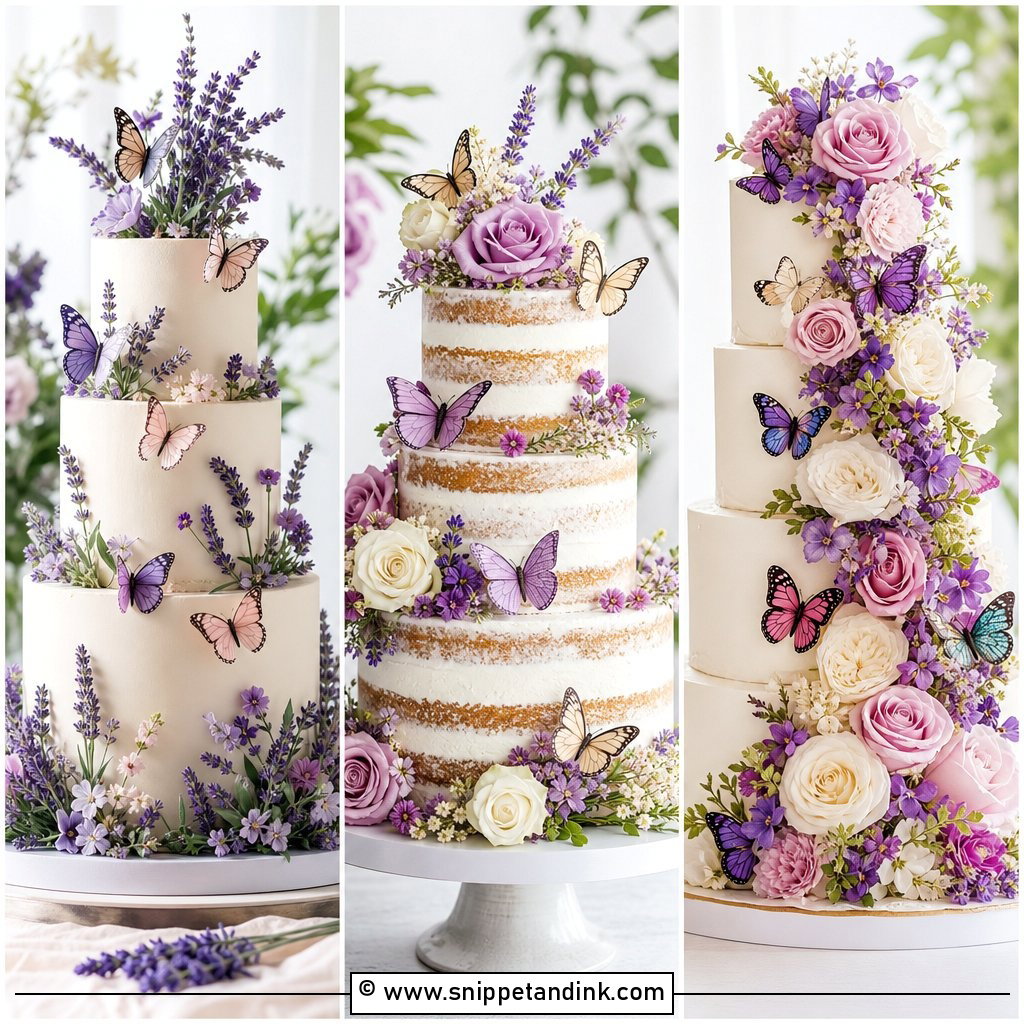
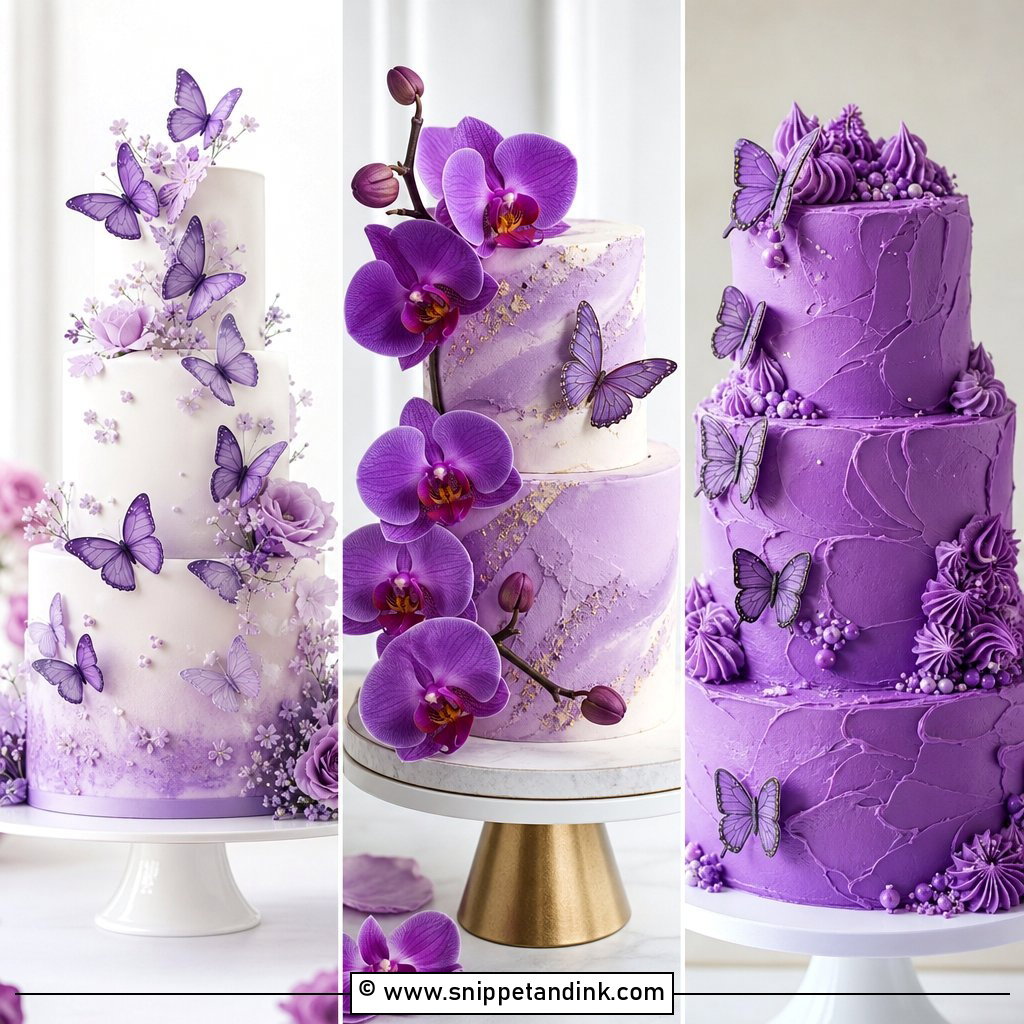
5. Purple Butterfly Wedding Cake
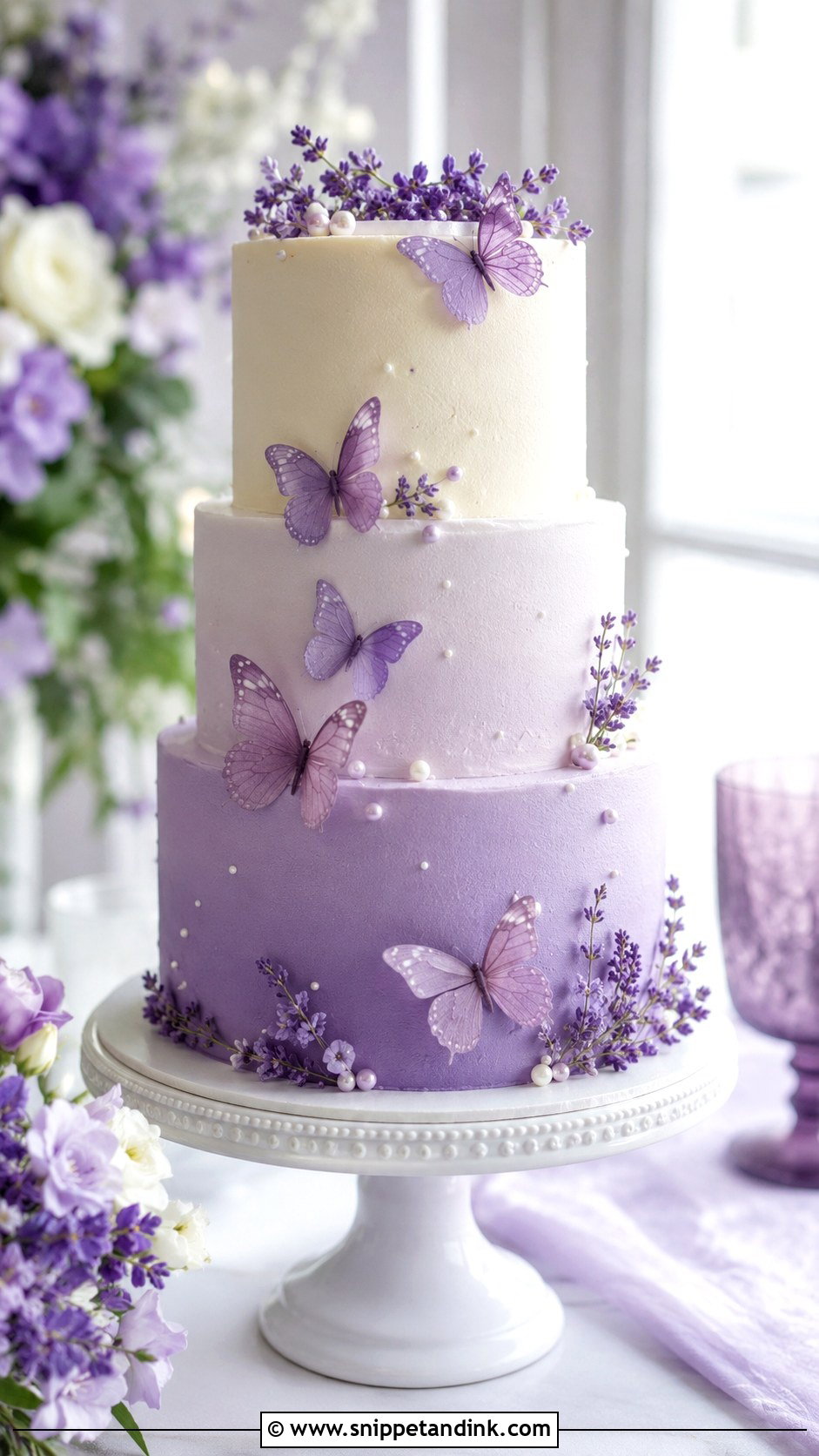
Lavender and lilac are harder colors to get right in buttercream than they look. Purple coloring fades in daylight and can drift toward grey or blue, so I tint the base a shade deeper than the final color I want. A purple butterfly wedding cake usually reads best as a soft white-to-lilac ombre with butterflies in lavender, plum and violet. Too much deep purple on a big cake feels heavy, so keep the darker shades for the smallest butterflies.
6. Butterfly Wedding Cake With Flowers
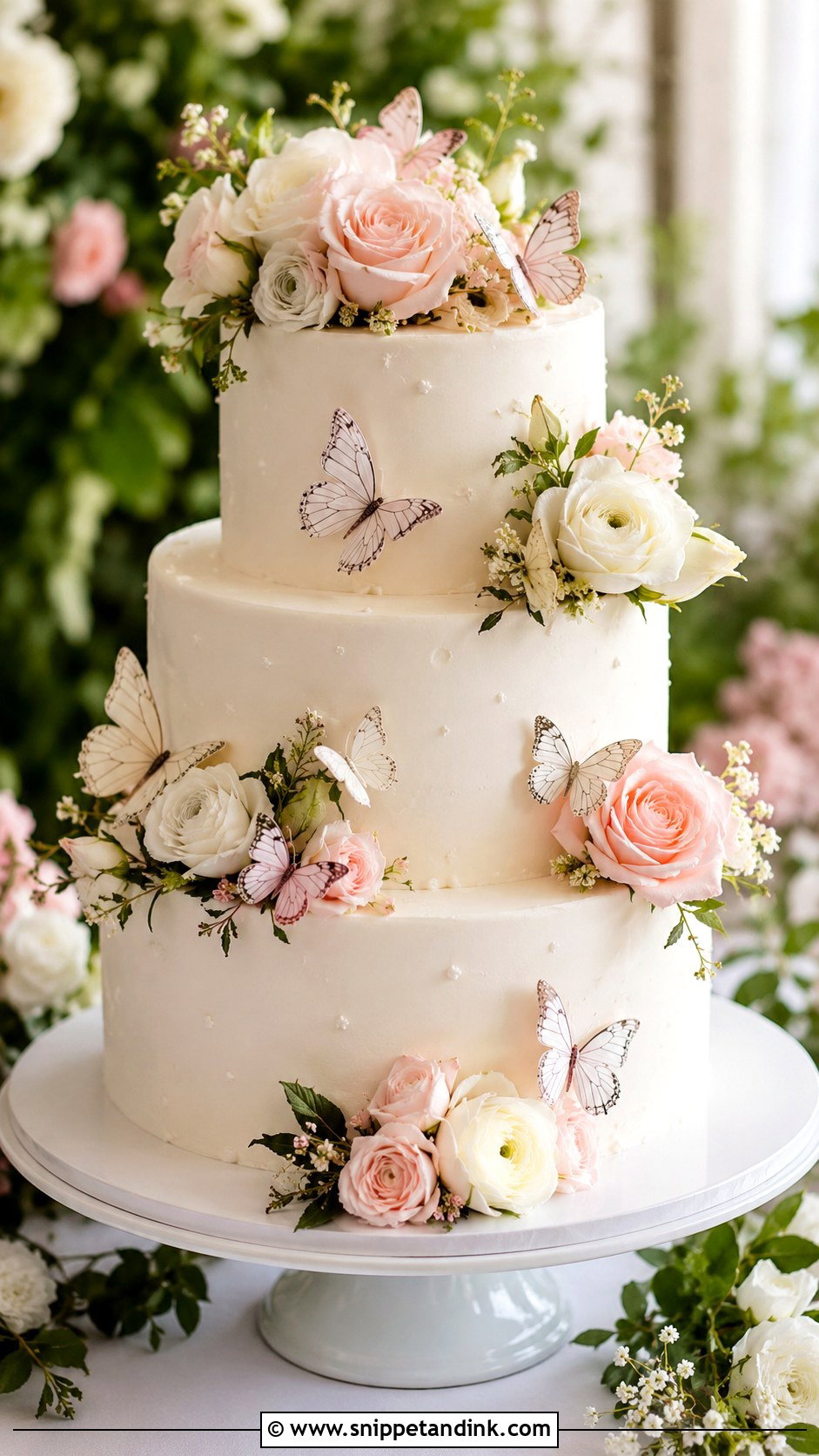
Flowers give the cake body; butterflies give it lightness, and together they make the design feel finished. I match the flowers to the bouquet, then place butterflies at the edges of the clusters as if they’d landed. If you’re using fresh flowers, they must come from a grower or florist who sells them without pesticides, and the stems should be wrapped or in food-safe picks, never pushed straight into the cake. Keep to two or three flower colors so the butterflies aren’t competing.
7. Butterfly Wedding Cake With Roses
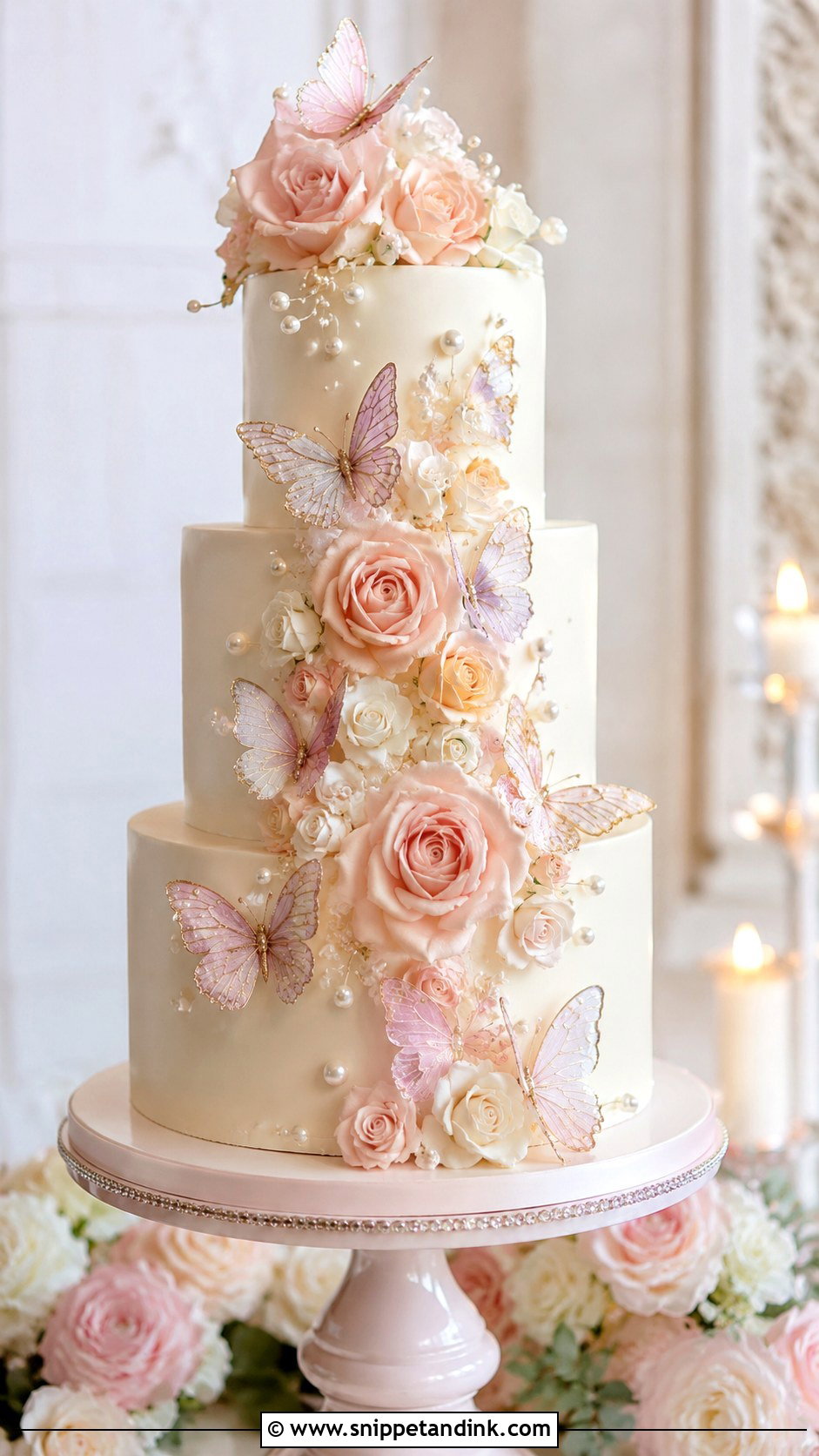
Roses and butterflies are an old pairing that still works. Ivory, blush, champagne or dusty pink roses set the tone; white looks formal, mauve looks vintage. The butterflies go around the rose clusters, never buried inside them, or they disappear. Wafer paper suits this best because it’s thin enough to look weightless beside petals. Three smooth buttercream tiers with roses between them and butterflies rising upward is the version I’d build.
8. Butterfly Wedding Cake With Pearl Details
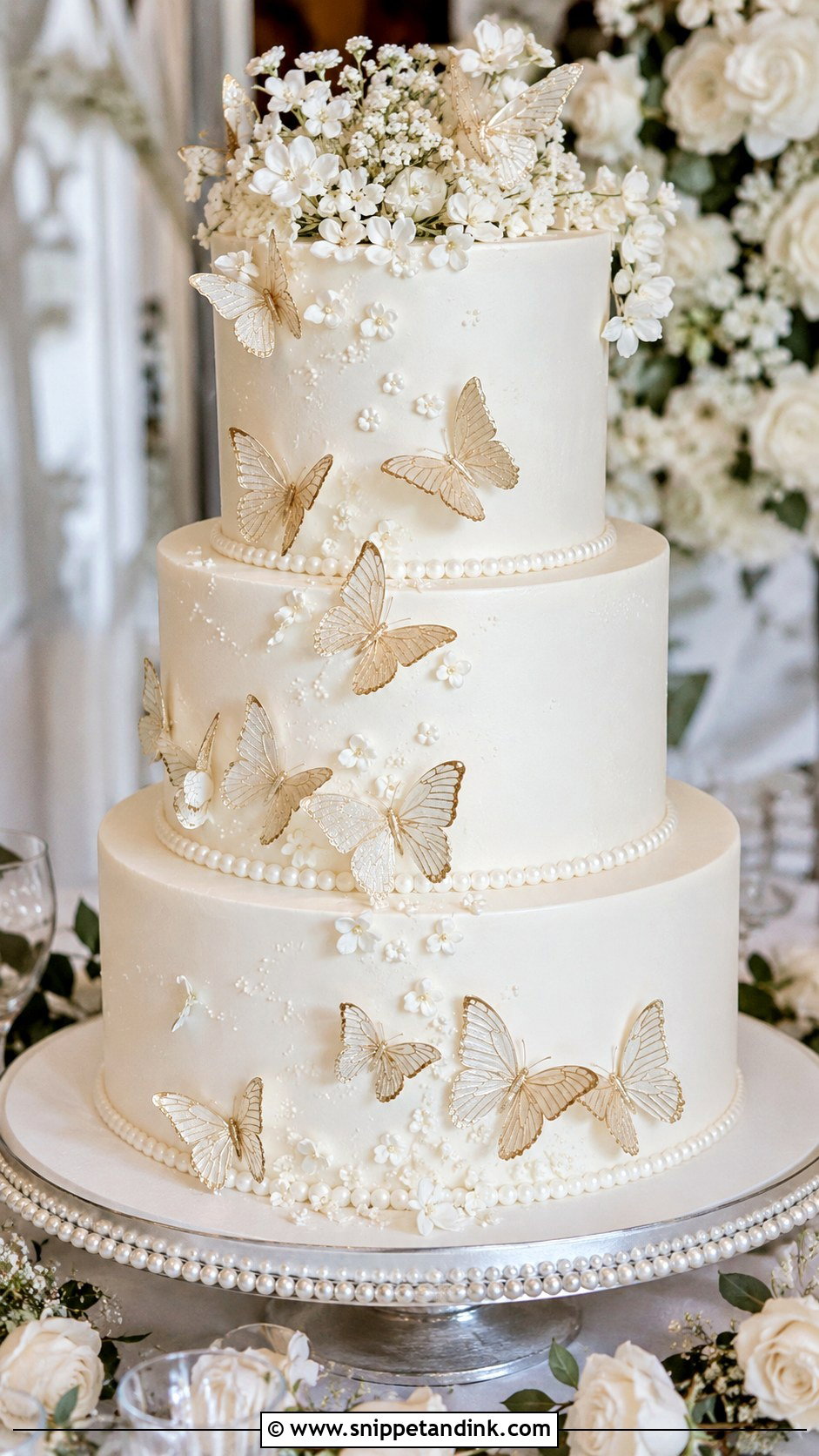
Pearls and butterflies both read as delicate, so this combination suits brides who don’t want flowers at all. I use pearls as a border, a scattered accent, or a fine trail that follows the butterflies’ path up the cake. A smooth ivory fondant or white buttercream base lets the pearl texture show. Fondant gives cleaner pearl lines. Don’t overdo it; a few well-placed rows look polished, and a cake studded all over with pearls just looks busy.
9. Butterfly Wedding Cake With Watercolor
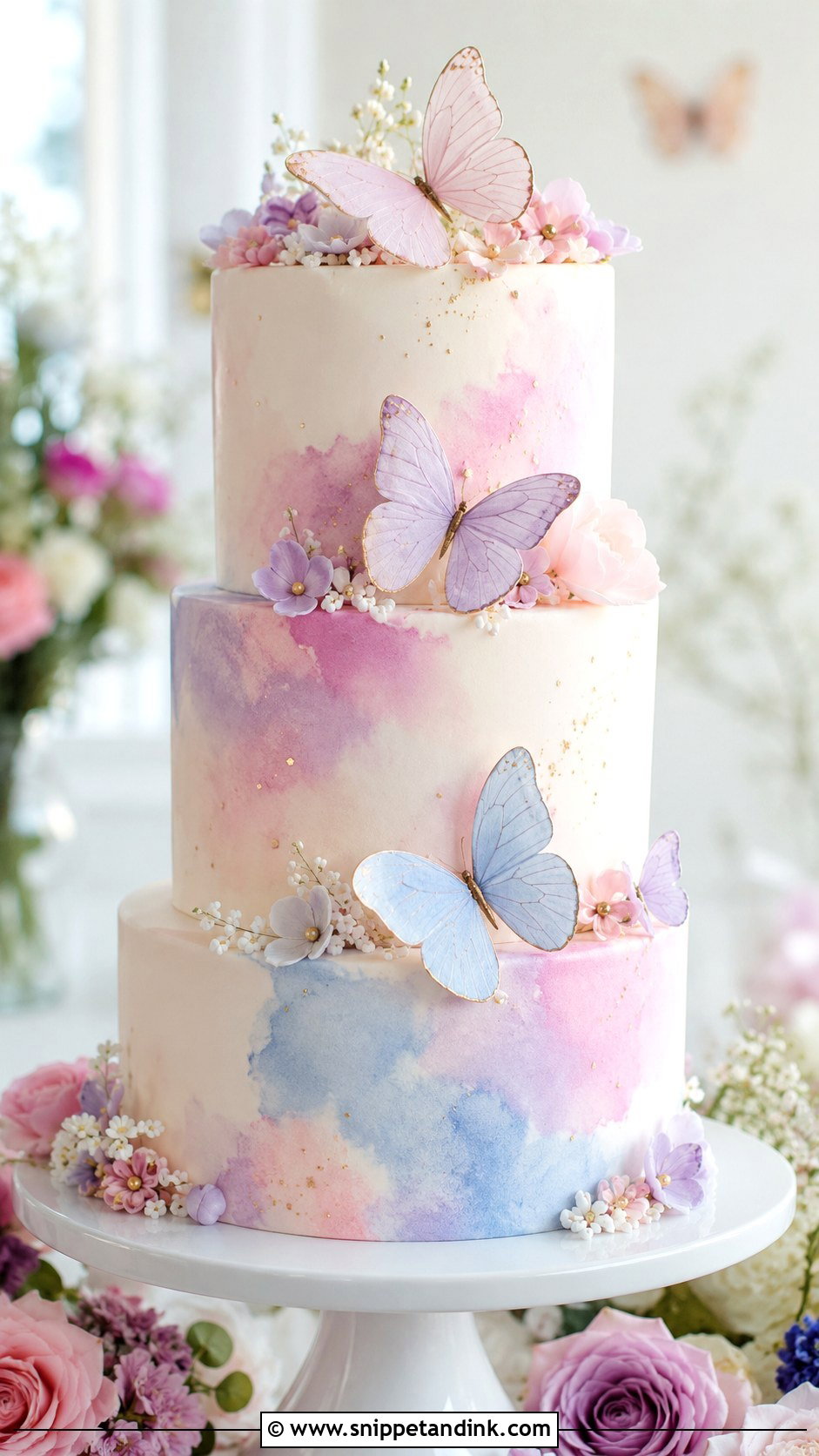
Watercolor buttercream is done with a palette knife, blending small amounts of color into the final coat, and it only looks right when the colors are kept pale. For a butterfly wedding cake with watercolor, I paint the wafer paper butterflies with the same colors as the cake, so the two connect. Pale pink, lavender, blue or peach all work. Keep the tiers simple; the color and the butterflies already give the eye plenty to look at.
10. Butterfly Wedding Cake With Ombre Tiers
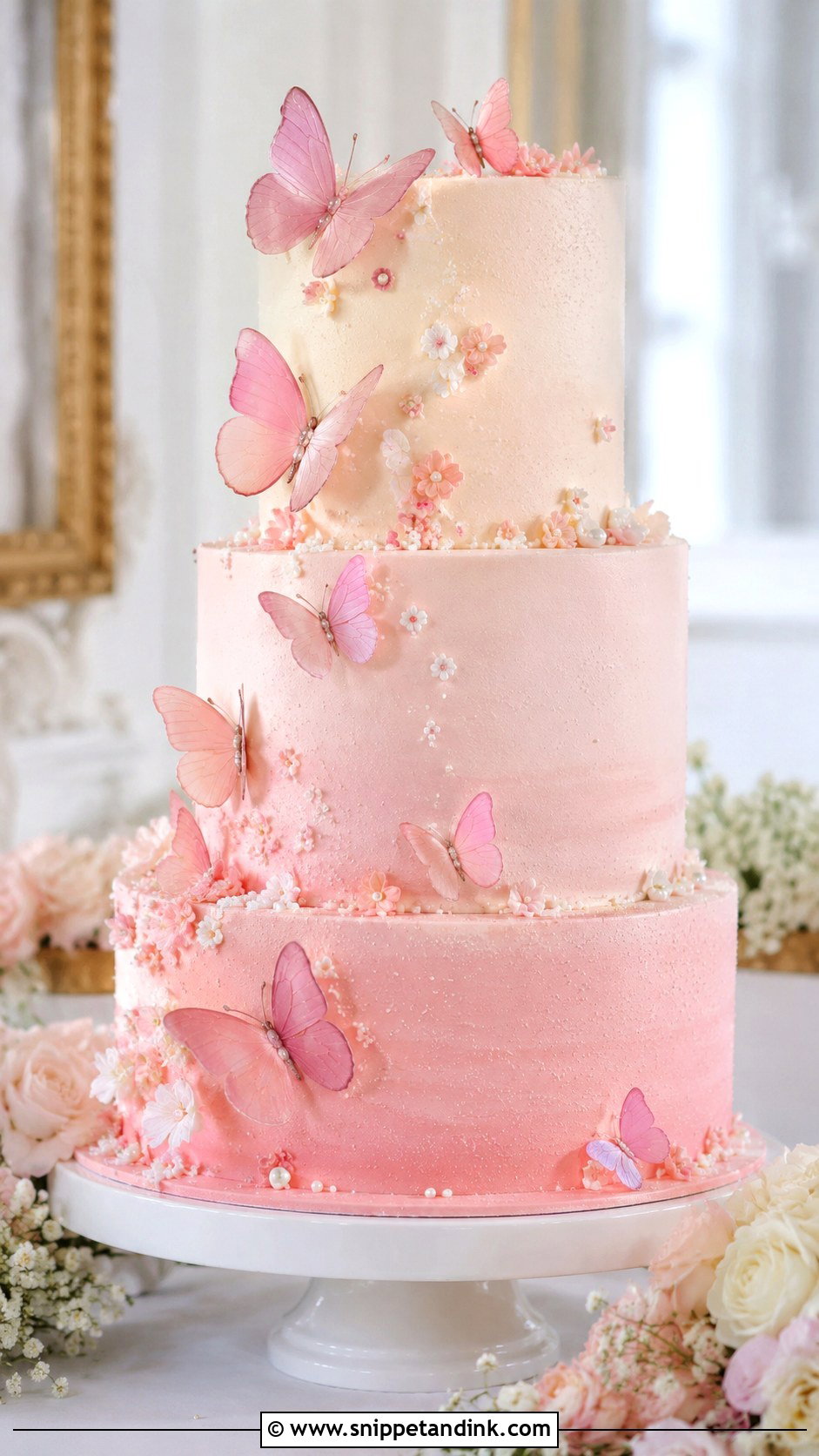
Ombre gives the butterflies a direction to travel in. The tiers fade from white to blush, ivory to peach or pale to deeper blue, and I match each butterfly to the tier color it sits on so they seem to follow the gradient. Ombre needs a smooth finish; texture breaks up the color shift. Leave out most other decoration. A few sugar flowers at most.
11. Butterfly Wedding Cake With Floral Cascade
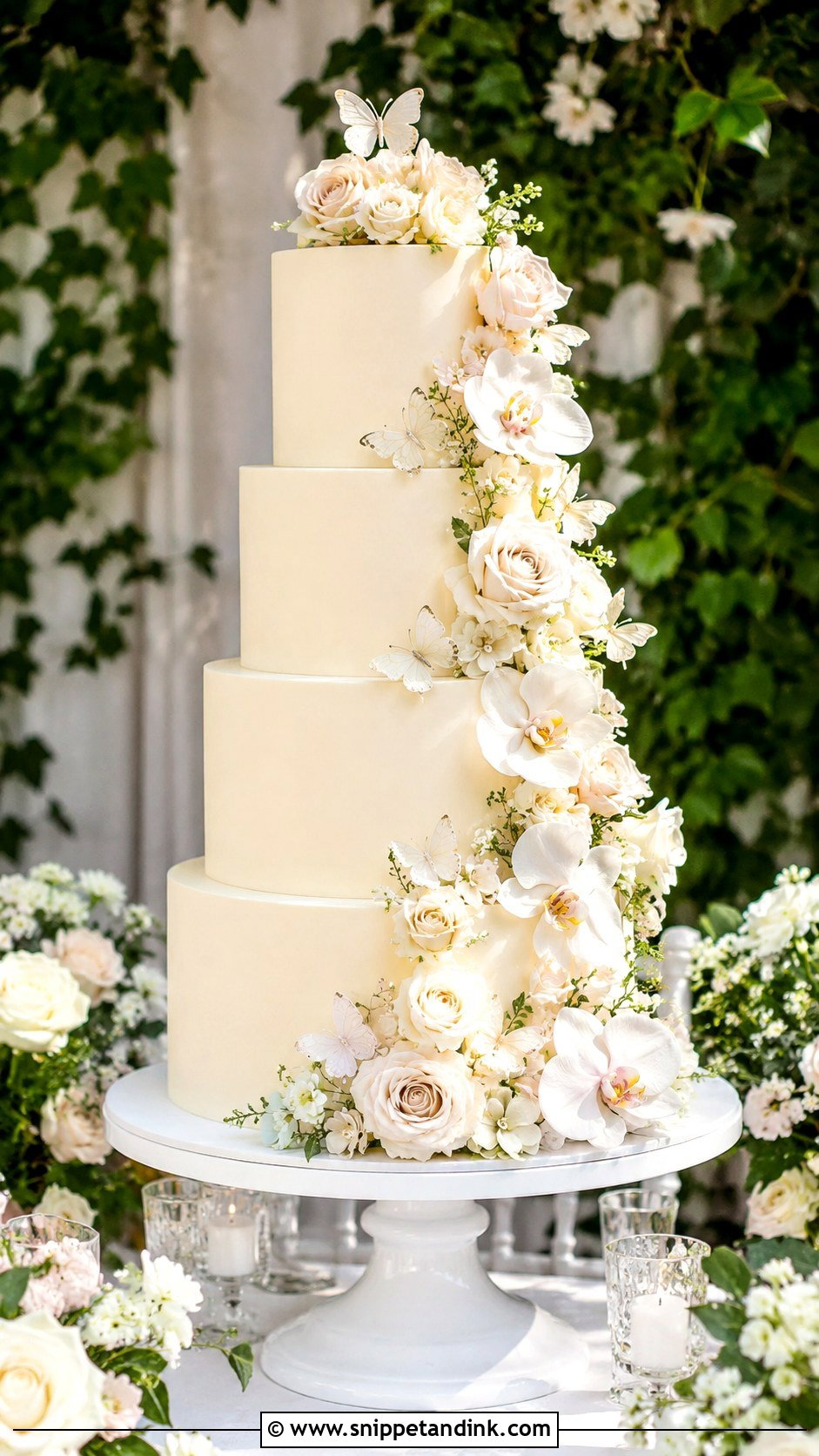
A cascade needs height, so I’d only suggest it on three or four tiers. Flowers run from the top tier down one side, and butterflies sit around the edges of the flow rather than in the middle of it. I take the flowers from the bouquet so the cake ties to everything else. Soft roses, orchids, sweet peas and small fillers pair well with butterflies; big, heavy blooms make the cascade look crowded.
12. Butterfly Wedding Cake With Sugar Flowers
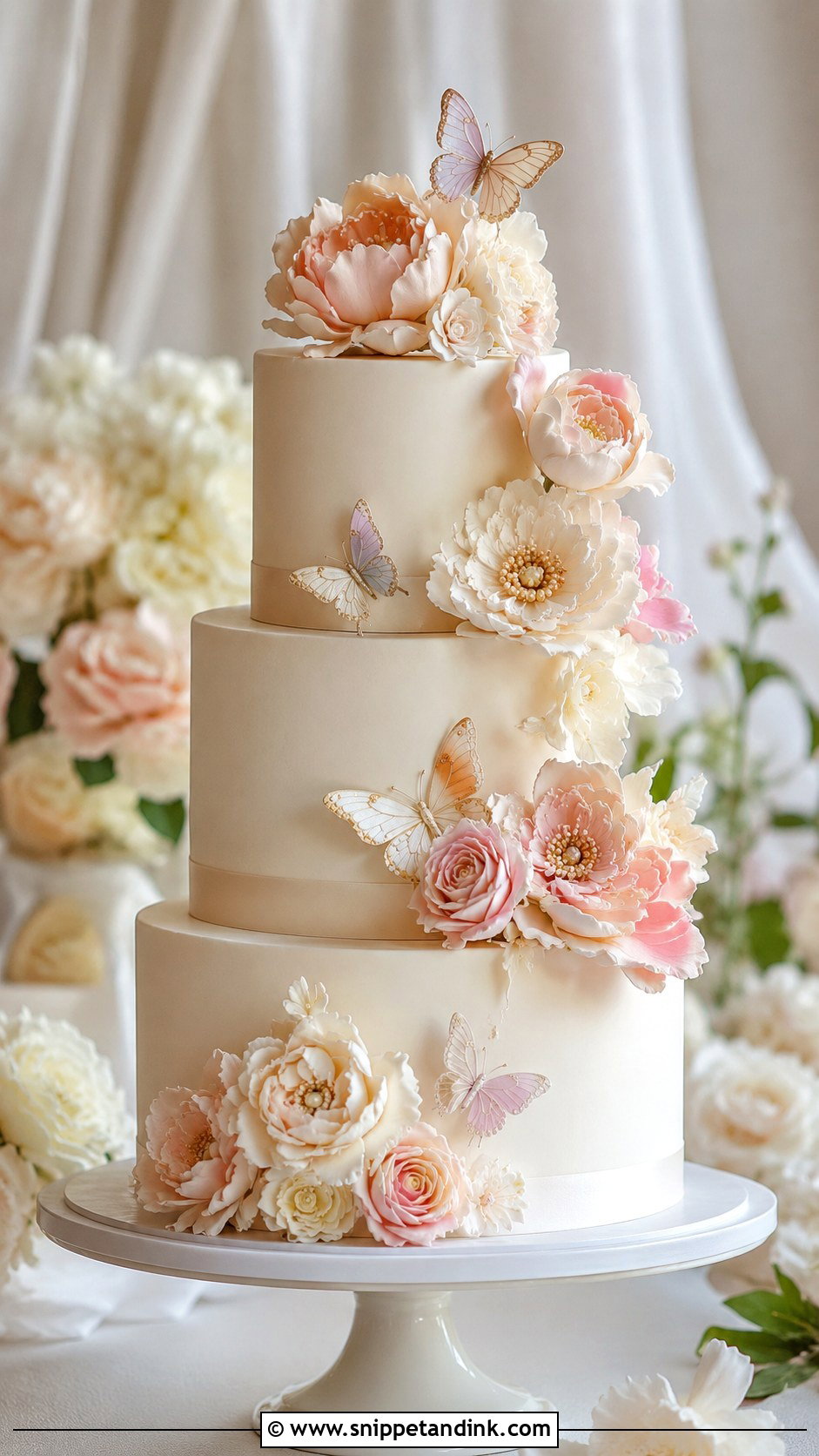
Sugar flowers are made petal by petal from gum paste, and many couples keep one afterward, so they’re the closest a cake gets to a keepsake. A butterfly wedding cake with sugar flowers can match the bouquet exactly: roses, peonies, orchids or cherry blossom. They hold their shape far better than fresh flowers in warm weather, though very high humidity can still soften them, so keep the cake in a cool room. Place the butterflies right beside the flowers, as if they’re feeding.
13. Butterfly Wedding Cake With Edible Wafer Paper
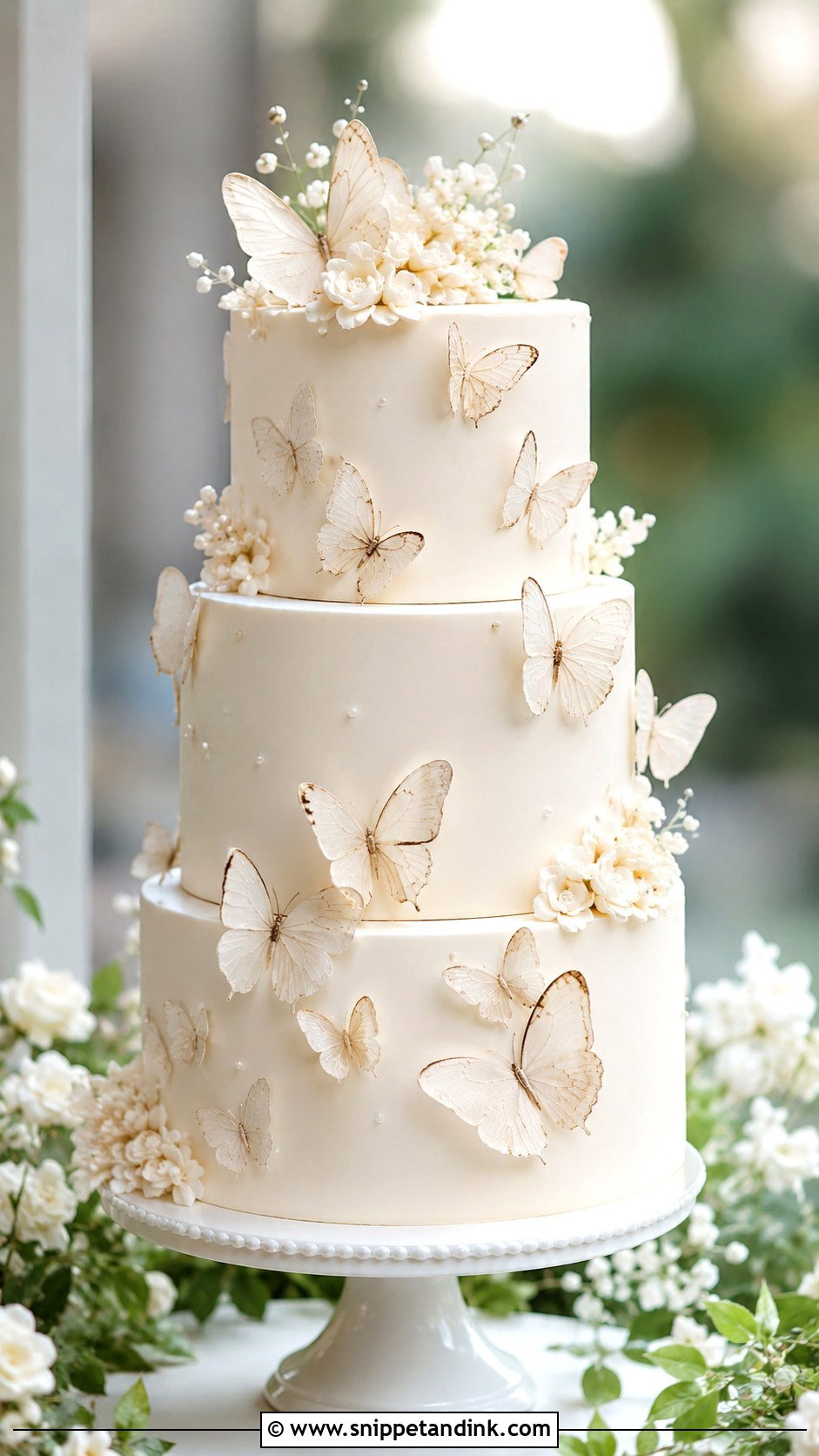
Wafer paper is made from potato starch, and it’s thin enough to bend. I fold each butterfly gently along the body so the wings lift, which gives that 3D effect. Mixing sizes adds depth, smaller near the top and larger near the bottom. The catch with edible wafer paper is moisture. It wilts and curls on contact with soft, damp buttercream, so I attach butterflies with a dot of melted chocolate or royal icing and add them as late as possible, ideally at the venue.
14. Butterfly Wedding Cake With Fondant Butterflies
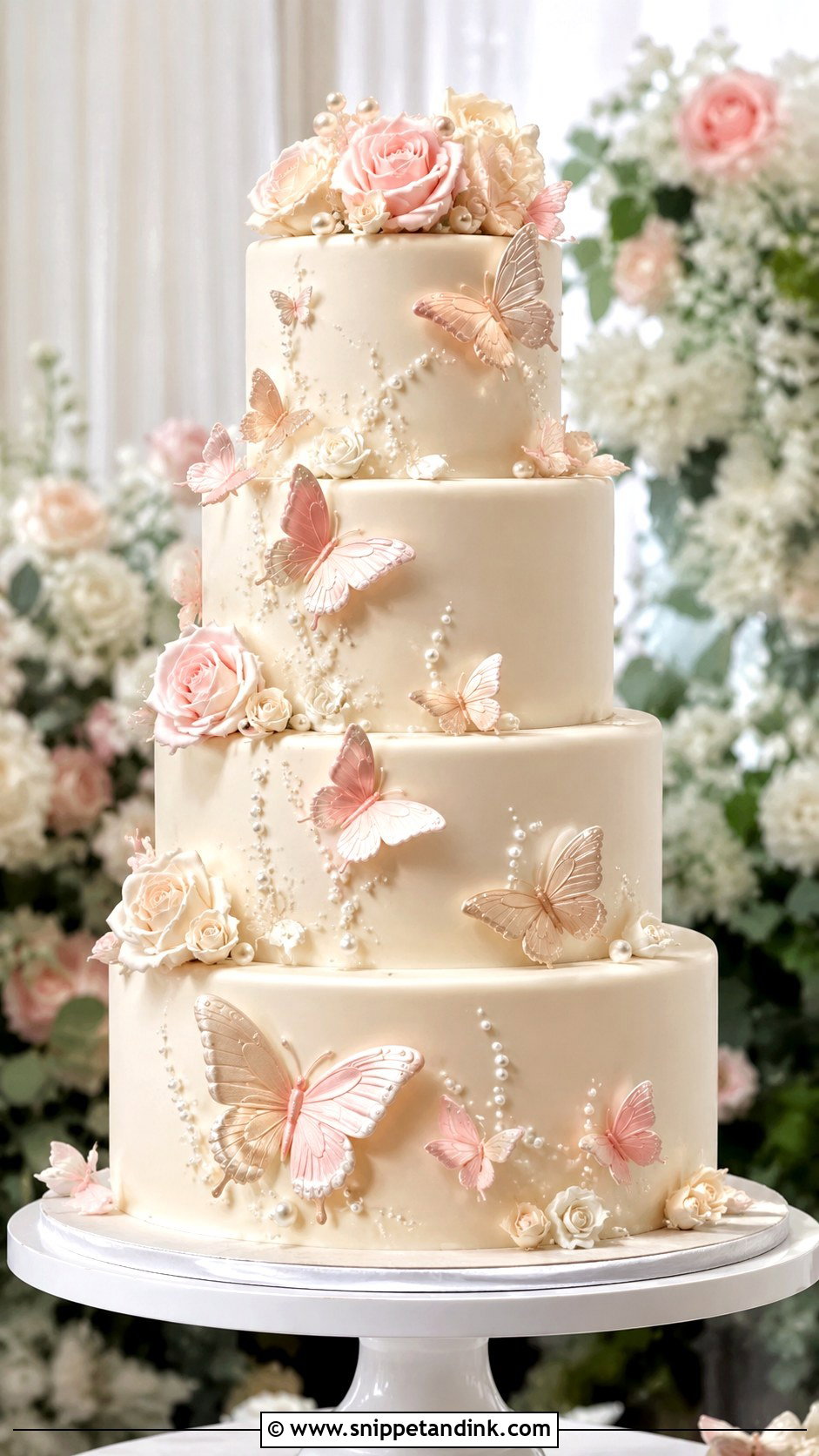
Fondant butterflies are thicker and heavier than wafer paper, so they look sculpted rather than fluttery. That’s useful for bolder, larger designs and for jewel tones or metallics, since fondant takes color evenly. I usually let them dry over a folded card for a day or two, so the wings hold a slight lift. They suit a smooth fondant cake best. Space them out; heavy butterflies bunched together look like they’ve crash-landed.
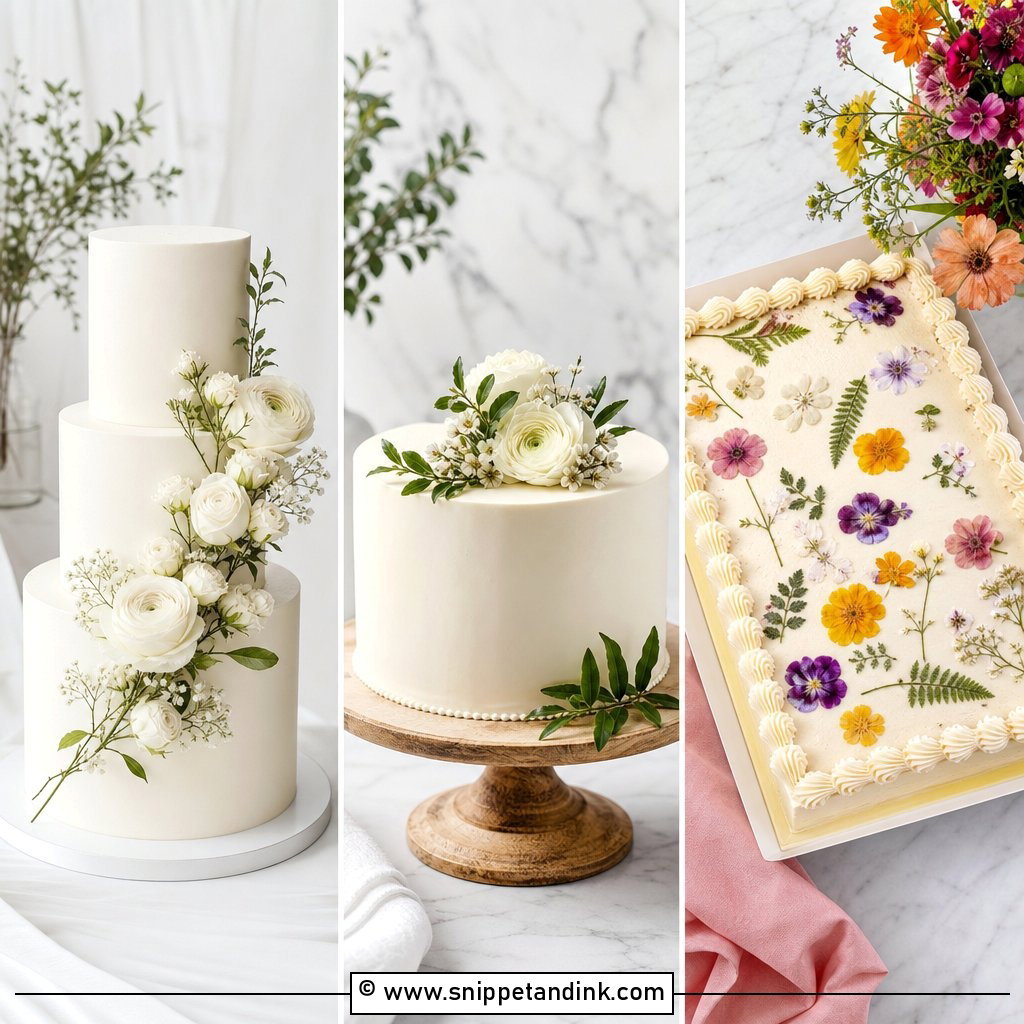
15. Butterfly Wedding Cake With 3D Butterflies
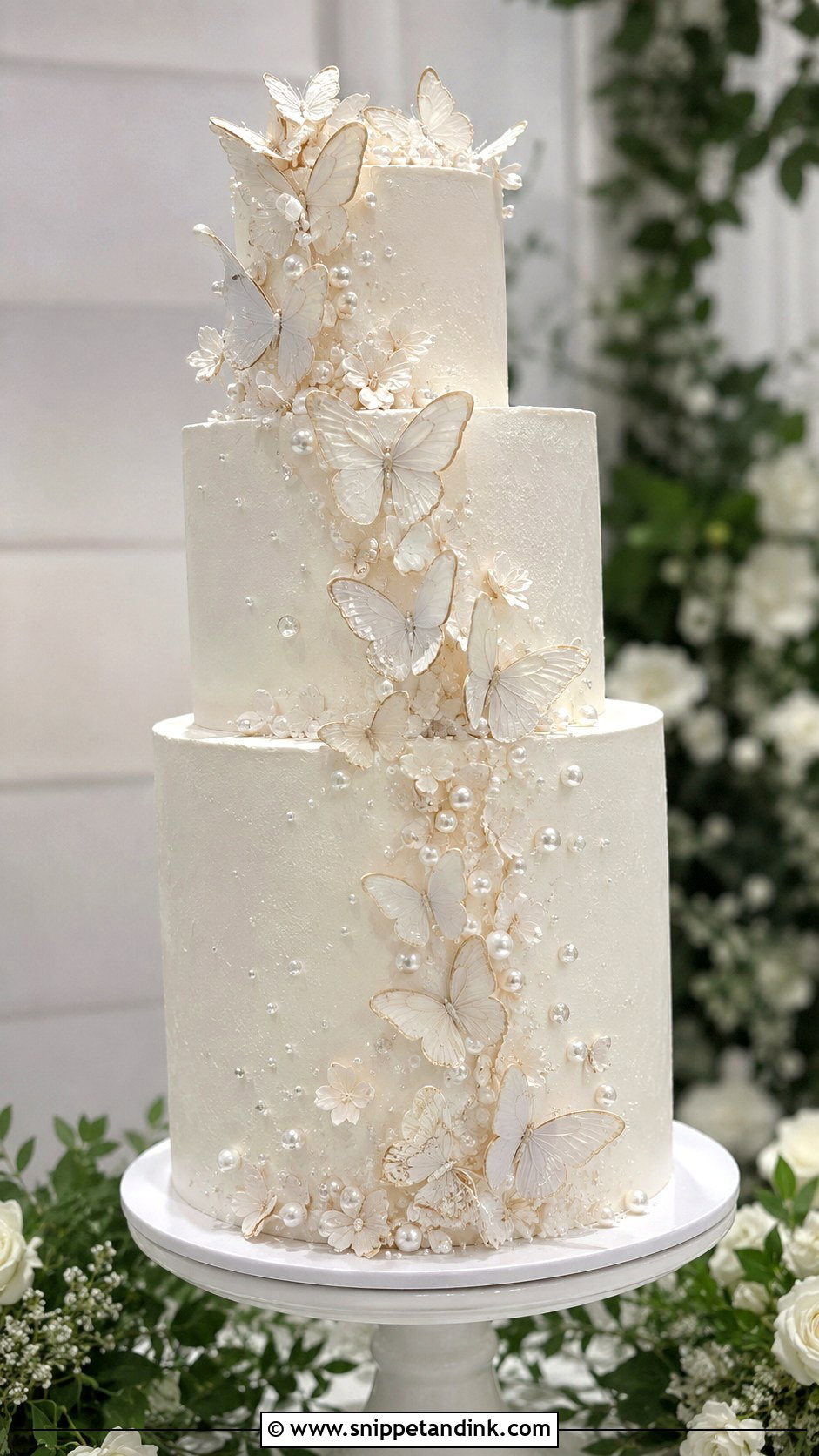
True 3D butterflies need their wings set at an angle before they go on the cake. I dry them in a V shape, then place them in a gentle spiral around the tiers. Wafer paper gives a floating look; gum paste gives sharper, more defined wings and stands up better to humidity. Tall cakes suit this most because the spiral has room to climb. Keep the base plain so the shapes cast their own shadows.
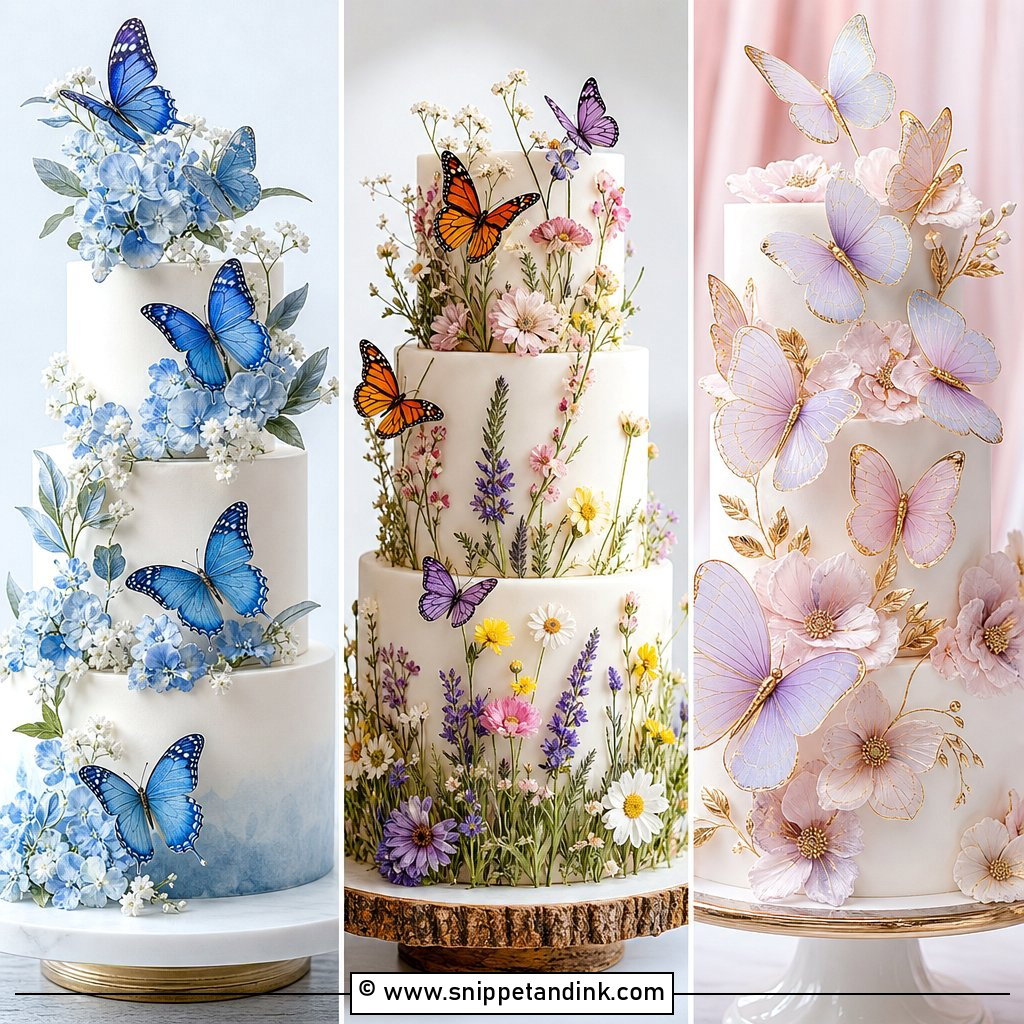
16. Butterfly Wedding Cake With Pressed Flowers
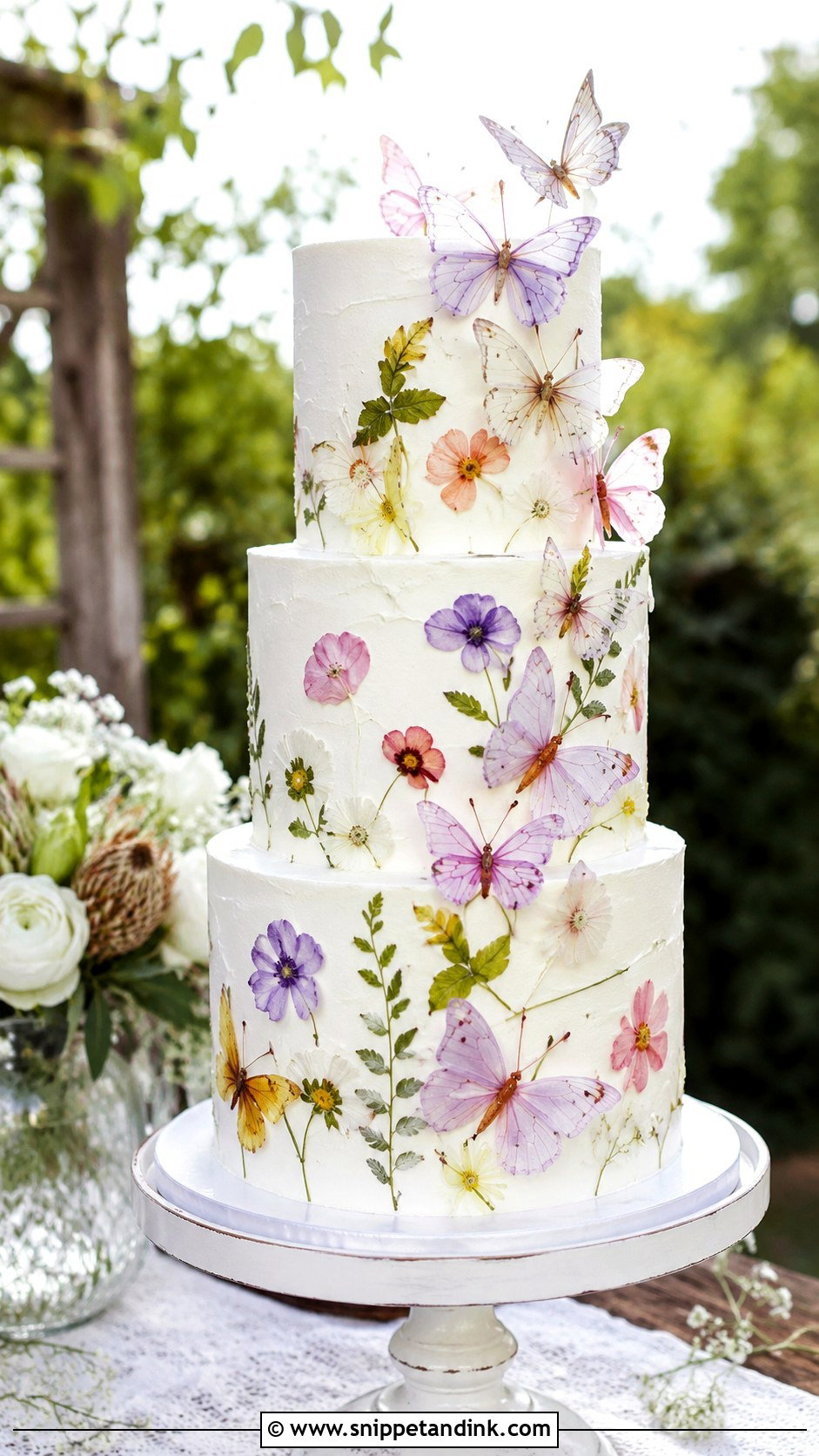
Pressed flowers and butterflies together make a meadow on the cake. The flowers must be edible varieties pressed for food use, like pansies, violas or cornflowers, and they’re pressed flat onto fresh buttercream. Pale yellow, lavender and blush suit it, with butterflies in matching shades. Pressed petals fade in strong sun, so if your reception is outdoors, keep the cake in the shade until the cutting.
17. Butterfly Wedding Cake With Greenery
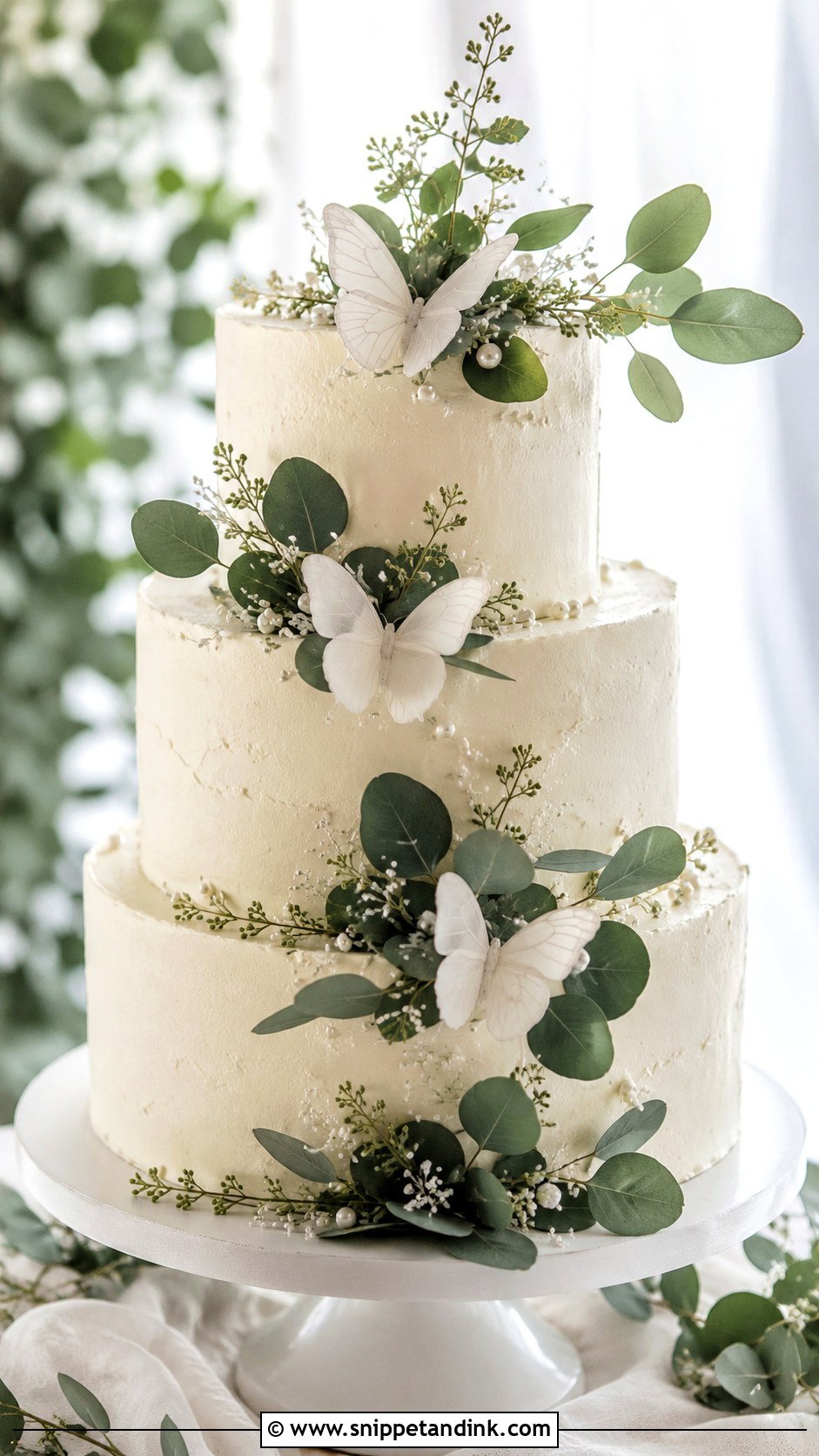
Greenery gives a butterfly cake a little structure. I use eucalyptus, olive leaves or fern, though eucalyptus shouldn’t touch the cake itself, so I wrap the stems and keep it on top or the board. Sugar or edible paper leaves are the safe alternative. White, gold or pastel butterflies soften the green. Semi-naked buttercream or smooth ivory tiers both work, with greenery kept to small clusters.
18. Butterfly Wedding Cake With Lace
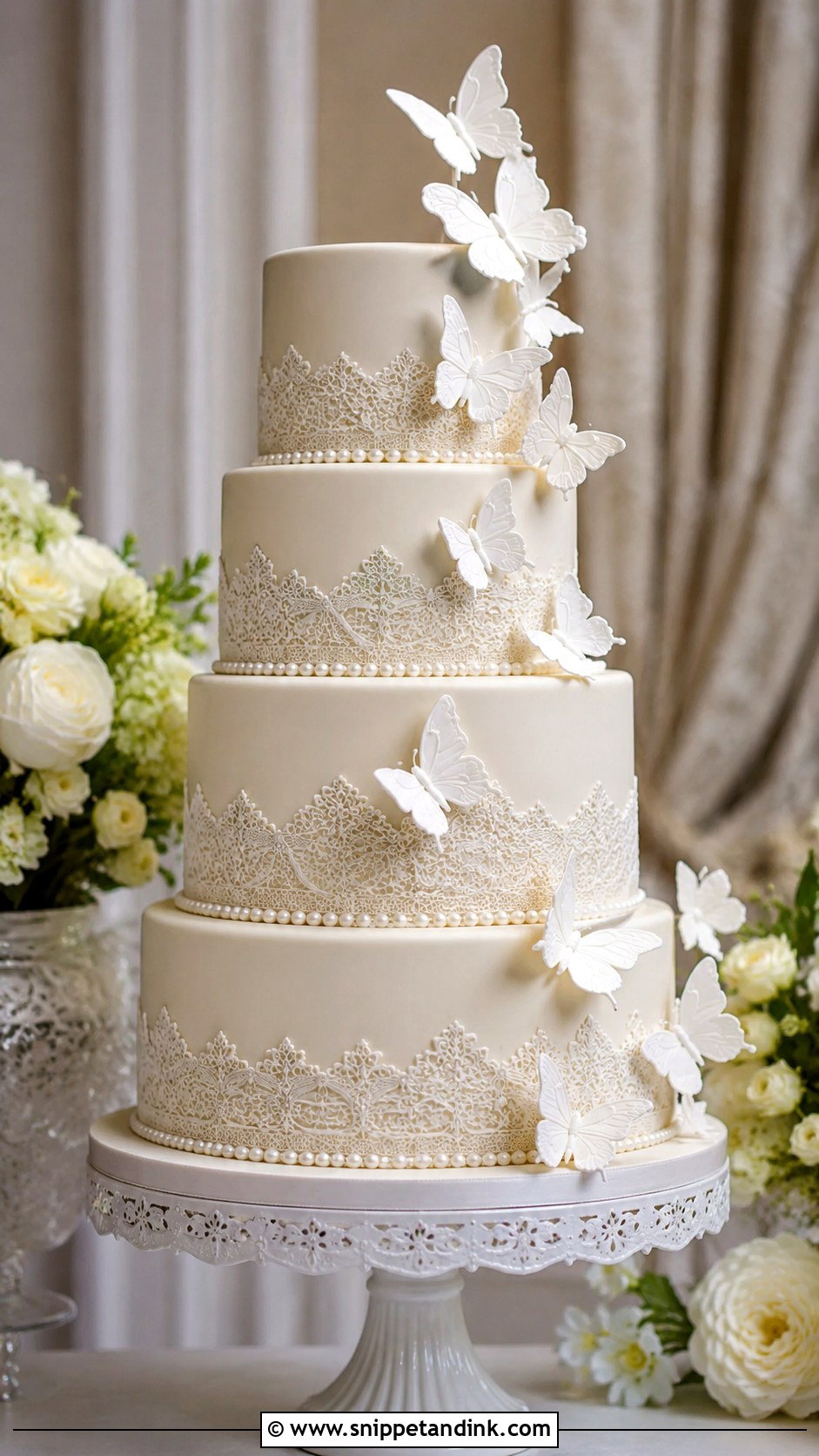
If there’s lace on your dress, veil or invitations, a lace tier is an easy way to tie the cake in. I make it with piped royal icing, a silicone lace mold or an embossed pattern on fondant. Ivory or champagne butterflies keep it soft. My favorite layout is a lace bottom tier, a smooth middle tier and butterflies rising to the top, so the cake doesn’t feel crowded. Ask your baker to bring a photo of your dress’s lace so the pattern can echo it.
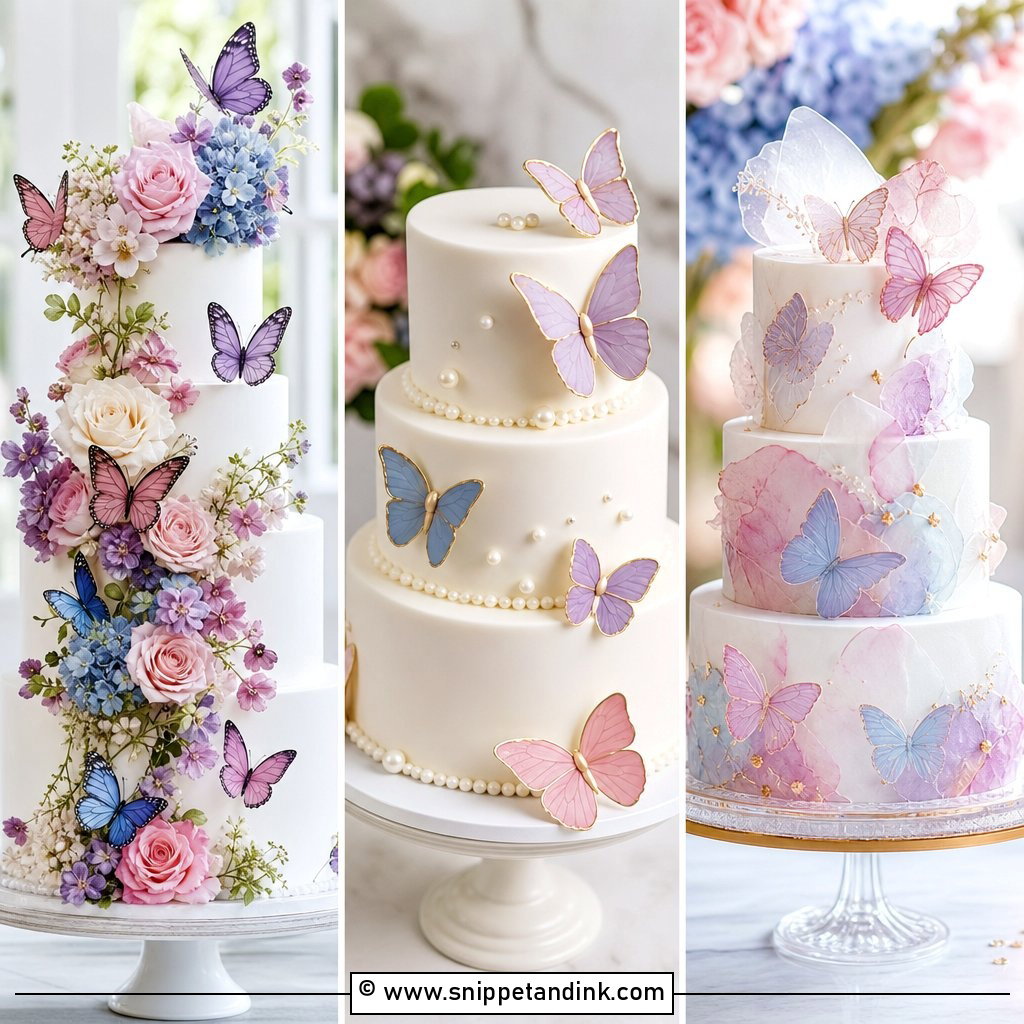
19. Butterfly Wedding Cake With Pastel Colors
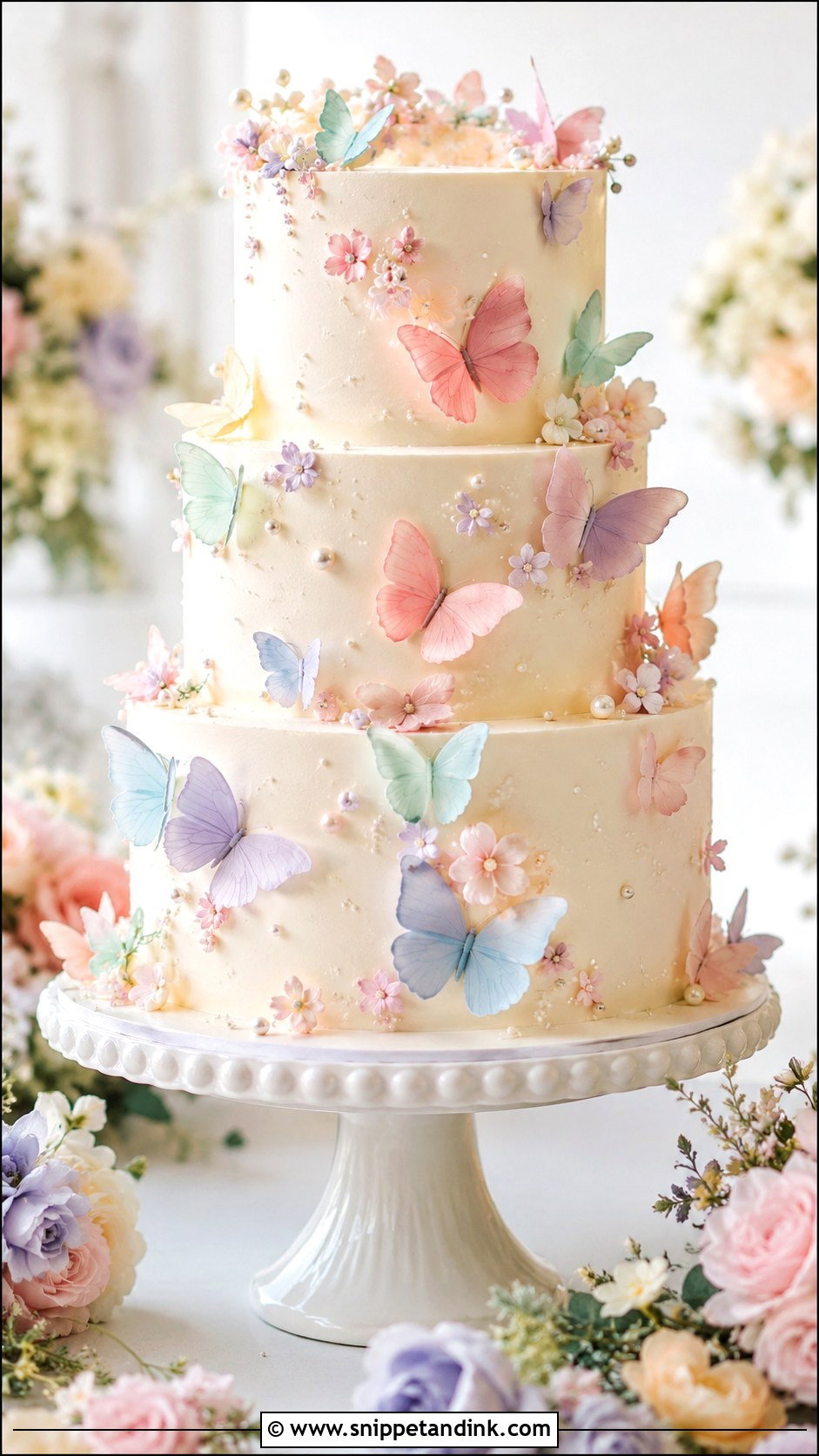
Pastels suit spring and summer. Blush, pale peach, mint, lavender and baby blue look soft together; once they get too saturated they look like a children’s party. I usually keep the base white and let the butterflies carry the color, or tint each tier very faintly. A loose butterfly trail across the tiers gives the whole thing movement. Smooth buttercream keeps it from looking homemade.
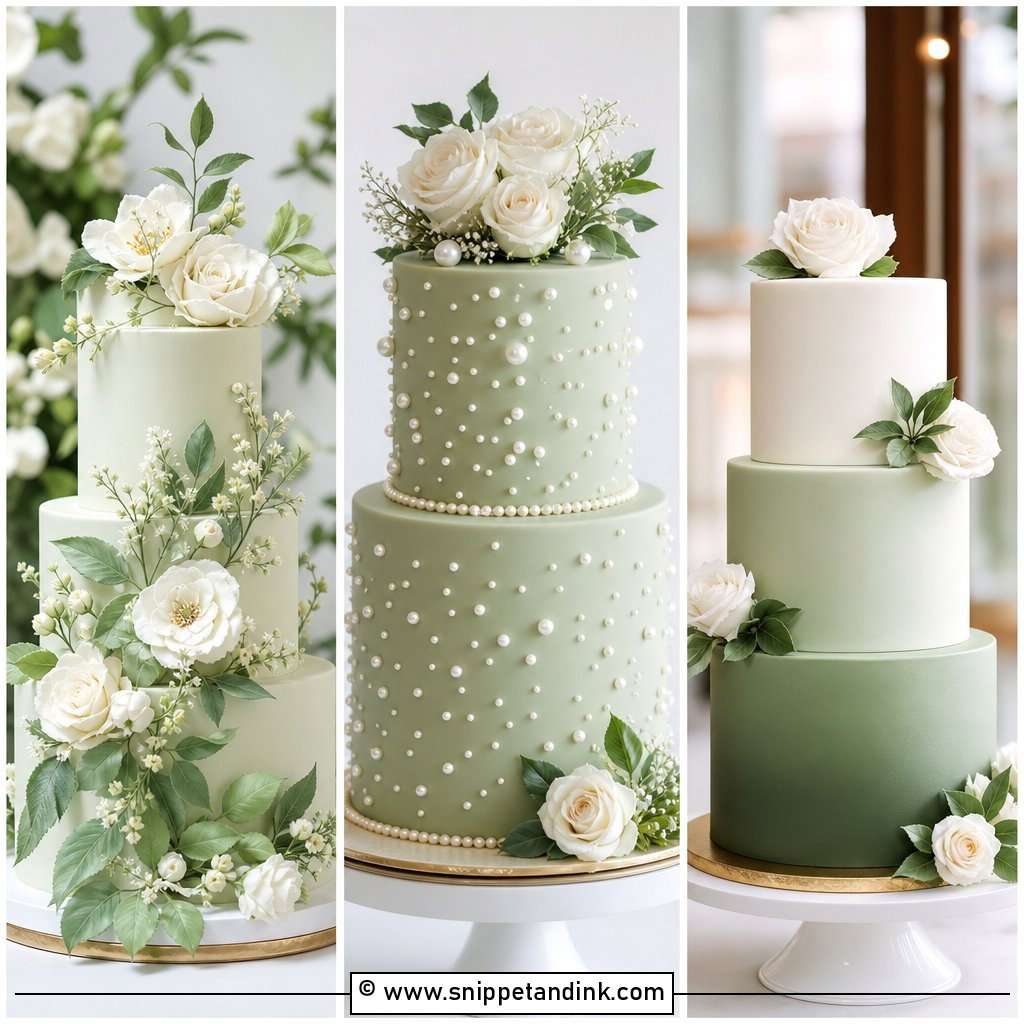


20. Butterfly Wedding Cake With Minimal Decor
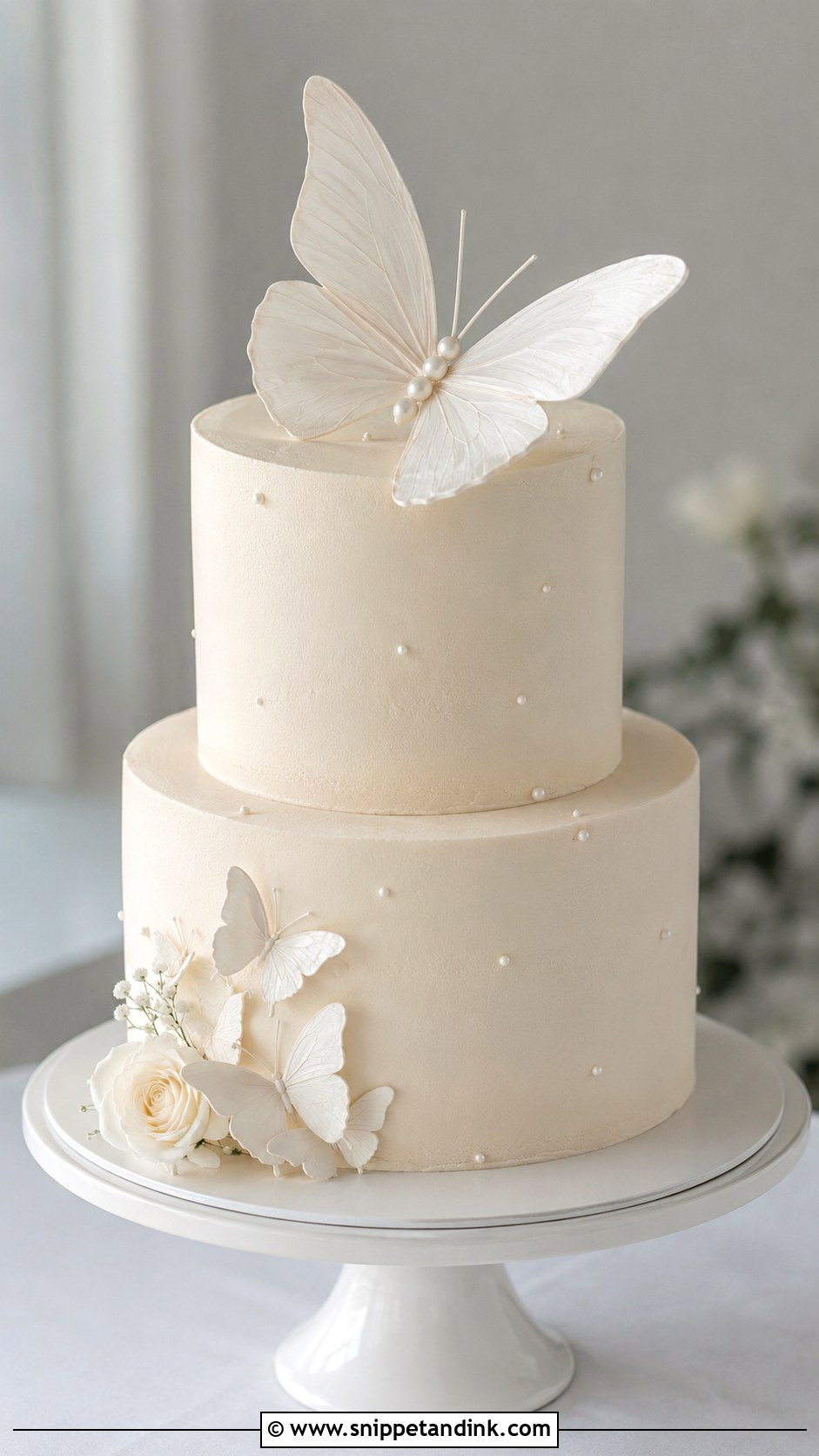
Minimal butterfly cakes are harder than they look, because there’s nothing to hide behind. The finish has to be flawless: sharp edges, smooth sides and no air bubbles. One large butterfly on the top tier and a small cluster near the base can be enough. A thin pearl border or a single sprig of flowers is the most I’d add. This is the version where placement does everything, so I usually photograph a mock-up before I commit.
Why Butterflies Wilt by Evening, and How Bakers Prevent It
The most common disappointment with butterfly cakes is a cake that looked crisp at three o’clock and droopy by the cutting. Moisture is almost always the reason. Buttercream releases moisture as it warms, the room fills with people, and thin wings start absorbing it.
Questions worth asking at your tasting
- What material will the butterflies be, and how do they hold up in a warm or humid room?
- Will they be added at the venue, or travel already on the cake?
- How are they attached? A dot of royal icing or melted chocolate holds better than pressing them into soft frosting.
- Can a few spares come along in case one breaks during setup?
- Where will the cake stand, and is it out of direct sun and away from heaters or kitchen doors?
For an outdoor or summer wedding, I’d lean toward gum paste butterflies on a ganache or firm buttercream base, which stays drier and steadier than a soft frosting. Wafer paper can still work outdoors, but it should go on as late as possible, and the cake should sit somewhere shaded until it’s cut.
Where the Butterflies Land Matters Most
A butterfly cake can be soft, colorful, classic or modern, depending on the cake underneath. The designs that work treat the butterflies as part of the cake, not stickers added at the end. Think about the base color, the frosting texture, any flowers, and the path the butterflies take. Wafer paper floats; fondant and gum paste hold sharper shapes. Pastels feel romantic, gold feels formal, white feels classic. And whatever you pick, ask your baker how they’ll keep the butterflies crisp in your venue’s conditions.
You'll Like These Ideas:




Leave a Reply