
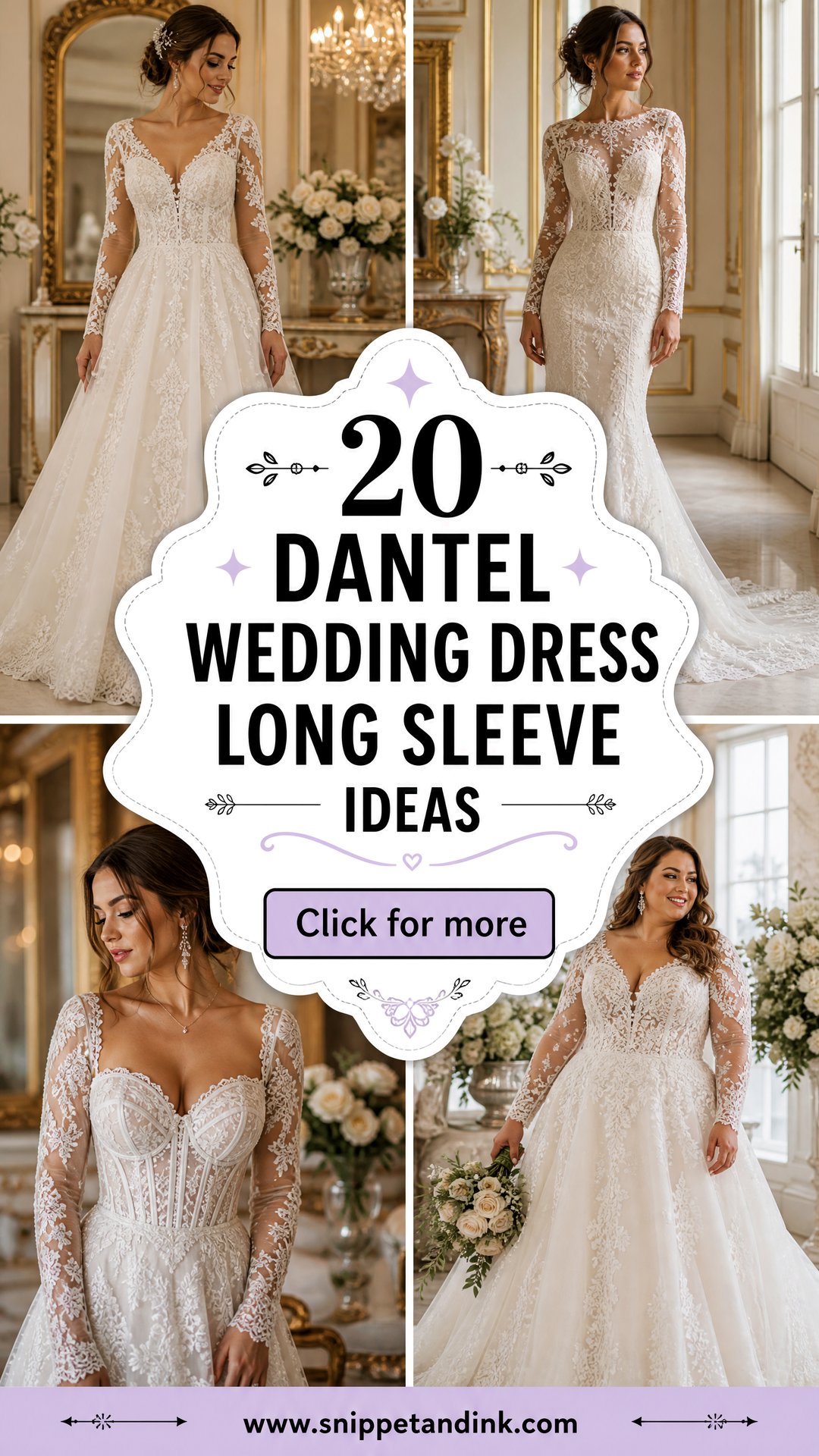
Most brides who ask me for a long sleeve lace gown are picturing the lace, but what decides whether they love it on the day is the sleeve: how it is cut, how the lace is placed on it and how it lets the arm move. “Dantel” is simply the Turkish word for lace, and it covers everything from a delicate lace effect on fine tulle to heavy corded motifs. Below are twenty complete looks, each with the silhouette, neckline, veil, shoes and jewelry I would put together for it, plus the fitting checks I run before I let a bride commit. Read them with your venue and season in mind, because a sleeve that feels right in a cool church can be hard work at a July garden party.
Reading a Lace Sleeve in the Fitting Room
Before I look at necklines or skirts, I look at the sleeve, because it is the hardest part of a lace gown to fix later. Sleeves are cut on a pattern that assumes a certain arm length and upper-arm width, and lace has far less seam allowance than satin. A bodice can be taken in by several sizes; a sleeve usually can’t be let out much at all.
Four checks I make on every sample
- Armhole height. A high, close armhole lets you lift your arm without the whole bodice rising with it. A low one looks fine standing still and pulls the dress up the moment you wave.
- Lace on stretch or rigid mesh. Pinch the sleeve lining. If it has no give, the lace will crease at the inner elbow and feel tight when you bend.
- Cuff finish. A scalloped lace edge at the wrist can be shortened by cutting around the motifs and re-stitching the scallop, but it is slow handwork. A plain hem shortens quickly.
- Motif placement. Good sleeves have lace placed symmetrically on both arms. Check that the left and right match at the elbow and the shoulder.
Bring the shoes and the undergarments you plan to wear, and give yourself time. Lace alterations, especially sleeves and hems with scalloped edges, generally take longer than plain fabric, so most seamstresses like to start fittings roughly two to three months before the wedding. Ask yours what they need; it varies a lot with how busy the season is.
1. A-Line Long Sleeve Lace Wedding Dress
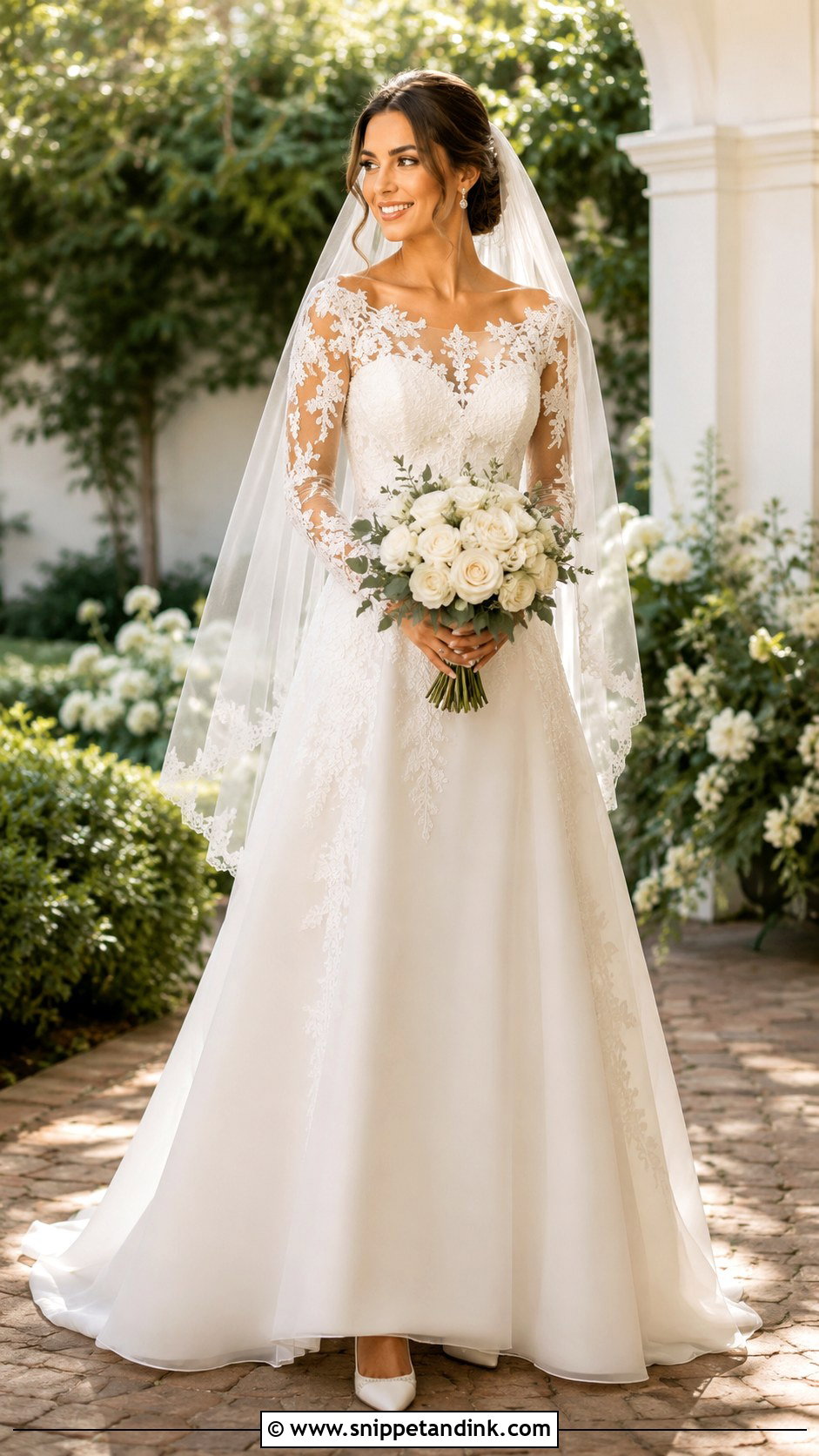
This is the shape I pull first for a bride who doesn’t yet know what she wants. The skirt leaves the waist without fighting the lace, and vertical floral motifs drawn down the bodice lengthen the whole line. I’d keep the styling quiet: pointed ivory pumps, pearl drops, a fingertip veil with a narrow lace edge and a small bouquet of white roses. A slim satin waistband helps if the bodice reads too soft on you. Bend your elbow fully when you try it on. If the sleeve lining has no stretch, the lace bunches at the inner arm every time you hug someone.
2. Ball Gown Long Sleeve Lace Wedding Dress
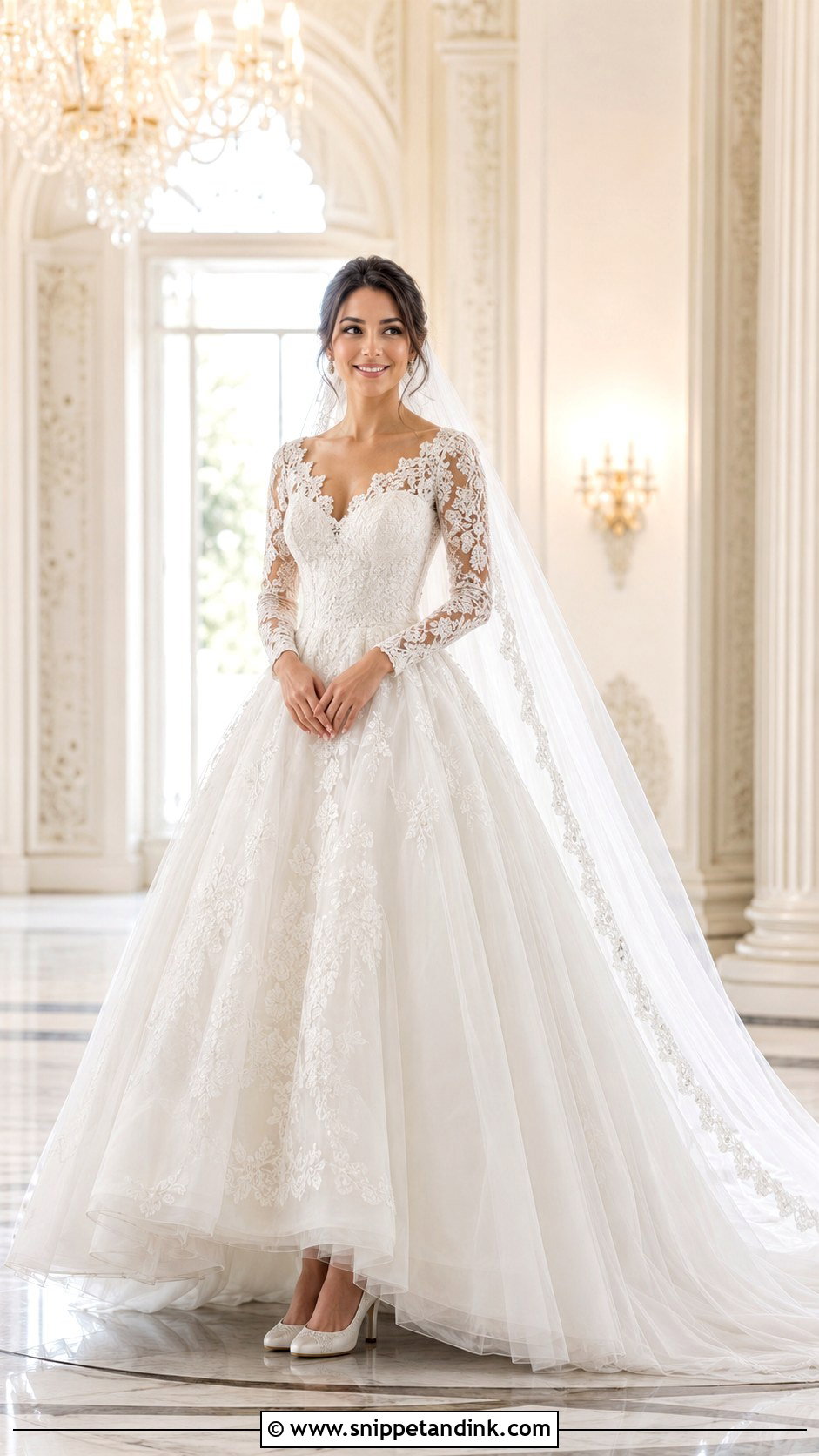
A lace ball gown is about volume, and long sleeves are what stop all that skirt from swallowing the bride. Look for a properly boned bodice, because the weight of layered tulle or organza pulls down on the waist seam all day. A softly curved neckline keeps it romantic. I’d pair it with a cathedral veil, crystal studs and closed satin heels that will barely be seen, and skip the necklace entirely if the bodice carries heavy appliqué. A low polished bun shows where the veil attaches. One honest warning: a full skirt and fitted sleeves together are warm, so I wouldn’t choose this for an outdoor summer ceremony.
3. Mermaid Long Sleeve Lace Wedding Dress
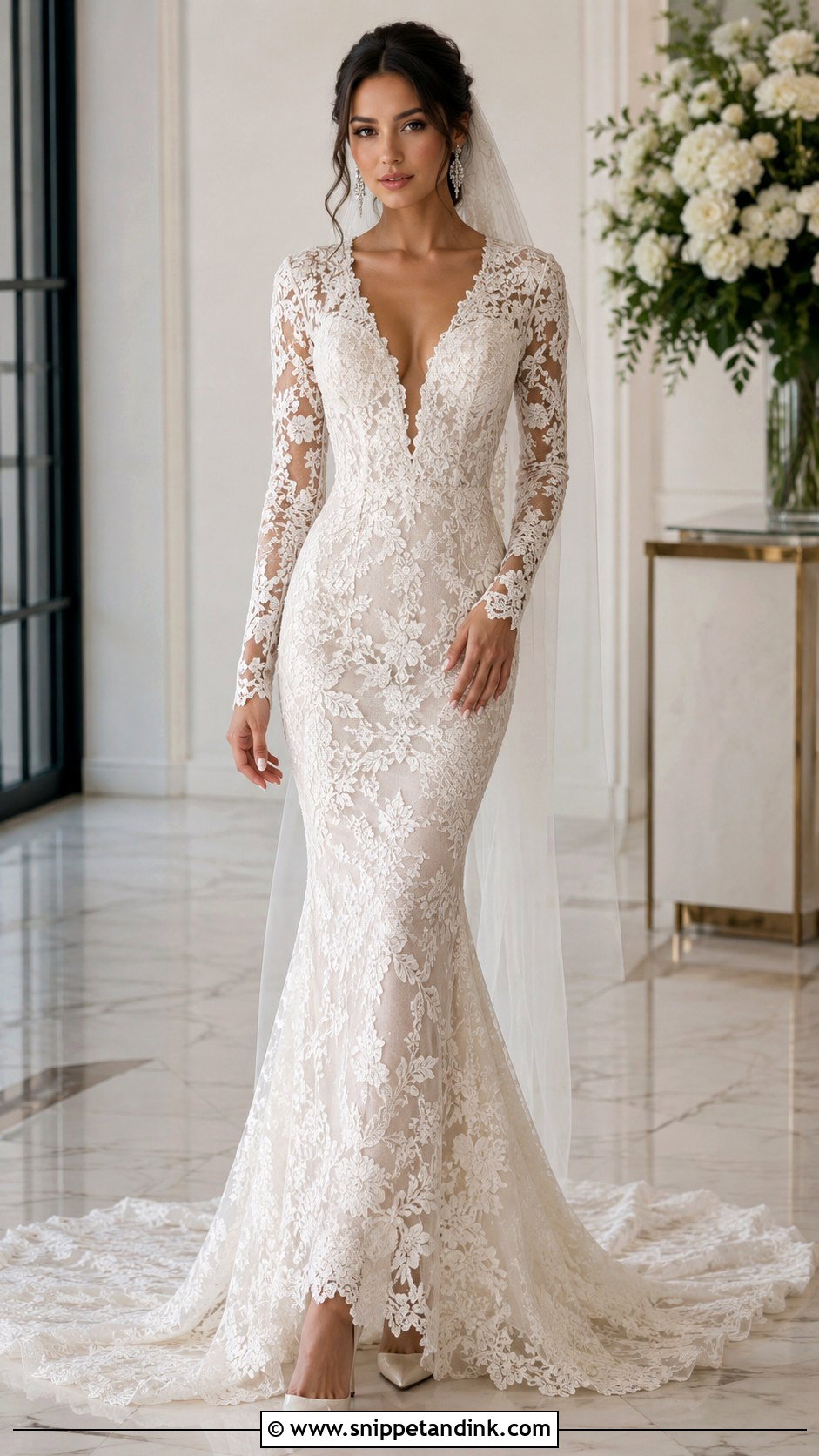
A mermaid lace wedding dress follows the body to the knee before it flares, and the long sleeves keep that close cut from looking bare. The lace matters more here than on any other shape. Dense, all-over pattern blurs the silhouette you are paying for, so I look for motifs spaced out with skin-tone tulle between them. A deep V or a sweetheart lining adds definition. Sleek hair, crystal earrings, pointed pumps and a chapel veil are all it needs. Walk the length of the fitting room before alterations are pinned, because the knee is where the flare starts and where your stride will be shortened. Ask for a hidden bustle so the train is off the floor by the first dance.
4. Sheath Long Sleeve Lace Wedding Dress
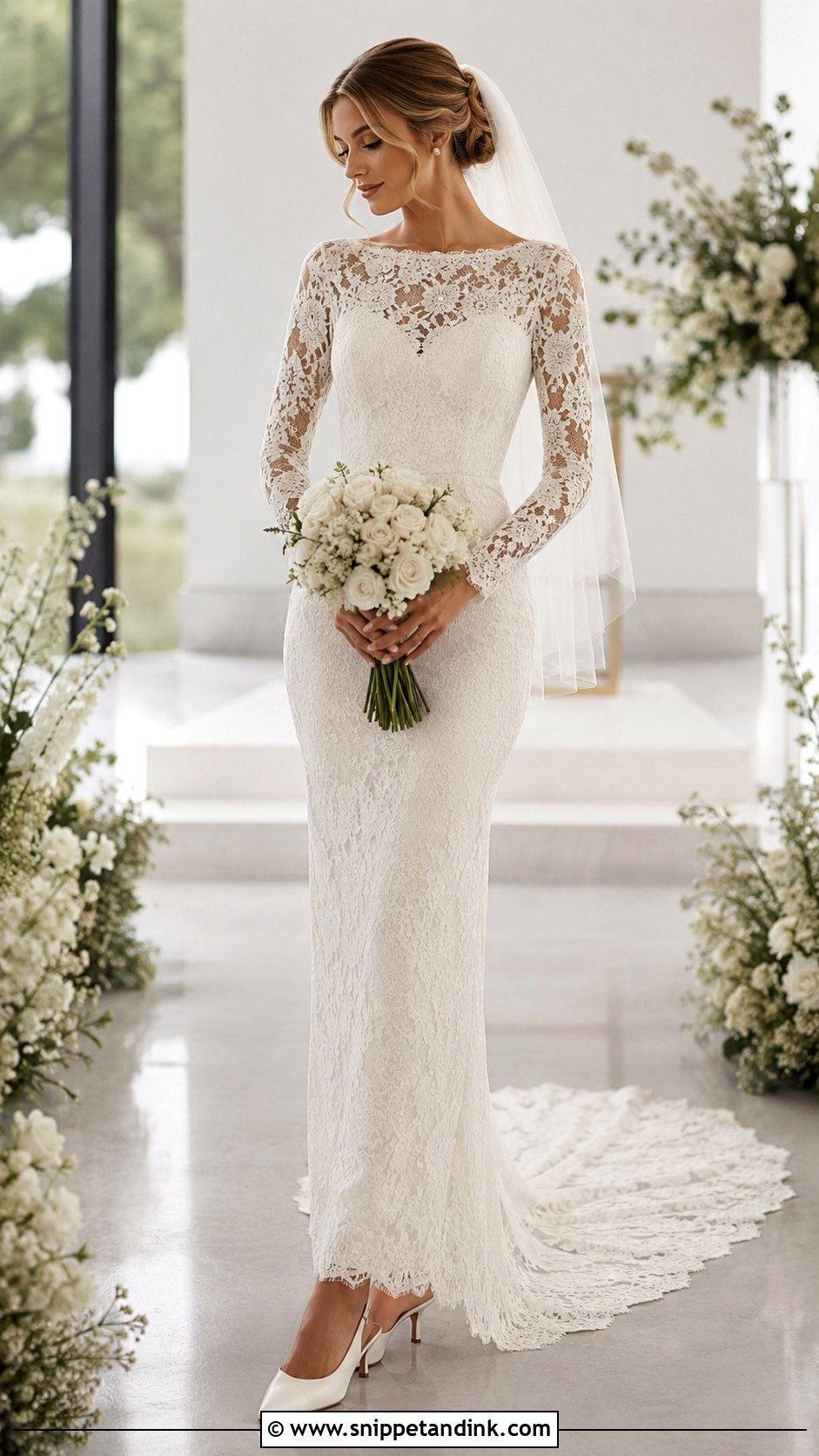
On a sheath, the fit is everything. It should skim, not grip, so the lace falls flat from shoulder to hem; if it’s pulled tight across the hips, the motifs stretch and you can see the net behind them. Sheer sleeves and a bateau neckline balance the coverage. I like low slingbacks, a compact bouquet and small studs here, with a narrow chapel veil for a bit of movement. A polished chignon or shoulder-length waves both suit it. I always ask the seamstress to check the knees, since a sheath that looks perfect standing still can make stairs awkward.
5. High Neck Long Sleeve Lace Wedding Dress
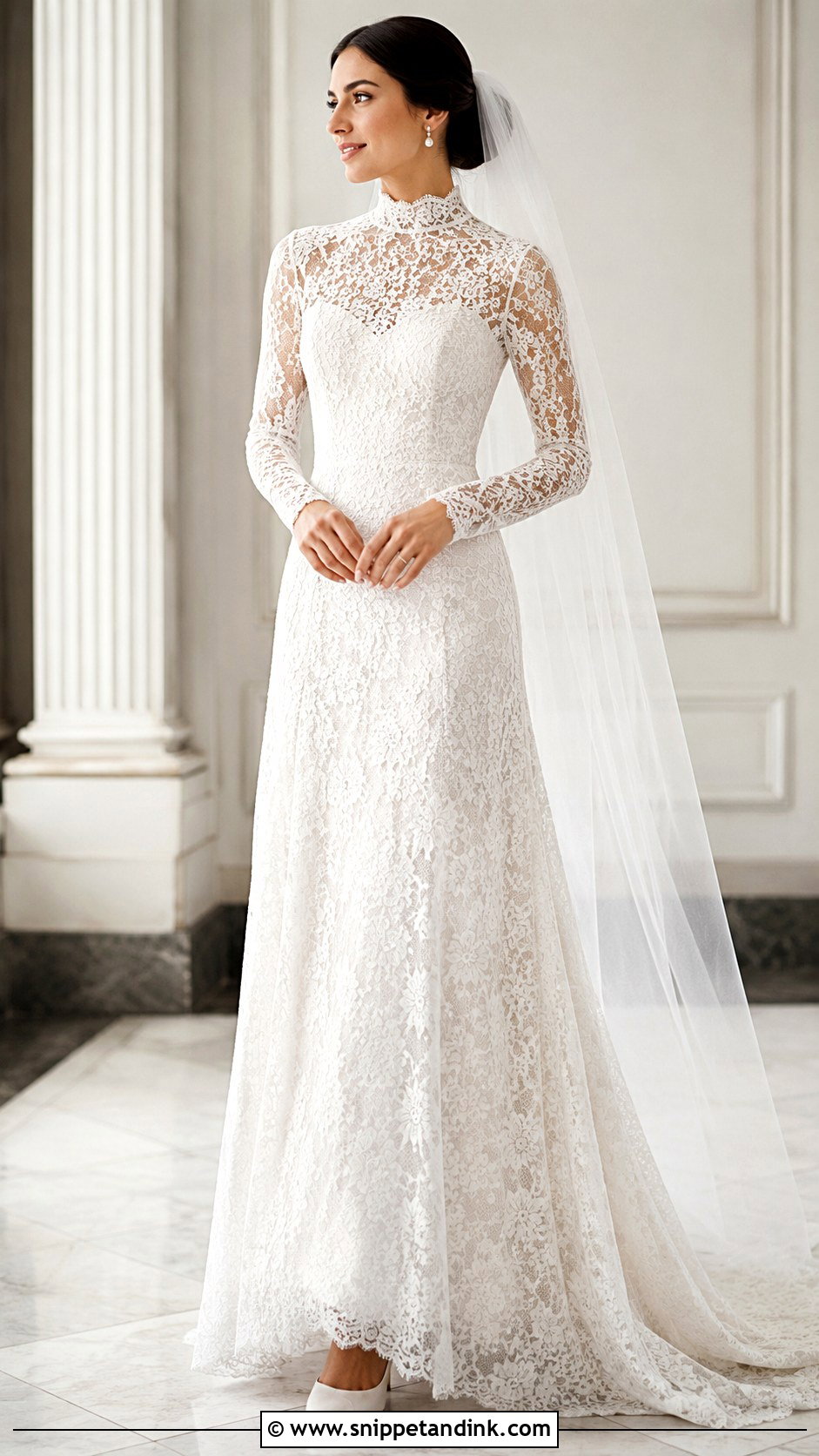
High necks are where I see the most regret, and it’s almost always about the collar, not the look. Fine Chantilly-style lace keeps the neckline light instead of heavy. Pair the fitted bodice and tapered sleeves with an A-line or a narrow column skirt, and don’t add a necklace: the collar is already framing your face. Pearl earrings, a fine bracelet and a smooth low bun are enough. A plain tulle veil gives the eye somewhere quiet to rest after all that lace. At the fitting, turn your head both ways and look down at your shoes. A collar that’s a few millimetres too tight will rub raw by the evening.
6. V-Neck Long Sleeve Lace Wedding Dress
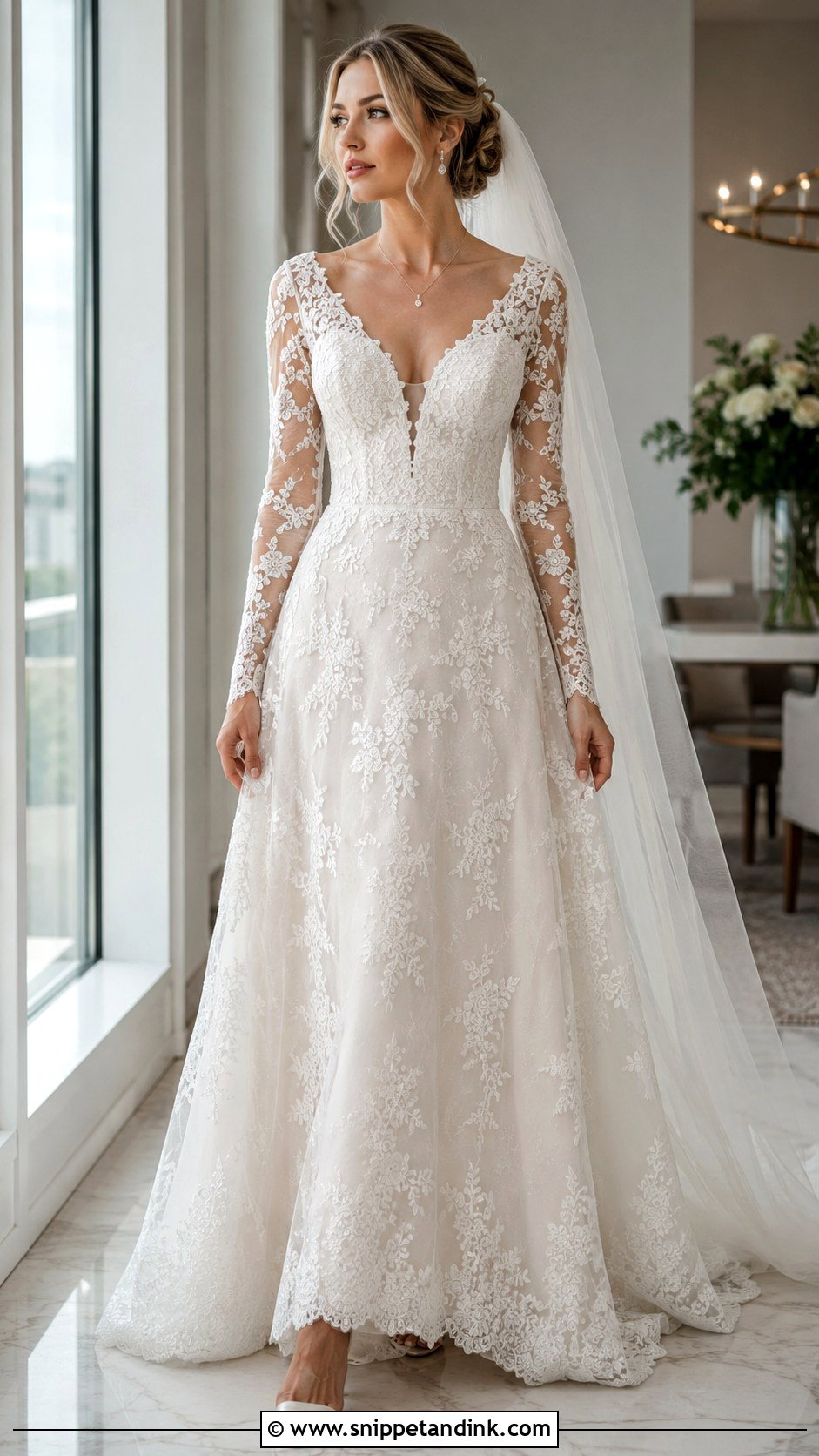
A V-neck opens up a long sleeve gown, and its depth should be decided by the support you need rather than by the sample. I’d have the bodice tailored close enough that it stays put when you lean forward to sign the register. An A-line skirt reads classic; a crepe skirt under lace sleeves reads current. A fine pendant, drop earrings, ivory heels and a veil set under a soft updo finish it, and with dense floral lace the jewelry should be smooth rather than sparkly. An illusion panel matched to your skin gives extra coverage without closing the neckline. During fittings I have brides sit, bend and raise both arms, because a plunging V is what moves first.
7. Square Neck Long Sleeve Lace Wedding Dress
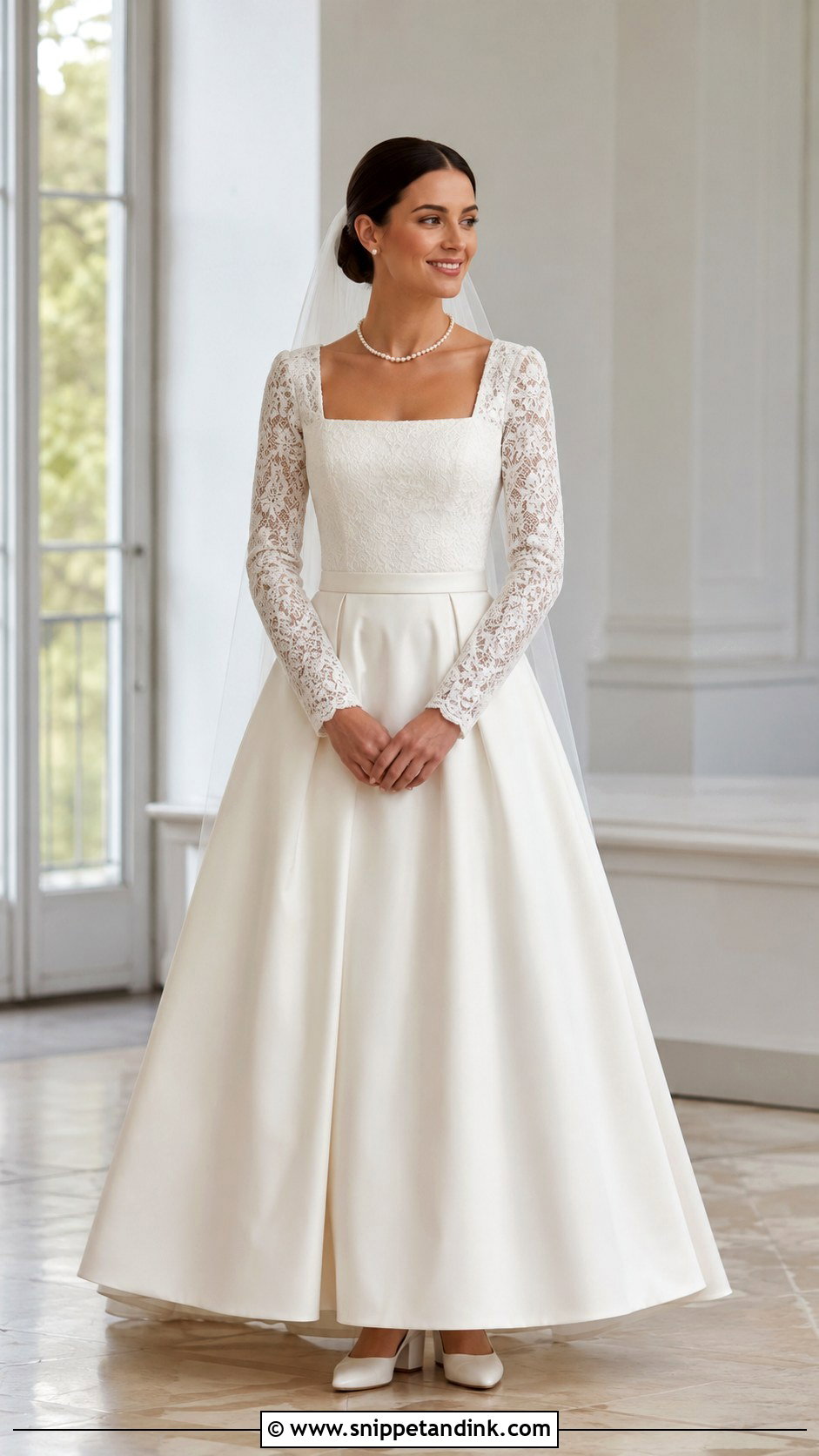
The square neckline frames the collarbones with a crisp edge, and long sleeves stop it from looking too severe. Go full A-line if you want softness, or straight if you want something architectural. Short pearls, pearl studs, block-heel pumps and a plain veil keep the focus where it belongs, and a centre-parted low bun repeats the neat geometry. The thing I check first is the two front corners. If they lift or curl when you breathe in, the bodice needs adjusting, and soft interior boning usually fixes it without making the top feel rigid.
8. Off-Shoulder Long Sleeve Lace Wedding Dress
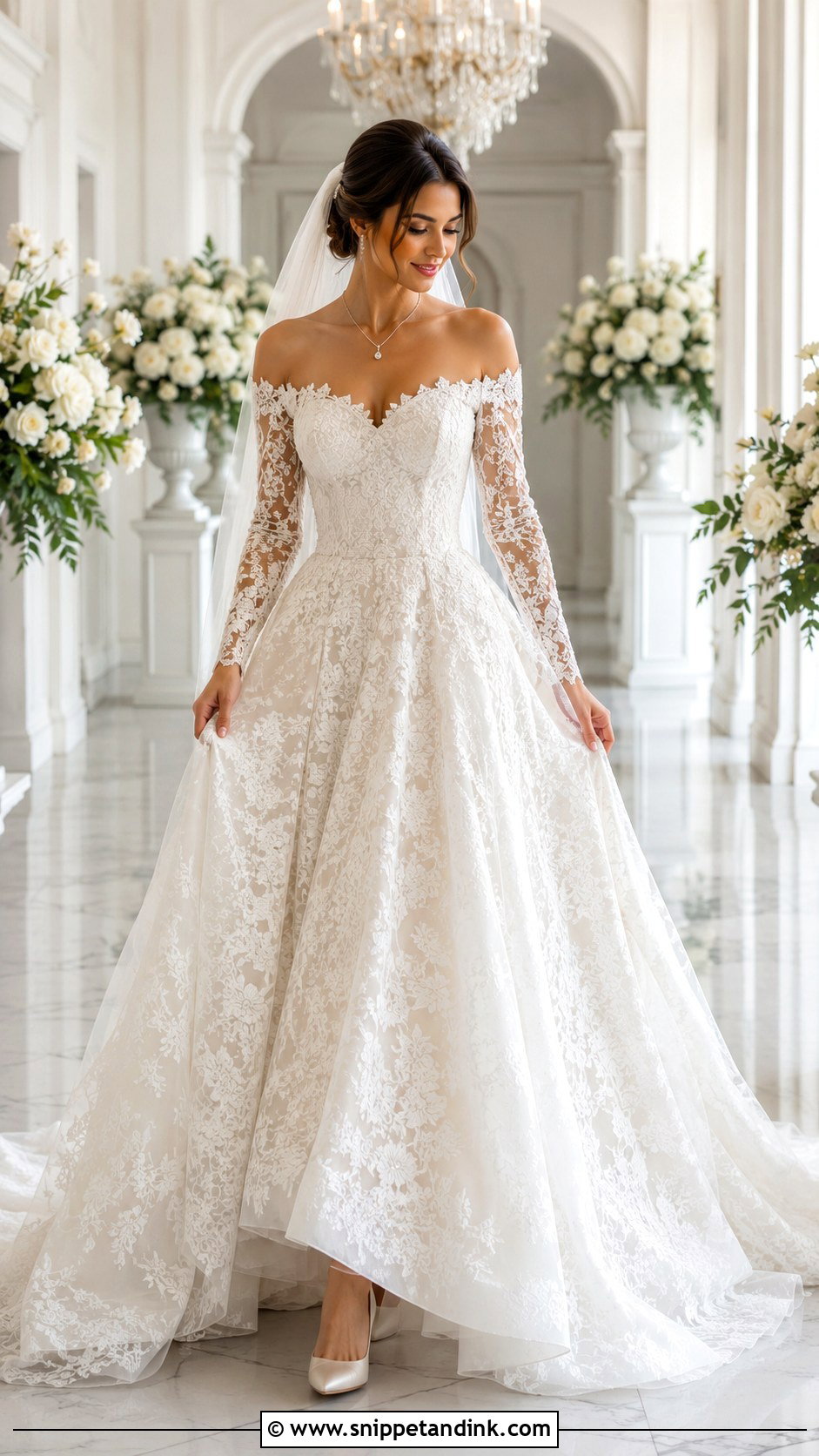
Off-shoulder lace looks romantic in photographs and can be miserable to wear if it’s built badly. The neckline must be held up by an inner corset, not by the sleeves, otherwise it slides every time you lift your arms. A softly draped lace edge across the shoulders, with an A-line or ball gown skirt, balances the bare neckline. I’d style a collarbone-length necklace, small earrings, a loose low bun and a chapel veil tucked under the hair, with ivory pumps or embellished block heels. Hug your partner during the fitting and reach as if for a glass. If the neckline rises or twists, it isn’t ready.
9. Illusion Sleeve Lace Wedding Dress
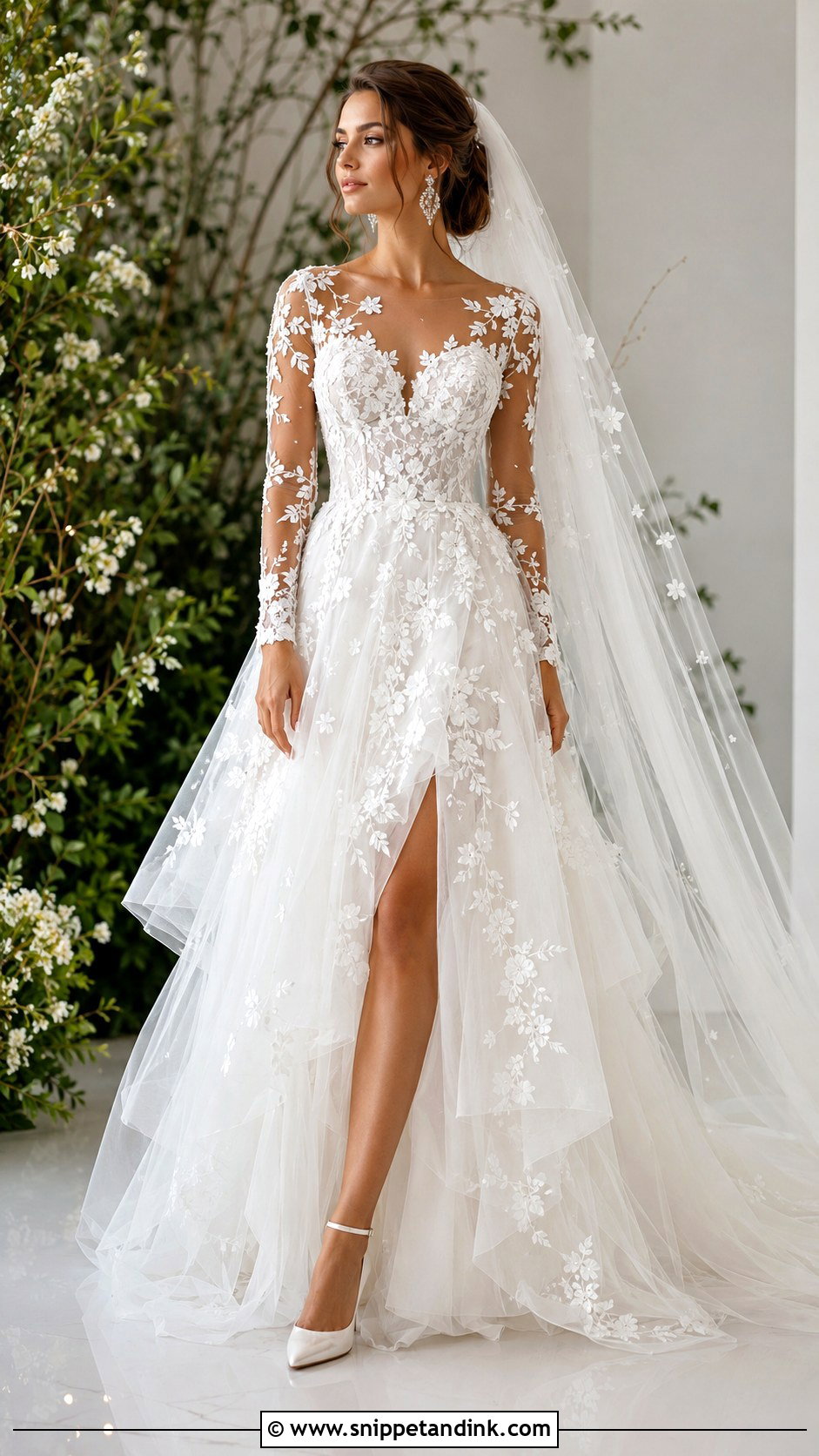
With illusion sleeves, the lace looks as though it’s sitting on bare skin. That only works if the mesh is close to your skin tone, so I hold the sleeve against the inside of the bride’s wrist in daylight before we order. Motifs should be spaced evenly over the shoulder, elbow and cuff, with no bare stretch at the inner arm. A fitted bodice and a flowing tulle skirt, crystal earrings, satin heels and a veil scattered with matching appliqués make it cohesive. Wear your hair up so the sleeve work is visible. Check it under indoor lighting too; warm bulbs can turn the wrong mesh shade slightly grey.
10. Bell Sleeve Lace Wedding Dress
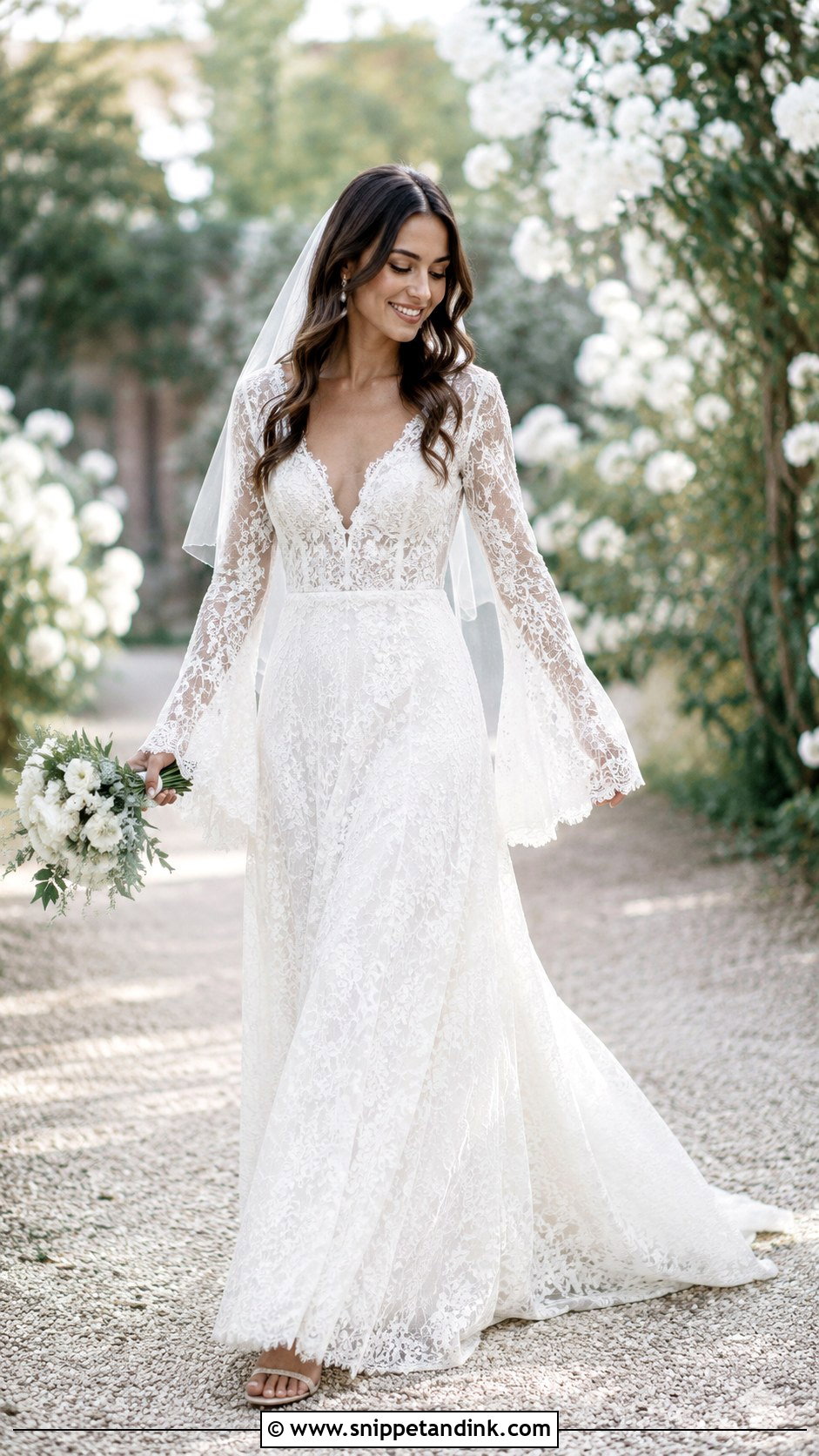
Flowing bell sleeves need to stay fitted through the upper arm, or the whole dress starts to look like a costume. Let the flare begin at the elbow or wrist and keep the rest simple: a V-neck bodice, a soft A-line skirt, low block heels, fine drop earrings, loose waves and a light veil or lace hairpiece. Skip bracelets, since the cuff already brings plenty of detail to the hands. My practical worry with this sleeve is food and candles. A wide lace cuff drags through sauce at dinner and swings over table settings, so I often have a discreet wrist loop added for the reception.
11. Puff Sleeve Lace Wedding Dress
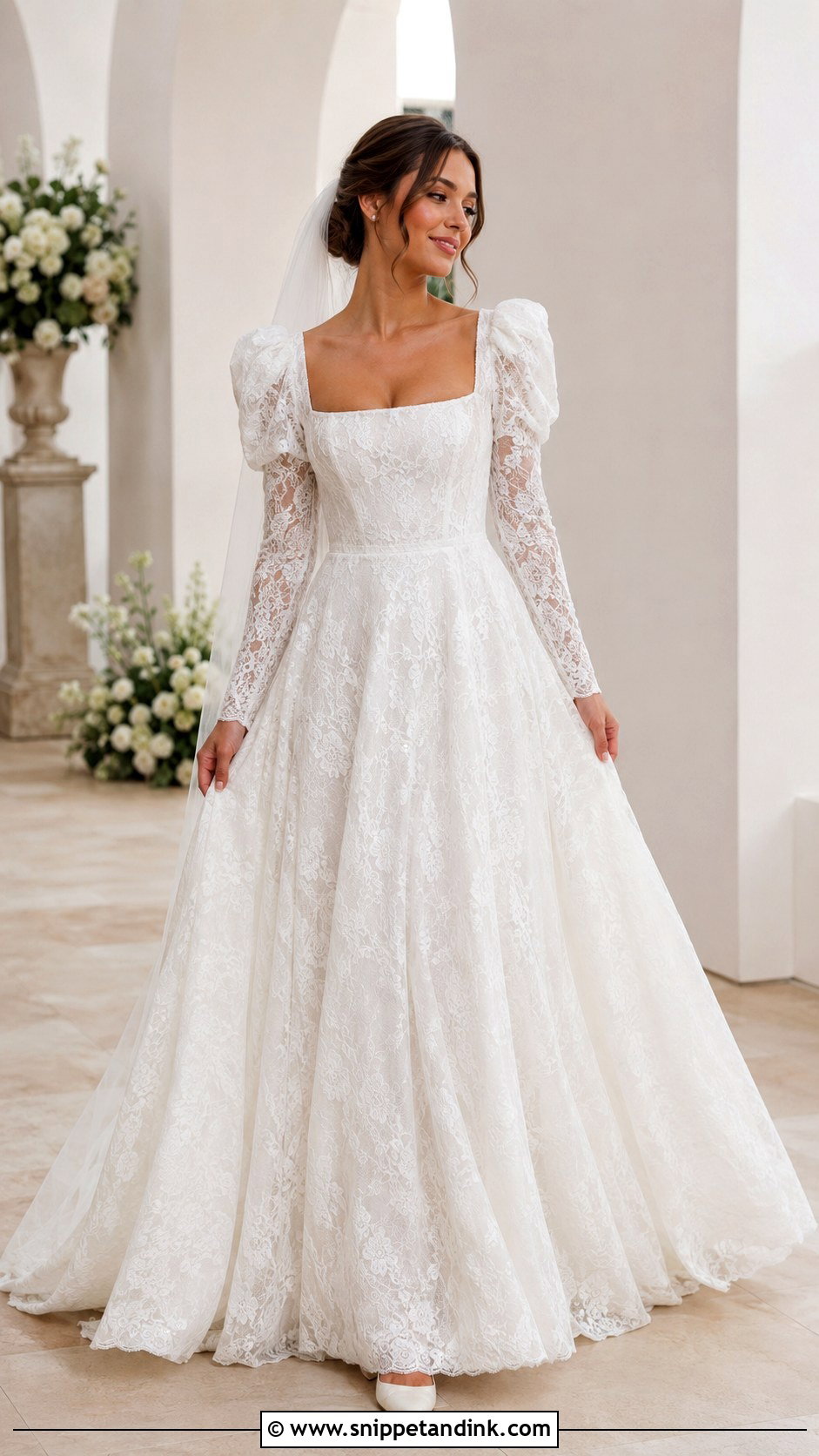
Puff sleeves sit on a fine line between distinctive and theatrical. I keep the volume small at the shoulder and fitted from the upper arm to the wrist, then leave the skirt plain so the sleeve is the only statement. A square or curved neckline, a fitted waist and an A-line skirt suit it, with pearl studs, a sleek bun, pointed heels and a plain fingertip veil. No heavy necklace. If your shoulders are broad, choose soft gathers rather than a structured puff, which adds visual width exactly where you don’t want it. The sleeve head is fiddly to alter, so make sure it sits on the shoulder point and doesn’t collapse when you raise your arm.
12. Detachable Sleeve Lace Wedding Dress
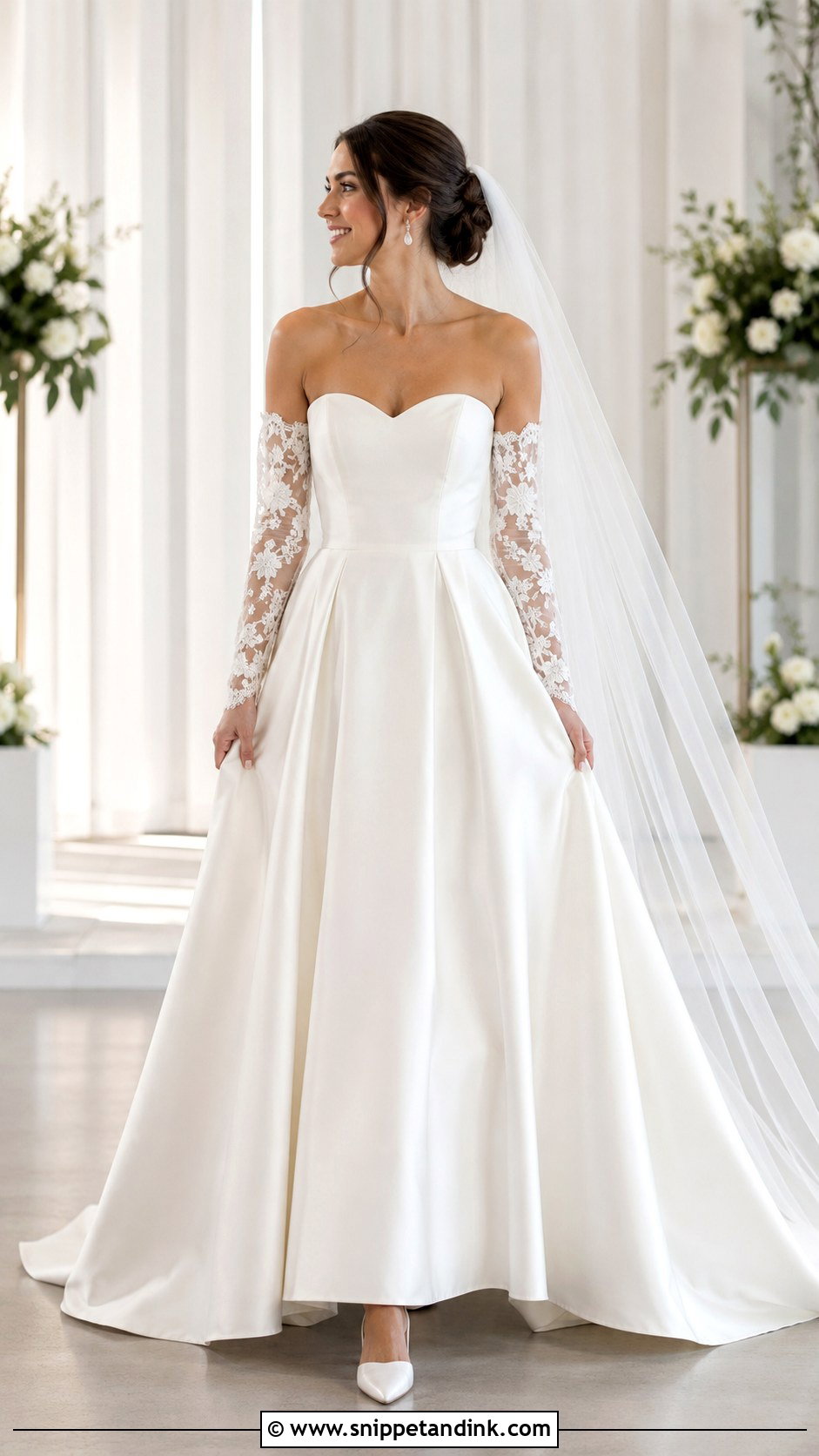
Detachable sleeves give you two looks from one dress, and I suggest them a lot to brides who want coverage for a religious ceremony and freedom for dancing. Start with a strapless or sleeveless gown and add lace sleeves, or a matching lace topper, for the service and formal portraits. A long veil, drop earrings and closed pumps suit the ceremony version; switch to bolder earrings or a short veil afterwards. The lace has to match the dress in colour and pattern, so order the sleeves with the gown rather than sourcing them later. Practise putting them on and taking them off with whoever will help you, because hooks under a bodice edge are awkward to reach on your own.
13. Corset Long Sleeve Lace Wedding Dress
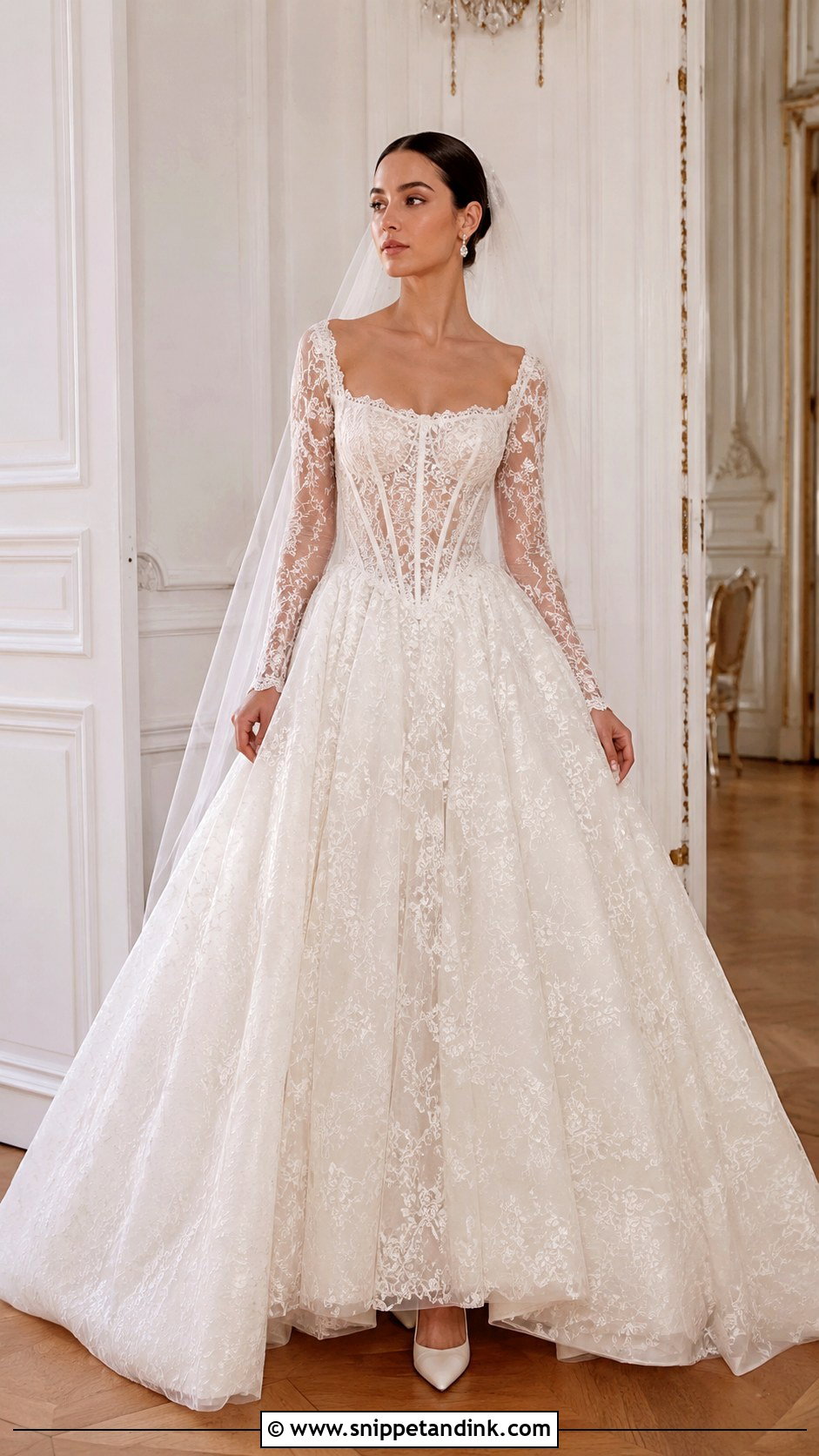
A corset bodice does the supporting so the lace doesn’t have to. Visible boning beneath floral lace looks modern, and it pairs with an A-line, ball gown or fitted skirt depending on how much drama you want, from a natural or basque waist. I’d finish it with a plain tulle veil, crystal earrings, satin pumps and a smooth low bun, and hold back on any other embellishment. Tighter is not better. You should be able to take a full breath, sit down to eat and lift your arms without the sleeve seams pulling against the corset, because those two pieces fight each other when the fit is off.
14. Basque Waist Long Sleeve Lace Wedding Dress
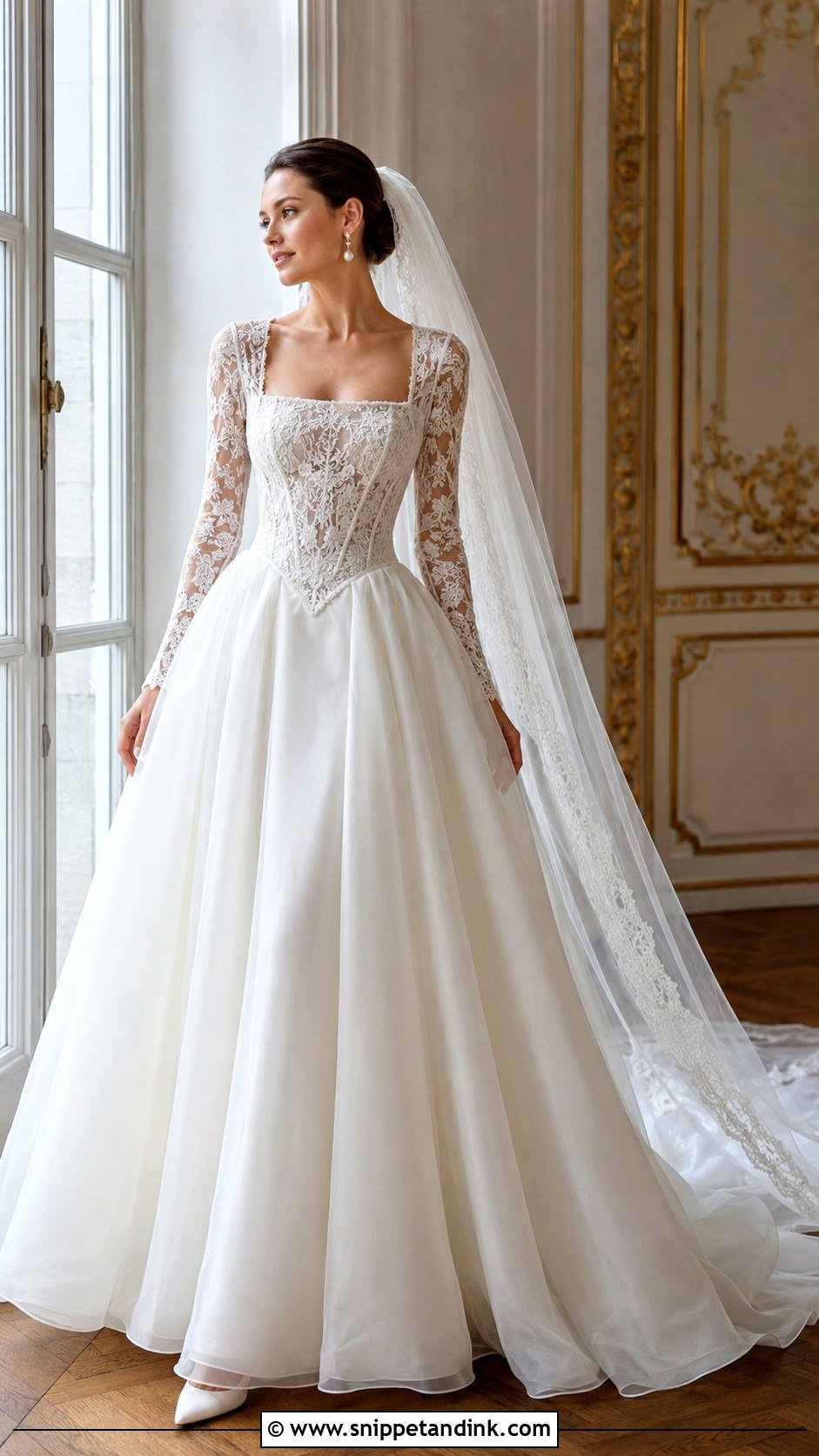
The basque waist dips to a point at the centre front, so it shapes the transition into the skirt without needing a belt. With lace sleeves and a full tulle, organza or satin skirt, you get clear contrast between texture and volume. A scoop or square neckline softens that point. Pair it with a cathedral veil, pearl earrings, low satin heels and a neat updo, and never add a belt, which cuts straight across the V. The detail I ask the seamstress for every time is motif matching at the side seams. When lace is cut straight across a seam, the pattern stops abruptly and the waist looks lopsided.
15. Open Back Long Sleeve Lace Wedding Dress
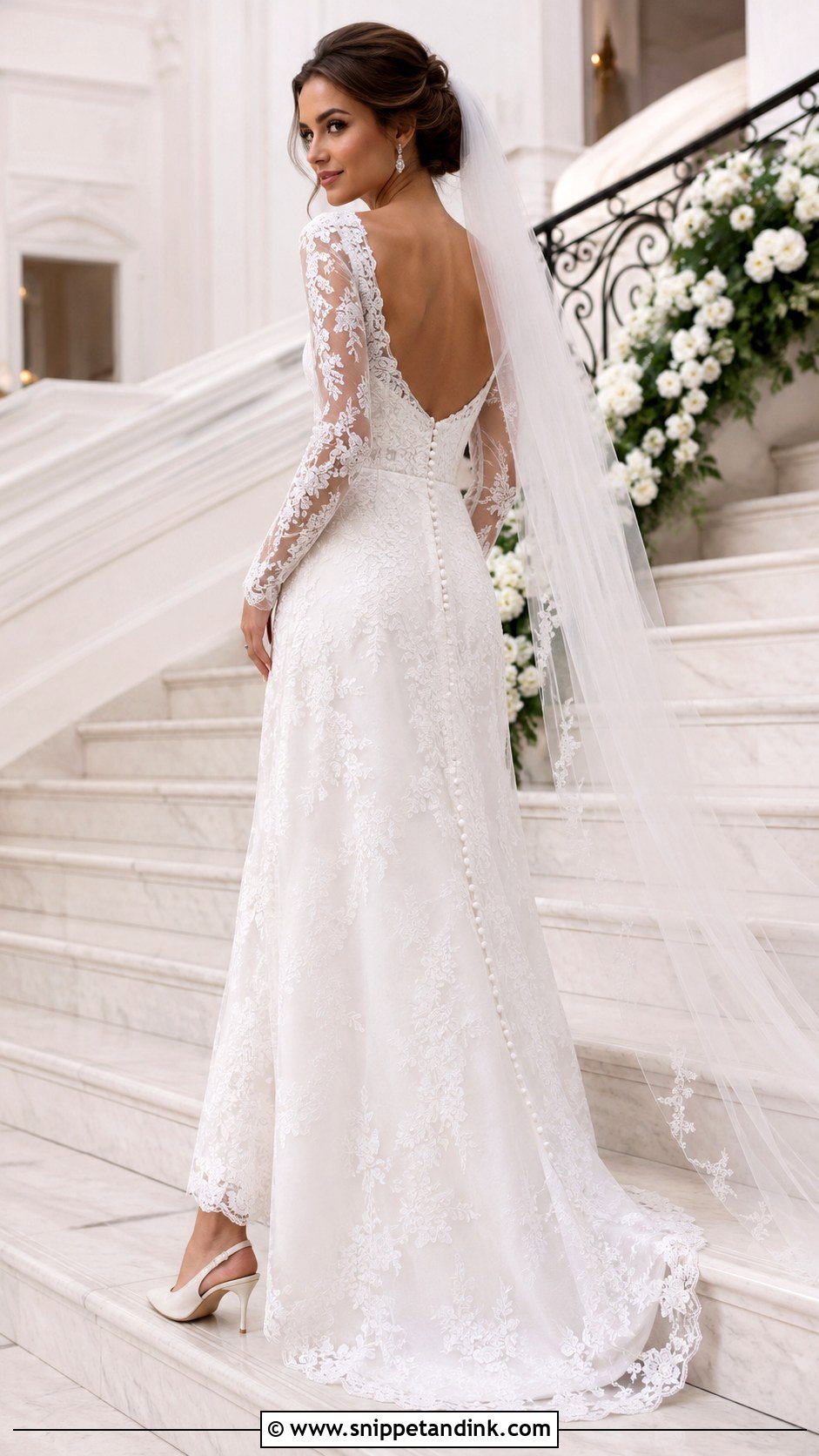
Covered arms and a bare back make a satisfying contrast. The back can be a low scoop, a narrow V or an illusion panel edged in appliqué, and the depth should be settled together with your undergarment plan, ideally at the first fitting. A sheath or gentle A-line keeps it refined. Set the veil below a polished updo so it doesn’t hide the back in every shot. Delicate earrings, an optional back necklace and ivory slingbacks are plenty. I watch the lace edges when a bride walks and sits. If they gape away from the skin, the fix is usually a few extra loops or a strip of interior support, not a smaller size.
16. Boho Long Sleeve Lace Wedding Dress
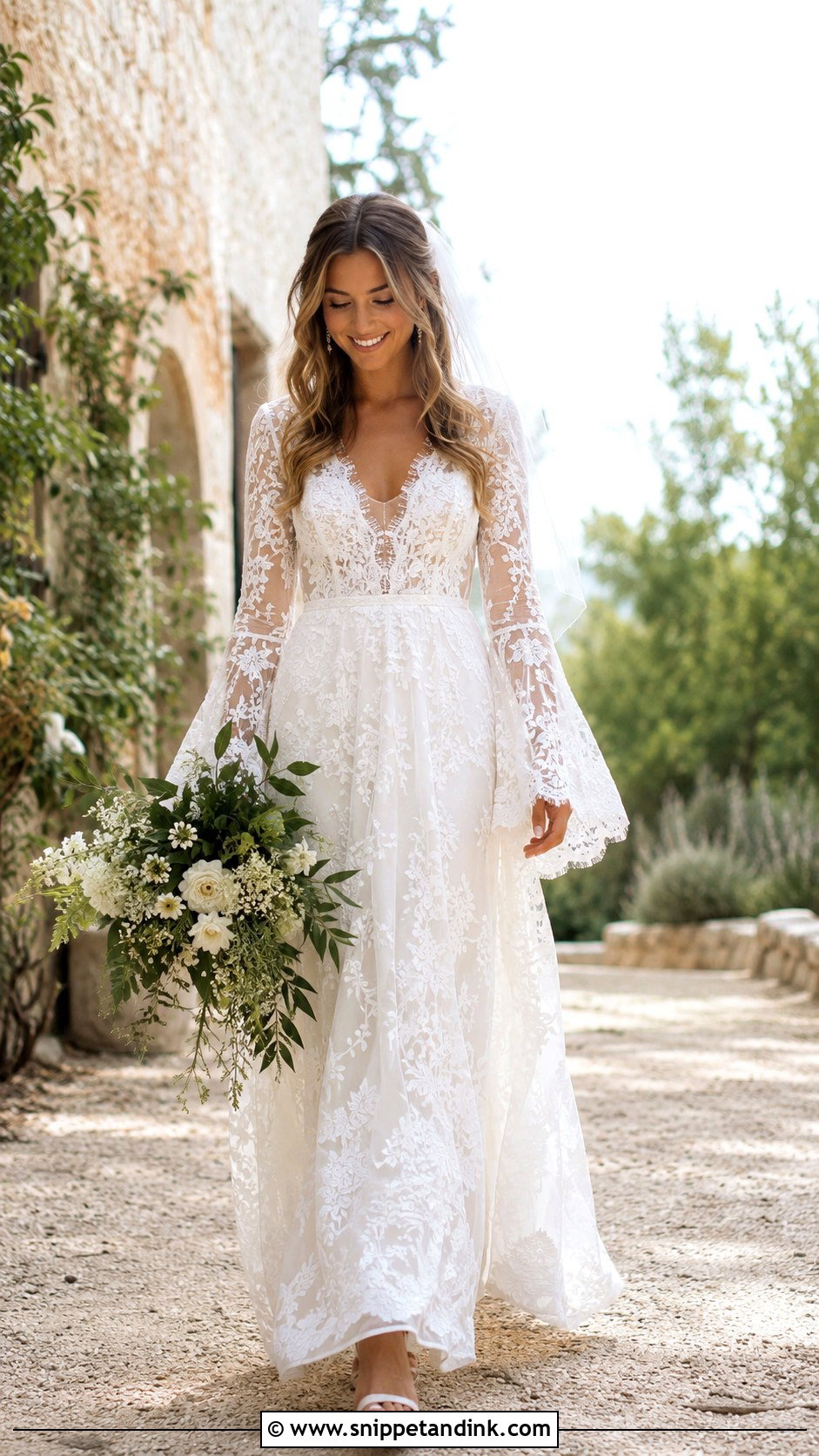
Boho lace relies on softness: a lightly fitted bodice, an open V, a floating skirt and sleeves that taper or flare a little at the cuff. Crochet-style or botanical lace carries the mood without heavy beading. Low block-heel sandals, loose waves, small earrings and a bouquet of greenery with small white flowers suit it, with a light veil or a floral comb. Outdoors, I’d prioritise a breathable lining over anything else, since lace sleeves trap heat quickly in direct sun. Check the skirt on grass in your actual shoes. A practical bustle will protect the train after the ceremony.
17. Vintage Long Sleeve Lace Wedding Dress
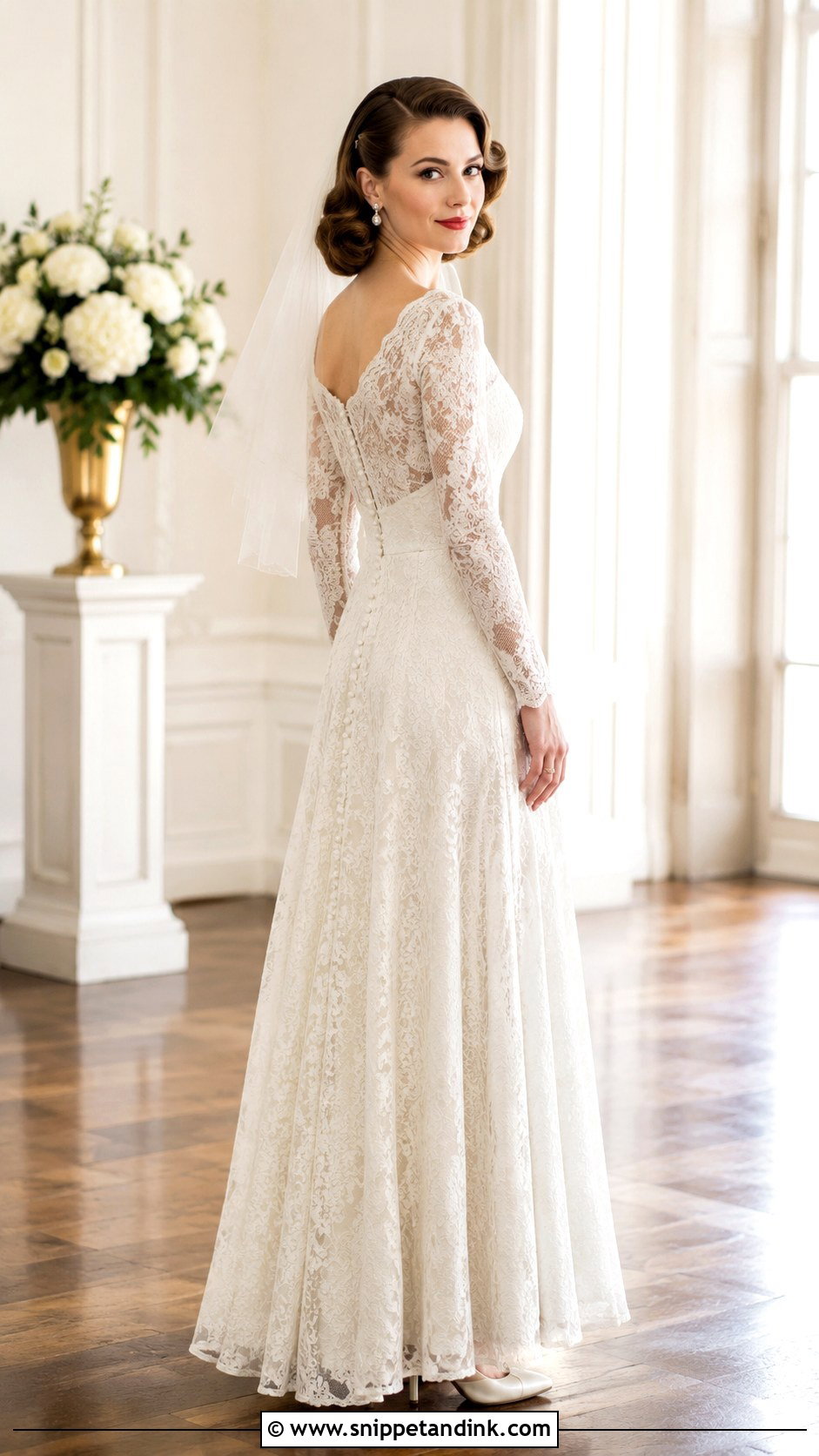
For a vintage feel, I look for a high or bateau neckline, fitted sleeves, covered buttons and a softly defined waist, with fine floral lace over an ivory or pale champagne lining so the pattern has depth. Pearl earrings, a birdcage or fingertip veil, low pumps and softly waved hair gathered low complete it. Stop there. Add a cameo, gloves and a period bag as well and it tips into fancy dress. Modern tailoring and a comfortable lining keep it wearable. Look at antique-coloured lace in daylight before buying, since some shades read as aged cream and others as yellowed.
18. Minimal Long Sleeve Lace Wedding Dress
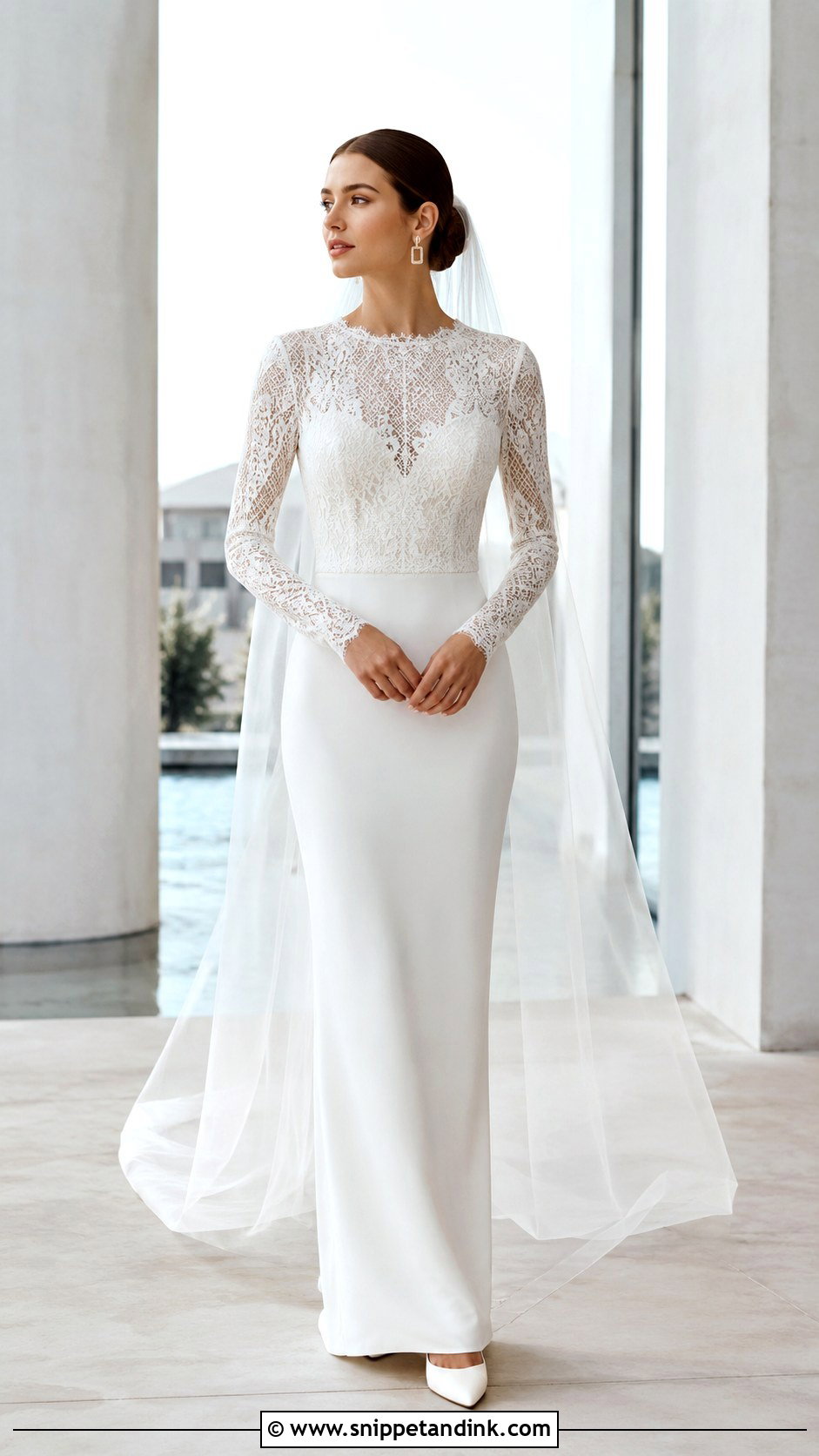
Can lace be minimal? Yes, if you limit where it goes. I’d choose a sheath or narrow A-line with lace only on the bodice, cuffs or back, and a plain crepe skirt that contrasts with the texture above. Geometric studs, pointed pumps, a plain cathedral veil and a centre-parted low bun are all the styling needed; no ornate belt, no layered jewelry. A simple dress hides nothing, so fit is unforgiving. Shoulder seams have to sit exactly on the shoulder, cuffs must end cleanly at the wrist bone, and the skirt can’t pull across the hips.
19. Plus Size Long Sleeve Lace Wedding Dress
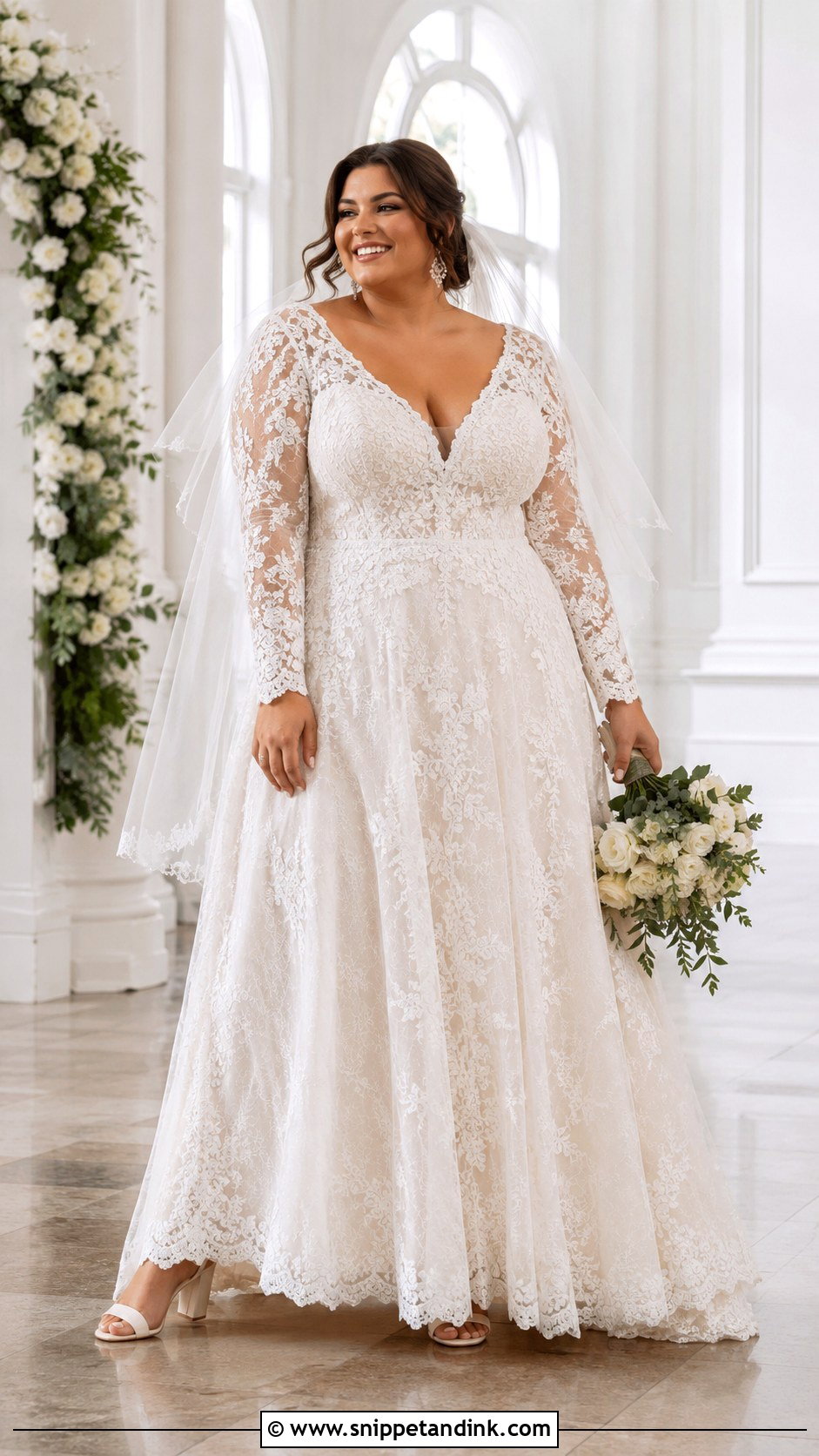
For plus-size brides I start with construction, not with rules about hiding anything. A supportive bodice, a defined waist, an A-line skirt and sleeves with some give in the lining make a reliable base. Pick the neckline you feel most like yourself in, whether V, square, scoop or high illusion. Stable block heels, comfortable undergarments, statement earrings and a veil scaled to the dress finish it. Large lace motifs read bold and smaller ones read softer, and both can work. Ask the salon honestly which samples come in your size and how much the sleeves can be let out, because lace sleeves have less seam allowance than the bodice.

20. Winter Long Sleeve Lace Wedding Dress
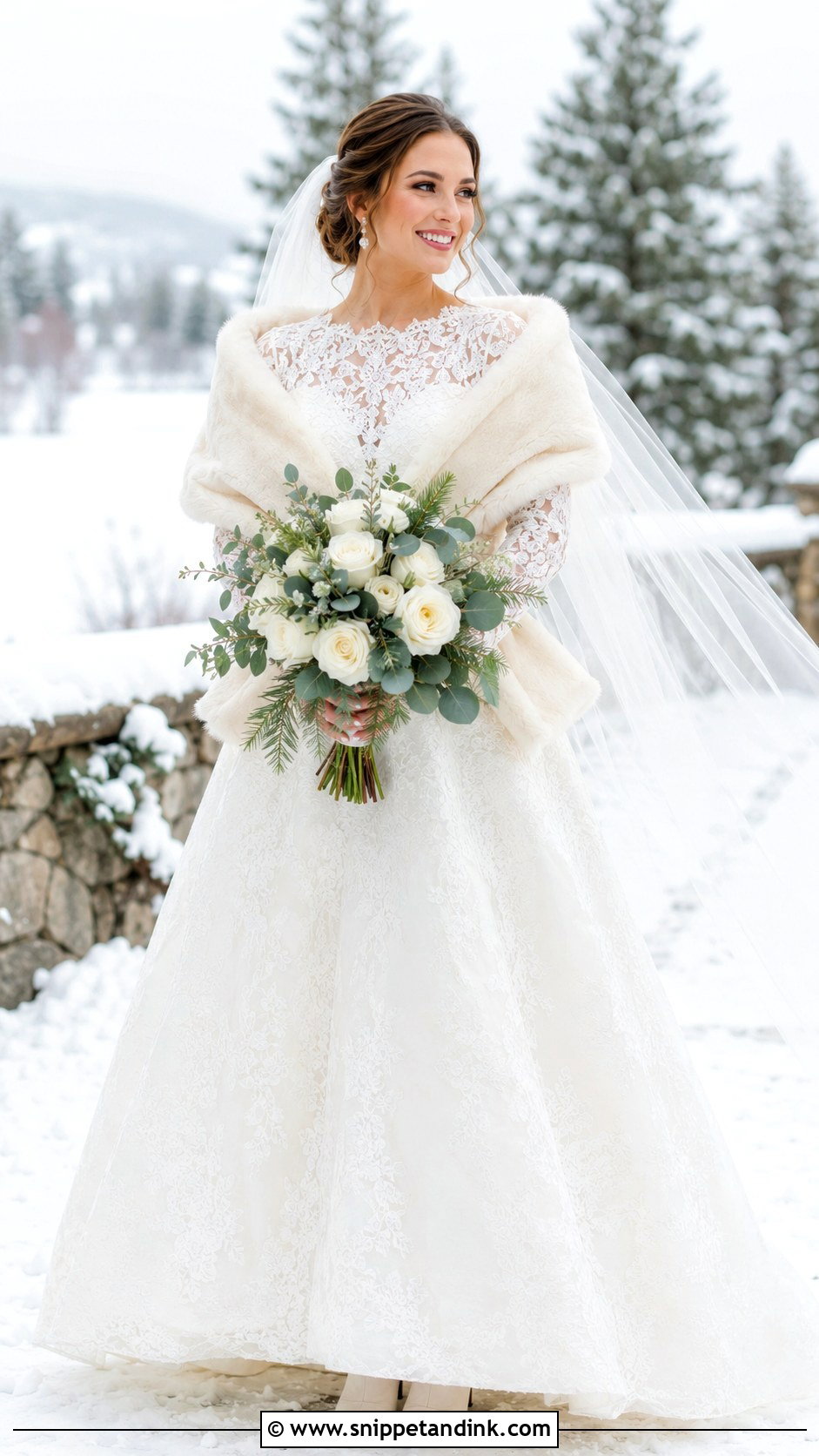
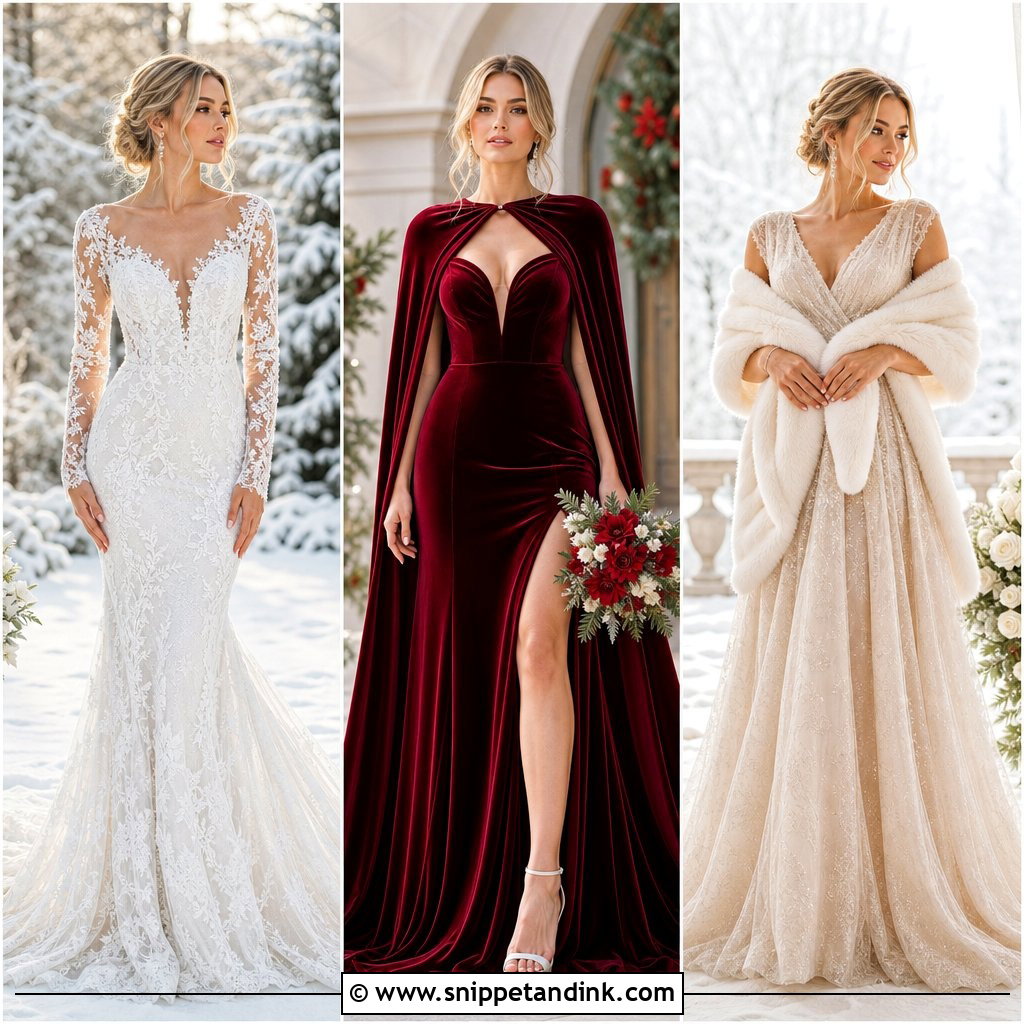
Winter is when long lace sleeves earn their place, but lace alone won’t keep you warm. I’d choose a fully lined bodice, fitted sleeves and a structured A-line or ball gown skirt, then add an ivory faux-fur wrap, a tailored cape or a bridal coat for outdoor photos. Closed block heels, pearl earrings, a cathedral veil and a bouquet of white flowers with cool greenery suit the season. Thermal shorts or fine hosiery under a full skirt help more than people expect. Bring a swatch of the dress when you shop for the outer layer, because white next to ivory looks grubby in photographs.
Where Lace Sleeves Struggle on the Day
Long sleeves solve some problems and quietly create others. These are the ones I plan for with every bride wearing lace to the wrist.
Heat and a crowded room
Lace sleeves over a lining hold warmth, and a packed reception gets hot. If your wedding is in summer or the venue runs warm, ask for an unlined sleeve on fine tulle, and plan a few minutes outside between courses. Don’t rely on sheer lace to cool you; it won’t.
Makeup, tan and fake lashes
The cuffs and inner wrists are where foundation, self-tan and hand cream end up. Have your makeup artist set your neck and hands, wait for any tan to fully develop before the dress goes on, and keep your hands away from your face once you’re dressed. A dot of makeup on ivory lace is much harder to lift than on satin, because it sits in the gaps of the pattern.
Snags
Rings with raised prongs, bracelets with clasps and the hook side of velcro on a coat will catch lace. I’d swap a high engagement setting to the right hand while you dress, and check any outer layer’s lining for rough fastenings. If a loop does catch, don’t pull it. Ease the thread back through from the inside with a needle, or pin it and leave the repair for after.
After the wedding
Never hang a lace gown by its sleeves. The weight drags the shoulders out of shape over months. Get it professionally cleaned soon after, since sugar and sweat marks turn brown over time, and store it folded in acid-free tissue with the sleeves laid flat across the bodice.
The Sleeve Is the Part You Will Feel All Day
Every gown here can look right on the hanger. The one to choose is the one whose sleeves still feel comfortable after the toasts, the hugs and the first dance. An A-line is the most forgiving, a ball gown brings the drama, and a sheath keeps everything clean. Details like illusion mesh, detachable sleeves, basque waists and open backs are where you make the dress your own. Take your venue and season to every fitting, move the way you will move at the wedding, and trust a good seamstress over a trend.
You'll Like These Ideas:






Leave a Reply