
A masquerade reception already does a lot of theatrical work with the lighting, the masks and the dress code, so the cake has to hold its own without tipping into costume party. When I sketch one of these, I start with a single question: what is the focal point? It might be a sculpted sugar mask, a black tier wrapped in gold leaf, or a cascade of jewel-toned roses, but rarely all three. Black fondant, ivory tiers, edible lace, pearls and feathers all belong to this theme, and the cakes I’d defend are the ones that pick two or three of those and commit. Below are twenty directions, from a full black and gold tower to a plain white cake carrying one Venetian mask, with notes on how each one behaves once it’s actually built.
Dark Icing, Metallics and What Guests Can Actually Eat
Most masquerade cakes lean on two things that need a conversation before the design is final: very dark colour and a metallic finish. Neither is a problem, but both behave differently from a plain white wedding cake.
Black and deep jewel tones
To get a true black, I start from a chocolate base and add concentrated gel colour, then leave it overnight so the shade deepens. Rushing it gives you either a grey cake or so much colour that it tastes bitter. Even done well, black and navy icing will tint lips and teeth, which matters when you’re being photographed feeding each other cake. My usual answer is to keep the dark colour on the outer fondant or a single tier, and keep the filling inside the slices pale.
Gold and silver
Edible gold and silver leaf are real metal, beaten very thin and sold as food grade, and the small amounts on a cake are fine to eat. Many lustre dusts sold for cake decorating, however, are labelled non-toxic rather than edible. Those are meant for pieces that get removed before serving, such as a mask or a topper. Ask your baker plainly which kind is going on the parts guests will eat; a good designer will answer without hesitating.
1. Black And Gold Masquerade Wedding Cake
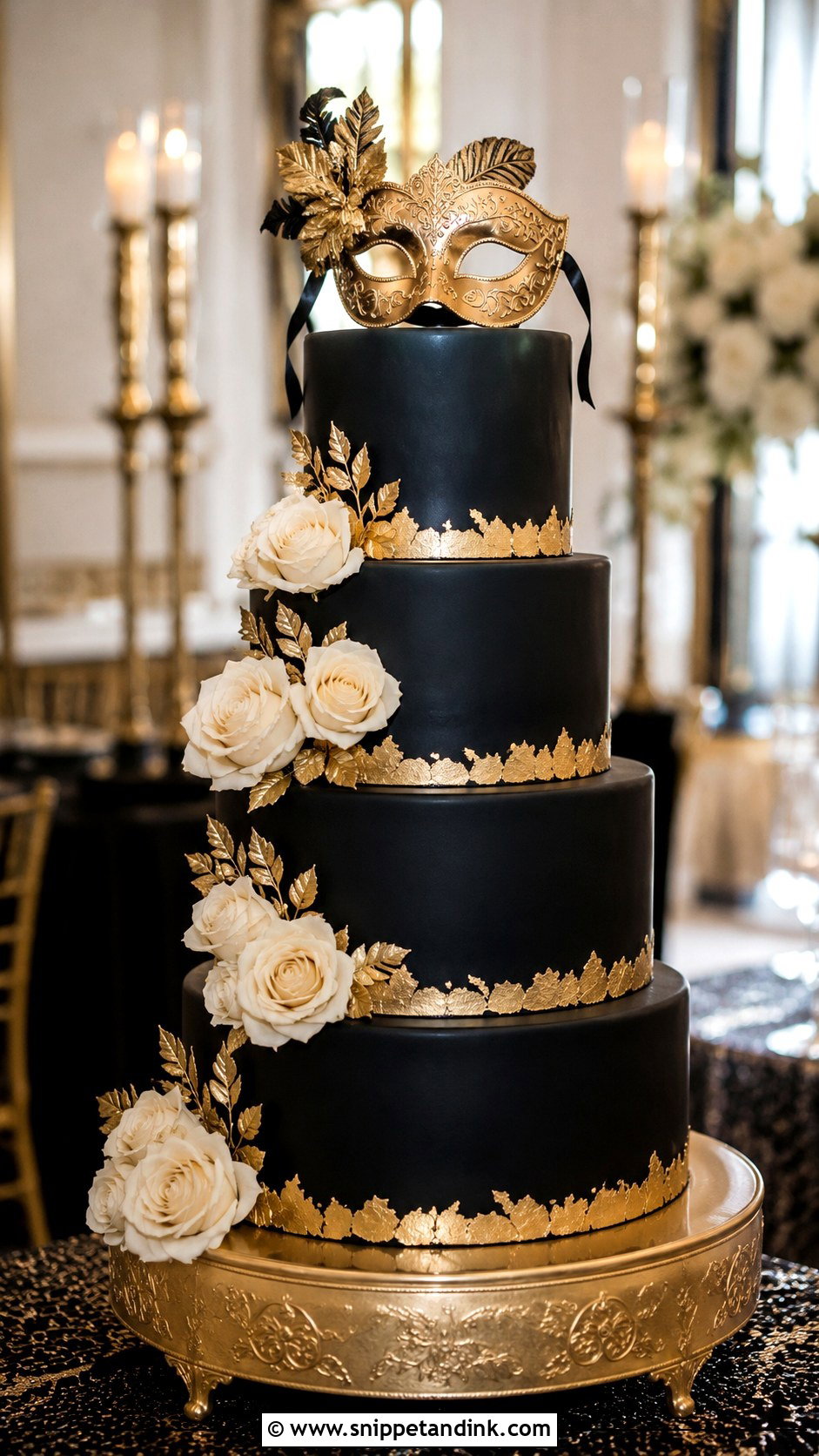
A black and gold masquerade wedding cake is the version most couples picture first, and it earns that place on three or four tiers, where there is enough height for a mask, florals and trim to sit without crowding. Black is harder to work with than it looks. Black fondant is heavily pigmented and softer than white, so I roll it a little thicker and expect it to show fingerprints, while black buttercream needs a cocoa base and a night to deepen or it reads charcoal grey. Gold leaf goes on last, by hand, because it tears if anything brushes it. A gold Venetian mask, a band of black satin ribbon and a few ivory roses are all this cake needs.
2. White Masquerade Wedding Cake
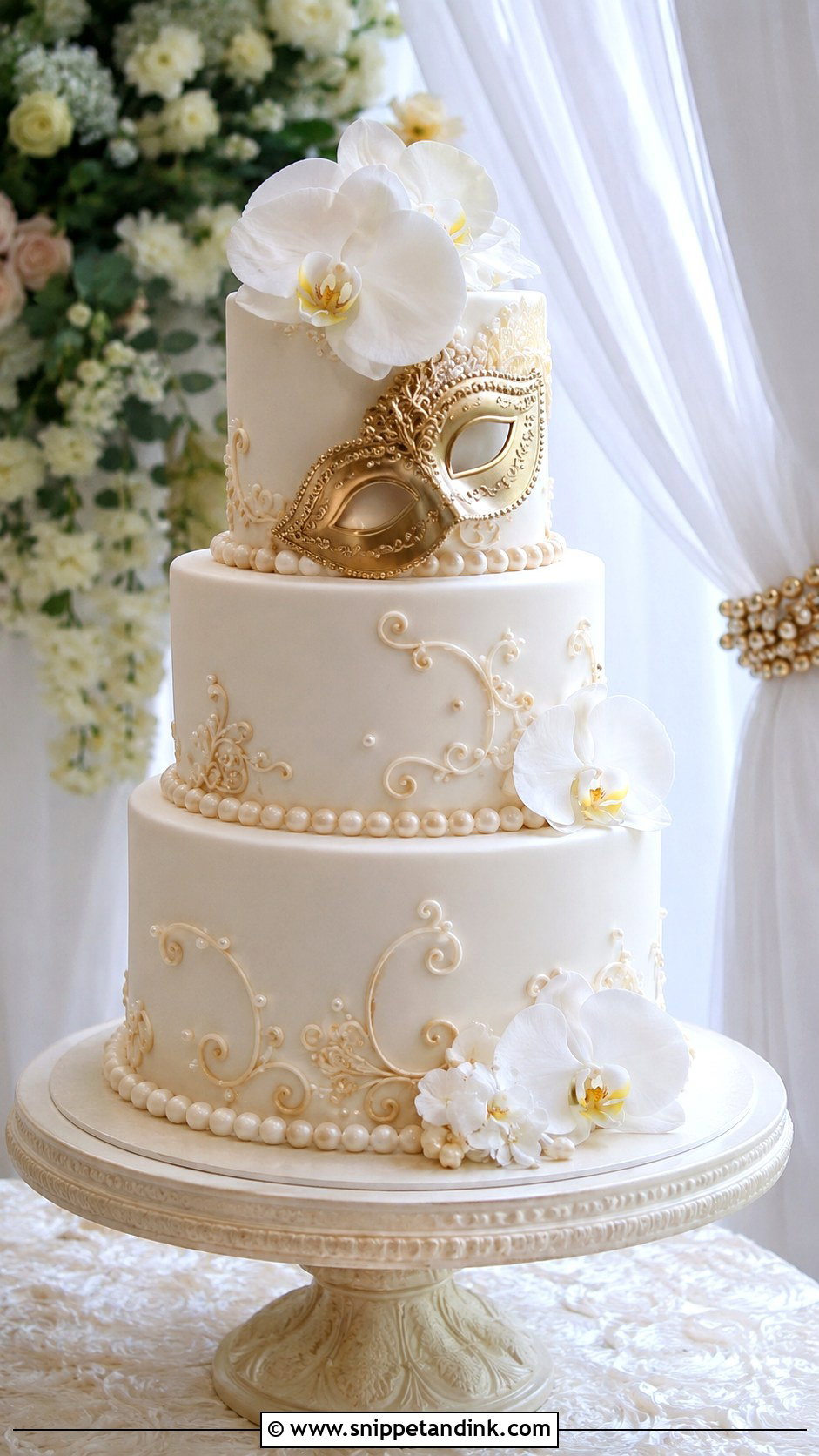
White is my quiet recommendation for venues that already have velvet linens, tall candelabras and moody lighting. A dark cake in a dark room can disappear; a white one becomes the brightest thing on the table, and mask details in gold, silver or pearl read sharply against it. I keep the tiers smooth and let edible lace, a pearl border and a delicate mask topper carry the theme. One caution: white fondant under warm tungsten light can look yellow in photos, so if your dress is bright white, ask to see a fondant sample in similar light. Soft white roses or orchids keep it bridal rather than theatrical.
3. Venetian Mask Wedding Cake
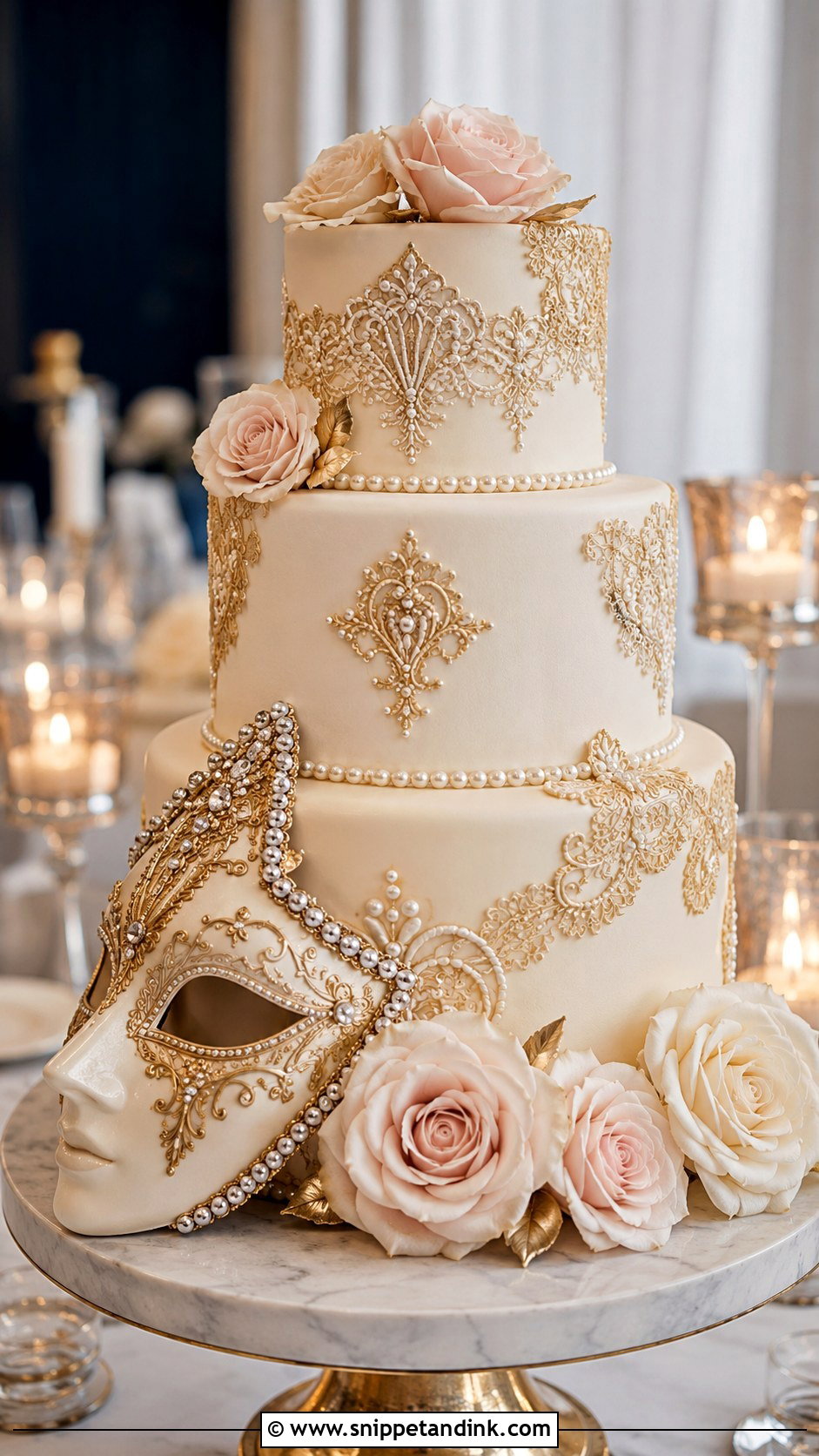
Here the mask is the whole story, so it has to be good. A sugar mask can sit on the top tier, lean against a lower one, or wrap around the side like a carved panel, and each placement changes how it’s built: a leaning mask needs a hidden support behind it, while a top-tier mask has to be light enough not to sink into the icing. I spend most of the decorating time on its trim, lace texture, tiny pearls and painted scrolls, and keep the tiers plain so nothing competes. Ivory, black, red, purple and gold all work as the base. Pair the mask with a few soft flowers and sharp, clean tier edges.
4. Red Masquerade Wedding Cake
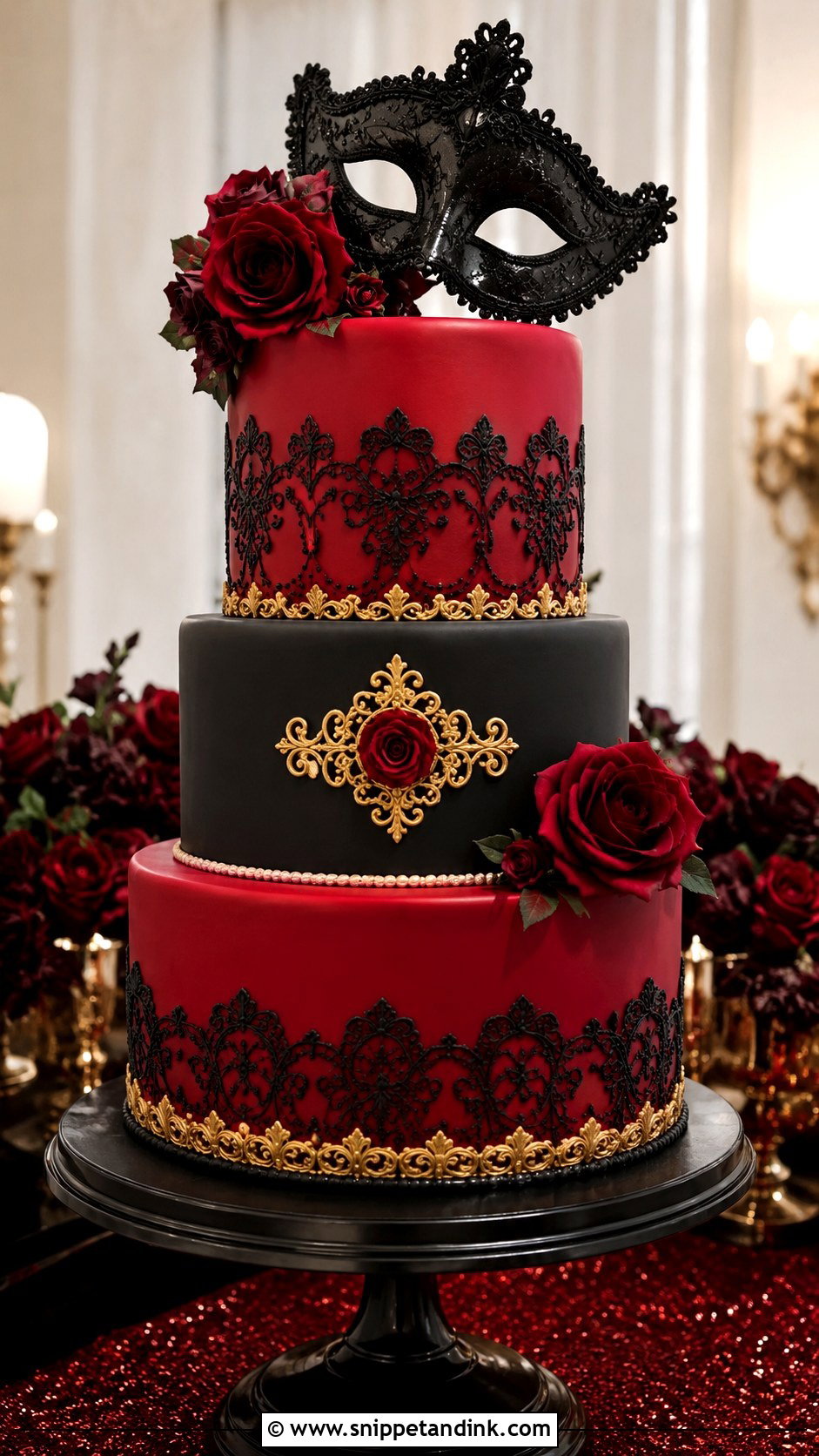
Deep red is the most dramatic colour on this list, and the one I handle most carefully. A true deep red in fondant or buttercream takes a lot of gel colour, which can leave a faintly bitter taste and will stain lips, so I usually confine it to one or two tiers and let ivory or black tiers balance it. Red roses, gold scrollwork and a black lace mask give it the ballroom look. Red velvet is the obvious flavour, though chocolate raspberry or vanilla with a berry filling fits the mood just as well. Ask for a wine or garnet shade. Bright fire-engine red looks cheap under evening lighting.
5. Purple Masquerade Wedding Cake
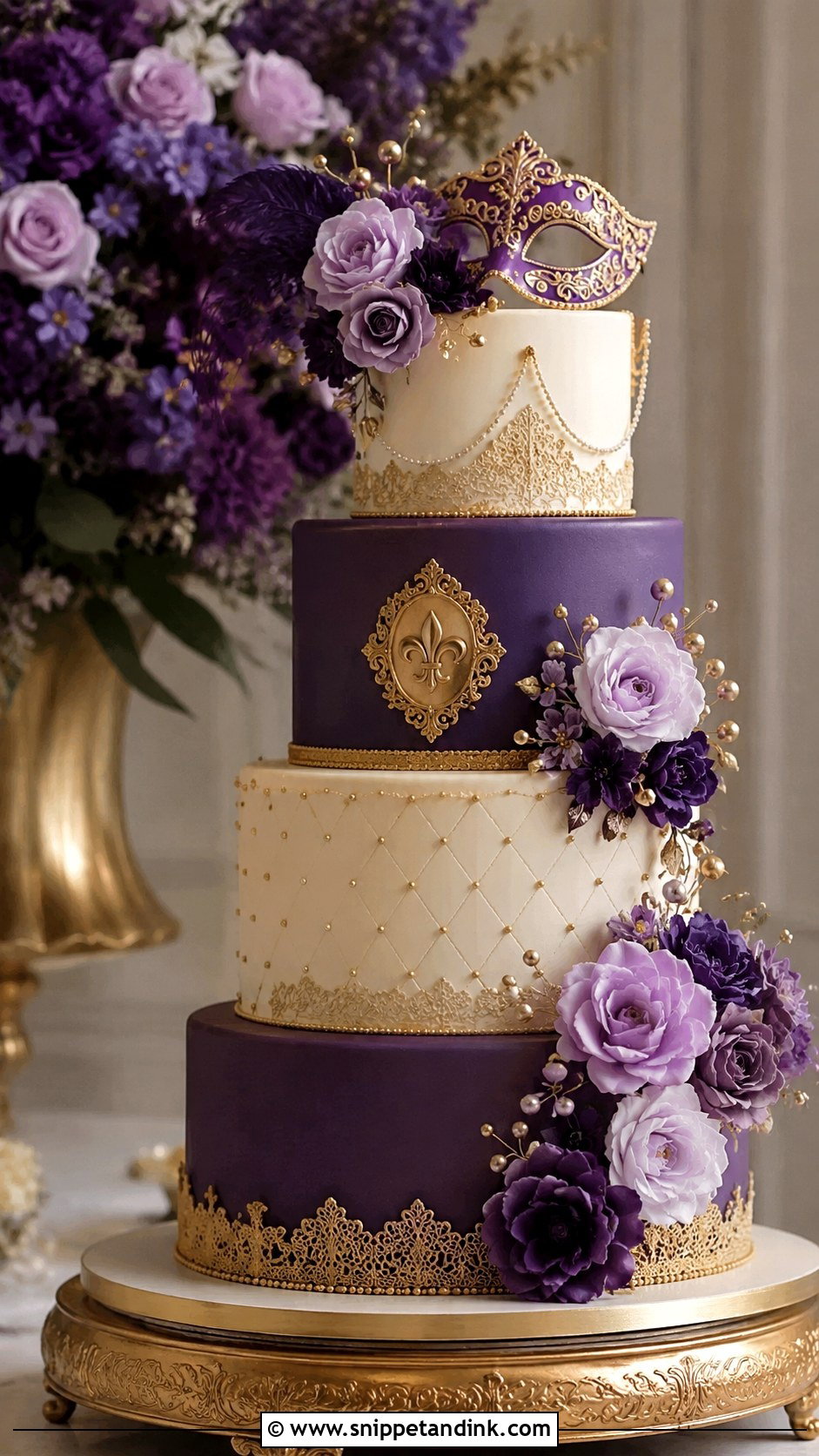
Purple reads royal without the weight of black or red. Deep plum, eggplant, and amethyst shades take gold detailing especially well. Purple is one of the trickier colours to keep stable, though: some purple gels drift toward blue or fade toward grey if the cake sits near a window, so I keep coloured tiers boxed and out of daylight until delivery. You can have smooth purple fondant, watercolor buttercream, or ivory tiers with purple flowers, and a gold mask topper with edible pearls ties any of them back to the theme. Blackberry, lavender or vanilla bean fillings suit the palette. If full purple tiers feel heavy, put purple flowers on white instead.
6. Mardi Gras Masquerade Wedding Cake
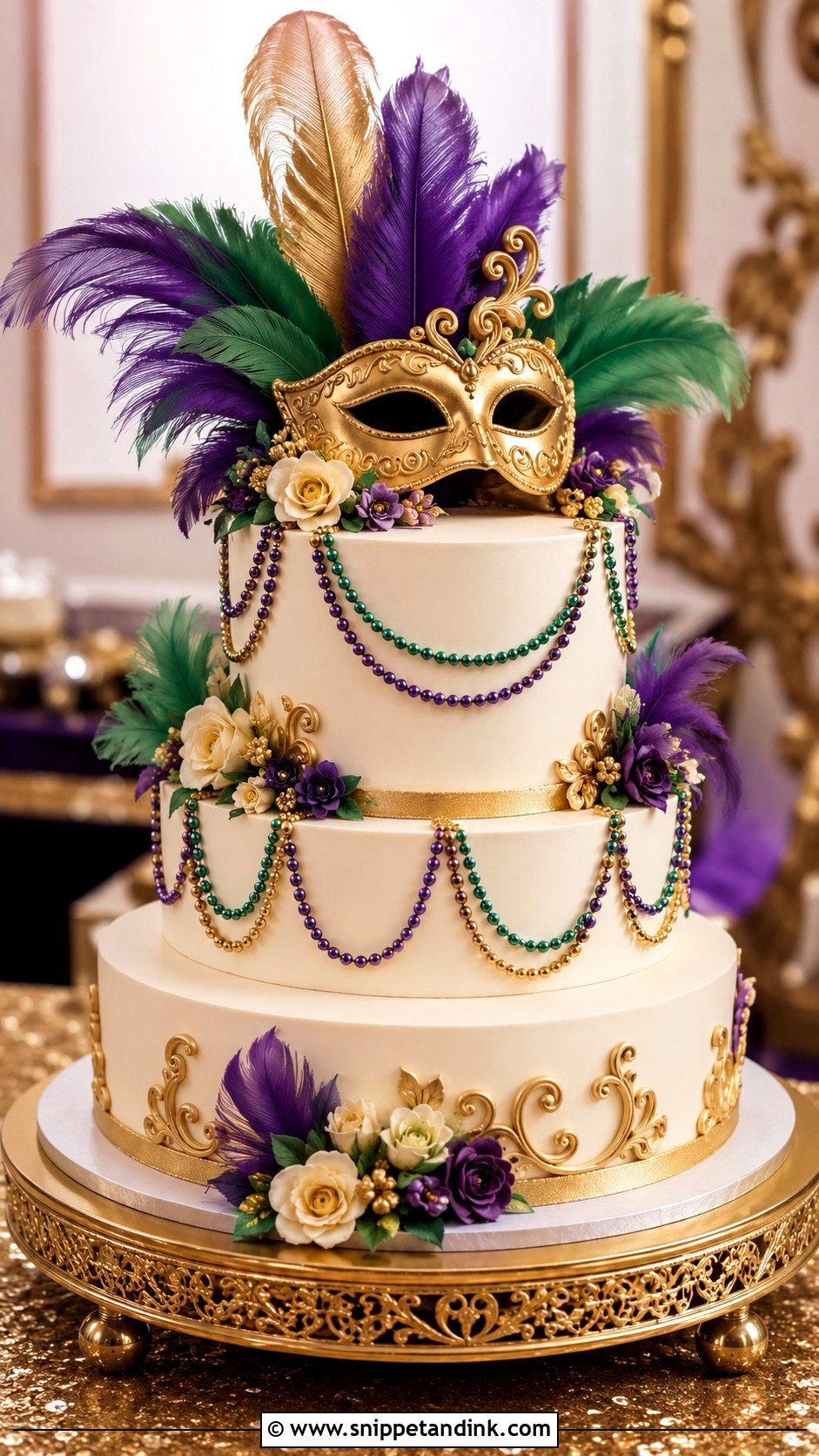
Mardi Gras brings purple, green and gold, which is a lot of colour for one cake to absorb. My rule is that the three act as accents on an ivory or white base, never as equal blocks on each tier, otherwise the cake starts to look like parade decor. Metallic trim, edible beads and a few feathers bring in the celebration, and gold-painted details pull the colours together. Structured tiers and crisp borders keep it from looking busy. It suits a reception built around a brass band and a packed dance floor far better than a seated, candlelit dinner.
7. Gold Masquerade Wedding Cake
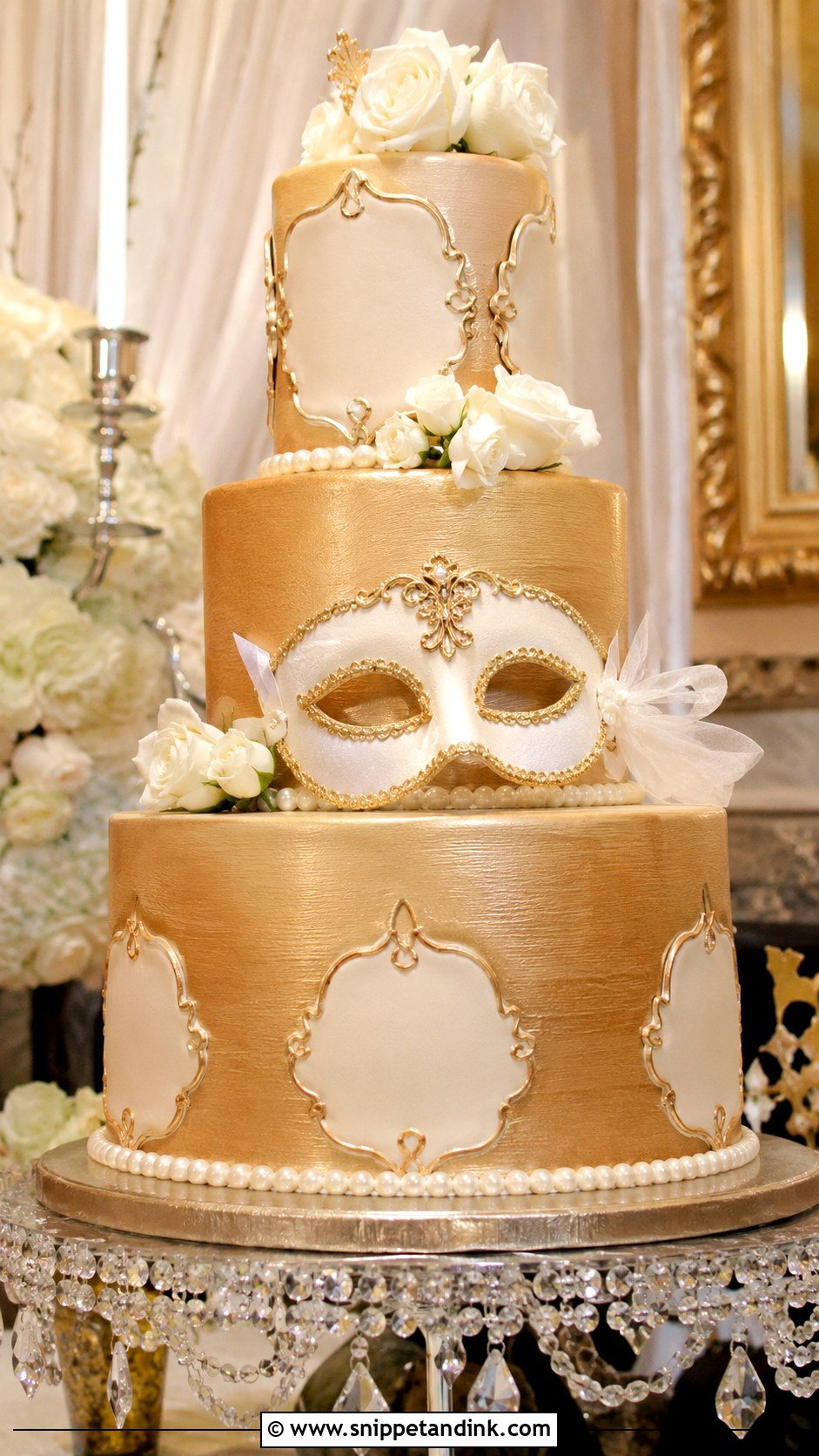
Gold carries well under warm reception lighting, and you can dial it from a full metallic tier down to fine gold piping over ivory fondant. A fully gold tier is painted with edible gold dust mixed into a quick-drying alcohol, and it shows every bump in the fondant underneath, so the base has to be very smooth. A white mask edged in gold keeps the theme clear while the cake stays light. Champagne roses, ivory orchids or pearl strands finish it. On a tall cake I alternate gold tiers with plain ones; four solid gold tiers in a row tend to look like a trophy.
8. Black Lace Masquerade Wedding Cake
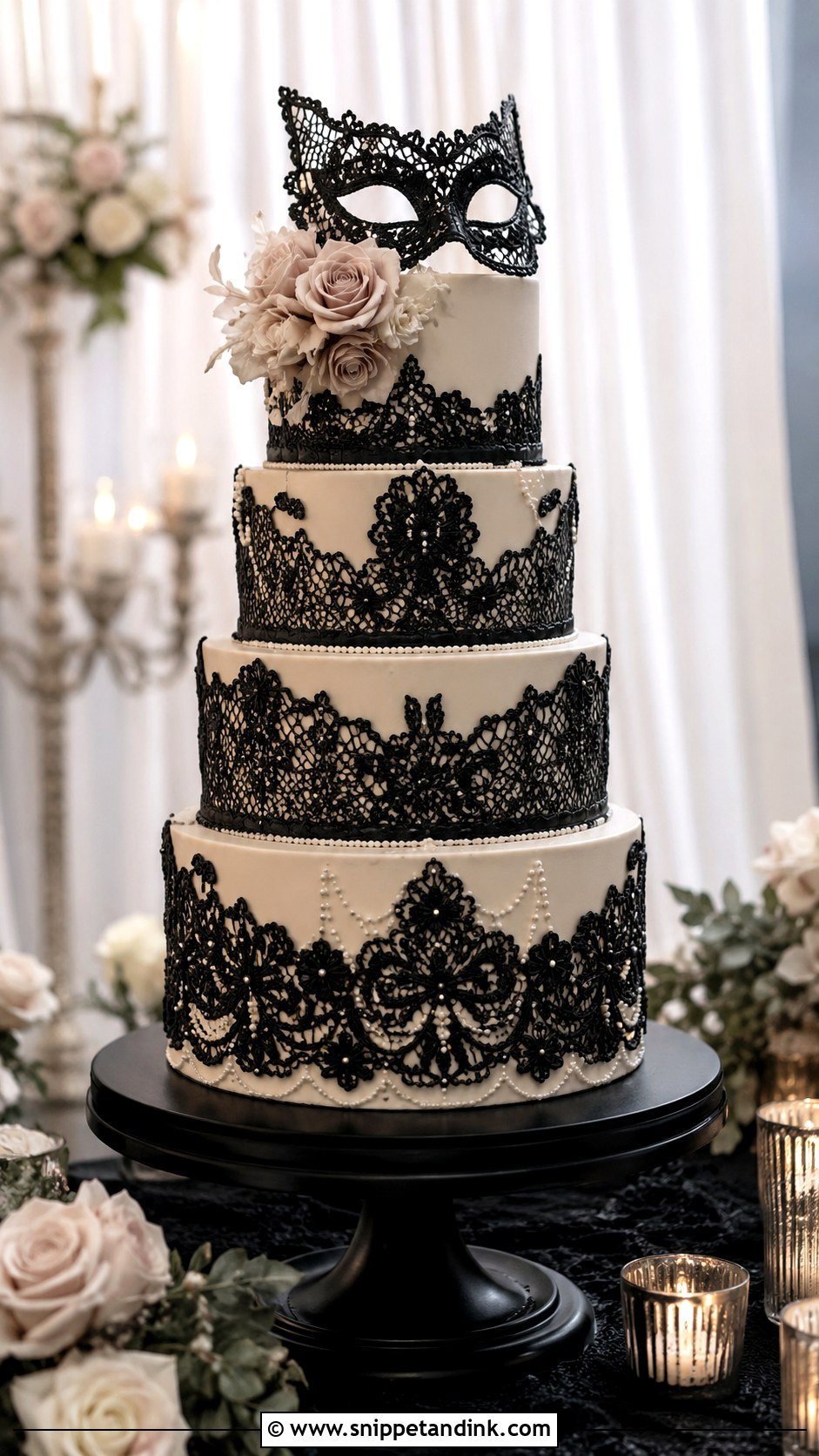
Black lace over a pale tier gives you the moody evening look without a heavy black cake. The lace can be piped, stenciled or applied as edible lace sheets over ivory, blush or champagne, and the methods behave differently. Piped lace is the most detailed and the slowest, stenciled lace is crisp but flat, and lace sheets go on quickly but can wrinkle in a humid room. Add a small black mask, pearl accents and a few soft flowers. Ballrooms, historic houses and candlelit receptions suit it best. Ask for one lace pattern repeated across every tier, because mixed patterns are the fastest way to make it look busy.
9. Masquerade Wedding Cake With Feathers
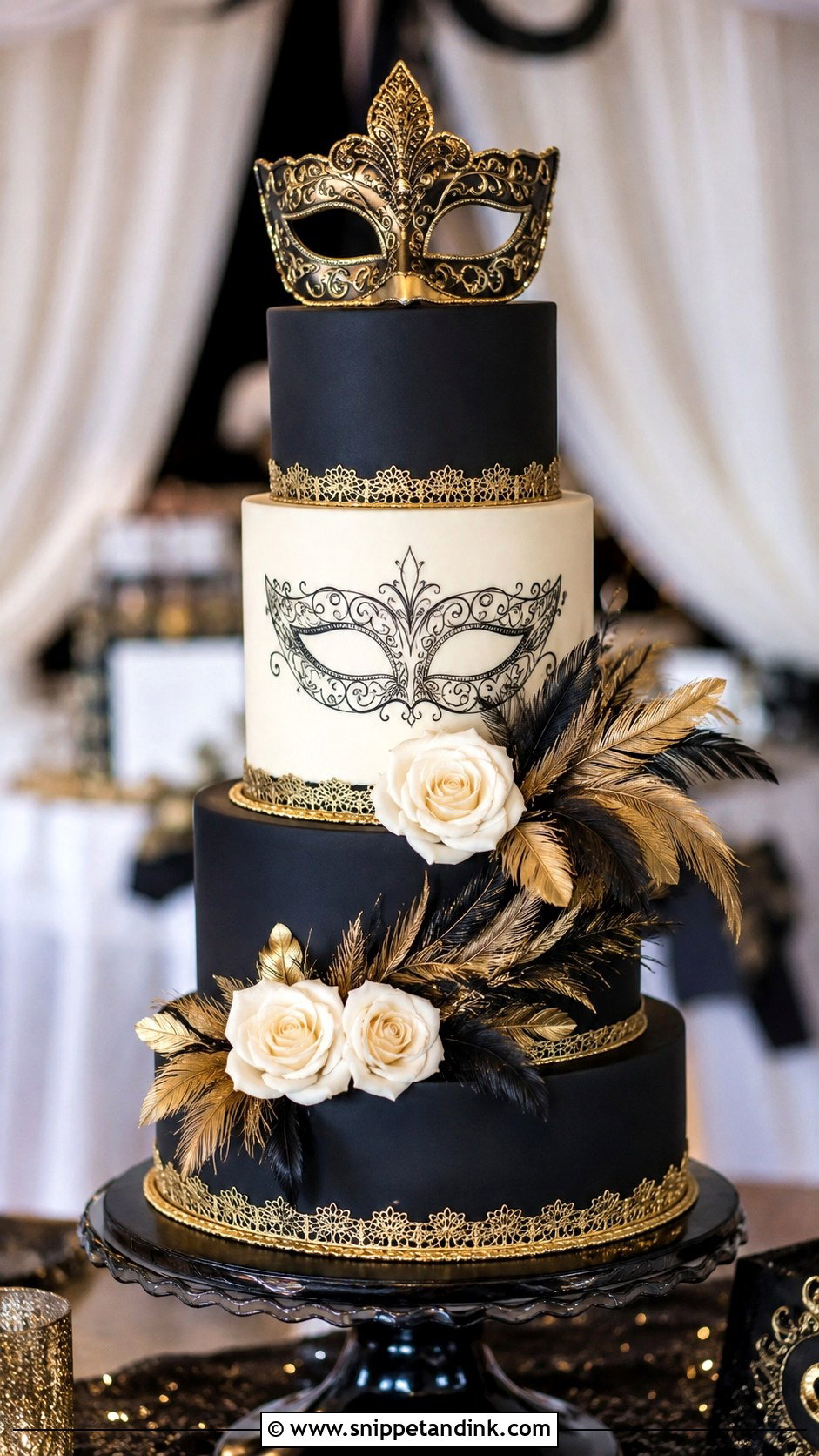
Feathers are the detail I discuss longest with couples, because real ones aren’t food safe. Natural feathers can carry dust and bacteria, so if they go on the cake I wrap the quills in floral tape and seat them in a food-safe pick, never straight into the sponge, and they come off before cutting. The alternative is edible wafer paper feathers, which can be cut, veined and painted gold, and they look surprisingly convincing. A few tall black, white or gold plumes add height and movement on smooth fondant tiers with metallic trim and a sculpted mask. Keep the flowers minimal so the feathers look deliberate, and keep the whole cake well away from table candles.
10. Masquerade Wedding Cake With Roses
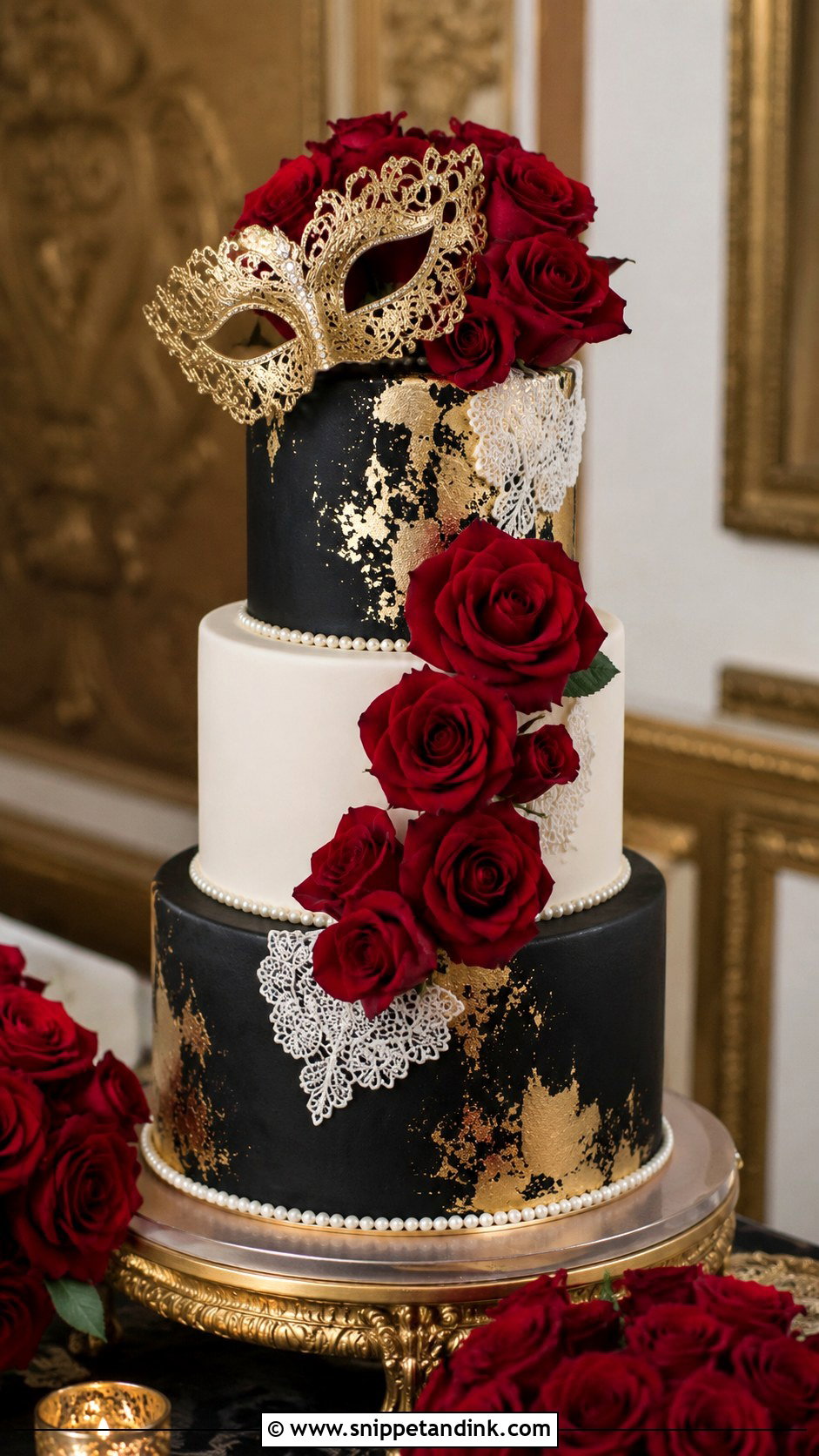
Roses soften the mystery of a masquerade cake. Red pushes it toward drama, while ivory, blush or champagne keep it classic, and any of them sit well on black, white, gold or burgundy tiers. The mask can crown the top tier or rest among the flowers at the front. Each type of rose has a catch. Fresh ones must be unsprayed with wrapped stems, sugar roses take days to make and cost more, and buttercream roses slump in a hot room. Your venue’s rules on fresh flowers touching food may decide it for you. Matching the rose colour to the bouquet ties the cake to everything else on the day.
11. Masquerade Wedding Cake With Pearls
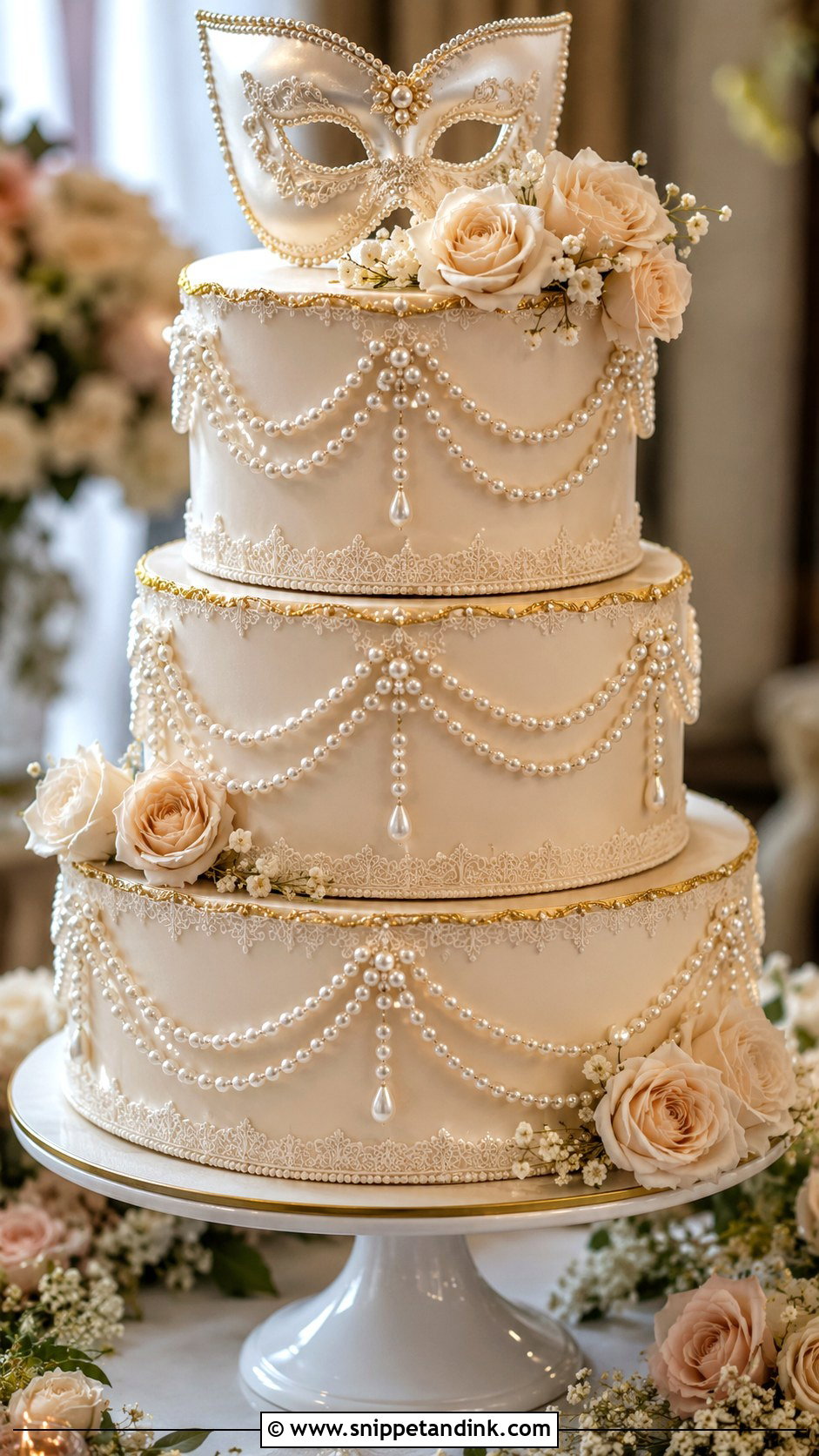
Pearls take the edge off the theme and pull it back toward bridal. They sit well on ivory fondant, champagne buttercream, black lace or gold trim, as pearl borders between tiers, strands draped down the sides, or tiny dots circling the mask. Sugar pearls are set by hand, often one at a time with a dab of edible glue, which is why a fully pearled cake takes longer than it looks. A pearl-trimmed Venetian mask on the top tier signals the theme clearly. I’d hold the palette to ivory, gold, black and blush; this one sits comfortably beside classic wedding decor.
12. Masquerade Wedding Cake With Edible Lace
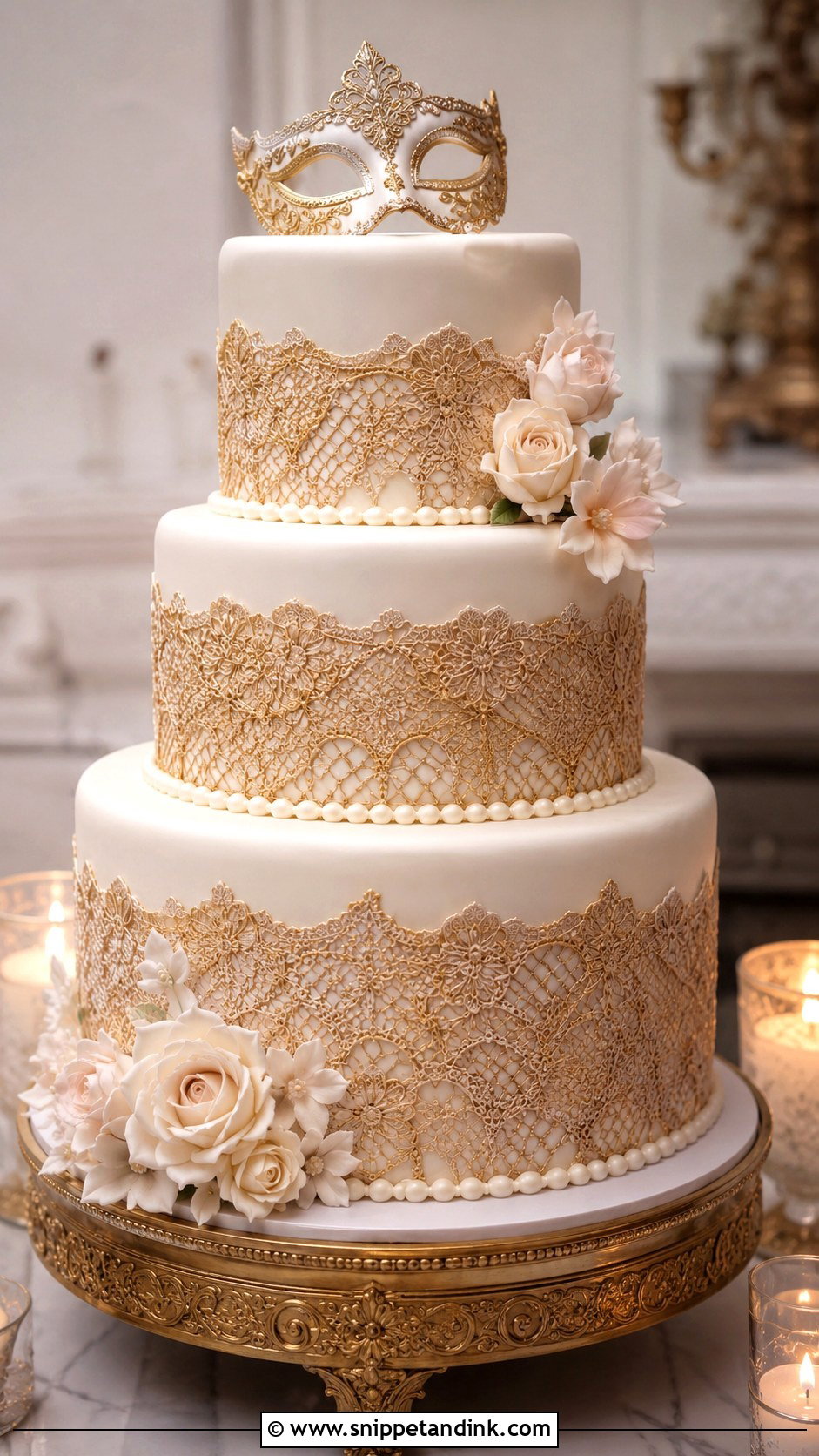
Edible lace gives an old-world look for far less decorating time than hand piping. It’s a flexible sugar paste set in silicone mats, so it can wrap a tier, frame a mask, or lie as a soft pattern over dark fondant. White lace on black tiers is dramatic; gold lace on ivory is warmer. Its weakness is moisture. In a humid room, or on a cake straight out of the fridge, lace goes tacky and can slip, so I apply it as close to delivery as I can. One pattern, repeated, with a simple mask topper and a few sugar flowers, looks intentional and expensive.
13. Masquerade Wedding Cake With Gold Drip
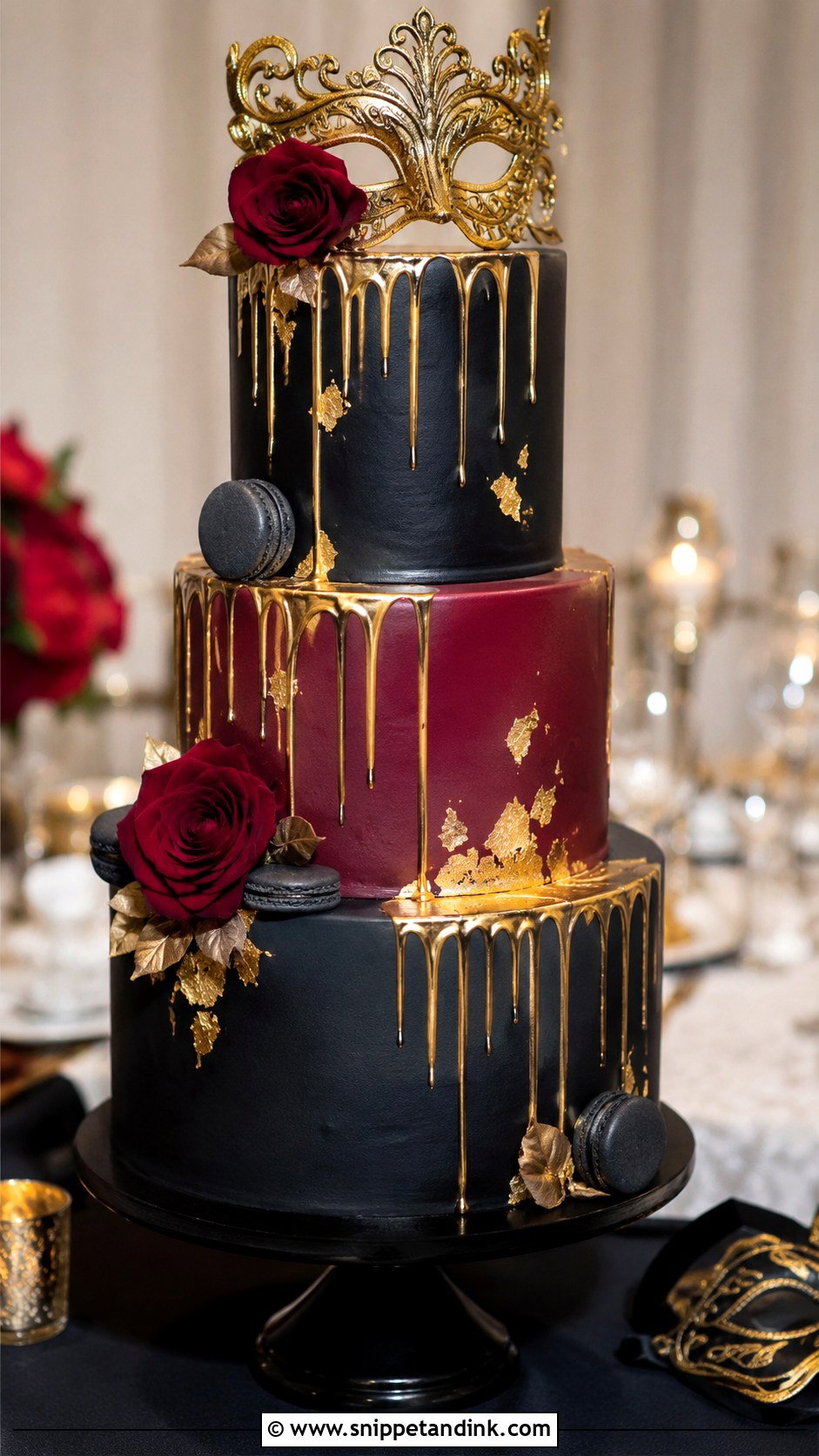
A gold drip makes the cake read modern rather than ballroom. The drip is usually ganache, left to set and then painted gold, and it shows best on black, white, burgundy or deep purple tiers. I test the ganache on the side of a chilled tier before committing: too warm and it runs to the board, too cool and it sits in thick blobs. Pair it with a mask topper, a little gold leaf and a few dark flowers. Shine is the point, so place the cake where the drip catches a light source, on a plain stand that doesn’t compete.
14. Masquerade Wedding Cake With Damask
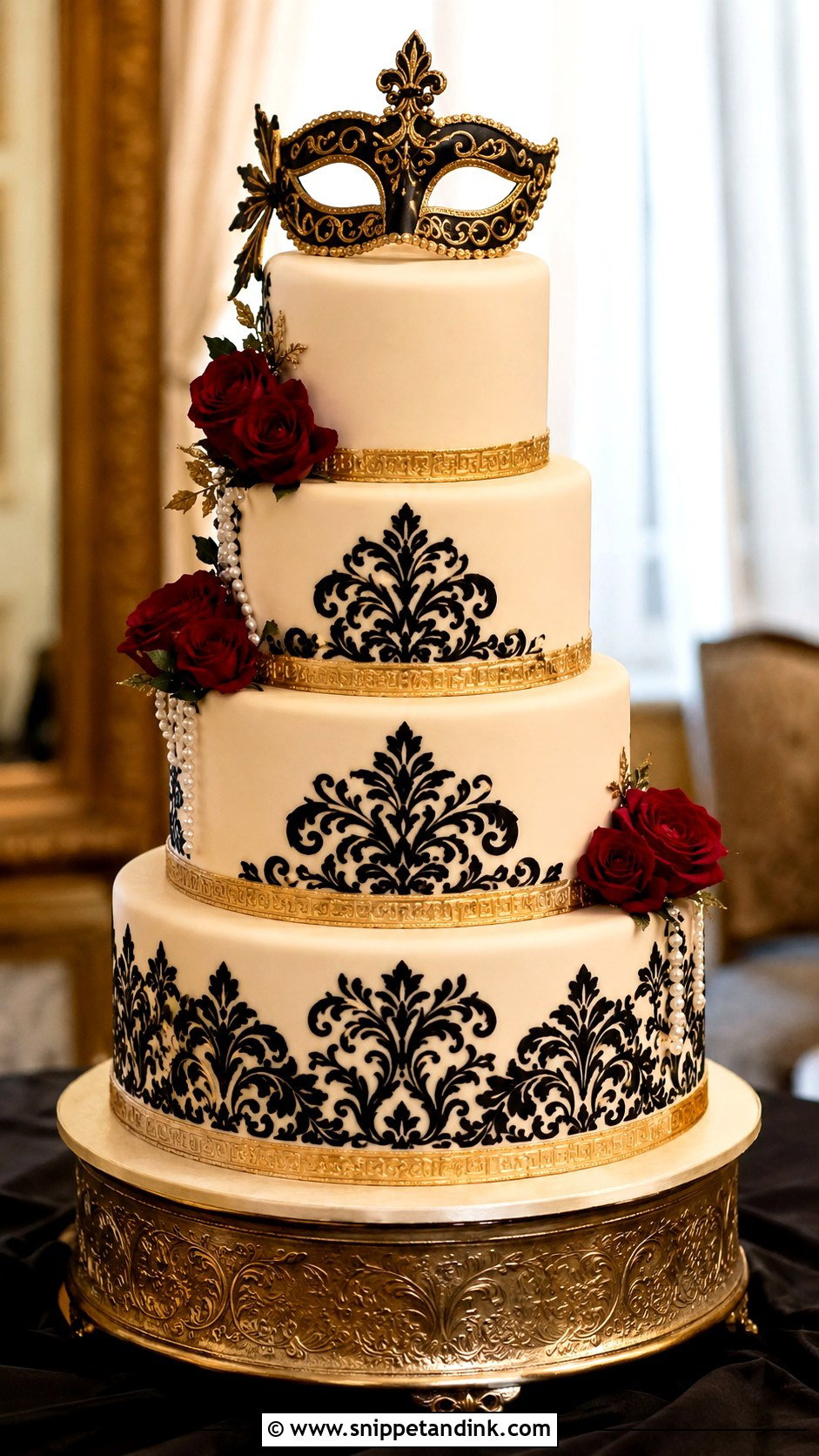
Damask has a formal, ballroom character that fits masquerade naturally. Most often it’s a black pattern over white or ivory tiers, though gold damask on burgundy or purple is just as striking. I stencil it in royal icing or airbrush colour, and tall round tiers suit it best because the repeat has room to show and doesn’t break awkwardly at a corner the way it does on a square cake. Add a mask topper, a pearl border and a few roses. Keep damask to one or two tiers and leave the rest smooth, so the pattern looks special rather than overwhelming.
15. Masquerade Wedding Cake With Silver
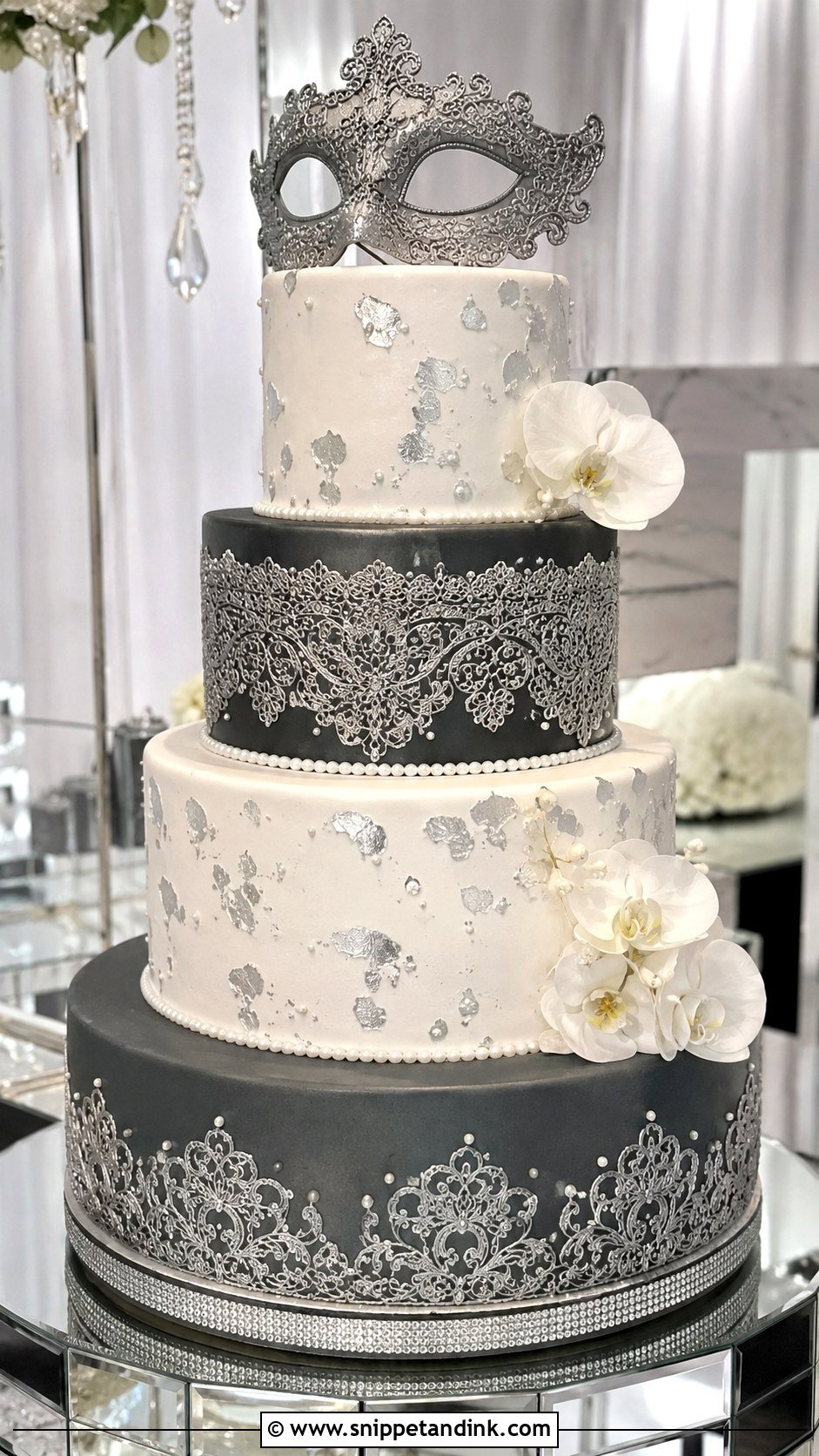
Silver is the cool alternative to gold, icy where gold is warm. It sits well with white, black, navy, lavender and charcoal, as silver leaf, silver piping, rhinestone-style edible accents or a silver mask topper. Silver leaf is the touchiest metallic I use because it dulls faster than gold, so it goes on as late as possible. Winter ballroom weddings, evening receptions and venues with mirrored decor suit it. Go easy on glitter. A smooth white base, silver lace and one sculpted mask look refined; a cake covered in sparkle looks like a costume shop.
16. Masquerade Wedding Cake With Navy
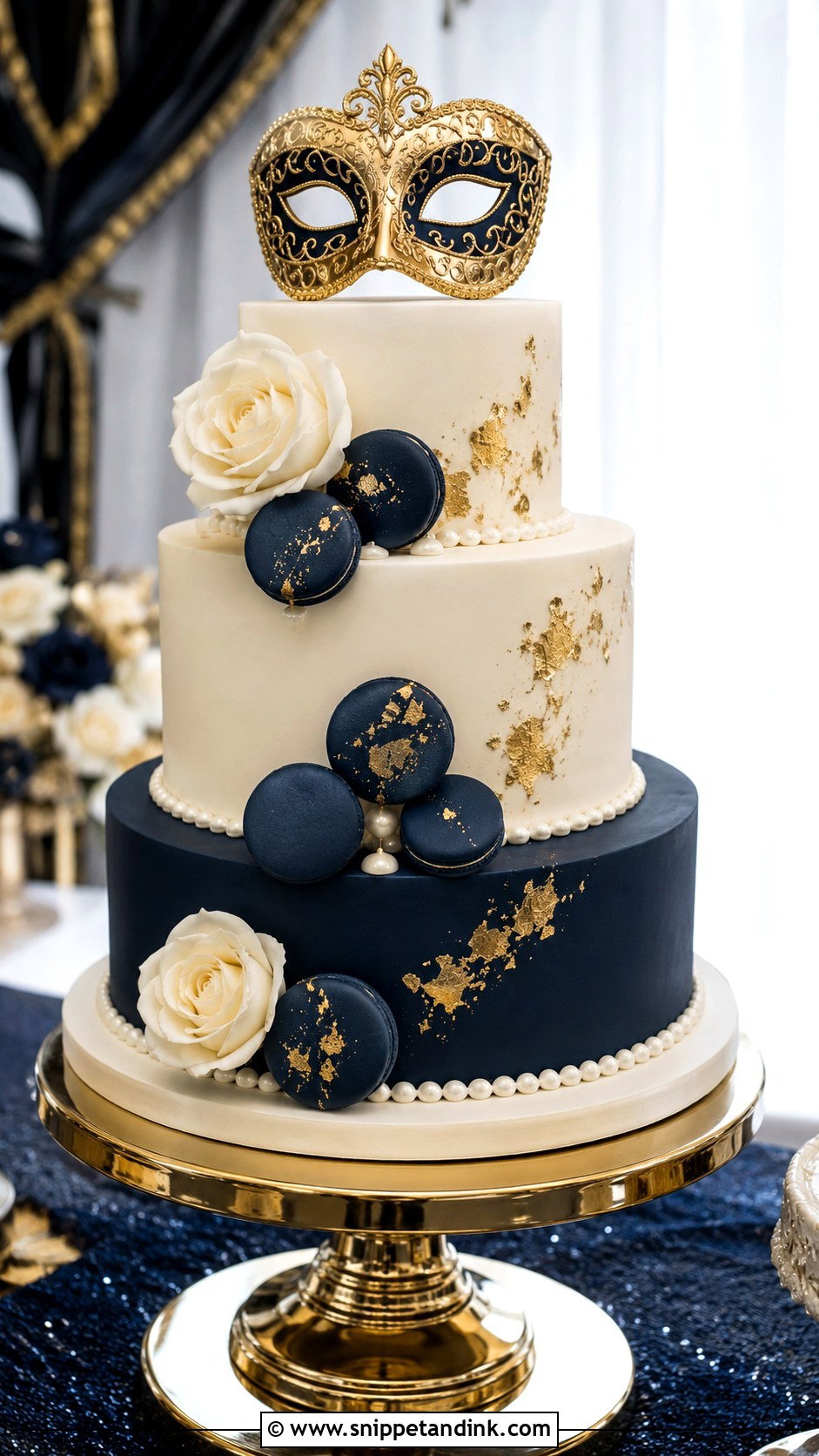
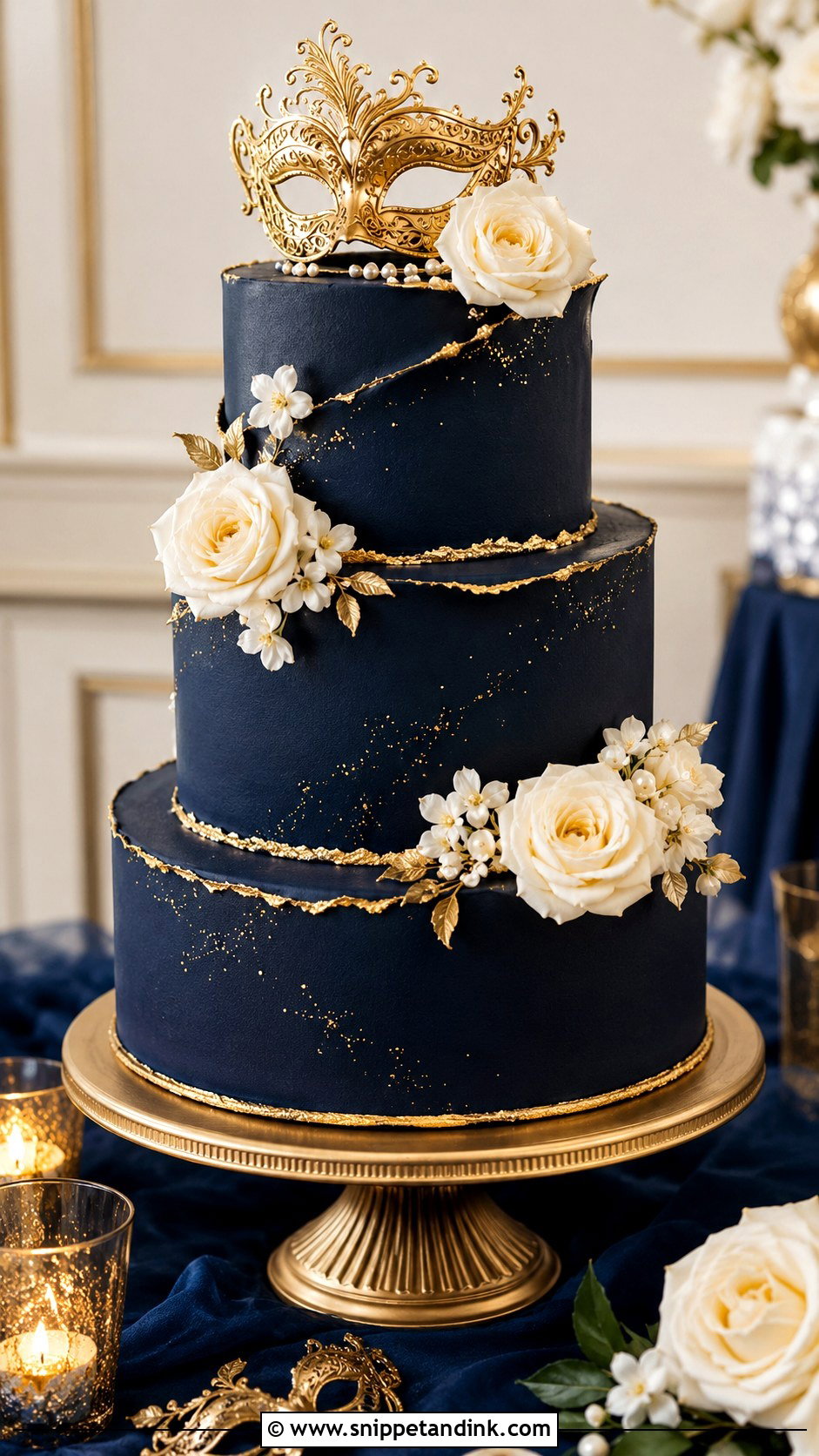
Navy is softer than black but still formal and moody, and it is far kinder to teeth and tongues than a black tier. It takes gold, silver, ivory and deep red accents well, and a gold mask topper with brushed metallic edges keeps it rich without going too dark. It also lines up neatly with navy bridesmaid dresses, tuxedos or evening invitations. Vanilla bean, chocolate, almond or blueberry fillings suit it. In a dim room navy can photograph as black, so give the tier a little light. Ivory roses or orchids bring it back to bridal, and clean lines matter more here than extra decoration.
17. Masquerade Wedding Cake With Buttercream
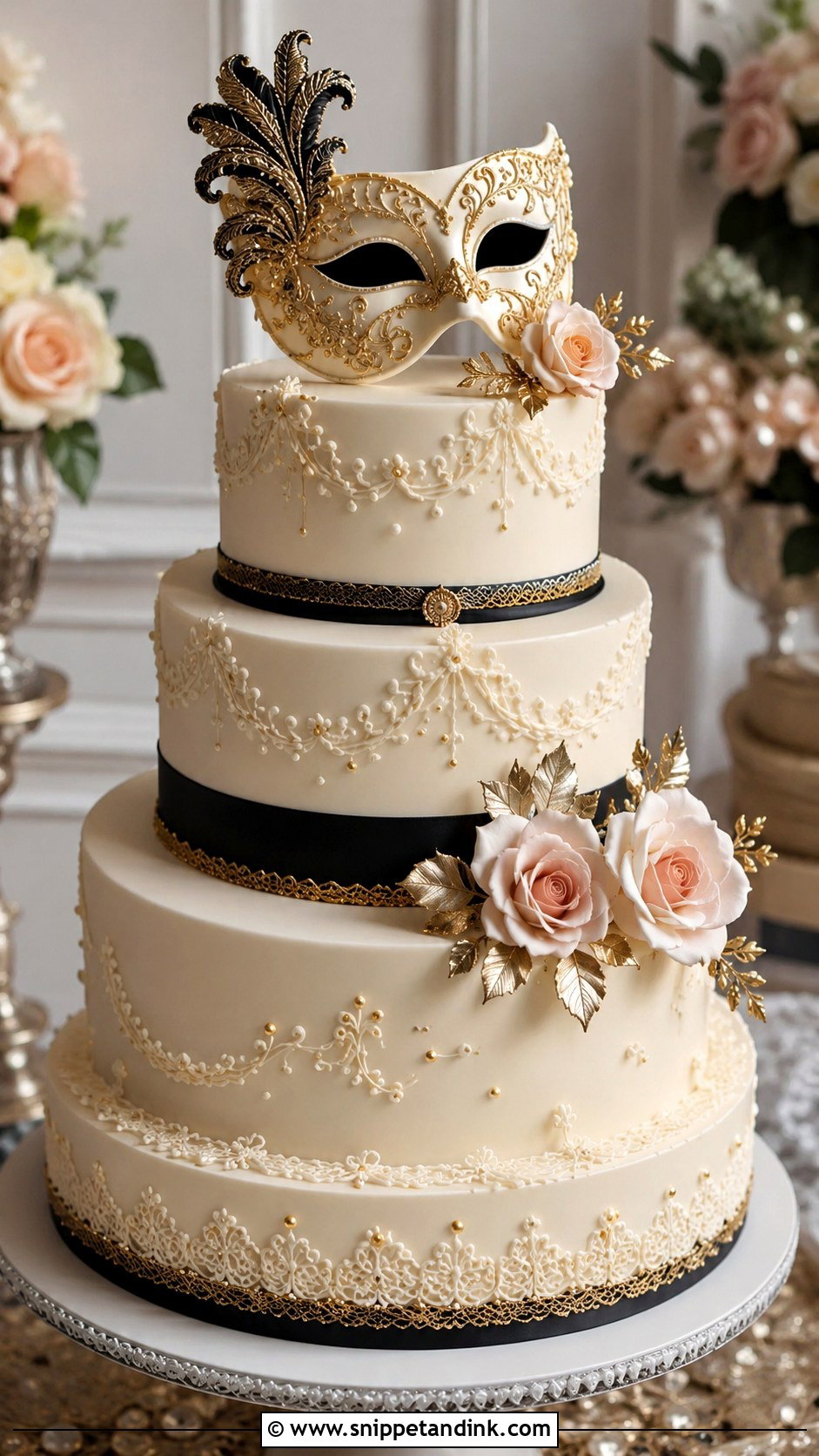
Buttercream gives a softer finish, and it’s the one most guests actually prefer eating. Smooth buttercream can still look formal under gold accents, black lace piping and a delicate mask topper; ivory buttercream with black and gold details is the simplest way to keep it polished. For colour, put deep burgundy, plum, or navy on one accent tier. The trade-off is heat. Buttercream softens in a warm room, so a sugar mask needs a support underneath, and the cake should sit away from sunny windows and heaters. I use a firm, well-chilled finish under heavy decoration so the details stay neat through the reception.
18. Masquerade Wedding Cake With Fondant
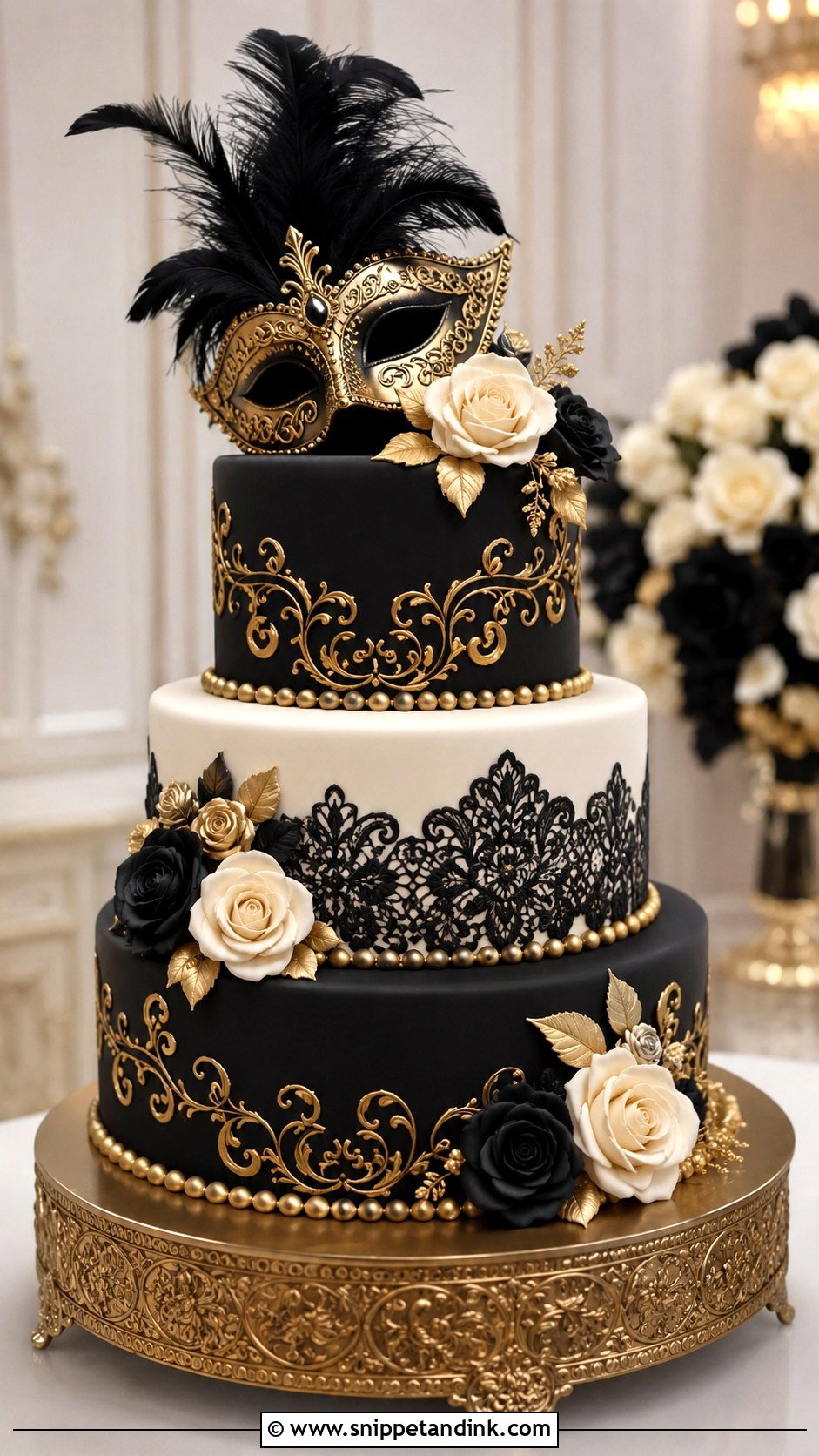
Fondant is the finish I reach for when the design is intricate. It gives the smooth, sharp-edged tiers that painted patterns, edible lace, sculpted masks and metallic accents need, and it’s the steadier option for a tall cake or a strong colour. Black fondant with gold trim looks bold; ivory fondant with pearls looks classic. Because a fondant or gumpaste mask can be made days ahead, there’s time for fine painted detail. If taste worries you, ask for a thin fondant layer over buttercream and good sponge underneath. Most guests peel it off anyway, and that’s fine. What fondant dislikes is the fridge, where it beads with condensation as it warms.
19. Masquerade Wedding Cake With Cupcakes
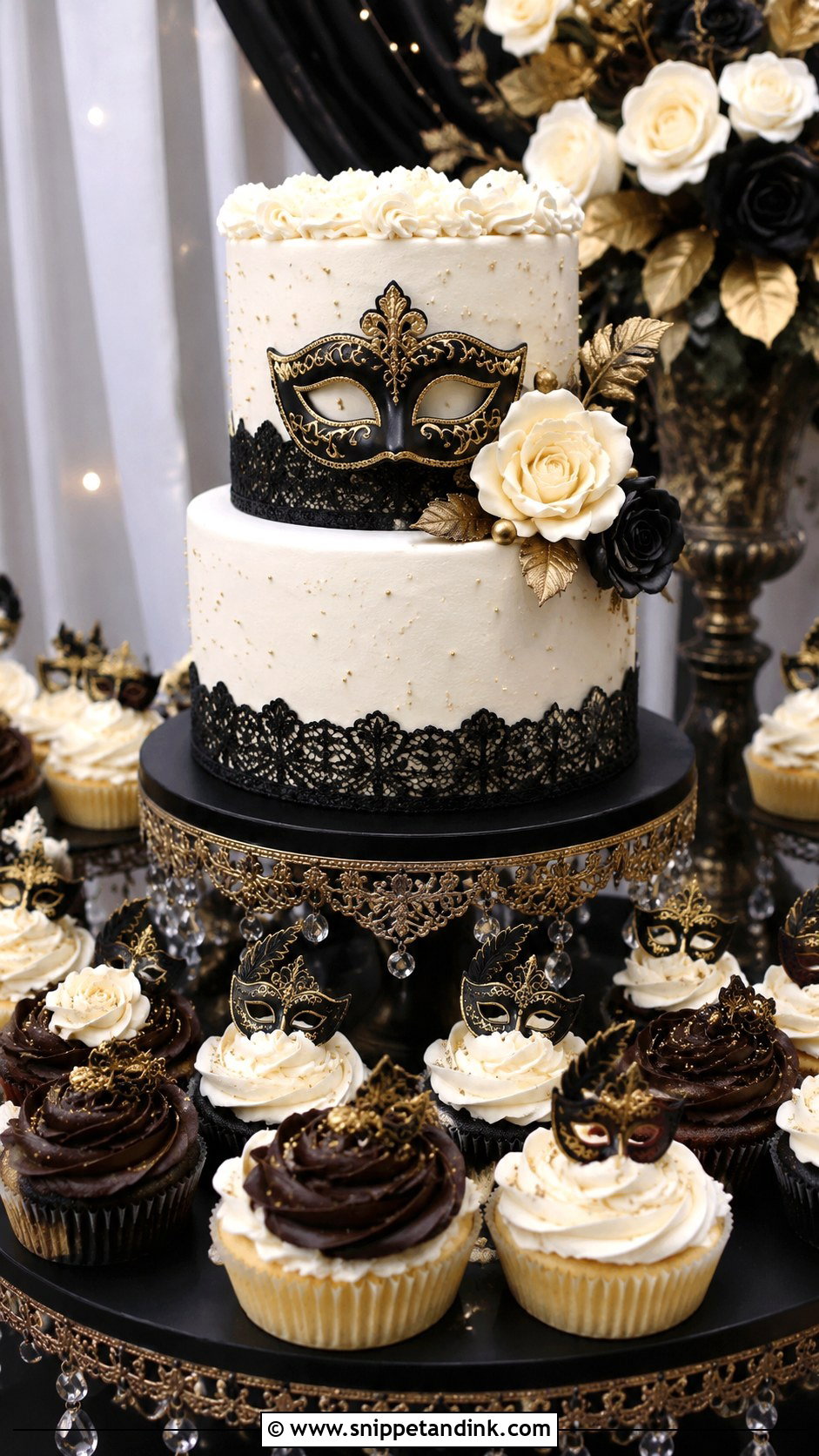
Cupcakes beside a smaller centerpiece cake solve a real logistics problem. A two-tier cake with a mask topper handles the cutting moment, and matching cupcakes go straight to guests, which saves serving time with a big guest count and can reduce cake-cutting fees at venues that charge them. Mini edible masks, gold sprinkles, pearl sugar, lace wrappers or piped rosettes carry the theme down to each one. I keep the cupcakes in the same palette as the main cake so the display reads as one piece, and a tiered stand gives it height. Cupcakes in a warm room wilt faster than a covered cake, so they go out late.
20. Masquerade Wedding Cake With Macarons
Macarons give the cake a modern, Parisian edge. They can ring the tiers, stack at the base, or sit on the dessert table beside the cake. I match their shells to the cake in black, gold, ivory, burgundy, plum or navy, and fix them with a dot of ganache rather than pressing them into the icing. Macarons soften in humidity and when they rest against buttercream for hours, so I place them last, on site. A smooth buttercream or fondant surface lets their shapes stand out. Used as accents with a small mask topper and metallic edging, they look polished; covering the entire cake turns it into a tower.
How a Sugar Mask Is Made and Gets to the Venue in One Piece
The sculpted mask is the piece couples worry about most, and it’s usually the safest part of the cake, because it’s made separately. I shape it from gumpaste over a mask form and let it dry hard, which takes several days depending on thickness and how damp the weather is. Painting, lace and pearls go on once it’s firm. So the mask is designed and approved well before the tiers are baked, and your designer will want final colours a few weeks out.
On the day it travels in its own padded box and goes onto the cake at the venue. Dried gumpaste is strong but brittle, and the real danger isn’t the drive, it’s moisture: a mask kept in a fridge, or set on tiers straight out of one, can soften and droop. If your reception is outdoors or the room runs humid, say so early, so the mask can be made thicker or given a hidden support.
Lighting a Dark Cake at a Candlelit Reception
Masquerade rooms are usually dim, and that changes the brief. A black or navy cake against a dark backdrop can vanish in photos, so I ask planners for a small pin spot aimed at the cake table and a lighter linen behind it. Tall candles need a sensible distance too. Heat softens buttercream and lace, and feathers near an open flame are a genuine fire risk.
- Light the cake table separately from the dance floor so it doesn’t go dark when the music starts.
- Keep the cake out of direct sun during setup, even if the reception itself is at night.
- Agree in advance who removes the mask, feathers and any non-edible pieces before slicing.
- Cut the cake before the lights drop fully, so your photographer can actually see it.
One Showpiece, Then Restraint
Every cake here works only when it has one clear lead. Decide early whether yours is about colour (black and gold, red, purple or navy), texture (lace, damask, pearls) or a showpiece mask, and let your venue’s lighting push you toward dark or pale tiers. Bring photos of the room to your tasting along with your colour swatches, so your designer can judge how the cake will read once the lights go down. Hold everything else back, and the cake will look like it belongs at the party rather than in a costume box.
You'll Like These Ideas:





Leave a Reply