
A black cake with flowers on it is one of the few designs where the icing and the blooms do completely different jobs. The black supplies depth and drama; the flowers decide whether the cake reads as romantic, gothic, garden or fashion. The same matte black tier can look like a candlelit ballroom cake with burgundy roses and like a greenhouse cake with green hellebores. Contrast is the first thing I plan. White and metallic blooms jump off black, while plum, navy and burgundy sink into it and need texture or a lighter partner to be seen. Here are 20 ways I would build one, from fresh stems to painted petals.
What It Takes to Get Icing Truly Black
Black is the hardest color a baker mixes, and it is worth understanding before you order. True black needs a lot of gel color, and at high doses that can leave a bitter aftertaste and grey-tinged teeth for the evening. Most experienced cake designers get around this by starting from a chocolate base, often made with black cocoa, so far less coloring is needed. Ask which method your baker uses, and taste a sample of the actual black icing, not just the cake flavors.
Black buttercream also deepens as it rests. I mix it to a dark charcoal the day before and let it sit overnight, and by morning it has turned black. If someone promises black buttercream mixed on the day, expect something closer to slate.
Questions worth raising at the tasting
- Is the black cocoa-based or colored from white icing, and how does it taste on its own?
- Is the inside black too? Most couples prefer a normal sponge inside a black shell, and the slices look better in photos.
- How far ahead do the sugar flowers need to be ordered? Handmade blooms take hours each, so many designers book them weeks out.
- Who supplies and places any fresh flowers: your florist, your baker, or both working together?
1. Black Wedding Cake With White Flowers
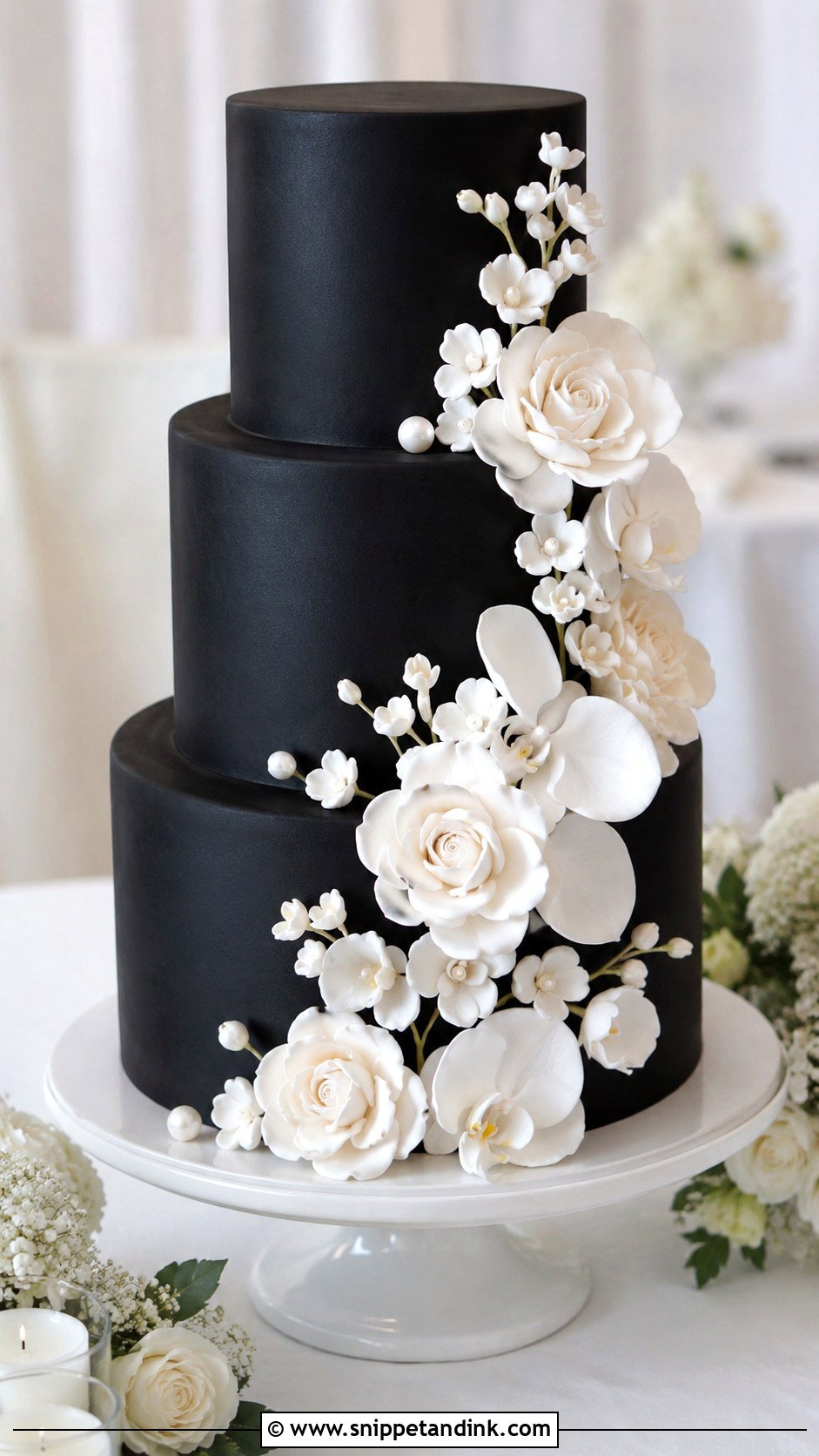
White on black is the strongest contrast you can put on a cake, so it forgives a lot. Roses, orchids, peonies and anemones all read as bridal against it, and anemones are a clever pick because their dark centers echo the icing. Matte fondant gives the cleanest edge. Black buttercream looks softer but shows every spatula mark, so it needs a patient finisher. I usually suggest flowers in a diagonal cascade here, because one sweeping line stops the white from looking like polka dots when the cake is photographed from across the room.
2. Black Wedding Cake With Red Flowers
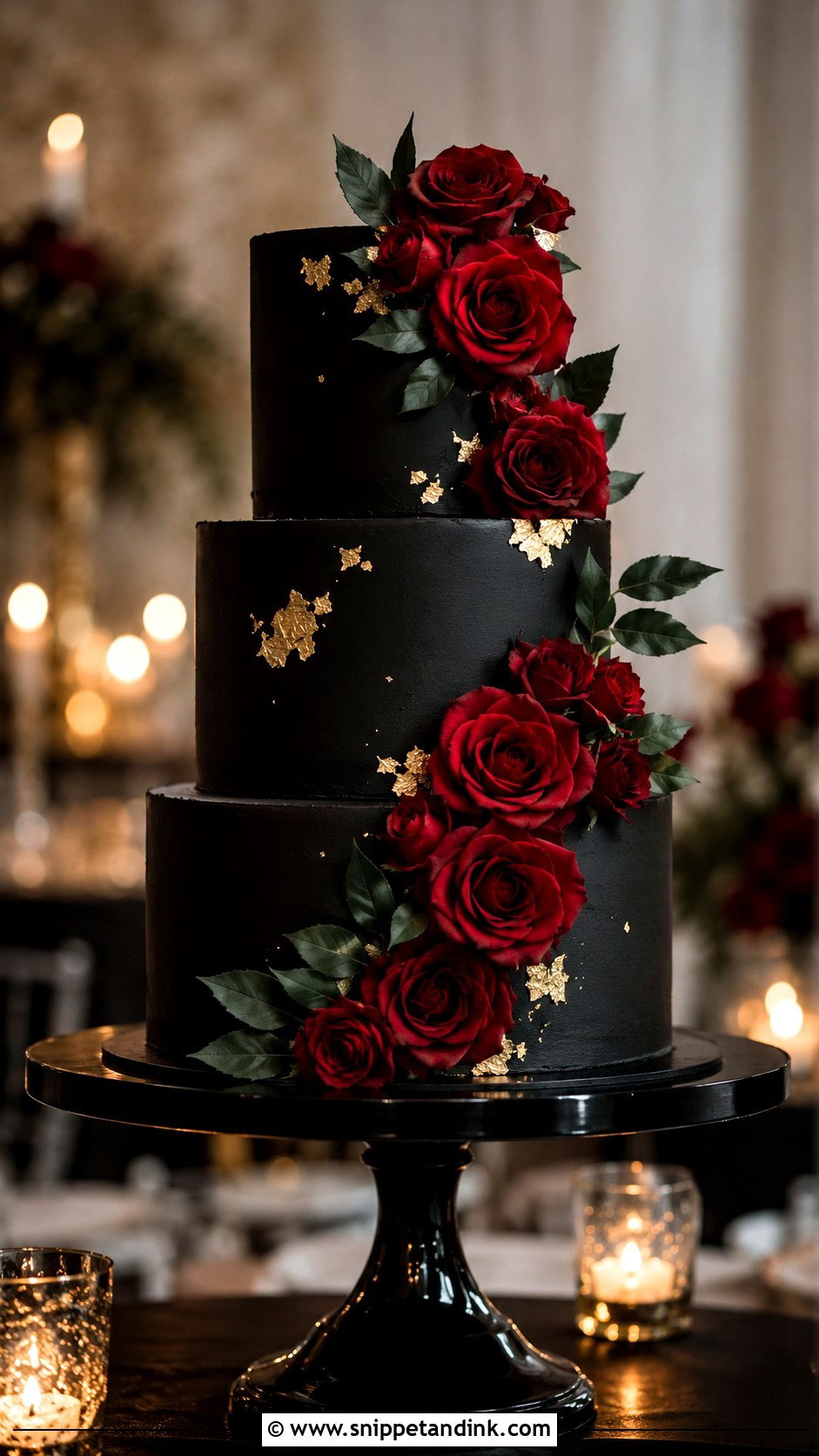
Red on black is pure evening romance, and it is also the pairing that goes muddy fastest. Under warm, dim reception lighting a deep red rose can almost disappear into the icing, so I lean toward brighter scarlet roses, ranunculus or sugar poppies, whose black centers tie back to the tiers. Keep everything else quiet: a few dark leaves, maybe one thin line of gold. Add red ribbon and red drips on top of red flowers and the cake starts to look like a Halloween party.
3. Black Wedding Cake With Pink Flowers
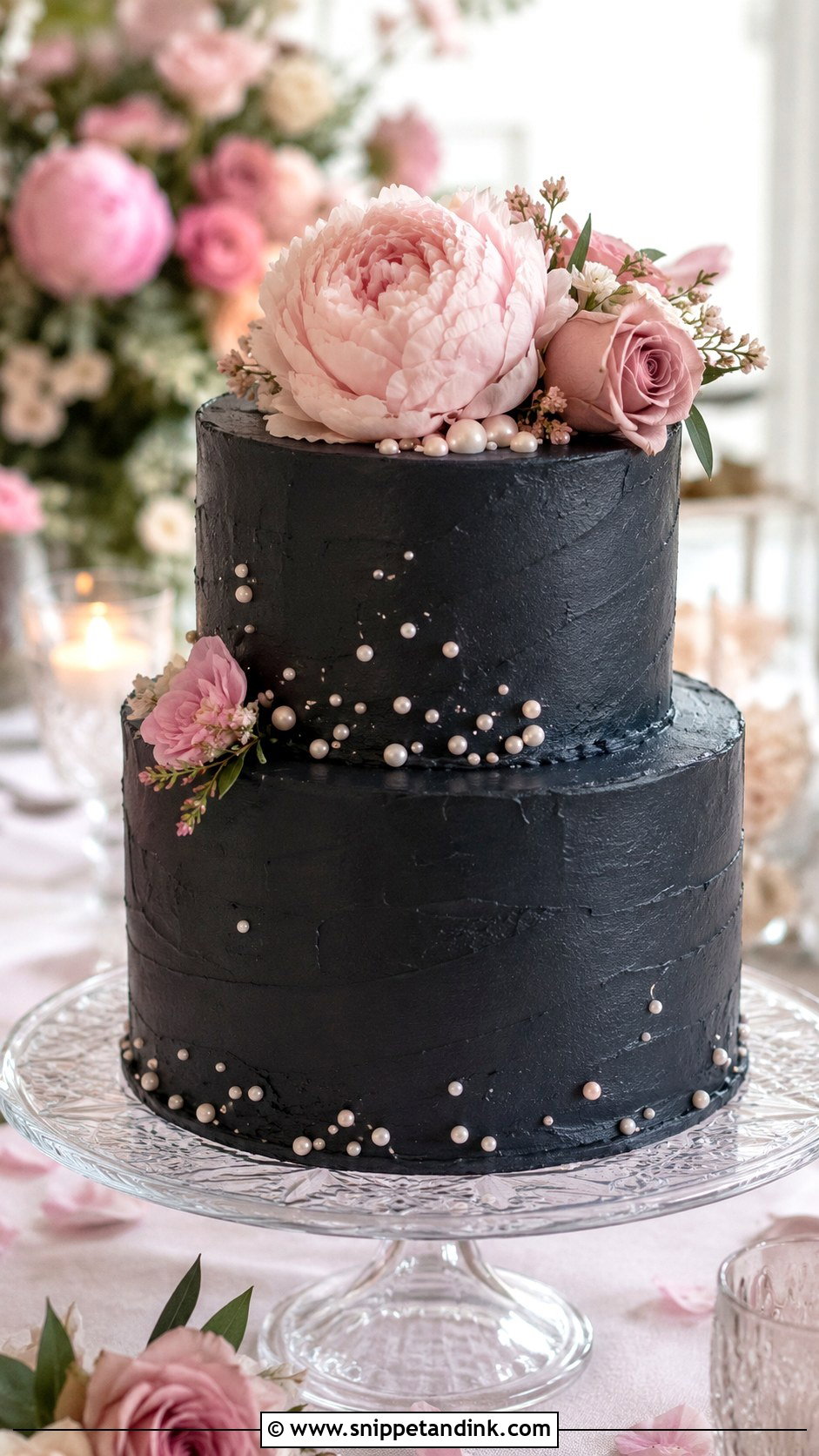
Pink is the gentlest way into a dark cake. Blush roses and dusty peonies do not fight the black the way white does, which suits a couple who wants one moody detail rather than a moody wedding. The catch shows up on camera: very pale blush can wash out toward white in flash photos, so I choose a pink with a little mauve in it. Loose clusters on each tier, plus a few pearl dragées or tiny sugar buds, keep it delicate.
4. Black Wedding Cake With Purple Flowers
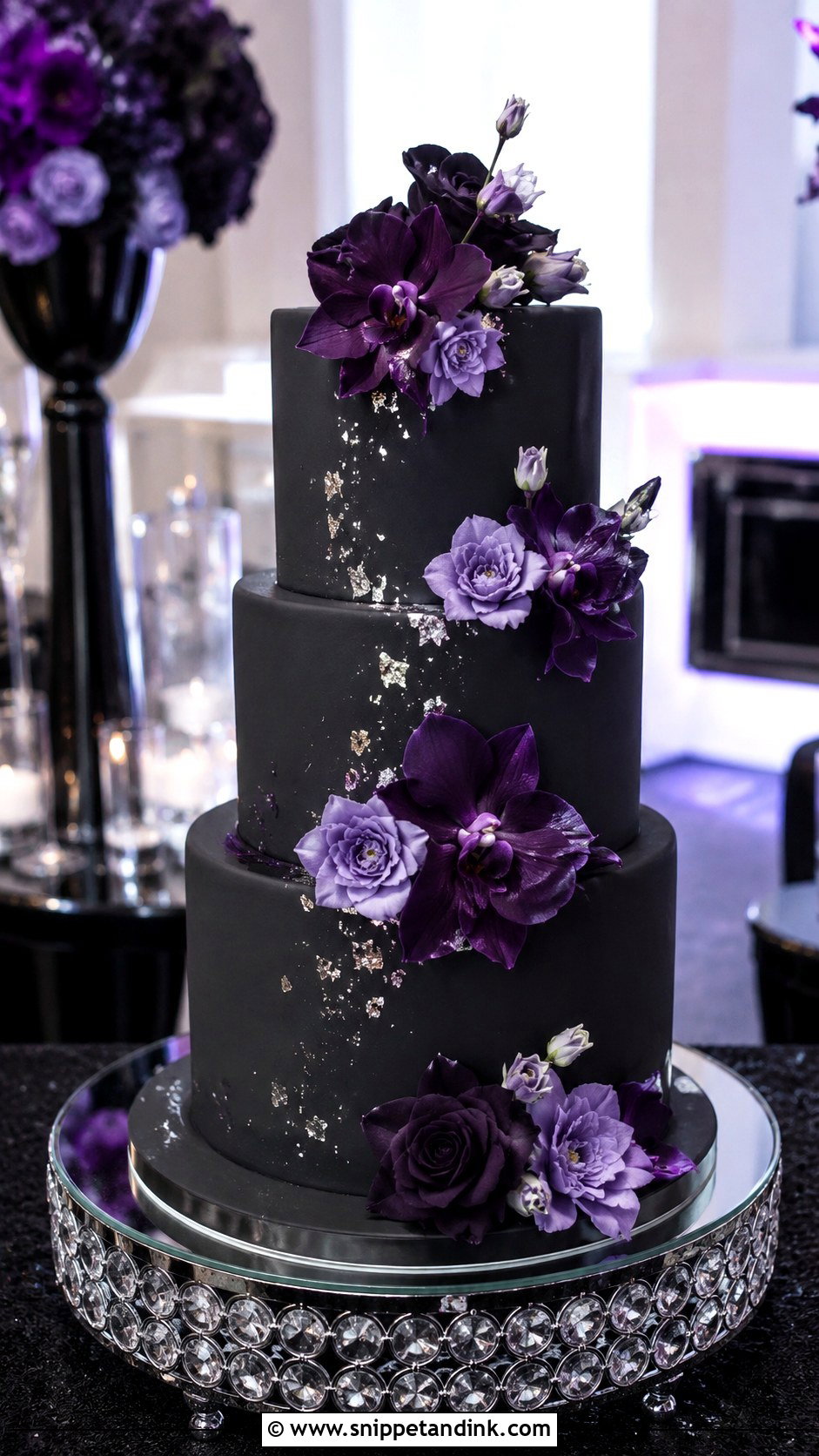
Purple and black sit close together, which is exactly why this one needs care. Deep plum on black can look like a bruise from ten feet away. I mix the darks with lighter lavender, violet, and lilac flowers so there is a gradient for the eye to follow. Sugar orchids give a sleek, almost architectural result; garden roses and lisianthus soften it. A few charcoal accents add depth without adding a new color. Warm lighting is kind to this palette, while cool overhead light flattens it.
5. Black Wedding Cake With Gold Flowers
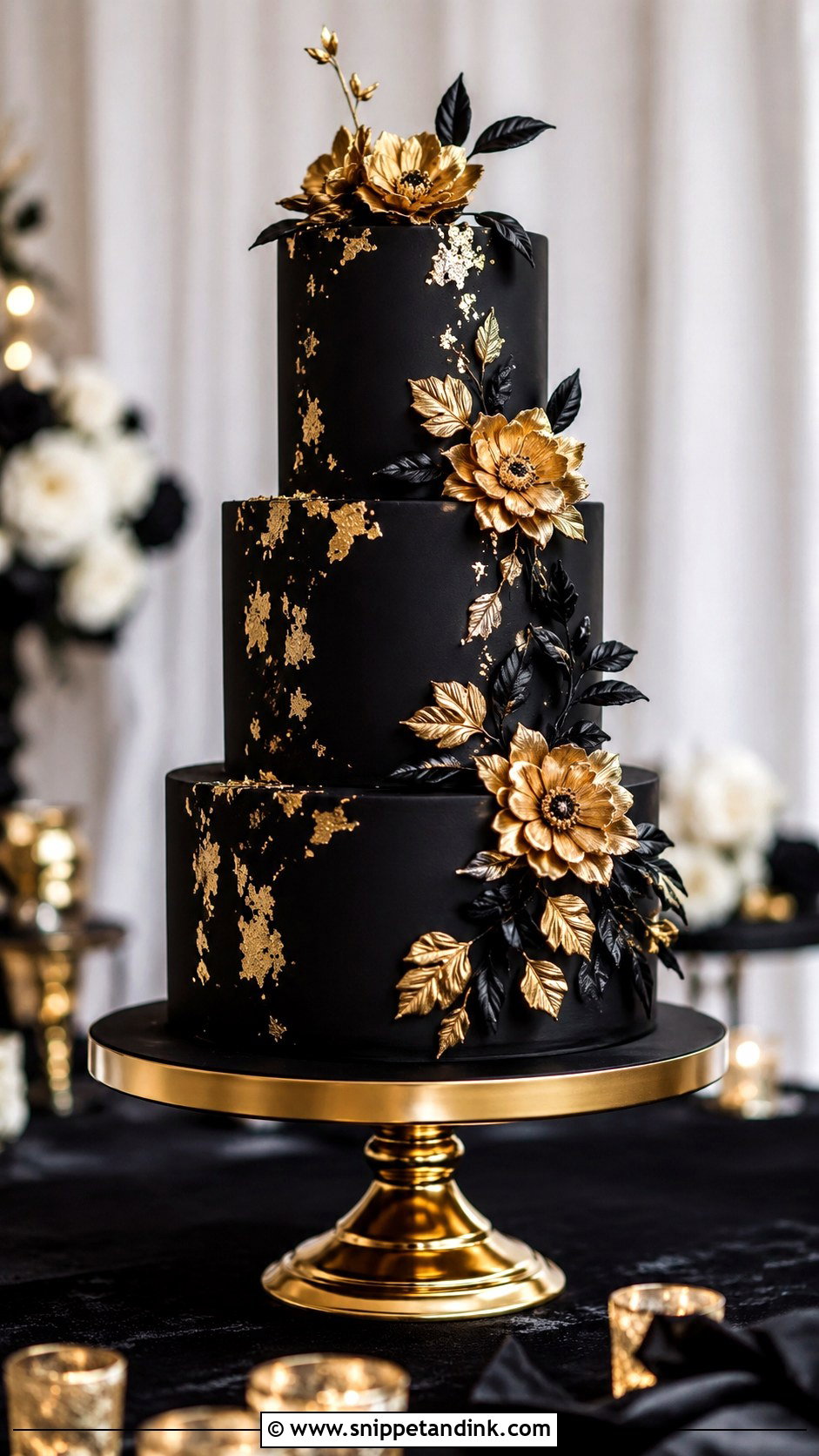
Gold on black is the formal pairing, and restraint is everything. I paint sugar petals with gold lustre mixed into a little alcohol, or lay edible gold leaf along their edges, and both catch candlelight far better than gold brushed over a whole tier. Three to five metallic blooms is usually enough on a tall cake; past that it starts to look like a prop. Small black sugar leaves keep the design tonal and let the gold do the glinting. One honest warning: some cake dusts are labeled non-toxic rather than edible, so ask your baker which kind touches the icing.
6. Black Wedding Cake With Sugar Flowers
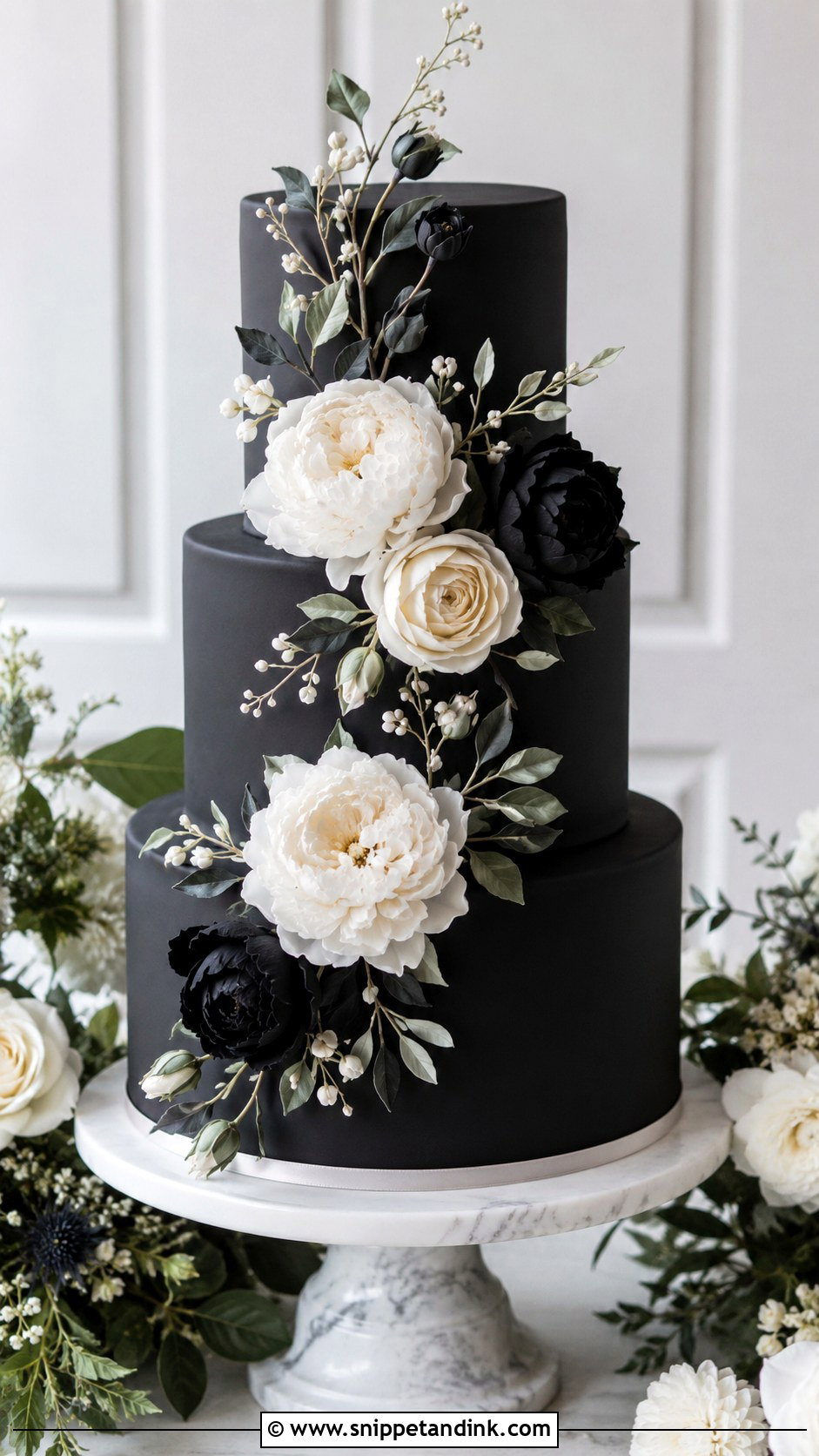
Sugar flowers are what I recommend most often for black cakes. They take any color, never wilt and never raise a food-safety question, which matters for destination weddings and long receptions. They do take time, since a realistic peony is hours of work, so they are ordered well ahead. Ask for thin petal edges and natural curves. Thick, flat petals look like plastic against a dark background, where every silhouette shows. On black, even one large sugar bloom can carry the whole cake, but keep it out of the fridge, because sugar petals soften in damp air.
7. Black Wedding Cake With Fresh Flowers
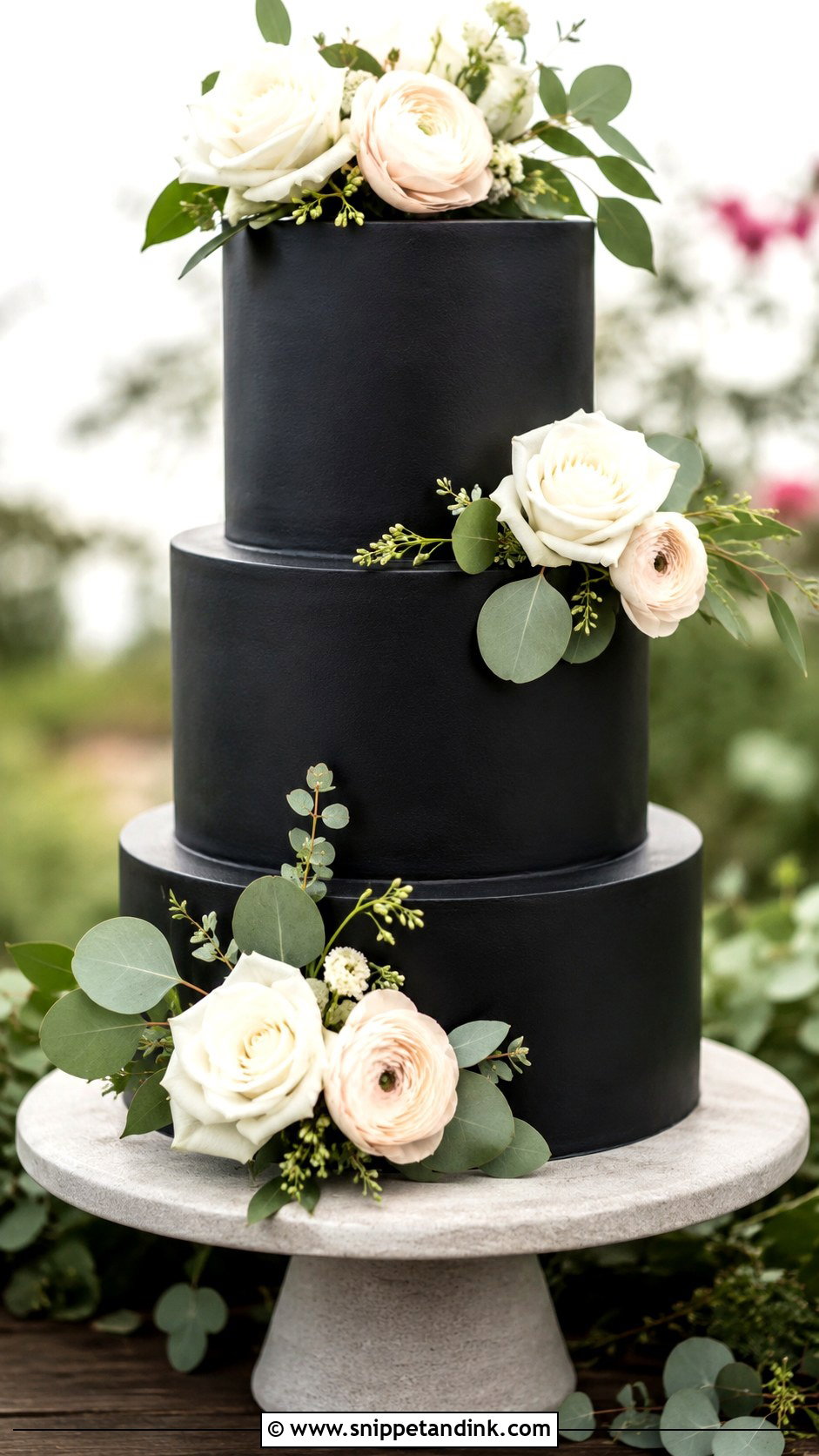
Fresh flowers tie the cake to the bouquet and centerpieces, and they are the riskiest option on this list. Many florist flowers are sprayed, and some popular ones are toxic, so stems should never go straight into the cake. I wrap each stem in floral tape, set it in a food-safe pick and place the flowers at the venue on the day. Black buttercream suits real petals because its softer finish matches their looseness. Clusters at the base or between tiers are much easier to secure than a full side cascade.
8. Black Wedding Cake With Dried Flowers
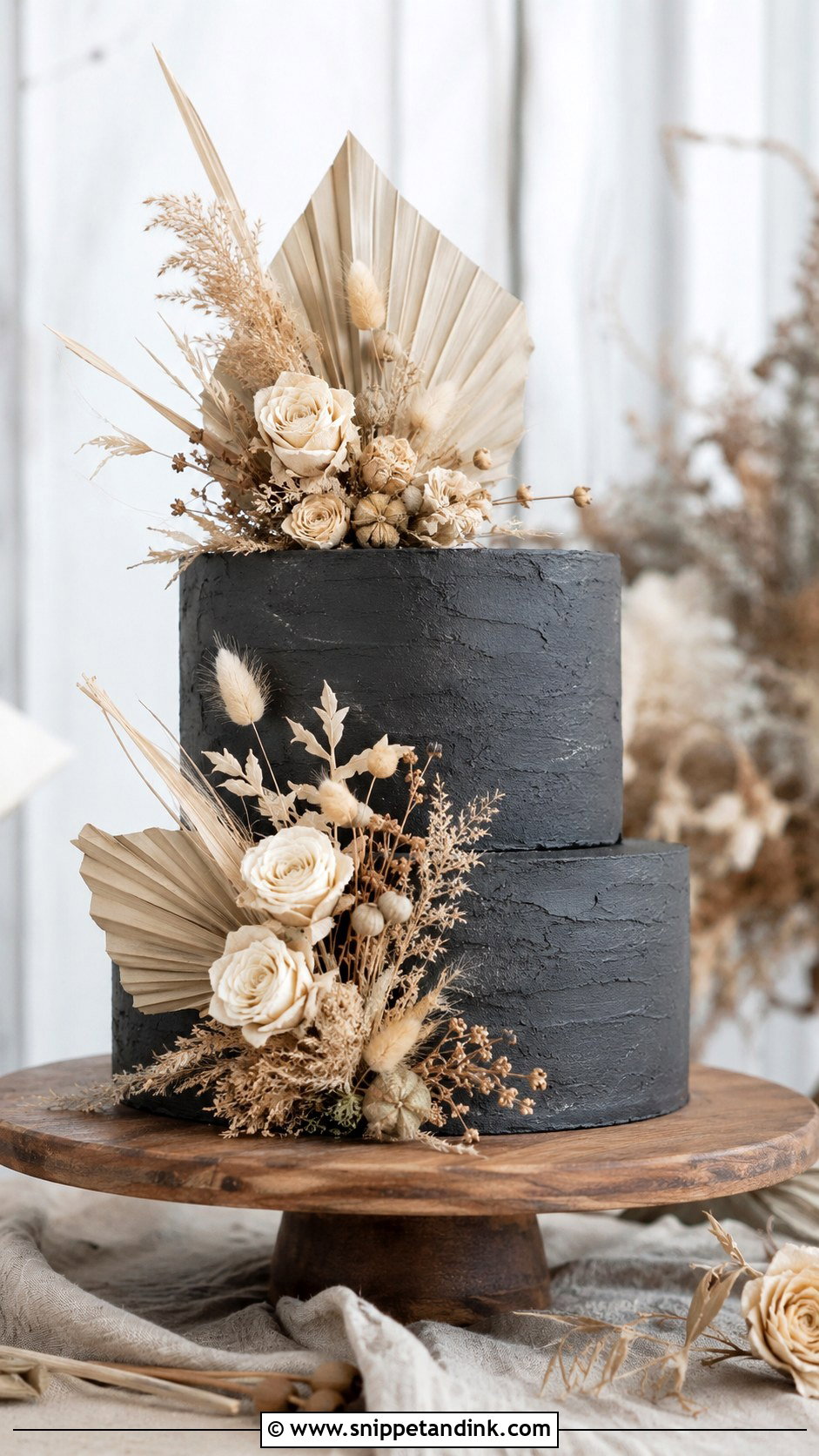
Dried flowers belong to earthy, boho and loft receptions, and in cream, tan and soft brown they look especially good against black. Palm spears, preserved roses, bunny tails and dark grasses give texture sugar cannot copy. What most couples do not know is that many dried stems are dyed, bleached or sprayed to hold their shape. I only let them sit on a barrier, a small disc of parchment or a pick, never on bare icing. Keep the tiers plain so the dried pieces look placed rather than scattered.
9. Black Wedding Cake With Pressed Flowers
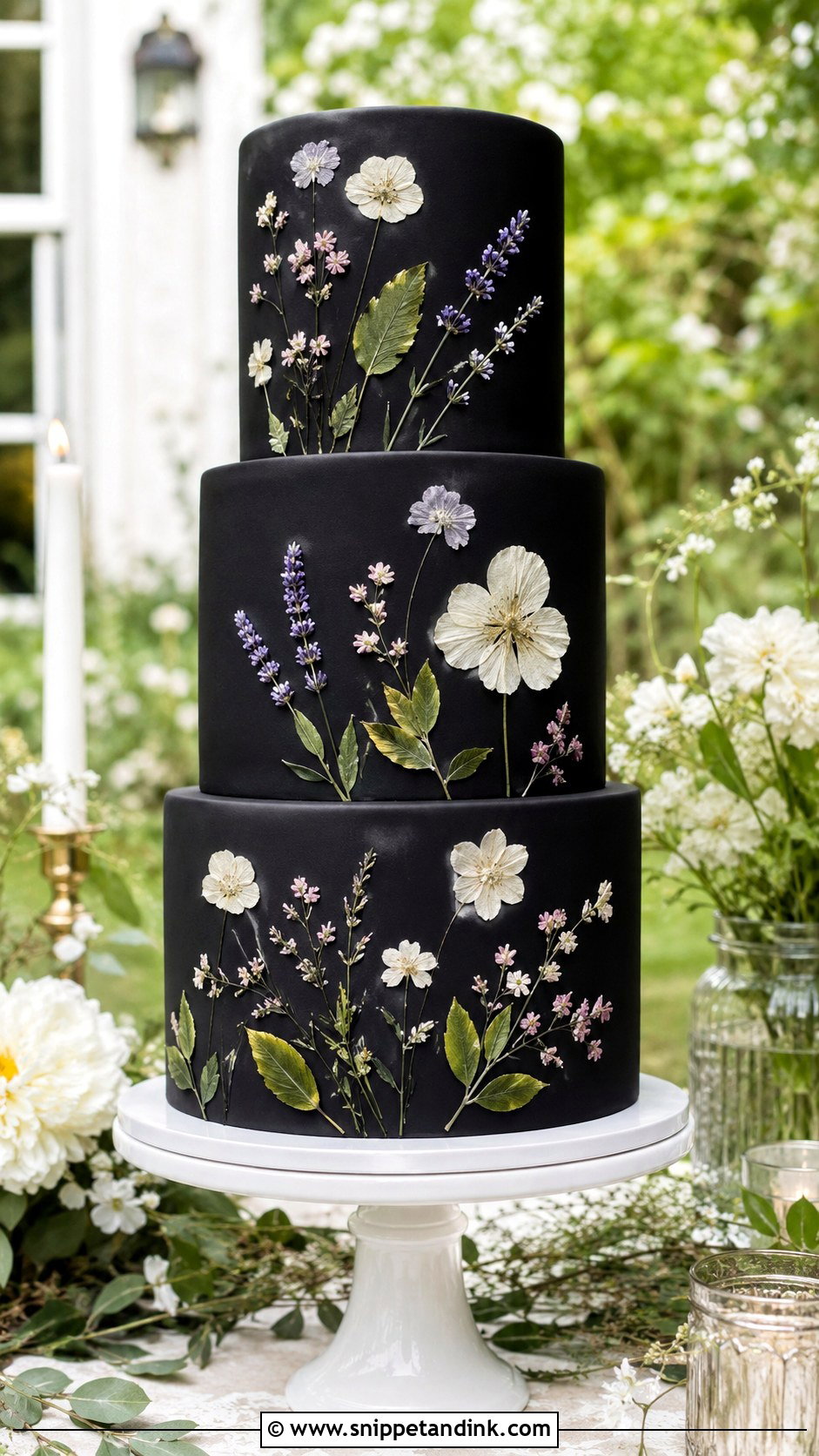
Pressed flowers need the smoothest surface of anything here. They go on flat with a thin brush of piping gel, so any bump in the fondant shows as a lifted petal. I use edible blooms such as violas, pansies and cornflowers, because they press thin and hold their color. White, lavender and pale blue show best on black, while darker pressed petals tend to vanish. Scatter them all over or run them in one flowing band; either makes a lovely spring garden cake.
10. Black Wedding Cake With Flower Cascade
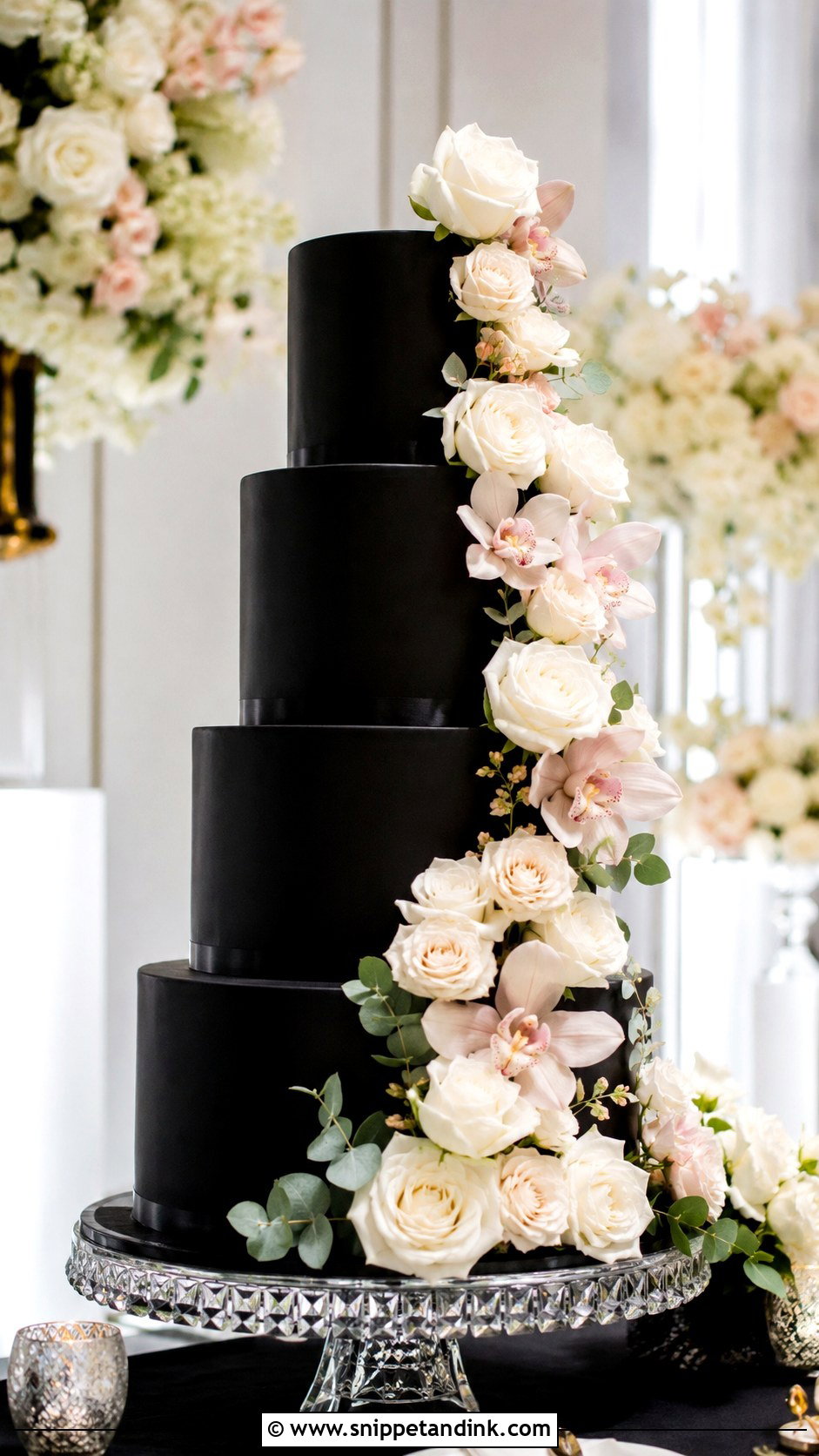
A cascade turns a tall cake into one long line, which is why I save it for three tiers or more. On two tiers the flowers tend to look as if they slid off. Decide early whether you want it full or narrow, because a lush cascade can need twice as many blooms and changes the quote. Black actually helps: the flowers stand out cleanly in photos with no white cake washing them out. Add buds or berries only when they share the main color, or the line breaks up.
11. Black Wedding Cake With Black Flowers
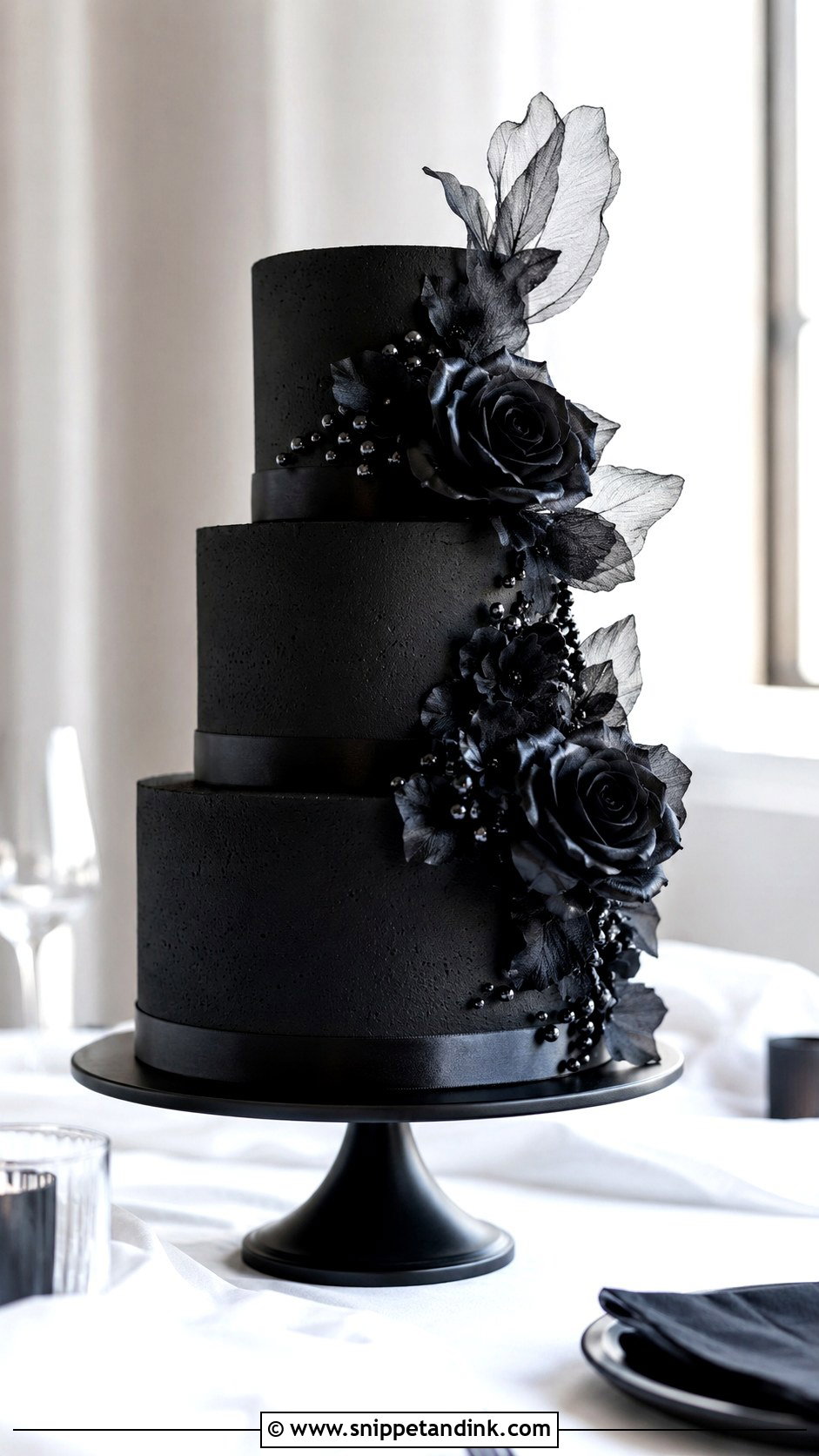
Black on black works only through texture, so this is a cake designed for the guest standing a step away. Black sugar roses, wafer paper petals or fondant ruffles over matte icing catch light along their edges and nowhere else. I would keep the stand plain and the lighting direct. Under soft, diffuse light the flowers can disappear completely. Satin ribbon or a few dark pearl dragées add just enough sheen for a quiet, very memorable monochrome cake.
12. Black Wedding Cake With Blue Flowers
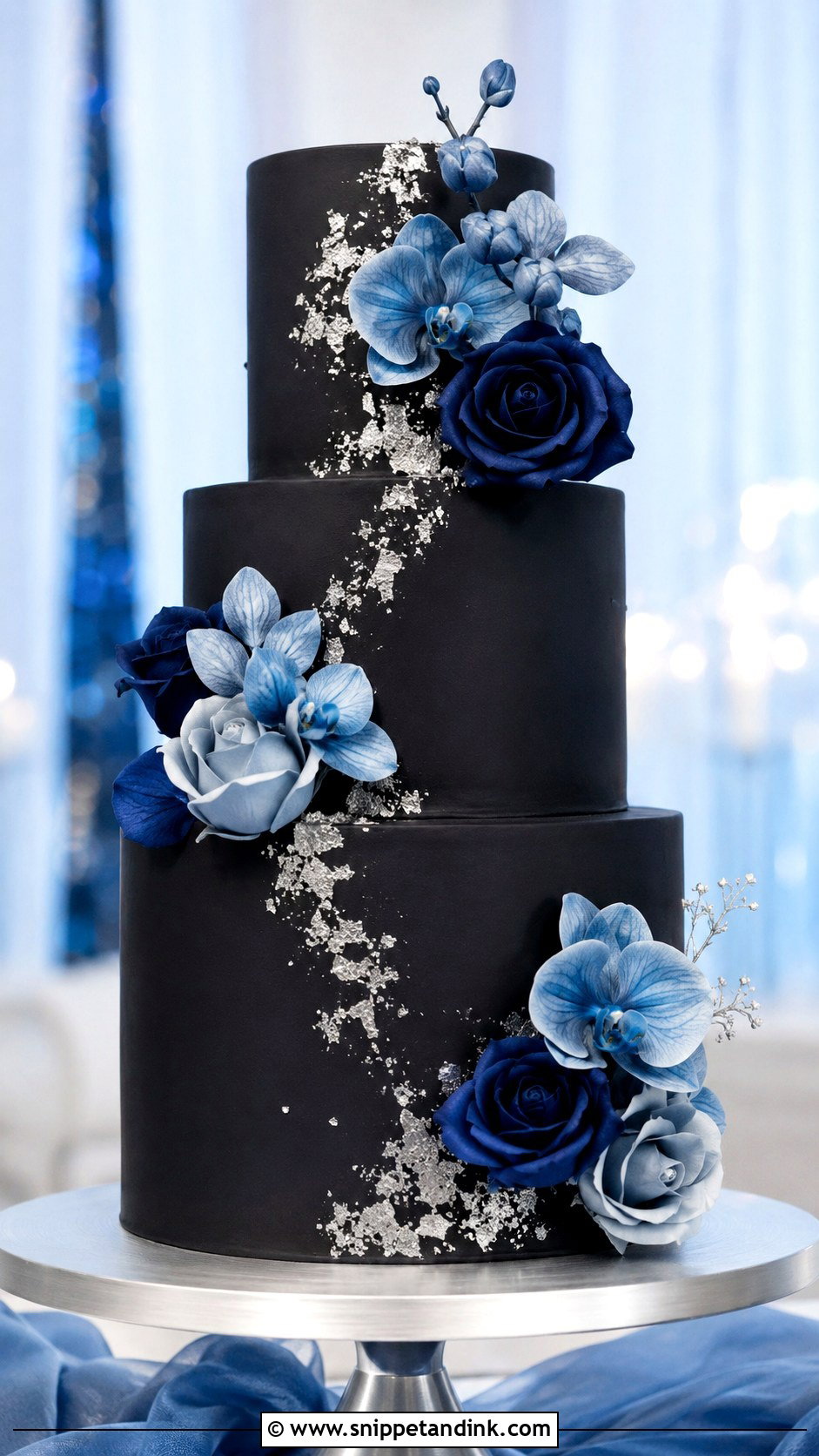
Blue brings color to black without heat. Dusty, slate and navy blooms all work, though navy needs a lighter blue beside it or the two merge. Sugar orchids look sleek. Hydrangea looks soft, but I keep real hydrangea off the cake because it is one of the flowers that should not touch food, so I make it in sugar instead. A black fondant base with grouped blue flowers and a touch of silver suits winter palettes and city venues; leave it matte for a calmer finish.
13. Black Wedding Cake With Green Flowers
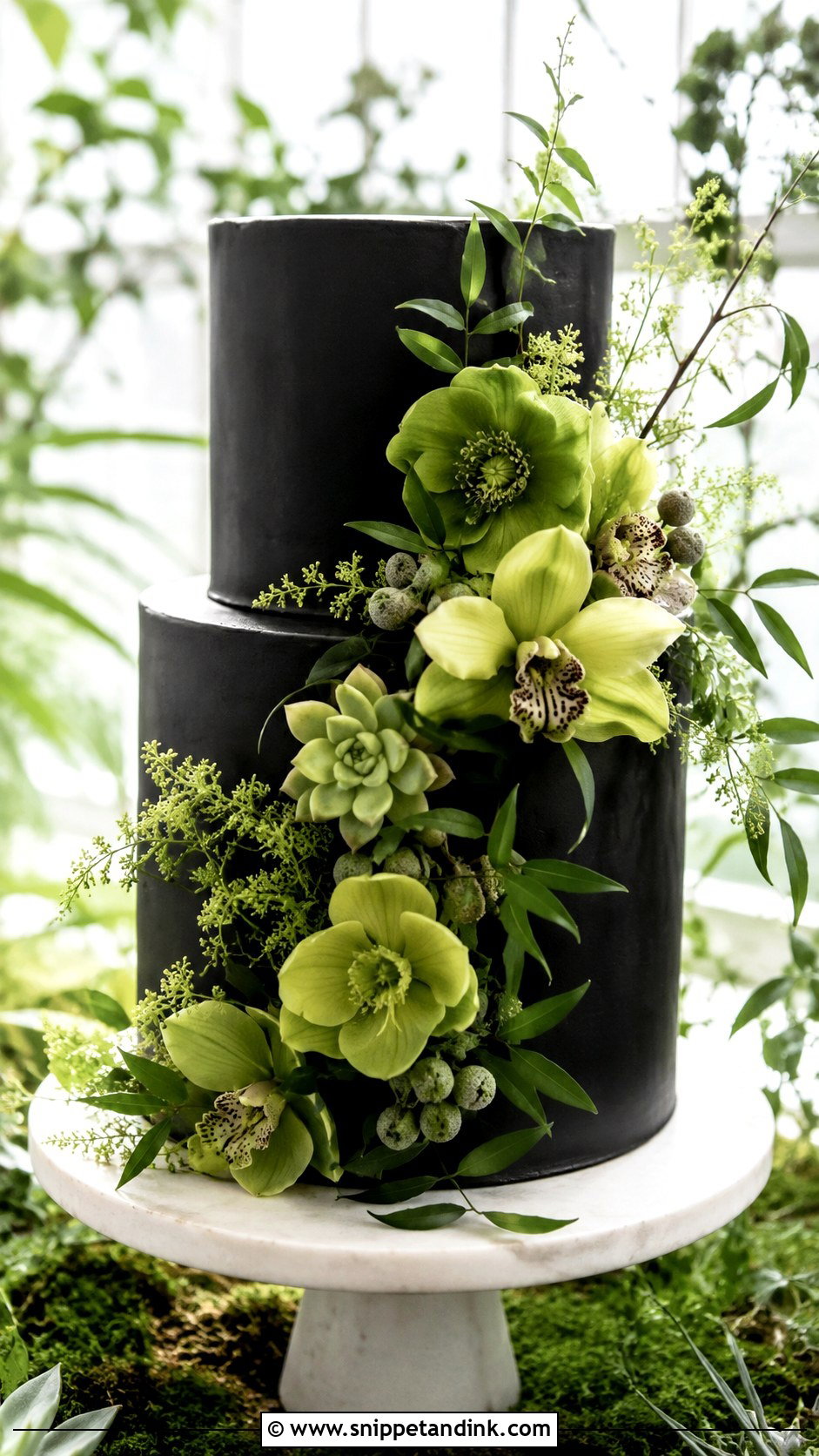
This is the botanical take: green orchids, hellebores, succulents and foliage on a dark base. The finish matters more than usual. Buttercream gives green a soft, mossy backdrop, while fondant makes the same green look sharp and graphic. Real succulents are popular, but they are heavy and their roots carry soil, so on a cake I prefer sugar or wafer paper versions. Low clusters at the base or between tiers read as a garden, and a couple of white buds give the eye somewhere to rest.
14. Black Wedding Cake With Orange Flowers
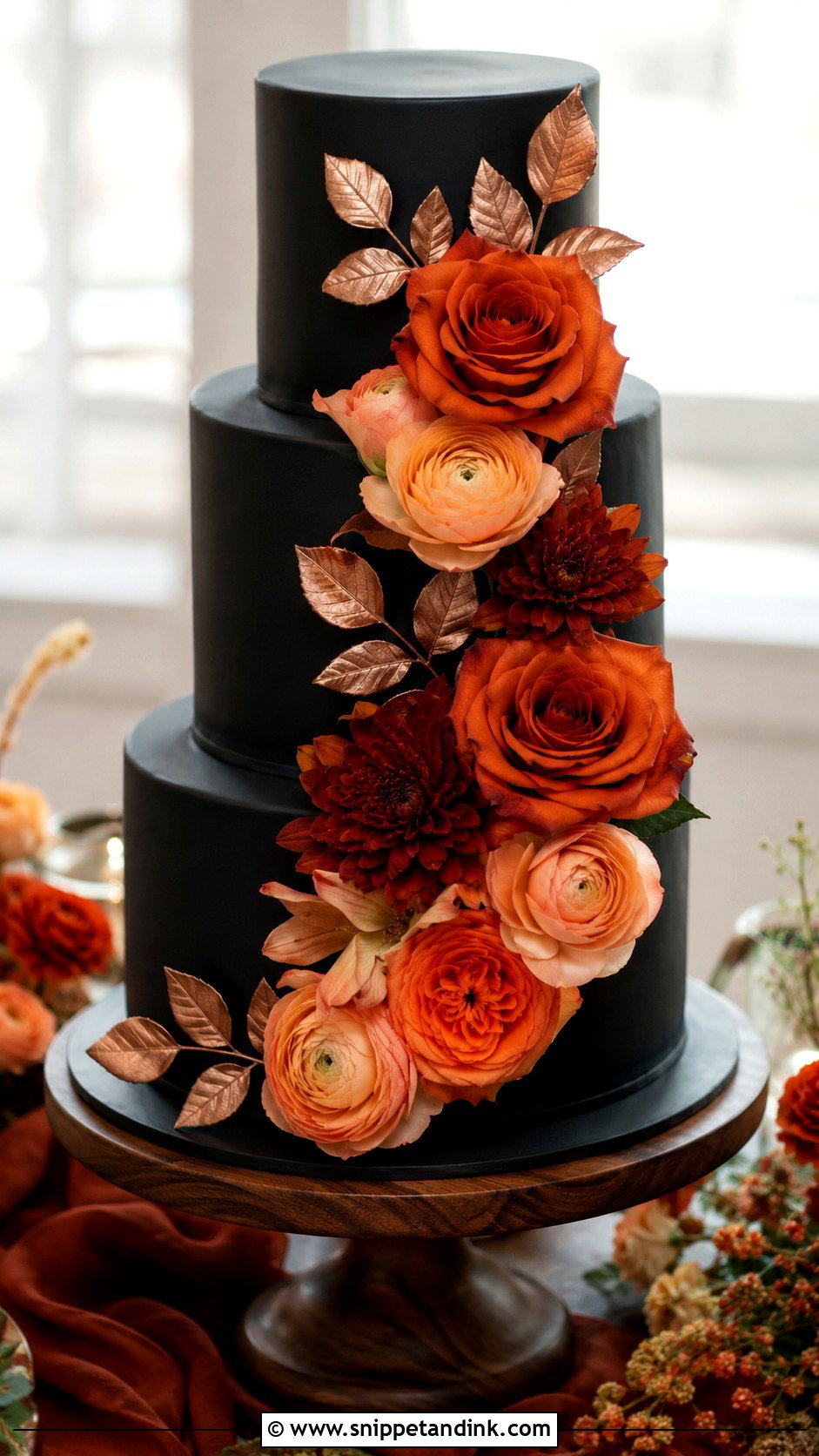
Orange is the color I suggest for fall and desert weddings where red feels too expected. Burnt orange roses, copper dahlias and peach ranunculus all hold their warmth against dark icing. Placement makes or breaks it. Two or three deliberate clusters look styled; orange scattered over every tier starts to look like a harvest table. A few bronze leaves tie it together, and the icing should stay smooth.


15. Black Wedding Cake With Burgundy Flowers
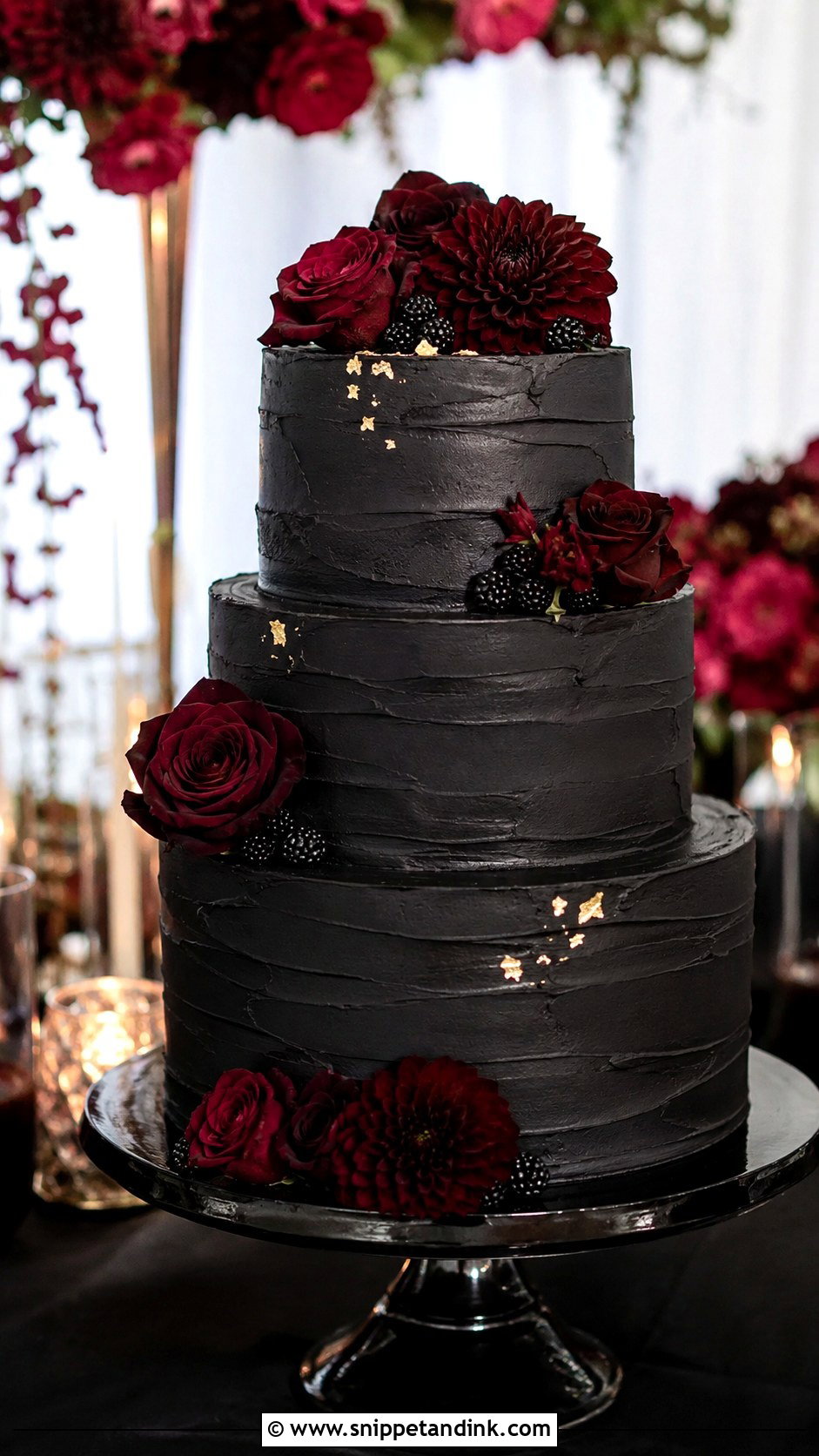
Burgundy roses, dahlias, peonies and dark ranunculus are the moodiest choice after black on black, and they need a little help to show their detail. I tuck a lighter tone into the arrangement, a few blush petals or gold-edged leaves, so the burgundy has something to push against. Velvet linens and dark greenery suit it. Tall tiers make a grand centerpiece, while two tiers fit an intimate dinner. It reads warmer than red, which makes it a strong winter pick.
16. Black Wedding Cake With Flower Painting
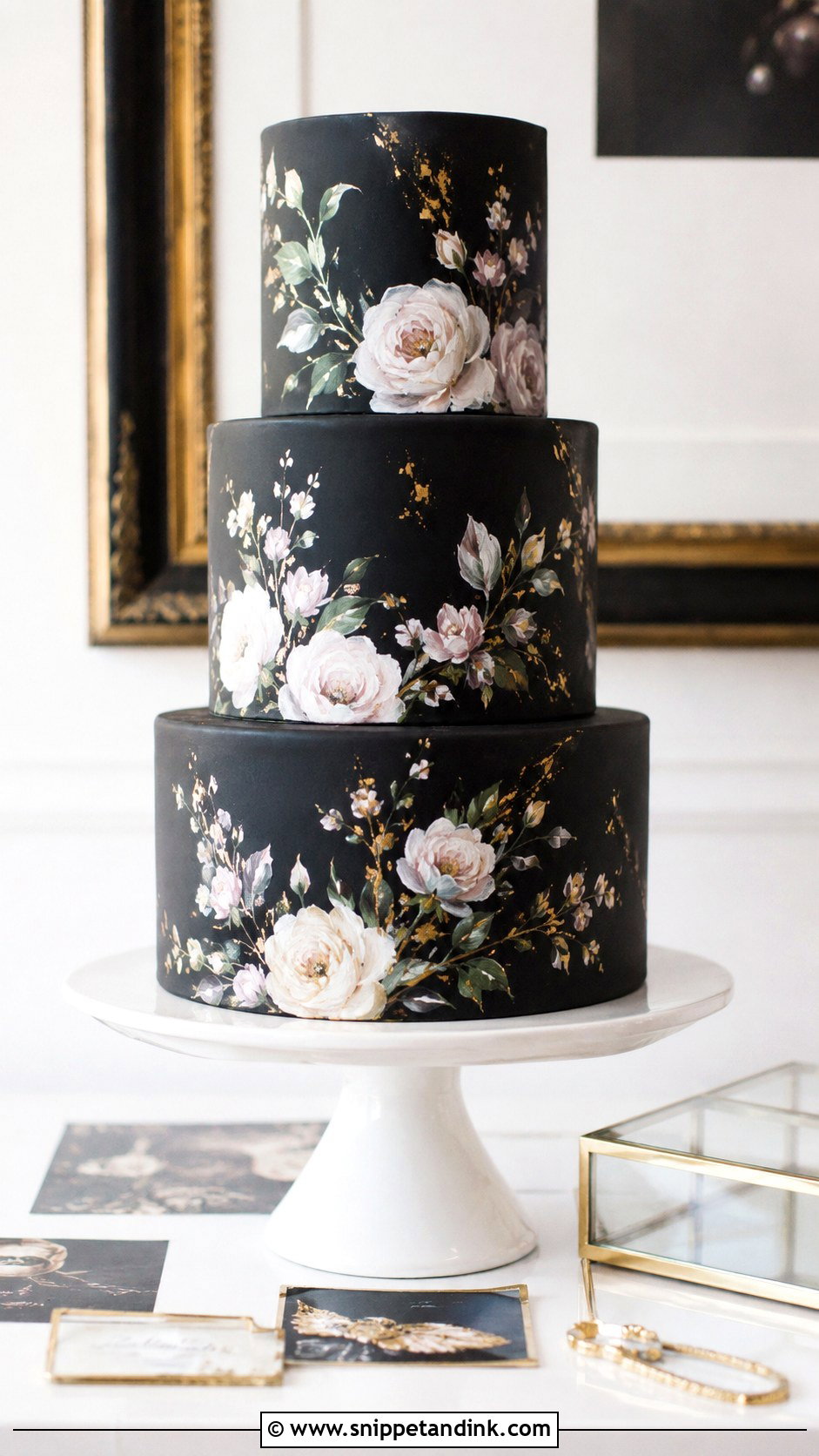
Hand-painted flowers on black fondant are closer to illustration than to cake decorating. White on black reads like a chalk sketch; colored paint adds personality. The work is done with edible paint or petal dust on firm fondant, which is why soft buttercream is not really suited to this technique. I like matching the motif to the invitation artwork so the cake feels drawn for this wedding. It is also light, so it gives you florals without the weight of fresh stems.
17. Black Wedding Cake With Flower Lace
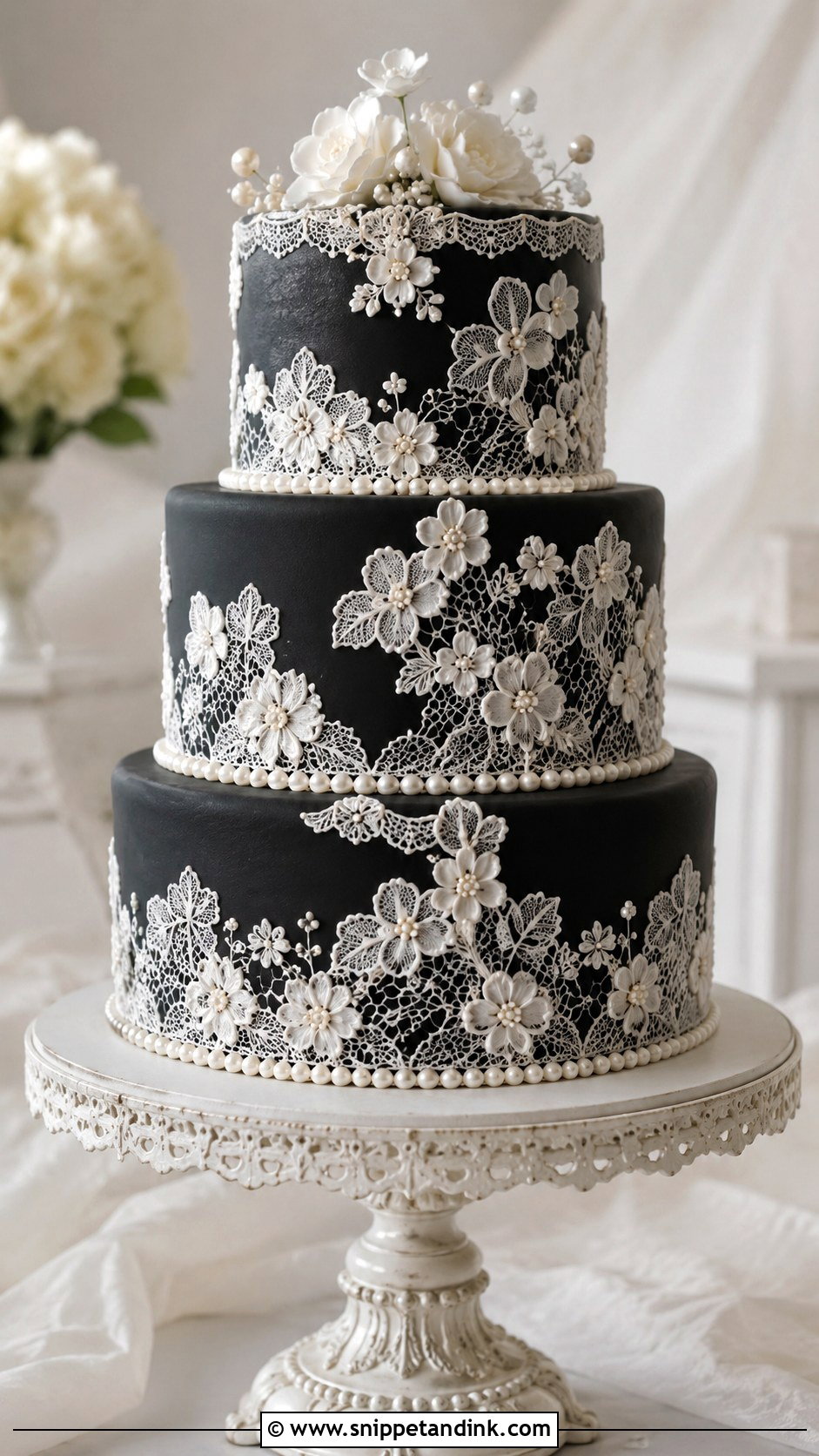
Lace on black reads vintage even when the tiers are modern. It can be piped by hand, cut from set edible lace or built from fondant appliqués, and hand piping has the most life but takes the longest. White, ivory and silver show the pattern clearly, while black lace on black becomes pure texture. When a bride sends me a close-up of her dress lace, I copy that motif. Edible lace panels can soften in humidity, so for a summer outdoor reception I would choose piping, then add a few small sugar flowers at the top to tie the lace to the floral theme.
18. Black Wedding Cake With Flower Arch
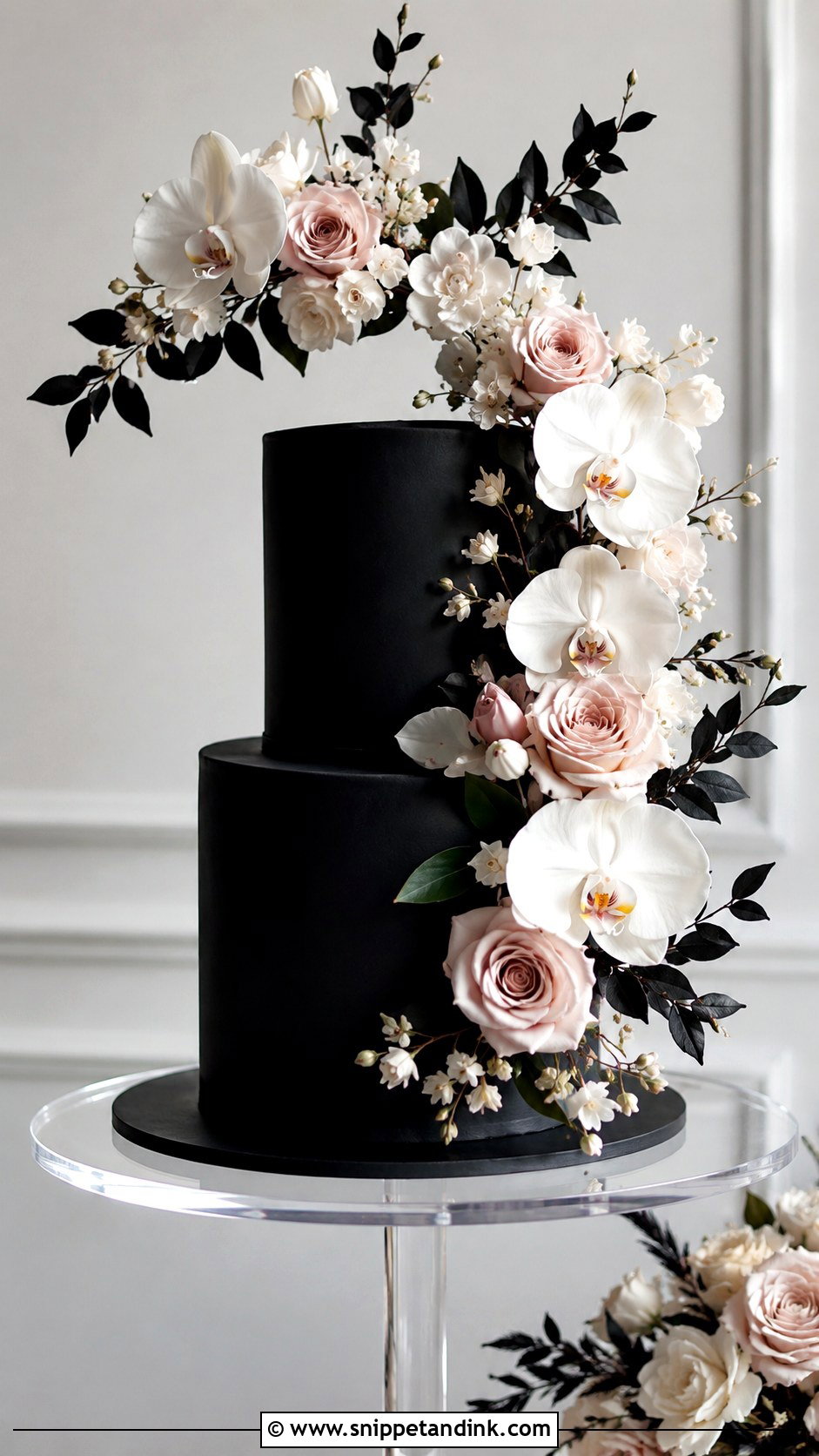
An arch gives the flowers structure. Instead of a cascade, the blooms form a curve around one side or rise over the top tier. Because it photographs best from the front, think about where the cake table sits and which way guests will face it. Orchids and sugar flowers hold the curve better than soft garden roses, which droop over a long evening. Matte black keeps the outline crisp. If the arch rises above the cake it needs internal wire support, so ask how it will travel.
19. Black Wedding Cake With Flower Topper
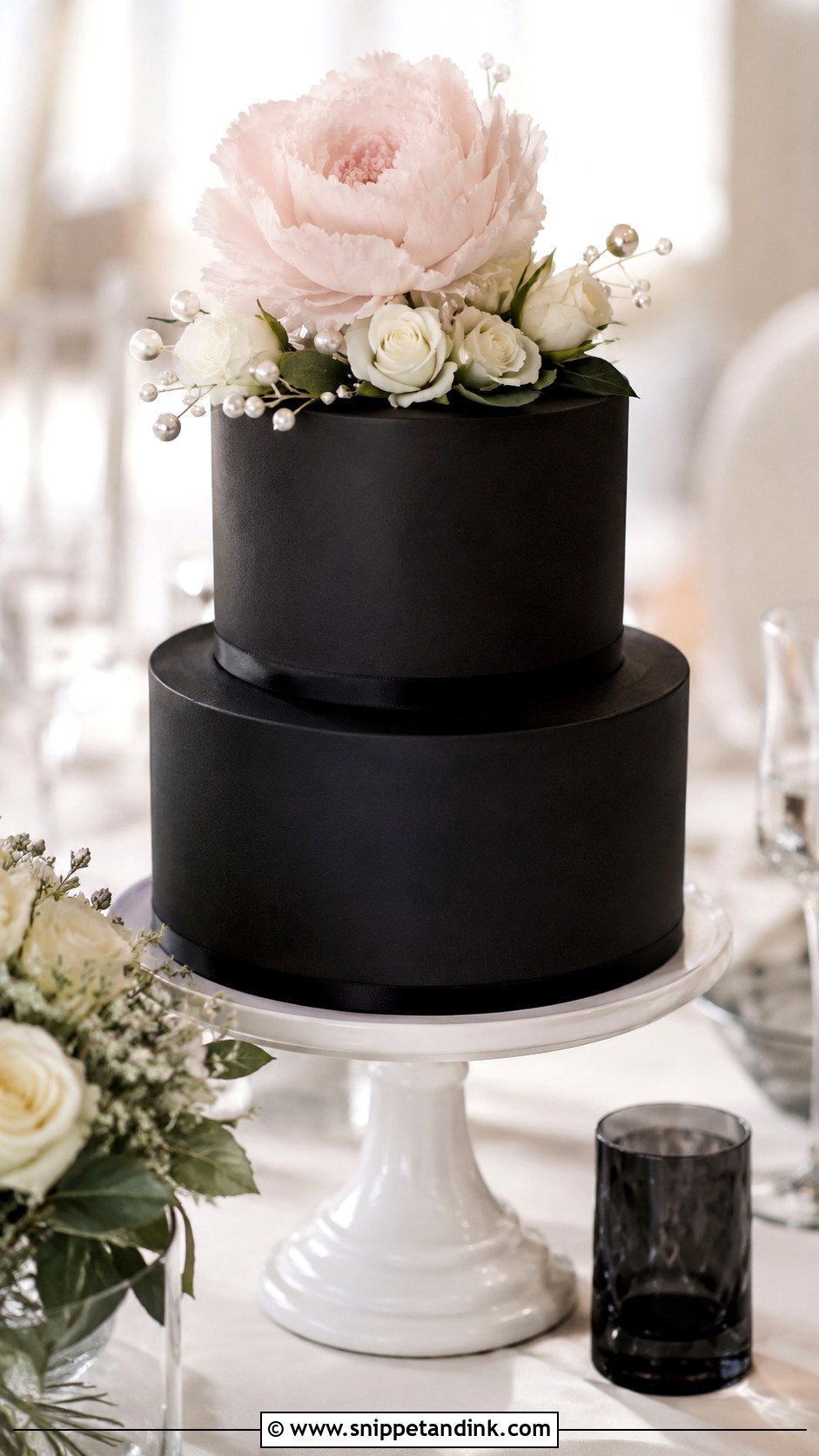
A topper keeps the tiers sleek and puts all the attention in one place, which suits small weddings and two-tier cakes. One large sugar peony, a tight rose cluster or a few orchids is plenty. I match it to the bouquet when I can, or go for contrast if the bouquet is already dark. A thin ribbon at each tier base finishes the edges. It is also the easiest design to change late, since a new topper does not mean remaking the cake.

20. Black Wedding Cake With Floral Texture
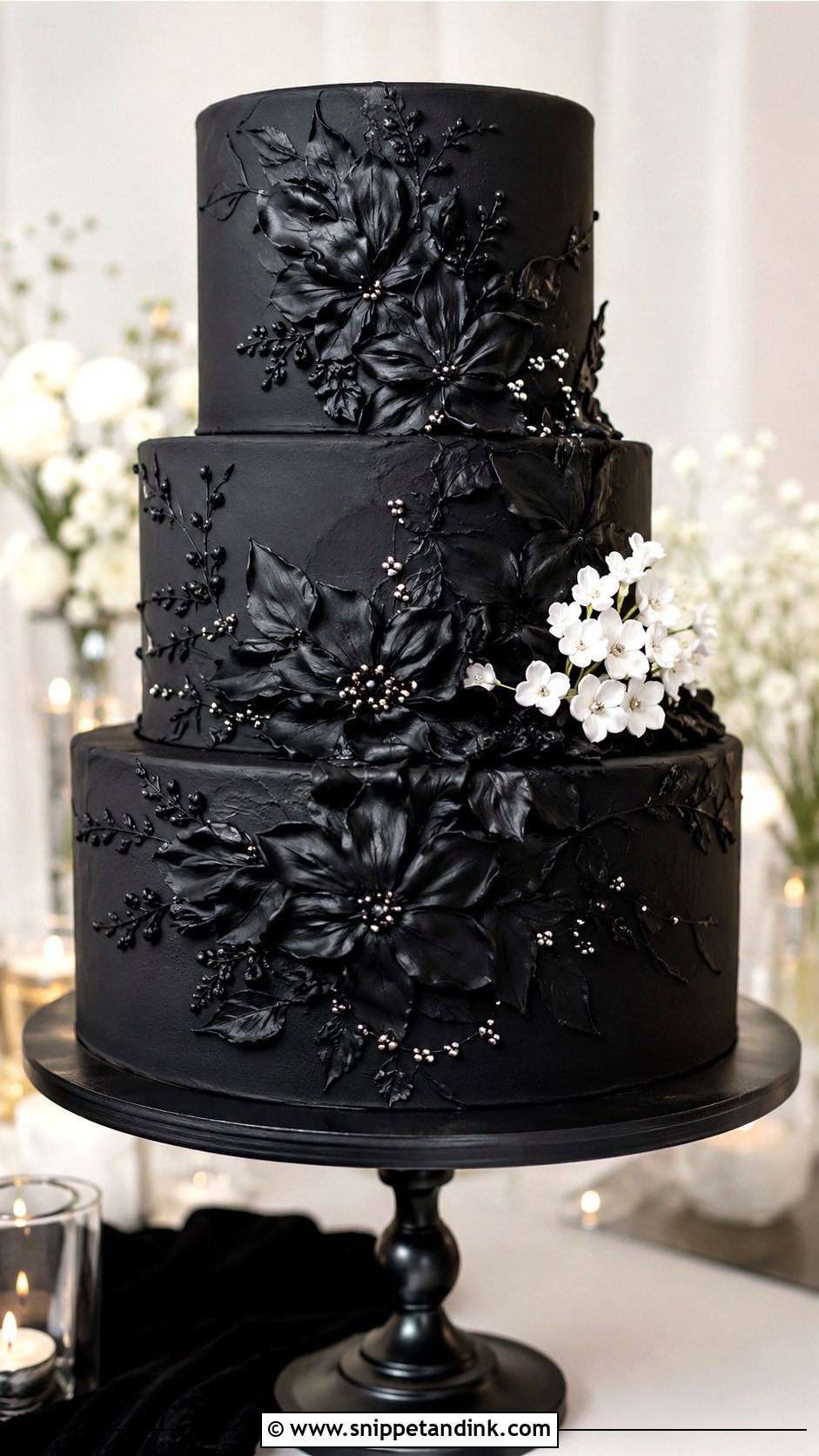
Raised floral texture makes the cake sculptural, whether it is piped buttercream flowers, embossed fondant or layered petals. Piping looks softer; fondant petals give a cleaner edge. The black-on-black version is the most dramatic because light lands only on the raised parts. A design like this rewards guests who come close, so I like it on a cake table near the dance floor or bar rather than in a far corner. Add one small colored cluster if full monochrome feels too severe.
Real Stems on a Cake Need Ground Rules
Fresh, dried and pressed flowers are the most requested option and the most misunderstood. Florist flowers are grown to look good, not to be eaten, and many are sprayed. Several favorite wedding flowers are also toxic, including lily of the valley, hydrangea, foxglove, sweet pea and daffodil. If you love one of those, I make it in sugar.
- Only pesticide-free blooms should go near the icing, so ask your florist to set aside a separate batch for the cake.
- Every stem gets wrapped in floral tape and sits in a food-safe pick, never straight into the sponge.
- Flowers go on at the venue shortly before guests arrive, so they do not wilt or leak sap into the icing.
- Everything comes off before cutting. It takes a minute and spares guests a mouthful of greenery.
Why Black Shows Every Scuff, and How I Protect It
Black is the least forgiving surface in cake design. A dusting of powdered sugar or cornstarch from rolling shows as a grey haze, so I roll black fondant on a thin film of shortening instead. A fingertip on the side leaves a mark that lights up in flash photos. Condensation is the bigger danger: a chilled cake carried into a warm, humid room starts to sweat, and on black those beads can dry into pale streaks.
Give the cake time to settle to room temperature before guests see it, keep it out of direct sun and away from heaters, and agree that nobody except the setup team touches it before the cutting.
The Petals Set the Mood and the Black Holds It
Start with the flower color, because that sets the mood: white for clean contrast, red and burgundy for romance, pink to soften, gold for glamour. Then decide how the flowers are made. Fresh, dried and pressed stems connect the cake to your florals but need careful handling, while sugar, lace, paint and piped texture stay exactly where they were put all night. Bring color swatches and a photo of the venue lighting to your tasting, and the right black cake usually becomes obvious quickly.
You'll Like These Ideas:








Leave a Reply