
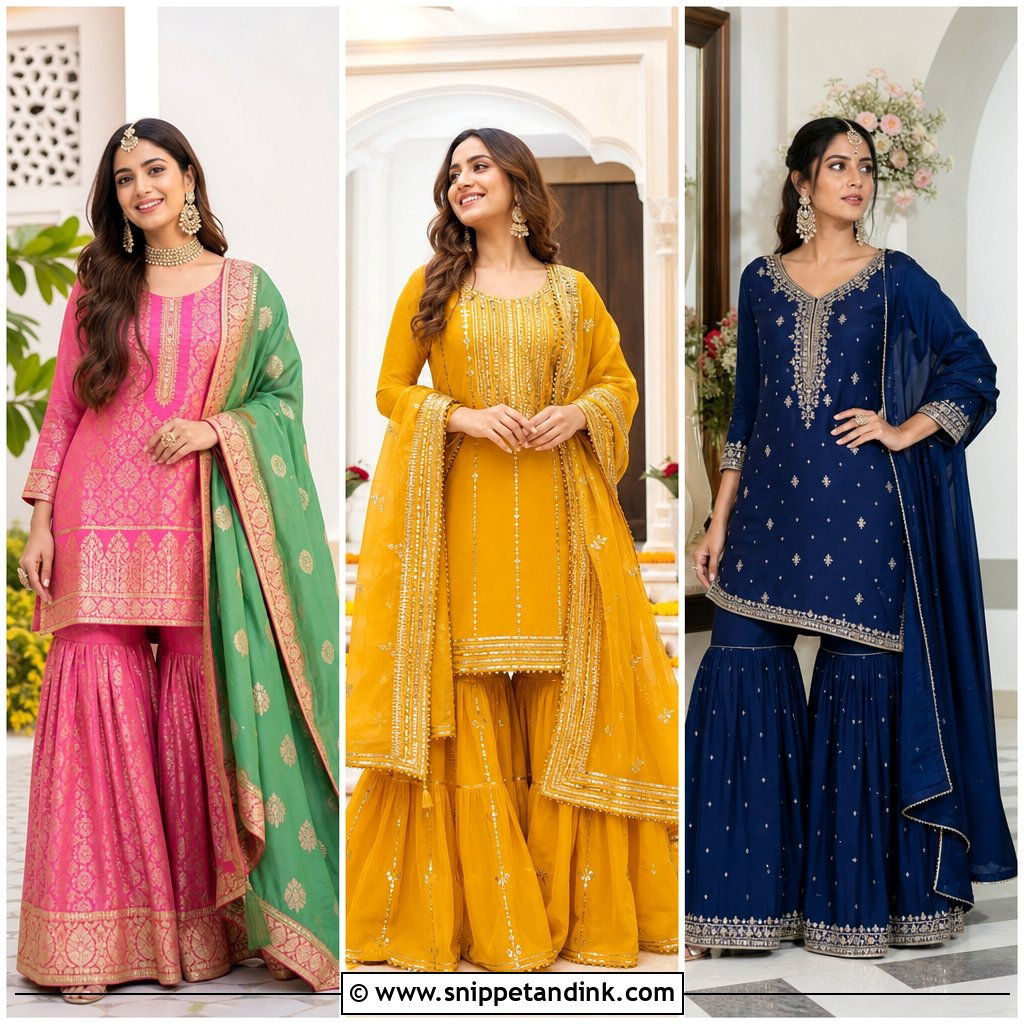
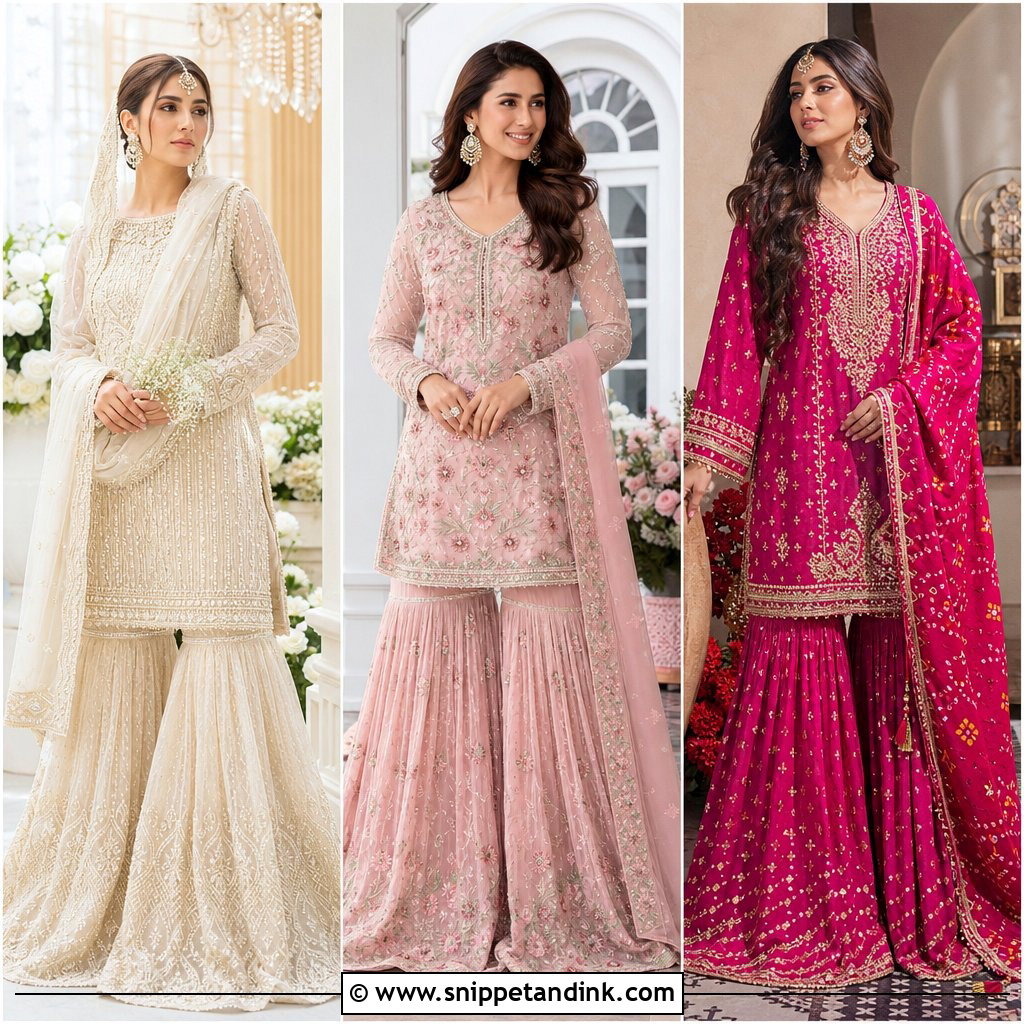
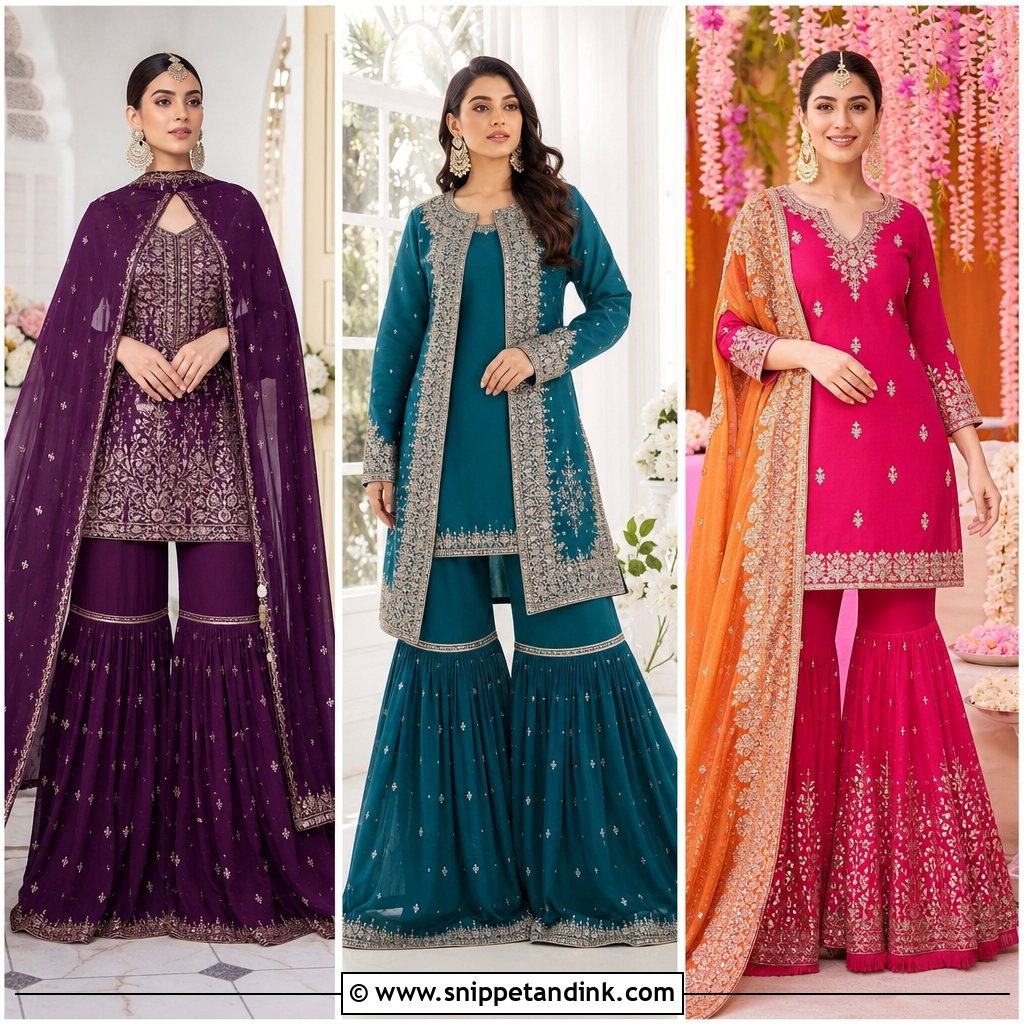
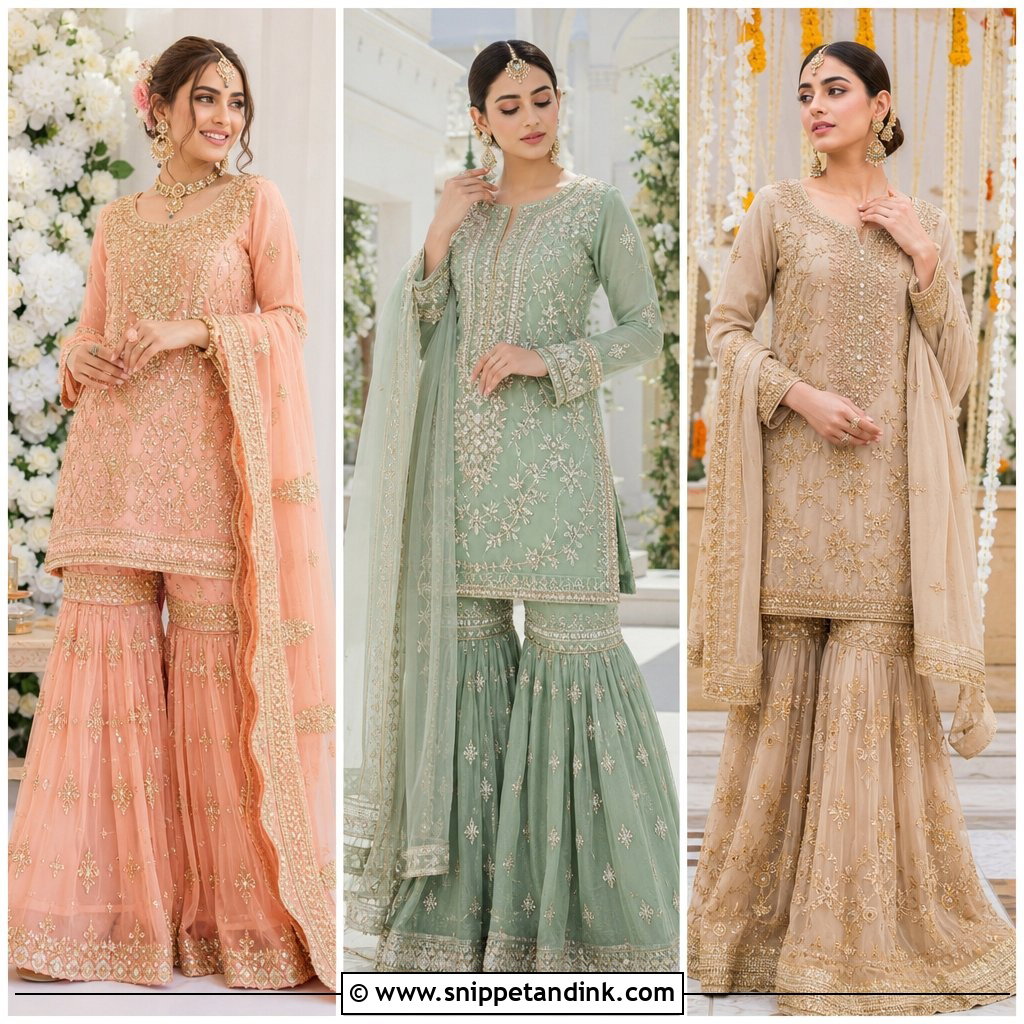
People mix up the garara and the sharara all the time, so let me separate them first. A sharara flares from the waist. A garara stays fitted through the thigh and only flares from the knee, where a decorative band covers the joint. That knee point is the whole personality of the outfit. Within that shape there’s huge range: ivory silk with pearls, deep red jamawar, pastel organza, a farshi cut that pools on the floor. Raw silk, tissue, organza, net and jamawar all hold the structured top half well, and the dupatta, jewelry and shoes do the rest. I’ve put together 20 Nikkah Garara Ideas below as complete outfits, with notes on what each one needs from you on the day.

Getting the Knee Joint Right When You Order a Garara
A garara is two garments joined at the knee: a fitted upper leg and a wide flared lower leg made from many panels. The band, often gota or embroidered trim, covers that seam. If the seam sits in the wrong place, no amount of embroidery fixes it.
- Have the tailor measure from waist to the center of your kneecap while you stand straight in the shoes you’ll wear. This is the joint measurement, and it’s the one people guess.
- Ask for the joint to sit at or a finger-width below the knee. Higher and it bunches when you sit; lower and it restricts your stride.
- Check the upper leg ease. It should be fitted but leave room to sit cross-legged, which needs more give than standing.
- Ask how many panels the lower flare uses. More panels give a fuller, swingier fall; fewer look flatter. A good tailor will show you a sample.
- Decide the kurti length after the joint is set. Most gararas look best with the kurti ending a few inches above the band.
1. Ivory And Gold Nikkah Garara
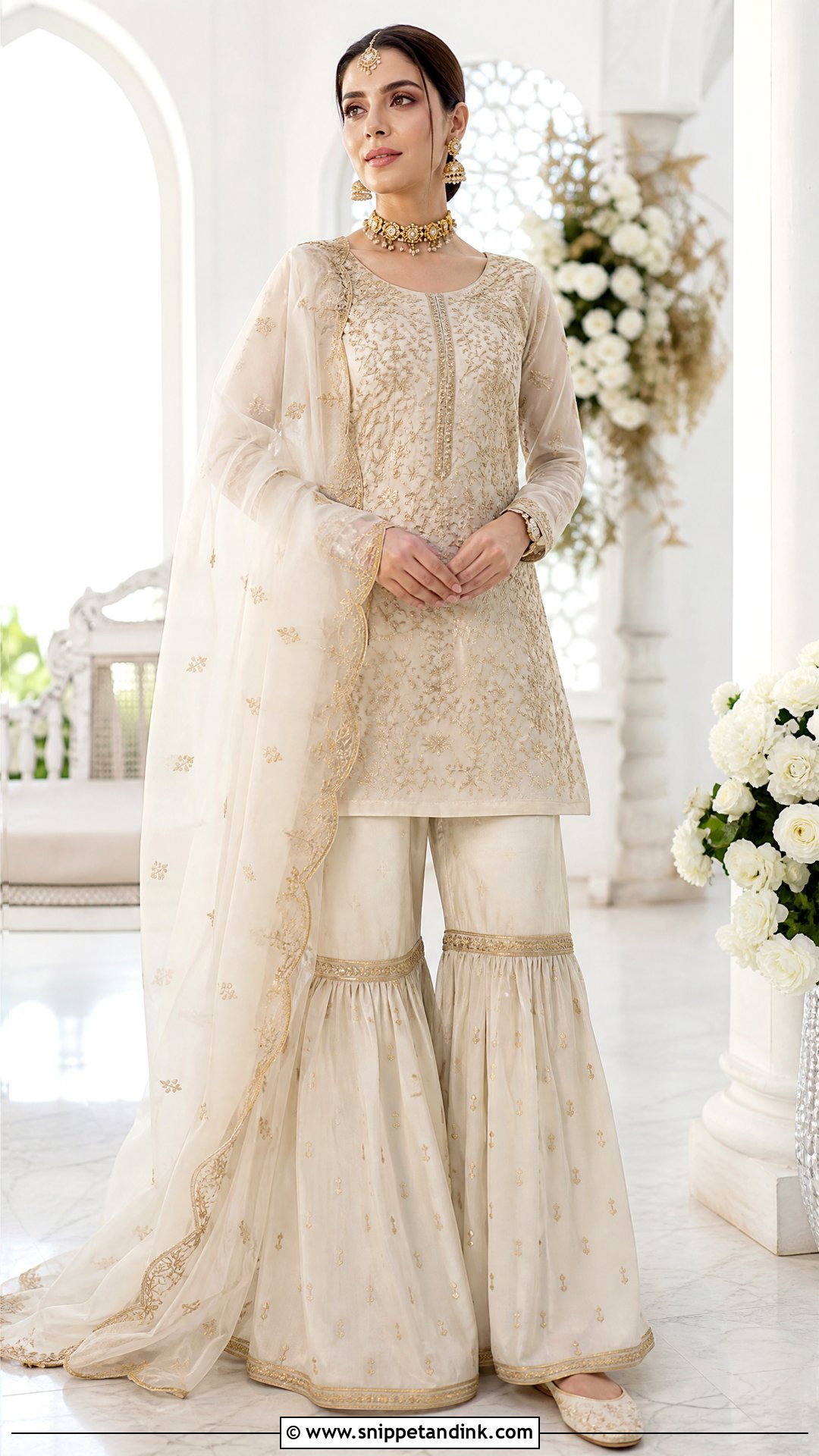
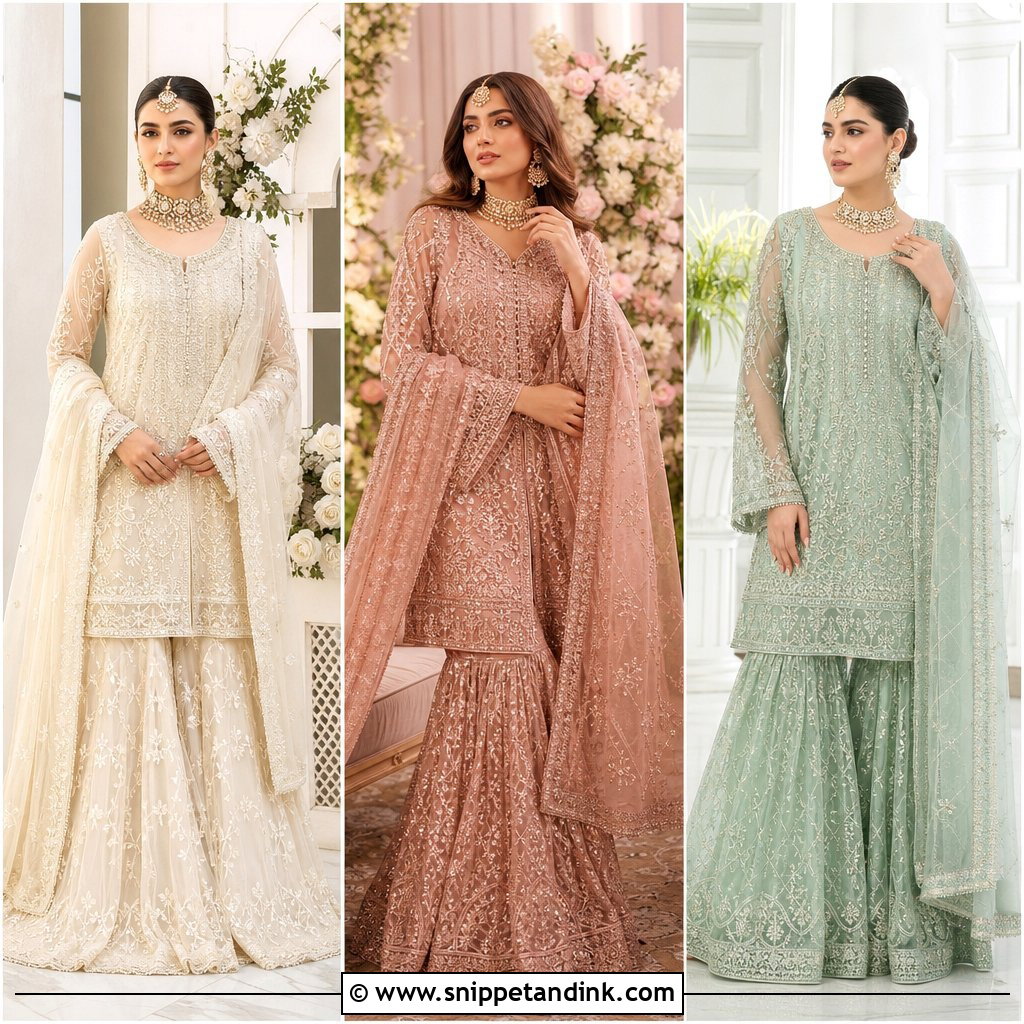
Ivory with gold is the garara most families expect, and it rarely disappoints. A short raw silk kurti with zardozi, dabka or tilla at the neck, cuffs and hem sits over a structured ivory garara with gold trim on the knee bands. Keep the dupatta sheer organza with a scalloped border so the outfit stays light. Antique gold jhumkas, a small maang tikka and ivory khussas finish it. Ivory raw silk shows a lot of slub texture up close. I check the bolt in daylight before cutting, since an uneven slub across two legs makes one side look a different shade.
2. White Nikkah Garara With Red Dupatta
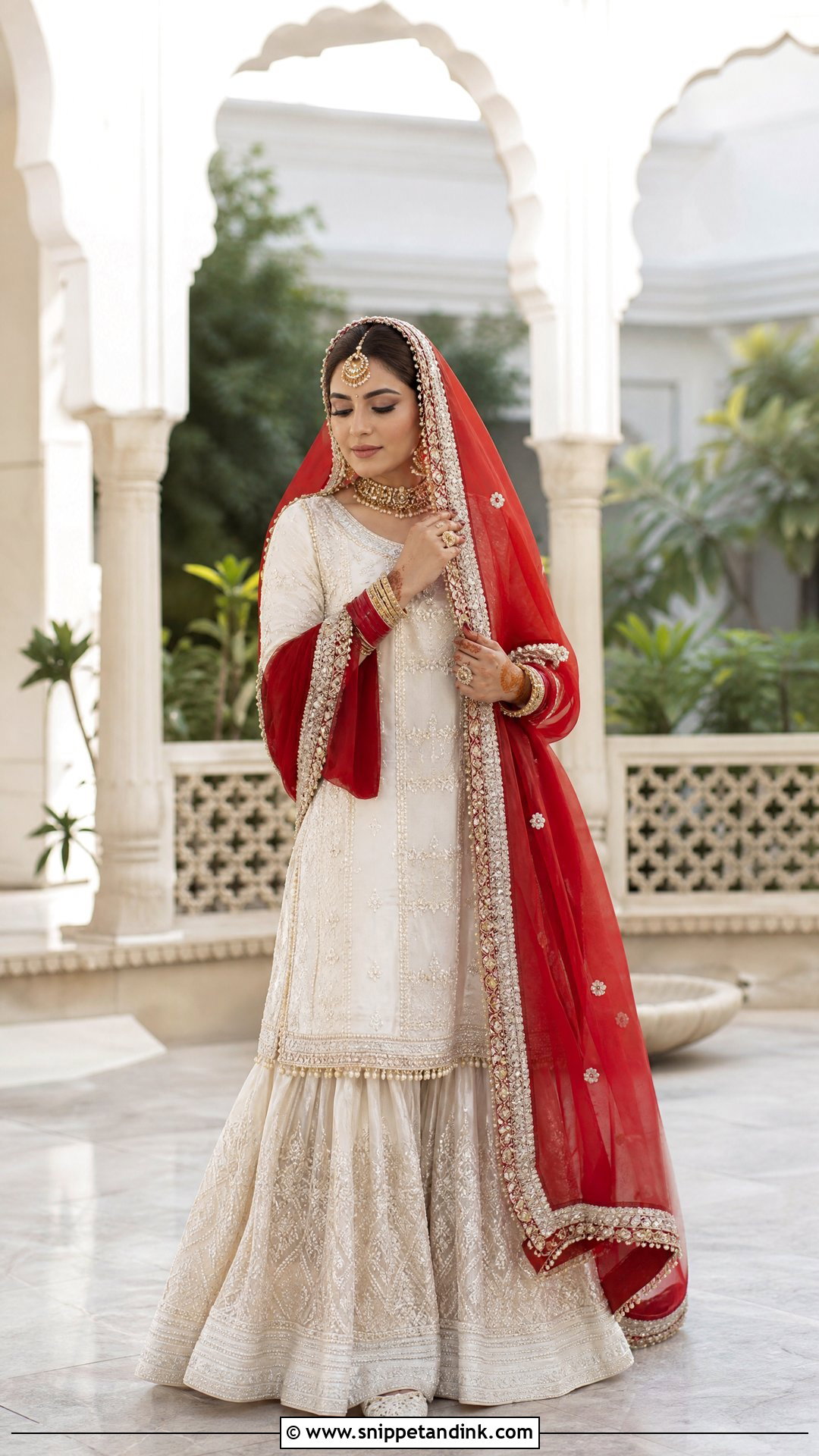
A red dupatta over white lets a bride honor the red tradition while wearing white. The kurti takes tonal threadwork, pearls and small silver details; the garara keeps embroidered knee bands. The red organza or chiffon dupatta, with a gold border and scattered motifs, goes over the head and across one shoulder so plenty of white still shows. Add a gold choker, pearl earrings, a passa and red-and-gold bangles. Here’s the catch with this pairing: red dye can transfer onto white in heat or rain. I test the dupatta with a damp white cloth before the day, and if it bleeds, I have it dry cleaned once to set it.
3. Blush Pink Pearl Nikkah Garara
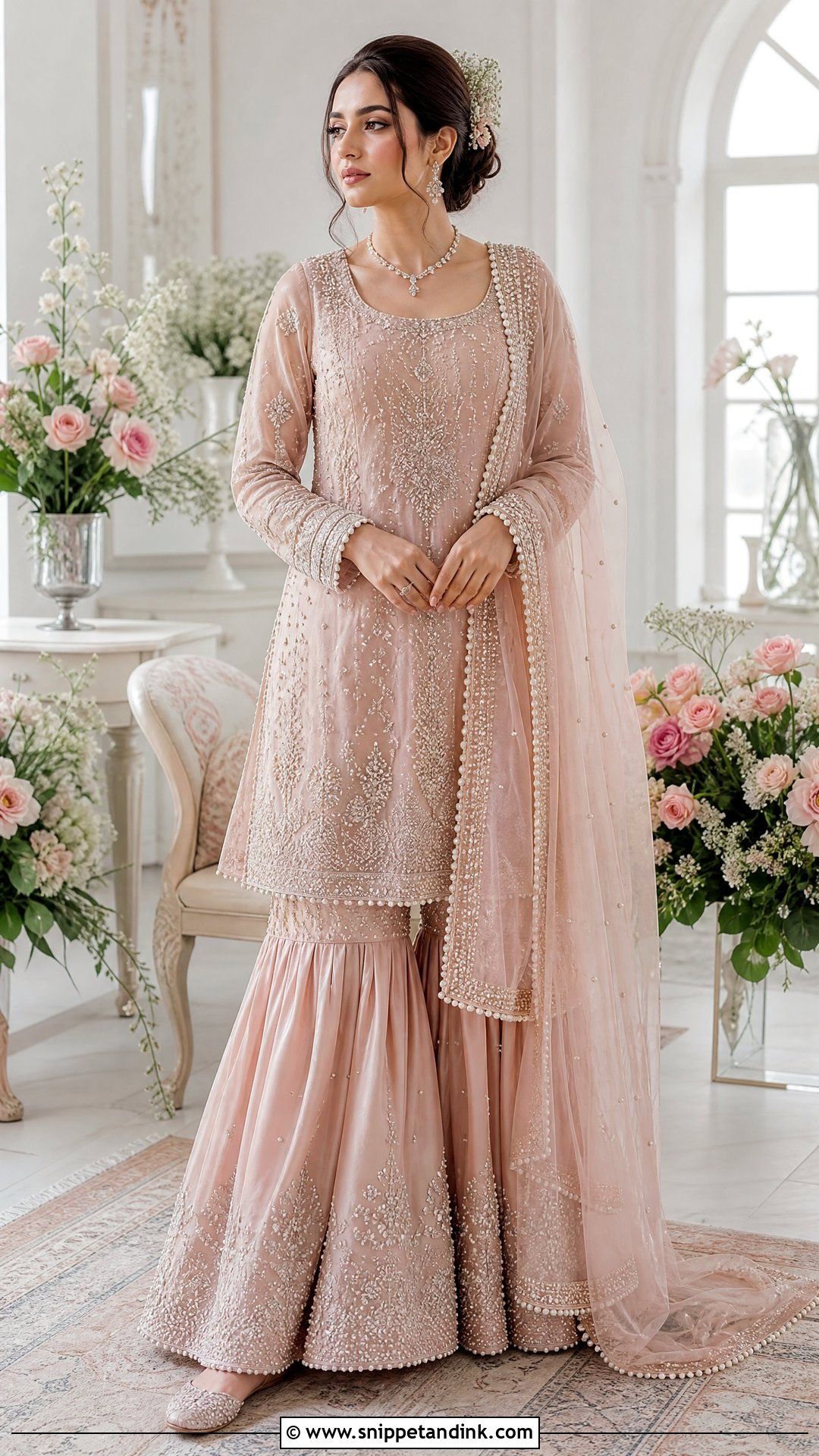
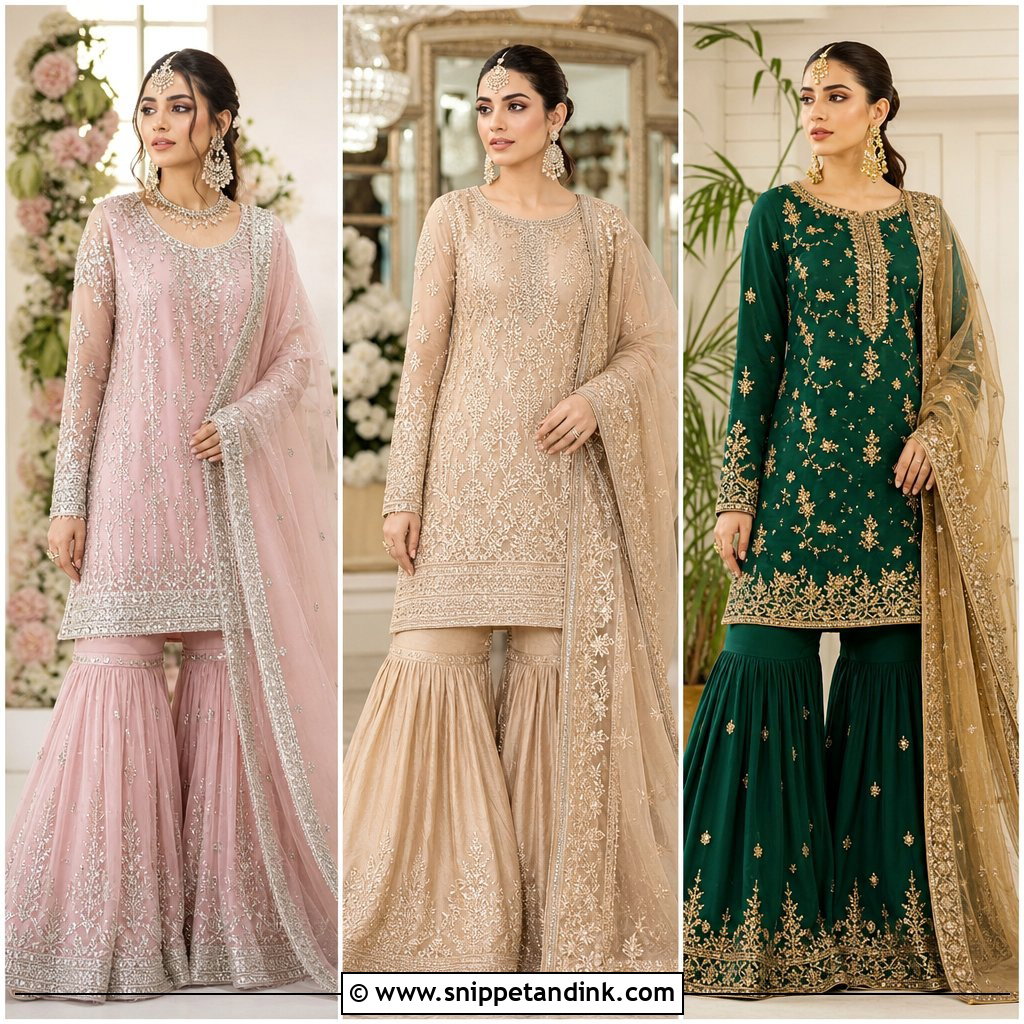
Blush with pearls suits a small, intimate ceremony where guests are close enough to see the handwork. A short silk kurti with fine pearl embroidery, light sequins and floral thread, over a blush garara with narrow pearl lines at the knee, keeps the detail delicate. The net dupatta with pearl edging moves easily. A pearl choker, drops and a small crystal maang tikka are plenty. Pearl-heavy kurtis are heavier than they look, so I ask for a cotton lining and slightly firmer shoulder seams to stop the neckline dragging forward.
4. Champagne Tissue Nikkah Garara
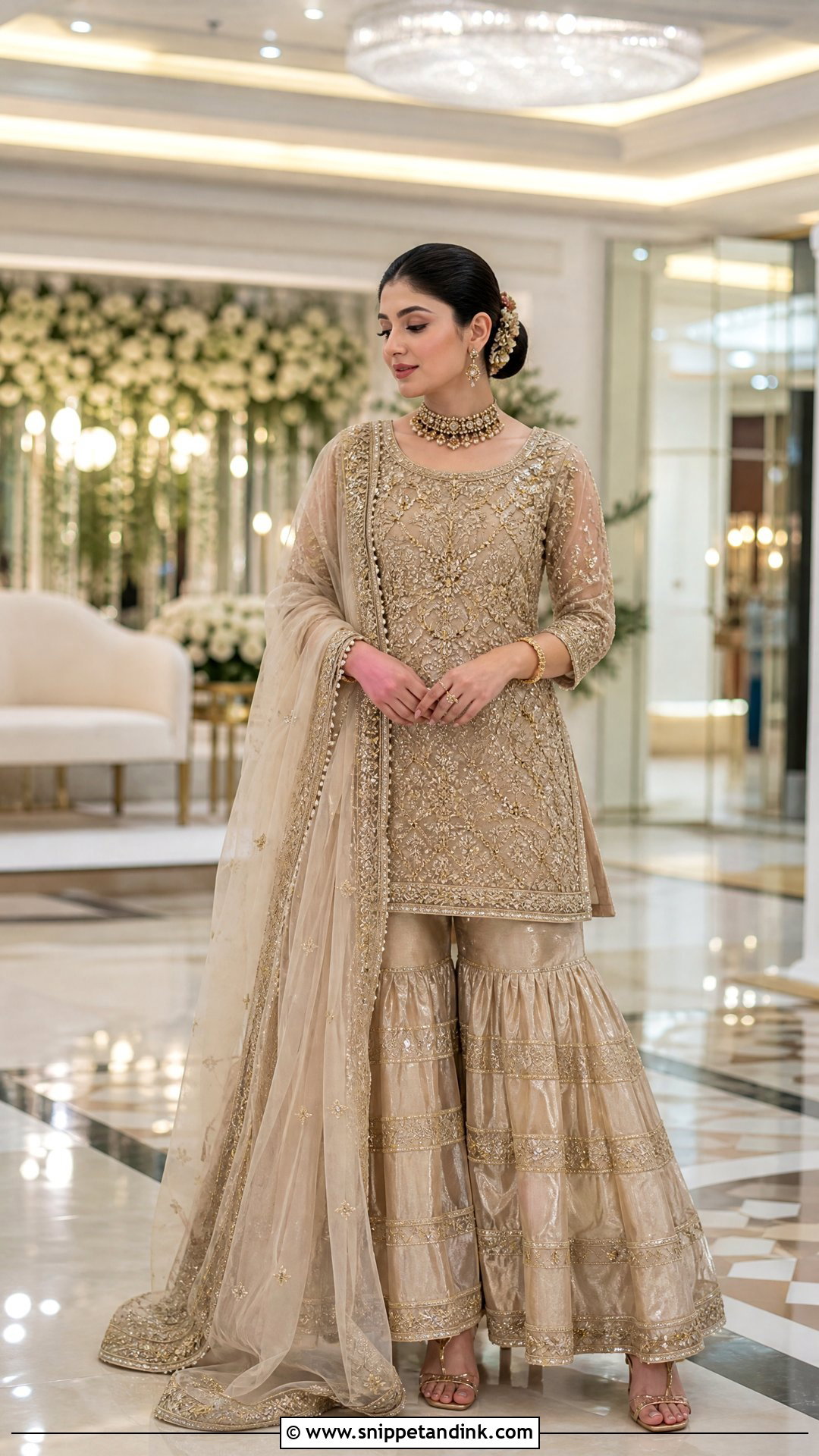
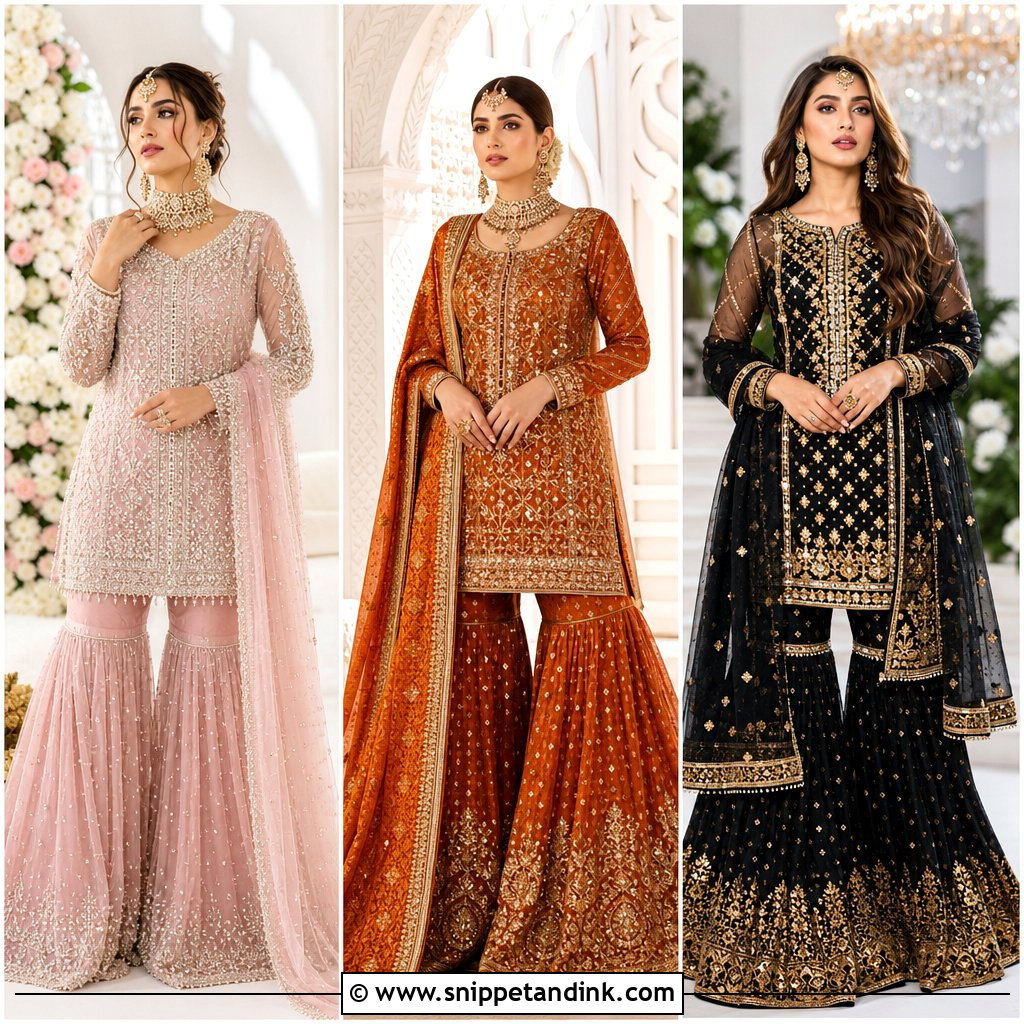
Champagne tissue has a sheen that reads well in both daylight and evening light. The kurti should be fitted and short, with antique gold work at the neck, sleeves and lower border, over a garara with careful pleating at the knee bands. Tissue is springy, so pleats need to be pressed in firmly or they open up into a puff. A tissue or organza dupatta with a fine kiran border adds just enough shine. Since the fabric is luminous already, a kundan choker, small earrings and one ring are enough, with metallic heels or embroidered khussas.
5. Mint Green Nikkah Garara With Gold Embroidery
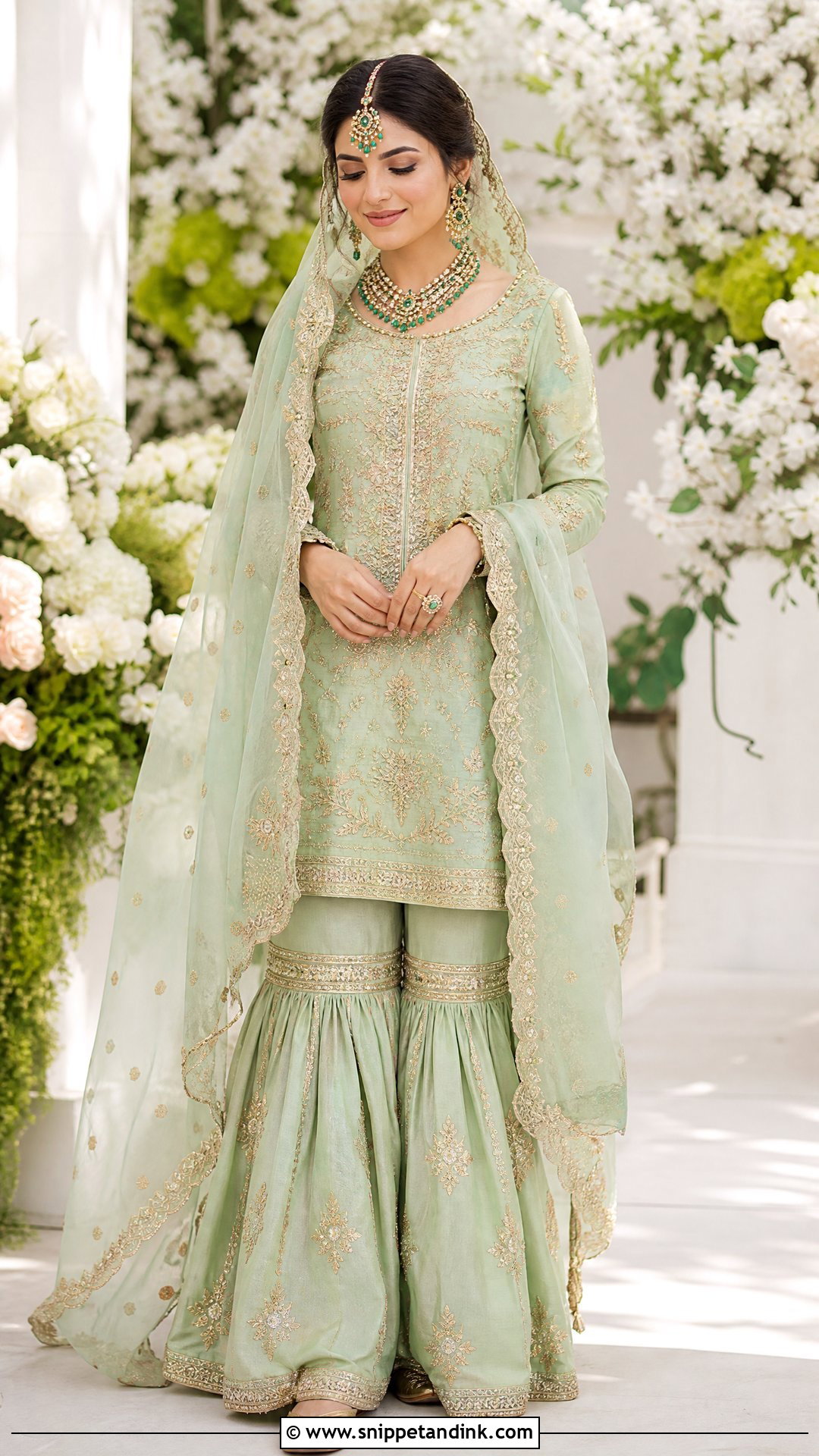
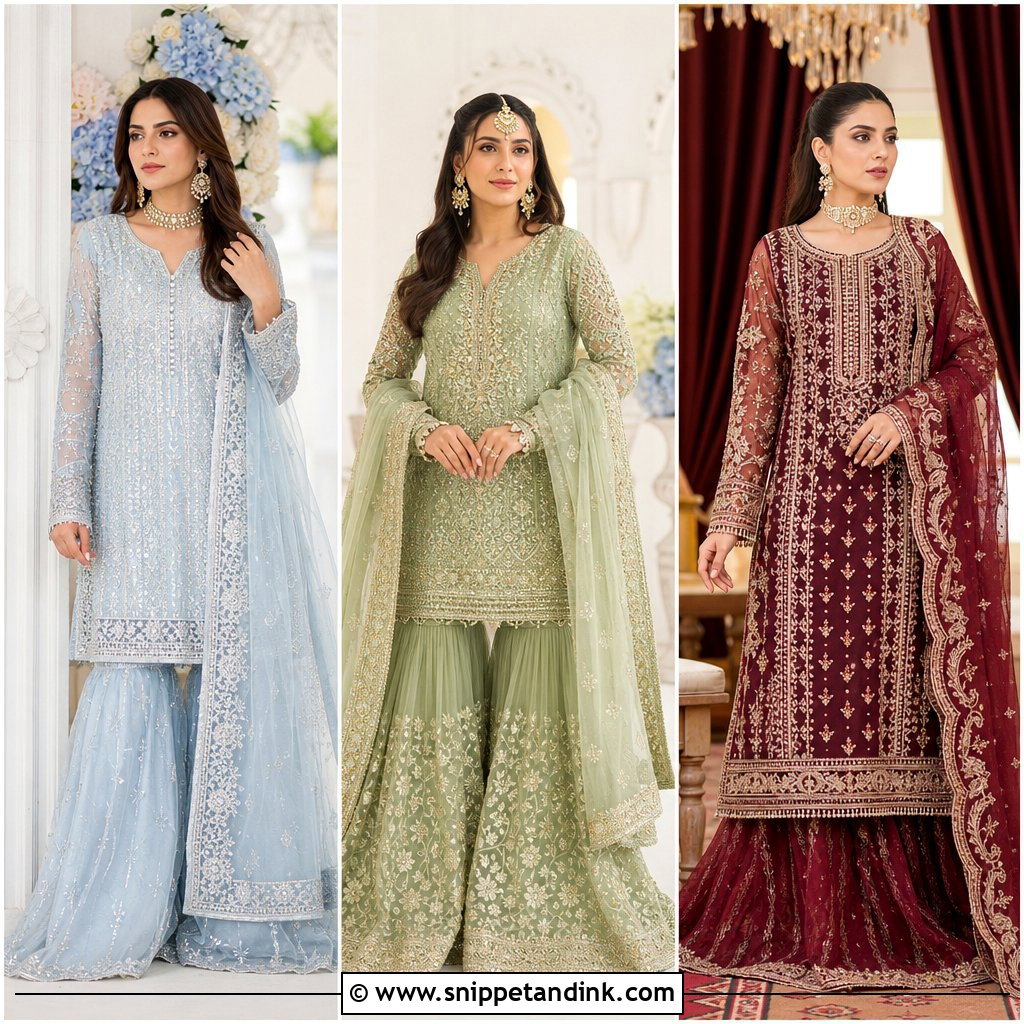
Mint is a spring and summer color; under warm evening bulbs it can drift toward yellow. A short raw silk kurti with gold tilla, pearls and small florals goes over a matching garara with lightly embroidered bands. A mint organza dupatta with a gold scalloped edge keeps it in one palette. For contrast, kundan with green stones works, as do gold khussas to warm the pastel. I’d use the same dye lot for kurti, garara and dupatta here. Pastel greens shift visibly between batches, and mismatched pieces look like they came from different outfits.
6. Powder Blue And Silver Nikkah Garara
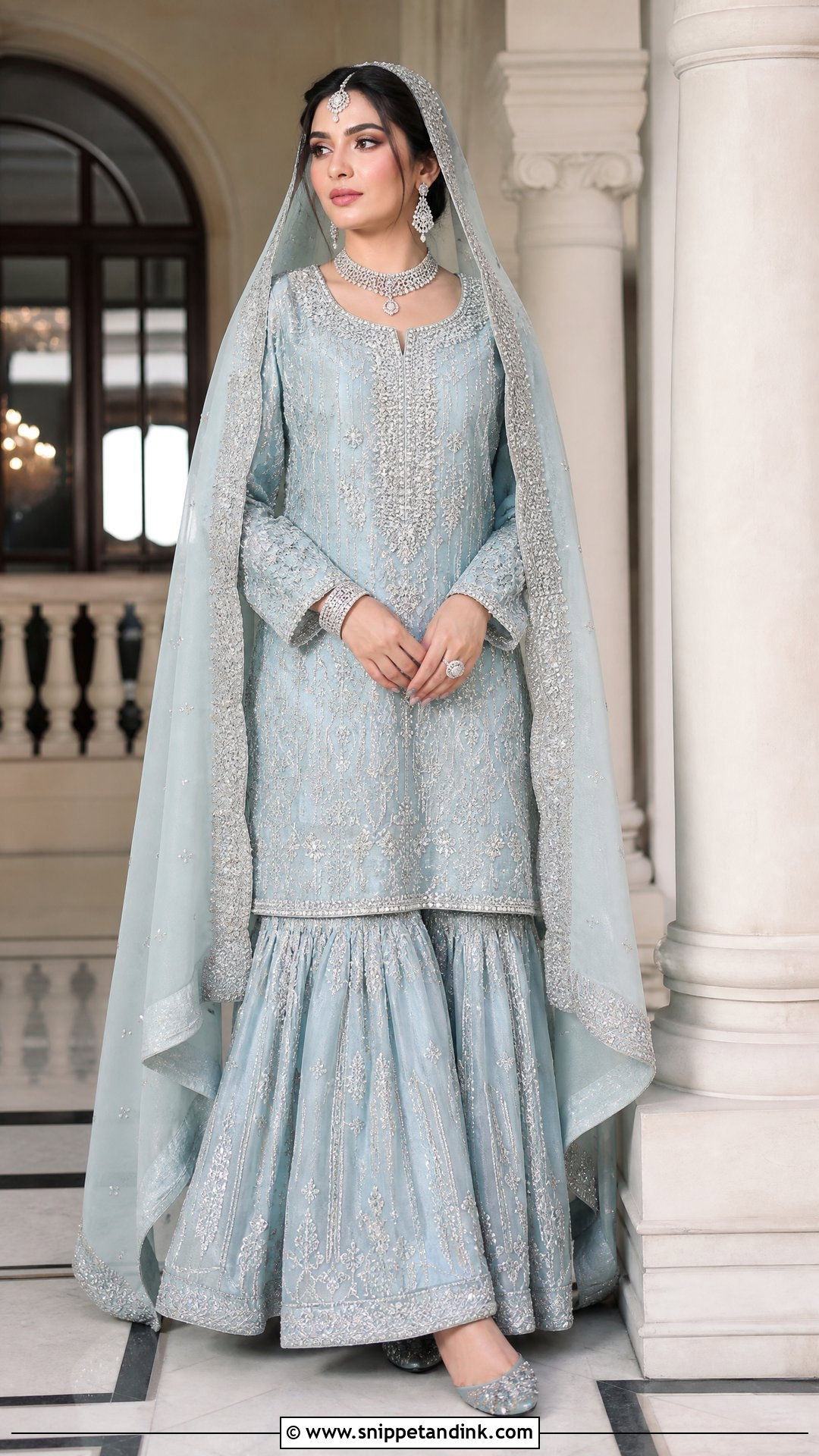
Silver instead of gold changes the whole temperature of a bridal look. A powder blue kurti with silver thread, crystals, pearls and restrained sequins, cut short enough to show the knee bands, sets it up. Choose a sheer blue dupatta embroidered on all four edges and drape it lightly over the head and one arm. Silver kundan or diamond-style jewelry suits this better than yellow gold, which looks muddy against the blue. Silver heels or pale blue flats complete it. Silver thread tarnishes faster than gold, so store this one wrapped in cotton, away from the rubber of a garment bag.
7. Lilac Nikkah Garara With Crystal Work
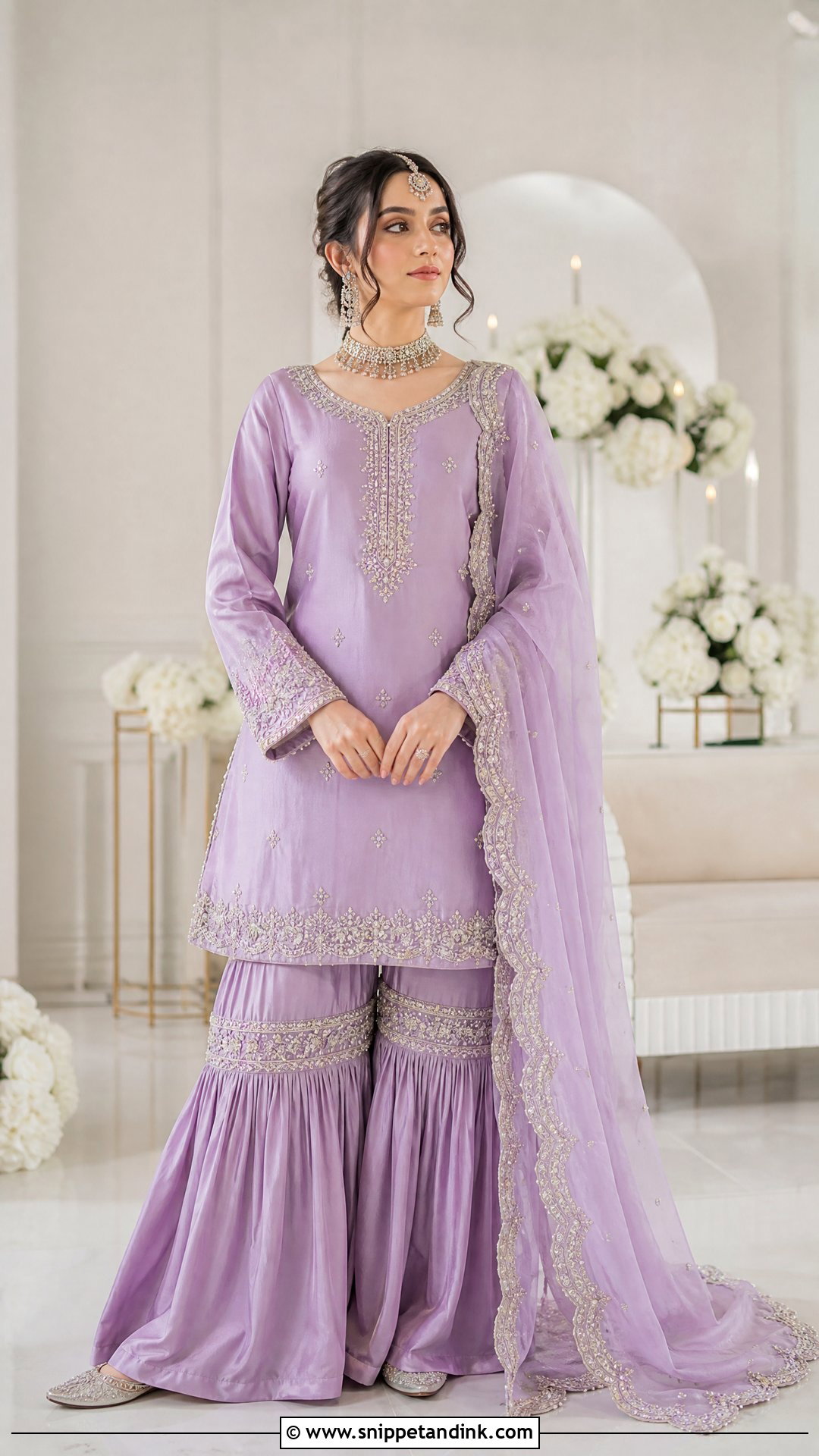
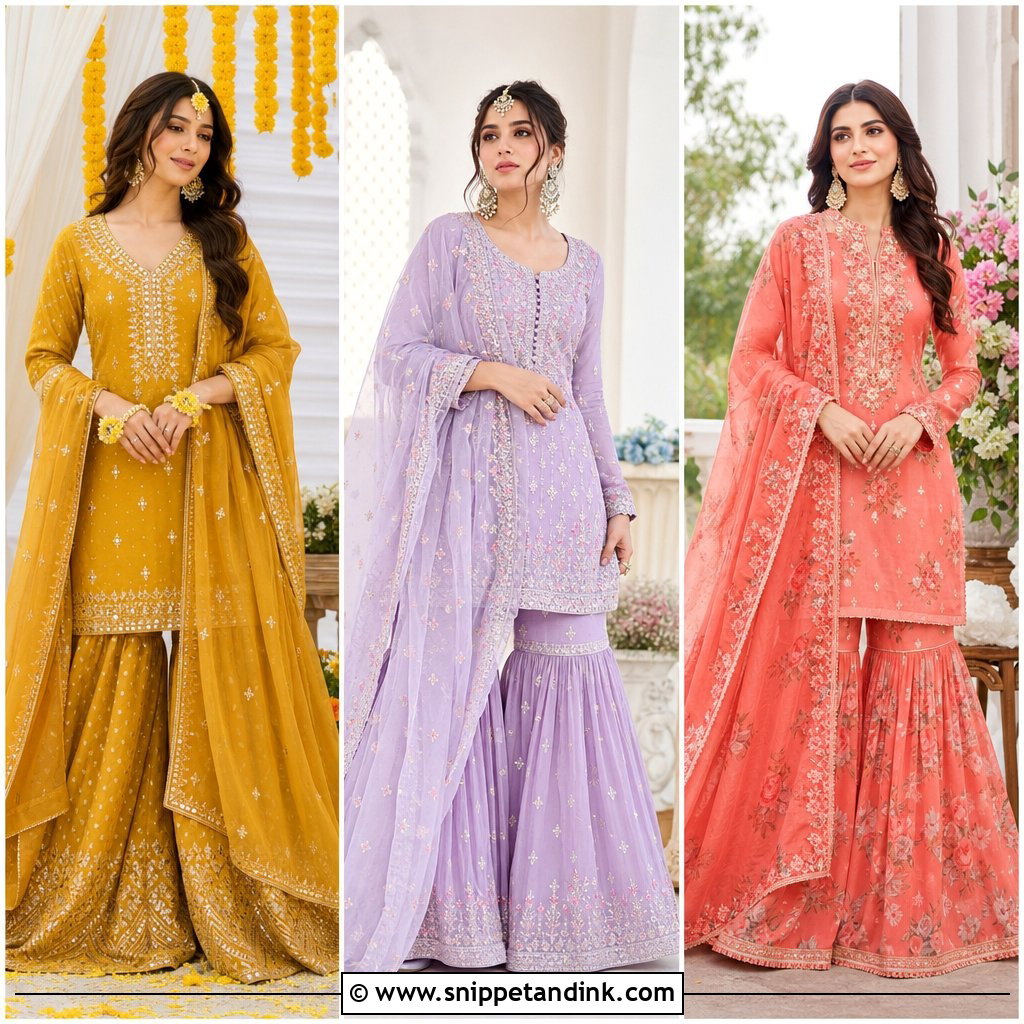
Lilac reads modern on a garara, especially with crystal work. Choose a silk kurti with crystals, silver tilla and tiny pearls in floral patterns, and a matching garara with narrow embroidered bands and generous flares. A sheer organza dupatta with a scalloped crystal edge adds sparkle without weight. Silver-toned kundan, a slim tikka, fine bangles and lilac or silver khussas finish it. I’d keep crystal work off the inner arms of the kurti; stones rub there with every movement and snag the dupatta.
8. Peach Floral Nikkah Garara
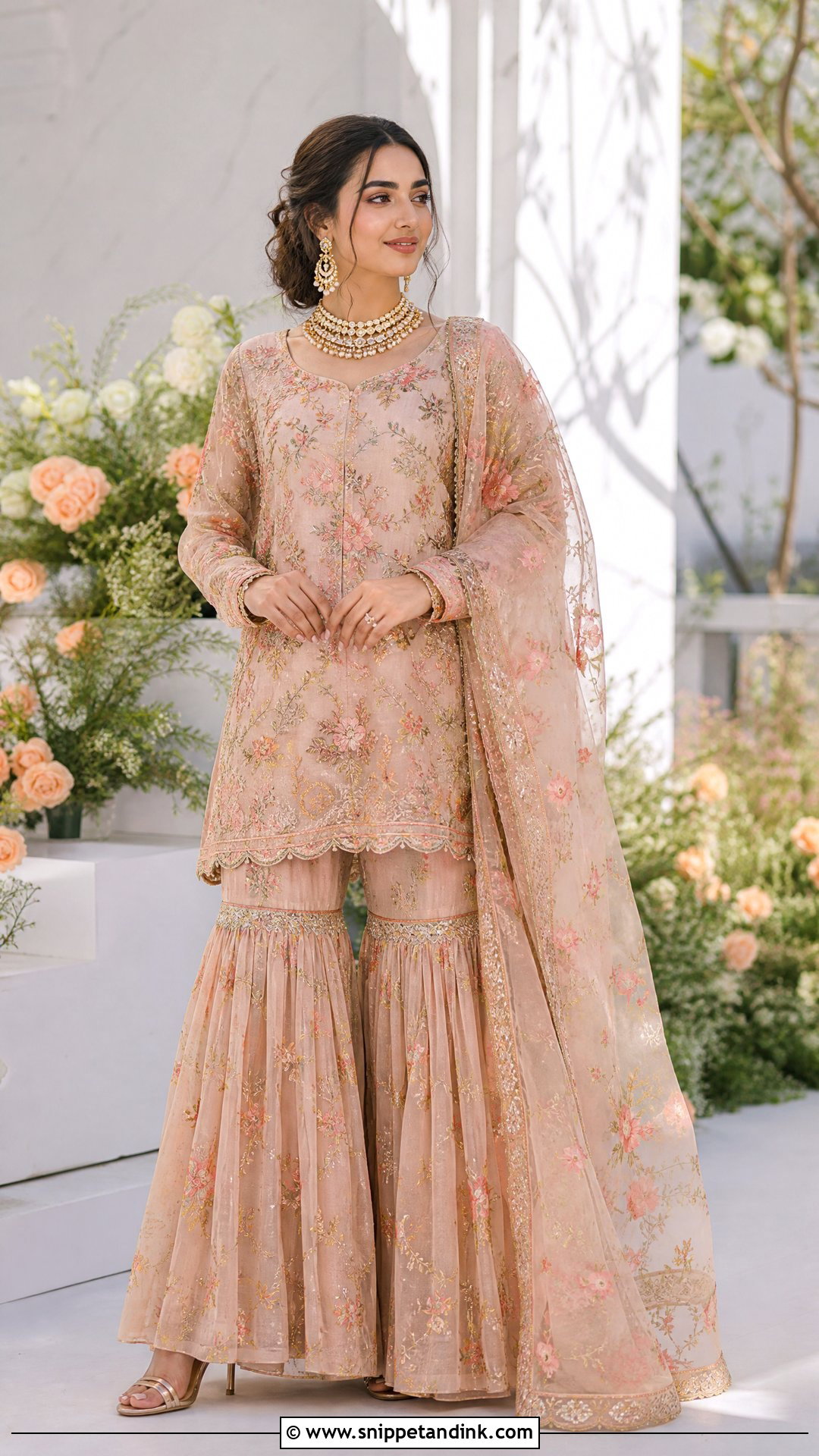
Peach florals belong in daylight. Embroider a short peach kurti with pastel flowers, pearls and fine gold thread, and carry the florals onto the knee bands and lower borders. Leave stretches of plain fabric between motifs so the eye can rest. The sheer organza dupatta takes scattered blossoms and a narrow gold trim. Pearl-and-kundan earrings, a fine choker and a small tikka suit the soft color, with nude gold heels or peach khussas. If you want open hair or a half-up style with this, pin the dupatta further back; loose curls get caught in floral embroidery.
9. Sage Green Nikkah Garara With Pearl Dupatta
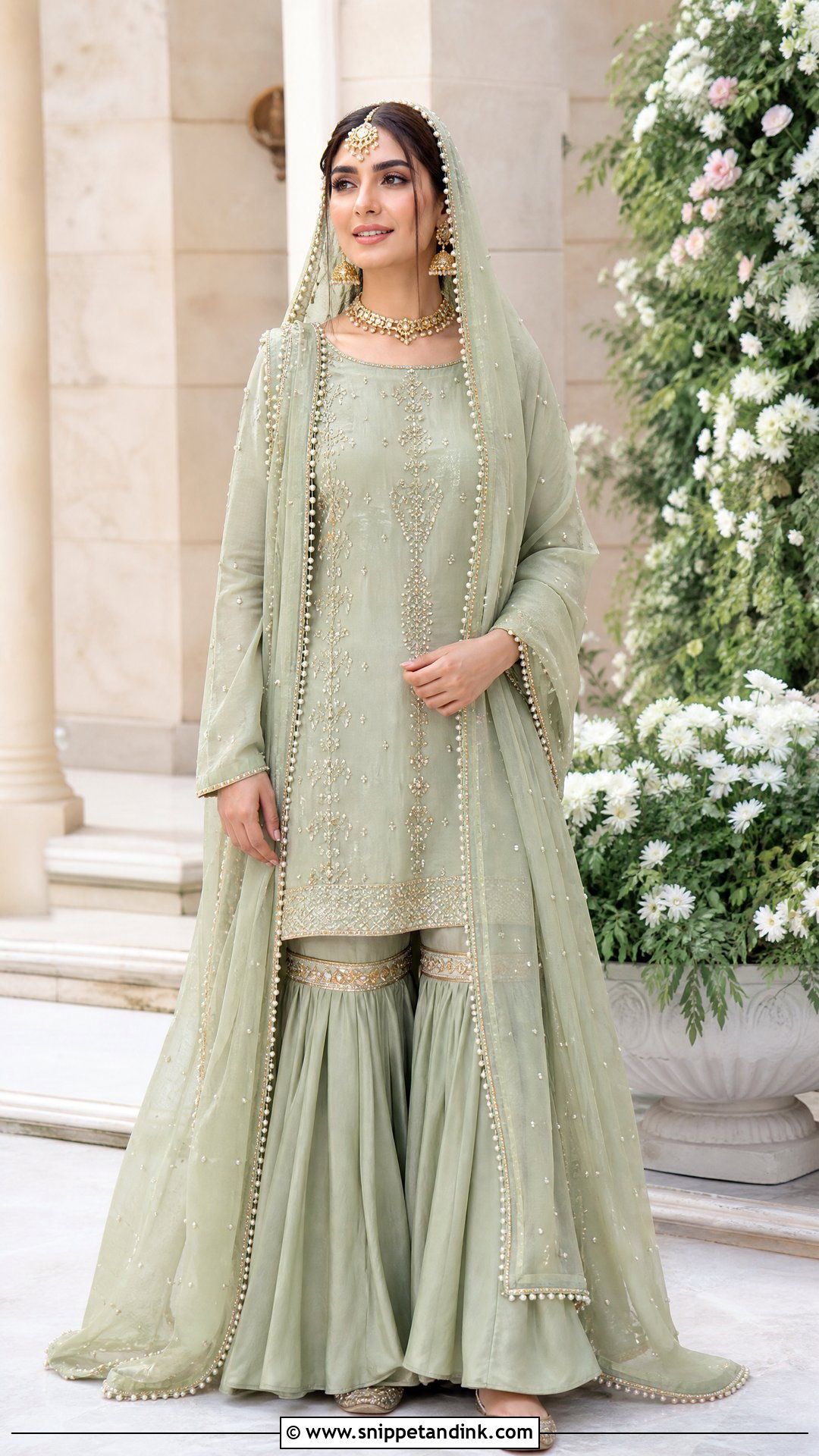
The pearl-edged dupatta is the star of this sage outfit, so everything else holds back. A short sage raw silk kurti with pearl embroidery, gold thread and vine motifs sits over a matching garara that flares cleanly below embellished knee bands. Wear the dupatta over the head with one side over the arm. Antique gold with pearls bridges the cool green and warm embroidery. Gold flats or khussas are a sensible choice, since sage suits garden ceremonies on lawns where heels sink. Pearl edging is sewn on individually, so I check every few centimeters for loose threads before the day.
10. Dusty Rose Nikkah Garara With Kundan Jewelry
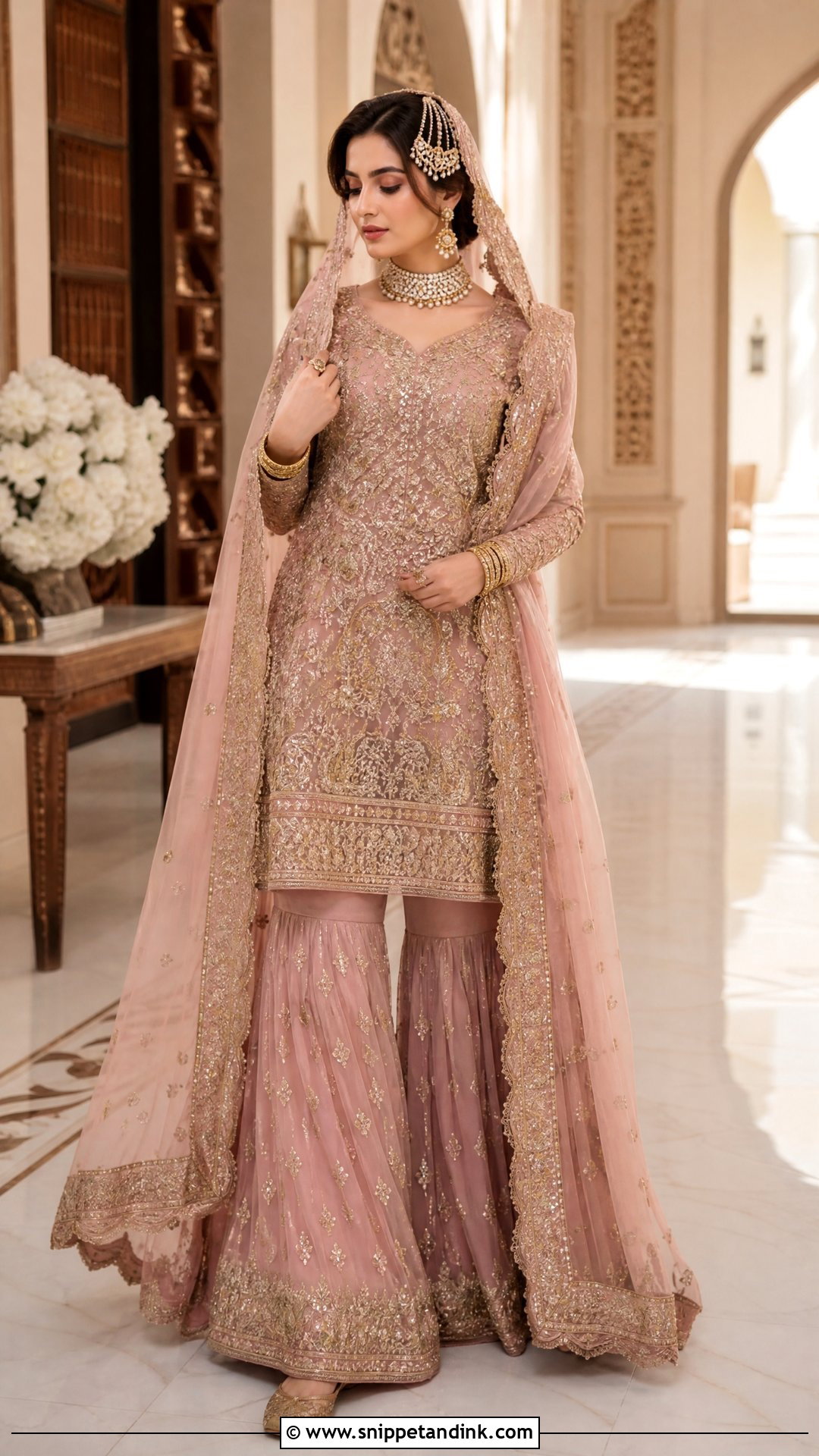
When blush feels too young, dusty rose is the grown-up version. The kurti can be velvet, silk or raw silk with antique gold at the neck, cuffs and hem, over a garara with rich knee bands and lighter work on the flares. A soft net dupatta with gold edging covers the head. Kundan suits this shade well, especially a choker, matching earrings and a side passa, with muted gold khussas and slim bangles. Choosing velvet for the kurti? Keep the garara in silk; two velvet pieces together make the knee joint bulky and stiff. It moves comfortably from a late-afternoon Nikkah into an evening dinner.
11. Red And Gold Nikkah Garara
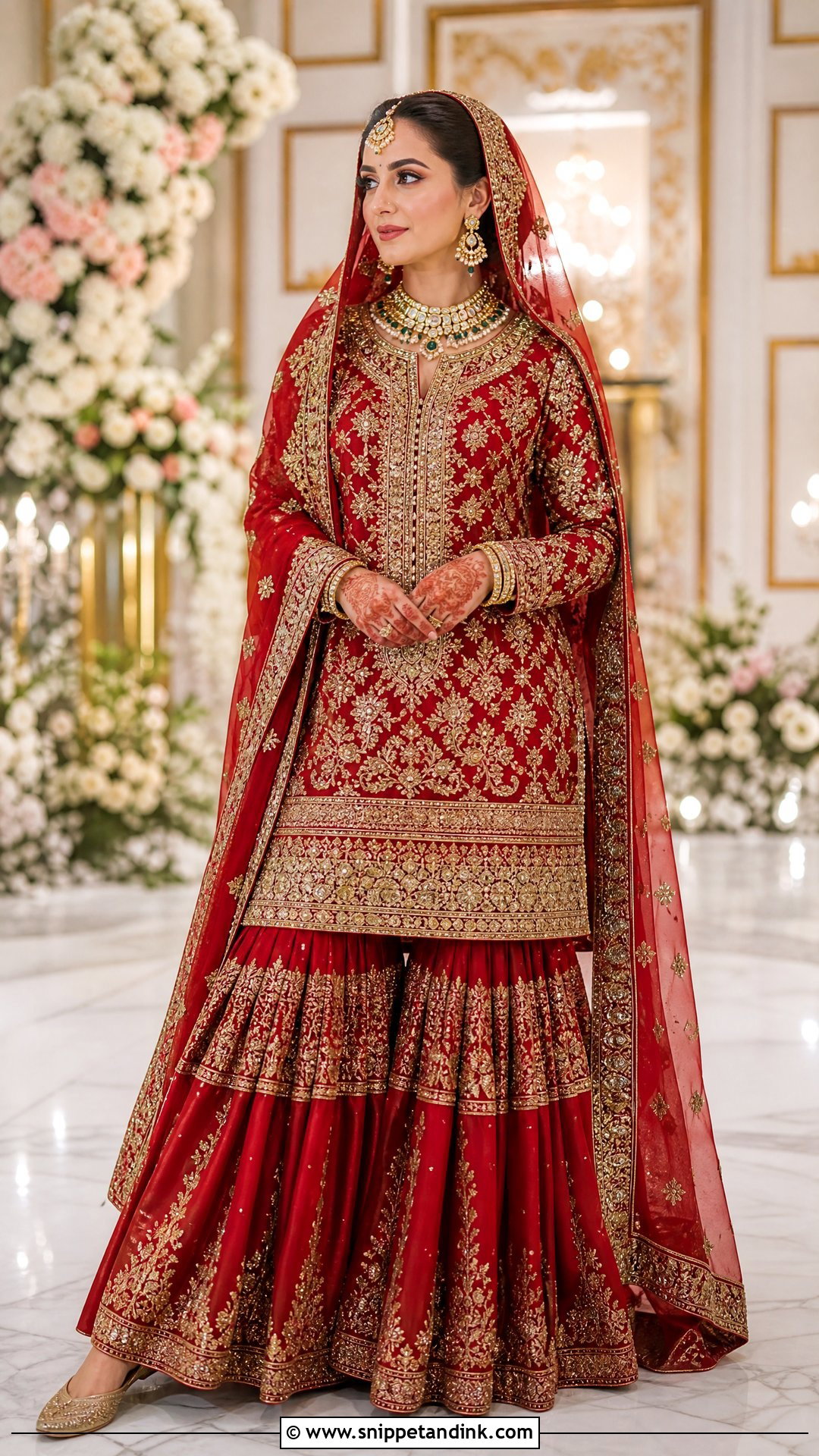
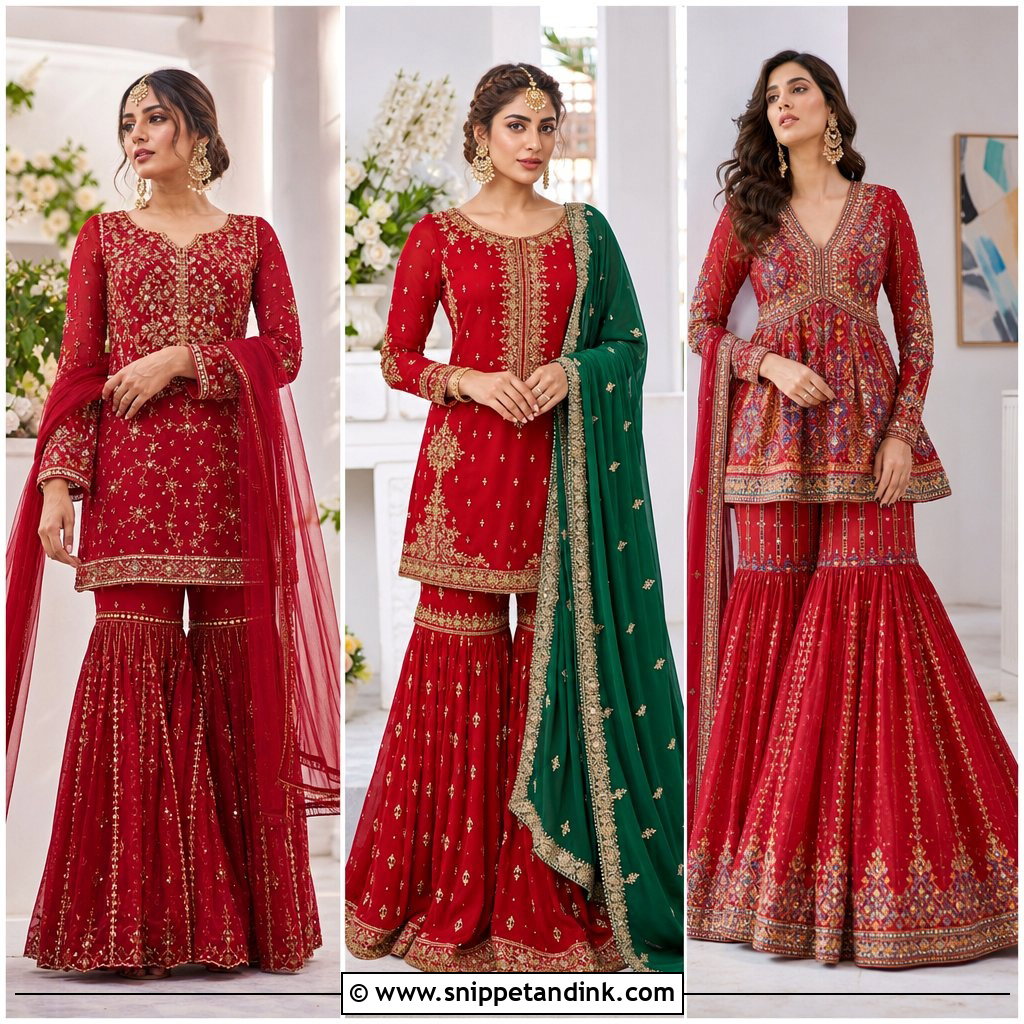
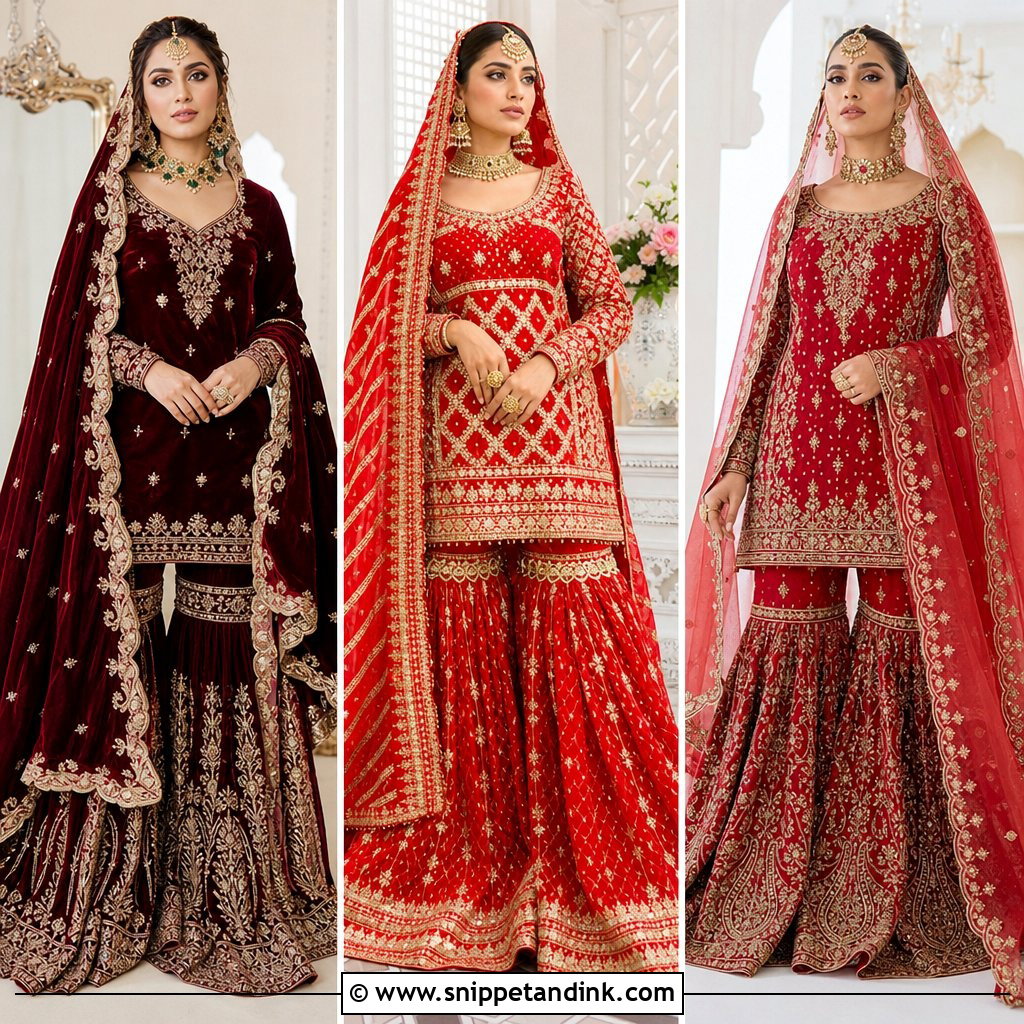
Red and gold remains the most traditional garara pairing there is. A deep red silk kurti with zardozi, dabka and gold thread goes with a garara with ornate knee bands and a weighted border at the hem, and that border does real work: it pulls the flares down so they hang in clean folds. Wear a red net or organza dupatta with a wide gold edge over the head. A kundan choker, earrings, passa, tikka and bangles complete the traditional set, with gold khussas. With this much jewelry, I set the tikka chain and passa before the dupatta goes on, then lift the dupatta into place over them.
12. Maroon Velvet Nikkah Garara
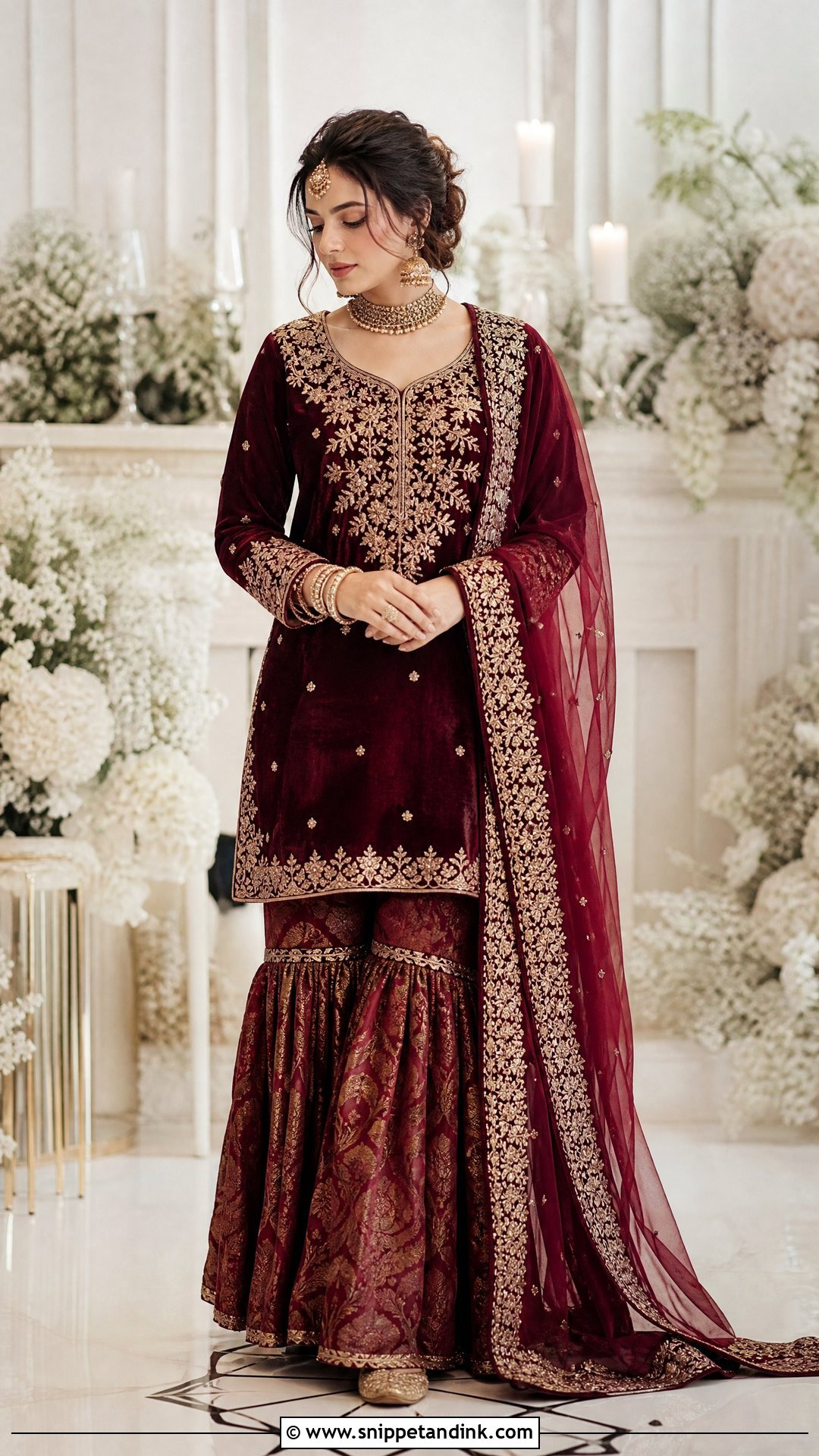
A maroon velvet Nikkah garara belongs to fall and winter. I’d keep velvet for the kurti only and cut the garara from lighter raw silk or jamawar, otherwise the legs get heavy and hot. Antique gold zardozi at the neck, cuffs and knee bands warms the dark color. Go for a maroon organza dupatta with a gold border rather than another velvet layer. Gold choker, jhumkas, a small forehead ornament and gold khussas finish it. Velvet marks under a hot iron, so steam it from the inside and never press the pile flat.
13. Emerald Green Nikkah Garara With Gold Dupatta
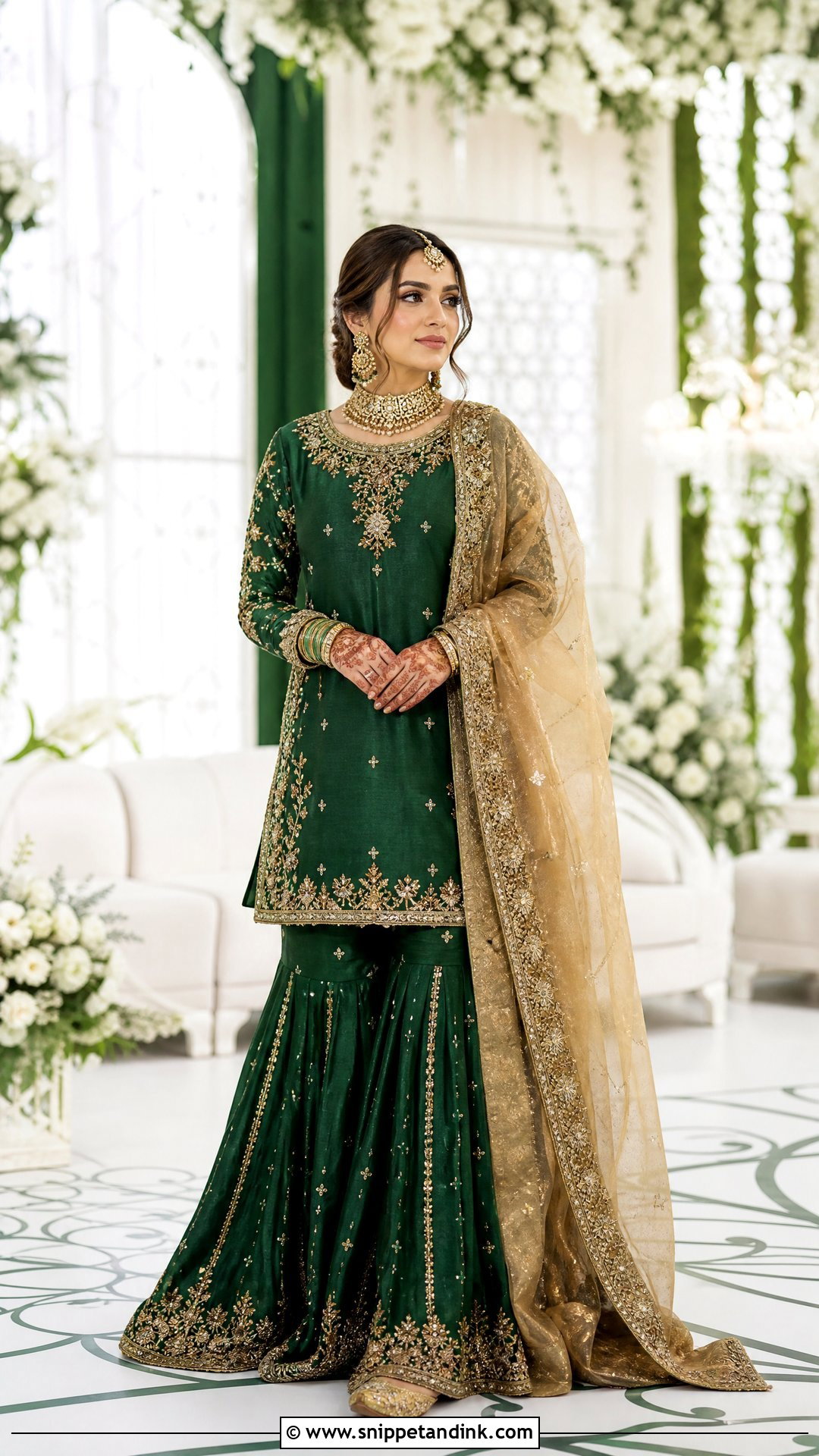
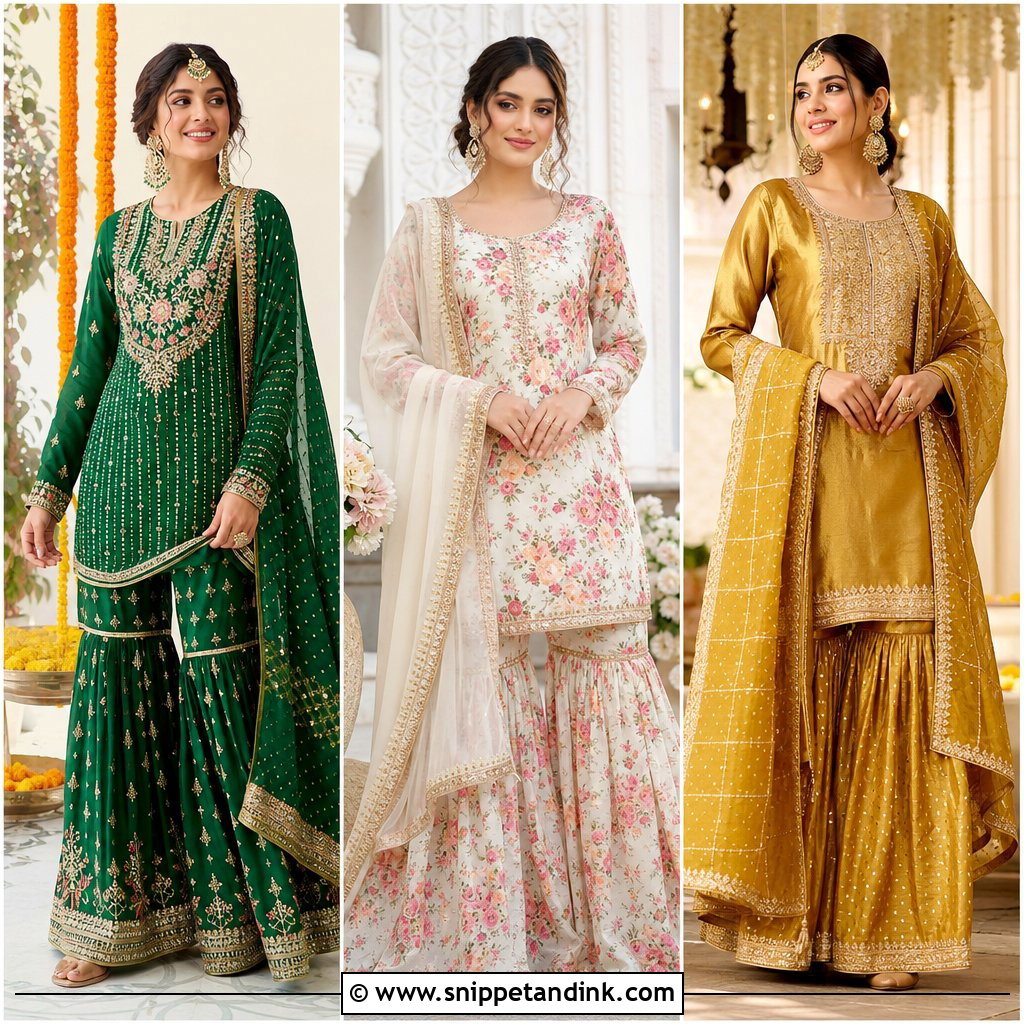
Emerald is bold, and a gold dupatta is what keeps it bridal rather than festive. Choose an emerald raw silk kurti with gold florals and a soft neckline, over a structured garara with broad decorative bands and gold motifs at the borders. The contrast dupatta in gold tissue with emerald edging and scattered green embroidery lifts the face. A kundan choker, drops, a small passa, antique gold khussas and a few bangles complete it. Gold tissue against emerald is a strong pairing in photos; I keep the earrings modest so the face isn’t competing with both.
14. Navy Blue And Silver Nikkah Garara
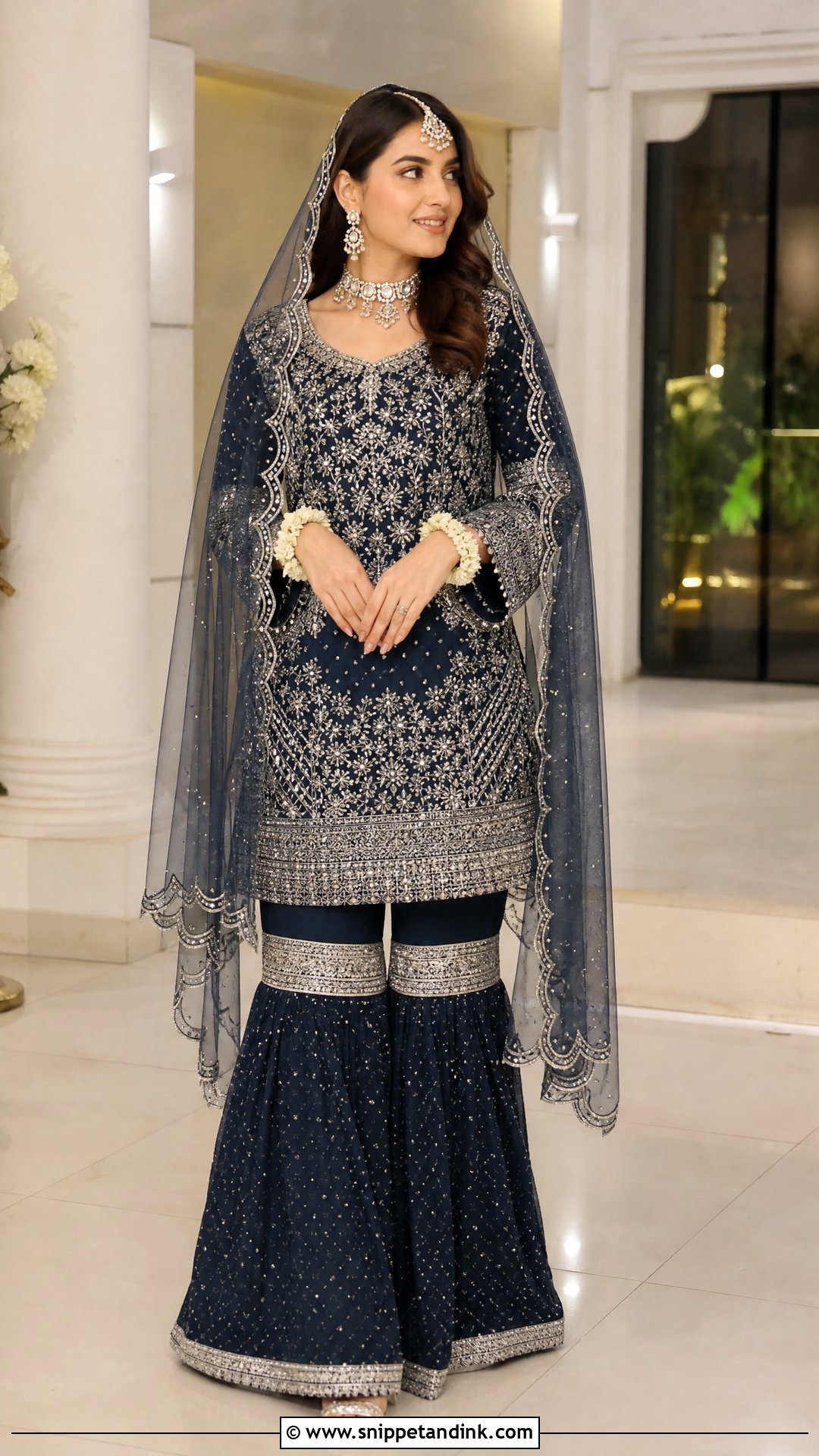
Navy with silver is one of the few evening garara combinations that doesn’t rely on red or gold. Choose a short navy kurti with silver thread, crystals and pearl accents, and a garara with defined bands and embroidery concentrated near the hem. A navy net dupatta with a silver scalloped border can go over the head or be pinned at one shoulder. Silver kundan, crystal earrings and a slim tikka suit it, with silver heels or navy flats. Navy can look black in low light, so I make sure the silver work is generous enough near the face to read on camera.
15. Beige Jamawar Nikkah Garara
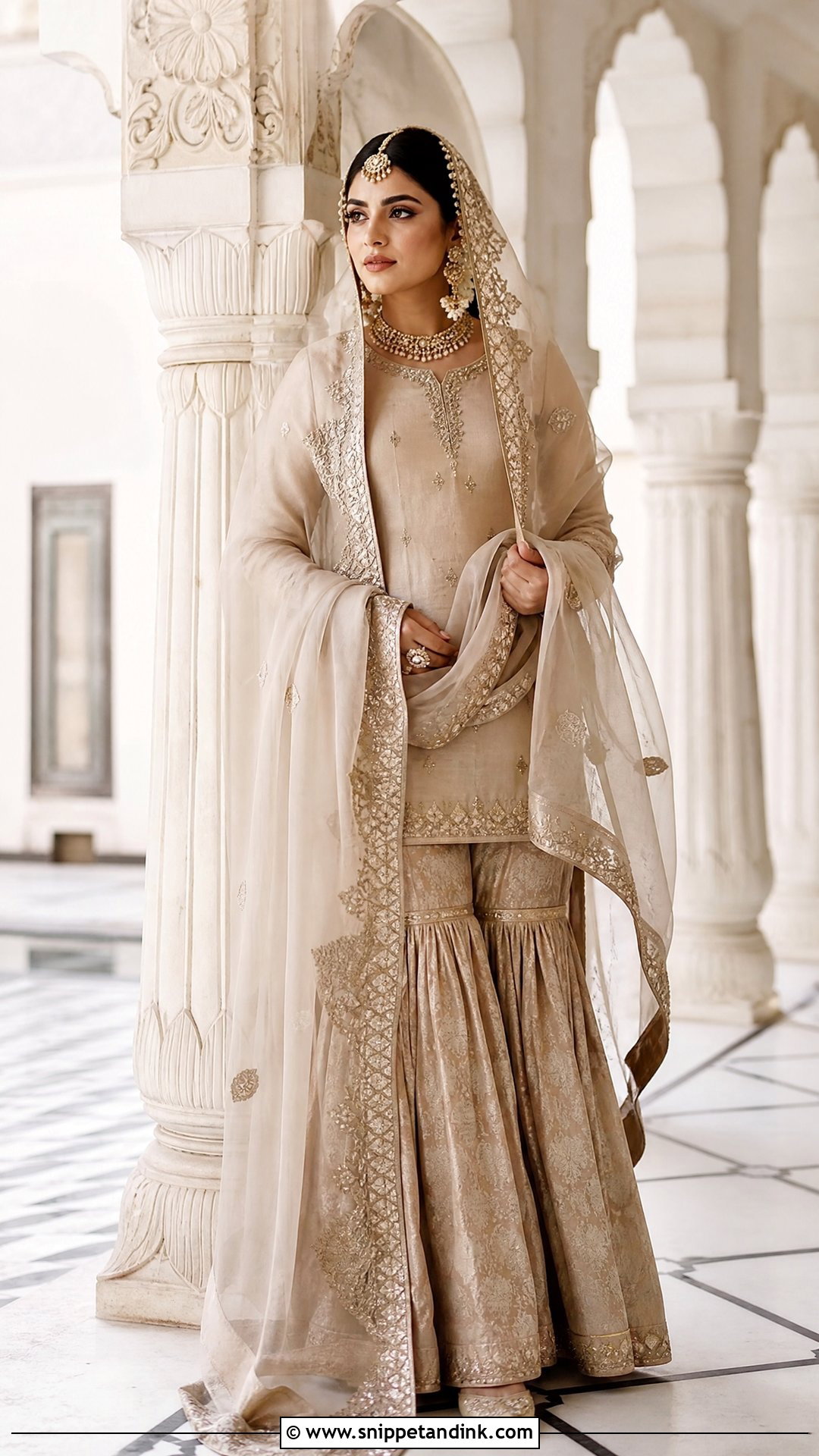
Jamawar is a woven patterned fabric, and on a beige garara the pattern is the decoration. Pair the jamawar pants with a plain or lightly embroidered short raw silk kurti; patterned on patterned gets busy fast. Highlight the knee bands with antique gold trim and add a beige organza dupatta with a fine border. Polki or kundan, a choker, medium earrings and a small tikka work with it, and antique gold khussas blend into the weave. Before cutting, I lay the jamawar out and plan where the main motifs fall so they line up on both legs.
16. Ivory Farshi Nikkah Garara
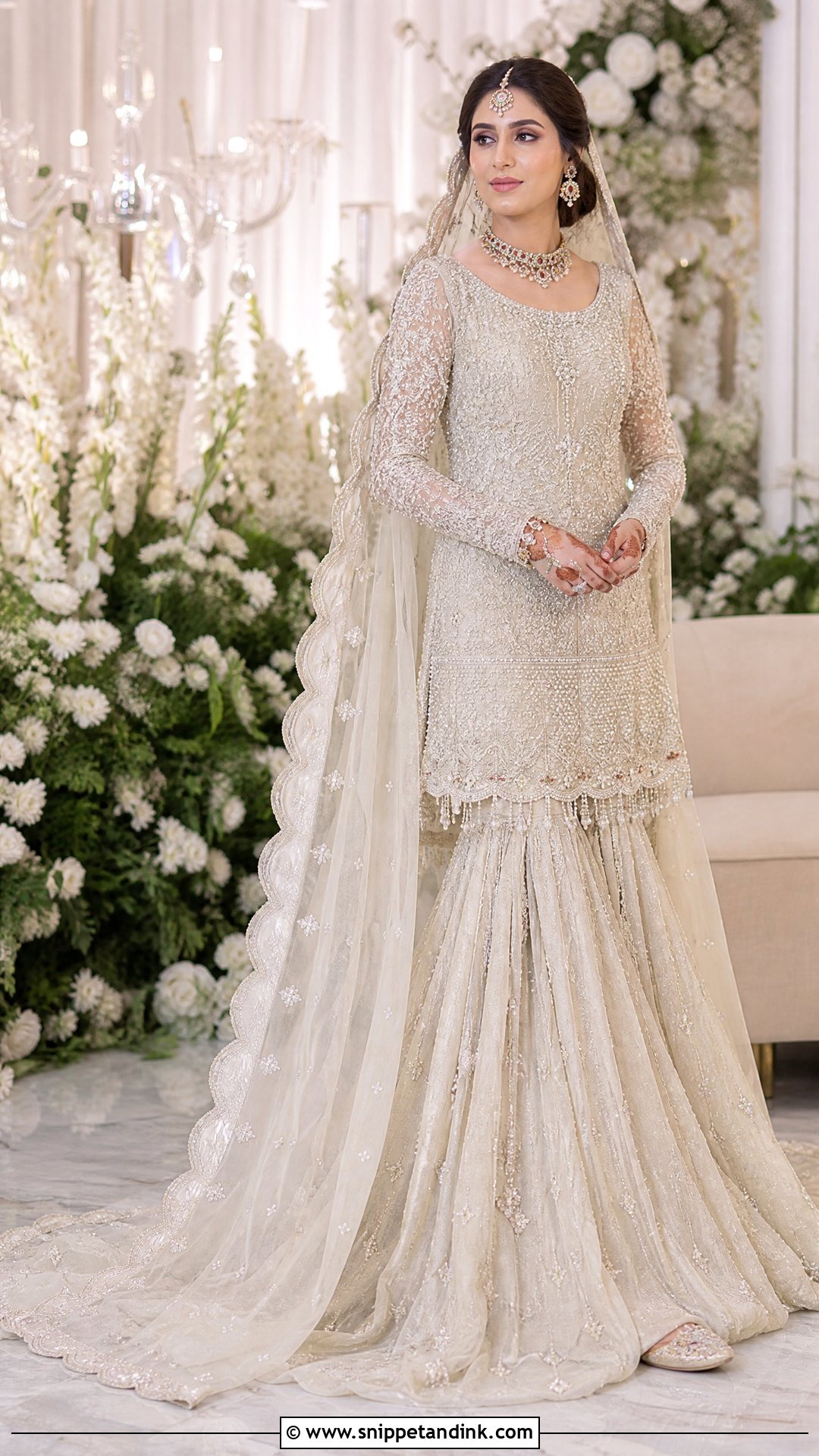
An ivory farshi garara gets its drama from length, not embellishment. A fitted short kurti with fine gold thread, pearls and neat sleeves sits above a garara that spreads across the floor and trails when you stand or sit. Keep the embroidery to the knee bands and outer borders so the shape stays visible. A long organza dupatta with scalloped gold edging goes over the head and down the back. A pearl-and-kundan choker, earrings and a small passa finish it. Practice walking: gather the front of both legs lightly, take short steps, and have someone ready to arrange the trail each time you sit.
17. Pastel Floral Organza Nikkah Garara
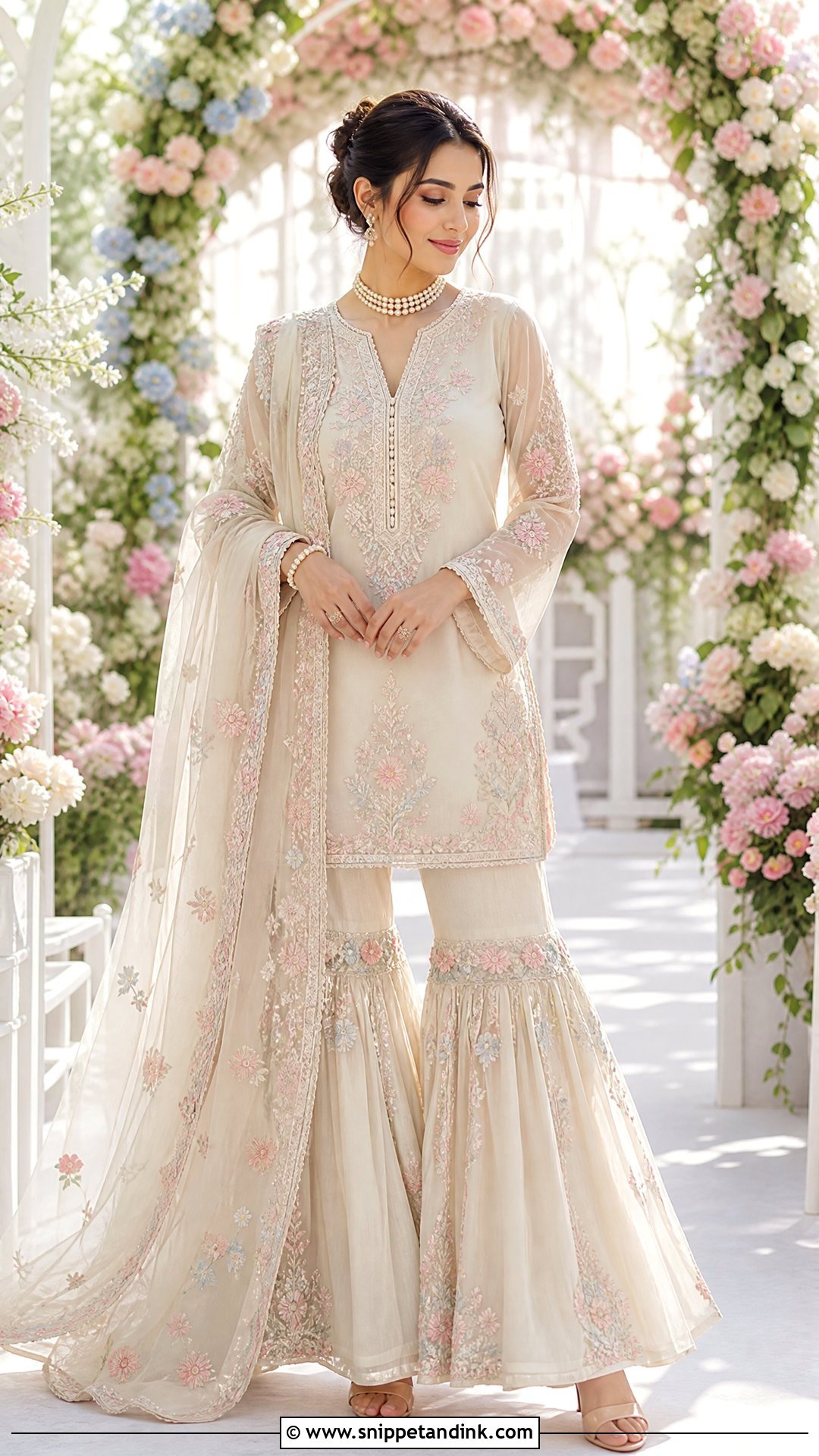
Floral embroidery on organza gives an airy garara for a garden or daytime ceremony. The base can be ivory, pale pink or powder blue, with florals in several soft shades. A lined short kurti with full or three-quarter sleeves goes over a lightly structured garara with floral knee bands, and a matching organza dupatta with small blossoms and a narrow pearl edge completes the set. Pearl earrings, a fine choker and a small crystal tikka are enough, with nude or ivory heels. Organza garara flares can stand stiffly away from the leg, so I ask for a soft lining in the lower panels to help them drop.
18. White Chikankari Nikkah Garara
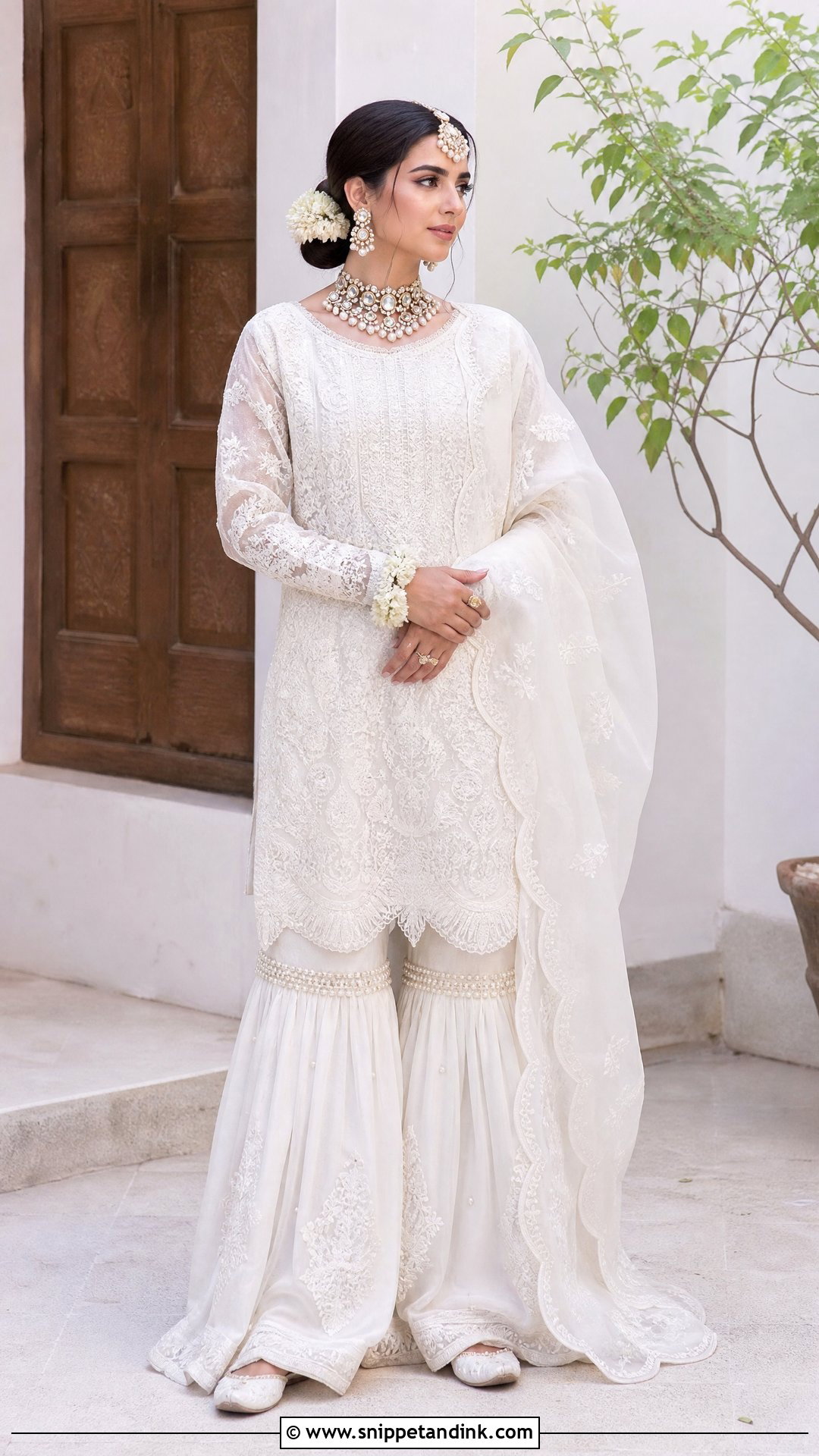
Chikankari is hand shadow-work embroidery, and a white chikankari garara gives texture with almost no sparkle. Line the short kurti with soft cotton silk or crepe for coverage, and pair it with a white garara in matching embroidery with a few pearls around the bands. A sheer white organza dupatta with a scalloped border adds formality. Pearl jewelry, silver kundan earrings, a small tikka and white khussas keep it monochrome. Chikankari is usually worked on soft fabric, so the garara knee joint needs interfacing behind the band or it collapses.
19. Gold Tissue Nikkah Garara With Ivory Kurti
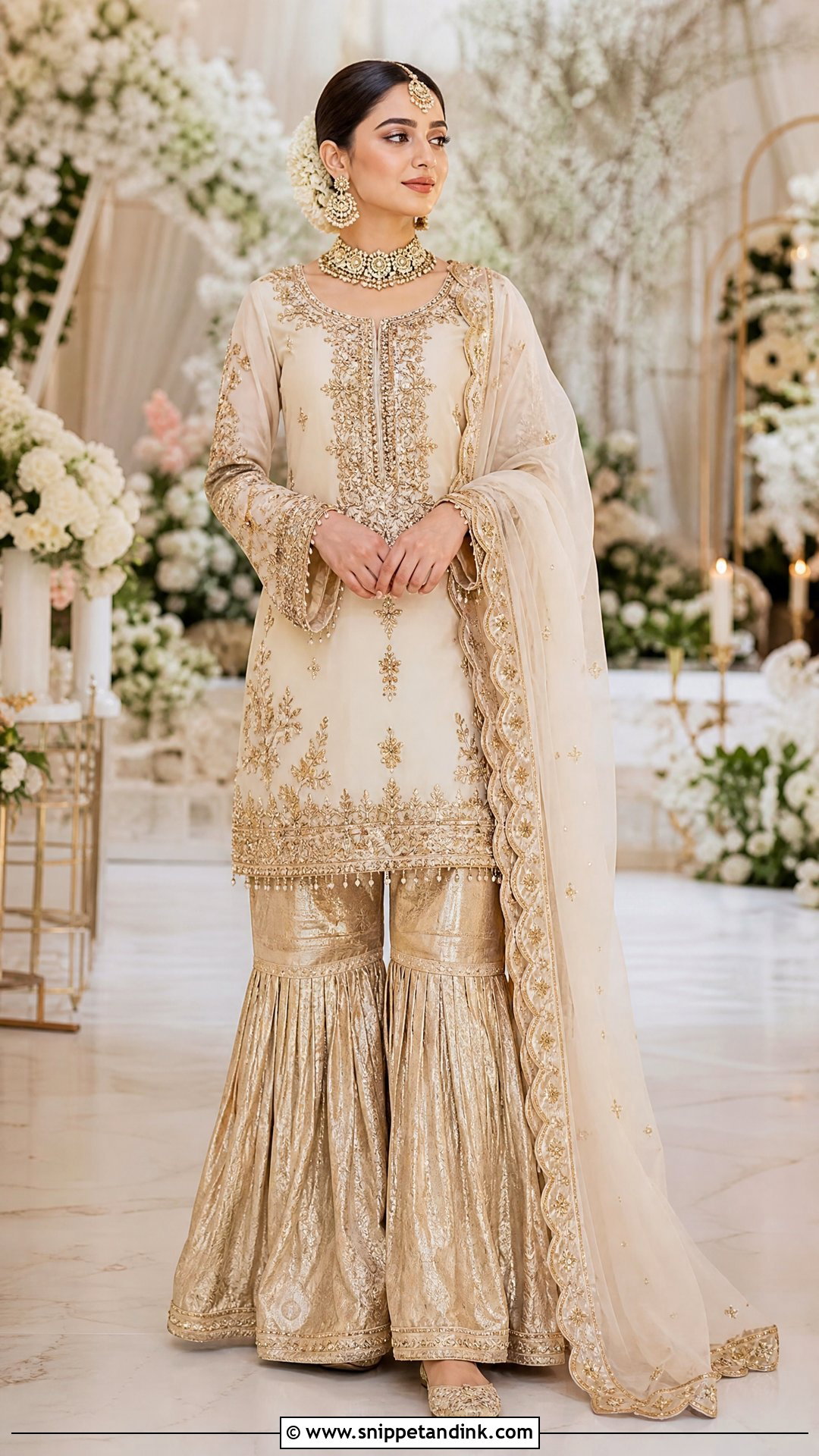
A gold tissue garara with an ivory kurti is the subtler way to wear metallic. The kurti carries antique gold thread, pearls and small florals that tie it to the pants. The tissue garara should have well-defined bands and broad flares. An ivory organza dupatta with gold scalloping softens the shine and keeps the light colors near your face. A kundan necklace, earrings and a modest forehead piece, with gold heels or ivory-and-gold khussas, complete it. Tissue on the legs rustles when you walk; some brides love that, others find it distracting during a quiet ceremony.
20. Hijab-Friendly Ivory Nikkah Garara
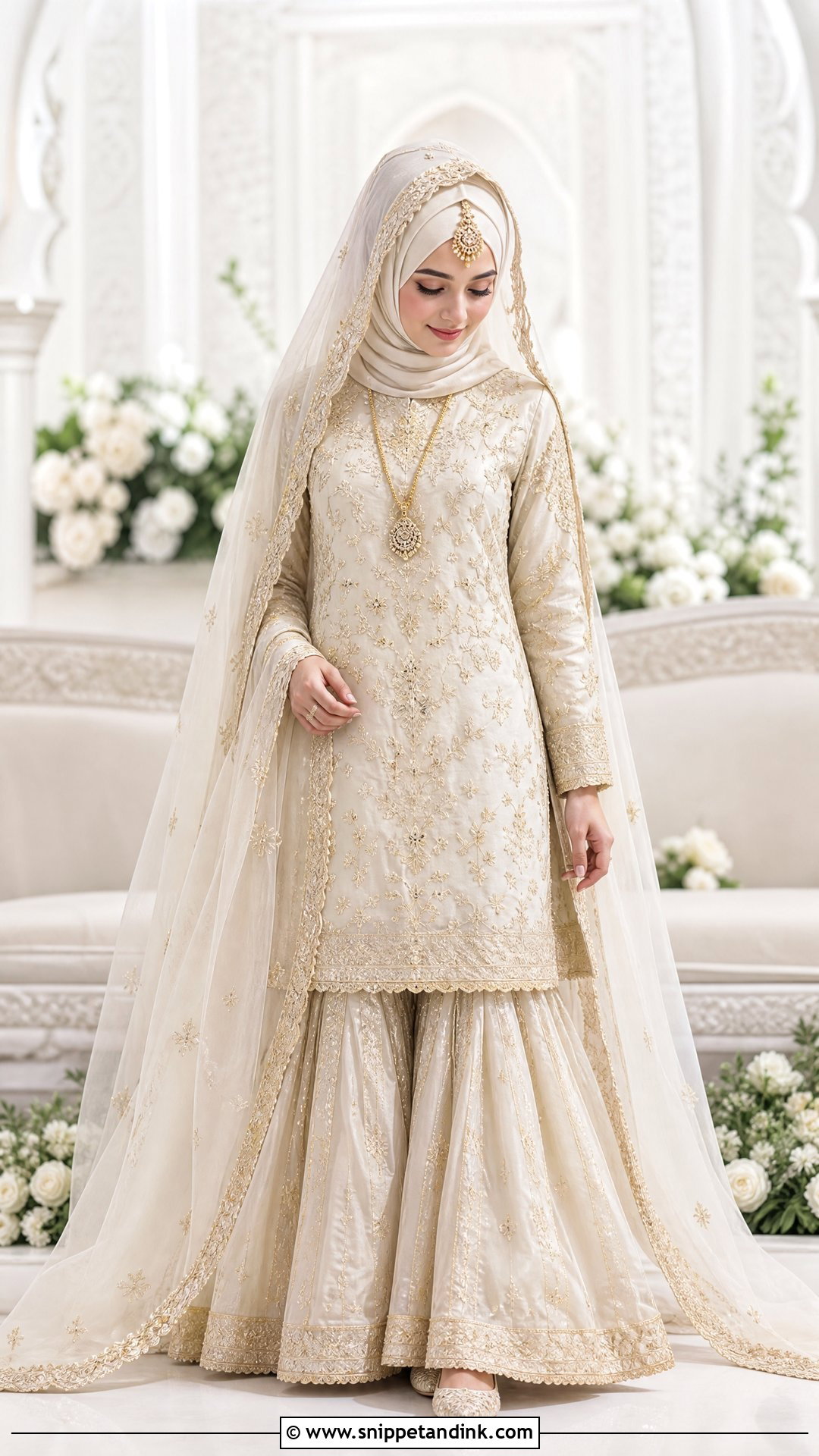
A garara works well over a hijab because the fitted top half keeps the silhouette clean under layered head coverings. Choose a fully lined short kurti with a high neck, full sleeves and pearl or gold embroidery at the cuffs and hem, over a structured ivory garara with embellished bands. Wear a light matching hijab under a longer organza dupatta and pin the dupatta over the head so it falls across the shoulders. A delicate headpiece, earrings if they show, a long necklace and ivory khussas finish it. I use ball-head hijab pins through both layers at the crown and sides, so the two fabrics move as one.
Stairs, Floor Seating and the Bathroom in a Garara
Nobody tells brides about the practical side of wearing a garara for a whole day. A few habits make it easy.
On stairs, take hold of both legs at the knee band and lift slightly; that raises the flare off the step without disturbing the top. To sit on the floor, sit first and then let someone spread the flares evenly around you so the knee bands show. For the bathroom, a garara has a drawstring or elastic waist, so it’s simpler than a lehenga, but the dupatta is the hazard. Ask a friend to hold it, or unpin it beforehand. Farshi styles need a helper every time.
Wearing the Garara Again After the Nikkah
A garara breaks into pieces you can rewear. The kurti on its own works with straight trousers for Eid or a family wedding. The garara looks fresh again with a plain silk shirt in a contrast color and a simpler dupatta. If you plan to rewear, I’d ask for a slightly lighter knee band and a kurti color that works with more than the bridal dupatta, so each piece can stand on its own later.
Kurti Length Is the Detail That Makes or Breaks a Garara
Start with the ceremony itself: the setting, the season and how formal it is. Ivory, white, blush and mint suit daytime; red, maroon, emerald and navy come into their own in the evening. Then look closely at the kurti length, knee detailing, fabric weight and where the dupatta will sit, because those define the garara’s shape far more than color. A kurti that ends too low hides the knee band entirely. Let jewelry follow the embroidery, not compete with it, and choose shoes you can walk in under wide flares. Get those right and the outfit will feel like yours in the photos for years.
You'll Like These Ideas:


Leave a Reply