
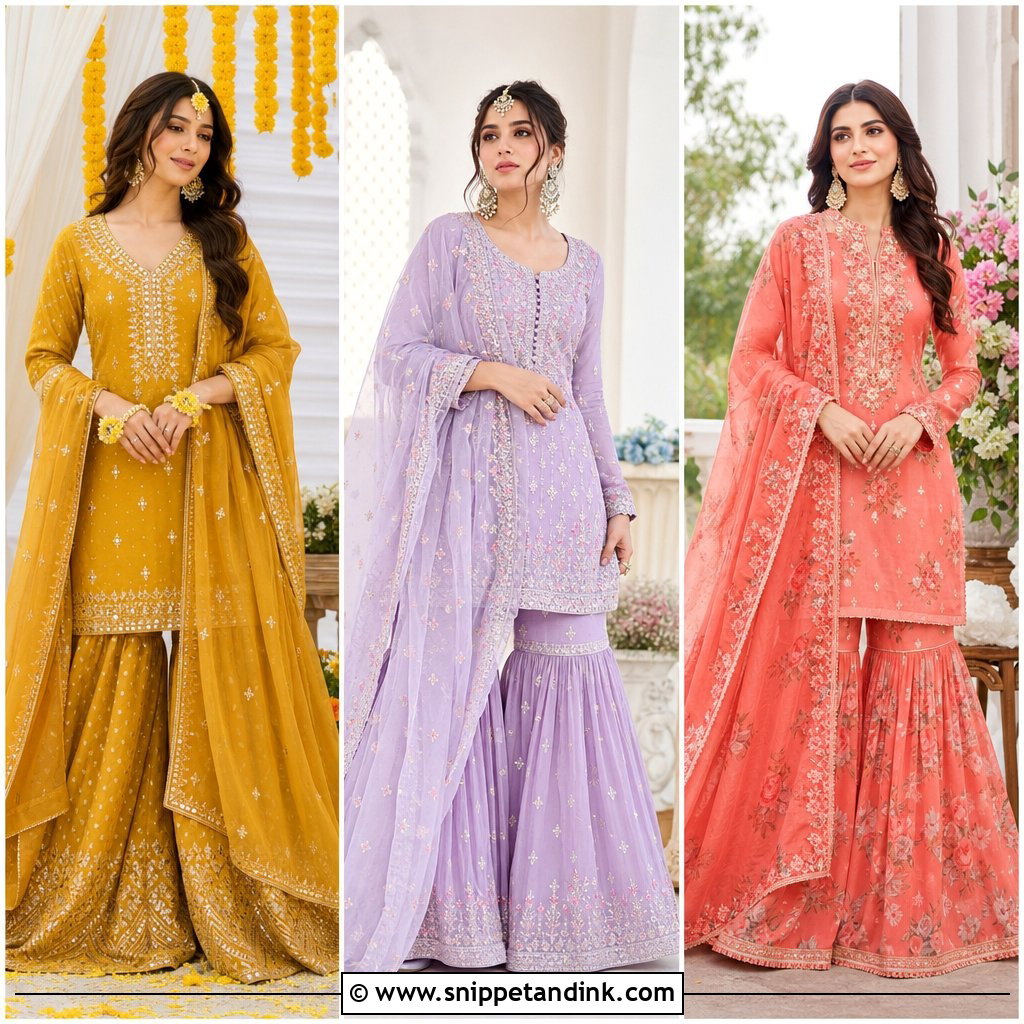
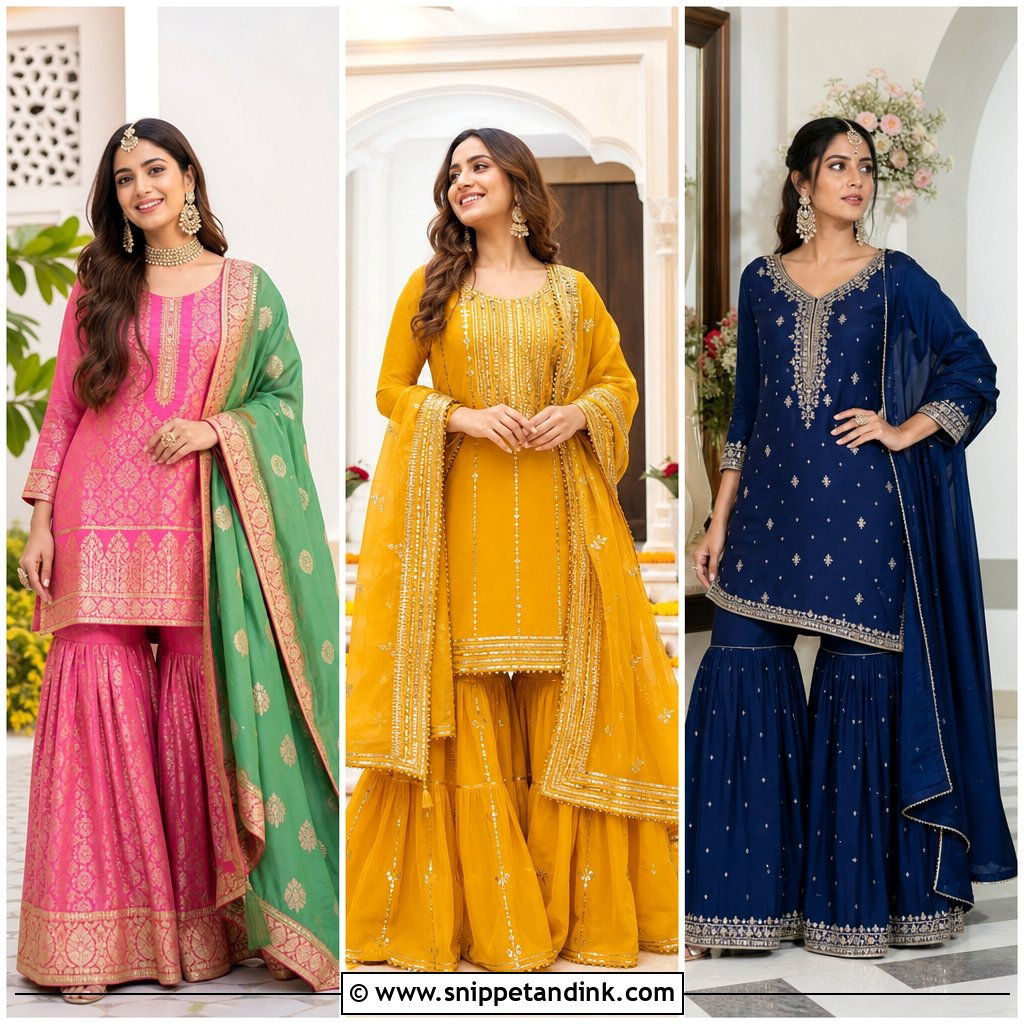
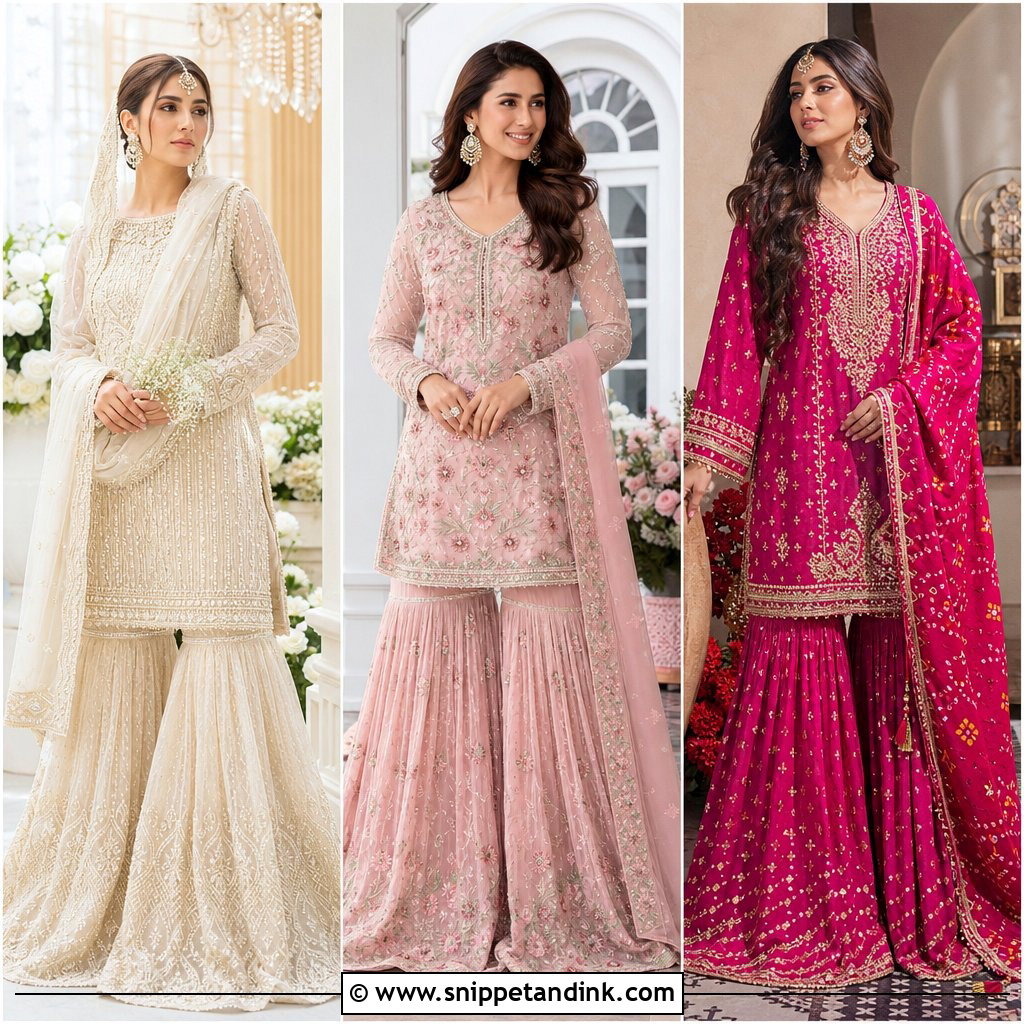
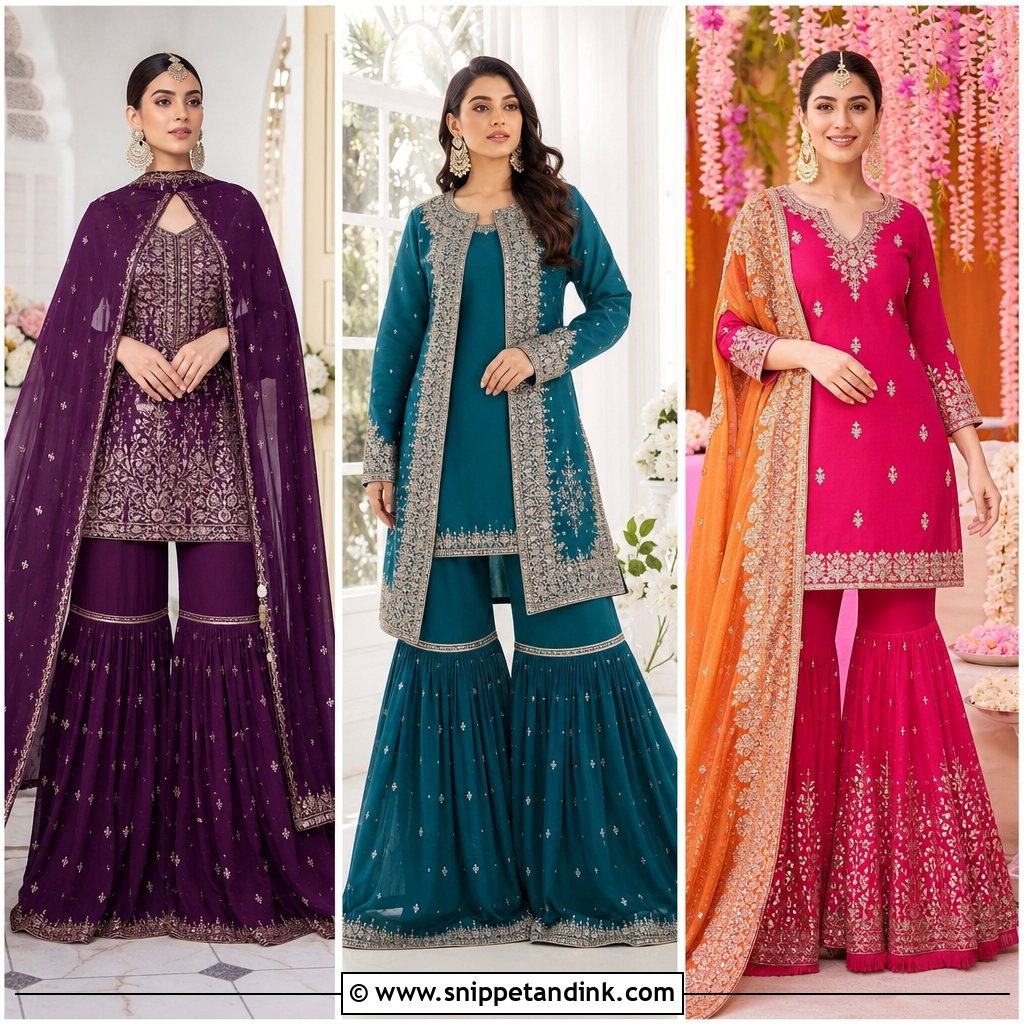
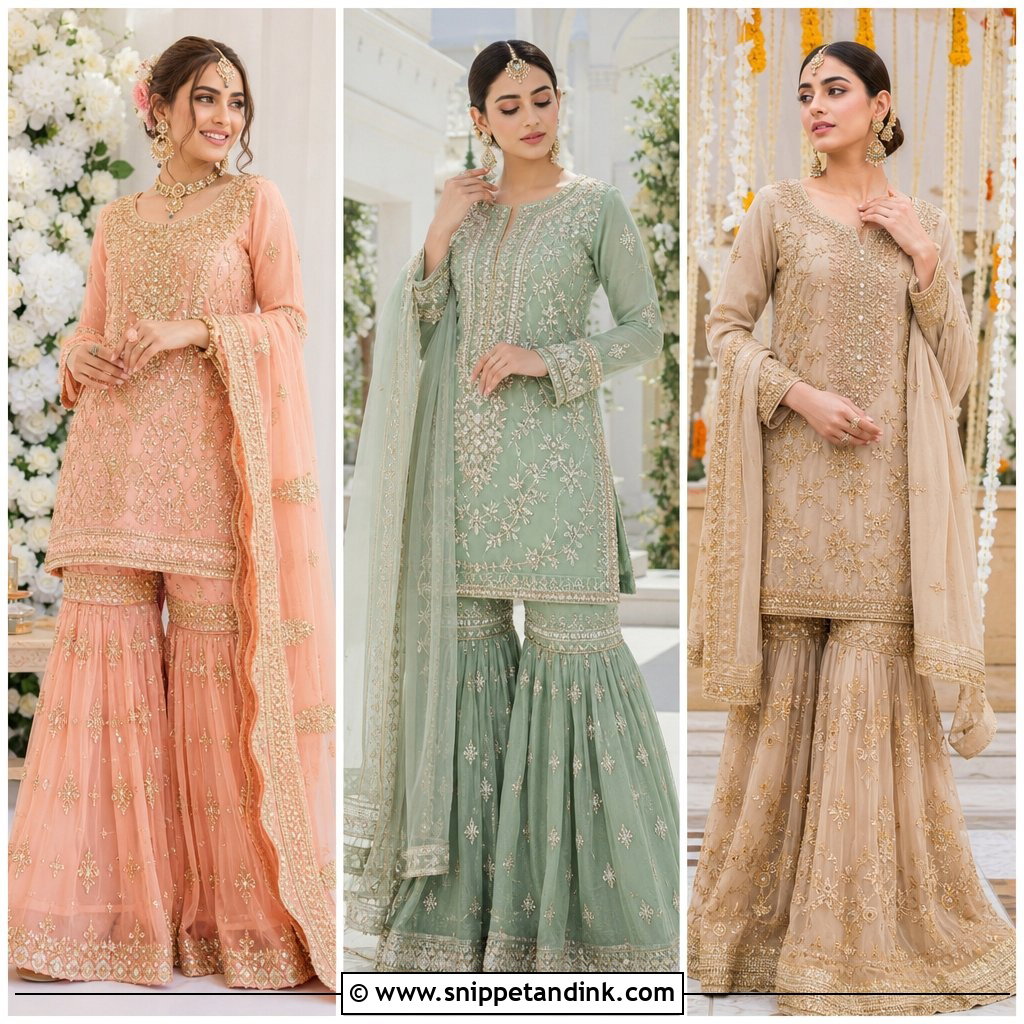
The garara (often spelled gharara) is the outfit I’d point to if someone asked what makes Nikah wear different. It’s a pair of wide trousers joined at the knee, fitted above and flared below, worn with a short or knee-length kurta and a dupatta. That knee joint, usually covered by a gota or embroidered band, gives it the shape no lehenga can copy. Colors now run from ivory and gold to blush, emerald and deep maroon, and the fabric decides whether it feels quiet or grand. Proportion is what I spend the most time on with brides: kurta length, knee height and how much flare the panels carry. Below are twenty complete garara outfits and how I’d style each one.
Where the Knee Joint Sits Changes the Whole Garara
Every garara has three measurements I fix before talking about color: the height of the knee joint, the kurta length and the hem length in your actual shoes. Get those right and almost any fabric looks good. Get them wrong and even fine embroidery looks off.
- The joint should sit at or just below the centre of your knee. Too high and the flare starts mid-thigh, which shortens the legs; too low and you’ll feel it pull when you sit.
- A short kurta should end above the knee band so the gota shows. A knee-length kurta can cover the band, but then the flare needs more volume to be noticed.
- The hem should brush the floor in your shoes, not pool, unless you’ve chosen a farshi style on purpose.
I take the hem measurement with the bride standing in the exact khussas or heels she’ll wear. Even a small heel changes where the flare breaks, and gararas are hard to shorten once heavy borders are stitched on.
1. Ivory Chikankari Nikah Garara Outfit
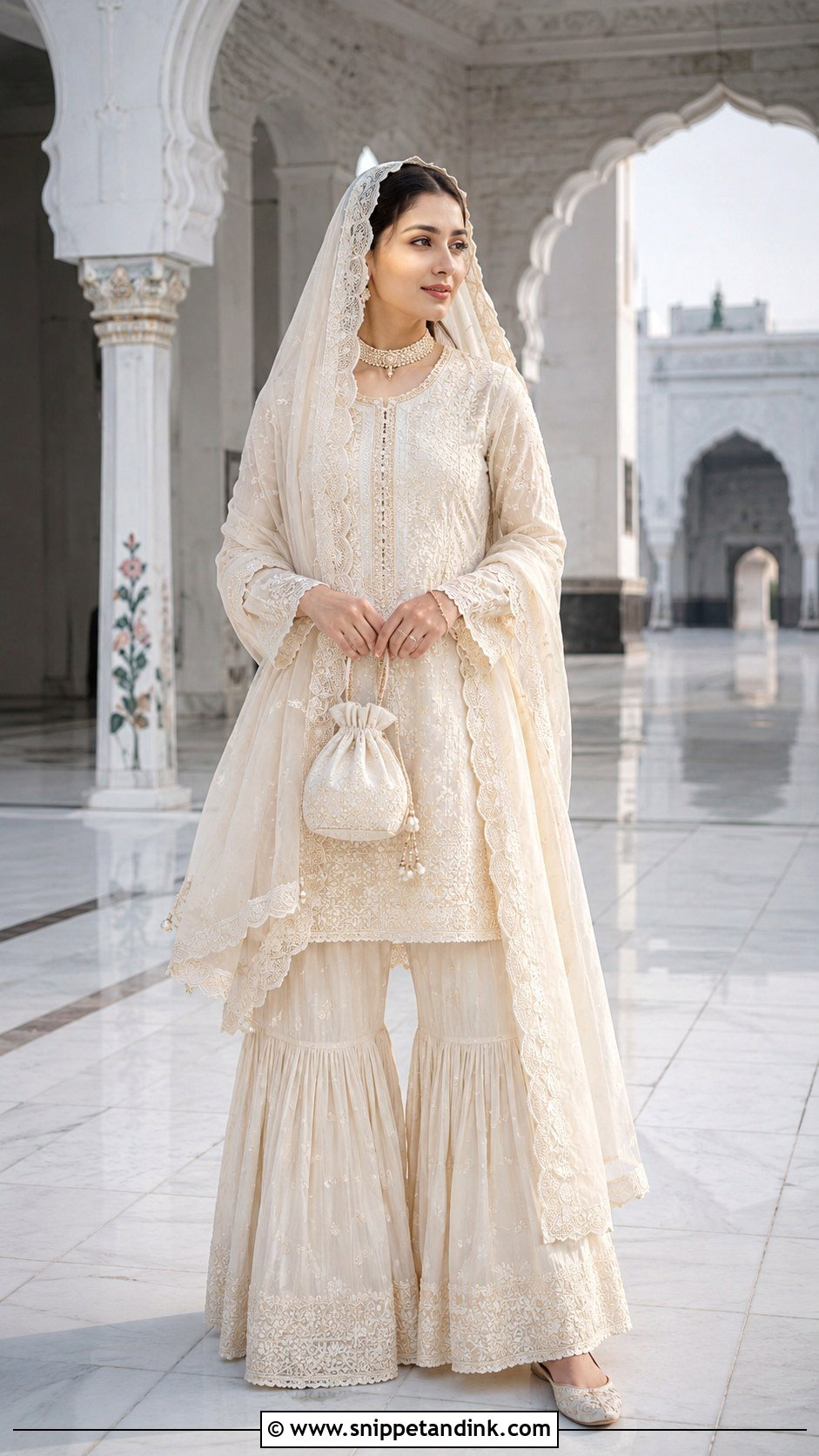
Chikankari is light and breathable, which makes an ivory chikankari garara a sensible pick for a summer afternoon. The knee band should be firmer than the rest of the garment, so I ask for a thin interfacing behind it; without that, soft chikankari collapses at the joint and the flare loses its shape. A scalloped kurta hem echoes the threadwork. One side of the dupatta over the head, the other across the arm. Pearls and a small tikka are all the jewelry it needs.
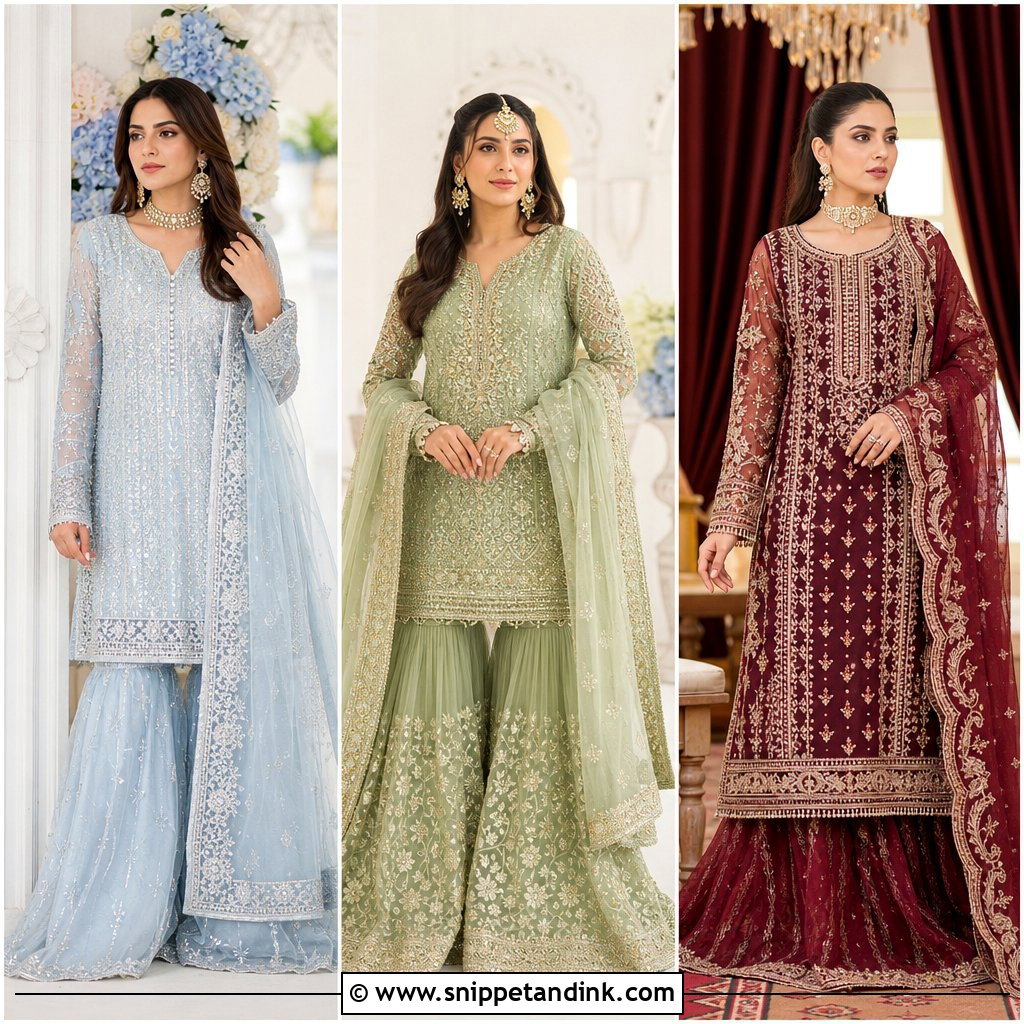
2. White And Gold Nikah Garara Outfit
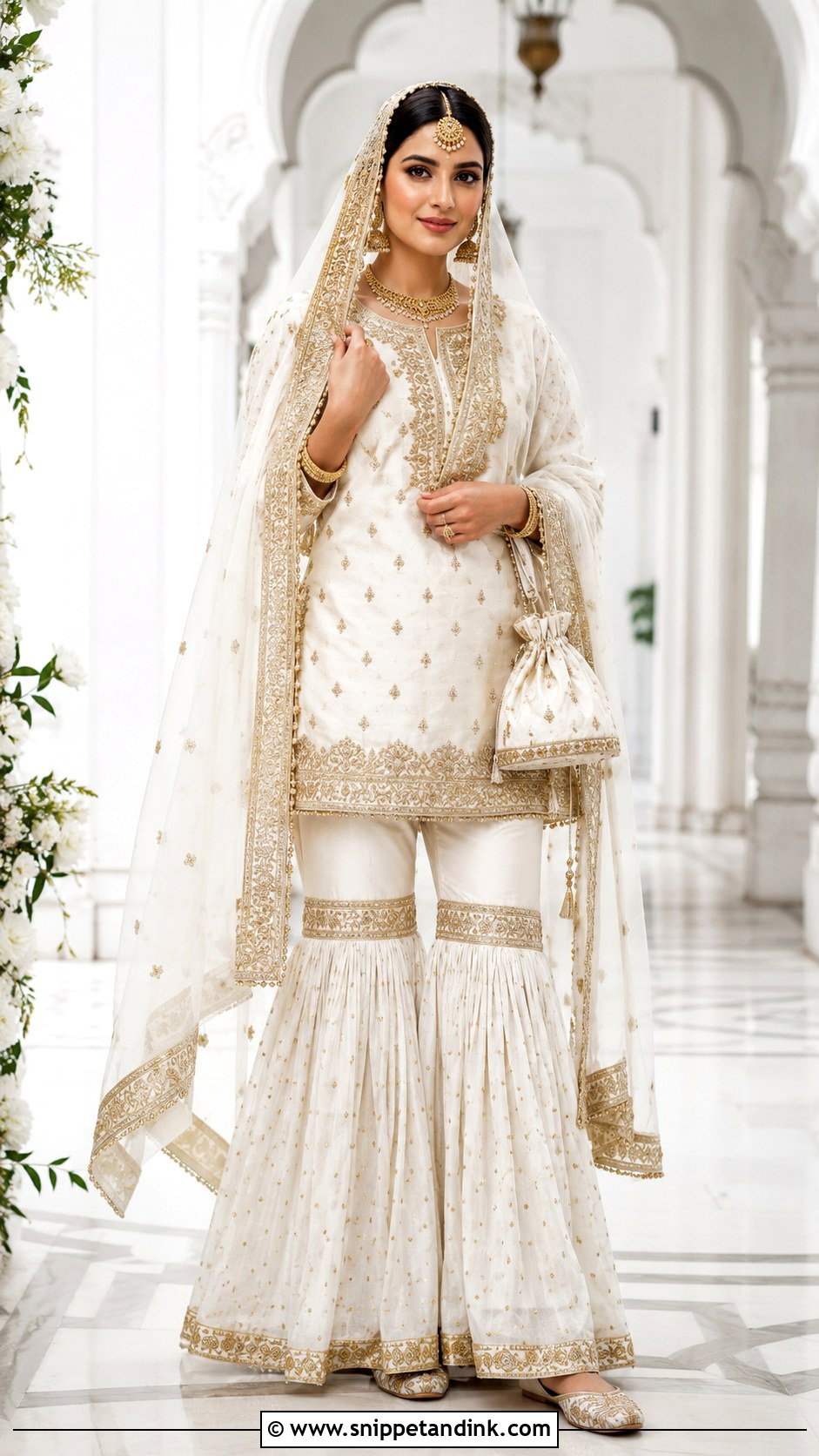
White with gold gota is the most traditional pairing here. Gota is woven metallic ribbon, so it’s lighter than zardozi and keeps a crisp edge, which is why it suits the knee bands and lower flare so well. A short silk kurta with zari at the neck and hem keeps the eye moving upward. Because white shows every mark, I’d keep a stain pen in the bride’s bag and avoid applying makeup or henna touch-ups once dressed. Antique gold jhumkas and muted rose lips keep it calm.
3. Blush Pink Nikah Garara Outfit
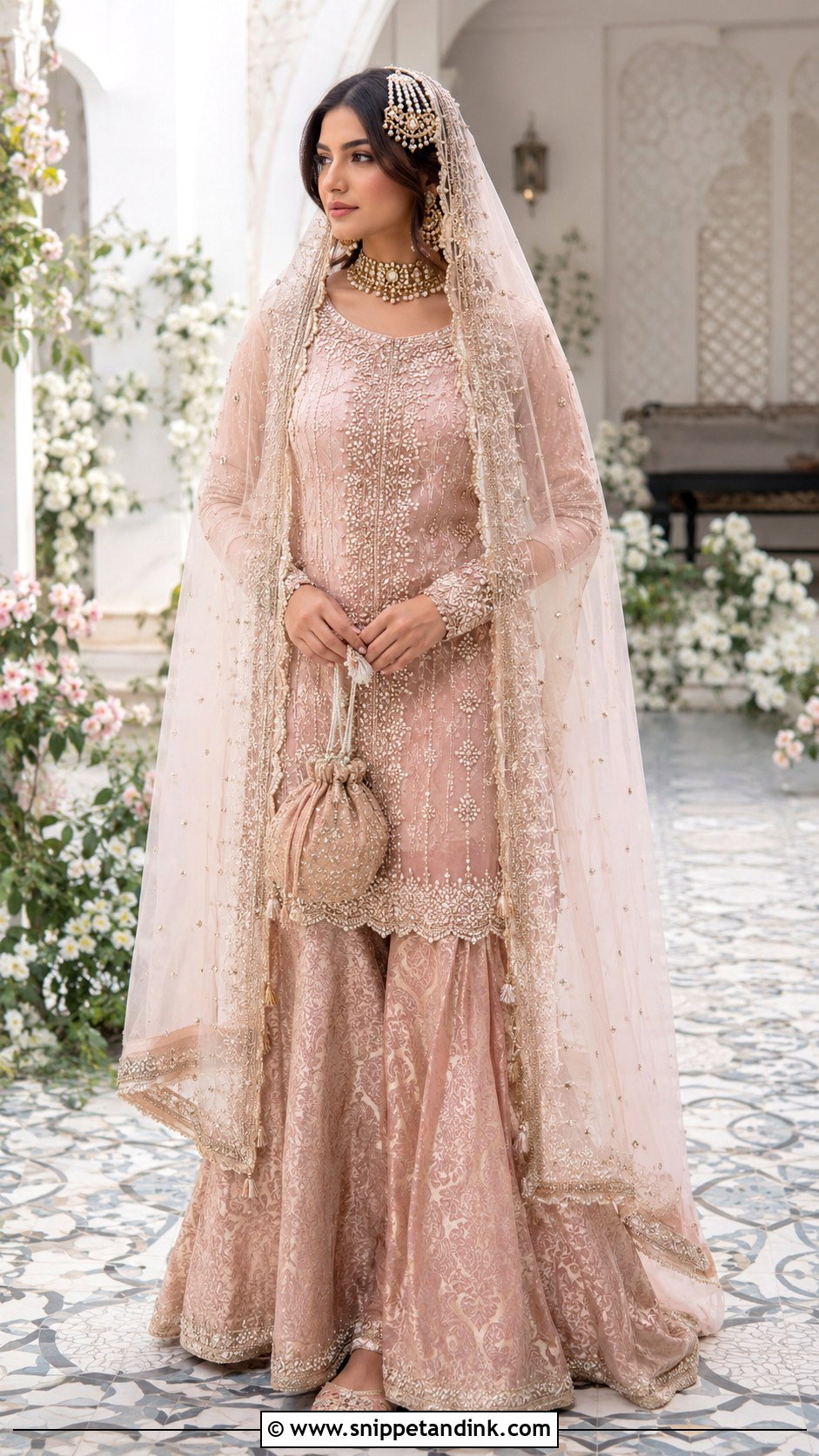
Jamawar and tissue both hold their own pattern, so a flowing blush garara in jamawar needs less embroidery than you’d think. A short raw silk kurta with tonal pearls and fine threadwork sits above it nicely. I like the scalloped net dupatta framing the face from above, since blush is gentle enough that a frame helps it read as bridal in group photos. A small passa and kundan earrings add the traditional touch. Cushioned khussas are a kindness on a long day.
4. Pink Garara With Maroon Dupatta Outfit
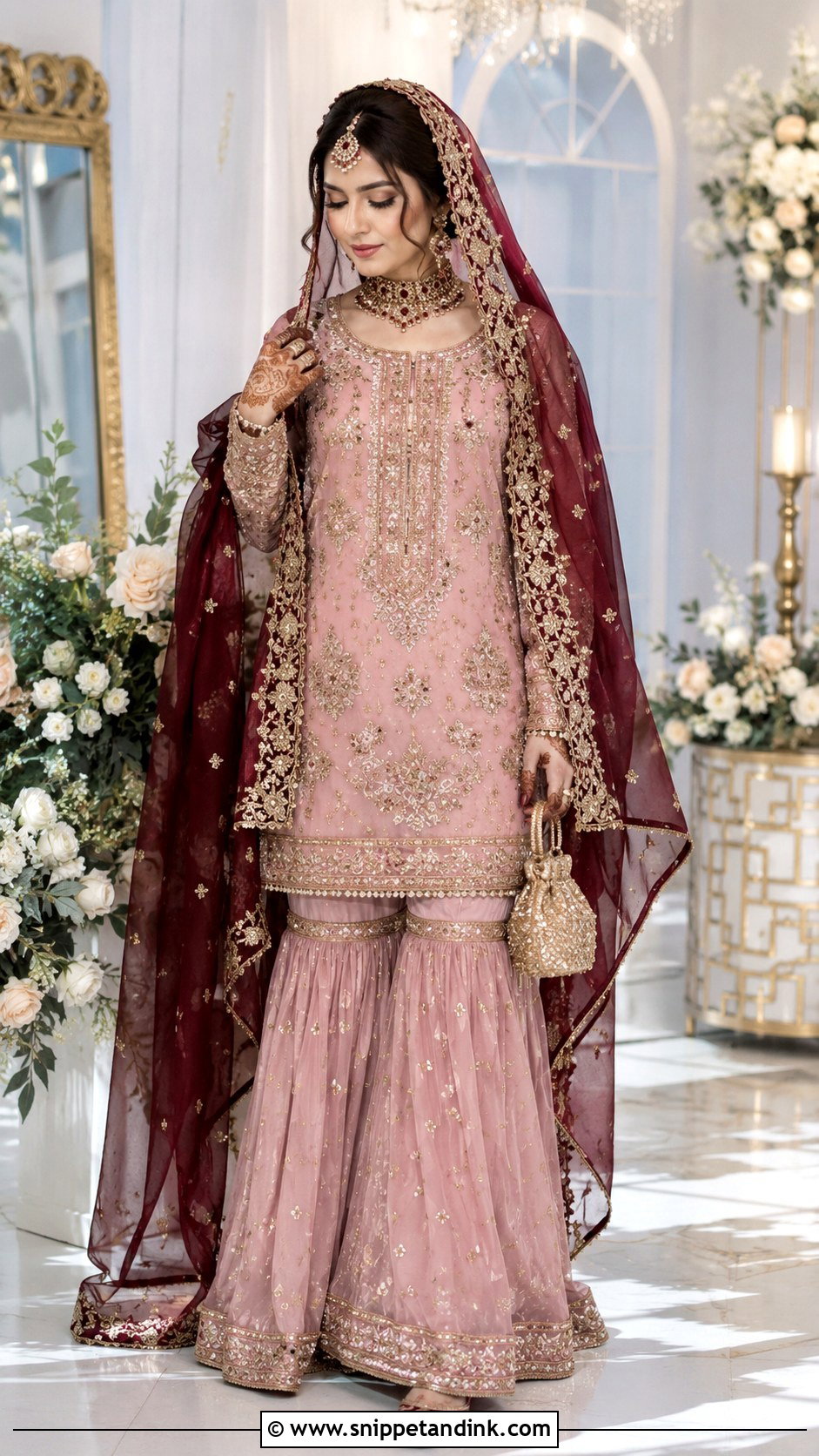
Pale pink can disappear in photos next to a guest in brighter clothes, and a maroon dupatta fixes that immediately. Maroon piping on the knee bands and hem connects the garara to the dupatta so the contrast looks planned, not borrowed. Velvet suits winter; organza is right for daytime. I’d always put the decorated border of the dupatta at the face, since that’s where the camera lands during the ceremony. Ruby-toned jewelry and maroon khussas close the color loop.
5. Champagne Nikah Garara Outfit
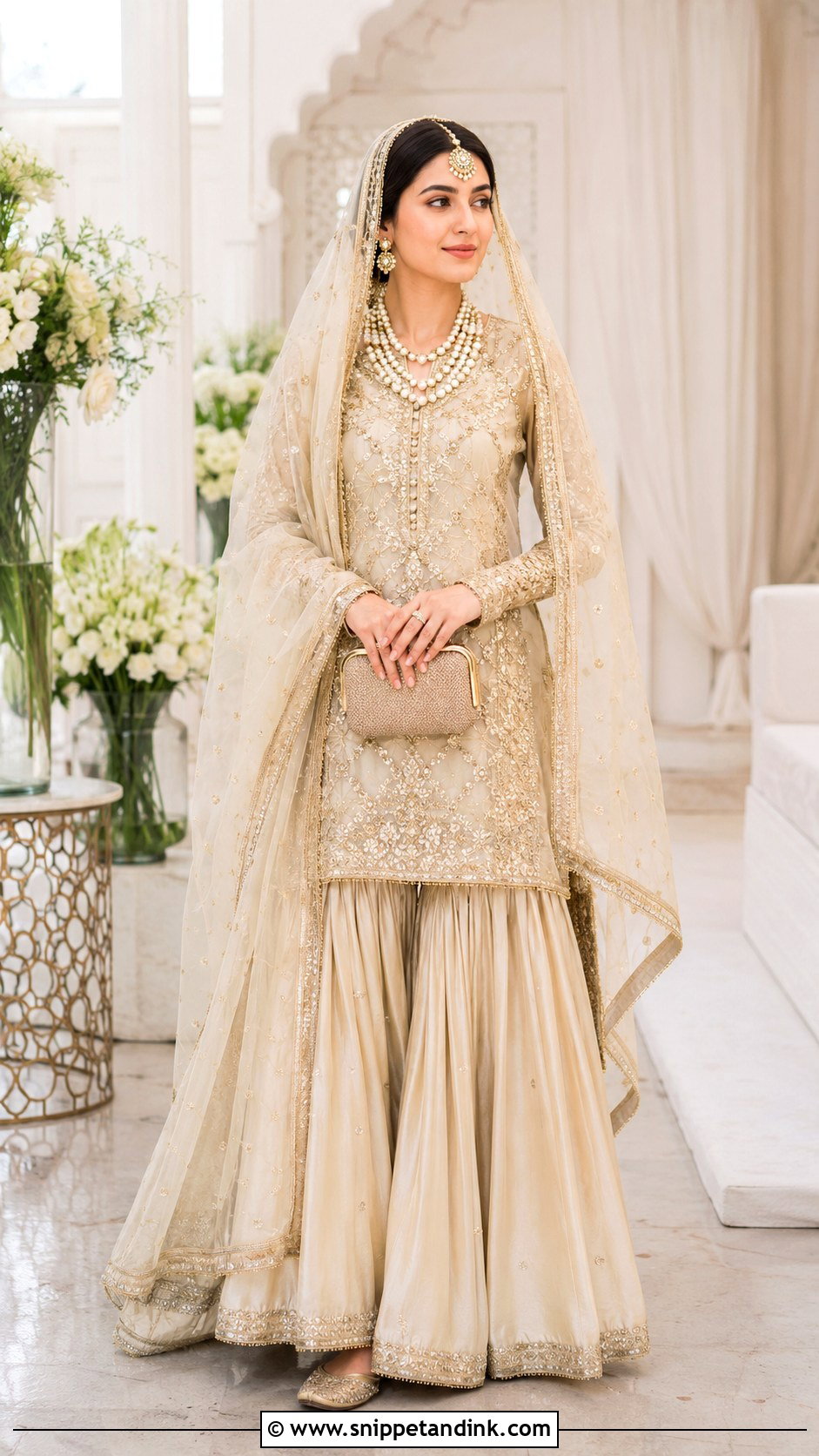
Champagne gives warmth without gold’s glare. A satin or raw silk kurta with antique zari and muted sequins is the starting point. The garara here combines a smooth upper section with finely pleated lower panels, and fine pleats need careful pressing after transport, so I’d ask the boutique to send it on a hanger rather than folded. Avoid very reflective jewelry, since it fights with the satin’s sheen. Soft bronze makeup and a peach-nude lip suit indoor evening lighting.
6. Rose Gold Nikah Garara Outfit
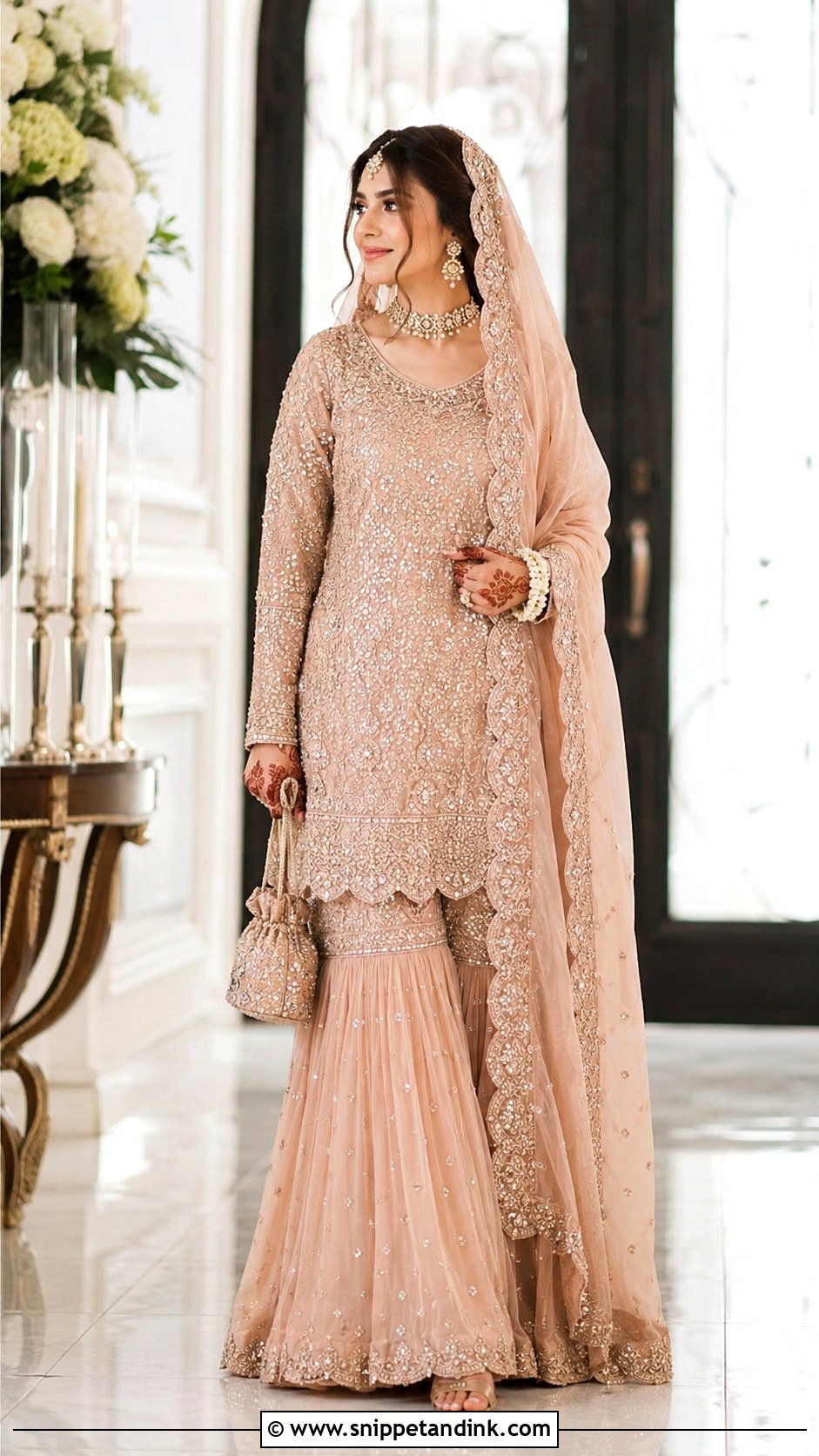
Rose gold reads softer than yellow gold and pairs well with most skin tones. The kurta carries the dense dabka and sequins; the garara stays lighter above the knee and richer below so the weight sits low. That placement helps the flare swing. One thing to watch with rose gold: it can look orange under some hall lighting, so I’d check it in the venue’s light if at all possible. Crystal and pearl jewelry, metallic rose heels and mauve lips keep it cohesive.
7. Mint Green Nikah Garara Outfit
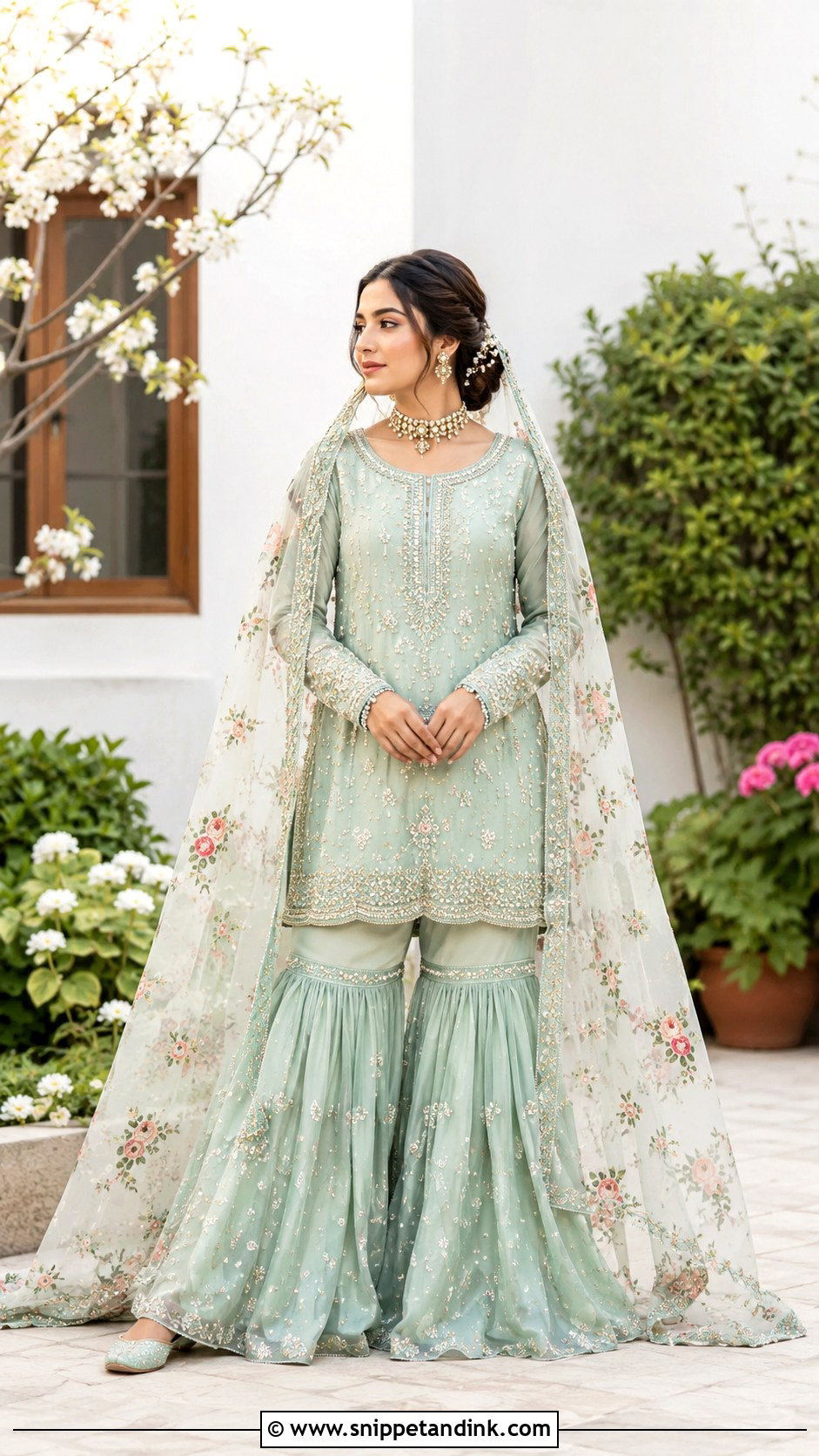
Mint feels fresh in spring and summer, and it photographs cleanly in daylight. A short mint kurta with white threadwork and pearls over a lightweight silk garara with chiffon panels is about as breathable as a bridal outfit gets. I’d always choose khussas over heels here if there’s standing involved; heels with a full garara also tend to catch the hem from behind. A low braided bun or a neat hijab finishes it.
8. Sage Green Nikah Garara Outfit
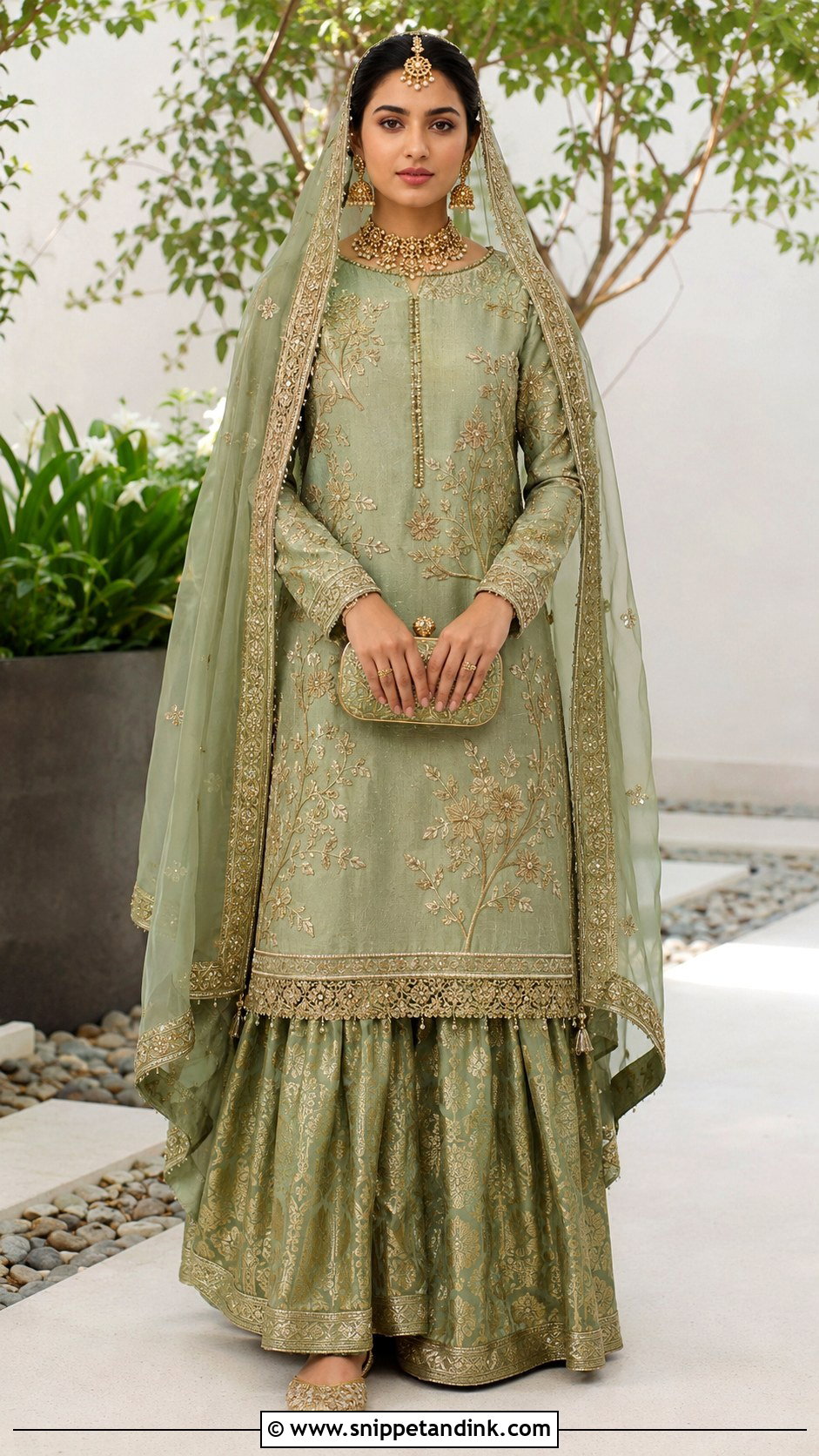
Sage is earthy and quiet. A raw silk kurta with an elongated hem and antique gold botanical embroidery sits over a tonal brocade garara. Slim gota bands at the knee are enough definition; wide bands would overpower such a muted color. The dupatta needs a heavier border for this one, because a light organza in a muted shade slips easily with nothing to weigh it. Bronze eyes and a dusty rose lip keep it grounded.
9. Powder Blue Nikah Garara Outfit
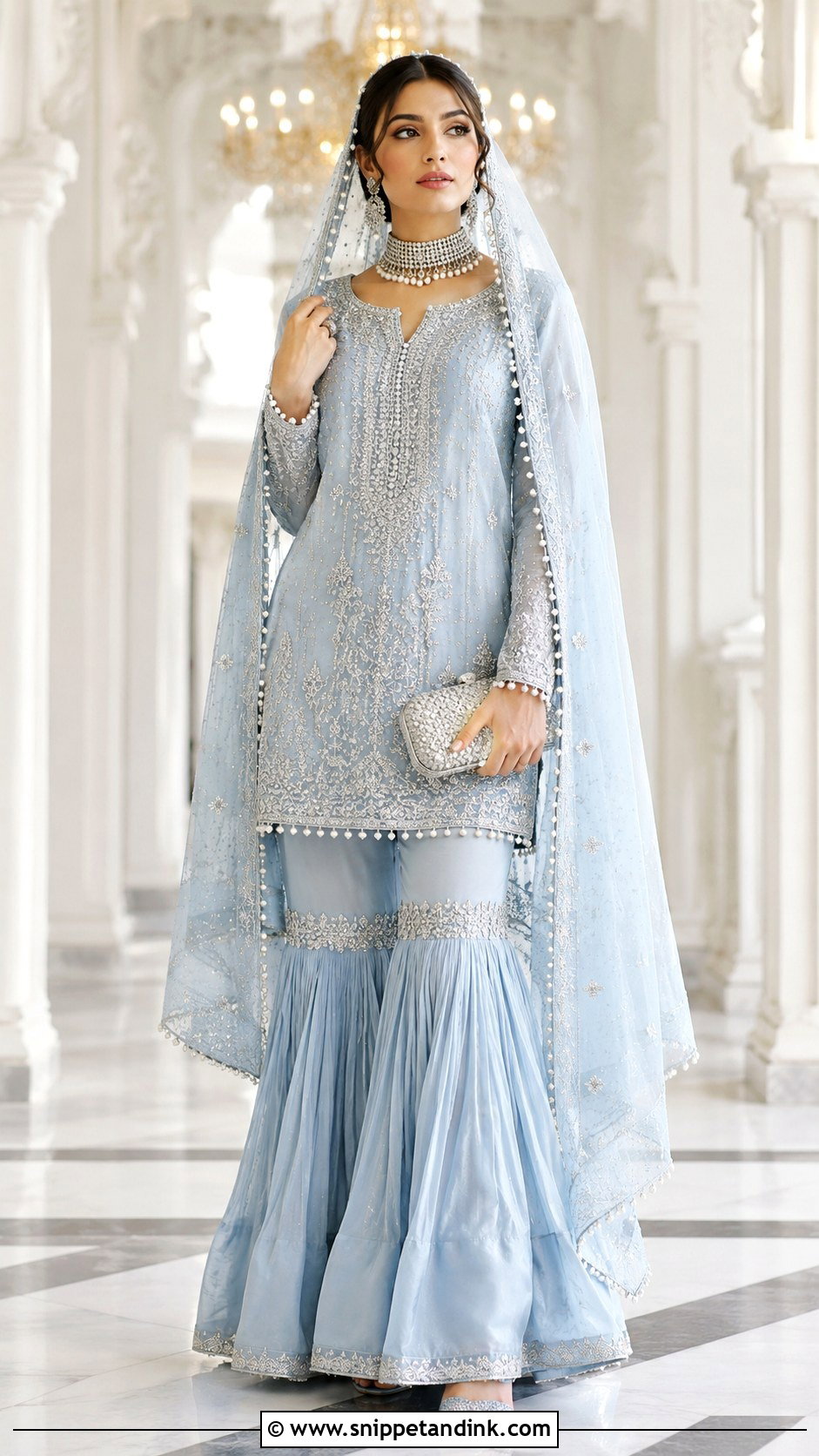
Powder blue is a cool, distinctive alternative to white. I’d go silver over gold with it, since warm gold against icy blue can look a little muddy. A knee-length kurta with crystal accents and silver-edged knee bands gives clear structure. Pearl drops on the dupatta’s edge add weight that helps it hang straight; pin it at both shoulders. Embroidered flats or low block heels keep you steady on the stage steps.
10. Lilac Nikah Garara Outfit
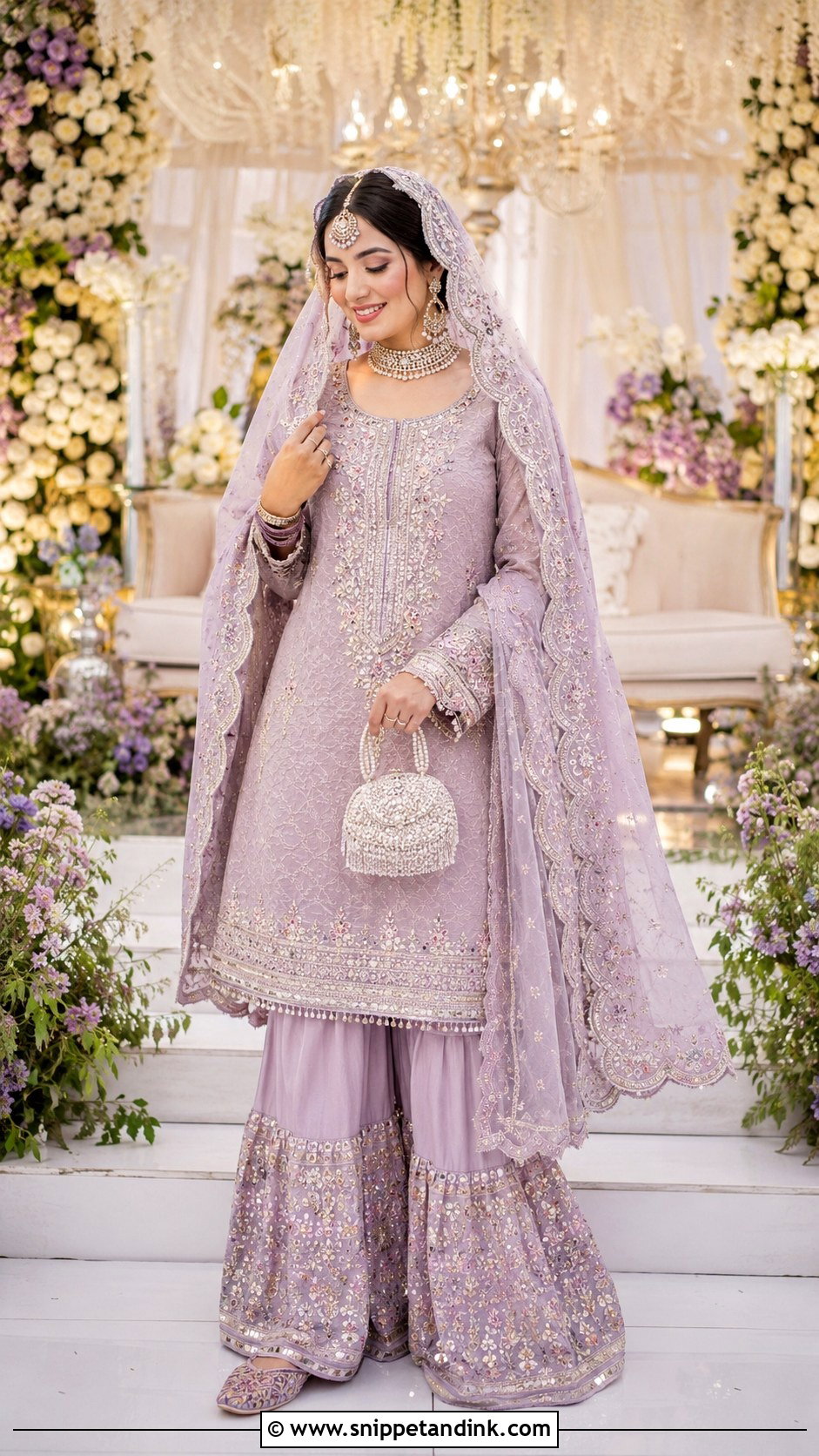
Lilac adapts to the season through the fabric: velvet for cooler months, raw silk or jacquard for warm ones. Silver-gold embroidery at the neckline, cuffs and hem gives definition. Heavier embellishment on the lower panels keeps the flare full. I check lilac against the bride’s skin in both window light and lamp light, because it can turn noticeably pinker indoors. Mauve eyes and a pink lip keep the palette soft.
11. Lavender And Silver Nikah Garara Outfit
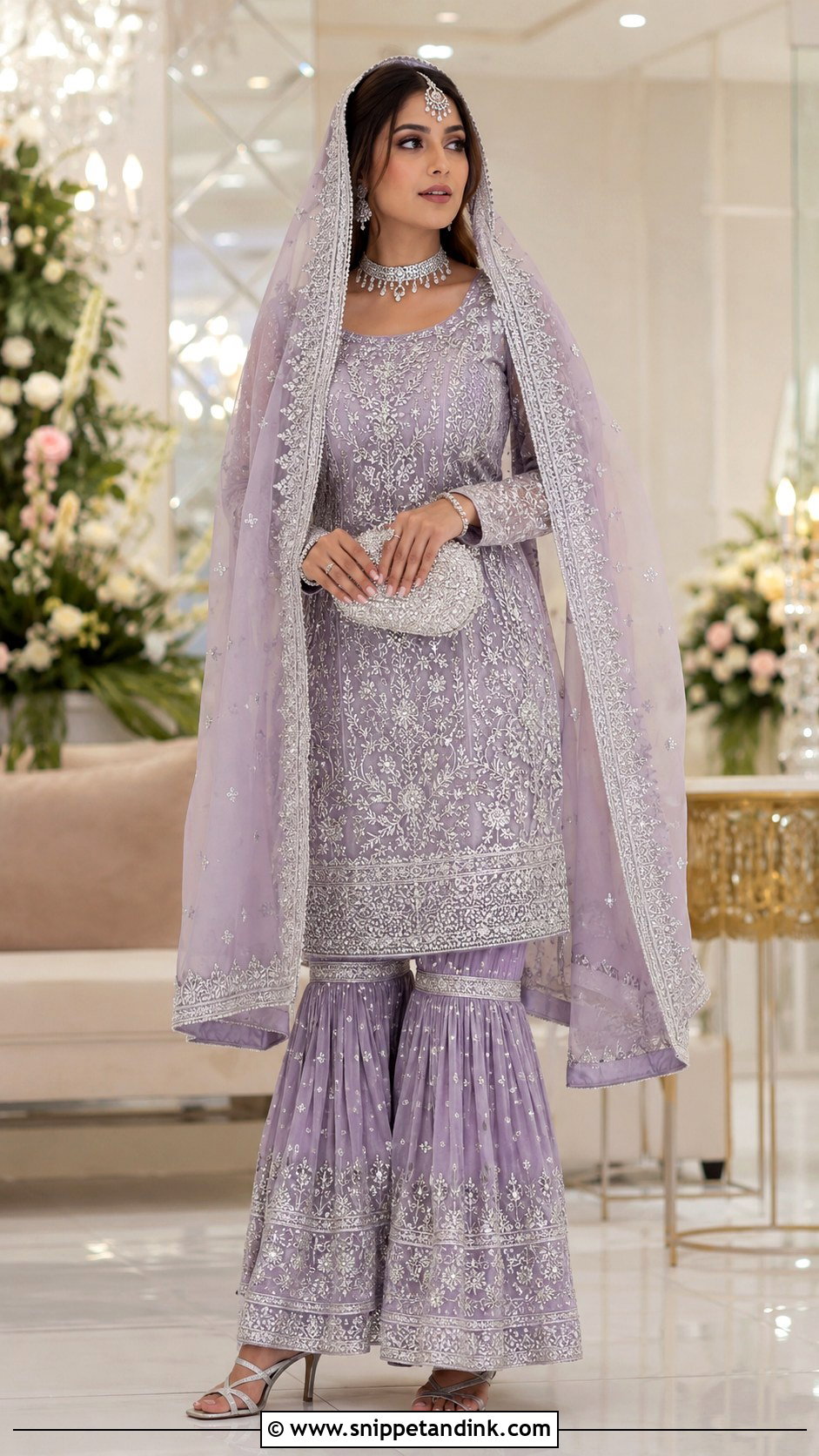
Lavender with silver tilla is cooler and more modern than lilac. Tilla is metallic thread embroidery and it shines, so I keep the jewelry to diamond-style pieces in the same silver family and avoid adding gold. The garara needs clean tailoring through the thighs and dramatic gathers at the knee, with broad silver borders near the floor. A center-parted bun keeps it polished, and a neatly draped hijab works equally well.
12. Peach Nikah Garara Outfit
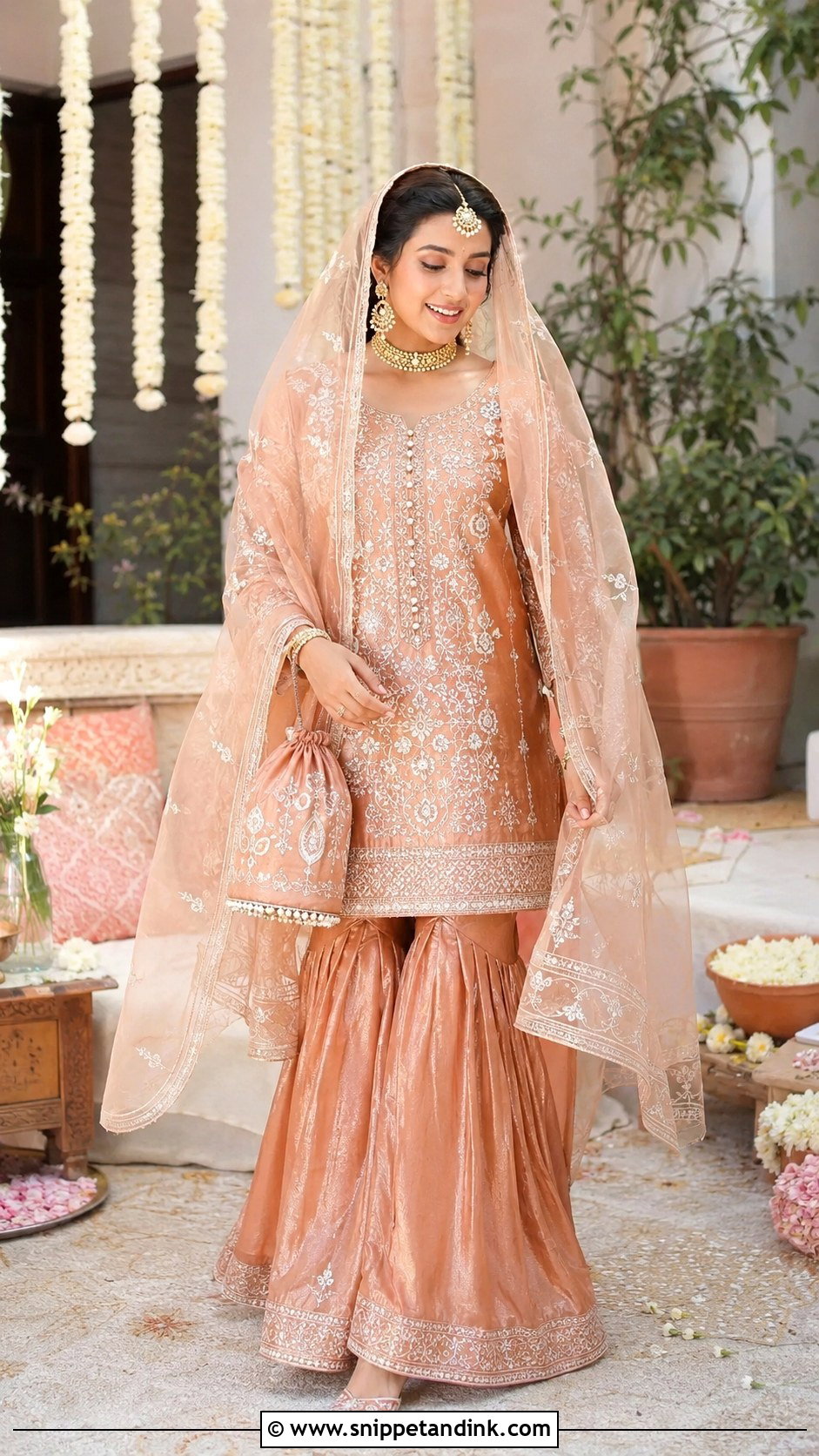
Peach warms the face in daylight, which makes it a flattering color for a home Nikah in a sunlit room. Ivory threadwork and small gold accents on a knee-length kurta keep it light. Tissue or silk garara panels hold the traditional shape, especially with embroidered knee bands. I drape the ivory-peach dupatta over the head with one long end over the shoulder so it doesn’t need constant adjusting. Pearl pins in a low bun finish it.
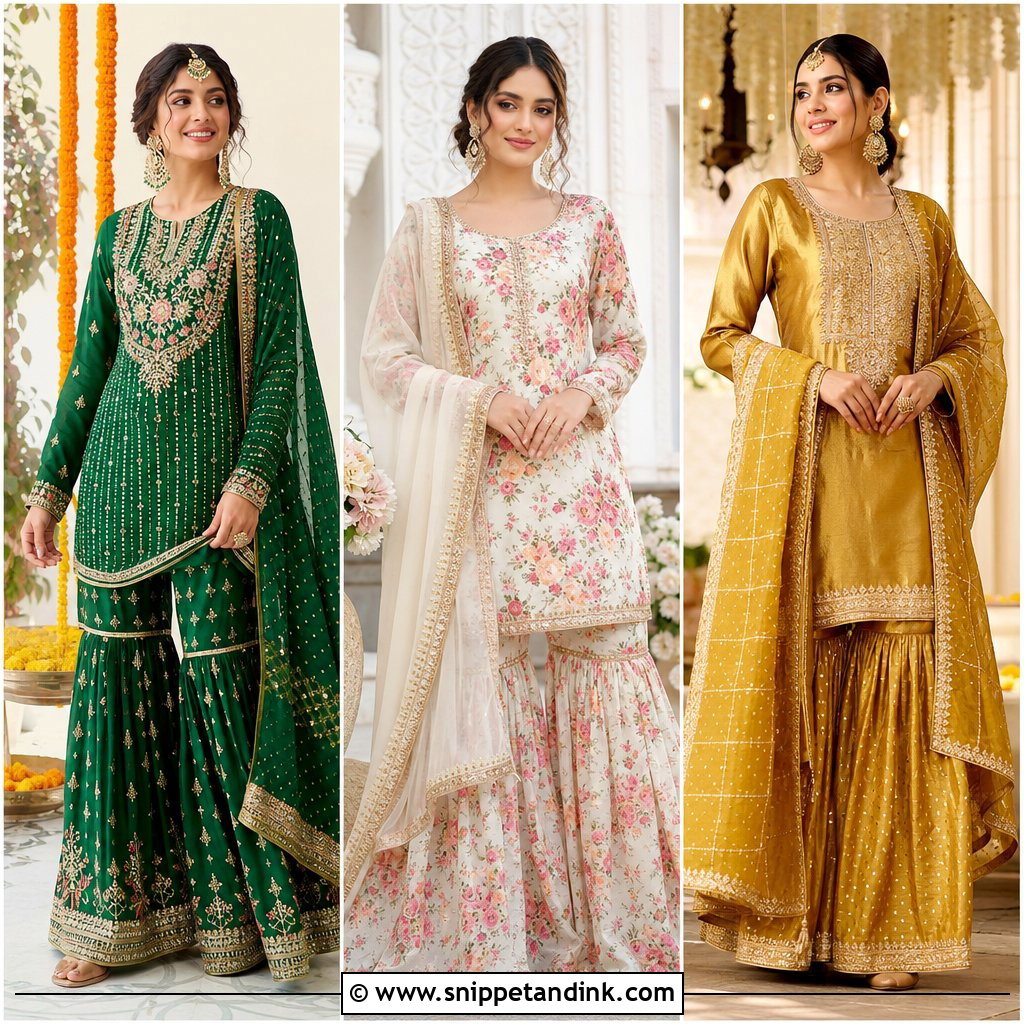
13. Pistachio Green Nikah Garara Outfit
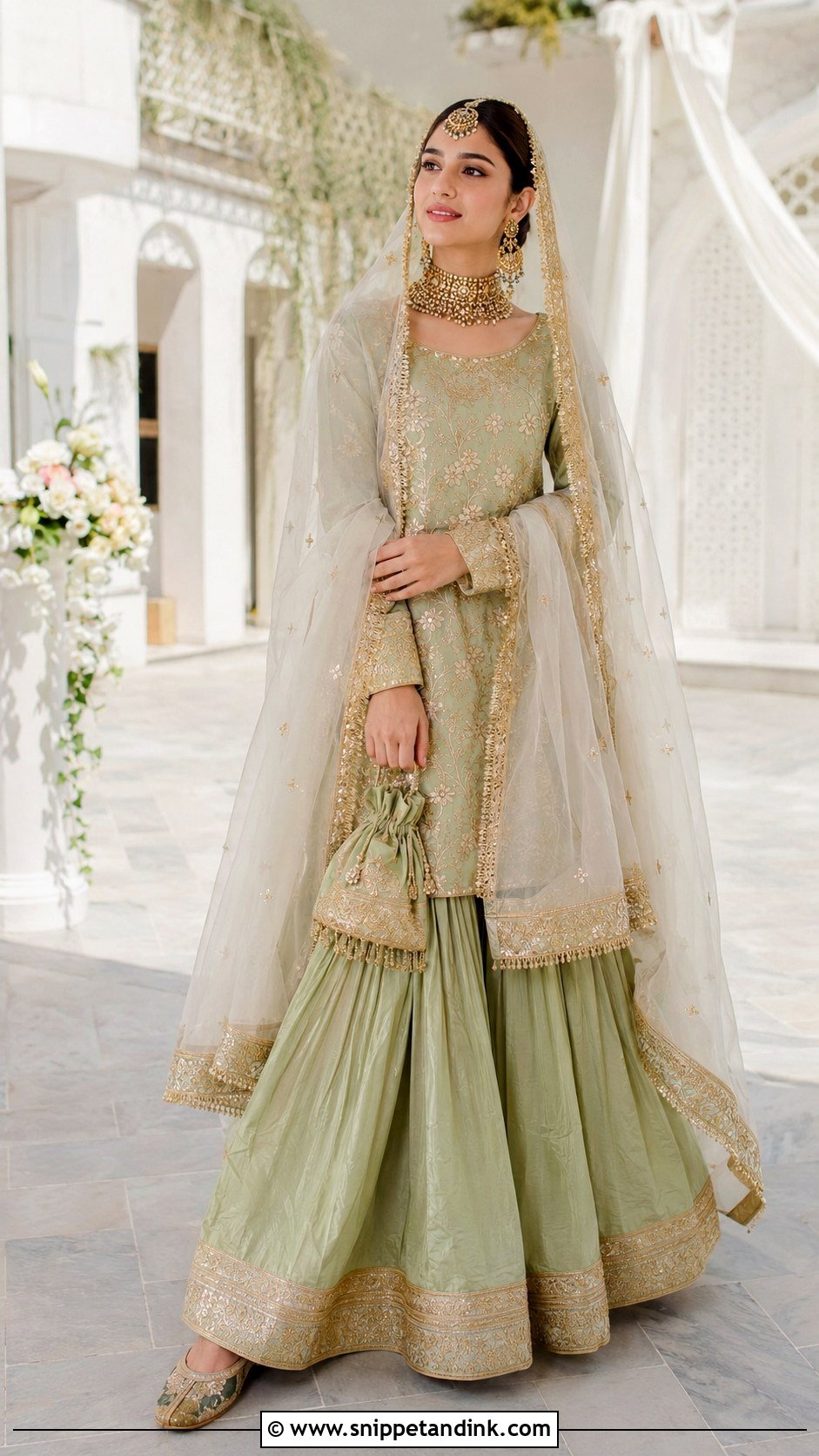
Pistachio is cheerful and very traditional in Mughal-inspired dress. A short brocade kurta with gold florals pairs with a silk garara using tiny pleats and wide gota borders below the knee. Wide gota adds weight at the hem, and that weight is what makes the flare move when you walk. Choose an ivory dupatta for brightness or matching green for a unified look. A passa placed close to the hairline and gold jhumkas keep it classic.
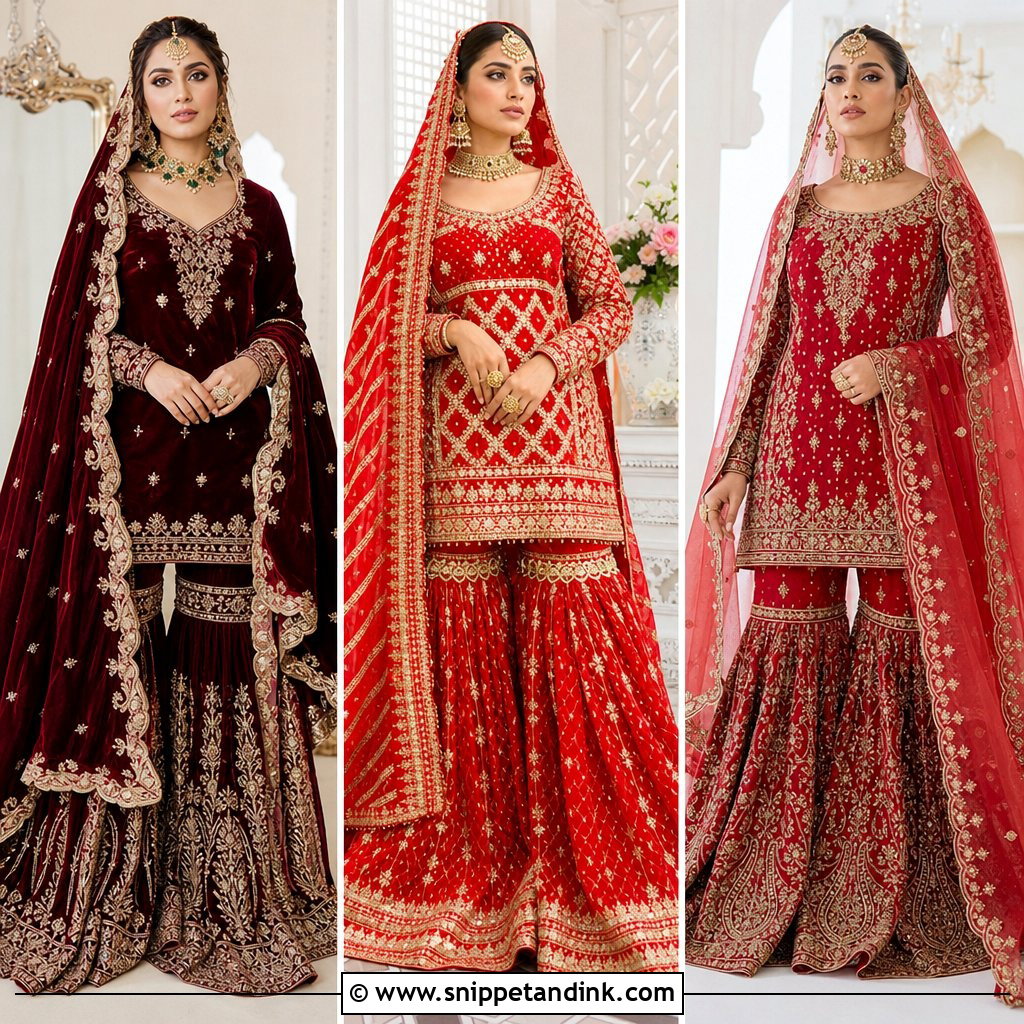
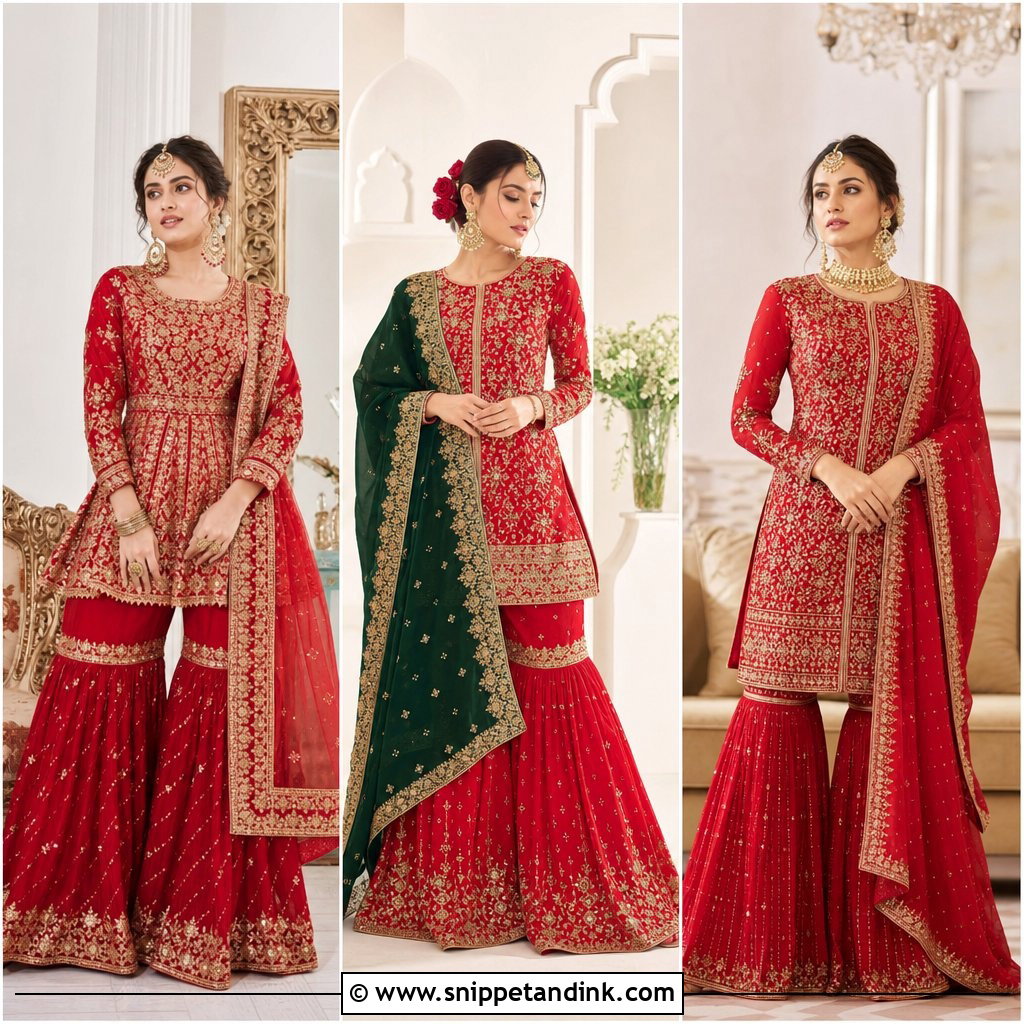
14. Red Bridal Nikah Garara Outfit
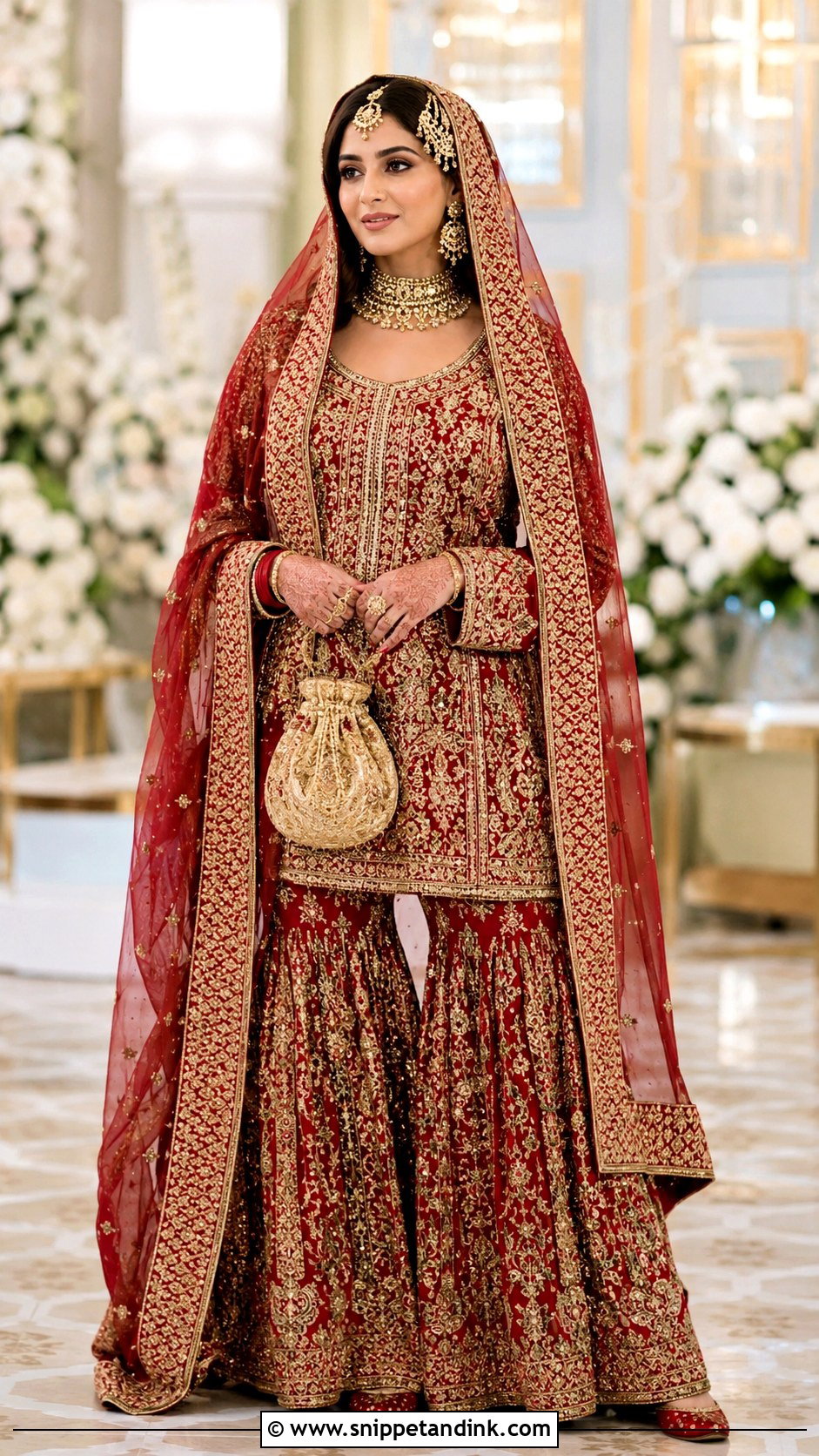
Red with dense zardozi is the full bridal statement. Zardozi is heavy metallic embroidery, so I always ask brides to try a red garara on with the jewelry and both dupattas together at the final fitting; the combined weight on the head and shoulders can surprise you. Keep the top of the garara lighter than the flared panels so it doesn’t drag at the waistband. Defined eyes and a deep rose lip suit the strong color. Keep the hair or hijab streamlined.
15. Maroon Velvet Nikah Garara Outfit
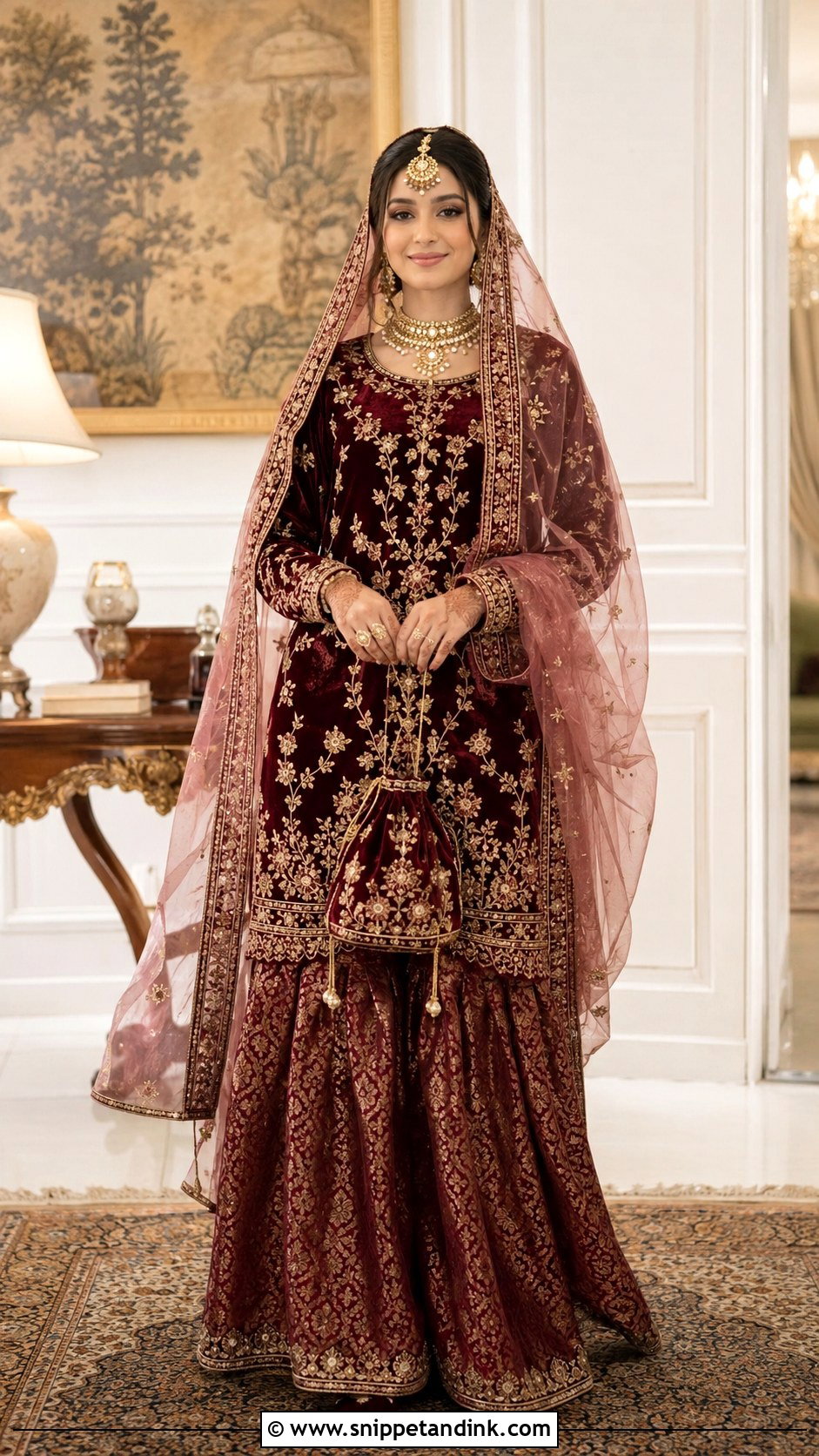
Maroon velvet belongs in fall and winter. The velvet kurta carries the antique gold and stones; the garara in silk or jamawar is lighter so you can still sit and walk comfortably. That split matters, because a full velvet garara gets hot and stiff. An organza dupatta in muted gold or dusty pink lifts the color near the face. Antique jewelry with pearl or emerald accents gives it a heritage feel. Soft smoky eyes and a berry lip finish it.
16. Emerald Green Nikah Garara Outfit
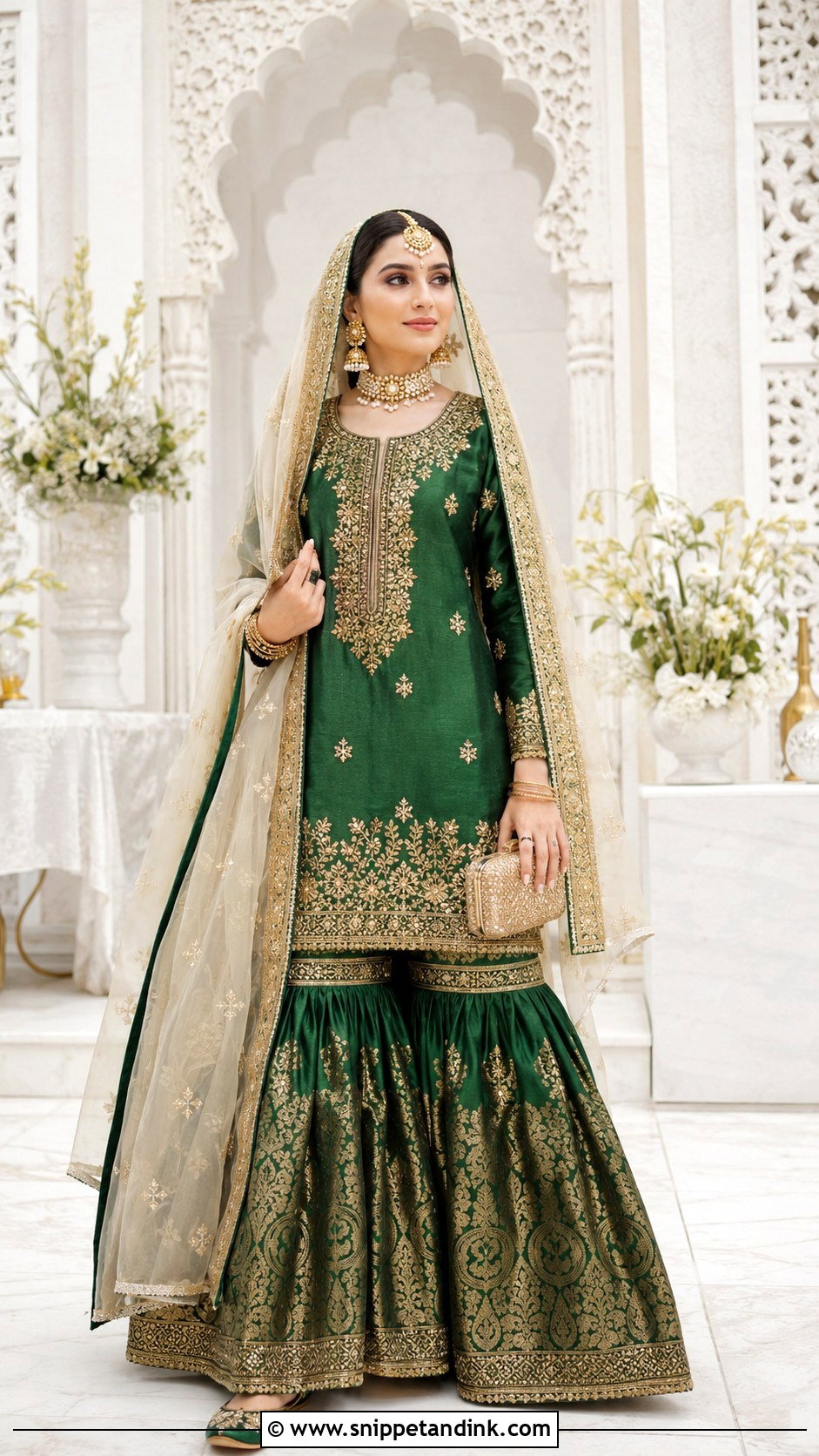
Emerald is saturated and confident, and an emerald garara in brocade or jamawar holds that color richly. Pleats below the knee give generous movement. Ivory dupatta brightens; emerald net creates a monochrome look. Gold with pearls or clear stones enhances green best, while colored stones crowd it. I’d keep the complexion luminous, since deep green next to a flat matte base can make skin look tired.
17. Navy Blue Nikah Garara Outfit
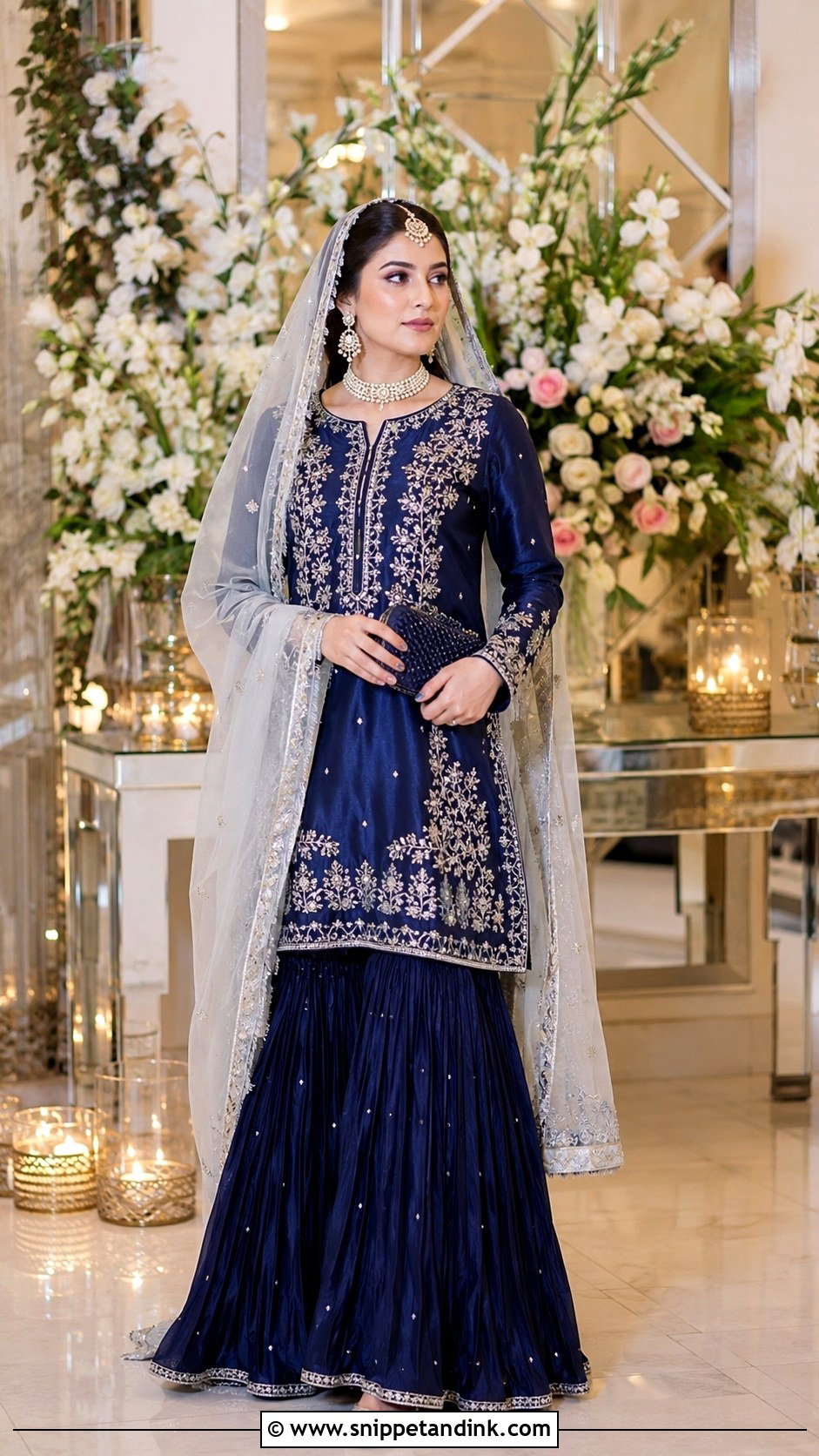
Navy is the evening alternative to black, and it gives a sharp, formal look. A raw silk kurta with silver or pearl embroidery and wide pleated panels below the knee keeps it structured. The thing I watch with navy is the face: deep blue directly under the chin can cast shadows, so a dusty blue or silver-gray dupatta adds light. Pearl drops, a crystal choker and smoked eyes suit it. Pearl pins in a low bun catch the light nicely.
18. Gold Farshi Nikah Garara Outfit
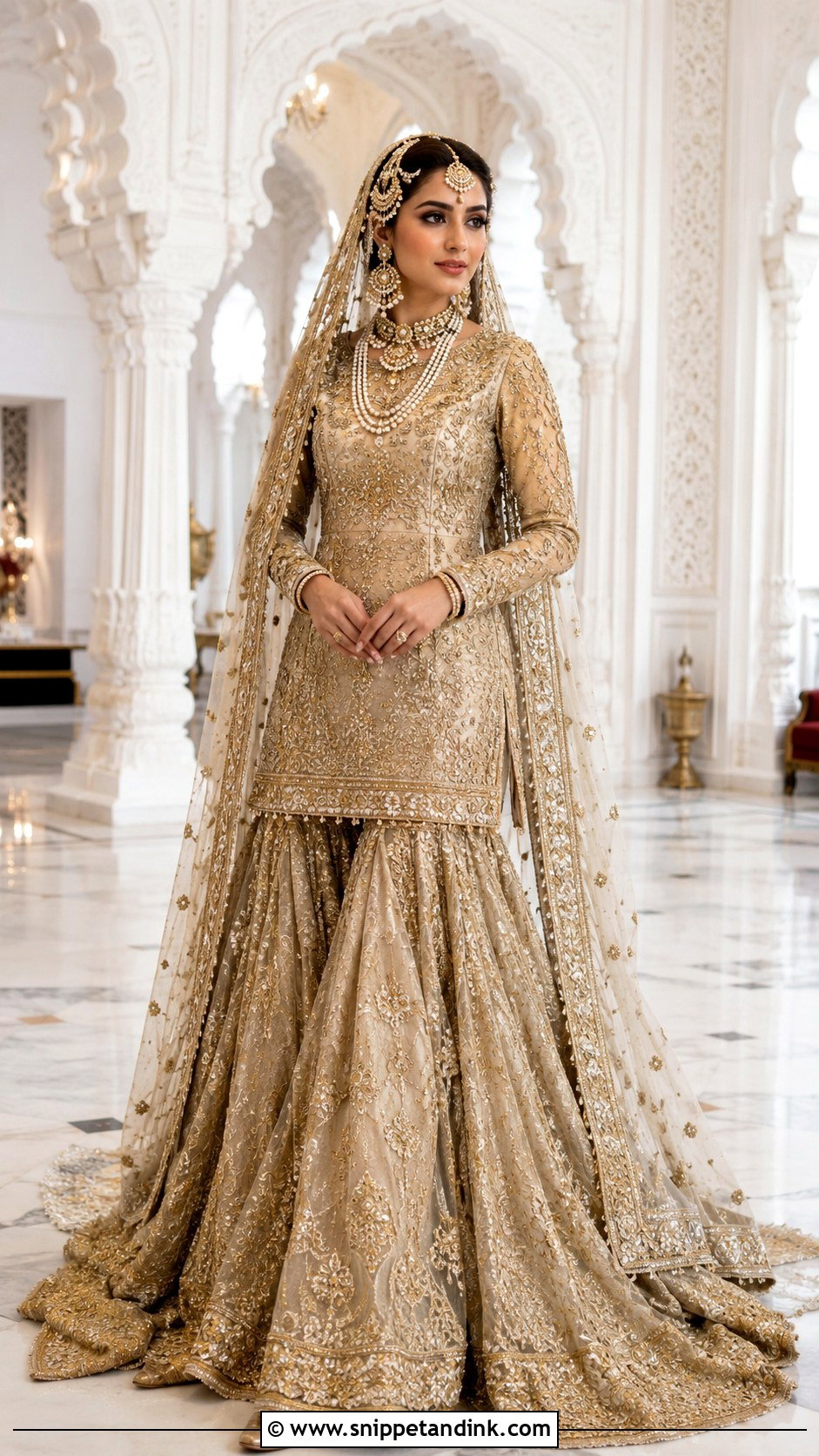
A farshi garara is extra long and pools on the floor, and it needs someone to manage it. For the walk in and out, a sister or friend should lift the back panels, and you’ll need help on any steps. I’d ask the tailor to fit the upper portion snugly and set the flare so it spreads evenly when you sit for portraits. Cushioned khussas are fine since they’ll be hidden. This is for a spacious indoor venue; in a tight home or a crowded hall, the hem gets stepped on.
19. Jamawar Nikah Garara Outfit
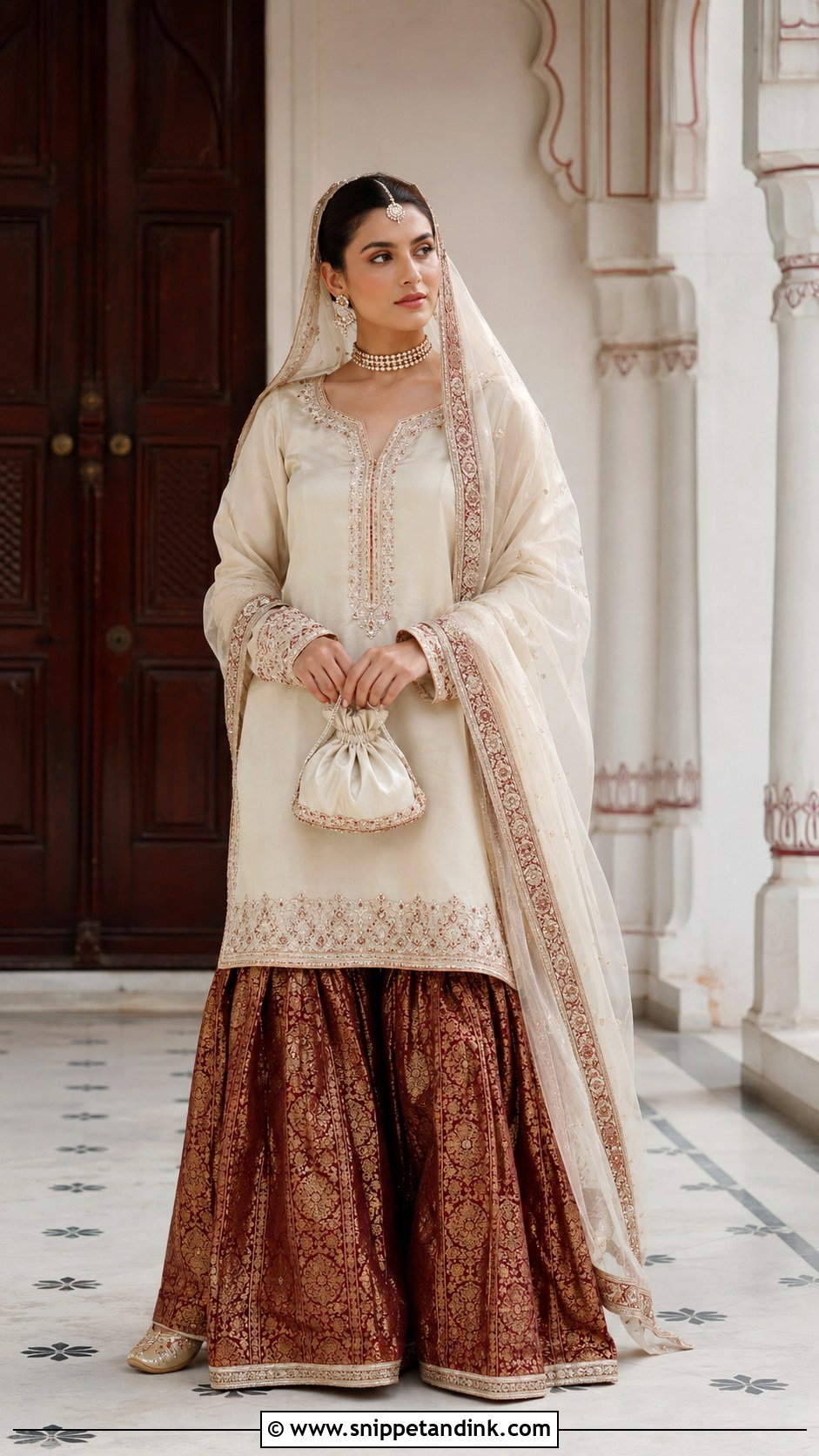
Jamawar’s woven pattern carries the outfit, so the kurta should be plain silk and the jewelry restrained. A richly woven jamawar garara with narrow matching trim at the kurta cuffs and hem looks deliberate. A simple organza dupatta with a jamawar border ties it in while staying light enough over the head. Brocade khussas and a plain potli keep the accessories quiet. Jamawar is stiffer than plain silk, so I’d allow a fitting just for the knee joint.
20. White Garara With Red Dupatta Outfit
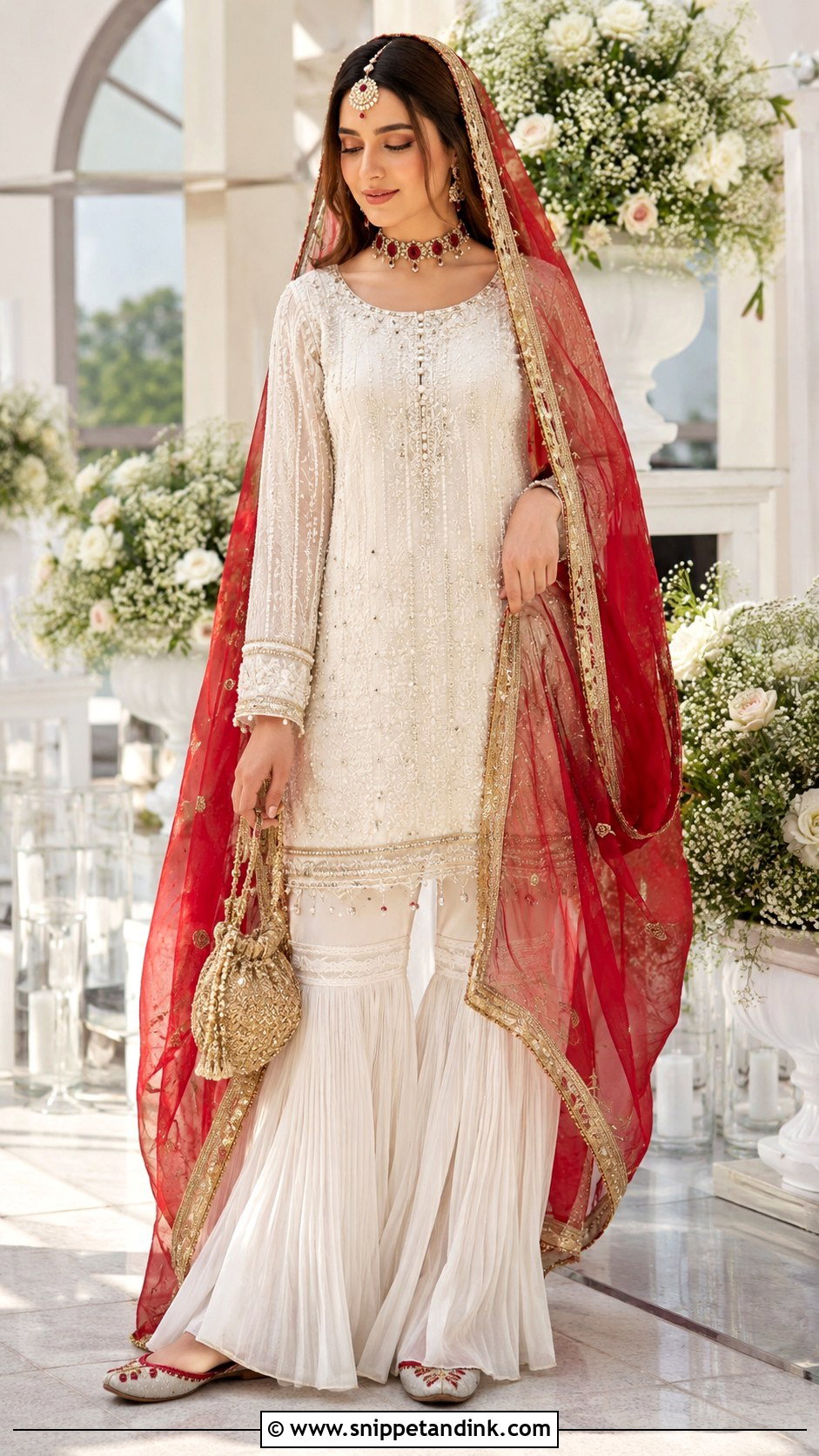
A red dupatta over white turns simple into memorable. The white kurta and garara keep to tonal threadwork, pearls and fine pleats, and the crimson dupatta with gold edging frames the face. I’d make sure the red doesn’t bleed: ask whether the dupatta has been pre-washed or color-tested, since dye transfer onto white under a warm hall light is a real risk. Ruby-toned kundan connects the two colors. A classic rose-red lip finishes it.
Sitting, Stairs and the Car Ride in a Full Flare
A garara carries a lot of fabric below the knee, and it behaves differently from a lehenga. When you sit, gather the panels slightly forward so you’re not sitting on the gota, which can crack or flatten under weight. On a stage or sofa, someone should spread the flare out for photos, then fold it back before you stand.
Stairs are where most gararas get stepped on. Lift both legs’ panels from the front at knee height, not from the hem, and go slowly. For the car, I’d sit first, then have someone lift the flare in after you, and keep the dupatta in your lap rather than trailing out the door.
Planning a Bathroom Break
Nobody likes to mention it, but a garara with a heavy dupatta is very hard to manage alone in a small bathroom. Take one helper, remove the dupatta first and hand it out, then gather the panels at the knee joint. Five minutes of planning here saves real stress later in the day.
Garara Proportions Worth Getting Right
A garara should feel rooted in tradition and still look like you. Ivory, blush and pastels suit daytime; red, maroon, emerald, navy and gold carry evening. Fabric changes the feel too: chiffon and organza float, while velvet, jamawar and raw silk give structure. Plan the whole outfit together, from kurta length and garara flare to dupatta, jewelry, shoes and hair or hijab. You’ll sit, stand and greet guests for hours, so a garara that moves well is the one to choose.
You'll Like These Ideas:


Leave a Reply