
Navy and gold is one of the few cake palettes I’m asked for in every season. Navy gives a cake weight and shadow without the harshness of black, and gold pulls it back toward warmth and candlelight. It suits a ballroom, a rooftop or a small dinner equally well, and it takes to almost any finish I work in: metallic leaf, textured buttercream, sculpted tiers, old-style piping, marbling. What decides the right version for you is less the trend and more the room. A cake that looks right in a dim hotel ballroom can look heavy in a bright garden tent, so the ideas below come with notes on where each one behaves best.
Why Navy Icing Fights Back, and How Bakers Get It Right
Navy is one of the colours I quote extra time for. In fondant it’s manageable, because good navy fondant can be bought ready-coloured and stays even. In buttercream it takes a lot of gel colour, and the more you add, the more you risk a bitter edge and blue-tinted smiles in the photos after cutting.
My routine is to start from chocolate buttercream instead of white, so the base is already dark, then add colour and leave it covered overnight. Dark colours deepen as they sit, and what looks royal blue at night is often navy by morning. Mixing it the same day usually leads to over-colouring.
- Ask whether the navy will be fondant, buttercream or ganache under fondant; each changes texture and taste.
- Bring a fabric swatch from the bridesmaid dresses or linens and compare it under warm light, not a white studio bulb.
- If stained teeth worry you, ask for navy on the outer finish only and ivory or chocolate icing between layers.
1. Navy Blue And Gold Wedding Cake
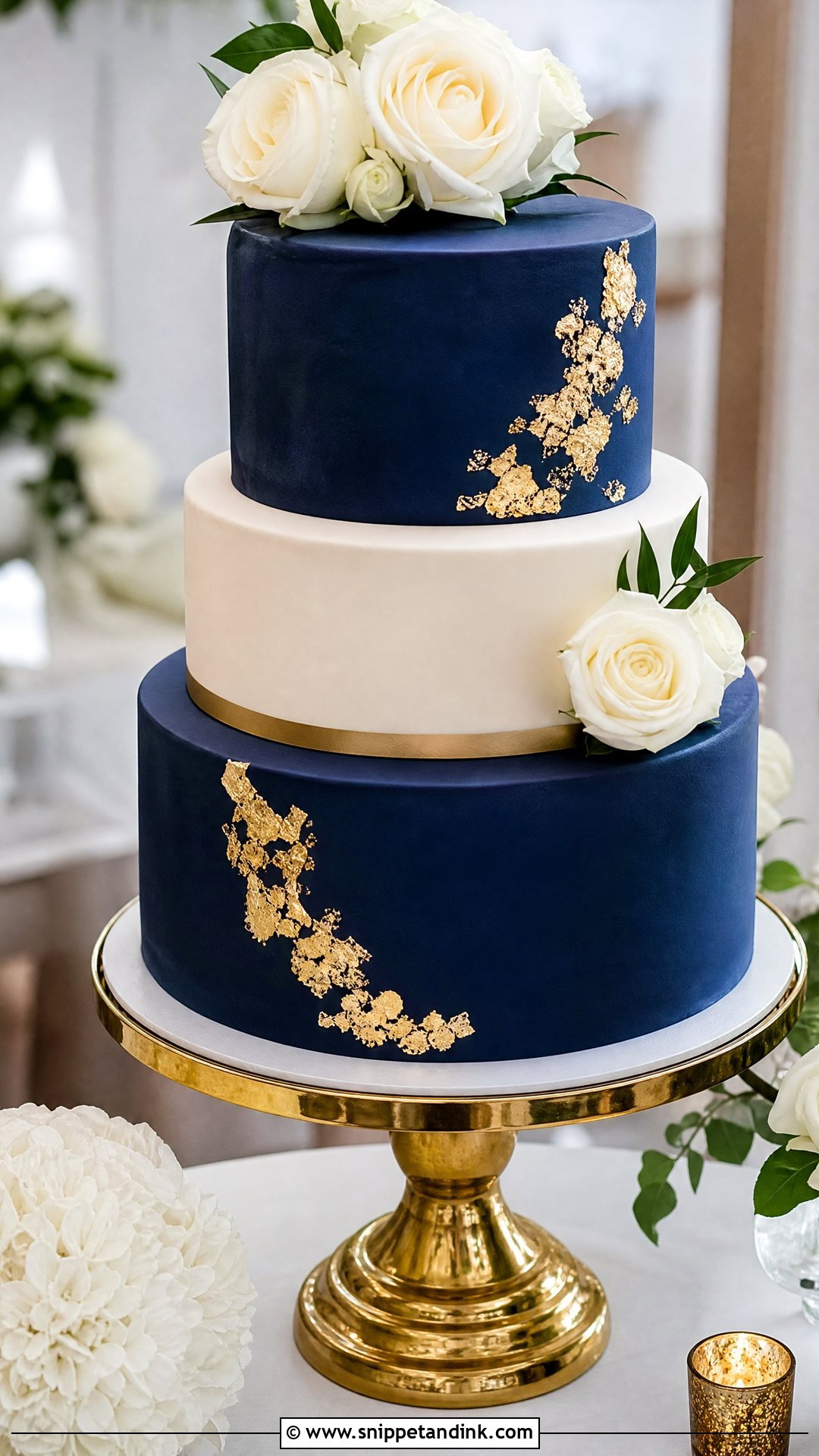
This is the version I’d sketch first for a couple who hasn’t settled on a style yet: three smooth navy fondant tiers, gold leaf torn along the top edges, and a small ivory flower cluster on one side. The plain base matters. Once you add texture as well as dark colour, the contrast gets lost. Because the outside is doing all the talking, flavour is completely free, and vanilla almond, champagne and chocolate all sit happily under navy fondant. A gold stand lifts it off the table so the bottom tier isn’t swallowed by linen.
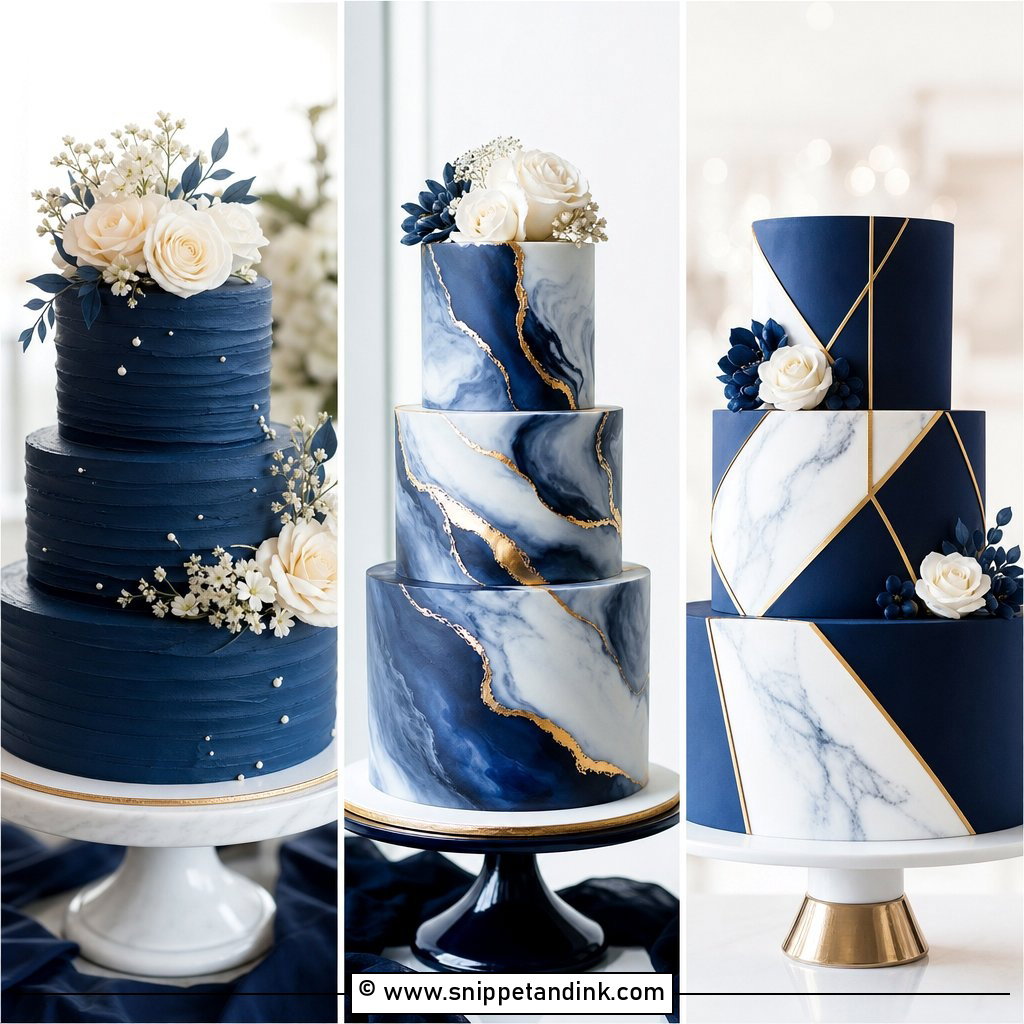
2. Navy Blue And Gold Marble Wedding Cake
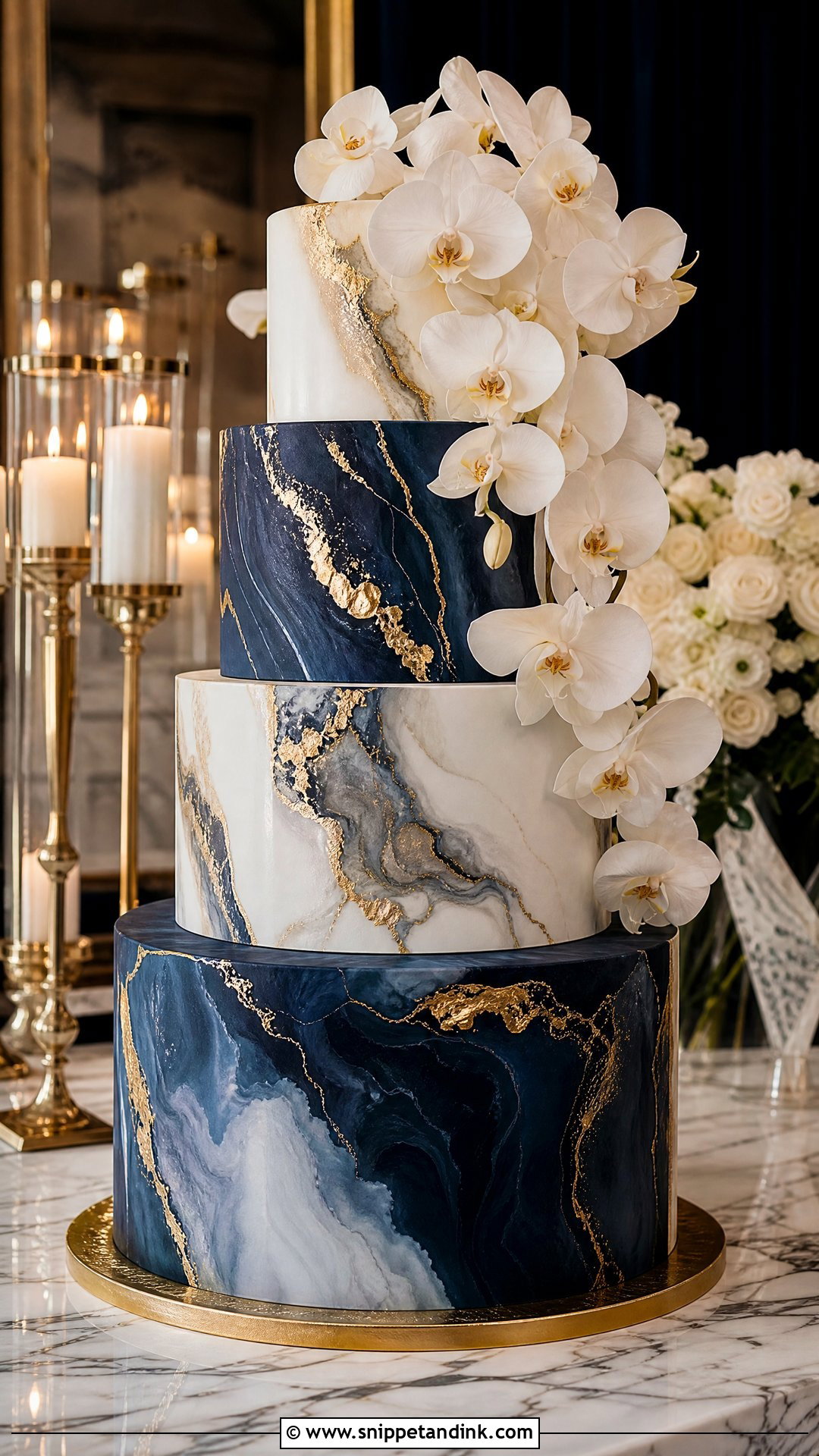
Marbling is how I soften navy for couples who find a solid dark tier too much. I fold navy, ivory and a little grey fondant together, roll it once or twice, and then paint thin gold veins along the natural lines. The danger is over-working it: roll too many times and the colours blend into a flat slate blue. I keep the veining sparse and usually let only one or two tiers carry the marble. Tall round tiers or a round and hexagon mix show the pattern best, and a few white roses or orchids are enough decoration.
3. Navy Blue And Gold Drip Wedding Cake
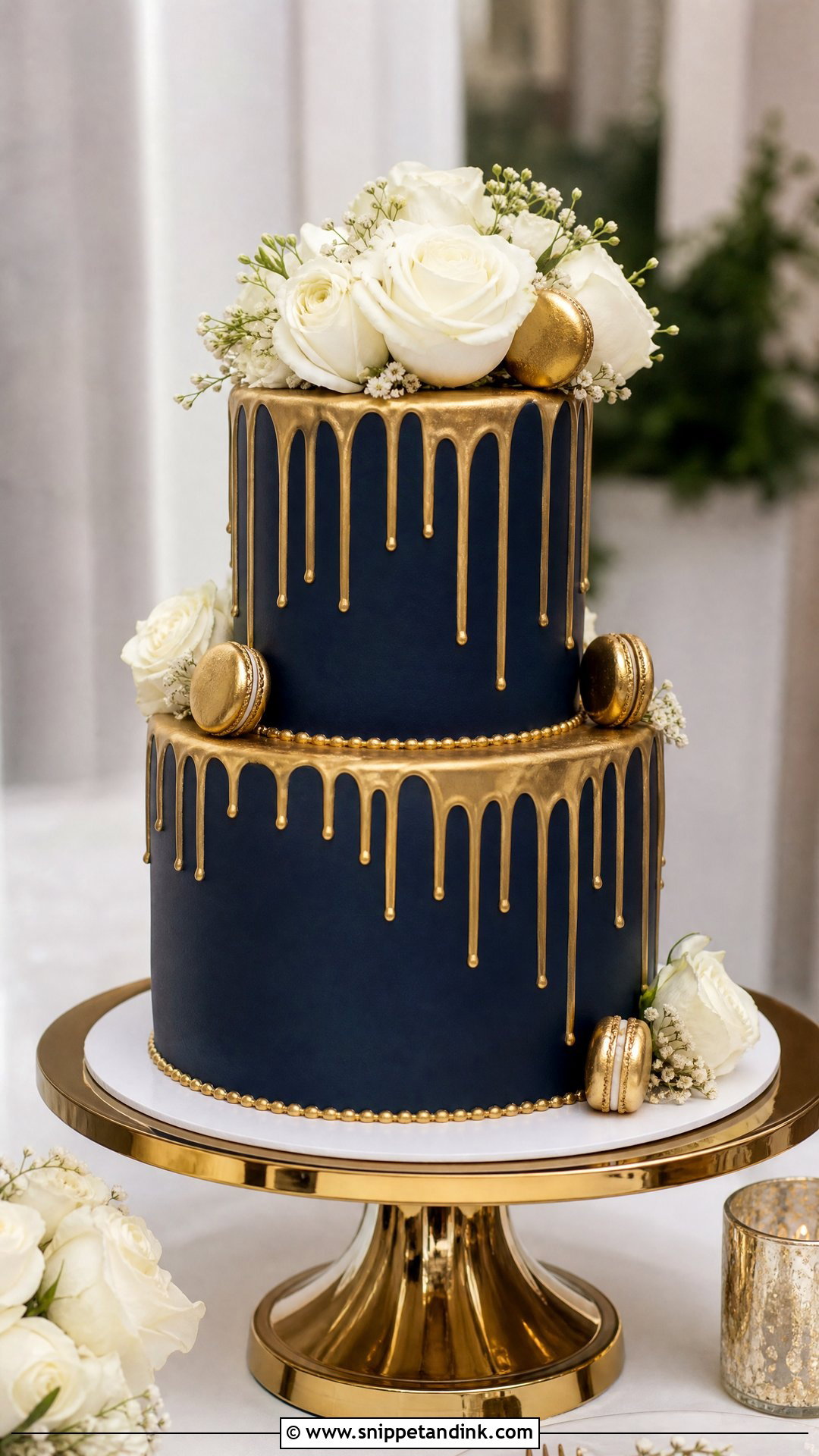
Drips are the easiest of these to photograph, because the gold edge catches light from almost any angle. The base is smooth navy buttercream or fondant, and the drip goes on last, once the cake is well chilled so it sets in clean lines instead of running to the board. A fine drip reads refined; a heavier one feels more like a party cake. On top I’d add a few gold macarons, white roses or pearls, not all three. It scales down very well as a two-tier cake for a smaller guest list.
4. Navy Blue And Gold Floral Wedding Cake
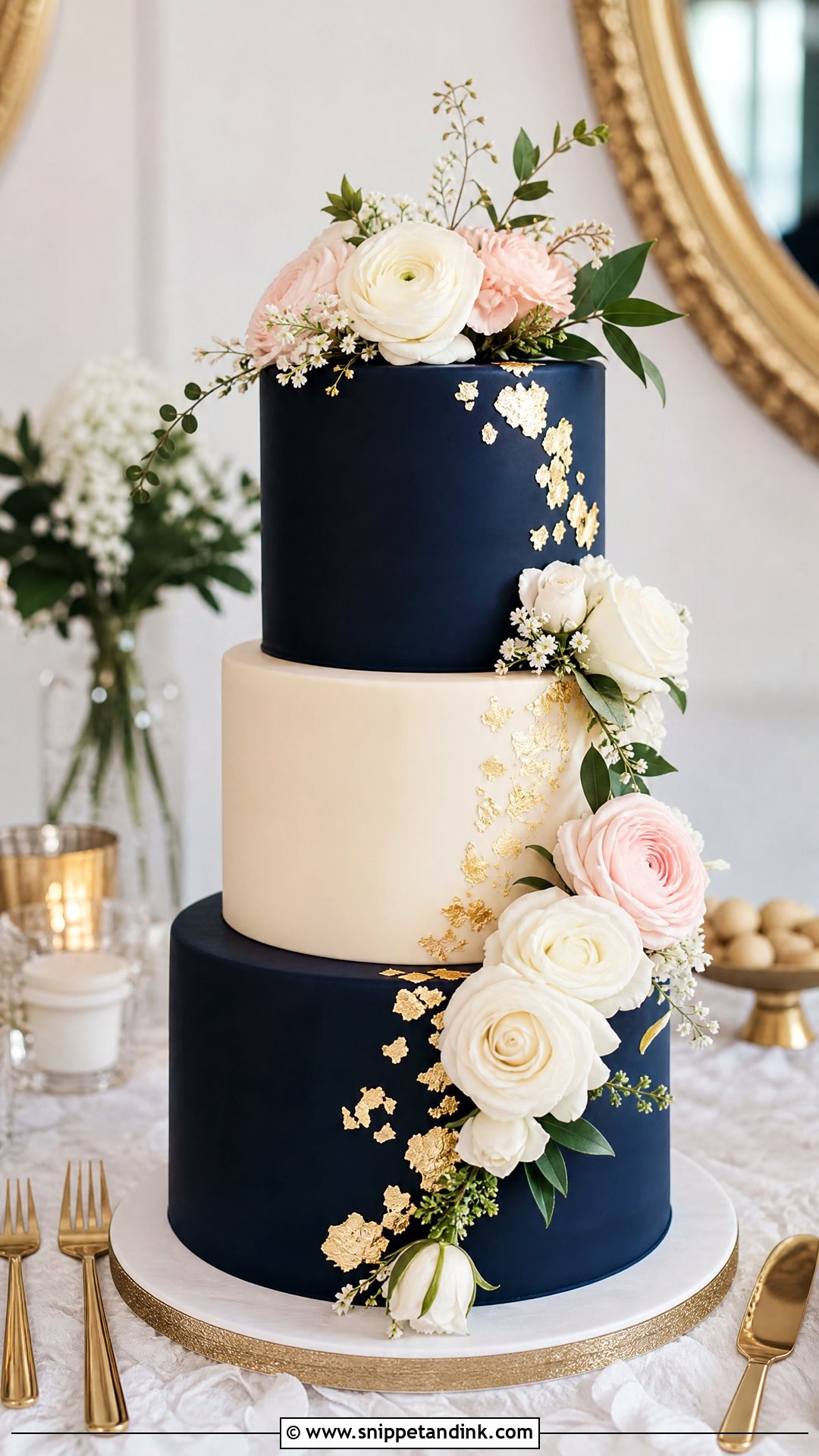
Flowers are what make navy and gold read as romantic instead of dramatic. I’ll often do one or two navy tiers, the rest in ivory, and run a cascade of white, blush, dusty blue or peach blooms down the side so they bridge the dark and light sections. If your florist is already using roses, ranunculus or orchids, ask for a few stems for the cake so it matches the tables. Fresh flowers need to be pesticide-free and wrapped or taped at the stem before they touch icing. Keep the gold to a few touches here, or it starts competing with the flowers.
5. Navy Blue And Gold Buttercream Wedding Cake
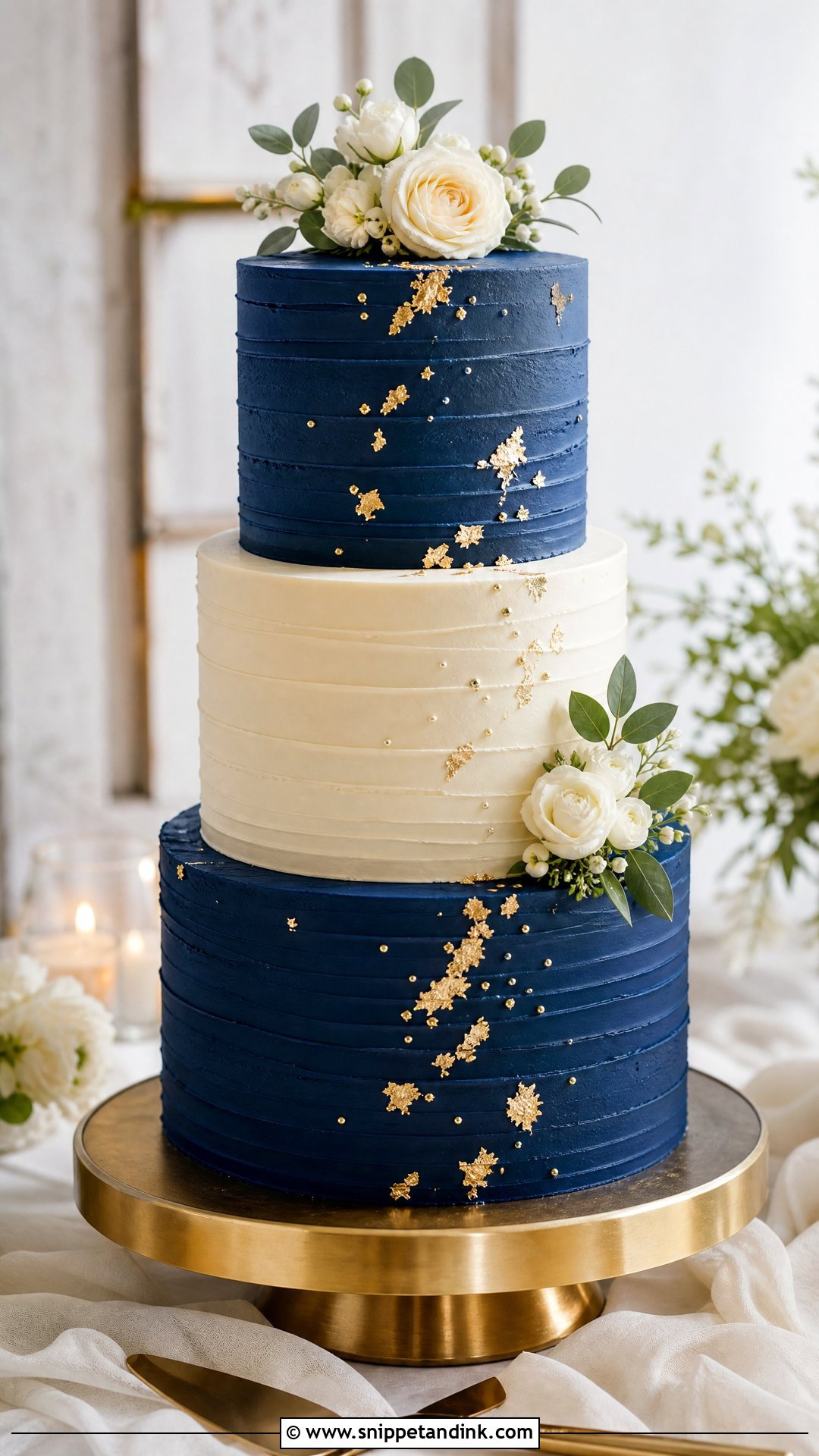
Buttercream gives navy a handmade, softer look than fondant. I either smooth it flat or drag a palette knife through it for gentle waves, then press gold leaf on in loose, broken patches. Be aware of the honest downside: getting buttercream properly navy takes a lot of colour, and very dark icing can stain lips and teeth and pick up a slightly bitter note. I build the colour on a chocolate buttercream base and let it rest overnight so it darkens on its own. Ask your baker how deep they can go before taste suffers, and whether a mid-blue would serve you better.
6. Navy Blue And Gold Fondant Wedding Cake
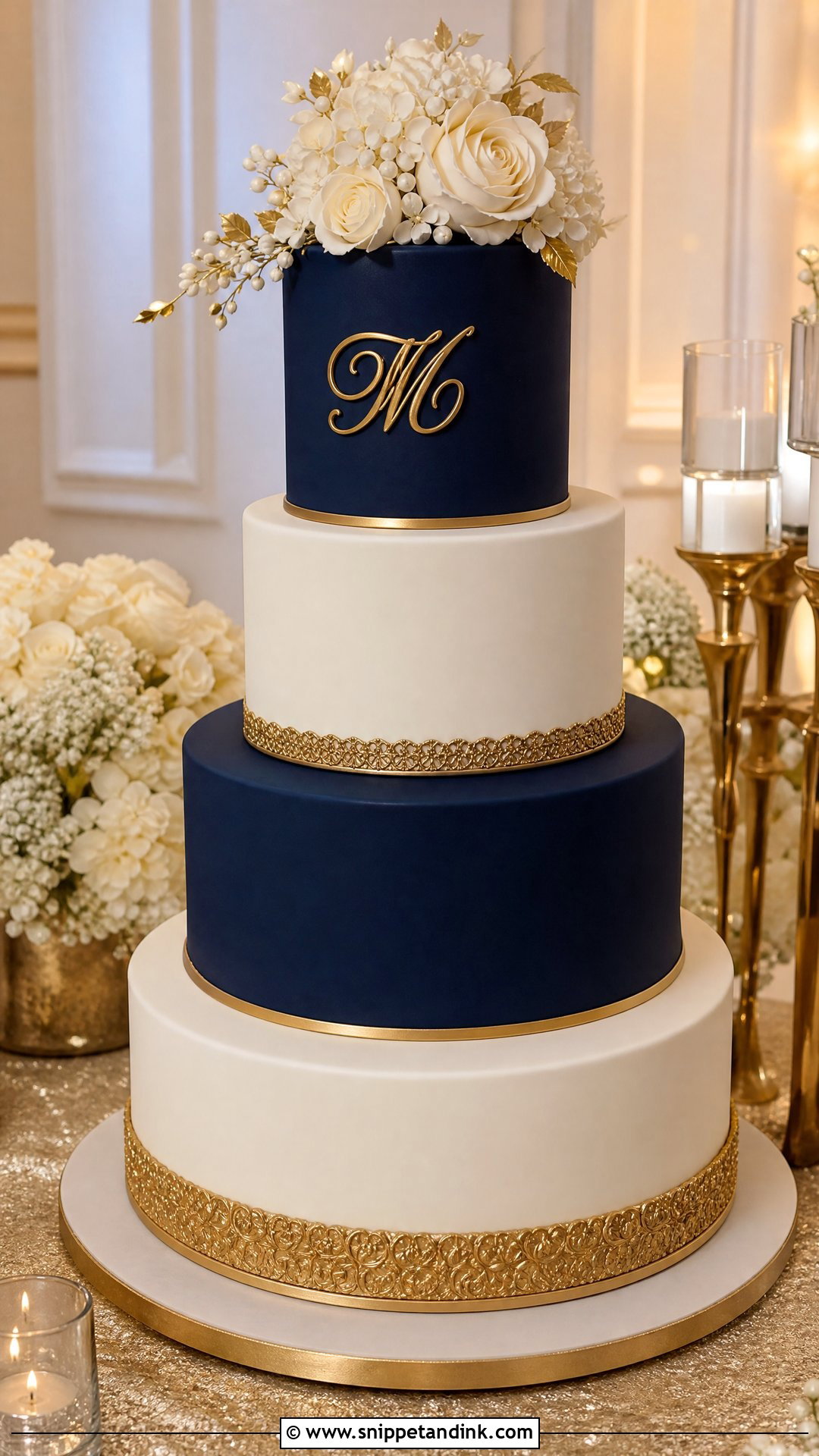
If you want razor edges and detail you can see from across the room, go with a navy blue and gold fondant wedding cake. Fondant holds navy as a smooth, even surface, which is the best canvas for gold bands, monograms, lace or geometric lines. It suits hotel receptions and black-tie dinners, and three or four tiers give enough height for a long dessert table. I almost always break up the navy with ivory or champagne tiers, otherwise four dark tiers look like a column. The gold should look like trim or hand-painting, placed deliberately, never random glitter.
7. Navy Blue And Gold Tiered Wedding Cake
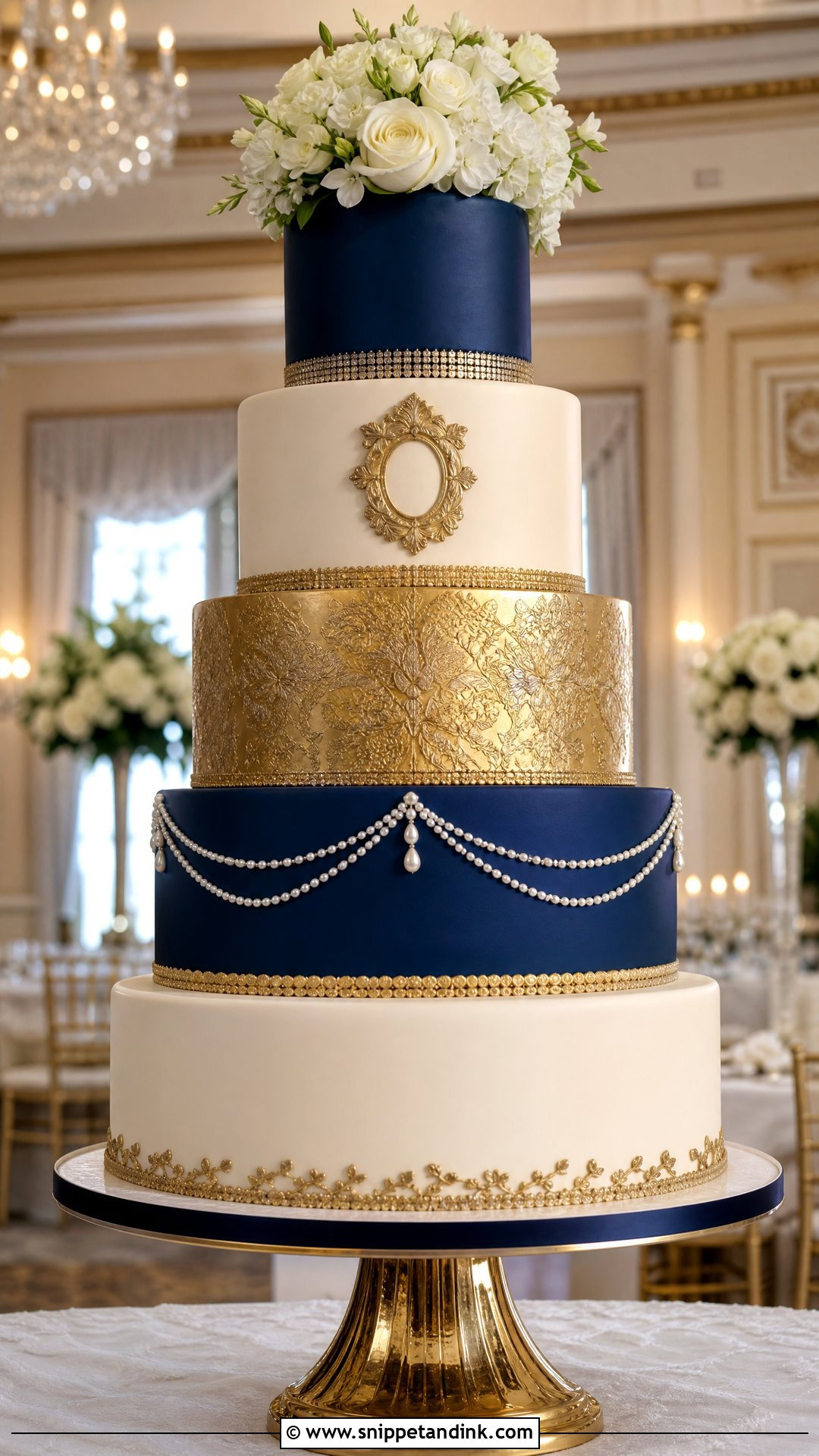
Height does a lot of the work on a tall tiered cake, so I plan the colour order before anything else. A pattern I like for five tiers: navy at the bottom to ground it, ivory through the middle, and navy again on top with the gold detail that ties them together. On a cake this size, the decoration needs to get quieter, not louder, because every element is repeated across five tiers. Simple gold trim or a few sugar flowers is plenty. Big ballrooms and rooms with large floral installations are where this scale makes sense; in a low-ceilinged room it can feel cramped.
8. Navy Blue And Gold One Tier Wedding Cake
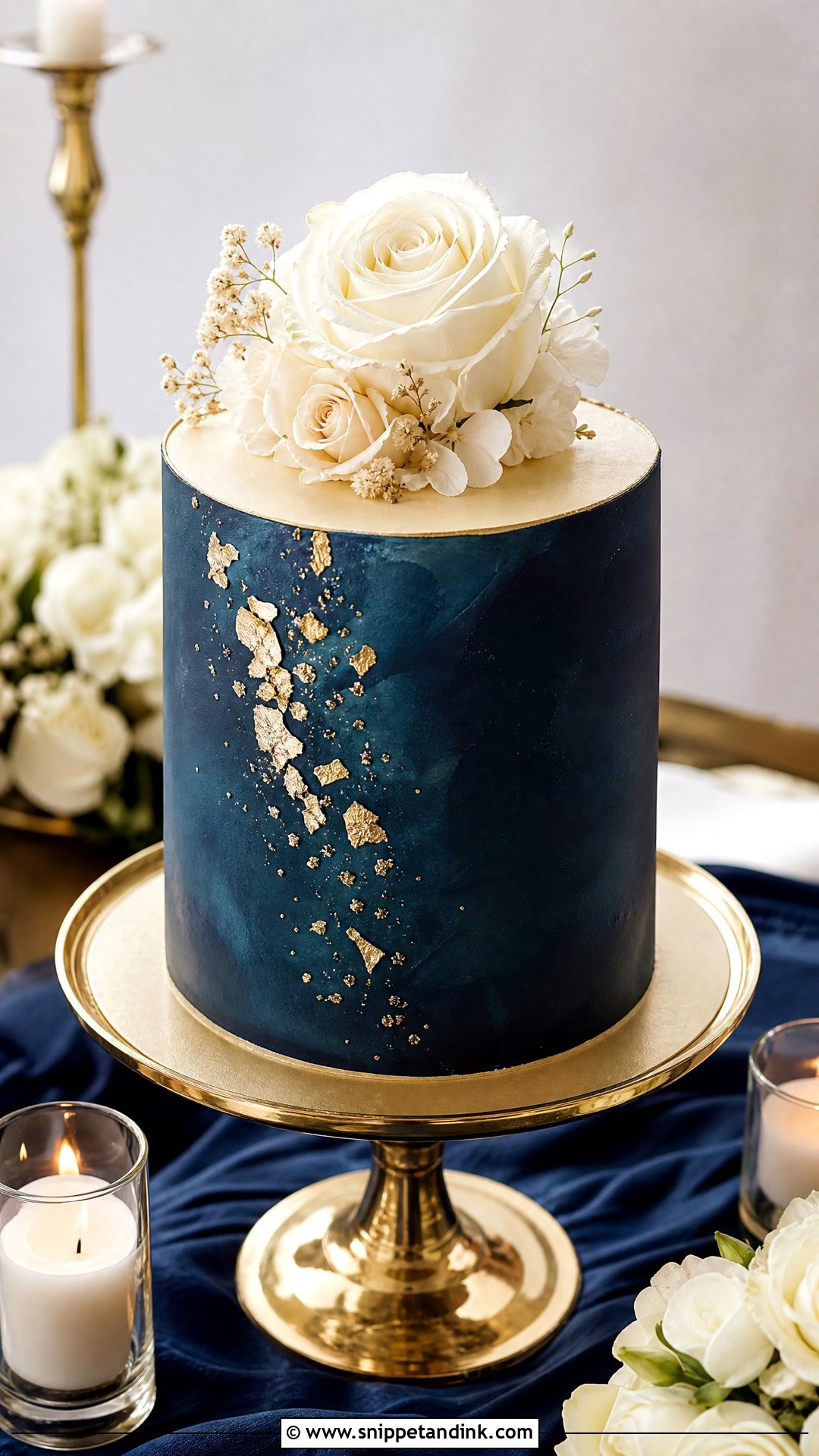
A single tier can hold its own if every choice on it is deliberate. For micro weddings, elopements and courthouse days, or when the cake sits among other desserts, I’d do one round tier in navy buttercream with gold leaf and a small flower cluster. Going taller helps: an extended-height tier, around twice the usual depth, looks far more intentional than a standard short one. It needs internal support at that height, so mention it when you order. Set it on a gold pedestal with a few candles around the base.
9. Navy Blue And Gold Square Wedding Cake
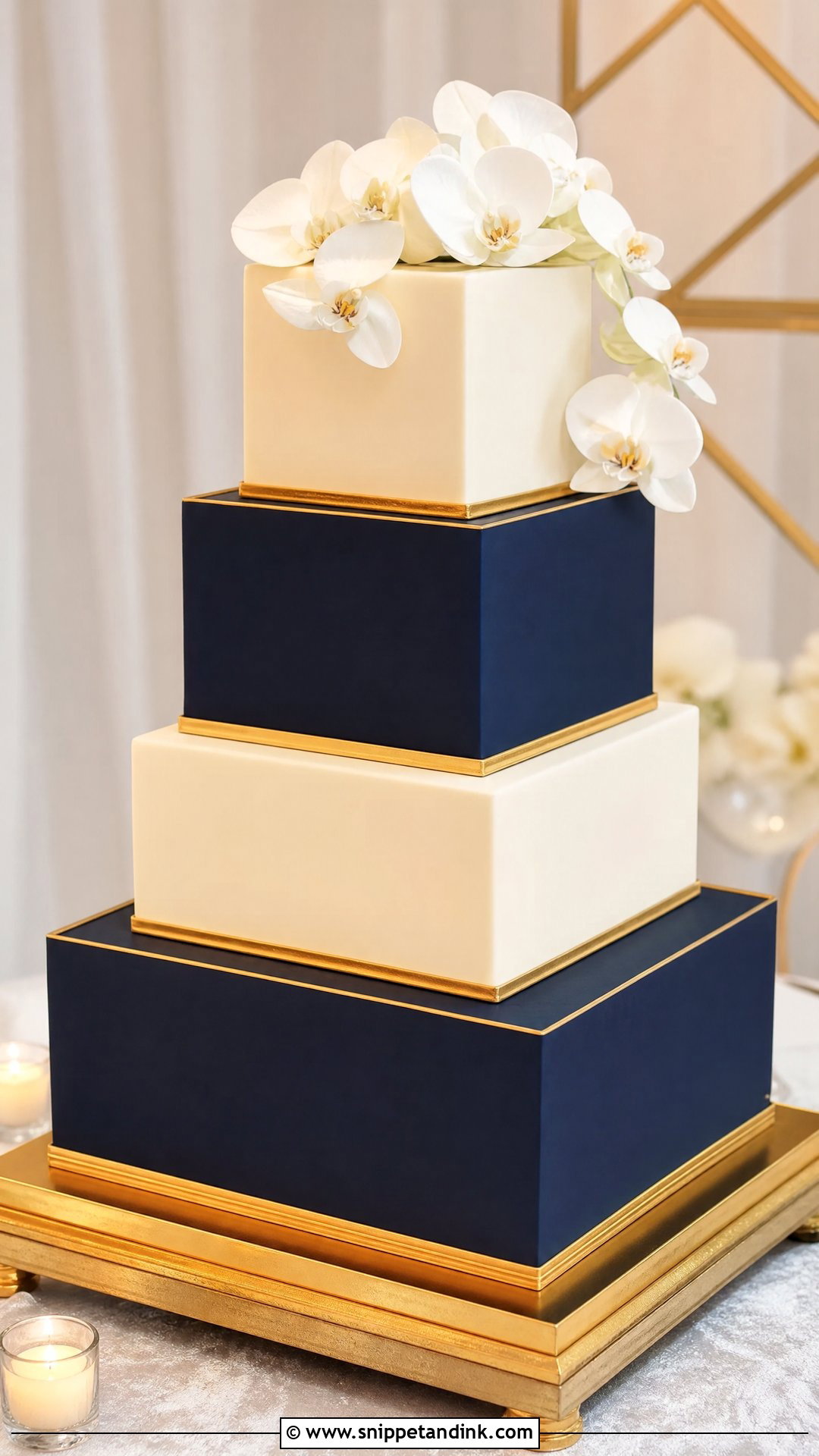
Square tiers change the whole personality of the palette. The corners make it tailored and a little architectural, and navy fondant with gold edging along those corners looks very sharp. Squares are harder than rounds, though: the fondant has to be eased over each corner without tearing or pleating, and any lean shows straight away. Stack them evenly for a classic outline, or turn each tier a few degrees for something more modern. Leave the flowers off or put one small accent on a single corner, since the shape is the feature.
10. Navy Blue And Gold Geometric Wedding Cake
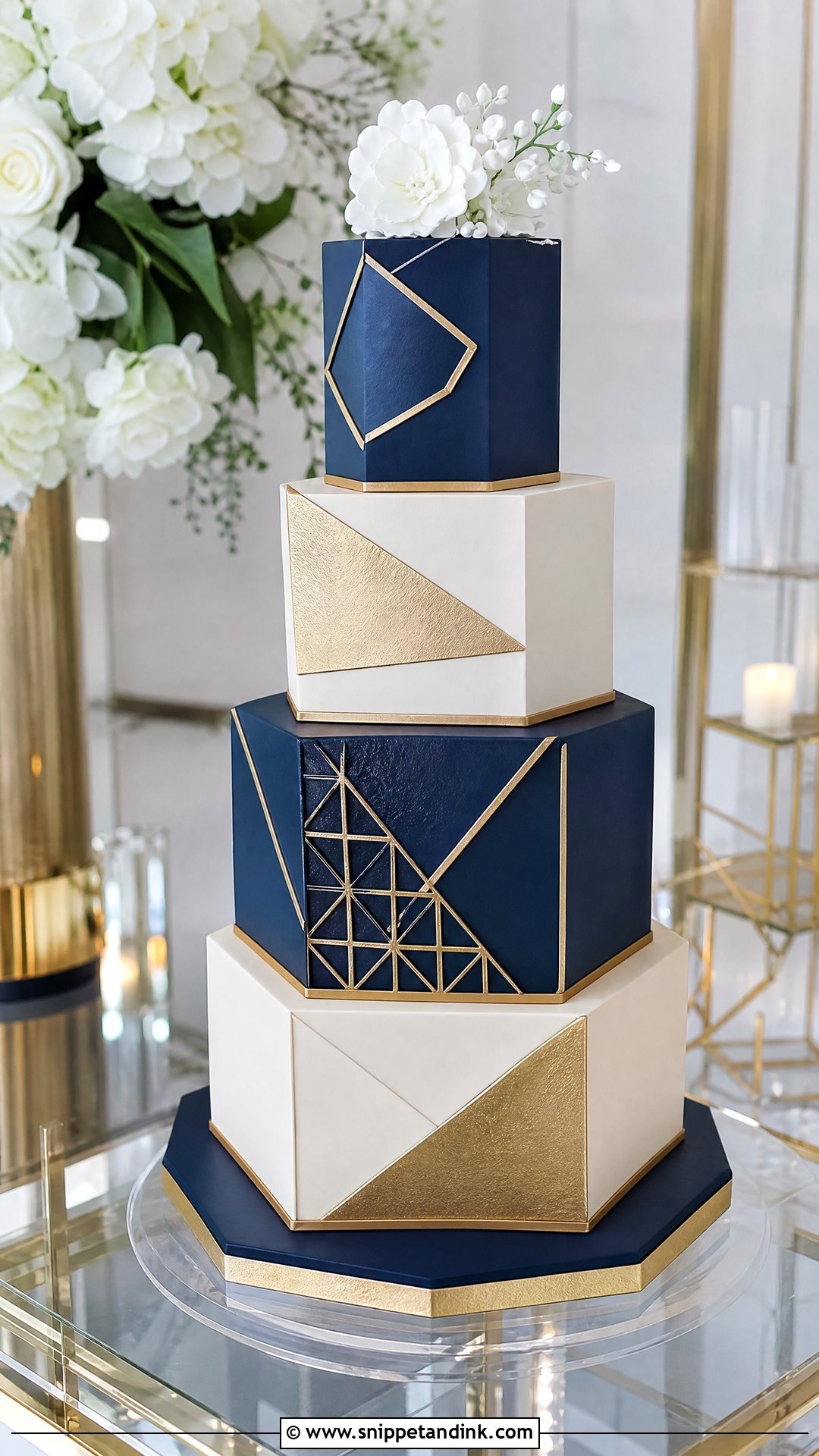
A navy blue and gold geometric wedding cake suits couples whose reception already has acrylic signs, gold chargers and modern arrangements. Hexagon tiers, angular gold lines, navy panels and small metallic triangles all fit here. My advice is to give the geometry to one tier and keep the others plain ivory or white, which stops the navy from feeling heavy and gives the pattern room. Every line on a geometric design has to be measured; a panel that’s a few millimetres out is obvious in photos, so this is a design for a baker comfortable with precise cutting.
11. Navy Blue And Gold Watercolor Wedding Cake
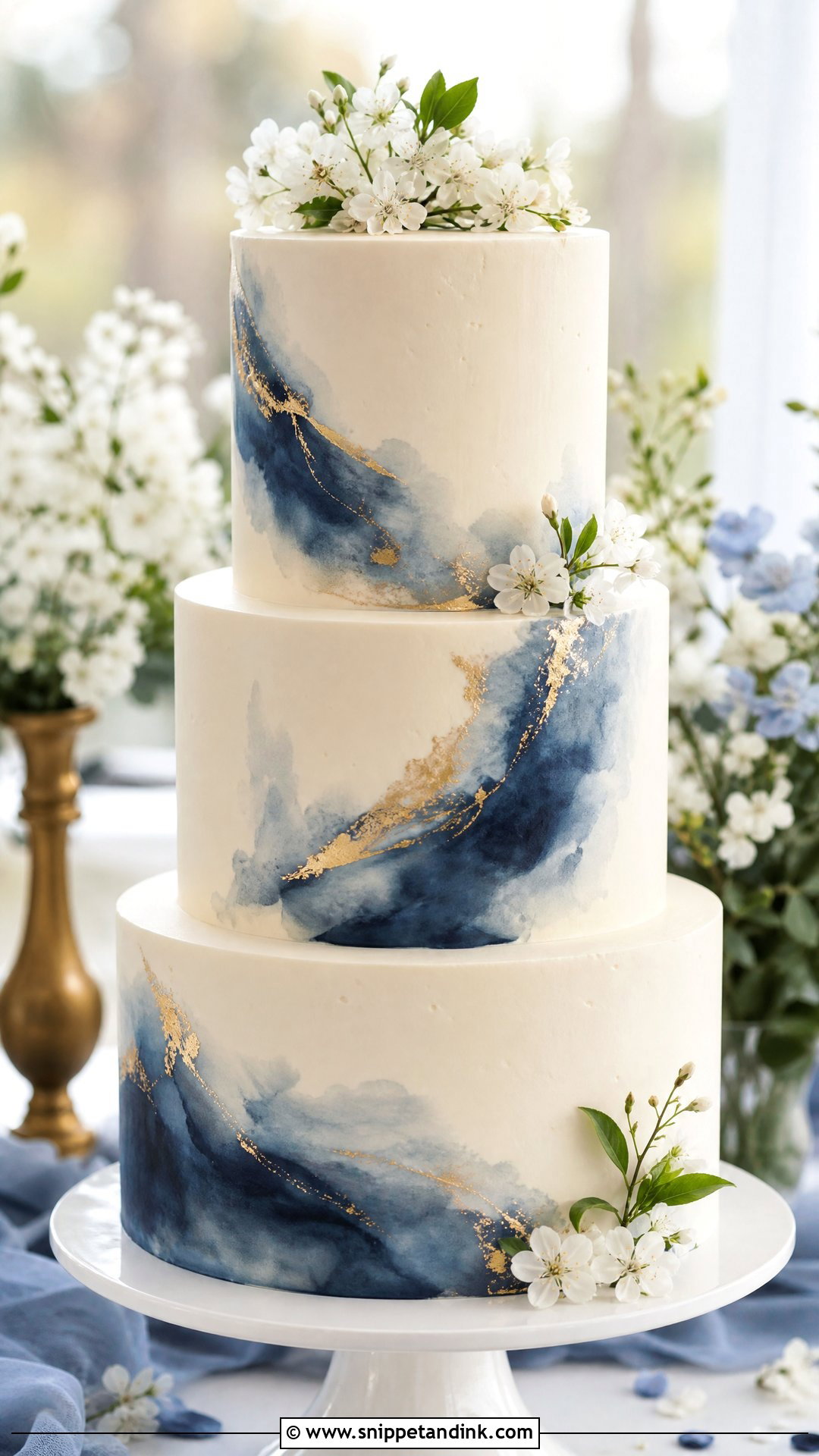
Watercolour is the gentlest way into navy. I brush diluted blue across ivory icing so it fades from deep to pale, then pick out a few edges in painted gold. The thing that ruins it is muddiness: if navy and gold overlap while the colour is still wet, they turn a greenish brown. I leave clear white space between the two. Because so much of the cake stays pale, it sits well at spring and summer garden weddings, finished with loose flowers or a little greenery.
12. Navy Blue And Gold Lace Wedding Cake
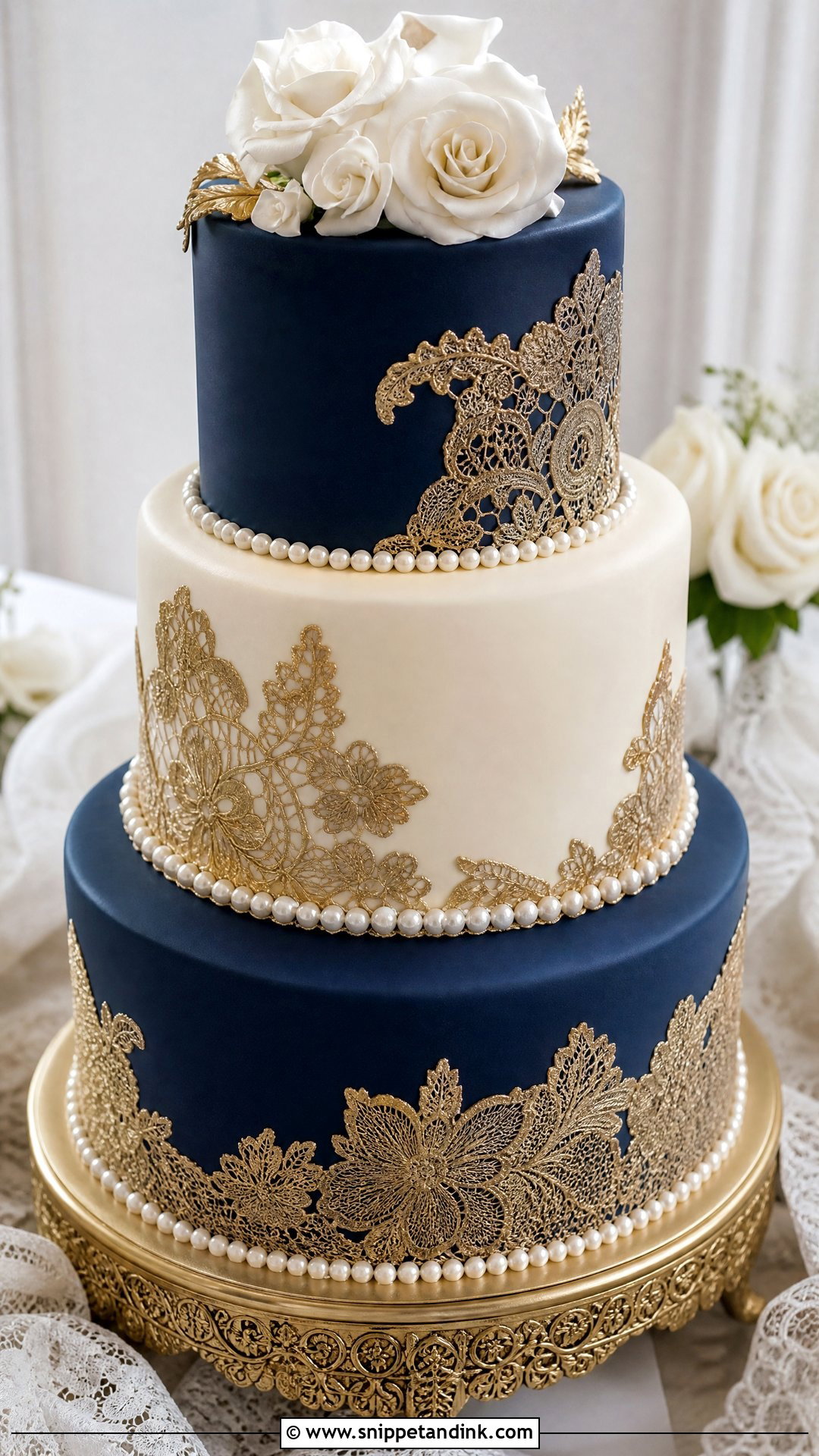
Lace can be made three ways: edible lace from a mat, piped royal icing, or cut fondant appliqué. Gold lace over navy fondant is the dramatic version; ivory lace with small gold touches is gentler. Smooth tiers underneath are essential, since lace on top of texture just looks busy. People often want the cake lace to match the dress exactly, but I find it reads better when it matches the mood and scale of the gown, not the precise motif. A few ivory roses or pearls finish it.
13. Navy Blue And Gold Pearl Wedding Cake
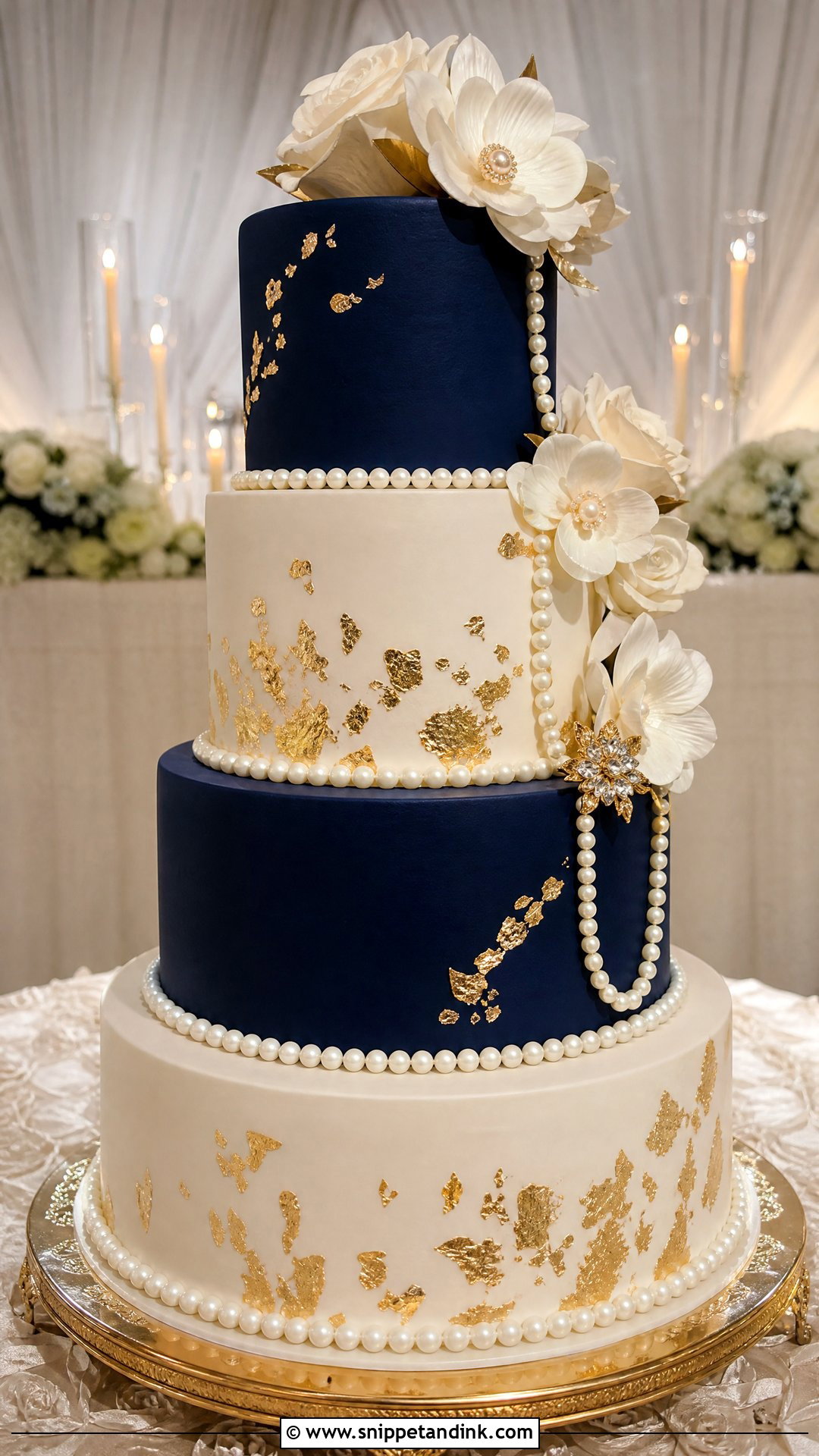
Sugar pearls give a quiet shine. I pipe them around the base of each tier, scatter a few over navy frosting, or mix them with small gold dragées so it looks like jewellery. They’re a good fit for formal weddings where you don’t want big flowers. Alternate navy and ivory tiers, add gold leaf in a couple of places for warmth, and stop there. Under warm reception lights the pearls pick up a soft glow; under harsh overhead light they can look flat, so ask what lighting the room has.
14. Navy Blue And Gold Art Deco Wedding Cake
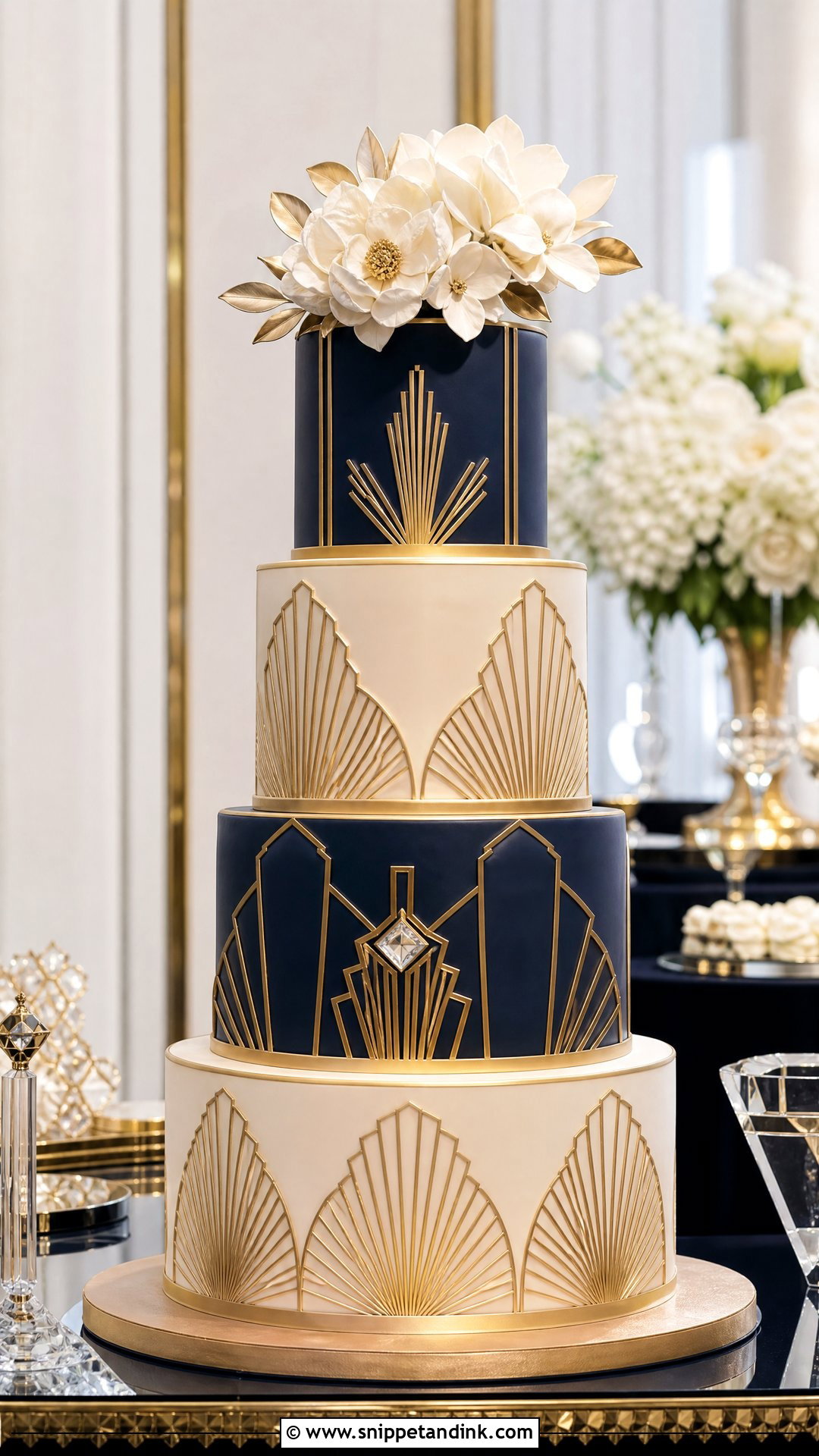
Art Deco is the most demanding of these because it relies on symmetry. Fans, sunbursts, straight gold lines and navy panels all have to line up from tier to tier, and I mark them out before any gold goes on. The payoff is huge with gold chargers, crystal and black-tie dress. Tall, narrow tiers suit the style better than wide ones, and an ivory tier somewhere in the stack gives the eye a rest. If you want flowers, choose structured white ones like calla lilies, which keep the clean outline.
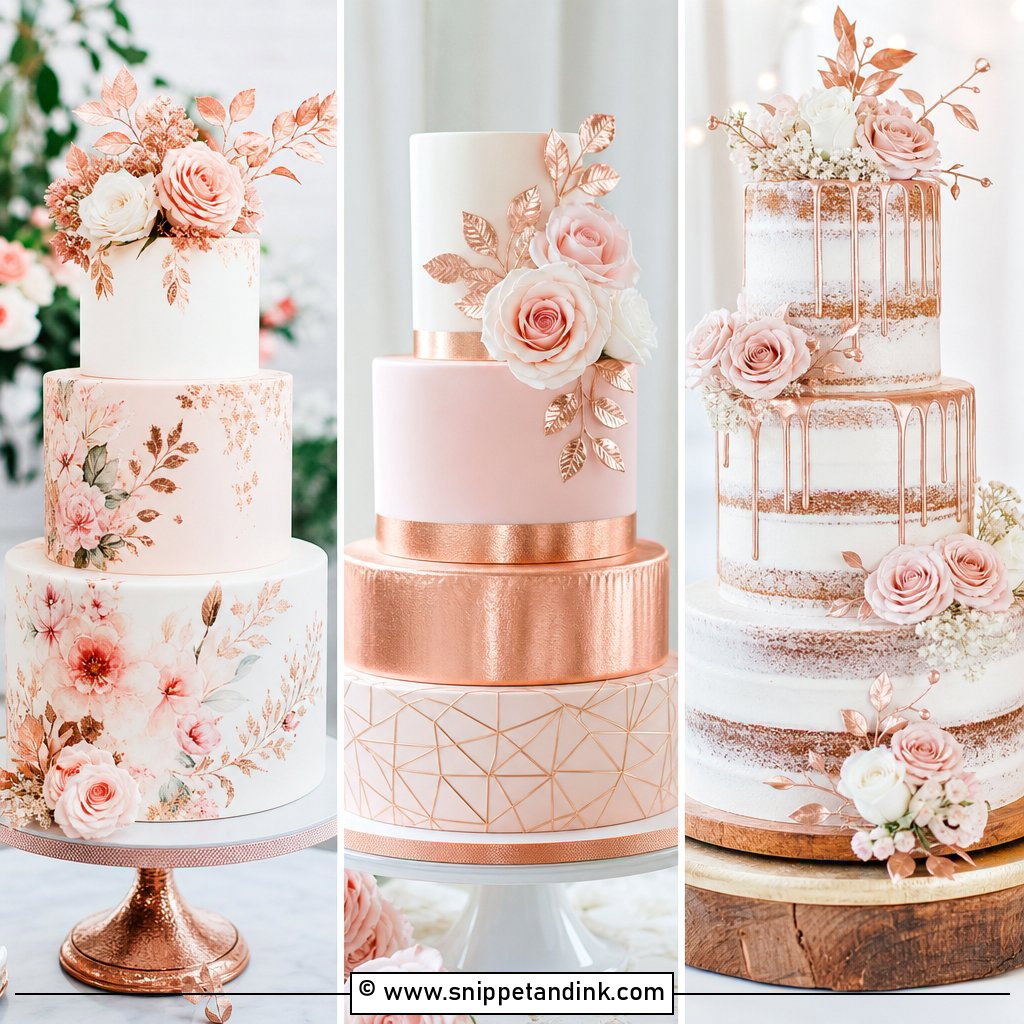
15. Navy Blue And Gold Celestial Wedding Cake
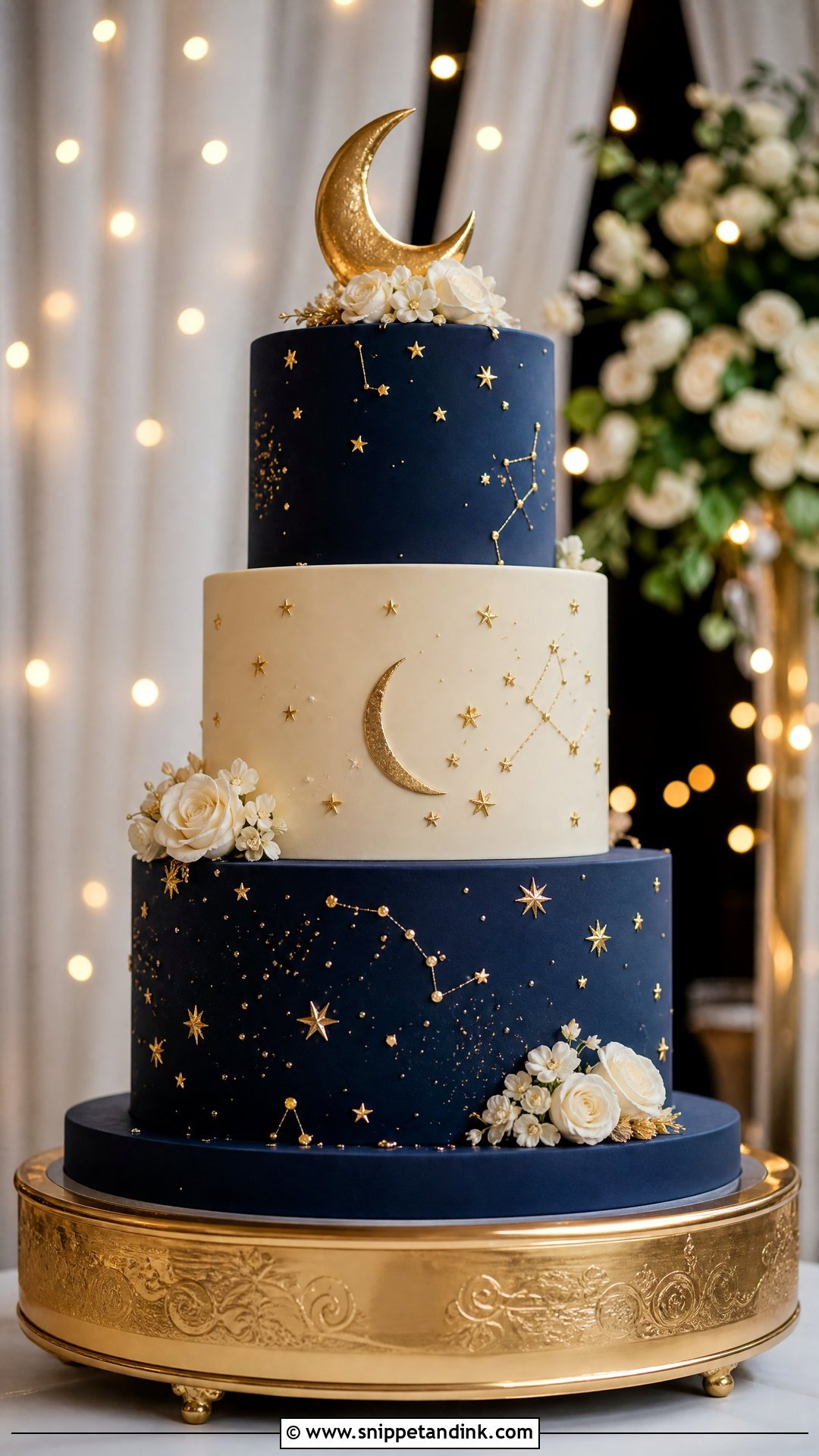
A navy blue and gold celestial wedding cake treats navy as a night sky, with gold stars, moons, constellation lines and tiny metallic dots. It shines at evening weddings and outdoor receptions. The line I watch carefully is the one between wedding and birthday: big cartoon stars and too many dots tip it over. Small hand-painted stars on smooth navy look far more grown-up, and two or three tiers is enough. A crescent moon topper or a few white flowers softens it if needed.
16. Navy Blue And Gold Ombre Wedding Cake
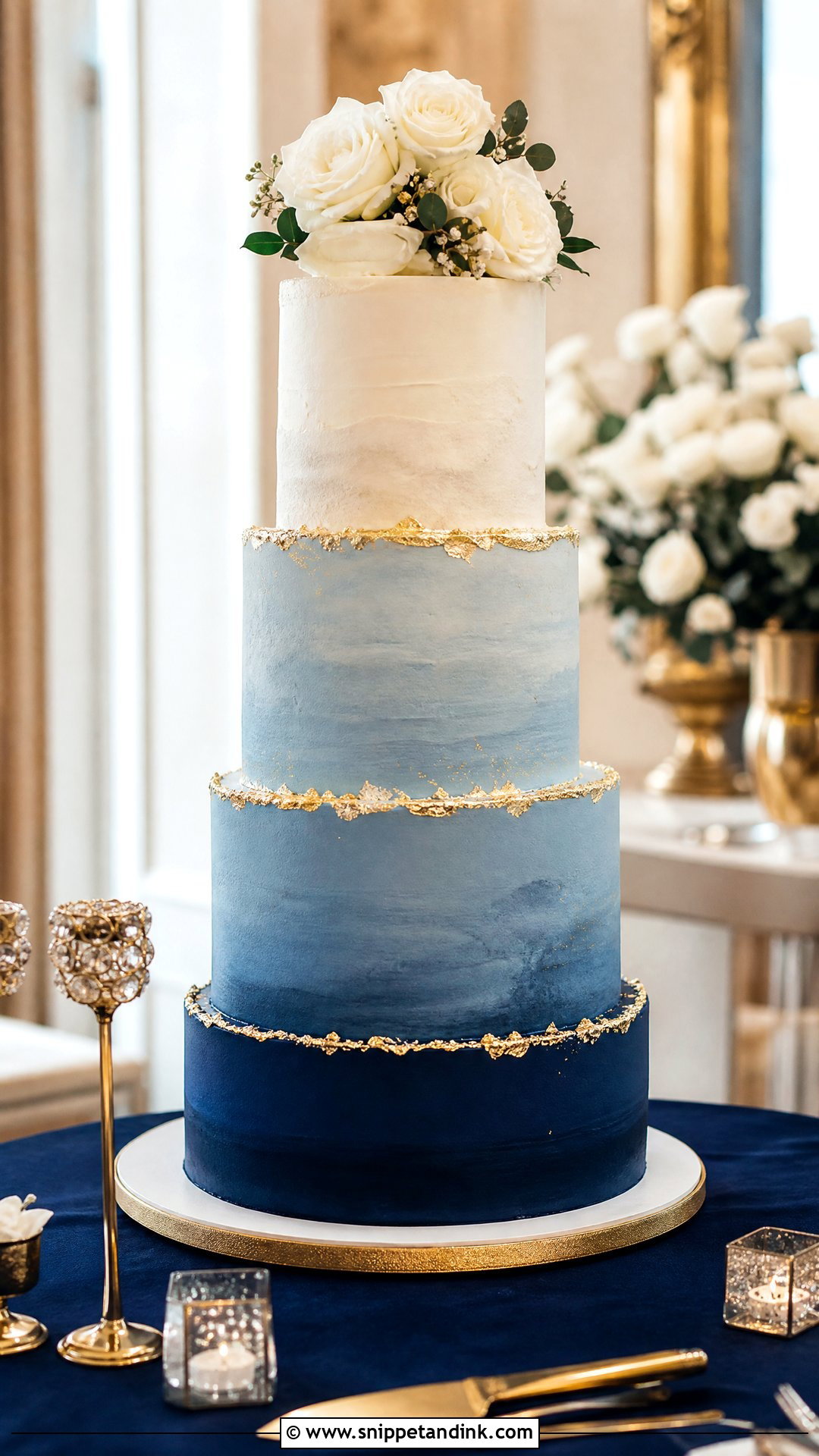
An ombré stack moves from ivory at the top through dusty blue and royal blue to navy at the base. It’s the right pick if you love navy but don’t want it on every tier. The work is in mixing each shade so the steps look gradual; get one tier too close in colour to the next and it reads as stripes instead of a fade. A thin gold edge on each tier warms the blues. Coastal weddings and evening ballrooms both suit it, and I keep decoration to a few white petals so the colour does the work.
17. Navy Blue And Gold Ruffle Wedding Cake
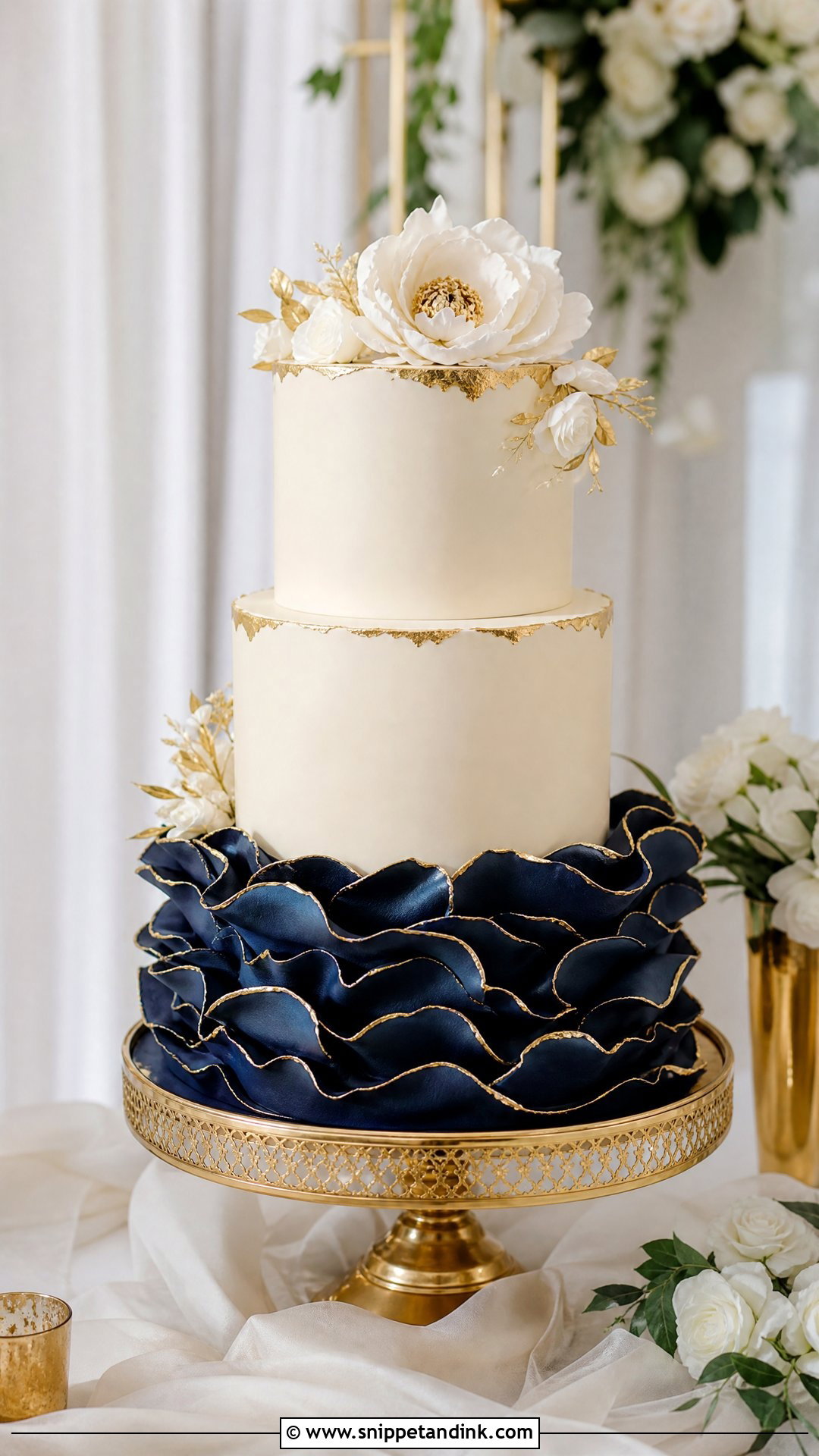
Ruffles add movement, and the material changes how they behave. Fondant ruffles hold crisp folds, wafer paper is feather-light and fluttery, and buttercream ruffles are soft but sensitive to heat. Navy ruffles look rich; ivory ruffles edged in gold leaf look lighter. I’d do one ruffled tier and keep the rest smooth, otherwise the cake loses its outline. Gold can sit along the ruffle edges or as a single band. It pairs naturally with flowing fabrics and floral arches.
18. Navy Blue And Gold Naked Wedding Cake
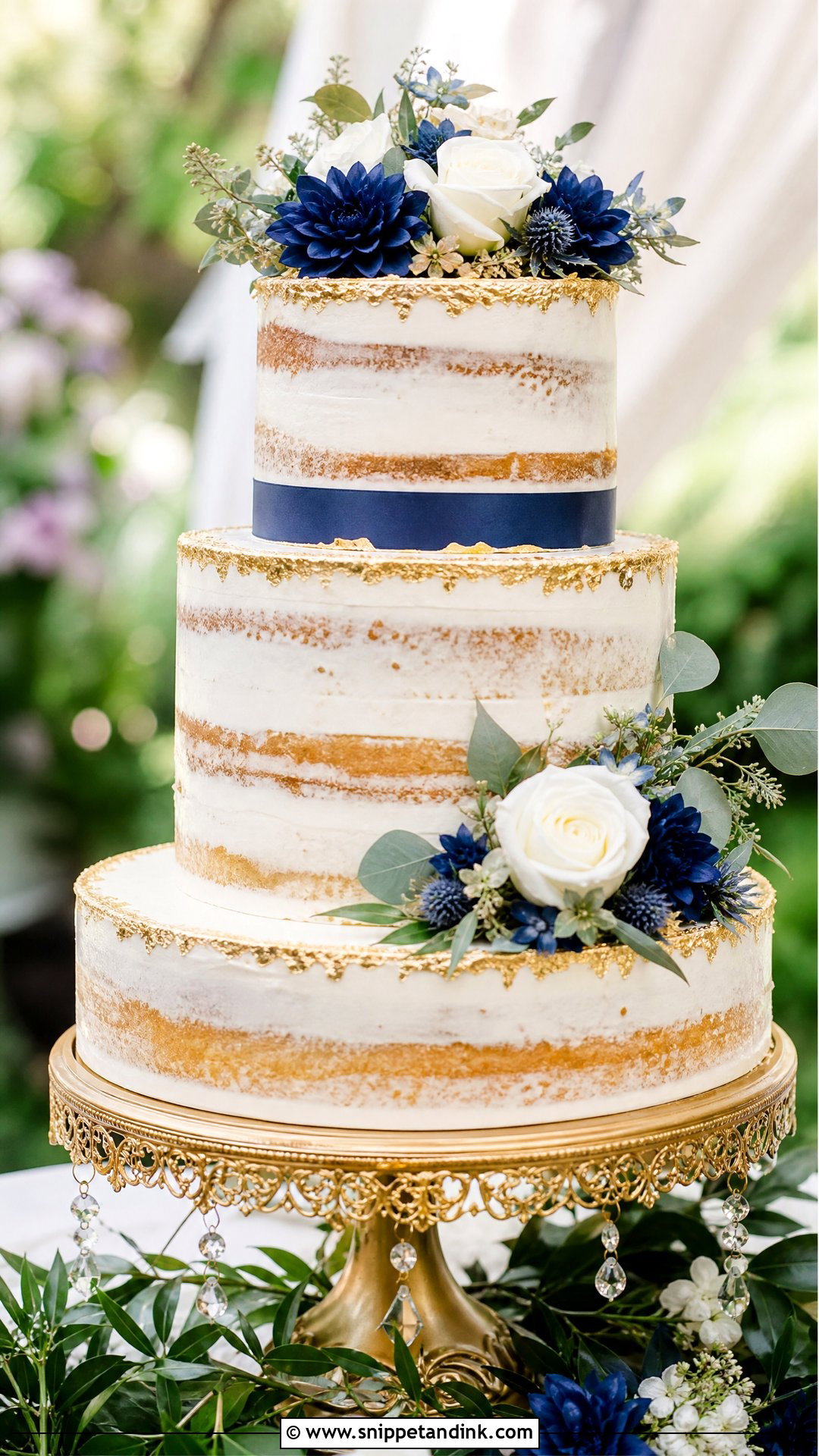
On a naked cake, the colour can’t live in the icing, because the sides are mostly bare sponge. So the navy and gold move to the decoration: gold leaf on the edges, navy ribbon at each tier, blueberries or blue flowers. Bare sponge dries out faster than frosted cake, so I assemble these as late as I can and keep them covered until they’re displayed. Vanilla, almond and lemon sponge look prettiest through the gaps. A gold stand and flowers that match the bouquets stop it feeling too casual.
19. Navy Blue And Gold Semi Naked Wedding Cake
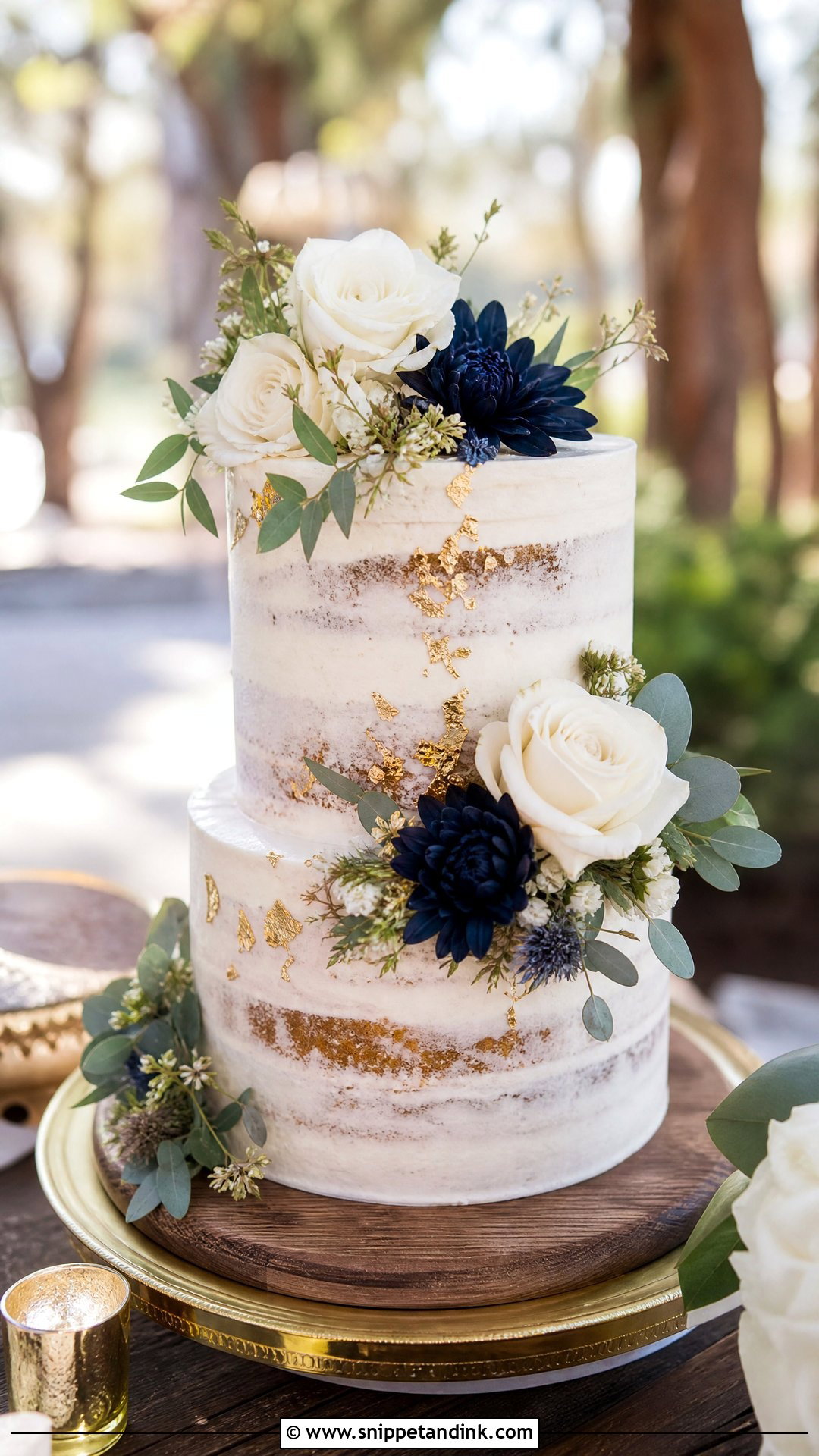
Semi-naked gives you more protection than a fully naked cake, since a thin scraped coat of buttercream seals the sponge while still letting the layers show. The palette comes from navy flowers, gold leaf and a gold topper. Barns, gardens and outdoor dinners are where I see it most. Keep the navy in the flowers or ribbon; tinting the thin coat blue tends to look patchy because the crumb shows through. Greenery, white roses and gold table pieces tie it to the room.


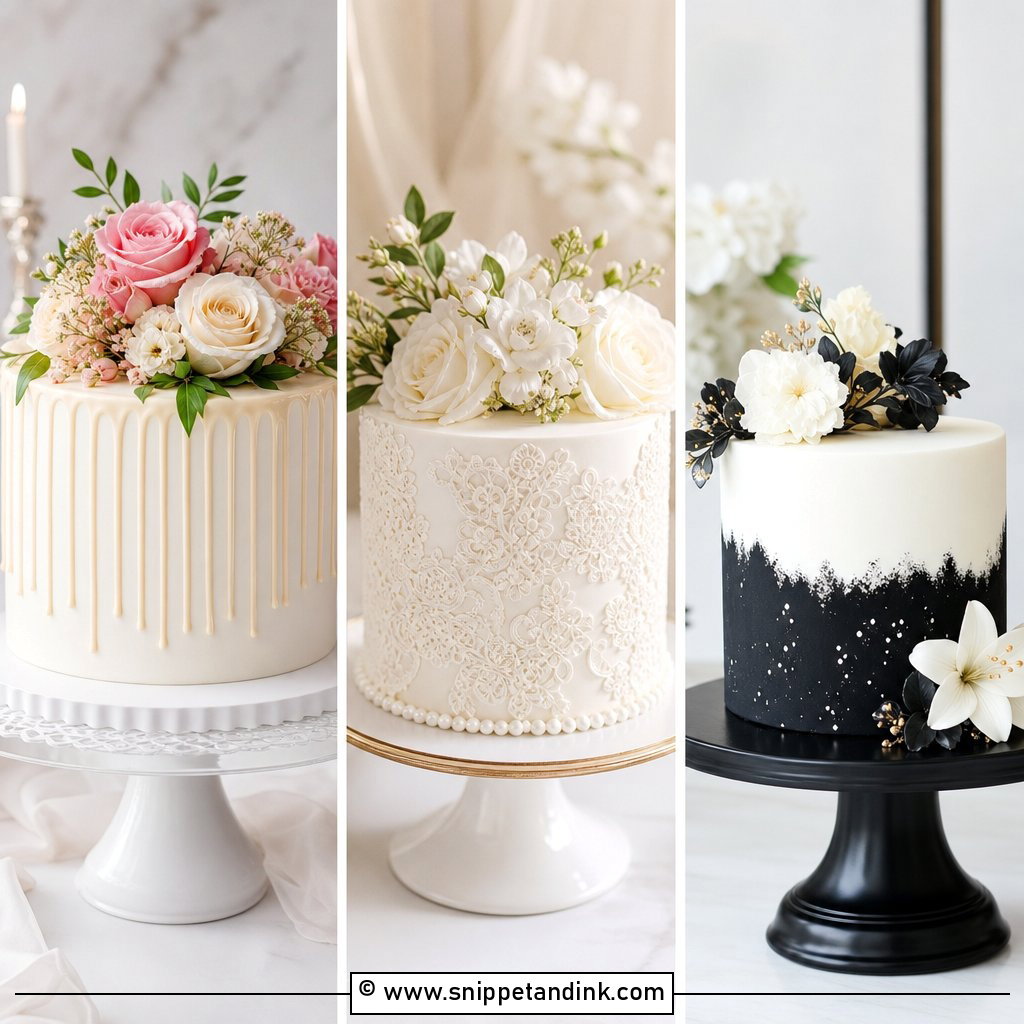

20. Navy Blue And Gold Black Tie Wedding Cake
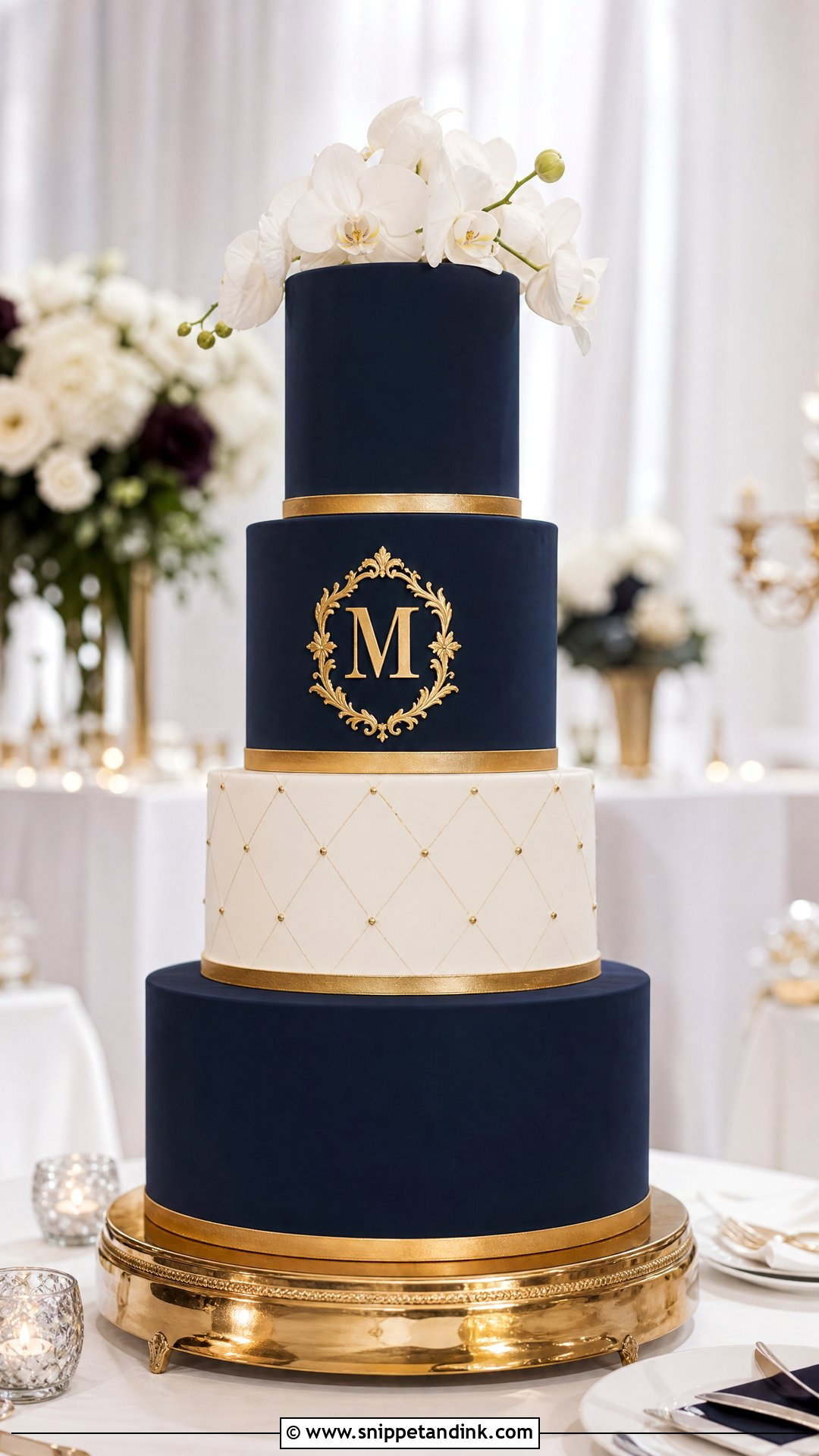
Black tie calls for discipline. Smooth navy fondant, sharp white tiers, thin gold trim and perhaps a small monogram or crest, and that’s it. Every element should earn its place, so I usually cut one thing from the first sketch. A tall three-tier or four-tier cake carries the formality without extra decoration. Choose between gold leaf, metallic bands or fine piping instead of using all three, and set it on a plain gold stand.
21. Navy Blue And Gold Minimalist Wedding Cake
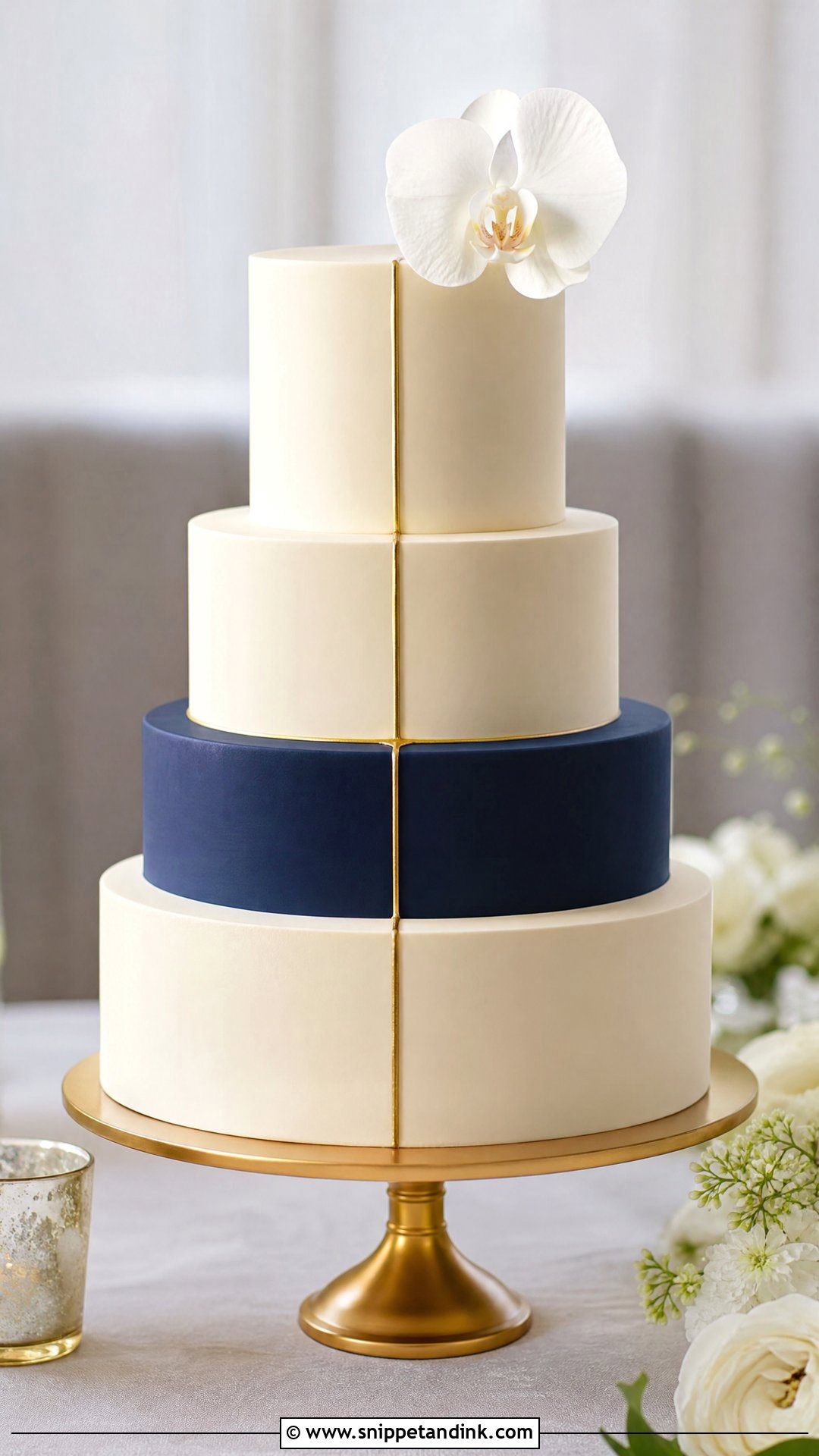
Minimal cakes are the hardest to fake. With so little on them, every bulge, air bubble and soft edge shows. My usual layout is mostly ivory with one navy tier, a single thin gold line and one focal point, like a gold leaf corner or a lone white orchid. A fully navy cake with two or three clean gold details also works. Modern venues and small weddings suit it. What makes it look finished is proportion and a perfect surface, so this is where I’d pay for a baker known for sharp, smooth work.
22. Navy Blue And Gold Vintage Wedding Cake
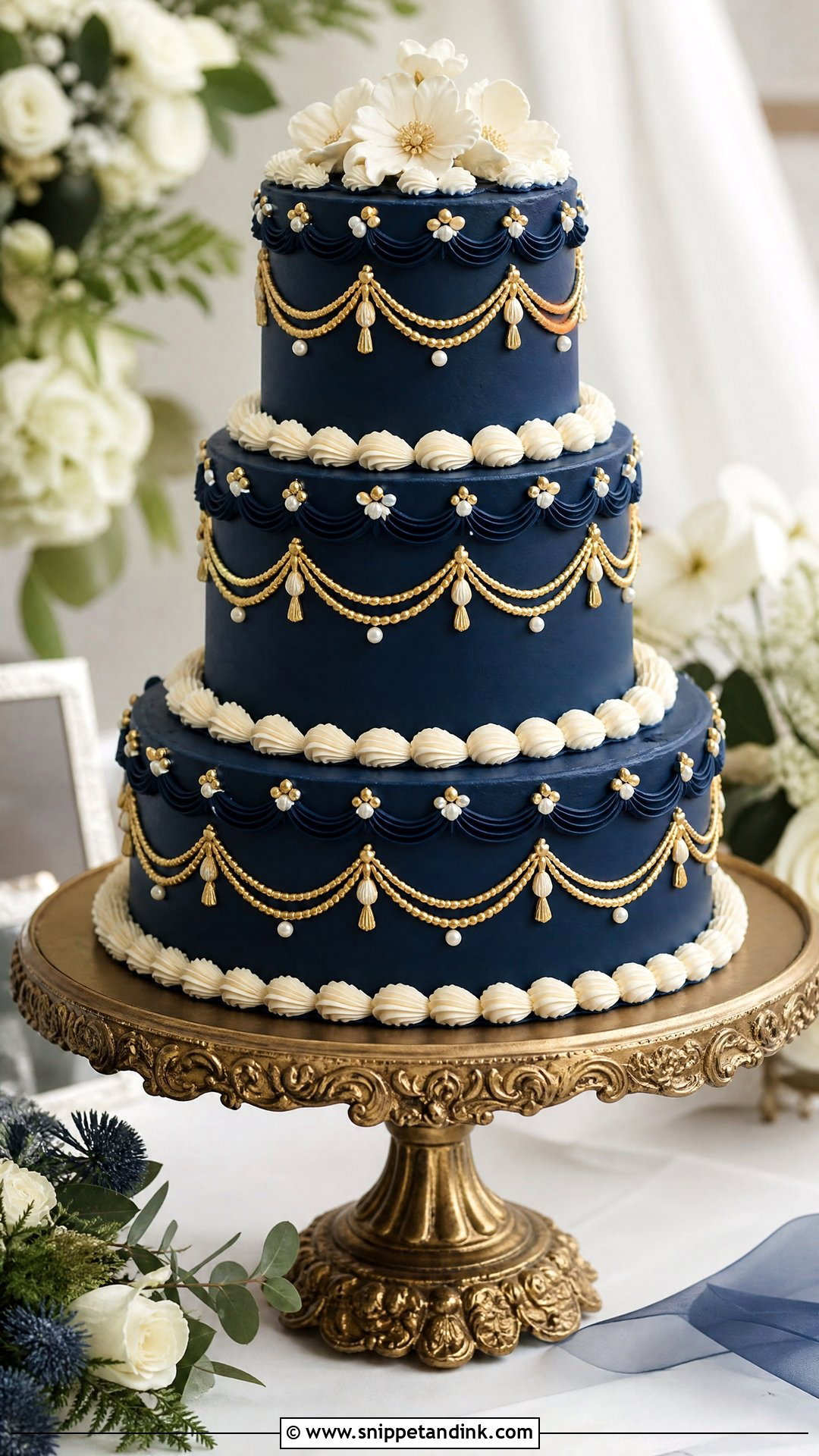
Lambeth-style piping, with its layered swags, shell borders and overpiped scrolls, looks fresh again in navy and gold. I pipe it in ivory or gold over navy buttercream; navy piping on ivory works too. It’s slow work, which is reflected in the cost. Historic houses and antique-filled rooms are where it belongs. Limit the palette strictly and skip extra toppers, because the piping is already the decoration. Two or three tiers with small ivory flowers is the right amount.
23. Navy Blue And Gold Rose Wedding Cake
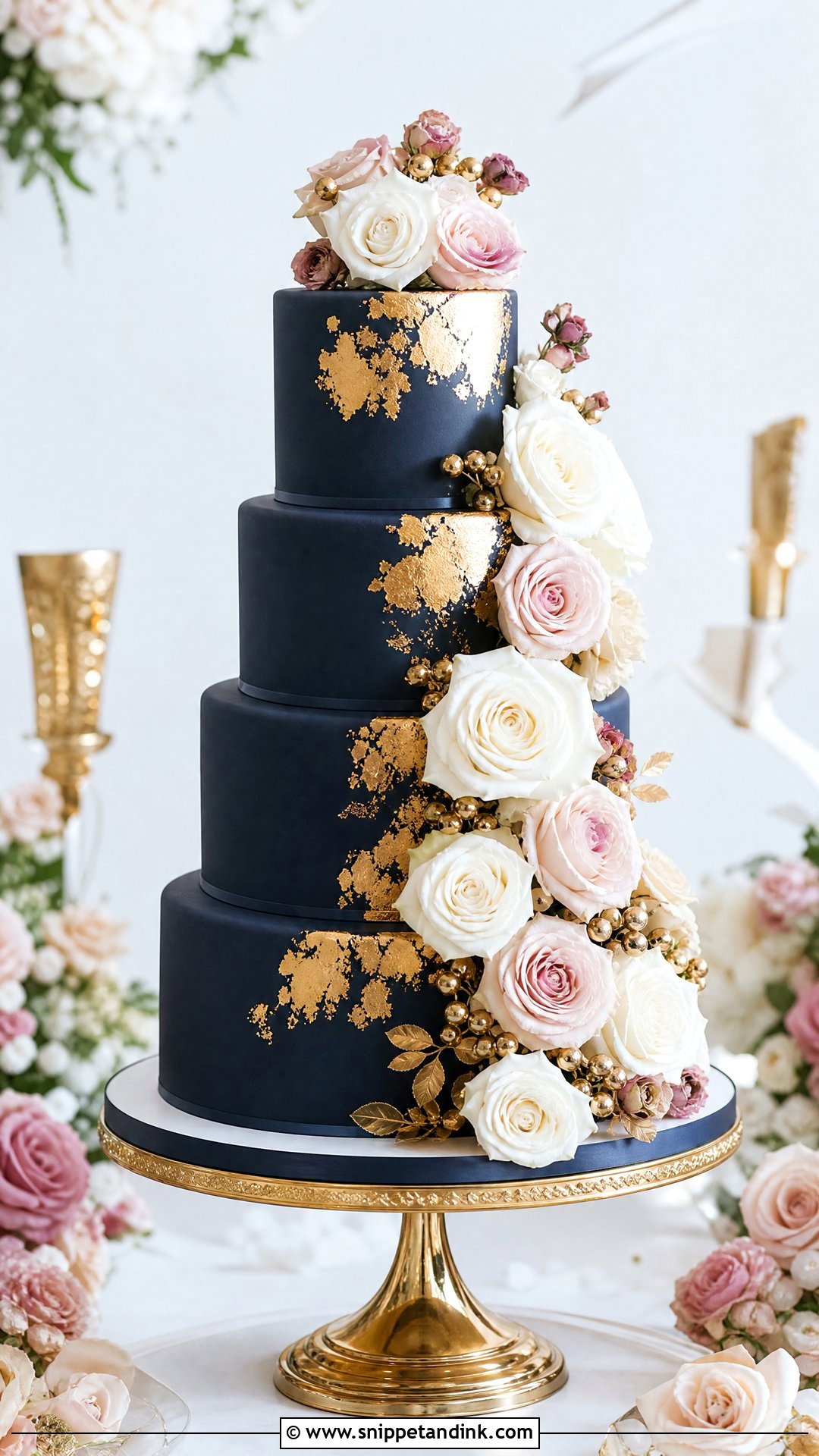
Roses are the most adaptable flower on a navy cake. They can be fresh, sugar or piped, and the choice usually comes down to budget and whether the cake needs to be made far in advance. White roses give the crispest contrast; blush or champagne ones soften the gold. On a navy base with gold leaf, I arrange them in a cascade, mixing full blooms with tight buds so it looks grown rather than placed. That variety in size is what gives the arrangement movement.
24. Navy Blue And Gold Orchid Wedding Cake
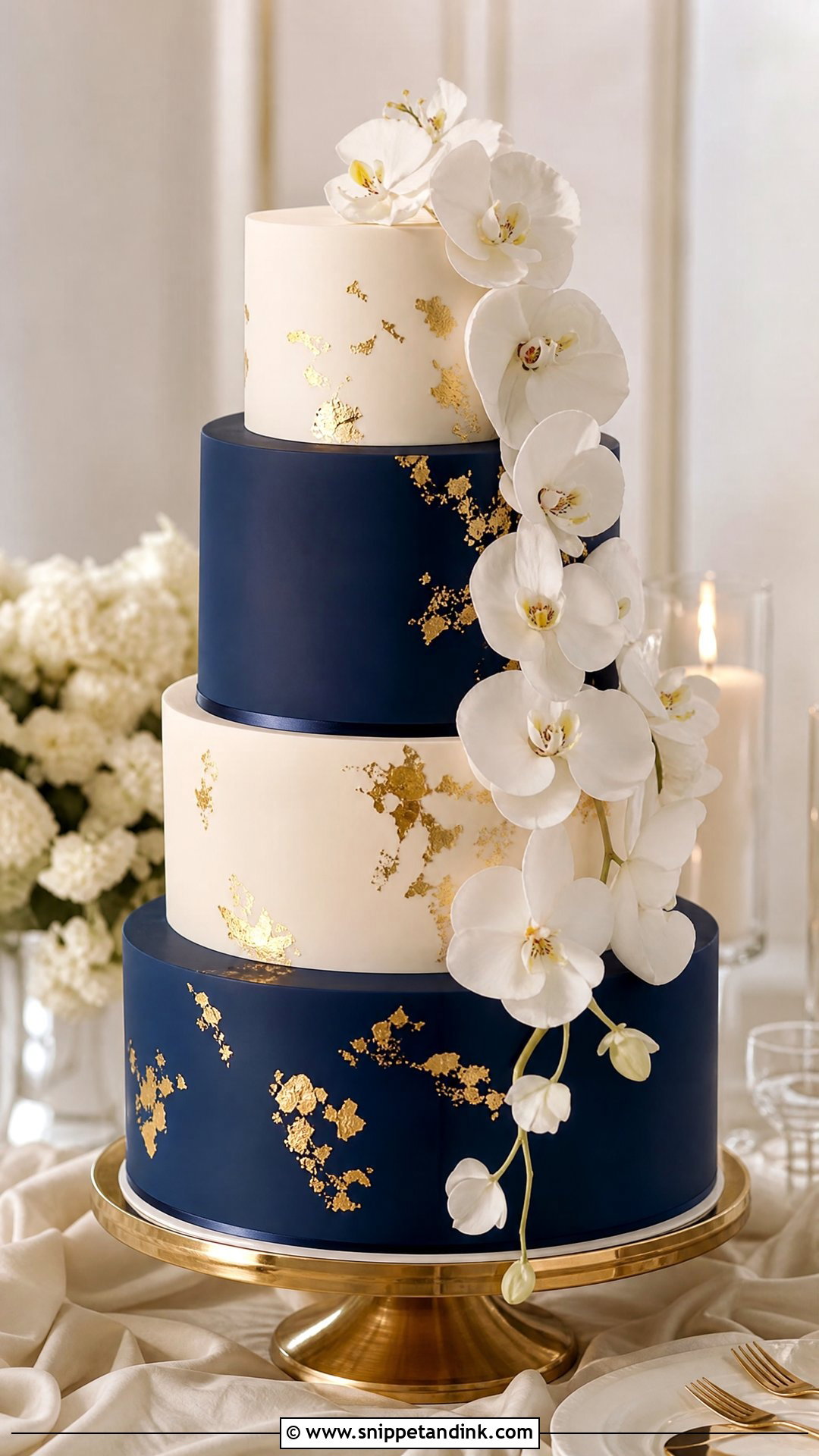
Orchids have a strong shape of their own, so you need very few. Three or four white stems against navy fondant do more than a dozen roses would. I let them trail down one side or sit in a tight cluster between two tiers, with a band of gold leaf to warm the navy. Destination weddings and hotel receptions suit the clean, slightly tropical feel. Real orchids bruise easily, so I add them at the venue; sugar orchids are the safer option in heat.
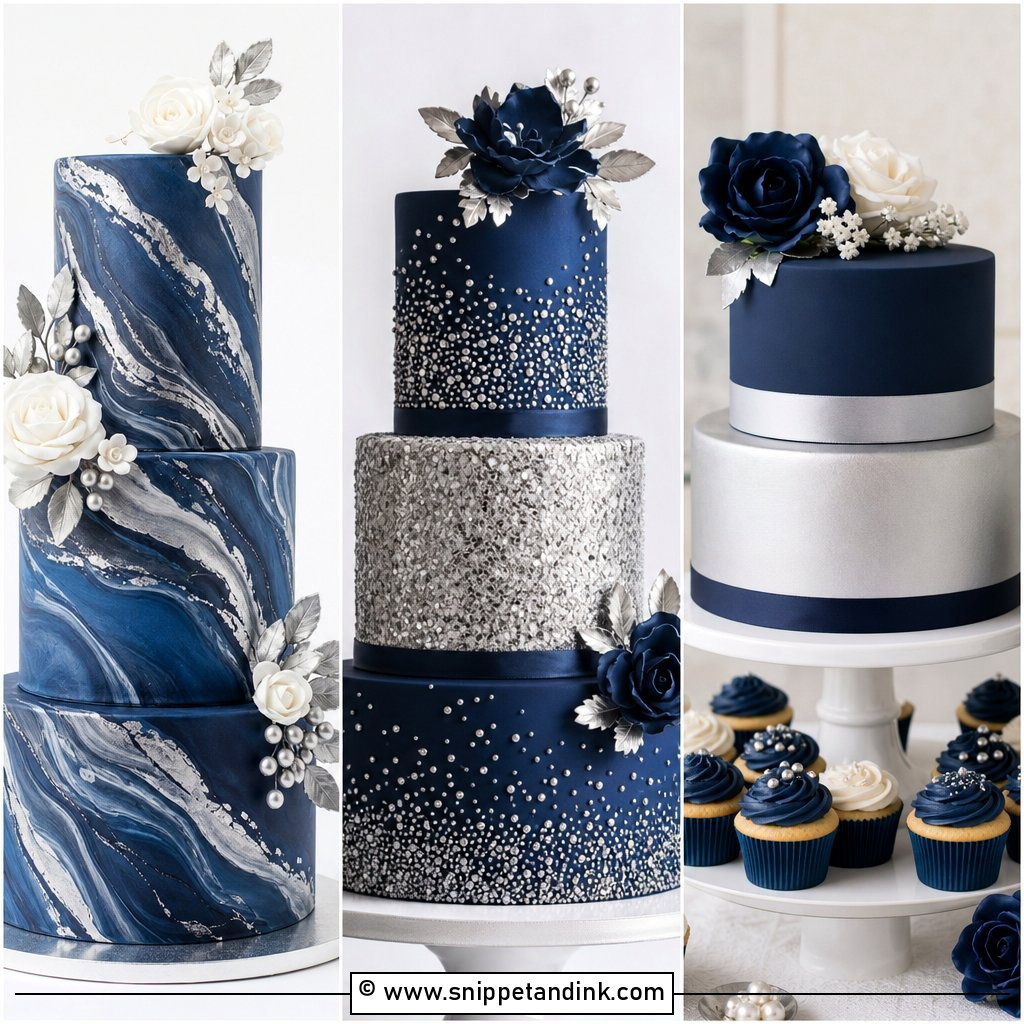
25. Navy Blue And Gold Dessert Table Cake
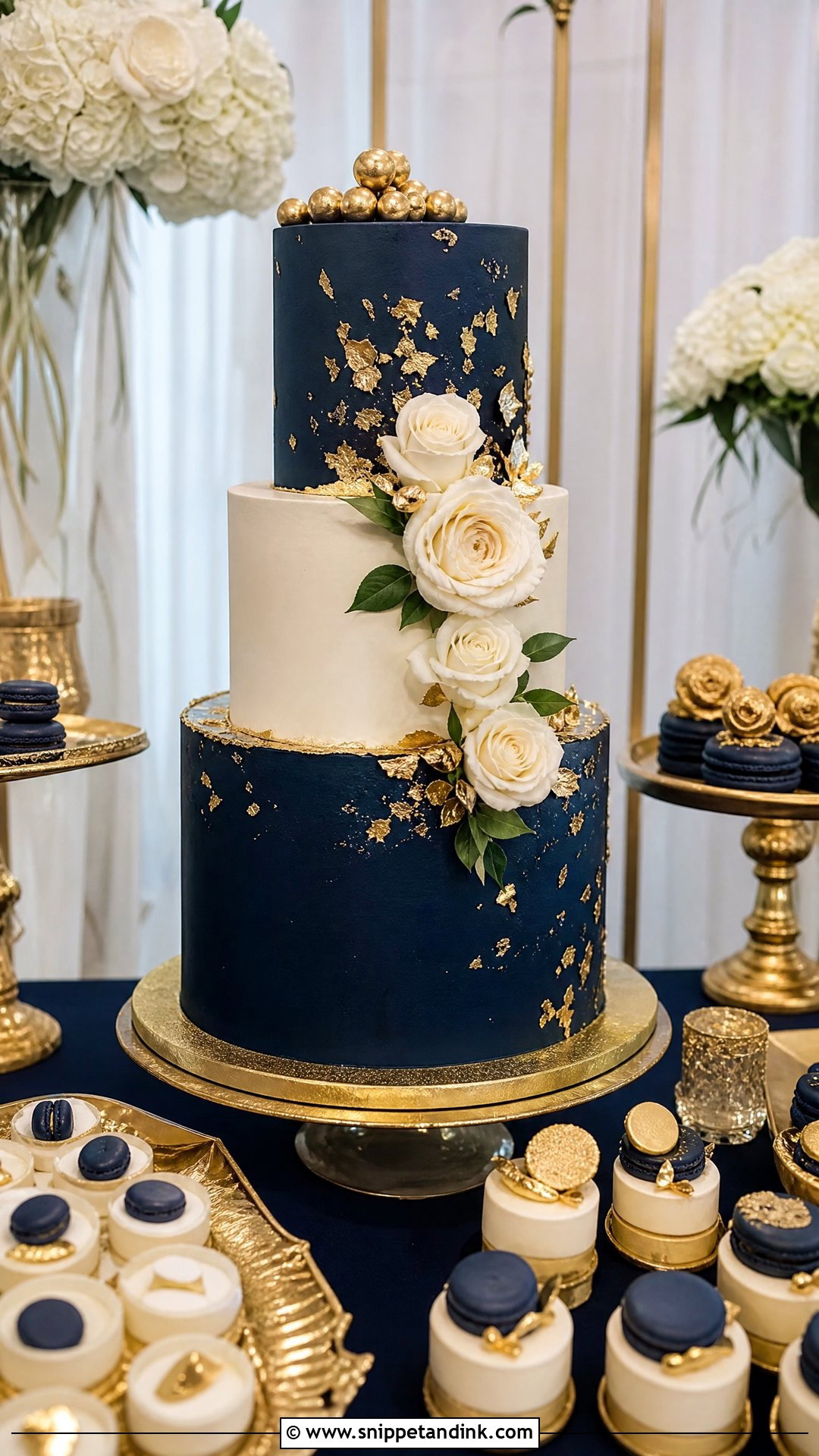
When the cake is one part of a full dessert table, it doesn’t need to be huge. Two or three tiers in navy frosting with gold leaf and white flowers, then the same colours repeated across cupcakes, macarons, cookies and mini cakes, makes the table look like one design. Gold trays, navy linens and clear signs finish the set-up. It’s practical for weddings where guests like variety, and the smaller cake costs less while still giving you a cutting moment.
Gold Leaf, Lustre Dust or Paint on a Navy Cake
Not every gold finish is food. Edible gold leaf, the high-carat kind sold for food use, is safe to eat. Many glitters and lustre dusts are labelled non-toxic, which only means they’re decorative and meant to be removed, not eaten. When I quote a gold cake, I tell the couple which pieces are edible and which aren’t, and you should expect the same from your baker.
How each one behaves
- Leaf: applied with a barely damp brush on fondant, or pressed onto chilled, crusted buttercream. It tears into irregular patches, which is part of its charm.
- Paint: edible lustre dust mixed with a little clear alcohol, which evaporates and leaves a metallic film. Good for lines, monograms and stars.
- Transfer sheets: for crisp gold patterns on fondant, though they need a very smooth surface.
Getting a Dark Cake From the Fridge to the Table Without Sweating
A chilled fondant cake carried into a warm, humid room collects condensation, the same way a cold glass does. On ivory you barely notice it. On navy, those beads of water can lift gold paint, leave dull spots and sometimes let colour bleed into a white tier next to it. I let a cold cake come up gradually in its box before unpacking, and I never dab the droplets, which smears them; they dry on their own. If your reception is outdoors in summer, ask your baker how long the cake can sit out and whether a shaded spot is planned for it.
Letting Your Venue Lighting Decide How Much Navy to Use
The same two colours can look classic, glamorous or quietly modern depending on finish, from marbled fondant and soft buttercream to a gold drip, vintage piping or one single tier. I’d let the room make the last call. Deep navy cakes come alive in evening light and candlelit spaces, while ivory tiers with navy and gold accents feel lighter in daylight. Bring your baker a few photos you love, then let them adjust the design to your guest count, budget and the way your venue is actually lit.
You'll Like These Ideas:








Leave a Reply