
Khmer wedding clothing is built from silk that catches light, embroidery that takes weeks to stitch, and accessories that have to agree with each other from crown to ankle. The looks below cover traditional bridal sets, lighter reception changes, bridesmaid groupings and outfits for close family. A Cambodian wedding usually runs across several ceremonies, so the couple changes clothes and colors more than once, and each change is built from the same parts: a silk sampot, a fitted embroidered top, a diagonal sbai, a gold belt and ceremonial jewelry. When I plan these days, comfort decides almost as much as color, because the bride will sit on the floor, bow, walk in procession and pose for hours. Where a piece carries cultural meaning, the family, an experienced Khmer tailor or the ceremony organizer should have the final word.
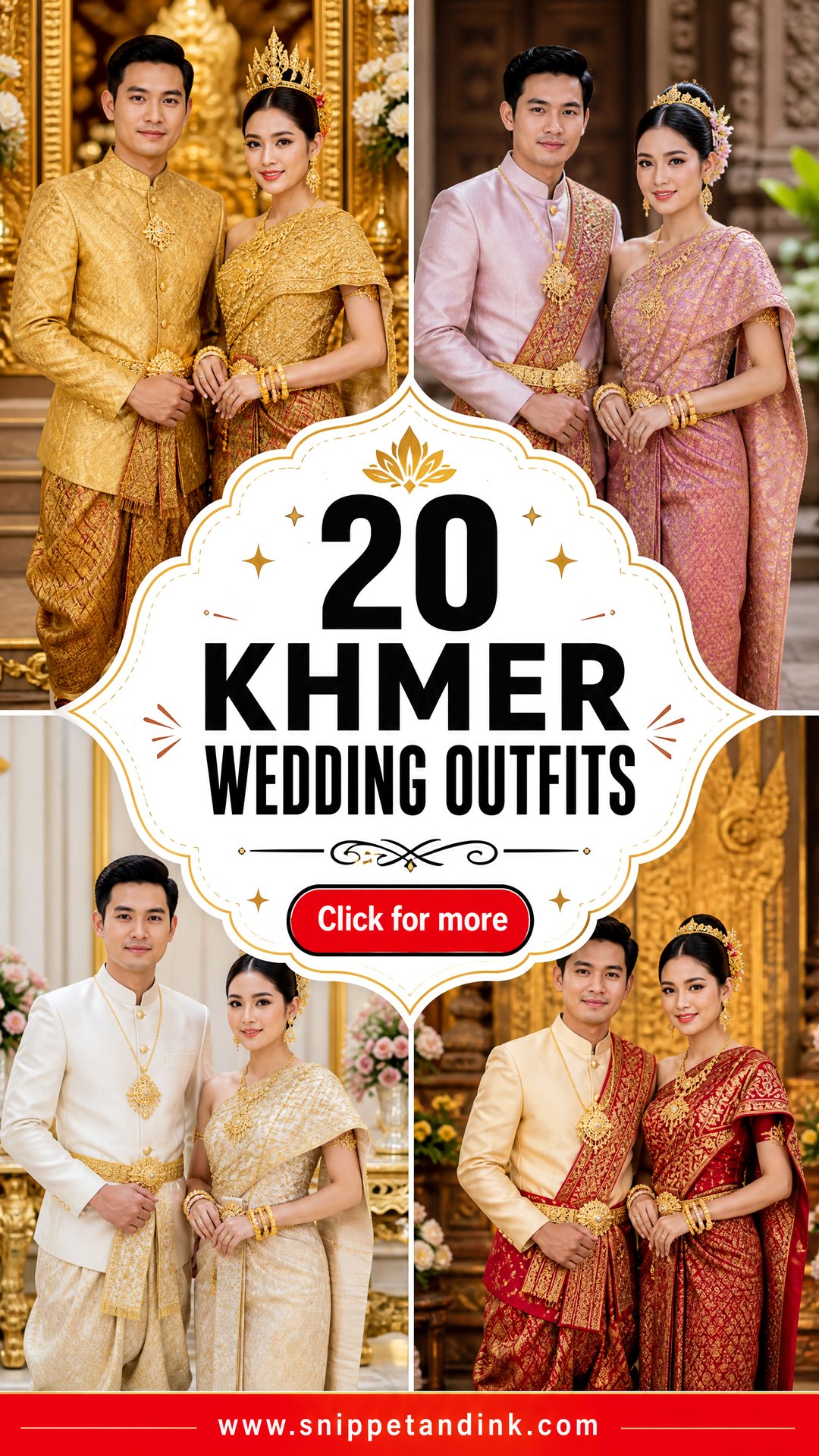
Planning a Khmer Wedding Day Around Its Outfit Changes
A Khmer wedding is a sequence of ceremonies, and each change of clothes takes longer than couples expect. Wrapping a sampot, pinning a sbai, swapping jewelry and reworking the hair ornaments can easily take half an hour per change for the bride, more if the groom changes too. When I build the day’s schedule, I count the changes first and work the ceremonies around them, not the other way round.
- Decide with the family how many changes are expected and which colors belong to which ceremony before buying or renting anything.
- Book a dresser for the whole day, not only the morning. Wrapping styles like the chang kben need the same hands at every change.
- Lay out each outfit as a complete set on its own hanger or tray, with its belt, jewelry and pins, so nothing goes missing between rooms.
- Plan where the changes happen. A private room close to the ceremony space saves walking through guests half dressed.
- Keep a small kit with safety pins, straight pins, double-sided tape, a needle and thread in each main color, blotting papers and flat shoes.
Many Cambodian families rent bridal sets from a shop that also supplies the dressers and makeup, which takes much of this work off the couple. If you are buying or commissioning instead, leave months, not weeks, for embroidered pieces and fittings, and ask the tailor how many fittings they plan before the final one.
1. Gold Khmer Wedding Outfit
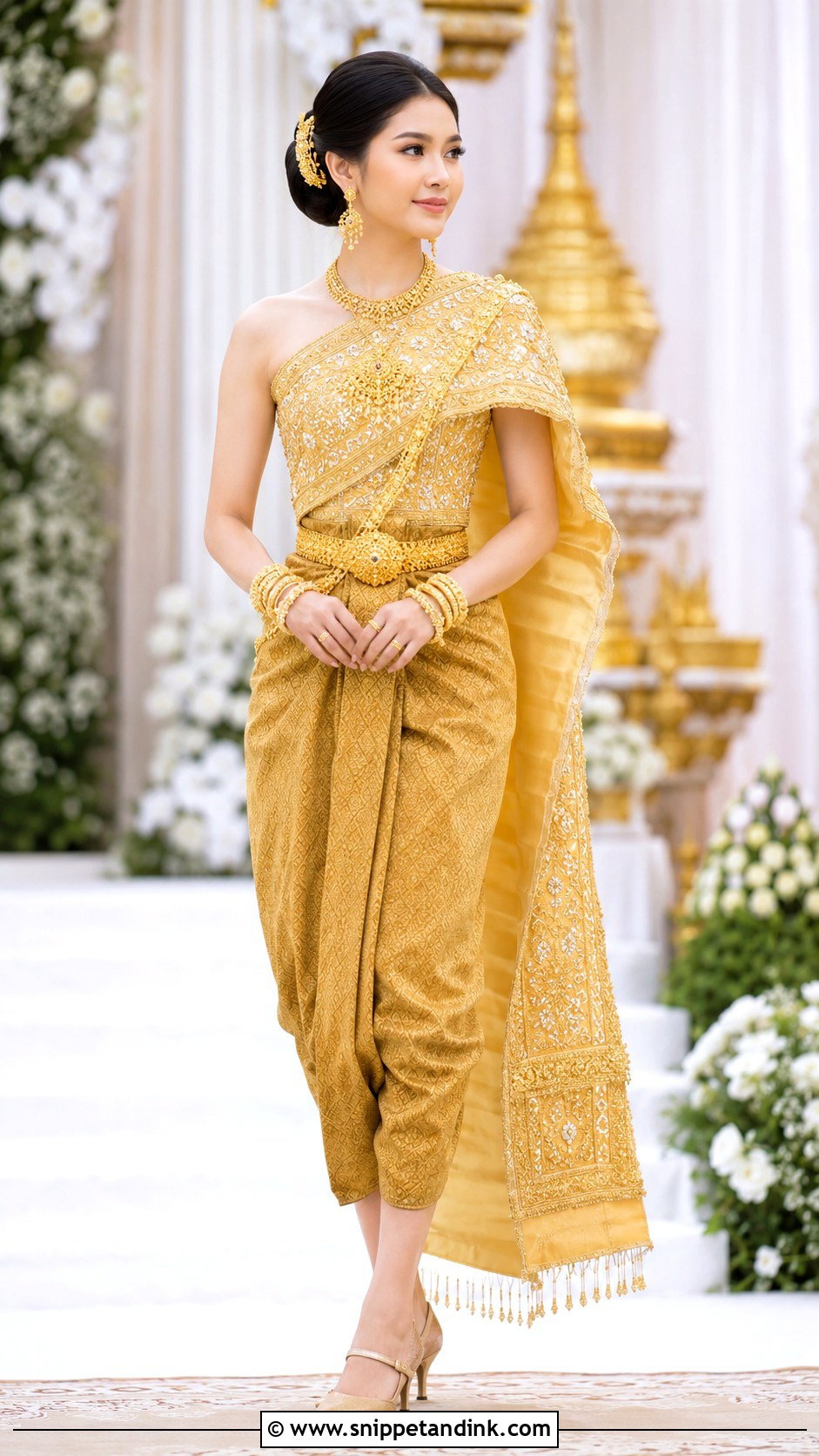
Gold is the color most people picture when they think of traditional Cambodian bridal clothing, and it is also the hardest to get right. Start with a silk sampot woven with metallic thread or an ornate border, then add a fitted gold top and a structured sbai across one shoulder. The belt is not decoration only; it is what holds the wrapped fabric in place when the bride kneels for blessings. When everything is gold, I look for three different textures, such as a matte silk ground, a raised brocade border and polished metal jewelry, because one flat shade of gold reads as a single yellow block on camera. Pointed flats or low metallic heels keep a floor-length skirt from catching under the toe.
2. Red And Gold Khmer Wedding Outfit
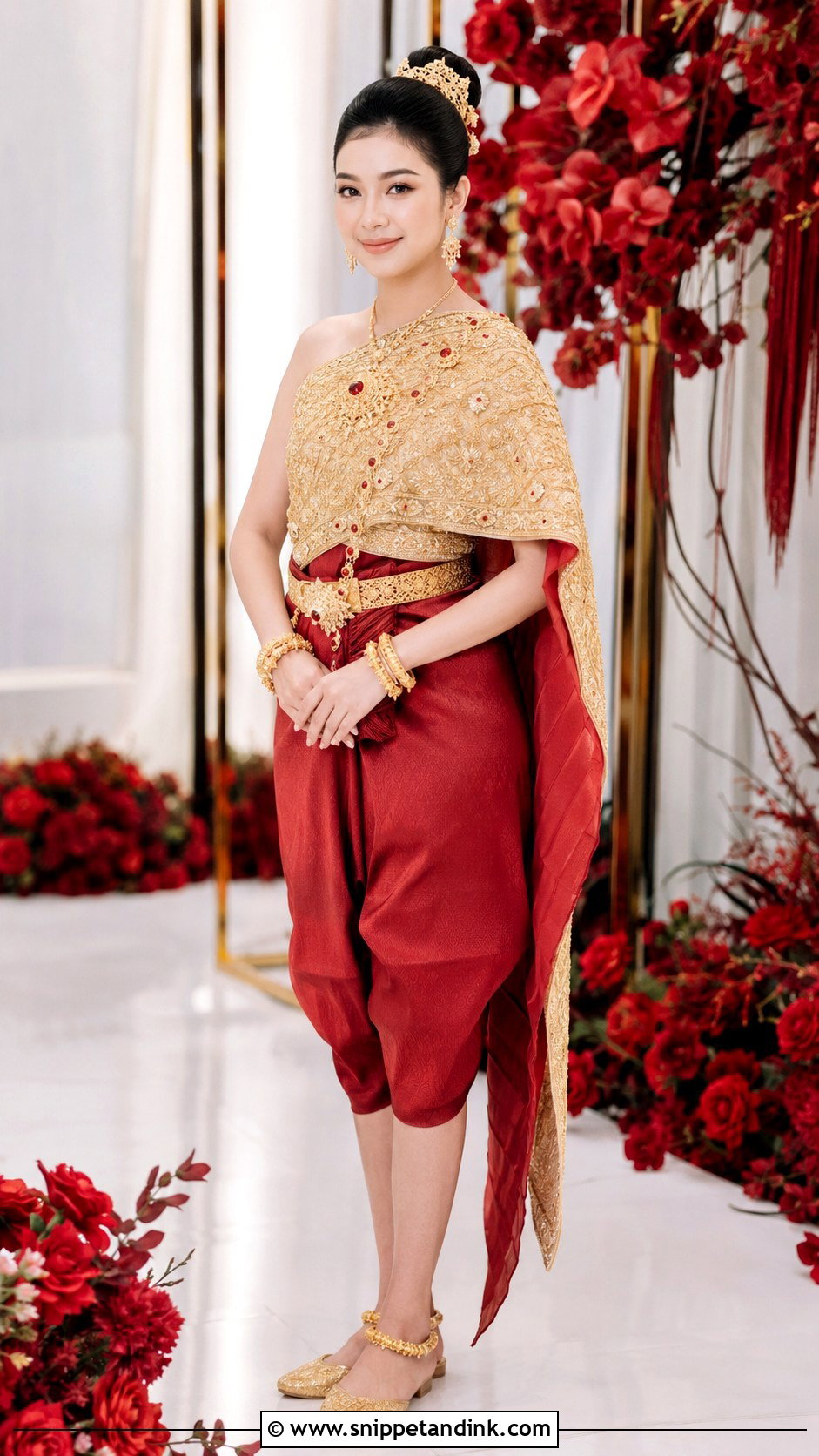
Red and gold is the classic celebratory pairing, and it forgives a lot because both colors hold their own in mixed lighting. Choose a red sampot with woven gold motifs and a fitted top whose embroidery runs around the neckline, sleeves and waist. A gold or red-and-gold sbai finishes it for the ceremonial portions. The mistake I see most is matching red to red by eye in a shop: silk reds shift toward orange or toward wine depending on the weave, so I hold the top and the sampot together in daylight before anything is cut. Keep the jewelry to a necklace, drop earrings, bangles and an engraved belt, and check with the family that red suits your role in that particular ceremony.
3. White And Gold Khmer Wedding Outfit
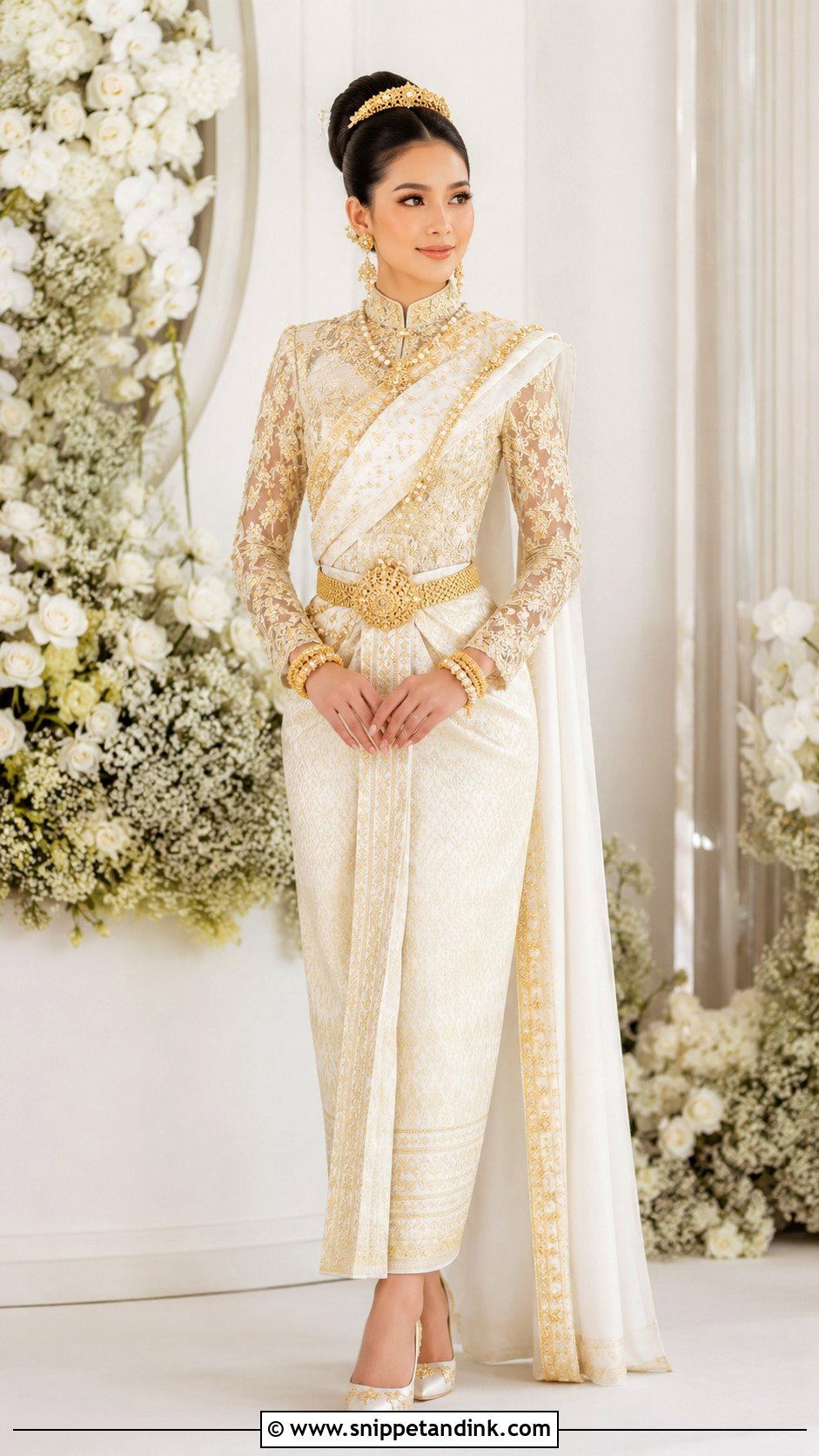
Ivory with gold threadwork is the pairing many Cambodian-American couples reach for when they want Khmer clothing that still nods to a Western white palette. For this Khmer wedding outfit, look for a soft-white silk sampot with a crisp front fold and a decorated hem, and a fitted top with gold beading or structured shoulders. A white sbai edged in gold ties the two together. White silk shows every mark, so I keep a clean cloth and a lint roller in the dressing kit and ask the bride to do her makeup before the top goes on. Pearls can soften the metal, though they should sit alongside, not replace, the jewelry chosen for the ceremony.
4. Emerald Green Khmer Wedding Outfit
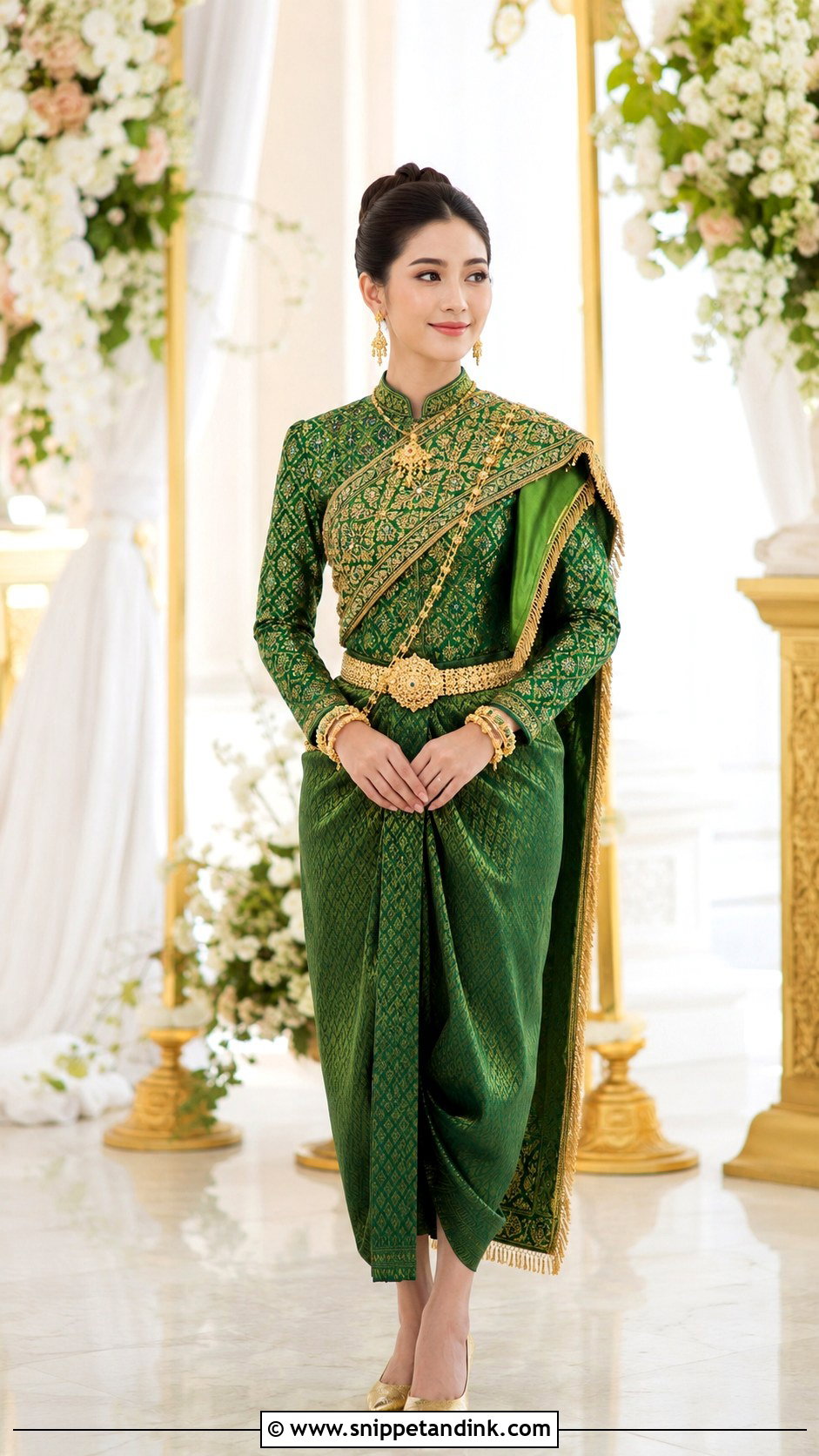
Emerald is one of the few jewel tones that looks rich in shade and still lifts in sunlight. Build it around an emerald sampot woven with gold florals or geometrics, a matching fitted top and a gold-edged sbai over one shoulder. A defined gold belt gives the waist structure. Deep green can drain very fair or very cool skin near the face, so before committing I drape the top fabric under the chin and look at it without makeup. A smooth bun with small gold ornaments keeps the eye on the shoulder drape, and if the family approves, the same color works for bridesmaids and relatives in simpler weaves.
5. Royal Blue Khmer Wedding Outfit
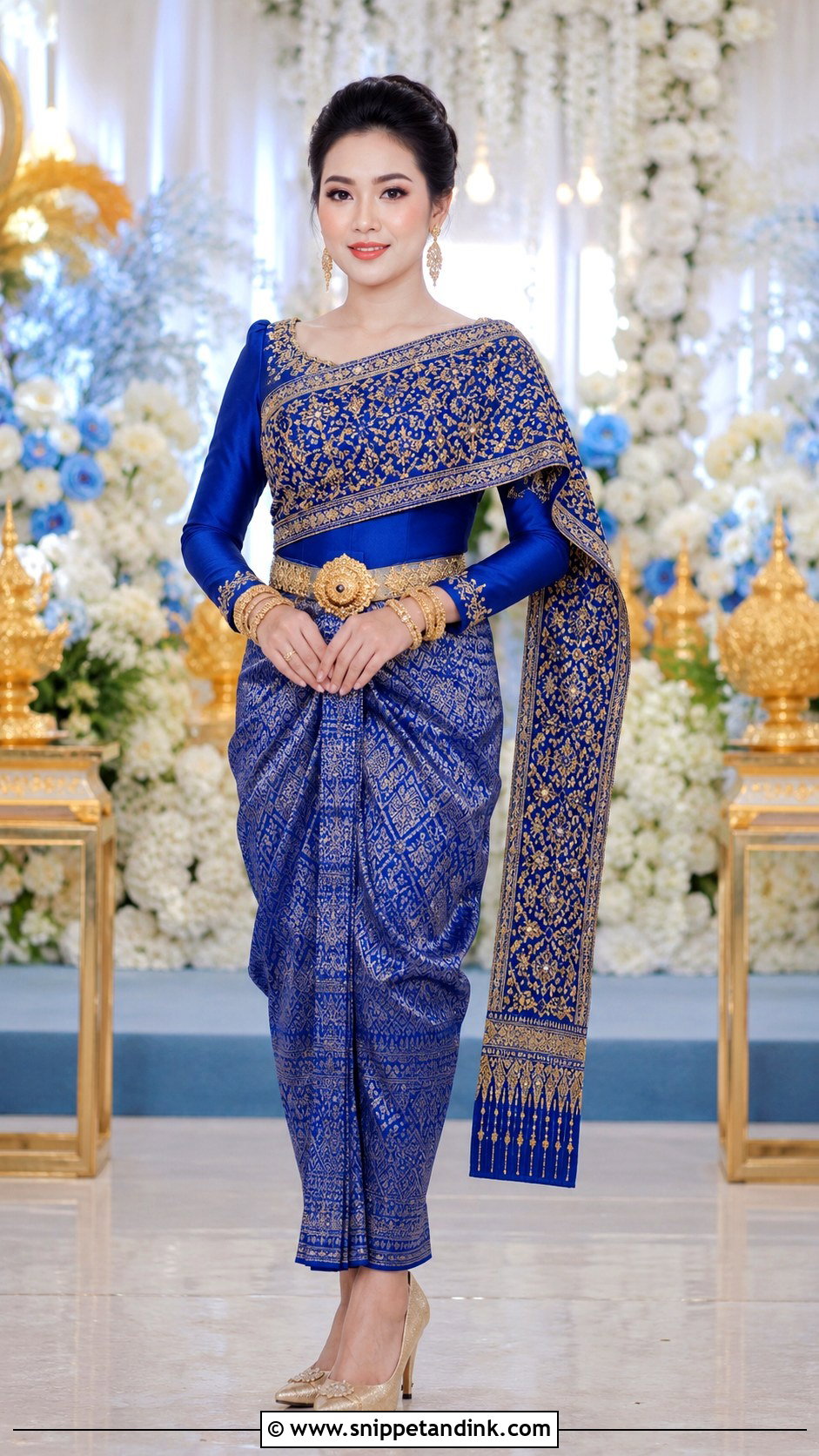
Royal blue makes gold threadwork look sharper than almost any other ground color. Pair a blue silk sampot with a woven border and a fitted top embroidered across the bodice and sleeves, then frame the shoulder with a blue sbai trimmed in metallic fabric. If the top is heavily beaded, I drop the necklace count to one, because beads and layered chains together turn into noise at portrait distance. Blue stays vivid under strong event lights where pastels wash out. When bridesmaids wear the same blue, I give them plainer embroidery and keep the densest work for the bride.
6. Purple Khmer Wedding Outfit
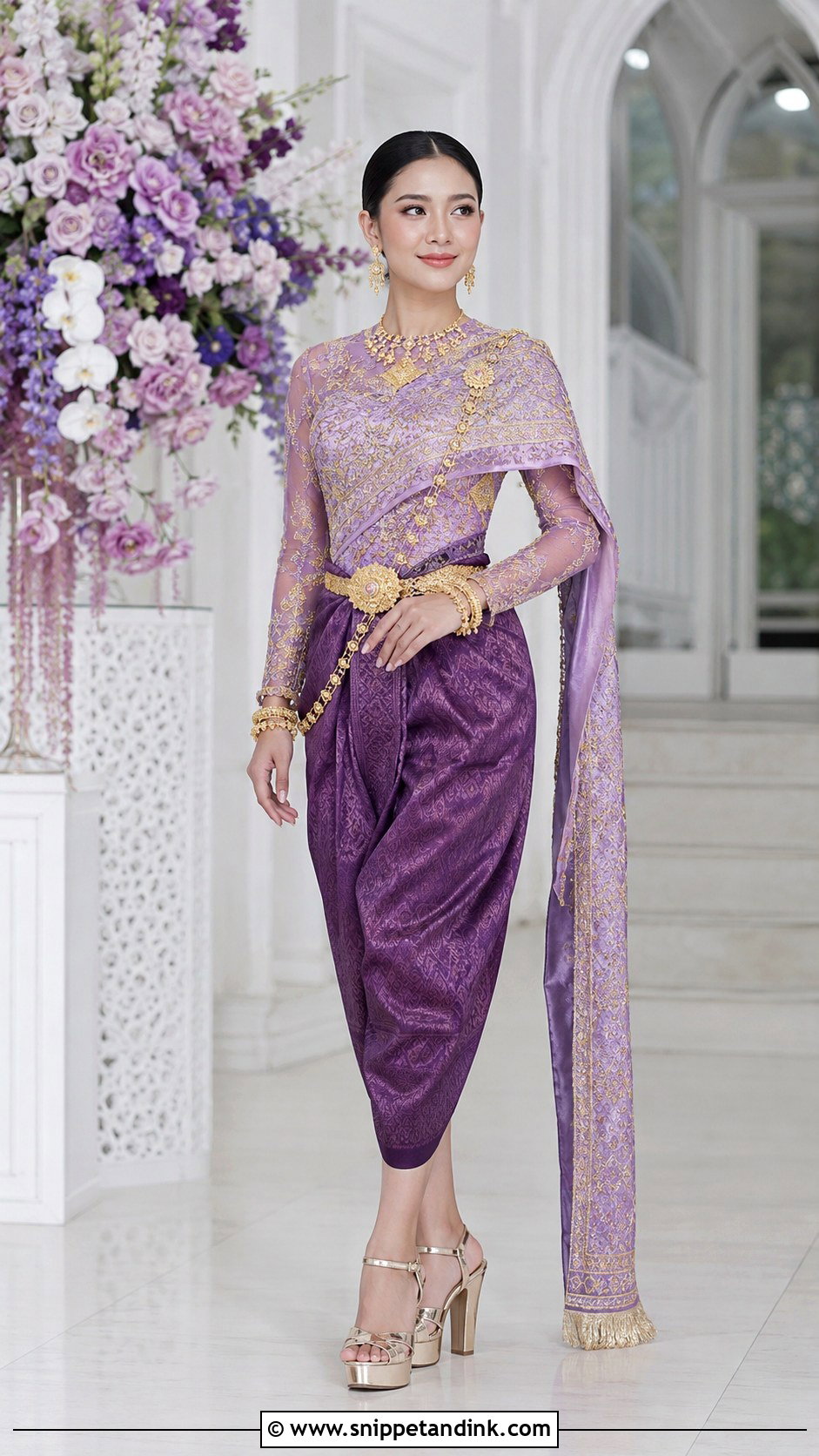
Purple woven silk has a depth that flat dyed fabric never quite matches. Start with a plum or true-purple sampot patterned in gold, add a fitted top with a modest neckline, and try a lighter lavender-gold sbai to give the set some dimension. My first rule with purple is to view all three pieces together under the actual venue lighting, because warm bulbs push violet toward brown and cool LEDs push it toward blue, and the pieces rarely shift by the same amount. Metallic flats are kinder during long family rituals; low block heels can come out for the reception.
7. Pink Khmer Wedding Outfit
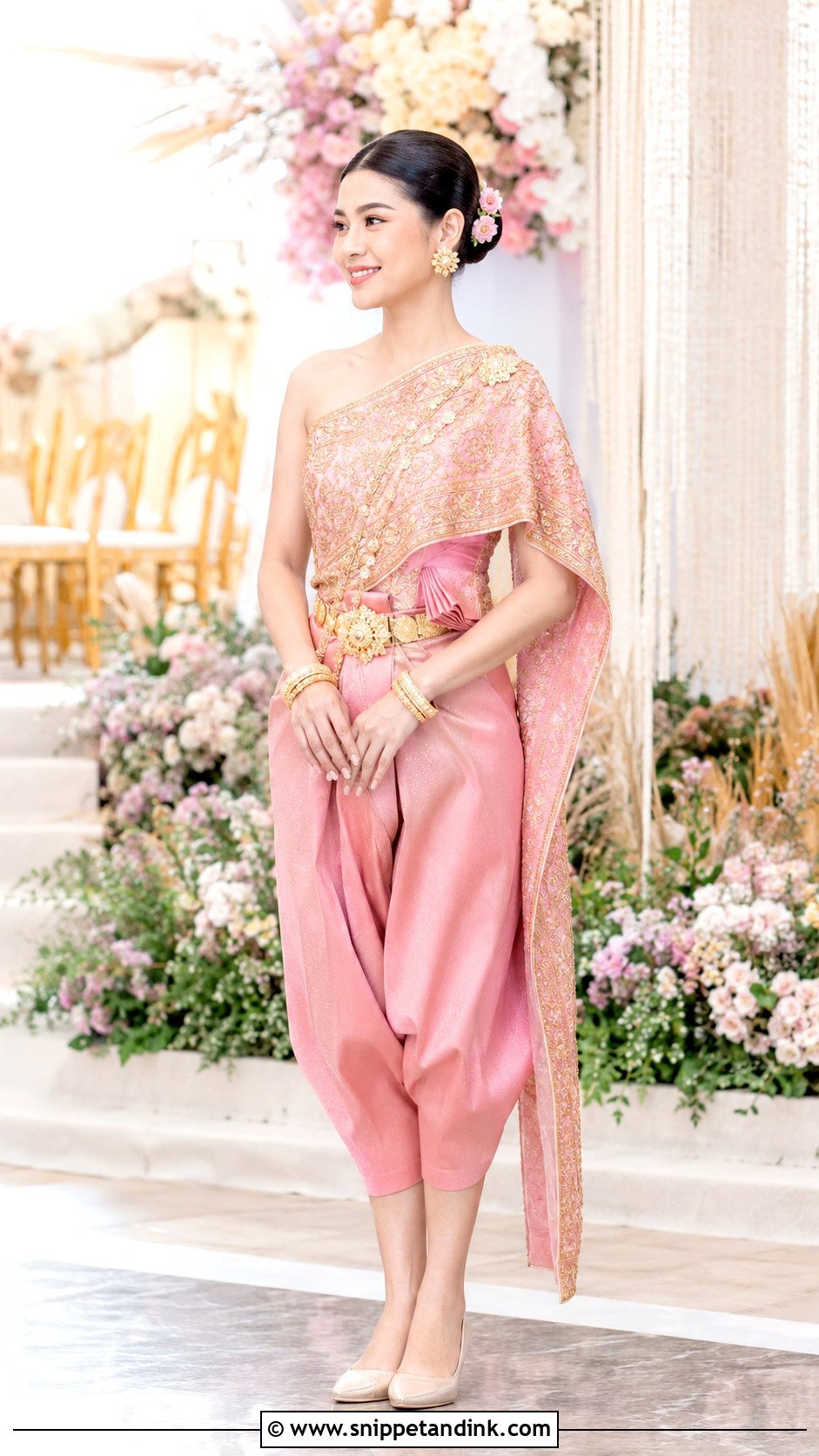
Pink silk gives a softer option between the deeper ceremonial colors. Look for a blush or lotus-pink sampot with fine gold weaving and a fitted embroidered top in a close shade, then add a sbai with a wide decorative border so the outfit still reads as formal. Soft colors lose definition in photos faster than strong ones, so I rely on that border and on a narrow gold belt to draw the lines a darker fabric would draw on its own. Fresh flowers in a smooth bun work when they echo the decor. Pink suits bridesmaids and daytime changes; for the bride, richer embroidery and a more ornate drape keep her distinct from the party.
8. Champagne Khmer Wedding Outfit
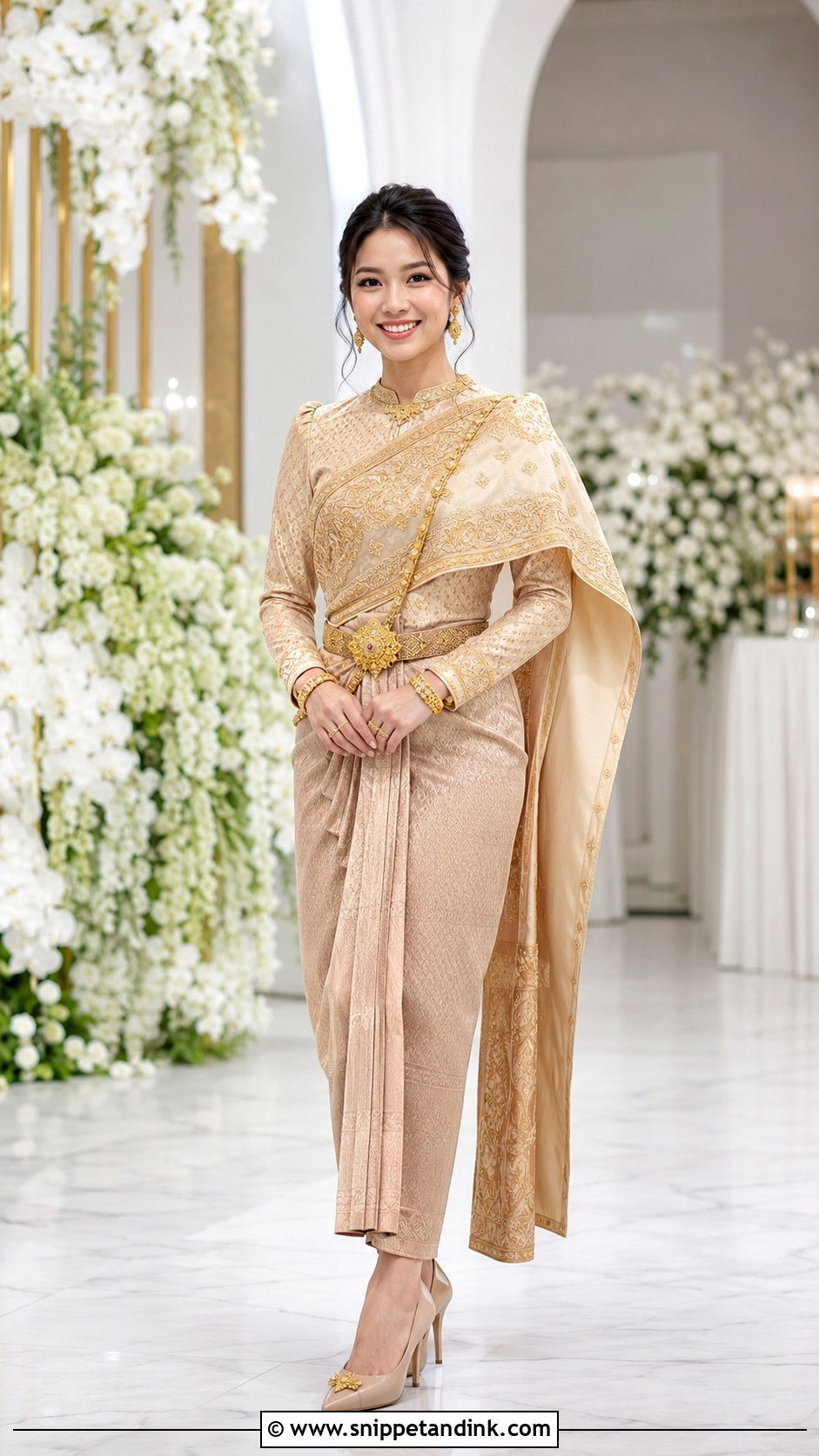
Champagne is the neutral I suggest with care. A champagne sampot with raised gold weaving, a fitted top with structured sleeves and a cream-and-gold sbai can look refined, but on light and medium skin tones the color can melt into the skin and leave the bride looking undressed in photos. I solve it with texture rather than more color: a visible weave, embroidery concentrated at the neckline, an antique-gold belt and makeup with enough definition around the eyes. Nude-gold heels lengthen the line; embellished flats are the comfortable alternative.
9. Teal Khmer Wedding Outfit
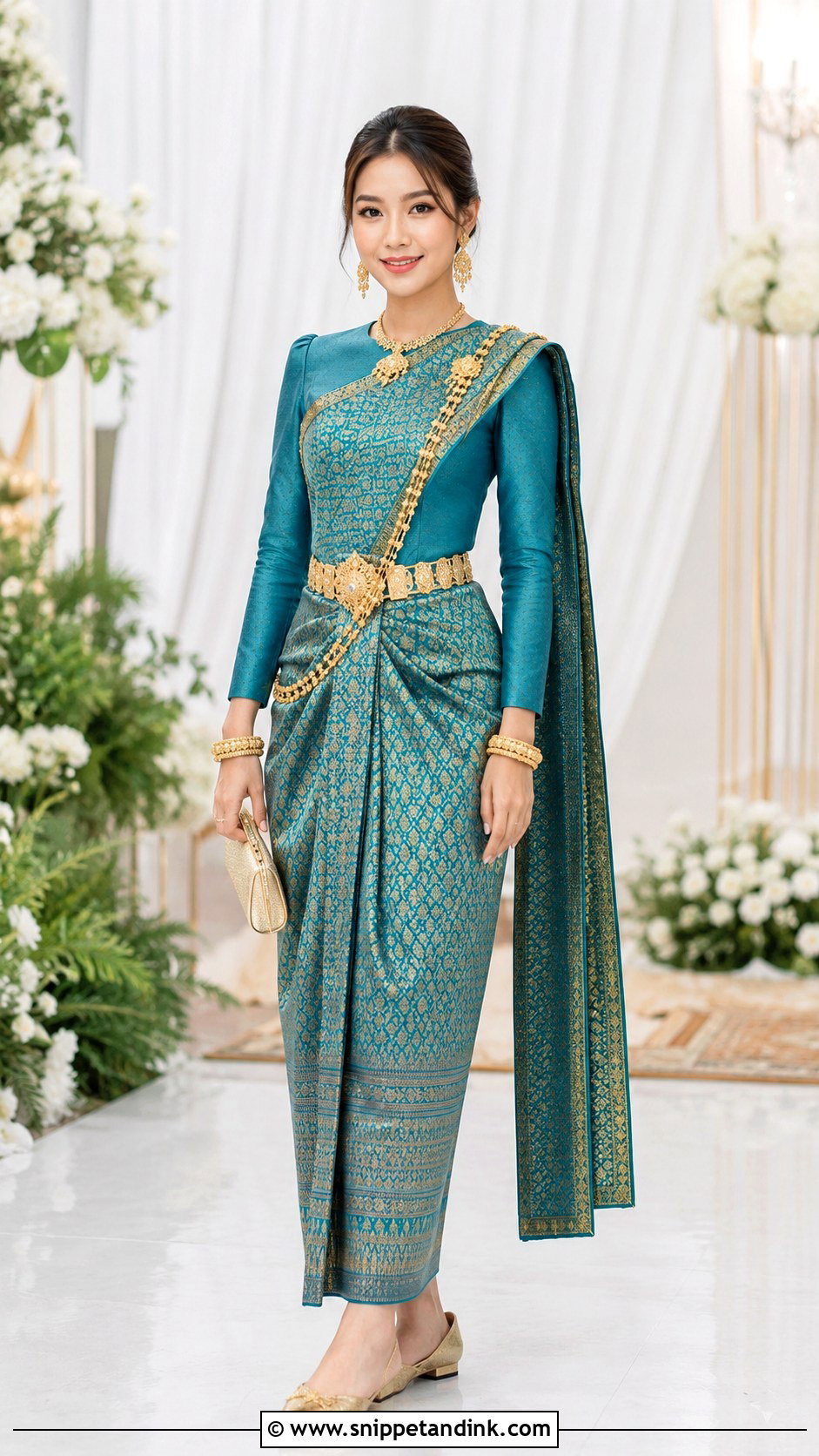
Teal sits between blue and green, which makes it one of the friendlier colors across different skin tones. Build the look from a teal silk sampot with gold or silver accents, a fitted top in the same family and a sbai with a contrasting metallic border. Here I check the thread before choosing jewelry: if the weave carries silver, I move the accessories toward cooler metal so the whole outfit stops fighting itself. Keep the hair smooth and lifted so the shoulder drape stays visible, and choose flats or low heels that survive a long receiving line.
10. Maroon Khmer Wedding Outfit
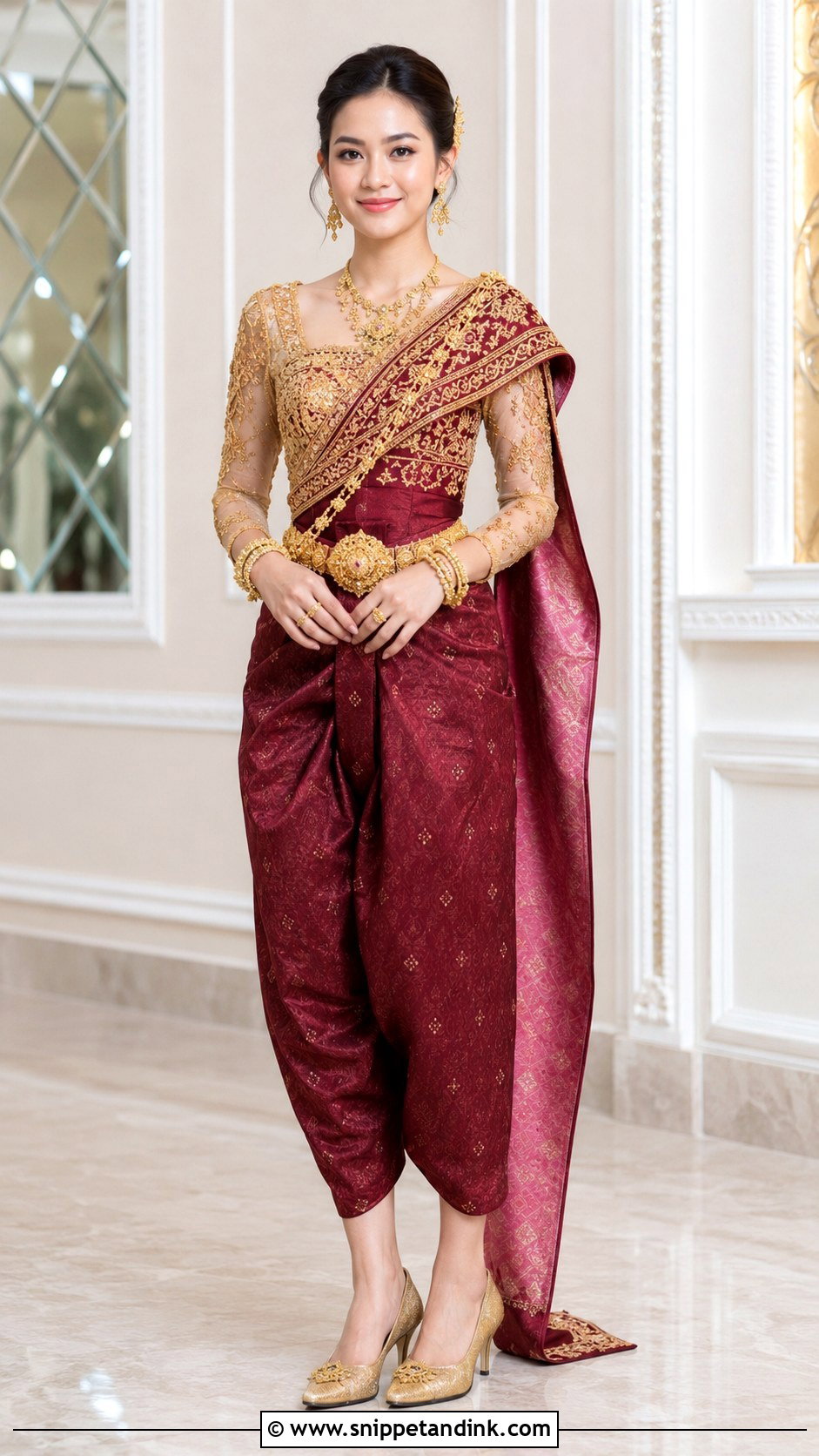
Maroon silk carries a formality that suits the evening portions of a Khmer wedding. Choose a long sampot in burgundy or oxblood with dense gold weaving, a top embroidered along the neckline and sleeves, and a maroon sbai with a wide gold border. That border matters more than people expect: dark silk photographs almost black in dim rooms, and the gold edge is what tells the camera where the drape starts and ends. I keep the accessory colors inside the red-gold family and let the ornate belt and a layered necklace do the work.
11. Orange Khmer Wedding Outfit
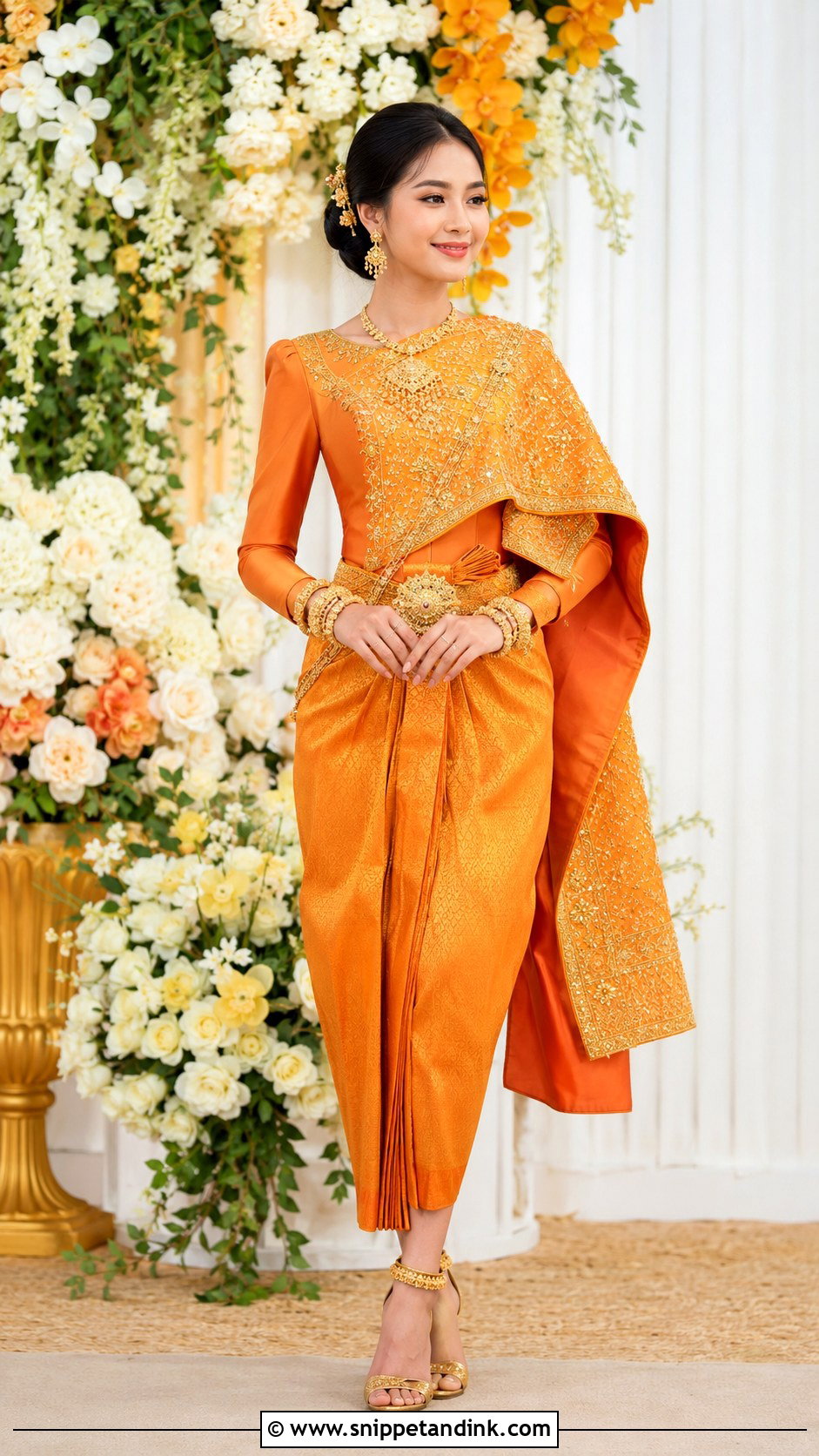
Orange is warm and very bright, and it reads as celebration from across a room. Combine a burnt-orange or saffron-toned sampot with a fitted top covered in gold embroidery and a matching sbai with a defined border. When a fabric is this saturated, I scale the jewelry down rather than up, because oversized pieces start competing with the silk. Gold sandals with a secure back strap are worth the search, since slip-on shoes come off during floor sitting and kneeling. Match the exact shade to the family palette before buying; orange covers a wide range from rust to marigold.
12. Khmer Sampot Chang Kben Wedding Outfit
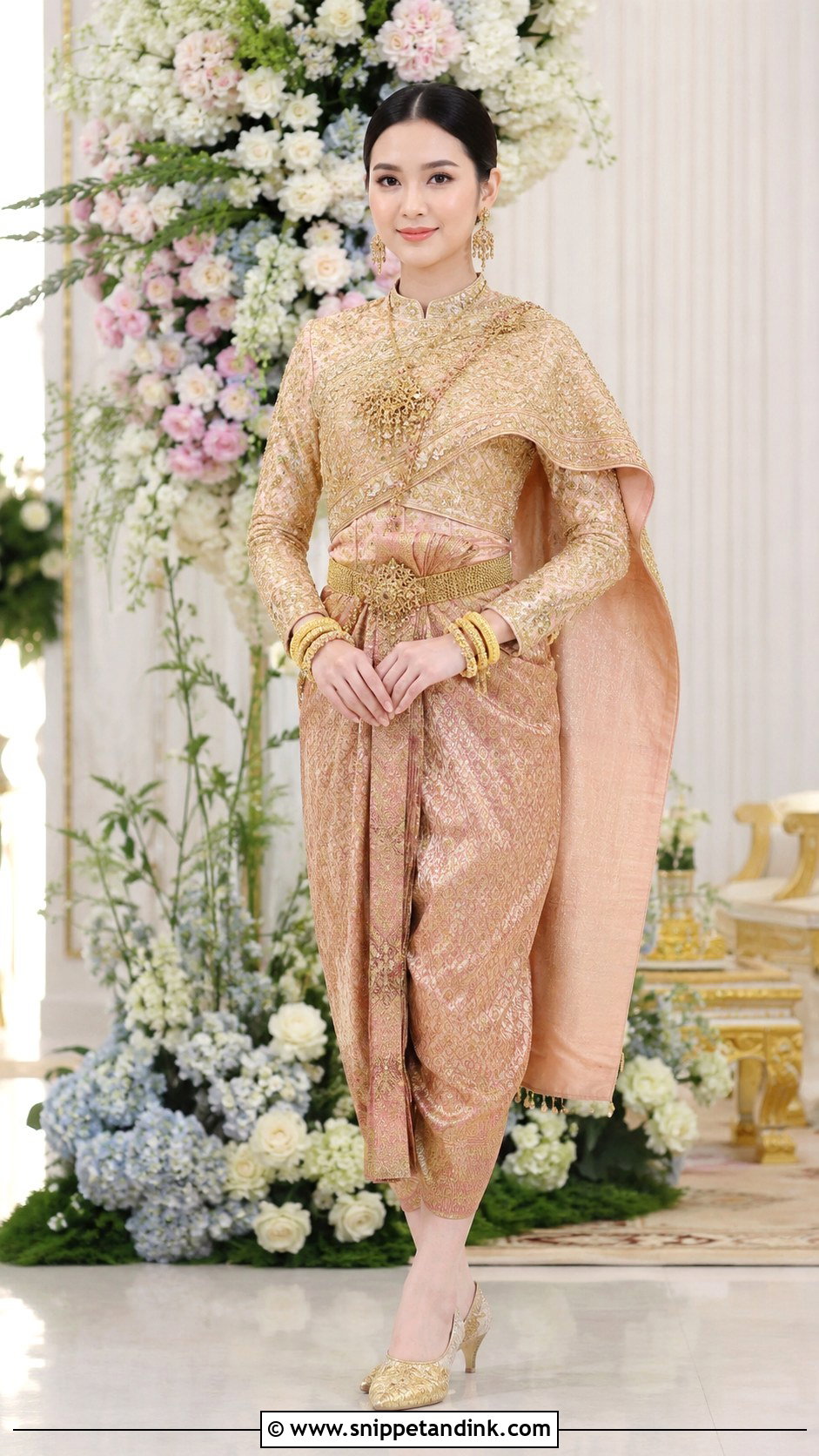
The sampot chang kben is wrapped around the waist, then the excess is twisted, passed between the legs and tucked at the back, which gives it a trouser-like shape. For a wedding, pick heavy silk with a rich woven pattern and pair it with a fitted embroidered top, a ceremonial shoulder drape, a decorative belt and stacked bracelets. I never let a bride wrap this one herself on the day. The tuck at the back carries all the tension, and if it is too loose the shape drops after an hour of sitting; a knowledgeable Khmer dresser knows how firmly to pull it and where to secure it. Pointed flats or low heels keep the line clean below the shortened hem.
13. Khmer Sampot Lbaeuk Wedding Outfit
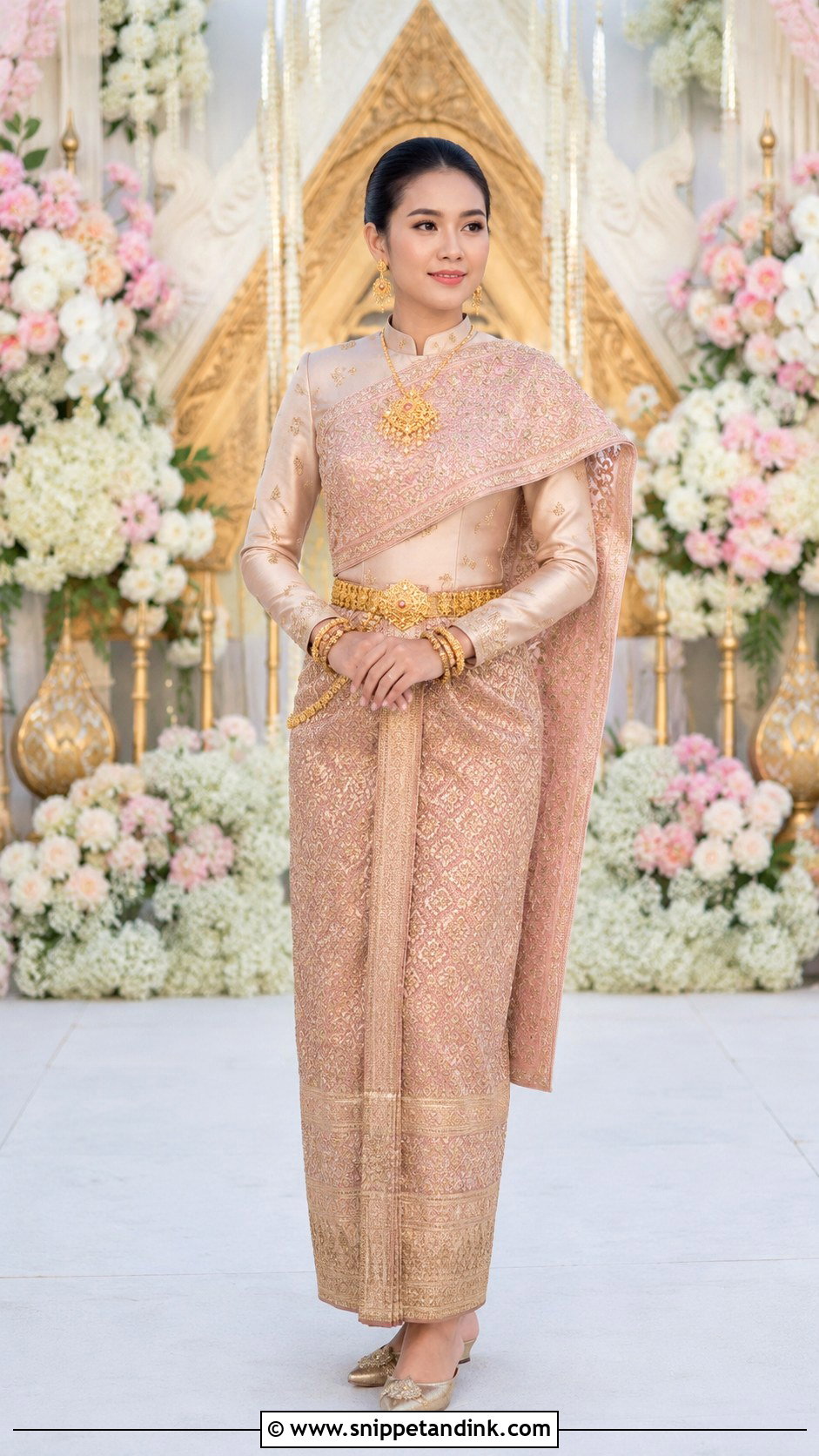
A sampot lbaeuk is ornate before you add a single accessory, and it has a long association with wedding dress. Pair it with a fitted top that repeats one or two colors from the skirt, never a new shade. Because the lower half already carries so much pattern, I keep the blouse embellishment controlled and let the sbai, an engraved belt and the jewelry bring the upper half up to the same level. At the fitting, I watch where the main motif lands on the body; a pattern that should sit centered at the front can slide to the hip if the wrap starts in the wrong place. Choose shoes that clear the hem so the embroidery does not snag.
14. Khmer Sampot Charobab Wedding Outfit
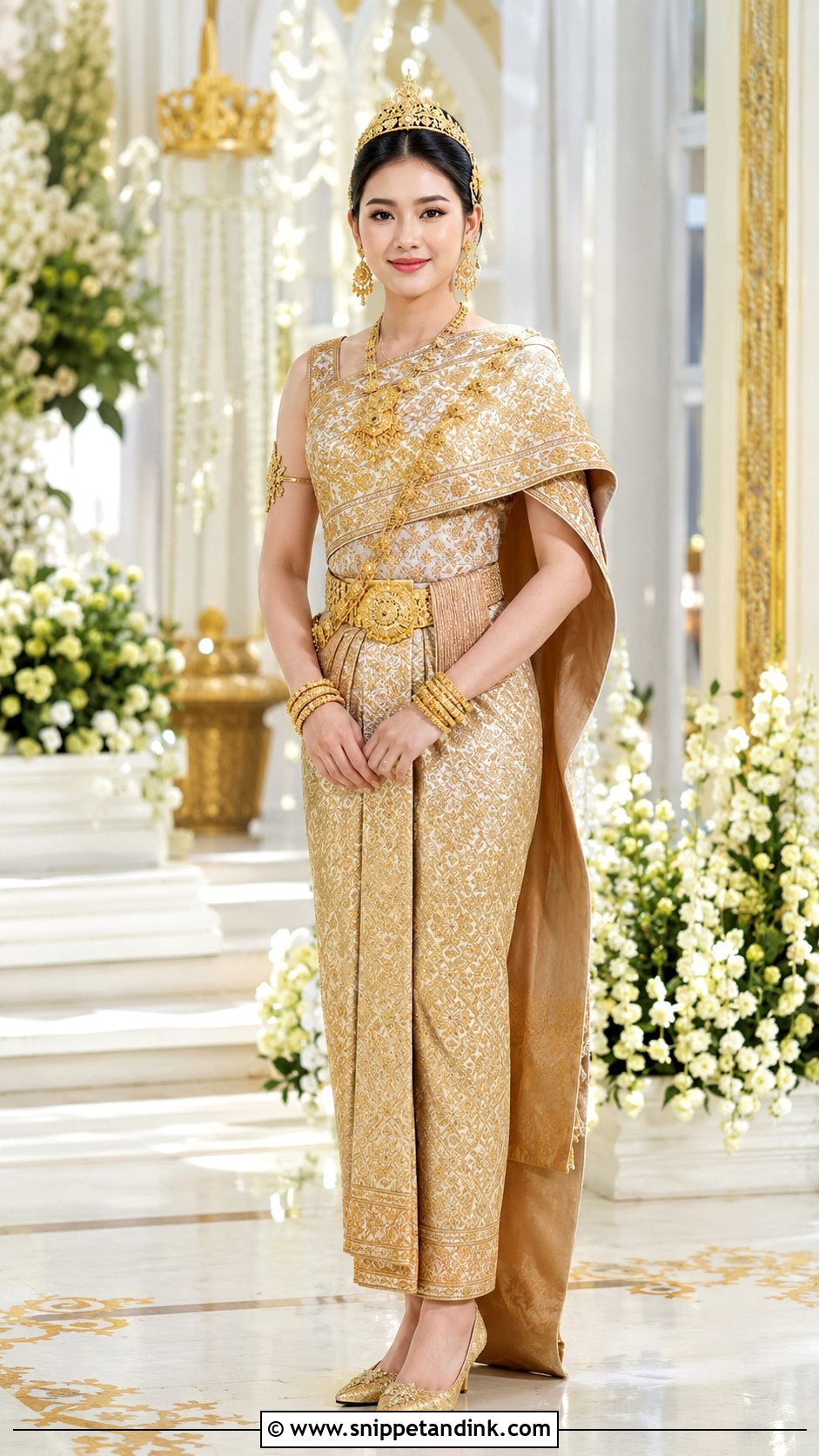
The sampot charobab is defined by gold embroidery, which is why it turns up at major ceremonies and in newlywed dress. Style it with a structured silk top that frames, rather than covers, the richest part of the skirt. Pin the sbai so its border falls cleanly over the shoulder, then add a wide belt, formal earrings, bracelets and a layered necklace. Metallic thread is heavy and slightly stiff, so I warn brides that it will feel warmer than plain silk and will not drape as softly. Symmetry helps with an outfit this elaborate: matched earrings, matched ornaments either side of the bun, and no handbag during ceremonial photos.
15. Khmer Sampot Hol Wedding Outfit
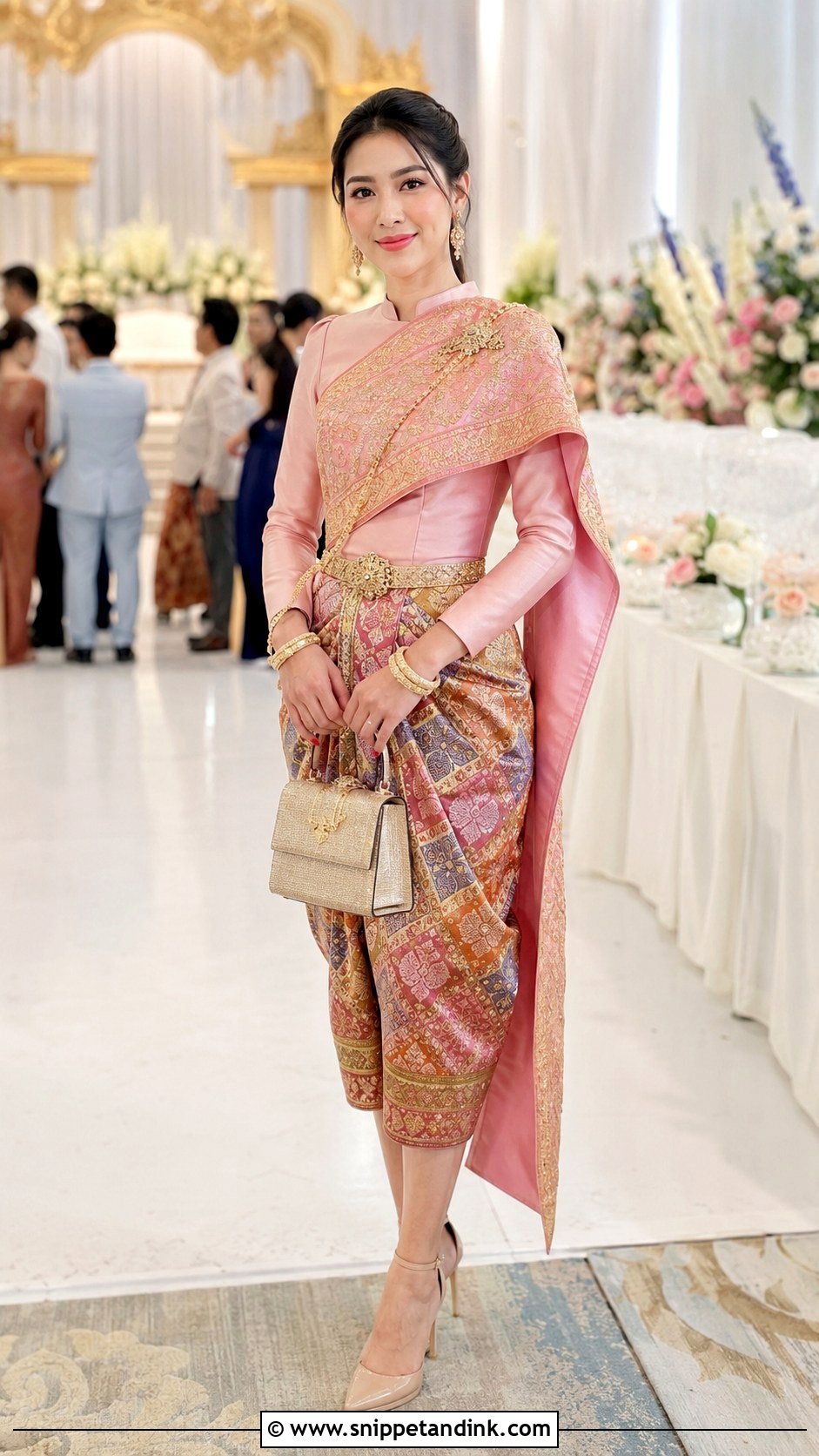
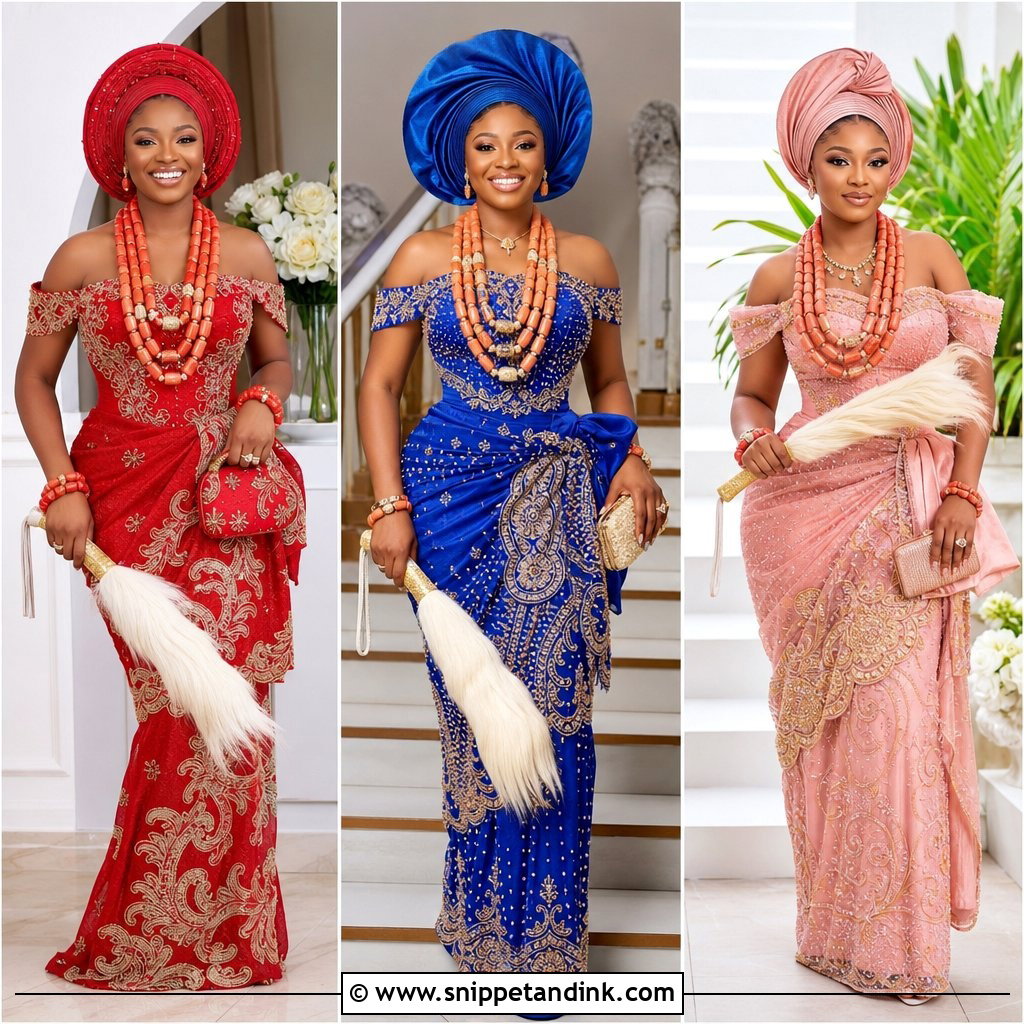
Sampot hol is made with an ikat technique, where the threads are tie-dyed before weaving, so the pattern has that slightly blurred, multicolored edge. It suits guests, bridesmaids, mothers and ceremonial changes. My approach is to pull the top color from the quietest shade in the textile, which keeps the outfit from looking busy. Add a coordinating drape, a narrow metallic belt and a few bracelets; gold or champagne shoes go with several colors at once. If the hol has a strong central motif, ask the tailor to place it deliberately, because an off-center pattern is the first thing people notice.
16. Khmer Sbai And Sampot Wedding Outfit
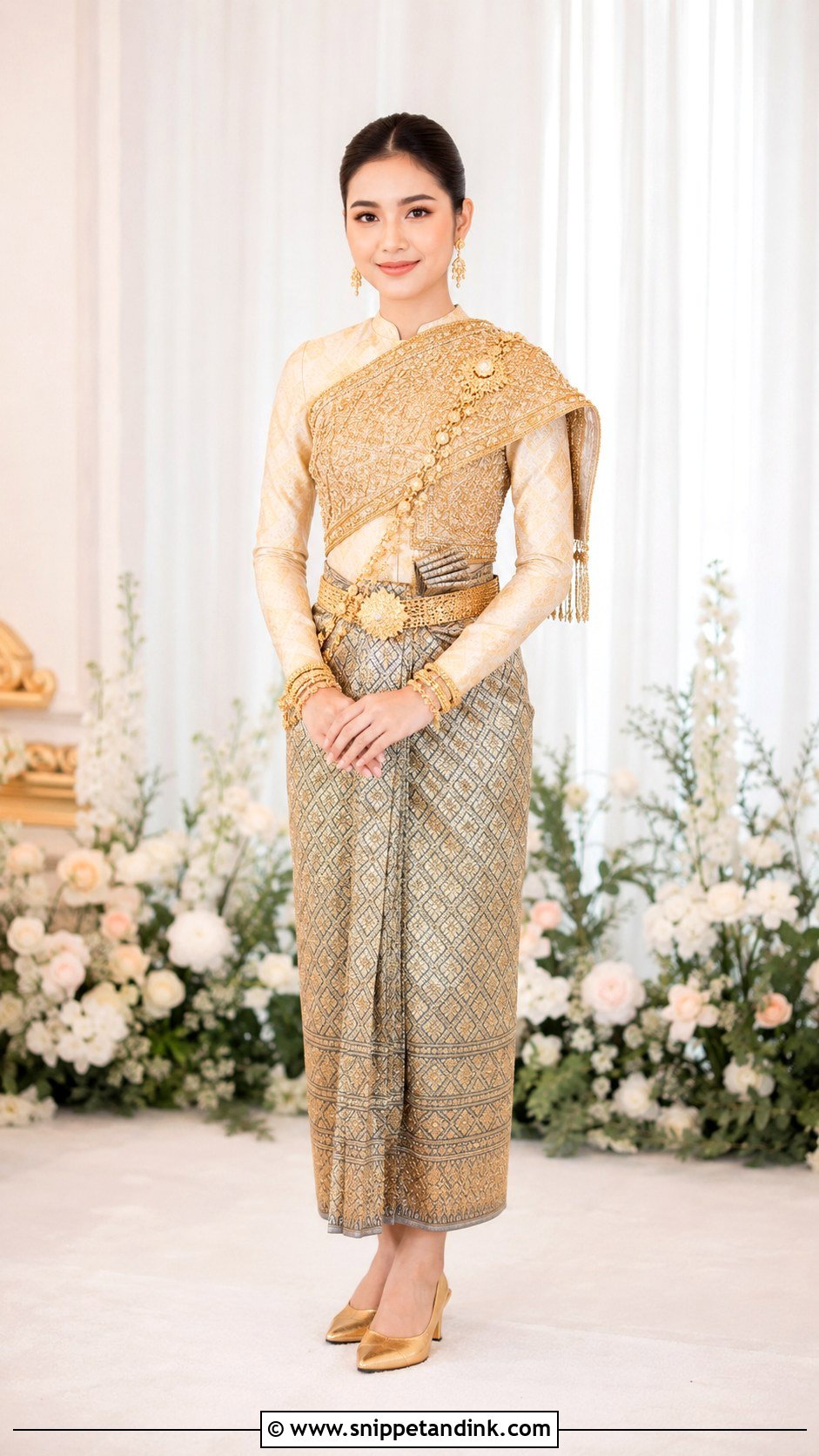
The diagonal sbai over a coordinated sampot is the silhouette most people recognize as Khmer ceremonial dress. The sbai crosses the body over one shoulder while the sampot gives a long base underneath. Choose silks whose colors, weaves and borders agree so the set looks assembled on purpose. The top beneath should be smooth and thin enough that the drape does not bunch over it. Pinning is where I spend the most time: I pin the sbai at the shoulder and again at the back of the waist, then have the bride sit and stand twice before she leaves the dressing room. Rather than copying a drape from a photo, let an experienced Khmer dresser arrange it for the specific event and garment.
17. Modern Khmer Bridal Gown Outfit
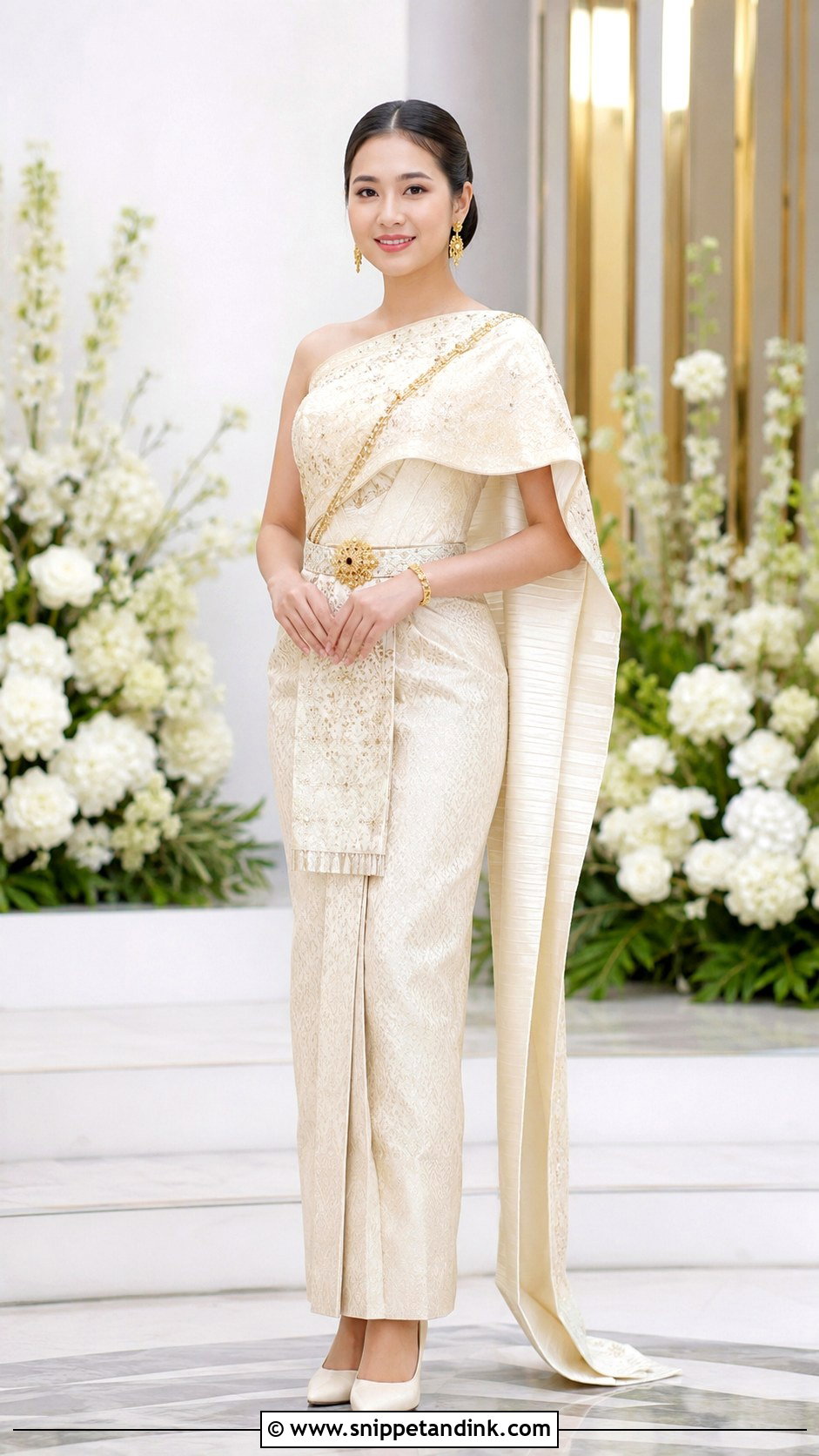
A modern Khmer bridal gown takes the shape of a full-length Western dress and works Khmer textiles into it. Start with a fitted ivory gown with a modest neckline, then bring in Khmer silk through a detachable sbai, an embroidered waist panel, a structured sash or a patterned overskirt. The detachable sbai is my usual recommendation, since it lets the bride take it off for dancing without losing the cultural element in earlier photos. Cutting woven silk to fit a gown pattern can slice through motifs, so it needs a Khmer designer or tailor who will plan the cuts around the weave rather than through it.
18. Khmer Wedding Reception Outfit
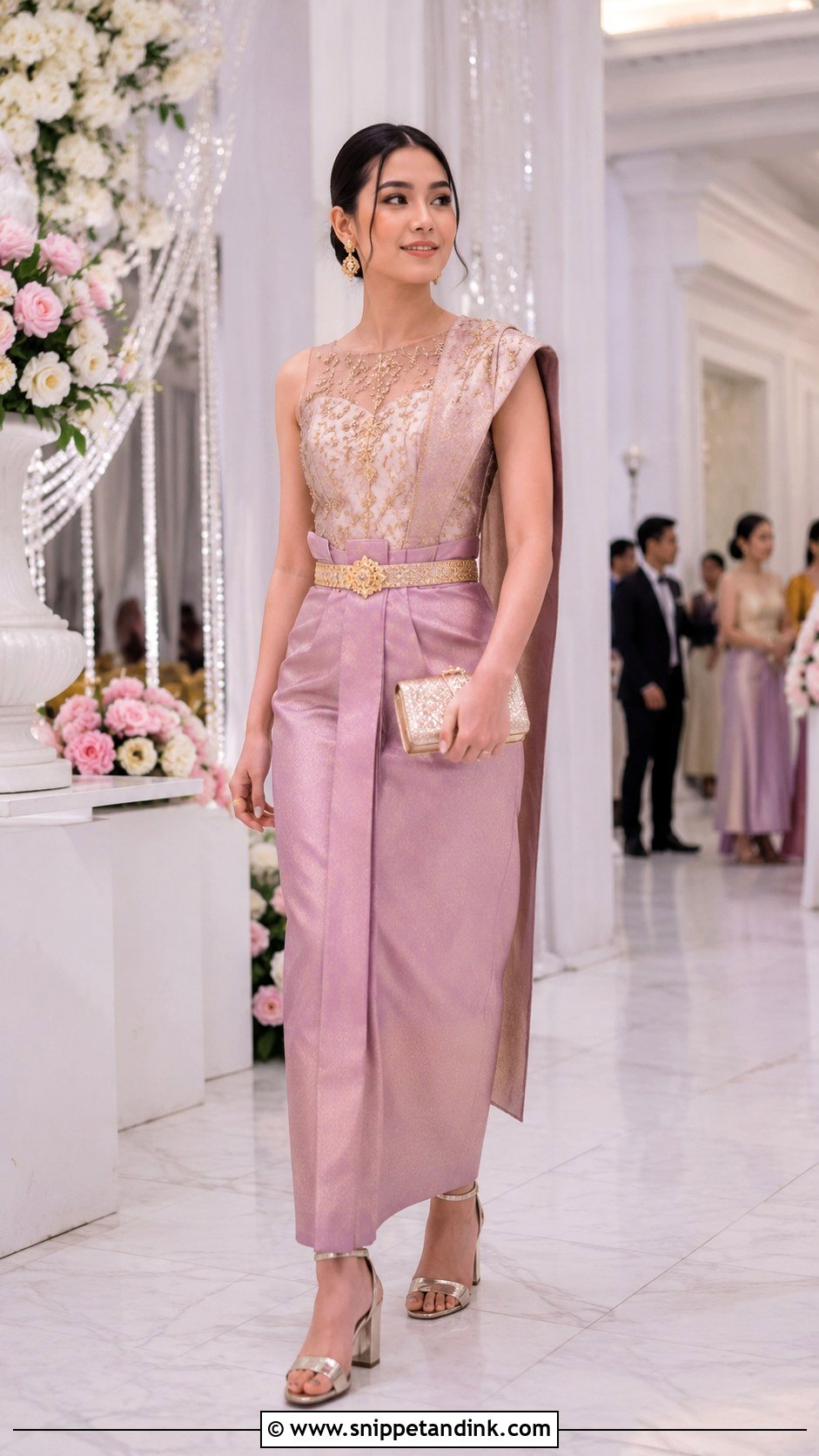
Once the formal ceremonies are over, a lighter reception outfit is a relief. A fitted silk midi or ankle-length dress in Khmer colors works, or a streamlined sampot with a modern embroidered top and a simplified drape. I keep one strong piece, usually the belt or a bold necklace, and take the rest of the heavy jewelry off, which also gives the bride’s neck and ears a break. Block heels or secure sandals make dancing realistic. The reception look should still connect to the earlier outfits through color or fabric so the photographs read as one wedding.
19. Khmer Bridesmaid Wedding Outfit
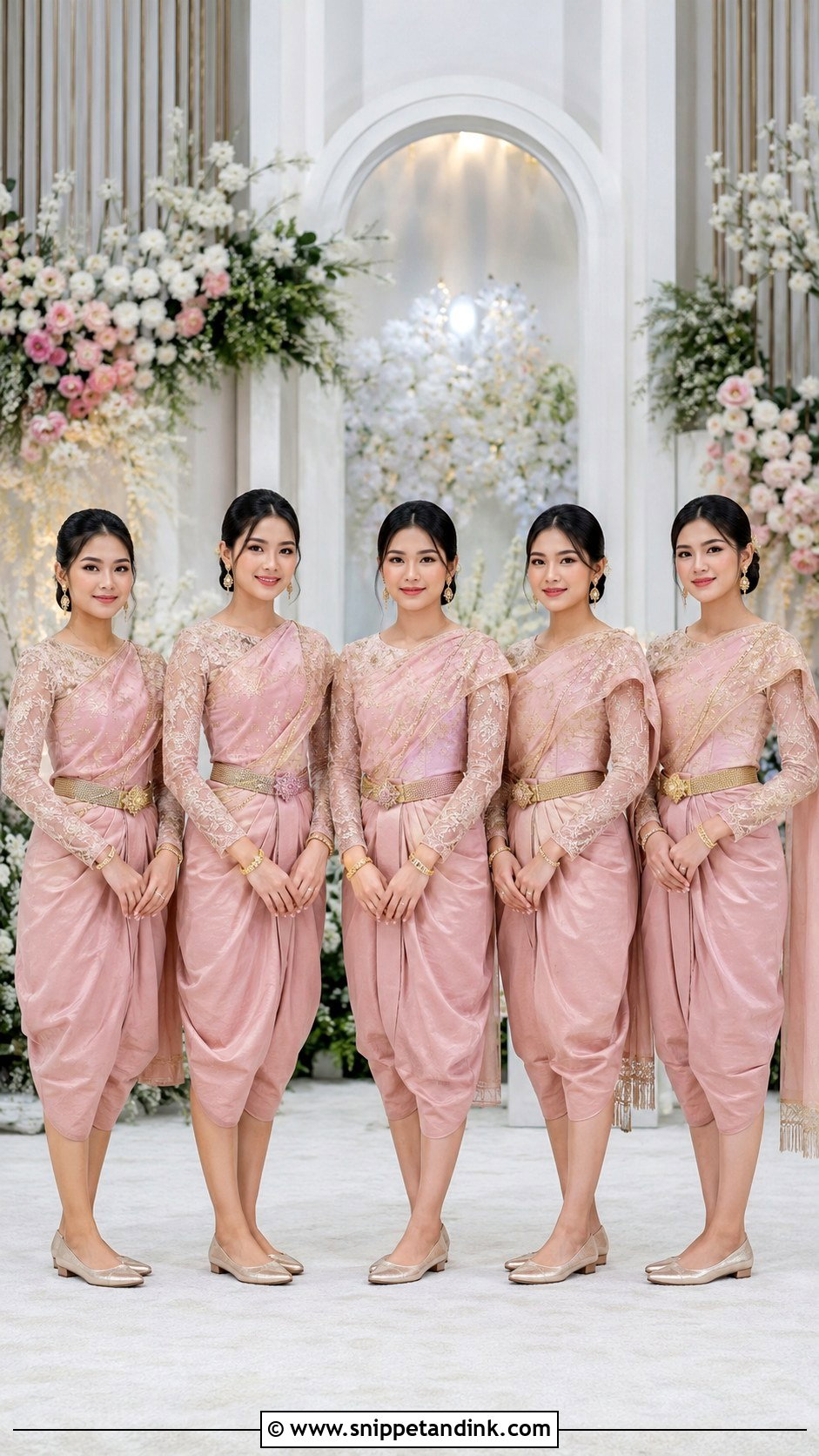
A coordinated Khmer bridesmaid outfit should sit one level below the bride in embroidery and jewelry. Put the group in silk sampots in one shared color, with fitted tops and neatly draped sbai in coordinated shades, then use slimmer belts and simpler earrings than the bride wears. Letting each bridesmaid choose her own top cut within the same color is something I encourage, because one neckline rarely flatters every body. Silk from different bolts can vary in shade, so I line every outfit up together under the venue lighting before the wedding.
20. Khmer Mother Of The Bride Wedding Outfit
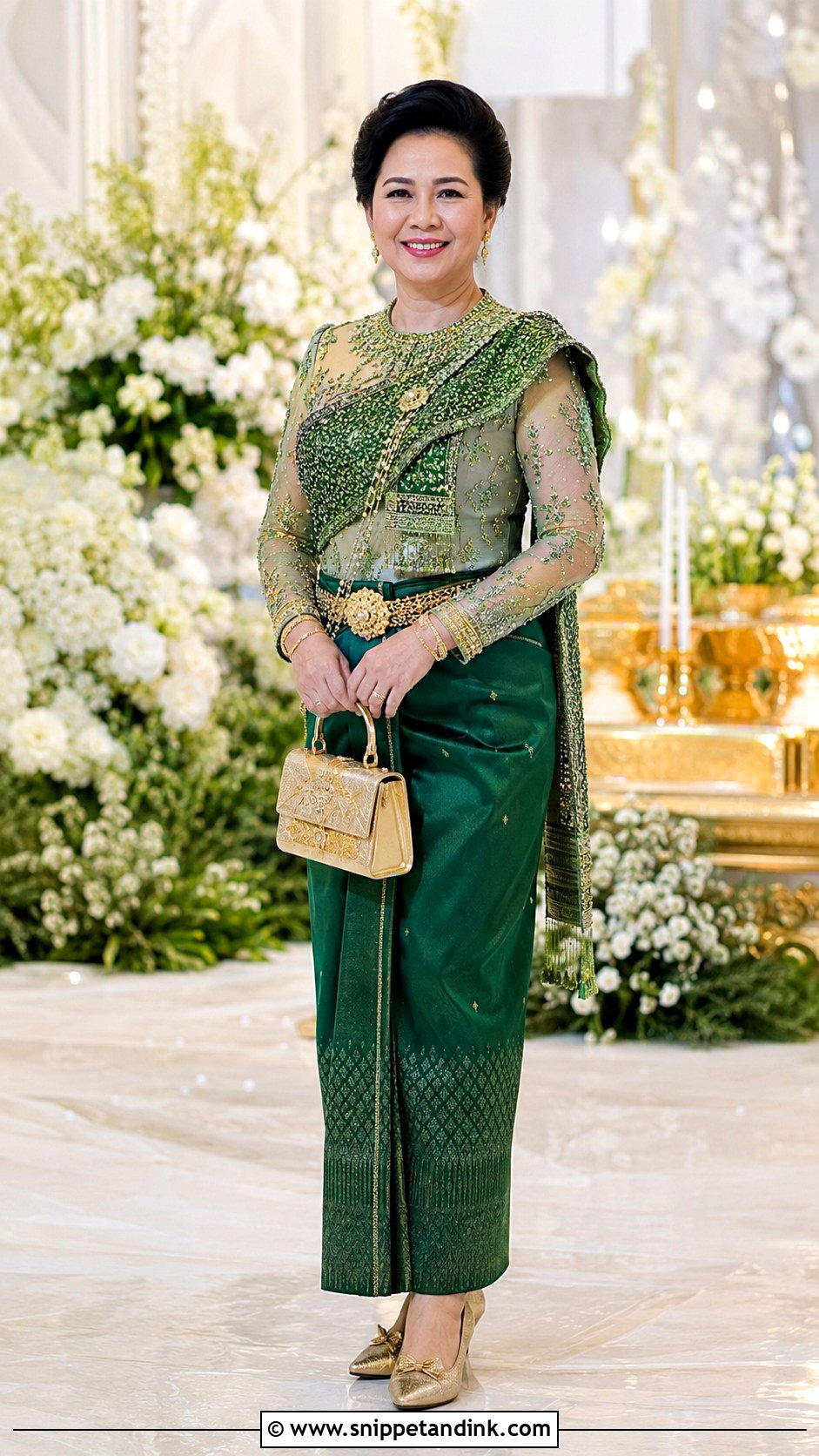
The mother of the bride needs an outfit that is formal and dignified without competing with her daughter. A rich sampot in emerald, plum, navy, maroon or soft gold works well with a structured top that has sleeves and controlled embroidery at the neckline and cuffs. Add a coordinated sbai for ceremonial moments and a decorative belt. She will greet relatives for hours, so I steer mothers toward lighter jewelry, a breathable lining and low heels. Check the color against the bride’s main outfits so the two stay distinct in family portraits.
How Silk Sampots Survive Heat, Kneeling and the Ride Home
Silk is strong but it marks easily. The two problems I deal with most often on wedding days are sweat at the waist and underarms, and creasing across the lap after long seated rituals.
During the ceremonies
Thin cotton dress shields in the top protect the embroidery from sweat, which can leave rings on silk that never fully lift. Between ceremonies, have the bride stand rather than sit while she waits; a sampot wrinkles fastest when it is folded under body heat. Keep drinks with color, like iced tea or red sauces, well away from anyone in light silk.
Afterwards
Hang or lay each piece flat to air out overnight before it goes anywhere near a bag. Metallic embroidery should not be pressed directly with an iron; a professional cleaner who handles silk and beaded work is safer than home washing. For long storage, fold the silk loosely around acid-free tissue, refold it along different lines every few months so the creases do not set permanently, and keep it away from damp and direct light. Return rented pieces as the shop asks, and note any marks when you hand them back.
Silk, Pins and Family Approval Before the First Blessing
Good Khmer wedding clothing balances respect for custom, the skill of the weaver and the simple fact that someone has to wear it all day. The ideas above cover brides, bridesmaids, reception changes, guests and close family, and they all rely on the same building blocks of sampot, sbai, embroidered top, belt, jewelry and footwear. Color matters just as much, from red and gold to pink, champagne and ivory. Because many pieces are tied to particular ceremonies and family traditions, talk to the couple or an experienced Khmer dresser before you finalize anything, then let careful tailoring and secure pinning do the rest.
You'll Like These Ideas:






Leave a Reply