
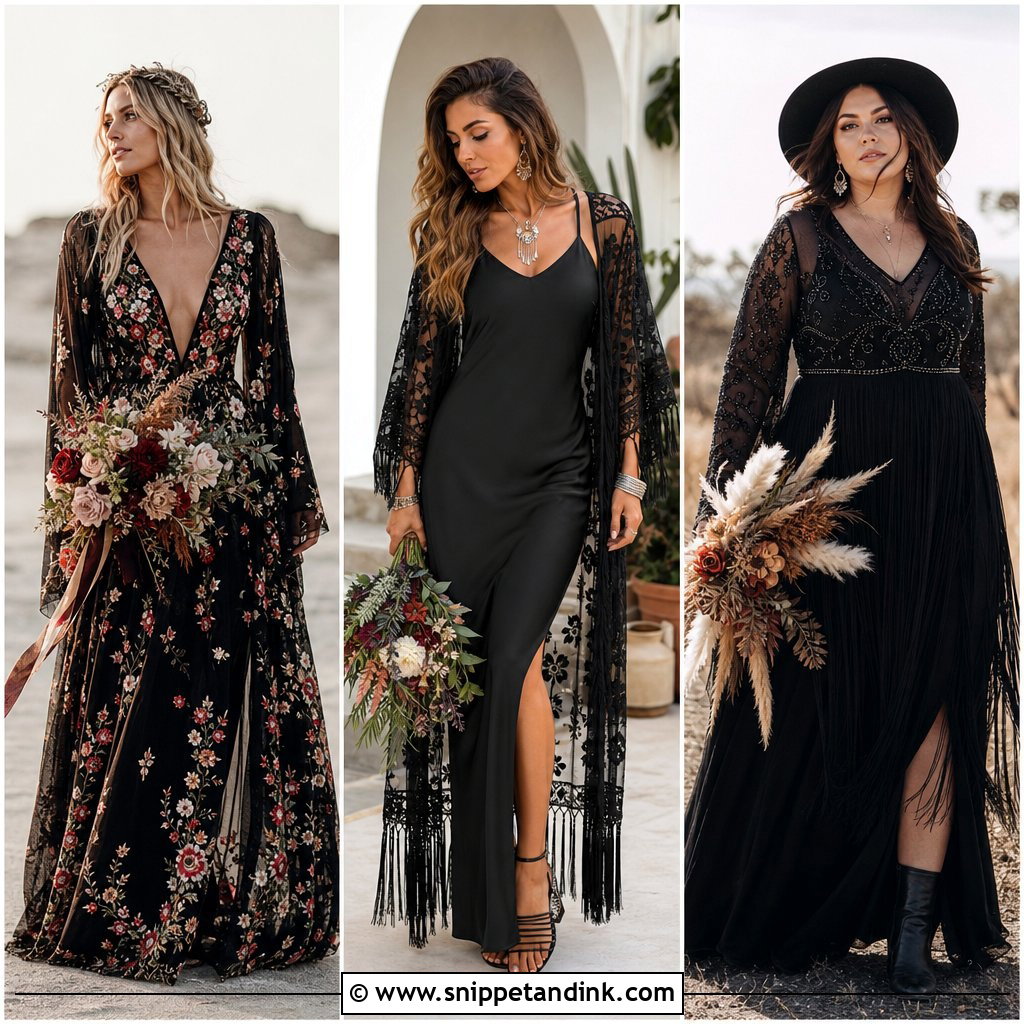
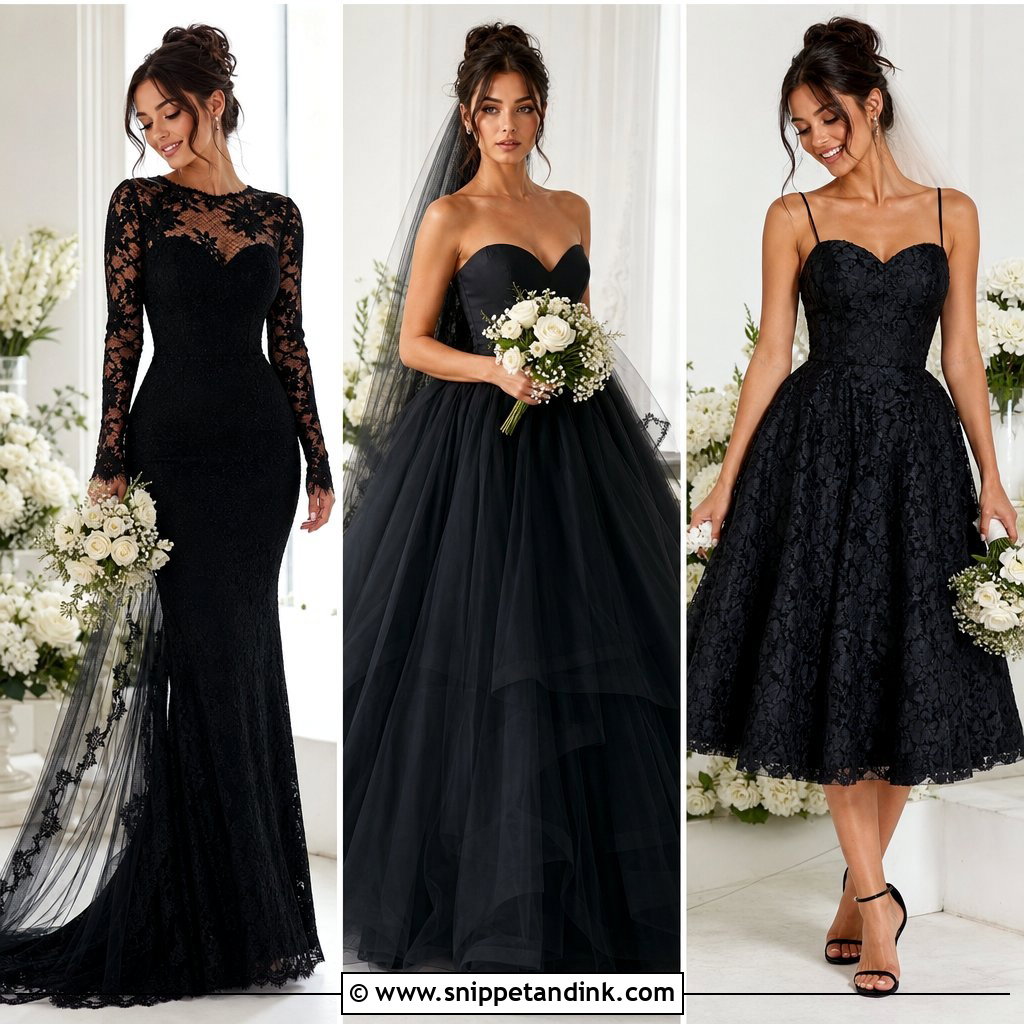
Black and white is the most graphic thing you can wear down an aisle, and the hardest part is deciding how much black. A white gown with black detailing still reads as a classic bride with a twist; a mostly black gown with white accents reads as a statement before anything else. In my fittings the conversation always comes back to placement, because the eye goes straight to wherever the black sits: the waist, the hem, the shoulders. Below are twenty ways to wear the pairing, from romantic lace to bare minimalism, with the shoes, veil and flowers I’d put with each, and the fitting point that makes or breaks it.
Black Dye Next to White Fabric
This is the conversation most brides don’t know to have. Any time a dark dye sits against white fabric, there’s a chance it transfers when it gets wet. Rain, a spilled drink, a sweaty hand at the waist or the steam iron can all move a little black into the ivory around it.
When I’m helping a bride choose, I ask the shop how the black parts are dyed and whether the gown has been colour-tested. Lace and embroidery thread are usually more stable than black velvet ribbon or cheaper trims. If you’re adding black details to a white dress after purchase, test a scrap of the trim on white fabric with a damp cloth first.
- Keep the gown away from steam directly on the black sections.
- Blot spills straight away with a dry white cloth, never rub.
- Use a cleaner that has handled two-tone gowns before, and point out every black area when you drop it off.
- Black velvet attracts lint and pet hair, so pack a lint roller.
1. Black And White Lace Wedding Dress
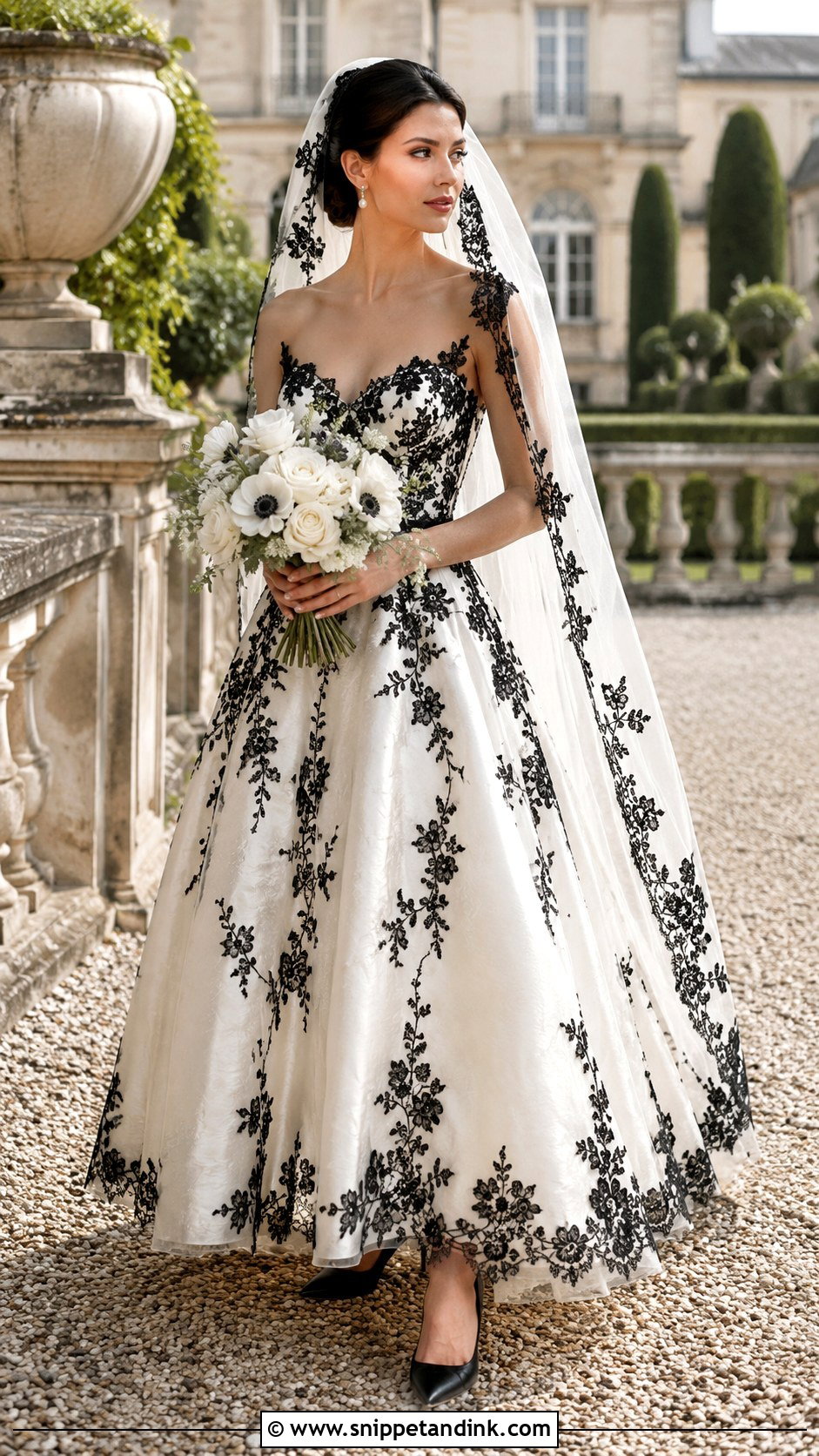
Black floral lace over ivory is the gentlest way into the palette. The lace usually sits along the bodice, waist and hem, and a fitted lining underneath is essential; without it, black lace on a sheer base looks muddy rather than crisp. Black pointed heels, pearl drops and a white veil edged in a thin line of black lace tie it together. I’d carry white roses and anemones, whose dark centres pick up the lace without adding another colour. A low bun with a few loose face-framing pieces keeps the hair quiet so the lace stays the focus.
2. Black And White Ball Gown Wedding Dress
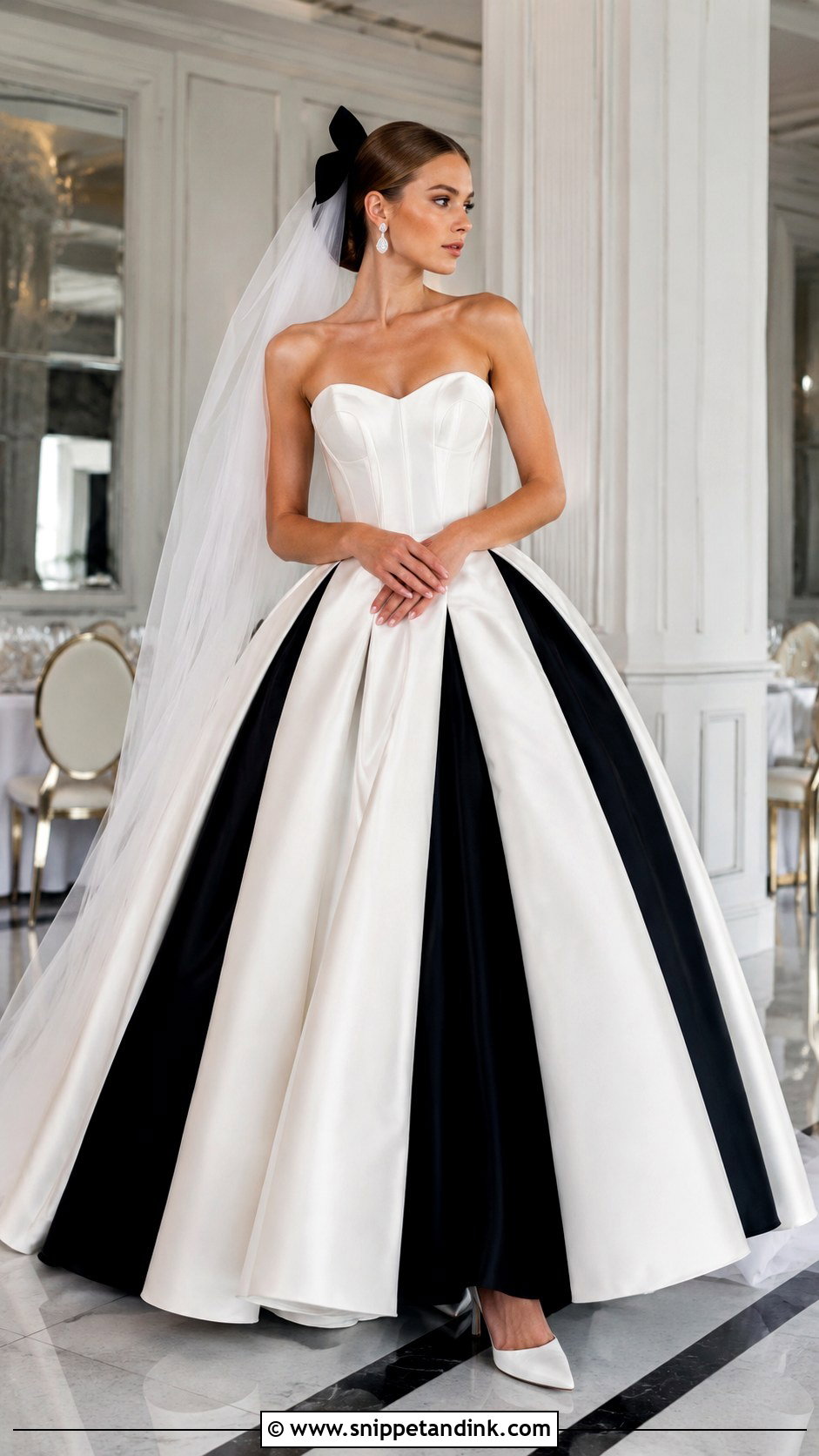
Wide black panels or a black hem on a white satin ball gown turn colour blocking into architecture. The waist has to be sharply defined here, or the blocks of colour take over the body. Scale the panels to your height: narrower bands for petite brides, broader ones for tall brides who can carry the drama. White satin pumps, a black velvet bow in the hair, crystal earrings, a long white veil and a tight bouquet of white callas keep the palette to two. It belongs in a ballroom or museum hall with plenty of floor.
3. White Wedding Dress With Black Bow
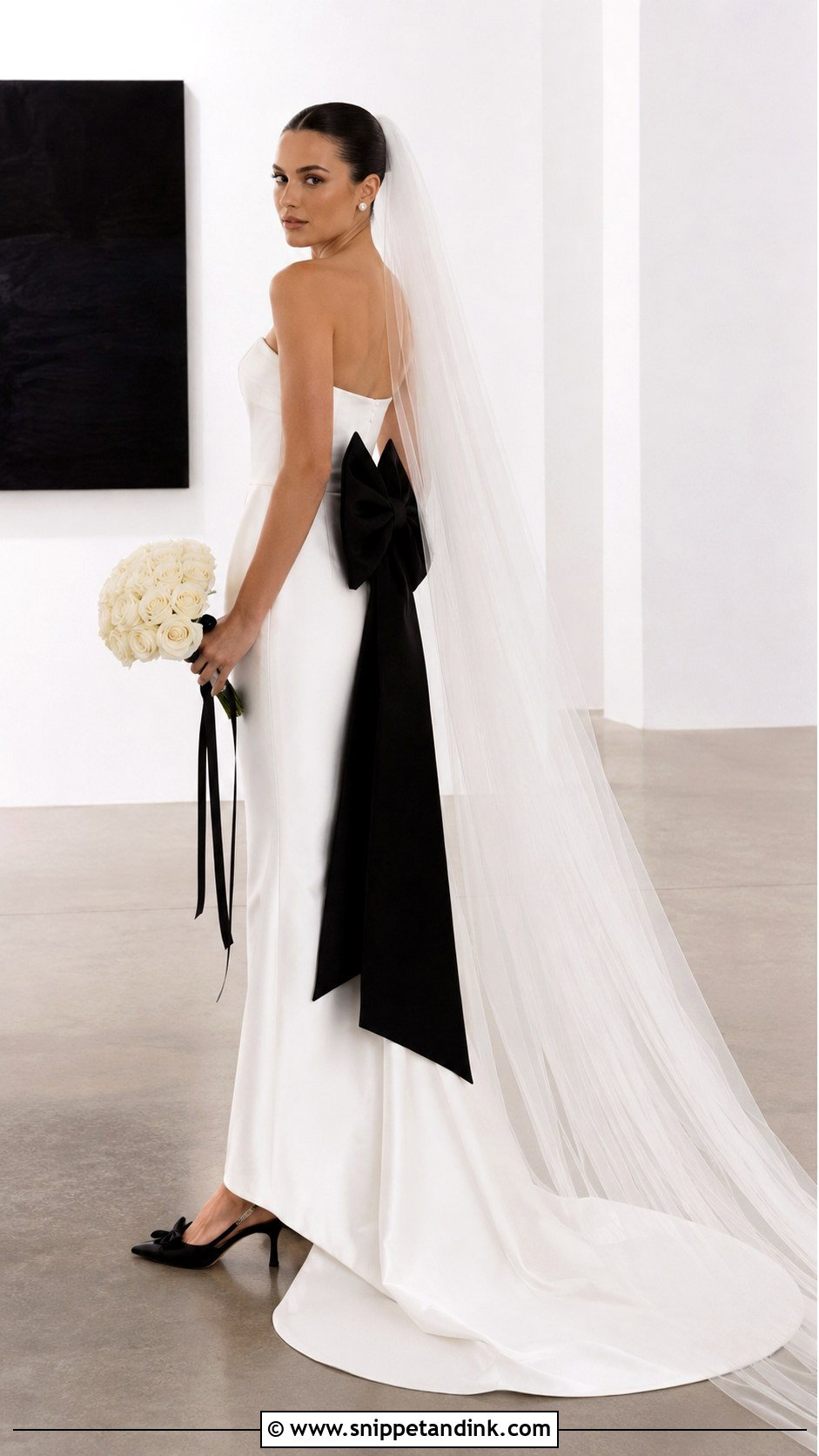
One black bow on a plain white satin dress is the most restrained version of this palette, and often the most effective. Decide where it sits before anything else. At the back it makes the exit the moment; at the shoulder it frames your face in close portraits. Strapless or square-neck satin with a gently flared skirt keeps the line clean. Black slingbacks, small diamond studs, a cathedral veil falling behind the bow and white roses wrapped in black ribbon repeat the detail. Beyond that, add nothing. A necklace or gloves on top of a big bow crowds the whole look.
4. Black Wedding Dress With White Lace
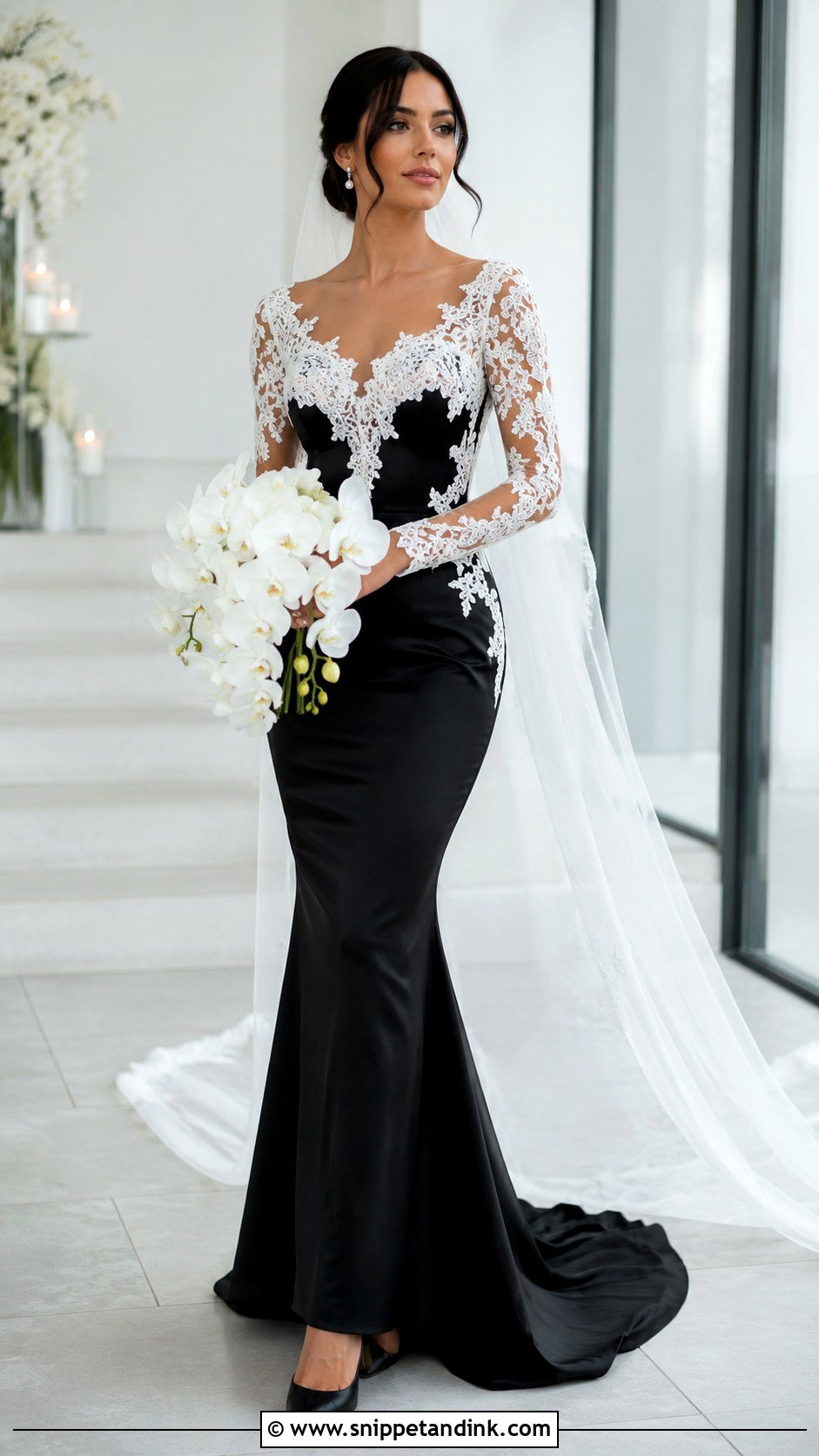
What if you want black to lead and still look like a bride? A black crepe or satin gown with white lace sleeves, a white lace neckline or appliqués across the bodice does exactly that. The lace placement matters, since white near the face keeps your skin bright in photos where an all-black top can drain it. Black heels, pearl earrings and a sheer white veil scattered with lace motifs carry the white through. A fitted silhouette feels modern; a fuller skirt is more dramatic. Keep the makeup neutral with a defined eye, and carry white orchids or roses for contrast.
5. Black And White Mermaid Wedding Dress
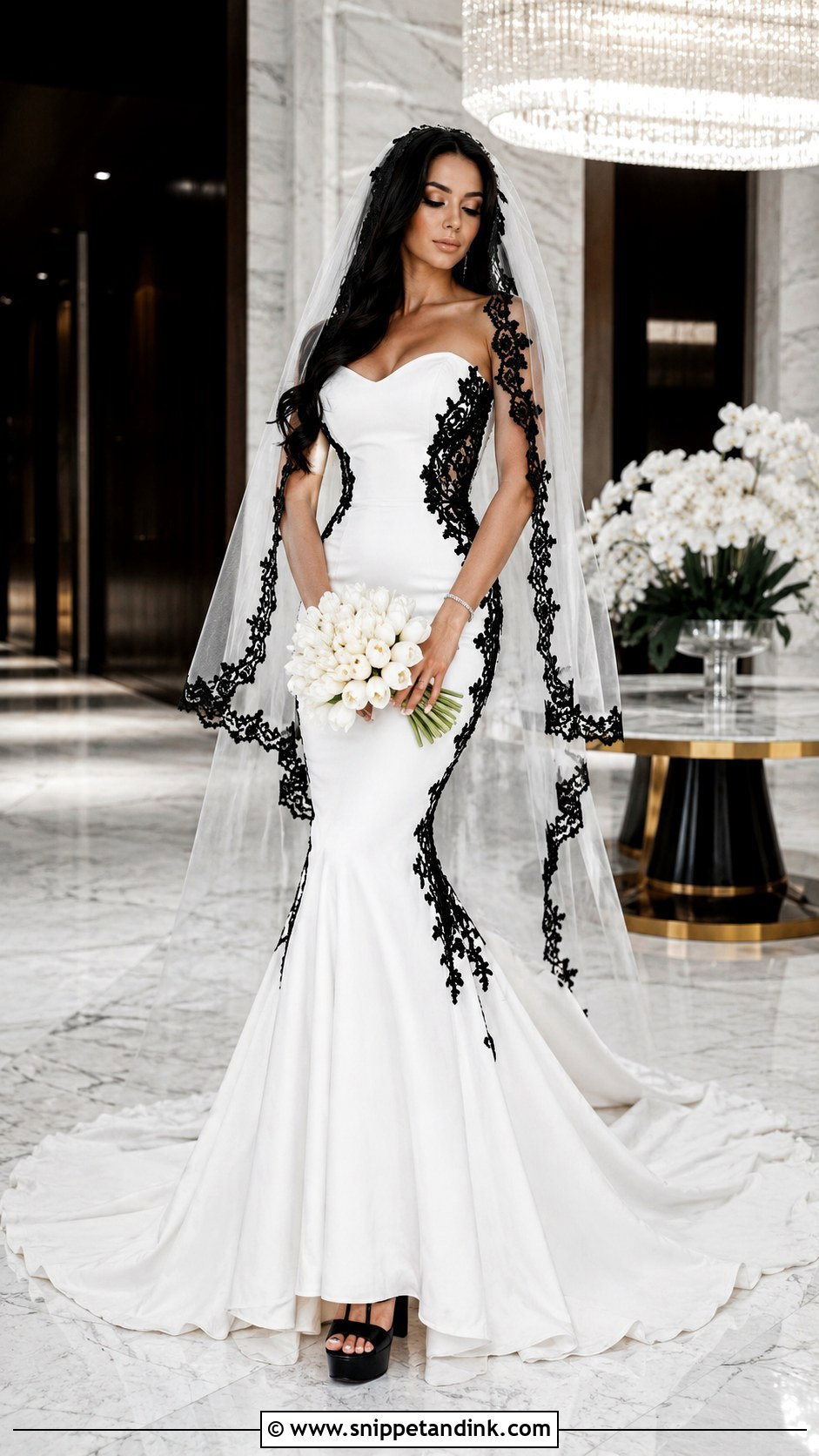
Black lace panels on the sides of a white mermaid gown act like contouring; they shade the outline and sharpen the curve of the waist and hips. Placement takes care. Panels set even a little too far forward can widen the look rather than narrow it, so I always view this one from three-quarter angles. The white flared train keeps it bridal. Black platforms, a fine tennis bracelet, a fingertip veil with a narrow black border and white tulips suit an evening reception. Schedule the last alteration close to the date, as mermaid bodices are unforgiving of small weight changes.
6. Black And White A-Line Wedding Dress
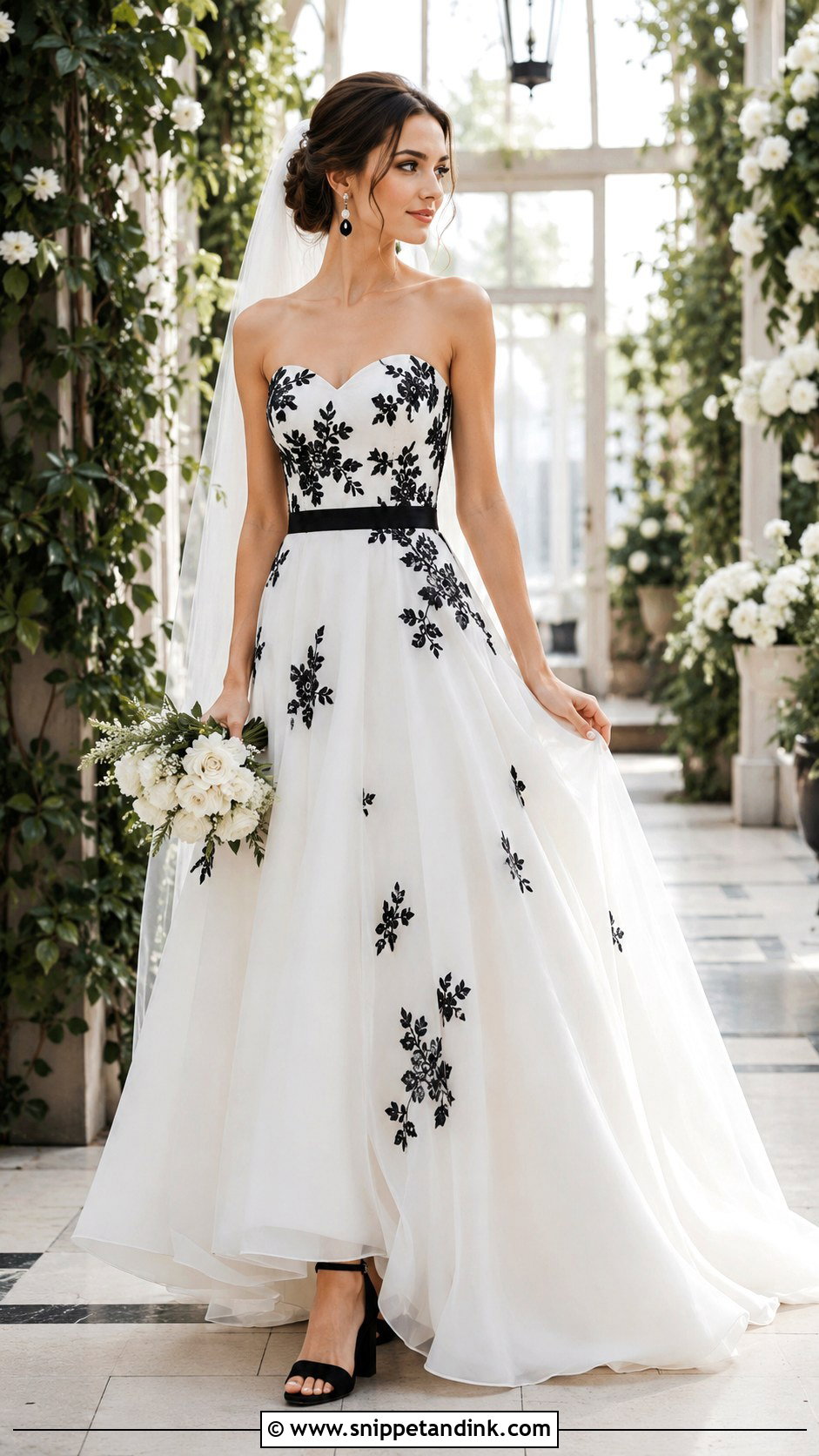
If you’ll be dancing for hours, the A-line is the honest choice. A white chiffon or mikado gown with a black waistband and black floral appliqués gives definition at the waist and room everywhere else. You set the contrast level: a narrow belt for a whisper of black, or appliqués trailing across the bodice and down one side for more. Black block heels, pearl-and-onyx earrings, a light veil and a loose bunch of white flowers with eucalyptus work across gardens, hotels and destination venues alike.
7. Black And White Strapless Wedding Dress
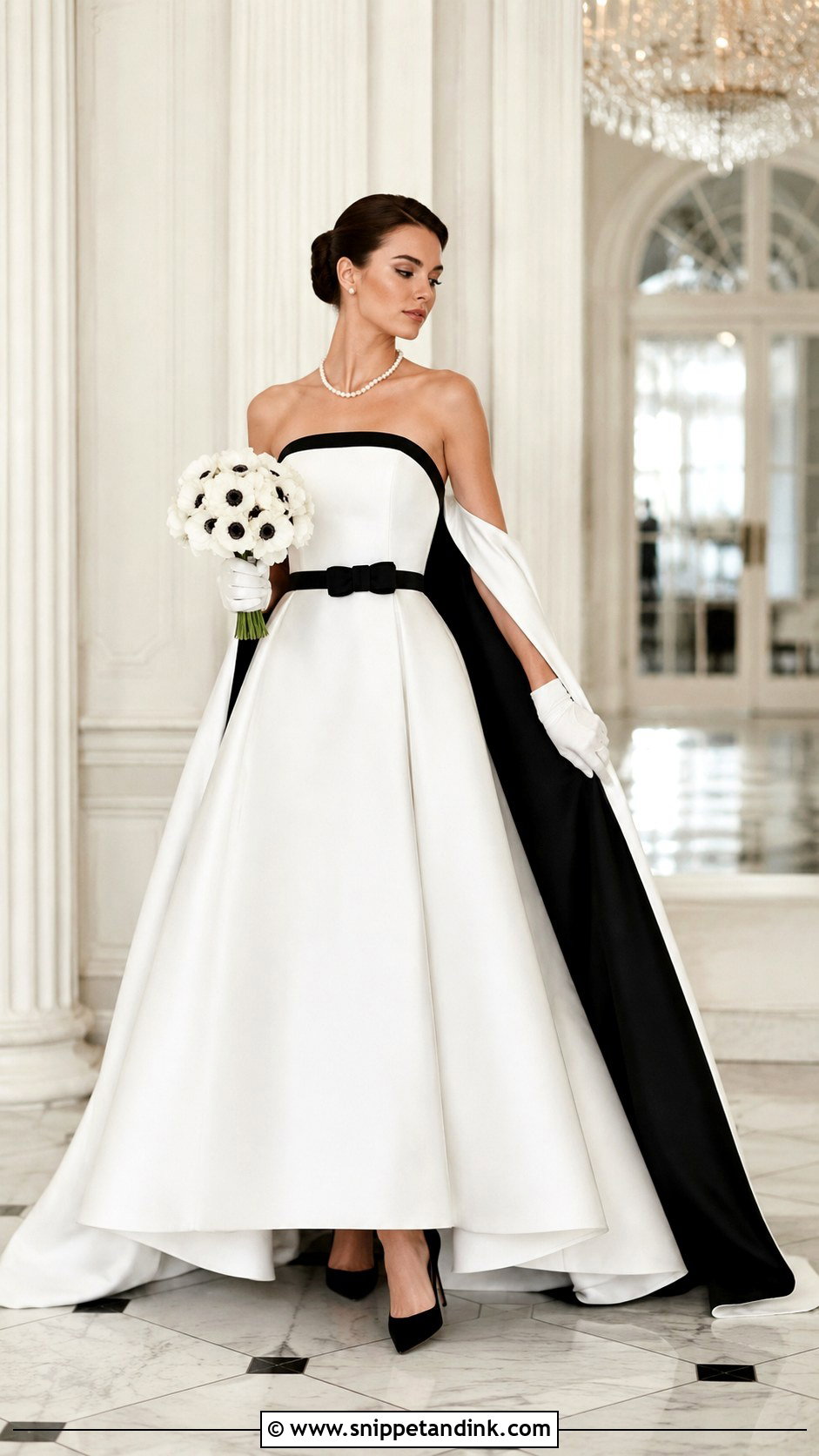
Strapless gowns rely on fabric with some backbone, and a white duchess satin gown has plenty. A black folded band at the neckline or waist looks deliberate against that weight. Inside, ask about boning, built-in cups and how the bodice is anchored, because a strapless top that slips even slightly will show a line of skin above the black band. Black pointed pumps, a short pearl necklace, white opera gloves and a simple updo suit it. For a cold day, a tailored white cape lined in black keeps the neckline visible where a shawl would bury it.
8. Black And White Long Sleeve Wedding Dress
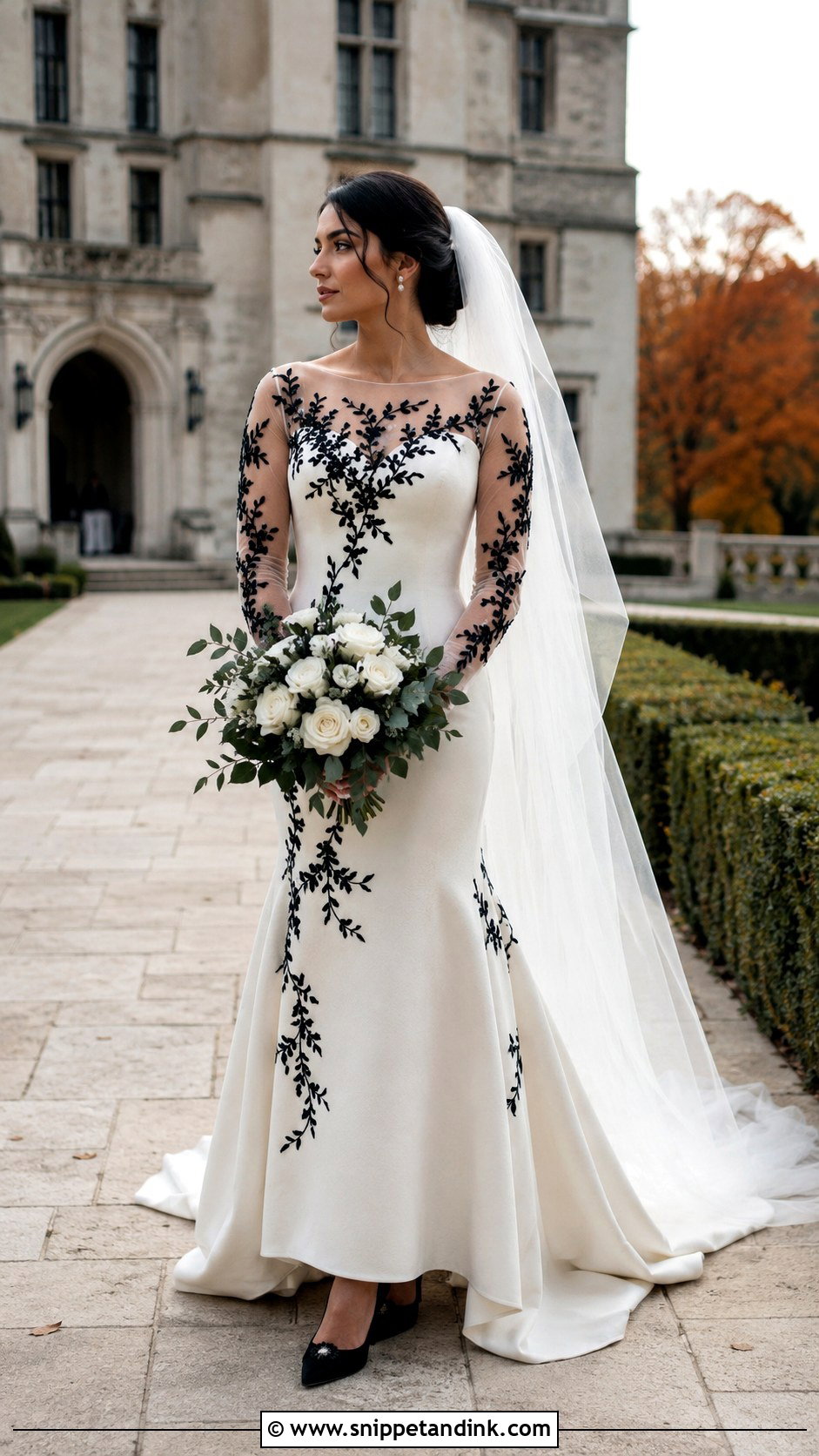
Sheer sleeves embroidered with black vines keep the coverage of long sleeves without heaviness. On an ivory fit-and-flare, I like a little of the embroidery to continue across the waist so the sleeves don’t look borrowed from another dress. Softer still: widely spaced motifs on clear tulle. Bolder: dense lace cuffs or black buttons running from wrist to elbow. Before the final fitting, check the cuff length with your arms bent; embroidered sleeves ride up and that is where the eye goes. Black closed-toe heels, pearl studs, a smooth veil and a low chignon finish it.
9. Black And White Off-The-Shoulder Wedding Dress
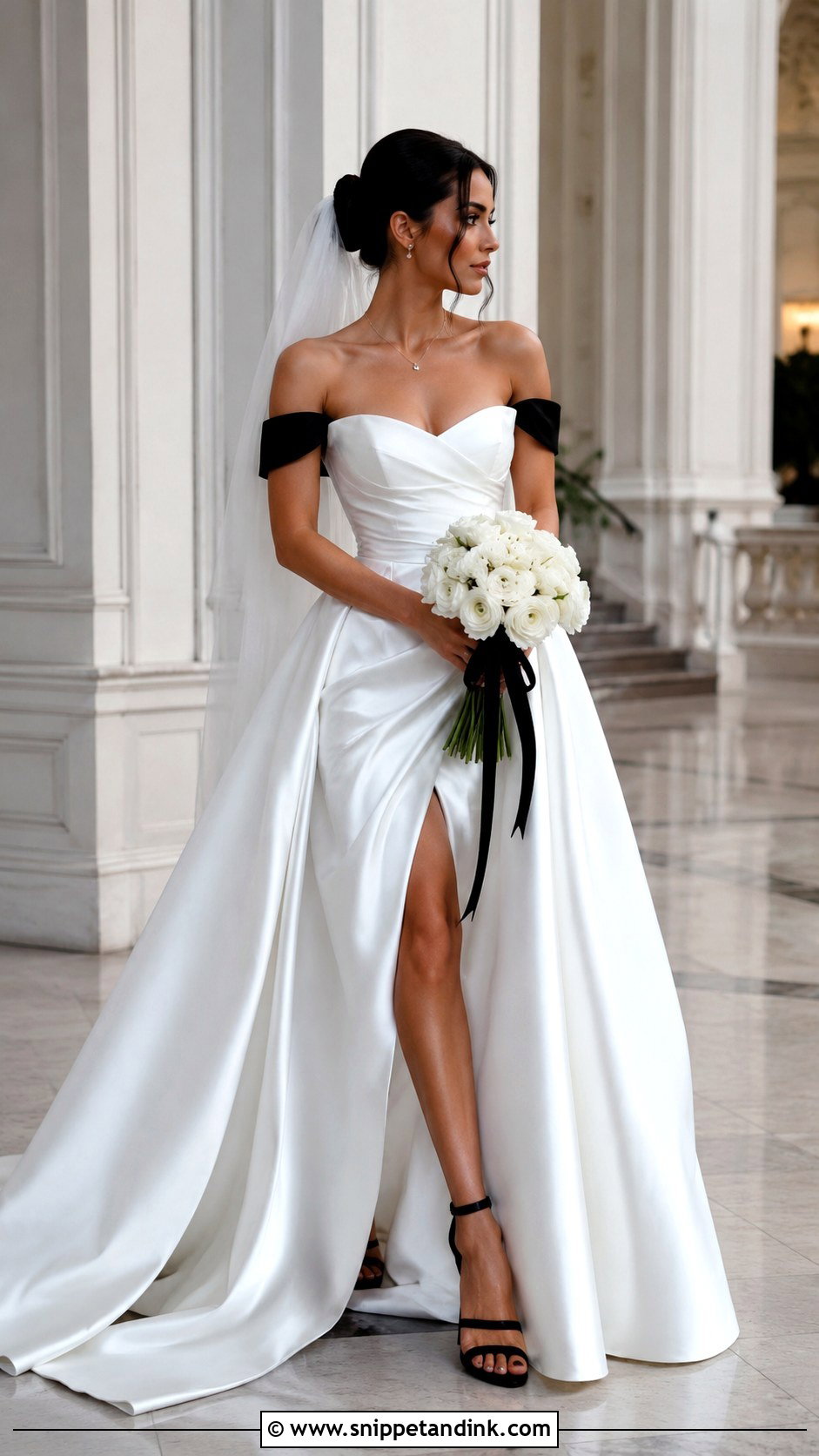
Black folded cuffs around the shoulders draw a dark frame across the collarbone, and against white satin it’s very flattering on the face. The trade-off is movement. Off-the-shoulder cuffs are held by elastic or boning, and if either is too tight you can’t raise your arms. Test that before you buy, not at the last fitting. A full or column skirt both work. Pair it with black ankle-strap heels, a fine pendant, a veil pinned under a sleek bun and white ranunculus with black ribbon at the stems.
10. Black And White Floral Wedding Dress
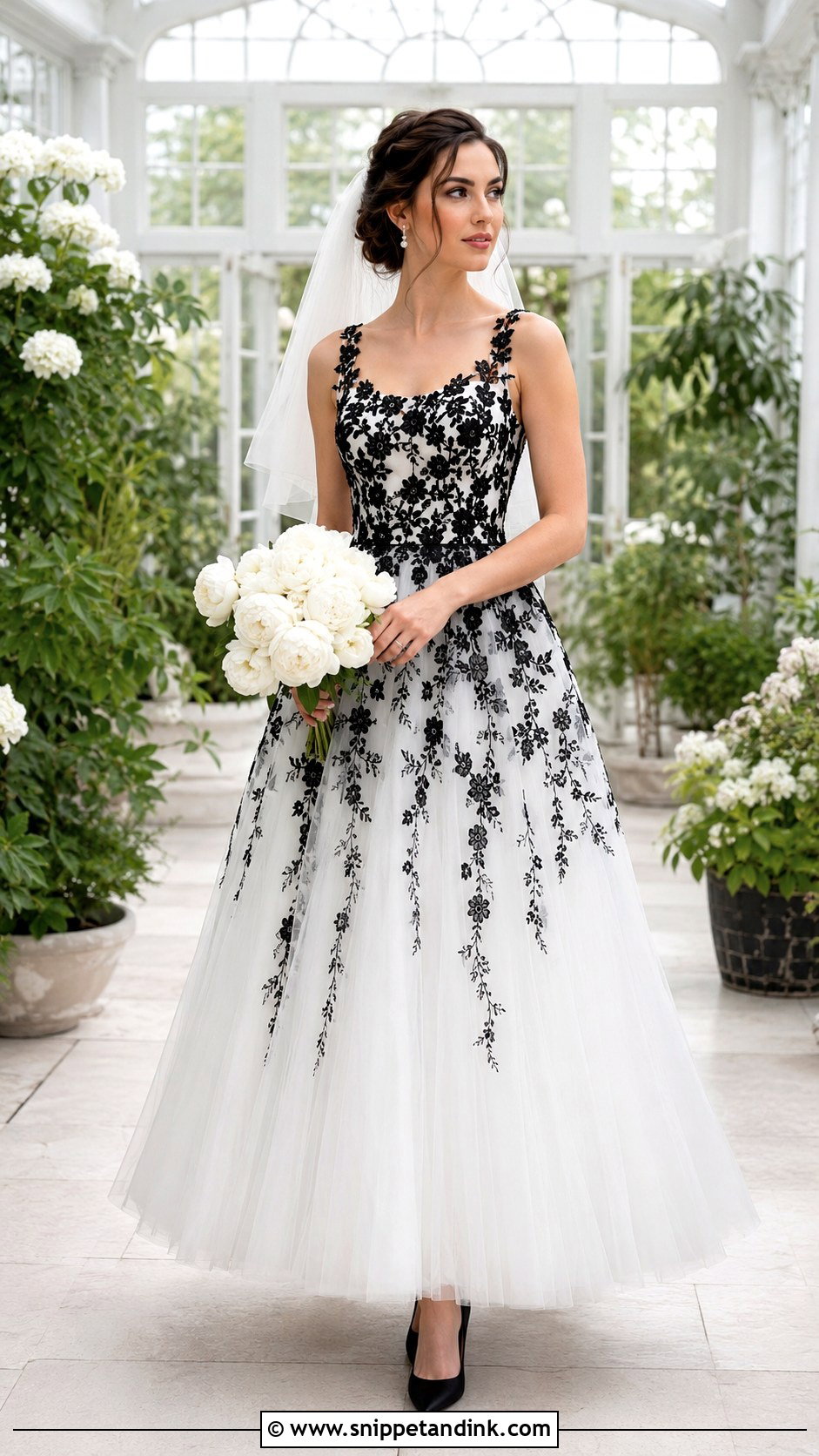
Black embroidered flowers that start dense on the bodice and fade toward the hem of a white tulle skirt give movement without blocks of colour. Flower size sets the mood: large blooms for strong contrast, small scattered ones if you want people to notice them only up close. The embroidery is already pattern and texture, so I keep everything else plain. Black satin pumps, small pearls, a plain white veil and white peonies with greenery suit a spring garden or conservatory.
11. Black And White Vintage Wedding Dress
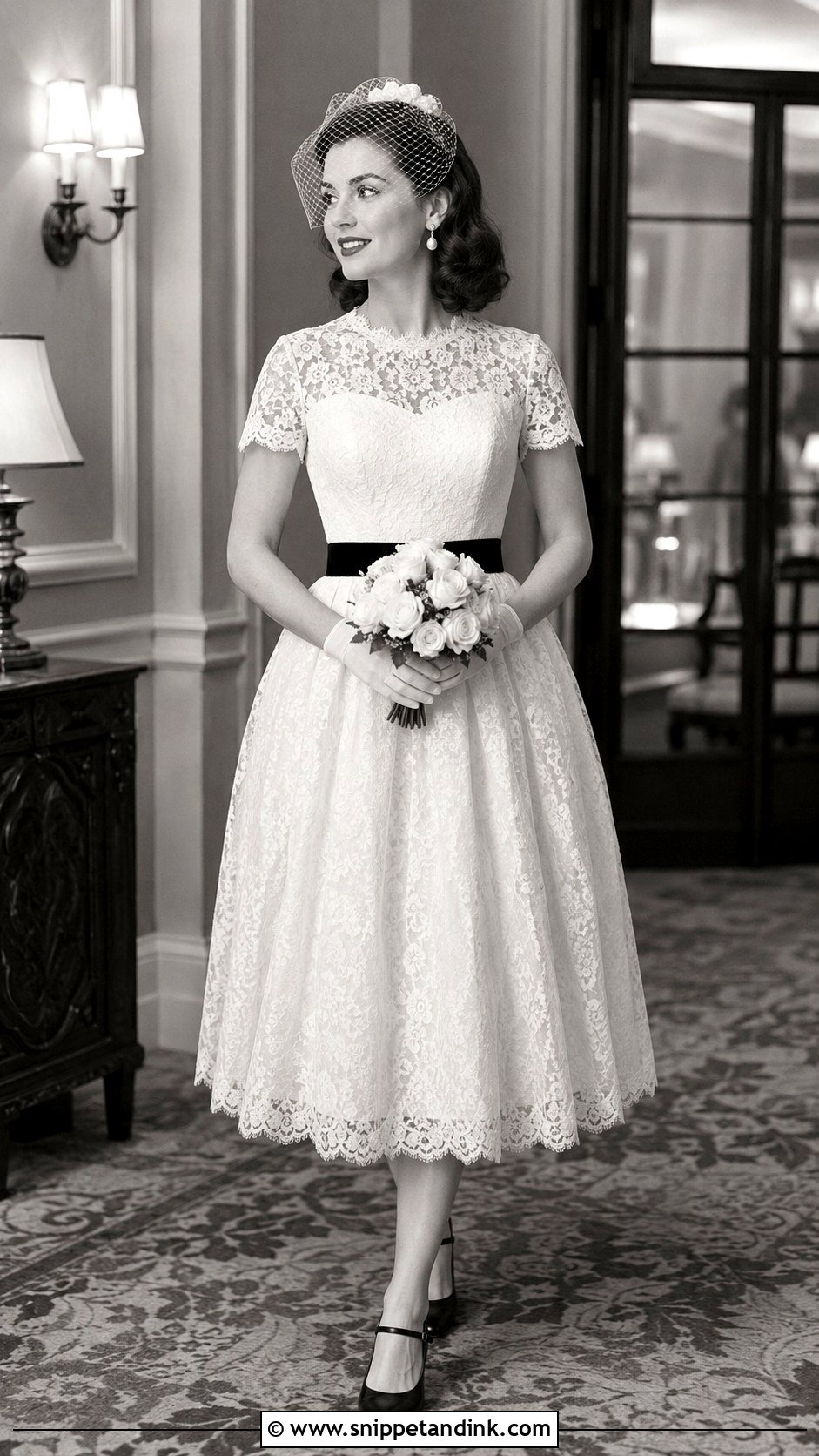
Vintage done well picks one decade and sticks to it. Mixing eras is what tips this look into costume. An ivory tea-length dress with a lace bodice, short sleeves and a black velvet waistband points to the fifties, so a 1950s silhouette with a full skirt, Mary Janes, pearl earrings and a birdcage veil hangs together. A thirties take would need fluid fabric and a longer hem instead. Polished waves or a smooth bun finish it. It fits a courthouse, restaurant or small daytime venue.
12. Black And White Minimalist Wedding Dress
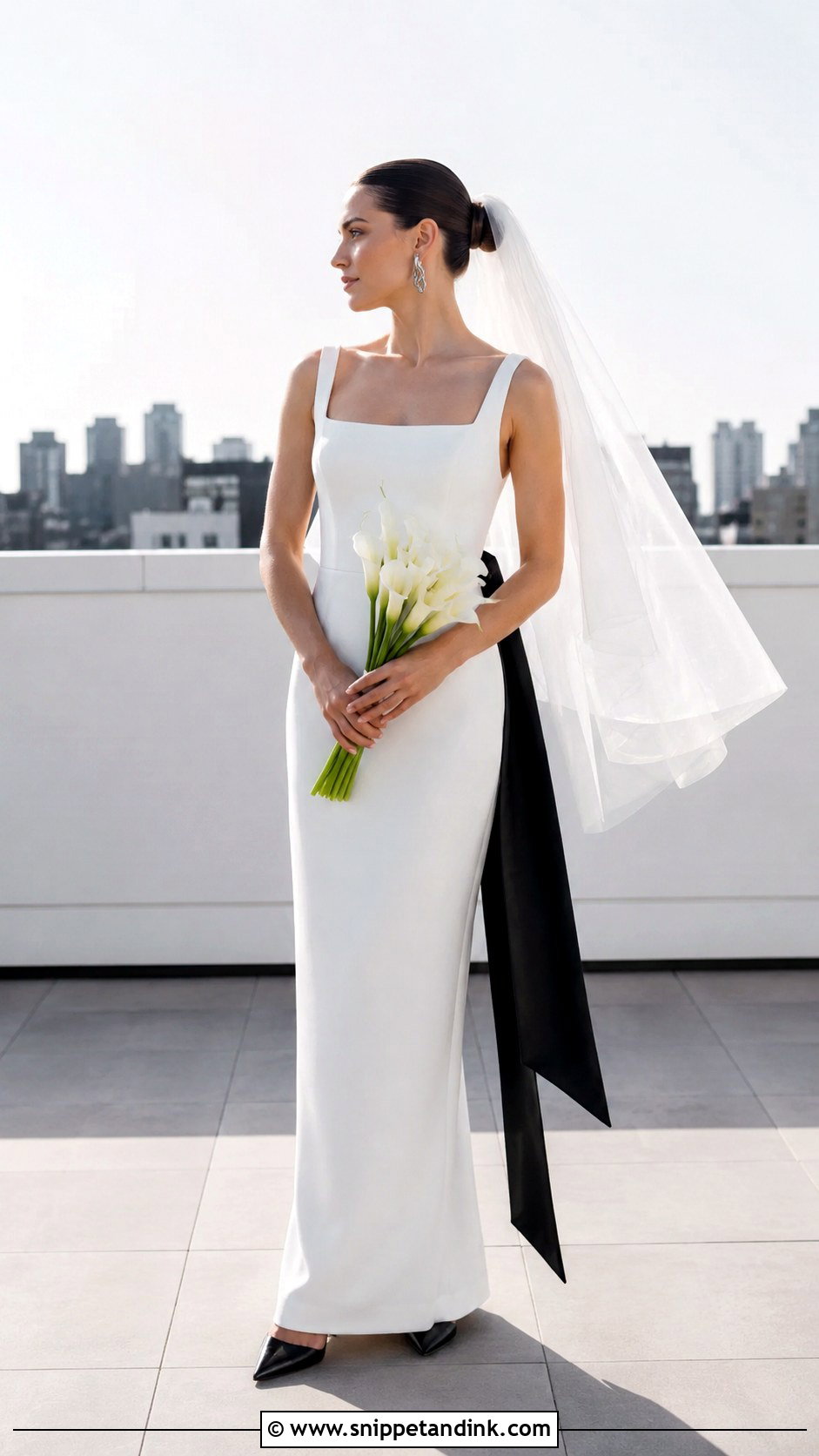
A white crepe column with one black element, a narrow waist panel, a back stripe or a long sash, is about as minimal as bridal gets. The danger is that plain crepe hides nothing. Pulling at the seams, bunching at the waist and an uneven hem all show, so professional fitting isn’t optional. Pointed black heels, sculptural silver earrings, an unembellished veil and a few white callas suit a city hotel or rooftop. A smooth low bun keeps the line clean.
13. Black And White Tulle Wedding Dress
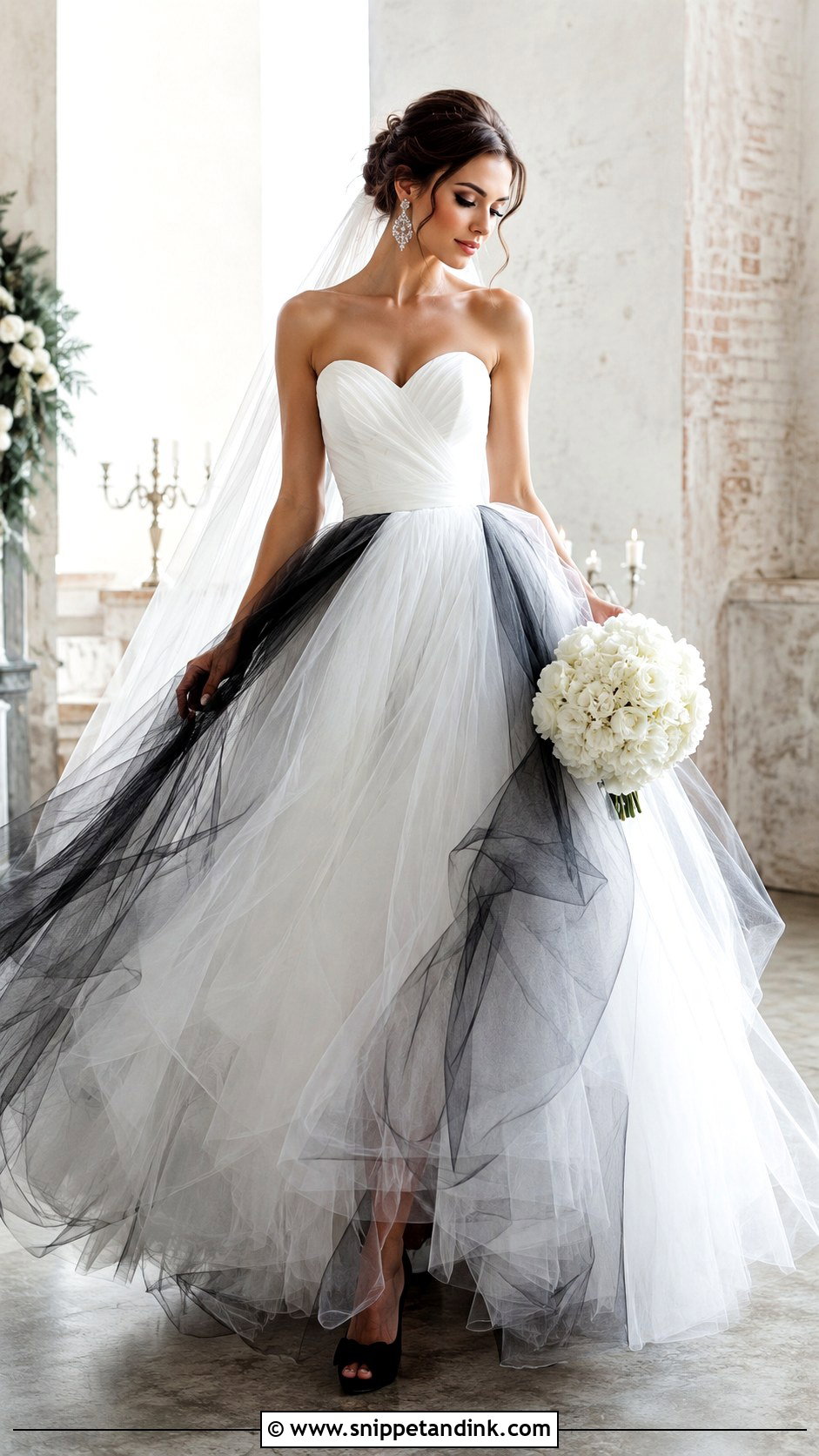
Alternating layers of white, grey-toned and sheer black tulle give a full skirt depth you can only get from net. Keep the black layers transparent; solid black tulle makes the skirt look heavy and can read as grey from a distance. For a lighter effect, put the black underneath the white. For a stronger one, take it to the outer layer or the train. Check the skirt in daylight and under indoor lighting before deciding, since layered tulle changes tone with the light. Black heels, crystal drops, a soft veil under a loose updo and white hydrangeas complete it.
14. Black And White Satin Wedding Dress
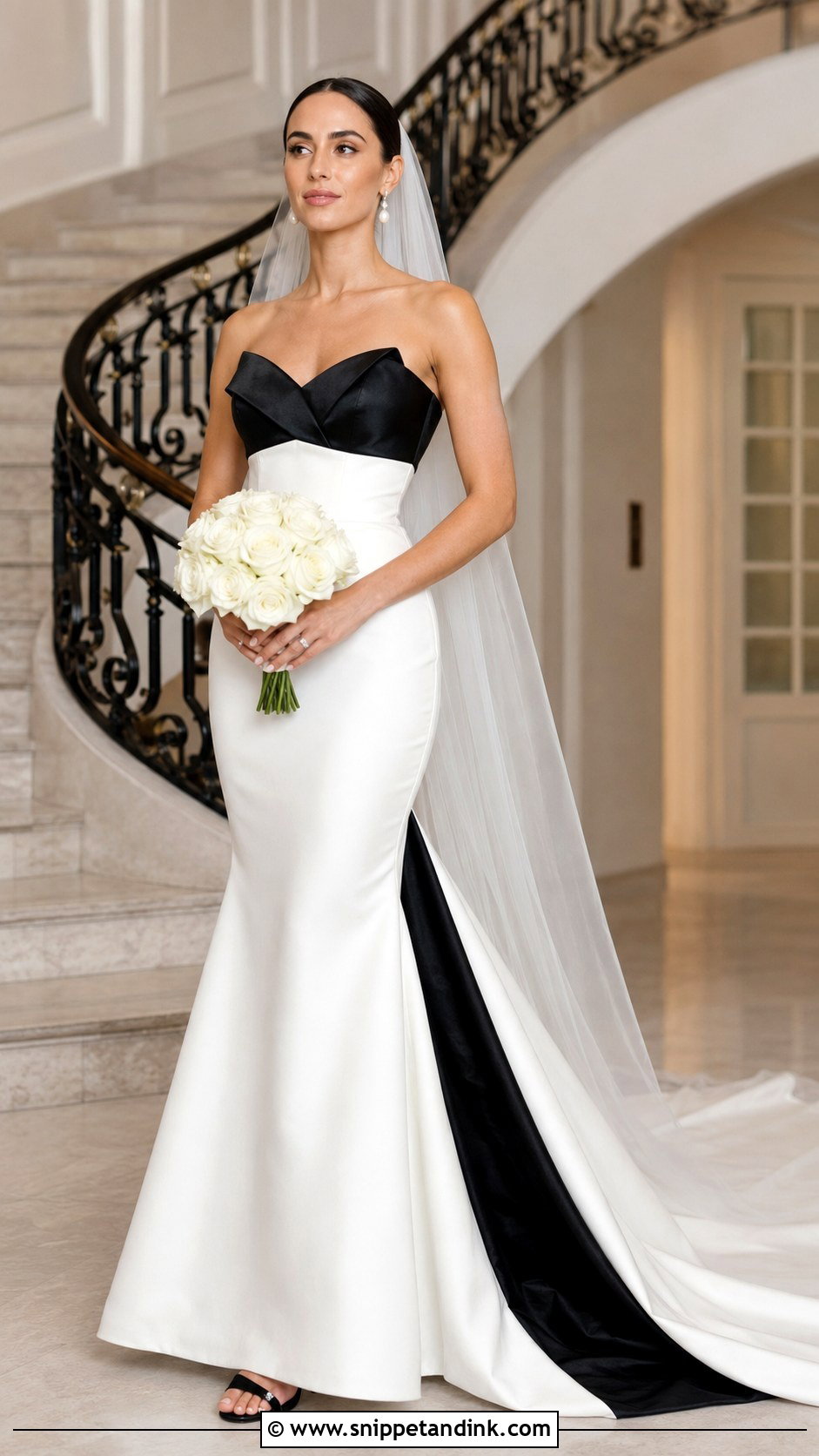
Satin gives the cleanest contrast of any fabric, because its sheen sharpens the edge where white meets black. Black lapel-style folds, a black corset panel or a wide black insert in the train all look tailored. The practical issue is that satin shows creases and water marks. I steam it as late as possible and keep a clean, dry cloth nearby while the bride dresses, never a damp one. Smooth undergarments are essential. Black slingbacks, pearl drops, a long plain veil and neat white roses suit an evening indoors.

15. Black And White High-Low Wedding Dress
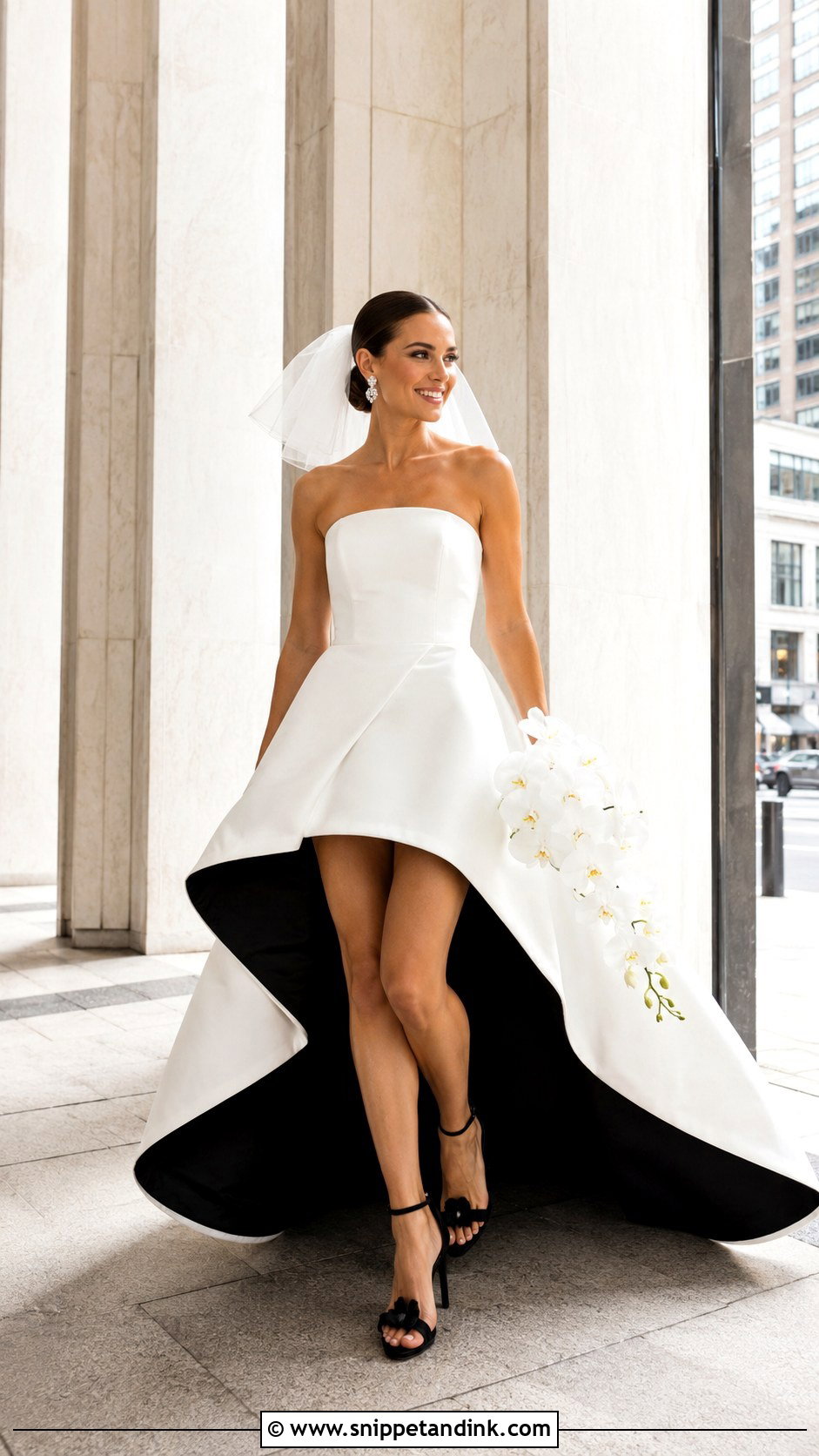
The clever part of a high-low dress is the black lining on the long back hem; you only see it when you walk, so the contrast appears in flashes. A structured white bodice and a clean front stop the shorter hem from looking casual. Your shoes are on display, so pick a pair that’s special and that you can actually stand in for hours. A short veil or a tailored hair bow, small crystal earrings and a compact orchid bouquet keep attention on the hemline. It suits city ceremonies, destinations and evening changes.
16. Black And White Tea-Length Wedding Dress
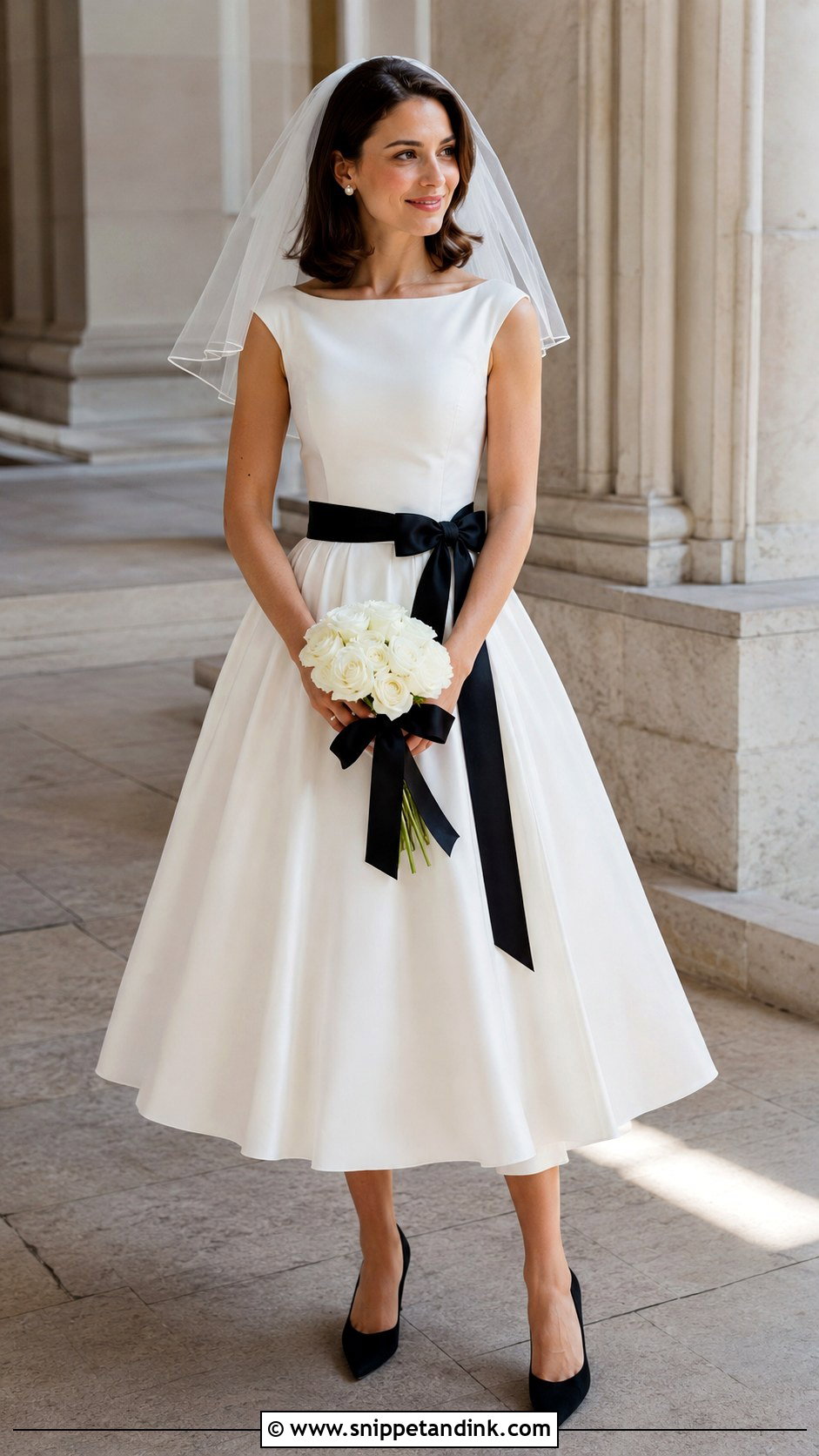
Tea length is the length I suggest when a bride plans to move freely and still look polished at a smaller wedding. A white bateau neck, fitted bodice, black waist bow and full skirt ending between knee and ankle is the classic version. The hem placement matters more than people think: it should finish at a slim part of the calf, never at its widest. A light petticoat adds structure, but too much volume looks retro rather than modern. Black pointed pumps, pearl studs, a shoulder-length veil and white roses tied in black ribbon suit a brunch or courthouse wedding.
17. Black And White Corset Wedding Dress
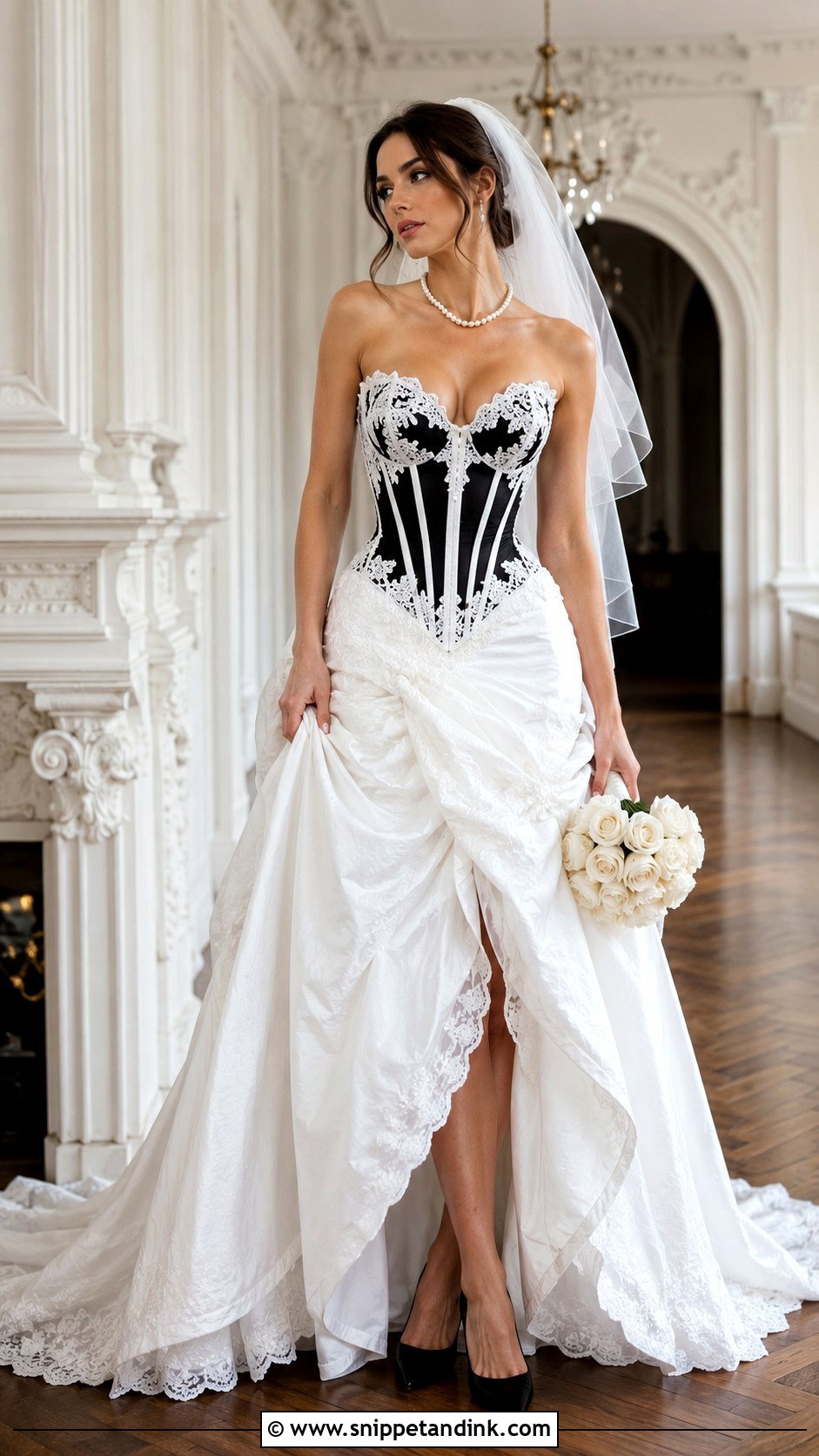
A visible black boned bodice over a white gown shows off construction, and I love it for that. It should support, not squeeze; if you can’t take a full breath or sit back in a chair, the lacing needs letting out. White lace overlays soften the boning. For subtle contrast, ask for black piping only along the corset seams. For a stronger look, a full black bodice with white appliqués. Black pumps, a fine pearl necklace, a lightly edged veil and white garden roses balance the strong lines.
18. Black And White One-Shoulder Wedding Dress
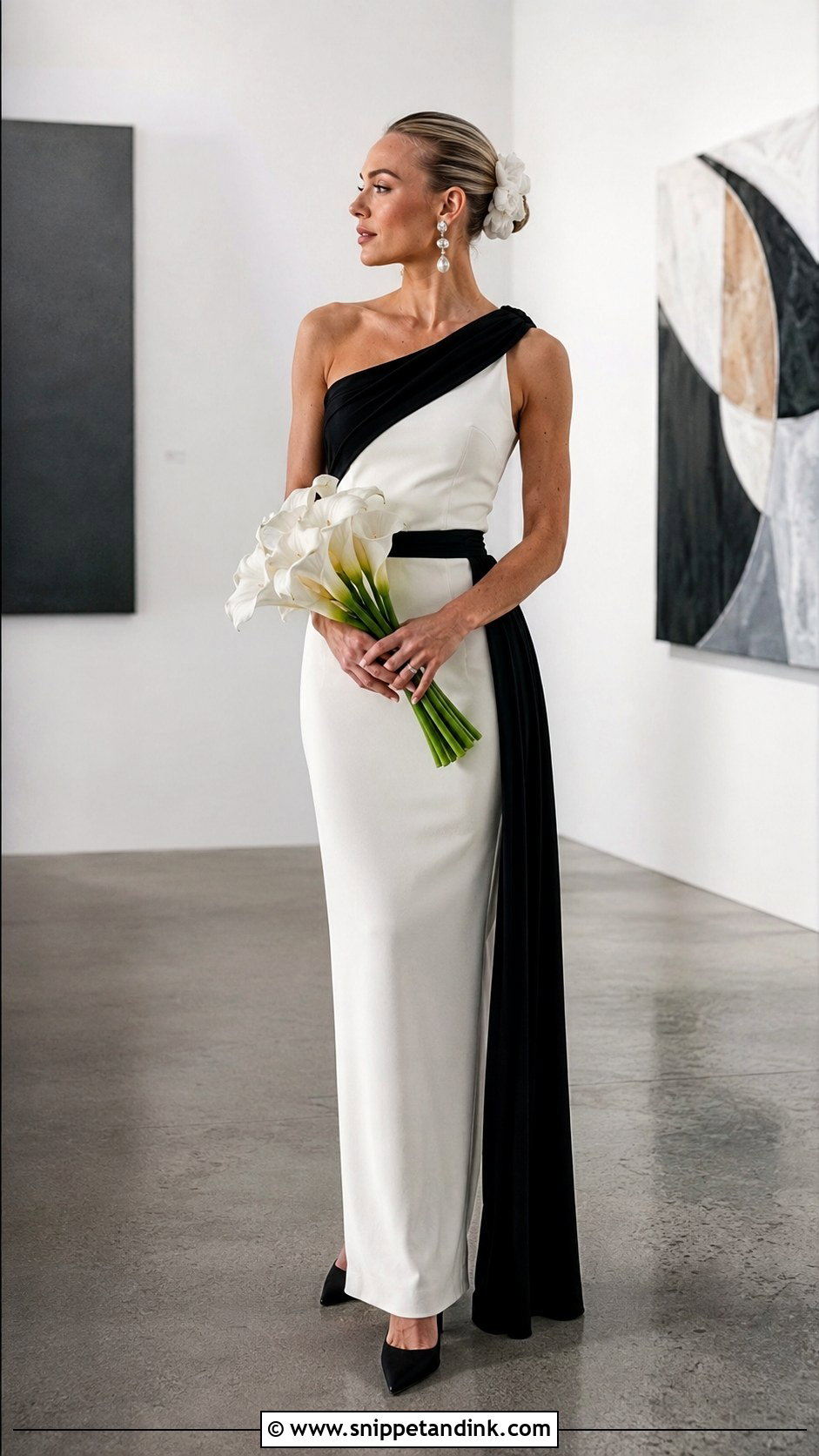
A single black draped shoulder sweeping into a sash or short train gives a white column dress an editorial angle. Keep the rest smooth and let the neckline lead. One statement earring on the bare side and a simple bracelet are enough; a full veil interrupts the asymmetry, so I’d choose a sleek white hairpiece. At fittings I check the drape from front, side and back, and then have the bride wave and hug. Draped shoulders that aren’t anchored properly slide toward the arm within an hour.
19. Black And White Plus Size Wedding Dress
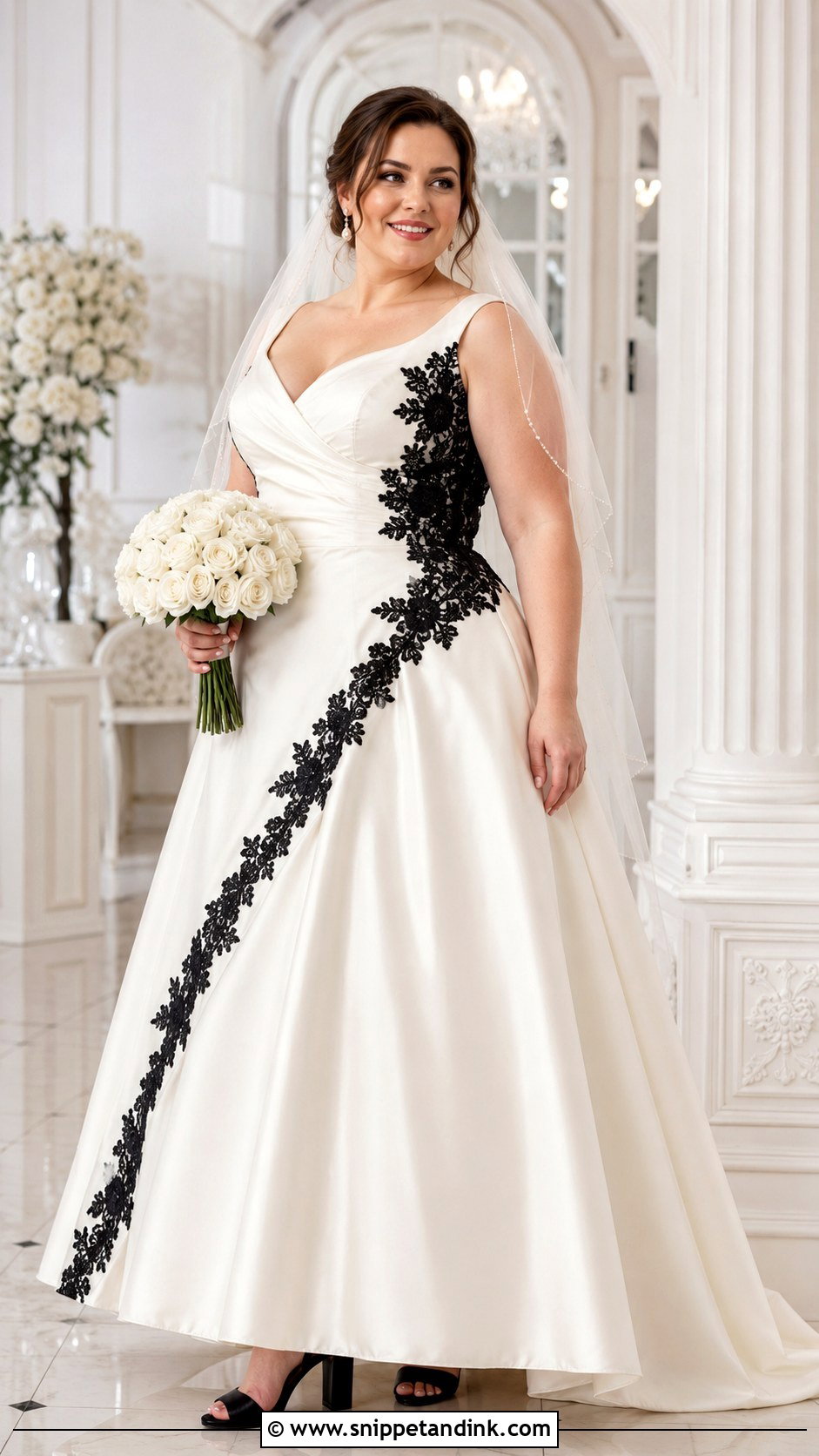
For a curvier bride I’d start with an ivory A-line, a structured bodice, black lace side panels and appliqués sweeping diagonally across the waist. The diagonal creates movement and shape without any attempt to hide the body. Black details can be moved during customisation to highlight the parts of yourself you like most, so tell your consultant what those are. Try samples in or near your size whenever possible; you can’t judge a neckline on a sample clipped at the back. Supportive black block heels, pearl earrings, a fingertip veil and a generous bouquet scaled to the gown complete the look.
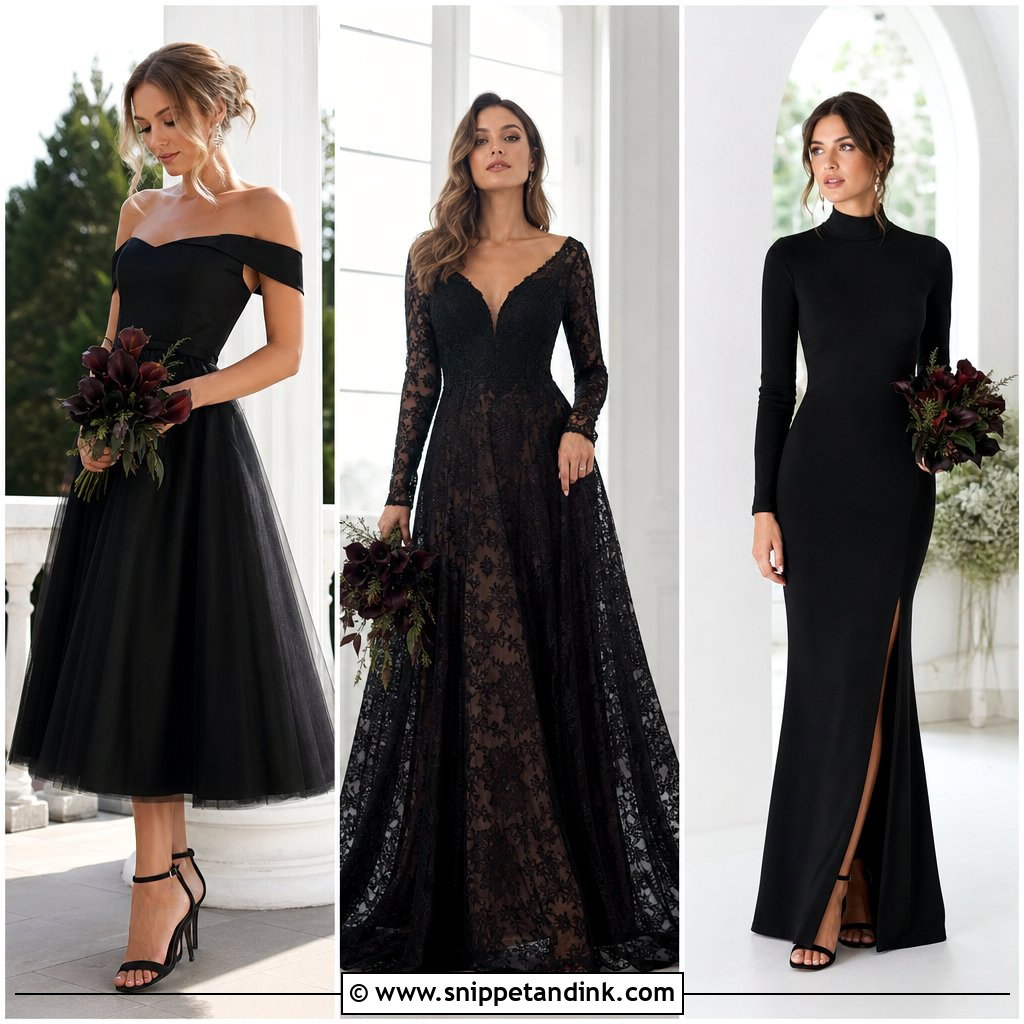
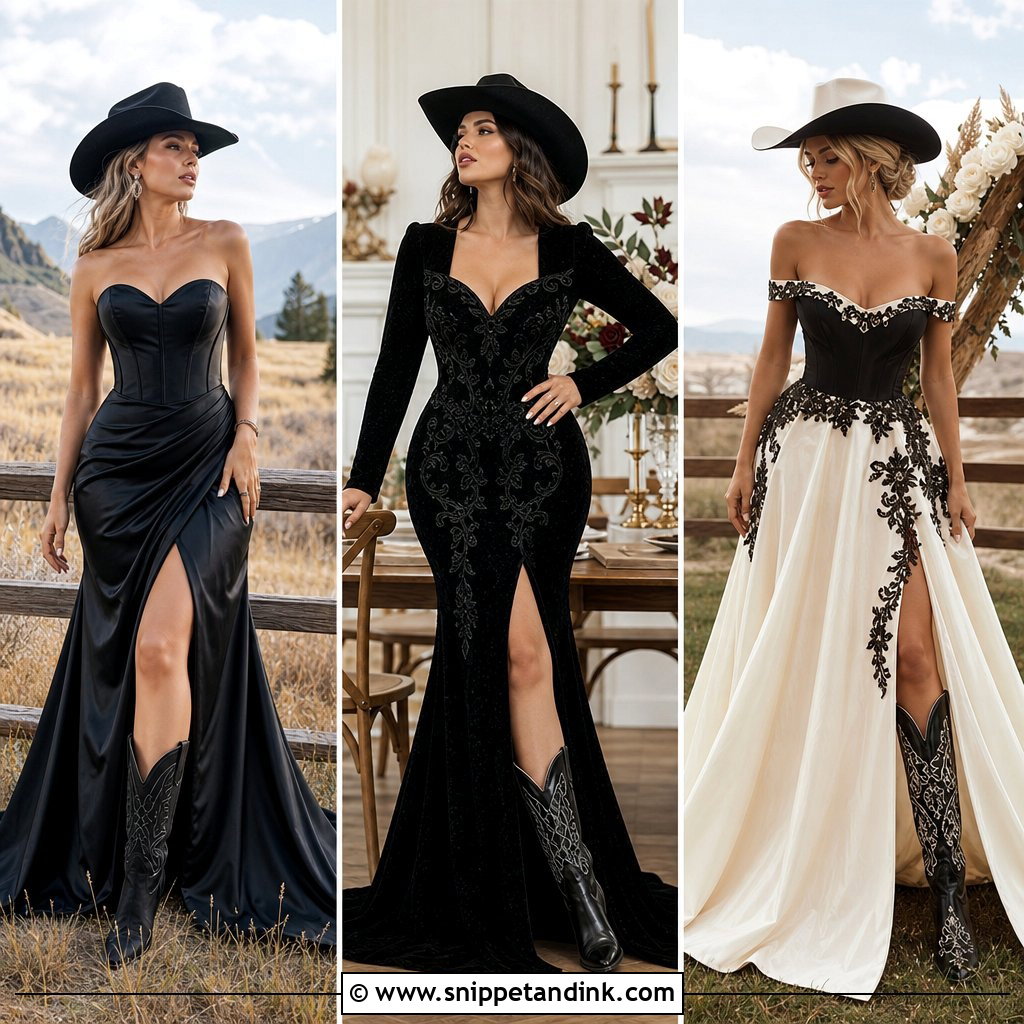
20. Black And White Short Wedding Dress
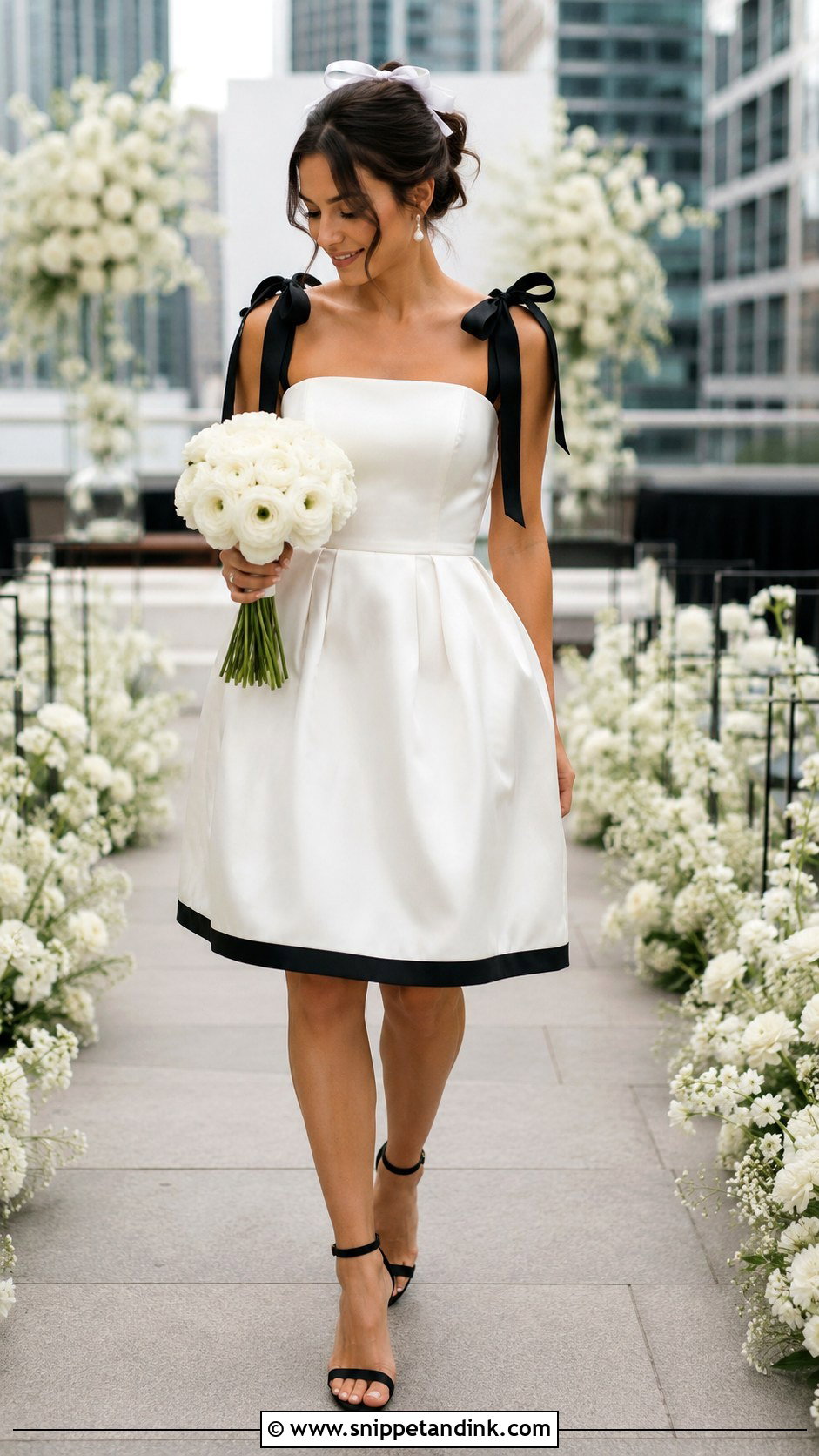
A short dress brings energy to a civil ceremony, a destination wedding or an evening change. A white mini or knee-length dress with a structured neckline, black bow straps and black trim at the hem stays unmistakably bridal. Fabric is what separates it from a party dress: satin, mikado, lace and textured jacquard all have enough weight for the occasion, while thin polyester doesn’t. Black ankle-strap heels or embellished flats, pearl earrings, a small white hair bow and white ranunculus finish it. A detachable overskirt or long veil adds ceremony drama, then comes off for the party.
Pure White and Deep Black in Front of a Camera
Bright white and solid black sit at opposite ends of what a camera can capture in one frame. Expose for the white, and the detail in black lace can sink into flat black. Expose for the black, and the white satin can lose its folds. Experienced wedding photographers handle this all the time, but it helps to tell yours about the dress ahead of the day.
A few things make it easier. Matte black, such as crepe or velvet, holds detail better than shiny black satin in direct sun. Ivory or off-white softens the contrast slightly compared with optical white. Open shade or an overcast sky is far kinder to this palette than harsh midday light, so if you can, plan portraits for later in the afternoon.
Bring the gown, or good photos of it, to any engagement shoot or meeting. Seeing how the fabric reacts to light lets your photographer plan instead of correcting afterwards. On the morning itself, hang the dress somewhere with soft window light for the detail shots; a dark hotel wardrobe door is where black lace disappears.
How Much Black Is Right for You?
The amount of black is the whole decision. Small accents on white give a traditional look with an edge; a dark base makes the statement first. Lace, satin, tulle, embroidery and bows all change the mood, so think about your venue, season and how much you want to move before you decide. At every fitting, walk around the gown, view it from behind and photograph it under different light. Contrast that looks crisp in the shop mirror can behave differently on camera, and you’ll want to know that before the day, not after.
You'll Like These Ideas:







Leave a Reply