
A net sharara swings when you walk, which is why so many brides and guests reach for it once the lehenga feels too heavy. The trick is that the pants already carry all the volume, so whatever goes on top has to be fitted: a short kurta, a peplum, a cropped blouse or a structured jacket. The other non-negotiable is lining, because net on its own is scratchy and see-through. The twenty sets below run from pastel daytime outfits to embroidered evening looks, and for each I’ve noted what I’d check at the fitting, from where the lining ends to how heavy the embroidery sits on the tiers.

Where the Flare Starts, and Other Fitting Details for Net
Most of what goes wrong with a net sharara happens at the tailor, not on the day. Net is almost always nylon or polyester, so it’s light and holds volume well, but it’s also see-through, a little scratchy and quick to melt under a hot iron. I go through the same checks with every client before anything is cut.
Sharara or gharara?
A true sharara is wide from the waist down. A gharara is fitted to the knee and flares from a seam there, often hidden under a band of gota. Shops use the names loosely, so look at where the flare begins. A waist flare suits petite frames and short kurtas; a knee flare suits long kurtas and anyone who wants a slimmer line through the hip.
Soft net or stiff net
Soft net, often sold as butterfly net, drapes and moves with you. Stiff net holds a wide shape on its own but crackles when you walk and can scratch through a thin lining. For a full day of sitting and dancing, I’d take soft net and get the volume from more panels instead.
- Take the length measurement wearing the shoes you’ll wear on the day. The hem should just clear the floor.
- Ask for the lining to run almost to the net hem, not stop at mid-calf.
- Choose cotton or a cotton blend for daytime heat, and satin or crepe for evening sheen.
- Have a drawstring plus a hook in the waistband; a heavy embroidered sharara on elastic alone sags by evening.
- Ask for pockets in the side seams. Most tailors can add them, and you’ll use them all day.
1. Pink Floral Net Sharara
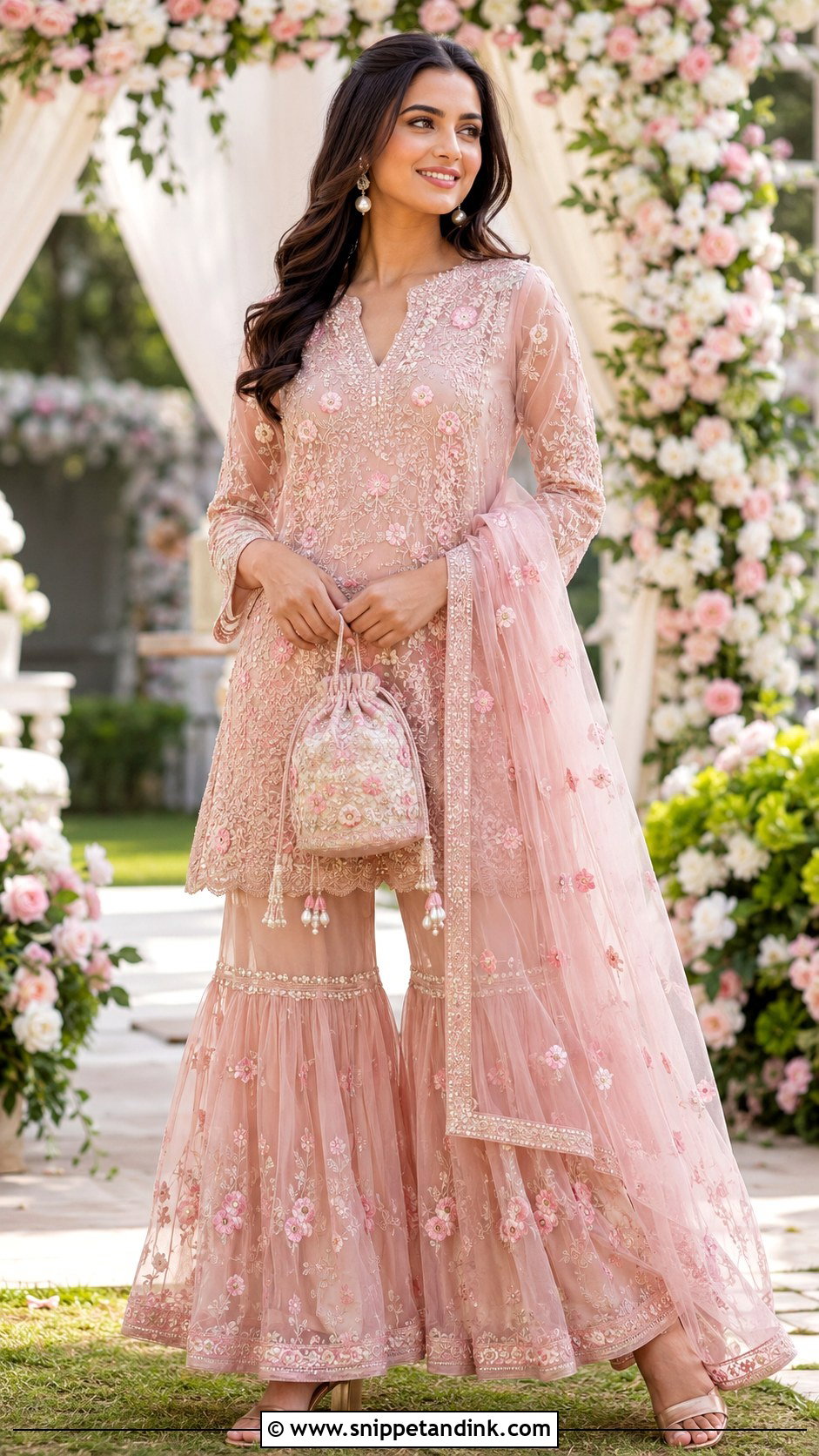
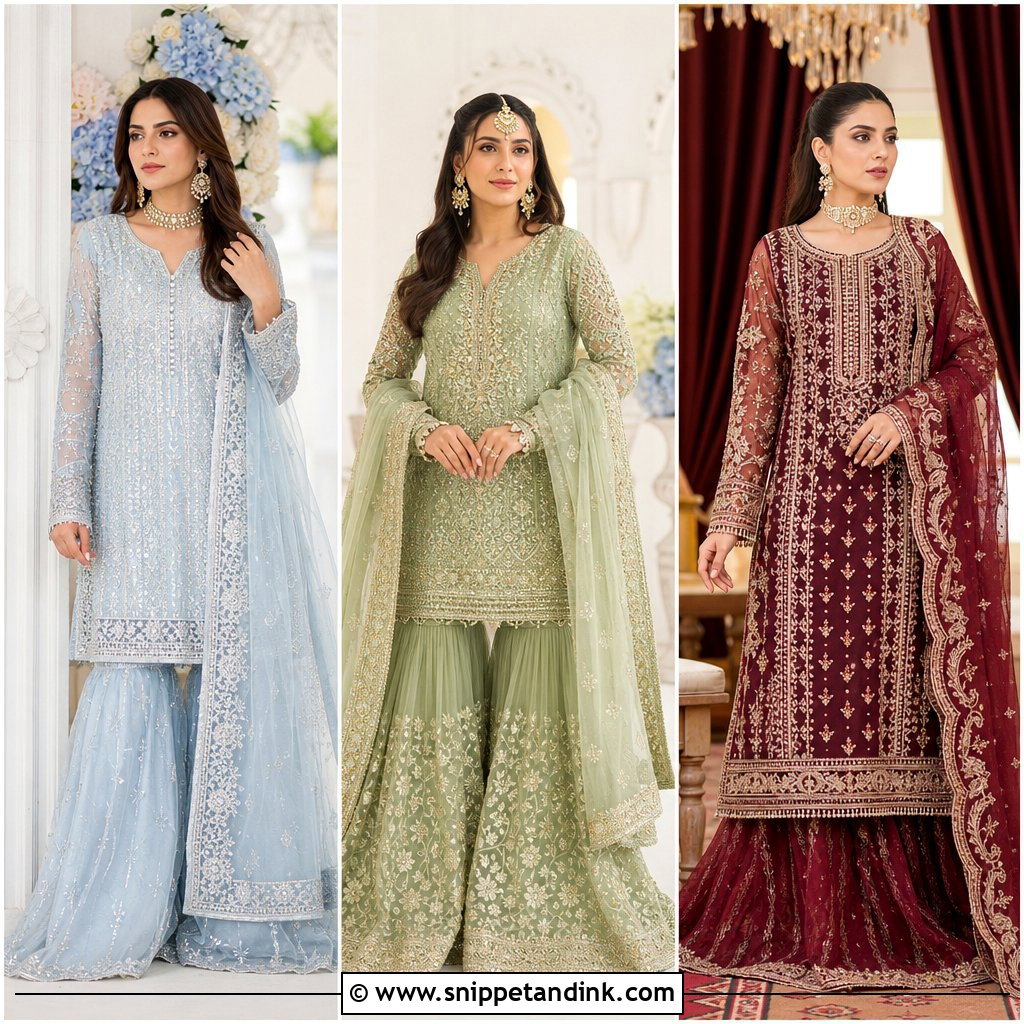
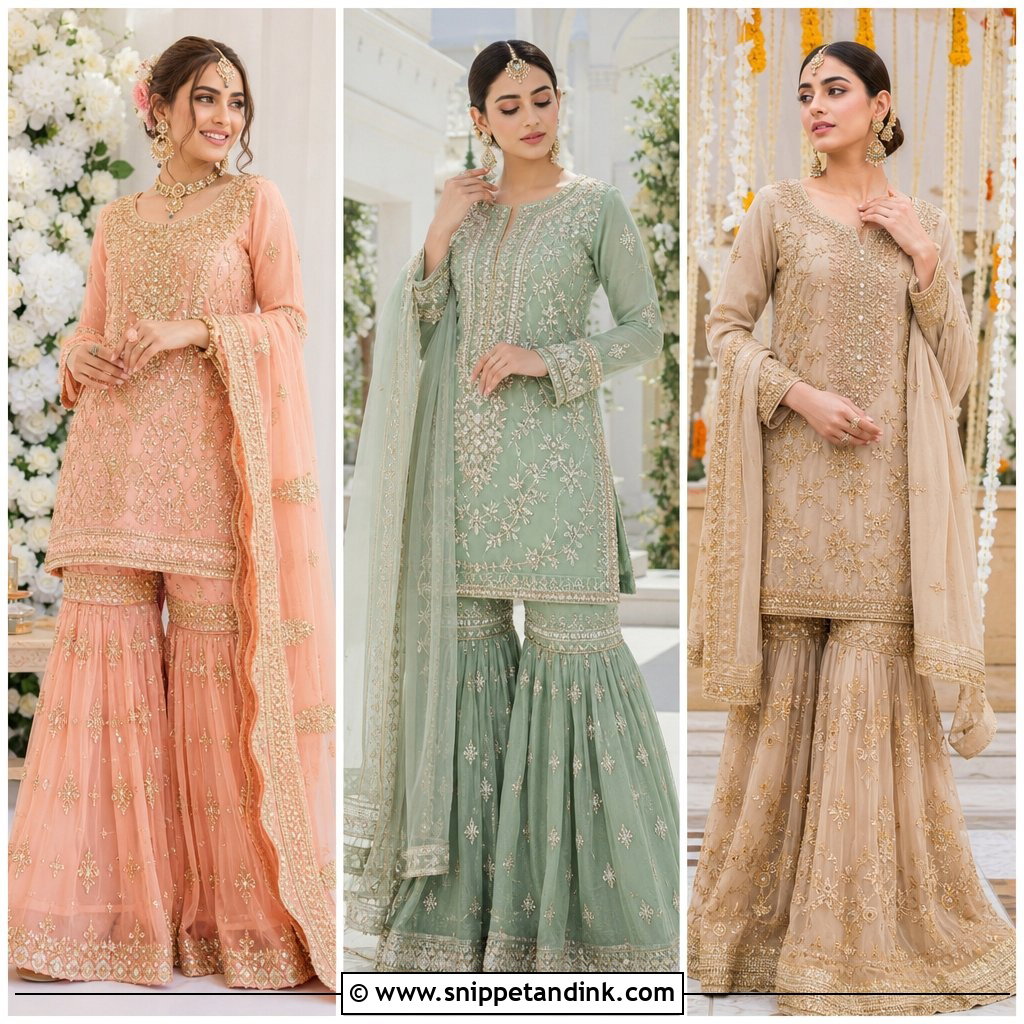
Blush pink floral net works best when the lining is the same blush in satin; a white lining under pink net turns the whole sharara chalky. Here a fitted short kurta carries light thread embroidery, a few sequins and three-quarter sleeves, over layered sharara pants and an organza or net dupatta with a narrow border. Pearl drops, a small embroidered potli and champagne block heels keep it daytime. I’d keep the hair loose or in a soft bun and the makeup rosy. It’s light enough to wear through a long lunch reception without anyone flagging by the cake cutting.
2. Ivory Pearl Net Sharara
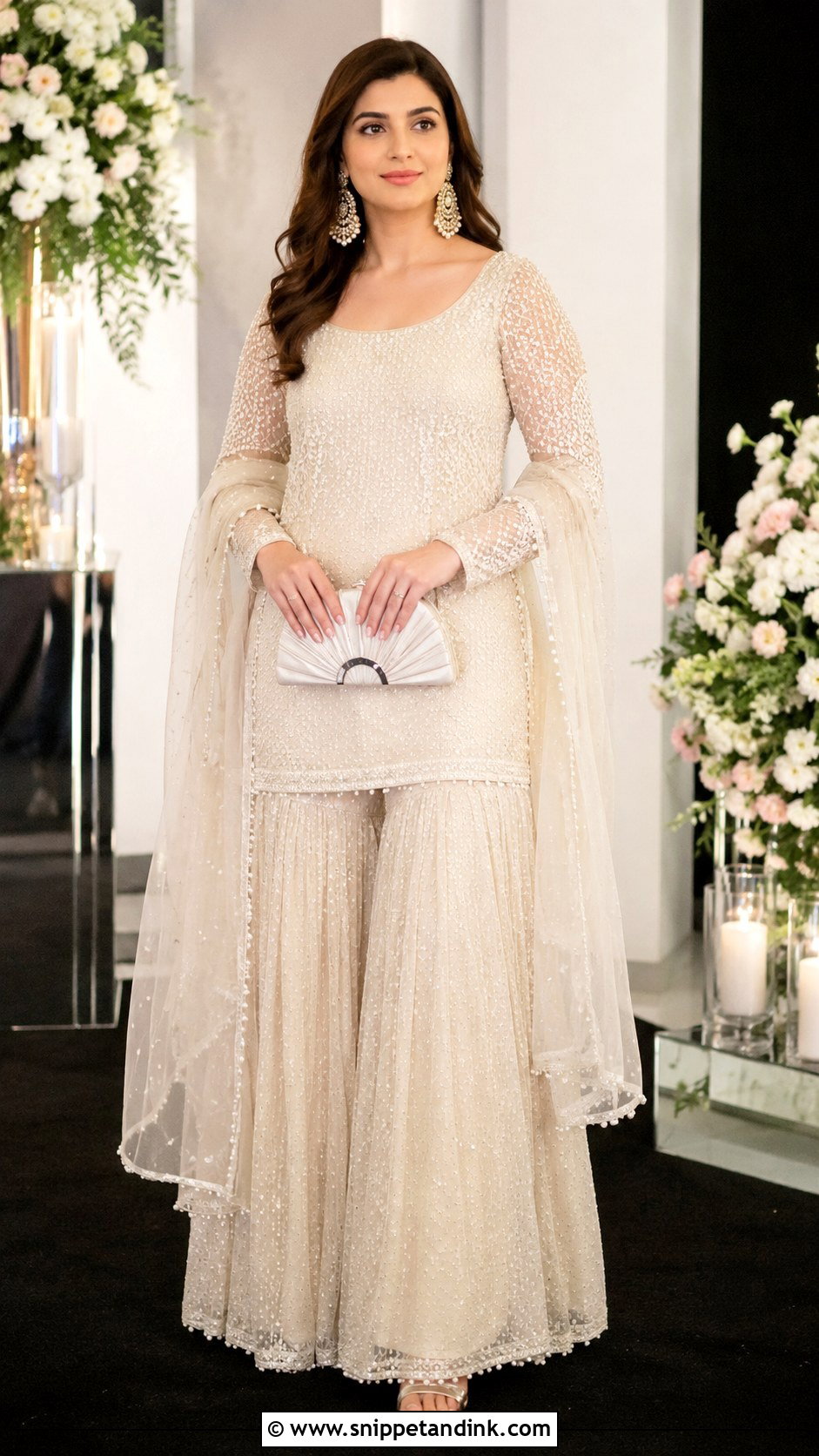
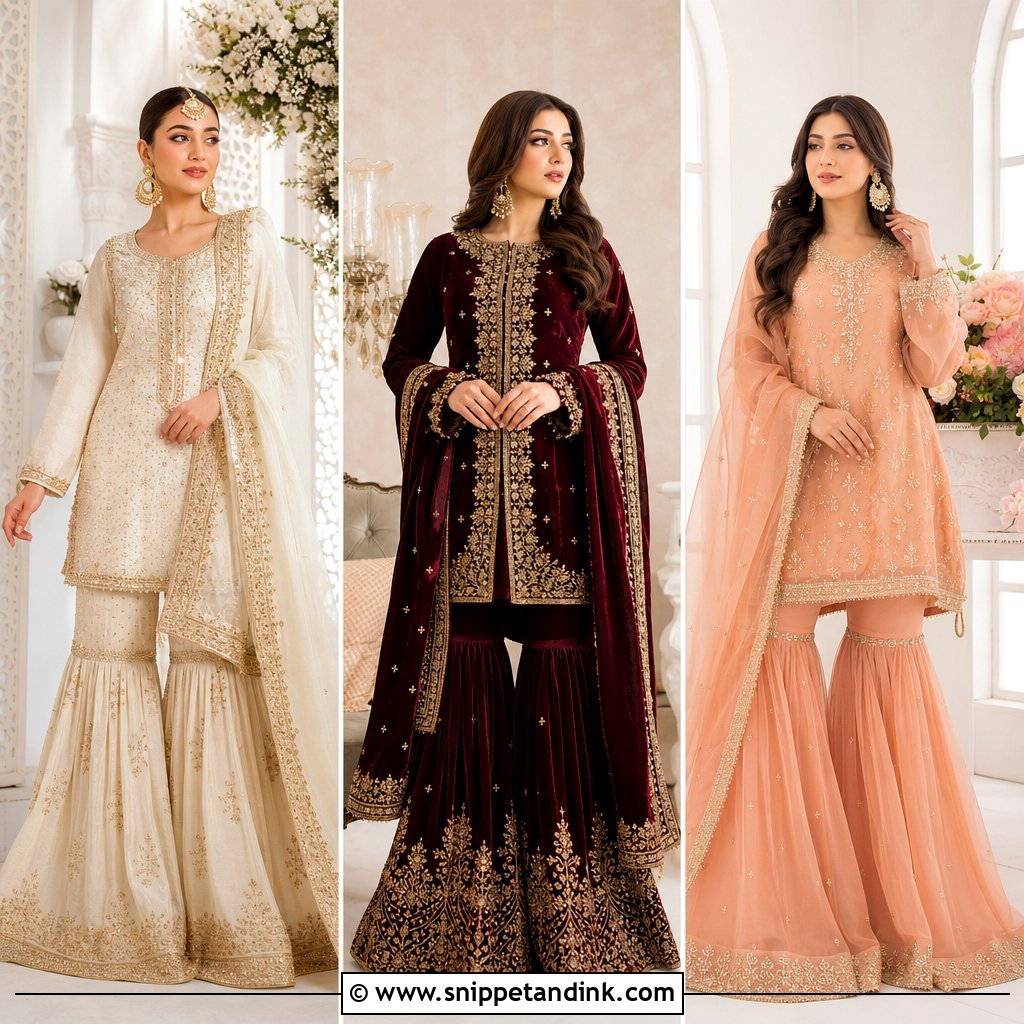
Pearls instead of colored work is what makes ivory net look expensive. A waist-length kurta with a modest neckline, fitted sleeves and evenly spaced pearls sits over a fully flared sharara on opaque crepe. Watch where that lining stops. I want it within an inch or two of the net hem, because a lining that ends at mid-calf leaves a sheer band that reads as a mistake in photos. Drape the pearl-edged dupatta over one shoulder rather than wrapping the whole outfit. Metallic sandals, an ivory clutch and pearl-and-kundan earrings are enough, with brown eyes and a center-parted bun for a reception.
3. Black Sequin Net Sharara
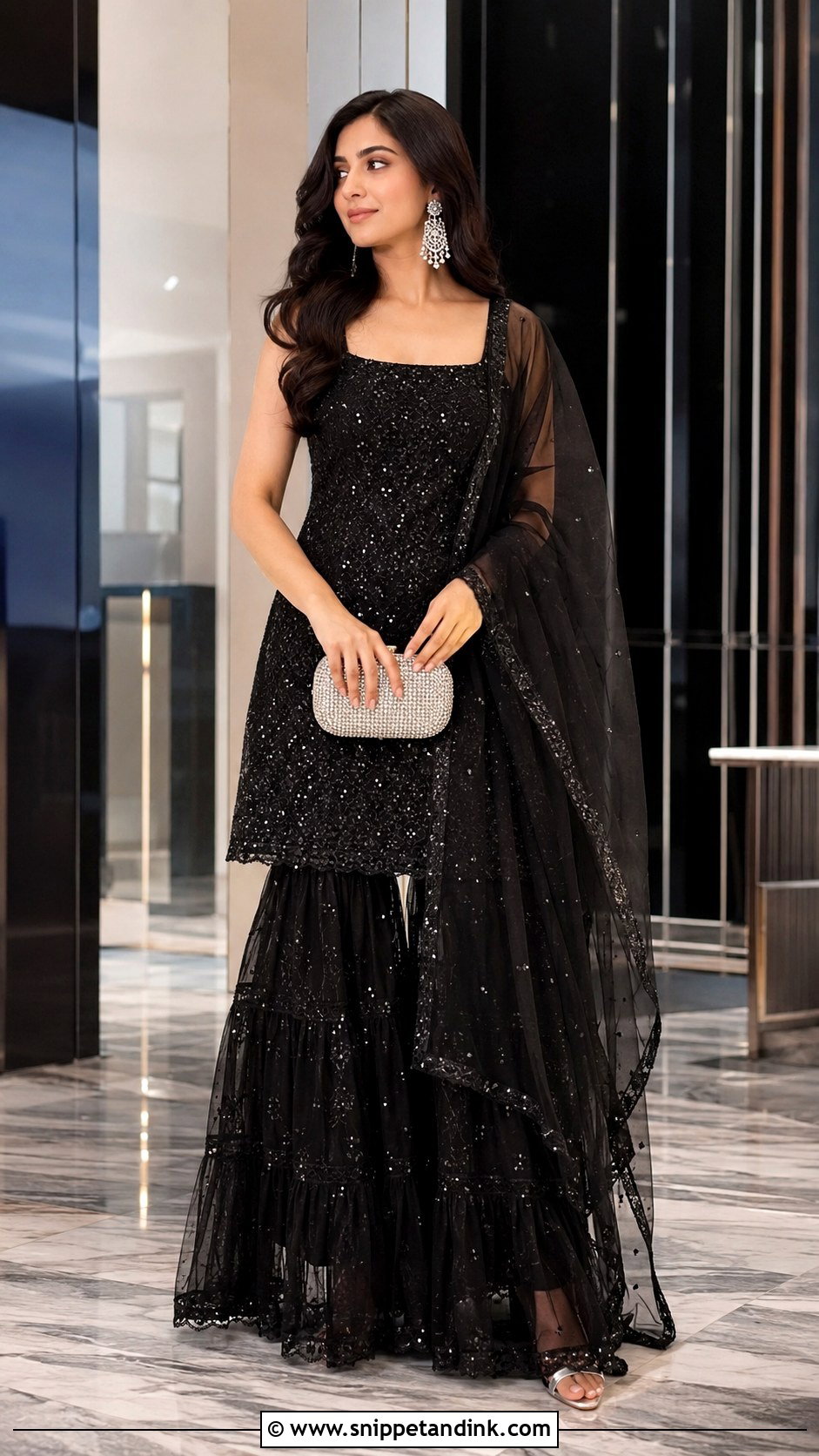
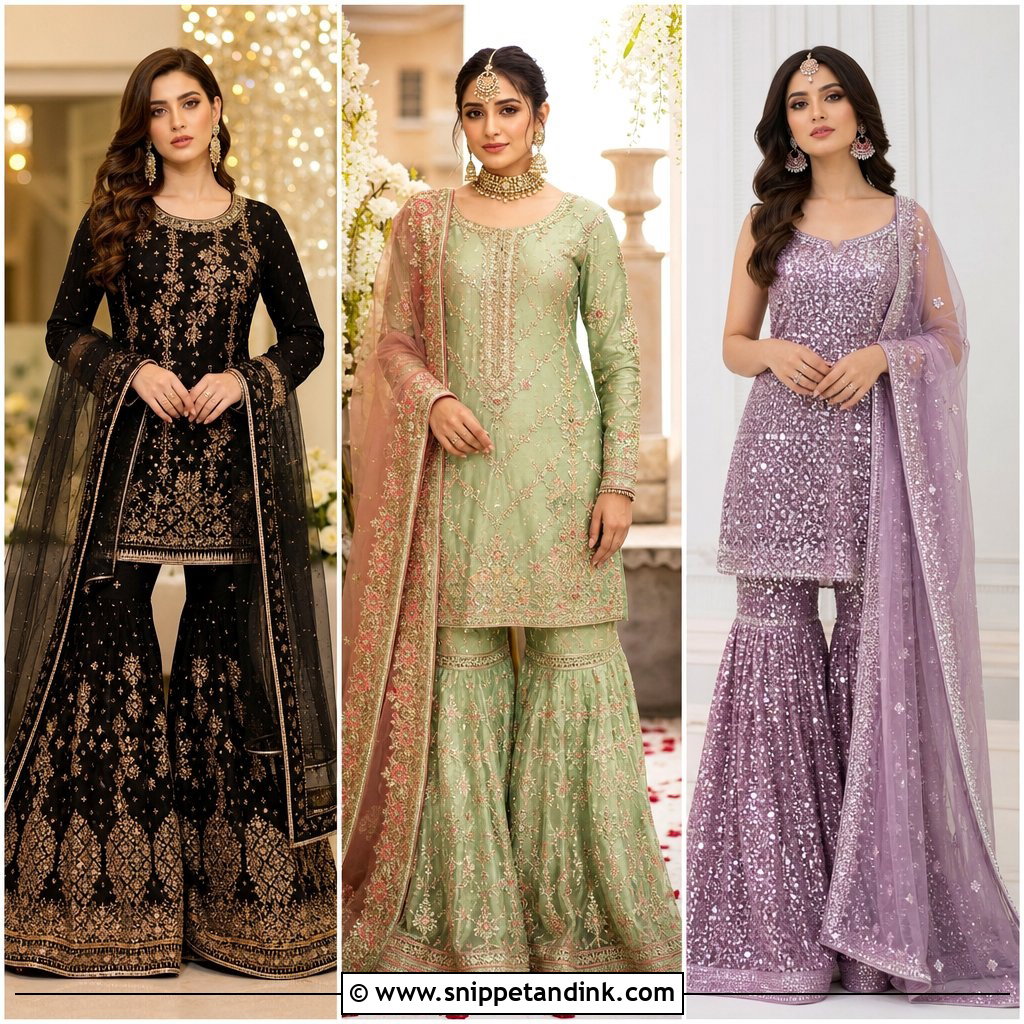
Black sequins give you evening drama without color. A fitted black blouse or short kurta with a square neckline and tonal sequins goes over wide, tiered net sharara pants scattered with black and silver. The plain black lining makes the shimmer pop. Sequins on net are heavy for such a light base, and I check that the embellishment is spread across the tiers, not all on the bottom one, or the hem drags and the net stretches. Carry the sheer dupatta over one arm, then add silver statement earrings, a crystal clutch and a sleek low ponytail for a sangeet or reception.
4. Red Bridal Net Sharara
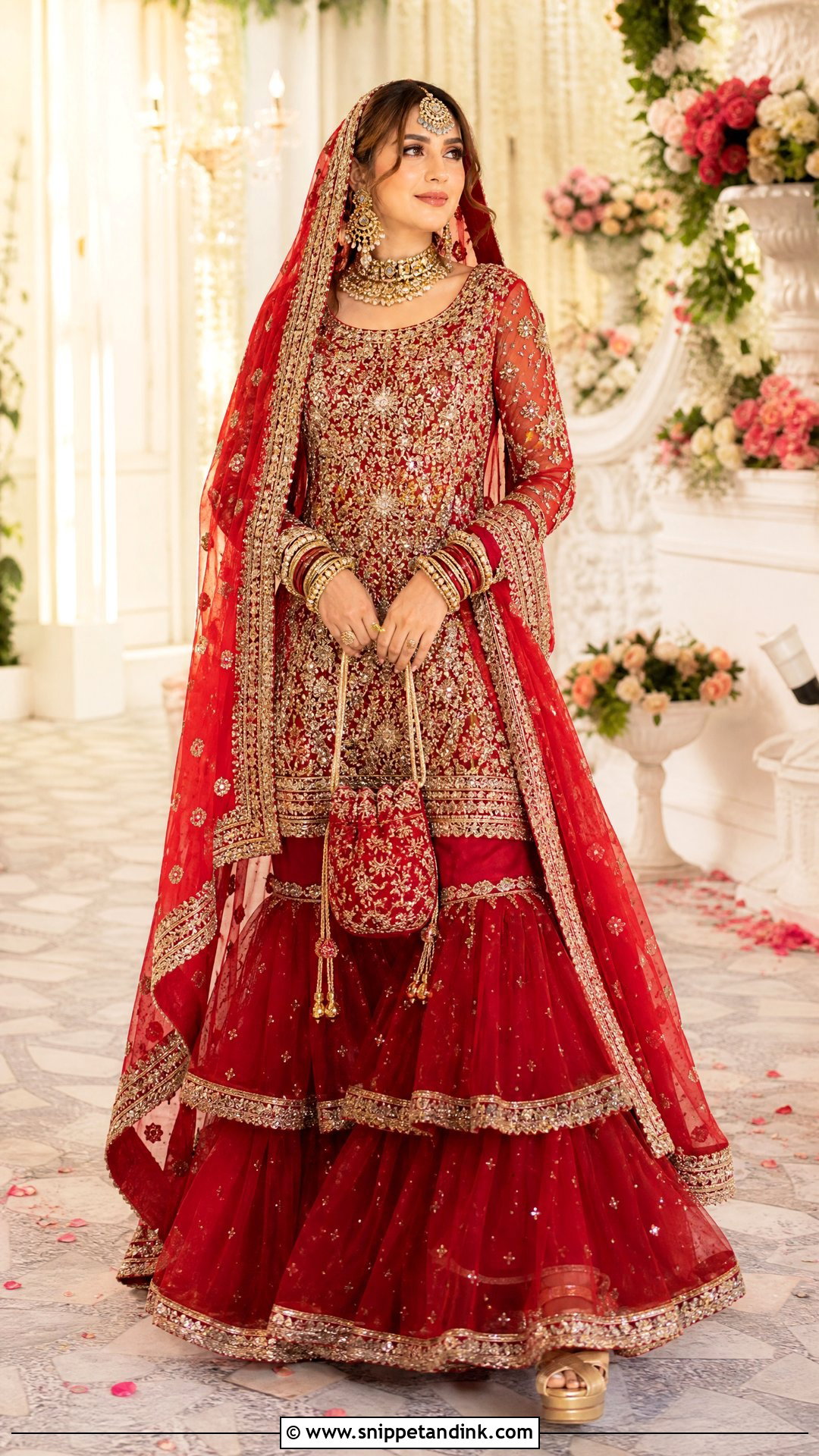
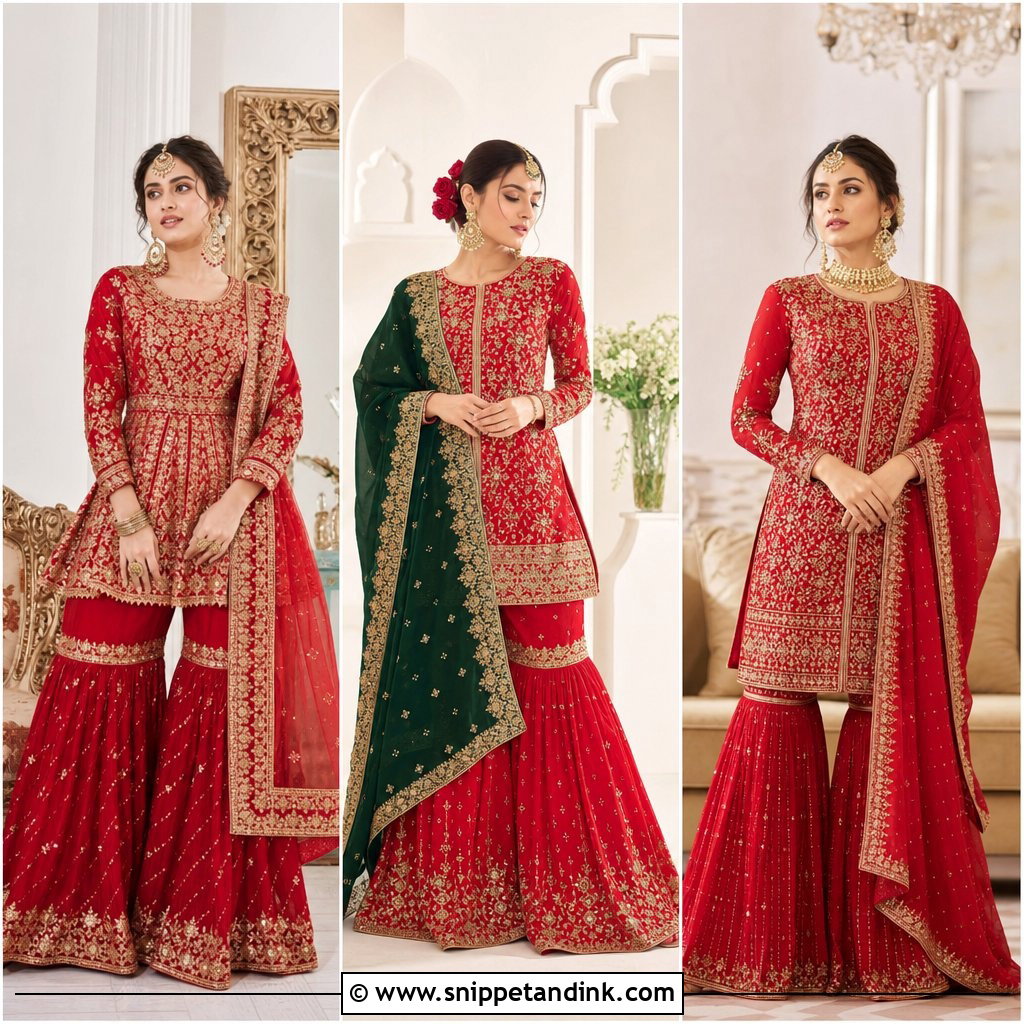
For a bride who wants something lighter than a lehenga, a red net sharara is the answer I give most often. The short kurta carries zari, beads, sequins or dabka at the neckline and hem, and the sharara needs a secure satin lining with borders on each tier. Two dupattas are traditional, one over the head and a lighter one across the shoulder. That head dupatta needs pinning to the hair with U-pins and to the kurta at the shoulder, or it will slip every time you bow. Kundan jewelry, a maang tikka, bangles and gold platforms finish it. Keep every metal one tone, since everything here is ornate.
5. Yellow Gota Net Sharara
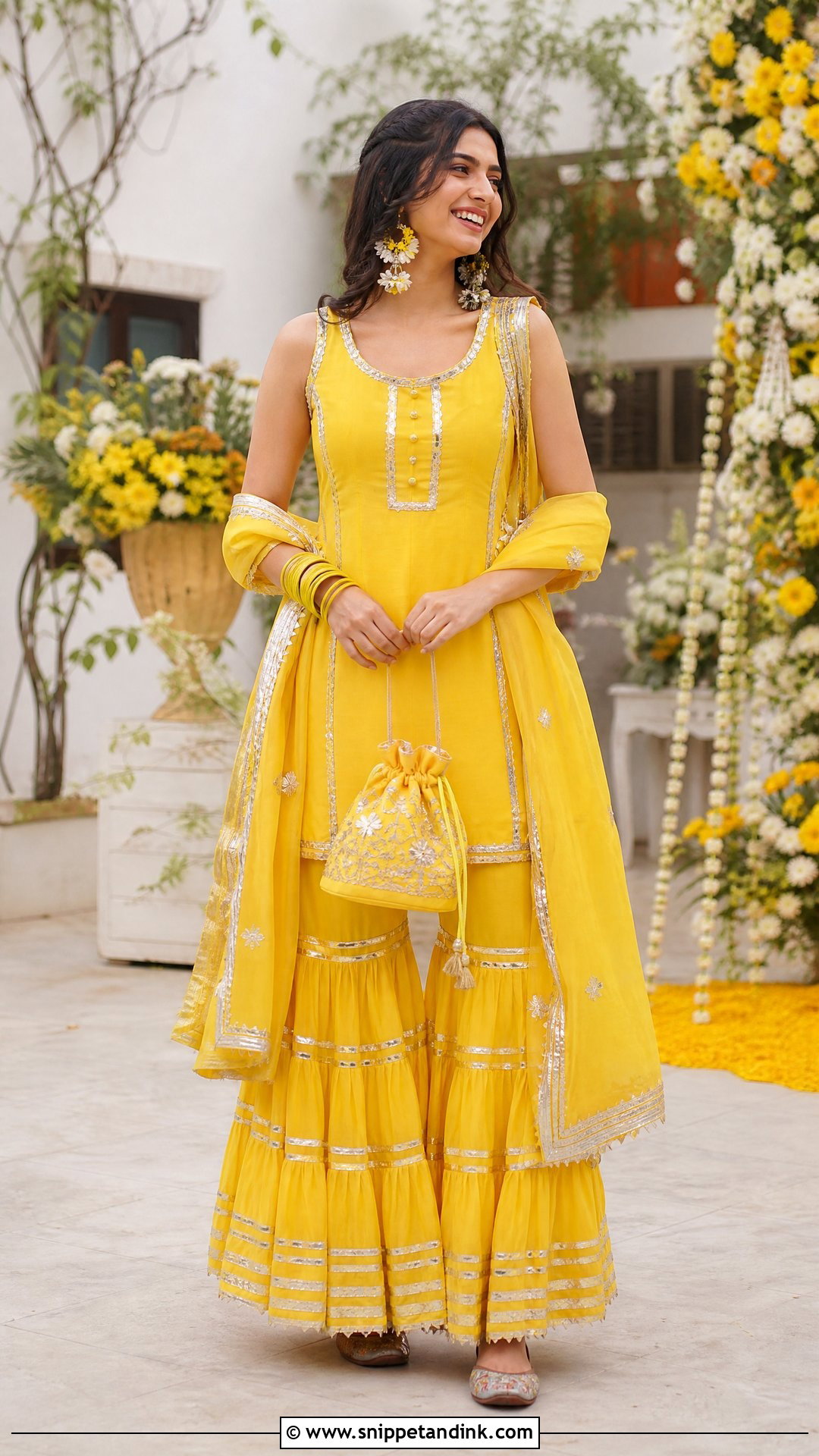
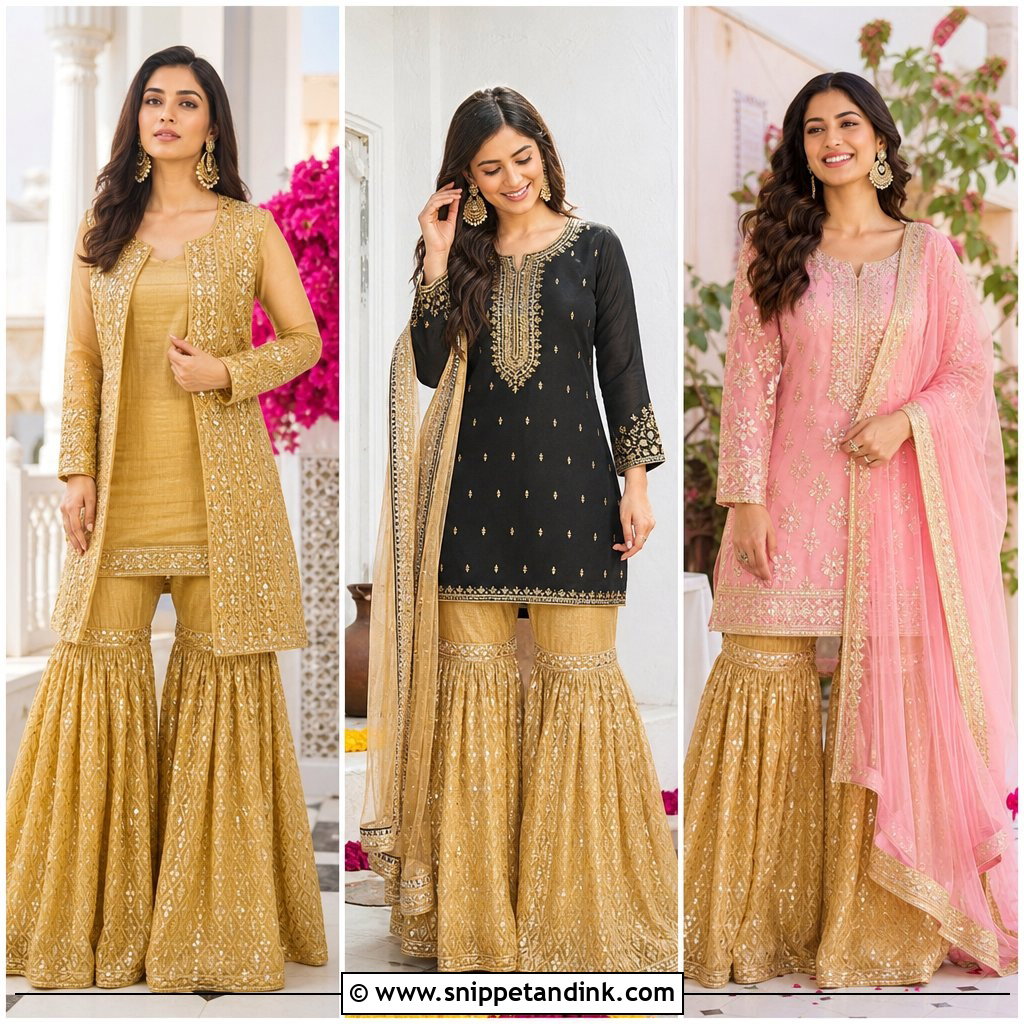
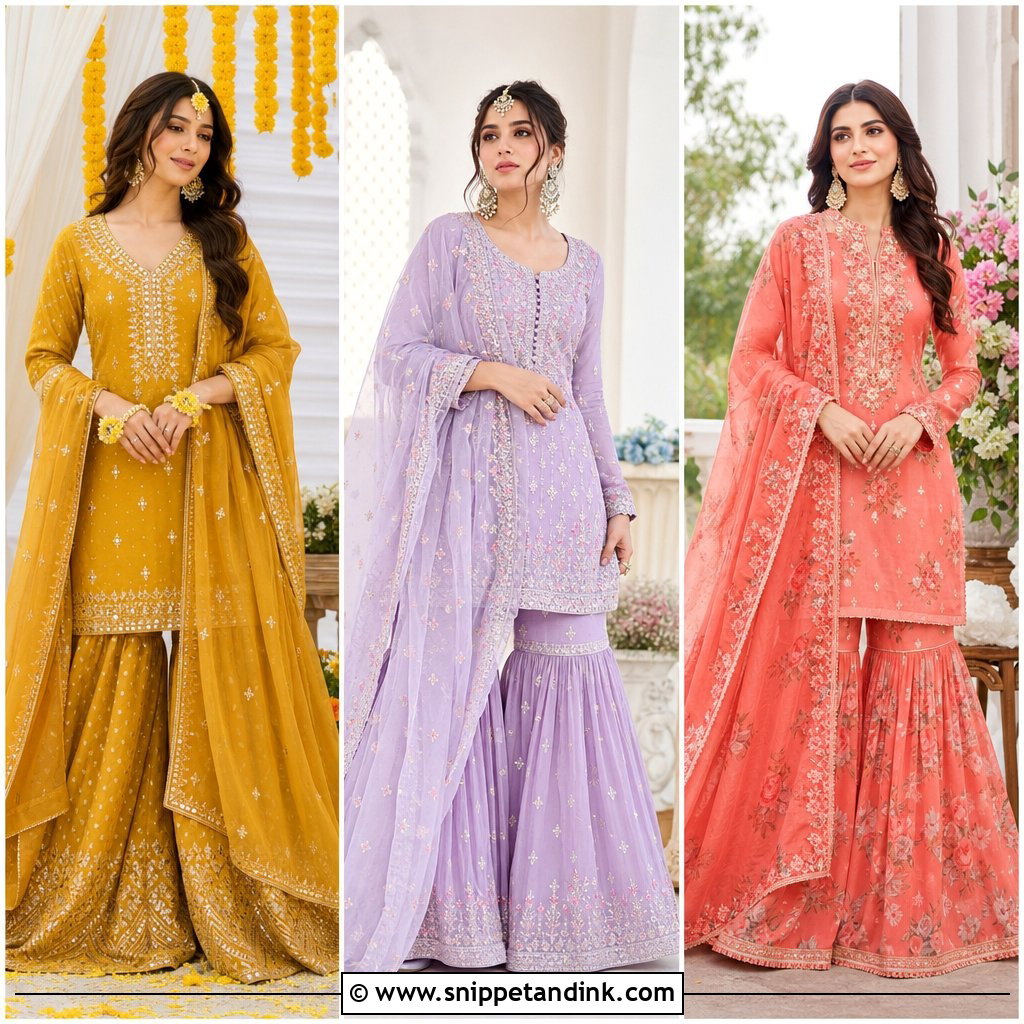
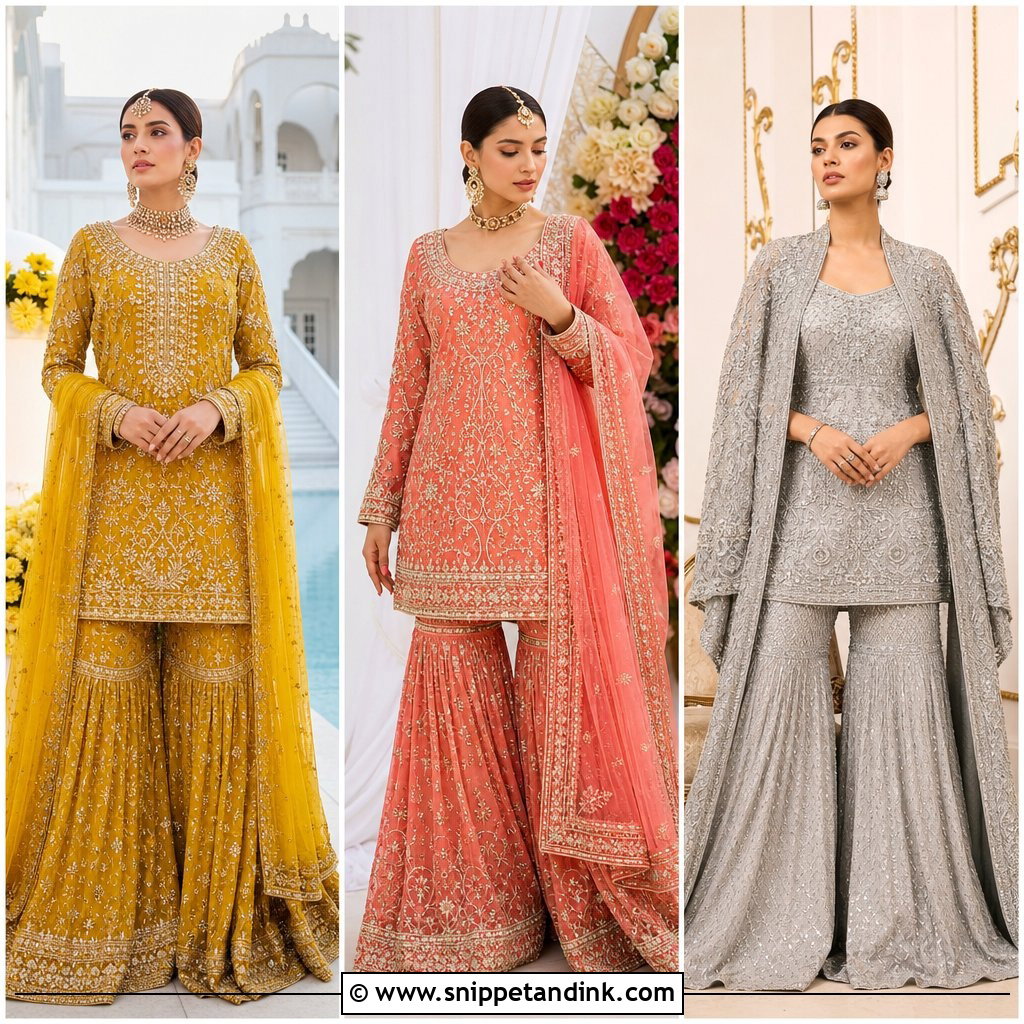
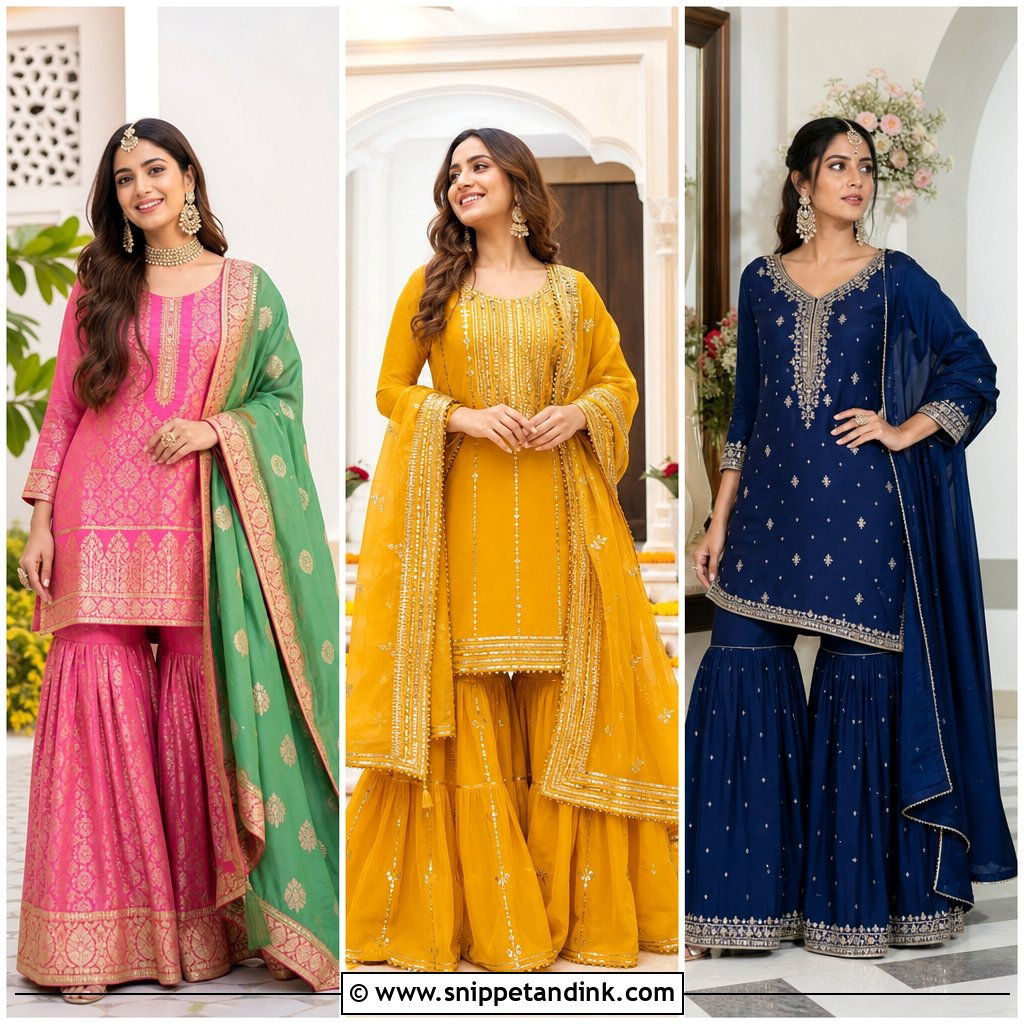
Gota is flat ribbon woven with metallic thread, and it reflects light in a cheerful way that suits haldi festivities perfectly. Pair a sleeveless or short-sleeved yellow kurta with tiered sharara pants trimmed at the knees and hem, and keep any floral embroidery light. Choose a soft cotton lining here. Haldi is messy and warm, and cotton breathes where satin sticks. Yes, the turmeric paste will stain, so wear a set you don’t mind marking. Floral earrings, stacked bangles, juttis, a braid and waterproof makeup will see you through.
6. Green Mirror Work Net Sharara
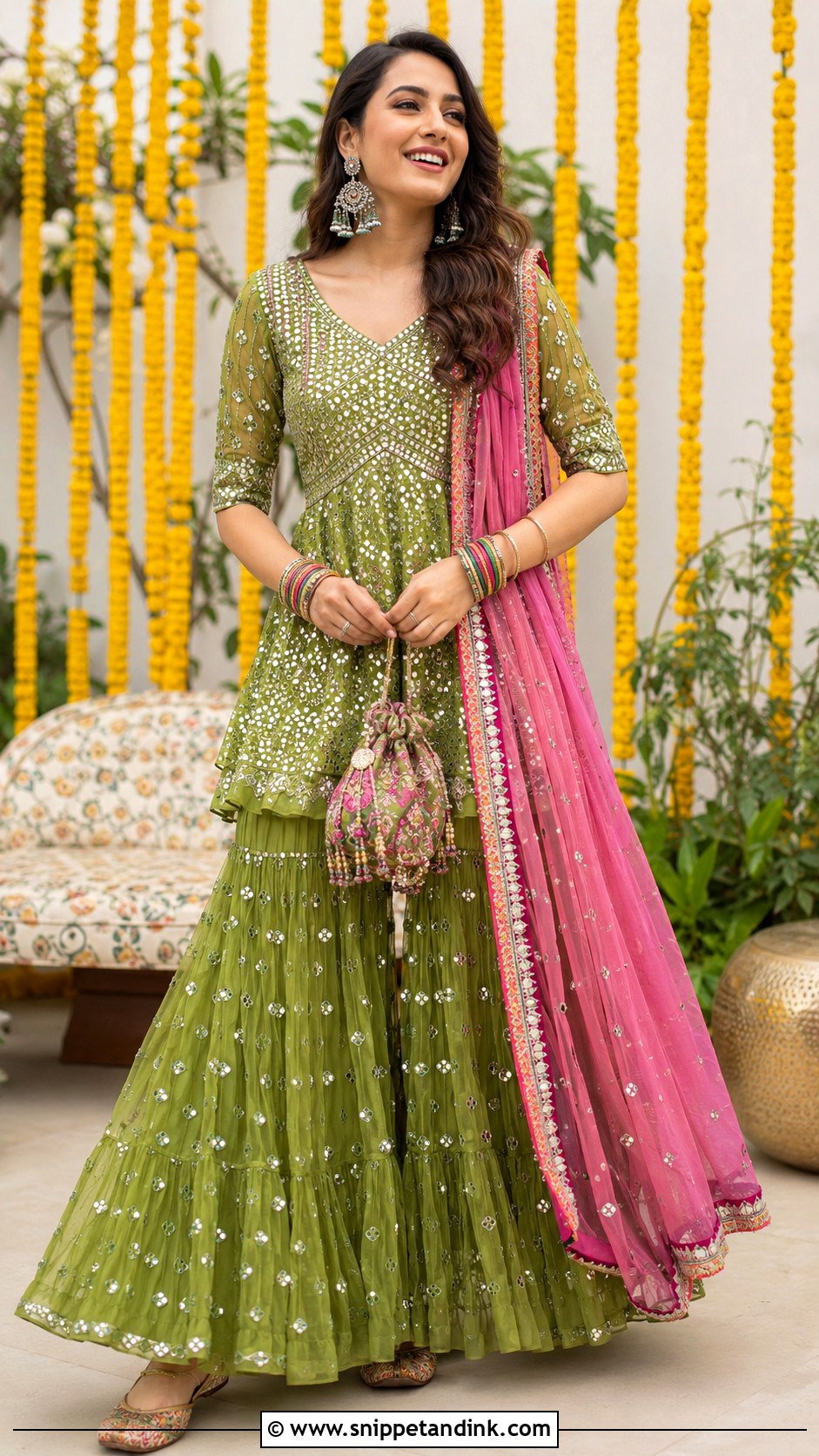
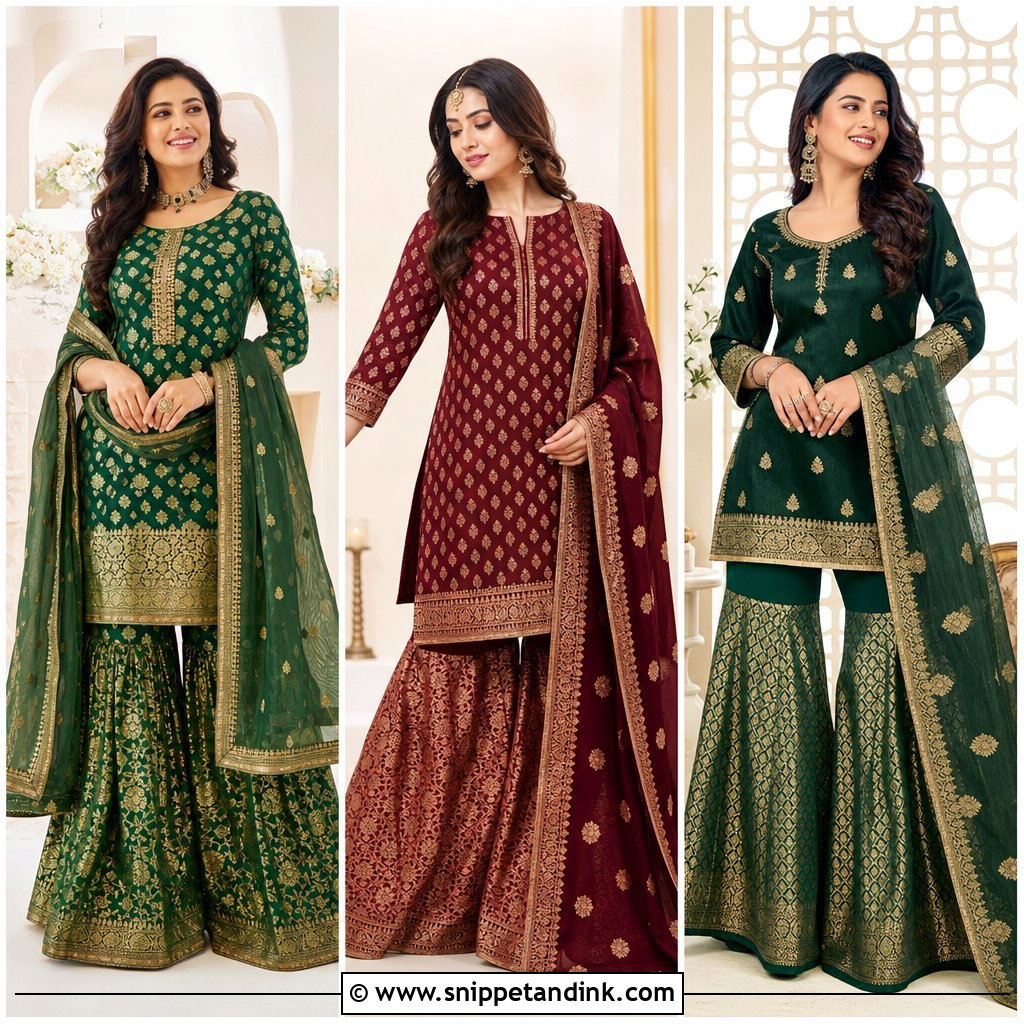
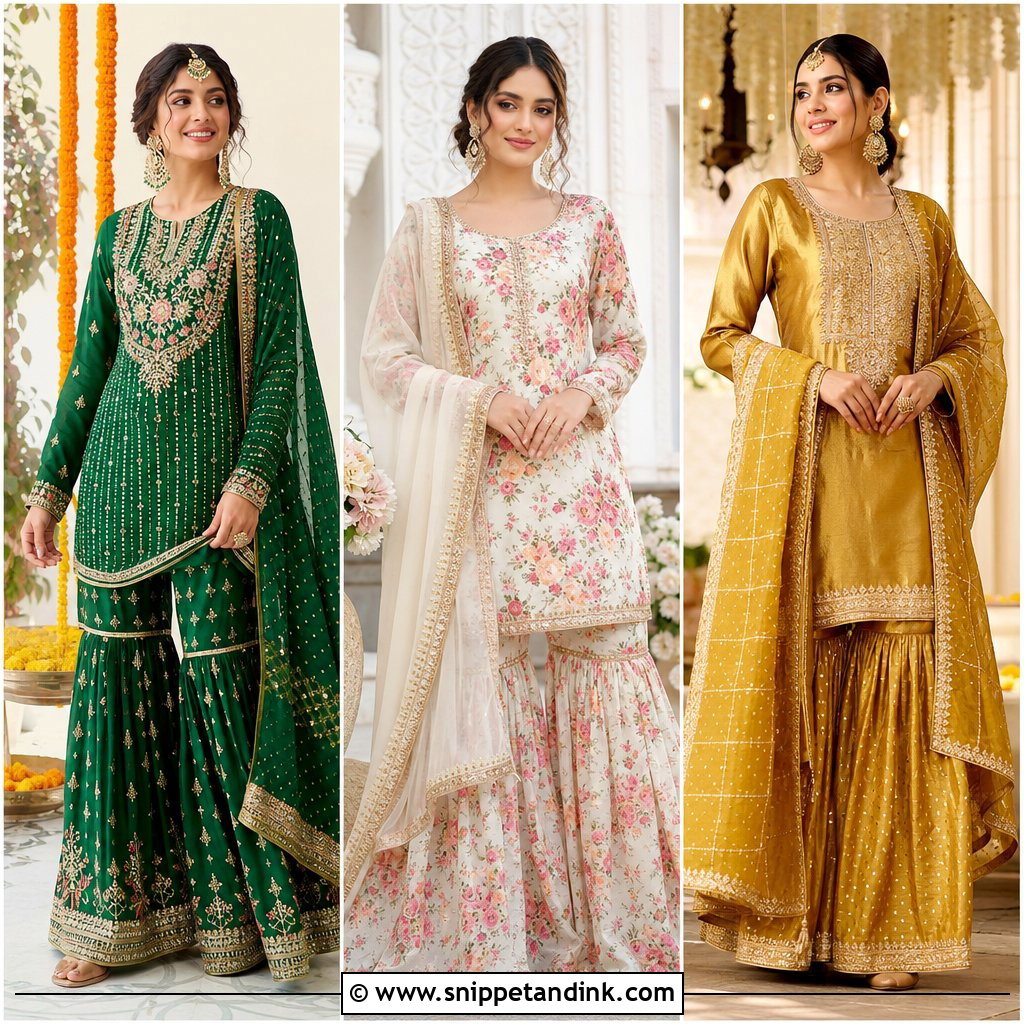
Mirror work belongs at a mehndi, and a green mirror work net sharara catches every light in the room. A fitted peplum kurta or short blouse covered in small mirrors and thread embroidery sits over green pants with mirrors mainly around the lower tiers. That placement is deliberate: mirrors are glass, and too many on the upper tiers make the pants heavy and stiff to sit in. A contrasting pink or multicolored dupatta adds energy. Oxidized silver earrings, bangles, a fabric potli and flat juttis let you dance, and a side braid with floral pins finishes it.
7. Royal Blue Zari Net Sharara
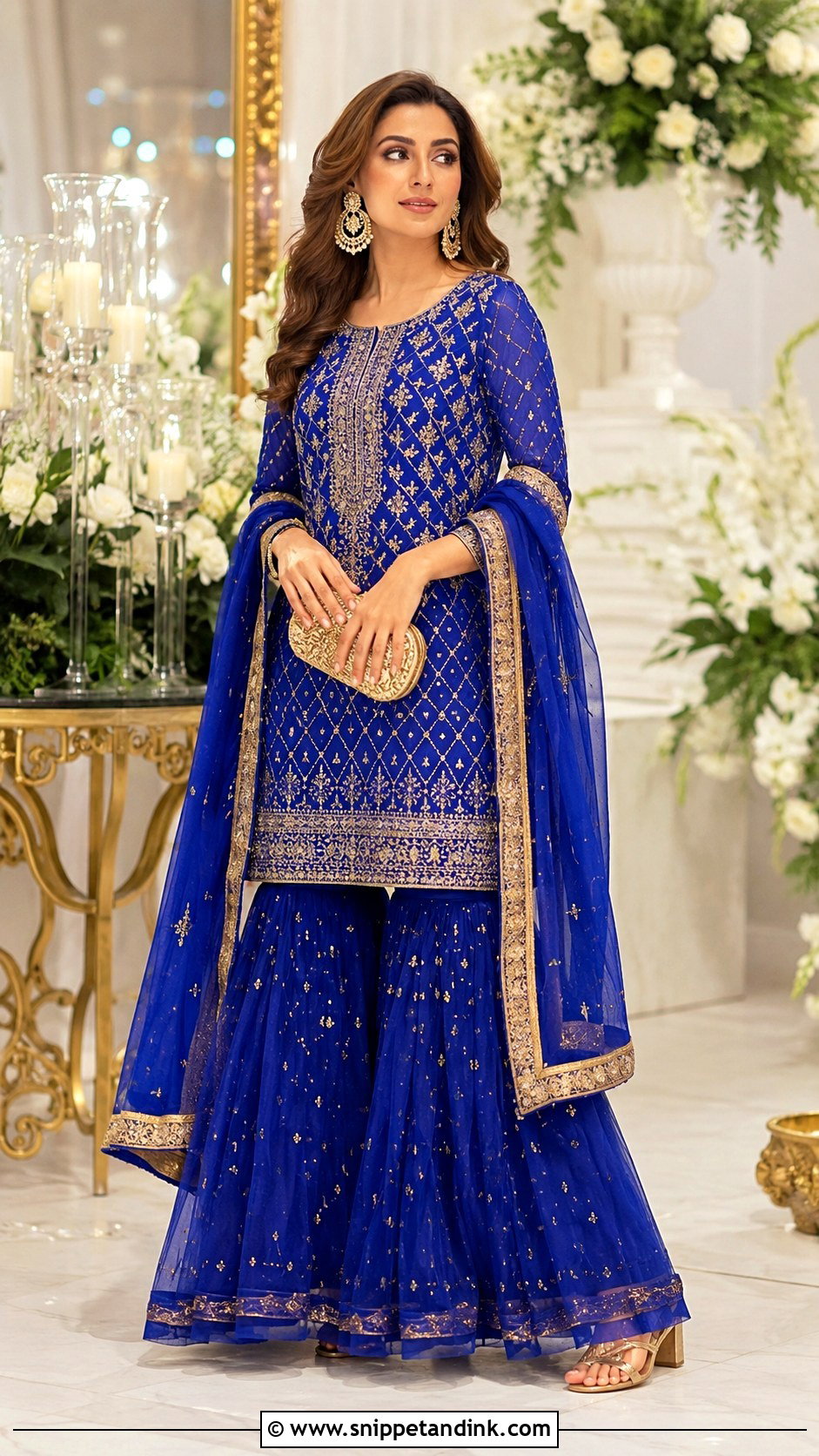
Royal blue with antique gold zari is the look I’d point a guest toward when she wants richness and more coverage. A straight, knee-length kurta with zari at the neckline, cuffs and side slits goes over a flared net sharara with embroidered borders rather than all-over work. Those side slits matter. Without them a long kurta bunches over the flare when you sit. Drape the gold-edged net dupatta over both arms or pin it at one shoulder, then add antique gold earrings, a brocade clutch, gold block heels and a soft bun for a ceremony or formal dinner.
8. Lavender Peplum Net Sharara
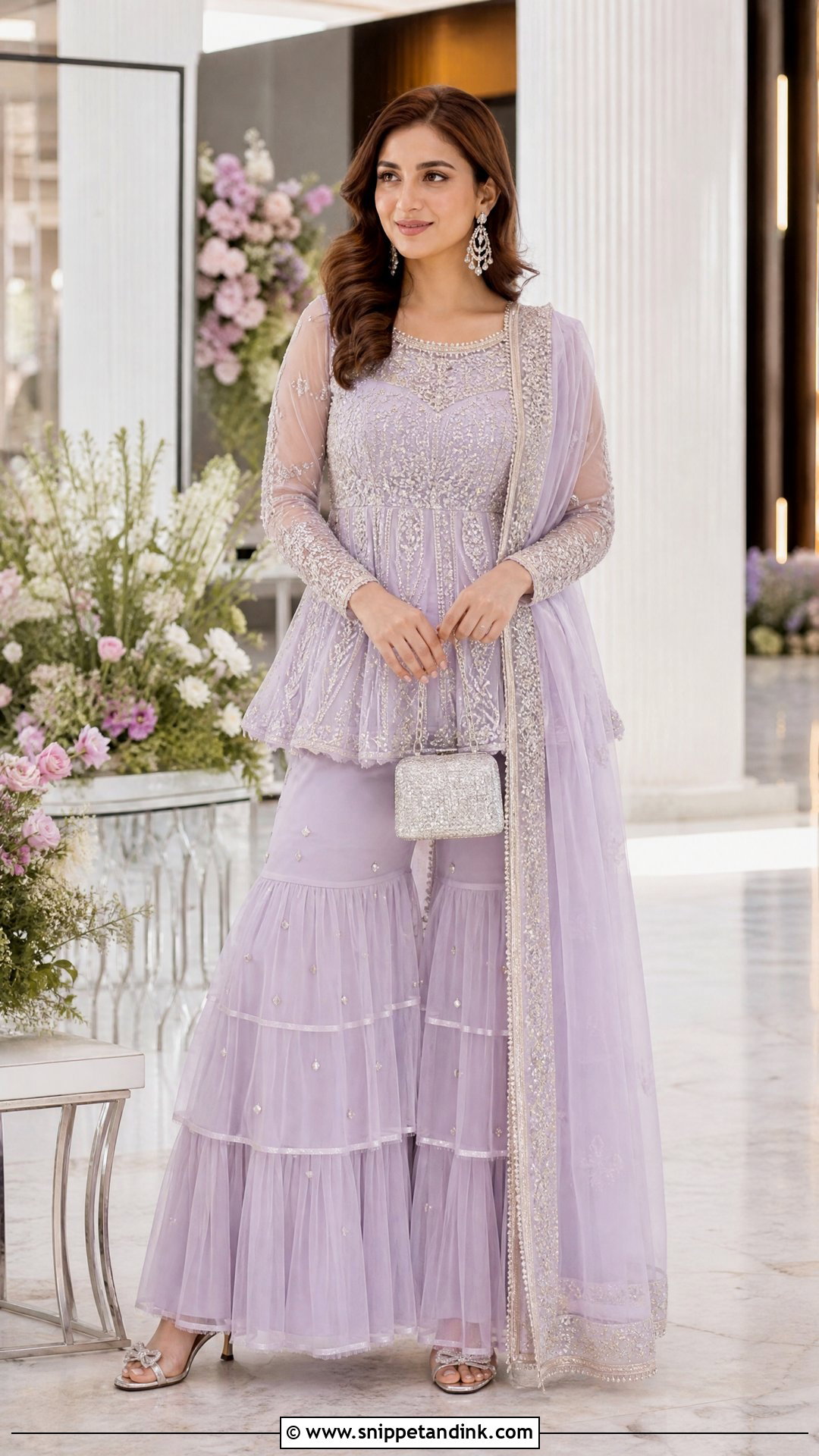
A peplum is the most flattering top for anyone who feels lost in a wide sharara, because it marks the waist before the volume starts. In lavender, look for a fitted bodice that flares gently over the hips, with embroidery on the neckline and the peplum edge. A tonal lining under layered lavender net keeps the pastel clean. Pin the sheer dupatta at the shoulder and let it fall straight down; that vertical line makes you look taller. Crystal earrings, a silver mini bag, low metallic heels and a half-up style finish it, and it makes a sweet bridesmaid set.
9. Sky Blue Cape Net Sharara
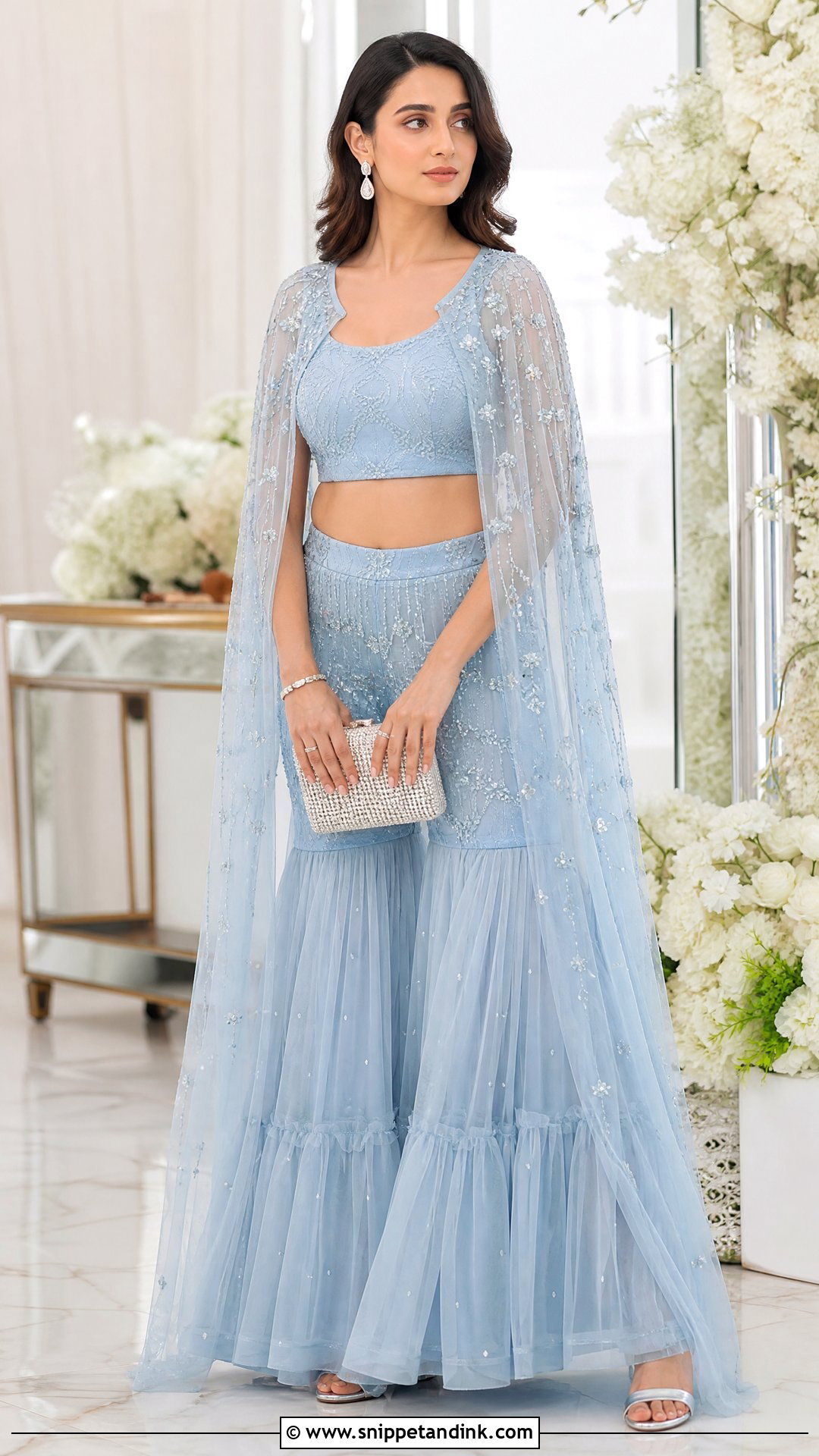
A cape replaces the dupatta, and for many people that’s a relief, since there’s nothing to keep re-draping. Here a fitted blouse and flared sky blue sharara sit under a sheer embroidered cape ending at the waist or mid-thigh; any longer and it hides the sharara’s shape. Beading around the shoulders and edges gives the detail a dupatta would. Check the cape’s fastening at the fitting: a single hook at the neck lets it slide sideways, so I prefer a discreet loop or snap at each shoulder. Silver sandals, fine drop earrings and a sleek ponytail let the neckline show.
10. Mint Short Kurta Net Sharara
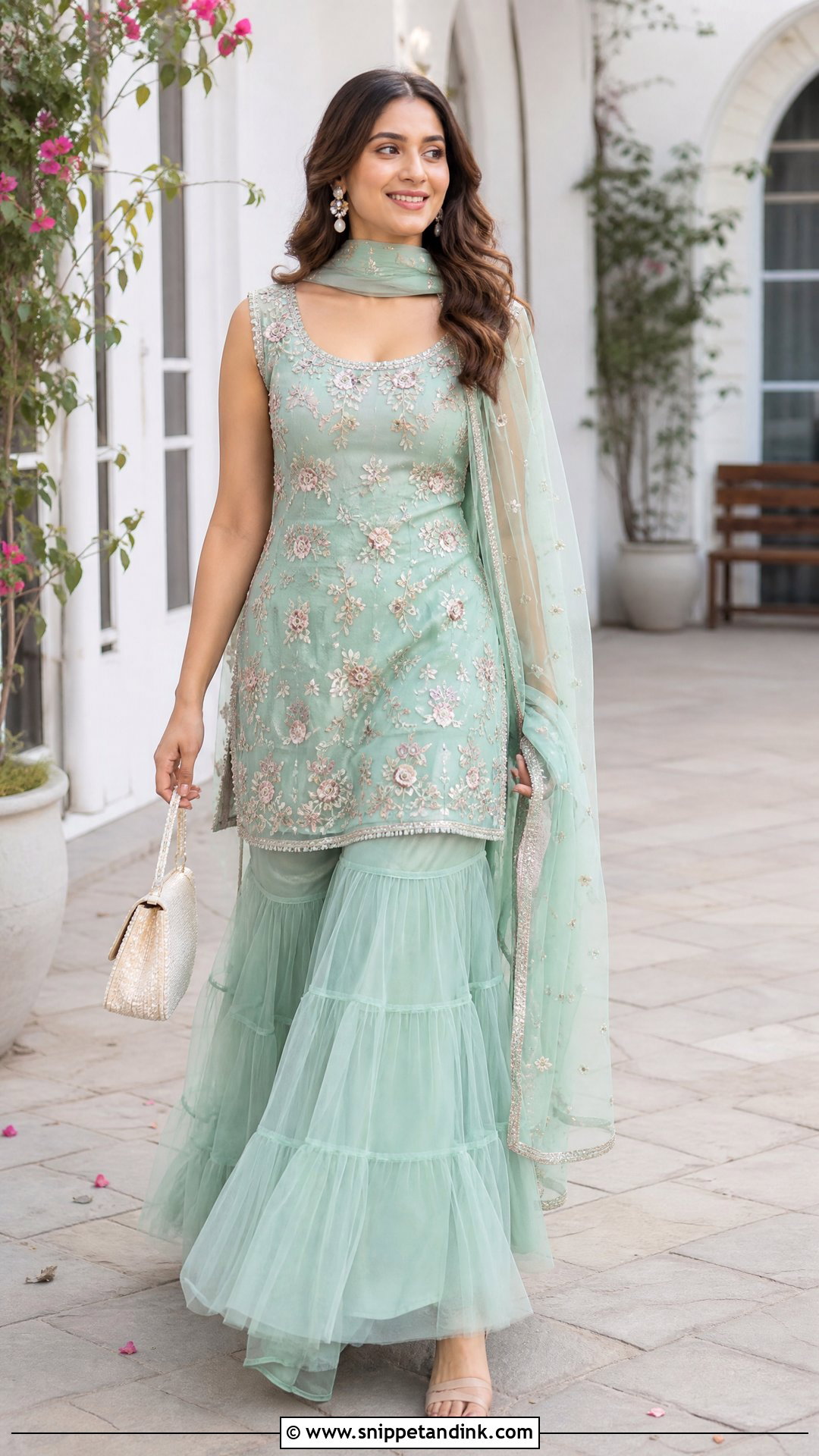
Mint is the kind of color that looks fresh in daylight and slightly grey under yellow indoor light, so I’d save it for daytime weddings and summer parties. A short fitted kurta over high-waisted sharara pants shows the full flare, with ivory, blush or pale gold threadwork and a lightly scalloped hem drawing the eye to the waist. Add a net dupatta with embroidered corners, nude block heels, pearl earrings and a mint or ivory bag. Pointed shoes and a vertical dupatta drape add length. Soft curls and natural makeup suit it.
11. Maroon Velvet Top Net Sharara
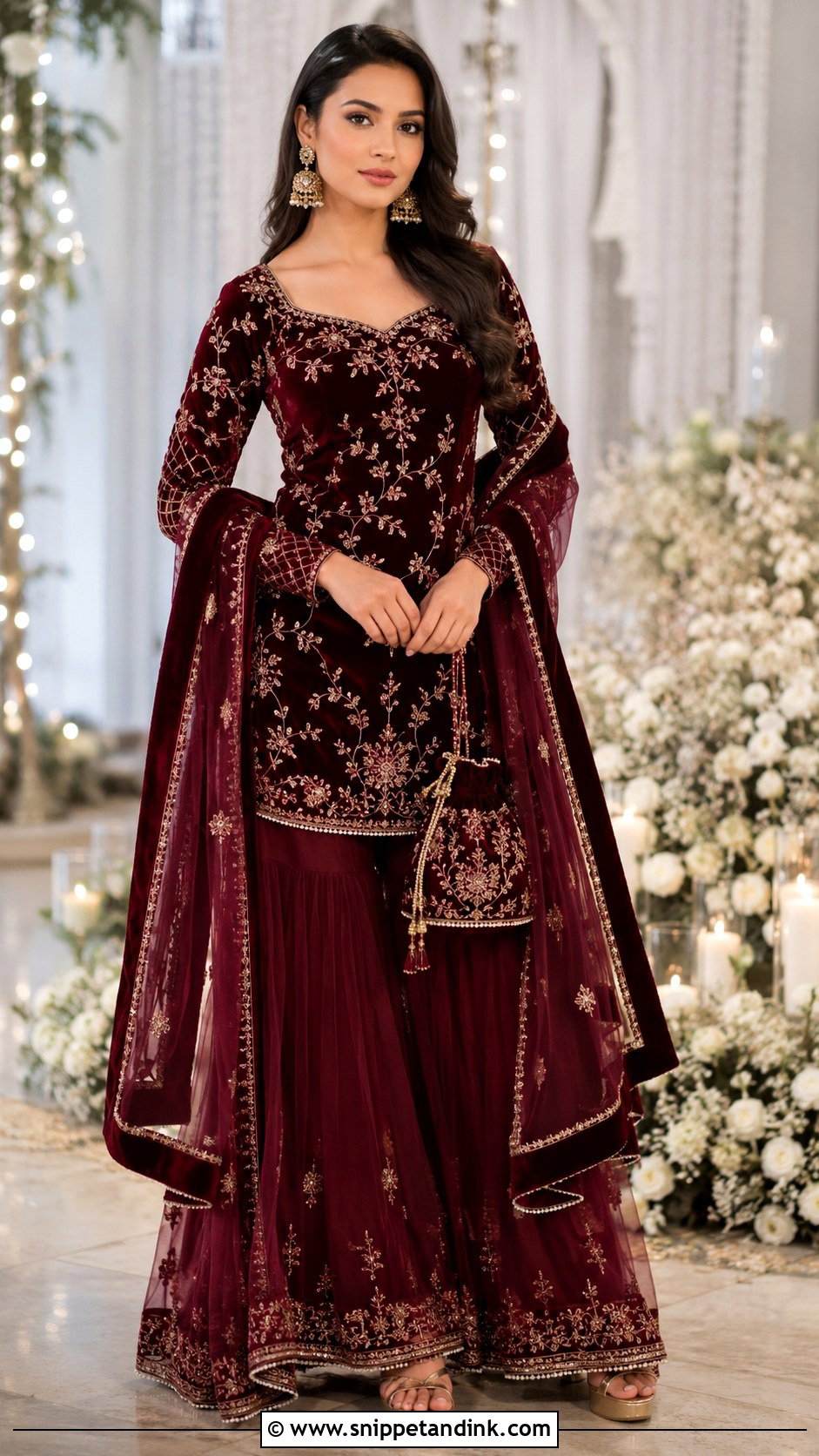
Velvet and net shouldn’t work together, yet they do: the heavy top grounds the airy pants. A fitted maroon velvet kurta with a V-neck, elbow sleeves and antique gold embroidery pairs with a matching net sharara lined in light satin, and a dupatta with velvet edging links the two fabrics. Velvet is warm and marks easily where it’s pressed, so I steam it from the inside rather than ironing. It’s a cold-weather outfit through and through. Antique jhumkas, an embroidered potli and platforms are plenty; skip extra necklaces, since velvet already looks rich.
12. White Chikankari Net Sharara
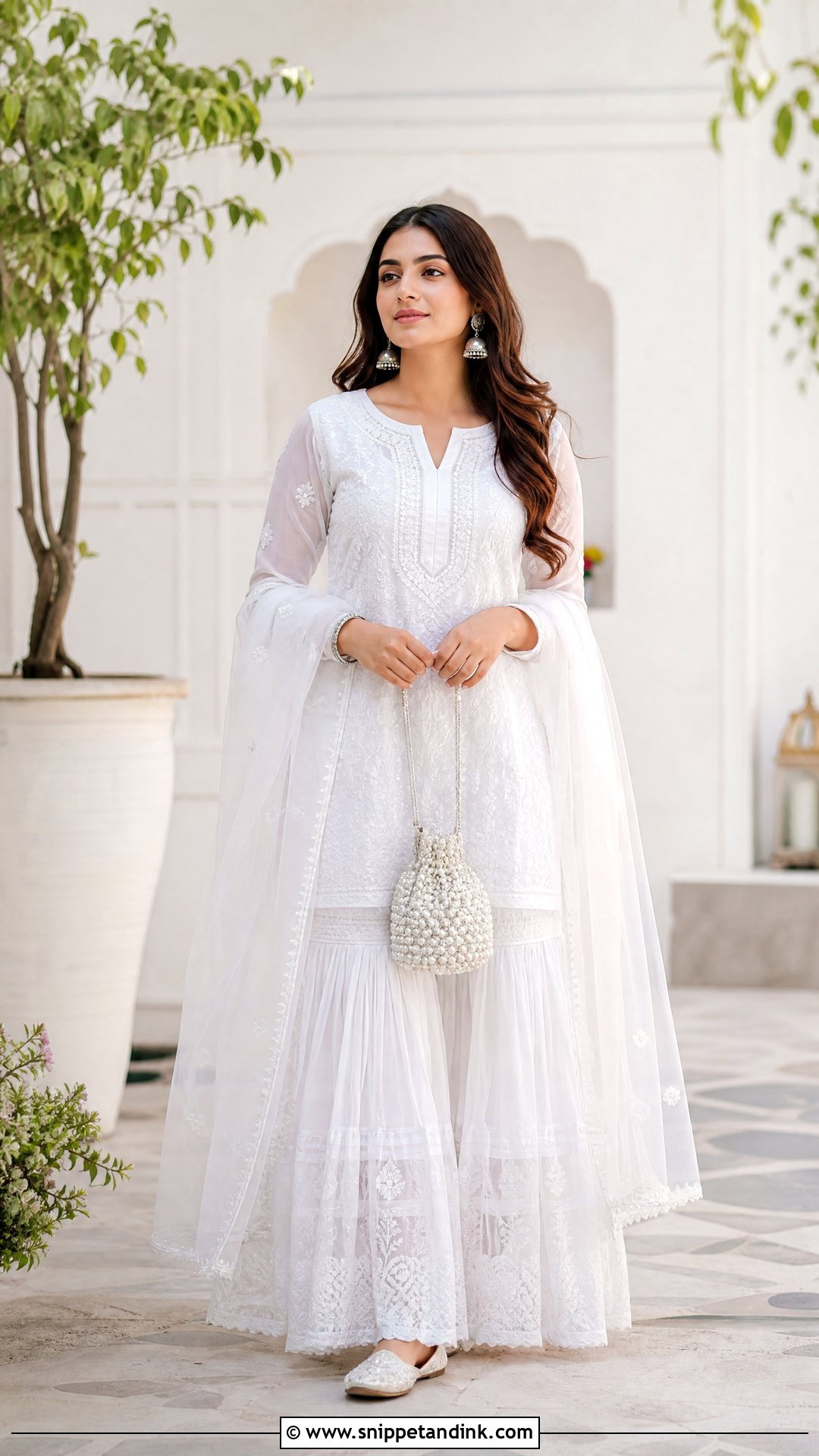
A white chikankari net sharara can be worn plain for a lunch or dressed up with metallics for an evening. A short cotton-lined kurta with white thread embroidery and a few sequins sits over a layered sharara that repeats the work near the hem, on a plain white lining. White net shows everything under it, so I check the outfit against daylight with the client’s actual underwear before the day. Silver jhumkas, white juttis and a pearl potli add texture without color; pale blue or mint accessories give contrast. A braid or relaxed bun keeps it easy.
13. Peach Ruffle Net Sharara
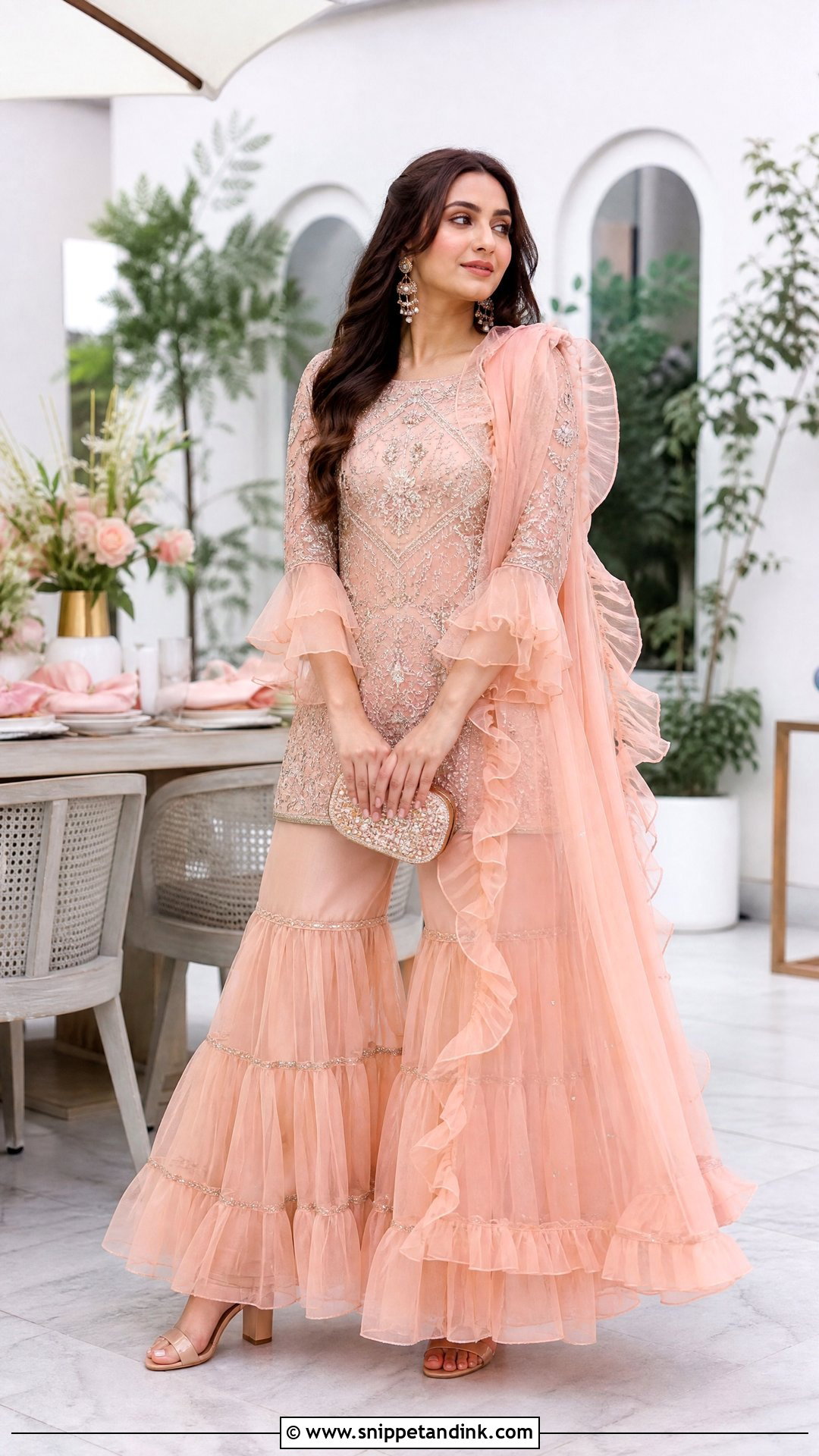
Ruffles add bounce, but they also add bulk fast. The peach version works because the ruffles are controlled: small ones on the sleeves of a fitted top with fine floral embroidery, and a few along the lower tiers of the sharara. Choose lightweight net over a narrow, smooth lining, and count the layers, since every extra one adds width at the hip. A plain dupatta with a ruffled border ties it together. Rose-gold earrings, a beaded clutch and blush block heels suit it, with a side-parted ponytail so the neckline shows.
14. Gold Jacket Net Sharara
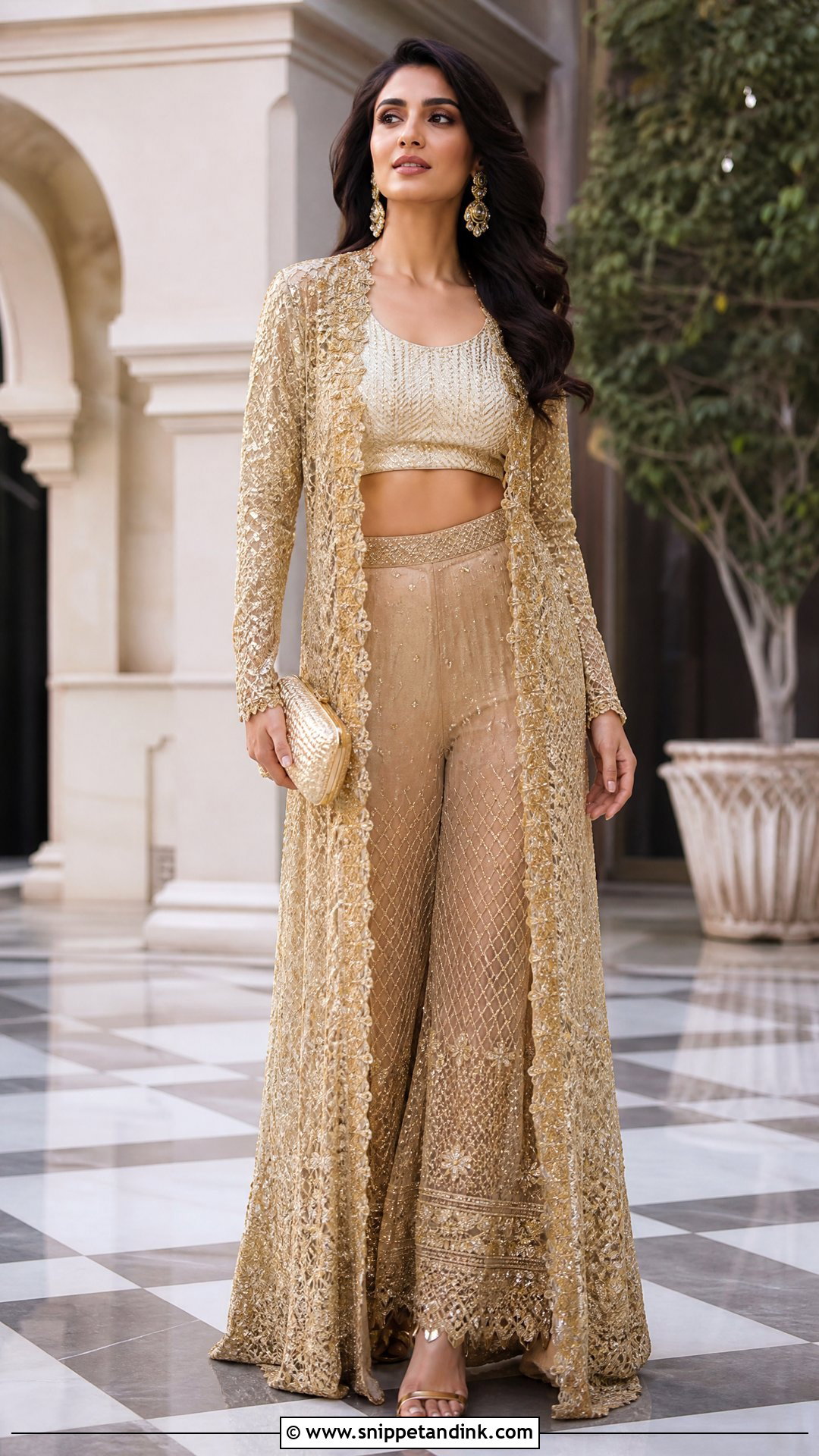
Gold net under a long embroidered jacket makes a strong evening outfit with very little effort. Keep the inner pieces plain, a sleeveless blouse and high-waisted sharara, and let the front-open jacket carry the zari, sequins or beads along its borders. Below-the-knee jackets are heavy, so check that the shoulders fit properly; a jacket that’s too wide slides back all night. No dupatta needed. Bronze heels, sculptural earrings, a small metallic clutch and a low bun or ponytail keep the jacket’s neckline visible.
15. Teal Long Kurta Net Sharara
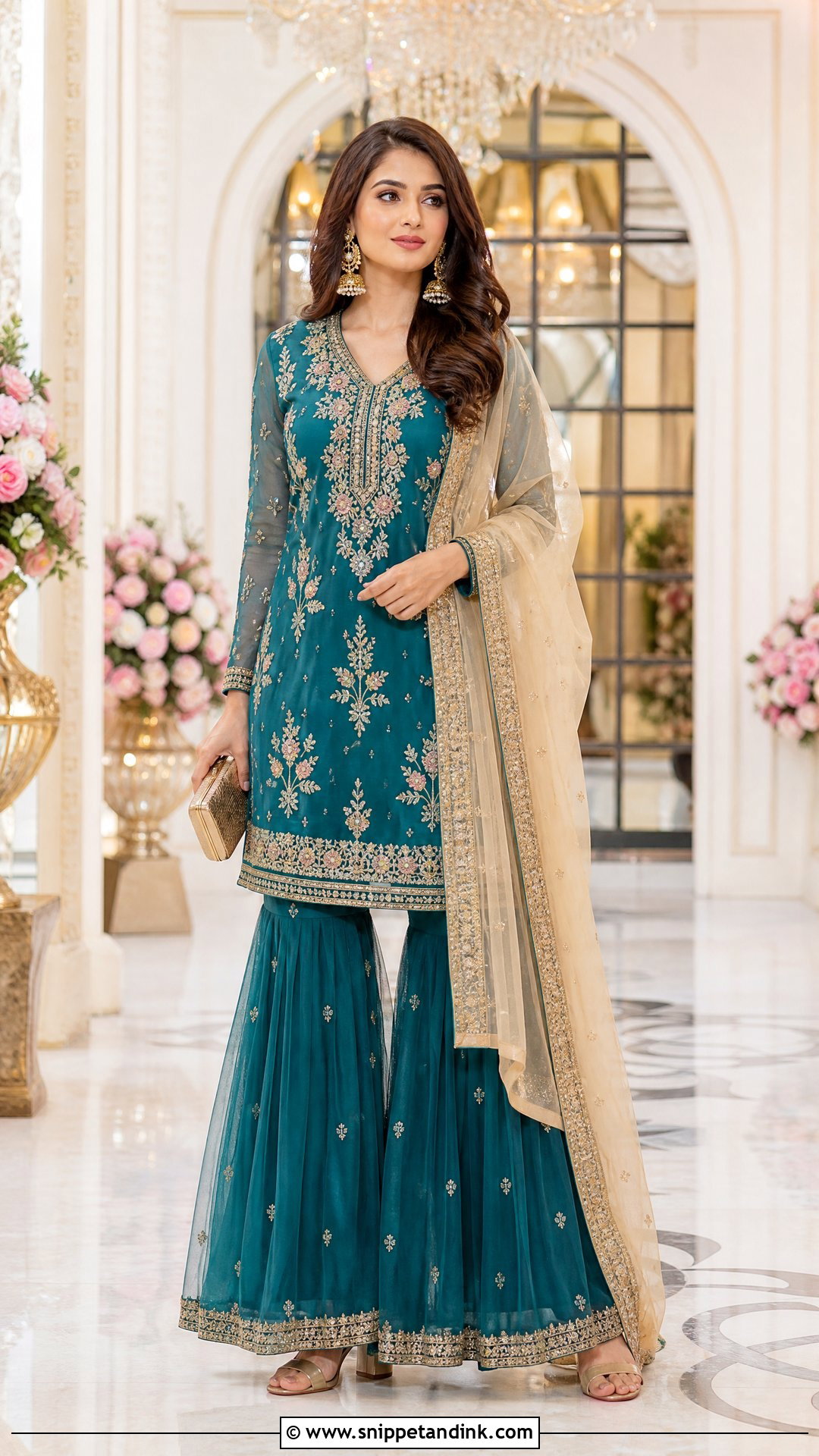
A long teal kurta gives full coverage while the sharara still swings below it. Choose a straight, knee-length kurta with side slits so the flare shows as you walk, and keep the embroidery to the neckline, cuffs and hem. Underneath, a sharara with fuller volume below the knee and an opaque lining completes the set. Many shops label this a sharara when it’s closer to a gharara, which is fitted to the knee and flares from a seam there; both suit a long kurta. A beige or blush dupatta adds depth, with gold drops, a structured clutch, medium block heels and side-swept waves.
16. Orange Bandhani Net Sharara
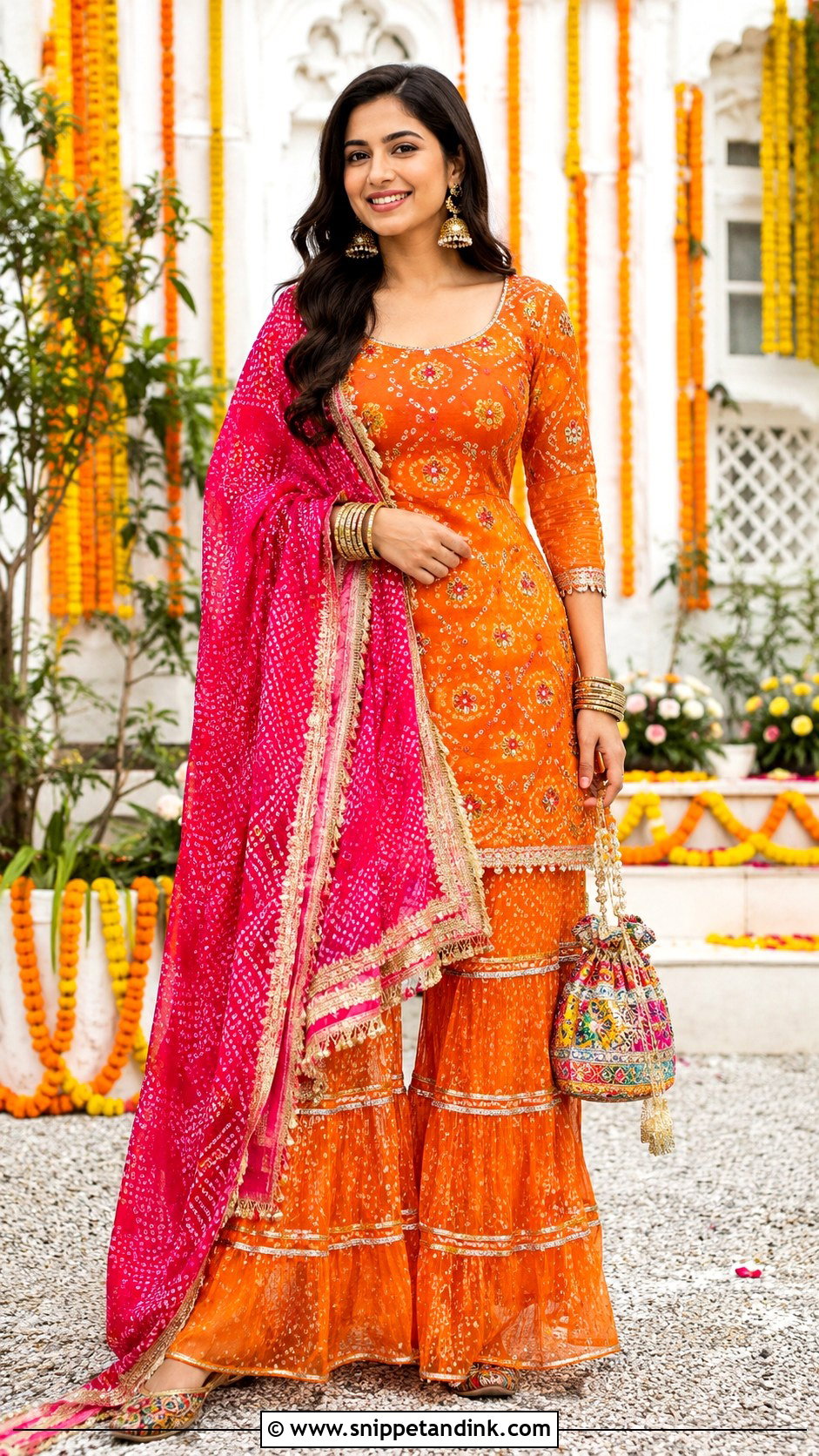
Orange bandhani motifs give net a Rajasthani and Gujarati festive feel. A fitted orange kurta with small bandhani-style motifs, gota trim and a round neck sits over a tiered net sharara banded with print or embroidery, and a contrasting pink bandhani dupatta lifts the color. Orange and pink is a classic pairing for good reason. For a hot daytime mehndi or haldi, I insist on a cotton-blend lining. Gold jhumkas, stacked bangles, a bright potli, juttis, a braid and coral makeup suit the palette.
17. Silver Crop Top Net Sharara
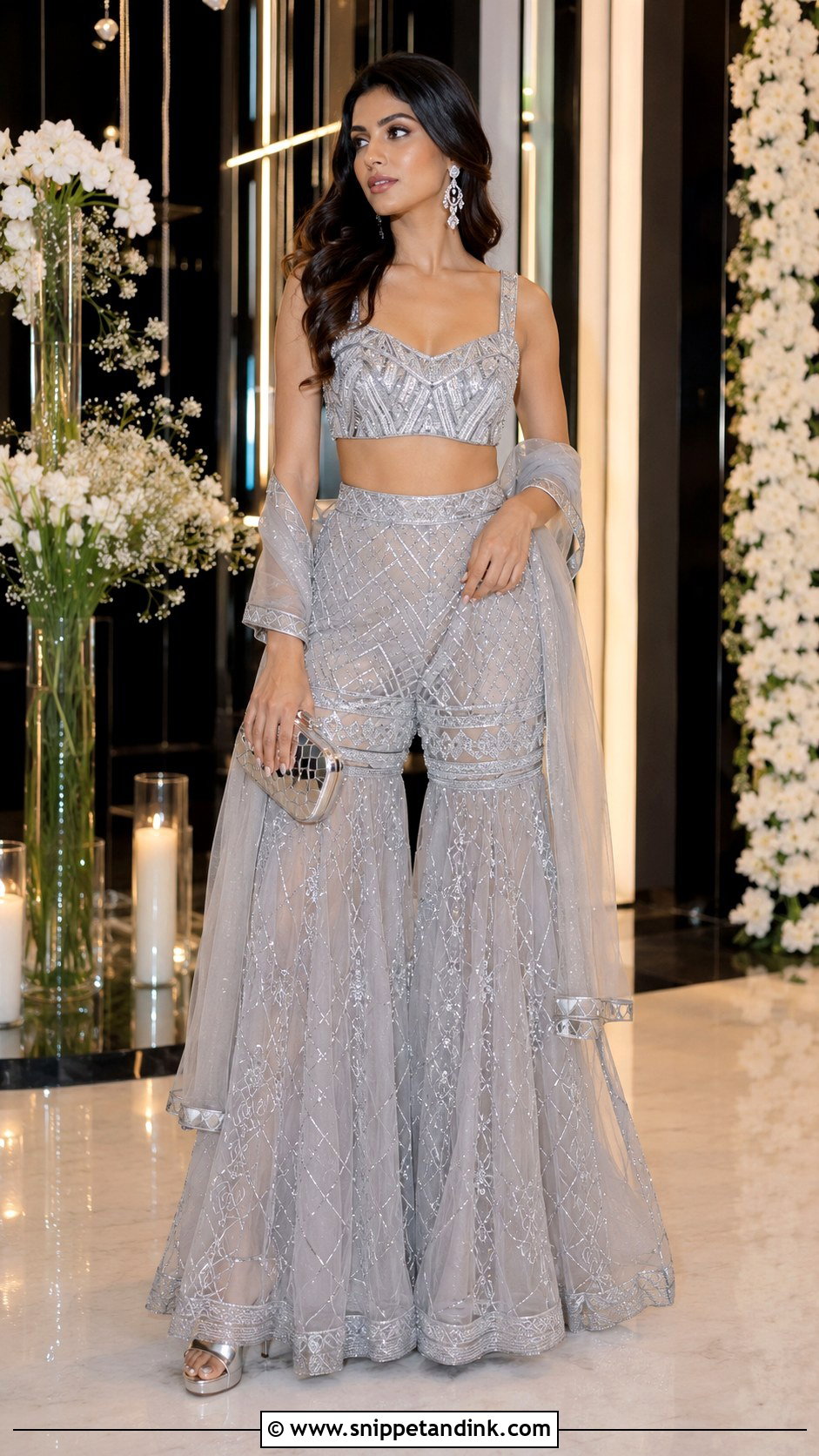
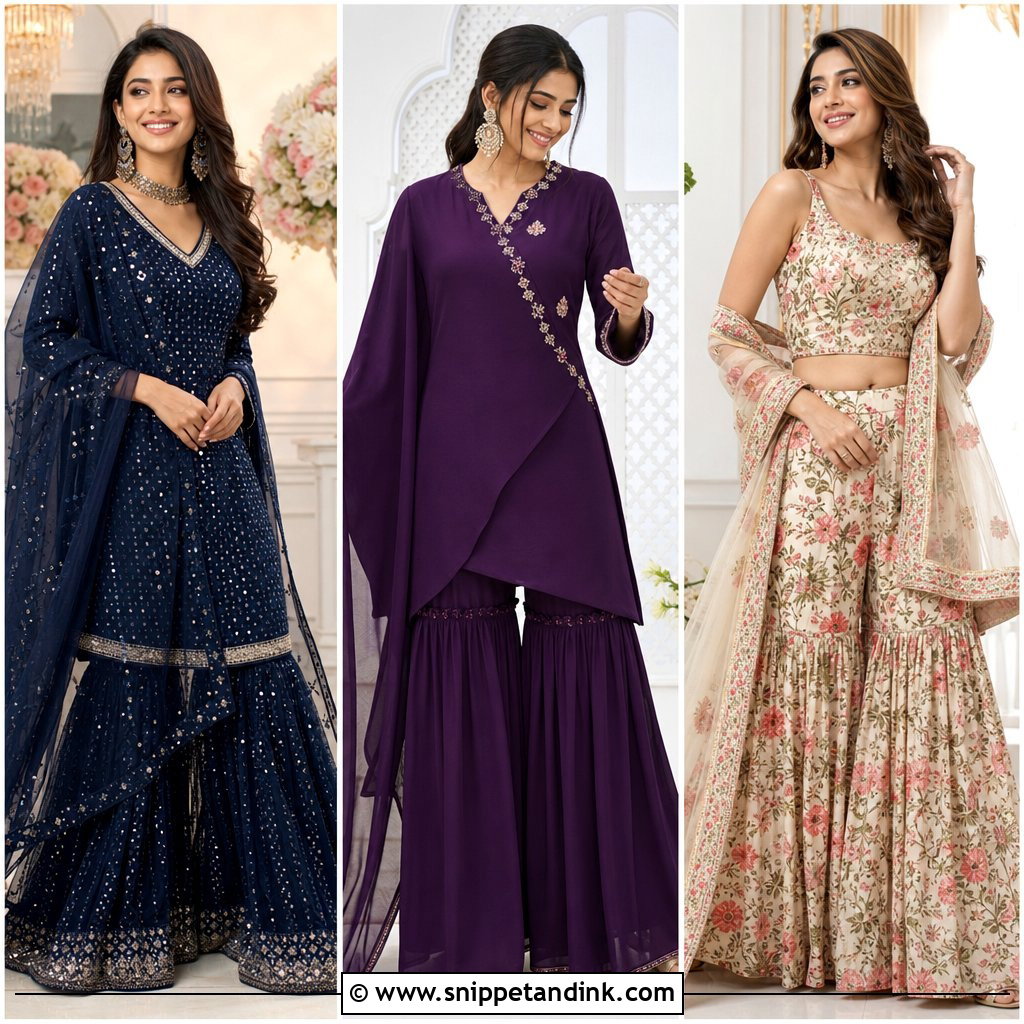
A silver crop top over a matching net sharara is the sleekest set here, and it’s all about the blouse. It needs a supportive fit, a comfortable neckline and geometric sequin or beadwork, over high-waisted pants so only a slim band of waist shows. Ask for a satin-faced waistband: beaded net rubbing against bare skin for six hours leaves marks. Drape a sheer silver-grey dupatta over one shoulder or pin it at the waist. Crystal earrings, a mirrored clutch, metallic heels and sleek straight hair or a high ponytail finish it for a sangeet or reception.
18. Navy High-Low Net Sharara
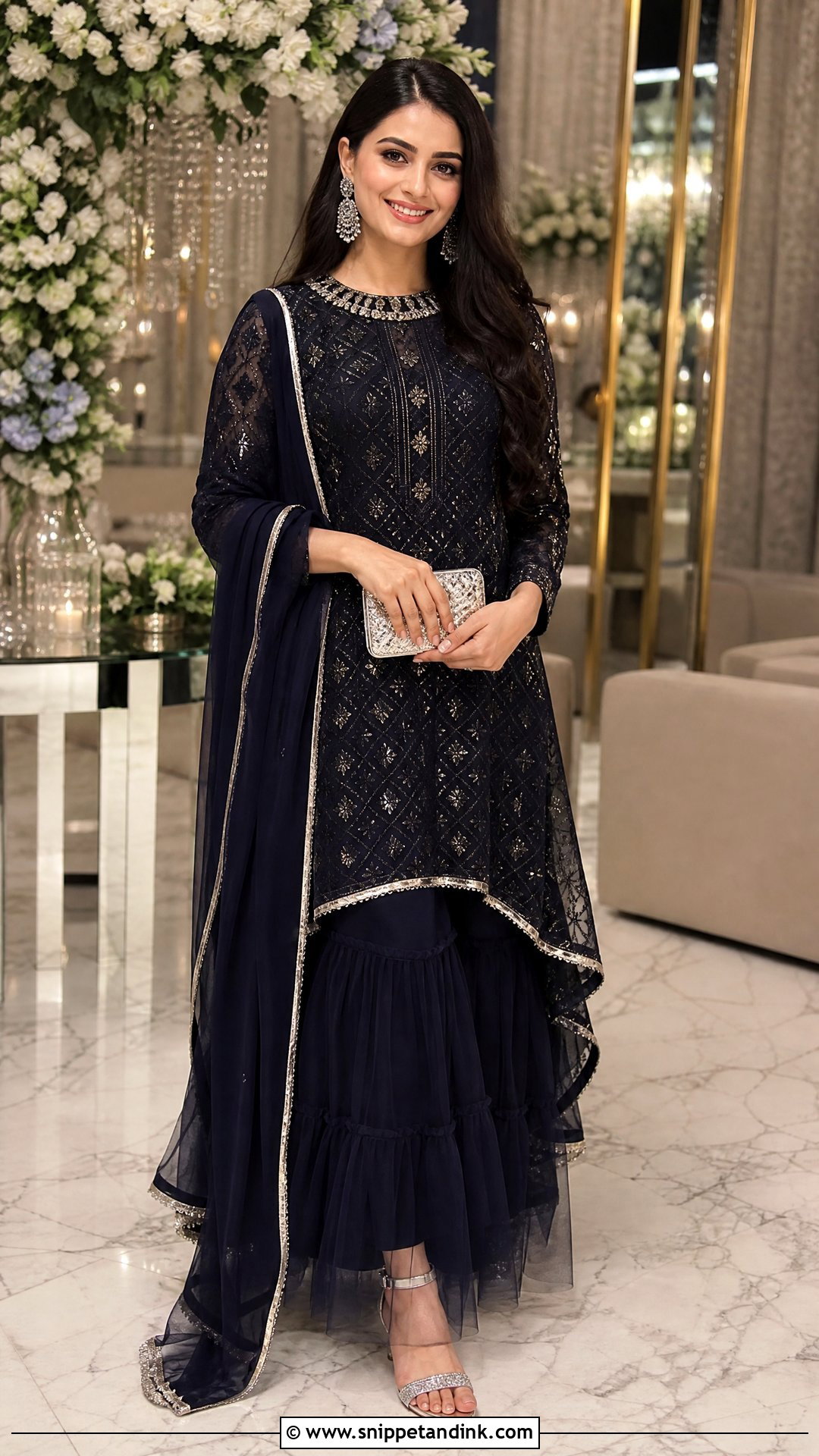
A high-low kurta shows the navy sharara in front and covers more at the back. The front ends at the upper thigh and the back falls near the knee, with tonal sequins, fine threadwork and a defined waist keeping the unusual cut tidy. A layered sharara on matching crepe goes underneath. Wear the dupatta over one shoulder so it doesn’t fight the hemline. The back panel is the thing I check when the client sits down, because a long back can bunch under you; a soft fabric with some drape avoids that. Navy or silver heels, statement earrings and swept-back hair finish it.
19. Mauve Asymmetrical Net Sharara
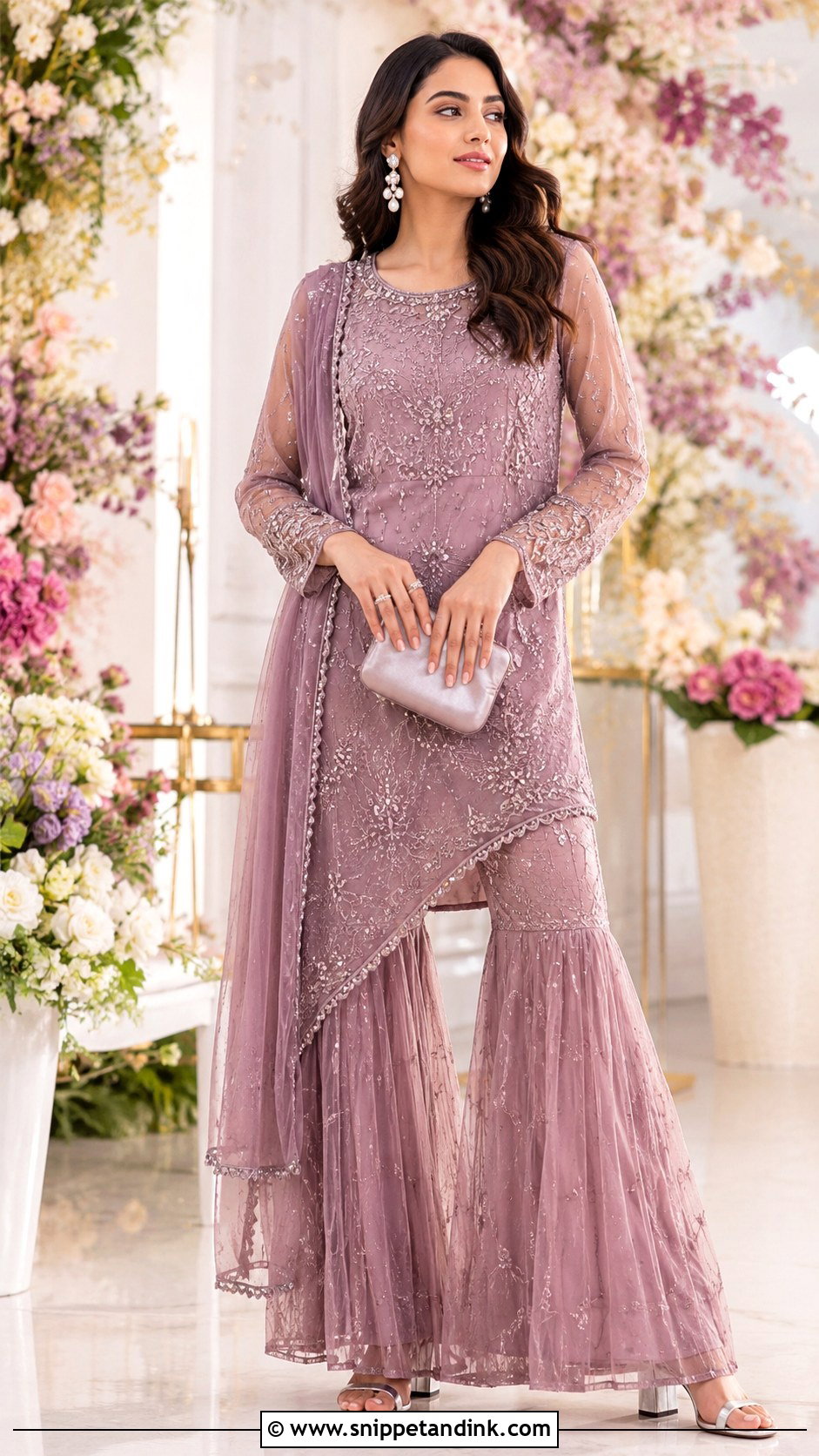
An asymmetric hem, longer over one hip and shorter on the other, makes the sharara the star and draws a long diagonal line across the body. In mauve, with a fitted kurta and a tonal sharara embroidered near the hem, it reads soft rather than edgy. How much dupatta to add depends on the top: a narrow one, or a one-shoulder drape if the kurta is already busy. I’d hem this sharara with the exact shoes in hand, since an asymmetric top draws attention to the hemline. Pearl earrings, a satin clutch and nude or silver block heels suit it, with a loose bun and a few face-framing strands.
20. Multicolor Embroidered Net Sharara
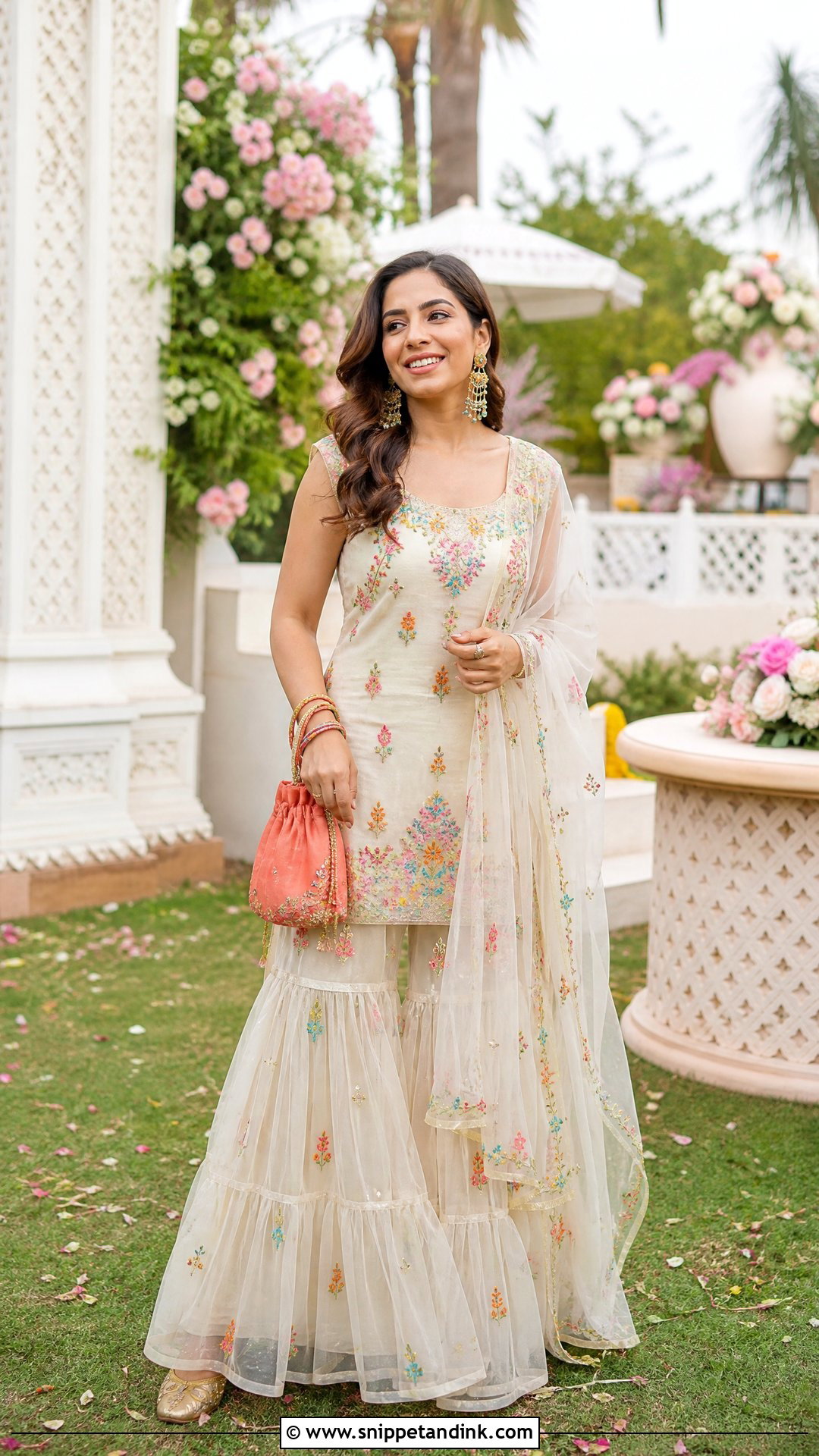
For anyone who loves color, a multicolor embroidered net sharara is a happy way to finish a wedding wardrobe. Start from a neutral base, ivory, beige or pale pink, with floral threadwork in green, blue, coral and yellow, and repeat that embroidery on a short fitted kurta without covering it. A light dupatta with colored edging connects everything. My rule with multicolor: pick one shade from the embroidery for your potli or bangles and leave the rest alone. Gold juttis, simple drops, natural makeup and a relaxed hairstyle let the work show.
Net Catches on Everything, So Plan the Night Around It
Net’s open weave snags on rough edges, and once a hole starts it spreads. The worst offenders I see are claw-set bangles, the velcro on a clutch, heel buckles and the hook on someone else’s jacket. Before the event, run your hand over every accessory that will touch the sharara and swap anything sharp for something smooth. Wear heels with closed straps, and lift the front tier slightly on stairs so a heel can’t catch the hem.
If it does snag, don’t pull the thread. Push it back through to the inside with a needle or a pin and press a tiny dot of clear nail polish on a broken thread from the inside only, never on the front. Small tears in a back tier can wait for the tailor.
Pressing and storing the set afterwards
Steam net rather than ironing it. If you must use an iron, set it low and press through a cotton cloth, because synthetic net melts and shines at higher heat. To store, fold the sharara loosely with tissue paper between the tiers and keep it in a cotton bag. Don’t hang a heavily embroidered one by the waistband for months; the weight slowly stretches the net. Store the kurta separately so its embellishment can’t rub against the net.
Fitted Top, Lined Net, One Jewelry Statement
Every outfit here follows the same balance: a fitted top so the flare doesn’t swamp you, a lining that ends where the net does, and accessories that support rather than compete. Pastels and florals suit daytime functions. Dark shades, sequins, velvet and zari carry evenings. Choose one main jewelry piece and shoes you can stand in, and remember that where you place the dupatta changes both your shape and your coverage. Get those few things right and the sharara does the rest.
You'll Like These Ideas:


Leave a Reply