
Dusty blue is the blue I find easiest to put on a wedding cake, because the grey in it keeps it calm next to ivory linens and white flowers. Ombre gives that color somewhere to go: a fade from deep slate blue at the base to a pale misty shade at the top, or from ivory down into a quiet blue bottom tier. The catch is that blue is the hardest color I tint. Push it a little too far and it turns nursery bright; leave out the grey and it reads teal under warm reception lighting. The twenty cakes below handle the fade in different ways, and for each one I’ve noted what it asks of the baker and where it tends to go wrong.
Getting Dusty Blue Instead of Baby Blue or Teal
Every cake below relies on one thing going right: the shade. Dusty blue is blue softened with grey, and it’s easy to miss in either direction. When I tint it, I start with a small amount of sky blue gel and knock it back with a tiny dot of black or a touch of violet, then I wait. Gel color keeps developing for an hour or more after mixing, so tinting straight to the final shade usually leaves you a step darker than you meant.
What to bring to your tasting
- A physical swatch. A ribbon, napkin or scrap of dress fabric beats any screen, since phone displays push blues brighter than they are.
- A photo of the venue at the hour the cake will be cut. Warm candlelight pulls dusty blue toward grey-green, while daylight keeps it cool.
- Your view on which way the fade runs. Dark at the base and pale at the top is the usual order because it looks grounded; reversing it can make a tall cake feel top-heavy.
- How many steps you want. Three shades read clean on a three tier cake, and four or more suit taller designs.
Ask to see the mixed frosting in daylight rather than under kitchen strip lights. And ask whether the baker whitens the buttercream before adding color. Butter is yellow, yellow and blue make green, and that is the most common reason a dusty blue cake looks faintly teal in the photos.
1. Dusty Blue Ombre Buttercream Wedding Cake
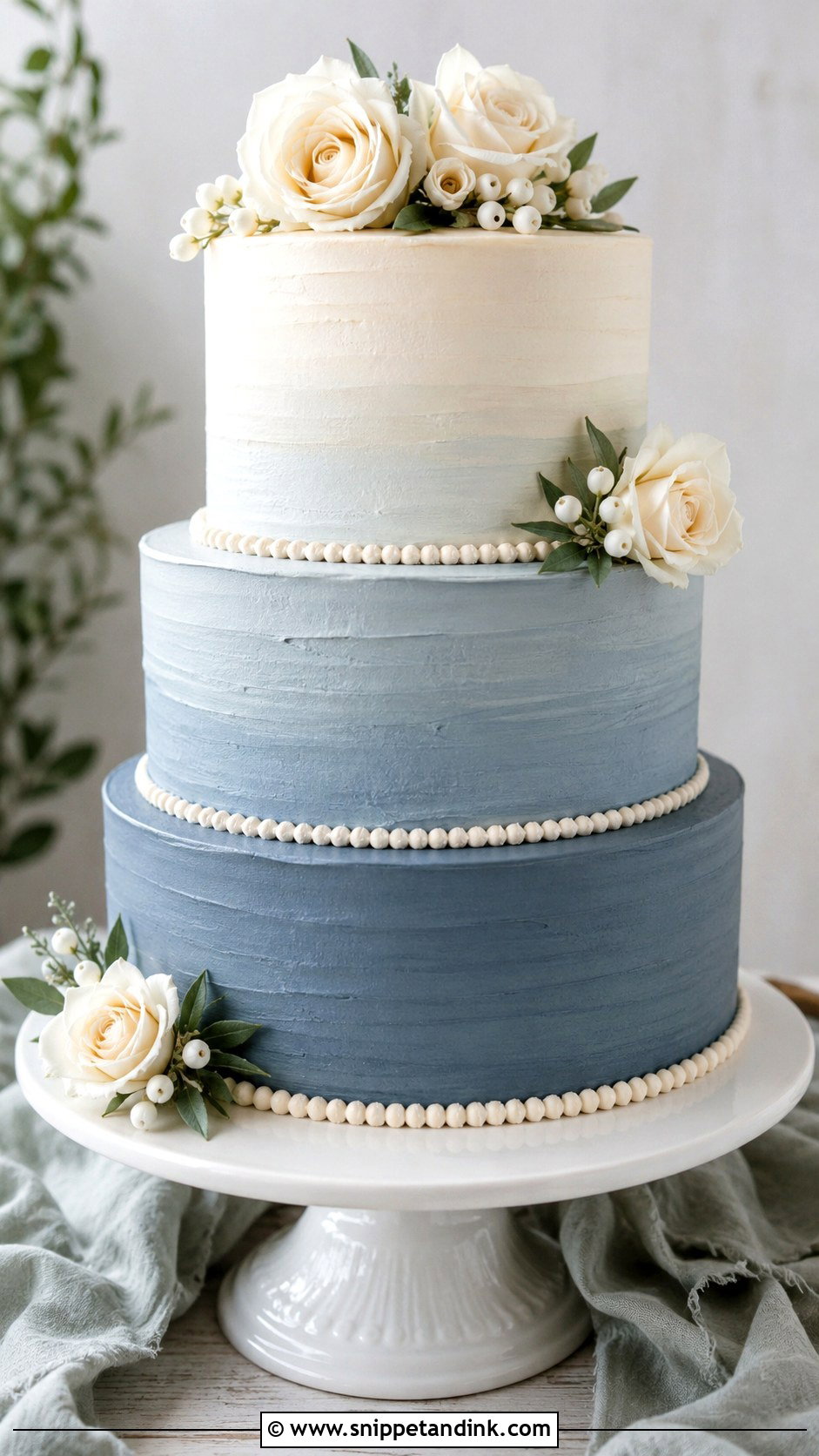
Buttercream is where I’d start most couples. A fade done with a bench scraper blends naturally because the shades meet while they’re still soft, so the bands melt into each other instead of sitting in stripes. I mix one base batch and pull out three or four portions, each tinted a step darker, which keeps every blue on the same undertone. Butter frosting is slightly yellow, though, and yellow plus blue drifts green, so I neutralize it with a speck of violet before any blue goes in. Vanilla, almond, lemon and white chocolate sponges all sit well under it, and a thin pearl border is all the finish it needs.
2. Dusty Blue Ombre Fondant Wedding Cake
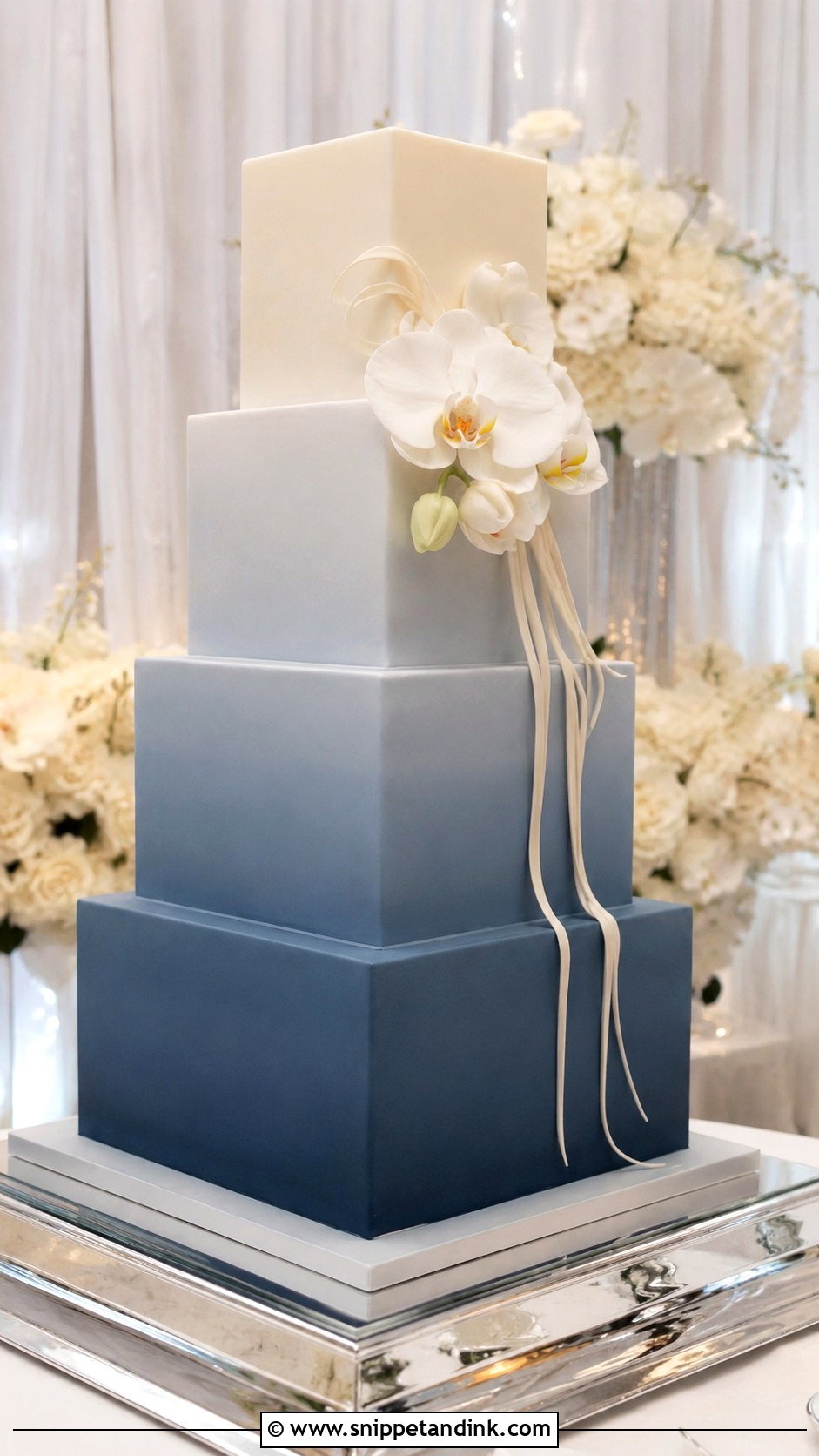
Fondant gives you the sharp edges and flat sides that a formal ballroom suits. The fade behaves more like paint here: I airbrush or brush on petal dust from smoky blue at the base up to ivory at the top tier. It holds its shape better than buttercream in a warm room, which is why I suggest it for summer, but it has its own weakness. Move a fondant cake from a cold fridge into a humid hall and condensation beads on the surface, and tinted fondant can spot as it dries. Sugar roses, a white orchid or a fondant ribbon is plenty. The gradient is the decoration.
3. Dusty Blue Ombre Wedding Cake With White Flowers
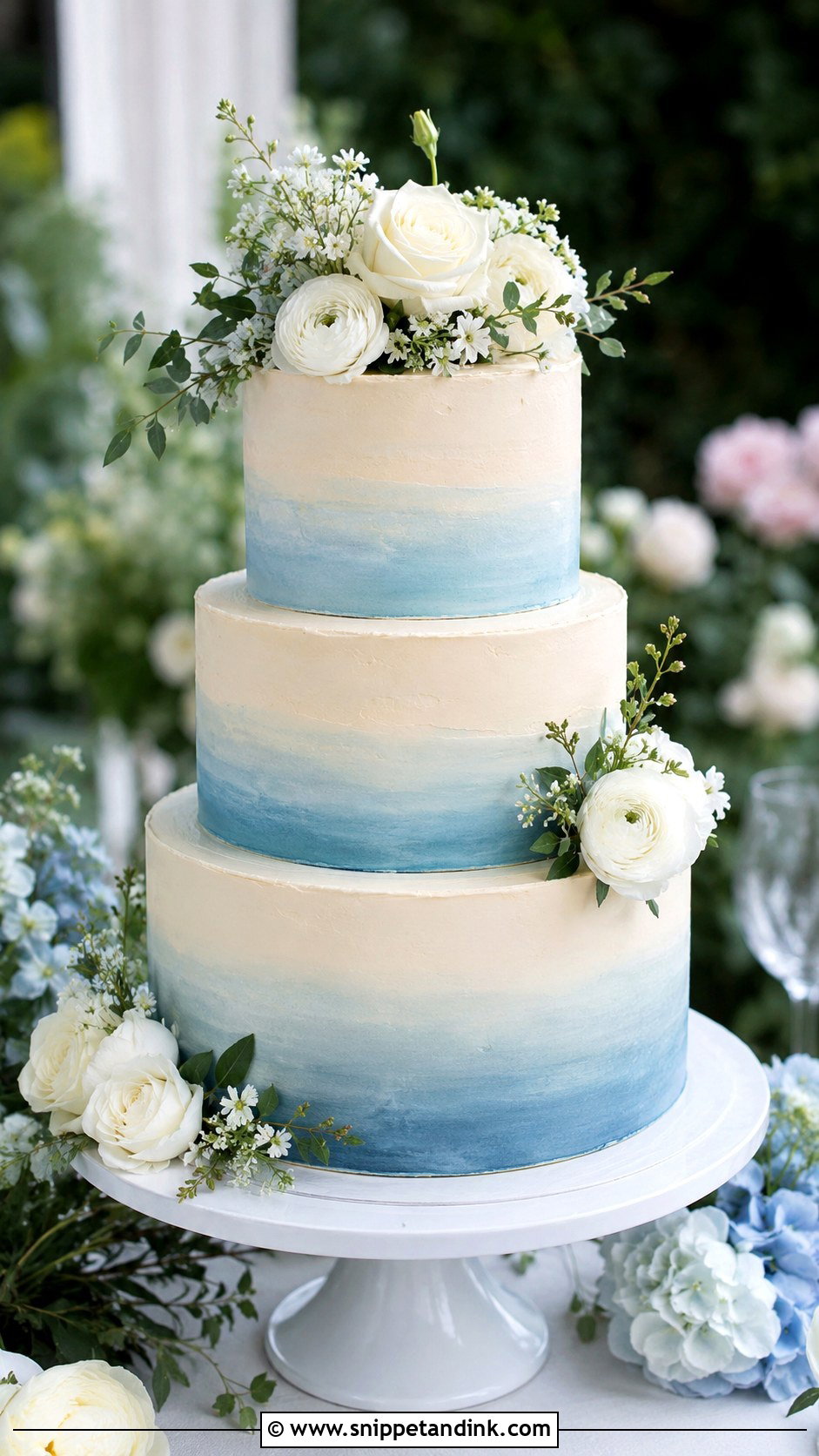
A diagonal sweep of white blooms is the simplest way to make the fade feel bridal. Three tiers is usually the right size, since the drift needs to cross at least two color bands to look intentional. Roses, ranunculus and peonies all read crisply against the blue. If they’re fresh, I want the stems wrapped and a barrier under every cluster, because plenty of florist flowers have been sprayed or simply aren’t food safe, and peonies drop petals as the room warms. Sugar flowers sidestep all of that. A few pale green leaves stop the white from looking stuck on.
4. Dusty Blue Ombre Wedding Cake With Gold
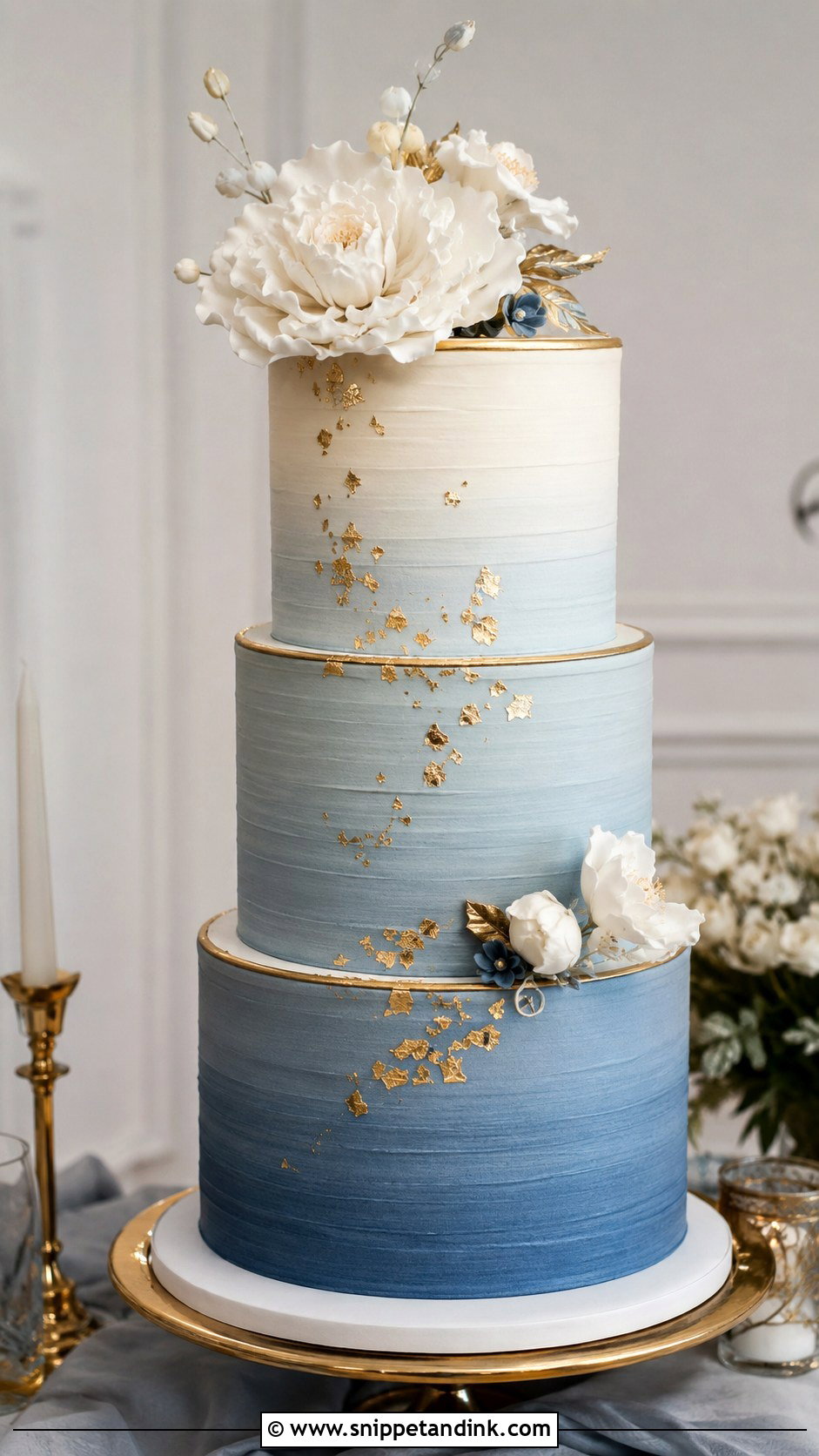
Gold on dusty blue works when it’s rationed. I give a cake one gold moment: a thin painted rim on a tier edge, a few flakes of edible leaf, or a small monogram, never all three. Gold leaf is so fine it tears if you breathe near it, so I lay it with a dry brush once the frosting has set; on wet buttercream it smears into a muddy streak. Under evening ballroom lighting the warmth of the gold balances the cool blue nicely. Keep the flowers ivory and the piping plain, or the cake starts competing with itself.
5. Dusty Blue Ombre Wedding Cake With Pearls
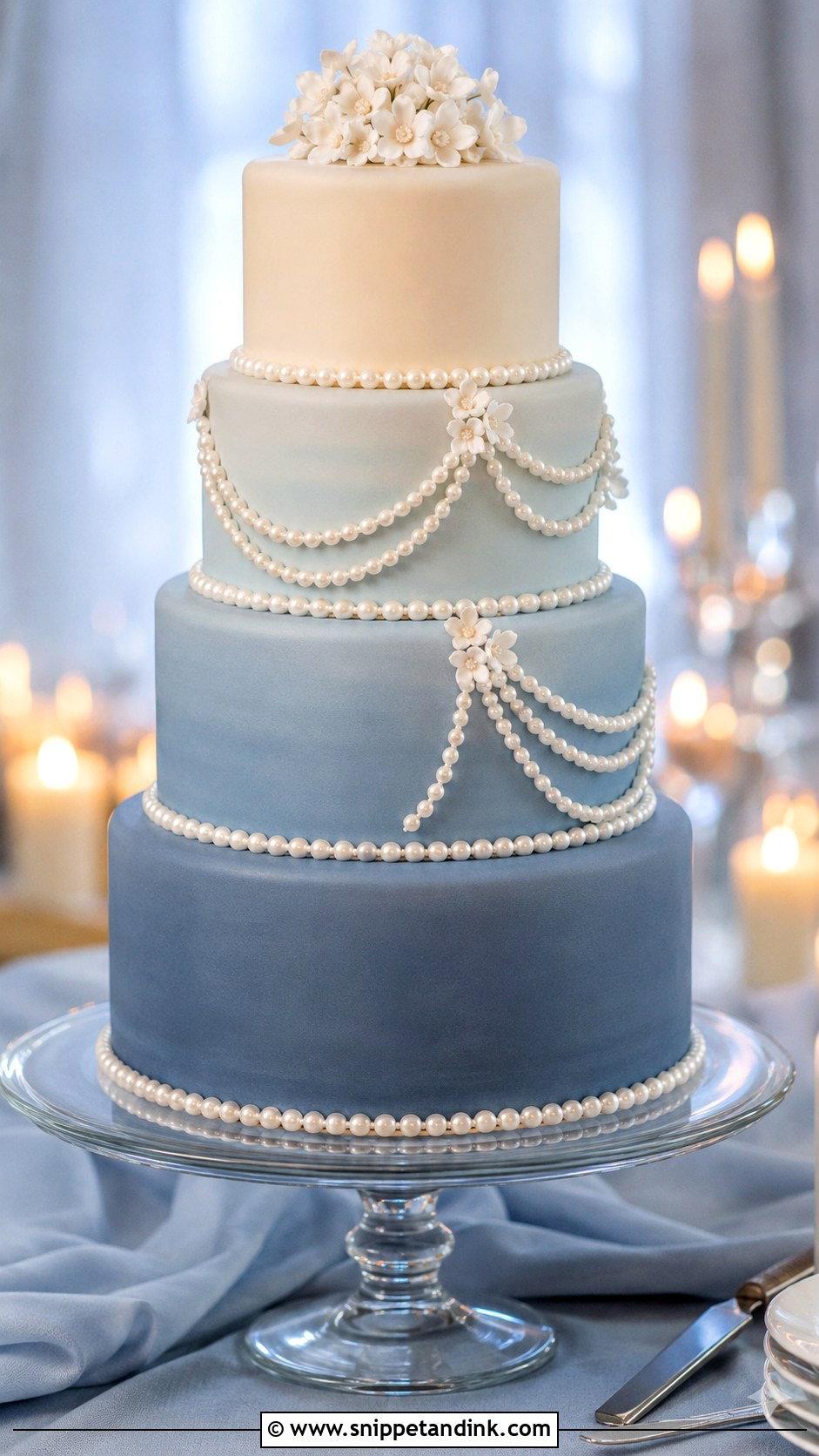
Pearls repeat the soft sheen dusty blue already has, so the two never fight. Placement sets the mood. Single dots spaced around each tier look modern, while strands and clusters set into piped buttercream lean vintage. I press sugar pearls in while the frosting is still tacky so they bond. On a humid day I’d use fewer of them, because sugar pearls go sticky and lose some of their shine in damp air. At a coastal venue they quietly echo sea glass without a single shell on the cake.
6. Dusty Blue Ombre Wedding Cake With Hydrangeas
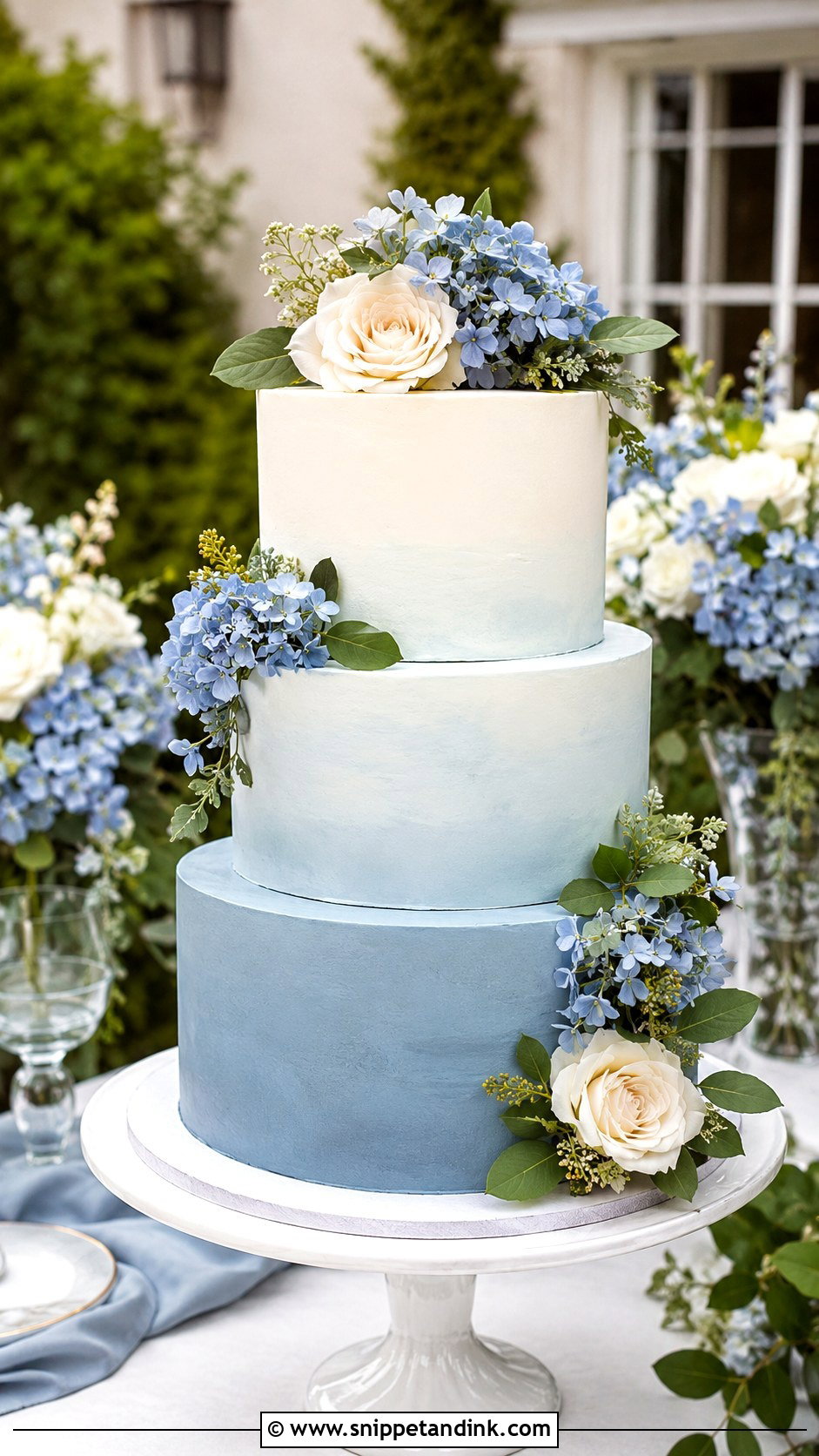
Their petals already carry that grey-blue cast, which is why hydrangeas suit this cake so well. They are also the thirstiest flower I deal with. Cut and out of water, a fresh head can wilt within a couple of hours on a warm table. If you want real ones, ask your florist to hydrate them thoroughly, wrap the stems and place them as late as the schedule allows. Otherwise I’d make them in sugar, which holds its shape all night. A white top tier, a pale blue middle and a deeper base give the blooms a graduated backdrop, and a few ivory roses soften the clusters.
7. Dusty Blue Ombre Wedding Cake With Roses
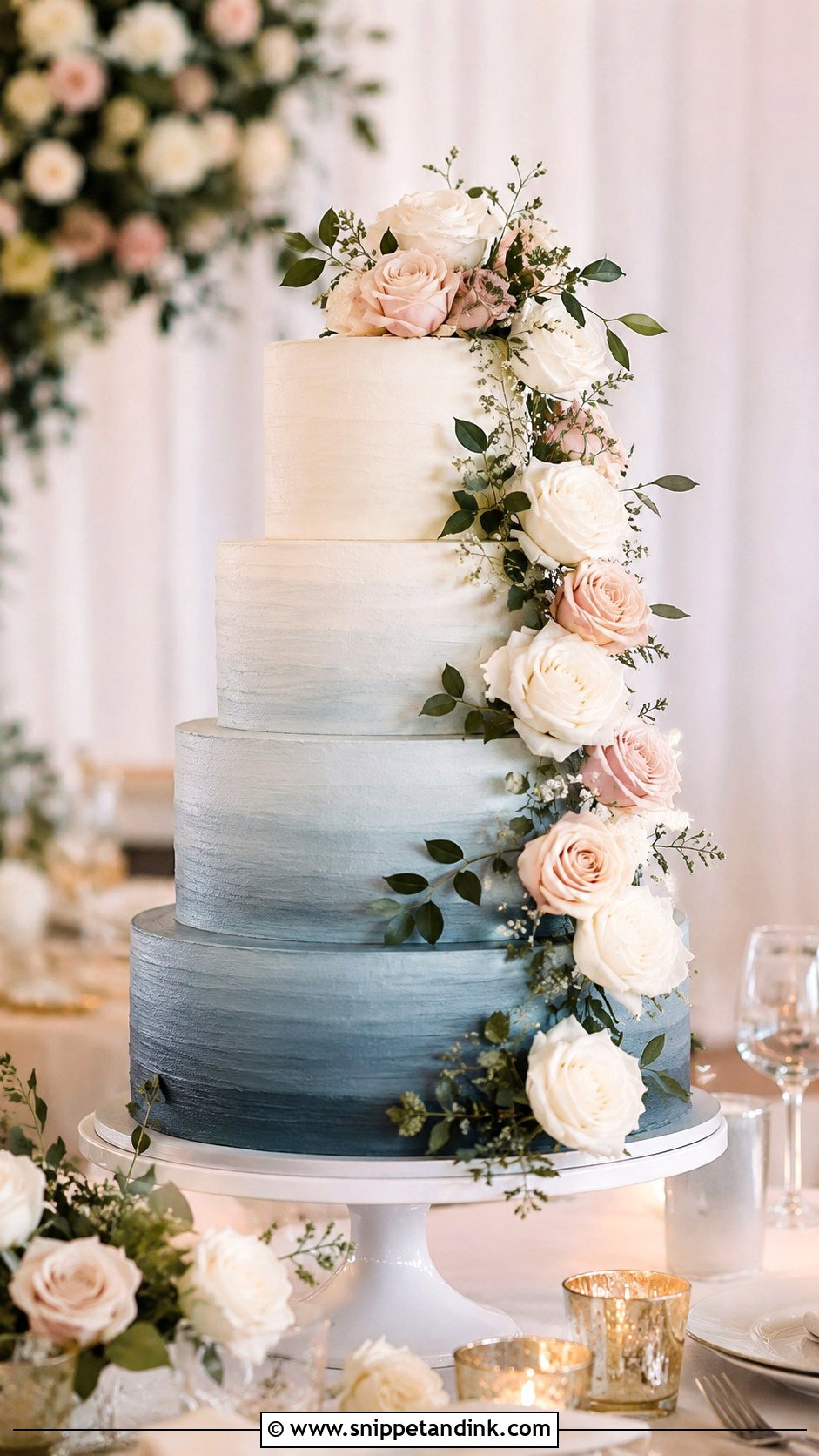
Rose color changes this cake more than anything else. White keeps it traditional and blush warms the blue up. Dusty blue sugar roses give a tonal, almost monochrome finish, but I’d only suggest them when the fade itself has strong contrast; otherwise the flowers disappear into the frosting. A single cascade down one side of a smooth three tier cake is the arrangement I find easiest for photographers, because it gives the cake an obvious front. It suits an indoor reception as readily as a garden one, and it won’t date.
8. Dusty Blue Ombre Watercolor Wedding Cake
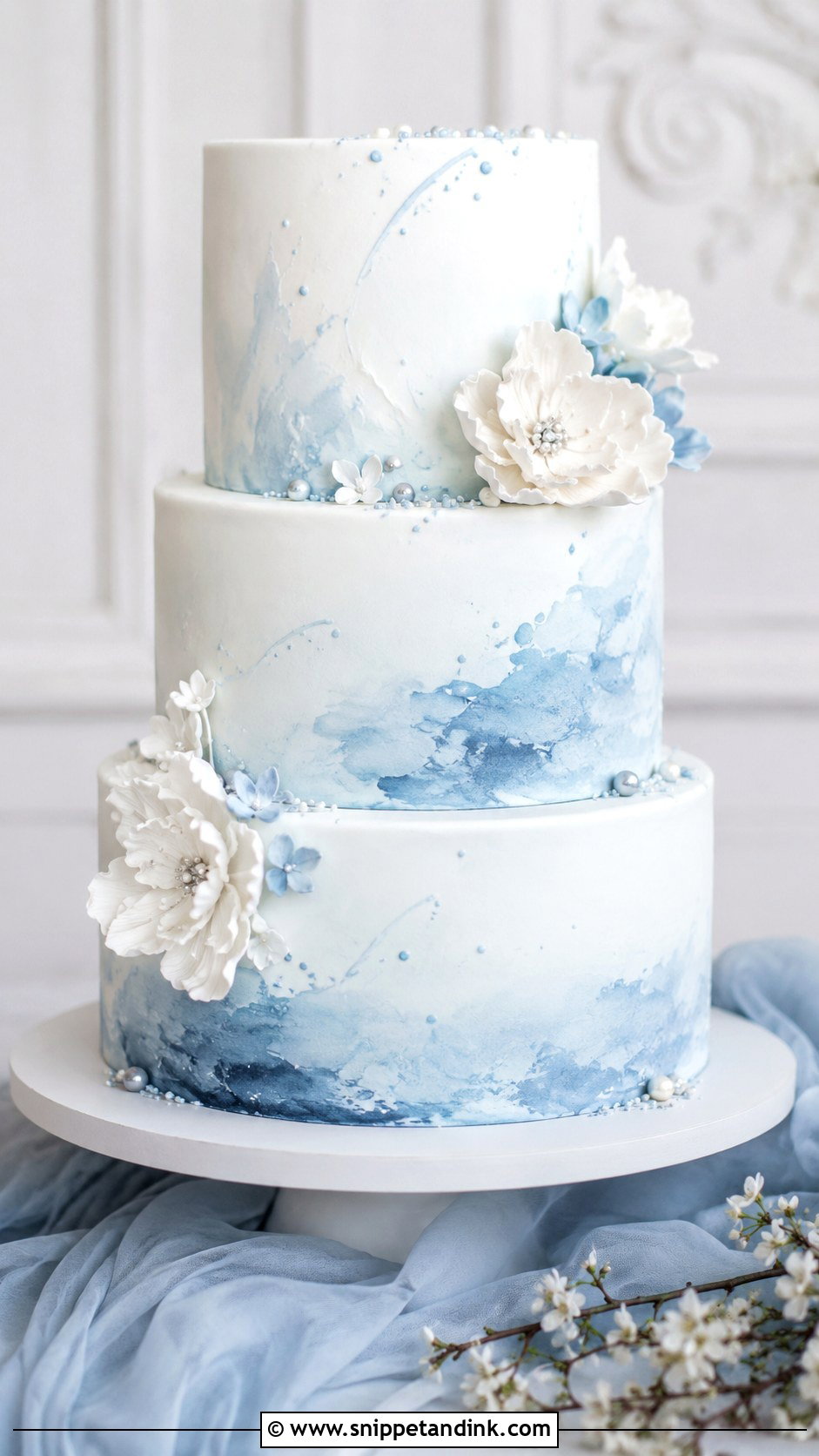
Watercolor is ombre with the edges left loose. Instead of an even blend, the blue sits in washes and cloudy patches, which I build by dragging small amounts of tinted buttercream over a chilled crumb coat with a palette knife. The risk is that a loose finish can look unfinished in close-up photos, so I keep the top mostly ivory and let the color pool toward the base, where the eye expects weight. One small gold accent or a few silver pearls is enough. I’d pick it for a fine-art or coastal wedding where the invitations already have a painted texture.
9. Dusty Blue Ombre Ruffle Wedding Cake
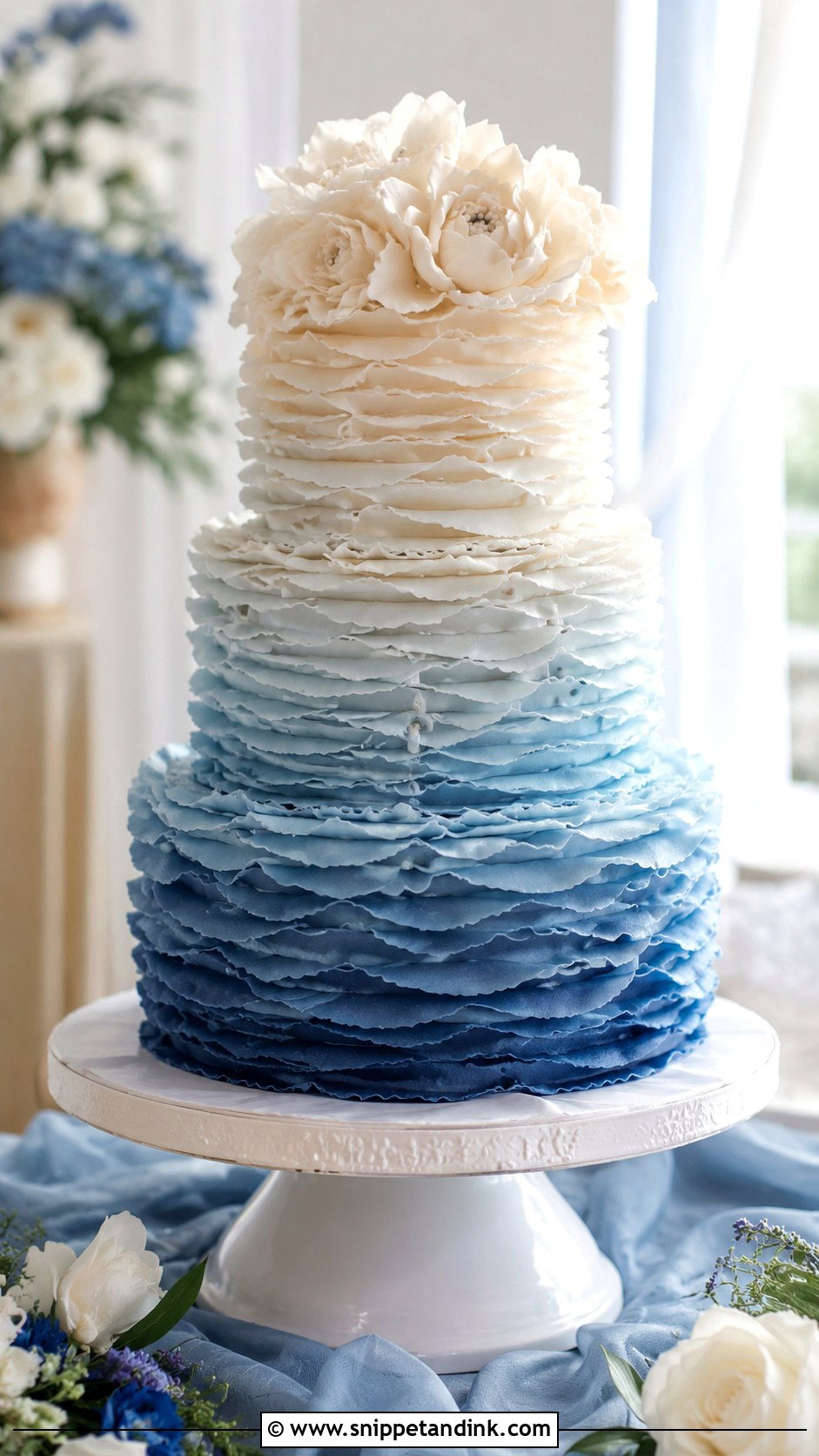
Ruffles do half the ombre work for you. Each fold casts its own shadow, so a dusty blue ombre wedding cake covered in buttercream, fondant or wafer paper ruffles looks deeper at the base even before the color darkens. Wafer paper is the lightest and moves almost like fabric, but it hates humidity. On a damp beach day it softens and droops, so near water I’d switch to fondant ruffles. A pearl accent or two white flowers finishes it, and with flowing linens or a chiffon dress the whole table feels connected.
10. Dusty Blue Ombre Naked Wedding Cake
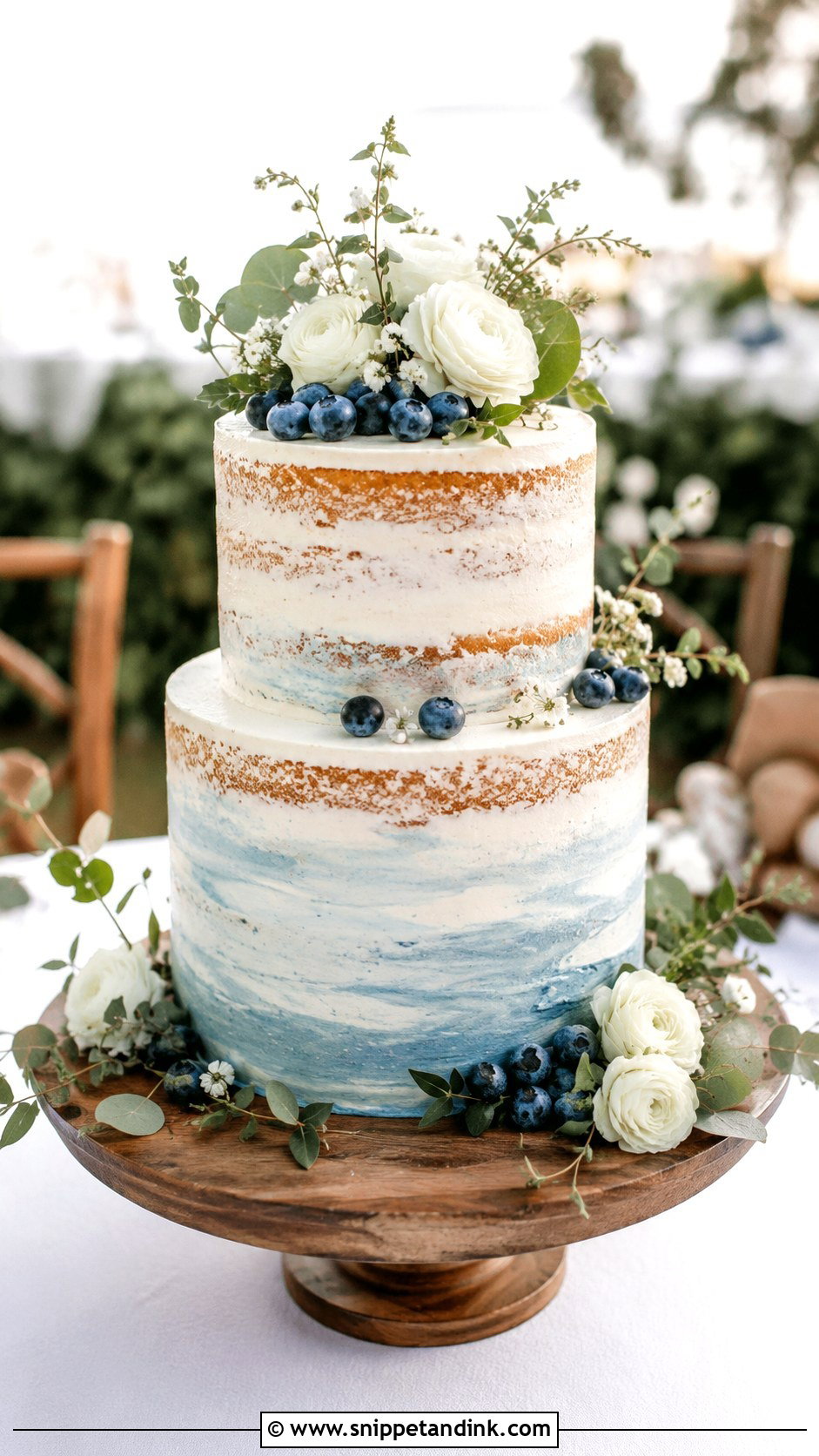
The dusty blue ombre naked wedding cake is the relaxed one. A thin scraped coat of blue-tinted buttercream lets the sponge show, and the fade can run through the frosting, through tinted cake layers, or both. The honest trade-off is that exposed sponge dries out faster than a fully covered cake, so I assemble these as close to the day as I can and keep them out of direct sun. Blueberry or lemon filling suits it, finished with berries and a little greenery. Keep the blue very muted. On a barn table, a bright blue semi-naked cake starts to look like a birthday cake.
11. Dusty Blue Ombre Drip Wedding Cake
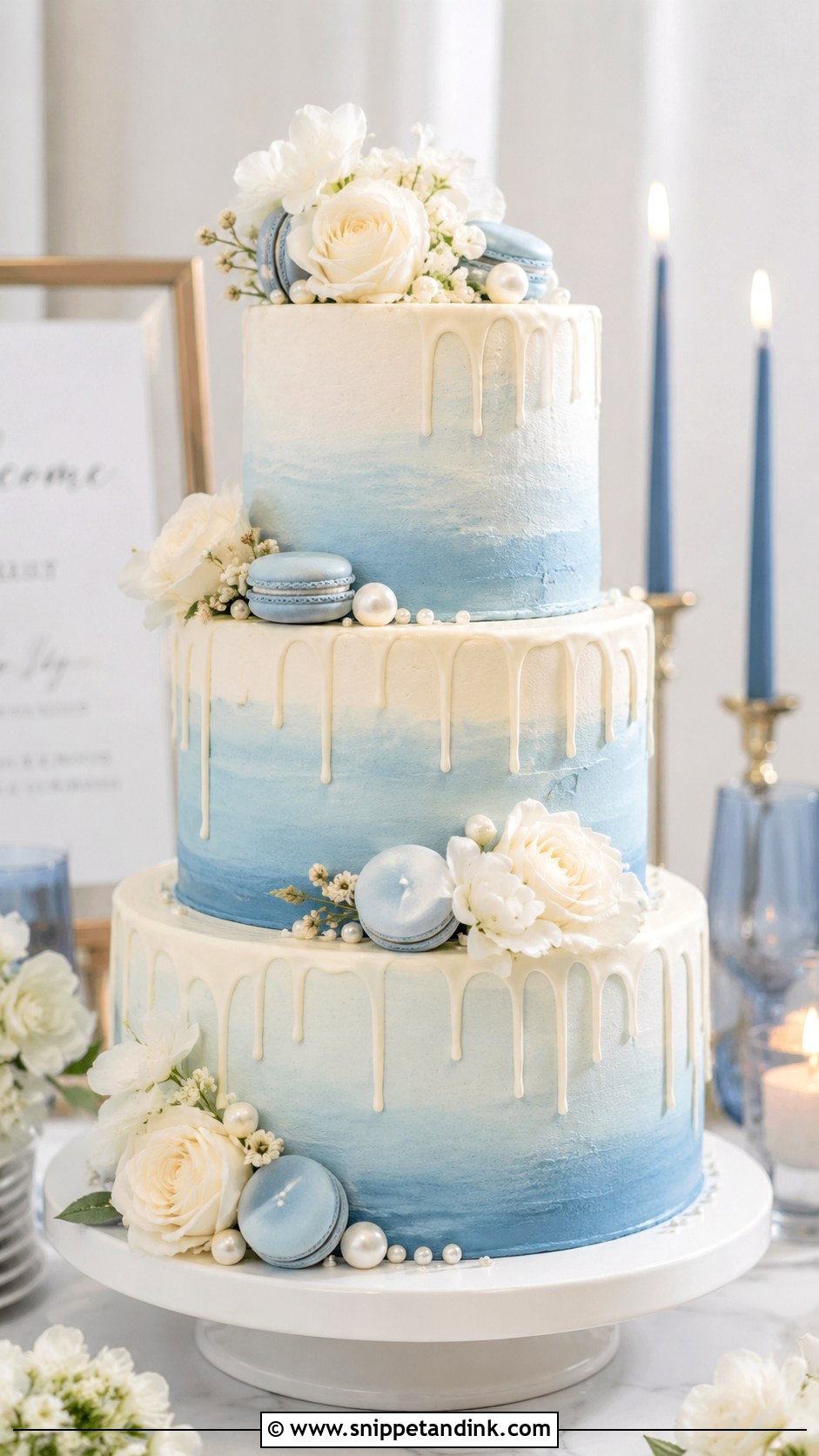
A drip brings a little drama to a calm palette. I use white chocolate ganache tinted ivory, silver-blue or pale blue, and the temperature matters more than the color. Too warm and it runs straight to the board; too cool and it sits in blobs. I test a single drip on the chilled cake before going all the way around. Macarons, meringues or a few sugar flowers on top give it height. It’s a playful style, and that’s the point, but keep the drip close in tone to the fade so the cake reads as one design rather than two.
12. Dusty Blue Ombre Lambeth Wedding Cake
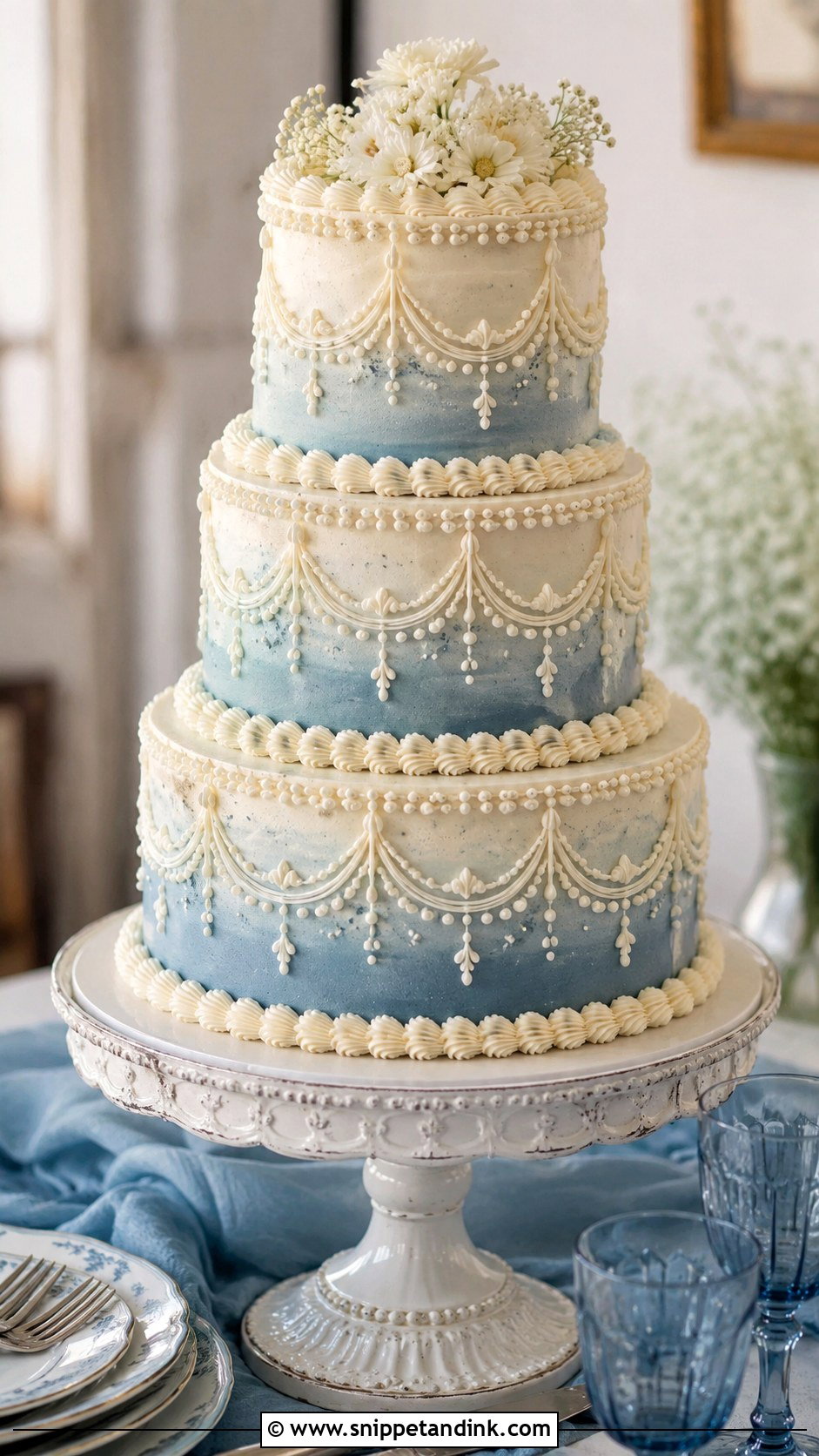
Overpiped Lambeth work is back, and dusty blue suits it because shell borders and swags read crisply in white against a muted ground. The fade runs from deep dusty blue at the base to pale blue near the top, with ivory piping laid over it. This is the most labor-heavy cake on the list. Every layer of piping is done by hand and has to line up tier to tier, so book a baker who shows Lambeth work in their own portfolio rather than in a mood board. Tiny pearl beads finish it. Keep the blue soft, because strong color under all that piping turns heavy fast.
13. Dusty Blue Ombre Marble Wedding Cake
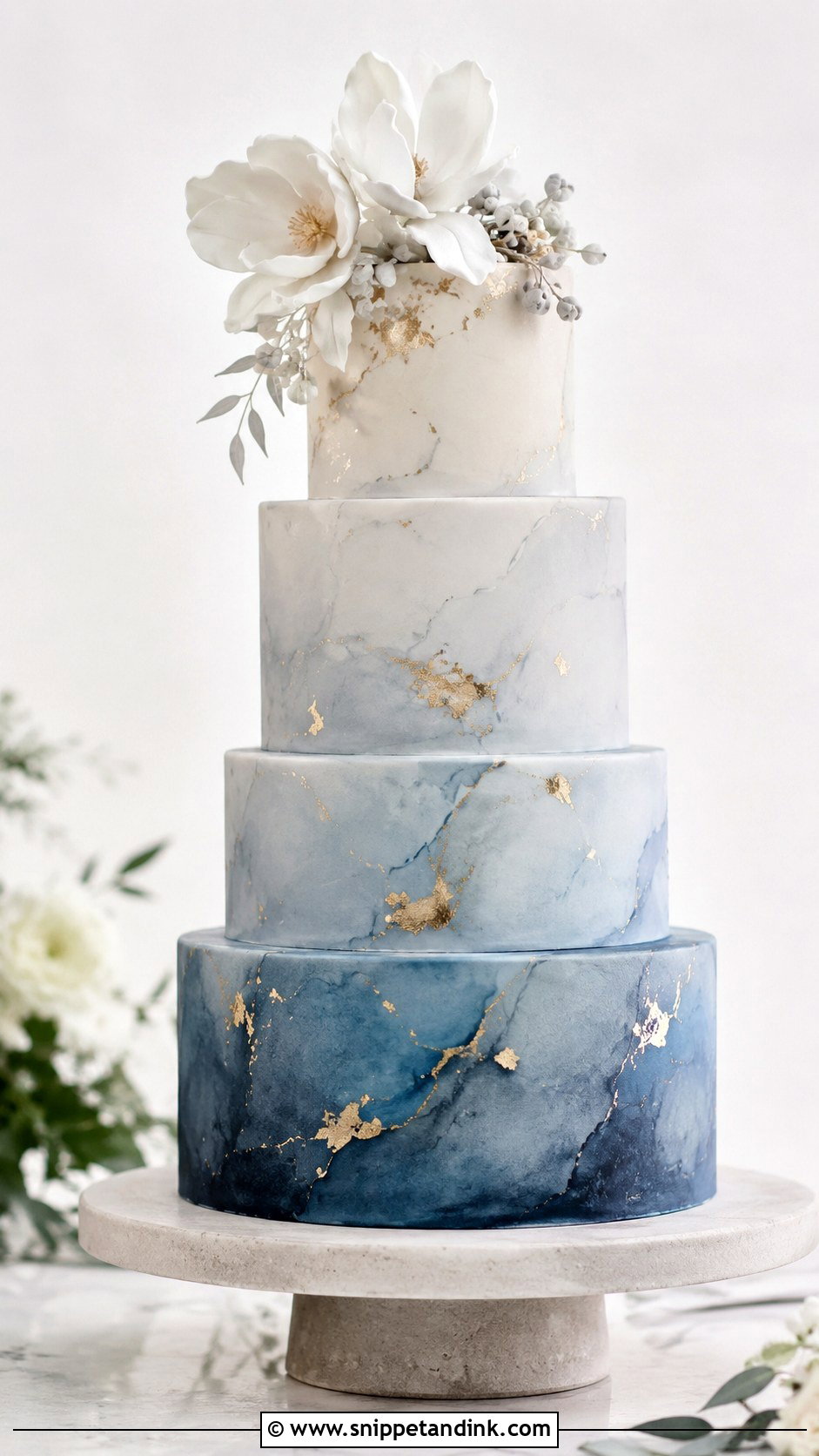
Marble and ombre together can get busy, so I let the veining carry most of the effect: ivory, pale grey and dusty blue folded through fondant, with the stone darkening tier by tier. Fondant is the right medium because you knead the colors only partly together before rolling, and no two sheets come out the same. That also means matching the veins from tier to tier is partly luck, and I’d warn any couple expecting a perfect repeat. A few gold leaf details or a simple acrylic topper is plenty for a modern venue.
14. Dusty Blue Ombre Wedding Cake With Silver
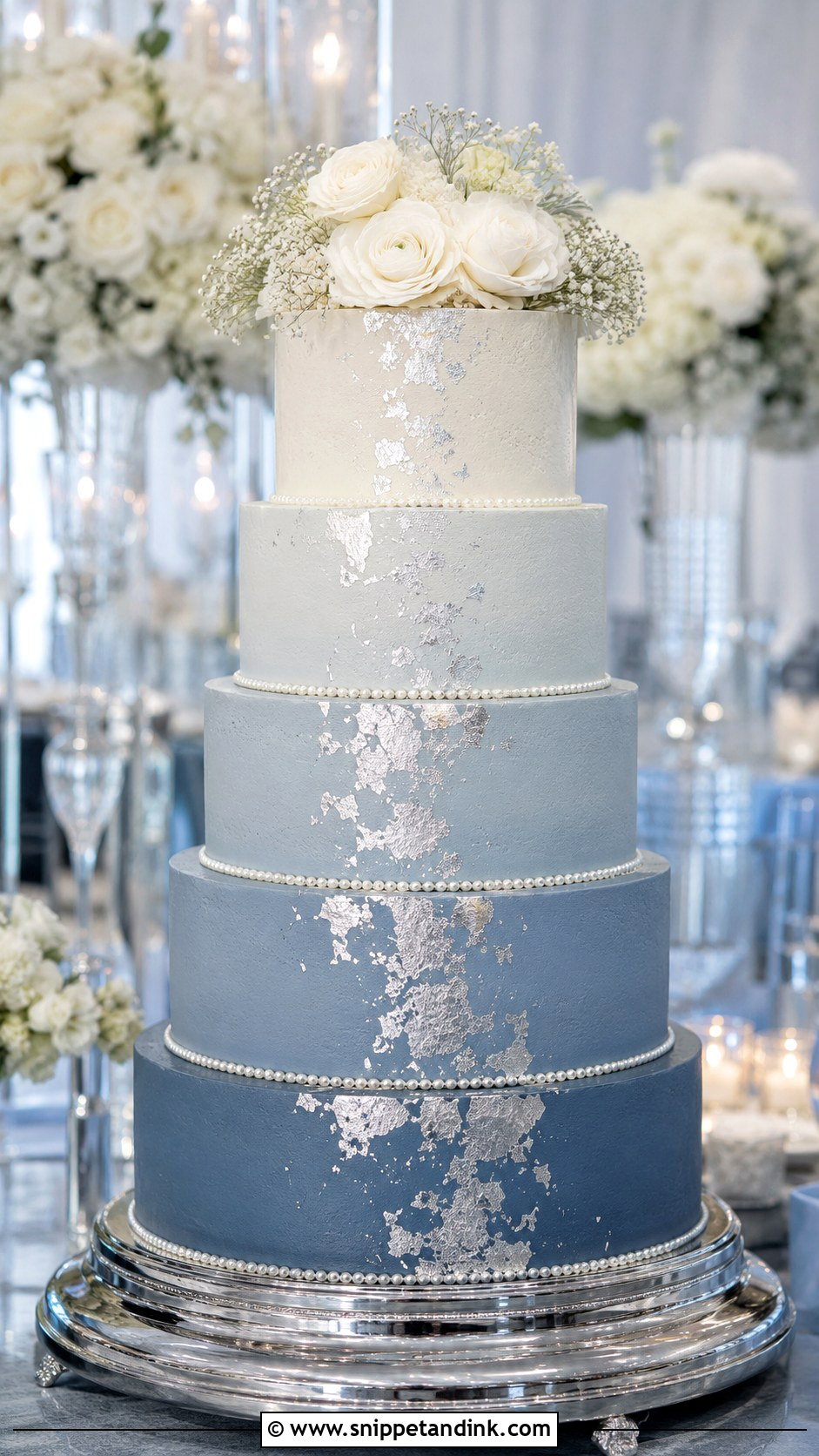
Silver is the cooler cousin of the gold version, and softer than navy with silver. Silver leaf, pearlized piping, a metallic ribbon or a slim topper all sit well over a fade from slate to pale blue. Two cautions from the bench. Ribbon wrapped straight onto buttercream soaks up butter and stains, so I back it with a strip of acetate first. And check that any silver sprinkles or dragees are labelled as edible, because some are sold for decoration only. White flowers and smooth frosting keep the whole thing reading bridal rather than wintry holiday.


15. Dusty Blue Ombre Wedding Cake With Lace
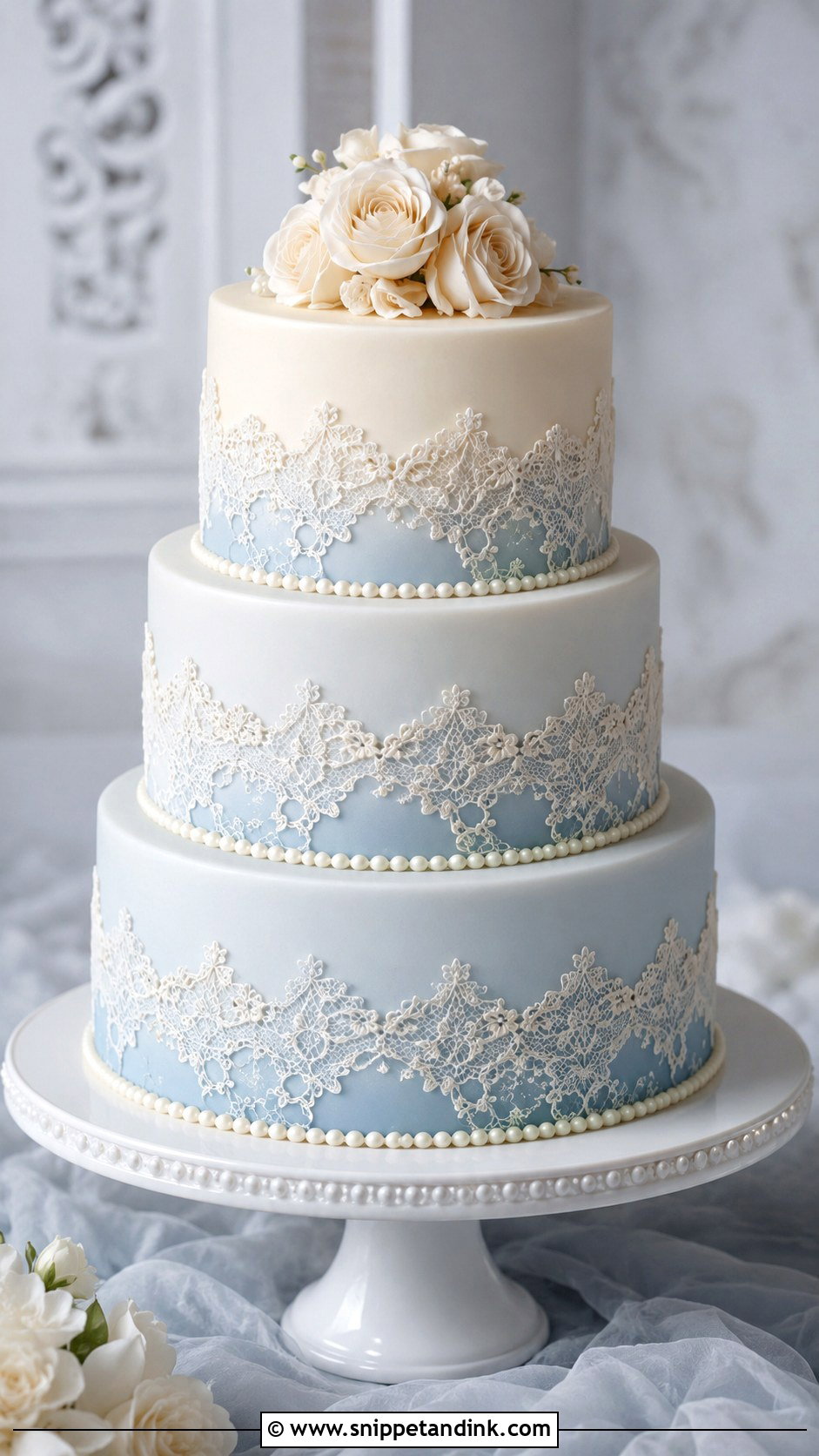
Lace can be piped by hand, cast from an edible lace mat or pressed in with a fondant stencil, and each method gives a different weight. Piped lace looks softest. Cast lace is the most detailed, but it goes limp in a hot, humid room, so it needs a cool venue. An ivory overlay on the deepest blue tier shows the pattern best, with the top tier left white so the color fades downward. I’d echo a lace gown only loosely, though. Copying the dress motif stitch for stitch sounds charming but usually looks fussy at cake scale.
16. Dusty Blue Ombre Wedding Cake With Sugar Flowers
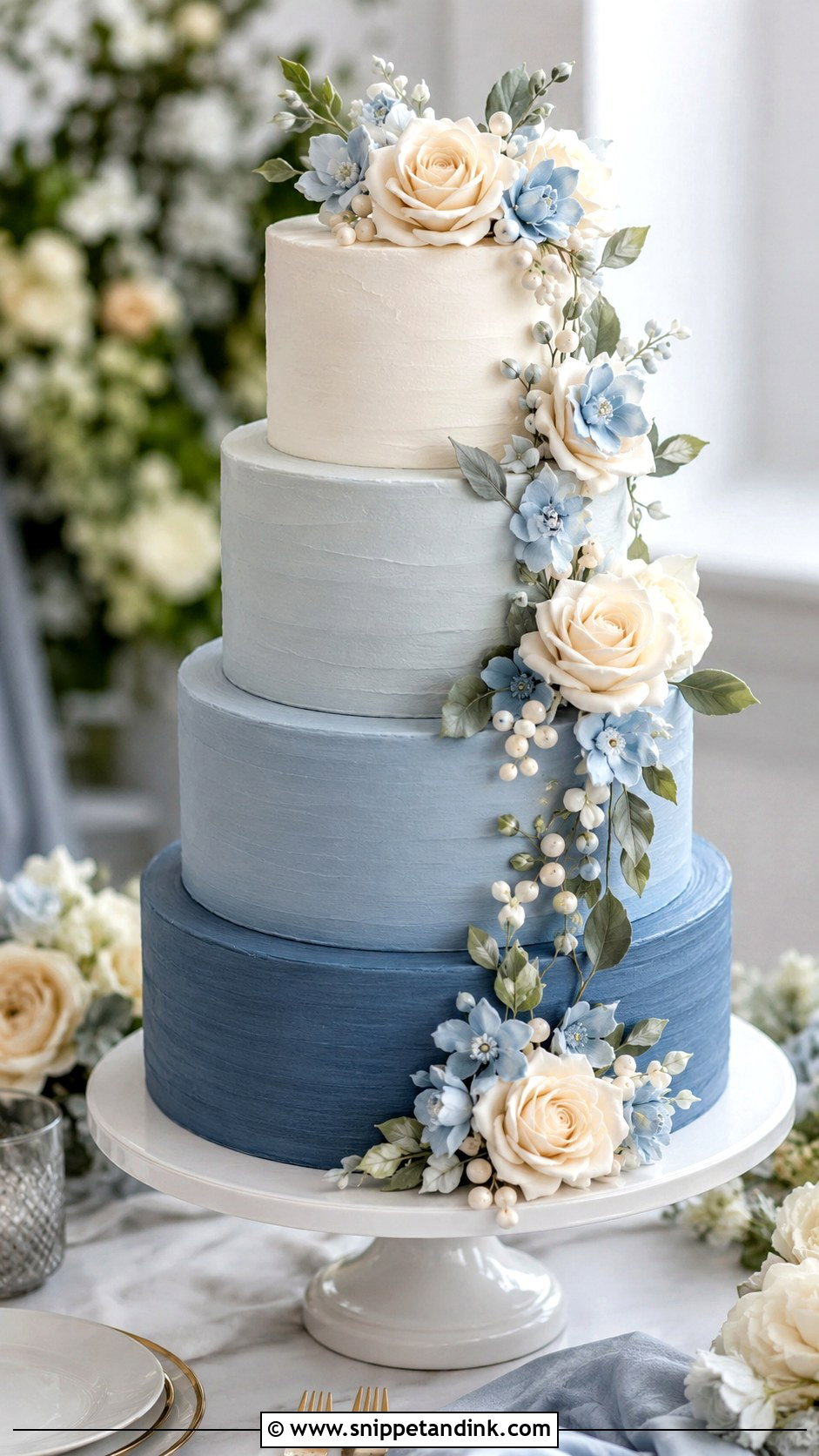
Sugar flowers are what I recommend when the shade matters more than the species. I can tint petals to sit exactly inside your fade: ivory roses, pale blue blossoms, grey-green leaves, a blush accent if the palette has one. They don’t wilt, they can be wired and placed precisely, and they can go on days ahead. Two things to know. They take many hours to make, which shows in the quote, and they aren’t really for eating, since most have wires inside. A single sugar bloom kept dry and out of sunlight makes a keepsake that lasts for years.
17. Dusty Blue Ombre Wedding Cake With Blueberries
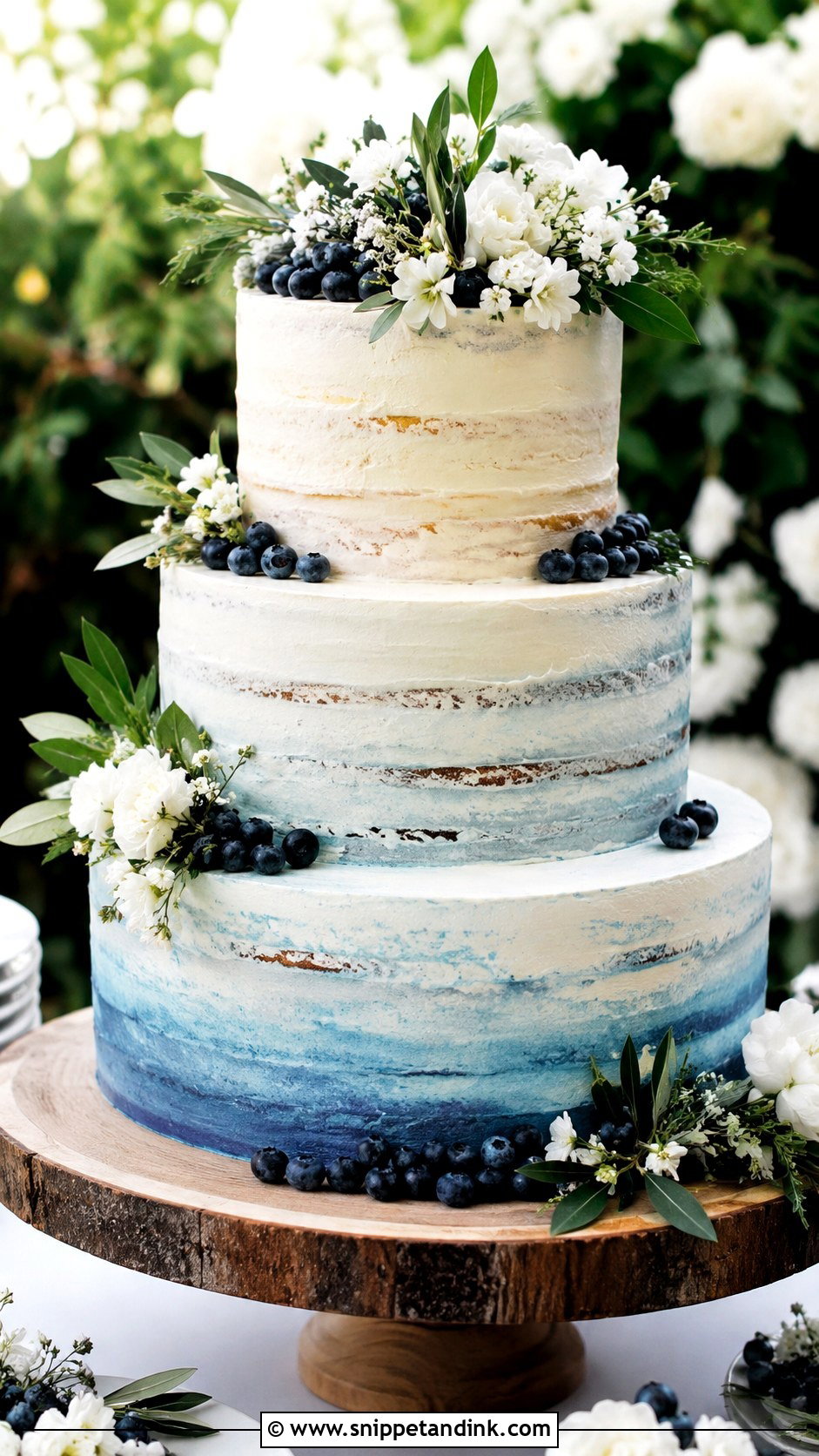
Blueberries tie the decoration to the color, which works nicely if the filling is blueberry too. They suit soft buttercream or semi-naked sides far better than fondant. The practical issue is juice: split or bruised berries bleed purple into pale frosting, so I only use whole, dry berries and keep them away from the ivory top tier. Lemon, vanilla and almond sponge all go well with the fruit. It’s less formal than the fondant cakes here, and right at home at a summer garden reception or a brunch wedding.
18. Dusty Blue Ombre Wedding Cake With Macarons
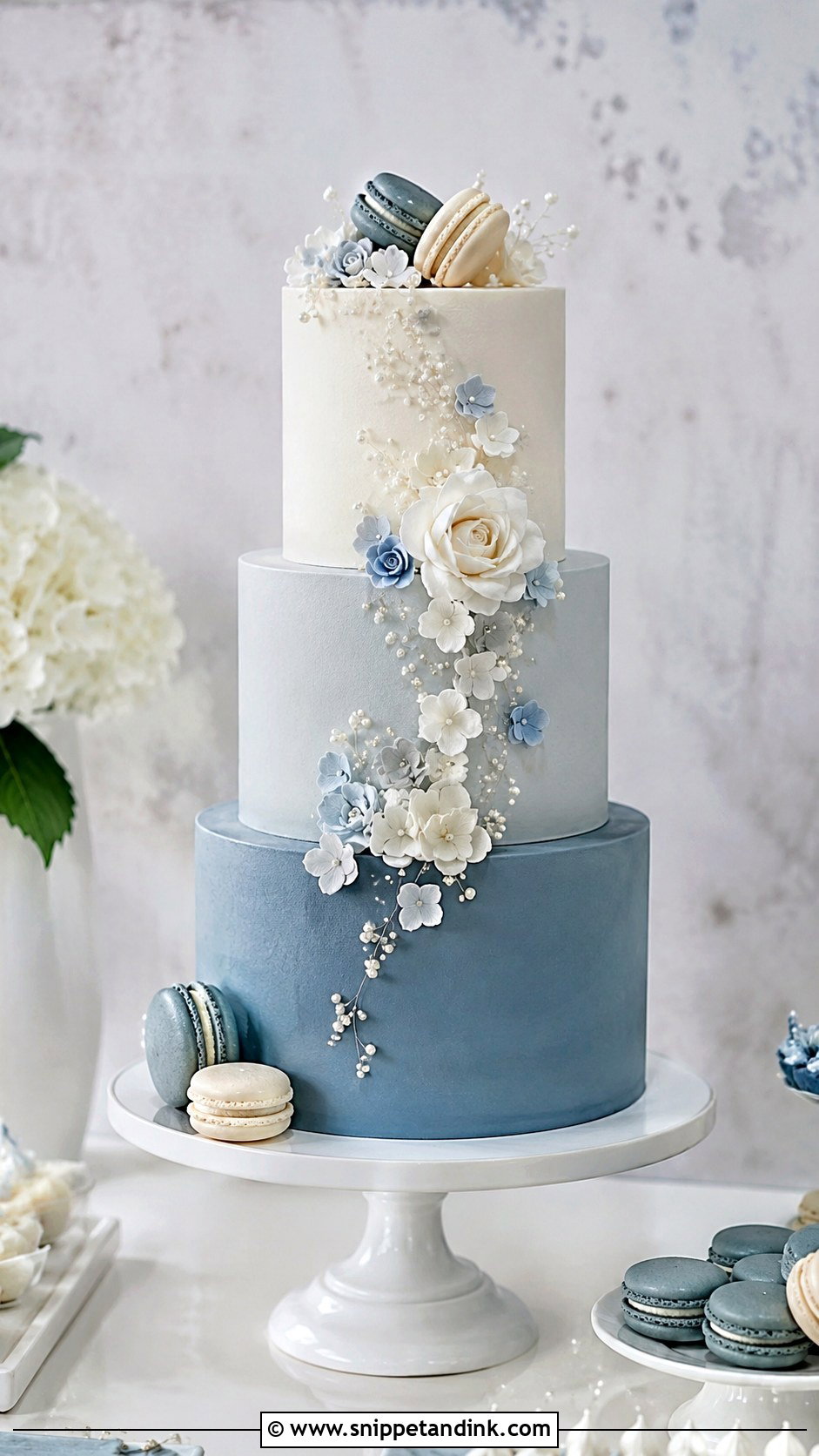
Macarons let the cake talk to the rest of the sweets. I color them in steps along the gradient, from ivory through pale blue and slate to pearl grey, then set them in a small cascade or around the base. Smooth buttercream gives them the cleanest backdrop. They’re also the decoration most likely to let you down: shells pressed against moist frosting soften within hours, so I fix them on with a dab of ganache shortly before the cake goes out. The style fits couples planning full dessert tables. Keep the cascade light so it stays a wedding cake, not a cookie tower.
19. Dusty Blue Ombre Wedding Cake With Seashells
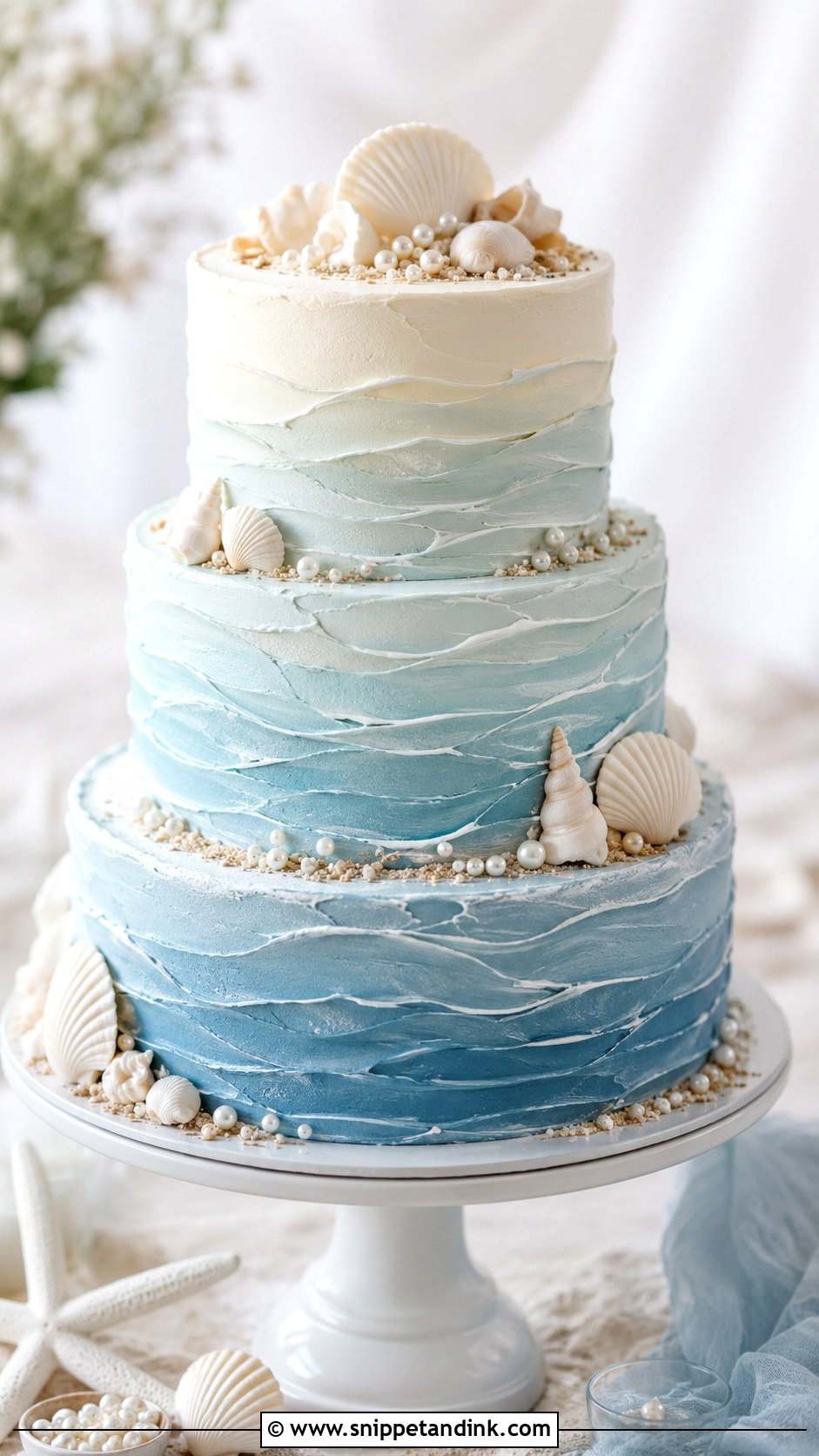
A dusty blue ombre wedding cake with seashells gives you a beach theme without bright tropical colors. The fade can mimic sea mist, deeper at the base and pale ivory up top, with white chocolate shells, sugar pearls and a little sand-toned texture. Those chocolate shells are the weak point at a beach venue, since white chocolate softens in the sun well before buttercream gives up. So this cake needs shade and a short display time. Wave-like strokes on the bottom tier finish the setting, and a few white flowers make it more bridal.

20. Dusty Blue Ombre Wedding Cake With Cascading Flowers
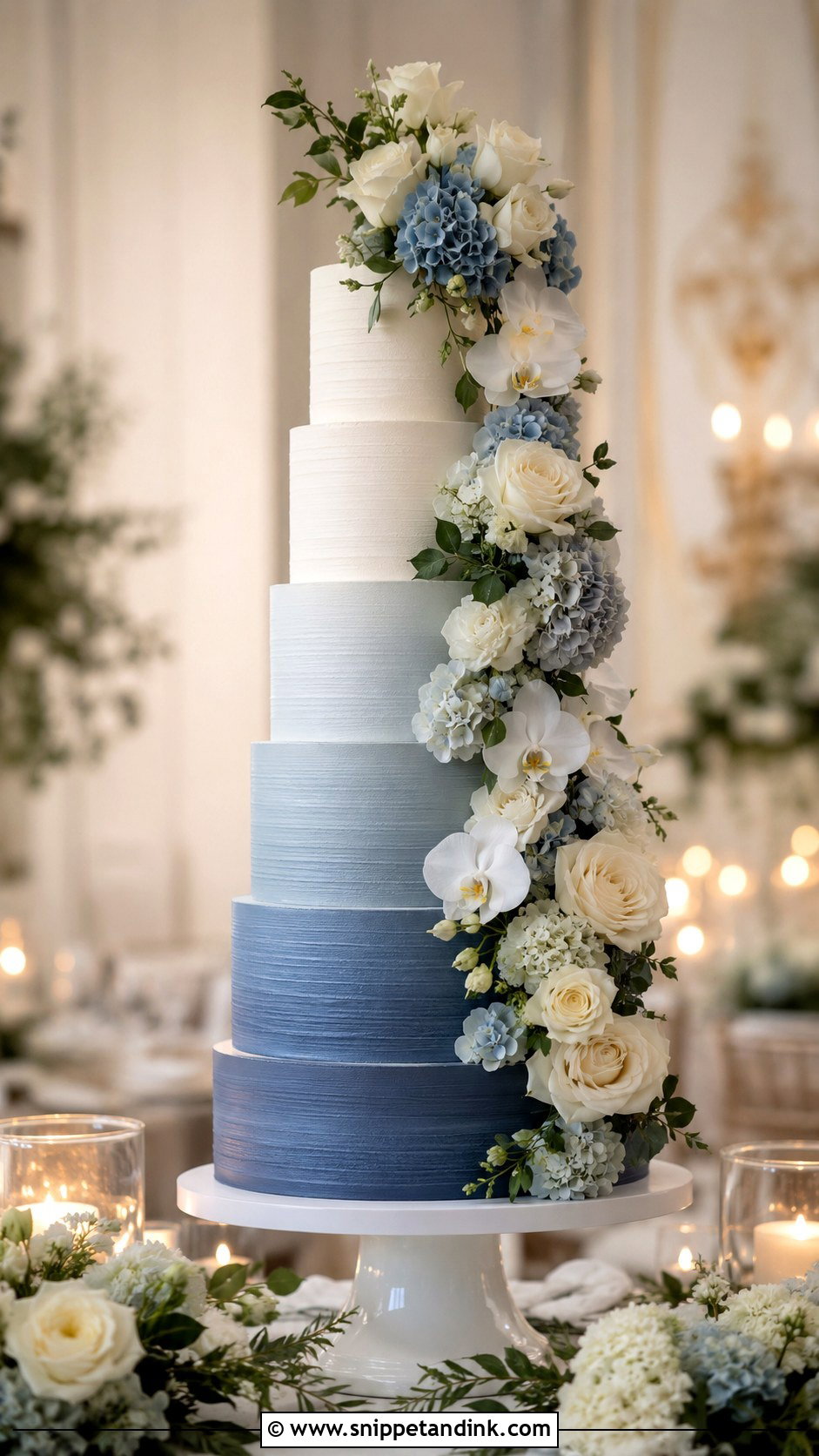
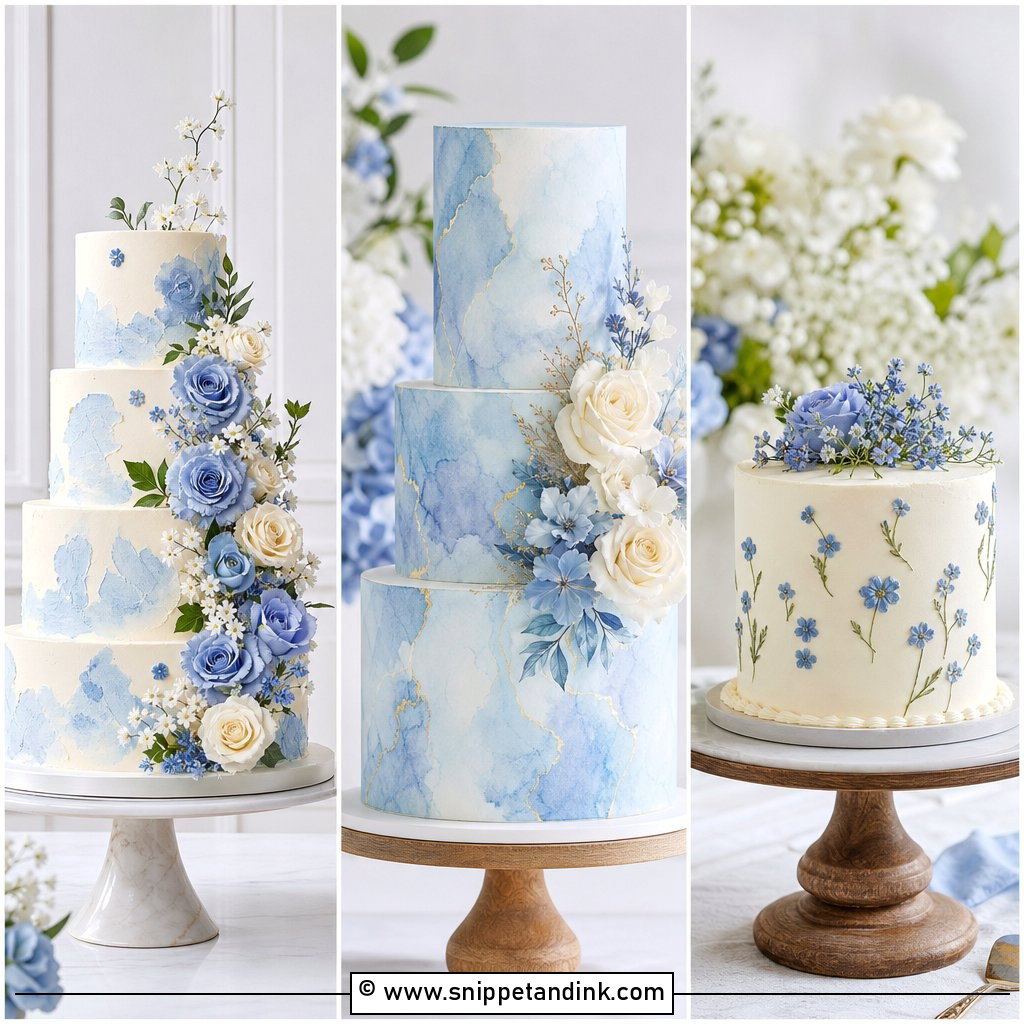
For a big room, a full cascade is the one I’d suggest, because it still reads from the back tables. The flowers start on the top tier and trail down in one curve: white roses, blue hydrangeas, sugar orchids and small fillers, with the deeper base tier giving the lower blooms something to stand out against. Structure is the hidden work. A long cascade needs dowels in every tier and the heavier stems wired or picked in properly, or the curve slumps by dessert. Keep the frosting smooth so the flowers stay the focus.
Blue Frosting Fades in Sunlight, So Plan Where the Cake Stands
Blue and purple are the least stable colors in my kit. Under strong daylight, behind a window or in a marquee with clear panels, a tinted cake can fade noticeably over a few hours. It fades unevenly too, so the side facing the light goes paler and a carefully graded ombre loses its steps. Choose the cake table’s spot with your planner well before the day: against a wall or in an inside corner, out of the sun’s path through the afternoon.
From the fridge to a warm room
Fondant and set buttercream both sweat when a chilled cake meets a warm, humid room. Leave the beads alone. Wiping them smears the color, and they dry off on their own if the cake sits undisturbed for a while. An air-conditioned delivery and a setup spot in the coolest part of the venue do more good than any product.
Fresh flowers, fruit and macarons go on last
Hydrangeas, peonies, berries and macarons are the parts of these designs that age fastest once the cake is out. If yours leans on them, settle with your baker and florist who places what and when, and make sure fresh stems are food safe or wrapped and kept off the frosting. Sugar versions take more hours to make, but they take this whole worry away.
Pull the Blue From Something Already on the Table
This palette can go classic with roses and pearls, modern with marble and metal, relaxed with a naked finish and berries, or grand with a cascade. What decides it, for me, is the rest of the room. If dusty blue is already in the bridesmaid dresses, the linens or a ribbon, bring a swatch to the tasting so the baker can match the darkest tier to it and build the fade upward from there. Then commit to one texture, one accent and one floral direction. A cake with a clear plan photographs better than one that tries every idea on this list.
You'll Like These Ideas:





Leave a Reply