
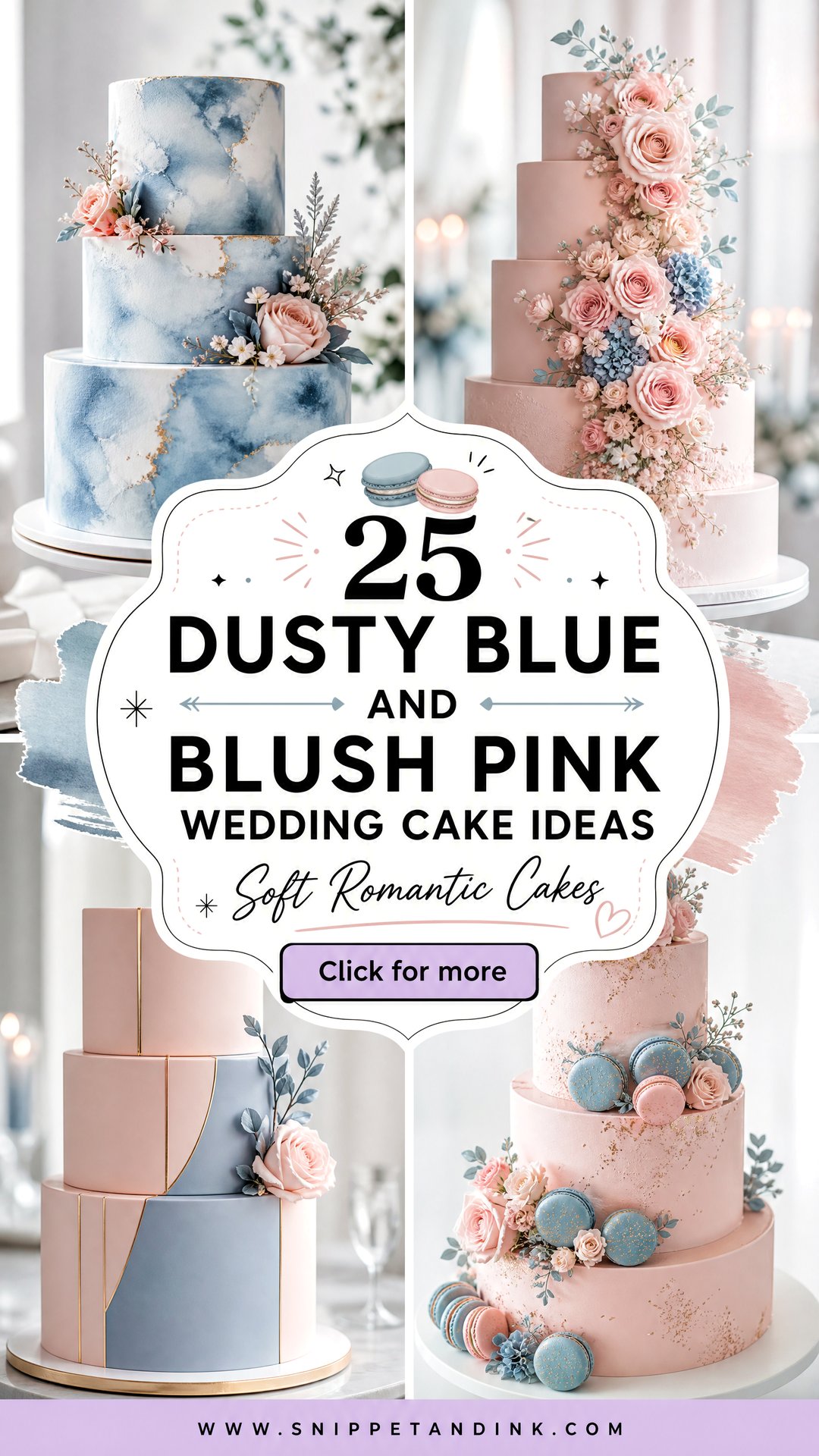
Dusty blue and blush is a palette I mix for more couples than almost any other, and it’s harder to get right than it looks. Blue on its own reads cool and calm; blush brings back warmth so the cake doesn’t feel icy. The trick is keeping both shades muted and letting ivory sit between them. Below are twenty-five ways to put the two together, from painted watercolor tiers to macarons and piped vintage borders, with notes on how each finish behaves and which settings it suits.
Why Dusty Blue Turns Teal on Some Cakes and How I Stop It
The single most common problem with this palette is color drift. Butter gives buttercream a yellow cast, and blue added to yellow leans green. A cake that looked right on the turntable can read teal by the time it’s on the table.
- I whiten the base first, either with a tiny amount of violet gel to cancel the yellow or by using a whitened buttercream.
- I mix the blue a shade lighter than the target, add a speck of black to dull it, then let it rest. Gel colors keep deepening for hours after mixing.
- I hold the swatch up to the fabric sample in daylight, not under kitchen bulbs, before I ice a single tier.
- Blush gets the same patience. Pinks are prone to fading in strong light, so the cake is kept boxed and away from windows until it’s set up.
Bring a physical swatch to your tasting: a bridesmaid dress offcut, a napkin, a ribbon. Screen colors lie, and “dusty blue” covers everything from slate to powder.
1. Dusty Blue Wedding Cake With Blush Flowers
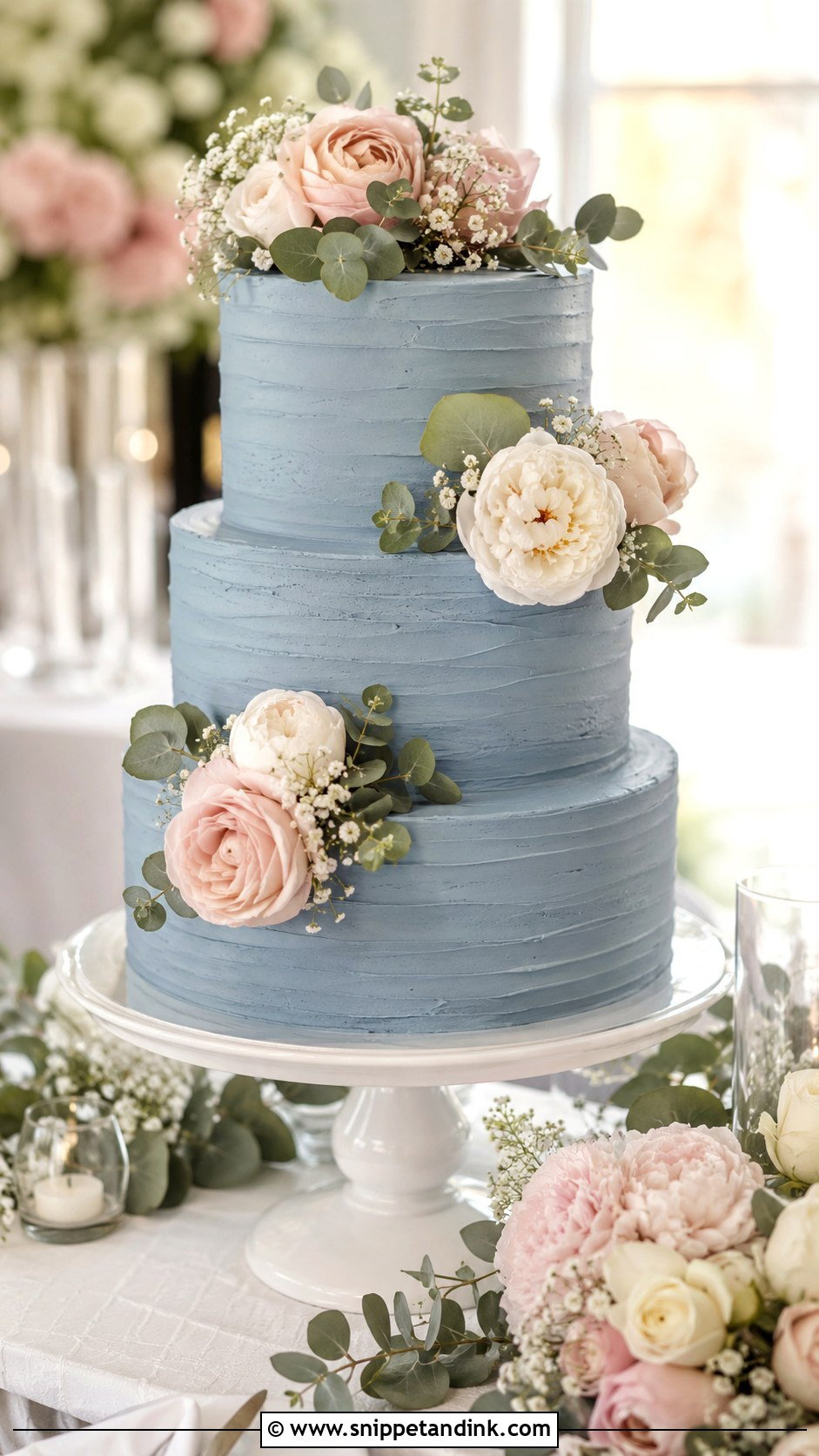
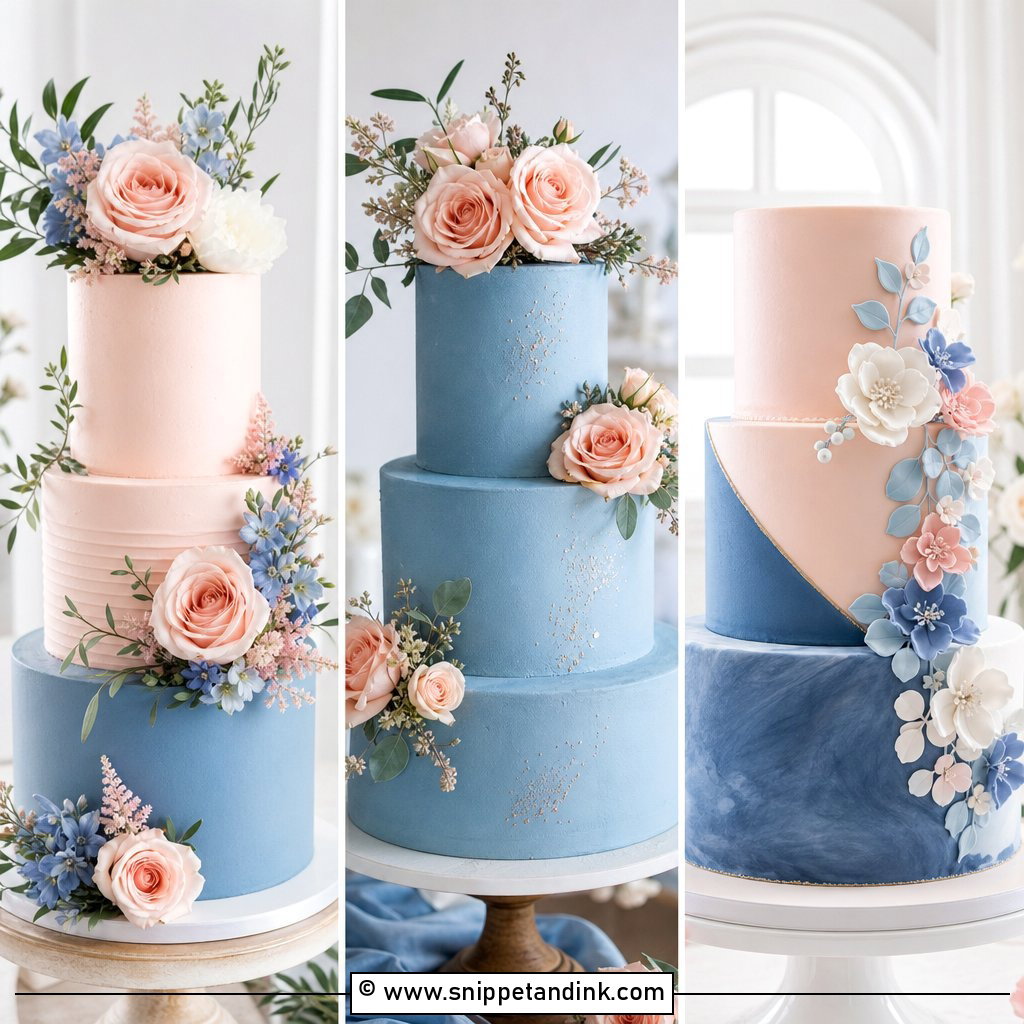
Start here if you want the simplest version of the palette. Blue icing is the base, and blush roses, ranunculus or peonies bring the warmth. Three tiers give the color enough surface to register; on a single small tier, blue can look like a novelty cake. I tint over an ivory base rather than bright white so the blue stays soft, and I’d add a little eucalyptus or tiny white filler to connect the cake to the bouquet.
2. Blush Pink Wedding Cake With Dusty Blue Flowers
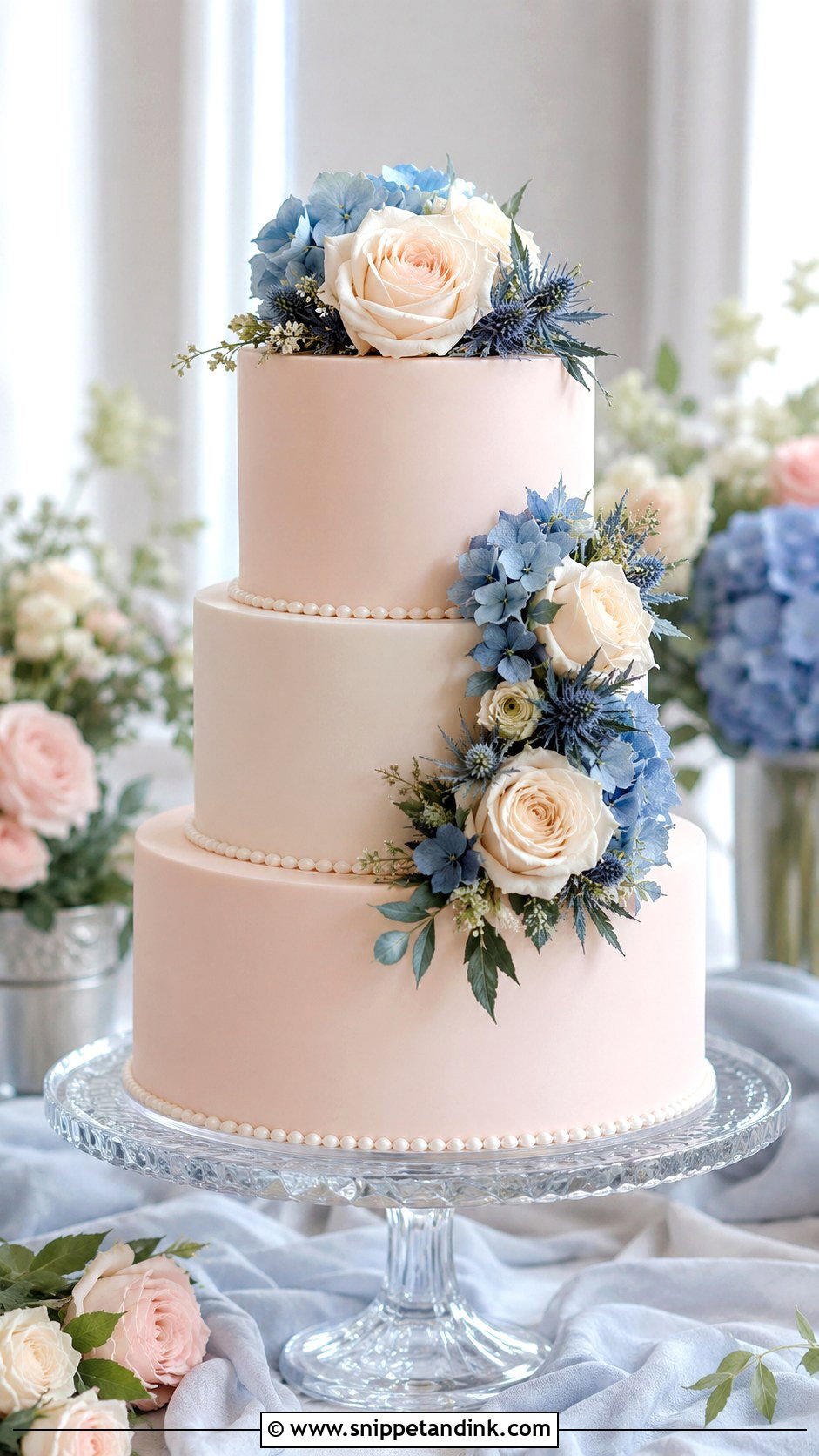
Flip the ratio and you get something sweeter. Dusty blue sugar flowers, blue thistle or pale hydrangea on a blush cake suit a reception already full of blush linens and bridesmaid dresses. The base can be smooth buttercream, fondant or a soft painted wash. What I watch for is pink and blue touching directly; a little ivory between them, in piping or petals, keeps the colors from muddying each other in natural light.
3. Dusty Blue And Blush Pink Ombre Wedding Cake
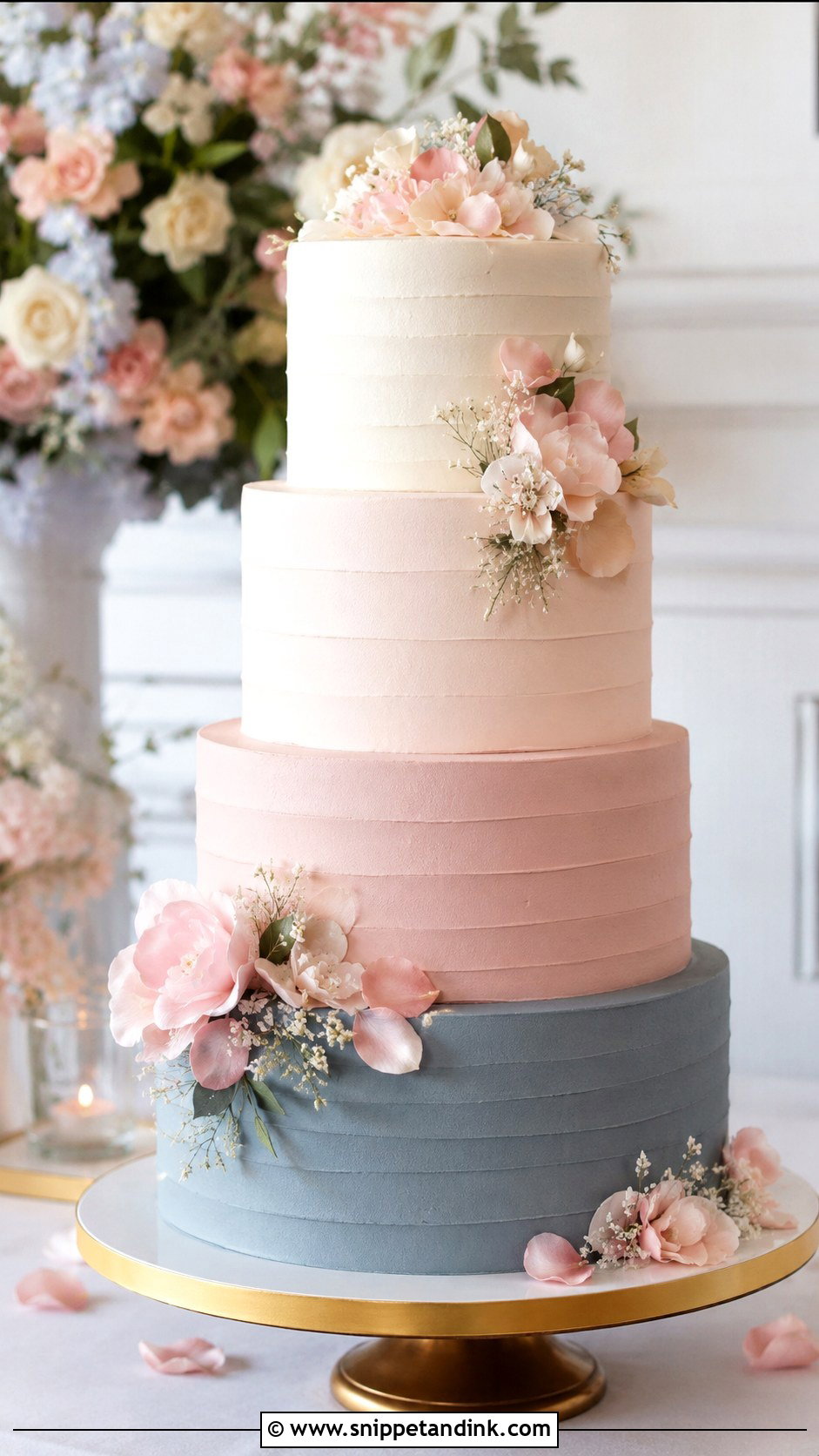
With an ombre wedding cake, the two colors meet instead of sitting in separate zones. I mix three or four shades in advance and blend them on the turntable while the buttercream is still soft, moving from ivory through blush into blue, or wrapping the gradient sideways around each tier. Where pink and blue overlap, the middle can turn lilac, which some couples love and some don’t, so I show a sample board first. Keep the finish smooth and the flowers near the base.
4. Dusty Blue Wedding Cake With Gold Leaf
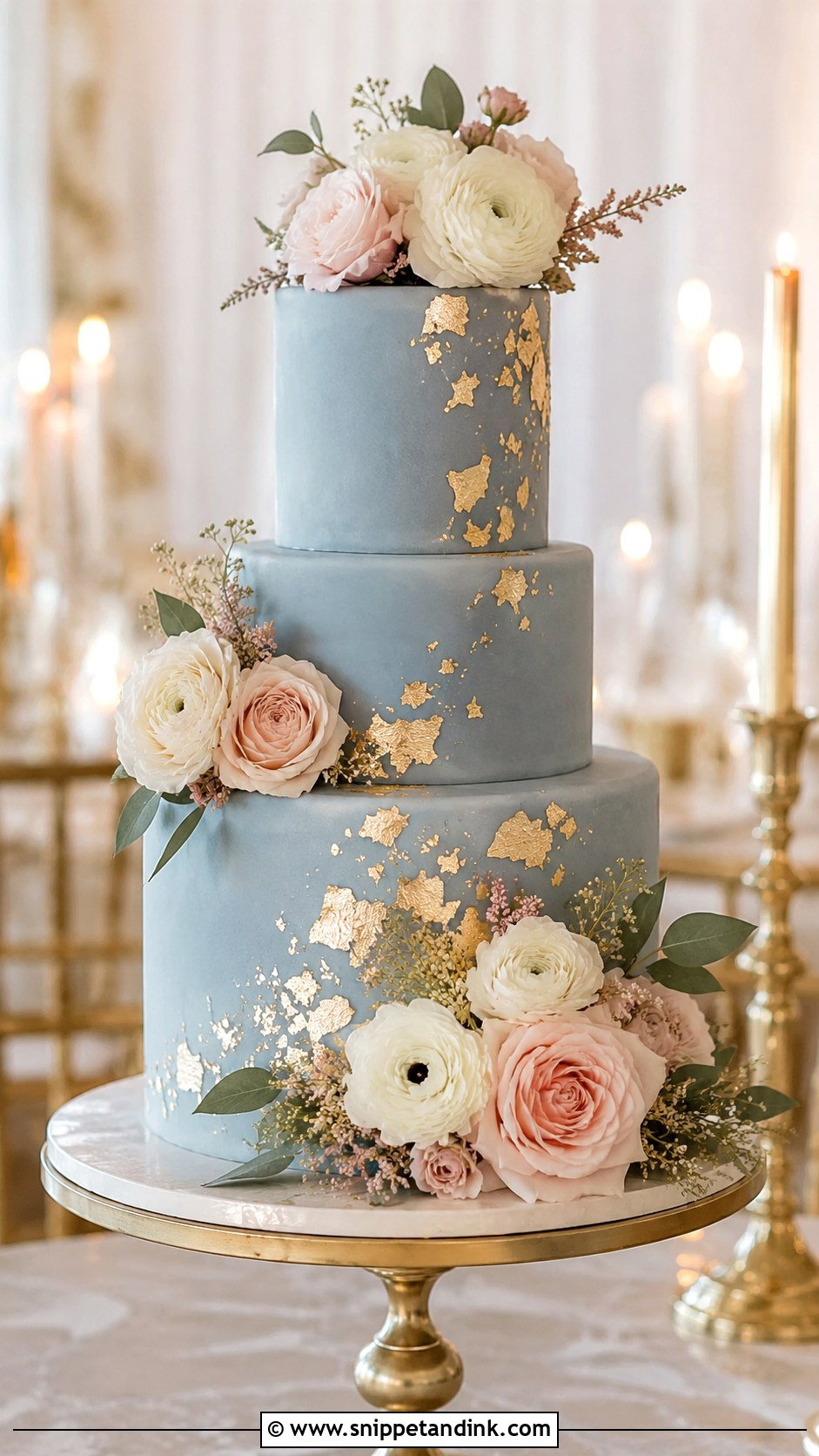
Gold leaf is the quickest way to make this palette formal. I apply it in torn, uneven patches with a dry brush rather than full sheets, which catches candlelight without looking like a jewelry box. Blush flowers can cluster on the top tier, between tiers or down one side. Gold leaf doesn’t stick to soft buttercream as cleanly as it does to fondant or a chilled ganache shell, so if you want crisp leaf, I’d suggest one of those finishes. Ballrooms and estate venues suit it most.
5. Blush Pink Wedding Cake With Dusty Blue Ribbon
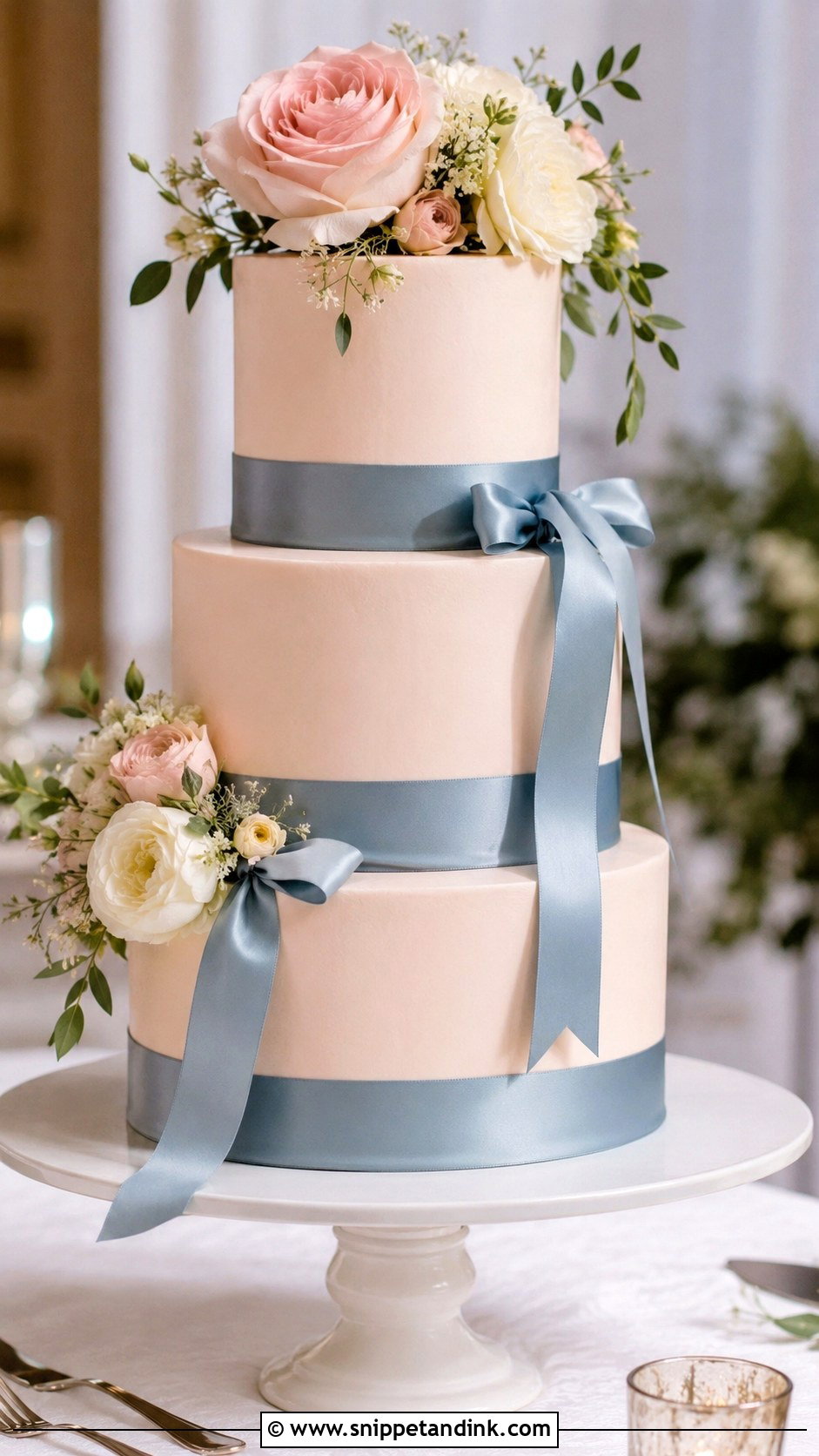
Ribbon is the most affordable detail on this list and the easiest to match to your stationery. A blue band around each blush tier, a trailing end down the side or a bow at the back is all it needs. Satin looks formal; silk chiffon with frayed edges moves and feels more garden. One practical warning: ribbon laid directly on buttercream will absorb grease and darken in patches, so I back it with a thin strip of fondant or a food-safe liner first. A few blush and ivory flowers can tuck in at the ribbon ends.
6. Dusty Blue Watercolor Wedding Cake
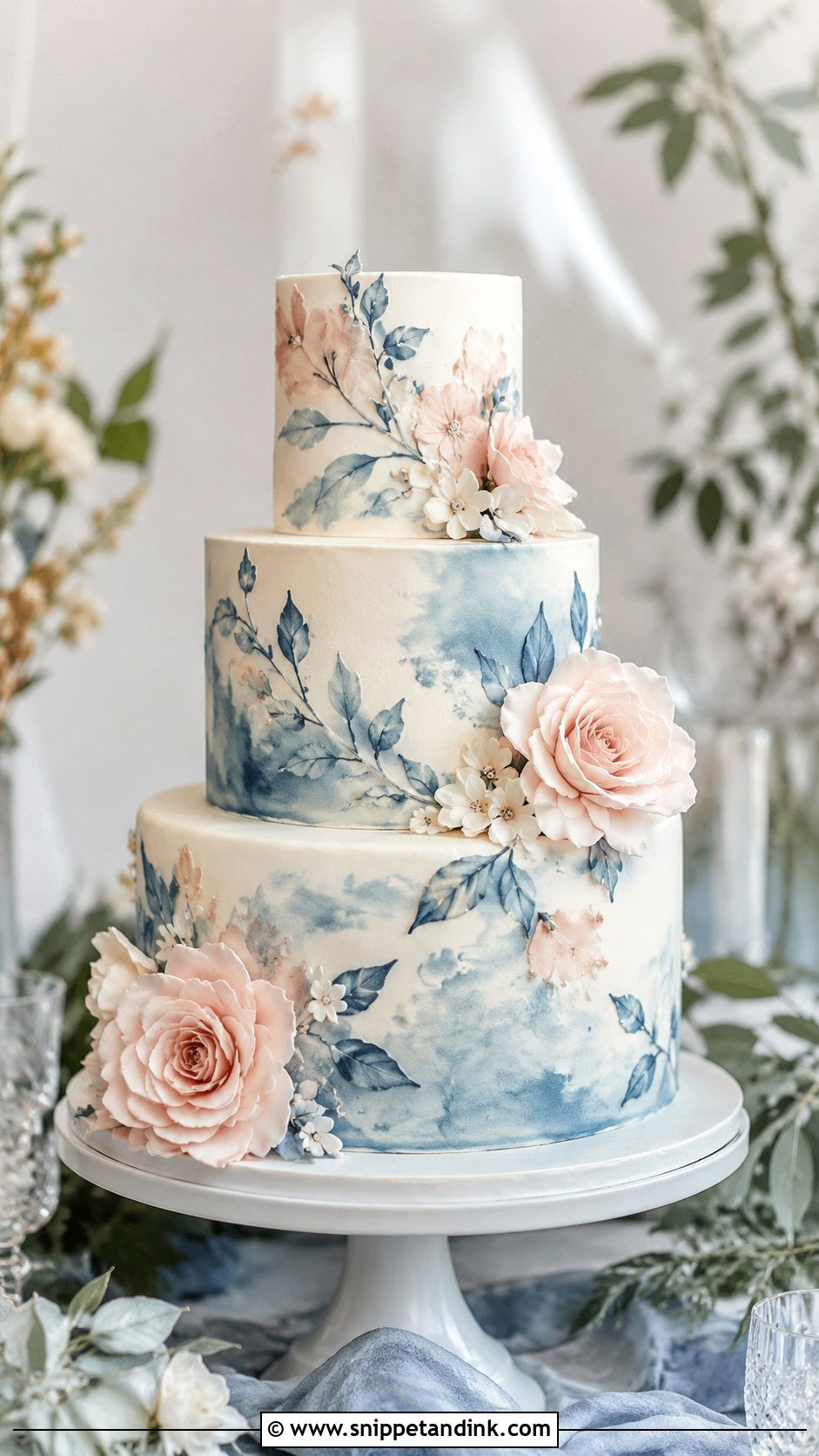
Watercolor finishes look loose but they’re planned. I brush thinned gel color or tinted buttercream across ivory tiers in light washes, layering until the blue sits in soft clouds. The risk is mud: too many passes and blue plus pink turns grey-brown. Blush can come in as painted accents or as a few blooms beside the washed areas. It suits outdoor and spring receptions, and anyone who wants the cake to feel handmade, but it needs a baker who paints with a light hand.
7. Blush Pink Watercolor Wedding Cake
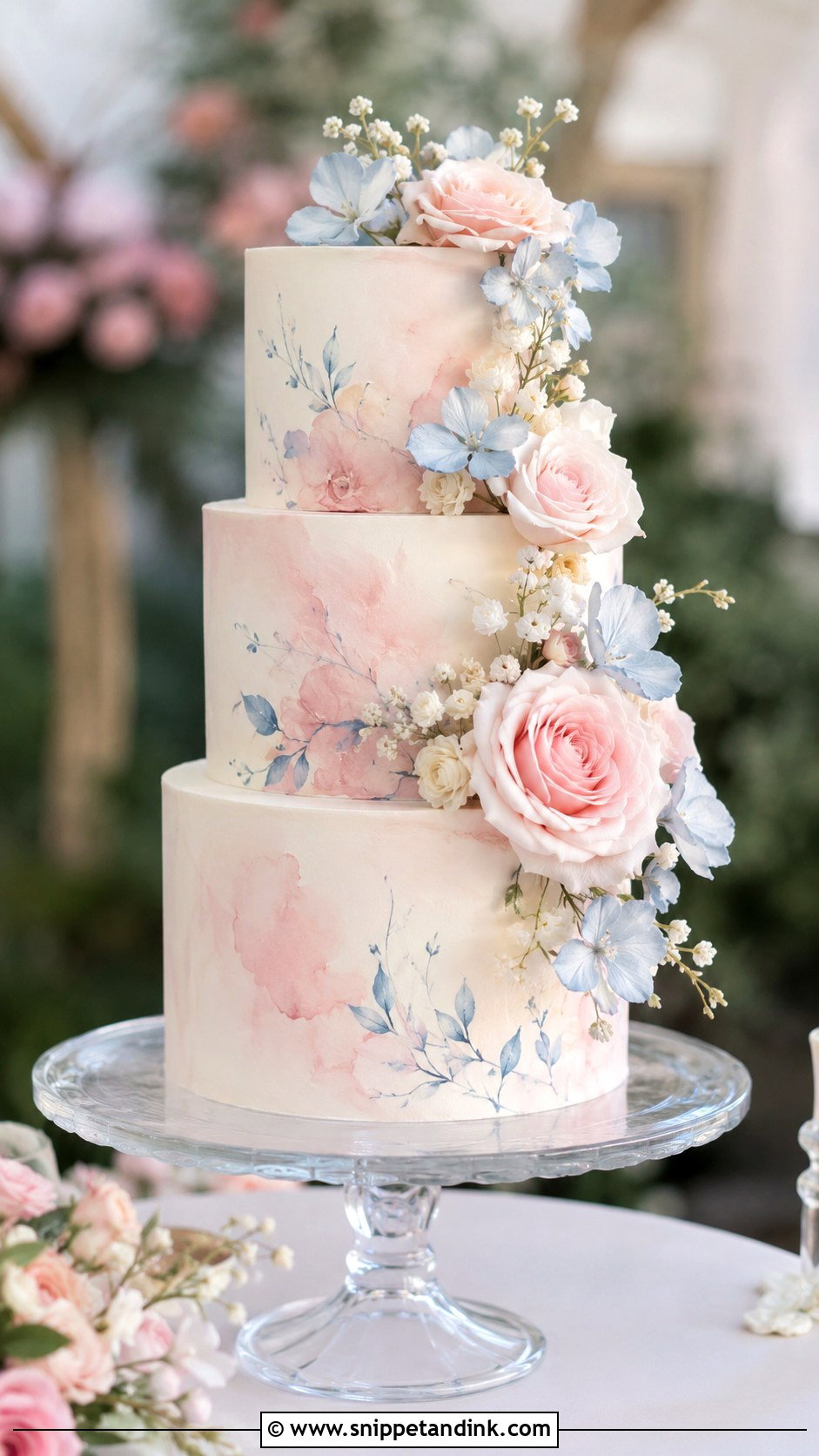
Shift the washes to blush and the same technique feels warmer. The cake starts ivory, pink is brushed across the tiers, and blue enters through painted leaves, ribbon or a few sugar petals. It sits well beside lace and tulle, and in garden or chapel settings. Layered soft color looks good in photos because it doesn’t blow out in bright light. I’d keep the stand plain, white ceramic or clear glass, so the painting stays the focus.
8. Dusty Blue Semi Naked Wedding Cake
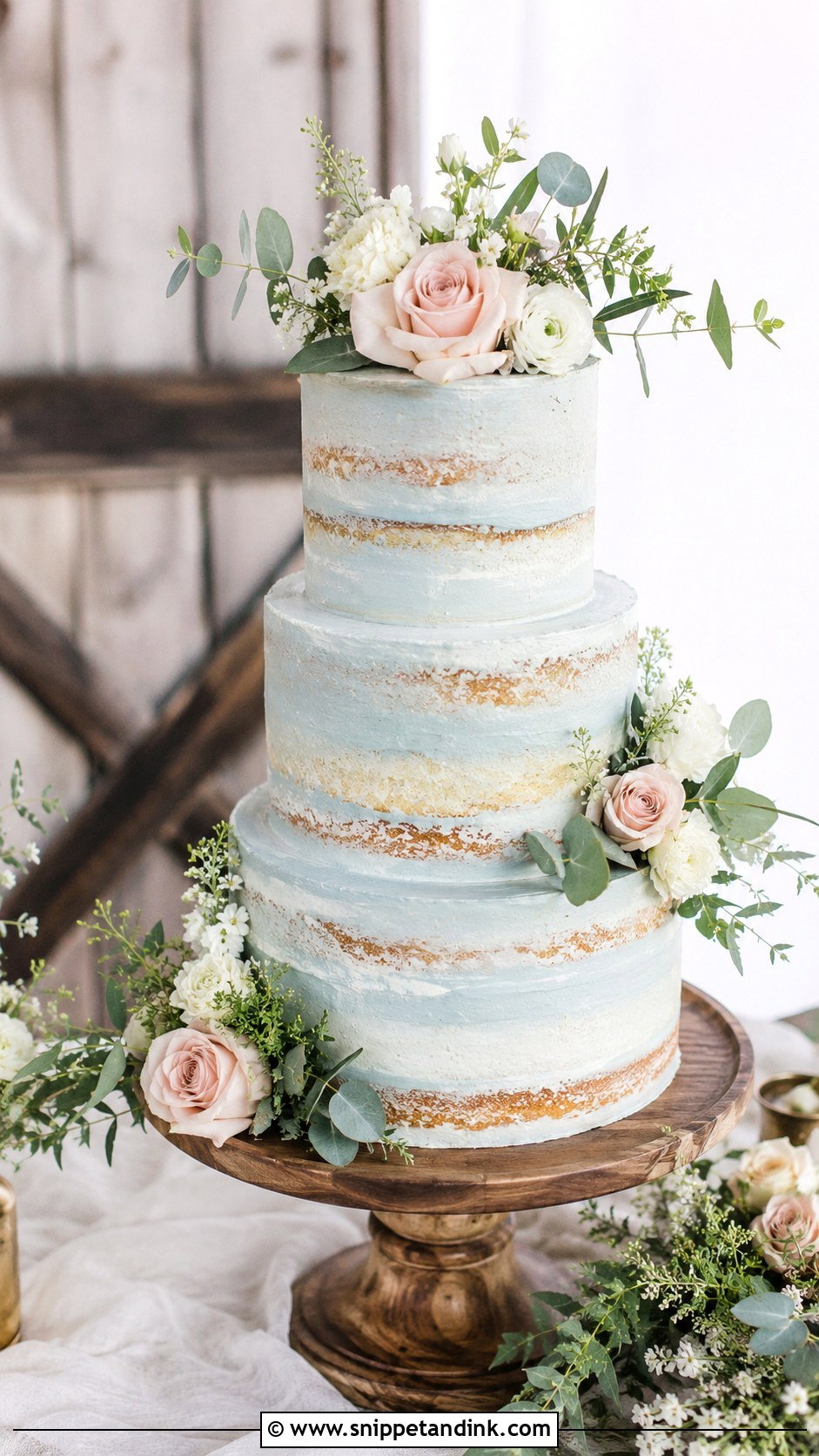
Semi naked finishes are thin, so the color reads paler than you might expect. A dusty blue scrape over a vanilla, almond or lemon sponge gives a blue-grey veil with the crumb showing through, and the warm cake tone actually flatters the blue. Clusters of blush and ivory blooms with eucalyptus finish it for barns, vineyards and outdoor receptions. Because so little icing protects the sponge, I’d ask your baker to assemble it as late as possible; exposed cake dries out at a long reception.
9. Blush Pink Semi Naked Wedding Cake
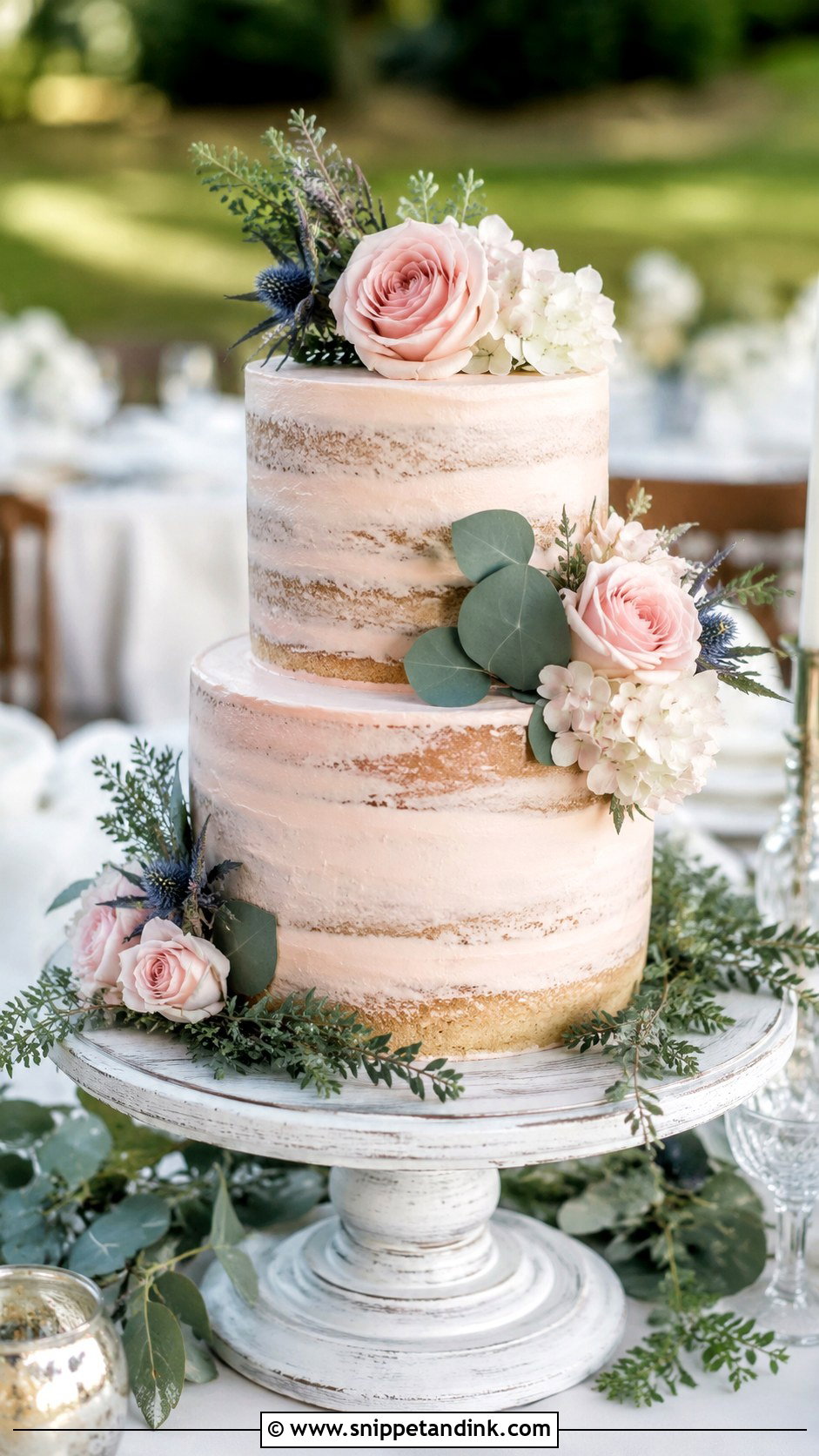
Blush on a semi naked cake gives a warmer, handmade look. The icing has to be thin enough to show the layers but scraped evenly, otherwise it reads as unfinished rather than relaxed. Blue thistle, hydrangea or painted leaves bring in the second color. It doesn’t need height to have presence, which makes it a sensible pick for smaller guest counts. In summer heat I’d be cautious: with so little icing, the cake has nothing to hide behind if it softens.
10. Dusty Blue Buttercream Wedding Cake
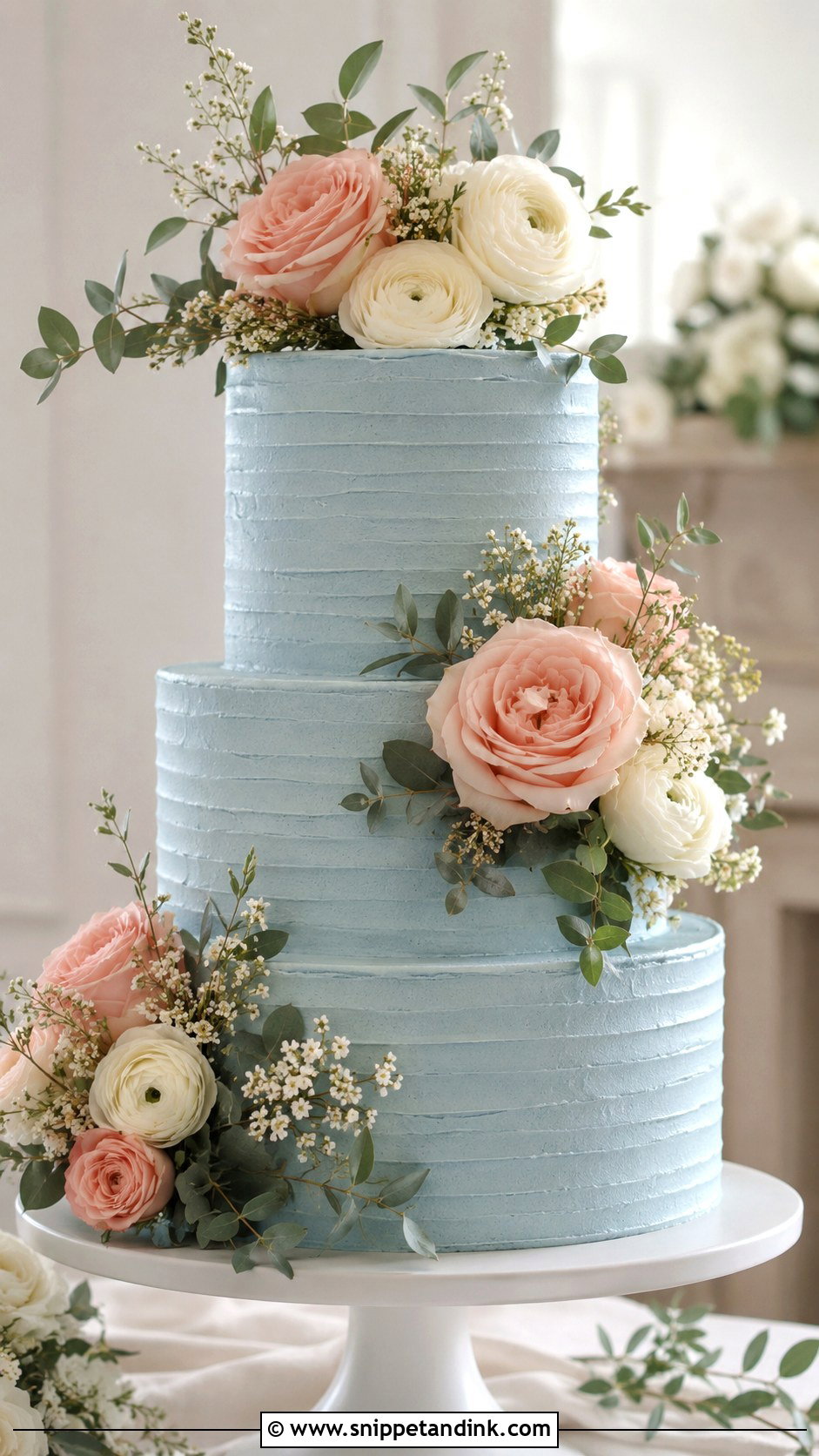
Buttercream gives you the widest range of finishes from one base: smooth, ridged with a comb, or left with spatula marks. The color is where I spend the most time. Buttercream made with butter is naturally pale yellow, and blue over yellow drifts green, so I neutralize the base first and add a tiny touch of black or grey to dull the blue. Done well, it’s grown-up and soft; done quickly, it’s baby blue. Blush flowers then do the warming.
11. Blush Pink Buttercream Wedding Cake
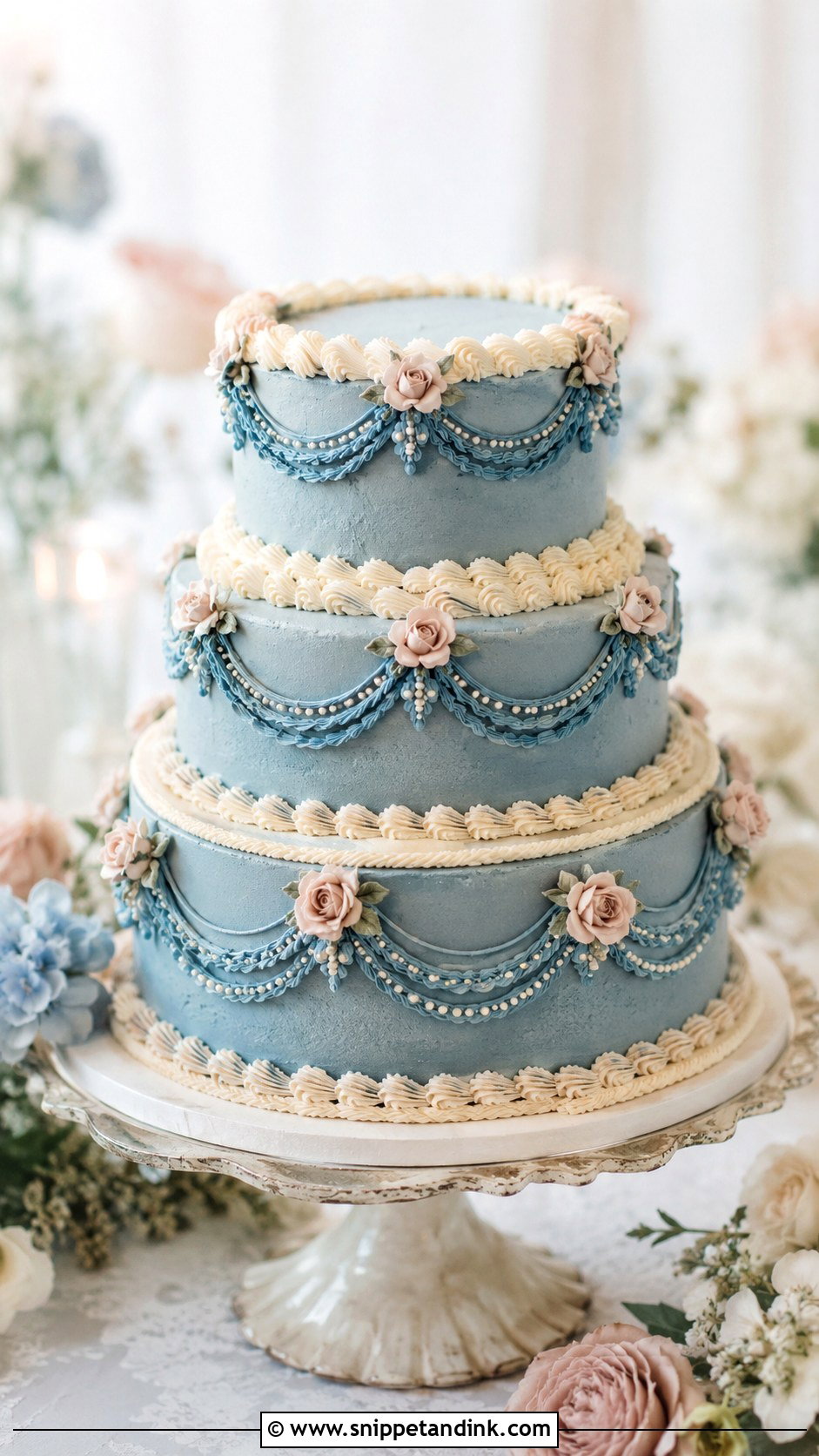
Blush buttercream flatters almost every skin tone standing next to it in photos, which is one reason couples love it. Three tiers with small floral clusters keep it classic; a lightly ribbed finish with loose greenery makes it relaxed. Pink is also the color most likely to fade under strong light, so I keep the shade a touch deeper than the final target and ask that the cake not sit near a sunny window. Blue silk ribbon or painted accents complete the pairing.
12. Dusty Blue Fondant Wedding Cake
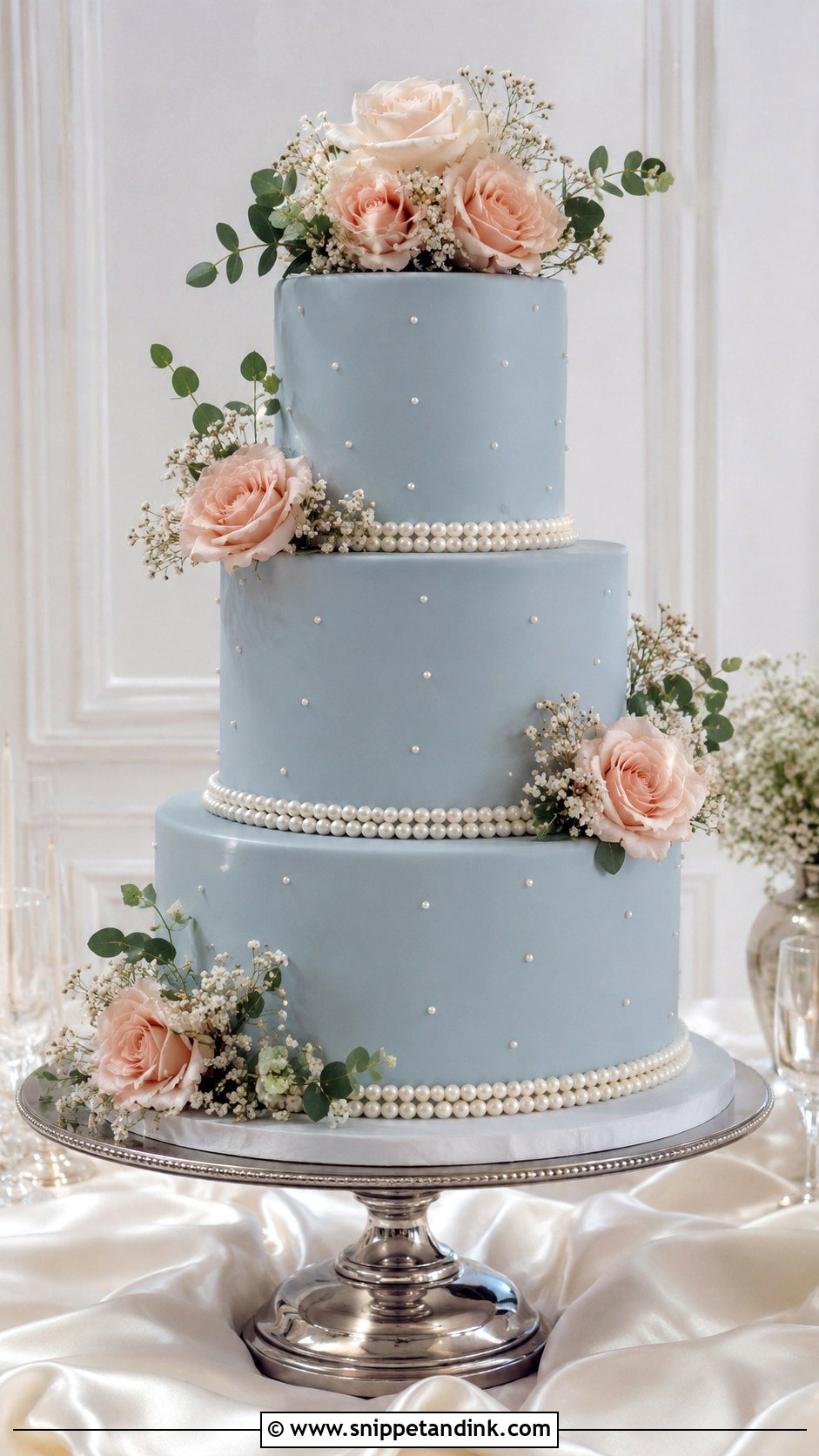
Fondant is the right call when you want sharp edges and a perfectly even color. A dusty blue fondant wedding cake with blush sugar flowers, pearls and ivory piping suits ballrooms, hotels and estate weddings. I tint the fondant in one large batch so every tier matches, since a second batch rarely lands on the same shade. One tier with a pressed pattern or raised detail adds dimension. Keep the blue grey-leaning and place the blush deliberately.
13. Blush Pink Fondant Wedding Cake
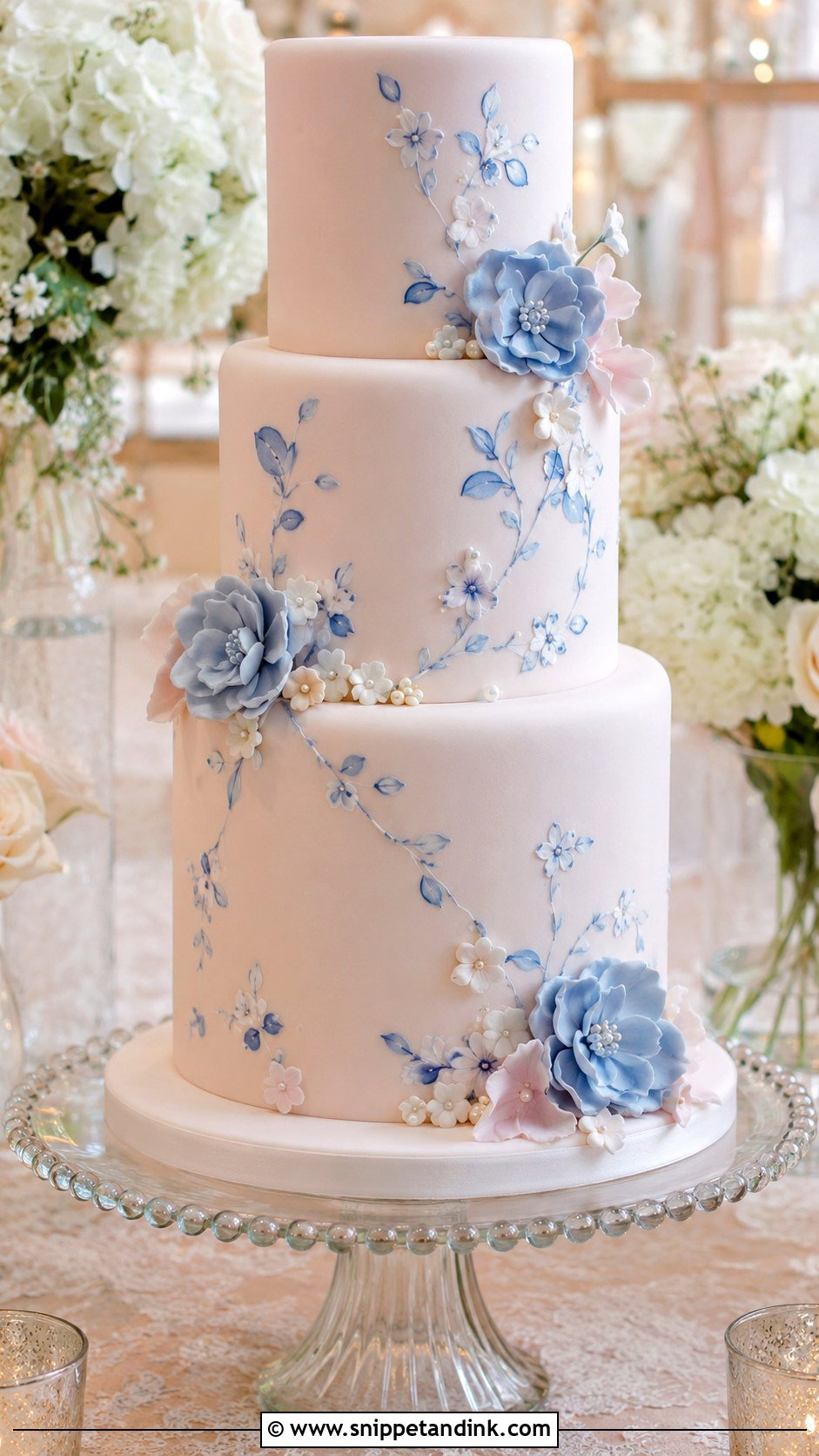
Pink fondant has a soft sheen that makes the cake read polished from across the room. Blue comes through sugar flowers, ribbon bands, painted vines or small appliqués, and ivory pearls or white piping refine it. A shape that’s classic with round tiers keeps it traditional; mixing a taller tier into the stack makes it current. I’d steer couples toward buttercream instead if they dislike the chewier texture of fondant, since you’ll be eating it.
14. Dusty Blue Floral Cascade Wedding Cake
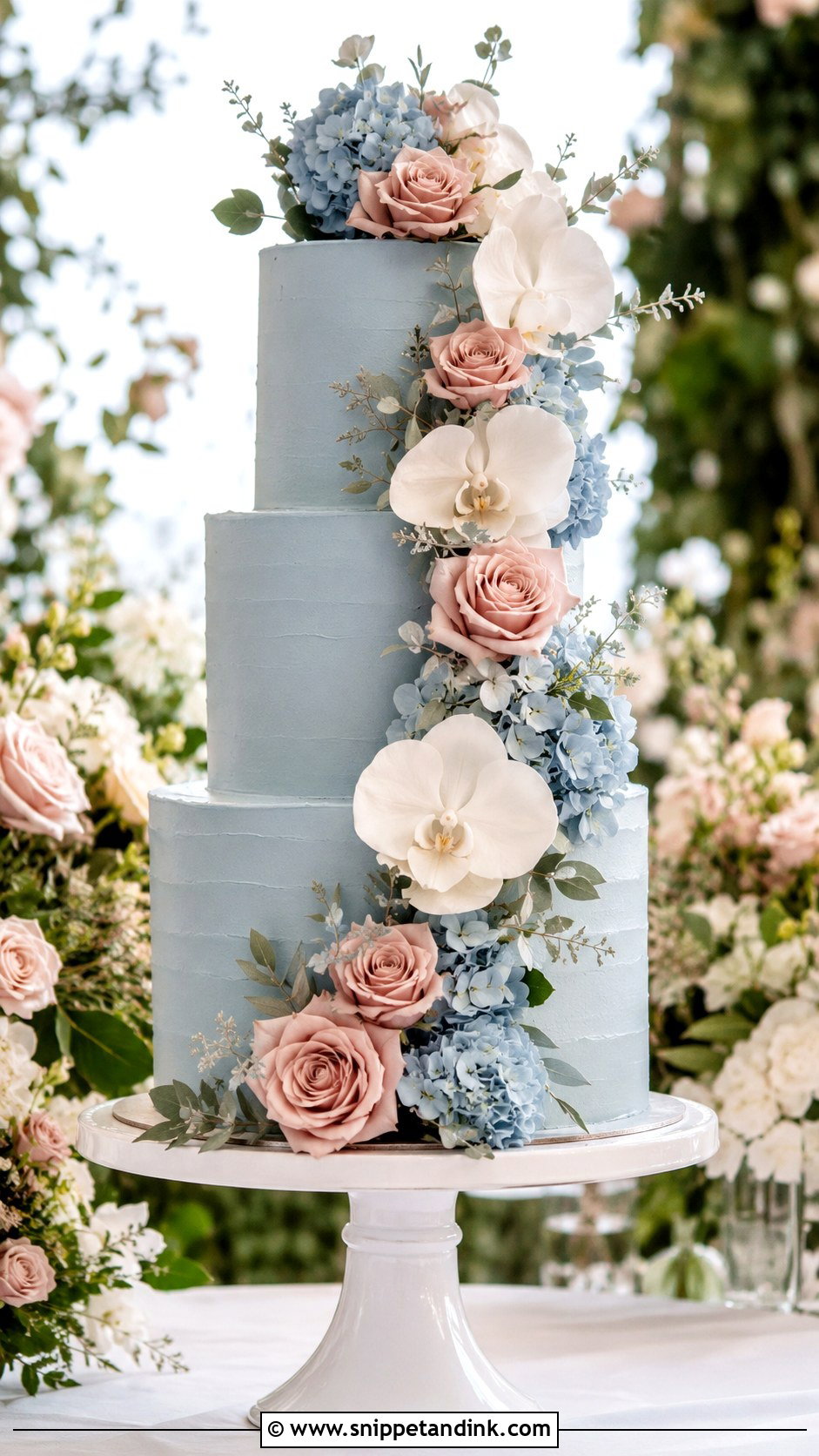
A cascade is the most dramatic option here, and it needs height. On a short cake, the flowers have nowhere to travel and just look piled. I plan the route from the top tier diagonally down, mixing blue hydrangea and pale sugar blooms with blush roses, ivory orchids and silvery leaves, and I vary flower sizes so it looks grown rather than glued. For tented and garden receptions where the florals already dominate, this ties the cake into the room.
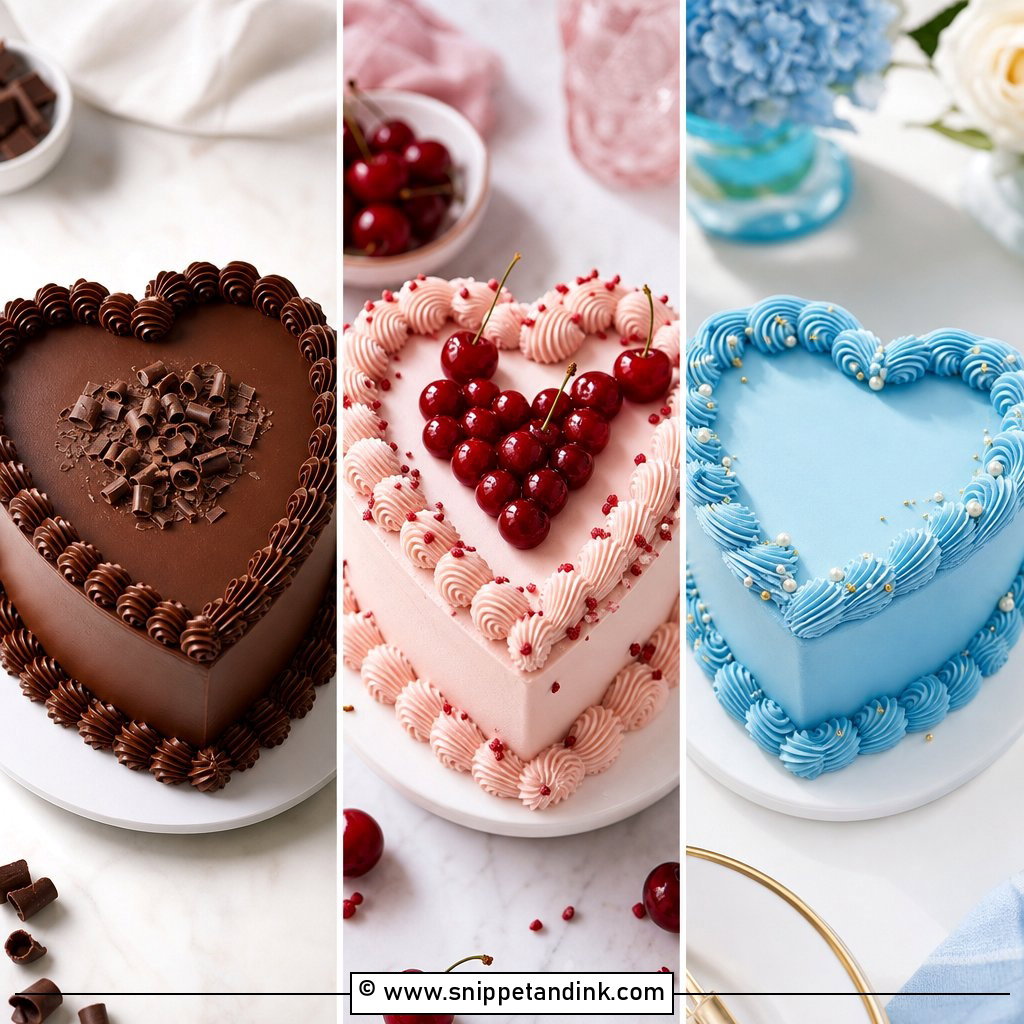
15. Blush Pink Floral Cascade Wedding Cake
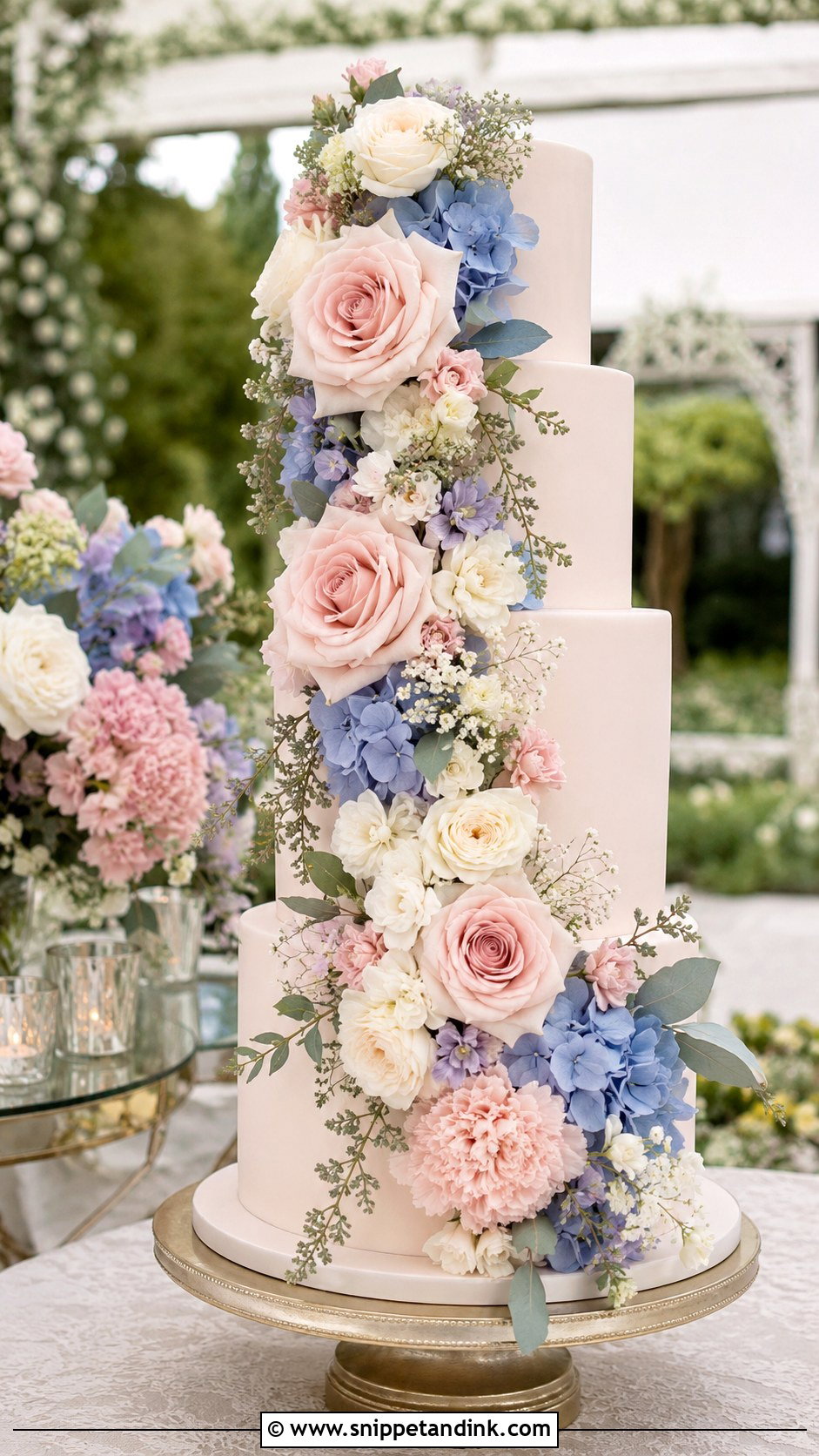
With blush as the lead, the cascade feels lush and warm, and blue becomes the contrast that keeps it from going sugary. I set one clear path, usually top left to bottom right, and stick to it. Large blush roses carry the line; small blue blooms, ivory petals and airy greenery fill around them. If your flowers are the biggest part of the decor budget, this is the cake that echoes them most directly, and your florist and baker should talk before the day.
16. Dusty Blue Wedding Cake With Sugar Flowers
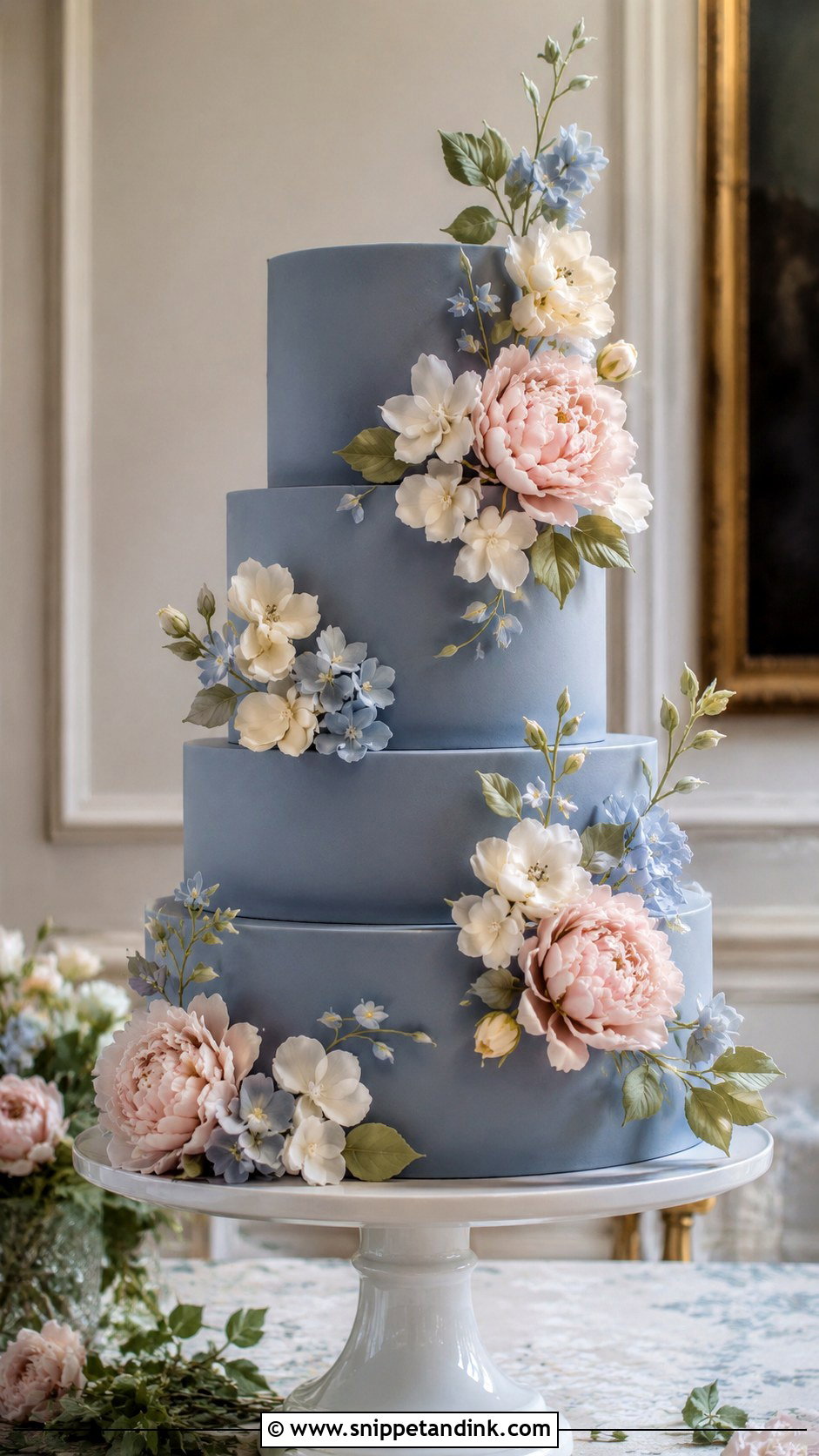
Sugar flowers hold up from cocktail hour to the last dance, which fresh flowers can’t promise. On a dusty blue wedding cake with sugar flowers, I make the blooms in blush, ivory, pale blue and soft green, each petal wired and dried before assembly. They’re time-consuming, so they’re often one of the bigger line items on a quote. Bring a photo of your bouquet; I can match roses, peonies, sweet peas or ranunculus to it. The result feels personal to your wedding rather than borrowed.
17. Blush Pink Wedding Cake With Sugar Flowers
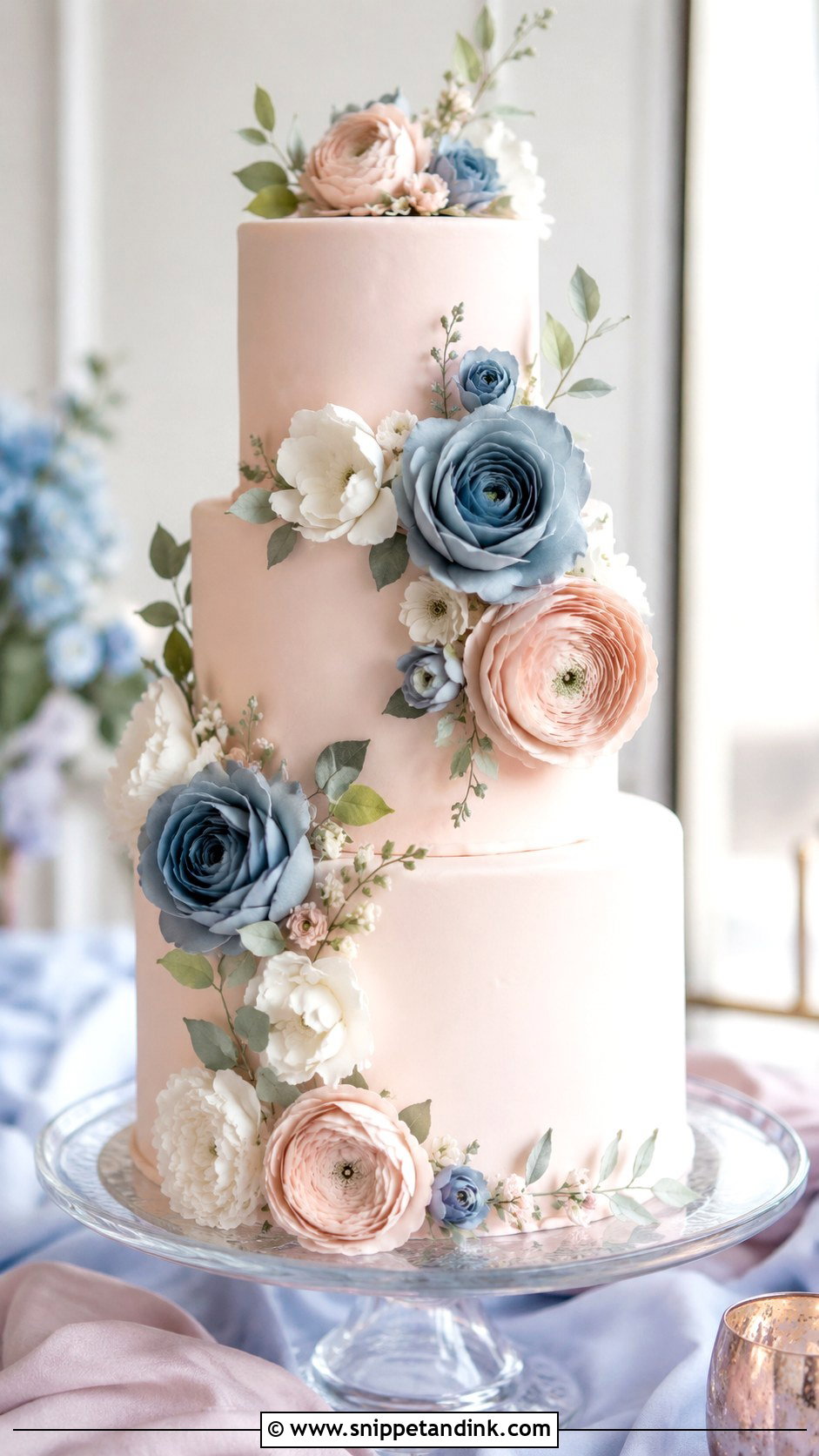
If your venue runs warm or your florist can’t guarantee cake-safe blooms, a blush cake with blue sugar flowers solves both problems. Sugar doesn’t wilt, and every flower can be matched exactly to your palette. Make them large for drama or keep them small and scattered for a garden feel. Behind them, I keep the icing plain, smooth fondant or clean buttercream, so the flowers are clearly the point. Sugar flowers also make a good keepsake, stored dry and out of sunlight.
18. Dusty Blue Wedding Cake With Pearl Details
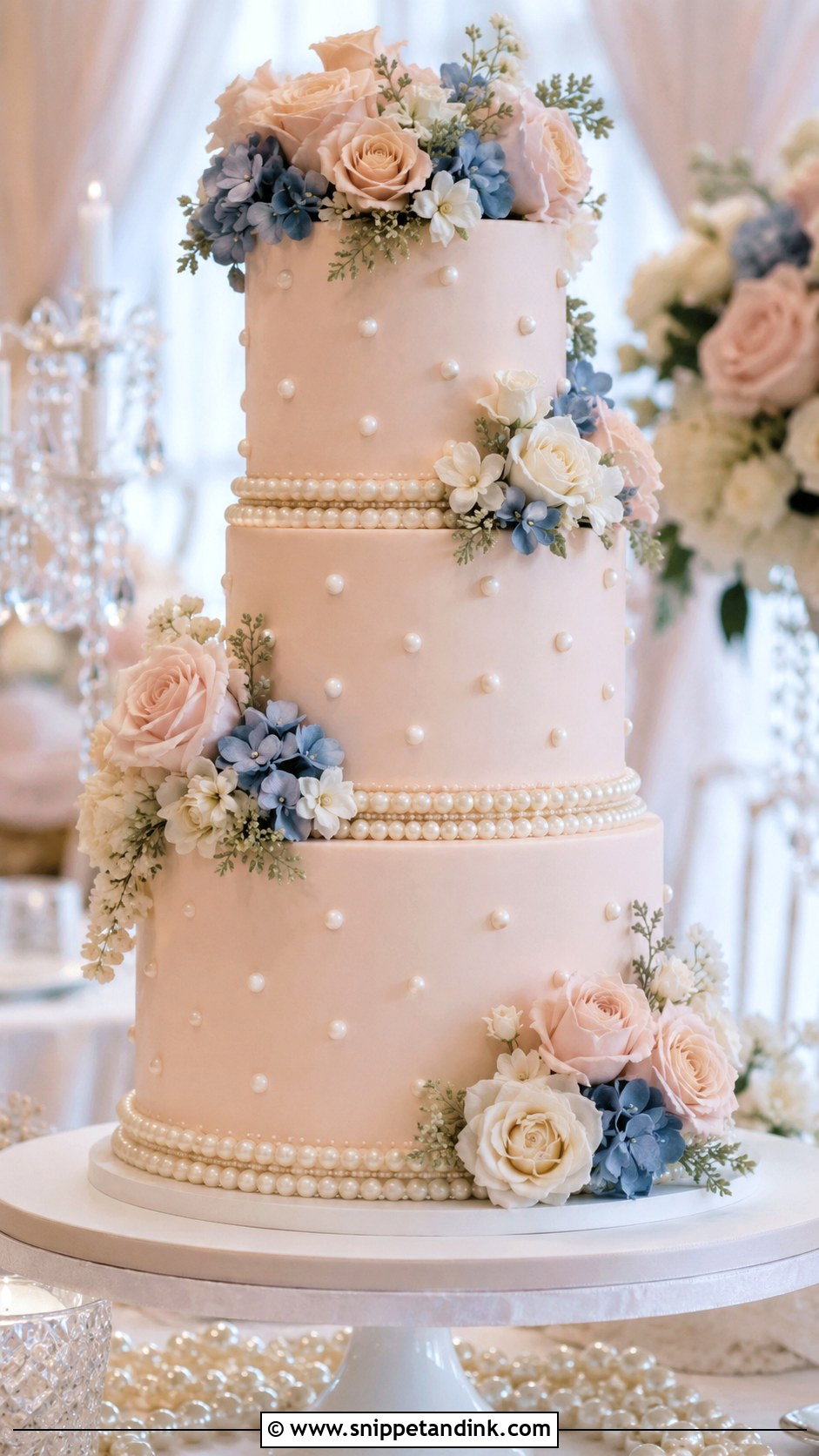
Pearls add texture and light to a cool blue base. I pipe them in royal icing, place sugar pearls one by one, or use a silicone mold for a uniform string, and I’d choose one method rather than mixing them. Borders, a scattered accent or a pattern across a single tier is enough; covering every tier tips it into costume. A few blush flowers keep the cool blue from feeling cold. Coastal venues and satin-heavy bridal looks suit it naturally.
19. Blush Pink Wedding Cake With Pearl Details
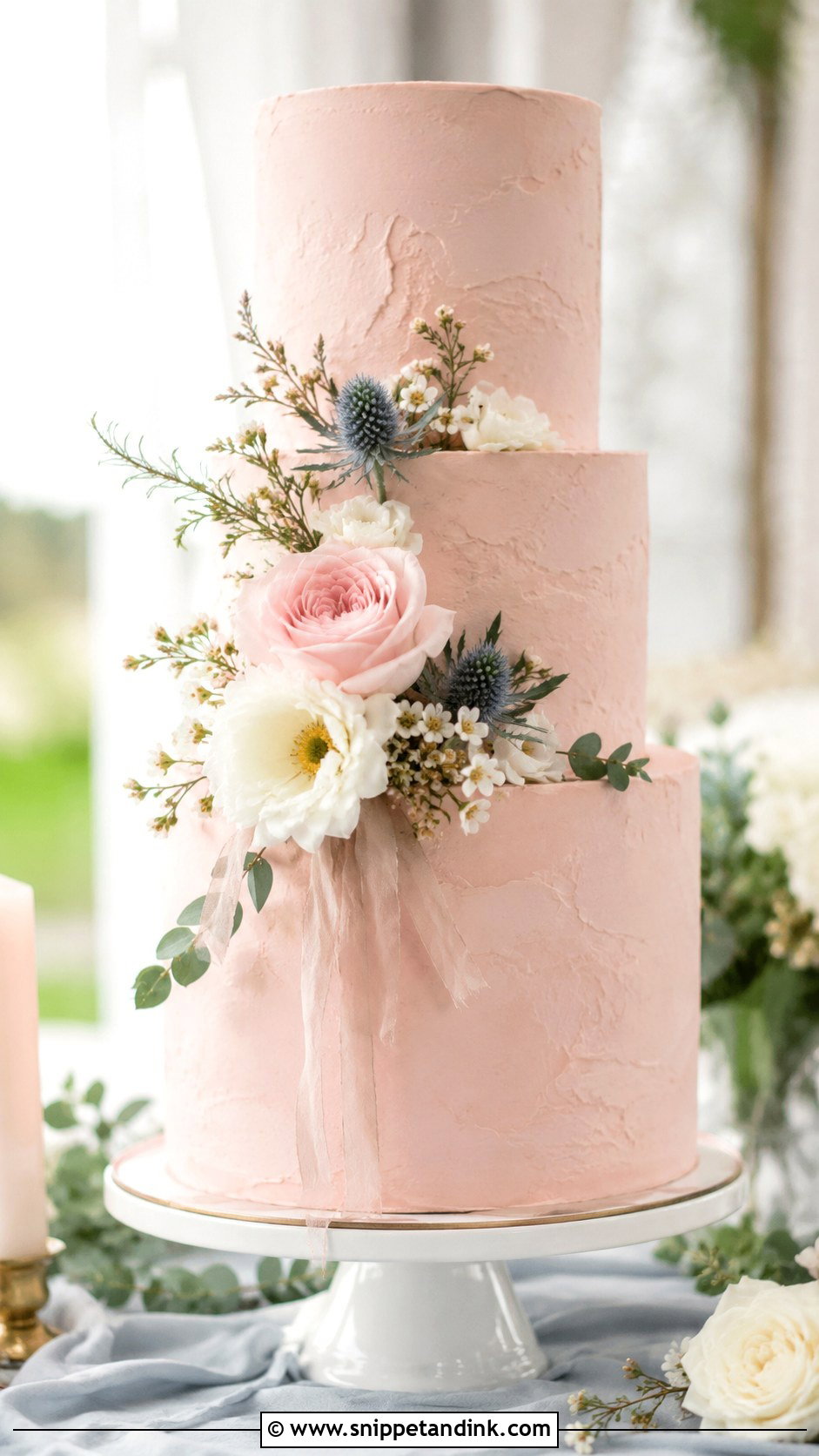
Pearl details on blush tend to echo what the bride is wearing: pearl earrings, a pearl-edged veil, a lightly beaded gown. That link is worth using. Smooth buttercream or fondant gives the cleanest background, and blue enters as a flower or two, a ribbon or a small piped detail. My rule is that you should still see more cake than pearl. If the whole surface is beaded, the eye has nowhere to rest.


20. Dusty Blue Vintage Wedding Cake
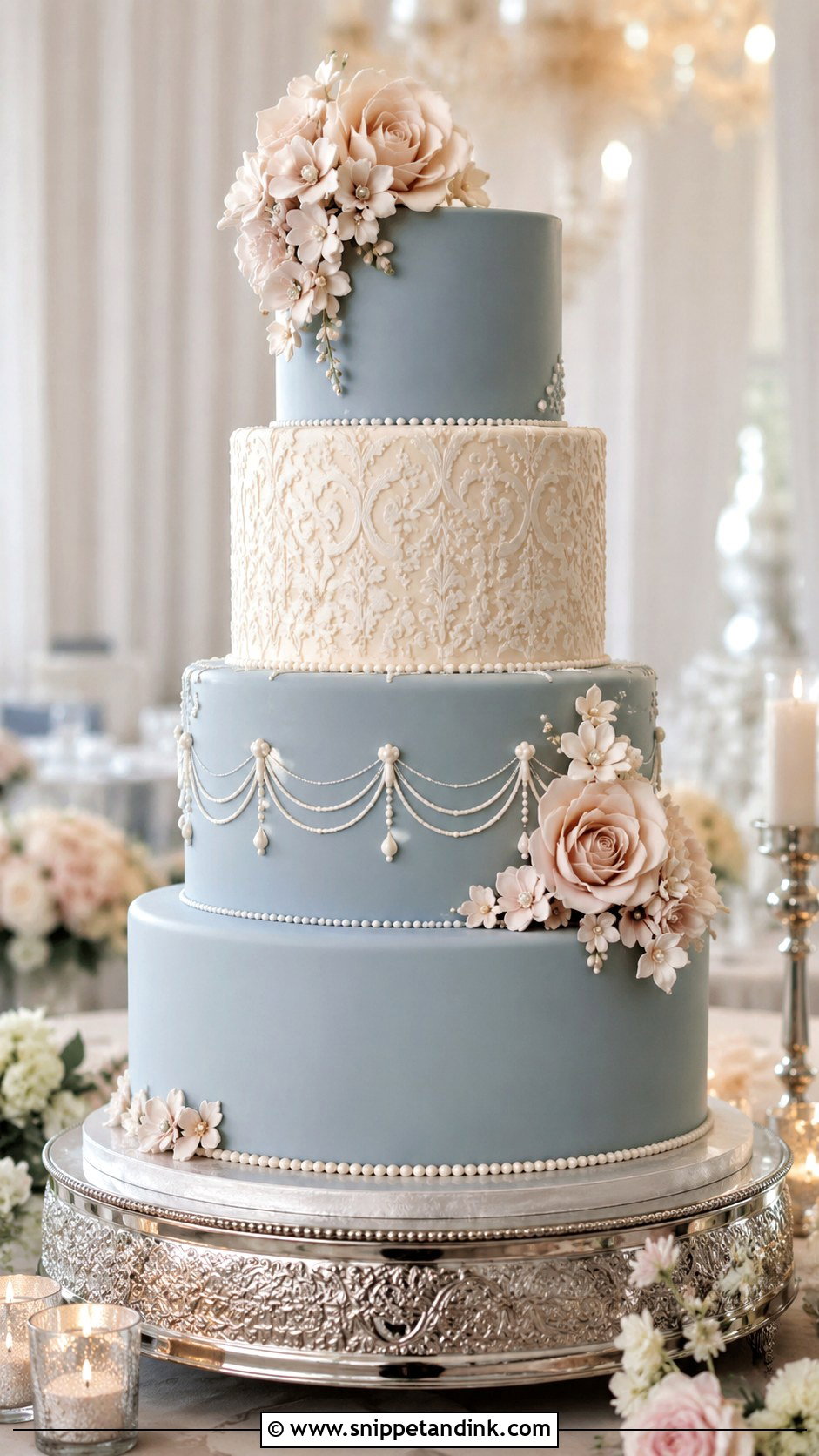
Vintage piping and a fresh palette work together surprisingly well. Picture blue icing with shell borders, Lambeth-style swags, small ruffles and blush piped roses. Overpiped work needs a stiff buttercream or royal icing and a cool room, because the layers are heavy and slump if the base softens. I keep the spacing clean so it reads nostalgic, not busy. Ivory piping for contrast and a few pearls finish it, on a white stand with simple flowers nearby.
21. Blush Pink Vintage Wedding Cake
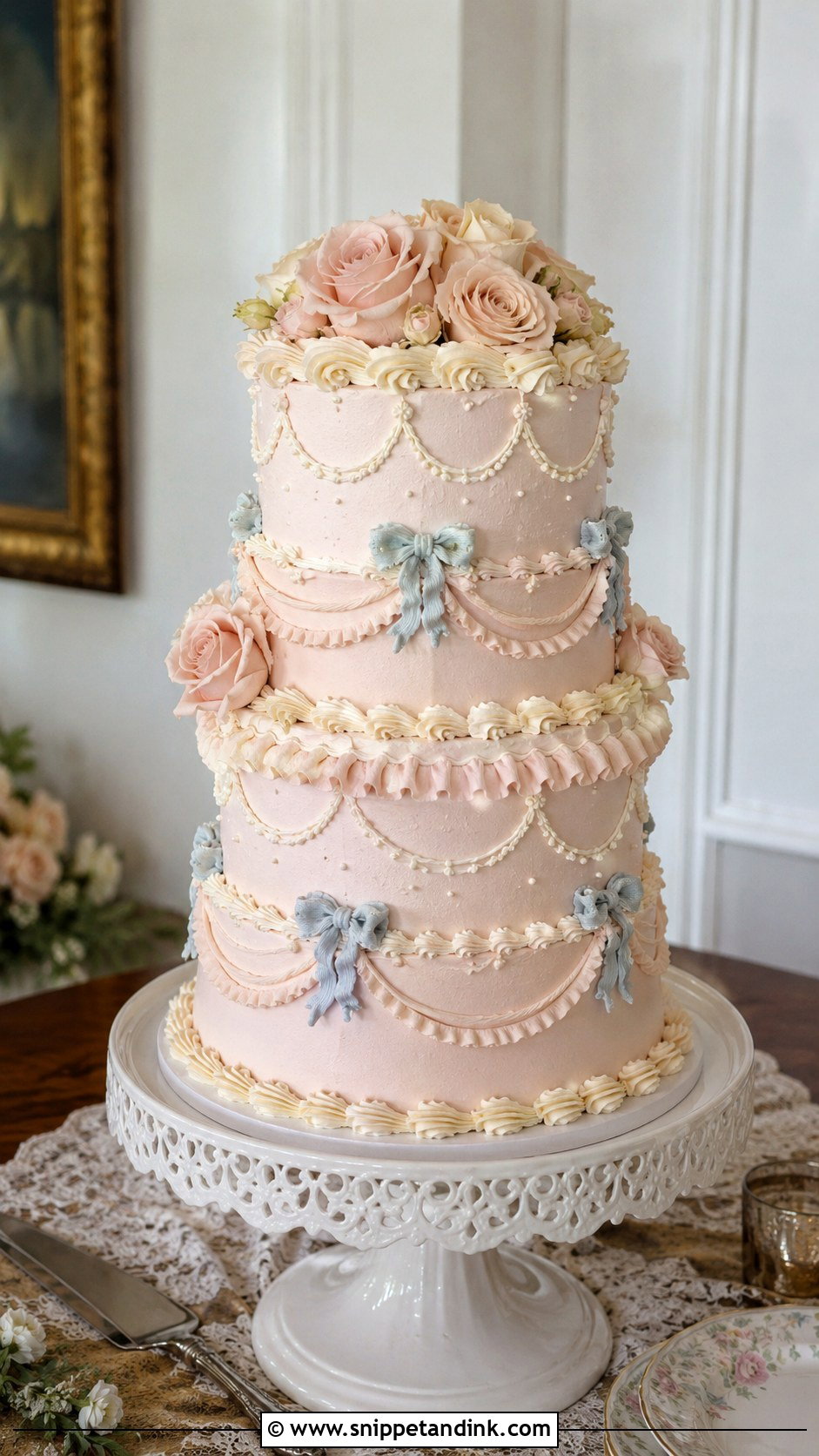
Blush makes vintage piping look sweeter and a little playful. Scallops, ruffles and small flowers in pale pink, with blue coming in through piped bows or a soft ribbon at the base of each tier. Keep the pink pale and the blue muted, or it can tip into a nursery palette. It suits intimate receptions and garden parties, especially on an antique stand, and it’s charming at two tiers.
22. Dusty Blue Modern Wedding Cake
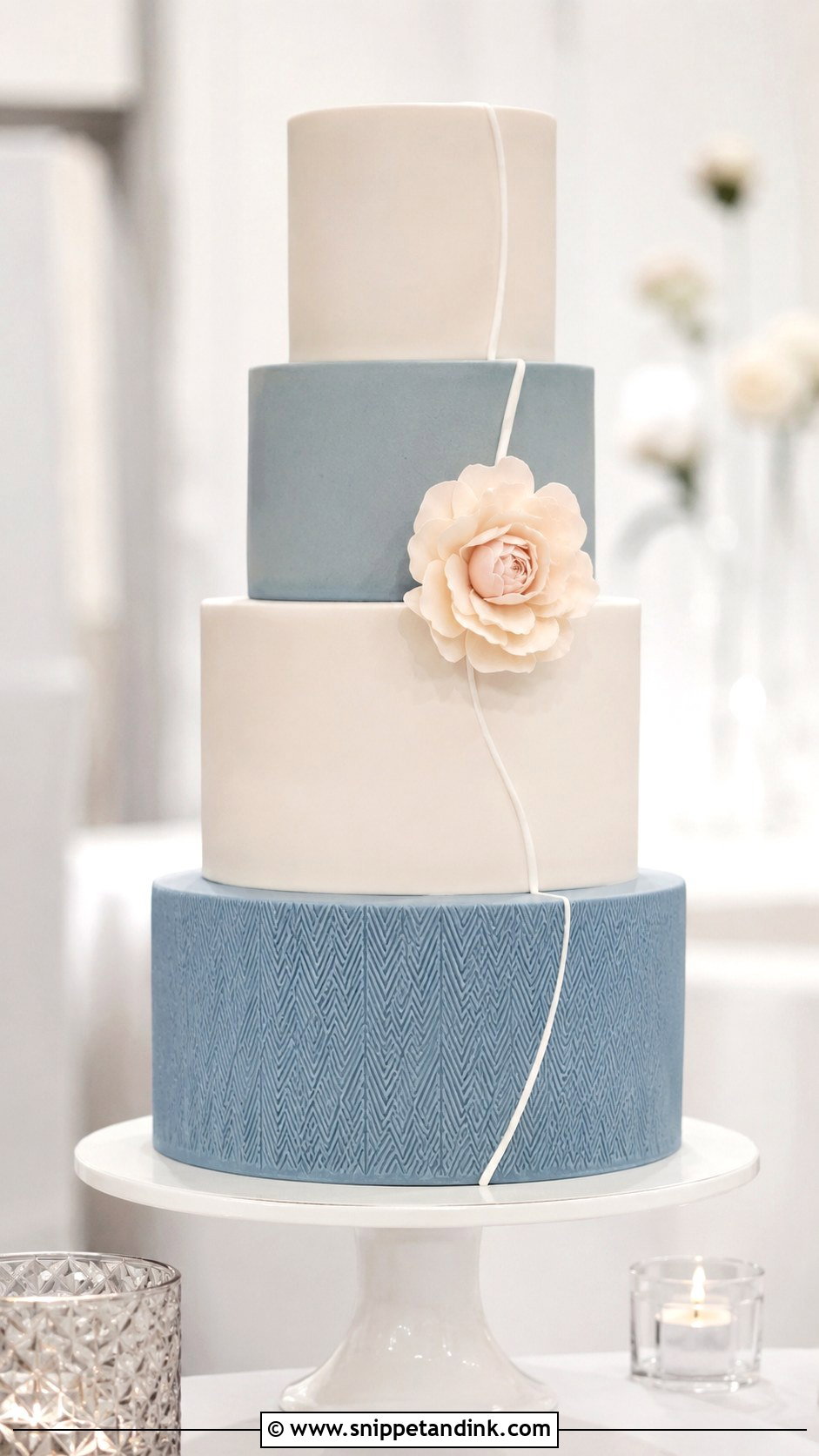
Minimal cakes show every flaw, so this is where I’d only work with a baker known for sharp edges. Tall tiers, crisp corners and very little decoration make dusty blue look considered. Blush enters through one floral cluster, one sugar flower or a thin painted line. Loft venues, galleries and city hotels suit it. To stop it feeling empty, I’ll often texture one tier with fine vertical lines or a matte finish so there’s something for the light to catch.
23. Blush Pink Modern Wedding Cake
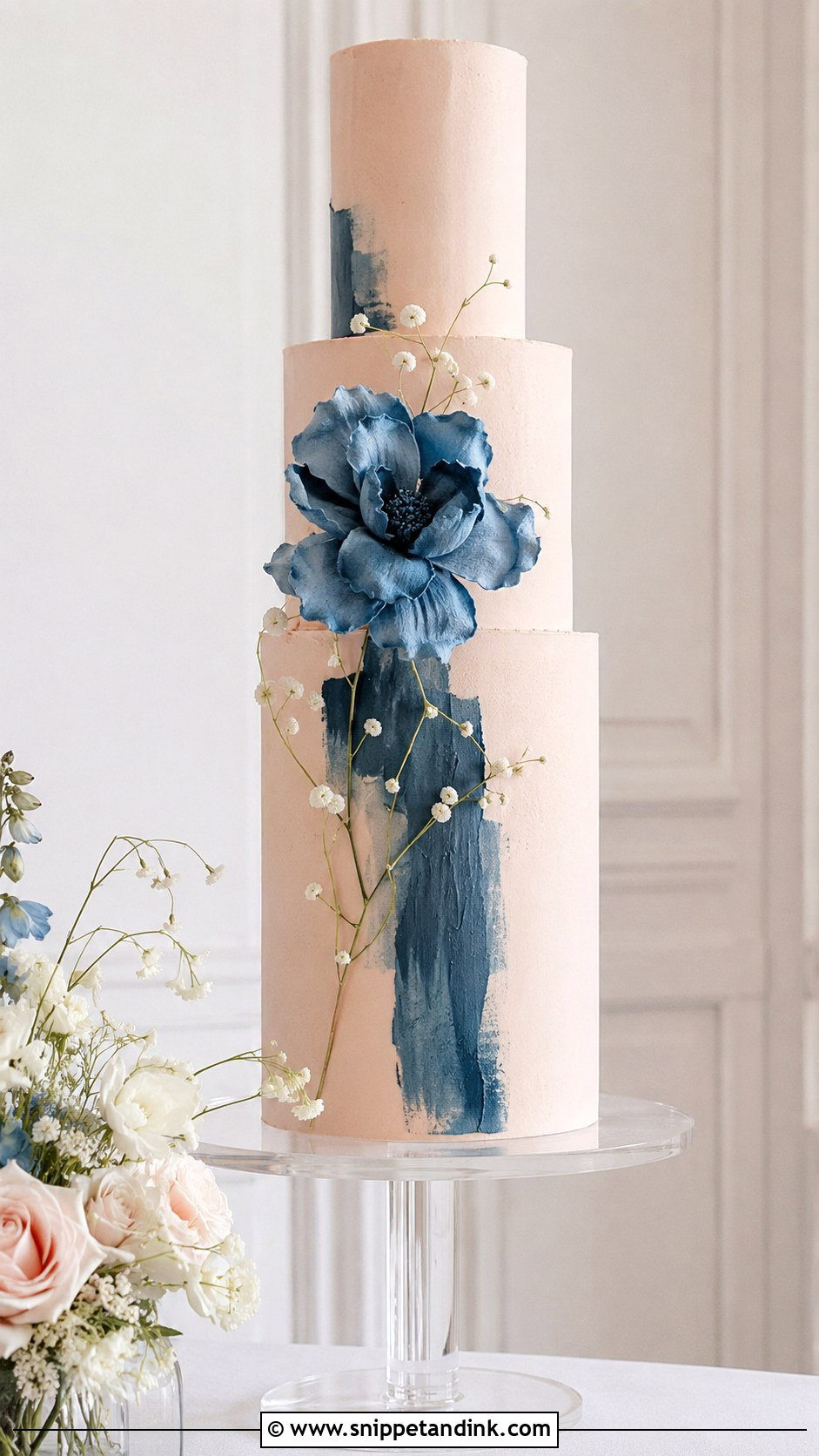
Modern blush is a good fit for couples who want color without a cake full of flowers. Tall smooth tiers, clean lines, and blue appearing as a geometric accent, a thin band, a brushstroke or one sculptural sugar flower. I place details off-center so the cake doesn’t look symmetrical and stiff. A matte finish keeps blush from looking shiny under bright reception lights. A white or clear stand keeps the outline crisp.
24. Dusty Blue Wedding Cake With Blush Macarons
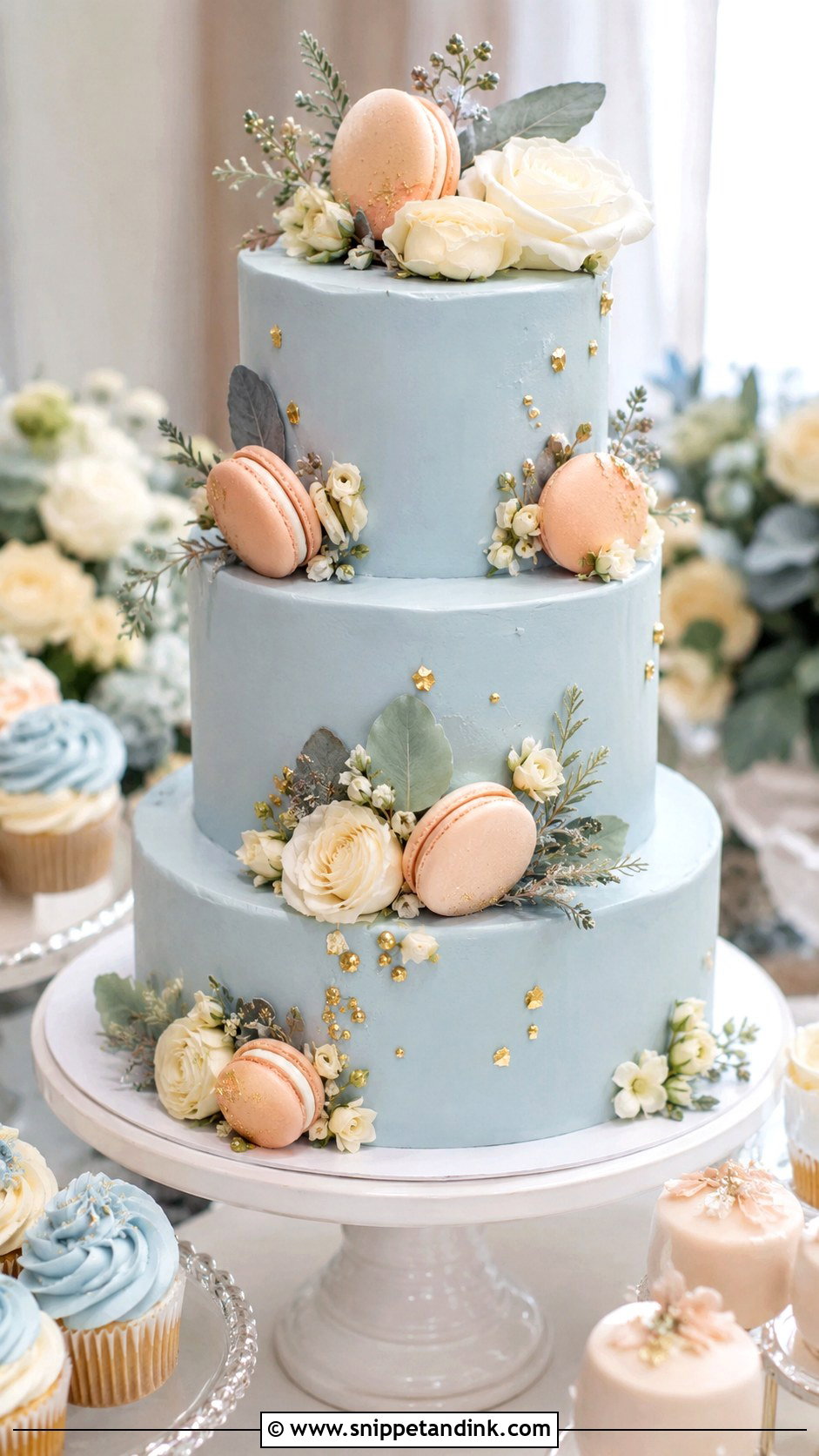
Macarons give the cake shape and connect it to a dessert table. I attach them to blue buttercream with a dab of icing, in a line along the tiers, around the base or in small clusters between flowers. Macarons soften once they sit against moist icing, so they go on the day, not the night before. Ivory blooms and a little gold refine it for brunch and garden receptions, and the pastel mood is easy to carry through the rest of the desserts.


25. Blush Pink Wedding Cake With Dusty Blue Macarons
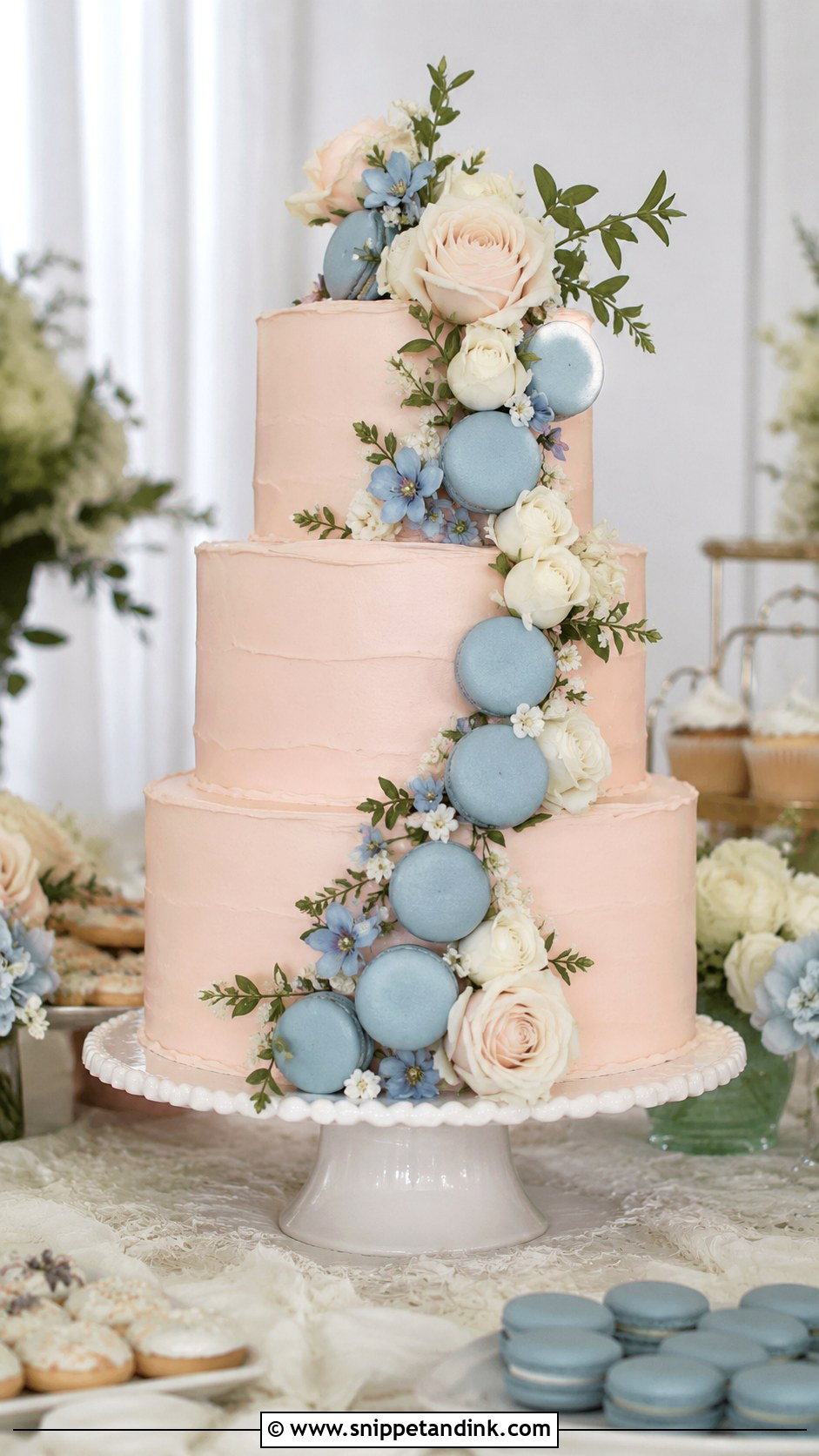
Flip the colors and the blue macarons do the contrast work against blush frosting. Buttercream holds them better than fondant, which can slide under the weight. I group them in a diagonal or space them evenly, with ivory roses, small blue flowers and a few pale leaves to link everything. If you’re planning a dessert bar in the same pastels, ordering extra macarons in matching colors for that table ties the two together.
Hydrangea, Thistle and Eucalyptus on a Cake Need a Plan
Many of the flowers that make this palette sing were not grown for food contact. Hydrangea wilts quickly once it’s out of water. Blue thistle is prickly and sheds. Eucalyptus is one of the greens I never let touch icing directly, because it isn’t considered food-safe.
My approach is simple. Stems are wrapped in floral tape and set into food-safe picks or straws so nothing pushes raw into the cake. Blooms sit on a small barrier where they rest against the icing. Flowers are added at the venue, as late as possible, and the cutting team is told which pieces to lift off. If your florist sprays with preservatives or pesticides, a separate cake-only batch is worth asking for.
How the palette reads under evening lights
Warm reception lighting pushes blue toward grey and blush toward peach. If your cake will be cut after dark under amber bulbs, I’d go one step deeper on the blue so it still reads as blue in the photos. A quick look at the venue at the time of the cutting, or a photo from a past event there, tells me a lot.
Two Muted Colors, One Clear Lead
Every version above works as long as both colors stay muted and one of them clearly leads. Formal rooms lean toward fondant and pearls; relaxed outdoor receptions lean toward semi naked and painted finishes. Bring your bouquet photo, a fabric swatch and the venue lighting into the conversation with your baker, and the right finish usually becomes obvious.
You'll Like These Ideas:








Leave a Reply