
A plain wedding dress is harder to make than it looks. With no lace or beading to distract the eye, everything rests on the fabric, the cut and the fit, and any shortcut shows. That’s the part I enjoy most as a stylist: getting a clean gown to sit so well that nobody misses the decoration. The twenty dresses below run from silk slips and crepe sheaths to a Mikado ball gown and a city-hall mini, and for each one I’ve noted the shoes, veil, hair and flowers I’d put with it, plus the fitting check I wouldn’t skip. They cover ballrooms, beaches, gardens and courthouses, warm months and cold.
Reading a Plain Gown at the Bridal Appointment
When a dress has no lace to look at, I look at how it’s made. A few quiet checks at the appointment tell you more about a simple gown than the price tag does.
- Turn the skirt inside out. Clean, finished seams and a full lining usually mean the outside will hang straight. Raw edges and loose threads usually mean it won’t.
- Squeeze a handful of fabric and let go. Good crepe and satin spring back with soft creases; thin polyester holds sharp wrinkles, and those will be in your seated photos.
- Hold the skirt up to the window. Ivory, white and chiffon all change in daylight, and any see-through spots are easier to fix now with an extra lining than after the order.
- Ask where the zip sits and how it’s covered. On a plain back, a visible zip tape or a puckered seam is the first thing a guest sees during the vows.
- Look at the sample in the mirror from behind, sitting down. Simple dresses show how the back and hips behave more than embellished ones do.
I’d also ask the boutique how long their production and alterations take. Made-to-order gowns commonly need several months before delivery, and two or three fittings after that, so timing affects which of these shapes is realistic for your date.
1. Simple Satin A-Line Wedding Dress
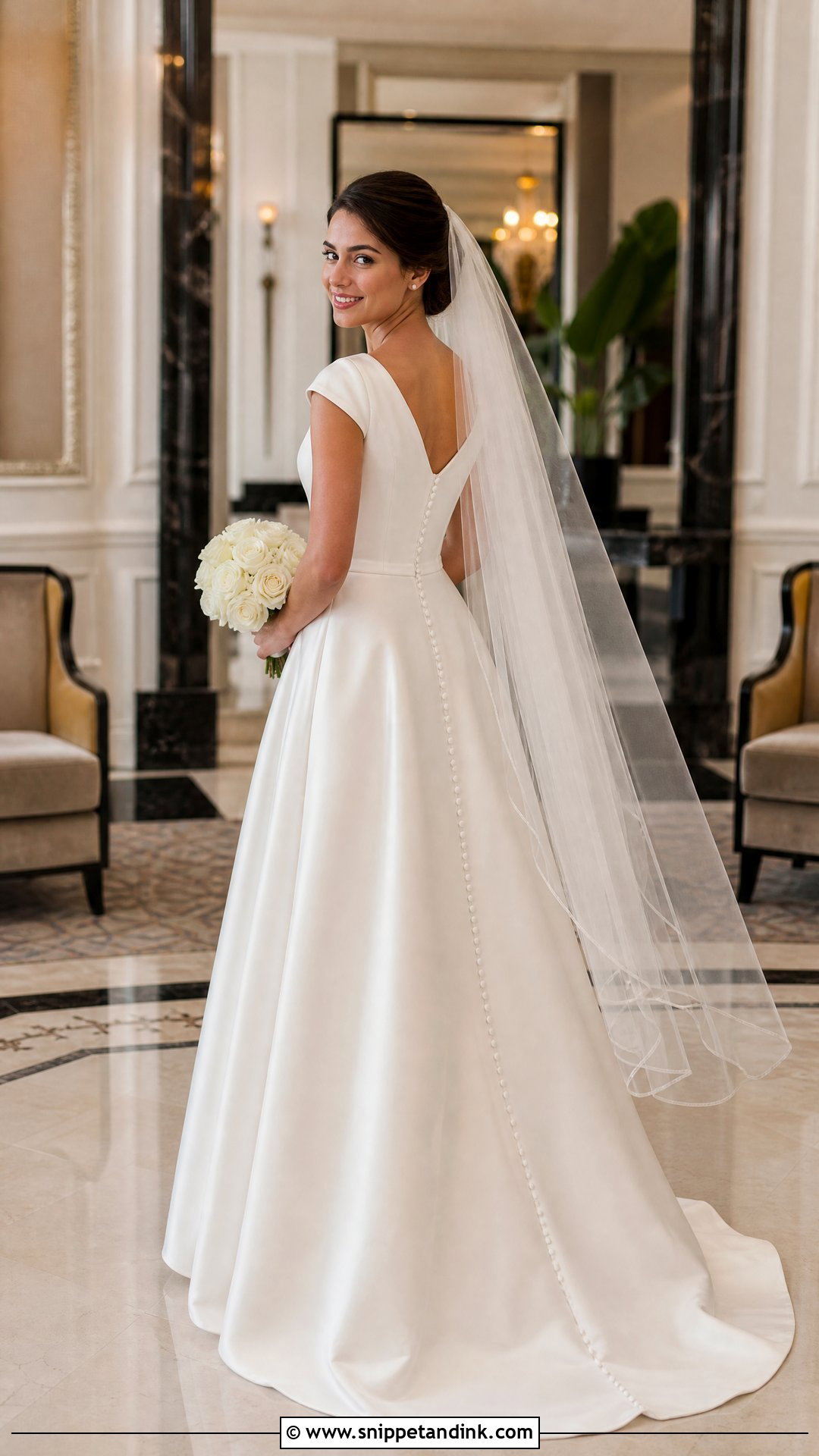
The satin A-line is the shape I suggest when a bride can’t decide, because it suits nearly every body and every venue. A fitted bodice, a natural waist and a skirt that widens gently to the floor; covered buttons down the back are all the detail it needs. I nearly always steer clients toward ivory over bright white in satin, since bright white satin can glare in flash photos while ivory reads warmer on skin. Pointed satin pumps, pearl earrings, a fingertip veil and a tight bouquet of white roses. Have the hem set while you’re wearing the actual wedding shoes, not a pair of similar height.
2. Simple Crepe Sheath Wedding Dress
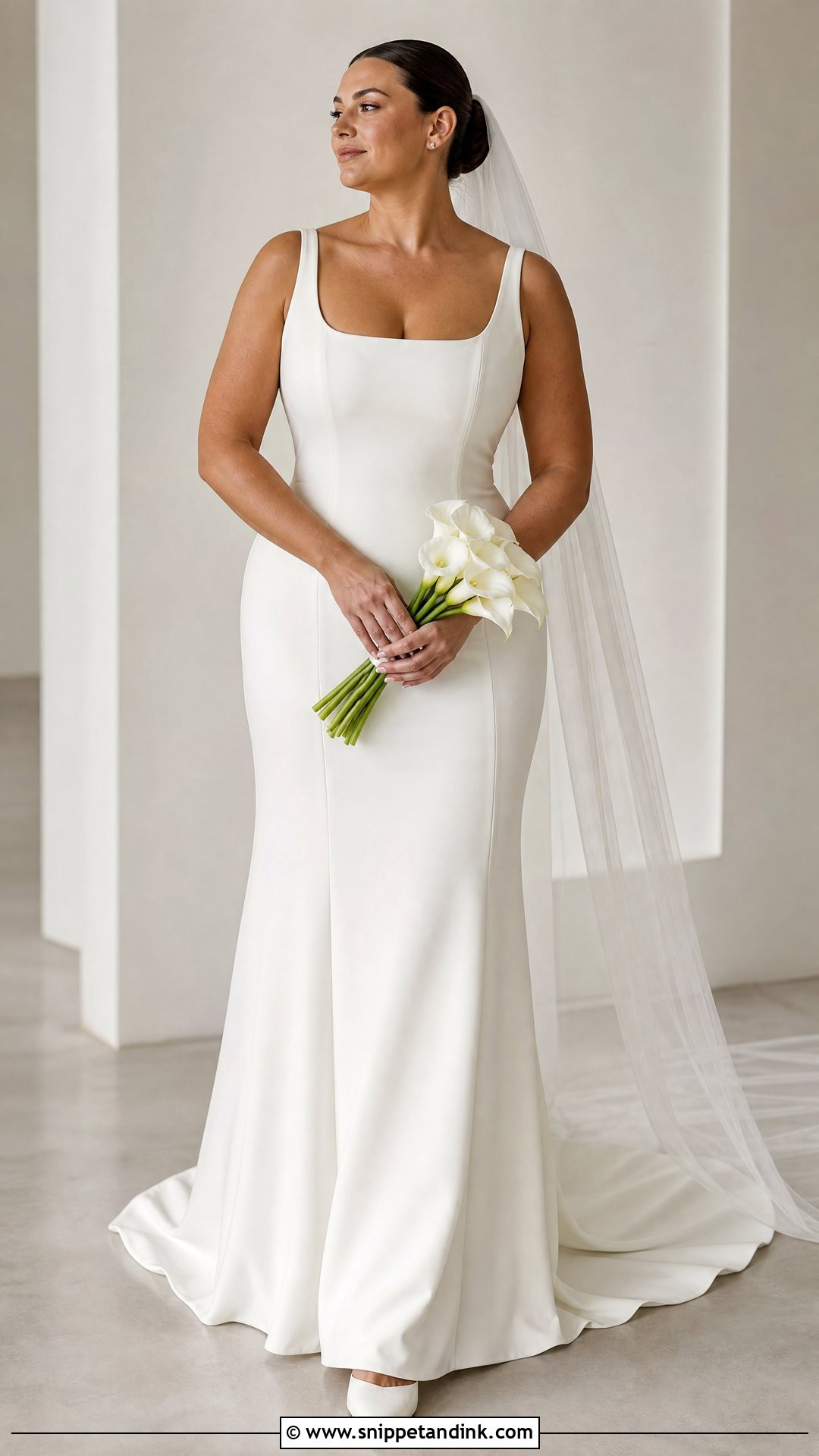
Crepe is honest fabric. It’s matte, it drapes close and it shows every pull, which is exactly why a streamlined sheath silhouette in crepe looks so sharp when it’s right. The dress should skim, never stretch; princess seams and a lightly structured bodice give it shape without a single bead. In the fitting I have you sit, walk and lift both arms over your head, because crepe will reveal a seam that’s a fraction too tight. Low pointed heels, diamond studs, a narrow cathedral veil, a sleek bun and a few calla lilies. Get the undergarments right before the final fitting, not after.
3. Simple Silk Slip Wedding Dress
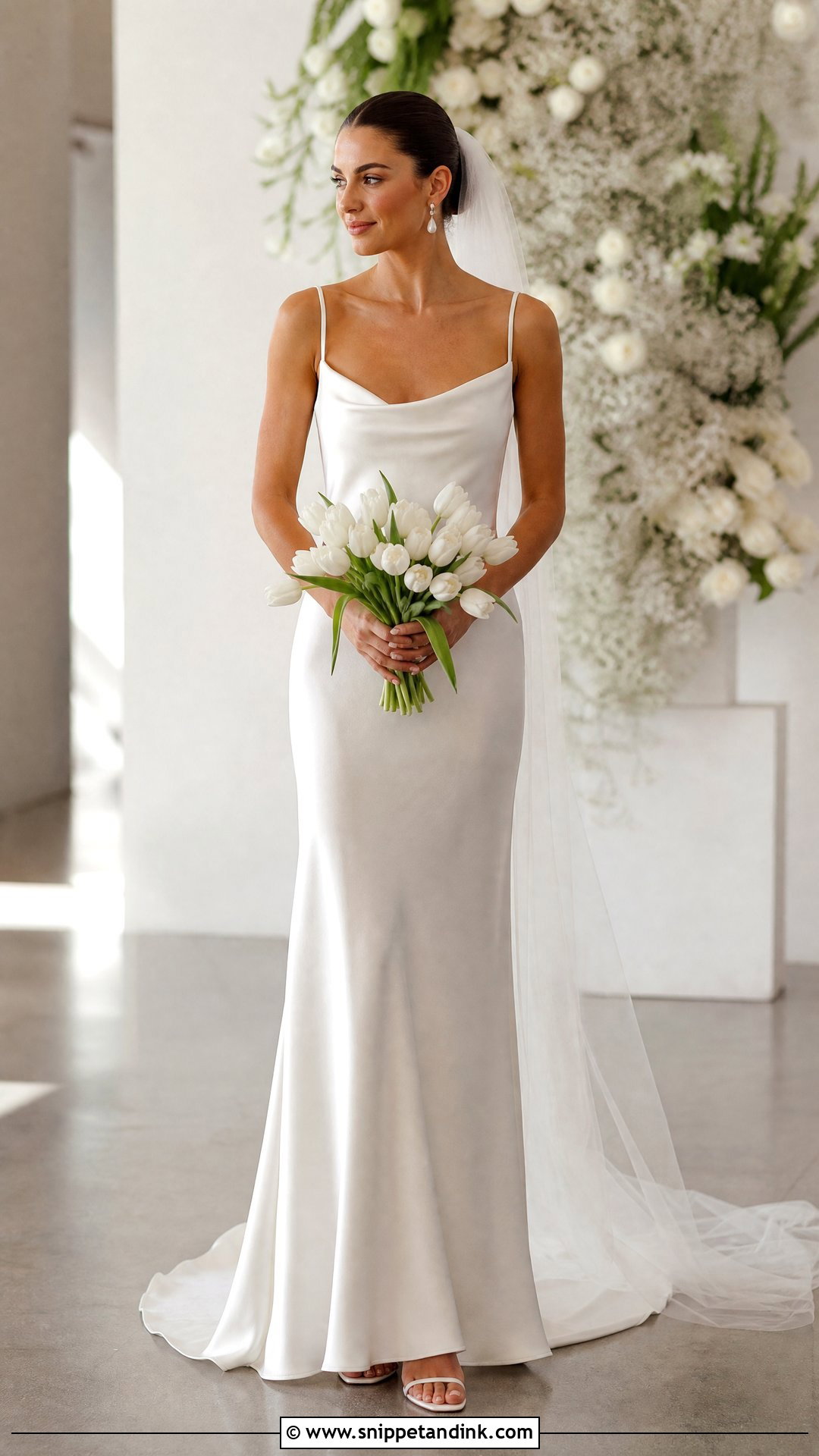
The silk slip is the most relaxed dress here and the least forgiving. Cut on the bias, it follows the body with slim straps and a draped neckline, very much in the 1990s spirit. I ask for a heavier silk or a lined satin, since thin silk clings and shows every line underneath. Bring the dress outside before you commit: reflective fabric can look ivory indoors and almost grey in shade, and the camera picks that up. Minimal white sandals, small drop earrings and a sheer chapel veil, or for an outdoor ceremony, a bun with one sculptural pin and a handful of white tulips.
4. Simple Strapless Column Wedding Dress
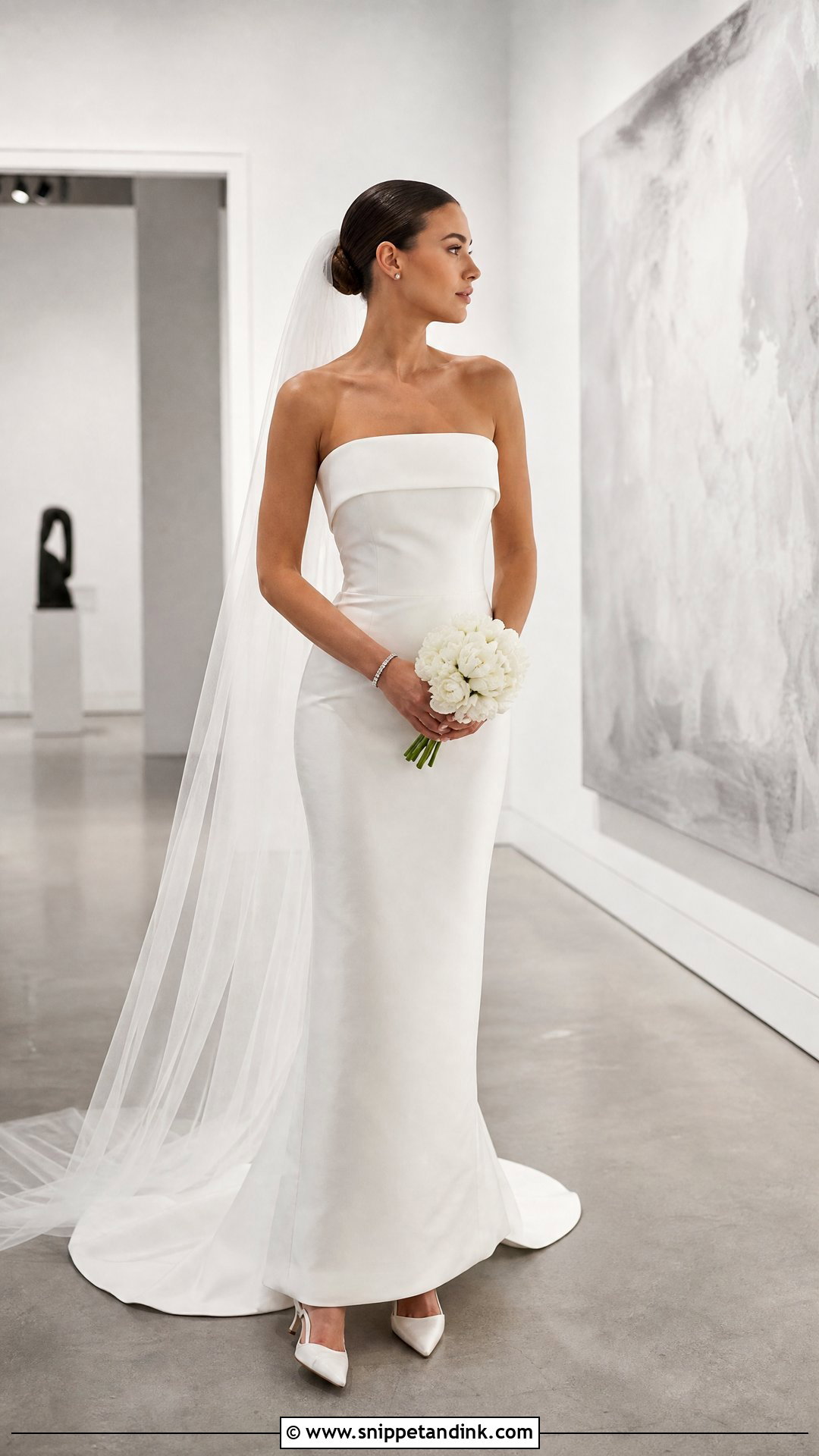
Strapless columns live or die on the inside of the bodice. I look for proper boning, secure cups and a waist stay before I even consider the neckline shape. A straight or gently curved neckline reads modern; a floor-length skirt with a short train gives it ceremony weight. In the fitting, roll your shoulders, sit and take a deep breath. If the neckline moves or pinches, the bodice needs taking in at the side seams, not more tape. Slingback heels, a tennis bracelet, a long sheer veil tucked under a smooth bun, and a small bouquet that doesn’t hide the narrow line.
5. Simple Square Neck Wedding Dress
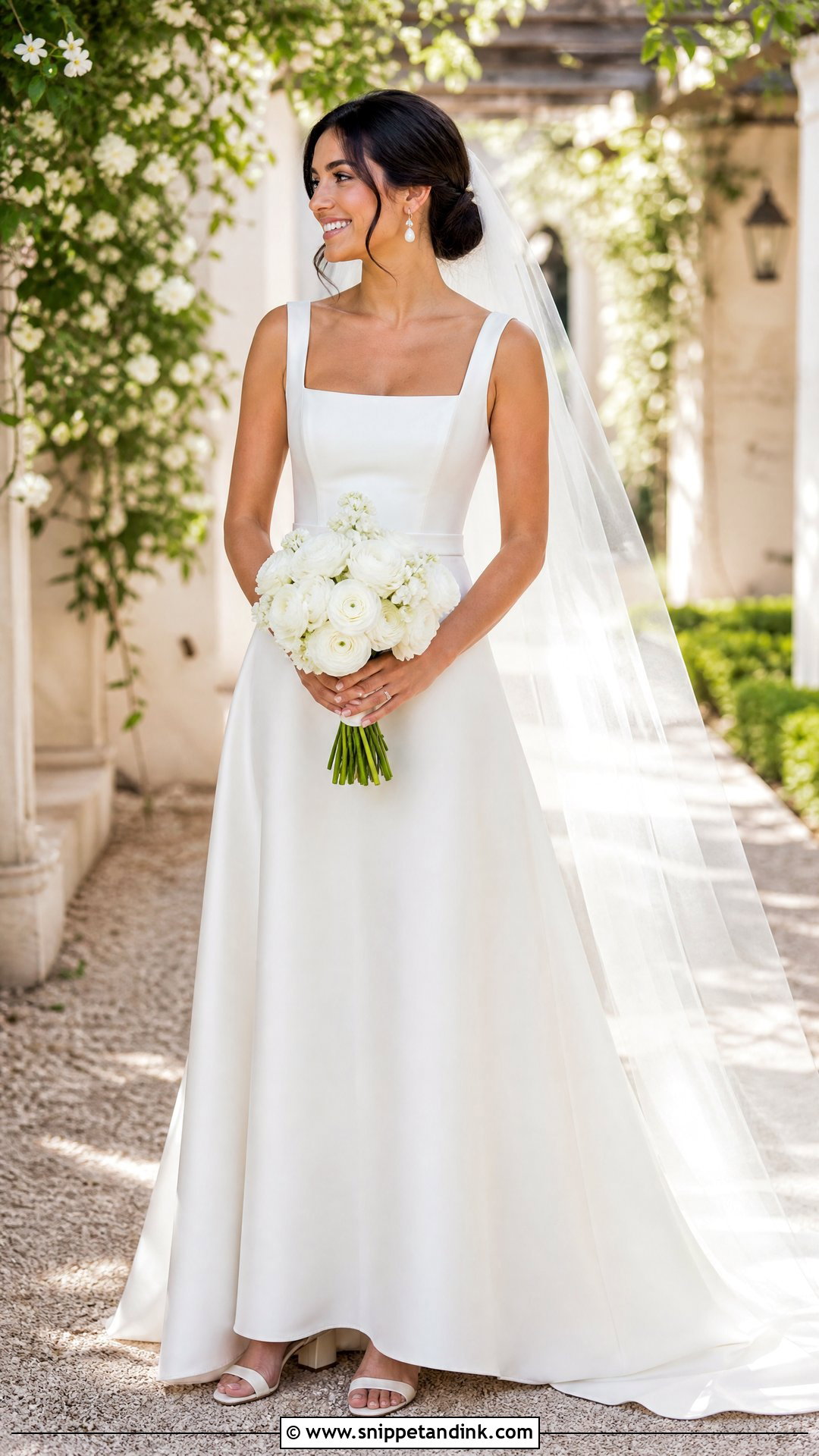
A square neckline frames the collarbones with clean geometry, and it only works if it stays level. Wide straps, a fitted bodice and a soft A-line skirt carry it well; matte crepe looks modern, satin a touch more formal. I watch the neckline as the bride sits, because one strap even slightly long will tip the square into a trapezoid. If you’d like more coverage at the back, ask for a square back with supportive straps instead of a deep opening. Block-heel pumps, pearl drops, a low gathered style and a waist-length veil, with loose but controlled ranunculus and greenery.
6. Simple Long Sleeve Wedding Dress
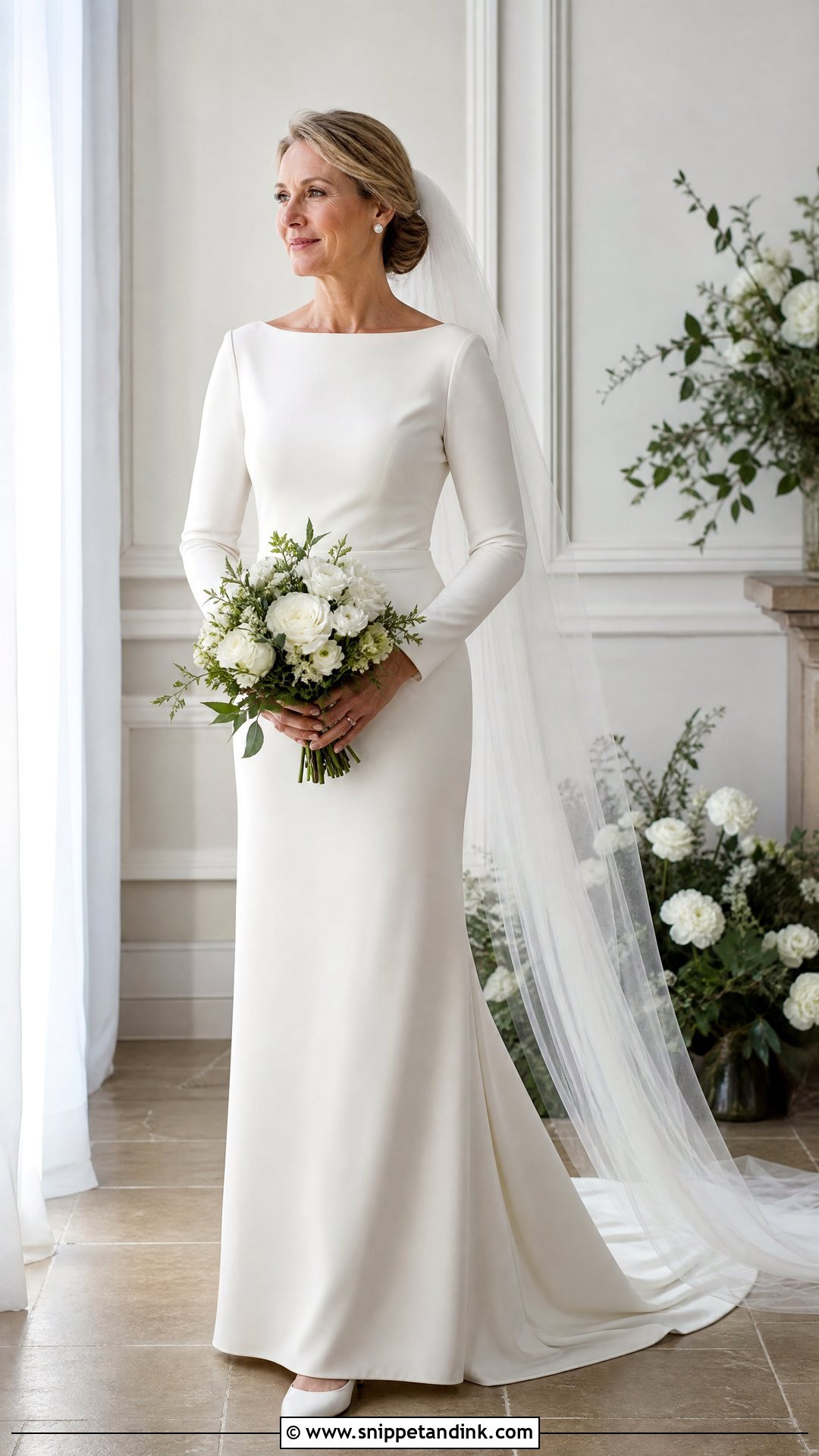
For a winter wedding I’ll often suggest a simple long sleeve wedding dress in crepe with a bateau neckline and a narrow A-line skirt. Lightweight chiffon sleeves soften it if crepe sleeves feel too buttoned up. The fitting test is practical: bend your elbows, hug someone, reach up as if for a bouquet toss. Fitted sleeves with too little ease pull across the upper back, and that pulling shows in every photograph from behind. Closed-toe pumps, pearl studs, a chapel veil with a plain edge and a low chignon so the neckline still shows. A white-and-green bouquet.
7. Simple Off Shoulder Wedding Dress
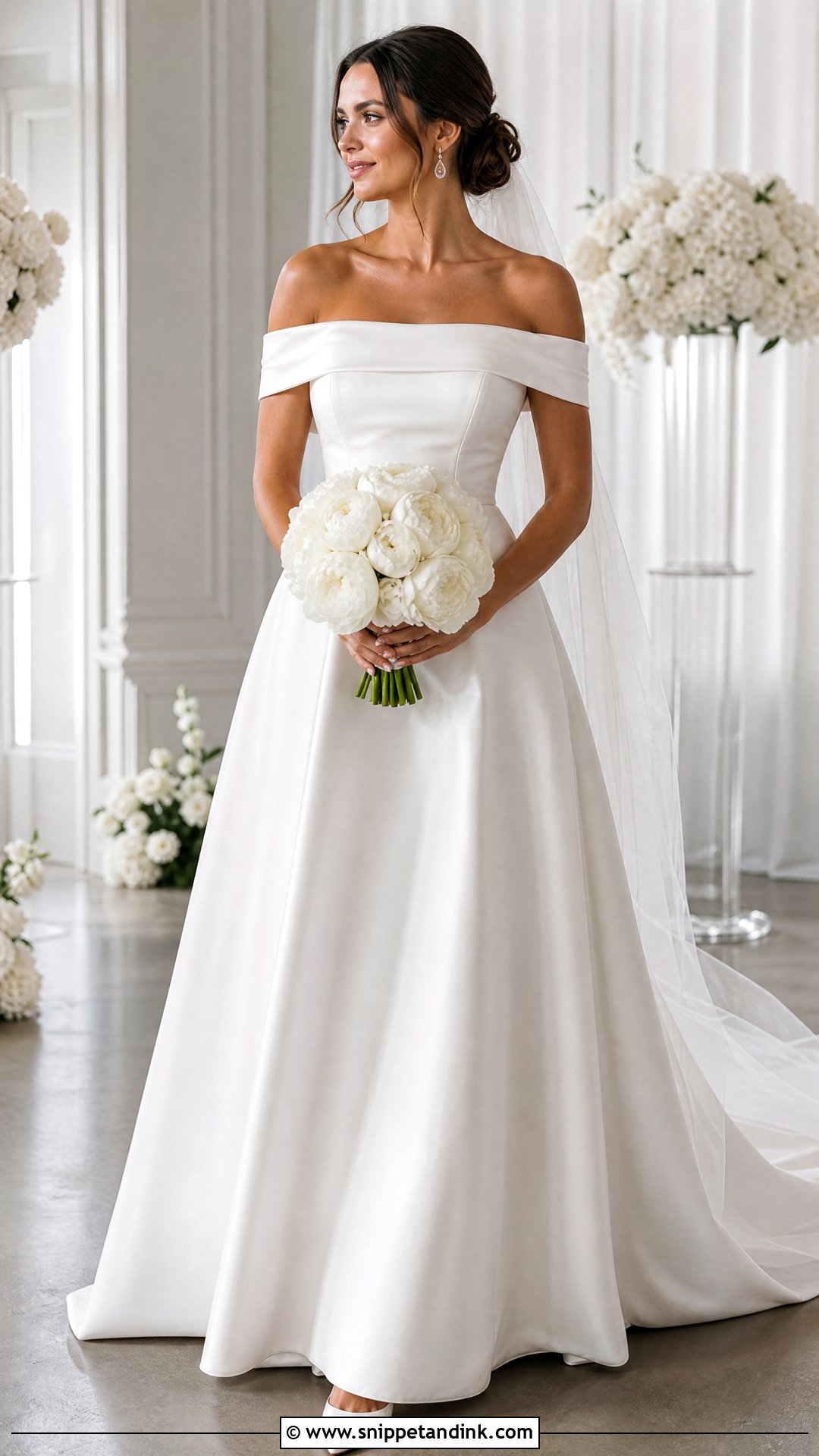
Off-the-shoulder is one detail doing all the work, so it has to stay put. I want a supportive inner bodice under soft folded bands that rest on the upper arms, in satin or structured crepe with as few seams as possible. Practice reaching forward and raising your arms in the fitting: if the bands climb up toward the shoulders, they need to be anchored to the bodice more firmly. Teardrop earrings, pointed pumps, a plain veil under a loose bun, and no necklace. A rounded bouquet of white peonies gives enough width to balance the open shoulders.
8. Simple High Neck Wedding Dress
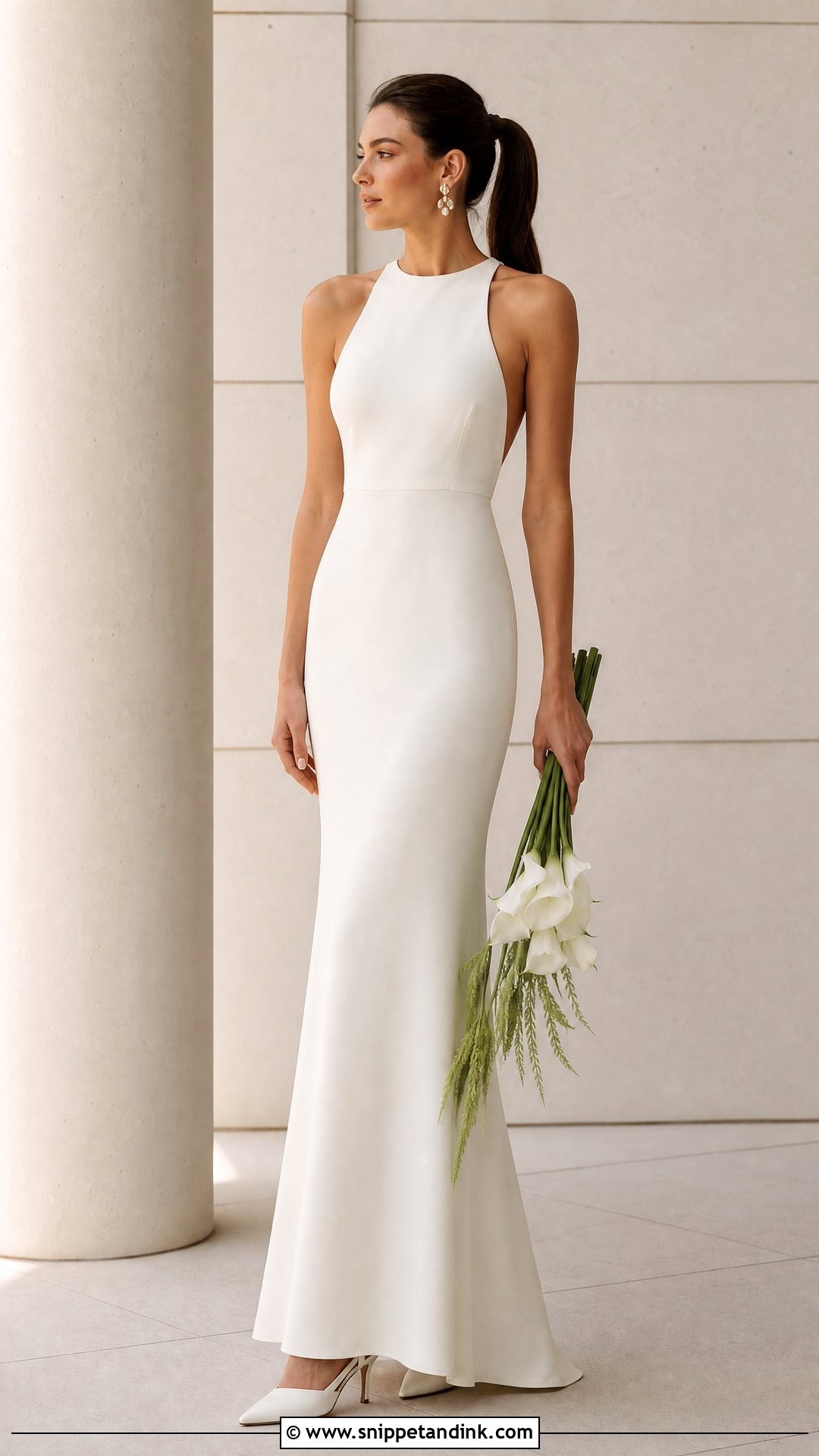
High necklines can look the most modern of all, provided nothing else competes. A sleeveless crepe column with a clean jewel neckline, fitted waist and slight flare at the hem pairs well with an open or buttoned back, so the dress has interest from both sides. I check the collar while the bride swallows and turns her head; if it presses on the throat, it’ll feel tighter every hour. A shallow mock neck or bateau is the easier version. Sculptural earrings, ivory slingbacks, a sleek ponytail, and a veil only if you want one. No necklace.
9. Simple V Neck Wedding Dress
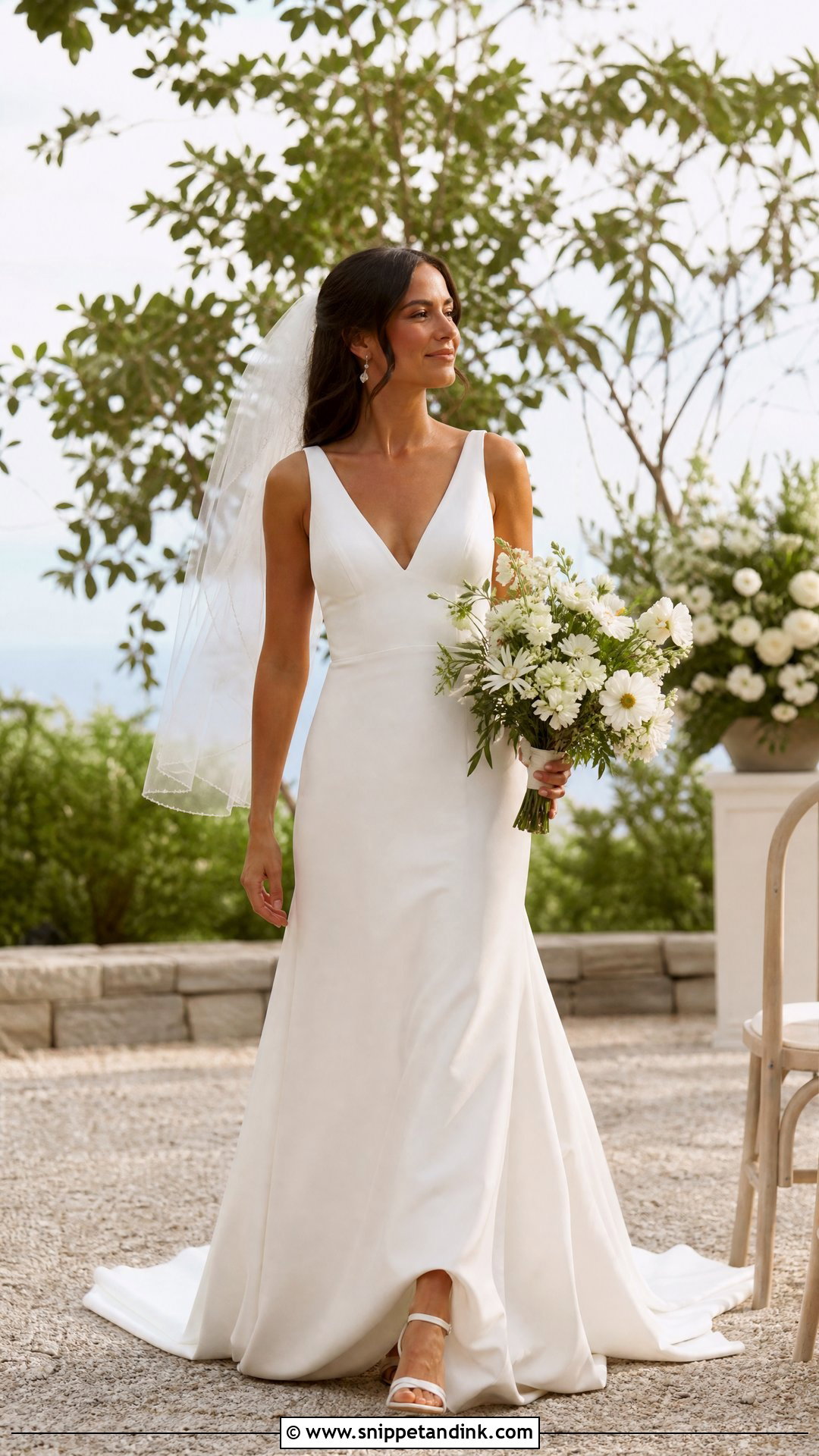
A V-neck draws the eye up to the face and lengthens the torso, which is why it flatters so many brides. Choose a depth you won’t be thinking about during the vows, then make sure there’s structure behind it: supportive mesh, wide straps or a well-fitted inner bodice. At the fitting, lean forward and twist side to side. If the edges lift away from your chest, the dress needs to be taken in at the neckline, which a good seamstress can do. Soft A-line skirt, delicate earrings, low block heels, a light fingertip veil and a relaxed bunch of garden flowers. Leaving the neckline bare usually looks cleaner than adding a pendant.
10. Simple Cap Sleeve Wedding Dress
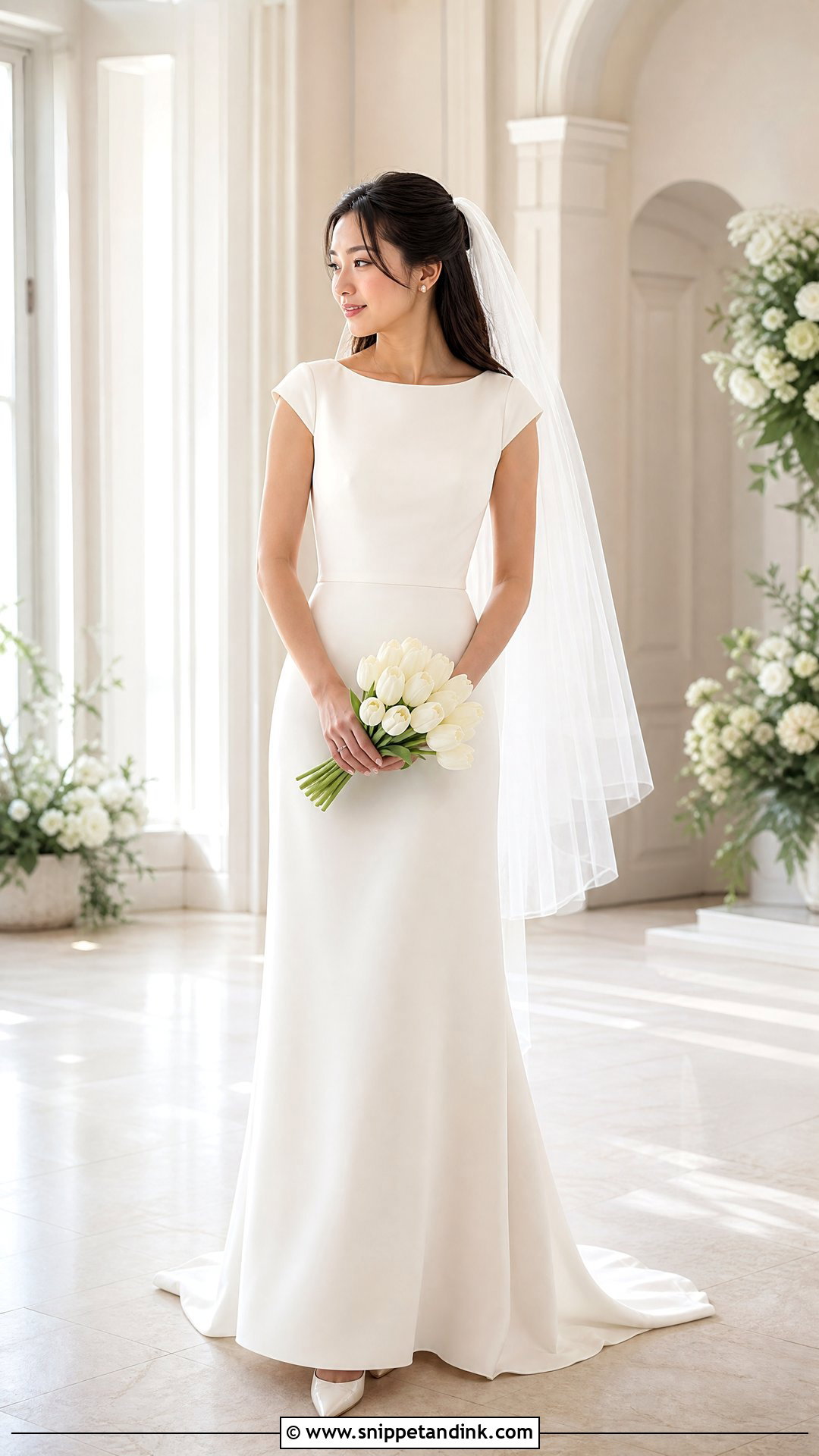
Cap sleeves give a little coverage without hiding the shoulders, and they look neatest when cut as part of the bodice rather than stitched on as separate pieces. A smooth crepe or satin gown with a fitted bodice and flowing skirt is the usual base. The thing I check is the sleeve edge: on a fabric with no stretch, a cap sleeve can bite into the upper arm, especially when you lift your arms to dance. Pearl studs, almond-toe heels, a waist-length veil and a half-up style. White sweet peas or tulips tied with a narrow ivory ribbon.
11. Simple Chiffon Beach Wedding Dress
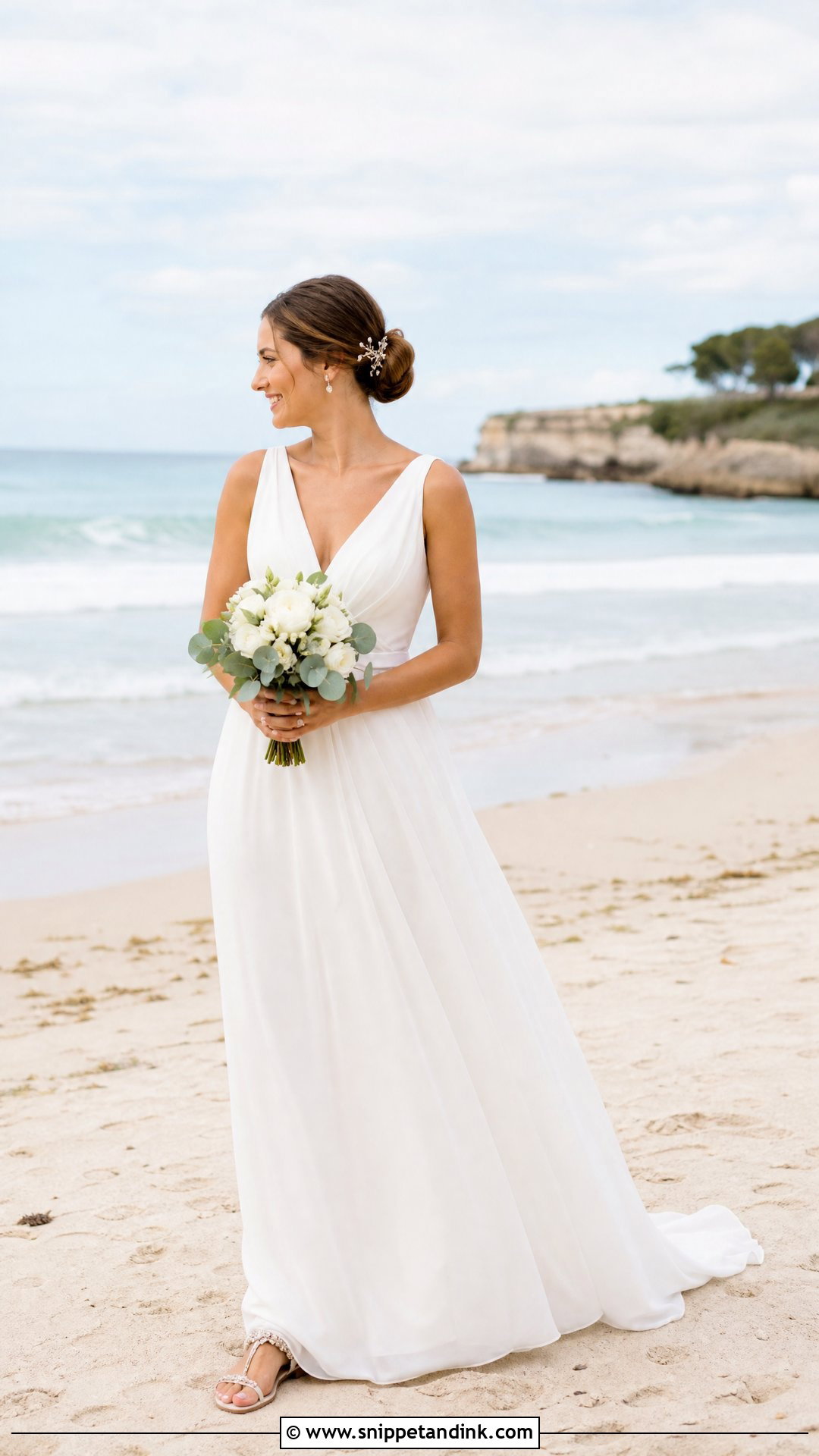
On sand, chiffon is the fabric I trust most. It’s light, it moves in wind and it dries fast if it catches spray. A lined A-line or empire-waist gown with a secure bodice suits a beach; a long train doesn’t, because it drags sand and seaweed down the aisle. I always look at chiffon outdoors in bright sun before the final fitting, since it turns more see-through than you’d expect, and a second lining layer is easy to add early. Flat bridal sandals, small pearls and a hair comb instead of a long veil, with a low bun that stays put in the breeze. Add a bustle or wrist loop for walking across uneven sand.
12. Simple Tea Length Wedding Dress
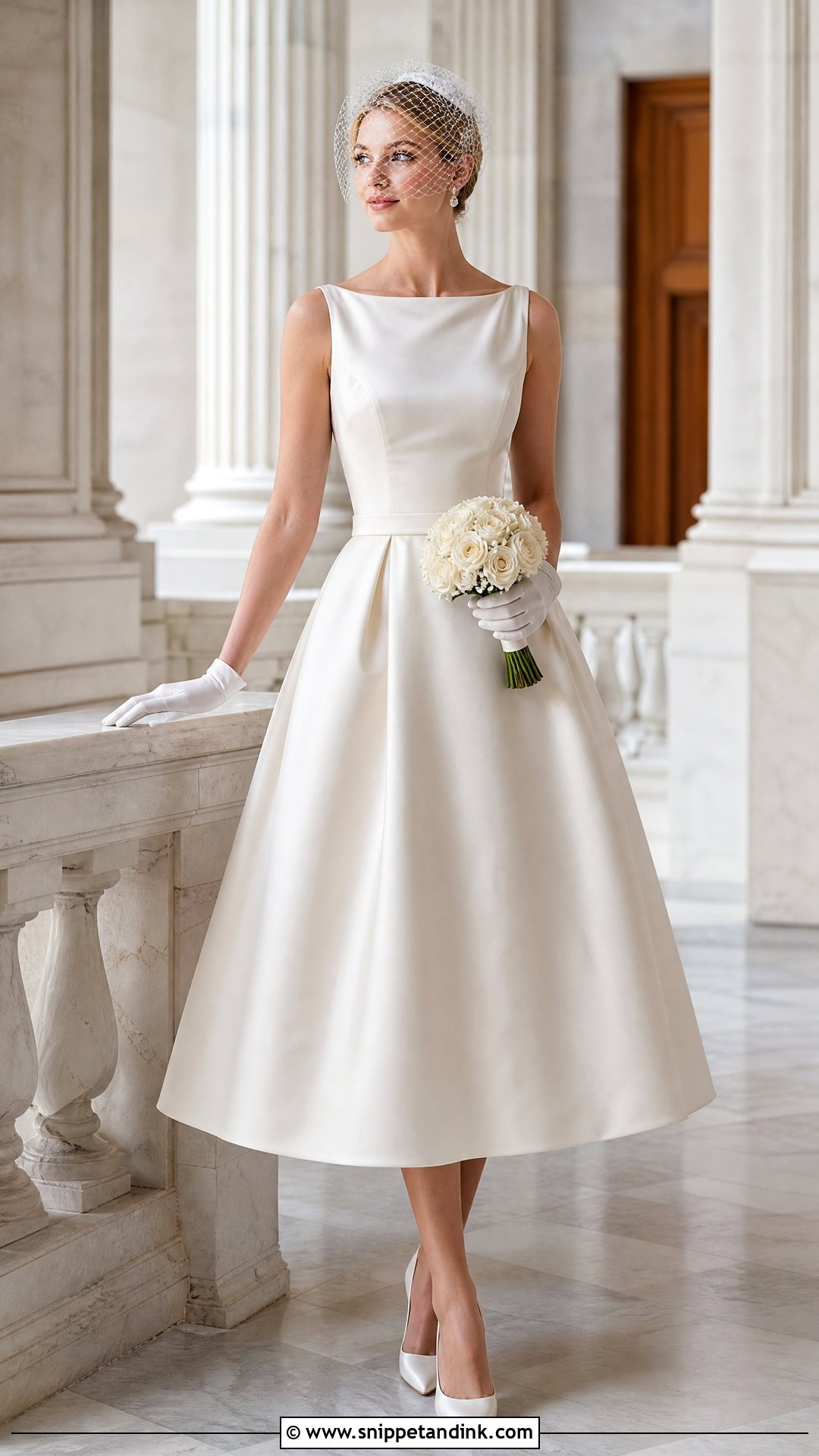
Tea length puts your shoes on show, so I treat them as part of the dress. The skirt falls between knee and ankle under a fitted bateau bodice, in satin, Mikado or crepe. A short hem exposes any unevenness, which is why I insist the length is set with the final shoes on and checked from across the room. For a vintage take, add short gloves, pearls and a birdcage veil. For something sharper, swap them for sculptural earrings and a sleek bun. A compact bouquet of roses or tulips keeps the proportions right.
13. Simple Mini Wedding Dress
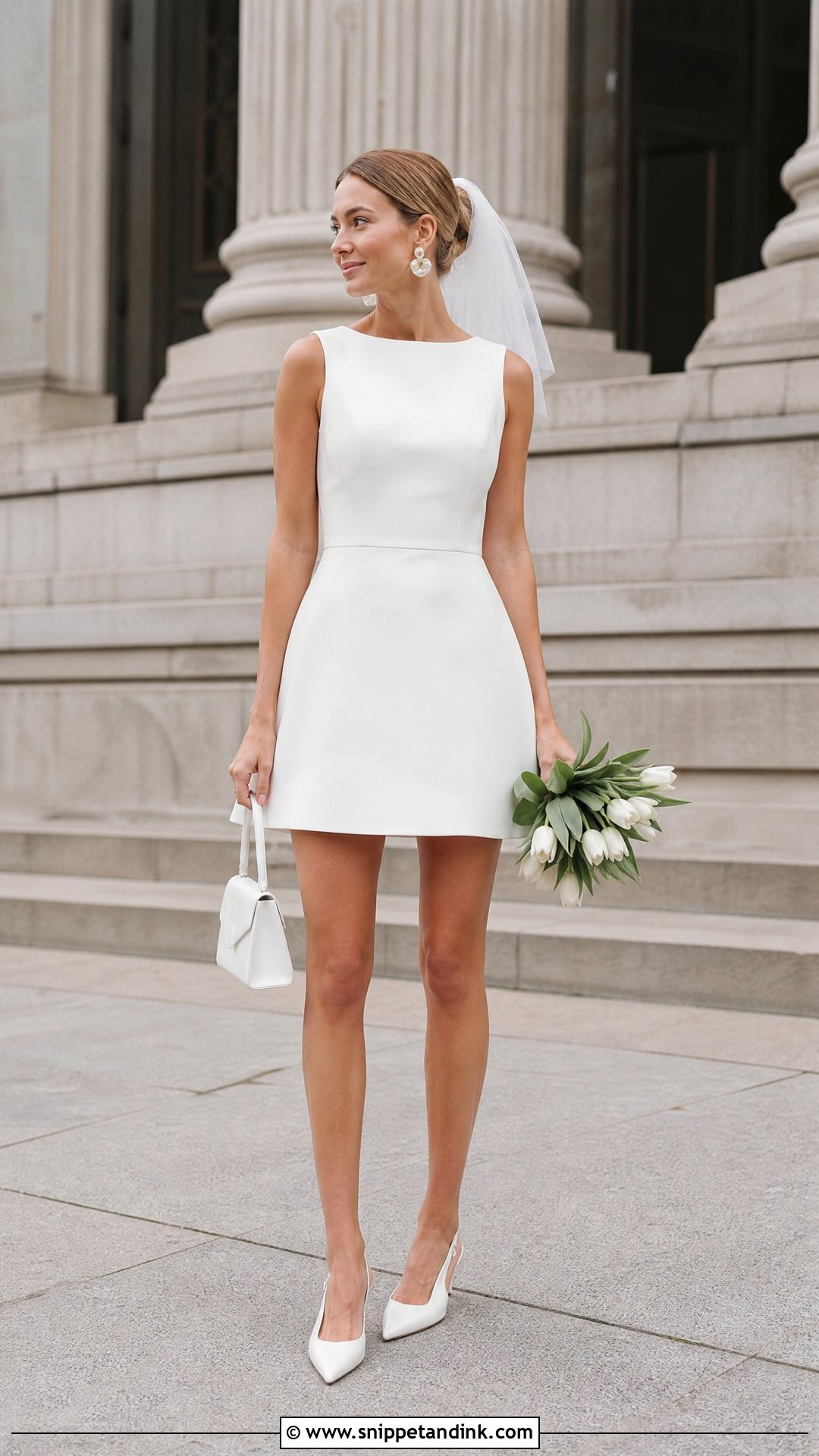
Minis are what I suggest for courthouse ceremonies and for a reception change. The difference between bridal and party dress comes down to cut and fabric: a tailored shift, a structured A-line or a clean long-sleeved mini in a substantial material looks deliberate, while thin stretch fabric looks like a night out. Sit down in it in front of a mirror, and check the back view as well, since hems rise more than you’d guess. A lining improves both coverage and shape. Pointed slingbacks, good earrings, a short veil or a big hair bow, a small top-handle bag and a compact white bouquet.
14. Simple Empire Waist Wedding Dress
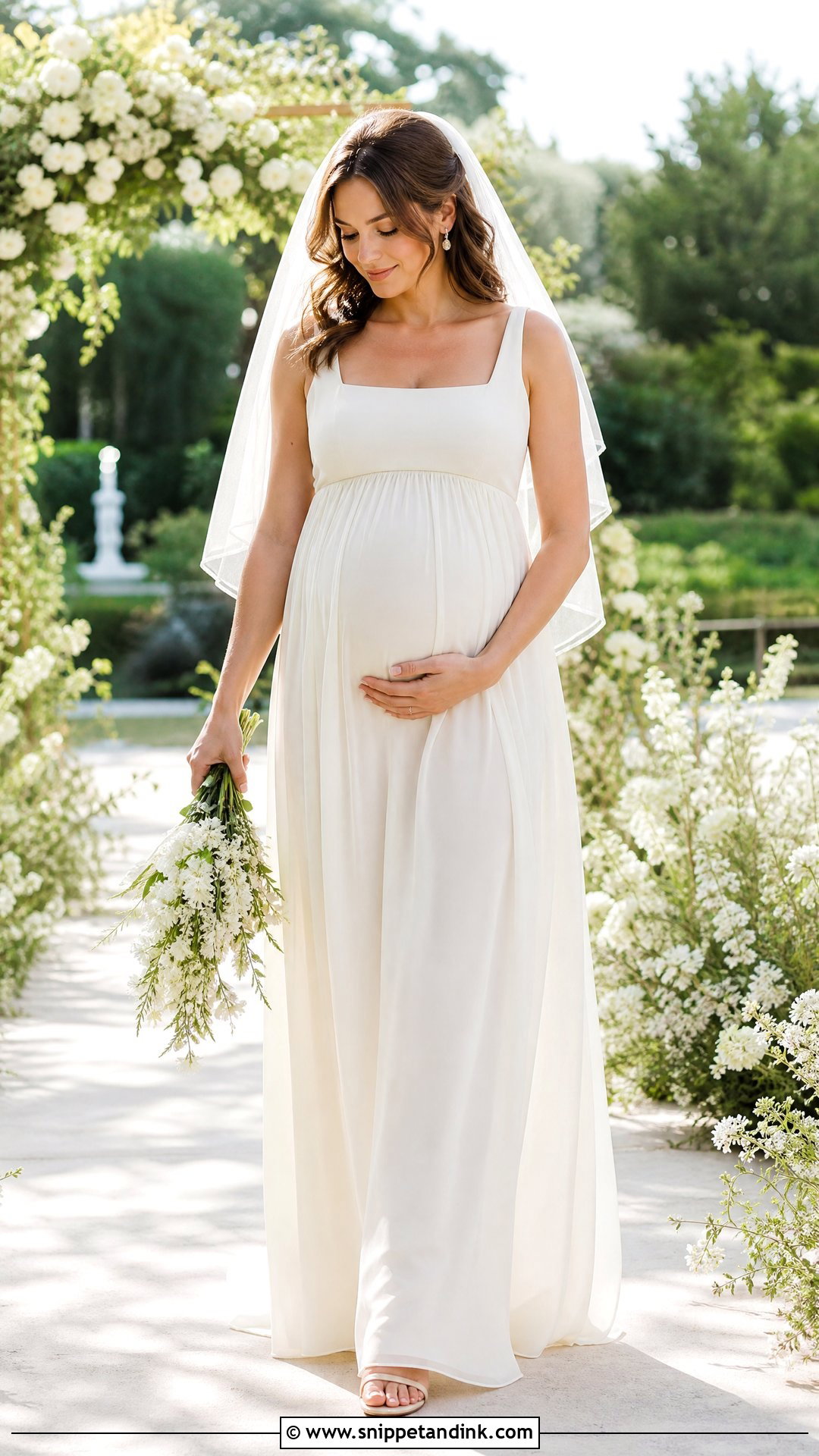
With the seam raised to just under the bust, an empire waist lets the skirt fall freely, and that’s why I recommend it for warm days, for pregnant brides and for anyone who doesn’t want the waist defined. Chiffon or lightweight crepe with a supportive V-neck or square bodice is the usual build. The fitting problem I look for is the seam riding up when you move your arms; it should stay right under the bust. Check the skirt lining in daylight for opacity. Low sandals, small earrings, a shoulder-length veil, soft waves and a narrow bouquet so the shape doesn’t get wide.
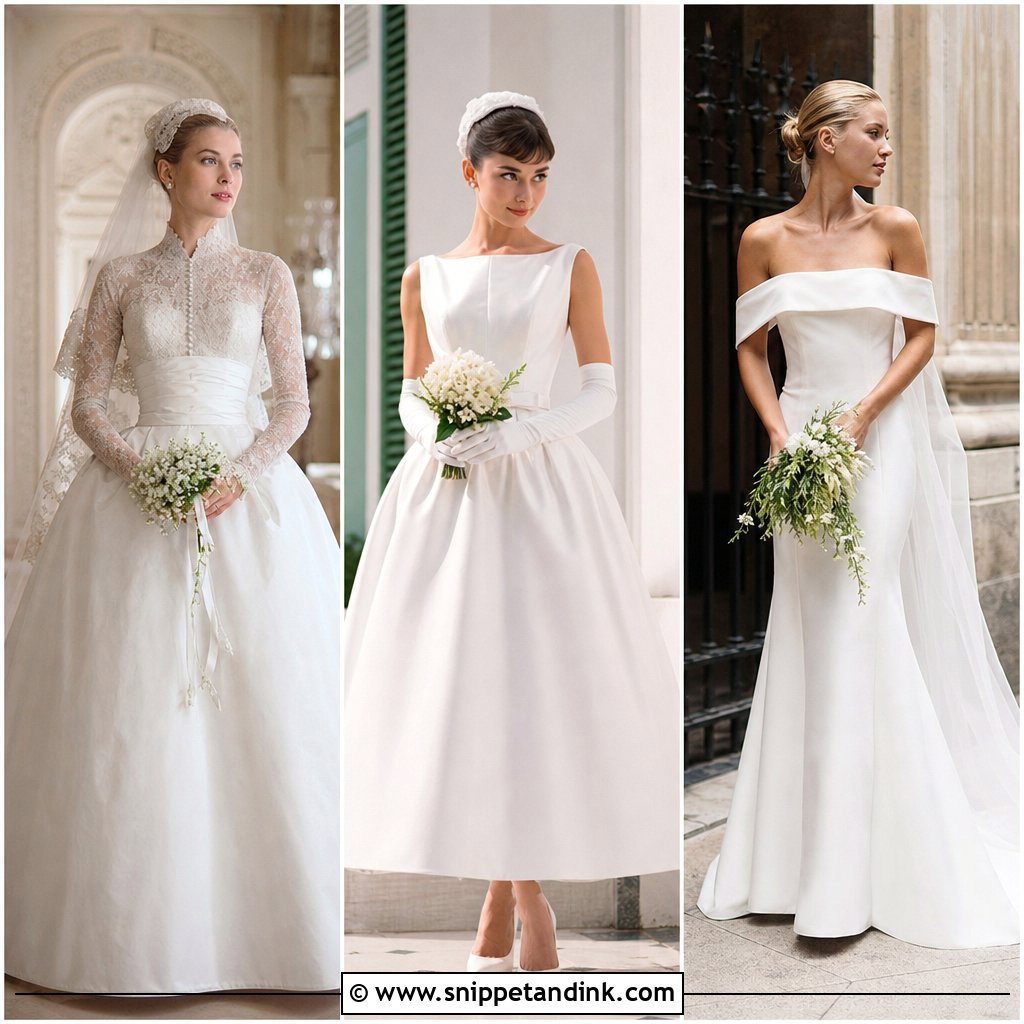
15. Simple Fit And Flare Wedding Dress
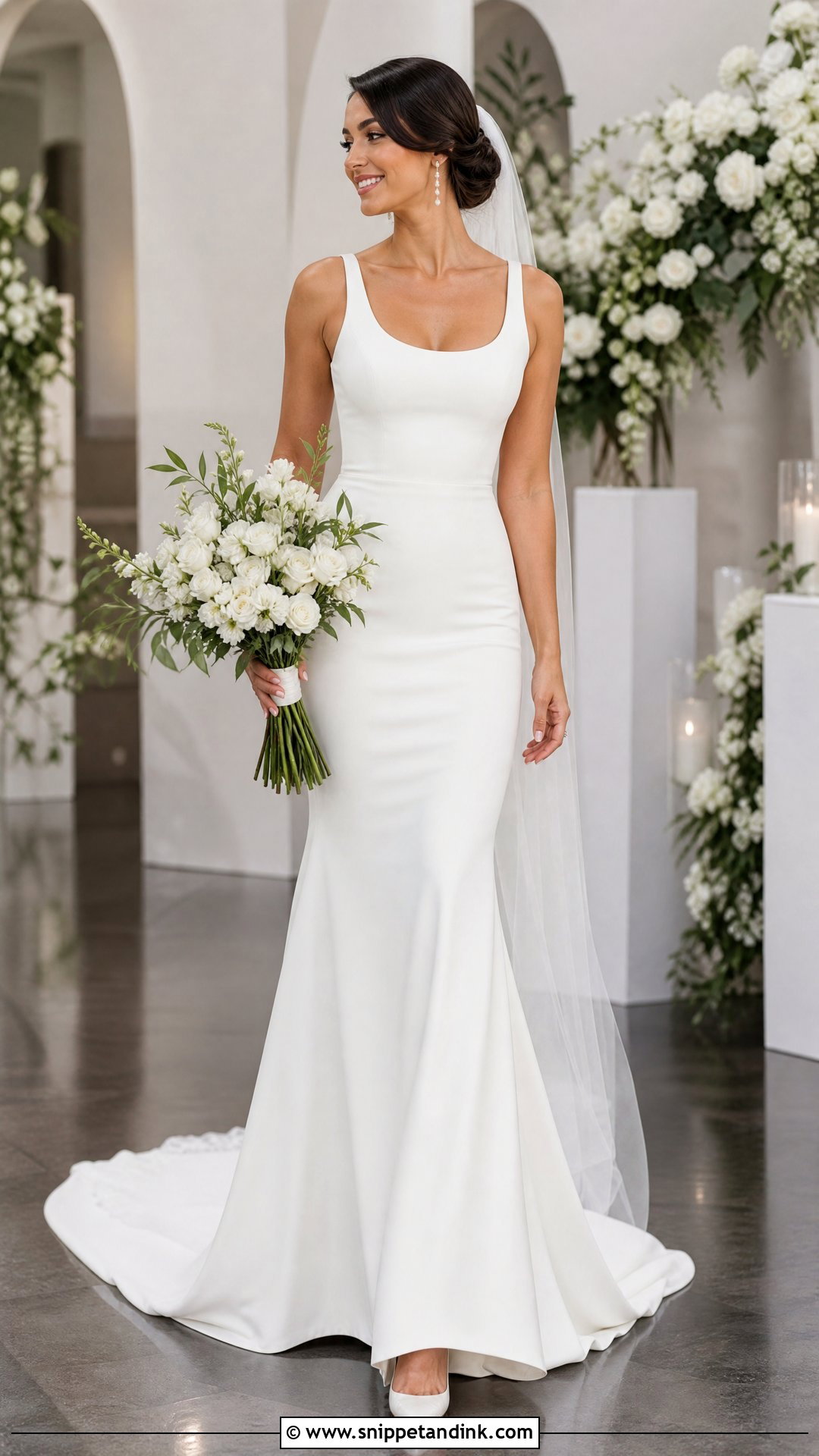
Fit-and-flare follows you through the hips and opens near the thighs or knees, giving shape without lace or crystals. Stretch crepe is my usual recommendation because it holds the line while still letting you move. The sign of a good fit is the absence of horizontal wrinkles across the hips; if you see them, it’s too tight. Sit, climb a step and walk at your normal pace in the fitting. If you’re planning to dance a lot, ask for a touch more room at the hip and a secure bustle. Pointed heels, small drops, a narrow chapel veil, a side-parted bun and long-stemmed flowers.
16. Simple Mikado Ball Gown Wedding Dress
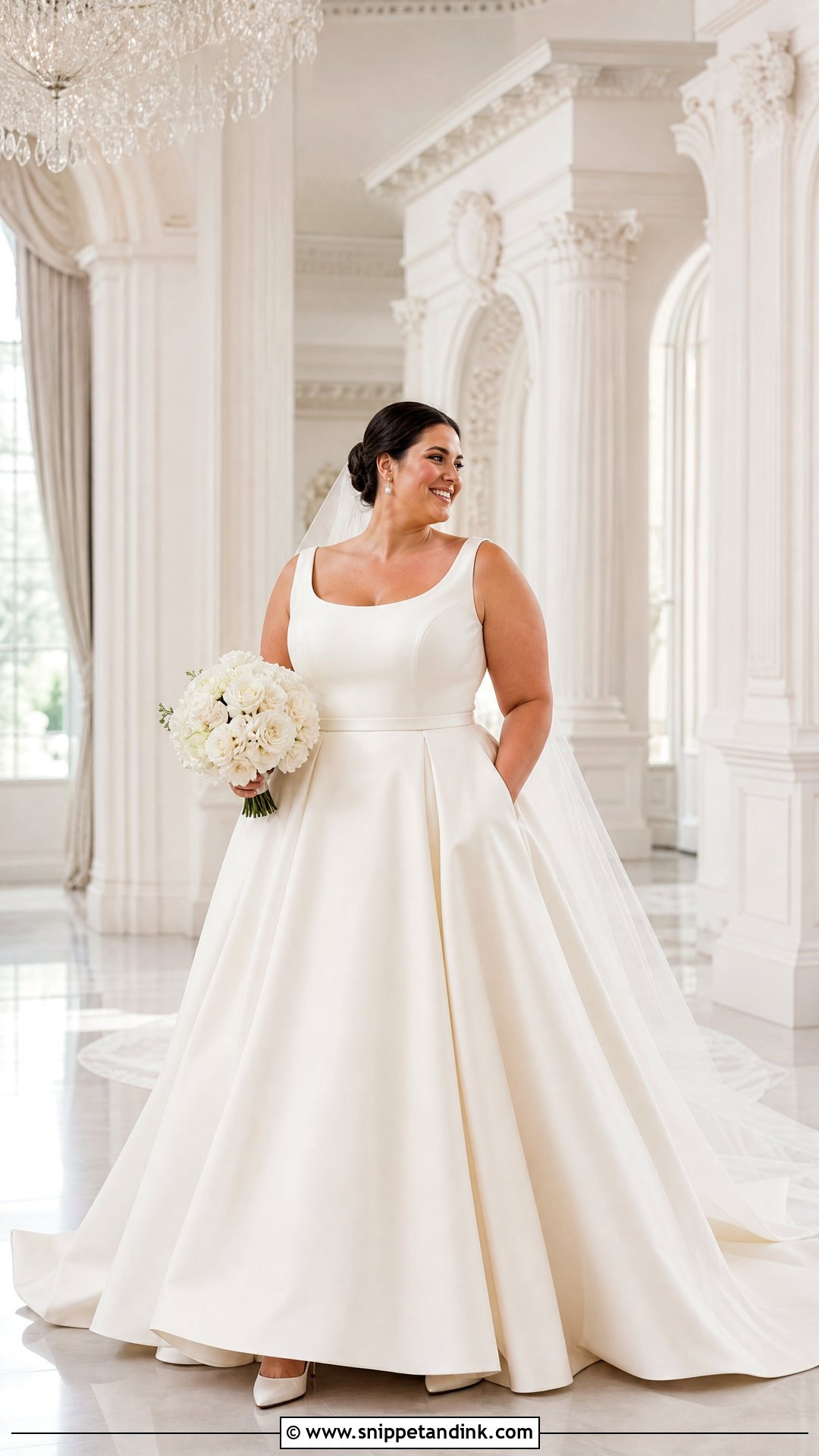
Mikado is stiff, slightly lustrous and holds volume on its own, which lets a ball gown stay simple: the skirt is full because of the fabric, not because of layers of tulle or decoration. Pick a scoop, straight or softly curved neckline over a fitted bodice and defined waist. Hidden pockets fit neatly into the side seams of a skirt this size. Ask about the bustle at your first fitting, not the last; a heavy Mikado train needs several secure points to lift cleanly. Closed-toe heels, pearl earrings, a plain-edged cathedral veil, a polished bun and a medium bouquet to match the scale.
17. Simple Cowl Neck Wedding Dress
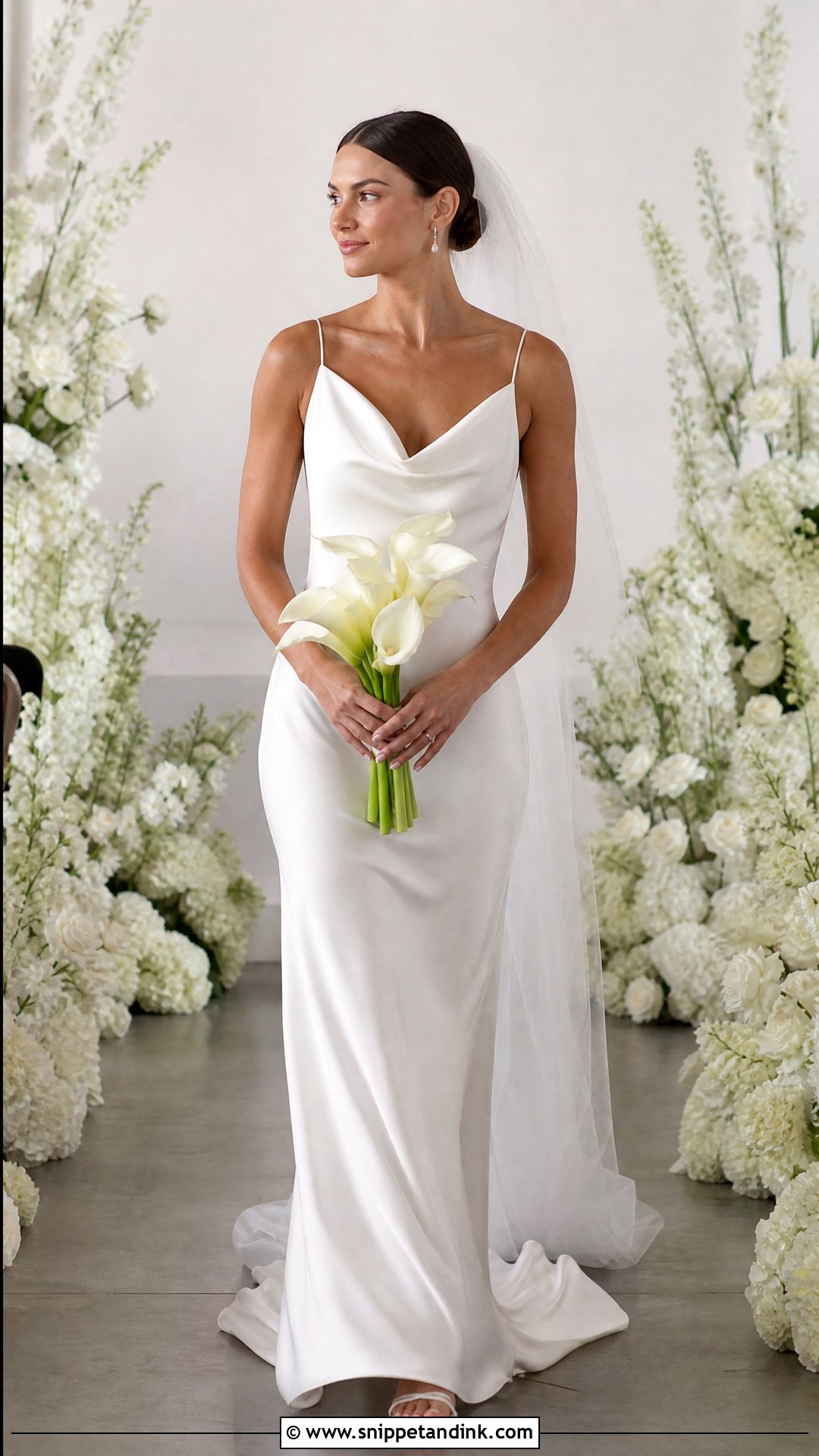
A cowl-neck wedding dress uses a soft fold of fabric at the neckline as its only feature, and it suits silk or satin slips because fluid fabric drapes into the fold without stiffness. Adjustable or carefully fitted straps keep it steady. The cowl is the risky part, since it can open more than intended when you bend, so I have the bride lean over during the fitting and weight or tack the drape if needed. Barely-there sandals, slim drops, a sheer veil under a low bun, no necklace, and calla lilies. Go for invisible, smooth undergarments and a fully finished lining.
18. Simple Backless Wedding Dress
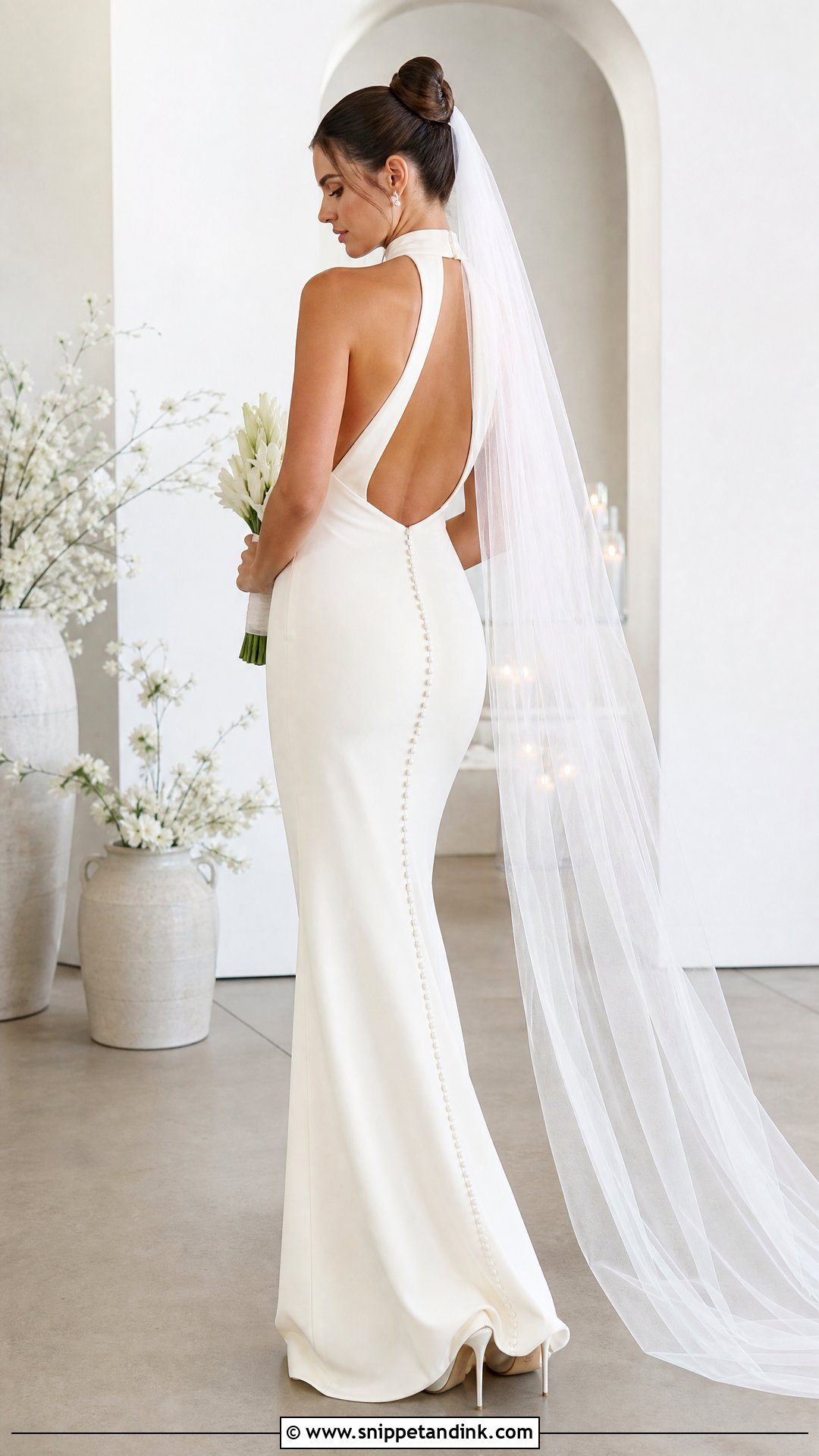
A backless gown keeps the front of the look quiet and saves the moment for when you turn around. A high-neck crepe sheath, satin slip or long-sleeved column with a low back are the usual shapes, sometimes framed with covered buttons, crossed straps or a soft cowl. Support is the real conversation: ordinary bras won’t work, so raise it at the first alteration appointment, when cups can still be sewn in. Wear your hair up, add small earrings and sleek pumps, and choose a plain sheer veil so the back still shows through it. Hug someone in the fitting to check it stays put.
19. Simple Wedding Dress With Bow
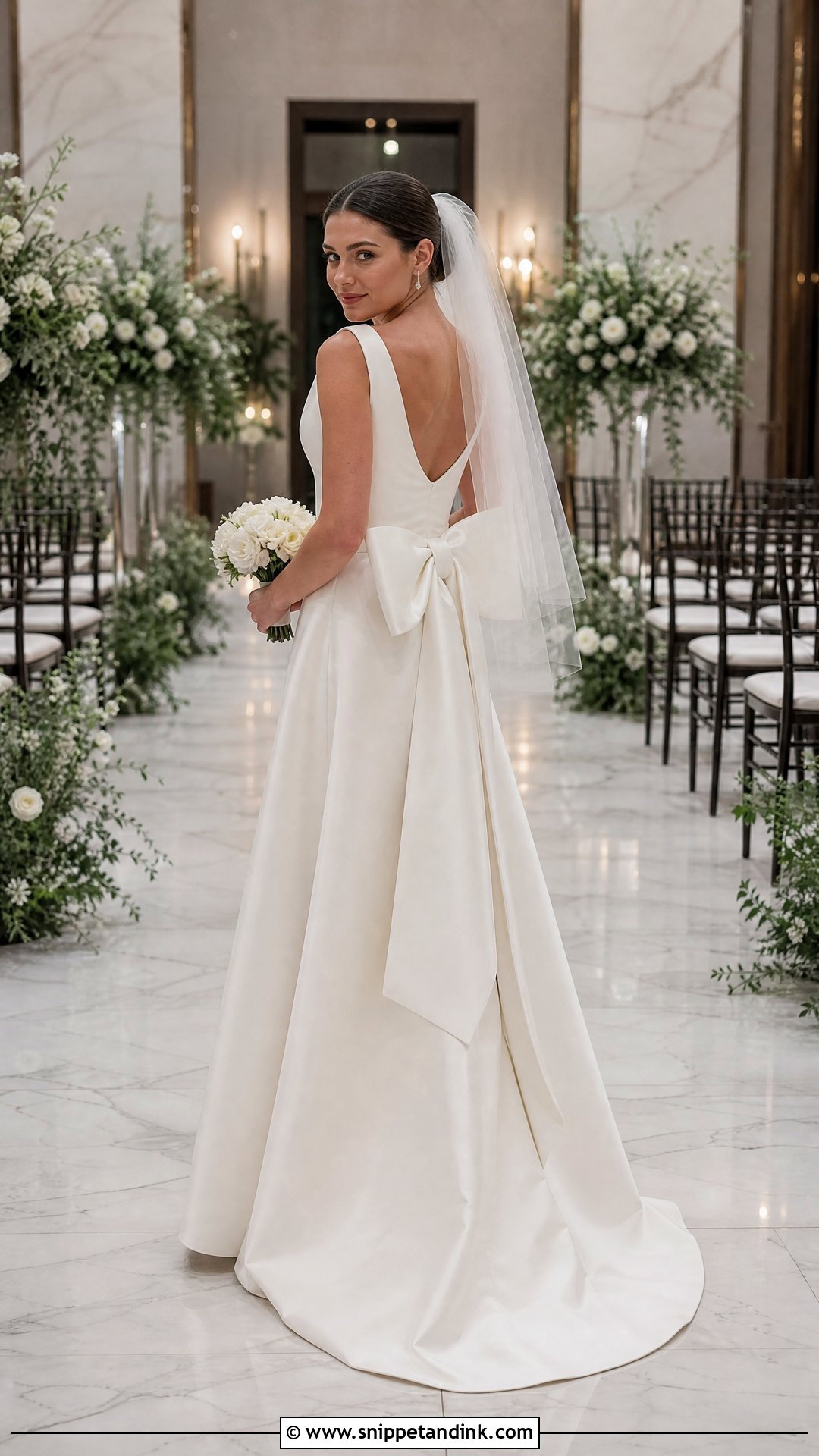
One bow can give a clean gown its personality, but scale is everything. I pin a bow on a satin A-line or column dress, then look at it from the front, the side, the back and through a phone camera, because a bow that looks right in the mirror can swallow the waist in photos. A neat waist bow, shoulder bow or detachable back bow are all options; one is more refined than two. Detachable means it can come off before dancing. Understated earrings, pointed pumps, a plain fingertip veil, a sleek bun so the look doesn’t turn sugary, and a simple white bouquet.
20. Simple Wedding Dress With Detachable Cape
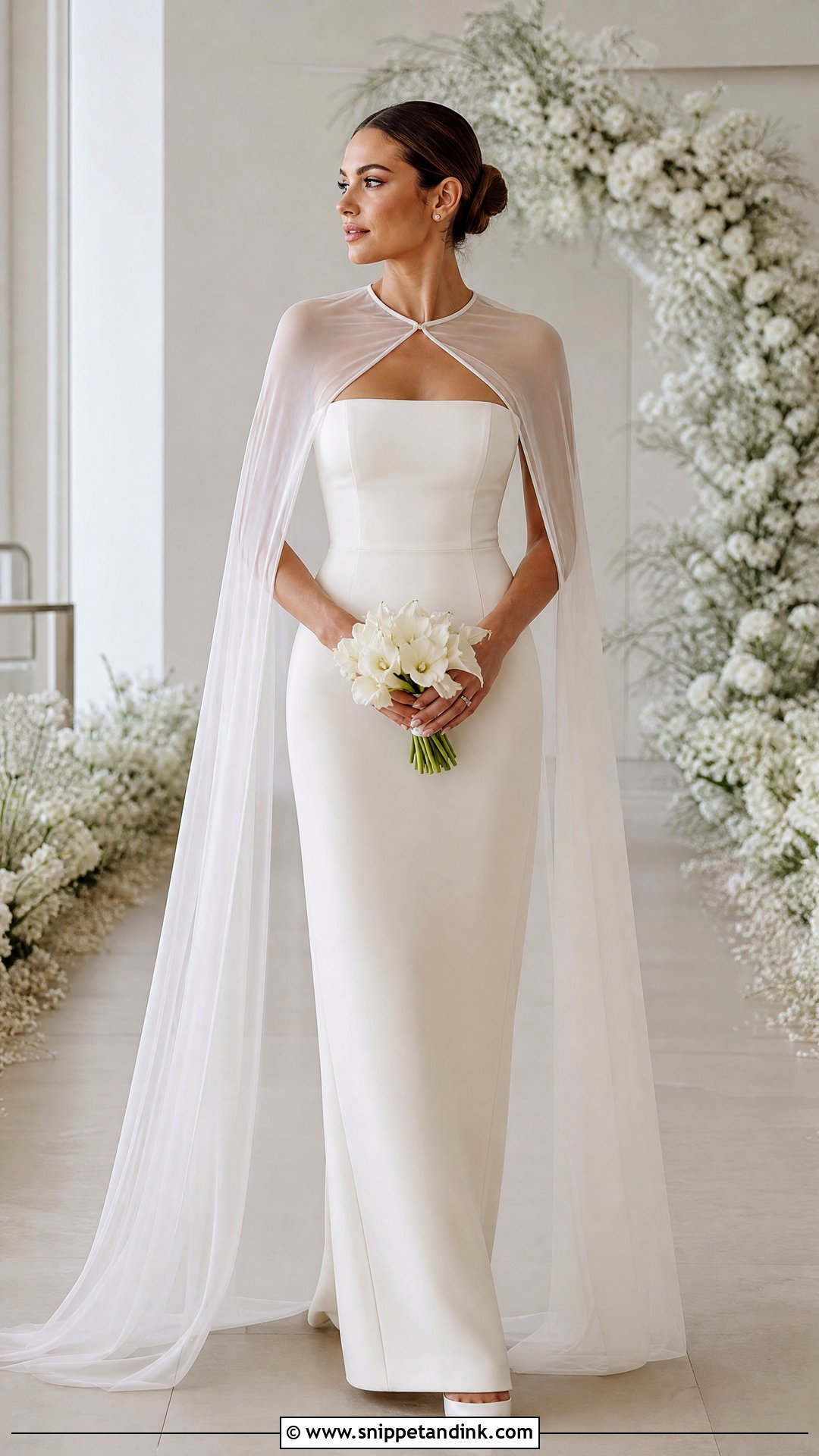
A detachable cape gives you two looks in one dress: covered and dramatic for the ceremony, sleek for the reception. Start with a strapless column, fitted crepe sheath or satin A-line, then add a sheer shoulder cape or a floor-length crepe one. It can stand in for the veil if you don’t want both. I always check the dress after the cape comes off. Hooks and snaps should leave nothing visible, and the cape’s weight shouldn’t pull the neckline down while it’s on. Studs, pointed heels, a polished bun and a narrow bouquet that lets the cape fall freely behind you.
Will Anything Show Through? Underpinnings for Clean Fabrics
Minimal gowns expose what goes under them. Silk, crepe and satin show bra lines, knicker edges and shapewear seams that a beaded bodice would hide, and that’s the most common problem I fix at final fittings.
Buy them early
Have your underwear and any shapewear before the first fitting, and wear the same pieces every time. Changing them later changes the fit at the waist and bust, and the seamstress ends up altering twice.
Match skin, not the dress
White underwear glows through ivory and white fabric. A shade close to your own skin tone disappears much better. Laser-cut edges lie flatter than elastic hems under bias-cut silk.
Let the dress do the support
For strapless, backless and deep V shapes, I prefer cups sewn into the bodice over adhesive bras. Sewn-in support doesn’t lose its grip in warm weather and can’t slide down halfway through the reception.
Why the Plainest Dress Needs the Best Seamstress
There isn’t one correct simple dress. The right one fits securely, lets you move and feels like you, whether that’s a silk slip on a beach or Mikado in a ballroom. What all twenty have in common is that tailoring and fabric quality carry the look, so that’s where I’d put your budget and your attention. Bring your shoes and undergarments to every fitting. Walk, sit, hug and reach in the dress before you say it’s done. If it passes those tests, the plainness becomes the point.
You'll Like These Ideas:









Leave a Reply