
Nineteenth-century bridal fashion changed shape almost every decade, and that is the useful part: you can pick the silhouette that suits your body instead of settling for one vague idea of vintage. The early years gave us light Regency empire gowns; by mid-century skirts were wide bells, and the 1870s and 1880s pushed all the volume to the back. White only became the expected bridal color partway through, so pale blue, champagne and floral silk are honest choices here, not departures. When I style a period-inspired bride, the aim is a gown that reads as historical from across the room but is built with modern linings, hidden zips and support you can breathe in. The twenty dresses below run roughly in date order, with notes on what each one asks of you.
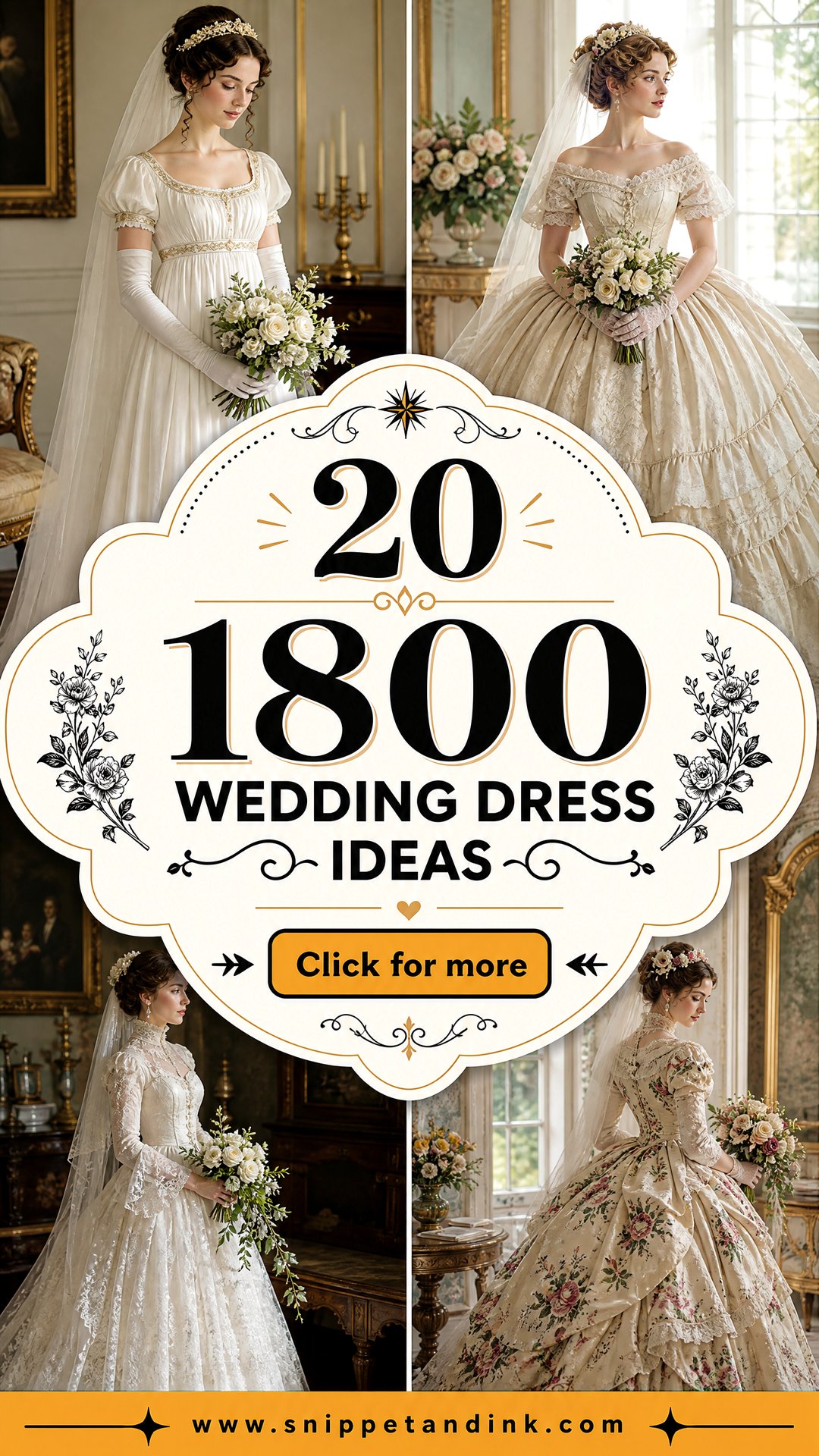
Where Each Decade Puts the Volume, and Why It Matters for Your Frame
Every decade of the 1800s put the fullness of a gown somewhere different, and that placement decides whether a dress flatters you and whether it fits the room. When a bride brings me a mood board of nineteenth-century gowns, I sort it by where the volume sits before we ever talk fabric.
- Regency, roughly 1800 to 1820: almost no volume at all. The waist sits under the bust and the skirt falls straight, which is kind to most heights, comfortable in heat and easy in a small venue.
- The 1830s and the 1890s: volume at the shoulders. Big sleeves widen the upper body, which balances fuller hips but can swamp a very petite or narrow frame.
- The 1840s to the 1860s: volume all around the hips. Bell and dome skirts need wide aisles, generous doorways and a car with plenty of room in the back.
- The 1870s and 1880s: volume at the back. The front stays slim, so it looks strong on a long aisle walk and from behind, but a seated dinner takes some planning.
Season narrows it further. Muslin and light crepe belong in summer; taffeta, heavy satin and long sleeves come into their own from late autumn. For a ceremony on grass, a hoop or a long train will collect damp and debris, so I’d lean toward an ankle-length Regency or 1830s hem and keep the grander skirts for indoor floors.
1. Regency Empire Waist Wedding Dress
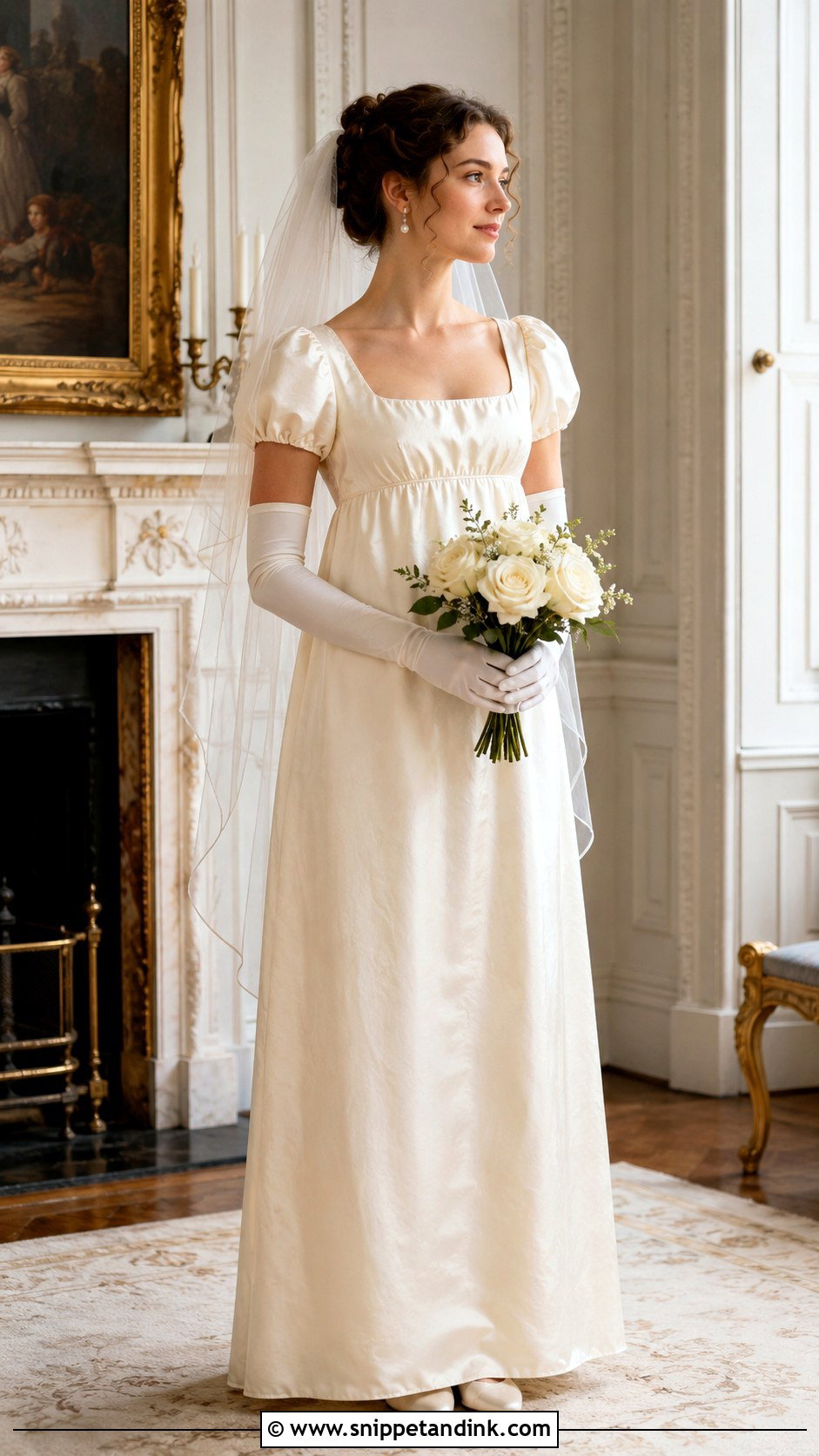
An empire seam sits right under the bust, and that one line does most of the work. I always check where it lands at the first fitting, because half an inch too low and the dress starts to look like a nightgown rather than a Regency gown. Ivory silk, satin or a lightweight crepe will hold the narrow column; the skirt should skim the hips, not cling. Short puff sleeves, a square neckline and fine embroidered trim are the details that make it read as period. Flat satin slippers, pearl drops, elbow gloves and a narrow ribbon band or small floral comb suit it far better than a big tiara, which pulls the eye up and away from the neckline. A fingertip veil and a compact posy of white roses and greenery finish it. Because the high waist gives one long, unbroken line, it flatters petite and tall brides alike.
2. White Muslin Regency Wedding Dress
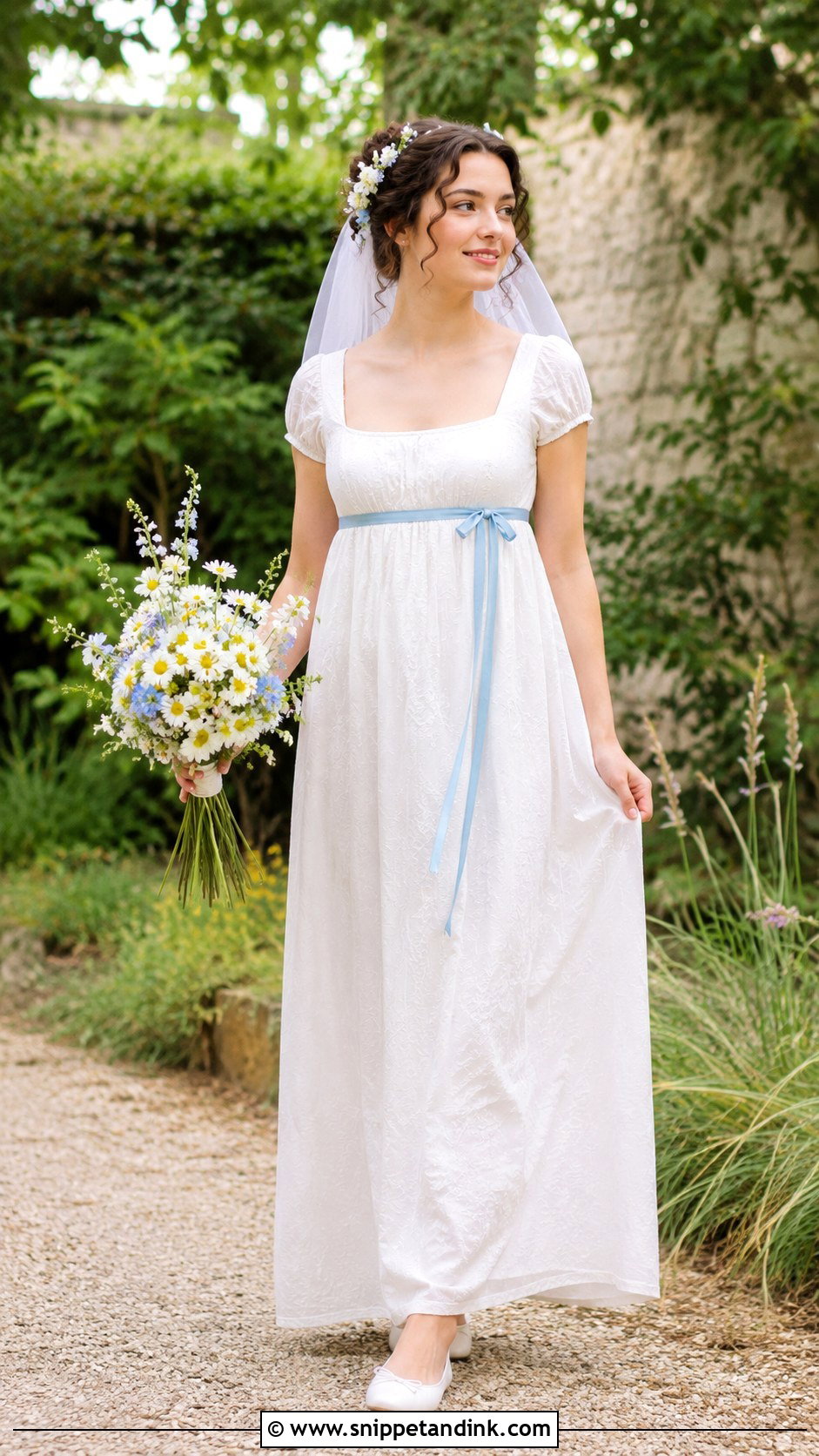
Airy white muslin was the fabric of the early 1800s, and it still moves like nothing else on a warm afternoon. The catch is sheerness. Muslin that looks opaque on the hanger can turn see-through in direct sun, so I insist on a cotton or silk-blend lining and check it outdoors, not under shop lights. Pick a lined gown with a high waist, a gently gathered skirt and small capped sleeves, with tonal embroidery at the hem and neckline. Muslin wrinkles readily, so expect a soft, lived-in look by the reception and steam it on the morning rather than the week before. White ballet flats, a fine pendant, a pale blue sash, a short tulle veil on a floral comb and a loose bunch of daisies and sweet peas keep it light. It belongs in a garden or a historic house, not a ballroom.
3. Regency Long Sleeve Wedding Dress
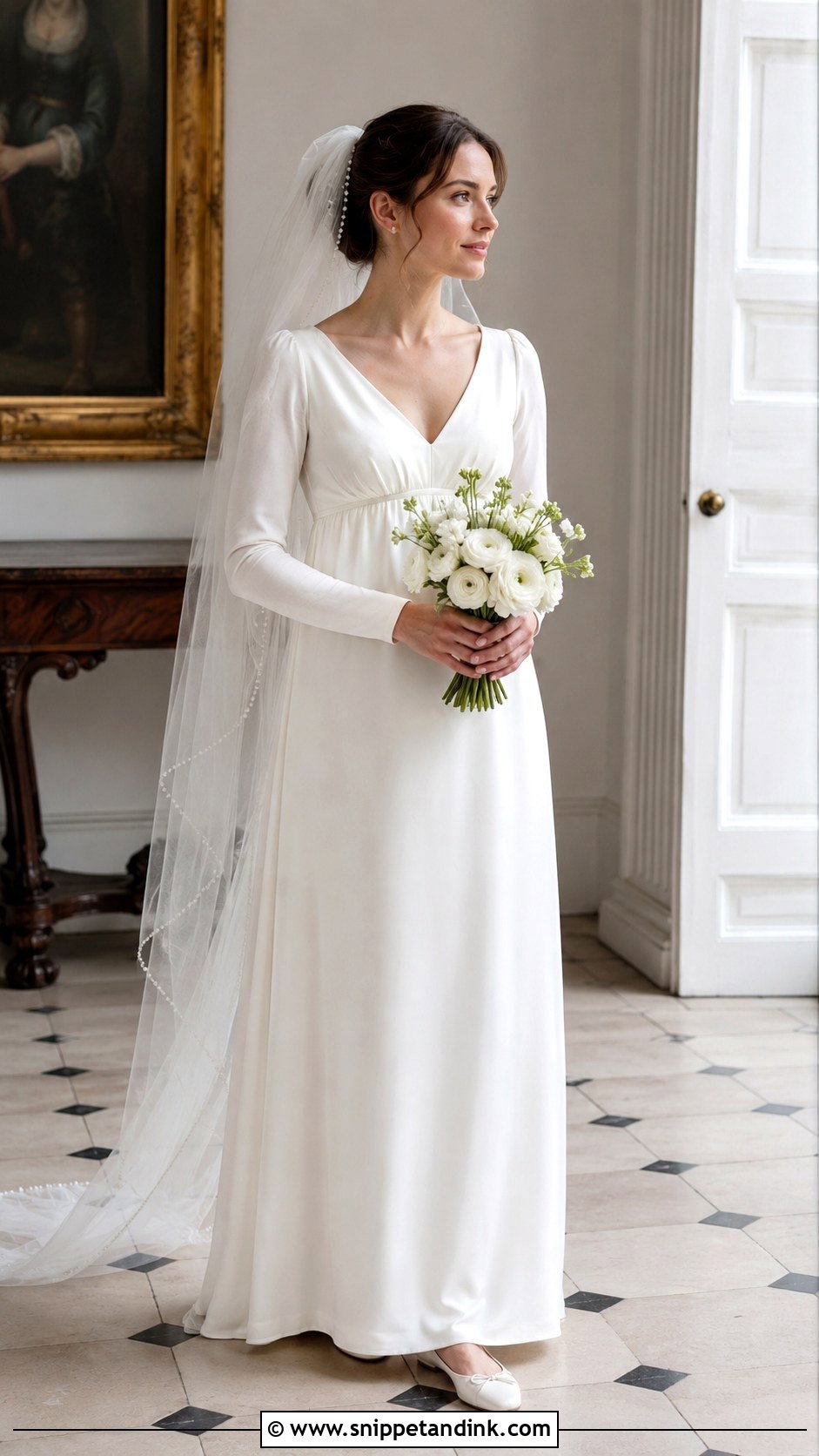
Fitted wrist-length sleeves change how a Regency gown feels: warmer, quieter, better suited to a winter church than a summer lawn. Watch the arm movement. A sleeve cut close to the wrist needs enough ease at the armhole, so at fittings I ask brides to raise their arms as if hugging someone; if the bodice lifts, the sleeve head needs work. A soft V or modest square neck stops the coverage from feeling heavy, and silk crepe or matte satin lets the skirt drop cleanly from the empire seam. Covered buttons on the sleeves and back add period detail without fuss. Low satin shoes, pearl studs and a slim velvet ribbon in an updo are enough, and a chapel-length veil gives movement without the handling a royal-length train demands. Carry white ranunculus with soft greenery.
4. Regency Lace Overlay Wedding Dress
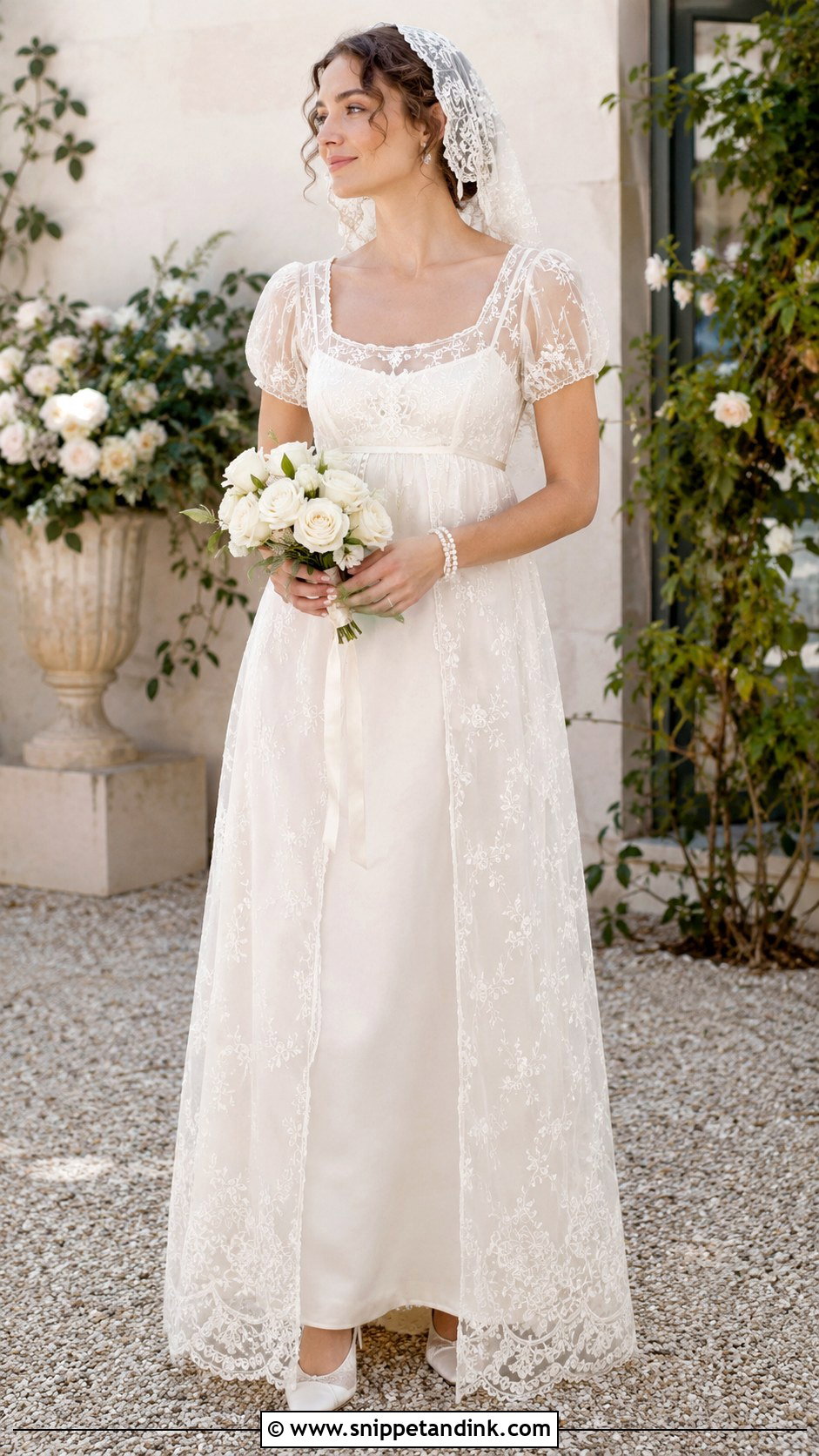
Layering is where this one gets its richness: a smooth ivory slip with a raised waist and narrow skirt, then a sheer embroidered lace overdress with short sleeves, a rounded neckline and a scalloped hem. I keep the lace tonal. Ivory lace over a stark white slip shows the mismatch in every photo, so hold both fabrics together in daylight before committing. Open lace snags on bracelet clasps and bouquet wire more than people expect, which is one reason I’d limit jewelry to pearl earrings and a smooth, fine bracelet. Pointed flats or low block heels sit well under the floor-length hem. Add a gathered style with tiny ivory flowers, a small lace-edged veil and a structured bouquet of cream roses. Up close the lace gives texture; from the back pews it reads as soft movement.
5. Blue Regency Wedding Dress
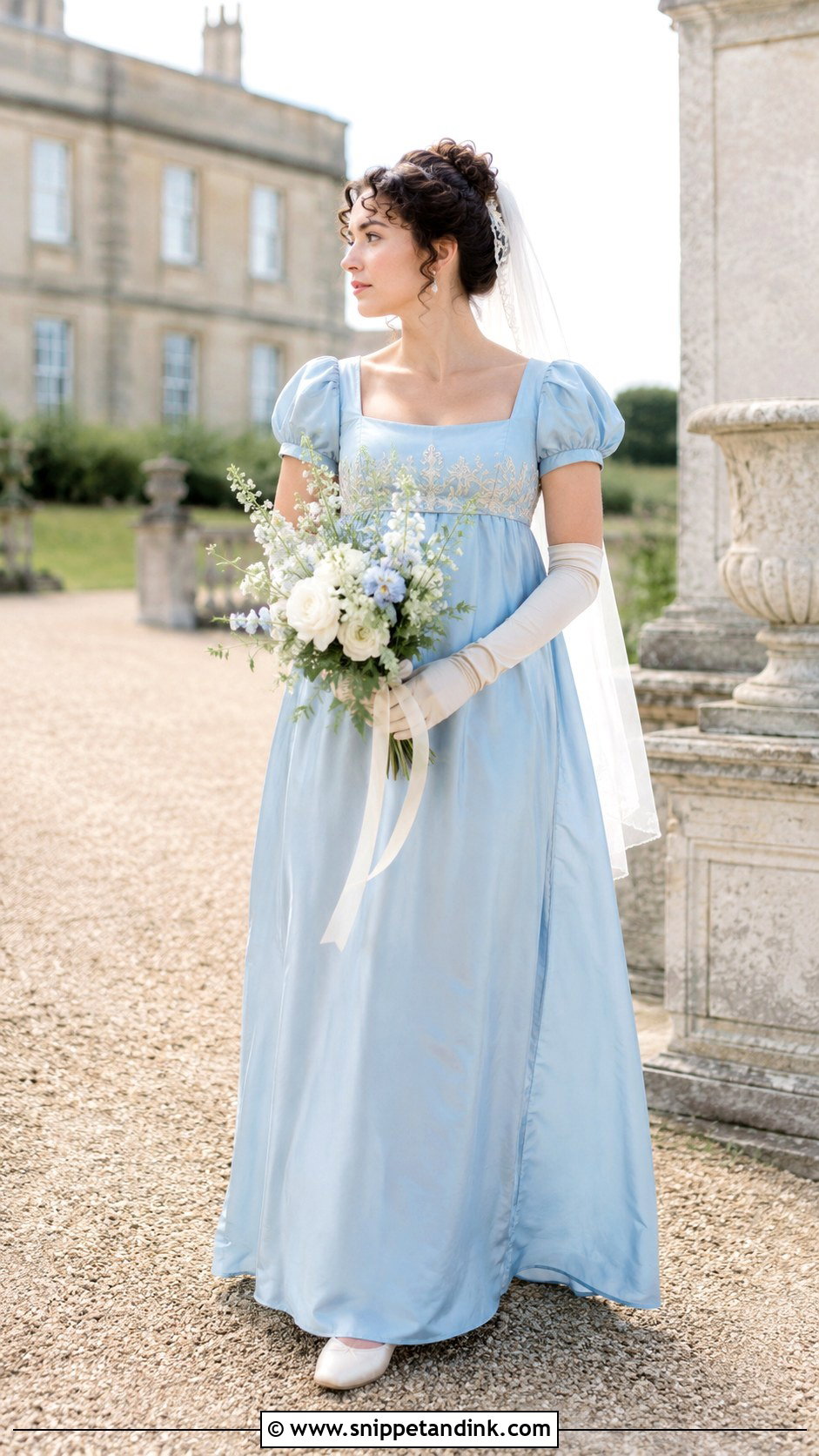
Plenty of early nineteenth-century brides married in colored silk, so a powder-blue empire dress has real precedent behind it. Blue is fussier to buy than ivory, though. Pale blue chiffon can look grey in shade and almost lilac under warm indoor bulbs, so I ask brides to see the fabric in the light of their actual venue if they can. Look for a fitted bodice, short puff sleeves and a fluid floor-length skirt over an opaque lining, with ivory embroidery under the bust to mark the waist. Cream flats, pearl earrings and wrist gloves keep it gentle. The ivory tulle veil is what tells everyone you’re the bride and not a bridesmaid. White flowers with touches of pale blue and eucalyptus, plus fresh, minimal makeup, suit spring gardens and country estates.
6. 1830s Puff Sleeve Wedding Dress
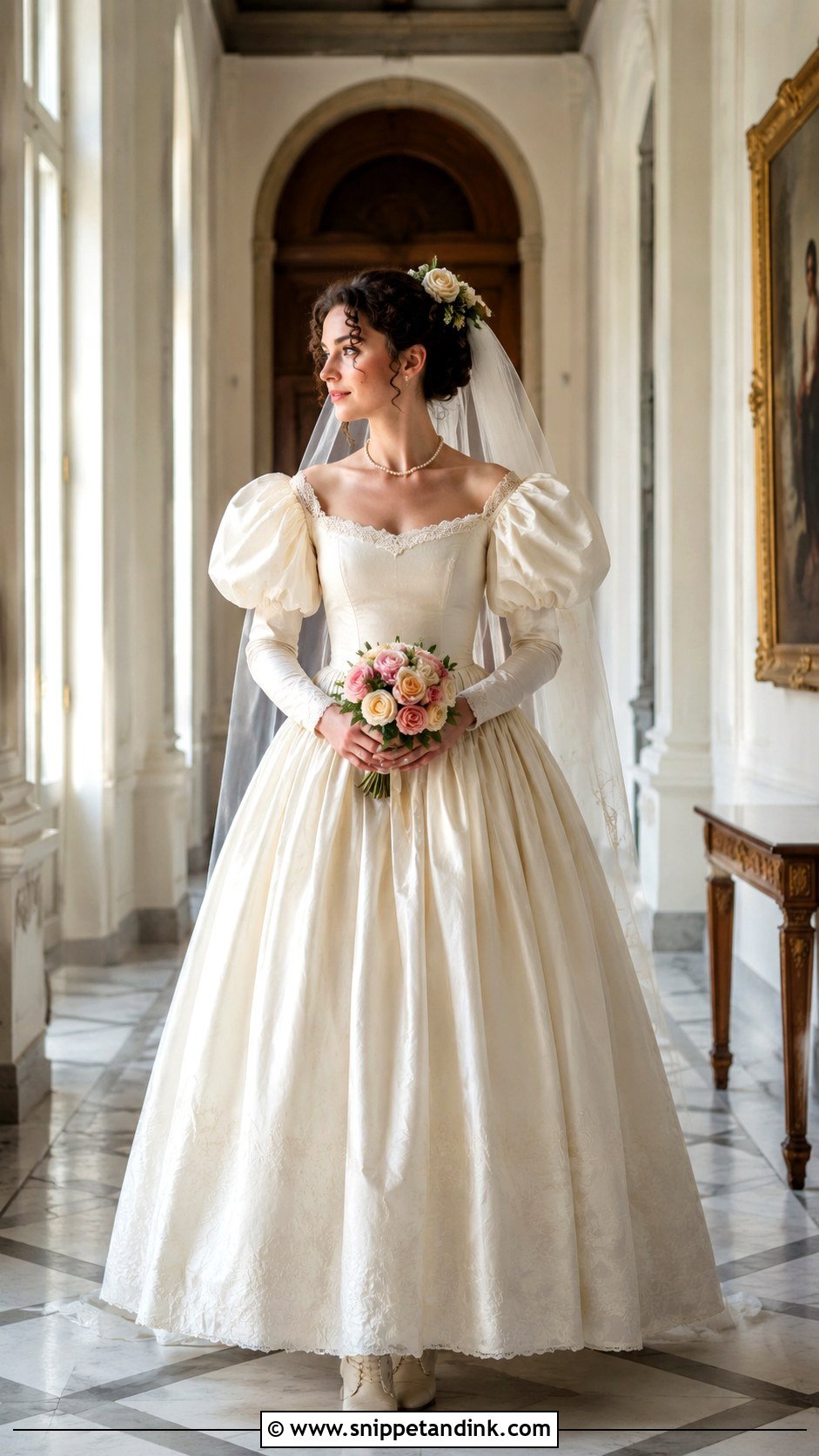
Gigot sleeves, the big leg-of-mutton shape of the 1830s, are the whole point of this gown, so everything else should stay quiet. The sleeve holds its volume at the shoulder and narrows to the wrist, and that volume needs an internal support, usually a net or organza puff, or it collapses by mid-afternoon. I check sleeve width against the bride’s shoulders: too wide on a narrow frame and she looks swamped. Choose ivory with a natural waist, a fitted bodice and a full skirt; an ankle-length hem is true to the decade and shows off low-heeled boots. A small pearl necklace, drop earrings and a neat parted updo with a floral comb suit it. Start the medium-length veil behind the hair so it doesn’t flatten the sleeves, and keep the bouquet compact so your arms stay free.
7. 1840s Victorian Wedding Dress
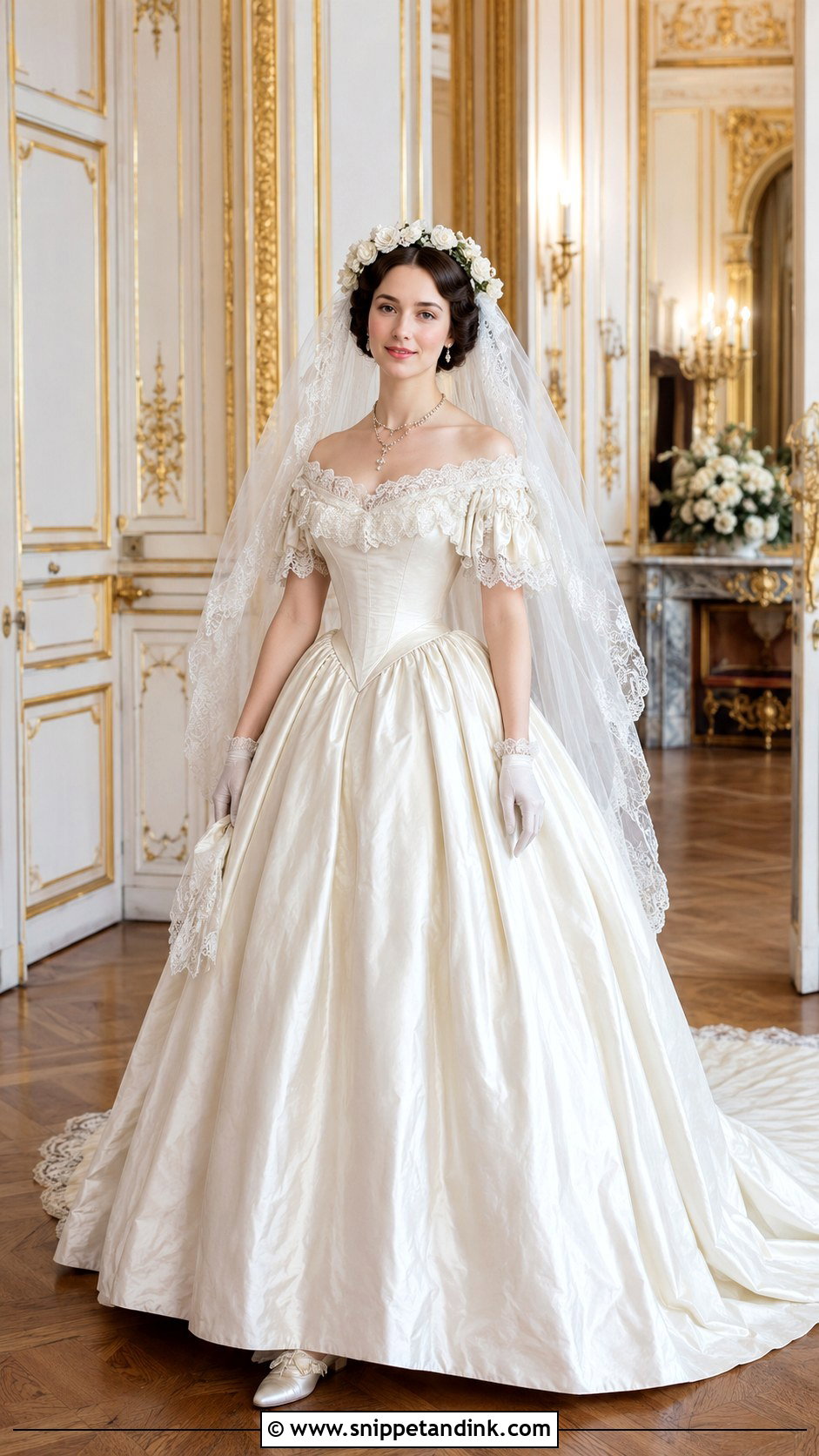
This is the decade that set the white wedding in motion. Queen Victoria’s 1840 bridal gown combined silk satin, lace, a full skirt and a long train, and its influence is all over this look. Cream satin with a pointed waist, gently dropped shoulders and short lace-finished puff sleeves gets you there. Dropped shoulders do limit how high you can lift your arms, which matters if you plan to dance with them around someone’s neck; tell your seamstress early so she can build in a little ease. Support the skirt with a modern underskirt and consider a detachable train for the ceremony only. Satin slippers, short gloves, a lace-edged veil and an orange-blossom-style wreath on a smooth center-parted style complete it, with a rounded bouquet in white and ivory.
8. Victorian Basque Waist Wedding Dress
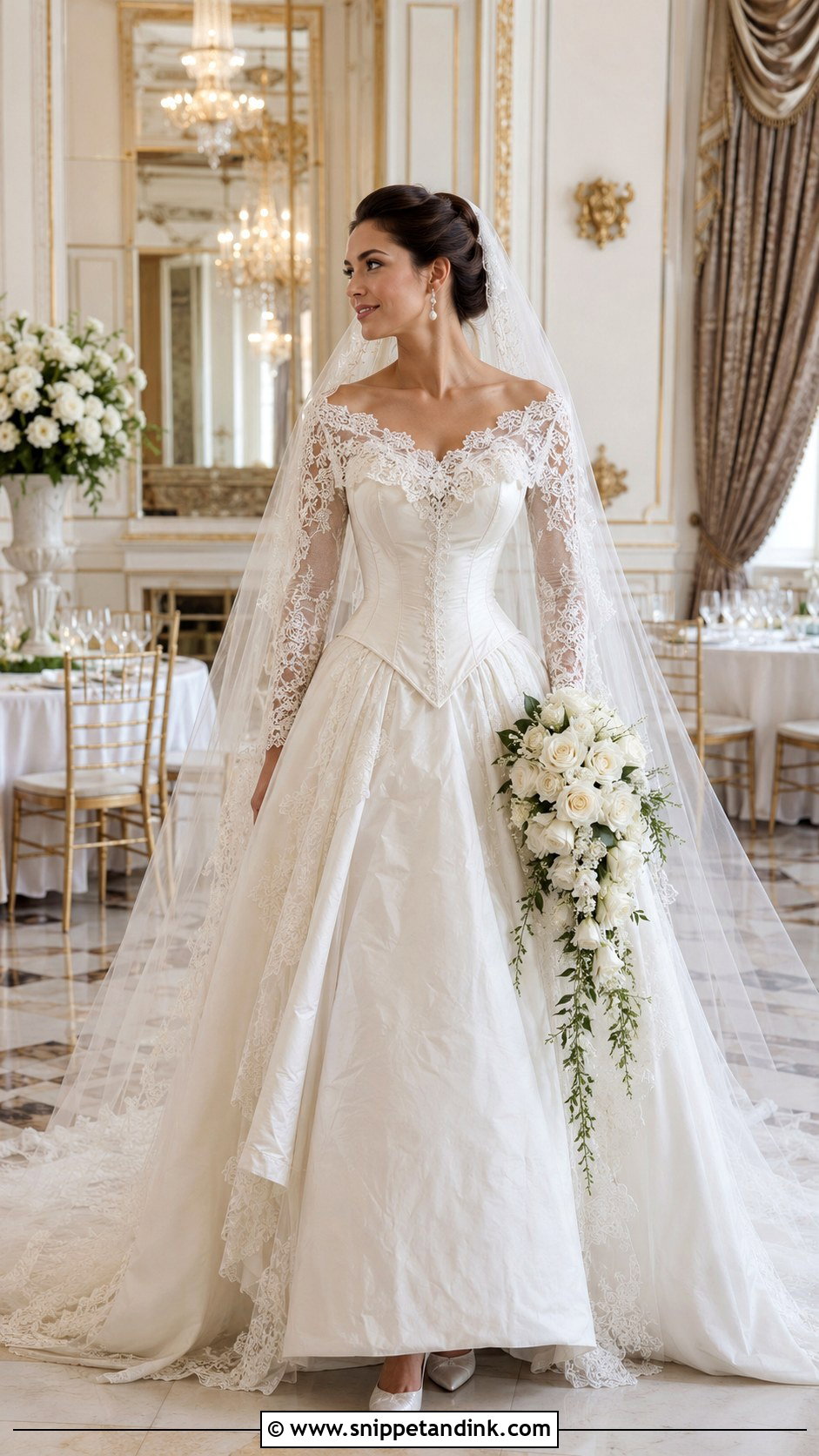
A basque waist dips into a gentle V at the front, lengthening the torso before the skirt flares out. For brides with a short waist, it’s one of the most flattering period shapes I know. The fit has to come from boning and tailoring, not squeezing. If you can’t take a full breath sitting down, the bodice is too tight, and that discomfort shows on your face by the speeches. Look for a structured ivory bodice, a wide neckline, short sleeves and a little lace at the shoulders. Low satin pumps, pearl drops and a slim bracelet suit it; a lace-trimmed cathedral veil and a low bun with a floral comb match its formality. A cascade of white roses and greenery follows the downward point of the waist. Ballrooms and traditional ceremony spaces give the skirt room.
9. Victorian High Neck Wedding Dress
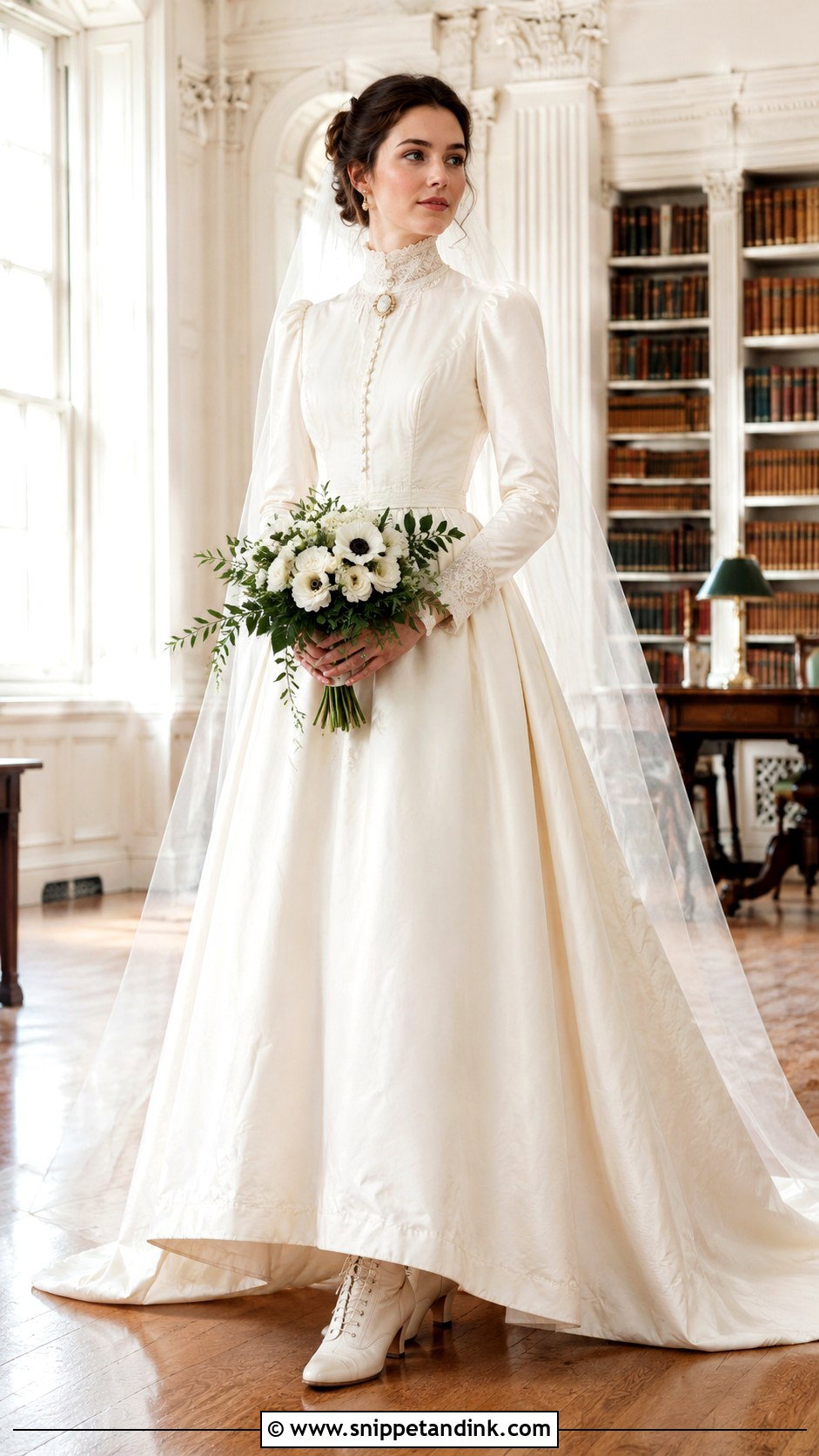
A high-neck Victorian wedding dress is the one I’d suggest first for a cold-weather ceremony. Ivory satin or silk with a fitted bodice, natural waist and long sleeves gives full coverage, and lace panels at the collar and cuffs keep it from looking severe. Collar height needs a careful fitting. A stand collar that touches your jaw when you look down will rub off foundation all evening, so I often have it lowered by a few millimetres. Covered buttons down the back and an A-line skirt balance the top. Lace-up ankle boots, pearl studs and a vintage brooch at the collar suit it, with a long plain veil set beneath a low bun so the neckline stays visible. White anemones, roses and deep green foliage look right against it in hotels, libraries and winter gardens.
10. Victorian Off Shoulder Wedding Dress
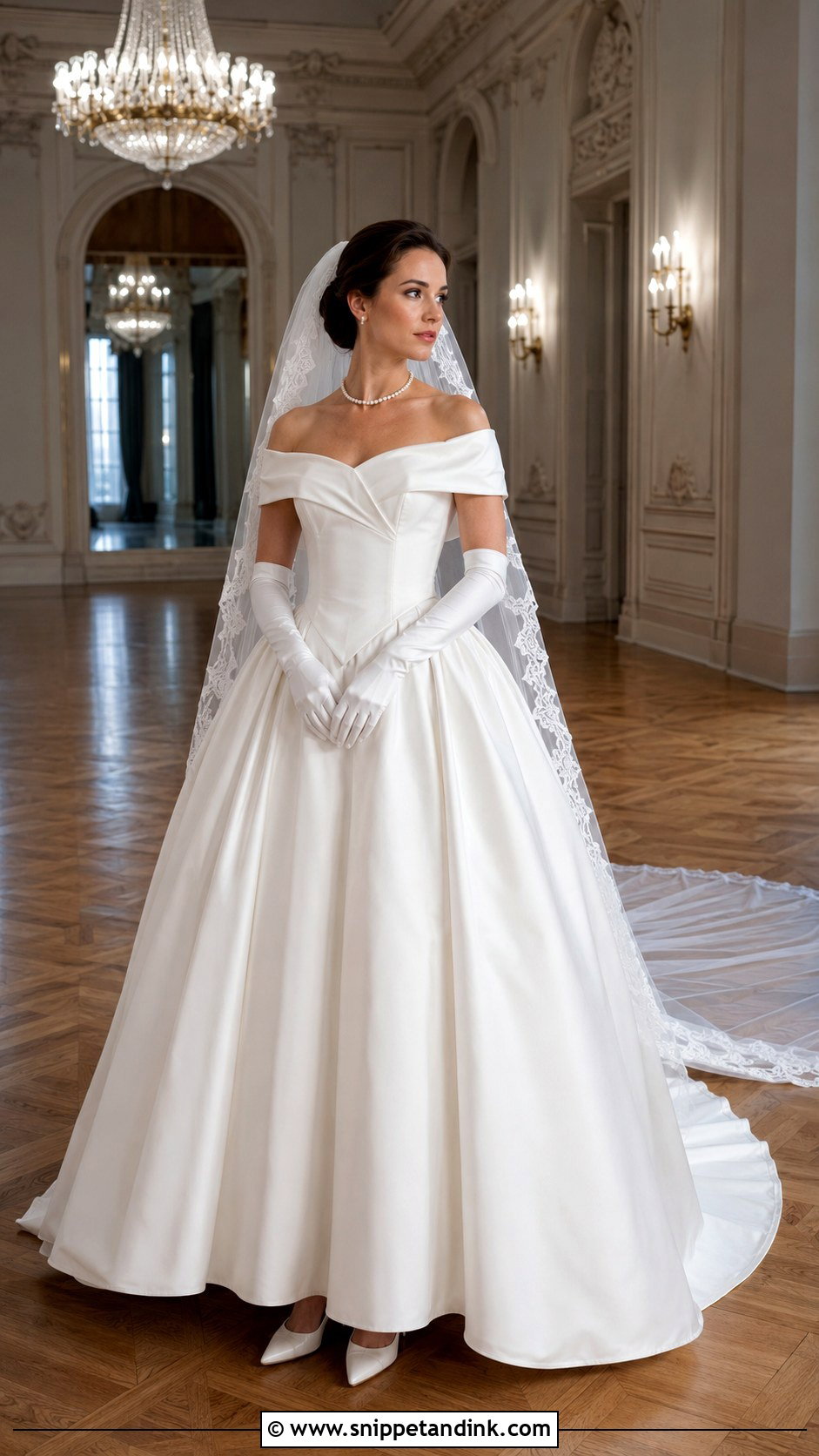
Evening gowns of the period often left the shoulders bare, and this version borrows that. A fitted satin bodice with a fold-over neckline, short sleeves and a softly pointed waist sits over a full skirt and a modest chapel train. The risk with any off-shoulder bodice is slippage. Unless it has proper boning and a grip band inside, you’ll spend the night hitching it up, so I test it by having the bride sit, reach for a glass and hug her mother. Opera gloves, a short pearl necklace and matching earrings give a formal finish, and a lace-edged veil set below a polished bun leaves the shoulders clear. Satin pumps in the gown’s shade and a rounded bouquet of white roses suit ballrooms, ornate estates and museum spaces.
11. 1850s Crinoline Wedding Dress
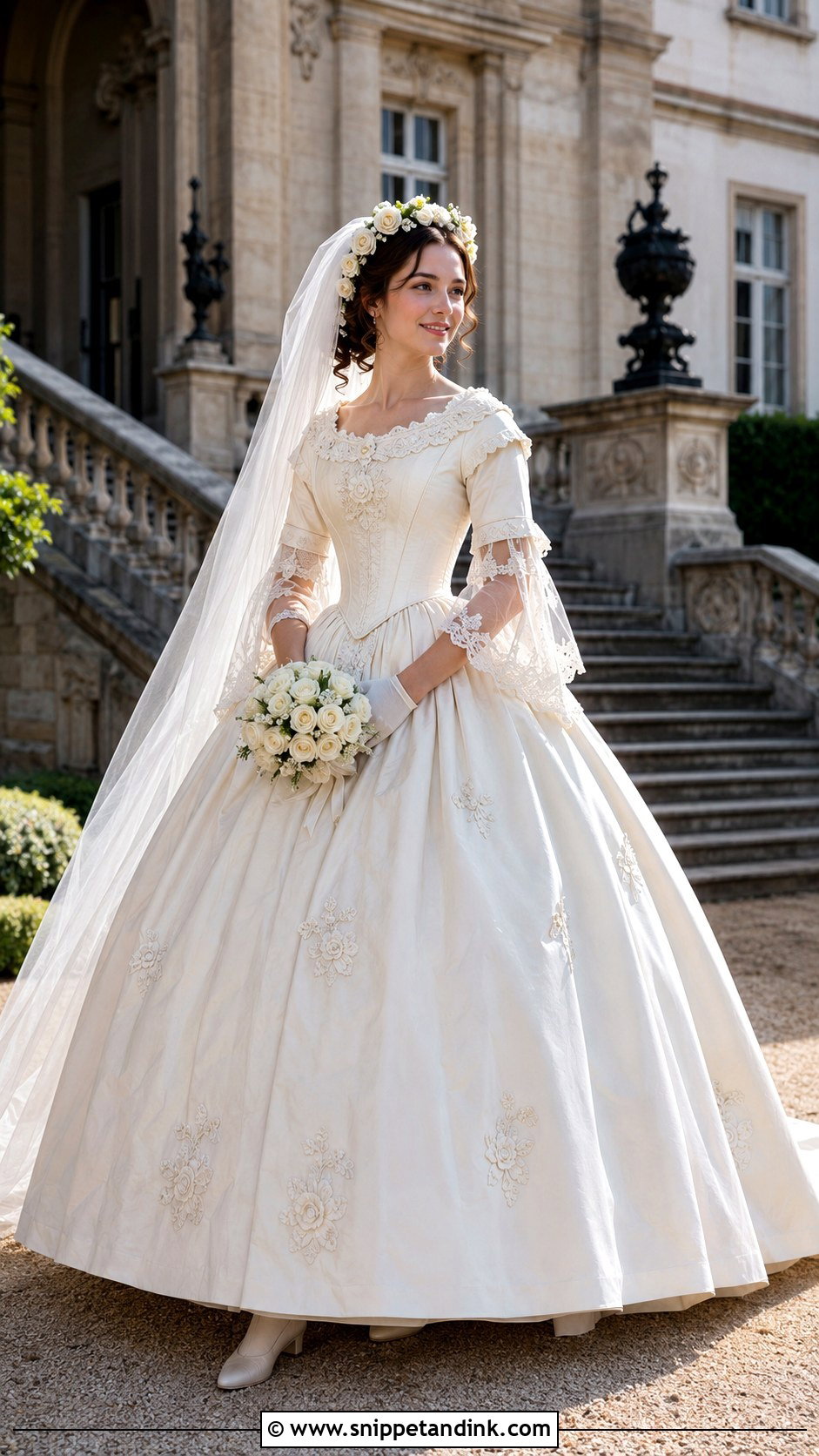
The 1850s skirt was a wide bell, and modern hoops create that volume far more lightly than the stacked petticoats women once wore. Choose an ivory silk gown with a fitted bodice, a modest neckline and short sleeves over detachable lace undersleeves, which can come off for the reception. A lightweight hoop or structured petticoat gives the shape, and tonal floral appliqué around the hem draws the eye down to it. Low block heels and delicate gloves keep you steady; a floral headpiece, drop earrings and a long veil finish the head. Keep the bouquet medium-sized so it doesn’t compete with the skirt. Measure the aisle before you fall for this one. A full hoop needs more room than many church aisles and car doors allow, so estate grounds and large reception rooms are where it shines.
12. 1860s Ball Gown Wedding Dress
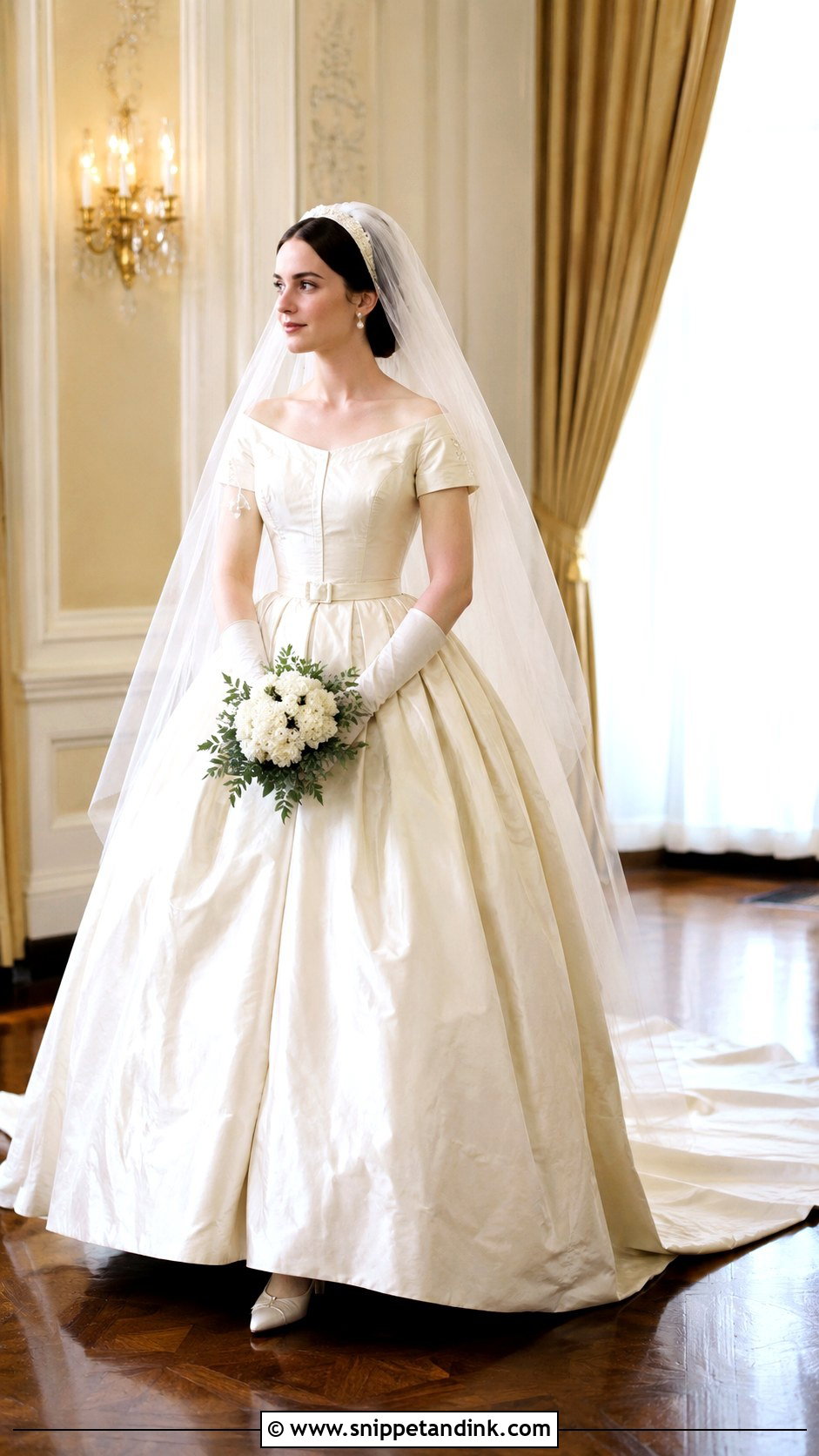
Taffeta is my first choice for an 1860s ball gown because it holds a shape on its own and rustles as you move. It also creases sharply, and those lines show in photos, so it needs careful hanging and a steam on the morning. By this decade the skirt was flattening at the front and gathering its fullness toward the sides and back, so ask for a smooth front panel with the gathers placed behind. A slightly lowered shoulder, short sleeves and a natural waist with a narrow satin belt complete the bodice. A removable train adds ceremony weight. Pearl earrings, wrist gloves and low satin heels are all it needs, and a long veil under a braided updo gives a graceful back view. White peonies and greenery belong in a formal historical setting.
13. 1870s Bustle Wedding Dress
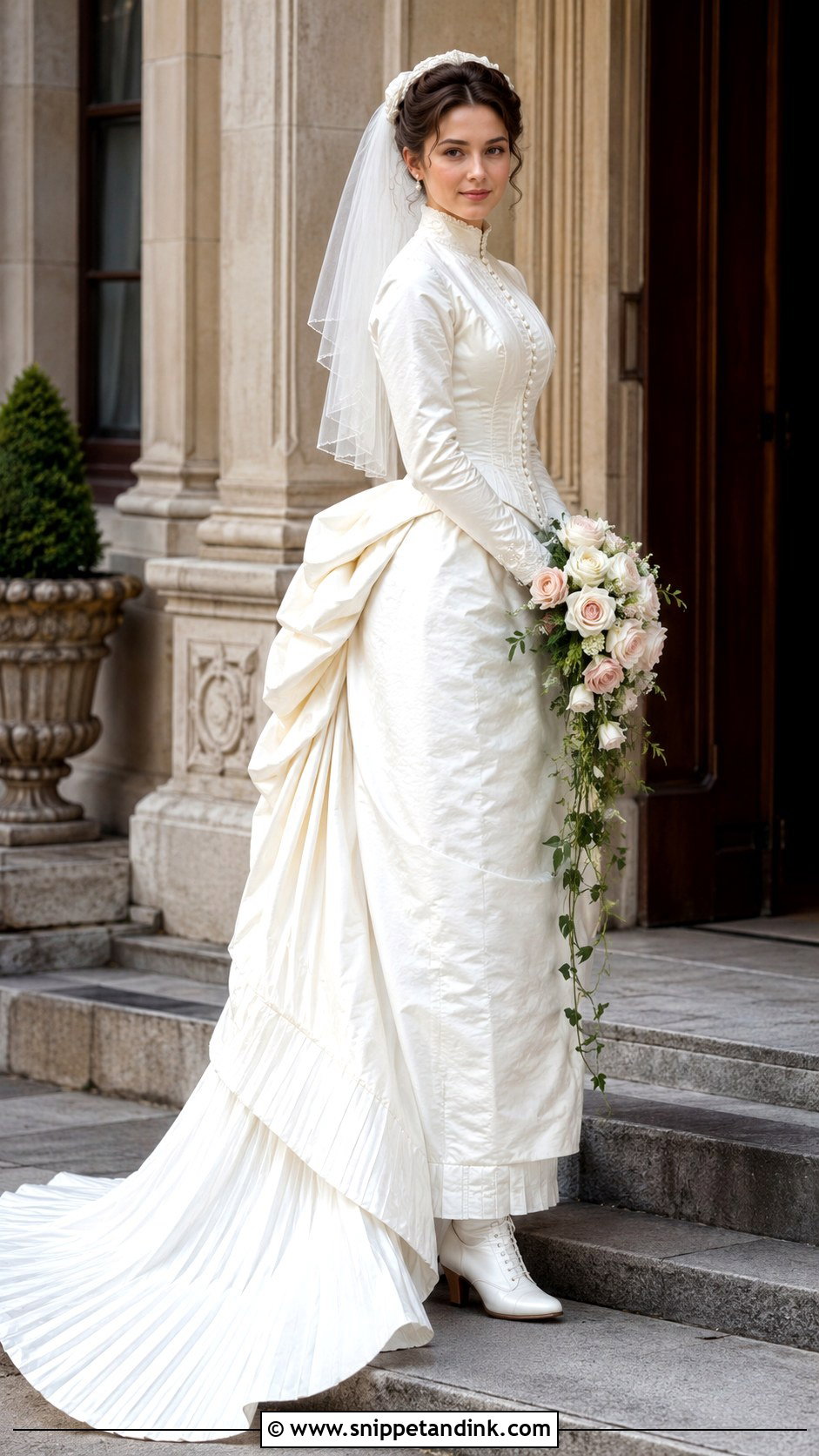
Sitting is the practical question with any bustle. A firm bustle pad means perching on the front edge of a chair, so for brides facing a long seated dinner I usually recommend a soft, collapsible support. The drama comes from shape, which lets the decoration stay minimal. The bodice is fitted ivory with a high neckline, long sleeves and a defined waist; the skirt stays fairly flat in front and gathers into structured fullness behind, with the train flowing from the bustle. Tonal pleating, covered buttons and narrow lace edging give enough interest. Buttoned ankle boots, pearl earrings and a small lace fan carried as an accessory suit the era. Keep the veil compact so the back shows, and add a low braided bun and a cascade of roses, ivy and soft white flowers.
14. Victorian Lace Wedding Dress
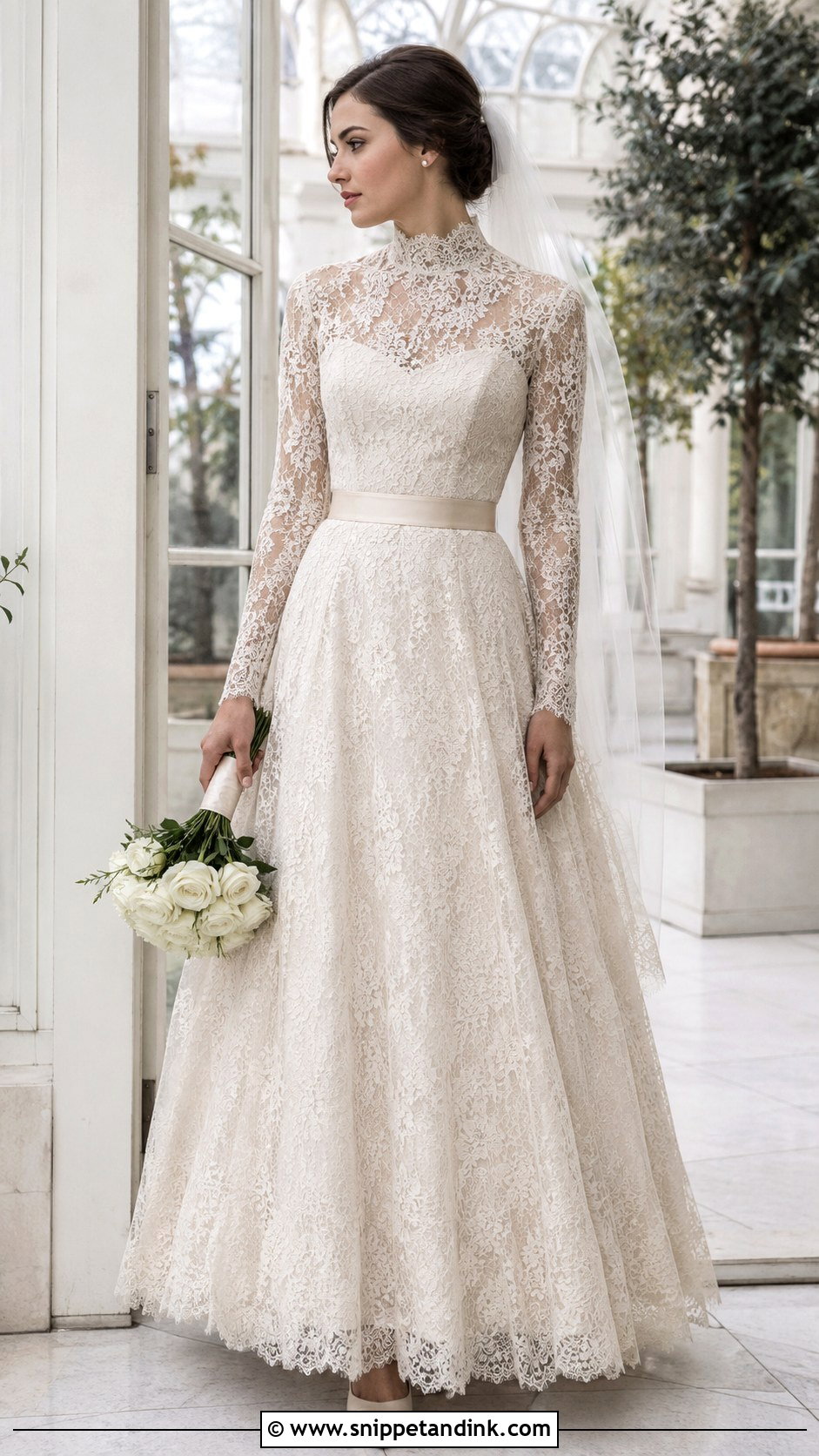
Lace is where I see the most mistakes on Victorian-style gowns, usually because three patterns end up competing. The fix is scale: smaller motifs on the bodice, larger ones toward the hem, all in one ivory. Choose a fitted long-sleeve bodice with a high illusion neckline and a natural waist, and a gentle A-line skirt with a little extra fullness at the back instead of a hoop or bustle. Illusion tulle can scratch at the neck, so ask for a soft net and run a fingertip along the edge at your fitting. Ivory pumps, pearl studs and a narrow velvet sash are enough. A plain tulle veil keeps the accessories from fighting the lace. A low twisted updo with a small comb and a simple bouquet of white roses and leafy greenery complete it.
15. Victorian Satin Wedding Dress
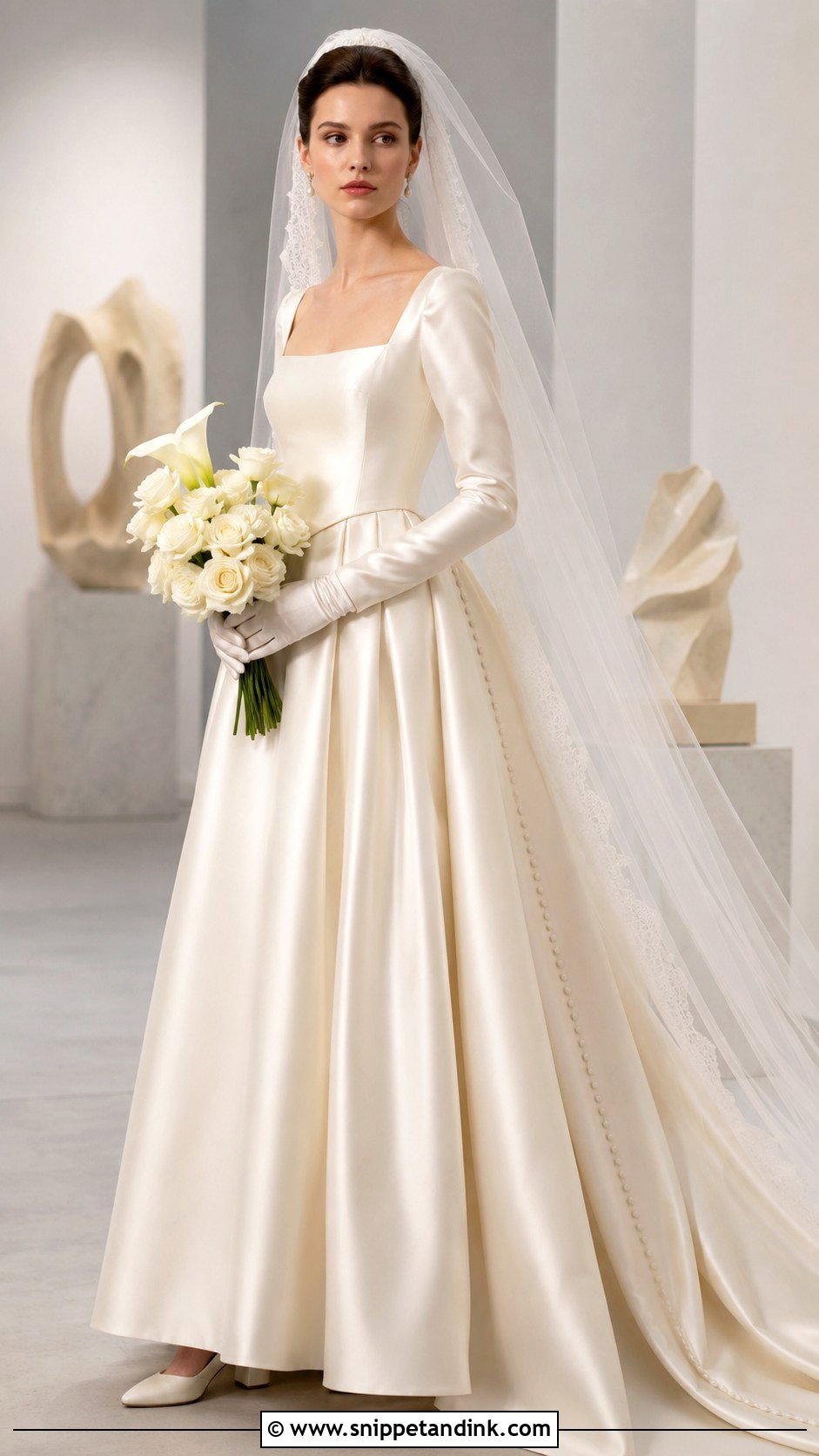
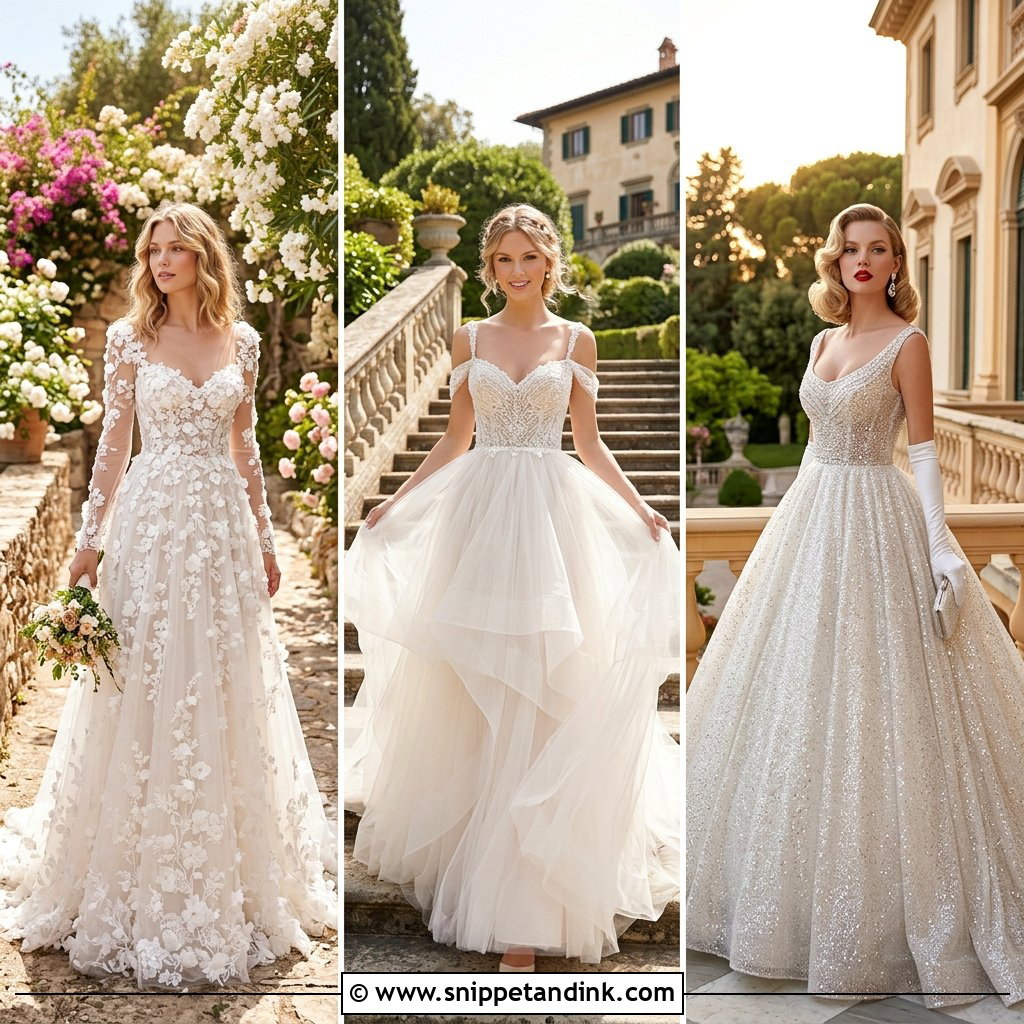
Satin shows every seam and pucker, which is exactly why I love it for an 1800s-style gown when the construction is good, and why I’m wary when it isn’t. Look for a structured bodice, a softly squared neckline, fitted sleeves and a full skirt with controlled pleats. A slightly pointed waist adds period character and covered buttons tailor the back. Skip heavy beading; the sheen is the decoration. Satin creases across the lap when you sit for a long time, and a heavier duchess satin recovers far better than a thin, slippery one. Satin block heels, pearl drops and short gloves suit it, with a cathedral veil edged in narrow satin to echo the gown. A center-parted bun and white roses with calla lilies fit grand hotels, galleries and pared-back modern spaces.
16. Floral Victorian Wedding Dress
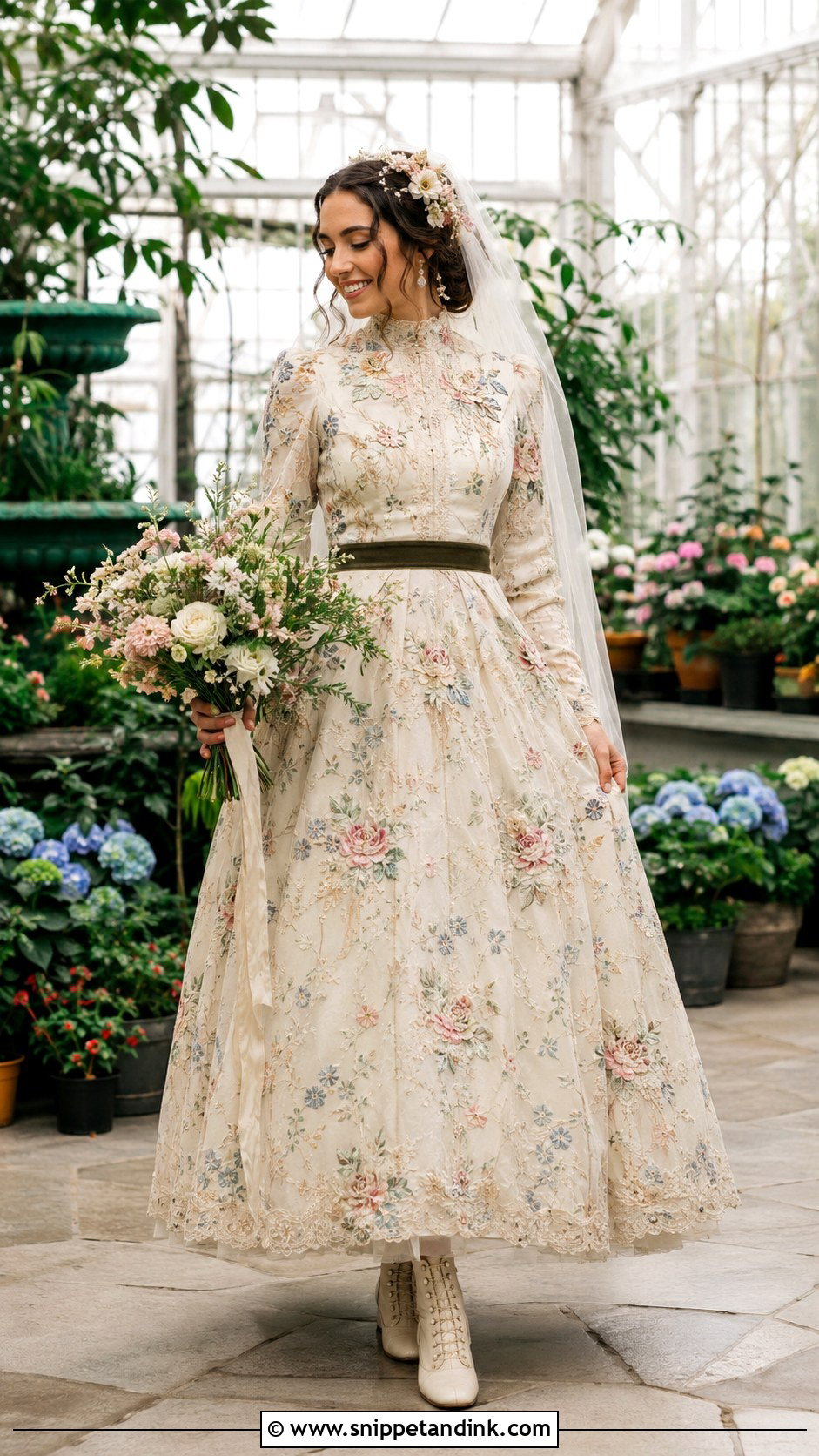
Many Victorian women married in their best patterned dress rather than a single-use white one, so a floral gown is a lovely historical nod. Start with a cream or pale blush base with small woven, embroidered or printed flowers. Print scale matters more than color: tiny repeats read as texture from a distance, while large blooms can look busy in group photos. Hold the palette to a few muted shades, say dusty pink, soft blue and sage, and repeat those in the bouquet. Choose a fitted bodice, natural waist, long sleeves and a full skirt running into a modest train. Cream ankle boots, simple pearl earrings and a velvet ribbon belt suit it, and light ivory tulle on a floral comb keeps the head from getting fussy. Botanical gardens, conservatories and country estates make the right backdrop.
17. 1880s Bustle Wedding Dress
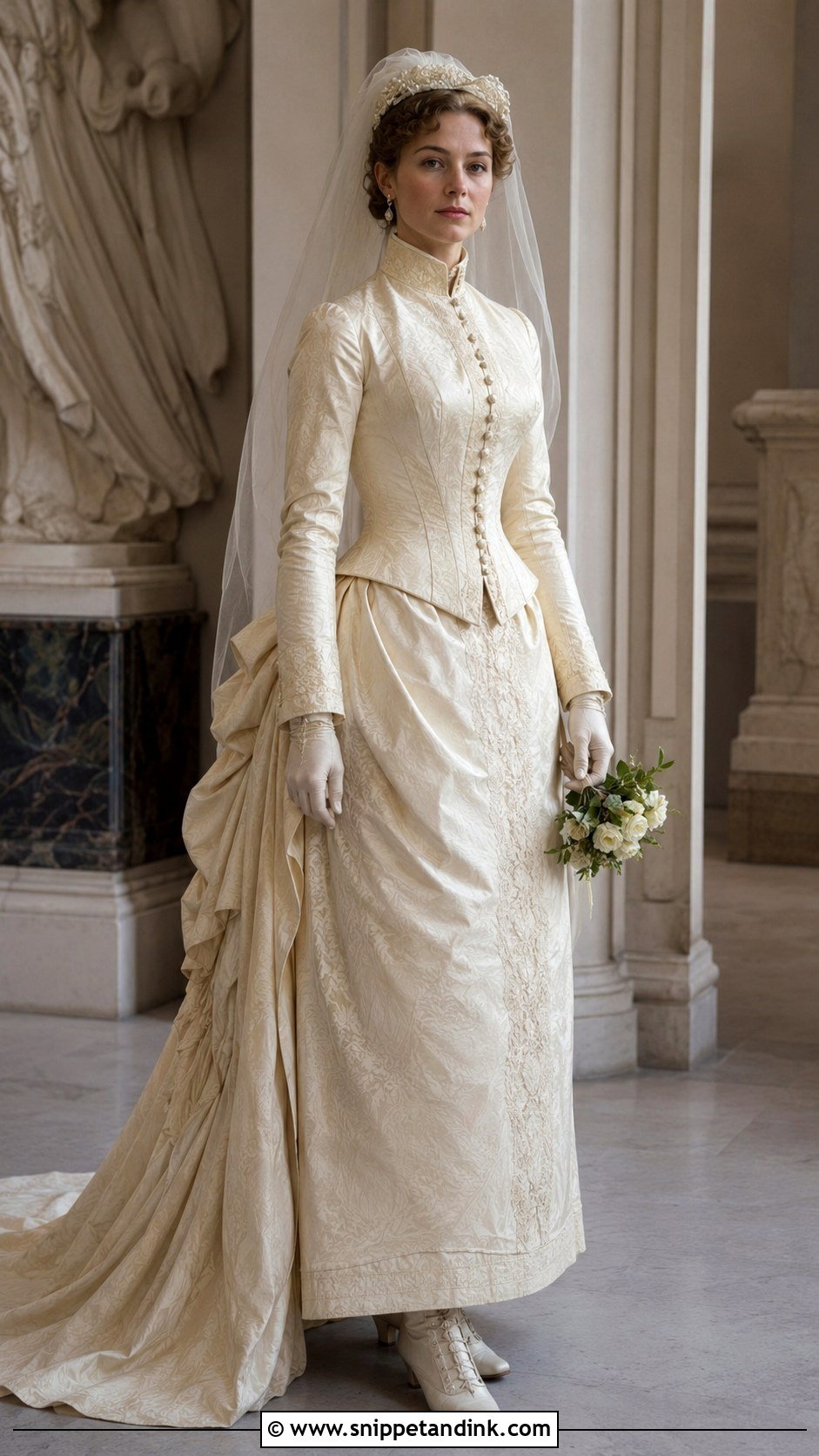
The 1880s-inspired gown is the most tailored of the century, closer to a structured jacket than a soft bodice. Choose ivory with a high collar, fitted sleeves and a sharply defined waist, over a narrow front skirt that builds into pronounced pleats and volume at the back. At its peak the bustle of this decade jutted out almost like a shelf, and I’d scale that down for most brides, because a full shelf makes cars, stairs and chairs awkward. A detachable train keeps the entrance strong and the reception practical. Buttons, satin piping and small lace inserts show the construction rather than hide it. Pointed ankle boots, pearl drops, fitted gloves, a small veil under a structured updo and a narrow cascading bouquet suit its precision.
18. 1890s Puff Sleeve Wedding Dress
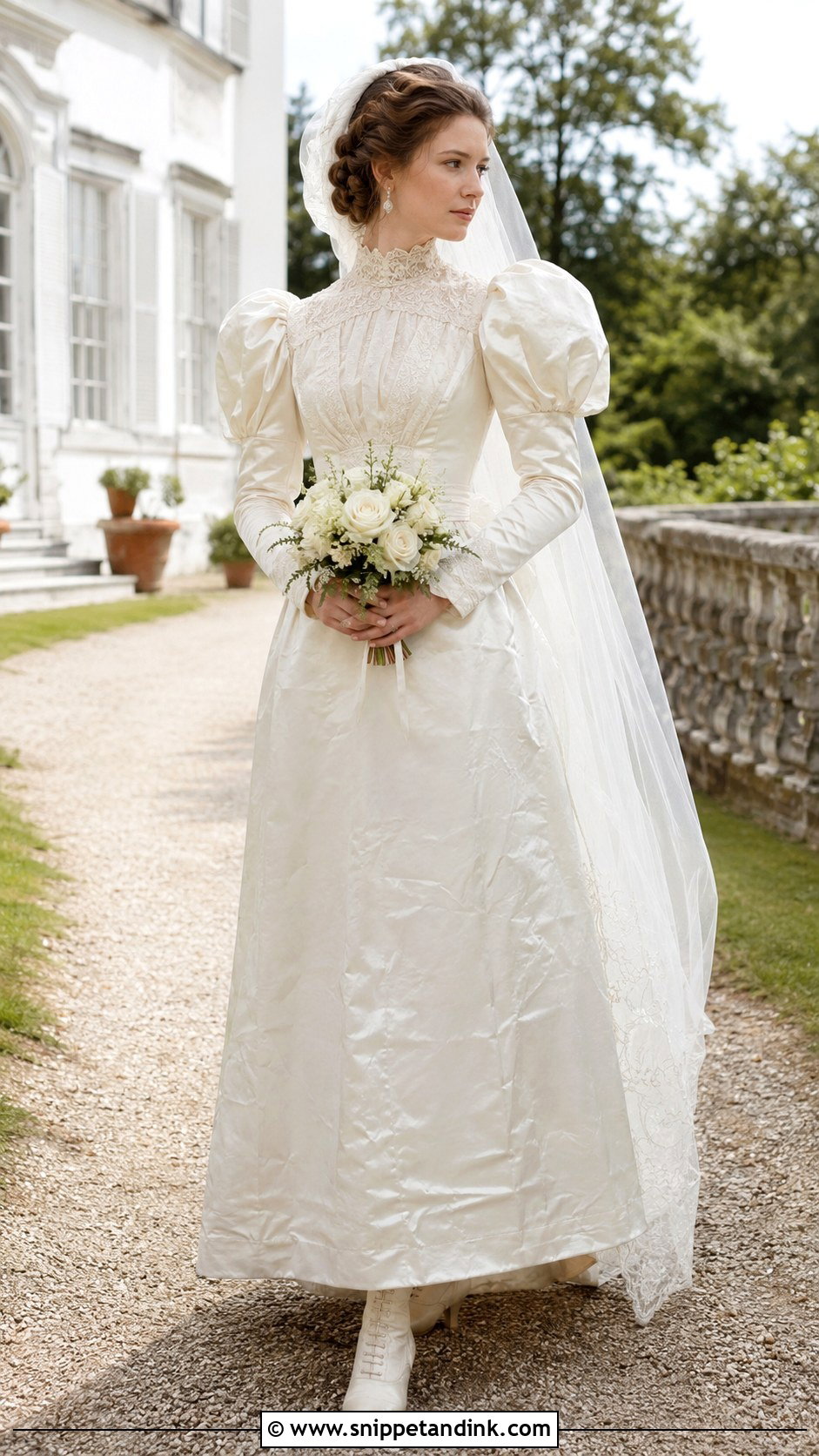
By the 1890s the volume had climbed to the shoulders: large puffed sleeves narrowing below the elbow, a small waist and a full, straight skirt. Choose ivory silk or satin. A high lace-trimmed neckline suits a daytime ceremony, while a softer open neckline works for evening. Since the sleeves are the feature, I set the veil to fall from the back of the hairstyle where it can’t flatten them, and I check that the puffs clear the bouquet when the elbows are bent. Brides with broad shoulders may want a smaller puff than the pictures show. Buttoned boots, pearl earrings and a small floral hairpiece complete the styling, and a compact bouquet of roses, greenery and blooms in the style of lily of the valley keeps the proportions balanced.
19. Champagne Victorian Wedding Dress
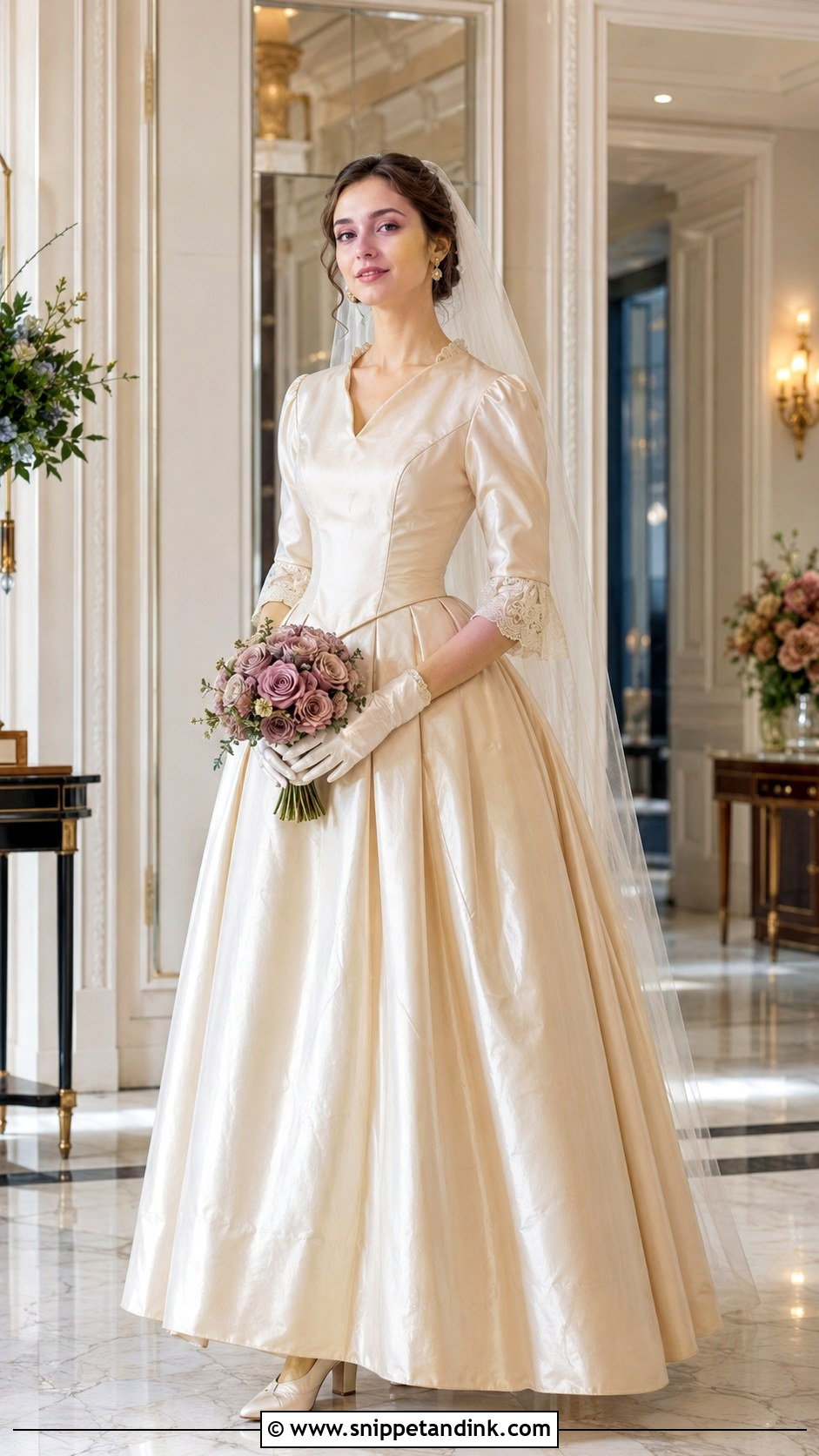
Champagne satin is the color I suggest to brides whose skin looks washed out next to bright white. It warms the face and still reads as bridal. Choose a fitted bodice with a softly pointed waist, elbow-length sleeves and a wide, modest neckline, over a full skirt with gentle back pleating. Ivory lace at the neckline and cuffs lifts the deeper shade near your face. Test it on camera before you commit: some champagnes photograph almost nude under flash, and a quick phone photo outdoors and indoors tells you a lot. Champagne block heels, pearl-and-gold earrings and cream gloves suit it, and an ivory veil gives subtle contrast. A low bun with a small gold comb and ivory roses with muted greenery finish the look.
20. Modern 1800s Inspired Wedding Dress
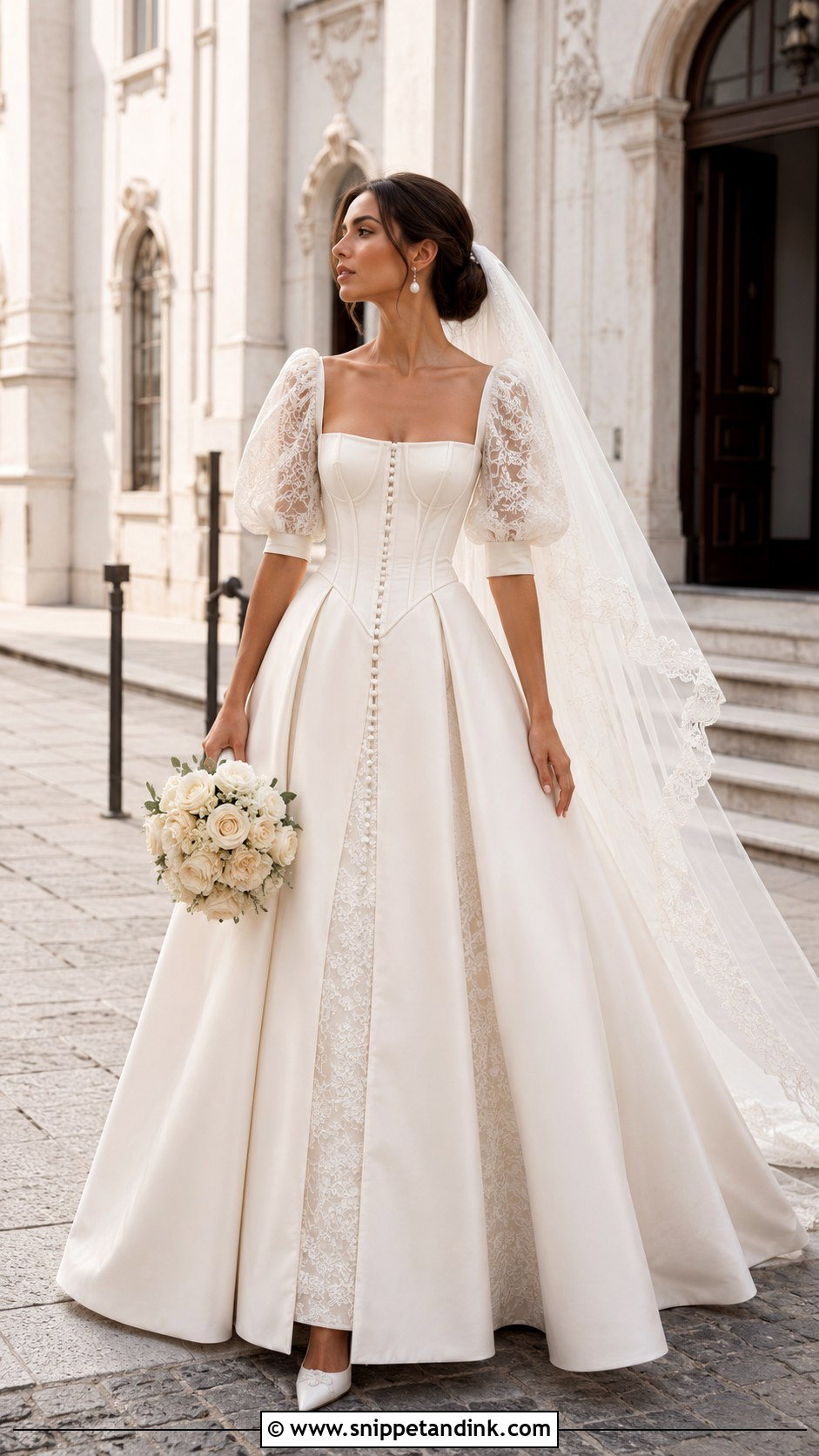
Not every period-inspired bride wants to commit to one decade, and this is the gown I’d point those brides toward. Choose an ivory A-line with a structured basque bodice, a square neckline and detachable puff sleeves, so the look changes between ceremony and dancing. A lightweight skirt with hidden support gives fullness without the weight of a hoop. Covered buttons and subtle lace panels bring the history, while clean seams and a modern zip hidden under the button placket mean you’re dressed in minutes rather than half an hour. Pointed block heels, pearl earrings and a chapel-length veil keep the accessories simple. A smooth low bun with a restrained floral comb and a loose bouquet of cream roses sit as comfortably in a contemporary venue as in a historic one.
The Underpinnings That Make a Period Silhouette Hold Its Shape
Almost every gown on this list depends on what’s underneath it. A bell skirt without a hoop sags into a plain A-line by mid-afternoon, and a bustle without a pad just looks like extra fabric gathered at the back. Sort the underlayers at your first fitting, not the last, because the hem is measured over them.
Hoops, petticoats and bustle pads
Modern bridal hoops are boned with light steel or plastic and weigh far less than a Victorian cage crinoline, and many have adjustable rings so you can shrink the width for the reception. A layered tulle petticoat gives softer, quieter volume with no rigid edge, and I prefer it for brides who dread sitting in a hoop. For the 1870s and 1880s looks, a small padded bustle tied at the waist does the job, and collapsible versions fold flat when you sit.
Corsets and bodice support
You don’t need a laced historical corset to get the line. A well-boned bodice with an internal waist stay gives the shape and anchors the dress so it doesn’t ride up when you lift your arms. If you do want a separate corset, wear it at home for a few hours in the weeks before, including through a meal, so nothing surprises you.
Getting through the day in a wide skirt
- Lift the back of a hoop slightly as you lower yourself into a chair, so the front doesn’t flip up.
- Have a bridesmaid learn how the bustle buttons or ribbon ties work at your final fitting, not in a corridor after the ceremony.
- Check the width of the venue bathroom door; a collapsible hoop or a half slip can save a stressful moment.
- On stairs, lift the front of the skirt a hand’s width by holding it at the side seams rather than bunching the middle.
Wearing the Nineteenth Century Without It Turning Into Fancy Dress
Each gown above borrows from a particular moment in the century, from empire waists and puff sleeves to basque bodices, crinolines, bustles and structured 1890s gowns. You can follow one decade closely or carry two or three details into a modern design. The decision usually comes down to the room you’re marrying in, the season, the width of the aisle and how much structure you’re willing to wear for twelve hours. At every fitting, bring the actual shoes, underlayers and veil, then practise sitting, climbing a step and hugging. A period dress that passes those small tests will feel like yours, not like something borrowed from a museum.
You'll Like These Ideas:


Leave a Reply