
Victorian bridal dress didn’t stand still for 64 years. Between 1837 and 1901 the skirt went from wide and gathered in the 1840s to the crinoline cage, then to the bustle, the slim princess line and finally the huge sleeves of the 1890s. White silk and lace caught on after Queen Victoria married in 1840, yet plenty of brides still wed in a good colored dress they would wear again. When I style a period-inspired bride, I start by naming the decade, because each one sets different rules for the bodice, the shoes and the hair. Modern versions can keep the line while using lighter boning, softer linings and accessories you can actually move in. Below are twenty full looks, roughly in date order, from the 1840 royal gown to the medieval revival at the century’s end.
Antique Original, Reproduction or a Gown That Only Hints?
The first conversation I have with a Victorian bride isn’t about lace. It’s about where the dress comes from, because the three routes have very different timelines and risks.
A true 19th-century gown
Surviving originals tend to be small in the waist and short in the torso, and they rarely have seam allowance left to let out. Silk from the later decades was often weighted with metal salts to make it feel heavier, and that silk splits along the grain with age. I would never let a bride wear one without a textile conservator checking it first, and many are best framed or displayed rather than worn.
A reproduction made to measure
A dressmaker who works from period patterns can build the correct underpinnings and fit them to you. Start early: allow most of a year for sourcing fabric, making a test garment and several fittings. Ask to see their previous work from the decade you want, not just their general bridal portfolio.
A modern gown with Victorian details
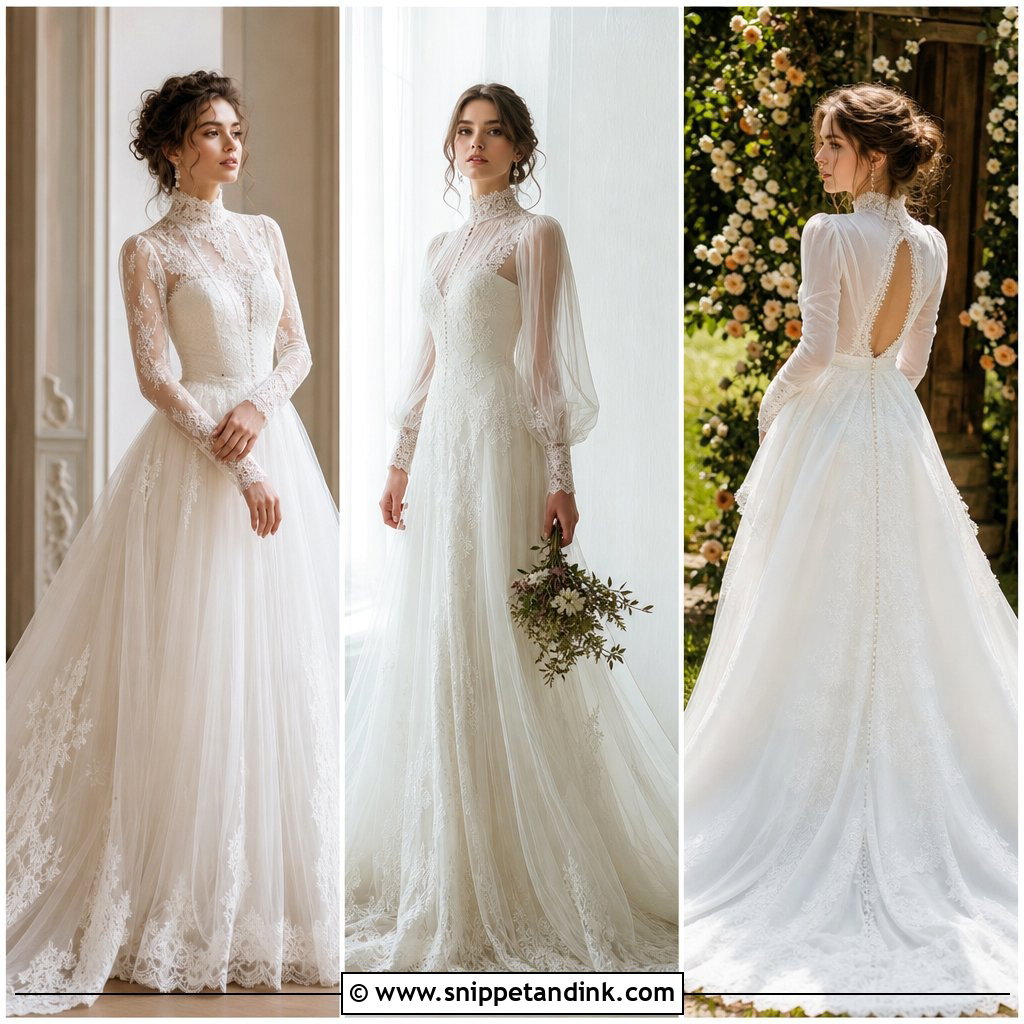
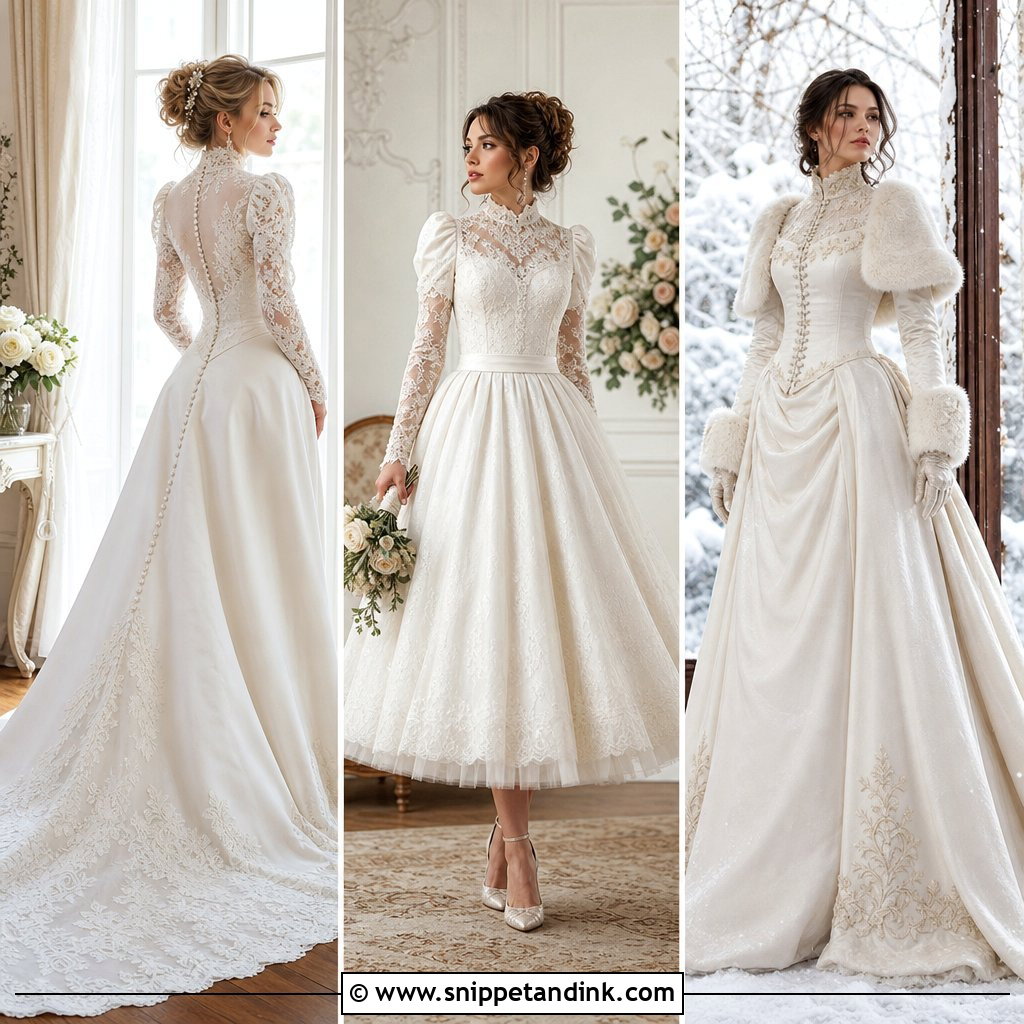
This is the easiest route and the one most of my brides choose. A high lace neck, covered buttons, a puffed sleeve or a soft bustle can be added to a modern bridal dress by a good seamstress, and you keep the comfort of current construction.
1. Queen Victoria 1840 Wedding Dress
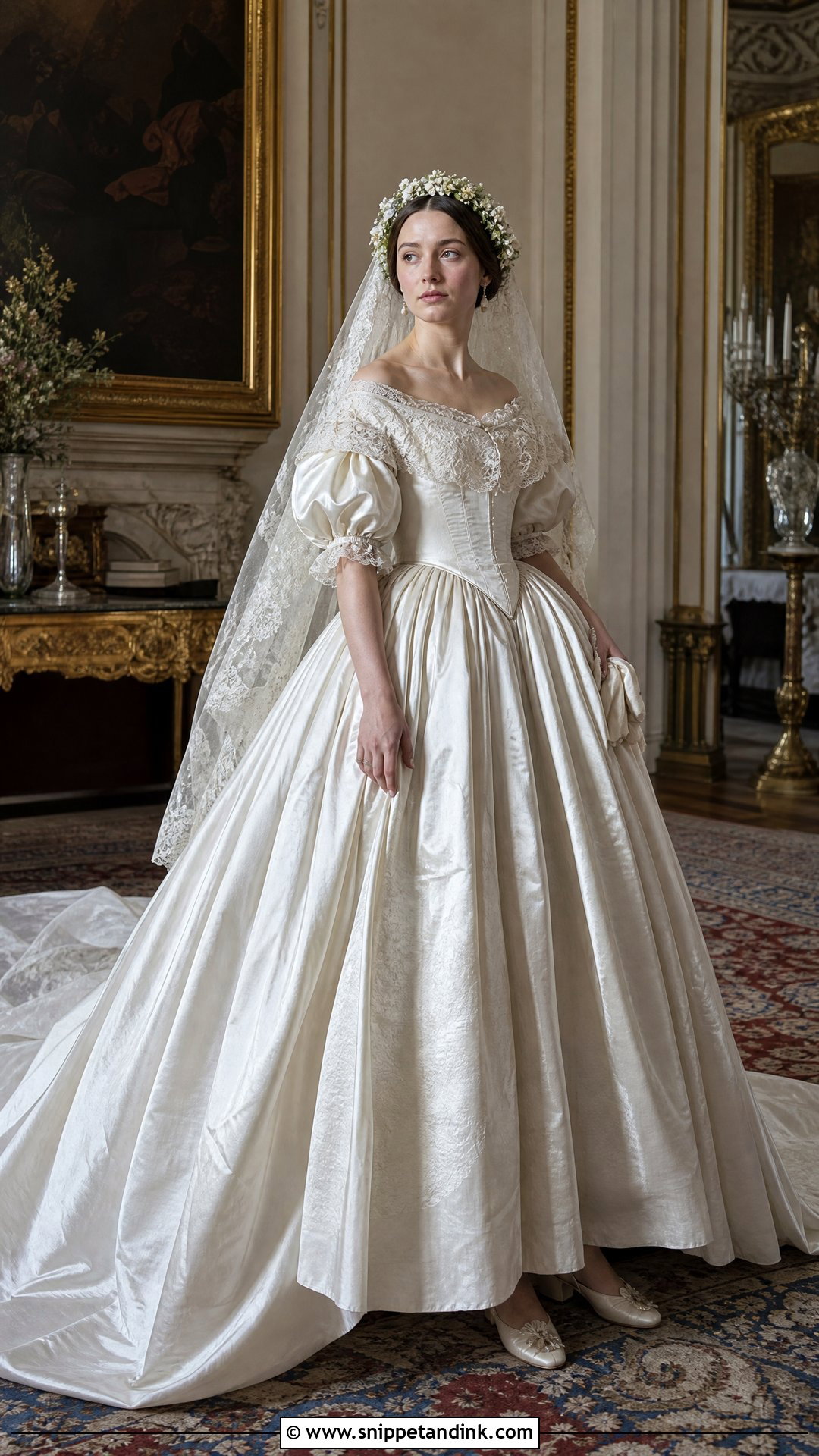
Queen Victoria’s famous bridal ensemble is where most early Victorian looks begin. I’d choose ivory silk satin with a fitted, pointed bodice and a wide neckline resting just off the shoulder, plus short puffed sleeves edged in lace. The skirt is heavily gathered to the floor and should look full rather than stiff, so I ask for soft petticoats instead of a hoop. A long satin train, flat ivory slippers, pearl drops and a lace veil held by an orange blossom wreath complete it. Her original used English Spitalfields silk and Honiton lace, and its plainness is the lesson: the fabric carries the dress. One fitting note: an off-shoulder neckline needs a snug bodice and well-placed boning, or it slides down every time you lift your arms.
2. 1840s Victorian Wedding Dress With Lace Bertha Collar
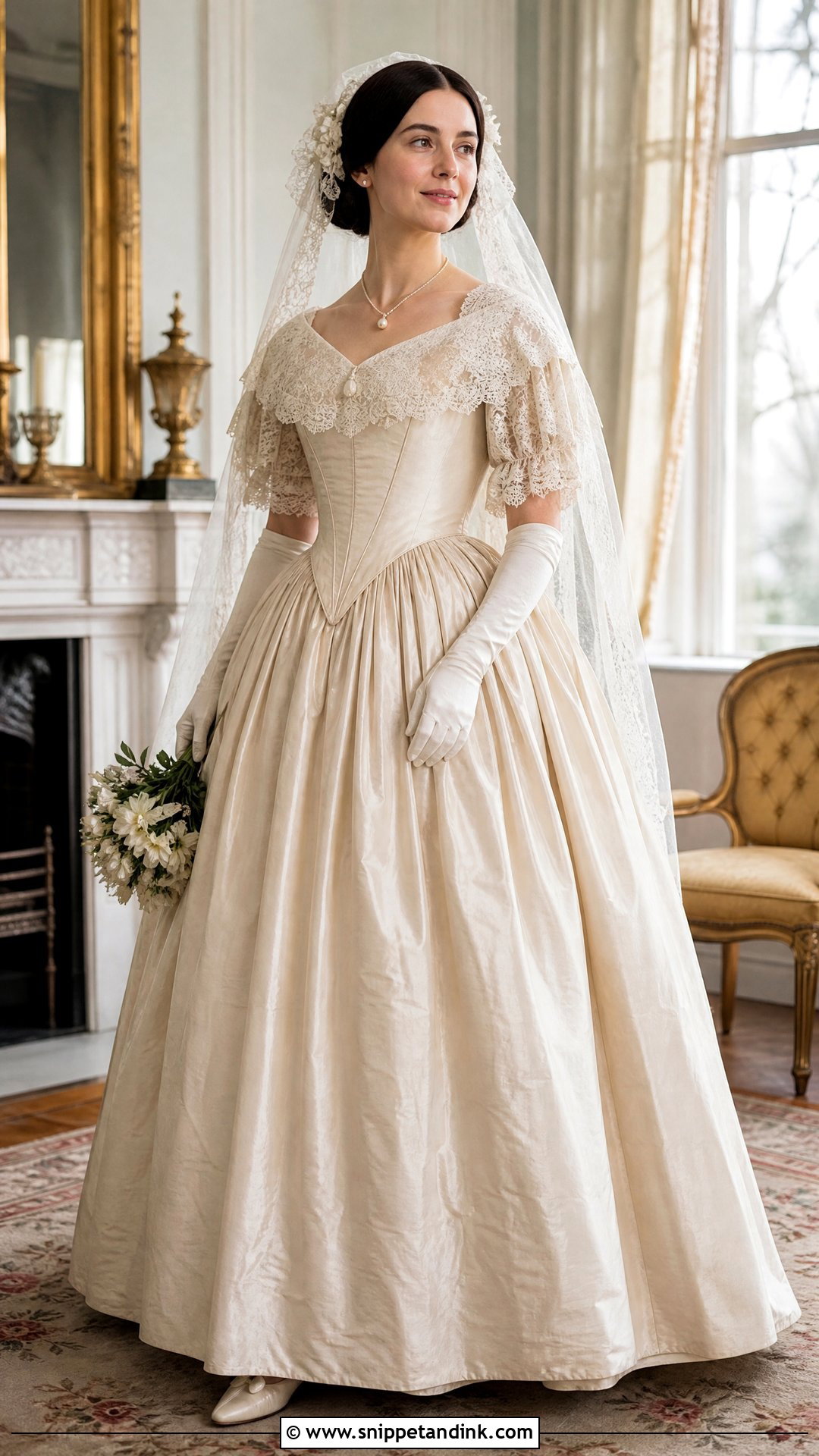
A lace bertha, the deep collar that wraps the shoulders, gives an 1840s gown the look of an old portrait. Start with cream silk, a structured V-point bodice and a broad neckline, then lay the bertha so it follows the shoulder line and frames the upper bodice. Short sleeves can take a layer of sheer lace for a little more coverage. For the bell-shaped skirt I use several light petticoats, which give period fullness without the swing of a hoop. Silk slippers, wrist gloves, a small posy and a fingertip lace veil keep the rest quiet; a fine pendant or pearl studs is all the jewelry it needs. I save this one for indoor ceremonies, where the lace at the neckline is close enough to the camera to be seen and wind can’t flip the bertha up.
3. 1850s Victorian Wedding Dress With Pagoda Sleeves
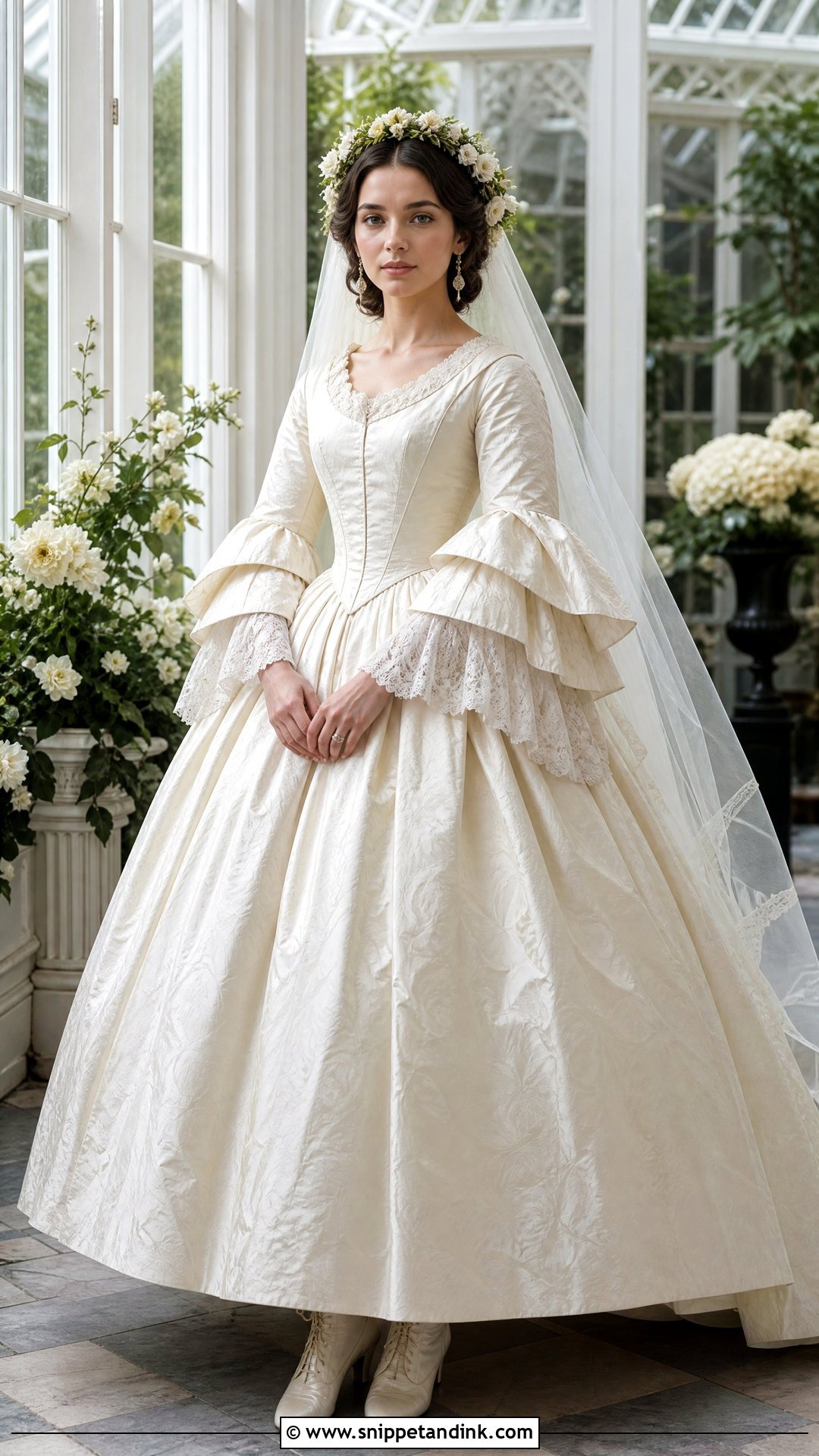
Pagoda sleeves are the giveaway of the 1850s: fitted at the upper arm, then flaring wide below the elbow over white lace undersleeves that run to the wrist. Choose ivory silk or satin with a fitted bodice at the natural waist. The dome skirt needs either layered petticoats or a lightweight hoop; I prefer the hoop for brides who’ll be standing a long time, because petticoats get heavy and hot by evening. Satin ankle boots, a floral wreath, drop earrings and a waist-length veil finish the outfit, with narrow ribbon bands or lace panels on the skirt if you want trim. Do a test with the bouquet at your fitting. Wide sleeves swing into the flowers, so I have brides hold a slightly smaller posy closer to the body.
4. 1860s Victorian Wedding Dress With Crinoline Skirt
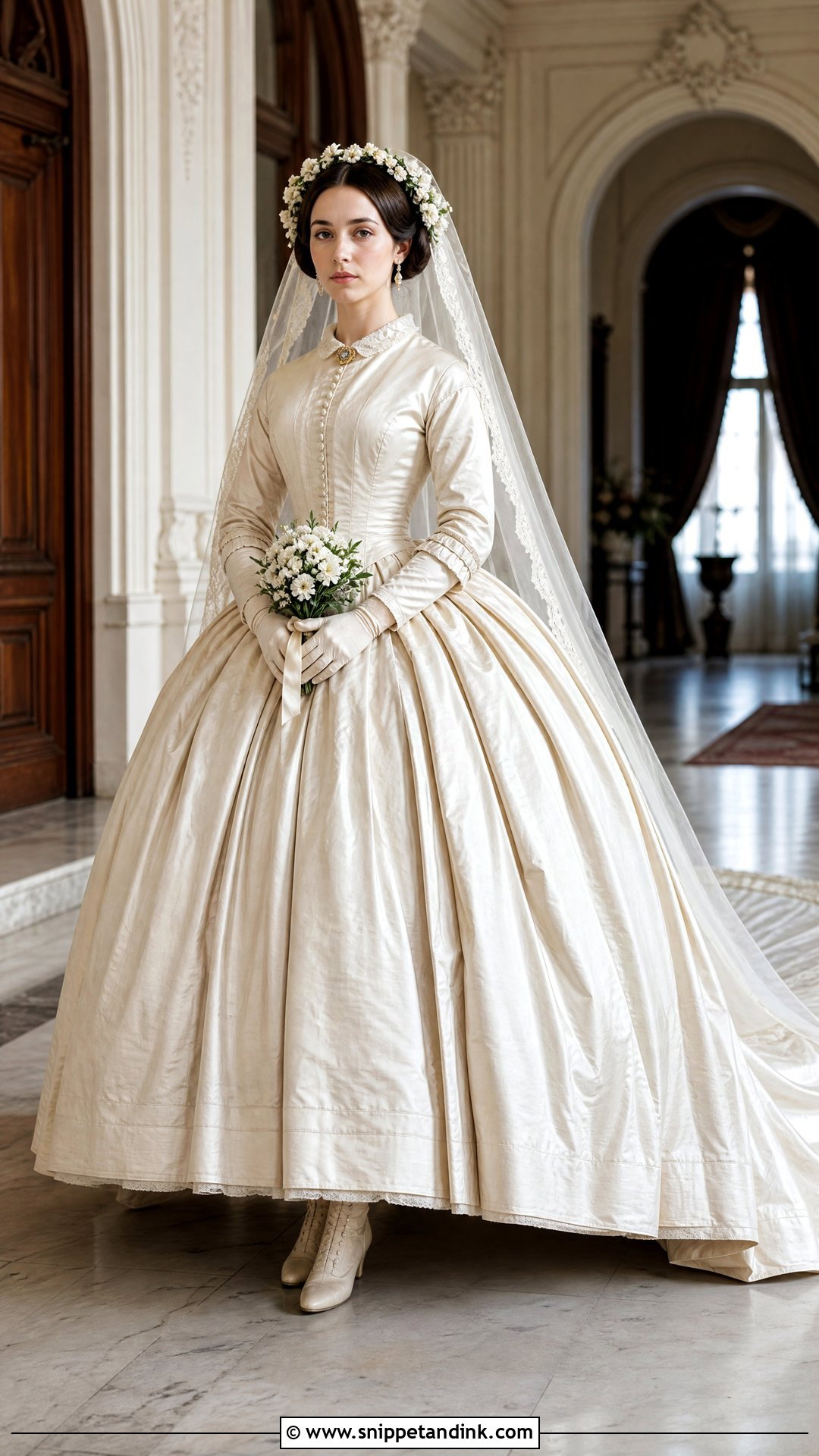
The wide crinoline skirt is the 1860s at full volume, and it needs careful balancing on top. A fitted ivory satin bodice with a modest round neck and long sleeves narrowing to the wrist keeps the upper half tidy. The skirt is smooth with box pleats at the waist and a back hem a little longer than the front. I almost never put a bride in a heavy steel cage; a modern bridal hoop with flexible boning gives the same shape and folds up when she sits. White button boots, fitted gloves, a lace-edged veil and a small orange blossom wreath complete it. The crinoline was invented so women could have this volume without six layers of petticoat, and it still does that job. Measure your aisle and doorways first, though.
5. 1860s Victorian Wedding Dress With High Neckline
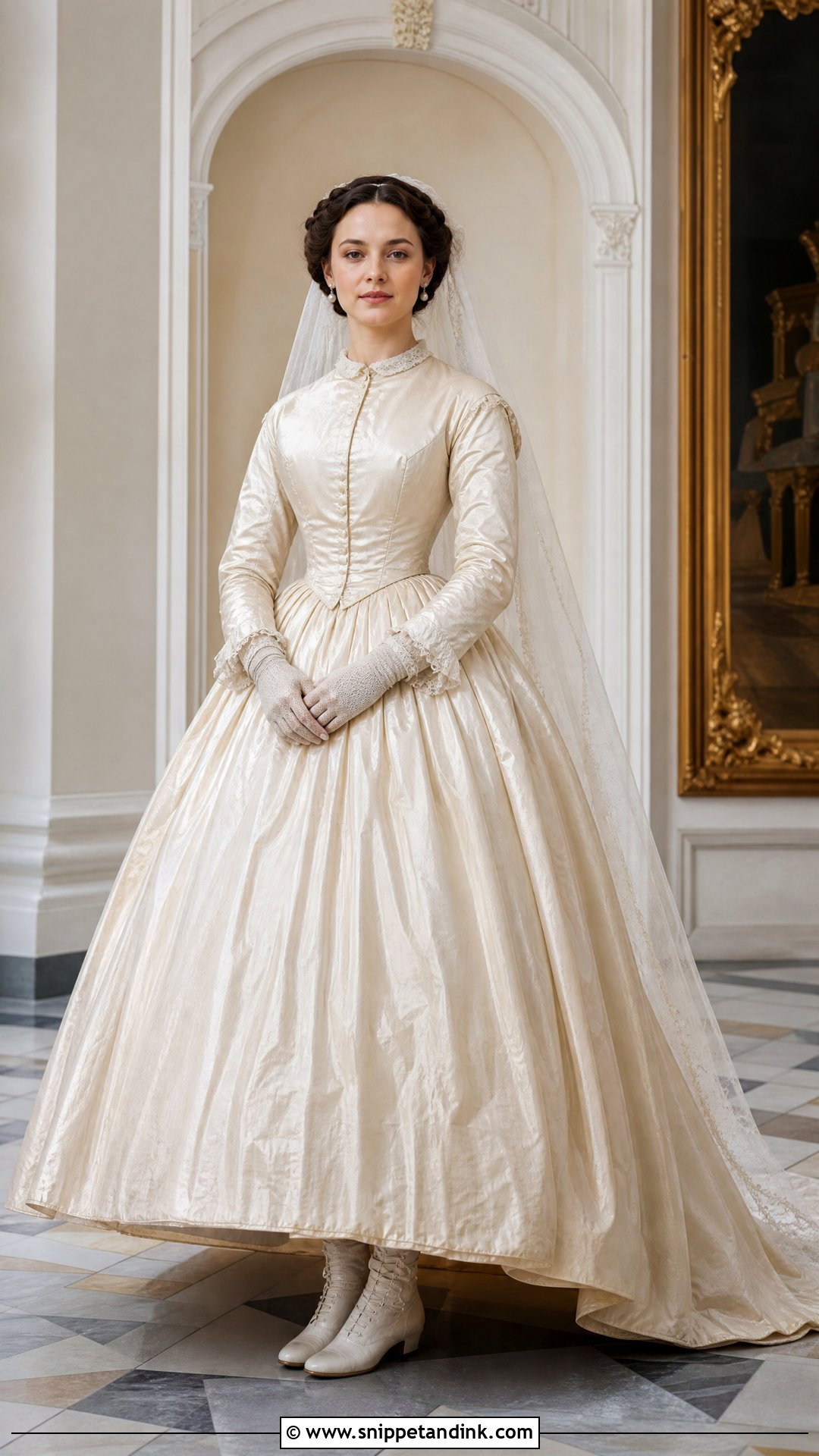
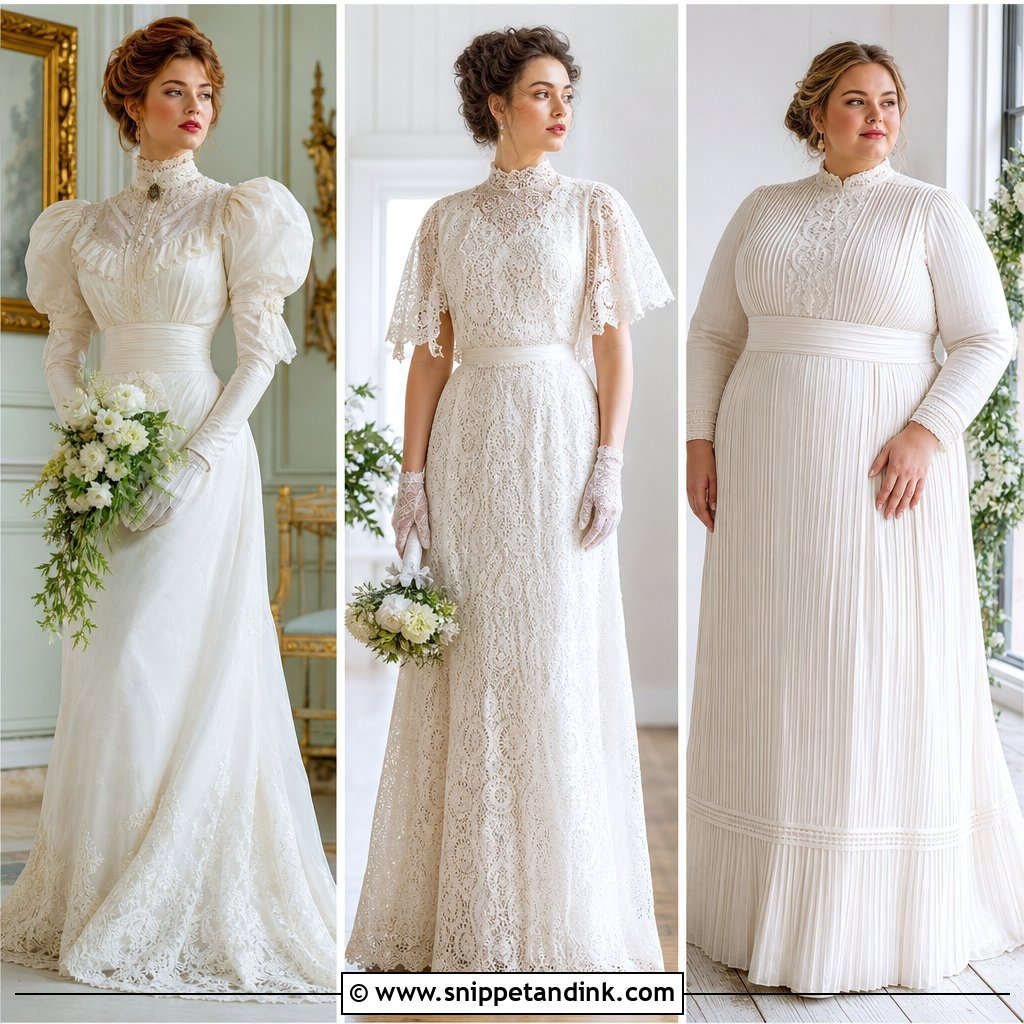
A high neck and long sleeves were standard daytime dress for an 1860s bride, so this is one of the most authentic looks on the list. Choose cream silk taffeta with a close-fitting bodice, a narrow standing collar and long sleeves closed with covered buttons, softened by fine lace at the throat and cuffs. The skirt is full and rounded, gently pleated, with a short train. Low-heeled button boots, pearl earrings, light gloves and a long veil pinned behind a smooth center-parted style complete the period picture, along with white garden flowers. Taffeta rustles and creases easily, so I steam it on the morning and warn brides that it will show seat creases after the ceremony. That crinkle is part of its character.
6. 1870s Victorian Wedding Dress With Bustle Train
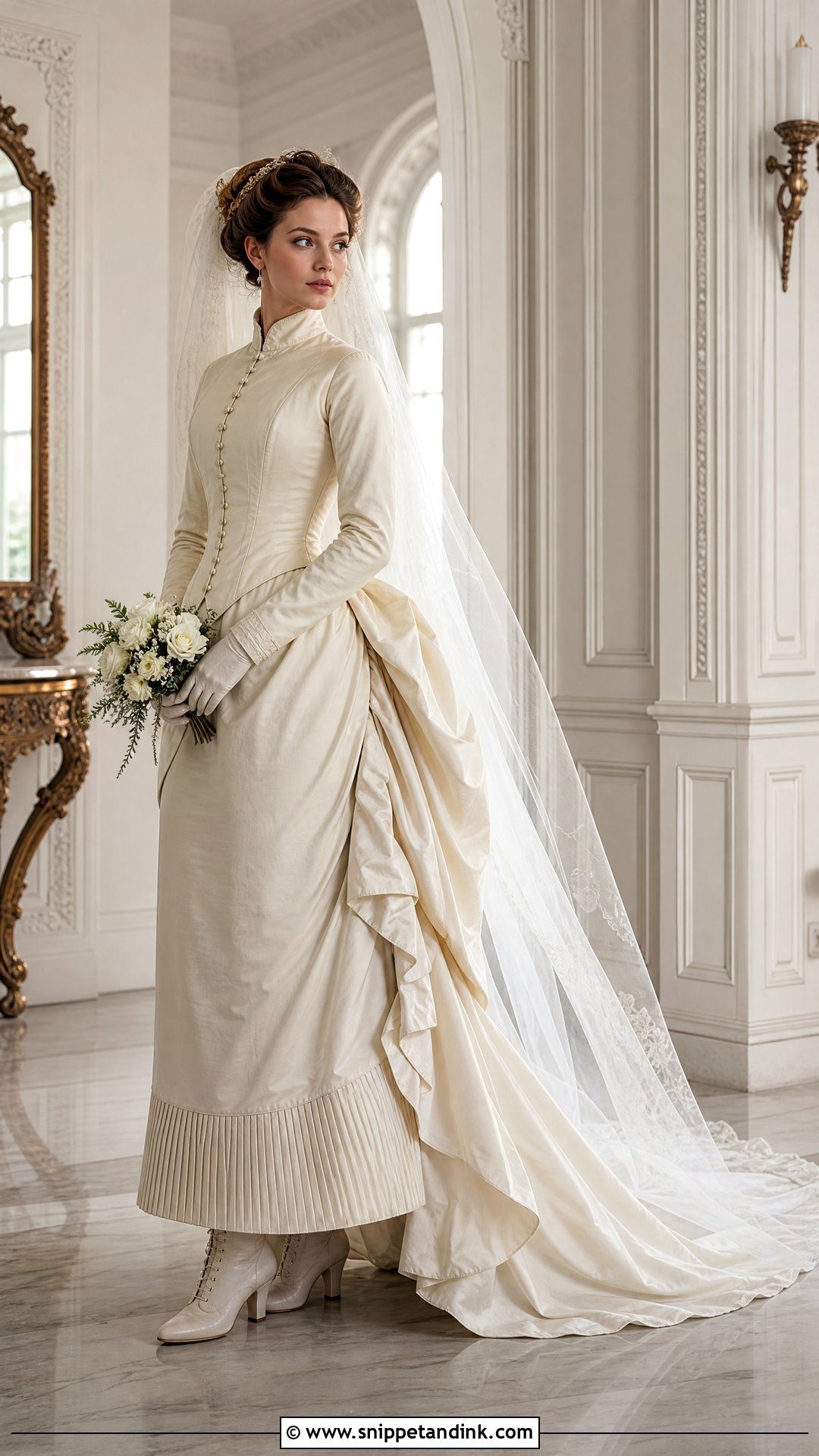
By the 1870s the volume moved to the back, and a bustle can make a plain ivory gown look ceremonial. I’d pick a button-front bodice with a high neck, long sleeves and a slightly elongated waist. The overskirt sweeps back and gathers over a modest bustle, showing a pleated or ruffled underskirt, and the back can run to a chapel-length train. Lace-up ivory boots, small pearls, fitted gloves and a long tulle veil set low on the head finish the look. Keep the front narrow so the back stays the focus. Bridal gowns of the time simply followed everyday fashion, and the bustle let dressmakers pull and drape fabric behind the body. Sitting is the catch: practice on a stool or a chair edge at your fitting, since a full chair back crushes the shape.
7. 1870s Victorian Wedding Dress With Polonaise Overskirt
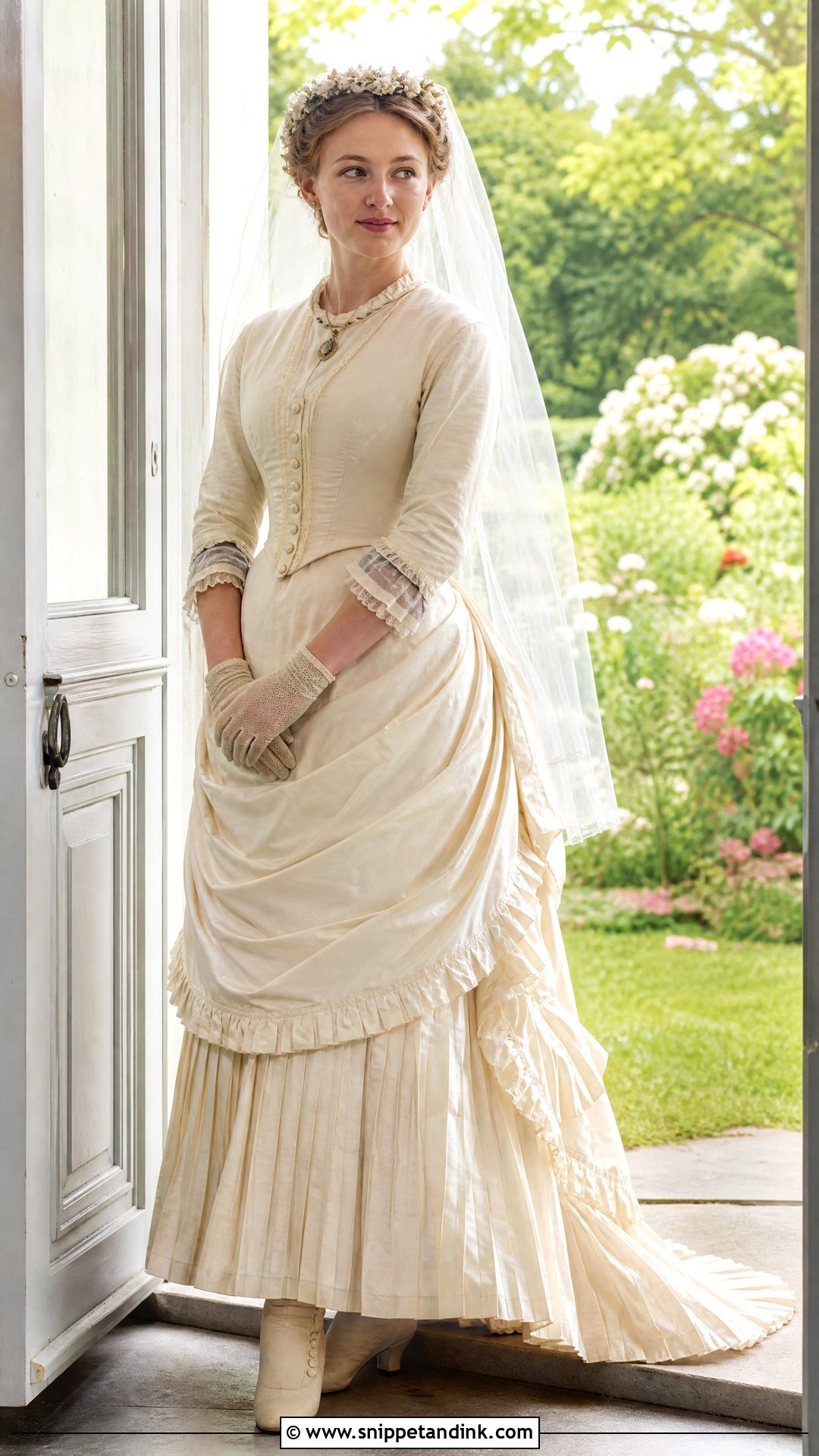
The polonaise is a layered alternative to a standard bustle: bodice and overskirt cut as one piece, fitted through the torso and drawn up at the back. Underneath sits a contrasting cream satin underskirt with narrow pleats or lace ruffles. Three-quarter sleeves with lace cuffs and a square or rounded neck suit it. Silk boots, short gloves, a floral comb and a sheer veil falling past the waist complete the outfit, with one small pendant. The polonaise and the related princess cut gave the late 1870s a long, controlled line. The draping is held up with internal ties or loops, and I always ask the seamstress to show the bride and one bridesmaid how they work. If a tie snaps mid-reception, someone needs to know how to re-hitch it.
8. 1880s Victorian Wedding Dress With Draped Bustle
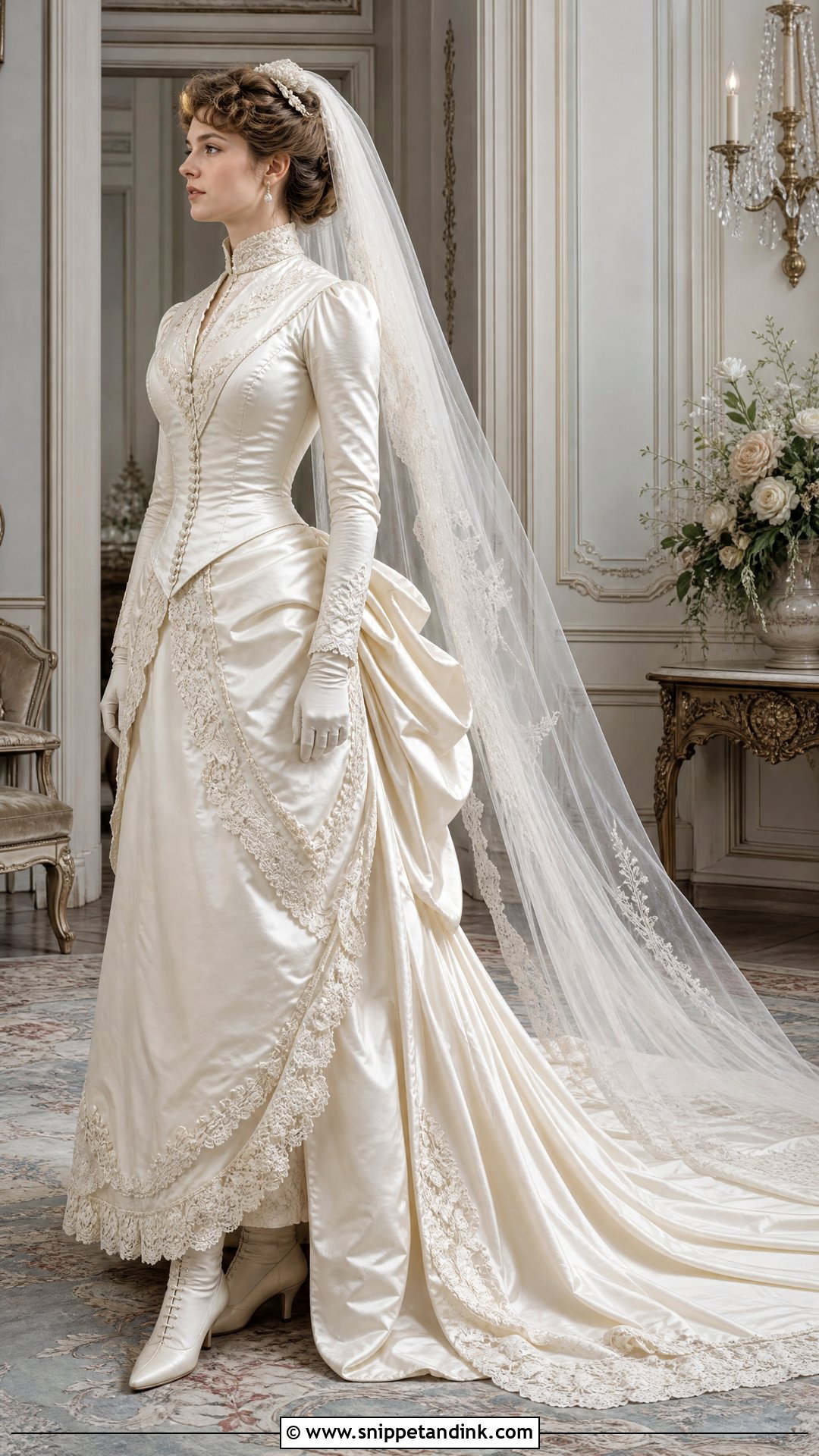
An 1880s draped bustle is a feast of fabric engineering. Begin with ivory satin: a tightly fitted bodice, pointed waist, high collar and long buttoned sleeves. The skirt layers asymmetric lace panels, side swags and an overskirt gathered firmly over the bustle, with a long train coming from beneath. Pointed satin boots, pearl hairpins, elbow gloves and a cathedral veil fixed at the crown finish it. I keep the textures ivory-on-ivory, because mixing lace colors on a dress this busy makes it look fussy. The flat front and strong back projection are the fashionable mid-1880s shape, satin and lace arranged over a bustle support. It’s heavy, so a bride who wants to dance needs either a detachable train or a reception change.
9. Natural Form Victorian Wedding Dress
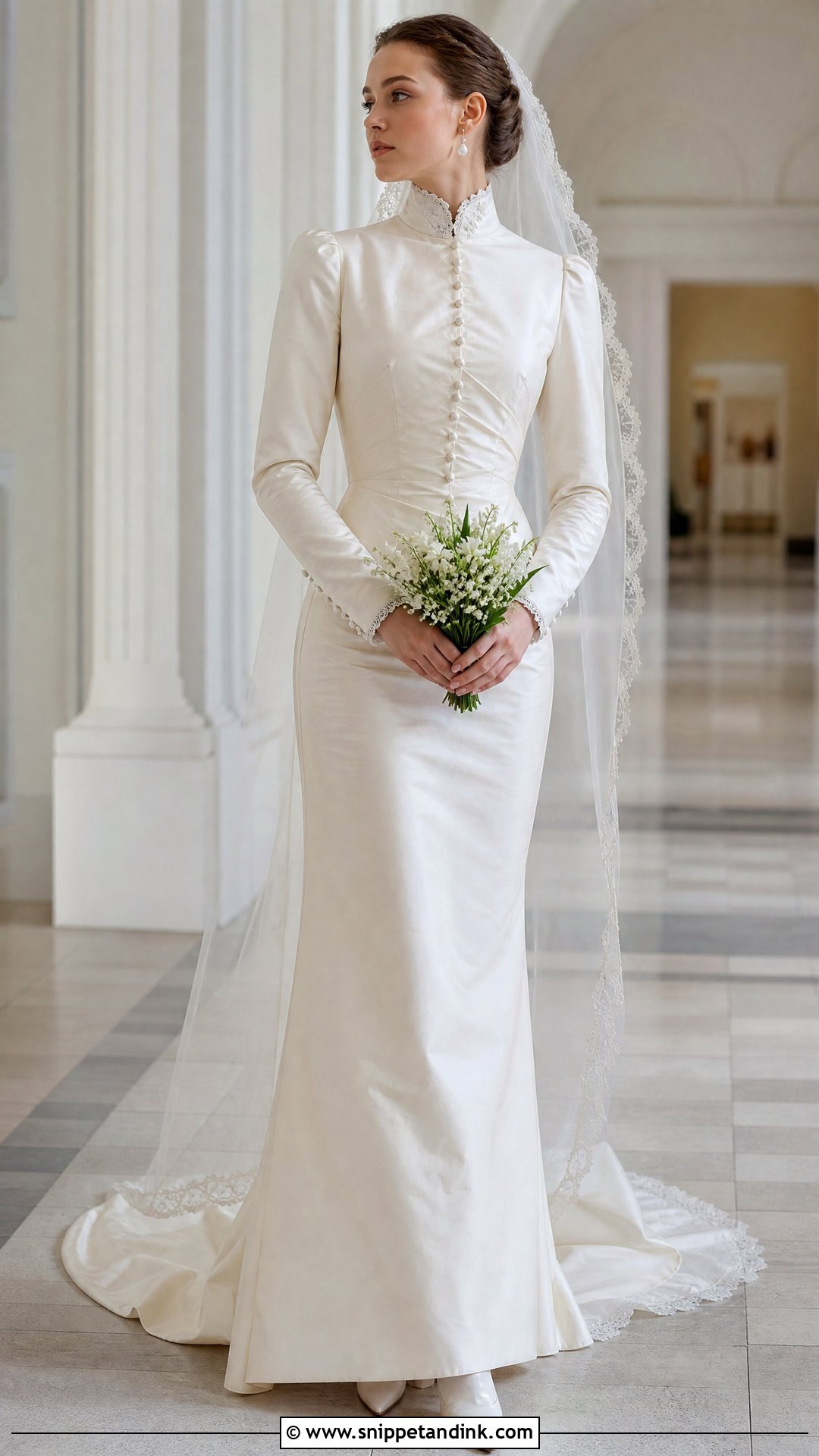
If a crinoline sounds exhausting, the natural form is the period’s own answer. This late-1870s line runs smooth from shoulder to hip in cream silk faille, with restrained draping and a narrow train behind the legs. Long sleeves, a standing lace collar and covered buttons keep it Victorian. Pointed ivory boots, a lace-edged veil, pearl earrings and a compact bouquet complete it. There’s no big bustle here; a small pad and interior ties shape the back. I suggest it to brides who love tailoring and plan to walk across lawns or dance, since it moves far more freely than any skirt on a frame. Long-waisted figures suit it best. On a short torso the unbroken line can make the legs look shorter, which a slight heel helps fix.
10. Princess Line Victorian Wedding Dress
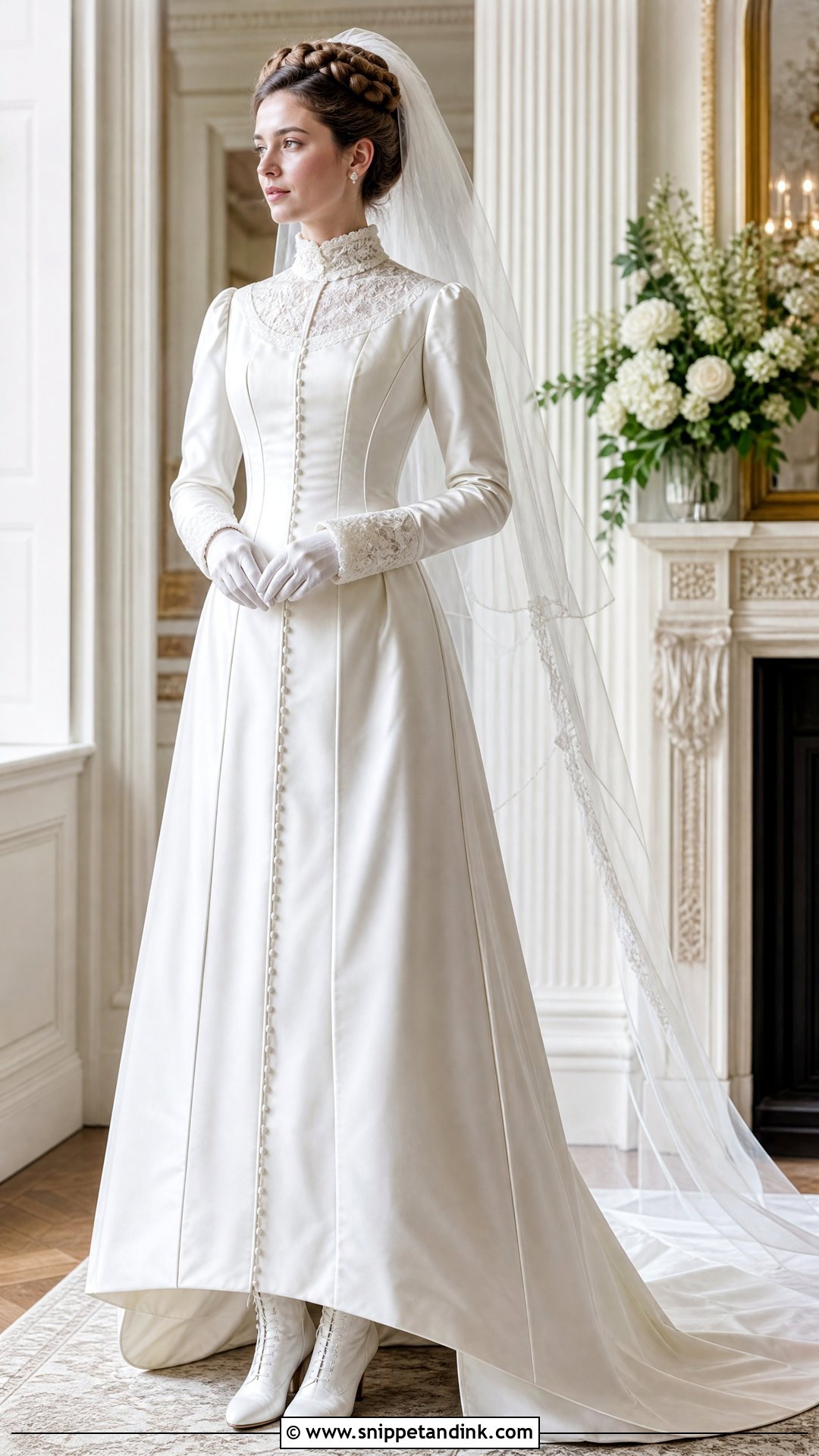
The princess line drops the waist seam altogether and shapes the gown with long vertical seams running from shoulder to hem. Ivory silk satin shows that construction well. A high lace neckline, fitted sleeves and a row of covered buttons keep it period, and the skirt flares gently below the hip into a narrow train. Lace-up boots, pearl studs, gloves and a chapel veil tucked under a braided updo finish the look. Princess and polonaise cuts were both tied to the slim line of the late 1870s. Because every seam shapes the body, this is the most fitting-sensitive dress on the list, and I plan at least three fittings so the panels lie flat rather than rippling at the hip.
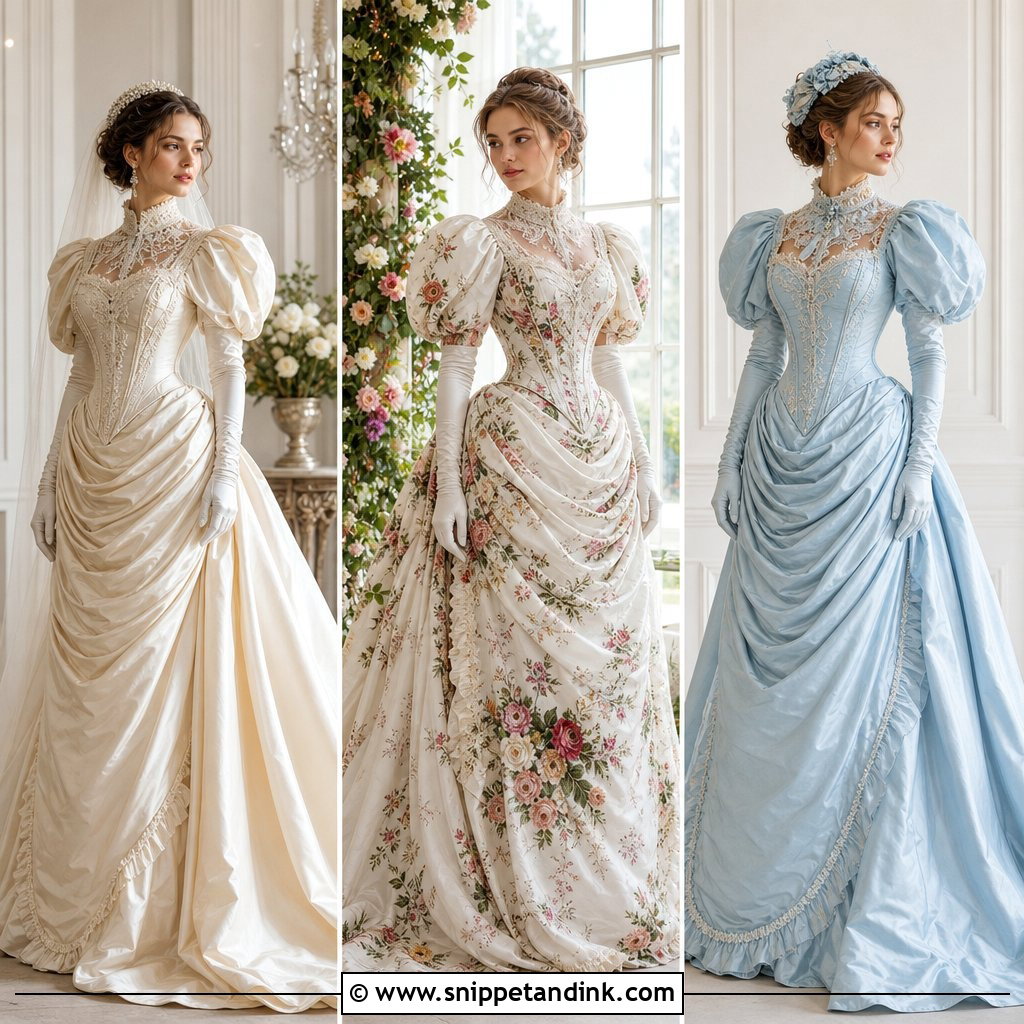
11. 1890s Victorian Wedding Dress With Leg Of Mutton Sleeves
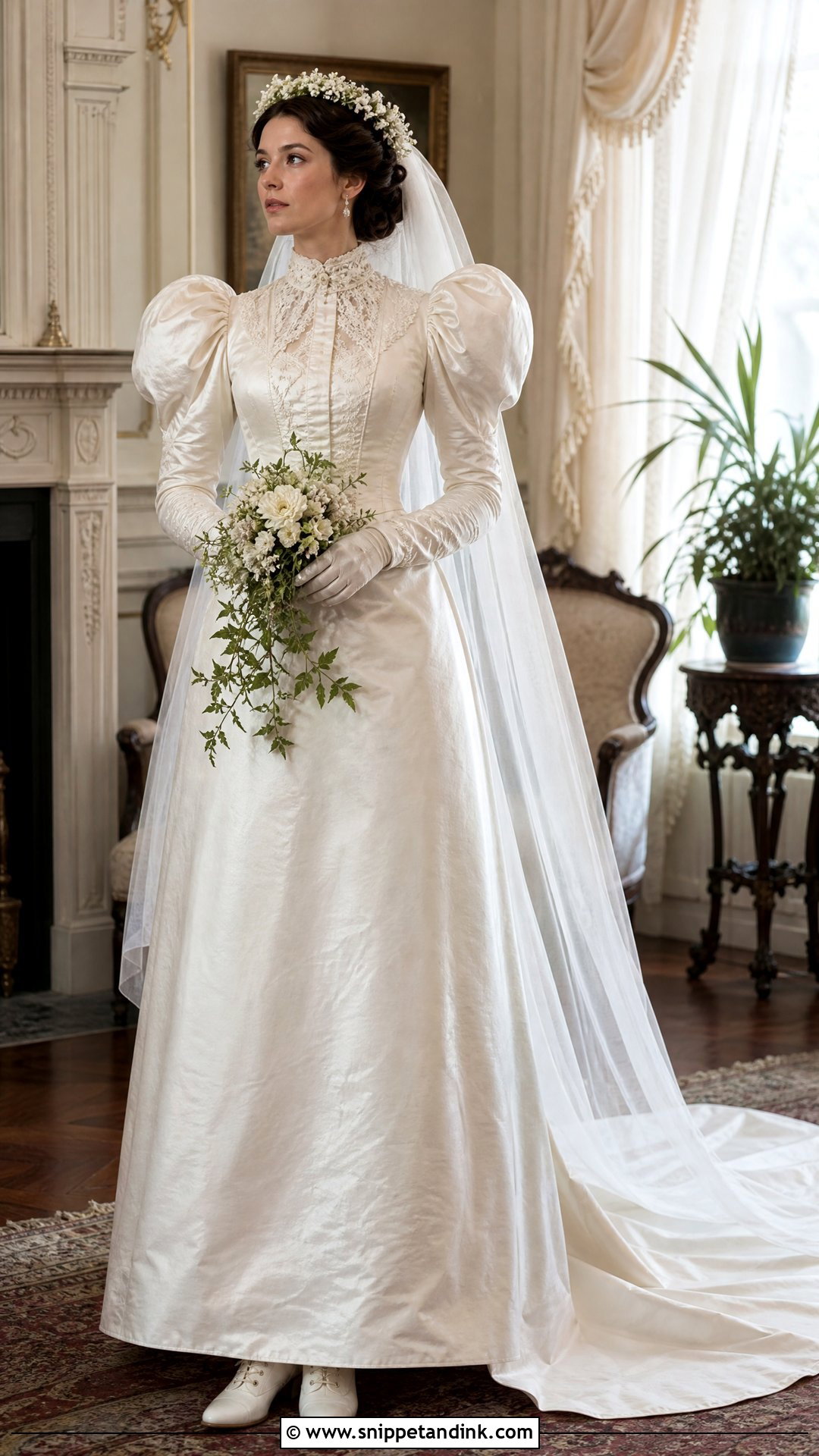
Nothing says 1890s faster than leg-of-mutton sleeves, huge at the shoulder and tapering tight from elbow to wrist. Pair them with an ivory satin bodice, a nipped-looking waist, a high neck and a straight, full-length skirt for the period’s hourglass. A detachable train makes the reception easier. Ivory button boots, a long veil, pearls, gloves and a neat floral wreath complete it, with the skirt left plain because the sleeves already dominate. In that decade the volume moved up from the skirt to the sleeve. A practical warning: those sleeve heads need inner support, often a stiff net lining, and in humid weather a weak lining collapses. I check them again on the morning of the wedding.
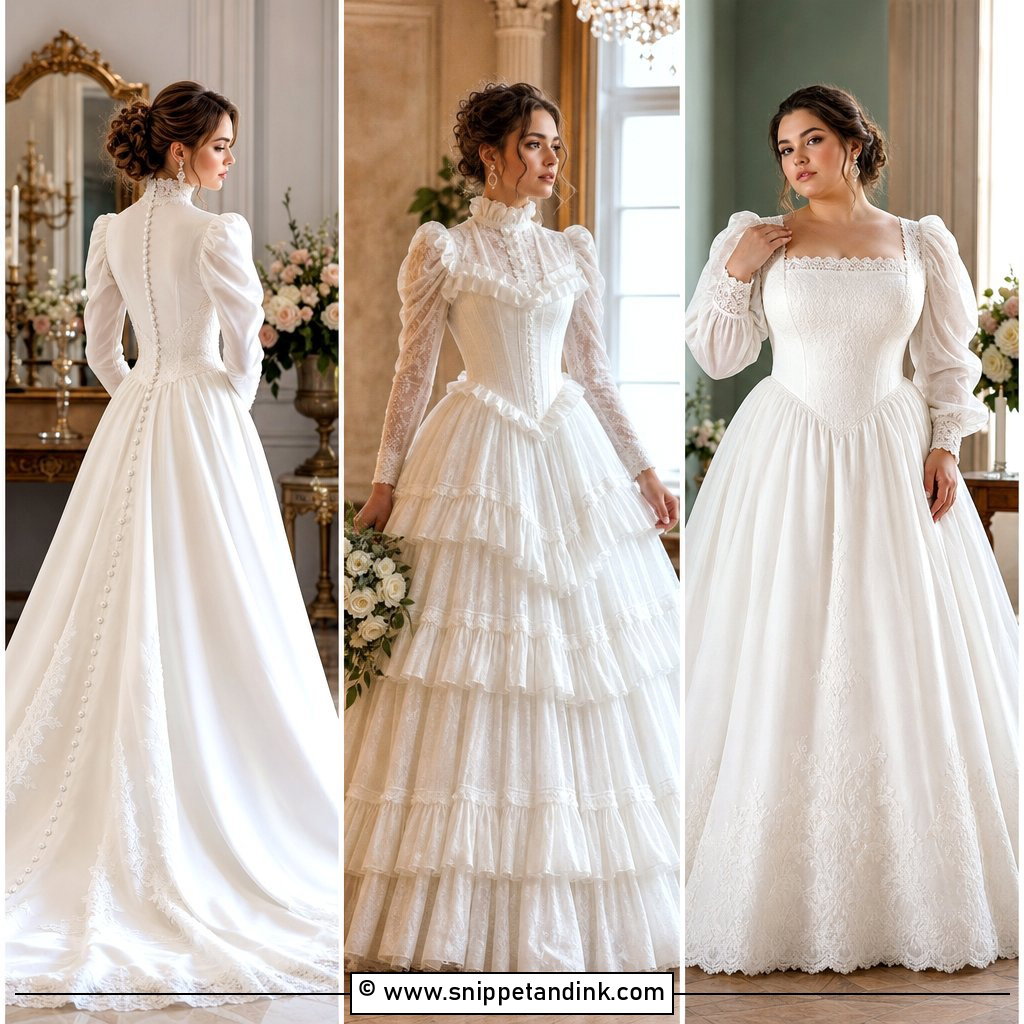
12. 1890s Victorian Wedding Dress With High Lace Collar
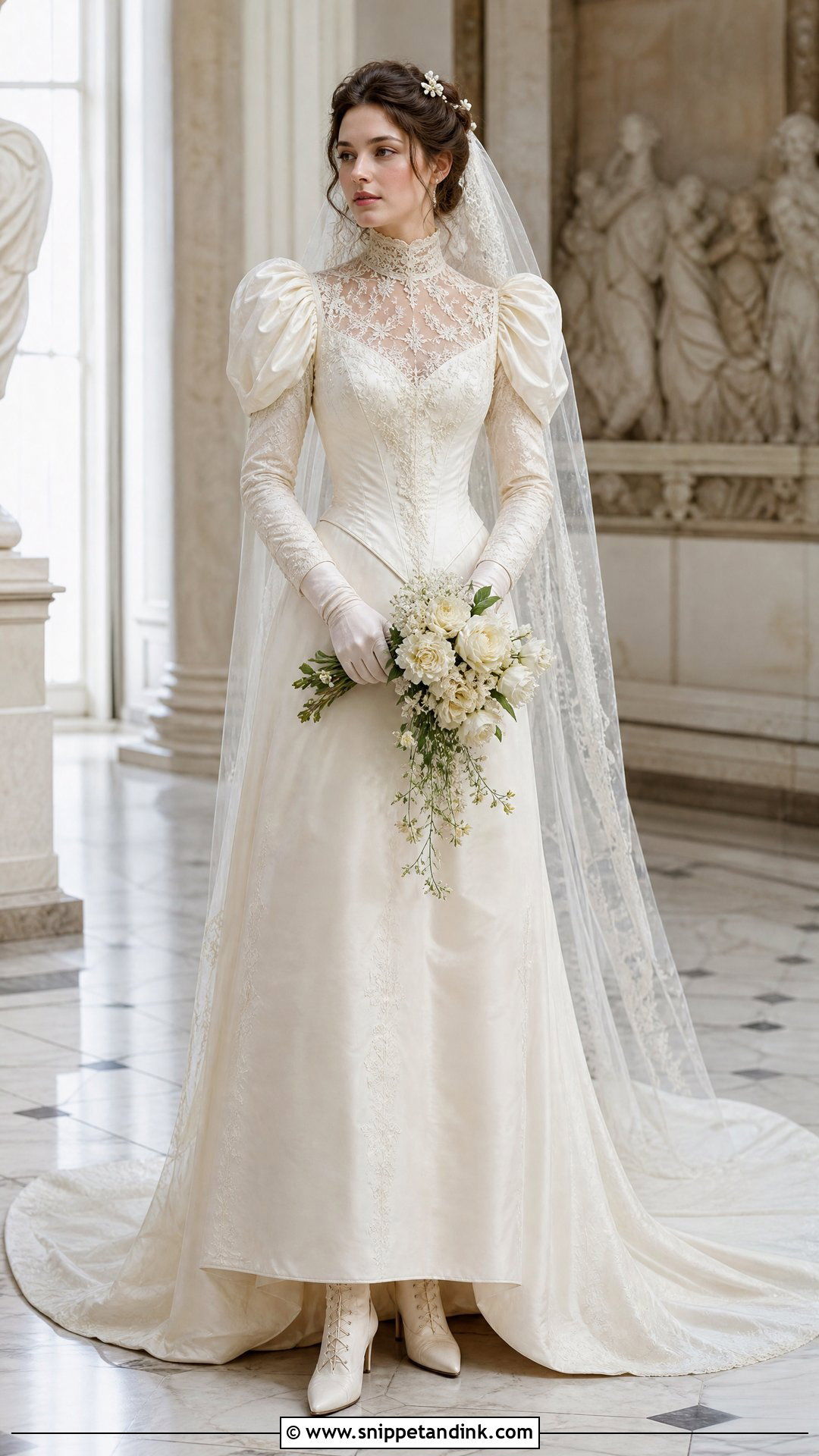
A sheer lace yoke rising into a close collar keeps 1890s structure from feeling heavy. The base is pale ivory silk with a fitted, pointed bodice and gently puffed shoulder caps; lace repeats at the wrists and down the front closure. The skirt is a smooth A-line with a train falling straight from the back waist. Slim button boots, pearl hairpins, fitted gloves and a full-length veil complete it, with white flowers held at the waist. High lace collars can scratch, so I have the dressmaker line the inside with a soft net or silk organza strip. Brides who want late-Victorian coverage but feel boxed in by solid silk necklines usually settle on this one.
13. Honiton Lace Victorian Wedding Dress
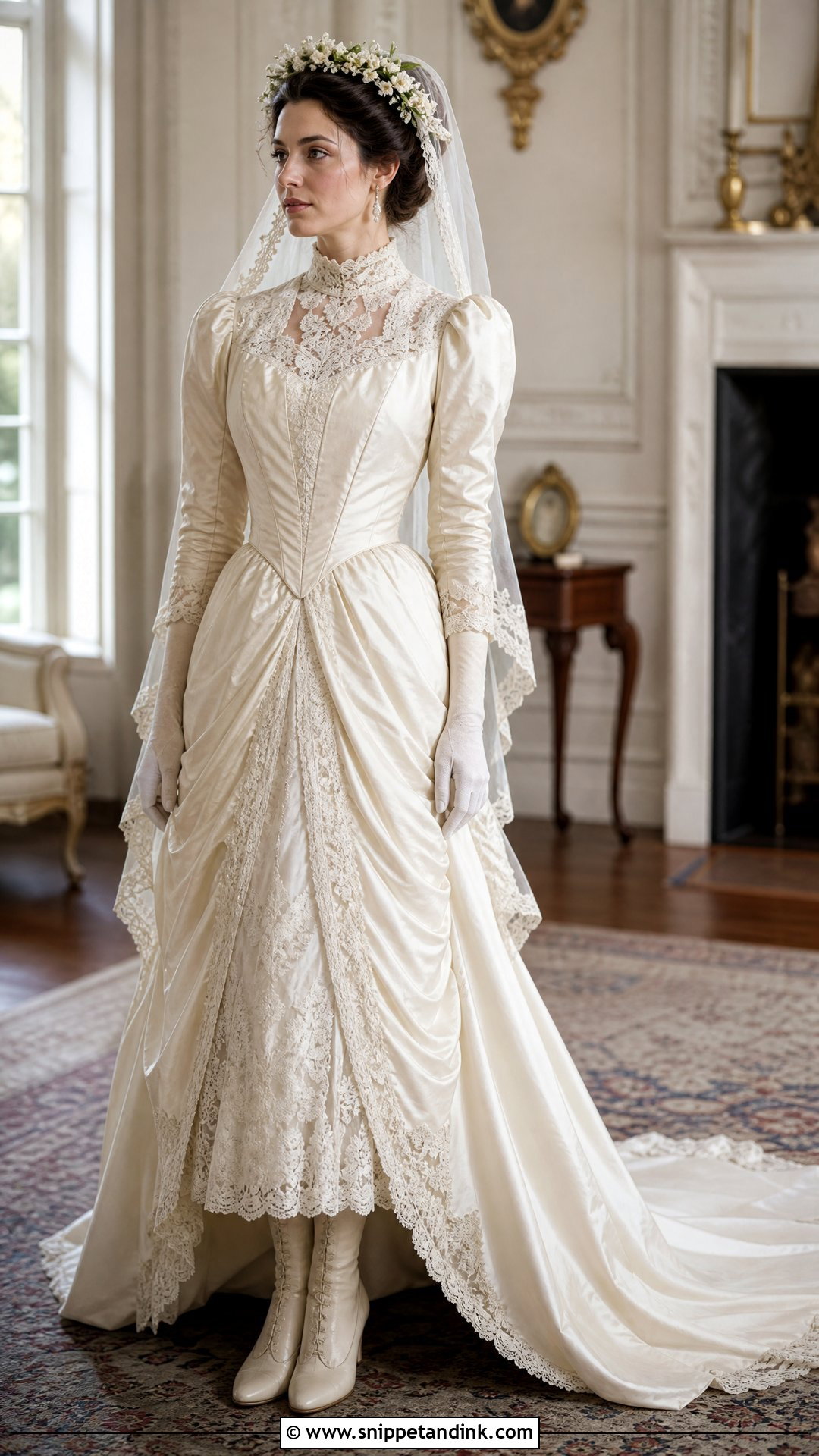
Honiton is the lace Queen Victoria chose for her own wedding, which brought the English lace makers a great deal of attention, and Honiton-style florals tie a gown straight to that story. Use cream silk satin with a pointed bodice, softly gathered skirt and a moderate train. Apply the lace at the neckline, sleeve edges, a front skirt panel and the veil border, and keep the cut simple so the motifs are readable. Ivory slippers or button boots, pearl earrings, gloves and an orange blossom wreath under the veil finish it. Genuine antique Honiton is fragile and expensive, so I usually source vintage pieces or a well-made modern lace in a similar pattern. Ask your seamstress to hand-stitch lace appliqués; machine stitching flattens the raised edges.
14. Victorian Wedding Dress With Orange Blossom Wreath
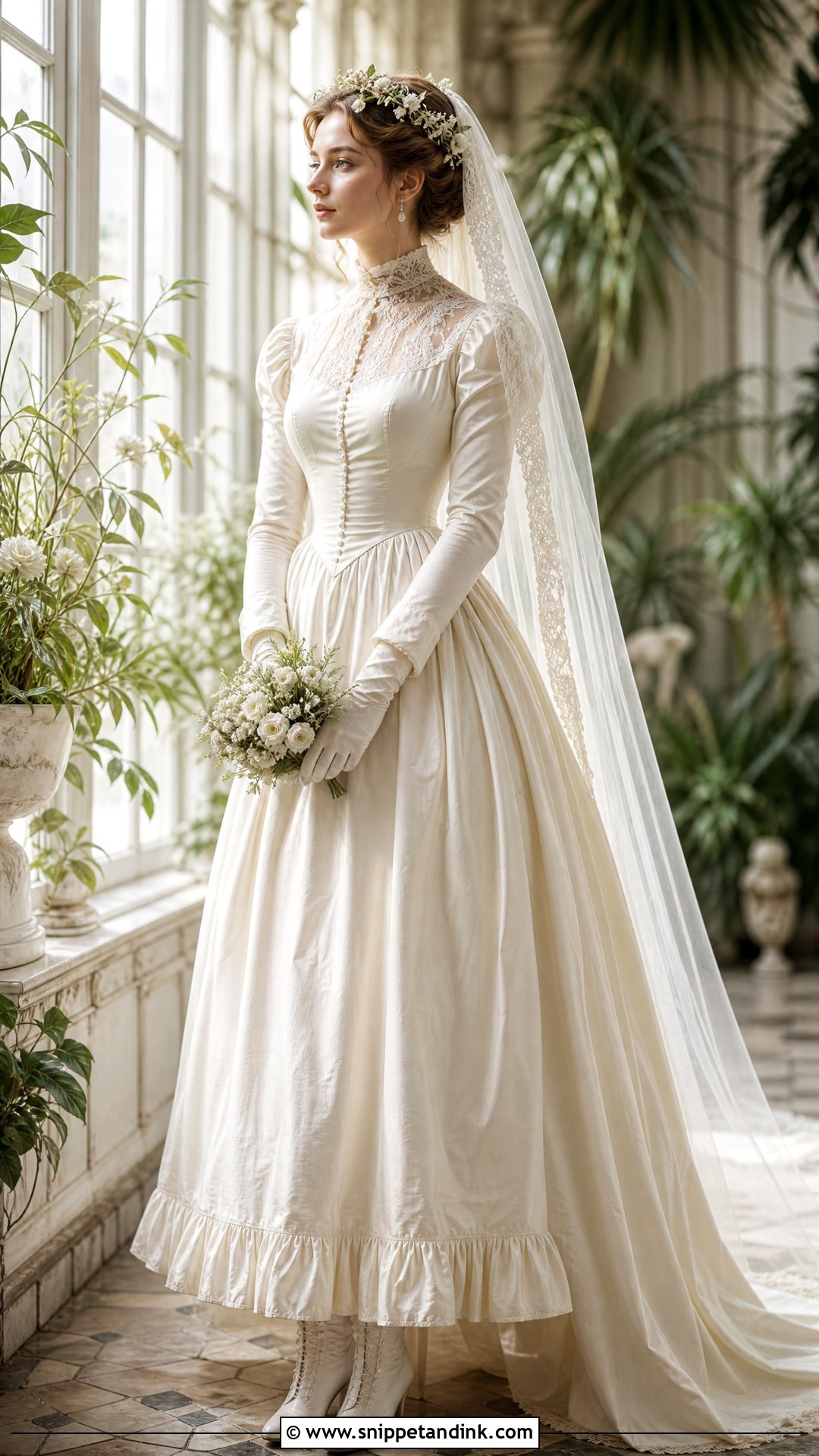
An orange blossom wreath was the classic Victorian bridal flower, worn for its link to fertility and purity. I set it around a center-parted updo, with a long lace veil secured behind it. The gown underneath is ivory silk with a fitted bodice, lace-trimmed neckline, long sleeves and a softly rounded skirt, plus a modest train. A small bouquet of white blossoms and greenery, pearl earrings, gloves and ivory button boots complete the look. Fresh orange blossom is hard to get and wilts within hours, so good silk or wax-style flowers are the realistic choice; wax blossoms were used in the period too. Pin the wreath to a firm base in the updo, not to loose hair, or it tilts by the speeches.
15. Victorian Wedding Dress With Bridal Bonnet
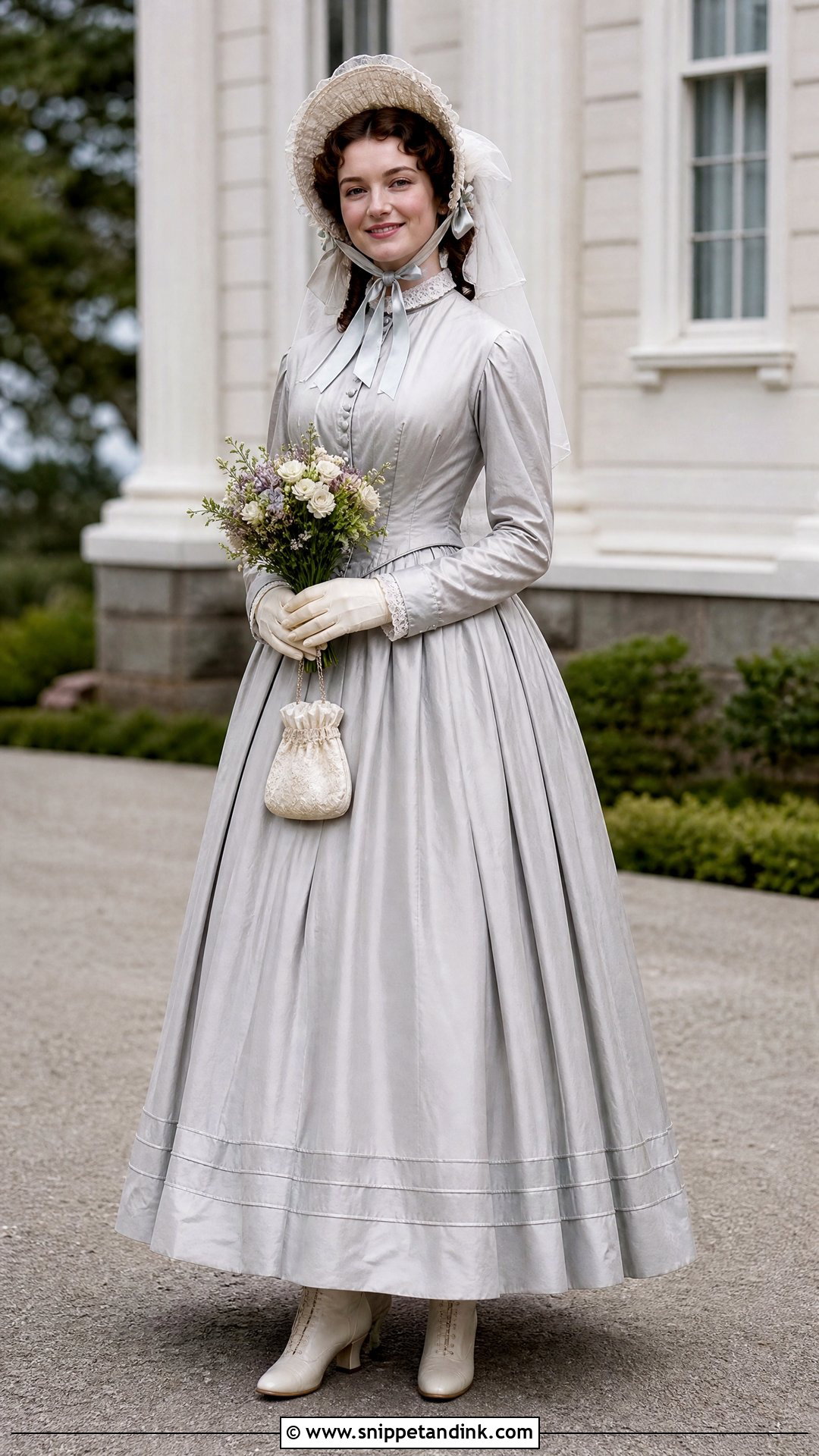
Not every 19th-century bride wore a veil. Veils cost money, and many brides chose a bonnet they could wear again, which makes this one of the most honest period looks for a small daytime wedding. Choose dove gray, pale blue or soft cream silk with a fitted bodice, long sleeves and a full skirt that clears the ankle. A matching bonnet trimmed with ivory ribbon, lace and small fabric flowers frames the face, with a short veil falling at the back if you like. Gloves, a tiny bag, low button boots and a compact bouquet finish it. Bonnet brims cast shadows, so I angle it back slightly from the hairline and ask the photographer for a few frames looking up into the light.
16. Colored Silk Victorian Wedding Dress
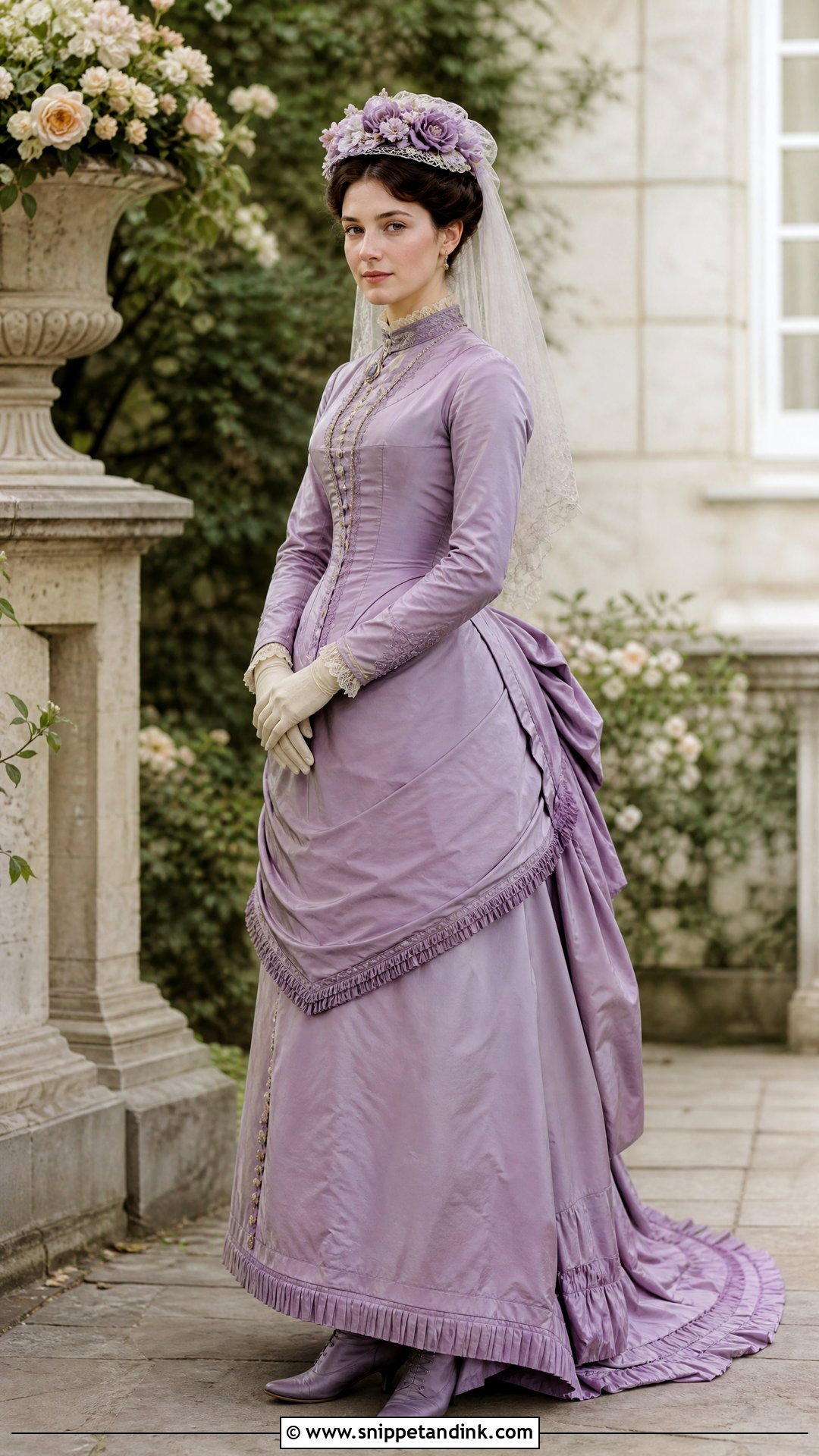
Colored silk is the historical truth that most modern Victorian themes leave out. Many brides married in a good dress in a fashionable shade, then altered and wore it for years. Lavender, soft brown, dusty blue and muted sage are all believable. I’d cut it as an 1870s fitted bodice with long sleeves, a high neck and a gently draped overskirt, adding a small bustle and train for formality. Matching button boots, cream gloves, a floral bonnet or short veil and a small pendant complete it. Ivory lace trim gives the bridal contrast. Before ordering, hold the fabric against your face in daylight. Muted colors read very differently on different skin tones, and sage in particular can drain fair skin.
17. Velvet Victorian Winter Wedding Dress
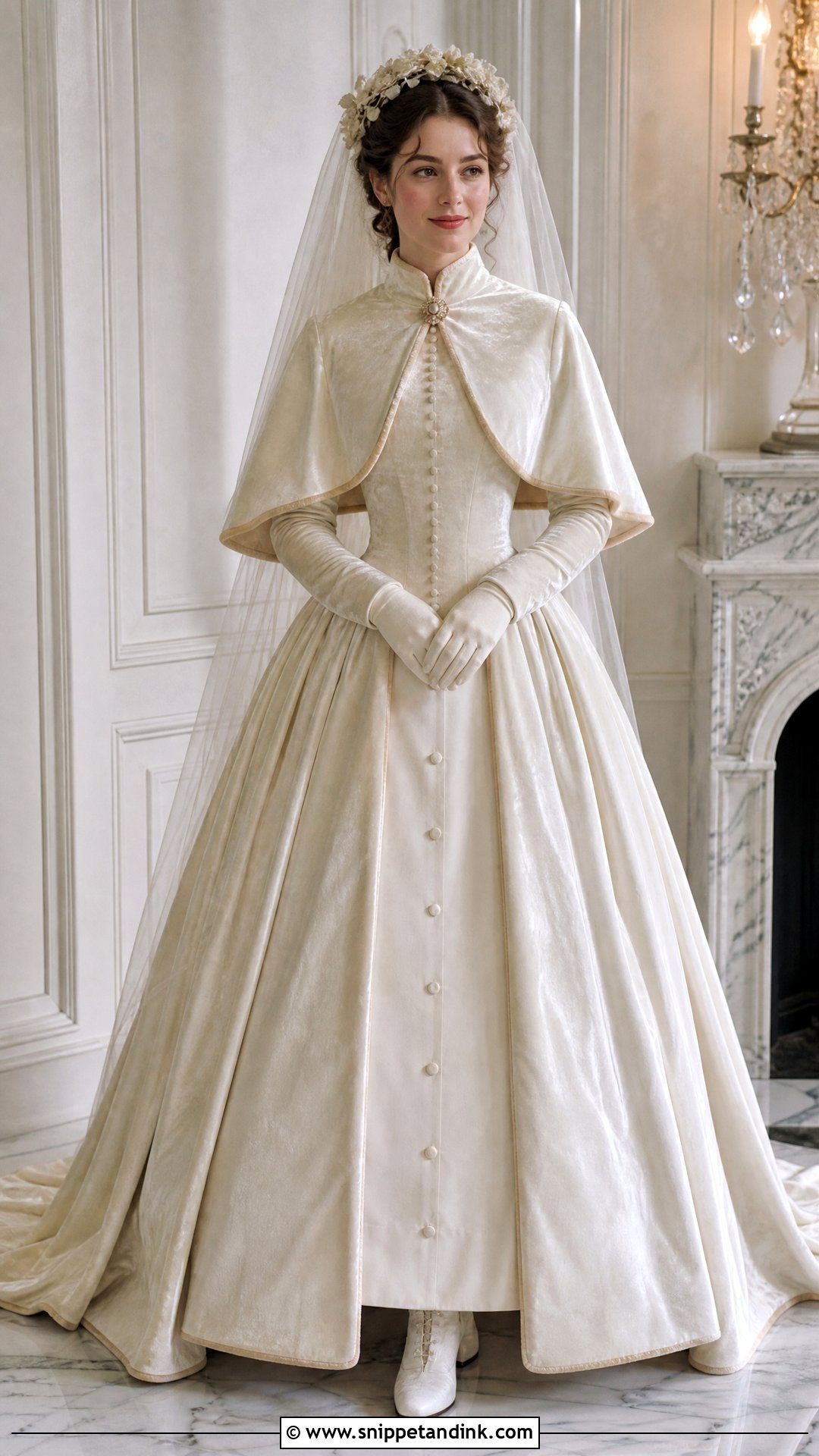
Winter is the one time I happily put a bride in velvet. Ivory silk velvet works for a fitted bodice with a high collar and long tapered sleeves, while a full satin skirt stops the whole dress from becoming a weight to carry. Velvet cuffs, covered buttons and a detachable train link the two fabrics. Closed button boots, lined gloves, a pearl brooch and a long veil anchored under a velvet-trimmed floral wreath complete the outfit, with a short matching cape for outdoor photos. Velvet crushes where it’s pressed and can’t be ironed flat, so it should be hung, steamed from the reverse side, and never folded into a car. Stick to bright ivory, silver-gray or pale champagne so the pile shows in photographs.
18. Organdy Victorian Garden Wedding Dress
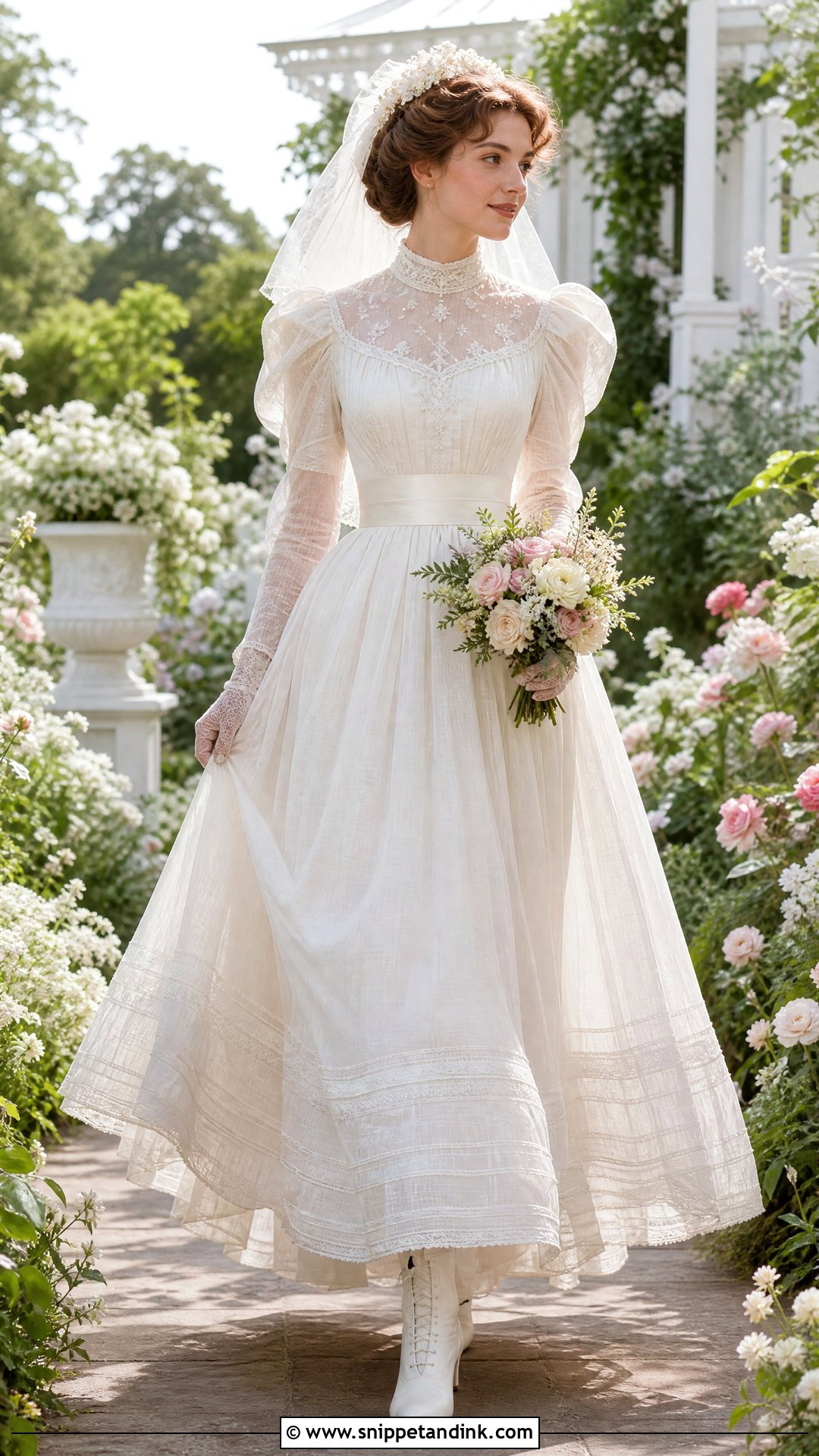
White organdy is my warm-weather pick: crisp, light and very late Victorian. Choose an 1890s gown with a fitted lined bodice, gently puffed sleeves and a full skirt in soft gathers. Embroidered net or lace can edge the rounded neckline and sleeve openings, and a wide satin ribbon tied in a firm bow at the back defines the waist. White ankle boots, delicate gloves, a short veil and a garden bouquet complete it. The outer fabric is sheer, so it must be fully lined. Organdy creases sharply and holds those creases, which I mention to every bride who plans to sit on grass for photos; a lightweight underlayer of tulle helps the skirt spring back. It keeps the period sleeves and waist while feeling far lighter than satin or velvet.
19. Brocade Victorian Wedding Dress With Pointed Bodice
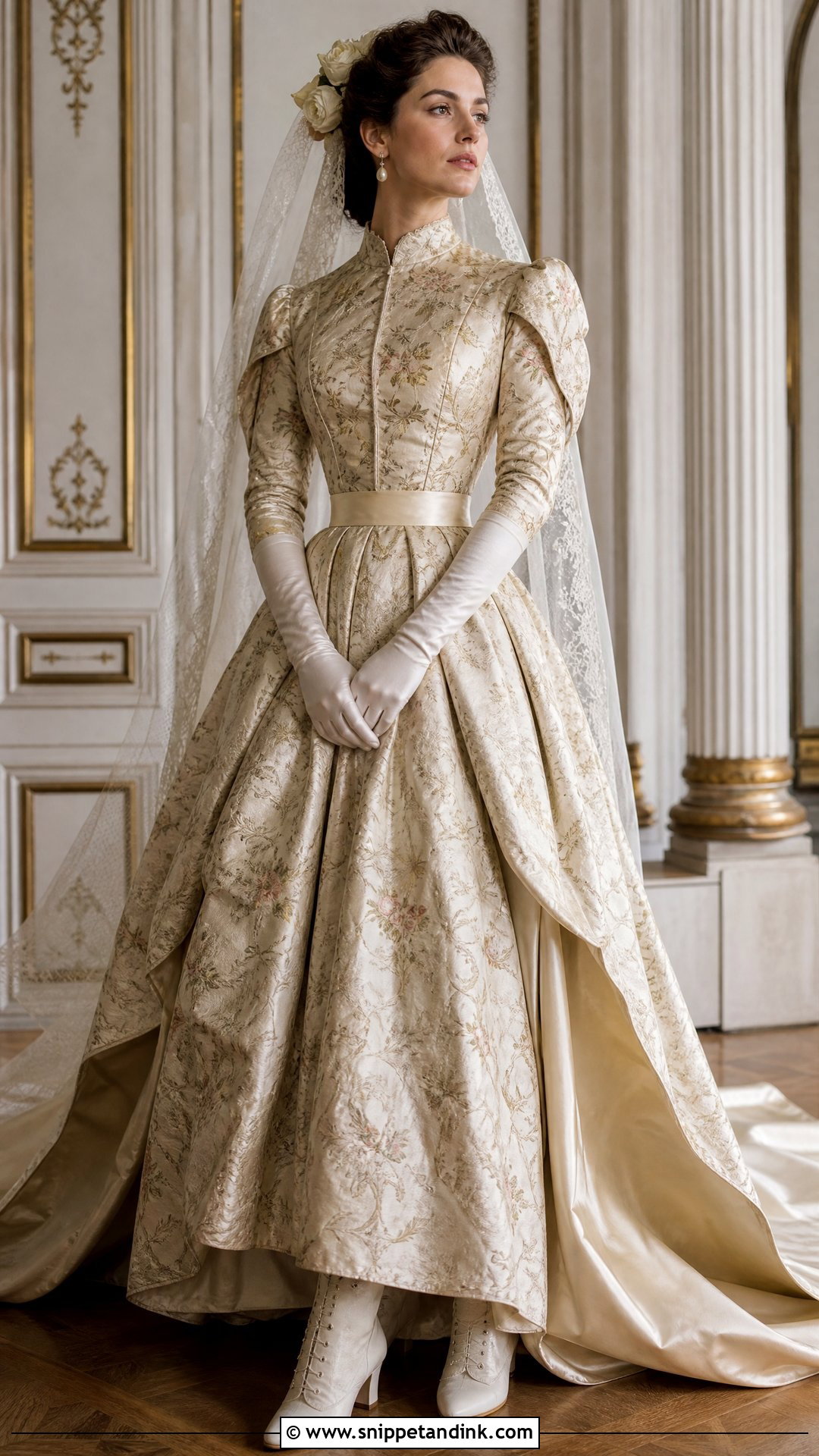
Brocade does the decorating for you, so the trim can stay minimal. Choose cream silk brocade woven with understated florals and cut it into a fitted bodice with a long pointed front, a close neckline and structured sleeves. A matching full skirt and a plain satin train keep the pattern from covering the whole silhouette. Pearl earrings, wrist gloves, ivory boots and a lace veil fixed with a small floral comb finish it, with a narrow satin sash at the waist if you like. White-and-silver brocades appeared in grand royal bridal gowns late in the century. Large brocade repeats have to be matched at the seams, and I always ask to see how the motif lands across the center front before the fabric is cut.
20. Medieval Revival Victorian Wedding Dress
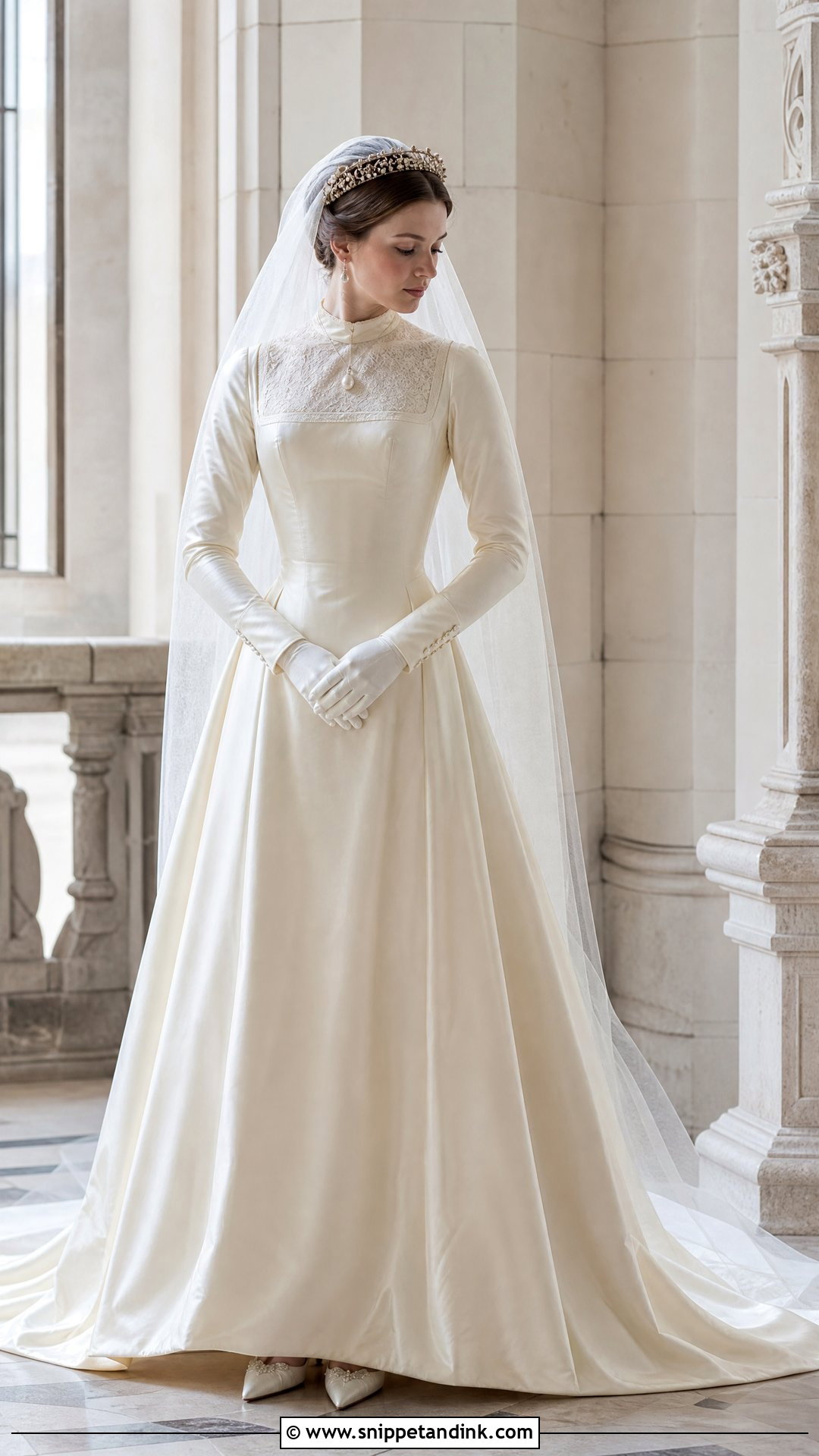
By the end of the century, dressmakers looked back to earlier history for ideas, which makes a medieval revival gown a fitting last option. I’d choose ivory silk in a long princess line with a high neckline, pointed cuffs and narrow sleeves. A square lace yoke or a modest embroidered panel gives it structure, and the skirt falls smoothly from the hip into a flowing court train. Flat pointed shoes, a pearl pendant, fitted gloves and a long veil under a small jeweled circlet finish the look. Leave out theatrical corset lacing and fantasy trim; the dress should read bridal, not costume. Clean seams and good silk carry it. Brides with a long torso and a love of quiet detail tend to wear this one best.
Stairs, Chairs and Bathroom Trips in a Period Skirt
Period silhouettes are built for standing and walking slowly, and a wedding asks you to do much more. I rehearse these moments at the final fitting so nothing surprises you on the day.
- Hoops and crinolines: lift the back edge slightly as you sit so the frame tips up at the front rather than flying up at the face. A flexible bridal hoop collapses enough for a car seat; a rigid one may not, so measure the car.
- Bustles: sit forward on the edge of the chair. Leaning back flattens the pad and crushes the draping.
- Trains: ask for a hidden loop or buttons so the train can be hitched for the reception, and teach two people how to do it.
- Stairs: hold the skirt at the front, not the side, and go down one step at a time with the train gathered over your arm.
- Bathroom: a bridesmaid holds the skirt up from behind while you face the wall, and a hoop can often be unhooked at the waist to make this easier.
Wear your boots or slippers around the house for a week before the wedding. Victorian-style footwear often has a narrow toe, and new leather is where most brides start limping by the speeches.
One Decade, One Silhouette, Then Everything Else
Across one reign, bridal dress swung from rounded skirts and open necklines with fine lace, through crinolines and modest long sleeves, to bustles, princess seams, high collars and enormous sleeves. White satin gives the most recognizable bridal effect, yet lavender, blue and gray are just as historical. My advice for a wearable version is to commit to one accurate silhouette and let your shoes, gloves, jewelry, flowers and headwear follow it. Lighter understructures and sensible fabric choices mean you can carry the period romance through a whole ceremony and reception without counting the hours until you can sit down.
You'll Like These Ideas:


Leave a Reply