
Blue, white and gold is a palette I can work with in any season, because each colour has a clear job. Blue gives the cake depth, white keeps it reading as a wedding cake, and gold catches the light once the room lamps go on. The shade of blue sets the mood far more than the design does: navy with gold leaf reads as evening and formal, powder blue with piped lace feels vintage, and a loose watercolour wash leans garden party. The palette also sits happily on buttercream, fondant, sugar flowers, pearls and painted work, so you are rarely boxed in by texture. Below are twenty ways I would build it, with notes on what each one asks of the baker and of you.
Why Blue Buttercream Turns Teal, and How a Baker Stops It
Blue is the colour I get the most worried messages about, and the reason is chemistry, not skill. Classic buttercream made with butter is pale yellow, and yellow plus blue makes green. So a cake that was meant to be powder blue can come out faintly teal, then look greener still under the warm bulbs most reception rooms use.
Here is what I do, and what you can ask your baker about:
- Whiten the base first. A tiny touch of violet gel cancels the yellow in butter before any blue goes in.
- Use a whiter frosting for pale shades. Swiss meringue buttercream whipped long, or a recipe with part shortening, starts closer to white.
- Put dark blues on fondant. Navy and royal blue need so much colour in buttercream that it can taste bitter and stain teeth.
- Let the colour develop. Gel colours deepen over a few hours, so I mix slightly lighter than the target and check it the next morning.
- Judge it under the right light. Ask to see a sample in warm light as well as daylight, since that is how most guests will see it.
If blue must match a fabric exactly, fondant or a sugar paste panel is the more reliable route. Buttercream will always be a close cousin of the swatch rather than a twin.
1. Blue White And Gold Wedding Cake
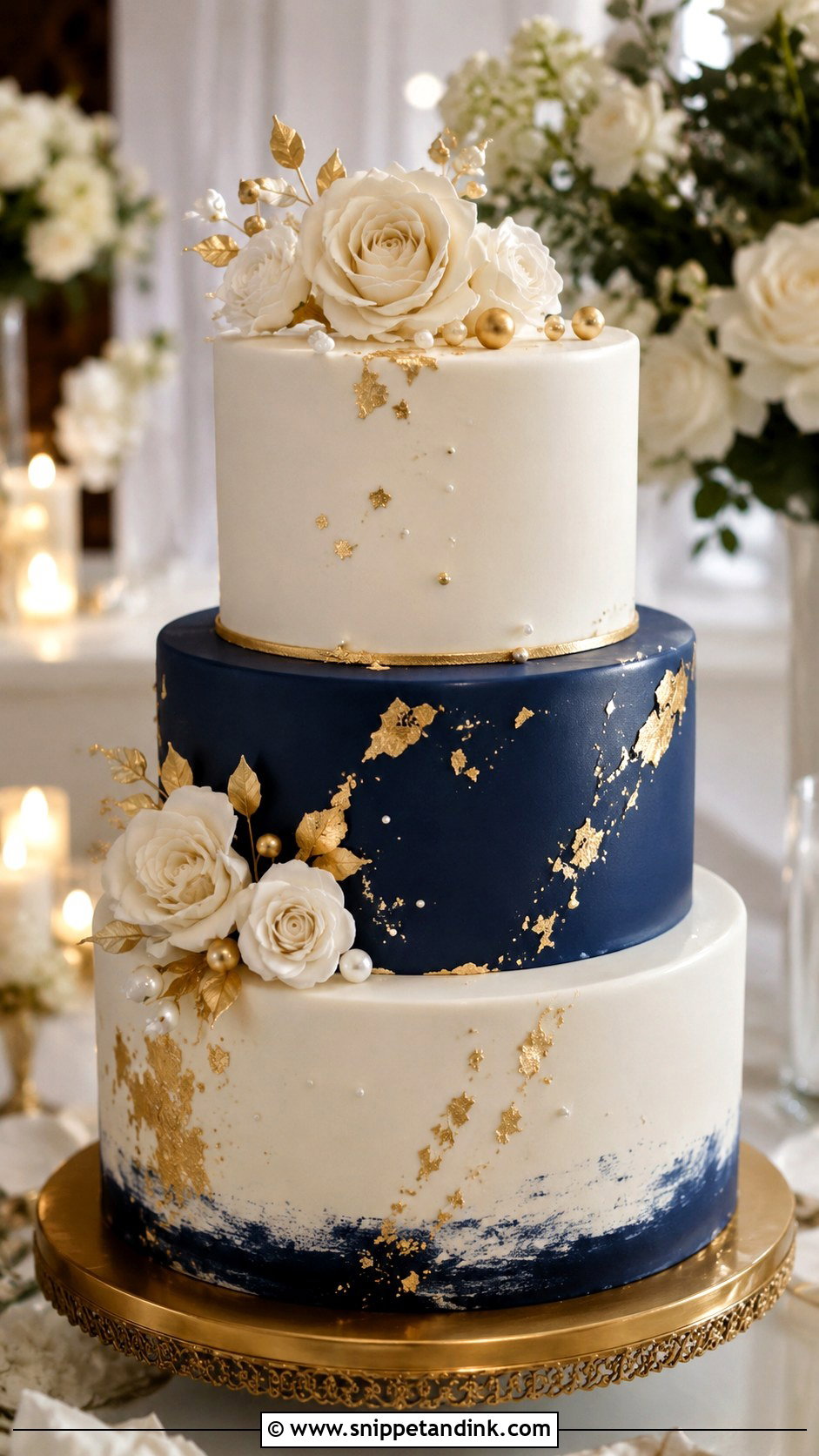
The safest version starts white and lets blue and gold arrive in measured doses. I usually keep the base tiers white, give one tier the colour, and run gold only along edges or in leaf so the eye travels instead of stalling. Navy belongs to evening receptions; dusty blue is gentler and suits spring or a garden. The mistake I see in reference photos is every detail crowded onto one tier. Spread them out, and a few white sugar roses with small gold pearls will finish it.
2. Navy Blue White And Gold Wedding Cake
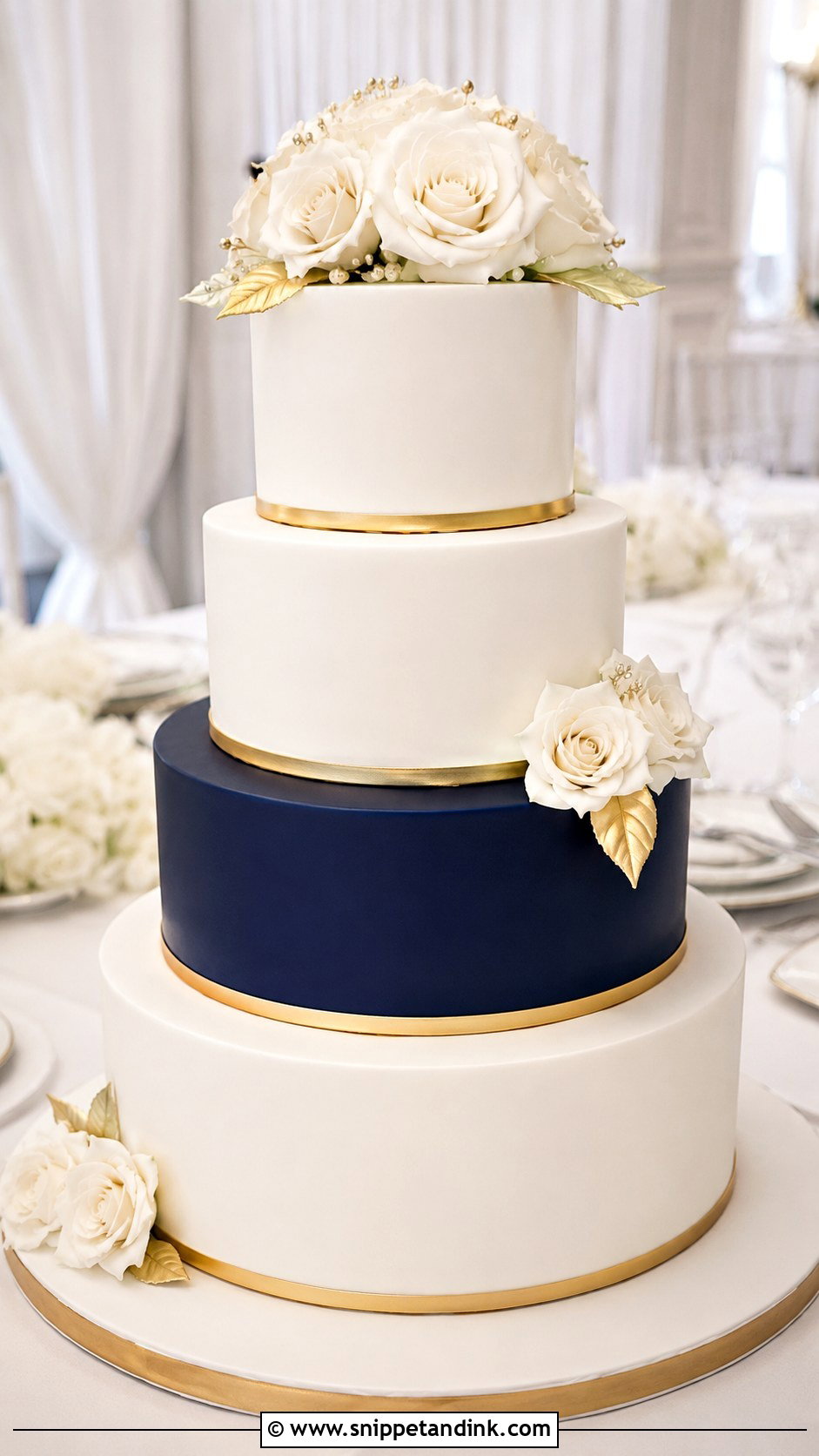
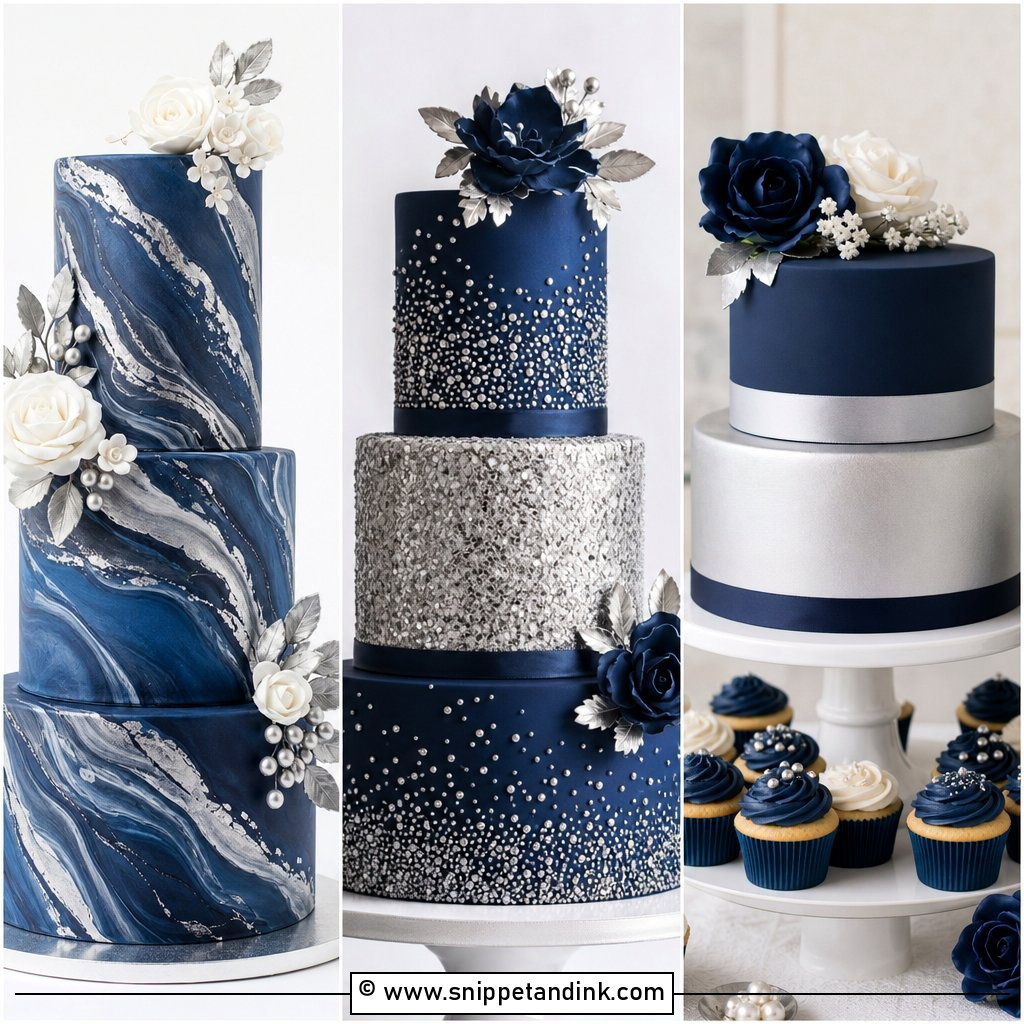
Navy is the shade I am most careful with, because getting a true dark blue into buttercream takes so much gel colour that it can taste bitter and stain lips. That is why most navy tiers you see are fondant, often with only one dark tier against bright white ones. A brushed gold band or leaf on the navy edge ties the tiers together. White roses, orchids or hydrangeas soften the contrast. Inside, I’d keep it light: vanilla almond or lemon with a berry filling suits a crowd who has just eaten dinner. Ballrooms and rooftop evenings are where this cake makes sense.
3. Dusty Blue White And Gold Wedding Cake
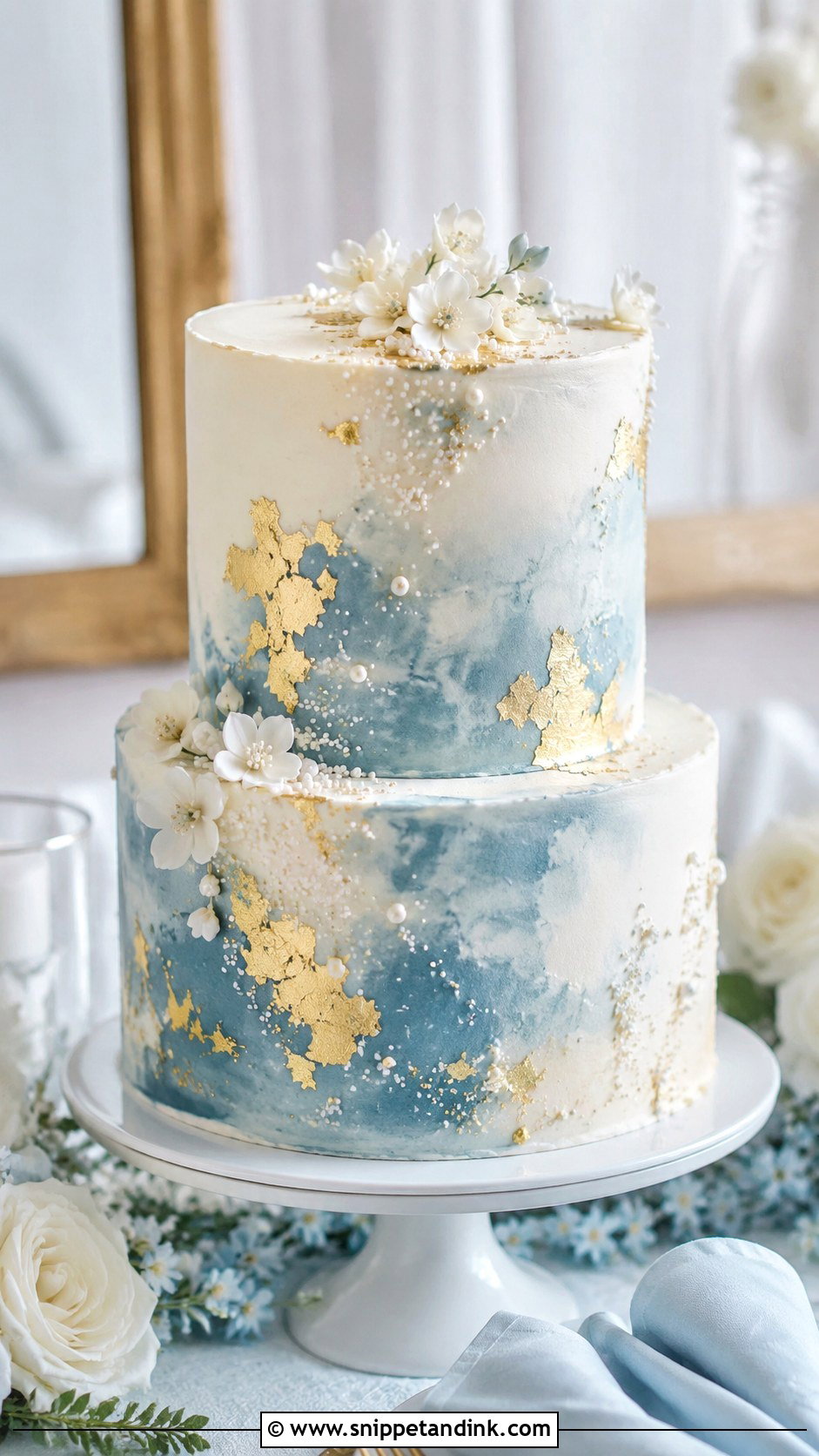
Dusty blue is the forgiving shade. It has grey in it, so it does not shout, and it sits well next to linen, sage and blush in a room. My usual layout is white buttercream with one dusty blue middle tier, a little gold leaf and small white sugar flowers. If you want texture, ask for fine vertical combing or smooth fondant panels rather than heavy piping. The one thing to check: dusty blue can drift grey under cool daylight, so look at a sample tier in the light of your venue if you can.
4. Royal Blue White And Gold Wedding Cake
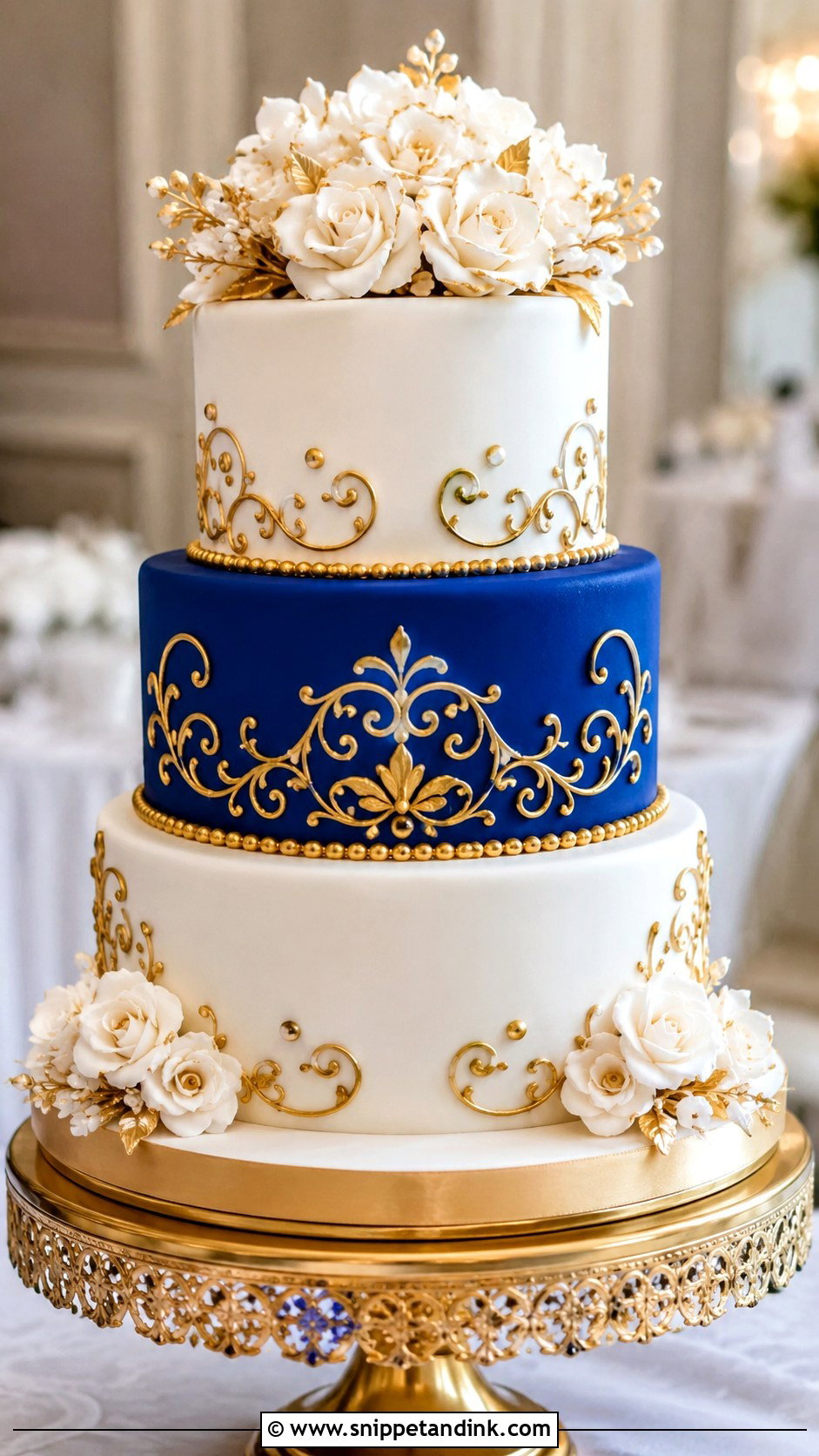
Royal blue is loud, so I keep everything around it disciplined. One saturated tier, white above and below, and a gold trim to frame it is usually enough. Crisp white fondant suits this shade because buttercream softens the edge between colours. Gold scrollwork or edible pearls can sit on the white tiers. For flowers, I’d stay with white roses or anemones; mixed colours next to royal blue start to look like a party cake rather than a wedding one.
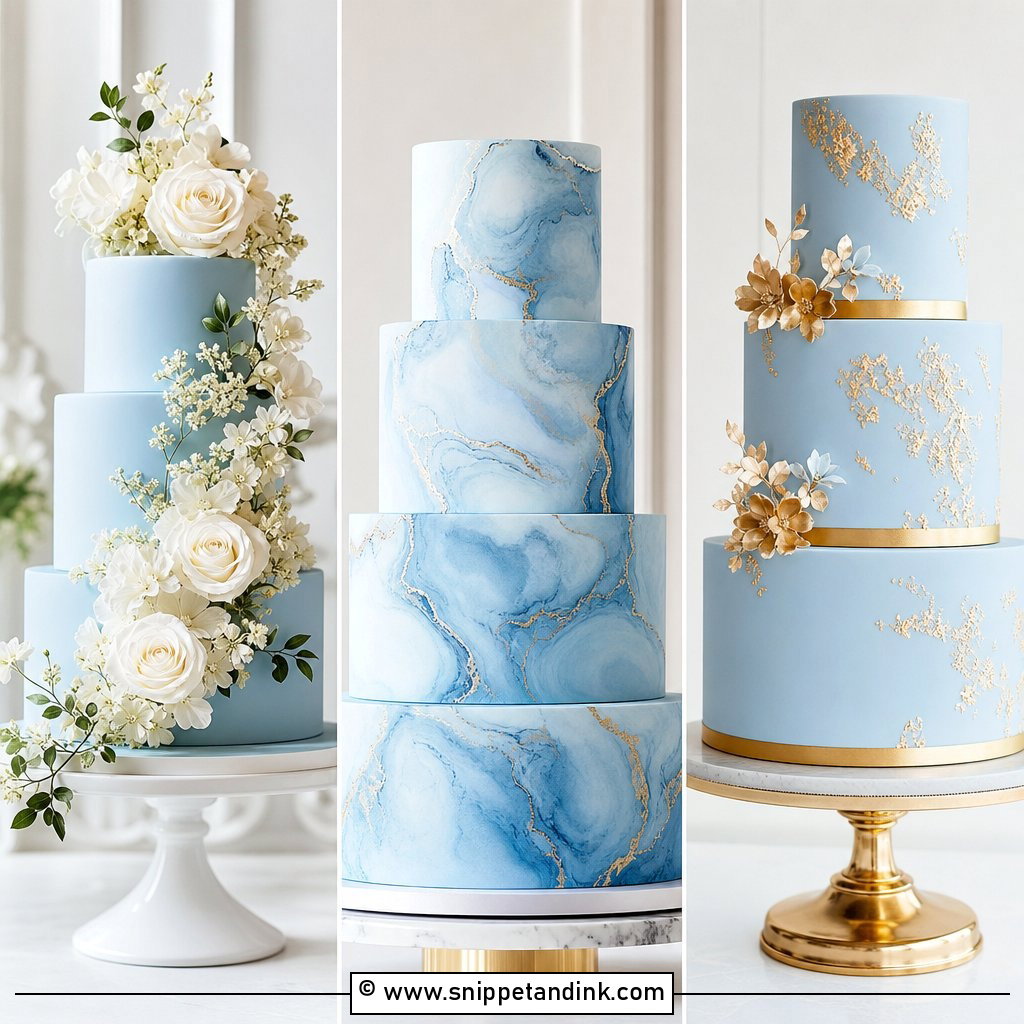
5. Blue And White Marble Wedding Cake With Gold
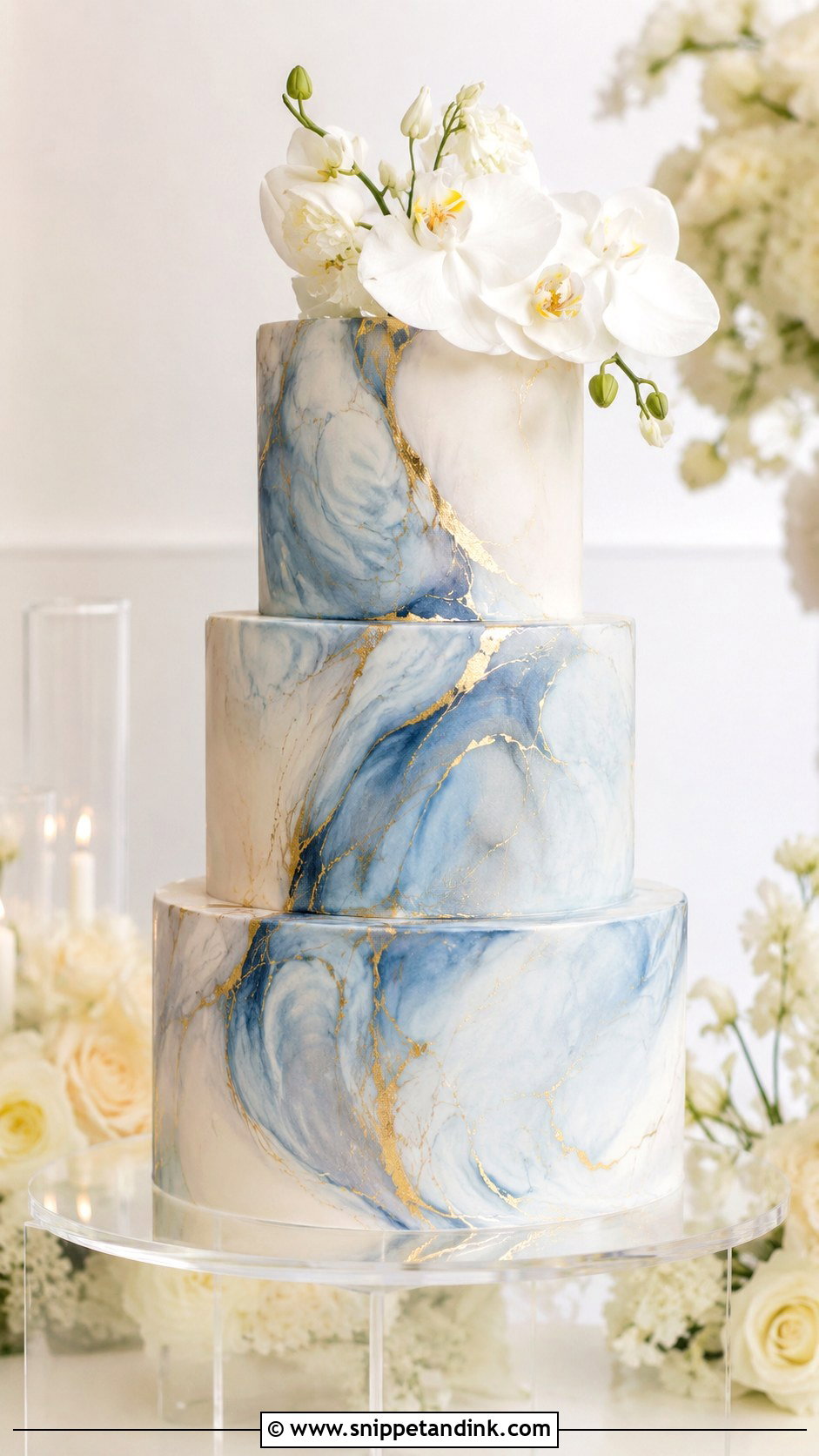
Marbling is one of the few techniques where no two tiers come out the same, which is part of the appeal. I roll blue and white fondant together and stop folding early, because overworked marble turns into an even pale blue. Pale blue gives a cloudy, soft stone; navy gives sharp veins. Thin gold lines painted along a few of the veins make it read as polished stone rather than a craft project. I’d marble one tier only and keep the others plain, and an acrylic stand suits the modern look.
6. Blue Ombre Wedding Cake With Gold
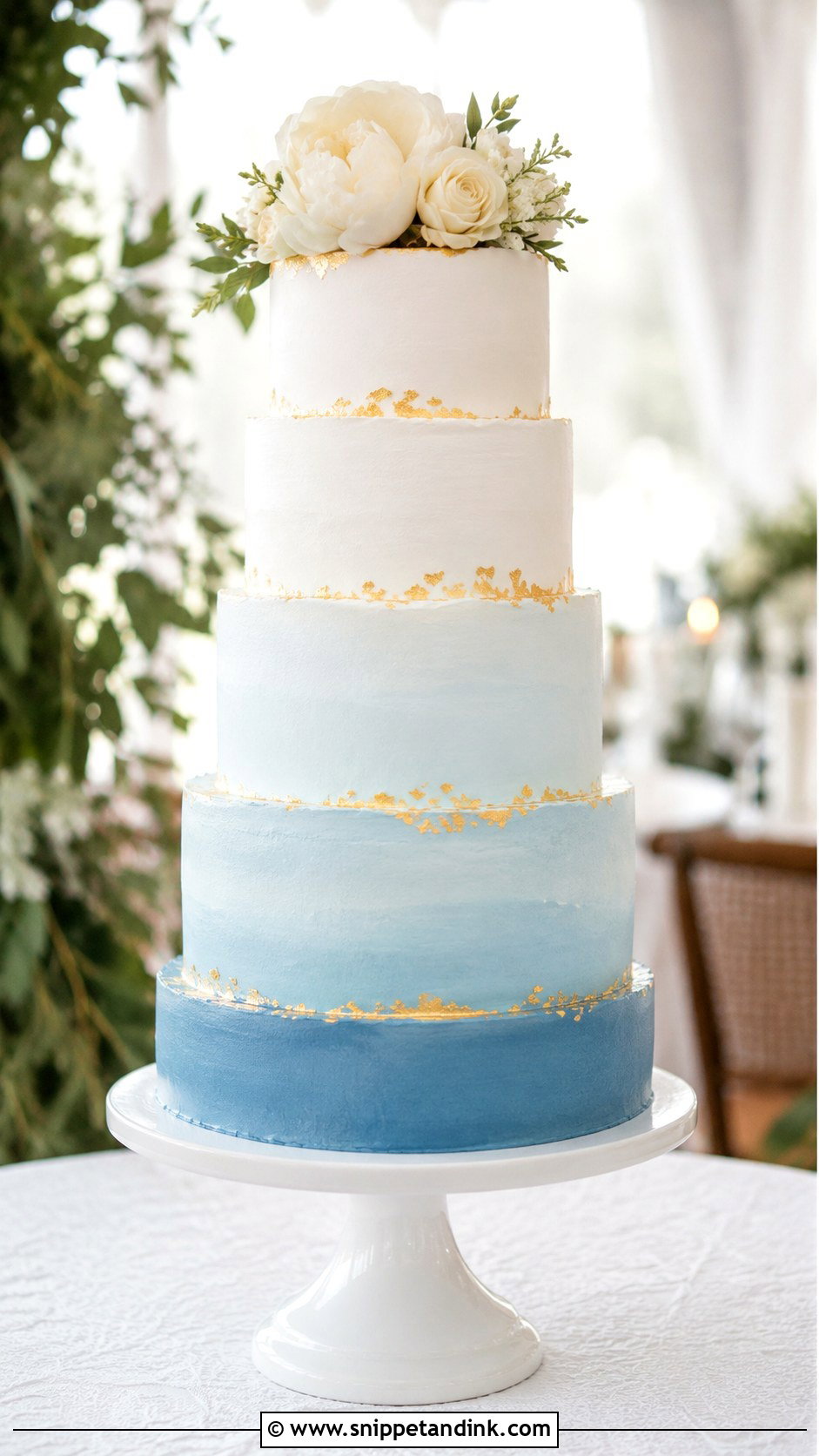
Ombre runs from white at the top through pale and dusty blue to the deepest shade at the base, so the heaviest colour sits lowest and the cake looks grounded. I prefer to do it in buttercream, where a palette knife can blur the step between tiers. Mixing each shade from one batch, rather than separate batches, is what keeps the gradient smooth instead of patchy. A touch of gold leaf or a slim gold topper adds shine without interrupting the fade. It adapts to two tiers or five, and it reads well at beach and spring receptions.
7. White Wedding Cake With Blue Flowers And Gold
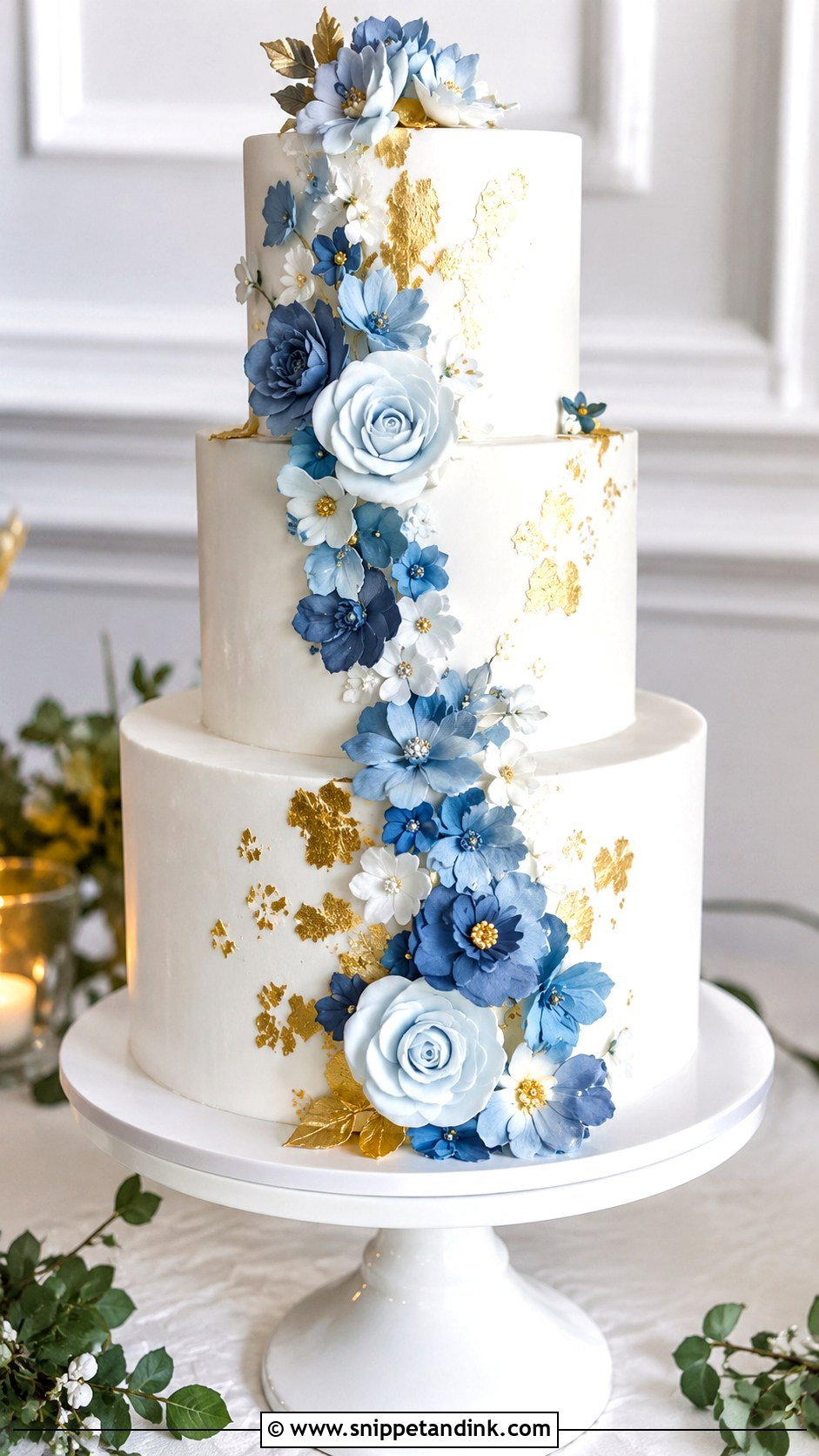
This is the cake I suggest to couples who want colour but are nervous about committing a whole tier to blue. The base stays white and the flowers do the work. Those flowers can be sugar blooms, edible pressed petals, or fresh stems your baker has approved; many popular blue flowers, delphinium among them, are toxic, so fresh ones must be food-safe or kept off the icing with a barrier. A thin gold band or scattered gold pearls finishes it. A cascade reads dramatic, scattered clusters read softer, and either suits a barn as well as a ballroom.
8. Blue Wedding Cake With White Roses And Gold
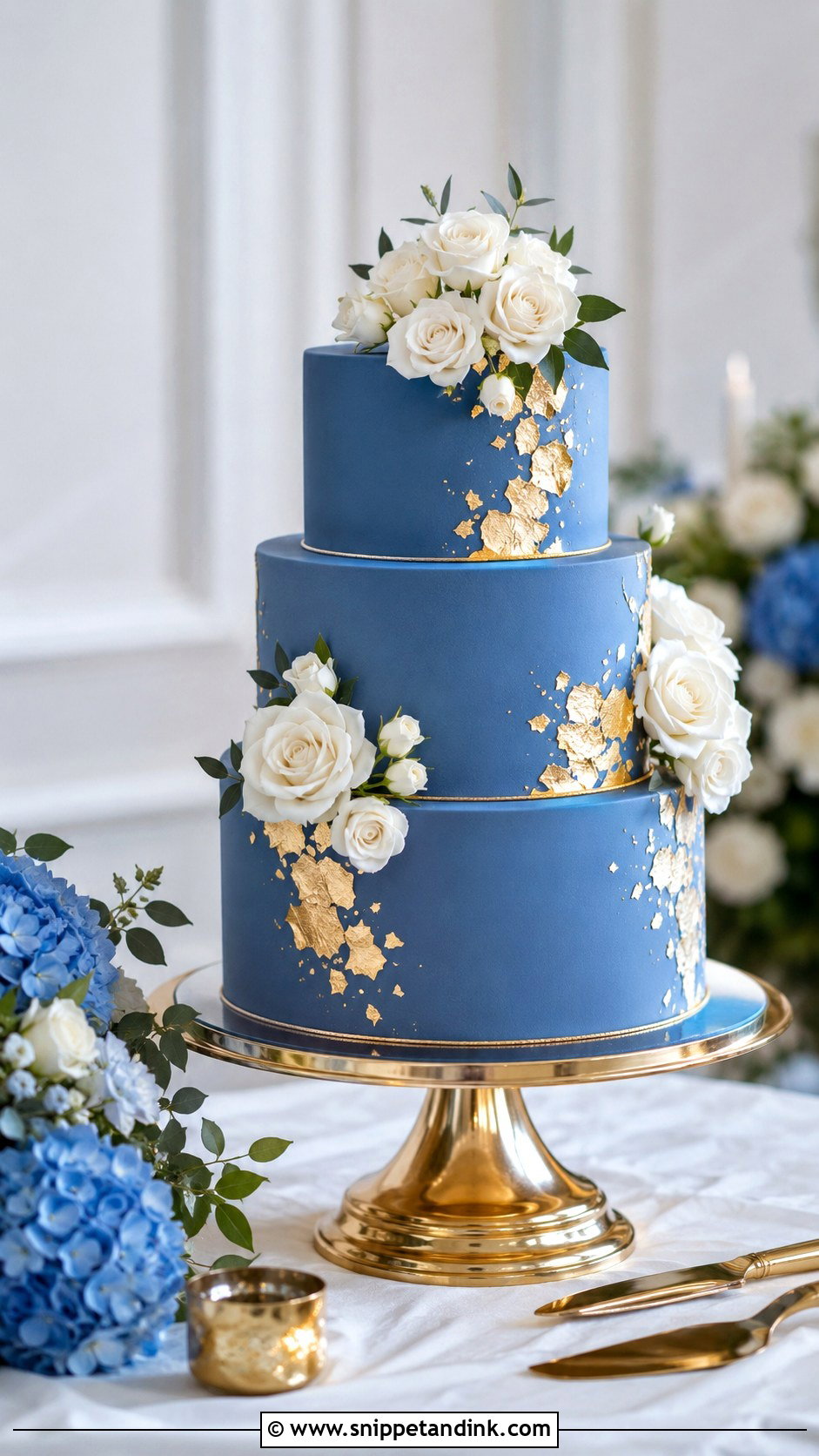
White roses on a blue base are about contrast: the roses pop forward and the blue recedes, which gives the cake real depth in photos. The base can be navy, slate, or dusty blue, and I’d pick by the time of day you cut it, since slate looks soft in daylight and navy looks richer under warm evening light. Gold leaf tucked around the roses gives them a glow at the edges. Textured buttercream makes it softer. Smooth fondant with tight rose clusters makes it formal.
9. Blue White And Gold Geode Wedding Cake
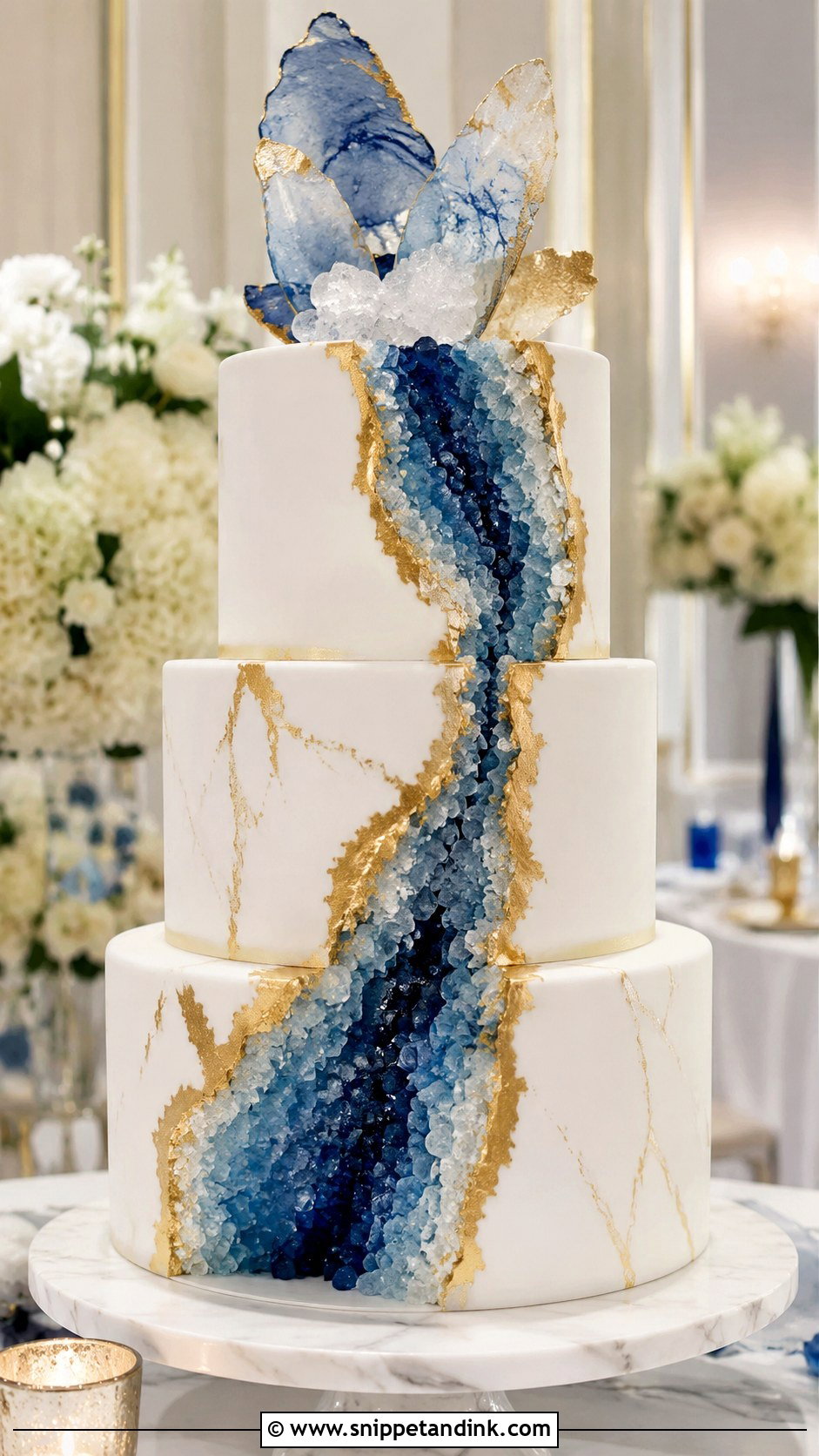
A geode tier is cut into, not built on. The baker carves a cavity into the side of a white tier and fills it with rock sugar or isomalt crystals in sapphire, navy and icy blue, then paints the rim gold so the opening looks like split stone. It is fiddly work and adds time, so expect it to cost more than a painted tier. Keep the rest of the cake quiet. In a room with marble, glass or metallic accents, this one needs almost no flowers at all.
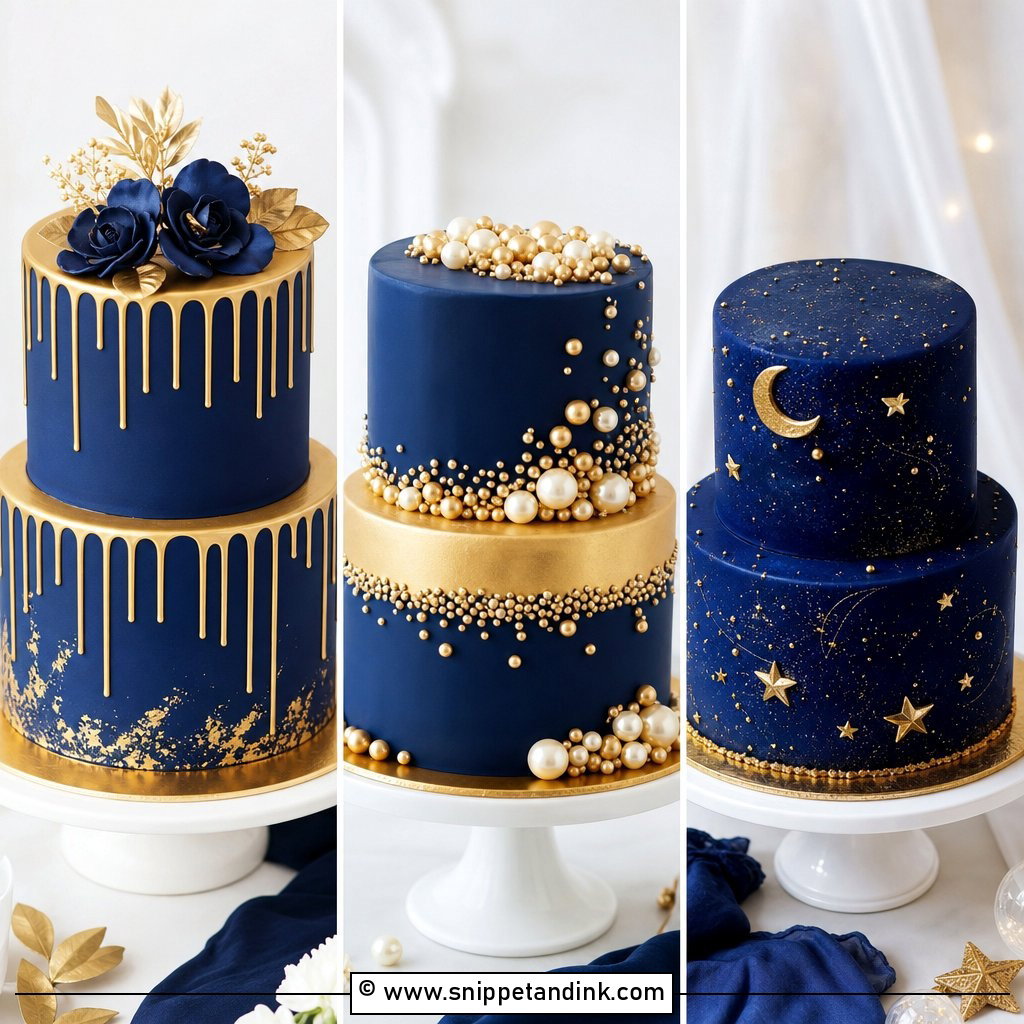
10. Blue White And Gold Drip Wedding Cake
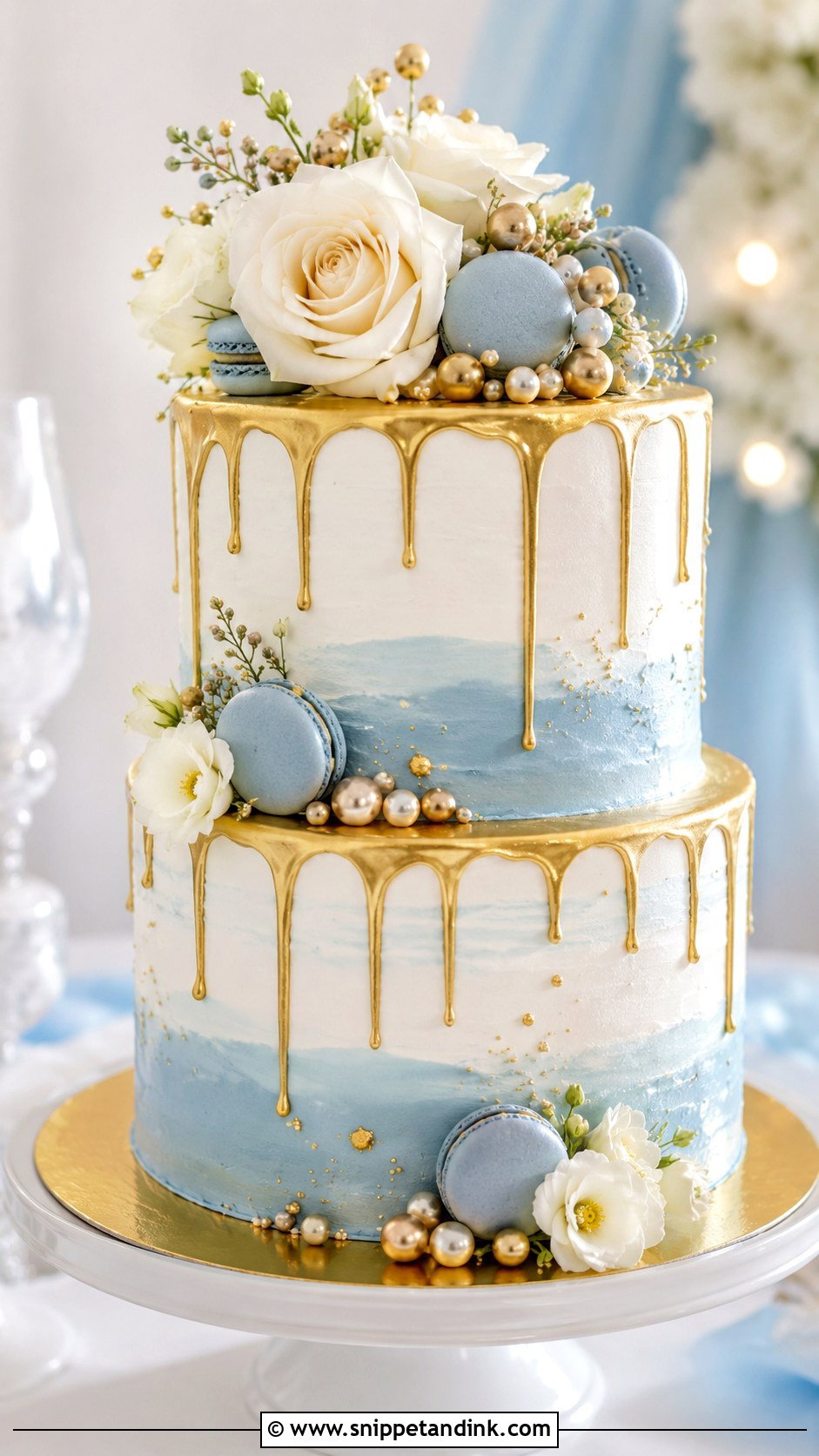
Drips go wrong in two ways: too warm and they run to the board, too cold and they stop in stubby blobs. I test the ganache temperature on a chilled tier first, and that is the difference between the neat metallic gold drip you want and a messy one. The gold is painted onto the set drip afterwards. White or pale blue buttercream underneath, then blue macarons, white flowers or painted meringues on top. Three tiers make a centrepiece; two tiers sit better on a dessert table at a smaller reception.
11. Blue White And Gold Floral Wedding Cake
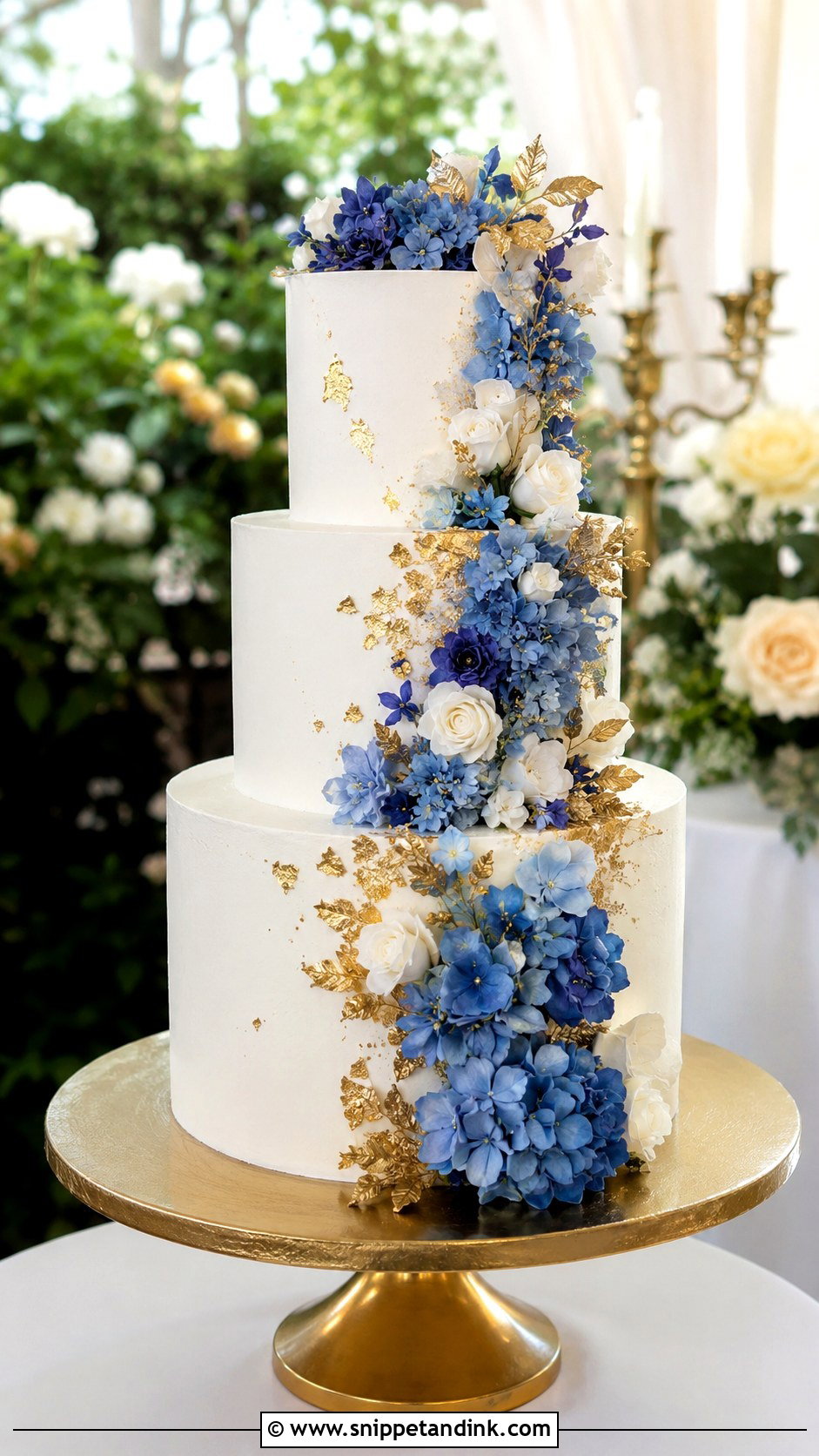
If your bouquet has blue hydrangea, delphinium or blue-toned roses, the cake can echo it in sugar instead of repeating fresh stems. I place flowers with a plan, usually a diagonal cascade or one strong corner cluster, because evenly dotted flowers make a tall cake look shorter. Tiny gold centres in the sugar blooms or a few gold leaves are enough metal. Bring a photo of the bouquet to the tasting so the sugar flower maker can match petal shape as well as colour.
12. Blue White And Gold Fondant Wedding Cake
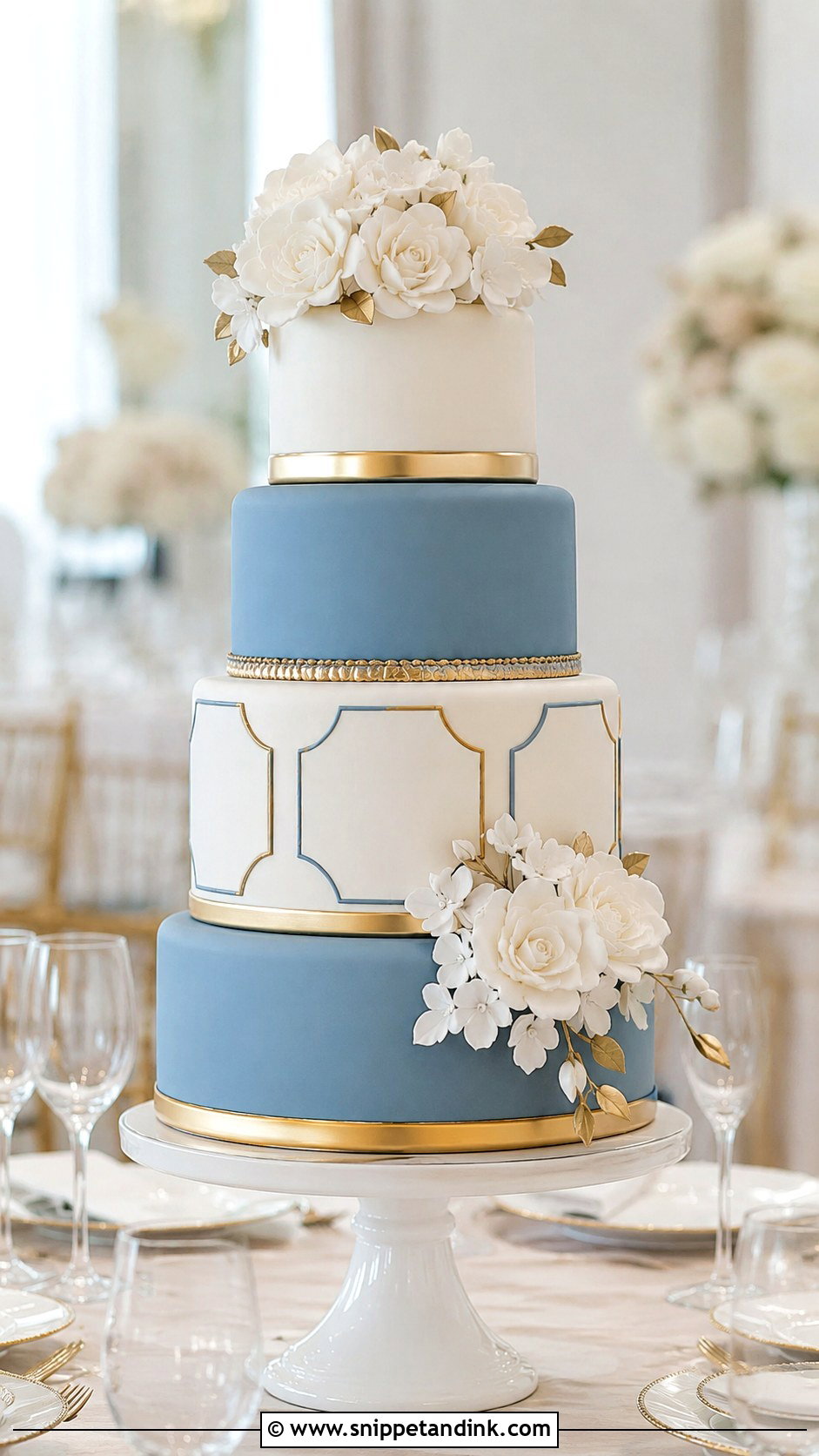
Fondant is the right surface when you want sharp edges, painted work or precise blocks of colour, because it gives a smooth canvas that buttercream cannot. White fondant with blue panels, gold bands or hand-painted gold leaves photographs crisply. It also holds monograms, lace imprints and structured sugar flowers. The risk is a cake that looks stiff, so I often add a soft fondant drape or a few loose flowers to break up the straight lines. One practical note: fondant does not like a fridge-to-warm-room move, as it beads with condensation.
13. Blue White And Gold Buttercream Wedding Cake
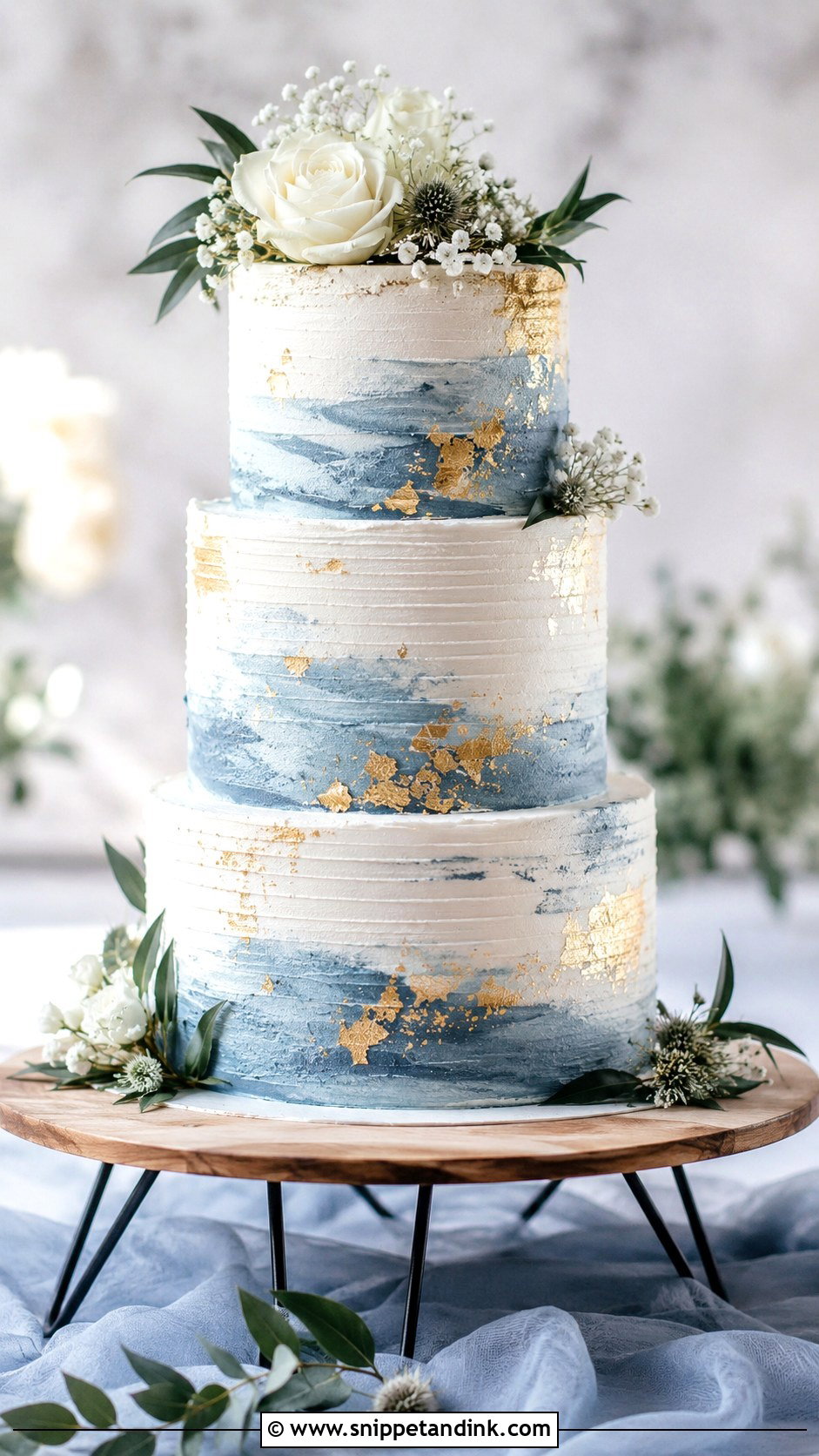
Buttercream is softer to look at and nicer to eat, and gold leaf actually sits better on it than on fondant, because the leaf catches in the ridges of a palette-knife stroke. I’d go smooth, lightly ribbed or knife-textured depending on the room. White with a dusty blue tier or brushed blue strokes keeps it gentle. The honest trade-off is heat: buttercream softens in a warm tent or a sunny window, so for an outdoor reception, ask how your baker plans to keep it cool until it is cut.
14. Blue White And Gold Lace Wedding Cake
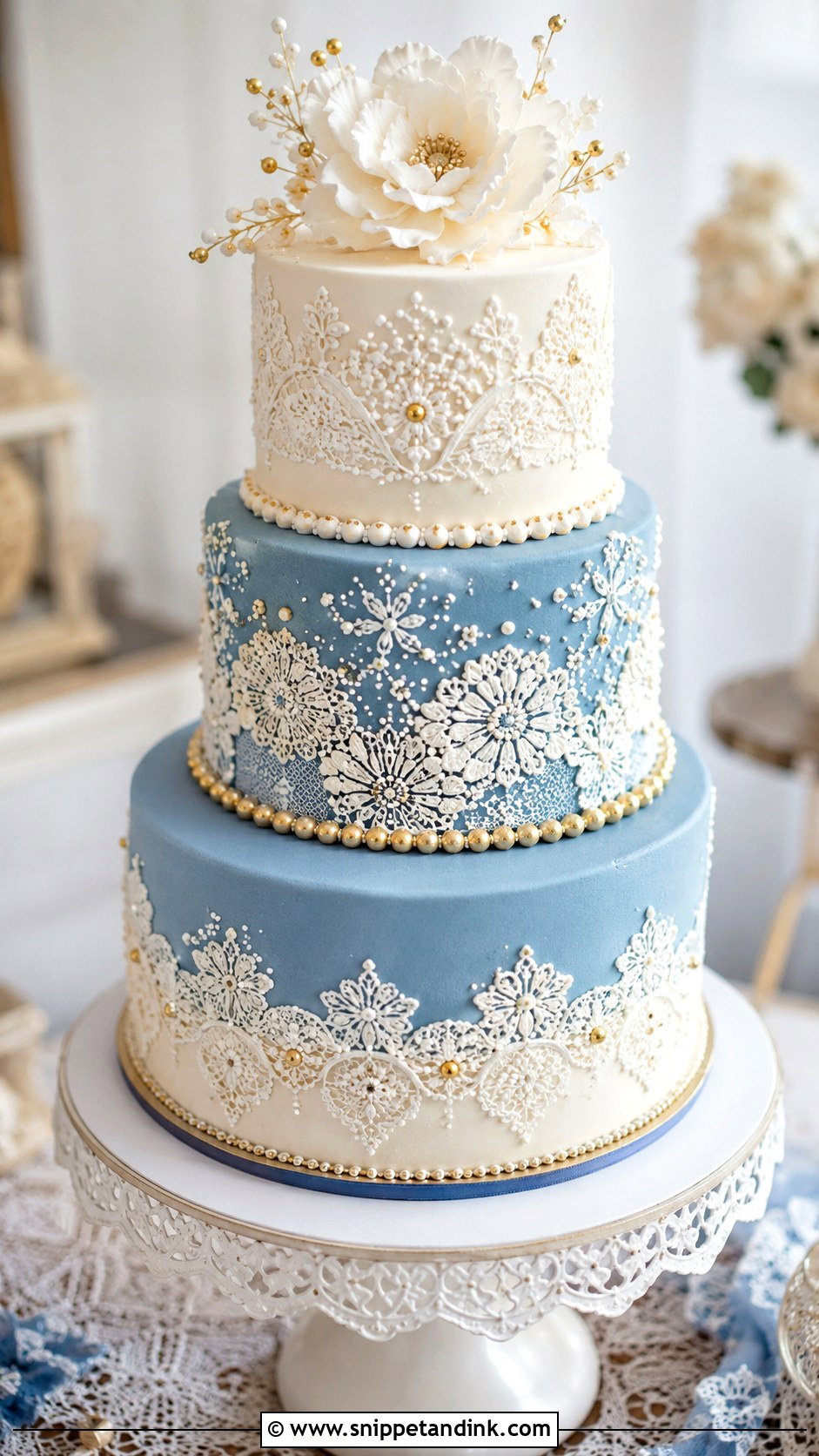
Lace piping is slow, careful work and it only reads at close range, so I place it at eye level on the cake rather than on the top tier. White lace over a blue tier is the clearer version; blue lace on white looks more delicate but disappears in photos taken from across the room. Keep the gold small: a few pearls, a thin band, or a lightly painted lace edge. If your gown has lace, bring a scrap or a close photo and the piping can follow its motif. Inside, a soft vanilla sponge with a cream filling matches the gentle look.
15. Blue White And Gold Pearl Wedding Cake
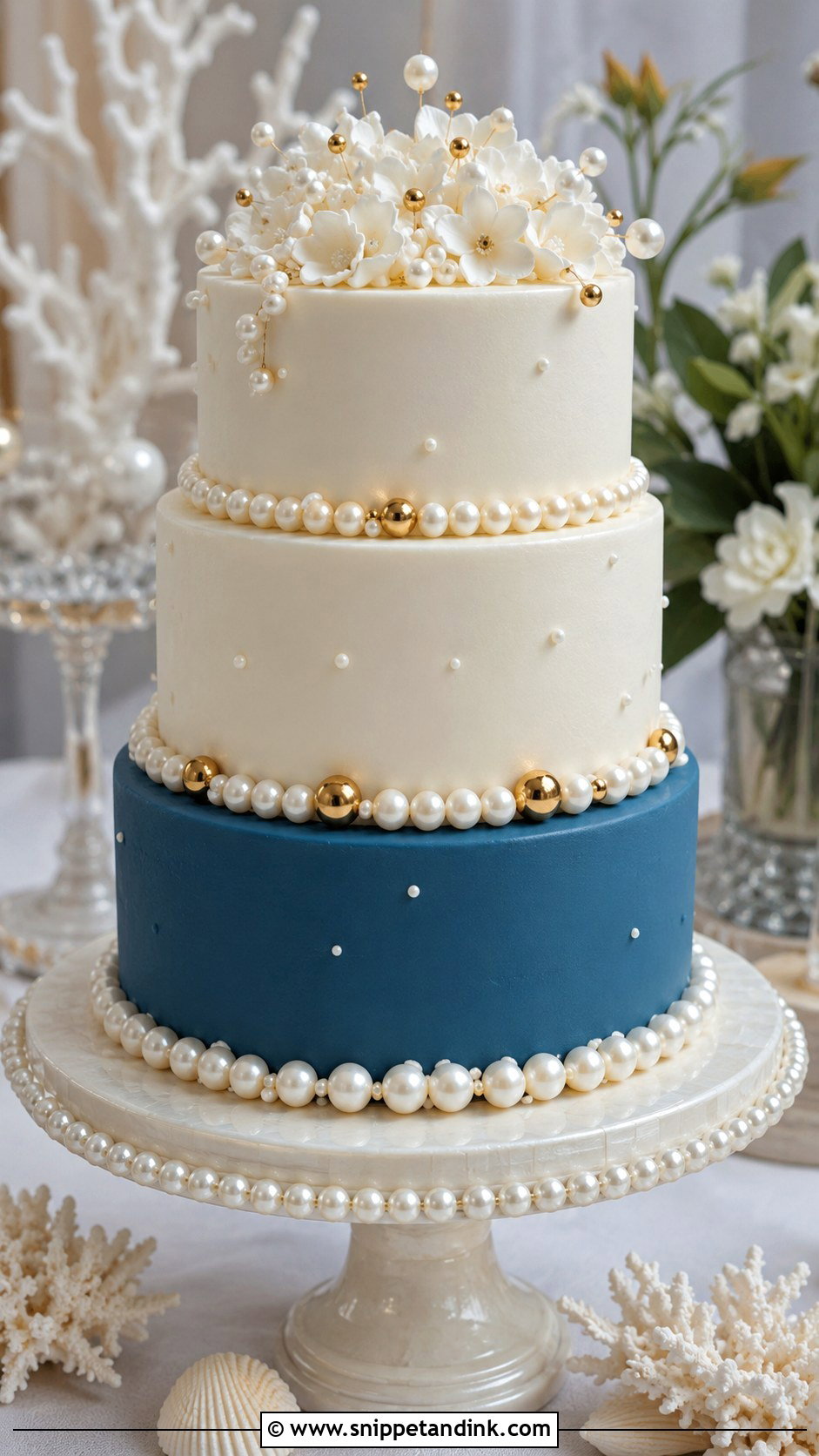
Pearls are the easiest detail to get right and the easiest to overdo. Rows of edible pearls along a blue accent band look tailored; scattered pearls look softer and hide small surface flaws, which is worth knowing on a buttercream cake. Mixing gold and white pearls warms the whole thing up. I’d put the blue tier at the bottom so it anchors the cake, with white tiers above. A few white blooms or a small pearl topper is all it needs.
16. Blue White And Gold Watercolor Wedding Cake
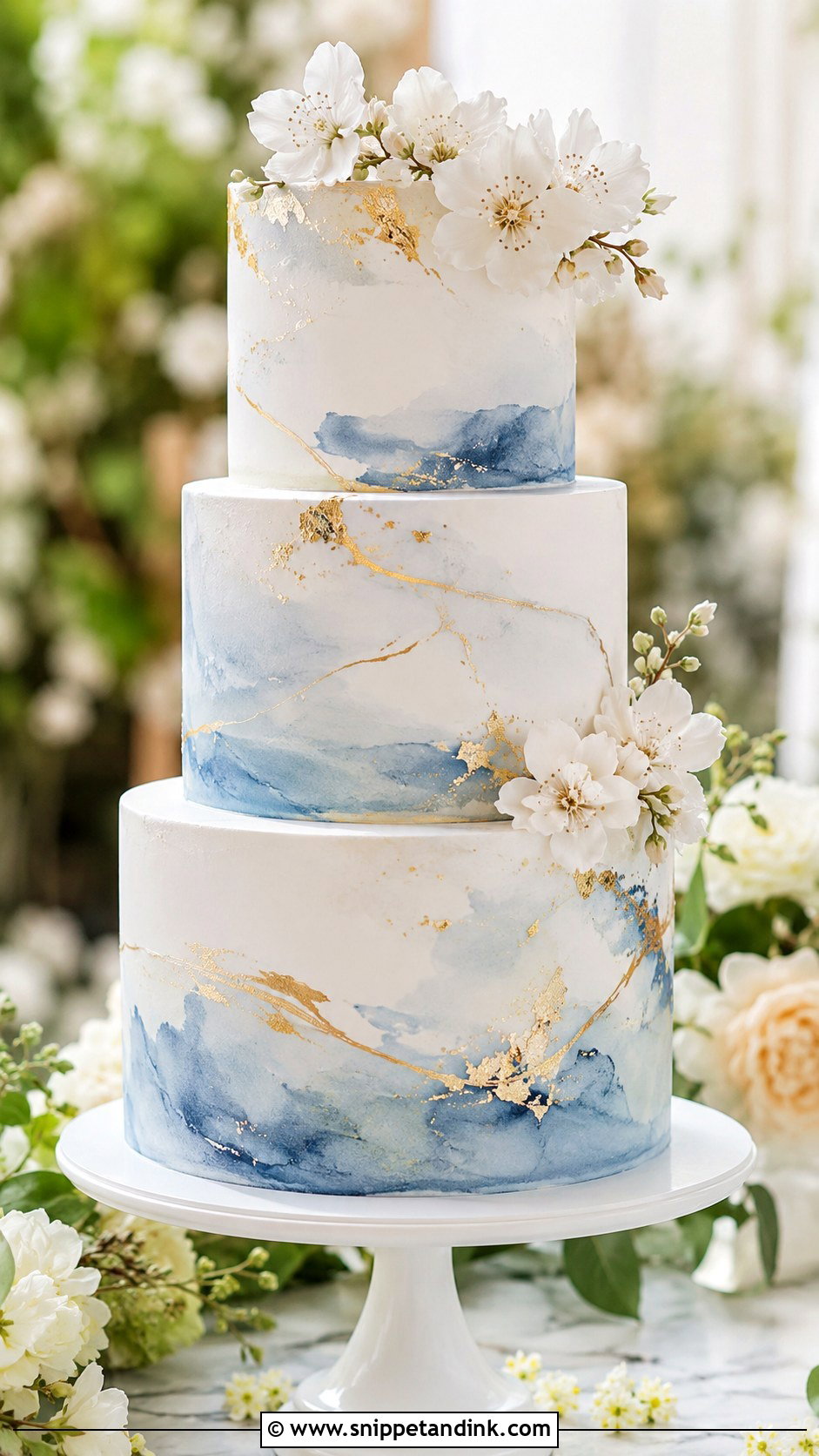
Watercolour on a cake is painted with thinned gel colour, layered in washes while the surface is still slightly tacky, so the edges bleed the way paint does on paper. I build pale blue in two or three passes rather than one heavy one, then pick out the edges with fine gold brushstrokes. It is lighter in mood than solid metallic designs and suits outdoor and spring weddings. The risk is a cake that looks like a baby shower; white flowers and a plain stand keep it bridal.
17. Blue White And Gold Tiered Wedding Cake
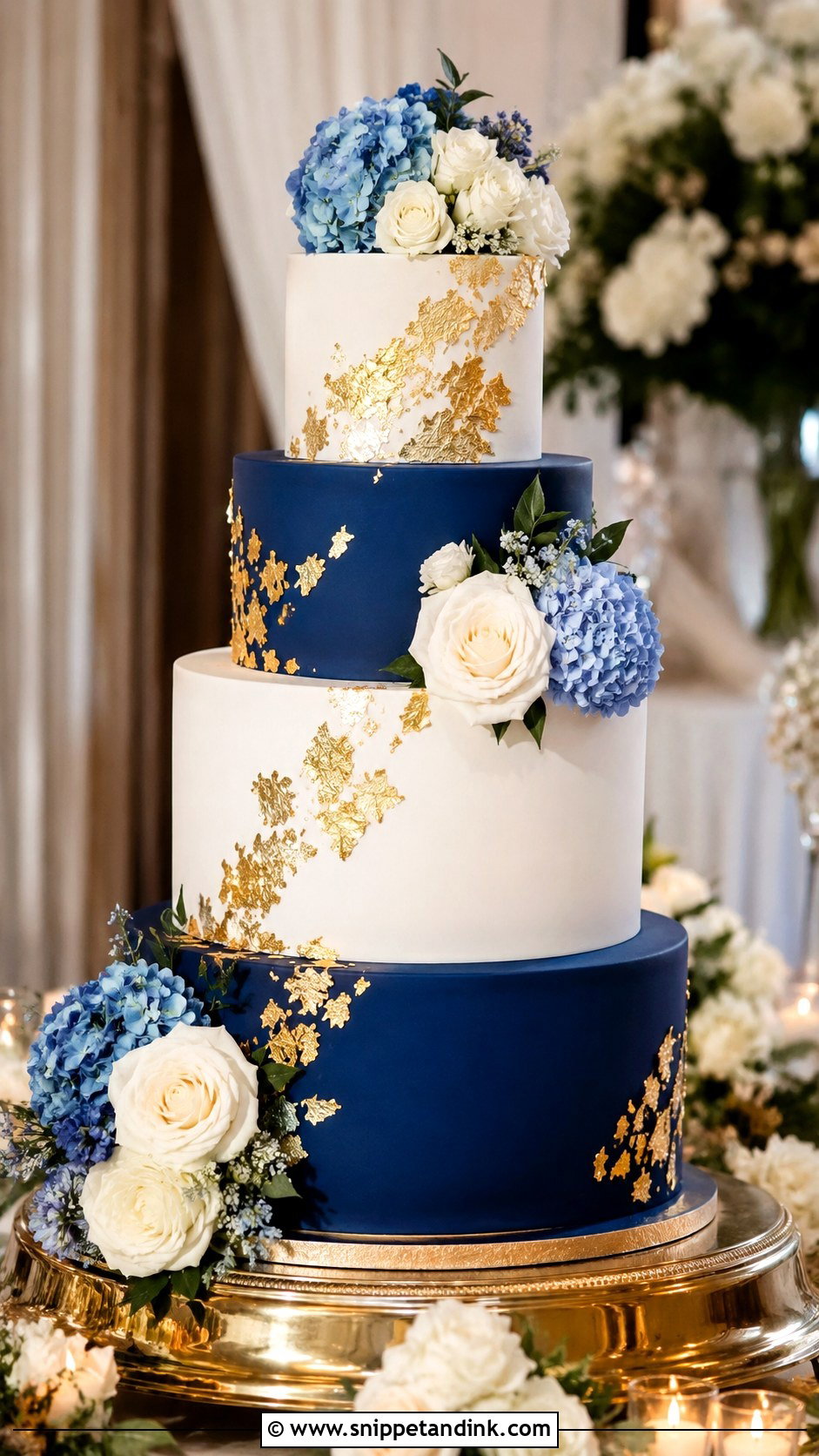
Height is what a tiered wedding cake gives you, and with three or more tiers there is room to separate the colours cleanly: a blue tier, a white tier with gold leaf, a tier for flowers or piping. I always plan each tier as seen from the front and from the side, since guests walk around a cake table. The practical bonus is flavour: each tier can be different, so vanilla, lemon, almond and chocolate can all appear. Tall cakes need internal dowels and a sturdy stand, gold or plain white.
18. Blue White And Gold Square Wedding Cake
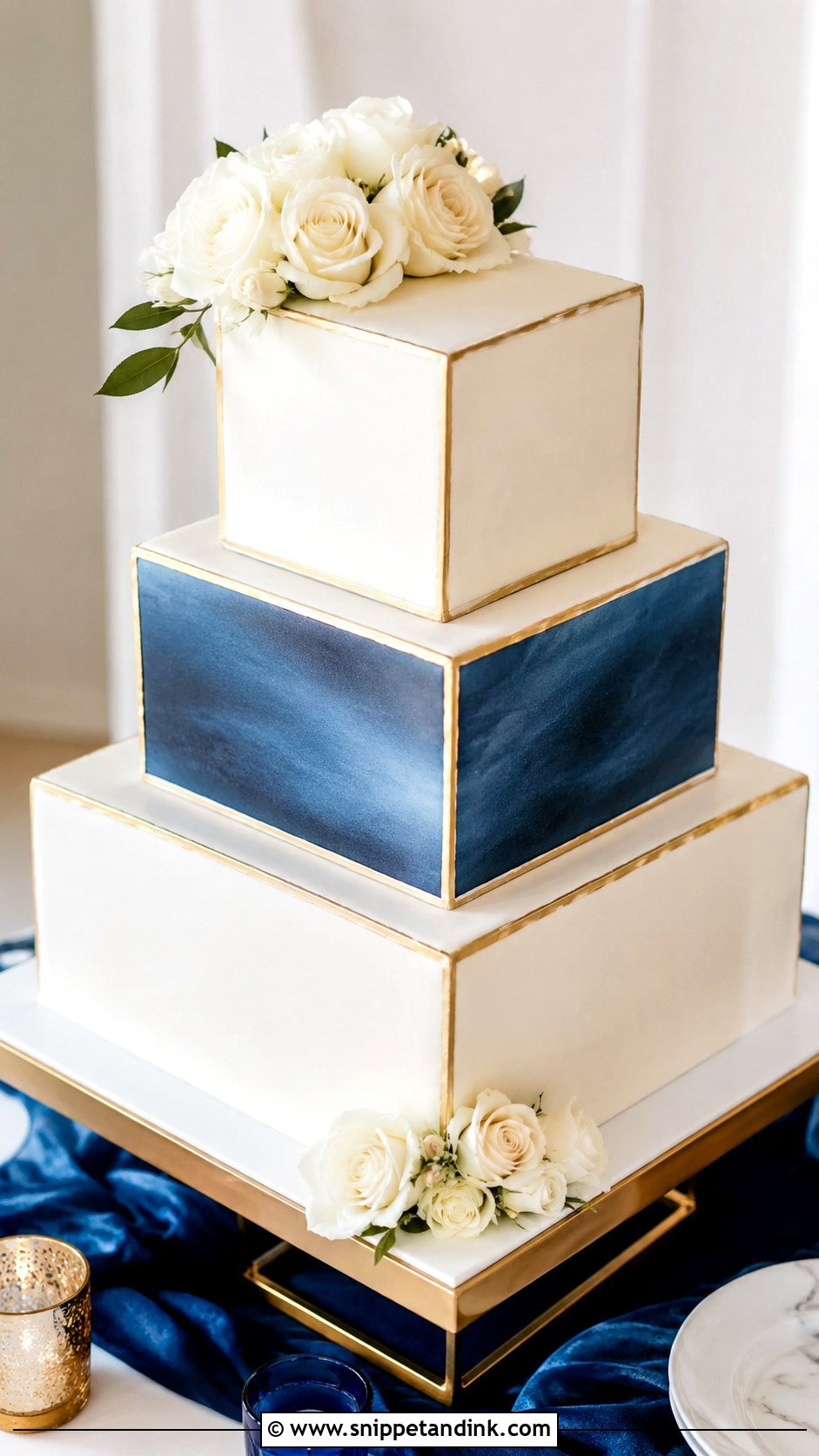
Square tiers are harder to cover than round ones; fondant has to be smoothed into each corner without tearing, which is why square cakes cost more. The payoff is a sharp, architectural shape. Blue panels or blue marbling on white show off the flat faces, and gold trim along the edges draws the outline. I’d keep flowers to one corner cluster of white roses. Hotels, galleries and lofts suit it far better than a rustic barn.
19. Blue White And Gold Monogram Wedding Cake
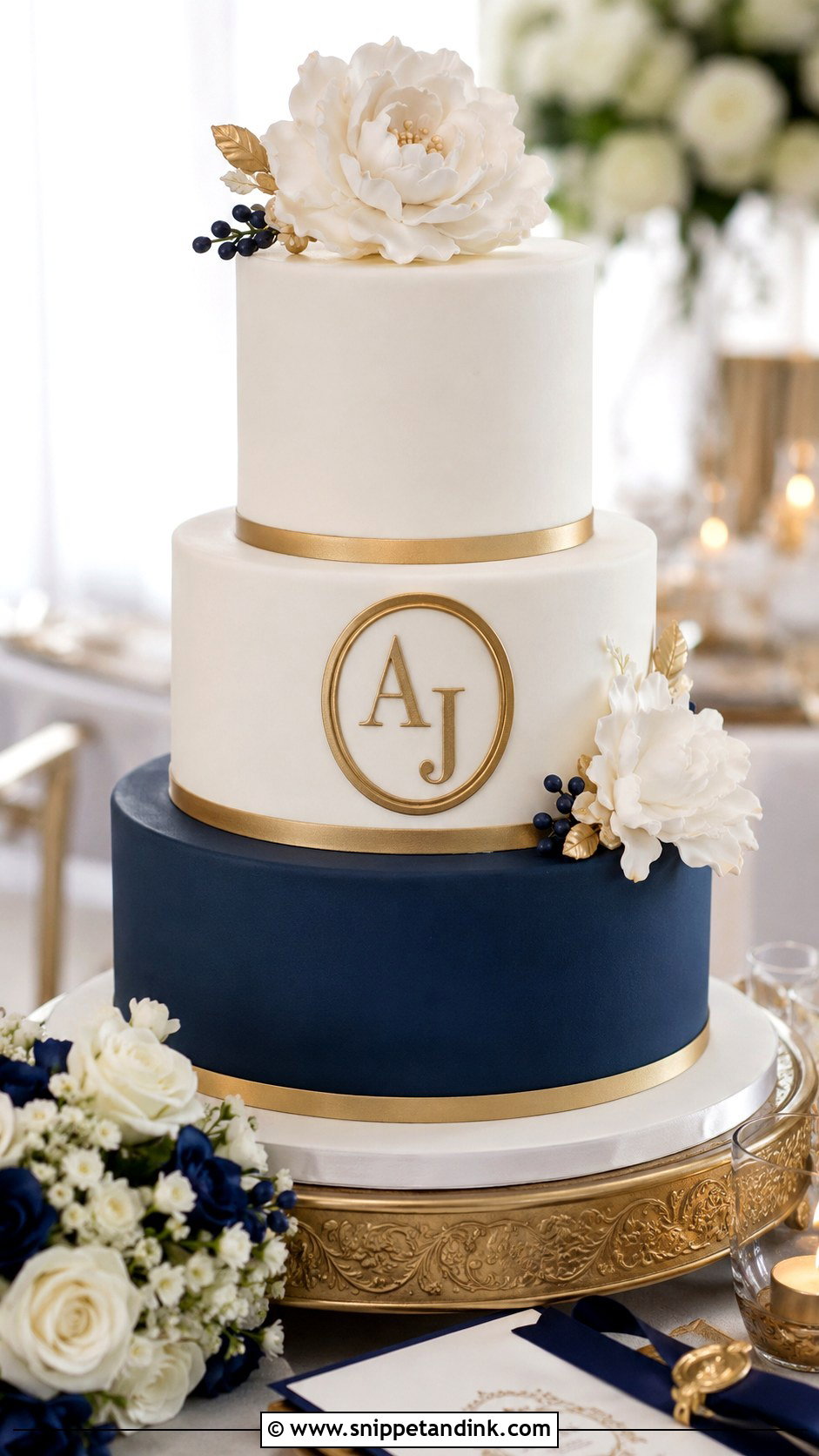
A monogram turns a cake into your cake. I paint or pipe the initials in gold on a white or blue middle tier, at the height a camera will catch during the cutting. Everything else should stay simple so the letters are the focus, perhaps gold borders, a few white flowers and blue ribbon-style bands. Give your baker the exact font from your invitations or signage; a monogram in a different lettering style from the rest of the stationery is the detail guests do notice.

20. Blue White And Gold Minimalist Wedding Cake
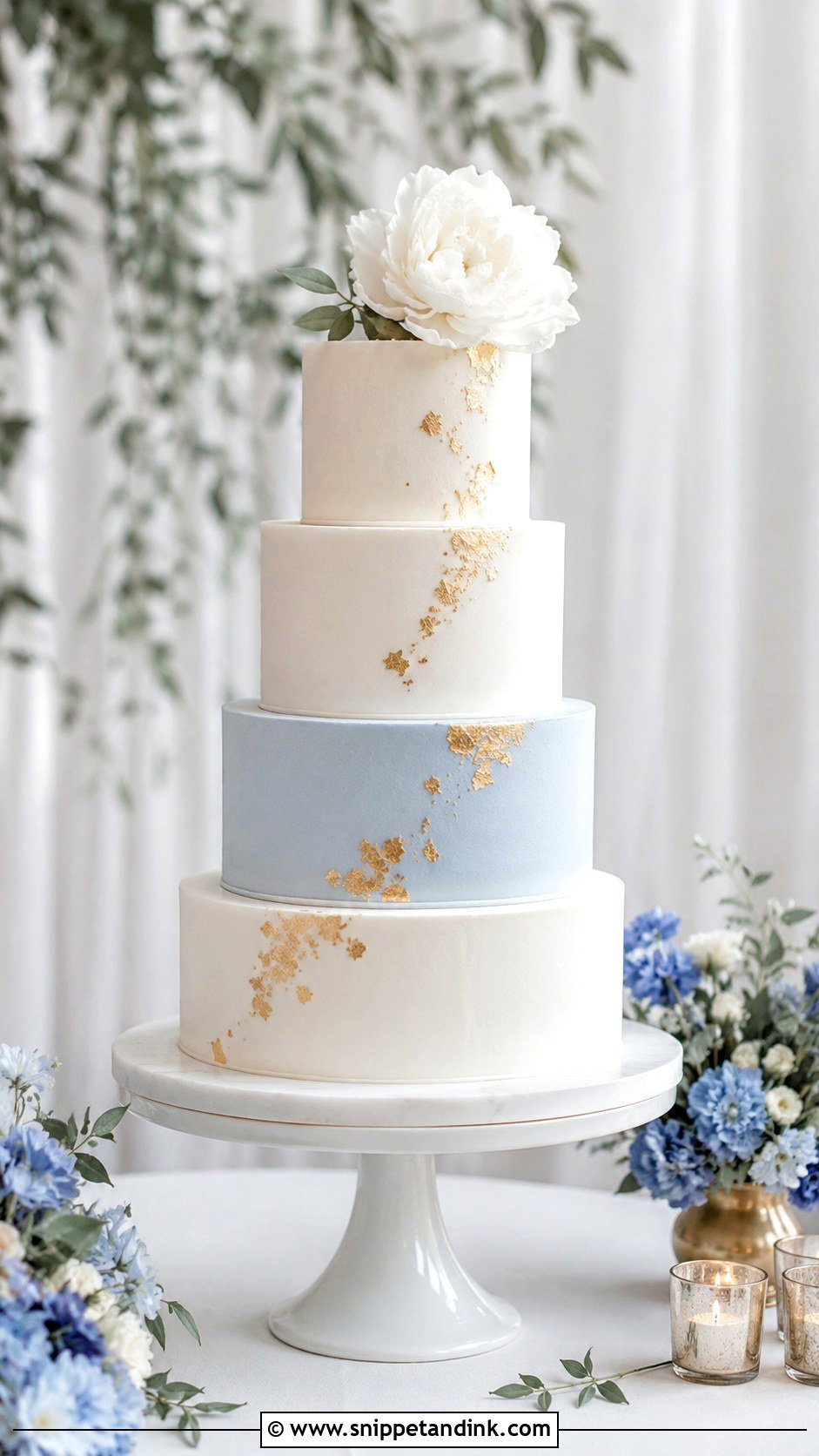
Minimal does not mean bare; it means every piece has been placed on purpose. Smooth white buttercream, one soft blue tier and a few pieces of gold leaf can be enough, as long as the edges are sharp, because there is no decoration to hide a wobbly finish. That makes it harder to bake well than it looks. It suits small weddings, since it does not rely on height to feel complete. A plain white stand and a few blue blooms on the table finish it.
Real Gold, Painted Gold and What Guests Can Actually Eat
Not every gold on a cake is food. This is the question I’d encourage every couple to ask at the tasting, because the shiny finishes look almost identical in photos.
Gold leaf
Edible gold leaf is thin beaten gold, usually 23 or 24 carat, sold specifically for food. It passes through the body untouched and has no taste. It is also so fine that a breath lifts it, so I apply it with a dry brush in a still room, and it tears if the surface is wet. That is why condensation on a chilled cake can leave gold looking patchy.
Gold paint and lustre dust
Painted gold is lustre dust mixed with alcohol or a clear extract. Some dusts are made as edible; others are labelled non-toxic, which only means they are meant for decorations that get removed. If the gold is on a part guests will eat, it should be an edible product, and a good baker will tell you which one they use without hesitation.
Flowers, toppers and the cutting tier
Fresh blooms, wired sugar flowers and metal toppers all come off before serving. I tell couples which tier holds the wires, so the caterer knows where to cut. It is a small conversation that saves a guest from biting into florist wire.
Send Your Baker One Swatch, Not Ten Photos
Blue, white and gold can go formal with navy and leaf, soft with dusty blue and lace, or modern with marble and sharp fondant. Before the tasting, settle on one mood and one exact blue, ideally a fabric swatch from the bridesmaid dresses or a paint chip. Then the frosting, the gold finish and the flowers can all be chosen to serve that one decision. The cakes that look right in photos years later are almost always the ones where the couple was clear about that single shade.
You'll Like These Ideas:




Leave a Reply