
Purple and black is one of the more demanding palettes I’m asked to work in, and one of the most rewarding when it’s done well. It suits gothic weddings, ballroom receptions and candlelit evening venues, where black gives the cake structure and purple adds softness. Both colors are tricky in sugar, though. Black takes a lot of coloring to get right, and purple has a habit of fading or shifting toward blue. Below are 20 ideas, from sleek fondant to berries and geodes, along with what each one asks of the baker and of your venue.
Getting True Black Icing Without Grey Teeth
Black is the hardest color I make. Starting from white icing takes so much gel color that the frosting can taste bitter and leave guests with dark lips and teeth. My approach is to start dark: a chocolate buttercream or ganache, or black cocoa in the mix, needs far less dye to reach true black. Colored icing also deepens as it rests, so I mix it the day before and let it sit overnight.
- Fondant is the safer choice if you want a solid black exterior, since it’s a thin layer and most of it gets peeled off the slice.
- Black accents, lace or a single dark tier give the look with much less color on each plate.
- Avoid activated charcoal as a coloring; it can interfere with how some medications are absorbed, and you won’t know every guest’s prescriptions.
- Ask for a tasting slice with the colored icing, not plain vanilla, so you know what guests will actually eat.
1. Purple And Black Gothic Wedding Cake
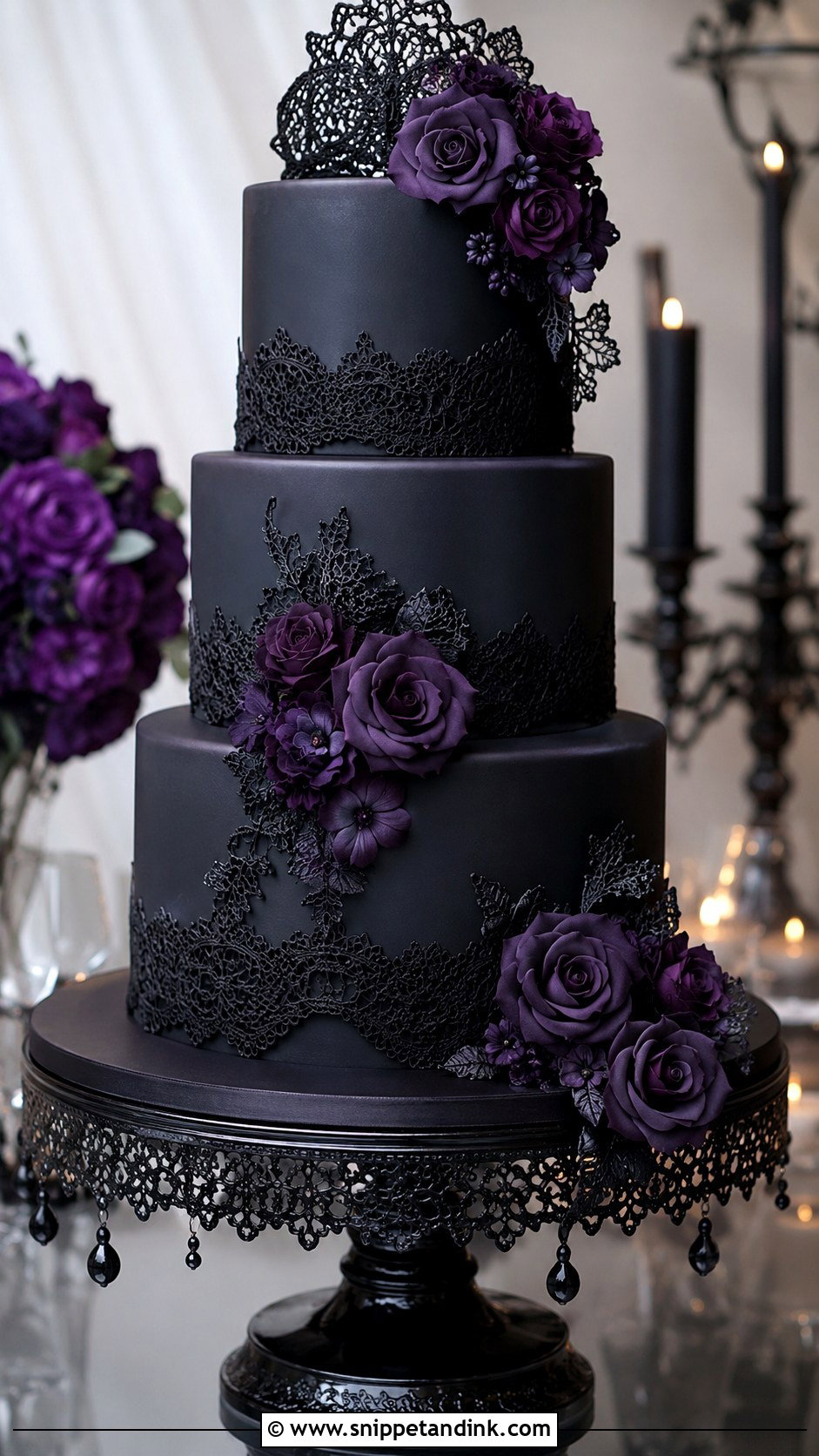
Tall tiers, matte black icing, deep purple roses and lace-style piping are the core of the gothic version. Height matters more than you’d think here; a short, wide dark cake looks heavy, while a tall one reads as elegant. I soften the black with a single touch of silver or pearl so it doesn’t look severe under candlelight. Chocolate, blackberry or red velvet fit the mood inside. Keep the stand plain, black ceramic or clear glass, so nothing competes with the cake.
2. Purple And Black Tiered Wedding Cake
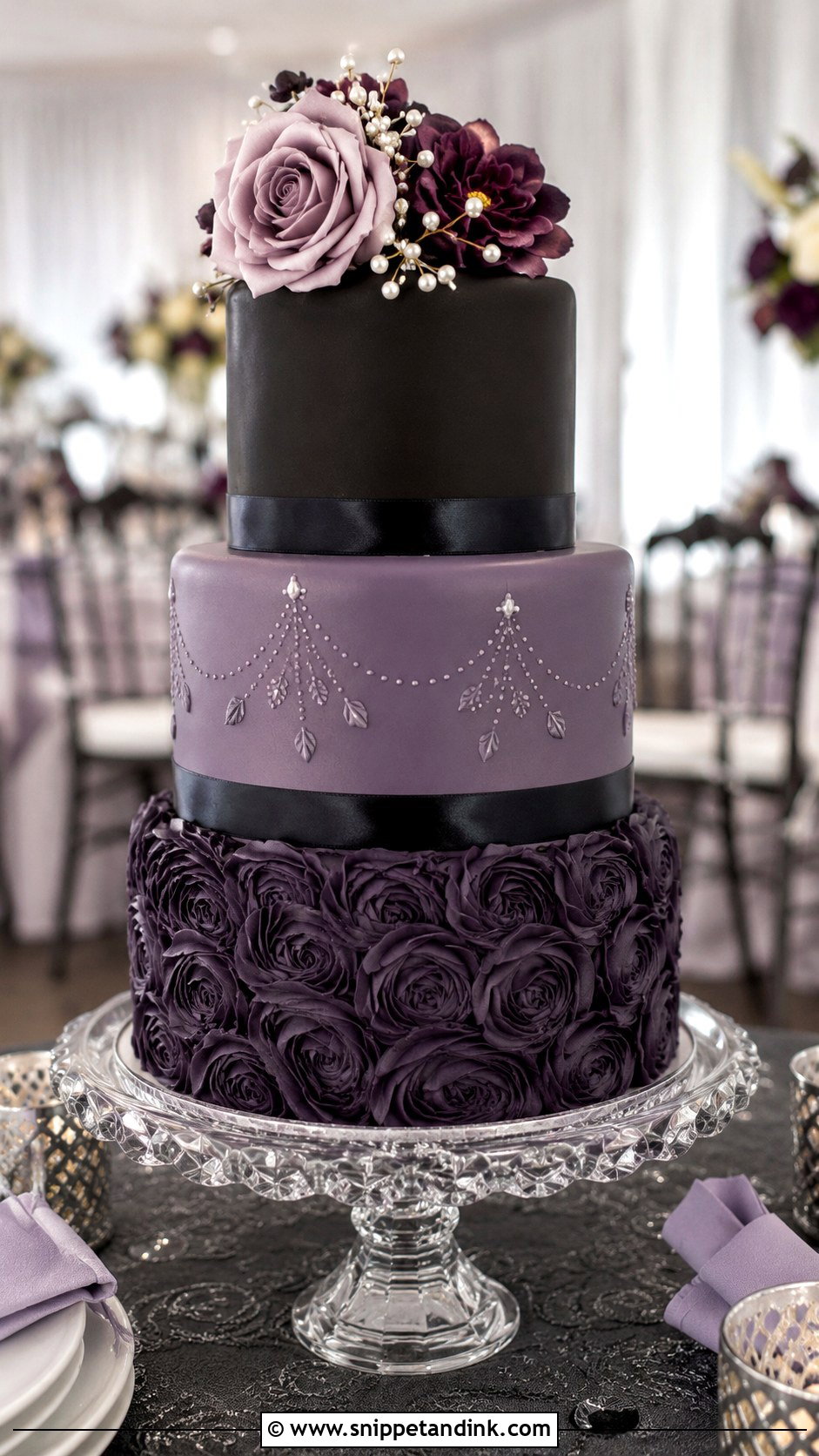
Separate tiers let you mix textures without the cake looking busy. On a tiered wedding cake I might do one tier in smooth black fondant, one in lavender buttercream and one with marble or floral work, tied together with plum flowers and black ribbon. Three tiers of 6, 8 and 10 inches give roughly seventy-five wedding portions, though that varies with how generously it’s cut. Four or five tiers suit a ballroom. Taller cakes need internal dowels and a central rod, so mention the tier count early.
3. Purple And Black Wedding Cake With Flowers
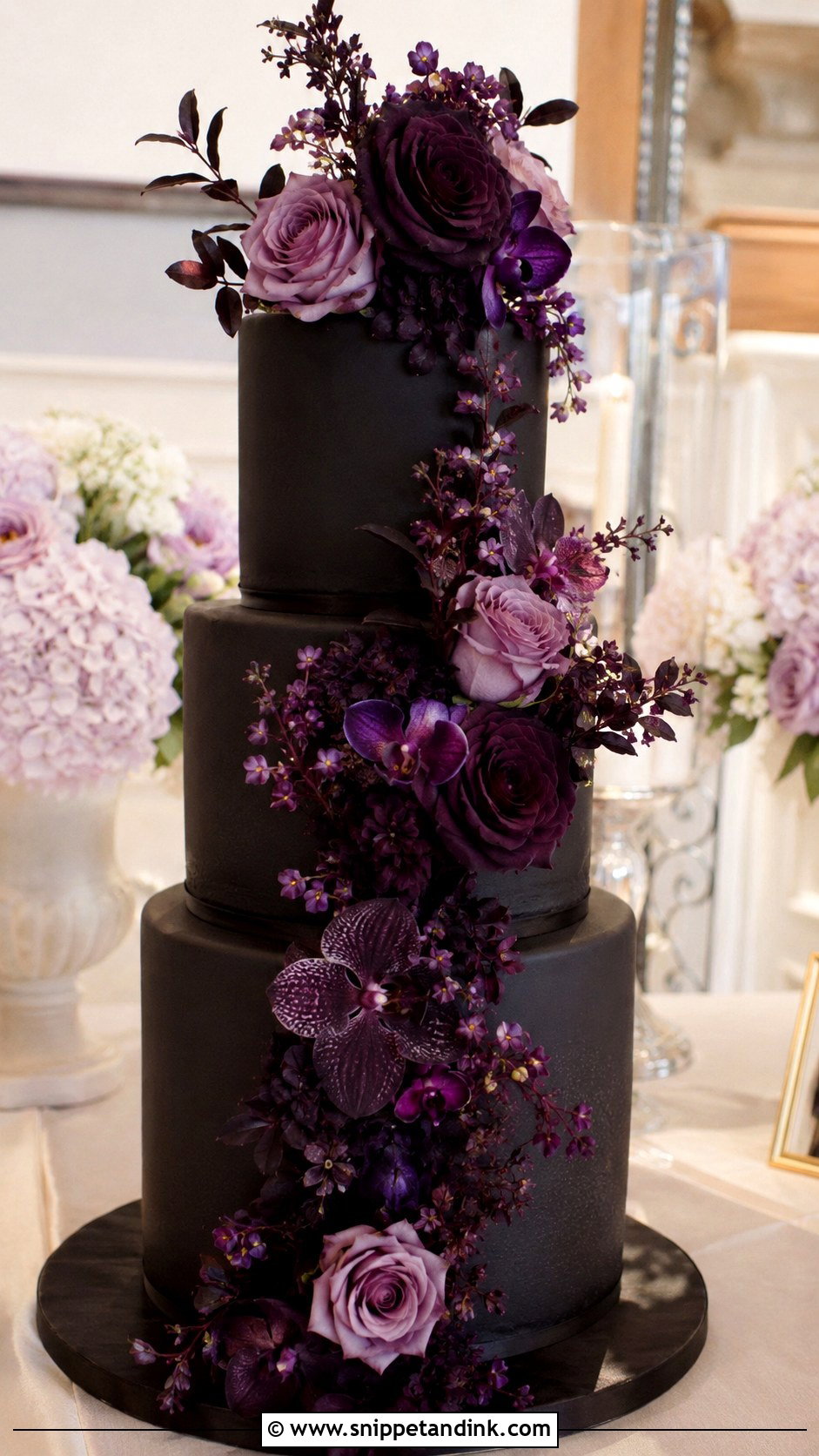
Black icing makes a striking backdrop for flowers, and purple blooms bring movement to it. Orchids, roses, lisianthus and anemones all suit the palette. Calla lilies look right but shouldn’t touch the cake, so I’d ask your florist to wrap their stems or swap them for sugar versions. A cascade from the top tier to the base gives a graceful line; one cluster per tier looks cleaner. Ask for the placement to stay airy, not packed, so the black still shows between stems.
4. Purple And Black Marble Wedding Cake
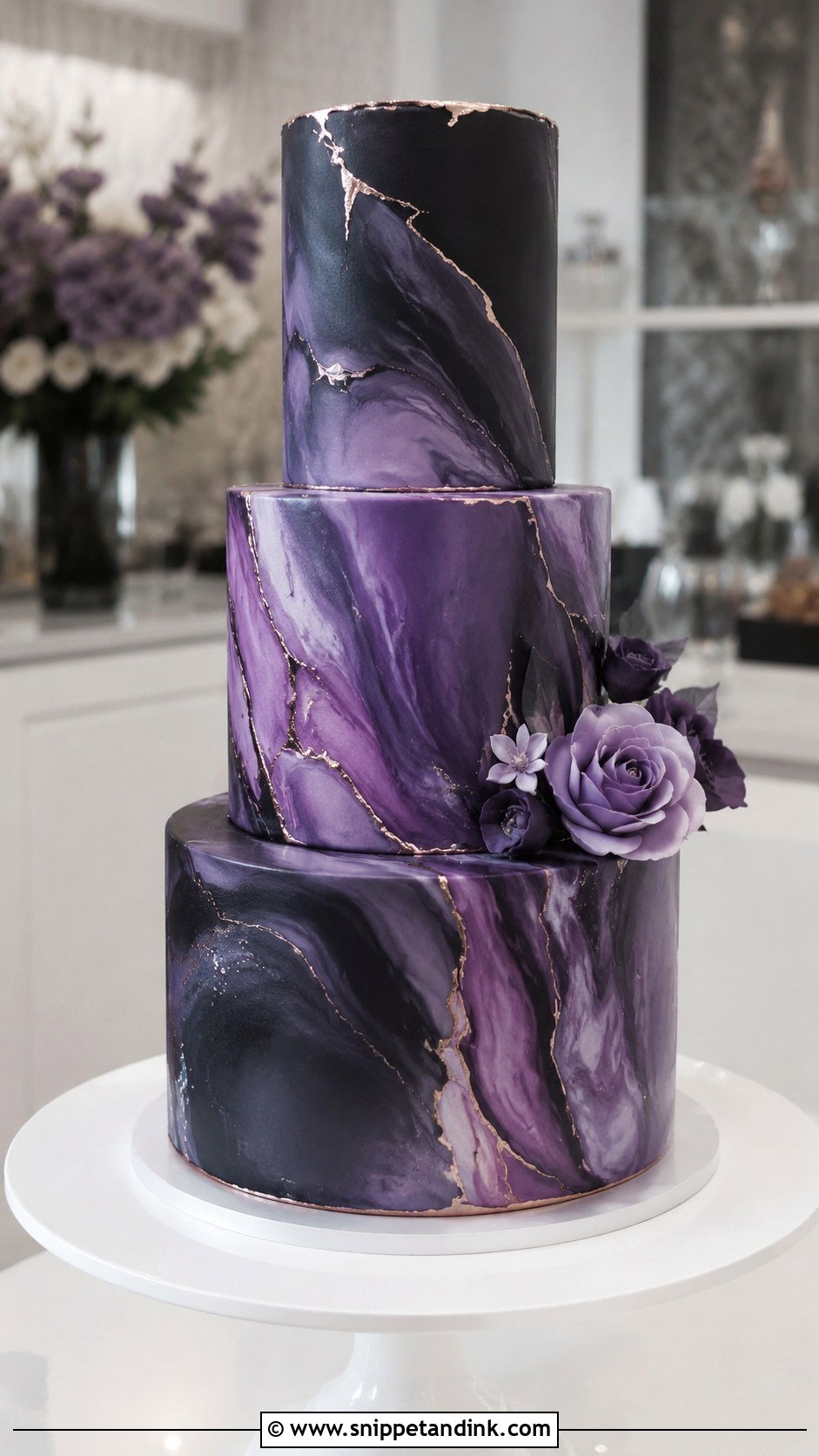
Marbled fondant gives a stone-like finish that looks modern on any table. I knead black, lavender, violet and plum together only partly, stopping while the streaks are still defined, because overworking turns everything a muddy grey. Black bleeds into the lighter colors, so I use less of it than you’d expect. A few sugar flowers, thin gold lines or edible shimmer are enough decoration. Vanilla bean, dark chocolate or blackberry sponge suits it, and it belongs in a modern or industrial venue.
5. Purple And Black Buttercream Wedding Cake
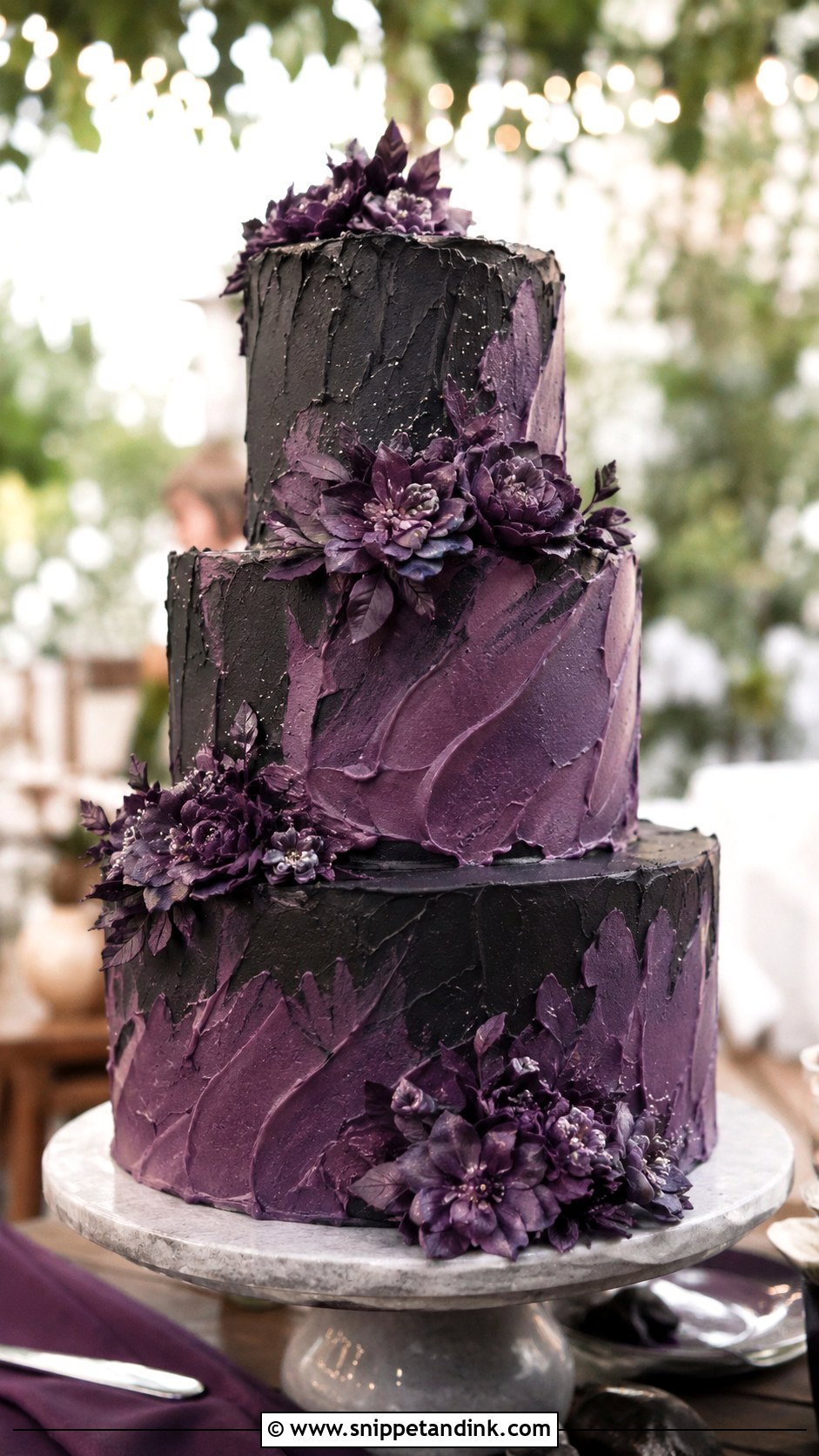
Buttercream feels softer than fondant and shows texture, whether it’s smoothed flat or spread with a palette knife for a painted finish. True black buttercream needs a lot of gel color, so I start from a chocolate base, which needs far less dye and tastes better. Charcoal grey is a gentler option. Purple buttercream flowers, violet brushstrokes or a plum fade bring in the second color. The trade-off is heat: buttercream softens in a warm room, so keep it away from sunny windows, and it suits indoor or shaded garden receptions.
6. Purple And Black Fondant Wedding Cake
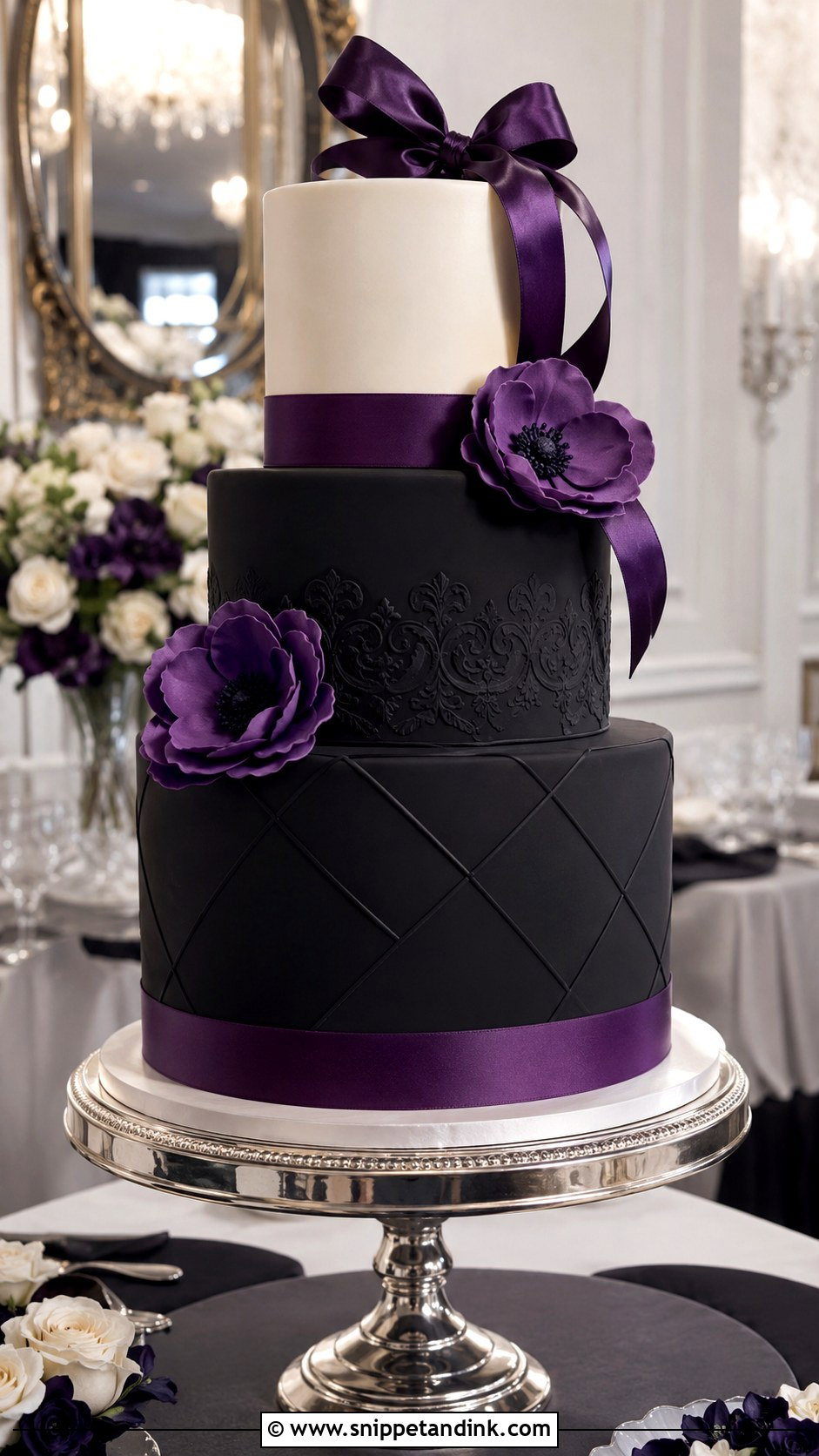
Fondant holds sharp edges and detailed decoration better than any frosting, which is why I use it for hexagon tiers, extra-tall cylinders and embossed patterns. Black fondant with purple ribbon bands or sugar flowers looks formal; purple fondant with black lace reverses the effect. Dark fondant shows every speck of cornstarch, so I roll it with a little shortening instead. It also sweats if it goes from a cold fridge into a warm room, which can leave dull patches, so I’d ask your baker how they store and transport it.
7. Purple And Black Drip Wedding Cake
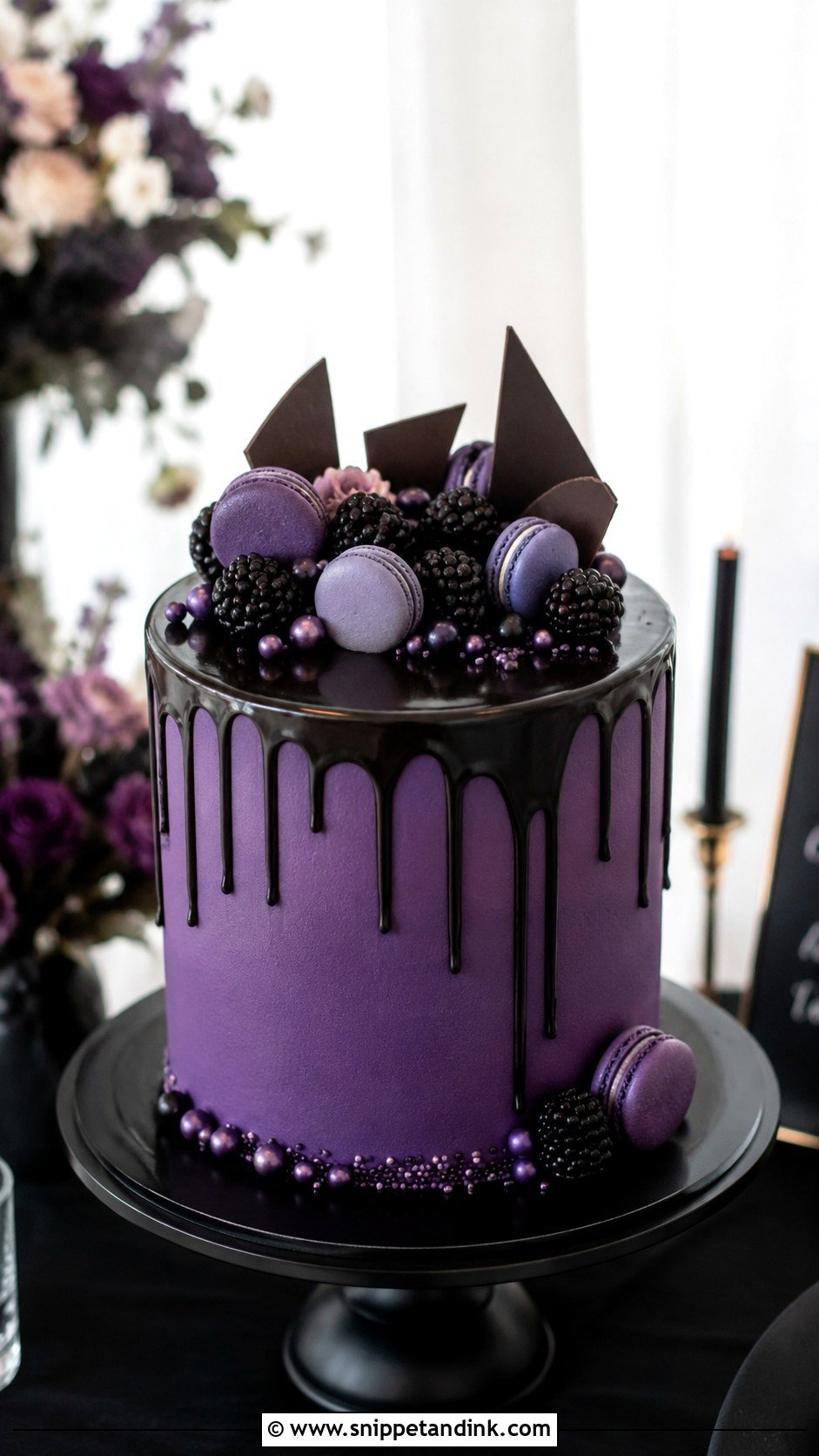
Pairing a purple buttercream base with a glossy black chocolate ganache drip gives strong contrast with very little decoration. The drip goes onto a well-chilled cake with ganache that’s barely warm, so each drip stops partway down instead of running to the board. For a wedding, keep the drips even in length and the top tidy. Blackberries, chocolate shards, purple macarons or a few flowers finish it. Inside, dark chocolate with blackberry filling, or vanilla with berry compote.
8. Purple And Black Ombre Wedding Cake
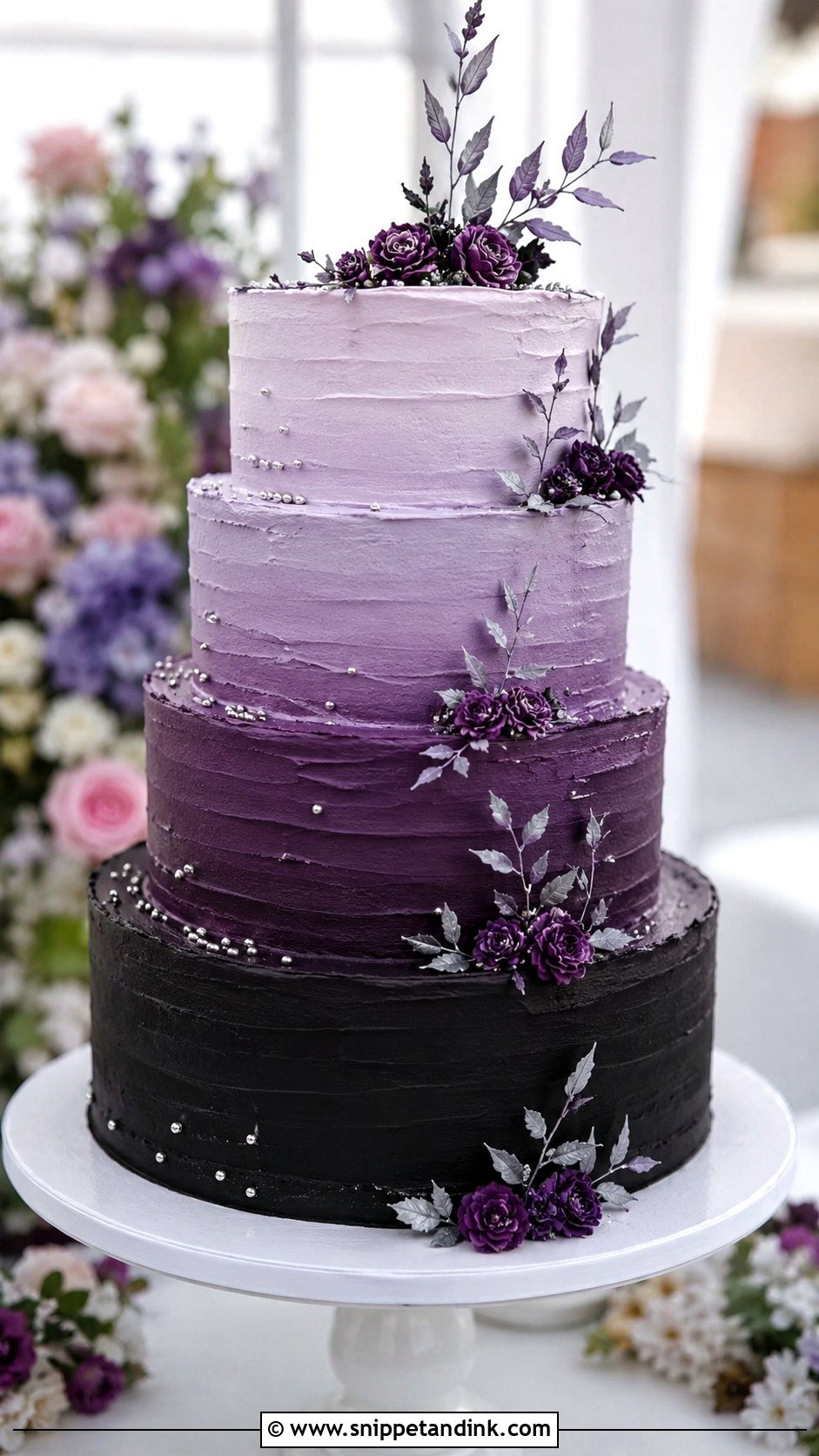
An ombre fade lets the two colors meet softly. The base tier starts in black or deep plum and lightens upward through violet and lavender to pale lilac, so the cake looks lighter at the top. I blend it by hand in buttercream with a bench scraper, which gives a smoother gradient than fondant can. Keep decoration minimal, a few flowers or silver pearls, so the transition stays visible. Evening and garden receptions suit it.
9. Purple And Black Wedding Cake With Gold
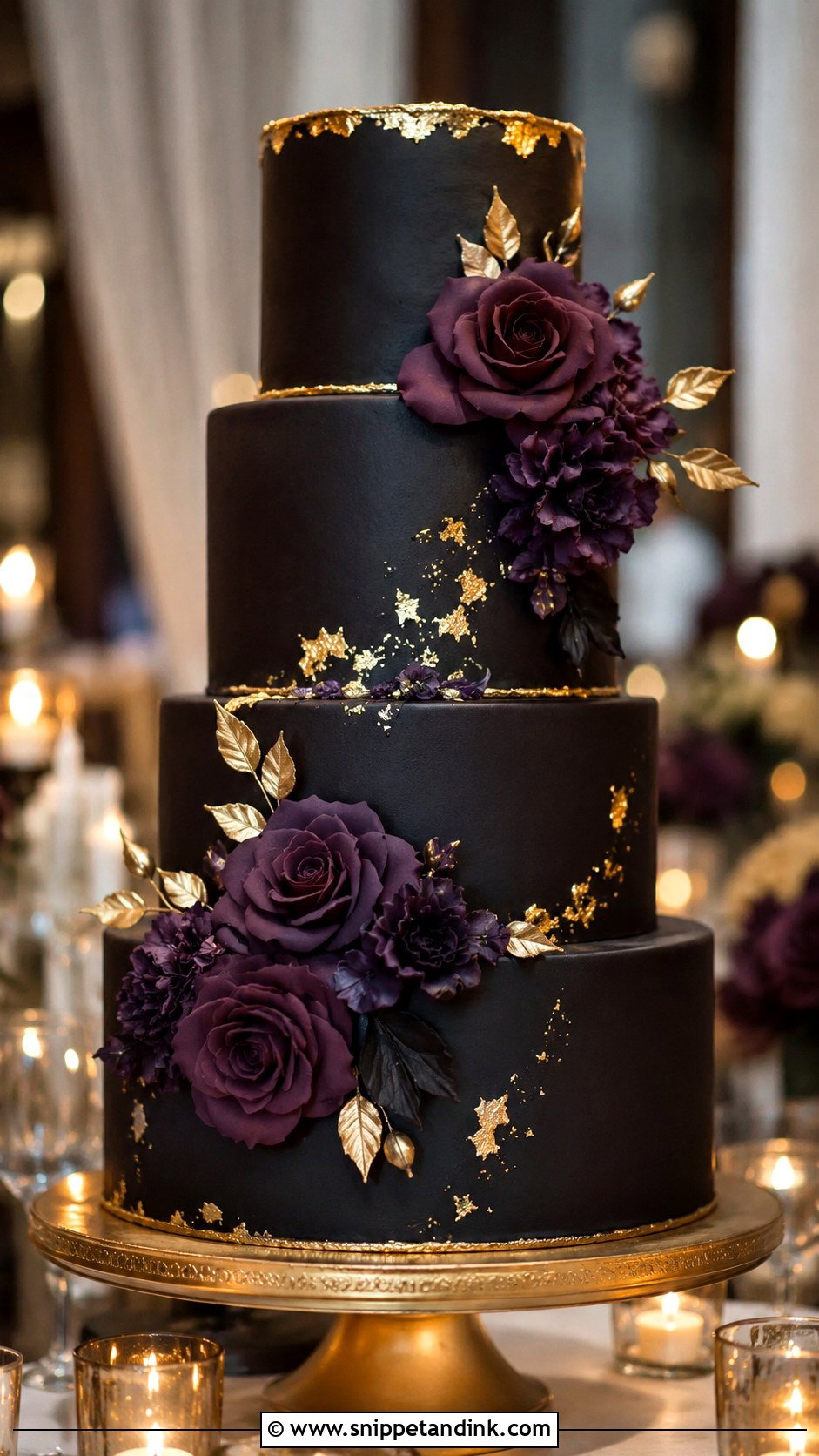
Gold warms up the palette and makes it feel formal. Thin gold leaf, painted tier edges, metallic piping or a single gold topper all work, as long as you hold back; too much and the purple and black get lost. A black base with plum flowers and a few flakes of leaf is the version I return to most. Real edible gold leaf goes on with a dry brush, and it’s worth checking that any gold paint or dust is labeled edible, not just non-toxic. Hotel receptions and ballrooms suit it, with candlelight and gold flatware.
10. Purple And Black Wedding Cake With Silver
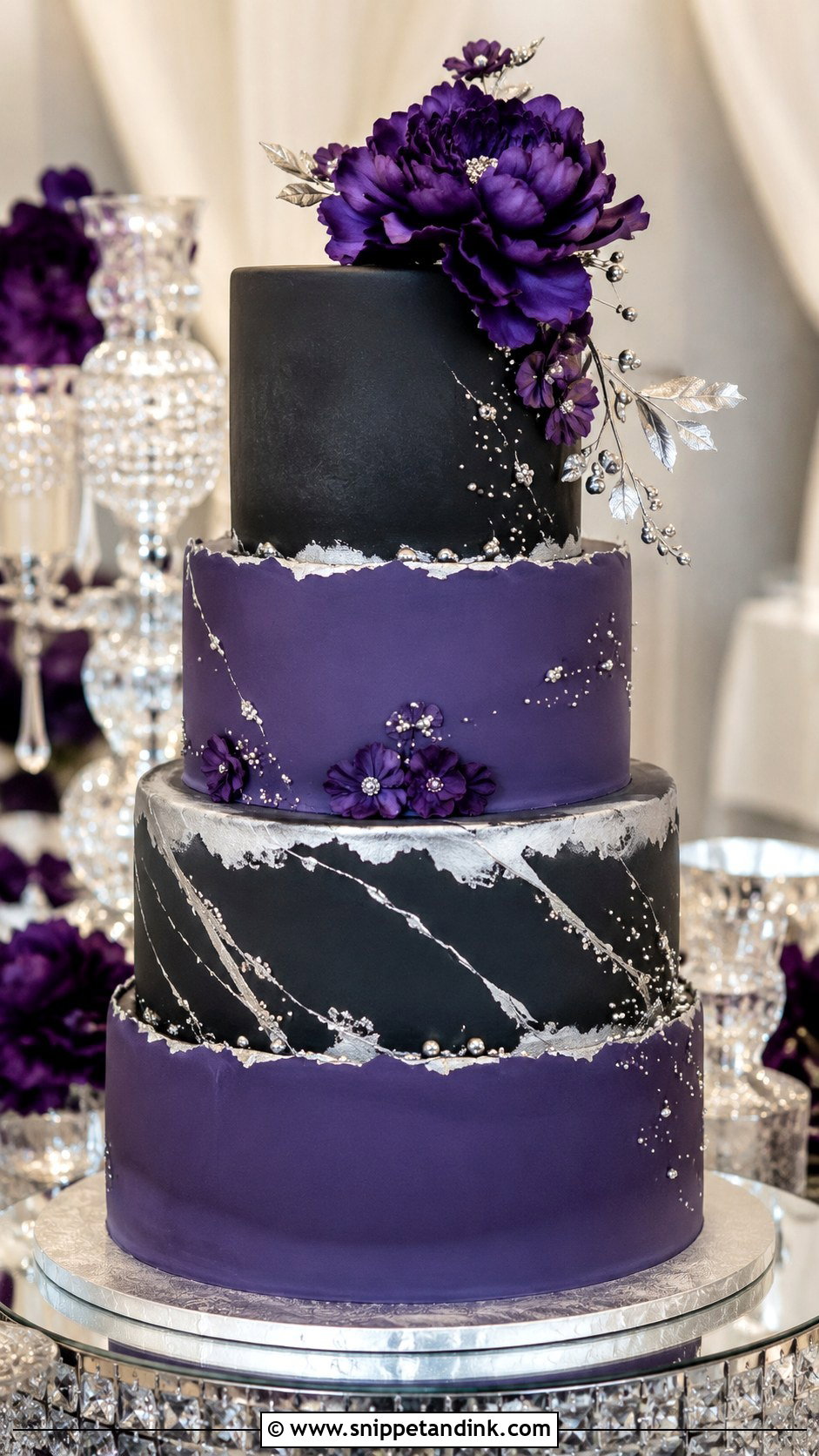
Silver gives a cooler, wintery glow alongside lavender, violet and charcoal. Try a matte black tier with silver painted edges, a floral tier with silver pearls, or marble with silver veining, and choose one main silver detail rather than many. Not every silver decoration sold for cakes is meant to be eaten, so check labels and ask your baker; some dragees are sold as decorative only. It suits crystal decor, mirrored trays and moody evening receptions.
11. Purple And Black Wedding Cake With Roses
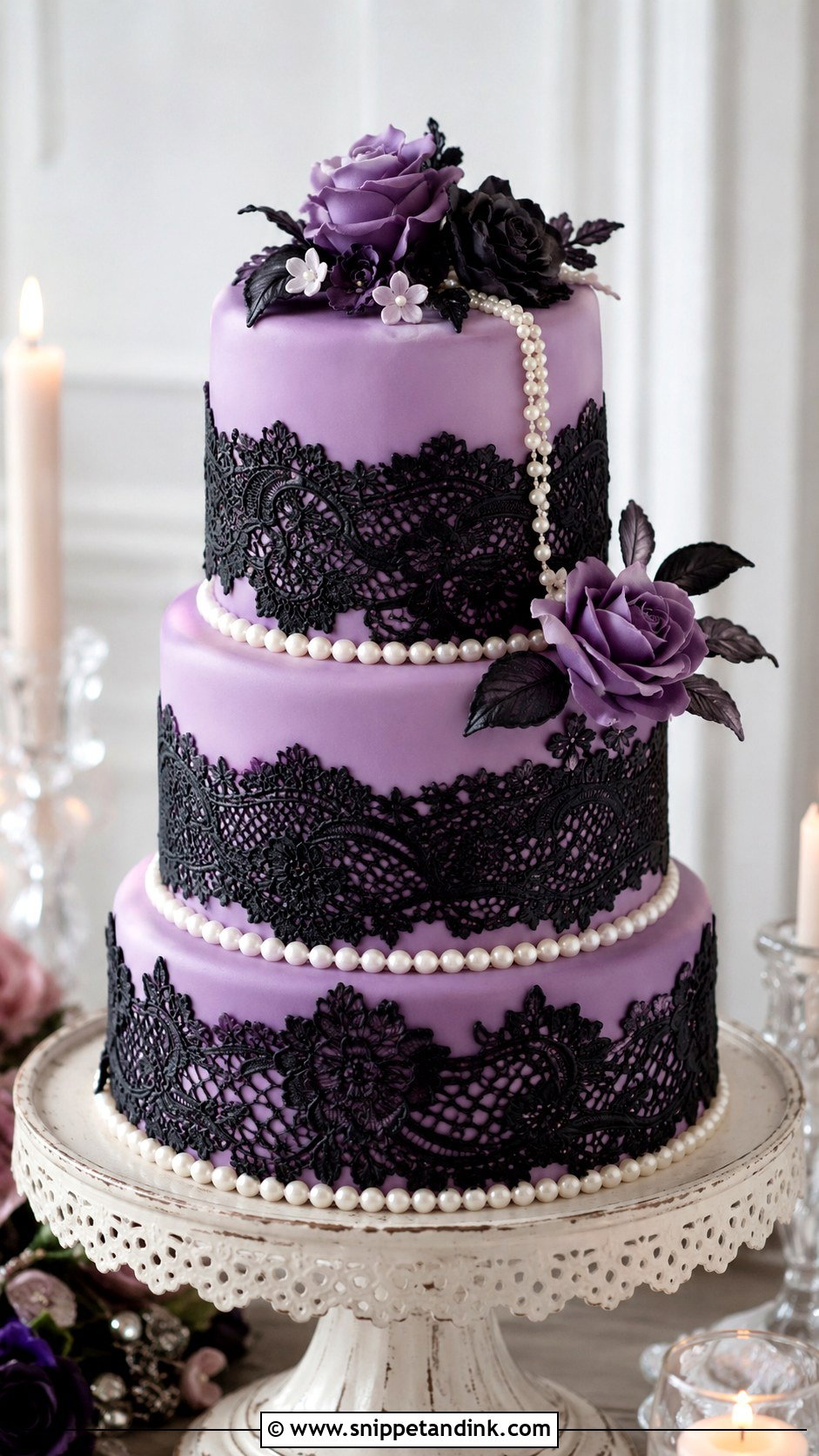
Deep purple roses against black icing look rich without trying hard. Fresh, sugar or piped buttercream roses all work, depending on budget and venue rules. Fresh roses should be grown without pesticides if they’re going on food, and the stems wrapped or set in picks. Sugar roses avoid that question but take time to make, so they need ordering well ahead. A cascade down one side adds height, and black leaves or dark berries add depth. Formal and vintage receptions suit it best.
12. Purple And Black Wedding Cake With Orchids
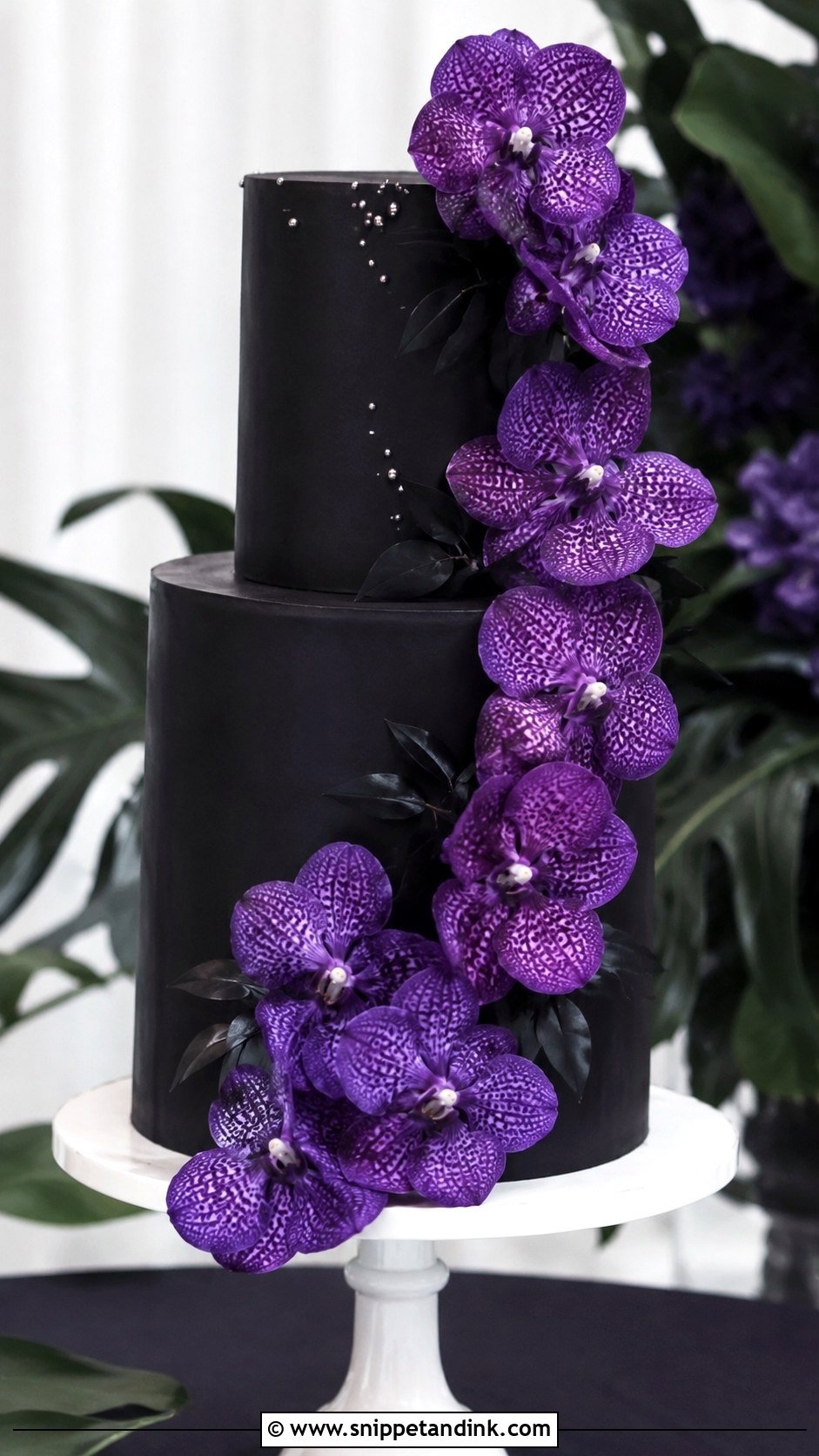
Orchids have such a clean shape that they need almost nothing else around them. A smooth black fondant cake with a trail of purple orchids looks modern and luxurious, especially in a hotel or tropical venue. Deep violet reads dramatic; pale lavender softer. Fresh orchids are usually sprayed by growers, so I set them on a small barrier or use sugar orchids where they touch the icing. Vanilla, coconut, chocolate or passion fruit filling gives it a fresh flavor.
13. Purple And Black Wedding Cake With Lace
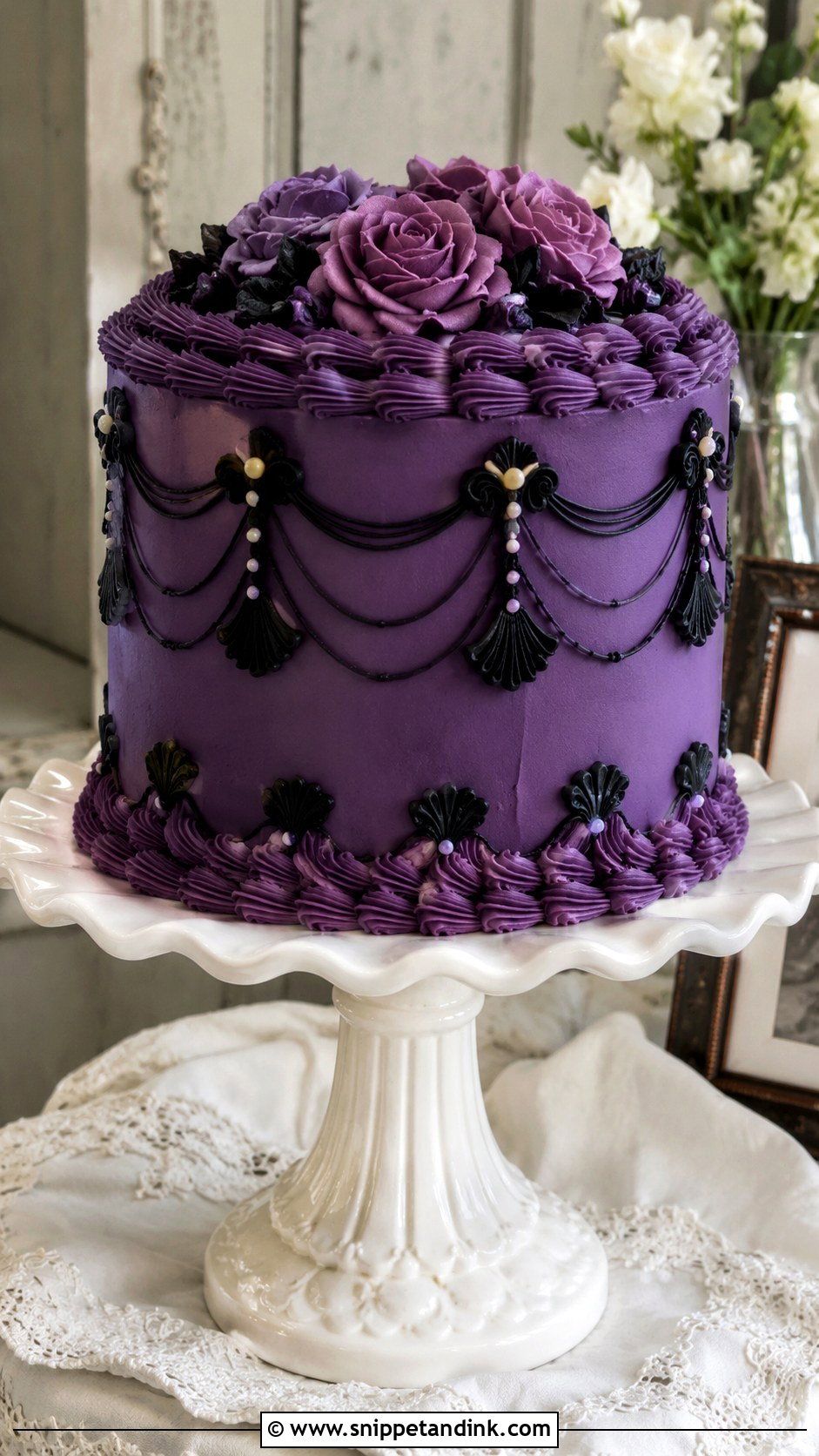
Lace brings in a vintage feel. It can be piped by hand, stenciled with royal icing or made from a set sugar lace mat, and each looks different up close: piped lace has a raised, handmade quality, while sugar lace is flatter and more even. Black lace over purple fondant or ivory tiers suits historic venues and candlelit rooms. Soften it with a few purple flowers or pearls, and a satin ribbon at the base of each tier finishes the edges.
14. Purple And Black Wedding Cake With Pearls
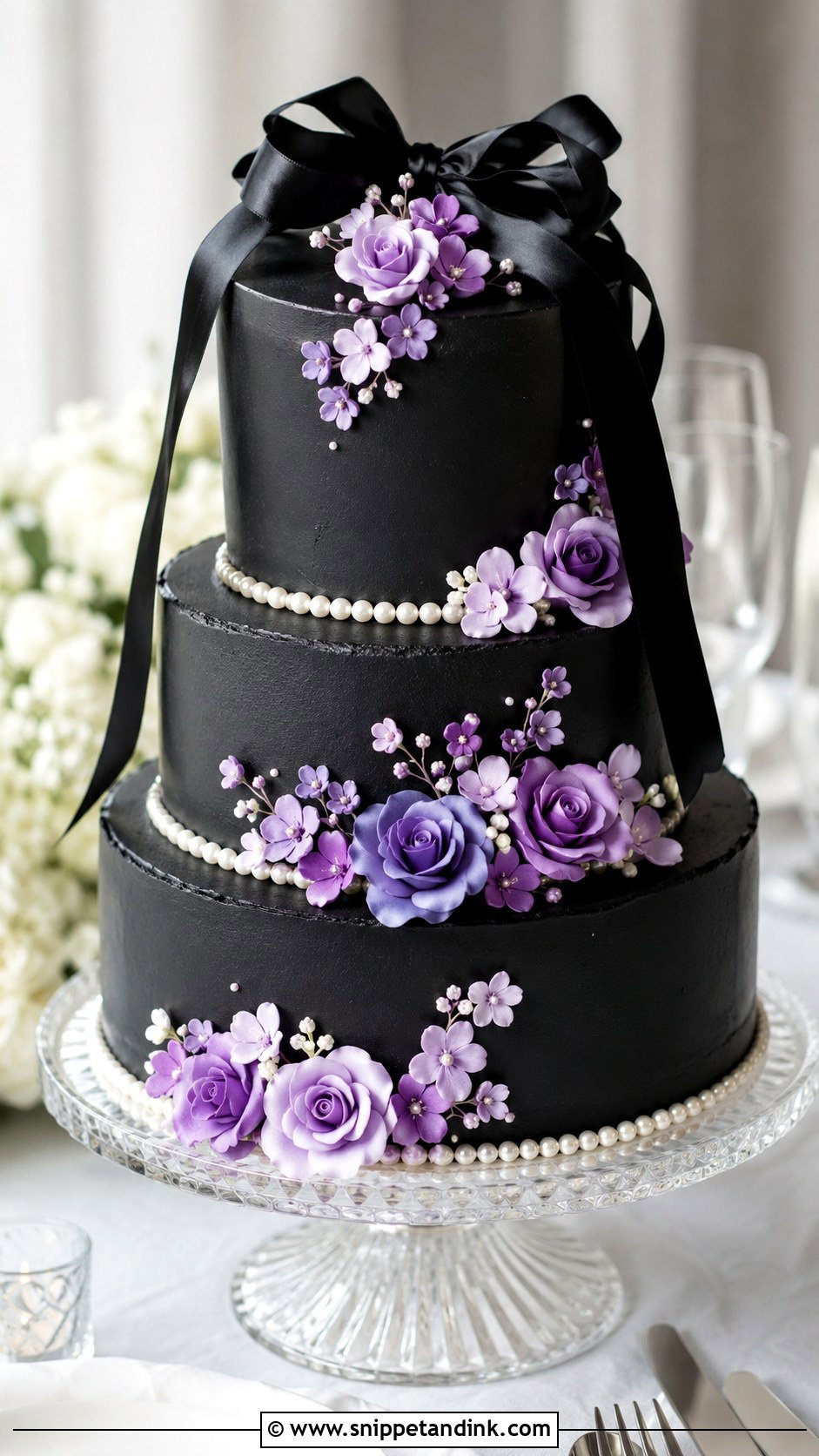
Pearls make the darker palette feel more bridal. Edible pearls around each tier’s base, scattered across smooth icing or set into piping all work. White pearls on black with lavender flowers give strong contrast; purple icing with black ribbon and pearl borders feels traditional. Sugar pearls soften and lose their sheen if they sit against moist buttercream for long, so I add them close to delivery. Keep the layout tidy so they look planned, not scattered at random.

15. Purple And Black Wedding Cake With Berries
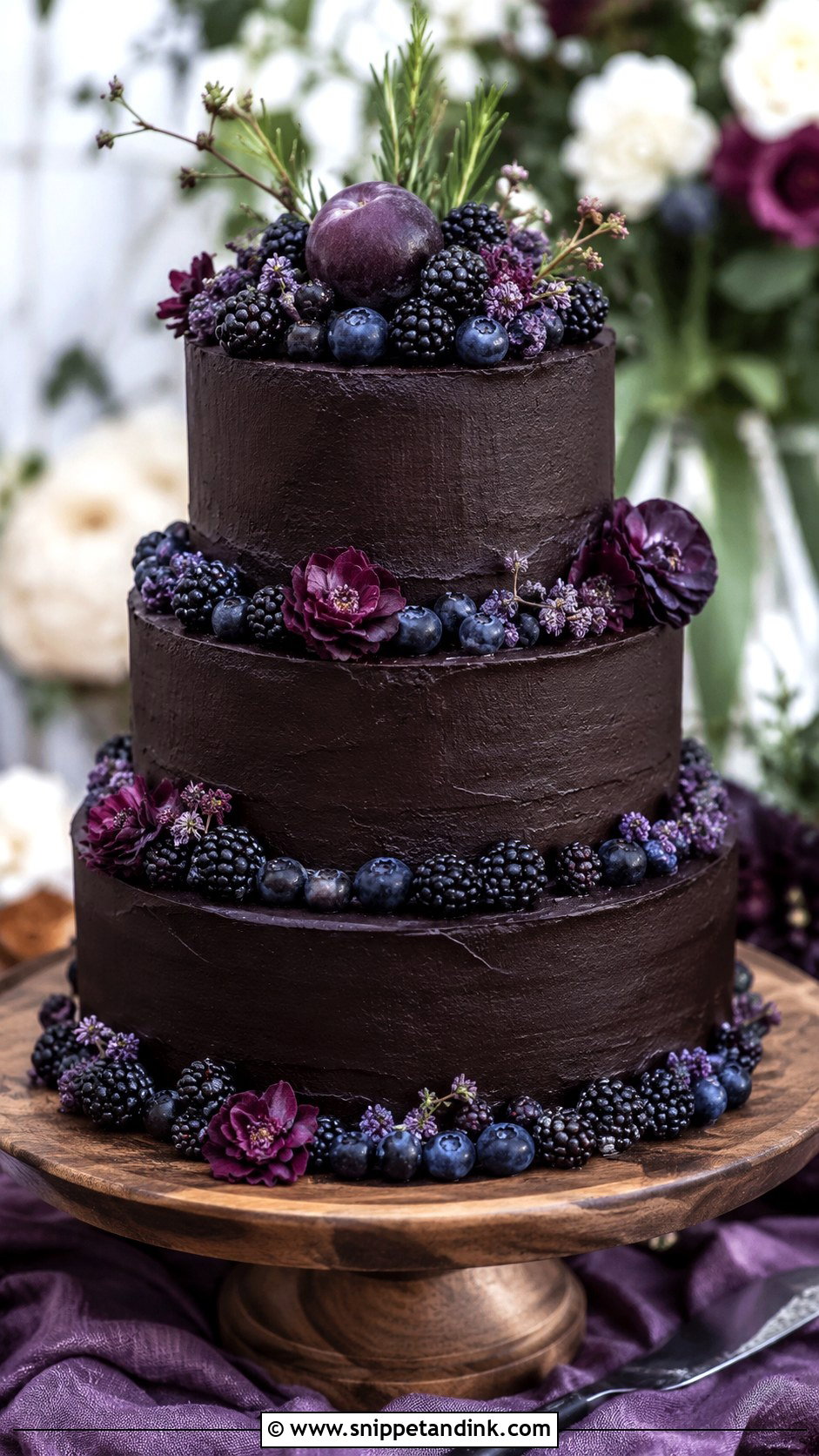
Blackberries, blueberries and dark grapes bring real purple color and keep the decoration edible. Dark chocolate sponge with black buttercream and purple berry compote suits it. Fresh fruit weeps, though, and blackberries bleed juice into pale icing, so I dry them thoroughly and add them as late as possible, ideally on site. Herbs, small flowers or a dusting of powdered sugar soften the look. Autumn weddings and outdoor receptions suit this less formal version.
16. Purple And Black Wedding Cake With Geode
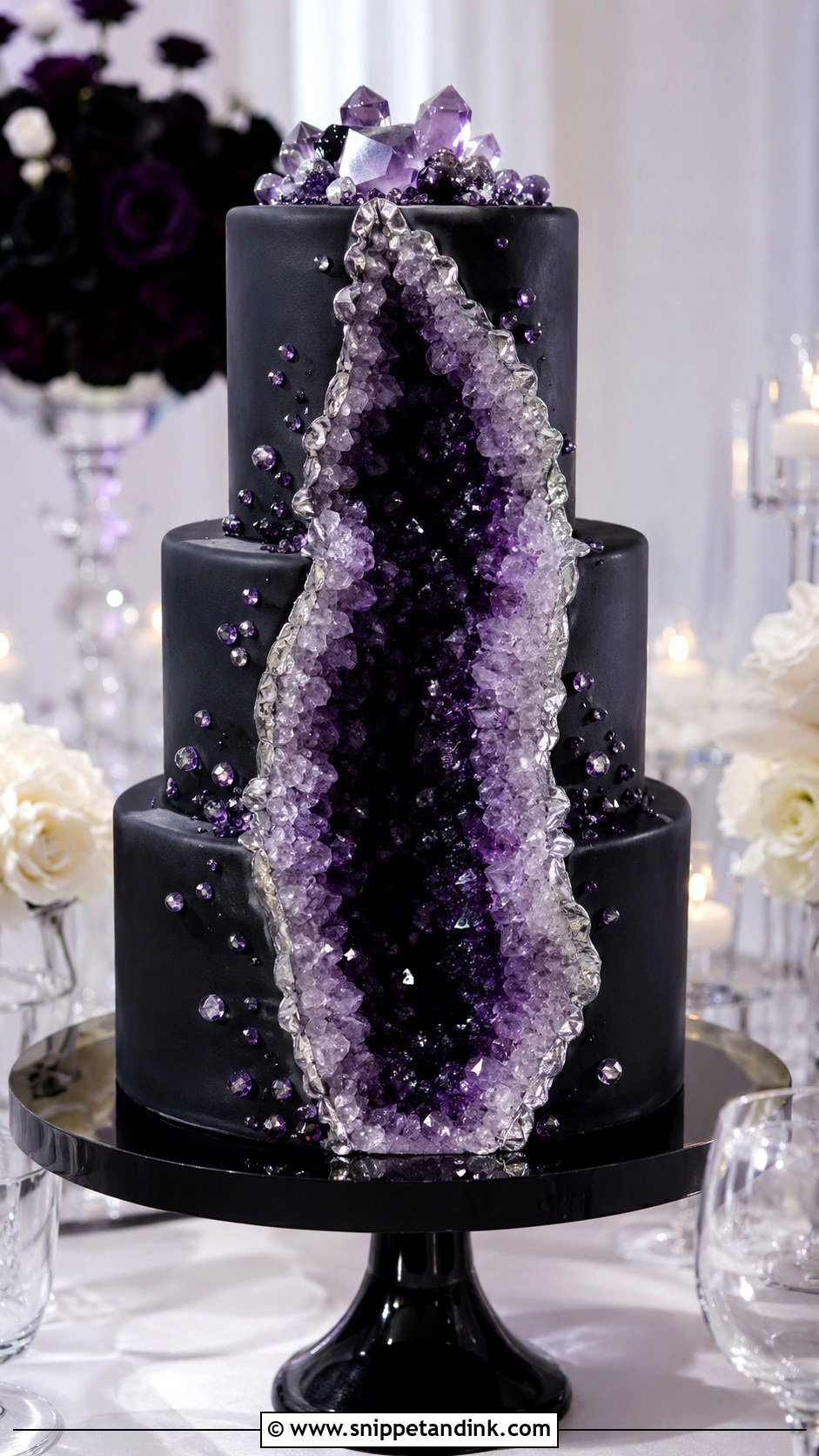
Nothing on this list makes a bigger showpiece than an amethyst geode. The crystal section is carved into black or dark grey tiers and filled with rock candy or isomalt crystals, then the edges are painted with metallic luster. Crystals are heavy and need a well-supported tier underneath. Keep the rest of the cake smooth so the geode is the clear focus. Silver or gold edging, used sparingly, frames the crystals. It suits modern, celestial or glam weddings.
17. Purple And Black Wedding Cake With Watercolor
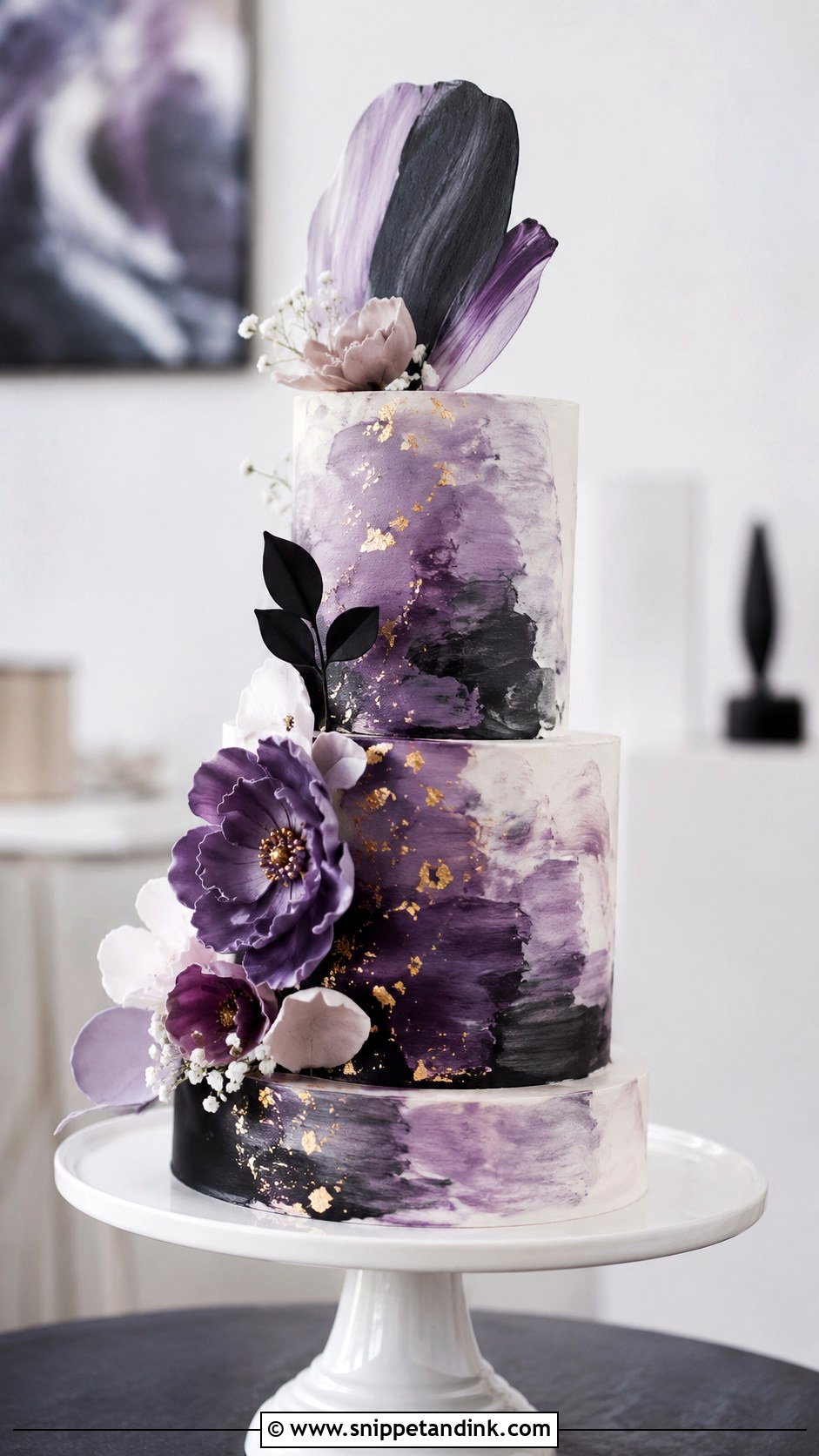
A purple and black watercolor wedding cake trades sharp blocks of color for soft brushstrokes. On fondant I paint with gel colors thinned in a little clear alcohol, which evaporates and leaves the color behind; on buttercream the effect is created by spreading colors together with a spatula. Lavender, plum, charcoal and black can drift across the tiers. Add a few sugar flowers or gold flecks, but keep it airy. It gives you the drama of the palette without the weight.
18. Purple And Black Wedding Cake With Velvet Texture
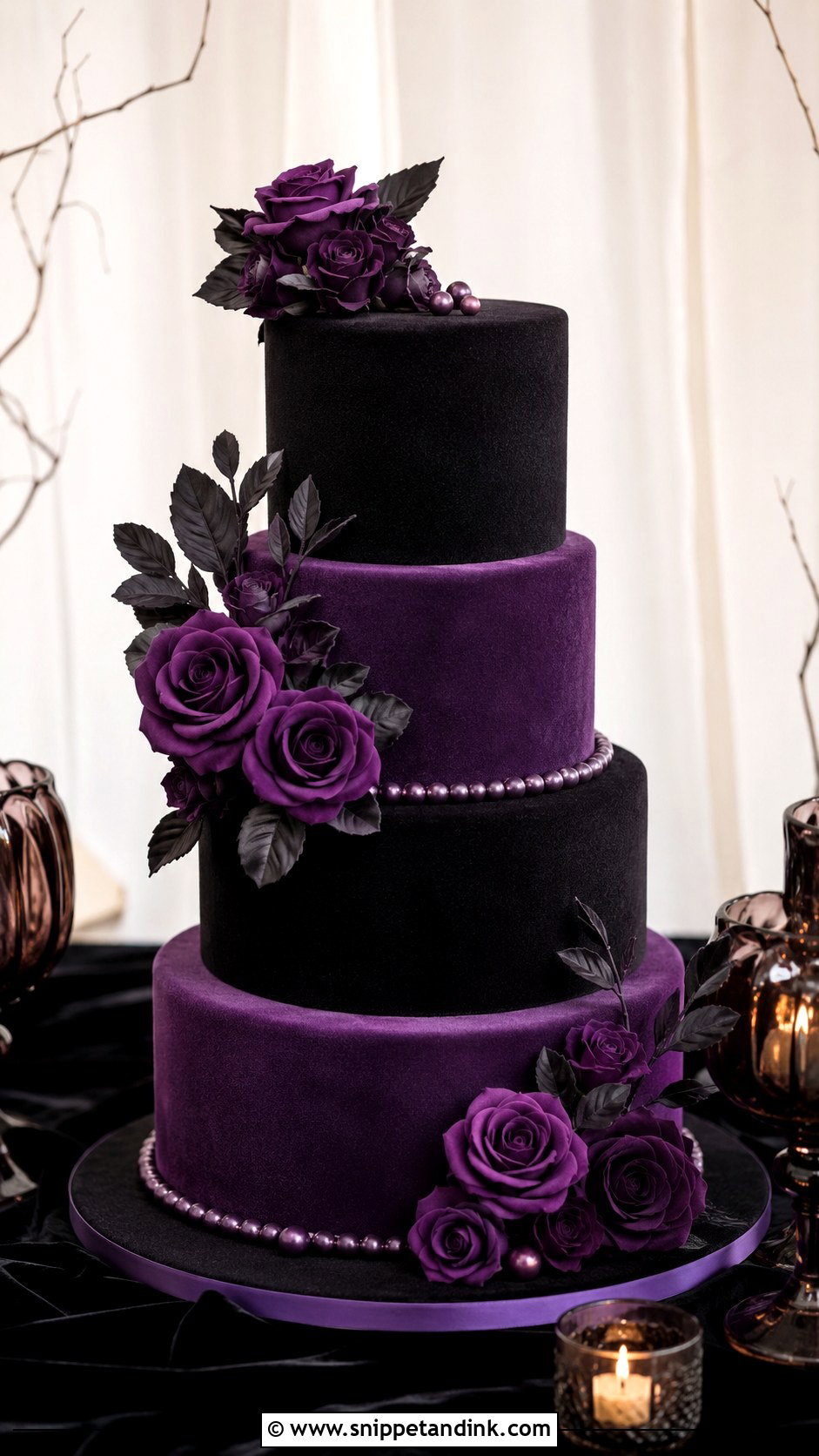
The velvet finish is usually a cocoa butter and chocolate spray applied to a very cold cake, where it sets instantly into a fine, plush texture. Black velvet with purple flowers looks dramatic; purple velvet tiers with black accents look softer. Because the texture does the work, decoration should stay simple, a few roses, orchids or sugar leaves. The spray marks easily when touched, so the cake should be handled as little as possible once finished. Evening and ballroom weddings suit it.
19. Purple And Black Wedding Cake With Vintage Piping
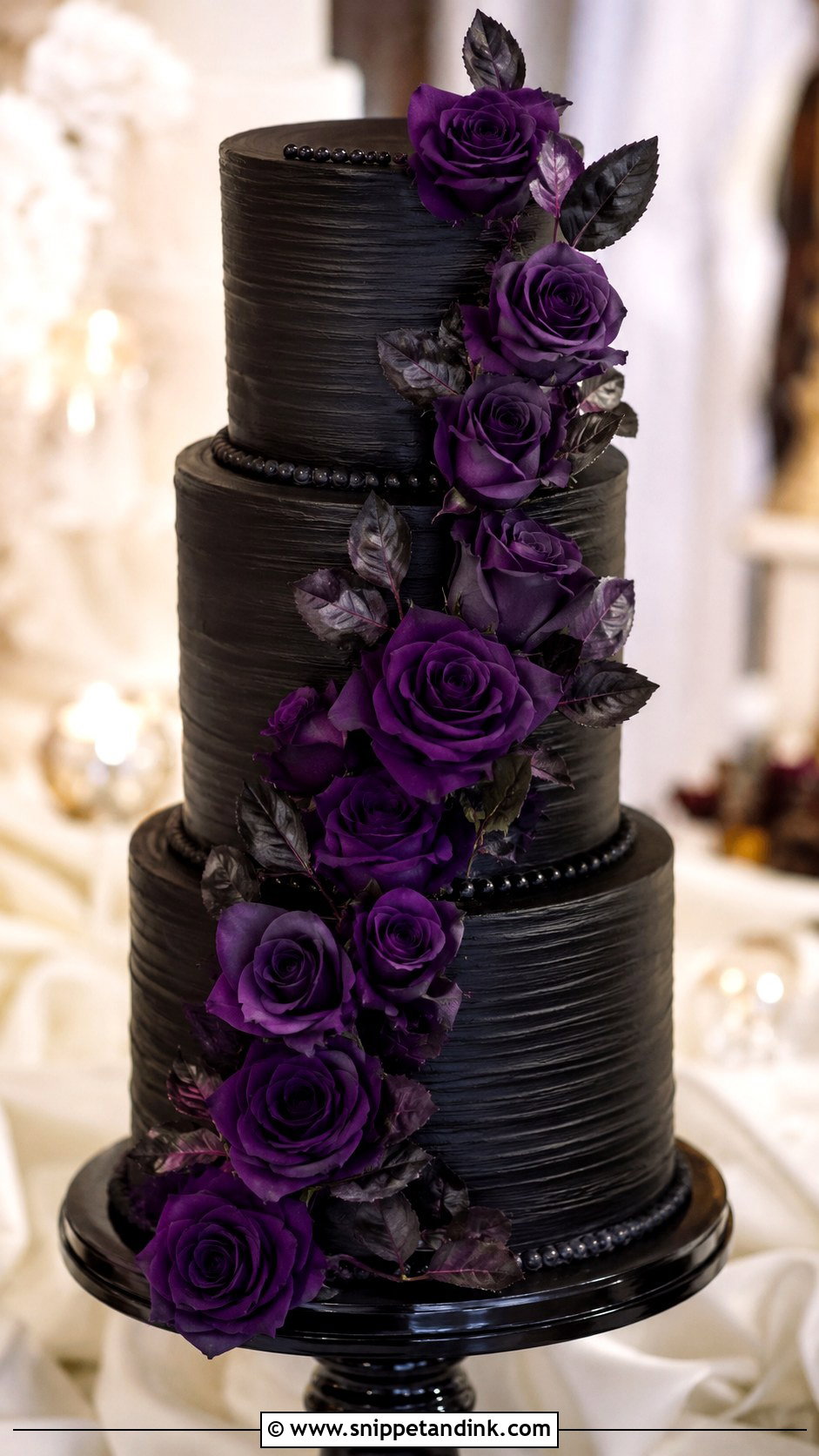
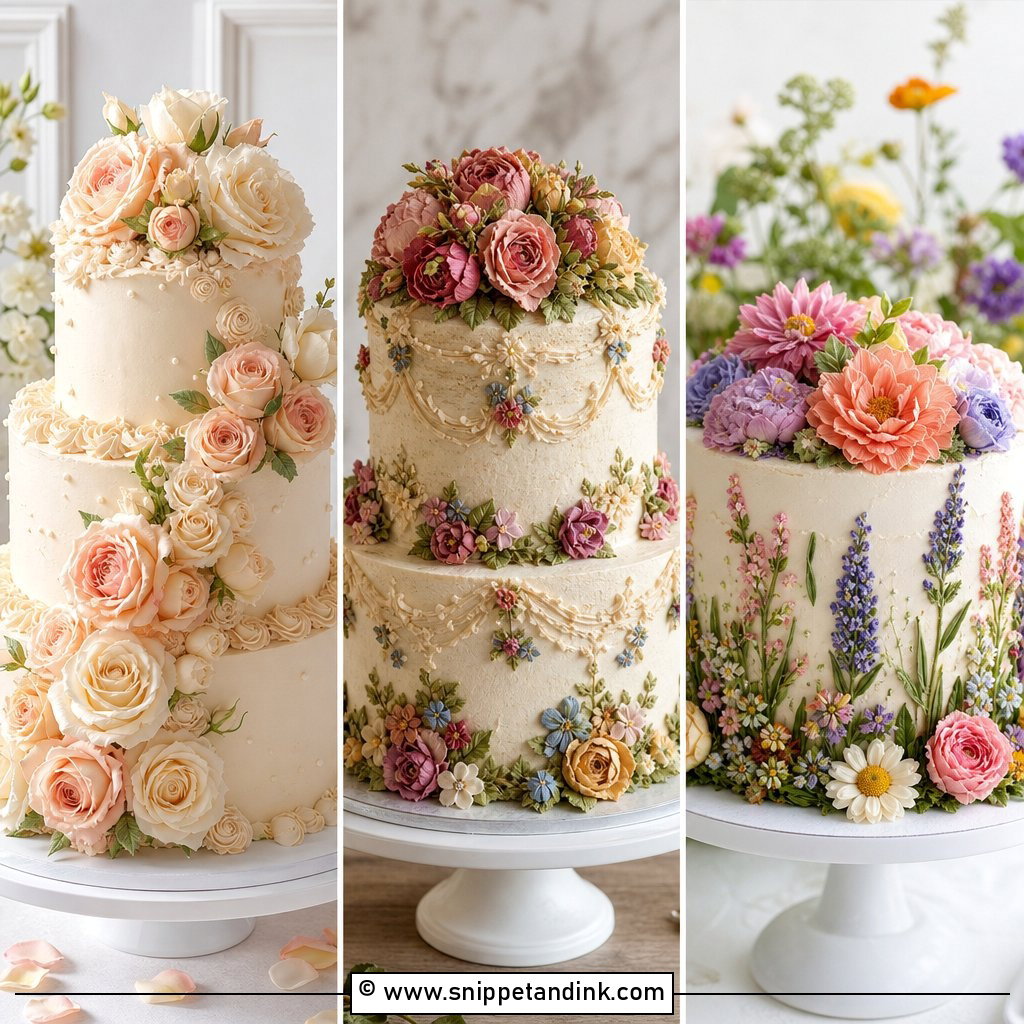
Lambeth-style swags, shell borders, ruffles and tiny piped pearls bring a nostalgic feel in purple and black. This kind of overpiping is slow, careful work, and it needs a firm buttercream or royal icing that holds its shape, so it suits a cool indoor room better than a summer marquee. A tall round cake keeps it modern; a heart shape leans playful. Deep plum icing with black piping, or black with lavender details, both work. Neat, balanced piping is what keeps it refined.
20. Purple And Black Wedding Cake With Moon And Stars
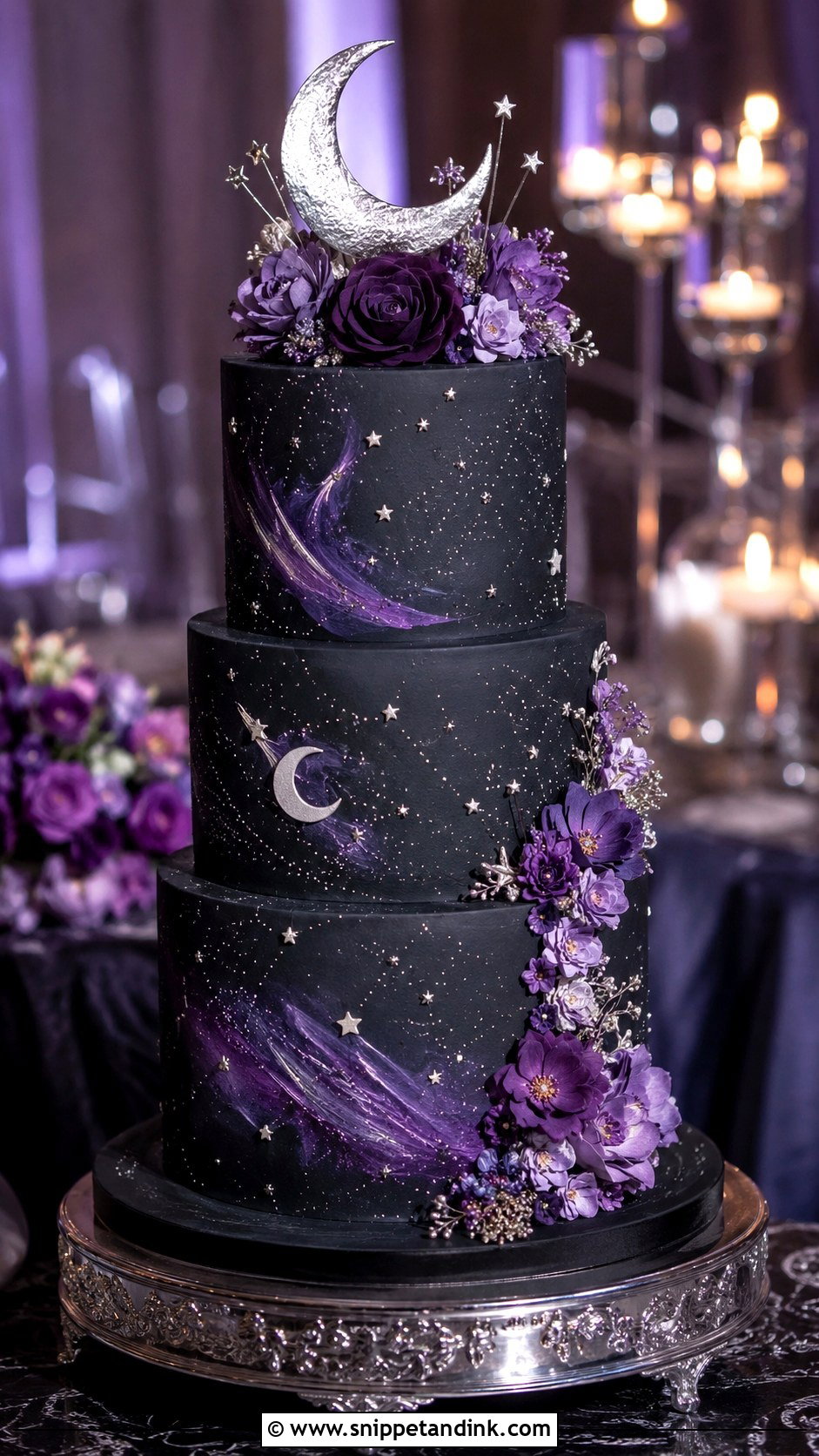
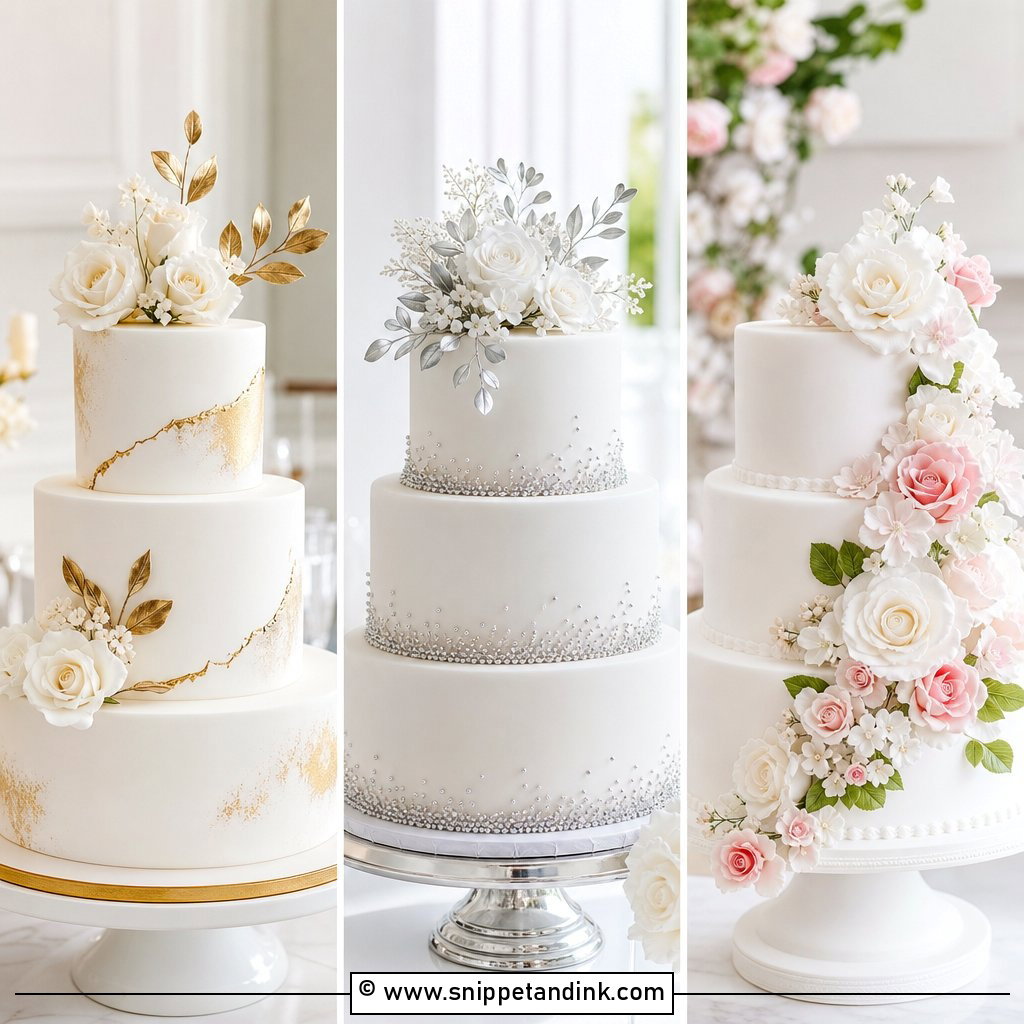
A black or midnight-purple base with silver moon and stars, edible glitter and soft galaxy brushstrokes suits a celestial theme. The risk is looking childish, so I keep the stars small and few, and pair them with a crescent moon topper and dark flowers. Edible glitter is the detail to check: some craft glitters are sold for cakes but aren’t meant to be eaten. Smooth tiers let the details stand out in photos and on the dessert table.
Why Purple Turns Blue or Grey Under the Wrong Light
Purple icing is built from red and blue pigments, and they don’t fade at the same rate. Under direct sunlight or strong fluorescent light, the red side weakens first and the cake drifts toward blue or a dusty grey, sometimes within hours. That’s why I set purple cakes up away from windows and deliver them as close to the reception as the schedule allows.
Lighting changes how the color photographs too. Warm candlelight pushes purple toward plum; cool white LEDs make it bluer. If you have a planned shade in mind, send your baker a photo of it under similar lighting, and ask for a small color sample in daylight and indoor light before the final order.
Flowers That Should Never Touch the Frosting
Several flowers that suit this palette are toxic or heavily treated, so they need a barrier or a sugar replacement:
- Calla lilies, lily of the valley and hydrangea should be kept off the icing completely.
- Florist roses and orchids are usually sprayed; use pesticide-free stems, or wrap and set them in food-safe picks.
- Sugar flowers avoid the problem entirely but are made by hand, so order them weeks ahead.
Agree between your florist and baker who supplies, prepares and places the cake flowers. It’s the detail most often left to chance on the day.
One Dark Element, One Soft One
Most of the purple and black cakes I’d stand behind balance one strong dark element with one softer detail, such as flowers, pearls, watercolor or a metallic touch. For drama, go with black fondant, deep roses and tall tiers. For something gentler, an ombre fade or lavender flowers. Before you decide, look at your venue’s lighting and where the cake will stand, and ask to see a sample of the exact black and purple your baker will use. Get those right and the cake becomes the room’s centerpiece.
You'll Like These Ideas:





Leave a Reply