
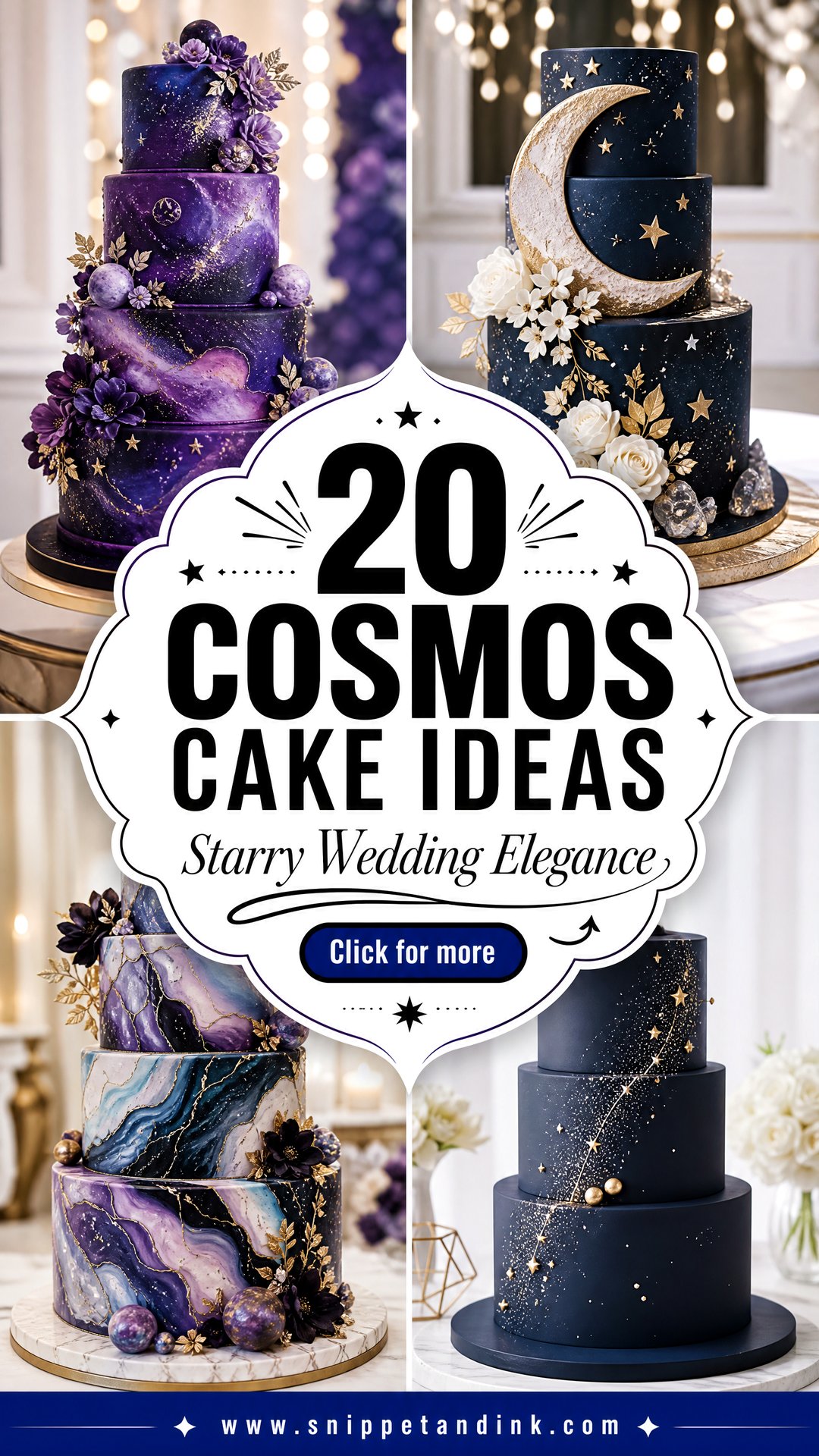
A cake covered in stars and moons can easily tip into a themed party, and most couples who ask me for one are worried about exactly that. The way around it is restraint with color and finish: deep navy, soft black, ivory, silver, pearl and gold, used on clean tiered shapes. Inside that palette there’s a lot of room, from hand-painted galaxies and constellation piping to geode crystals and a single brushed moon. Evening receptions, rooftops and candlelit halls suit the darker versions best. Below are twenty designs, along with the practical details I’d want you to know before you order one.
Dark Icing Has Costs Nobody Mentions at the Tasting
Most of these cakes depend on navy, black or deep purple, and dark icing behaves differently from pale icing. To get buttercream truly black takes a lot of gel color, which can leave a slightly bitter taste and will stain lips and teeth for a while. Nobody wants a blue-tongued kiss in the cake-cutting photos.
There are good ways around it, and they’re worth raising with your baker before the design is final:
- Start dark buttercream from chocolate or black cocoa, so far less dye is needed to reach the shade.
- Keep the dark color on the outside only. A navy fondant or ganache shell over pale filling looks the same on the table and is far gentler to eat.
- Choose navy over true black. It reads as dramatic from a few steps away and needs much less coloring.
- Ask for the icing to be colored a day ahead. Dark shades keep deepening as they rest, so a baker who colors on the day tends to overshoot with dye.
1. Galaxy Wedding Cake
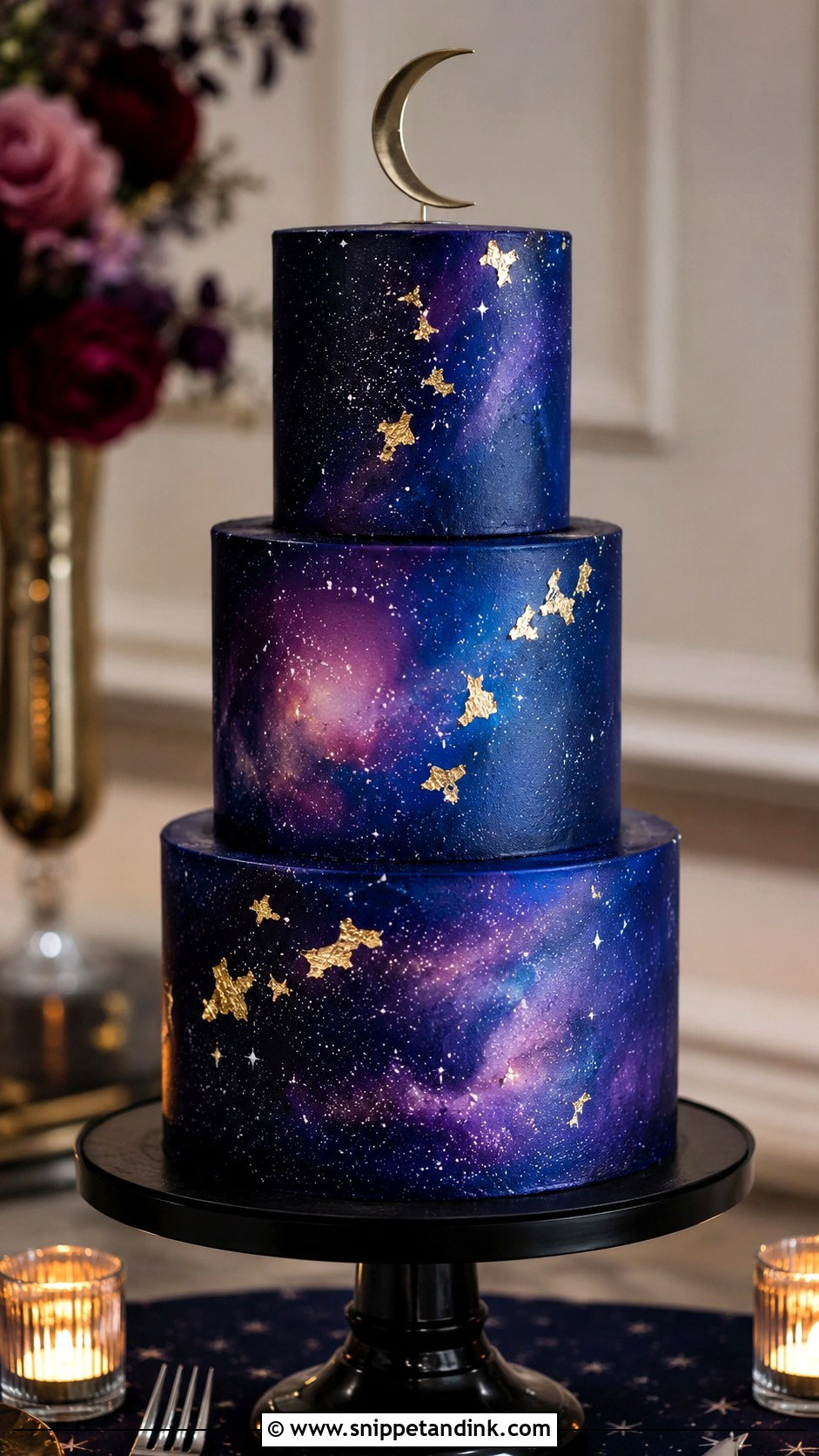
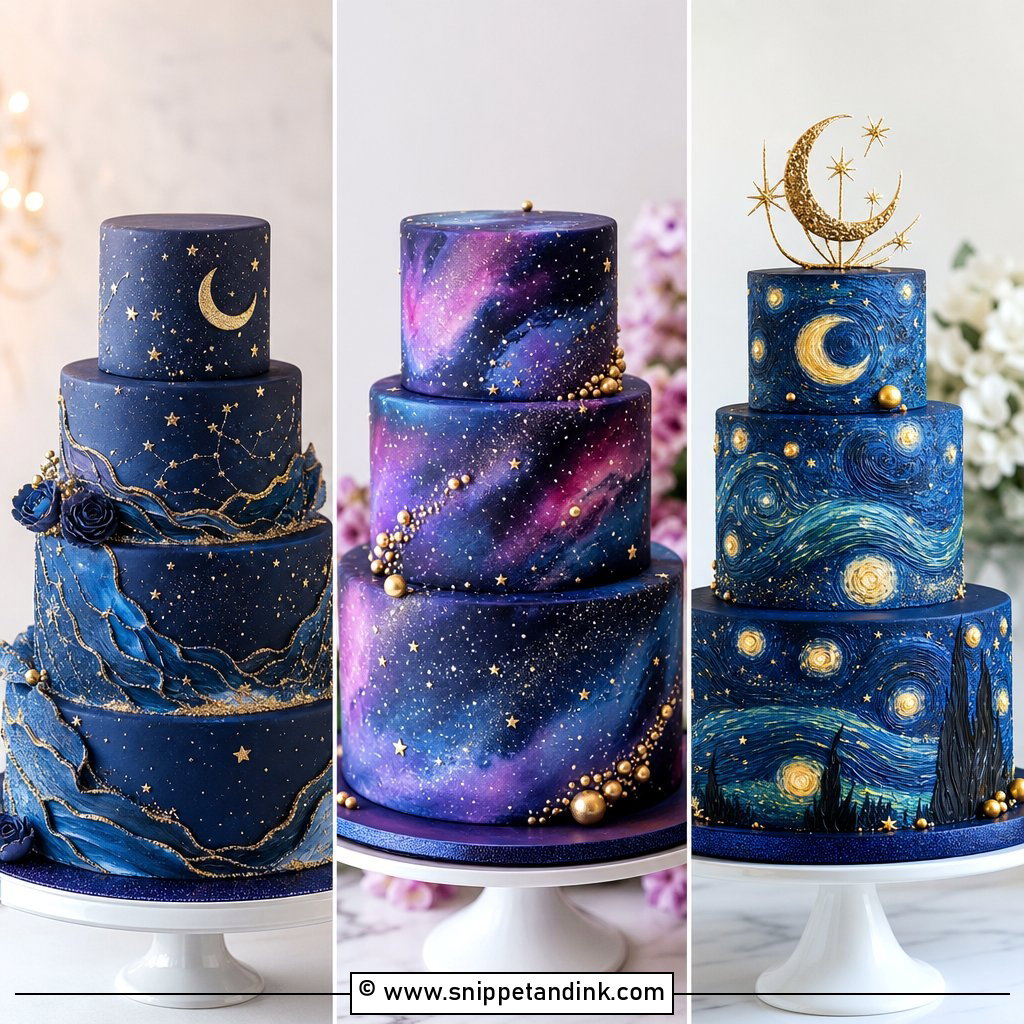
Galaxy is where most celestial cakes start, because blended navy, black, violet and blue capture the movement of the night sky better than any single color. I paint or airbrush the blend over smooth buttercream or fondant, then flick on fine white speckles for the star field. Two or three tiers is the sweet spot; on a taller cake the blending gets harder to keep even. Crisp edges, a plain stand and one topper, a crescent moon or a gold starburst, keep it formal. Chocolate, vanilla and blackberry sponges all sit well under the dark finish.
2. Moon And Stars Wedding Cake
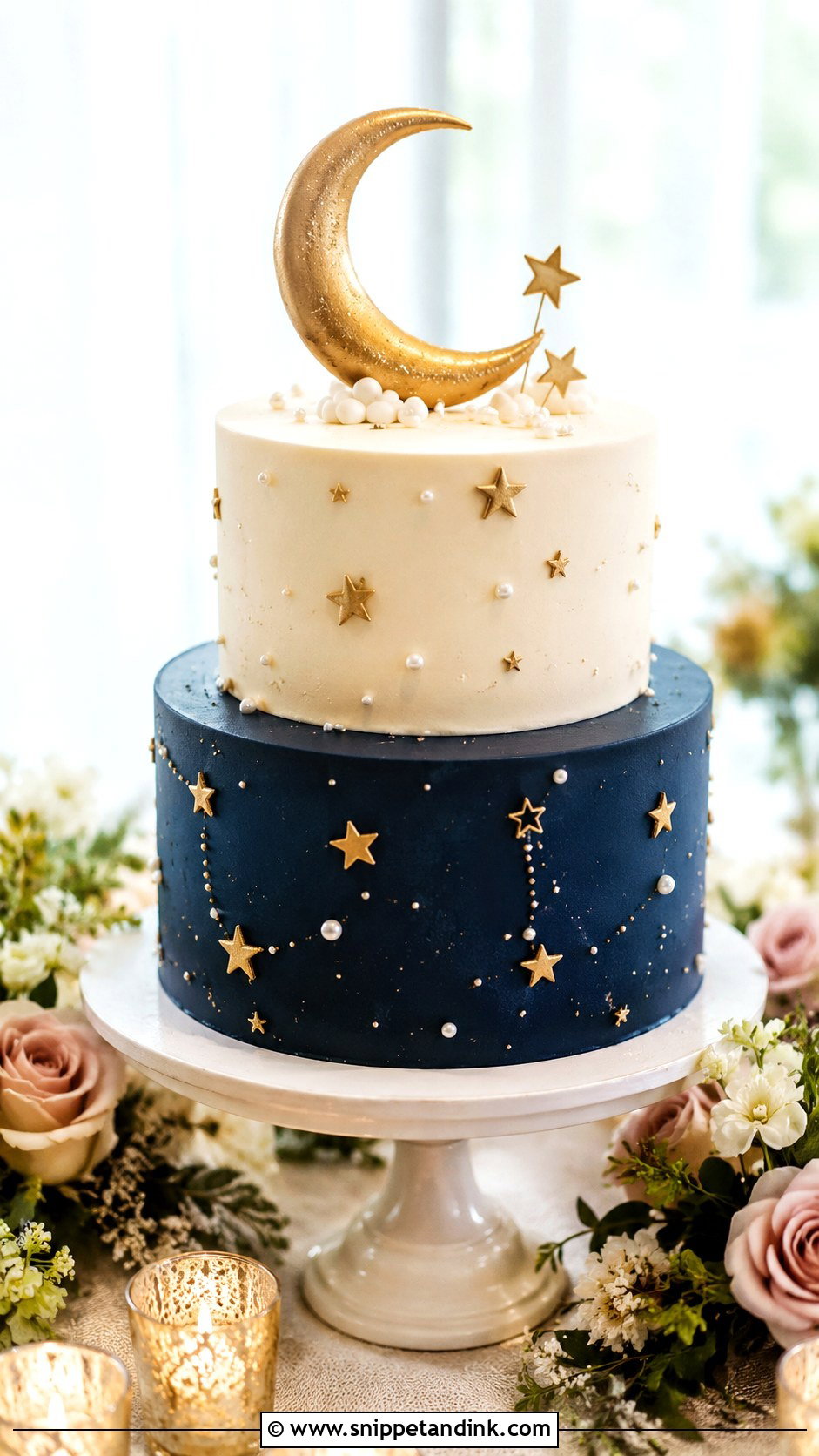
This one is romantic rather than dramatic. Ivory buttercream, matte navy fondant or a soft blue watercolor finish all work as the base, with a crescent moon topper and edible gold stars set in a deliberate trail rather than sprinkled. I glue each star on individually so they don’t slide on soft buttercream in a warm room. Candles, pale flowers and dark linens suit it. Almond, vanilla bean, lemon and champagne sponges keep the flavor as light as the look.
3. Celestial Wedding Cake
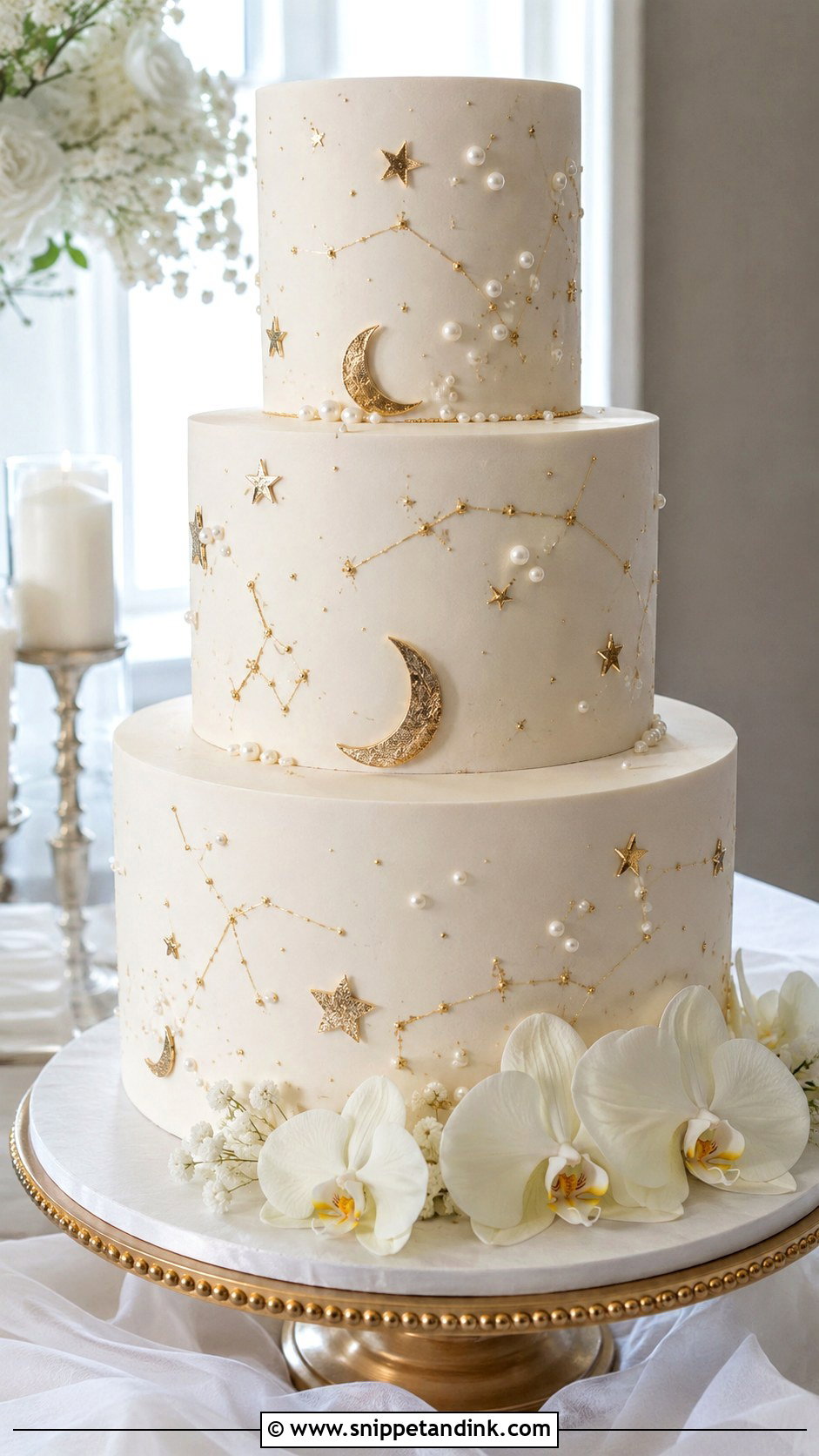
Instead of painting the whole cake, I keep the tiers white or ivory and let gold constellations, small crescents, sunbursts and pearl stars carry the theme. It’s the version I’d suggest for a formal wedding where the venue is already ornate. A tall three-tier in fondant gives the sharpest canvas for fine metallic lines; buttercream softens them. Fresh white roses, orchids or dried gold foliage sit well alongside. The risk is crowding, so I sketch the motifs on paper first and remove about a third before painting.
4. Navy Cosmos Wedding Cake
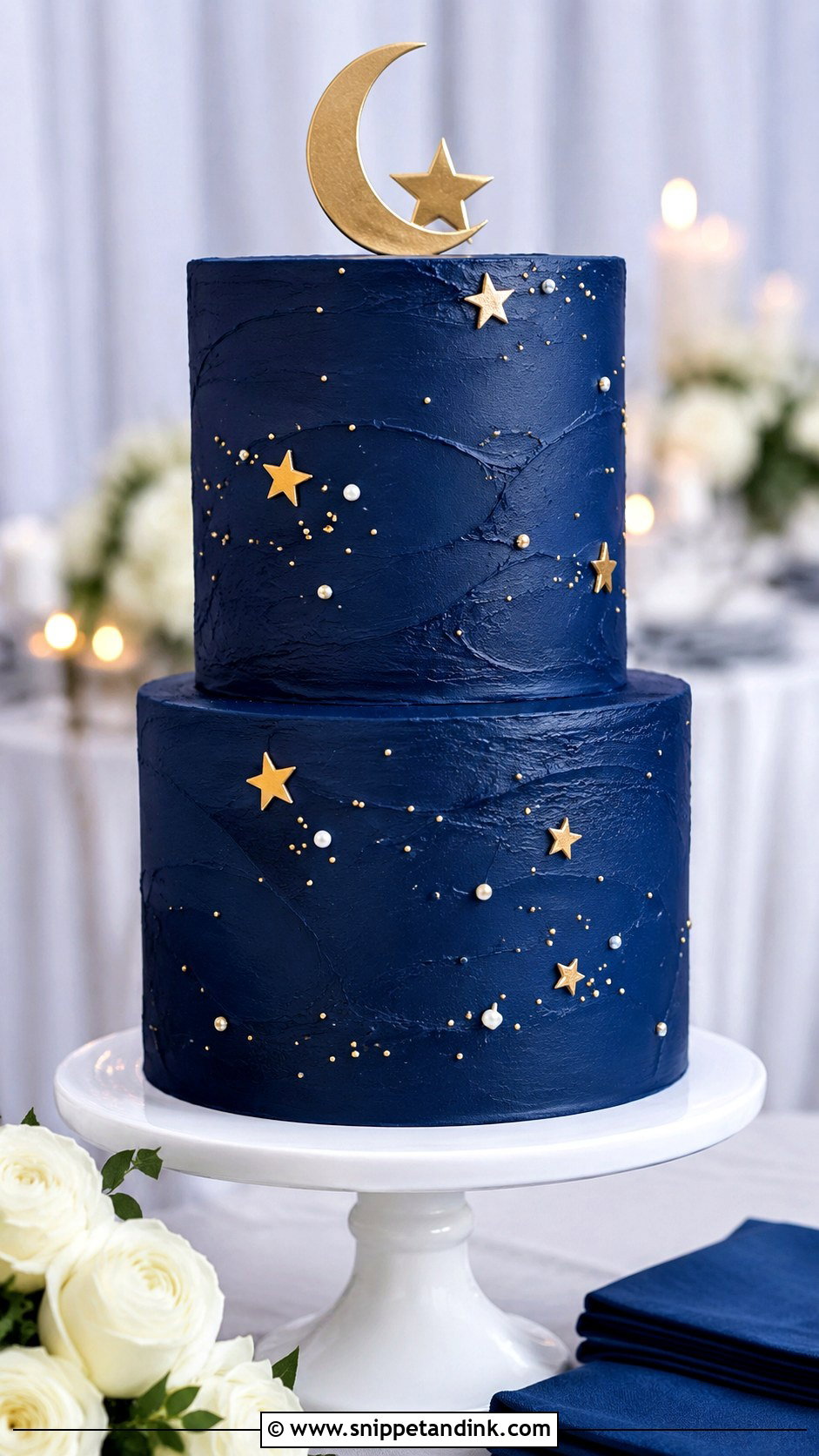
Navy is my usual recommendation over black. It reads just as dramatic from across a room, it’s kinder in photos, and it needs less coloring to reach a rich shade. I cover the tiers in smooth navy fondant or deep blue buttercream, then add brushed gold stars, a moon topper and tiny edible pearls. A tall two-tier or slim three-tier gives it presence. Dark chocolate, espresso, vanilla bean and salted caramel all suit. White flowers at the base stop the color feeling heavy.
5. Black Galaxy Wedding Cake
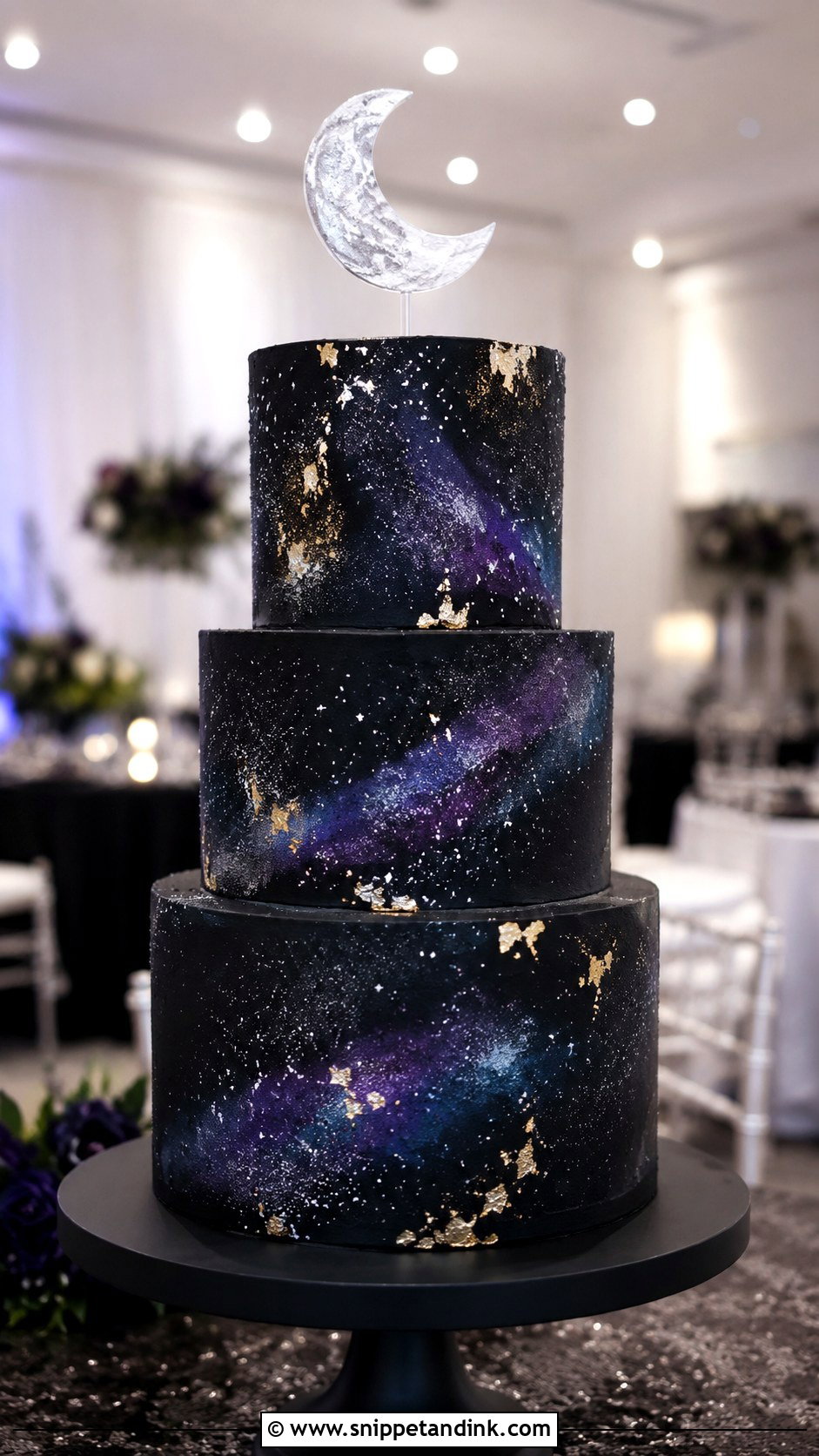
Black galaxy is the boldest cake here, and the finish has to be immaculate or it looks like a birthday cake. I start with a smooth black or charcoal buttercream, then wash purple, blue and silver across each tier and speckle fine white stars over the top. Every flaw shows on black, so the base coat gets an extra chill and smoothing pass. A crescent moon or a slim acrylic topper adds height without clutter. Industrial venues and ballrooms suit it. Chocolate ganache, mocha and black cocoa sponges match the mood, and the black cocoa also helps the icing go dark with less dye.
6. White Celestial Wedding Cake
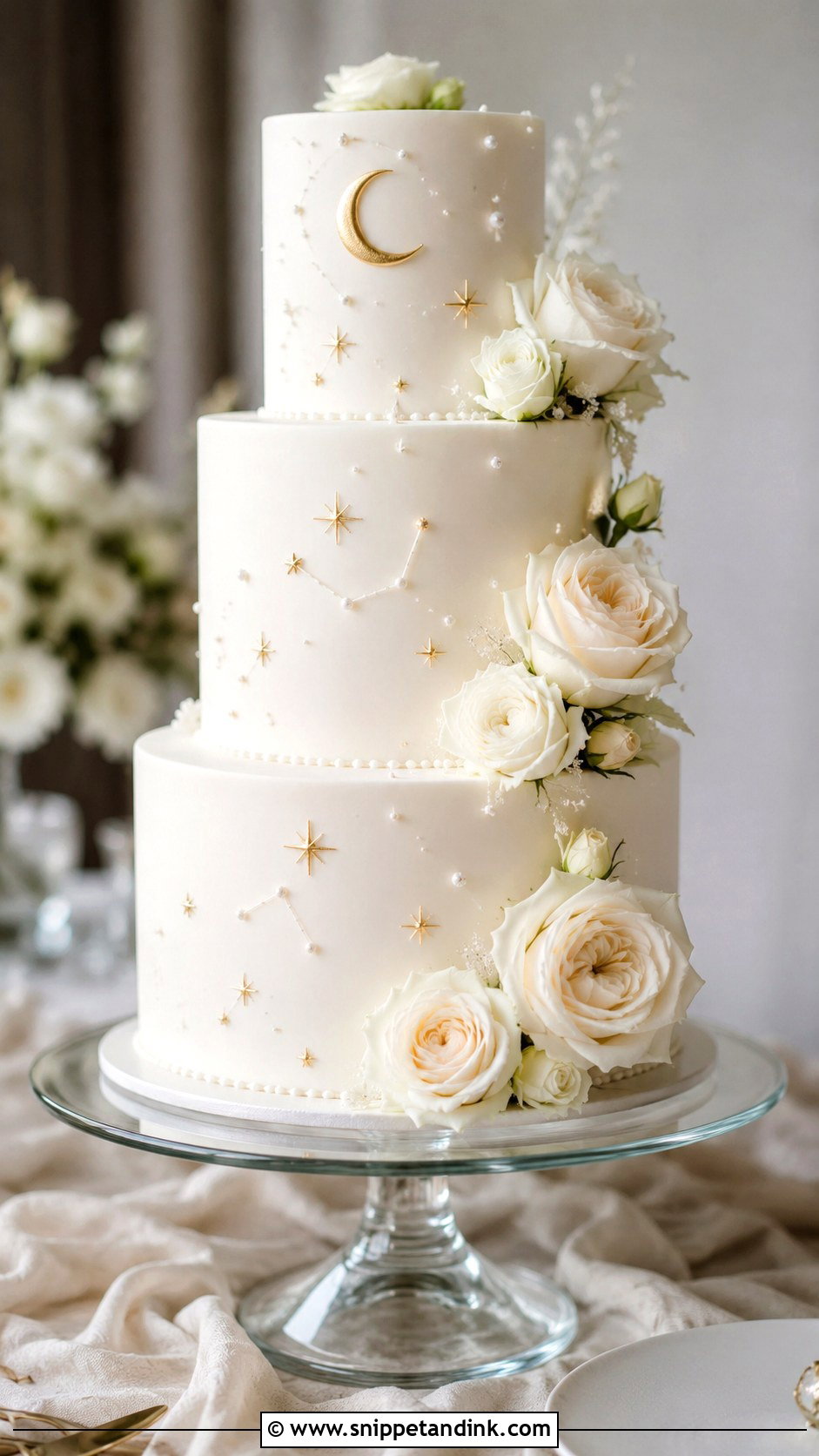
A white celestial cake keeps the bridal brightness and lets the theme whisper. The tiers stay white or ivory, and gold stars, pearl accents and delicate constellation lines do the rest. Fondant gives the crispest surface for fine painting; buttercream feels softer and more romantic. A pale cake also leaves your florist free to add fresh blooms without fighting a dark background. Vanilla, almond, coconut and champagne sponges suit it. If your reception is outdoors in daylight, this is the celestial cake I’d pick.
7. Gold Star Wedding Cake
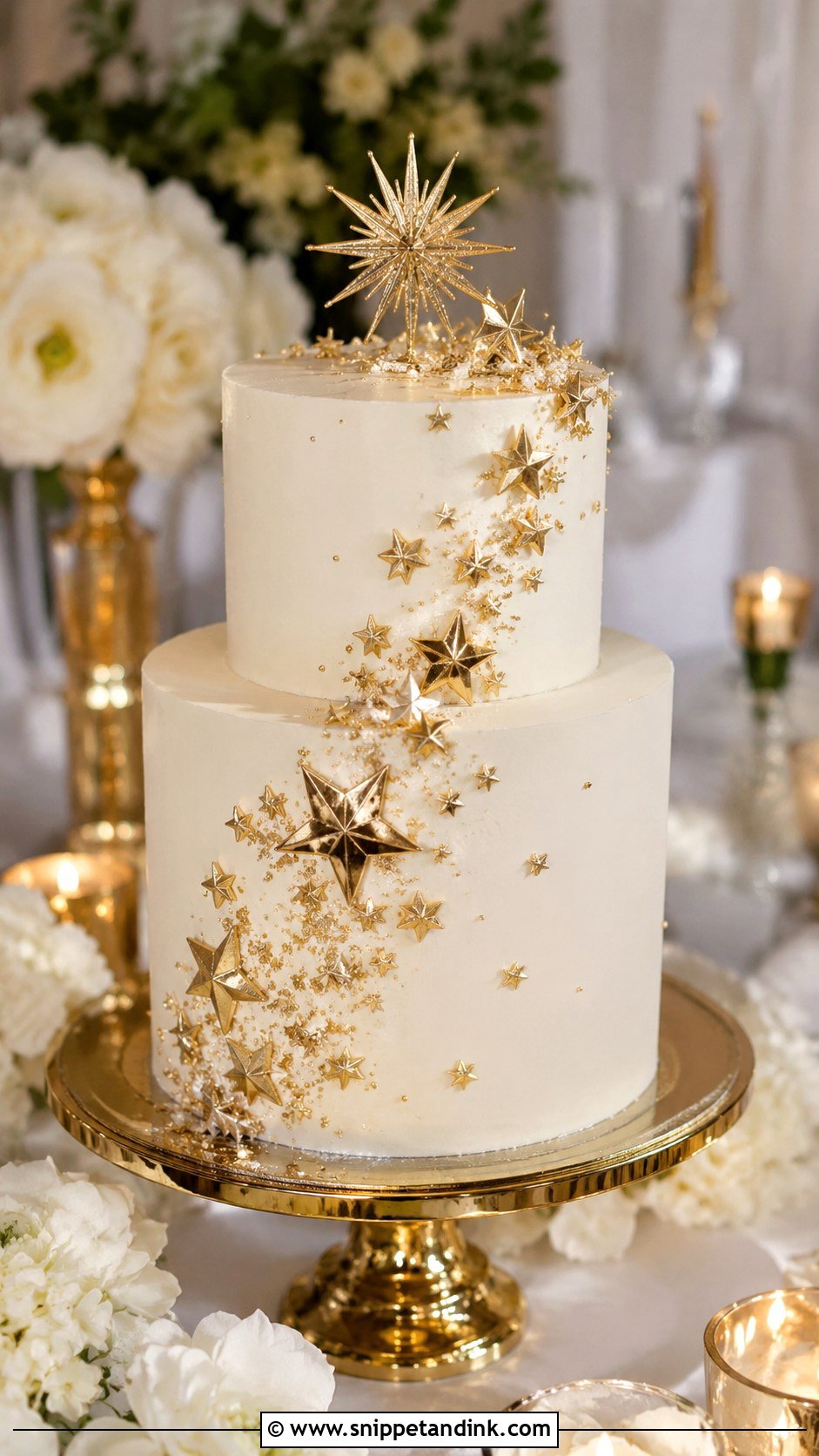
Stars alone can carry a cake if the placement is good. The base can be white, ivory, navy or blush, with edible gold stars in mixed sizes, a little gold leaf or a slim starburst topper. I arrange the stars on a diagonal sweep rising from the bottom tier to the top, which gives the cake movement and guides the eye upward in photos. Random scattering looks unplanned by comparison. Vanilla bean, honey almond, lemon and brown butter pair well with gold.
8. Constellation Wedding Cake
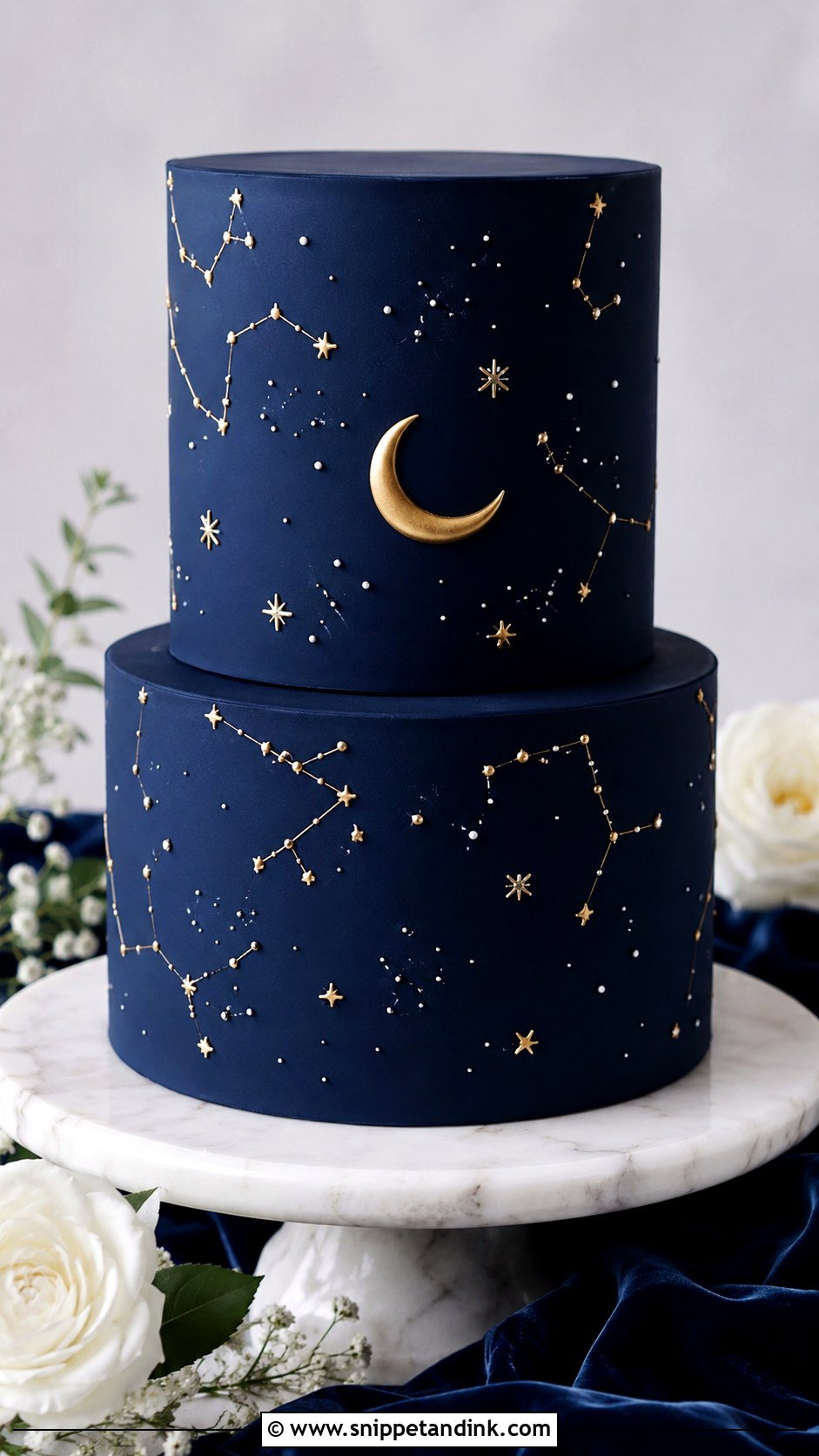
A constellation cake is the most personal of the set. Couples bring me their zodiac signs, a star map of the sky on their wedding date, or just a pattern of tiny connected dots. Dark navy gives a strong night-sky contrast; ivory feels softer. I pipe or paint the lines in fine gold or edible silver, and they need to stay thin, since thick lines turn the stars into a dot-to-dot puzzle. Vanilla blackberry, chocolate raspberry and lavender lemon suit it. Keep the topper simple so the pattern stays in focus.
9. Starry Night Wedding Cake
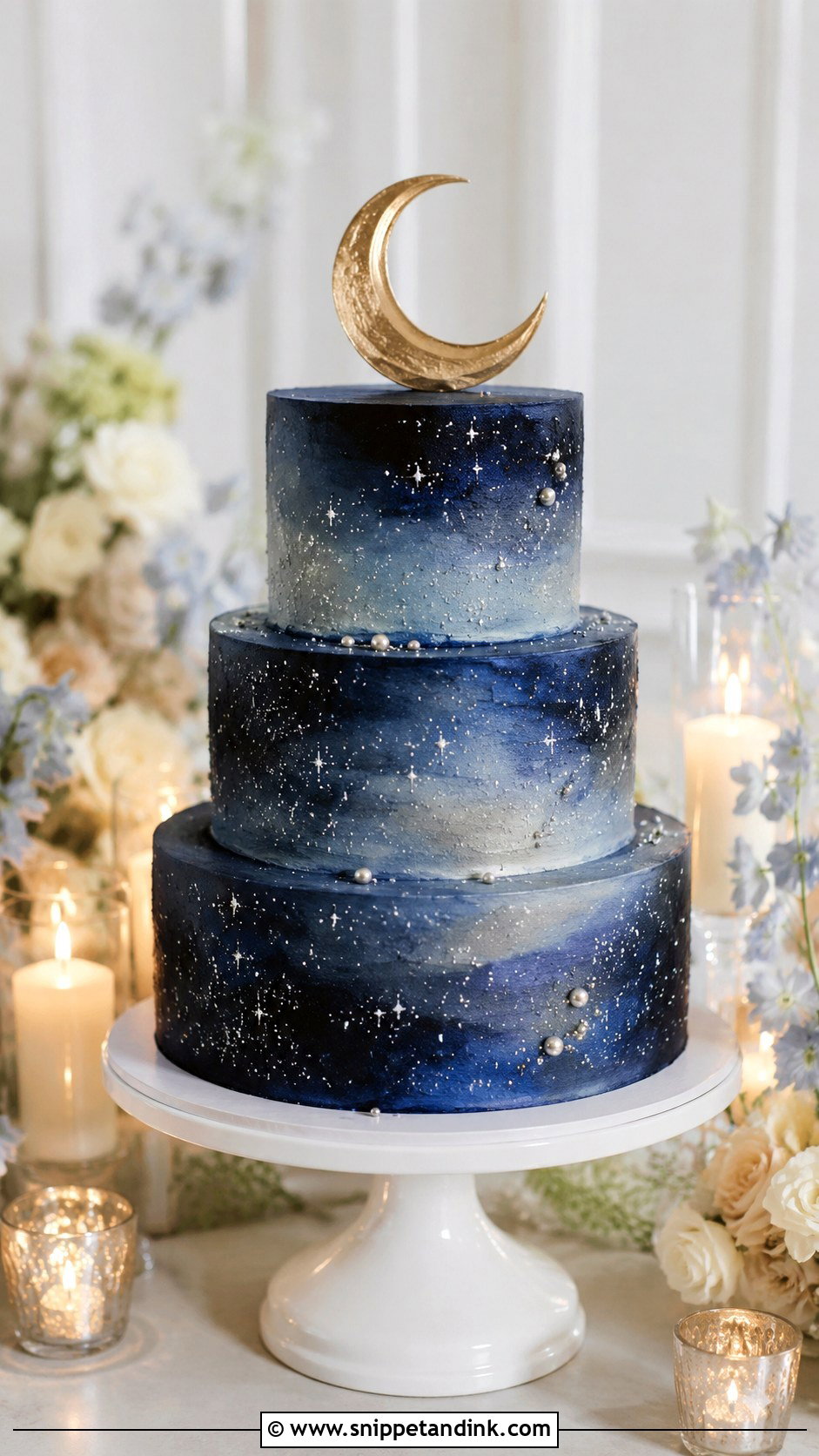
A starry night cake pairs deep blue watercolor buttercream with soft black shading and white speckled stars, which reads as a dreamier evening sky than a full galaxy. I blend the colors on the cake with a bench scraper while the buttercream is still soft, which is why the transitions look painterly instead of striped. A tall round cake lets the color flow around the tiers. Add a moon topper, white flowers or tiny sugar stars, but only one or two of them. Blueberry lemon, vanilla, chocolate and blackberry champagne sponges suit it. Candlelit and outdoor evening receptions are its natural setting.
10. Purple Galaxy Wedding Cake
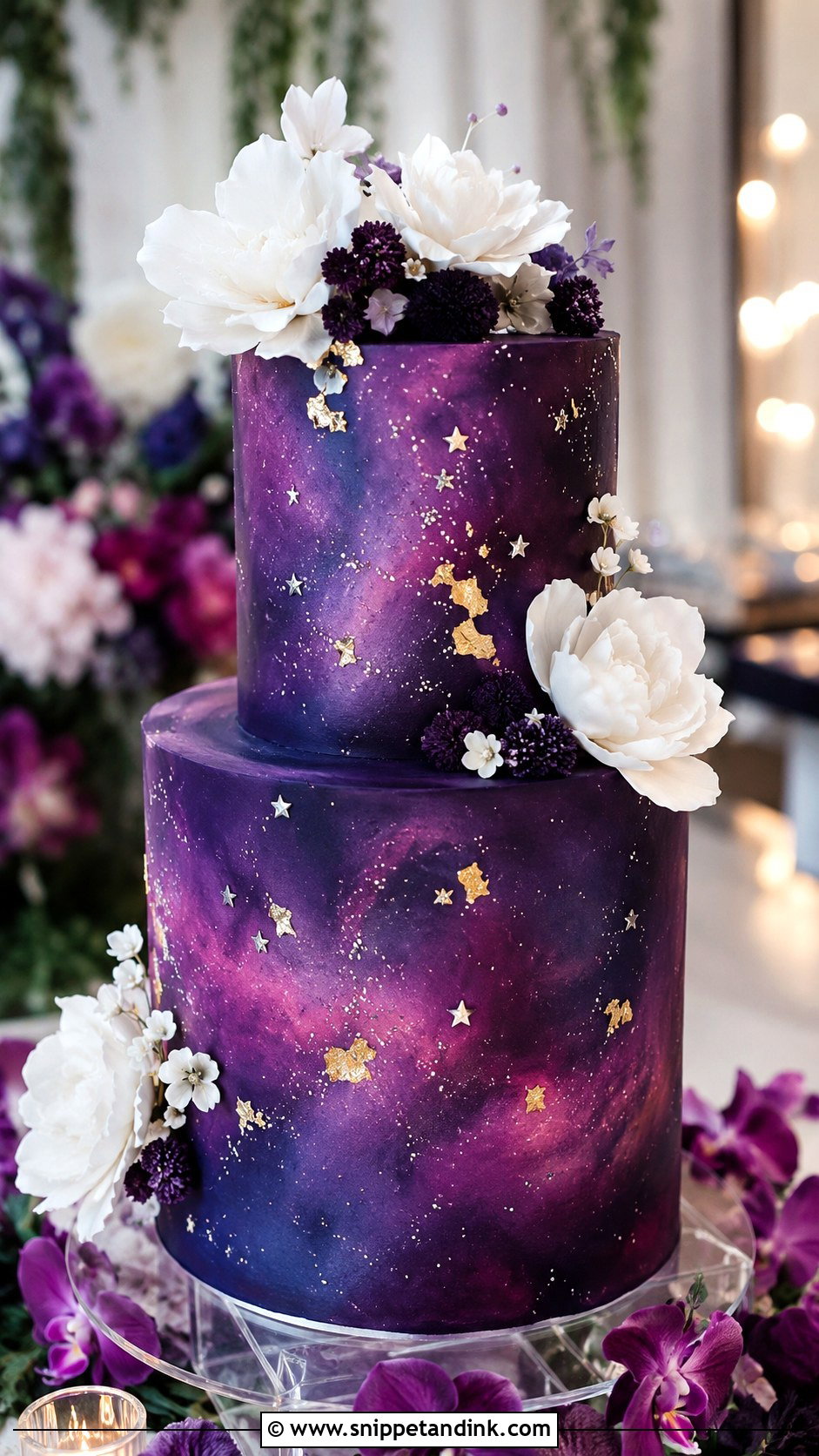
A purple galaxy wedding cake layers plum, lavender, violet, navy and a touch of magenta. Purple fades faster than most colors under strong light, including sunny windows, so I keep this cake out of direct sun until it’s served. The shades need to be layered softly; hard blocks of violet look cartoonish. Gold leaf, silver stars or white sugar flowers make it bridal, and it pairs easily with orchids, roses, lisianthus or anemones in the bouquet. Blackberry, ube, vanilla lavender and dark chocolate cherry suit the color story.
11. Blue Galaxy Wedding Cake
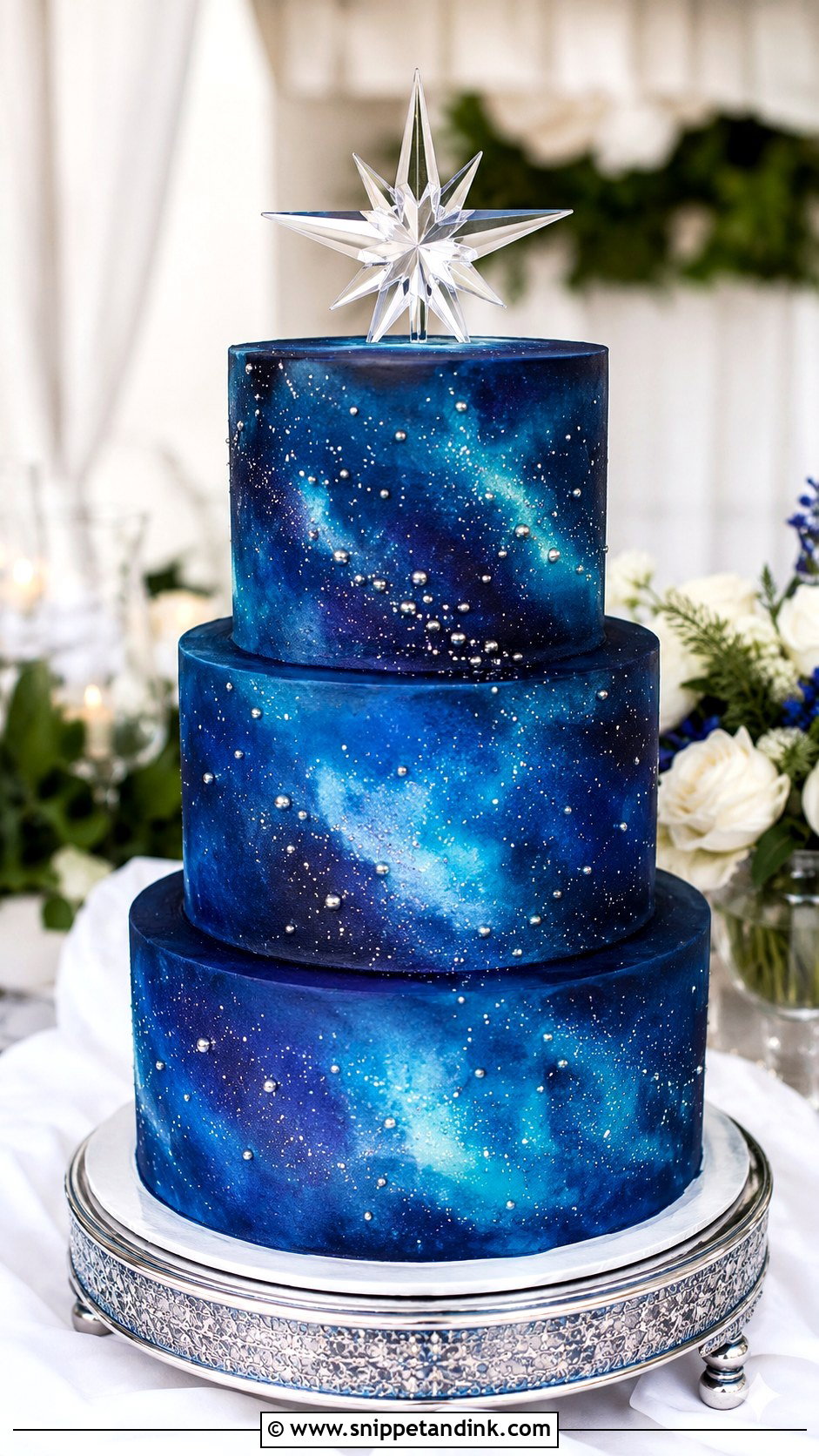
Blue galaxy is the cleaner, cooler cousin of the black version. Midnight, royal, teal and pale icy blue blend together, usually with silver rather than gold. I airbrush the shading over smooth buttercream for a soft sky, then press tiny white sugar pearls into it for starry texture. It suits winter palettes, beach evening weddings and ballrooms. Vanilla bean, blueberry, coconut, lemon and white chocolate fit the lighter mood, and a clear acrylic topper keeps the top modern.
12. Crescent Moon Wedding Cake
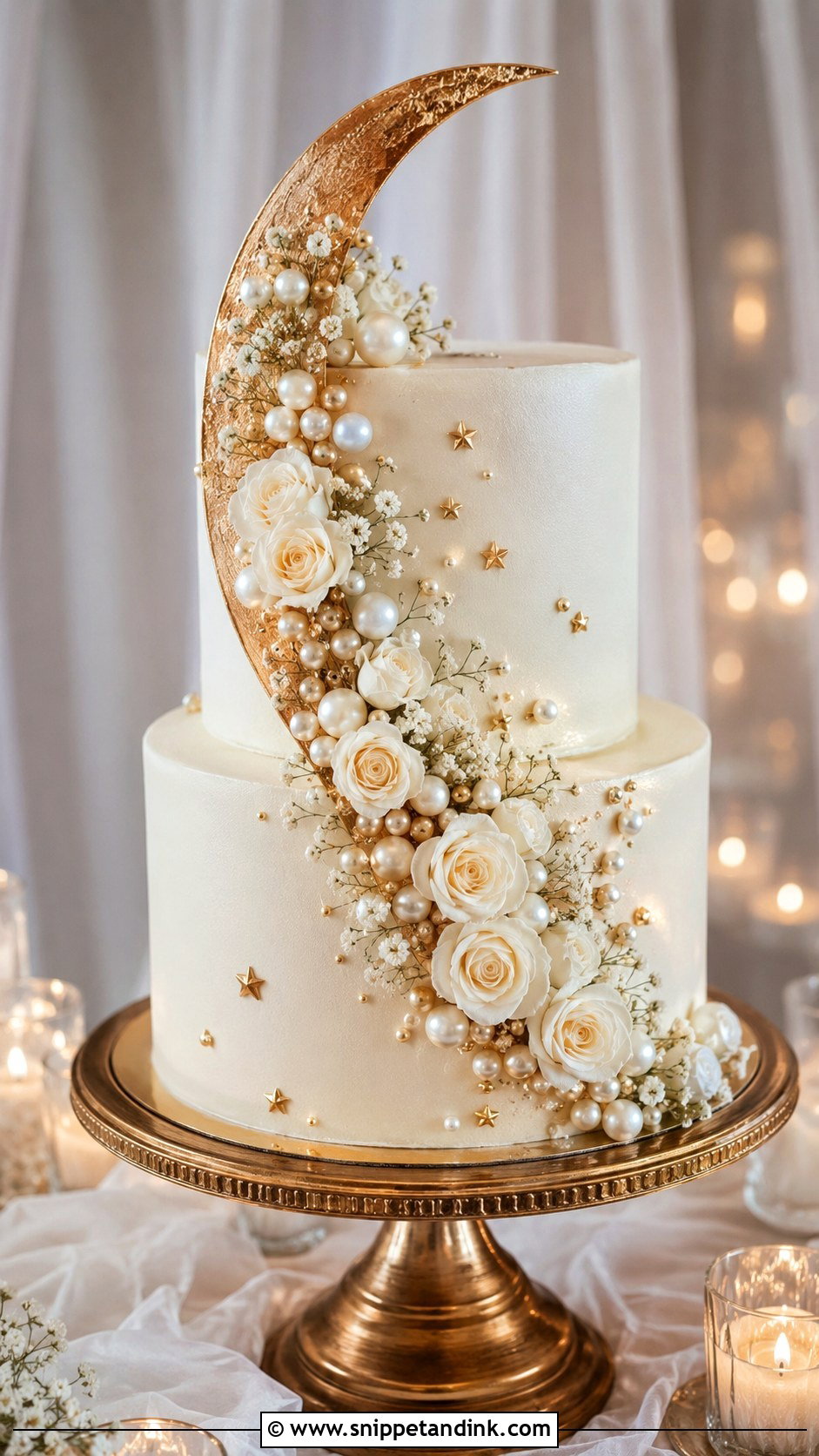
One strong symbol often beats a busy pattern. The cake can be white, navy, black or soft gray, with the crescent moon as the clear focus: either a large gold crescent on the top tier or a crescent shaped from flowers, pearls and tiny stars across the side. A large topper crescent needs a hidden dowel or support rod, since a heavy sugar or acrylic moon will lean on soft icing within hours. Smooth frosting keeps it clean. Almond, vanilla rose, lemon elderflower and chocolate hazelnut are flavors I’d pair with it.
13. Planet Wedding Cake
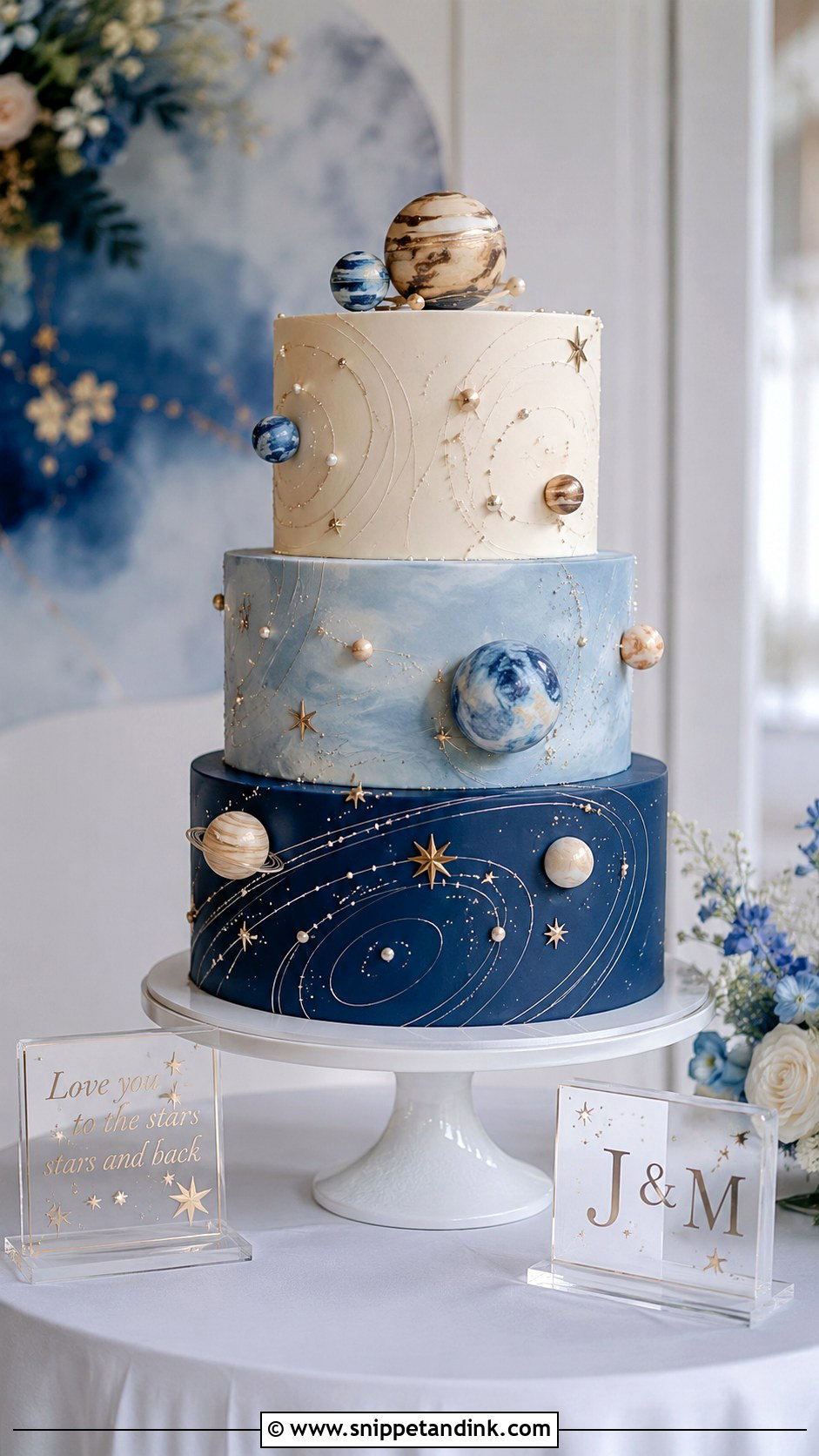
Planets are where taste matters most. Cartoon planets read as a child’s party, so I make small marbled spheres in muted navy, ivory, dusty blue, bronze and pearl, with painted orbit lines and a few metallic touches. Sugar or chocolate spheres are lighter than fondant-covered cake balls, which matters because anything stuck to the side of a tier pulls downward. A couple of ringed planets is plenty. Science-loving couples and planetarium venues are the natural fit. Chocolate, vanilla, pistachio and caramel all work inside.
14. Solar System Wedding Cake
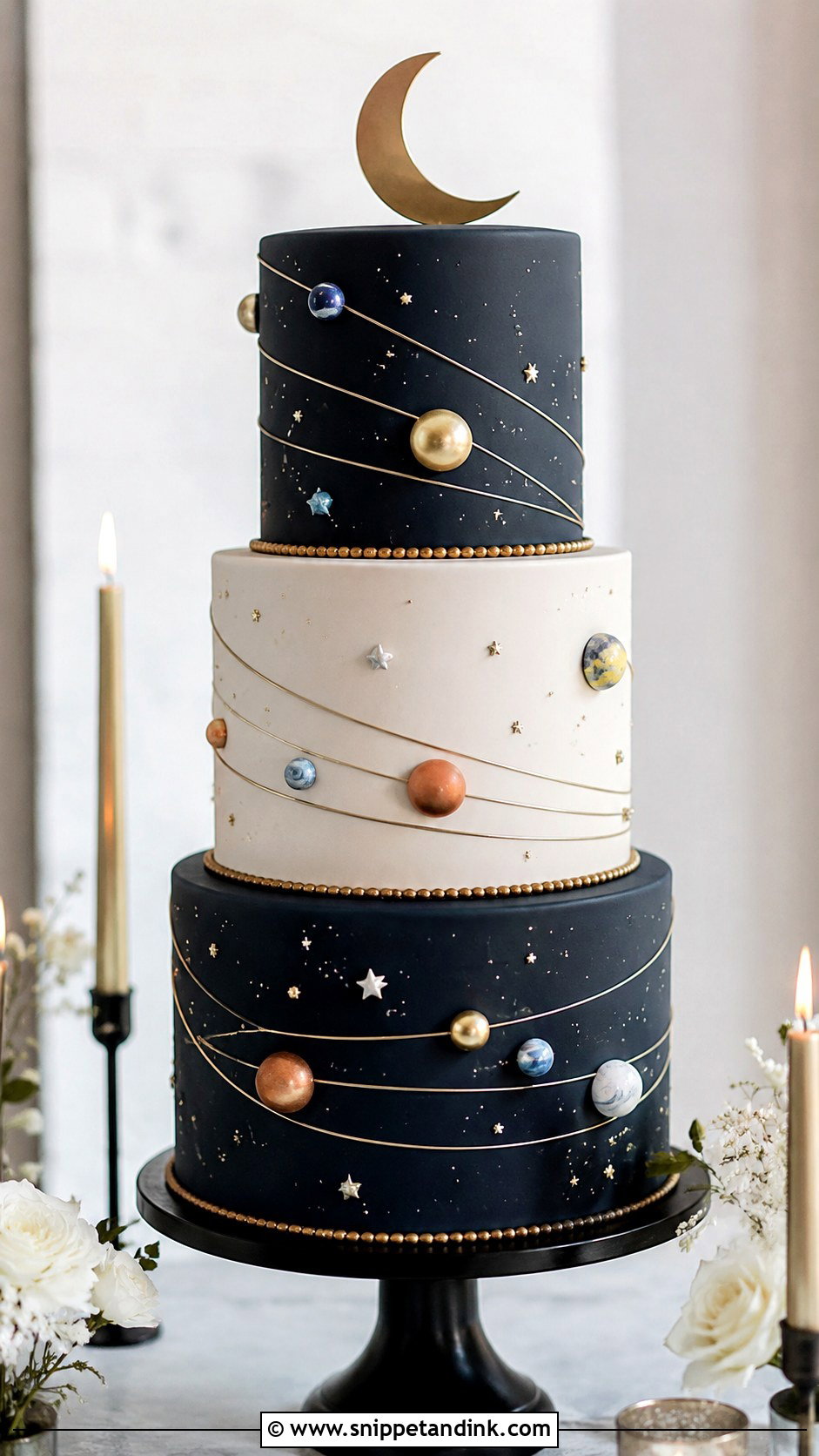
A full solar system has more parts than a planet cake, so it needs a clean three-tier canvas and careful spacing. I use edible paint and fondant cutouts rather than large heavy toppers for the orbit lines, planets, stars and moons. Grading the tiers from a dark bottom to a light top gives the eye a path to follow. Metallic orbit lines can wrap each tier for a modern finish. It’s a centerpiece cake, so plan it as the focus of the dessert table. Chocolate orange, vanilla bean, mocha and cookies and cream are the flavors I’d suggest.
15. Milky Way Wedding Cake
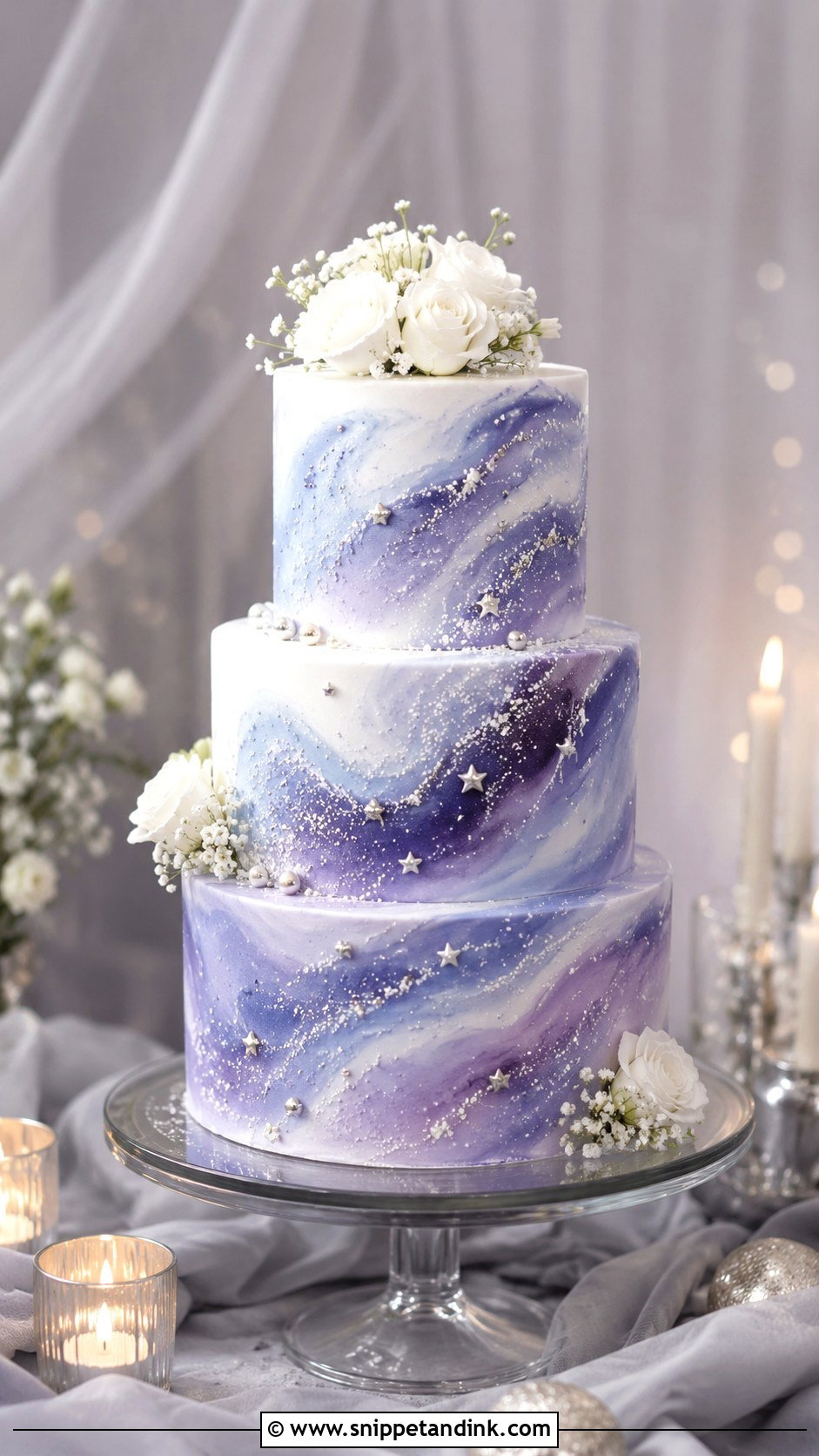
The Milky Way version swaps sharp speckles for flowing, cloudy streaks of white, blue, lavender and silver. I brush the streaks with pearl dust over a smooth fondant or buttercream base, keeping them diagonal so they look like a band of sky rather than smudges. Delicate star details, fresh white flowers or a simple moon topper finish it. Flavors like vanilla cream, white chocolate raspberry, blueberry lemon or coconut match the airy look.
16. Nebula Wedding Cake
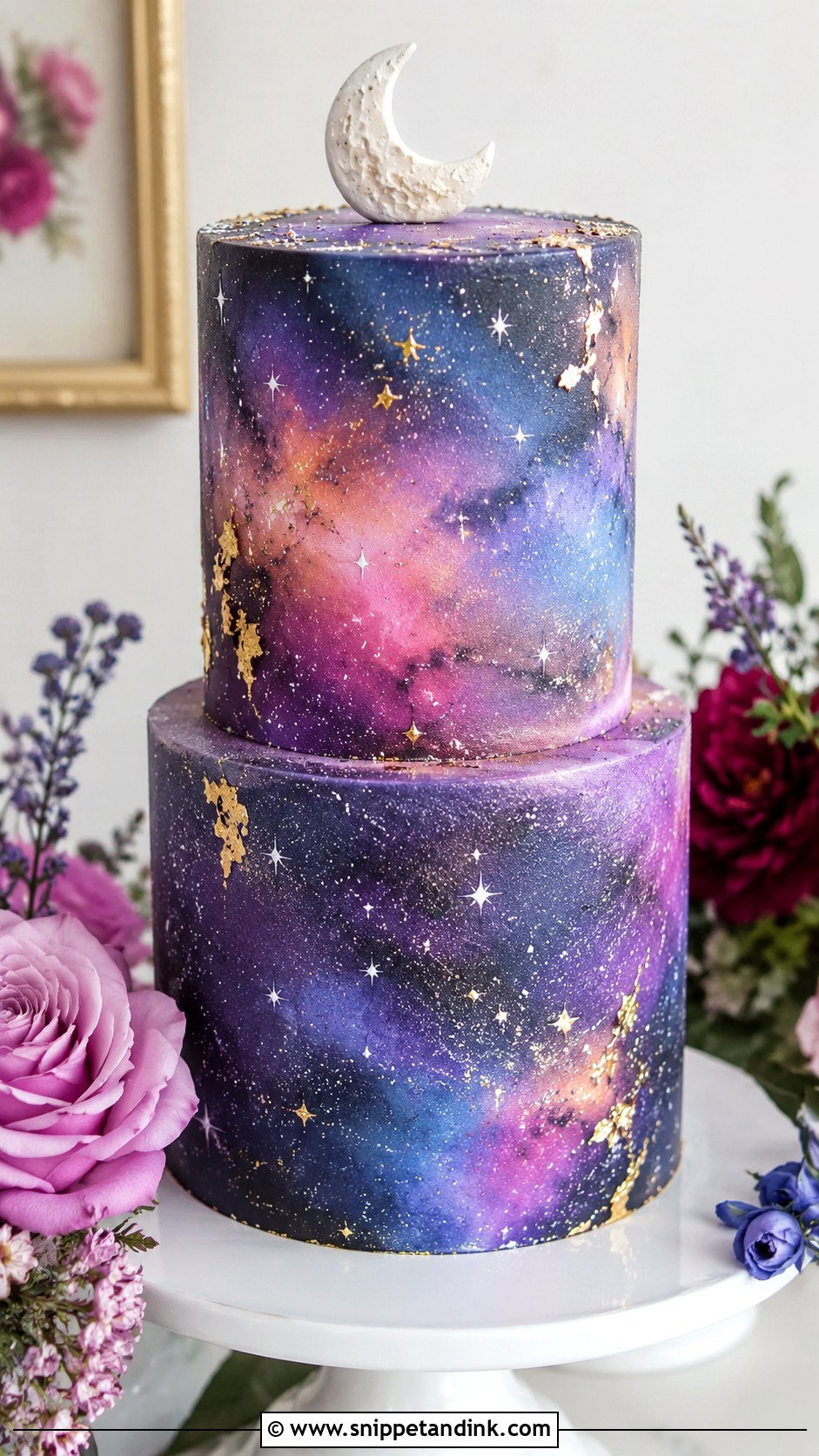
Nebula is the most colorful cake on the list: purple, pink, blue, black and silver blended into a glowing cloud. On a tall two-tier or a three-tier it needs smooth frosting and very few extras, perhaps gold leaf, edible glitter and a scatter of small stars. More than that and the color loses its depth. If navy feels too quiet for you, this is the step up. Raspberry vanilla, black cocoa, blueberry and strawberry champagne sponges suit the bright palette.
17. Marbled Cosmos Wedding Cake
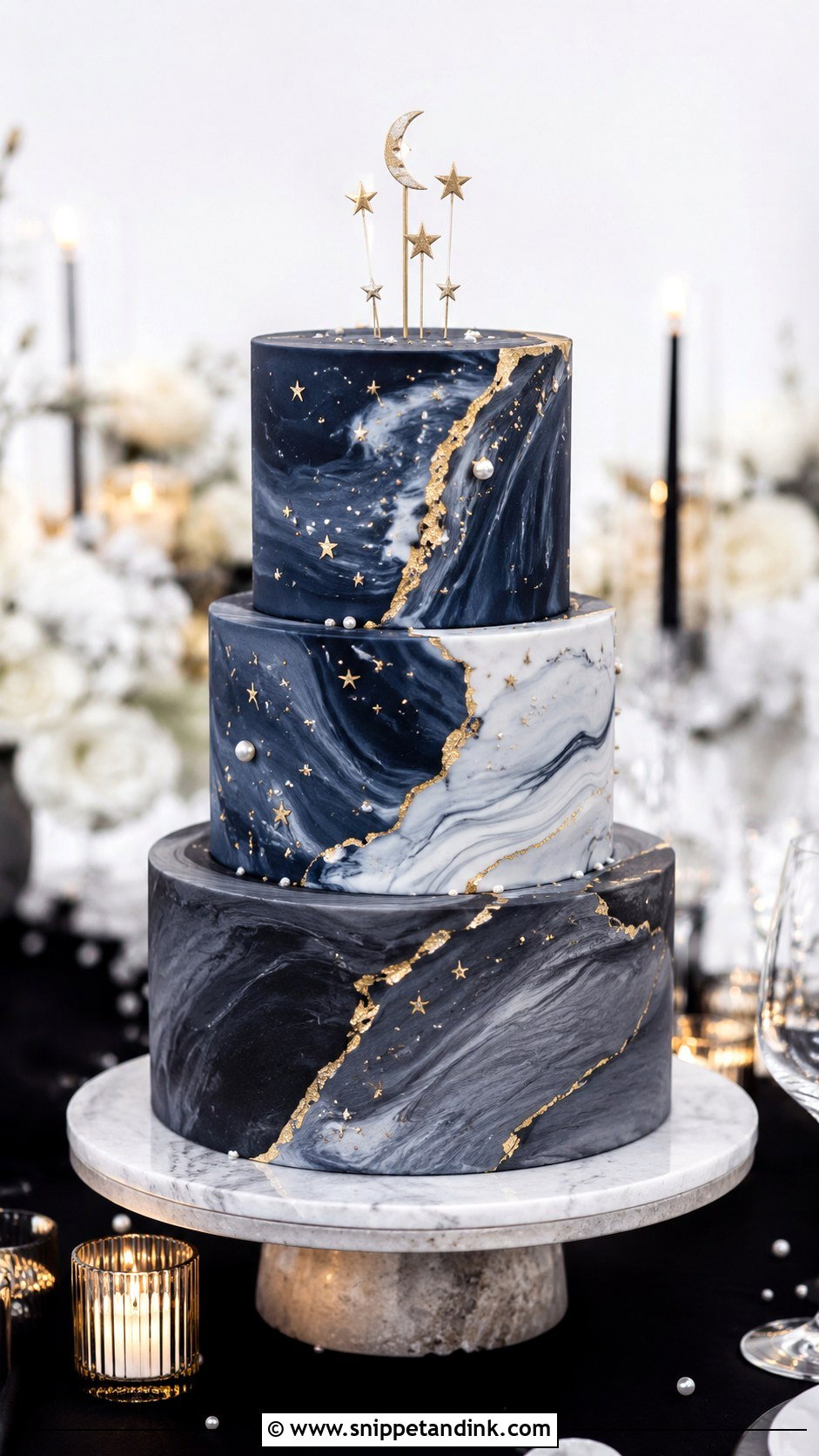
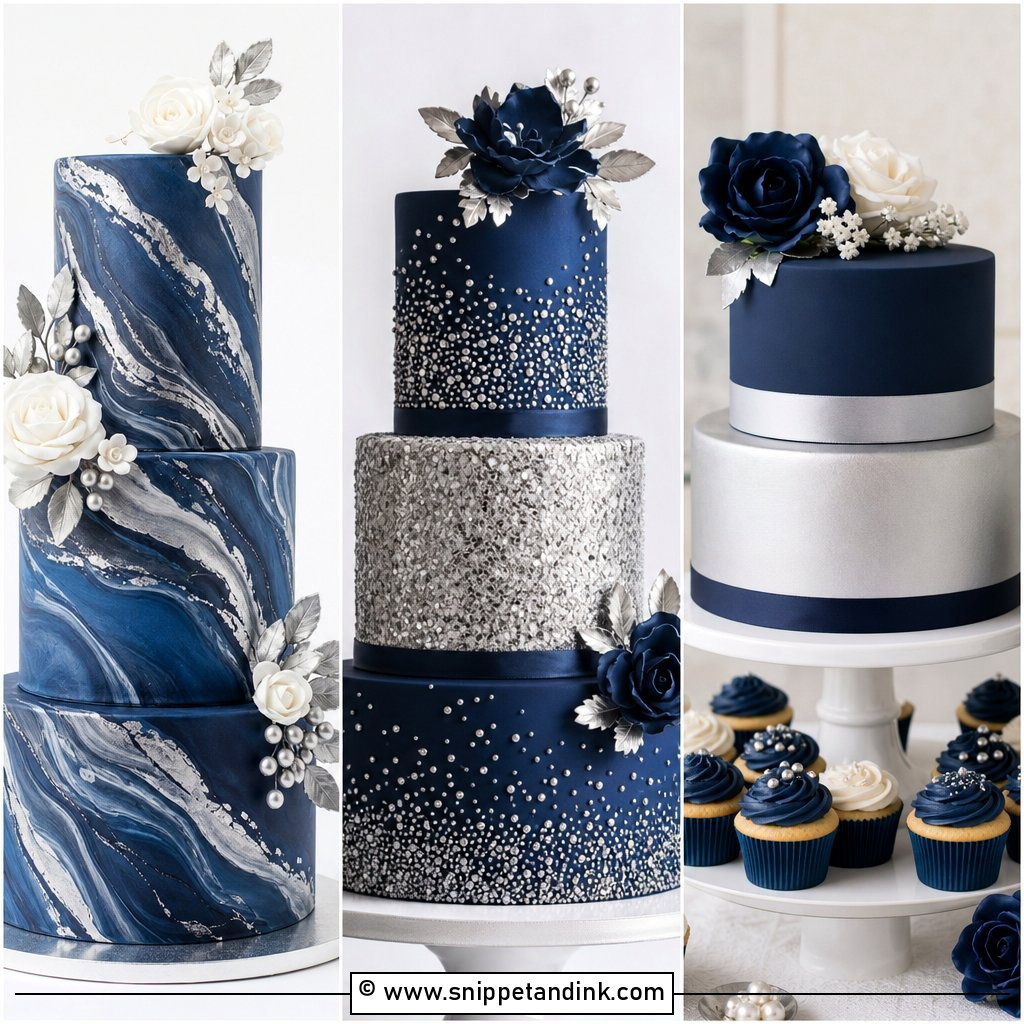
Marbling navy, black, gray, white and gold into the covering gives a stone-and-space effect with no moons or planets at all. Fondant holds sharp marble veins; buttercream gives softer swirls. The marble pattern is set the moment the fondant is rolled, so I always roll a test piece first, since no two sheets marble the same way. Gold leaf along the edges polishes it. Acrylic signage, modern flowers and black-tie decor suit it, as do vanilla almond, chocolate, marble and salted caramel sponges.
18. Geode Cosmos Wedding Cake
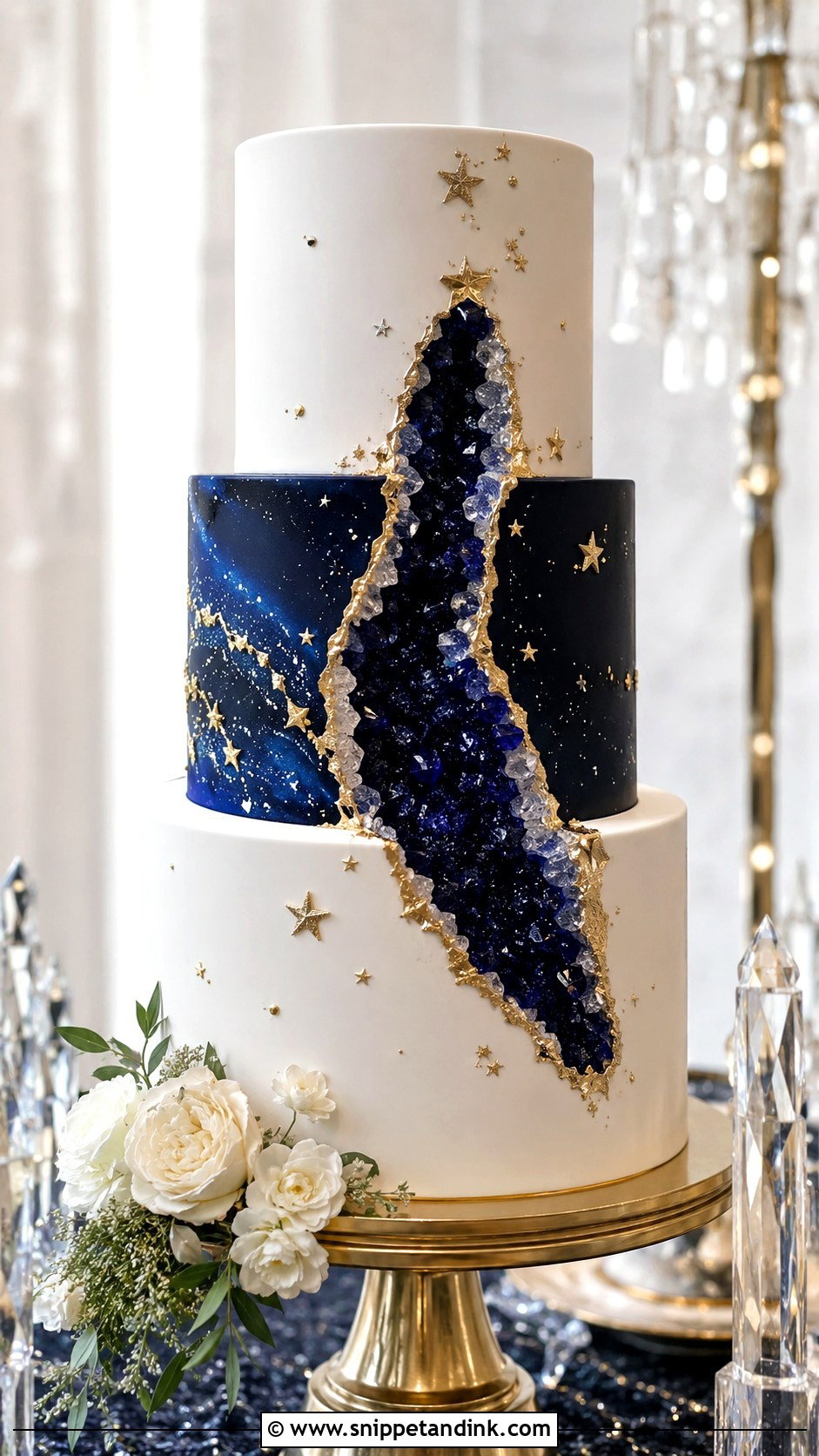
A geode cake has smooth white, navy or charcoal tiers with an edible crystal opening cut into one side. Amethyst, sapphire, or silver geode colors suit a space theme especially well. The crystals are usually rock candy or isomalt; isomalt sparkles more but turns sticky and cloudy in humid air, so for a summer outdoor wedding I lean toward rock candy. Gold leaf around the edge catches the reception lighting. Keep the rest of the cake plain. Chocolate, vanilla, lavender and blackberry suit it.
19. Mirror Glaze Galaxy Wedding Cake
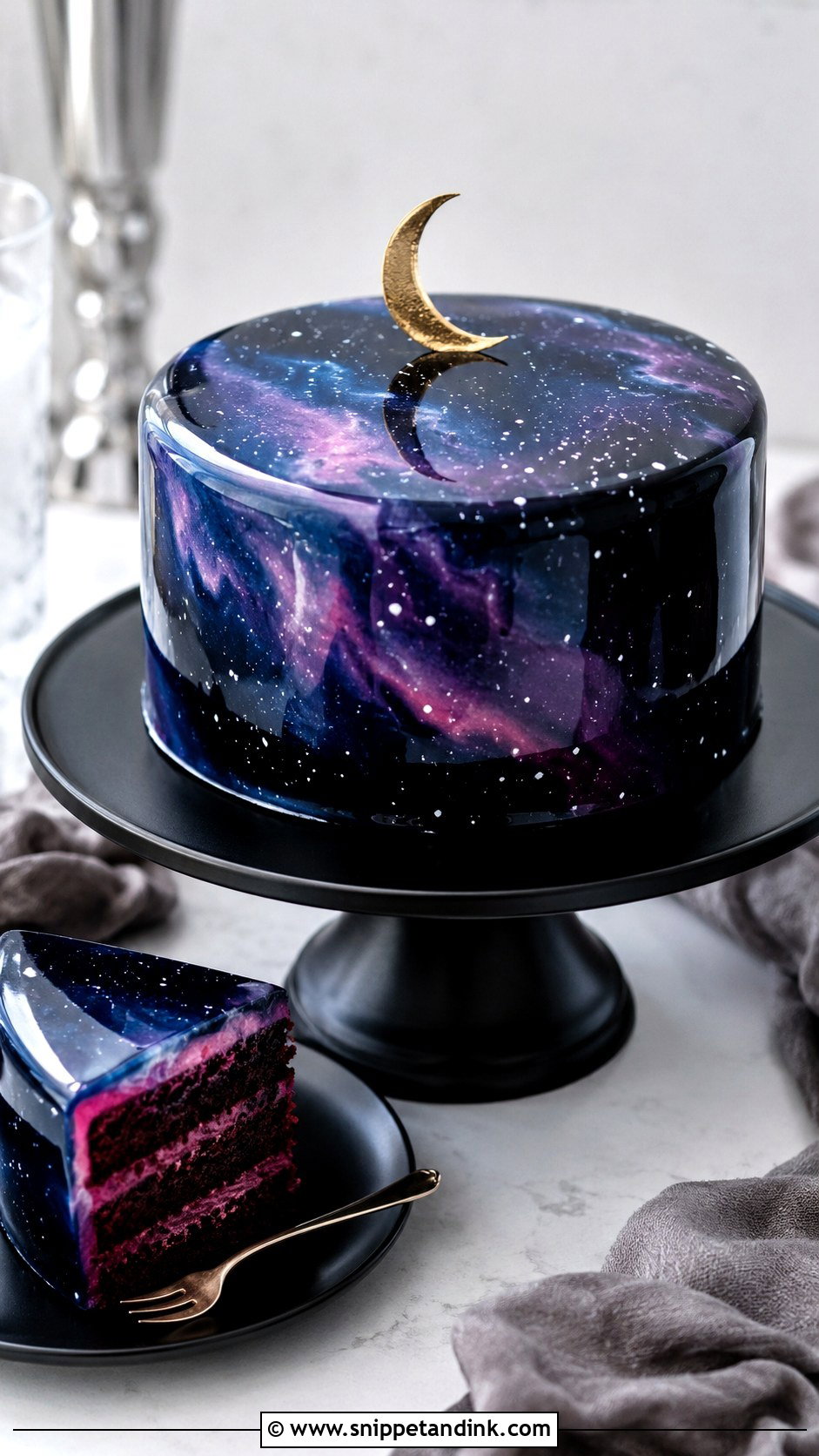
Mirror glaze gives the glossiest, most dramatic finish here, with dark blue, black, purple and pink glaze poured over a smooth mousse cake and white splatter stars on top. It has limits worth knowing. Mirror glaze needs refrigeration and goes dull once it warms, and mousse cakes can’t carry tiers above them, so I recommend it for a small cake, a sweetheart cake or a dessert table centerpiece rather than the main tiered cake. A simple gold moon or a few sugar stars is all the decoration it needs. Chocolate mousse, vanilla berry, passion fruit and dark chocolate raspberry suit it.


20. Minimal Cosmos Wedding Cake
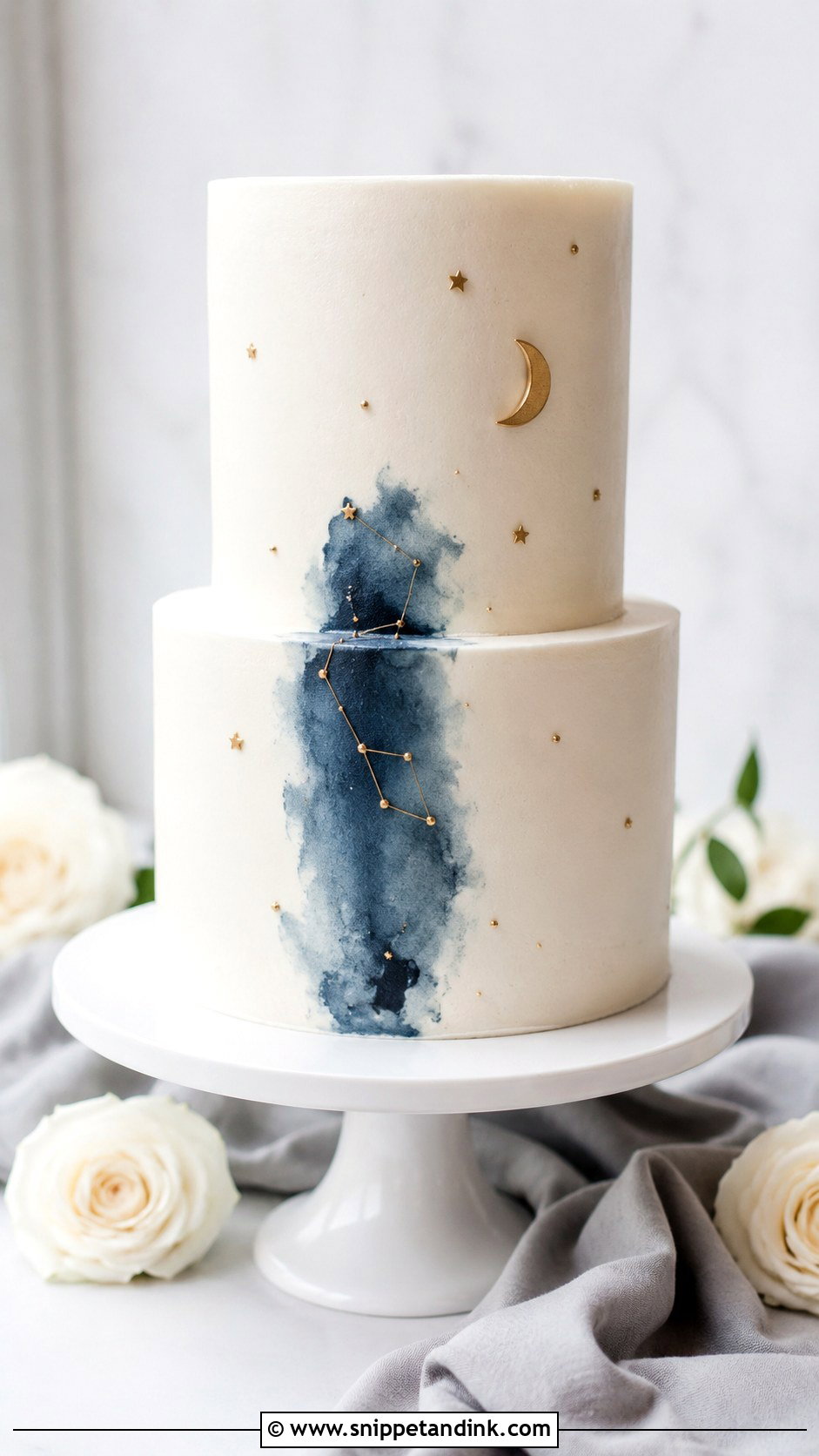
Minimal is the cosmos cake for couples who want the theme noticed only up close. Smooth white, ivory or pale gray tiers with one crescent moon, a small constellation, a few gold stars or a single navy watercolor panel. Restraint is the whole design, so the finish has to be flawless; there’s nothing to hide a dent behind. A slim two-tier or a tall single tier works especially well. Vanilla bean, almond, lemon and coconut cream keep the flavor clean.
Which Celestial Finishes Survive a Warm Room
A cake on display for three hours at a summer reception goes through a lot. Fondant is the sturdiest of these finishes, though it can sweat with condensation if it comes from a cold van into a hot room, which smudges painted stars. Buttercream softens as the room warms, so piped constellation lines may blur after a long stretch in the heat.
Mirror glaze and isomalt crystals are the fragile ones. Glaze loses its shine and can slide once it warms, and isomalt pulls moisture from humid air until it goes cloudy. If your venue is outdoors or poorly cooled, ask for the cake to be set up as late as possible, placed away from windows and stage lights, and keep the glossiest designs for a cool indoor room.
Glitter, Gold Leaf and the Edible Question
Sparkle is half the appeal of a starry cake, and it’s also where I see the most confusion. Some craft-style glitters sold for cake decorating are labeled non-toxic rather than edible, which only means they’re unlikely to harm you, not that they’re meant to be eaten. On a cake that guests will eat, every sparkle should be clearly marked edible.
Gold leaf is different. High-karat edible gold leaf is safe to eat and has no taste, and it holds its shine through a long evening better than most dusts. Ask your baker what they use for the stars and shimmer. A good one will answer without hesitation.
Carry One Palette From the Cake to the Candles
Celestial cakes run from full galaxy drama to a single gold moon on ivory. Formal receptions usually suit white fondant with gold constellations. Modern or evening venues can carry black galaxy, mirror glaze or navy with stars. For something softer, look at the crescent moon, Milky Way and minimal designs. Whichever you choose, settle the palette first and repeat it through the linens, flowers, signage and lighting. When the room echoes the cake, it looks planned rather than themed.
You'll Like These Ideas:




Leave a Reply