
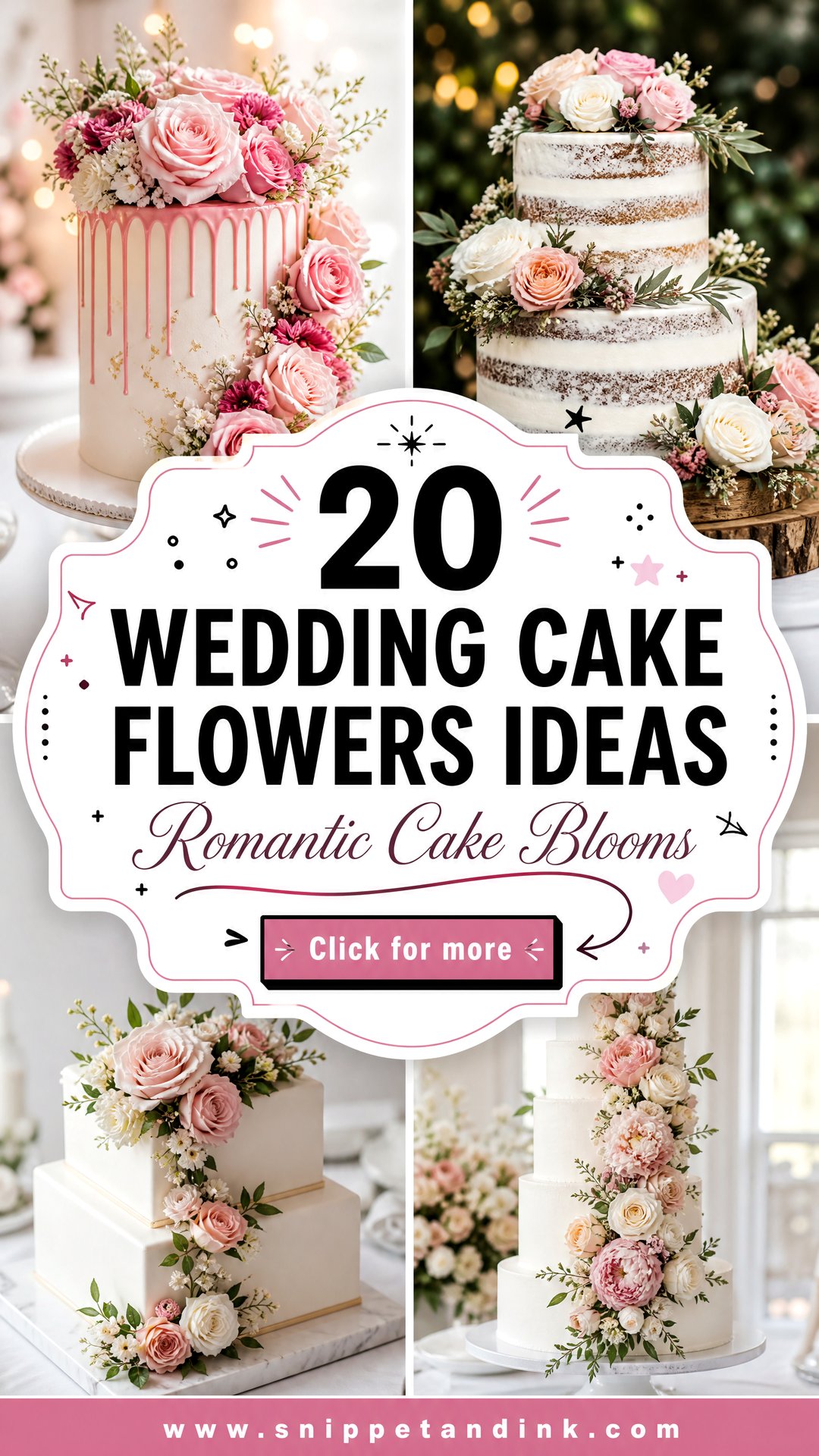
Flowers are the decoration I get asked about most, and the one that needs the most planning between baker and florist. A few well-placed blooms can carry a plain buttercream cake, and the same idea works in a ballroom or a barn because the flowers set the mood more than the tiers do. Below are twenty floral directions I’d happily build, from pressed petals to sugar peonies to fruit mixed with stems. Each one comes with what I’d check before saying yes, because the prettiest cake on a mood board isn’t always the one that survives a warm reception.
Which Fresh Blooms Are Safe on a Cake
Not every flower that looks pretty in a bouquet belongs on something people will eat. Some popular wedding flowers are toxic, and a few shed sap or pollen onto frosting. My rule is simple: if a petal will touch icing, it has to be a known edible flower grown for eating, or it gets made in sugar instead.
- Edible and easy: roses, pansies, violas, calendula, cornflowers, chamomile and lavender in small amounts, as long as they were grown without sprays.
- Decorative only, never touching cake: lily of the valley, foxglove, hydrangea, sweet pea, oleander and daffodil. I recreate these in sugar if a couple loves them.
- Shop roses are usually treated with pesticides, so even an edible variety needs to come from a grower who can confirm it wasn’t sprayed.
For decorative stems, I wrap the cut end in floral tape and sit it inside a food-safe pick, so no sap reaches the sponge. I also remove the flowers before cutting, which keeps them off guests’ plates. If your florist is supplying stems, ask them to keep a few aside for the cake rather than pulling them from centerpieces.
1. Pressed Flower Wedding Cake
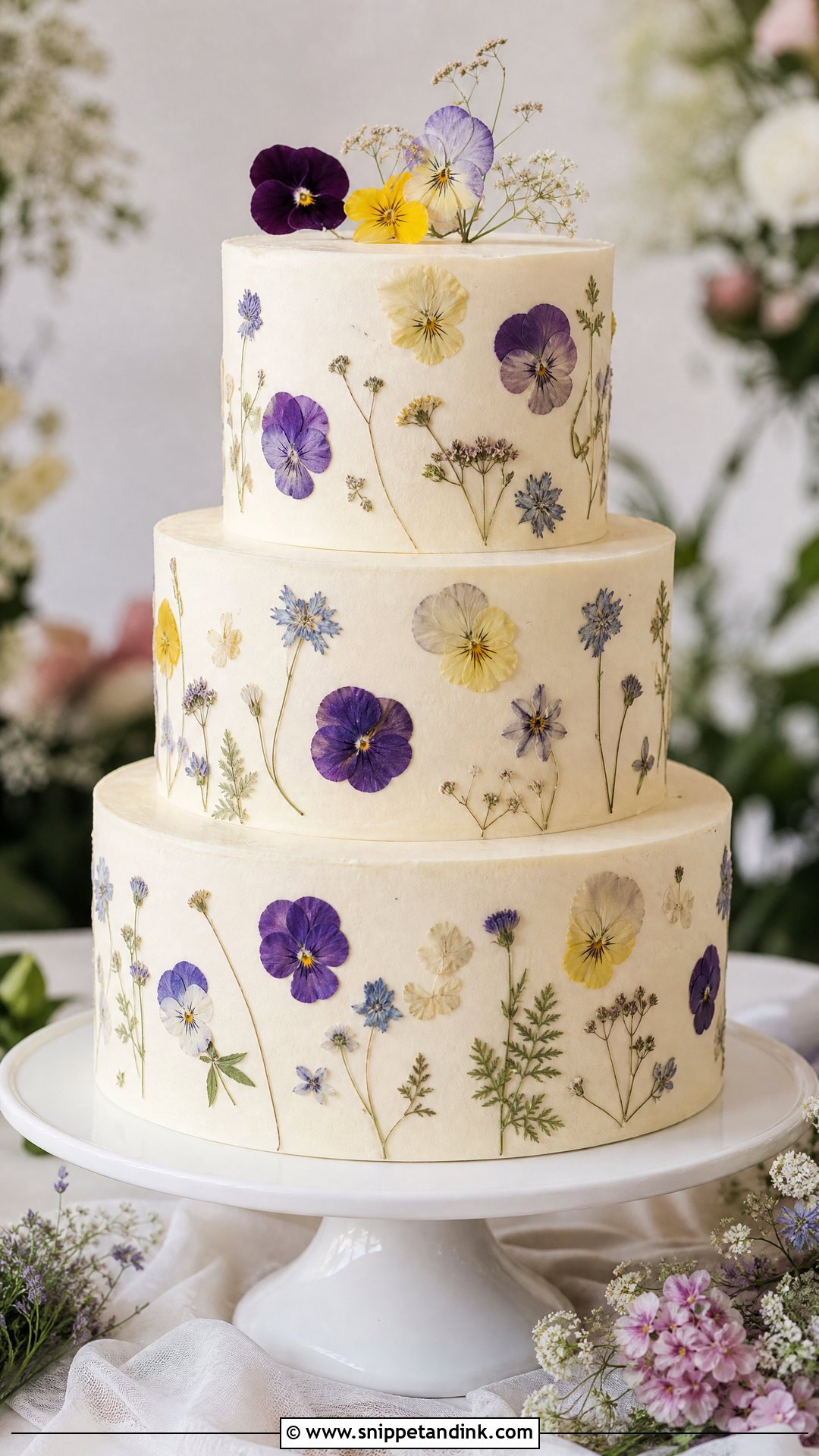
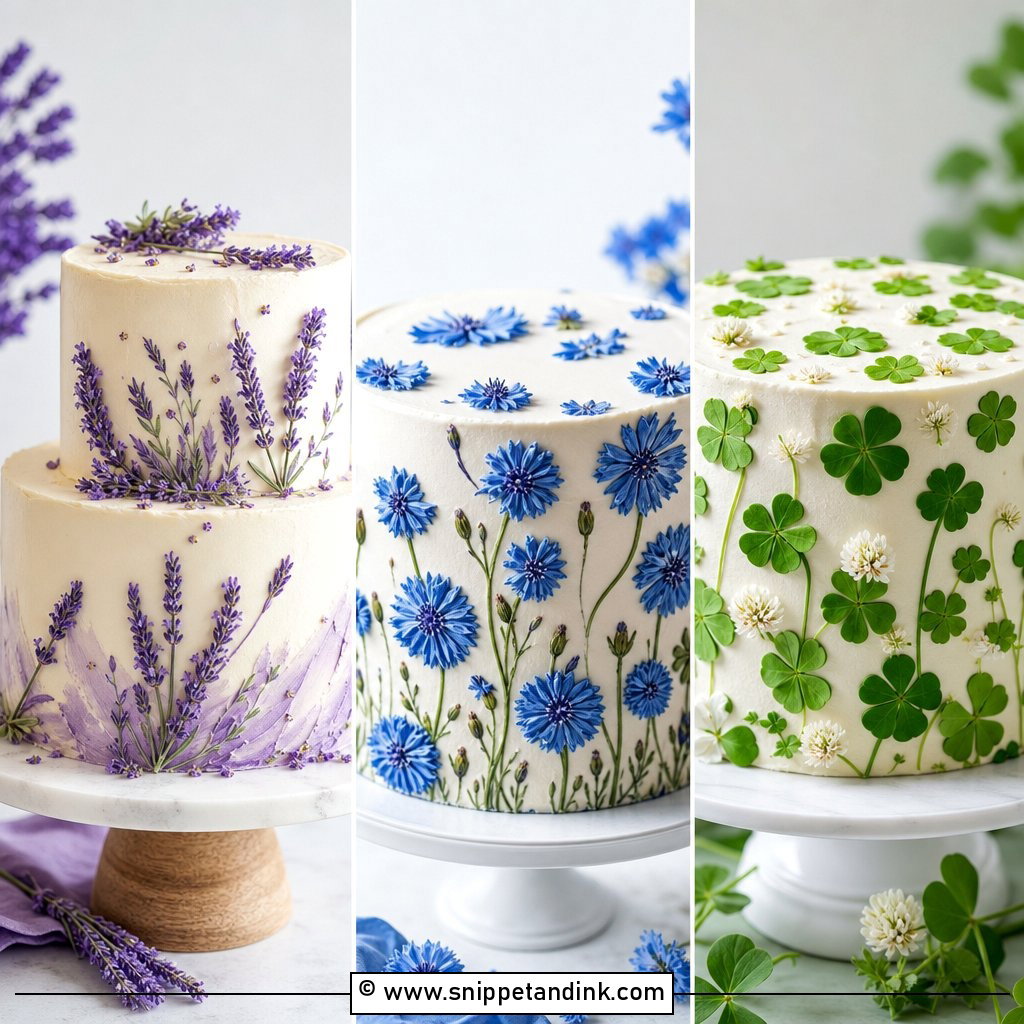
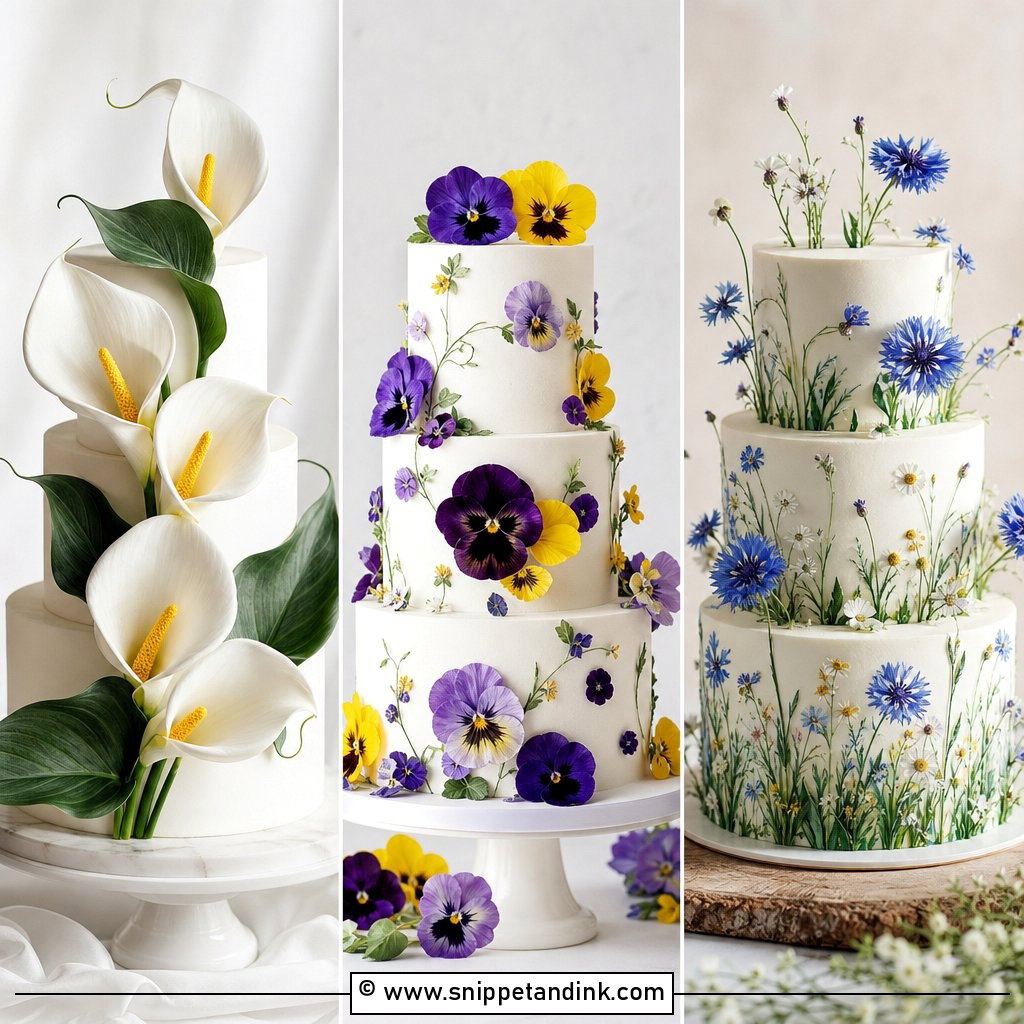
Here the petals lie flat against the icing, so the cake reads like a botanical print rather than an arrangement. I press edible violas, pansies, cornflowers and calendula a week or two ahead and apply them to chilled buttercream so they grip without sliding. Thin petals go translucent if the frosting is too soft, which is why I keep the base ivory or pale blush and fairly firm. Scatter them loosely for a modern feel; covering every inch tends to look busy from across a room. This is one of my favorite spring cakes for a relaxed outdoor reception.
2. Fresh Flower Wedding Cake
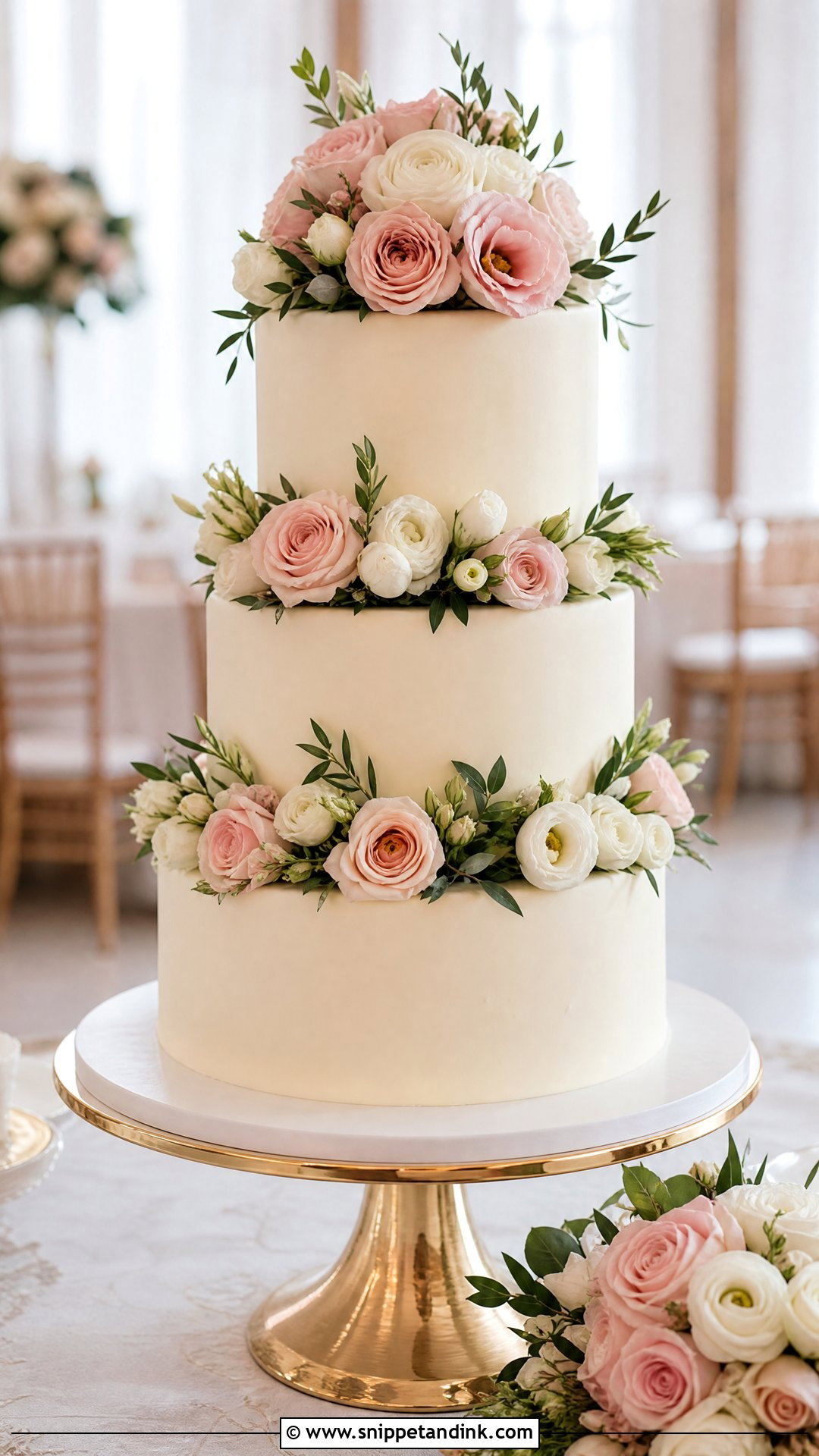
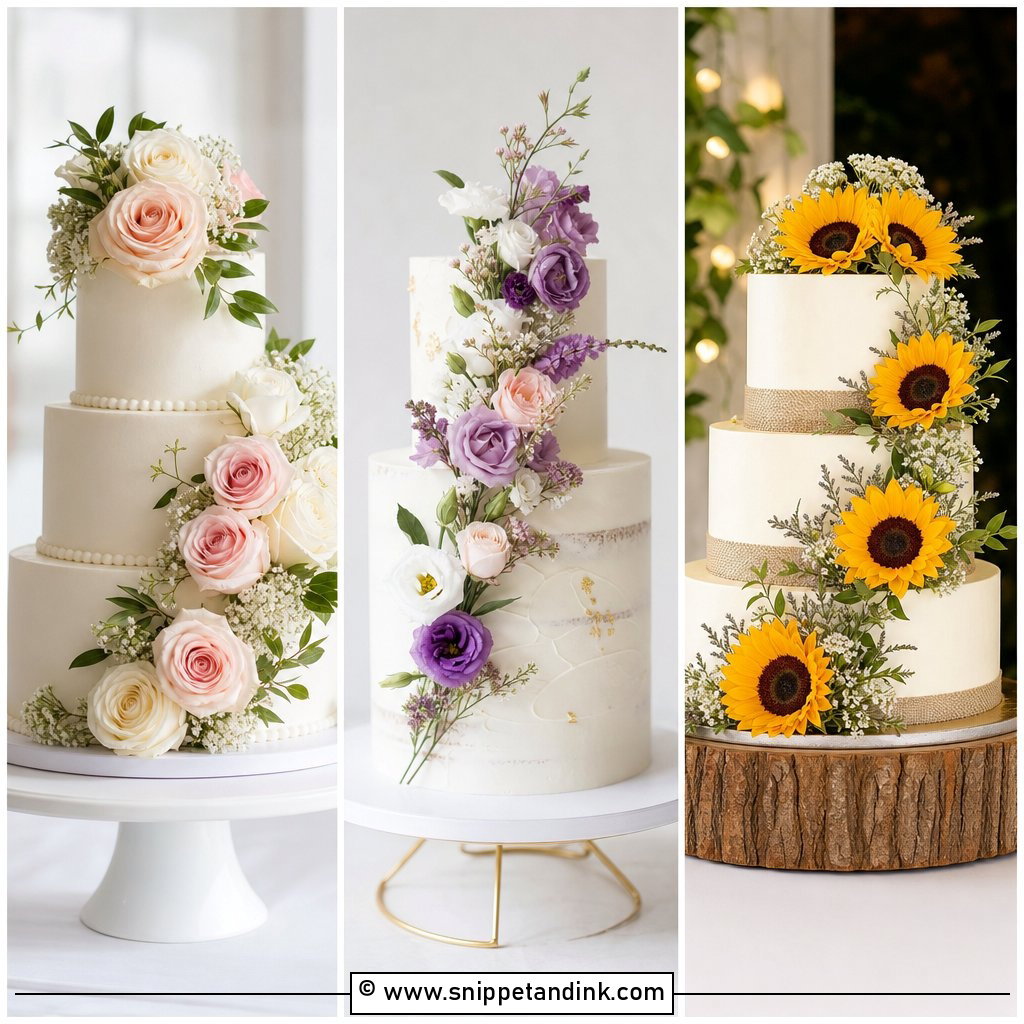
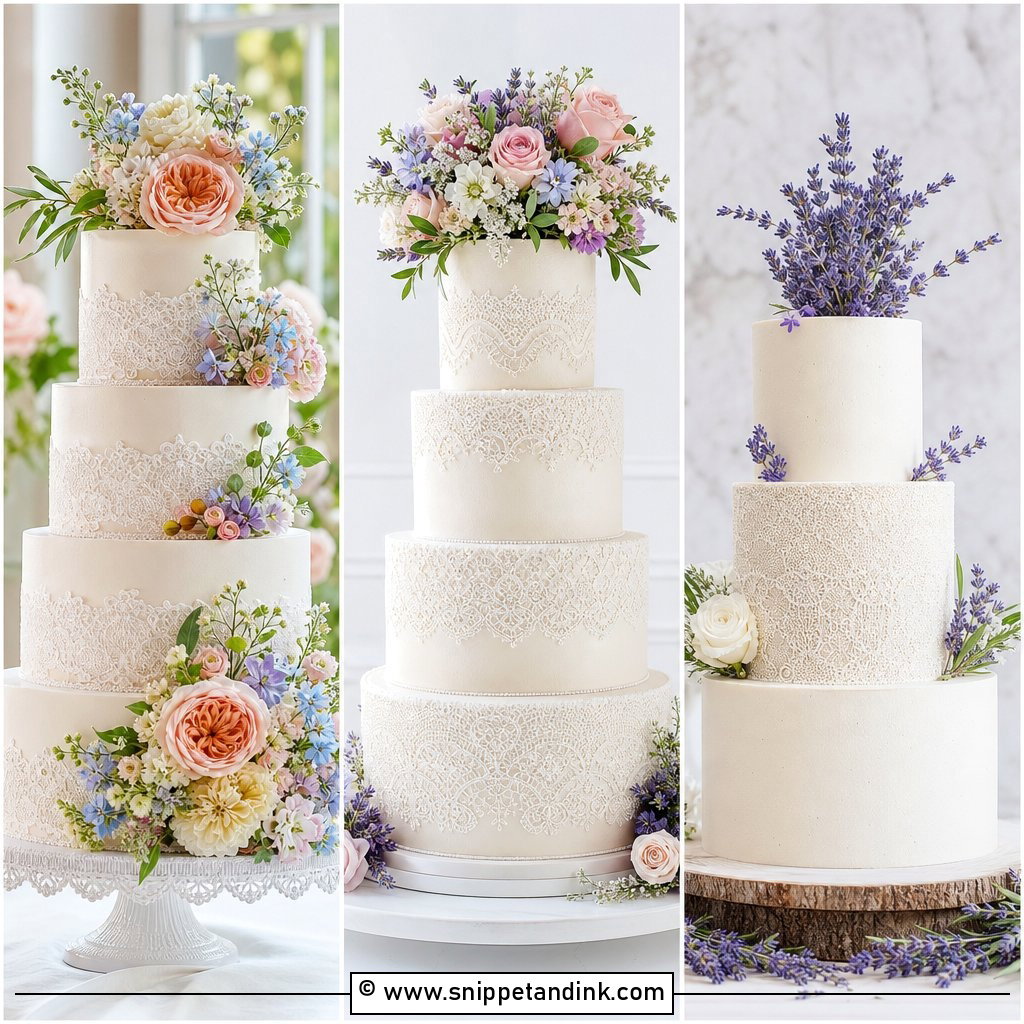
Fresh blooms are the quickest way to tie the cake to the bouquet. Roses, ranunculus, lisianthus, orchids, dahlias, and spray roses all hold up well on tiers. The part couples rarely think about is the stem. I never push a raw stem into sponge: it gets wrapped in floral tape and set into a food-safe pick or a cut drinking straw, and I ask for flowers grown without pesticides wherever the florist can source them. Keep the palette to two colors, ivory with blush or white with green, and the cake will sit naturally beside the table arrangements.
3. Sugar Flower Wedding Cake
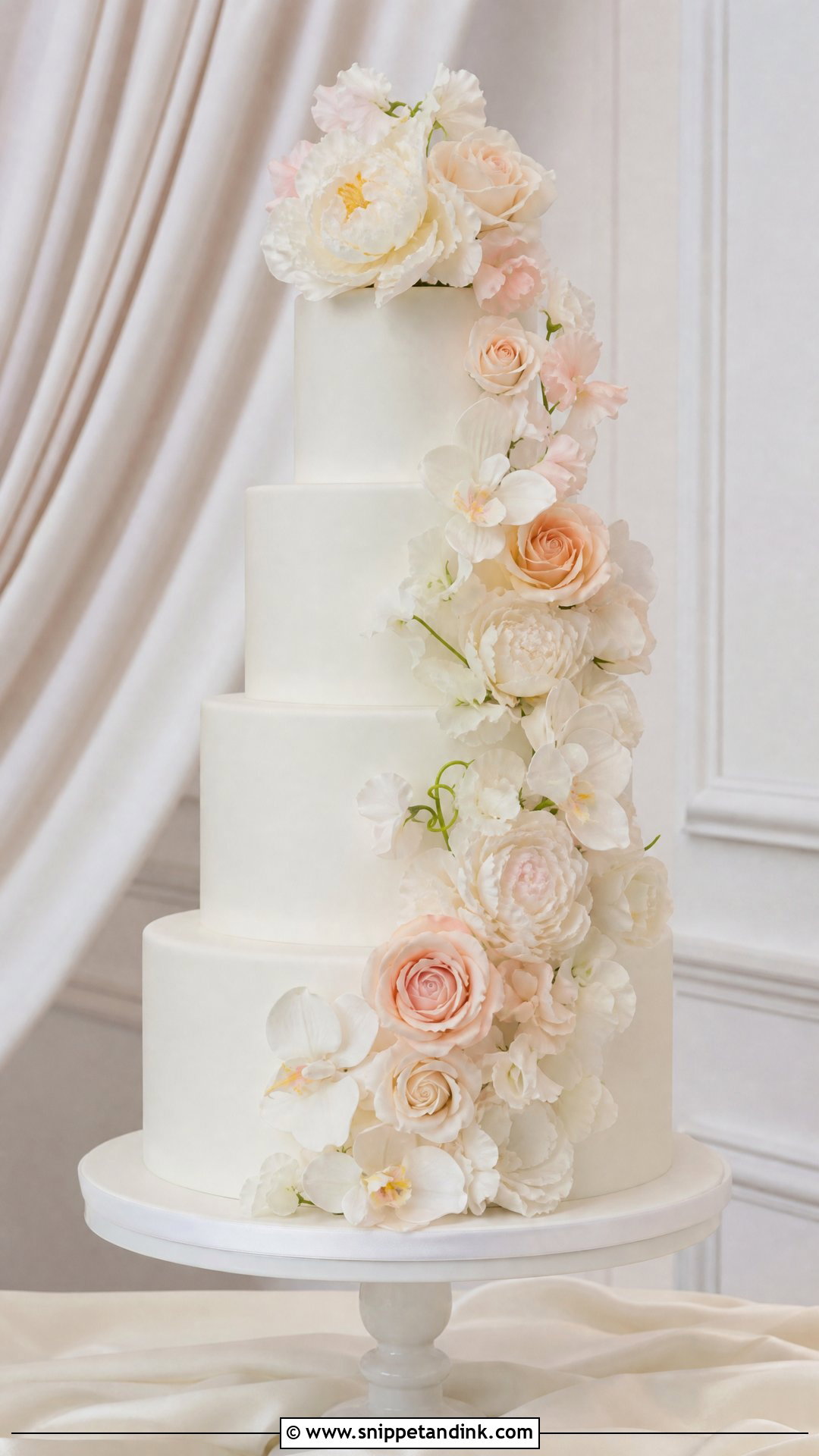
Sugar flowers let you have peonies in October. I roll gum paste petals thin, wire them, dry them, then dust the color on in layers, so a single large bloom can take hours across several days. That is why I book sugar work well ahead. Once made, they don’t wilt or brown under lights, which makes them my first suggestion for a hot venue or a delicate flower like sweet pea that shouldn’t touch food in its fresh form. Two or three oversized blooms on a clean cake usually look more refined than a crowded arrangement. Do keep them out of the fridge, since damp air softens the petals.
4. White Flower Wedding Cake
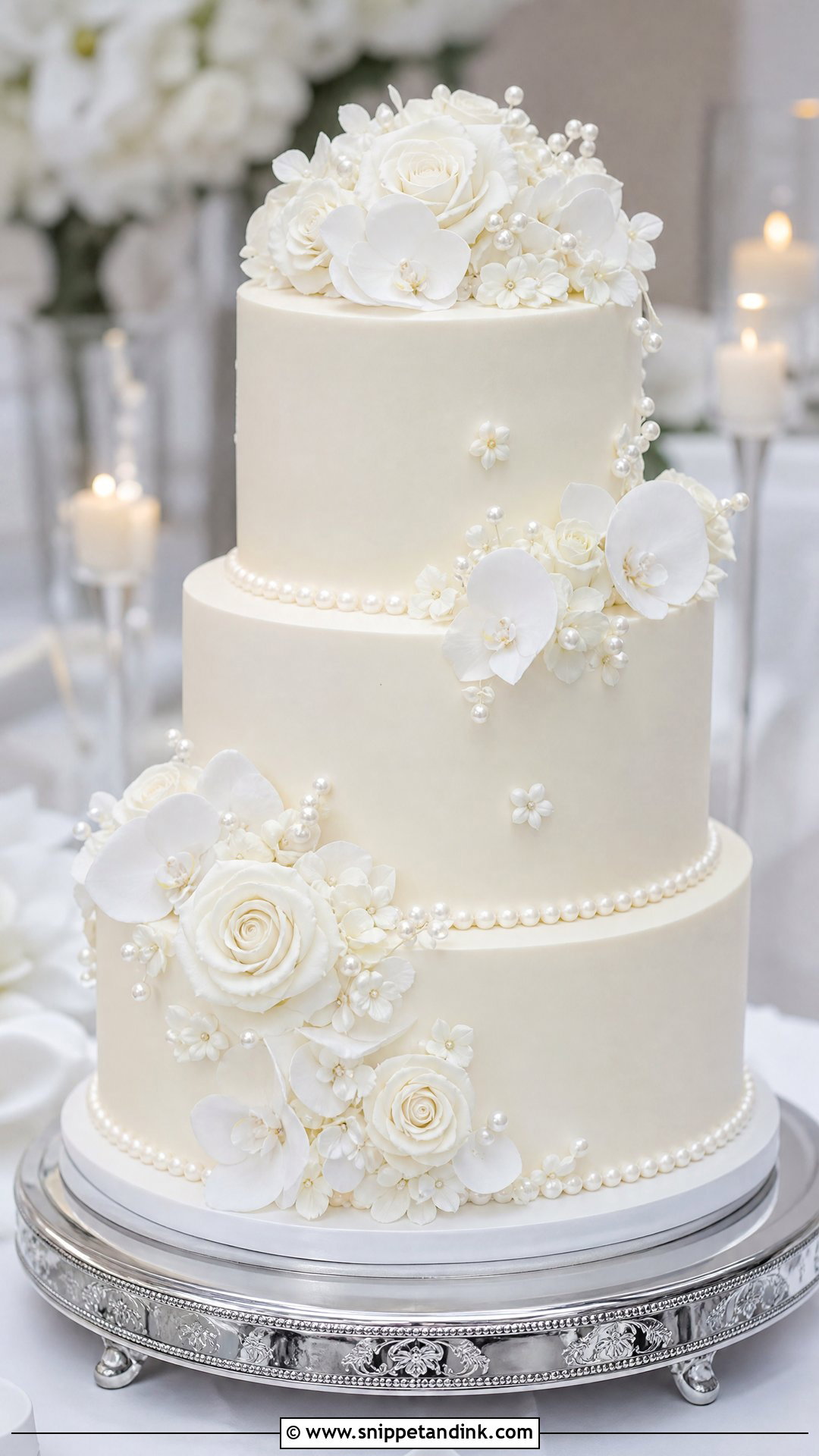
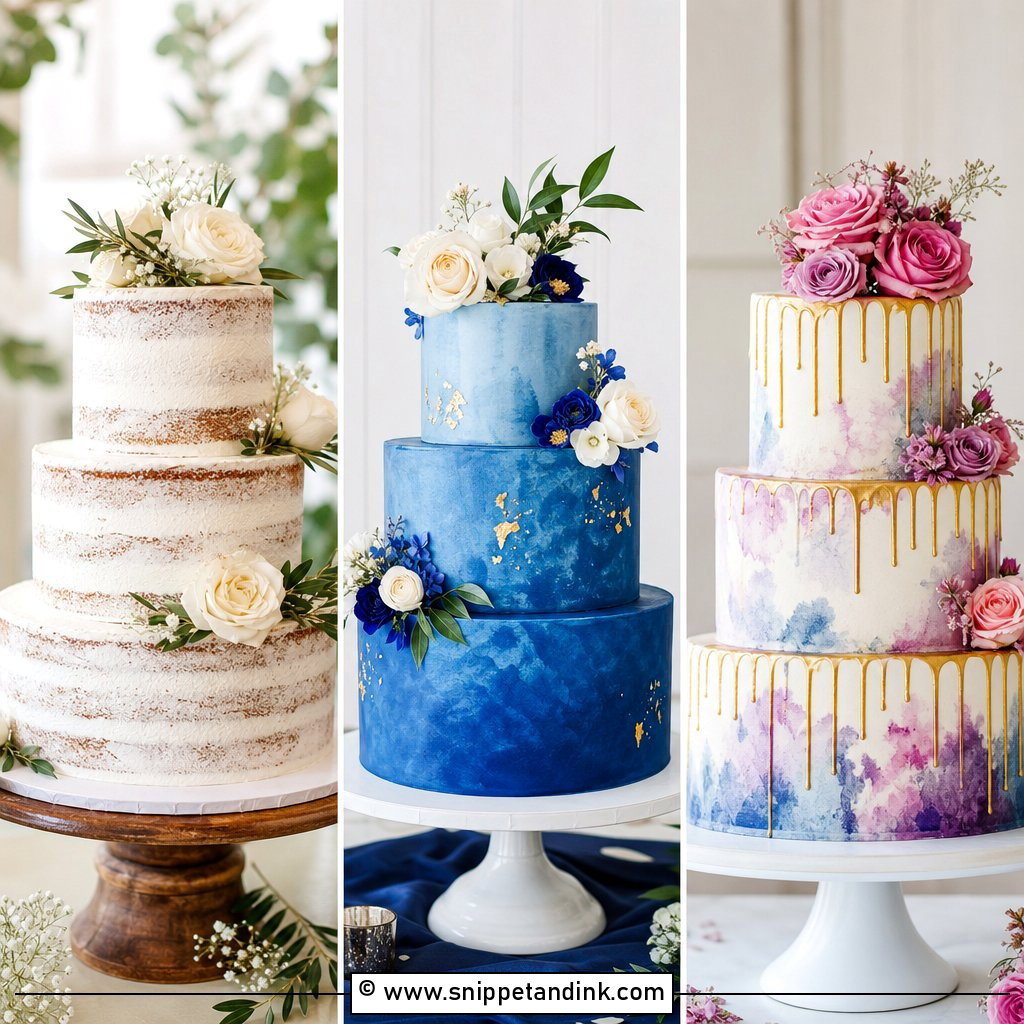
White on white only works when there is texture. A cake of white roses, stephanotis and sugar blossoms on ivory buttercream can go flat in photos, so I mix bloom sizes and add one surface detail: pearl piping, a soft ruffle or a few sprigs of green. Hydrangea looks pretty here, but I’d only use it in sugar, as the fresh flower isn’t one I want near frosting. The palette suits a chapel or black-tie reception in any season.
5. Blush Flower Wedding Cake
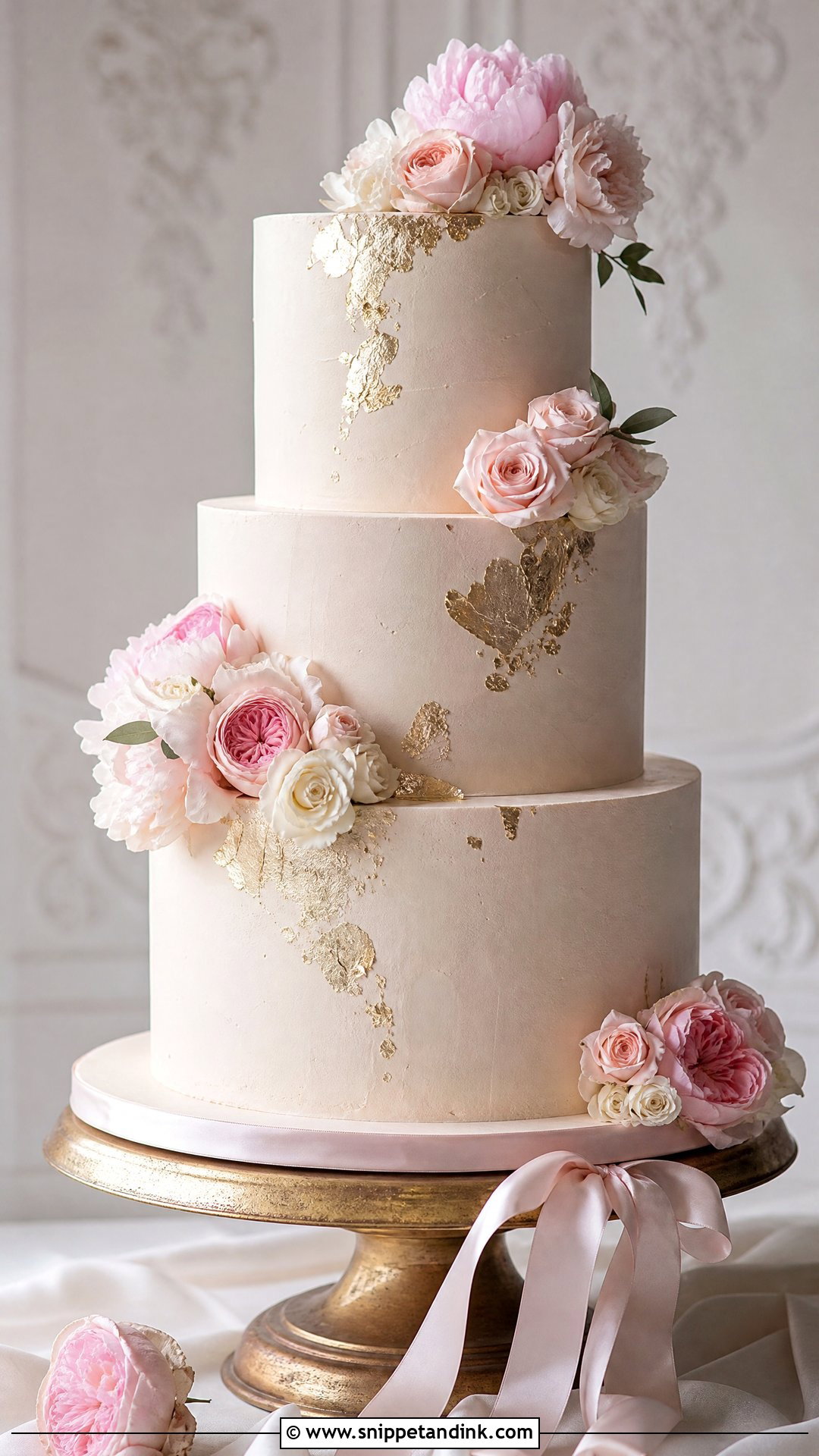
Blush reads warmer than white in photographs without tipping into candy pink. Pale garden roses, blush peonies, light ranunculus and cream spray roses sit easily on ivory frosting, and a gold leaf edge or satin ribbon at the base of each tier finishes it. I usually suggest asymmetrical placement, a heavier cluster on one tier and a small echo two tiers down, rather than a perfect spiral. One caution: peonies open fast in a warm room, so I place them late and expect them to look fuller by the cutting than at the reveal.
6. Wildflower Wedding Cake
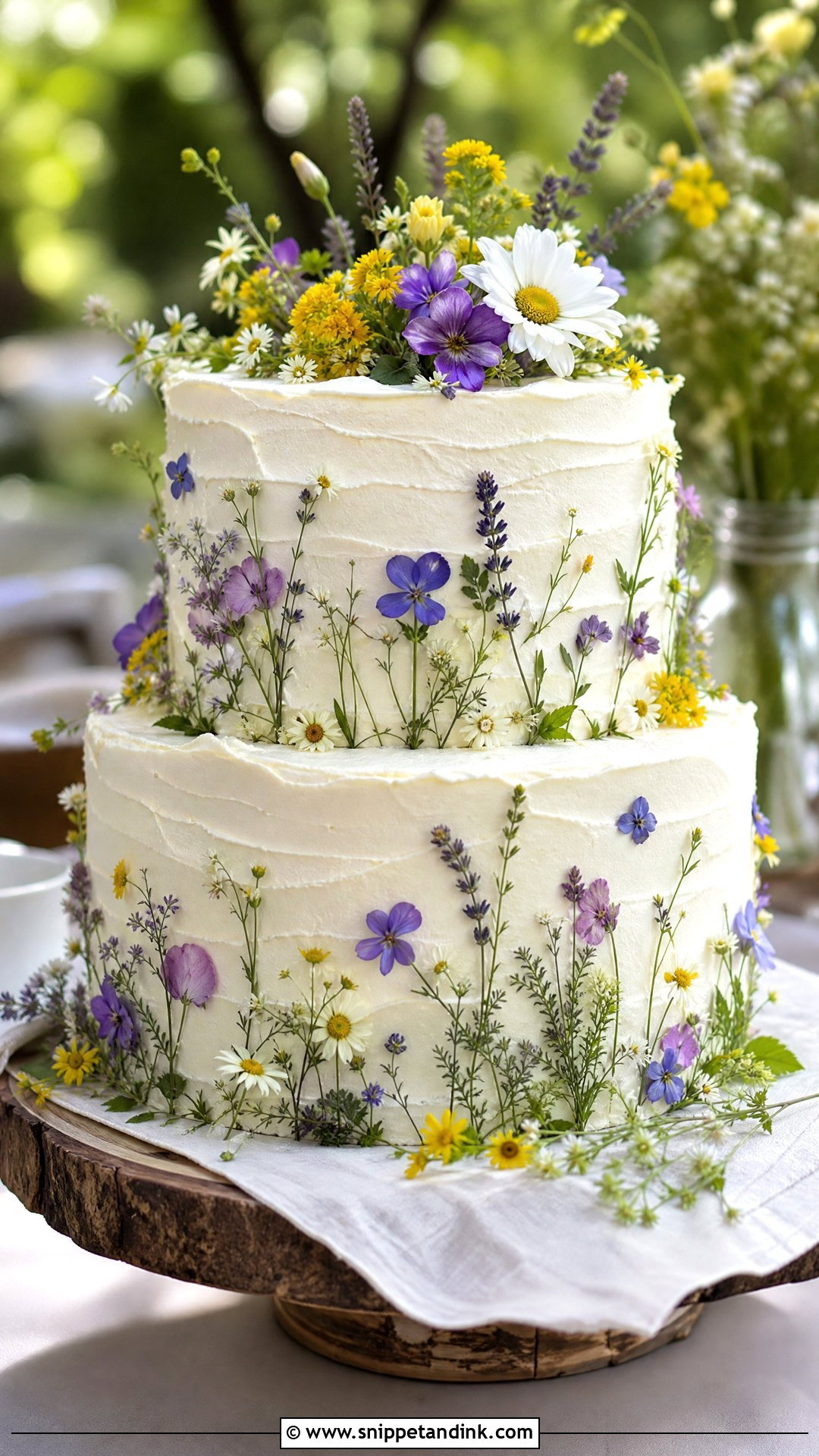
A wildflower wedding cake relies on small blooms, chamomile, lavender, daisies, bachelor buttons and violets, scattered as if they grew on the tiers. I pair them with a combed or palette-knife buttercream because texture hides the gaps between tiny flowers. The risk is chaos. I limit the mix to three or four colors, usually yellow, blue and white with a touch of purple, and repeat each one around the cake. It suits a barn or backyard party far better than a formal ballroom.
7. Floral Cascade Wedding Cake
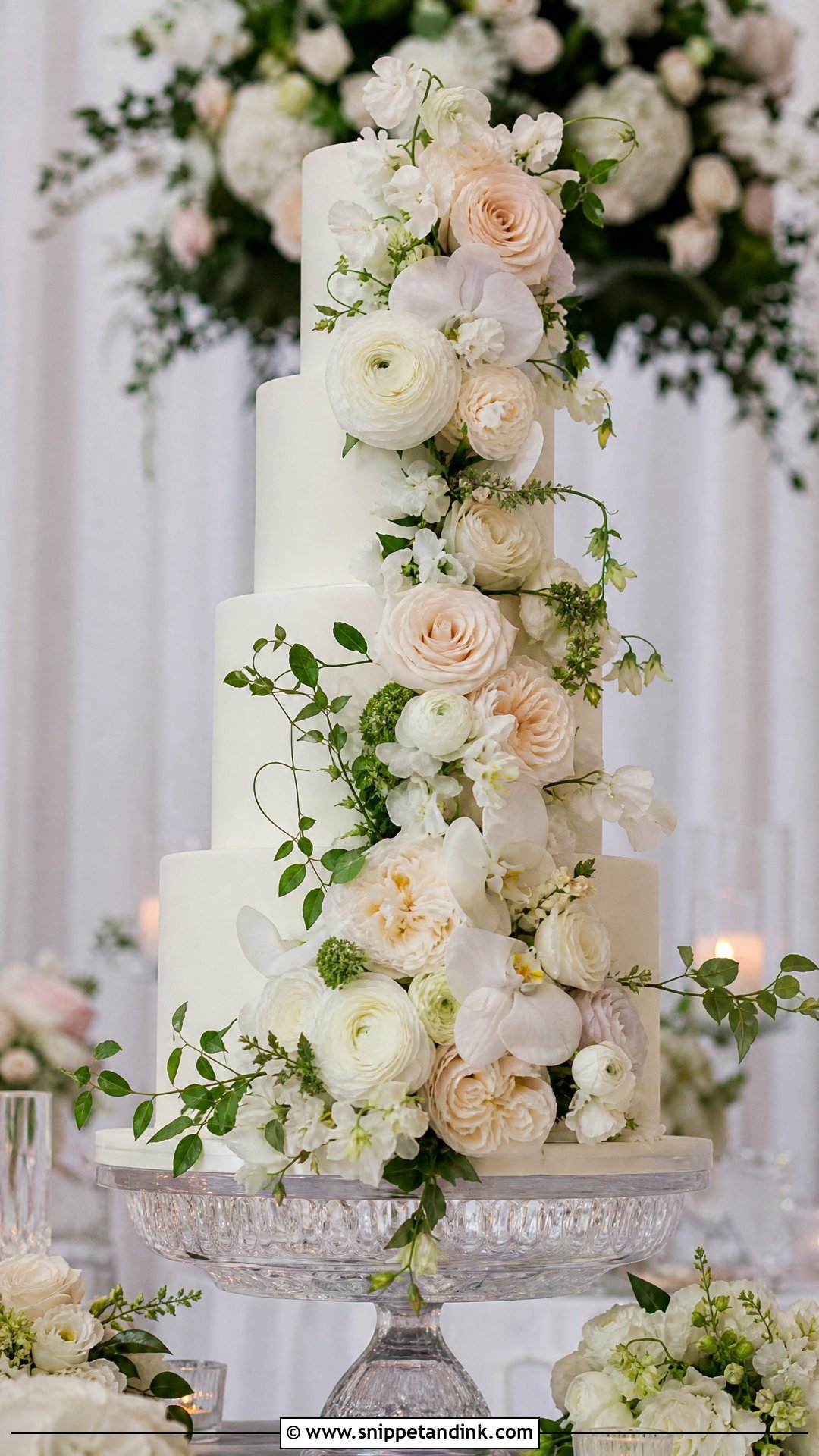
A cascade only works if it has room to fall. On three tiers or more, roses, orchids, ranunculus and trailing greenery can sweep from top to base; on two tiers I shorten it to a curve across the front. I build cascades in clusters anchored into the cake with picks, never one long garland, because a single heavy run can drag on soft buttercream. Fresh, sugar or mixed all work here. I keep the frosting smooth so the flowers carry the movement, and I tell couples to choose which side faces the room before I start placing.
8. Floral Meadow Wedding Cake
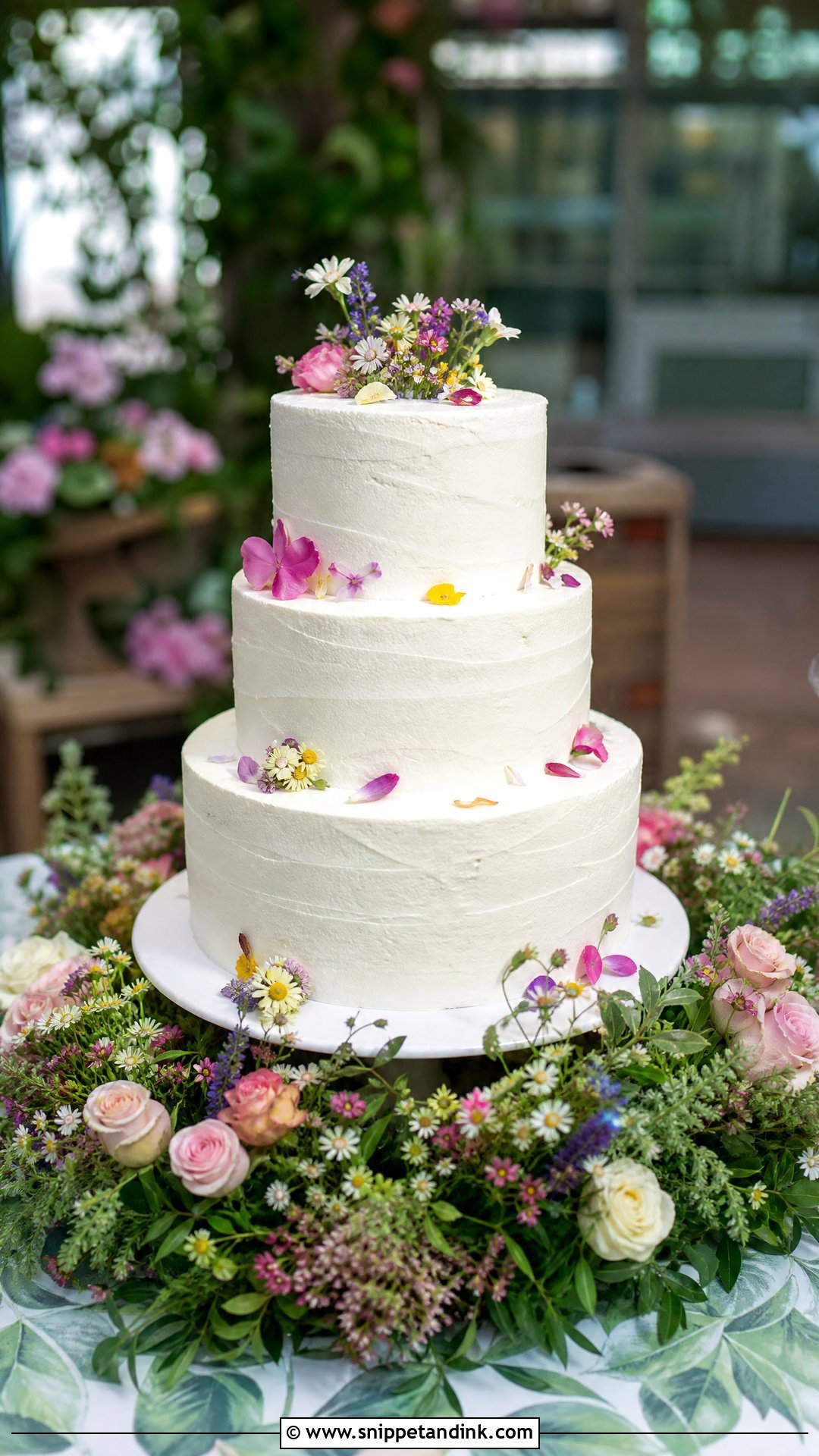
Here the flowers barely touch the cake. It sits on a stand inside a ring of petals, greenery and tiny blooms, so the florist does most of the work and I can keep the tiers smooth white or lightly textured. That makes it one of the safest floral options from a food point of view. Ask your florist to build the meadow from the same stems as the aisle so the cake table belongs to the room. It needs a stable, level table, though, because guests lean in close for photos.
9. Minimal Flower Wedding Cake
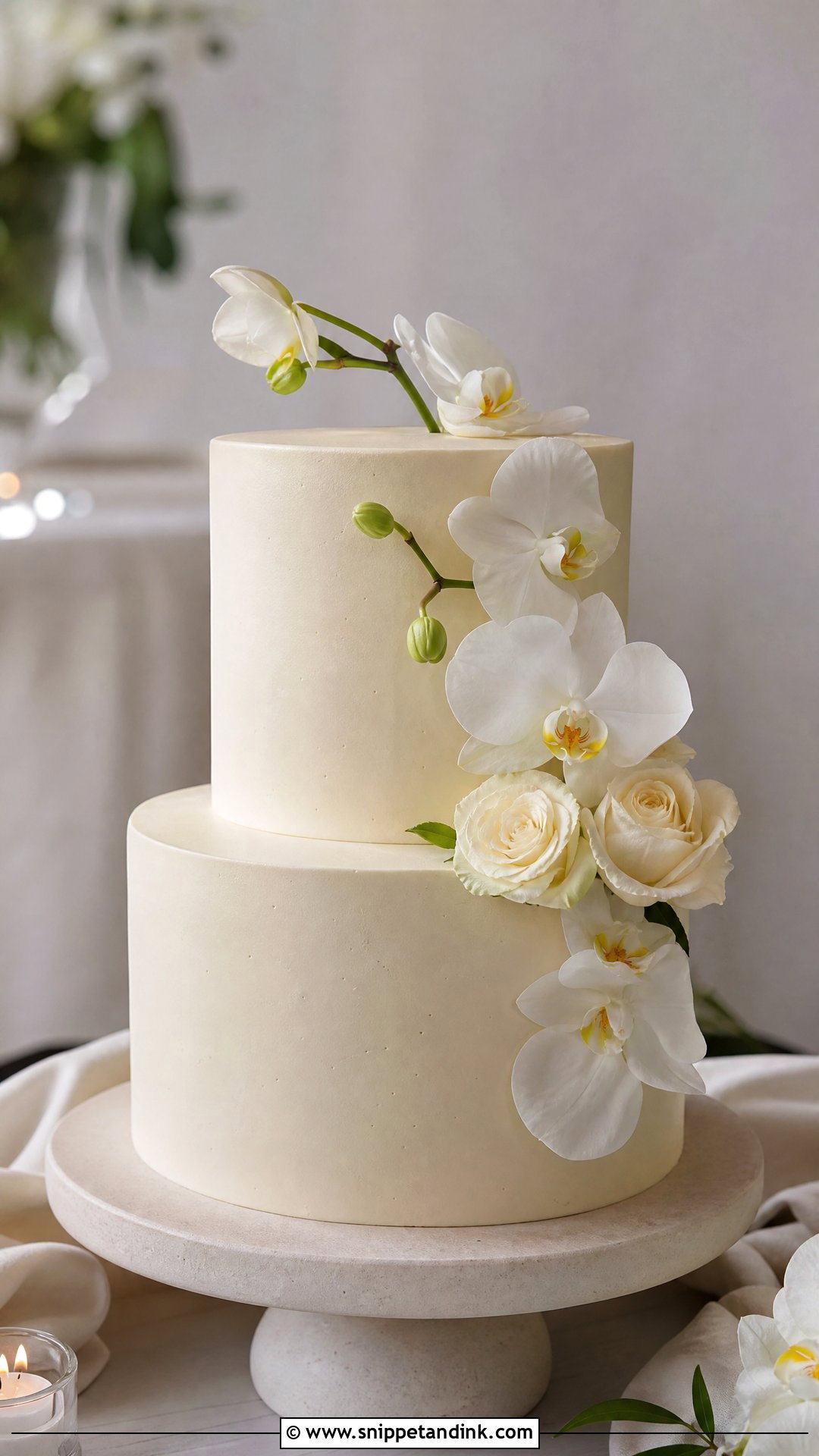
One orchid stem or a tight cluster of three roses can look more confident than a fully covered cake, but the restraint exposes everything else. With so few flowers, sharp edges and a flawless finish matter, so I spend longer on the final scrape than on placement. Ivory, cream, soft beige or pale gray keep it calm. I often recommend this when the venue is already full of florals and the cake shouldn’t compete. It is also easy to transport, since there is almost nothing to set up on site.
10. Floral Buttercream Wedding Cake
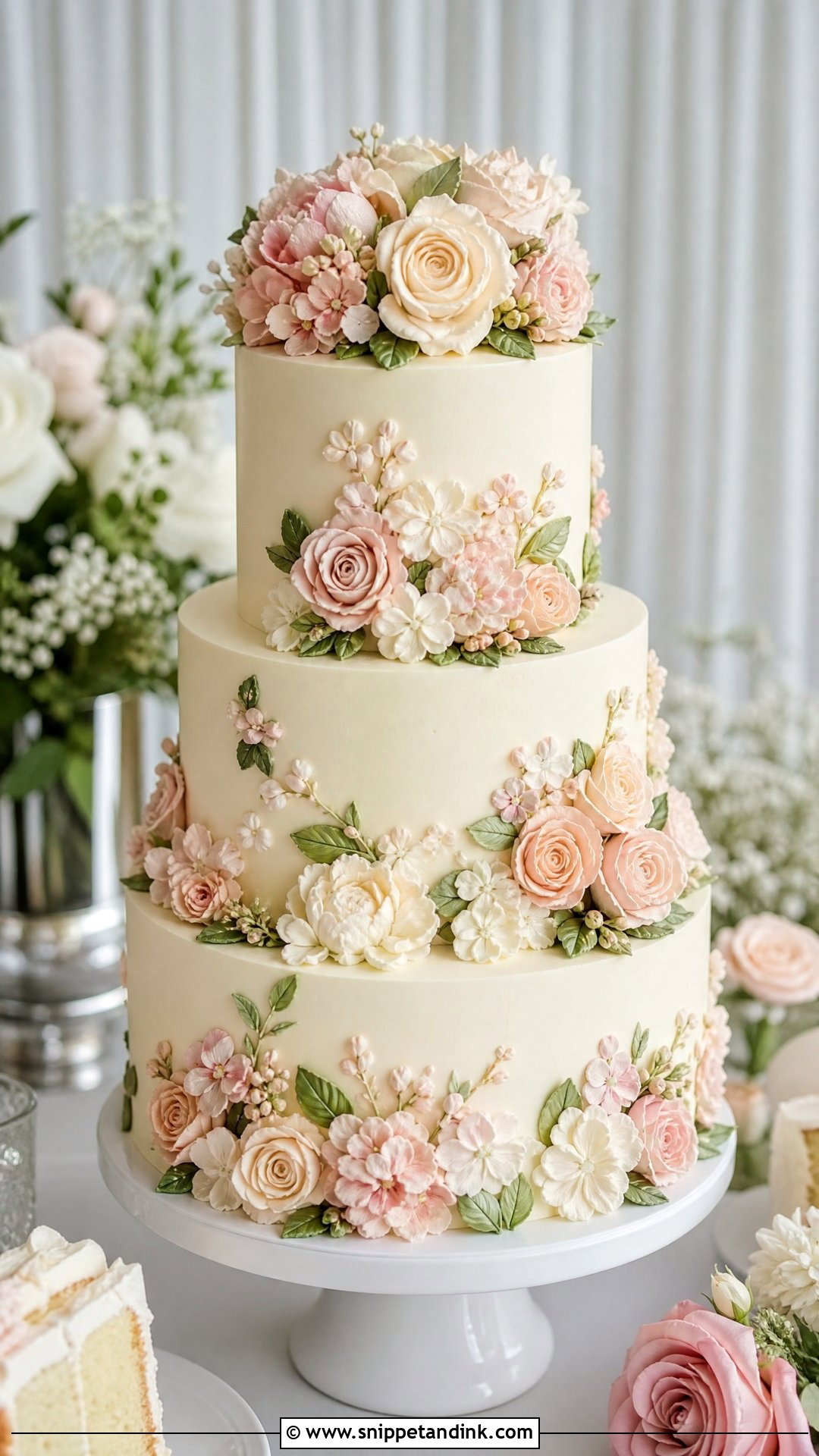
Piped flowers mean every petal on the cake can be eaten. I pipe buttercream roses, peonies and blossoms with petal tips, and the result can be painterly and loose or crisp and raised. The trade-off is heat. American buttercream crusts and holds better than a silky meringue buttercream in a warm room, so I ask about the venue temperature before choosing the recipe. Muted shades lean vintage; brighter ones feel playful. Full coverage takes far longer than a few blooms per tier, so expect that in the quote.
11. Floral Painted Wedding Cake
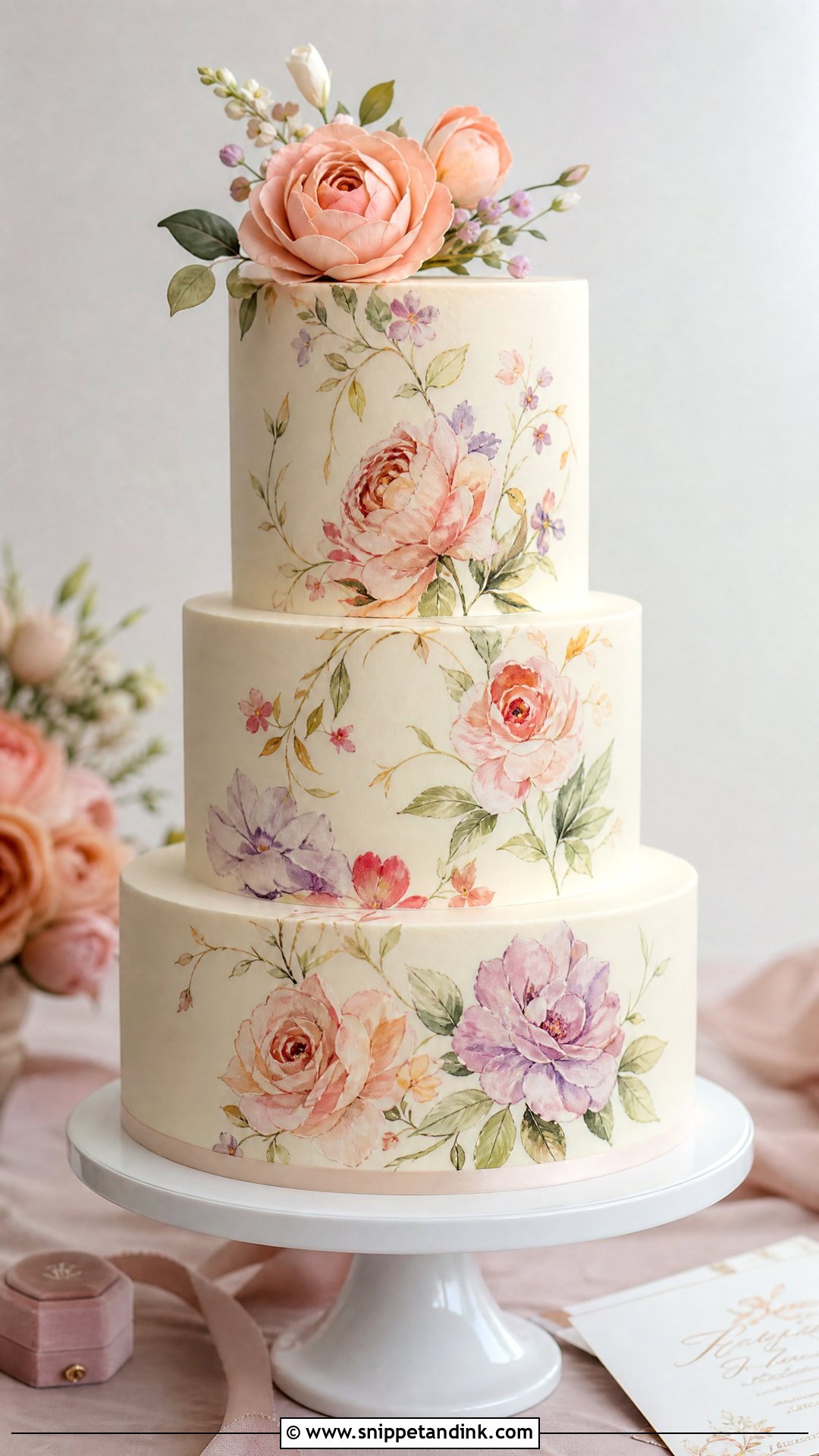
Painted cakes give you florals without any height. I paint with food coloring thinned in alcohol over firm fondant or chilled buttercream, building roses, vines or cherry blossoms in washes like watercolor. Couples often bring me their invitation suite so the cake can borrow its artwork. A loose wash looks romantic; bold outlined blooms look editorial. If you want a little dimension, add one or two sugar flowers, but let the painting stay the main event.
12. Floral Lace Wedding Cake
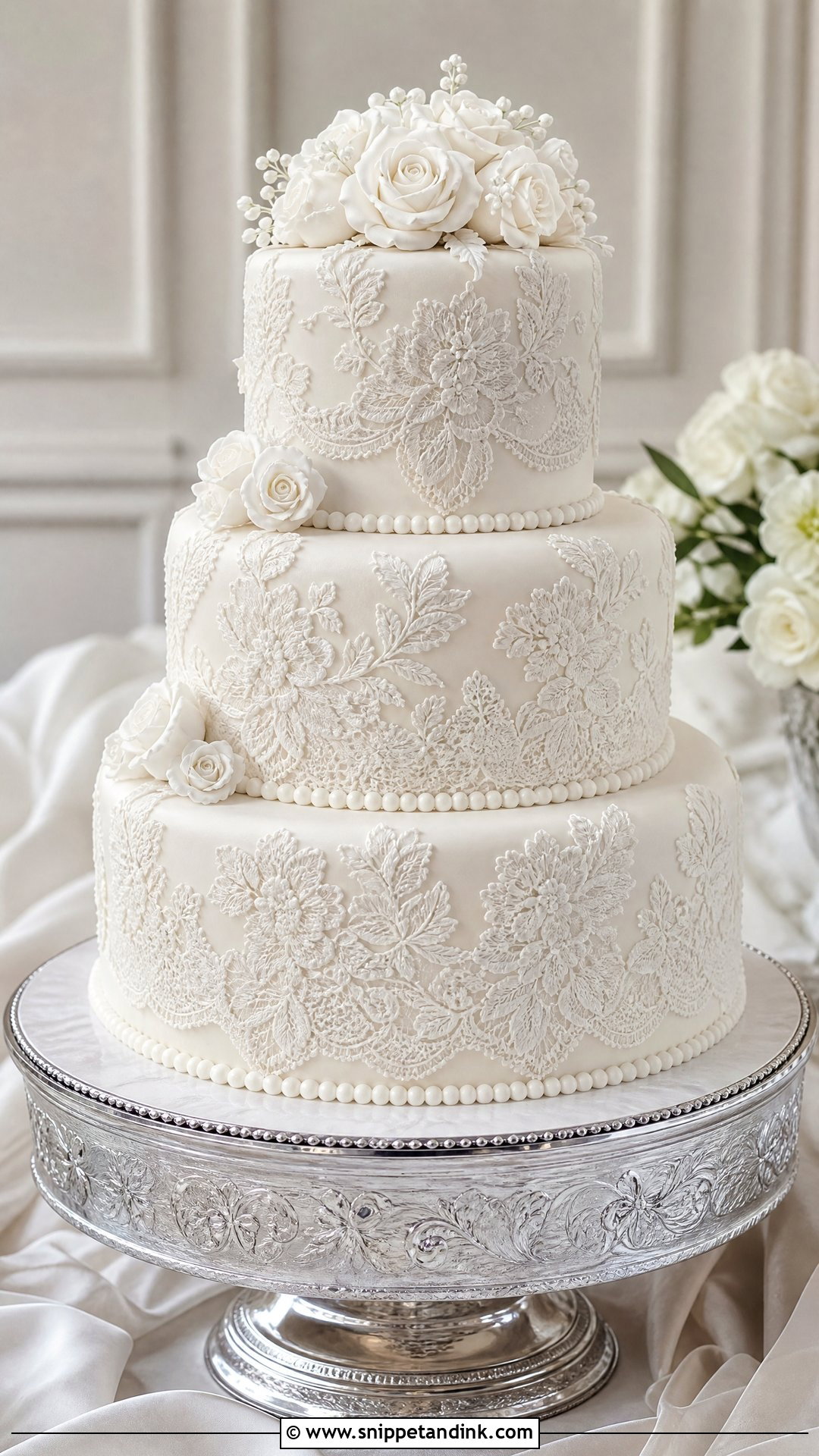
Lace is where cake and gown speak to each other. I work it with lace molds, piped royal icing or edible lace sheets, and I’ll ask to see a photo of the dress so the motif matches its scale. Raised floral appliqué in ivory almost disappears into the base until the light catches it, which is the point. I keep the palette pale and finish with a few white roses or sugar orchids. Piped royal icing is slow and exacting, so this is a design I need planned well in advance.
13. Floral Drip Wedding Cake
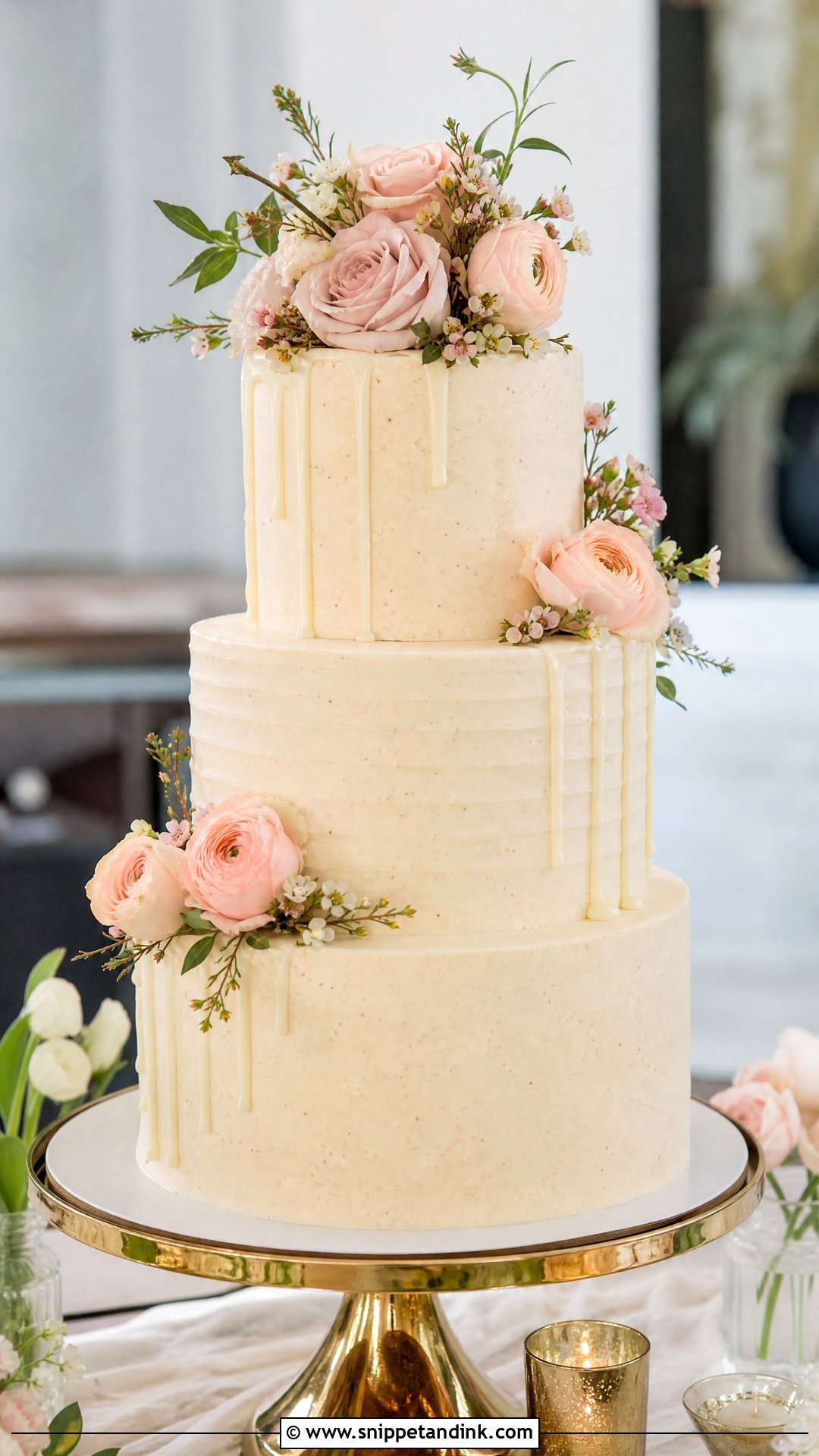
A drip adds gloss and a modern edge, and flowers soften its graphic line. I use white chocolate, caramel or tinted ganache, and the ganache temperature decides everything: too warm and it runs to the board, too cool and it stops in stubby blobs. I apply drips to a cold cake and place flowers where the drip is shortest so nothing gets hidden. Roses, ranunculus and small edible blossoms work best. Smooth buttercream and a plain stand keep it from looking cluttered.
14. Floral Naked Wedding Cake
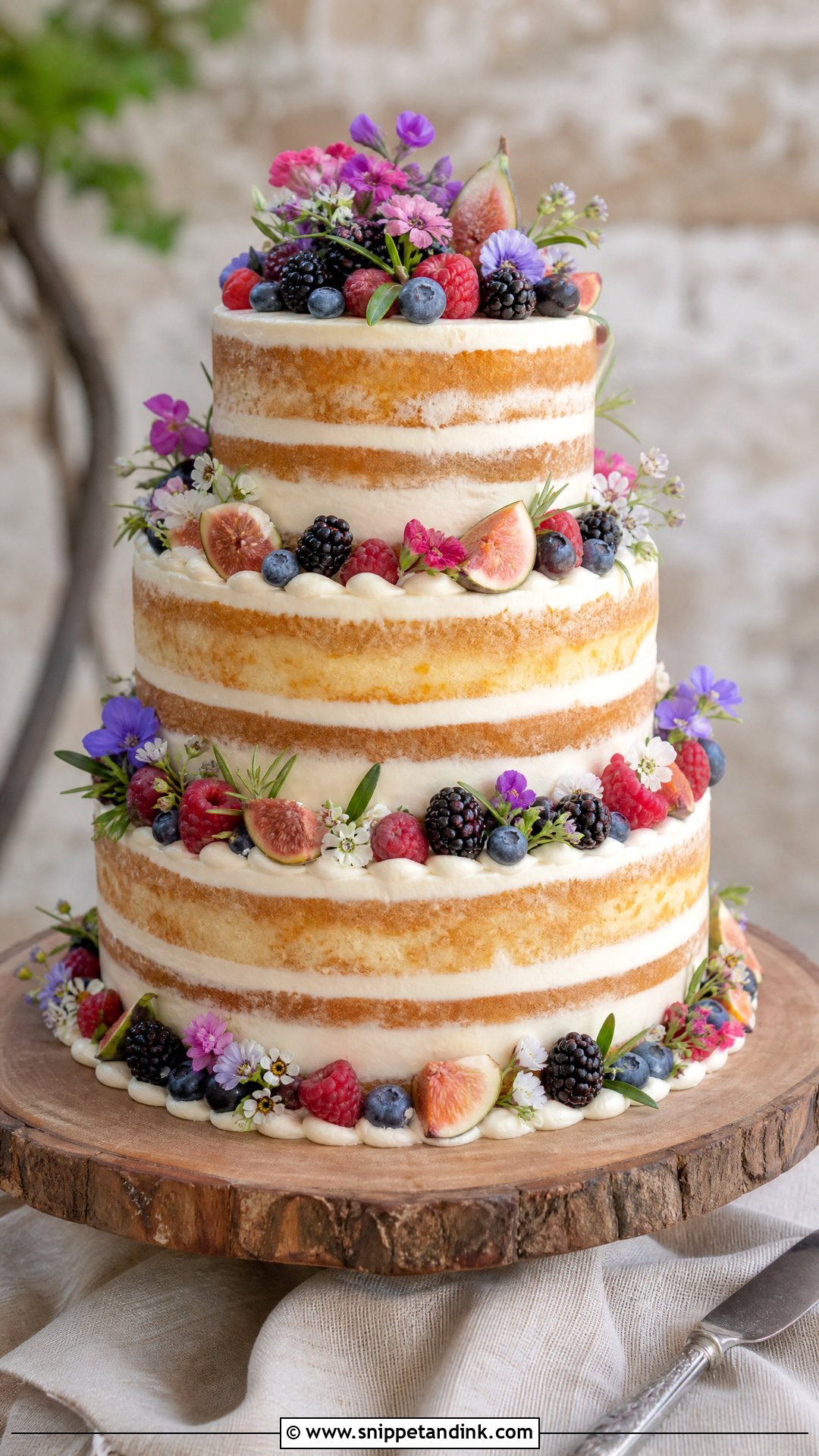
With a naked cake, the sponge is the decoration, so it has to be good. Vanilla, lemon, almond, carrot and berry layers all look warm with berries, herbs and flowers tucked around them. Unfrosted sides dry out quickly, so I assemble as close to the event as I can and keep it covered until it goes out. Fresh flowers still need wrapped stems, and edible blooms are my choice wherever petals touch the cake. A dusting of powdered sugar or a few halved figs finishes it. It belongs at a barn or garden party, not a black-tie dinner.


15. Floral Semi Naked Wedding Cake
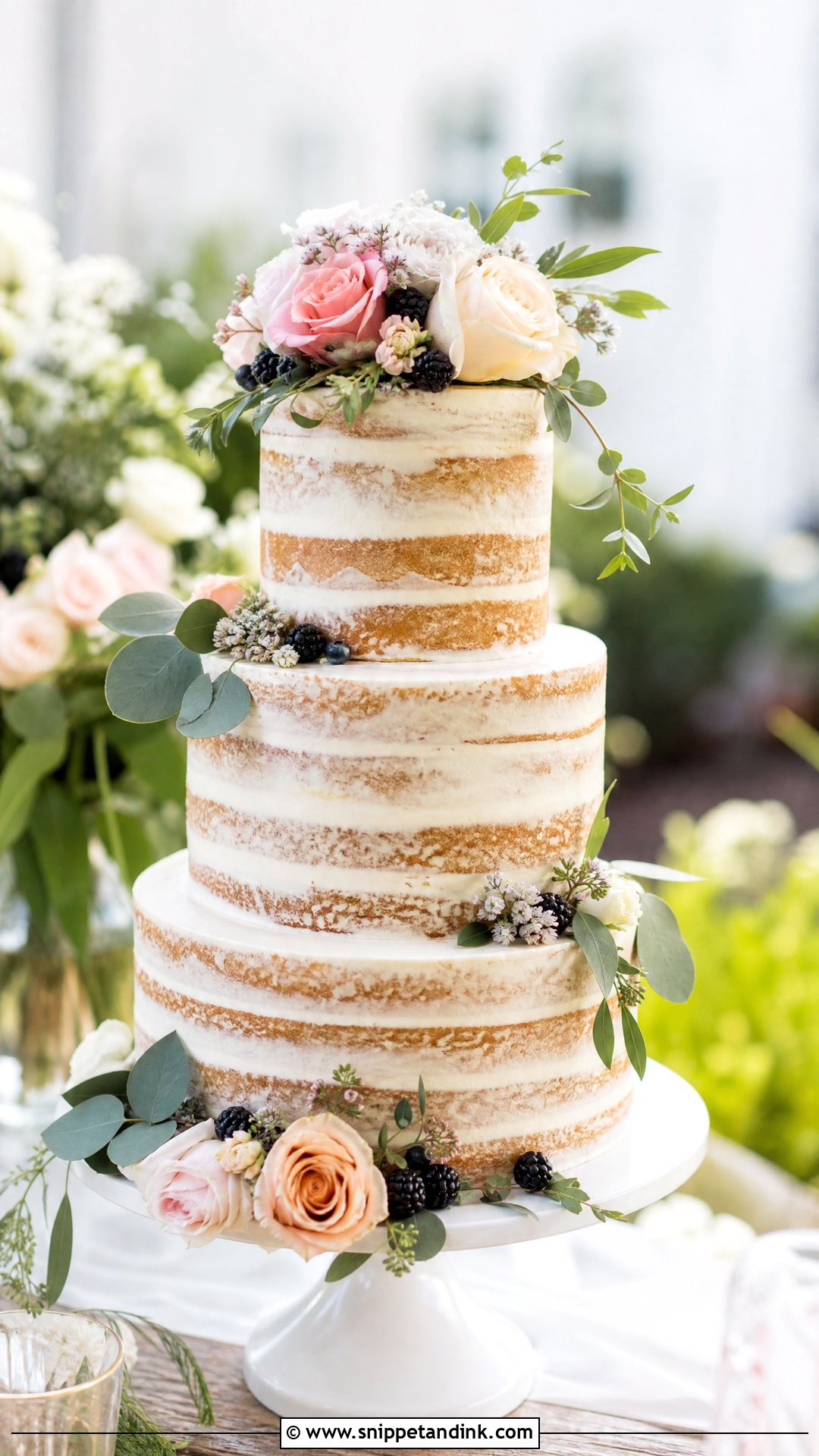
A semi-naked finish is a thin scraped coat that lets some sponge show through, a little more polished than a naked cake and better at keeping moisture in. I tuck greenery, soft roses and seasonal stems between tiers or around the top. Flavor and look go together here: almond raspberry, lemon elderflower, vanilla bean and spice cake all suit visible layers. Watch the color of the sponge, though; a pale chiffon reads very differently from a dark spice cake through the frosting. It suits a vineyard or tented reception.
16. Floral Square Wedding Cake
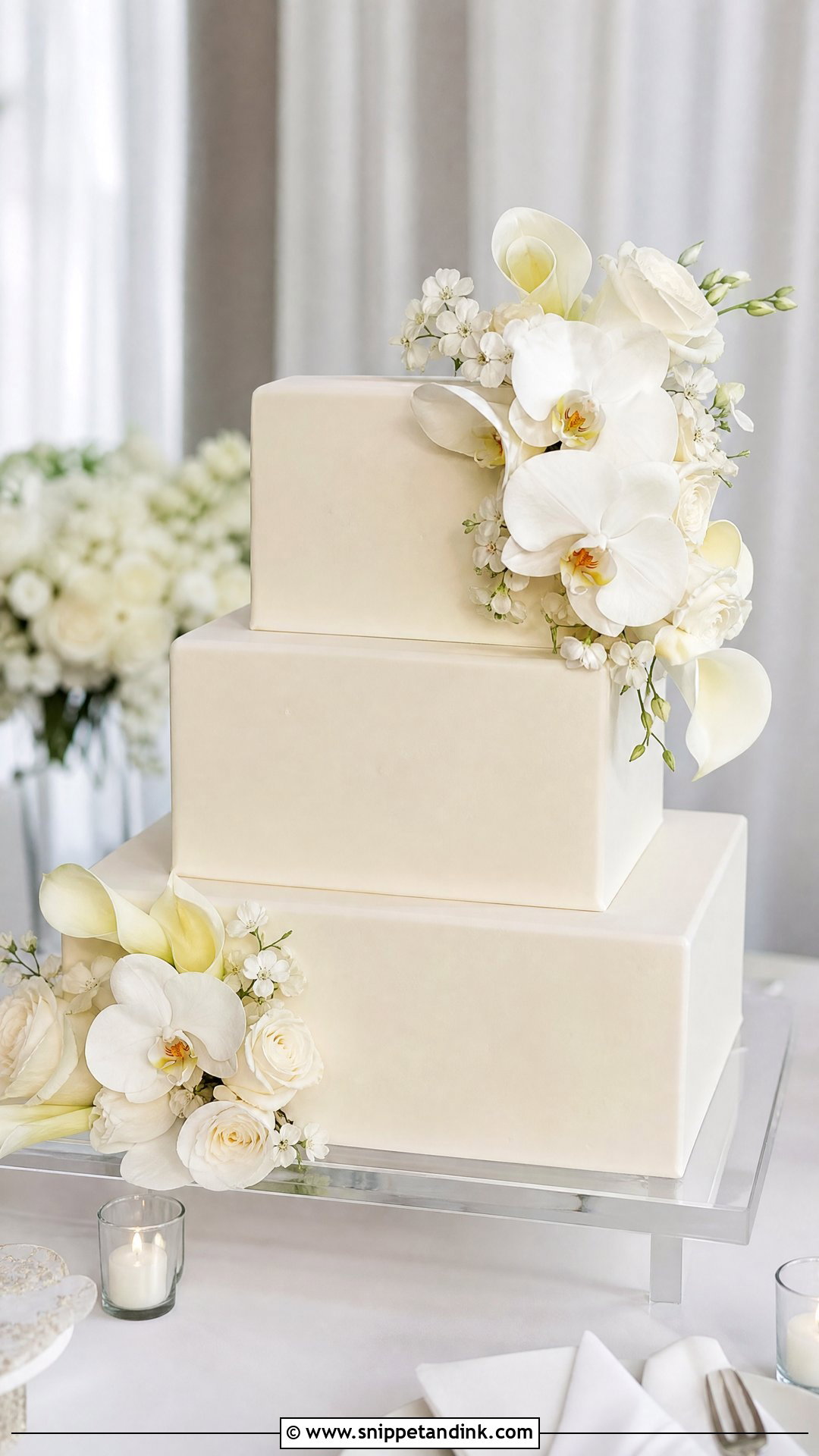
Square tiers are harder to finish than round ones, because every corner shows a slip in the icing. Sharp corners in fondant or crisp buttercream give that architectural look, and flowers then soften it: blooms on opposite corners for balance, or one small cascade down a single edge. White orchids, calla lilies, roses and sugar flowers suit the clean shape. Square cakes also cut into neat portions, which caterers appreciate. If you want something less traditional without going loud, this shape is a good middle ground.
17. Floral Tall Wedding Cake
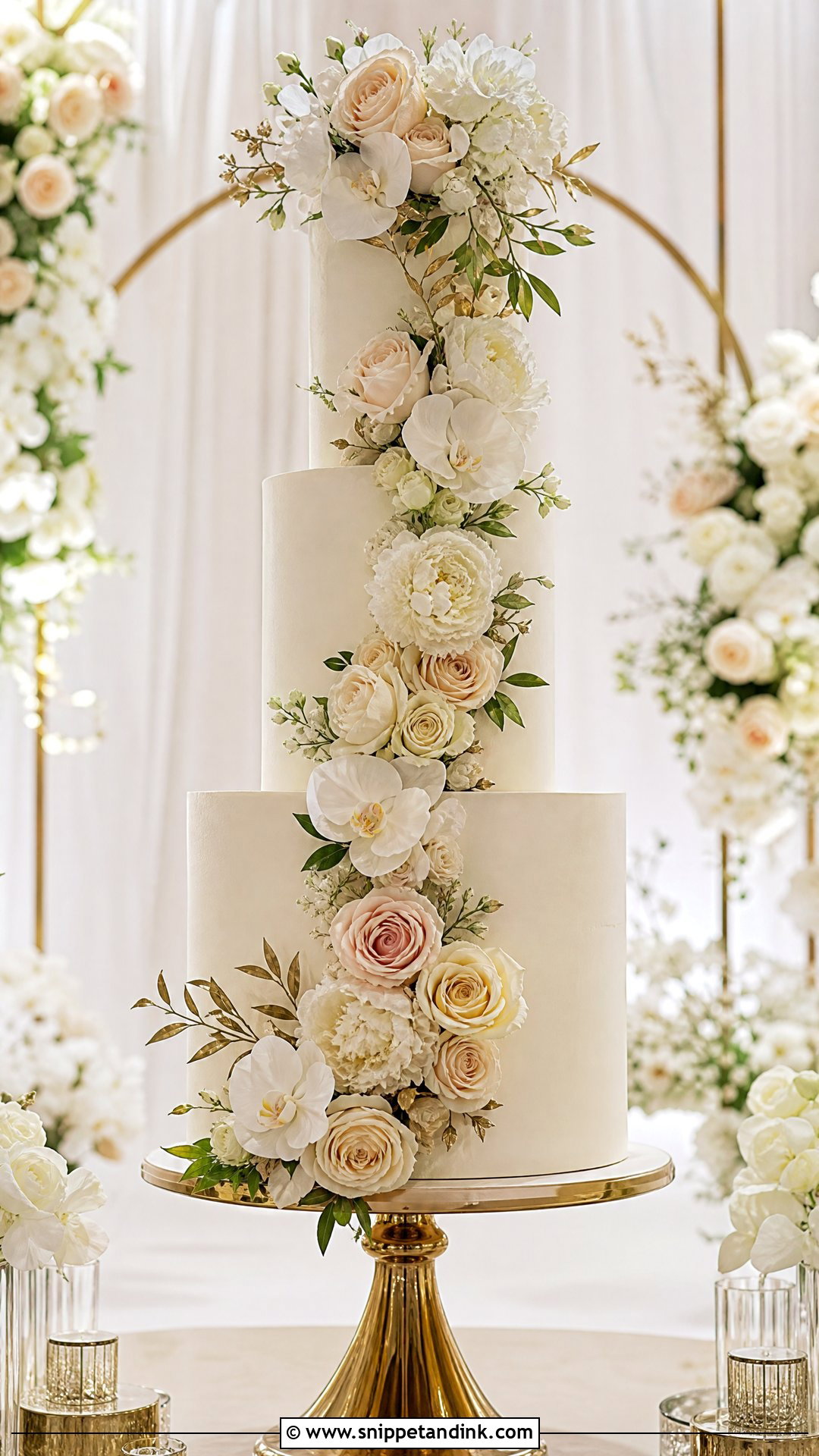
Tall cakes use extended tiers, often six inches or more each, which means extra dowels and a sturdier board inside so nothing settles. The height is the effect, so I keep the flowers vertical: slim clusters climbing one side, or a simple grouping at the base. Sugar flowers are useful here because they weigh less and don’t wilt. Random scattering ruins the silhouette. I keep the colors refined, ivory, champagne or soft green, and recommend it most for venues with high ceilings, where a short cake would vanish.
18. Floral Single Tier Wedding Cake
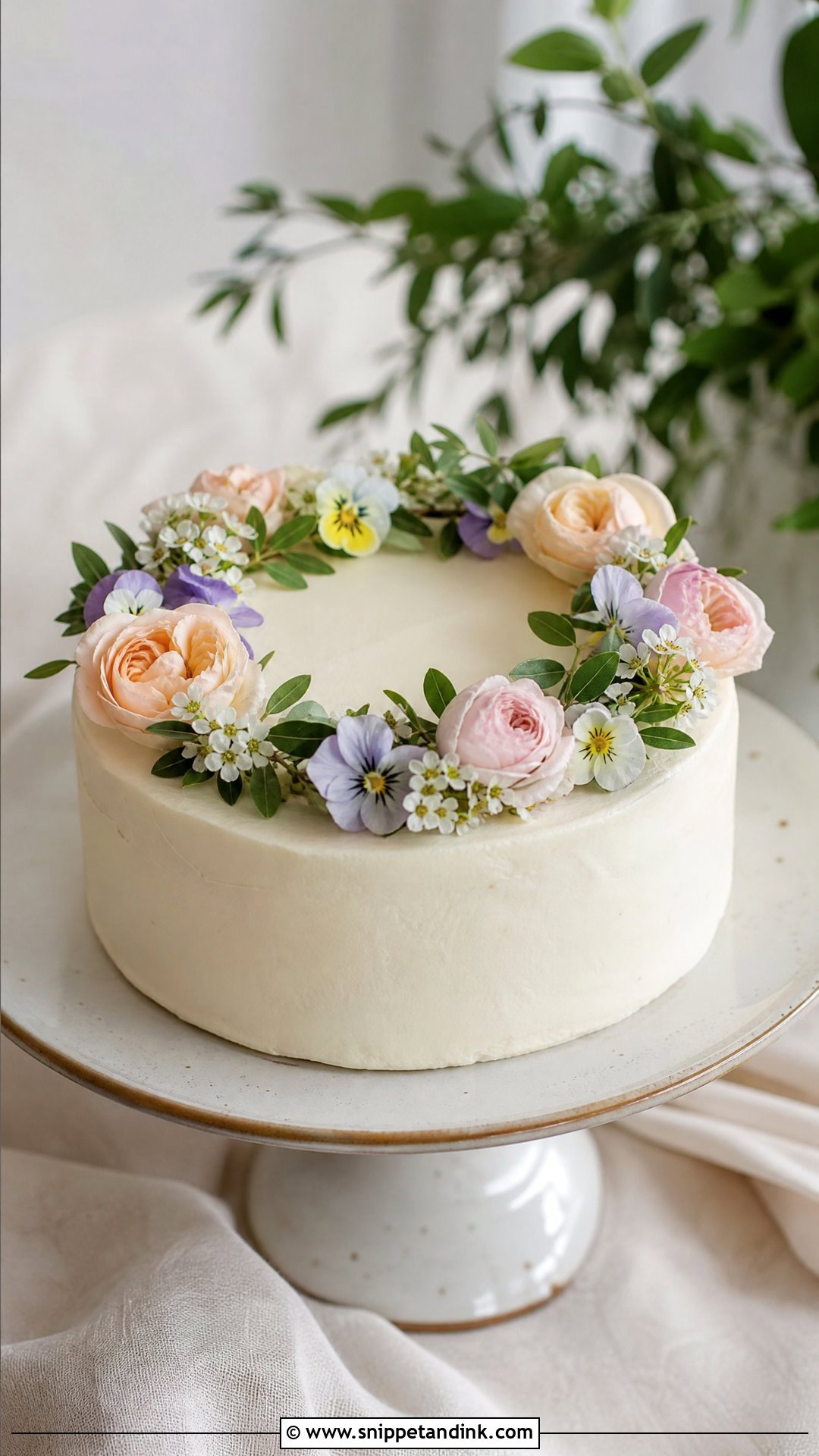
One tier suits an elopement, a micro wedding or a dessert table with plenty of other sweets. It is also what I build as a cutting cake when the guests are served from sheet cakes in the kitchen. Because it sits at eye level, details count: a round of pressed petals, a small fresh flower crown or a single sugar cluster that matches the bouquet. Clean frosting and balanced placement keep it from looking like an afterthought.
19. Floral Cupcake Wedding Cake
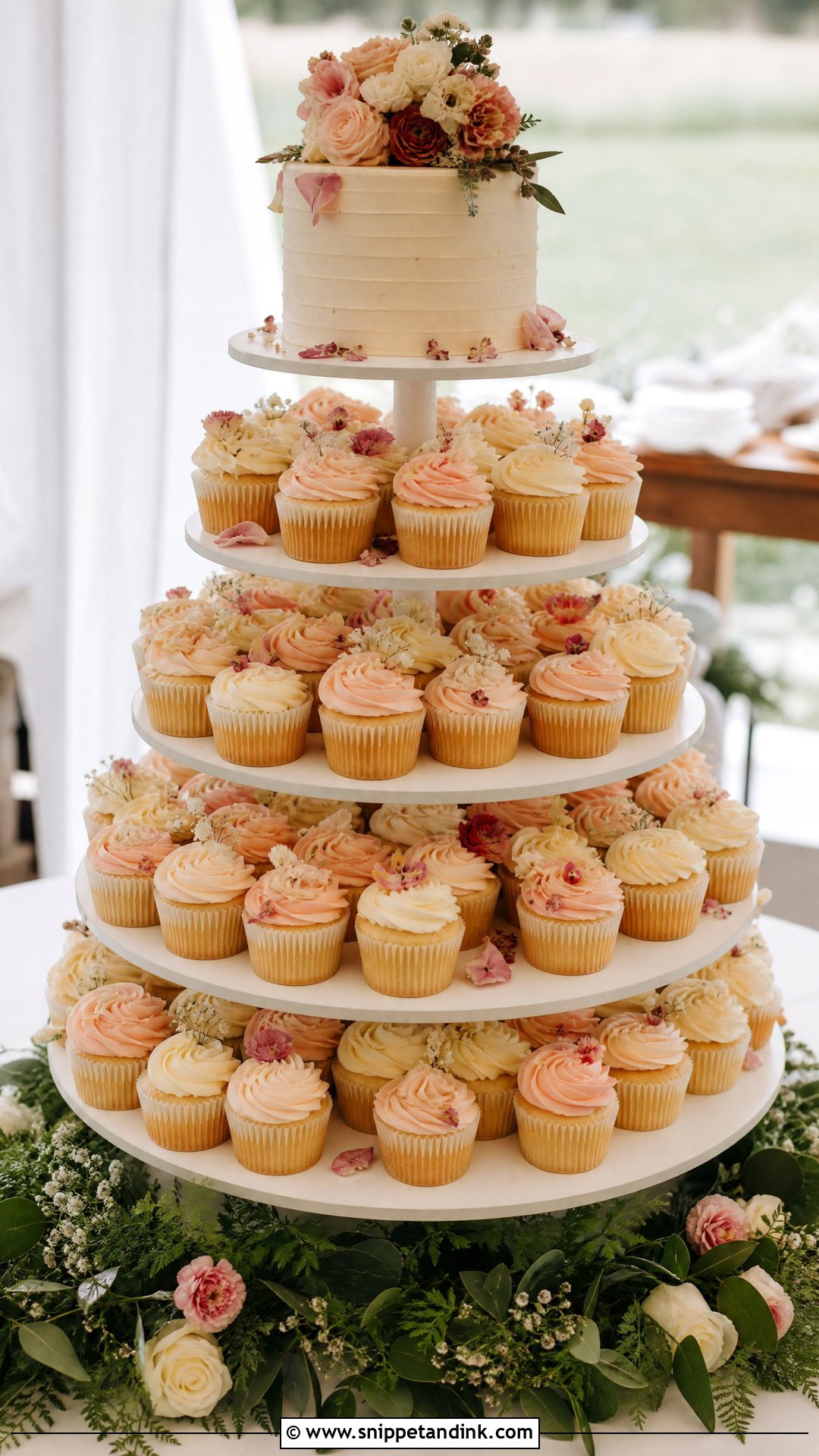
Cupcakes solve the serving problem: no cutting, no plates waiting on the caterer. I usually top a tiered stand with a small cutting cake so you still get the moment. Each cupcake can carry a piped buttercream flower, an edible petal, a mini sugar blossom or a tiny rose. Uniform liners and two or three repeated designs look more finished than twenty different toppers. A ring of greenery around the base of the stand softens the display, and guests tend to love choosing their own.
20. Floral Fruit Wedding Cake
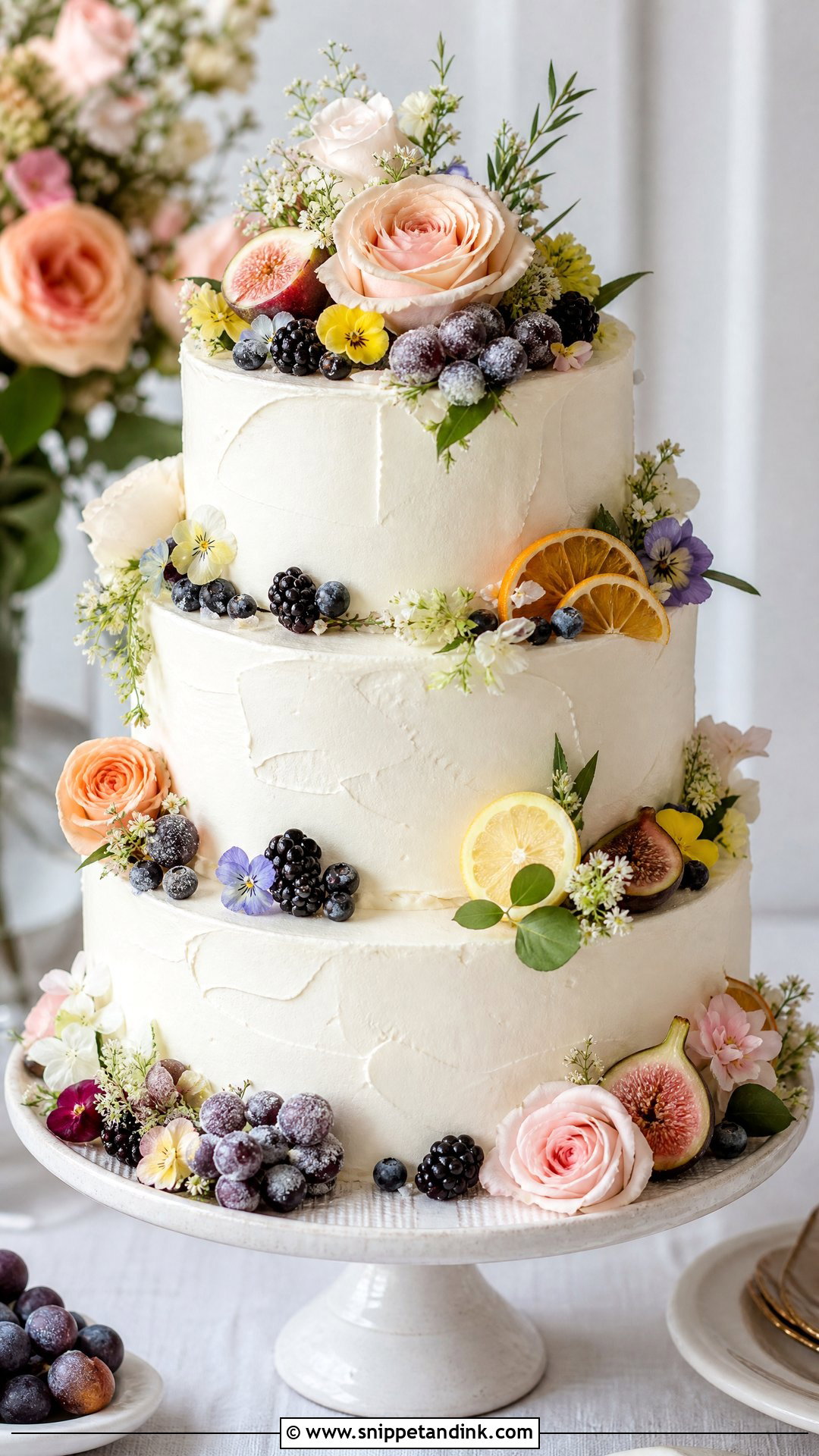
A floral fruit wedding cake pairs blooms with figs, berries, grapes, citrus slices, pears or cherries. Fruit is less predictable than flowers. Cut fruit weeps onto frosting within a few hours, so I prefer whole berries and halved figs, and I glaze or sugar anything cut. Smooth buttercream with sugared fruit reads refined; semi-naked layers with berries look rustic. Edible flowers wherever petals touch the icing, as always. It is at its best in late spring and summer, when the fruit is ripe and full of color.
Who Places the Flowers, and at What Hour
The most common floral cake problem I see has nothing to do with design. It is a gap in the schedule where the cake arrives at noon and the florist arrives at three, or each assumes the other is doing it. Agree in writing who supplies the flowers and who puts them on.
Fresh stems
Out of water, most blooms start to droop within a few hours, faster in summer heat. I prefer to dress the cake at the venue, after it is set on its final table, and as close to the reception as the timeline allows. Bring a few spare stems so wilted ones can be swapped before the cutting.
Sugar flowers
These are made weeks ahead and travel boxed separately, then go on during setup so they aren’t knocked in the van. They keep for years if you want to save one, as long as they stay dry and out of direct sun.
Heat and sunlight
Buttercream softens in a warm tent and petals scorch in direct sun. I ask where the cake table sits and will move it from a window or into shade, because no flower choice can rescue a cake that is melting under it.
Settle the Flower Source Before the Cake Design
Once you know whether your flowers will be fresh, sugar, piped, pressed or painted, the rest of the design follows quickly, because each one has its own timing and its own limits in heat. Pressed and painted petals stay flat and delicate. Sugar flowers give you any bloom in any season. Fresh stems connect the cake to your bouquet, and a meadow puts the flowers around it instead of on it. If budget or serving is the worry, cupcakes or a single tier still carry a floral idea well. Bring your florist and baker into the same conversation early, and the cake will look as good at the last slice as it did at the reveal.
You'll Like These Ideas:





Leave a Reply