
Most of my work at Indian weddings is the half of the photo people forget: dressing the groom so he belongs next to the bride without looking like her reflection. Couples who coordinate well rarely match exactly. They share a color, an embroidery metal, a motif or one accessory, and each person wears a cut that suits them. Multi-day weddings make this harder, since a cotton haldi set and a velvet reception jacket follow different rules. Think about the function, venue, weather and formality first. Below are twenty pairings, from classic red and ivory to lavender and navy, with notes on how I’d link the two outfits.
One Palette, Five Functions: Mapping Both Wardrobes
When a couple comes to me, I lay out every event on one page before we look at a single fabric. It stops two problems: repeating the same color twice in a weekend, and the groom ending up with five jackets that all look alike.
- Haldi: washable cotton or mulmul, flat shoes, colors that can survive turmeric. Lowest priority for spending.
- Mehndi: light, bright and comfortable to sit in for hours. This is where prints and florals work best.
- Sangeet: movement matters. Check that both outfits let you dance, and that her lehenga isn’t too heavy to spin in.
- Wedding: the most traditional pairing, chosen with both families. His look is built around hers.
- Reception: the place for darker shades, Indo-Western cuts, velvet and sharper tailoring.
Give each event a different main color so the photos don’t blur together, and keep one thread running through all five, such as the same embroidery metal. Leave room between events for outfit changes; a draped saree and a safa each take time to put on properly.
1. Red Lehenga And Ivory Sherwani
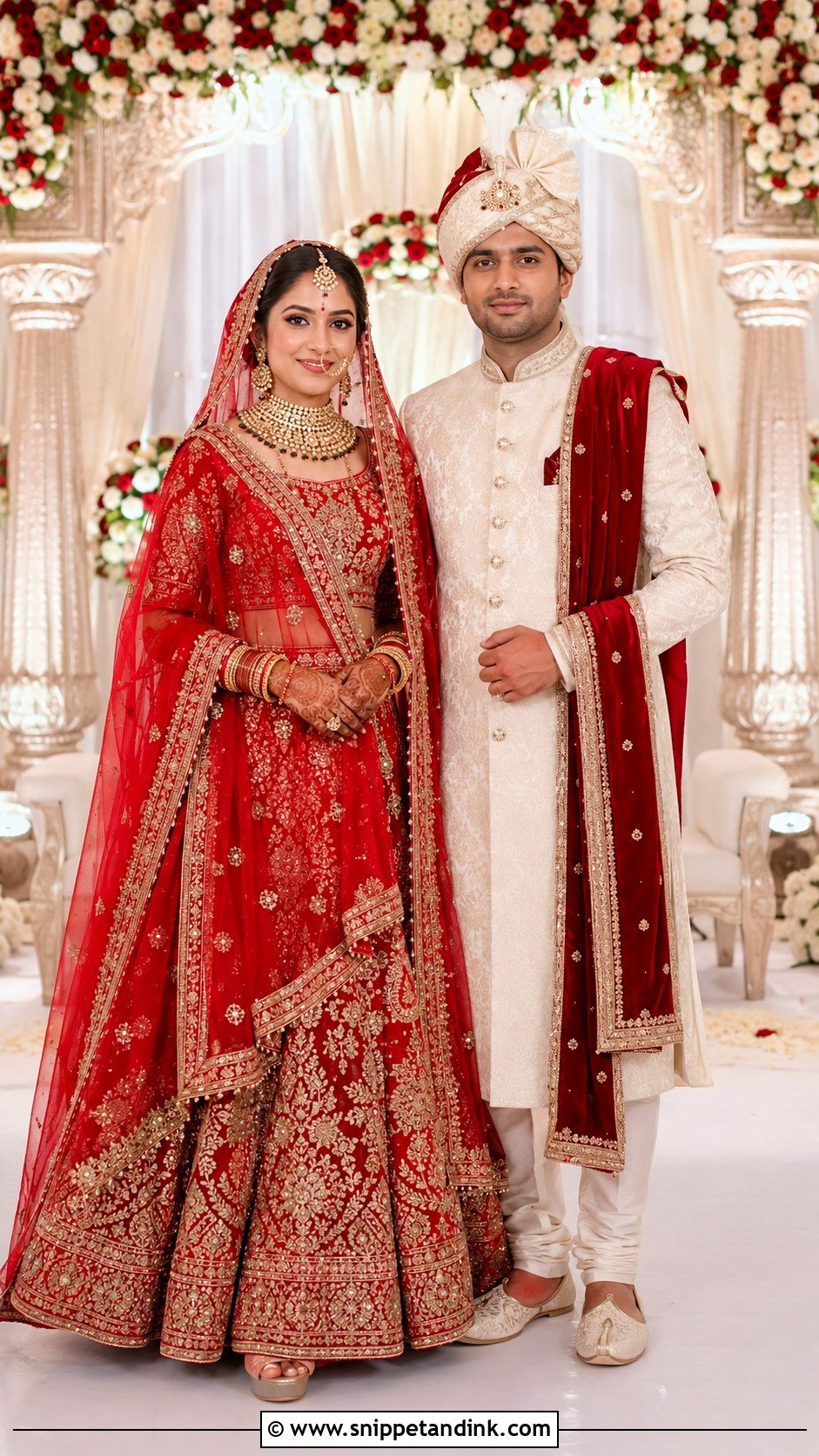
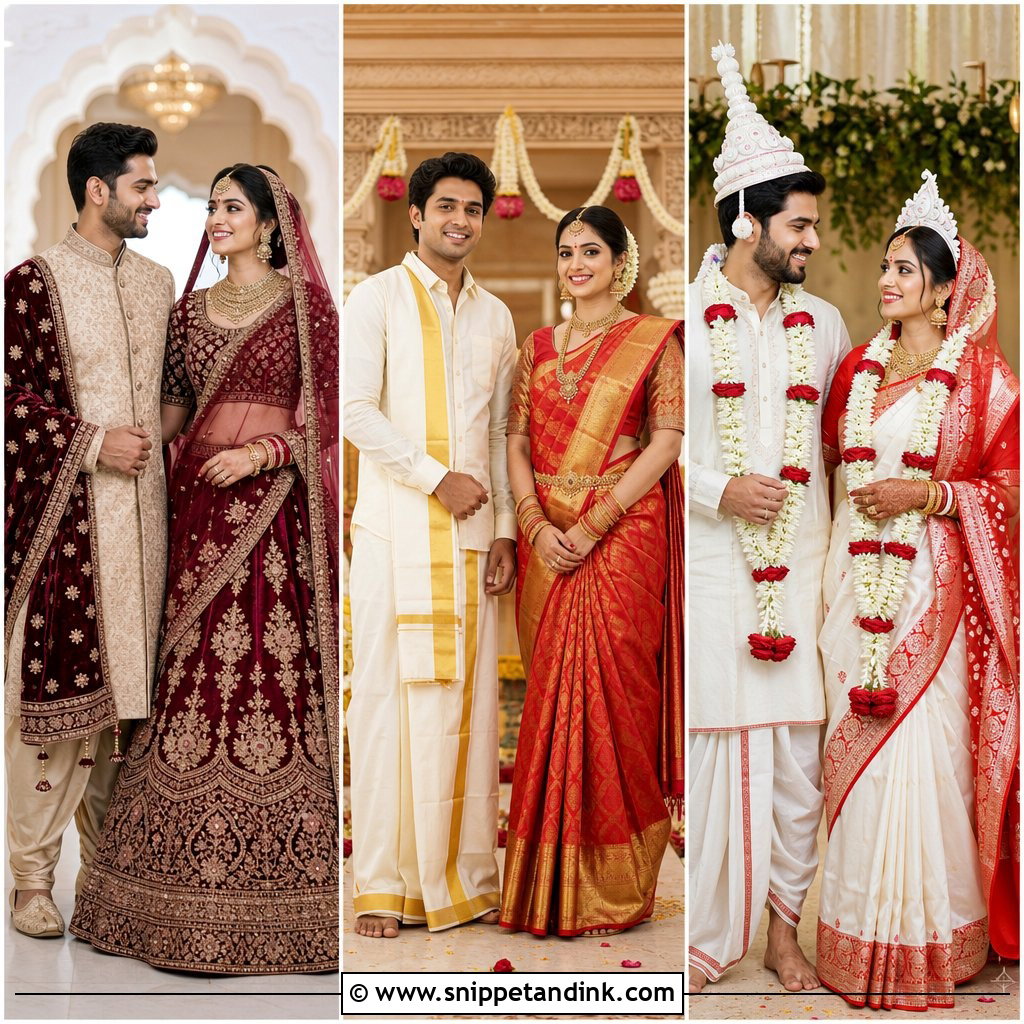
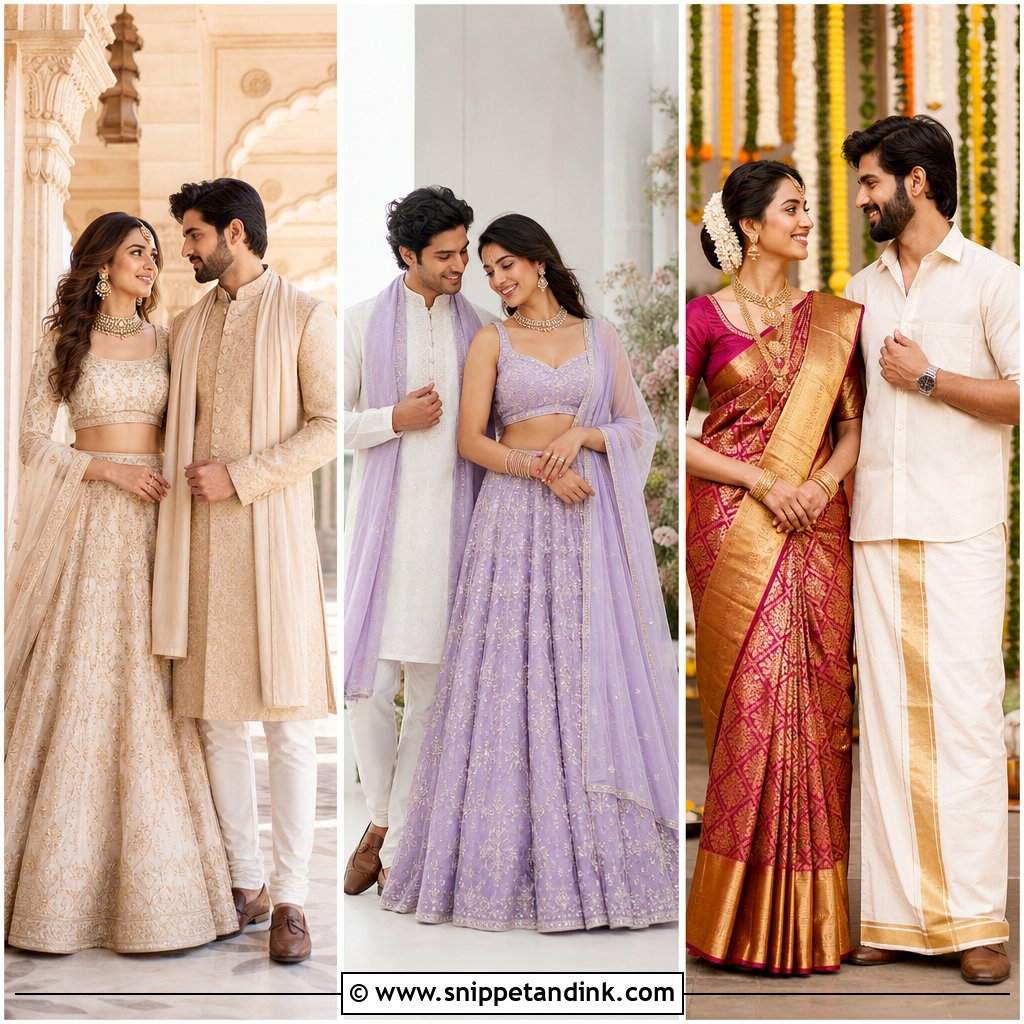
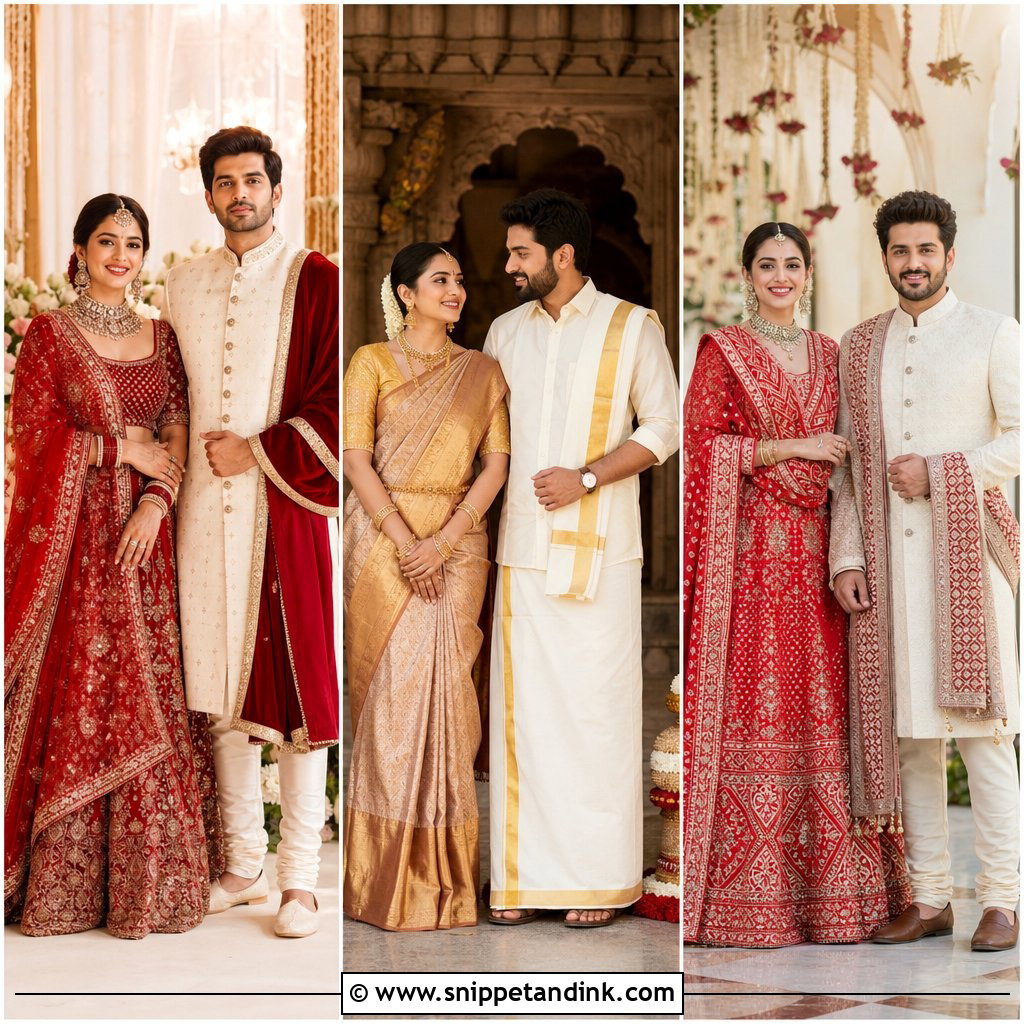
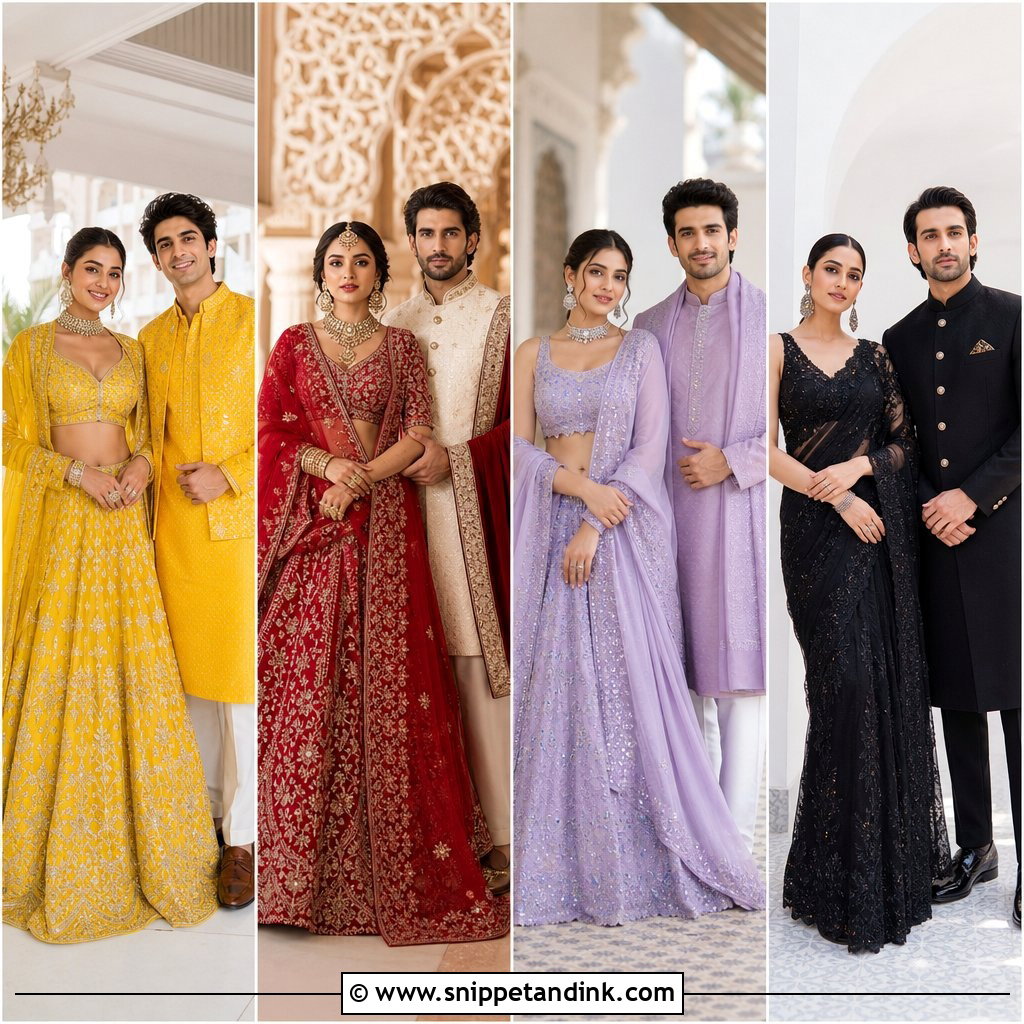
Red for her and ivory for him is the pairing I’d call the default, because it leaves the bride as the clear focus at the mandap. Her lehenga carries the color with heavy embroidery, double dupattas, gold jewelry and comfortable platforms. On his side I’d choose ivory silk with fine gold work, fitted churidar and mojaris, plus a red stole or a red detail at the pocket. The one rule I’m strict about: both outfits should use the same embroidery metal. Antique gold next to bright yellow gold looks wrong in every close-up.
2. Blush Pink Lehenga And Beige Sherwani
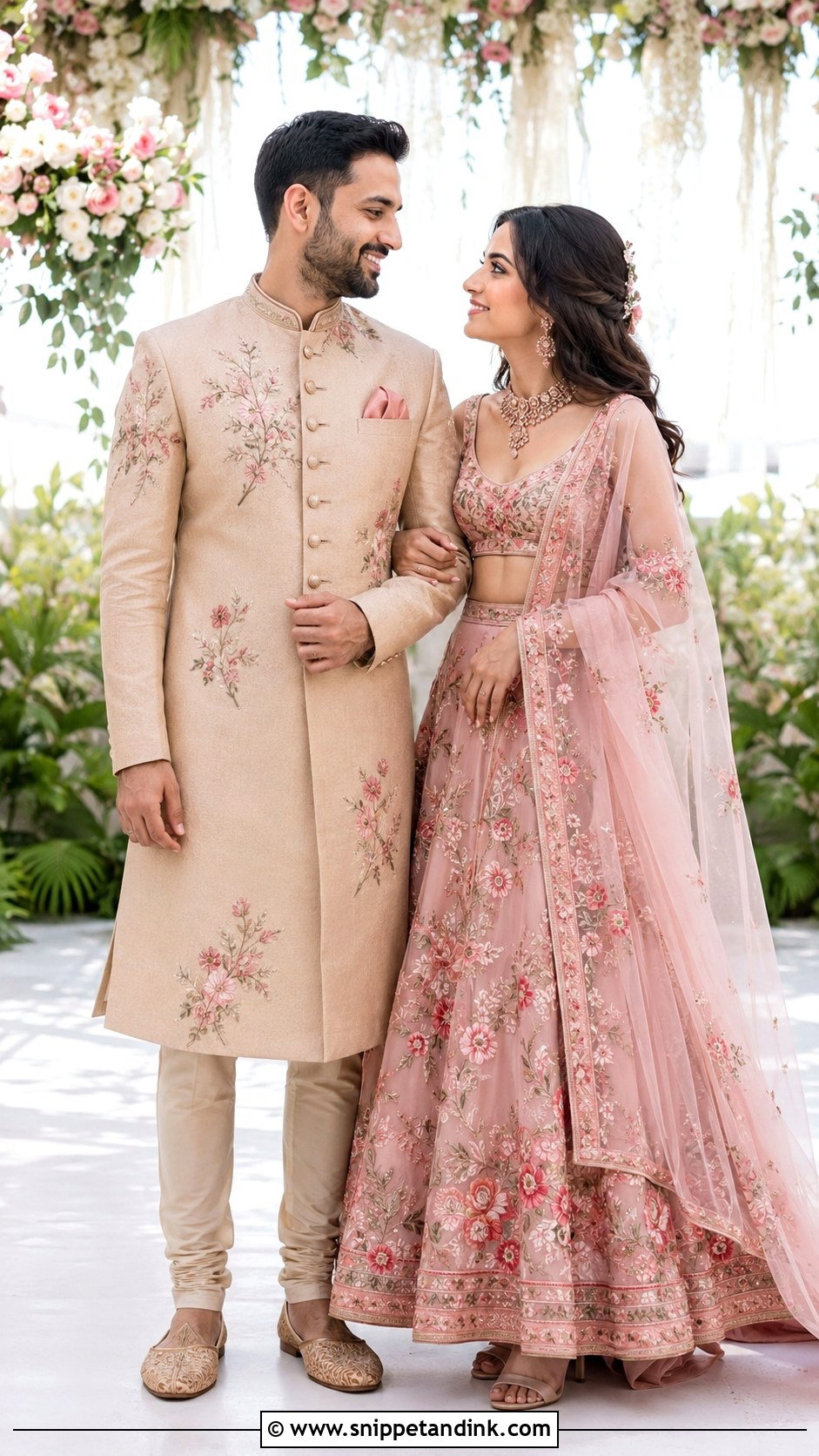
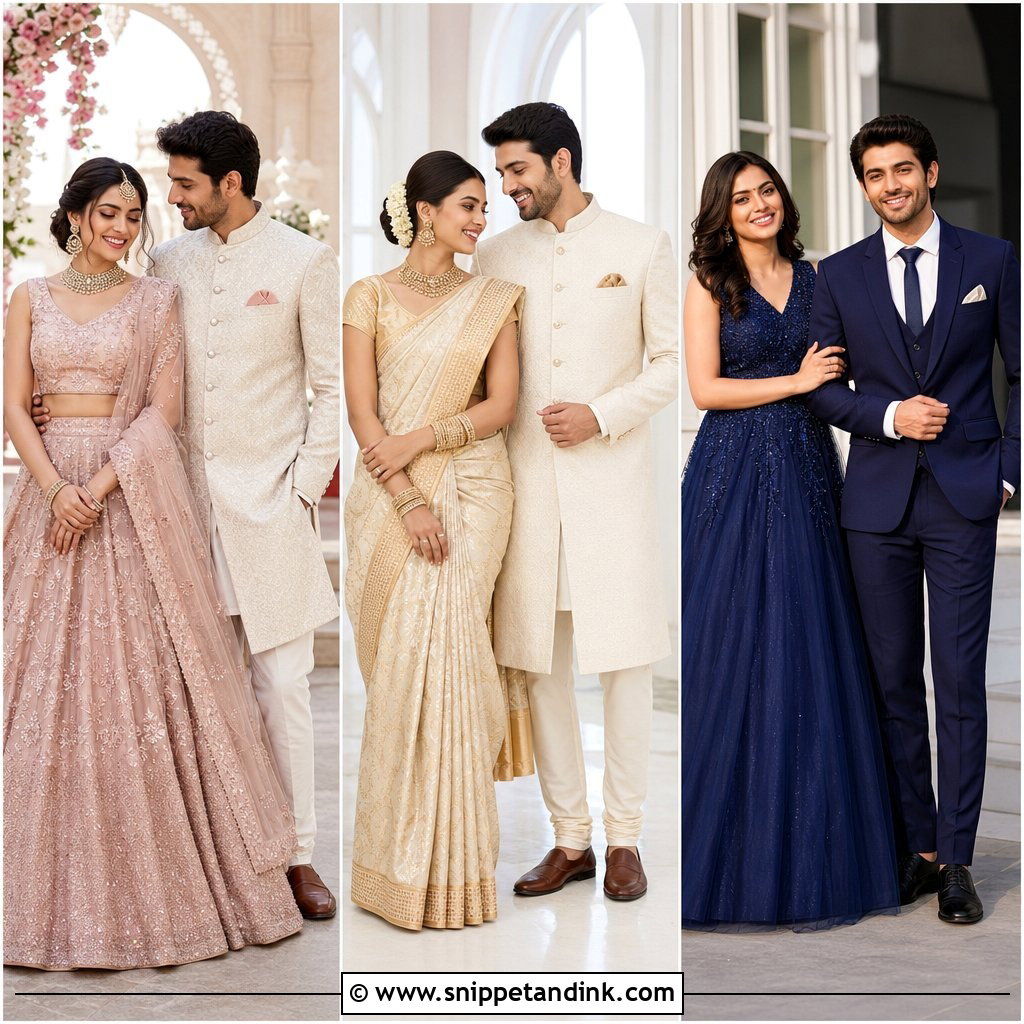
Blush and warm beige make a romantic couple outfit for daylight. She might wear a blush lehenga with floral threadwork, pearls or light sequins, a fitted blouse, a sheer dupatta, nude heels and rose-gold jewelry. For him, a beige or champagne sherwani with blush embroidery at the collar, cuffs and buttons, cream trousers, tan mojaris and a pink pocket square. Undertone is what I check. A cool-pink lehenga beside a yellow-beige sherwani makes one of them look washed out, so I hold both fabrics together by a window before anything is cut.
3. Ivory Lehenga And Red Sherwani
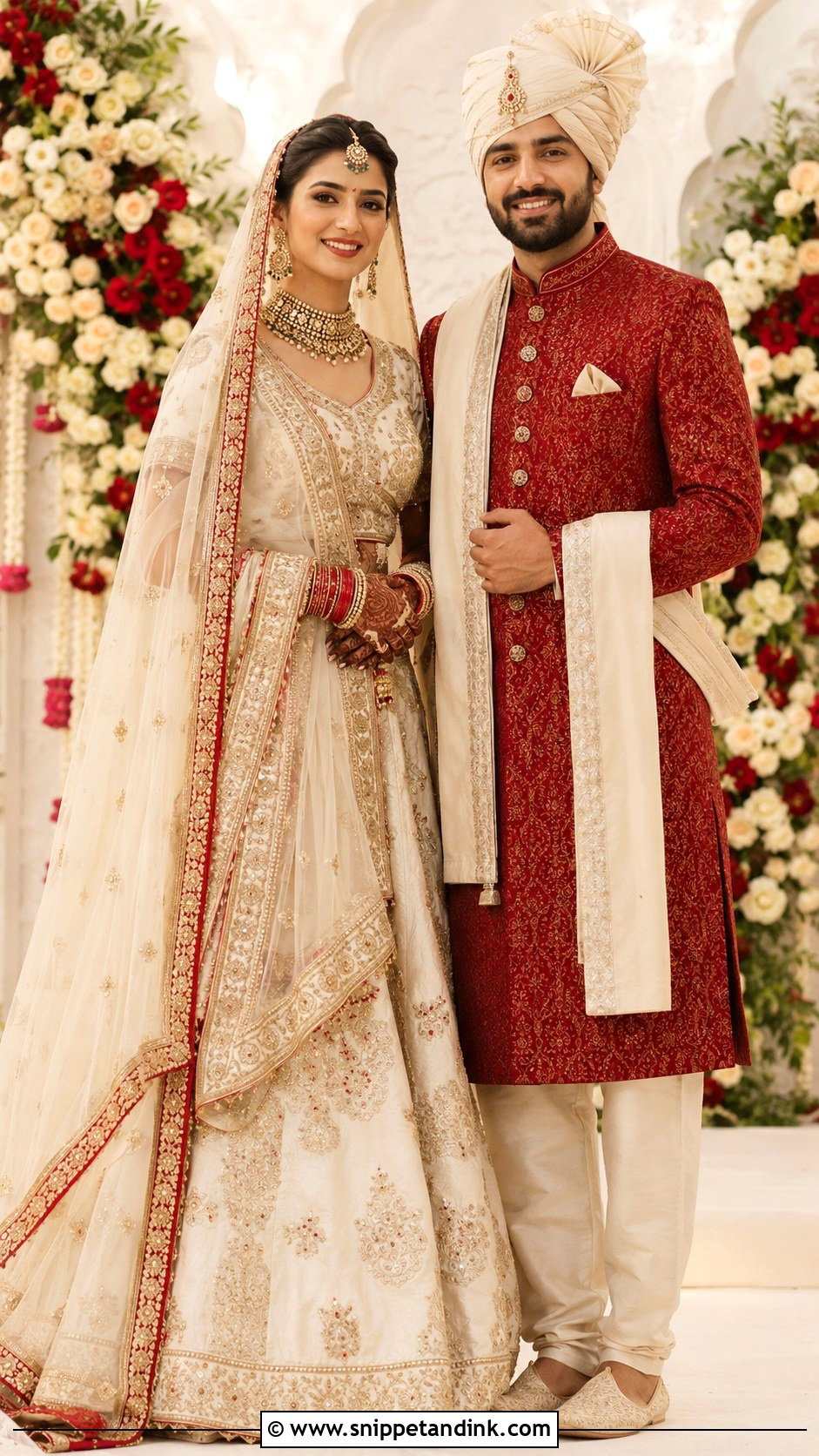
Flipping the palette puts the bride in ivory and the groom in royal red. Her ivory lehenga with gold embroidery and a red-bordered dupatta keeps a traditional thread, finished with red bangles, gold heels and heritage jewelry. A deep red sherwani on him needs restrained gold work, ivory trousers, neutral mojaris and an ivory stole to cool it down. Each outfit borrows from the other, which is why it looks planned. Some communities consider white or ivory inappropriate for a bride, so talk to both families before ordering.
4. Gold Silk Saree And White Veshti
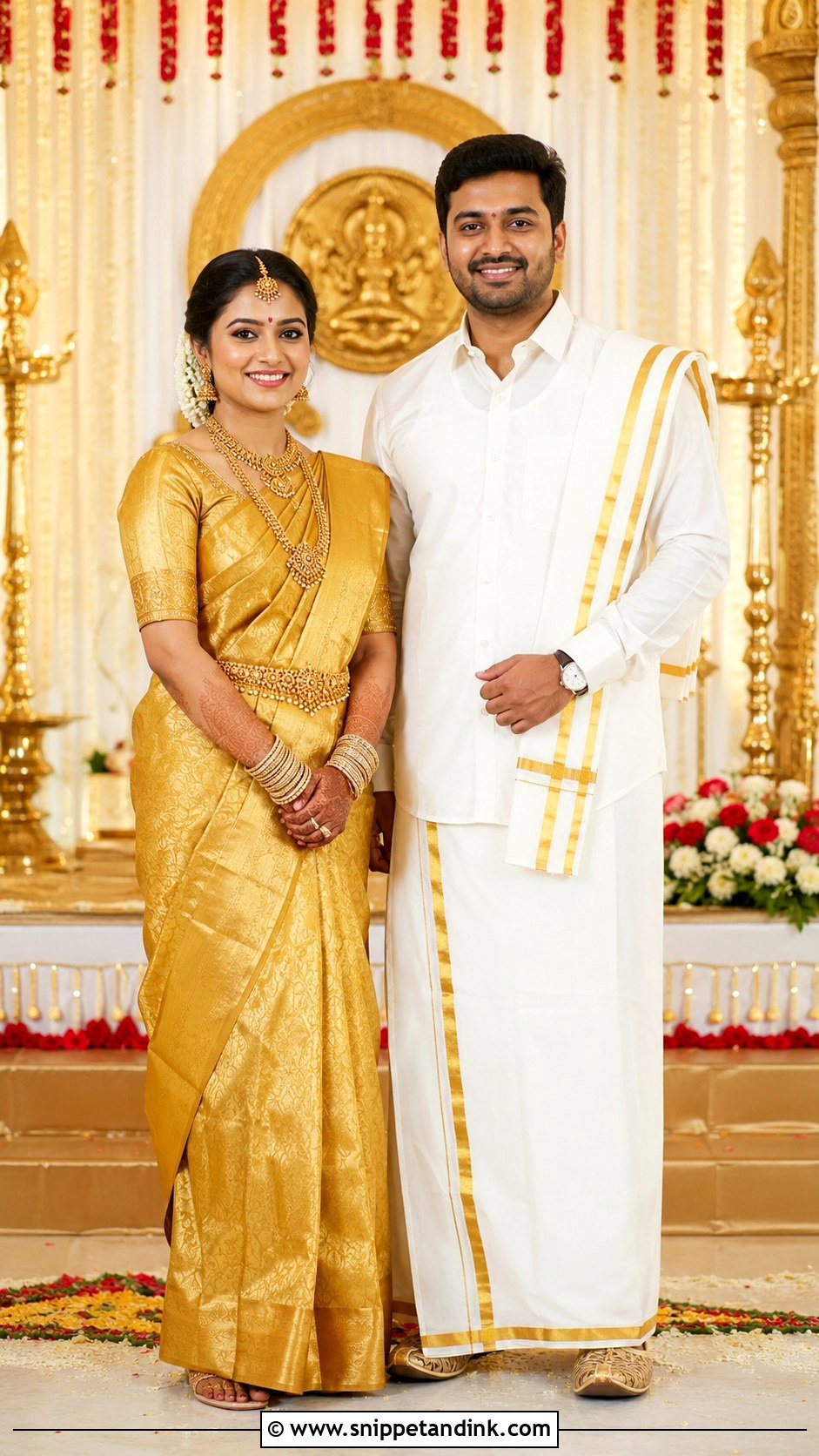
A gold silk saree and crisp white veshti make an elegant South Indian wedding look. She wears a lustrous gold or cream Kanjeevaram with a rich zari border, fitted blouse, temple jewelry, jasmine and embroidered sandals. He wears a white or cream veshti, matching shirt and an angavastram with a gold border. I match the zari, not the fabric. Pale antique gold on one and bright yellow gold on the other is the most common mismatch I see in temple photographs. Keep his footwear simple, or skip it where the ceremony is barefoot.
5. Navy Saree And Jodhpuri Suit
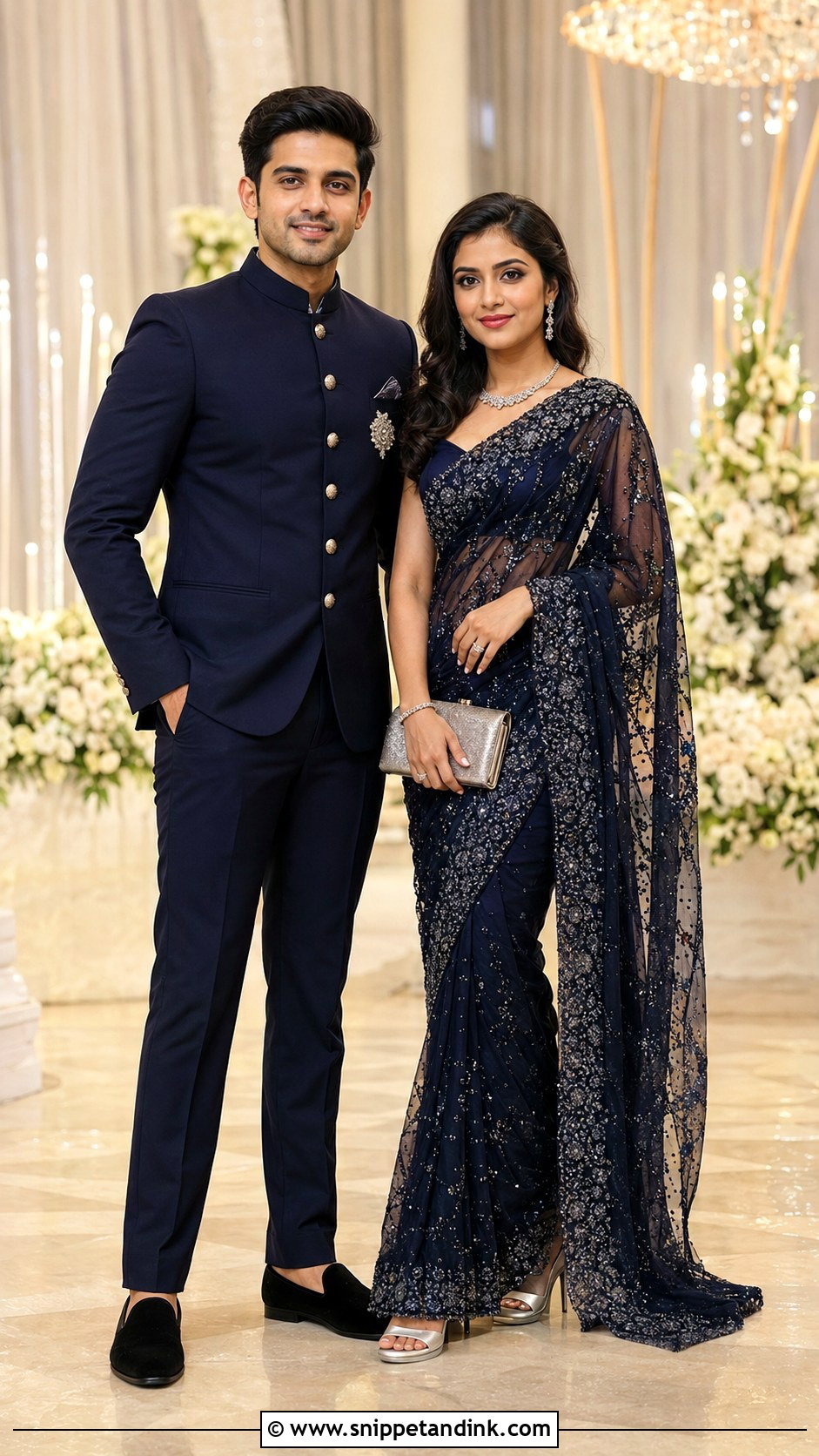
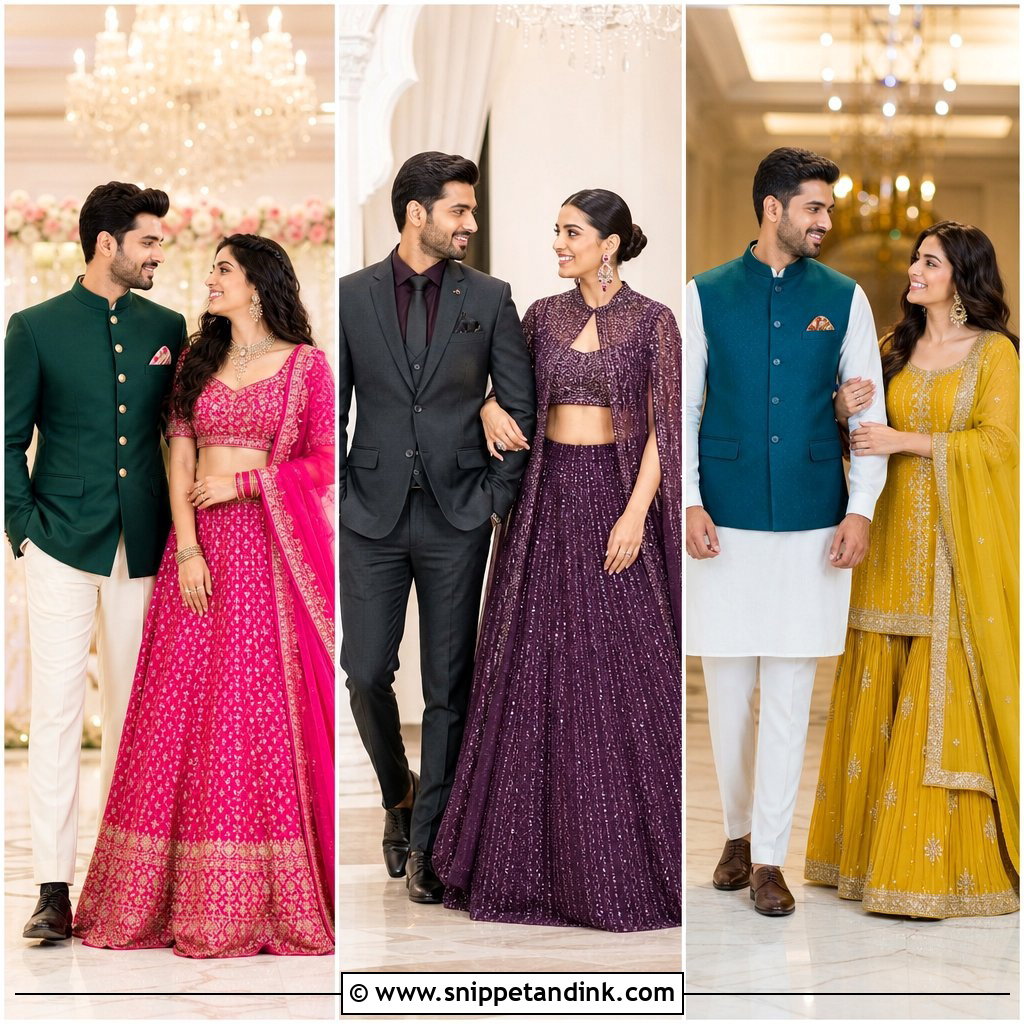
Navy with silver is my favorite evening reception pairing. Her navy saree with crystal work, a structured blouse, silver heels and diamond-style jewelry; a neatly pleated and pinned pallu that survives an hour of greetings. His navy Jodhpuri suit with tonal embroidery, slim trousers, black shoes and a silver brooch. Two navies side by side can merge into a block of blue in photos, so I change the texture: fluid georgette for her against velvet or jacquard for him. A metallic clutch and a silver pocket square finish it.
6. Emerald Green Lehenga And Gold Sherwani
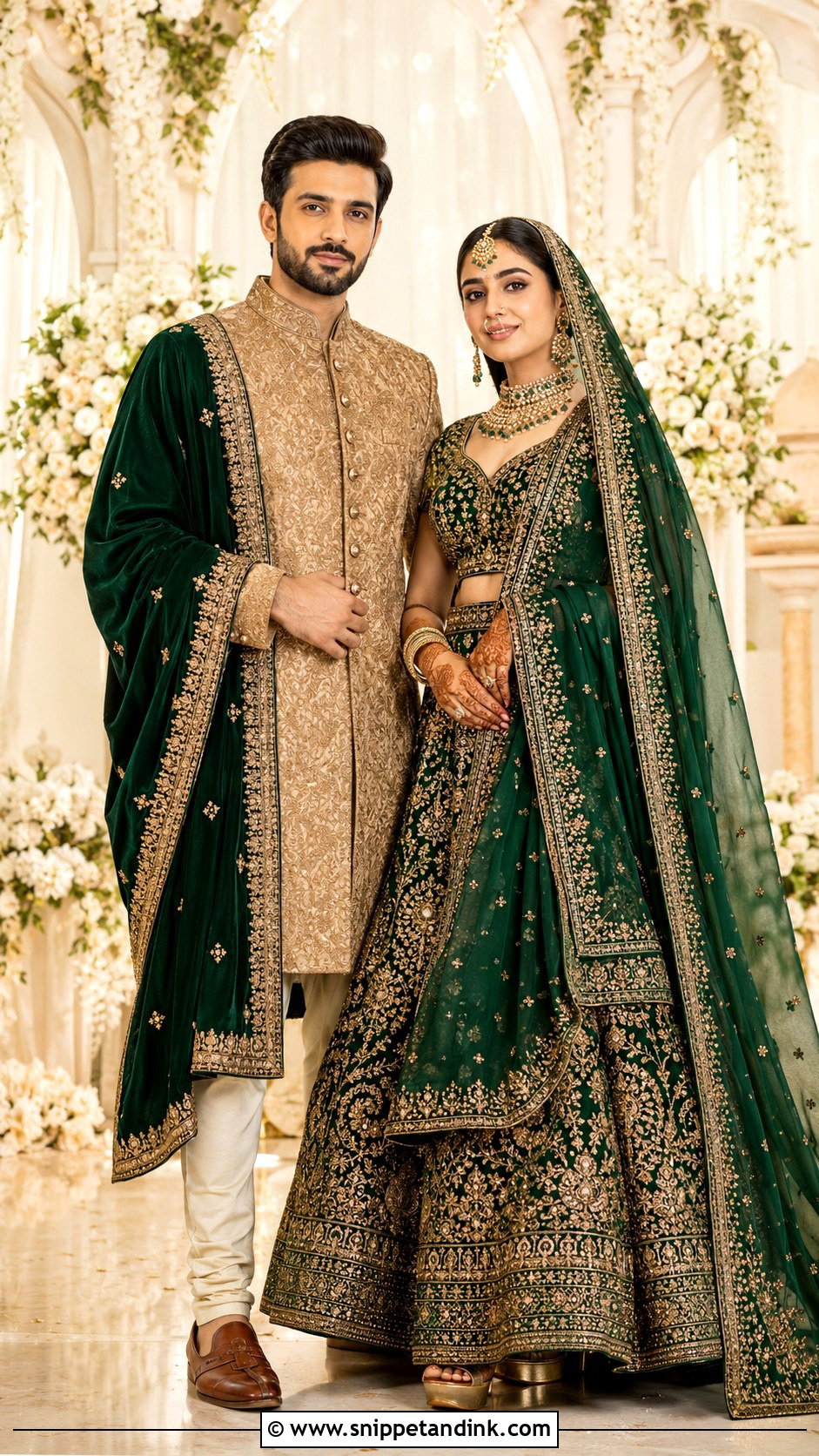
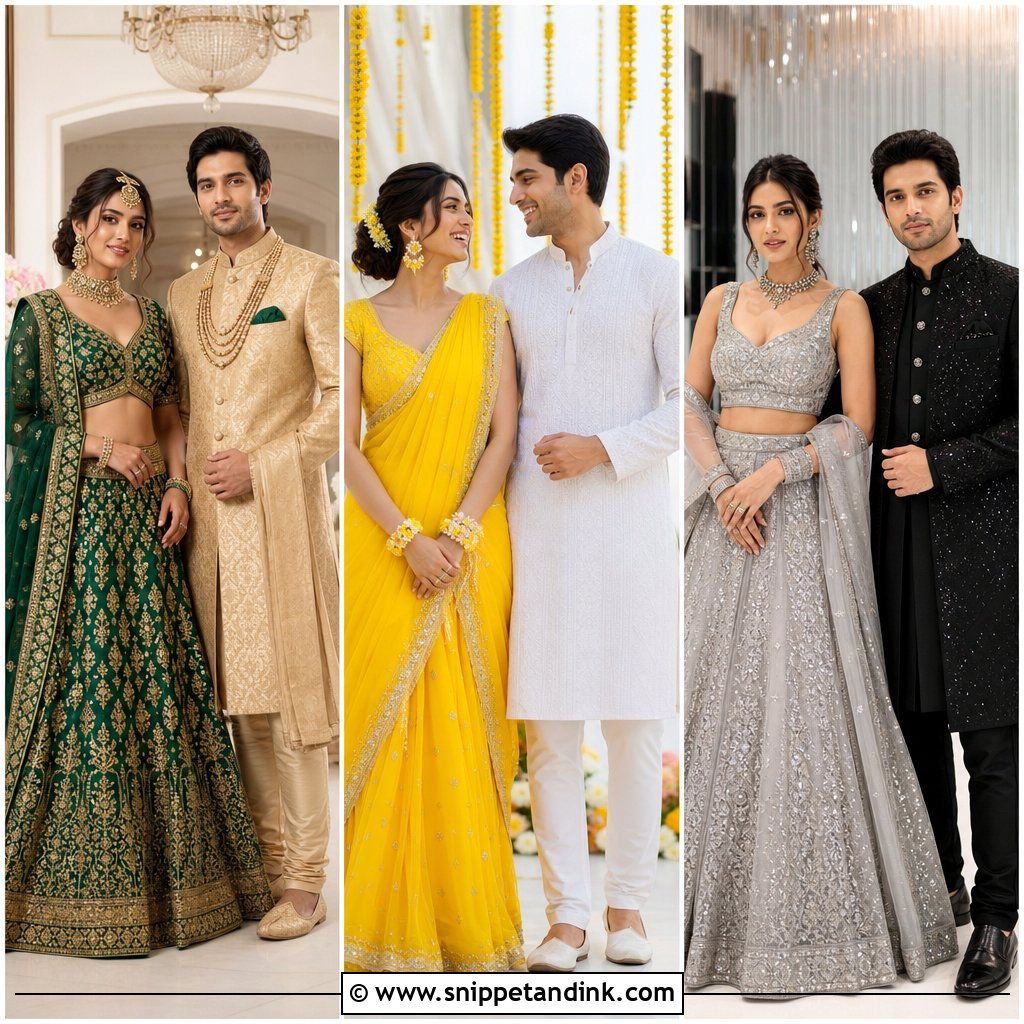
Emerald and gold look regal without red. She carries the color in an emerald lehenga with antique-gold embroidery, statement earrings and gold platforms. I’d put him in muted gold, cream trousers, brown mojaris and an emerald stole, so green is only his accent and her jewel tone leads. A very shiny gold sherwani next to a heavily embellished lehenga turns both into glare under flash. Textured silk or brocade reads rich without competing. It sits well against ivory, floral or red-and-gold decor.
7. Maroon Lehenga And Cream Achkan
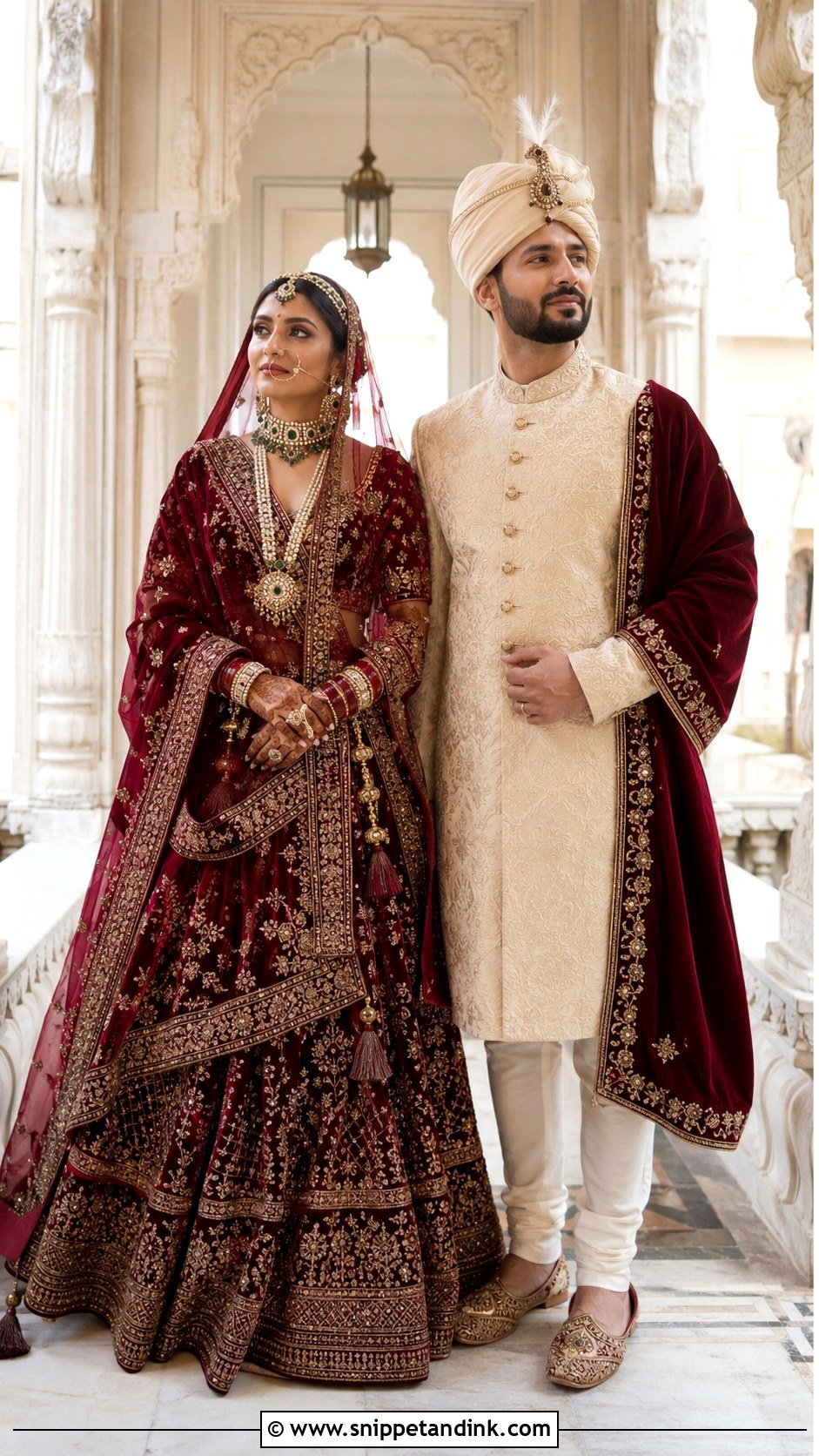
Maroon and cream is a winter classic. Her maroon lehenga with antique gold, a deep-neck blouse, a matching dupatta and a lighter veil for dimension, with gold jewelry, maroon bangles and block heels. His tailored cream achkan with maroon buttons, a coordinating stole, churidar and embroidered mojaris; those dark buttons and stole tie him to her. Maroon is one of the least consistent dye colors, swinging from brown-red to purple-red between suppliers. I always compare the stole swatch against her lehenga in daylight before it’s finalized.
8. Yellow Sharara And White Kurta Set
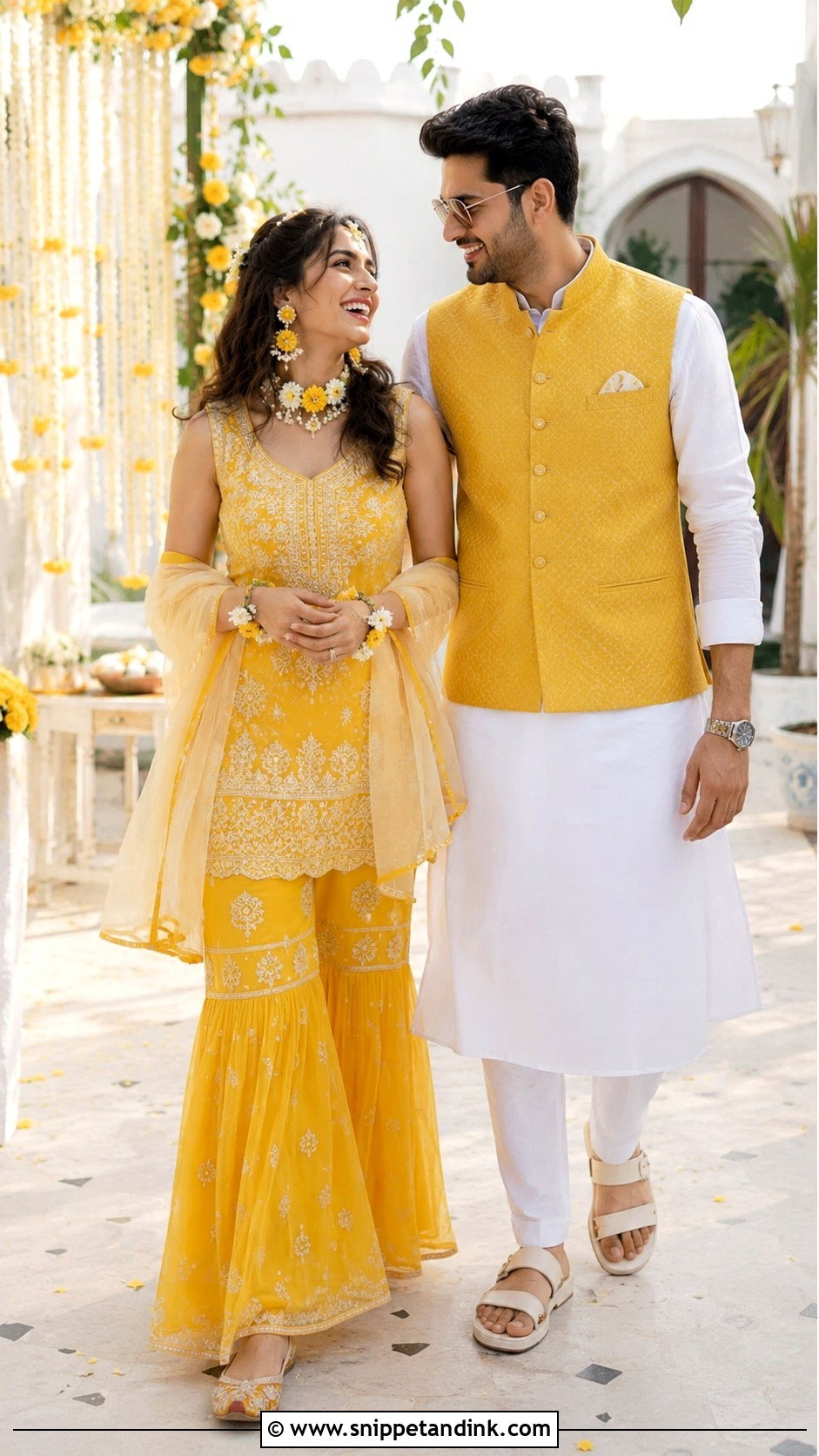
Haldi is the one function where I tell couples to plan for ruin. Bright yellow and clean white make a cheerful pairing for a haldi celebration: a light yellow sharara with a short embroidered kurta, a soft dupatta, floral jewelry and flat juttis for her; a breathable white kurta pajama with yellow embroidery or a sleeveless mustard Nehru jacket for him, with brown or cream sandals. Turmeric stains are close to permanent on white cotton, so choose washable pieces you don’t mind losing and leave delicate embellishment for later events. A little shared threadwork is enough to link them.
9. Green Lehenga And Floral Nehru Jacket
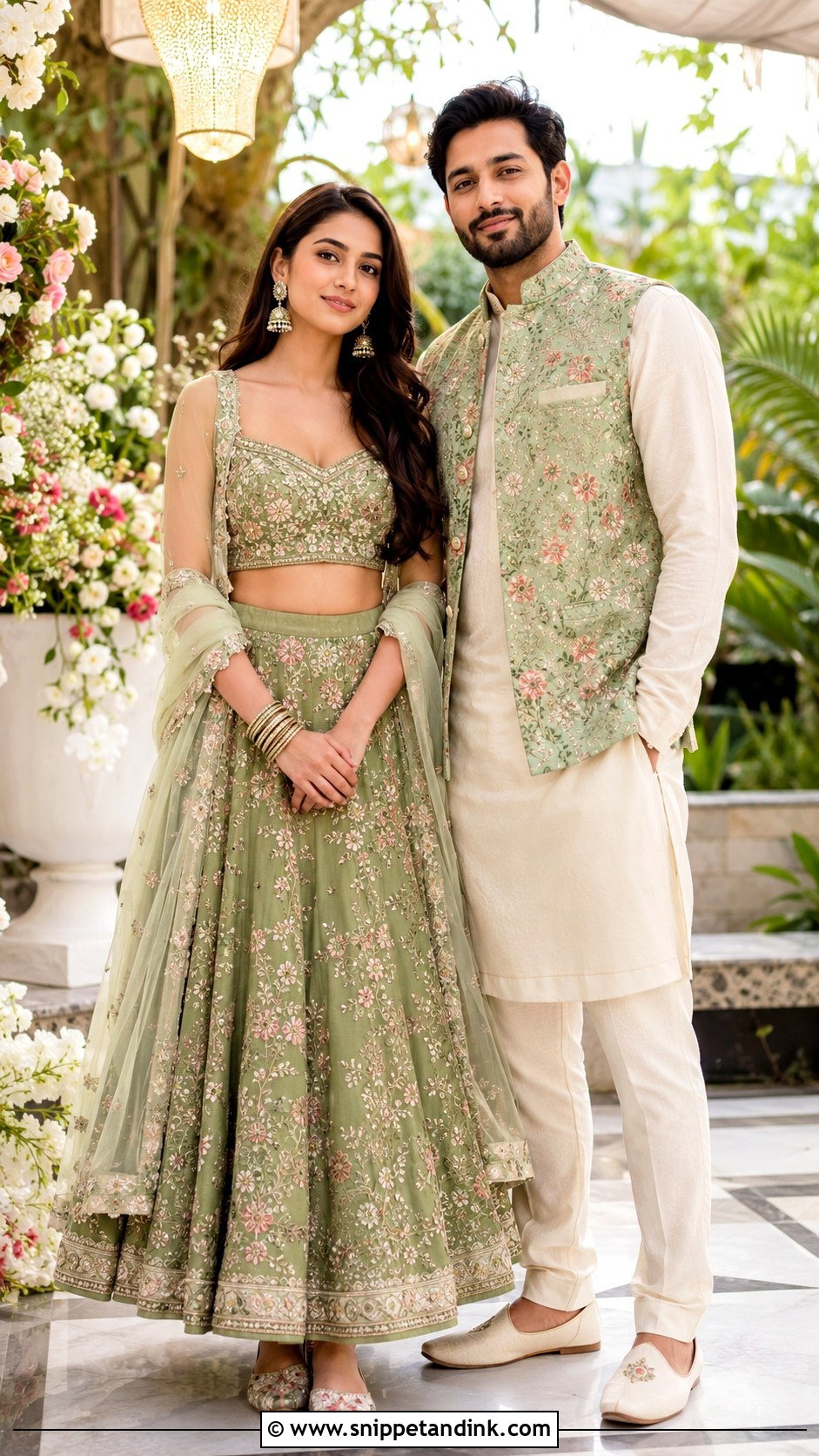
Mehndi runs long and involves a lot of sitting while the henna dries, so comfort comes first. A leaf-green lehenga with a cropped blouse, colorful thread embroidery, a light dupatta, jhumkas, stacked bangles and embroidered flats for her. For him, an ivory kurta pajama under a floral Nehru jacket that picks up her exact green, neutral mojaris and a plain watch. The jacket’s florals should echo her embroidery, not copy it. Cotton-silk, georgette or organza breathe in daytime heat, and short sleeves on her keep fresh henna from smudging.
10. Lavender Lehenga And Lilac Bandhgala
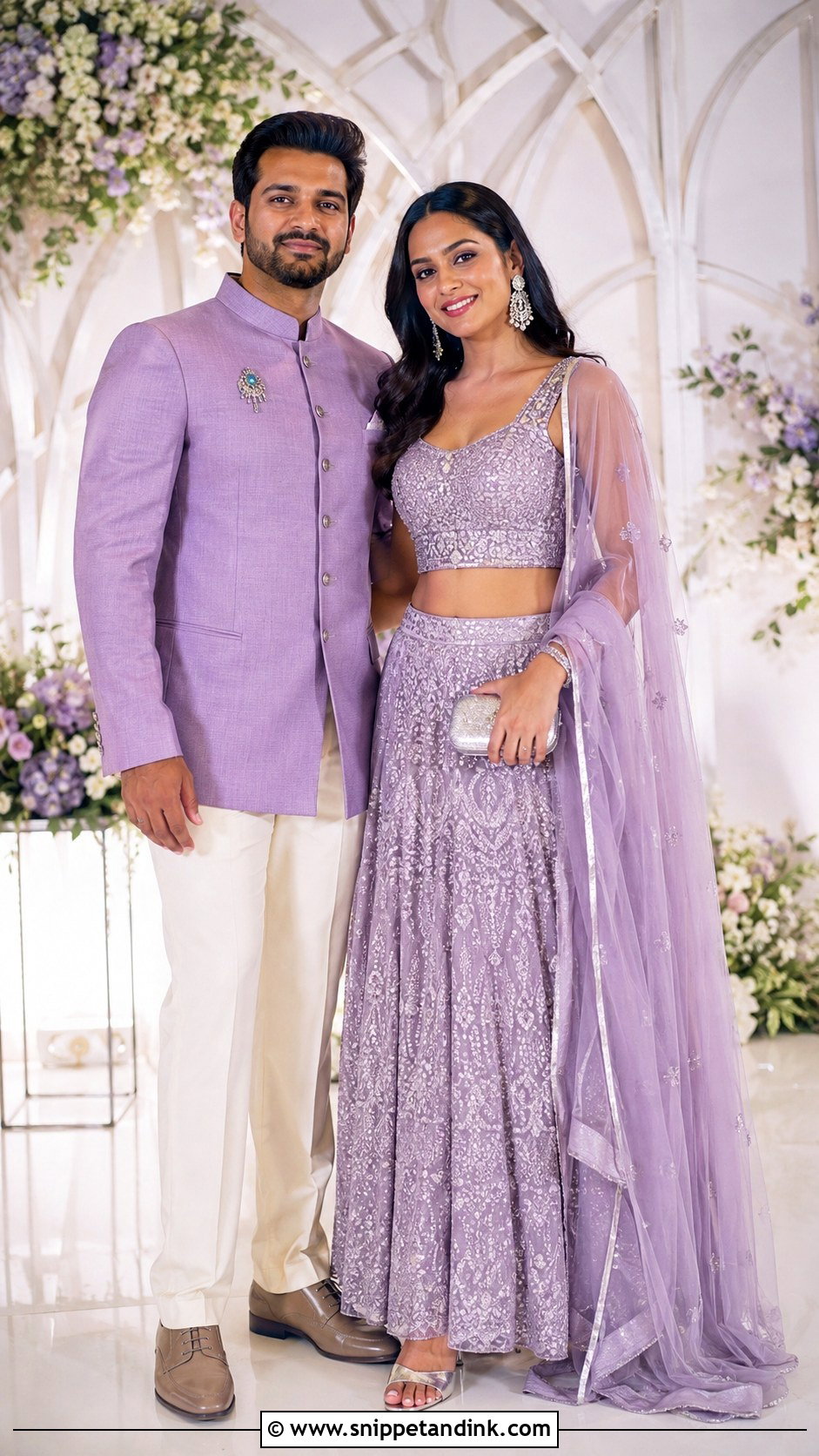
Lavender and lilac are a soft, modern palette for an engagement or sangeet. She might choose a lavender lehenga with silver sequins, a structured blouse, sheer dupatta, crystal earrings, metallic heels and a silver clutch. I’d put him in a lilac bandhgala with tonal embroidery, ivory trousers and brown or taupe shoes, a shade apart from hers so they don’t look uniformed. Silver buttons or a small brooch echo her sequins. Purple fabrics shift dramatically under colored stage lights, often going blue or grey, so test both under the venue’s lighting if you can.
11. Powder Blue Saree And Blue Kurta
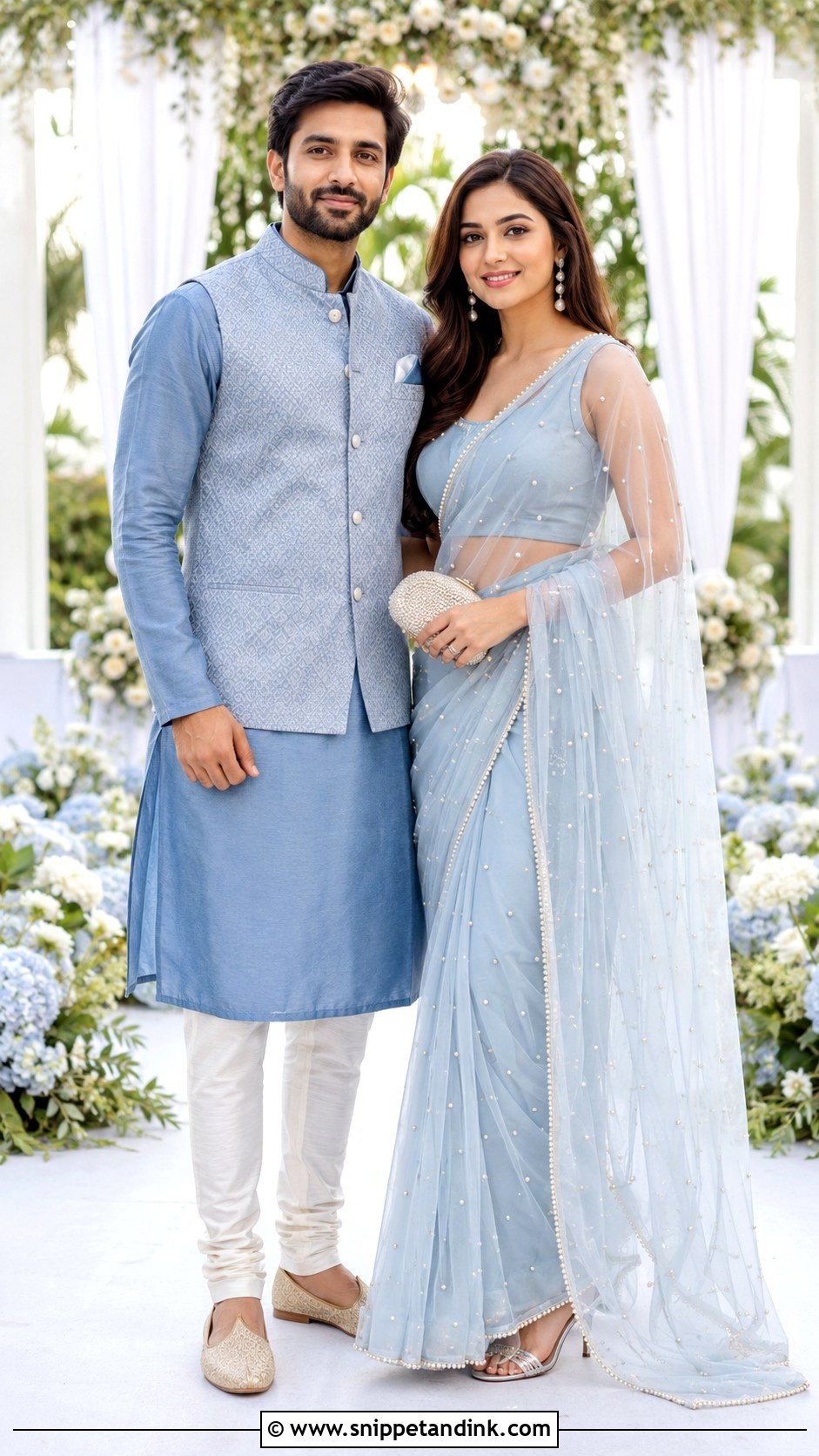
Powder blue is calm and easy in daylight. Her powder-blue organza saree with pearl detailing, a fitted blouse, pearl earrings, silver sandals and a compact clutch. For him, a slightly deeper blue kurta, ivory churidar and a textured sleeveless jacket, with pale grey or beige mojaris. I link them through pearl buttons or matching silver thread rather than identical blue. Organza is slippery, so her pleats need firm pinning, and his jacket has to fit cleanly at the shoulders, since pale colors show every wrinkle.
12. Peach Anarkali And Ivory Kurta Pajama
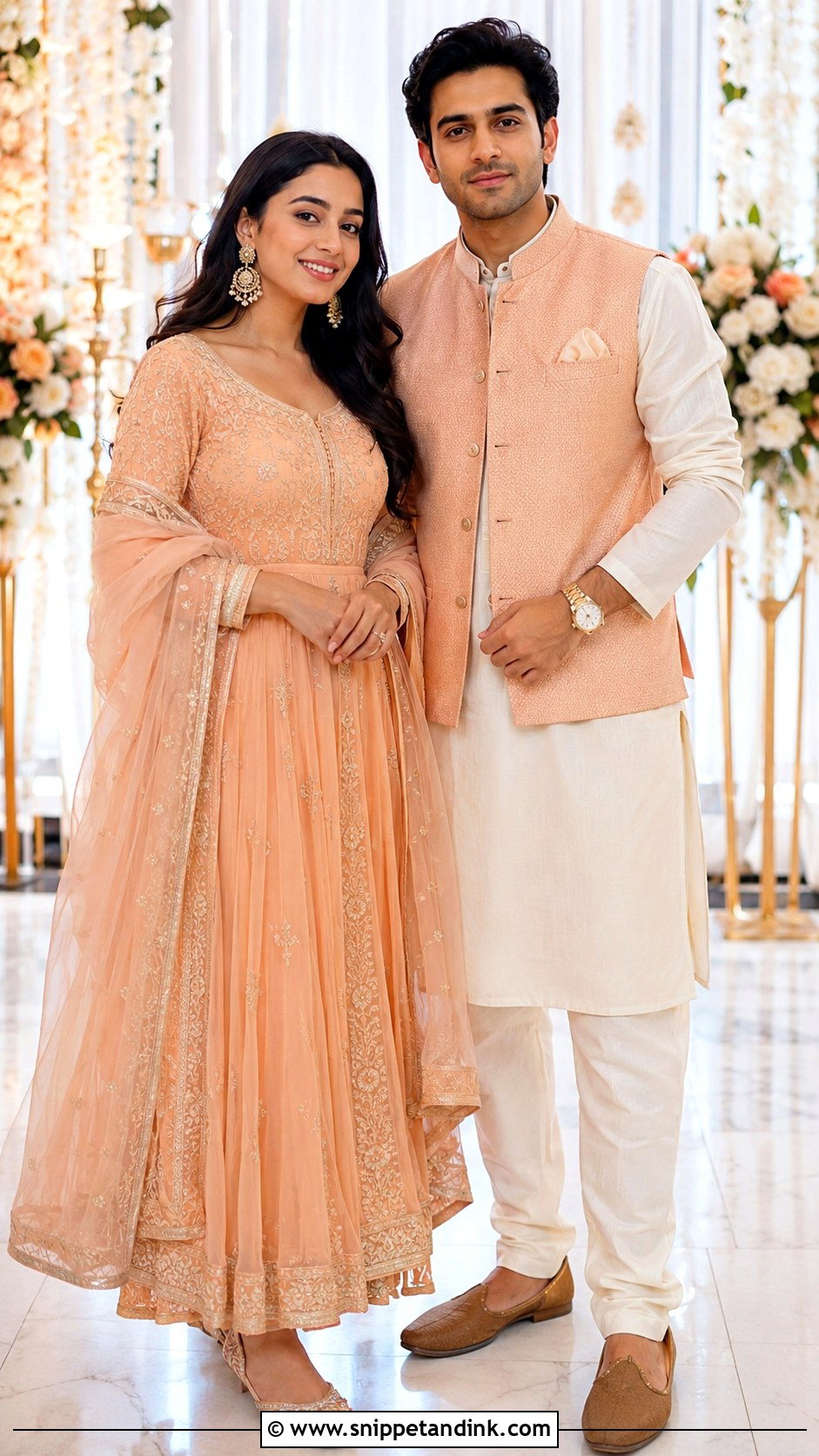
Smaller functions like a roka or family dinner suit a flowing peach Anarkali with gold embroidery, fitted churidar, a light dupatta, drop earrings and embellished juttis. He can wear an ivory kurta pajama with a peach Nehru jacket or a peach stole, tan mojaris and a simple gold-toned watch. The risk is an over-decorated jacket fighting her detailed Anarkali. I repeat just two elements, usually the peach and the gold border, and keep everything else plain. Both outfits stay comfortable through a long afternoon.
13. Black Sequin Saree And Black Bandhgala
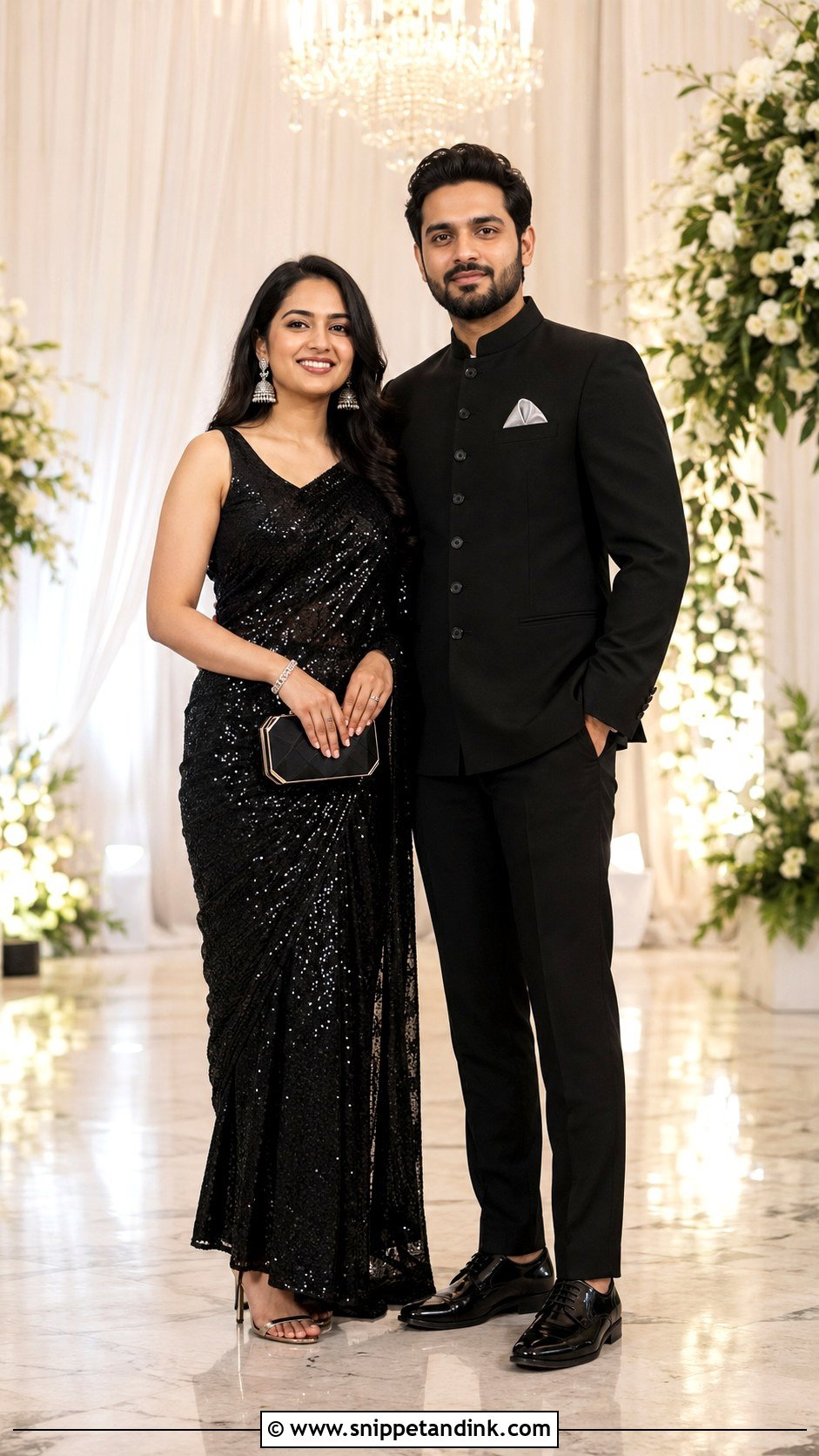
Black is still avoided at many Indian weddings, so I only suggest it once both families are happy with it. When they are, a black sequin saree with a sleek blouse, silver earrings, a structured clutch and black or metallic heels pairs with a black bandhgala in tonal embroidery, tailored trousers and polished shoes. Two black outfits merge into one shape in photos unless the textures differ: sequins and fluid drape on her, matte suiting or velvet on him. Keep accessories controlled. Black needs bright, clear lighting or the detail disappears.
14. Wine Gown And Burgundy Indo Western Suit
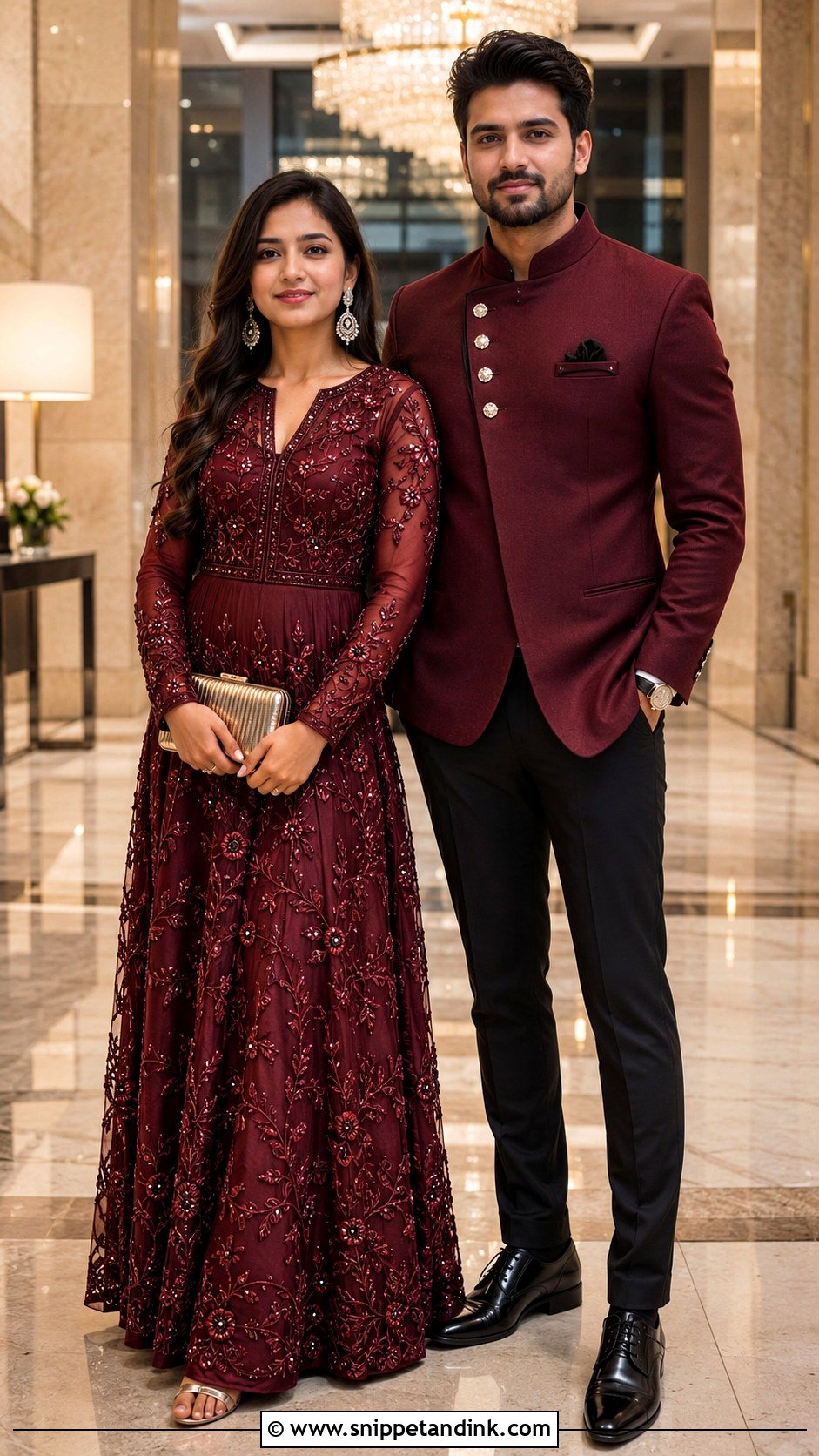
Wine and burgundy give a modern monochrome look for a hotel reception. A floor-length wine gown with Indian embroidery, a defined waist, heels, statement earrings and a metallic clutch for her. A burgundy Indo-Western suit with an asymmetric jacket, black trousers and black shoes for him, with a touch of her embroidery color on his jacket. Two shiny fabrics under ballroom lights look like plastic, so I pair a softly embellished gown with a matte or lightly textured jacket. Close color, different cuts.
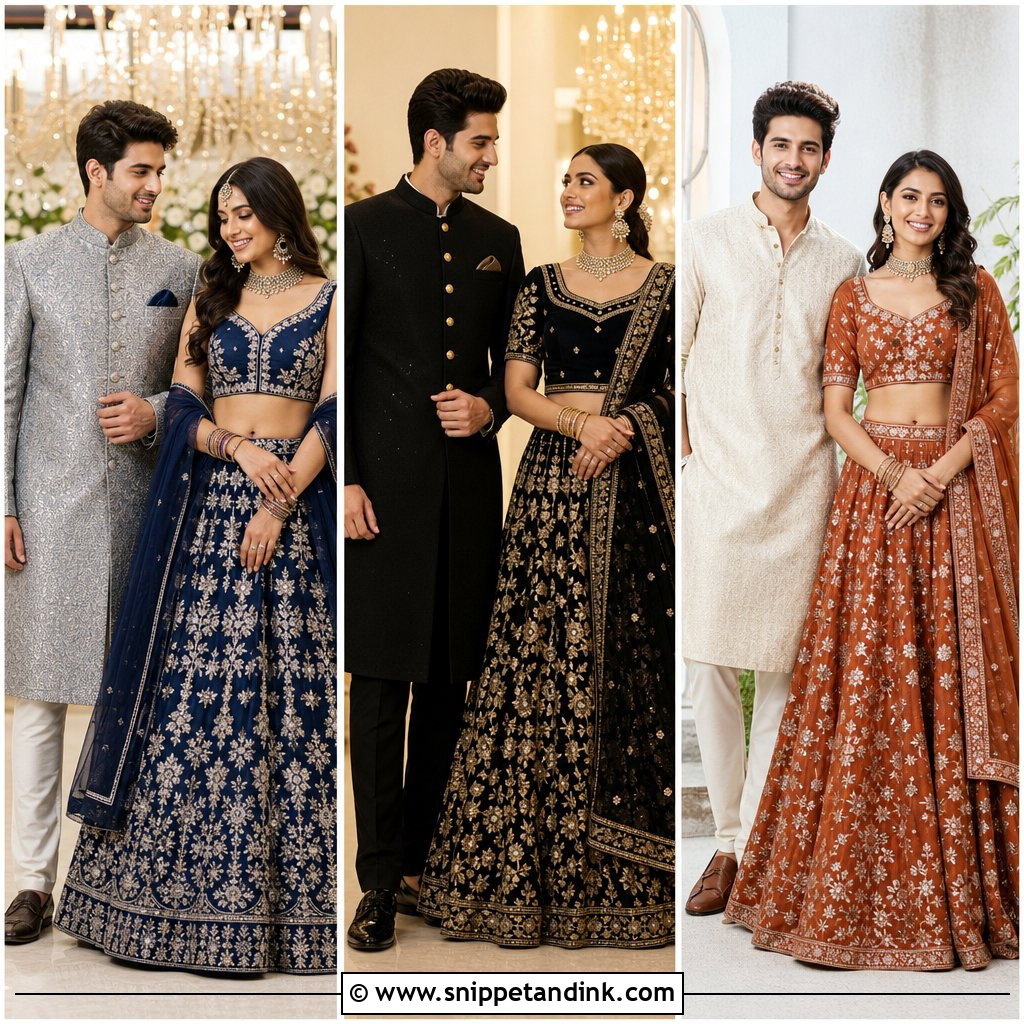
15. Teal Lehenga And Beige Sherwani
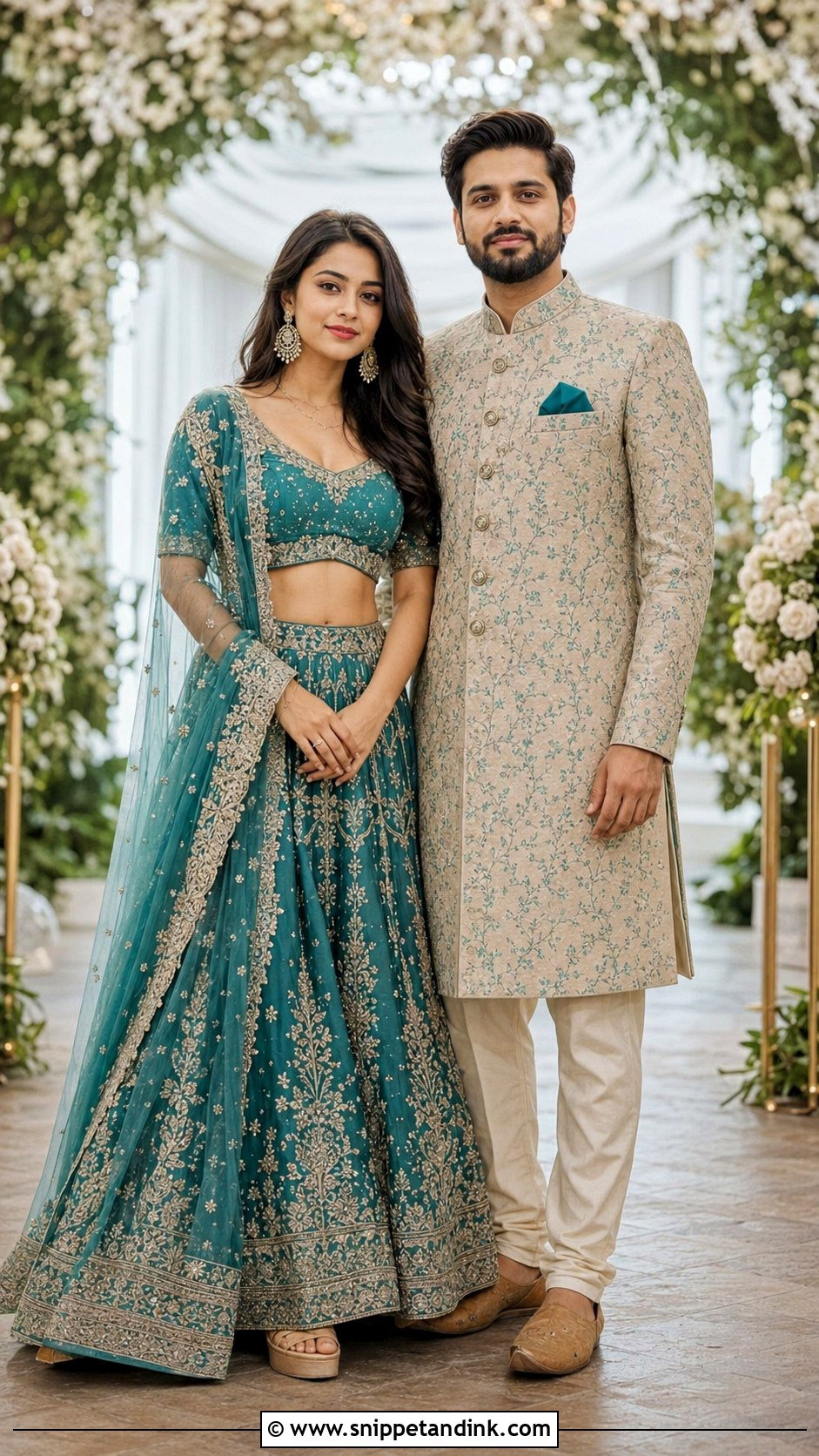
Teal photographs richly, and beige keeps the pair from getting heavy. Her teal lehenga with champagne embroidery, a matching blouse, light dupatta, gold earrings and neutral platforms. His beige sherwani with teal threadwork at the collar and cuffs, cream trousers and tan mojaris. A teal pocket square or a stole links them, but you don’t need both. Champagne embroidery is a cooler gold, and bright yellow gold buttons on him will clash, so I bring her blouse to his fitting. Similar floral or geometric motifs also tie them together.
16. Orange Lehenga And Rust Kurta Set
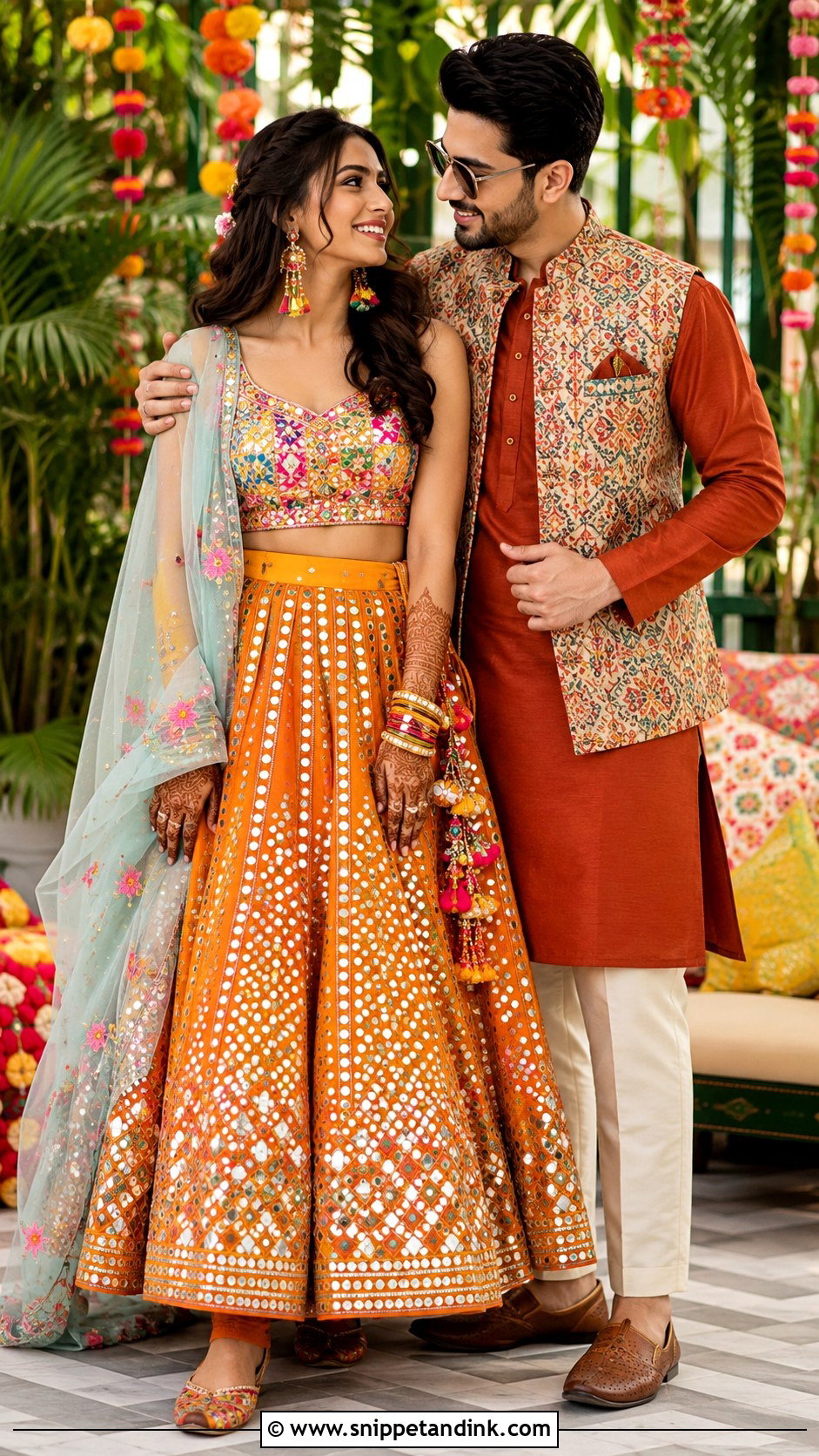
Orange and rust are made for a daytime mehndi or welcome event. She can wear a bright orange lehenga with mirror work, a colorful blouse, a light dupatta, tassel earrings, stacked bangles and juttis. He wears a rust kurta, ivory pants, a printed waistcoat with a little orange in the pattern and brown mojaris. The colors already connect them, so I don’t match accessories at all. Mirror work catches on loose kurta embroidery when couples dance close, so I keep his front fairly flat.
17. White Floral Lehenga And Printed Kurta
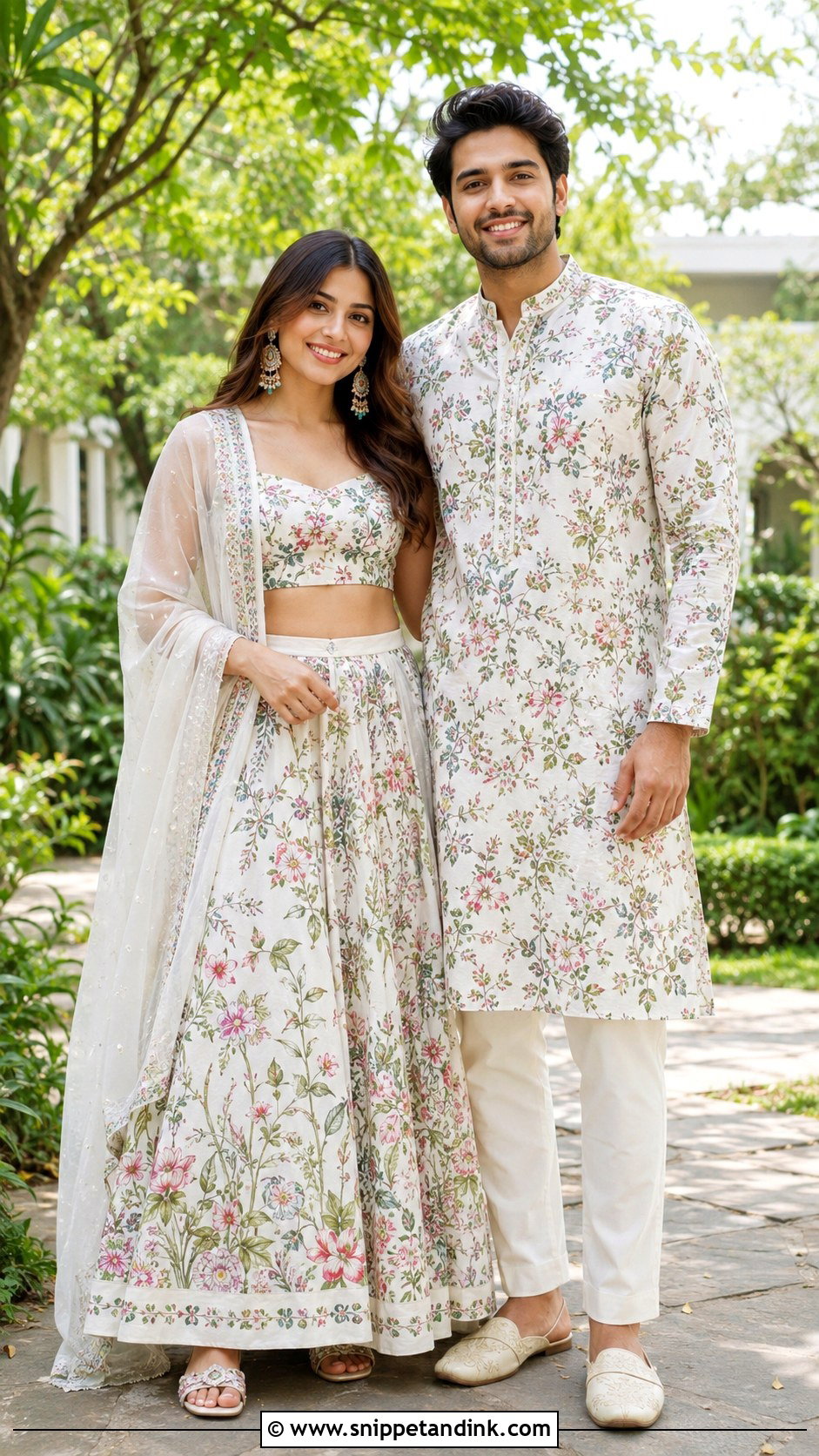
For a garden mehndi, brunch or welcome party, a white lehenga with colorful botanical prints, a fitted blouse, delicate dupatta, pastel earrings and flat sandals pairs with his printed kurta that takes one or two colors from her print, plain ivory trousers and neutral mojaris. The prints don’t need to match. I look for a similar scale and color intensity; a tiny print next to a huge one looks accidental. Keep jewelry simple and let the patterns lead. Both sets rewear easily as separates.
18. Red Kanjeevaram Saree And Cream Veshti
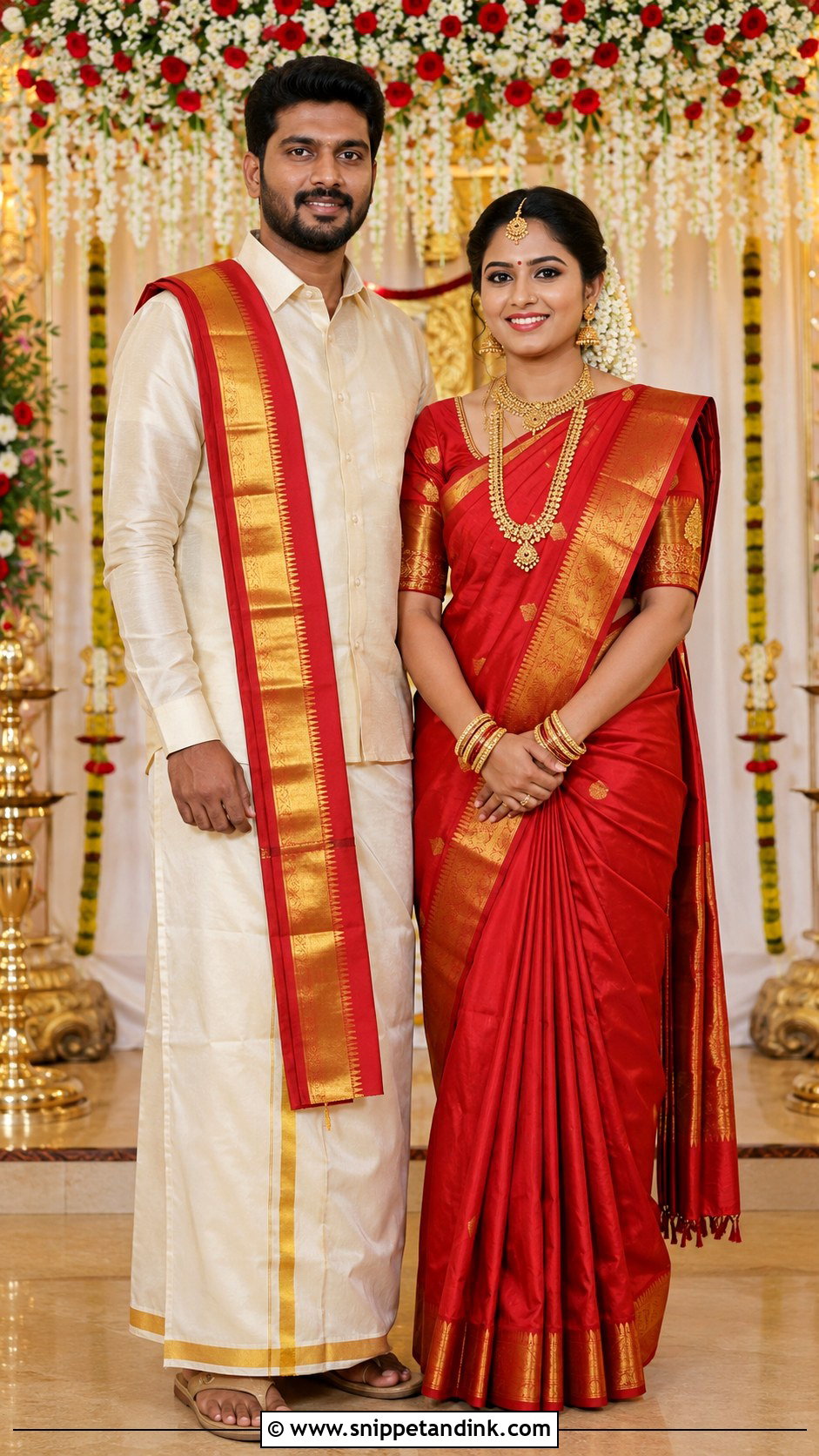
A red Kanjeevaram saree with a cream veshti is a powerful South Indian pairing. Her red silk with a broad gold border, matching blouse, temple jewelry, jasmine, bangles and gold sandals. His cream veshti with a gold border, matching shirt and a red-and-gold angavastram that links straight back to her. Pieces bought separately often have borders of different golds, so lay them side by side before the day. Rituals can run for hours on the floor; his veshti needs a secure tuck or a belt underneath, and her drape needs firm pinning.
19. Ivory Saree And Gold Bandhgala
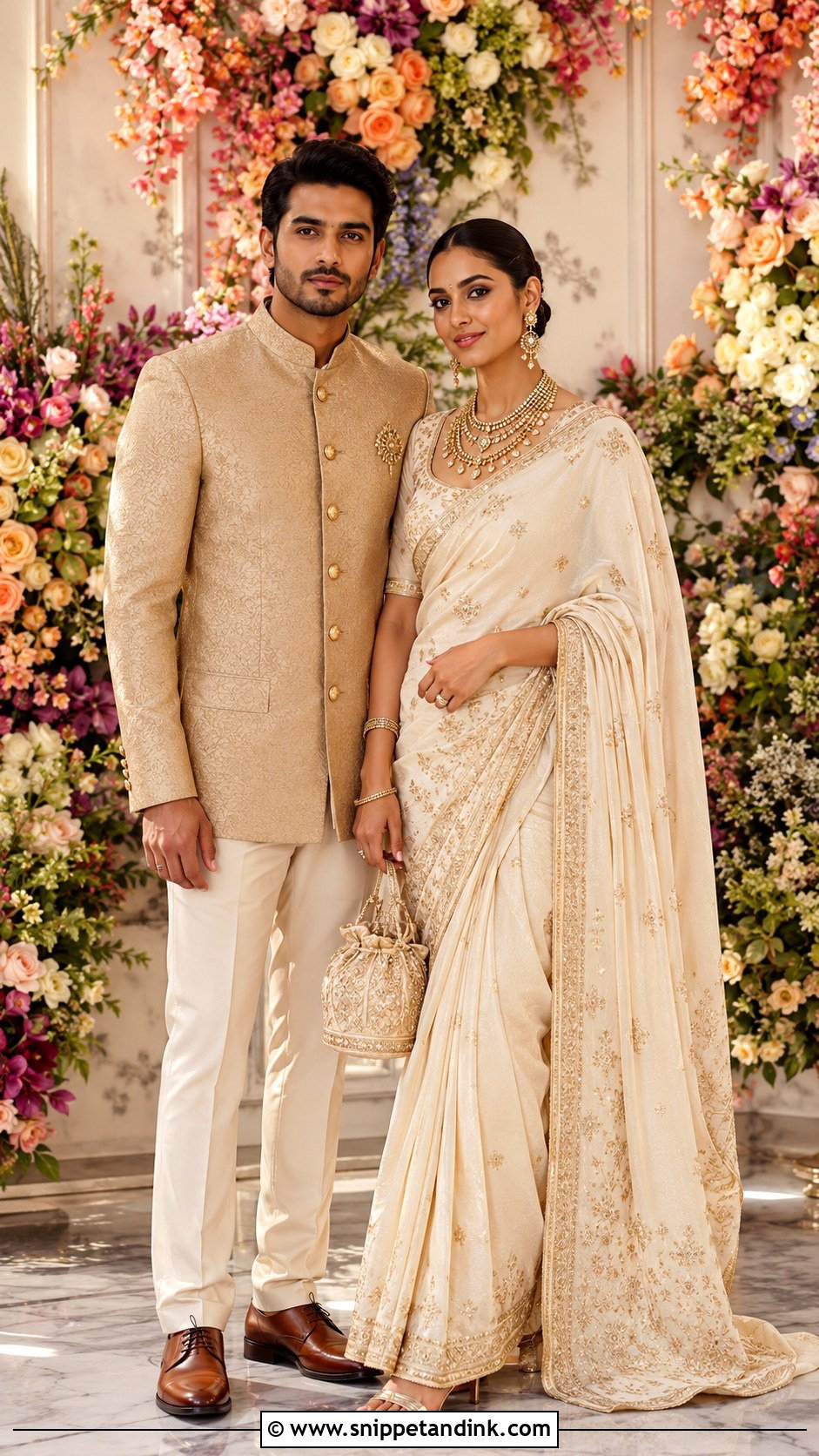
Ivory and gold is the quietest pairing here and the least forgiving. She wears an ivory saree with gold embroidery, layered gold jewelry, metallic sandals and a structured potli. He wears a muted gold bandhgala, ivory trousers and brown shoes. I’d choose antique or champagne gold for his jacket rather than anything reflective, especially beside heavy embellishment, and soften it with ivory buttons or a simple brooch. With so little color, tailoring and fabric quality carry the whole look. A colorful or darker backdrop helps the couple stand out.
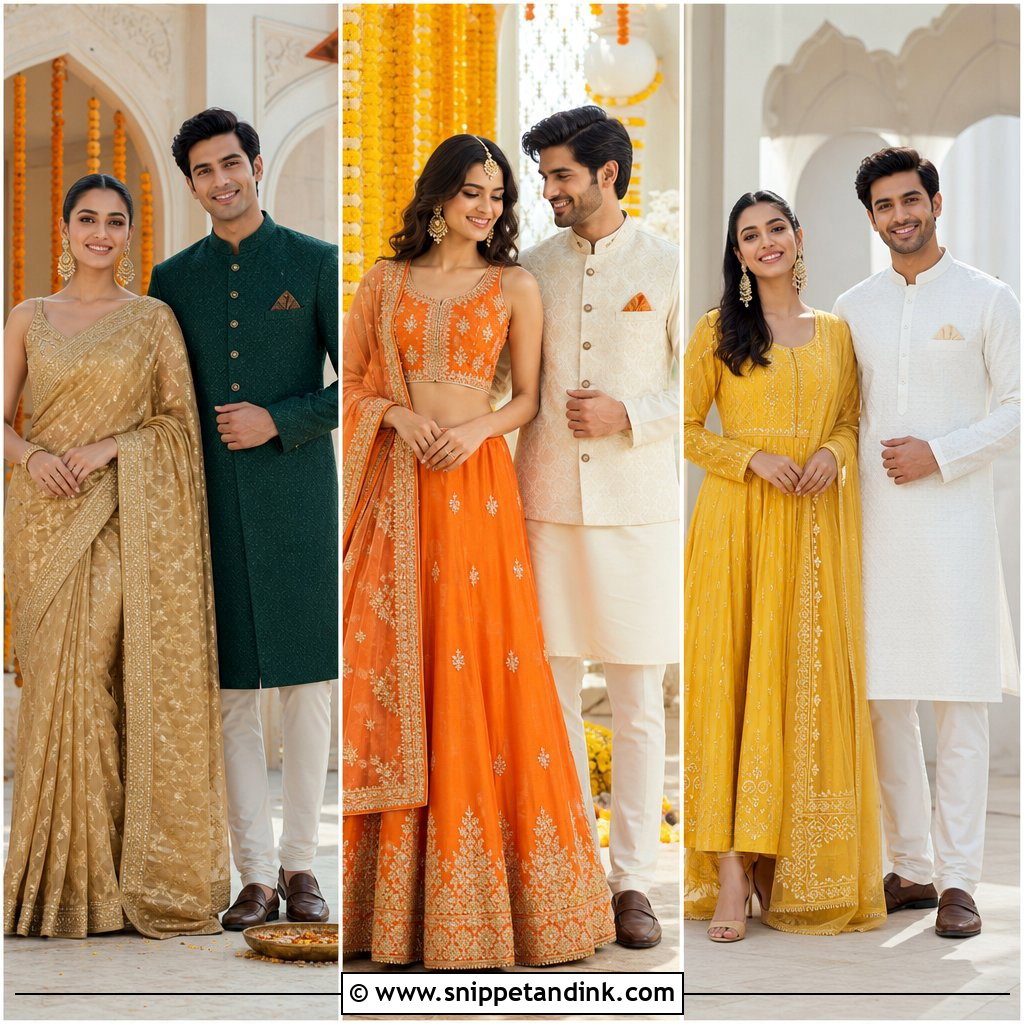
20. Pastel Green Lehenga And Sage Sherwani
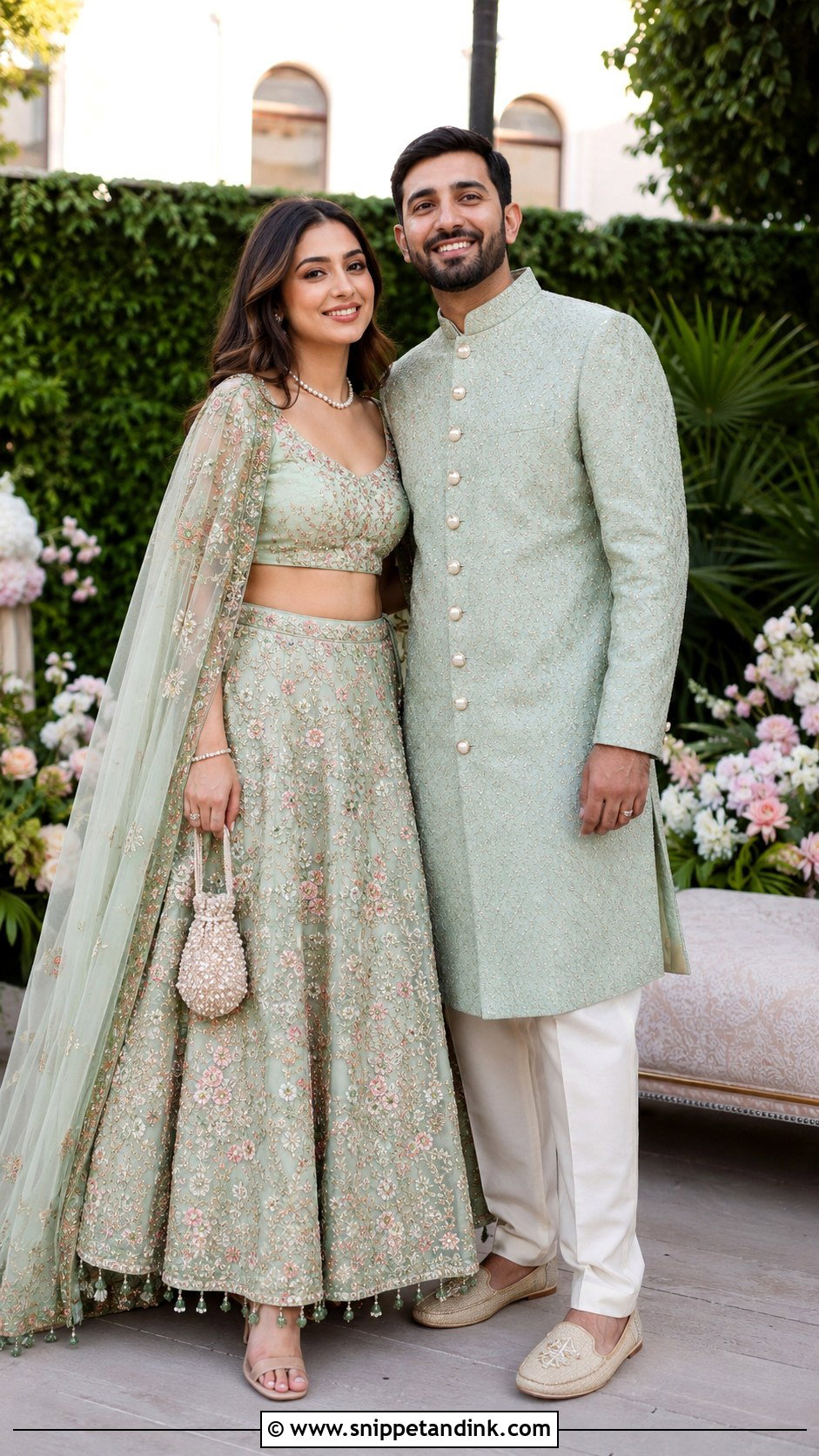
Two related greens give depth without clashing. Her pastel green lehenga with floral embroidery, a fitted blouse, airy dupatta, pearl jewelry, nude heels and a small bag; his slightly deeper sage sherwani, ivory trousers, beige mojaris and pearl-style buttons. Repeat one accent, pale pink, ivory or gold, across both. Light fabrics can turn see-through in strong sun, so I check every layer outdoors before the final fitting. Garden venues and warm daytime ceremonies suit it best.
Timing the Sherwani Around Her Lehenga
The groom’s outfit almost always depends on the bride’s, and that order catches couples out. Custom bridal lehengas often need several months, sometimes longer for heavy hand embroidery, while a sherwani usually takes a few weeks to tailor. The mistake is ordering his first and hoping the colors line up.
- Settle the bride’s main outfits and get a small cut-off swatch of each fabric and embroidery thread from the designer.
- Bring those swatches to the groom’s first appointment. Match stoles, buttons and threadwork against them in daylight.
- Book at least two fittings for him. Sherwanis and bandhgalas are fitted close at the chest and collar, and weight can shift before a wedding.
- Try the full look together once: safa, stole, mojaris and jewelry. Mojaris are rigid at first and need a few wears to soften.
After the wedding
Zari and metallic embroidery tarnish in plastic and humid air. Wrap heavy pieces in clean muslin or cotton, store them flat or folded with tissue in the creases, and refold them every few months so the silk doesn’t split along the same lines. Dry-clean only with a cleaner who handles embroidered silk.
Her Outfit First, Then One or Two Echoes in His
Good coordination keeps each person’s character. Shared colors, embroidery metals and one or two accessories create harmony from head to toe. In my fittings the bride’s outfit is settled first, then I repeat one or two of its elements in the groom’s look rather than copying every detail. Compare swatches in daylight, think about the venue and pick shapes that suit each function. Comfort counts as much as appearance through long rituals and late nights of dancing, whichever palette you choose.
You'll Like These Ideas:


Leave a Reply