
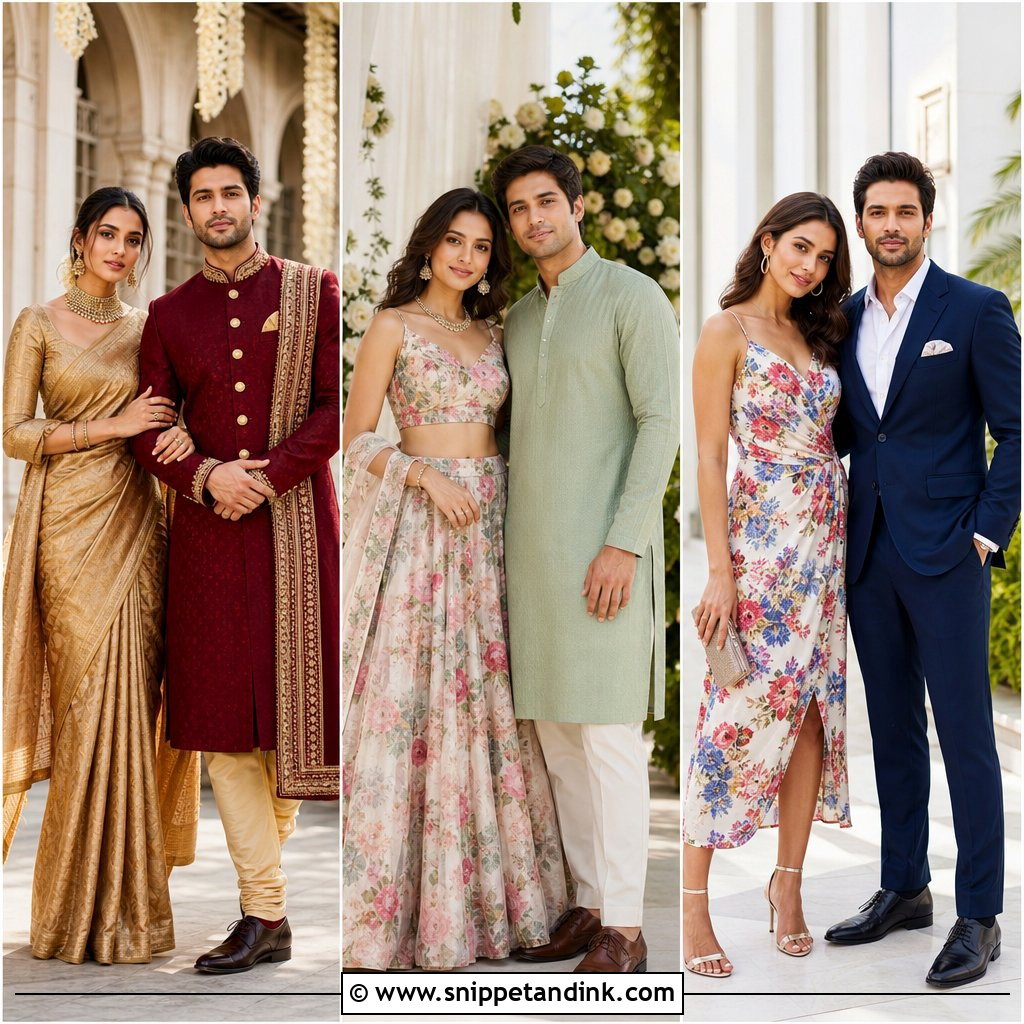
When I dress a couple, I’m aiming for two outfits that clearly belong to the same family without looking cut from one bolt. The tie can be a shade, an embroidery finish or one repeated motif, and each partner should still feel like themselves in it. Below are twenty pairings I’d put in front of a couple for the roka, haldi, mehndi, sangeet, the wedding and the reception, from lehengas and Kanjeevaram silks to bandhgalas and Indo-Western gowns. Read them against your own events, because the venue, the season and how long each function runs change which fabrics I’d actually let you wear.
Building Two Outfits From One Swatch Card
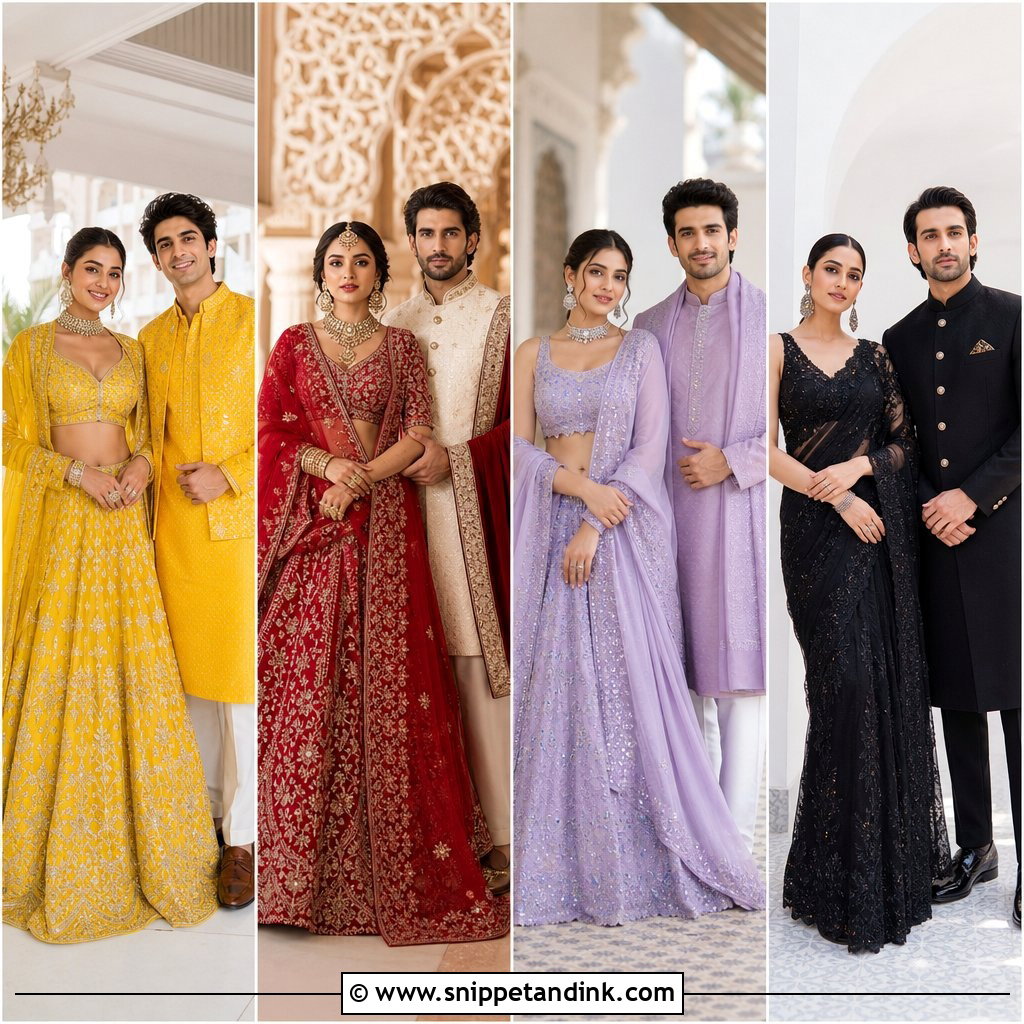
The first thing I do with a couple is make a single card: snips of her main fabric, her embroidery and any lining, set beside his. Everything else gets judged against that card, so nobody falls for a sherwani in a shop that fights a lehenga already on order. It also stops the most common mistake I see, which is matching the base colors exactly and ending up looking like a uniform.
What I settle on the card, in this order:
- Who carries the color. Usually one partner wears the strong shade and the other wears it as an accent on a stole, buttons or threadwork.
- One metal finish. Bright gold, antique gold or silver, used on both outfits and both sets of jewelry.
- Undertone. Warm and cool versions of ivory, gold and pink rarely sit well together, even when the shop calls them the same name.
- Formality. A heavy embroidered lehenga beside a thin cotton kurta looks lopsided, so both garments should sit at a similar level of dressiness.
If the two of you are buying from different shops or cities, ask for a swatch before the order is confirmed, not after. A cutting in the post is far cheaper than a remake.
1. Pastel Lehenga And Sherwani Couple Outfit
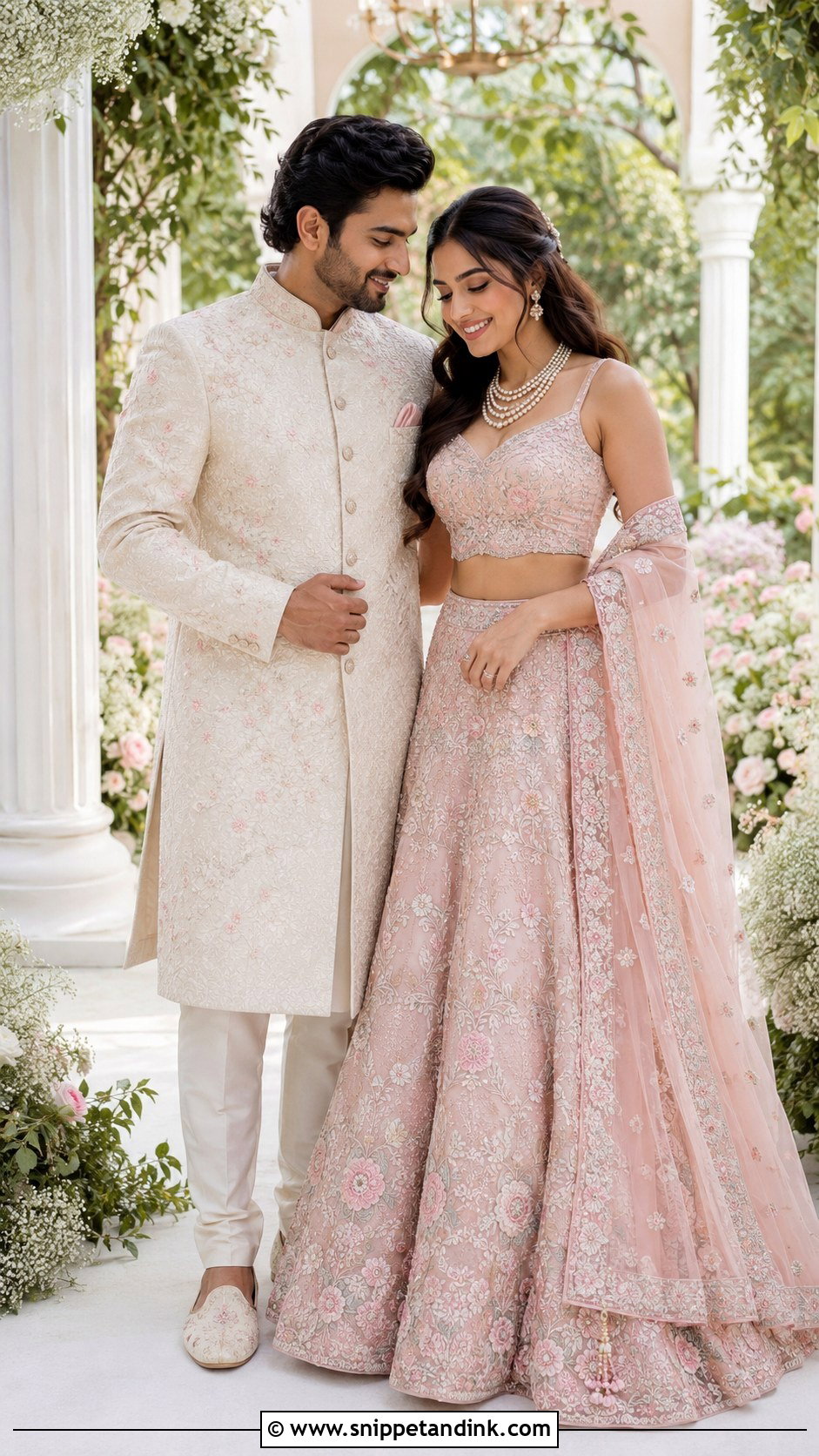
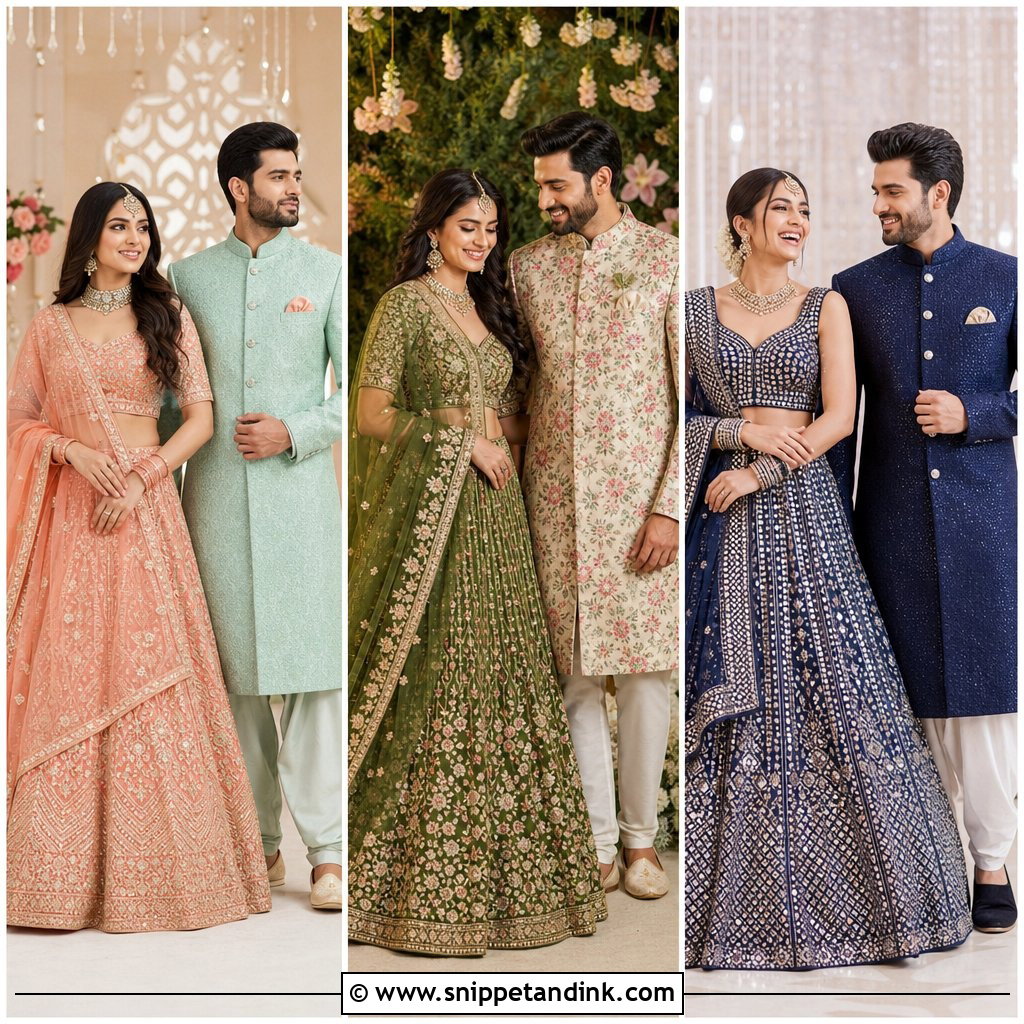
Pastels are where I see couples overmatch most, so I give the stronger color to the lehenga and keep the sherwani ivory with threadwork in her shade. Blush, mint, powder blue and lavender all sit well against ivory, but each one shifts once embroidery goes on, so I compare the embroidered panel rather than the plain fabric. Style hers with a light dupatta, a choker and juttis, and his with straight trousers, neutral mojaris and a stole that picks up her color. Then settle the metal: gold threadwork for warm pastels, silver for blue and lavender, and the same choice on both outfits.
2. Yellow Lehenga And Kurta Haldi Couple Outfit
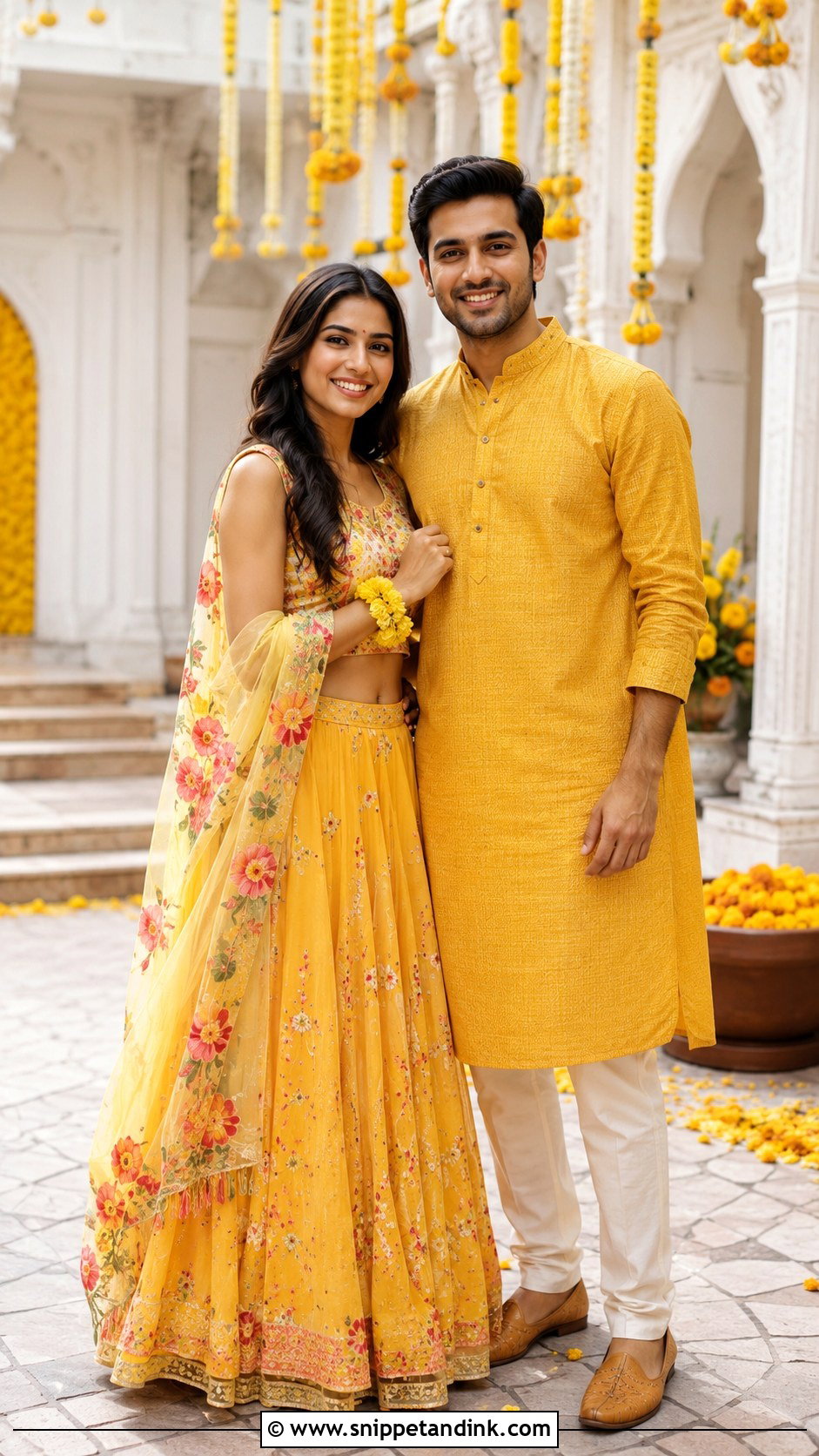
Haldi is the one event where I tell couples to dress for damage. A lightweight yellow lehenga with a sleeveless blouse and a white or floral dupatta lets the paste land somewhere washable, and a mustard or marigold kurta with ivory pajamas does the same job for him. Turmeric sets fast in silk and zari, so I keep embellishment to cotton thread or gota and leave the good jewelry at home; floral pieces and simple bangles are what I pack. A printed Nehru jacket only makes sense if the haldi is formal enough that nobody will be smearing anyone. Flat juttis for her, tan sandals or mojaris for him, and a touch of white, green or pink so the yellow doesn’t swallow you both.
3. Green Lehenga And Printed Kurta Mehndi Couple Outfit
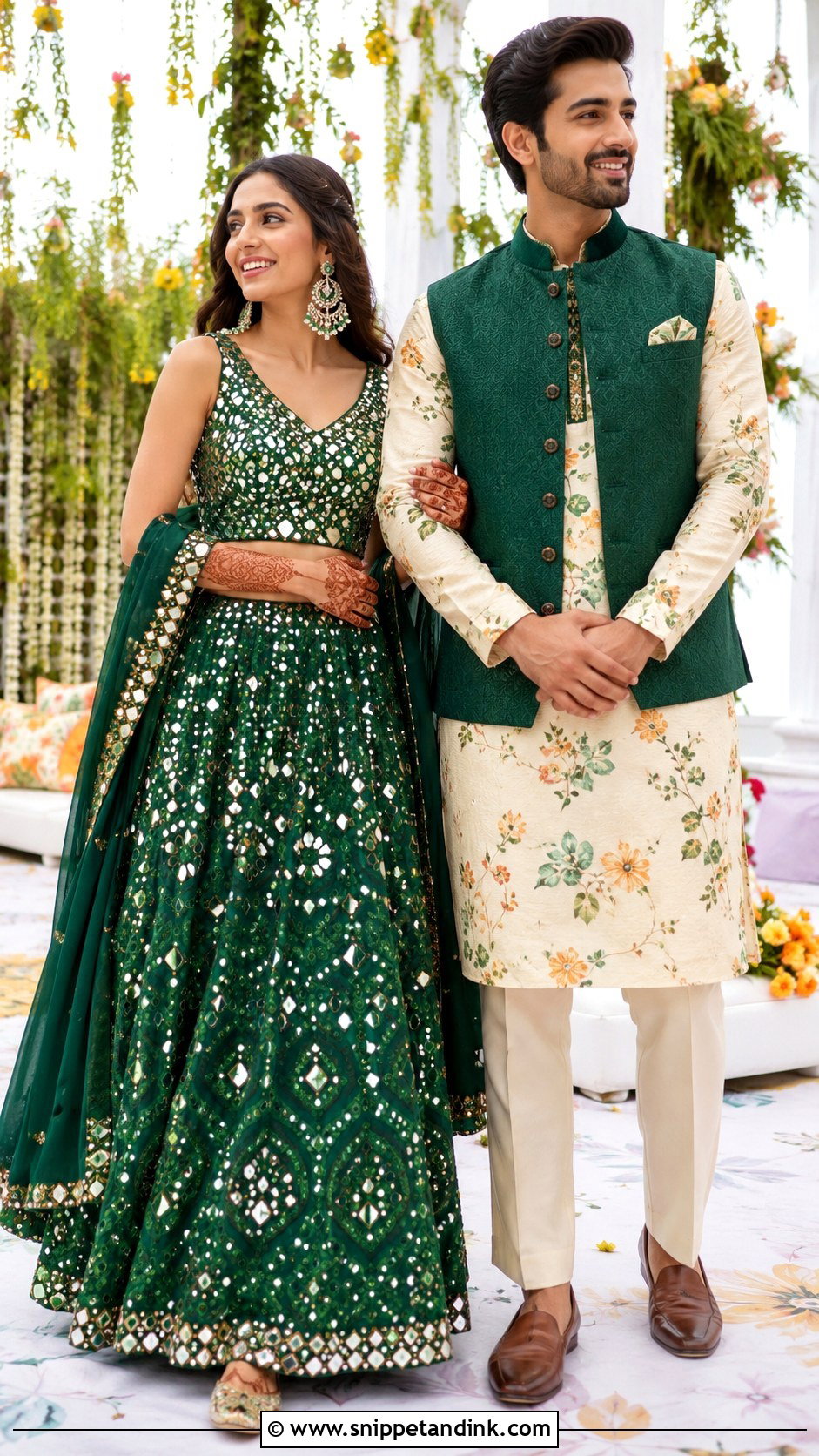
At a mehndi the bride sits for hours with wet paste on her hands and feet, so her outfit has to behave without her touching it. That’s why I like an emerald, sage or lime lehenga with mirror work or florals, paired with an ivory kurta printed in small leaves or geometrics, or a plain green kurta under a patterned waistcoat. Her dupatta should be pinned at the shoulder and waist before the artist starts, and a hands-free potli saves someone fetching her phone all afternoon. Block heels or juttis and statement earrings for her, neutral trousers and brown mojaris for him. One shared print or accent color is all the connection this event needs.
4. Navy Lehenga And Bandhgala Sangeet Couple Outfit
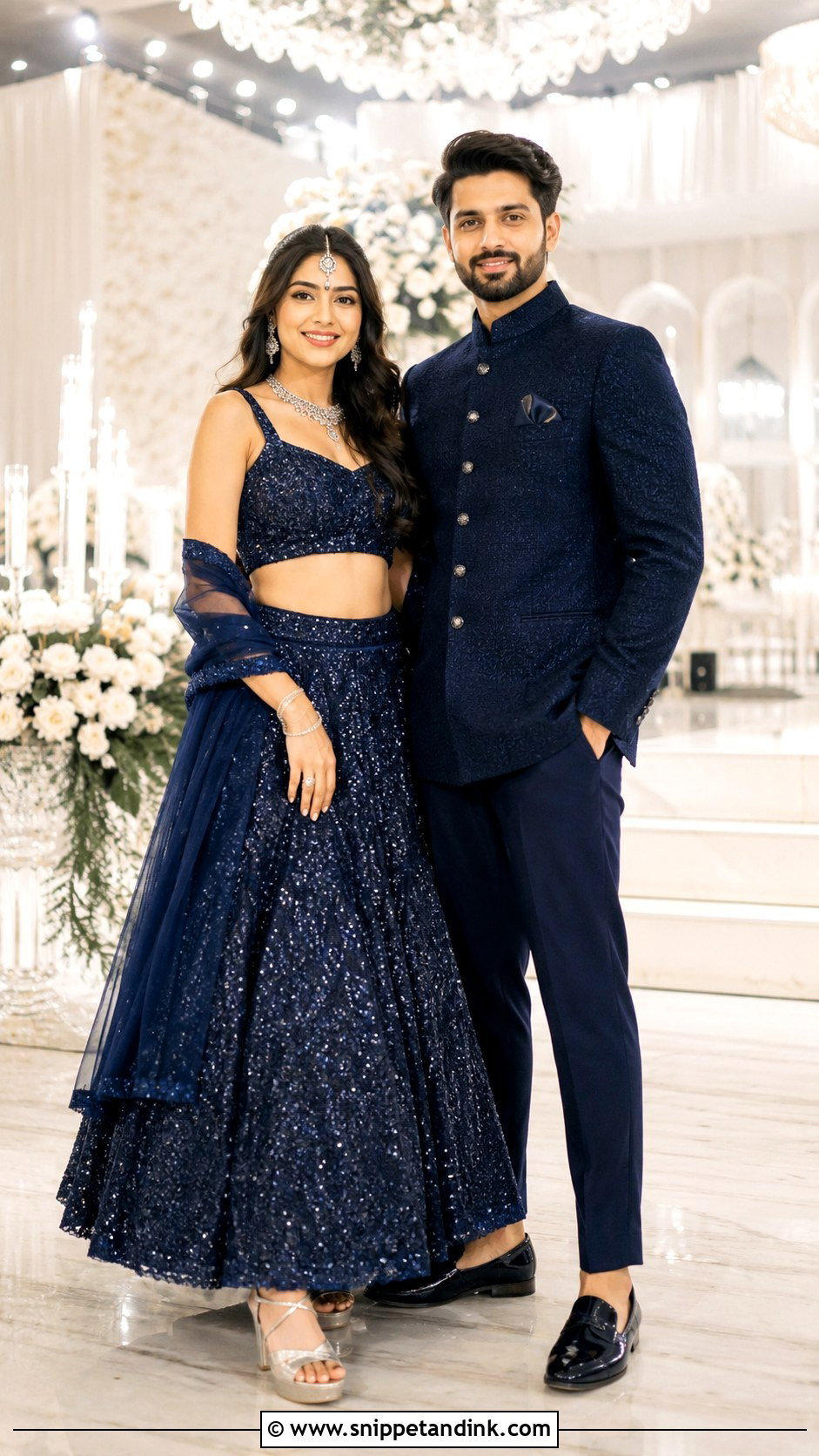
Navy is my usual swap when a couple wants evening drama and the family would rather not see black. For the sangeet I put her in a sequined navy lehenga and him in a navy bandhgala, then break the sameness with texture: matte velvet or jacquard on his jacket beside her sparkle. Before signing off on the blouse I ask her to raise both arms as if she’s dancing. If the hem rides up or the armhole cuts in, it goes back for a lower armhole or a small gusset. Silver earrings and metallic heels for her, silver buttons or a brooch for him, and footwear that has already been danced in at home.
5. Red Lehenga And Ivory Sherwani Wedding Couple Outfit
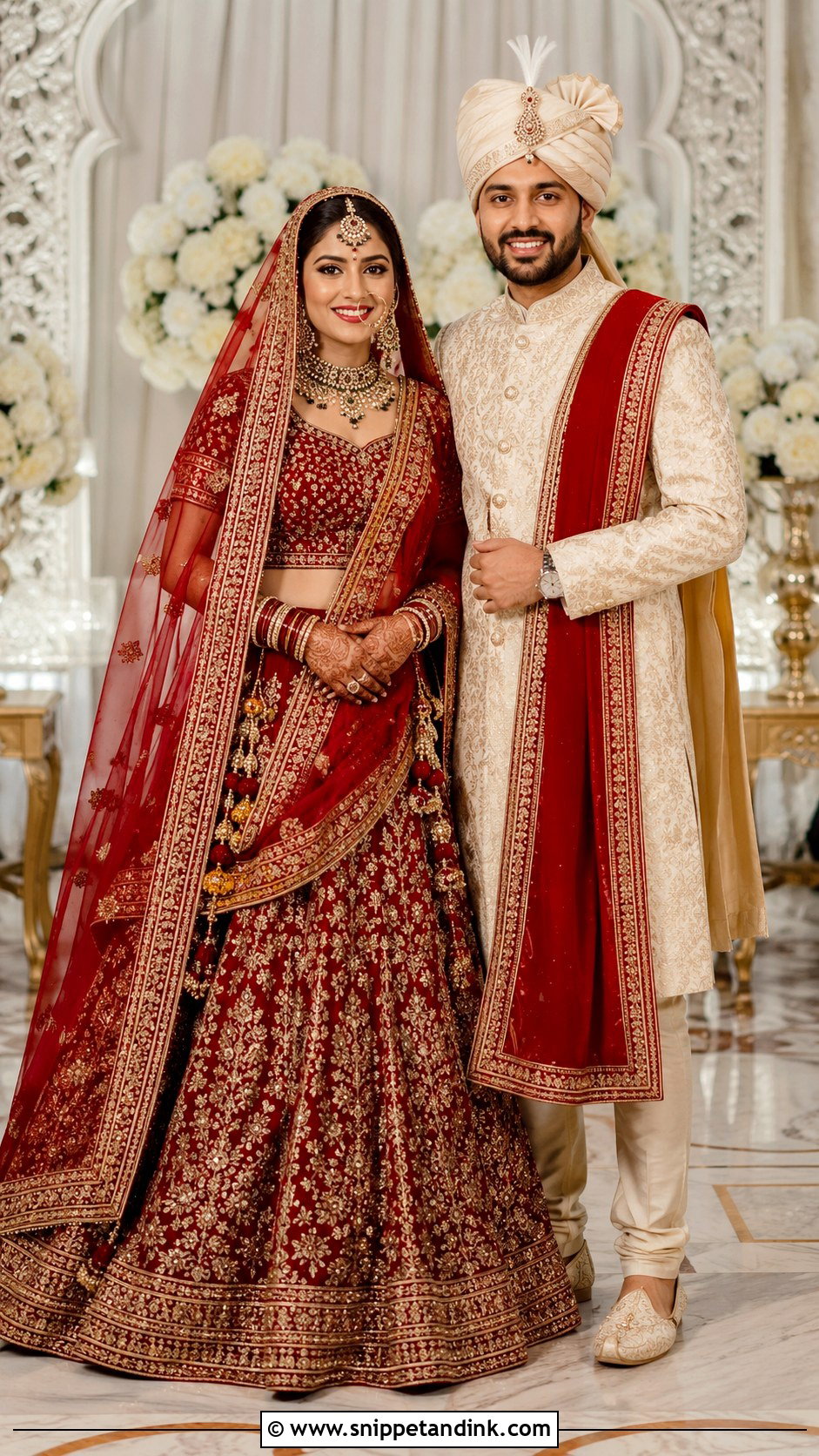
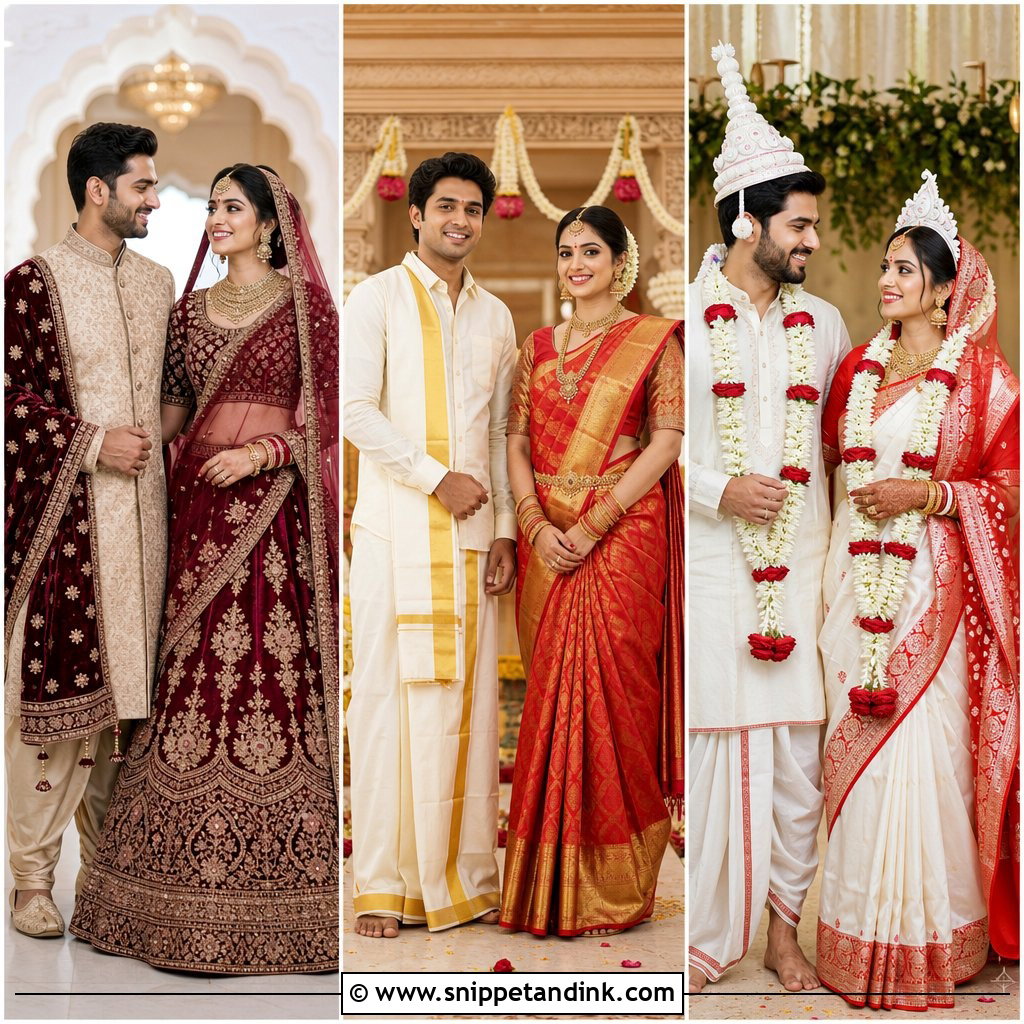
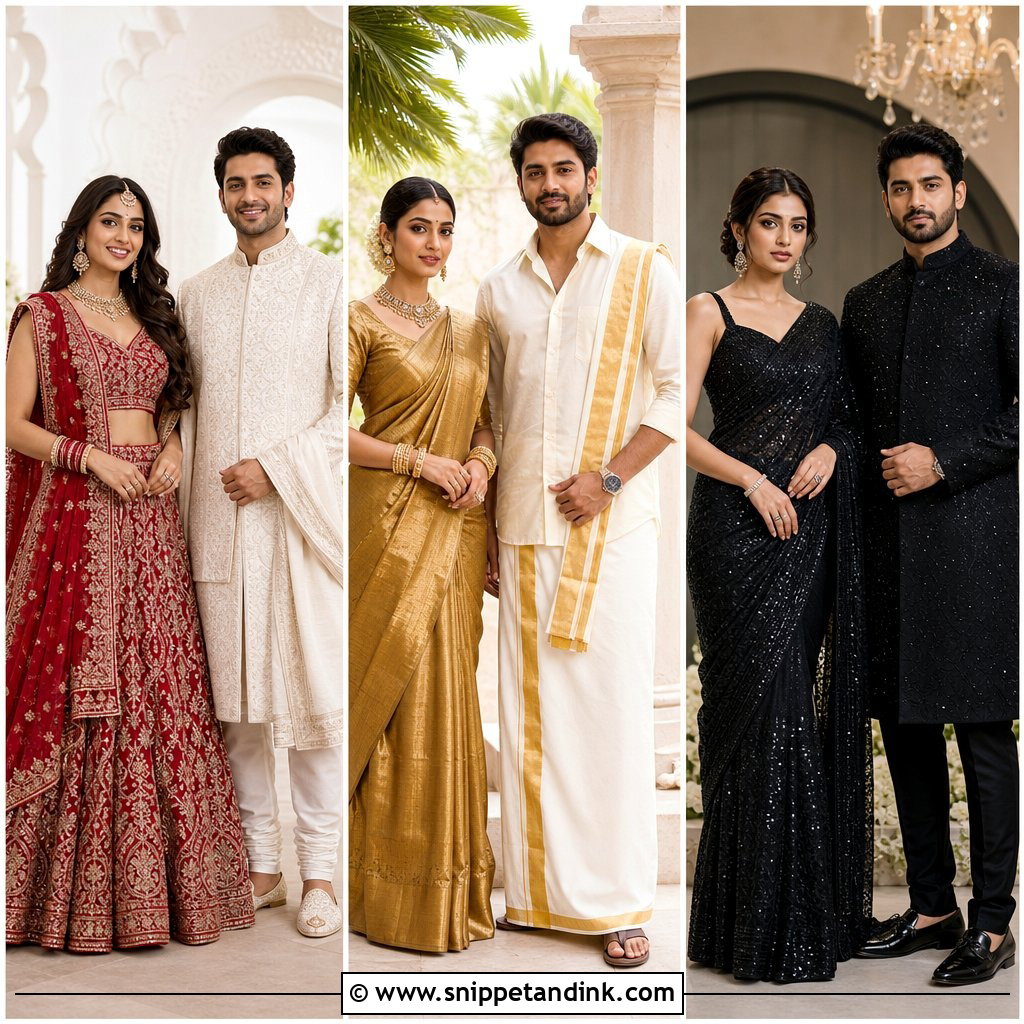
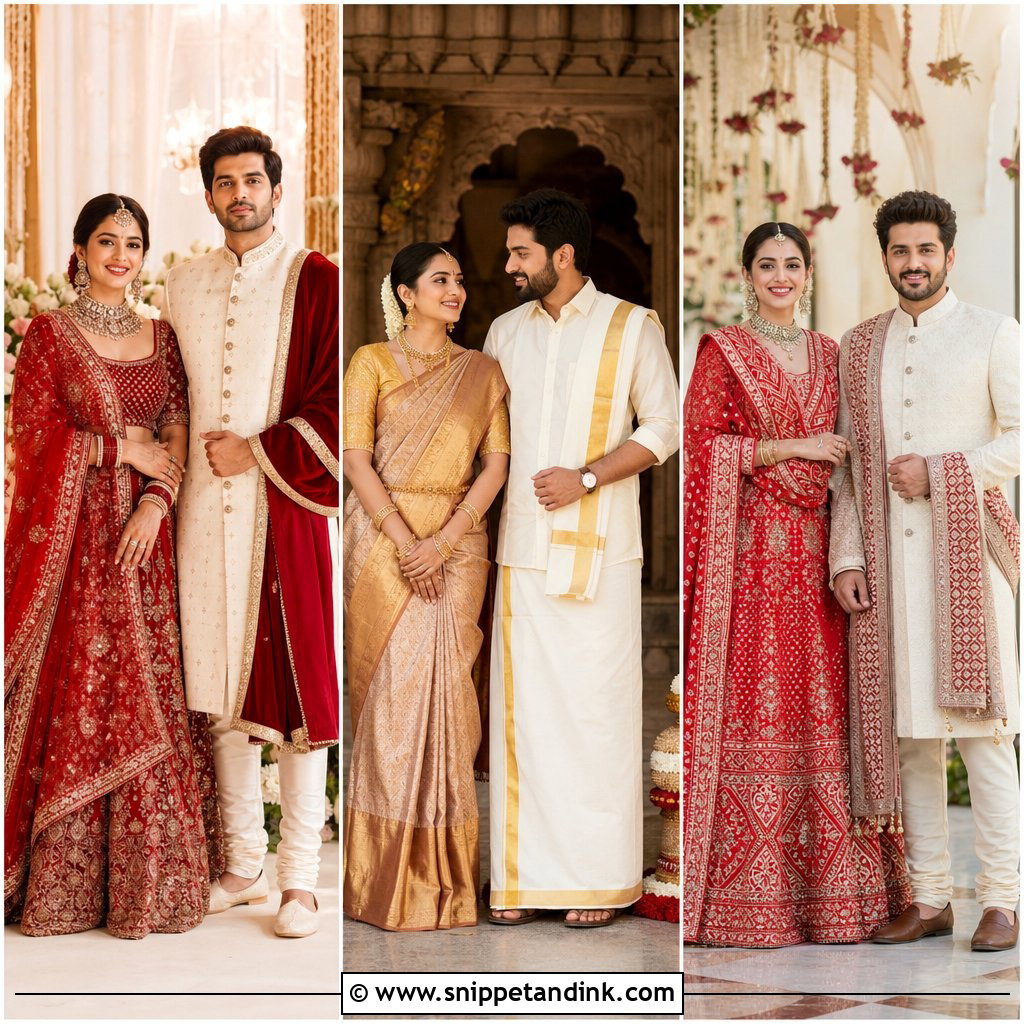
Red and ivory is the classic wedding contrast, and the work is in keeping it intentional. A crimson or vermilion lehenga with gold zari and a bridal dupatta sits against an ivory sherwani with restrained gold work, while a red stole, safa or beaded mala carries her color onto him. I hold the two fabrics together outdoors as well as indoors, because some reds turn orange and some ivories turn yellow beside each other. Matching the zari tone matters more than matching anything else here. Traditional gold jewelry and juttis for her; cream churidar and ivory mojaris for him, with the churidar cut long enough to gather properly at the ankle.
6. Ivory Lehenga And Beige Sherwani Couple Outfit
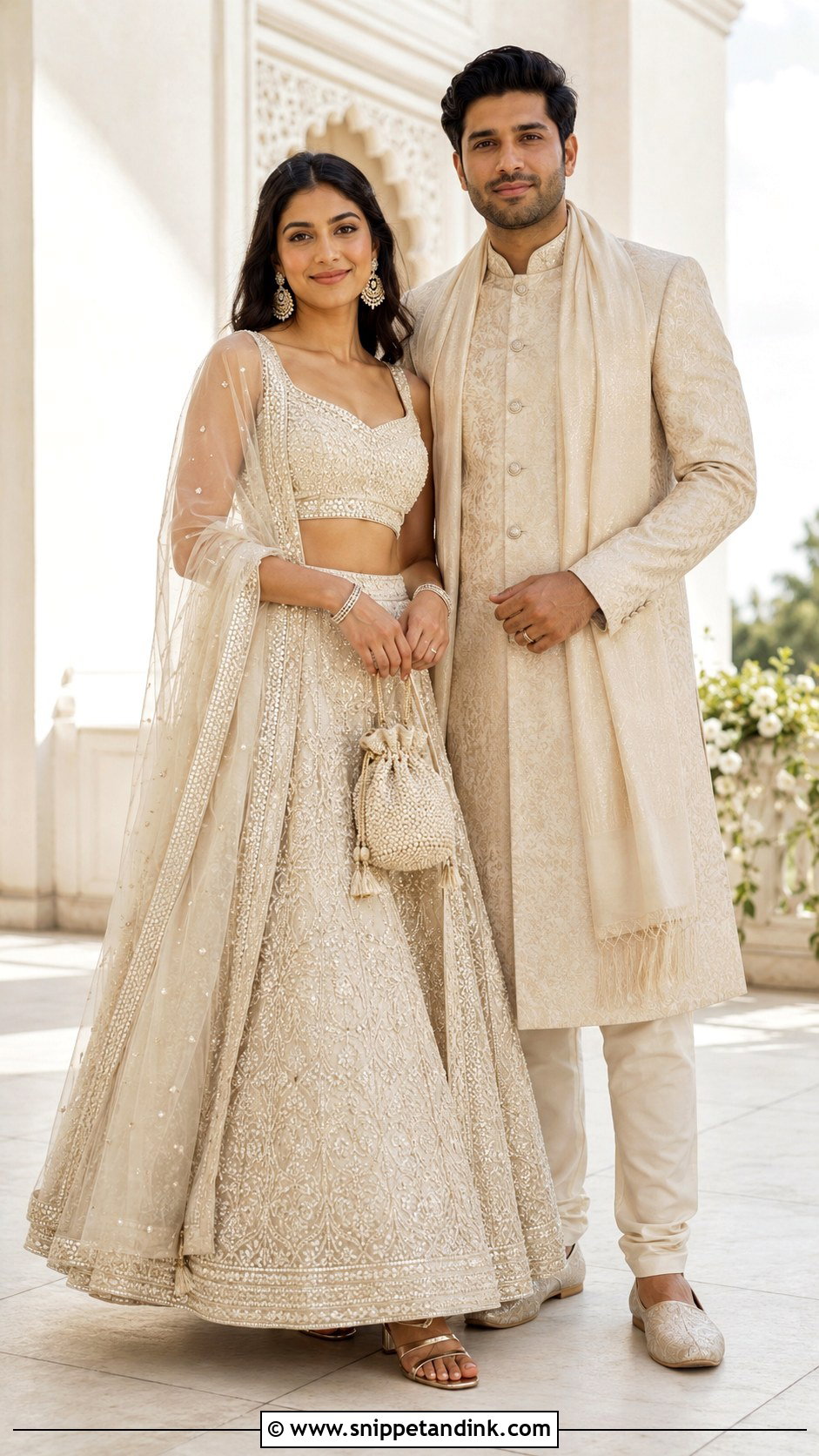
Neutrals reward texture and punish mismatched undertones. An ivory lehenga with pearls or pale gold threadwork can stand beside a beige or champagne sherwani, but only if both lean the same way, warm or cool. Once that’s settled, raw silk, jacquard, organza and embroidered net happily share a pairing. I keep her accessories to pearls, metallic sandals and a structured potli, and his to neutral mojaris, a plain brooch and an ivory stole. If it feels flat, one muted accent such as sage or dusty pink in both outfits fixes it without breaking the calm.
7. Pink Saree And Matching Kurta Couple Outfit
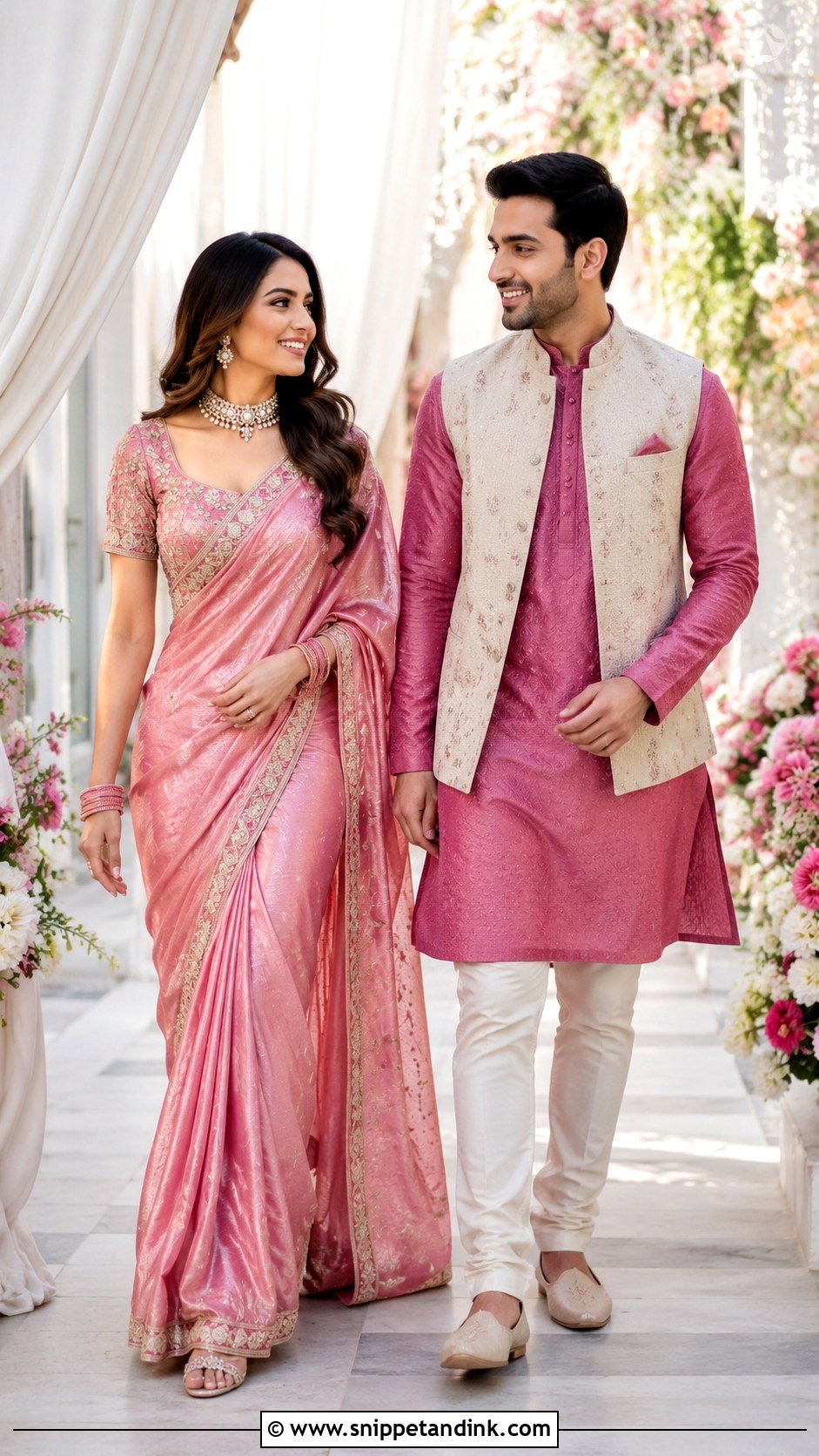
Tone-on-tone pink is one of the easier pairings to get right, because a lighter or deeper kurta beside her saree looks deliberate rather than copied. Silk holds its pleats through a long day; georgette is lighter, and organza creases the moment she sits, which I flag for long family functions. His ivory trousers and a neutral Nehru jacket stop the pink from turning into a costume. Instead of repeating her blouse fabric on him, I pick up its embroidery on his buttons or stole. A choker, bangles and embellished sandals for her, mojaris and a watch for him.
8. Emerald Saree And Black Bandhgala Couple Outfit
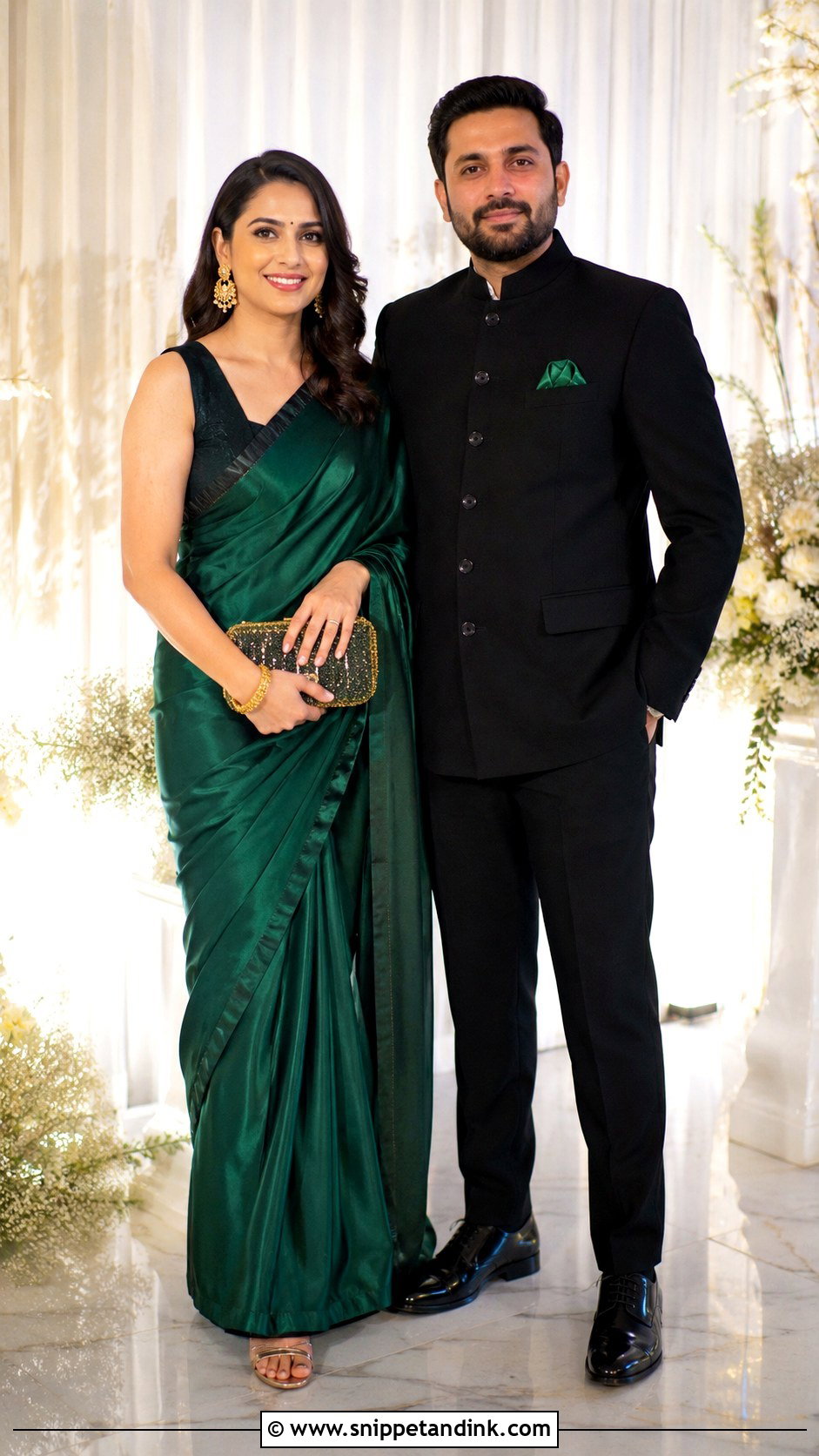
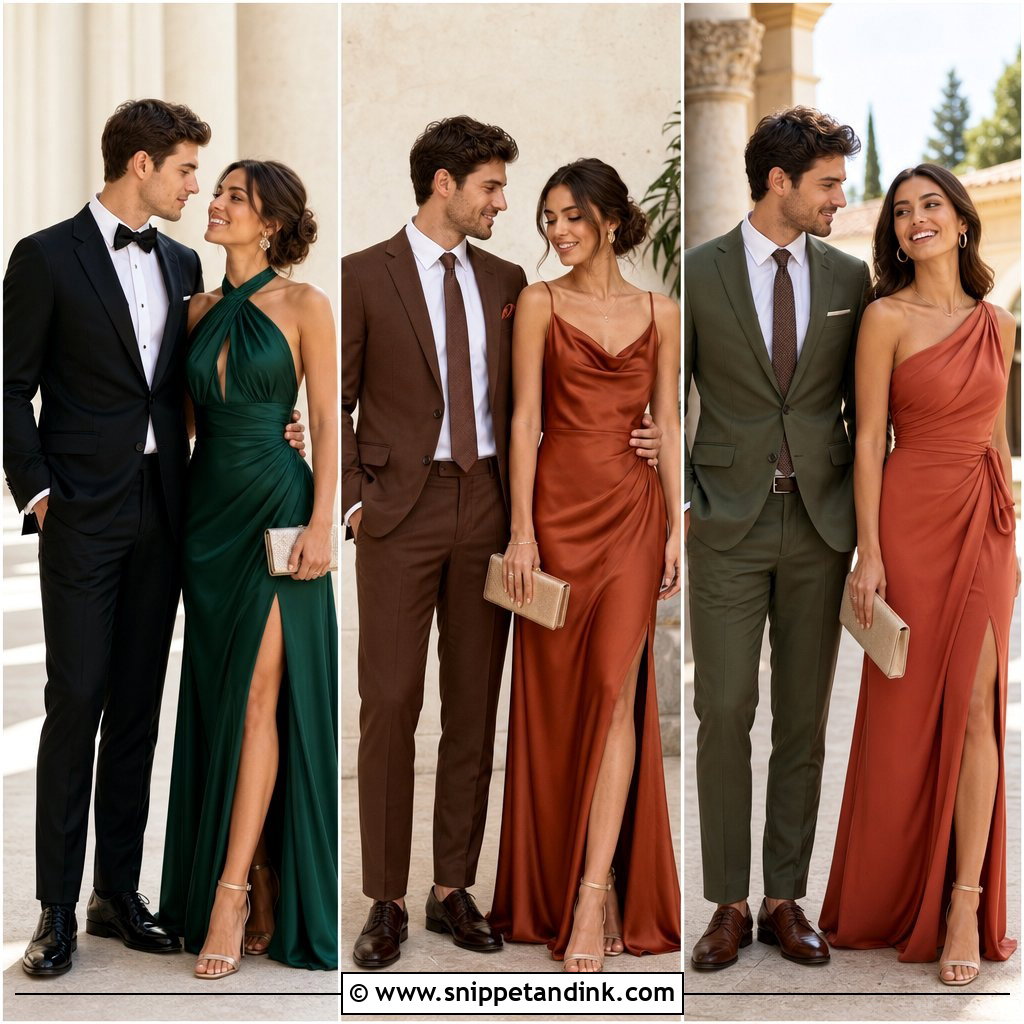
Emerald and black holds together at a reception because the color sits mostly on one person. She wears an emerald silk or sequined saree with a structured black blouse; he wears a black bandhgala with emerald only on the buttons, the pocket or a thin line of embroidery. I steer couples away from a glossy jacket beside a glossy saree, since two shines compete, and matte or lightly textured on him reads cleaner. Gold or diamond-look jewelry, a slim clutch and metallic heels for her, tailored black trousers and polished shoes for him, and nothing else in the palette.
9. Maroon Lehenga And Cream Sherwani Couple Outfit
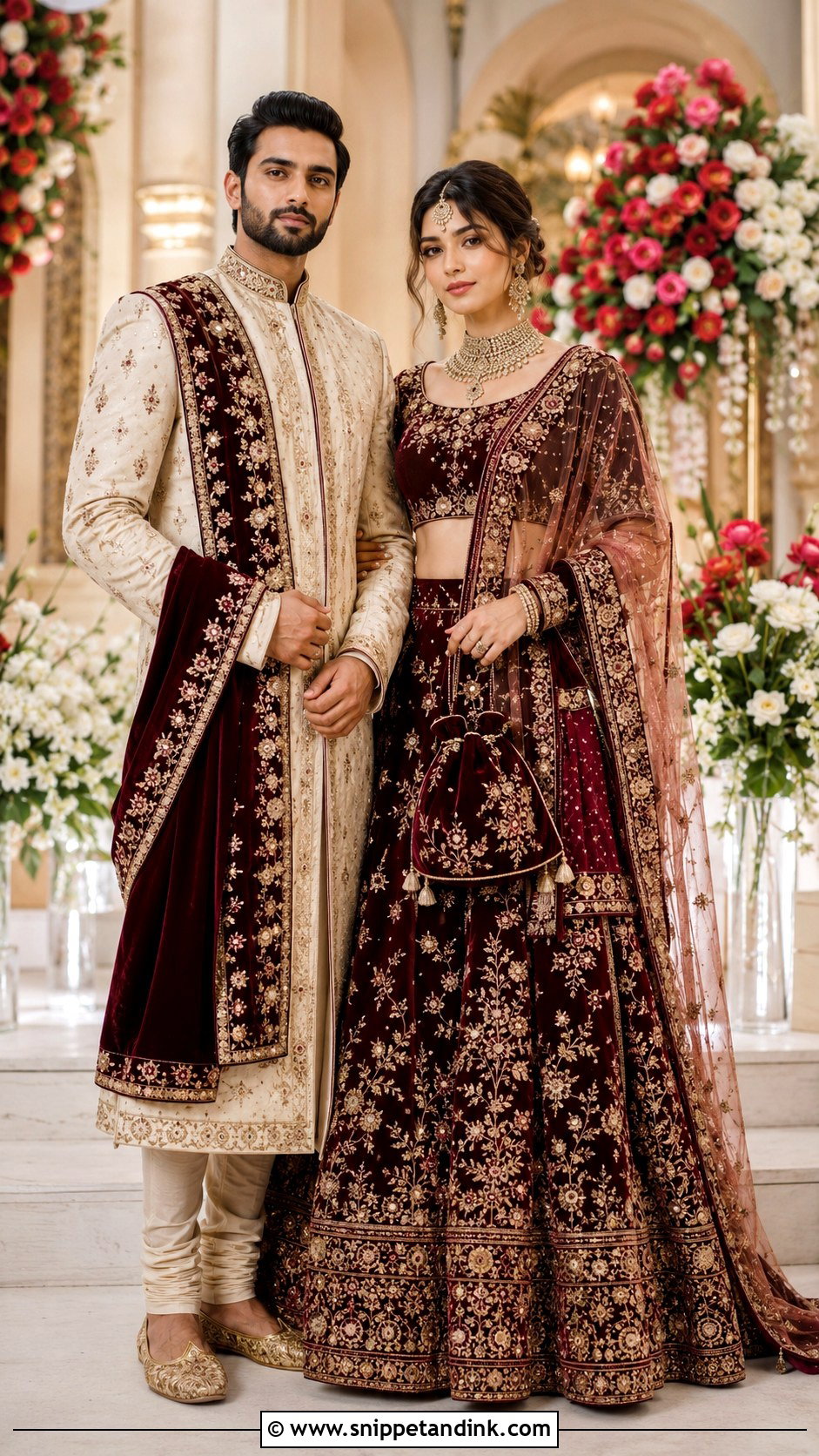
Maroon velvet is the fabric I check most carefully at fittings, because velvet crushes where she sits and the pile marks don’t always steam out. A silk or brocade maroon lehenga avoids that problem, and antique gold embroidery suits any of the three. His cream sherwani with maroon threadwork or borders balances the depth, and a maroon stole or safa tightens the link if the families want it stronger. Antique-finish jewelry, a small potli and embroidered heels for her; cream churidar with brown or gold mojaris for him. Pick one metal finish for every embellishment and accessory, and keep other jewel tones away from the maroon.
10. Lavender Lehenga And Ivory Kurta Couple Outfit
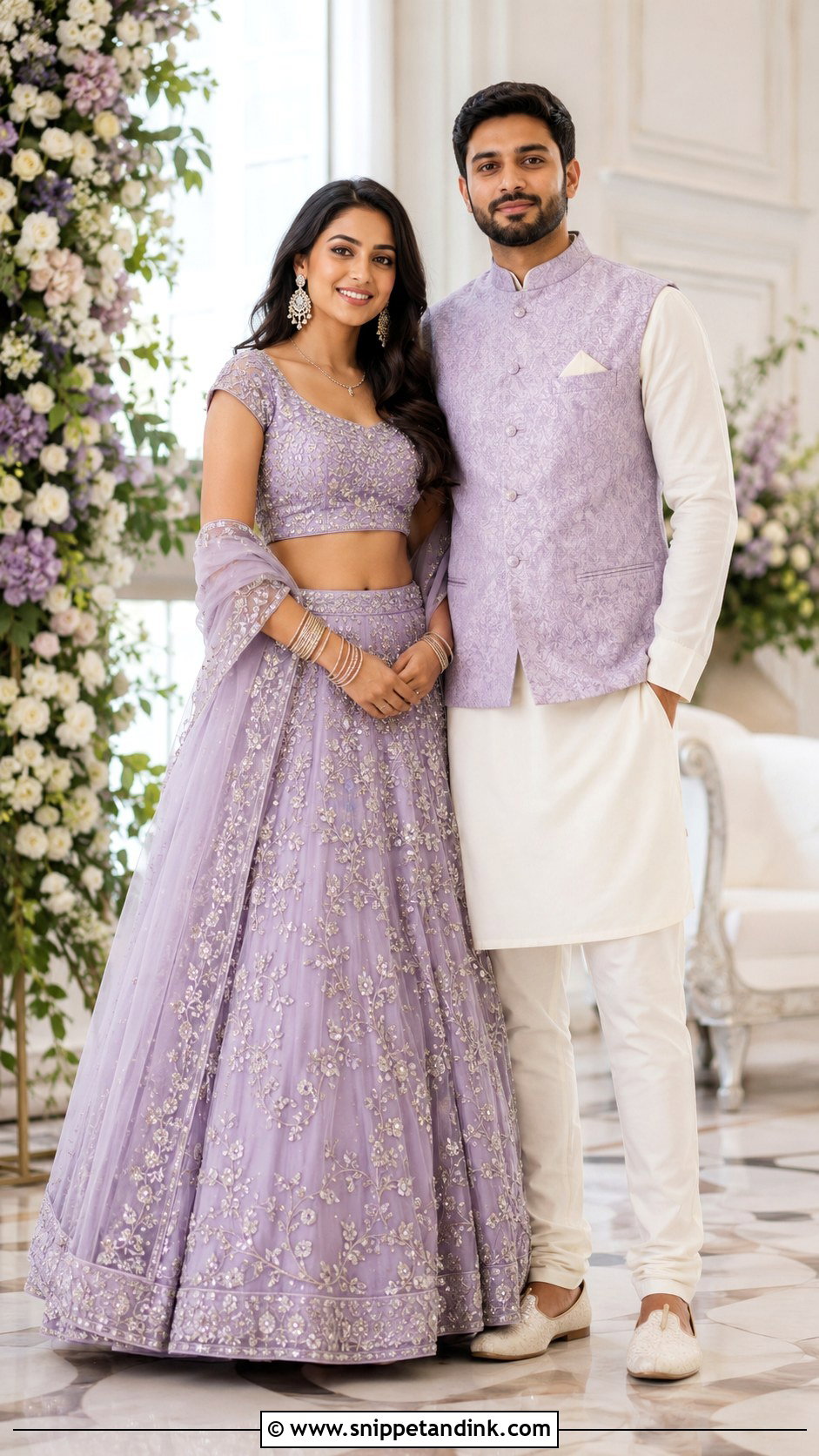
Lavender is trickier than it looks, since it drifts grey or pink depending on what sits next to it. I give her the strong dose, a lavender lehenga with silver embroidery or scattered sequins, and him an ivory kurta with a lavender Nehru jacket or stole. His ivory has to be a cool one. Yellow-based cream makes lavender look tired, so I bring his fabric to her fitting before anyone cuts it. Silver earrings, stacked bangles and neutral heels for her, ivory mojaris and silver-toned buttons for him, with grey or soft blue as the only supporting shades.
11. Royal Blue Anarkali And Kurta Couple Outfit
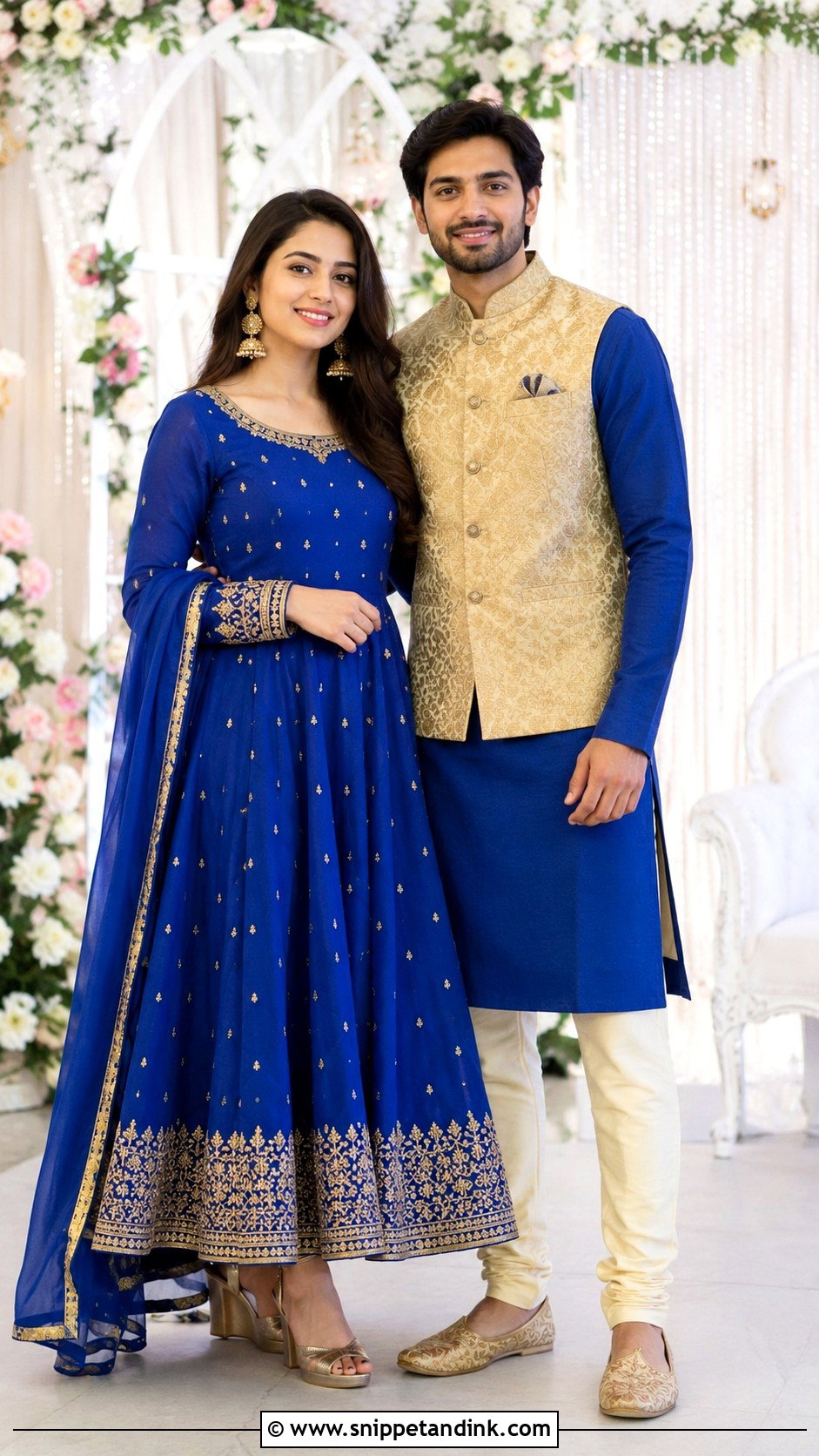
An Anarkali carries a lot of fabric in its kalis, and a heavy flare drags the bodice down over a long evening unless the fit at the bust and waist is precise. I check that at the second fitting with her walking and sitting, not standing still on a stool. Royal blue with gold borders on her; a royal blue kurta, ivory trousers and a gold-patterned Nehru jacket on him. If you’re both in blue, vary the weave, chanderi against brocade or silk against jacquard, so the two pieces don’t merge. Gold jewelry and block heels for her, brown or gold mojaris for him, and you have a sangeet or engagement pairing that lets you move.
12. Peach Sharara And Beige Kurta Couple Outfit
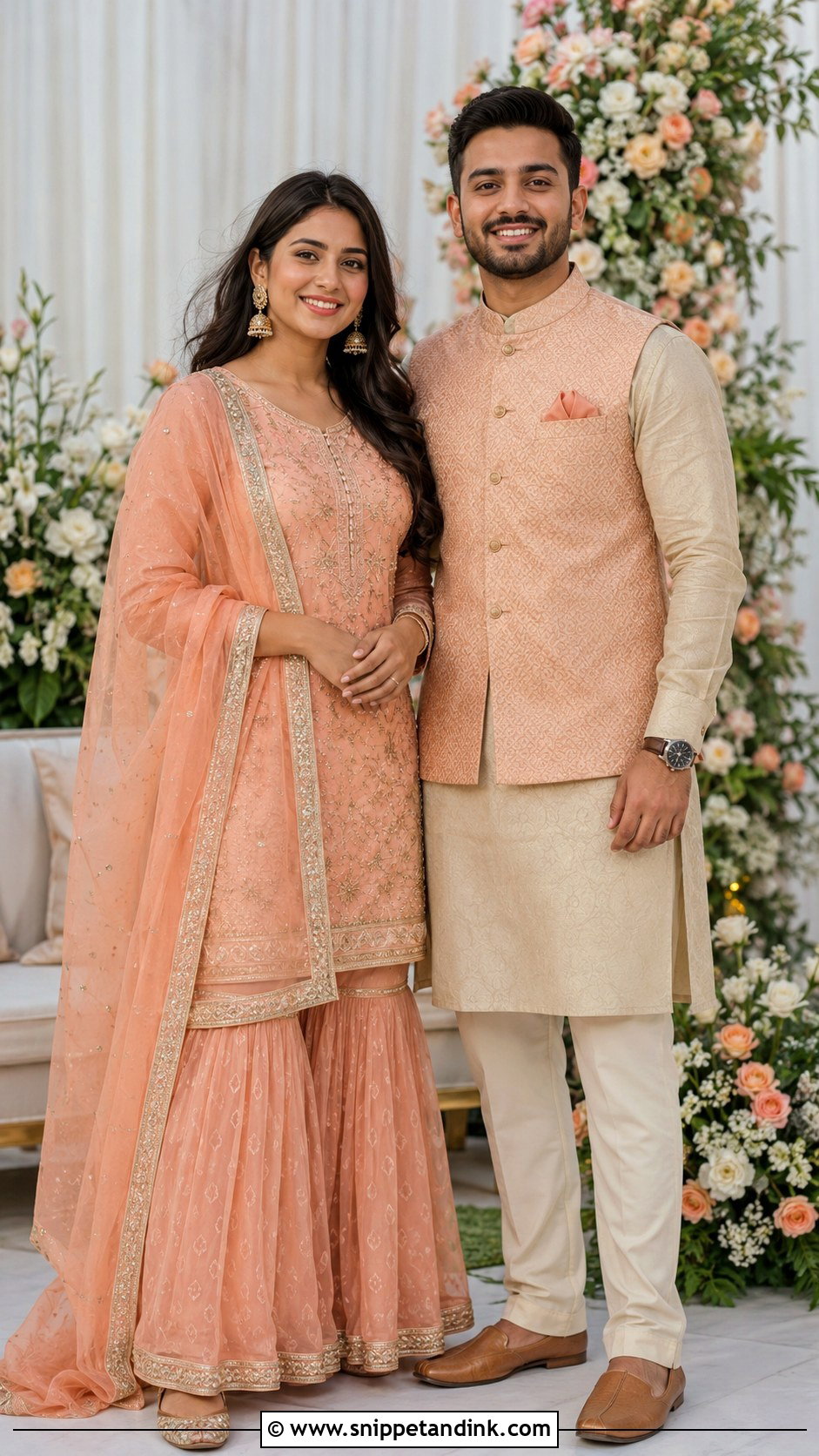
Sharara pants change length with her shoes, so I fix the footwear before the hem is cut. A short embroidered kurti over wide peach shararas with a sheer dupatta is light enough for a roka or a daytime mehndi, and georgette, cotton silk or lightweight jacquard keep it that way. His beige kurta set picks up the peach in threadwork, a waistcoat or a stole, visible but quiet. Jhumkas, a potli and juttis or low block heels for her; tan sandals or loafers for him. Pearls and pale gold suit peach, and anything heavier fights it.
13. White Saree And White Kurta Couple Outfit
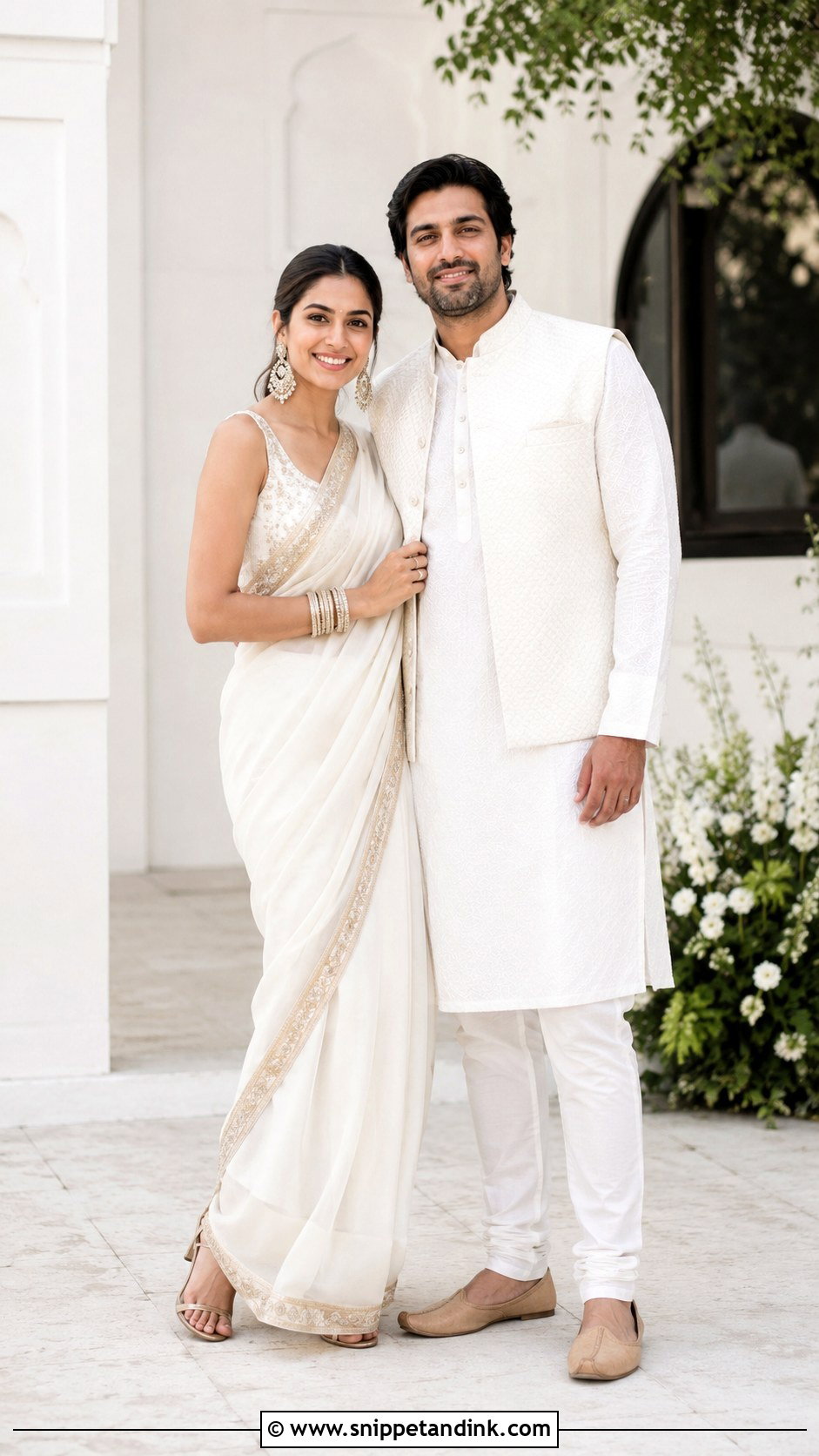
An all-white couple outfit looks simple and is one of the hardest to match. A white saree with a woven gold, silver or colored border, beside a white kurta-pajama and a textured Nehru jacket, sounds easy until the whites sit side by side. Bright white, cream and ivory rarely agree, and some synthetic whites carry a blue cast that makes natural cotton look dingy next to them. I put both garments, or both swatches, in one room before anything is bought. Then one shared accent travels from her border to his jacket or pocket square, and texture in both fabrics gives the white some depth.
14. Black Saree And Black Sherwani Couple Outfit
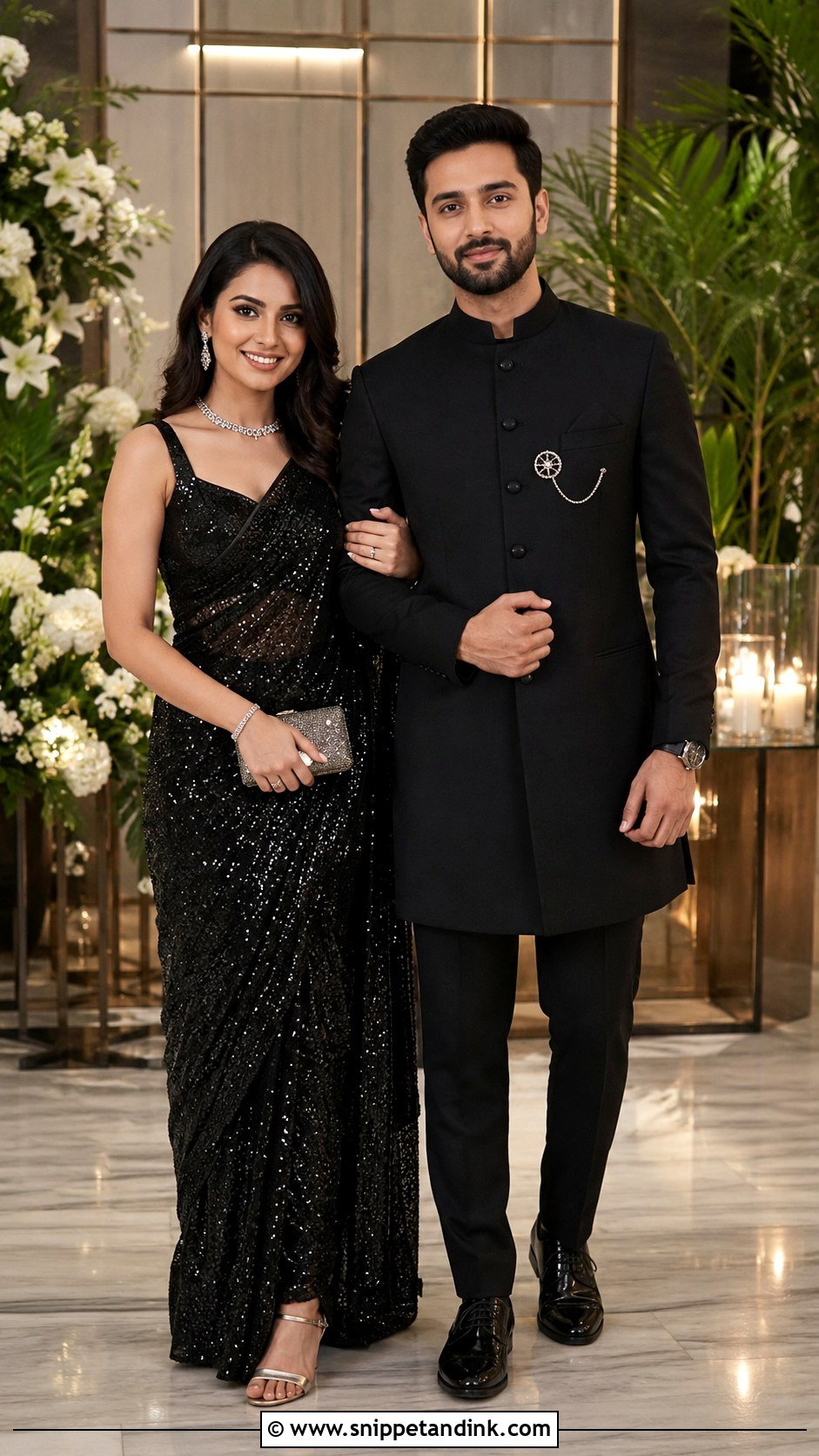
Black creates a sleek couple look for a reception or sangeet, as long as only one of you sparkles. My usual split is a sequined saree, or one with a jewel-toned border, for her and a matte black sherwani with decorative buttons for him. Sequins also snag on embroidered jackets when you stand close or dance, which is another reason to keep his surface plain. Silver earrings, a clutch and metallic heels for her; polished shoes, a brooch and a quiet pocket square for him. Some families avoid black at auspicious functions, so ask first, and if the answer is no, charcoal or midnight navy carries the same formality.
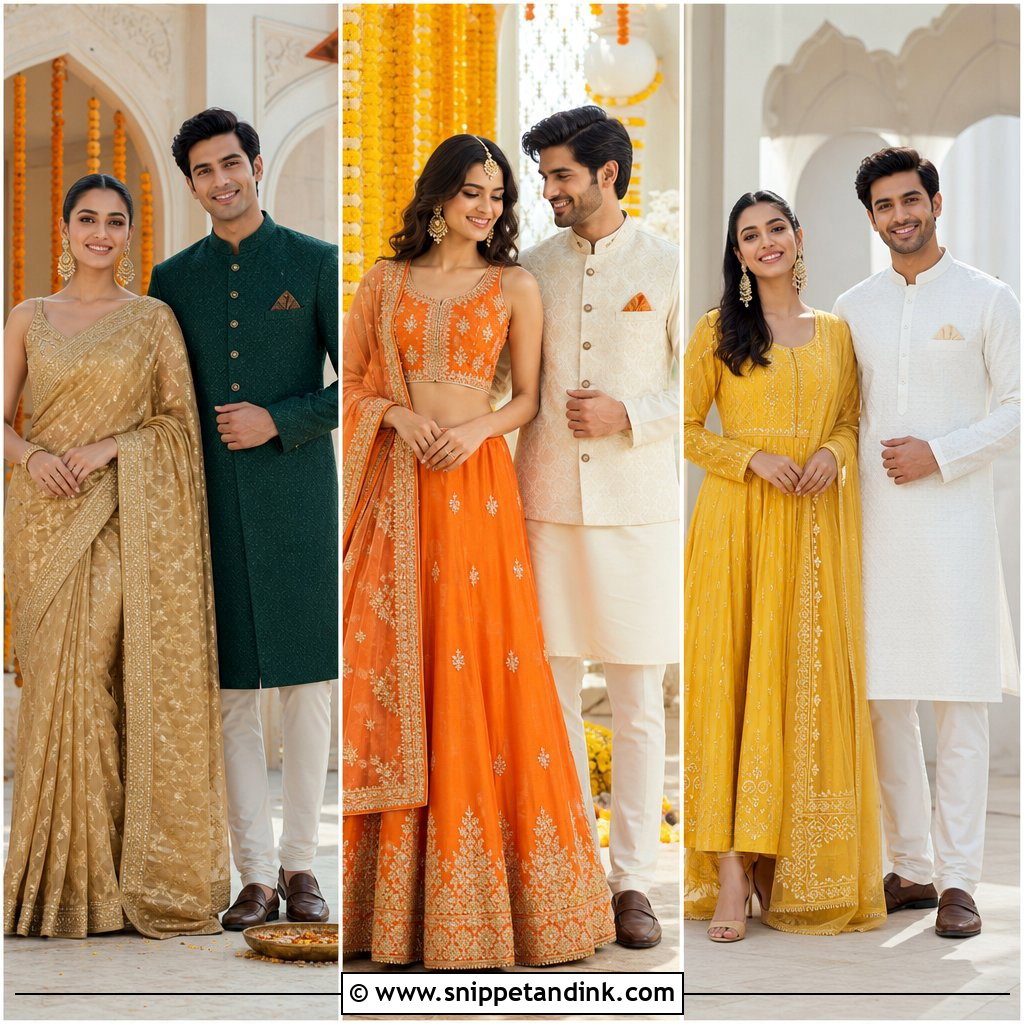

15. Floral Lehenga And Floral Nehru Jacket Couple Outfit
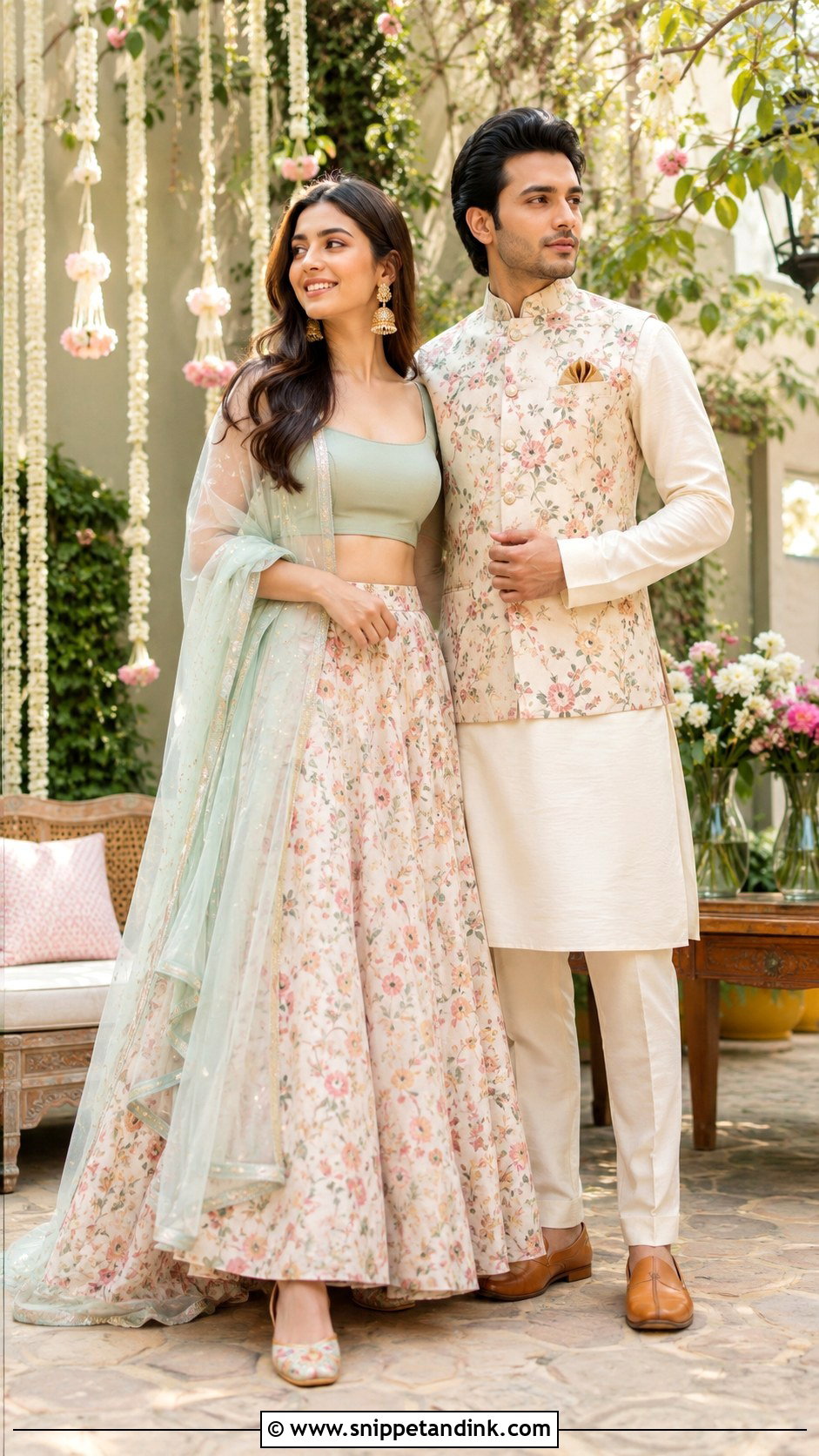
Two prints only work together when one is clearly the lead. I let her lehenga carry the florals with a solid blouse and a light dupatta, then find him a Nehru jacket that repeats one or two of those flowers at a similar scale over an ivory or pastel kurta. Mismatched scale is the usual failure, since a large rose next to a tiny ditsy print looks accidental. Embroidered juttis and tan mojaris keep the feet quiet, and her jewelry stays light because the fabric is already doing the work. I’d save this one for a garden mehndi, a haldi or a daytime engagement.
16. Gold Lehenga And Gold Sherwani Couple Outfit
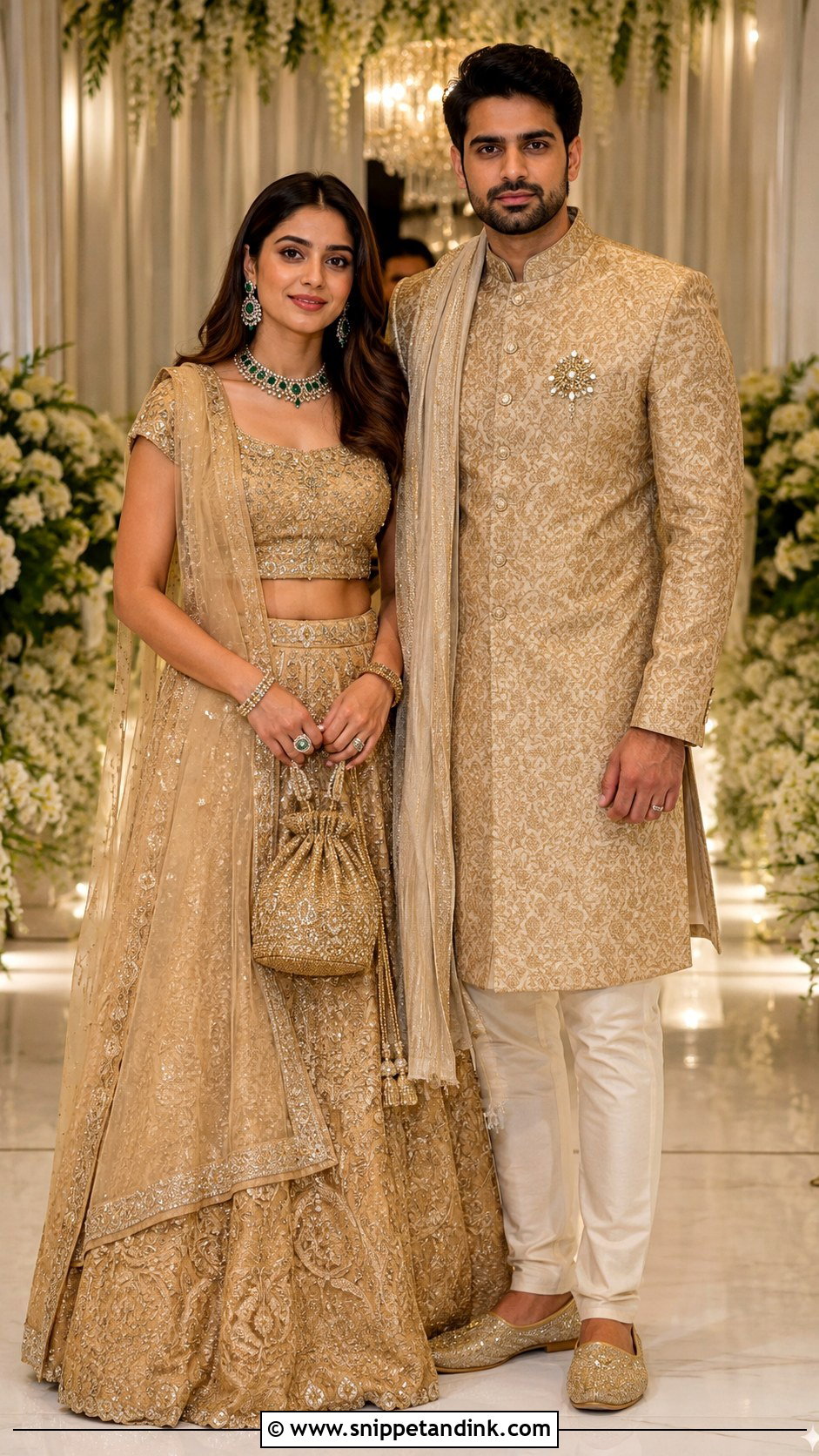
Gold on gold reads regal at a reception, but only when the undertones agree. Champagne gold sits well with cool ivory and antique gold with warm cream, and I lay the two fabrics on the same table before approving either. Her lehenga can carry sequins, zari or tonal embroidery while his muted gold or beige sherwani stays plainer, with ivory trousers. Emerald, ruby, pearl or clear stones give her jewelry the contrast the fabric lacks. What I won’t sign off on is bright yellow gold, rose gold and silver all appearing in equal amounts across the two outfits.
17. Orange Lehenga And Green Kurta Couple Outfit
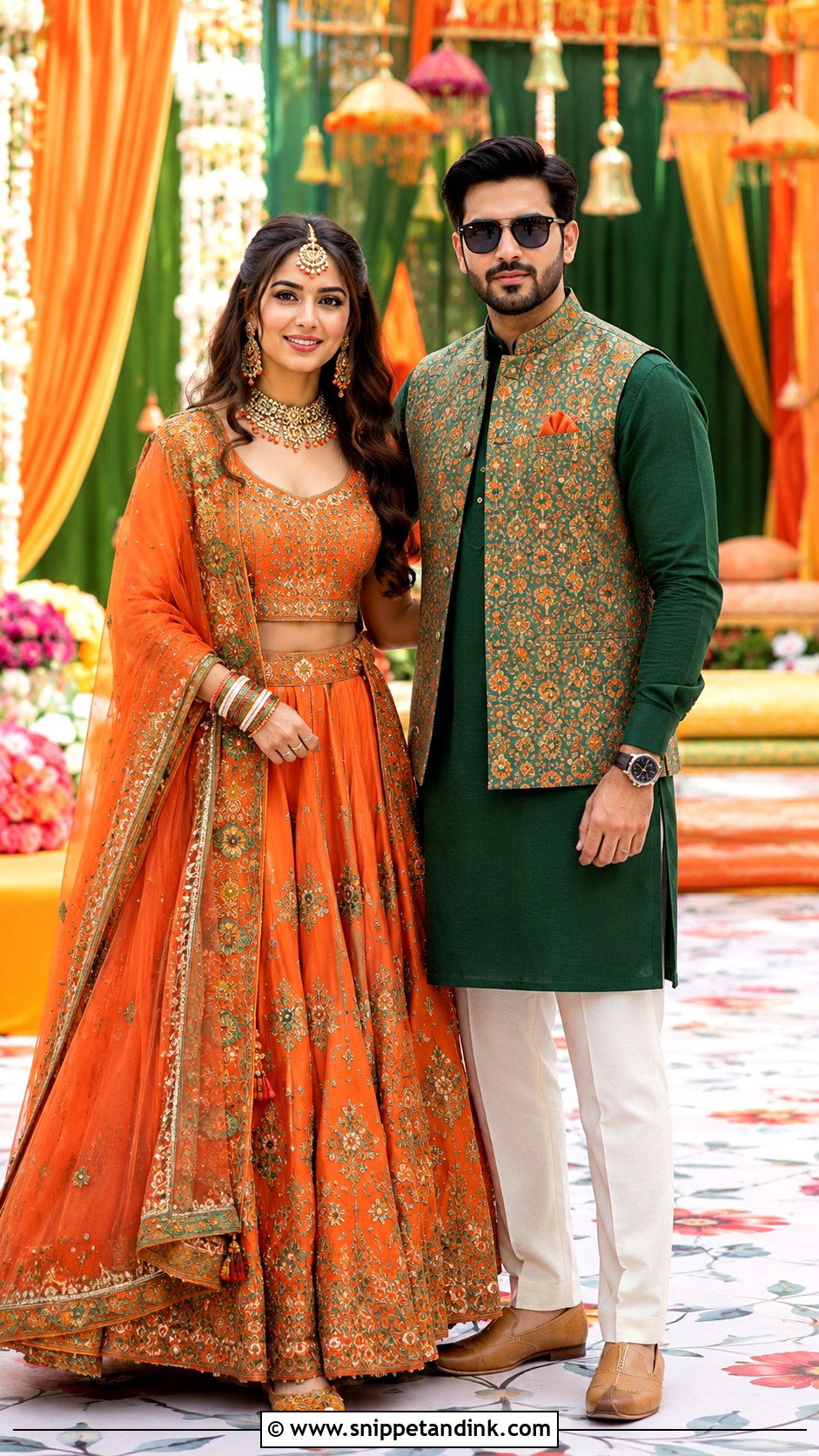
Orange and green are complementary colors, which is exactly why one of them has to be toned down. A burnt orange or marigold lehenga with green embroidery sits well beside a bottle-green or olive kurta with orange buttons or a patterned waistcoat; vivid orange next to neon green does not. I choose the muted partner first and build the other outfit around it. Gold jewelry, glass bangles and juttis for her, ivory trousers and tan mojaris for him. It’s a mehndi or outdoor haldi combination, and cotton or chanderi will keep you both cooler than heavy silk.
18. Kanjeevaram Saree And Veshti Couple Outfit
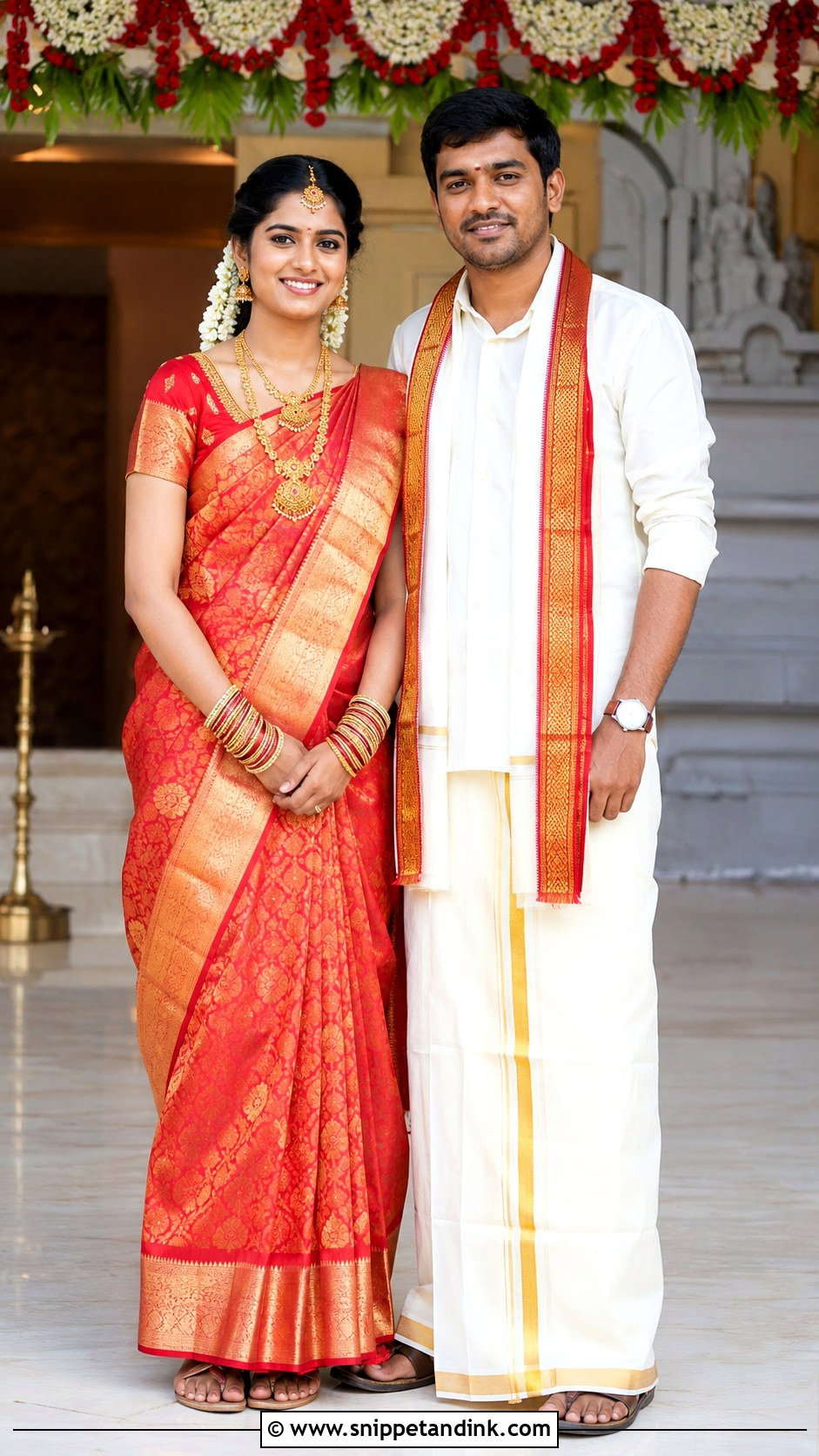
A Kanjeevaram saree and veshti make a traditional South Indian couple look where the coordination lives in the border. Her silk in red, green, mustard or deep blue with a contrasting zari border sets the palette, and his ivory veshti and shirt take it up through the angavastram, ideally in her body color or border shade. Kanjeevaram silk is heavy and stiff when new, so I have her pleats set by someone who drapes them often and keep spare pins for a re-tuck after the rituals. Gold jewelry, flowers in the hair and flat sandals for her; classic sandals and little else for him. Check the zari side by side, because a bright yellow-gold border beside an antique one looks like two different weddings.
19. Phulkari Lehenga And Punjabi Kurta Couple Outfit
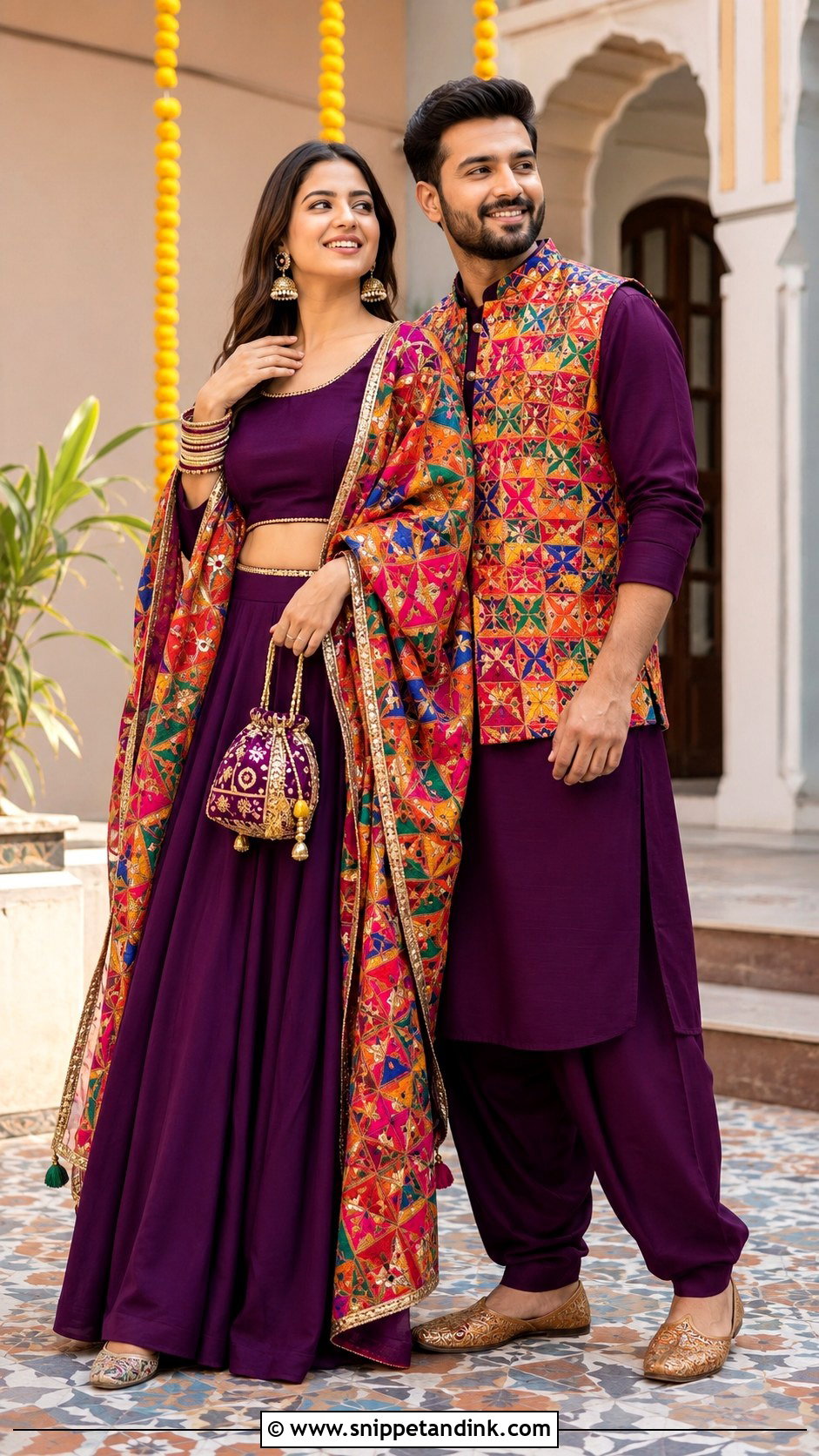
Phulkari brings so many colors that a Punjabi-inspired couple outfit only needs one of them repeated. She wears a solid lehenga or Patiala suit under a heavily worked Phulkari dupatta; he wears a kurta, pajama and a waistcoat in one shade lifted from it, with a matching turban if it suits the occasion and his tradition. Hand Phulkari is silk floss on cotton, and some handmade or older pieces bleed when they get damp, so I send it only to a cleaner who handles hand embroidery. Jhumkas, bangles, a potli and juttis for her; mojaris in a neutral or matching tone for him. Keep both base garments plain and let the dupatta be the only busy piece.
20. Indo Western Gown And Jodhpuri Suit Couple Outfit
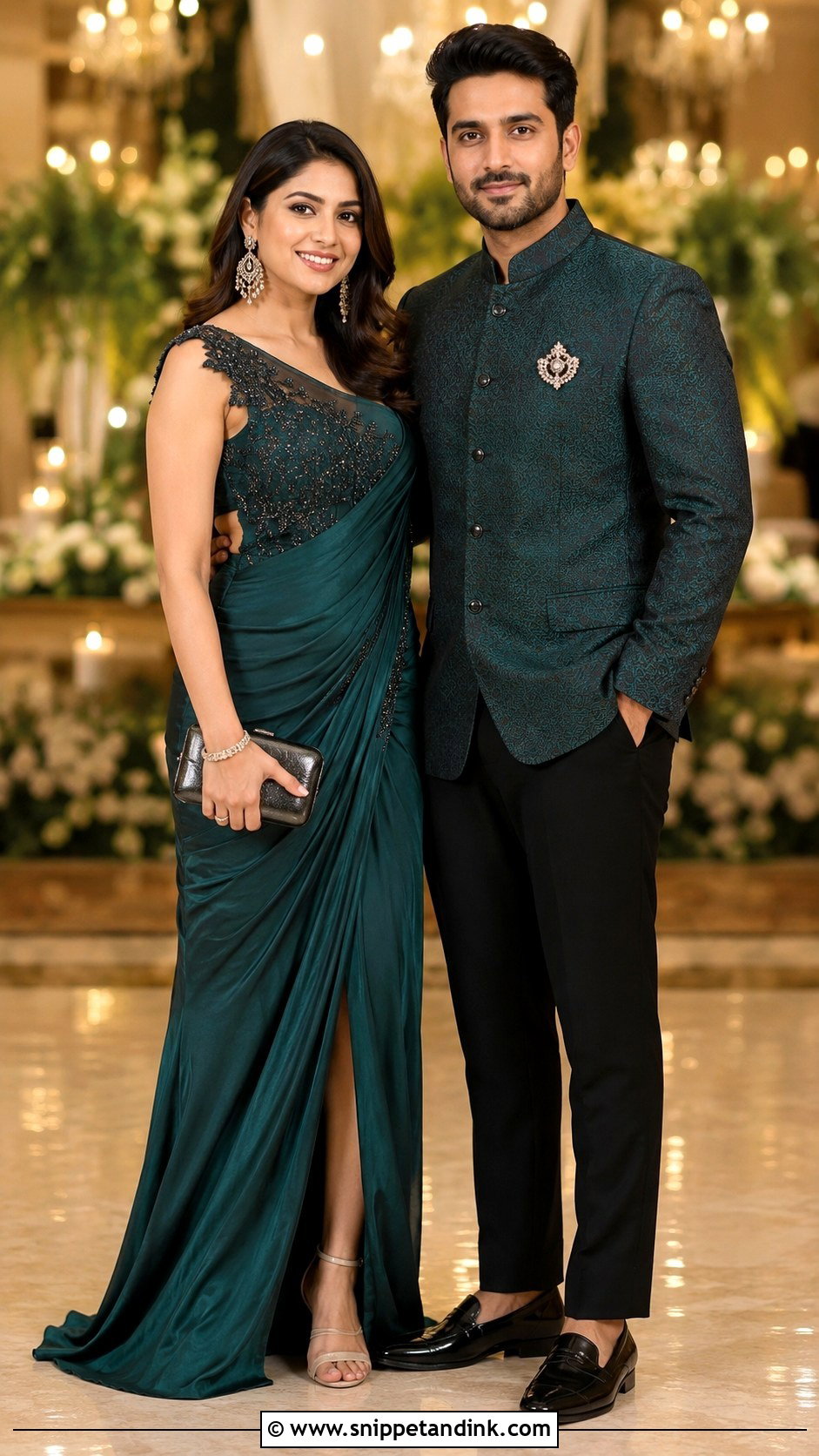
An Indo-Western gown and Jodhpuri suit are what I reach for when a couple wants the reception or sangeet to feel modern. Her gown can carry Indian embroidery, a cape sleeve or a blouse-style bodice, and his tailored Jodhpuri shares her color family or her metal. For evening I lean toward deep teal, wine, navy, charcoal or muted gold. The balance rule is simple: a detailed gown wants a clean suit, a plain gown can stand beside a richly textured jacket, and never both heavy. I also ask him to sit in the Jodhpuri at his fitting, because a closed collar and close-cut coat get warm fast at a long dinner.
Sitting Through Long Rituals in Silk and Zari
A Hindu wedding ceremony can keep a couple seated on a low platform for two hours or more, and that’s where outfits quietly fail. A heavy bridal lehenga can weigh several kilos, most of it in the skirt, so I make sure the waistband rests on the hip bones and closes with a drawstring as well as hooks, never one hook alone. Blouses get a little extra ease at the ribs for sitting, and I have the groom sit cross-legged at his fitting so I can see whether the sherwani strains at the buttons or rides up at the back.
Planning the Change Between Events
Couples with two functions in one day need a change plan as much as a second outfit. I pack each look’s jewelry, safety pins and blouse hooks in its own labeled pouch, and allow about an hour between the ceremony and the reception change, more if hair is being restyled. Someone other than the bride should know where each dupatta pin goes, because she won’t have free hands to show them.
Fitting Dates and Where the Zari Goes Afterward
Made-to-measure bridal lehengas commonly take three to six months from order to delivery, with heavy hand embroidery at the long end, while a tailored sherwani often needs six to ten weeks. Both vary a lot by atelier and season. I book the last fitting two to three weeks before the first event and ask both partners to bring the actual shoes, jewelry and undergarments, since each of those can change a hem or a neckline. Leave room for one more alteration after that.
Once the Wedding Is Over
Deal with perspiration first: air each outfit inside out for a day, then take it to a dry cleaner who works with zari and hand embroidery. For storage I wrap heavy pieces in soft muslin or old cotton, never plastic, and keep them folded flat rather than hung, because the weight of a skirt slowly stretches the waistband on a hanger. Refold along different lines every few months so the metallic thread doesn’t crack at the creases, and keep naphthalene balls out of direct contact with the zari.
A Shared Thread Matters More Than a Shared Color
Start with the event, then pick the one thing you’ll share: a color family, an embroidery finish, a fabric or a single motif. A lehenga can sit with a sherwani, kurta, bandhgala or Jodhpuri suit and still read as a pair through a stole, a button or a border. Look at your swatches together before ordering, and at the fitting, move in the clothes the way you’ll move on the day. Good fit and real comfort will carry a couple through a long wedding far better than head-to-toe copying ever does.
You'll Like These Ideas:


Leave a Reply