
Most of my Haldi work is on the groom’s side, and the question I hear every season is the same: how do we look like a pair without dressing like twins? The answer is to share one or two things, a color, a print, a border, and let everything else differ. The couple looks below cover lehengas, sarees, shararas, kurtas, jackets and regional dressing, from all-yellow sets to ivory contrasts, tangerine palettes and plain handloom cotton. Both of you will be smeared with paste, sitting on low stools and dancing afterward, so light fabric, secure drapes and flat shoes come first. The pairings work in a garden, a courtyard, a resort or the family home.
Coordinating a Pair When Two Tailors Are Involved
The bride’s outfit and the groom’s usually come from different shops, and that’s where coordination falls apart. A few habits keep it together:
- Swap fabric swatches early. Ask each tailor or store for a small cutting and compare them side by side in daylight, not under shop lights, which make every yellow look warmer.
- Decide the link before anyone cuts fabric. One shared element, the color, a print or a border, is easier to control than trying to echo everything.
- Order his outfit after hers is confirmed. Lehenga colors are often finalized late, and a groom’s kurta is quicker to make.
- Match the fabric weight, not just the shade. Heavy silk next to thin cotton looks uneven in photos, even in the same yellow.
Try both outfits on together once before the day, even in a living room. Sitting side by side on a low seat shows things a mirror won’t: whether his kurta length clashes with her dupatta fall, whether two prints fight, whether one of you looks far more formal than the other.
If budget is tight, the most effective thing to coordinate is his jacket or stole. It’s the piece the camera sees beside her, and it can be made from her leftover fabric.
1. Matching Yellow Lehenga And Kurta Haldi Outfits
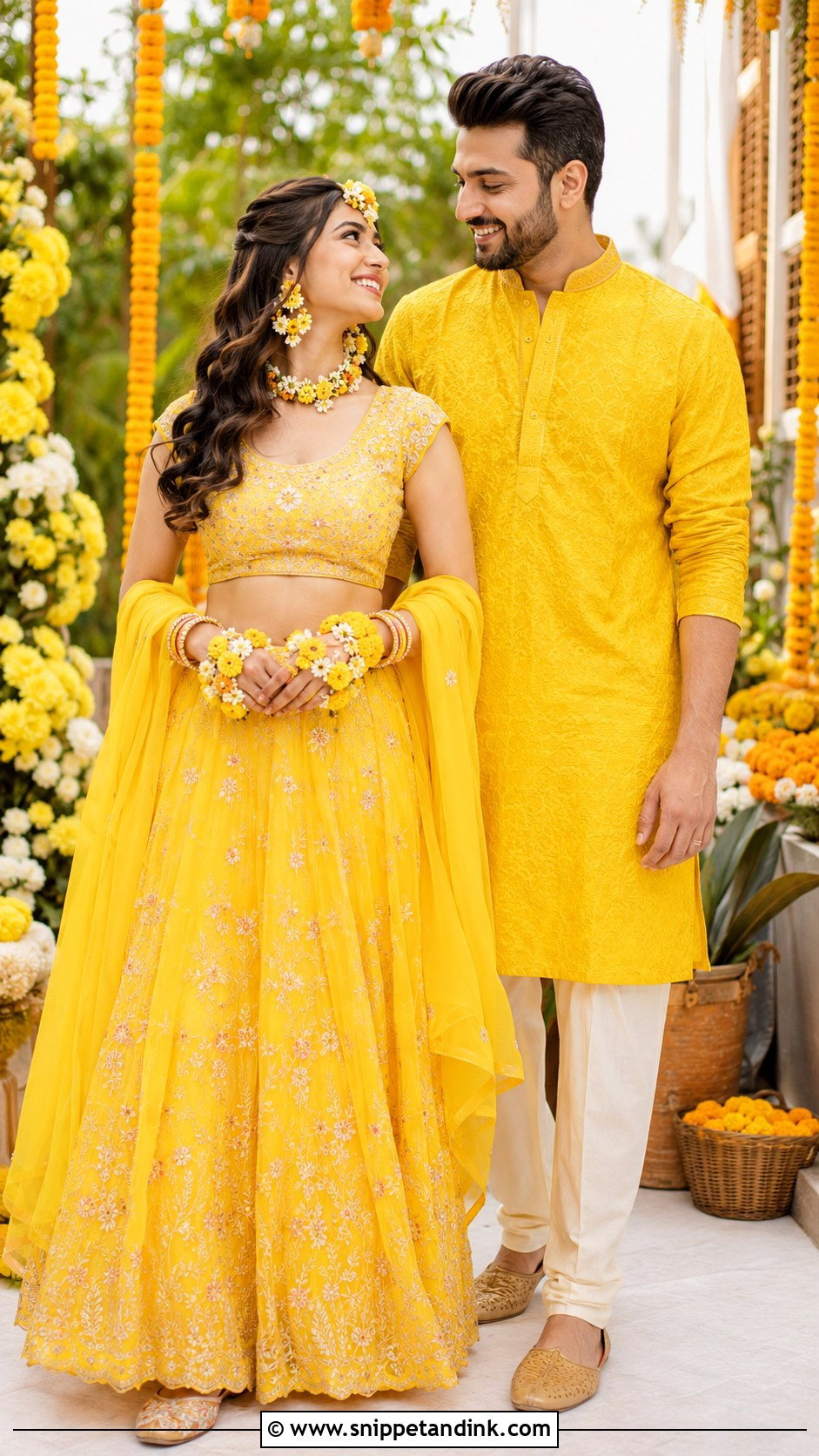
All-yellow is the classic, and it’s harder to get right than it looks. Two yellows bought from different shops almost never match, so either buy both fabrics together or deliberately choose two shades a step apart. The bride wears a lightweight yellow lehenga with a cropped blouse, organza dupatta and light gota or threadwork; he wears a cotton-silk kurta with ivory pajamas, tan juttis and a plain watch. Her floral earrings, bangles and a flower-dressed braid finish the pair. Against marigolds and greenery, the slightly different yellows read as depth rather than a mismatch.
2. Ivory And Yellow Haldi Outfits For Couple
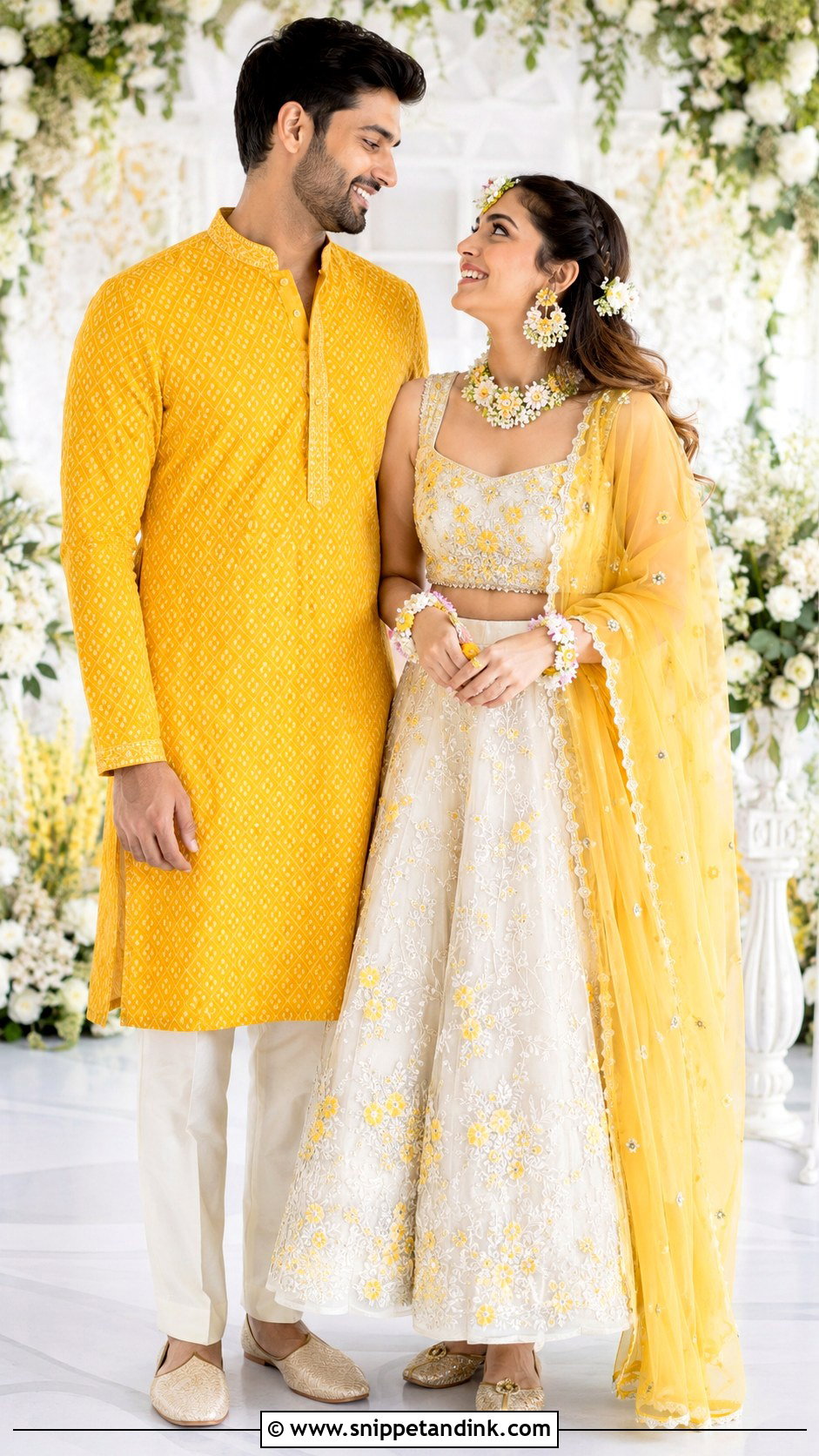
Here the colors swap places: she wears ivory with yellow embroidery, he wears solid marigold with ivory trousers. It’s one of my favorite approaches because each of you gets a distinct look and the link is obvious. The bride adds a sheer yellow dupatta, yellow flower jewelry and a low bun with jasmine. For him, a small ivory pocket square or an embroidered neckline ties back to her lehenga. Ivory shows every turmeric mark, so neither outfit should be an heirloom. Choose washable cotton or georgette and accept that it may come home a little yellower.
3. Mustard Anarkali And Pathani Haldi Outfits
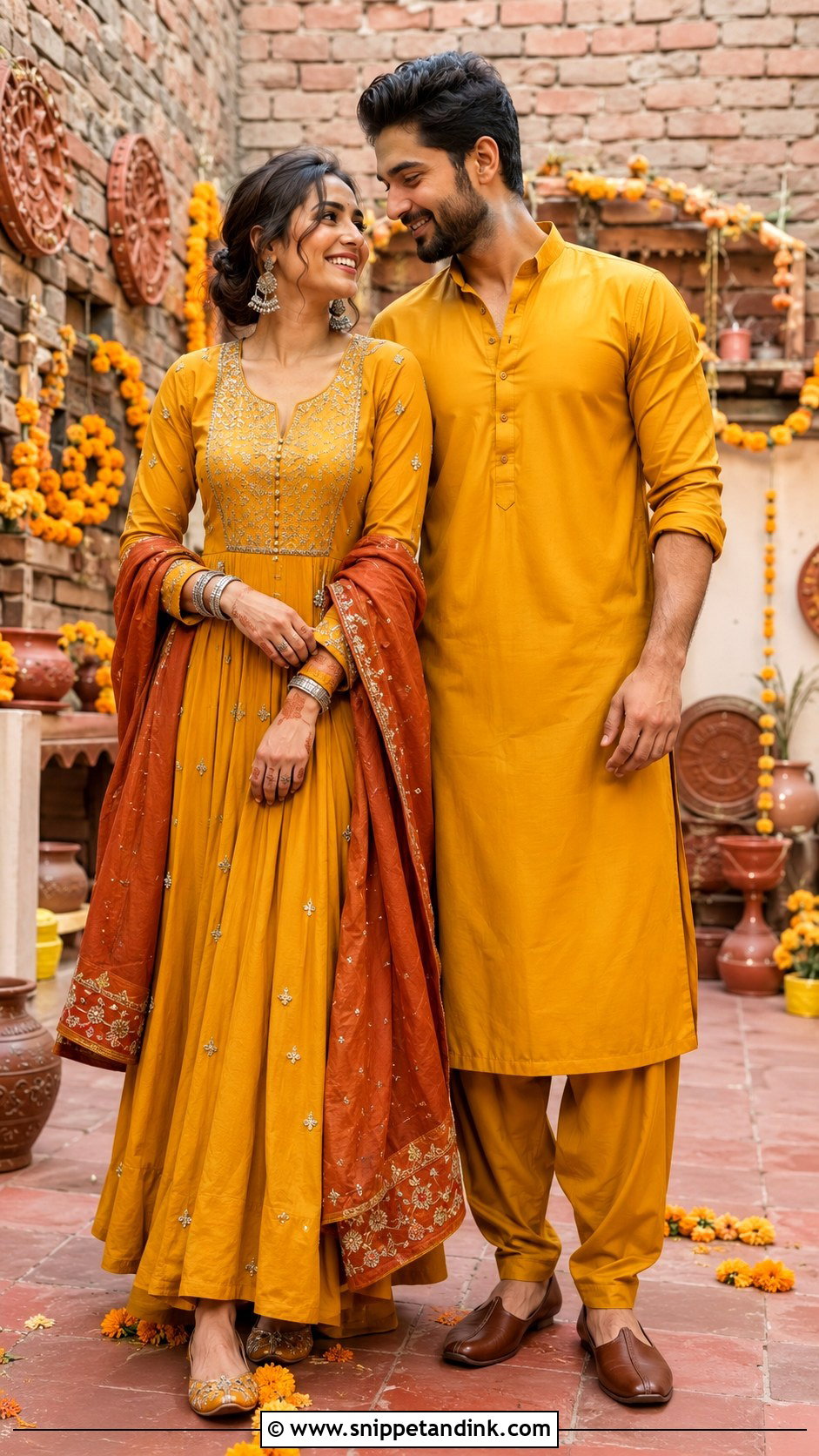
Deep mustard suits daylight and warm skin tones, and it hides paste better than pale yellow does. She wears a flowing mustard Anarkali with fitted sleeves, a churidar and a rust or fuchsia dupatta for contrast. He wears a mustard Pathani suit: a straight, collared kurta with a relaxed salwar, which sits more structured on the shoulders than a regular kurta. Brown leather juttis ground it. A tip from fittings: Pathani salwars are generous, so have the hem tapered slightly or it drags in spilled water. Oxidized earrings and stacked bangles finish her side.
4. Floral Lehenga And Floral Kurta Haldi Outfits
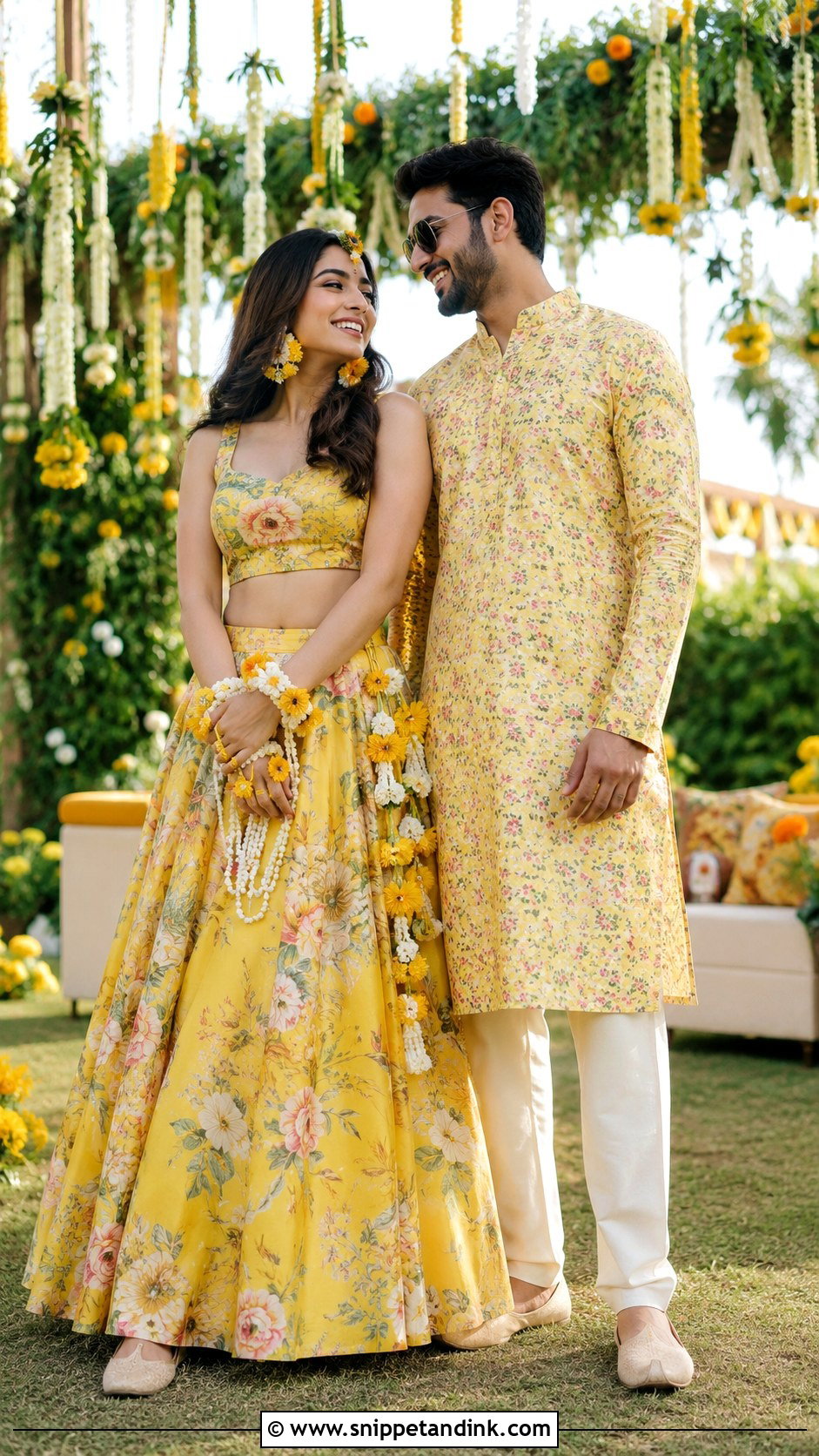
A shared floral theme lets you coordinate without matching a single color exactly. The rule I give couples is one bold print and one small print, never two large florals side by side, which blur together in photos. Usually the bride takes the larger print on a yellow lehenga with pink or green flowers, and the groom wears a smaller floral kurta that repeats one or two of her colors, over solid ivory pajamas. Her flower earrings, maang tikka and neutral juttis are plenty. He needs only classic footwear and a crisp collar. It suits a garden venue with hanging flowers.
5. Tangerine Sharara And Kurta Haldi Outfits
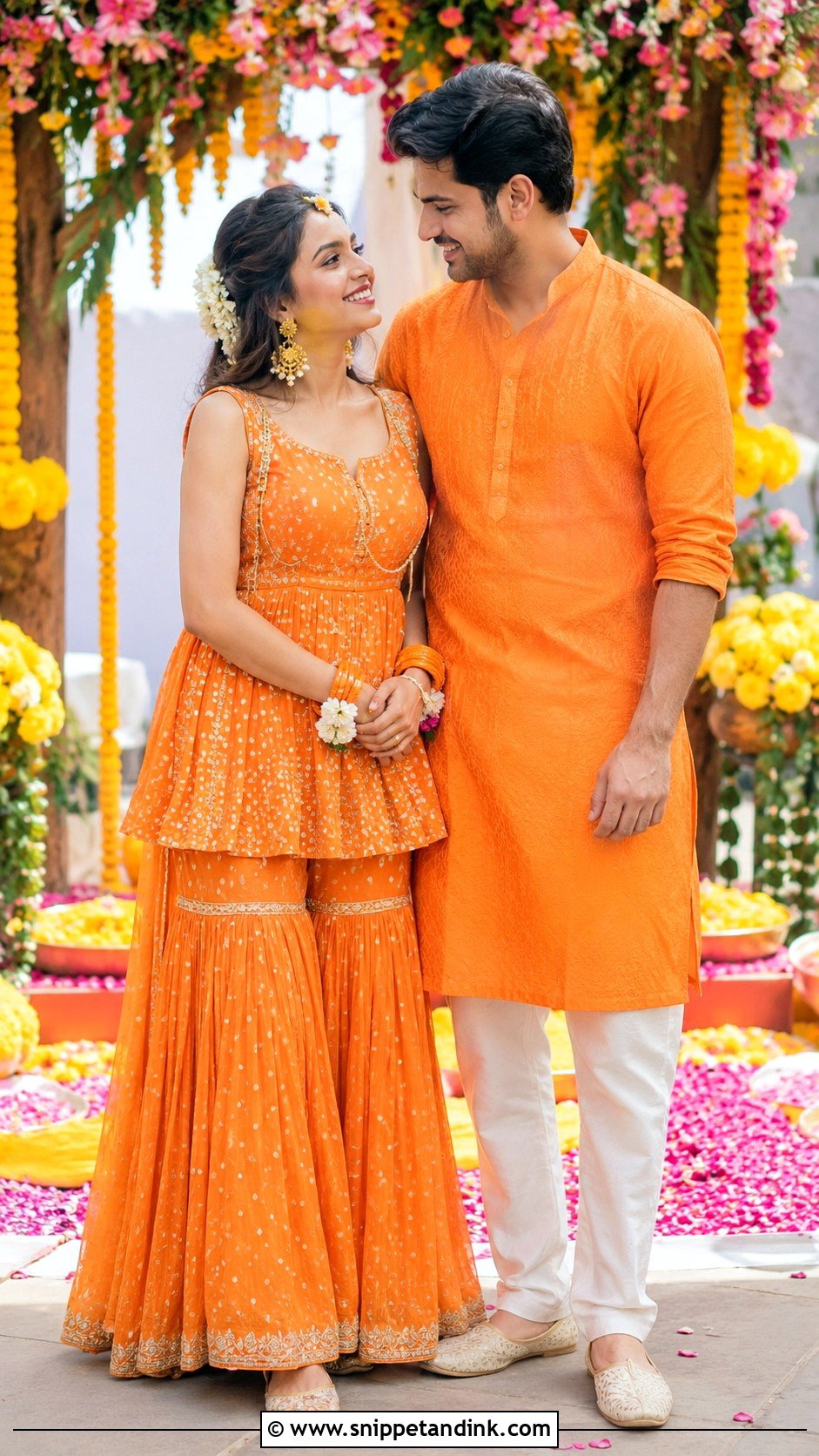
Tangerine keeps the sunny mood while standing apart from the sea of yellow guests. The bride wears a tangerine sharara with a short peplum kurti and a dupatta pinned at the shoulder. For grooms who find a full orange kurta too loud, I suggest an ivory kurta with a tangerine Nehru jacket; the jacket comes off when the paste starts, which keeps it clean for later photos. Gold earrings, orange glass bangles and white flowers balance her look. Keep embellishment light because a sharara already has a lot of movement.
6. Yellow Saree And Ivory Kurta Haldi Outfits
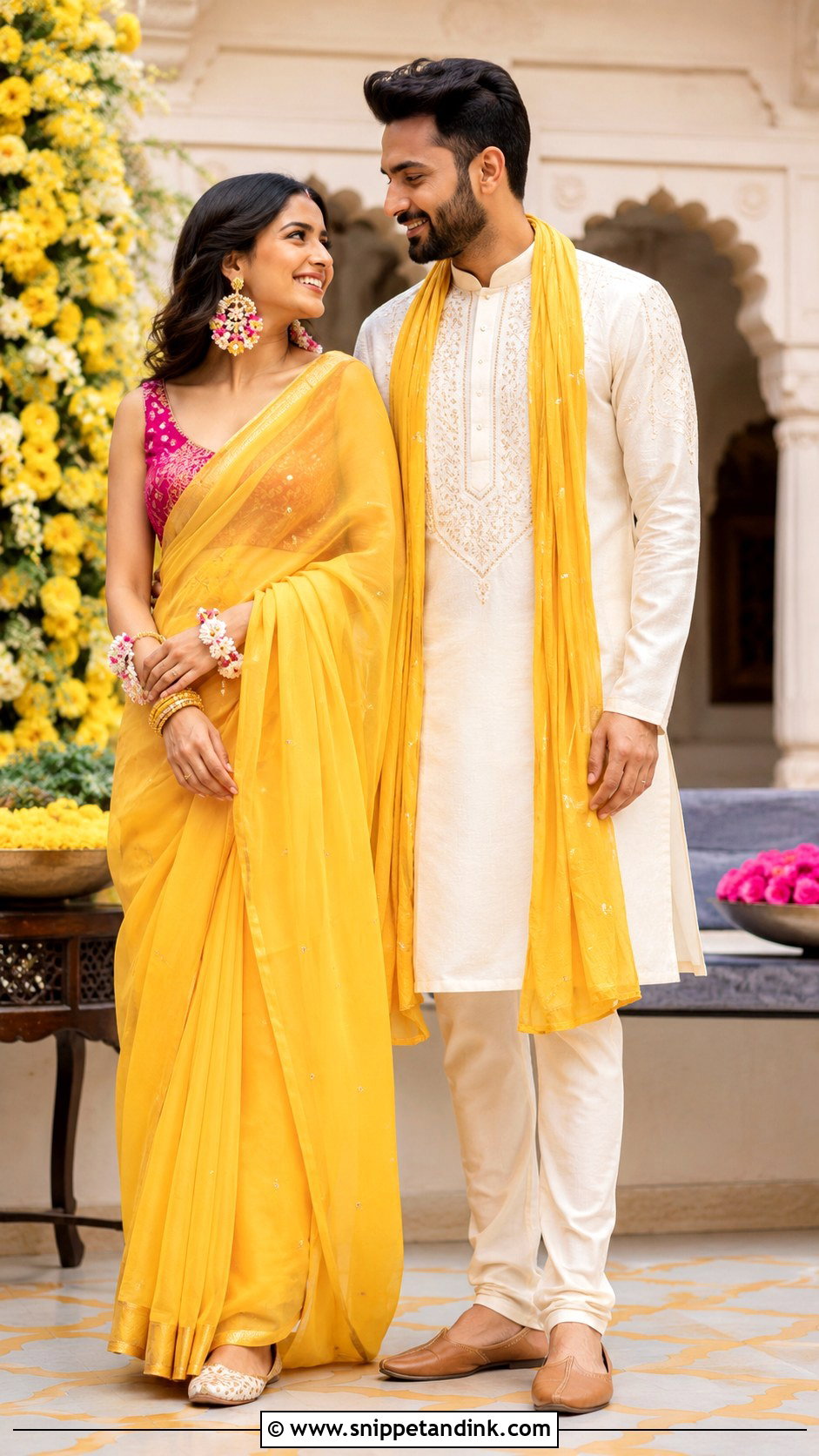
A saree with an ivory kurta is the traditional pairing, and it photographs calmly. She chooses chiffon, georgette or cotton silk with a narrow embroidered border, and a pink or orange blouse for contrast; pins at the pleats and shoulder keep the pallu out of the bowl. He wears an ivory kurta with a touch of yellow embroidery, straight pajamas and tan juttis. A yellow stole draped over his shoulder links the two without looking contrived. One practical point I always raise: thin ivory cotton turns see-through once it’s wet with paste, so he should wear a skin-toned vest underneath.
7. Yellow Dhoti Saree And Kurta Haldi Outfits
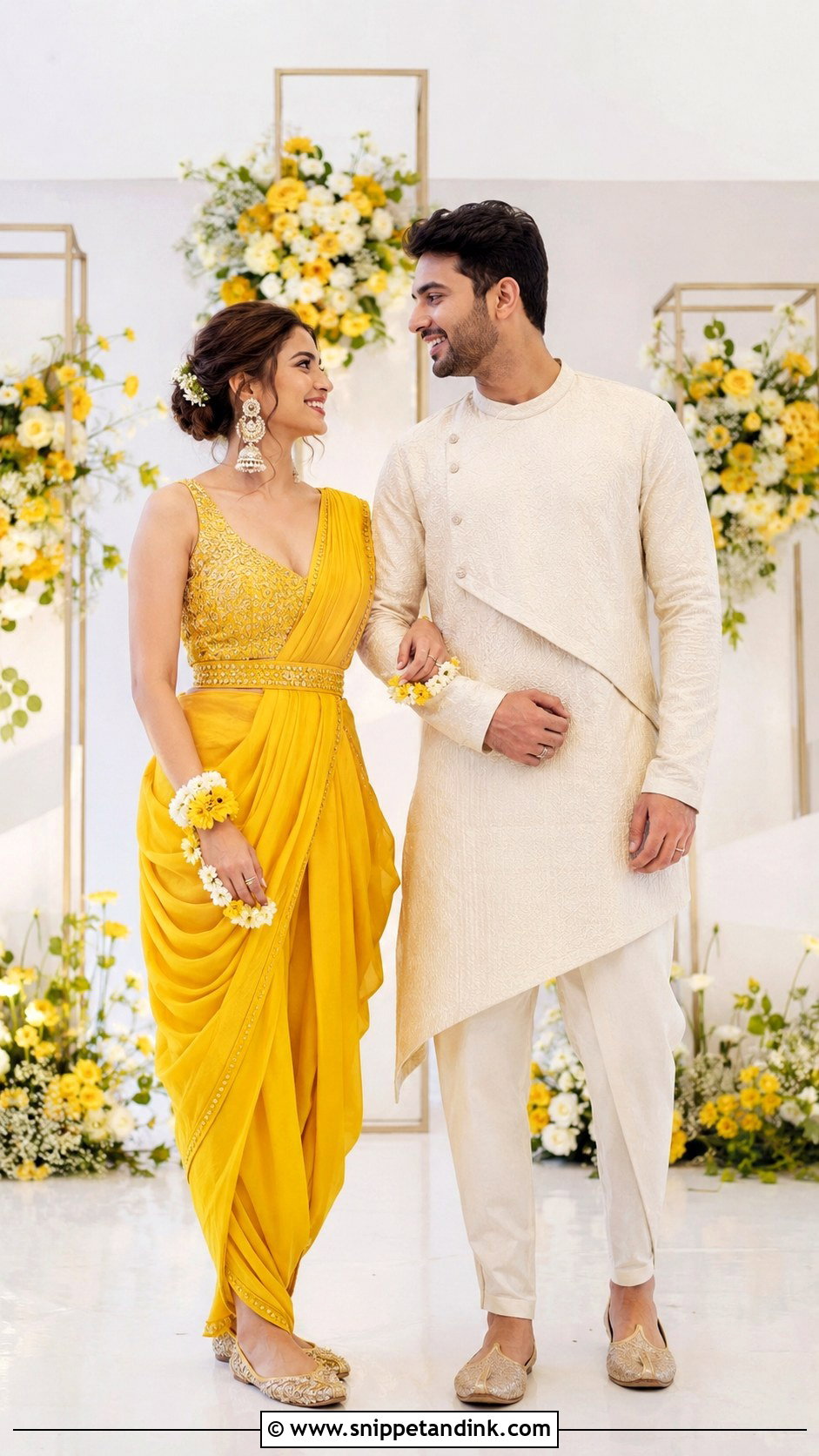
For a contemporary couple, a pre-draped dhoti saree gives the bride secure pleats and full movement, with a short pallu that stays out of the way and a waist belt to hold the drape. He wears a streamlined yellow or ivory kurta with tapered trousers and an asymmetric hem. I coordinate this pair through details, matching borders, buttons or pocket trims, rather than identical fabric. If his buttons are fabric-covered, swap them for removable metal ones before the ceremony, as covered buttons soak up turmeric and rarely clean. Statement earrings and embellished flats for her, loafers or juttis for him.
8. Mirror Work Lehenga And Nehru Jacket Haldi Outfits
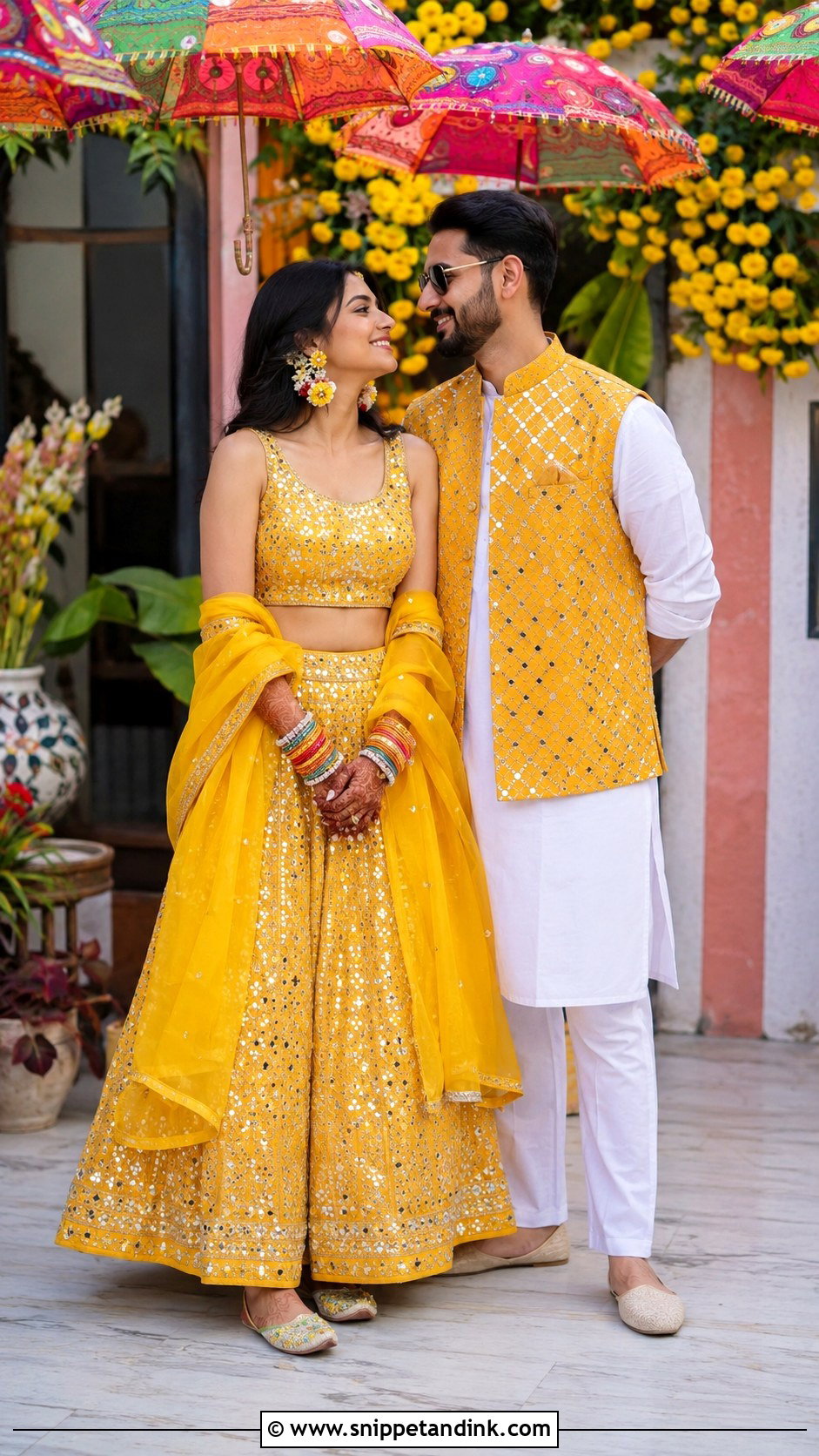
Mirror work catches daylight, so I limit it to one garment per person. She wears a yellow mirror-work lehenga with a plain blouse and plain organza dupatta. He wears an ivory kurta-pajama under a yellow mirror-work Nehru jacket. That keeps the pair balanced instead of glittering head to toe. Check that every mirror is firmly stitched, because Haldi involves a lot of hugging, and a loose mirror’s sharp edge can scratch. Small flower earrings, a delicate maang tikka and juttis finish her look. He needs only neutral footwear and a simple watch.
9. Yellow Chikankari Haldi Outfits For Couple
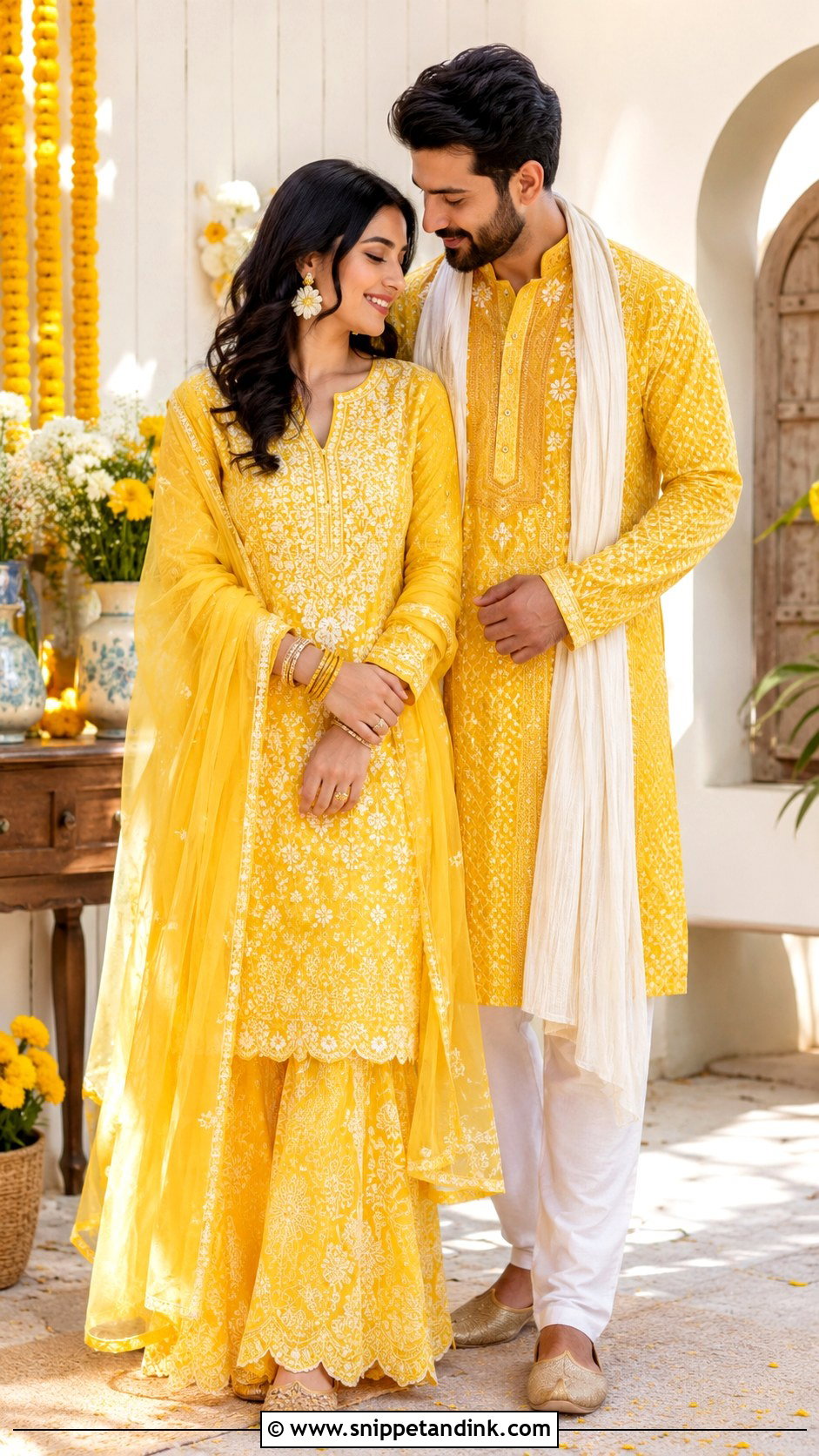
Chikankari on both outfits gives a soft, understated pairing for a daytime function. She wears a yellow chikankari kurta with palazzos and a fine dupatta; side slits on a long kurta let her sit on the floor easily. He wears a chikankari kurta with ivory pajamas and juttis. The embroidery doesn’t need to match, but the yellows should, so hold both fabrics together in daylight before you buy. Fine chikankari cotton is sheer, which matters most for him; a lined kurta or a vest underneath solves it. Pearl-and-flower earrings and a low ponytail with blooms suit the bride.
10. Yellow Bandhani Haldi Outfits For Couple
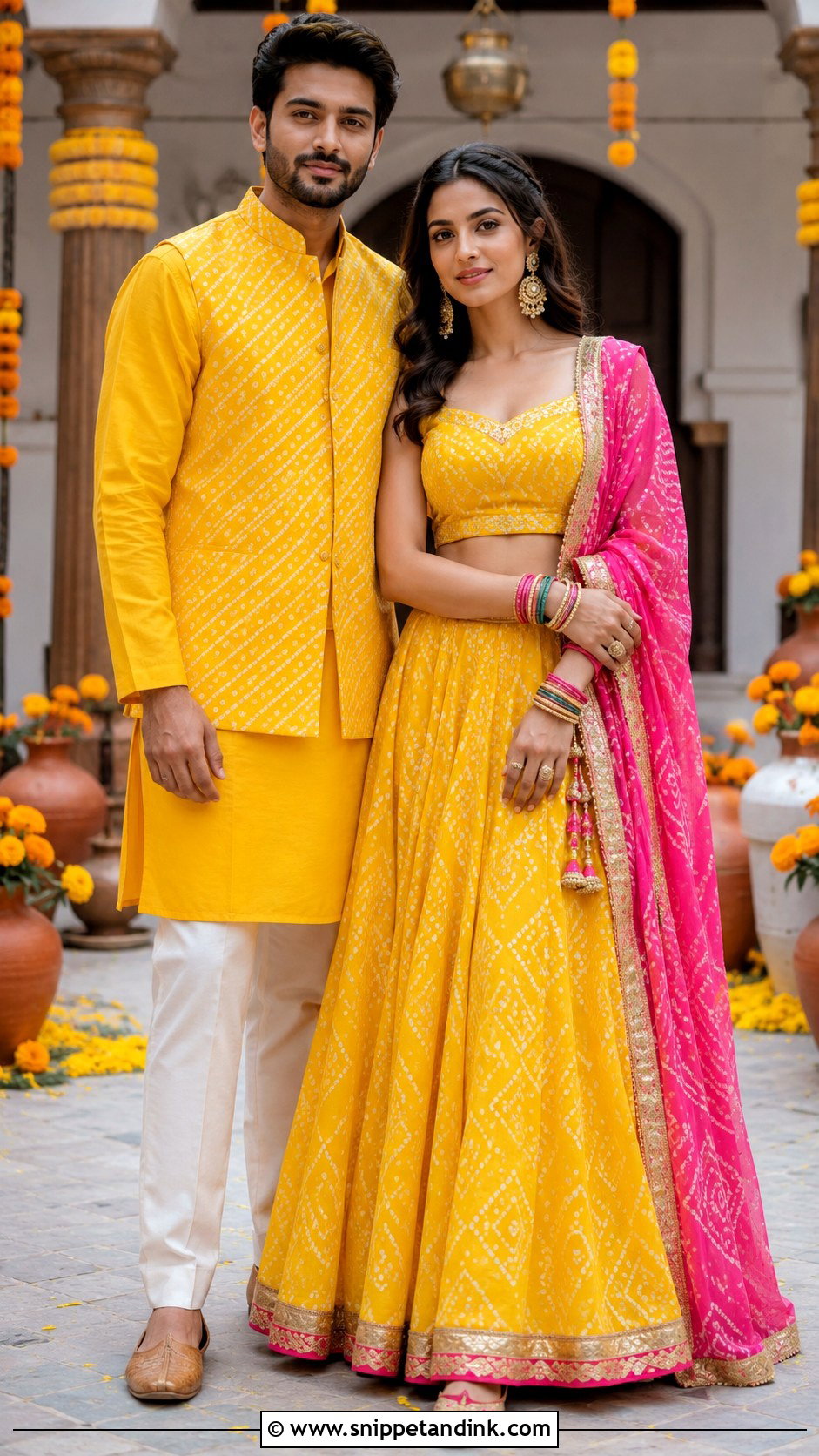
Bandhani carries regional character and lively pattern. She wears a yellow Bandhani lehenga with a fitted blouse and a pink or red dupatta, or a Bandhani saree in a secure drape. He wears a plain yellow kurta with a Bandhani jacket or stole, keeping the rest solid so the print isn’t everywhere. I warn couples that hand-dyed bandhani can bleed when soaked, so a wet red dupatta against his ivory trousers is a risk. Gold jhumkas, bangles and a bindi for her, tan footwear for him. It sits naturally among marigolds and clay pots.
11. Yellow And Green Haldi Outfits For Couple
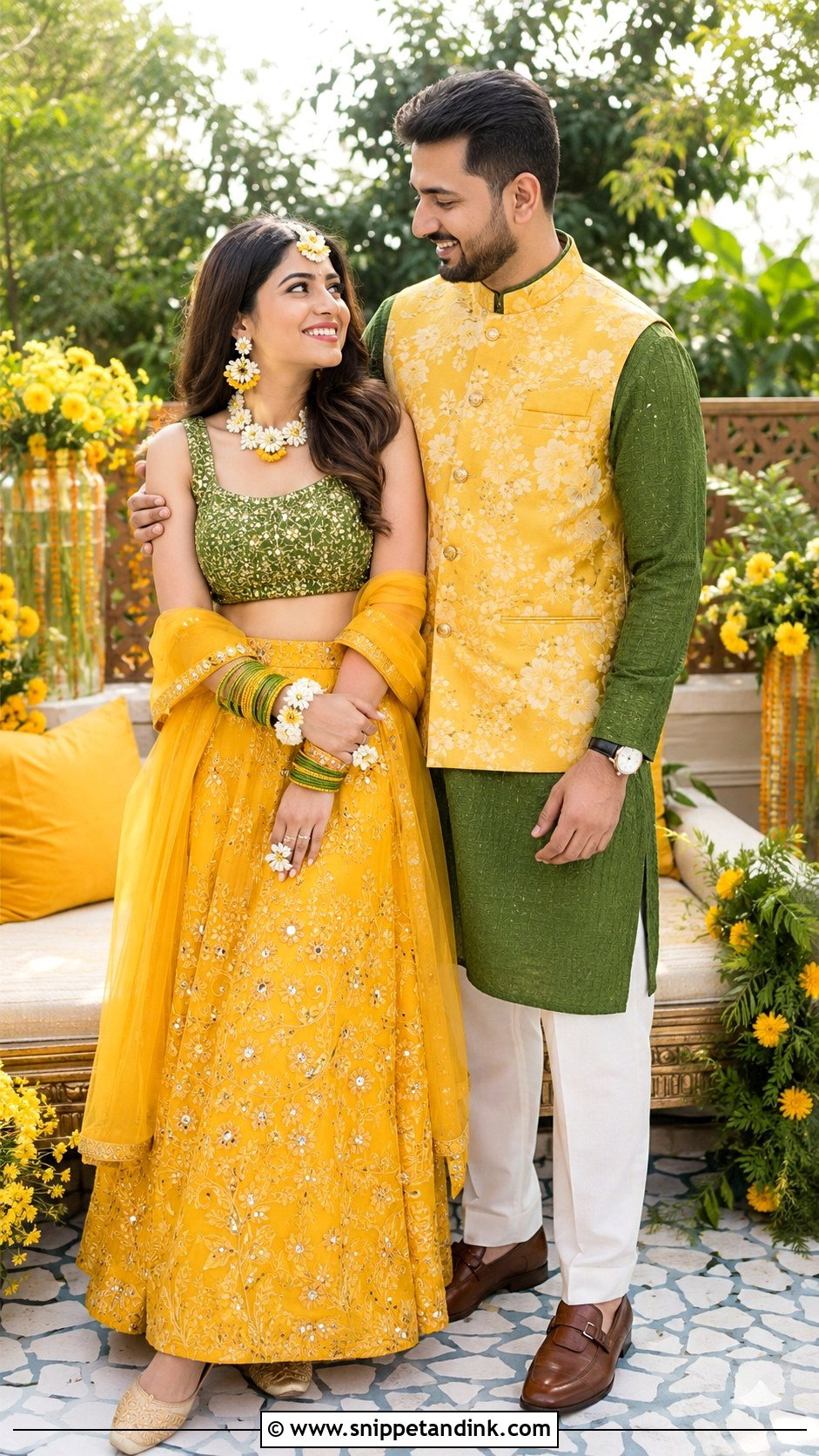
Yellow and green look fresh outdoors, and reversing the palette between you is a neat trick. She wears a marigold lehenga with a leaf-green blouse and a dupatta carrying both shades. He wears a green kurta, ivory trousers and a yellow printed Nehru jacket. One color should dominate each outfit, with the other as the accent; equal amounts look like a uniform. Her white floral jewelry, green bangles and a jasmine braid complete it, and he keeps to brown juttis and a classic watch. It suits a garden lawn surrounded by greenery.
12. White Haldi Outfits With Yellow Accents
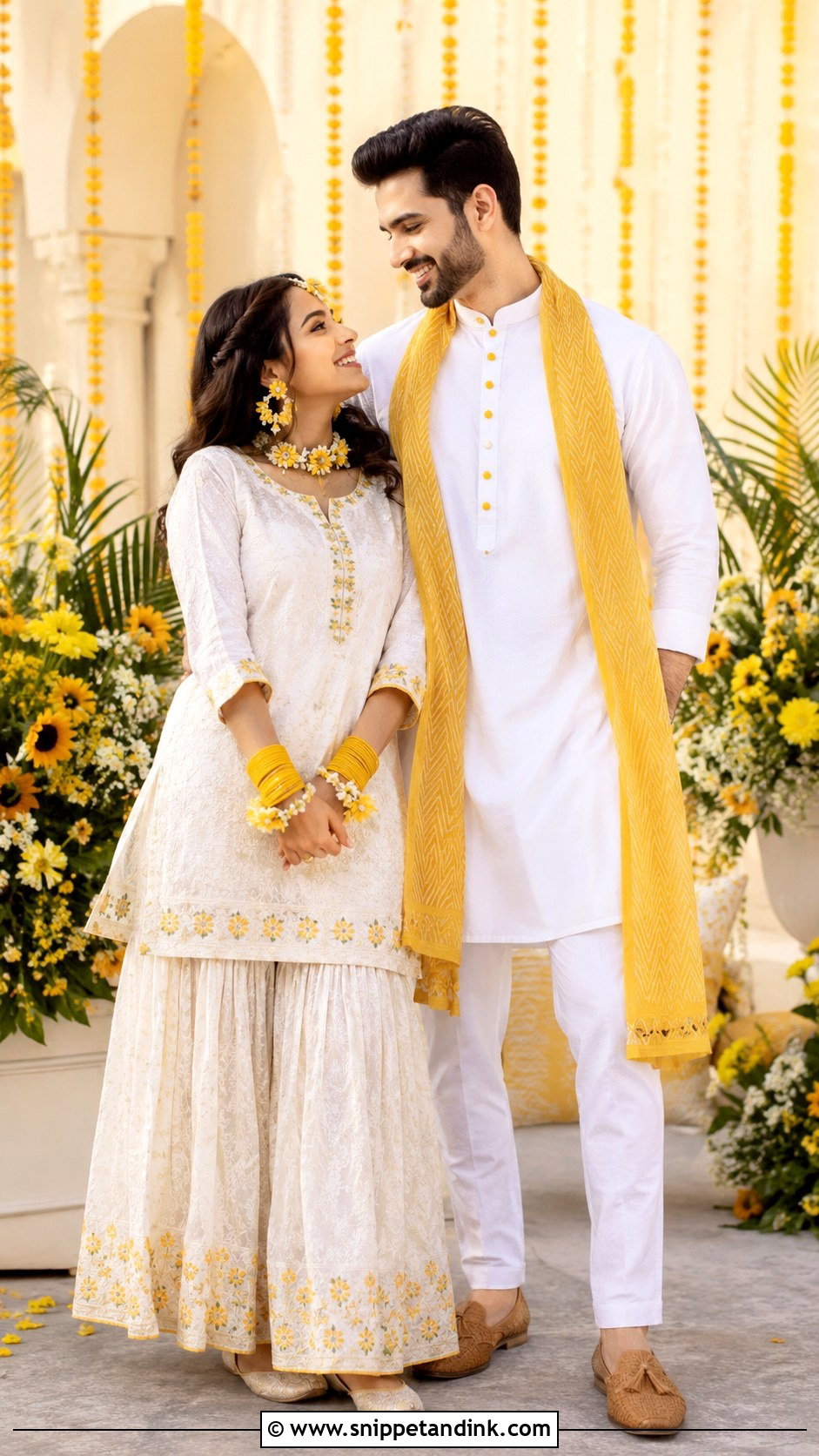
White with yellow accents is the choice for couples who want the turmeric to show. Paste will mark white fabric, and it rarely comes out completely. Some couples love that, keeping the stained outfits as a memento and letting the photographs show the change. If that’s you, she wears a simple white lehenga or sharara with yellow threadwork at the neckline and hem; he wears a white kurta-pajama with yellow buttons or a light stole. White flower jewelry mixed with marigolds, yellow bangles and ivory juttis for her, cream footwear for him. If you’d hate a stain, skip this one.
13. Pink And Yellow Haldi Outfits For Couple
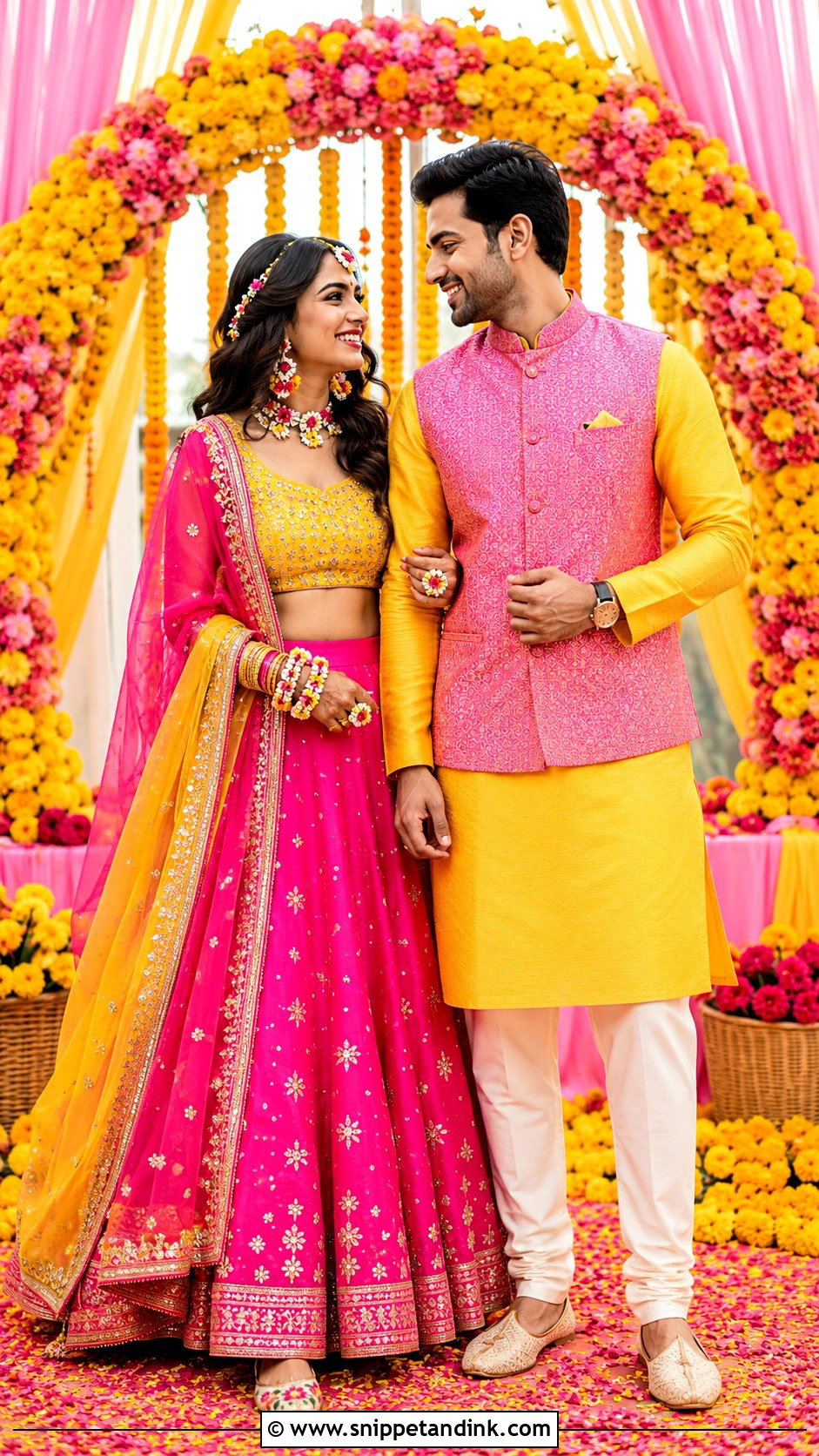
Pink and yellow are a cheerful daytime pair. She wears a fuchsia lehenga with a yellow blouse and a two-tone dupatta; he wears a yellow kurta and ivory pajama with one pink touch, a pocket square, stole or embroidered jacket. One shared accent per person is enough. Don’t add a third strong color, since fuchsia and yellow already carry the look. Pink-and-yellow flower jewelry, glass bangles and a maang tikka finish her side, and he needs only beige juttis. It pairs well with marigold arches and bright patterned seating.
14. Lime Green And Yellow Haldi Outfits
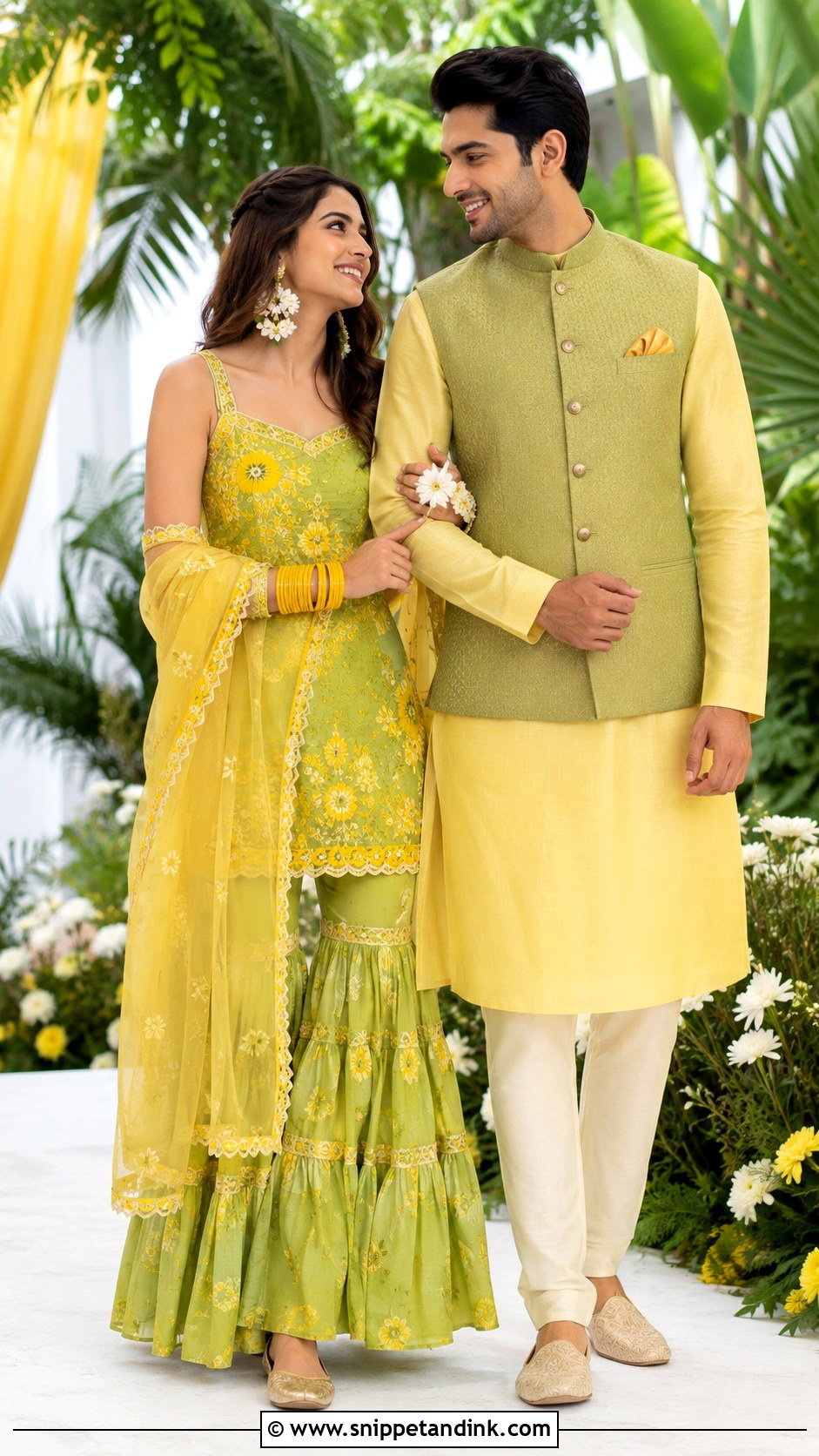
Lime and yellow is a playful update. She wears a lime green sharara or light lehenga with yellow floral embroidery and a sheer yellow dupatta; he wears soft yellow with ivory trousers and a lime Nehru jacket. Each outfit carries both colors without matching. Lime can look harsh on camera in strong midday sun, so I soften one of the two shades, a paler lime or a buttery yellow. White flower earrings, yellow bangles and gold flats suit her; neutral juttis for him. It fits a poolside or tropical setting.
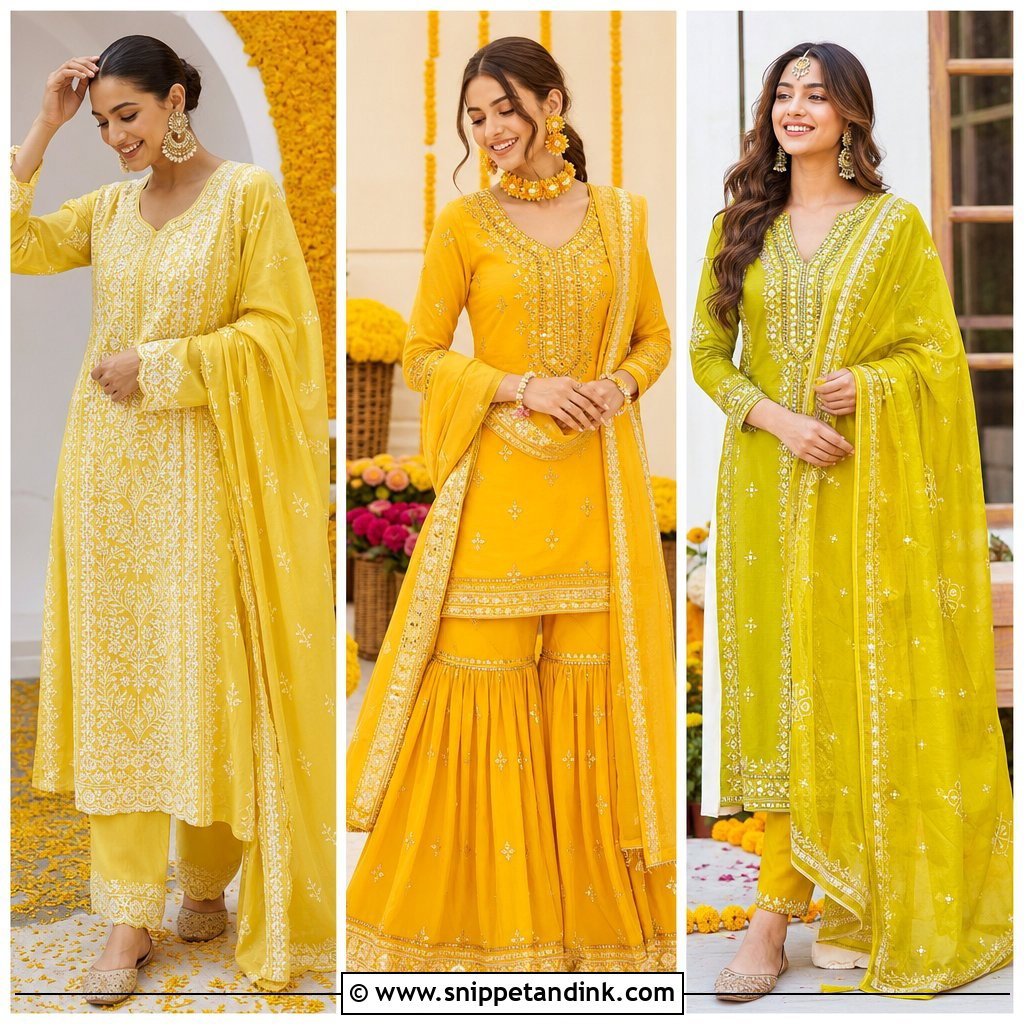
15. Printed Lehenga And Jacket Haldi Outfits
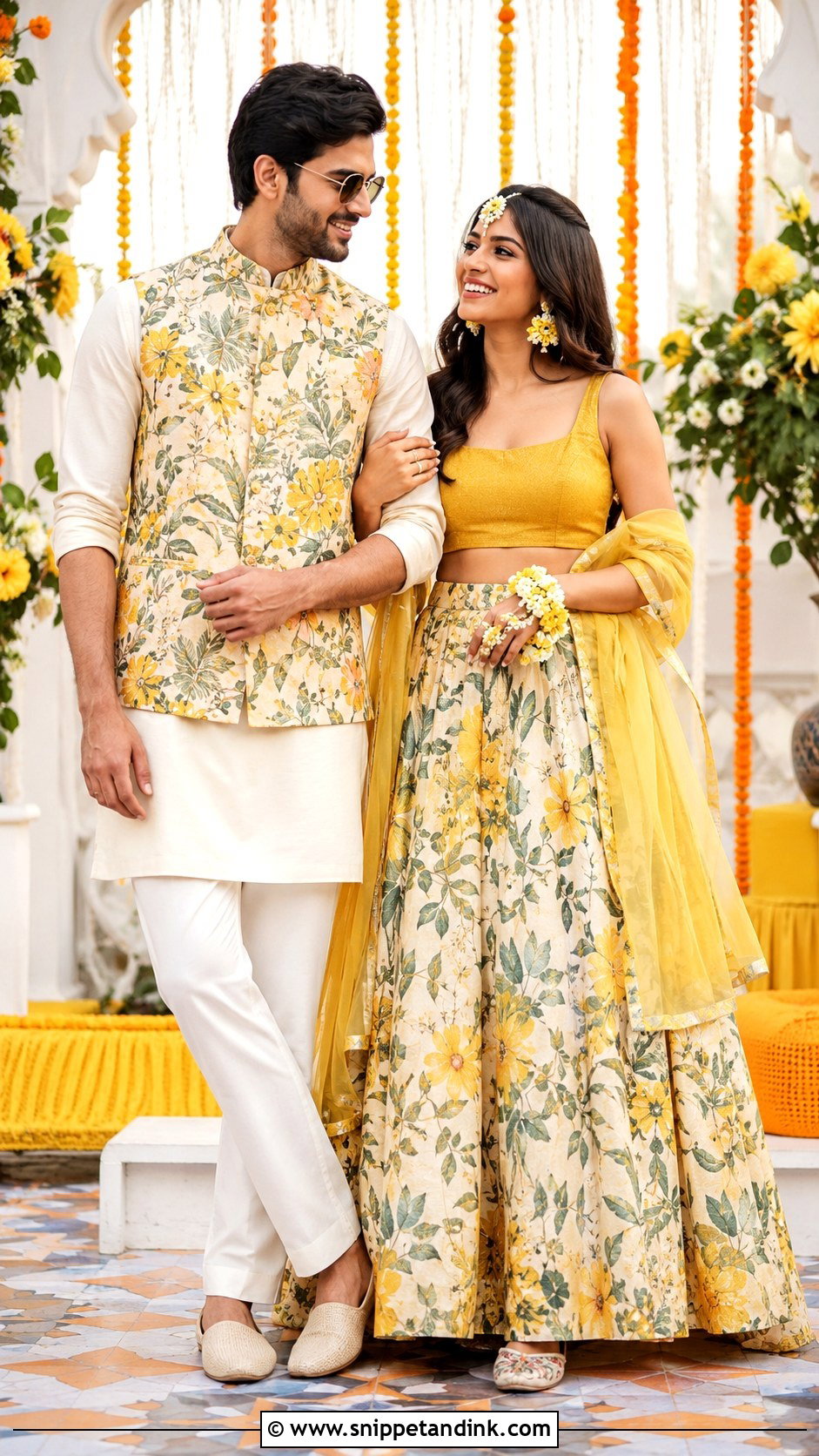
A shared print bridges two very different silhouettes. She wears a yellow lehenga with small flowers, vines or geometric motifs, with a solid blouse and simple dupatta so the print stays central. He wears an ivory kurta-pajama with a jacket in the same print. Most tailors can make a jacket from leftover lehenga fabric if you ask early, before the skirt is cut. A subtler option is a solid jacket with only a printed pocket. Her light earrings, stacked bangles and flat juttis keep it easy, and neutral footwear on both of you stops the prints looking busy.
16. Punjabi Haldi Outfits For Couple
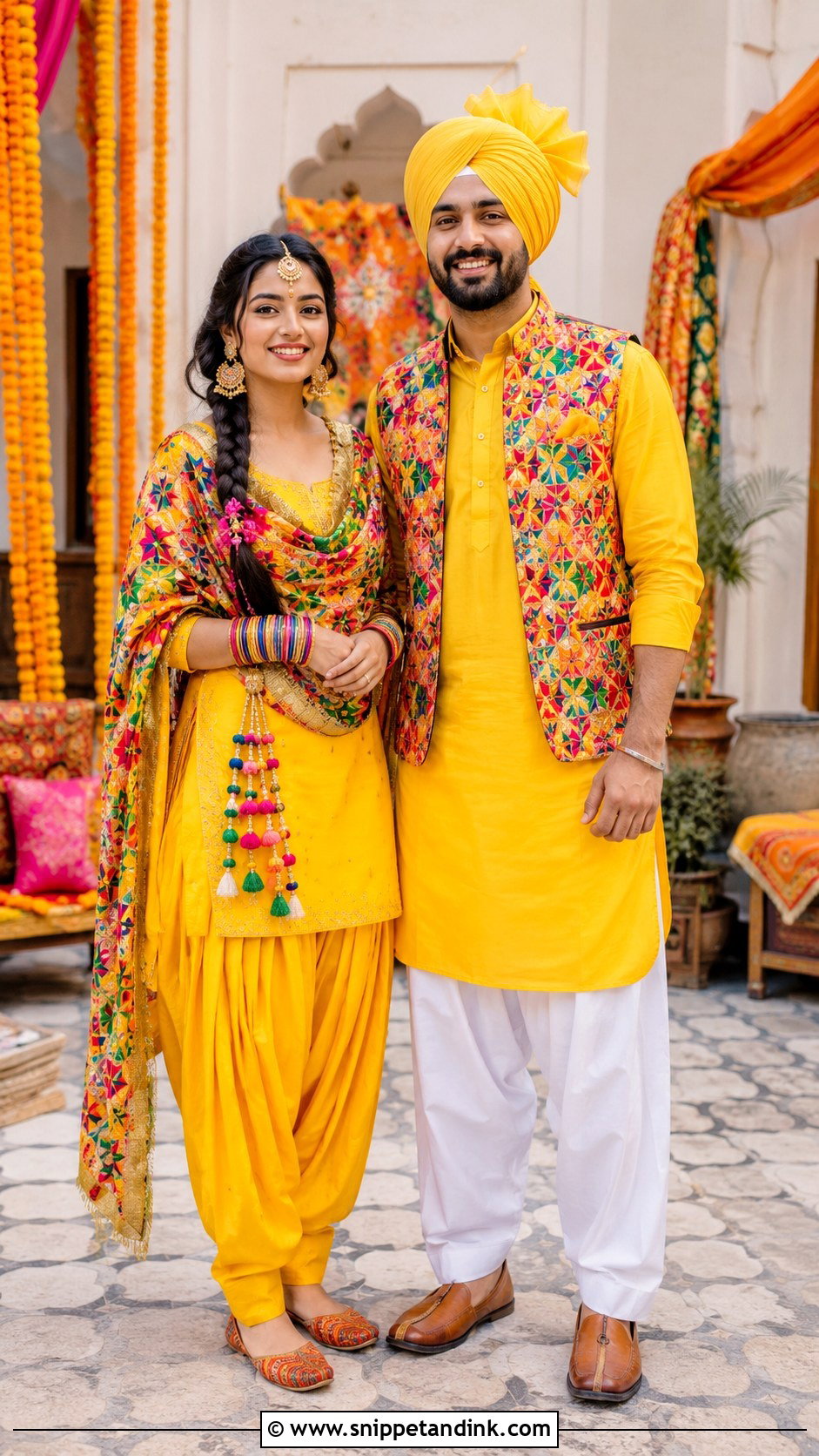
A Punjabi-inspired couple look is built for dancing. She wears a yellow Patiala suit, the deeply pleated salwar giving plenty of room, with a short embroidered kameez and a phulkari dupatta in pink, orange and green. He wears a yellow kurta with a white pajama or salwar and a phulkari waistcoat. A coordinated turban can match if it suits your family’s customs; I’d talk it through with the elders first. Jhumkas, bright bangles, a paranda braid and Punjabi juttis for her, plain leather juttis for him. The phulkari is heavy, so pin her dupatta securely.
17. Bengali Haldi Outfits For Couple
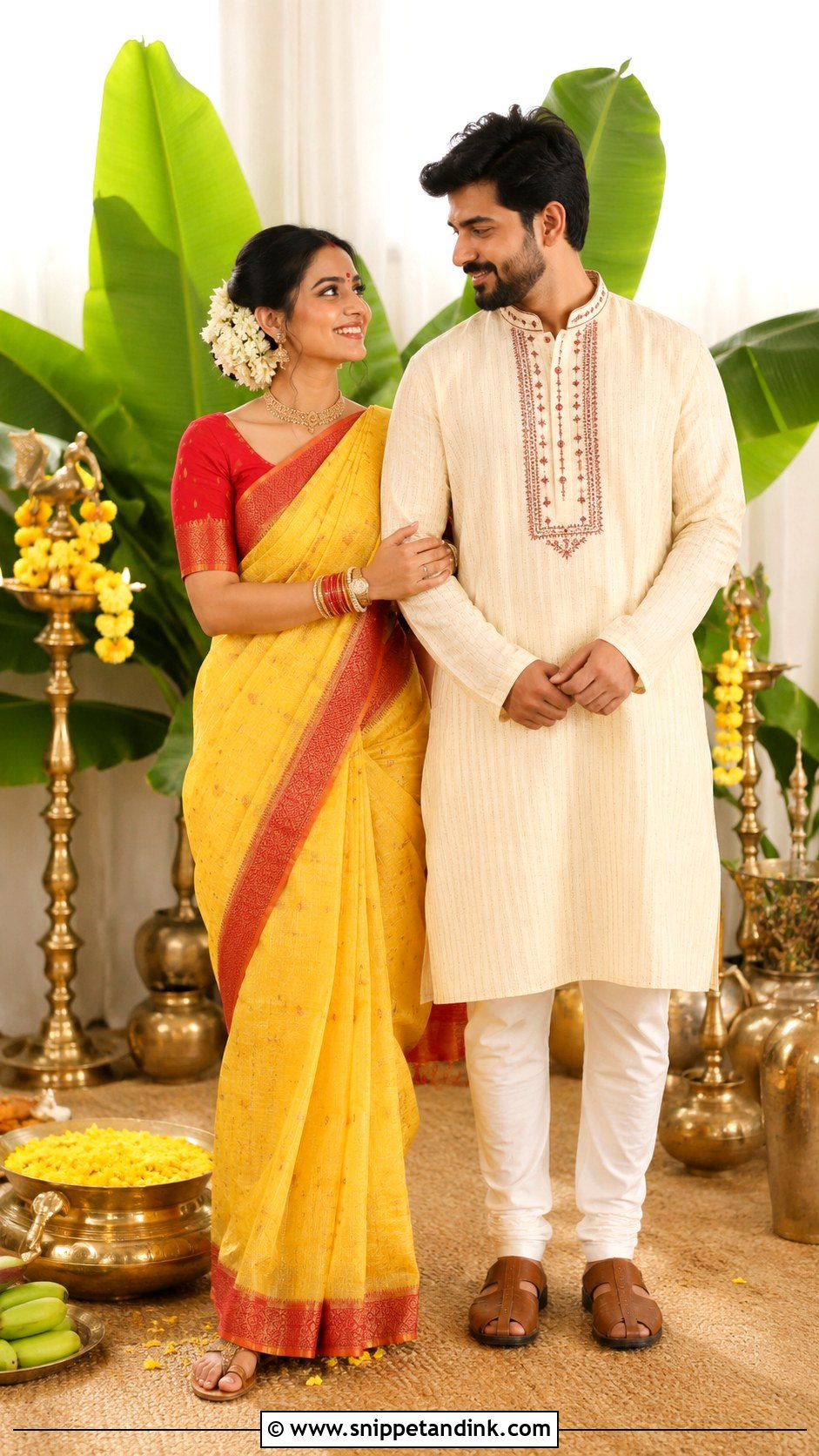
In Bengali tradition the gaye holud is often held separately at each family’s home, so check whether you’ll even be photographed together before coordinating. When you are, a yellow handloom or soft silk saree with a red border and red blouse is classic for the bride. He wears a cream or yellow panjabi with a white pajama or dhoti and a little red embroidery. Shared yellow, cream and red keeps them connected. Add a red bindi, white-and-red bangles, flowers in her bun and flat sandals; brown traditional footwear suits him. Brass, banana leaves and marigolds make a natural backdrop.
18. South Indian Haldi Outfits For Couple
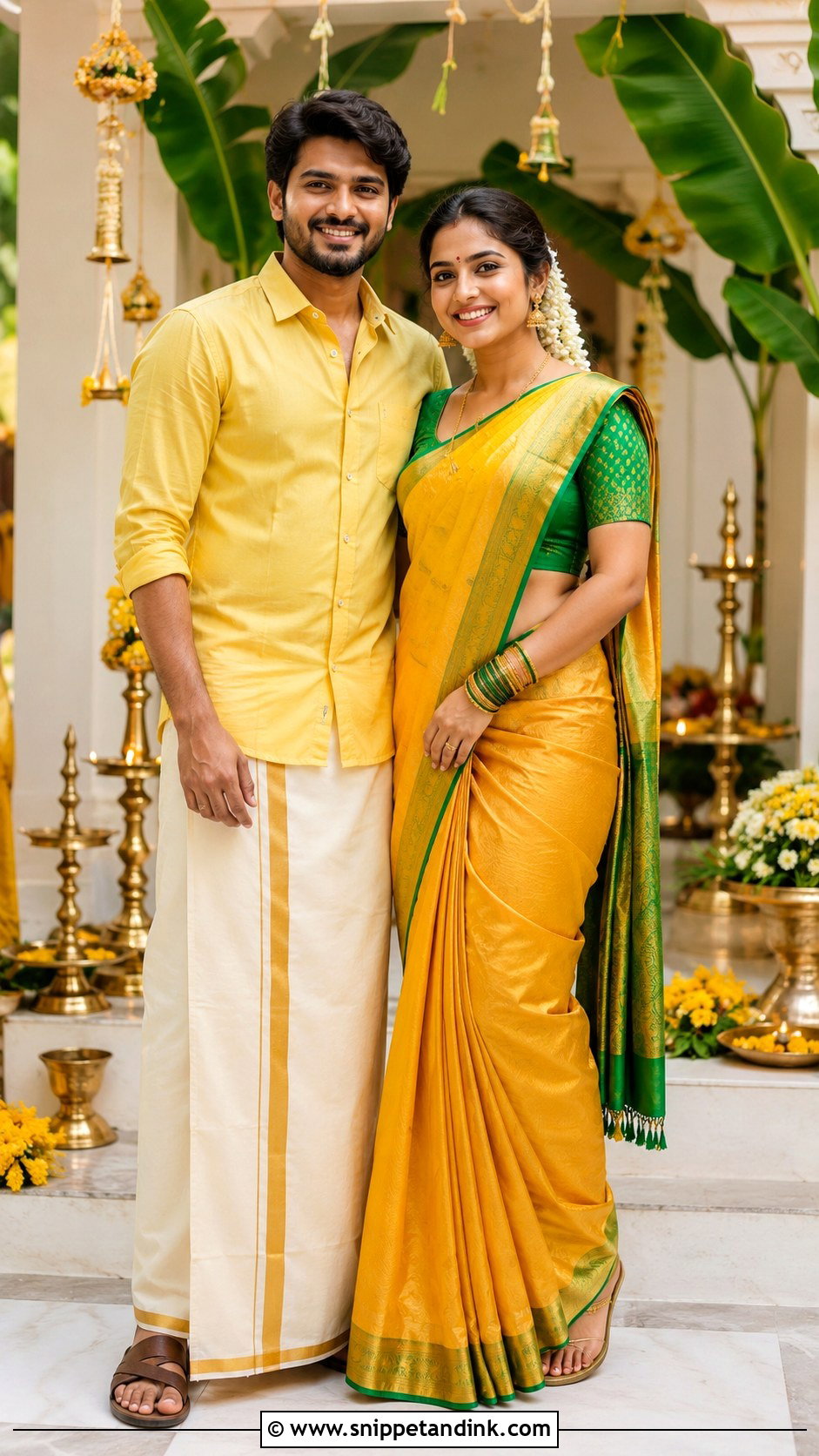
For a South Indian pairing, she wears a yellow silk saree and he wears a cream veshti with a gold border, topped with a yellow kurta or traditional shirt. I’d steer the bride toward a lighter silk than her wedding saree, with a green or pink border; a heavy Kanjivaram is too hot and too precious for turmeric. Pin the pallu neatly. Jasmine, small gold-toned earrings, bangles, a bindi and comfortable sandals complete her look. He needs only brown sandals and a watch. Matching the saree border and veshti border is the quiet link between you.
19. Boho Haldi Outfits With Shell Jewelry
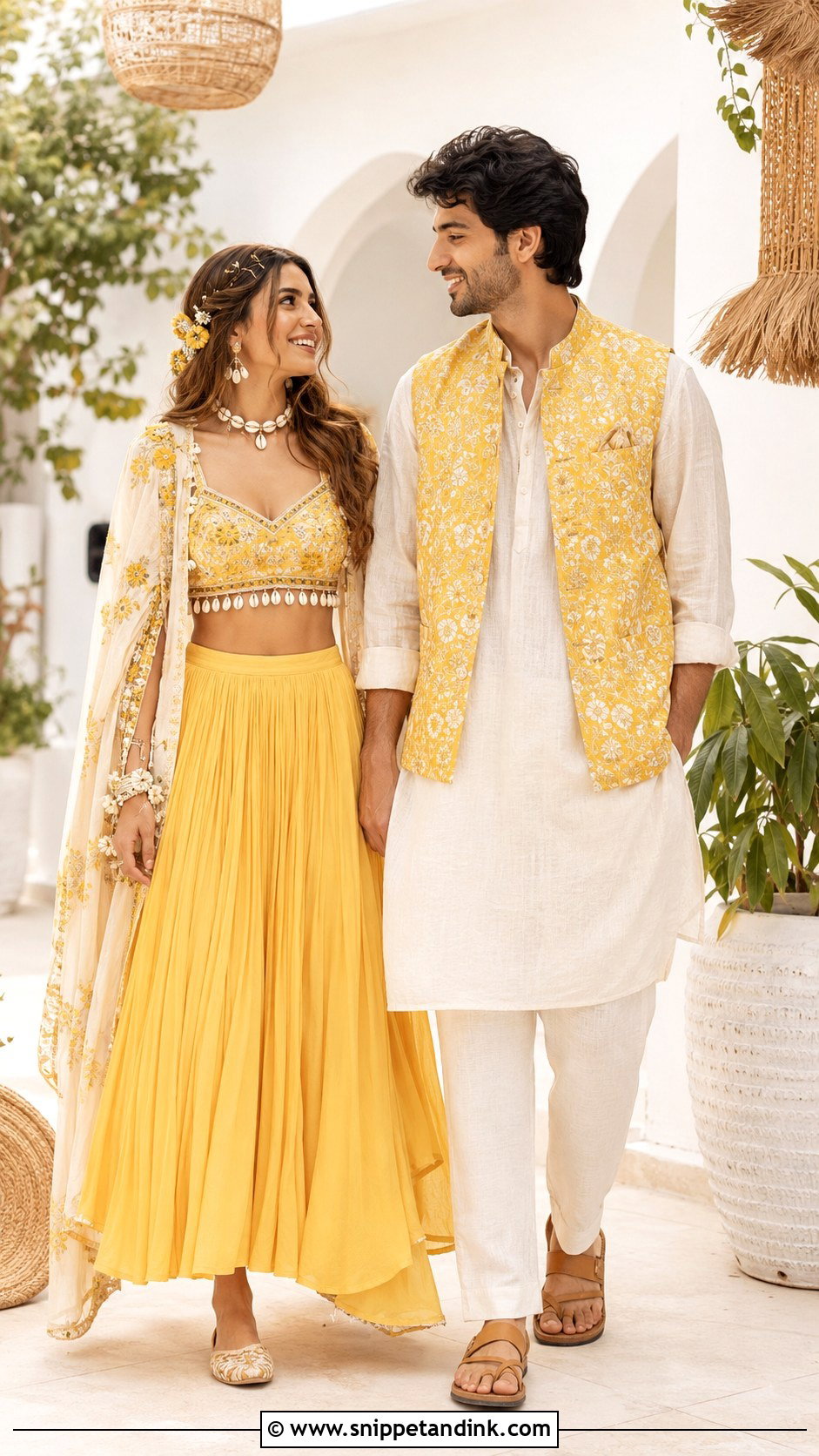
Boho Haldi looks belong at the beach or a resort. She wears a flowing yellow skirt with a cropped blouse and a light cape or short dupatta, with white embroidery or tassels for texture. He wears a breathable linen kurta with relaxed pants and a yellow printed waistcoat. Linen creases the moment you sit, which I tell grooms to embrace rather than fight. Shell earrings, shell bracelets, floral pins and woven flats suit the setting; tan loafers or leather sandals for him. Keep the palette to yellow, ivory and beige.

20. Handloom Cotton Haldi Outfits For Couple
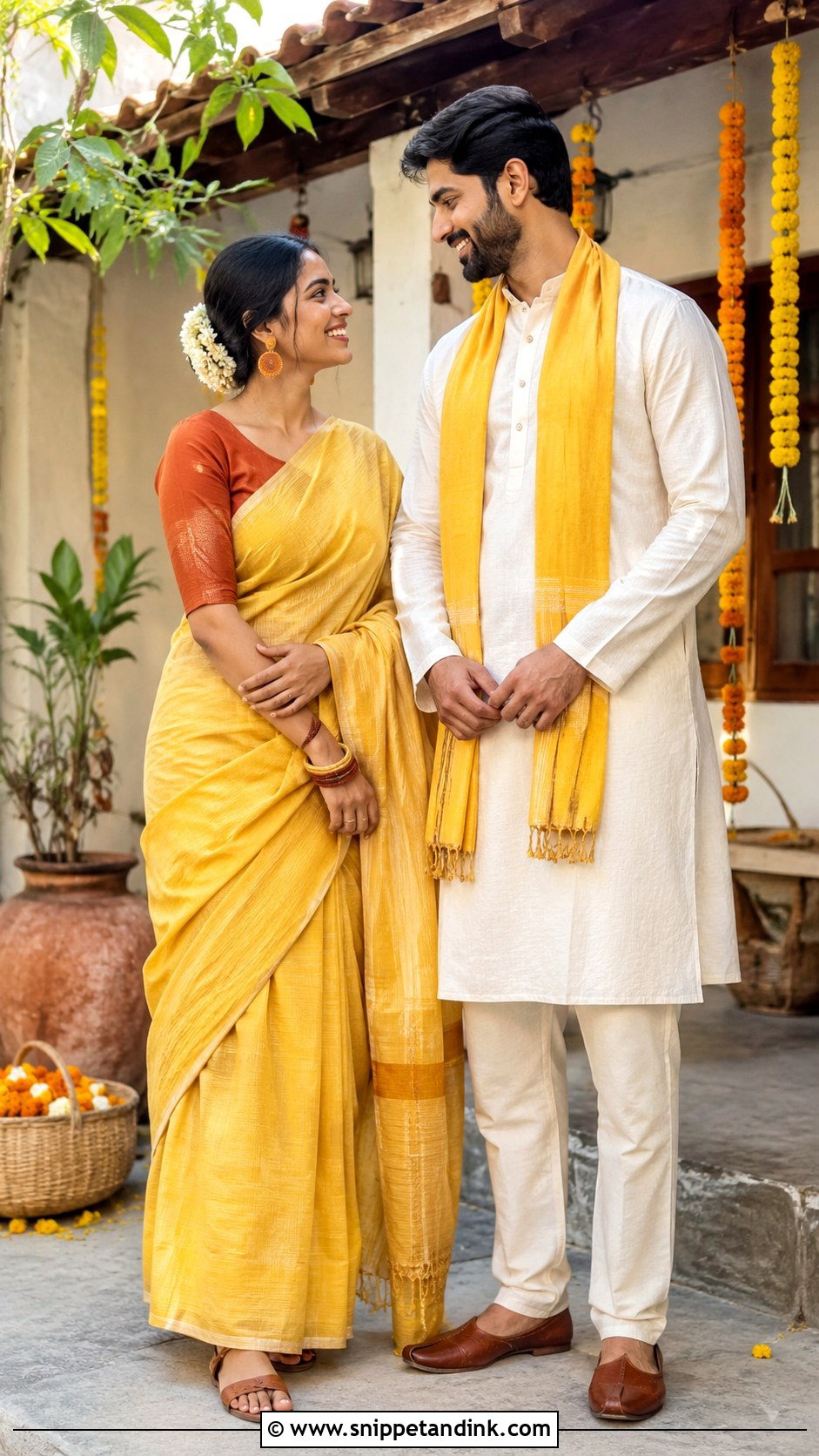
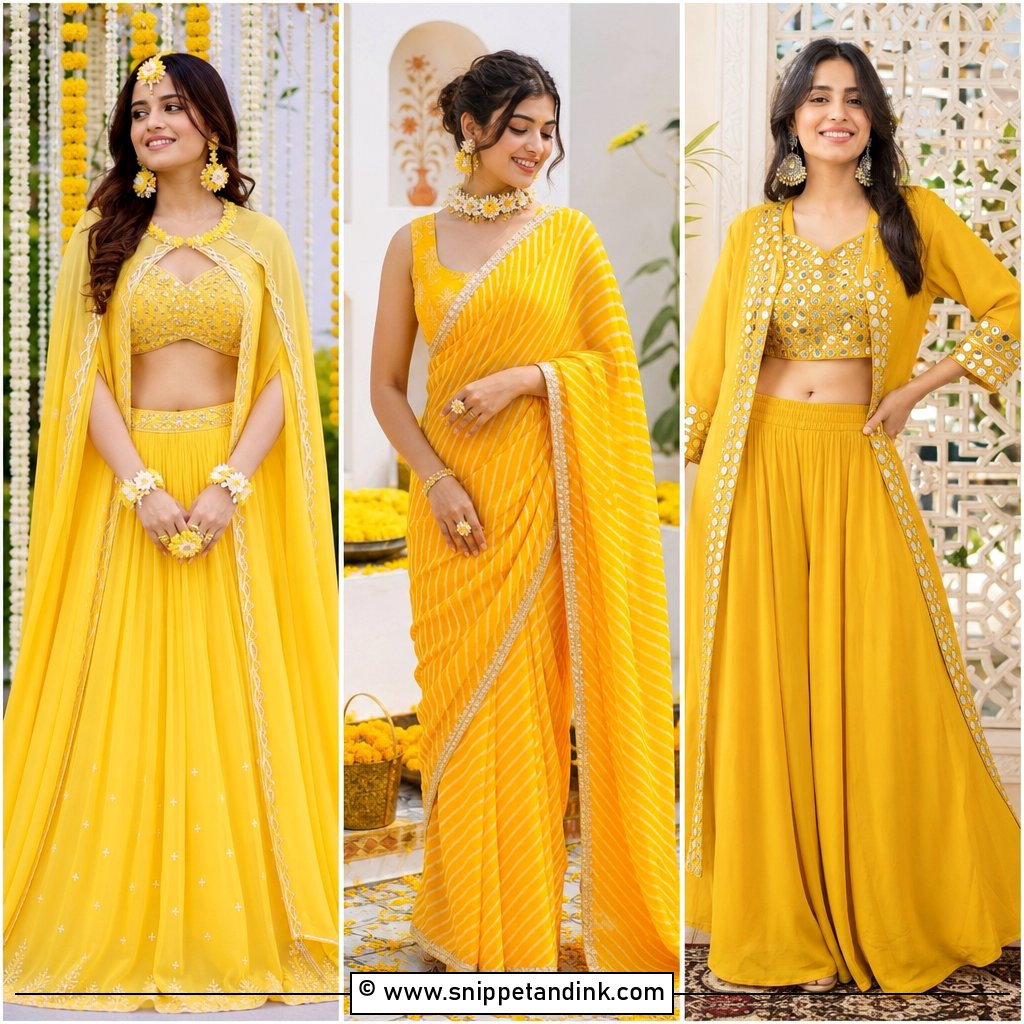
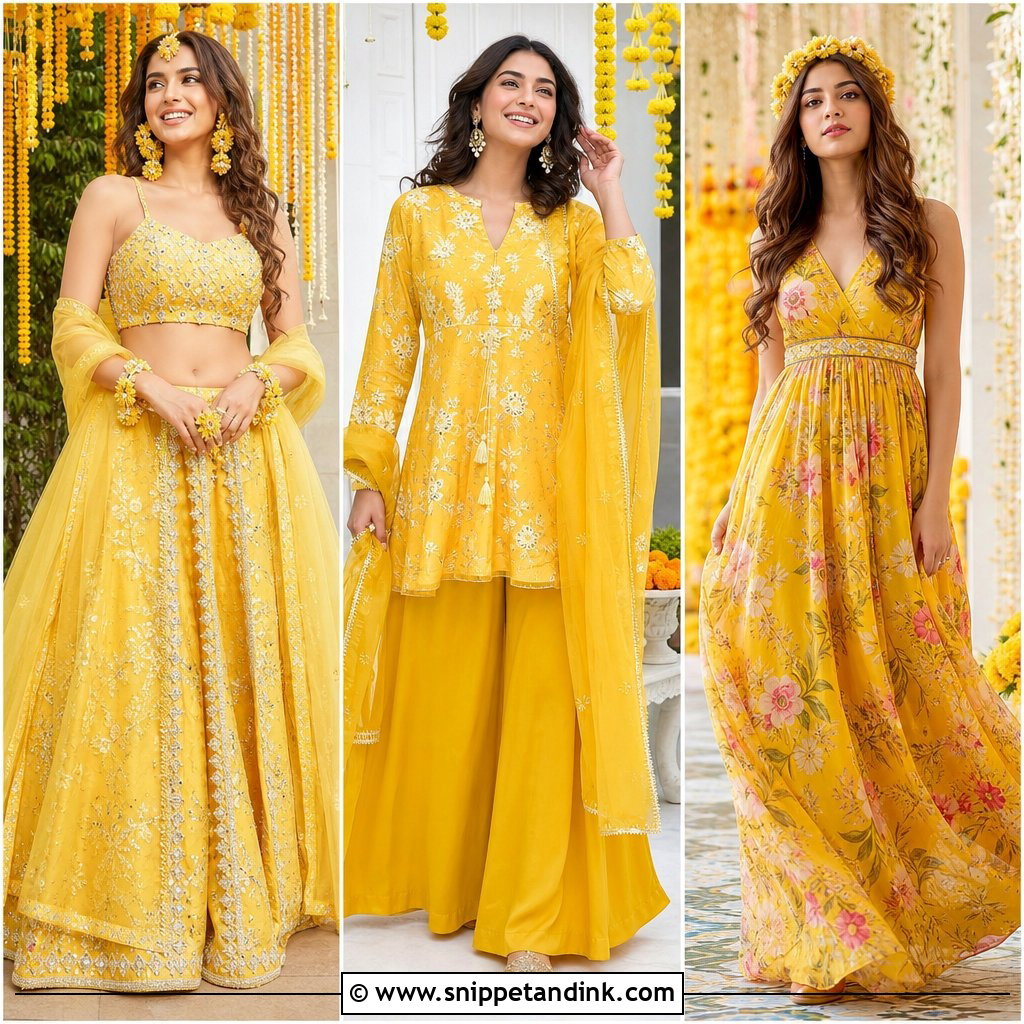
Handloom cotton is the most comfortable and reusable option on this list, and it washes better after a Haldi than nearly anything else. She can wear a yellow cotton saree, a wrap skirt set or a simple lehenga with a woven border and a green, pink or rust blouse. He wears a yellow or ivory handloom kurta with straight cotton pants. A woven stole in her accent color links the two. Terracotta earrings, glass bangles, fresh flowers and flat leather sandals suit her; brown juttis for him. It’s the pairing I’d choose for a small, hot daytime ceremony.
What Grooms Forget About Turmeric
Brides tend to plan for the paste. Grooms usually don’t, and the problems I see are predictable.
Wet ivory goes sheer
Thin cotton kurtas and pajamas turn transparent once paste and water soak in. A skin-toned vest and briefs underneath save some awkward photos.
Jackets and stoles should come off
If he’s wearing a printed Nehru jacket or a good stole, have someone hold it during the ritual and put it back on afterward. It stays clean for the family photos that follow.
Footwear and buttons
Suede juttis stain permanently, while plain leather wipes clean, so choose leather or go barefoot for the ritual. Remove decorative buttons, brooches and a watch before the paste starts. Turmeric gets into watch straps and settings, and it’s easier to take them off than to clean them later.
One Shared Link Is Usually Enough
A coordinated Haldi look comes from shared details, not identical clothes. Pick one link, a color, a print or a border, and let each outfit suit the person wearing it. Yellow is the natural base, but ivory, orange, pink, green and mustard all work. Keep fabrics light, drapes pinned, shoes flat and embellishment modest so neither of you spends the ceremony adjusting clothes. Then adapt the colors and cuts to your venue, your family’s customs and what you’ll both enjoy wearing.
You'll Like These Ideas:




Leave a Reply