
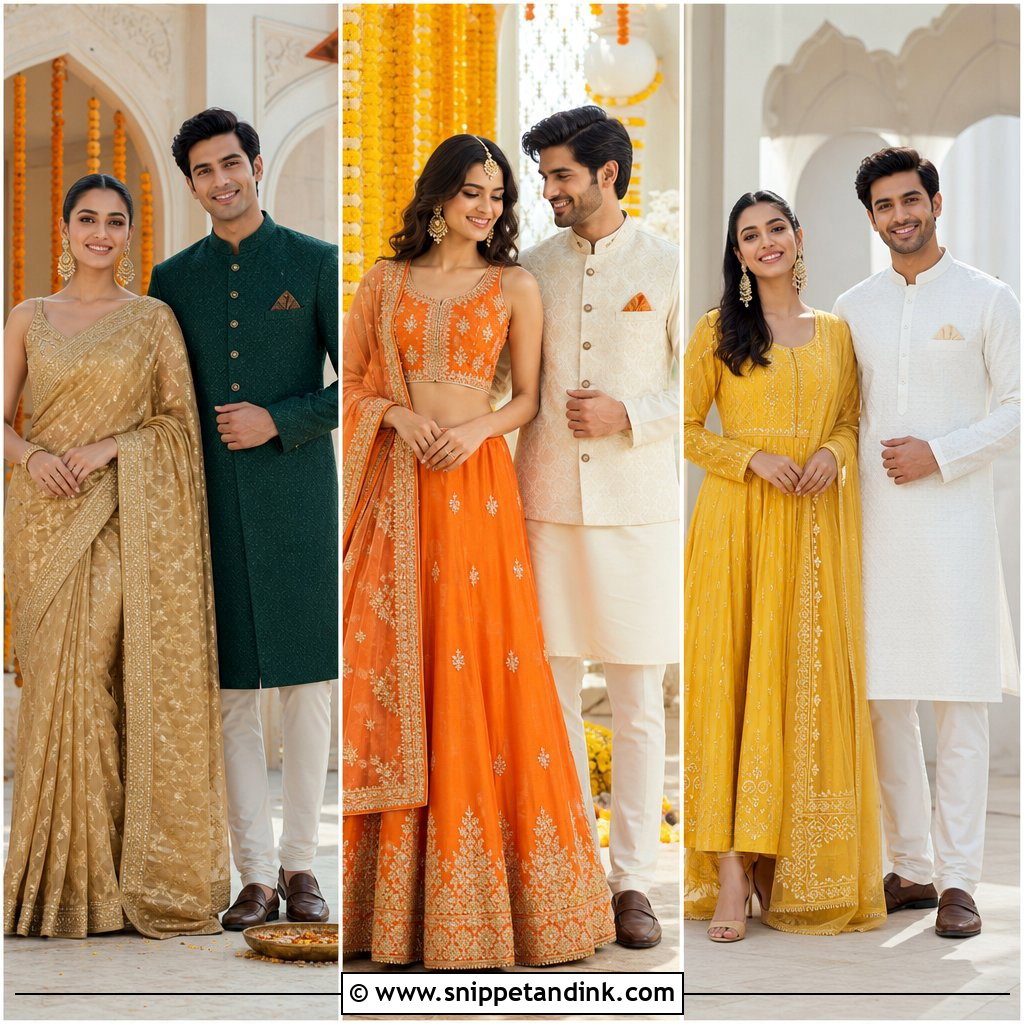
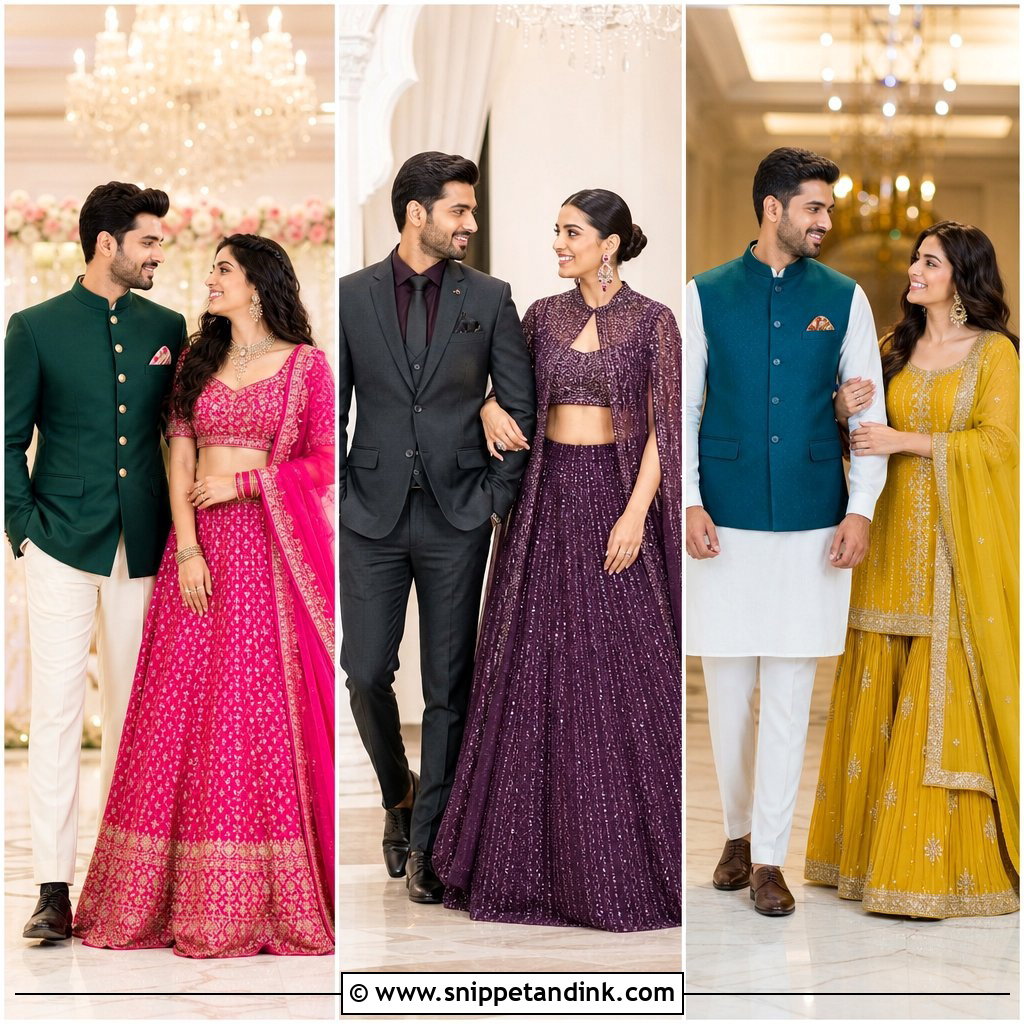
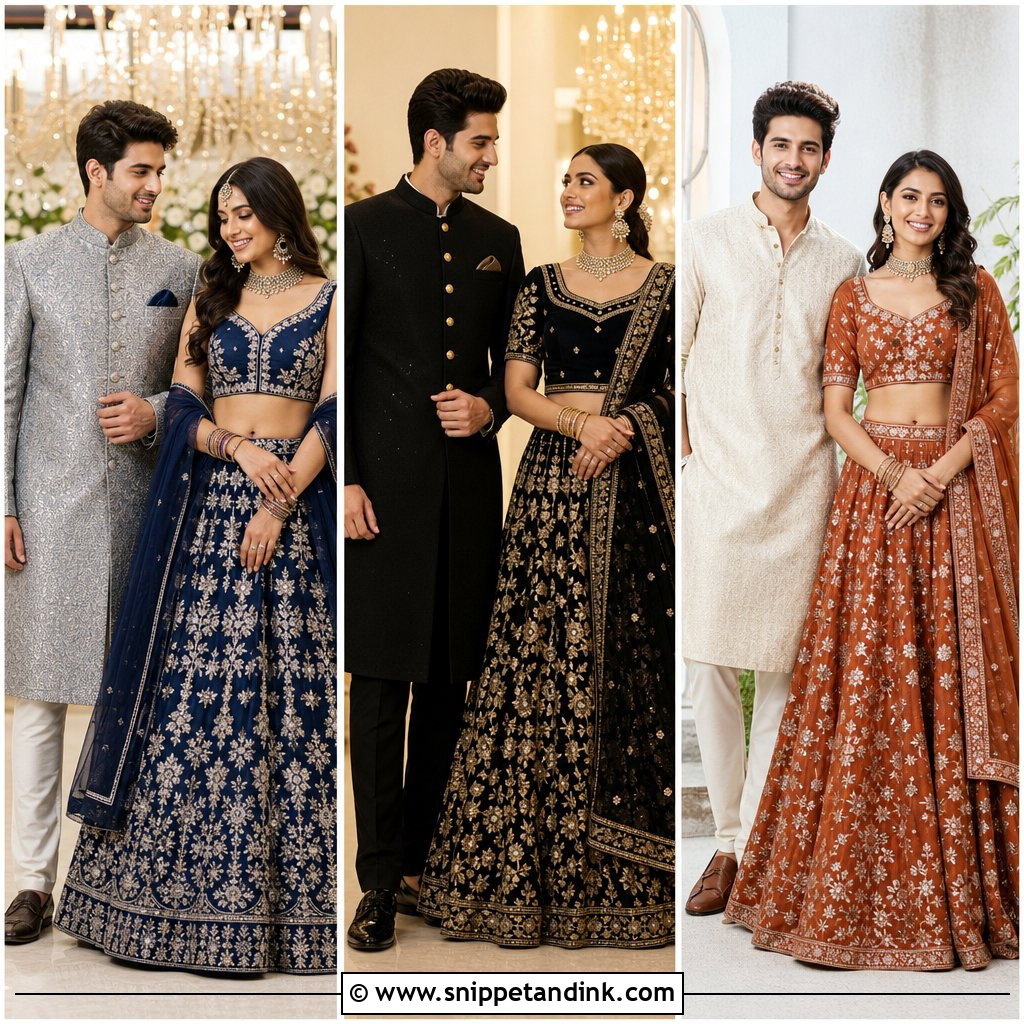
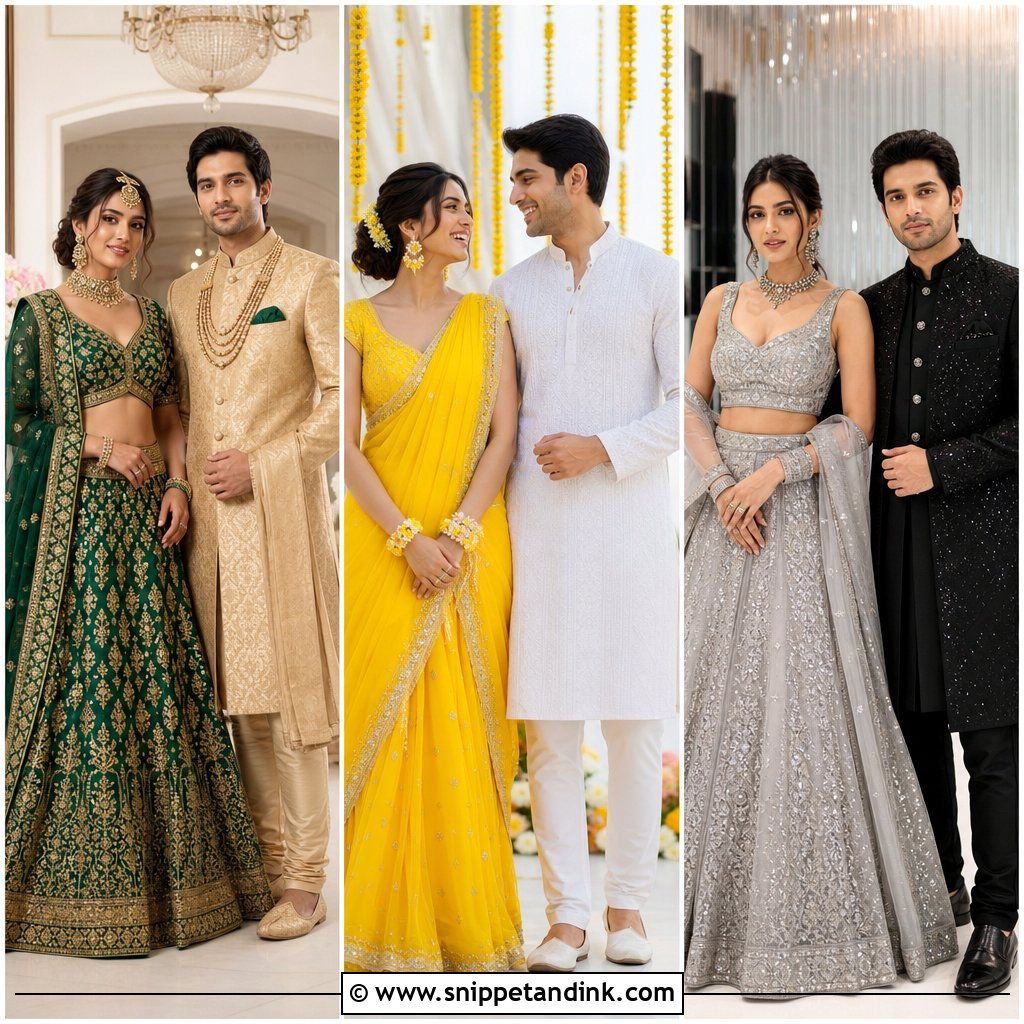
Most of my work on couple looks is the groom’s side, and the brief is nearly always the same: he should look like he belongs next to her without wearing a smaller copy of her lehenga. Identical colors rarely photograph well, because his matte fabric and her embroidered one never read as the same shade anyway. What works is one shared thread, whether that’s a border, a motif, a metal finish or a single color carried into his stole or jacket. The twenty pairings below run from haldi cottons to reception velvet. For each, think about the venue, the time of day and what your families expect, then decide how much he should echo her.
Her Lehenga Gets Ordered First, and His Outfit Follows It
A custom bridal lehenga usually takes the longest to make, often several months with embroidery, so it should be ordered first. His sherwani or bandhgala comes after, built around her fabric. Grooms who shop first end up hunting for a lehenga that matches a jacket, which is backwards.
Once her outfit is confirmed, ask the designer for a small swatch of the main fabric and a cutting of the border or embroidery. I take those swatches to every one of his fittings. Phone photos lie about color, especially pinks and blues, and a physical swatch settles the question in seconds.
- Fix her outfit for each function and get swatches.
- Decide what he will echo for each one: color, motif, border or metal.
- Order his pieces, leaving time for at least two fittings.
- Check both outfits side by side before the final alterations.
1. Yellow Lehenga And Kurta Indian Wedding Outfit
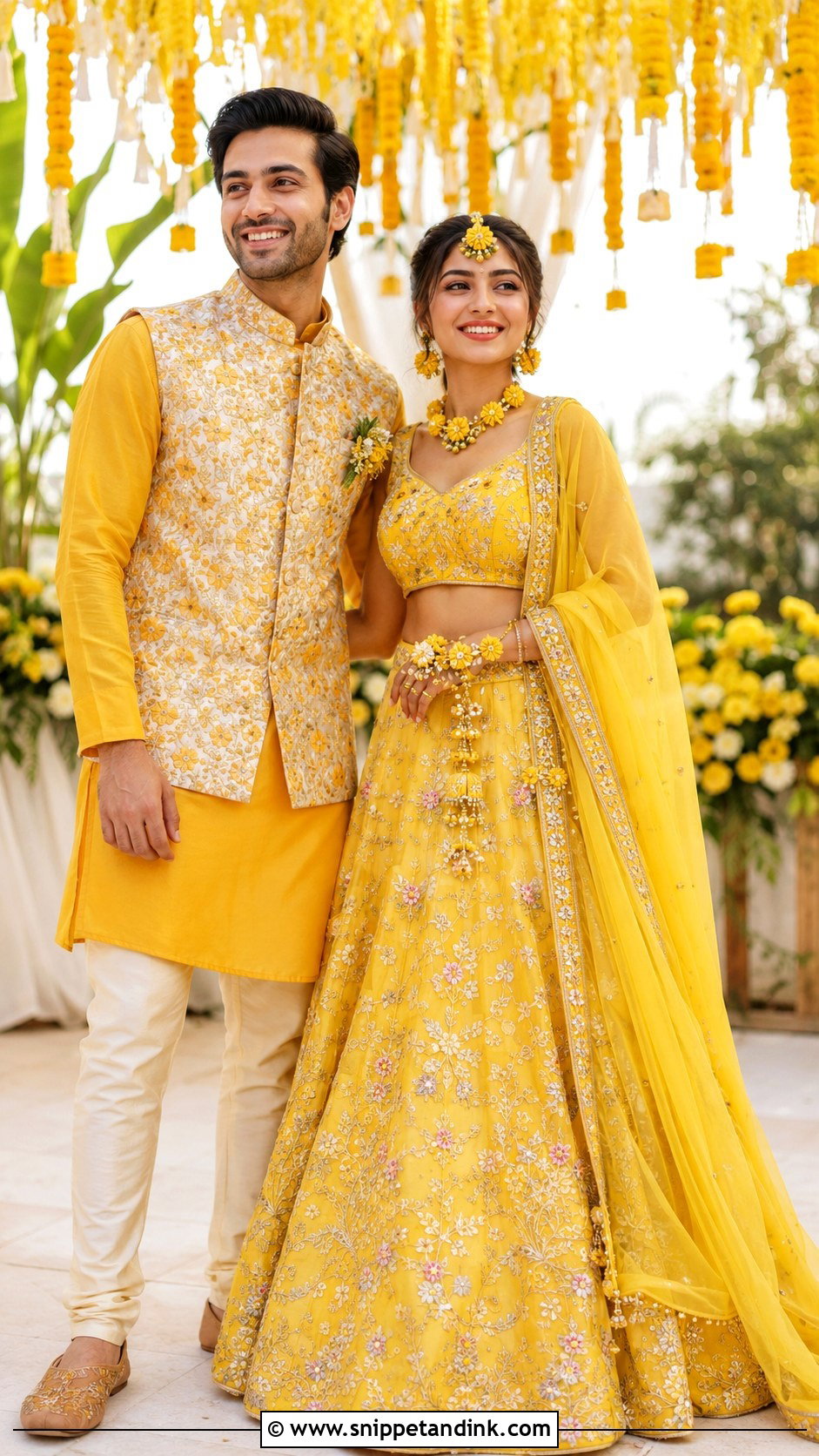
Haldi is the easiest function to coordinate, because a cheerful yellow pairing is almost expected. She wears a light cotton or georgette lehenga; he wears a yellow kurta with ivory pajama pants and a simple Nehru jacket. Turmeric paste stains both, so neither outfit should be precious. The yellows don’t need to match. Marigold on her and mustard on him looks deliberate, especially if a white floral print or gold border repeats on both. Floral jewelry and juttis for her, tan mojaris and a plain watch for him.
2. Green Lehenga And Nehru Jacket Indian Wedding Outfit
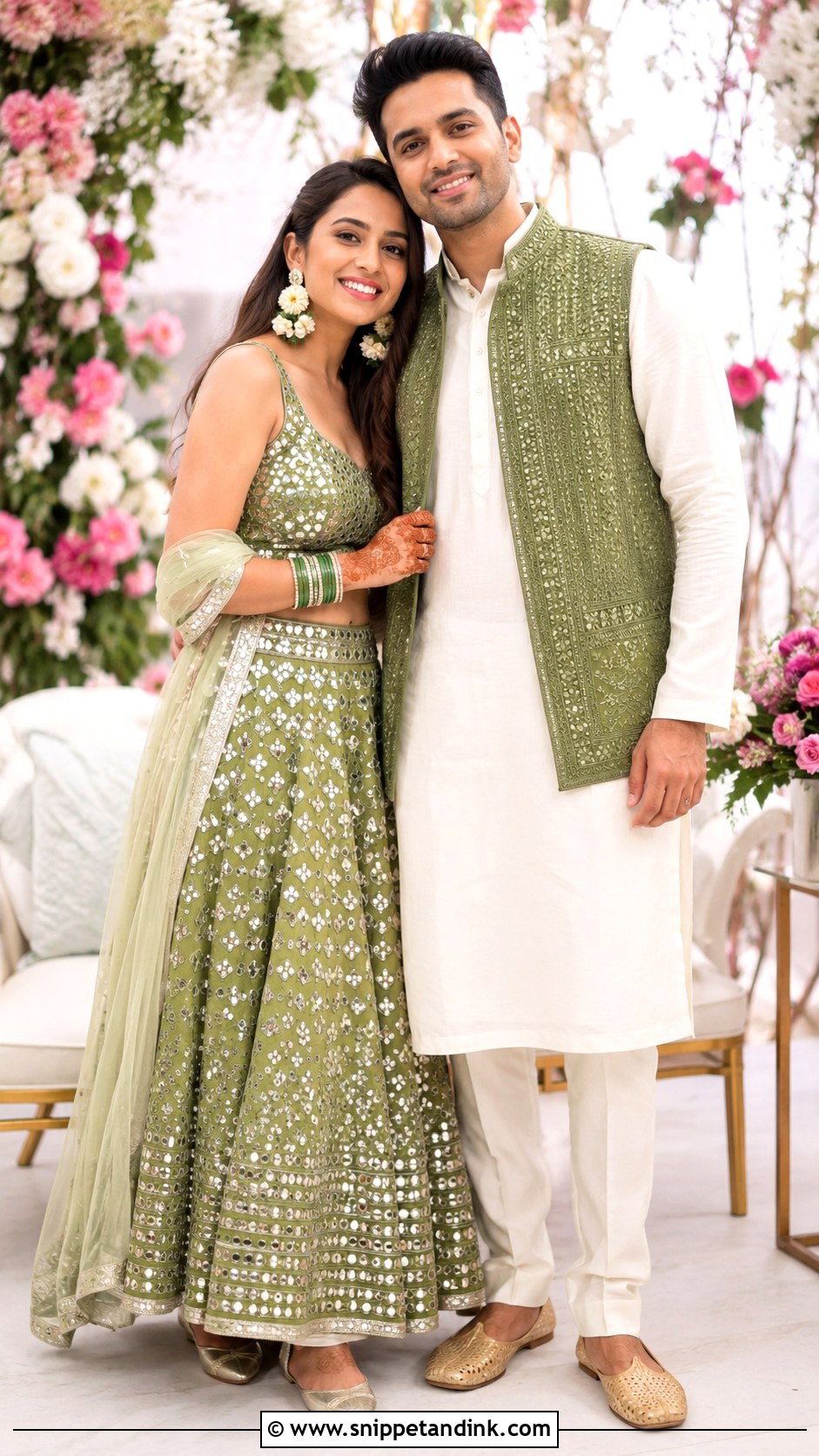
At a mehndi, her lehenga should lead and his jacket should answer. An emerald or leaf-green lehenga with mirror work and a sleeveless blouse keeps her arms free while the artist works. For him, I’d keep the kurta pajama ivory and put the green into an embroidered Nehru jacket that picks up one motif from her skirt, a paisley or a small flower. Doubling the heavy decoration on both makes them look like a stage act. Brown or gold-toned mojaris for him, metallic flats and stacked bangles for her.
3. Pink Lehenga And Ivory Sherwani Indian Wedding Outfit
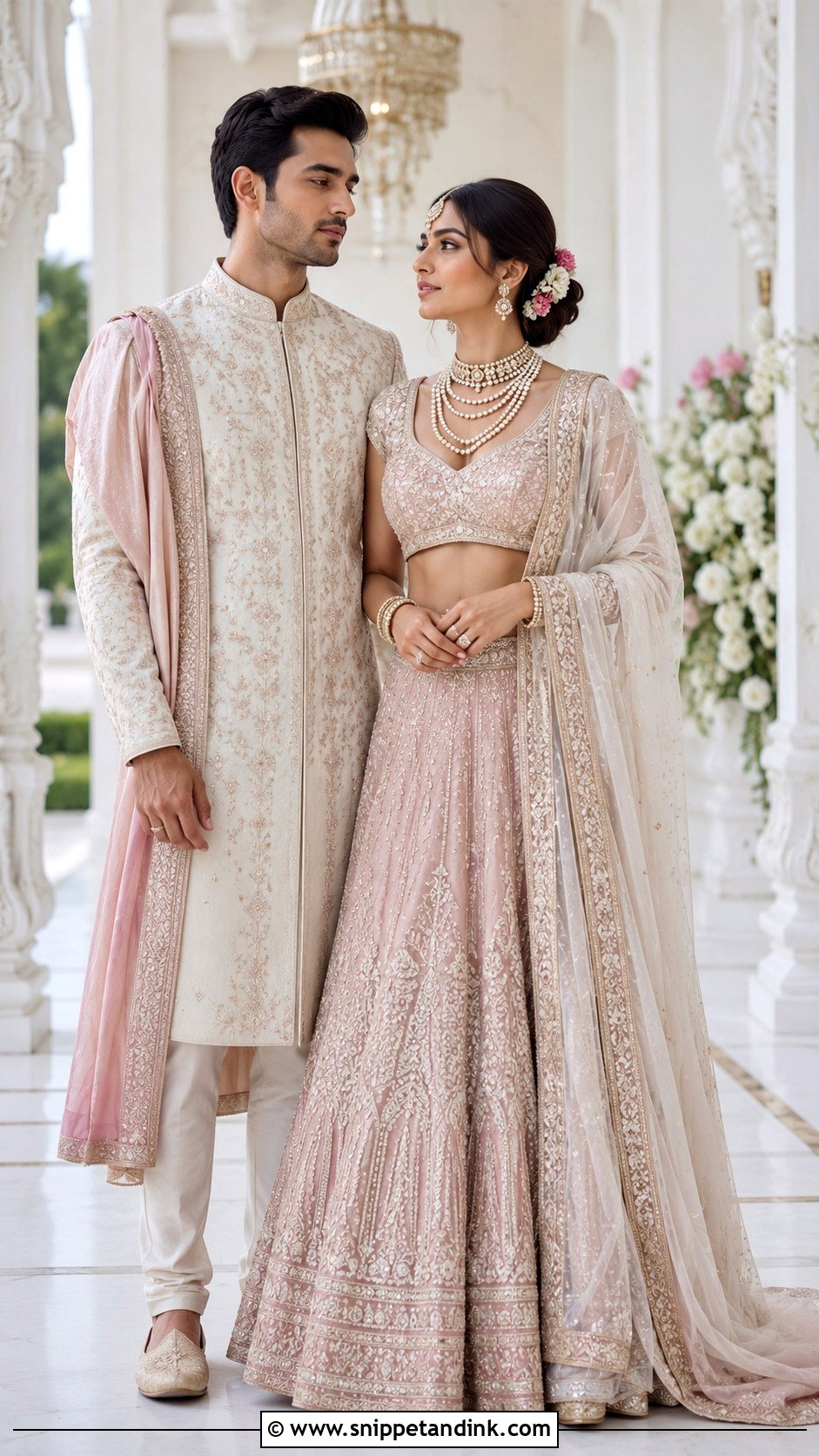
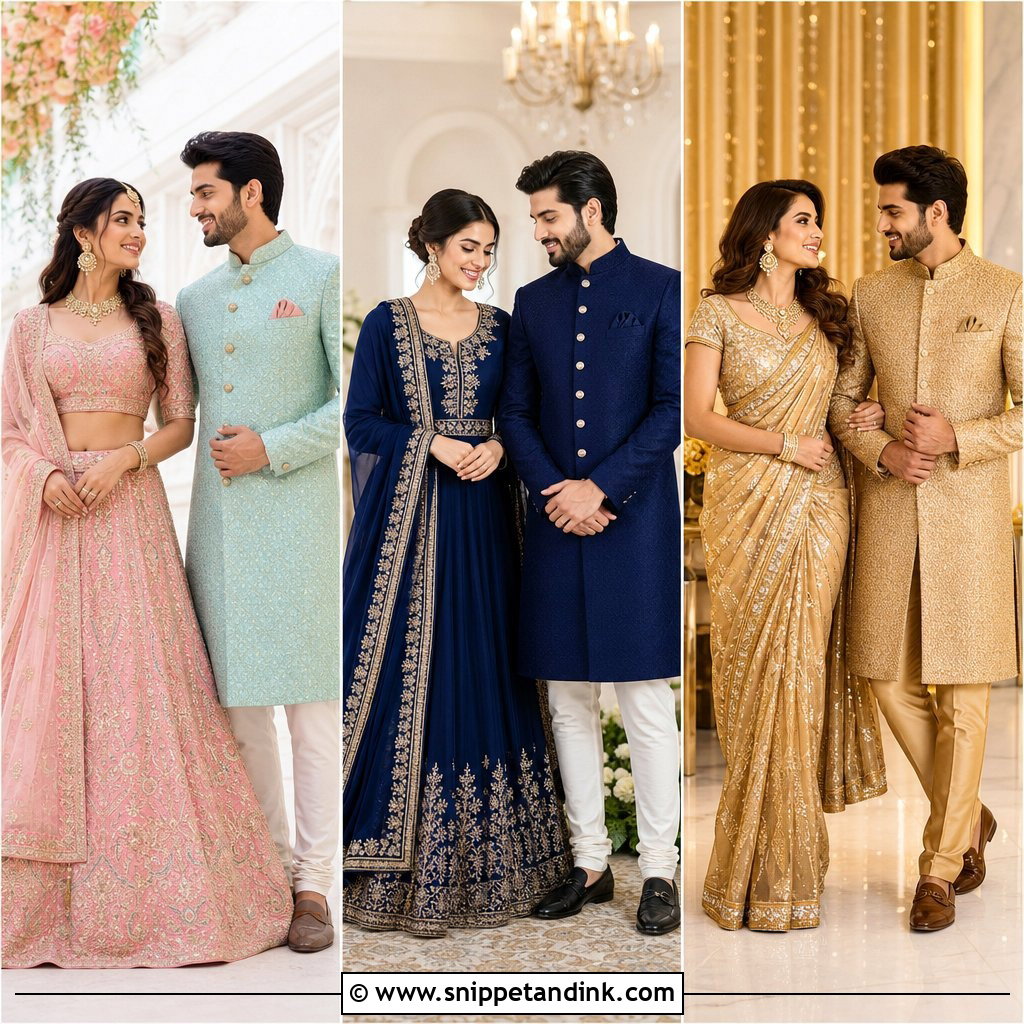
Blush and ivory suit an engagement or daytime ceremony, and the link here is the metal, not the color. She might wear a blush lehenga with pearl or silver thread detailing with an ivory dupatta. His ivory sherwani carries a little pink embroidery, and a pale pink stole or pocket square finishes it. I keep the embellishment the same tone on both, so silver with silver, rather than the same amount. He shouldn’t sparkle as much as she does. Neutral mojaris and straight-cut trousers keep his side quiet.
4. Red Lehenga And Cream Sherwani Indian Wedding Outfit
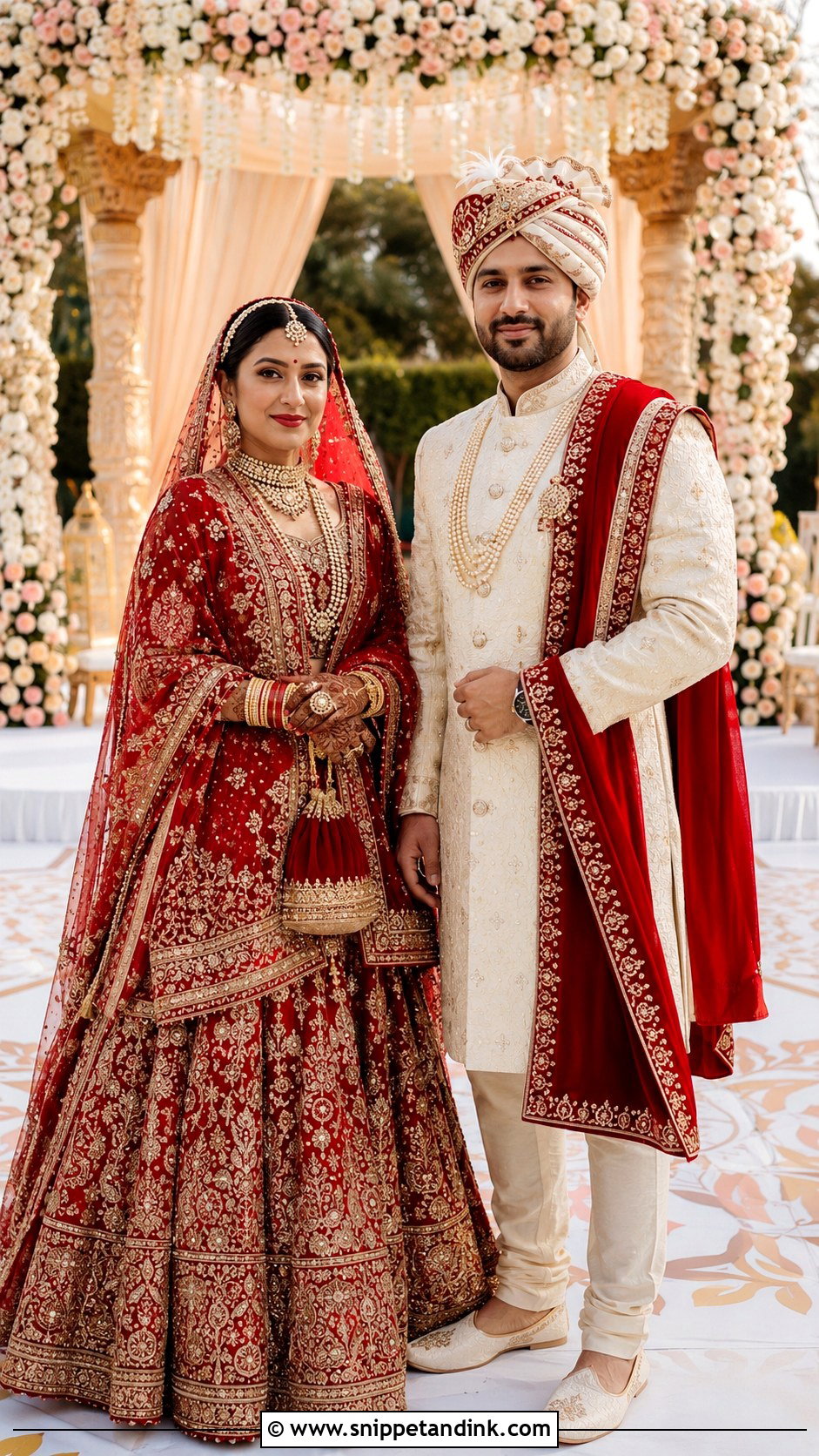
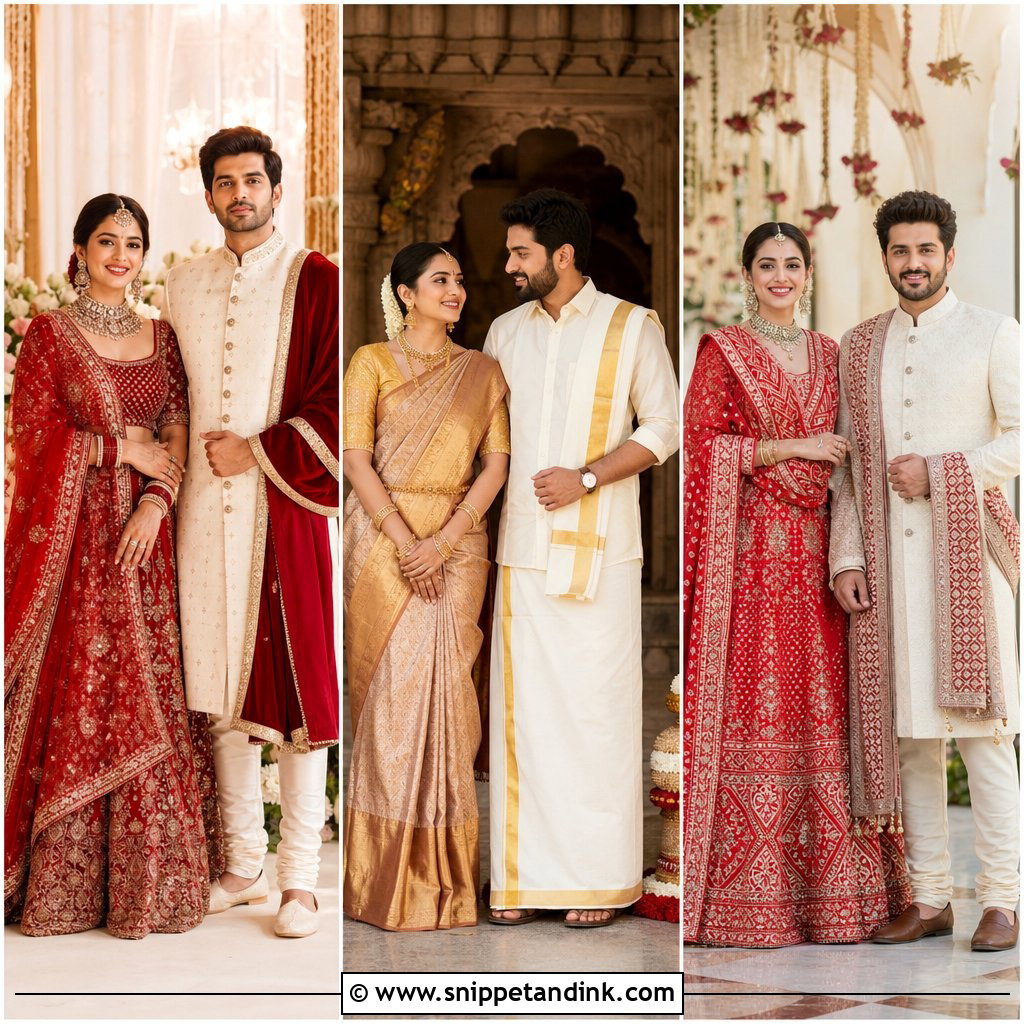
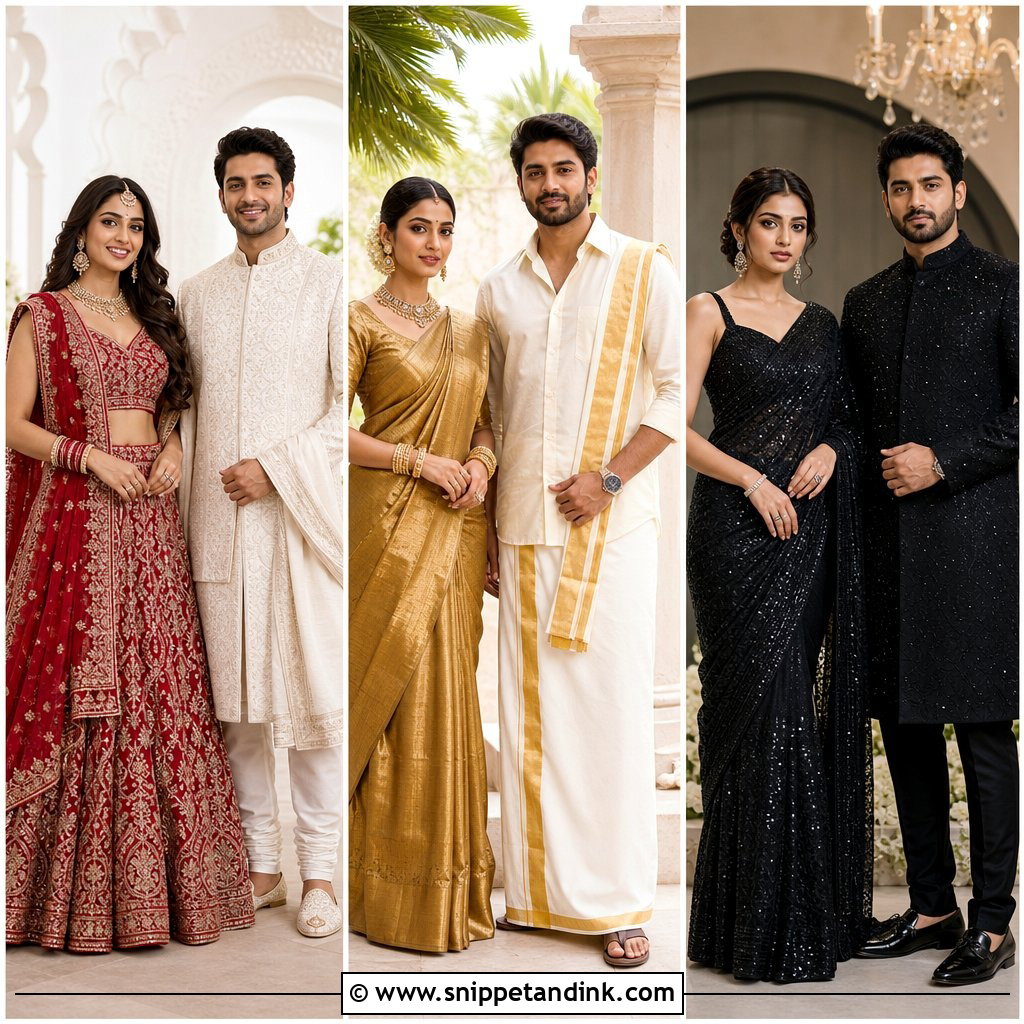
Red and cream is the classic ceremony pairing, and the mistake I see is putting too much red on him. Her lehenga carries the gold zari or zardozi, the double dupatta and the maang tikka. His cream sherwani needs only one or two red accents, a stole, a pocket square or a safa, to answer her. Many families have firm views on ceremony colors and on the groom’s turban, so ask before you commit. Cream mojaris and a small brooch keep his look balanced against her bridal weight.
5. Ivory Lehenga And Floral Sherwani Indian Wedding Outfit
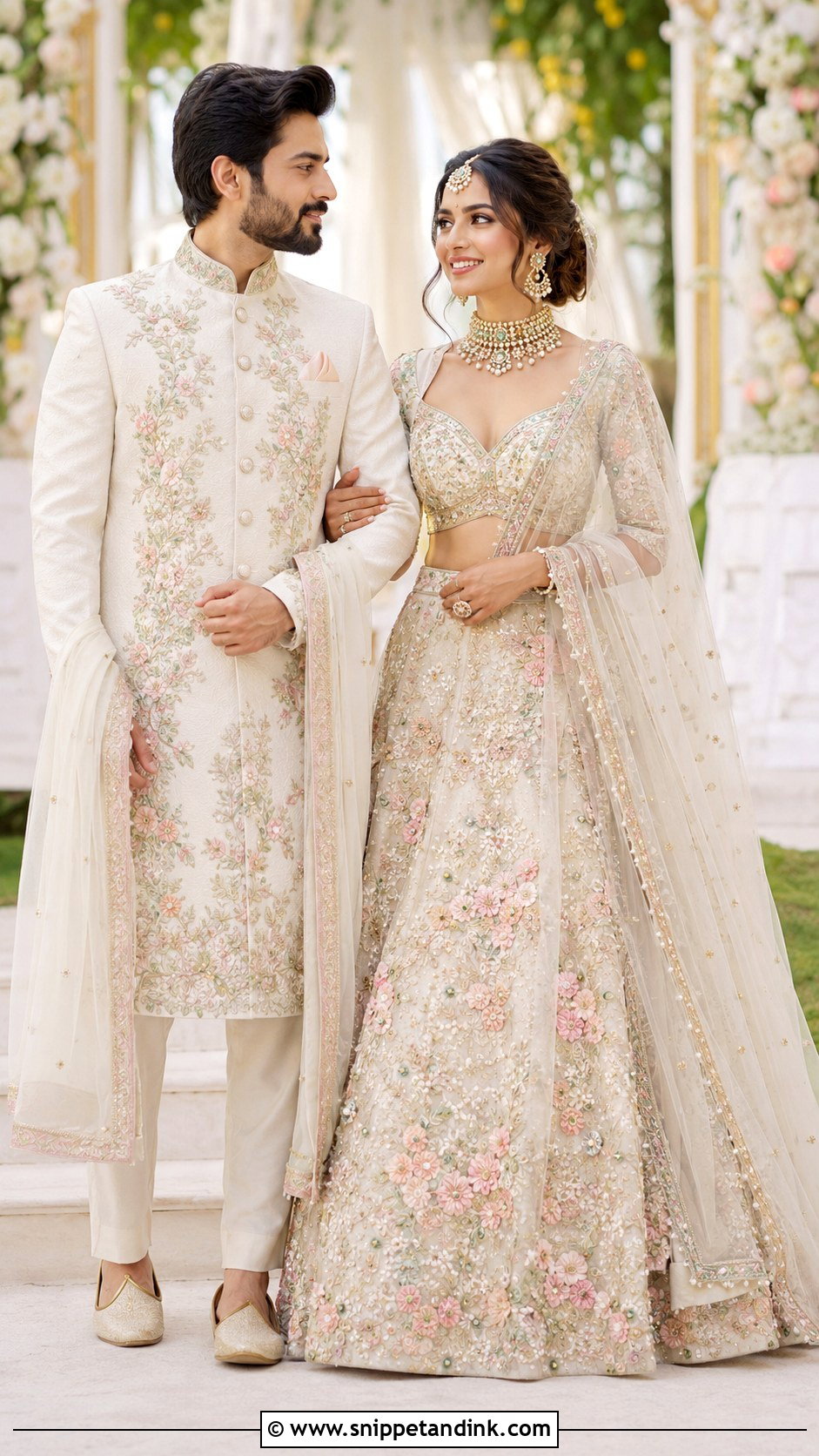
Ivory on ivory is hard to photograph, because two pale outfits next to each other can merge into one shape. Texture saves it. Her lehenga needs raised floral appliqué or pearl beading; his sherwani carries floral embroidery in the same pastel thread colors but smaller motifs. That difference in scale is what keeps them separate in a photo. A colored gemstone necklace on her gives the picture a focal point. Beige mojaris and a pastel pocket square suit him at a garden ceremony or daytime event.
6. Navy Lehenga And Bandhgala Indian Wedding Outfit
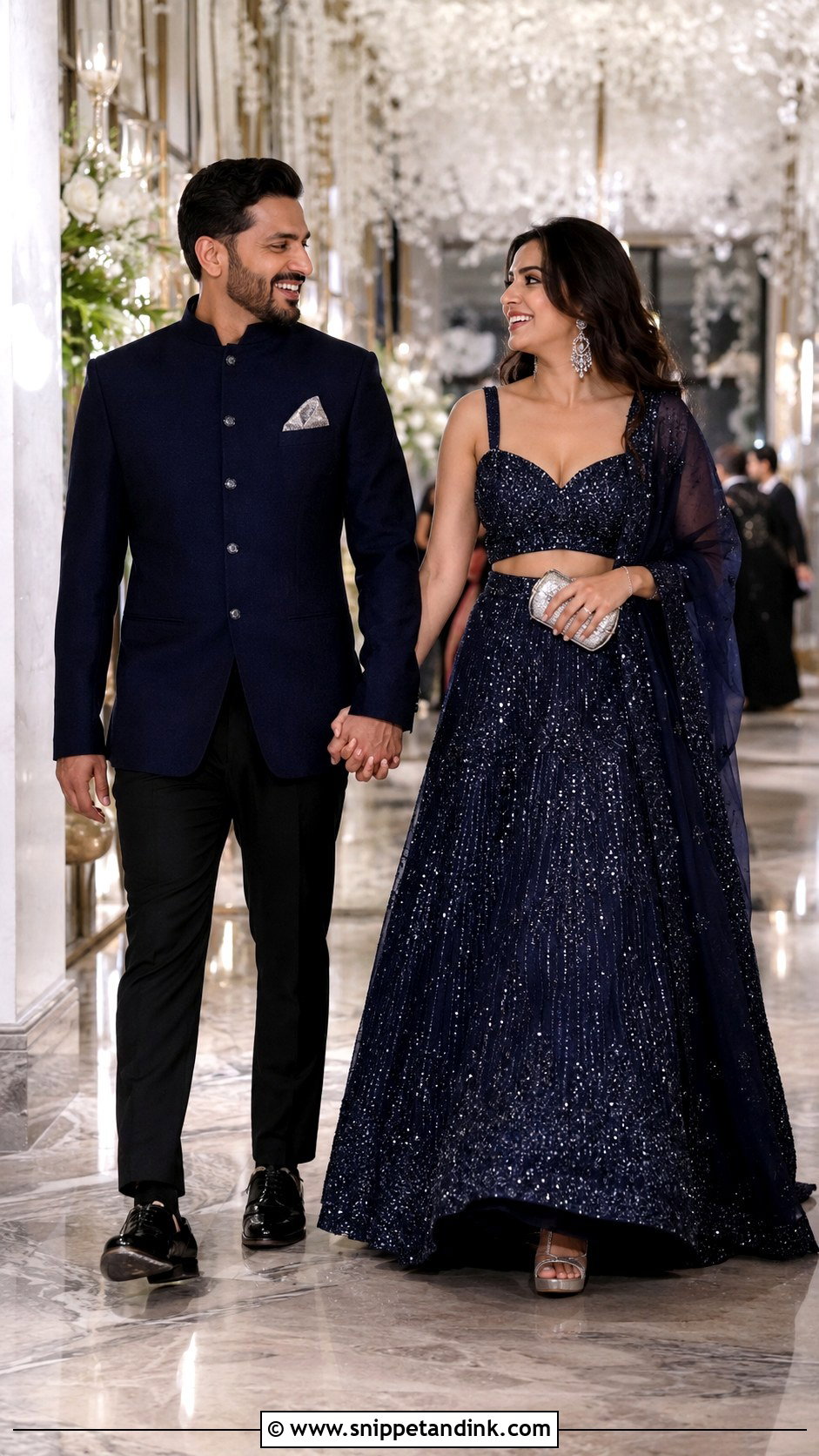
Navy is a forgiving base for a sangeet because it looks good on almost every skin tone and hides creases from dancing. Her navy lehenga carries silver sequins or crystal; his navy bandhgala needs only silver buttons or a patterned pocket square to reference it. A bandhgala is a closed-collar jacket and runs warm, so I cut his in a light wool blend or linen-silk if the venue is crowded. Matching navy gives one base, and the different silhouettes keep them individual. Black loafers or formal mojaris for him, block heels and a secure dupatta for her.
7. Lavender Lehenga And Kurta Indian Wedding Outfit
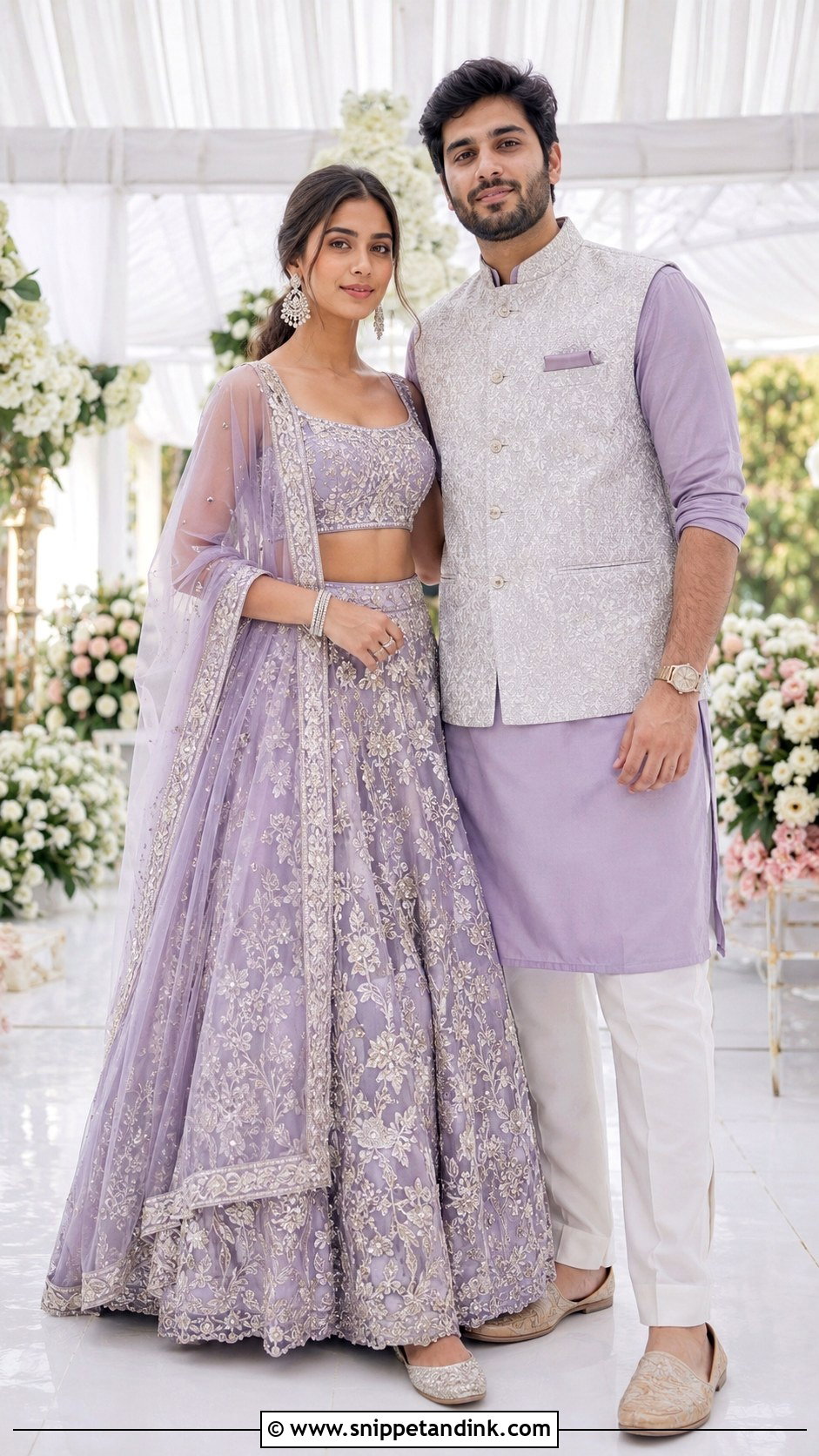
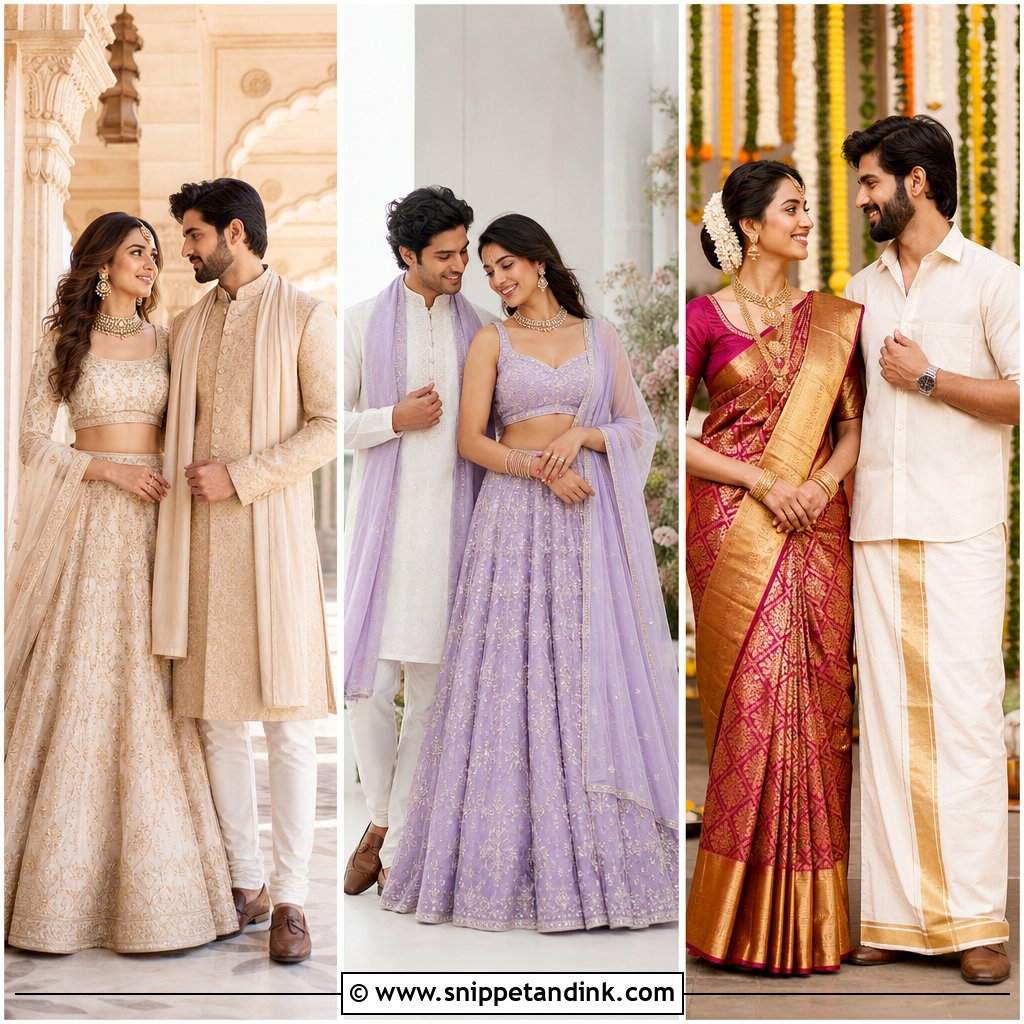
Lavender pairs well with ivory, and it is less expected than pink or peach. Her lavender lehenga with silver embroidery leads. For him there are two routes: a lavender kurta with an ivory jacket, or the quieter version, an ivory kurta with a lavender jacket. I usually suggest the second for grooms who are nervous about pastels. Don’t force one exact shade. Lilac on her and mauve on him reads as a palette, not a mismatch. Silver juttis for her, neutral mojaris for him, and it suits a daytime engagement outdoors.
8. Peach Saree And Embroidered Kurta Indian Wedding Outfit
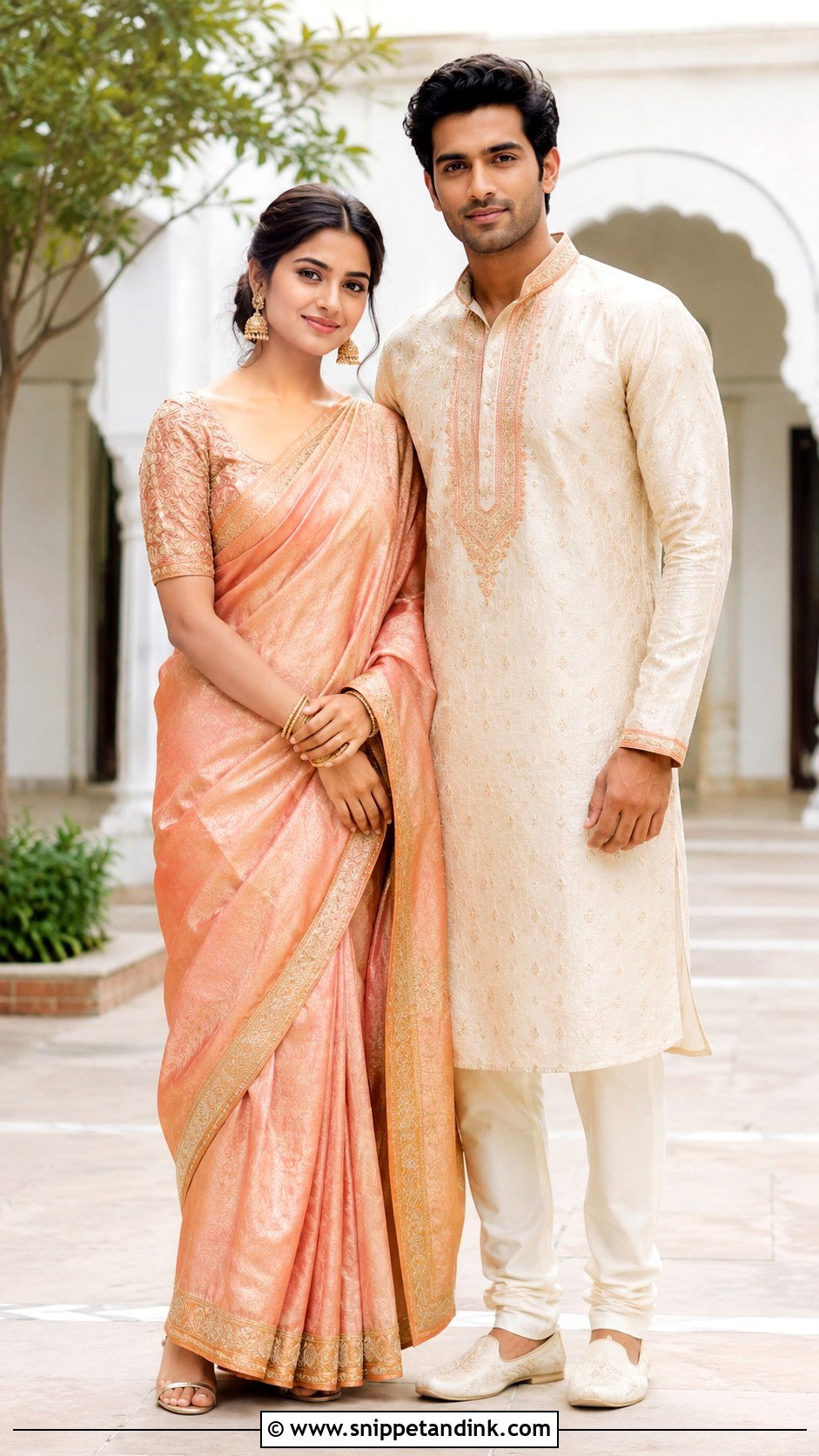
A peach saree with a gold border gives the groom an easy reference point: repeat that border on his collar, cuffs or jacket placket. She wears silk, organza or georgette with a fitted embroidered blouse and a low bun. His cream or peach kurta carries similar gold threadwork with ivory pajama pants. If her saree is heavily embellished, keep his kurta plain apart from the border detail. Cream mojaris and a gold-toned watch suit engagement ceremonies and family events where both of you will be standing and greeting for hours.
9. Powder Blue Lehenga And Sherwani Indian Wedding Outfit
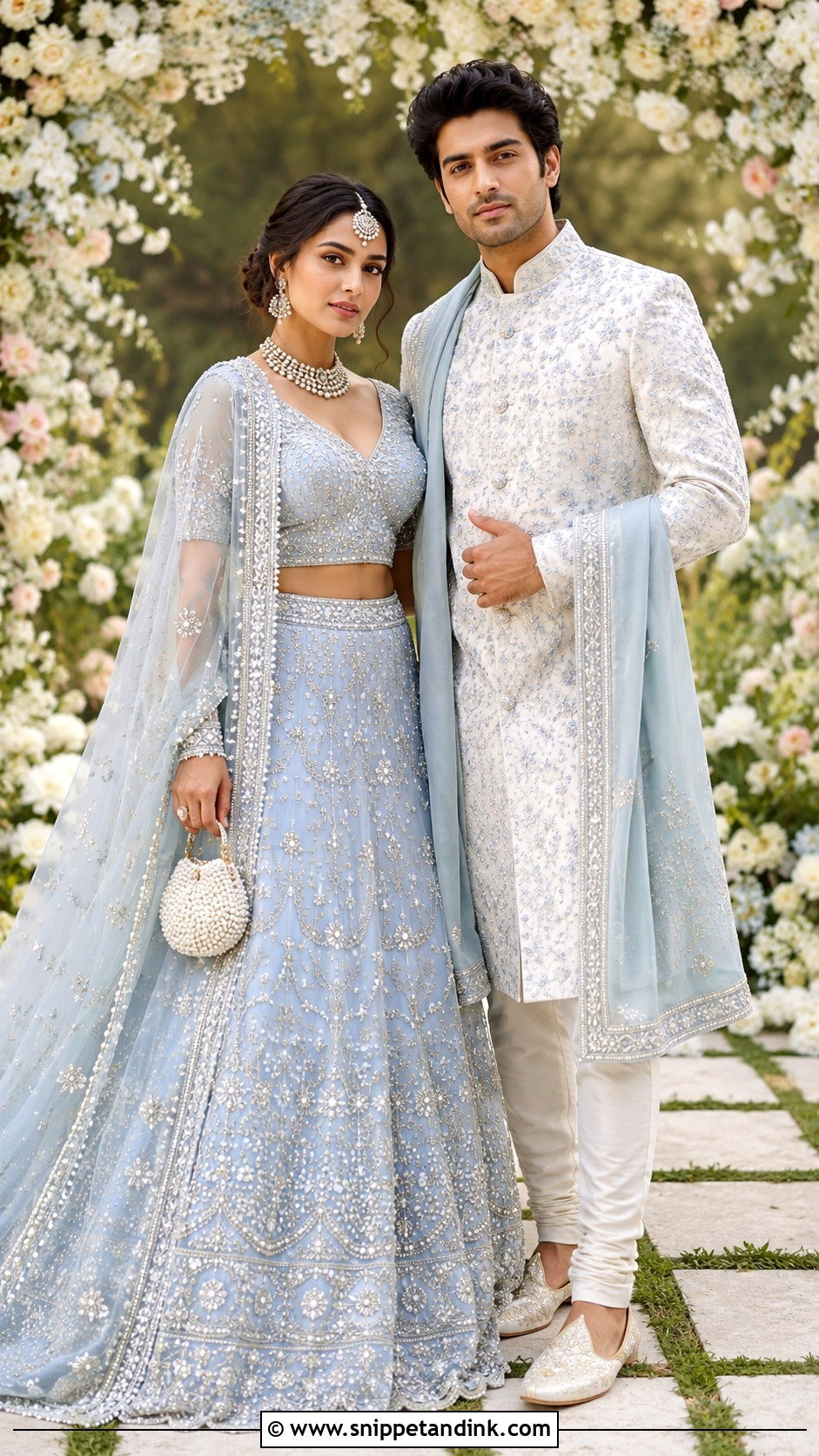
Blues are the trickiest color to match because they lean in different directions. One powder blue looks cool, another goes gray in shade, a third turns slightly green under tungsten bulbs. Before buying his sherwani, I put her fabric and his side by side in daylight. She wears a powder blue lehenga with pearls or silver motifs. He can wear an ivory sherwani with a blue stole, or a pale blue sherwani with ivory trousers for a stronger match. Ivory mojaris and a minimal brooch suit garden and waterfront venues.
10. Burgundy Lehenga And Velvet Bandhgala Indian Wedding Outfit
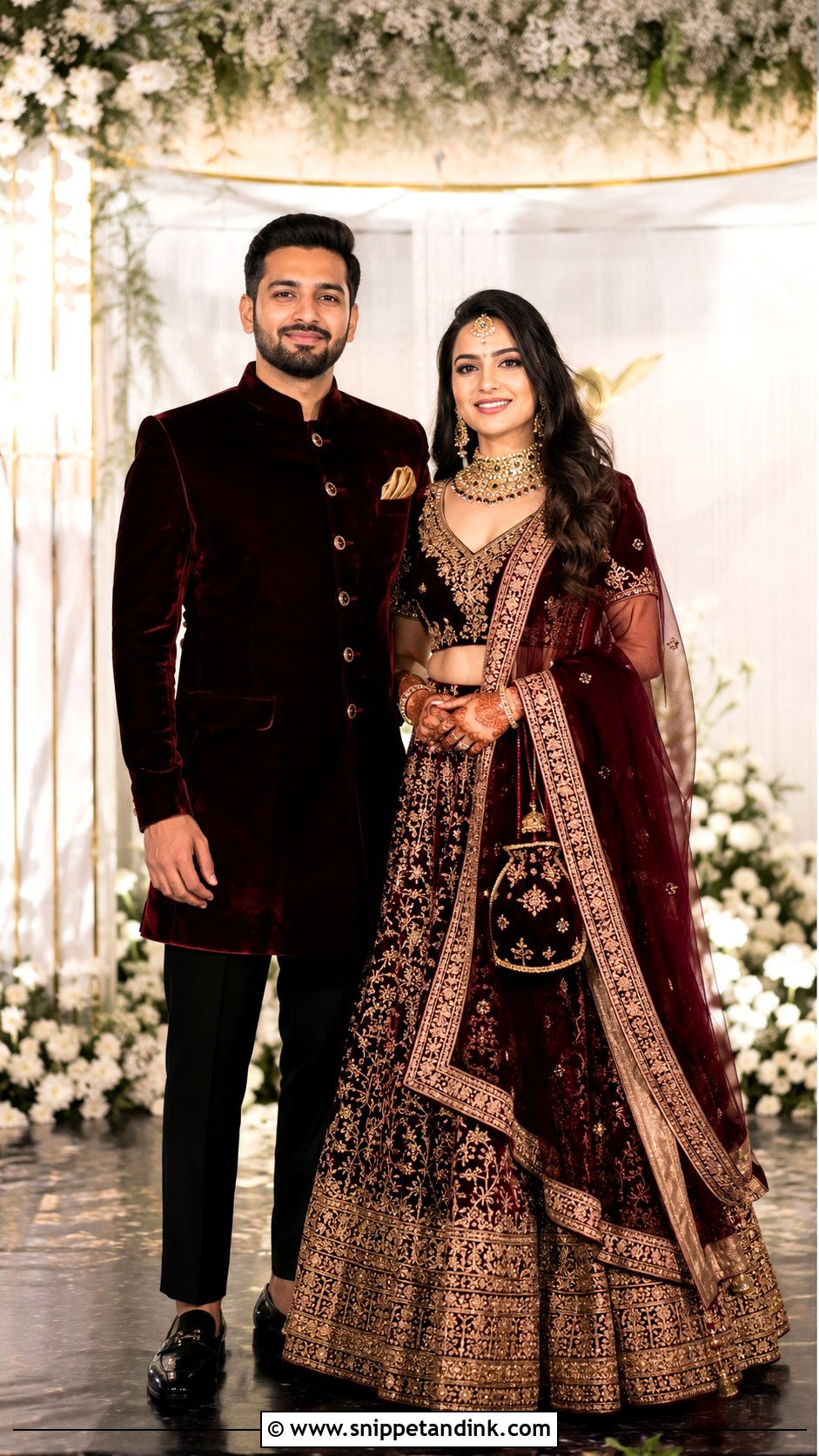
Burgundy velvet looks rich at an evening reception but goes nearly black in dim light, so ask what the venue lighting is like. Her burgundy velvet or raw silk lehenga carries antique gold embroidery. A matching velvet bandhgala on him is heavy and hot; I often suggest black with burgundy embroidery at the collar and cuffs instead. Repeat one embroidery pattern across both for cohesion. Polished loafers and a gold pocket square for him, a velvet potli and focused antique gold jewelry for her.
11. Orange Lehenga And Printed Kurta Indian Wedding Outfit
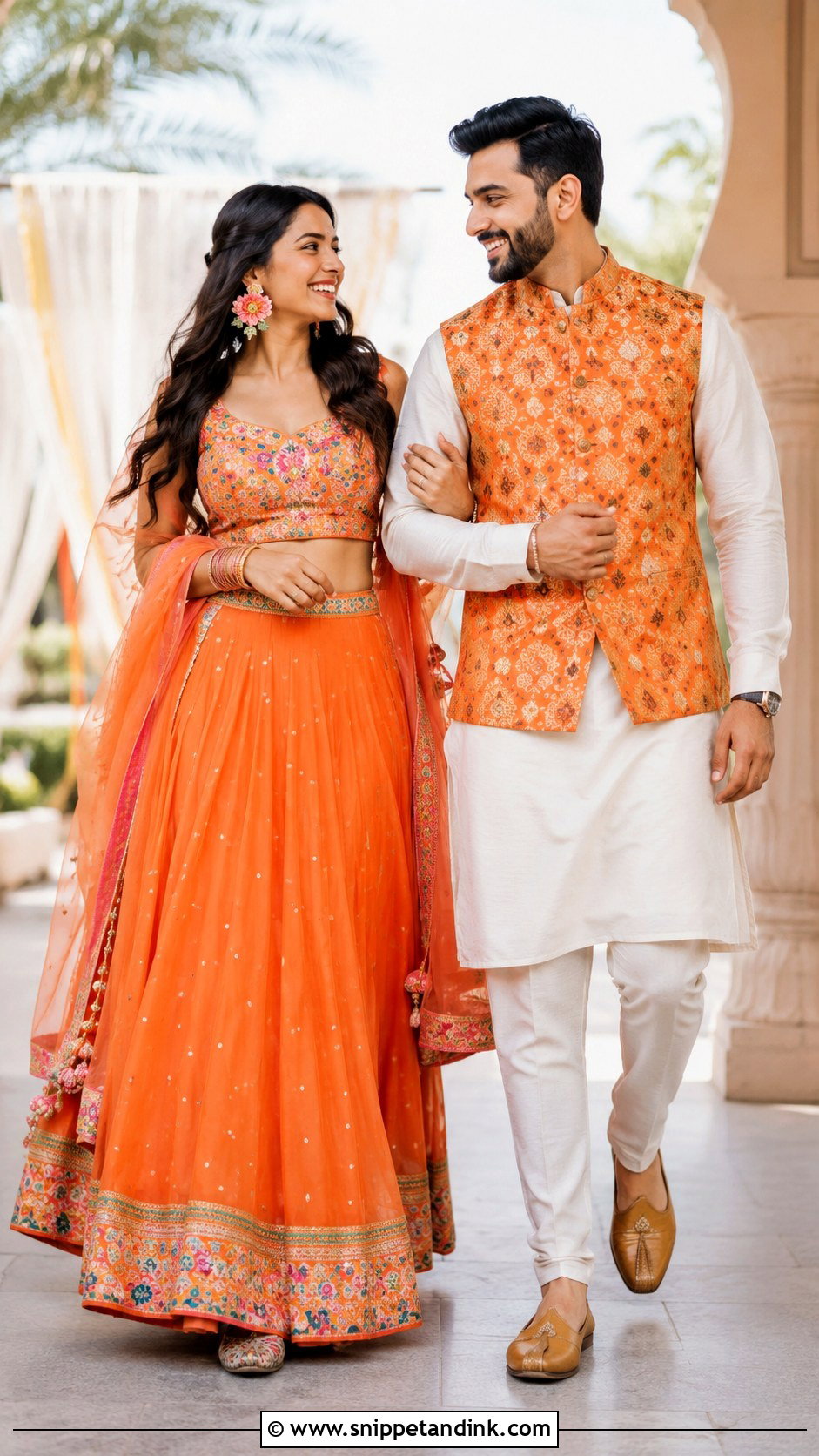
Orange is loud, so only one of you should wear a lot of it. She might wear a tangerine lehenga with a printed blouse, and he wears an ivory kurta with the same print on a Nehru jacket. Bandhani-style dots, a floral or a geometric motif all make an easy link between them. Printed cotton or light silk keeps both cool at an outdoor haldi or mehndi. Tan mojaris and a plain watch for him; flower earrings, stacked bangles and embroidered flats for her.
12. Sage Green Lehenga And Ivory Kurta Indian Wedding Outfit
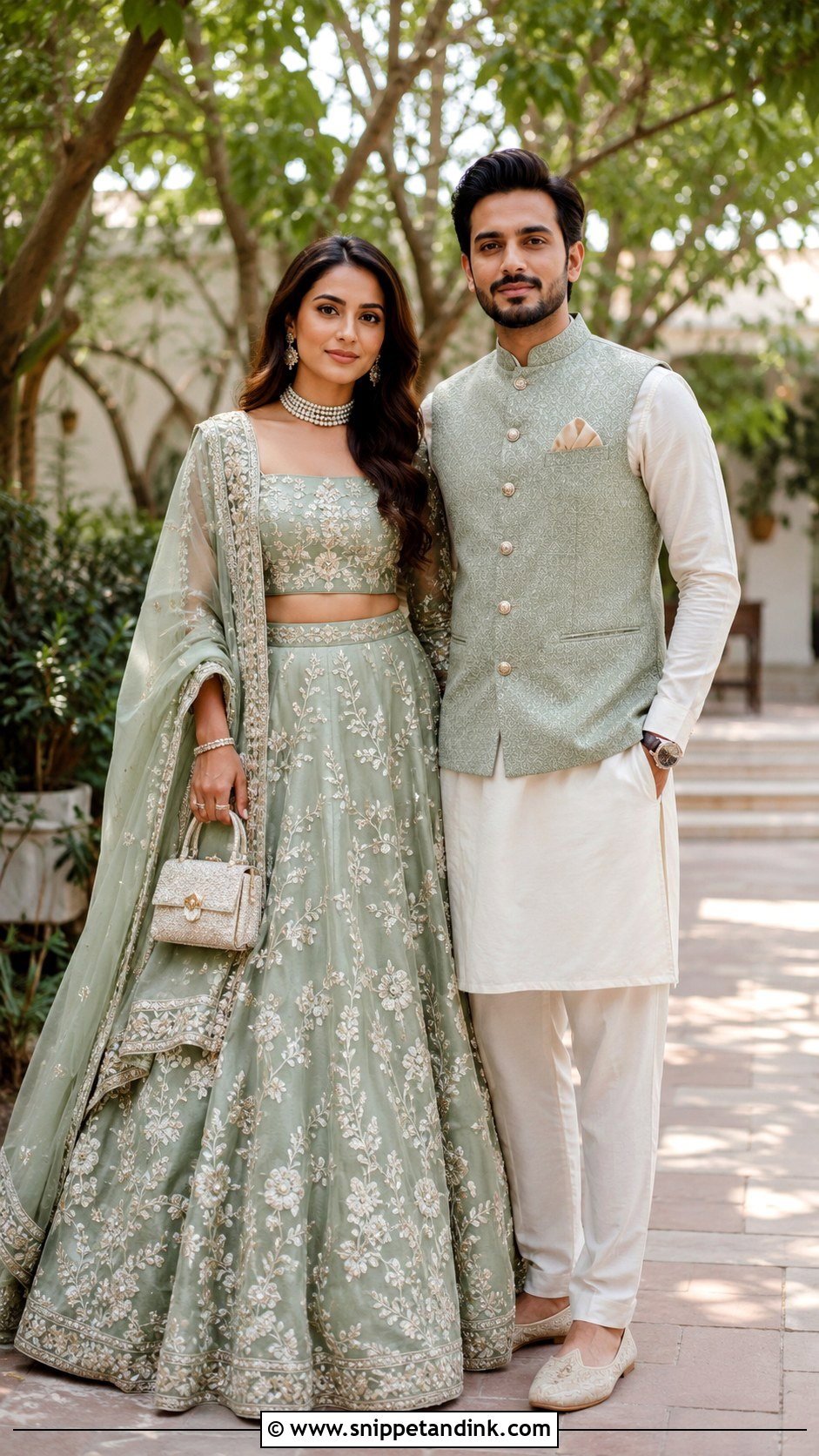
Sage green is calm and modern, but a pale palette looks flat unless the fabric has texture. I’d look for jacquard, raw silk or visible threadwork on both outfits. Her sage lehenga with ivory floral embroidery and a sheer dupatta leads; his ivory kurta pajama with a sage Nehru jacket or stole answers. Cool metals suit sage better than yellow gold: pearl, silver or a pale gold finish. Beige mojaris and a coordinated pocket square for him. It’s a good pairing for an engagement in a garden or an outdoor daytime ceremony.
13. Fuchsia Lehenga And Black Bandhgala Indian Wedding Outfit
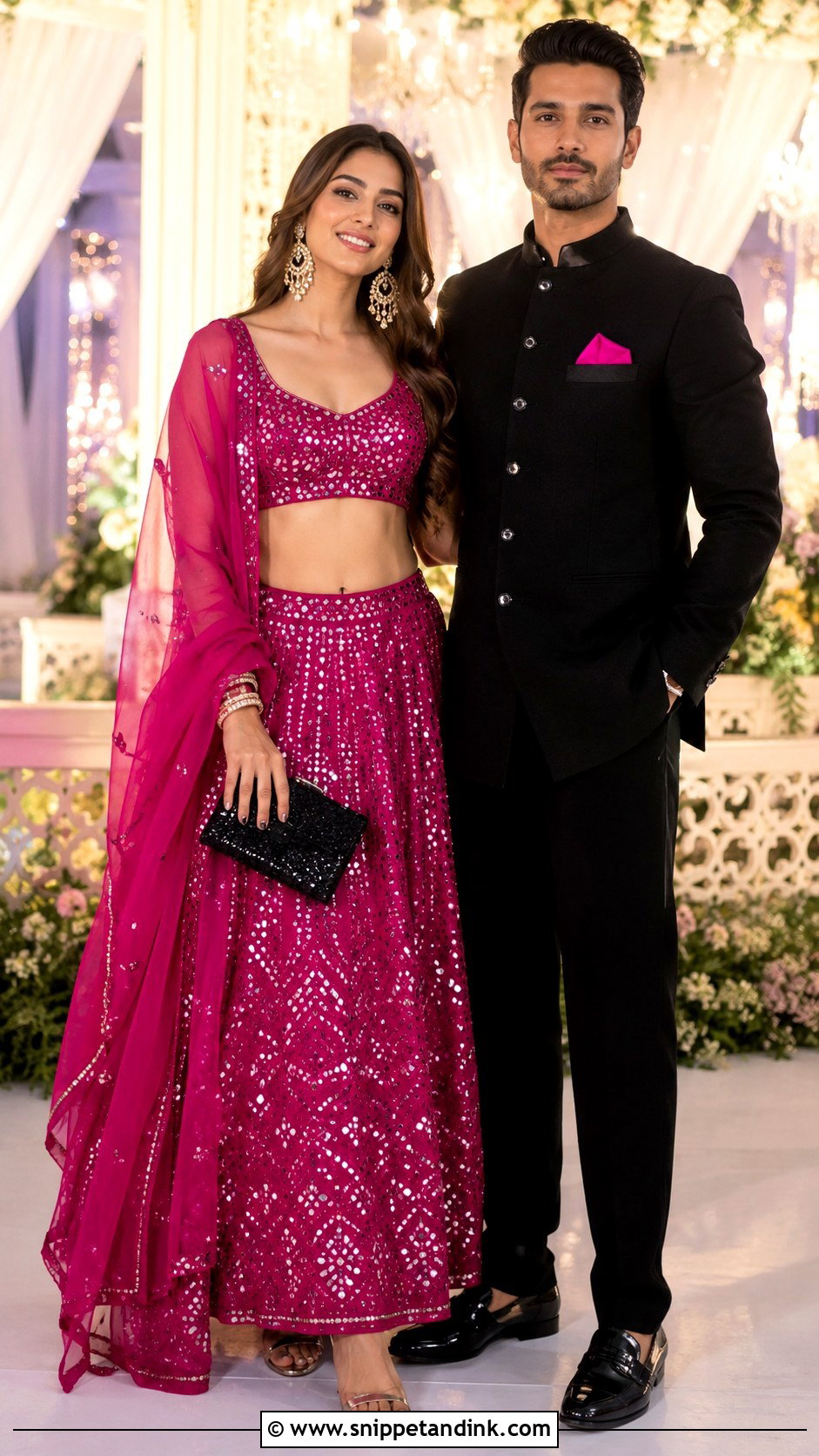
Fuchsia and black is high contrast, which helps on a dance floor where photos are fast and lighting moves. She wears bright fuchsia with mirror work or sequins. He wears a sleek black bandhgala with fuchsia on the pocket square, the buttons or the inner kurta, and nothing more. Black grounds the palette and lets her lead. Keep one shared metal, silver or antique gold, on both. Fuchsia already commands attention, so skip other strong colors. Polished loafers for him, metallic heels and statement earrings for her.
14. Gold Saree And Beige Sherwani Indian Wedding Outfit
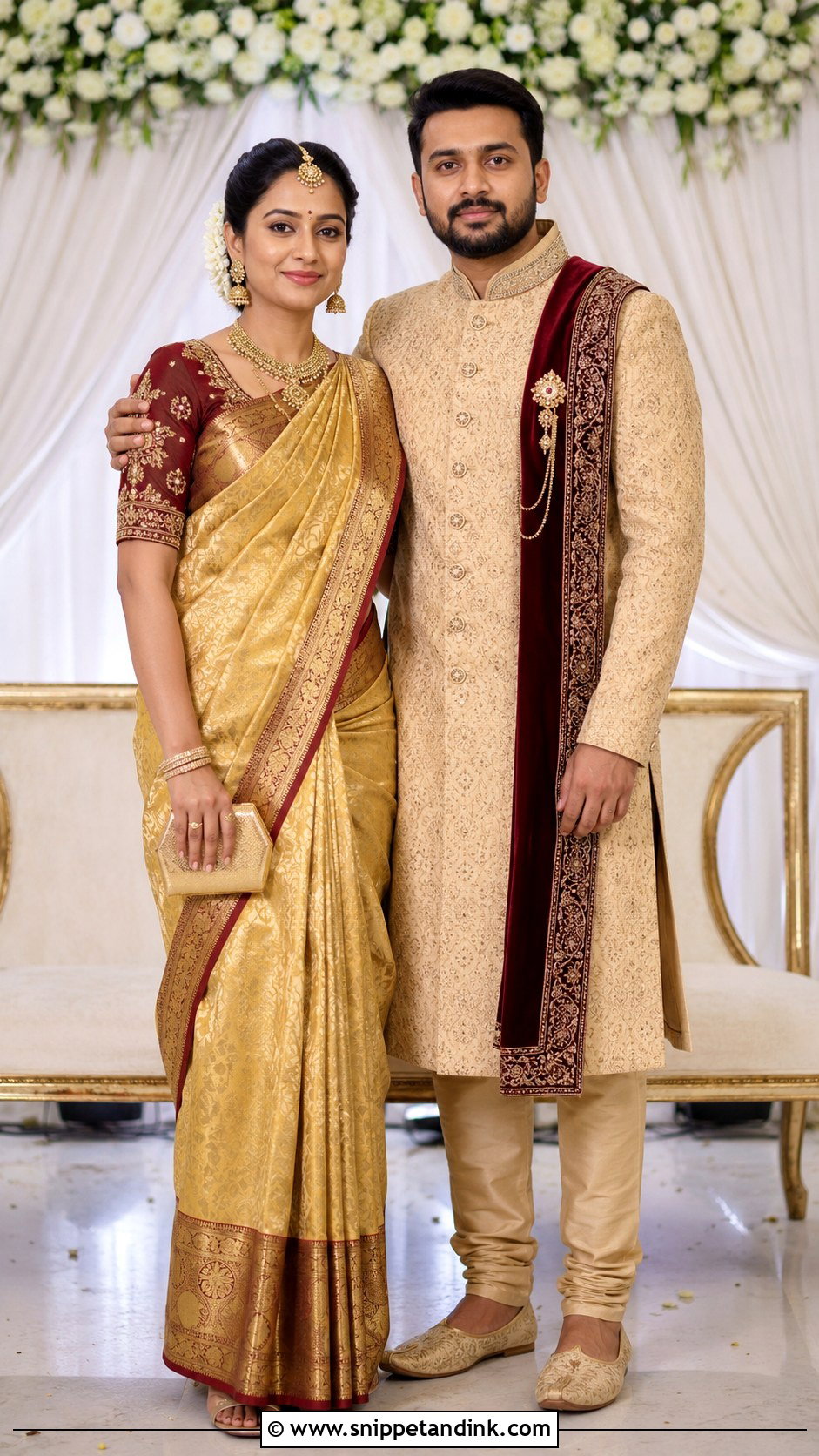
Gold and beige look warm and ceremonial, and the risk is that two neutrals go flat in photos. I fix that with contrasting finishes: her lustrous gold silk saree against his matte raw-silk sherwani, both carrying gold embroidery. Her blouse can be maroon, green or ivory, and his stole picks up that color. Temple jewelry, fresh flowers in a bun and gold sandals suit her; beige mojaris and a classic brooch suit him. Regional traditions vary a great deal with gold sarees, so adapt the draping and jewelry to your family’s customs.
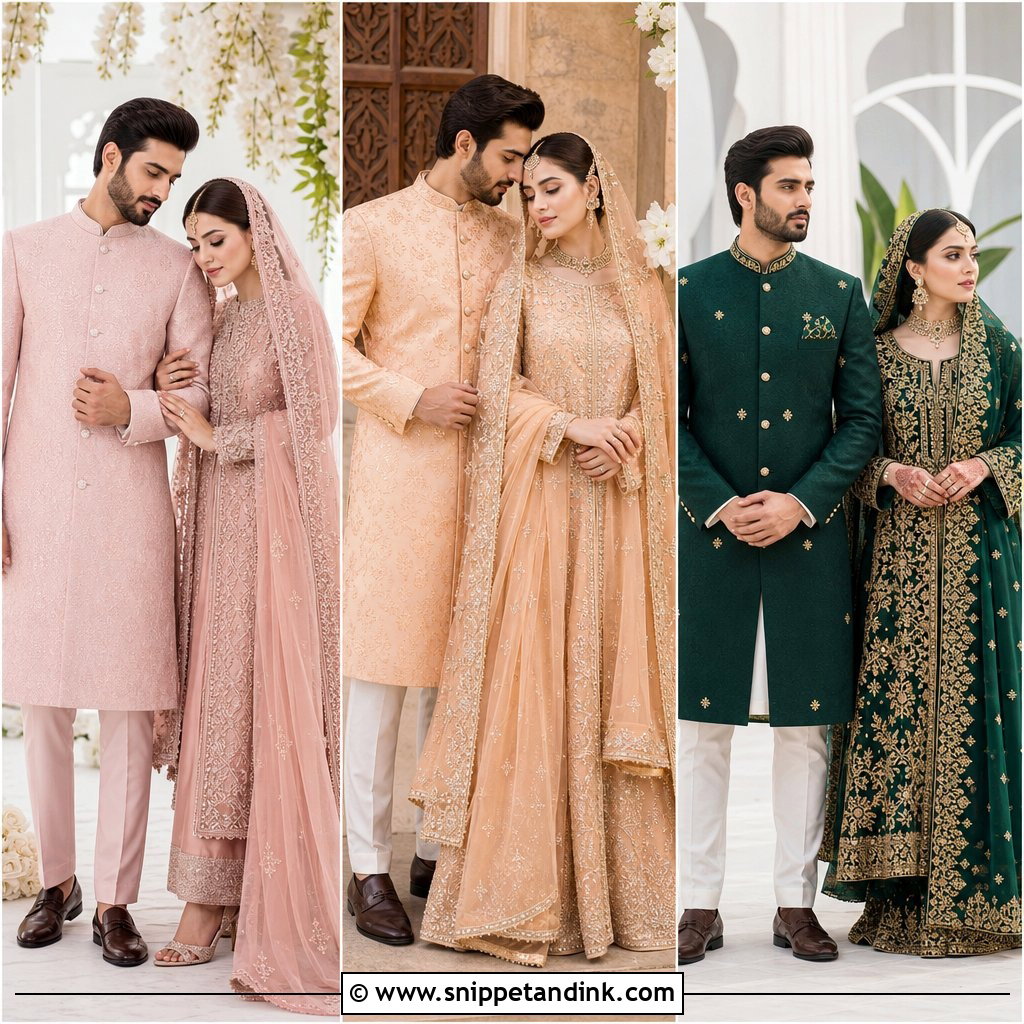
15. Teal Lehenga And Jacquard Jacket Indian Wedding Outfit
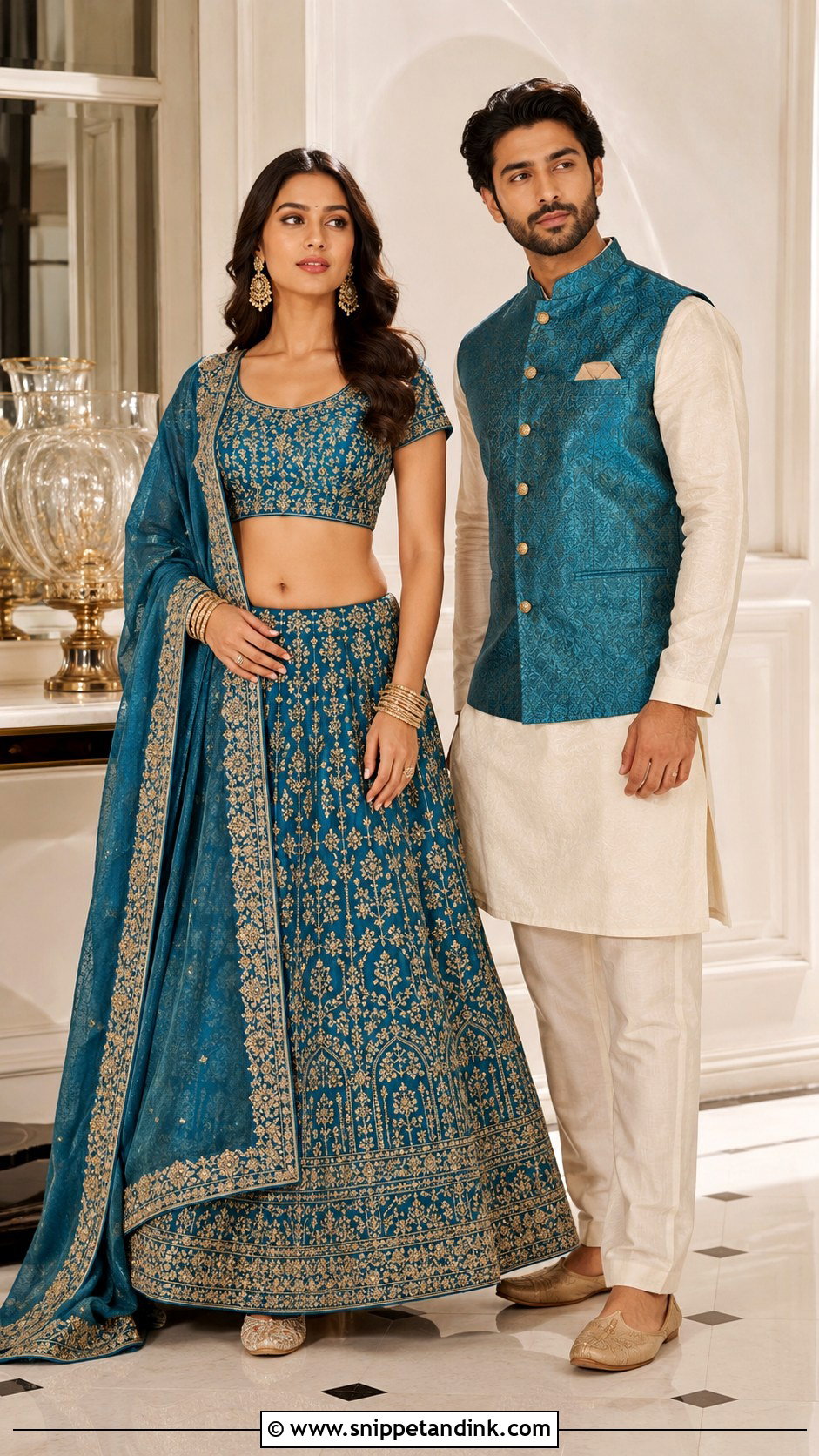
Teal sits between blue and green, and two teals bought in different shops almost never match. Compare them under the same light before you buy. Her teal lehenga with gold embroidery and a bordered dupatta leads. His ivory kurta and trousers with a teal jacquard Nehru jacket that repeats her paisley or floral motif keep him connected. Pairing one solid teal piece with one patterned teal piece looks coordinated rather than uniform. Tan mojaris and a gold-toned watch for him; gold drop earrings and embroidered heels for her.
16. White Saree And White Kurta Indian Wedding Outfit
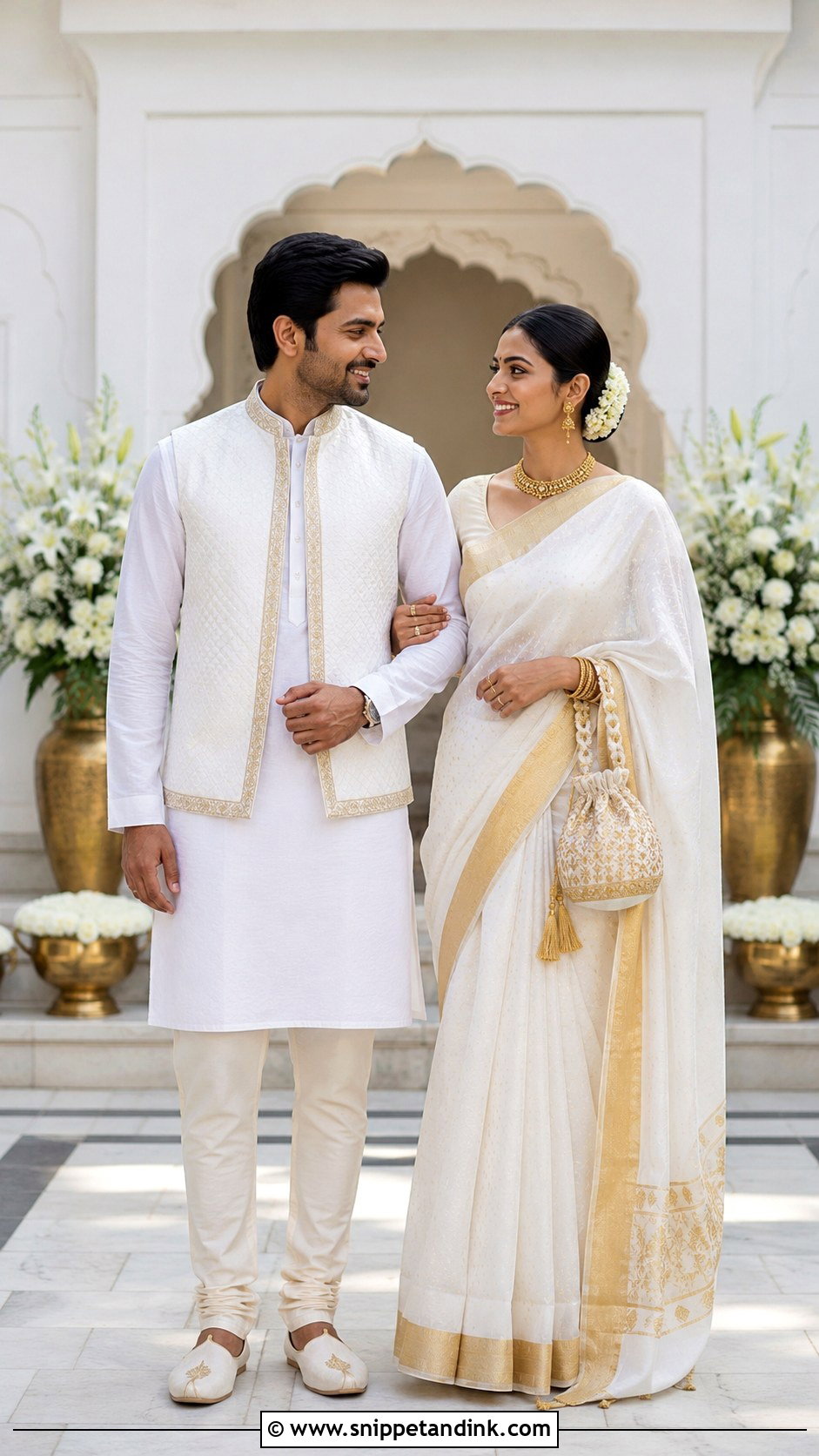
White is worn at several regional ceremonies, especially in South India and Kerala, but in other families it is associated with mourning. Confirm with both sides before planning an all-white look. When it fits, she wears a white or cream saree with a gold border and traditional jewelry; he wears a crisp white kurta, cream pajama and a gold-bordered stole or waistcoat. Undertones need care: bright white beside cream makes the cream look dirty. Gold borders tie the two together and keep them from looking plain.
17. Multicolor Lehenga And Printed Nehru Jacket Indian Wedding Outfit
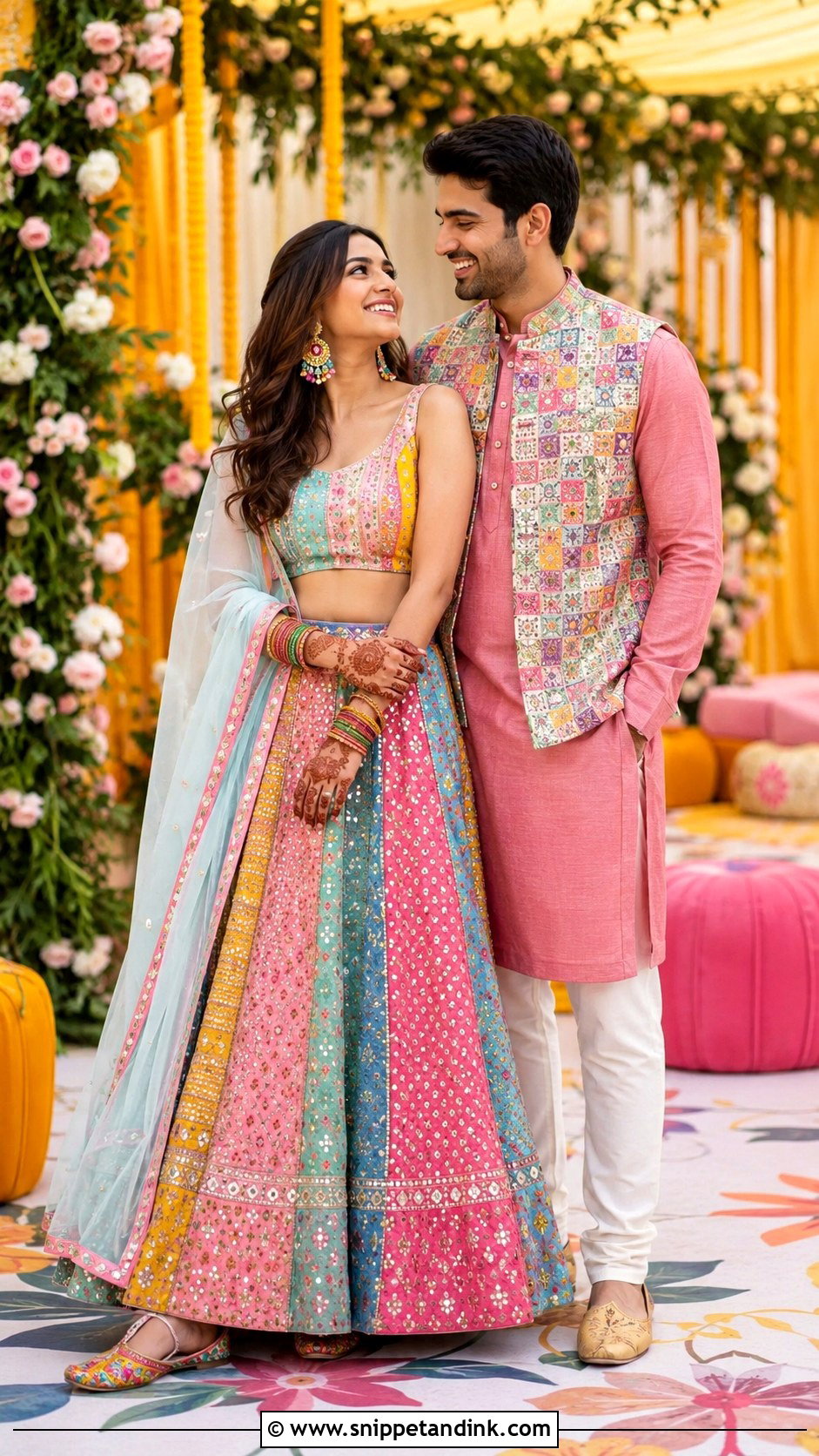
When her lehenga carries four or five colors, he should wear one of them, not all. A multicolor lehenga in pink, green, yellow and blue works for a mehndi or sangeet. He picks one shade from her skirt for a solid kurta and adds a printed Nehru jacket that carries the broader palette. Two unrelated prints side by side clash in every picture, so one shared pattern should lead. Neutral trousers and tan mojaris keep his look calm against hers.
18. Maroon Saree And Ivory Sherwani Indian Wedding Outfit
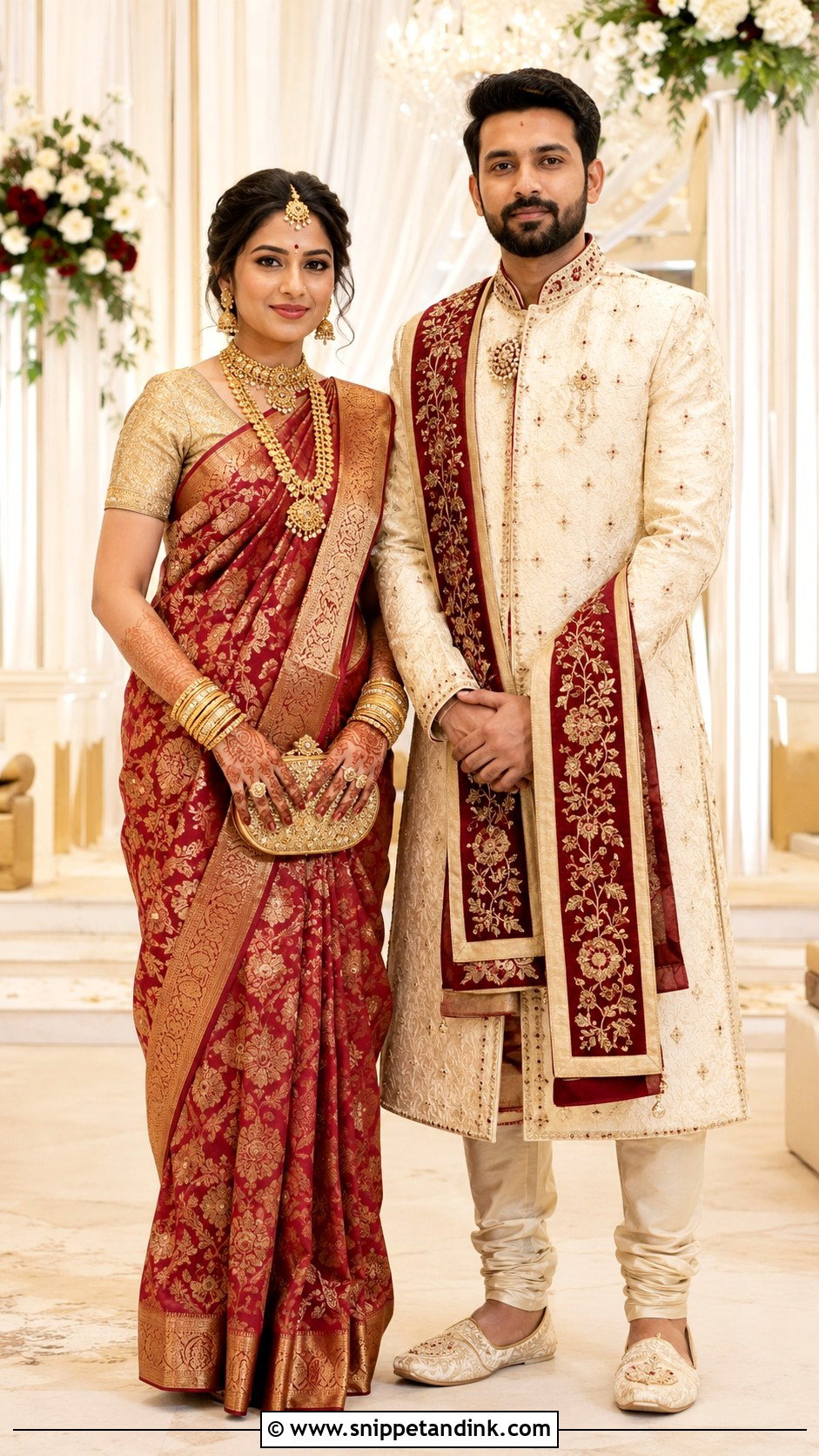
Maroon and ivory is a deeper, more regal take on red and cream. Her maroon silk saree with antique gold zari and a matching or gold blouse leads. His ivory sherwani carries maroon only in a few places: embroidery, buttons, a stole or a safa. Too much maroon on a pale sherwani makes it look busy, so I limit it to two touches. A shared gold finish ties the colors together. Ivory mojaris and a restrained brooch suit him at a traditional ceremony or formal family portrait.
19. Pastel Floral Lehenga And Coordinated Kurta Indian Wedding Outfit
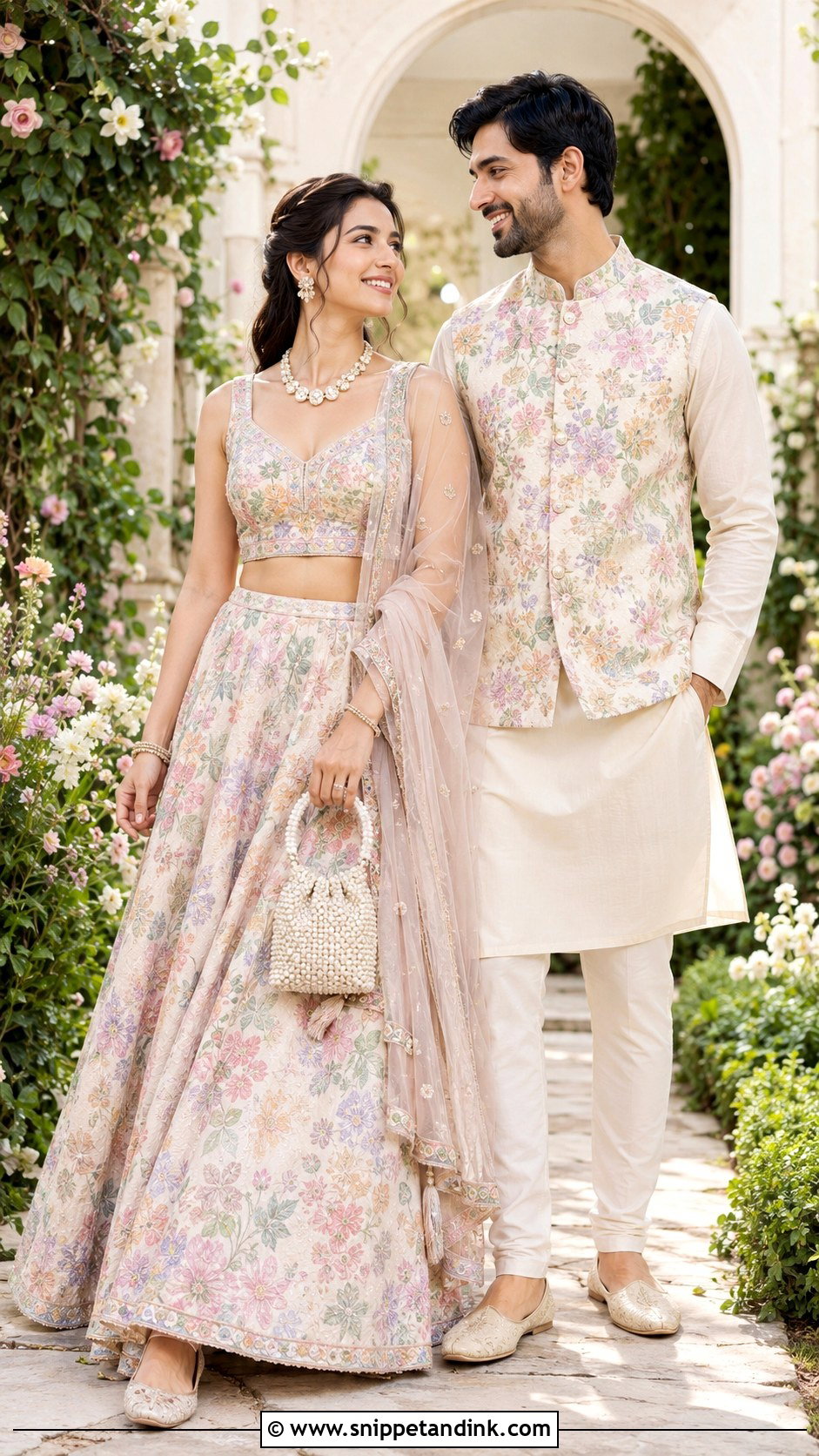
With two florals, scale is everything. Pastel floral outfits look celebratory at a garden engagement, but only if his print is smaller or sparser than hers. She wears a blush, mint and lavender floral lehenga with a solid blouse. He wears an ivory kurta pajama with a floral Nehru jacket in the same palette. Pick one dominant color, blush or mint, to guide both sets of accessories. Beige mojaris and a pastel pocket square for him; pearl earrings and light juttis for her.
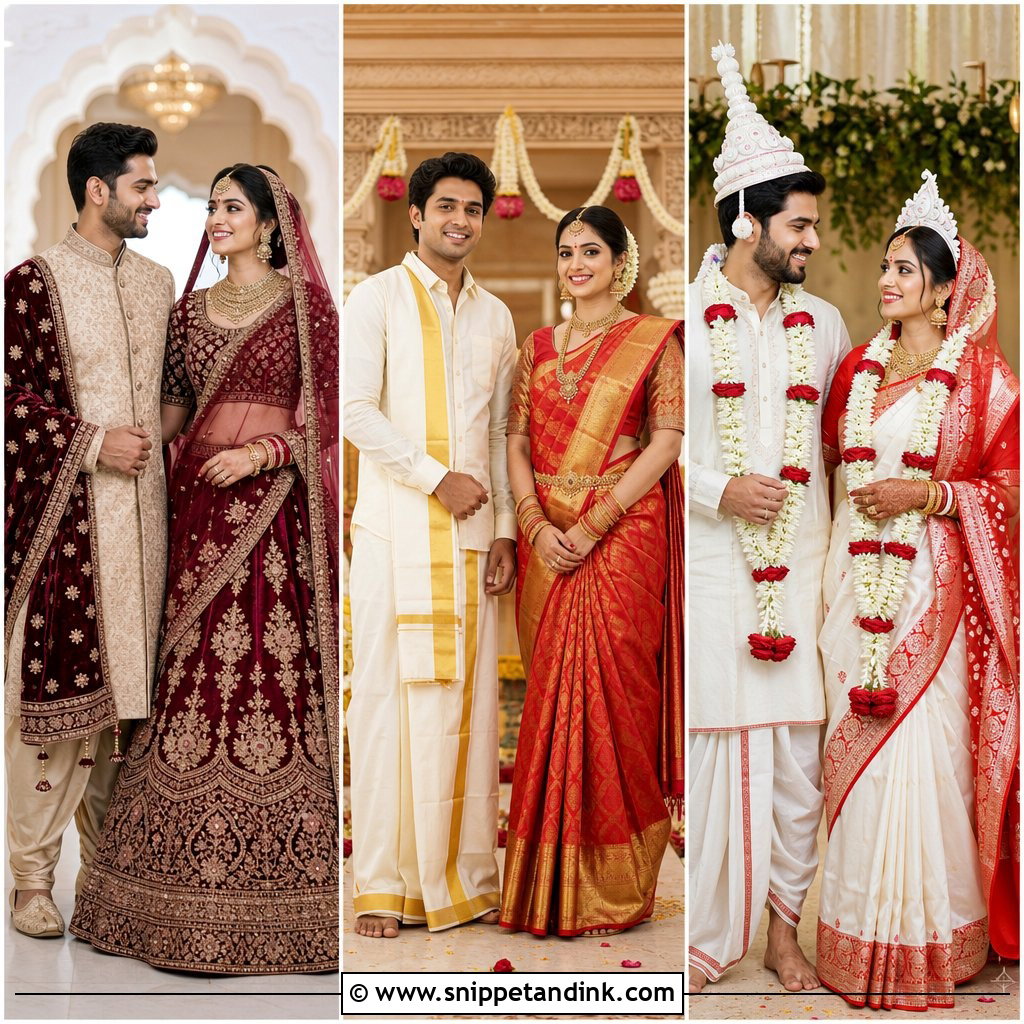
20. Black Saree And Black Bandhgala Indian Wedding Outfit
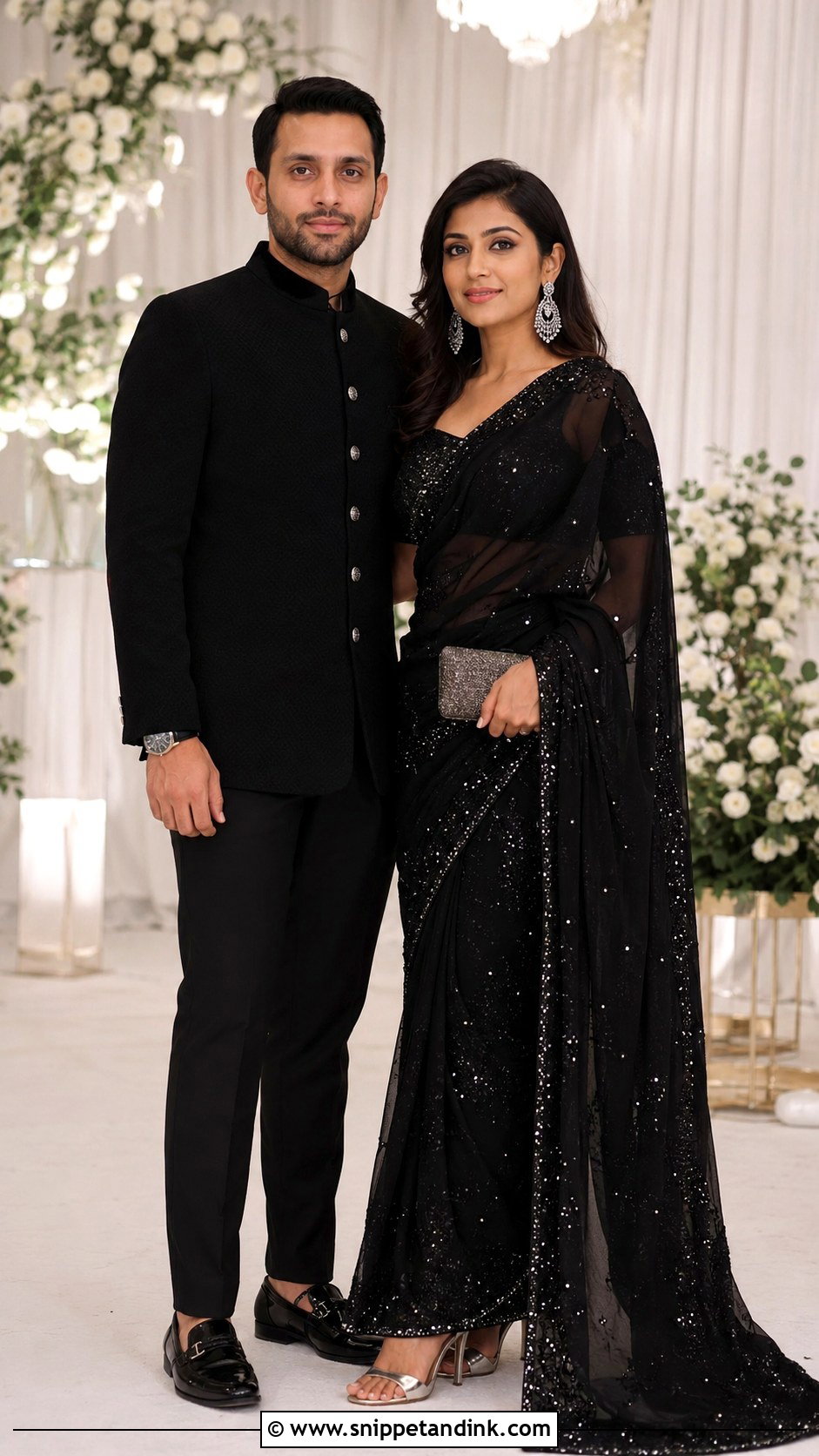
Black on black works for a reception only where the dress code and both families are comfortable with it, so ask first. She wears a black saree with silver sequins or a metallic border; he wears a tailored black bandhgala with silver buttons. Two black outfits disappear into each other in evening photos, so texture matters: velvet, satin, jacquard or sequins on at least one. One repeated silver detail is enough to connect them. Black loafers and a silver watch for him, a statement cuff and metallic heels for her.
Why Matched Colors Shift Under Mandap Lights and Flash
Two fabrics that look identical in a shop can photograph as different colors. Silk reflects light and looks brighter; raw silk, velvet and cotton absorb it and look darker. Warm venue bulbs push everything toward yellow, so cool pastels can look muddy at night. Camera flash flattens embroidery and can turn ivory beside white into a visible mismatch.
The simplest check is a test photo. Stand the two outfits, or the swatches, together near a window and then under a warm lamp, and take a picture of each with your phone. If they read as the same family in both, you’re safe. If one looks gray or green in the warm light, adjust his shade or move the match to a stole instead.
Groom Fittings Need Room Too
Sherwanis and bandhgalas are tailored garments, and the shoulders and sleeve length matter more than the embroidery. Plan for a first fitting, an alteration and a final fitting a couple of weeks before the wedding. Bring the mojaris or shoes he’ll wear, because trouser length is set against them. A safa needs its own trial with whoever ties it on the day.
Coordination Comes From One Shared Detail
Matching works best when it’s balance, not duplication. Decide the function and formality first, then pick the one or two details that will connect you, a color, a border, a print or a metal finish. Each of you should wear a silhouette you’re comfortable in for hours. Look at both outfits together in daylight and in the kind of light your venue has before any final alterations. Shoes, stoles, bags and pocket squares should support the shared palette, not add another one.
You'll Like These Ideas:


Leave a Reply