
Georgian bridal dress, meaning the country of Georgia rather than the American state, grows out of one garment: the kartuli kaba, a long women’s dress shaped close through the bodice, cinched with a decorated belt and finished with elegant headwear. When a bride brings me a Georgian reference, my first question is which region her family comes from, because embroidery, fabric, color and even the cut of a sleeve change between Kakheti, Svaneti and Adjara. Some of the dresses below stay close to historical forms. Others borrow one or two features for a modern wedding. If authenticity matters to your family, bring a Georgian maker or cultural specialist in alongside whoever handles your fittings.
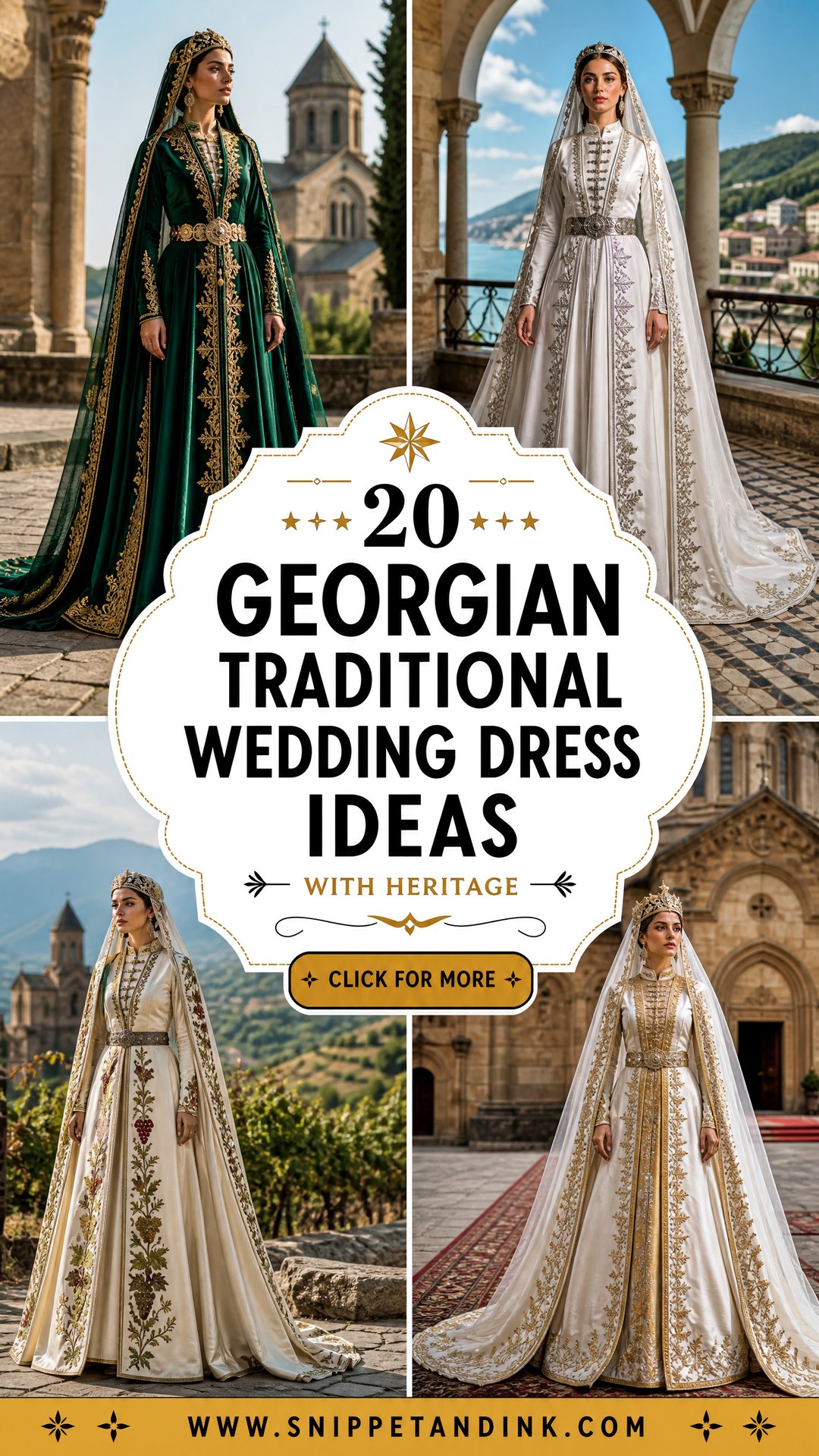
Commissioning a Kartuli Kaba From a Georgian Maker
Most of the dresses below can’t be bought off a rail. A fitted kaba with hand goldwork on the belt and cuffs is a commission, and the embroidery sets the calendar, not the sewing. For anything hand-embroidered I’d start the conversation the best part of a year out and ask the maker for her own estimate, since goldwork done by one person can’t be rushed by adding another pair of hands halfway through.
Plan on at least three fittings. The first checks the bodice shape on your body, the second checks sleeve length and skirt fullness, and the last one has to happen with the belt, the headpiece and the exact shoes you’ll wear. A heavy belt changes where the waist sits, and a headpiece changes how the veil falls over the back of the bodice, so a final fitting without them tells you very little.
What to bring to the first appointment
- Photos of any family dress, belt or headpiece, even blurry ones. Regional details often show up in the cuff or belt end.
- The name of your family’s region, and the church or venue, since a Georgian Orthodox ceremony expects covered shoulders and a covered head for women.
- Your shoe height, so the hem is cut once and cut right.
- Any heirloom piece you want worked in, so the maker can match metal color and thread to it.
1. White Kartuli Kaba Wedding Dress
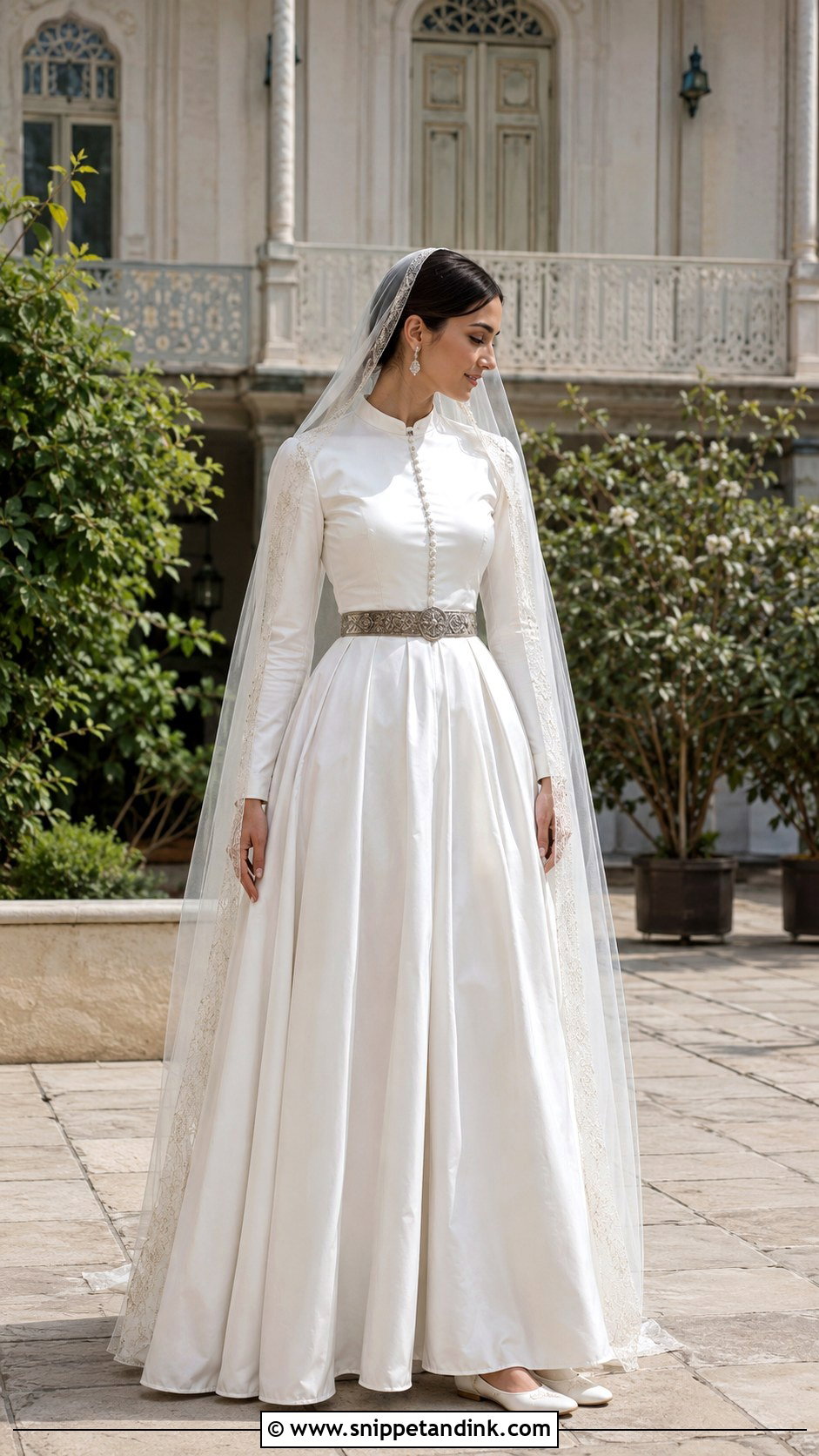
White is where most brides start, and the kaba carries it well because the shape does the work. I look for a floor-length dress with a fitted bodice, a defined waist, a full skirt and narrow sleeves that reach toward the hand, in silk or satin with tonal embroidery you only notice up close. The belt is the piece I fuss over most. A structured metallic belt with two ends falling straight down the skirt will drag the waist forward if it’s heavy, so I ask the maker to anchor it to the waist seam with thread loops. A sheer lechaki-style veil, pearl drops and white leather flats finish it. Keep the neckline modest and leave enough fullness in the skirt to dance.
2. Ivory Georgian Wedding Dress With Chikhti-Kopi
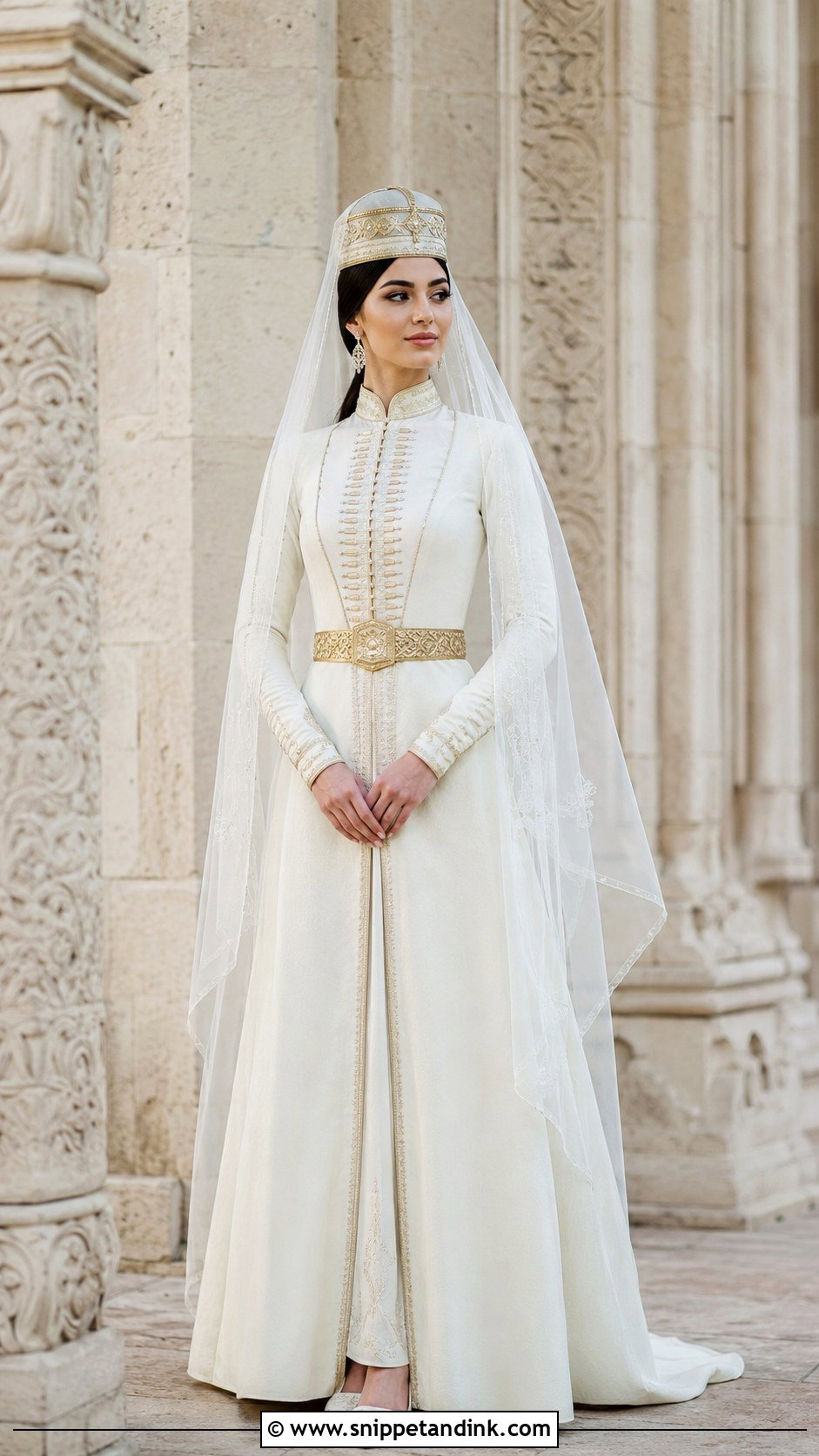
Ivory sits half a shade warmer than white, which is kinder to olive and golden skin in daylight. Start with a fitted silk gown with a high neckline, slim sleeves and a gently full skirt, and add a gold embroidered belt with cuffs to match. The real focus is the chikhti-kopi, a stiffened, fabric-covered band worn on the head with a sheer lechaki falling from it. Historically, Georgian women’s headwear was built from several layered pieces, so this is not something to improvise from a craft-store headband. At a fitting I set the headpiece first and the veil second, over a low braid that gives the pins something solid to grip. Small gold earrings and pointed ivory slippers keep attention at the head and waist.
3. Red Velvet Georgian Wedding Dress
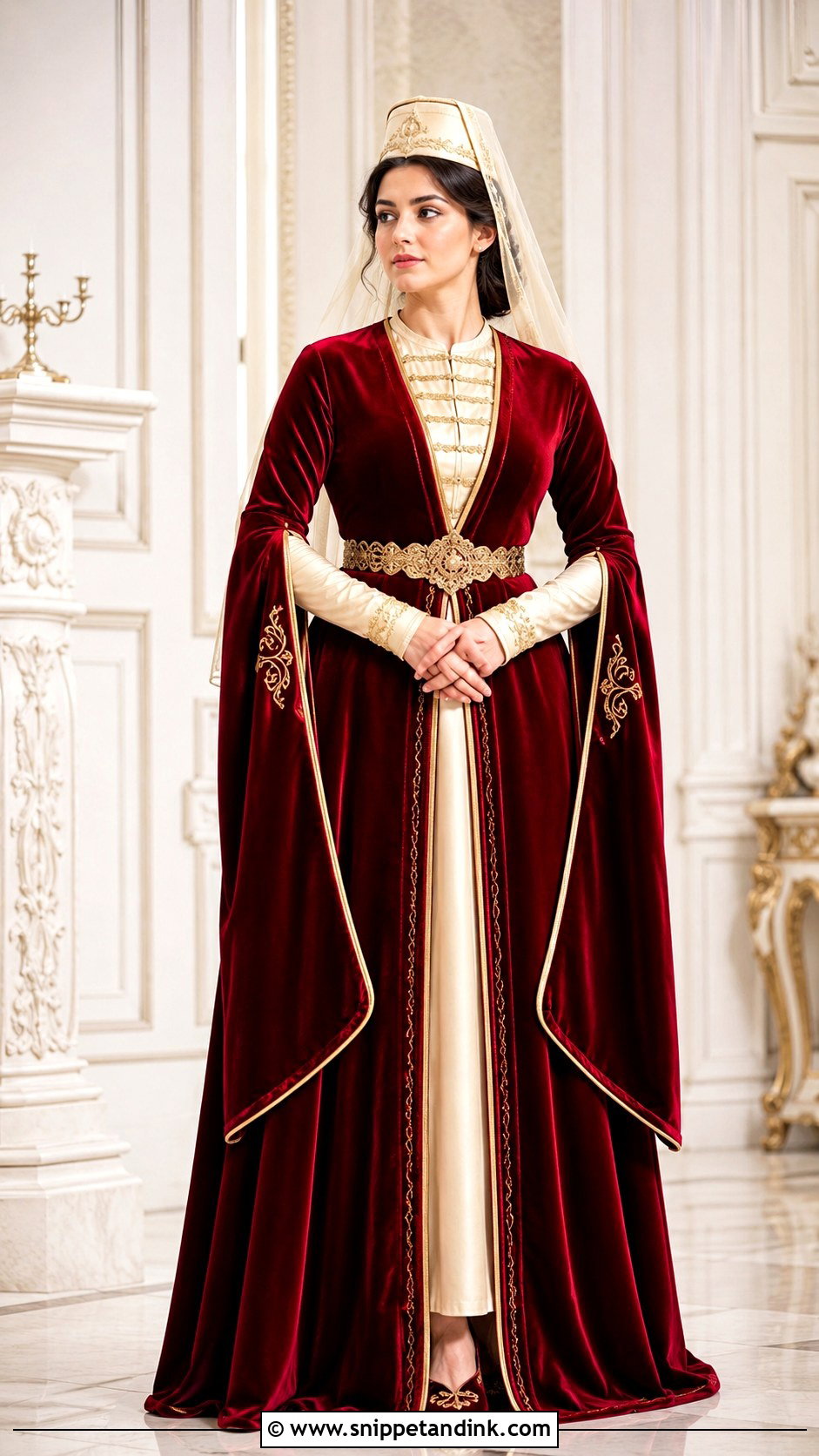
Red velvet is the dress I suggest for a winter ceremony in a candlelit church, and the one I talk brides out of for July. Select a floor-length kartuli-inspired dress with a closely shaped bodice, narrow waist and long open sleeves over fitted cream undersleeves, with gold embroidery at the neckline, cuffs and skirt opening. One thing I always check: velvet has a nap, and if the panels are cut in different directions the red looks patchy under flash. Add a broad gold belt with long front panels, a cream headpiece and light veil to calm the color, gold drop earrings, and dark red or gold flats under the hem. For a heated indoor venue, ask about a lighter velour.
4. Blue Silk Georgian Wedding Dress
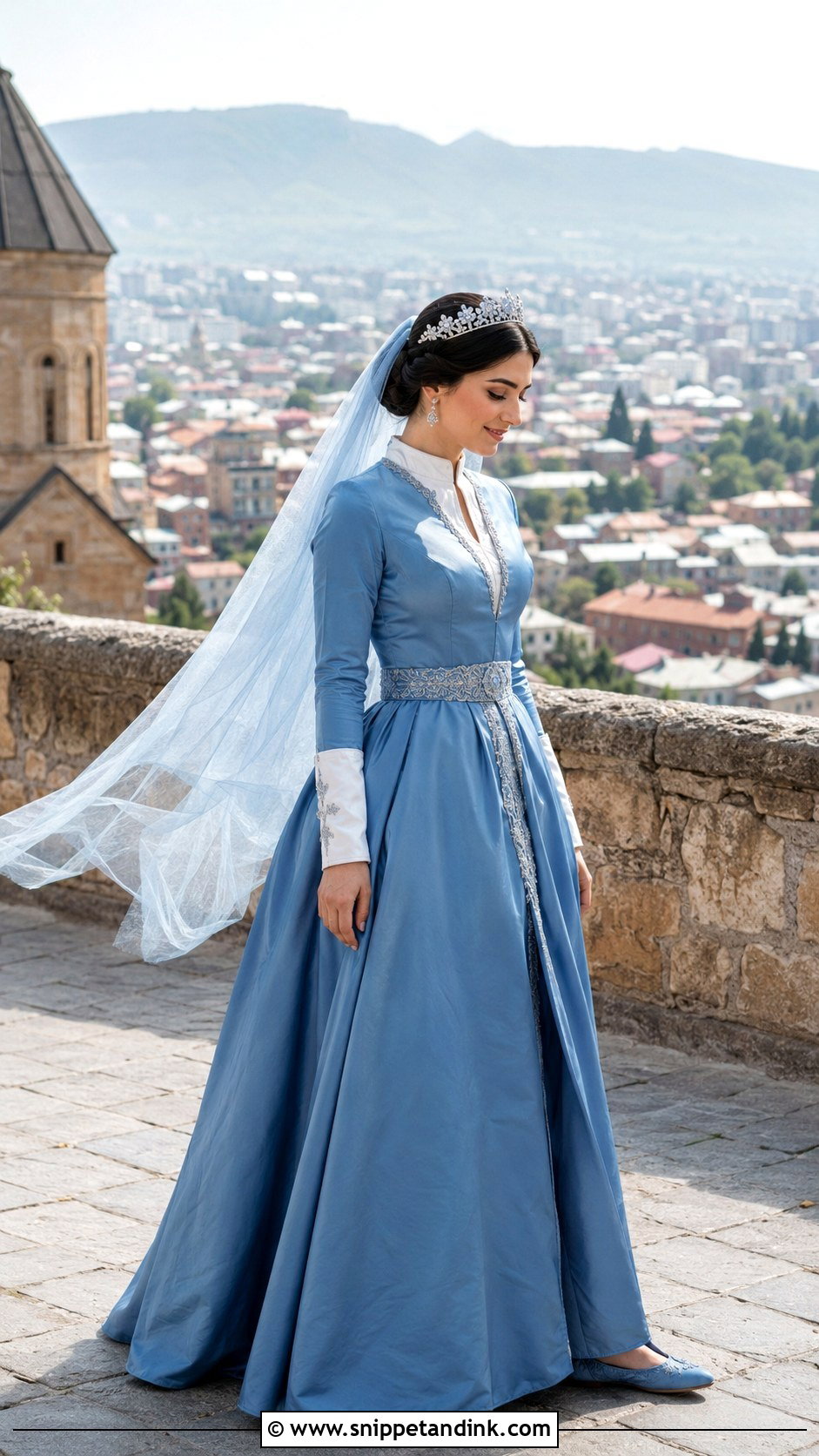
Blue silk keeps the long Georgian line while stepping away from white. Look for a gown with a fitted torso, a gently flared skirt and sleeves that open to show embroidered white cuffs. Silver sits more quietly against blue than gold, which can turn brassy beside a cool shade, so I’d use the same silver thread at the neckline, cuffs and belt; mixed metals on this dress tend to look accidental. Restrained botanical or geometric motifs on the belt, a silver-trimmed headpiece, a pale blue sheer veil and understated earrings are plenty. Soft leather slippers or low block heels keep you steady on stone church floors.
5. Emerald Georgian Wedding Dress With Gold Belt
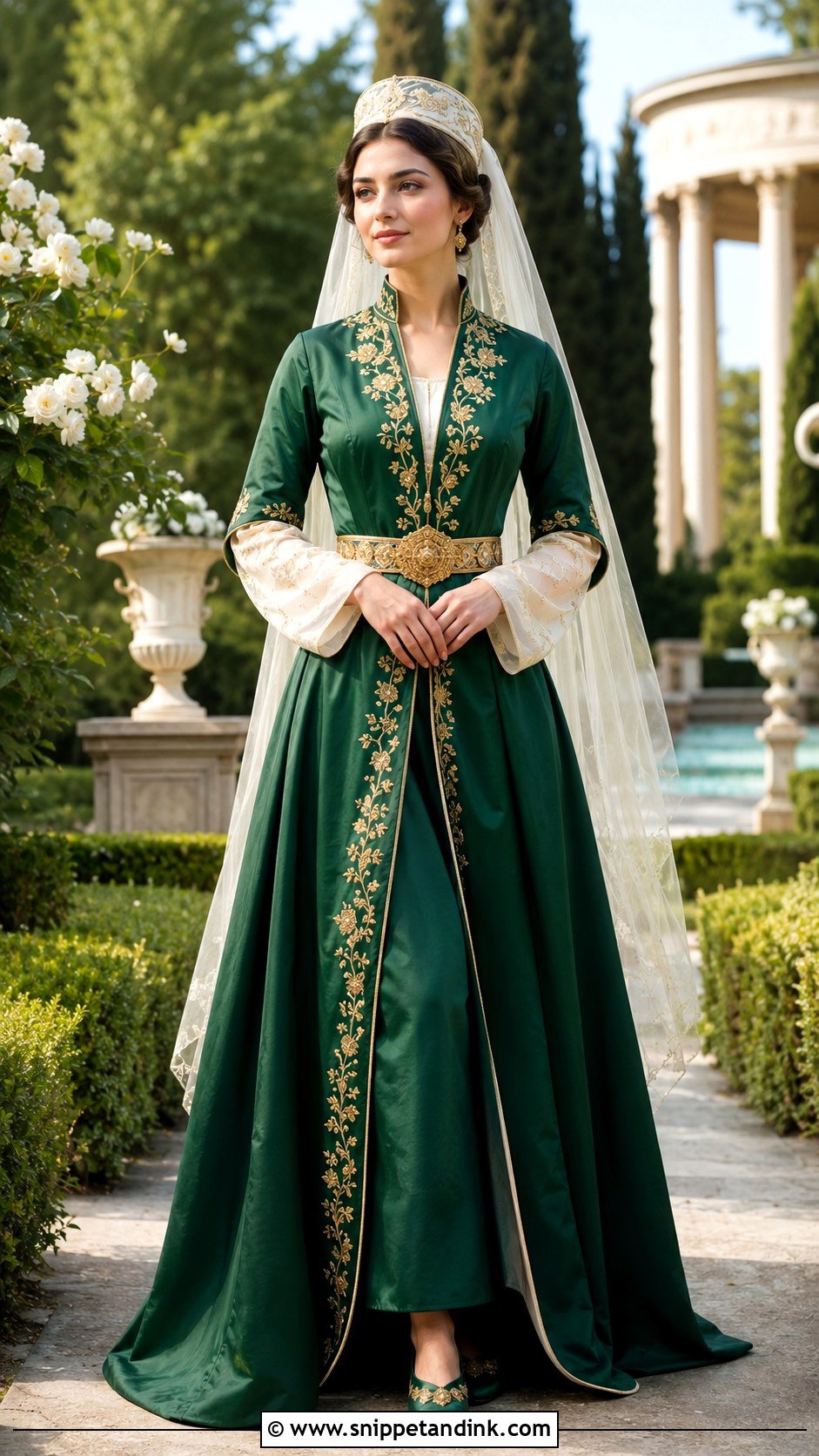
Emerald and gold is a strong pairing, and the risk is that it tips into stage costume. Choose a long silk or velvet gown that fits smoothly through the upper body and widens below the waist, with fitted cream undersleeves beneath split outer sleeves. A wide gold belt is the anchor, ideally with metalwork or embroidery that echoes the cuffs. Add a cream chikhti-kopi-inspired headpiece, a translucent veil, green pointed flats and small gold earrings. When a bride finds green head to toe too much, I keep the underdress ivory and use emerald only for the outer layer. That lighter version also holds its color better against pale stone walls and garden greenery in pictures.
6. Khevsureti Georgian Wedding Dress
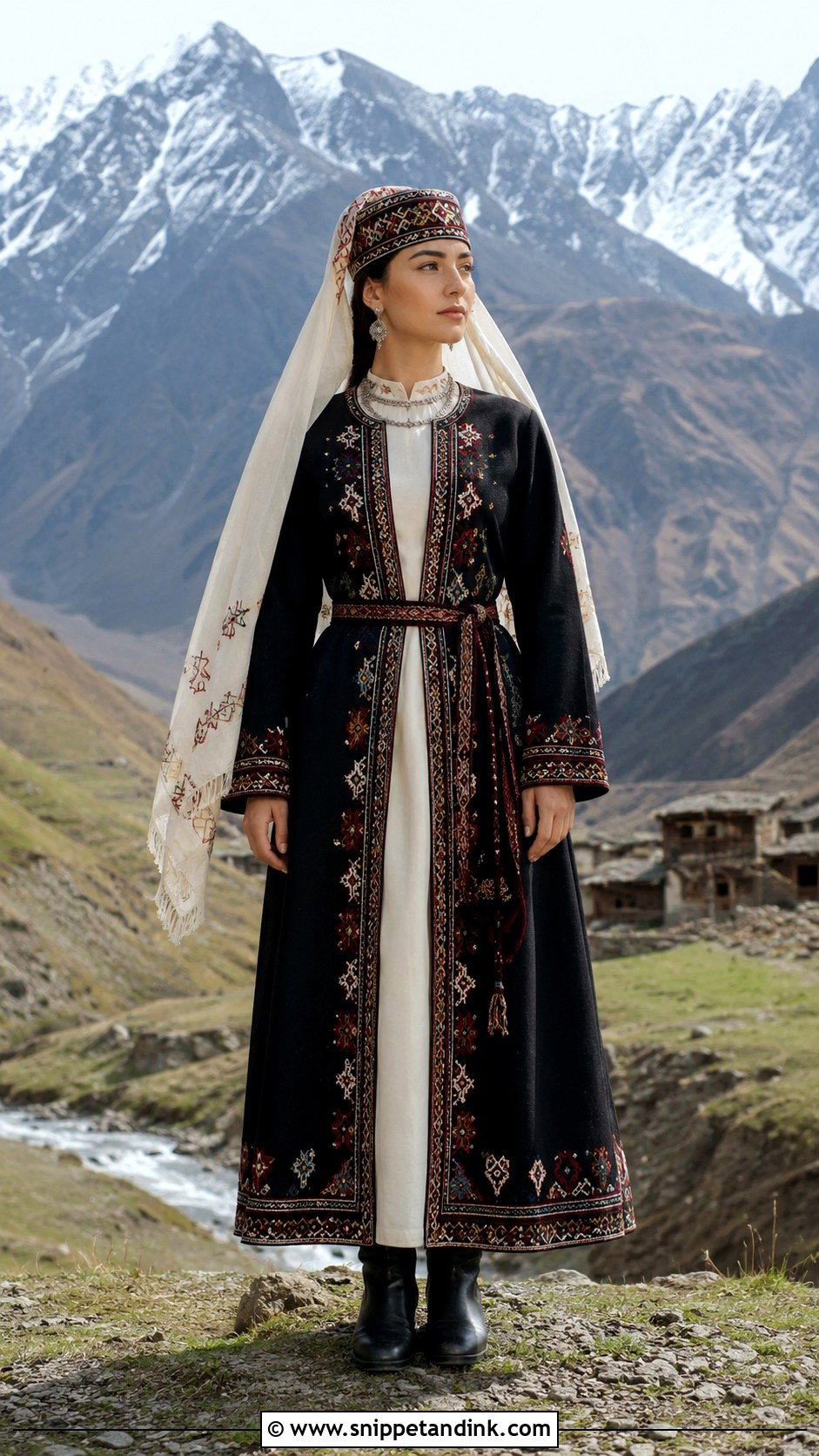
Khevsureti, high in the northeastern mountains, has some of the boldest textile work in Georgia, and the traditional women’s dress there is called the sadiatso. I treat a Khevsur-inspired dress very differently from the lowland kaba: dark wool or a firm cotton, dense colored geometric embroidery across the bodice, sleeves and hem, a narrow woven belt, an embroidered head covering and sturdy dark boots for a mountain ceremony. Jewelry stays minimal because the needlework is already doing the talking. Ivory embroidery, a light veil or a white underdress is what makes it read as bridal. These motifs carry meaning, so only use them with a craftsperson who can tell you what each one is. Mixing symbols from unrelated regions is the mistake I see most often with this look.
7. Svaneti Georgian Wedding Dress
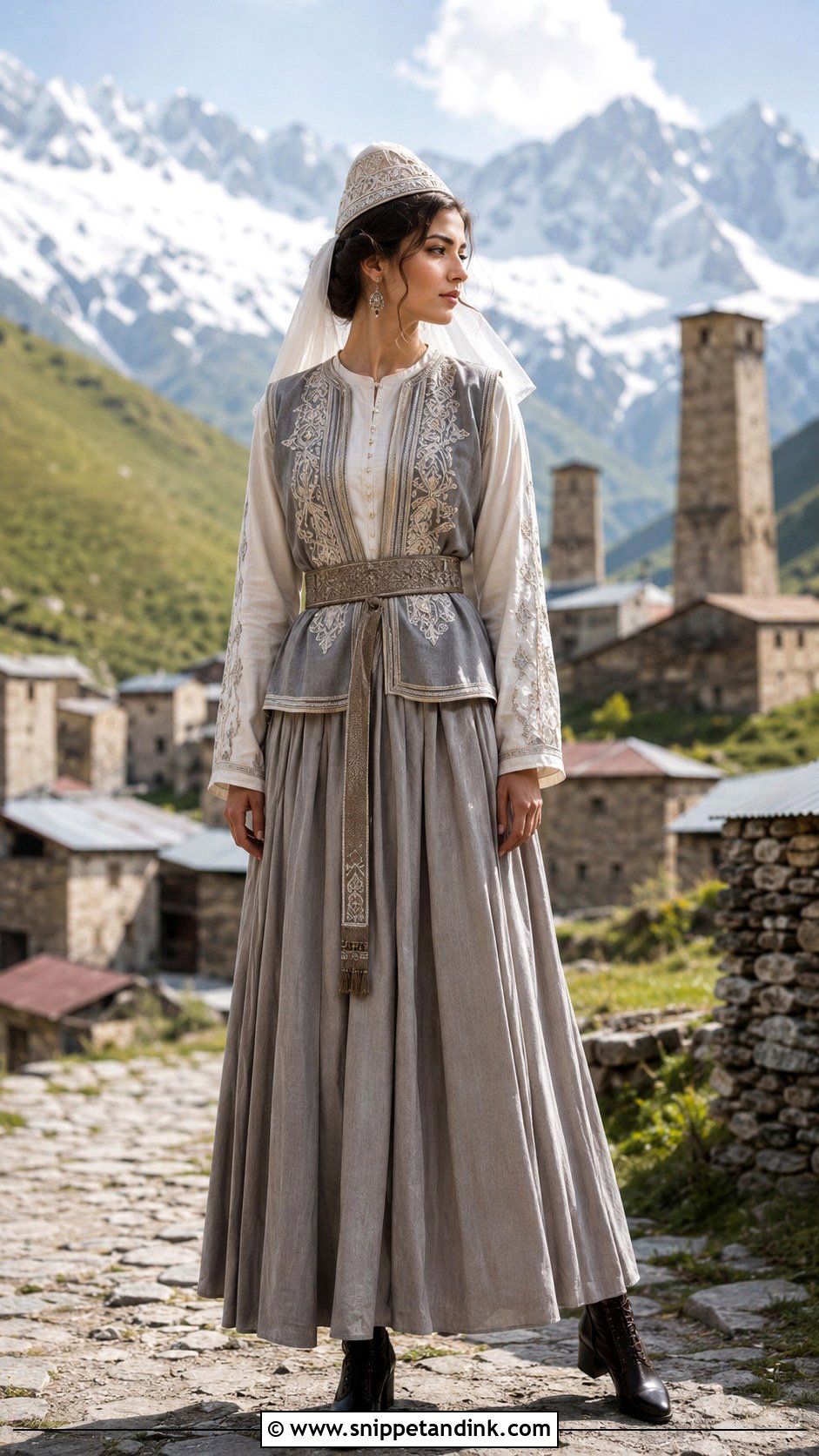
Svan women traditionally wore a two-piece dress, which makes this the easiest regional look to wear comfortably all day. Begin with an ivory long-sleeved blouse and a high-waisted floor-length skirt in soft gray or muted blue, then add an embroidered fitted vest or short jacket for shape through the upper body. A simple felt cap inspired by Svan headwear, worn with a light veil, gives a clear regional reference. Felt is stiff and doesn’t give, so I have the cap fitted over the bride’s finished hair rather than her bare head. Finish with a woven belt, silver earrings and polished ankle boots. Wool-silk blends and lined cotton keep the mountain character without the itch.
8. Racha Georgian Wedding Dress
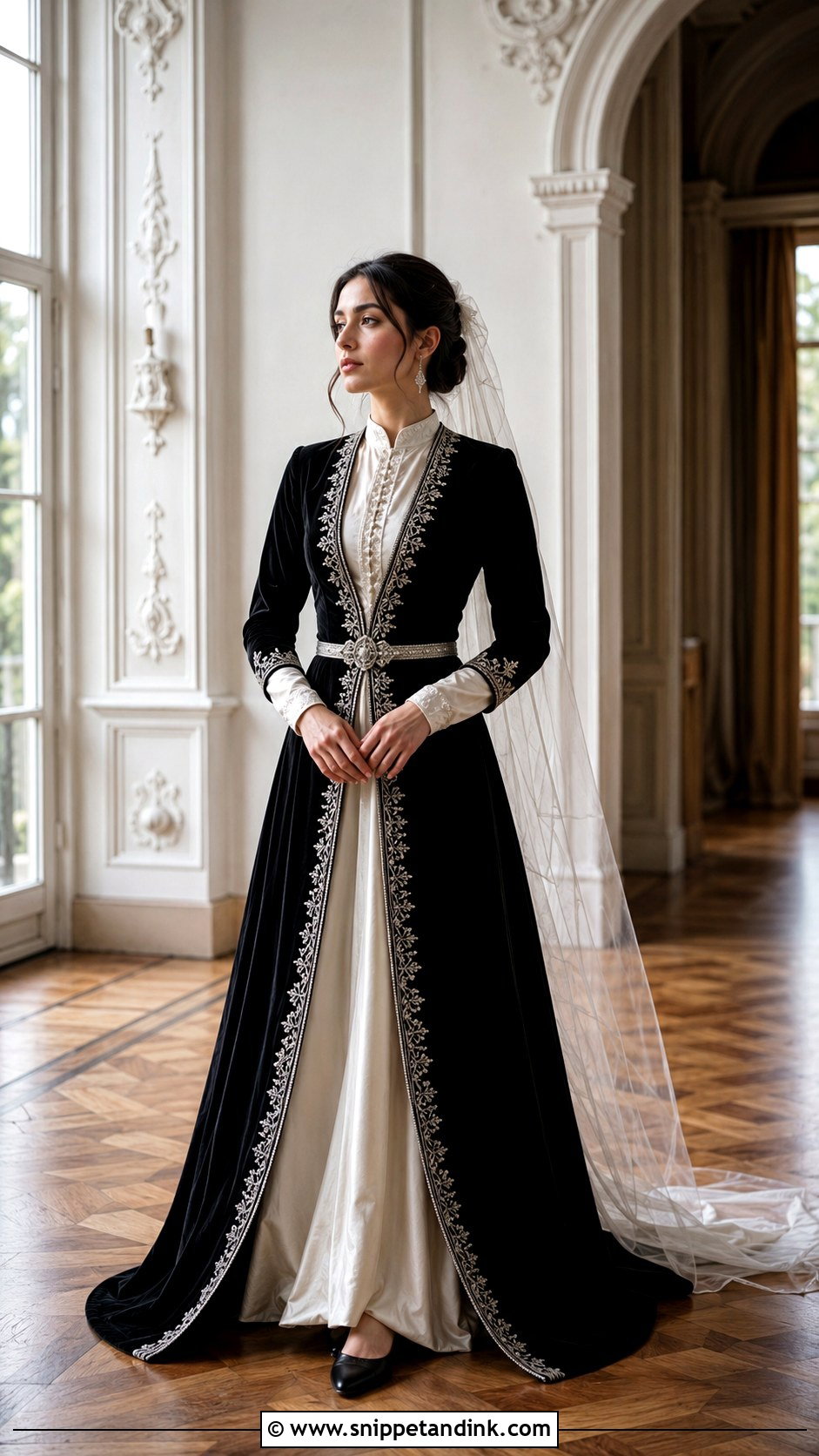
Black for a bride sounds wrong until you see it done properly. Clothing from Racha is often described in black satin, though colored satin was worn too, and a black gown lifted with ivory can be very striking at an evening ceremony. I’d choose a floor-length black dress with a fitted bodice, flowing skirt and narrow sleeves, then bring in an ivory inset panel, white cuffs, silver embroidery and a sheer veil. Black satin goes flat in photos when nothing breaks it up, which is why the polished silver belt matters so much here. Black leather flats, silver drops and a low braid under the headpiece complete it. If the family would rather not see a bride in black, reverse it: ivory gown, black satin outer panels.
9. Adjarian Georgian Wedding Dress
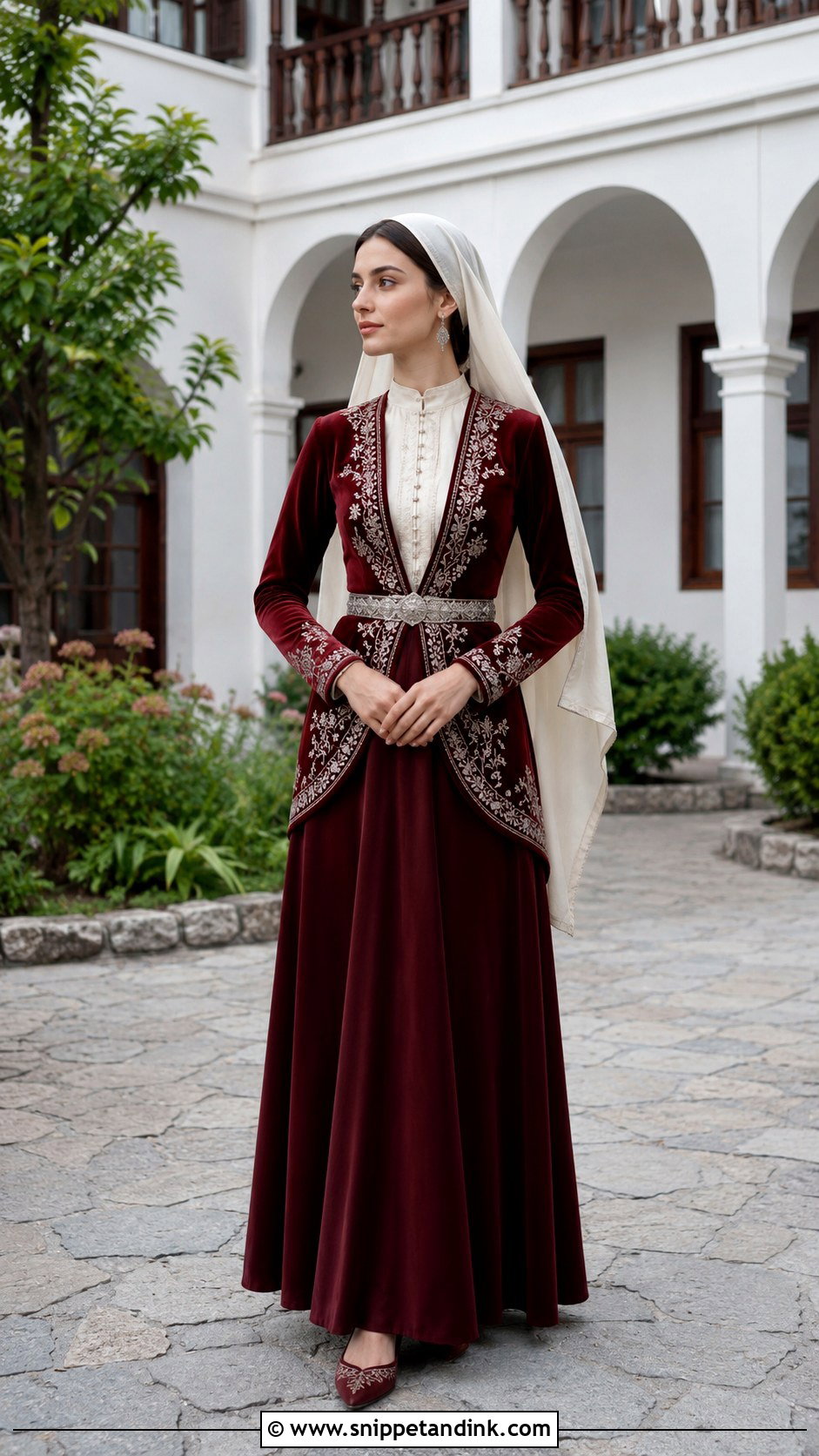
In Adjara and neighboring Guria, traditional dress could be worked with silver thread, and that is the detail I build this look around. Begin with a long burgundy or forest-green dress shaped closely at the waist, and add a cropped embroidered jacket over a cream blouse with narrow sleeves. A silver belt, matching cuffs and a draped headscarf pull it together; pointed leather flats and restrained silver jewelry finish it. Western Georgian dress differs from eastern forms, so pinning Adjarian trim onto a generic costume rarely looks right. A Georgian maker will know how long the jacket should sit and how it should close, and those two details are what make it belong to the region.
10. Gurian Georgian Wedding Dress
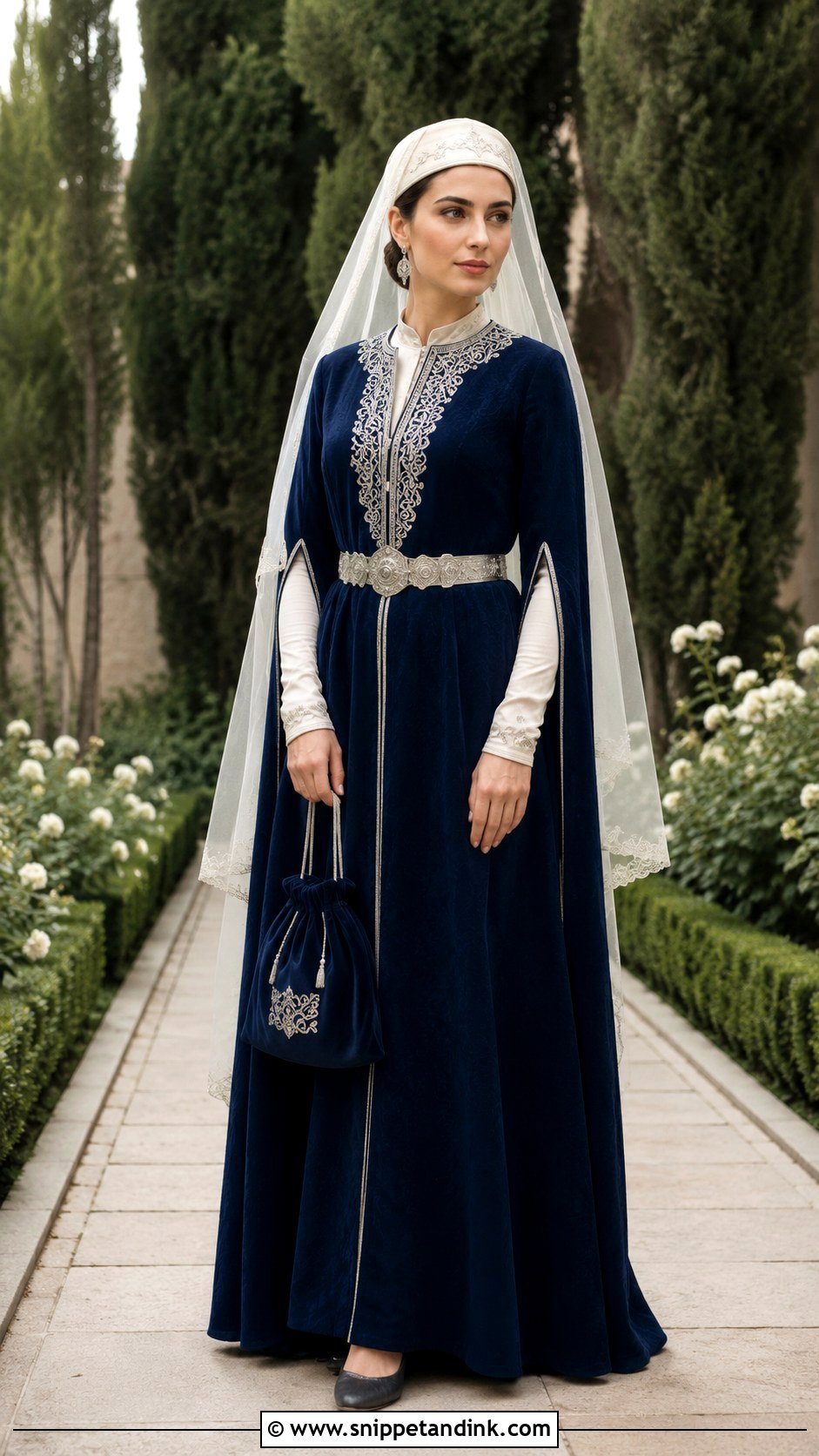
Silver thread is the signature again, but here I keep it to the edges. Choose a long navy or charcoal gown with a fitted top, full skirt and slim cream undersleeves, and place the silver work at the neckline, cuffs and front openings rather than all over. Metallic thread on dark cloth catches every light in the room, so a little goes further than brides expect. A matching silver belt gives structure, while an ivory head covering and sheer veil keep the dark palette bridal. Charcoal flats, silver earrings and a small pouch embroidered to match are enough. For accuracy, work from references for Gurian women’s clothing rather than the better-known men’s chokha, which has a different form and purpose.
11. Kakheti Georgian Wedding Dress
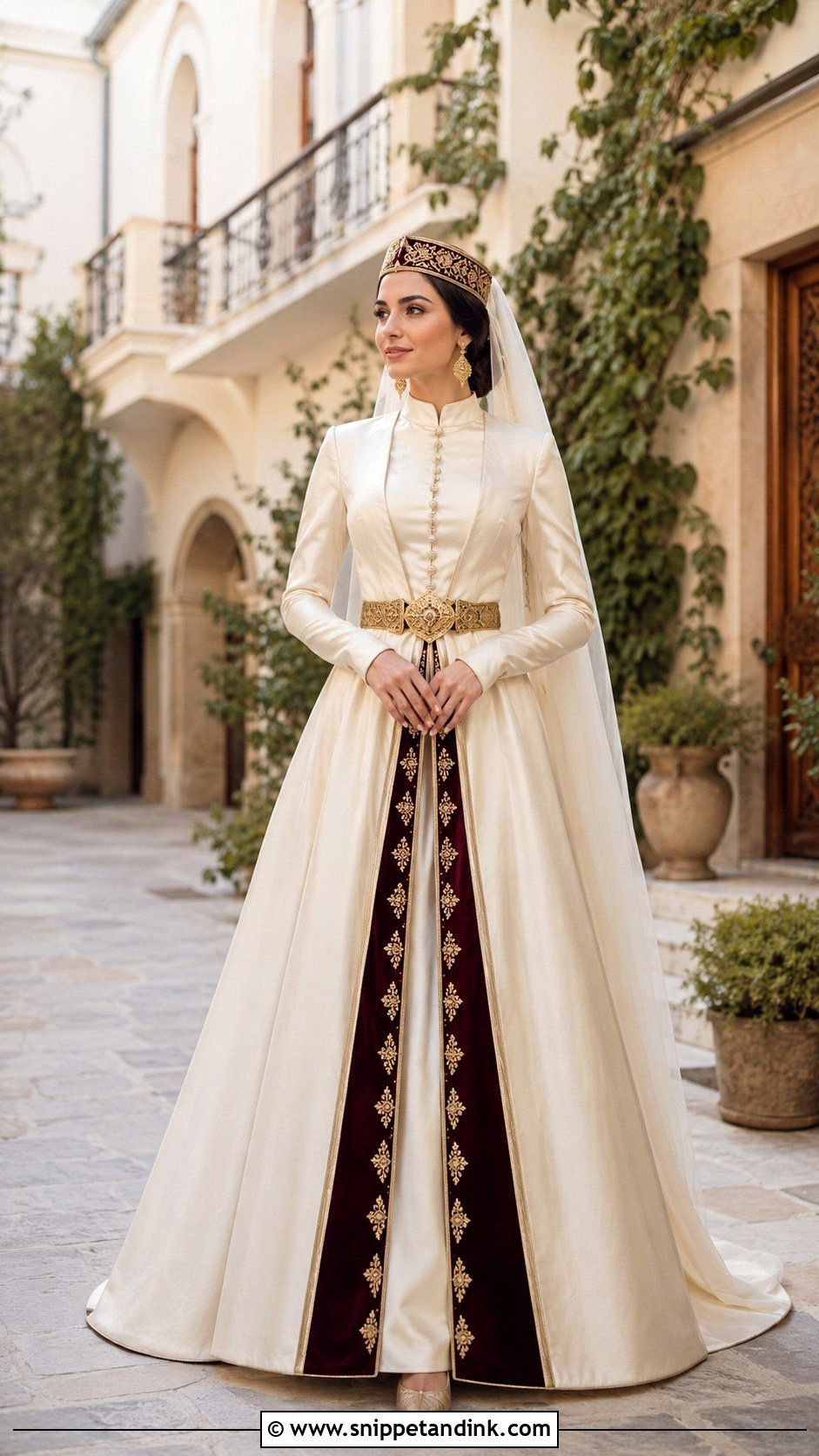
The classic national form of Georgian women’s dress is most closely tied to Kartli and Kakheti: a long garment, a decorated belt and structured headwear. For a Kakheti-inspired bride I start with an ivory kartuli kaba with a fitted bodice, full skirt, high neckline and sleeves tapering to the wrist, then run wine-red or deep plum silk along the front edges and cuffs. Those colored front panels need interfacing, or they ripple the moment a substantial gold belt goes on. A chikhti-kopi-inspired headpiece, sheer ivory veil, gold earrings and pointed flats complete it. Keep the embroidery restrained so the construction stays visible.
12. Kartli Georgian Wedding Dress
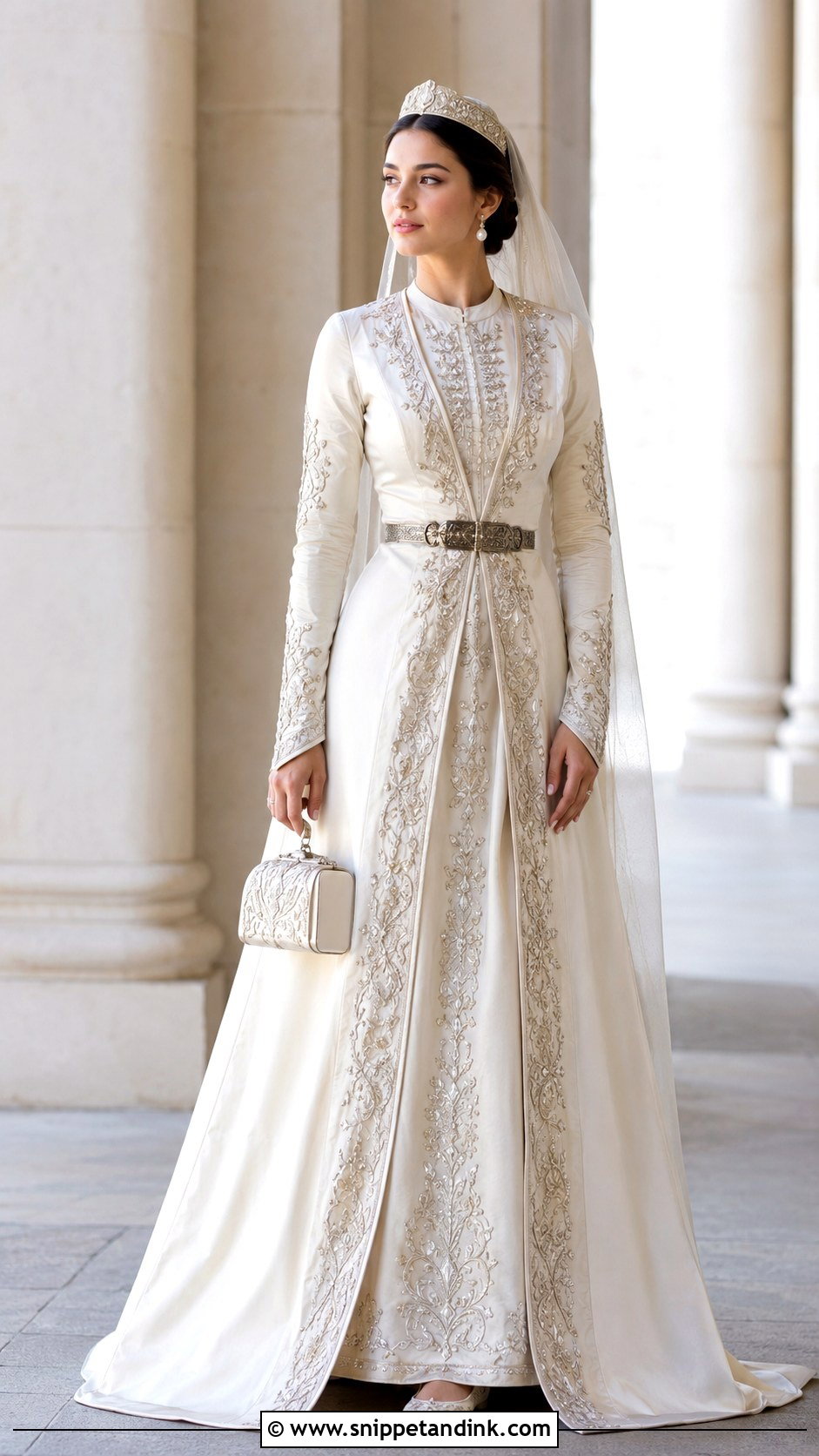
For a silhouette guests will read as Georgian at a glance, Kartli is the place to start. Select a long ivory silk gown with a narrow bodice, a softly rounded neckline, fitted sleeves and a skirt that parts slightly at the front over an embroidered underlayer. That front opening is what I test at every fitting. Walk, sit, climb a step, and see whether the underlayer shows too much or too little. Secure the waist with a gold or silver belt with two extended ends, and let the veil fall behind the shoulders so the bodice stays in view. Pearl earrings, embroidered ivory flats and a small structured bag are all it needs.
13. Georgian Brocade Wedding Dress
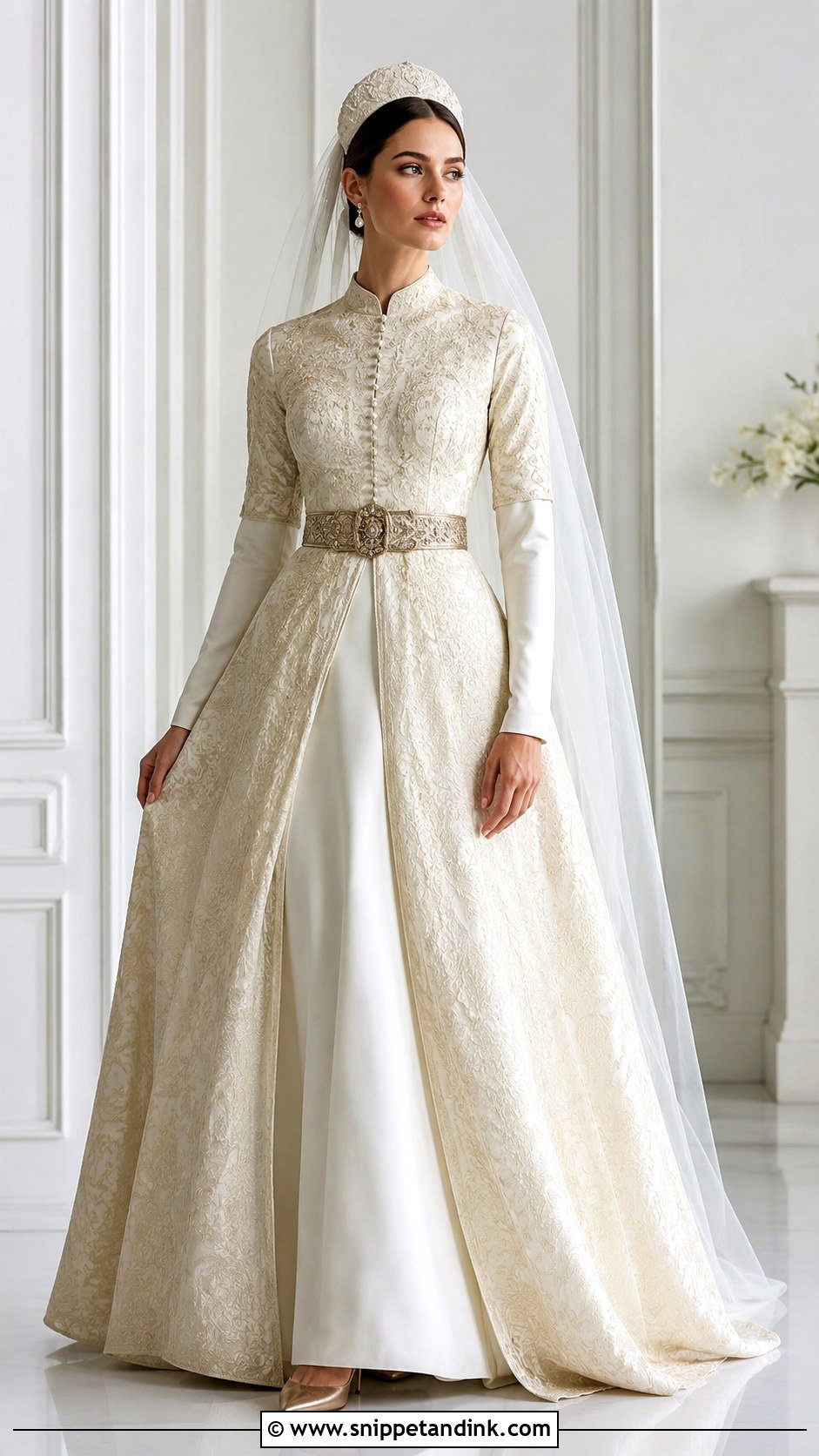
Brocade is heavy, and that is both its appeal and its problem. I use ivory brocade with a subtle woven pattern for the bodice and outer skirt, plain silk for the sleeves and underdress, and a metallic embroidered belt that doesn’t fight the weave. A simple ivory headpiece, sheer veil, pearl earrings and low gold shoes are plenty. If an all-over brocade gown feels like armor, put the fabric only on the bodice, cuffs and front panels. For a warm month, a lightweight jacquard gives a similar depth at a fraction of the weight and won’t trap heat the way upholstery-grade brocade does.
14. Georgian Wedding Dress With Split Sleeves
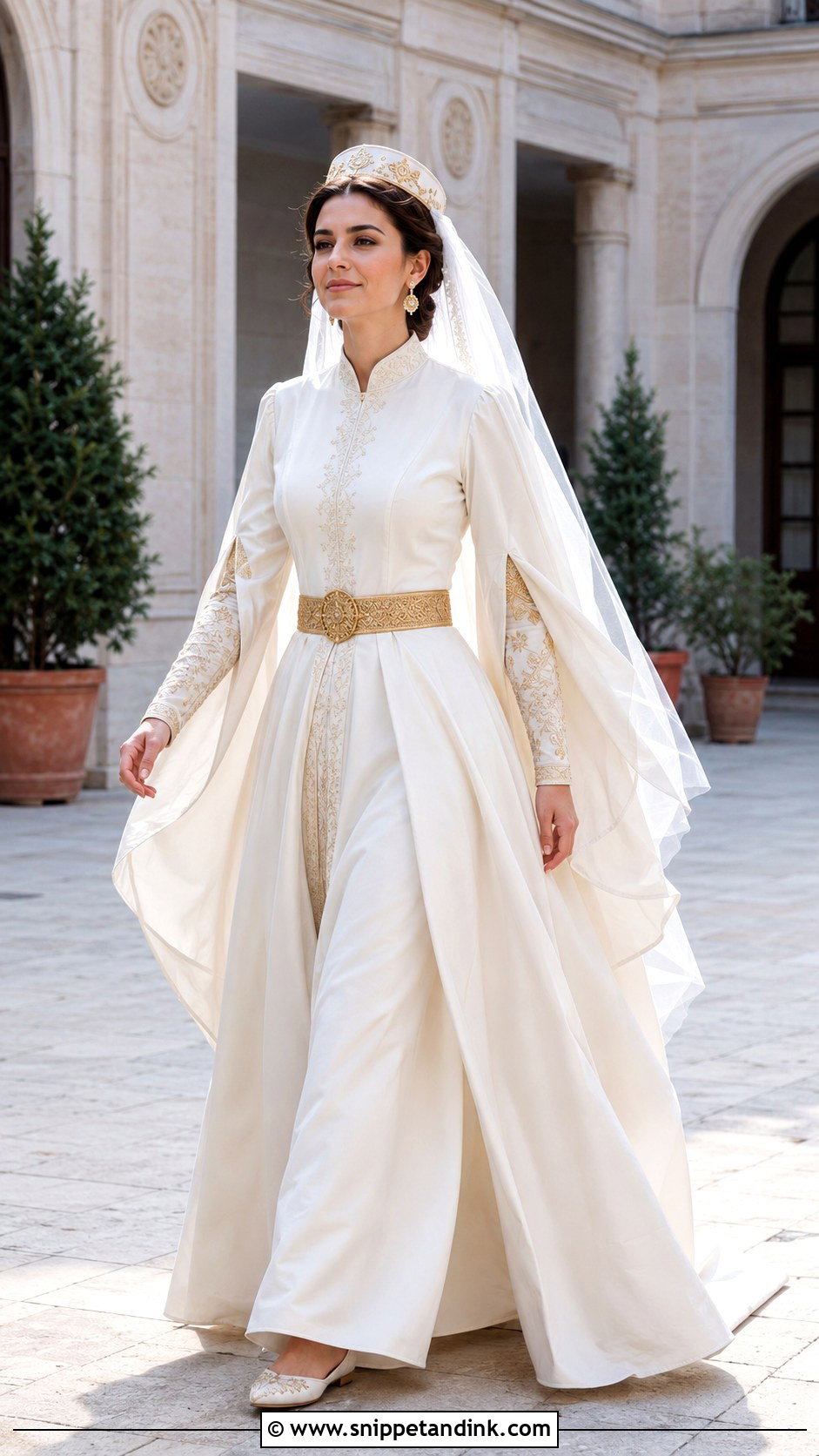
Split sleeves are the most graceful part of the kaba and the least practical. Begin with an ivory floor-length gown fitted through the torso and waist, then add open outer sleeves in silk or velvet over narrow embroidered undersleeves, so the contrast shows from shoulder to wrist. A structured gold belt stops the layers from looking shapeless. Long sleeve tips drag through food and catch on chair backs, so I like a small hidden loop at each tip that hooks over a button behind the shoulder for dinner. A traditional-inspired headpiece, sheer back veil, gold earrings and ivory pointed flats finish it. Walking down an aisle with a small bouquet, those sleeves give long clean lines on camera.
15. Georgian Wedding Dress With Embroidered Belt
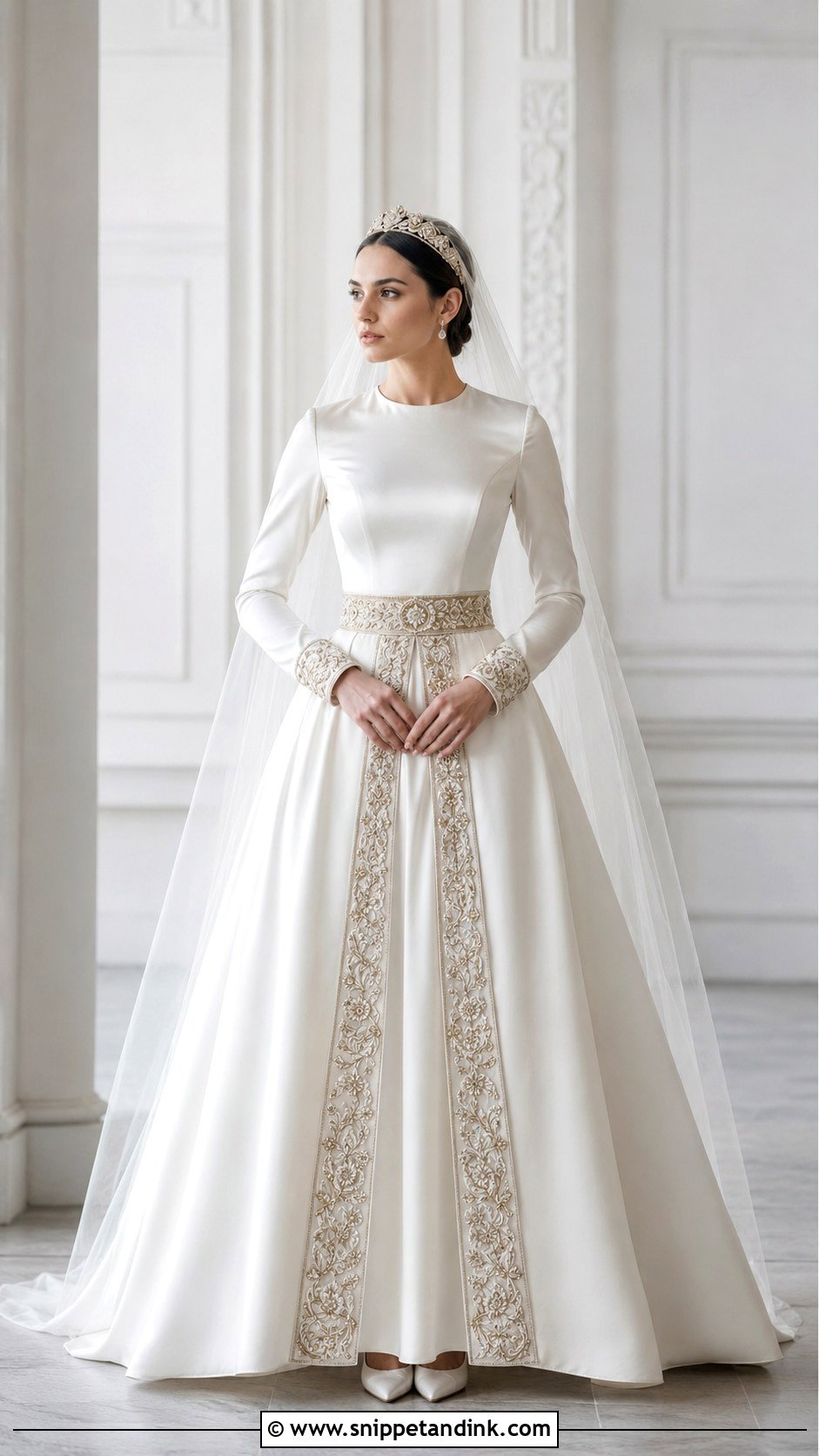
Make the belt the whole story. Start with a plain white silk kartuli-inspired gown with a close bodice, long sleeves and an unembellished full skirt, then add a wide hand-embroidered belt worked in gold thread and pearls, with two panels running down the front to lengthen the figure. A strongly defined waist and a richly decorated belt are among the features most associated with Georgian women’s dress, which is why I’d put the budget here rather than into the gown. Hand goldwork is slow, so commission the belt first. Everything else stays quiet: a restrained headpiece, sheer veil, embroidered cuffs, ivory shoes, small earrings. Ask the maker what each motif means before you approve the design.
16. Georgian Wedding Dress With Lechaki Veil
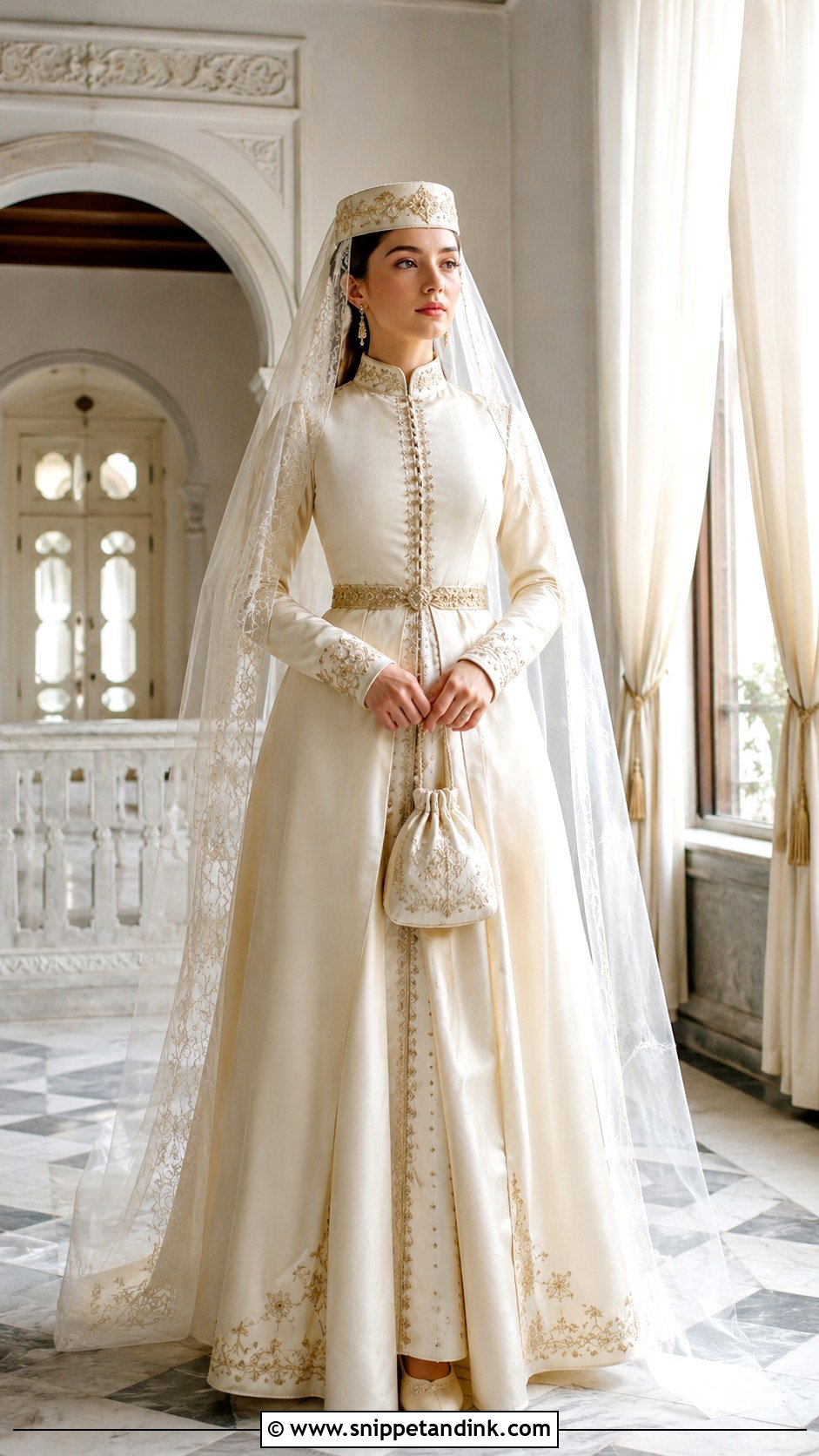
The lechaki is the sheer veil of traditional Georgian women’s headwear, worn with or over other head pieces, and it is the softest element you can add to a structured dress. Pair it with a cream silk gown with a fitted waist, high neckline, long sleeves and subtle gold embroidery. It should hang from a properly built headpiece and fall behind the shoulders, leaving the bodice and belt visible. Tulle or silk gauze keeps it airy; anything heavier starts to look theatrical. A narrow gold headband, drop earrings, ivory flats and a small embroidered bag finish the look. I anchor the headpiece with combs sewn inside and two crossed pins, because a veil this long behaves like a sail outdoors.
17. Georgian Winter Wedding Dress
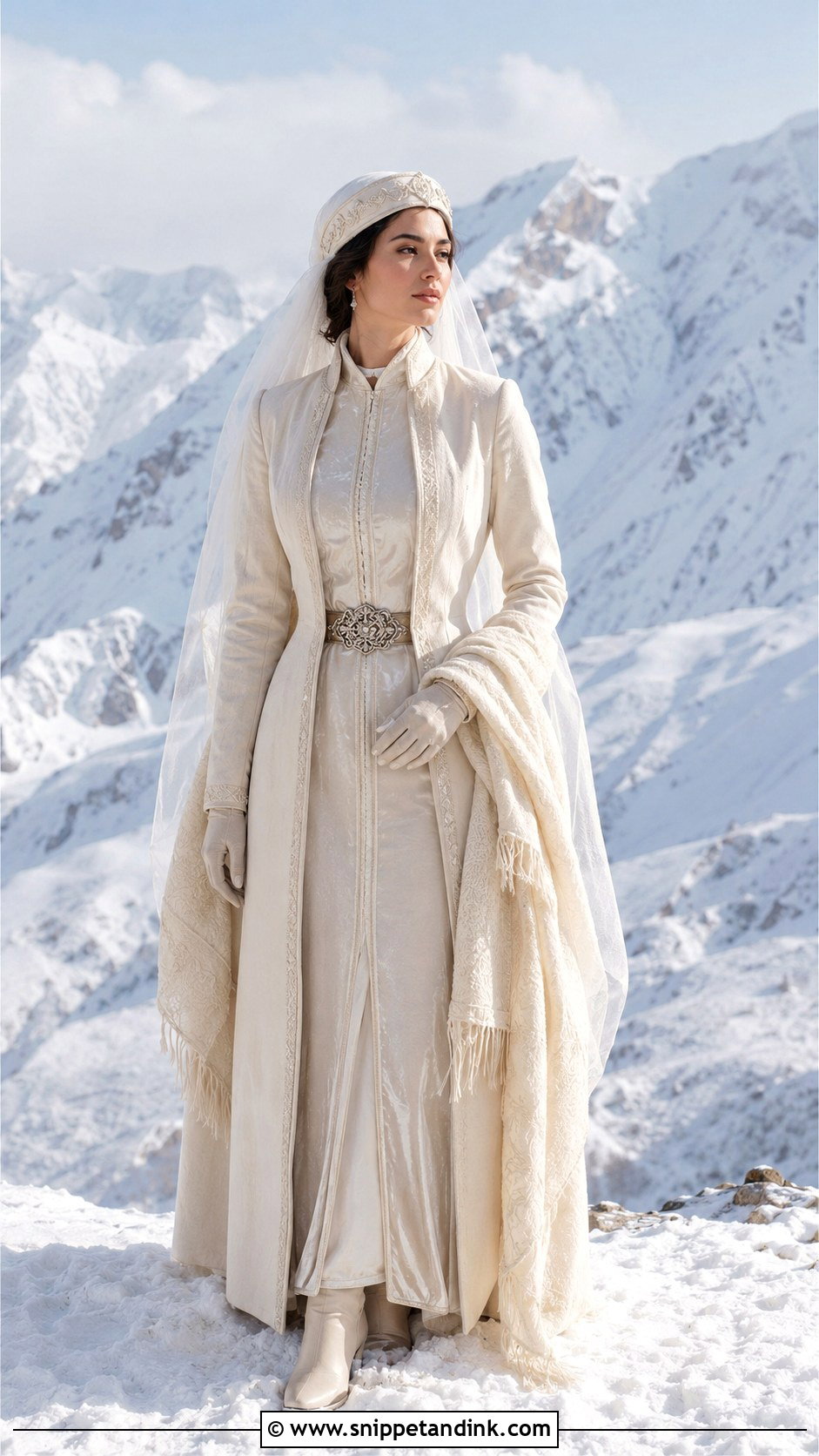
A cold-weather Georgian wedding calls for layers you can take off. I’d choose a long ivory velvet dress with a fitted bodice, full skirt and narrow sleeves over a breathable silk lining, then add a structured cream wool coat inspired by Georgian tailoring. Be careful here, because many of the coat shapes people picture are men’s garments; borrow the tailoring, not the chokha itself. A silver embroidered belt sits over the dress and gets its moment once the coat comes off. Add a lined headpiece, light veil, pale leather boots, gloves and a wool wrap, all in one tonal palette. Coat on for the outdoor portraits, coat off for the reception.
18. Georgian Summer Wedding Dress
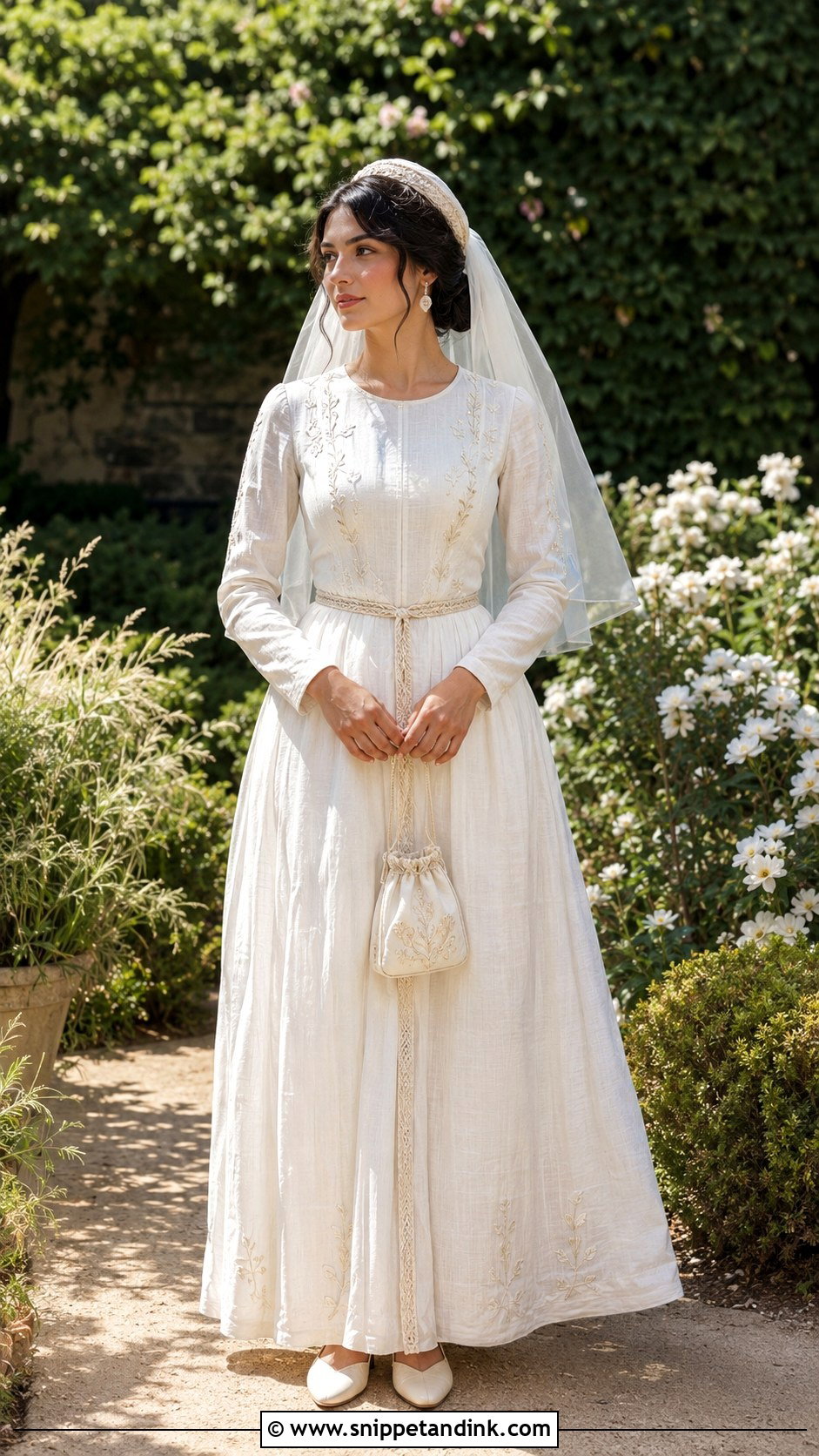
Summer is hard on a dress that covers the arms and legs, so fabric does most of the work. Select an ivory silk, linen-silk or fine cotton gown with a fitted waist, full skirt and slim sleeves, and swap heavy metallic decoration for tonal embroidery and a narrow woven belt. Line the skirt only where it’s needed. I also ask for discreet underarm openings that let air through without changing the silhouette. Pure linen creases the minute you sit down, so a linen-silk blend is the compromise I usually land on. A small fabric-covered headpiece, a shoulder-length sheer veil, low ivory shoes and a compact embroidered pouch keep it light enough for a garden or courtyard.
19. Modern Georgian Traditional Wedding Dress
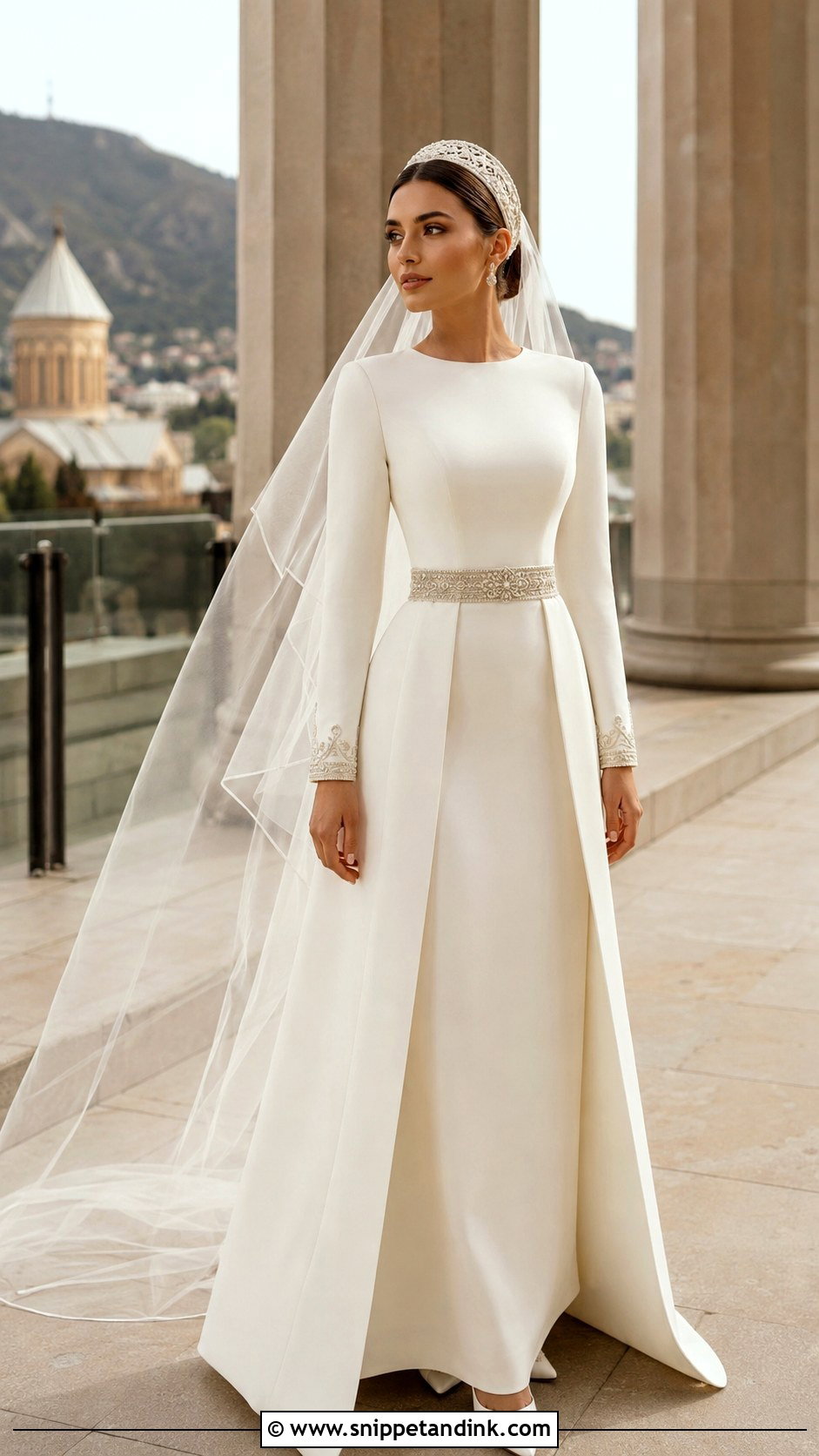
A modern take should borrow the proportions and stop short of costume. Begin with a minimalist ivory gown with a fitted bodice, long tapered sleeves, a defined waist and a floor-length A-line skirt, and reference the kaba through a decorative belt and extended front panels instead of heavy embroidery. One metallic motif at the neckline or cuffs is enough to tie it to Georgian craft. Add a streamlined headpiece, sheer veil, pearl earrings and pointed low heels. What I’d leave out: the decorative cartridge holders from the chokha, a garment historically tied to men’s dress. Bride first, heritage in the details.
20. Georgian Royal Wedding Dress
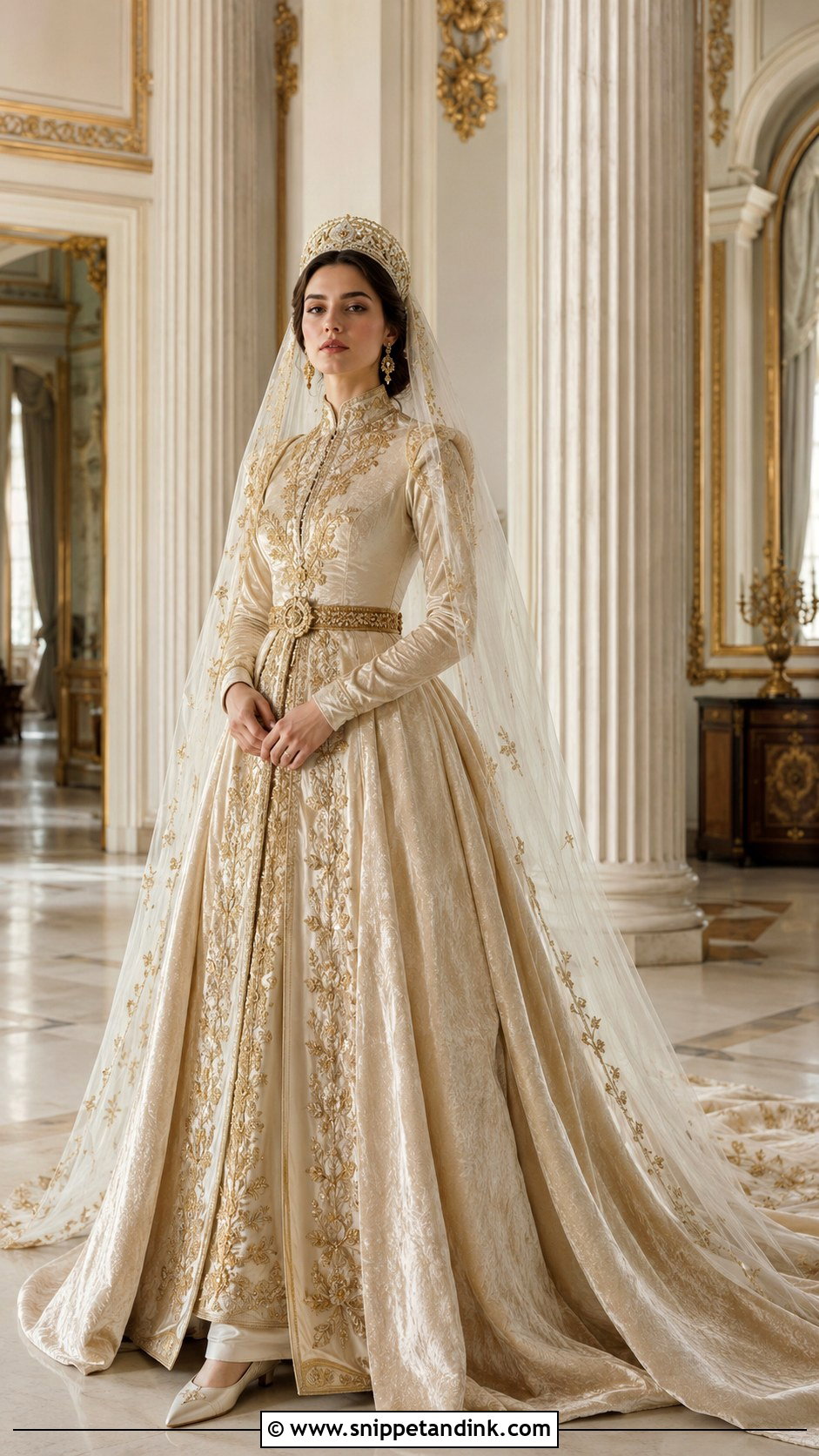
Georgian royal dress was known for valuable jewelry and lavish decoration, and the temptation is to copy every piece of it. I’d rather take a long ivory silk velvet gown with a fitted bodice, full skirt and train, frame the neckline and cuffs in fine gold embroidery, and add a jeweled belt with two long panels. A structured headpiece, floor-length sheer veil, gold earrings and embroidered slippers complete it. Use crystal, pearl or enamel-style accents sparingly. Weight is the practical limit: a velvet train plus a jeweled belt gets heavy fast, so put on the full outfit and sit in it for twenty minutes before you sign off the final fitting.
Wearing It Through the Crowning and a Long Supra
A Georgian wedding day asks a lot of a dress. There’s the church service, where you stand for a long time and crowns are held or placed over your head, and then a supra that can run late into the night with toast after toast at the table. If crowns are part of your service, tell the maker, because a tall headpiece can sit awkwardly under one.
At the table, the belt is what you’ll feel first. A rigid metal belt that’s fine standing can dig in after hours of sitting, so I have brides sit through a full meal’s worth of time at the last fitting. If it presses, a hidden hook-and-bar set slightly looser works better than a belt you take off halfway, which leaves the dress looking unfinished in every later photo. For dancing, the front hem should clear the floor when you’re standing still; the gliding steps of Georgian dances look wrong if you have to hold your skirt up.
Caring for Velvet and Goldwork Once the Party Ends
Heavy velvet and silk gowns stretch at the shoulders when they hang for months, so store the dress flat in a box, folds padded with acid-free tissue, rather than on a hanger. Take the belt off and wrap it separately; metal thread and plated fittings tarnish, and a heavy belt pressed against the skirt leaves a mark in velvet pile that’s hard to lift. Skip plastic covers, which trap moisture. If the velvet gets crushed, steam it from the wrong side and never press the pile with an iron.
Your Family’s Region Is the Best Starting Point
Begin with the region your family comes from, and the dress tends to follow. A kaba silhouette, a defined waist, a decorated belt, long sleeves and properly built headwear are the foundation; color, fabric, embroidery and seasonal layers make it yours. Georgian dress varied so much by region and period that no single gown speaks for the whole country, which is exactly why a Georgian artisan or costume historian is worth involving early. White and minimal or dense with goldwork, the version that works is the one made carefully enough to walk, sit and dance in.
You'll Like These Ideas:





Leave a Reply