
Thai bridal dress is a world of silk, draping and exact tailoring, and the eight formal women’s ensembles known as chut thai phraratchaniyom are only part of it. Each of those eight has its own silhouette and its own level of formality, and regional dress from the north, northeast and south adds even more choices. So a bride might wear a layered one-shoulder ceremonial outfit, a modest long-sleeved dress or a lighter look for a daytime blessing. My advice is to let the weave lead and keep jewelry and hair supporting it, and to talk to family, whoever is running the ceremony and an experienced Thai tailor early. Here are twenty complete looks to start from.
Which Chut Thai Belongs at the Morning Rites and Which at Night?
A Thai wedding often runs from an early merit-making with monks, through the khan maak procession and the water-pouring blessing, to an evening reception. Plenty of brides change at least once, and the formality of the dress should follow the hour.
- Morning with monks: covered shoulders are the respectful choice, so I lean toward Siwalai, Boromphiman or Chitralada. You’ll sit low and bow often, so the sinh needs ease at the knee.
- Water-pouring blessing: Chakri is the classic, and its single sabai leaves the arm free when you hold your hands out over the bowl.
- Evening reception: this is where Dusit, Chakraphat and brighter brocades belong, or a Western gown if you’re changing.
Ask the family which parts they plan to hold and in what order before you commission anything. It decides how many outfits you need and how fast each one has to come off.
1. Gold Thai Chakri Wedding Dress
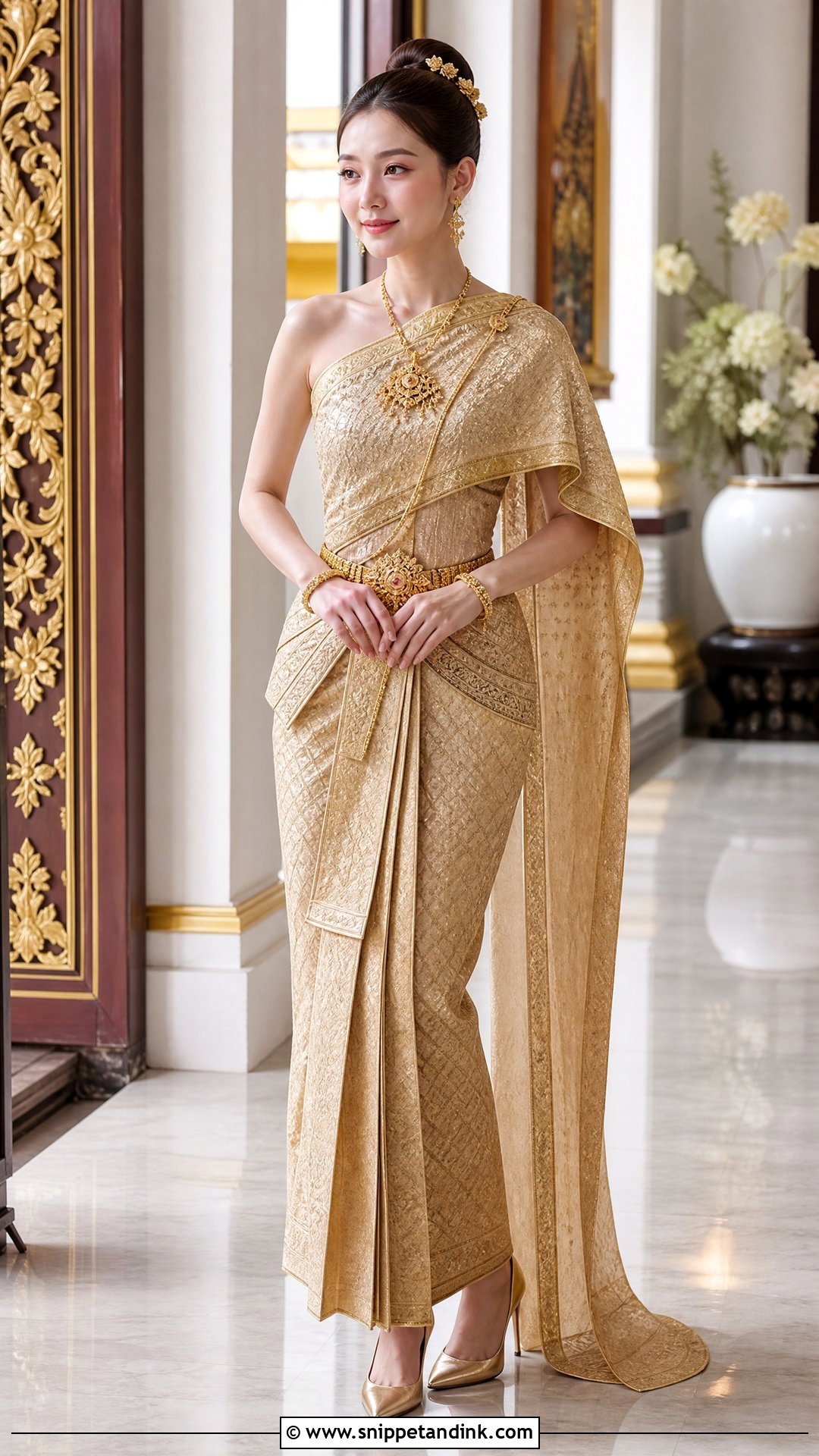
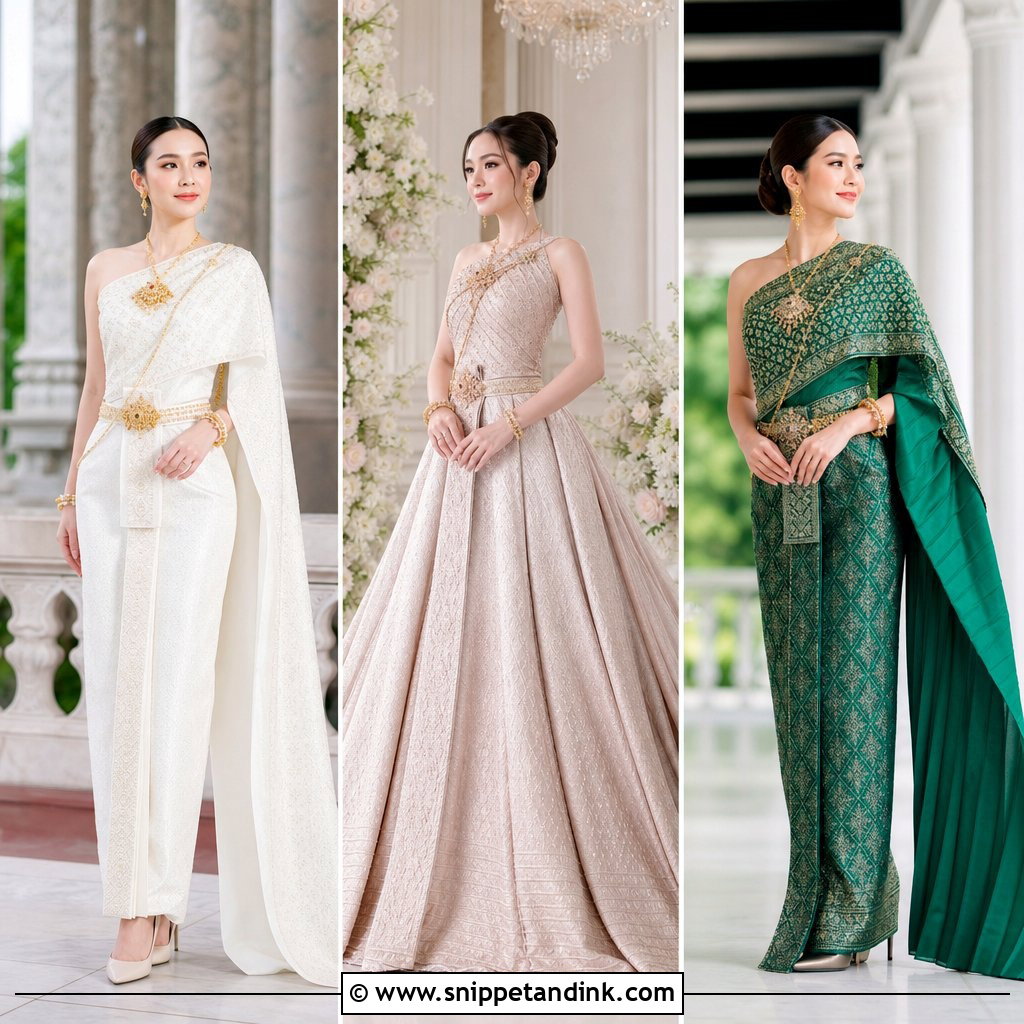
A gold Thai Chakri wedding dress is the look most people picture first. It pairs a fitted lower garment with a front pleat and a single sabai crossed diagonally over the chest and one shoulder, and it’s worn for weddings, engagements and formal evenings alike. The sabai is the part that moves. Without a fitted foundation top under it and hidden pins at the shoulder and back waist, it slides every time you raise an arm, so I have the dressmaker build the support in. Choose gold-thread brocade with a refined pattern rather than decoration everywhere, then a sculpted gold belt, earrings, a necklace and comfortable gold heels. A low bun leaves the drape visible.
2. Ivory Thai Chakri Wedding Dress
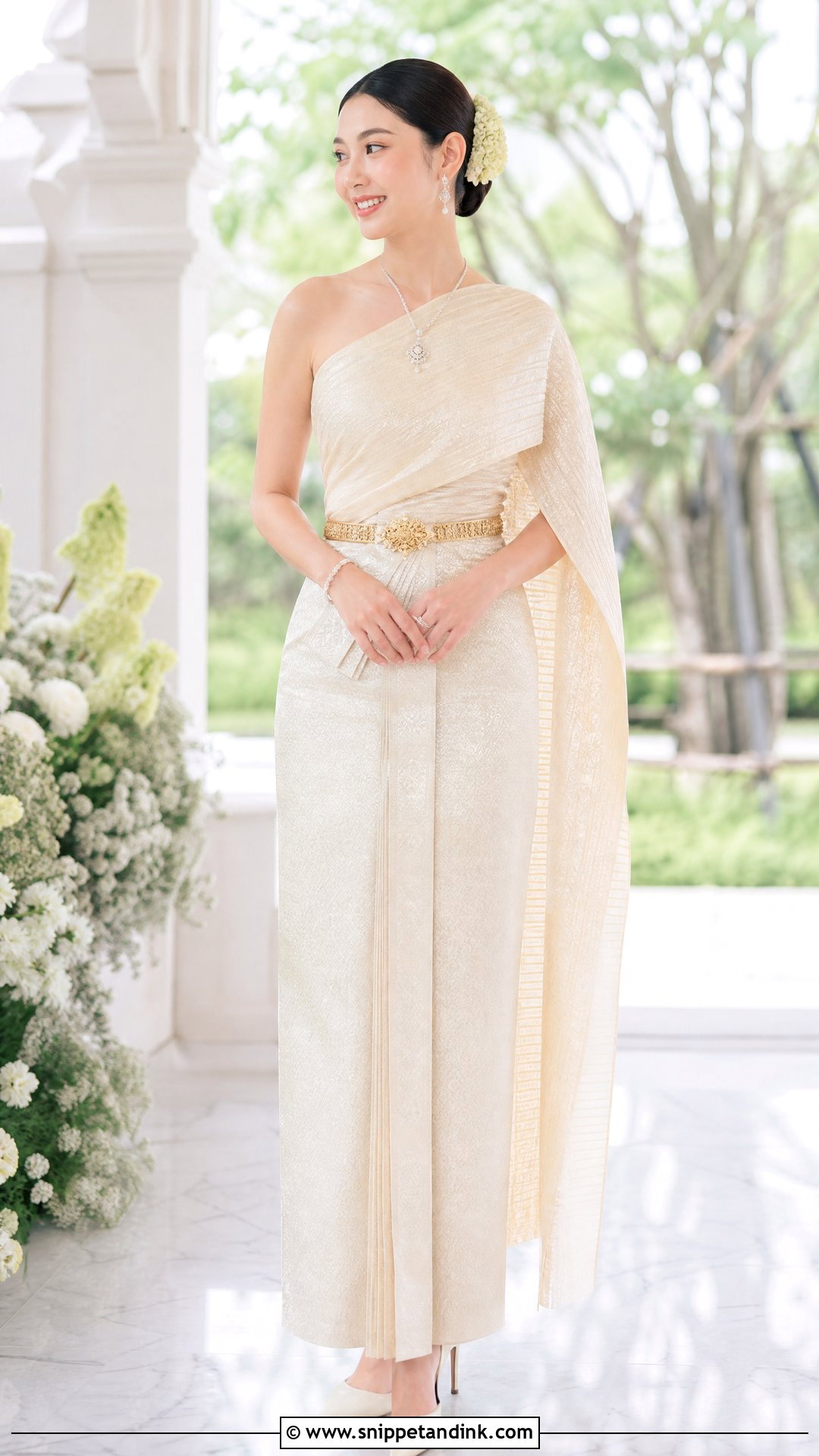
Ivory keeps the Chakri shape but softens it, which suits a morning water-pouring ceremony or a bright indoor venue. Look for silk with subtle silver or pale gold threads so the weave still reads in daylight, a gently pleated sinh and a narrow metallic belt. One caution from fittings: ivory and silver can look quite different under flash, sometimes grey, so photograph a sample both ways first. Pearl drops, a delicate gold necklace, ivory pointed heels and a small silk clutch are enough, with jasmine-inspired hair accessories used sparingly around a smooth bun.
3. Red Thai Chakraphat Wedding Dress
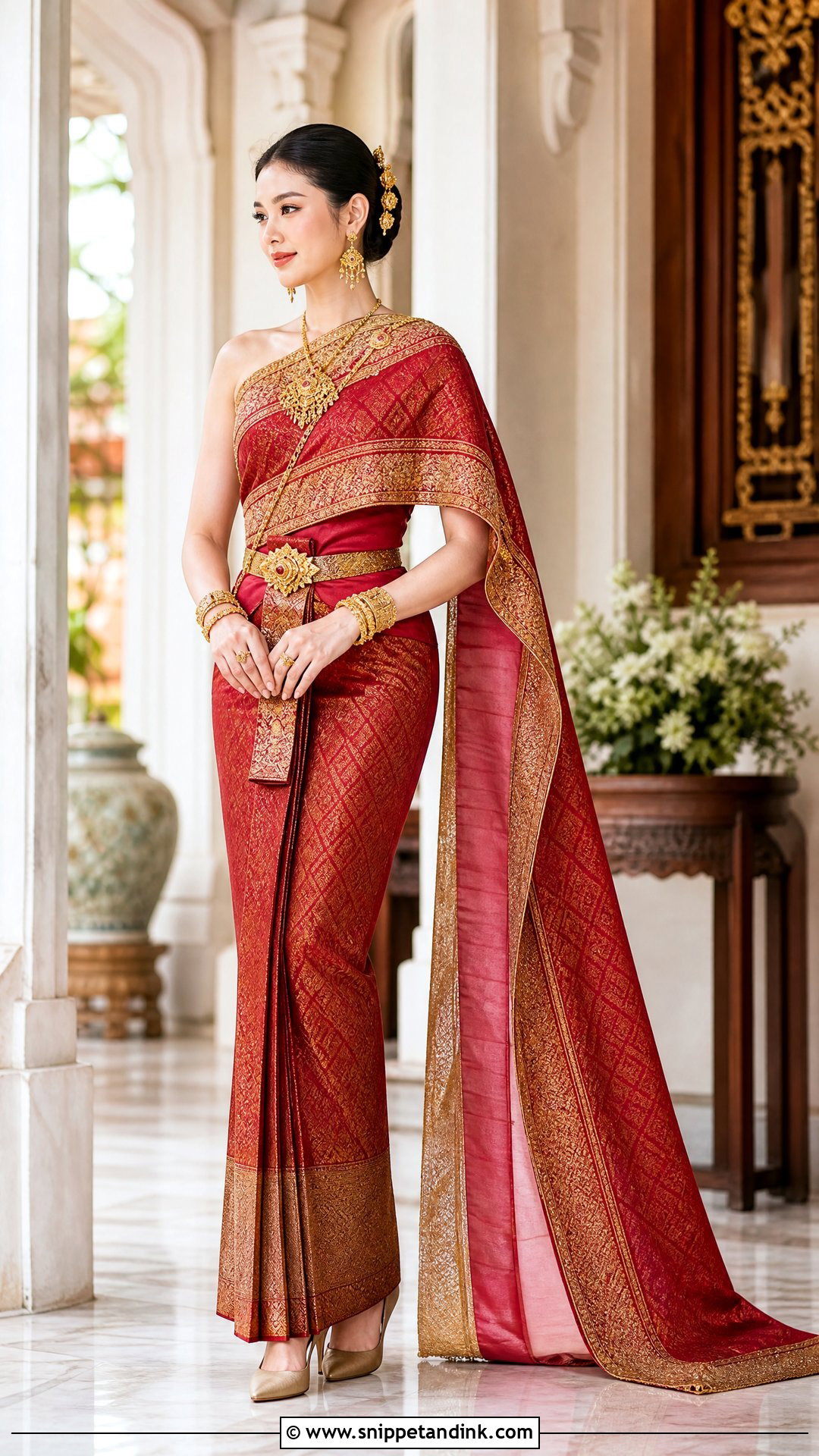
Chakraphat is the more elaborate cousin of Chakri, traditionally with two sabai layers and richer accessories. In deep ruby silk paired with antique gold brocade it looks regal without turning brash. Keep the inner drape smooth and let the embroidered outer layer carry the texture. Two layers of silk over the shoulders are heavier and warmer than brides expect. I’d do a full wear test in the actual outfit, sitting, kneeling and bowing, to see that every pin holds. Add a substantial belt, drop earrings, bracelets and gold closed-toe heels, and a center-parted bun to balance the shoulder volume.
4. Champagne Thai Chakraphat Wedding Dress
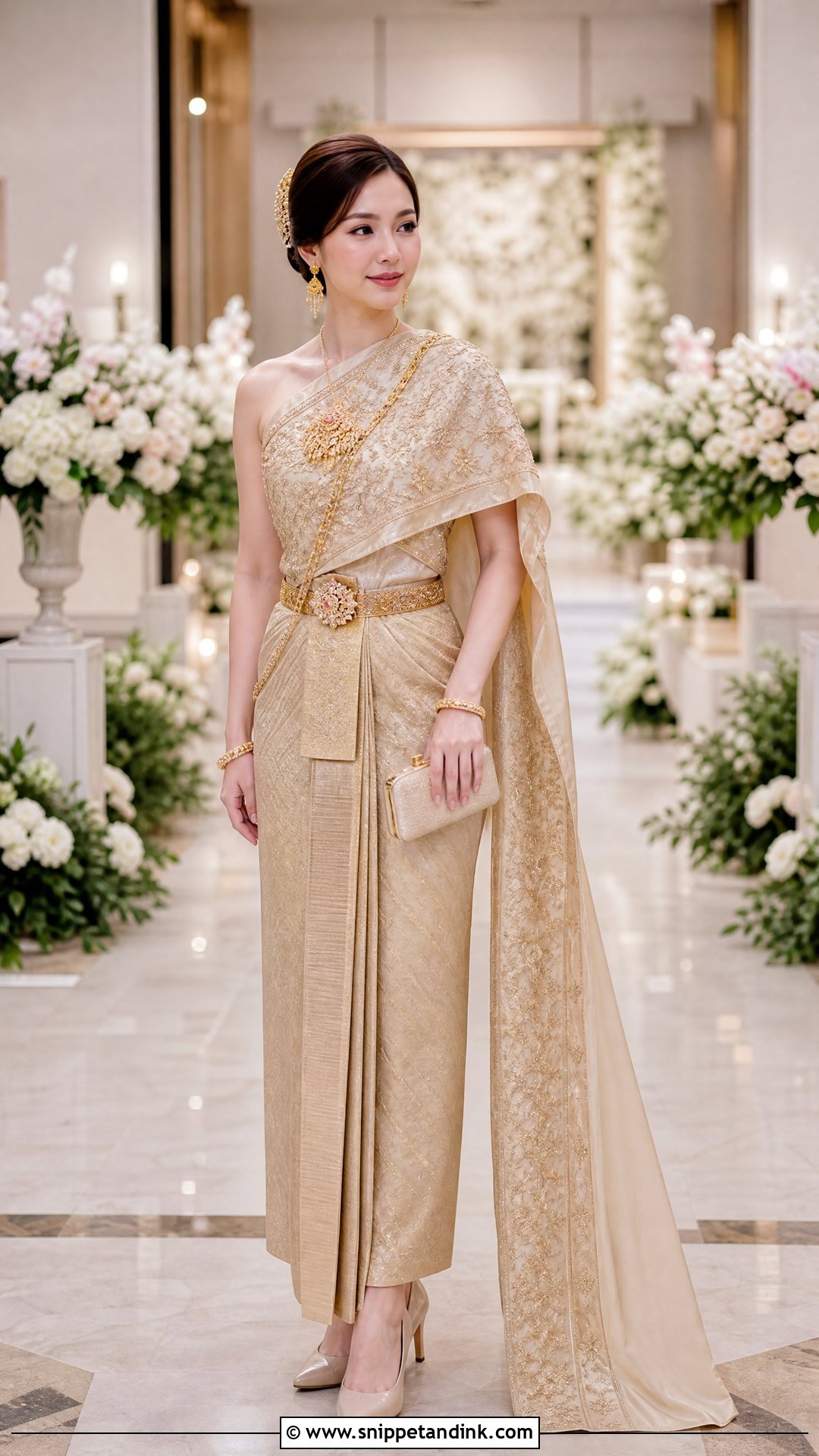
Champagne is a gentler way into Chakraphat. Build it on a pale gold pleated sinh and a fitted foundation top that holds two sabai layers, with crystal, pearl or metallic-thread embroidery kept to the outer drape’s border so the silk still shows. Champagne is a slippery color. Depending on the dye it leans pink, yellow or grey, so look at large swatches next to your skin and the decor rather than a thumbnail. A structured gold belt, medium earrings, one bracelet, champagne pumps with a stable heel and a small gold comb in a sleek bun complete it.
5. White Thai Siwalai Wedding Dress
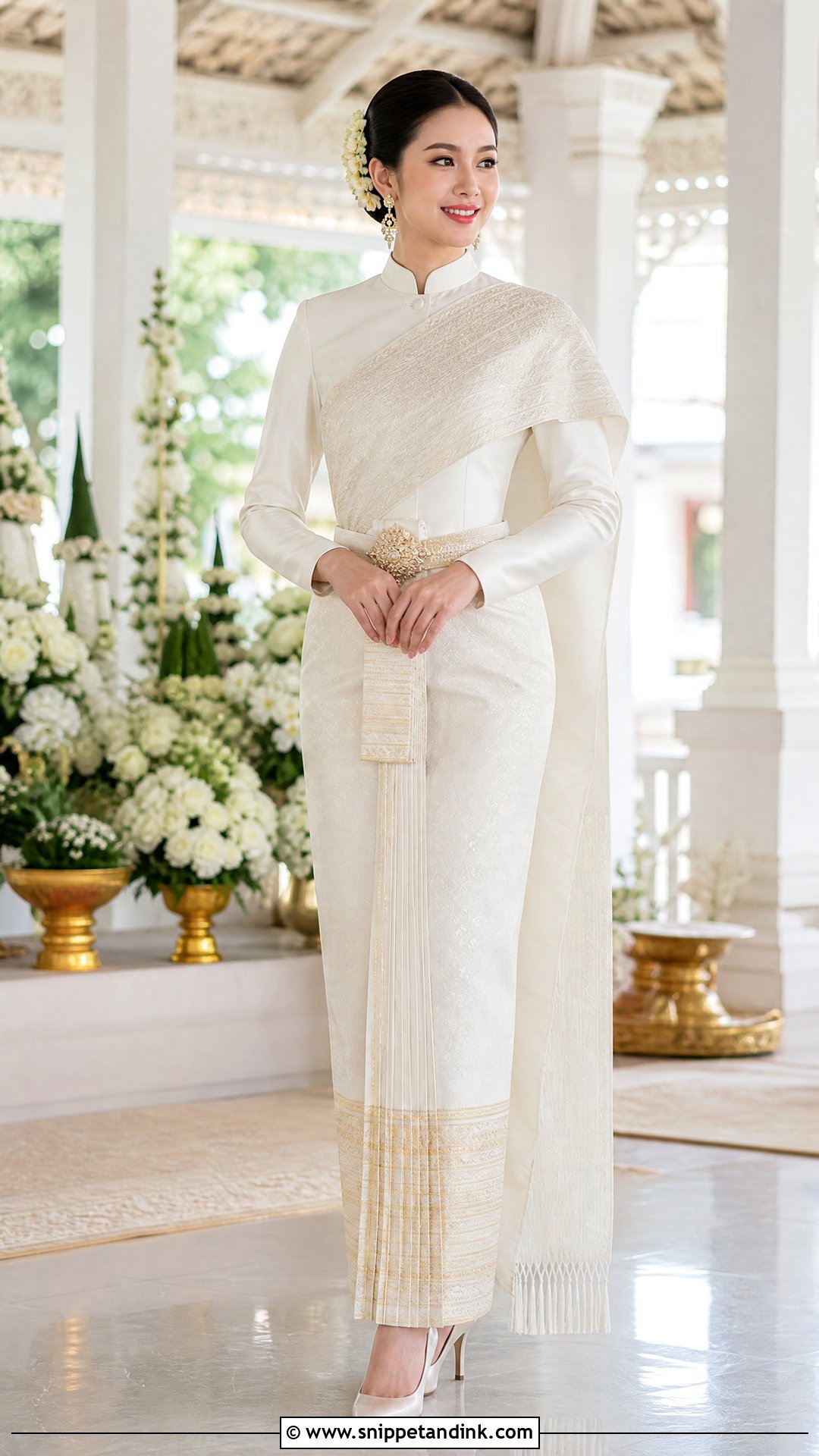
Siwalai is the answer for a bride who wants covered shoulders at a formal occasion. It combines a long-sleeved, standing-collar top with a front-pleated sinh and a sabai across the upper body. In white silk with fine gold weaving at the hem, cuffs and sabai edge, it’s quiet and very formal, and I’d pick it for a morning when monks are present. Three layers on the torso is warm, so ask for breathable silk lining. A slim gold belt, pearl-and-gold earrings, ivory heels, a compact embroidered bag and a low bun with fresh white flowers are all it needs.
6. Emerald Thai Siwalai Wedding Dress
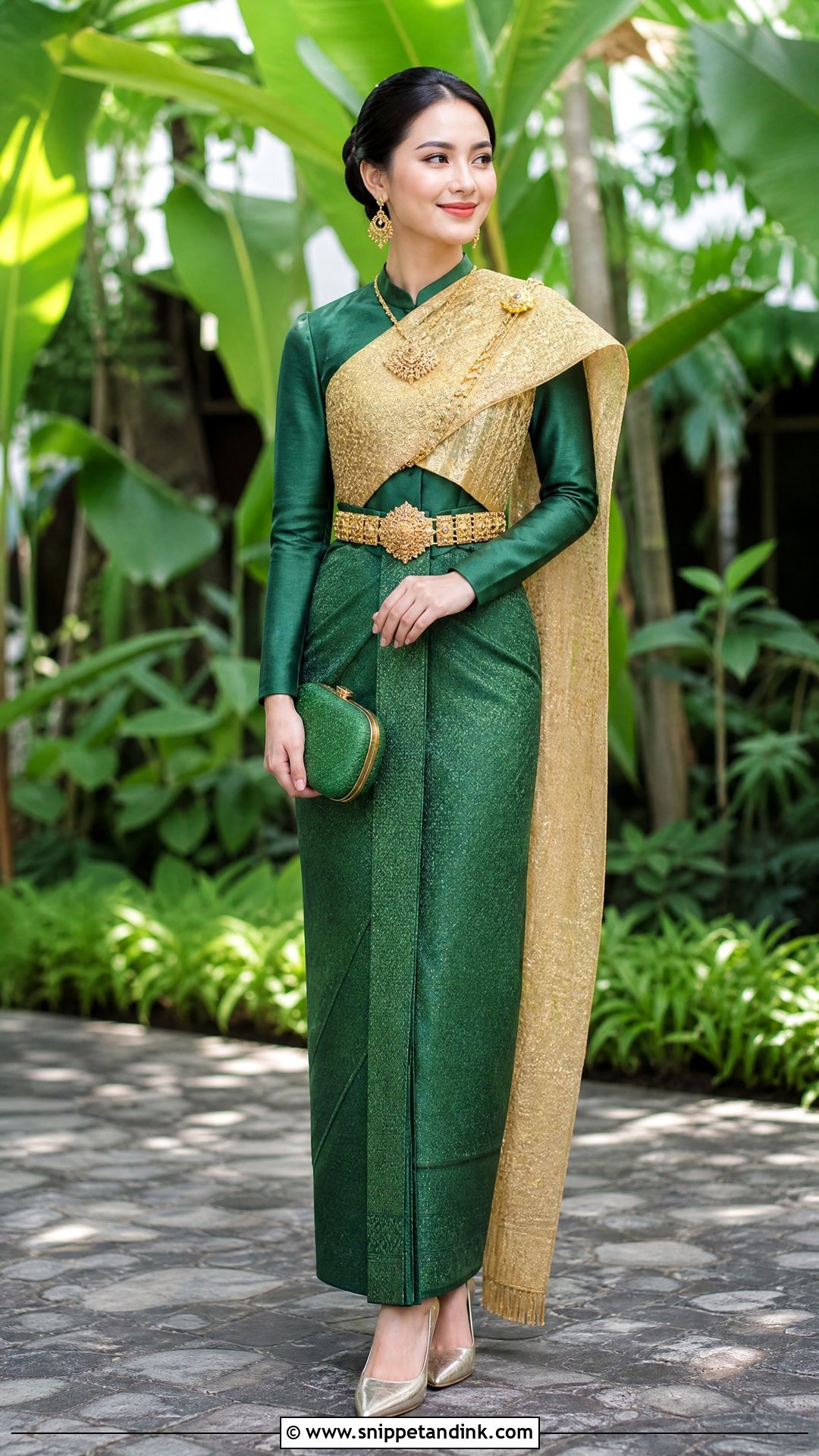
Emerald gives Siwalai a jewel-toned finish. I’d choose silk with a smooth sheen and small gold motifs rather than dense pattern from neck to hem, then add a gold sabai for contrast across the long-sleeved blouse and matching sinh. Long sleeves in Thai heat are the real issue, so ask for breathable lining and hidden closures rather than bulky buttons. An engraved belt, gold earrings, a traditional-style necklace, metallic pumps and a structured clutch finish it, with a high bun when the sabai border is ornate. It sits naturally in a tropical garden and holds its own in a ballroom.
7. Gold Thai Boromphiman Wedding Dress
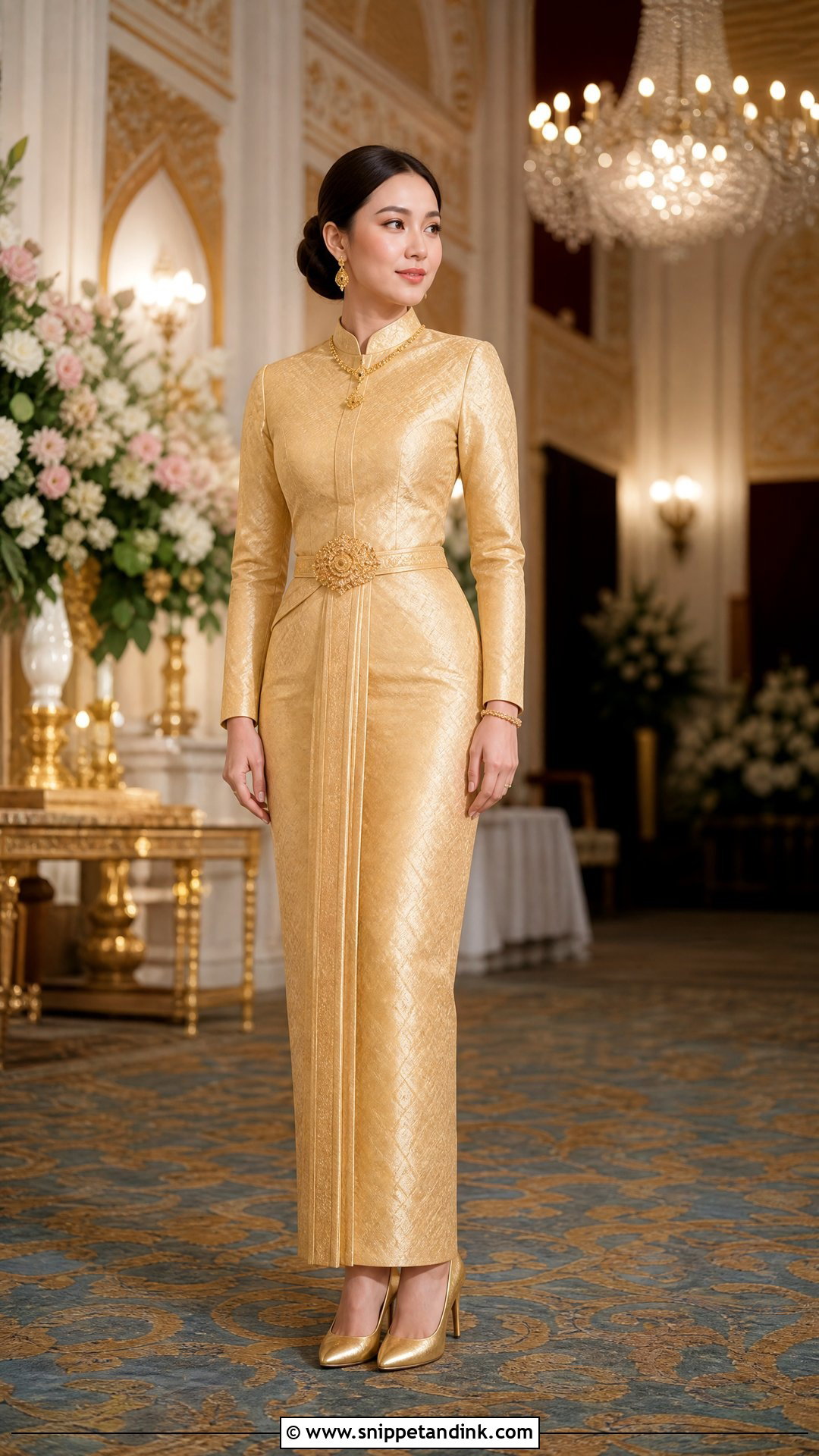
Boromphiman covers the shoulders and arms fully, with long sleeves, a standing collar, a front-pleated lower section and an ornamental belt, and traditional versions may be cut as one continuous dress in Thai silk or brocade. In muted gold with a slightly brighter woven hem, it looks formal and composed. The collar already frames the face, so I keep to one short necklace; stacked necklaces press into a standing collar and crease it. Pair it with a sculpted belt, refined drop earrings, gold pumps and a low bun or French twist.
8. Burgundy Thai Boromphiman Wedding Dress
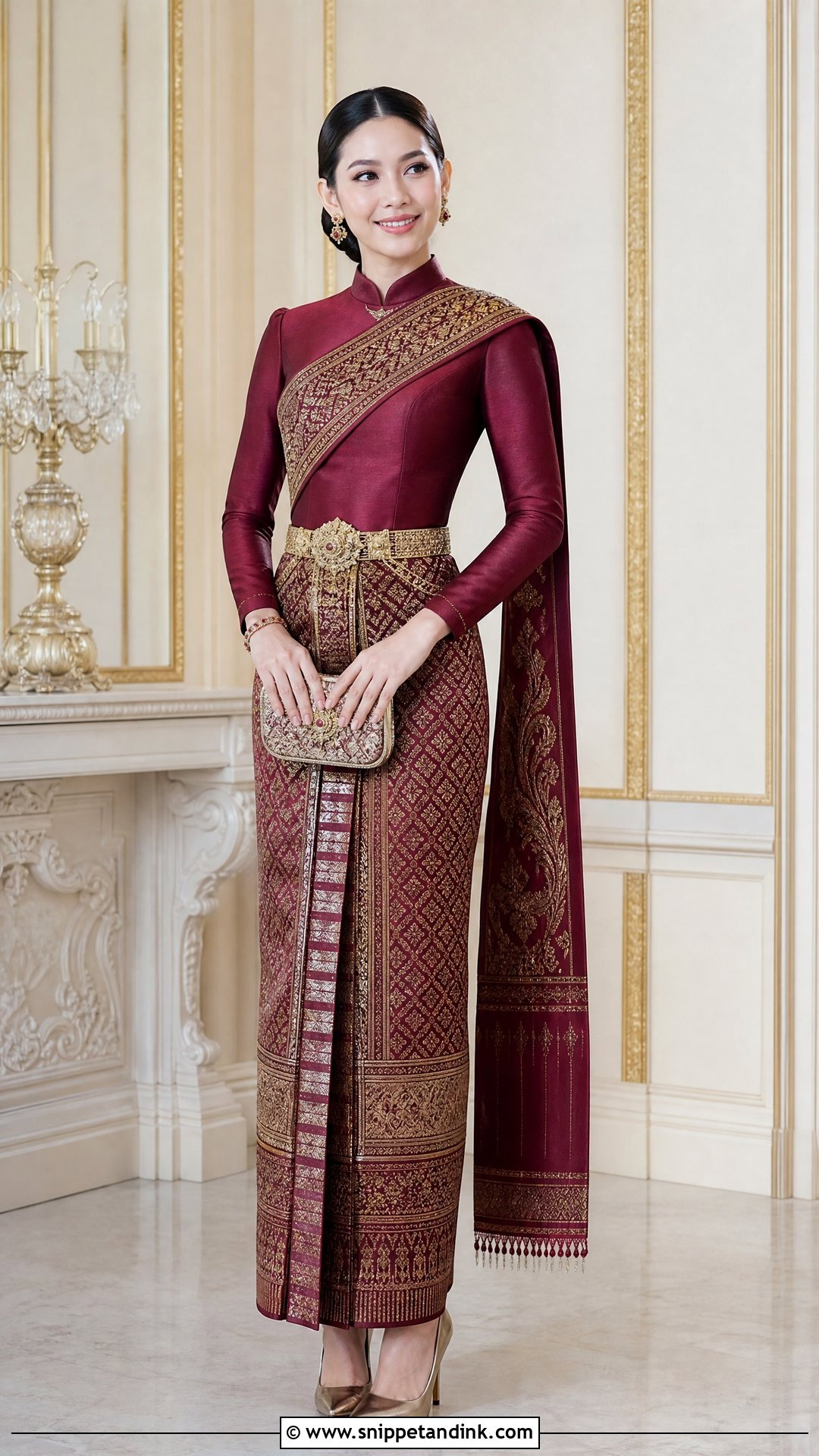
Burgundy Boromphiman is an evening dress, dignified and warm under candlelight. Use one primary burgundy silk for the long-sleeved bodice and pleated sinh and bring gold in through the border and belt. Deep reds shift a lot under artificial light, from wine to brown, so photograph the fabric indoors before ordering. Fit across the shoulders matters most in a continuous dress: too tight and you can’t lift your arms for the wai, too loose and the line collapses. Add ruby-toned earrings, a slim bracelet, metallic closed-toe heels and a brocade clutch, and skip the necklace if the silk is boldly patterned.
9. Blush Thai Dusit Wedding Dress
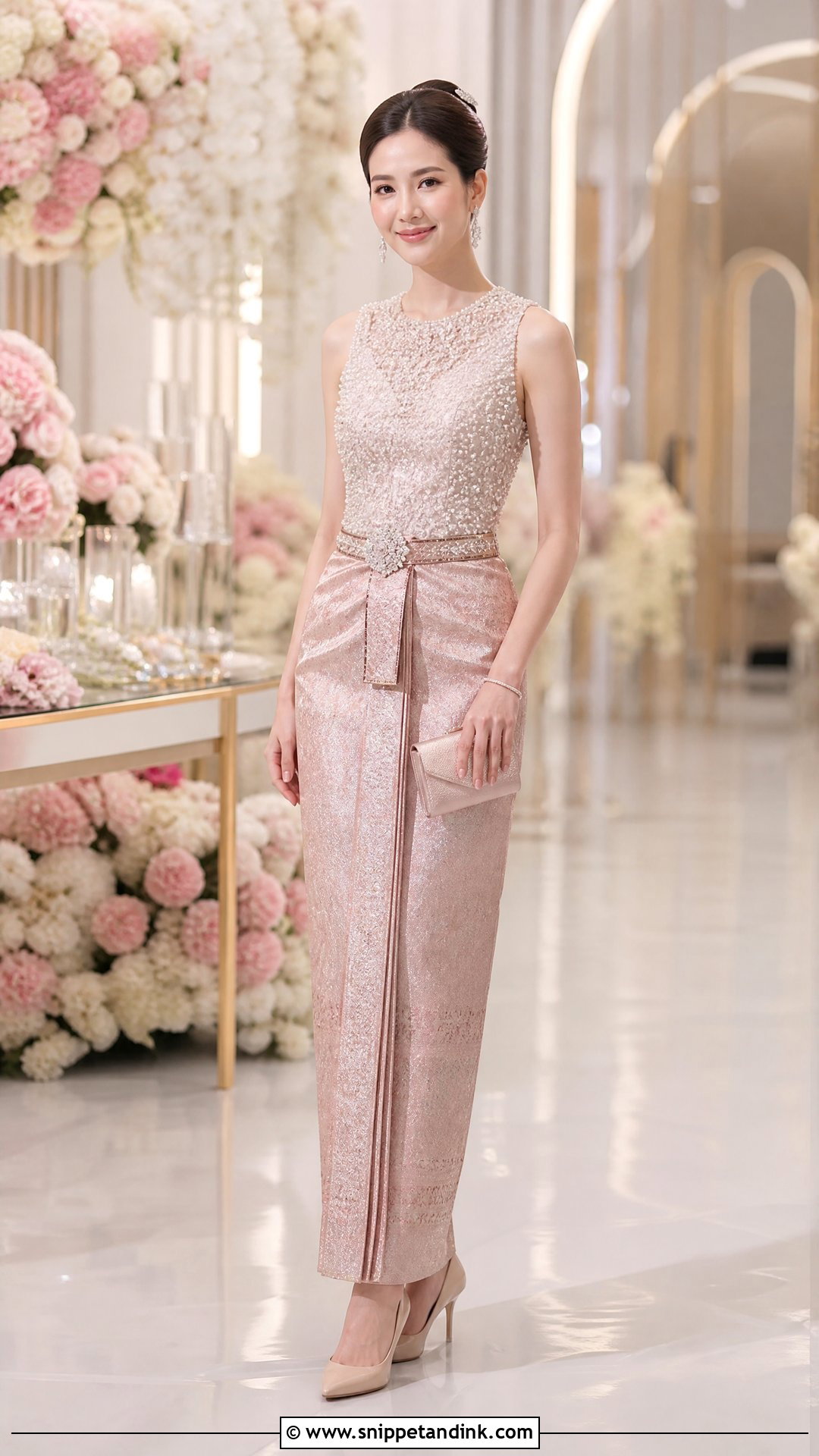
Dusit is the most glamorous of the formal set: a wide neckline, a fitted sleeveless bodice with a decorated surface, a front-pleated brocade sinh and a belt. In pale blush with beadwork that thins out toward the waist, it makes a strong reception or second look. Wide necklines gape if the fit is off even slightly. At the fitting I have the bride walk, sit and raise both arms, and we adjust before the beading is finished, not after. A rose-gold woven skirt, slim belt, crystal earrings, blush pumps and a smooth updo complete it.
10. Silver Thai Dusit Wedding Dress
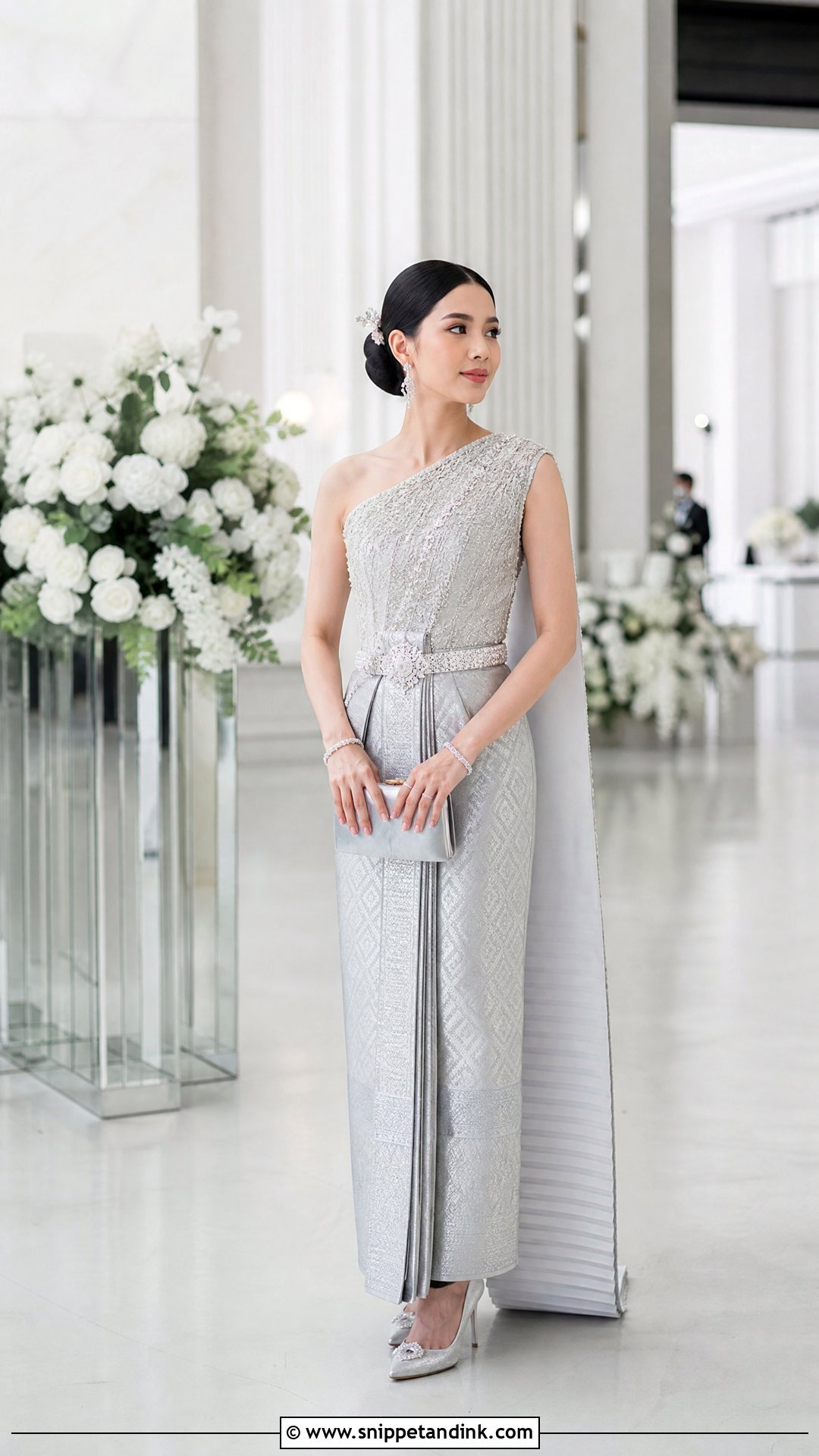
Silver Dusit is cool and luminous for an evening reception. Use a fitted sleeveless bodice with pearls, silver beads and restrained crystal, over a pale silver brocade sinh with a structured front pleat, joined by a polished silver belt. Too much shine on both pieces turns flat in photos, so I put matte silk next to the brightest embellishment for depth. Crystal drops, pointed silver heels, a satin clutch and a sleek bun finish it. Bring a tailored silk wrap for air-conditioned rooms or moments that call for covered shoulders.
11. Rose Gold Thai Amarin Wedding Dress
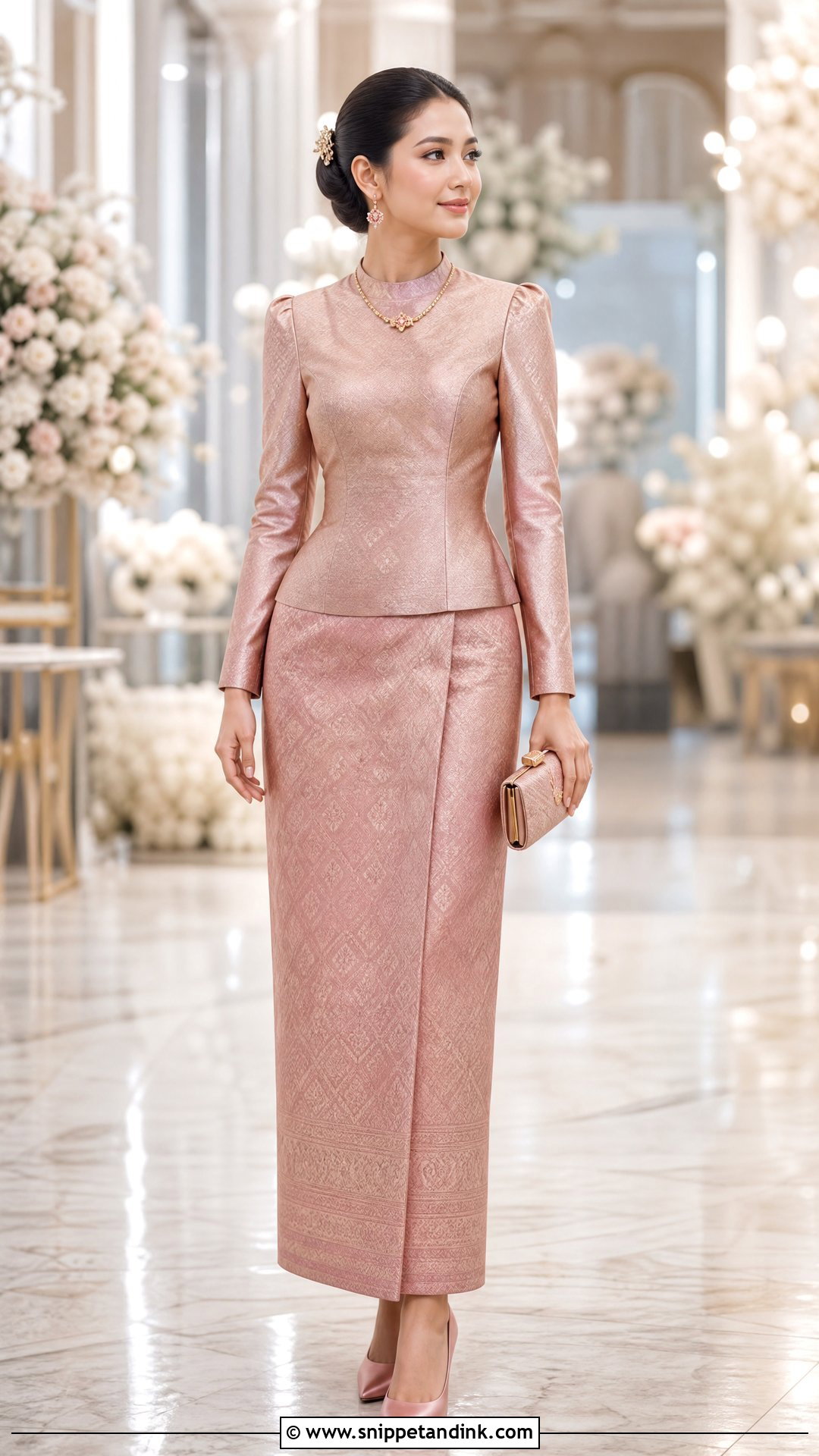
Amarin resembles Chitralada but uses richer fabric such as silk brocade and is worn without a belt, which makes it suitable for formal evenings. Rose gold gives it warmth without fuss. With no belt to hide the join, the waist tailoring has to be exact, and I’d budget an extra fitting for it. Choose a structured long-sleeved blouse and matching rose-gold sinh with a soft floral weave, then gold-and-pink earrings, a short necklace, satin pumps and a compact clutch, with a metallic pin in a polished bun.
12. Navy Thai Chitralada Wedding Dress
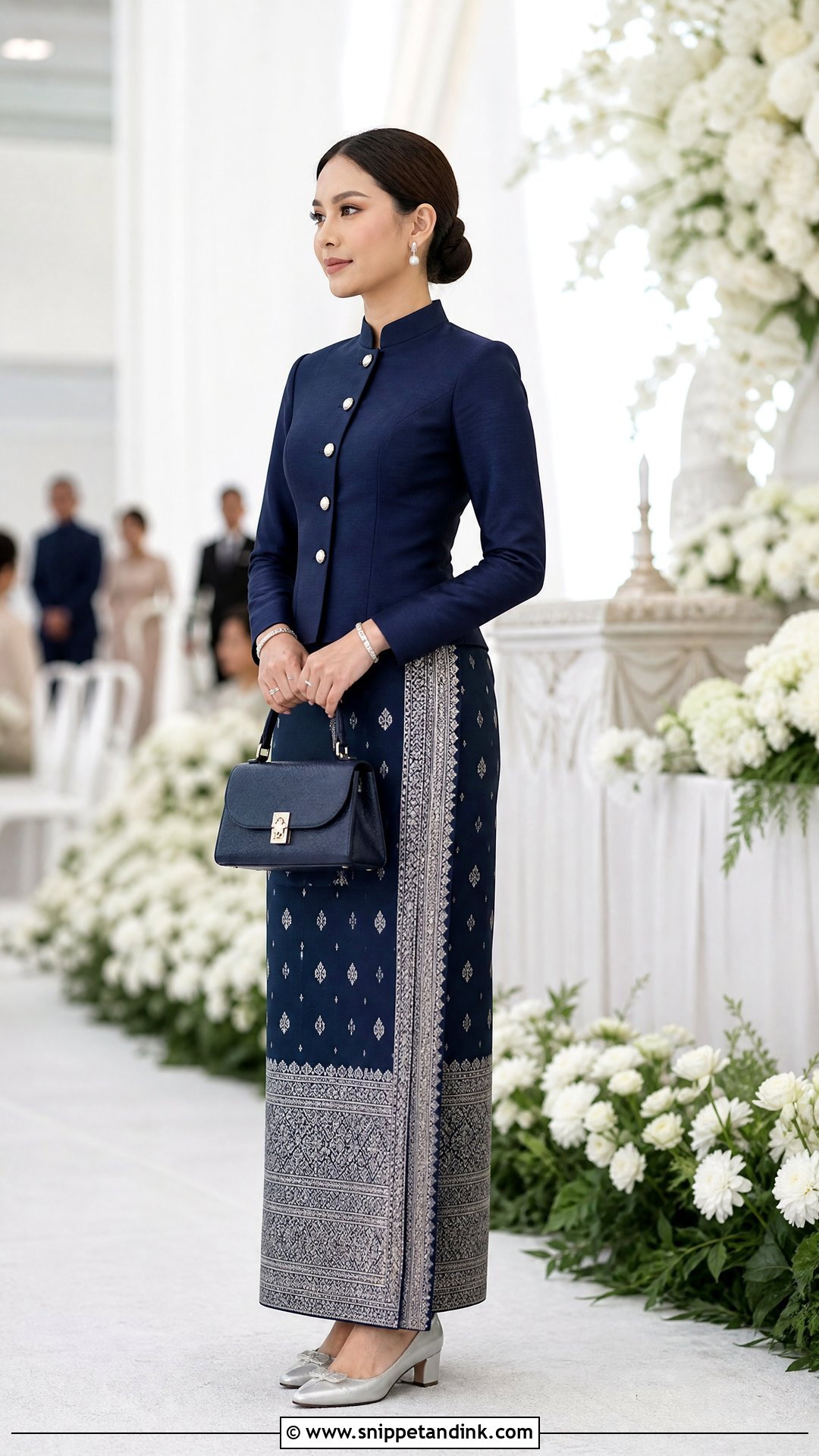
A navy Thai Chitralada wedding dress suits a formal daytime ceremony. Chitralada is more formal than Ruean Ton and usually pairs a standing-collar blouse with a long sinh. Navy can look sober for a wedding, so lift it with fine silver weaving, pearl buttons and a bright skirt border, and check with the family that a dark bridal color is welcome; some prefer lighter tones. Pearl earrings, silver low heels, a structured navy bag and a neat low bun keep it composed. Heavy sparkle fights with such a restrained cut.
13. Pastel Thai Ruean Ton Wedding Dress
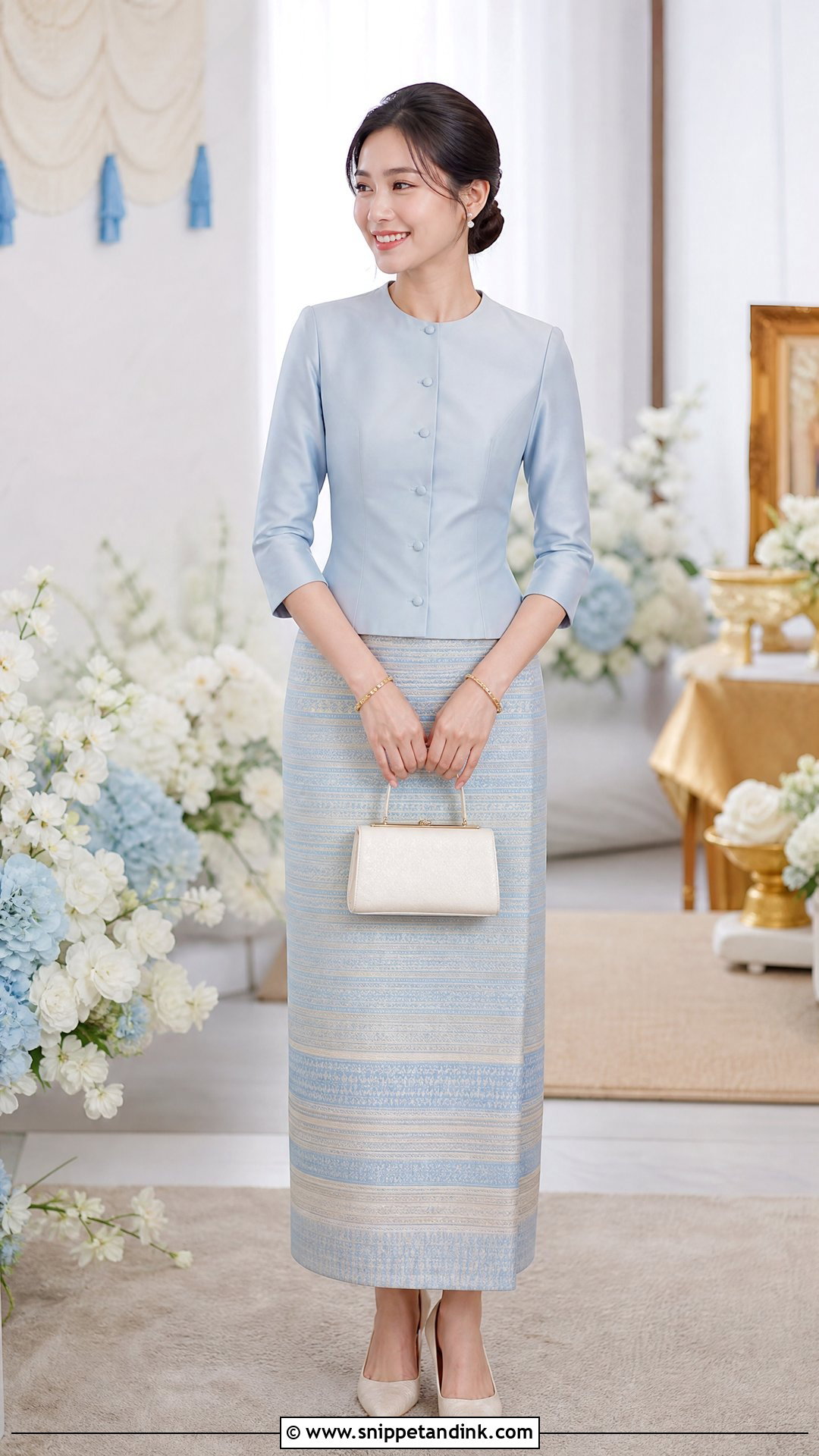
Could a simpler silhouette fit an intimate morning? Ruean Ton is the least formal of the eight ensembles, usually a collarless three-quarter-sleeve blouse with an ankle-length sinh, and it’s comfortable in a way the draped styles aren’t. For a bride, I’d do a powder-blue silk blouse with covered buttons and an ivory sinh woven with pale blue stripes. It’s easy to over-decorate a plain style to make it feel bridal; don’t. Spend on the silk and the tailoring instead. Pearl studs, a fine gold bracelet, low ivory heels and softly pinned hair with a few white flowers suit a home ceremony or a second daytime look.
14. Northern Thai Lanna Wedding Dress
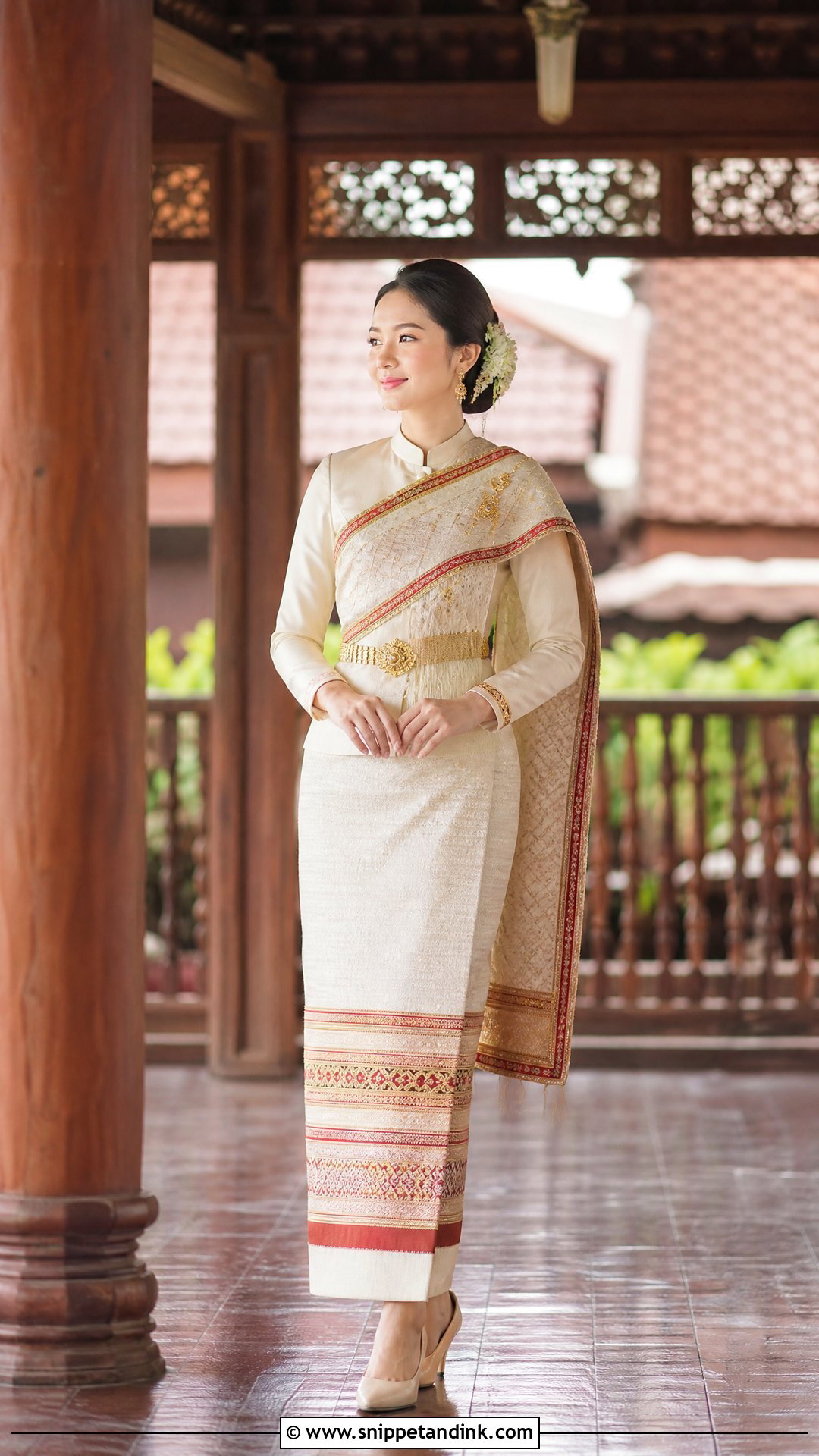
Lanna dress from Northern Thailand centers on the patterned pha sinh, often with a deep decorative border at the hem. I’d pair an ivory or pale gold blouse with a handwoven sinh in red, rust or gold, and add a shoulder cloth only if it fits the family’s custom and the ceremony. Handwoven cotton or silk sinh can be a little shorter or narrower than machine yardage, so measure before the tailor commits. Don’t mix motifs from different regions just because they look good together. Gold earrings, a decorative waistband, low heels and flowers woven into a tidy bun finish it.
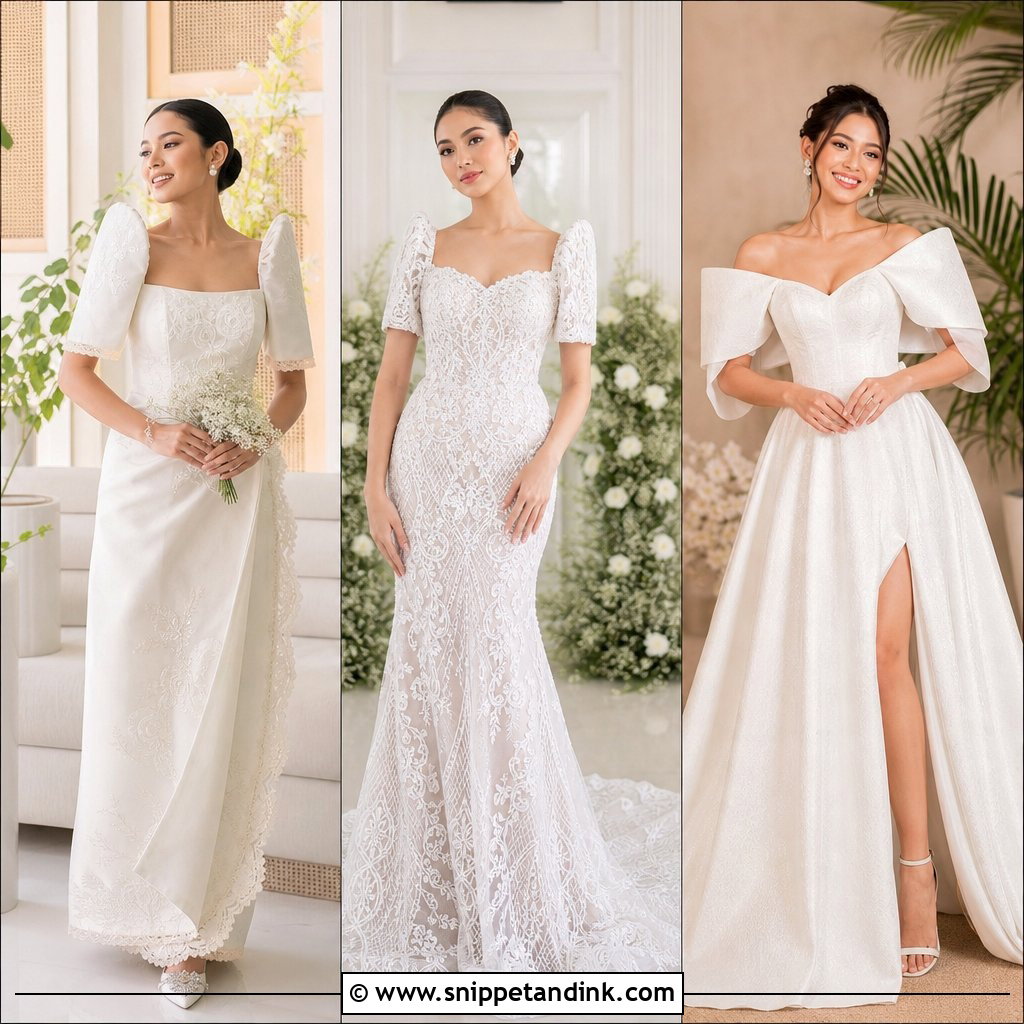
15. Isan Mudmee Silk Wedding Dress
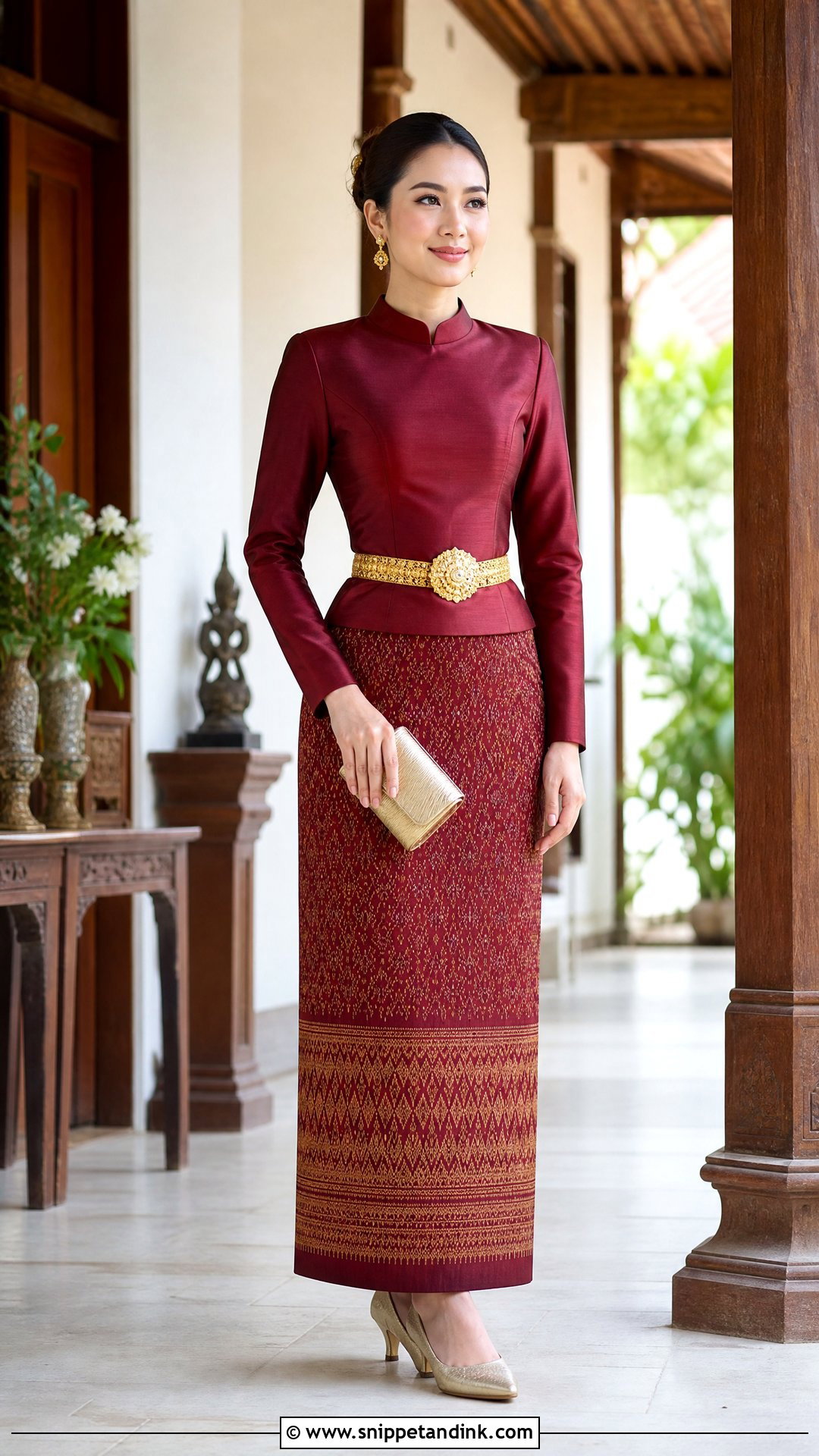
Mudmee, also written mat mee, is the ikat silk of Northeast Thailand. The threads are tie-dyed before weaving, which gives the pattern its slightly feathered edge, and that softness is what you’re buying. Build the outfit around a well-sourced mudmee sinh in burgundy, purple, blue or rust and keep the blouse solid. Long sleeves read formal; a one-shoulder drape looks more ceremonial where that’s appropriate. I always ask the weaver about the pattern’s origin before choosing jewelry, since some motifs carry meaning. A gold belt, restrained earrings, low metallic heels and a smooth bun complete it.
16. Southern Thai Brocade Wedding Dress
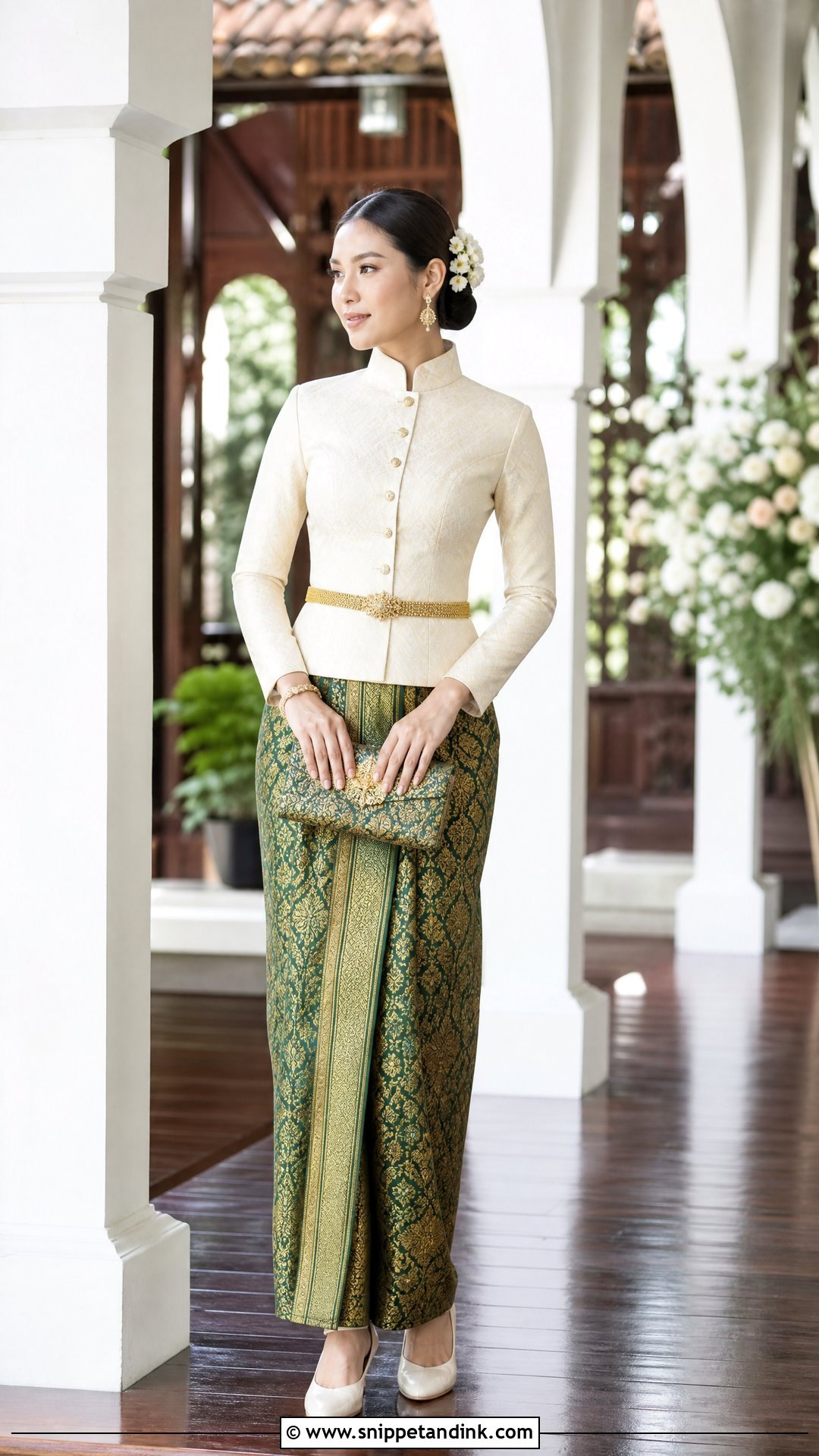
Southern Thailand has its own textile traditions, including patterned sarongs and bright metallic brocade. For a bride, I’d combine a jewel-toned brocade lower garment with a fitted ivory or gold blouse. Emerald, sapphire and deep magenta all work when one metal runs through the whole outfit. When the skirt pattern is complicated, the blouse stays plain. Metallic brocade is stiff and scratchy on the inside, so ask for the waistband to be lined in soft silk. A slim belt, drop earrings, closed-toe heels, a clutch in the skirt fabric and a sleek bun with a few flowers finish it. Check with a southern artisan or relative before mixing regional cloth with formal court styles.
17. Sukhothai Inspired Thai Wedding Dress
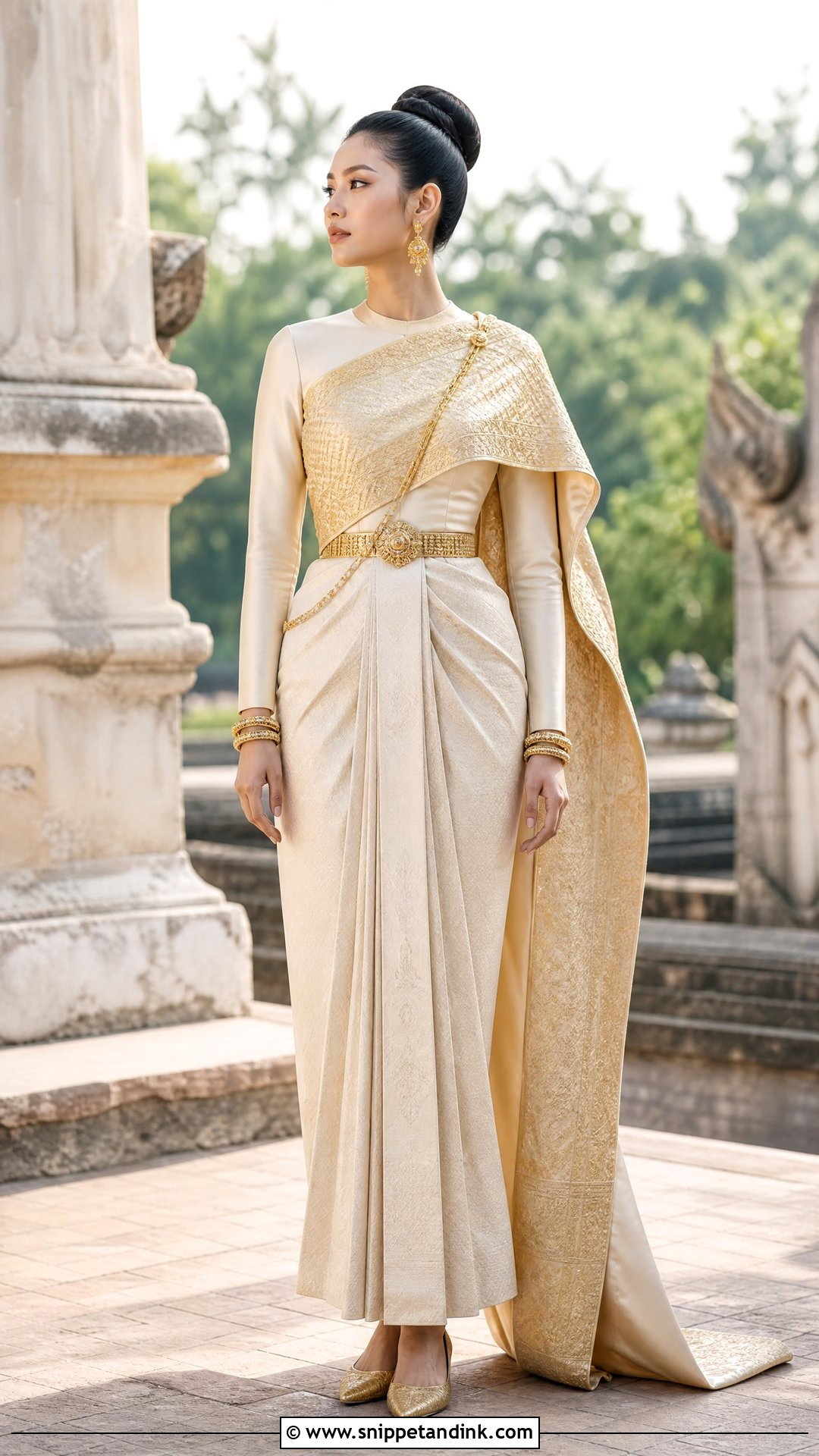
Much of what we know about Sukhothai-era dress comes from carvings and sculpture, so call this look inspired, not reconstructed. Keep it light: an ivory wrapped lower garment, a soft gold shoulder drape and a fitted foundation layer underneath for modern coverage. A narrow decorative belt, sculptural gold earrings, bracelets, low gold shoes and a high bun suit the long lines. If accuracy matters to you, work with a specialist; costume rental photos are not a reliable reference.
18. Ayutthaya Inspired Thai Wedding Dress
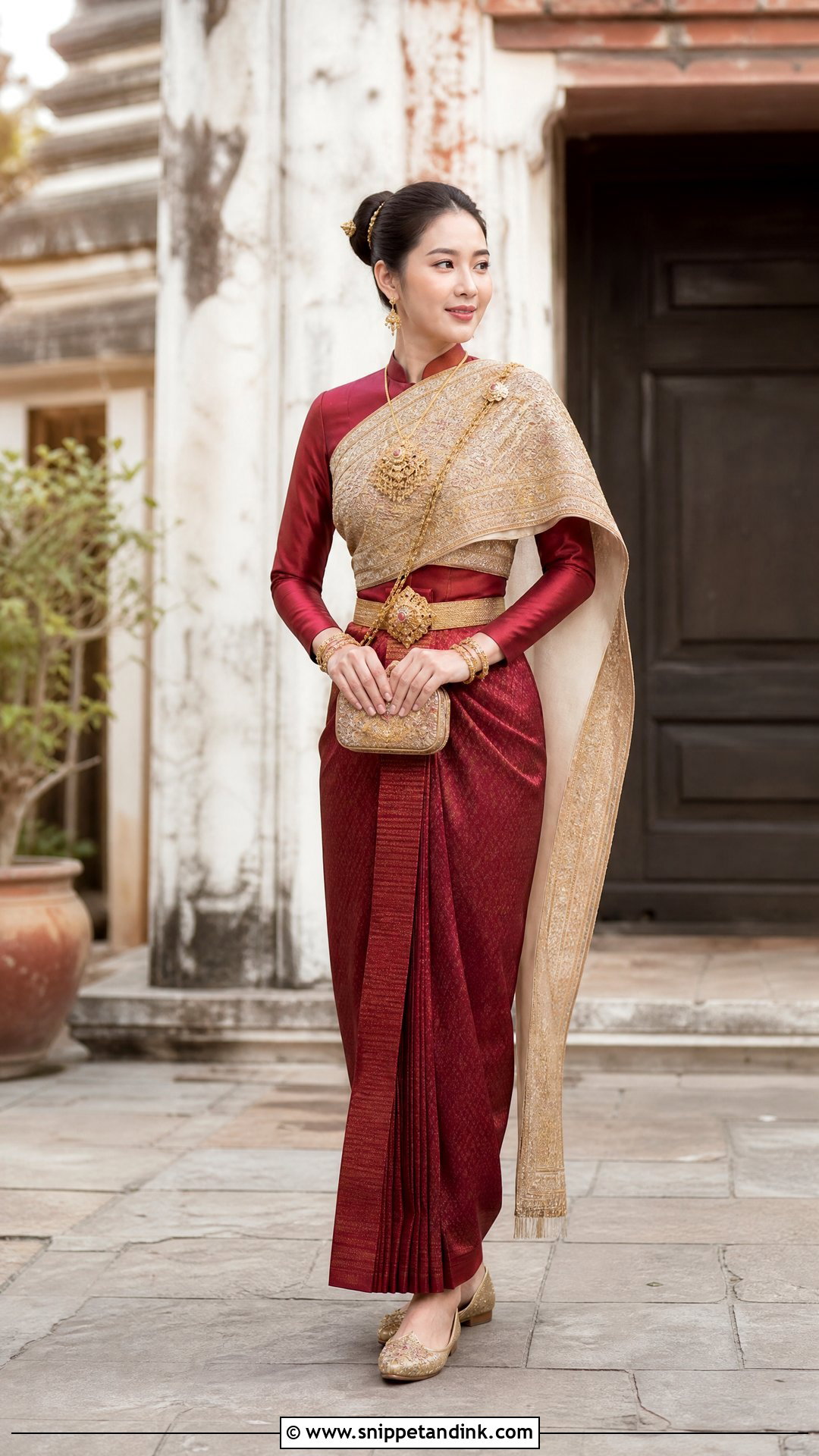
An Ayutthaya-inspired Thai wedding dress leans on dramatic drapery. Women’s dress of that period included pleated lower garments or chong kraben with a sabai, sometimes over a shirt. For a wedding, I’d translate that into a deep red pleated sinh, an antique gold sabai and a fitted silk blouse for secure coverage. A chong kraben is wrapped and tucked, not sewn, and it needs a practiced hand to dress; book someone who knows how. Add a decorative belt, gold earrings, one or two bracelets, embroidered shoes and a polished bun with a traditional ornament, and keep historical references distinct from today’s official chut thai.
19. Pink And Gold Thai Wedding Dress
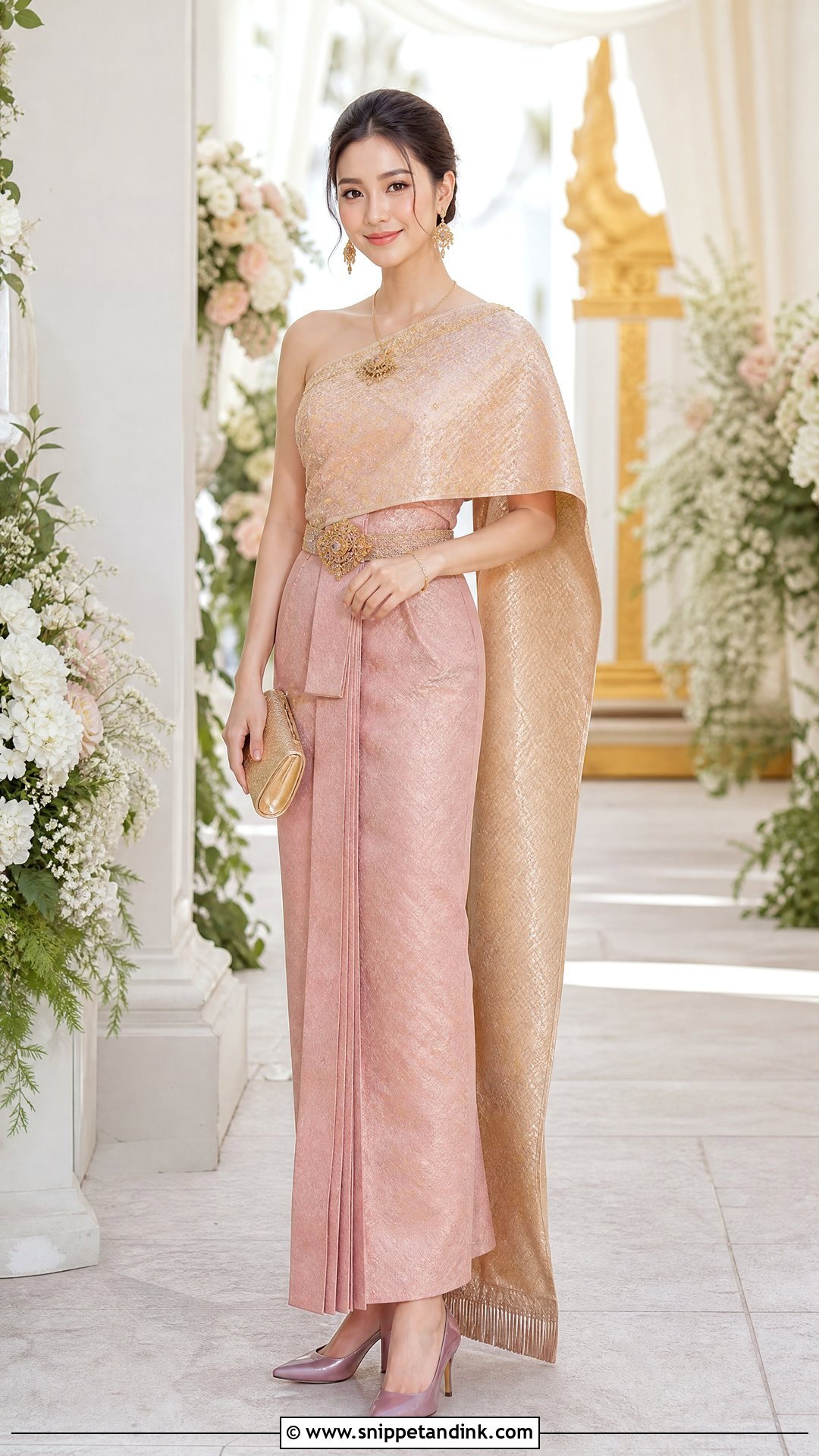
Dusty rose and gold is romantic and still formal. A rose silk sinh with a front pleat and narrow gold border, a matching fitted bodice and a pale gold sabai over one shoulder are anchored by a medium-width gold belt. Large woven motifs have to be placed symmetrically across the pleat, bodice and visible sabai, and that’s a cutting decision, so discuss it before the silk is cut. Drop earrings, a delicate necklace, pink satin heels and a small gold clutch finish it. Choose flowers or an ornamental comb for the hair, not both.
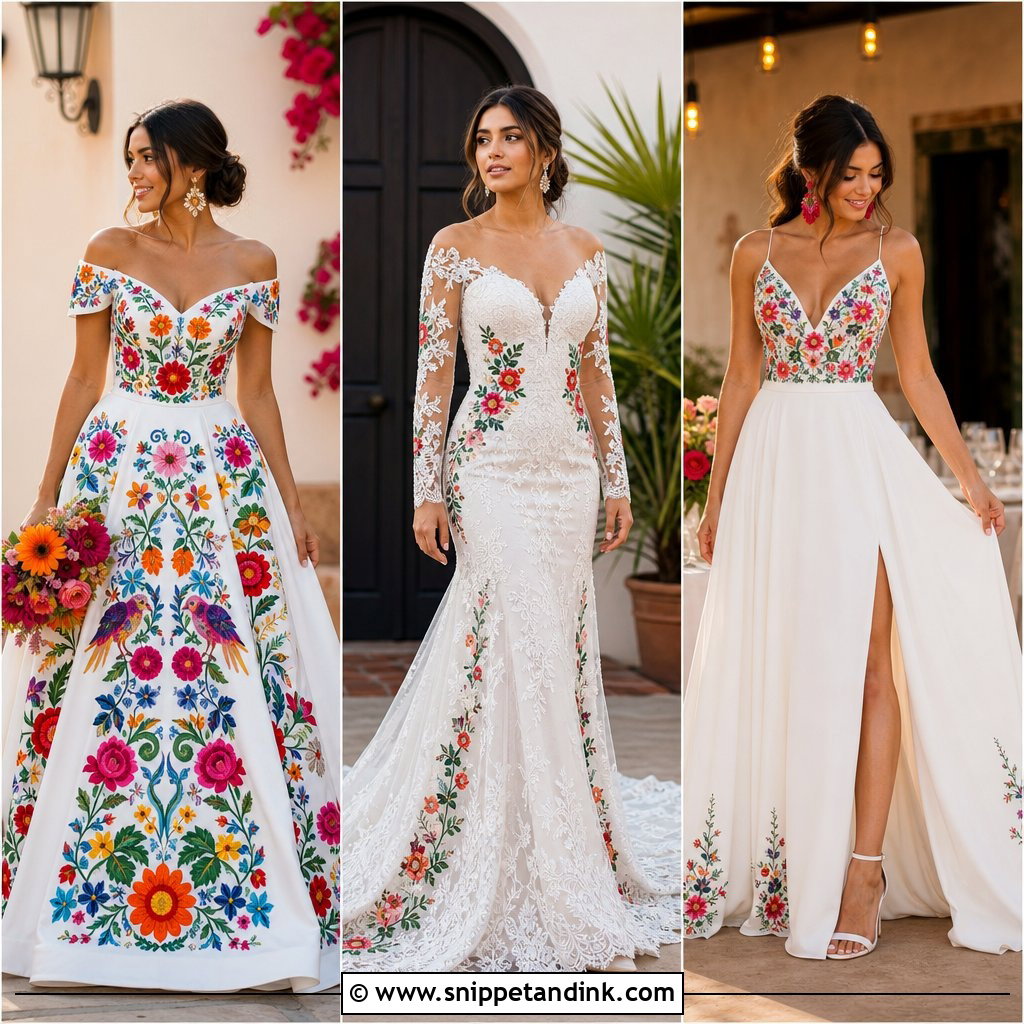
20. Ivory And Blue Thai Silk Wedding Dress
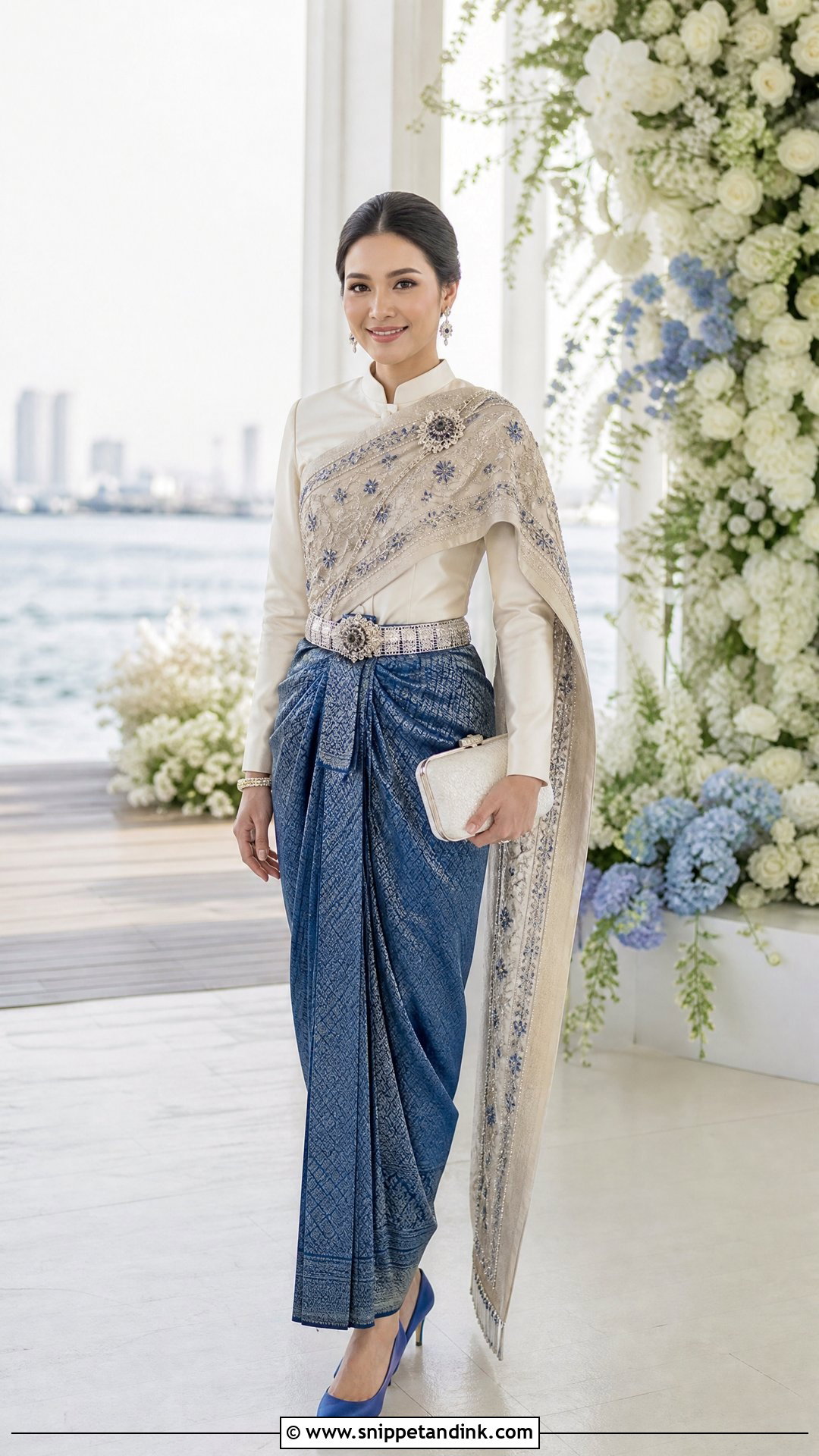
Ivory and blue is calmer than all-gold. Pair an ivory bodice with a sapphire, powder-blue or blue-grey silk sinh and an ivory sabai edged in blue-and-silver embroidery. Blues are the hardest silks to match, since two that agree indoors can disagree outside, so compare every piece in daylight before ordering. A silver belt, pearl earrings, a fine bracelet, blue satin pumps, an ivory clutch and one small silver ornament or a cluster of white flowers in sleek hair complete it. It suits a waterside venue.
Kneeling, Bowing and Sitting Low in a Fitted Sinh
Thai ceremonies are physical. You kneel to wai elders, sit on low cushions with your feet tucked away from monks and stay still for long stretches. A sinh cut close for a standing photo can make all of that awkward.
- At the last fitting, kneel, sit side-saddle and rise without using your hands. If the pleat strains or the hem pulls up, ask for more ease through the hip.
- Have the sabai pinned to the foundation top at the shoulder and the back waist, so it can’t slip when you bow forward.
- Practice a deep wai in the full outfit with jewelry on. Bracelets and long sleeves catch on each other more than you’d think.
- Keep a small pin kit with the person who dresses you, and plan time between rites for a quick re-pin.
What Blessing Water Does to Silk
During rod nam sang, guests pour scented water over your hands, and some of it ends up on your skirt. Thai silk can water-spot, especially lighter colors, so I lay a folded cloth across the bride’s lap or ask that the bowl sit well forward of the hem.
If water does land on the silk, blot it, never rub, and let it dry flat. After the wedding, take the outfit to a cleaner experienced with silk and metallic thread, then store it rolled or loosely folded in acid-free tissue inside a cotton bag. Metallic brocade creased hard along the same line for years can crack, so refold it now and then.
Let the Weave Lead and Dress Around It
Color, silk, draping, regional weaving and tailoring all shape a Thai bridal look. Some brides want the one-shoulder ease of Chakri, others feel more at home in the covered lines of Siwalai or Boromphiman, and regional textiles add meaning when chosen with knowledge. Talk through the ceremony, venue, climate and family custom with a Thai tailor, then test everything together: shoes, jewelry, hair and every underlayer. If you can kneel, bow and stand back up without anything shifting, the dress is ready.
You'll Like These Ideas:





Leave a Reply