
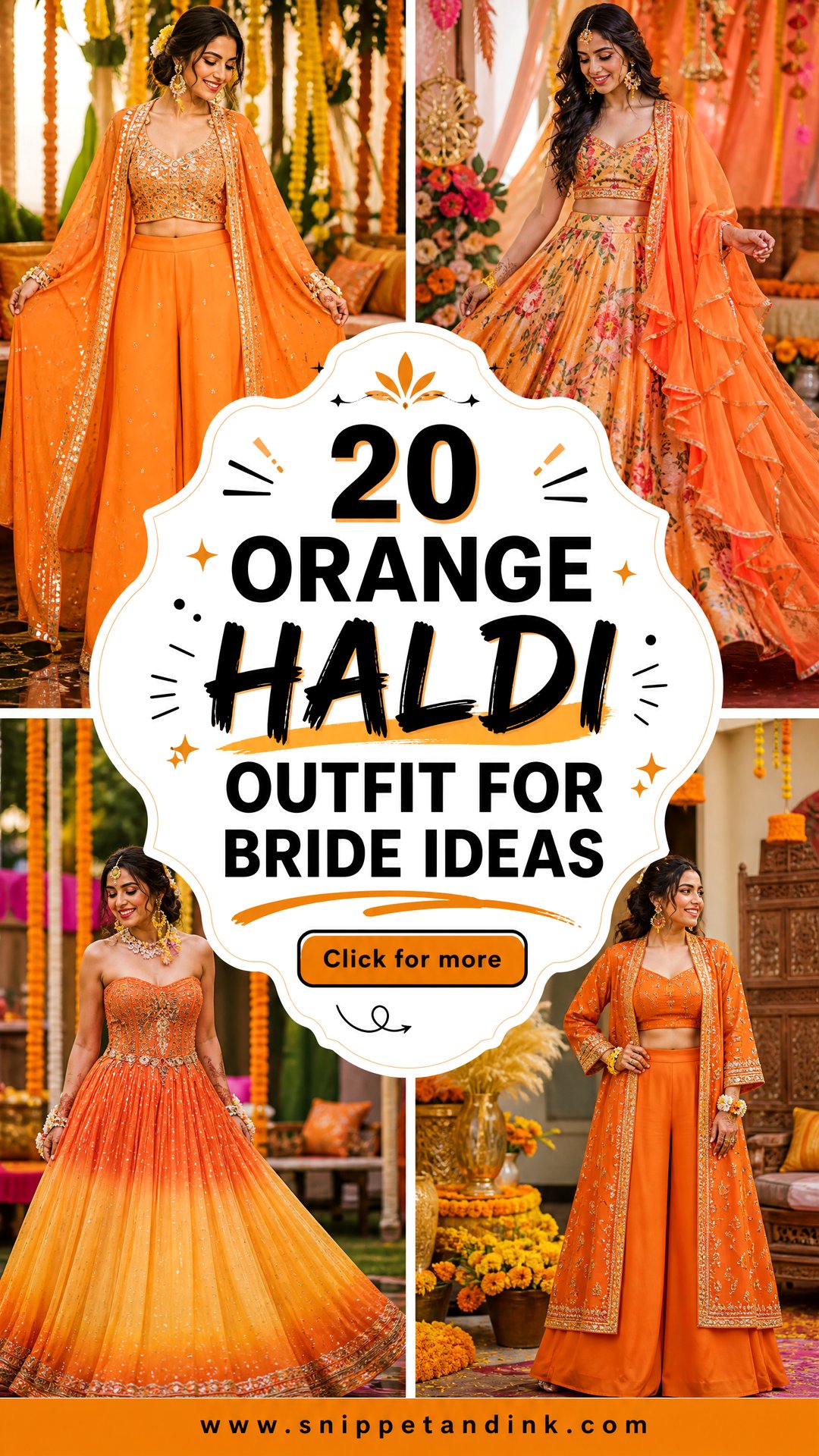
Orange is the colour I reach for most often when a bride asks what to wear to her haldi. It sits naturally against marigold garlands, and when the turmeric paste goes on, the yellow blends into the fabric instead of looking like a stain on it. The range is wide: peach-orange, tangerine, saffron, rust and a deep burnt orange all count. What matters more than the shade is that the outfit lets you sit on a low stool, get covered in paste, dance afterwards and still look composed in photos. Light fabric, secure draping, comfortable bottoms and sensible jewellery make that possible. Below are twenty orange haldi looks, from lehengas and sarees to shararas and fusion sets, each styled from head to toe.
Will It Survive the Turmeric? Fabric Decisions for a Wet, Messy Ritual
The first question I ask about any haldi outfit isn’t how it looks. It’s what happens to it when someone smears turmeric paste mixed with oil and milk across the sleeve. Turmeric is a strong natural dye. On cotton and linen it usually fades with a few washes; on pure silk, organza and zari it often leaves a permanent yellow cast.
- Safest: cotton, mulmul, cotton silk and chanderi blends. They breathe in the heat and tolerate a cold-water wash afterwards.
- Workable: georgette and chiffon. They dry quickly and printed versions hide marks, though light shades may stay tinted.
- Risky: pure silk, organza, velvet and anything with real zari or dense mirror work. Water marks them and the metal threads tarnish when wet.
- Check first: bandhani and leheriya. Hand-dyed fabrics can bleed when soaked, so dampen a hidden corner before the day.
If you love a delicate piece, wear it for the portraits before the ceremony, then change into something washable for the paste. Many brides do exactly that, and nobody notices the switch in the photos.
1. Orange Lehenga With Floral Blouse
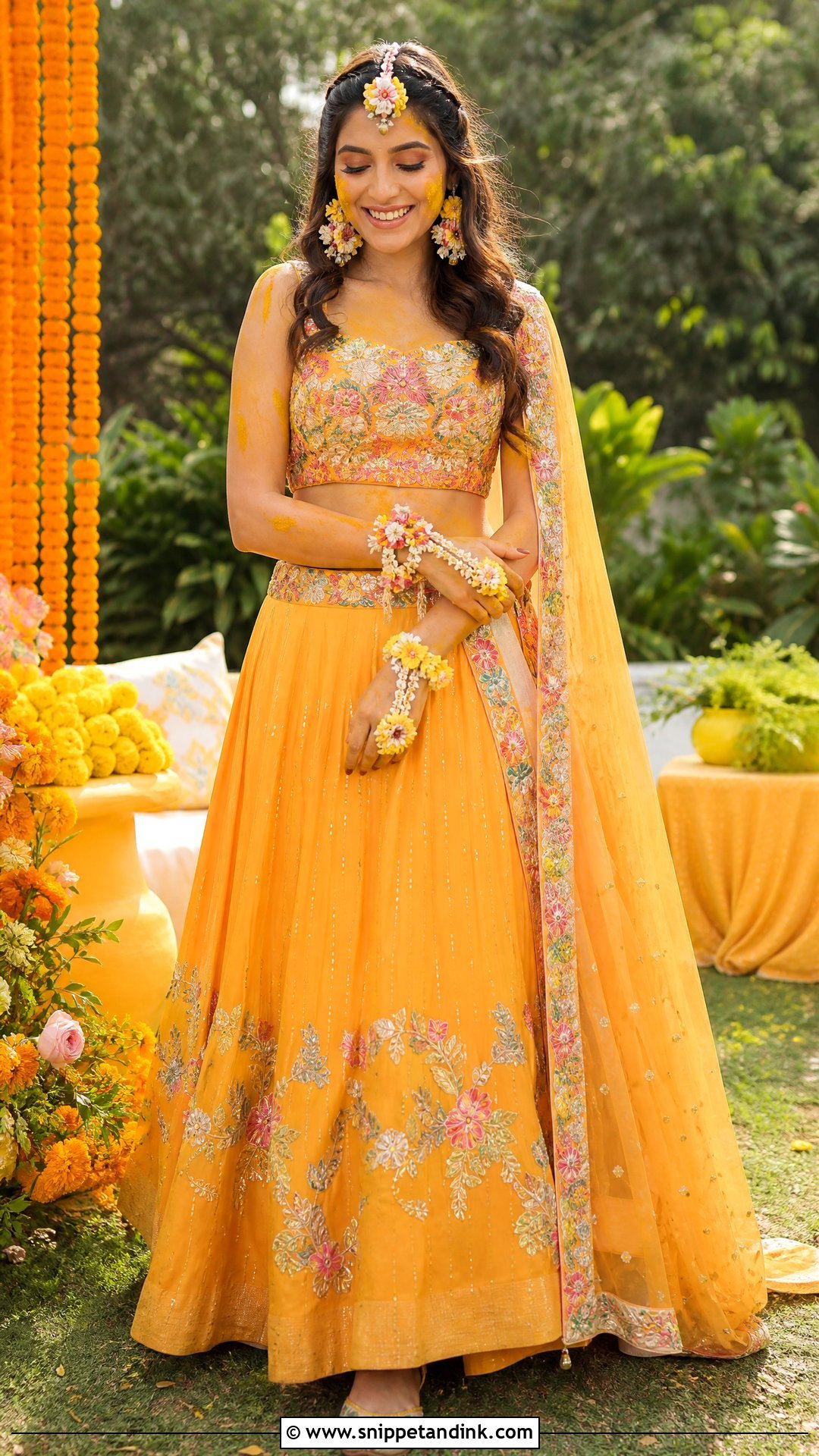
For a garden haldi, a light orange lehenga with a floral blouse is hard to beat. I’d pick georgette or organza for the skirt, with a waistband that has some give, because you’ll be bending and laughing more than at any other function. A blouse embroidered in pink, yellow and ivory flowers adds contrast while the orange stays in charge. Pin a sheer orange dupatta over one shoulder at two points, not one. Floral earrings, a matching maang tikka and haath phool finish the jewellery. Flat juttis, not heels, since the ground is often grass or rugs. A loose braid with small flowers and glowing, light makeup complete it.
2. Orange Saree With Sleeveless Blouse
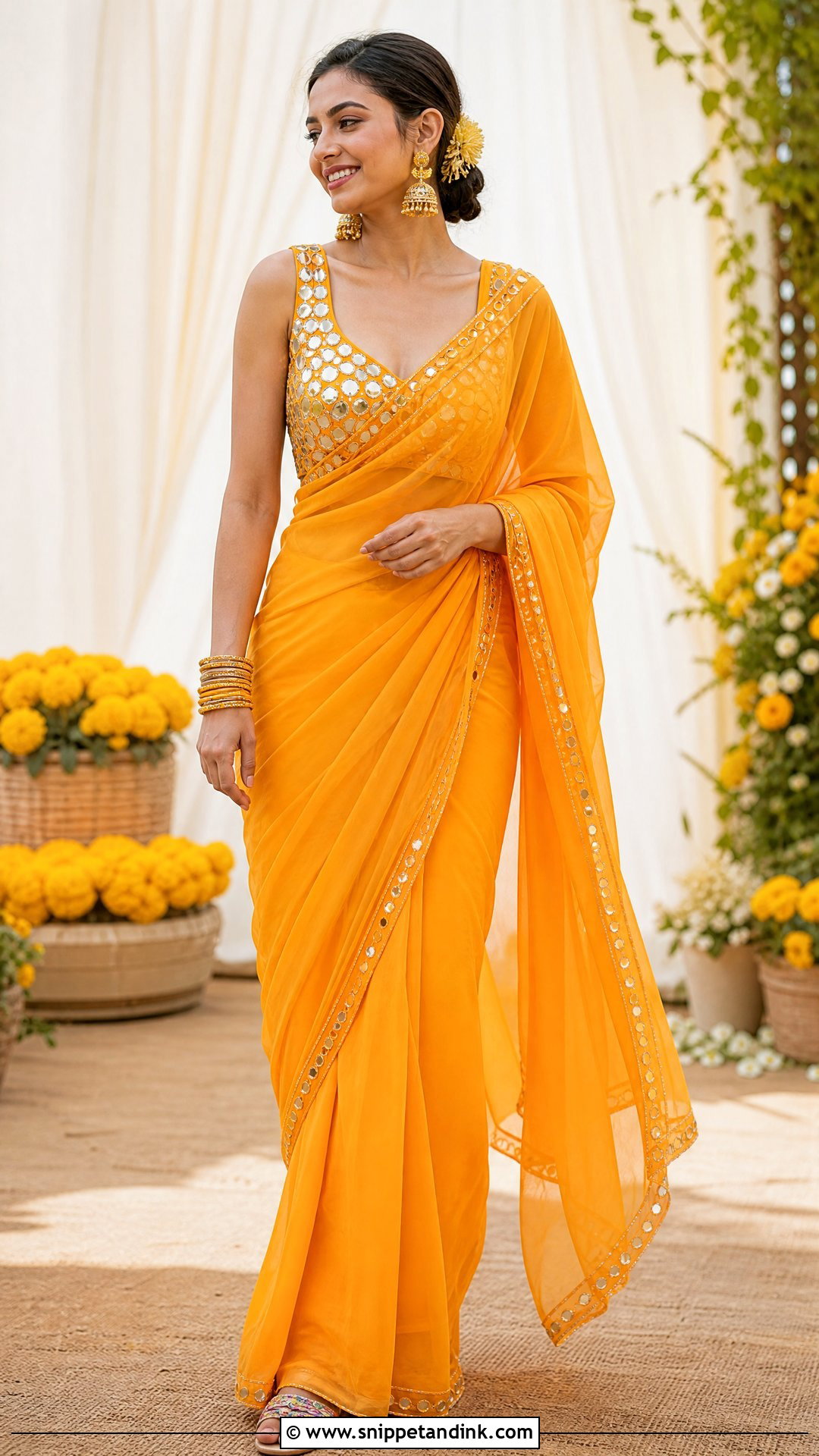
A chiffon or georgette saree in bright orange is the easiest saree to wear at a haldi, because it’s light and dries fast if the paste gets watery. A sleeveless blouse with a little mirror work or gota trim keeps the arms free for the ritual. Pin the pleats at the waist and the pallu at the shoulder with more pins than feels necessary; family will pull you up for hugs and dances, and a loose pallu falls straight into the turmeric bowl. Gold jhumkas, stacked bangles and a small floral tikka are enough. Wear gold flats or embellished sandals. A low bun wrapped in white flowers, luminous skin and a coral lip suit the colour.
3. Burnt Orange Sharara With Short Kurti
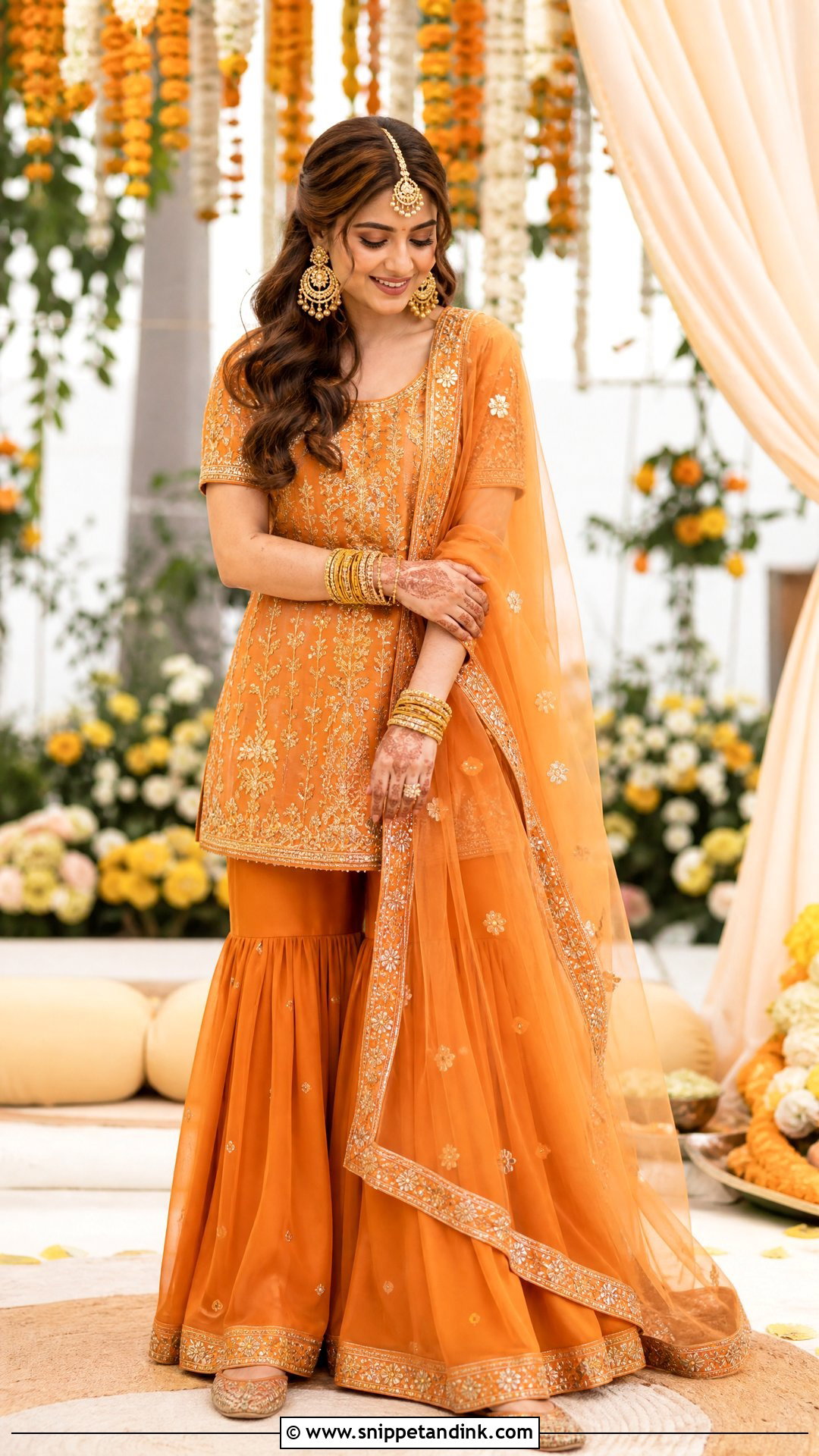
Burnt orange is the shade I suggest to brides who find tangerine too loud. Build it around a short embroidered kurti and wide, flowing sharara pants in soft georgette. Gota borders, a scatter of sequins or fine threadwork give enough bridal detail without the weight. A light net dupatta over one shoulder or looped around the arms stays out of the way. Antique-gold chandbalis and a statement tikka sit well against the deeper tone. Get cushioned juttis; you’ll be standing a lot. A centre-parted low ponytail or textured braid keeps it neat. This one is better suited to an indoor haldi with traditional flower decor, where the darker orange won’t fade into bright sunlight.
4. Tangerine Gharara With Organza Dupatta
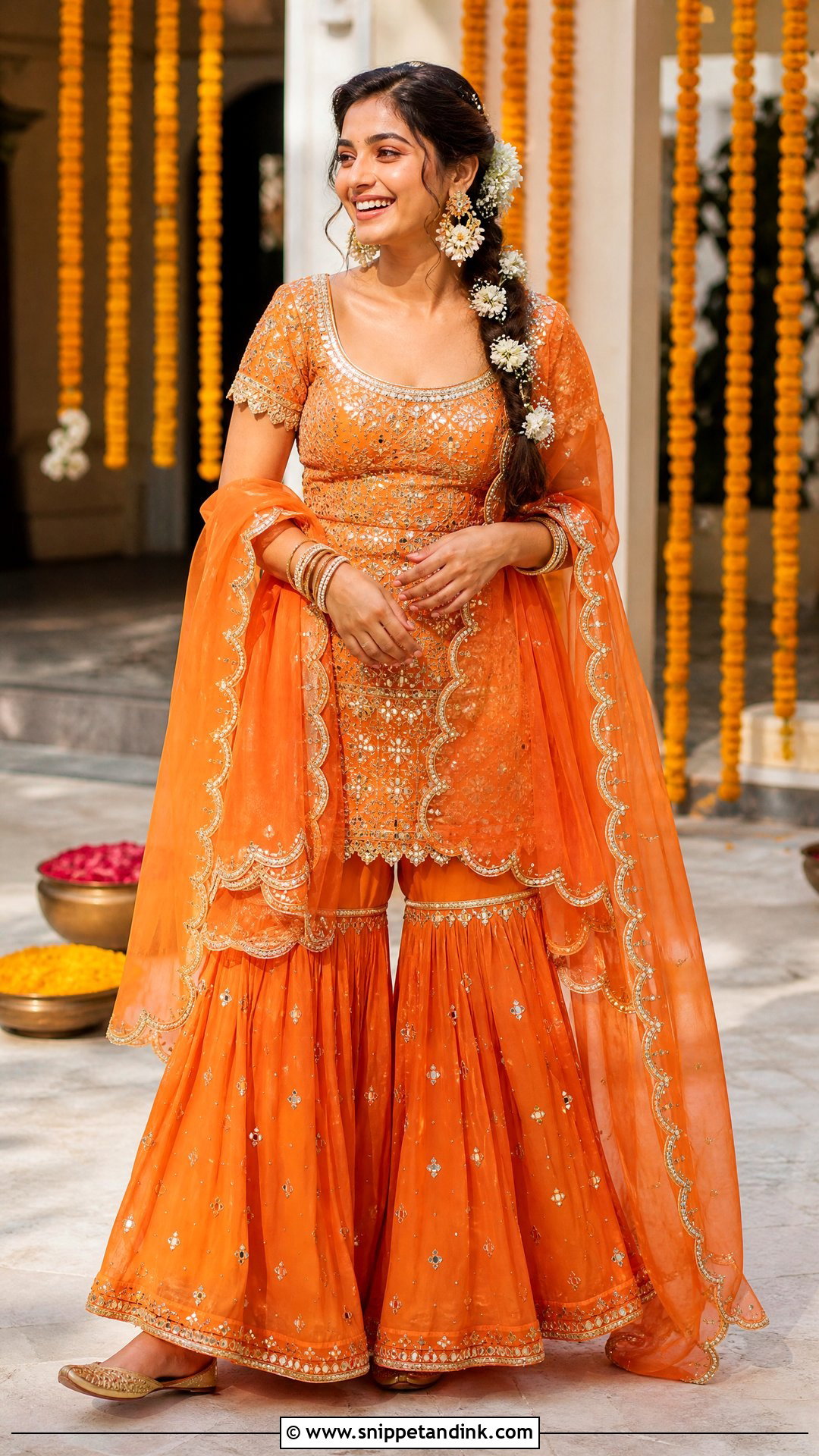
Tangerine is a daytime colour; it glows outdoors and turns slightly red under warm bulbs. A fitted short kurti over a gharara defines the waist, and the gharara’s gathered knee joint gives you plenty of room to sit cross-legged. Mirror work, small pearls or gold piping at the neckline and sleeves is all the decoration it needs. An organza dupatta with a scalloped edge holds its shape in sunlight. Keep the jewellery small: flower-shaped earrings, layered bangles, a simple forehead piece. Orange or gold juttis keep the colour running to your feet. I’d weave small yellow flowers into a relaxed braid, and use peach makeup with a touch of gold highlight.
5. Orange Anarkali With Floral Jewelry
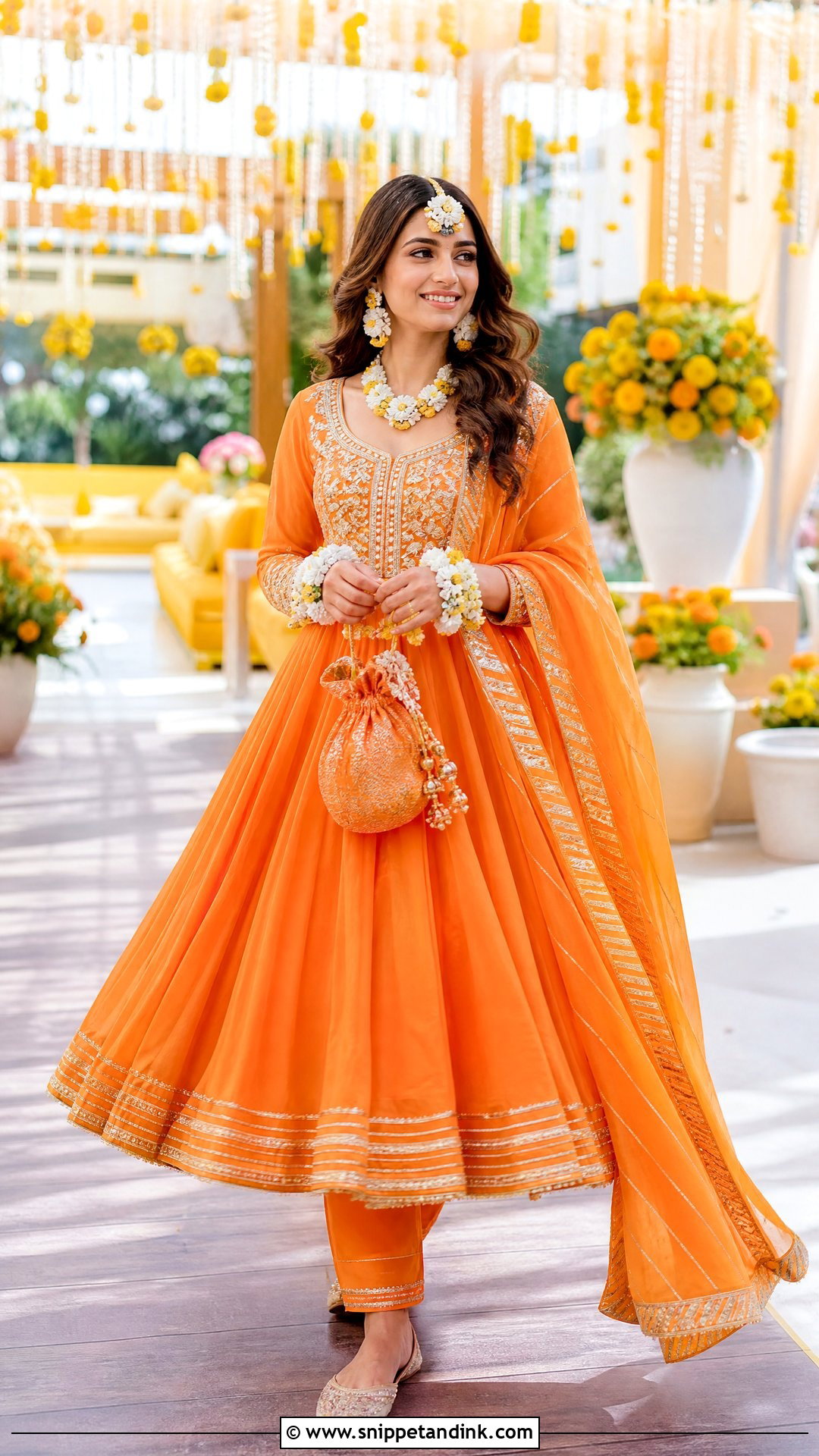
The Anarkali works at a haldi because the flare hides the fact that you’re sitting on a low patla for half an hour. Calf or ankle length with a fitted bodice and a full lining is the shape to look for. Cotton silk, georgette or light chanderi give the skirt body without weight. Slim pants underneath and a sheer dupatta with a narrow gota edge keep it simple. White and yellow floral jewellery stands out against orange and suits the ritual. Embroidered juttis and a small potli for the portraits before things get messy finish it. A half-up style with loose waves keeps the neckline visible, with defined eyes and a coral lip.
6. Orange Pre-Draped Saree With Belt
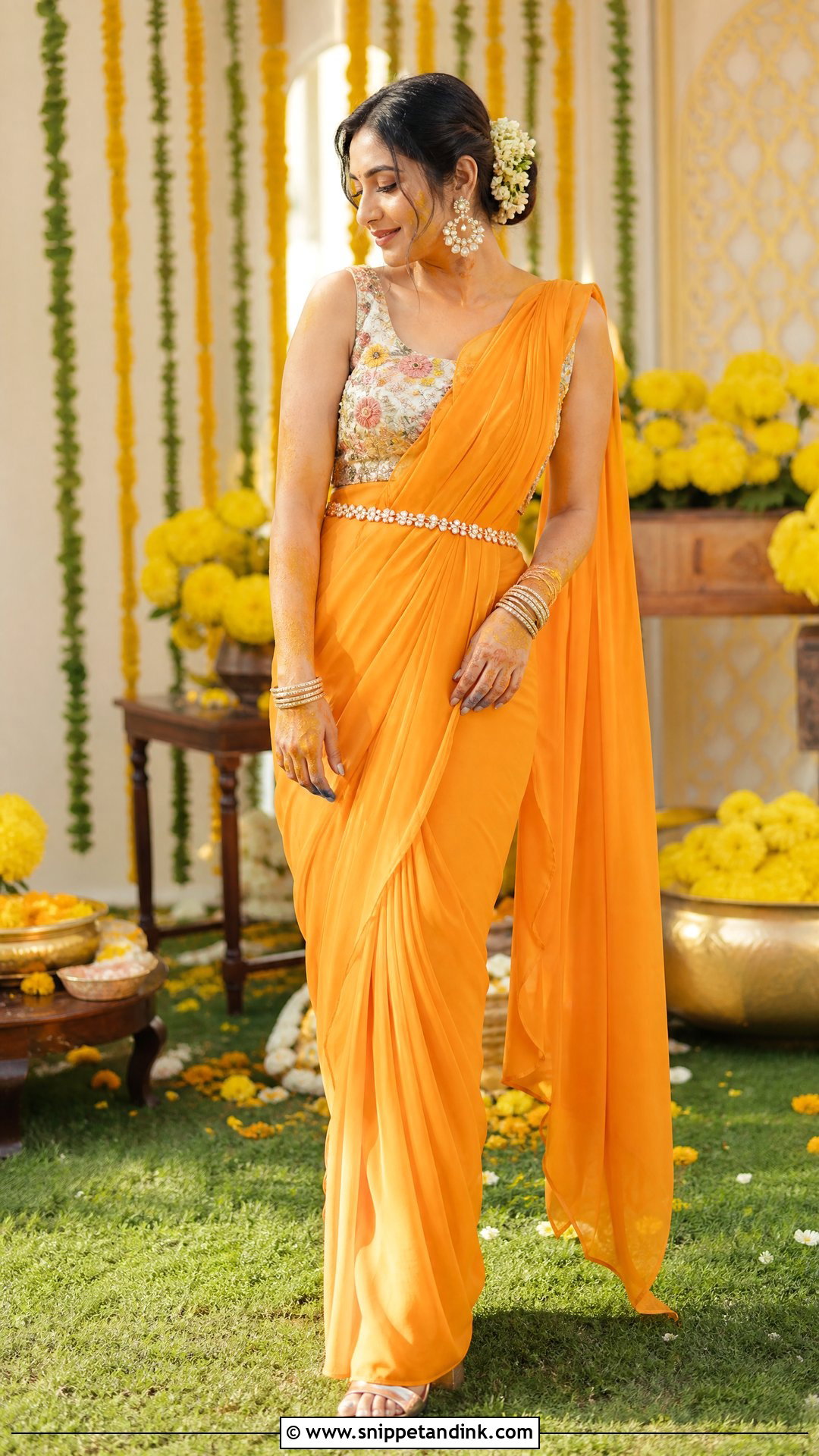
A pre-draped saree saves you from re-tucking pleats while relatives smear paste on your arms. I’d choose soft georgette or crepe with a stitched drape and a side zip so you can step out of it quickly afterwards. A blouse with floral embroidery, some mirrors or a modest sweetheart neck works well. Add a slim embroidered belt: it holds the pallu flat during dancing and gives the waist shape. Pearl-and-flower earrings, stacked bangles and metallic sandals are enough. A sleek low bun with orange and white blossoms keeps it clean, and since the drape already moves, keep the jewellery moderate. Dewy skin and soft liner finish the face.
7. Orange Palazzo Set With Cape
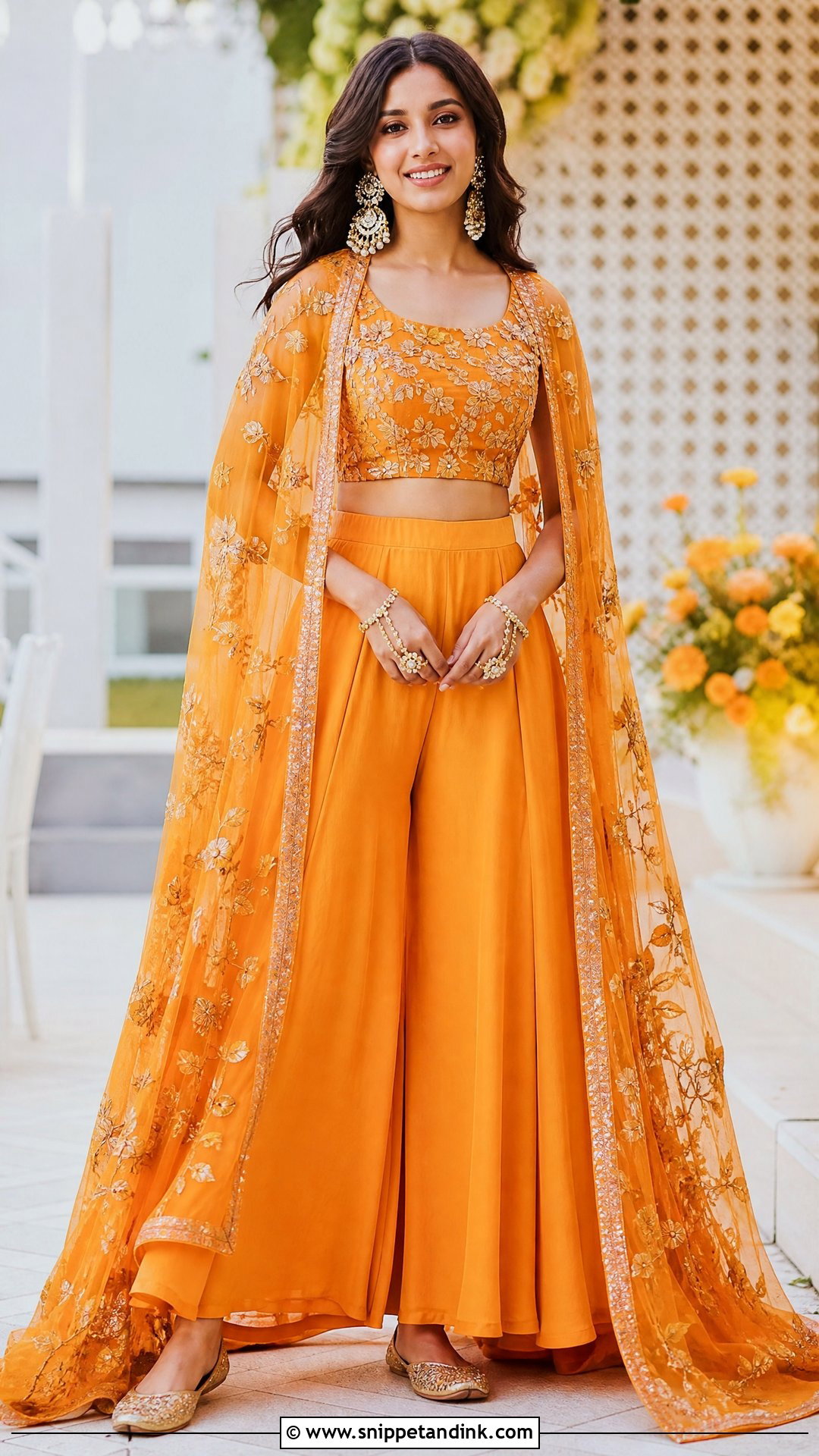
A palazzo set with a long cape is my pick for a bride who plans to dance through her haldi. A fitted crop top or waist-length blouse over high-rise wide-leg palazzos gives full movement, and a sheer embroidered cape falling below the knee adds the bridal flow. Light mirror work or floral thread embroidery keeps it from feeling heavy. The cape carries most of the decoration, so statement earrings and a haath phool are enough jewellery. Cushioned gold flats or orange juttis go underneath. Pull the hair back into soft waves or a low ponytail so the paste doesn’t end up in it, and keep the makeup natural with a warm peach lip.
8. Orange Bandhani Lehenga With Gota Dupatta
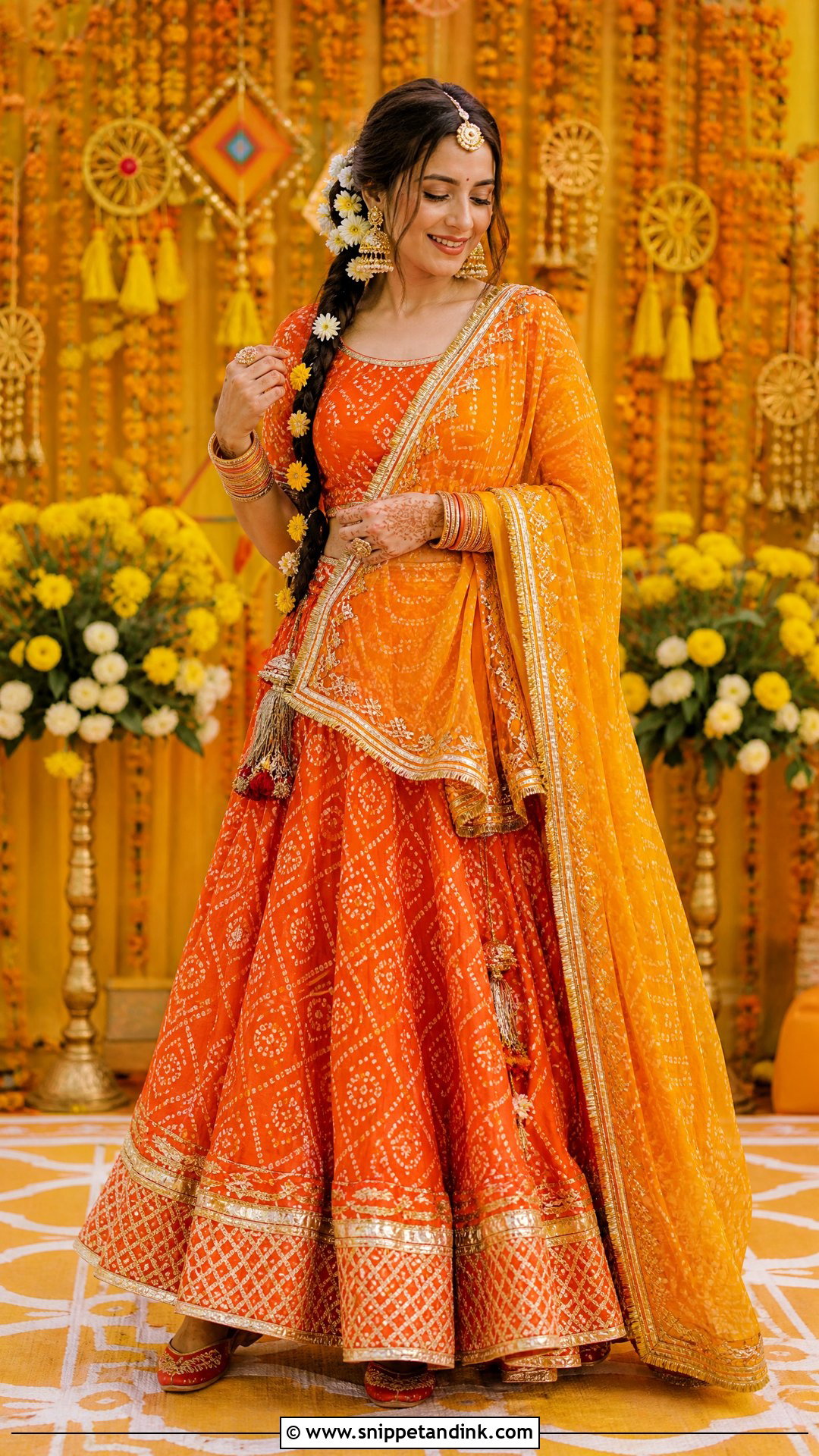
Bandhani gives an orange Haldi lehenga its own texture from the tie-dye dots, and it carries a lot of cultural meaning in Rajasthani and Gujarati families. Pick a light skirt with a comfortable flare and a fitted orange blouse with simple gota edging. A yellow-orange dupatta brightens it, draped diagonally and pinned at shoulder and waist. Gold jhumkas, glass bangles and a small borla or tikka reinforce the traditional feel, with red-orange juttis and a small potli. A long braid wrapped with gold cord or flowers suits bandhani better than an open style. Keep the makeup simple; the fabric is the detail. Before the day, wet a hidden corner of the dupatta, because hand-dyed bandhani sometimes bleeds onto skin and blouses.
9. Orange Mirror Work Lehenga With Net Dupatta
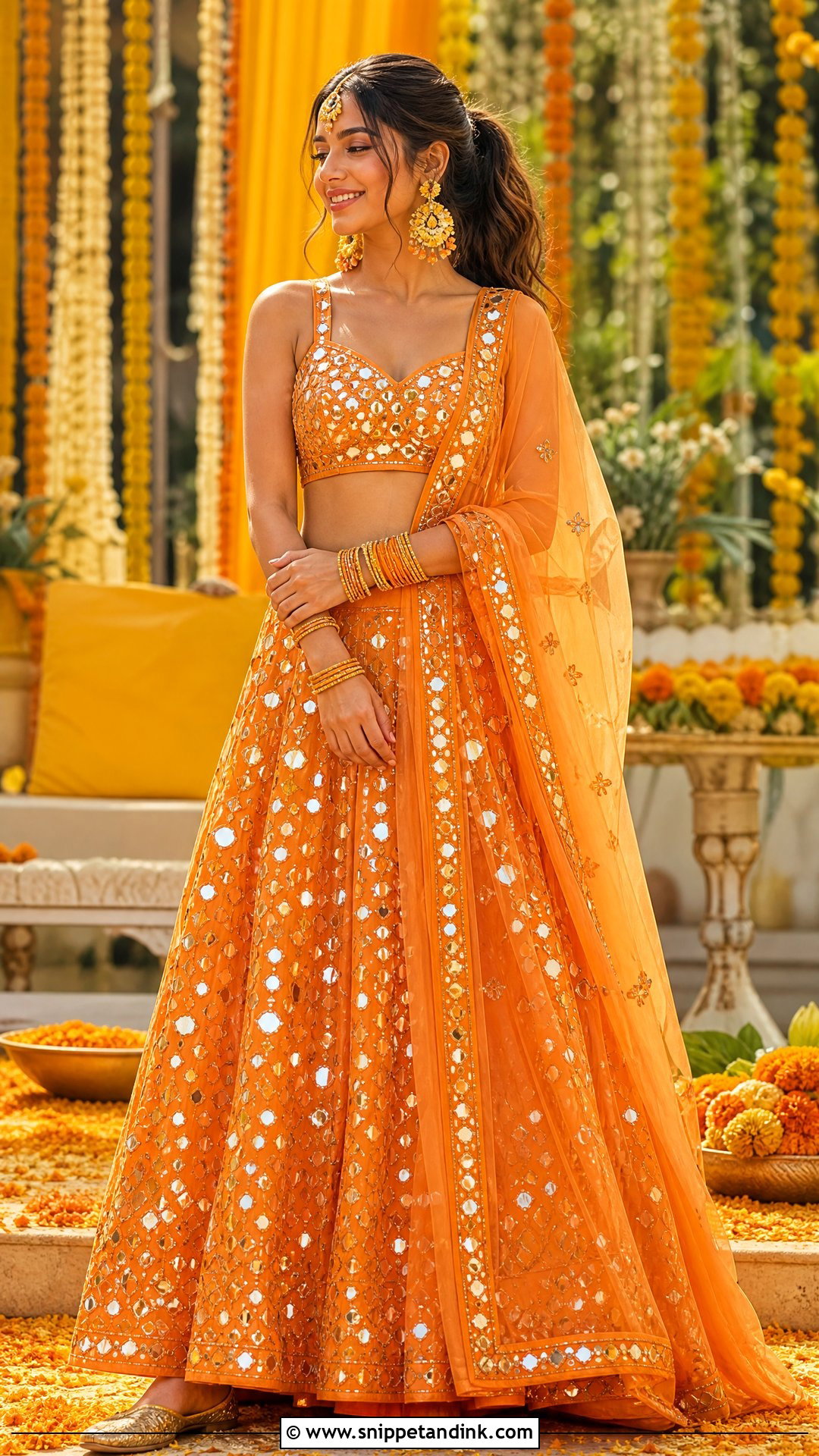
Mirror work catches the morning sun better than any embroidery, but it is heavy and the mirrors’ edges scratch if the work is dense. That’s why I’d choose a skirt with evenly spaced mirrors rather than a solid covering. The blouse needs secure straps and real support; mirrors add weight at the neckline. A plain net dupatta with a mirrored border balances the skirt. Bold floral earrings, a single tikka and a few bangles are enough. Metallic juttis make walking and dancing easy. A textured ponytail or braid stops hair tangling in the mirrors. Use matte makeup with waterproof eye products and a peach-orange lip, because haldi often ends with water being thrown around.
10. Orange Chikankari Suit With Straight Pants
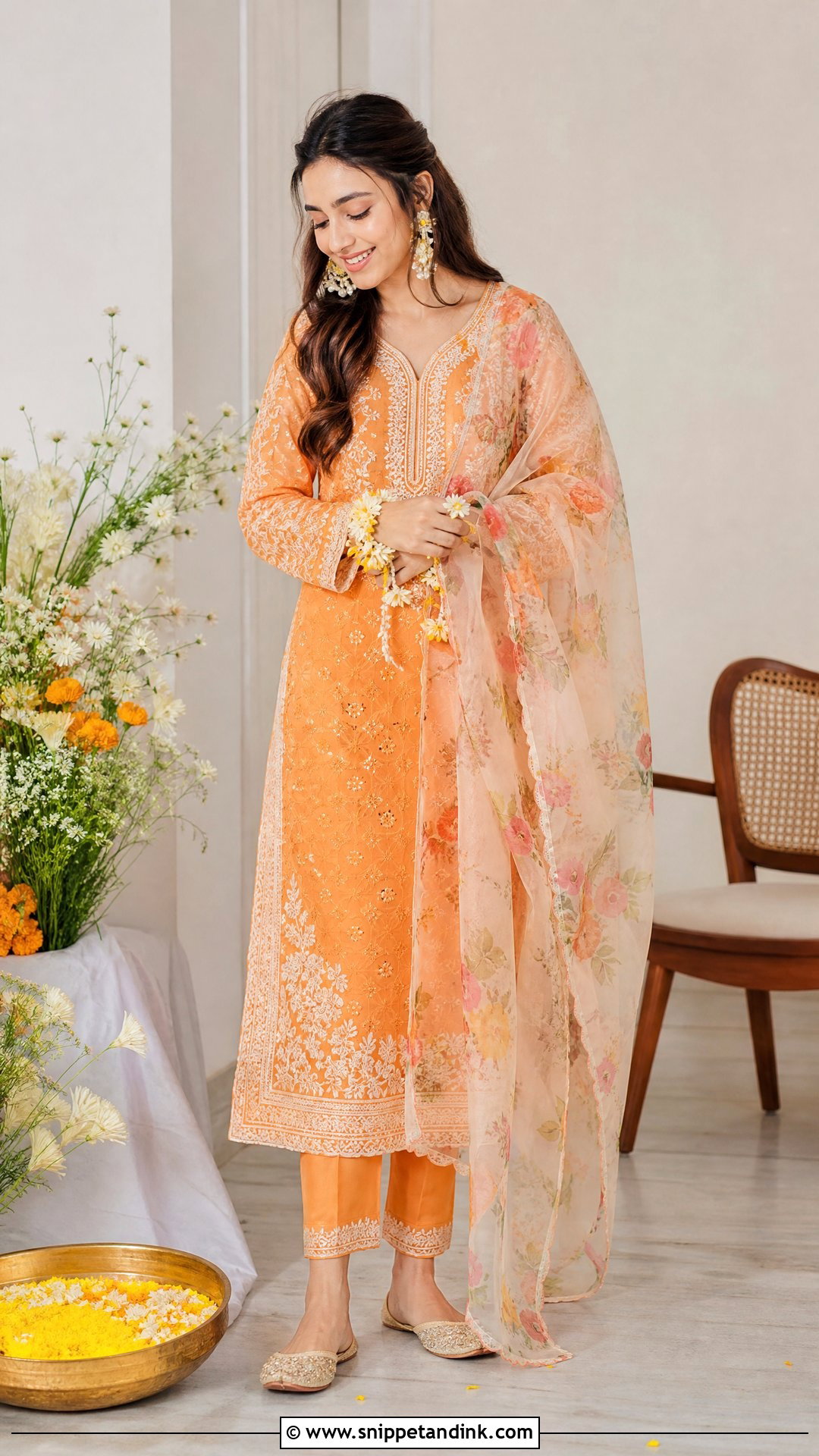
For a small haldi at home, an orange chikankari suit is the most comfortable option on this list. Breathable cotton, mulmul or georgette with tone-on-tone embroidery in a straight cut keeps you cool. Pair it with straight pants or ankle-length cigarettes. A lightweight organza dupatta with small florals adds the dressed-up touch. Pearl jhumkas, fresh flower bangles and embroidered flats are plenty. Avoid heavy necklaces; they compete with the fine chikan work. A low braid or soft ponytail, glowing skin and a coral lip finish it. The bonus is practical: cotton chikankari survives a gentle wash, so the turmeric isn’t a disaster.
11. Orange Organza Saree With Pearl Blouse
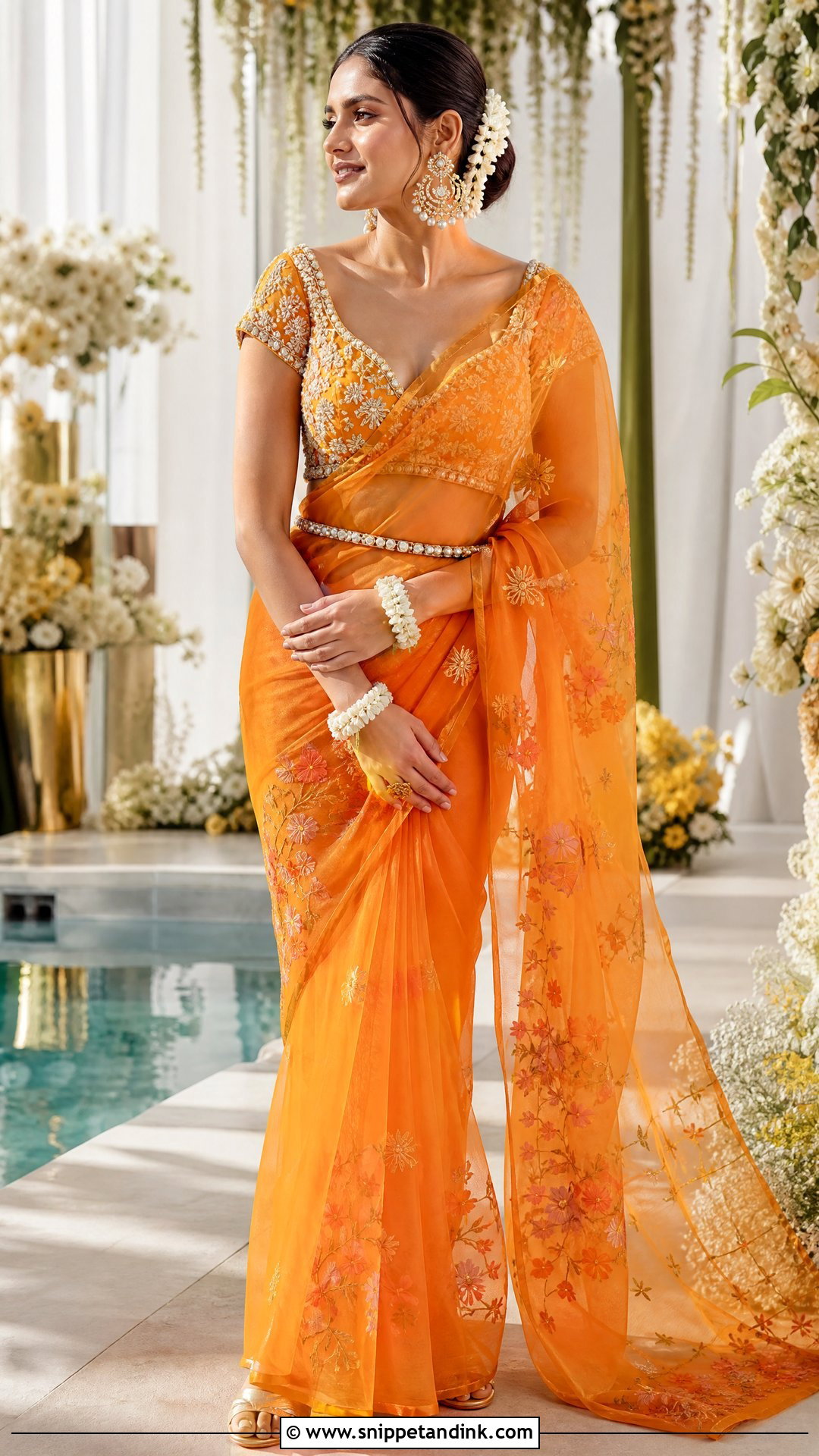
Orange organza holds a crisp, structured drape that shows up well in daylight. Choose a saree with a slim embroidered border, scattered florals or light gold accents, and balance its stiffness with a fitted blouse trimmed in pearls, in orange, ivory or soft gold. Organza slides off itself, so pin the pleats and pallu more firmly than you would chiffon, and add a belt if there’s dancing. Pearl chandbalis, fine bangles and gold sandals are enough. A smooth bun with white flowers keeps it neat. Use a light base with warm blush and waterproof mascara. Organza also marks easily when wet, so keep this one for brides whose families apply the paste gently.
12. Orange Peplum Top With Dhoti Pants
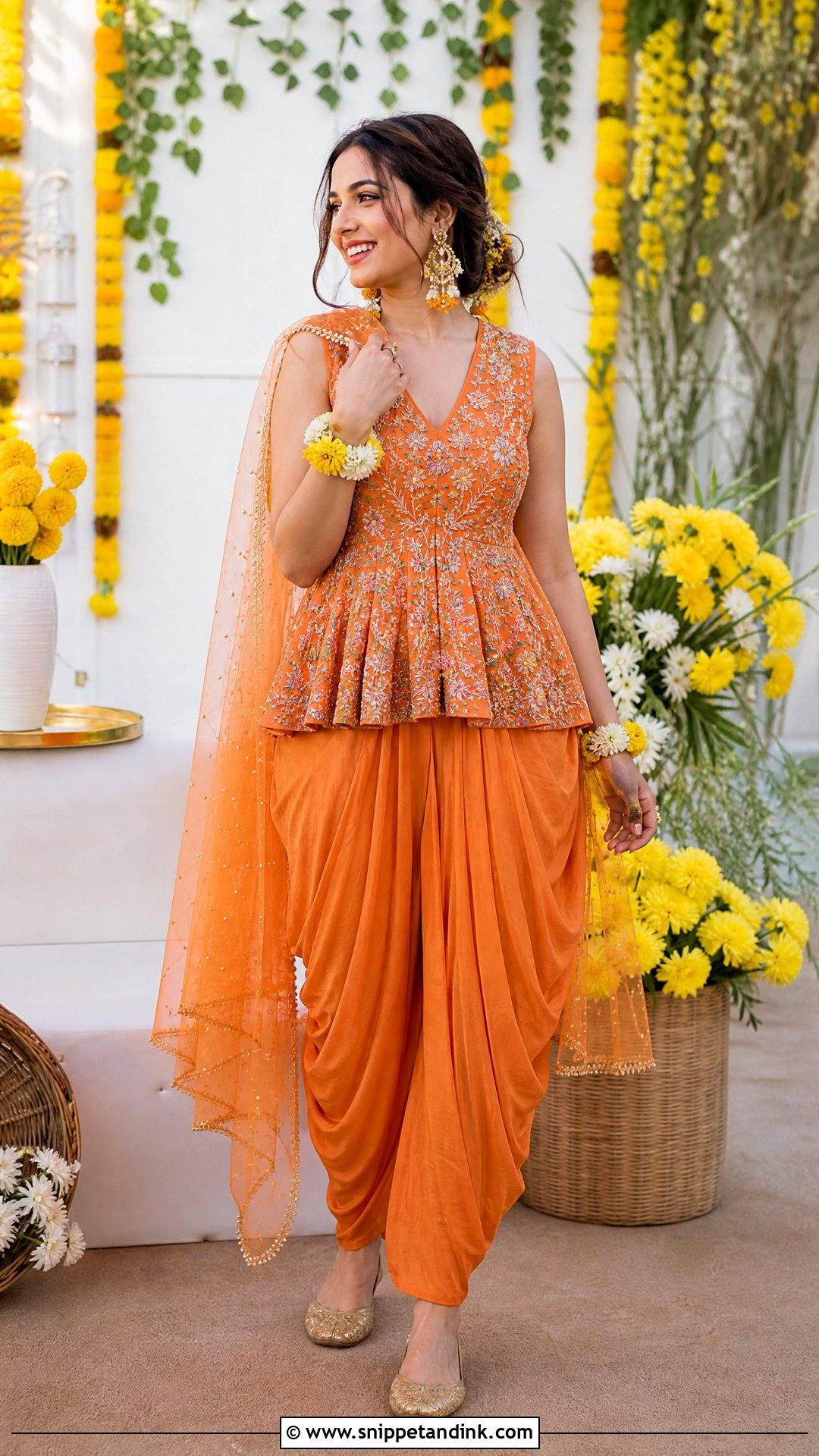
Peplum with dhoti pants makes a playful fusion outfit with plenty of room to move. The peplum has to sit firmly at the waist; a loose one rides up every time you lift your arms. Mirror work, gota or small florals are enough decoration. The draped dhoti balances the fitted top and makes sitting on the floor easy. I’d use a short sheer dupatta or an attached shoulder drape rather than a long loose one. Statement earrings, floral wrist pieces and gold juttis complete it, with a high ponytail or braid, defined lashes and a peach lip. It suits a relaxed haldi with music, games and dancing.
13. Orange Skirt And Blouse With Embroidered Jacket
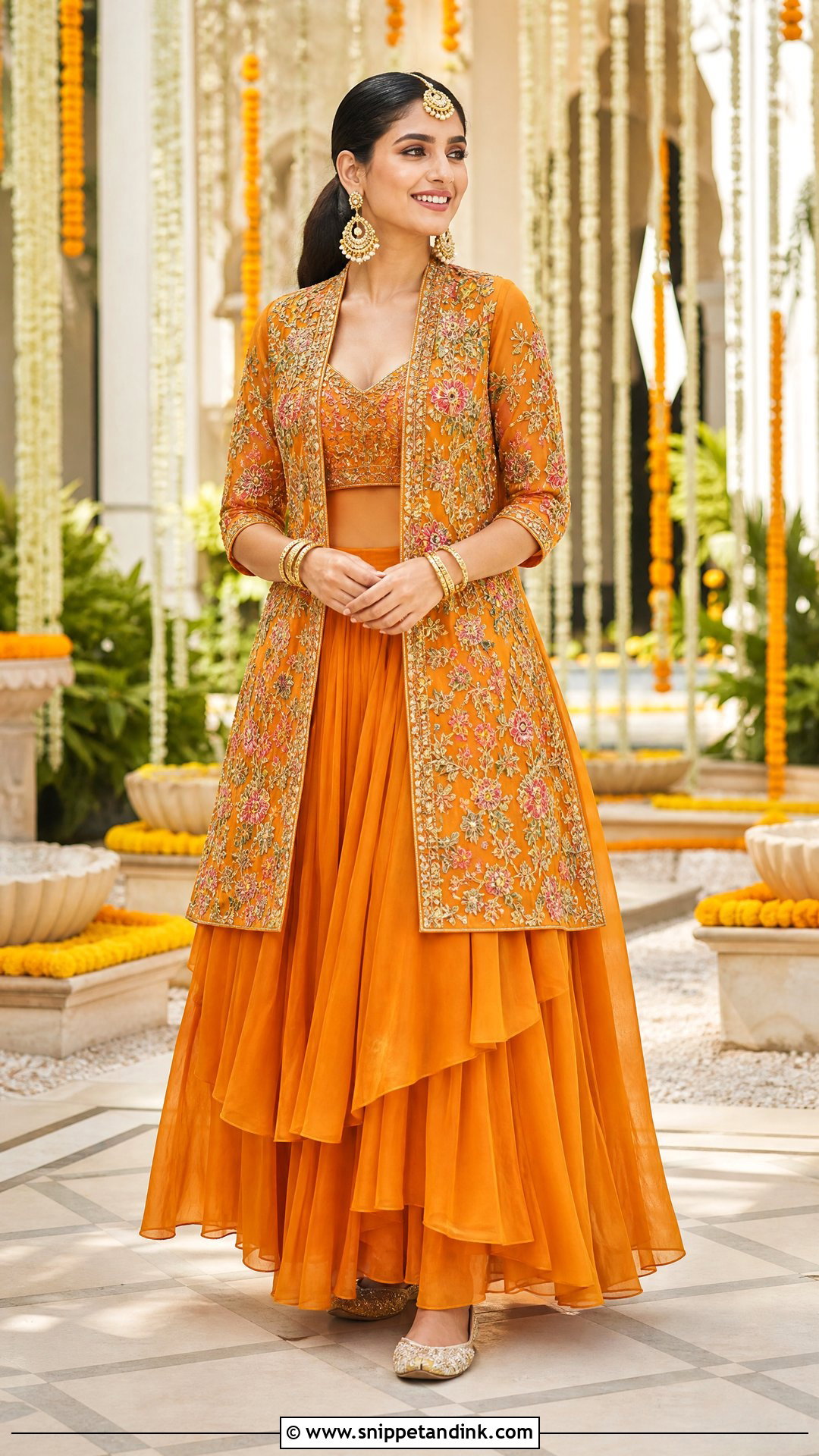
Adding an embroidered jacket to a plain orange skirt and blouse changes the whole look and covers your arms, so you can skip the dupatta entirely. Keep the skirt ankle-length and flowing, and the blouse simple so the jacket stays the focus. Colourful florals, mirrors or a scalloped hem on a knee-length jacket give a flattering layered line. Large earrings, a small tikka and a few gold bangles are all you need, plus embellished flats. A loose braid or neat low ponytail suits it. One caution: a jacket is warm, so I’d keep this for a cooler morning or an indoor haldi with air conditioning.
14. Orange Floral Print Lehenga With Ruffle Dupatta
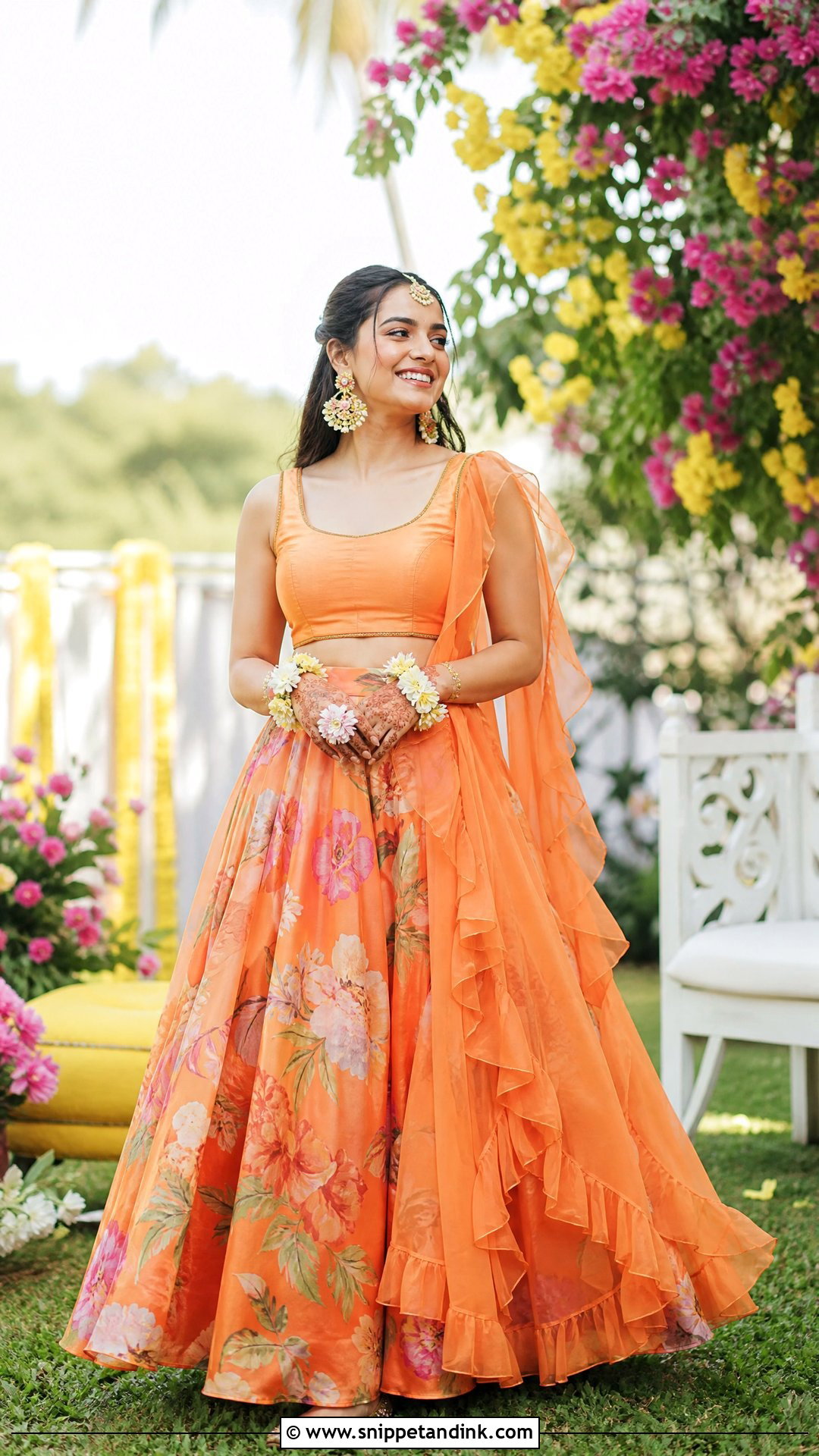
A floral print takes the edge off bright orange. Look for a light skirt printed with yellow, pink, green or ivory flowers, and wear it with a solid orange blouse so the outfit doesn’t get busy. A single-layer ruffle dupatta adds movement; keep its border light, since a heavy border drags the ruffle flat. Floral chandbalis, wrist flowers and a fine tikka tie the jewellery to the print. Plain orange juttis or gold flats finish it. Loose waves pinned off the face suit an outdoor setting, with a natural base and soft coral lips. Printed fabrics also hide small turmeric marks better than solid ones, which is a quiet advantage.

15. Orange Ombre Lehenga With Corset Blouse
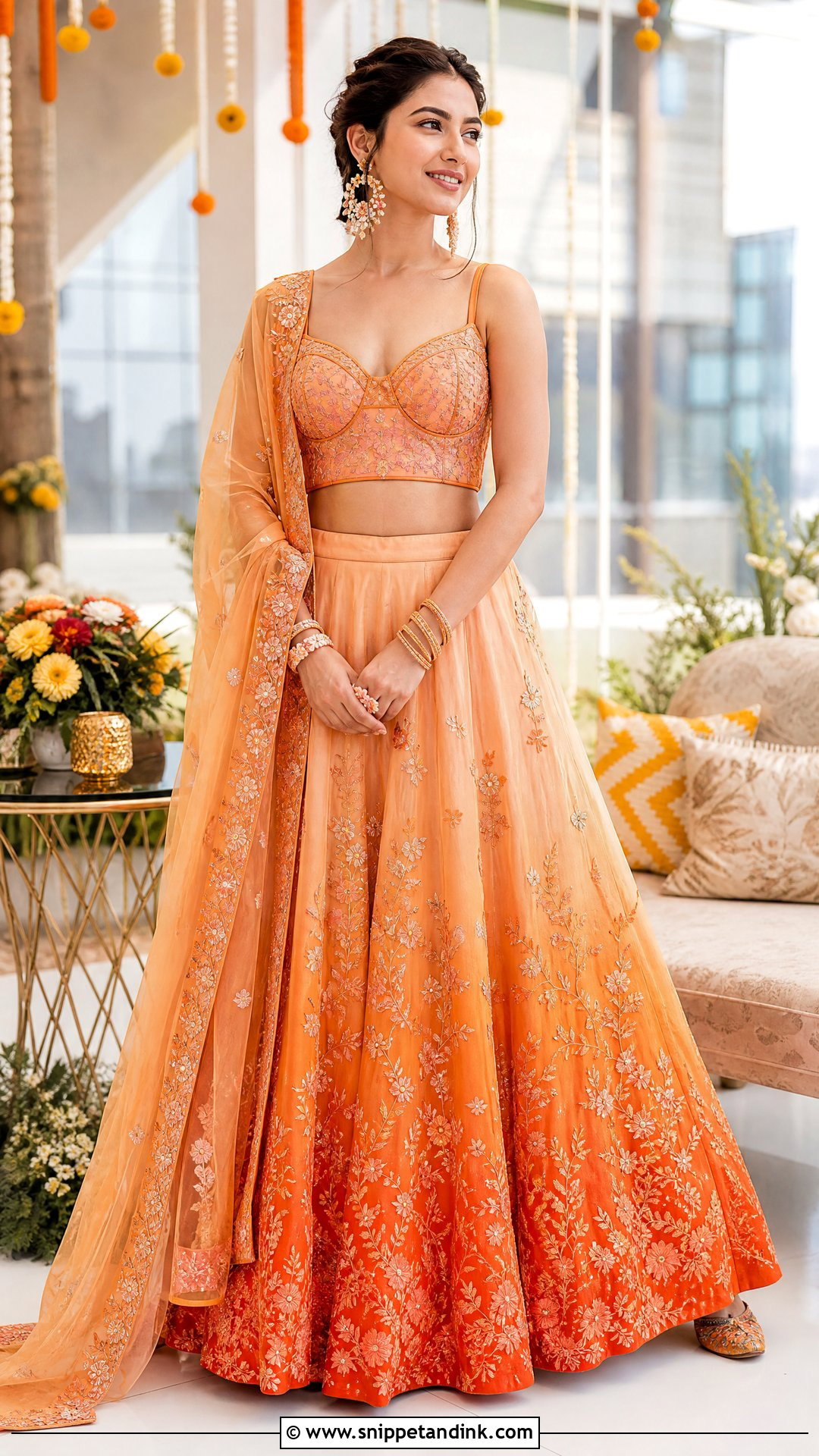
An orange ombre lehenga blends peach, tangerine and burnt orange in one skirt. I’d want the darkest shade at the hem, where turmeric splashes will land, and the palest near the waist. Pair it with a supportive corset-style blouse with wider straps and structured panels; thin straps don’t hold up a boned top through a long ritual. A soft net dupatta in the palest orange keeps the balance. Crystal-and-floral earrings, slim bangles and a small tikka are enough, with juttis or block heels. A sleek ponytail or side braid shows off the blouse, and a coral lip suits the gradient.
16. Orange Silk Saree With Temple Jewelry
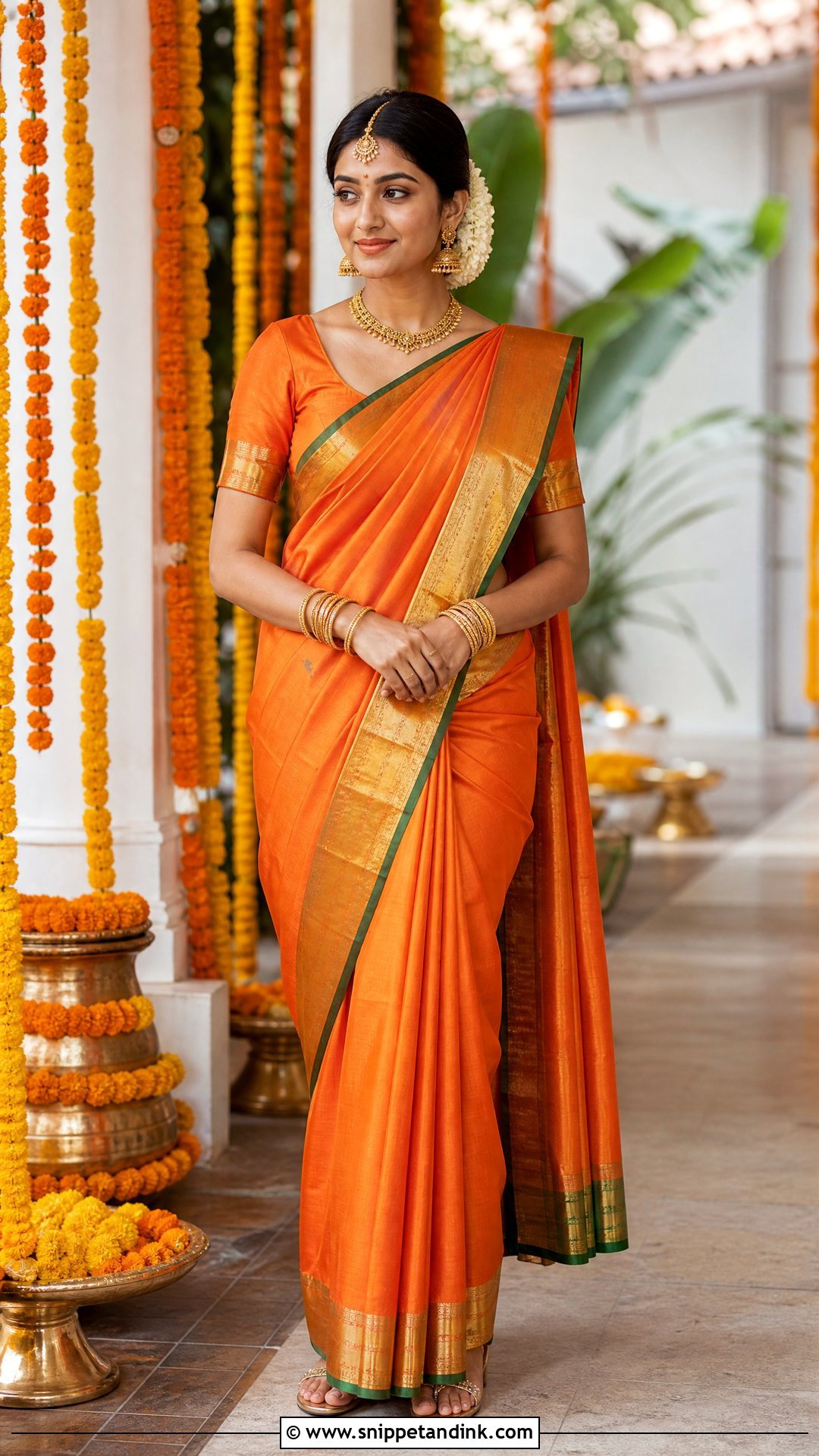
For a traditional bride, an orange silk saree with temple jewellery feels right for the ritual. I’d pick a lightweight silk or silk blend with a contrasting gold, pink or green border, and a short-sleeved blouse in the same orange. Pleat the pallu and pin it at the shoulder so you aren’t adjusting it constantly. Temple earrings, a short necklace, bangles and a small tikka suit the drape, but leave the heavier temple pieces for the wedding. Gold flat sandals go underneath. A centre-parted bun with white flowers, defined eyes, a small bindi and a muted coral lip finish it. Be realistic: pure silk rarely comes back unmarked from a haldi.
17. Orange Kurta And Skirt With Contrast Dupatta
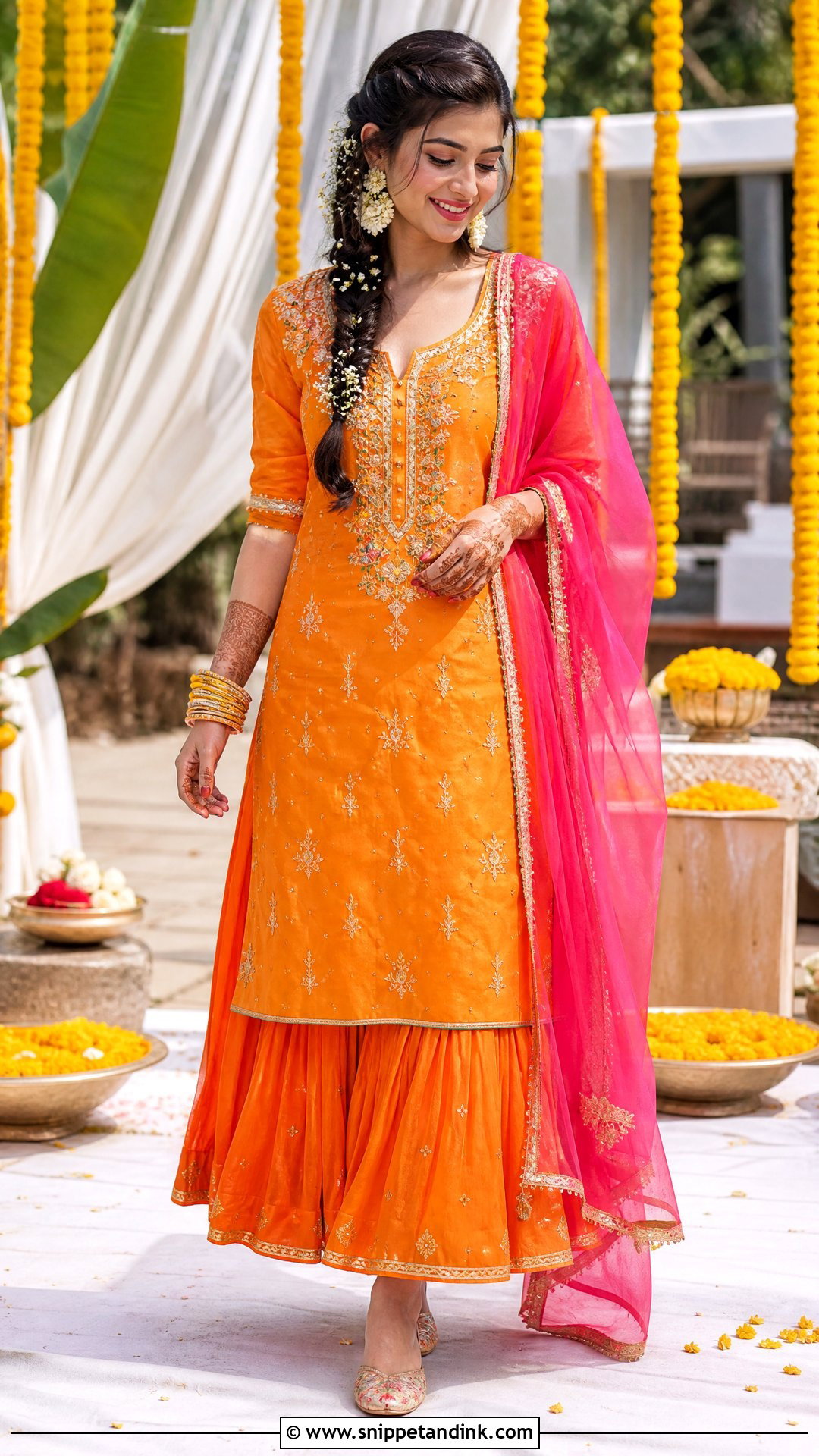
An orange kurta with a matching skirt gives you the ease of a suit with the movement of a lehenga. A fitted knee-length kurta with side slits over a softly flared skirt in the same colour is the shape. Fine gota or small embroidered motifs make it celebratory without weight. Bring the contrast in through a pink, yellow or green organza dupatta with a narrow border. Floral earrings, bangles and embroidered juttis finish it, with a side braid holding tiny flowers. If you’d rather keep full coverage, this is a good option, because the kurta covers the midriff and the slits still let you move.
18. Orange Ruffle Saree With Embroidered Blouse
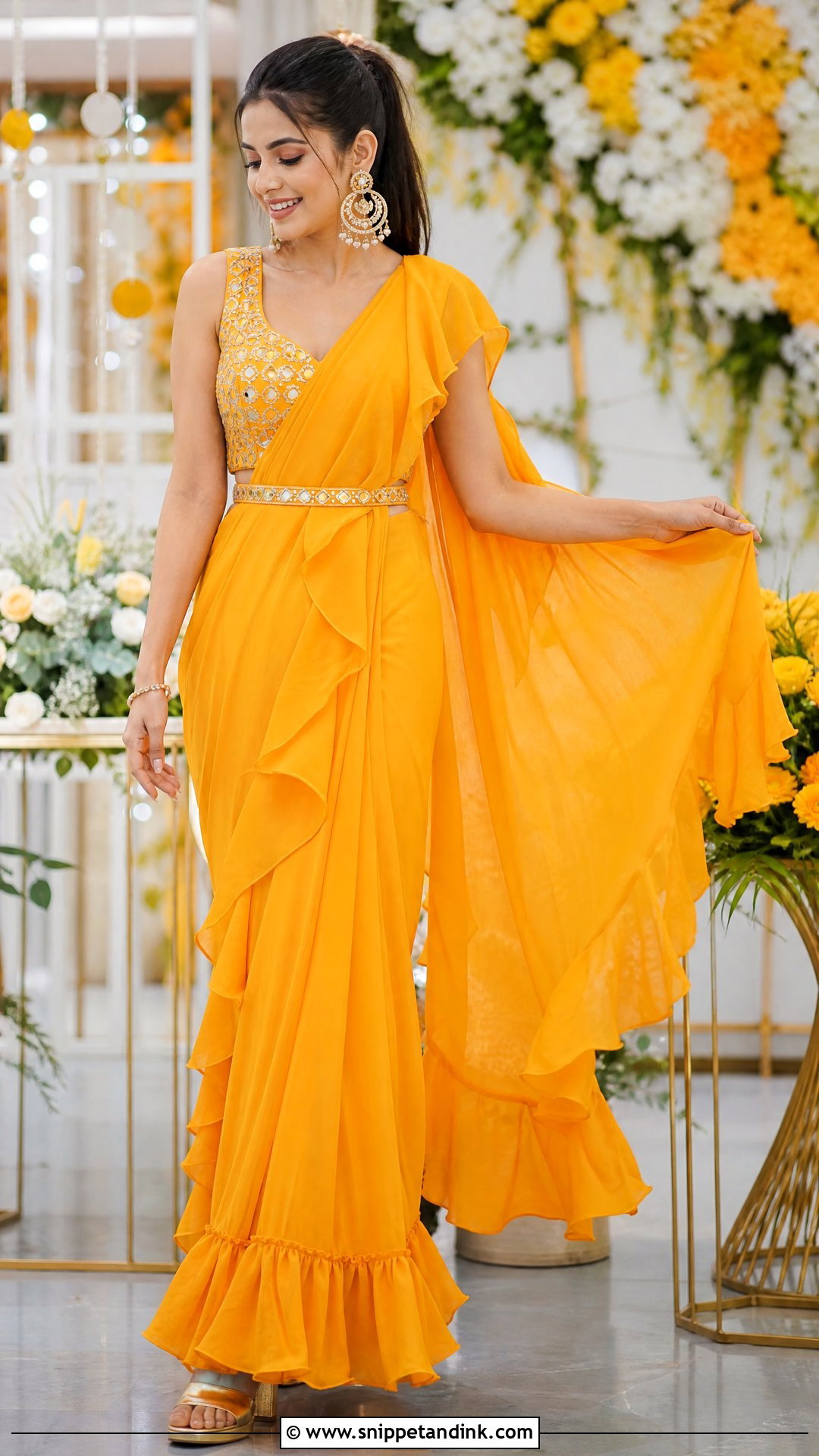
Ruffles make an orange saree feel modern, but too many make it bulky. A pre-stitched or easy-drape georgette version lets the ruffles fall neatly. Pair it with an embroidered blouse in mirror work, florals or light sequins. Pin the pallu at shoulder and waist so the lower tiers stay visible. Statement chandbalis, a fine bracelet and a slim belt give definition. Metallic block heels work for portraits, but switch to decorated flats for the ritual itself. A high ponytail or sleek bun balances the volume. Wet ruffles cling and lose their shape, so this is a saree for the photos before the paste, not after.
19. Orange Co-Ord Set With Long Shrug
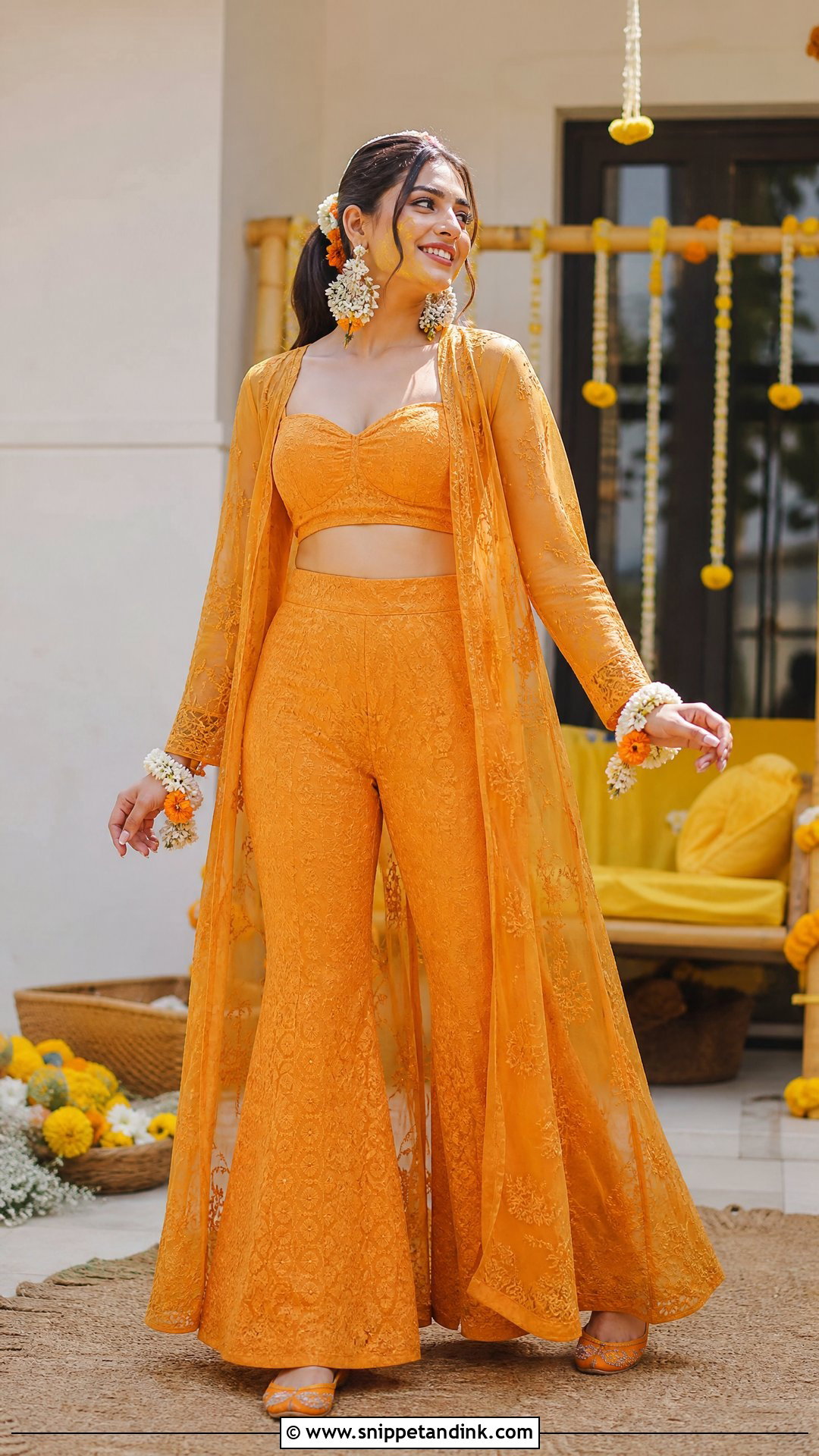
A monochrome orange co-ord is the outfit you’ll actually wear again, which is why I like it for relaxed brides. A comfortable crop top and high-waisted flared pants, with a long sheer shrug on top, give a layered line. Floral embroidery, mirror edging or small tassels on the shrug add the bridal touch. Check that every closure is secure and the fabric breathes, since outdoor haldis get hot. Oversized earrings, floral bangles and orange or gold juttis finish it. A ponytail with fresh flowers, glowing skin and a peachy lip keep it young. Wash the shrug separately afterwards; sheer fabric holds turmeric longer than the solid pieces.
20. Orange Jumpsuit With Sheer Cape
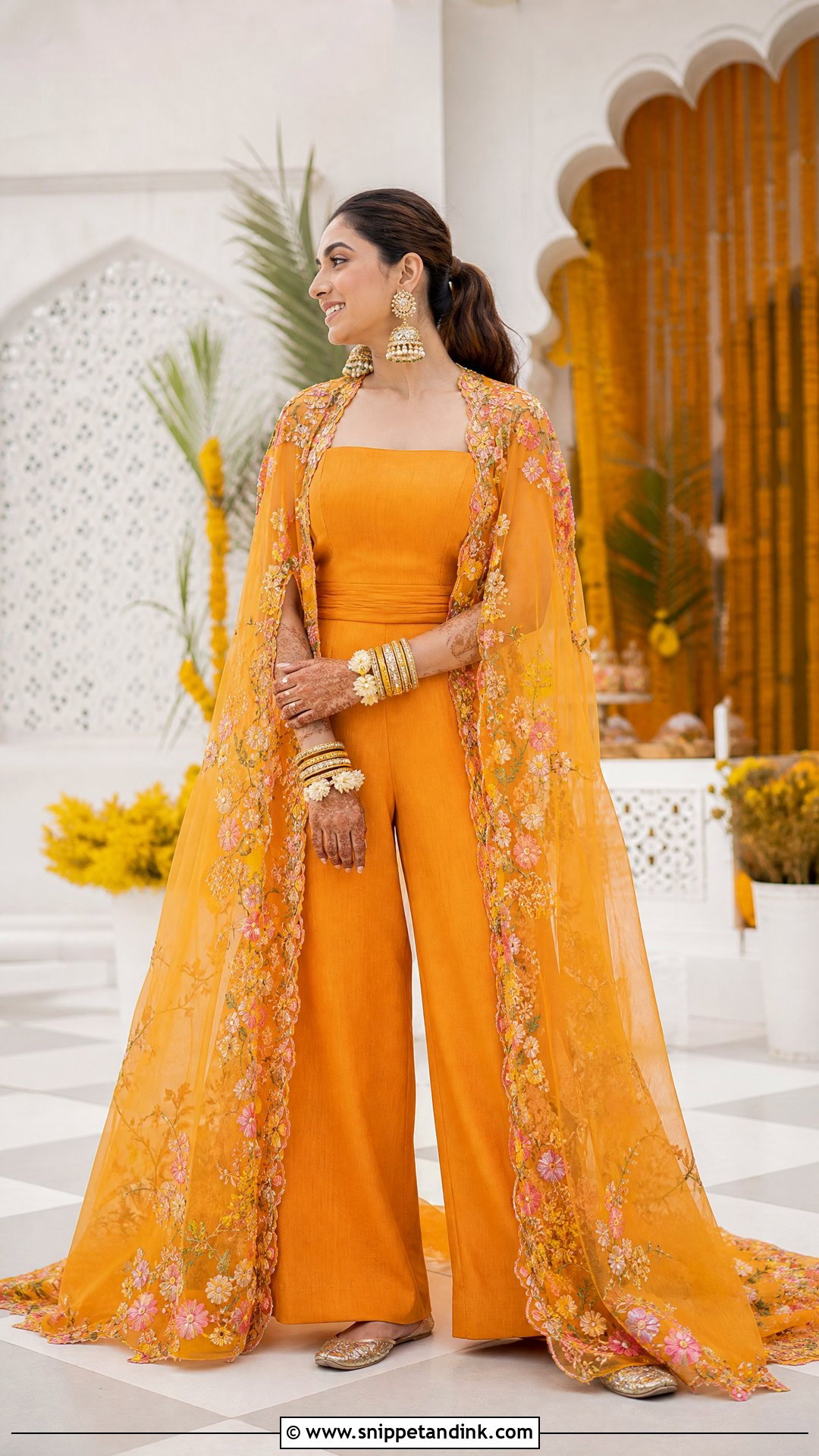
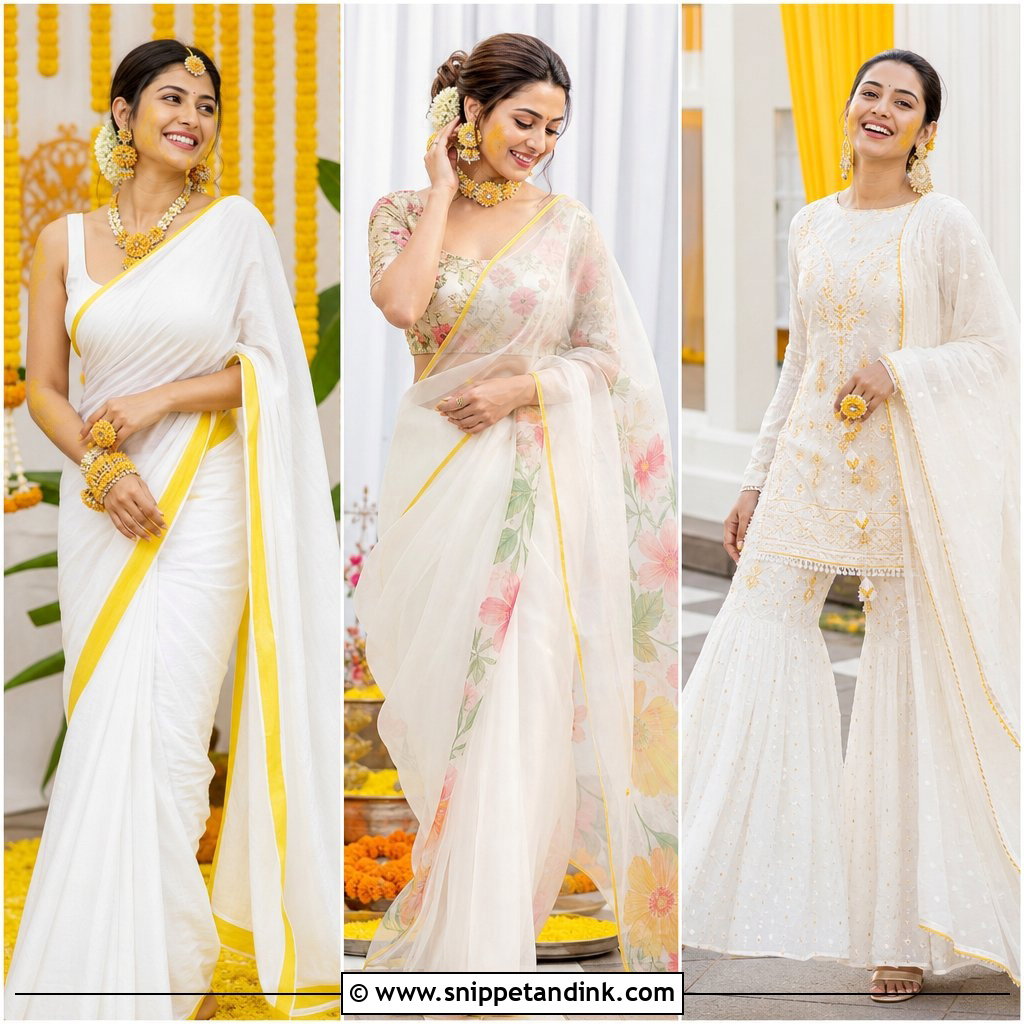
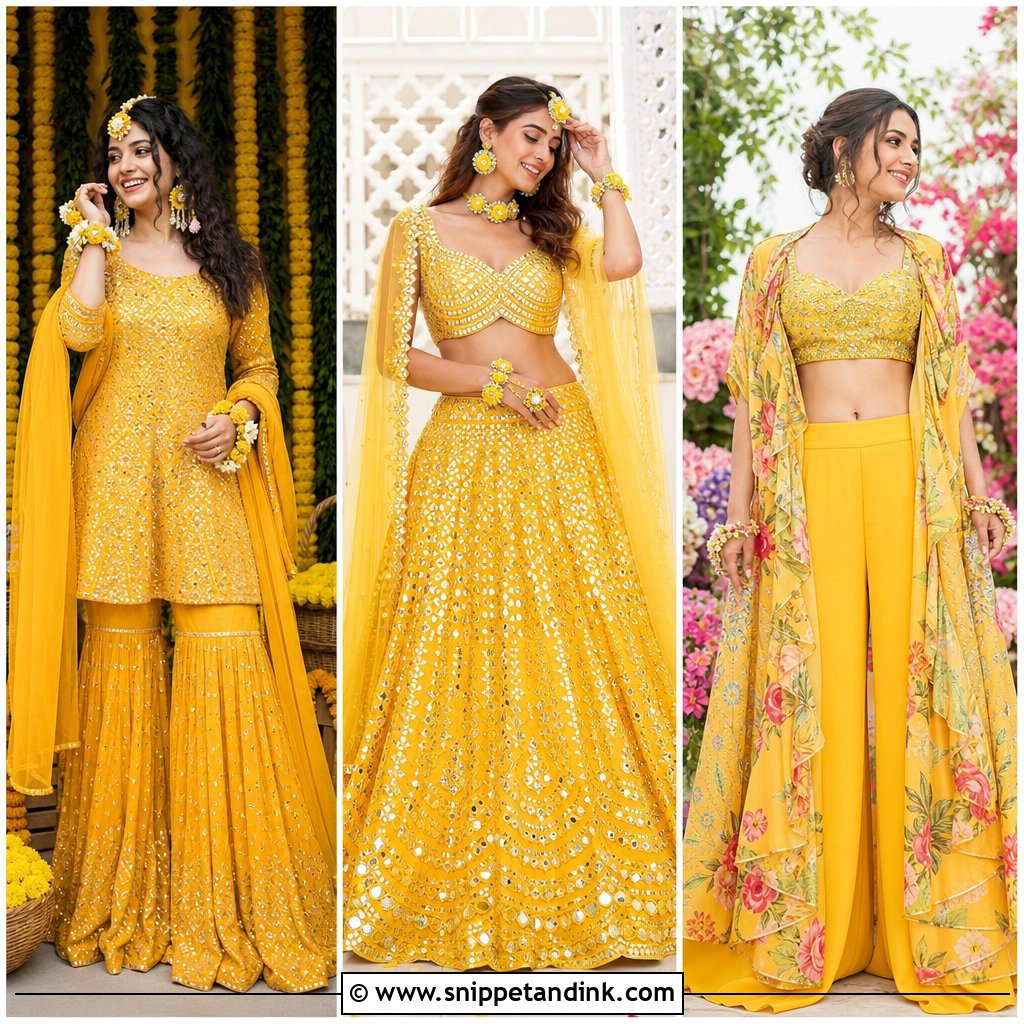
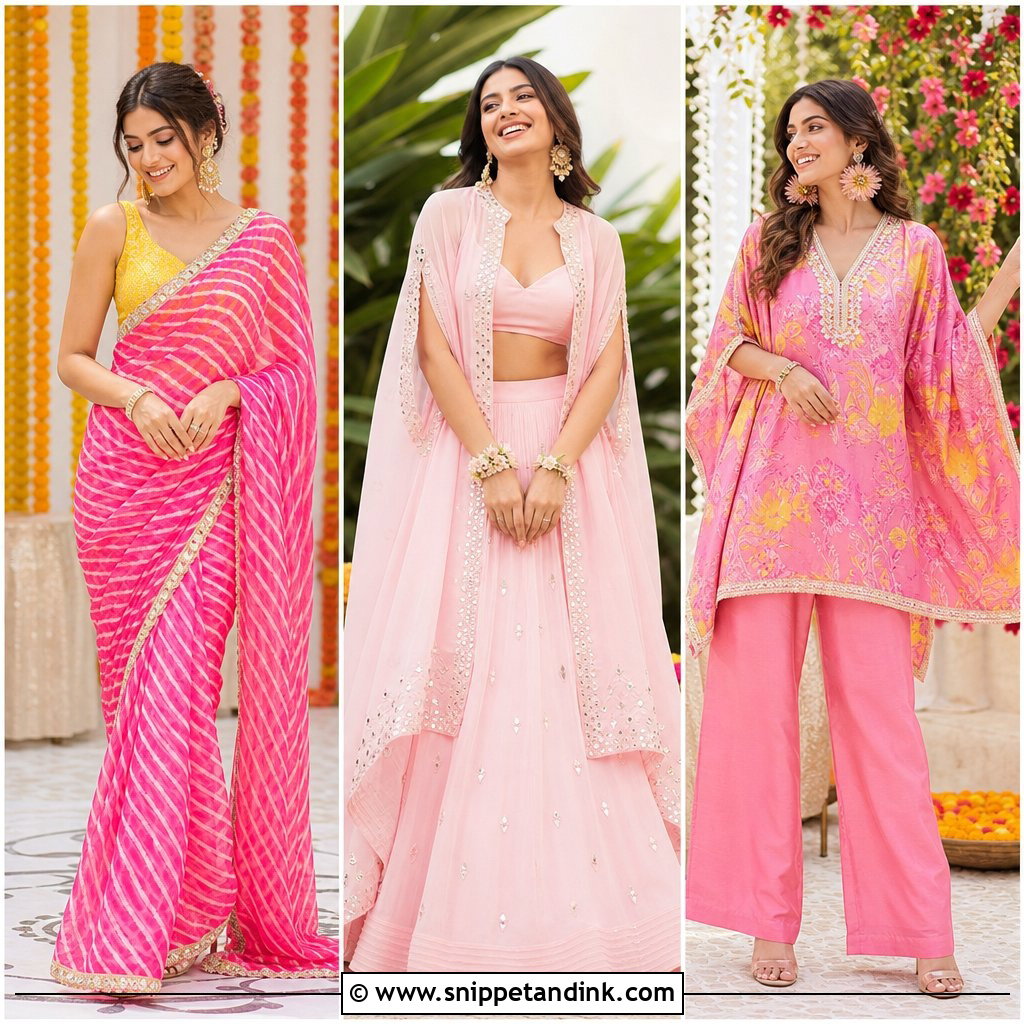
An orange jumpsuit is a bold choice for a haldi, and the details decide whether it works. A wide leg, a fitted waist, a supportive bodice and enough room in the seat to sit on the floor are non-negotiable. Add a sheer floor-length cape with floral embroidery or a light border; it gives the movement and ceremony that a dupatta would. Statement jhumkas, stacked bangles and block heels or metallic flats finish it. A polished low ponytail keeps the neckline and cape visible. Make sure the zip is reachable or that someone is around to help, because getting out of a turmeric-soaked jumpsuit quickly is harder than it sounds.
Fresh Flower Jewellery Is Made the Morning Of
Floral jewellery appears in half the looks above, and it behaves nothing like metal. Real flowers wilt in heat, so the florist or jewellery maker usually threads them the same morning, or late the night before with the pieces kept cool. Order them for a pickup an hour or two before you dress, not the previous afternoon.
Ask how each piece attaches. Earrings made of flowers are often hooked over the ear or tied to your own earrings, and a tikka needs a pin or clip into the hair. Mogra and rose are the usual choices; marigold is sturdier but heavier. If you have sensitive skin or pollen allergies, wear a test piece for an hour a few days earlier, and keep thin cotton between the flowers and your wrists.
The Hour After the Paste Comes Off
Plan the change before the ceremony starts. Lay out a towel, a dark old t-shirt, a plastic bag for the stained outfit and an old pair of slippers in the room you’ll head to. A few things worth knowing:
- Turmeric tints skin yellow for a day or so. It fades on its own, and the glow is the point of the ritual, so don’t scrub hard.
- It can yellow the edges of light nail polish and gel. If your wedding nails are already done, a deep shade hides it better than nude.
- Rinse the outfit in cold water as soon as you can, before the paste dries. Hot water sets the stain.
- Keep your wedding jewellery and the main outfit in a separate room entirely.
A Haldi Outfit Is Allowed to Get Ruined
Orange works for traditional, minimal and modern haldi looks alike. A lehenga or silk saree feels classic, while a palazzo set, co-ord, or jumpsuit gives you more freedom to move. Whichever you wear, put breathable fabric, firm pinning, flat shoes and jewellery that won’t catch on anything ahead of everything else. Look at the colour of your decor too: a tangerine outfit can vanish against a wall of tangerine marigolds, so pick a shade that stands apart. And go into the ritual expecting the outfit to get stained. Brides who accept that relax and enjoy it, and that’s what shows up in the photos.
You'll Like These Ideas:




Leave a Reply