
Italian bridalwear has always been about tailoring first and decoration second. A good Italian gown is cut so precisely that the lace, the satin or the Mikado can do very little and still look important. That is the thread through the twenty dresses below, from sculpted corsets and Italian lace to slip dresses, capes and gowns that change shape between ceremony and dinner. For each one I’ve noted what I’d pair with it and, more usefully, what I check at a fitting before I’d let a bride wear it down a stone aisle or across a villa lawn in July.
Church or Town Hall? It Changes Which Gown Works
Before a bride falls for a neckline, I ask where she is legally marrying, because Italy gives two very different settings. A Catholic ceremony in a church is long, quiet and often strict about bare skin. A civil ceremony in a town hall or a licensed villa room is shorter, brighter and far more relaxed about what you wear.
For a church ceremony
- Plan to cover your shoulders during Mass, even if the priest hasn’t said so. A lace bolero, a cape or sheer detachable sleeves keep a strapless gown in play.
- Very deep backs and plunging fronts can be refused at the door of larger churches. A long veil worn down over the back solves most of it.
- Old churches are cool inside even in summer, and the floors are polished stone. Leather soles slip; scuff them or add grips.
For a civil or symbolic ceremony
Almost anything goes, including minis and jumpsuits. The practical limits are the venue itself: narrow staircases in historic halls, terraces with gaps between the paving, lawns that swallow a stiletto. I fit the gown with those surfaces in mind rather than the showroom carpet.
1. Italian Lace A-Line Wedding Dress
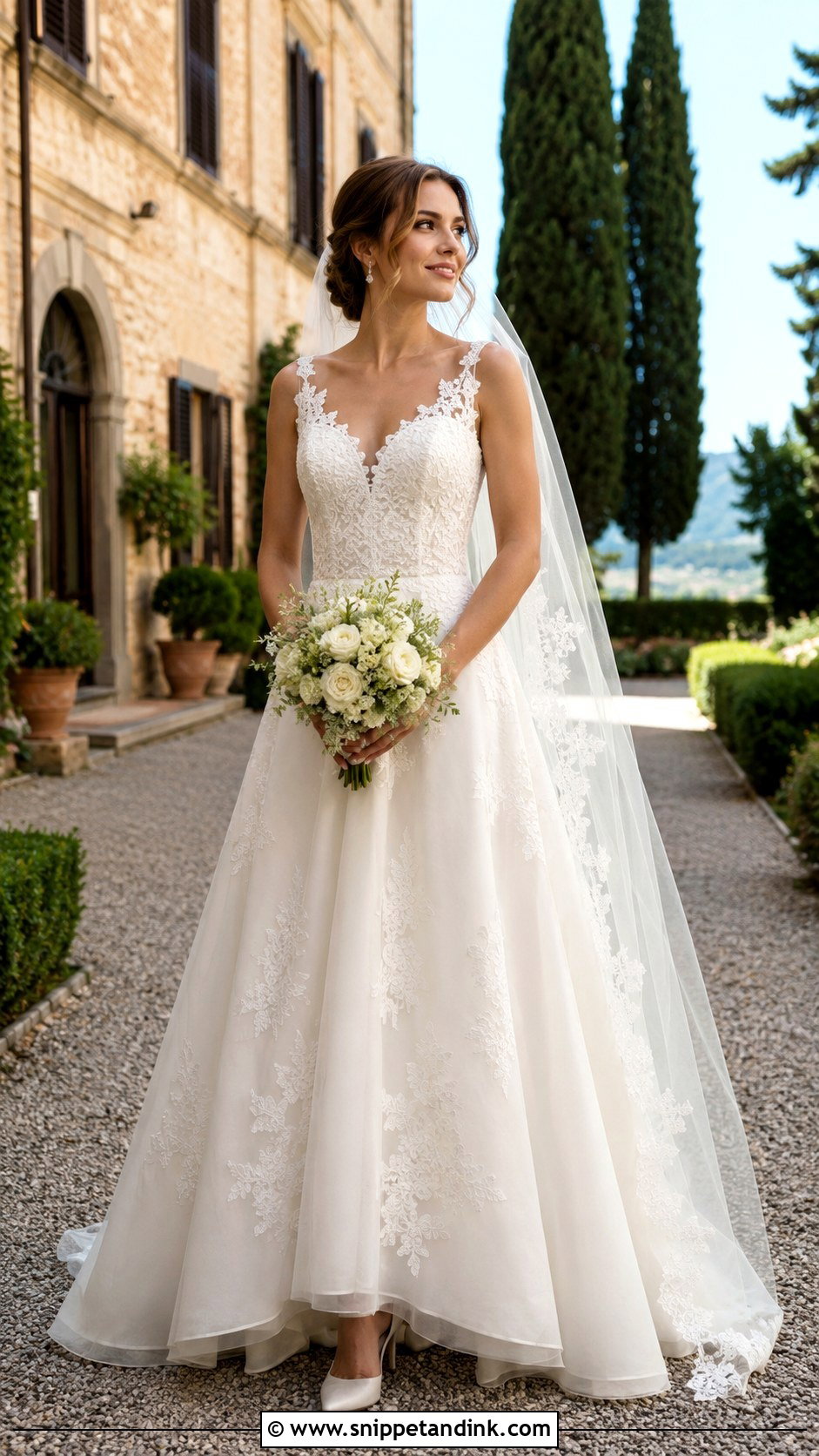
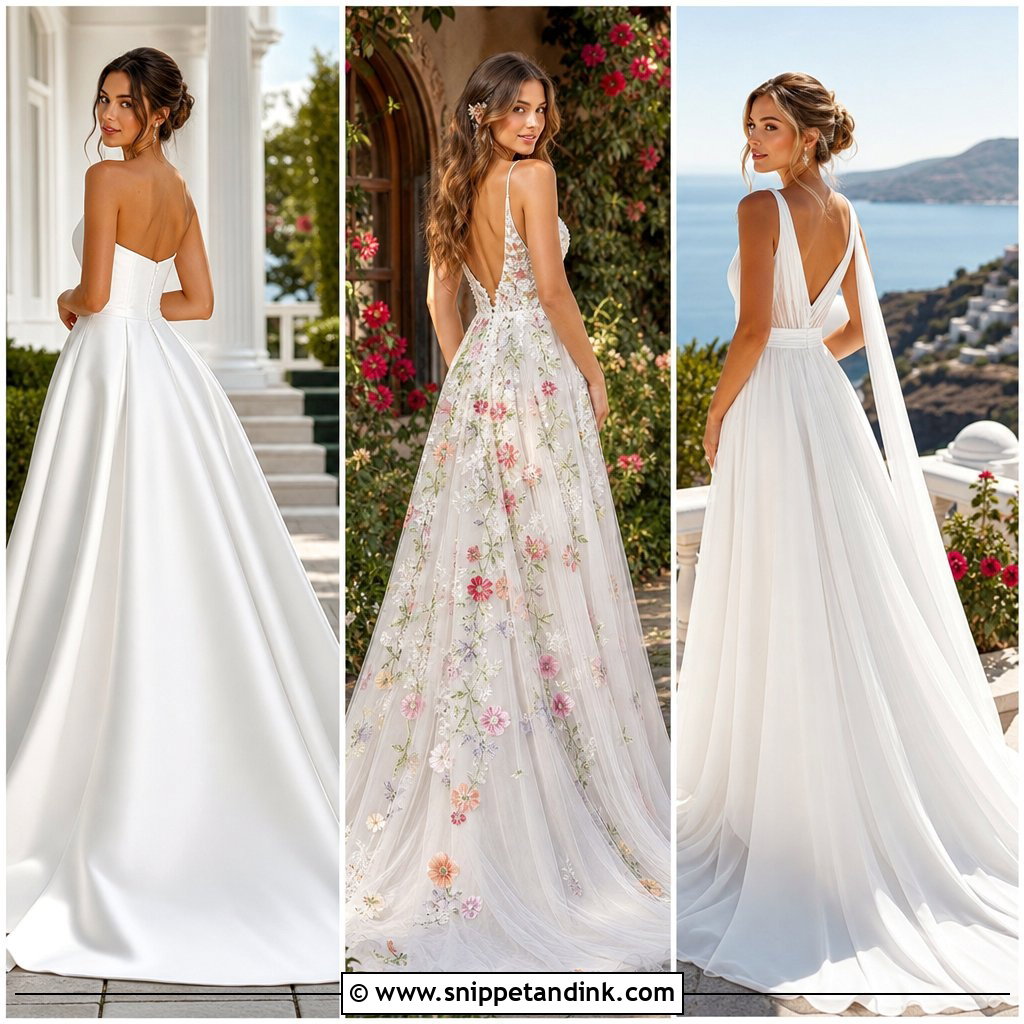
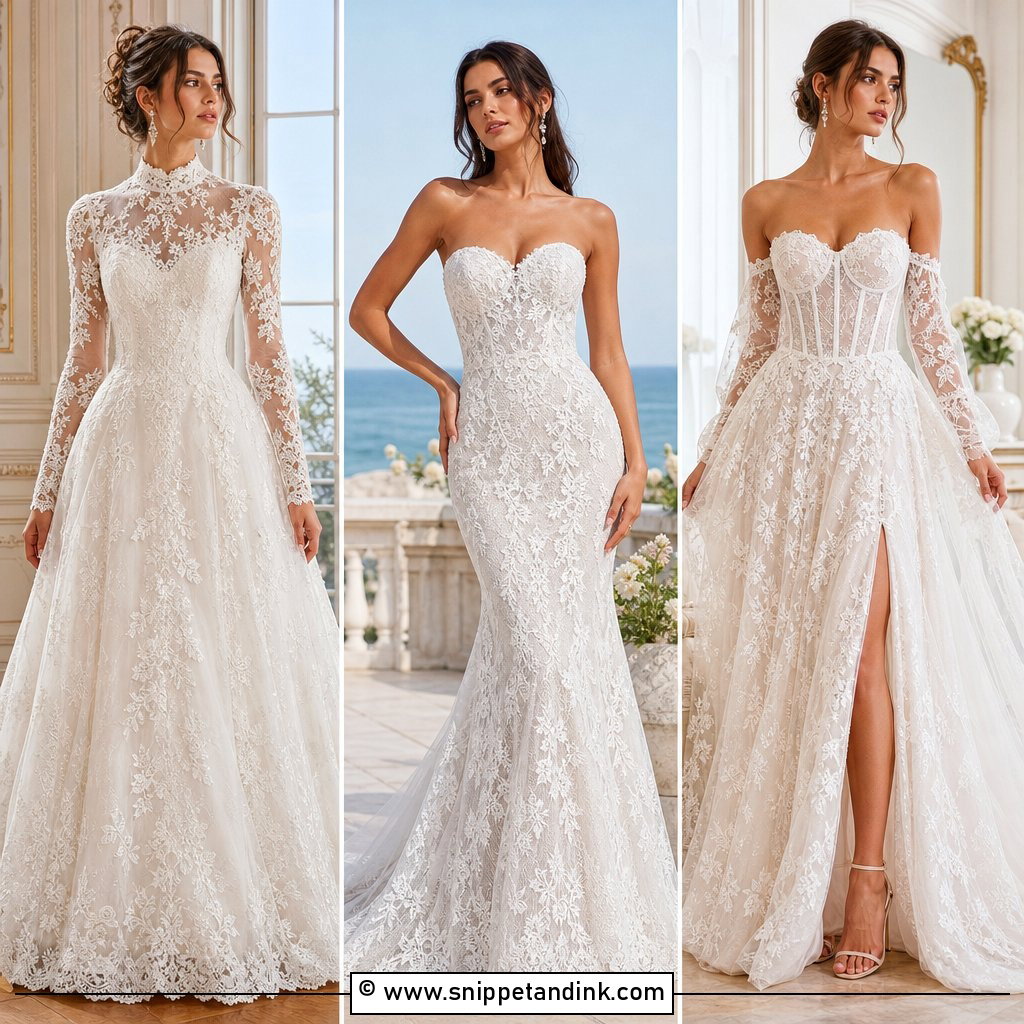
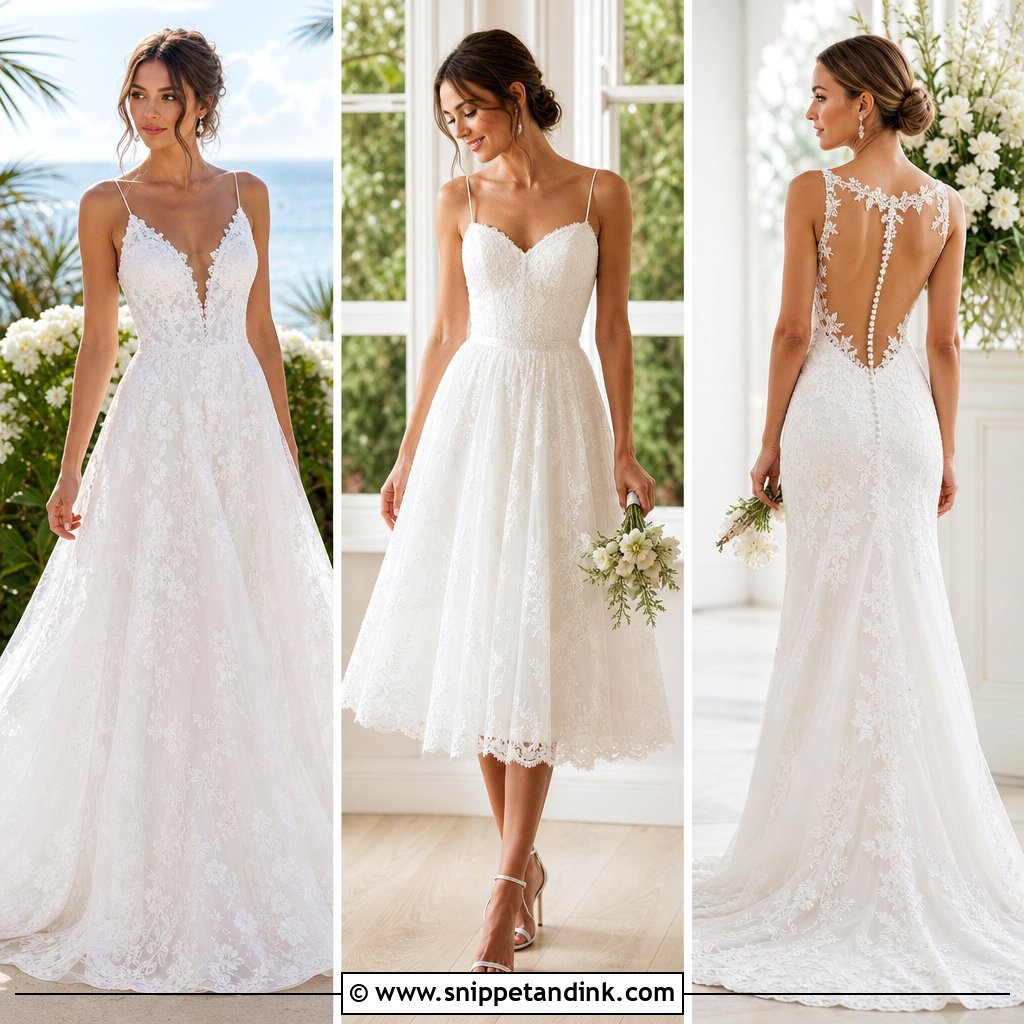
An Italian lace A-line wedding dress is the gown I reach for when a bride wants romance without the weight of a ball skirt. A fitted lace bodice, a softly defined waist and a skirt that swings when you walk. The thing I look at closely is how the lace meets the seams: on a well-made dress the motifs are cut out and laid over the join by hand, so you never see a straight line through a flower. A fingertip veil with a narrow lace edge sits well with it. Ivory pointed pumps suit a hall; block heels are kinder on grass and stone. Pearl drops and a low textured bun finish it.
2. Mikado Ball Gown Wedding Dress
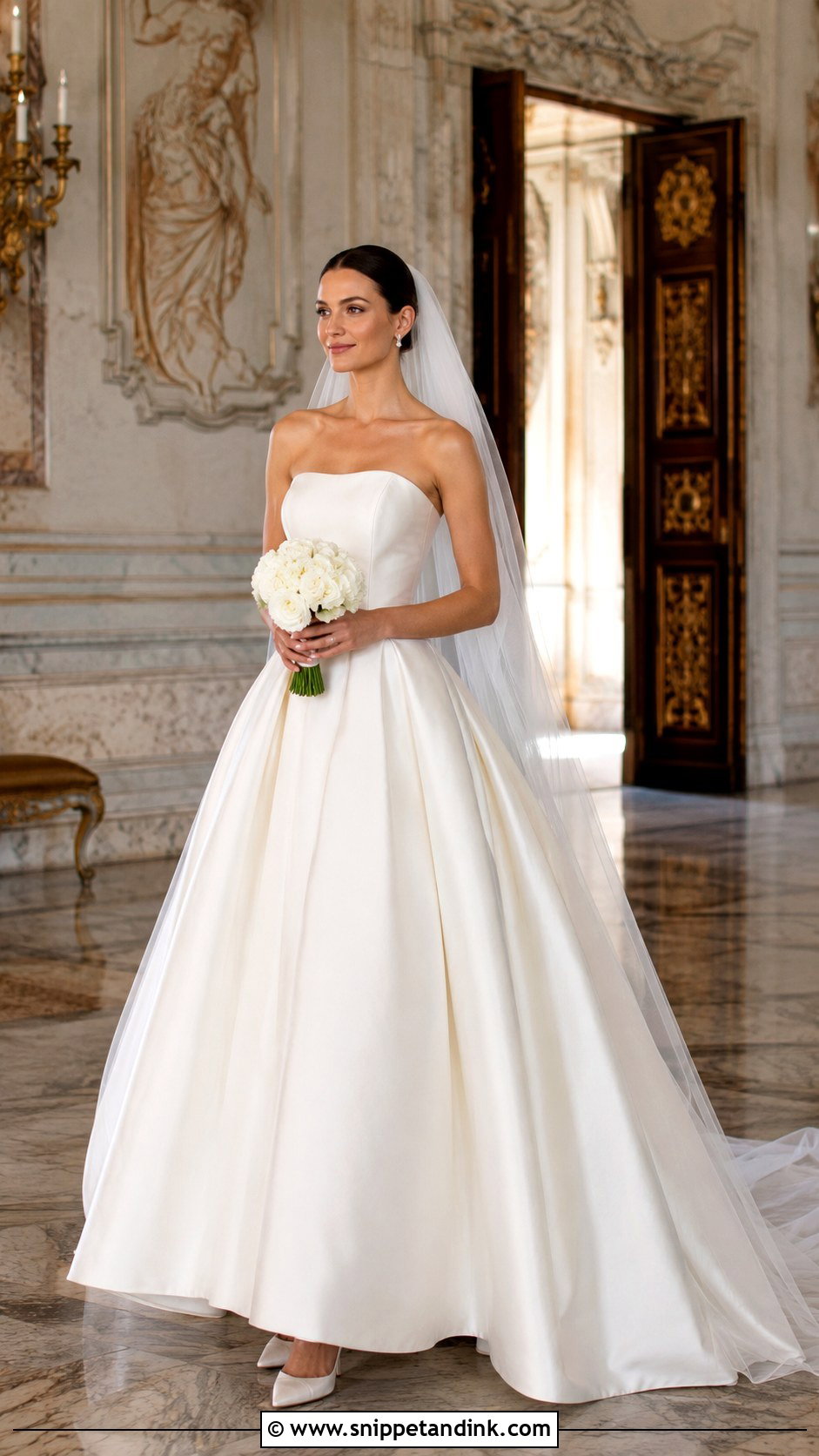
Crisp Mikado fabric gives a ball gown the body to stand up on its own, which is why it suits palaces, historic villas and big hotel ballrooms. Look for a clean strapless bodice with real internal structure and a pleated skirt that holds its shape for hours. Mikado is heavy, though. A full skirt in it can weigh several kilos, and in August heat it becomes hard work long before the speeches, so I’d keep it for spring, autumn or air-conditioned rooms. A long plain veil lets the shape speak. Satin pumps, crystal studs and a sleek chignon. Ask for pockets and a proper bustle; you’ll use both.
3. Satin Column Wedding Dress
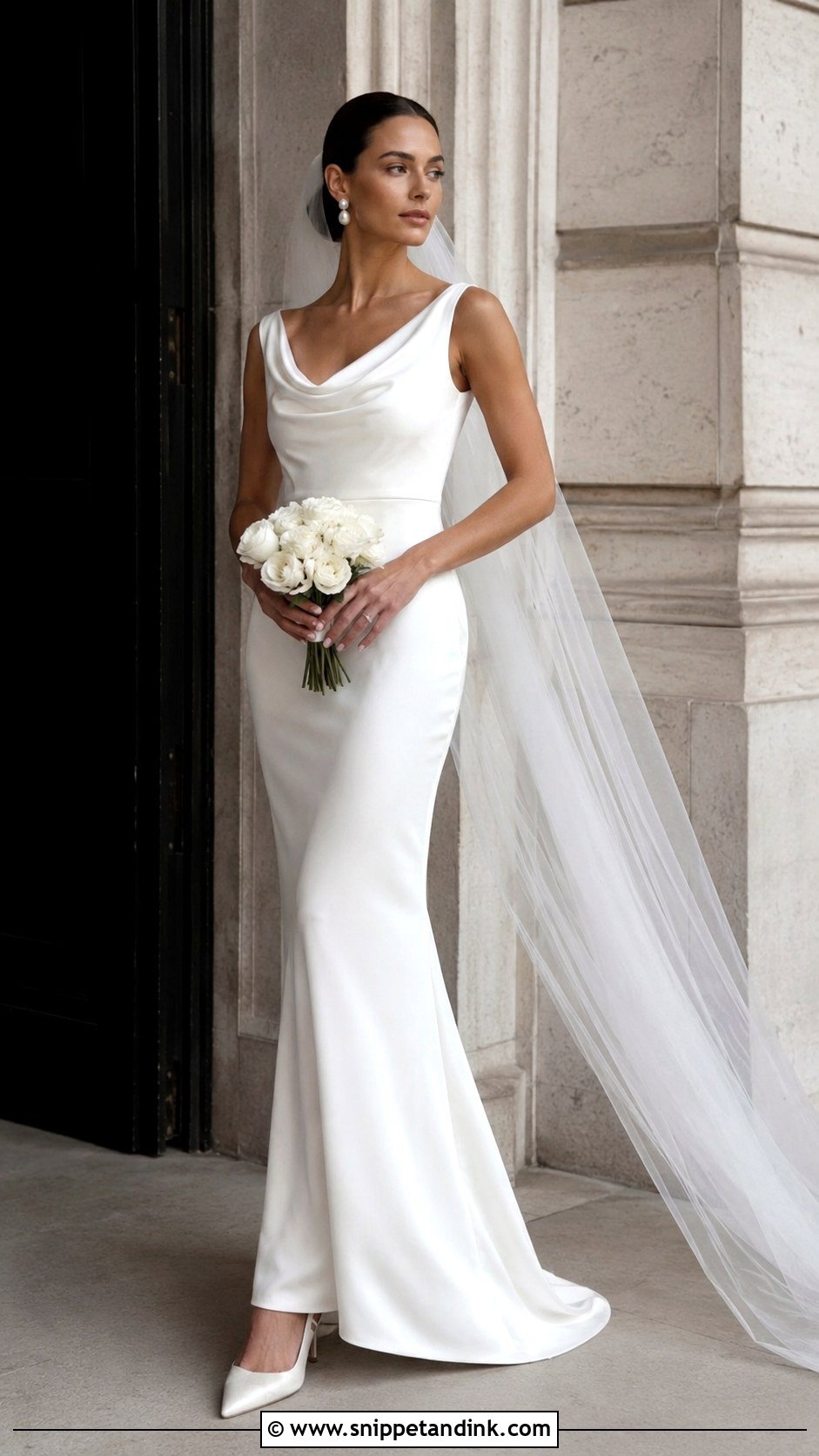
A satin column is the most honest dress on this list, because there is nowhere for poor tailoring to hide. It should skim, not grip, with seams placed so you can sit and walk without the fabric pulling across the hips. A draped or straight bateau neckline keeps it clean. I usually suggest a sheer cathedral veil for the ceremony, removed afterwards for a sleek reception line. Pointed satin slingbacks, sculptural pearl earrings and a small structured clutch. It belongs in a Milan gallery, a city hall or a quiet lakeside ceremony where restraint reads as confidence.
4. Corset Basque Waist Wedding Dress
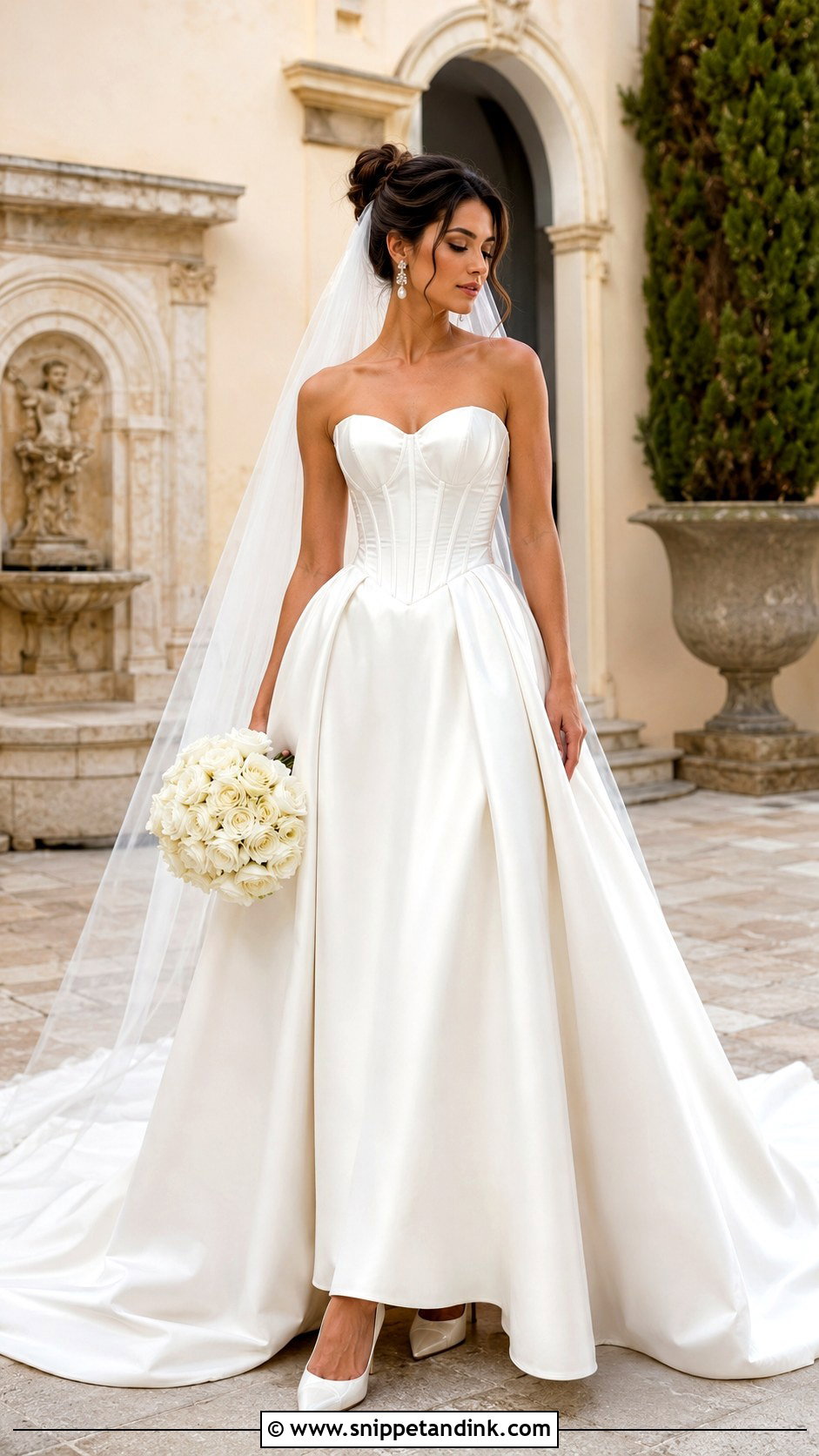
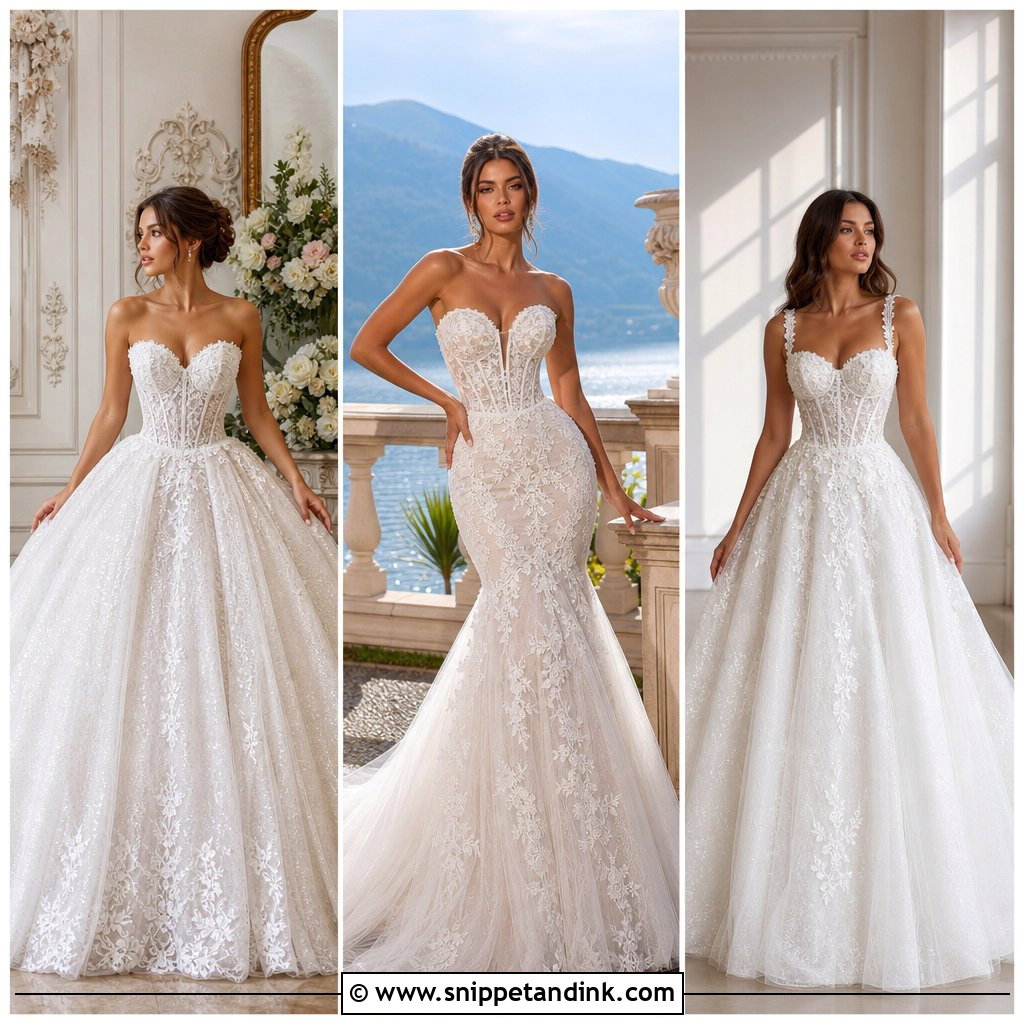
The Basque waist dips into a point at the centre front, which lengthens the torso and makes the waist look smaller without squeezing it. The bodice should feel supportive, never like a vice, so I check where the boning sits: if a bone presses into the hip when you sit, it needs shortening. Balance the shape with a full skirt in satin, tulle or Mikado, a plain chapel veil and pearl-and-crystal earrings. Cushioned closed pumps for formal interiors, sturdier block heels for villa grounds. Corset bodices take the most alteration time of any style here, so book fittings early and dance in it before you sign it off.
5. Off-the-Shoulder Wedding Dress
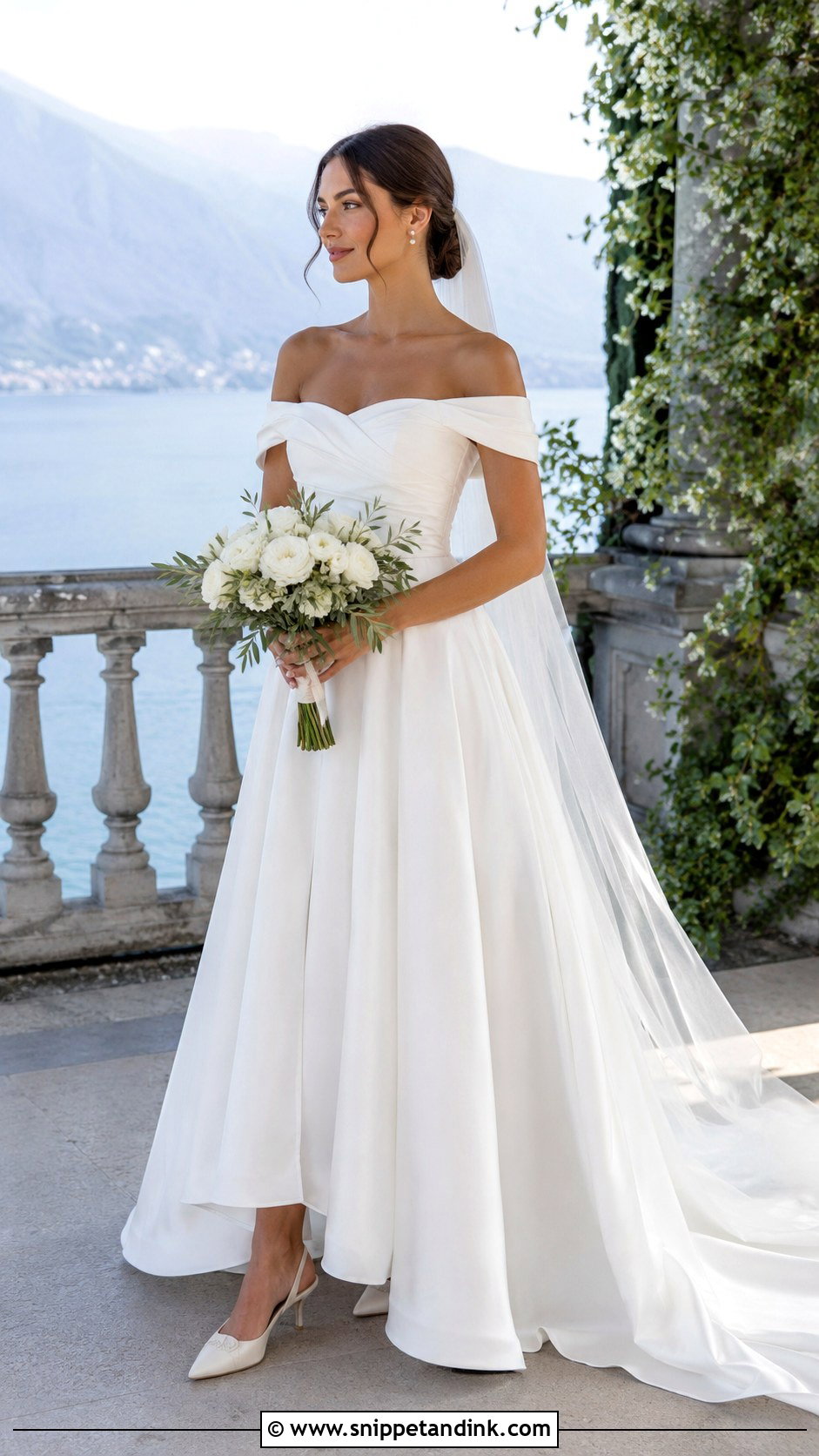
Off-the-shoulder draping does a lot with very little. The fit challenge is that the sleeves hold your arms down if they’re cut too tight, so at a fitting I have the bride hug someone and lift a glass. If she can’t, the band needs easing or a little elastic hidden inside. An A-line or gently full skirt balances the open neckline. A low veil tucked under a polished bun keeps the shoulders on show. Pearl studs and ivory slingbacks are enough. For an outdoor summer ceremony, detachable shoulder drapes let you cool down after the vows, and white roses with olive-toned greenery suit a Lake Como garden.
6. Long-Sleeve Lace Wedding Dress
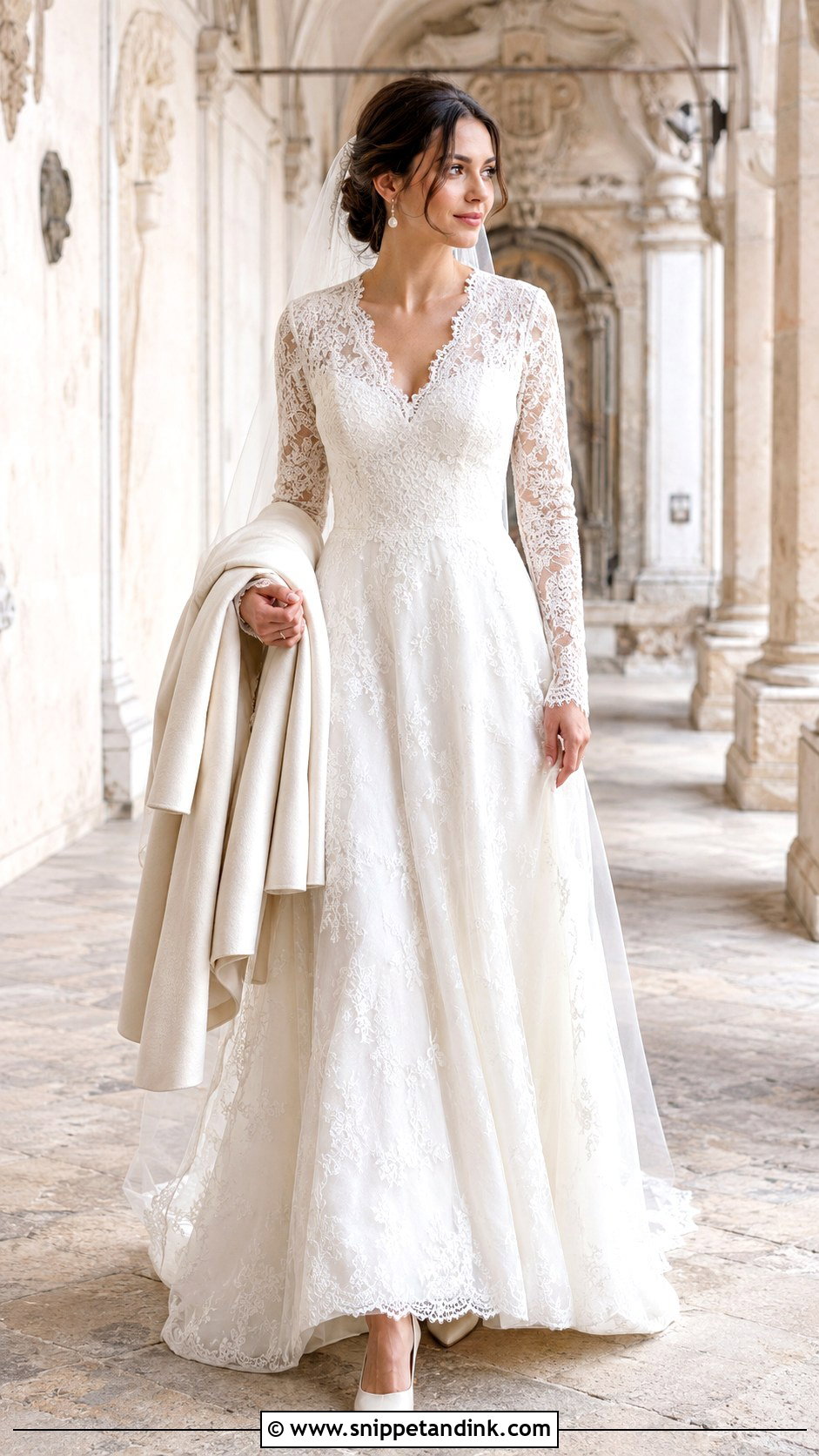
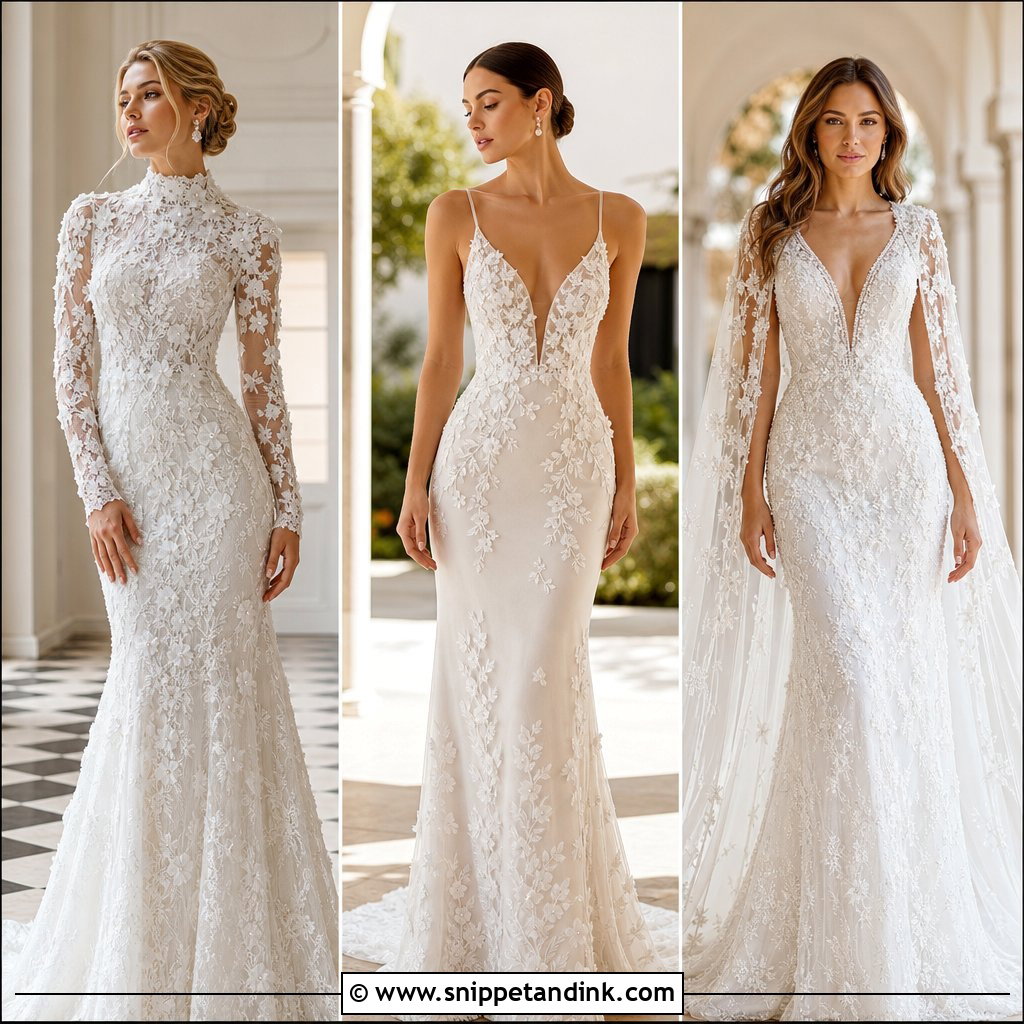
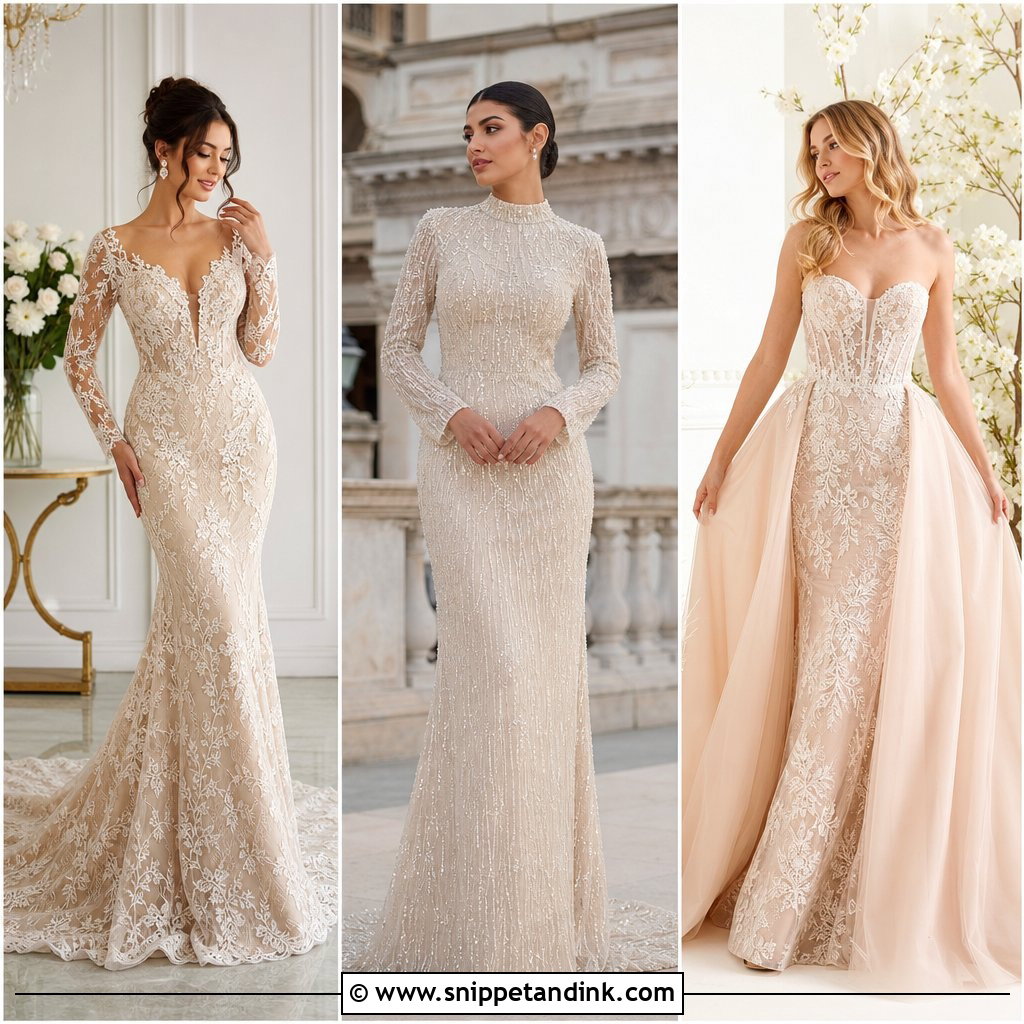
For an autumn or winter wedding in Italy, a long-sleeve lace dress is the practical choice that also happens to look right in an old church. I ask for lace with a little stretch at the elbow, a lined bodice and a flowing A-line skirt. A modest V-neck or bateau neckline keeps it formal. Chapel veil, pearl drops, closed ivory pumps. A tailored cream coat or a removable satin cape handles the cold walk between ceremony and car. Before buying, run a finger along the inside of the sleeve seam; scratchy lace edges at the wrist will bother you all evening, and lace cuffs snag on bracelets.
7. Square-Neck Wedding Dress
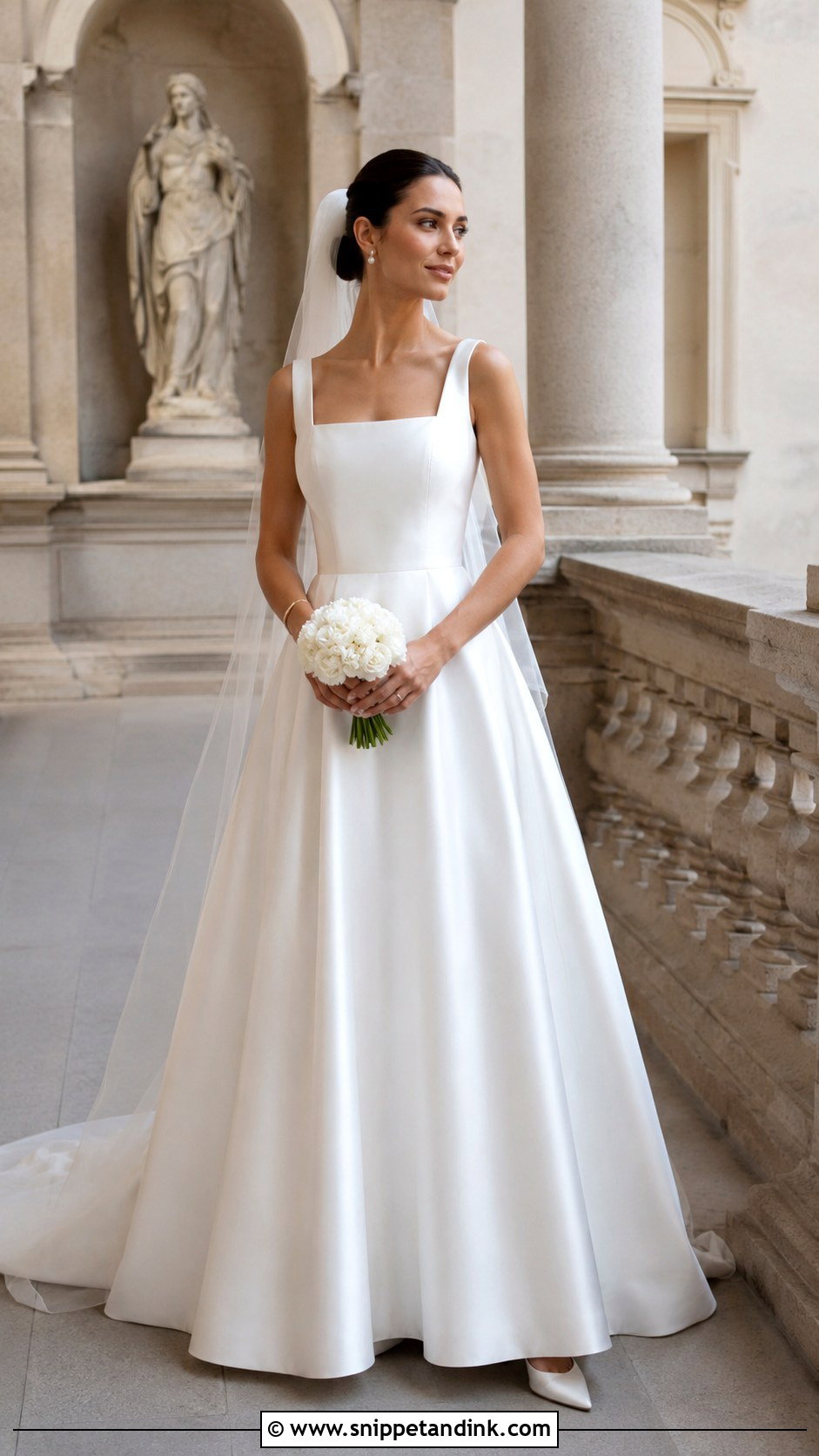
A square-neck dress carries a subtle Renaissance influence that feels very much at home in Florence or a Tuscan villa. Wider straps give real support, and the straight neckline frames the collarbone with either a structured or a flowing skirt. I like a fitted bodice, a natural waist and full satin or soft crepe below. Leave the neckline bare; a pendant usually breaks that clean line. Small pearl earrings, a slim gold bracelet, a sheer veil with minimal edging, pointed ivory pumps and a low chignon. For a stricter church, a removable lace topper adds coverage for the service.
8. Halter-Neck Wedding Dress
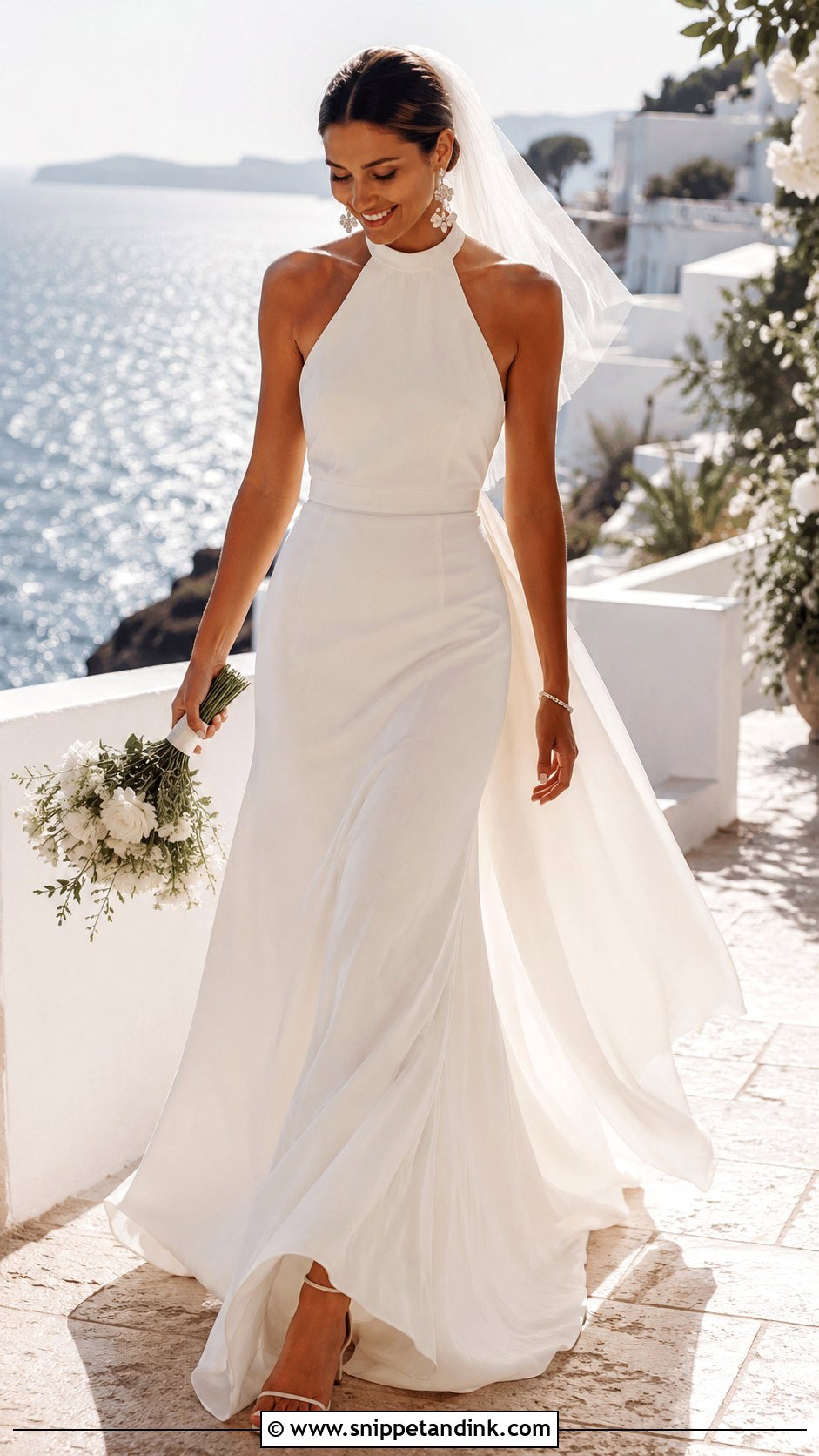
A halter-neck wedding dress is made for a warm coastal terrace. The neckline has to feel secure, and a bare-backed halter needs enough structure in the bodice that you aren’t relying on the neck strap to hold everything up; I check this by having the bride lean forward. A flowing crepe or satin skirt keeps the line long. Skip the necklace and wear statement earrings. Hair goes up, in a high bun or braided updo, to show shoulders and back. Strappy sandals, a short veil or sheer cape, and nothing heavy. One caution: a halter is the wrong pick for a church that wants covered shoulders unless you add a cover-up.
9. Silk Slip Wedding Dress
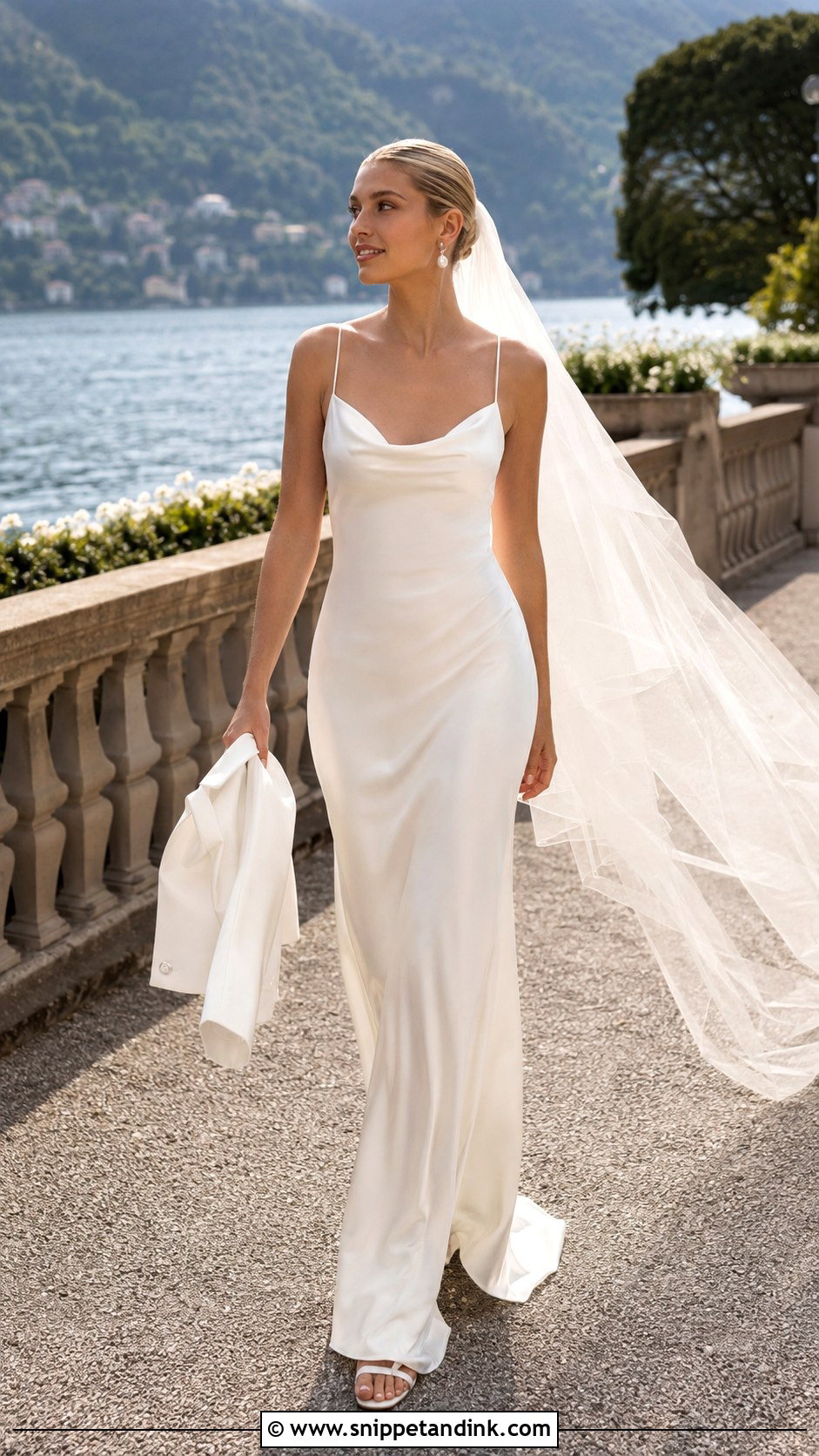
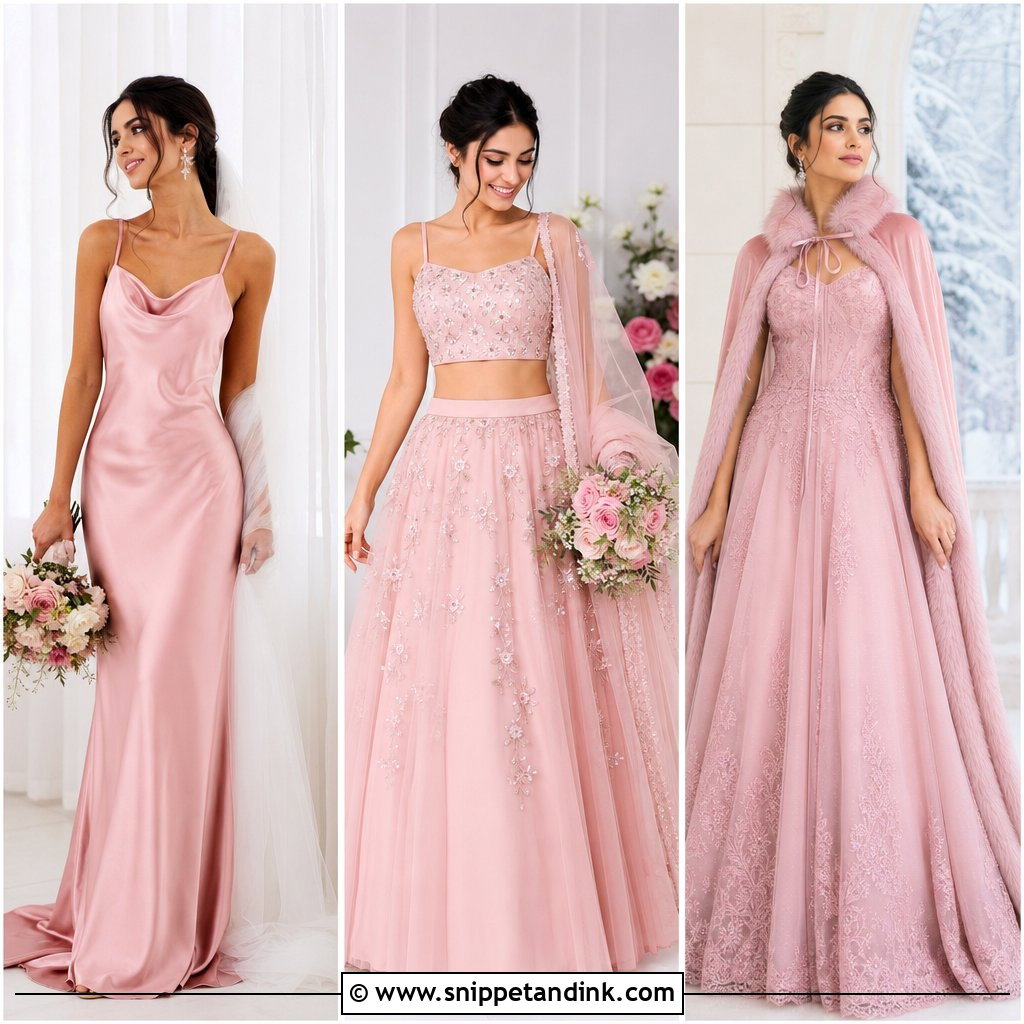
A bias-cut silk slip suits an intimate lakeside ceremony, but it is the most demanding dress to fit. Because silk cut on the bias stretches and clings, tailoring must be exact around the bust, waist and hips, and every line underneath shows. I fit it over the final underwear and, if needed, smooth bonded shapewear that doesn’t change how the silk falls. Adjustable straps and good lining matter more than any detail. Add a sheer floor-length veil, modern pearl earrings and slim satin sandals. A loose low bun suits the softness. Carry a small bouquet, and keep a cropped ivory jacket or fine cashmere wrap for the evening.
10. Floral Appliqué Wedding Dress
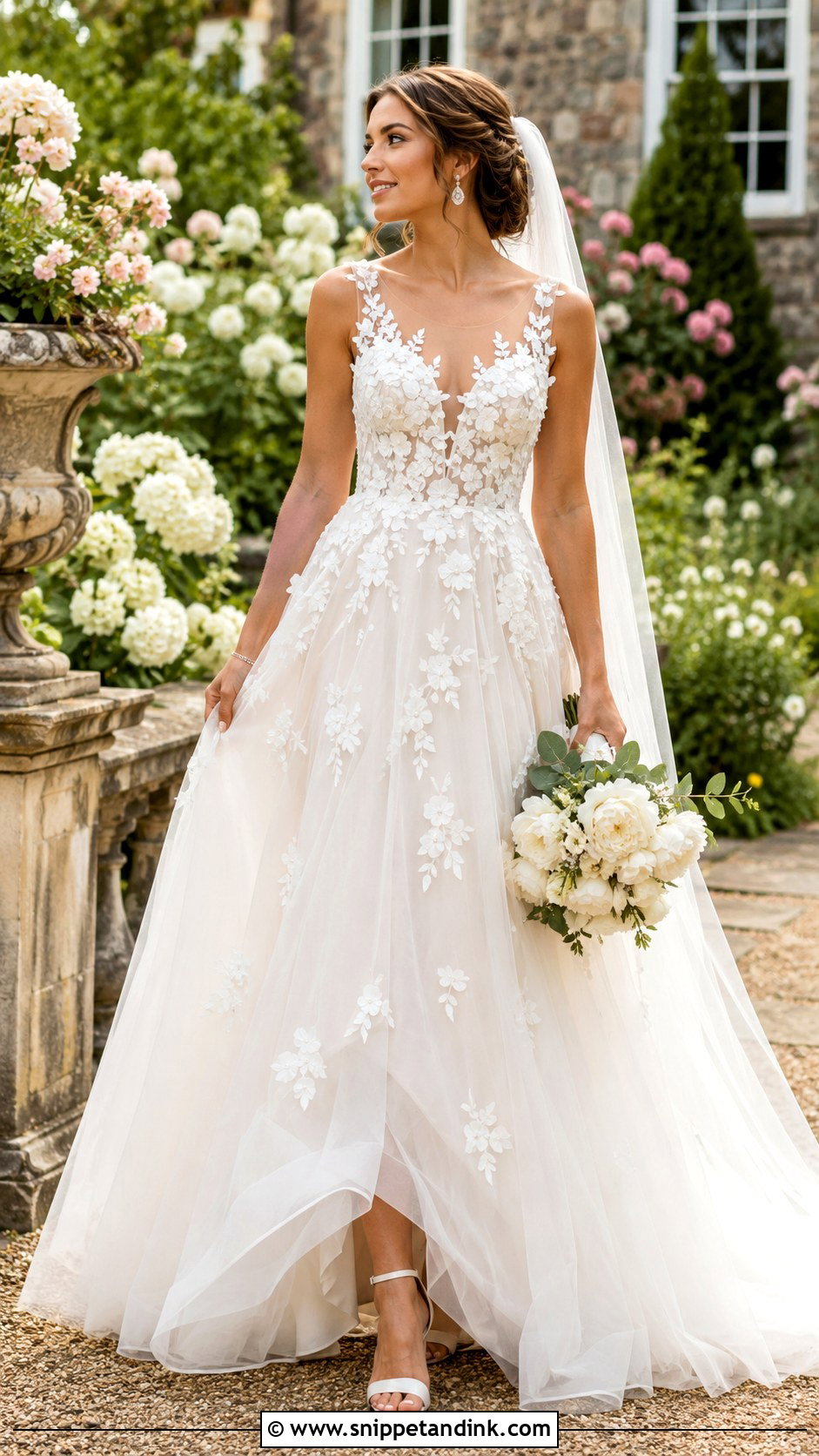
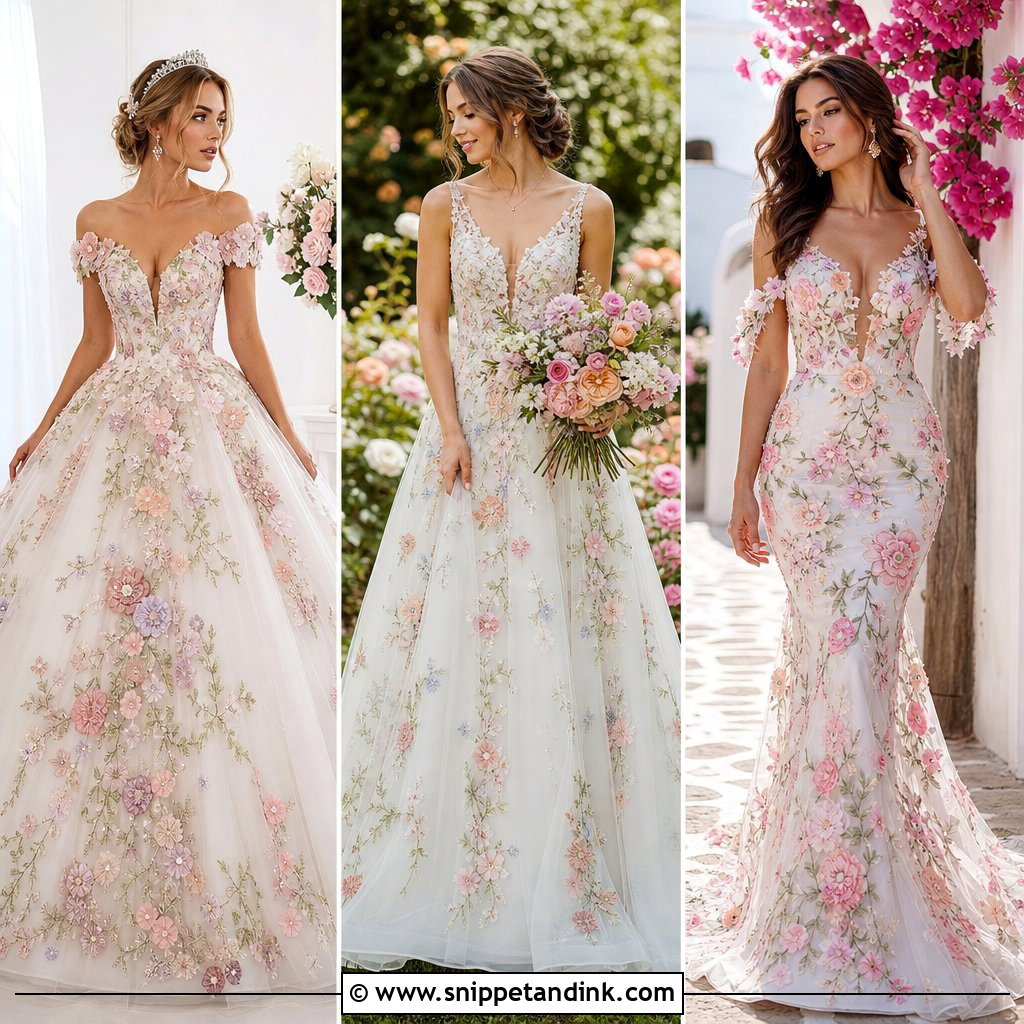
Three-dimensional appliqué gives a gown depth that flat lace can’t. The placement is everything: I prefer flowers concentrated on the bodice and thinning as they travel down the skirt, so the eye moves and the dress doesn’t feel heavy. A soft tulle A-line suits spring gardens and countryside estates. Keep the veil plain. Delicate drop earrings, ivory ankle-strap heels and a bouquet built from one or two flower varieties. At the final fitting, I gently tug every appliqué near the arms and waist. Loose petals get pulled off by hugs, and any wire or stiff edge near the inner arm will scratch by the end of the night.
11. Cathedral Train Wedding Dress
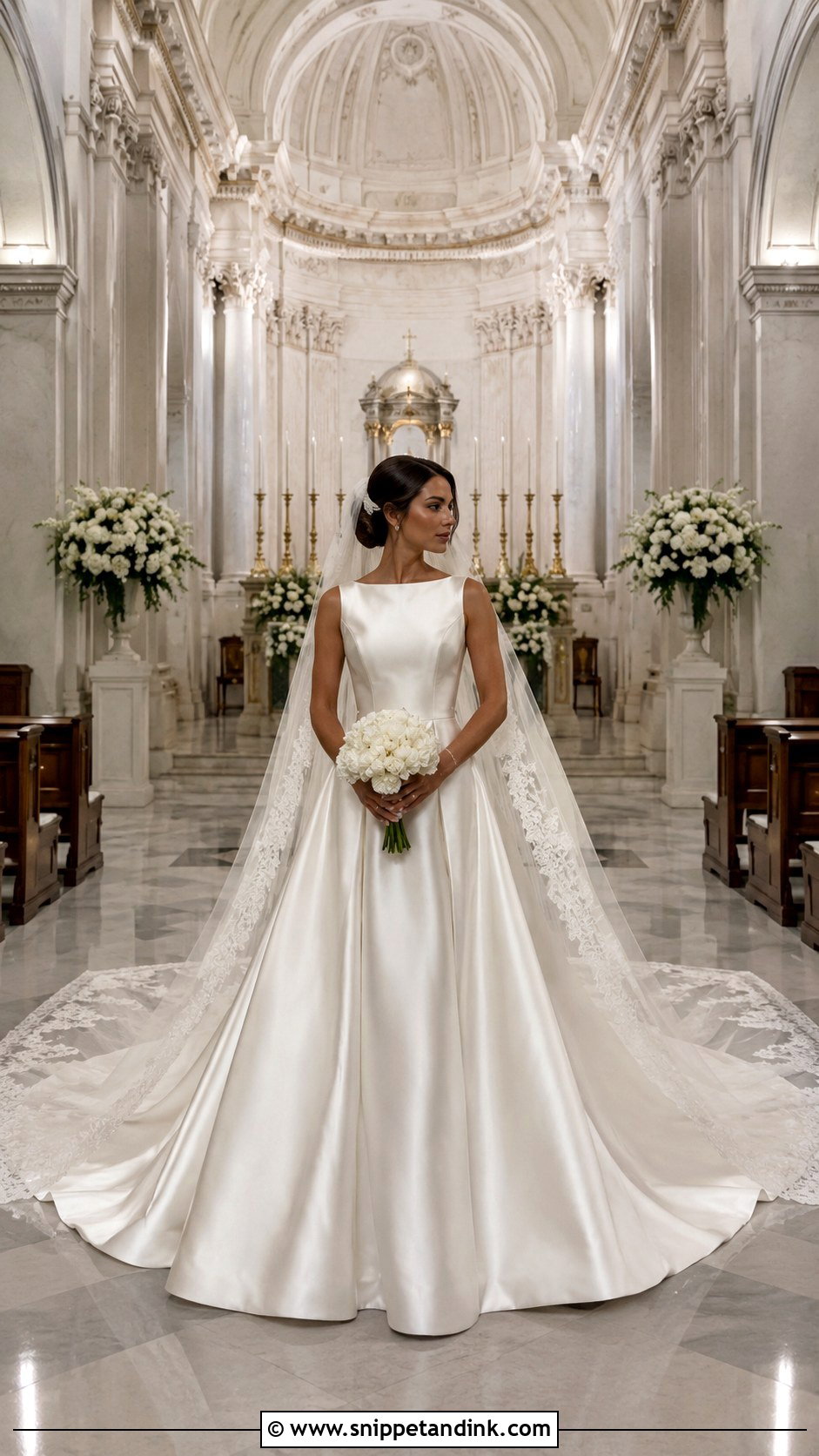
A cathedral train is about an entrance, and it needs a venue big enough to show it: a long aisle, a grand staircase, room to lay it out for portraits. Lace, satin or Mikado all work, as long as the bodice is strong enough to counter the pull of the fabric behind you. A cathedral veil that runs slightly past the train makes one continuous line. Keep jewellery quiet, perhaps a family ring. The part people forget is the reception. Ask your seamstress for a sturdy bustle, then have one attendant practise it before the day. A rushed bustle in a dim corridor is where trains get torn.
12. Detachable Overskirt Wedding Dress
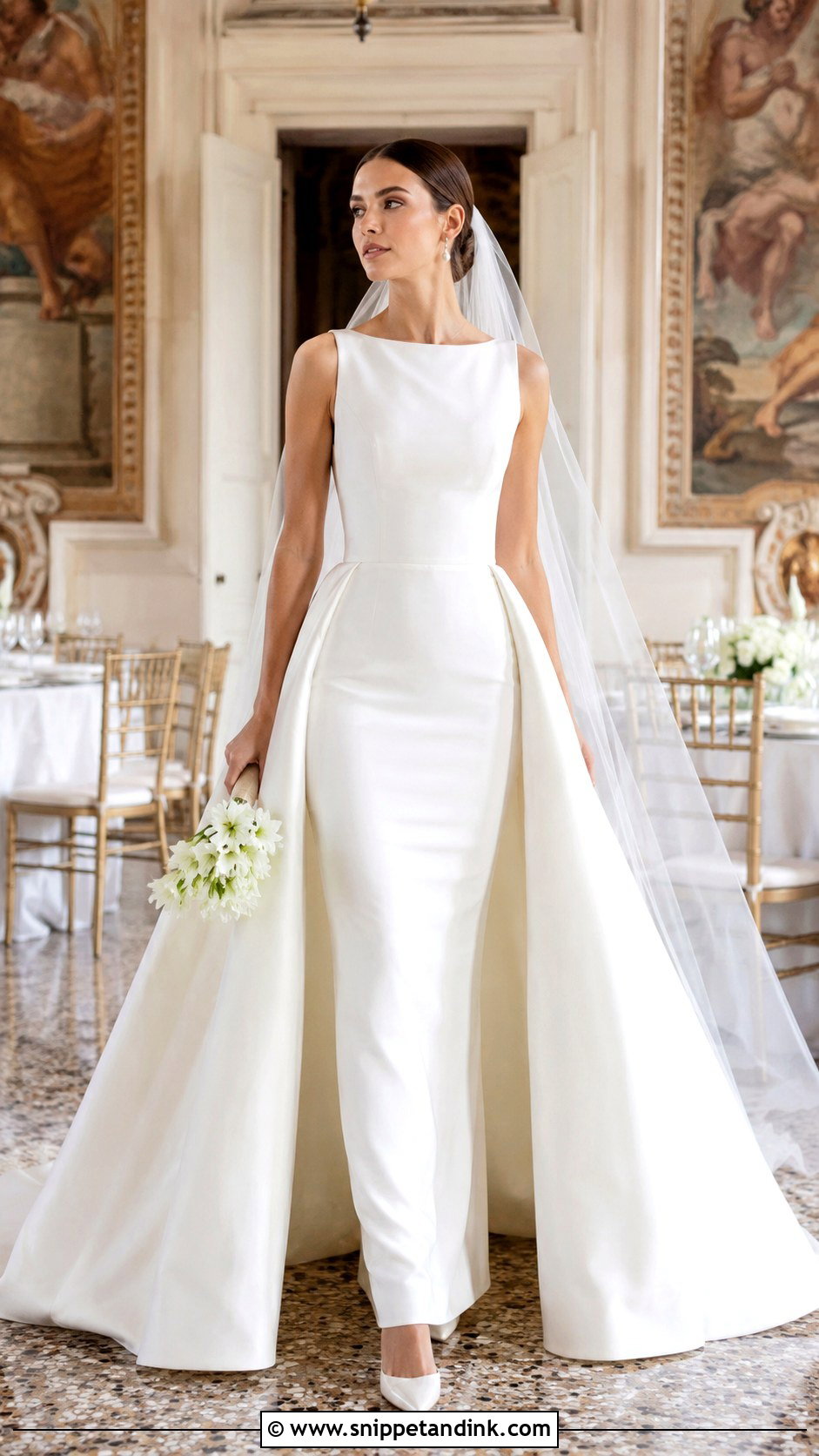
A detachable overskirt lets one Italy wedding dress become two. You walk the aisle in a fitted crepe, lace or satin gown with a full skirt over it, then unclip the volume for dinner and dancing. For the ceremony I’d use a long veil, pearl earrings and classic pumps; for the reception, a jewelled comb and block heels. What I check: the overskirt waistband must lie flat with no ridge, the fastening has to be reachable by your helper in under a minute, and the two fabrics need to match in daylight, since whites from different mills rarely match exactly.
13. Wedding Dress With Bridal Cape
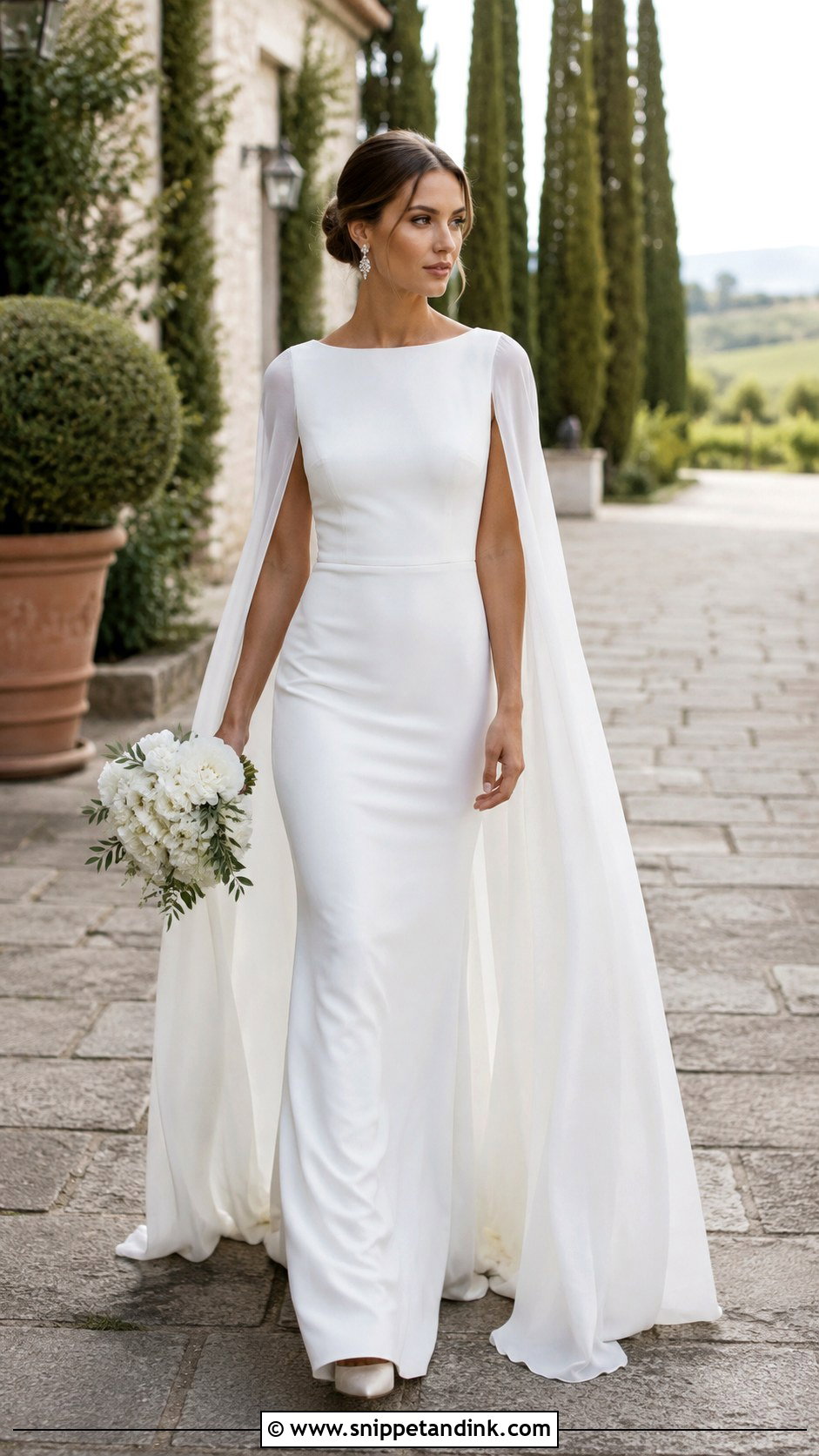
A cape turns a very plain gown into something ceremonial. Start with a clean column, sheath or A-line in matte crepe or smooth satin, and add a sheer floor-length cape fixed at the shoulders, or a structured capelet if you want more coverage. Many brides wear one instead of a veil. Crystal studs, a slim metallic bracelet, pointed ivory pumps and a sleek bun keep the neckline uncluttered. Outdoors, wind is the real issue: a long sheer cape behaves like a sail on a coastal cliff. I make sure it attaches with snaps or a hook rather than sewn in, so it can come off in seconds.
14. Tea-Length Wedding Dress
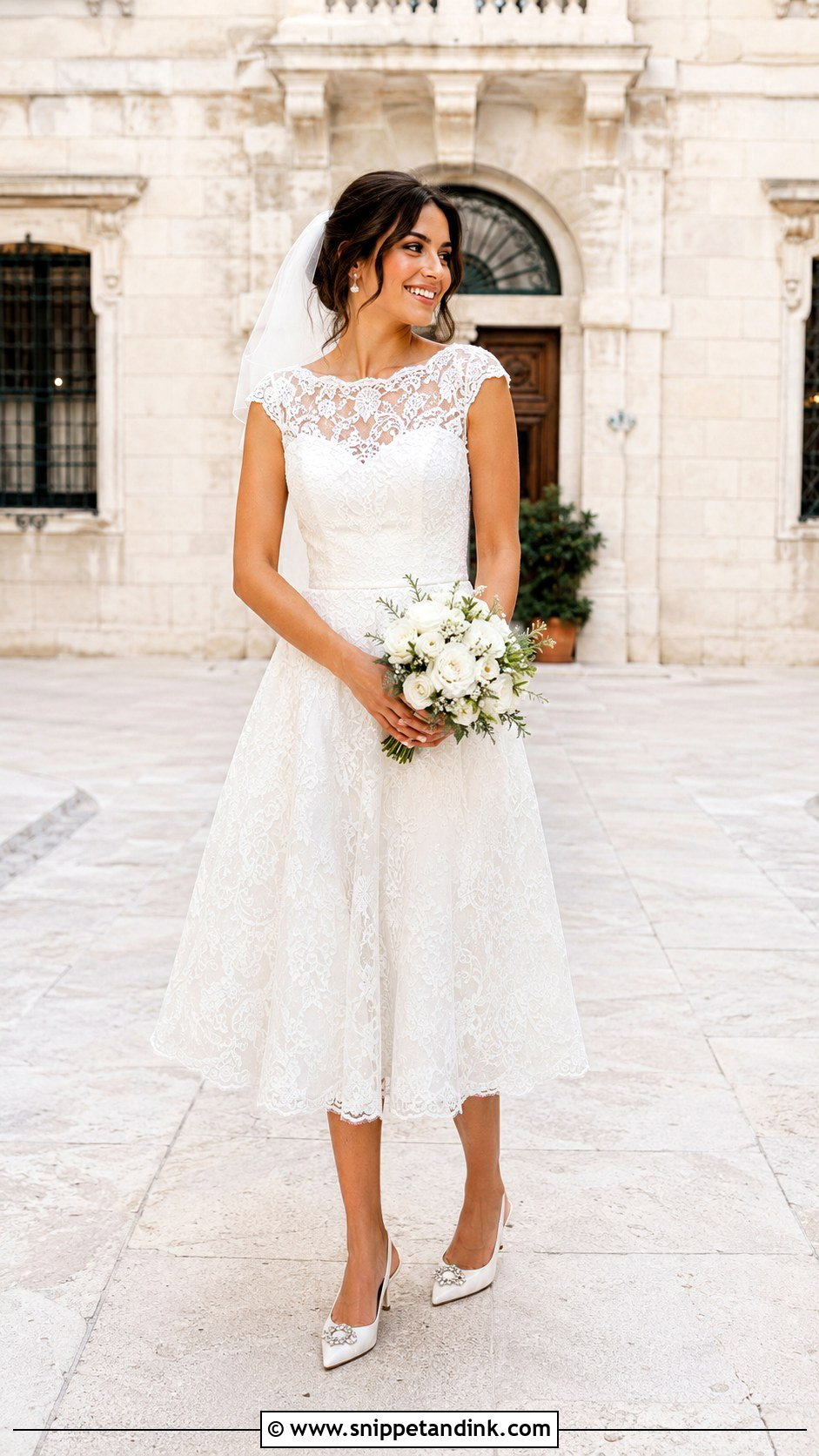
A tea-length wedding dress suits a civil ceremony at a town hall or a relaxed lunch on a restaurant terrace. The hem sits between knee and ankle, so your shoes become part of the outfit; I’d budget for them as seriously as the veil. A fitted bodice and softly full skirt in lace, satin or jacquard, pointed slingbacks or embellished pumps in ivory or a soft blue, a short veil and pearl studs. Proportion is where tea length goes wrong. On a petite bride, a hem a touch shorter keeps her from looking cut off, while a taller bride can take it closer to the ankle.
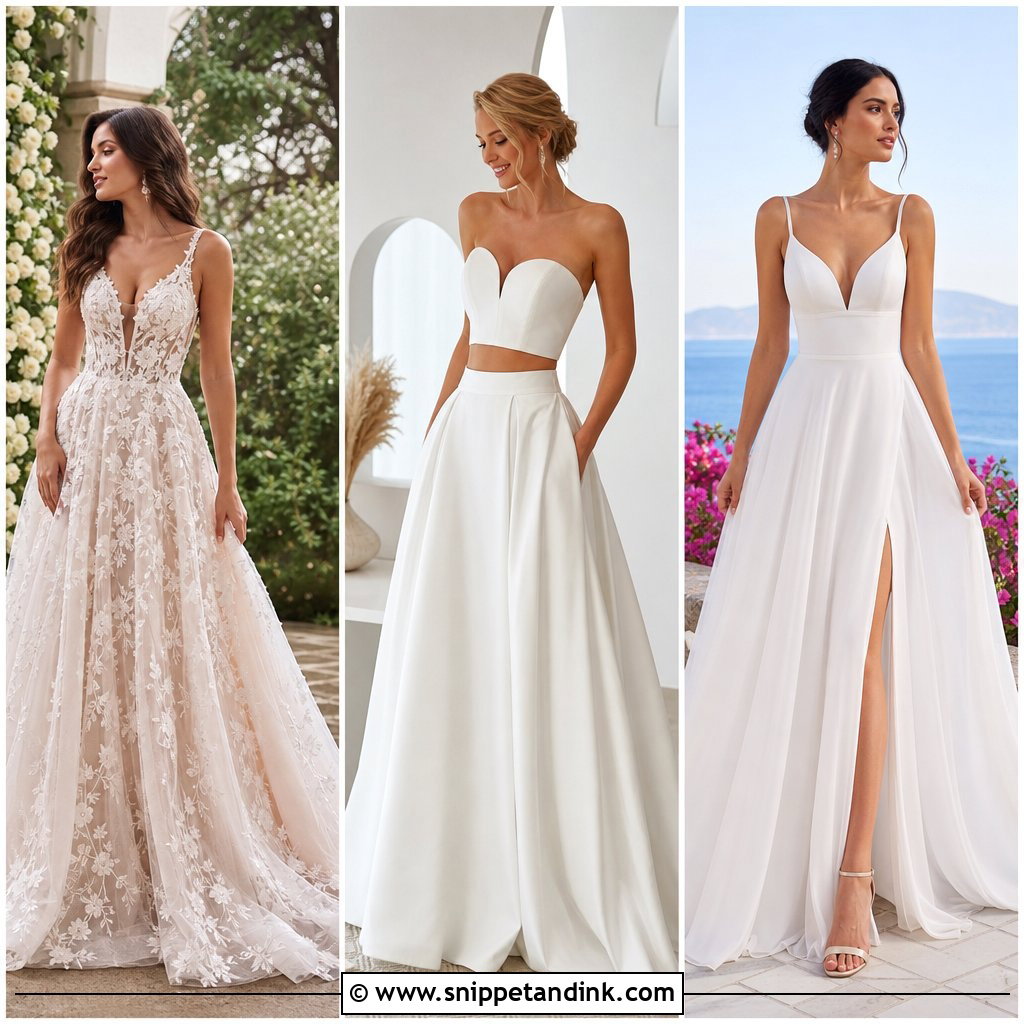
15. High-Neck Crepe Wedding Dress
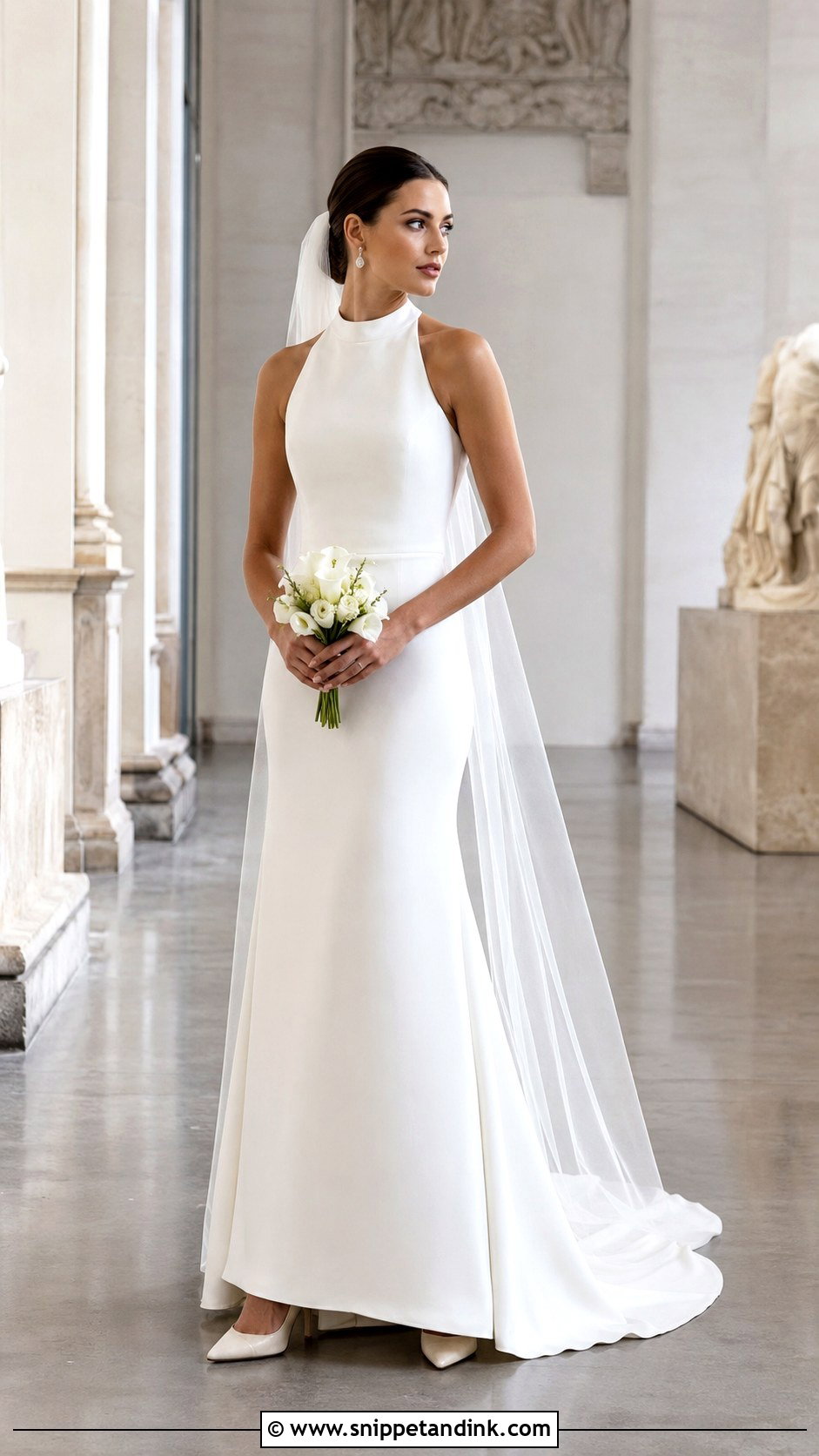
High-neck crepe gives full coverage while looking anything but conservative. A sleeveless or long-sleeve fitted bodice, a smooth neckline and a softly flared skirt; crepe has enough weight to skim without clinging. Fasten the veil beneath a low bun so the neck stays clear, and choose drop earrings rather than any necklace or embellished belt, both of which interrupt the line. My usual adjustment on fitted crepe is room to move. If walking feels like a shuffle, ask for a back slit, stretch lining or a little ease through the hips. It suits museum venues, city ceremonies and winter receptions.
16. Lace Mermaid Wedding Dress
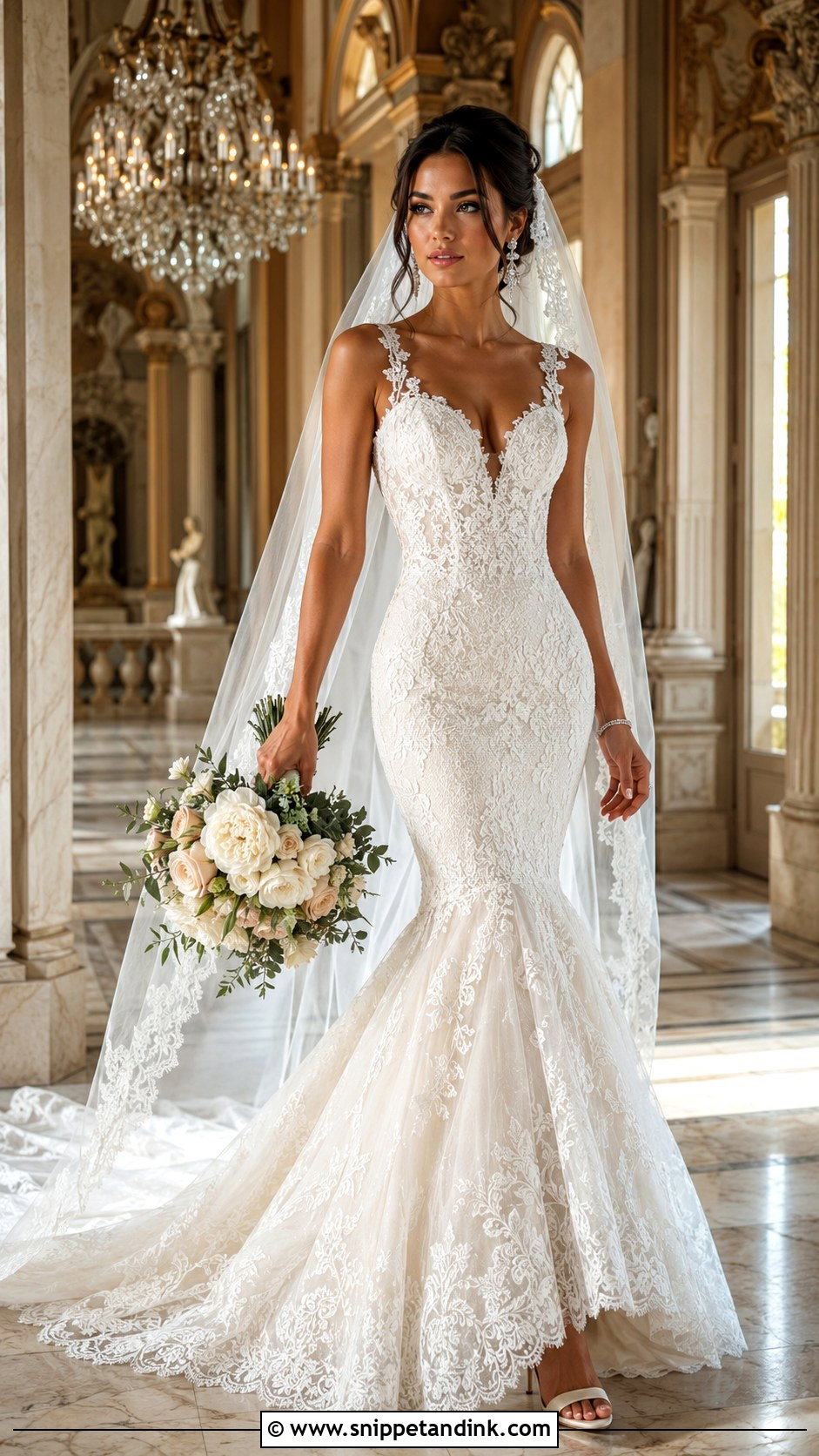
A lace mermaid should follow the body smoothly through torso and hips and flare at or just below the knee. Where that flare starts is the most important number in the whole fitting. Too high and you can’t climb steps; too low and you can’t walk at all. Medium-scale lace shows up well without hiding the shape. A fingertip veil leaves the train visible. Crystal earrings, a narrow bracelet and heels you’ve actually broken in. During alterations, I have brides take normal strides, sit and climb stairs before the hem is finished. A secure bustle protects the train once the dancing starts.
17. Empire-Waist Chiffon Wedding Dress
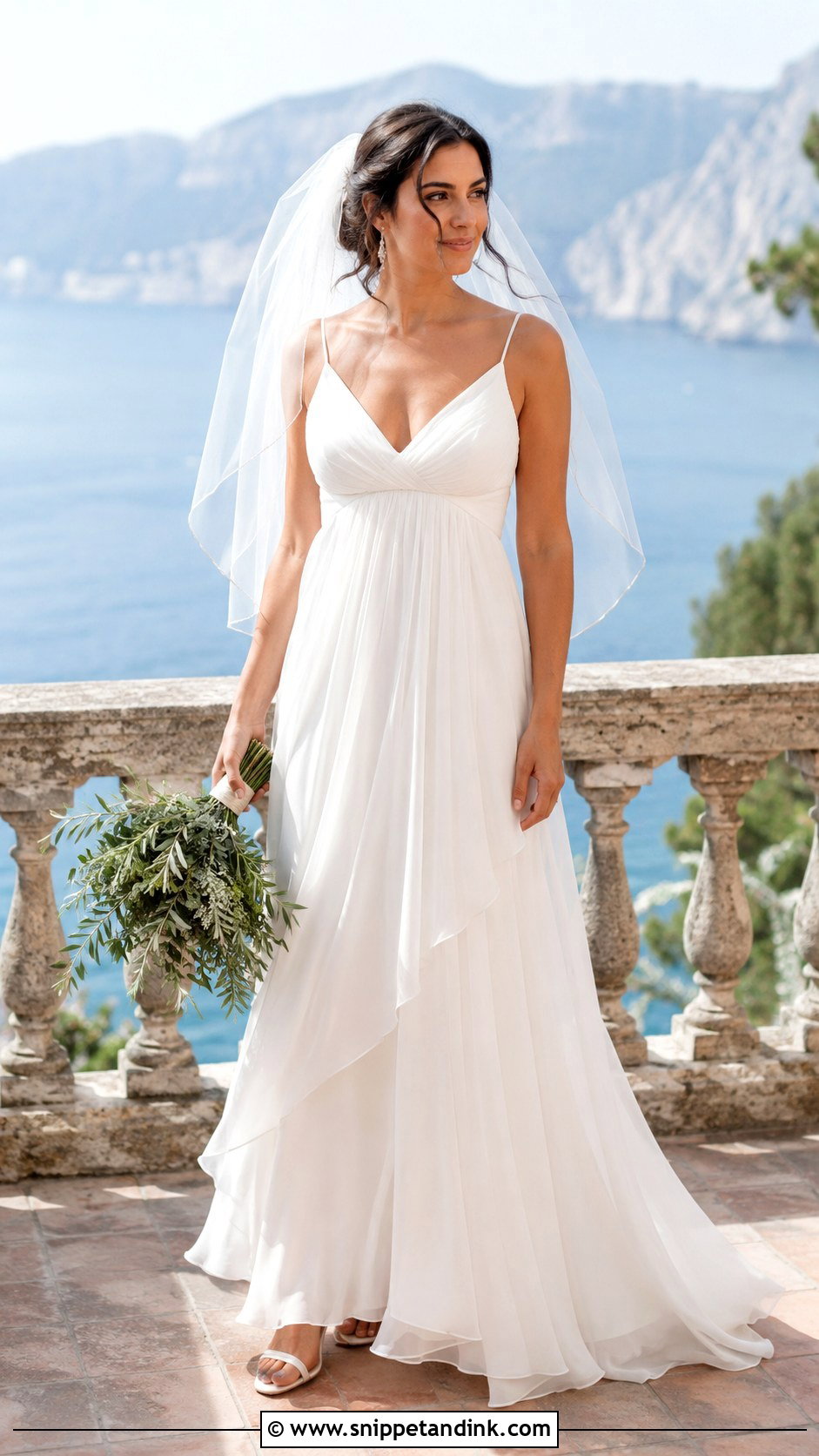
Light chiffon with an empire waist is the coolest bridal silhouette I know for an Italian summer. It sits under the bust and falls in fluid layers, giving ease through the waist and hips and movement in a sea breeze. Pair it with a lightweight fingertip veil, fine drop earrings and low block-heel sandals. A loosely gathered updo and airy greenery in the bouquet suit the fabric. Chiffon frays and snags easily, so on terraces, beaches and rural estates I ask for a slightly shorter hem and a simple bustle. Skip heavy necklaces; they drag the delicate neckline forward.
18. One-Shoulder Satin Wedding Dress
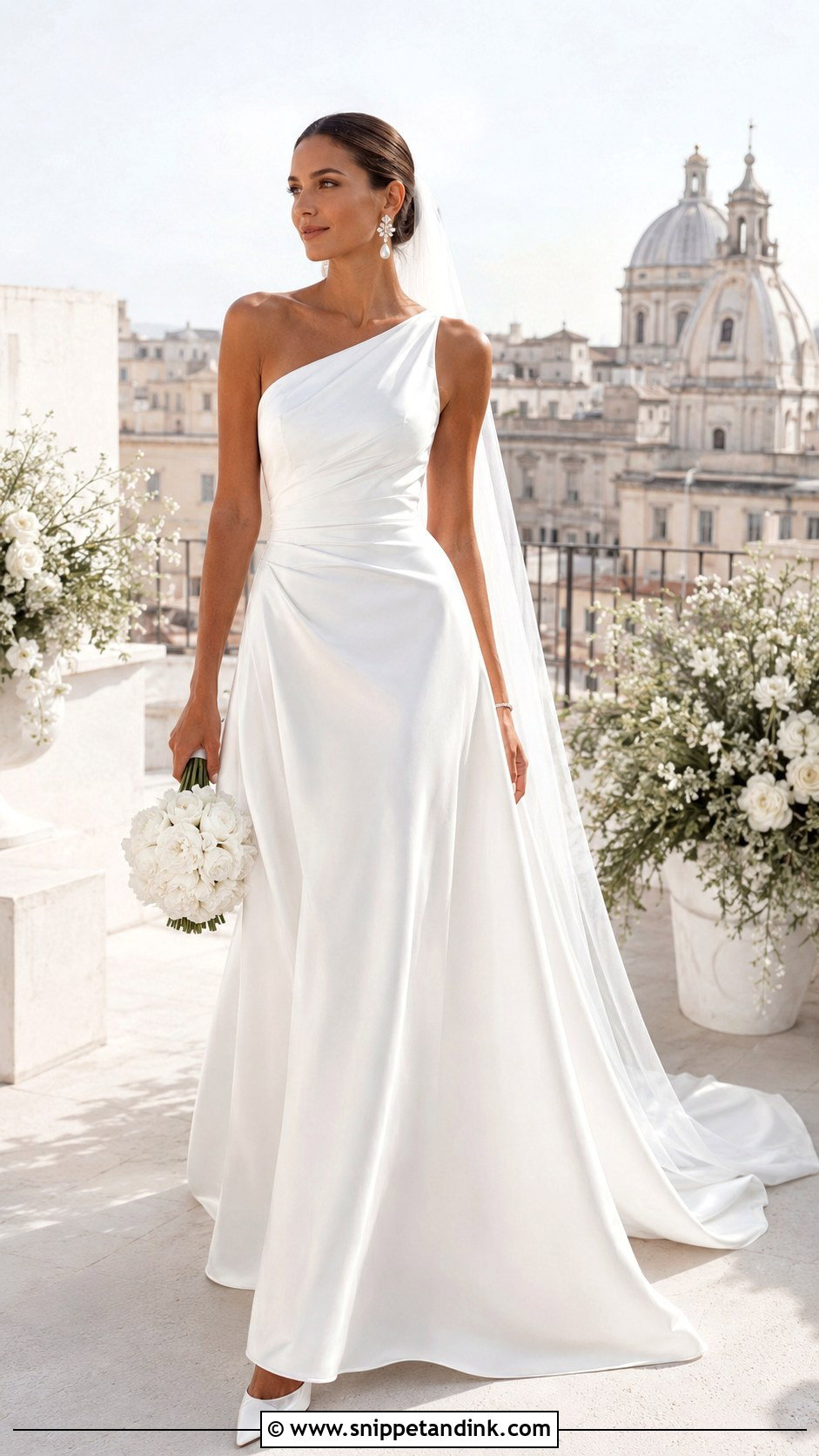
One-shoulder satin needs almost no decoration, because the asymmetry is the design. I check two things: that the single strap lies flat without digging in, and that the bodice has enough internal support that the strap isn’t doing all the work. A draped column or A-line skirt keeps it sophisticated. Sculptural earrings, a narrow bracelet on the bare arm and pointed satin pumps. A sleek bun keeps the line clear, and a low-set veil or detachable shoulder drape won’t fight the neckline. Satin shows every wrinkle and uneven seam, so have it professionally pressed close to the day, never with a hotel iron.
19. Champagne Tulle Wedding Dress
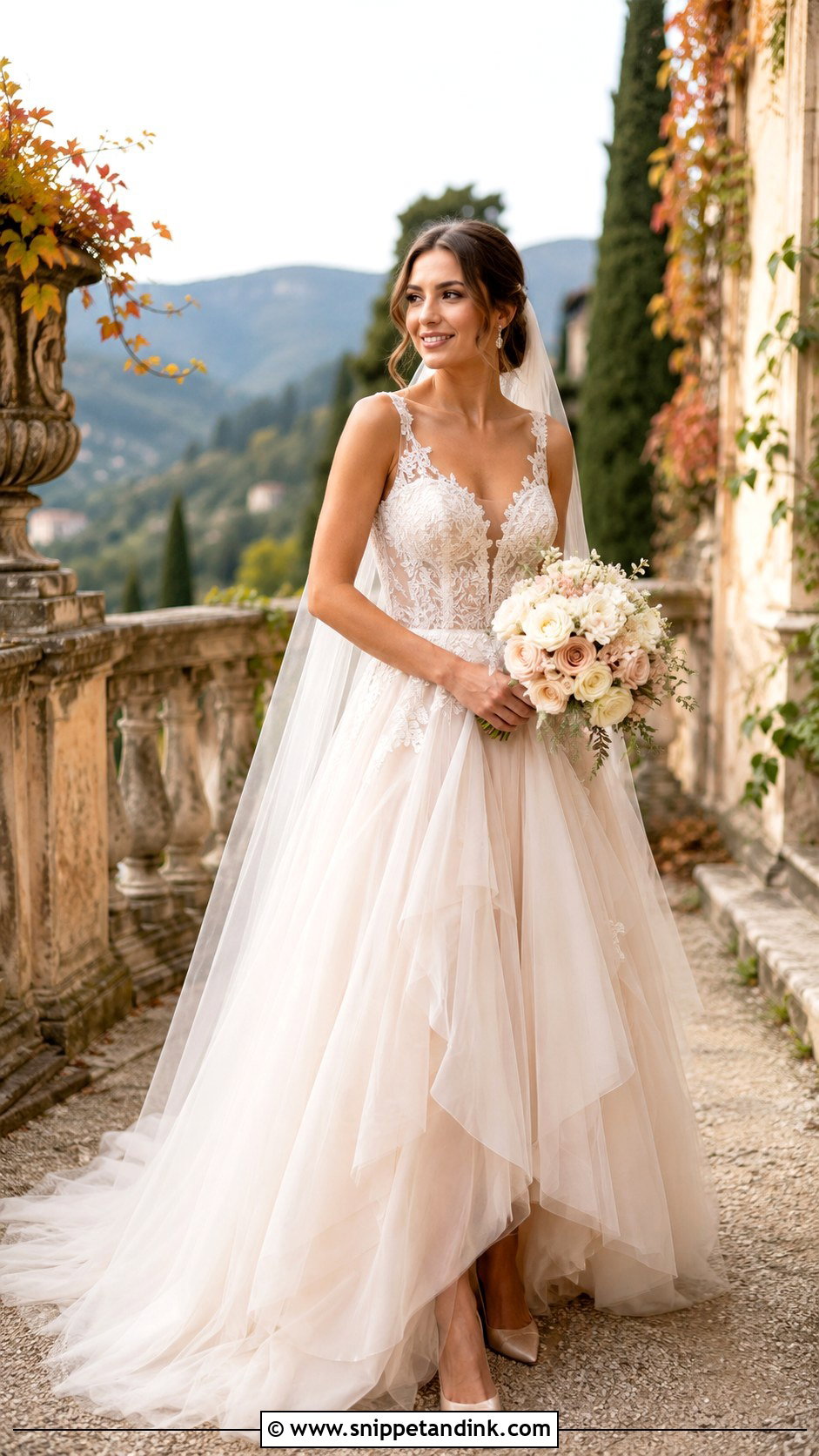
Champagne tulle is still clearly bridal, but softer than bright white, and it flatters warmer skin tones in particular. An A-line or ball gown with warm-neutral tulle layers and ivory lace laid over the top makes the embroidery easier to see in photos. Champagne satin pumps, pearl earrings and a sheer ivory veil tie the lighter details together. For flowers I’d go cream, pale blush and muted greenery instead of matching the dress exactly. Always look at swatches in daylight before ordering. Champagne can read pinkish under warm bulbs and grey in shade, and you want to know which it’ll be at sunset in the venue.
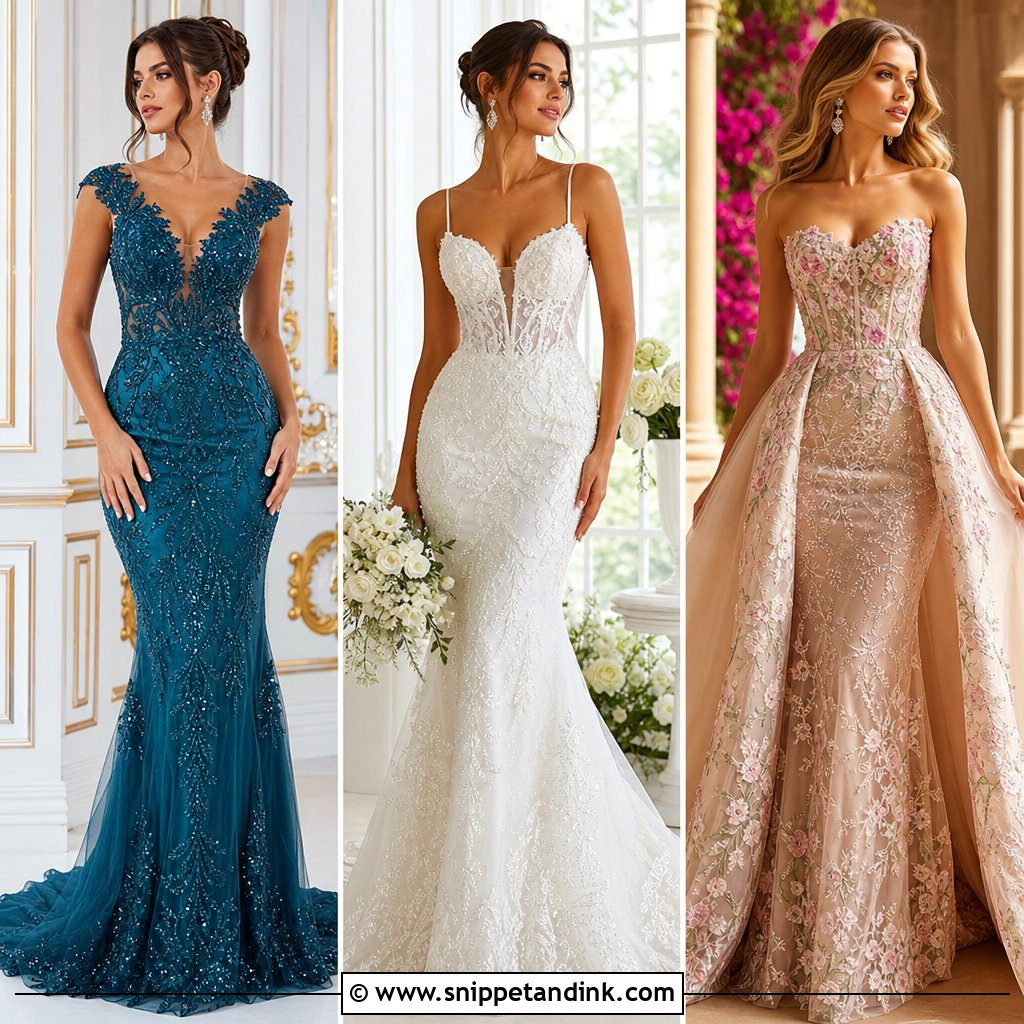


20. Bridal Mini Wedding Dress
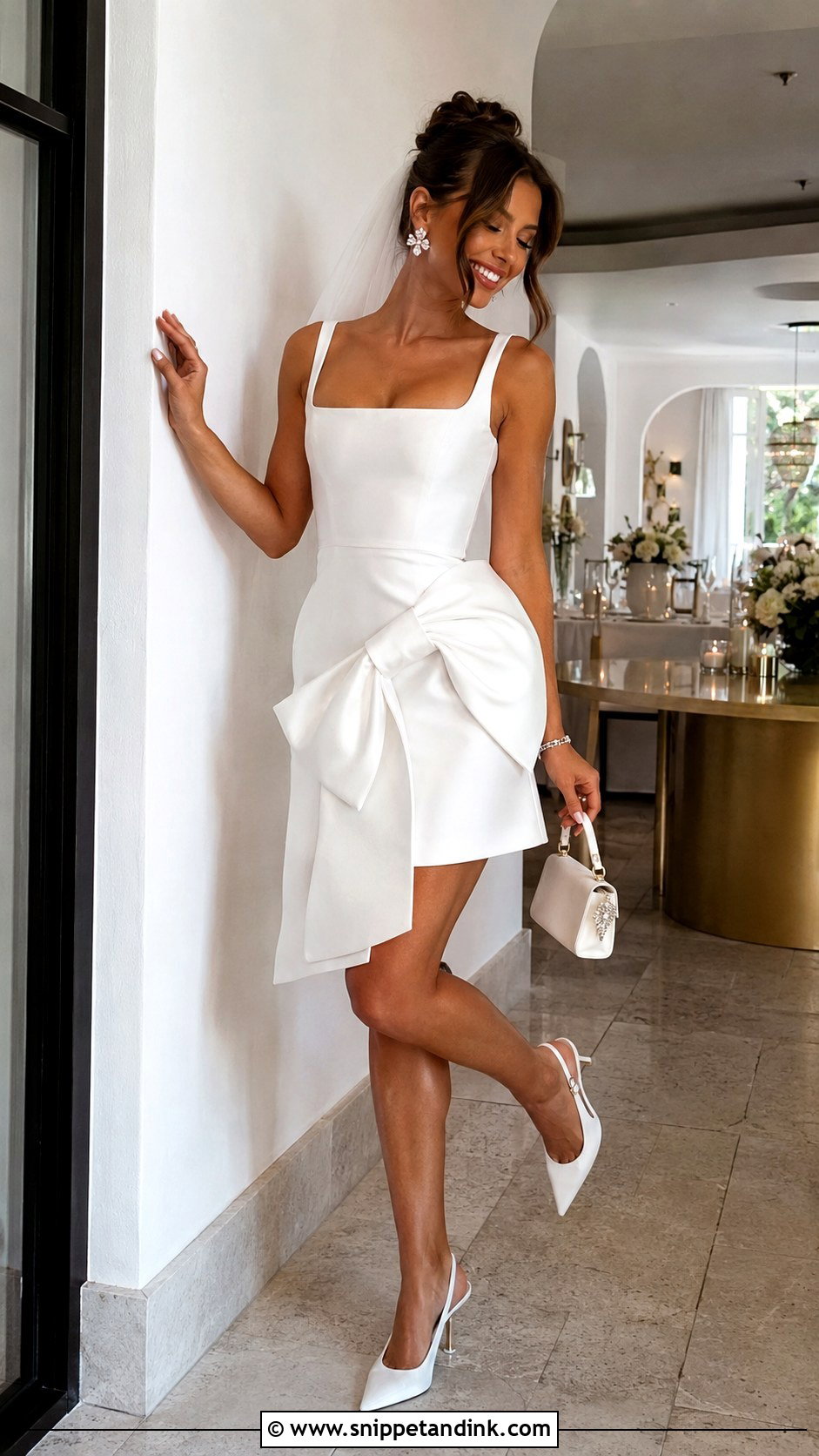
A bridal mini is usually a second look, a change for the reception after a long gown, though it works well for a civil ceremony too. It needs a structured bodice and a hem you can sit and dance in without tugging. A square neckline, a sculpted bow, lace sleeves or plain satin all keep it polished. Pointed pumps or low slingbacks, statement earrings and a small top-handle bag. A short veil makes it clearly bridal. When a mini is a change of outfit, I keep one thing constant from the ceremony look, usually the earrings or the shoes, so photos from both halves still look like the same wedding.
From Order Form to Altar When You Marry Abroad
A destination wedding squeezes the usual dress timeline, because your last fitting has to happen before you fly rather than the week of the wedding. This is the schedule I work back from.
- Nine to twelve months out: order the gown. Many made-to-order bridal pieces take several months to produce, and anything with hand-applied lace or a custom colour takes longer.
- About three months out: first fitting. This is where the big changes happen, such as taking in a corset or reshaping a train.
- Four to six weeks before you travel: final fitting, wearing your real shoes and underwear. Learn the bustle here and film your attendant doing it on her phone.
- Travel day: the gown goes in the cabin in a breathable garment bag. Call the airline ahead to ask how they handle wedding dresses; some will hang it, others ask for it in the overhead bin.
- On arrival: arrange a steam with your planner or a local seamstress rather than trusting a hotel iron. Silk, satin and Mikado mark permanently if the heat is wrong.
Bring a small kit too: clear thread, a needle, safety pins, fashion tape and a stain pen that is safe on silk. Of everything in my bag, those are what I reach for most on the day, usually for a bustle hook that has come loose during dinner.
Lace, Mikado or Silk: Matching the Gown to the Venue and the Heat
Every dress here, from the lace A-line and the Mikado ball gown to the slip, the overskirt and the reception mini, works only if it suits where you’ll stand and how long you’ll wear it. Think about the ground underfoot, the temperature, the formality of the ceremony and how much you’ll move between vows and the last dance. Start fittings early, test every fastening and walk the full outfit in your wedding shoes. Then pick the dress that looks like you rather than the one trending this season. Good proportions and careful finishing are what make a bride look at ease from the first photo to the last.
You'll Like These Ideas:





Leave a Reply