
Gothic cakes have softened lately. Black tiers, velvet-matte finishes, old bakery piping, dark florals and a little metal leaf now show up under candlelight at weddings that are romantic rather than spooky. From the baking side, I can tell you the simple versions are the ones that turn out best: one clean silhouette, one strong color and one dramatic detail read far better across a dim room than five competing ideas. Matte black buttercream, burgundy roses, black lace piping, a strip of silver leaf or a deep purple ribbon can each carry the mood alone. The twenty cakes below are all realistic to brief and to make.

What Black Icing Does That White Icing Won’t
Most of the questions I get about gothic cakes are really questions about black coloring. It’s worth knowing how it behaves before you fall for a photo, because it changes what your baker can promise.
- It needs a day. Freshly mixed black buttercream looks charcoal and deepens over several hours, so a careful baker colors it the day before decorating.
- It can taste. Forcing white frosting black with a lot of gel color can leave a bitter edge. Starting from black cocoa or dark chocolate needs far less dye.
- It stains. Lips, teeth, white shirts and linen napkins can all pick up color. Plenty of couples keep black on the outer finish and choose a lighter filling inside.
- It shows flaws. Air bubbles, soft edges and fingerprints are far more visible on black than on ivory.
- It dislikes temperature swings. A chilled dark cake carried into a warm room collects condensation, and the droplets dry as pale marks.
None of this is a reason to avoid black. It’s a reason to ask your baker how they get their black, when they’ll apply it, and whether you can taste a sample of the colored frosting at your tasting.
1. Simple Black Gothic Wedding Cake

Two or three smooth tiers in matte black is the quickest route to a bold dessert table, and also the one that shows every flaw. Black exaggerates a wobbly edge or a trapped air bubble far more than white does, so this is the cake where I spend the longest with the scraper getting sharp corners. Keep the decoration to a few deep red roses or a ribbon at the base. Set it on white plates with candles nearby so the outline stays readable from across the room.
2. Gothic Wedding Cake With Red Roses

Black frosting with deep red roses is a contrast people recognize instantly, even in a small phone photo. Fresh roses are fine if they’re unsprayed and the stems are wrapped or set in picks so they never sit directly in the cake. Sugar roses cost more in labor, but they won’t wilt under warm lights. I like smooth black fondant or dark ganache underneath, with the roses trailing down one side rather than wrapping every tier. A crowded cascade loses its shape from a distance.
3. Black And White Gothic Wedding Cake

If your family expects a traditional cake, a black and white gothic wedding cake gives you the drama while still looking bridal. White tiers with black lace piping or one black base tier is the gentler version; black tiers with white sugar flowers is the sharper reverse. One practical warning: black details sitting on white buttercream in a warm room can bleed a faint grey halo, so I pipe the black as late as I can. Stick to one pattern per tier and it stays calm in a formal venue.
4. Gothic Wedding Cake With Black Lace

Lace can be piped in royal icing, pressed from an edible lace mat or hand painted onto fondant, and each behaves differently. Piped lace has the most depth but takes hours, which shows up in the quote. Edible lace sheets are quick and very even, though they go tacky in humid weather. Ivory with black lace reads soft and bridal, while black with tonal black lace only appears when light catches it at an angle. It’s a clever way to echo the lace on a dress or veil.
5. Matte Black Gothic Wedding Cake

Matte black absorbs light, so the cake looks like velvet instead of patent leather. That’s the appeal and the catch. Matte surfaces show fingerprints and water spots, so I handle these cakes with gloves and keep them away from a cold-to-warm move that makes them sweat. Pick one accent, perhaps dried dark flowers or a slim ribbon, and stop there. Put something pale behind it, white florals or a stone wall, or a matte black cake simply vanishes in a dim room.
6. Gothic Wedding Cake With Silver Leaf

Silver gives a cooler, moonlit shine than gold and sits well on black, charcoal, navy or deep purple. Edges, one full tier or loose flakes all work, and I place the leaf off-center so it looks applied by hand rather than stamped. Ask whether the leaf is sold as edible grade, because some metallic leaf on the market is decorative only and has to come off before serving. It’s thin enough to tear at a touch, so it goes on last. White roses and blackberries keep the palette crisp.
7. Gothic Wedding Cake With Burgundy Flowers

Burgundy softens black frosting without lightening the mood, which is why this palette works in more seasons than most. Roses, ranunculus and sugar peonies in deep red and plum all hold well. Dahlias are the fragile ones; their petals bruise and drop once they’ve been out of water a few hours, so I’d only use them on a cake that’s dressed at the venue. A cluster at the top and another at the base balances the tiers and ties neatly to burgundy bridesmaid dresses or antique gold decor.
8. Gothic Wedding Cake With Purple Flowers

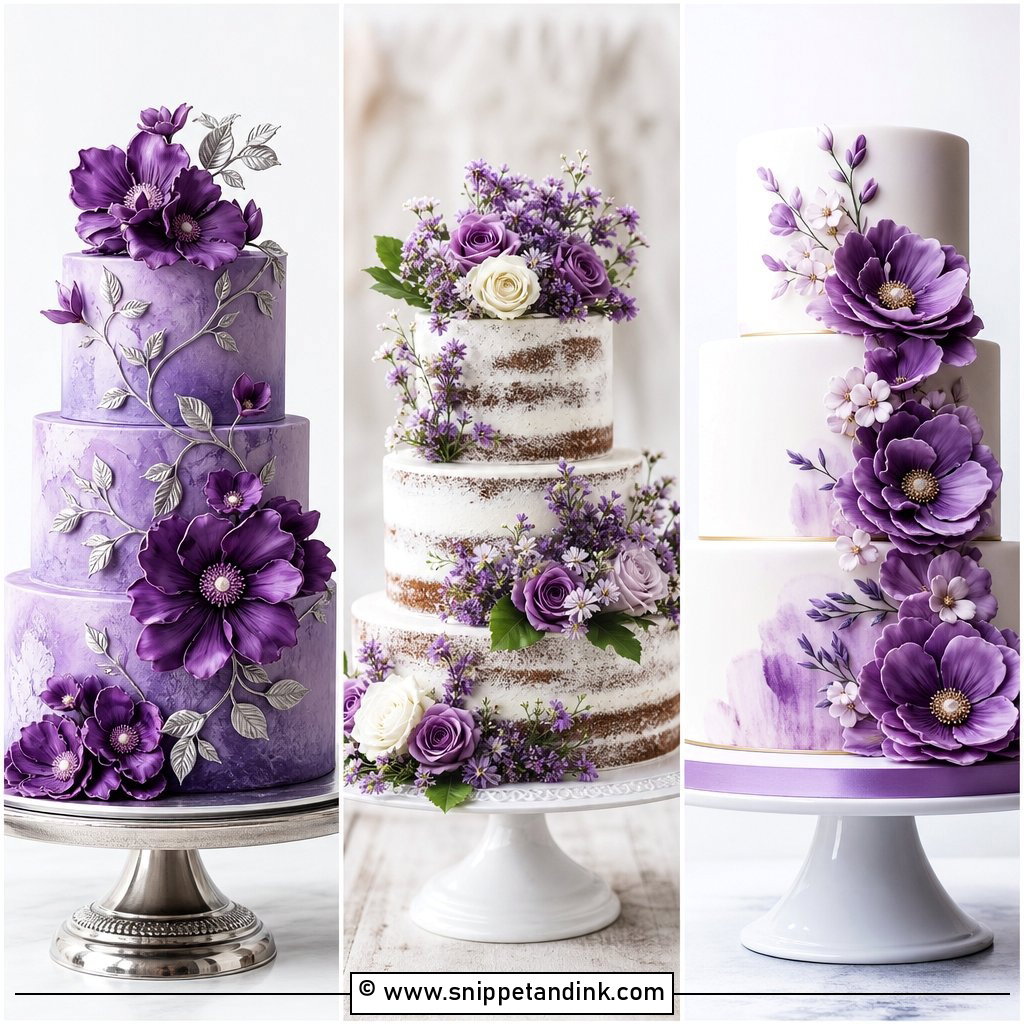
Purple reads cooler and more mysterious than red. Plum, lavender grey and black sugar flowers keep it from tipping into anything sweet. Be aware that purple is the color that shifts most under warm bulbs and camera settings, and a true plum can photograph close to brown, so I’d test one sample flower under your venue’s lighting if you can. A smooth black, charcoal or ivory base with a small side cascade is plenty. A thin silver ribbon suits a twilight reception with velvet on the tables.
9. Gothic Wedding Cake With Gold Accents

Gold against black adds warmth and it’s simpler to execute than it looks: thin painted edges, scattered leaf or a small monogram on one tier. The surface matters, though. A brush drags across soft buttercream, so if you want crisp painted lines, fondant or a well-chilled ganache gives a much cleaner result. Keep the gold to one tier so it doesn’t look busy, and pair it with deep red or ivory flowers in a ballroom or historic venue.
10. Gothic Wedding Cake With Drip

Drip adds movement without fussy sugar work. black ganache over a charcoal, burgundy or ivory cake gives the moodiest result, and dark chocolate drip on a black cake is the subtler option. Drip is entirely about temperature. Too warm and it runs onto the board; too cool and it stops in thick blobs. I chill the cake first and test one drip at the back before committing. Keep the drips evenly spaced for a wedding and crown it with a small cluster of roses, berries or edible pearls.
11. Gothic Wedding Cake With Vintage Piping

Shell borders, pearl dots, swags and overpiped tops in black or deep burgundy buttercream turn an old bakery look dark. One or two tiers in a single color keeps it simple. Heavily colored buttercream is a touch softer than plain white, so big swags can droop on a warm afternoon; I pipe these in a firmer consistency and keep the cake cool until it’s set up. A black vintage heart cake suits small weddings, and a short phrase or your initials makes it feel personal.
12. Gothic Wedding Cake With Black Ribbon

Wrapping smooth ivory, white or pale grey tiers in black satin ribbon is one of the cheapest ways to darken a classic cake, because there’s no extra sugar work. The detail people miss: plain satin soaks up butter from buttercream and develops grease spots within hours, so I back the ribbon with a strip of food-safe film or choose a lined ribbon. A few deep red or white flowers add romance. It still reads as a bridal cake, which helps when traditional relatives are on the guest list.
13. Gothic Wedding Cake With Dark Berries

Blackberries, blueberries, dark cherries and figs bring color without any sugar work, and they suit chocolate, vanilla or almond cake under black, ivory or grey frosting. The trade-off is moisture. Cut figs and bruised berries weep juice onto frosting within a few hours, so I use whole fruit, pat it dry and add it at the venue. Small clusters stay refined. Rosemary or dark greenery adds texture, and a wood table or stone plate makes it feel organic rather than staged.
14. Gothic Wedding Cake With Black Flowers

Black flowers give you a monochrome cake that’s still romantic. Use black sugar roses, dark anemones or painted wafer paper flowers. Black on black only works if the textures change, smooth fondant against ruffled petals; otherwise the flowers sink into the tiers. Truly black fresh flowers are rare, and most are a very deep burgundy or purple that only reads black in dim light, which is one reason I often make them in sugar. For more contrast, put them on an ivory cake in one clean cascade.
15. Gothic Wedding Cake With Marble

Black and white marble is the classic, but charcoal, deep purple or burgundy marbling softens it. I’d keep it to one marbled tier between plain ones, which gives interest without chaos. Every marbled fondant sheet comes out different, so you won’t get an exact copy of a photo, only the same feel. A thin metallic line or a few small sugar flowers is enough decoration. It’s a good route if you want a gothic hint without committing to a black cake.
16. Gothic Wedding Cake With Candles

Here the cake can be plain, black buttercream tiers or ivory with dark flowers, because the candles do the work. Keep flames around the stand, not on the cake, unless your baker agrees and the venue allows it. Pillars, tapers in holders and votives at different heights create the glow. I always warn about one thing: buttercream sitting close to a cluster of pillar candles will soften on that side, so leave real space between flame and frosting.
17. Gothic Wedding Cake With Black Buttercream

Buttercream is softer than fondant and can be smooth, lightly ribbed or finished with spatula marks. Two tiers with clean edges and one accent color is the simple wedding version. Black buttercream needs time, though. The color deepens noticeably overnight, so I mix it a day ahead and start from a dark base rather than forcing white frosting black with endless gel, which can leave a bitter taste. A dark chocolate base helps deepen the shade naturally. Do warn guests that true black frosting can tint lips and teeth for a while.
18. Gothic Wedding Cake With White Flowers

Black tiers with white roses, orchids or peonies give the sharpest contrast in the list and make a gothic cake look formal right away. Place the flowers in one diagonal line or a single top cluster, and resist adding a third color. White petals pick up every smudge of black frosting, so I set them only after the cake has firmed up, with clean gloves on. Black linens and white candles finish the table.
19. Gothic Wedding Cake With Dark Chocolate

With dark chocolate, the flavor and the look finally match. Chocolate sponge, ganache and a near-black cocoa finish give real depth with very little food coloring, which also means fewer stained smiles. Smooth ganache looks sleek; textured ganache feels rustic and moodier. Ganache also stands up to heat better than most buttercreams, so this is my first suggestion for a summer gothic wedding. Finish with dark berries, chocolate shards or burgundy roses, and the slices stay rich and dark on the plate.
20. Small Gothic Wedding Cake

A small gothic wedding cake suits elopements, micro weddings or a dessert table with several treats. One or two tiers still look dramatic when the palette is strong. Because a small cake sits close to eye level, every flaw shows, so the finish has to be clean. A tall black stand gives it presence and one focal decoration is enough. It usually costs less than a large tiered cake, though detailed sugar work affects the price as much as size does.
Will a Black Cake Show Up in Your Photos?
It will, if you plan the backdrop. A dark cake against a dark wall under dim lighting turns into a silhouette, and the piping or lace you paid for disappears. I ask couples where the cake table will stand and suggest a lighter wall, a pale linen or a soft light placed behind and to one side so the edges glow.
Matte finishes photograph more forgivingly than gloss, which throws back hard reflections from flash. Tell your photographer the cake is black so they can expose for it, and have the cake shots taken before the room gets darker for dancing.
Cutting and Serving Dark Tiers Cleanly
Black frosting smears onto pale sponge with every pass of the knife. Ask the venue to dip the knife in hot water and wipe it between slices, and serve on white or clear plates where a dark slice looks deliberate. If guests are wearing light colors, a lighter interior and a ganache rather than heavily dyed filling keeps the cleanup simple.
Sugar flowers and fondant decorations are usually made weeks ahead, so a dark palette is no harder to schedule than a white one. Just leave time for a color test, especially with purple or burgundy, and confirm it in writing once you’ve approved it.
One Dark Color, One Detail, Then Stop
The gothic cakes I’m proudest of are rarely the busiest ones. Start with a single base color and add one or two details that match the mood of your wedding. Bring your saved photos to the tasting, point to the one element you love in each, and let your baker tell you which will survive your venue, your season and your budget. That conversation will shape the cake more than any picture.
You'll Like These Ideas:


Leave a Reply