
Rose gold on a white cake is mostly a question of restraint. A thin painted band or a few leafed petals look rich; a whole tier brushed in metallic can tip into costume jewelry. When I design with this palette, I treat white as the cake and rose gold as the finishing detail, then build texture around it with smooth fondant, soft buttercream, sugar roses, marbling or pearls. It suits a ballroom, a garden or a small hotel dinner equally well. The twenty designs below range from sleek to vintage, with my notes on what each one asks of your baker and your venue.
Rose Gold Looks Different Under Candles Than in Your Samples
There’s no single rose gold. Edible dusts and paints labelled with that name range from a pinkish champagne to something close to copper, and the same pot looks different depending on how it’s applied and lit. I always paint a small swatch on a scrap of white fondant during your consultation so we’re comparing the real finish, not a photo on a screen.
Warm light pushes it toward copper
Candlelight and warm bulbs make rose gold look more orange, and next to an ivory cake it can start to read as plain gold. If your reception is evening and candlelit, I’ll often choose a slightly pinker shade than you’d pick in daylight so it lands where you expect.
Flash and spotlights flatten shine
High-shine metallic can bounce a camera flash straight back and show up as a white glare. A softer satin finish, or keeping the metallic to thin lines rather than whole panels, photographs more evenly. It’s worth asking your photographer how they light the cake table.
Match it to one physical thing
Pick a single object, the invitation foil, the cake knife, a bridesmaid’s earring, and bring it along. Matching three different rose gold items at once rarely works, because they don’t match each other either.
1. White And Rose Gold Tiered Wedding Cake
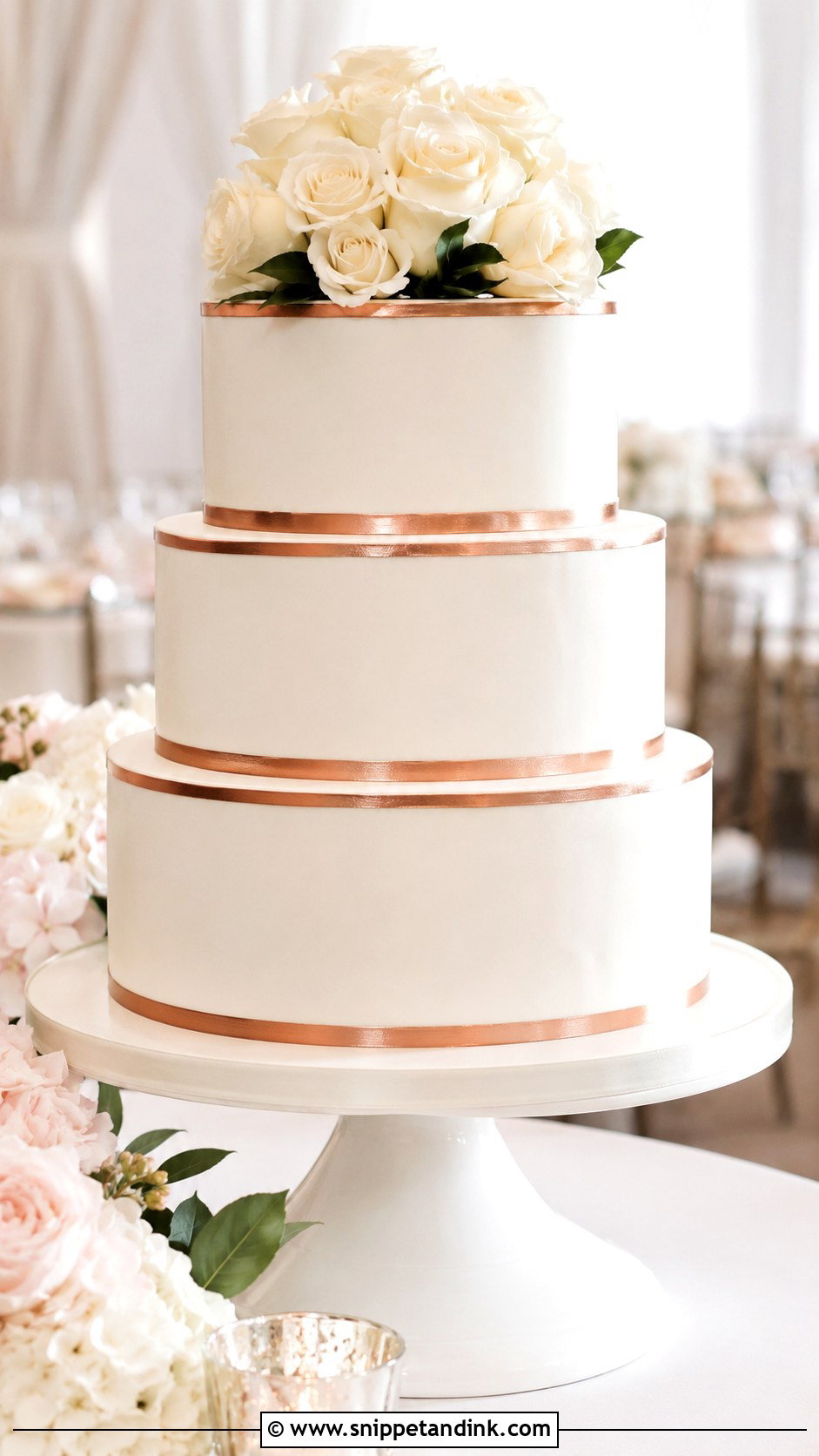
Three clean white tiers with rose gold in thin bands or painted edges is the version I’d call foolproof. The metallic gives the cake presence without the weight that comes from covering too much surface. Keep the tiers smooth for a modern room or add a light texture for a softer look. The detail I always ask for is a sample of your rose gold, whether it’s the invitation foil, the flatware or a hair pin, because rose gold ranges from nearly copper to almost pink, and an unmatched tone is the first thing people notice on the dessert table.
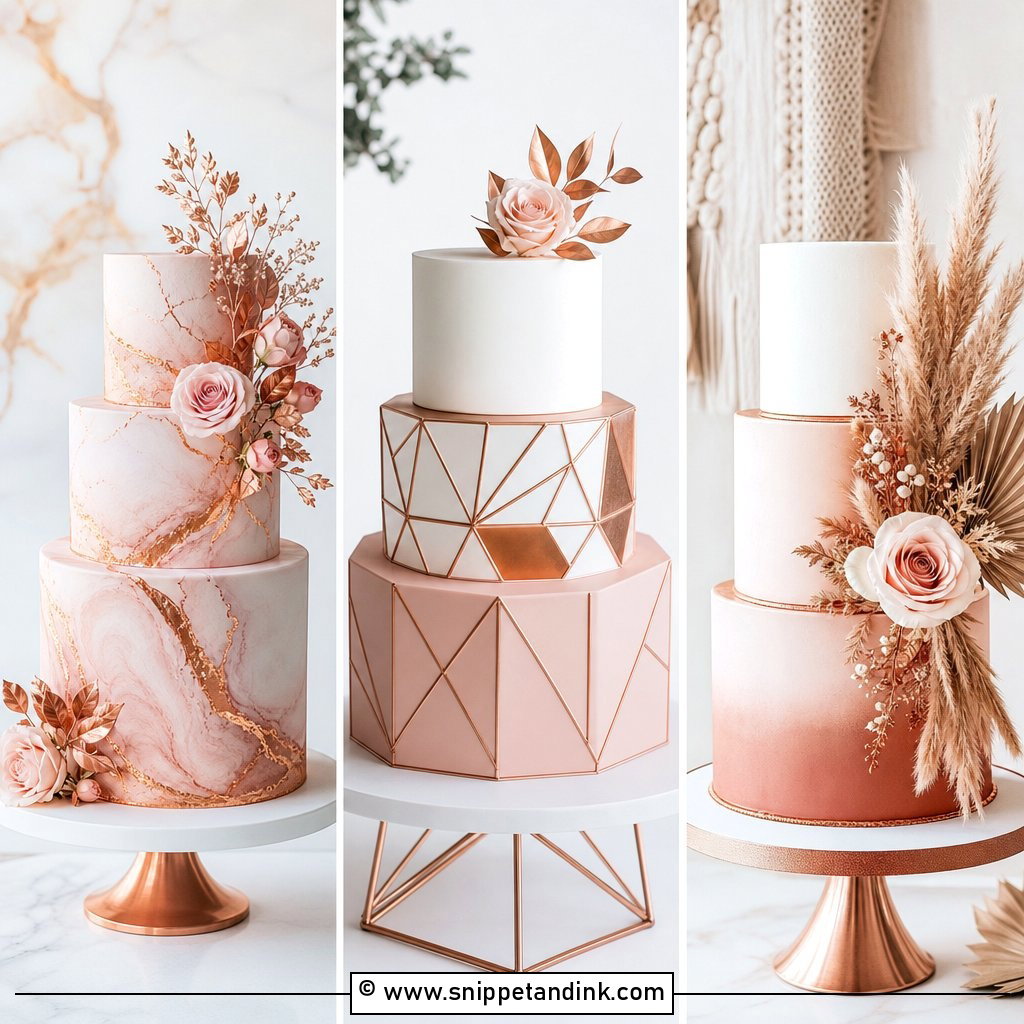
2. White And Rose Gold Marble Wedding Cake
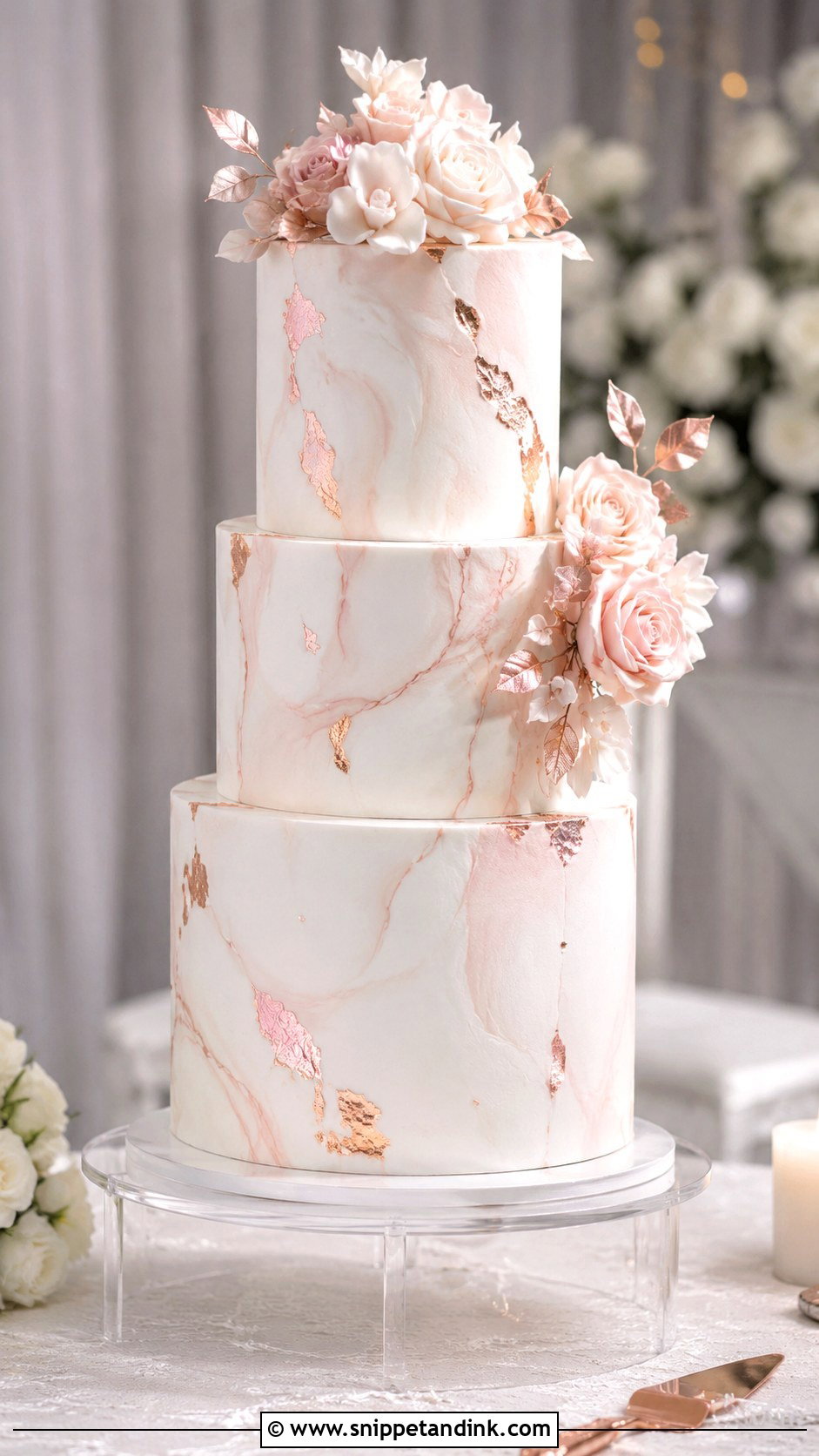
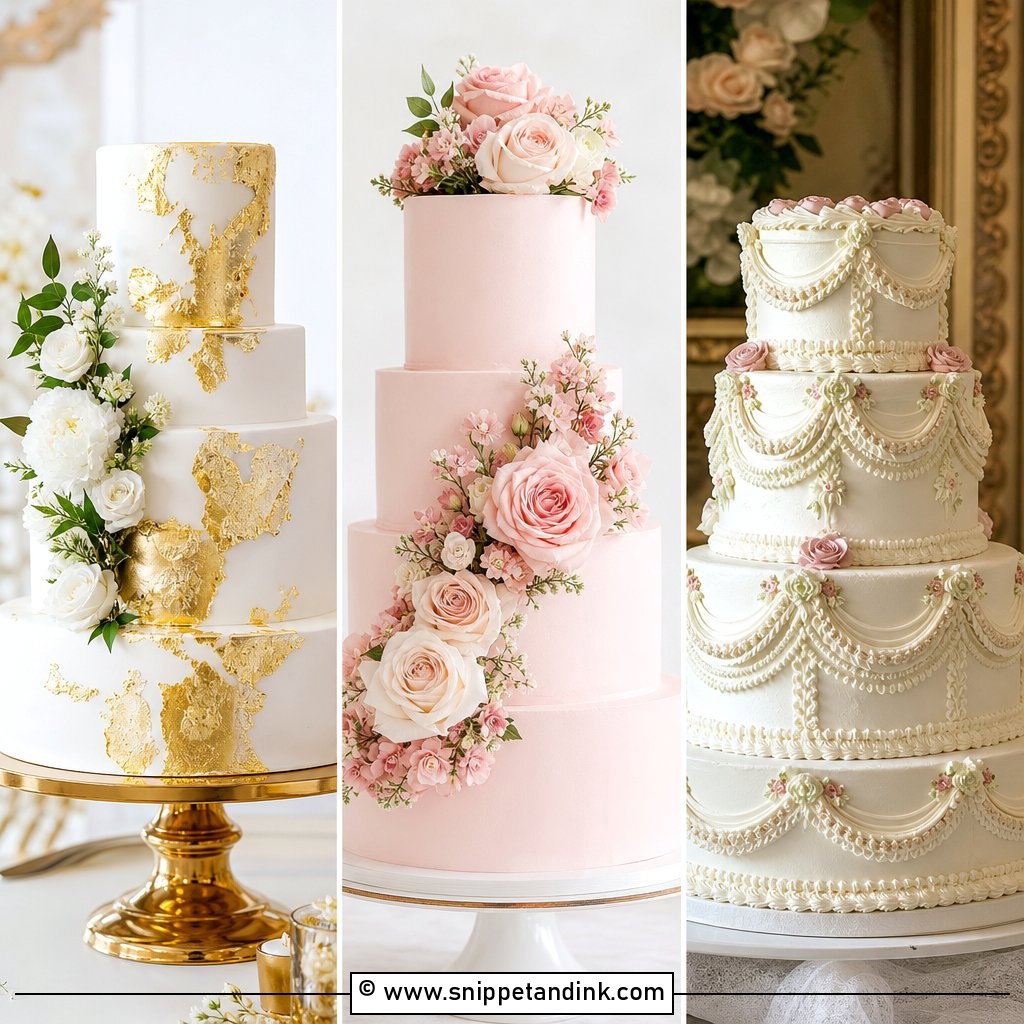
Marble works best on tall tiers with sharp edges, where the veining has room to travel. A white and rose gold marble wedding cake gets its warmth from the metallic running through the white. I marble fondant by folding in streaks of tinted paste and rolling it out once, then I paint some of the veins by hand afterward; overworking the paste turns crisp veins into a muddy grey. A few white roses, blush sugar flowers or flecks of leaf finish it. Use a plain stand so the pattern is the only busy thing on the table.
3. White And Rose Gold Drip Wedding Cake
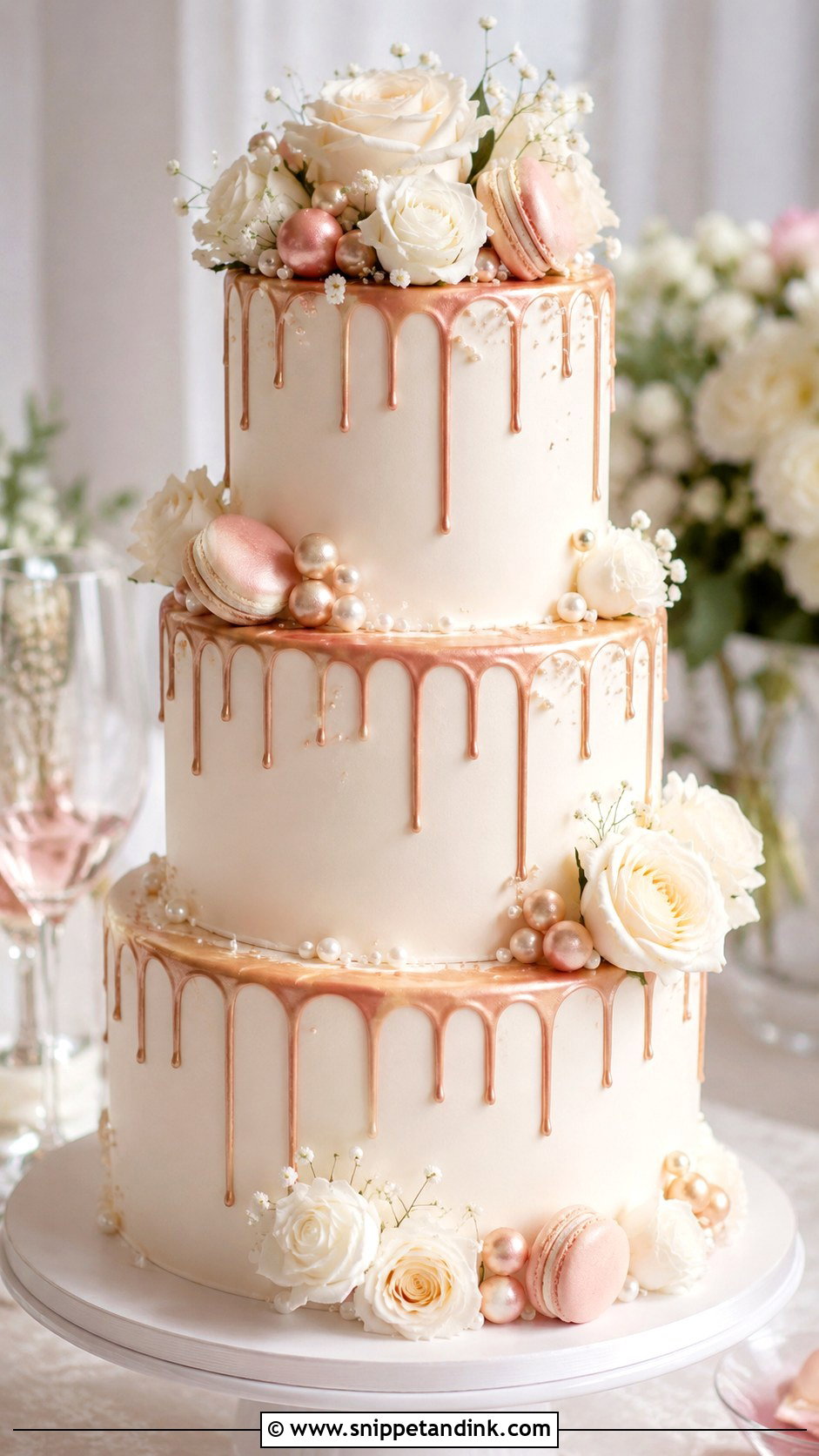
Drips are where rose gold most often looks messy, so this one comes down to control. I pour a white chocolate ganache drip onto a well-chilled cake and paint the metallic over it once it has set, rather than mixing dust into the warm ganache, which dulls it. White buttercream underneath keeps the base soft. Roses, macarons, berries or pearls around the top edge cover the point where the drips start. It sits between casual and formal, and it glows under warm, low reception lighting.
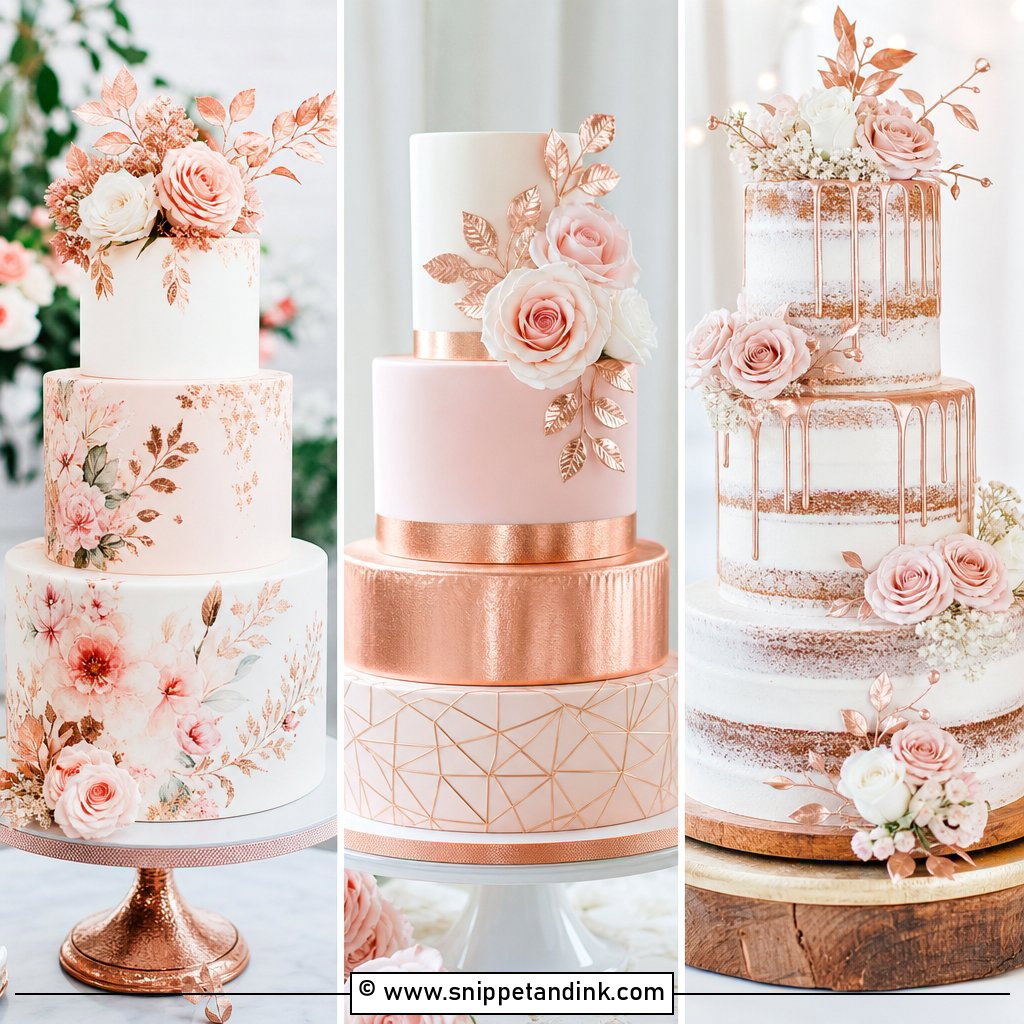
4. White And Rose Gold Floral Wedding Cake
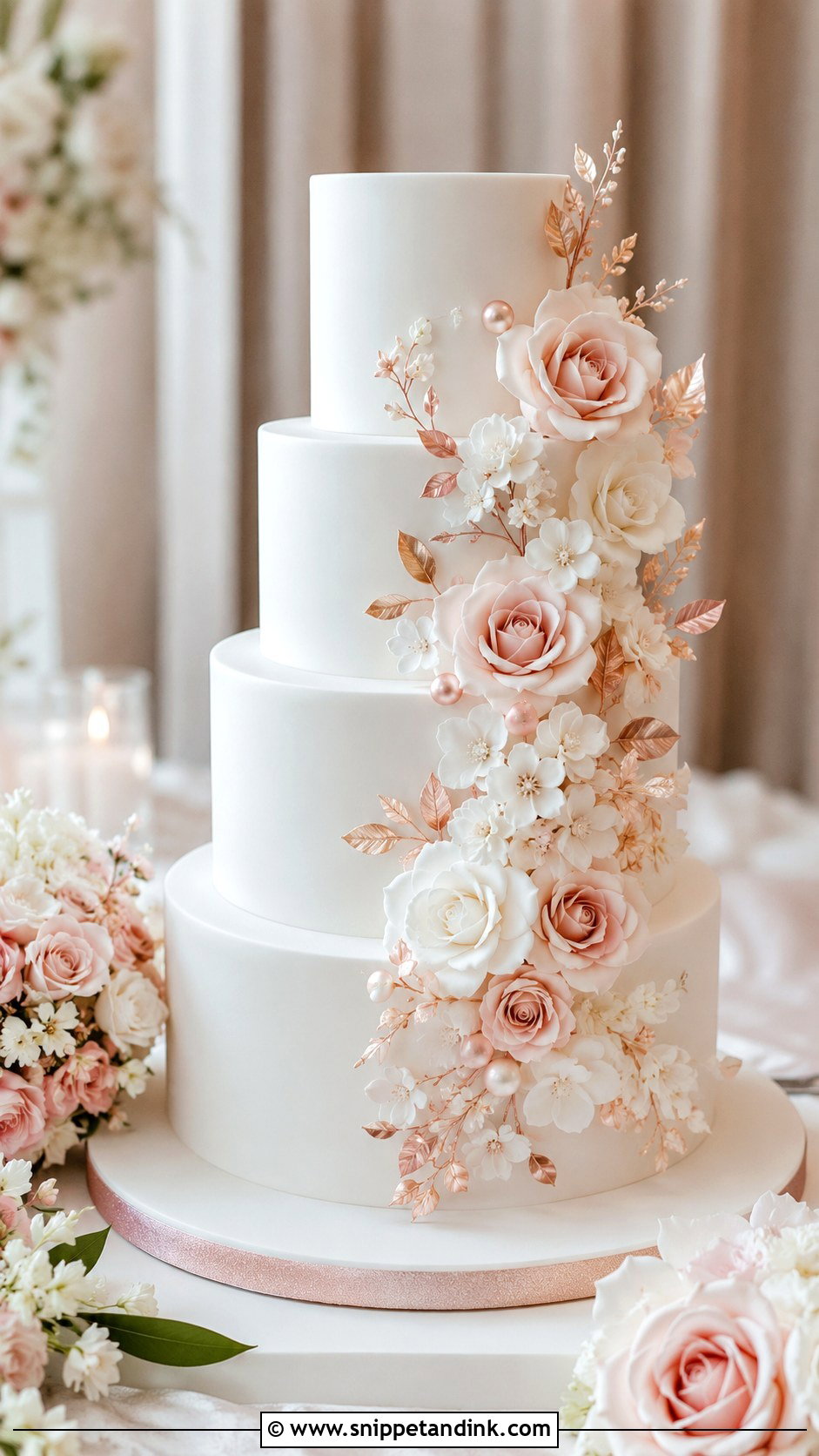
Floral designs let the metallic be a whisper. Start with white tiers, then sugar or fresh flowers in ivory, blush and pale pink, and bring in rose gold only on painted leaves, wired stems, thin tier borders or a light dusting on petal edges. If the dust goes on fresh flowers, those flowers come off before anyone eats near them. My favorite trick is repeating one bloom from the bouquet on the cake; it connects the two in photos without anyone having to explain it. Spring and summer suit it, though floral centerpieces make it work indoors any time of year.
5. White And Rose Gold Buttercream Wedding Cake
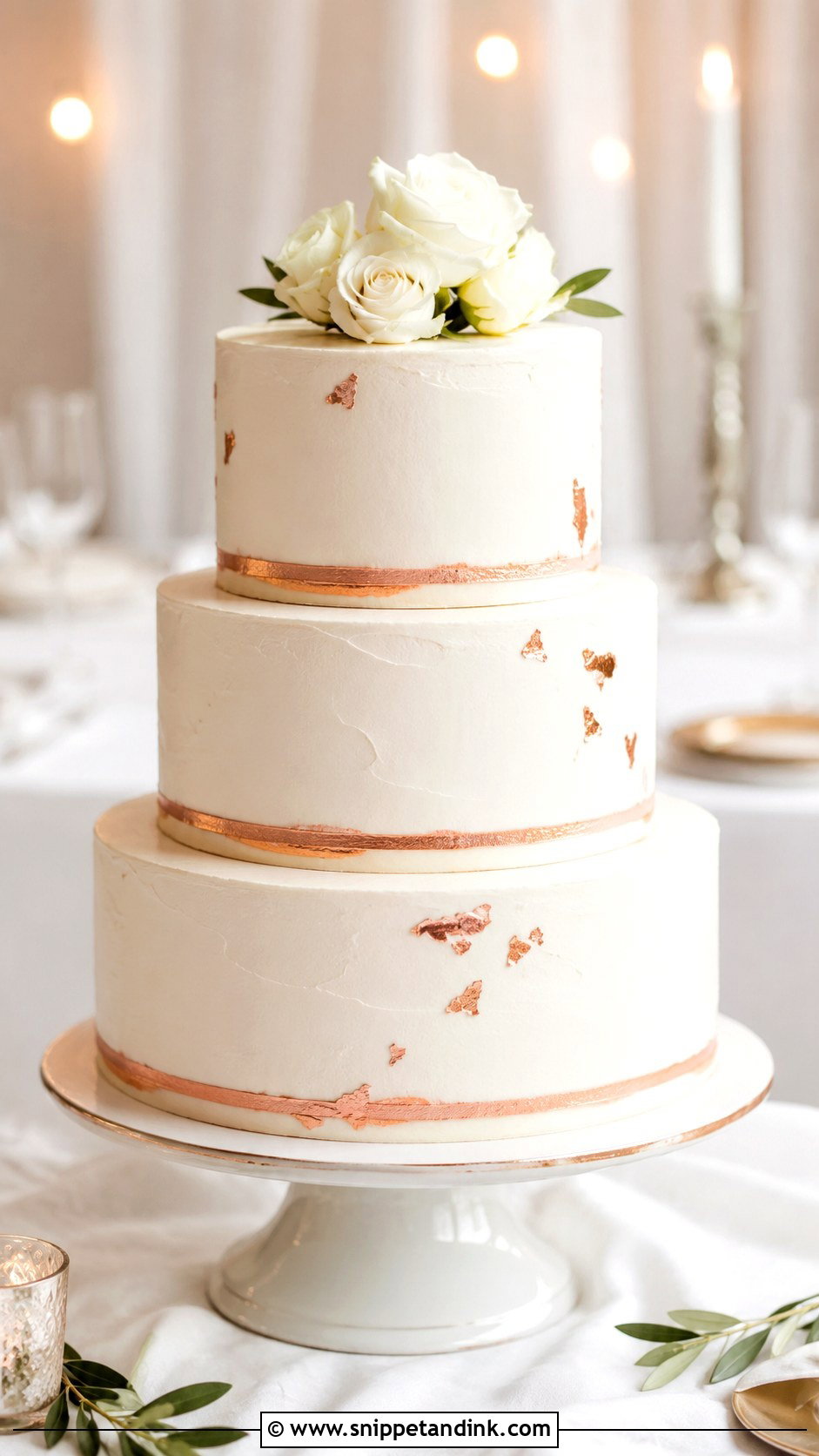
Buttercream gives a handmade softness that fondant can’t, and a white and rose gold buttercream wedding cake can be smooth, ridged with a comb, or swept with a palette knife. Metallic paint sticks poorly to soft buttercream, so I chill the cake until the surface is firm before applying foil or painted streaks, and I keep the strokes light. Pearls or a slim topper work just as well if painting feels risky. Vanilla, almond, lemon, raspberry and white chocolate all sit happily under buttercream.
6. White And Rose Gold Fondant Wedding Cake
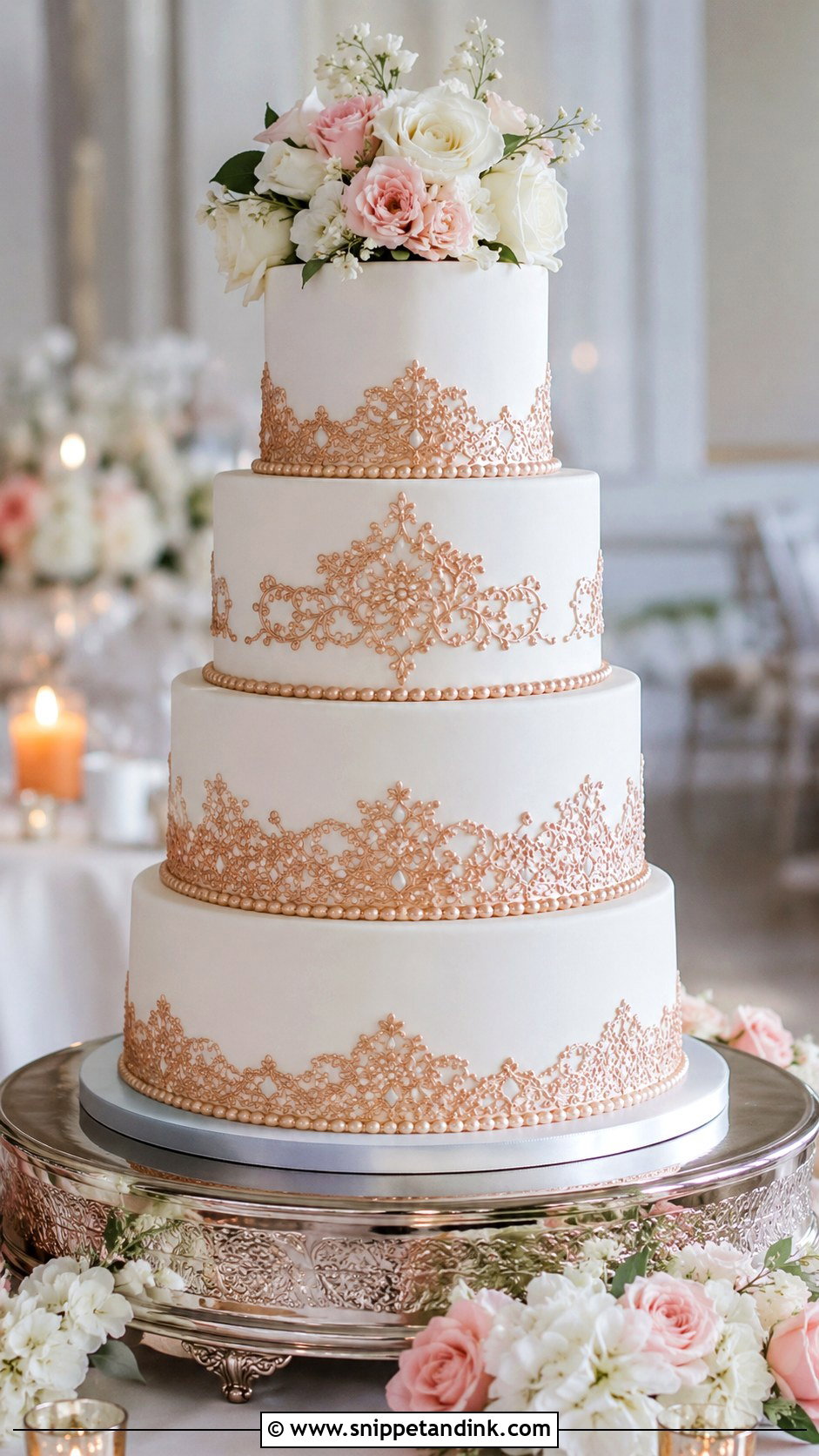
Fondant is the right base when you want metallic painting that looks flawless, because paint glides over a firm, smooth surface instead of catching in texture. I leave white fondant matte so the rose gold contrasts with it; a satin-sheen fondant next to shiny paint flattens both. Thin piped lines, edible lace, a monogram or one fully painted tier all suit formal rooms and black-tie dinners. To keep it from looking stiff, I’d soften it with sugar flowers or a textured middle tier.
7. White And Rose Gold Geometric Wedding Cake
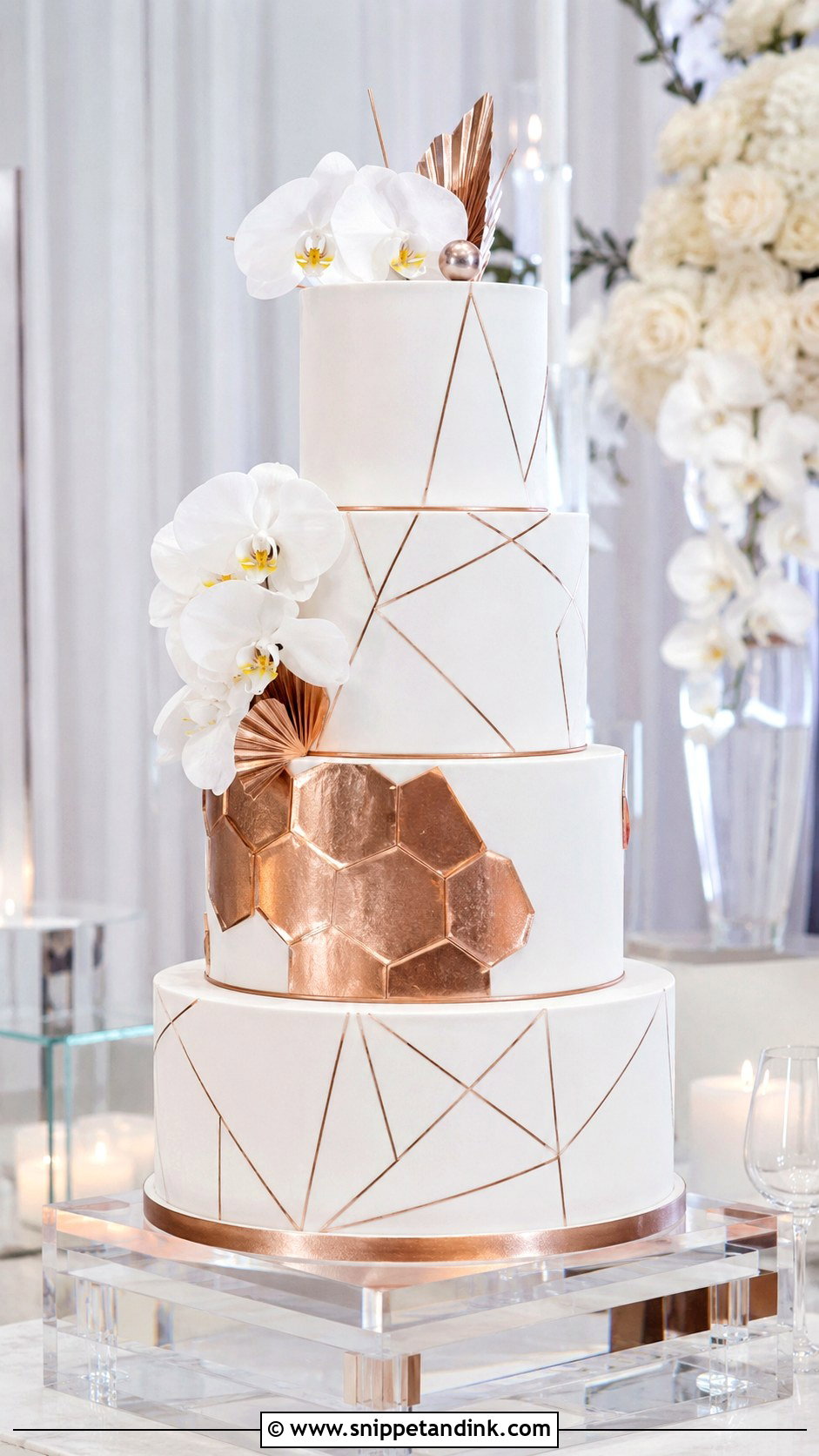
Geometric detail suits couples who like graphic design more than flowers: rose gold lines, hexagons, arches or angular panels laid over white tiers. Precision is the whole look, and that’s where it gets expensive, since every line is cut or painted by hand and a wobble shows from across the room. I’d suggest one geometric tier between two plain white ones; it reads as deliberate rather than busy. Acrylic stands and minimal florals keep the modern line going.
8. White And Rose Gold Lace Wedding Cake
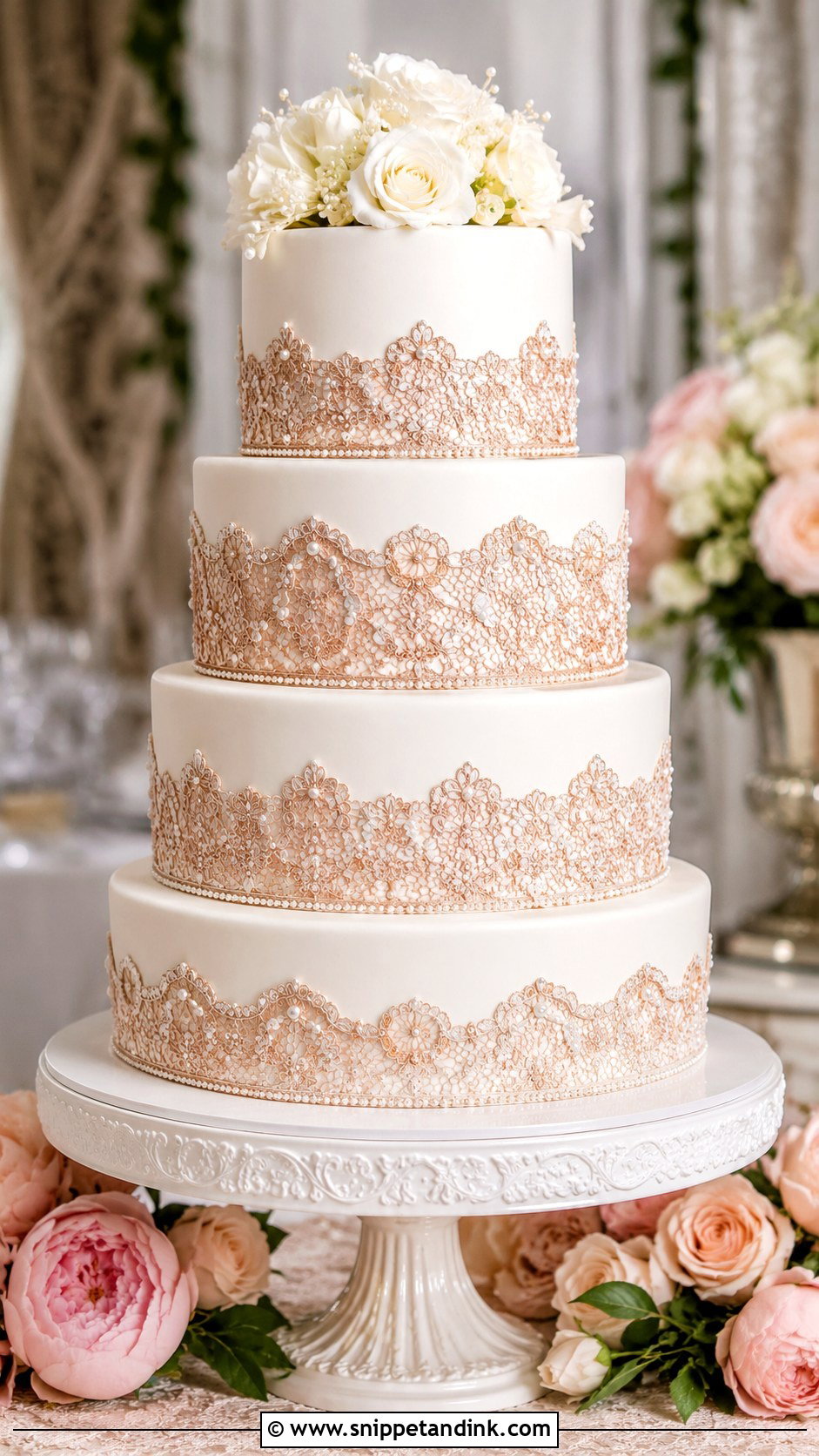
Lace can be piped, stenciled, molded, or painted onto white fondant or buttercream, and rose gold works best as a highlight brushed over the raised parts rather than covering the whole pattern. That gives the lace a soft vintage glow that still looks current. If your dress has lace, bring a photo or a scrap, and I’ll copy the motif into a silicone mold or a stencil; a dress-matched lace is one of the most personal touches you can put on a cake. Tall plain tiers give it room.
9. White And Rose Gold Pearl Wedding Cake
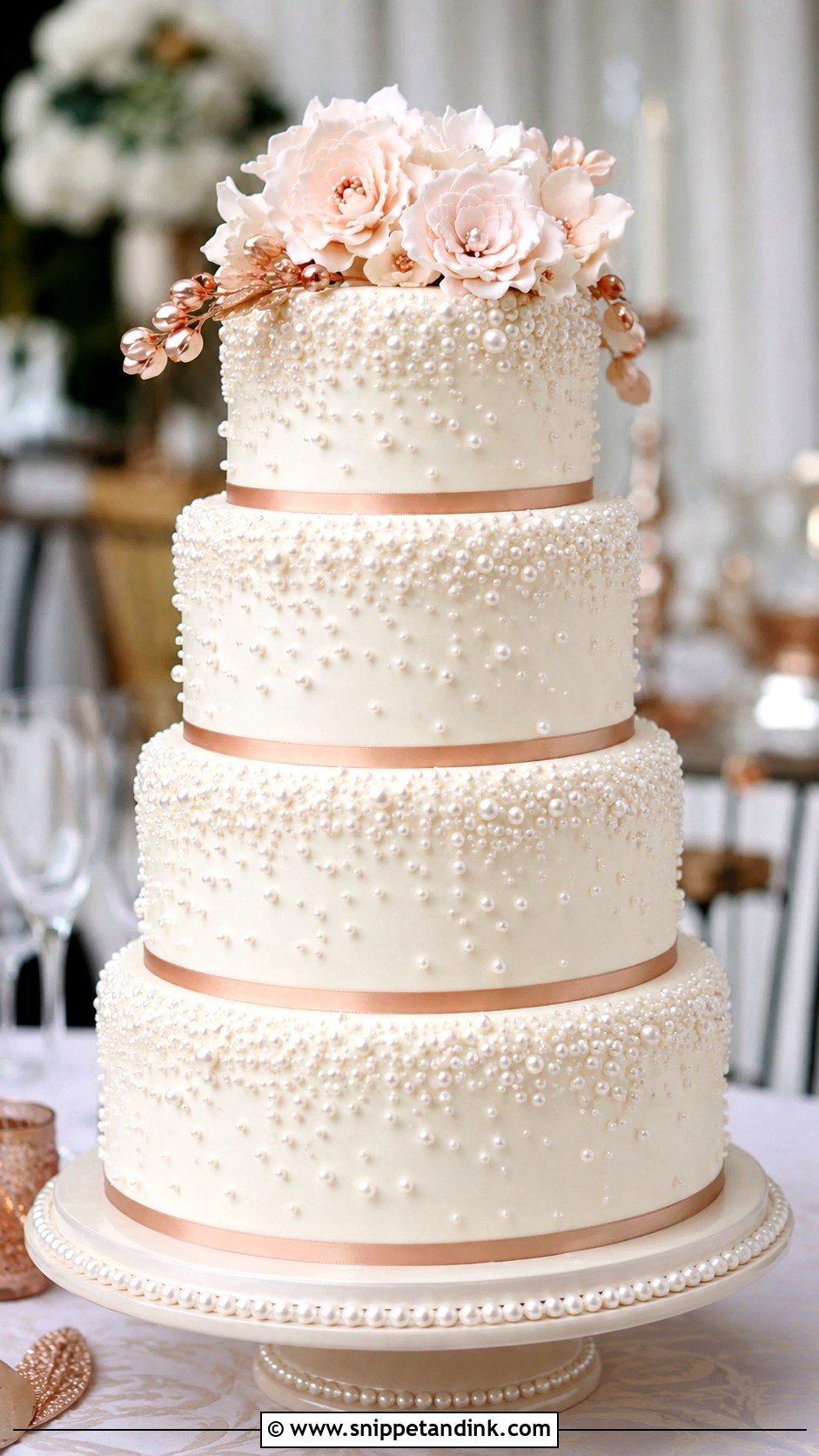
Pearls add texture without adding color. Tiny edible pearls can sit in neat rows, scatter lightly across the tiers or form borders between layers. Pick one pearl treatment and let the rest of the cake stay smooth, or the surface starts to look like a sewing box. I mix ivory pearls with the white base and save the rose gold for a monogram or a ribbon line. Check that the pearls you use are sold as edible; some craft-style dragées are meant only for decoration.
10. White And Rose Gold Ruffle Wedding Cake
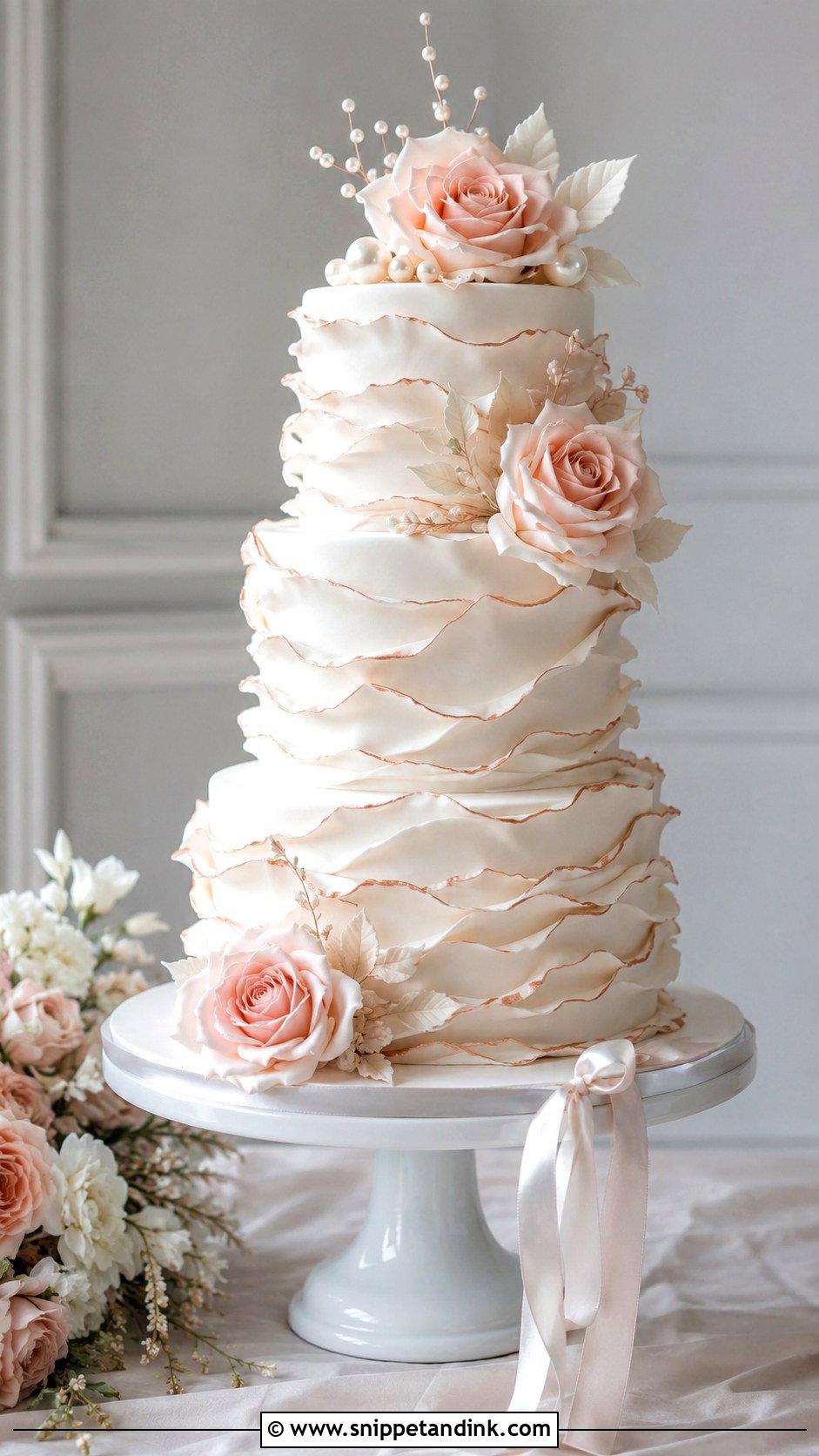
Ruffles behave like fabric on a cake, and the material changes how they move. Wafer paper ruffles are feather-light and look the most like silk, but they wilt in humidity; fondant ruffles hold their shape in a warm room; buttercream ruffles are soft and the most fragile when bumped. Rose gold painted only along the edges makes each layer catch the light. I’d ruffle one or two tiers and keep the rest smooth with a thin metallic band, so the eye has somewhere to rest. Satin linens nearby pick up the same sheen.
11. White And Rose Gold Sugar Flower Wedding Cake
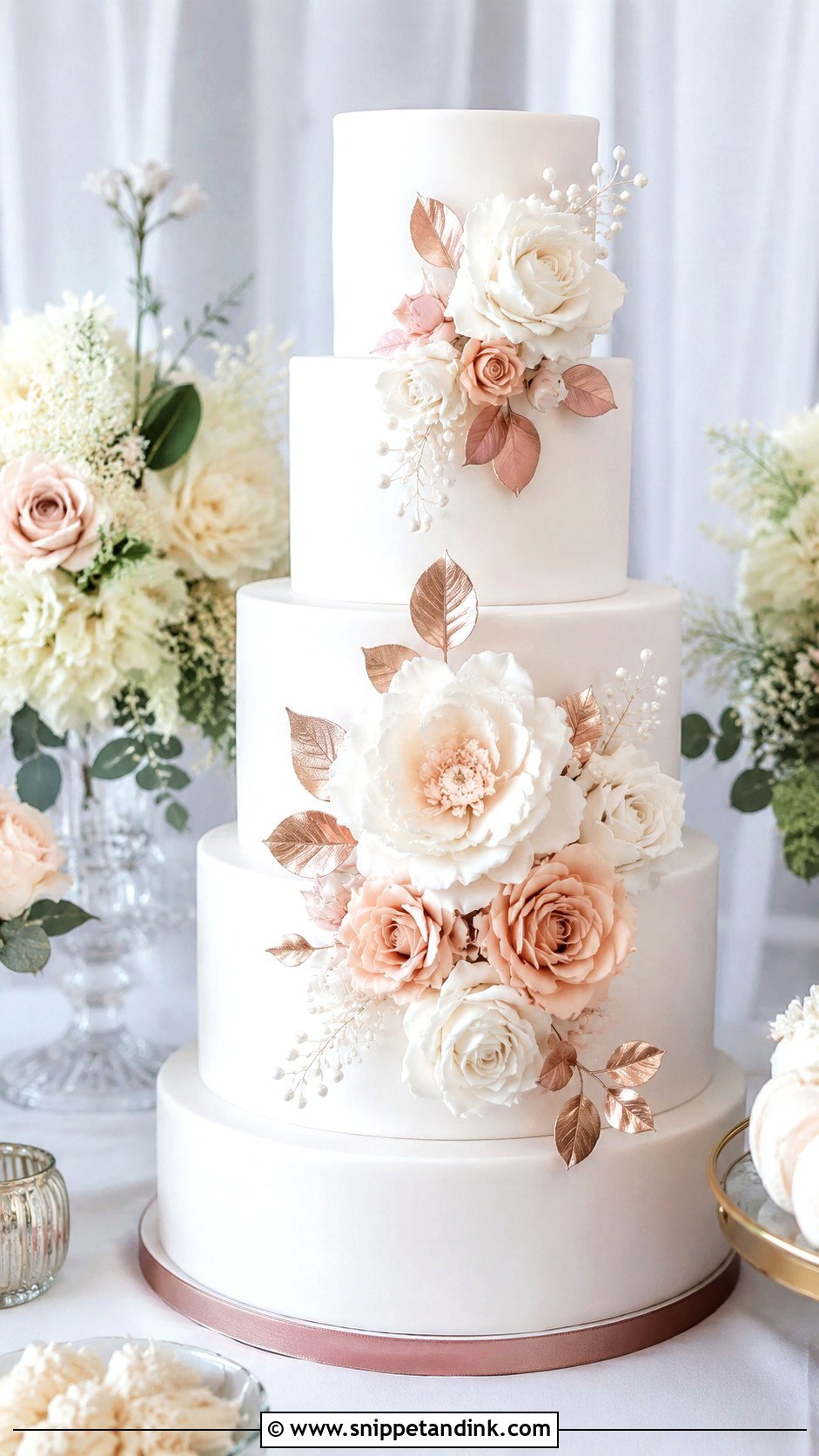
Sugar flowers last all day, which matters if your favorite blooms are out of season or too fragile to sit on frosting. I can shape roses, peonies, orchids, ranunculus or small blossoms to match your bouquet, then dust the leaf tips or petal edges with rose gold. Because I wire each flower, I can place every one exactly where it needs to sit for the camera. Sugar flowers do soften in very humid rooms, so they’re kept boxed and dry until set-up. A clean base lets them carry the whole design.
12. White And Rose Gold Monogram Wedding Cake
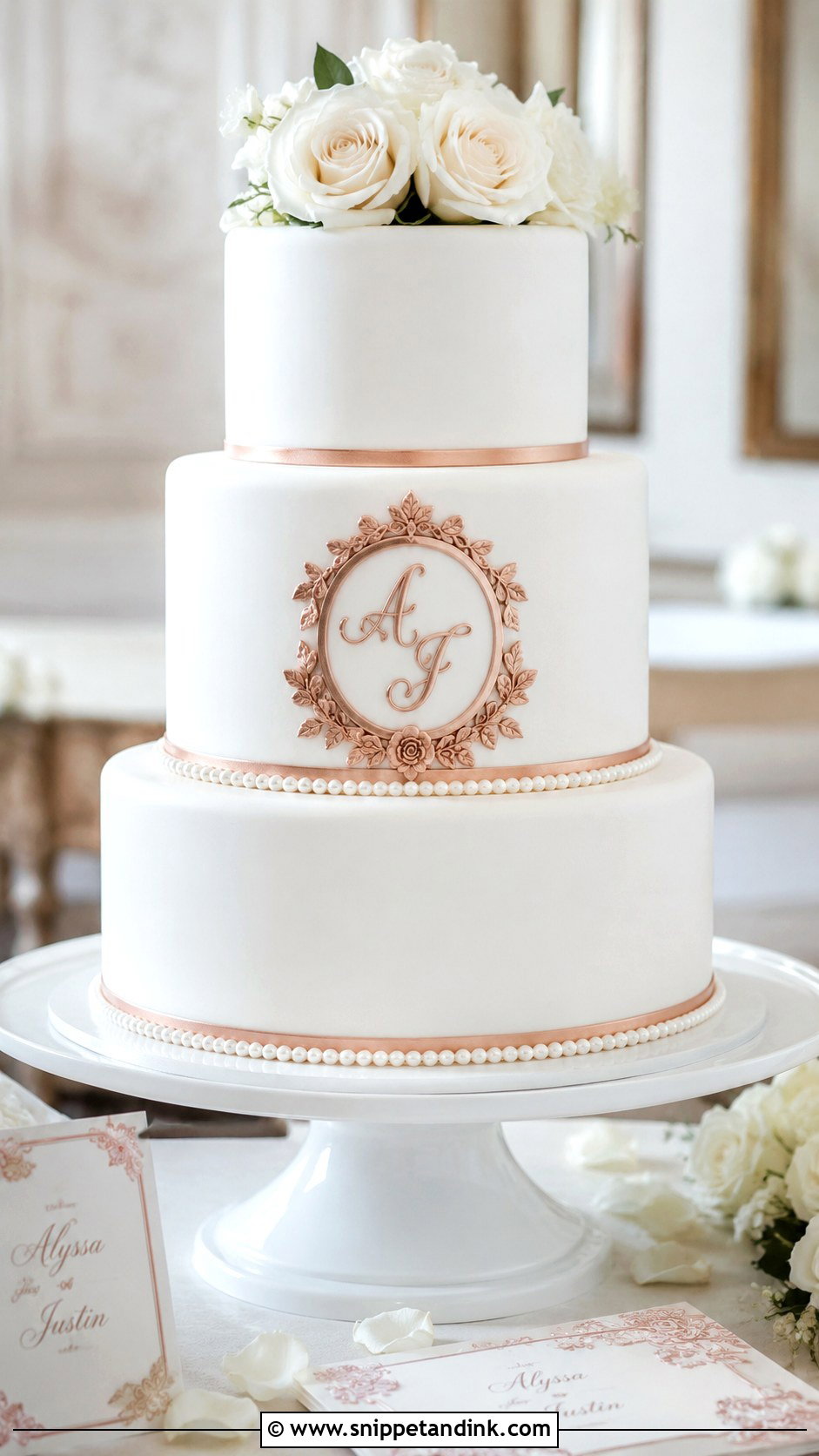
A monogram makes the cake undeniably yours. The couple’s initials can be a rose gold topper, a painted crest, an embossed fondant detail or an edible plaque on the front tier. Send your baker the exact font file or a clear photo of your invitation, since lettering is the hardest thing to freehand and a mismatched serif stands out. Everything else should stay quiet: smooth white tiers, thin borders, maybe a small floral cluster. It shows clearly in front-on photos of the cutting.
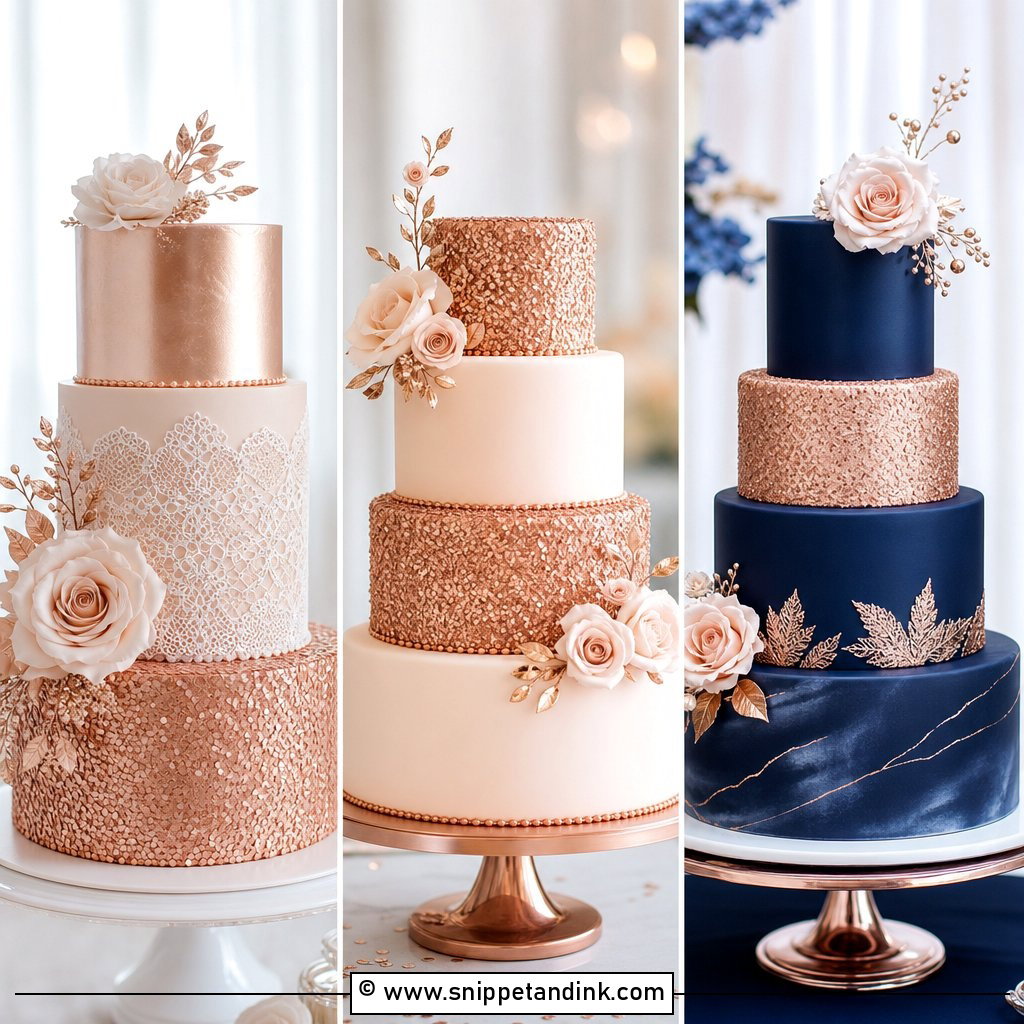
13. White And Rose Gold Sequin Wedding Cake
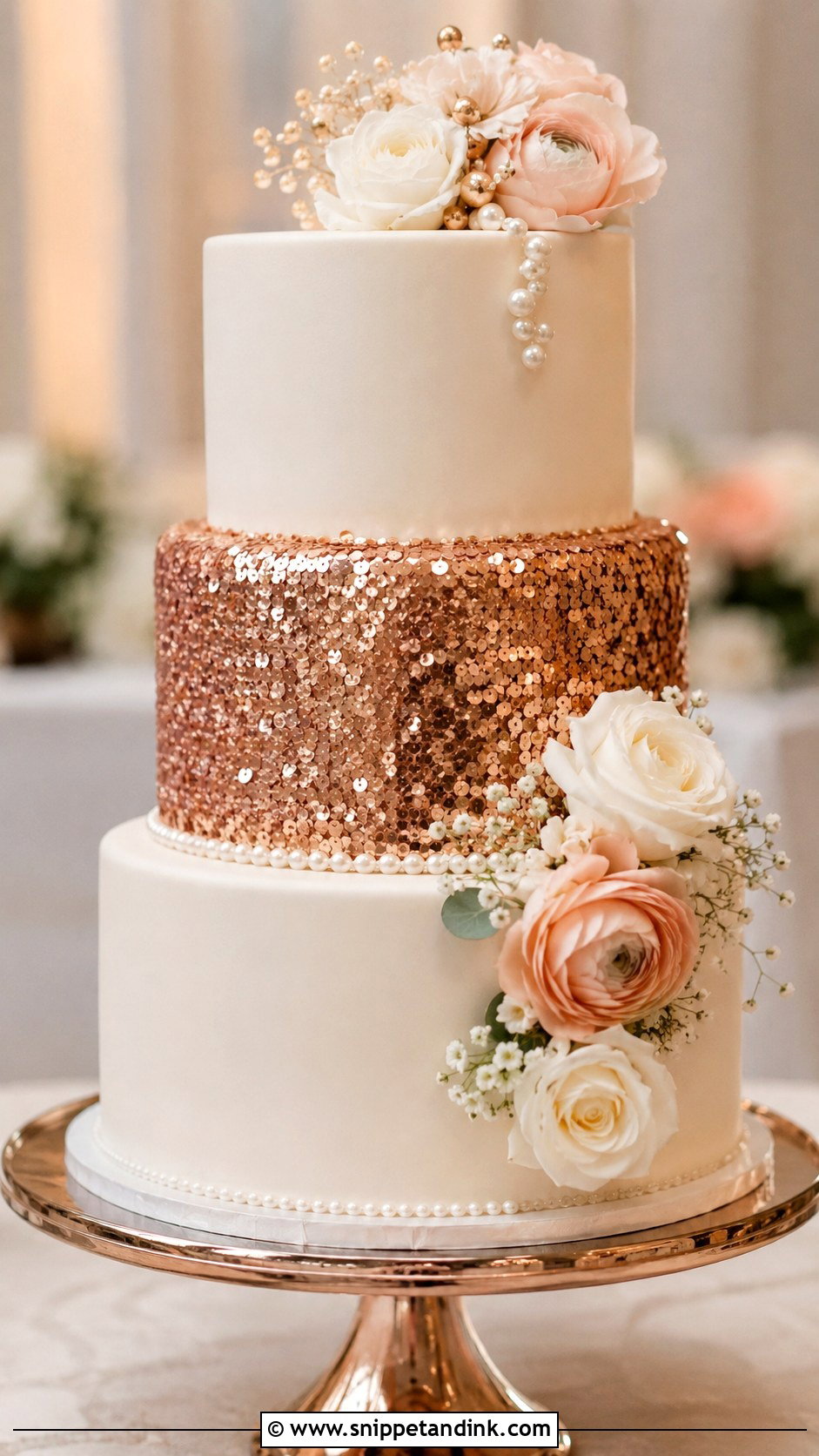
Sequins on cake are usually tiny discs of gelatin or isomalt painted metallic, pressed one by one onto a single tier. It’s slow work, so expect it to be priced accordingly, and keep it to one tier, usually the middle or bottom, while the rest stays smooth white. Evening receptions with candles or spotlights are where it really shines. White roses, blush flowers or a pearl border sit nicely beside it. Choose a plain stand and very little extra decor around the table.
14. White And Rose Gold Naked Wedding Cake
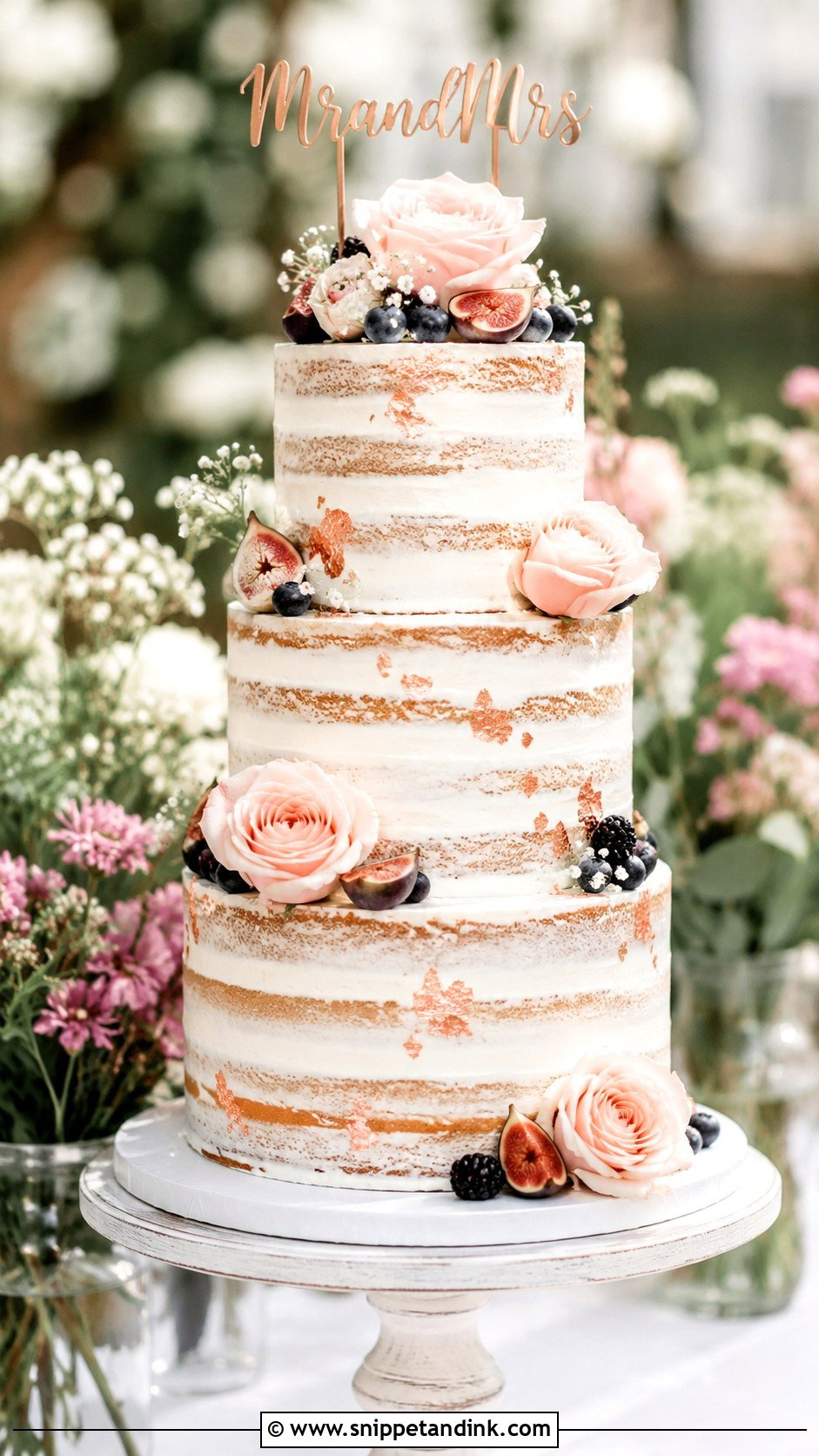
A naked cake shows its layers through a thin scrape of frosting, which means it dries out faster than a fully coated one. I brush the sponge with syrup and assemble it as close to the day as I can, and I’d only recommend it where the cake won’t sit out in sun or wind for hours. Rose gold comes in through a topper, leaf details, small painted accents or a ribbon on the stand. Fresh flowers, figs or pears suit the rustic feel of a garden or barn reception. Keep the metallic touches small so the cake still feels relaxed.

15. White And Rose Gold Square Wedding Cake
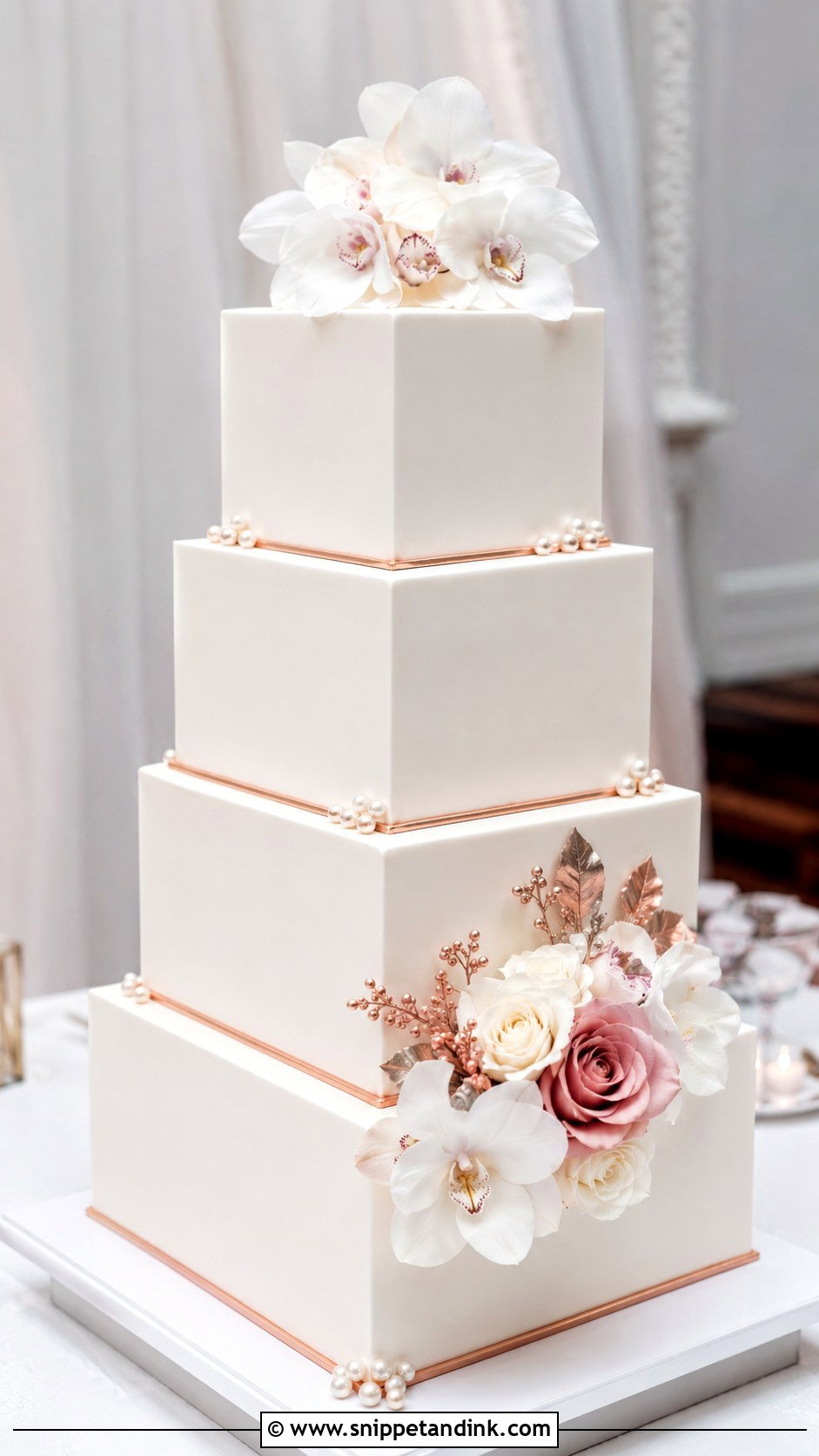
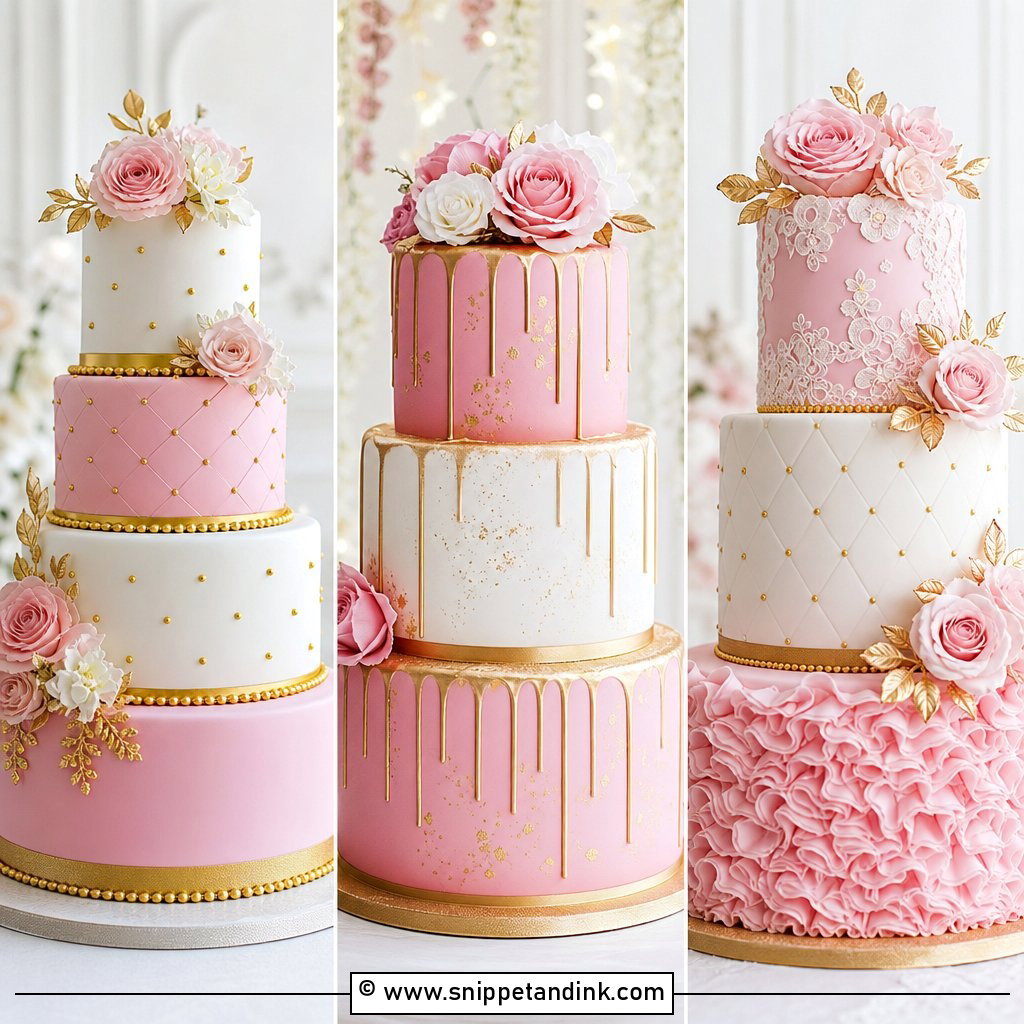
Straight edges make a square wedding cake look architectural, and rose gold lines along each edge sharpen that further. Fondant gives the crispest corners; buttercream softens the look for a less formal room but needs a cool space to keep the corners from rounding. Flowers on one corner, thin metallic edging or a monogram on the front all work. Square cakes look their best photographed from a corner angle, so ask where the photographer will stand when you position the table.
16. White And Rose Gold Tall Wedding Cake
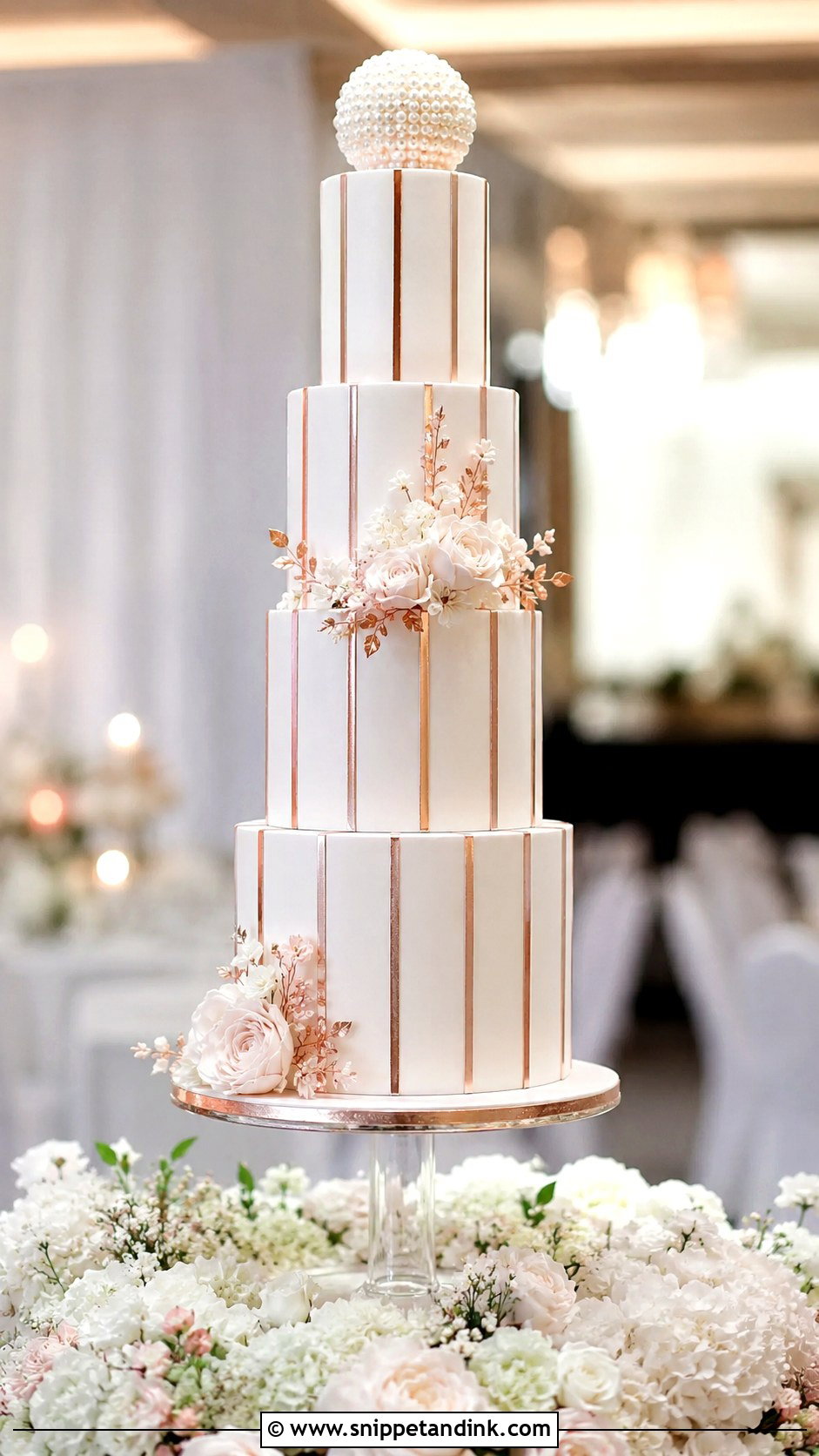
Extra-tall tiers, often six inches or more each instead of the usual four, create height with very little decoration. A white base with rose gold vertical lines or a thin cascade draws the eye upward. Tall tiers need more internal support and are often stacked at the venue rather than delivered whole, so check your baker’s plan for that. High ceilings and big rooms suit this style. A small floral cluster near the top or base softens the shape.
17. White And Rose Gold Small Wedding Cake
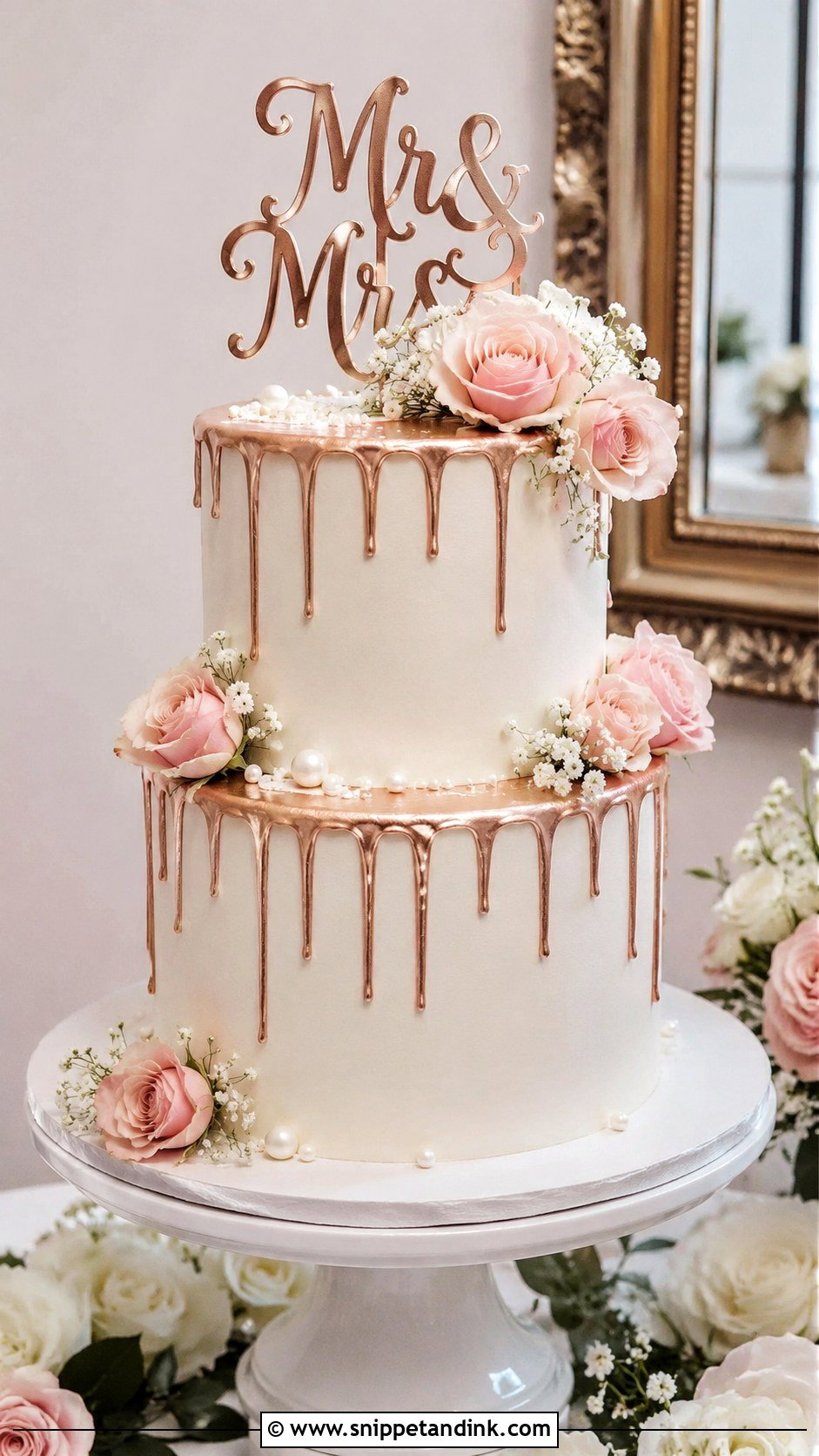
Small cakes suit micro weddings, courthouse celebrations or a cutting cake backed by a dessert table. Two white tiers with one rose gold element, a metallic drip, a short floral cascade, pearl borders or a personal topper, is plenty. On a small surface, two metallic details compete, so I’d pick one and do it well. A raised stand with fresh flowers around the base gives it presence. Since there’s less cake, put your effort into a flavor you really love.
18. White And Rose Gold Watercolor Wedding Cake
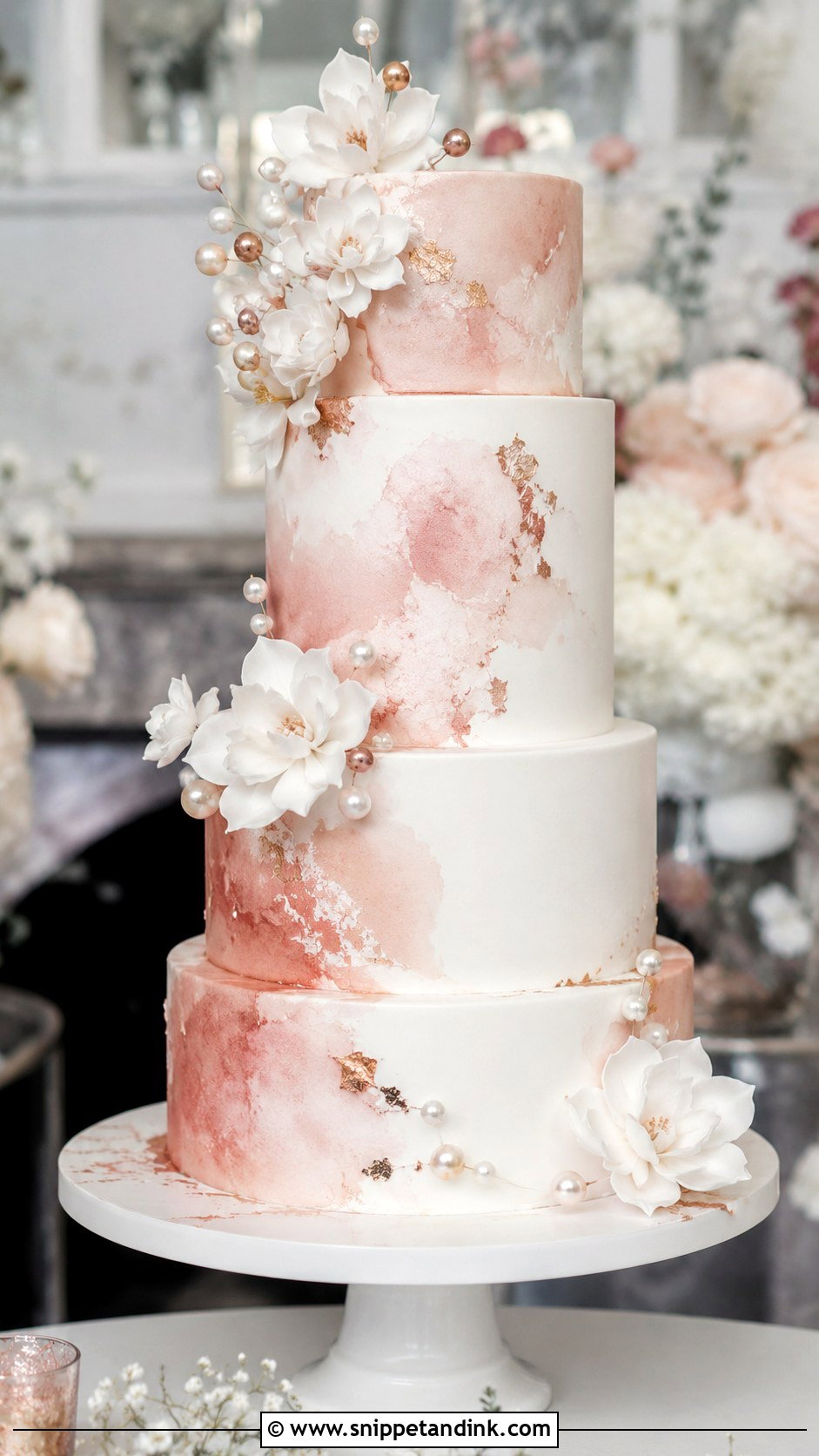
Watercolor here means pale blush, ivory and rose gold blended across the tiers like a painted wash. I apply the color with tinted buttercream and a palette knife first, then add the shimmer last in a few strokes, because metallic dust spread through the whole wash looks muddy rather than glowing. Airy flowers, silk ribbon and bright rooms suit it. Ask your baker to keep the wash subtle; it reads stronger in photos than in person. A few leaf touches or sugar blossoms finish it without covering the paintwork.
19. White And Rose Gold Vintage Wedding Cake
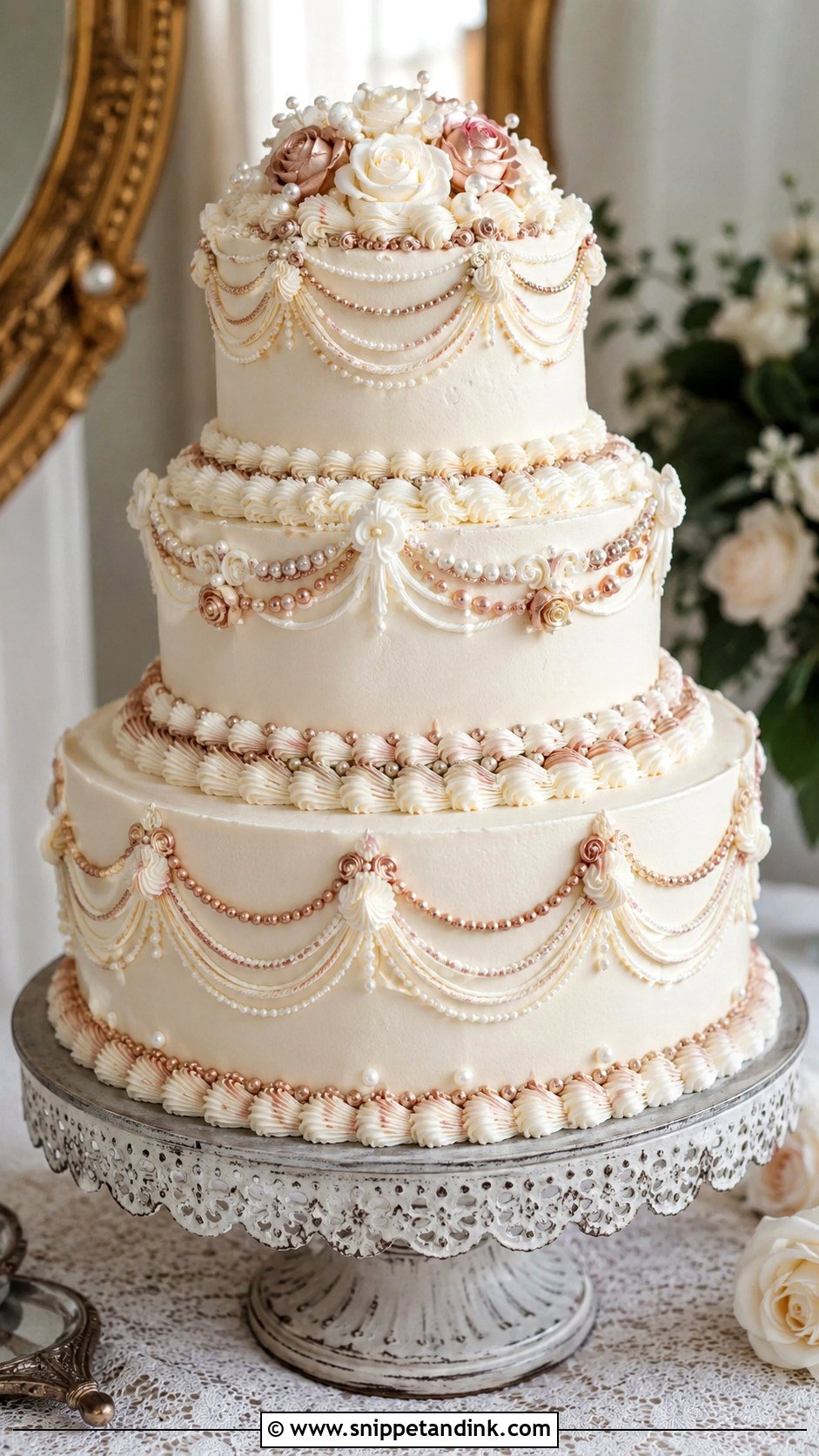
Vintage piping, Lambeth swags, pearls and shell borders, gets a fresh twist when the highlights are rose gold instead of silver. I pipe everything in white first, let it crust, and then pick out a few raised details with metallic paint, never the entire design. A heart shape suits a smaller celebration; stacked tiers suit a grander table. If you love heirloom details, antique mirrors or a lace gown, this one ties them together. Neat, even piping is non-negotiable here.

20. White And Rose Gold Floral Cascade Wedding Cake
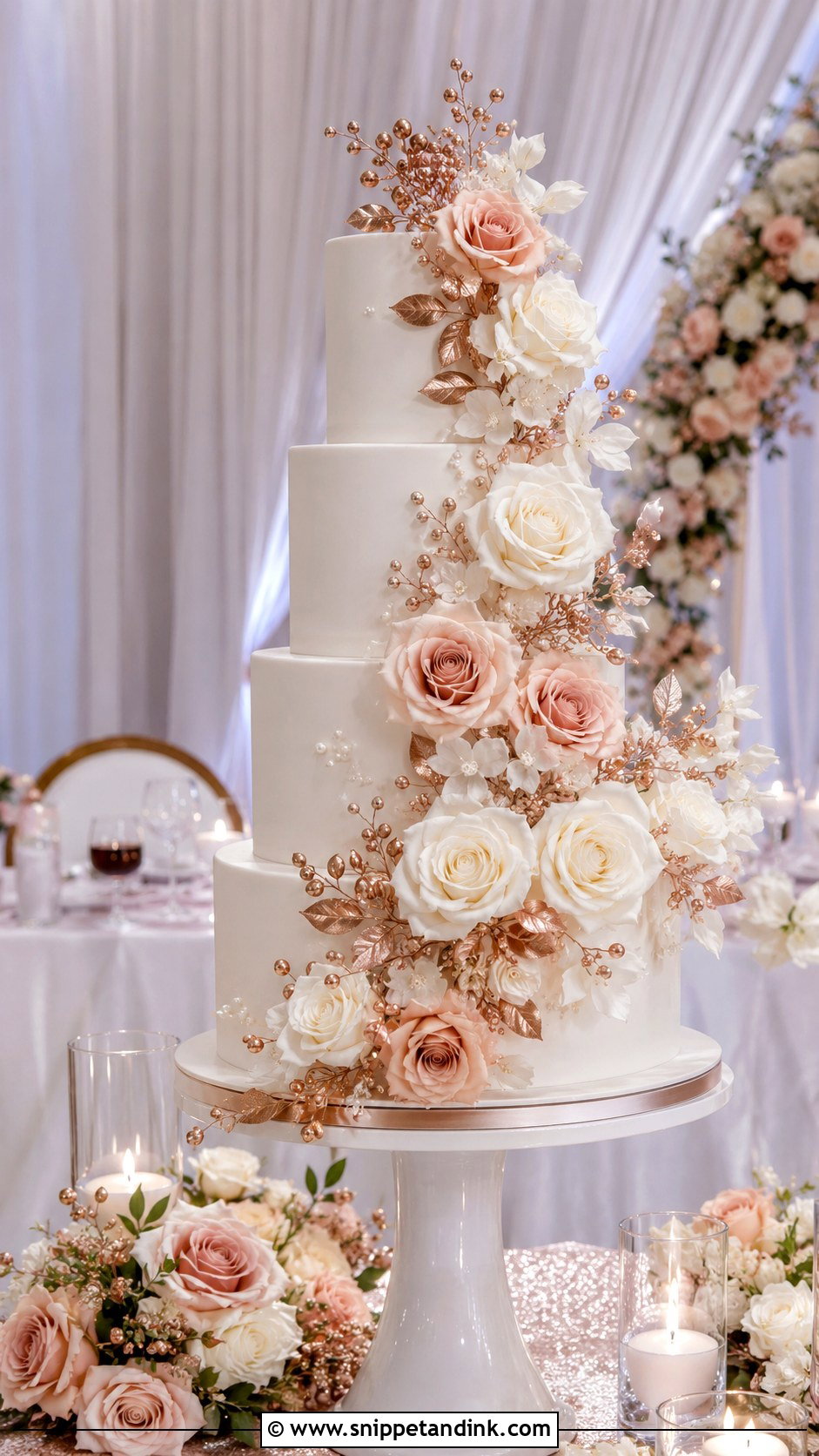
A cascade lets flowers fall from the top tier down one side, giving the cake movement and height. White roses, blush blooms and soft greenery work, with rose gold leaves, painted petals or metallic berries for shine. Round tiers suit it best since the flowers follow the curve. I map the cascade on paper before I place a single bloom, because the line has to look loose while being anchored firmly enough to survive the move to the table. Keep the base finish simple, smooth buttercream or fondant, and match the flowers to your centerpieces.
Is That Shimmer Safe to Eat? Questions for Your Baker
This is the part couples rarely think to ask about, and it matters. Many shimmer dusts sold for cake decorating are labelled non-toxic or for decoration only, which is not the same thing as edible. They can be used on parts that are removed before serving, such as a topper or sugar flowers, but they shouldn’t cover frosting that guests will eat. Here’s what I’d ask before you sign off on a design:
- Which metallic products are going on the cake, and are they sold as edible in your country?
- Which decorated parts will be served and which will be removed before cutting?
- Is any metal leaf used real edible leaf, or imitation transfer leaf meant for crafts?
- How is the paint mixed? Most decorators thin dust with a high-proof alcohol or clear extract that evaporates; ask if you need it alcohol-free.
- Will any metallic touch fresh flowers or non-food items, like wired picks, that sit in the cake?
A good baker will answer all of this without hesitation. If the answers feel vague, steer the design toward pieces that come off before serving: a rose gold topper, wired sugar flowers, a ribbon on the board. You still get the glow, and nobody has to wonder what they just ate.
One last practical note. Metallic paint can smudge if it’s touched before it’s fully dry, and it can bloom with tiny water spots if a chilled cake sweats. I finish metallic details last and let the cake come to room temperature slowly in its box, which is also why the delivery time on your contract matters.
Let White Carry the Cake and Rose Gold Do the Detail
What makes this palette work is the mix of a clean bridal base and a warm metallic accent. It can go simple, dramatic, modern, vintage or rustic depending on texture and shape. For a cake that will look right in photos for decades, keep the tiers smooth and the rose gold thin. If you want more personality, marble, ruffles, sequins, watercolor or a cascade all give it. Whatever you choose, treat the metallic like jewelry on a dress: one well-placed piece, matched to the rest of your wedding, says more than five.
You'll Like These Ideas:







Leave a Reply