
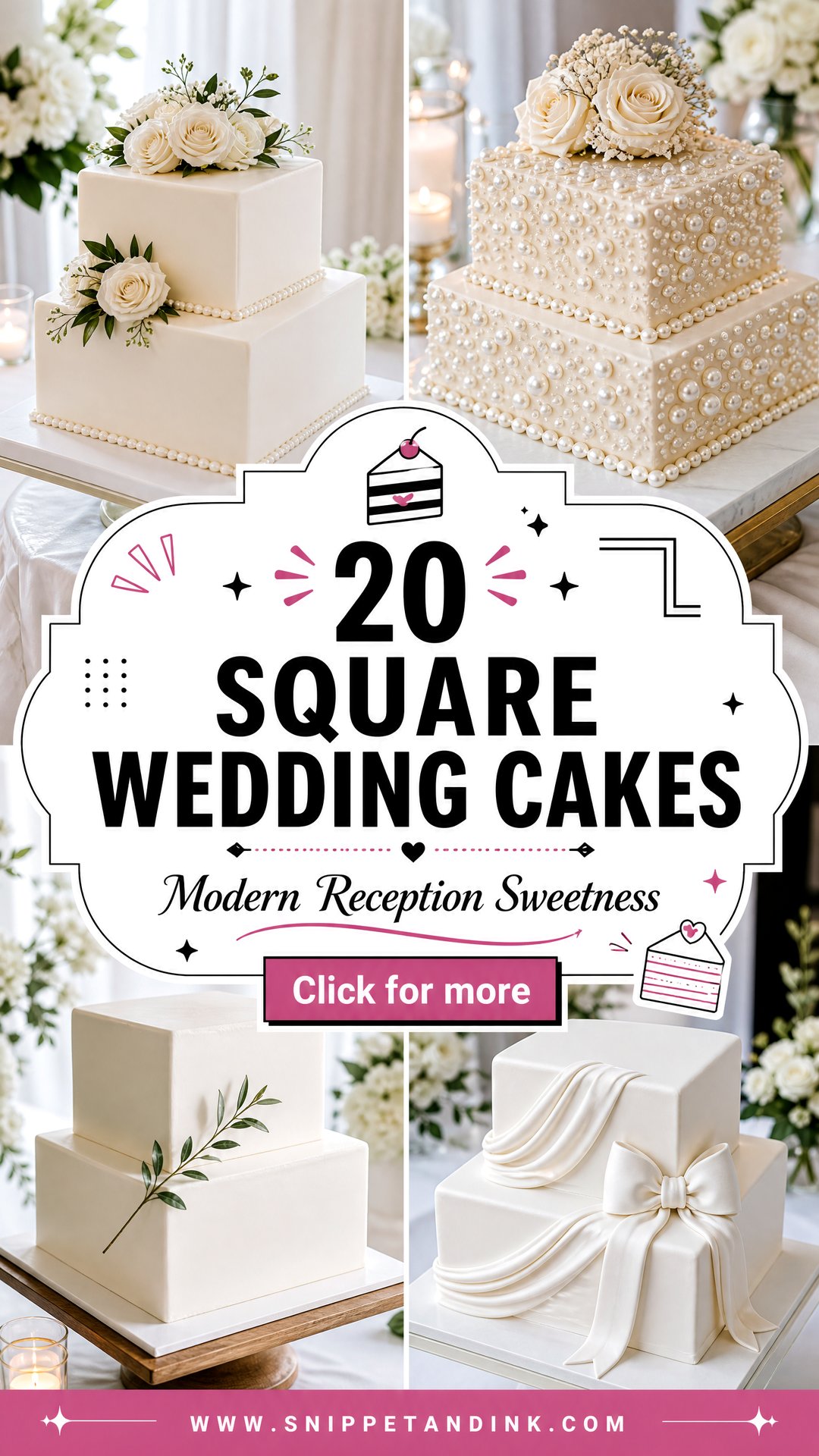
Square tiers are the shape I reach for when a couple wants the cake to look tailored rather than frilly. The corners do the work: a plain ivory finish suddenly reads as architecture, and flowers or pearls sit against it with clean space around them. They are also more demanding to make, because a sharp corner shows every wobble in the frosting, so the quality of the finish matters more here than on a round. Below are twenty ways I’d dress a square cake, from a quiet two-tier to dramatic four-tier centerpieces, with notes on what each one asks of your baker and your venue.
What a Square Tier Changes Compared With a Round One
Most couples come to a square cake for the look, but the shape changes three practical things: how many people it feeds, how long it takes to make, and how it has to be built inside.
More slices from the same width
A square tier holds more cake than a round tier of the same width, because the corners carry extra. On the standard wedding serving charts most bakers work from, with slices cut as narrow one-by-two-inch fingers, an 8-inch square serves roughly a third more than an 8-inch round. That can mean dropping a tier or shrinking the base, so it’s worth working out your numbers before you settle on height.
Corners cost time
Every corner has to be built up and cut sharp, and a four-sided tier gives the finish four places to go wrong. That’s why some bakers charge more for squares, and why a few will gently steer you toward rounds. Ask them directly. I’d much rather a baker admit squares aren’t their strength than have you find out at the reception.
Support you never see
Because square tiers are heavier than rounds of the same width, the structure inside matters more. Each tier should sit on its own board with dowels cut perfectly level beneath it, and a tall cake traveling any distance needs one long dowel running down through the center of the stack.
1. Simple Square Wedding Cake
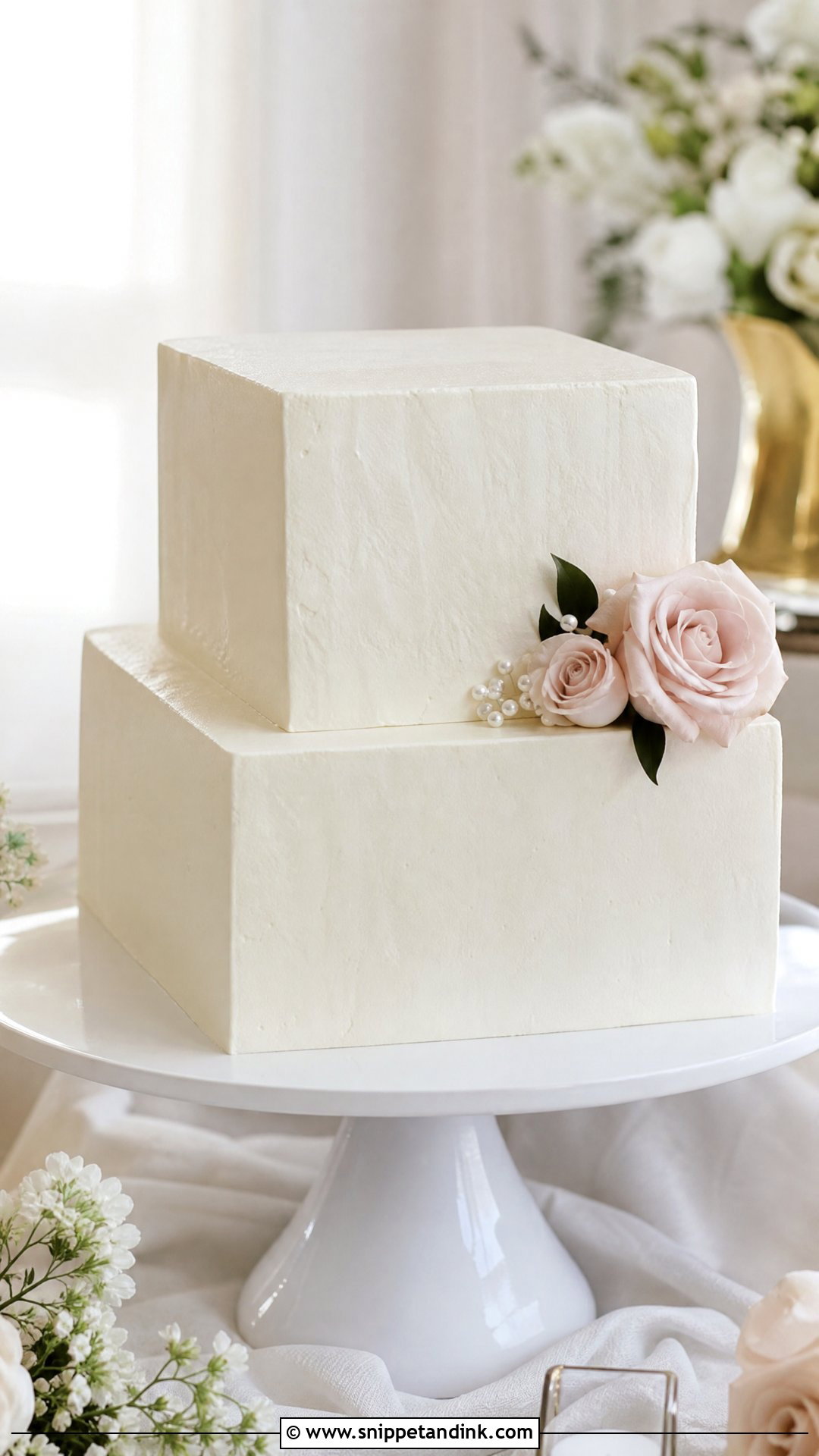
Plain square tiers look intentional precisely because there’s nothing to hide behind. That’s also the catch. With no flowers or piping to distract the eye, a soft corner or a bulge at the base is the first thing guests notice, so I put most of the effort into a ganache undercoat that sets firm before the final coat goes on. One small accent is plenty, such as a thin ribbon at the base or a line of pearl piping. When you meet bakers, ask to see photos of their plain square cakes specifically, not their decorated ones.
2. Two Tier Square Wedding Cake
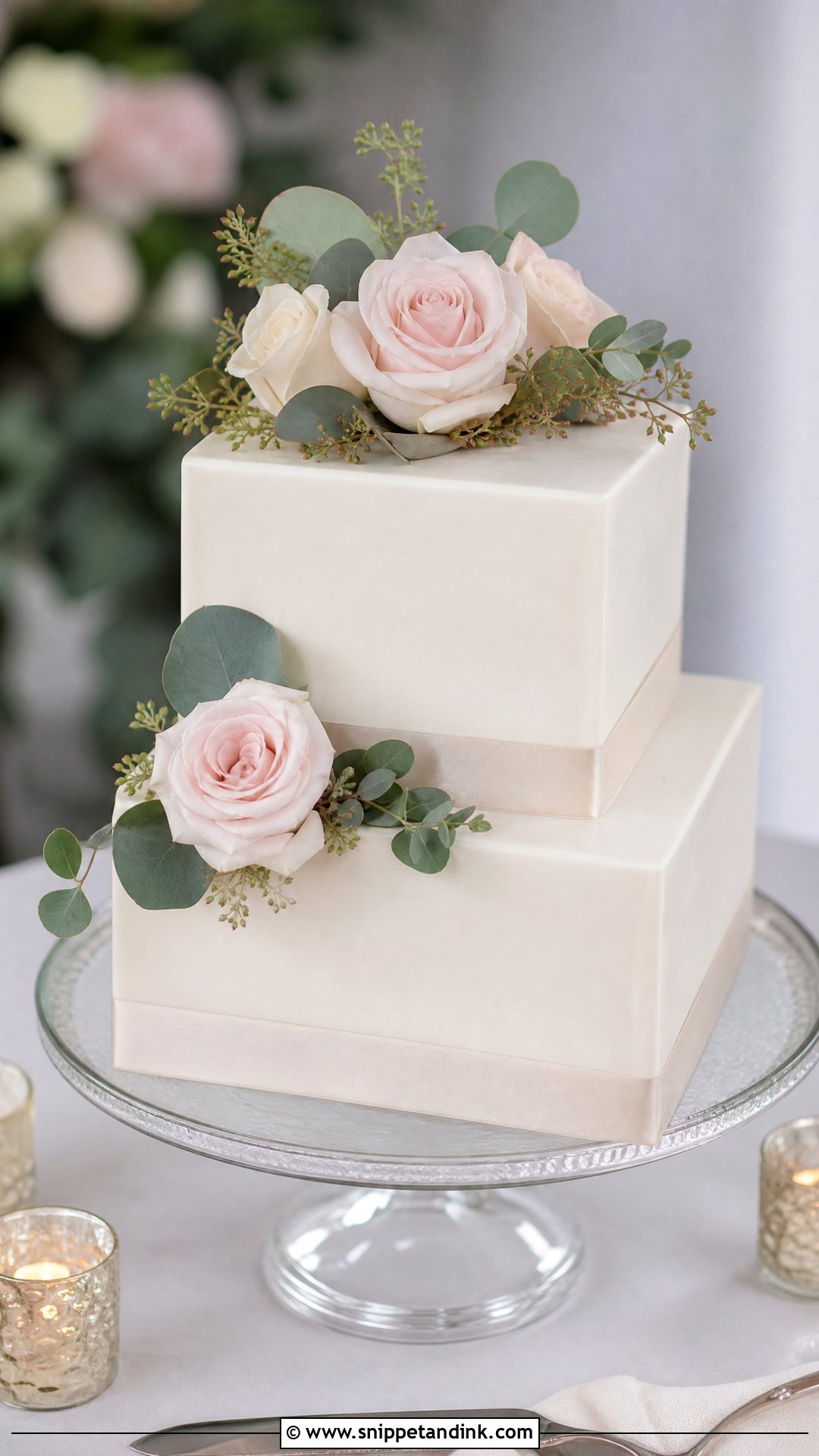
Two square tiers give a small wedding real height without the cake looking like it was built for a ballroom. I usually pair a 10-inch base with a 6-inch top, which leaves a generous ledge for flowers and keeps the proportions from looking stubby. Because square tiers carry more cake per inch than rounds, this pair feeds more guests than people expect. Keep it white, or let one accent color from your palette show up in the flowers rather than in the frosting itself.
3. Three Tier Square Wedding Cake
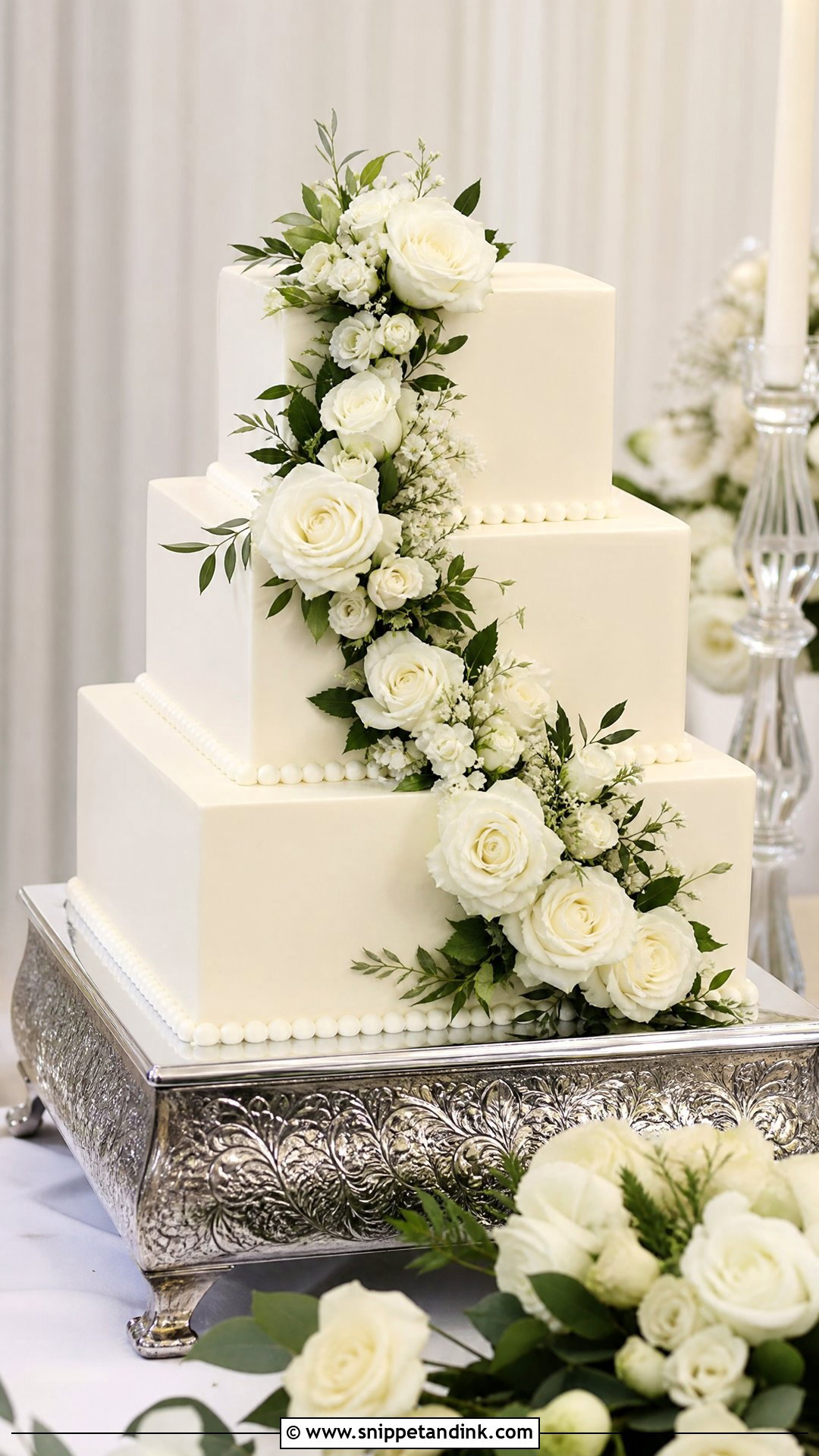
Three tiers is where a square cake starts to look properly architectural, and it’s the size I suggest most often for mid-sized guest lists. The risk with three is decorating every tier differently and losing the shape. I’d rather see one idea carried all the way through, like a sugar flower cascade running diagonally from the top corner to the opposite base corner, or a single metallic band repeated on each tier. Diagonals suit squares far better than rounds, because the eye naturally follows the corners down.
4. Four Tier Square Wedding Cake
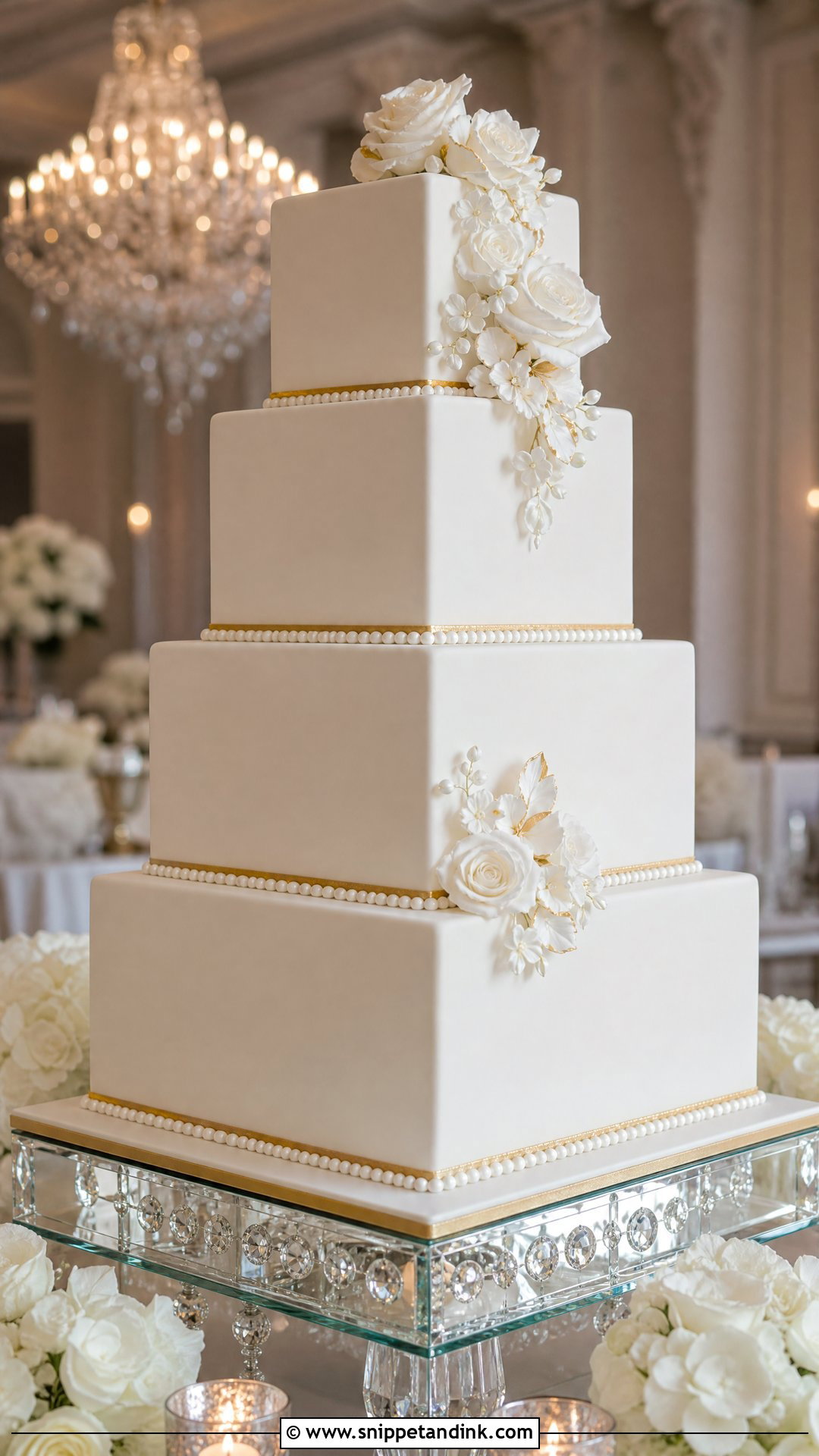
Four square tiers is a lot of cake, physically. A stack like this can easily weigh more than twenty pounds, so the internal support matters as much as the decoration: every tier needs its own board and dowels, and I run a central dowel through the whole stack before it travels. Smooth fondant holds crisp edges best in a big room, though a well-chilled buttercream can manage it. Give the decoration a clear plan, such as sugar flowers on alternate corners or a pearl border at each base, and it reads as grand rather than crowded from the back of a ballroom.
5. White Square Wedding Cake
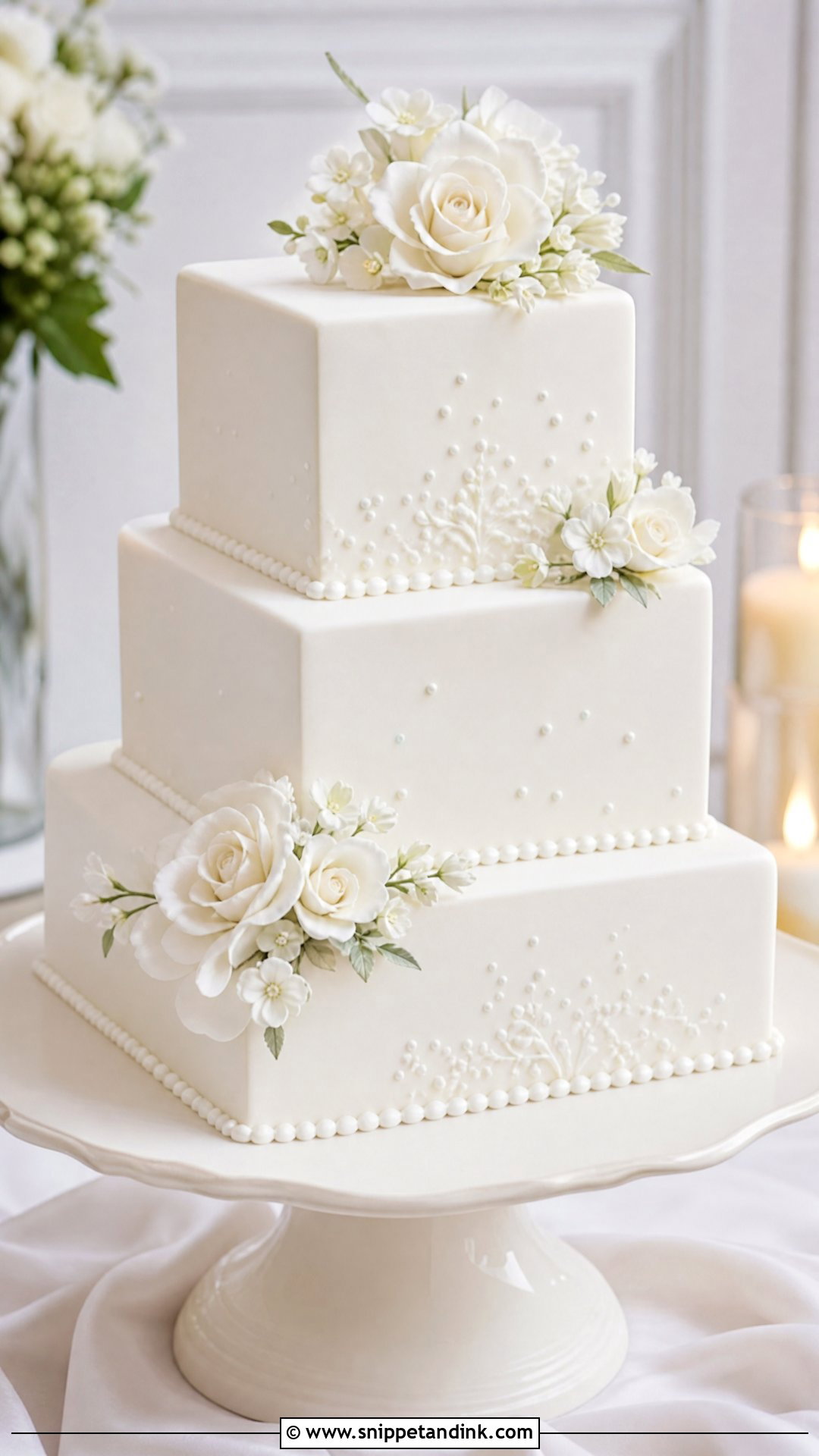
White on a square cake never looks plain to me, because the corners throw shadows a round cake doesn’t have. Under reception lighting each face catches the light differently, so even an undecorated tier has depth. What I watch is which white. Bright white fondant can look almost blue next to an ivory gown in photos, so I match the shade to the dress or the linens. Quiet finishes like piped borders, white sugar flowers or satin ribbon keep it calm, which is a relief in a colorful room.
6. Square Wedding Cake With Flowers
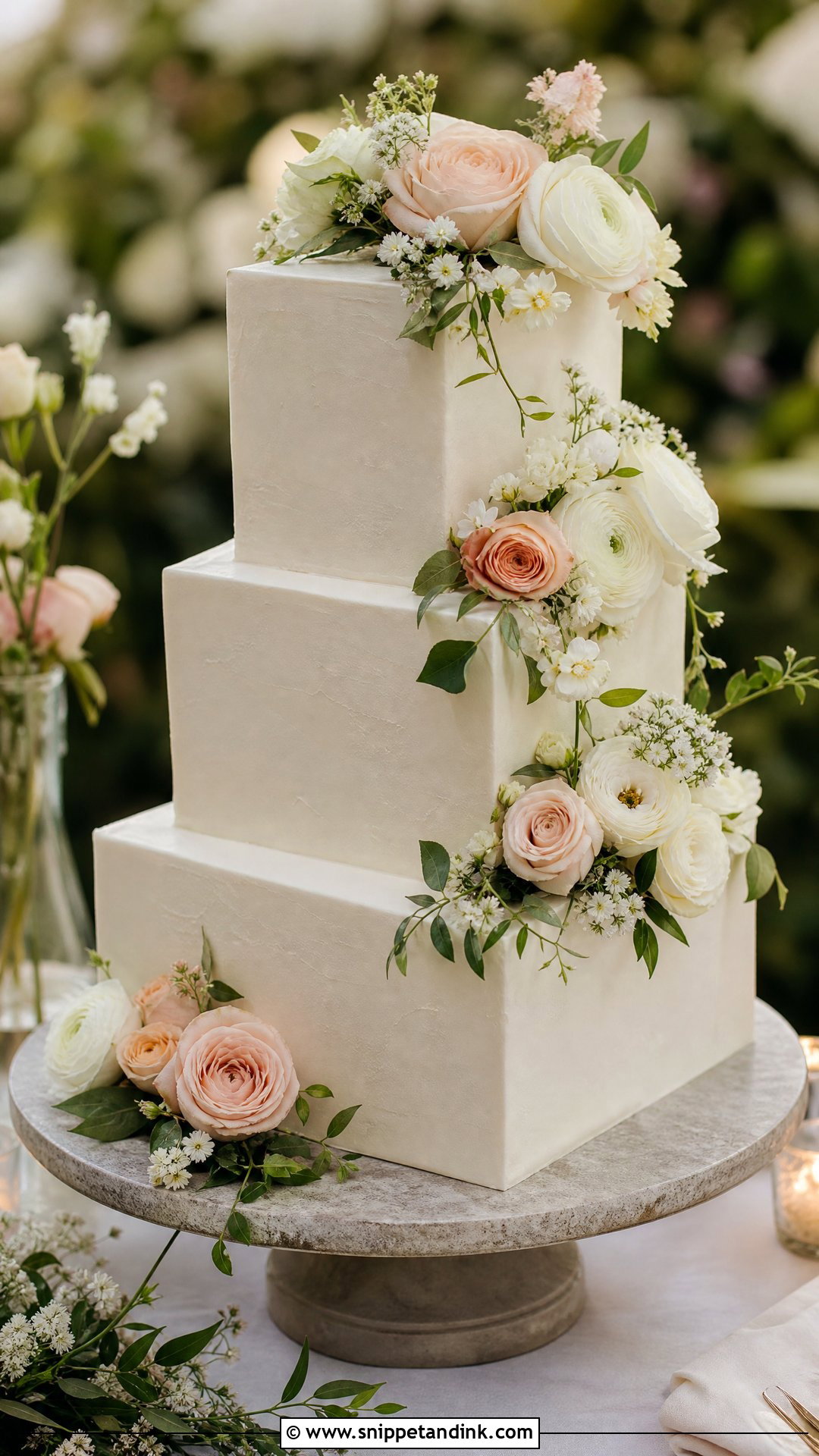
Fresh flowers are the quickest way to soften a square tier, but they need a baker who knows how to place them safely. Plenty of popular wedding flowers aren’t food-safe, and some, like hydrangea and lily of the valley, are toxic, so stems should be wrapped in floral tape and set in picks or on a barrier rather than pushed straight into the cake. Place the blooms on the corners or in a diagonal sweep, and leave at least one face of each tier clean so the shape still reads.
7. Square Wedding Cake With Roses
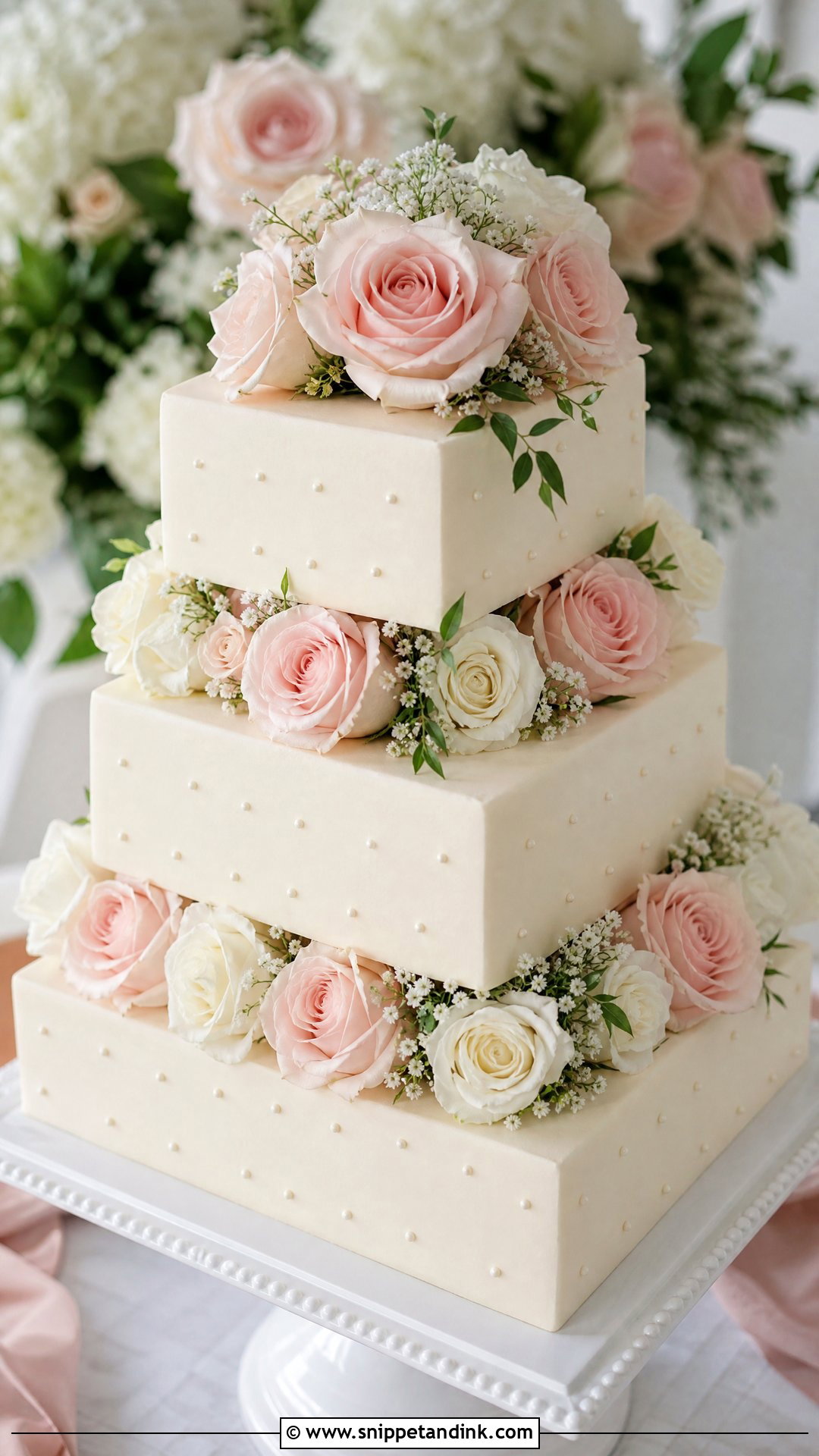
Garden roses are probably the flower I put on square tiers most often, because a full rose head has enough weight to sit on a corner without looking lost. Color sets the mood more than placement does: white for a classic room, blush for a soft palette, deep red for an evening reception. Ask your florist to hold back a dozen heads for the cake when they prep the bouquets so the roses actually match. Fully open blooms wilt faster under warm lights, which is why I add them as close to the reception as I can.
8. Square Wedding Cake With Gold
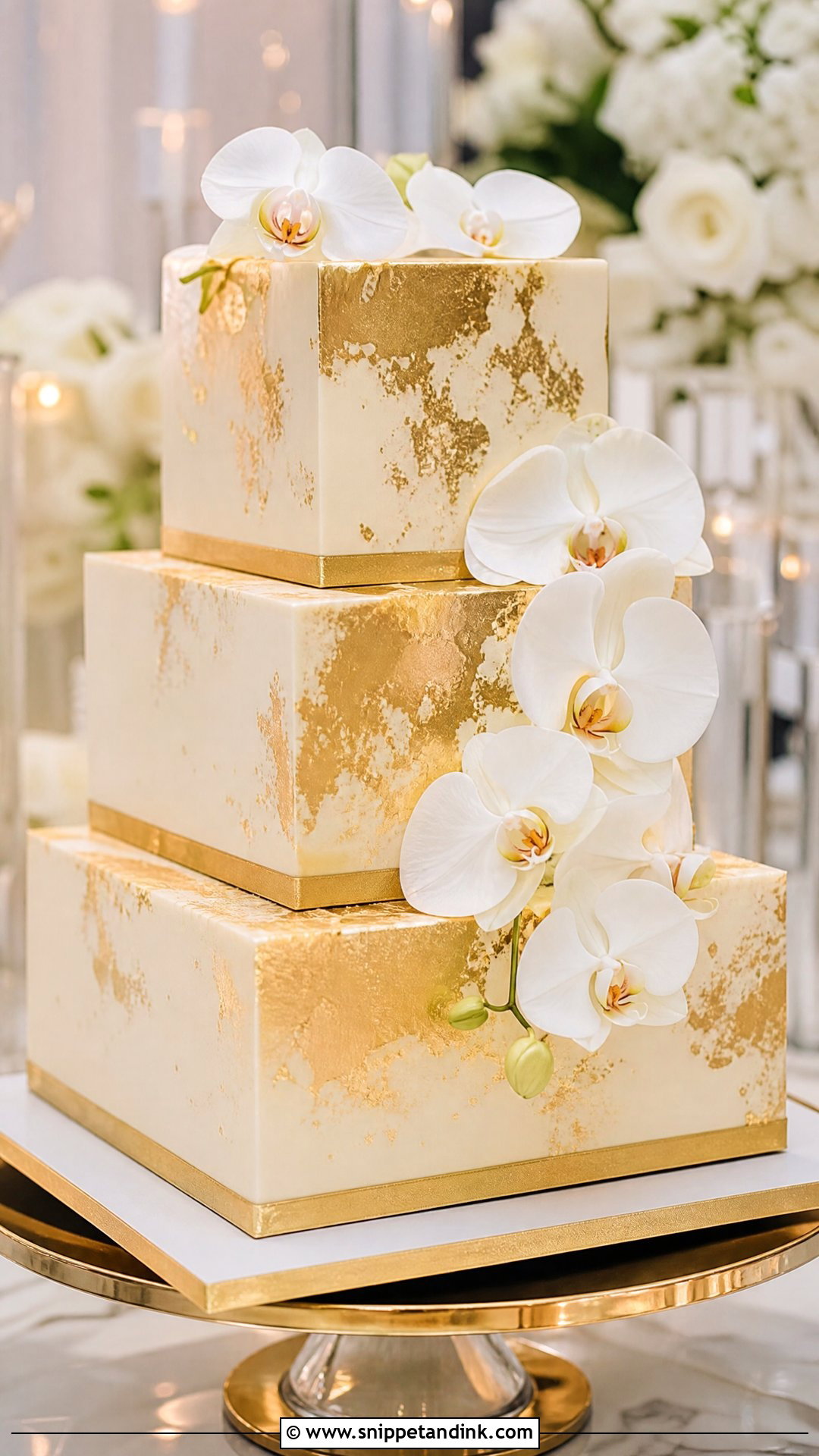
Gold behaves best on a square cake when it follows lines that are already there. A thin band at the base of each tier, leaf pressed onto one corner or a few geometric strokes all look neat because the edges guide them. Edible gold leaf is fragile and sticks to fingertips, so it goes on last with tweezers or a dry brush, and it settles far better on fondant than on soft buttercream. I keep the metallic to one or two zones. Too much and the cake starts bouncing the camera flash back as bright patches.
9. Square Wedding Cake With Pearls
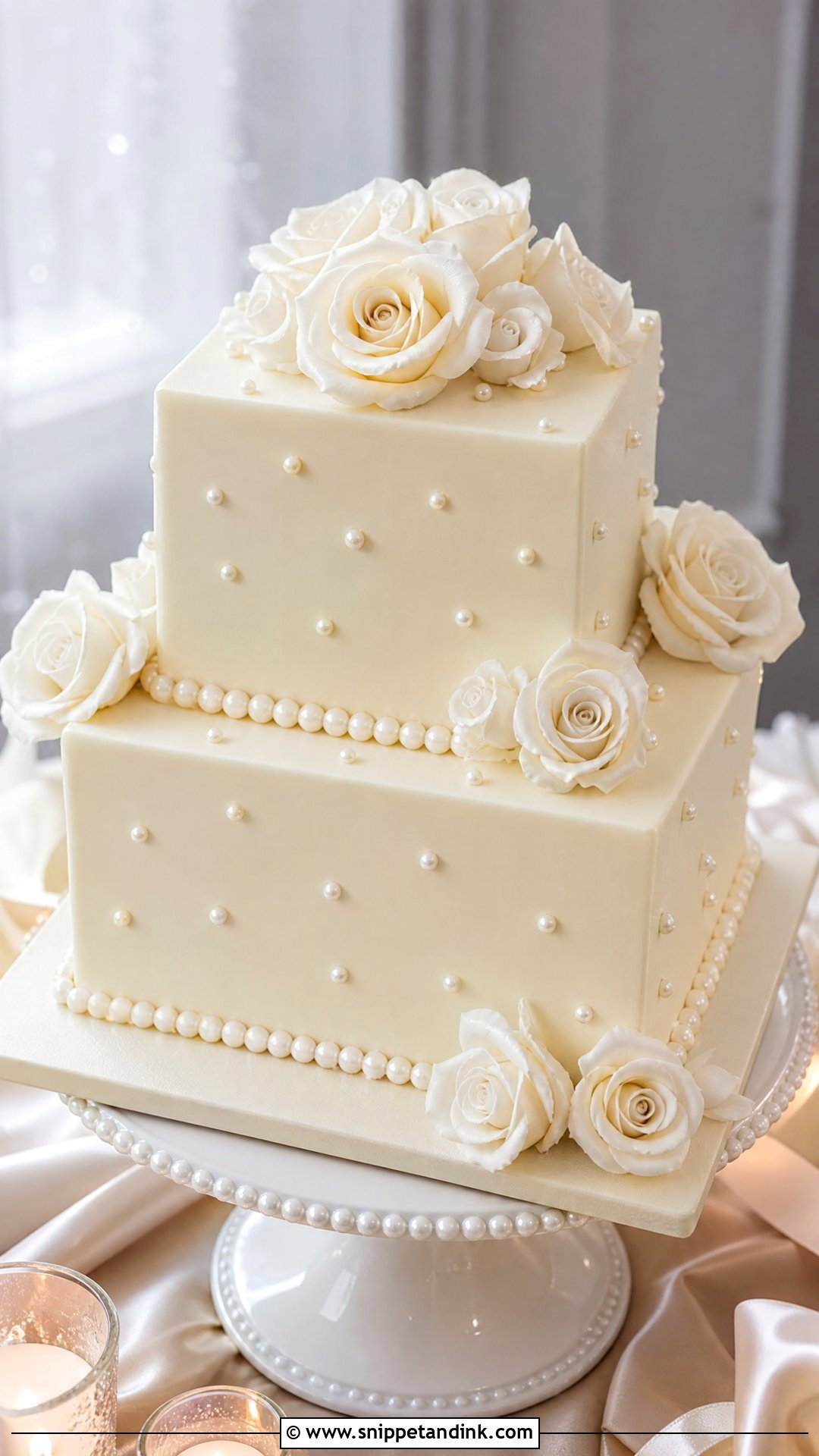
Edible pearls soften the edge of a square tier without adding bulk. A single row around each base is the classic finish, and it doubles as a tidy way to hide the seam where the tier meets its board. Hard sugar pearls can be tough on teeth, so I tell the catering team not to serve slices topped with whole clusters. For a more modern take, I mass the pearls in one corner panel and leave everything else smooth.
10. Square Wedding Cake With Lace
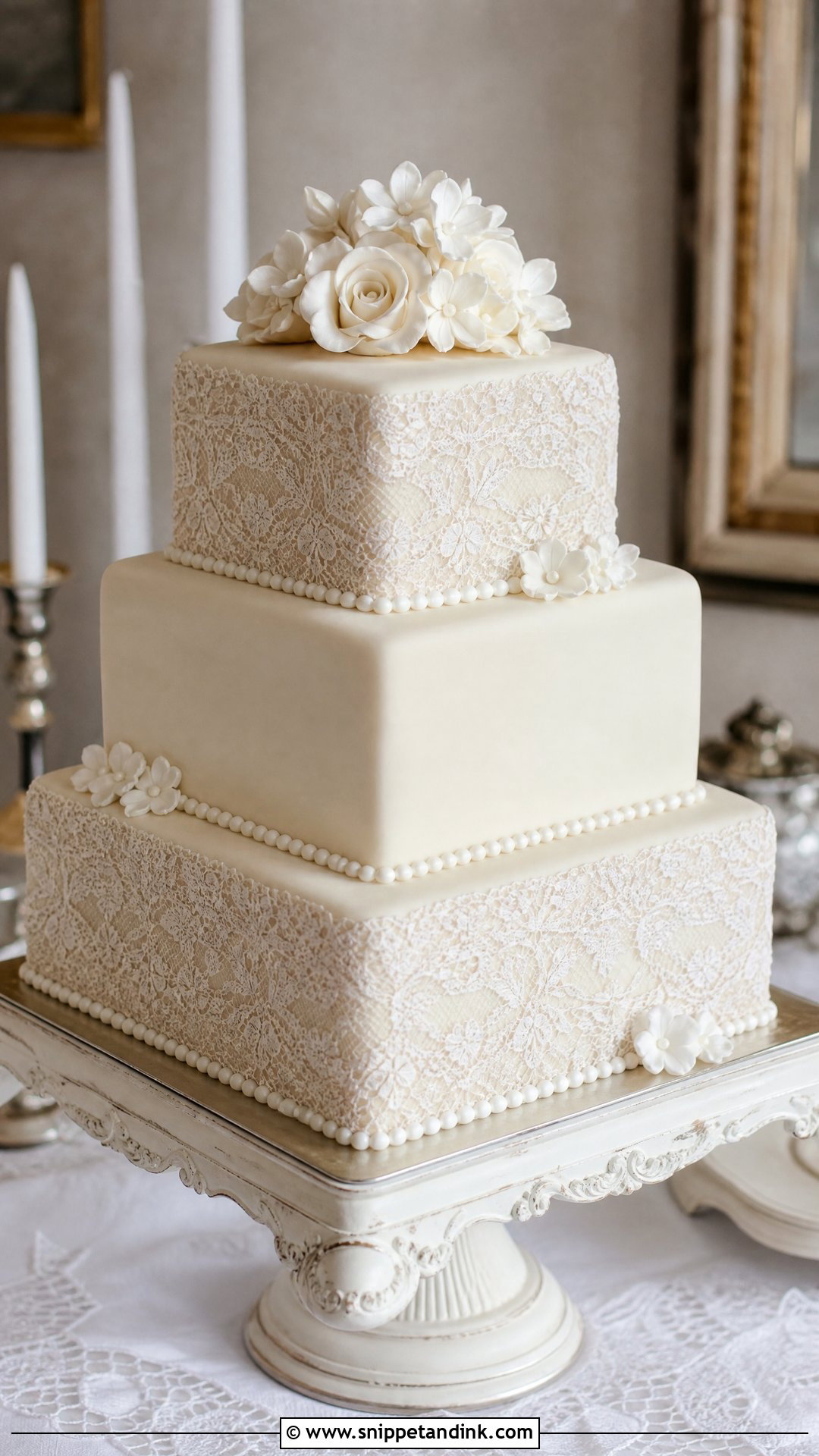
Lace is my favorite way to tie the cake back to the dress. The flat faces of a square tier give the pattern room to show clearly, where round sides tend to stretch it. It can be piped by hand, pressed into fondant with a mold, or cut from edible lace sheets. Bring a photo or a swatch of your gown’s lace to the tasting and a good decorator can echo that exact motif instead of using a stock pattern. On a three-tier cake I’d lace one tier and keep the others smooth.
11. Modern Square Wedding Cake
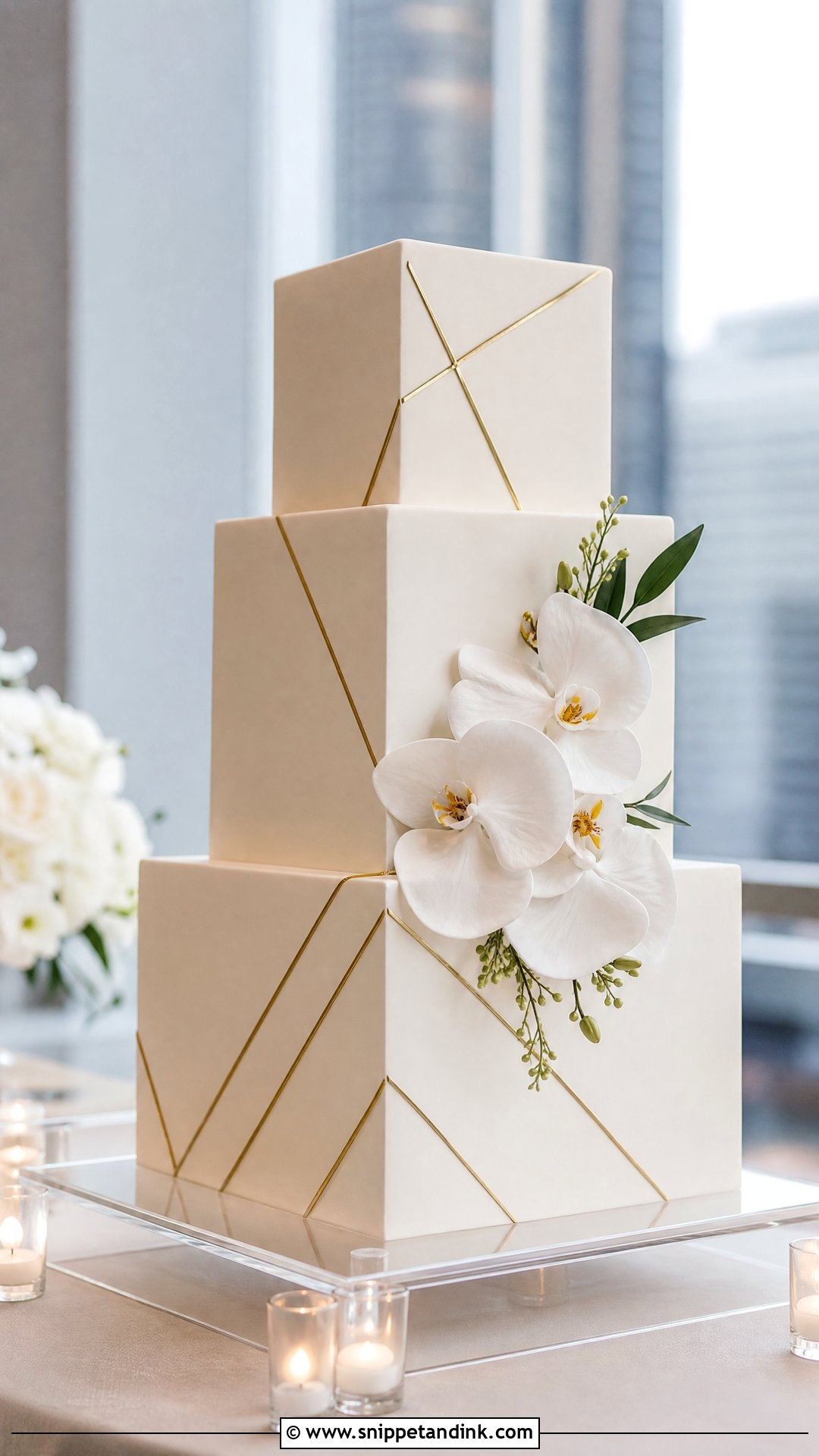
Modern square cakes rely on proportion more than decoration. I sometimes make the tiers taller than standard so the cake looks slim and deliberate, then add one focal point, perhaps a geometric accent or a tight floral cluster. City venues, rooftops and galleries suit it well. The trap is adding a second and third focal point because the cake looks bare on the tasting-room counter. In the actual room, with linens and flowers around it, it won’t.
12. Minimalist Square Wedding Cake
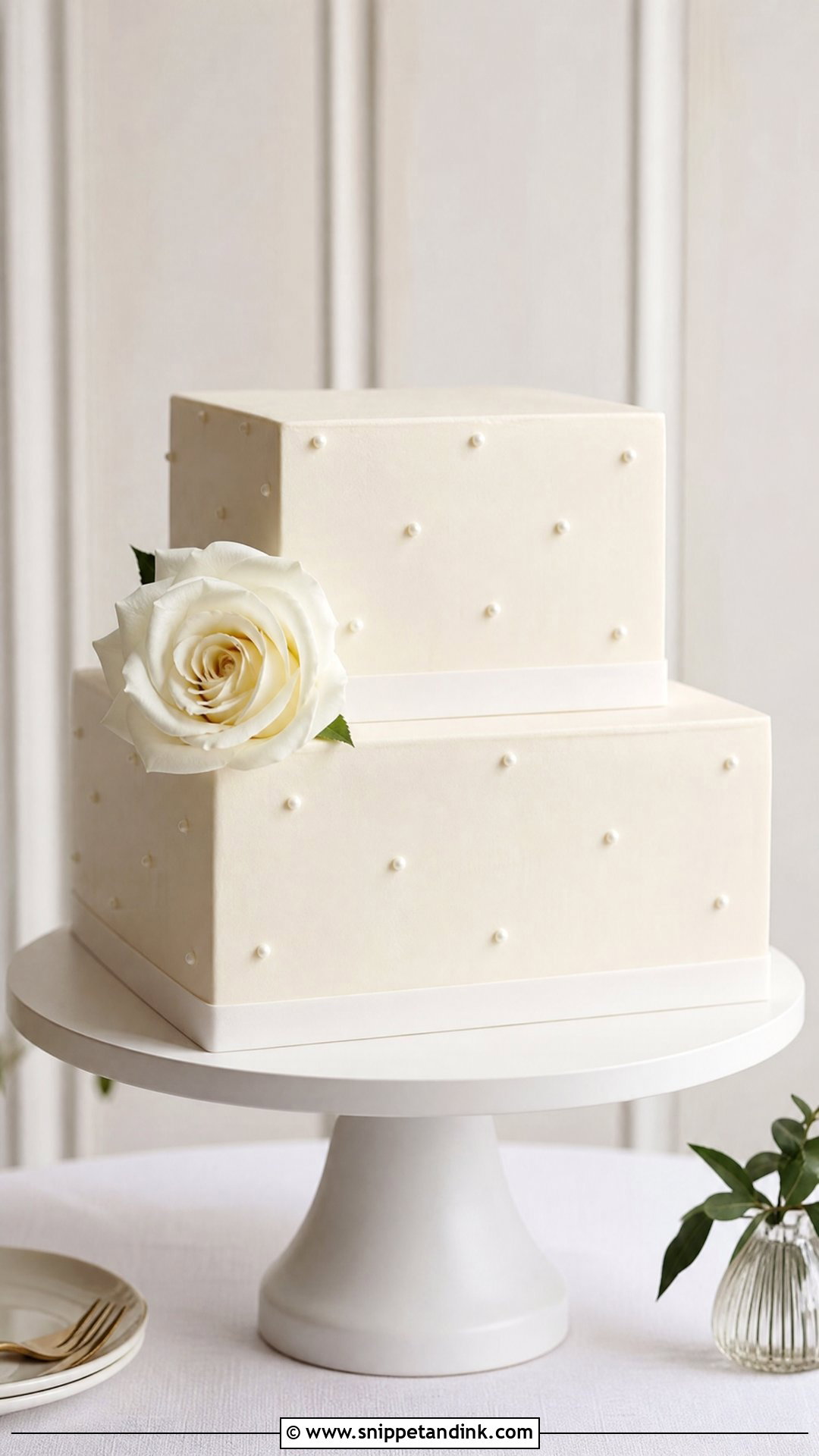
Minimal cakes are the least forgiving ones I make. With a single small bow or one flower as the only accent, every corner and seam is on show, which is why the finish deserves more of your budget here than the decoration does. Ask to see close-up photos of corners from previous work, and confirm the cake will be chilled and fully set before delivery so the edges arrive sharp. Small weddings with pared-back decor suit it best. In a busy, flower-heavy room it can quietly disappear.
13. Rustic Square Wedding Cake
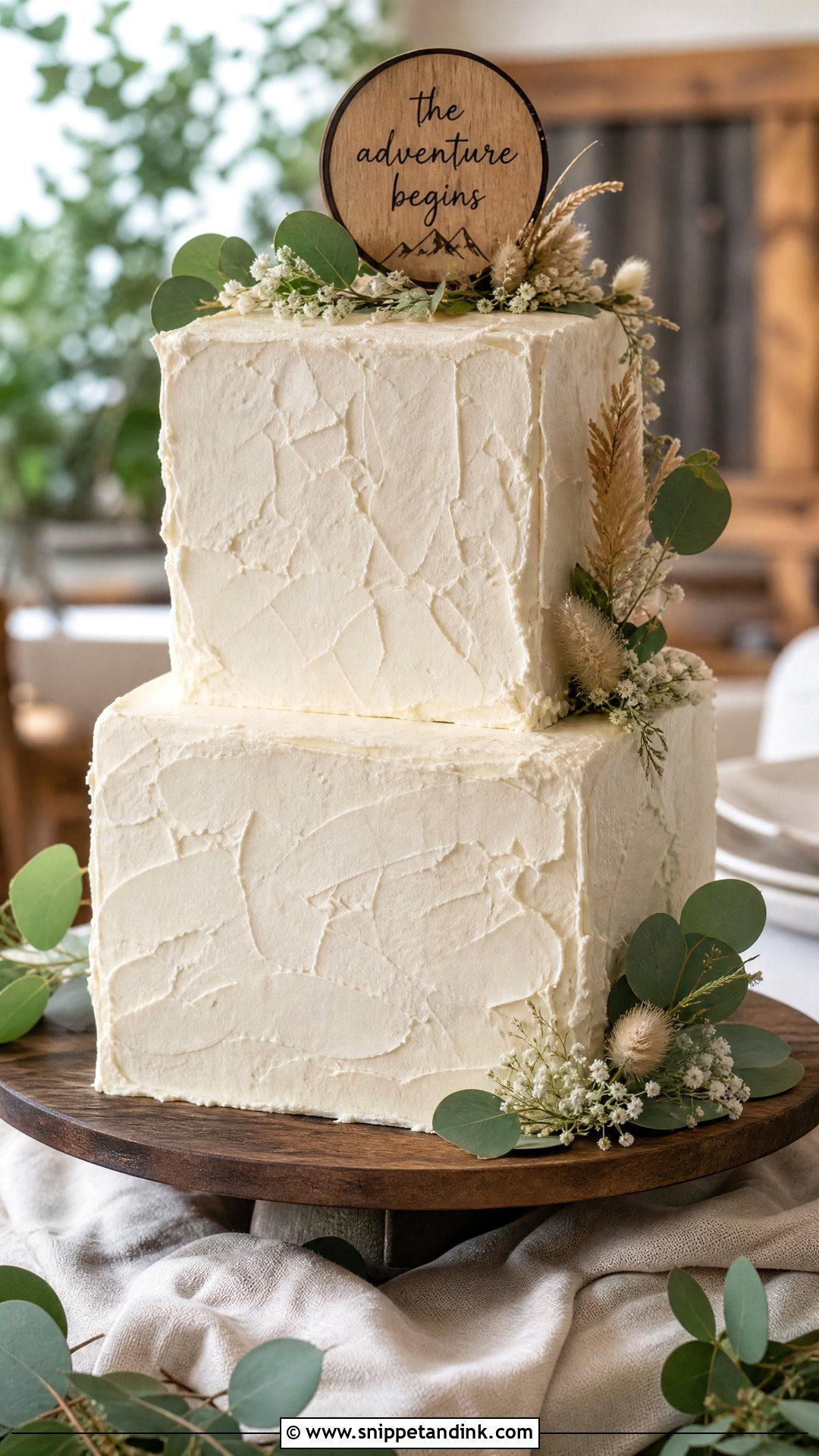
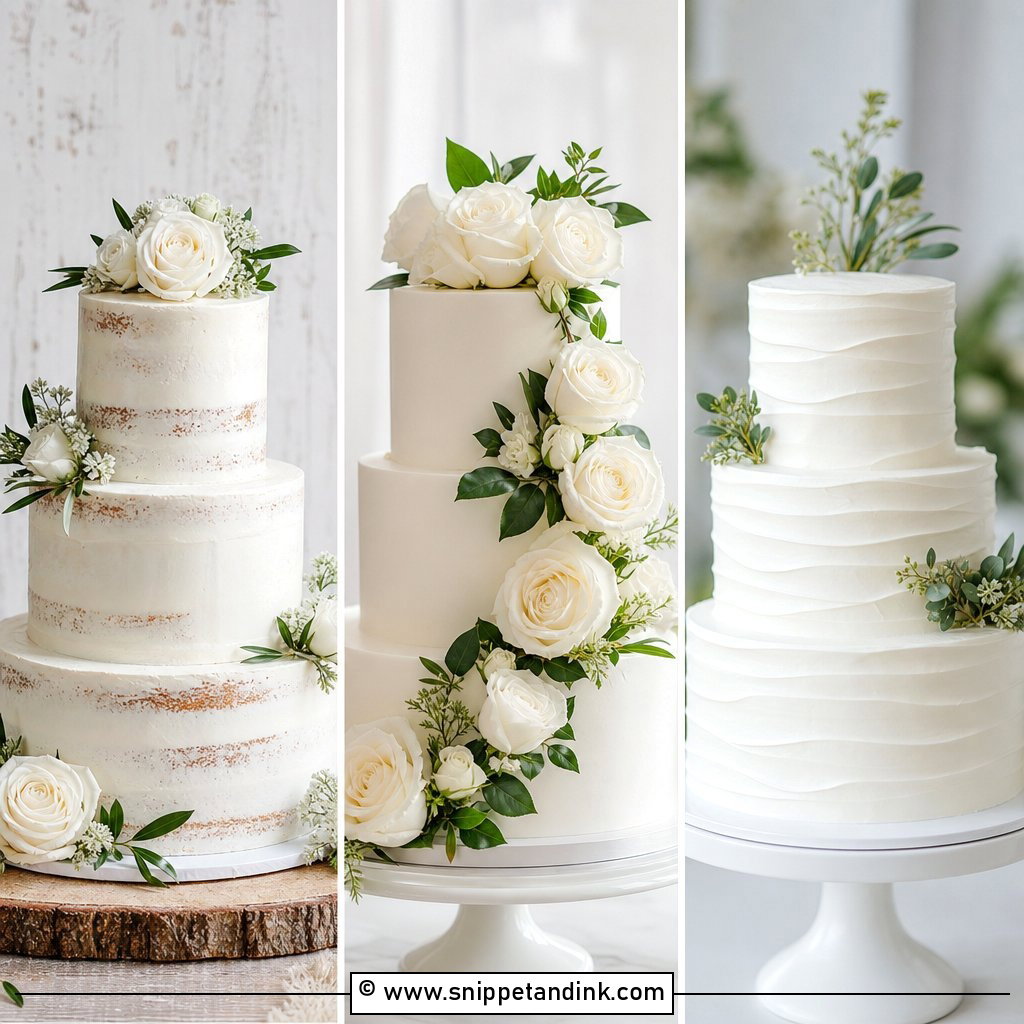
Square tiers keep a rustic cake from tipping into sloppy. The texture comes from the frosting itself: a palette knife swiped across each face, a comb dragged horizontally, or a semi-naked scrape where the sponge peeks through. Exposed sponge dries out quickly, so I finish semi-naked cakes on the morning of the wedding rather than the day before. Eucalyptus, small white blooms or dried grasses suit barn and outdoor venues, and a wooden stand with linen and candles around it finishes the table.
14. Square Wedding Cake With Buttercream
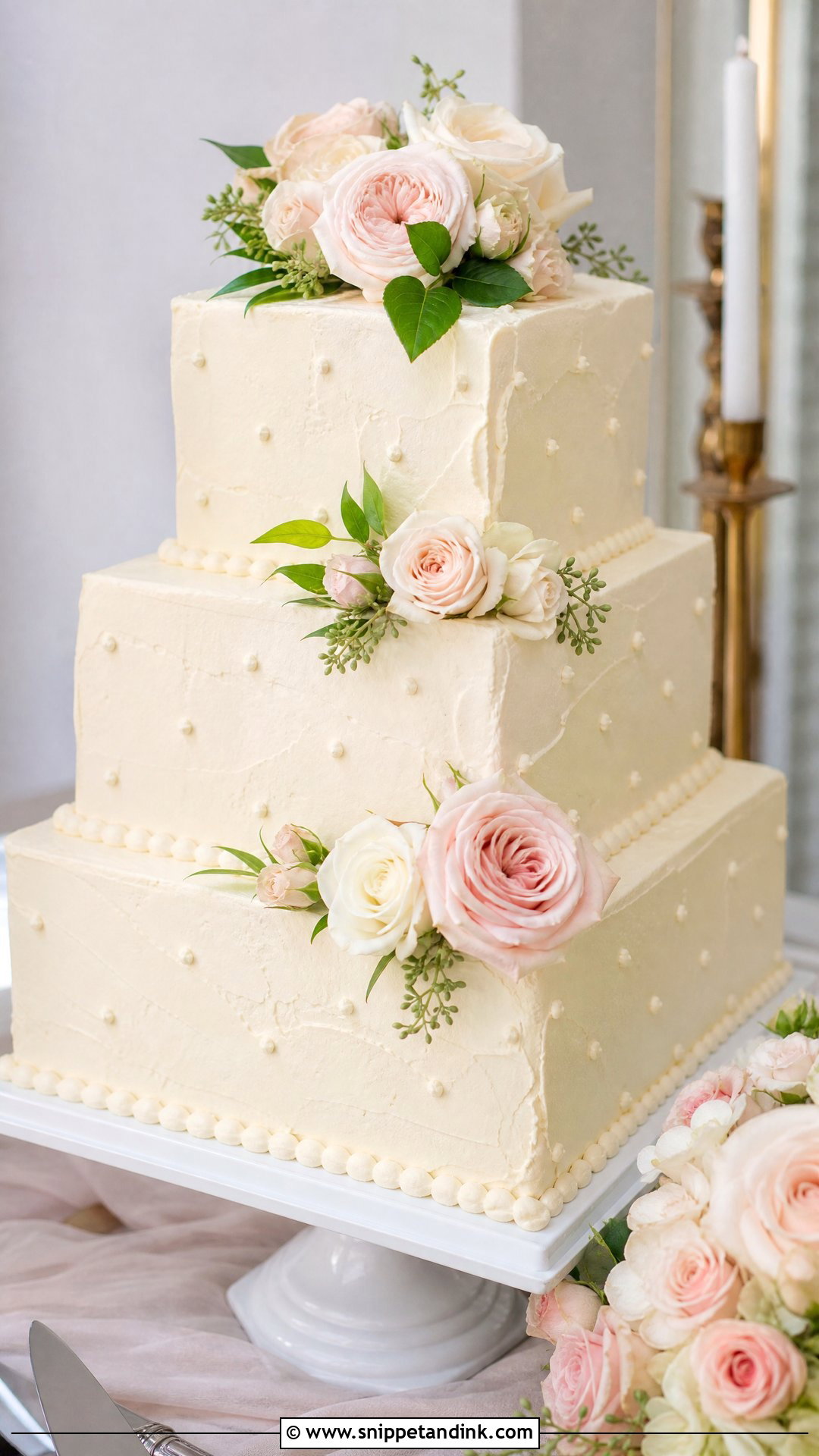
Buttercream on square tiers is a real skill test. A sharp corner means building the frosting out past the edge, chilling it, then cutting it back with a bench scraper, and plenty of bakers who do lovely round cakes struggle here. Most guests prefer the taste to fondant, and it takes piping and fresh flowers well. The weak point is heat. A classic American buttercream softens and starts to slump once a room warms up, so for a summer reception I’d ask about a firmer recipe or a ganache base underneath.

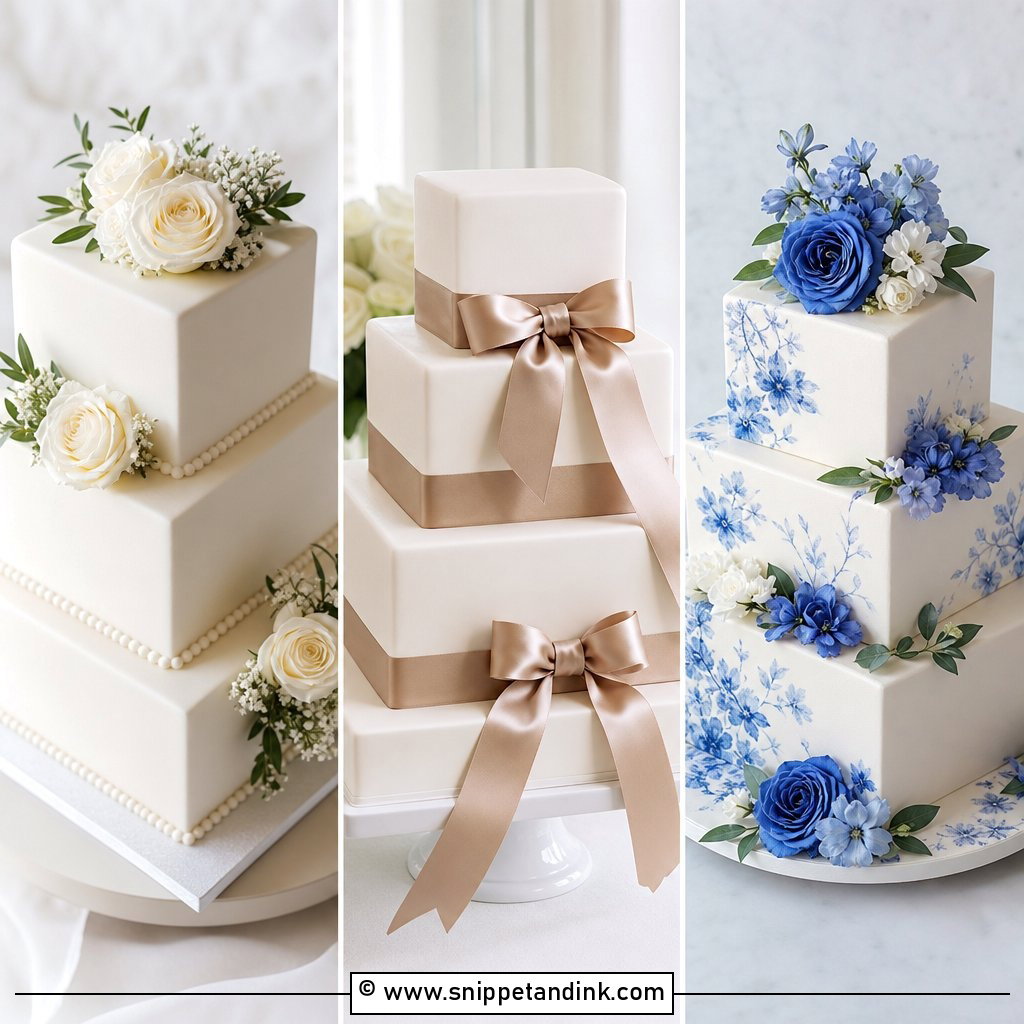
15. Square Wedding Cake With Fondant
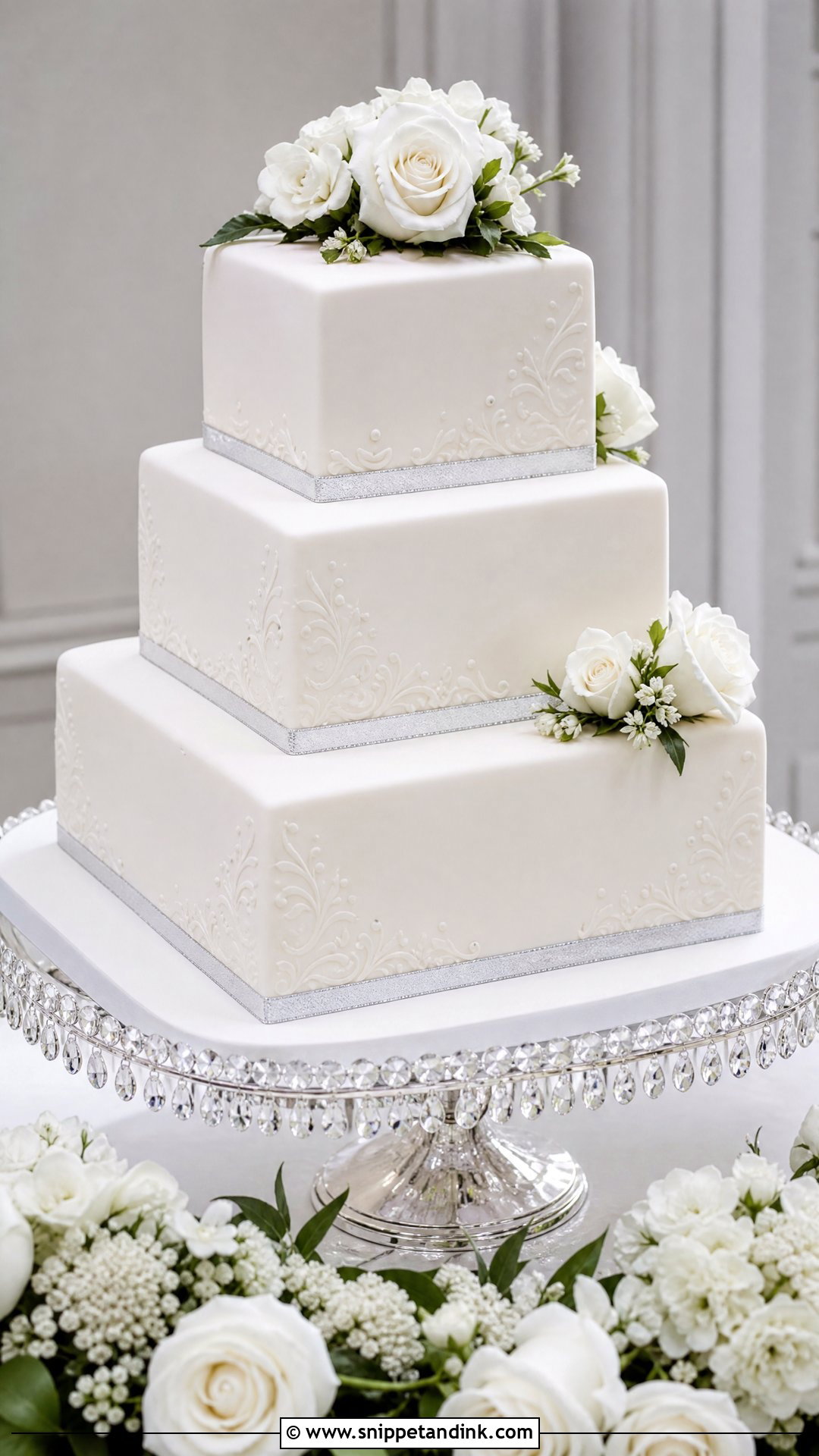
Fondant gives the sharpest corners and the smoothest faces, which is why so many architectural square cakes use it. It’s also the base for detailed work like monograms, painted metallics and geometric panels. Covering a square in one sheet risks tearing or pleating at the corners, so many decorators panel each side separately for a crisper edge. It copes with warm rooms better than buttercream, although humidity can make it tacky. Guests often peel it off, so make sure the cake underneath is one you’d happily eat on its own.
16. Square Wedding Cake With Marble
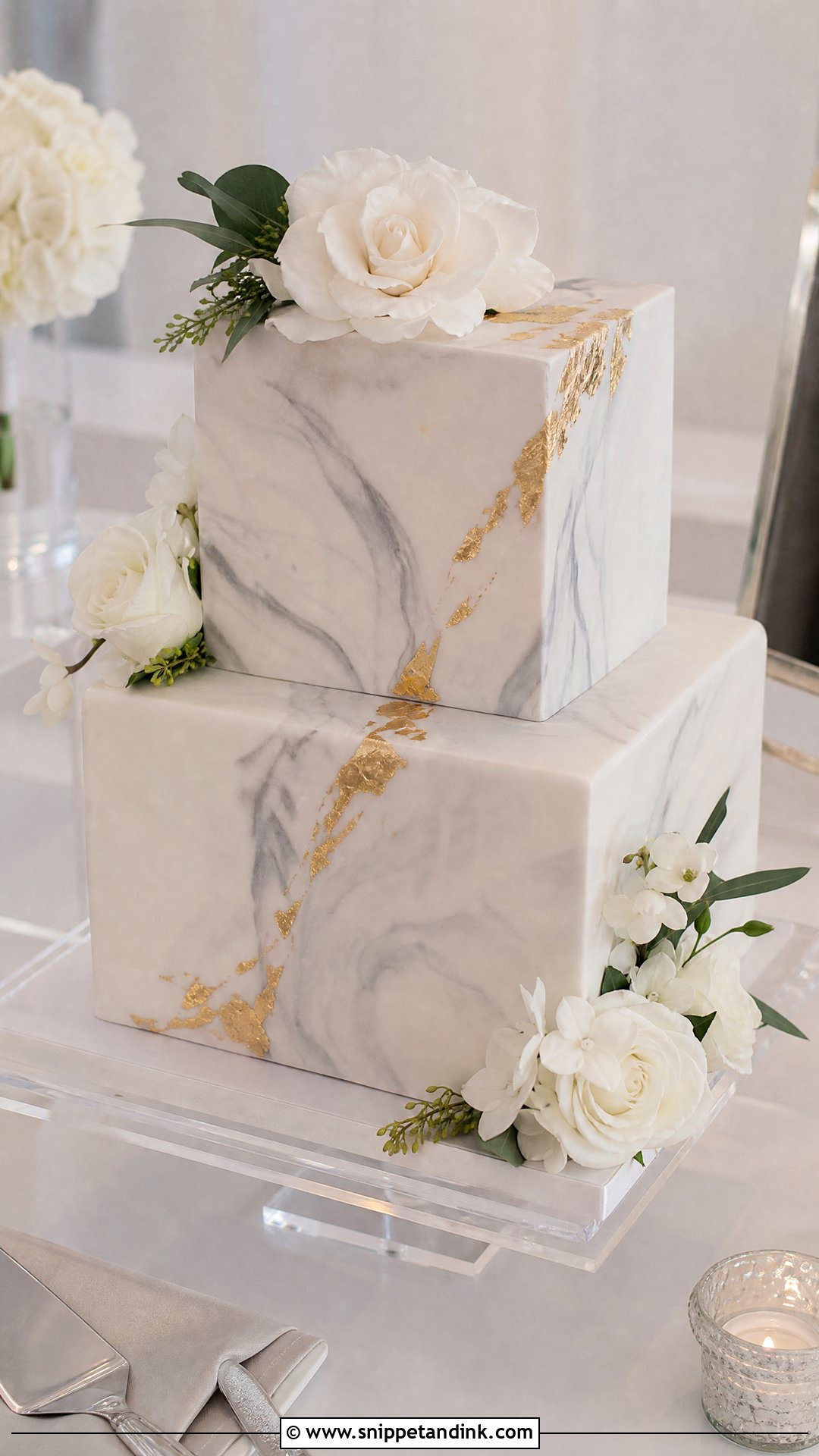
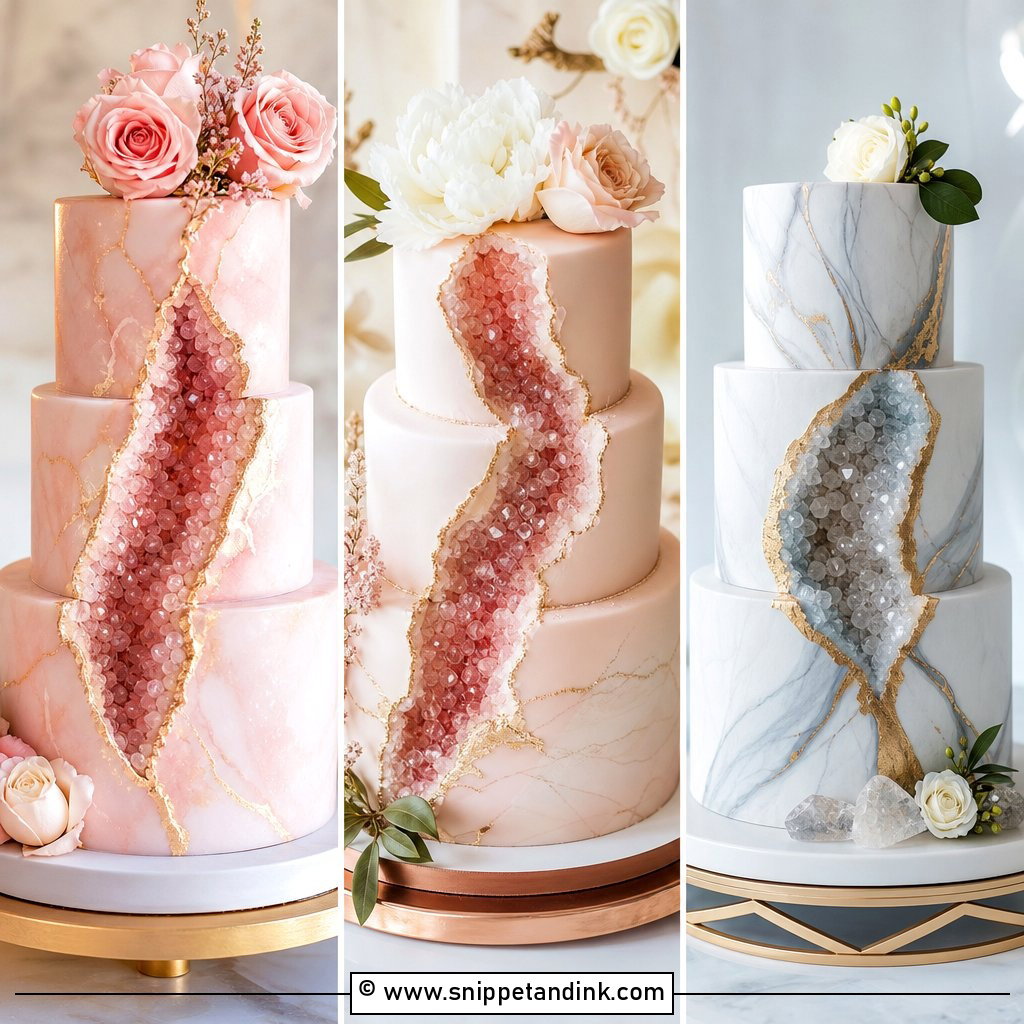
Flat sides are a gift for marbling, since the veins run straight instead of stretching around a curve. The effect comes from twisting colored fondant through white before rolling, so no two tiers ever match exactly, and I think that’s half the charm. Soft gray or blush veining reads best in photos; dark, busy veining can look like a bruise from a distance. Marble fondant needs very little help. A touch of gold leaf or a single sugar flower is enough before the pattern loses its place as the main feature.
17. Square Wedding Cake With Black And White
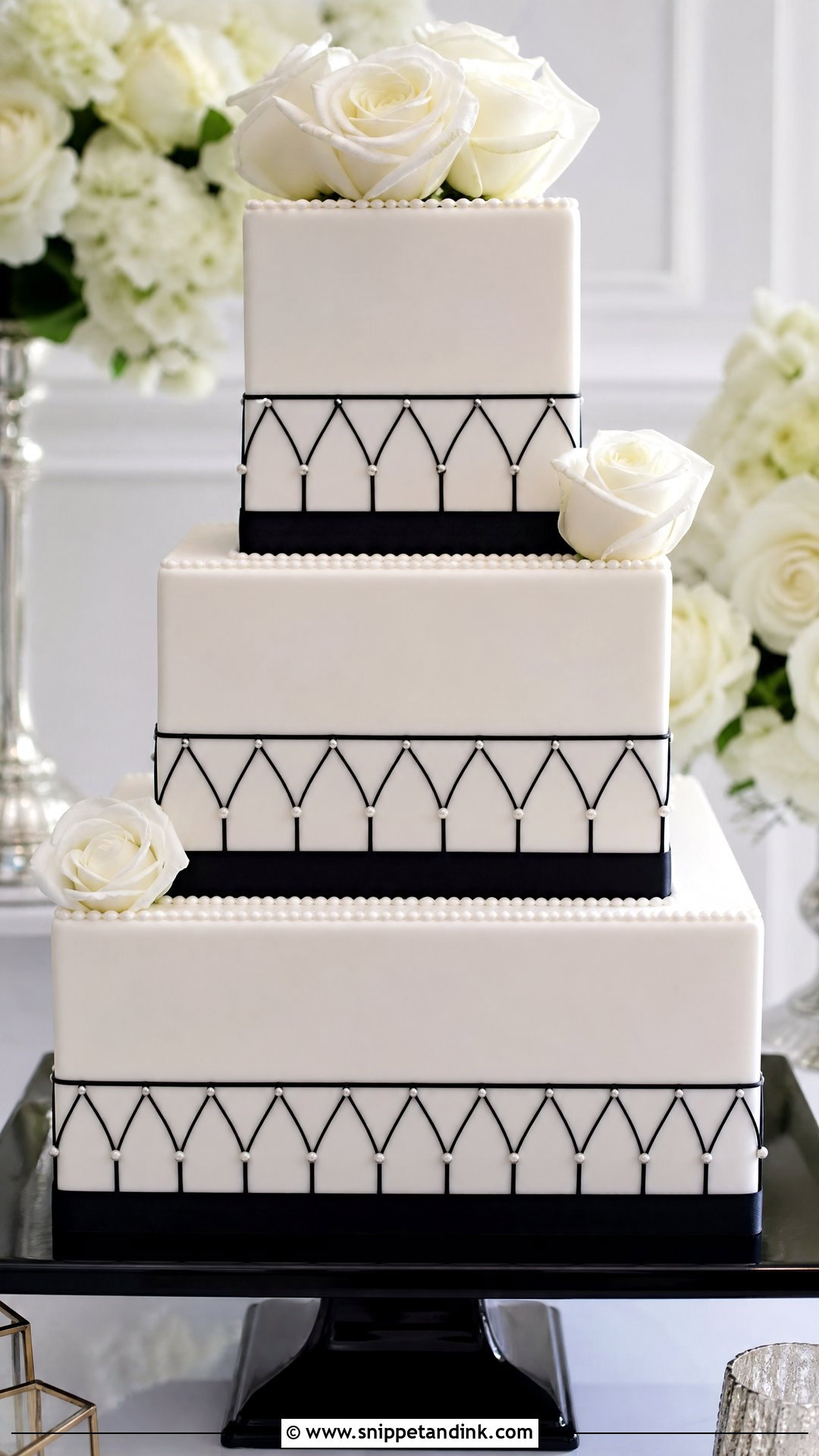
Black and white is the most graphic idea in this list, and it looks sharpest at an evening or black-tie reception. A black base tier under white upper tiers is the easiest version to pull off. Black icing needs a heavy dose of coloring, which can stain mouths and leave a slightly bitter edge, so I keep black to bands, ribbon, piping or one tier rather than covering the whole cake. If it starts to feel stark, white roses or a row of pearls pull it back toward bridal.
18. Square Wedding Cake With Cascading Flowers
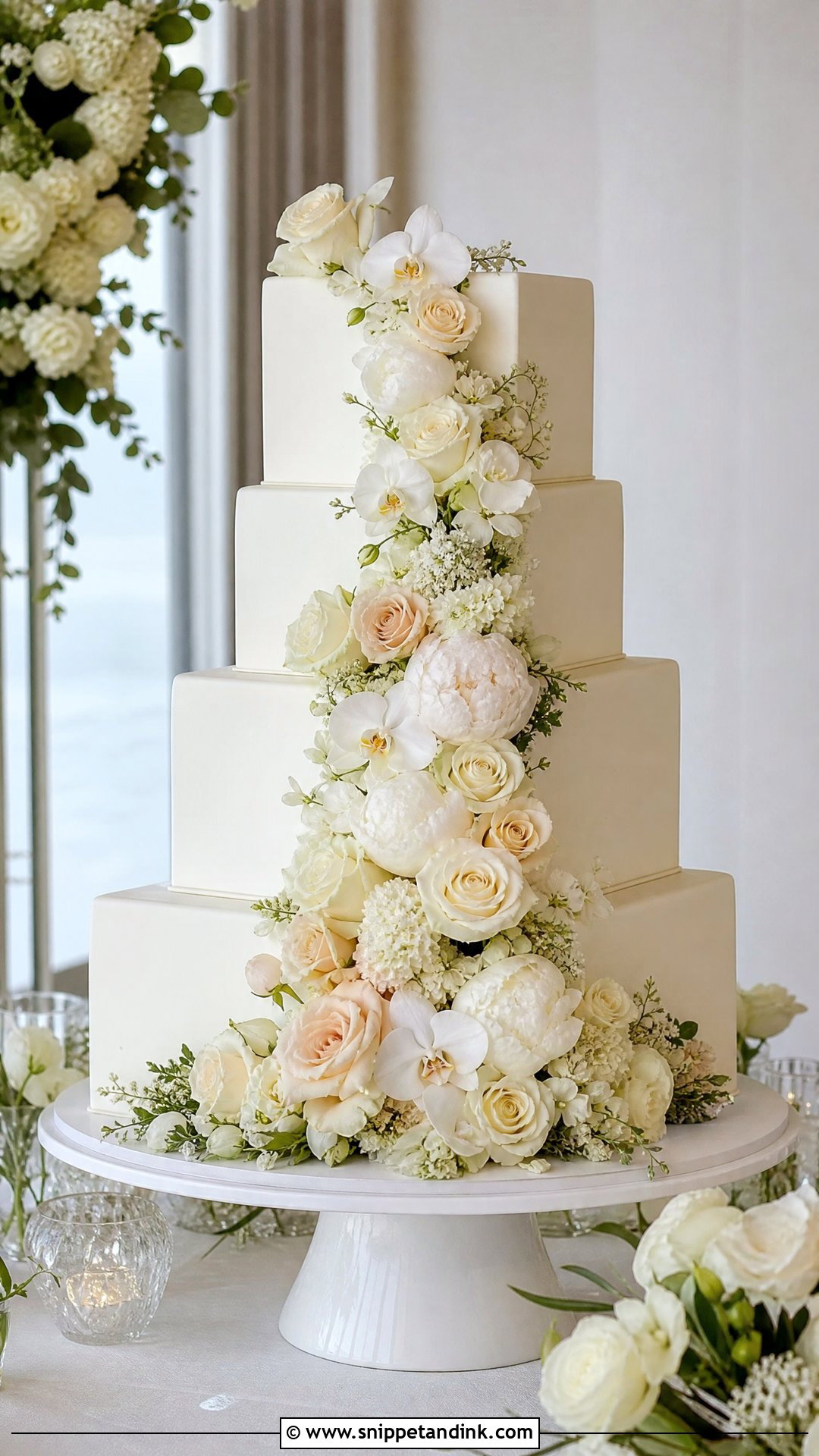
The corners of a square tier give cascading flowers a clean path to follow. I start the arrangement on the top tier and let it drop down one side, touching each corner on the way, which pulls the eye diagonally across the whole stack. Sugar flowers can be wired and placed days ahead; fresh ones go on at the venue as the last job before guests arrive. Weight is the practical limit. A heavy fresh cascade has to be anchored into the boards, not just pressed into the frosting, or it slides as the cake warms.
19. Square Wedding Cake With Monogram
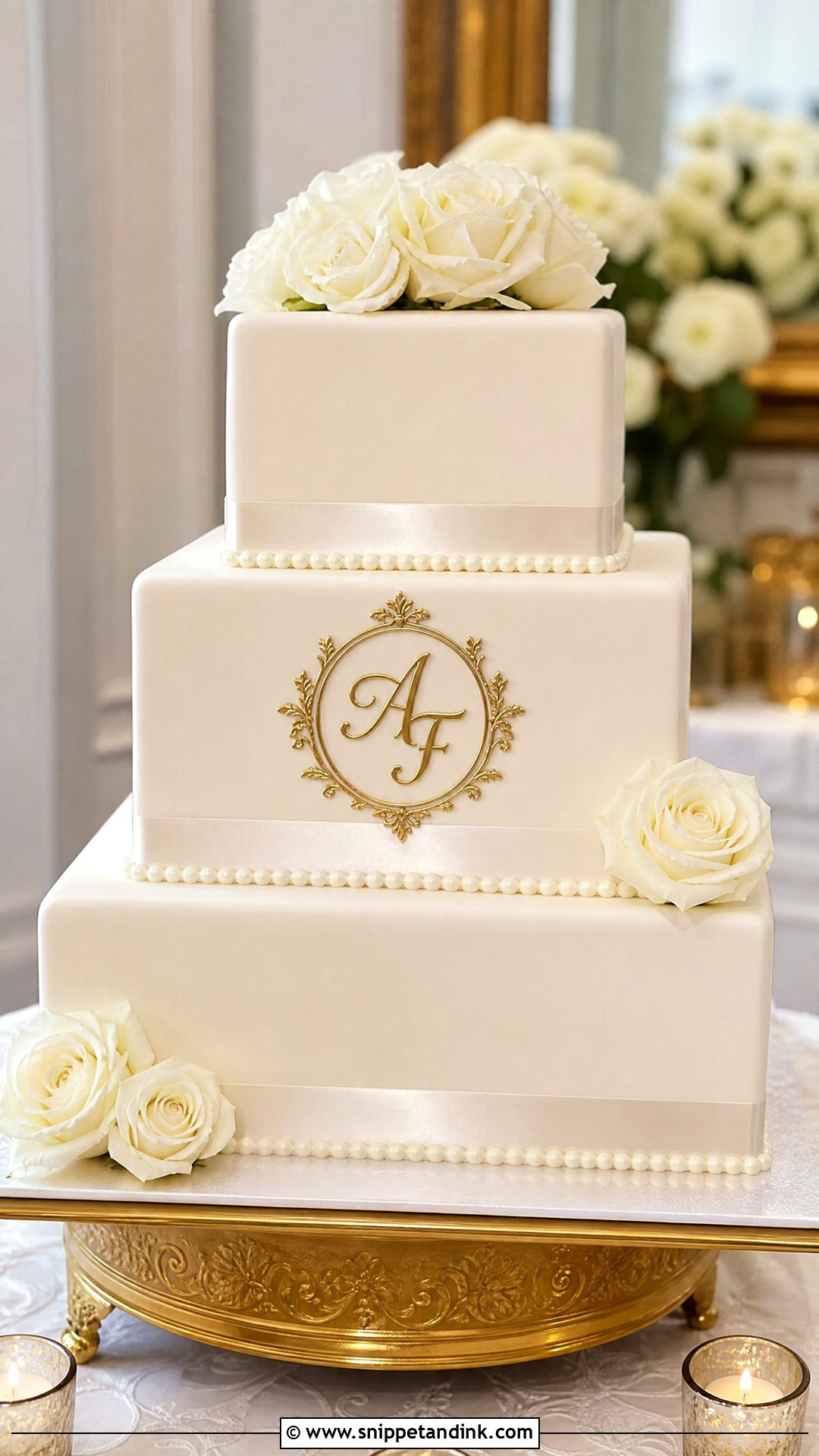
A monogram needs a flat surface, so square tiers suit it better than any other shape. The front of the middle tier is usually the best spot, since it sits at camera height for the cake-cutting photos. Painted and embossed initials need fondant underneath; on buttercream I’d pipe them or use a metallic cut-out instead. Confirm the letter order in writing, because traditional couple monograms often put the shared surname initial larger in the center. Keep everything else on the cake quiet.


20. Square Wedding Cake With Different Tiers
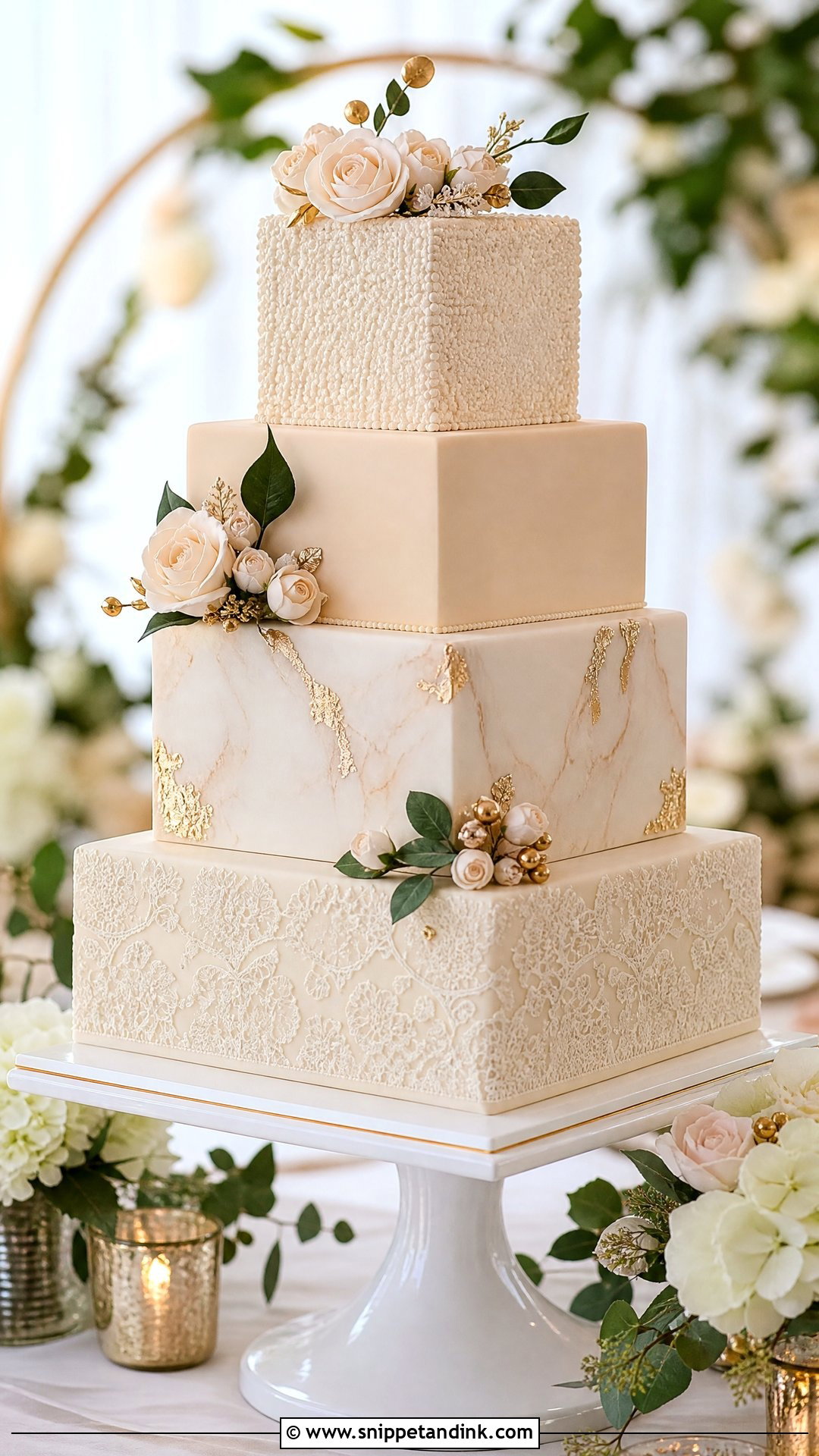
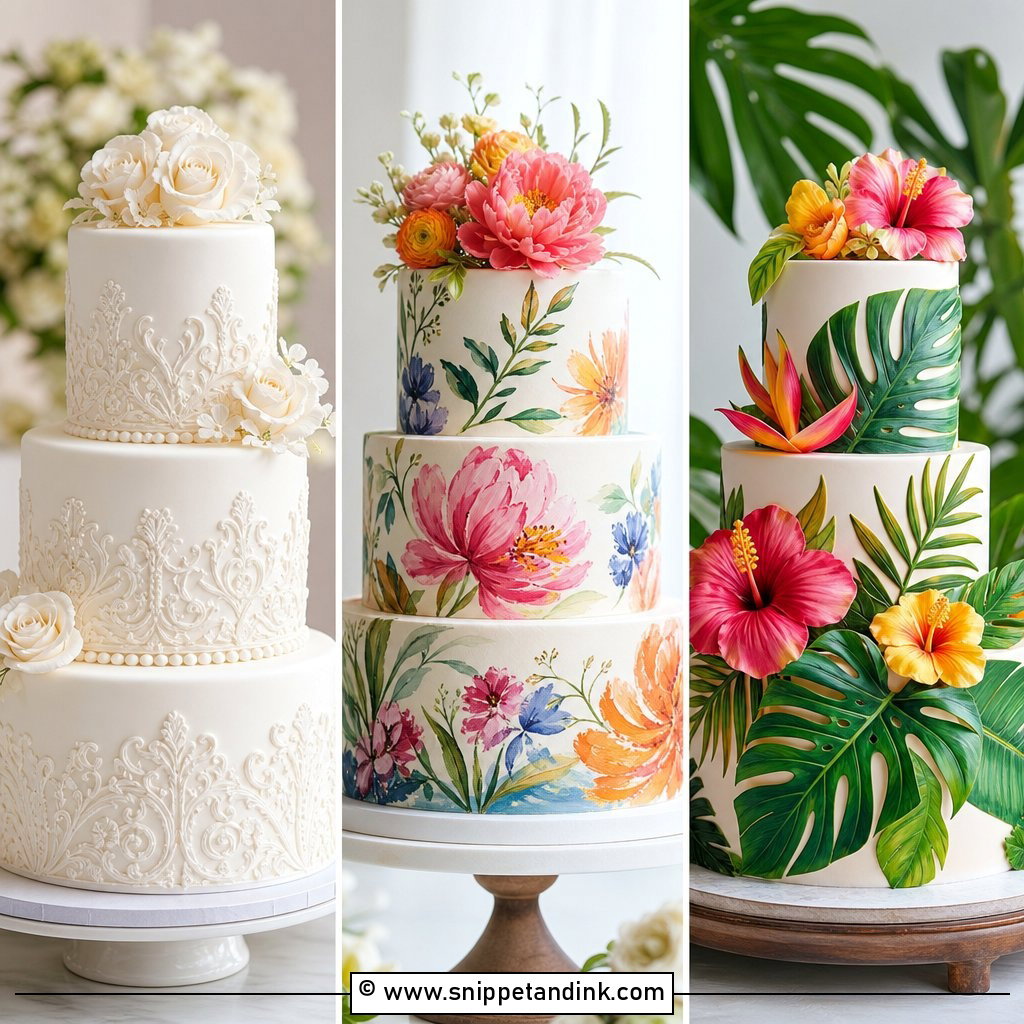
Giving each tier its own finish, say smooth fondant on one, lace on the next and marble on the third, is the most fun cake to design and the easiest to get wrong. What holds it together is a shared color thread, so every tier speaks the same palette even when the texture changes. I also keep the top tier plain. It gives the eye somewhere to rest and leaves room for a topper. If your wedding already layers florals, metallics and patterned stationery, this cake can echo those textures instead of competing with them.
Getting Sharp Corners Through a Car Ride and a Hot Room
Corners are where a square cake shows damage first. A round cake can take a small knock and hide it; a square one loses its edge and everybody sees it. Most of the protection happens before the cake ever leaves the kitchen.
- A chilled cake travels best. Firm frosting resists dents, so I deliver straight from the fridge in a box with a little space on every side.
- The cake rides on a flat floor, never a lap or a car seat. Seats slope, so it goes on a non-slip mat in the trunk or footwell and nobody holds it.
- Tall cakes travel stacked only when they’re doweled through the center. Otherwise the tiers ride in separate boxes and get stacked at the venue.
- Once it’s set up, keep it out of direct sun and away from heaters, kitchen doors and dance floor lighting. Buttercream corners soften first.
- Fondant brought from a cold car into a humid room can bead with condensation. Leave it alone and it dries on its own; wiping it smears the finish.
Three Photos Worth Requesting at Your Tasting
Most portfolios are full of round cakes, so ask the baker to show you squares specifically.
- A side-on close-up of a buttercream square corner. If the corners look soft in their own photos, they’ll look soft on your table.
- A fondant square shot from above, so you can see whether the corner seams are tidy.
- A tall square cake photographed at a venue rather than on their counter, which tells you how their structure and delivery hold up.
While you’re there, ask how the cake will be cut. Square tiers are sliced in a straight grid, which is quicker for catering staff, but somebody needs to know that grid on a large cake. I always send a simple cutting plan along with the cake so the servers aren’t guessing.
Square Corners Ask More of a Baker, and Pay It Back
Square tiers reward good craftsmanship. A simple cake looks tailored, and the flat sides give flowers, lace, pearls, monograms and marbling room that a curve would distort. The design I’d point you toward depends on your room, your guest count and how warm the reception will be, far more than on any trend. Start with the finish you love most, find a baker whose corners you trust, and build everything else from there.
You'll Like These Ideas:










Leave a Reply