
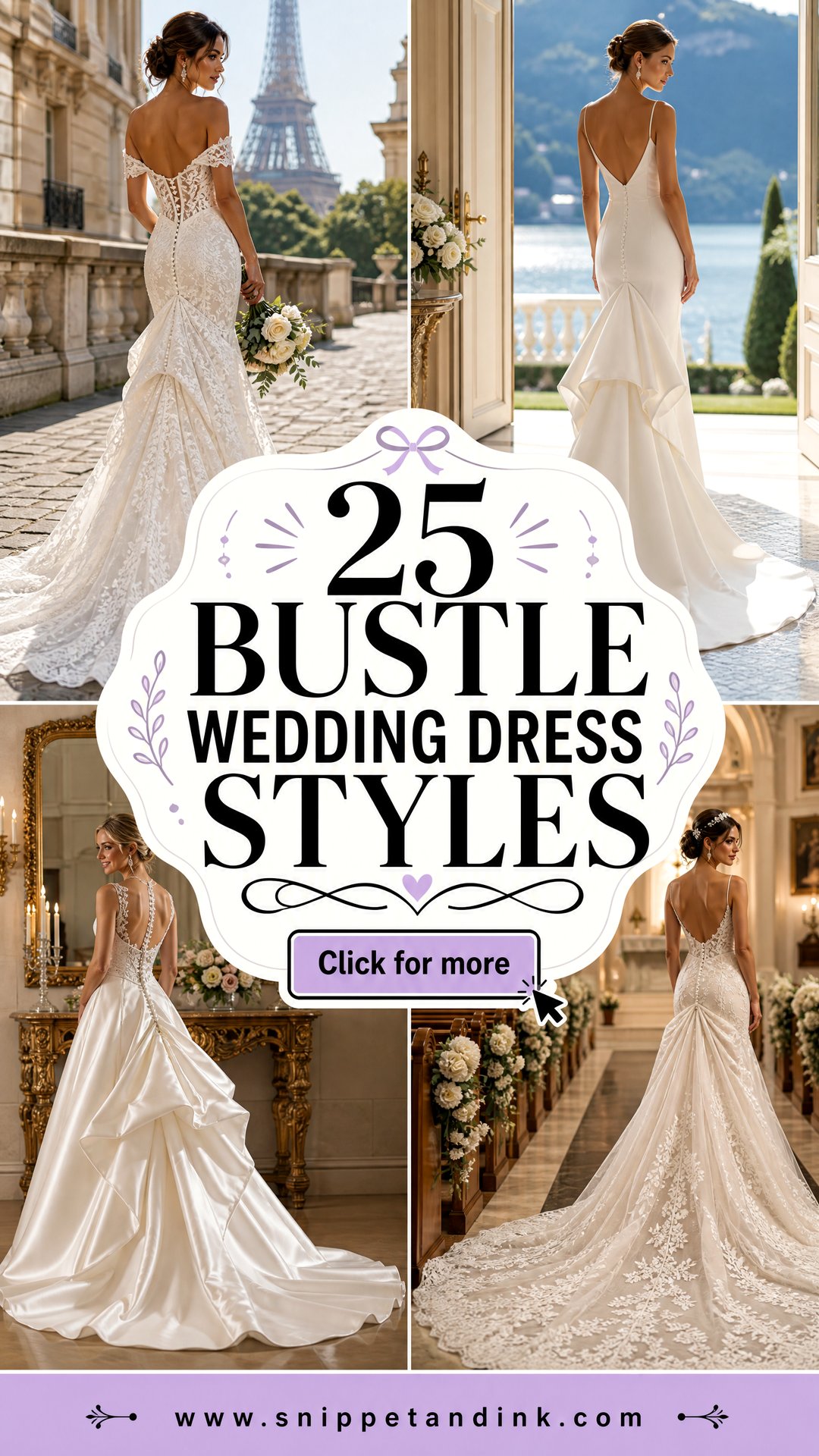
A bustle changes how a gown behaves the moment the ceremony is over. It lifts the train off the floor, keeps delicate hems from being trodden on and lets you walk, hug and dance without fabric trailing behind you. Which type suits you depends on the silhouette, the train length, the fabric weight and whatever is happening on the back of the dress. A satin ball gown, a lace mermaid and a soft chiffon A-line each need something different, which is why I always ask the seamstress to pin two or three options before anything is sewn. The styles below show how each bustle sits on a real gown shape, so you can picture yours before that appointment.
The Fitting Where Your Bustle Gets Decided
Most seamstresses design the bustle once the hem is set, often at the second or final fitting, because the train can’t be judged until the length is right. Come prepared and that appointment does far more work.
- Wear the actual wedding shoes and undergarments. Even a small change in heel height moves the hem and the points.
- Bring the person who will bustle you on the day, whether that’s a bridesmaid, your mother or the planner. They need to watch it being pinned, not learn it from a description later.
- Ask to see two or three options pinned, then walk, turn and sit in each one.
- Ask for the fastenings to be numbered or color-coded, and film your helper doing the whole thing once.
Buttons, hooks or ribbon ties
Outside bustles usually fasten with satin-covered buttons and loops or with hooks and eyes, while under bustles almost always use paired ribbon ties. Buttons look neat and are easy to find. Hooks are quick but can slip free under a heavy train. Ribbons hold well under weight but take longer, since every pair has to be found and tied. I tell brides to choose by train weight first and speed second.
1. American Bustle Ball Gown Wedding Dress
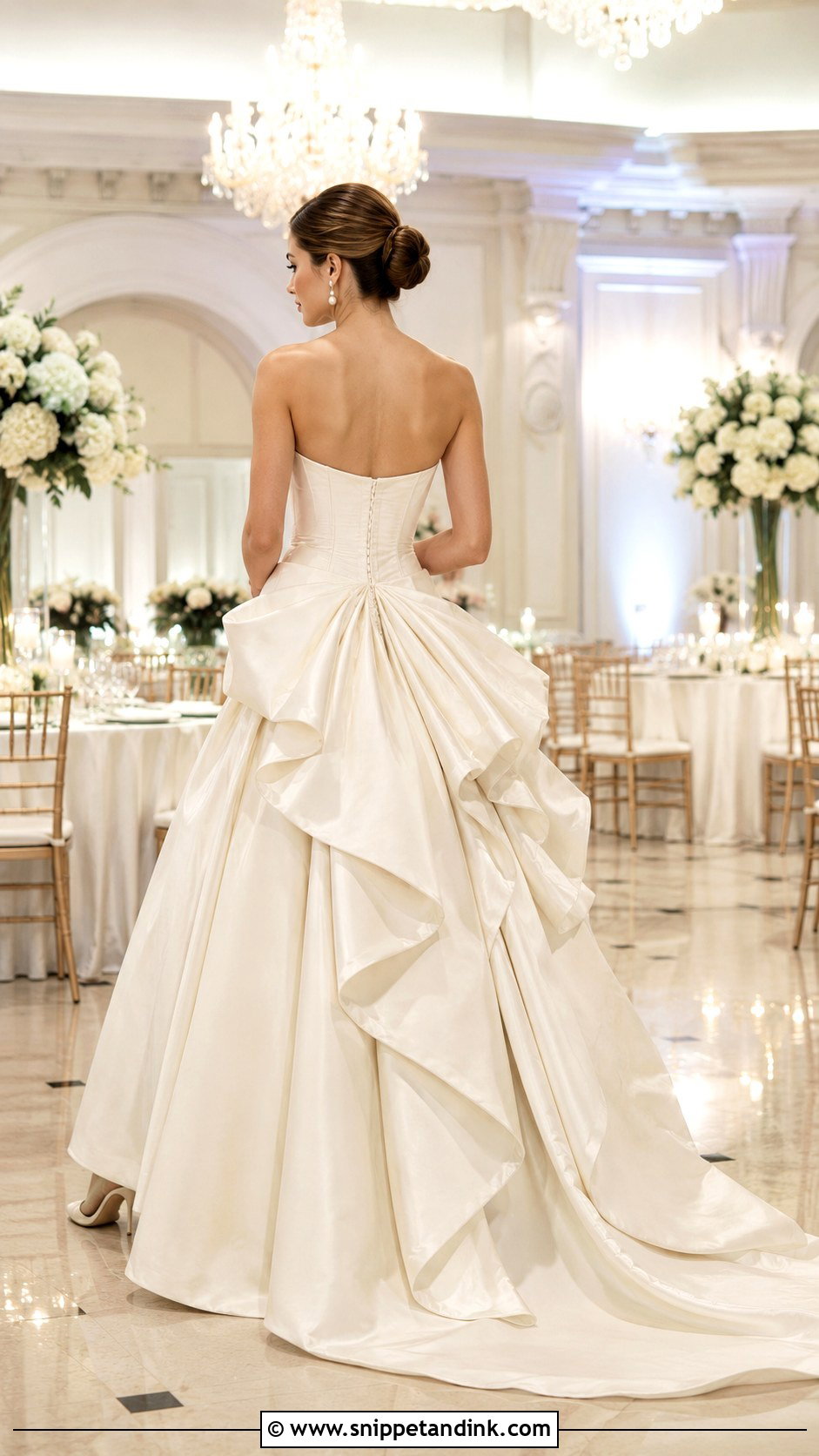
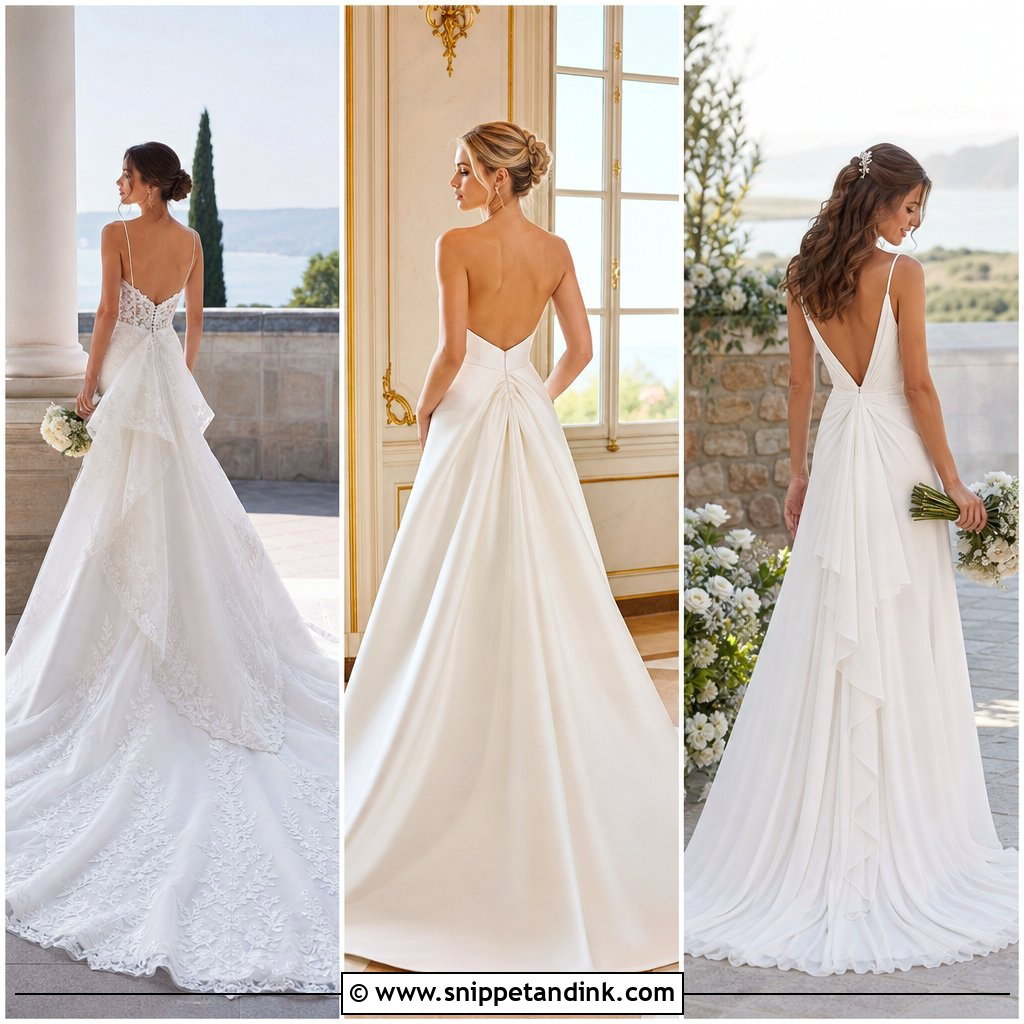
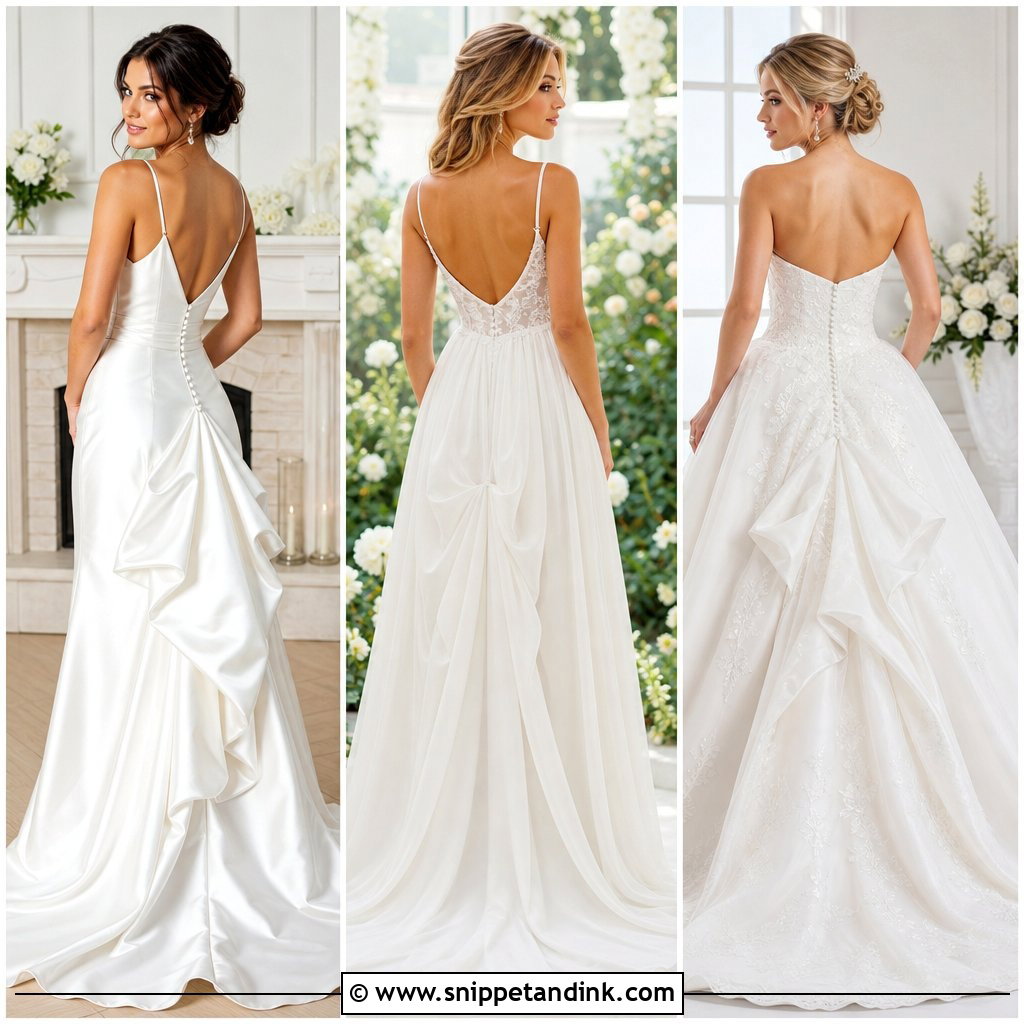
The American bustle is the one most people picture. The train is lifted over the outside of the skirt and fastened near the back waist with buttons, hooks or loops, so it falls in cascading folds. On a full skirt it looks deliberate, and stiffer fabrics such as satin, mikado, tulle and organza hold those folds without collapsing. I like that nobody on the dance floor mistakes it for an accident. The catch is weight. The whole train now hangs from a few points, so on a heavy gown I ask for the hooks to be stitched into a seam or the waist stay rather than just the outer fabric. A structured bodice, simple veil, pearl earrings and block heels complete it.
2. French Bustle Mermaid Wedding Dress
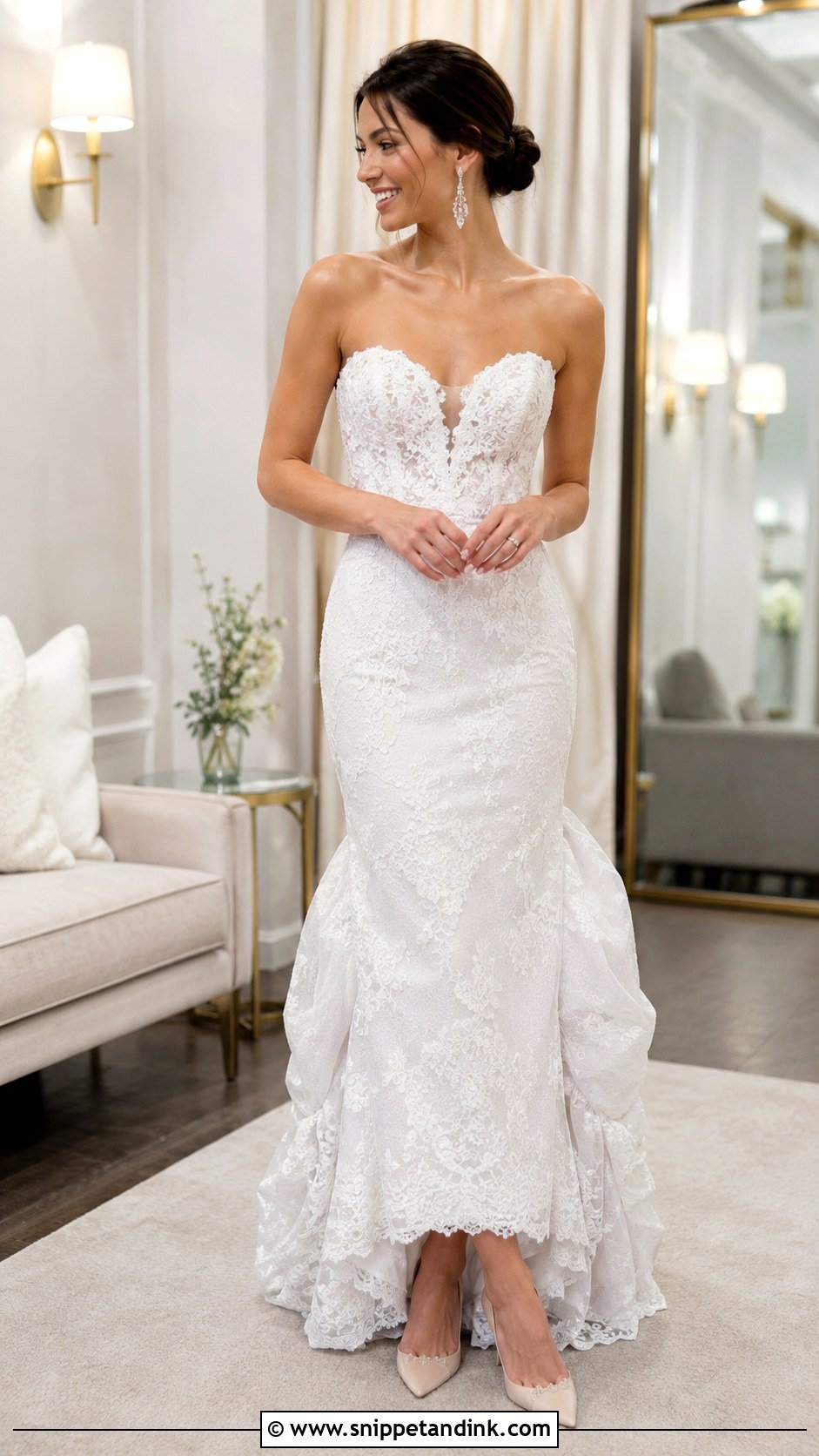
On a fitted mermaid, piling the train on top would spoil the line, so I go French. The train folds under the skirt and is tied in place with ribbons sewn inside, which leaves soft volume below the hips while the back stays smooth over the body. Lace, crepe and fit-and-flare shapes take it well. Seamstresses usually number or color-code the ribbon pairs, and I’d insist on it, because matching ribbons under a skirt in a dim corridor is harder than it sounds. A low bun, drop earrings, pointed heels and a fingertip veil keep attention on the silhouette.
3. Ballroom Bustle Satin Wedding Dress
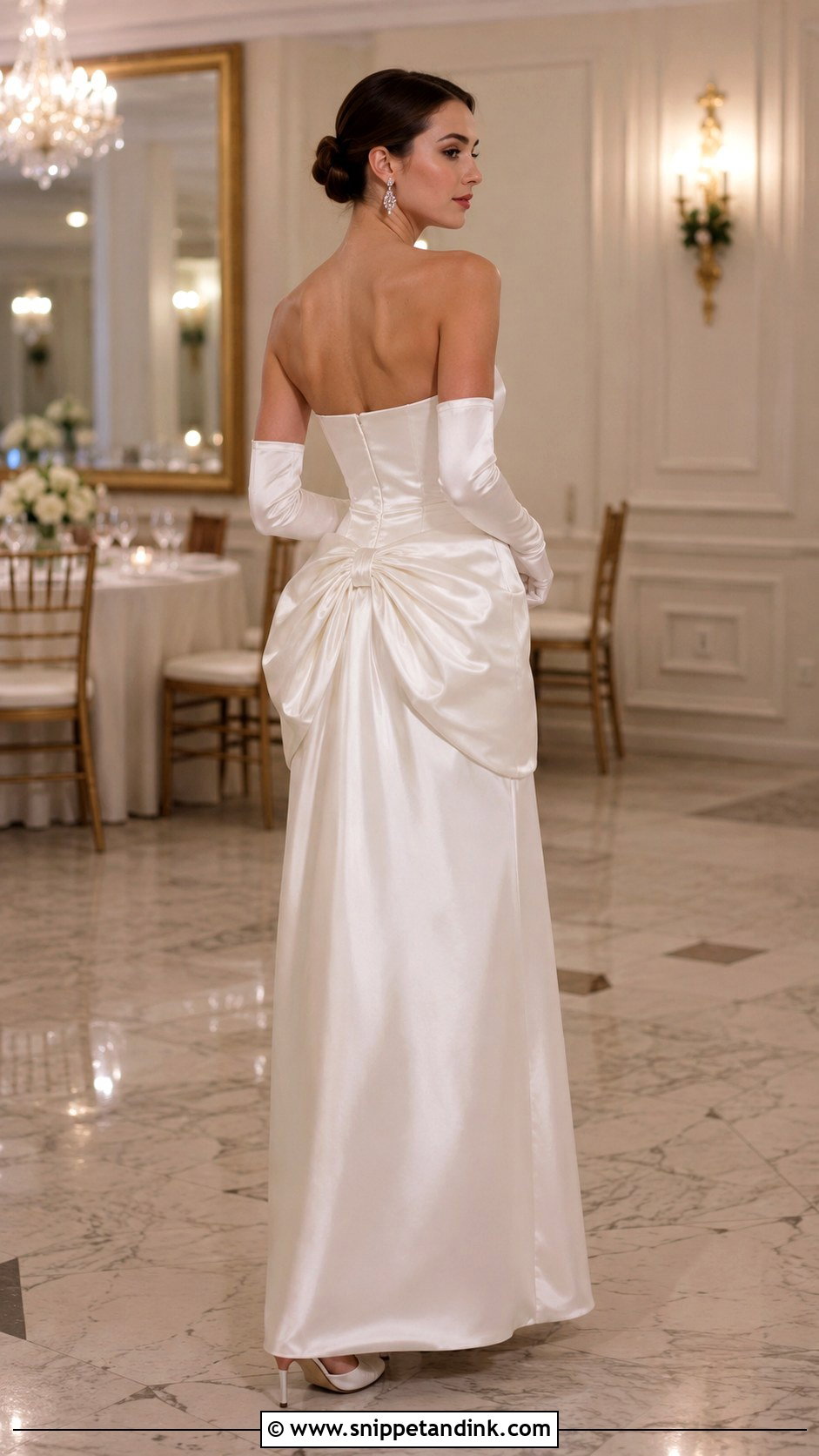
A ballroom bustle makes the train disappear. It’s secured underneath at several points so the hem lies level and the gown reads as a floor-length dress for the reception. Structured satin and mikado suit it best, since the skirt stays smooth over the hidden folds. It’s my choice for a long train at a formal evening, where the weight starts to drag by the third hour. Expect it to take the most fitting time of any style: getting the hem even all the way round can mean several rounds of pinning. Finish with a fitted bodice, sleek gloves, crystal earrings and satin pumps.
4. Bow Bustle A Line Wedding Dress
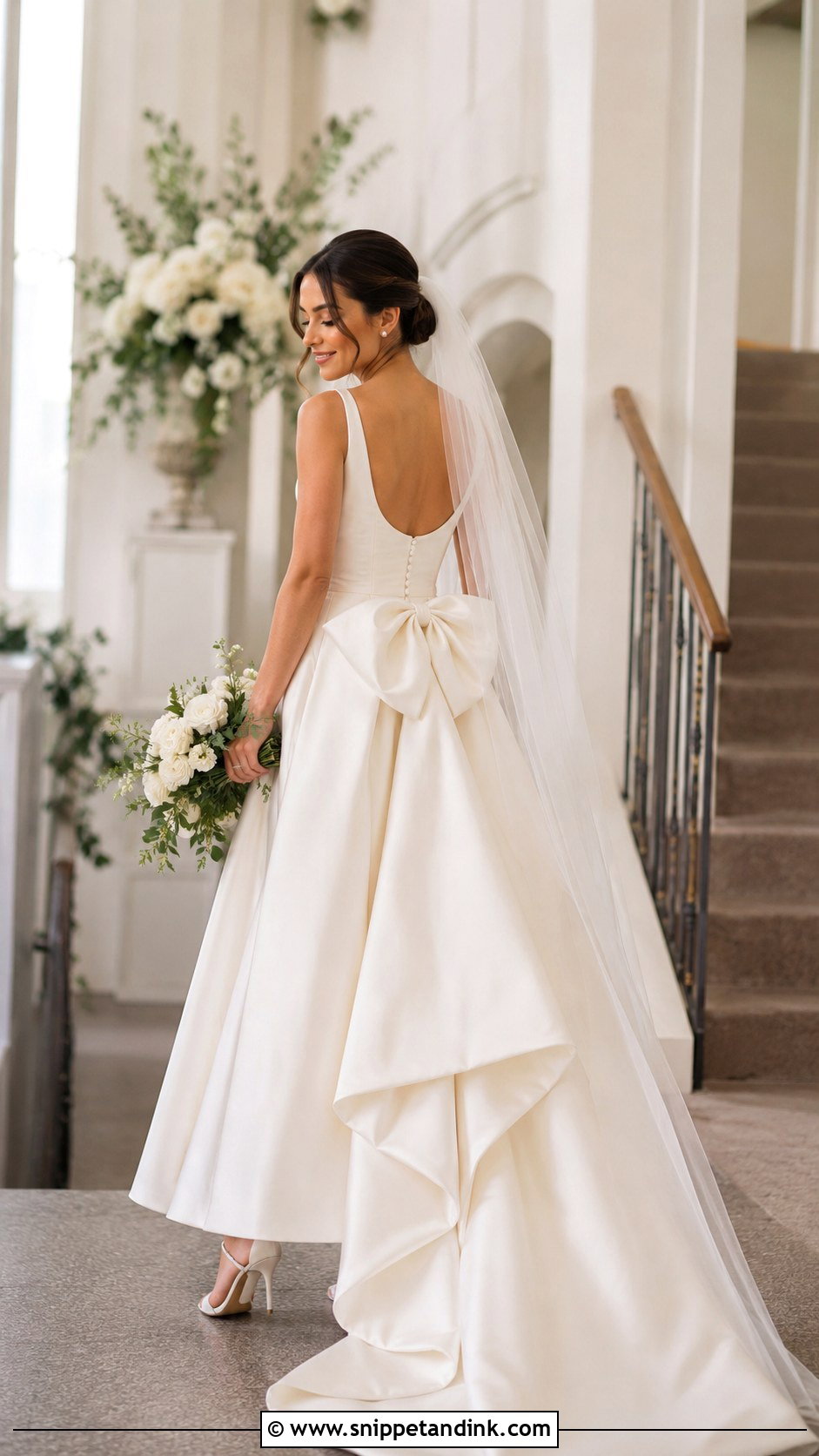
A bow bustle A line wedding dress takes the over-the-skirt lift of an American bustle and hides the attachment point behind a bow. It suits gowns that already have a sash, a detachable bow or a soft waist detail, and the A-line skirt gives the lifted train somewhere natural to fall. Have the bow anchored firmly. It now carries part of the train’s weight and sits exactly where guests’ hands land during hugs. Soft curls, pearl studs, a sheer veil and comfortable heels finish it.
5. Victorian Bustle Lace Wedding Dress
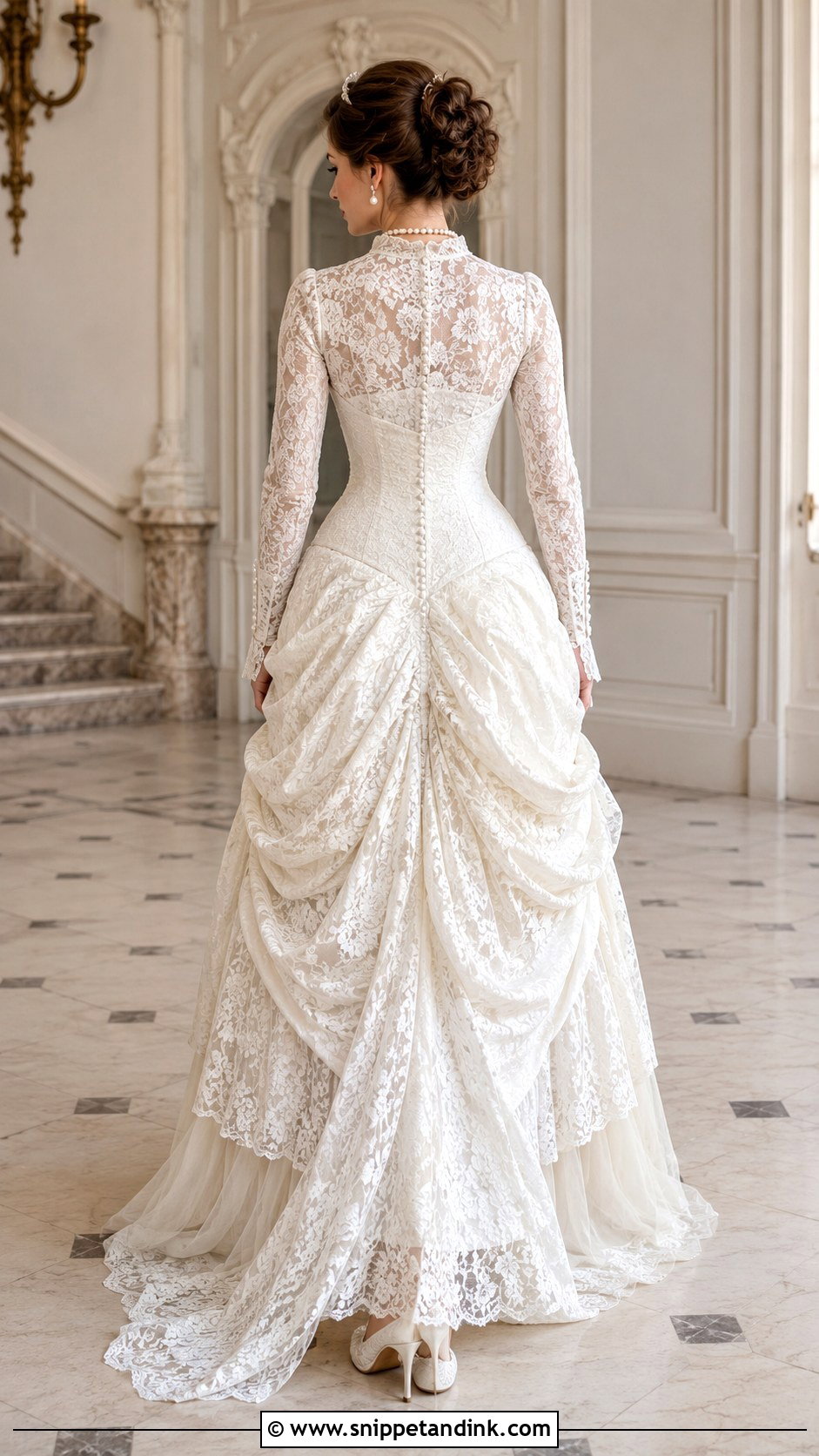
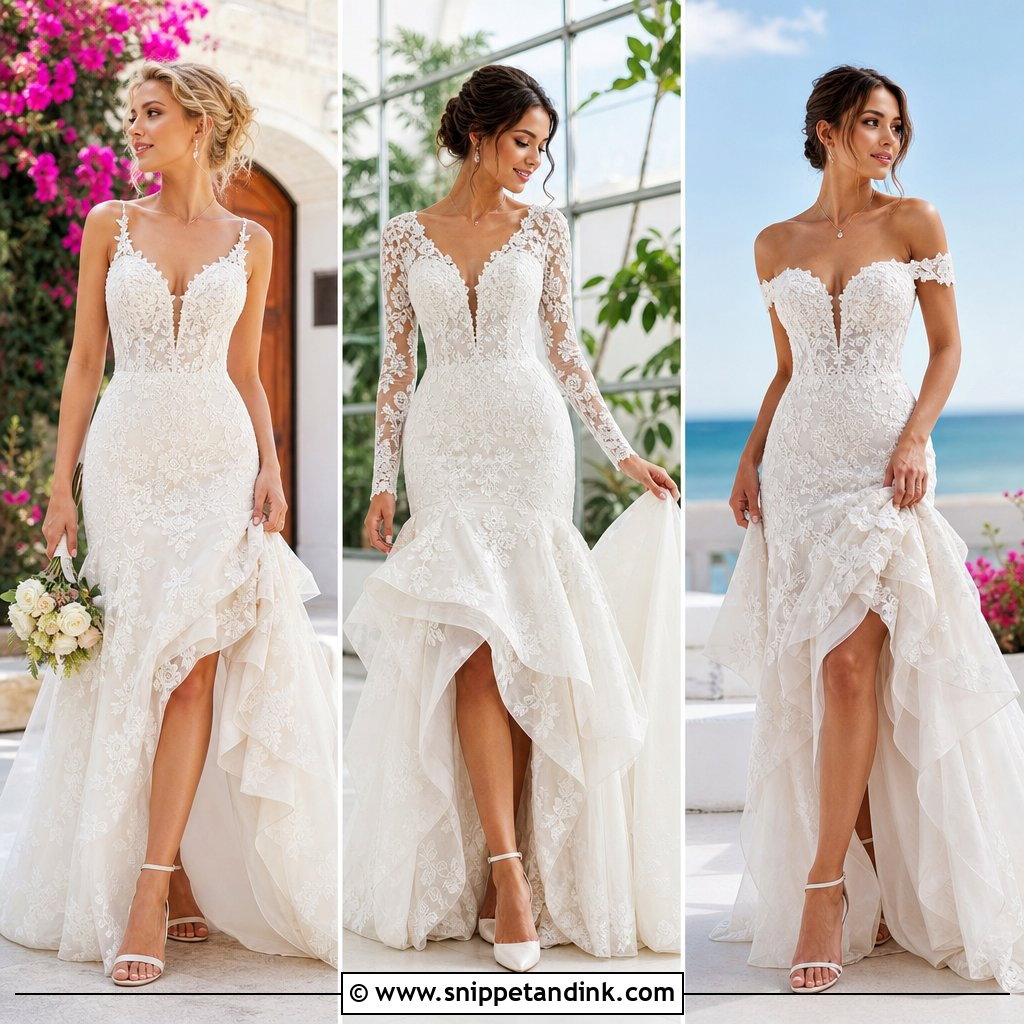
A Victorian bustle lace wedding dress gathers fabric into fullness at the back, so the bustle reads as part of the design rather than a practical fix. In soft lace it looks historic without tipping into costume. It needs a defined waist, a fitted bodice and a train that lifts into layered folds, and I suggest it to brides who already love antique details such as high necklines, long sleeves or corset-style bodices. Lace snags on metal, so I’d ask for thread loops or satin-covered buttons rather than hooks. Lace-trimmed shoes, a soft updo and small pearls complete it.
6. Train Flip Bustle Crepe Wedding Dress
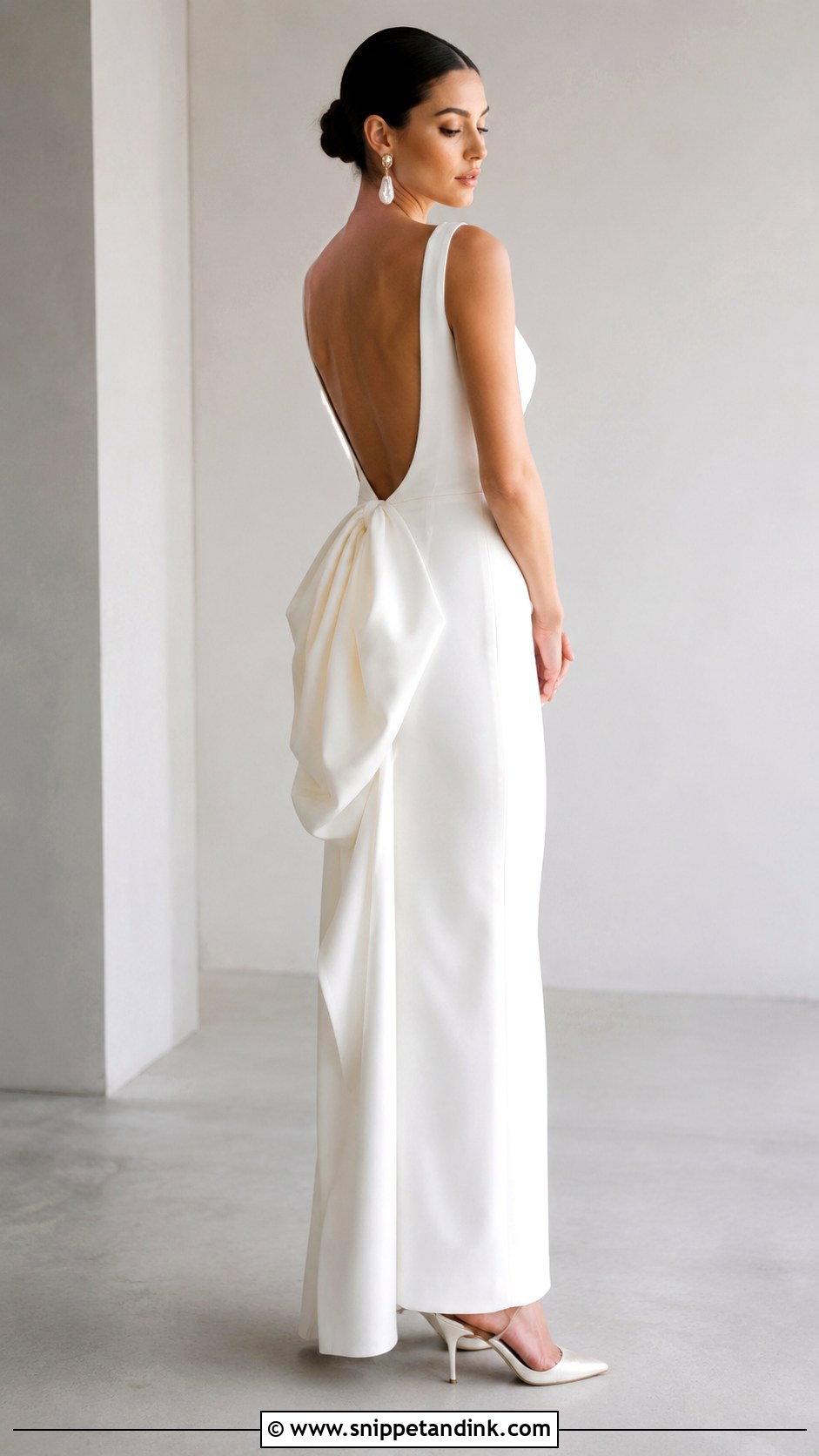
This is the most minimal option of the lot. The train is flipped under and secured so the dress hangs close to floor length, with no visible folds. Crepe drapes sleekly enough that it doesn’t need volume behind it. I wouldn’t use it on a heavily beaded or very wide train, because the folded layer gets bulky and can show as a ridge through thin fabric. Pointed white heels, a sleek bun, sculptural earrings and a simple veil keep it modern.
7. Austrian Bustle Tulle Wedding Dress
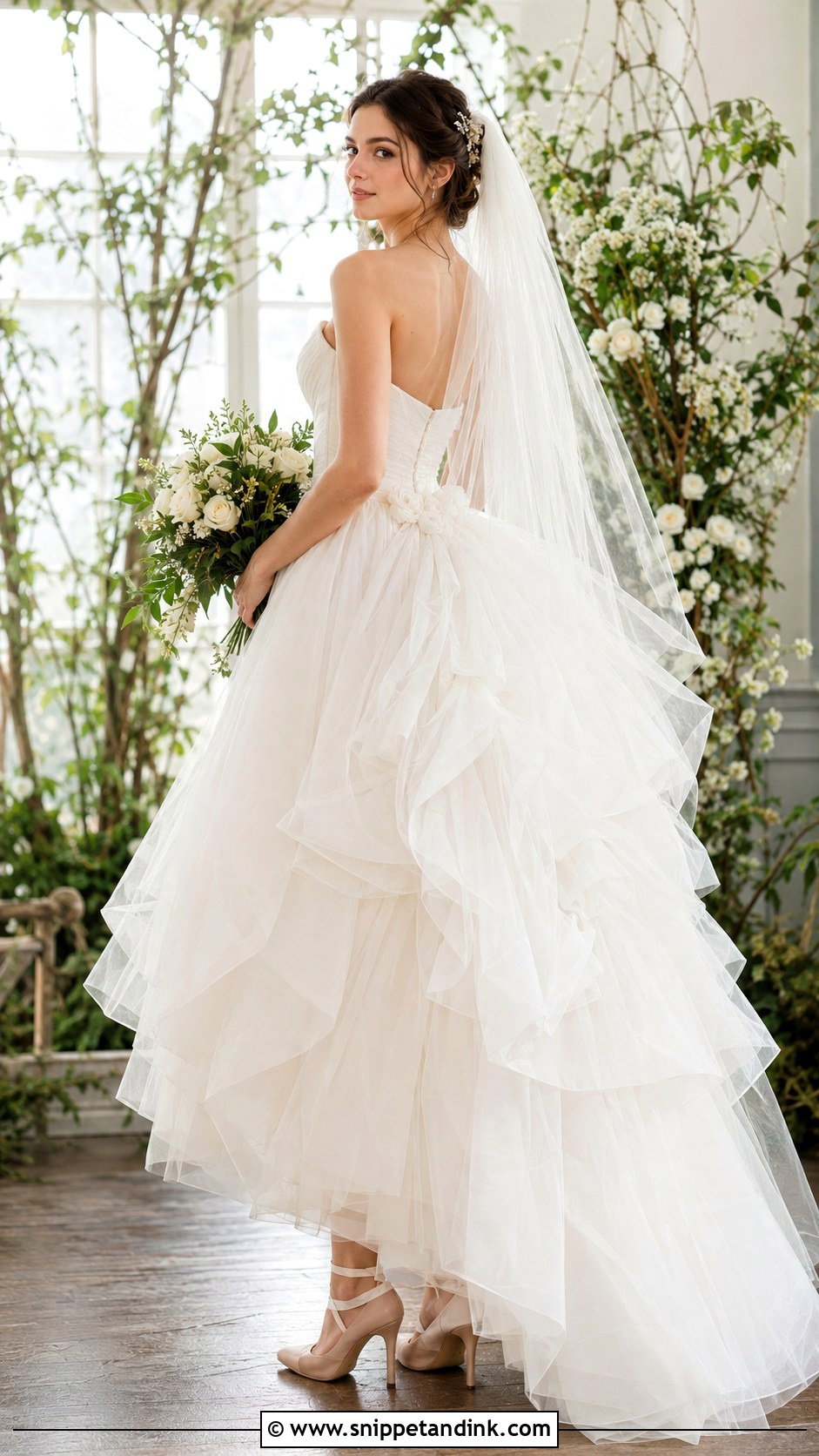
Austrian bustles gather the train with vertical pickups or cords run through channels inside the skirt, rather like a theater curtain rising, and they leave a ruched texture down the back. Lightweight tulle gathers without turning bulky, so it suits romantic ball gowns, airy A-lines and layered skirts, and it looks lovely in motion. The cords must be tied off securely and tucked away; a loose end left dangling catches on chair legs. A floral comb, sheer veil, delicate bracelet and ballet-style heels finish it.
8. English Bustle Fit And Flare Wedding Dress
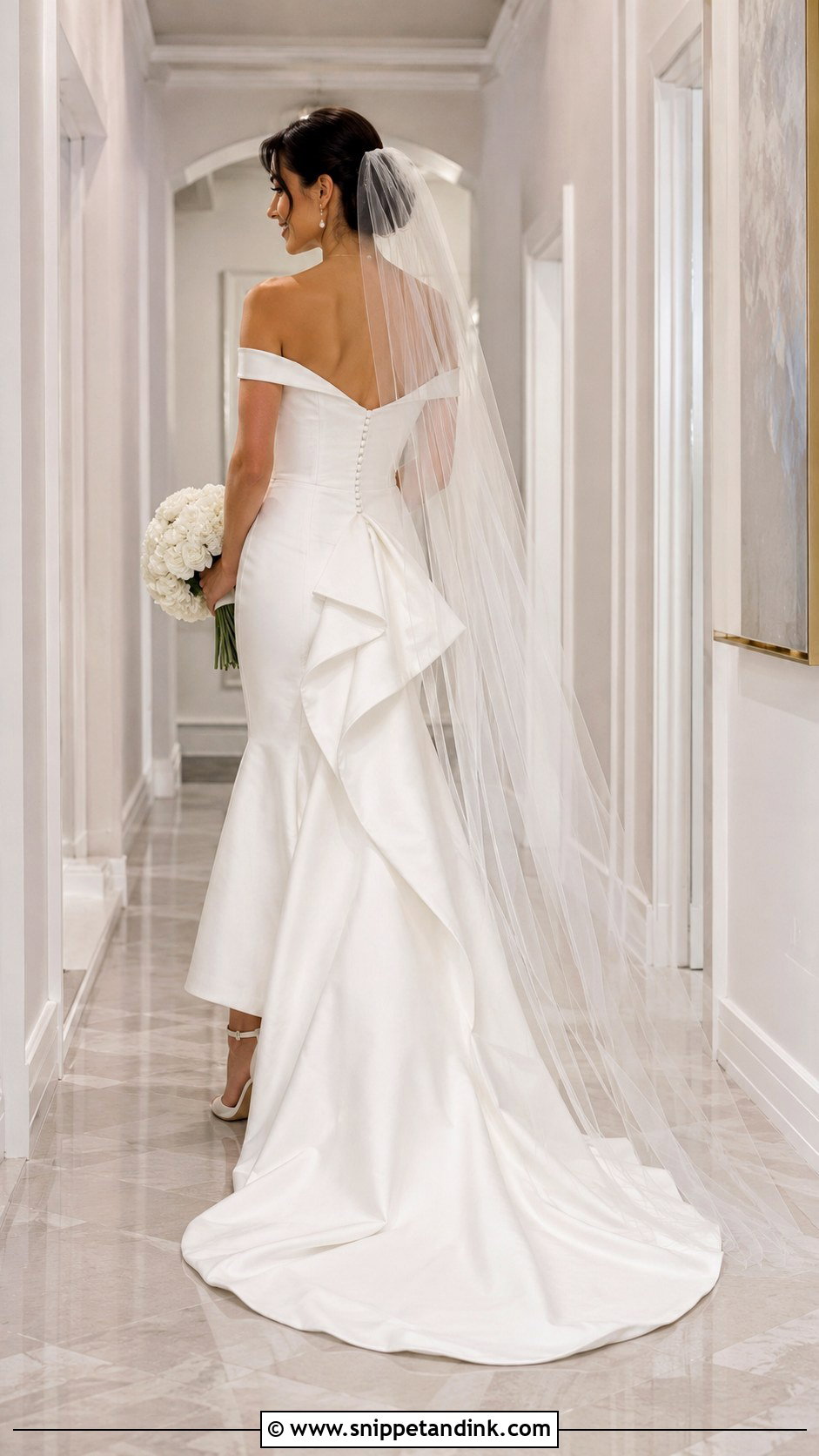
An English bustle is a tailored lift that keeps a fitted gown neat while adding structure at the back. Seamstresses use the name for slightly different techniques, so ask yours to show you rather than relying on the label. It suits gowns with a fitted hip, smooth fabric or a shaped train that needs precise placement, where the aim is to keep the dress’s lines without random bunching. For a refined reception I’d pick it over anything puffy. Sleek earrings, a chapel veil, ankle-strap heels and a fitted bodice complete it.
9. Wrist Loop Wedding Dress With Train
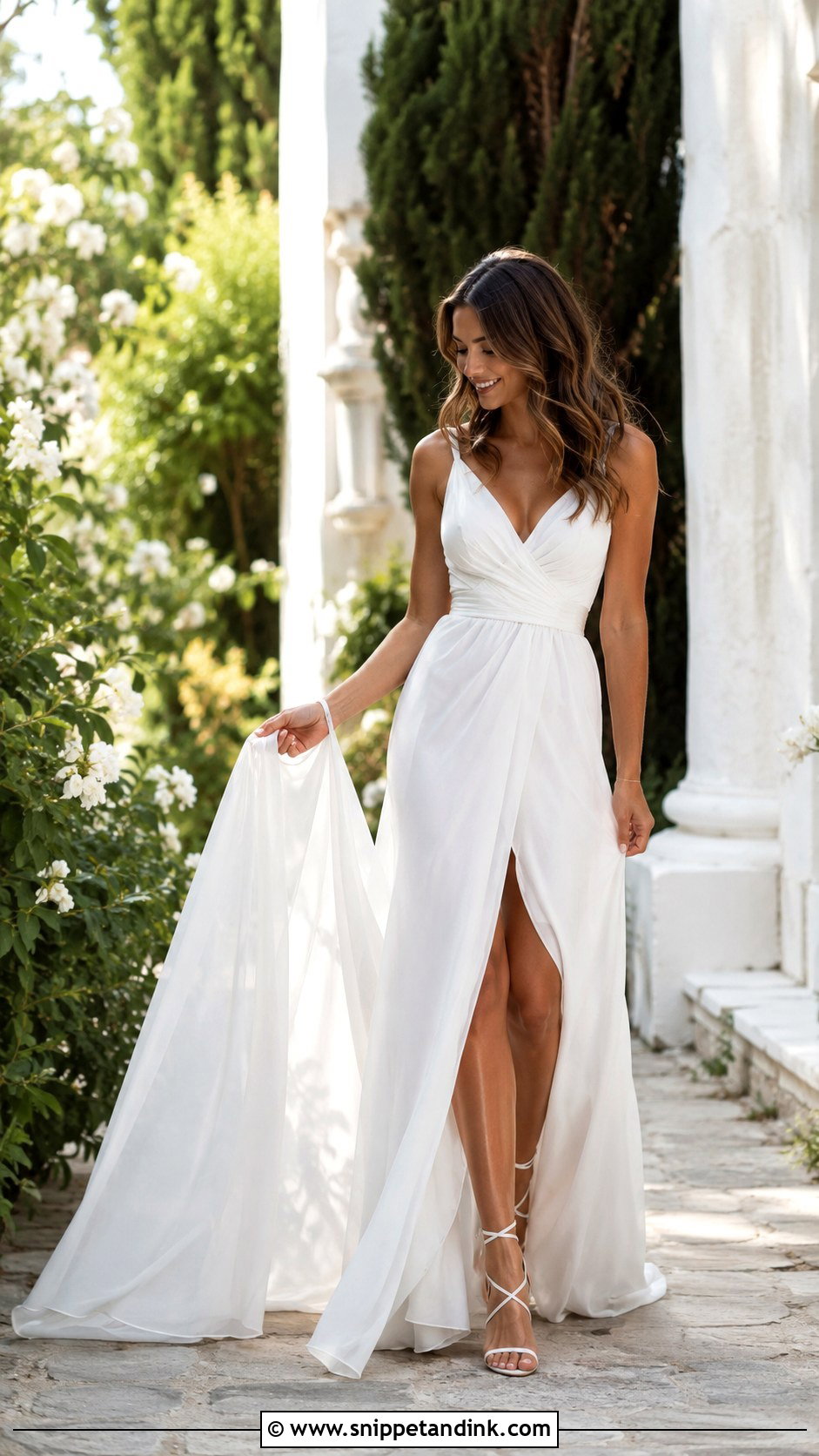
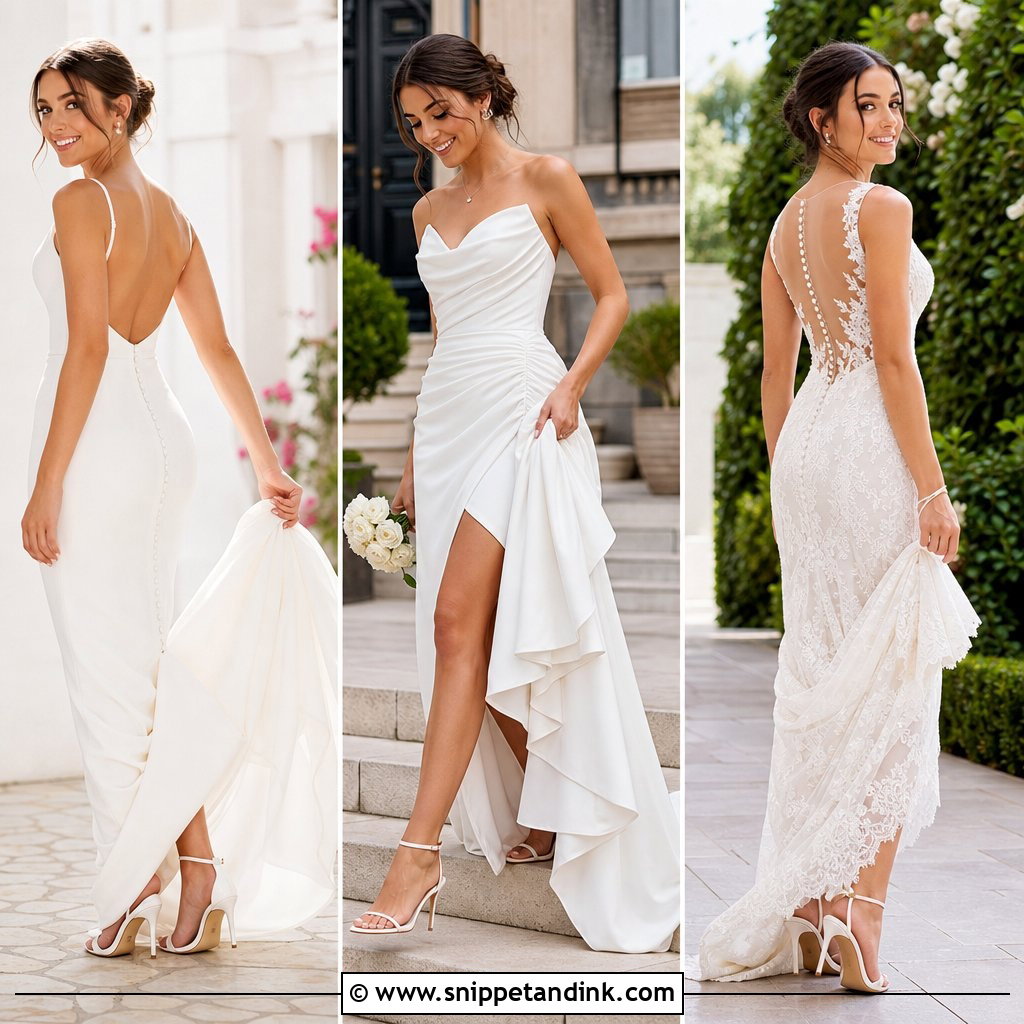
Strictly speaking, a wrist loop isn’t a bustle at all. A small loop sewn under the train slips over your wrist so you can carry the fabric during photos or short walks. It looks graceful, but I rarely recommend it for a whole reception, because one hand is always occupied and you can’t hold a glass and hug someone at the same time. It works with light chiffon, organza or soft tulle, and for outdoor portraits it does the job well. Plenty of brides pair it with a proper bustle and use the loop only for pictures. Strappy heels, a slim bracelet and relaxed waves suit it.
10. One Point Bustle Sheath Wedding Dress
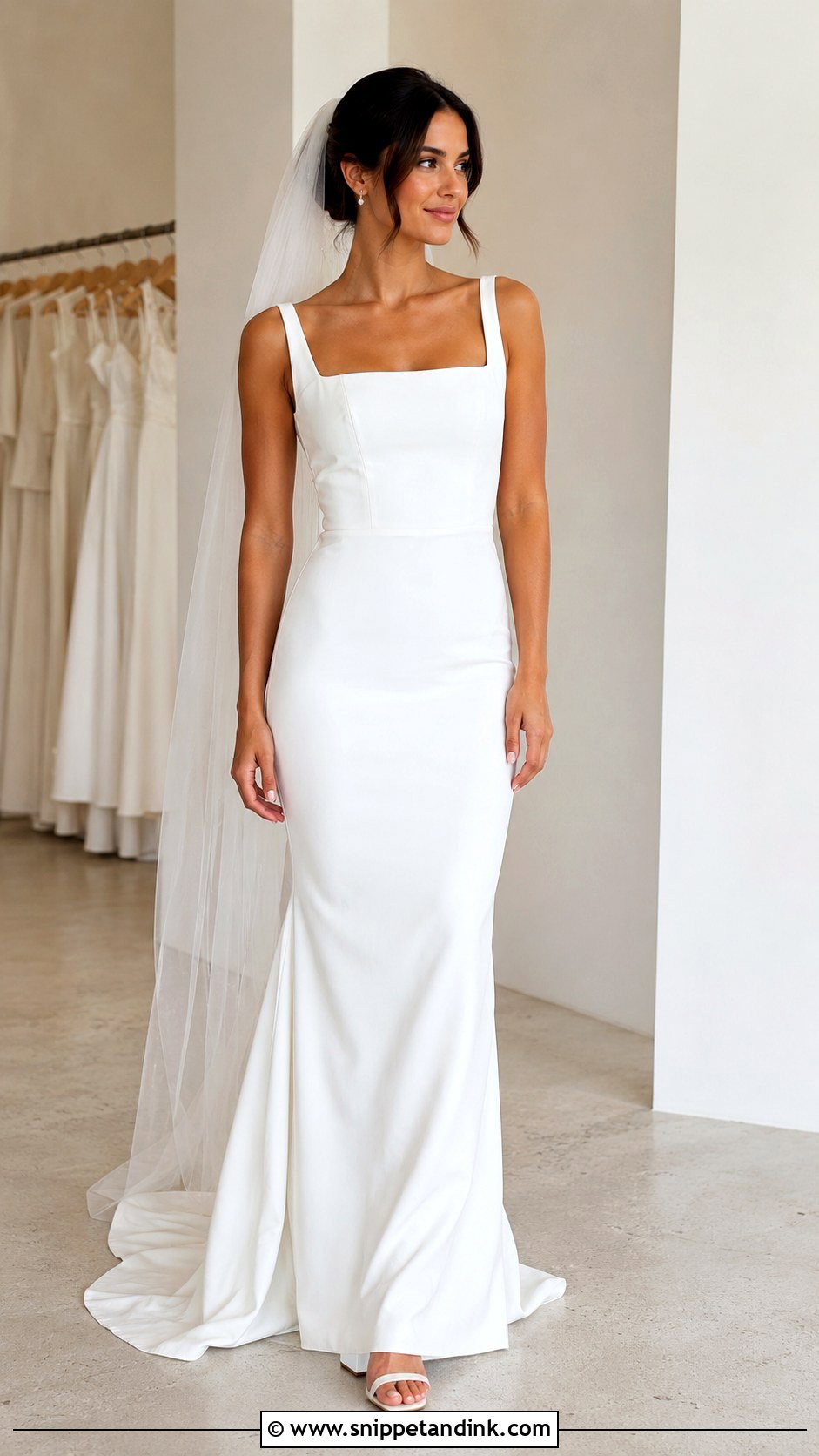
One point is the simplest bustle there is. The fabric is lifted and hooked at a single spot near the back waist or lower hip, and on a narrow sheath with a short, light train it looks clean. Anyone can fasten it in under a minute, which suits a relaxed reception. Its limit is weight. On anything heavier than crepe, chiffon or lightweight satin, a single point drags at the waist and the train swings when you turn. A square neckline, simple veil, low block heels and small earrings keep it modern.
11. Three Point Bustle A Line Wedding Dress
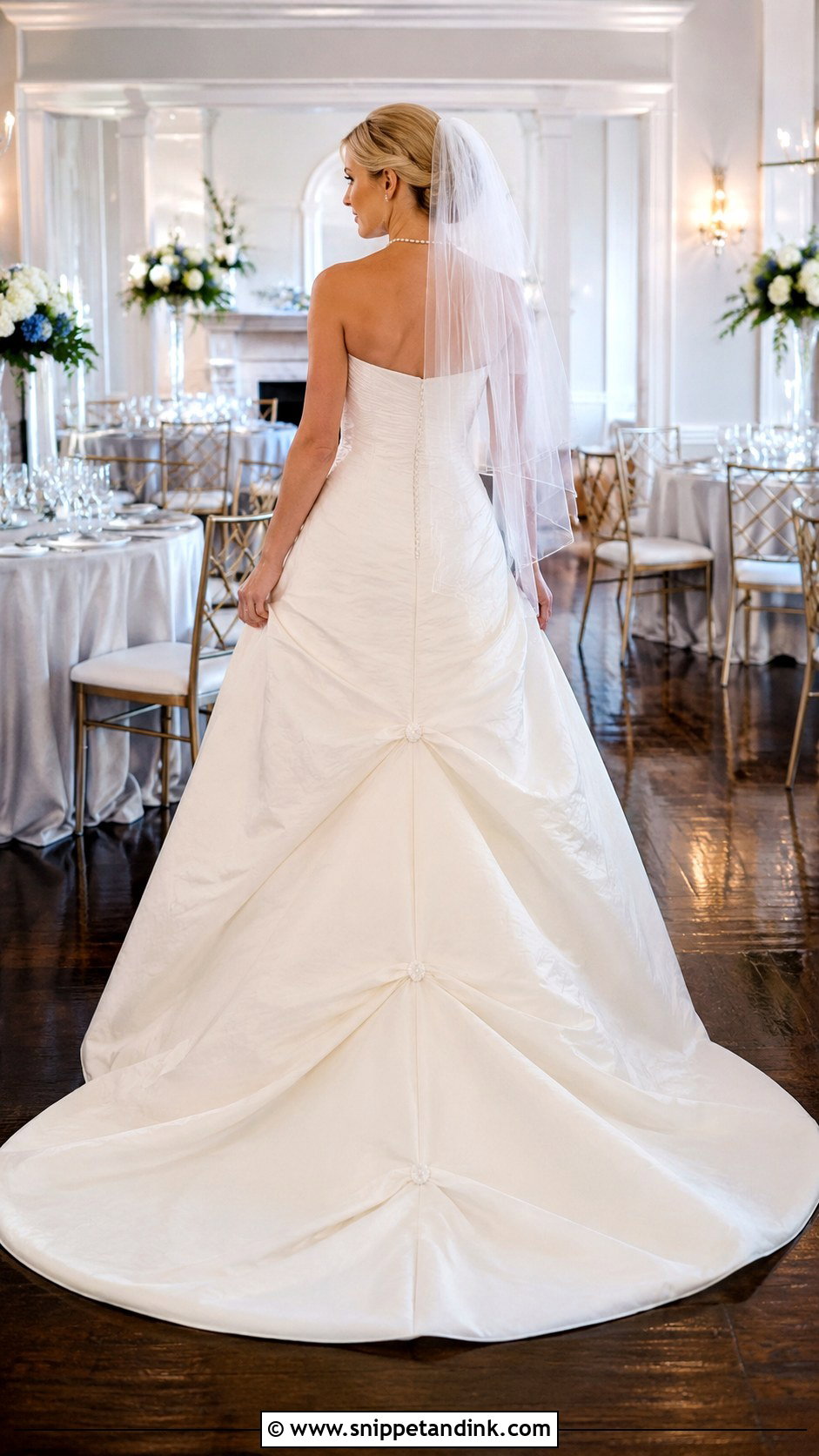
Three points spread the train evenly across the back, which is why seamstresses reach for this one so often. It handles medium-length trains, lace borders and slightly heavier fabric without becoming fiddly, and on an A-line the lifted fabric falls naturally between the points. The usual error is uneven spacing: if the outer points sit higher than the center, the hem dips in the middle. I always check it from both sides and from the back at a distance. A fitted bodice, soft veil, pearl necklace and closed-toe heels complete it.
12. Five Point Bustle Cathedral Train Wedding Dress
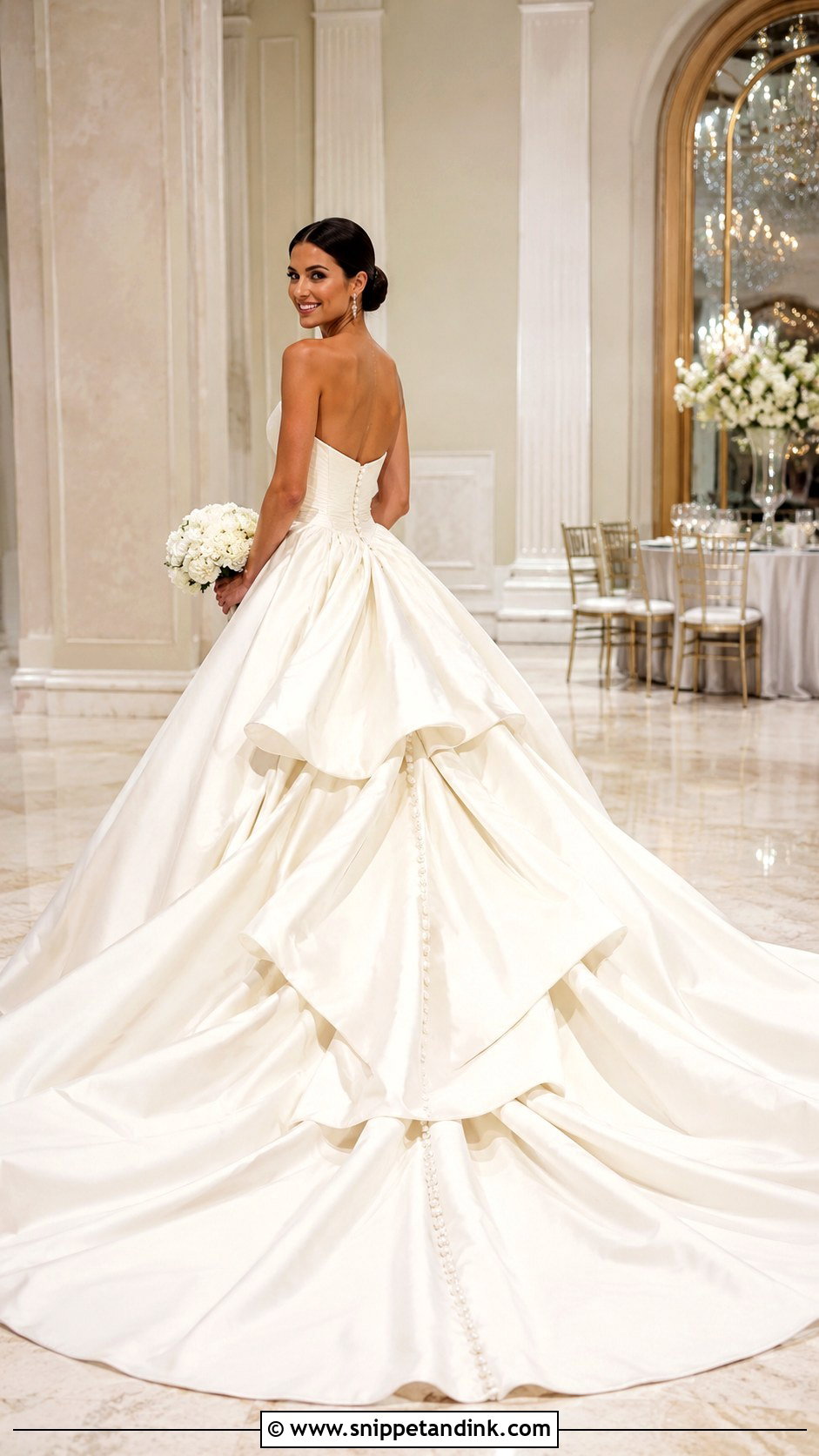
Cathedral trains need more than one or two points, or the fabric sags and pulls unevenly. Five points lift a long train into a fuller, balanced shape across the back, which suits ball gowns, grand A-lines and heavily detailed skirts, and gives the bride real freedom afterward. More fasteners means more practice. Whoever bustles you should do it at least once at the final fitting while the seamstress watches, and ideally film it on their phone. Wear a long veil for the ceremony, then take it off so the bustle shows.
13. Bustle Wedding Dress With Lace Train
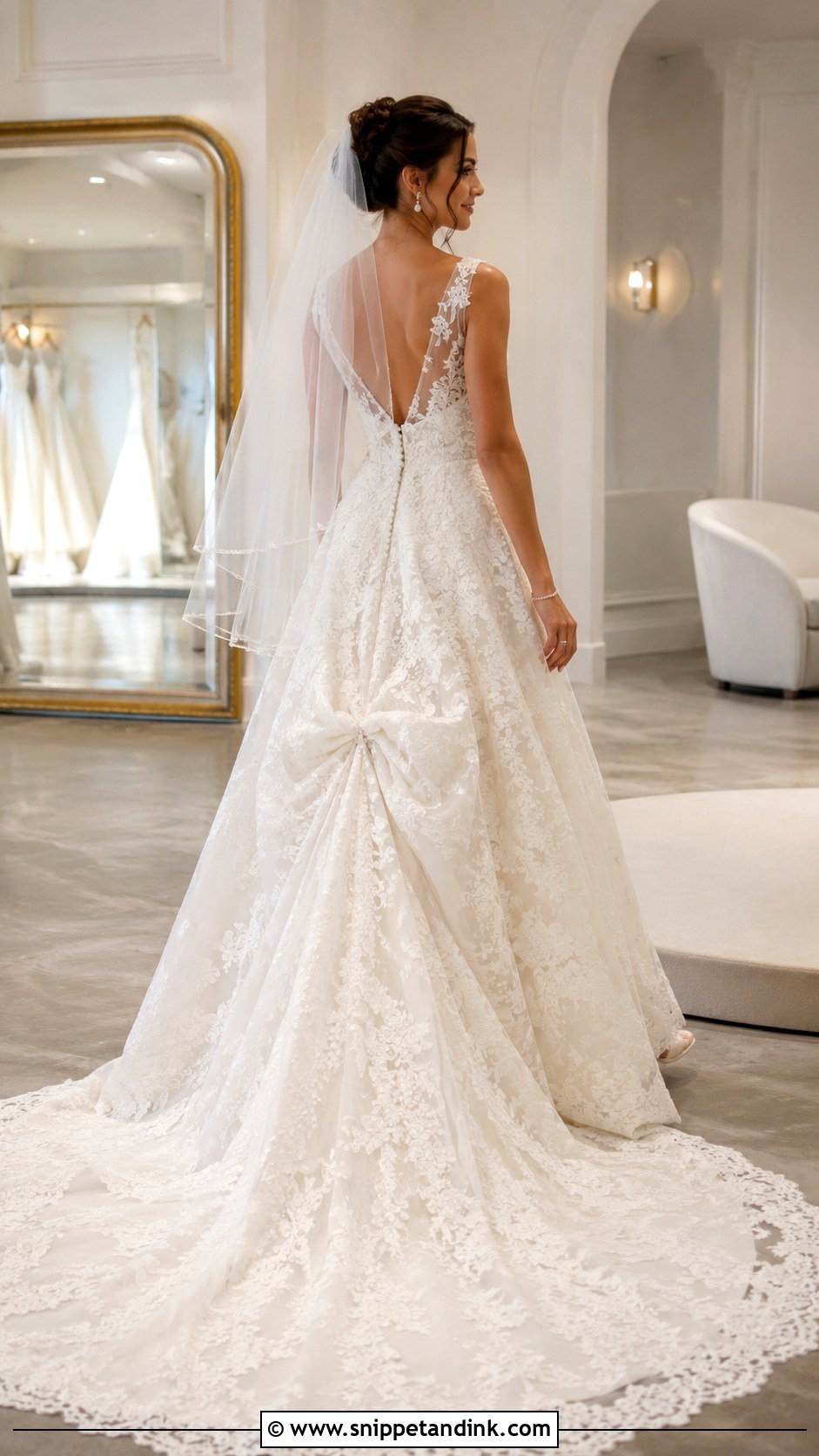
Placement is everything with lace, because the scalloped border or the best motif usually runs along the hem, and it’s easy to fold it out of sight. I ask the seamstress to set the points so the pattern still faces outward once the train is up. French, American and ballroom styles can all work: a lace A-line often looks good with soft outside pickups, while a fitted lace gown stays cleaner with an under bustle. Keep accessories light, with pearl earrings, a thin bracelet, neutral heels and a simply edged veil, so nothing competes with the lace.
14. Bustle Wedding Dress With Beaded Train
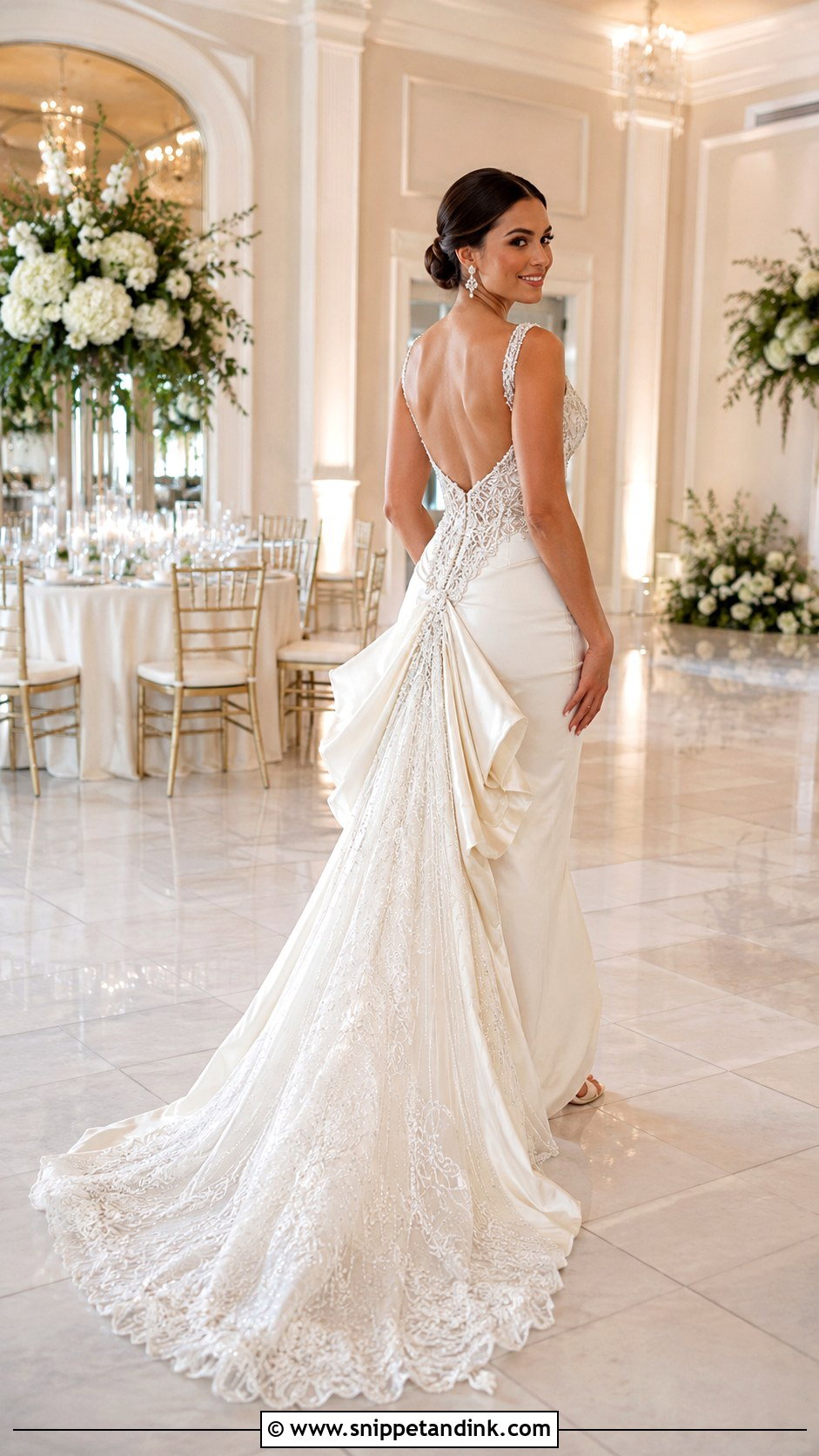
With a beaded train, security comes first and looks come second. Beading adds a surprising amount of weight, so the points have to hold the train without tearing delicate fabric, and a good seamstress places hooks or loops on strong seams or reinforced patches rather than directly on the embellishment. Done well, the beads catch light in the folds, which is wonderful at an evening reception. Simple crystal earrings, sleek heels and smooth hair suit it. I’d also keep anything that could snag away from the back, such as long hair pieces or a dangling clutch strap.
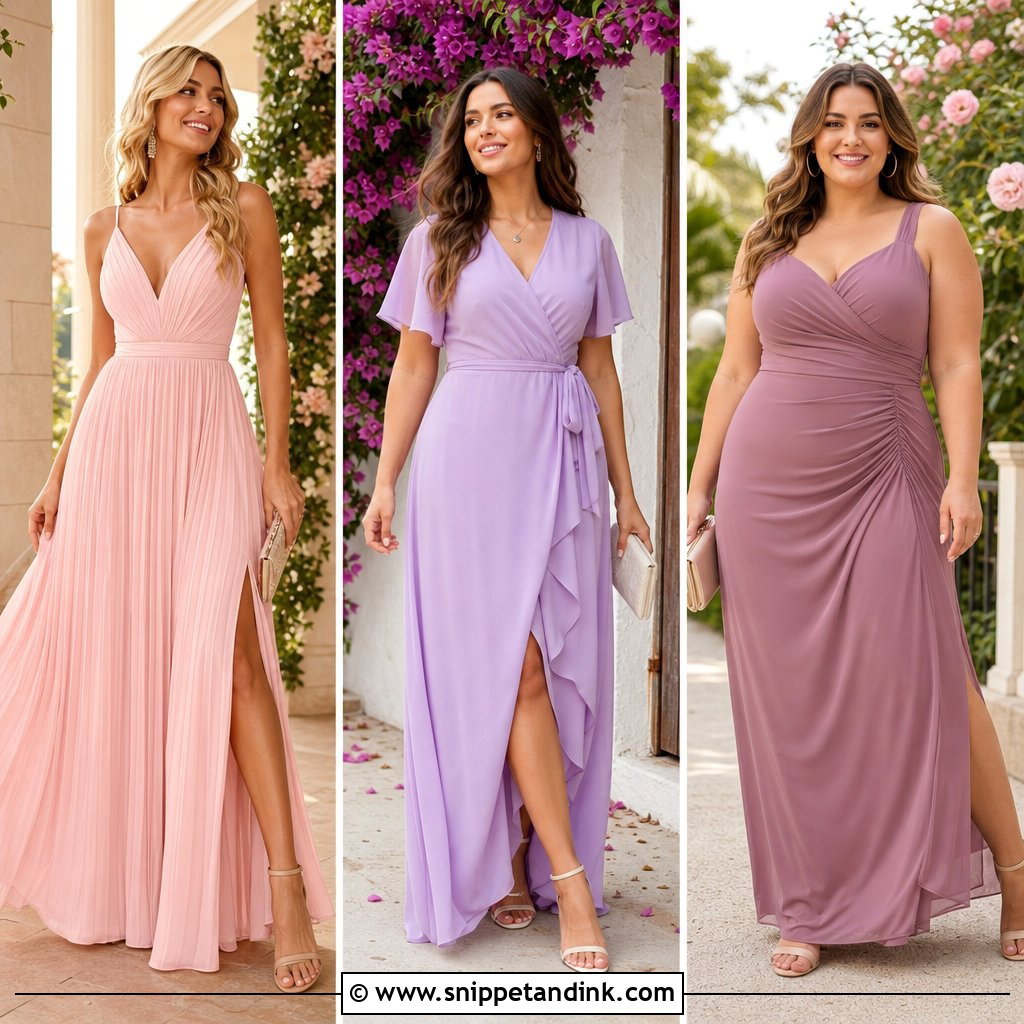
15. Bustle Wedding Dress With Tulle Skirt
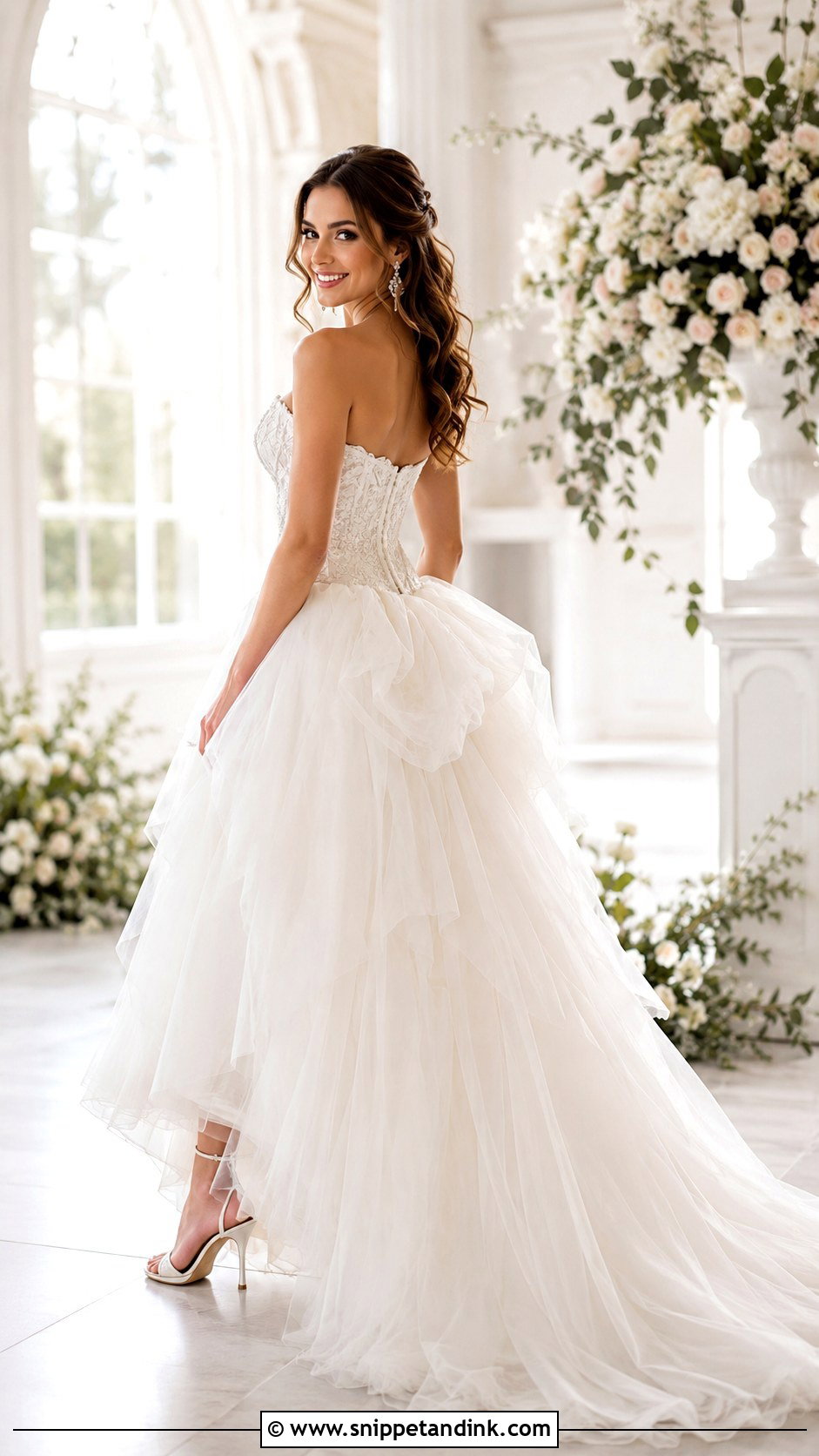
Tulle is light enough to lift into layered folds without strain. The real challenge is volume, since several layers can puff out if the bustle sits too high or is pulled too tight. An American, Austrian, or multi-point bustle can all work on ball gown and A-line shapes. On a skirt with many layers, the seamstress will often bustle each layer separately or hem the lining shorter, so the lower layers float instead of bunching. A fitted bodice, delicate earrings, soft curls and comfortable heels hidden under the skirt complete it.
16. Bustle Wedding Dress With Chiffon Skirt
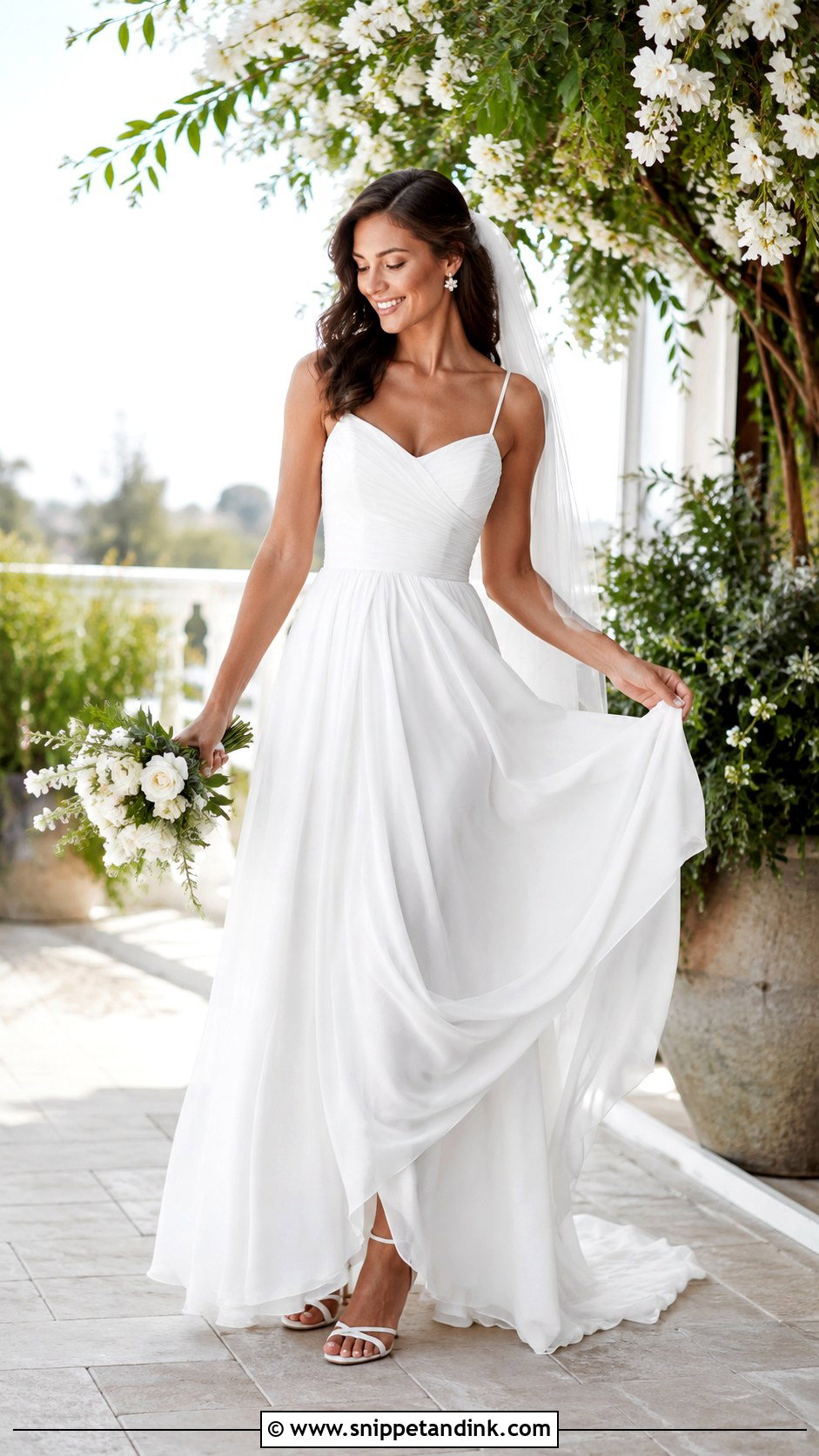
Chiffon drapes so freely that it droops if the bustle isn’t balanced. A soft under bustle or a subtle outside pickup lifts the train while keeping the fabric fluid; anything bulky just fights the drape. It suits beach, garden and warm-weather weddings. Because chiffon is thin, I ask for each hook to be backed with a small patch of matching fabric, so the point doesn’t pull a visible pucker through the skirt. Strappy sandals, a simple veil, small floral earrings and loose waves keep it relaxed.
17. Bustle Wedding Dress With Organza Skirt
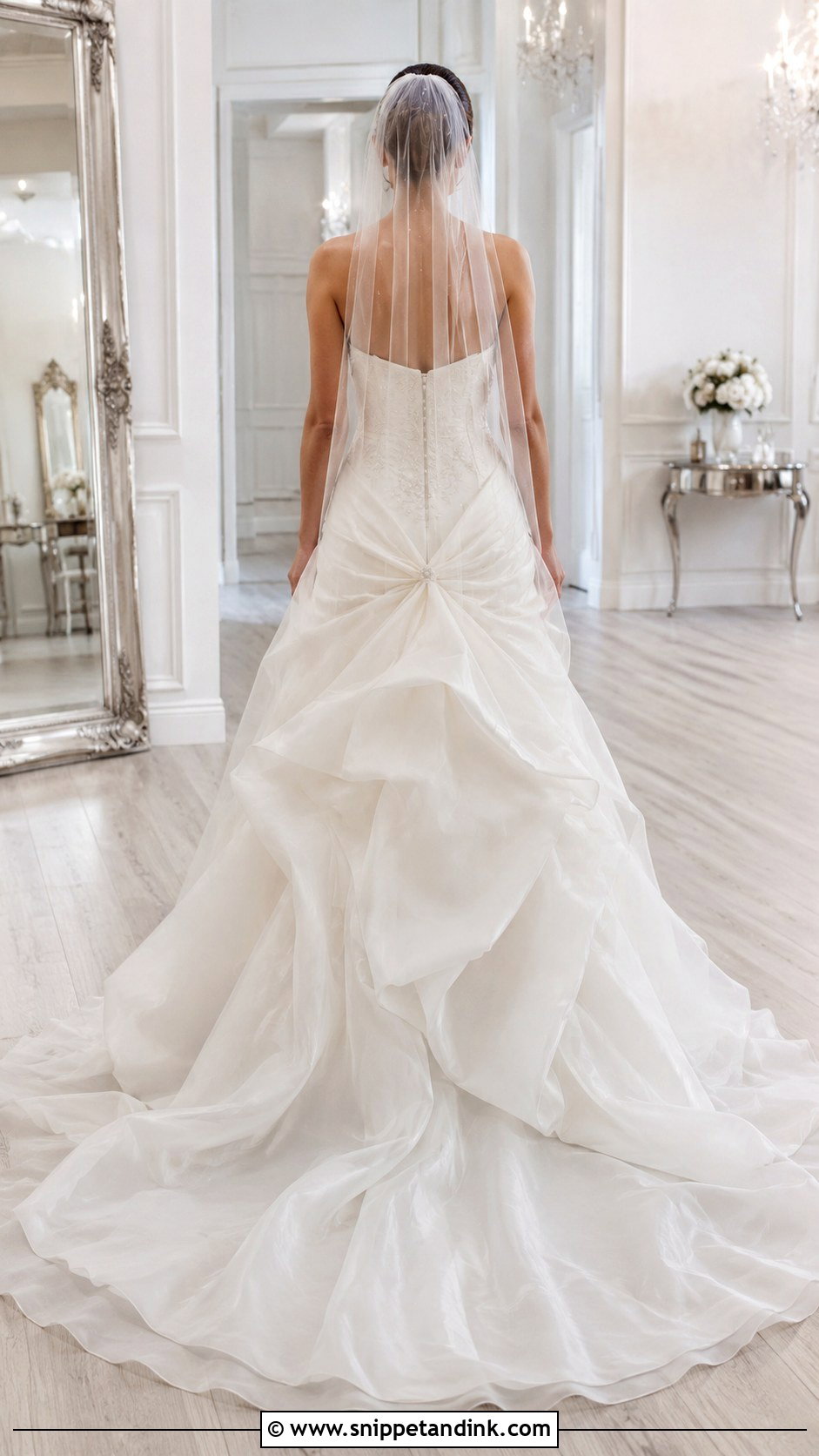
Organza sits between satin and chiffon: lighter than one, crisper than the other. That body means it holds folds well, so an American bustle makes soft visible layers and a ballroom bustle keeps the skirt cleaner, and it adds volume with a delicate surface on A-lines and ball gowns. Watch for creasing. Organza remembers its folds, so if the bustle stays up all night, expect lines when you let the train down for any late photos. A clean bodice, crystal studs, satin heels and a sheer veil support it.
18. Bustle Wedding Dress With Satin Skirt
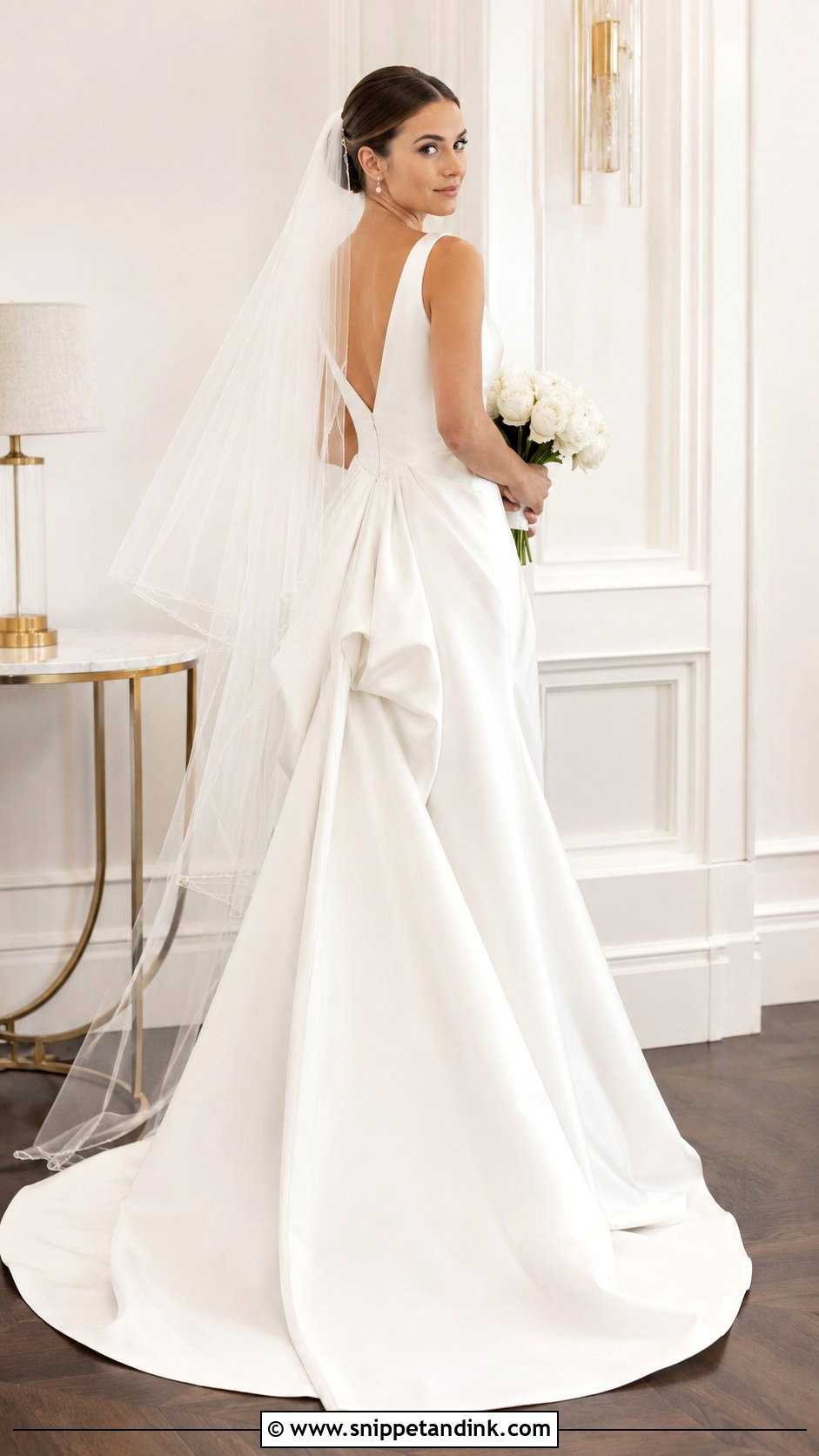
Satin is unforgiving, because its shine picks up every fold, pull and pucker. Done well, though, a bustled satin skirt looks formal and expensive. A ballroom bustle hides the train neatly, and an American bustle works if the folds are placed with care. Full satin ball gowns and A-lines handle bustle points far better than a slinky satin sheath, where any lift drags the fabric across the hips. Keeping the back balanced is the whole job. Satin pumps, pearl earrings, a classic veil and a clean updo let the fabric speak.
19. Bustle Wedding Dress With Long Sleeves
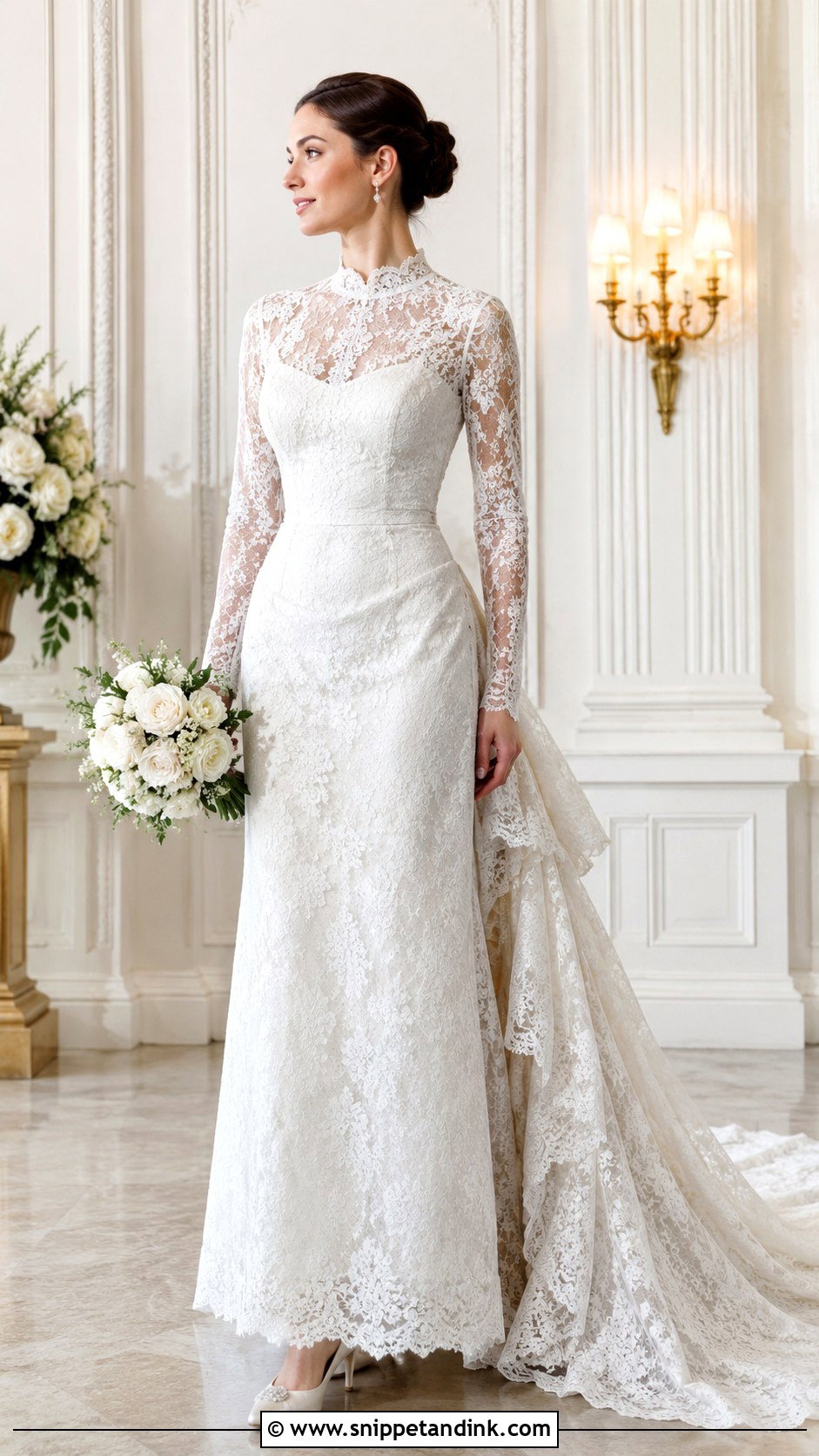
Long sleeves already give the eye plenty to look at, so the bustle should support the gown without crowding the back. Lace sleeves pair well with a French or soft American bustle, and crepe sleeves suit cleaner options. It’s a natural choice for cooler seasons, formal venues and brides who want coverage. One practical point I raise at fittings: in a fitted sleeve you can’t reach behind yourself, so you’ll rely entirely on a helper, and the fastenings should be ones she can see and reach easily. Closed-toe heels, delicate earrings and a neat bun or half-up style finish it.
20. Bustle Wedding Dress With Corset Bodice
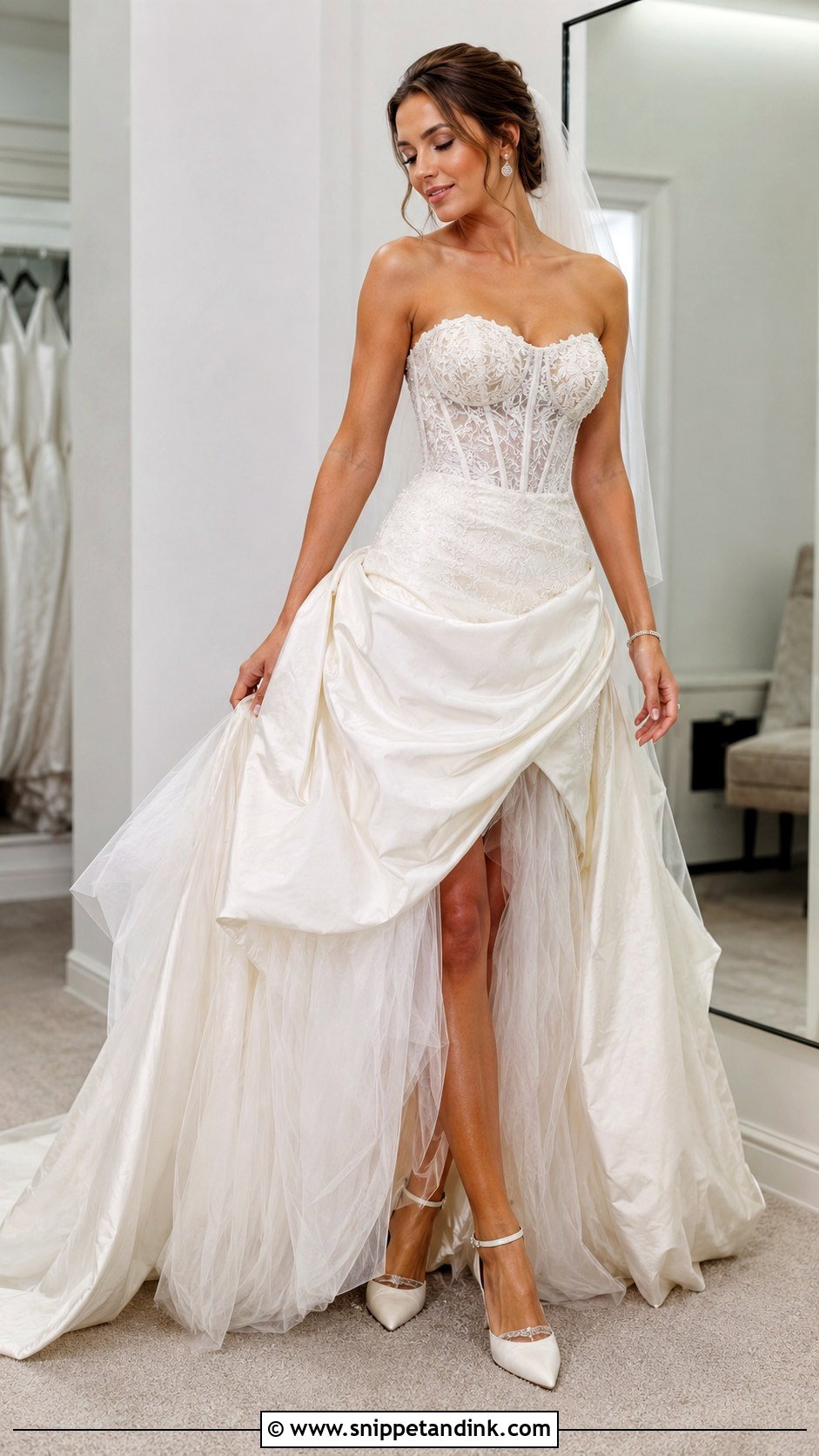
A corset bodice already draws the eye to the waist, so the bustle should flatter that line rather than add bulk right beneath it. Full ball gown and A-line skirts can take a fuller bustle, while a fitted skirt needs a smoother under bustle, and lace, satin and tulle all work. My fit check is to bustle the dress and then lace the corset to its wedding-day tightness, because a lifted train adds pull at the back waist and can shift how the bodice sits. A simple necklace if the neckline allows, soft earrings and heels in the dress tone complete it.
21. Bustle Wedding Dress With Detachable Train
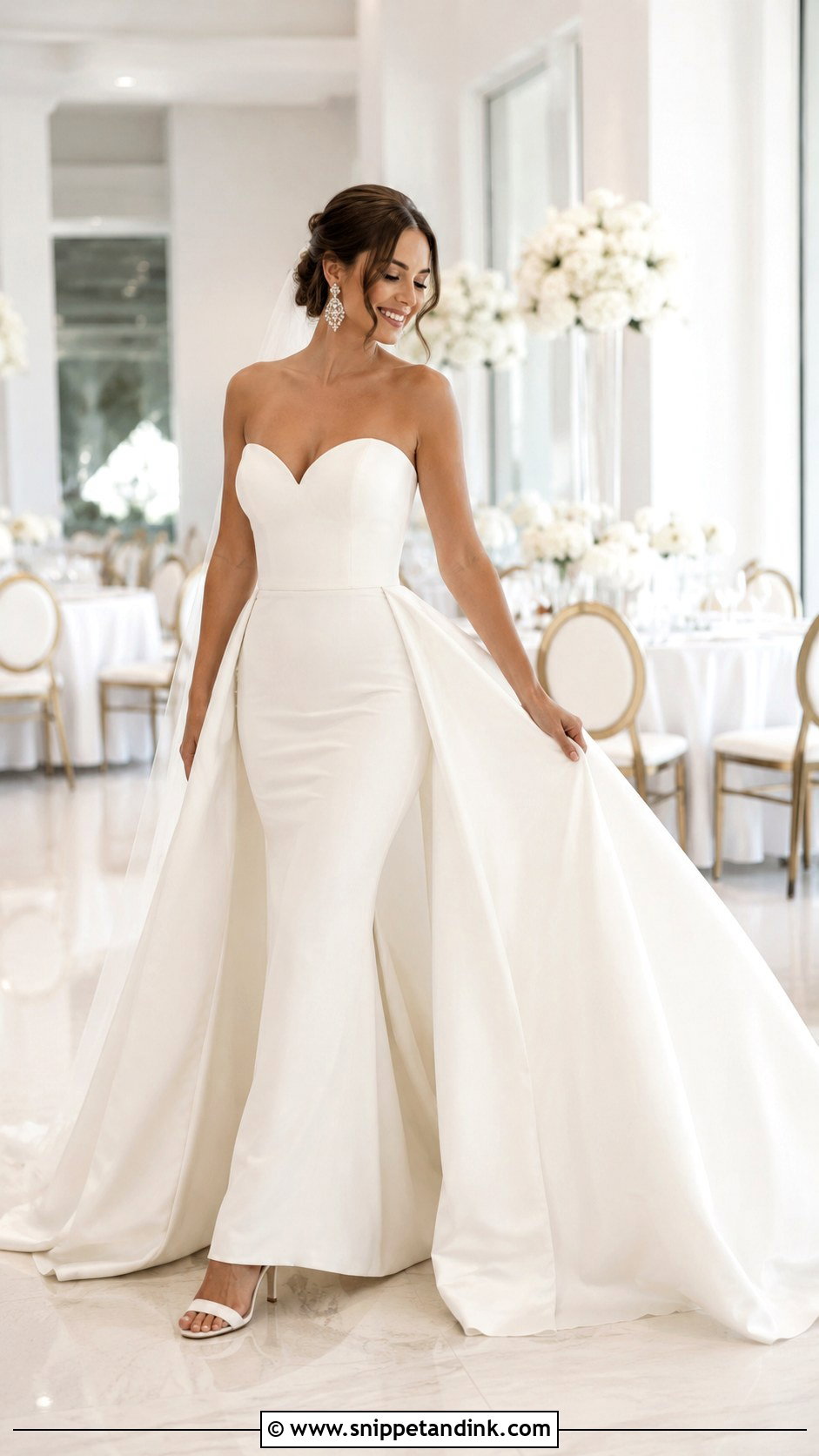
A bustle wedding dress with detachable train gives you two outfits in one. The train makes the ceremony entrance, then comes off or gets bustled for the reception. Some attach at the waist and others at the shoulders or back, and if fabric remains after removal, a small bustle may still be needed. I’d confirm how the train fastens before buying, since a row of buttons or hooks along the waist can stay visible once the train is off unless it’s designed to hide. Go dramatic for the ceremony with a long veil and statement earrings, then simplify with comfortable heels.
22. Bustle Wedding Dress With Overskirt
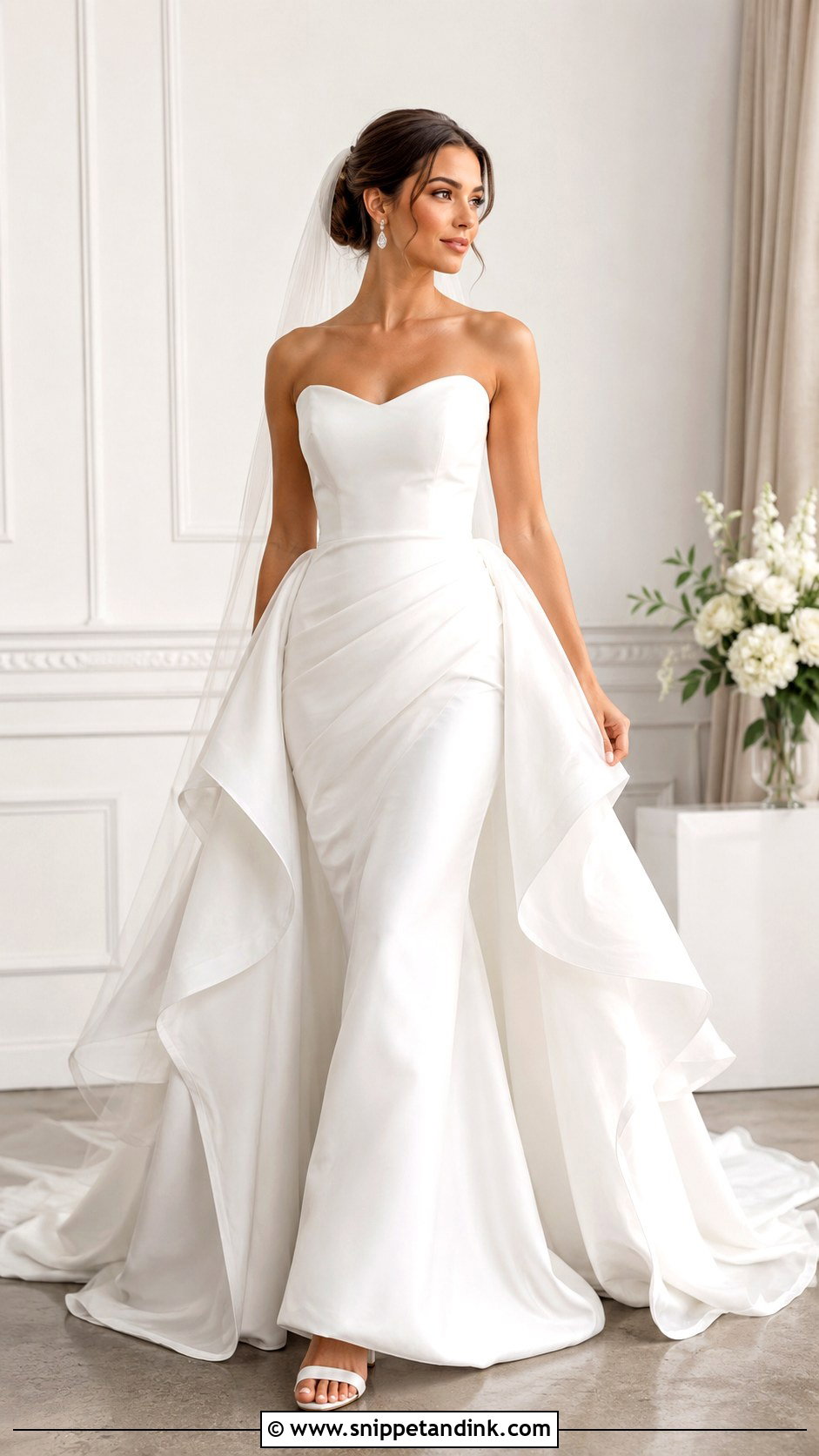
An overskirt gives volume for the ceremony and a cleaner shape later, so a fitted gown can become a ball gown without buying two dresses. It may detach completely or need its own bustle, depending on the design, and either way both layers have to stay controlled so the outfit doesn’t feel heavy. Tulle, organza and satin overskirts all work. A removed overskirt left on a chair gets crushed or stepped on, so assign someone to carry it straight to the bridal suite. Sleek heels, drop earrings and a simple veil suit it.
23. Bustle Wedding Dress With Chapel Train
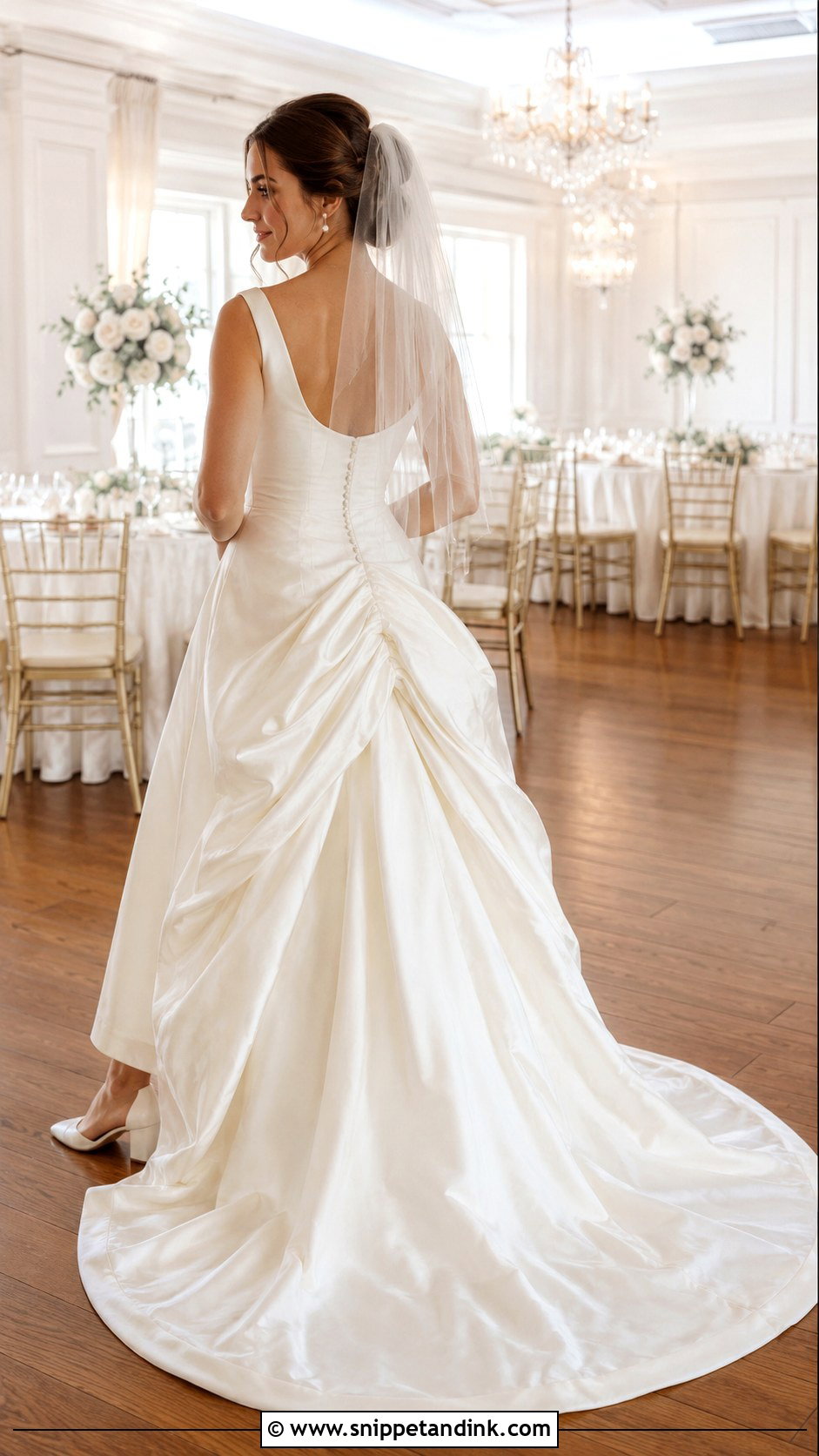
Chapel trains are the most adaptable length I work with. There’s enough fabric for ceremony photos, yet it’s far easier to bustle than a cathedral. Depending on fabric and silhouette, one-point, three-point, American, French and ballroom styles can all work, so you have real choice. A fitted bodice, medium veil, pearl earrings and block heels keep it classic. If a bride is torn about train length, this is usually where I’d point her.
24. Bustle Wedding Dress With Sweep Train
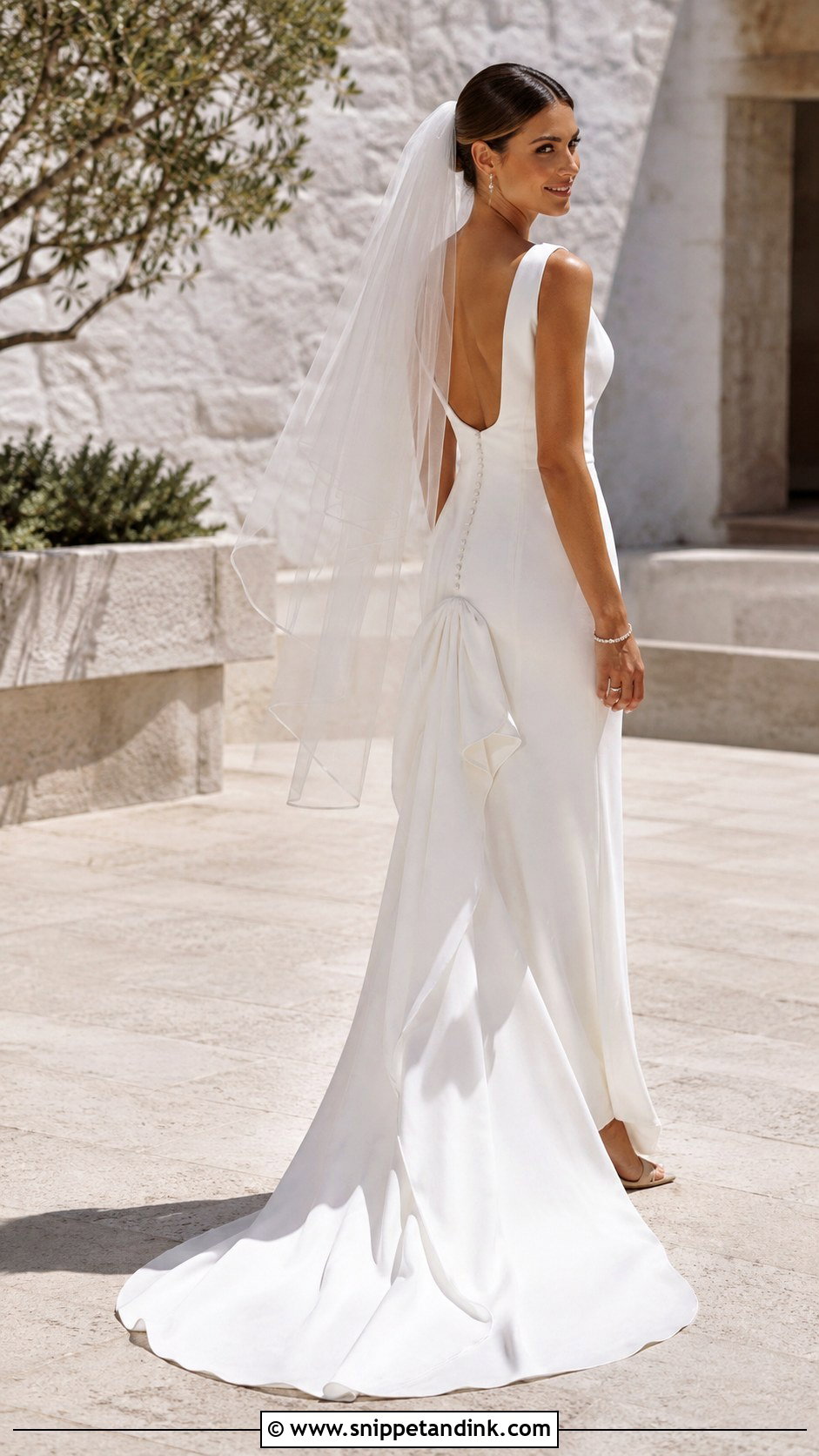
A bustle wedding dress with sweep train leaves just a little length behind you, so the bustle can be very simple: a small loop, a single point or a subtle lift near the back seam. It suits simple ceremonies, outdoor venues and sheath, A-line or slim crepe gowns. Brides sometimes assume a sweep doesn’t need bustling, but even a short train collects grass, dust and spilled drinks by evening, so I’d still add one point. Comfortable heels, delicate jewelry and a simple veil complete it.

25. Bustle Wedding Dress With Royal Train
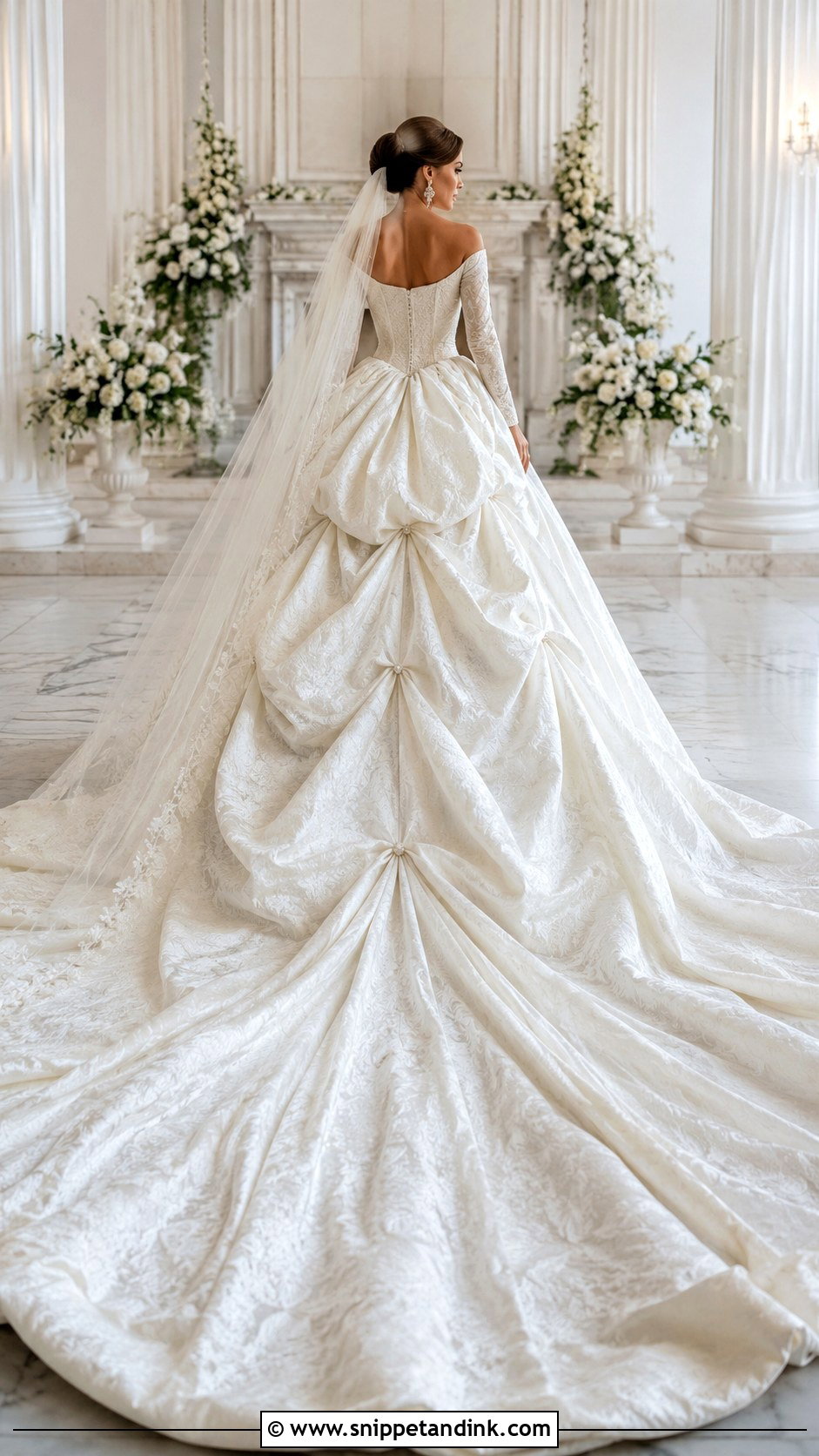
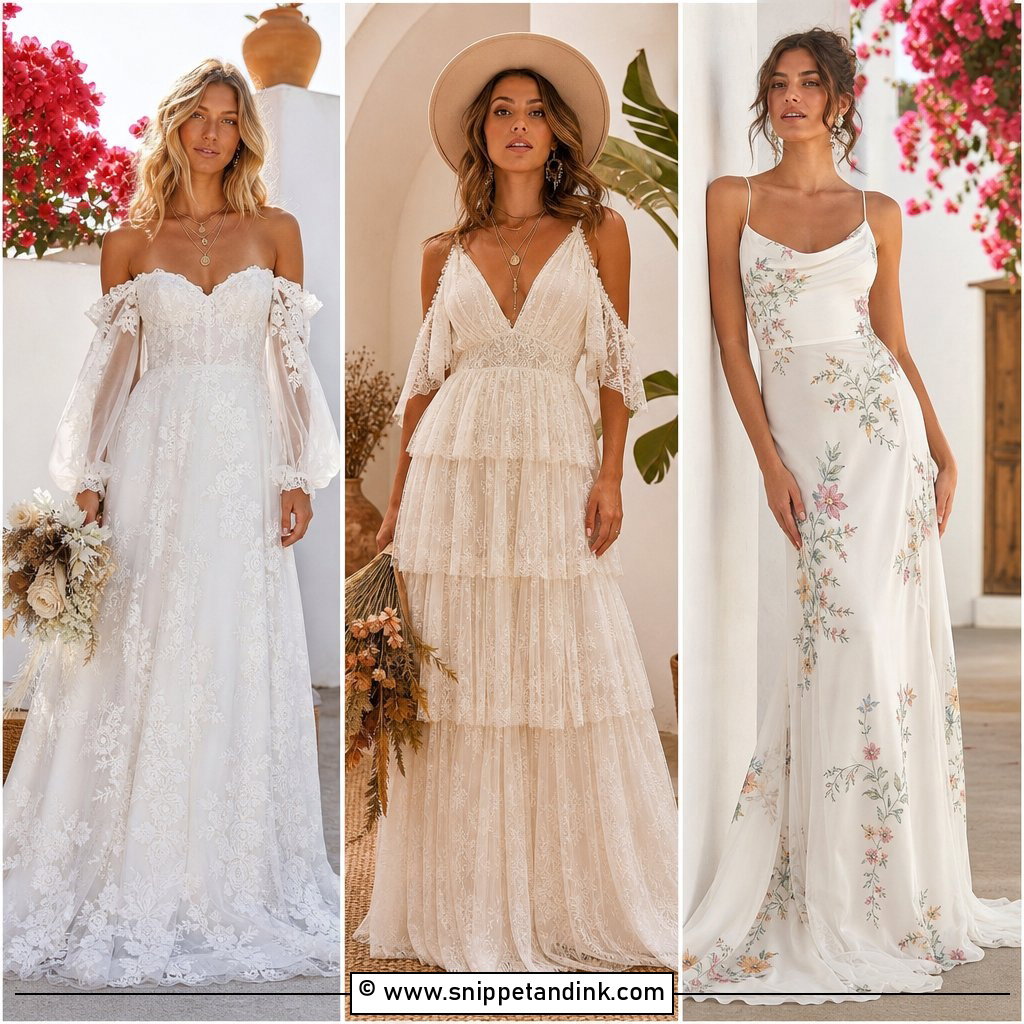
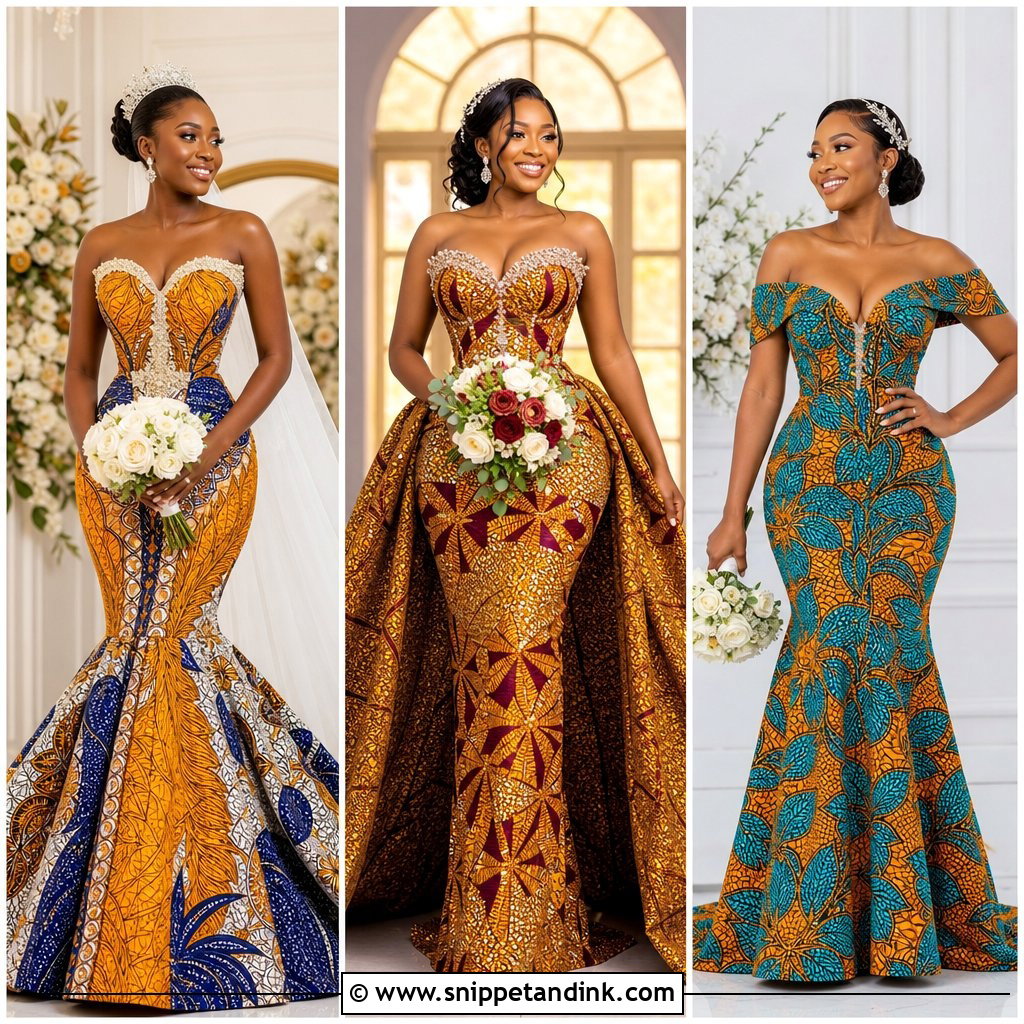
Royal trains are the most dramatic option and need serious alteration planning. They can be very long, heavy and detailed, so the bustle may need many hidden points or a custom solution, and sometimes a detachable train or a dedicated train handler is more practical than any bustle. I start this conversation at the first fitting rather than the last, because the answer can affect how the train is built. Plan the reception so the fabric stays protected and the bride can walk safely. A structured bodice, secure heels, elegant earrings and a veil that doesn’t compete with the train finish it.
When a Bustle Point Gives Way Mid-Reception
Bustle points come loose more often than brides expect, usually when someone treads on the lifted edge during a dance or a loop works free under a heavy train. It’s a two-minute fix if the right things are close by.
What goes in the bustle kit
- Small safety pins, which can hold a fold from underneath where nobody will see them.
- A needle already threaded in the dress color, for a proper repair.
- A spare length of ribbon if your bustle uses ties.
- Small scissors for a loose thread before it pulls further.
Hand the kit to the person who knows the bustle, not to the bride. Build ten to fifteen minutes into the timeline between portraits and the reception entrance so the bustling happens in a quiet room rather than a crowded hallway, and take one slow turn in front of a mirror before you walk back in.
A Bustle Should Look Like Part of the Dress
Picking a bustle is really about balancing how the gown looks with how you’ll move in it. The right one protects the train, flatters your shape and holds for the entire reception. An American bustle may suit a romantic ball gown, a French bustle a fitted lace dress, a ballroom bustle a clean floor-length finish, and a wrist loop a light train. Test it during alterations, photograph it from the back and side, and have your helper practice fastening it. The best bustle looks like part of the dress, never an afterthought.
You'll Like These Ideas:





Leave a Reply