
A plain white cake is the easiest canvas I get to work on, and burgundy is the color that gives it weight. The same deep red can read formal on sharp fondant or relaxed on soft buttercream, and that shift comes from the finish and the placement far more than from the flowers themselves. What I always ask couples first is where the cake will stand and how the room will be lit, because burgundy that looks rich at noon can turn almost black by candlelight. Below are twenty white cakes dressed in burgundy blooms, with my notes on how each one is built and where it can go wrong.
Real Burgundy Blooms on White Icing Without the Stains
Deep red petals and white icing are a risky pair. A wet or bruised burgundy petal can leave a pink smudge on buttercream that I can’t scrape away, so the flowers get just as much prep as the cake itself.
- Stems are cut short, wrapped in floral tape and pushed into a food-safe flower pick or a wrapped straw. Nothing goes into the icing bare.
- I ask the florist for flowers grown without sprays, since most commercial stems are treated and not meant to touch food.
- Petals should be dry before they go on. I pat off any condensation from the cooler with a paper towel.
- Some popular wedding flowers are toxic and stay off the cake entirely, including lily of the valley, hydrangea, sweet pea and foxglove.
- Anything sitting directly on a tier, like a single rose on top, goes onto a small round of parchment or a thin acetate disc.
Timing matters as much as prep. I dress a fresh-flower cake on site, ideally within an hour or two of guests arriving, so the blooms never sit wilting under warm lights while the couple is still at the ceremony.
1. White Wedding Cake With Burgundy Roses
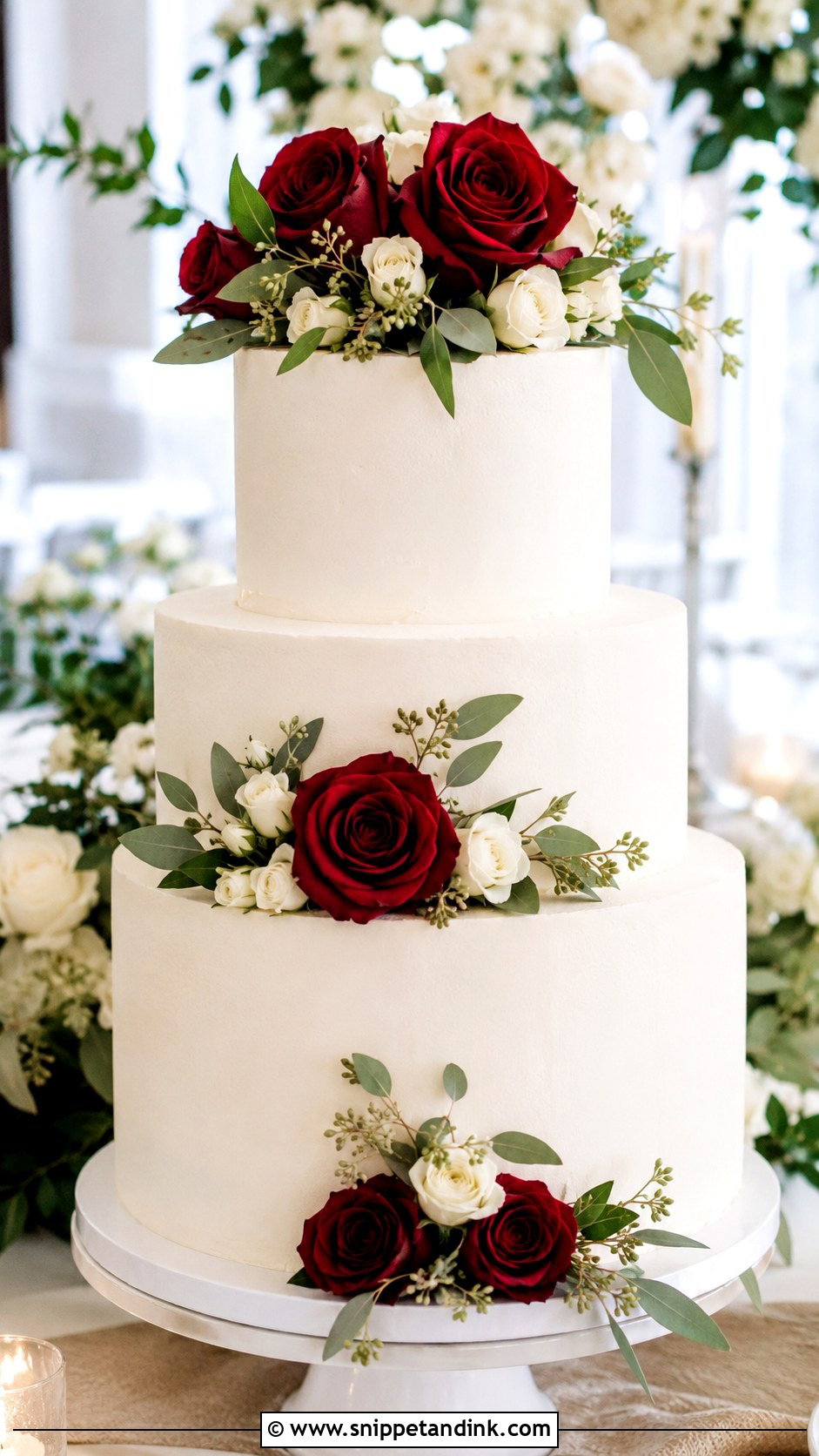
Roses are the safest burgundy flower I can put on a cake, since their petals are firm and they hold their shape for hours out of water. I usually group them in small clusters at the base, between tiers and on top, so the eye travels up the cake instead of stopping at one spot. On smooth white buttercream or fondant the contrast is clear from across the room. If the full red feels heavy for your palette, I’ll mix in a few ivory roses, and I keep greenery to a few sprigs so the cake doesn’t start to look like a centerpiece.
2. White Wedding Cake With Burgundy Flower Cascade
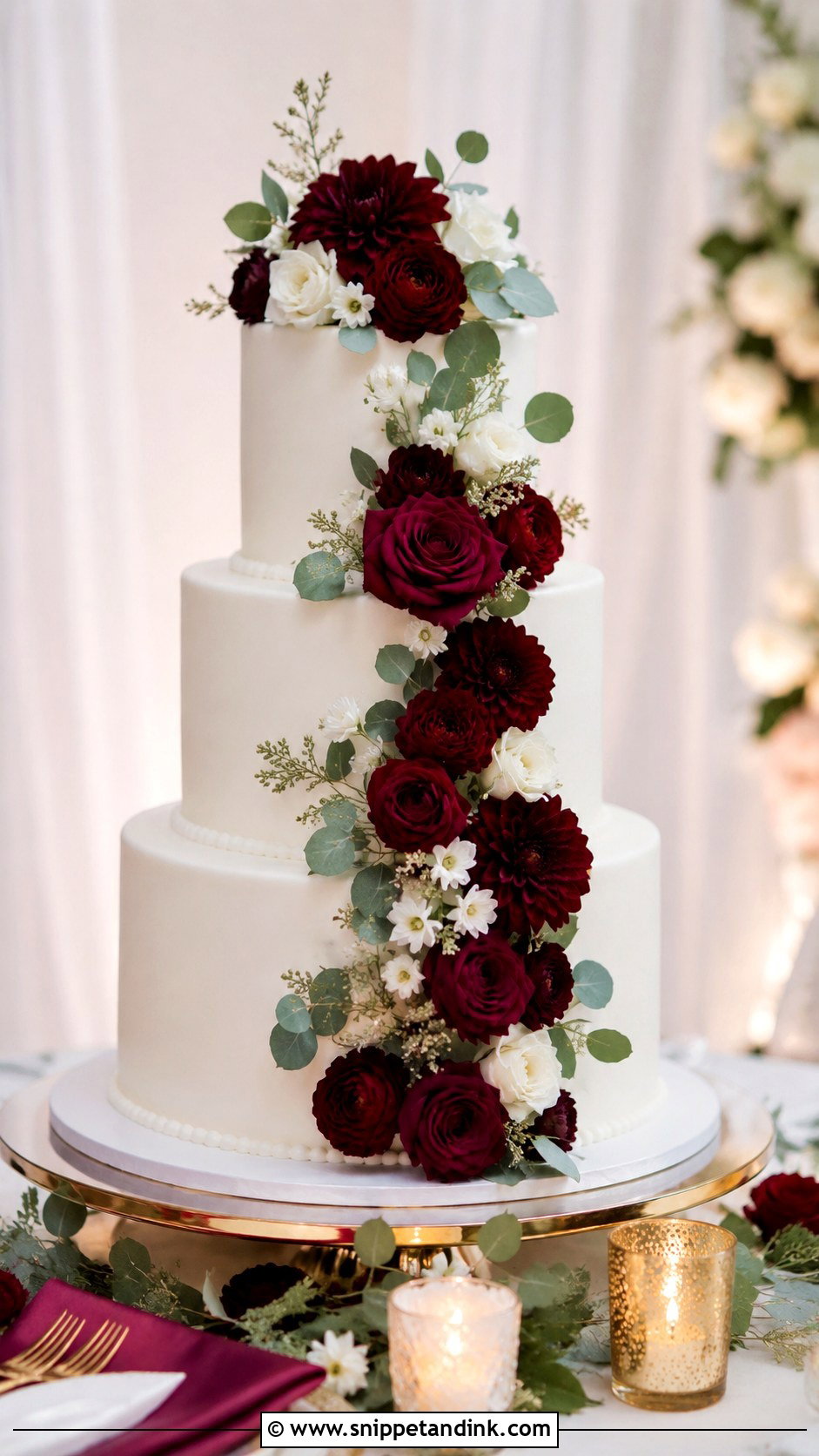
A cascade gives the cake movement, but it also adds weight to one side, so I plan the trail from the top tier down and stop it just short of the bottom edge. Dahlias and peonies are heavy heads; on a cascade I lean on roses and ranunculus for the long run and save the big blooms for the top. Eucalyptus and small ivory filler soften the line between flowers. For a small guest count, a two-tier cake with a shorter cascade keeps the proportions right instead of looking crowded.
3. White Buttercream Wedding Cake With Burgundy Flowers
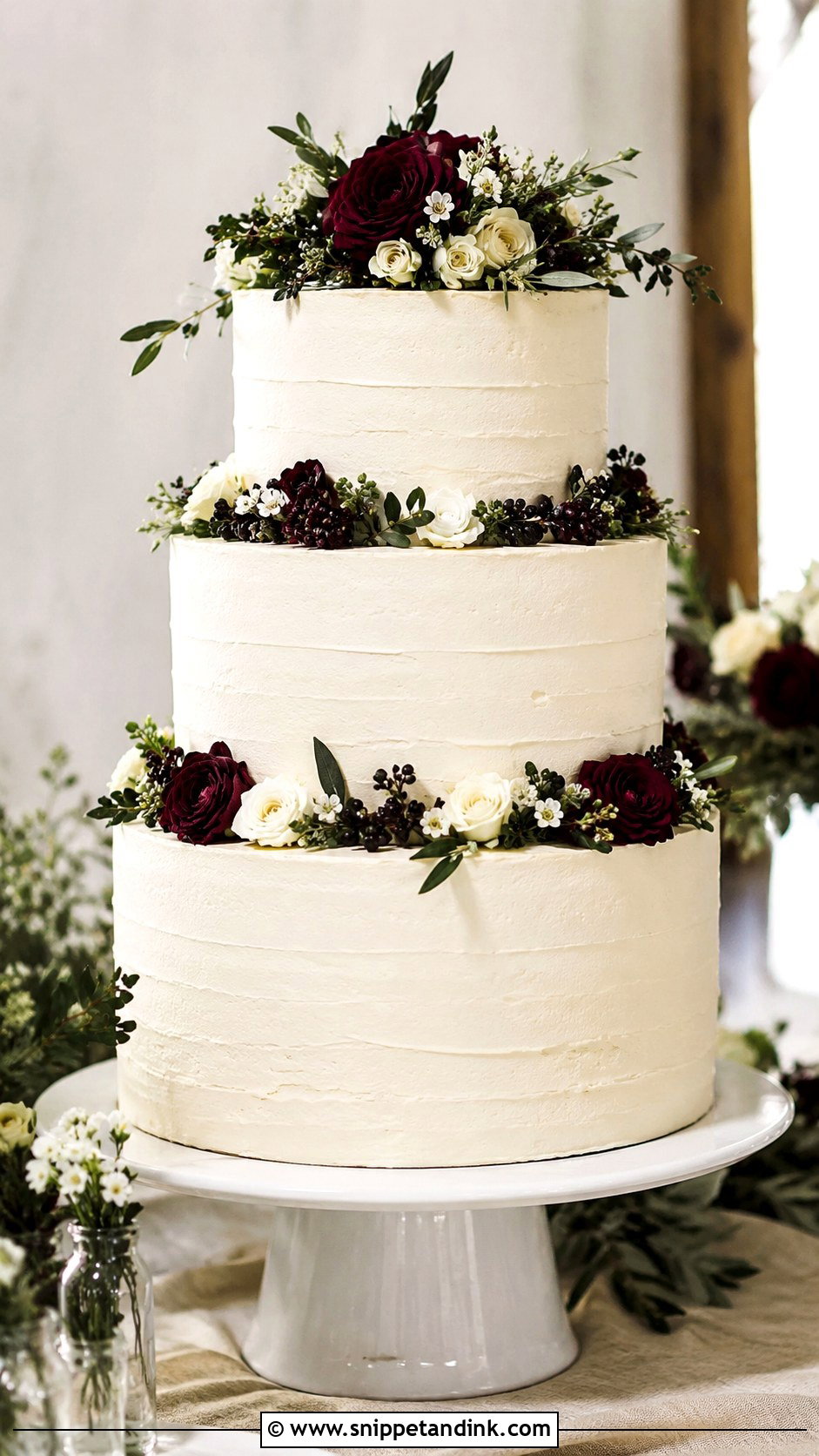
Buttercream gives burgundy a softer, handmade look than fondant, and I like it for couples who want the cake to feel relaxed. The trade-off is that buttercream is soft, so every flower stem has to be wrapped and set in a pick before it touches the icing, or it leaves a damp mark. A smooth finish keeps things clean; a light horizontal comb texture suits a barn or garden venue. Burgundy blooms set right along the tier seams hide the joins and outline the shape of the cake at the same time. A few deep berry accents in among small white flowers add depth without more red.
4. White Fondant Wedding Cake With Burgundy Flowers
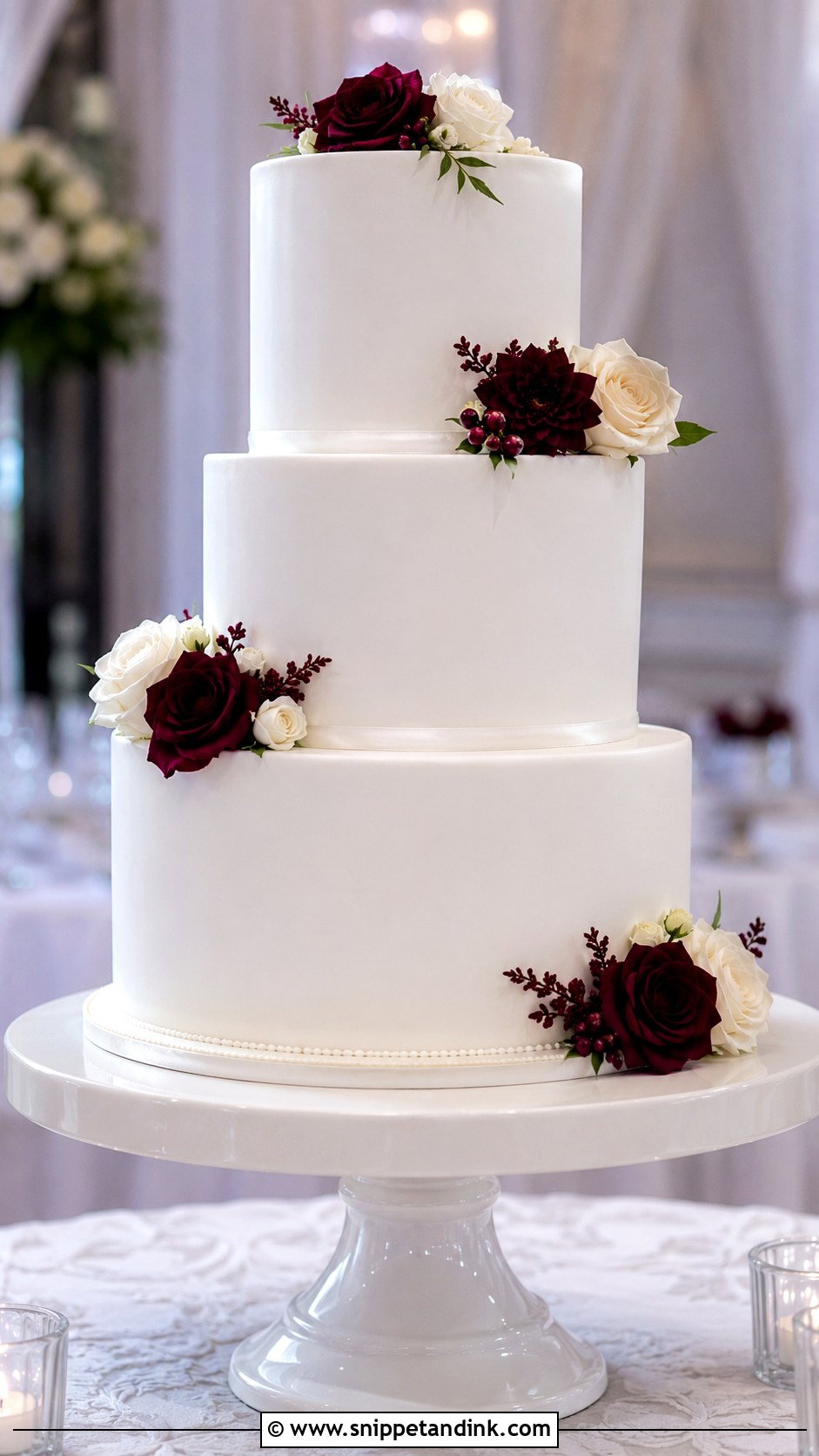
Fondant gives me the crispest surface to work on, which is why burgundy flowers look so deliberate against it. It also tolerates a warm room better than buttercream, a real advantage for a black-tie evening in a heated ballroom. I can leave it perfectly smooth, emboss it lightly or add a line of sugar pearls. On fondant I’d never scatter flowers everywhere; one strong cluster on the top tier and a second at the base keeps the cake looking structured.
5. White Wedding Cake With Burgundy Peonies
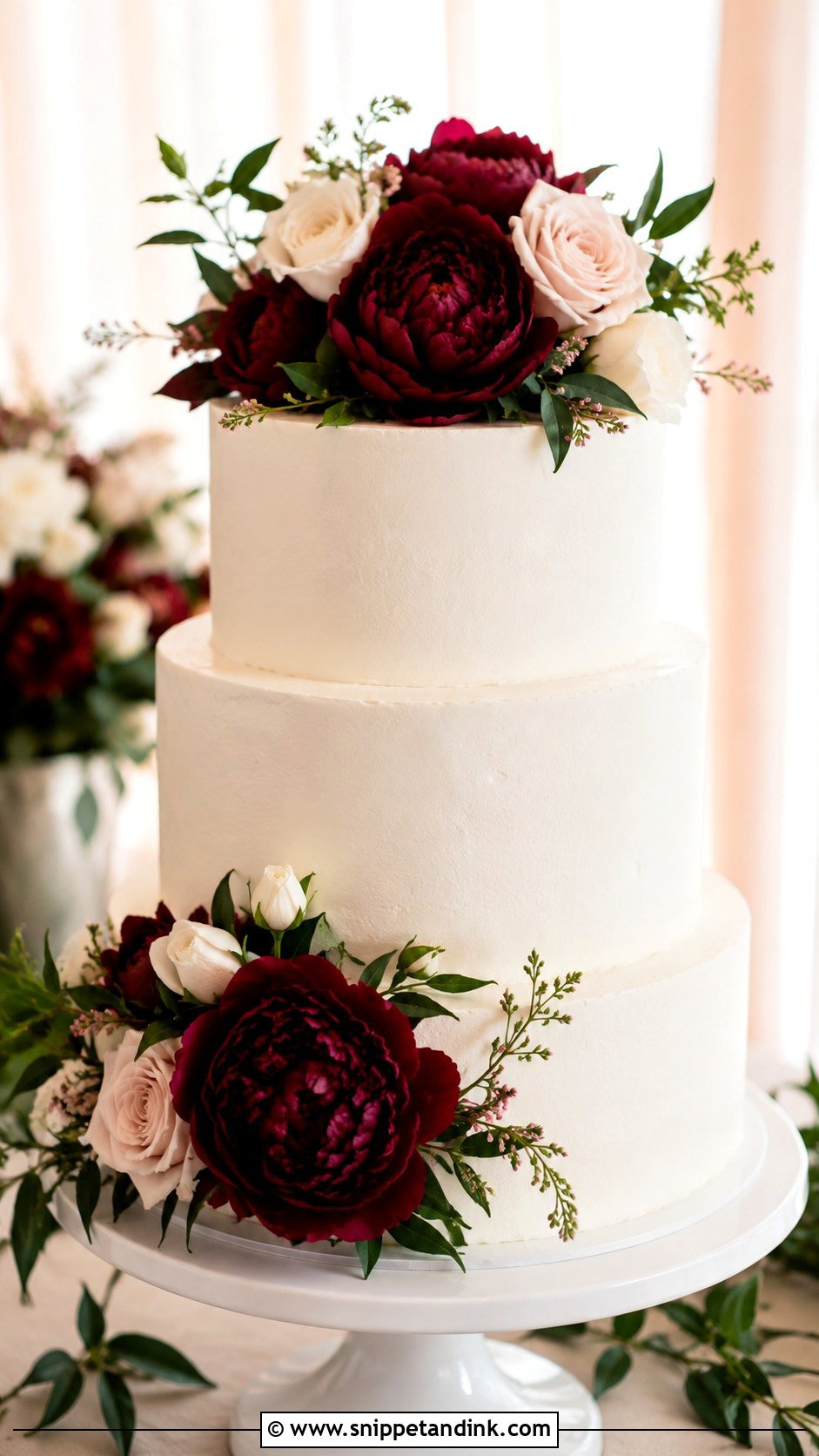
Peonies are big and generous, so two or three heads on the top tier do the job of a dozen roses. The catch is that they keep opening once they’re cut, and a bloom that looks tight at setup can be blown wide by the time you cut the cake. I place them last, as close to the reception as I can, and fill the middle and base with smaller flowers. Blush and dusty rose blend into burgundy peonies well. Their season is short, roughly late spring into early summer, so outside it I’d make them in sugar instead.
6. White Wedding Cake With Burgundy Dahlias
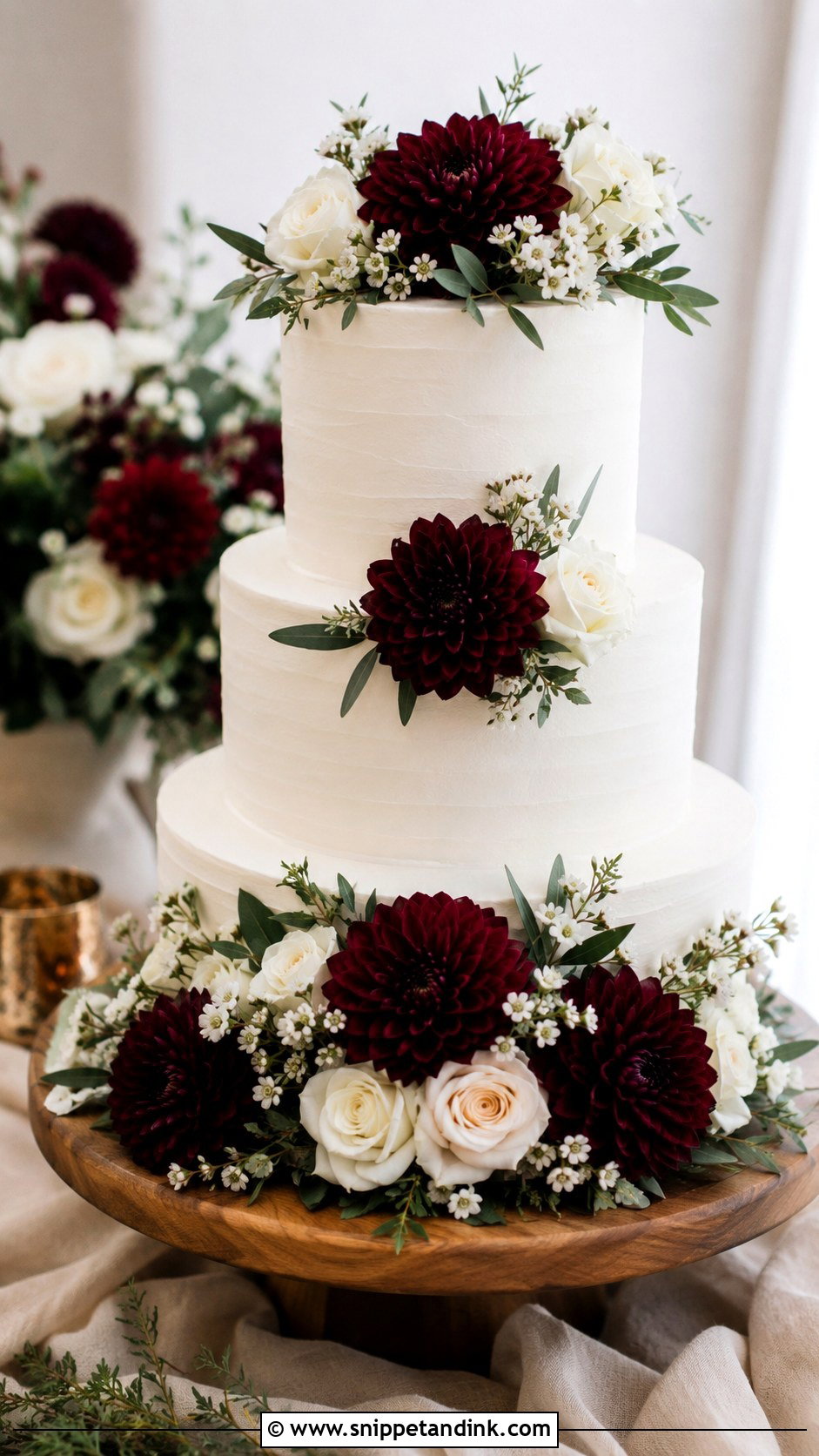
Dahlias are at their peak from late summer through fall, and their layered petals give so much texture that the cake underneath can stay completely plain. They are also thirsty and bruise easily, so they’re the first flower I’d expect to droop on a hot afternoon. I keep them on the top tier and front, away from the warmest side of the room, and pair them with ivory roses and small white blossoms. A wood stand pulls them toward rustic; a white ceramic stand keeps them polished.
7. White Wedding Cake With Burgundy Ranunculus
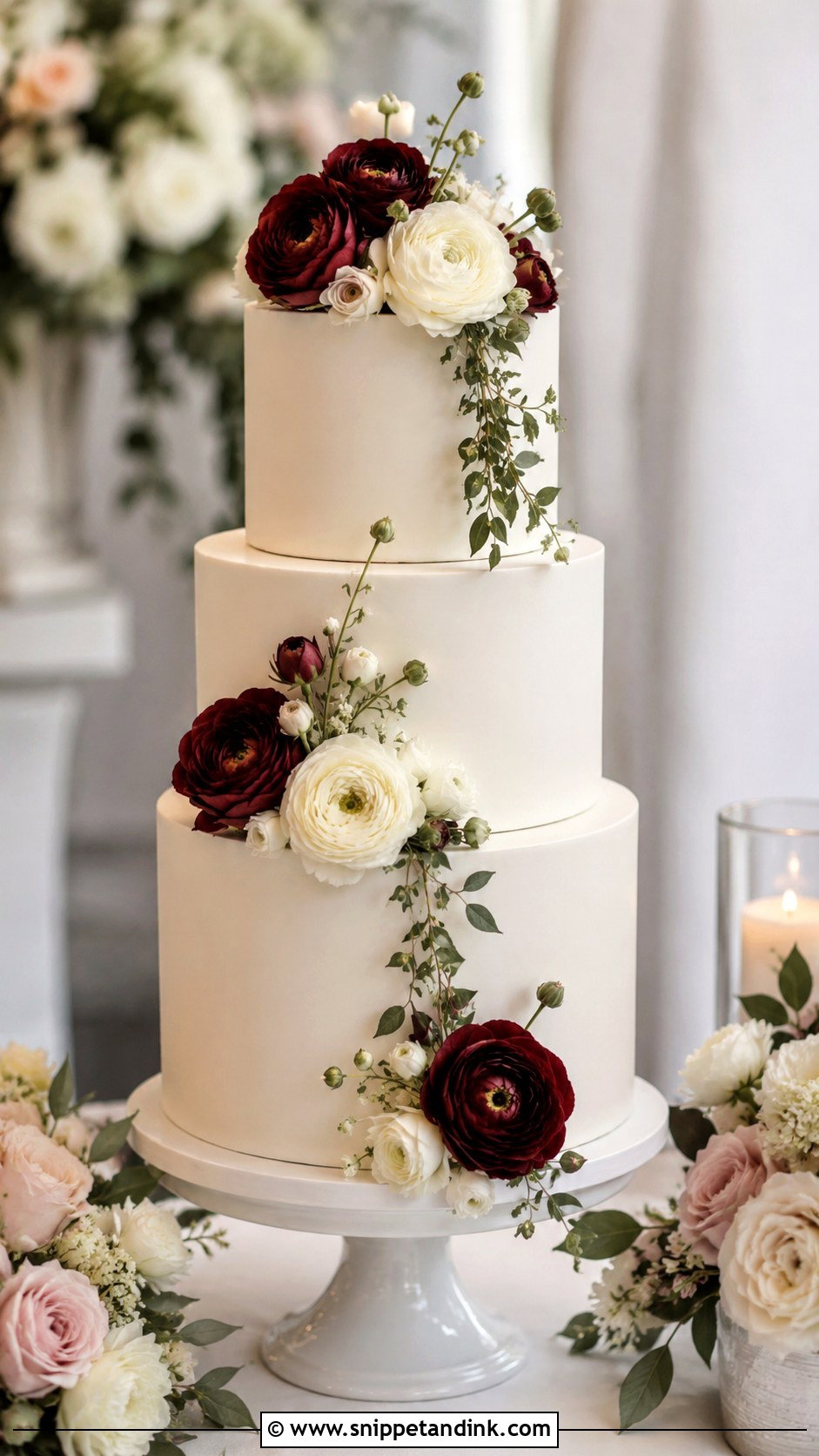
Burgundy ranunculus flowers are smaller and more tightly layered than roses, which lets me add detail without hiding the icing. I use them on slimmer tiers and on cakes with vintage piping, where a large bloom would cover the work. They sit neatly in clusters along a tier edge or in a light diagonal trail. Ranunculus stems are hollow and soft, so they need extra care when I wrap them. Mixed with ivory ranunculus and a few tight buds, they suit a spring cake or a candlelit indoor dinner.
8. White Wedding Cake With Burgundy Orchids
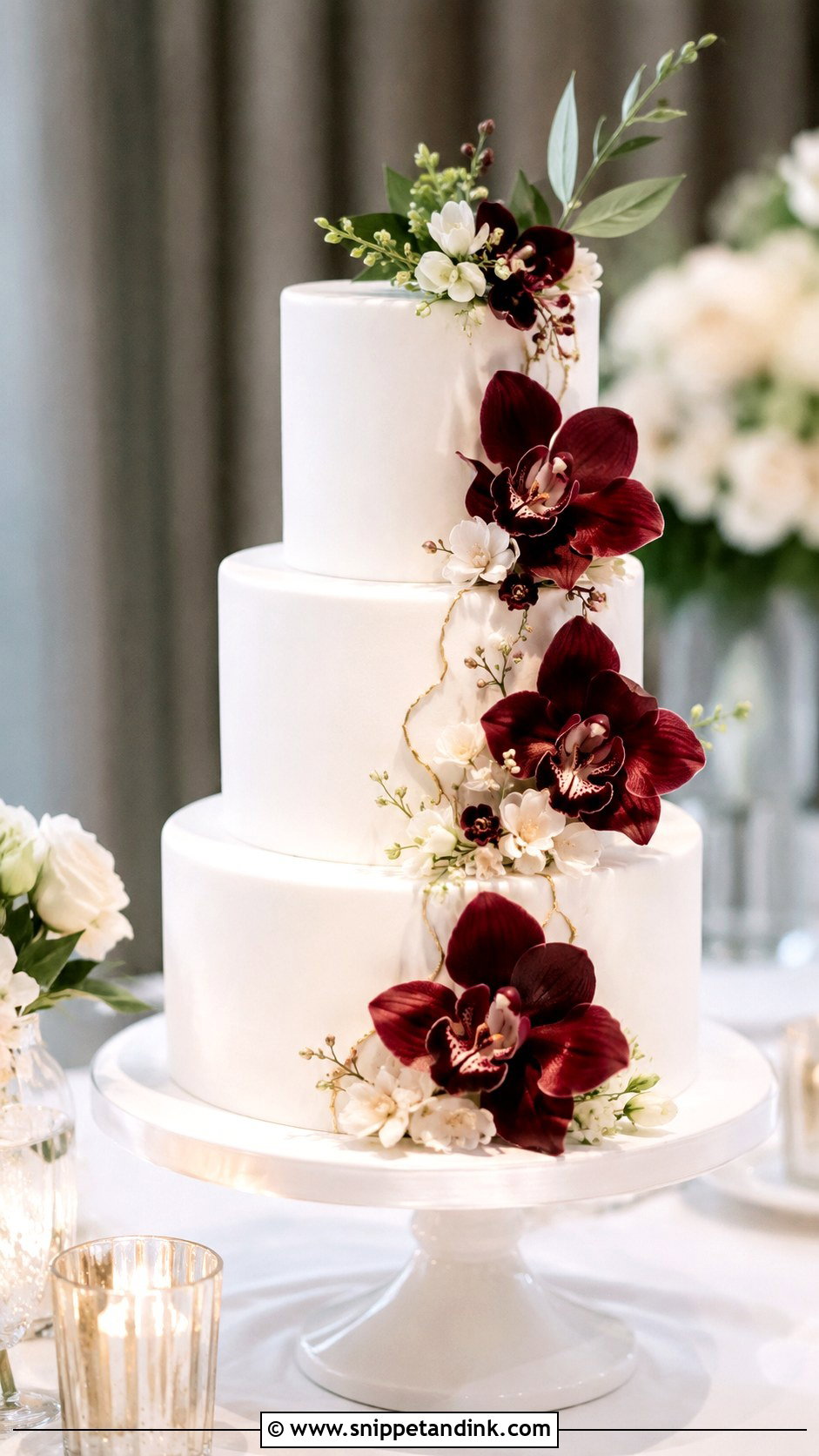
Orchids have a sculptural shape that fights with busy decoration, so I only put them on a very clean cake. A vertical line down one side, or a few blooms at the top and base, shows off the shape of each flower. They pair with ivory fondant, pearls and thin gold lines. Burgundy orchids are less traditional than roses, which suits a hotel or modern venue and an evening reception. They’re also sturdy out of water, which makes my life easier on long setup days.
9. White Wedding Cake With Burgundy Sugar Flowers
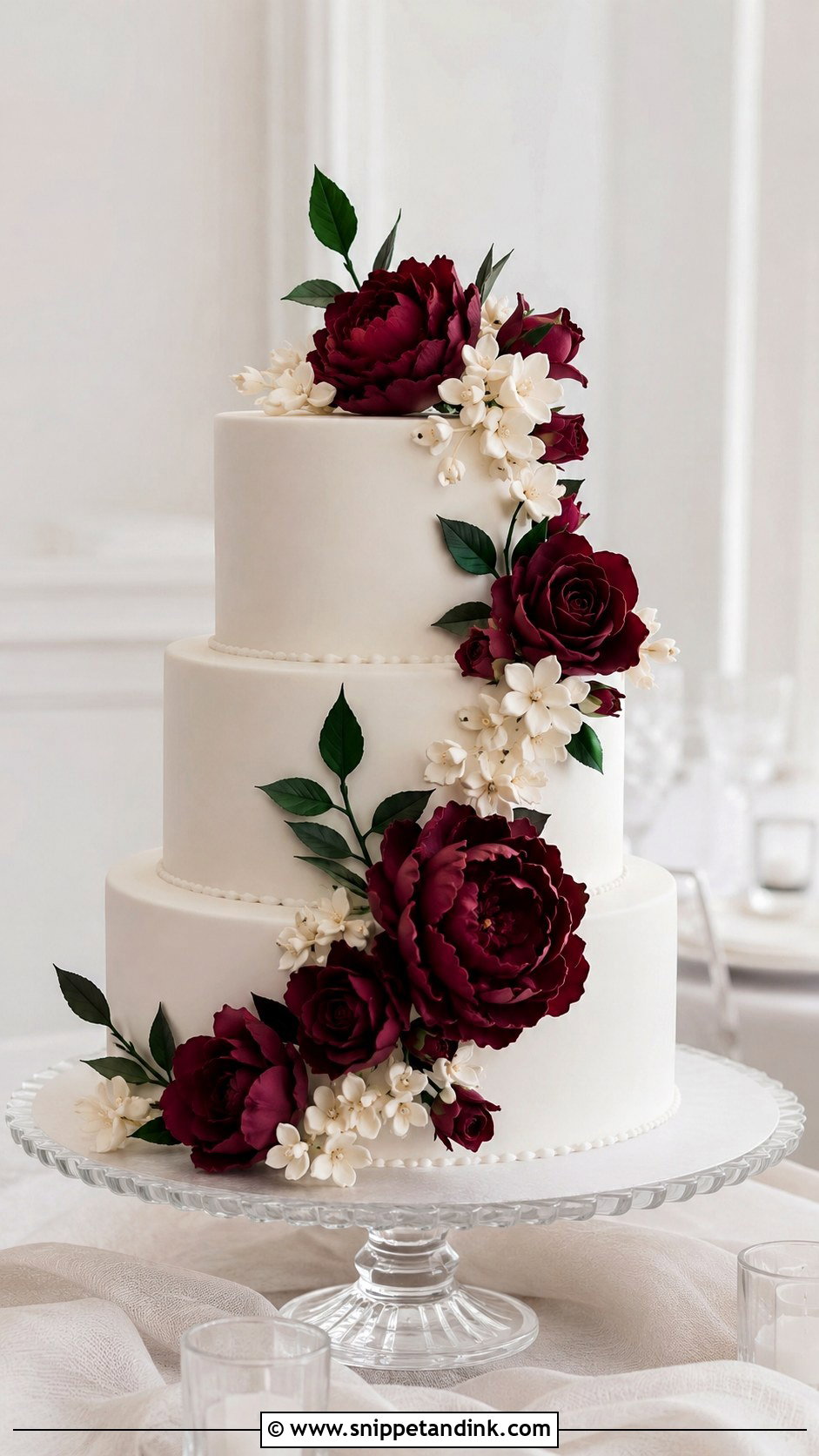
Sugar flowers free you from the season completely, and because I color them myself I can match a burgundy to a bridesmaid dress swatch far more closely than any grower can. They take time, though: each petal is rolled, wired and dried, so a full set has to be ordered weeks ahead, and humidity is their enemy. The wires mean they are decoration, not something guests should eat. I keep the cake beneath them plain, in smooth white fondant or buttercream, and arrange them in a cascade, a single top cluster or a band around one tier.
10. White Wedding Cake With Burgundy Fresh Flowers
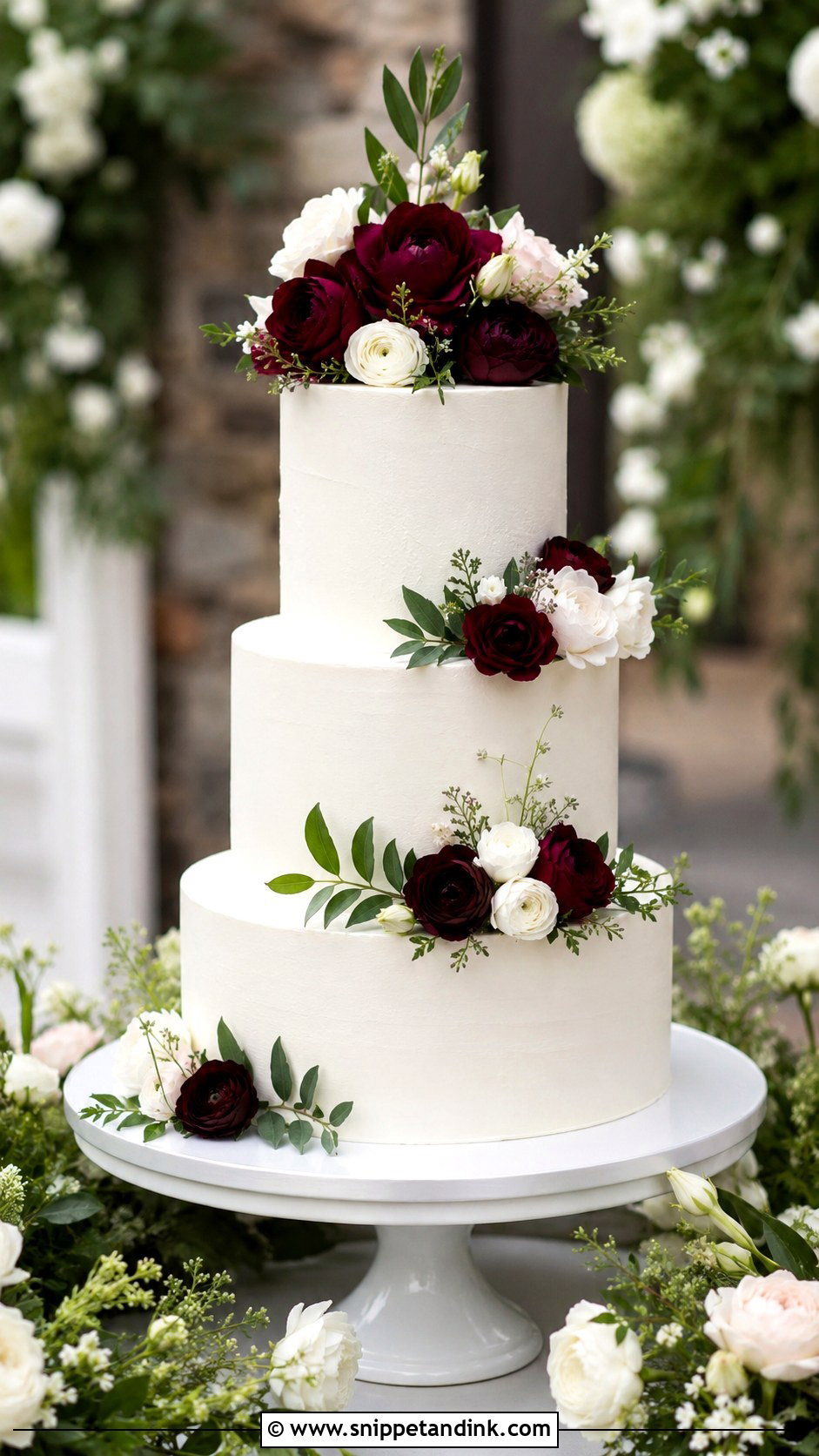
Fresh flowers tie the cake to the bouquet and centerpieces, but this is the version that needs the most coordination between your florist and me. I want to know exactly which stems are coming, whether they were grown without sprays, and when they’ll arrive, because the cake should be dressed on site, not hours earlier in a warm van. Roses, ranunculus and dahlias in burgundy all behave well with the right prep. Every stem gets wrapped and goes into a food-safe pick so nothing touches the cake directly, and the simplest white tiers give the real flowers the most room.
11. White Wedding Cake With Burgundy And Blush Flowers
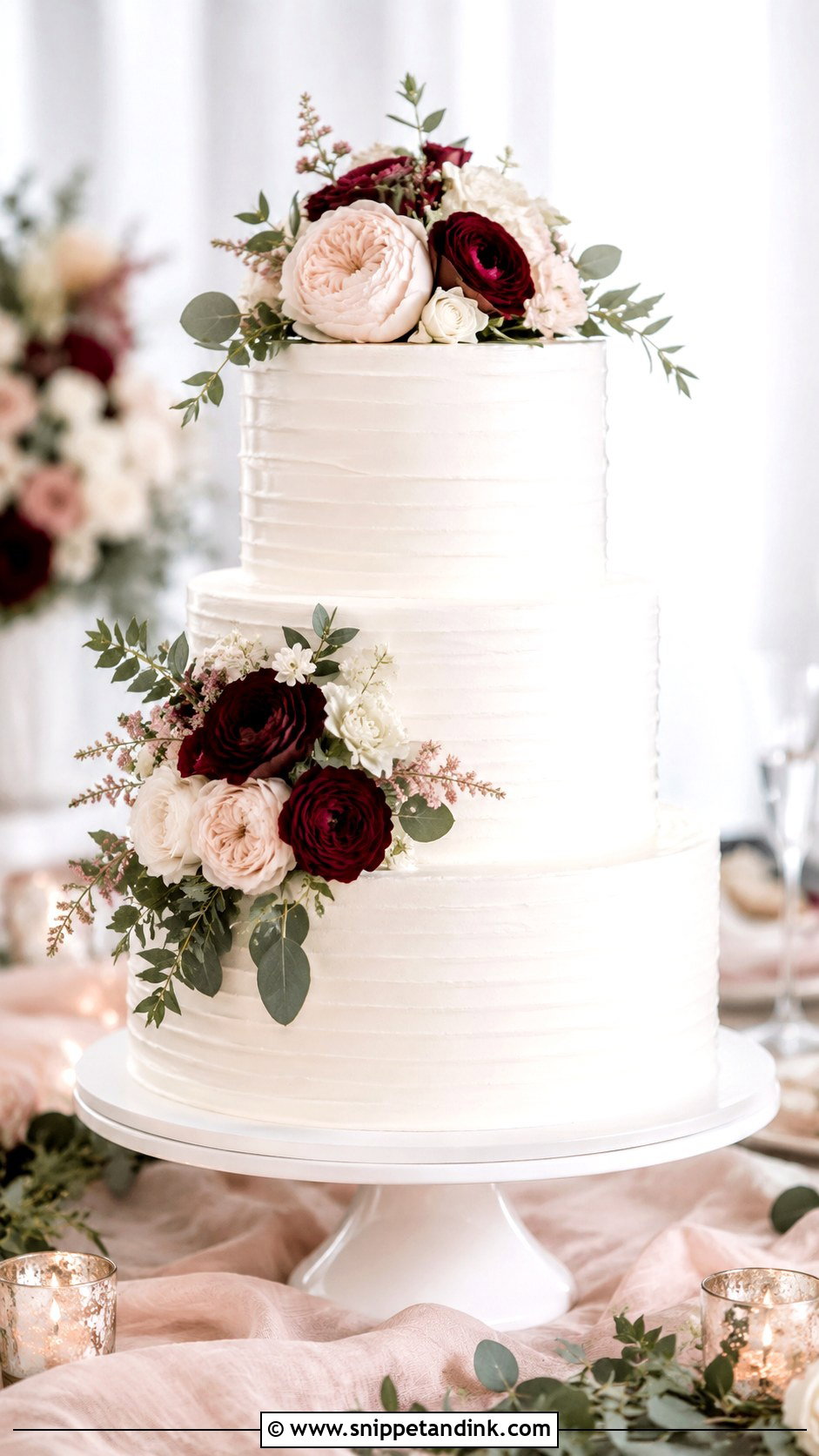
Adding blush is how I soften burgundy for a couple who finds it too dark on its own. The blush acts as a bridge, so the eye doesn’t jump straight from deep red to white. I set burgundy roses or dahlias as the focal flowers, then fill around them with blush garden roses, ivory blooms and a little greenery. It suits spring through early fall and sits comfortably on any finish. Keep the ratio in mind: when blush outnumbers burgundy, the cake reads pink in photos.
12. White Wedding Cake With Burgundy And Greenery
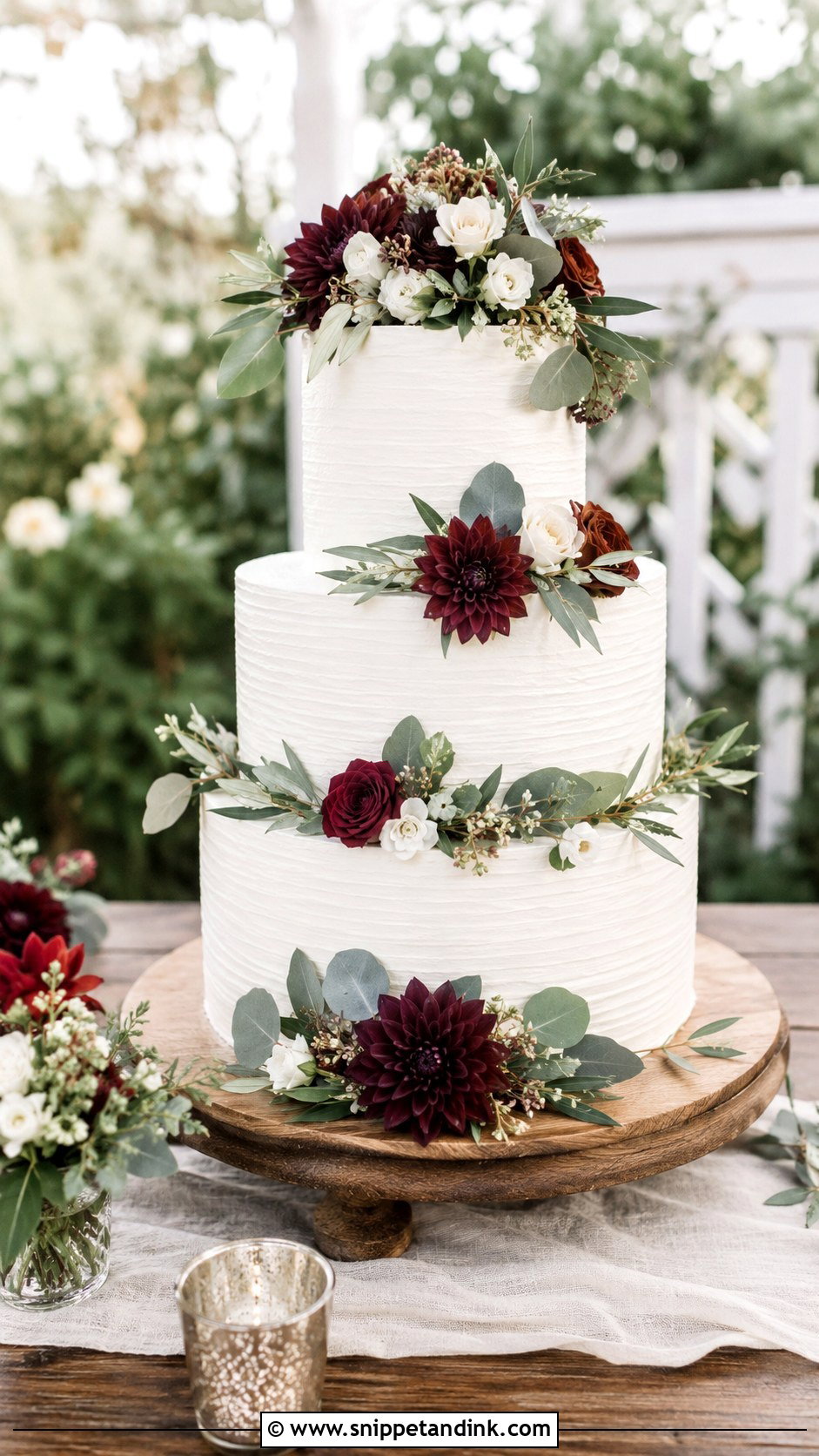
Greenery relaxes burgundy and makes it look gathered rather than arranged. Eucalyptus, olive leaves, ruscus or a little fern each bring a different shade of green, and I pick one or two, never all of them. This is the version I suggest for barn weddings, garden receptions and vineyard venues that don’t need wine-themed styling to feel right. I keep the leaves airy, set the flowers at the tier seams and let a few stems trail for movement. Eucalyptus is one to check with your florist, as some couples prefer to keep it on a separator rather than in the icing.
13. White Wedding Cake With Burgundy Flowers And Gold
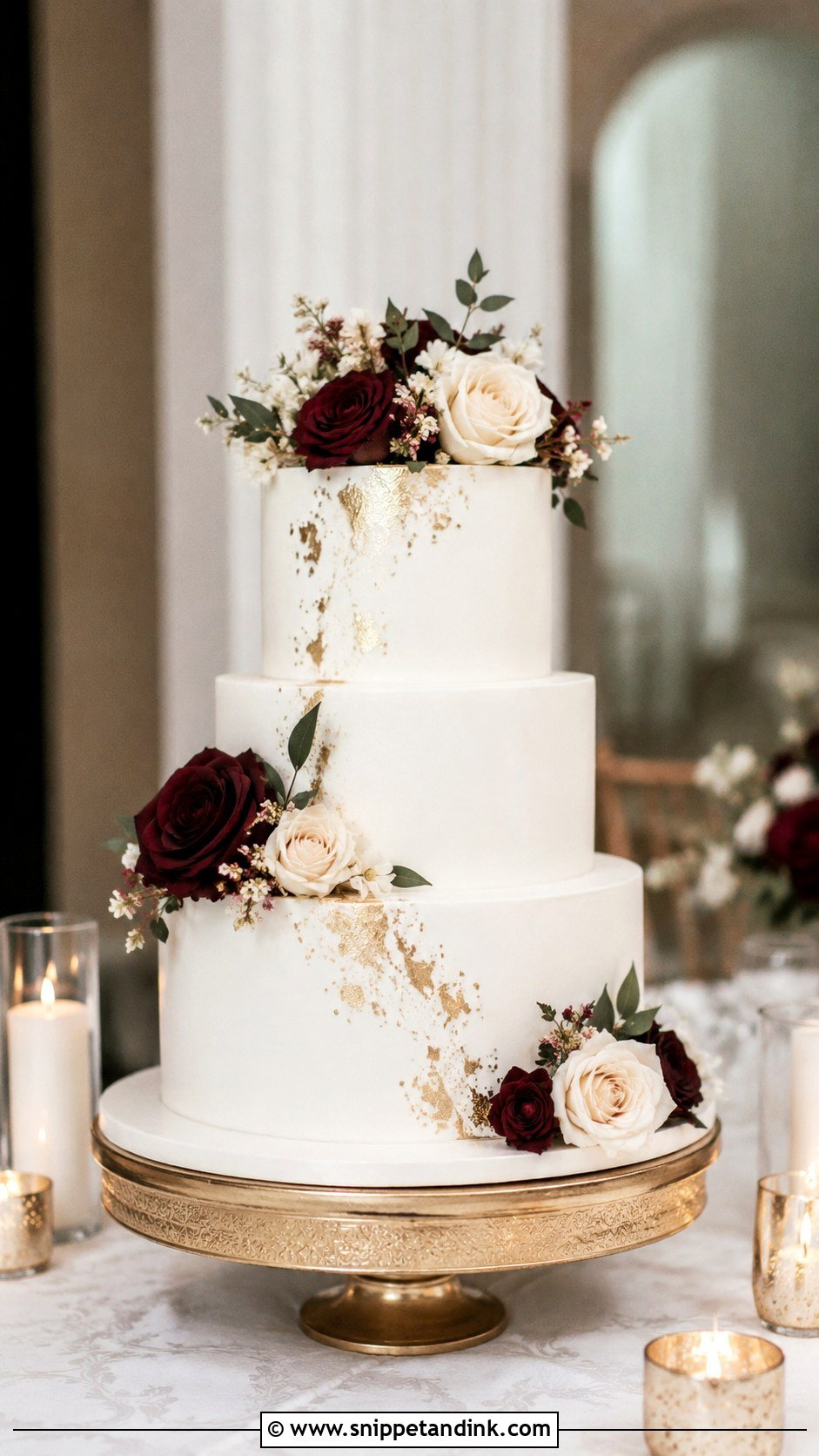
Gold makes burgundy look more formal, but only when it is used sparingly. A few thin gold leaf touches, a metallic separator, a small monogram or a painted rim on each tier is plenty; gold on every surface fights the flowers. Edible gold leaf behaves best on fondant, where it lies flat, while on soft buttercream it can wrinkle. I save this one for ballroom weddings and evening receptions in fall, where warm light picks up the metal.
14. White Wedding Cake With Burgundy Flowers And Pearls
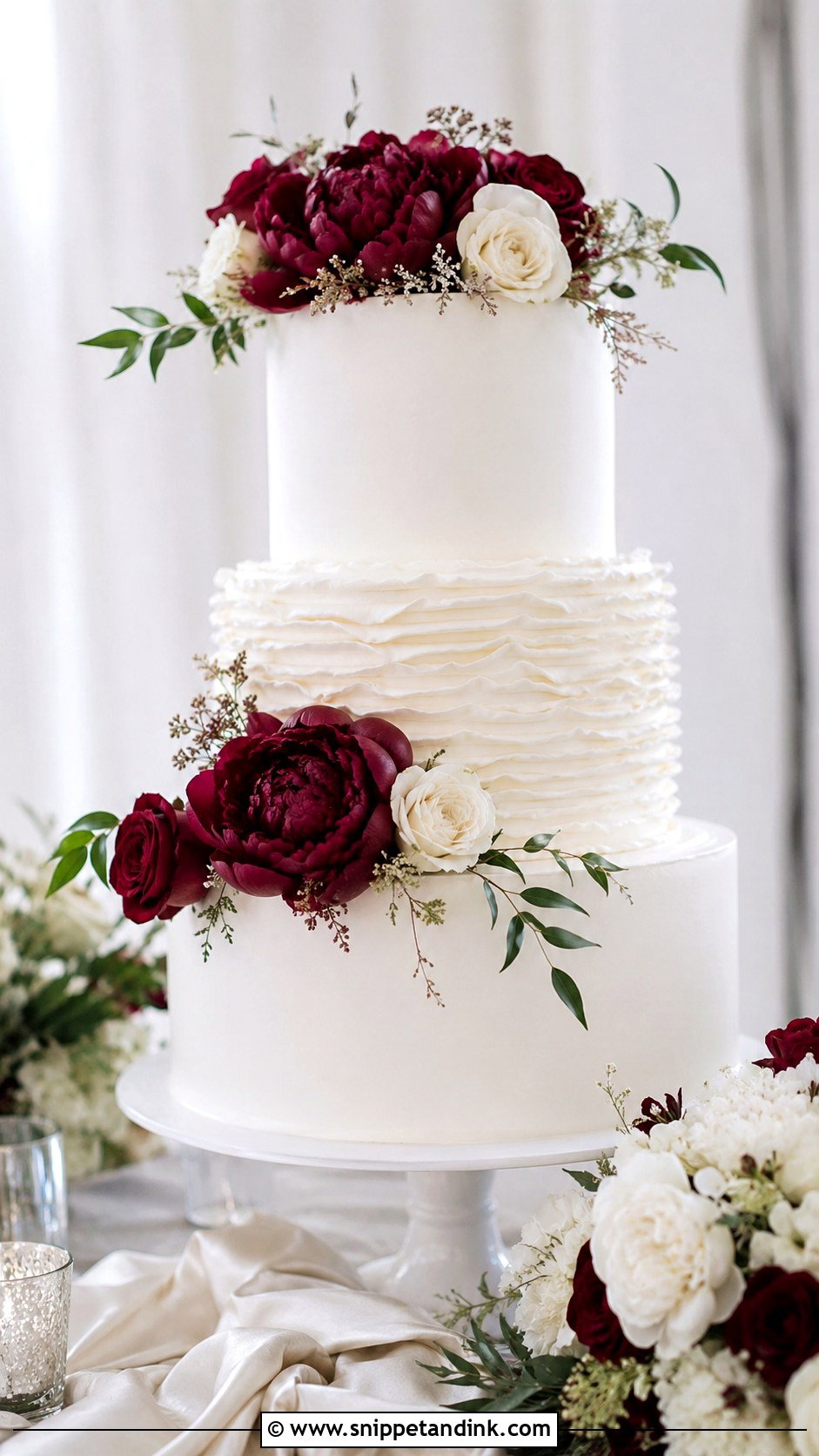
Pearls are a detail you only notice up close, which is exactly why I like them for a cake that will be photographed in close-up. Tiny piped pearls, a pearl border or a scattering of edible pearls sit on smooth white buttercream or fondant. I keep the burgundy roses or ranunculus in small clusters so the pearl work stays visible. Too many flowers here and the effort disappears. Church weddings and vintage-styled receptions suit it.
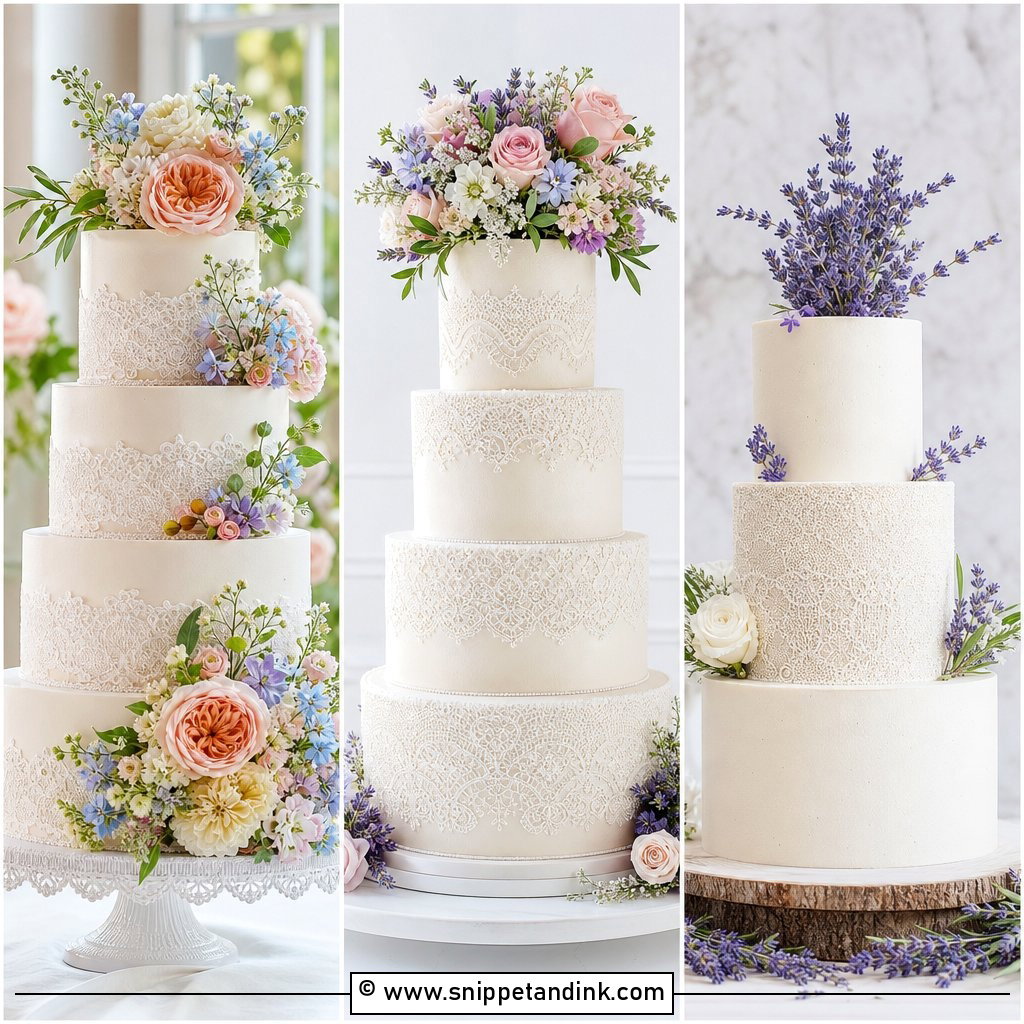
15. White Wedding Cake With Burgundy Flowers And Lace
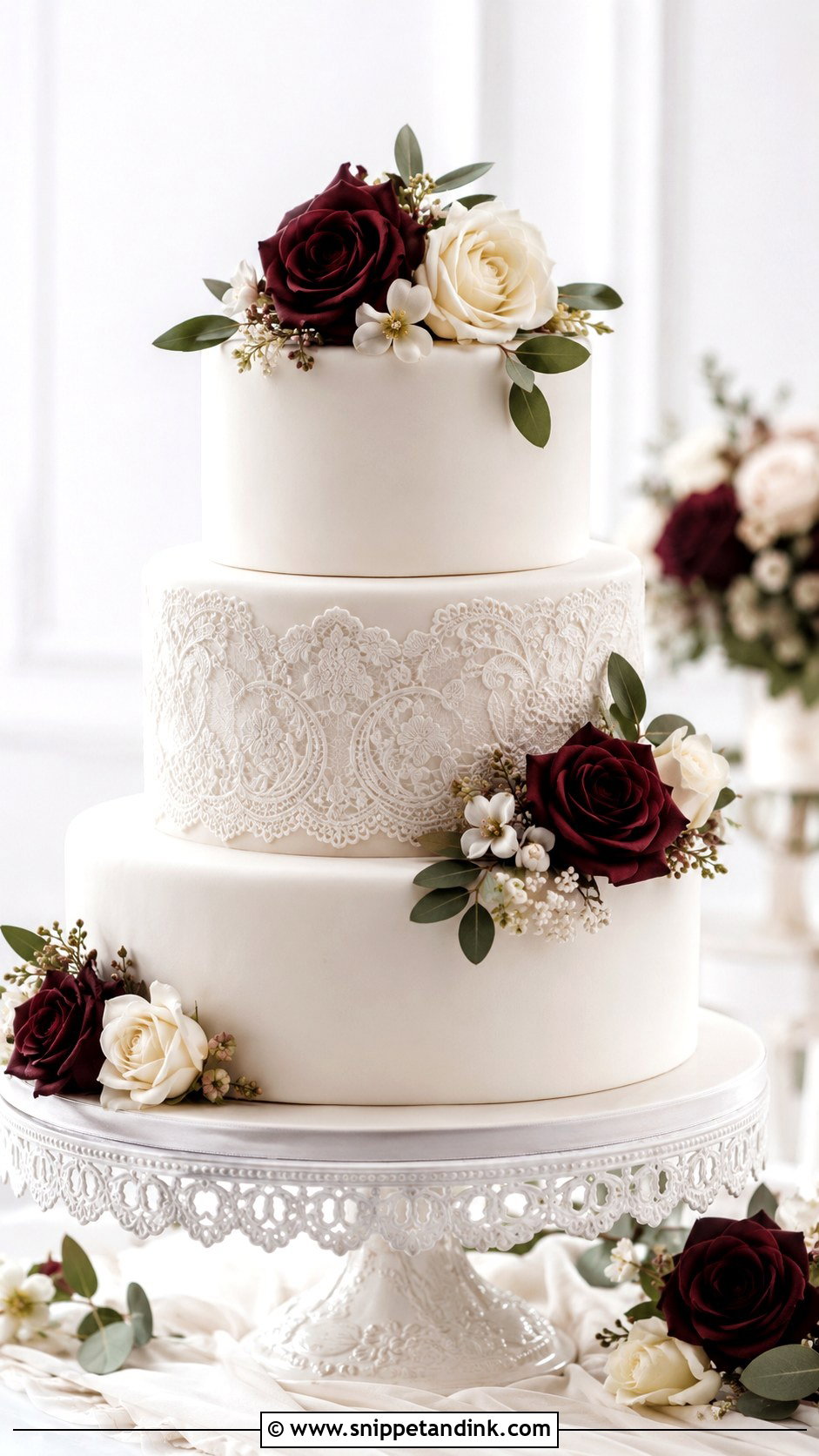
Lace and burgundy flowers compete for attention, and the lace usually loses. I solve it by putting the flowers in one controlled place, around the base, along one side or on the top tier, and leaving the rest of the lace clear. The lace itself can be piped, embossed or made as edible appliqué. An ivory base rather than bright white often makes the lace look richer. Treat this as a cake for traditional details with one strong color.
16. White Wedding Cake With Burgundy Flowers And Ruffles
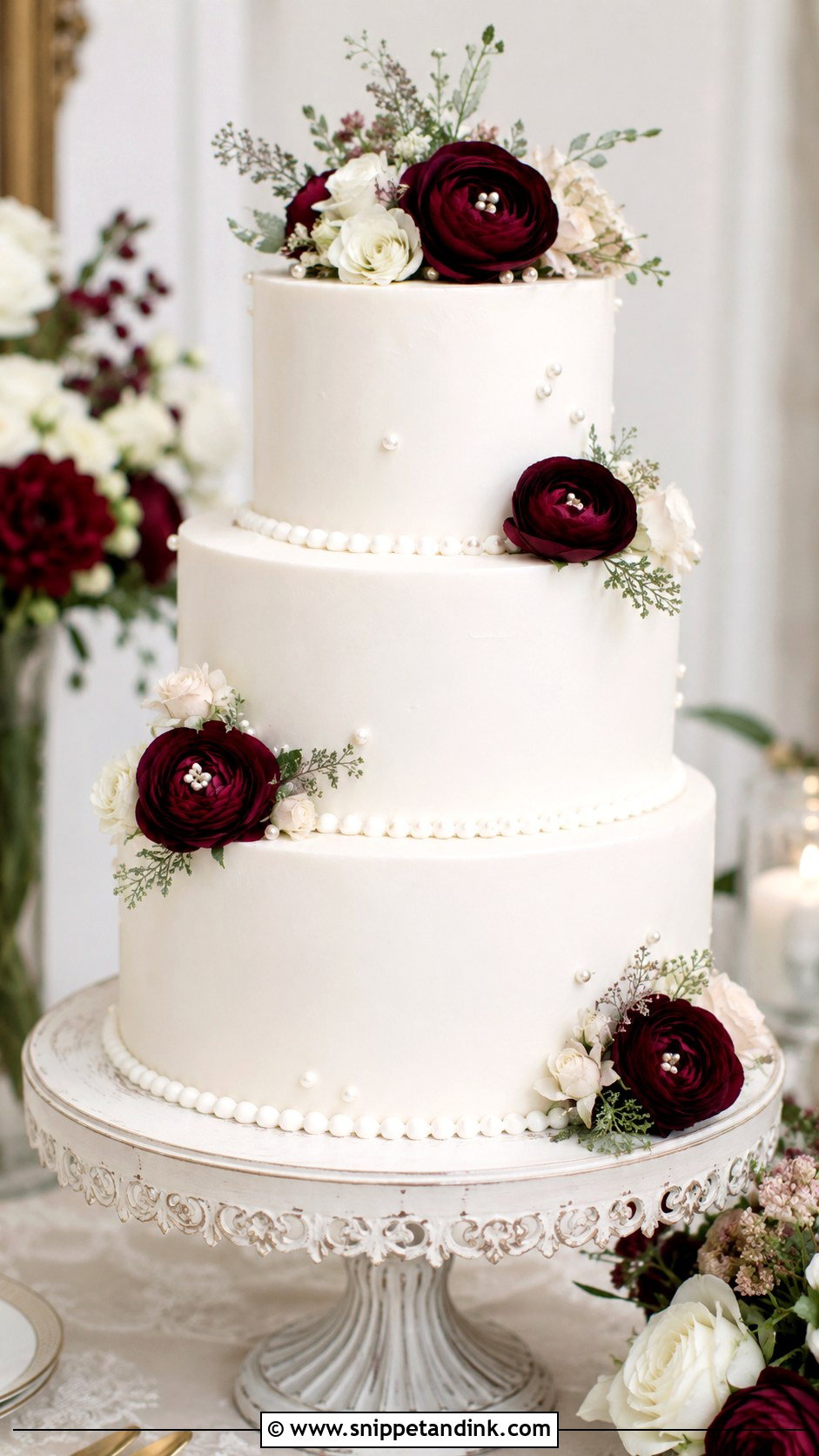
Ruffles bring texture without piping, and they take light in a way flat icing doesn’t. A single ruffled tier looks modern; every tier ruffled is dramatic and quite heavy. Burgundy flowers can sit at the top and base or frame the ruffled tier on either side. Fondant ruffles hold their shape longer in a warm room than buttercream ones, which is worth knowing for summer. A few small ivory blooms keep the arrangement from feeling dense.
17. White Wedding Cake With Burgundy Flowers And Drip
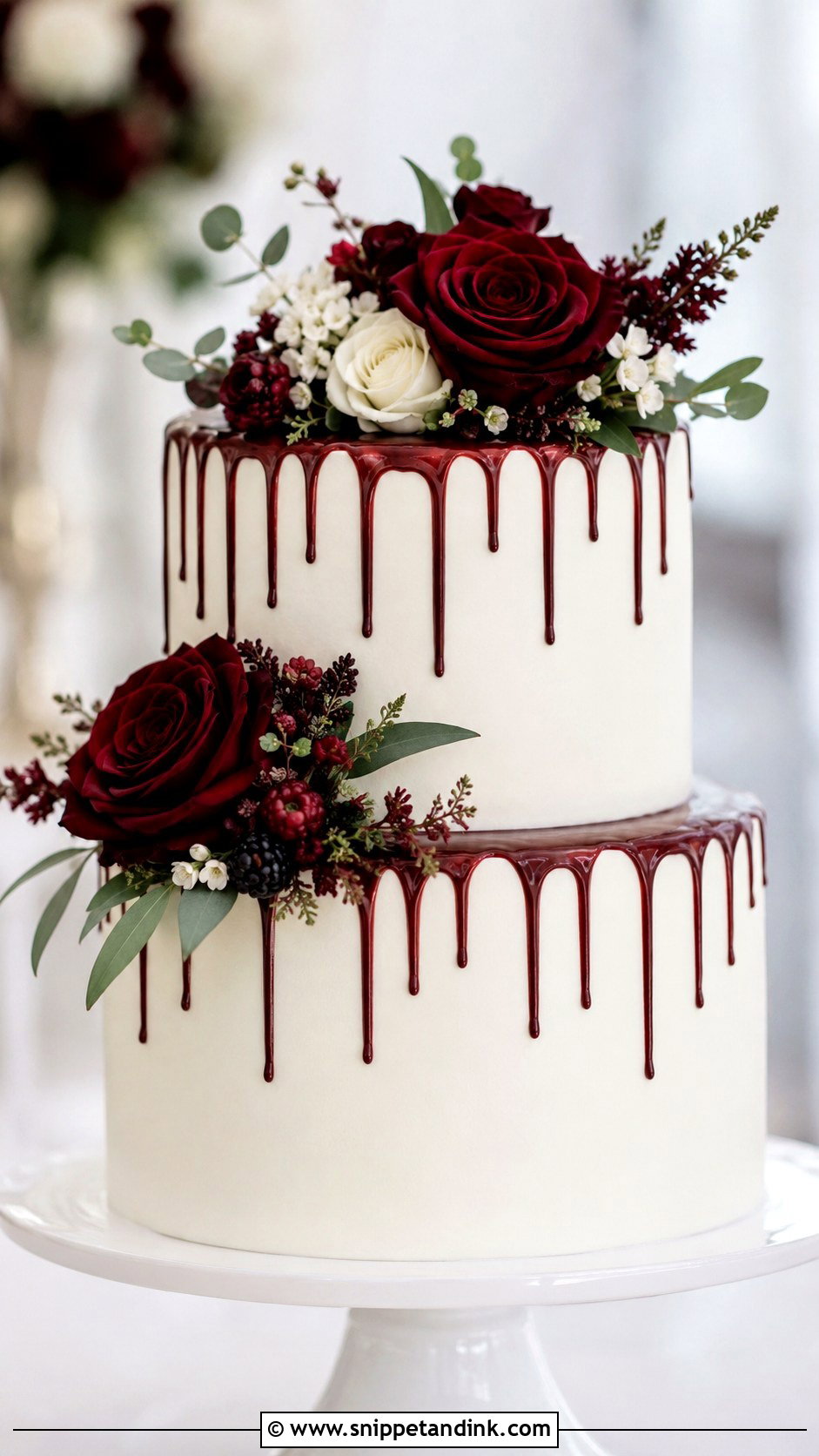
A burgundy drip on a white cake only stays elegant when it’s done with restraint. I apply the glaze around the top edge on a chilled cake, so the drips stop partway down instead of pooling at the base, which is why this one needs smooth buttercream. Matching flowers go on top and at one lower edge only. Berries or small blossoms can join them. It’s a bolder cake, so I’d steer a couple toward it only if the rest of the reception has some personality too.
18. White Wedding Cake With Burgundy Flowers And Ribbon
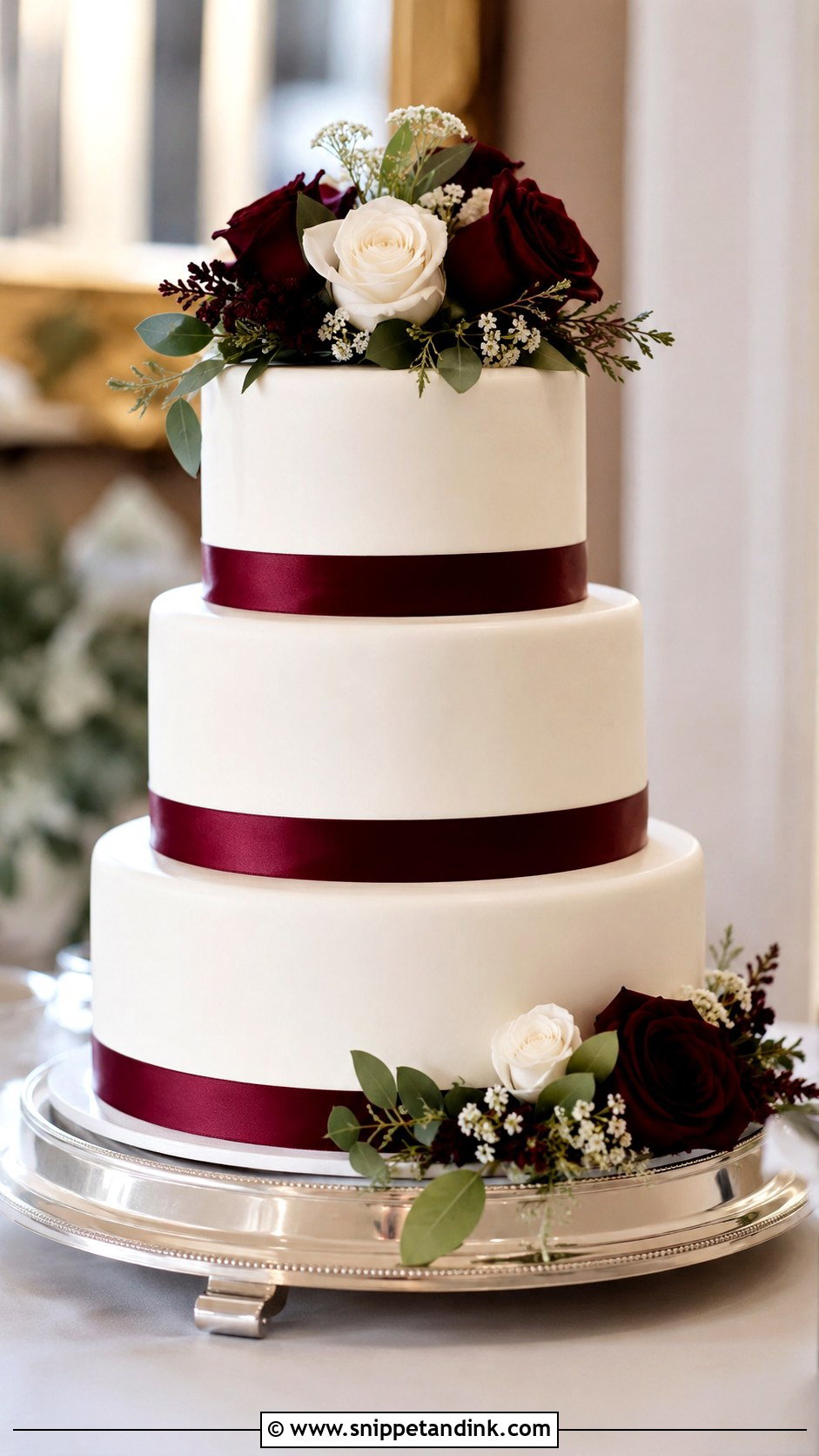
Ribbon is the easiest way I know to match a cake to bridesmaid dresses, because you can hold the actual ribbon up to the fabric. One band per tier looks tailored; a single band on the middle tier is lighter. I put a thin layer of food-safe backing behind real ribbon on buttercream, since grease seeps through satin and leaves dark spots. Fondant gives the ribbon a formal edge, buttercream softens it. Burgundy flowers at the top and base pull the ribbon and blooms together.
19. White Wedding Cake With Burgundy Flowers And Square Tiers
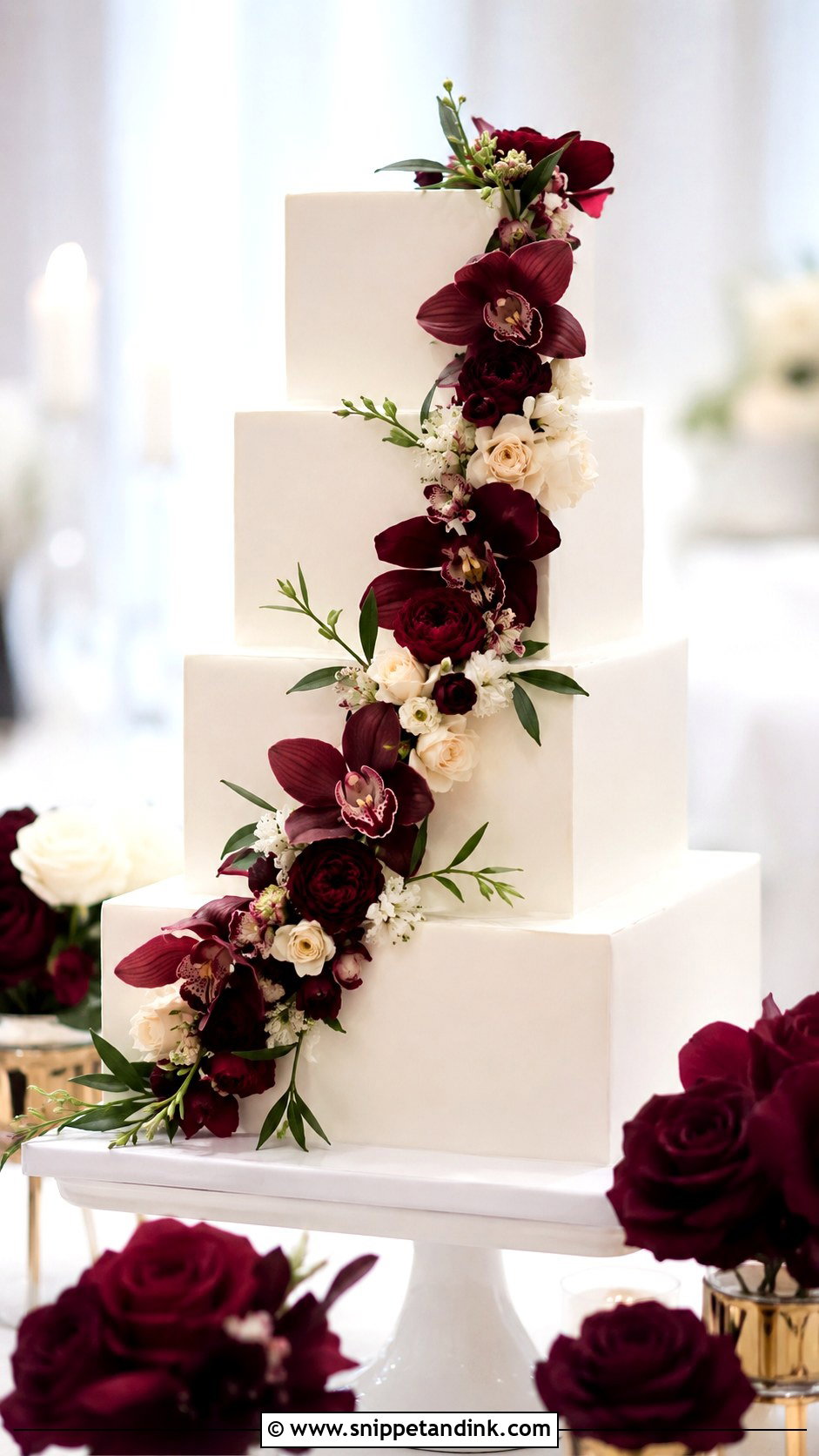
Square tiers change how I place flowers, since the corners become natural points to anchor a cluster. Clean lines matter more here than on round tiers, so I’d choose smooth fondant or a very sharp buttercream finish. Flowers can sit on the corners, between tiers, or run in a diagonal cascade across the faces. Roses, orchids and ranunculus all soften the geometry. Square cakes are heavier than round ones of the same width, a detail your venue’s cake table should be ready for.
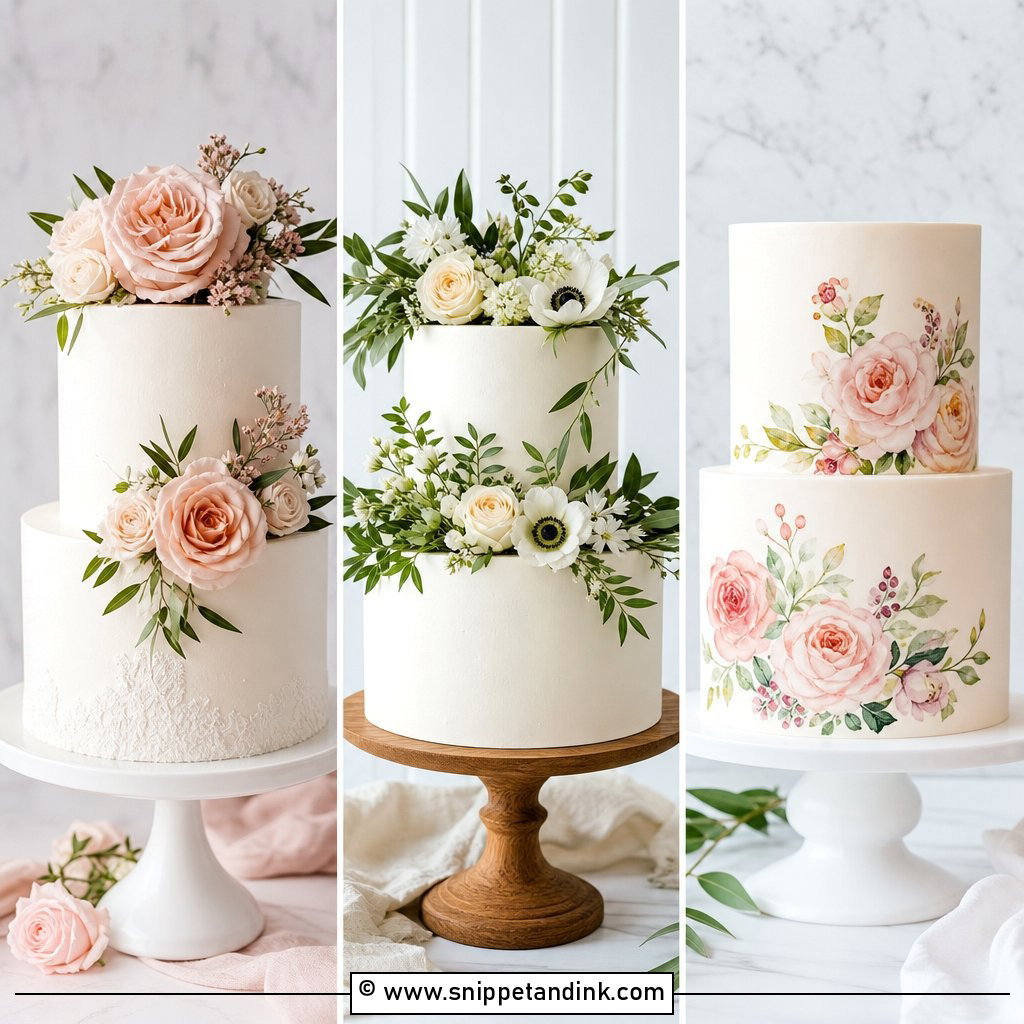
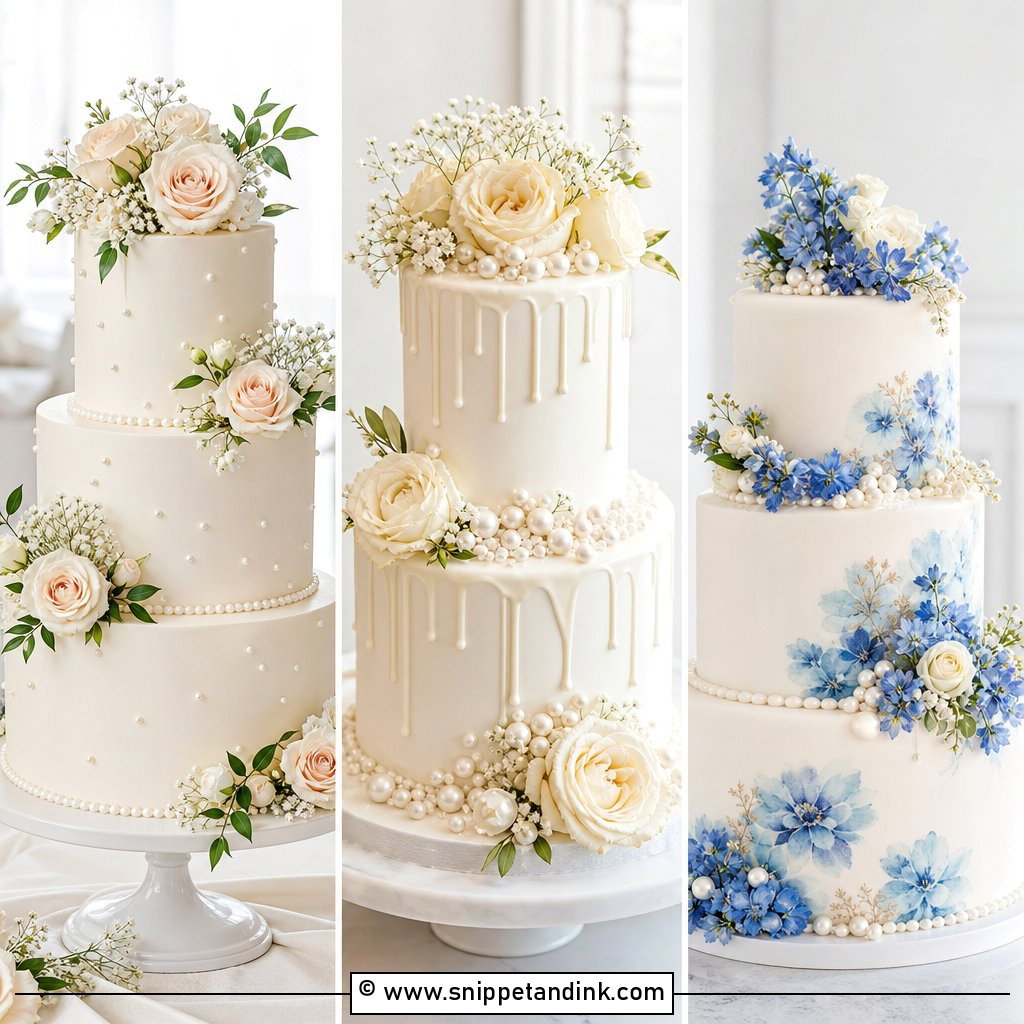
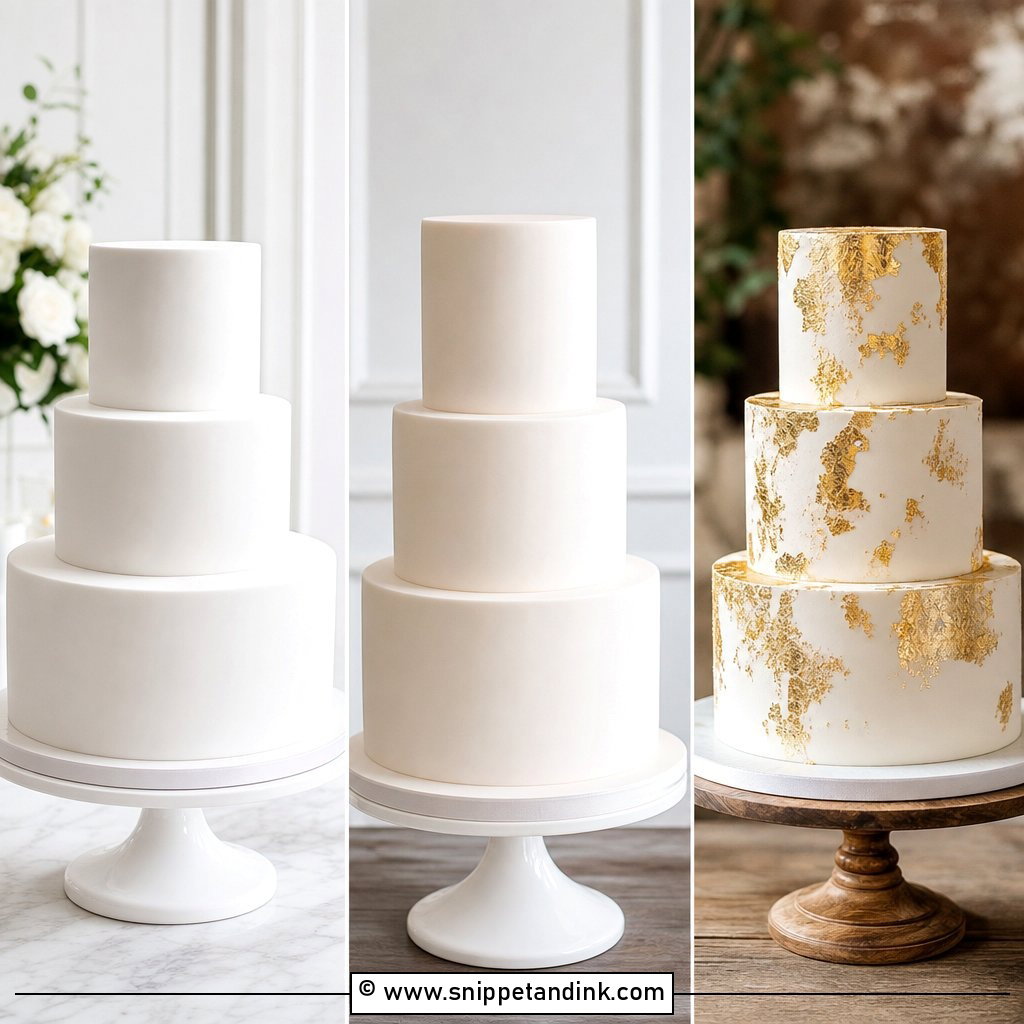

20. White Wedding Cake With Burgundy Flowers And Tall Tiers
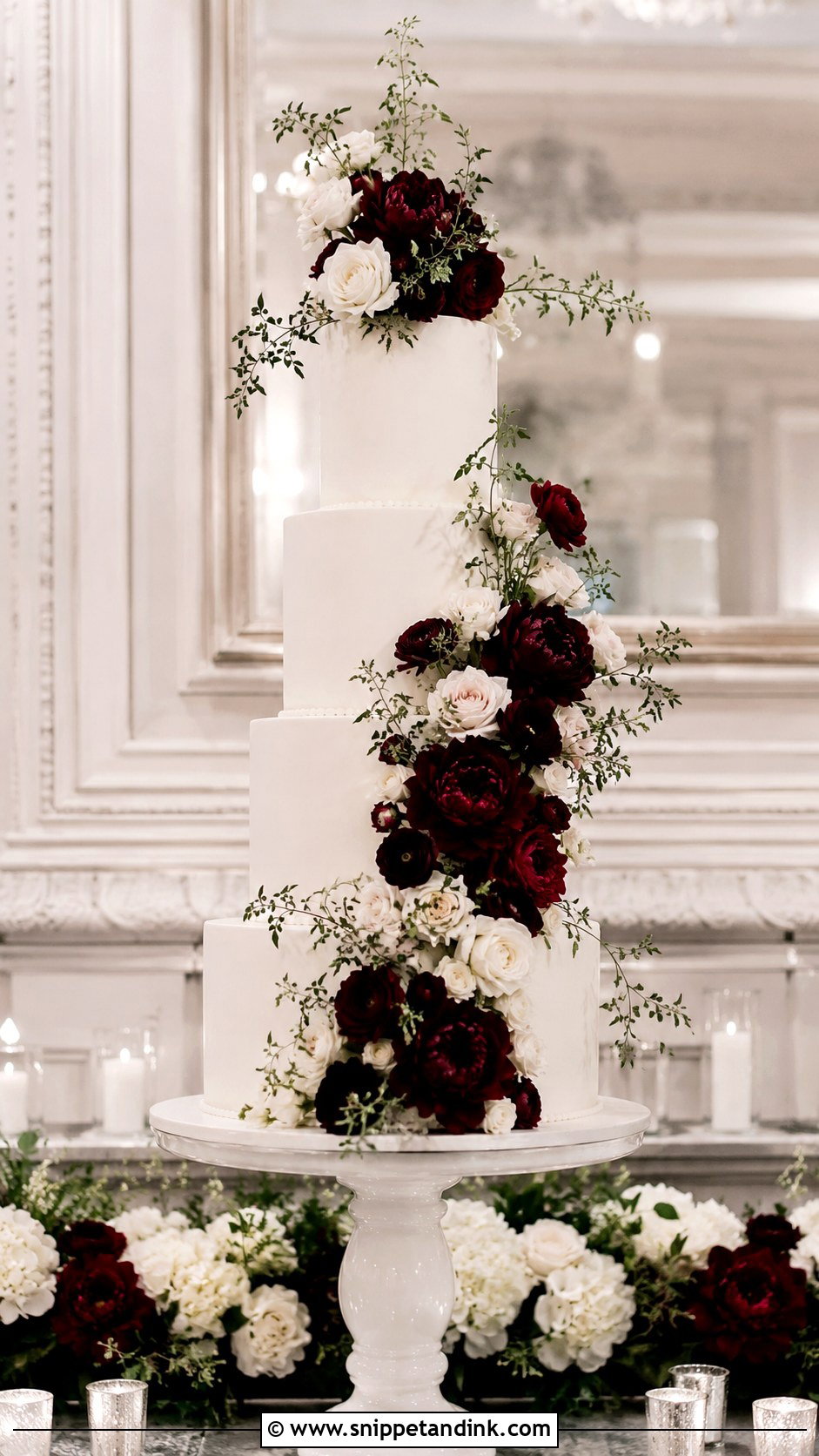
Tall tiers make a cake look grand without adding colors, and burgundy gives that height a focal point. More visible surface means more icing to keep perfect, so I lean on smooth fondant, clean buttercream or subtle vertical texture that draws the eye upward. Flowers go in a restrained cascade, at the seams or as one bold top arrangement. Extra-tall tiers need internal supports, so I always build these with dowels and boards in every tier. For a large formal reception, it’s the cake that fills the room.
Burgundy Is Not One Color, So Bring Something to Match
The word covers everything from a bright wine red to a brownish oxblood to a shade that leans plum. Two couples can both ask me for burgundy and mean completely different things, which is why I ask for a physical sample: a fabric swatch, a napkin, a ribbon off a bridesmaid dress. A photo on a phone screen is never reliable.
How the shade changes once the lights go down
Burgundy gets darker as the room gets dimmer. Under evening candlelight, a deep shade can lose its red entirely and look almost black against the white icing. If the cake is cut after sunset, I’ll often nudge the flowers or sugar petals a shade brighter than the swatch, or add blush and ivory blooms between them so the cluster keeps its shape on camera.
Real stems and sugar petals side by side
Mixing sugar flowers with fresh ones is common, but natural flowers vary from stem to stem while sugar petals are colored in a batch. I ask your florist for one sample bloom a few weeks out and match my petal dust to it, rather than to a catalog name. That one stem saves a lot of guesswork, and a mismatch between sugar and real burgundy shows more on a white cake than on any other color.
Which Details to Carry From These Cakes to Your Baker
Most of these cakes share the same foundation: a clean white surface and burgundy placed with intention. Where they differ is the flower you choose, the finish beneath it and how warm the room will be. A few roses keep the cake quiet, a cascade makes it the centerpiece, and orchids, square tiers or a drip push it somewhere modern. Save the photos you like, mark the detail you love in each, and bring that list to both your baker and your florist so the flowers are planned together.
You'll Like These Ideas:





Leave a Reply