
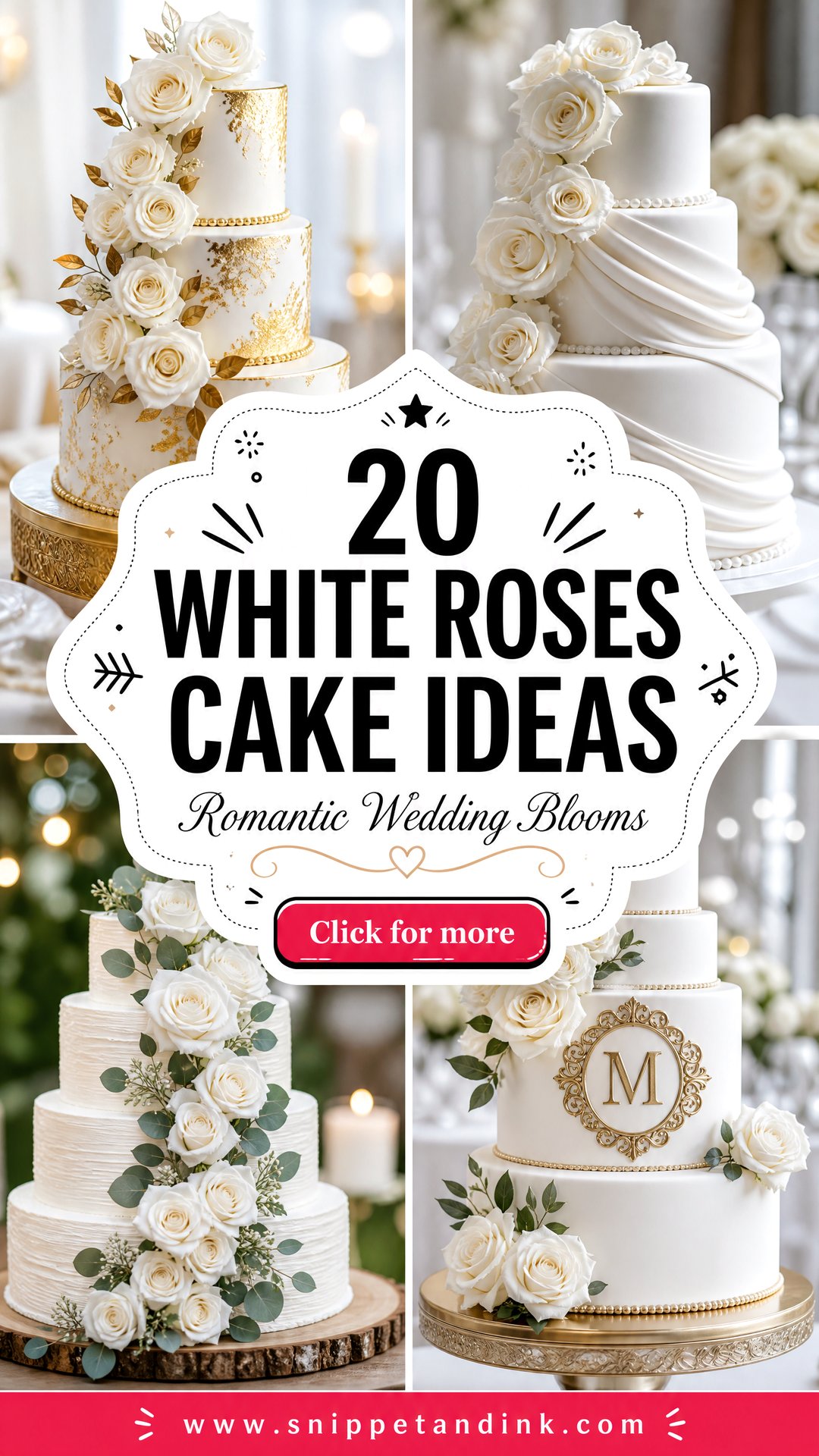
White roses are the flower I put on wedding cakes more than any other, mostly because they never argue with the room. They sit as easily on a garden table as in a ballroom, and the cake underneath decides whether the result feels classic or modern. The roses themselves can be fresh, sugar, piped buttercream or wafer paper roses, and each of those behaves very differently over a long reception. Below are twenty ways I’d use them, with honest notes on what each one needs from your florist, your venue and your budget.
Sugar, Wafer Paper, Piped or Fresh? How Each Rose Holds Up
The cake designs below can use almost any kind of rose. What changes is how long the flowers last, how they look up close and how far ahead they need to be made.
- Sugar roses: the most lifelike and the longest lasting. Each one takes real time to make and dry, so they’re ordered weeks ahead and priced accordingly. Humidity is their enemy.
- Wafer paper roses: light, delicate and very realistic in thin petals. They’re even more sensitive to moisture than sugar, and they can curl or wilt if they sit against buttercream for hours.
- Buttercream roses: piped directly on the cake, fully edible and the softest looking. They can droop in heat and can’t be made far in advance.
- Fresh roses: the most natural and usually the least expensive, but they need food-safe preparation and they start to relax after a few hours out of water.
One more thing about white on white: pure white roses on a bright white cake can blur together in photos. Roses with a creamy center or a faint green tint at the base give the camera an edge to catch, and so does a touch of greenery or a cake in warm ivory.
1. White Rose Wedding Cake With Greenery
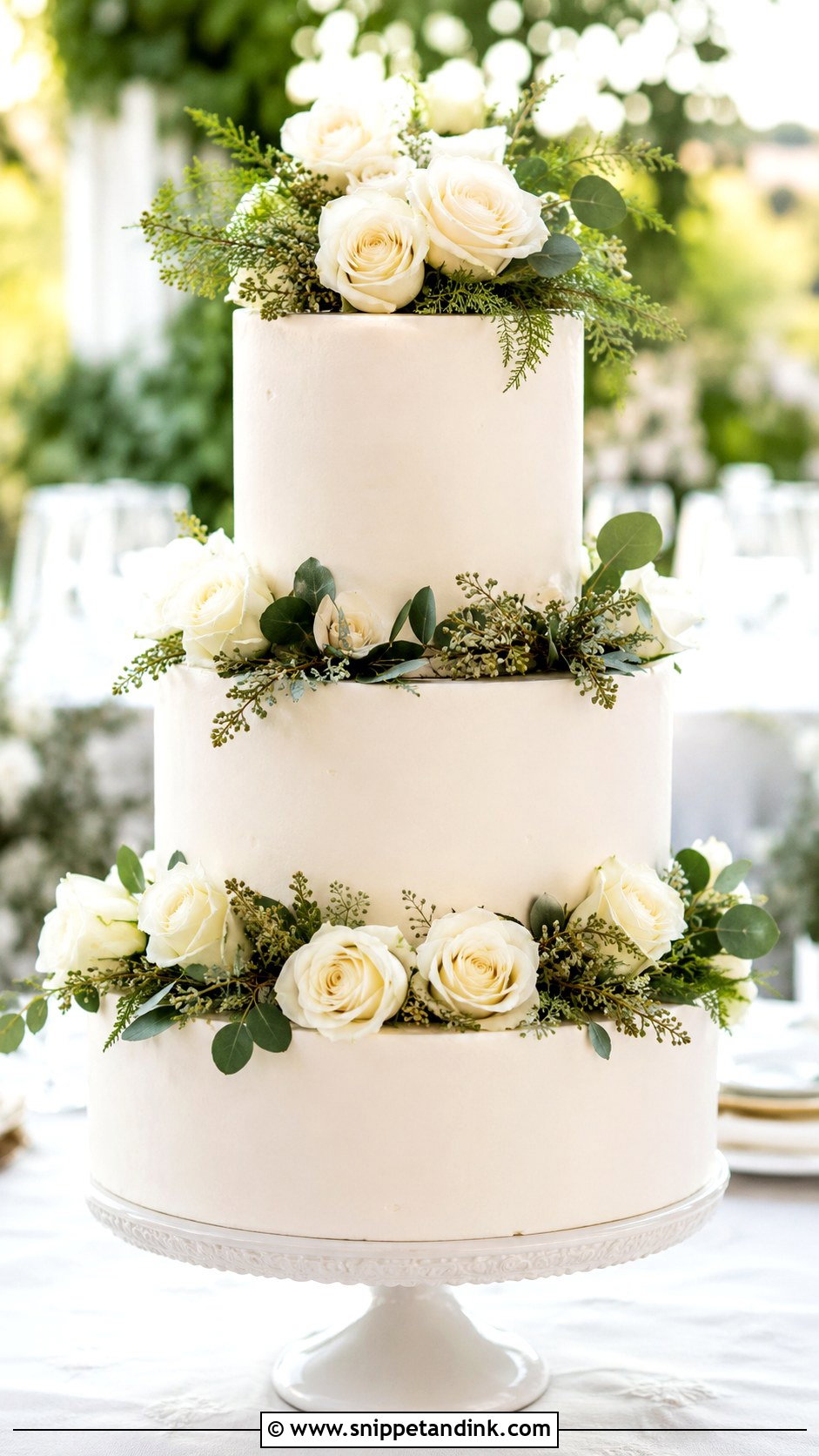
Greenery is what stops an all-white cake from looking flat. Against smooth buttercream or fondant, a few sprigs of olive or small fern give the roses an outline, so they don’t disappear into the icing in photos. I keep the leaves sparse so the roses stay in charge. A three-tier cake looks fullest with a small cluster where each tier meets the next, and the flowers hide the joins too. Eucalyptus is popular here, but it shouldn’t touch the icing directly; more on that further down.
2. White Rose Wedding Cake With Gold
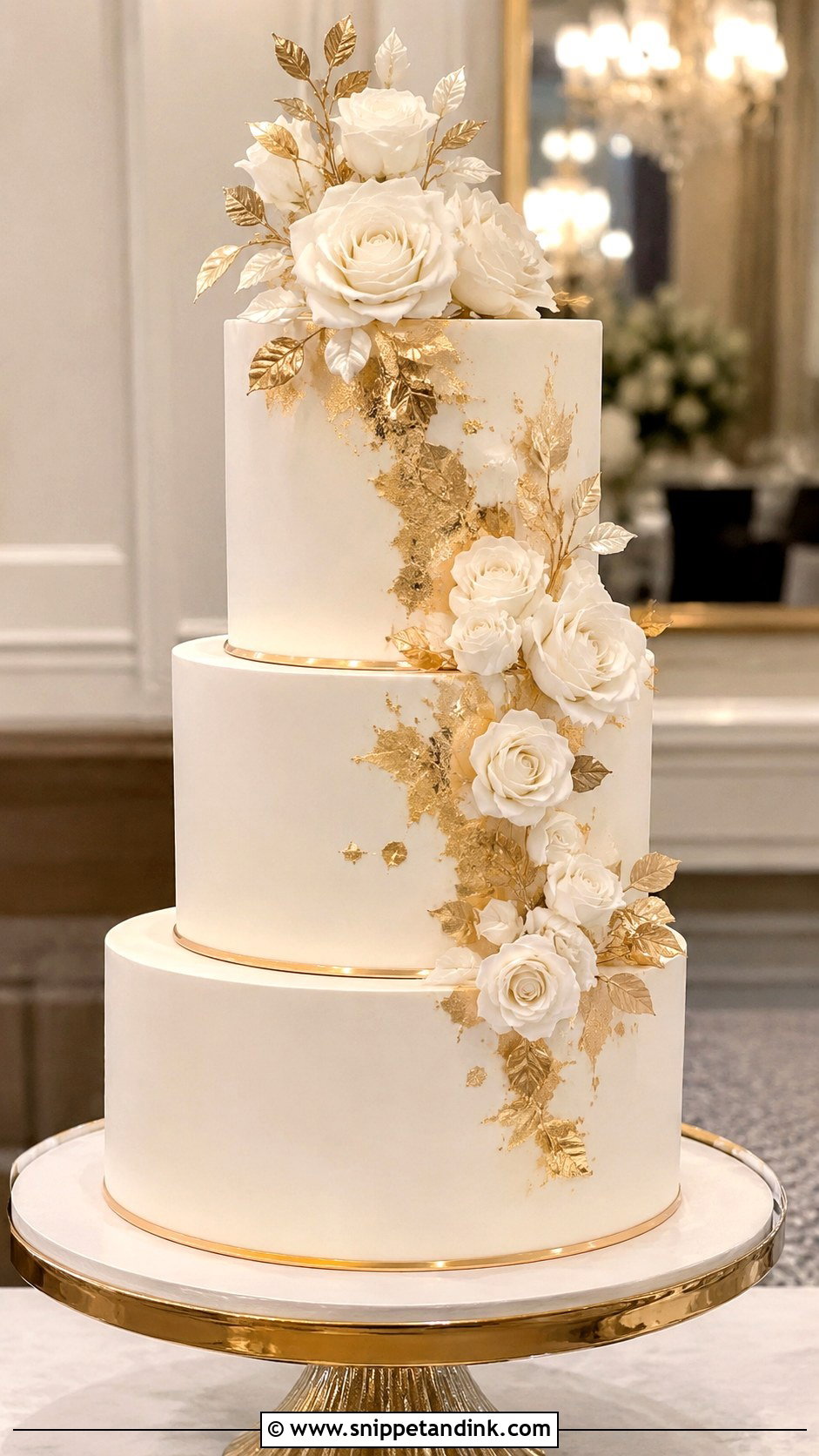
Gold works best as punctuation. A painted edge on one tier, a few flakes of metallic leaf or a thin line of gold piping is plenty, and the roses keep it soft. Covering whole tiers in gold quickly starts to look heavy. Edible gold leaf is real metal and very delicate; it has to be applied with a dry brush and it can’t be moved once it touches the icing, so I plan exactly where it goes before I start. Ballrooms and black-tie receptions suit this cake.
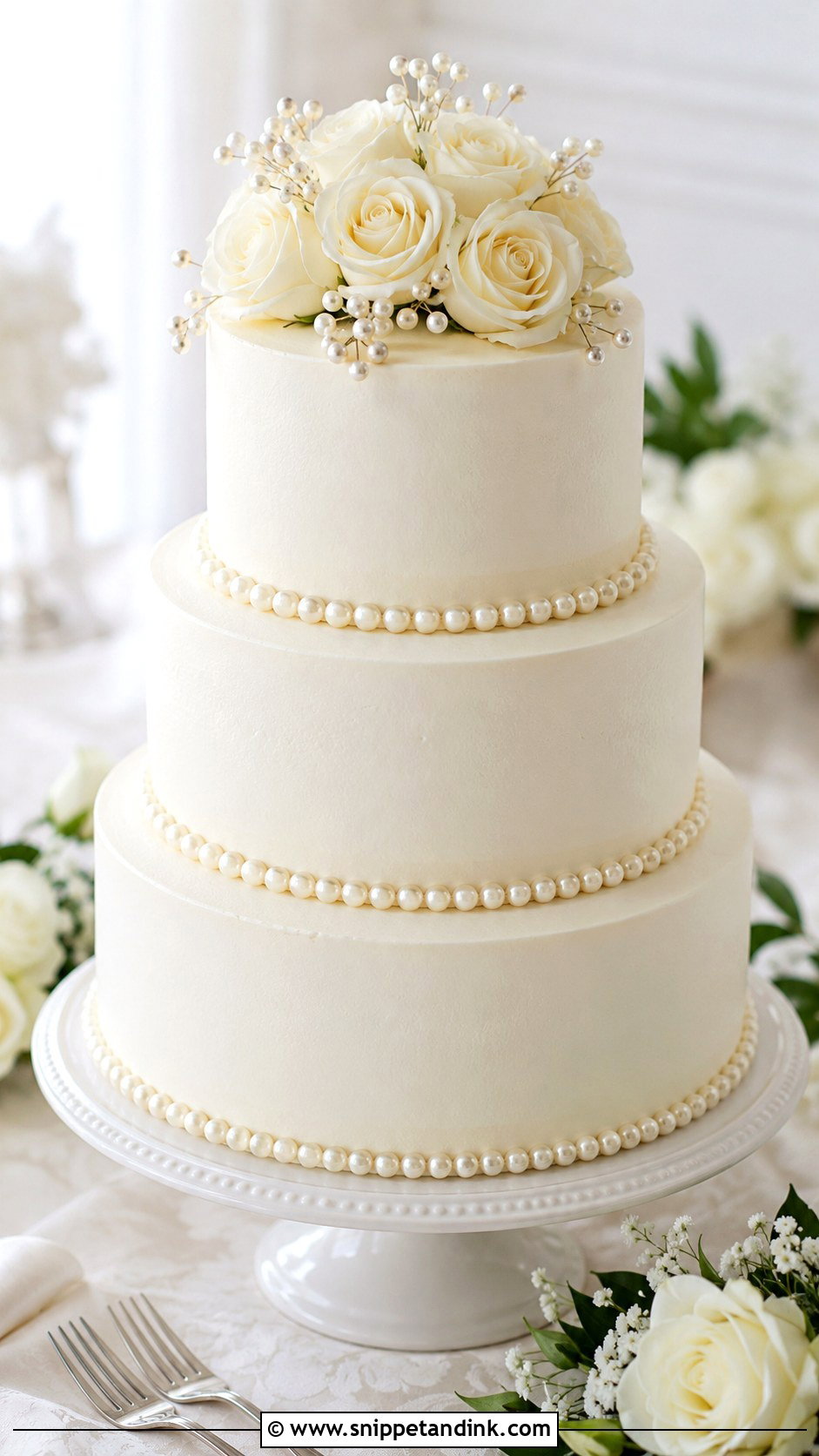
3. White Rose Wedding Cake With Pearls
Pearls and white roses share the same quiet sheen, so they never clash. I set small edible pearls around the base of each tier or scatter a few among the petals, pressing each one into the icing while it’s still slightly soft so it grips. Sugar pearls can bleed or lose their shine in humid rooms, which is worth knowing for a summer tent. Keep the roses white or ivory to match the pearl tone. Up close, it gives the photographer plenty of detail.
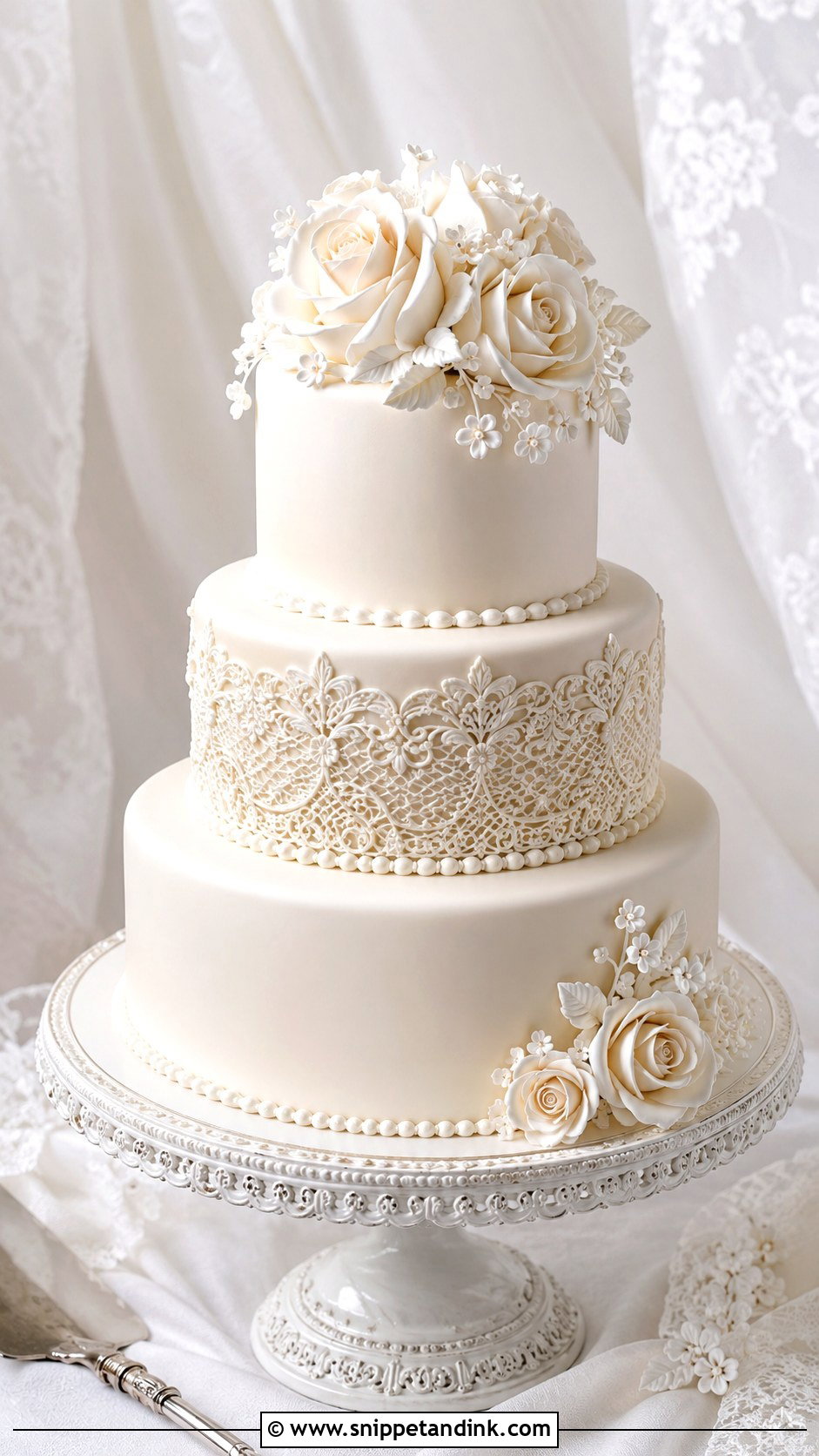
4. White Rose Wedding Cake With Lace
Lace on a cake can be cut from fondant, piped as royal icing piping or stencilled over buttercream, and I choose based on how fine the pattern is. Fondant appliqué suits a bold motif; piping suits a delicate one. Roses should sit beside the lace rather than over it, or you lose the work. An ivory or warm white cake lets the pattern cast a shadow; on bright white, fine lace can almost vanish. Putting lace on one tier and roses on another is the clearest arrangement.
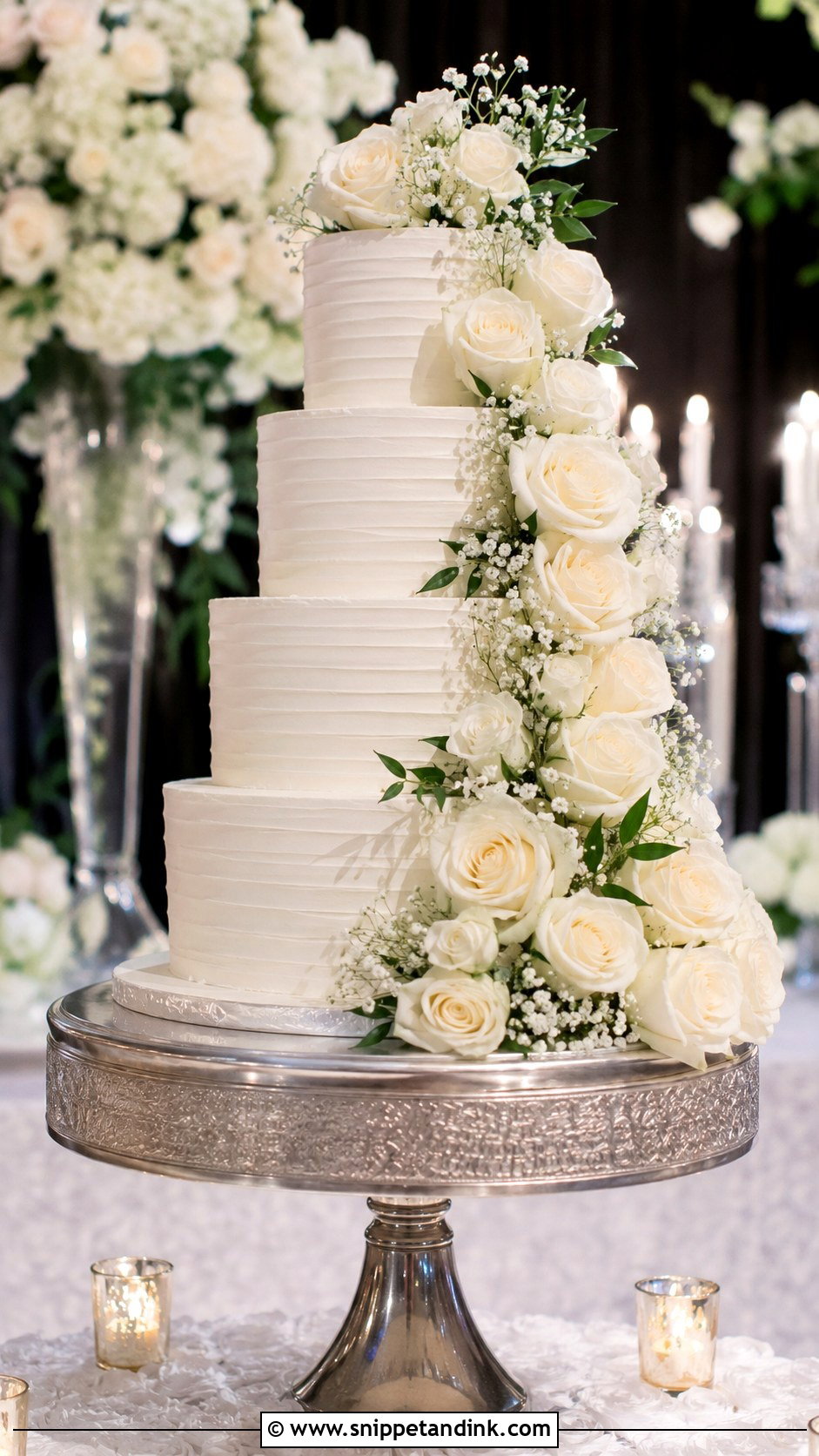
5. White Rose Wedding Cake With Cascading Flowers
A cascade needs height to fall down, so this is a design for tall cakes and large rooms. I build it from the top tier downward, tucking each rose in at a slight angle so the line curves rather than running straight. It uses a lot of flowers, which matters for cost and for food safety if they’re fresh. A few small filler blooms add texture, but I keep the palette almost entirely white. Full and lush or light and airy both work; the room usually tells you which.
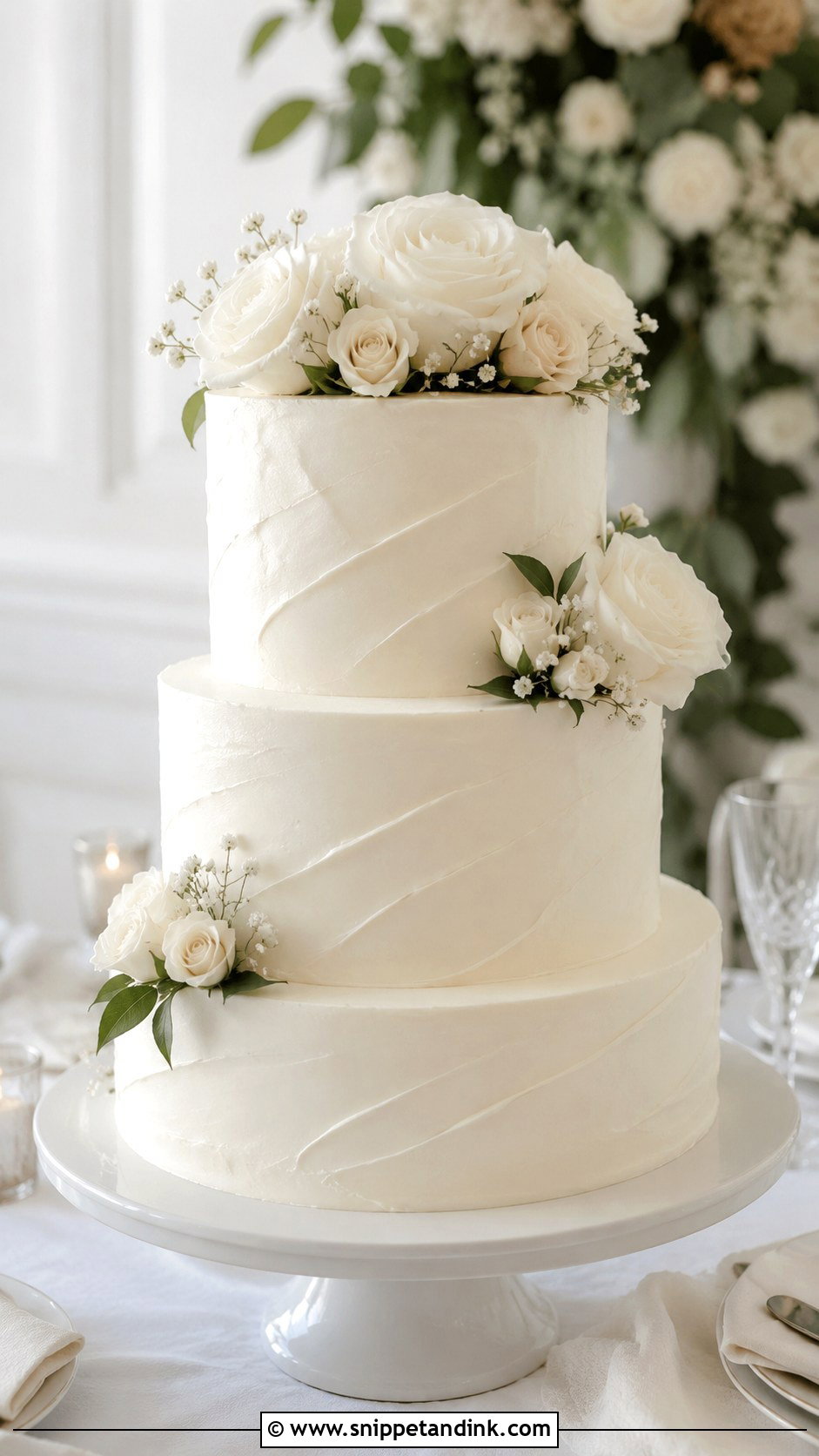
6. White Rose Wedding Cake With Buttercream
Couples who care most about flavor usually end up here. Buttercream tastes better than fondant to most guests and pairs naturally with vanilla, almond, lemon or raspberry fillings. The trade-off is heat: real butter softens in a warm room, so I keep buttercream cakes out of sun and away from the dance floor lights. A smooth finish looks polished; a gentle spatula texture looks relaxed. The roses do the romantic work either way.
7. White Rose Wedding Cake With Fondant
Fondant gives the flawless, sharp-edged surface that makes white roses stand out cleanly. It also protects the cake underneath, which helps on a warm day or when the cake has to sit out for a few hours. Plain fondant looks modern; subtle embossing or panels add interest without color. Sugar roses suit it best, since both are crisp and structured. I group the roses in clusters rather than dotting them everywhere, which keeps the surface looking deliberate.
8. White Rose Wedding Cake With Sugar Flowers
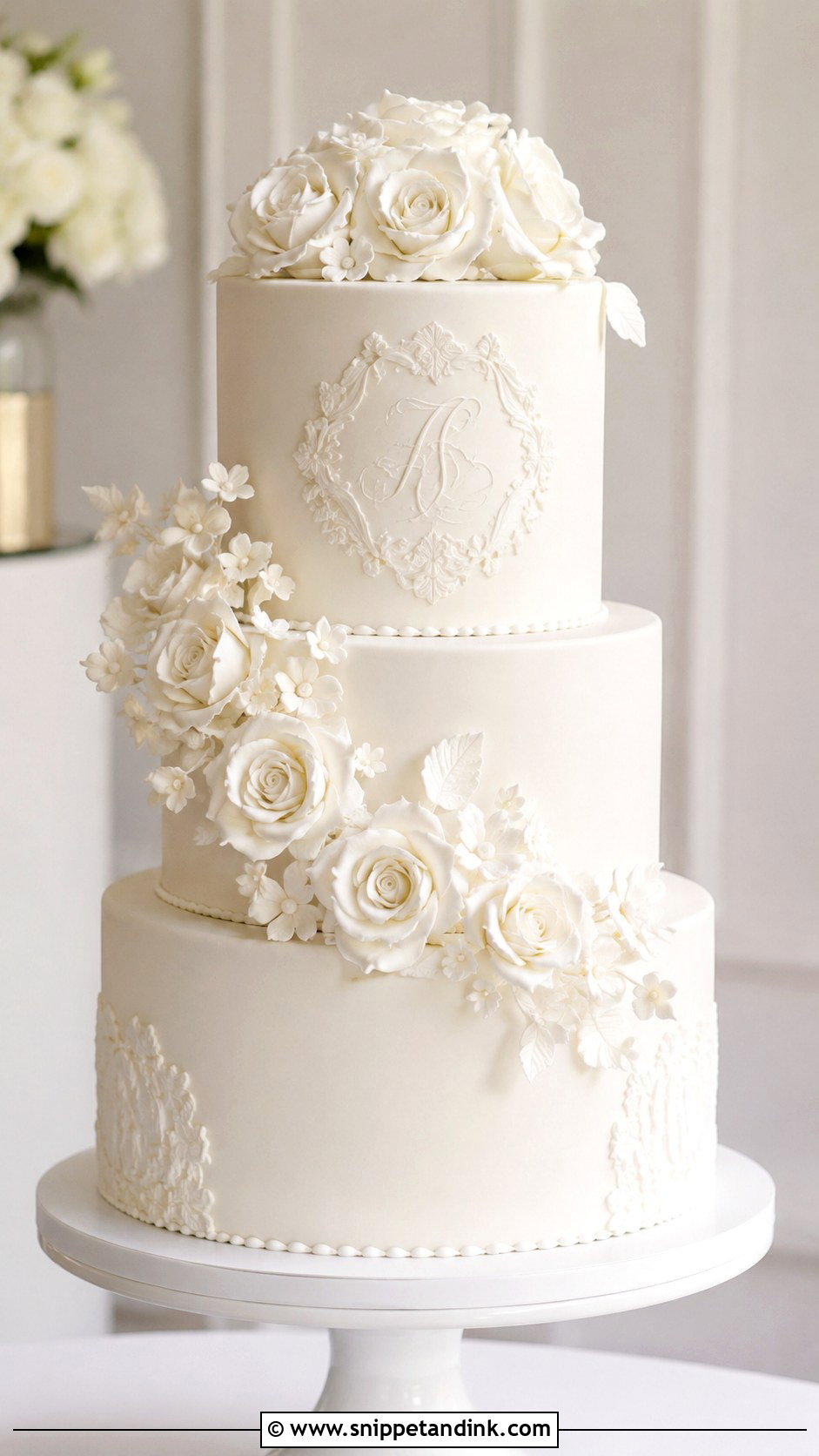
Sugar roses are made by hand, petal by petal, from gum paste that’s rolled thin, shaped, wired and left to dry. They can match any size or stage of bloom, they don’t wilt, and many couples keep the top rose afterward. They’re edible in theory, but hard, so most guests set them aside. Their weakness is moisture; a humid room or a cold-to-warm move can soften the petals. A white-on-white cake with sugar roses looks rich in close-up photography because every petal edge shows.
9. White Rose Wedding Cake With Fresh Roses
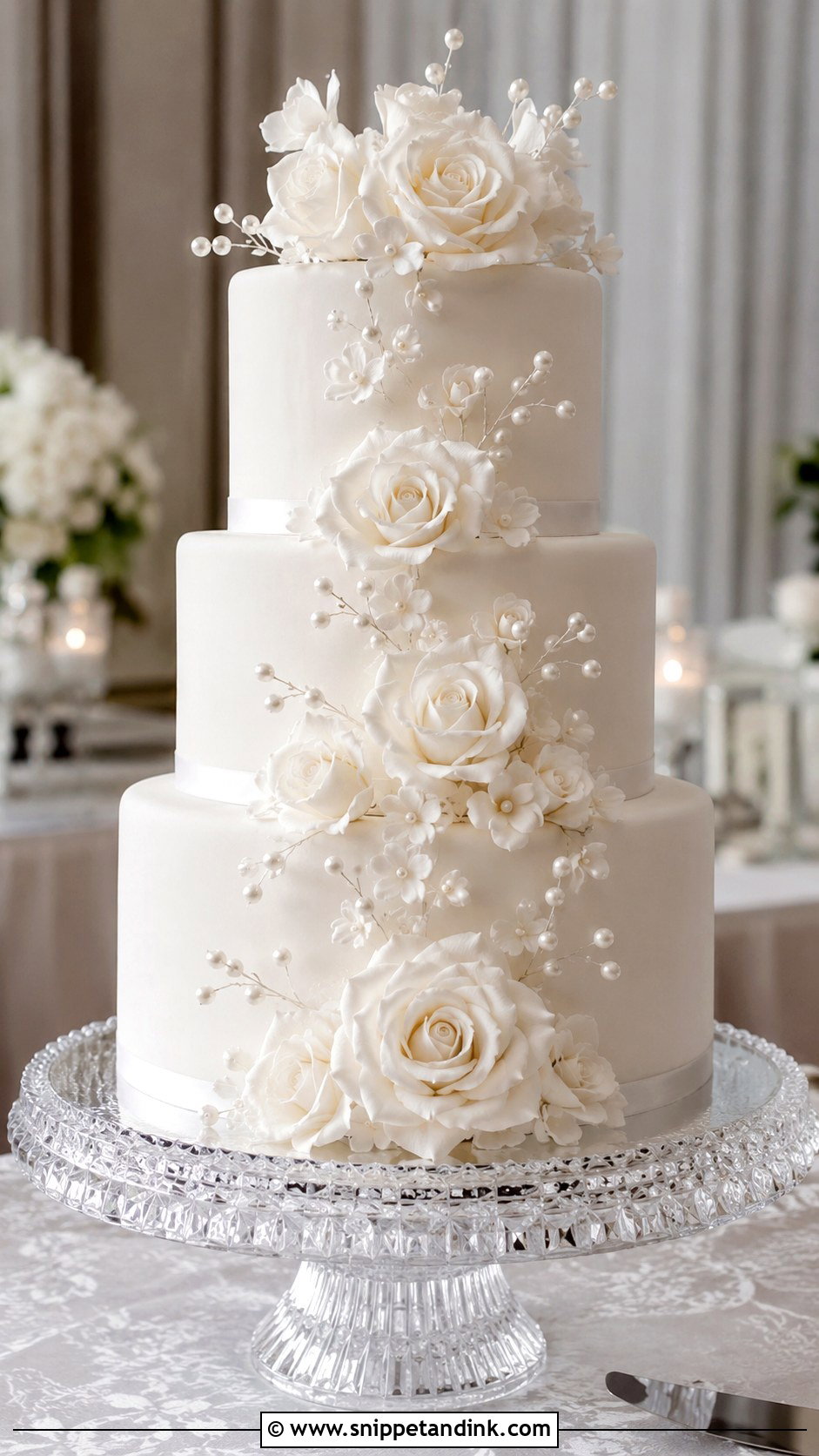
Fresh roses look soft and full in a way sugar never quite matches, and they’re often cheaper. They also need the most care. Most commercial roses are grown with pesticides and aren’t meant to touch food, so the stems must be wrapped or placed in flower picks, and ideally the blooms come from a grower your florist trusts. Decide early who places them, the florist or the baker, and when. A few well-placed blooms look better than roses scattered at random.
10. White Rose Wedding Cake With Baby’s Breath
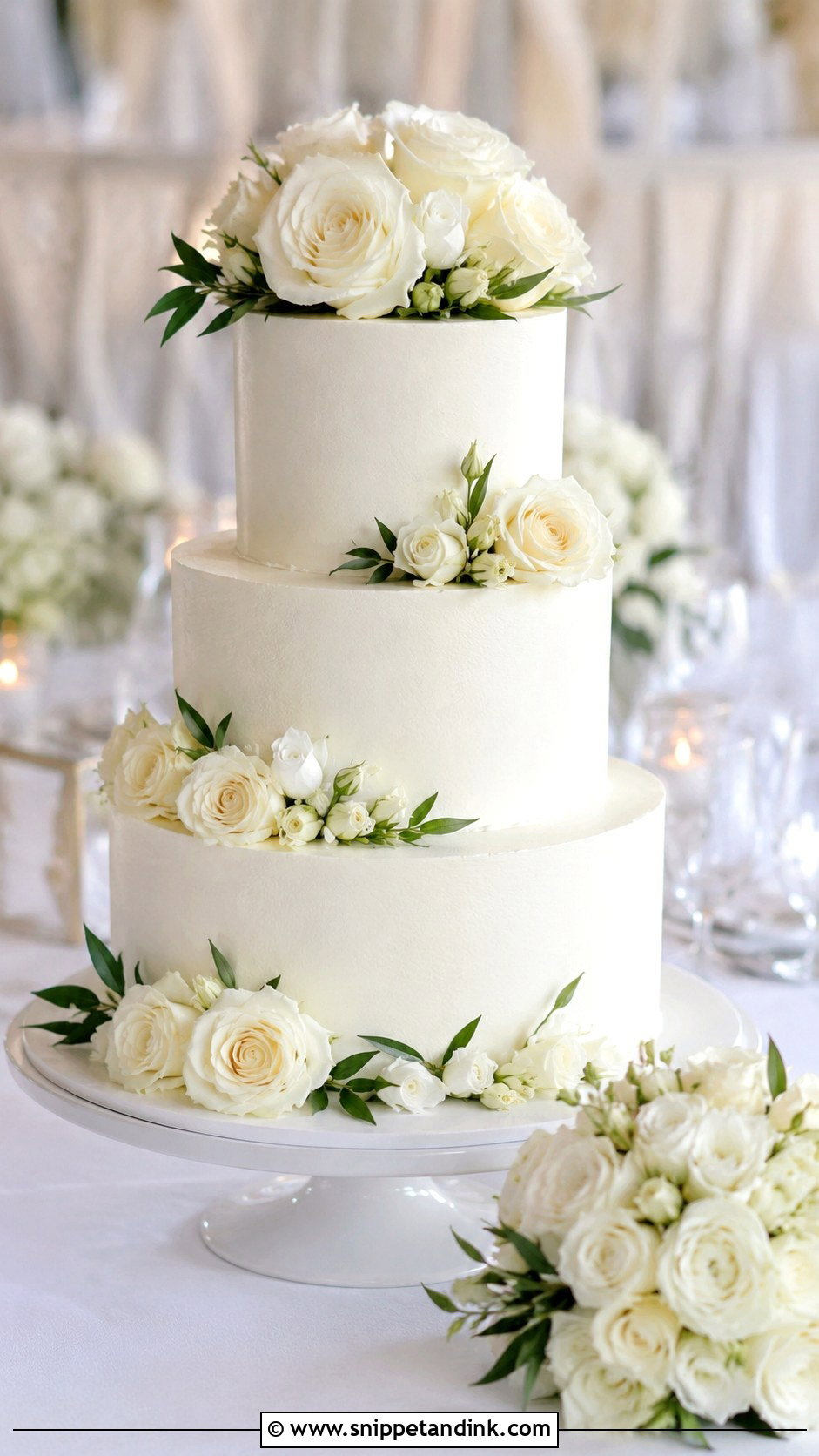
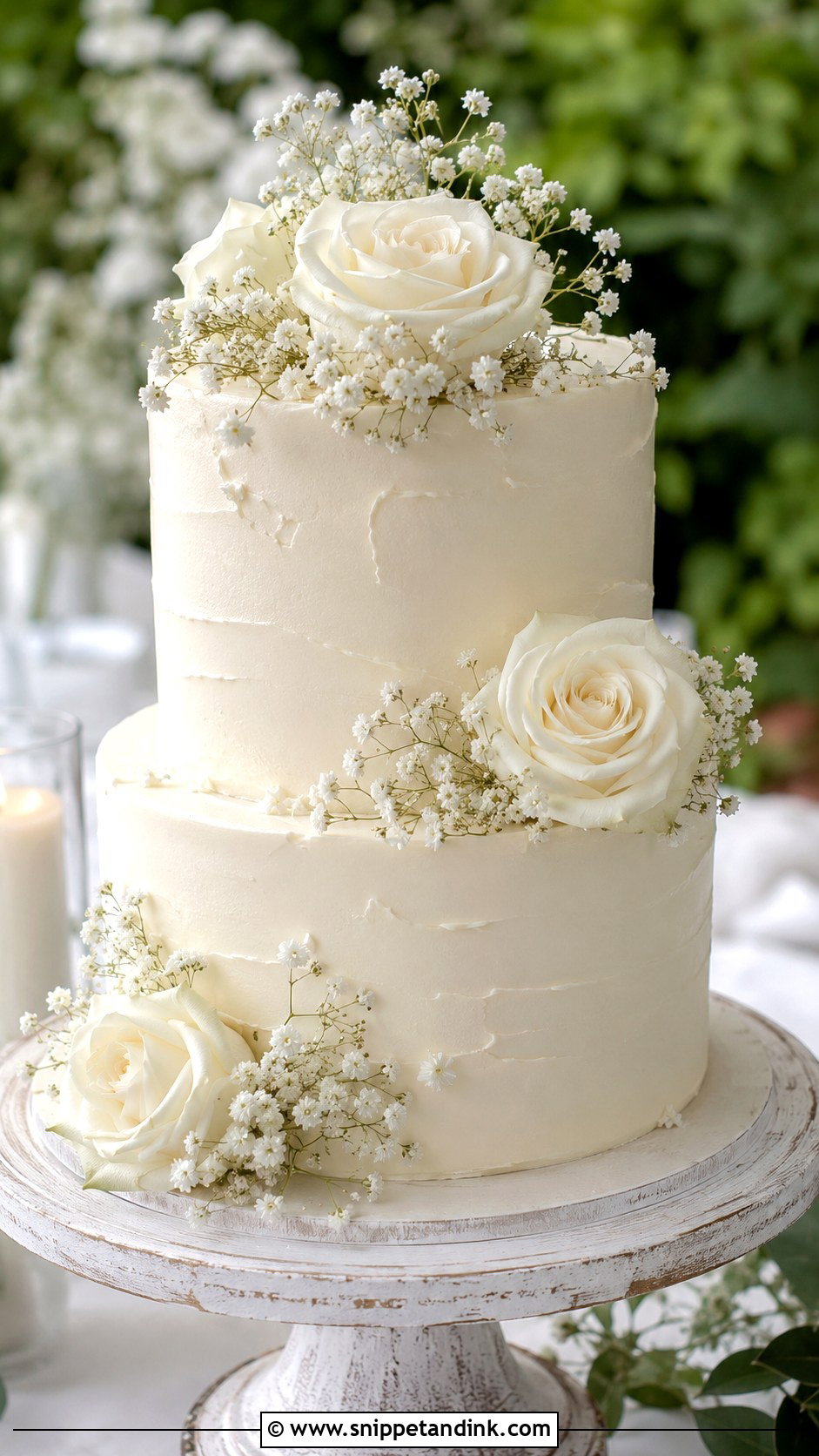
Baby’s breath fills the gaps around larger roses and makes a cake look full without adding color. I have to be blunt about it, though: gypsophila is generally considered unsafe to eat, so fresh sprigs should never sit directly in the icing. Wrap and pick the stems, keep them on the cake board or the stand, or ask for tiny sugar versions instead. Smooth or lightly textured frosting keeps the little flowers readable. It suits garden and rustic receptions.
11. White Rose Wedding Cake With Eucalyptus
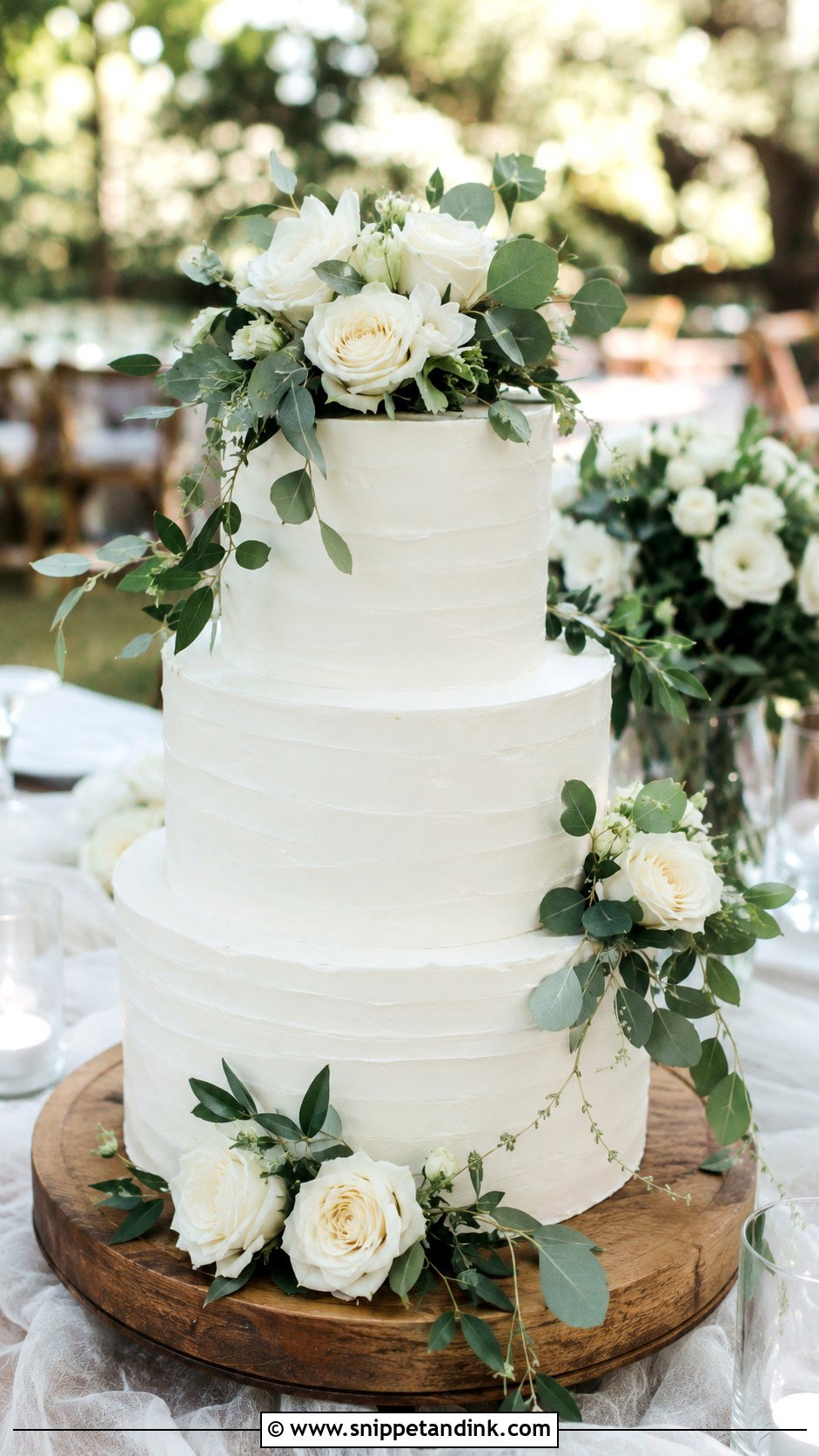
Eucalyptus gives white roses a cool, gray-green frame that feels more modern than ivy or fern. I use it as a small ring around the top tier or trailing loosely down one side with rose clusters. Eucalyptus leaves contain oils that aren’t safe to eat, so like baby’s breath it needs a barrier between leaf and icing, or I use sugar leaves that look the same. Keep it loose and natural. Overdone, it looks like a florist’s sample.
12. White Rose Wedding Cake With Ribbon
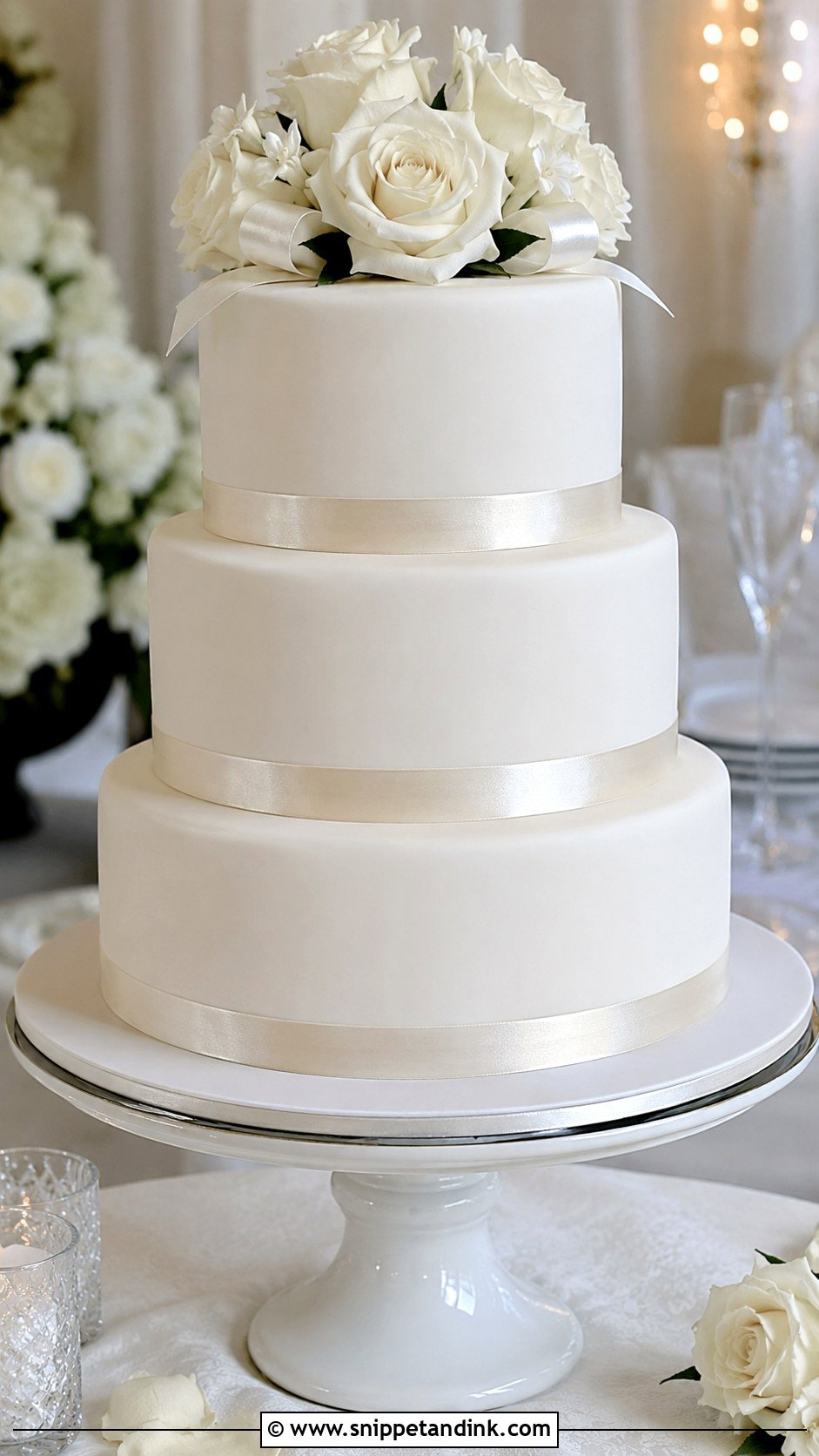
A satin ribbon around the base of each tier frames the cake neatly and hides the line where tier meets board. White, ivory, champagne or very pale blush all work for subtle contrast. Ribbon on buttercream absorbs grease and can show a darker band within hours, so I back it with a thin strip of fondant or acetate first. The roses then go at the top, down one side or between tiers. Match the ribbon to the cake’s tone, not the bridesmaid dresses.
13. White Rose Wedding Cake With Drip
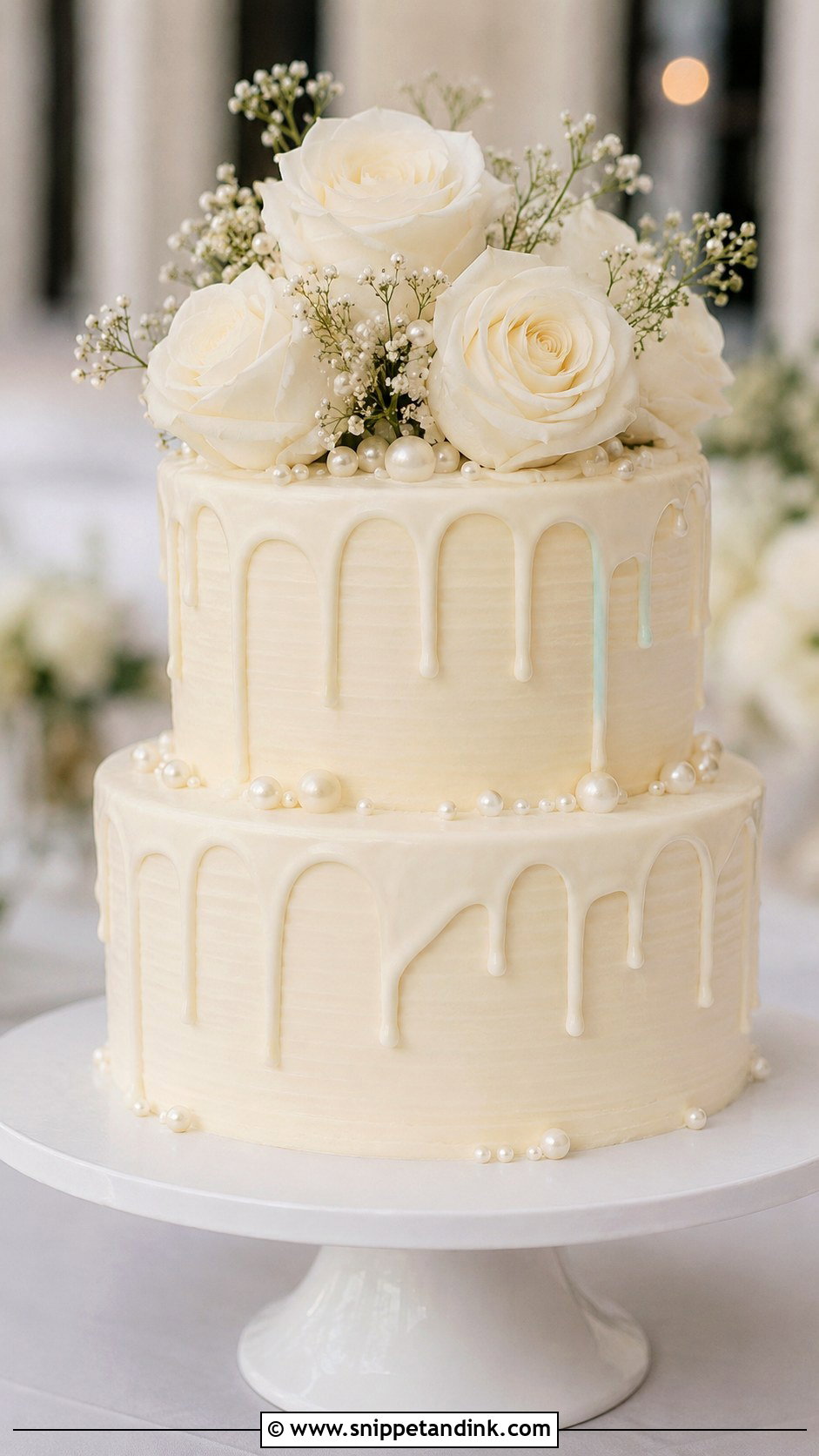
A white drip brings movement to an otherwise calm cake. It can be white chocolate ganache, a vanilla glaze or an ivory ganache, run over chilled buttercream so it sets before reaching the base. Temperature is everything; too warm and it runs to the board, too cold and it stops in stubby blobs. I test a single drip on the back of the cake first. Roses on top give the bridal finish.
14. White Rose Wedding Cake With Ruffles
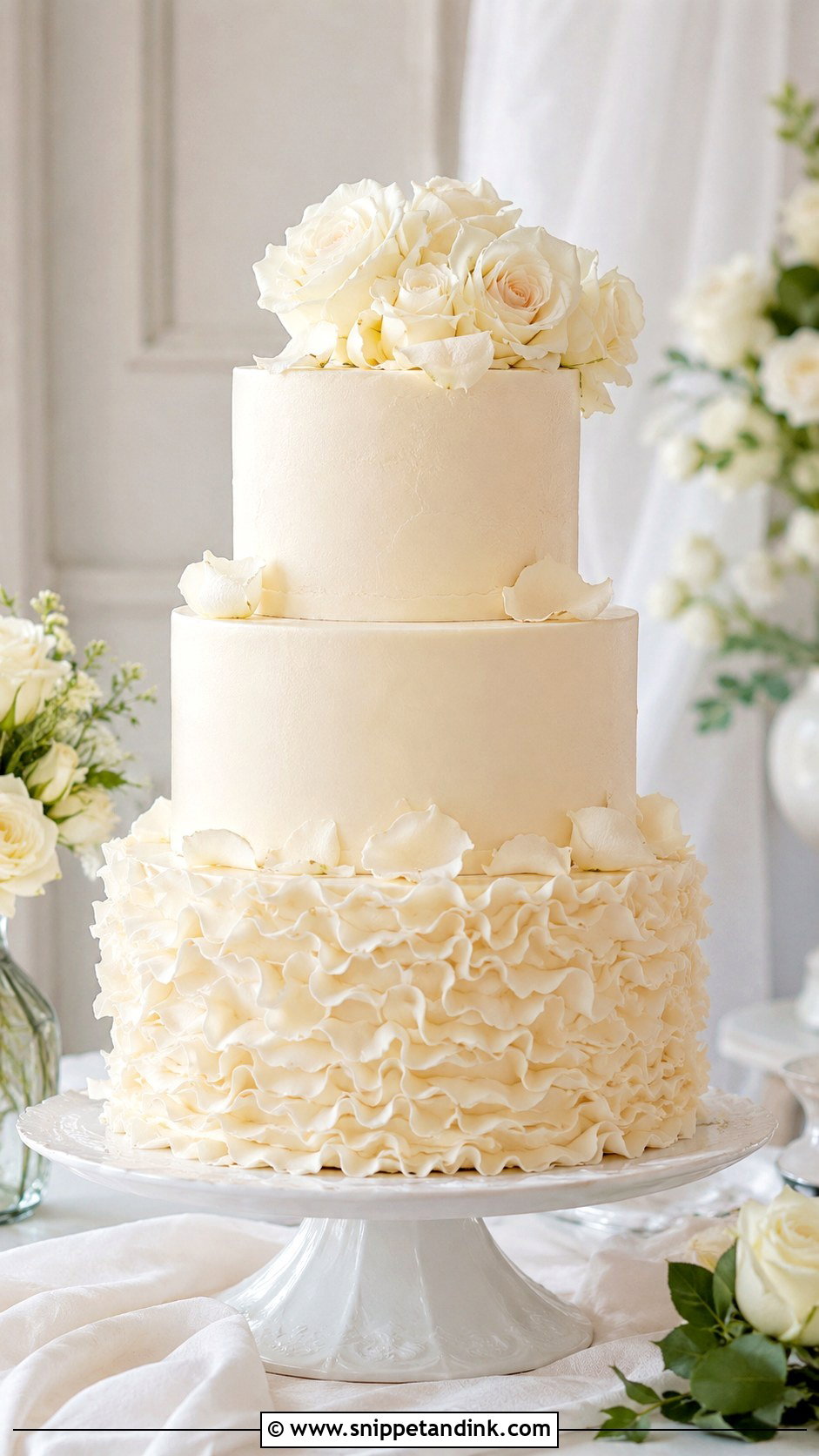
Ruffles look like fabric, and next to smooth roses they can echo a gown. Buttercream ruffles look soft and romantic; fondant ruffles hold a stiffer, more tailored shape and survive warm rooms better. I keep the roses in one cluster so they don’t fight the texture. One ruffled tier with one smooth tier is the balance I come back to most.


15. White Rose Wedding Cake With Floral Wreath
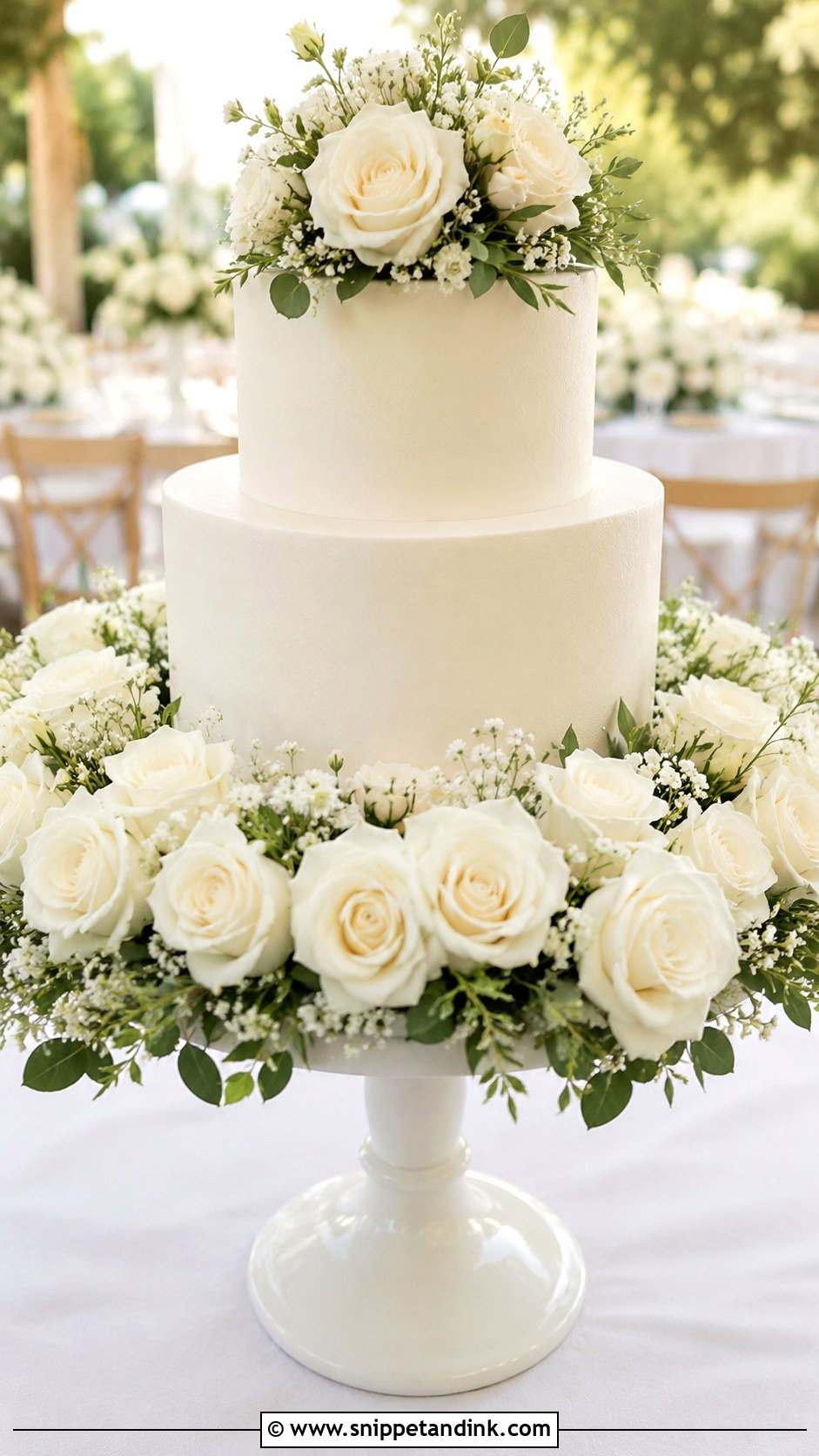
A wreath wraps the cake with flowers so it looks finished from every side, which helps when the cake table sits in the middle of the room. It can ring the base, circle the middle tier or crown the top. Round cakes follow it naturally. I build it from white roses with tiny blooms or leaves filling the gaps, keeping it even but not stiff. It suits intimate weddings and simple tables with very little décor.
16. White Rose Wedding Cake With Monogram
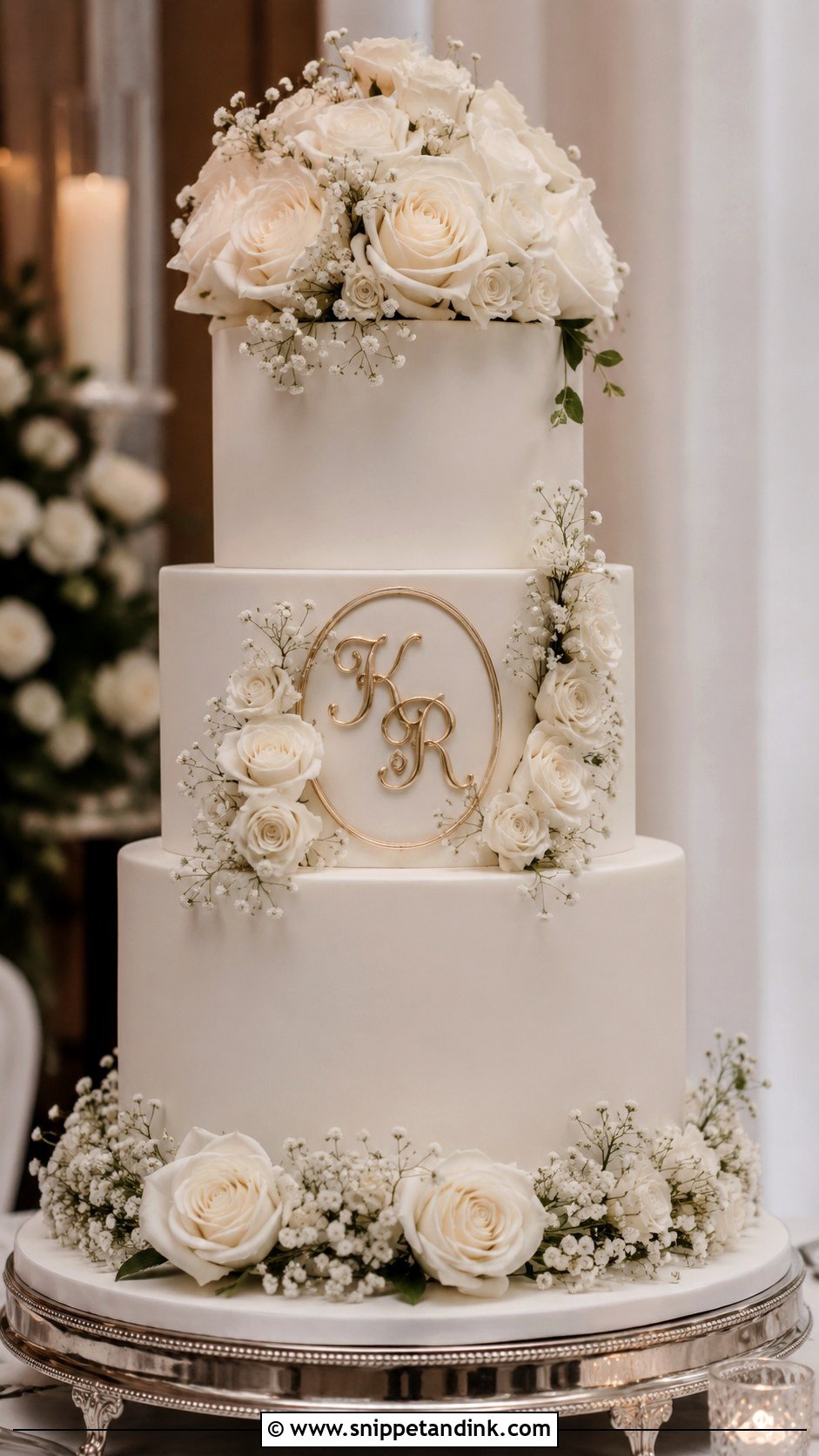
A monogram makes the cake personal without a large topper. The couple’s initials can be painted in gold or silver, piped in white or cut on a small fondant plaque. White roses frame the letters. I put the monogram on the front of the middle tier, where it’s at eye level for photos, and confirm the exact lettering in writing beforehand, since a misplaced letter can’t be fixed on site. Keep the rest of the cake clean.
17. White Rose Wedding Cake With Tall Tiers
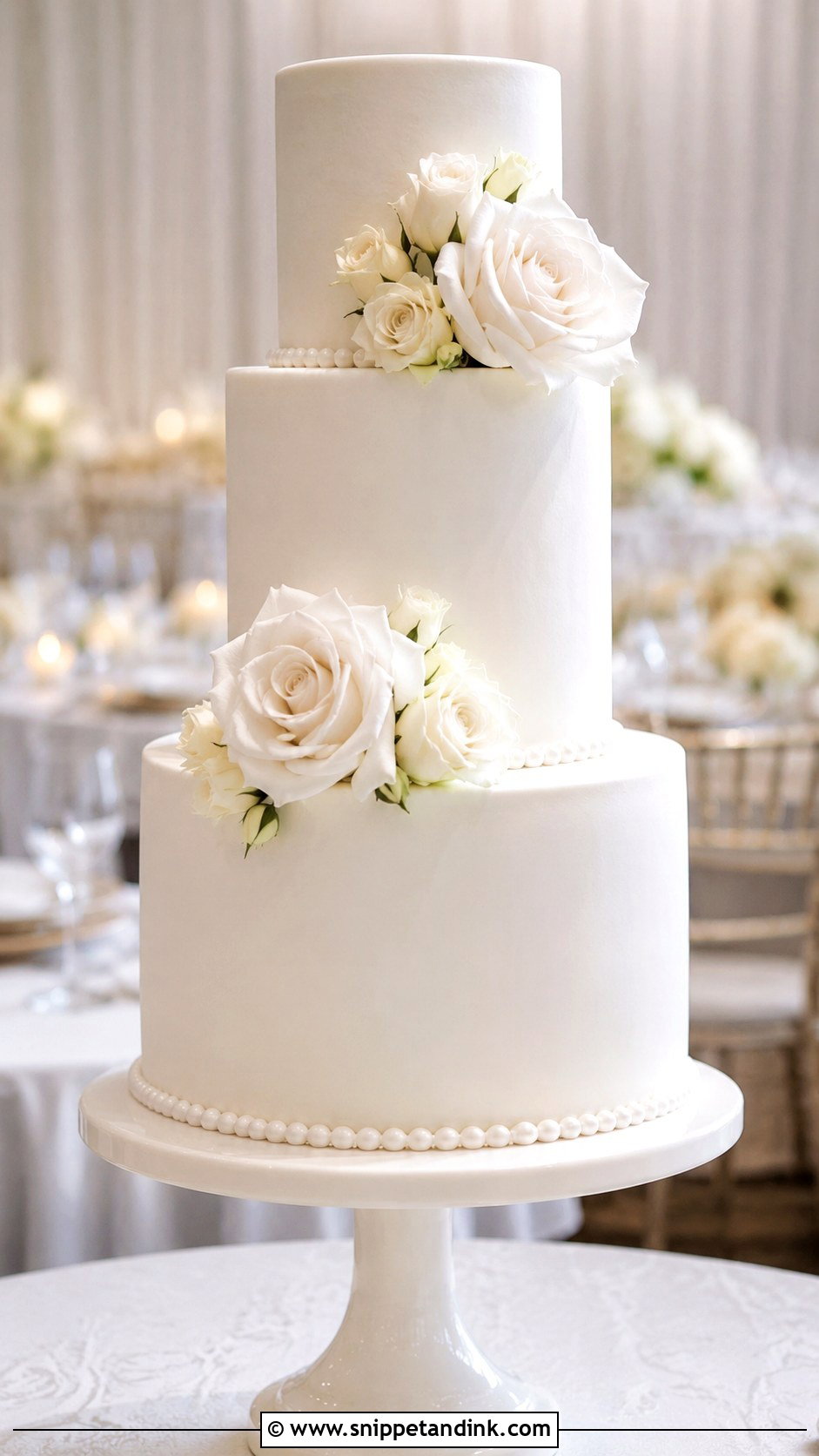
Taller tiers, often double the usual height, give the cake a sleek modern outline. Each one needs a cake board and dowels hidden halfway up so it doesn’t compress under its own weight, which is why I need to know early. Roses look best here in tight clusters; scattered blooms make the height look accidental. Smooth fondant or crisp buttercream keeps the tall sides clean. It holds its own in a large reception room.
18. White Rose Wedding Cake With Naked Layers
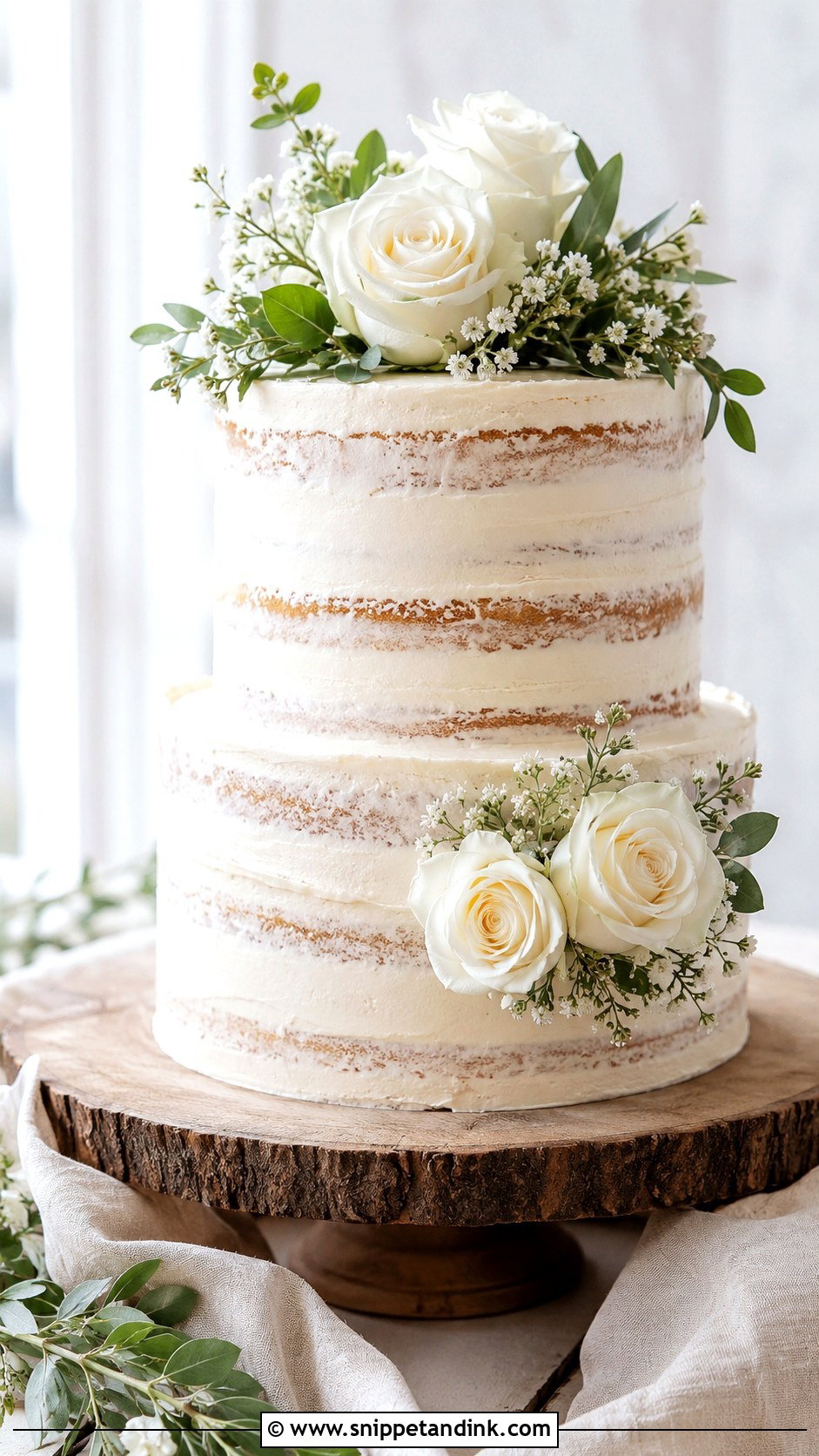
A naked or semi-naked cake shows the sponge through a thin scraped layer of buttercream, which gives a relaxed, bakery feel. The exposed cake dries out faster than a fully iced one, so I assemble these as close to the event as possible and brush the layers with syrup. White roses make it bridal; berries or greenery can join if they fit the palette. A small rose crown on top and a couple of blooms at the base is enough. Barns and garden receptions suit it.
19. White Rose Wedding Cake With Square Tiers
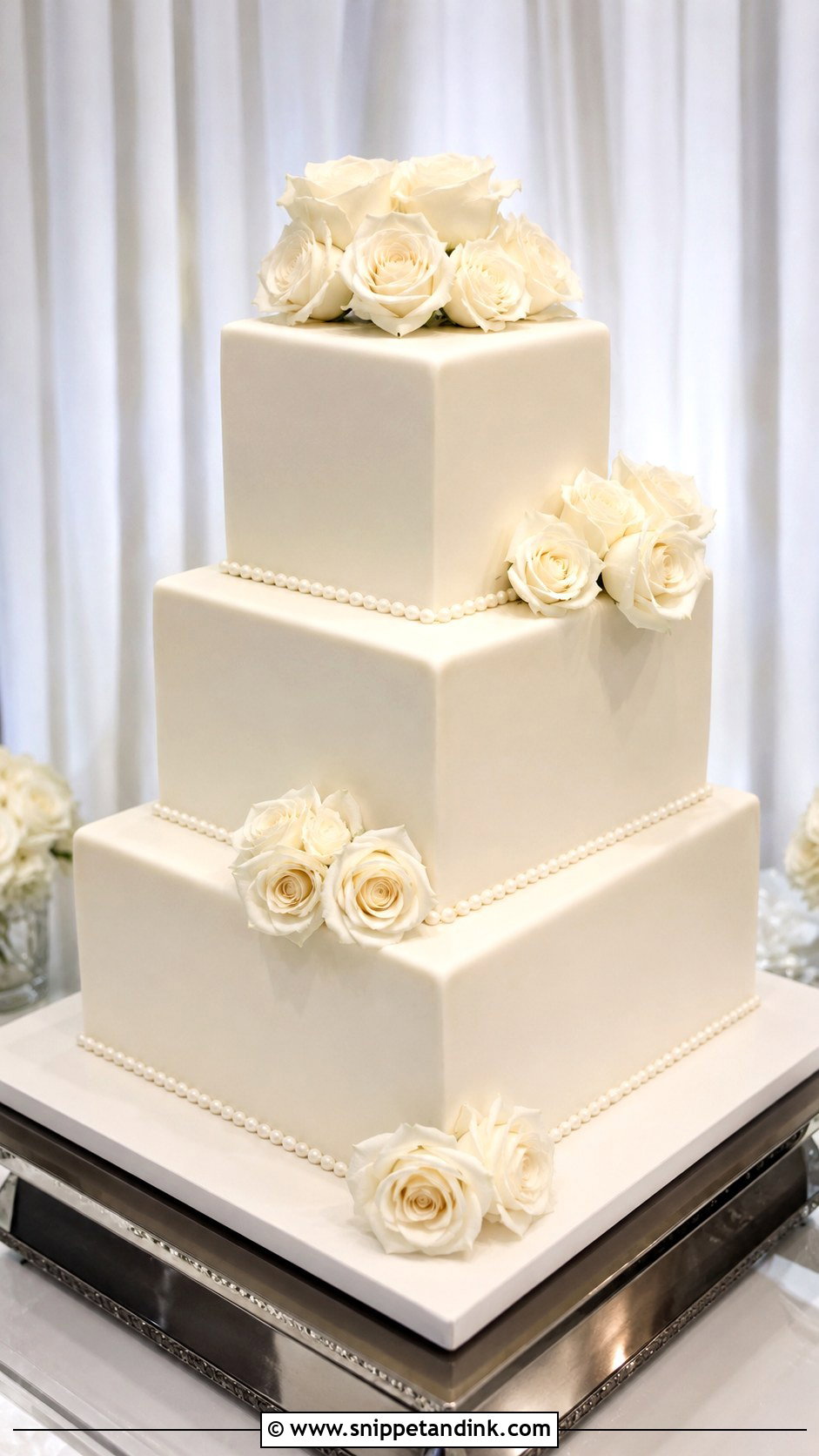
Square tiers feel structured and modern, and roses soften the hard edges. I place them at the corners, where they draw attention to the shape instead of hiding it. Fondant keeps those corners crisp; buttercream can do it but needs a cool room and very patient finishing. A thin piped border or pearl trim adds polish. It’s a good fit if you like tradition but not the usual round cake.

20. White Rose Wedding Cake With One Tier
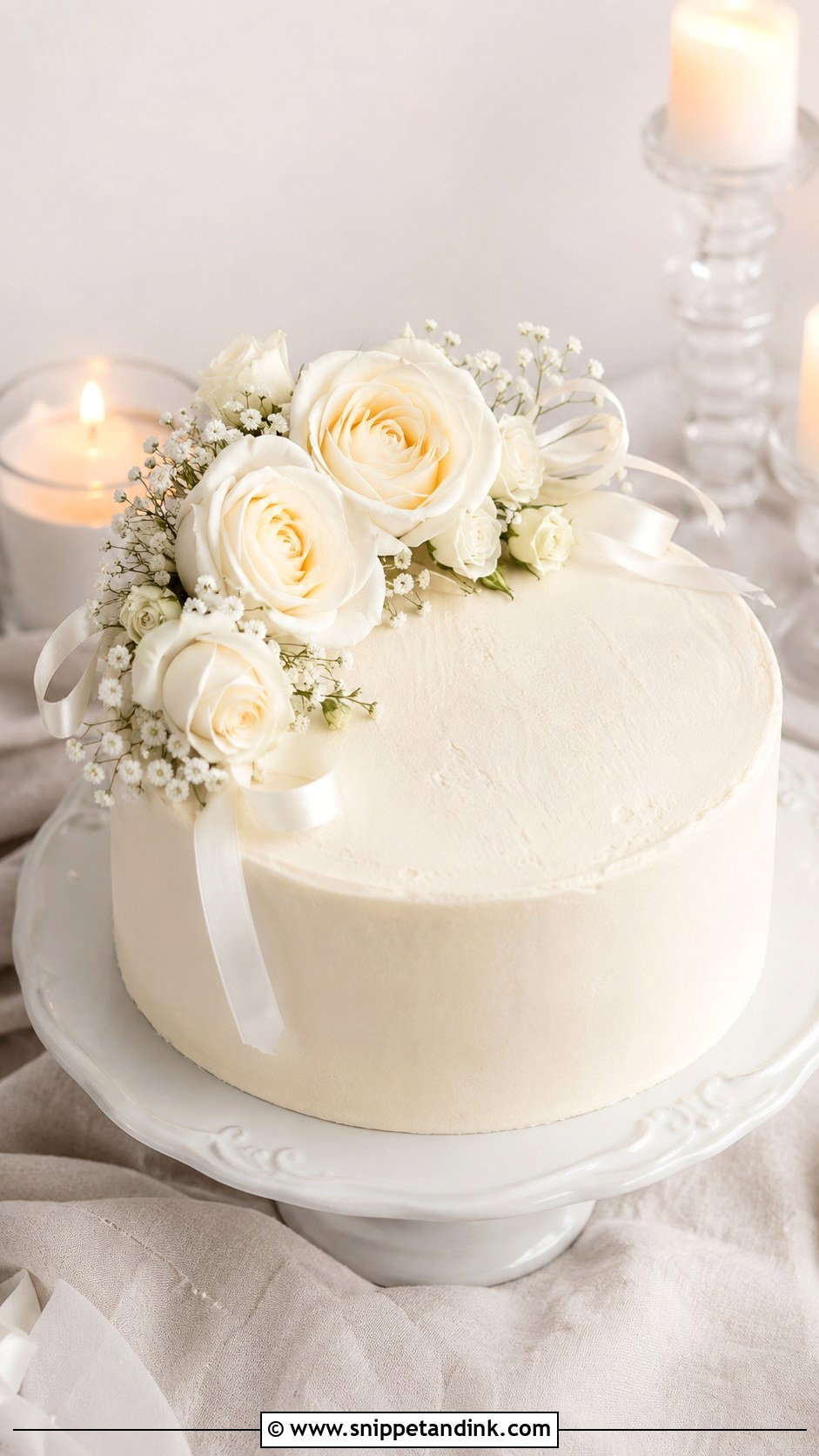
A single tier is enough for an elopement, a small wedding or a cutting cake backed by sheet cake in the kitchen. With one tier, the details carry more weight, so I spend more time on the finish. A half-moon of white roses curving around one side looks better than a ring on such a small cake. It’s easier to budget and to display, and it looks right on a raised stand with candles nearby. Size isn’t what makes a wedding cake feel like one.
Real Roses on Icing Need a Plan for the Morning of the Wedding
Fresh flowers are where I see the most last-minute confusion, usually because the florist and baker each assumed the other was handling it. Settle these three things a few weeks out.
Who prepares and places them
Someone has to wash the blooms, trim them short, wrap each stem in floral tape and seat it in a food-safe flower pick or a drinking straw before it goes into the cake. Some bakers do this themselves with flowers the florist supplies; others let the florist dress the cake at the venue. Either works, as long as both of them know.
Which flowers stay off the icing
Roses are among the safer cake flowers when they’re grown without pesticides. Baby’s breath, eucalyptus and many popular fillers aren’t food-safe, so they should sit on the board or stand, not in the cake. If your florist can’t confirm how the roses were grown, I treat them as decoration only and keep a barrier between petal and icing.
When they go on
As late as possible. Fresh roses pushed into the cake the night before will be tired by the first dance. I dress the cake an hour or two before guests arrive and keep a few spare blooms in water nearby in case one bruises. Every flower and pick has to come out before the cake is cut, so tell whoever is slicing it.
Let the Roses Lead and Stop at Two Extras
Every cake in this list follows the same principle: white roses first, then one or two supporting details, never five. Buttercream and a few fresh roses can be just as memorable as tall tiers with gold and a cascade. Look at your venue, your dress and your table setting, pick the extras that belong there, and bring those photos to your tasting. Your baker will tell you what holds up in your season and your room.
You'll Like These Ideas:











Leave a Reply