
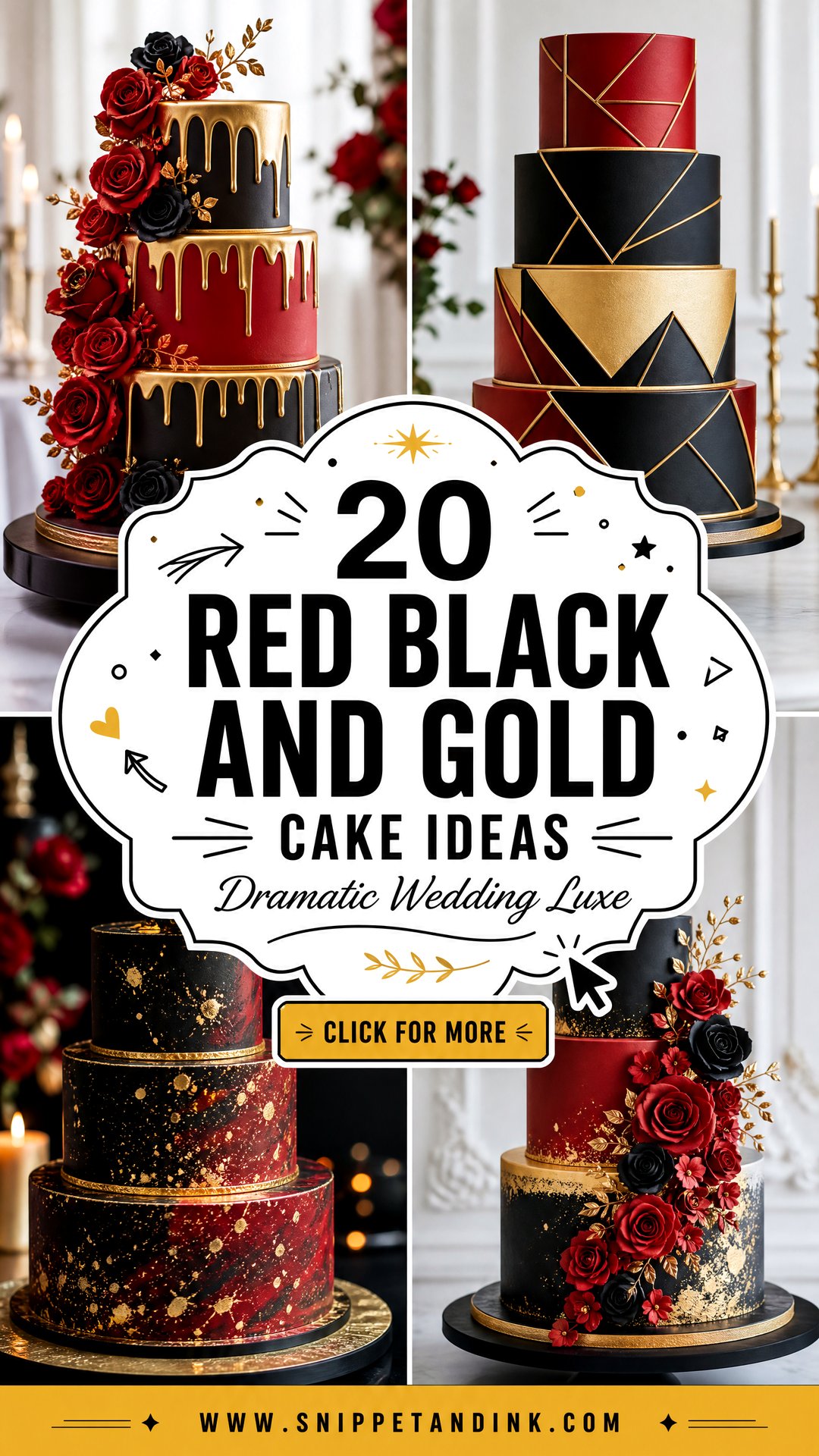
Adding black to red and gold changes the job completely. Black gives the cake depth and edge, red brings the romance, gold catches the light, and the cake only works when one of the three clearly leads. When couples bring me this palette, the conversation is less about which colors and more about proportion: how much black before it looks heavy, how much gold before it looks gaudy. Below are twenty ways to balance it, from roses and lace to marble, art deco and gold splatter, with notes on what each finish asks of the baker and how dark icing behaves once it’s on a cake.
Black Icing Behaves Differently From Every Other Color
Black is the color that most often surprises couples after the wedding, so I explain it at the first consultation. It takes far more coloring than any other shade to get a true black, and that has consequences.
- Stained mouths: black buttercream can leave guests with grey teeth and lips. Black fondant, which most people peel off, avoids most of this.
- Taste: heavy dye can taste bitter. Starting from a dark cocoa buttercream needs much less coloring.
- Time: black deepens as it rests, so I color it a day ahead rather than adding more dye until it looks right.
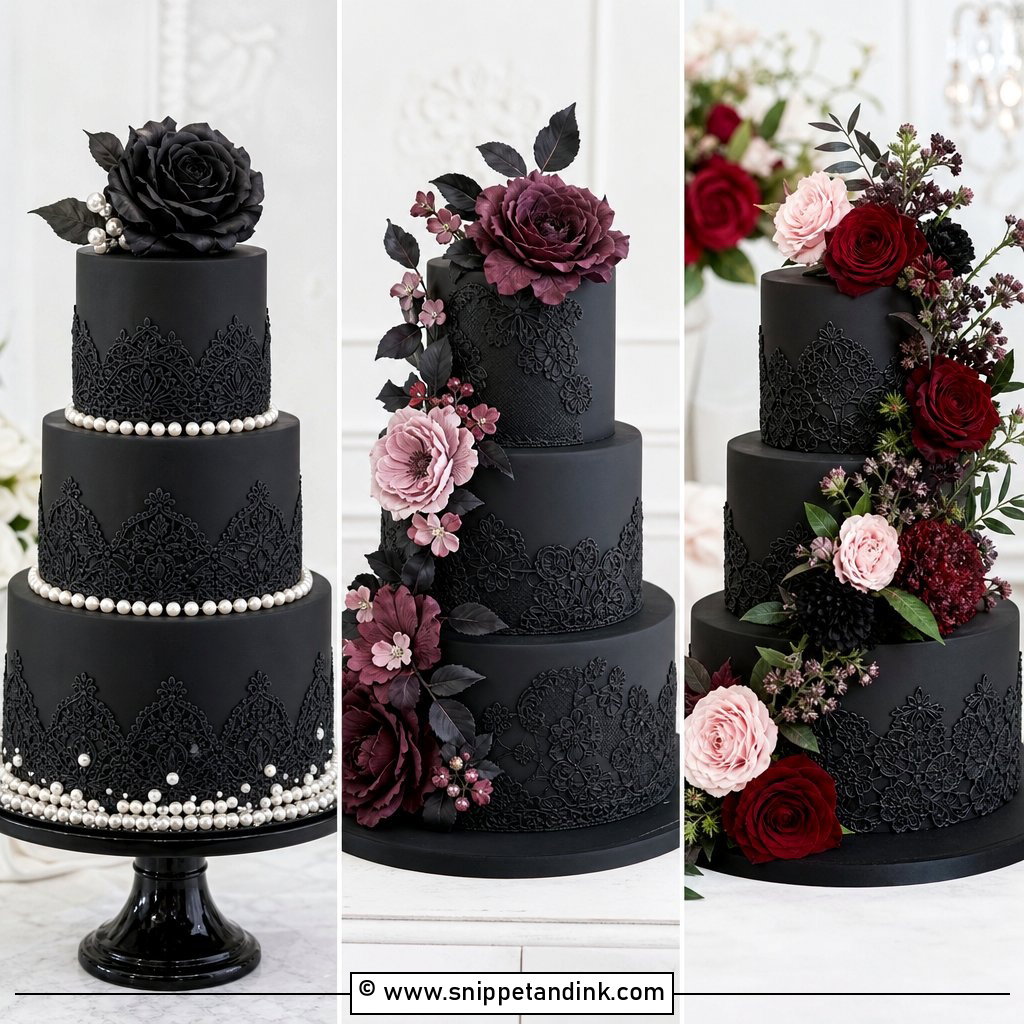
- Marks: dust, cornstarch and fingerprints show on black in a way they never do on ivory, so the cake is handled with gloves and steamed to an even finish.
None of this is a reason to avoid black. It’s a reason to decide where it sits. A black fondant exterior over a light vanilla or almond cake gives you the drama on the table and a clean, normal slice on the plate.
1. Red Black And Gold Wedding Cake With Roses
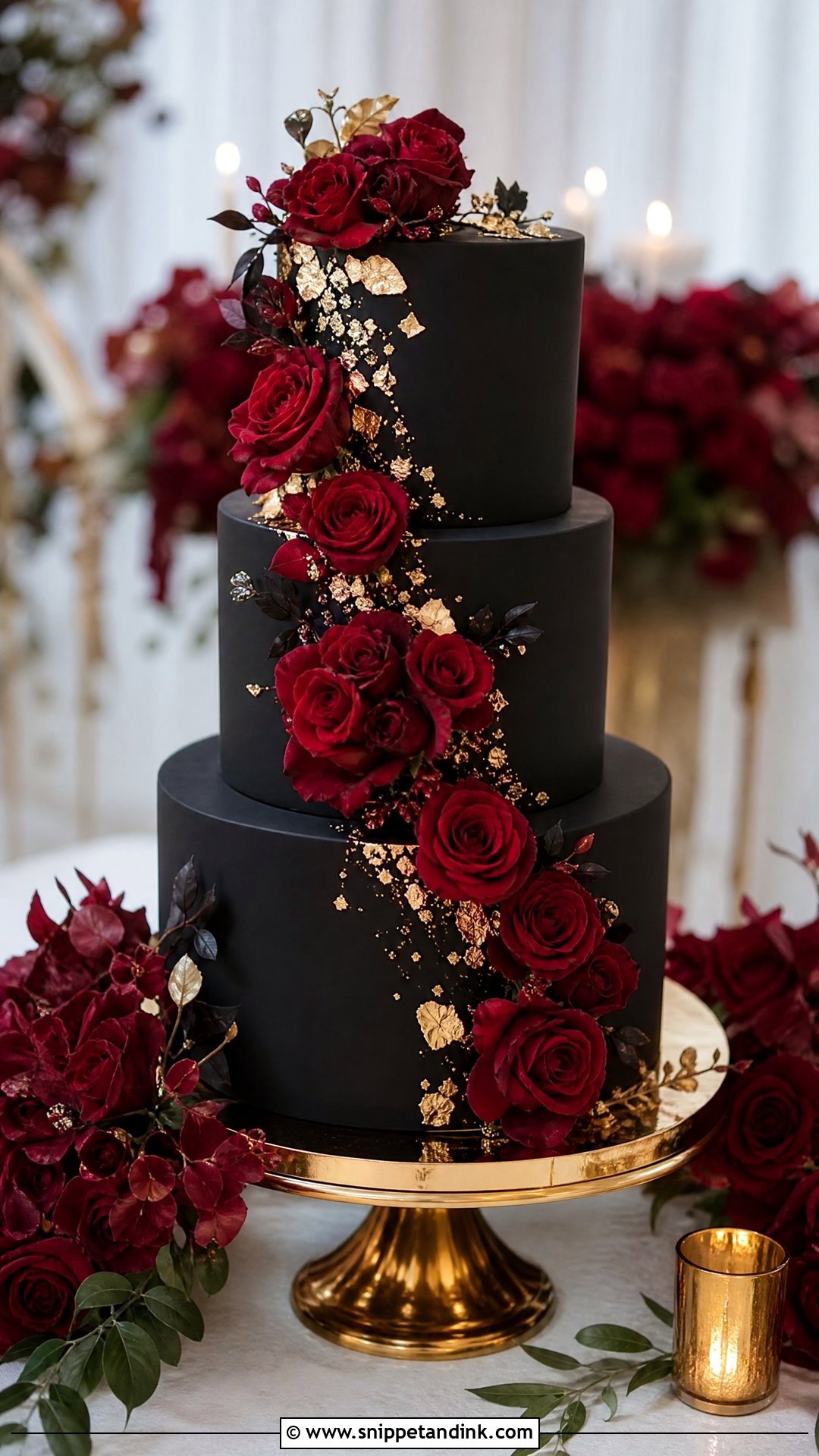
Roses are the gentlest way into this palette, and the reason is simple: soft petals against a hard black surface take the edge off. Start with smooth black tiers and let deep red roses run diagonally across them, which gives the cake movement instead of a stripe of flowers on each tier. Gold should stay thin here, as leaf, a narrow band or a painted edge, with perhaps a few gold leaves or pearl accents near the roses. Fresh roses need wrapped stems; sugar ones hold their shape better on a long evening.
2. Red Black And Gold Wedding Cake With Gold Leaf
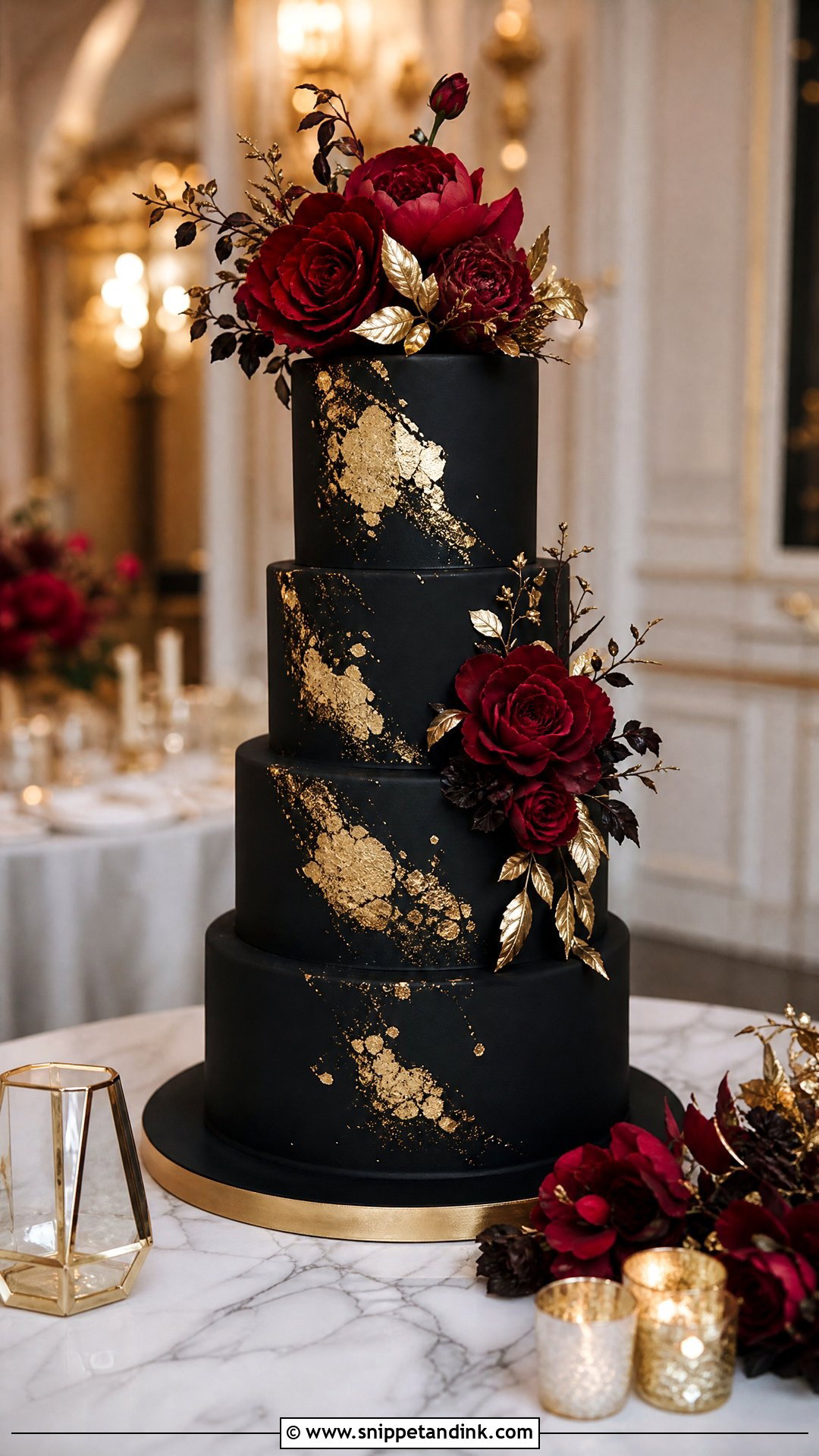
Gold leaf on black fondant is about as much contrast as a cake can carry. I tear it and lay it in broken, uneven patches, down one side, around the tier edges, or scattered across the front, because a fully gilded tier looks like a costume piece. Gold leaf is extremely thin and clings to anything, so it goes on with a soft dry brush and a light touch of water on the fondant. Keep the red flowers or sugar petals in one area so the eye has a single place to land.
3. Red Black And Gold Wedding Cake With Marble
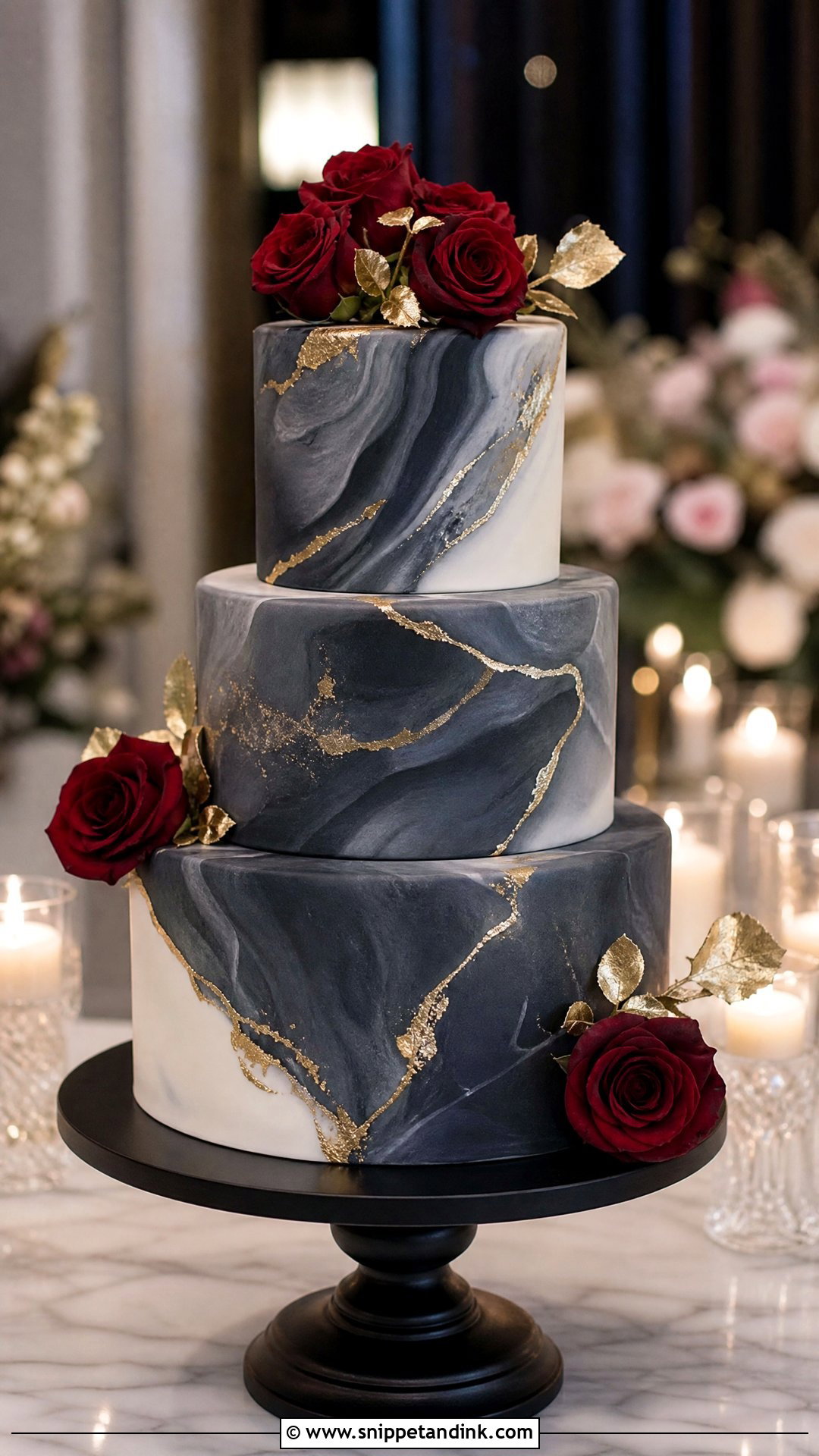
Marble gives this palette its most modern look. Black and charcoal veining runs through white or dark tiers, with fine gold painted along some of the veins after the fondant is on the cake. Over-mixing is the classic mistake: if the colors are kneaded too long they turn into a muddy grey, so I stop while the streaks are still distinct. Red roses, orchids or burgundy sugar flowers keep it from looking like a kitchen countertop. Marble one or two tiers and leave the others smooth black or gold.
4. Red Black And Gold Wedding Cake With Drip
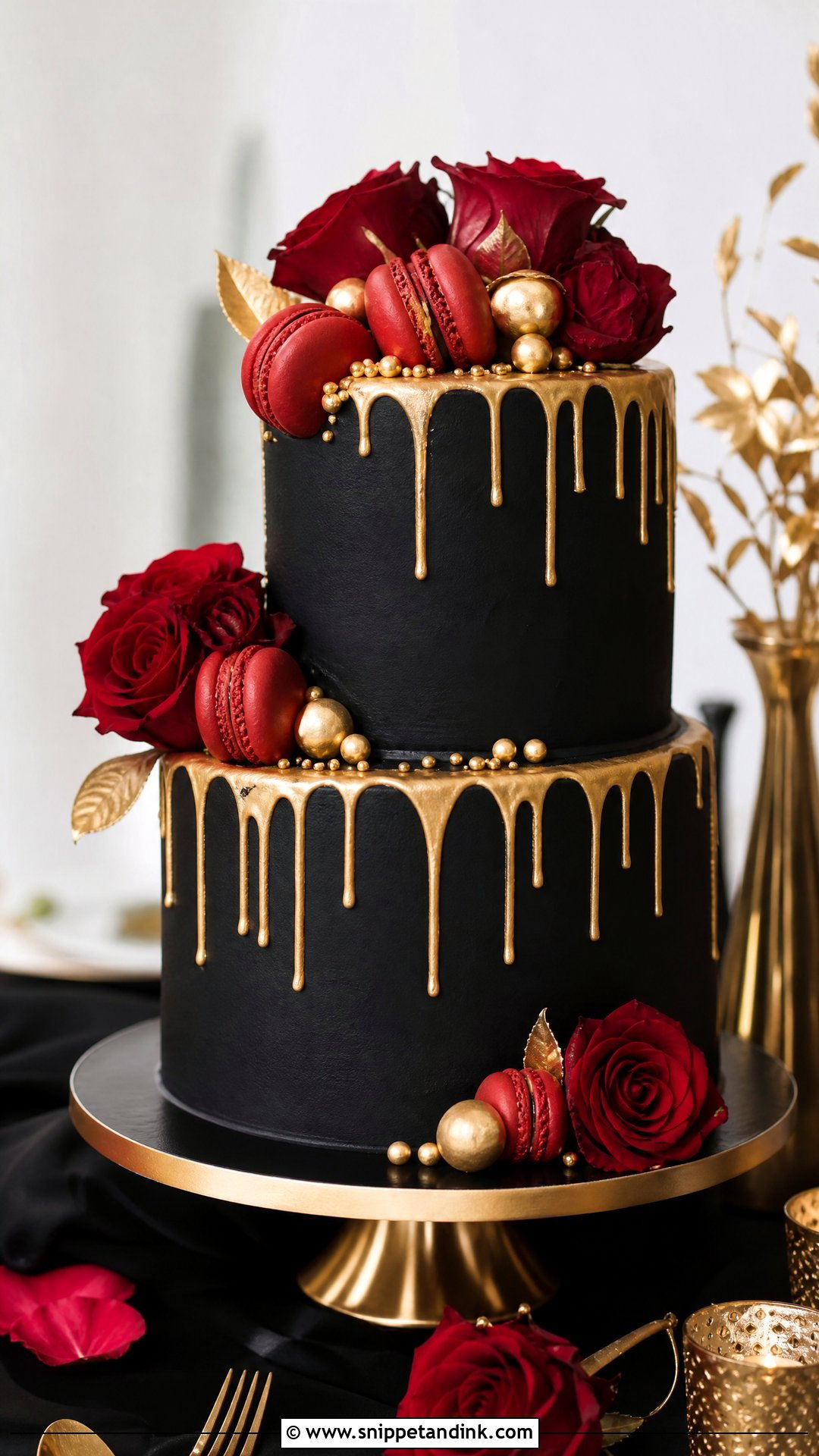
A metallic gold drip on black buttercream catches the eye from across the room. For a formal cake, the drip has to be smooth and even, so I pour onto a well-chilled tier, test one drip first, and only paint it gold once the ganache has set. Red flowers, red macarons or a scatter of red velvet crumbs bring in the third color without crowding the top. Keep the base matte so the gold is the only shine. Two or three tiers is the right scale.
5. Red Black And Gold Wedding Cake With Sugar Flowers
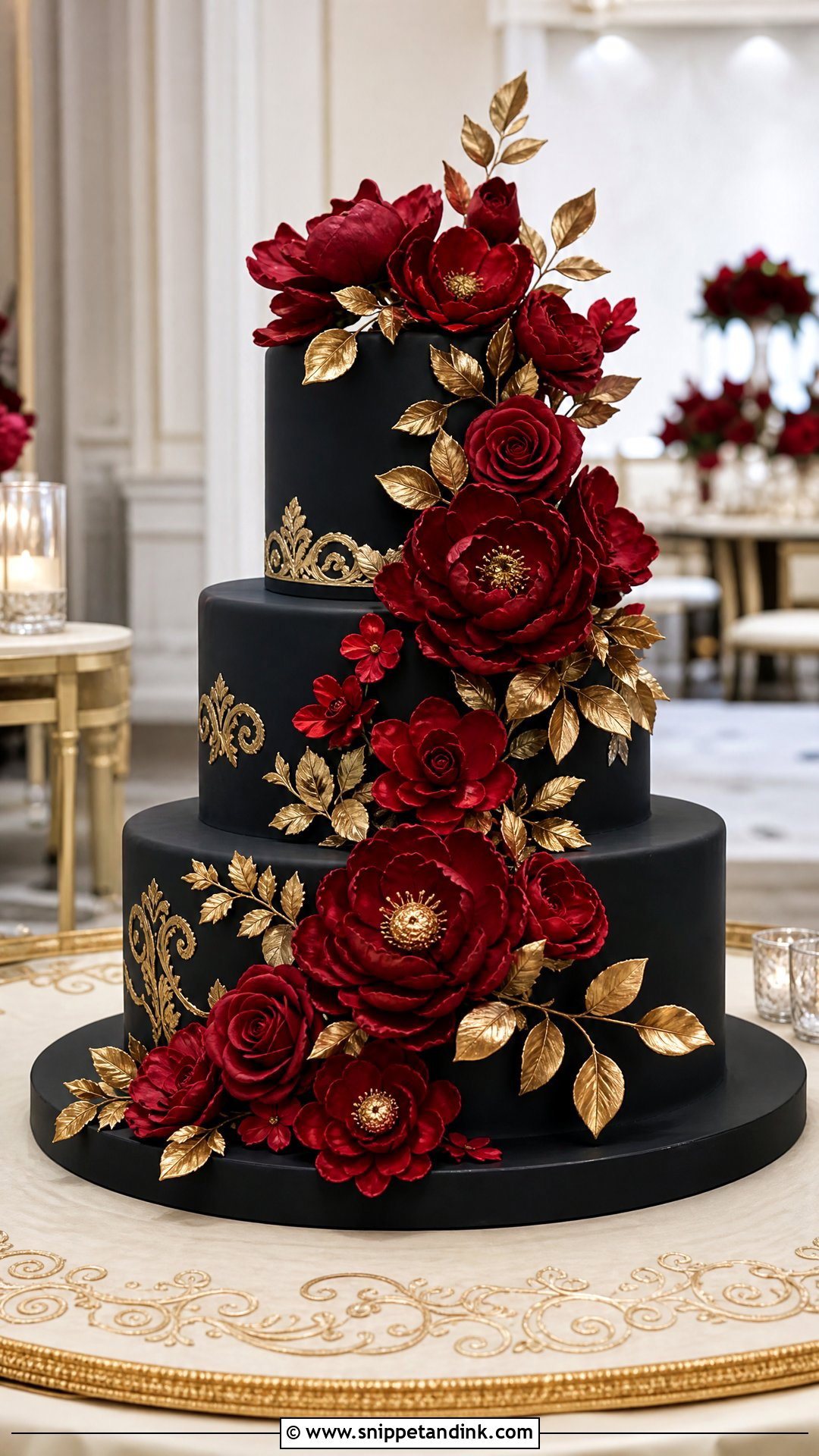
Sugar flowers are my first suggestion for a warm venue or a long reception, since they don’t wilt and can be tinted to match your exact red. Sugar roses, peonies and anemones read clearly against black fondant, and anemones even bring their own dark centers. Gold-painted sugar leaves or small gold berries finish them. They do take time; a full cascade can be days of work, so order early. Place them as a cascade, at the tier seams or as a topper.
6. Red Black And Gold Wedding Cake With Lace
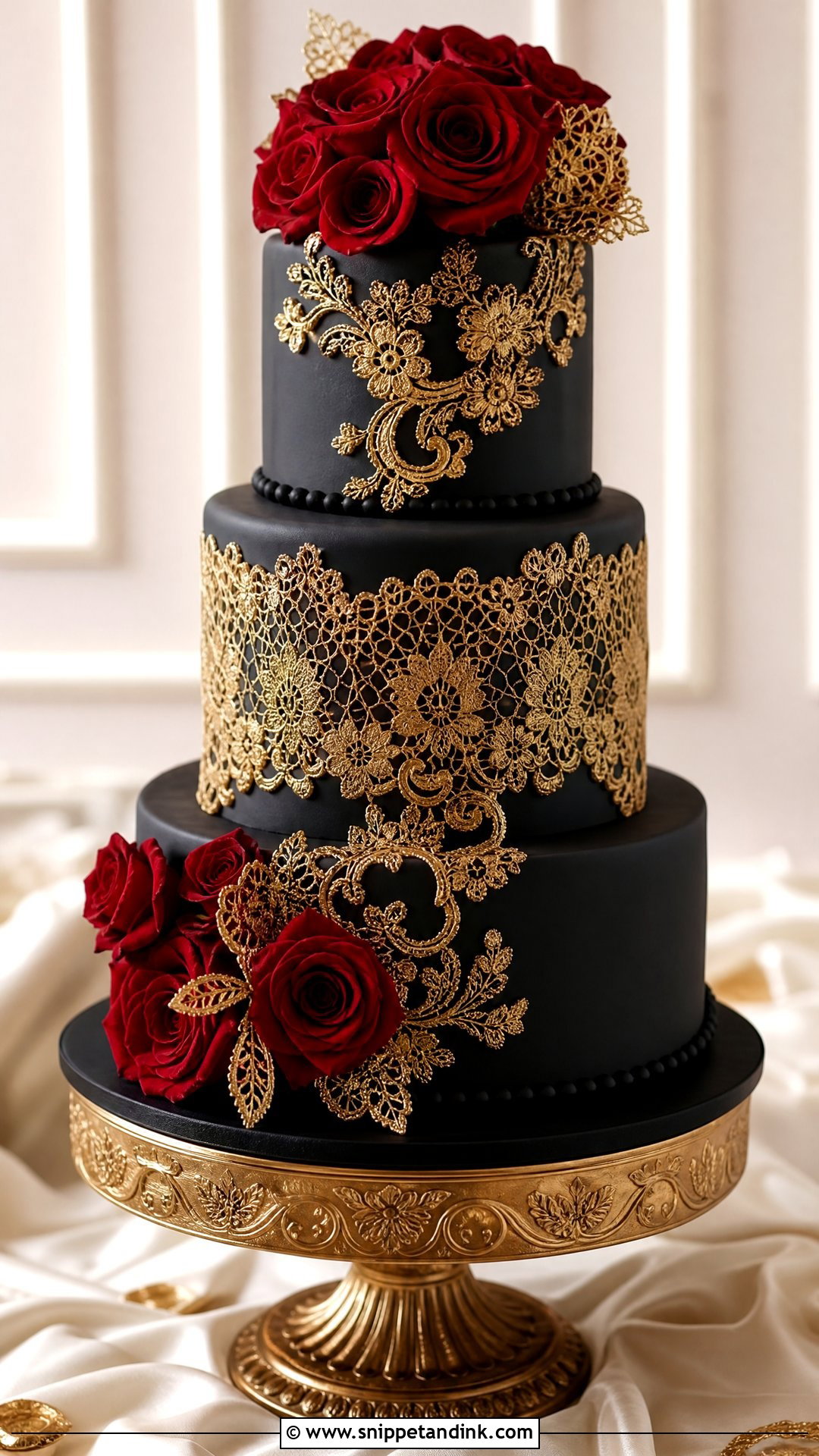
Lace on black needs a light hand. Edible gold lace over black fondant, or black lace patterns on red tiers, both look detailed and vintage, but lace on every tier quickly turns busy. I’d put it on one tier, keep the others smooth with simple gold trim, and add a few red roses or gold-edged flowers. Edible lace is made in silicone mats and stays flexible for a while, but it softens in humid air, so I attach it as late as I can. It suits a formal hall or an evening reception.
7. Red Black And Gold Wedding Cake With Geometric Pattern
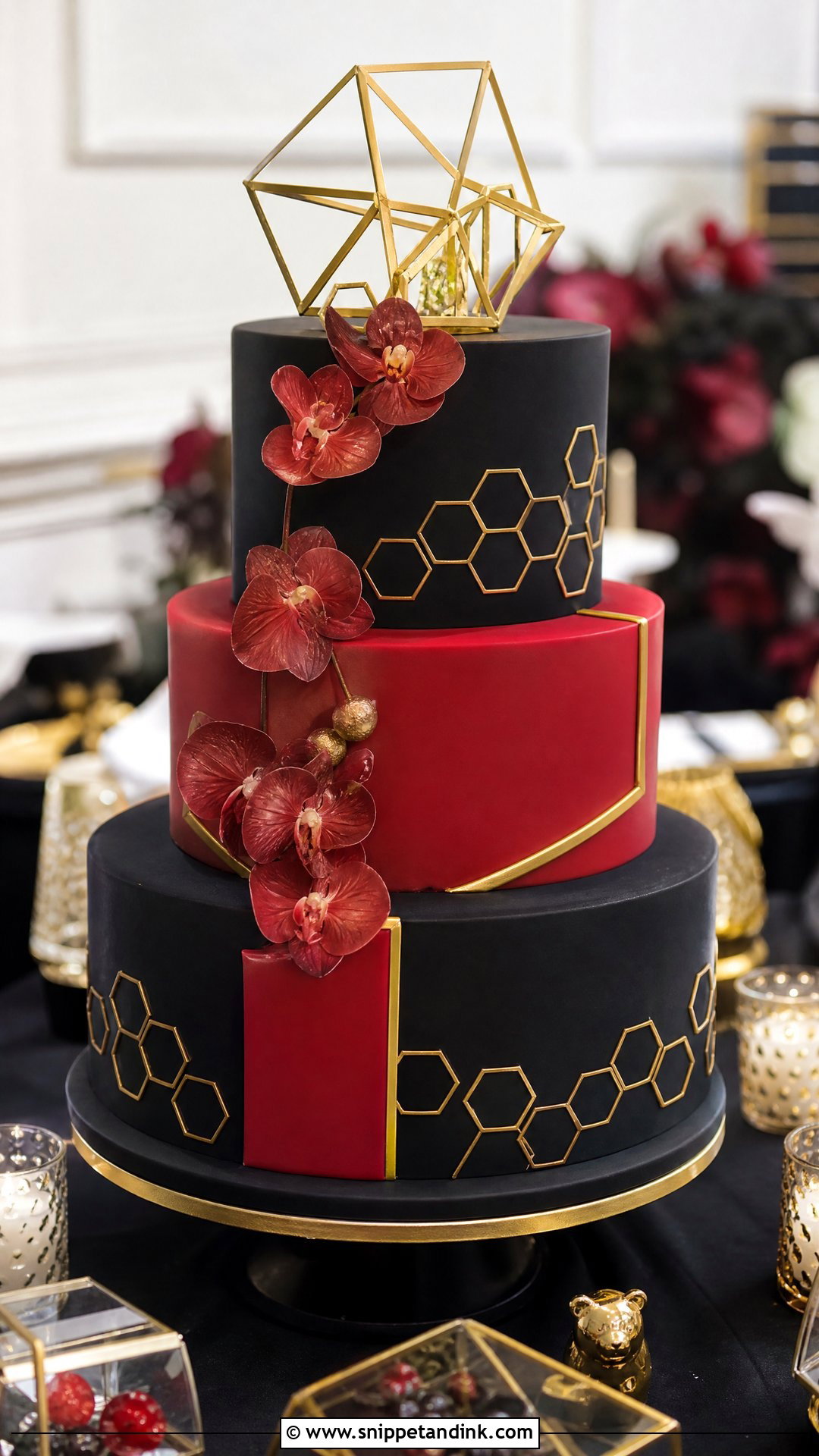
Geometry rewards precision and punishes everything else. Black tiers with gold hexagons, red accent panels or clean angular lines look sharp only if every line is measured; a hexagon grid that drifts by a few millimeters across a tier is very visible. I cut panels with templates and pick one geometric motif to repeat, rather than mixing shapes. Red flowers or red fondant panels soften the structure. It sits naturally in a sleek reception with black linens, gold flatware and red centerpieces.
8. Red Black And Gold Wedding Cake With Ombre
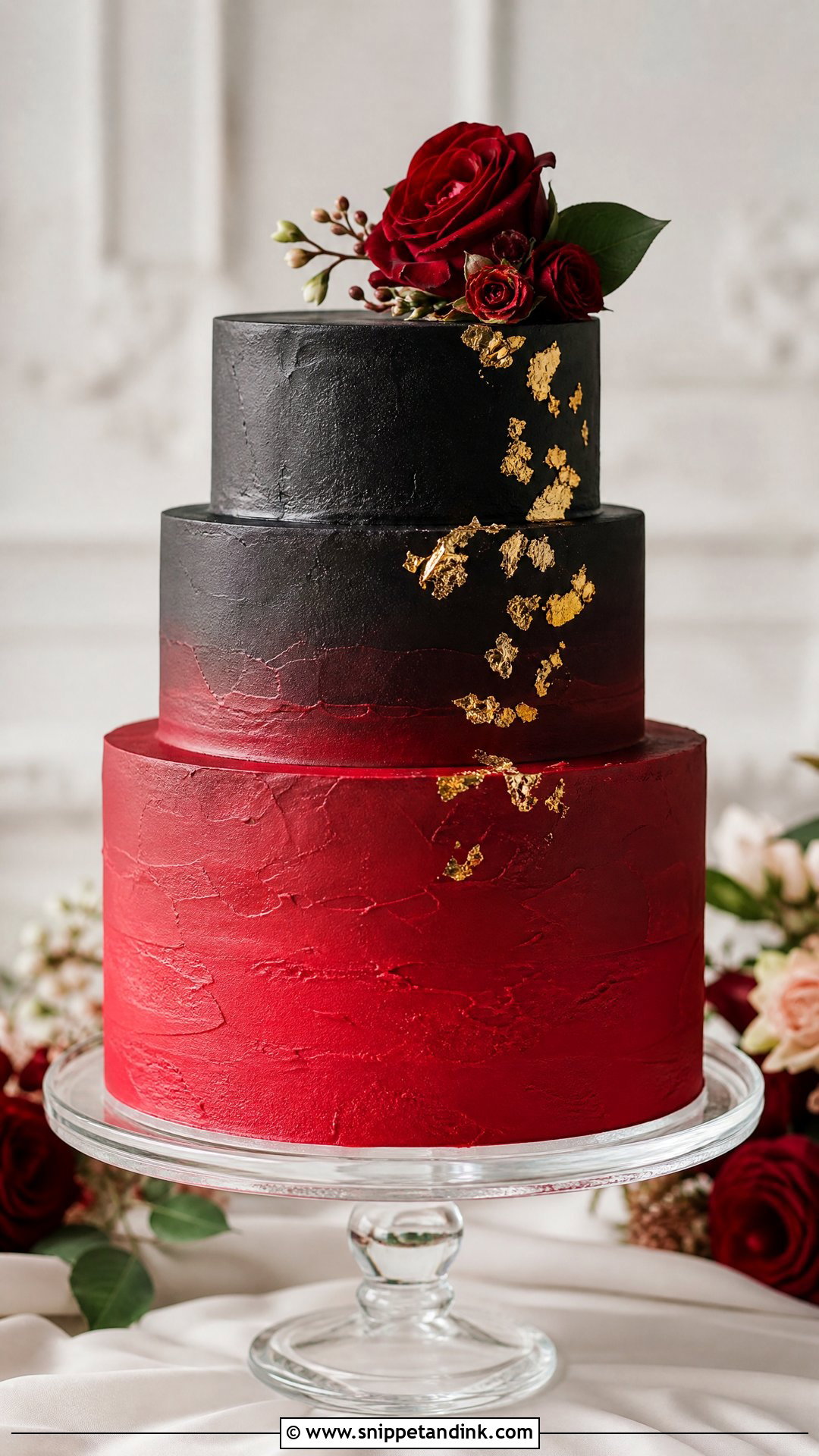
Ombre gives this palette flow, fading from deep red at the base to black at the top, with gold marking the transition. Buttercream blends better than fondant for this, since I can smooth the bands into each other with a scraper while they’re soft. It feels dramatic without the hardness of solid black. Gold leaf, gold beads or a thin metallic drip can highlight the change in color, and one floral cluster or a clean topper is all the decoration it needs.
9. Red Black And Gold Wedding Cake With Fresh Flowers
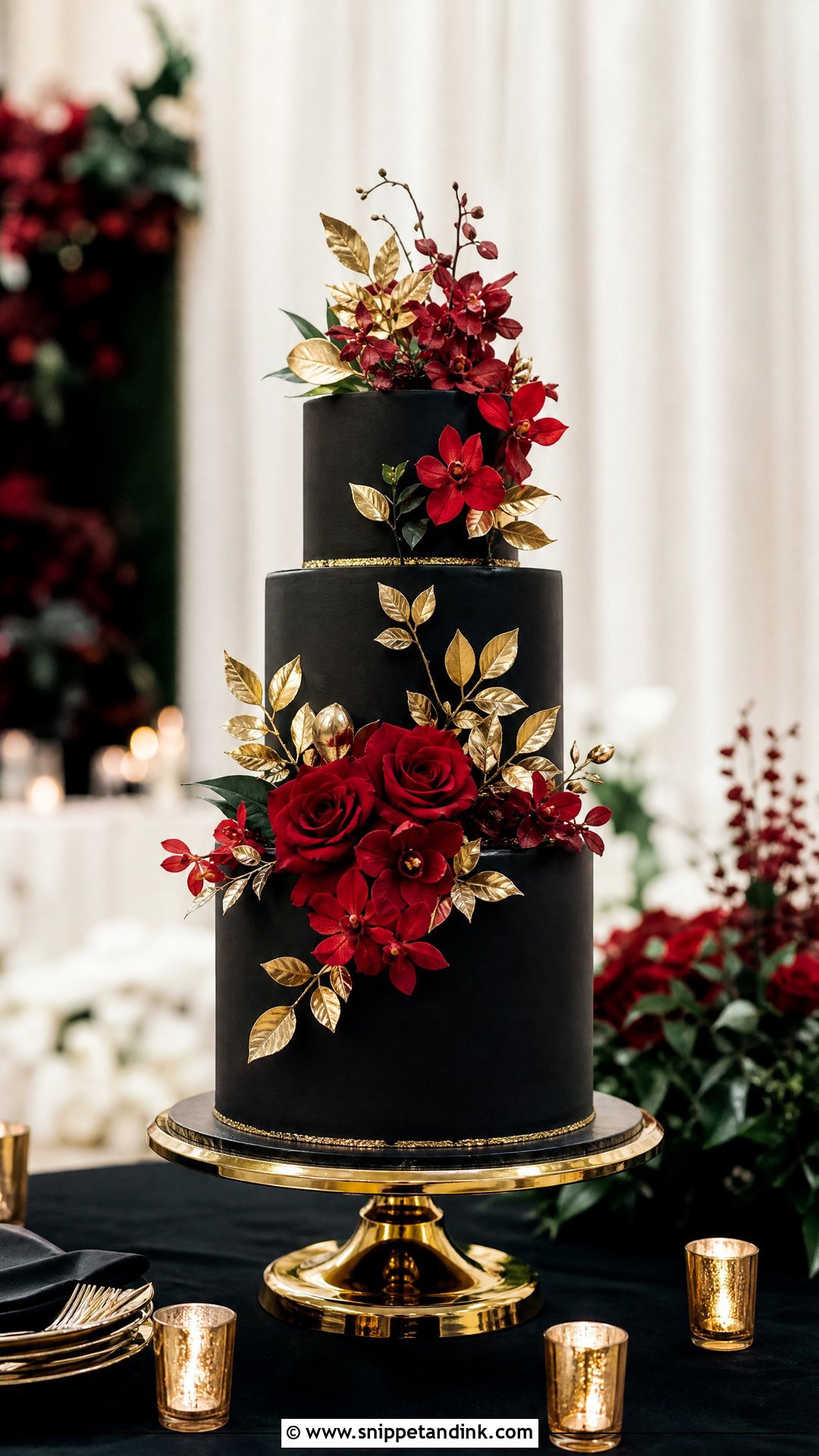
Real flowers soften black tiers more than anything else can. Deep red roses, ranunculus, dahlias, or orchids stand out sharply against the dark surface, with gold appearing as painted leaves, metallic stems or thin tier borders. Most florist flowers aren’t grown to be eaten, so stems are wrapped or set in food-safe picks, and the baker and florist should agree on who places them. A diagonal cascade makes the cake look taller and fuller than a ring of flowers on each tier.
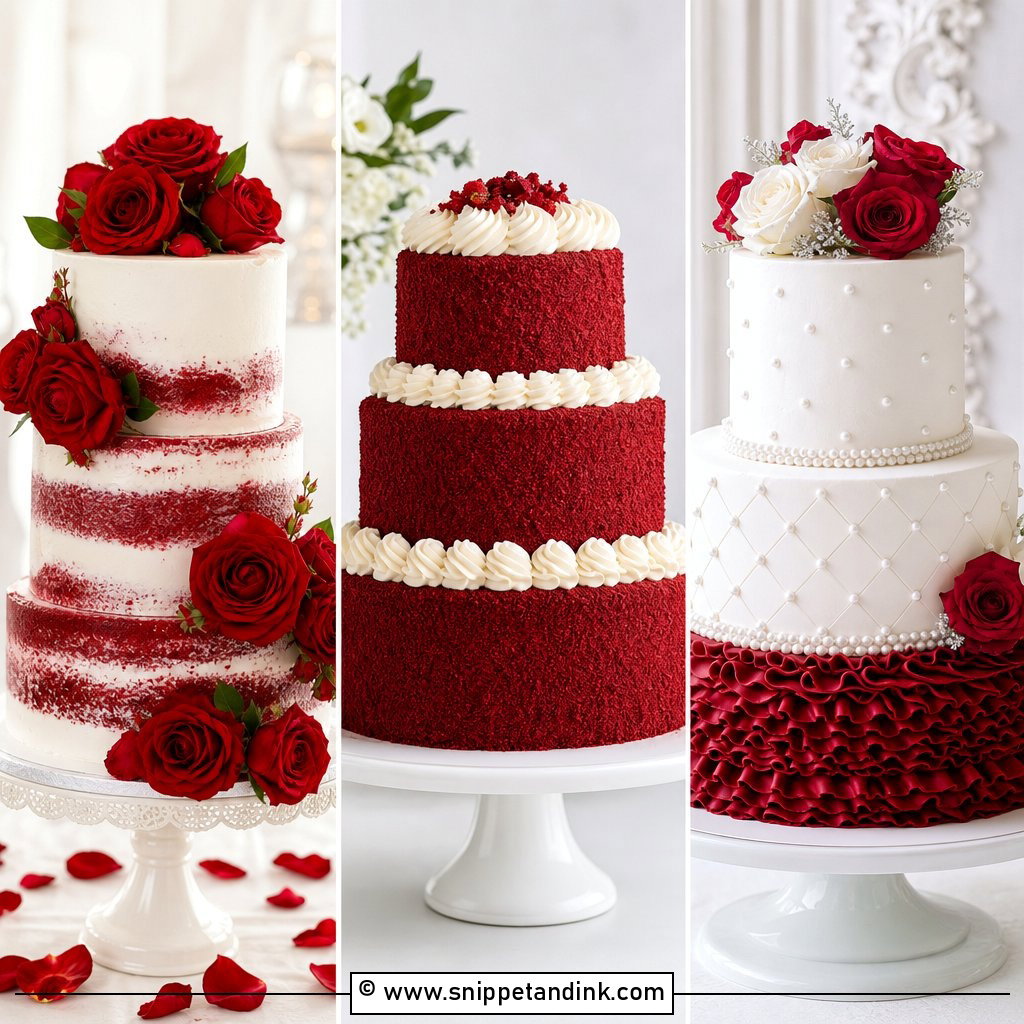
10. Red Black And Gold Wedding Cake With Red Velvet
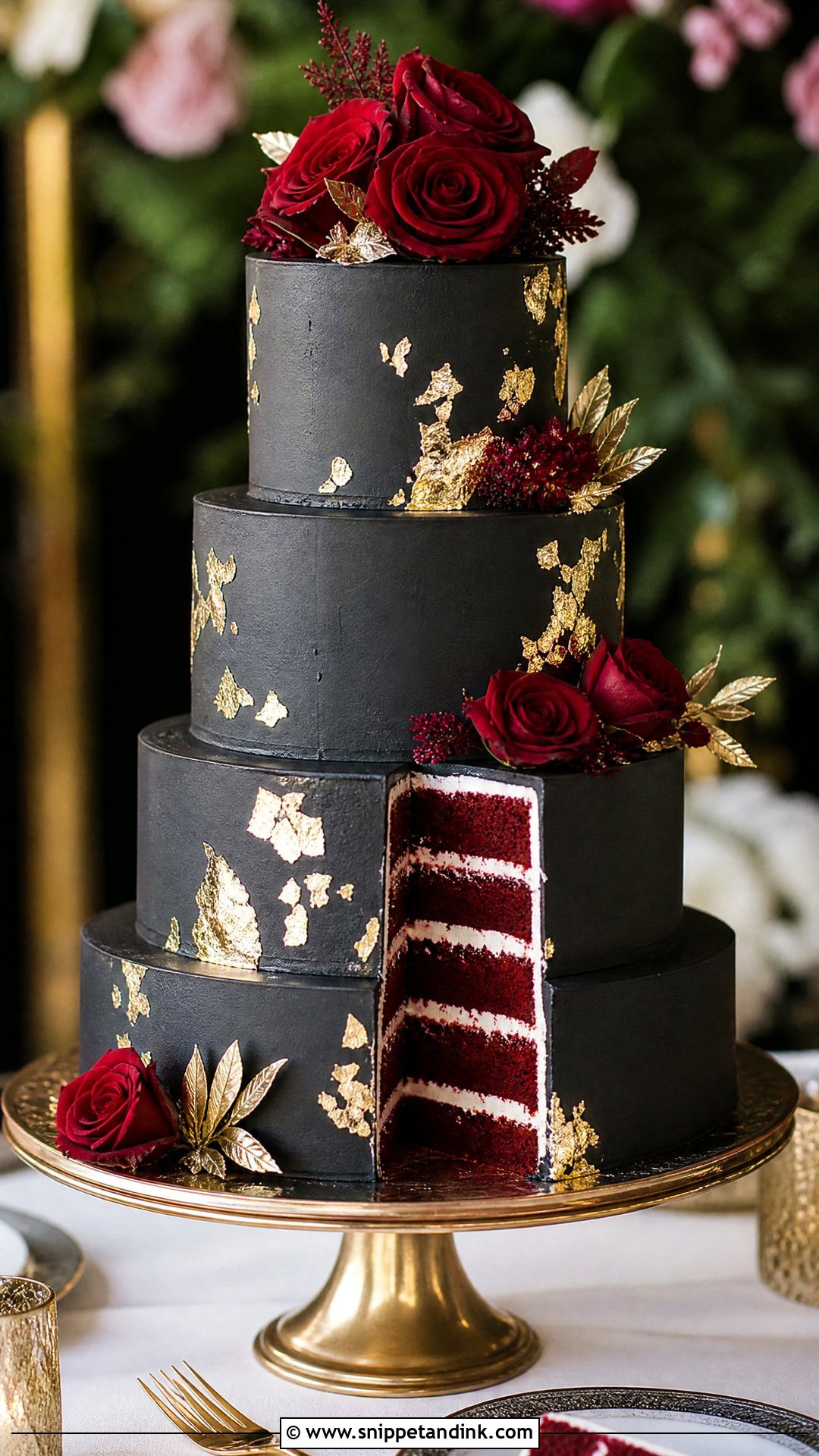
Red velvet hides the red inside, so a sleek black exterior opens up into bright red slices when the cake is cut. Black buttercream or black fondant makes the shell, with gold leaf or gold piping for shine. Cream cheese frosting is the natural filling, though it’s too soft to hold up a black fondant exterior on tall tiers by itself, so I use it between the layers and a firmer buttercream underneath the fondant. A few red roses between the tiers connect the outside to what’s inside.
11. Red Black And Gold Wedding Cake With Fondant
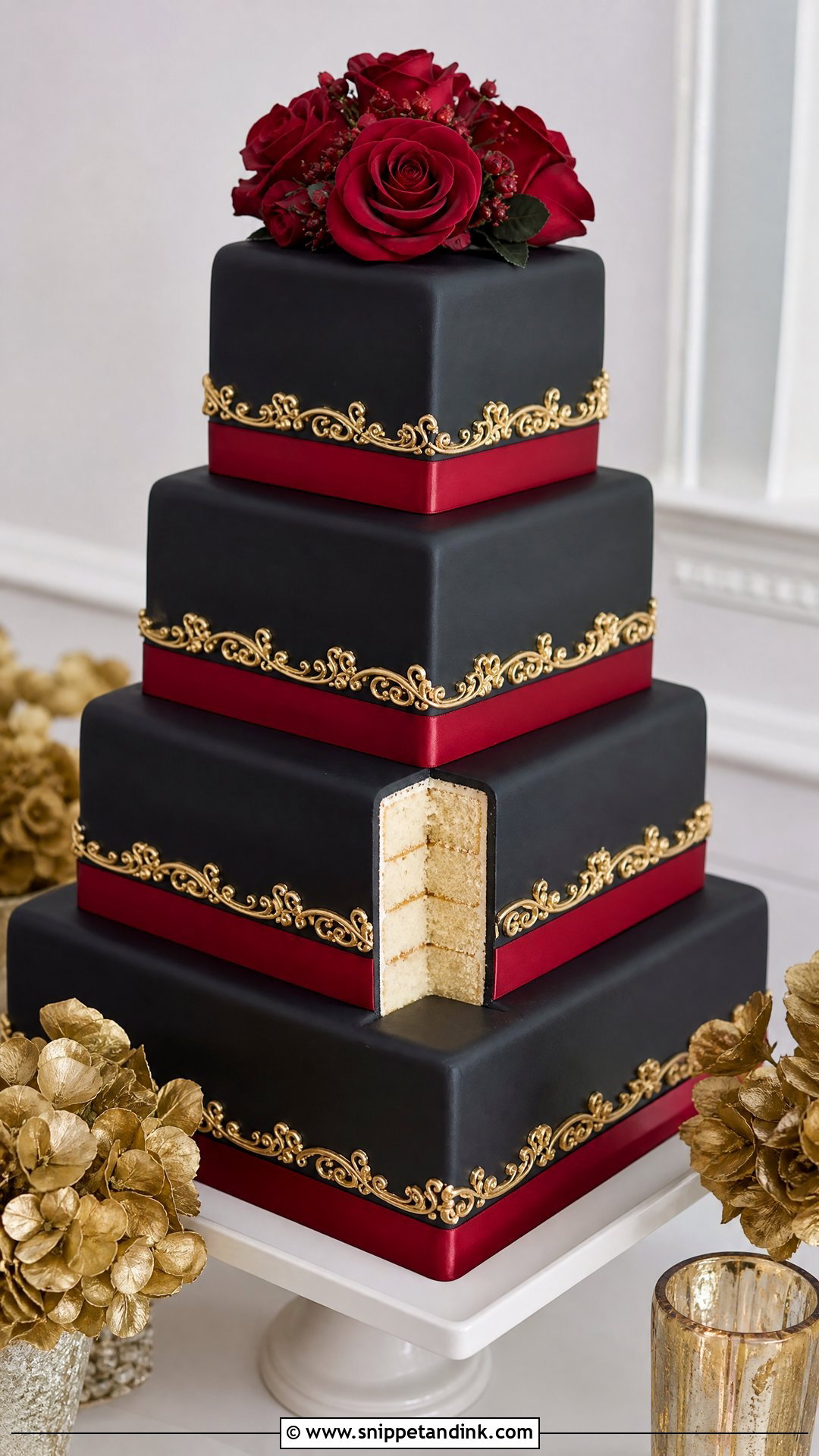
Fondant gives black tiers the cleanest edges and the most even color. Red fondant ribbons, gold painted trim and structured sugar flowers suit it, as do tall, square or sharply modern cakes. Black fondant is unforgiving to work with, though: every speck of cornstarch, smudge and fingerprint shows. I roll it with shortening rather than powder, handle it with gloves, and steam the finished tiers to bring back an even matte surface. If you’d rather not eat much fondant, it peels off easily and leaves the cake and frosting underneath.
12. Red Black And Gold Wedding Cake With Buttercream
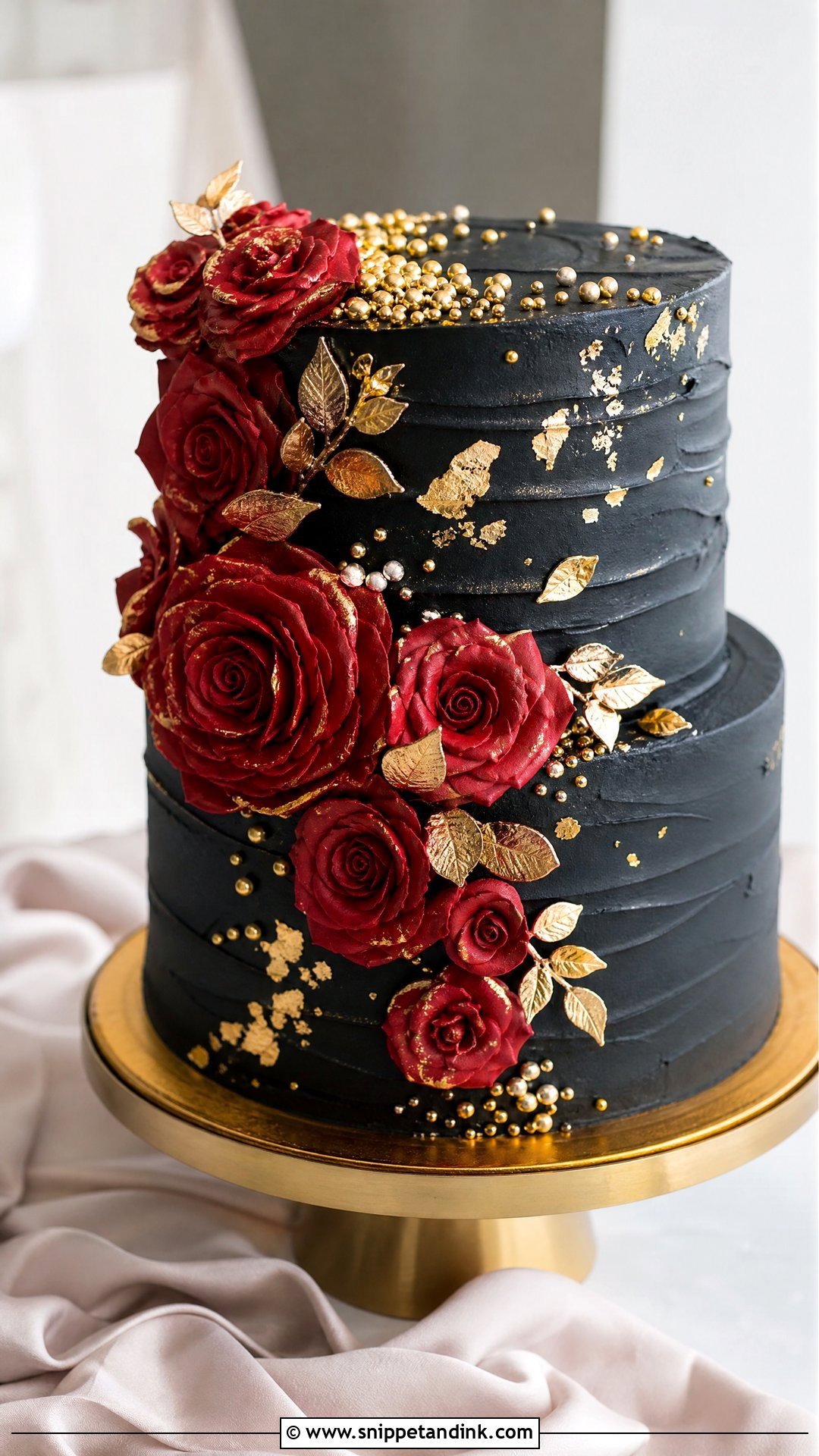
Buttercream makes the palette feel softer and more handmade, with visible texture where fondant would be flat. A black buttercream base with red roses and gold leaf is the simplest version; red buttercream flowers on black tiers gives more contrast. Black buttercream needs a lot of coloring and can taste bitter and stain mouths, so I build it from a dark cocoa base, which needs much less dye, and keep the cake layers inside lighter. It’s the better choice for a relaxed reception than a formal ballroom.
13. Red Black And Gold Wedding Cake With Metallic Gold Tier
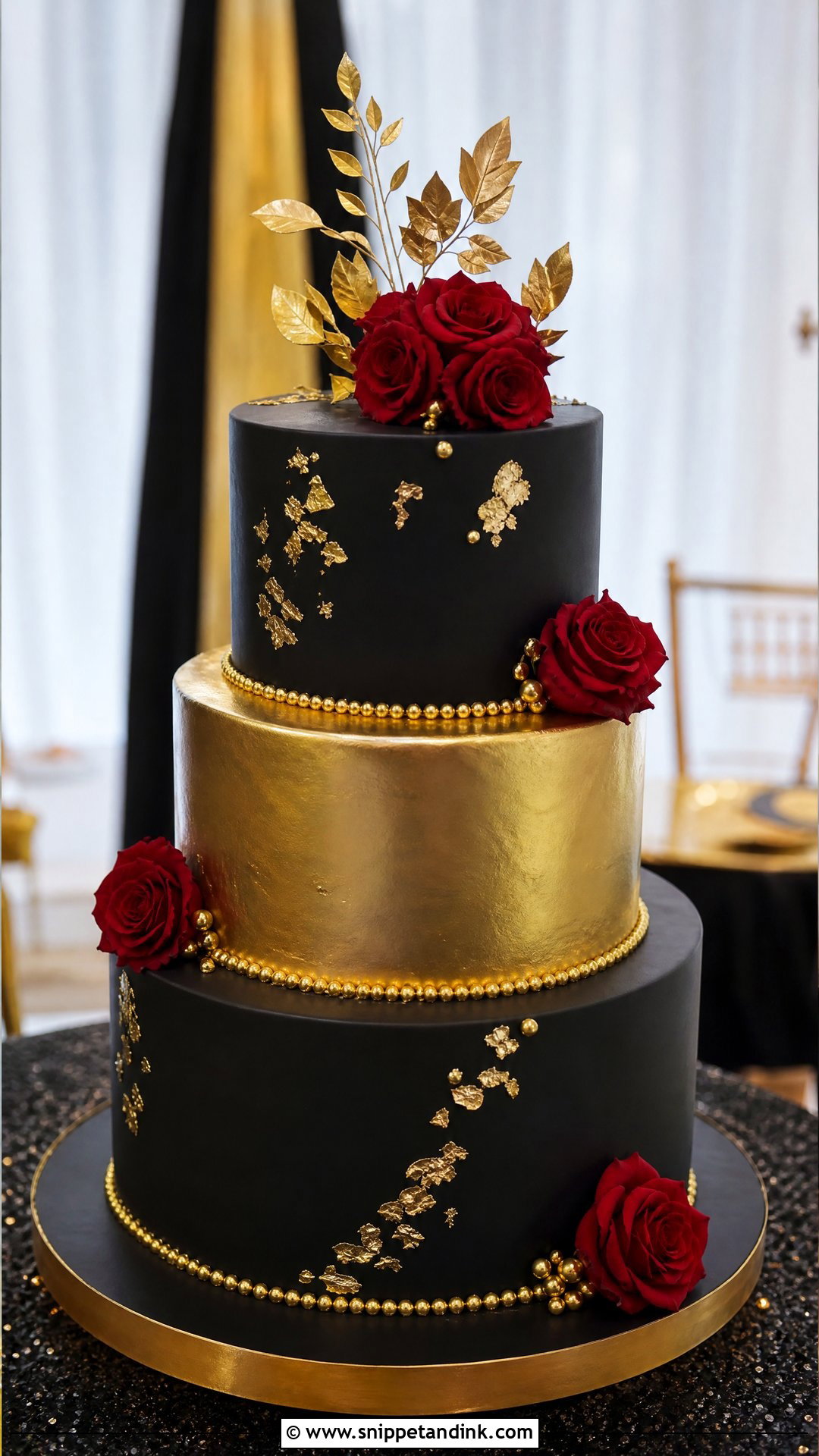
A metallic gold tier is the boldest single move in this list. It can sit between black tiers or anchor the bottom. To get an even metallic finish, I paint smooth fondant in several thin coats, letting each dry, because one heavy coat leaves streaks and brush marks. Keep the other tiers simple with black frosting, red accents and a few gold dots, and place the red flowers so they don’t cover the shine.
14. Red Black And Gold Wedding Cake With Black Roses
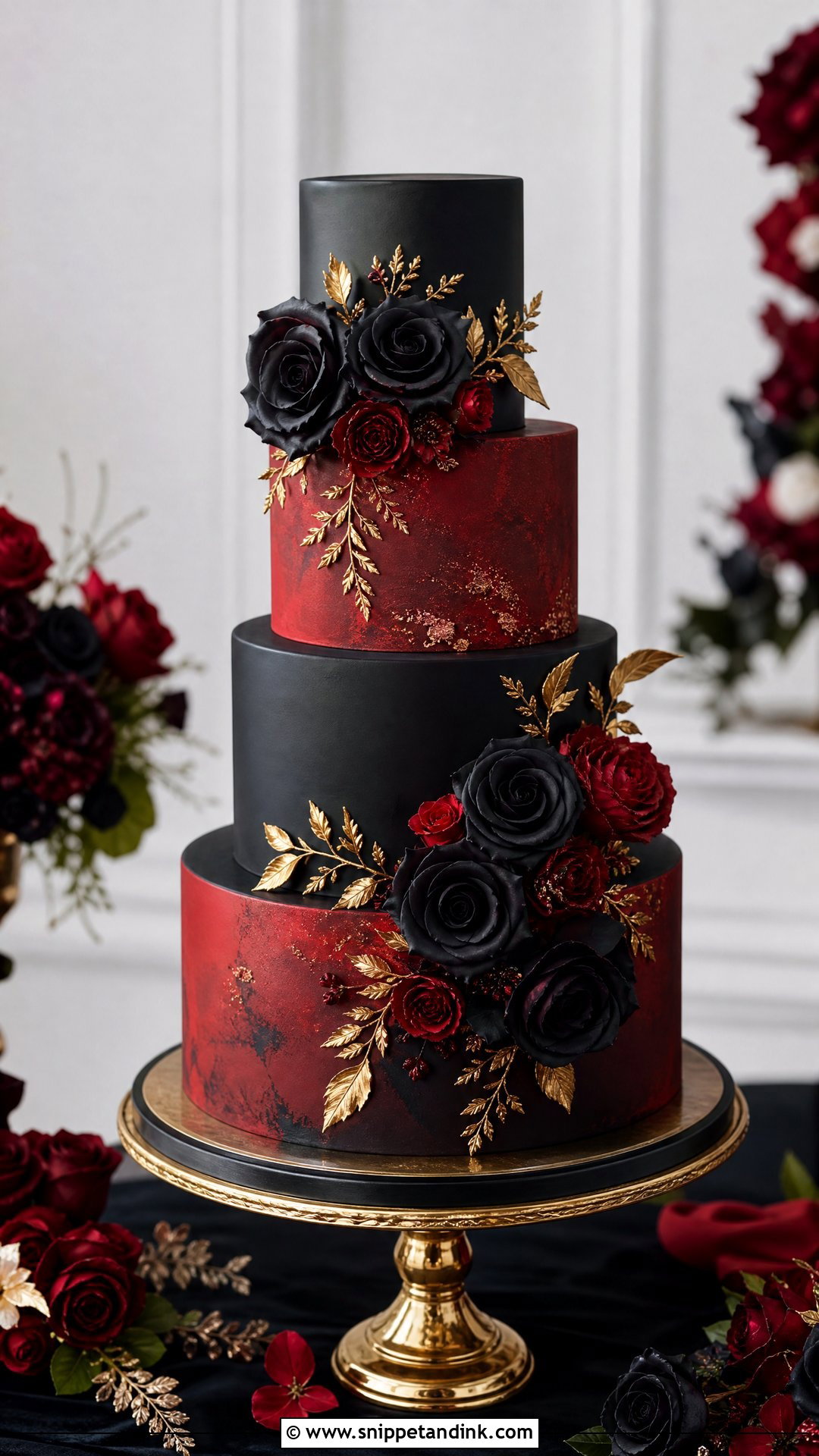
Black roses look moody and theatrical, and they work best in small numbers. I make them in sugar or fondant; true black buttercream roses are possible but heavy on coloring. Pair them with red blooms and gold leaves so the cake doesn’t read as dark from a distance, and add a red tier or red ribbon for warmth. Think of the black roses as an accent within the arrangement, never the whole of it.


15. Red Black And Gold Wedding Cake With Red Drip
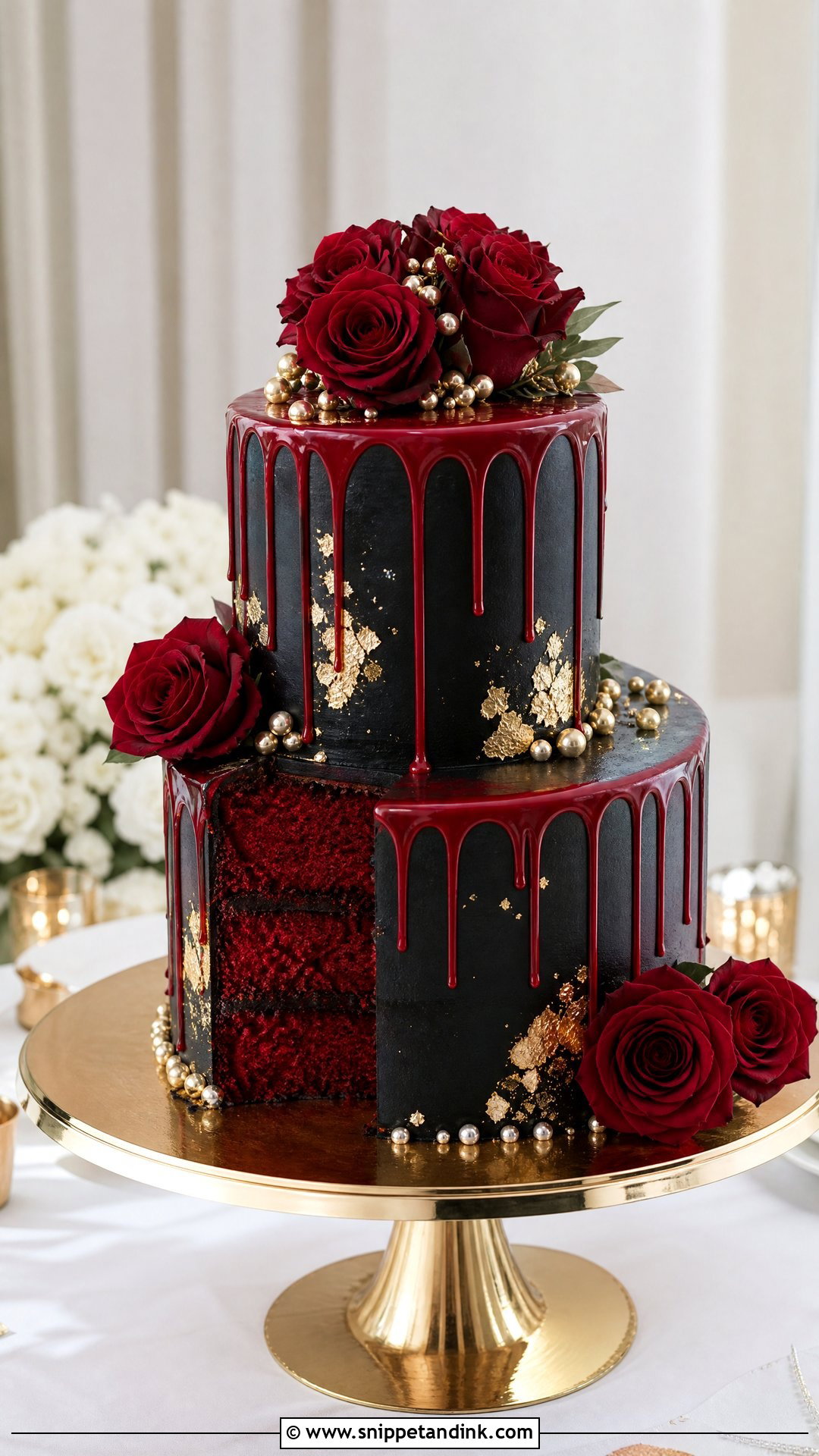
A red drip over black buttercream or fondant has a strong look, and it needs careful judgment. A deep, glossy red reads as elegant; a thin, runny bright red can look unsettling on a wedding cake, especially with irregular lines. So I keep the drip dark, thick and evenly spaced, then pair it with gold leaf, gold pearls or a few delicate red flowers. A smooth black base and clean gold accents make the drip look deliberate.
16. Red Black And Gold Wedding Cake With Square Tiers
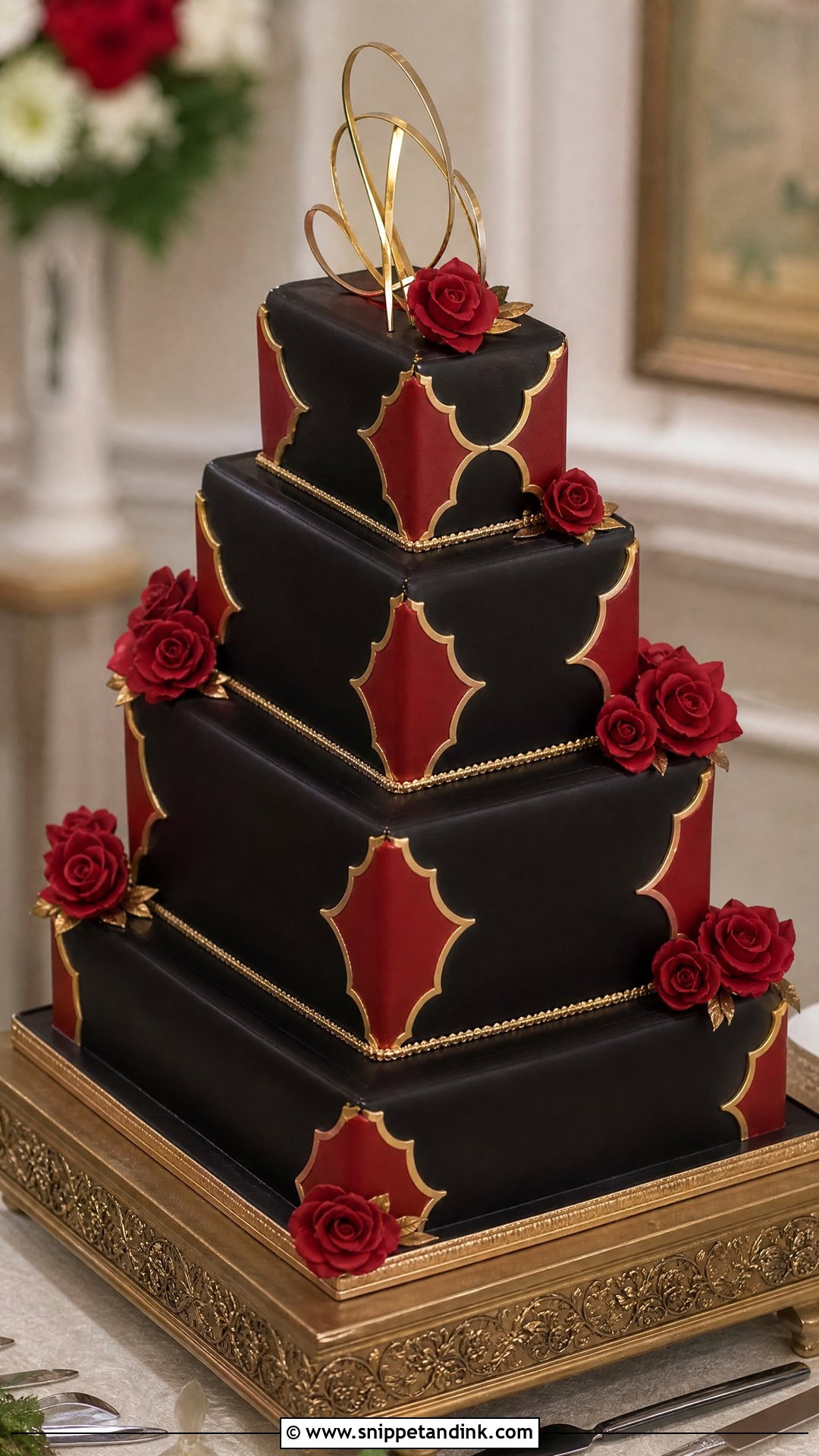
Square tiers give the cake a clean, structured outline and flat faces for gold lines, red panels or black fondant detail. They suit formal receptions and art deco settings particularly well. Alternate red and black tiers and use gold borders to tie them together, with fresh red flowers at the corners to soften the edges. Square corners are tricky to cover without tearing, especially in black fondant where any crack shows, so they take more time to finish than rounds.
17. Red Black And Gold Wedding Cake With Pearl Accents
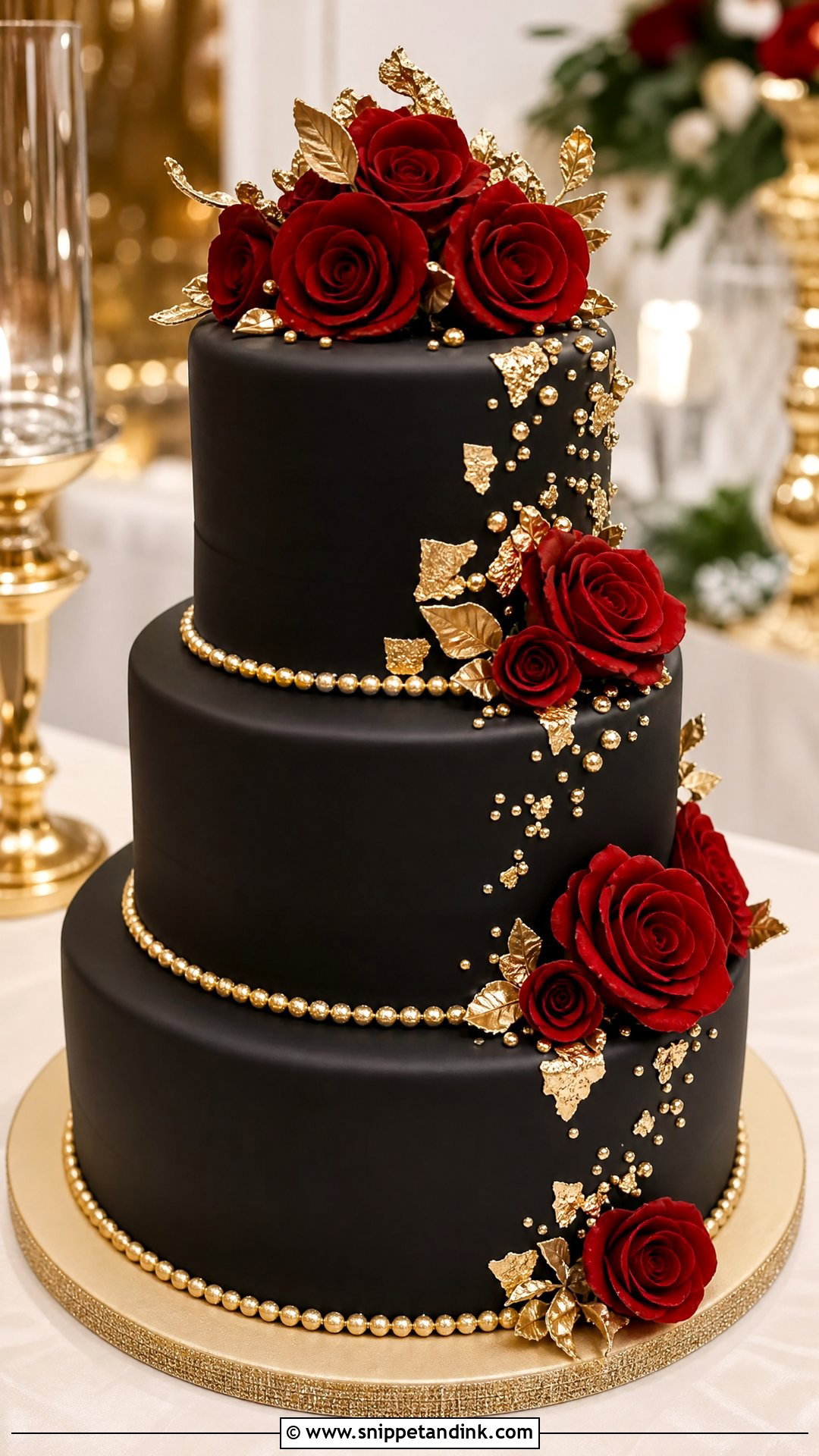
Pearls soften black and make the palette feel more bridal. Gold pearls along tier borders, around floral clusters or scattered lightly over black fondant, with red roses or sugar flowers, give a finished look without weight. Use small pearls and not too many, so they highlight the design. Hard sugar pearls can be tough on teeth, so I keep them to borders and decorations that are easy to brush aside when slicing. Smooth black, red blooms and gold pearl trim are enough.
18. Red Black And Gold Wedding Cake With Art Deco
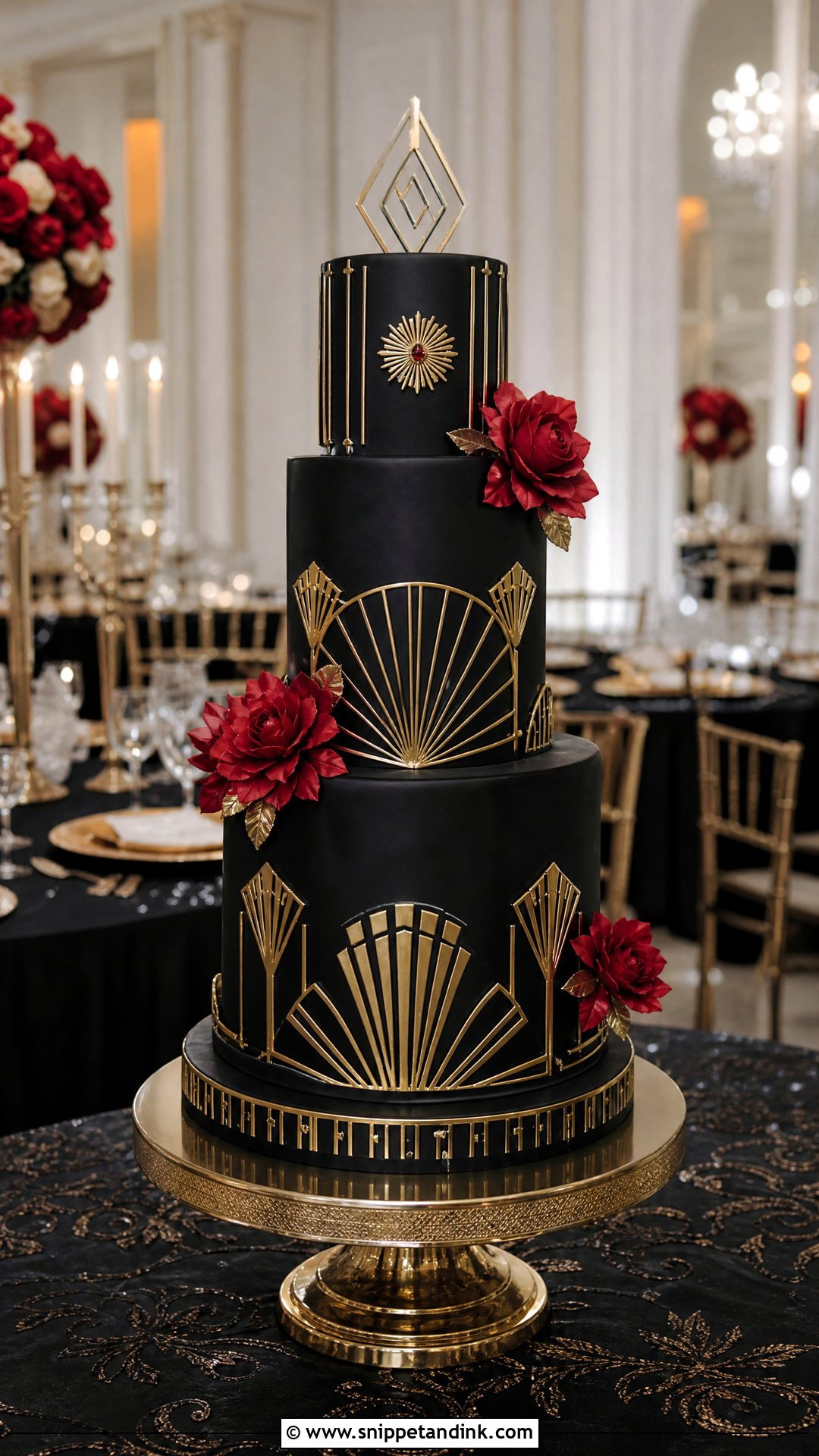
Art deco is all symmetry: fan shapes, sunbursts, stepped gold lines, black tiers and red accents. It suits hotel ballrooms and black-tie evenings, and a tall tiered cake shows the pattern best, with gold detailing on the front. I cut every fan and line from a template so both sides mirror exactly, because a lopsided deco pattern looks wrong even to people who can’t say why. Red flowers or red fondant panels add warmth to the geometry.
19. Red Black And Gold Wedding Cake With Gold Splatter
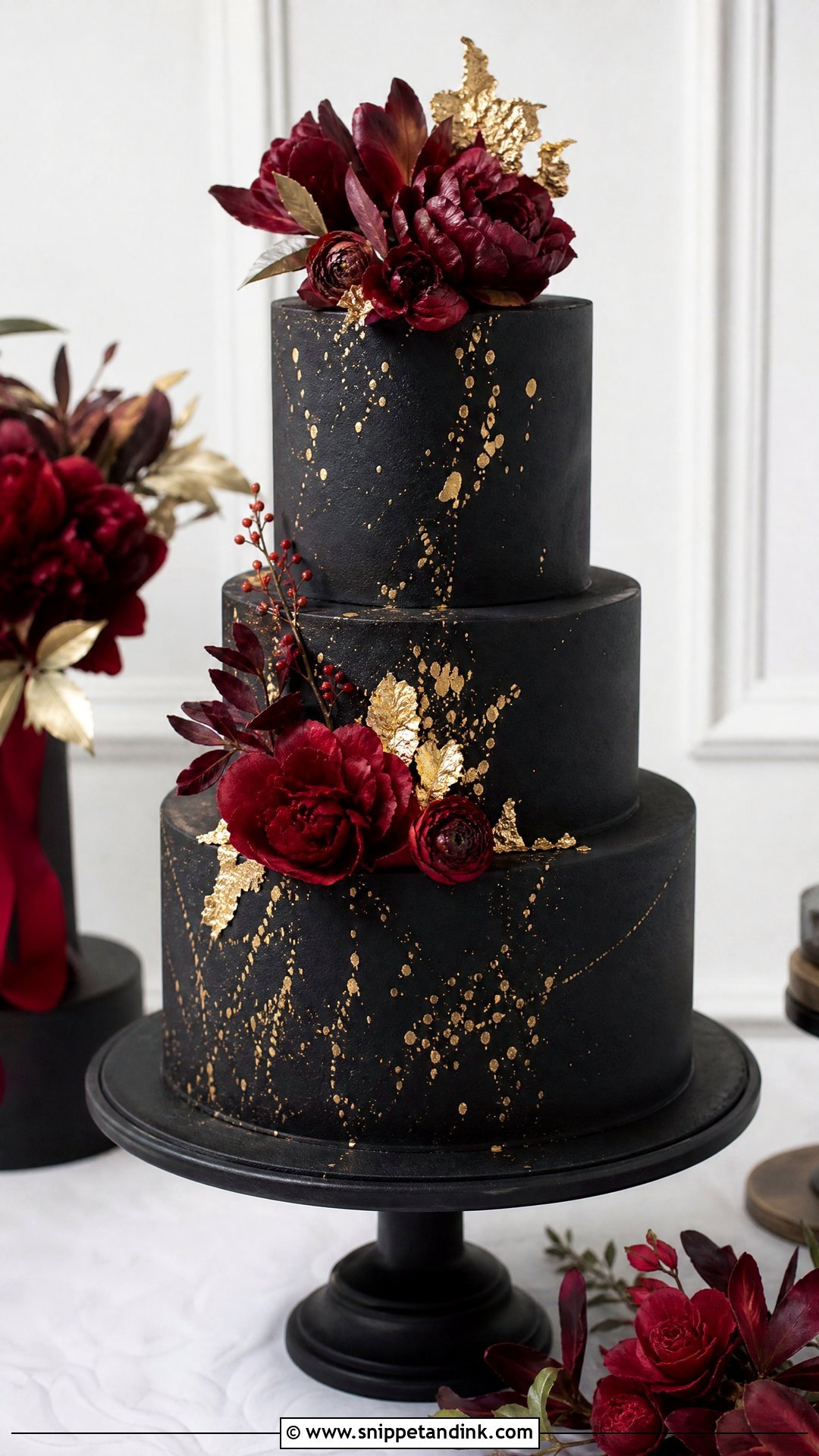
Gold splatter looks spontaneous and isn’t. On matte black tiers, the specks stand out clearly, and I practice the flick on paper first to control the size and spread before touching the cake. A few larger gold patches give the splatter weight so it doesn’t look like random dust. Red flowers or red berries around the base or between tiers bring in color. It’s a good match for a lively reception with bold decor, and less formal than gold leaf or lace.

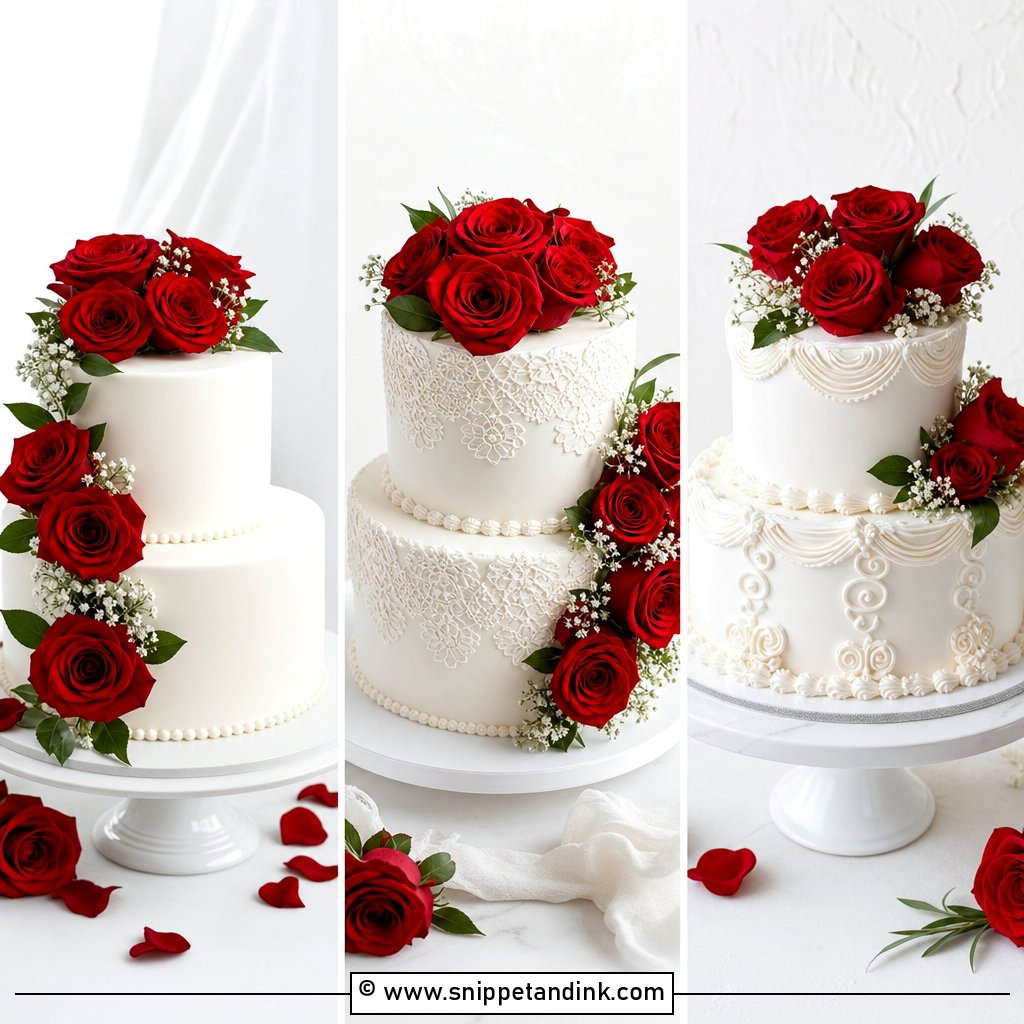

20. Red Black And Gold Wedding Cake With Cascading Flowers
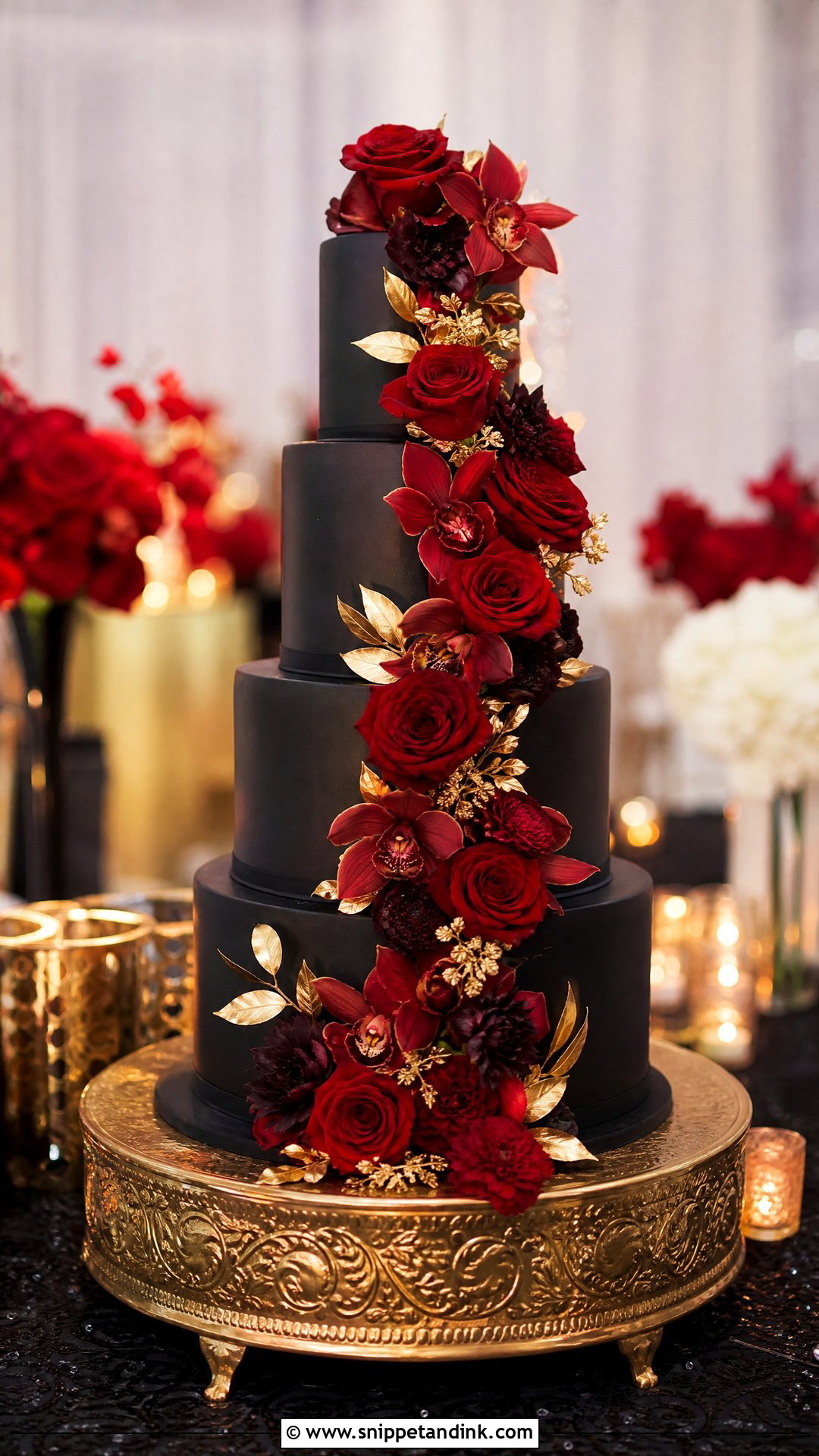
Cascading flowers from the top tier to the base make the cake feel tall and dramatic, with red roses, red orchids and gold leaves running across black tiers. The black is the perfect background, so keep the finish beneath simple, smooth fondant or buttercream, and let the flowers carry it. A cascade has weight, so I anchor larger sugar flowers into the tiers with food-safe supports rather than relying on icing to hold them.
Settle the Proportions on Paper Before the Quote
With three strong colors, the design lives or dies on ratio, and it’s much cheaper to change a sketch than a finished tier. Before I quote a red, black and gold cake, I work through these with the couple:
- Which color leads? Black tiers with red flowers is a different cake from red tiers with black detail.
- Where does the red come from: icing, sugar flowers, fresh flowers or the sponge inside? Each has a different cost and taste.
- What kind of gold, and how much? Edible gold leaf, painted lustre and gold pearls vary a lot in price and labor.
- How warm is the room, and how long will the cake stand before cutting? That decides fresh versus sugar flowers and buttercream versus fondant.
- What else is red, black or gold in the room? Bring a swatch of your linens and a photo of the flowers so the reds match.
Sugar flowers and hand-painted gold are where most of the cost sits, because both are slow, skilled work. If the budget is tight, a smooth black cake with one fresh red arrangement and a little gold leaf delivers most of the drama for a fraction of the hours.
Where the Drama Should Sit on a Three-Color Cake
This palette is bold, but it can be romantic, modern or formal depending on the finish. Roses and cascades feel classic. Marble, geometric patterns and gold splatter feel modern. Lace, pearls and art deco detail feel more formal. If you love the colors but worry the cake will look too dark, keep black as the base, put the red in the flowers, and use gold only where you want the light to land. That proportion rarely fails, and it leaves room for one feature to be the thing guests remember.
You'll Like These Ideas:



Leave a Reply