
Malli poo has been tucked into South Indian brides’ hair for generations, carrying wishes for purity and a harmonious marriage. For a stylist it’s also a material with its own habits: it’s heavier than it looks, it opens and softens through the day, and its scent is strong enough to matter in a small room. These twenty South Indian bridal hairstyles all use jasmine, from the full poolajada to a simple wrapped ponytail. For each I’ve noted how the flowers sit, what the hair underneath needs, and where the style suits or struggles.
Malli, Mullai and Kanakambaram Don’t Behave the Same
Brides often say jasmine as if it’s one flower. In practice I work with a few strings that do different jobs. Malli, the round, full-headed jasmine most people picture, has the strongest scent and the most visible white. Mullai is the smaller, pointed bud; it’s lighter, so it suits fine hair and side braids, and its fragrance is gentler. Kanakambaram, the orange one, has almost no scent but keeps its colour and shape for hours, which is why it’s mixed in rather than worn alone.
Knowing this helps you talk to your flower supplier. If a style is heavy with flowers, ask for some of the volume in mullai to reduce the weight. If you’re worried about wilting in heat, a kanakambaram or rose row keeps the arrangement looking fresh after the jasmine has softened.
When the scent is too much
Jasmine is strongly fragrant, and a full poolajada sits right behind your head for hours. If strong scents give you headaches, say so at the trial. I’d use mullai, a smaller amount of malli, or let faux jasmine carry the bulk with a few real strings for fragrance.
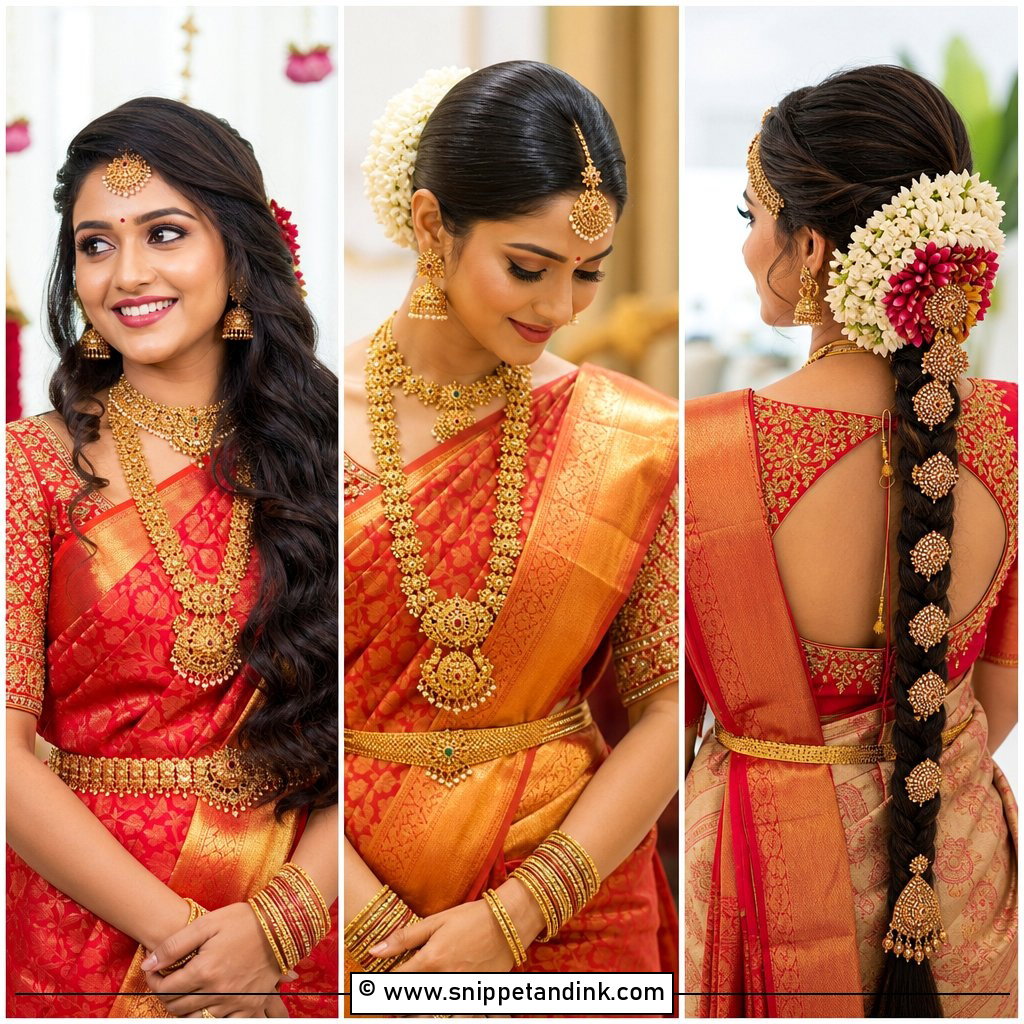
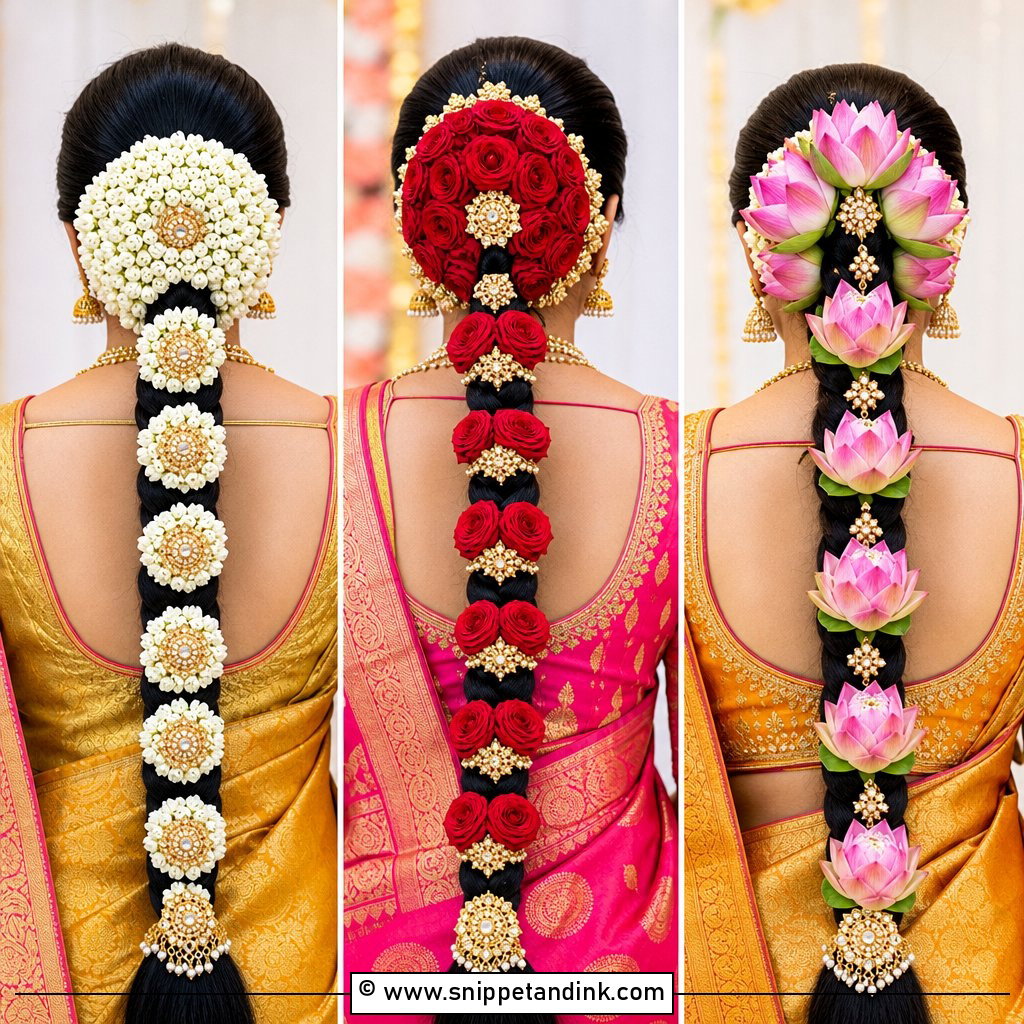
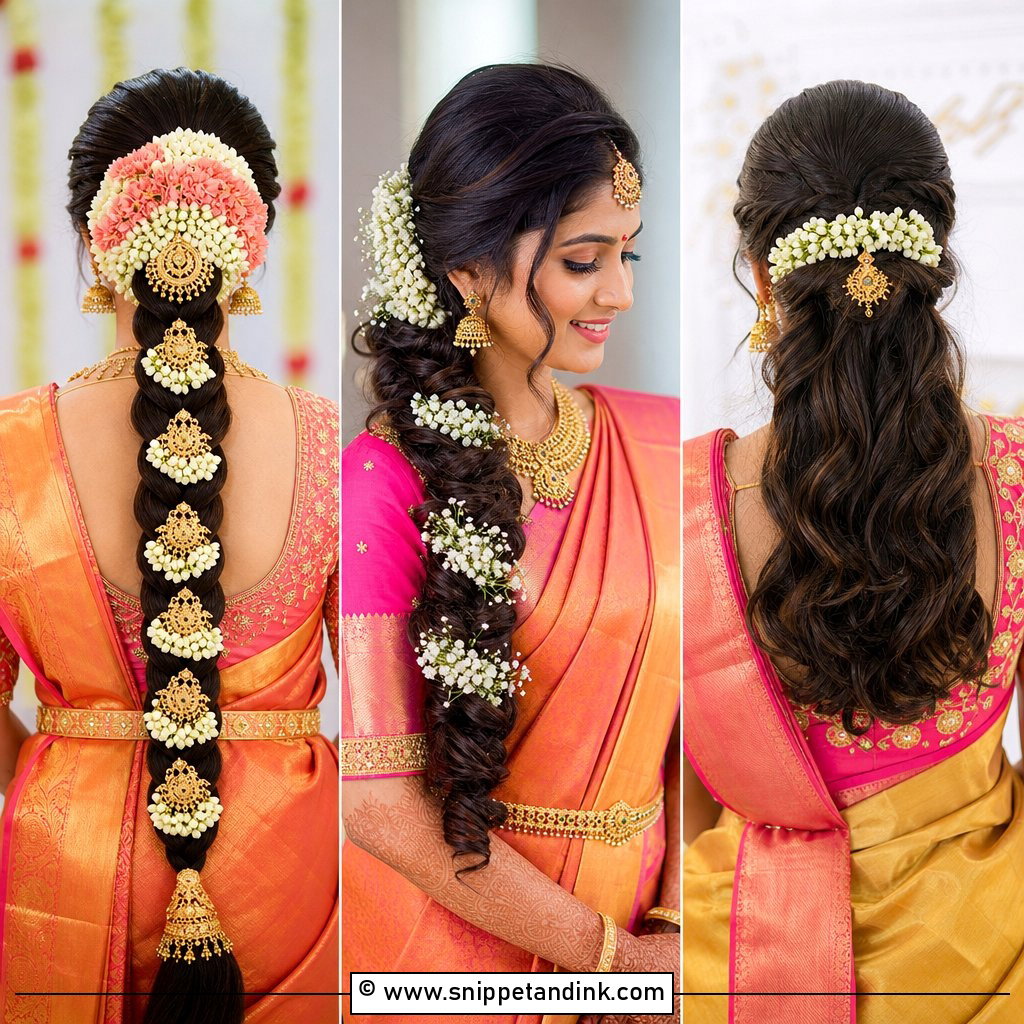
1. Traditional Poolajada Braid With Jasmine
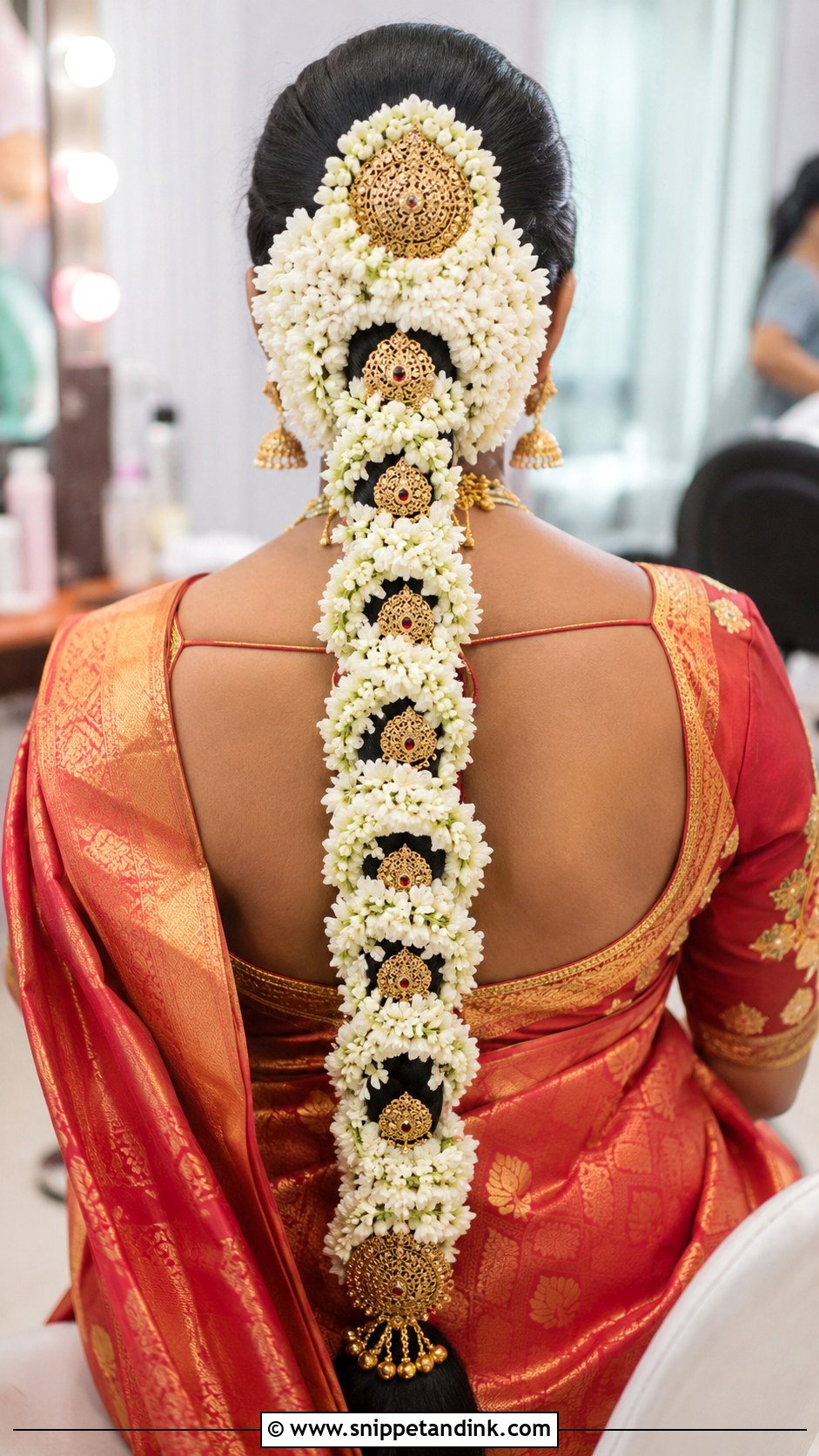
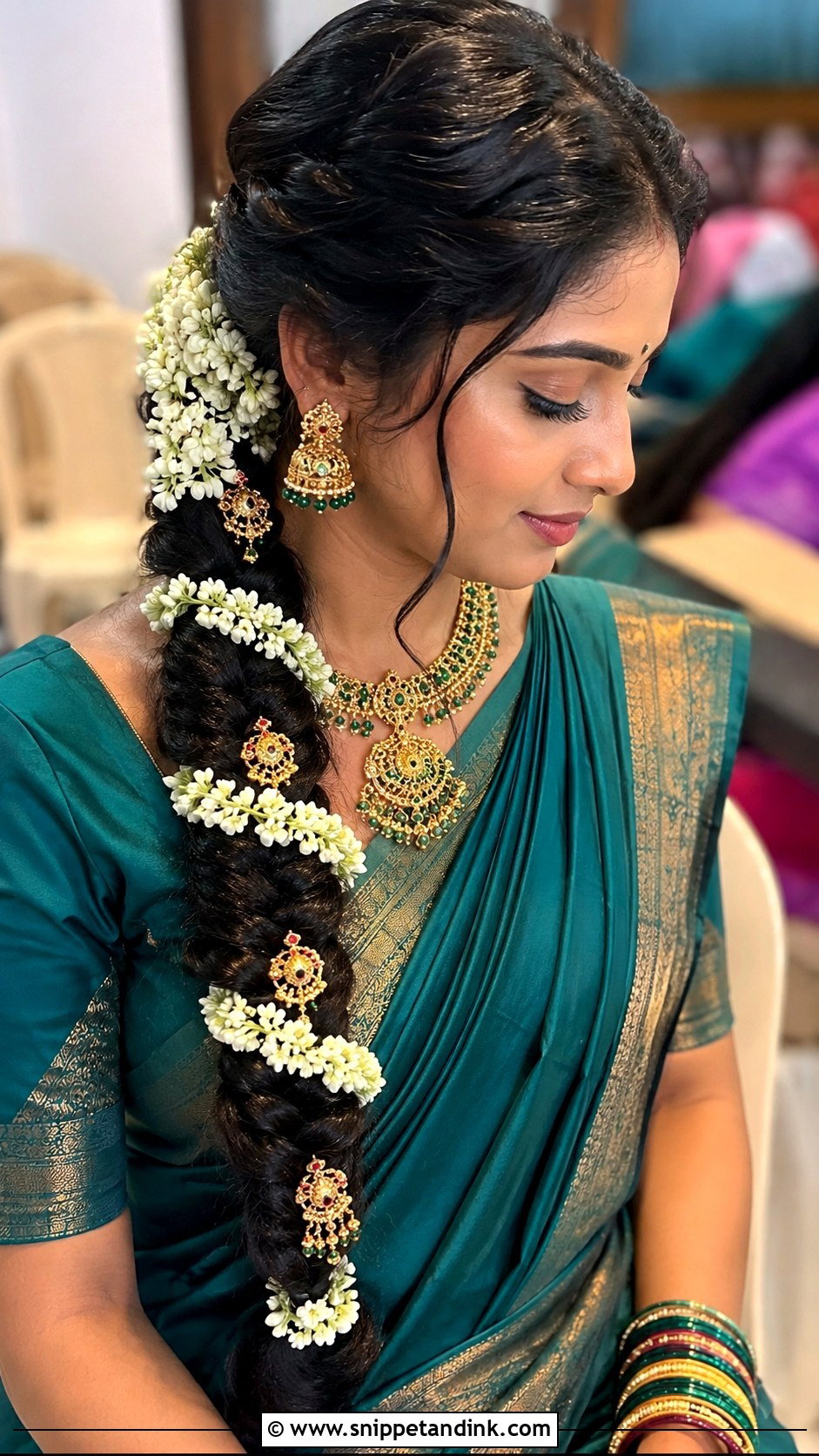
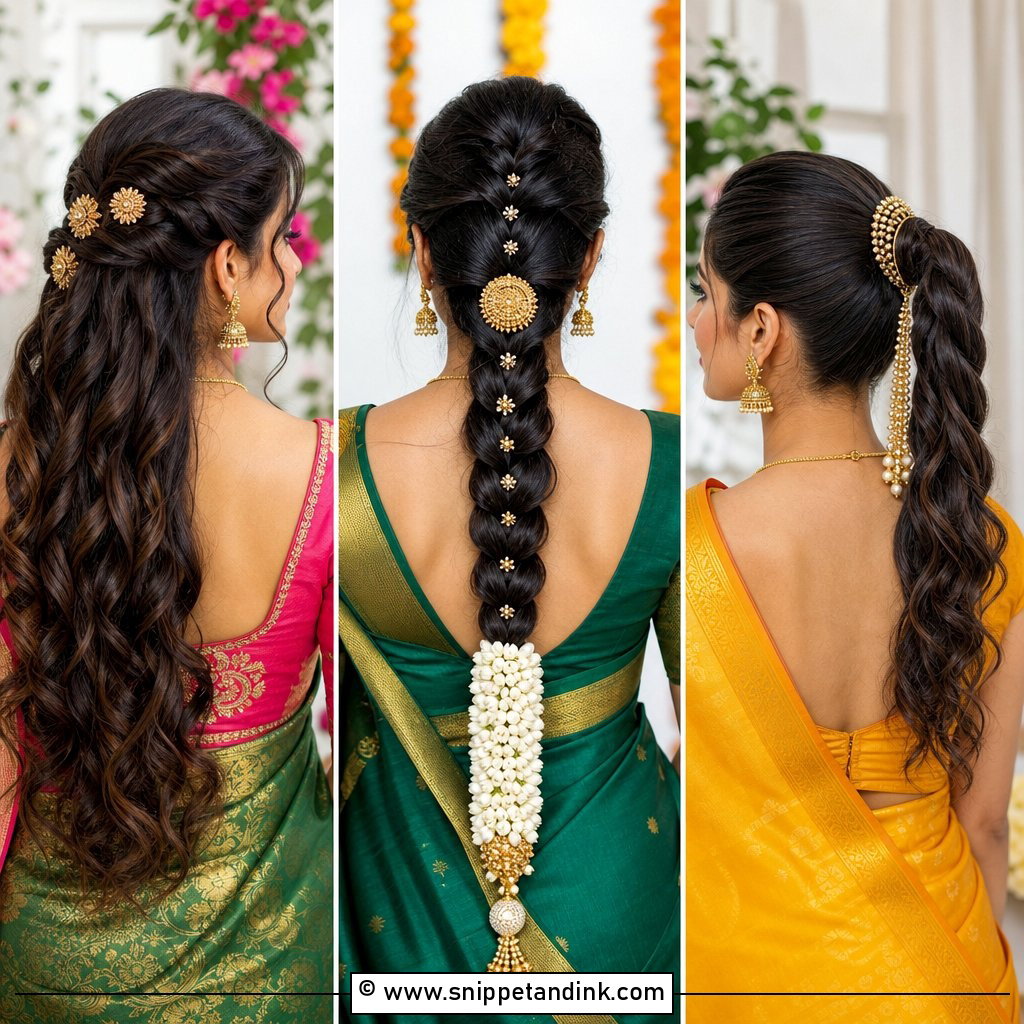
One thick braid down the back, covered from top to bottom in rows of jasmine, with gold jada billalu showing through and a flower tassel at the end. It belongs with a Kanjeevaram and temple jewellery, and it’s the look many families have in mind from the start. The braid gets wider toward the bottom because the flower rows are built that way, not the hair. I make the hair braid itself firm and slightly narrow, so the classic poolajada braid panel lies flat on it instead of rolling off to one side.
2. Low Bun Wrapped In Jasmine Gajra
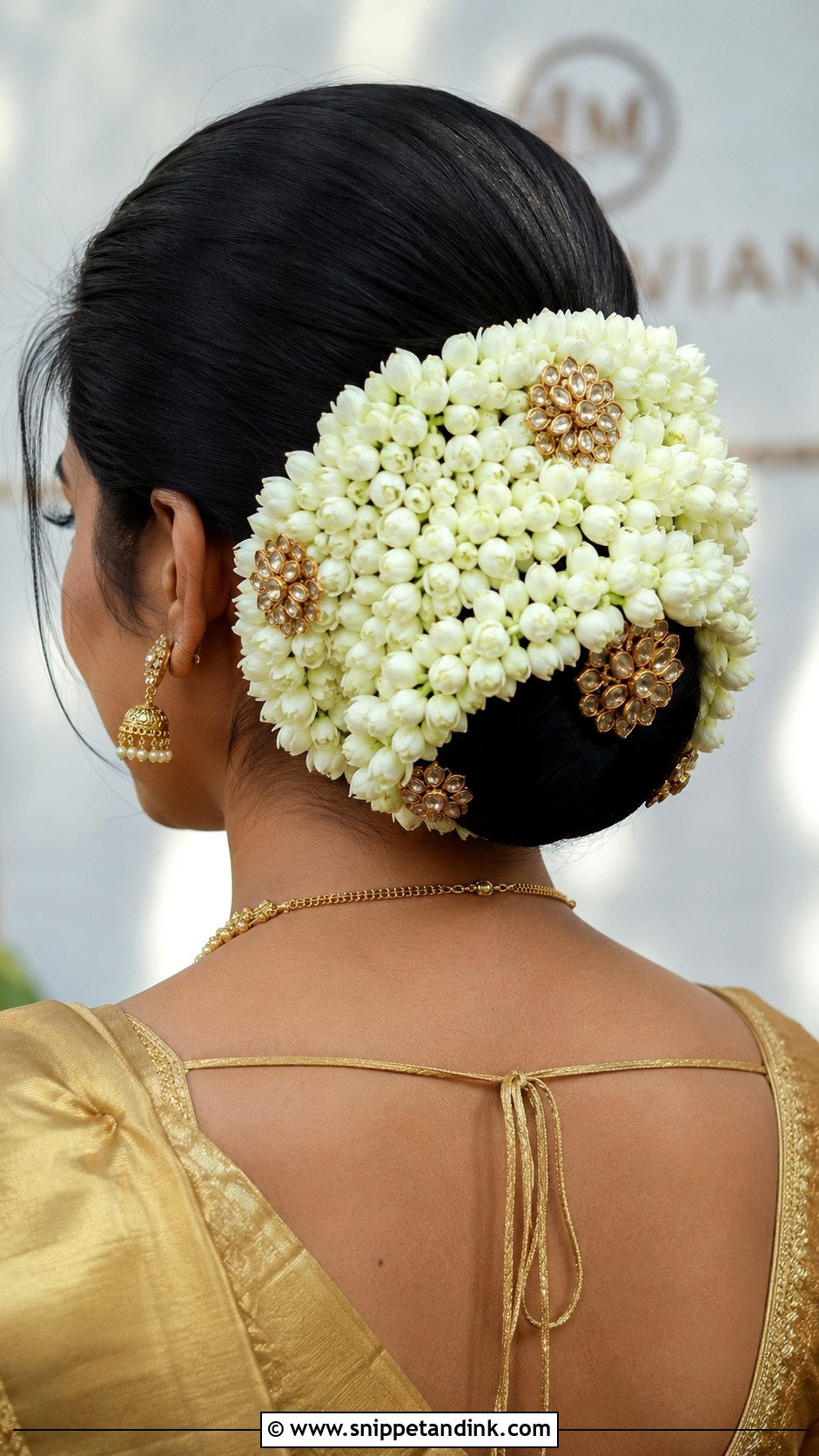
A low bun circled by a fresh jasmine gajra is the quiet option, and an easy one to wear for hours. The bun sits at the nape, the gajra goes round in neat rings, and antique gold or kundan pins sit in among the buds. It suits a bride who wants her earrings and necklace to lead. The rings stay level only if they’re pinned at three or four points; with one pin, the gajra slides to the lowest side of the bun within an hour.
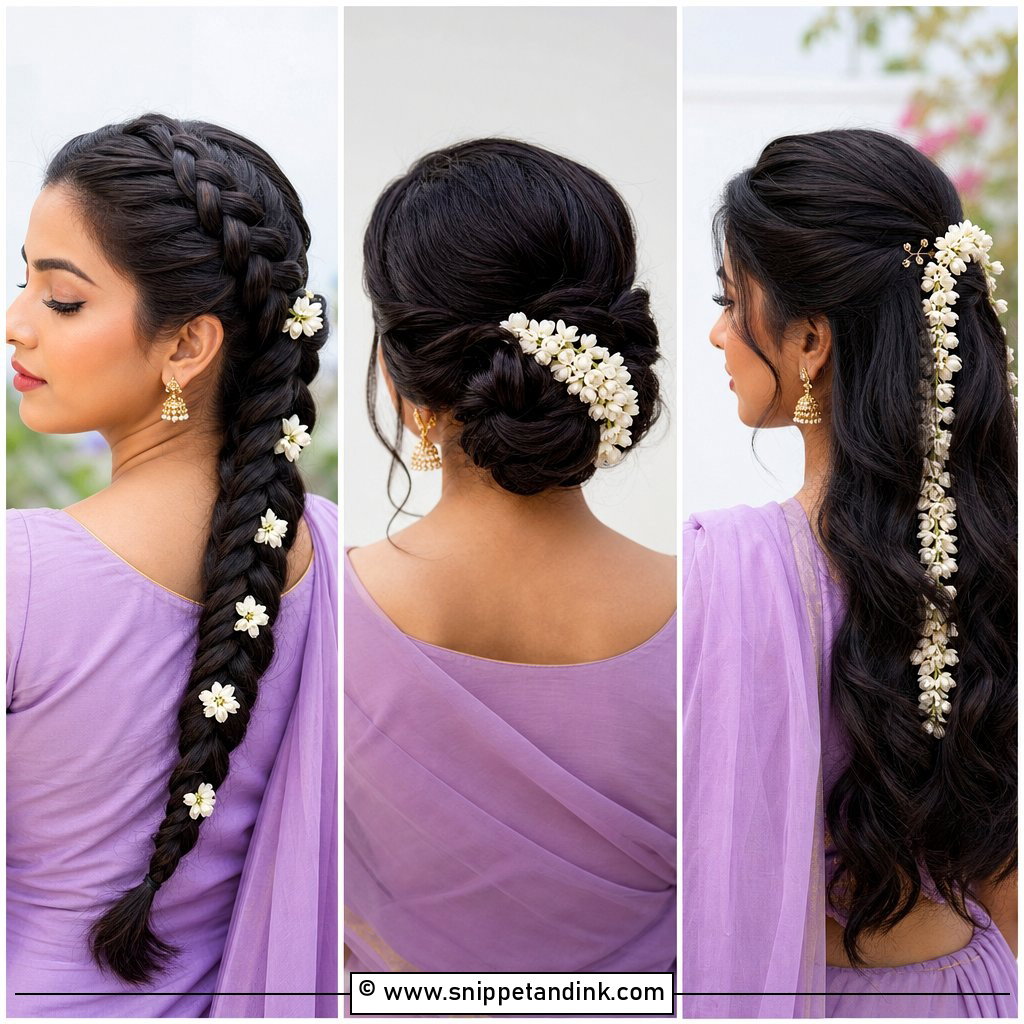
3. Side Swept Braid With Jasmine Strings
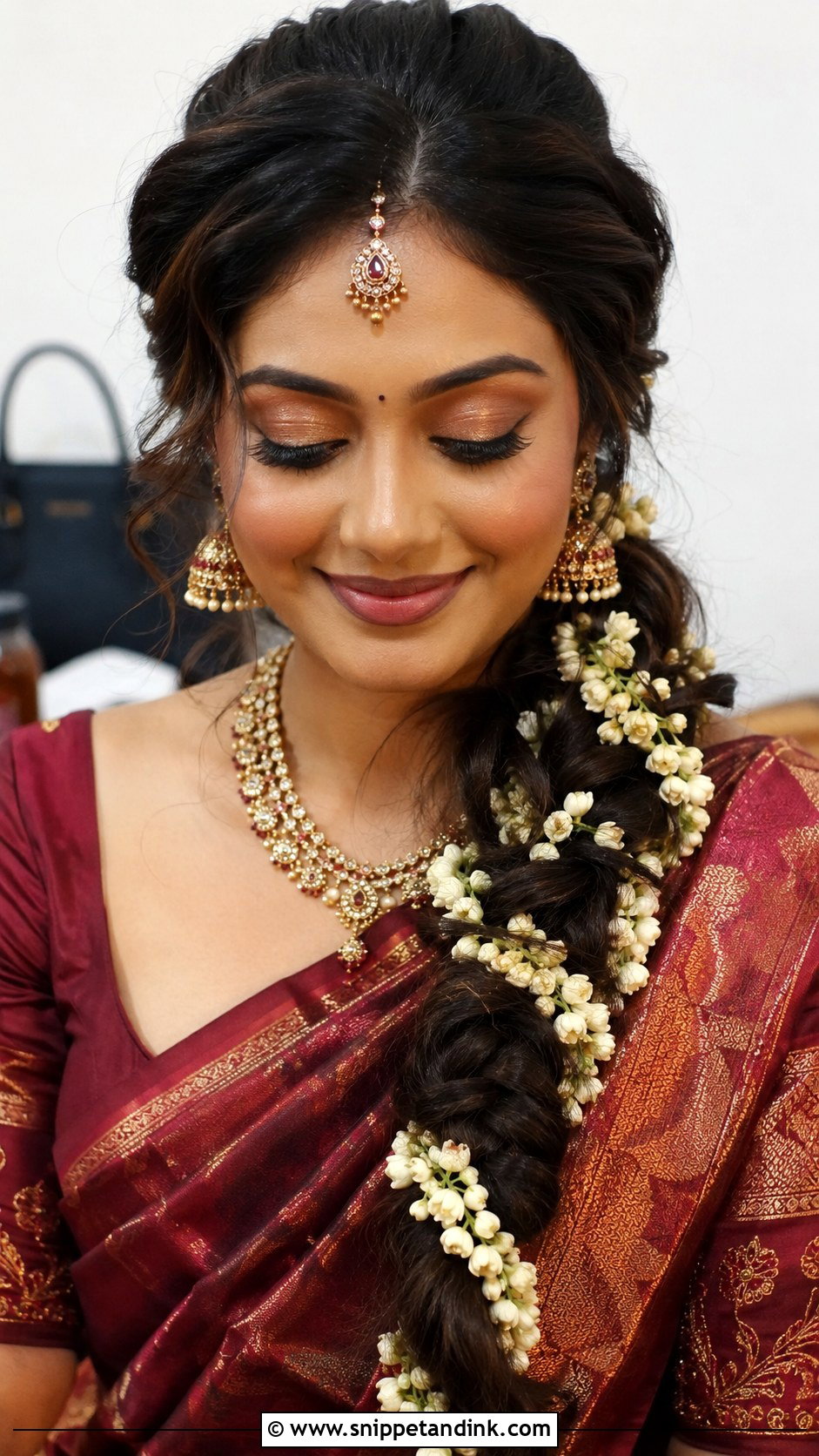
Hair gathered over one shoulder, braided loosely and wrapped with fine jasmine strings, with a few flowers near the crown. It softens round and heart-shaped faces and moves easily between the muhurtham and the reception, depending on the jewellery. I’d use thinner strings here than on a back braid. Thick gajra on a side braid sits right against the cheek and neck, and the scent can be a lot that close to your face for several hours.
4. Veni Style Floral Bun
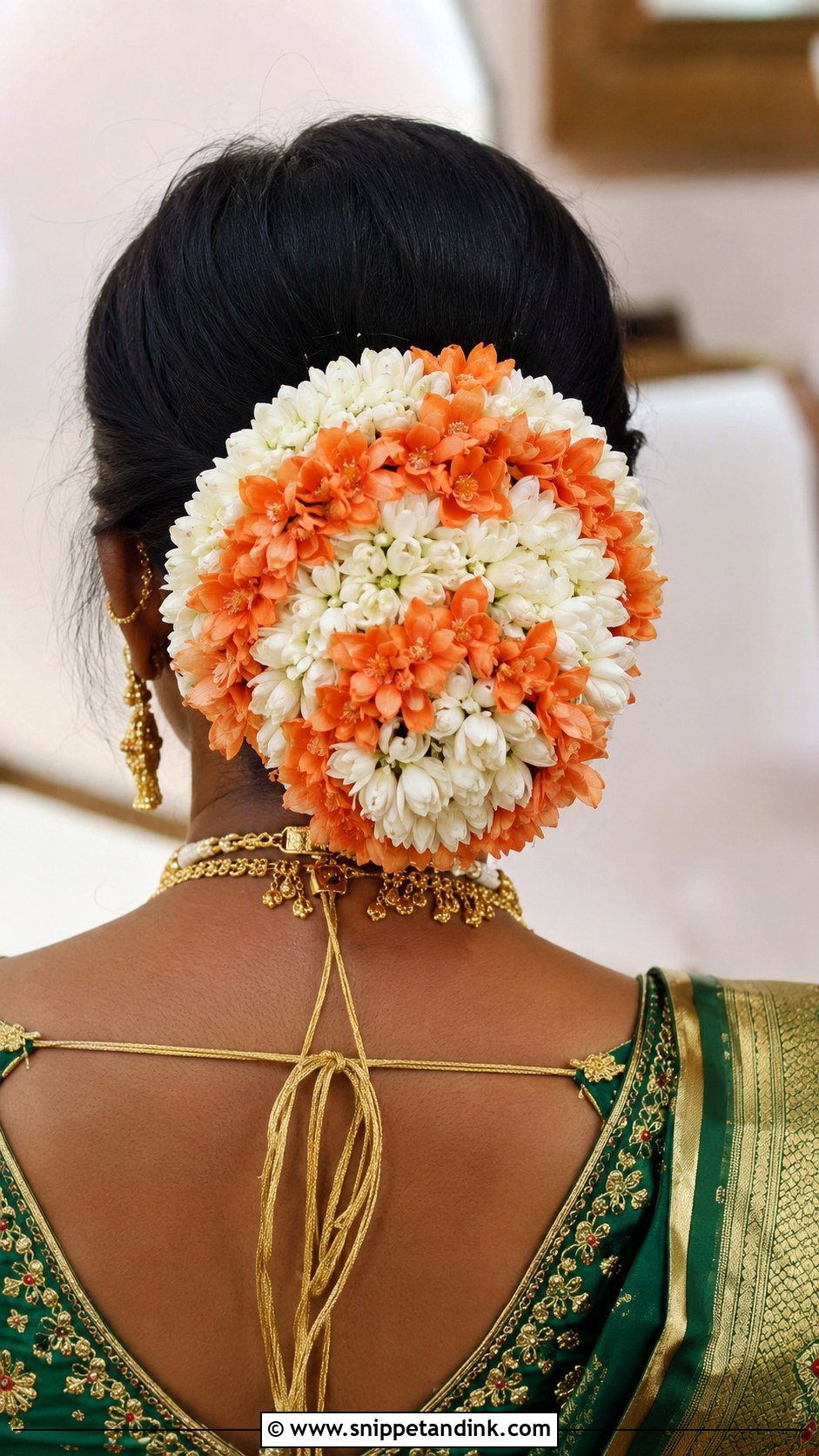
In a veni-style bun the round low bun disappears completely under a large jasmine veni, sometimes mixed with roses or orange kanakambaram, so the back of the head reads as one full bloom. Grand weddings and heavy bridal sarees suit it. The white and orange contrast is strong in photographs. All that flower weight sits on a small base, so I pin the veni through the bun from four directions and use a bun filler, which gives the pins something to grip.
5. Rose And Jasmine Combination Bun
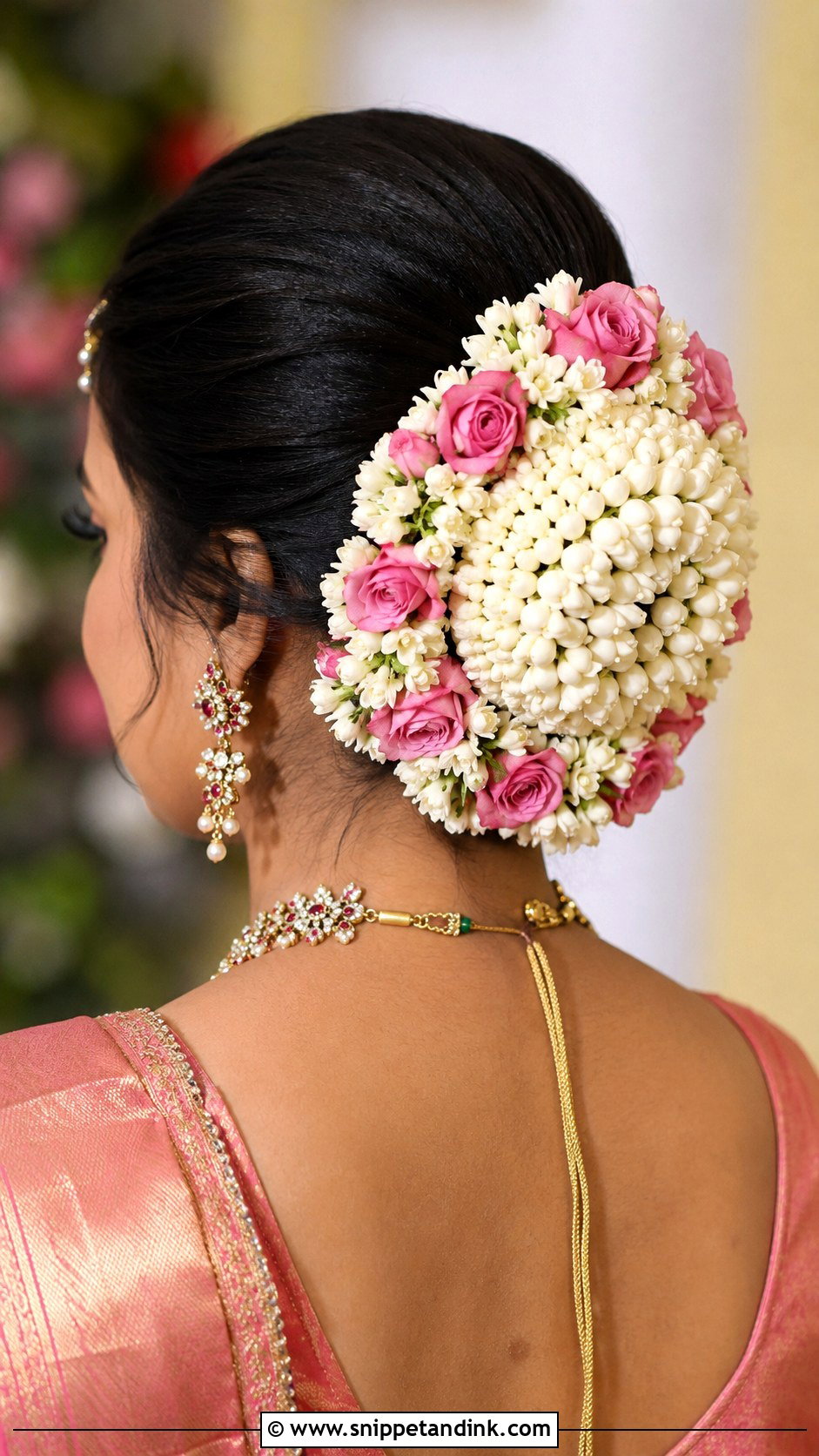
Jasmine woven into the bun itself, then a jasmine and rose gajra circled over it, so pink or red roses sit against the creamy malli poo. It’s a little bolder, which is why it often appears at receptions, and it pairs with floral jewellery or gold kundan. Rose petals bruise where they’re pinned. I place roses last and hold them with pins through the stem base, never through the petals, which turn brown at the puncture by the evening.
6. Temple Inspired Jada With Jasmine
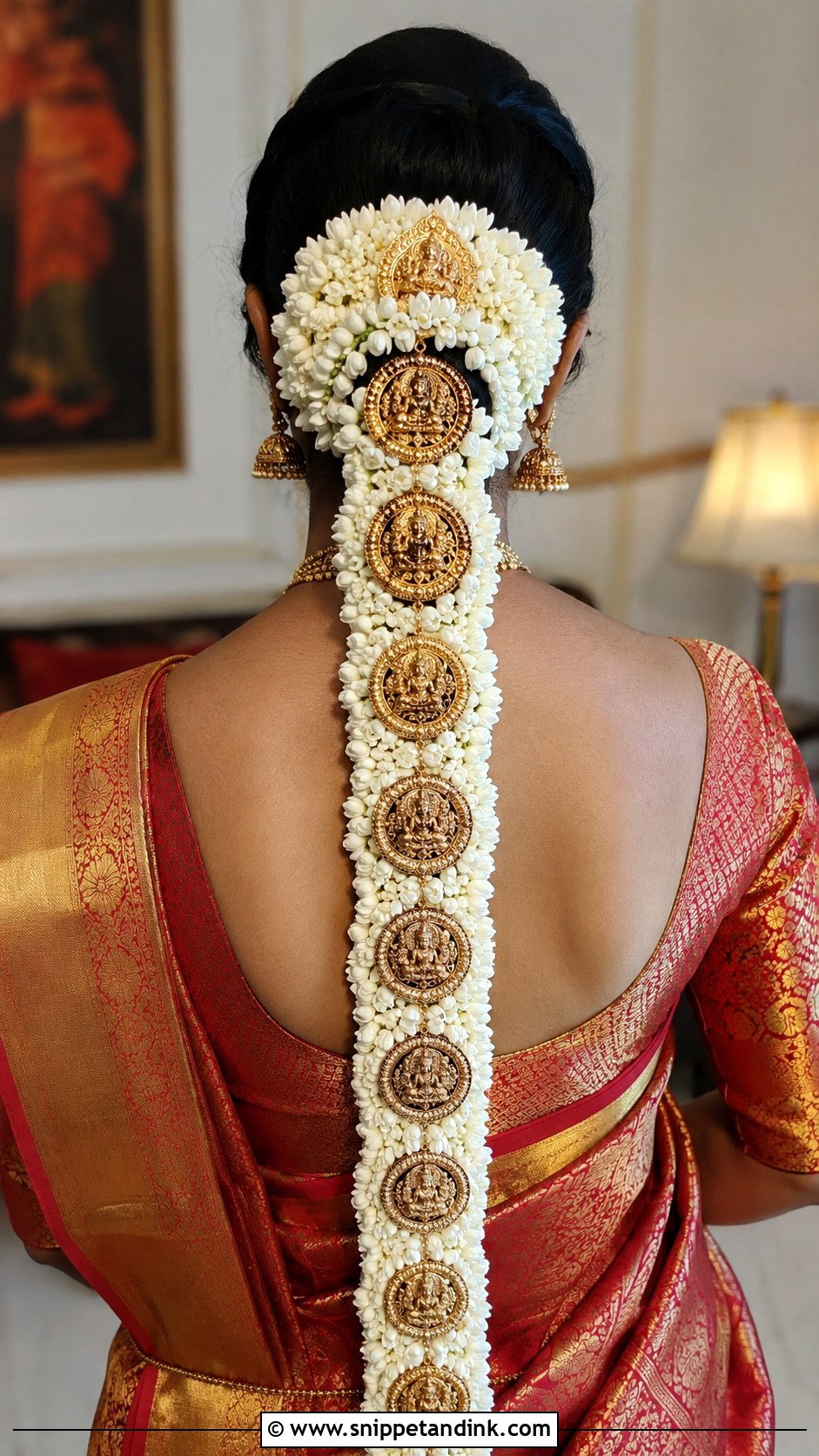
Temple architecture is the inspiration: a braid set with traditional jada billalu, gold discs that get smaller as they go down, with jasmine filling the gaps between them. It’s deeply ceremonial and belongs at the main ritual, with a silk saree and temple jewellery. The billalu are set first, spaced evenly against a tape measure if the braid is long, and the jasmine goes in afterwards. Done the other way round, the flowers push the discs out of line.
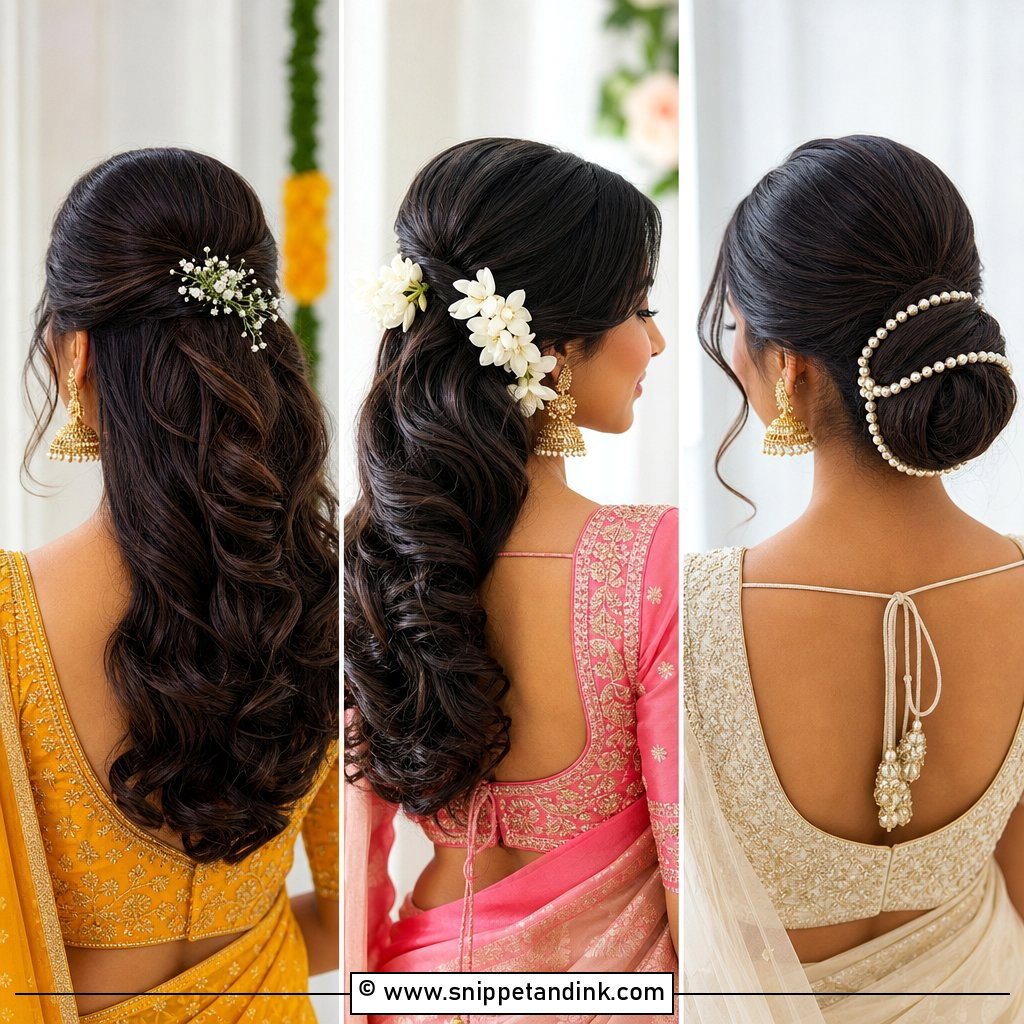
7. Half Up Half Down With Jasmine Crown
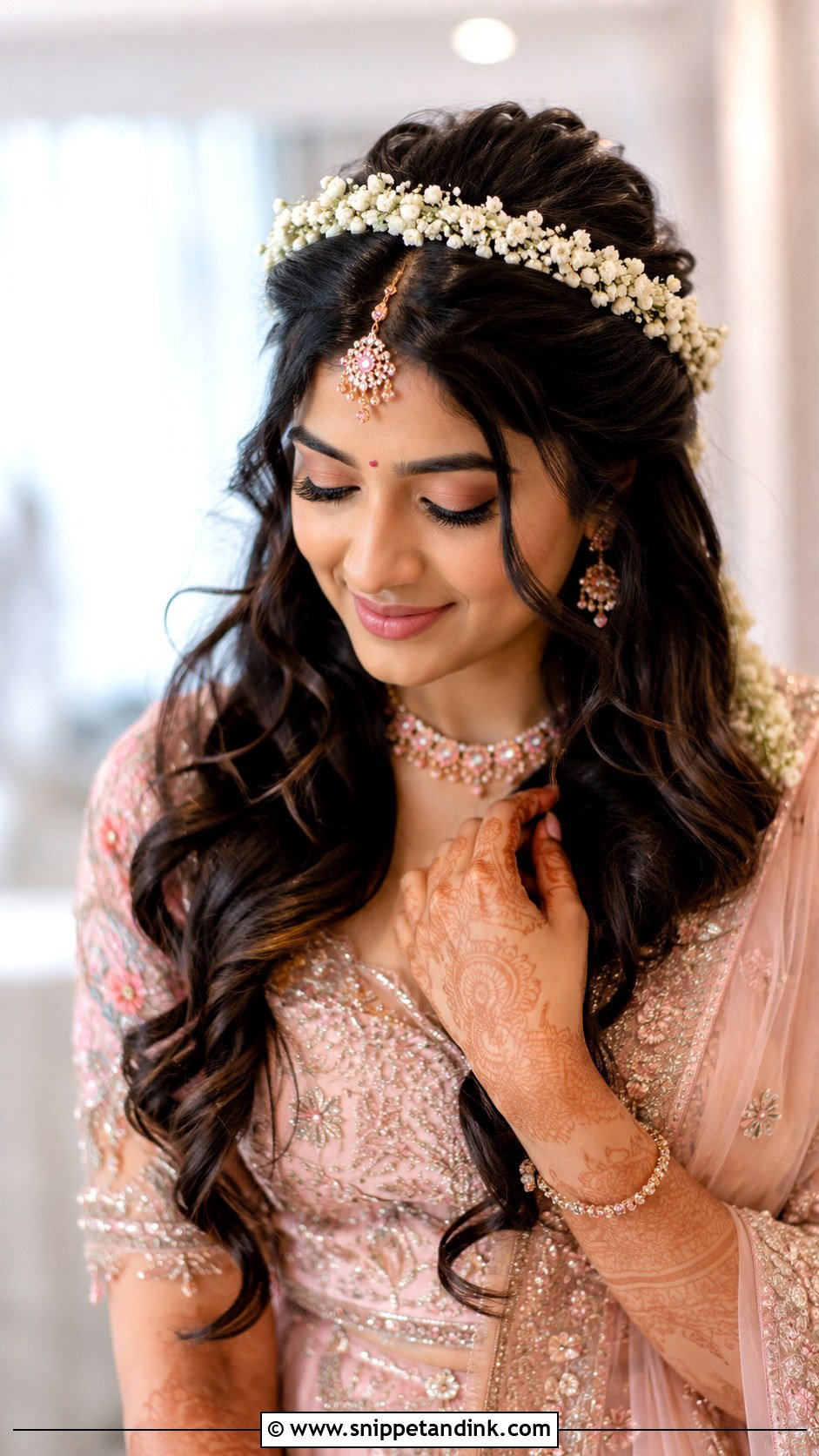
The top section is pulled back and secured, the rest falls in soft waves, and a band of jasmine sits where the two meet. It’s light and comfortable, and it suits engagements and receptions with a lighter saree or lehenga. Jasmine sitting on loose hair has nothing to grip. I hide a small elastic and two crossed pins under the band, and hook the string to those rather than to the waves, which keeps the crown level as the curls drop.
8. Maharashtrian Style Bun With Jasmine
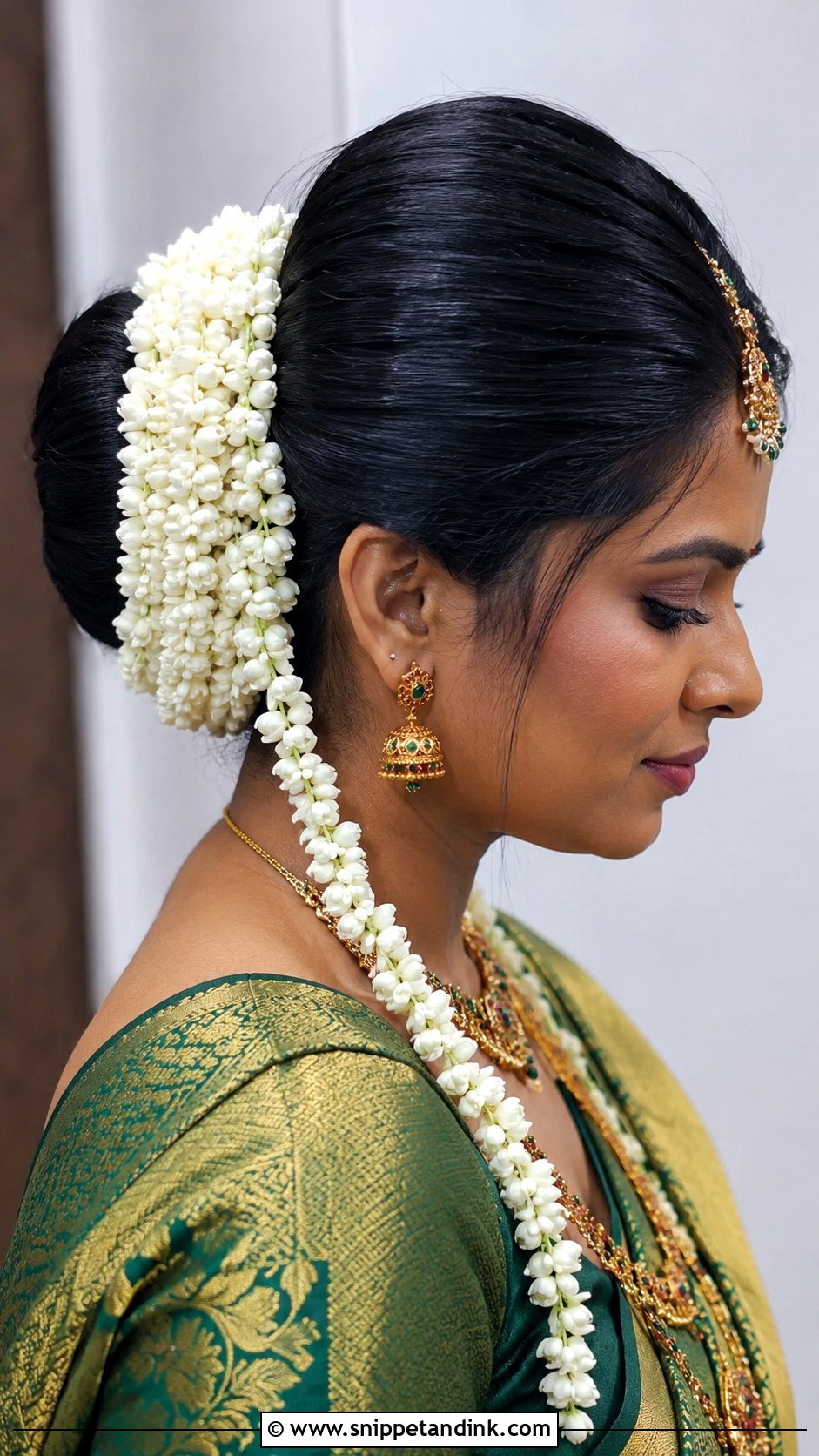
This round bun comes from Maharashtrian tradition and has been adopted widely in the South. It sits high or at the crown, wrapped with a thick gajra, sometimes with one string trailing down the side. It looks clean with a nauvari or a silk saree, and keeping hair off the face helps through a long ceremony. A high bun shows its base from every angle, so I smooth the sides with a fine comb and gel before wrapping. Any bump under the gajra becomes obvious in profile photos.
9. Long Open Hair With Jasmine Accents
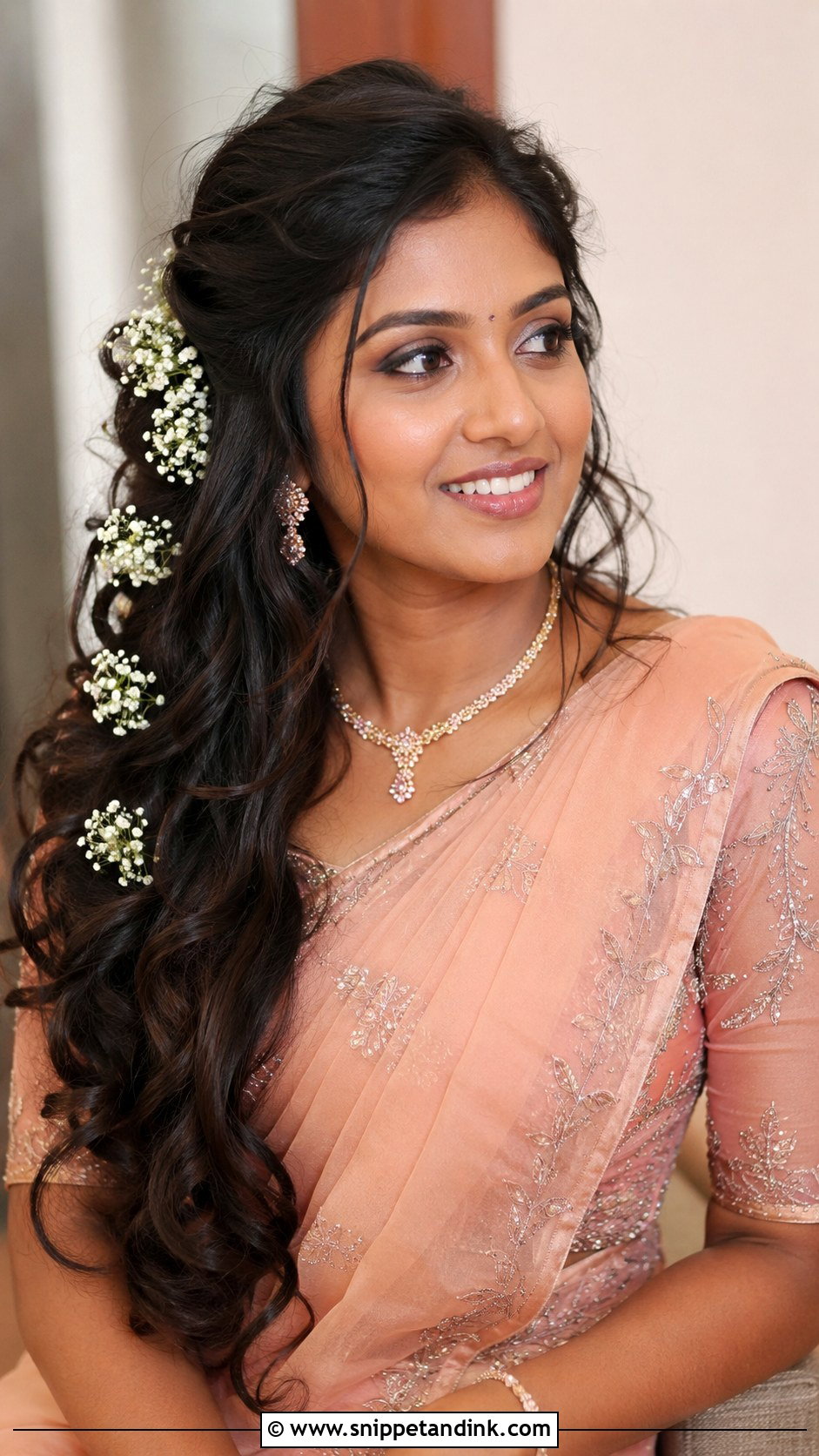
Loose curls or waves with small jasmine clusters pinned along one side or at the crown. It’s the reception option that shows off length, and it sits well with pastel sarees and lehengas. It needs thick, healthy hair to look full. Jasmine clusters on open hair are best pinned into a tiny hidden braid at the side; pinned straight into curls, they work loose as soon as you hug anyone.
10. Braided Bun With Jasmine And Gold
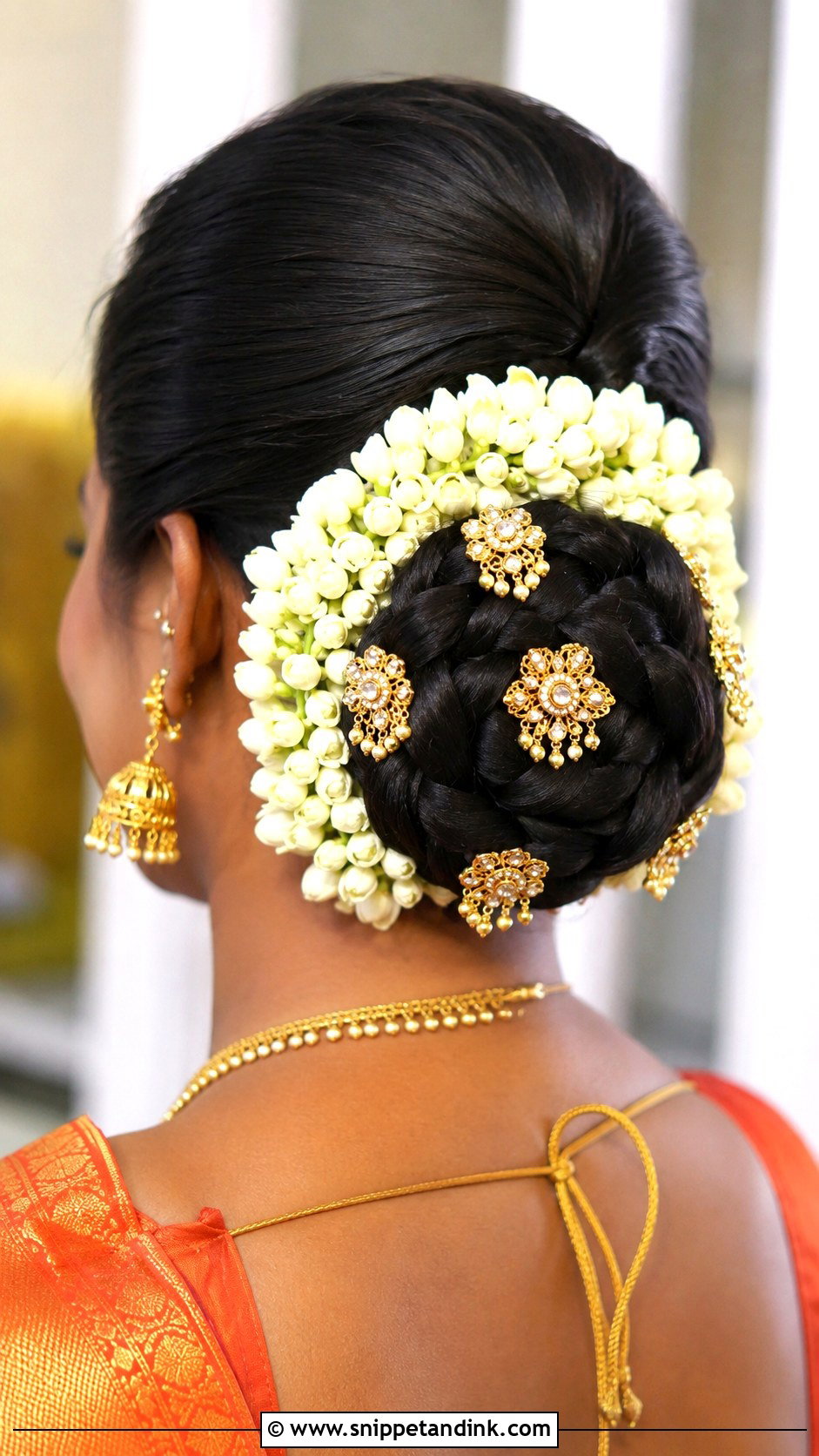
Braiding first, then coiling the braid into a nape bun, gives a textured surface for jasmine to weave through, with gold pins and ornaments adding shine. It’s detailed without being fragile, which makes it a strong choice for the muhurtham with heavy silk and traditional jewellery. Of all the buns here, this is the one I trust most for a long day. The braid’s crossovers hold the pins better than smooth hair ever does.
11. Floral Crown Bun For Reception
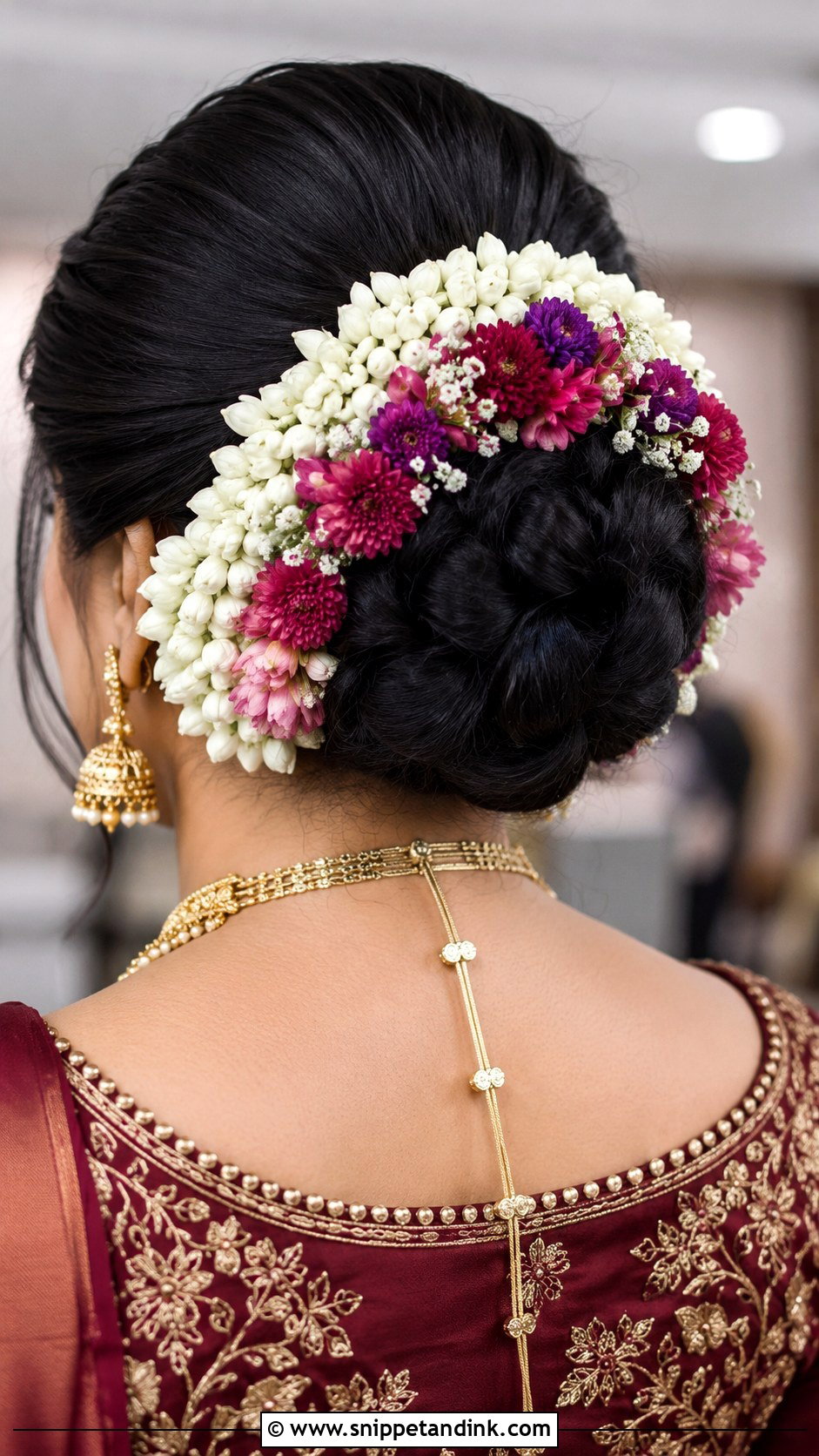
A full bun with a thick arc of jasmine curving over the top of the head like a halo, sometimes joined by coloured flowers. It’s built for a big reception entrance, with statement jewellery and a heavily embroidered saree or gown. The arc is the delicate part. I build it on a thin wire frame shaped to the bride’s head at the trial, so on the day it simply pins in place and keeps its curve all evening.
12. Fishtail Braid With Jasmine
A fishtail’s herringbone weave gives a fine pattern for jasmine to wrap along or tuck into. Worn over one shoulder it suits engagement parties and smaller ceremonies, with small gold accents for shine. Layered hair escapes a fishtail easily, so it’s better on one-length hair. The fishtail jasmine braid also loosens as the day goes on, so I wrap the flowers firmly near the top and lighter toward the end, where a little movement does no harm.
13. Messy Bun With Jasmine Flowers
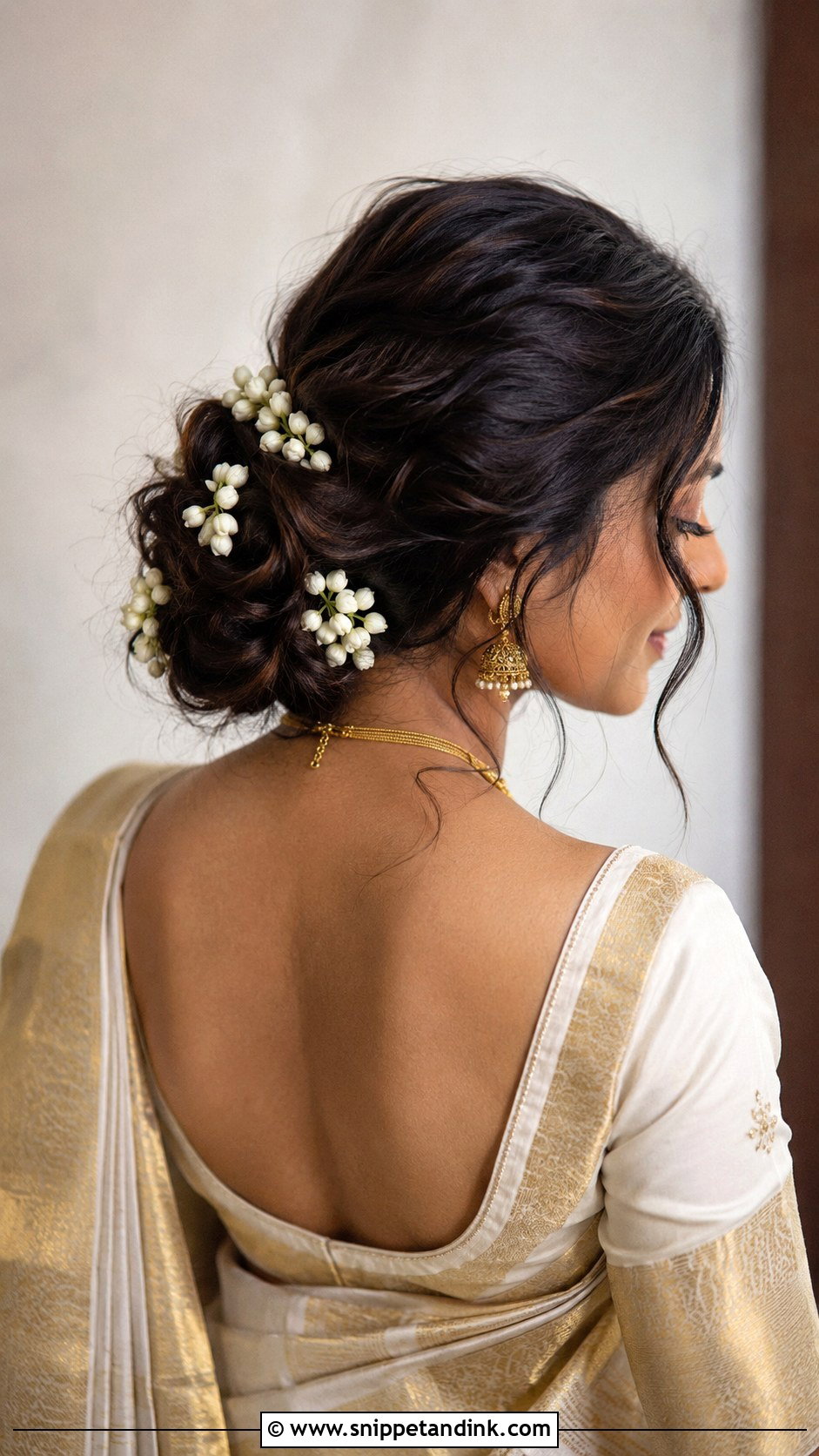
Relaxed at the nape with a few loose tendrils at the face, and jasmine tucked through. Daytime ceremonies and intimate gatherings suit it, with fine jewellery and a softly draped saree. The undone look still needs a solid base. I pin the core firmly first and pull pieces loose afterwards; a bun that is genuinely loose gives up under the weight of fresh flowers by lunchtime.
14. Donut Bun Covered In Jasmine
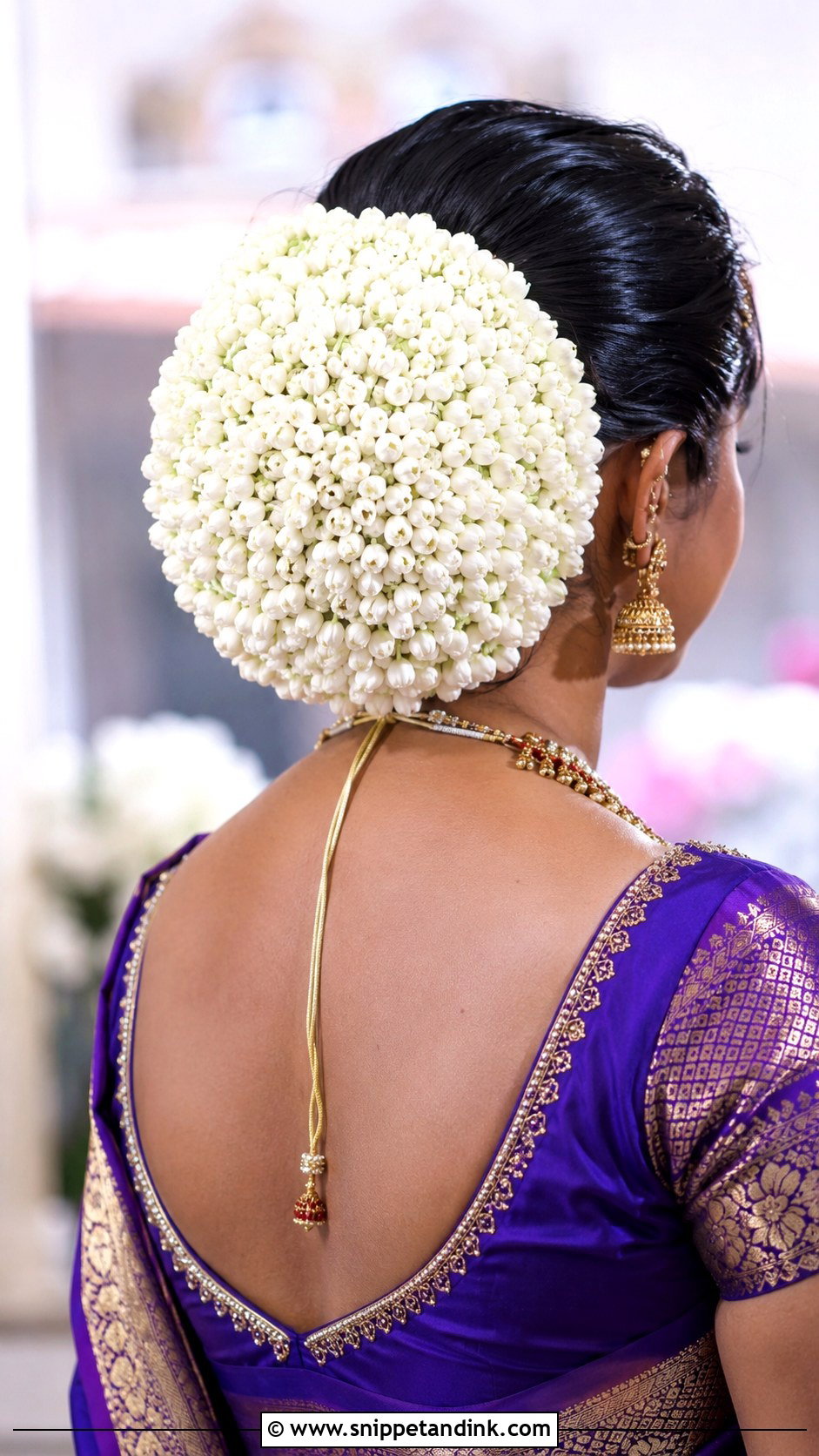
Hair wrapped round a donut base makes a smooth, generous circle that disappears under a full covering of malli poo, leaving a neat dome of flowers at the back. Symmetry is the appeal, and it holds well through long ceremonies with silk and temple jewellery. Choose a donut in your own hair colour. If the jasmine shifts at any point, a dark base hides the gap and a light one shows straight through it.
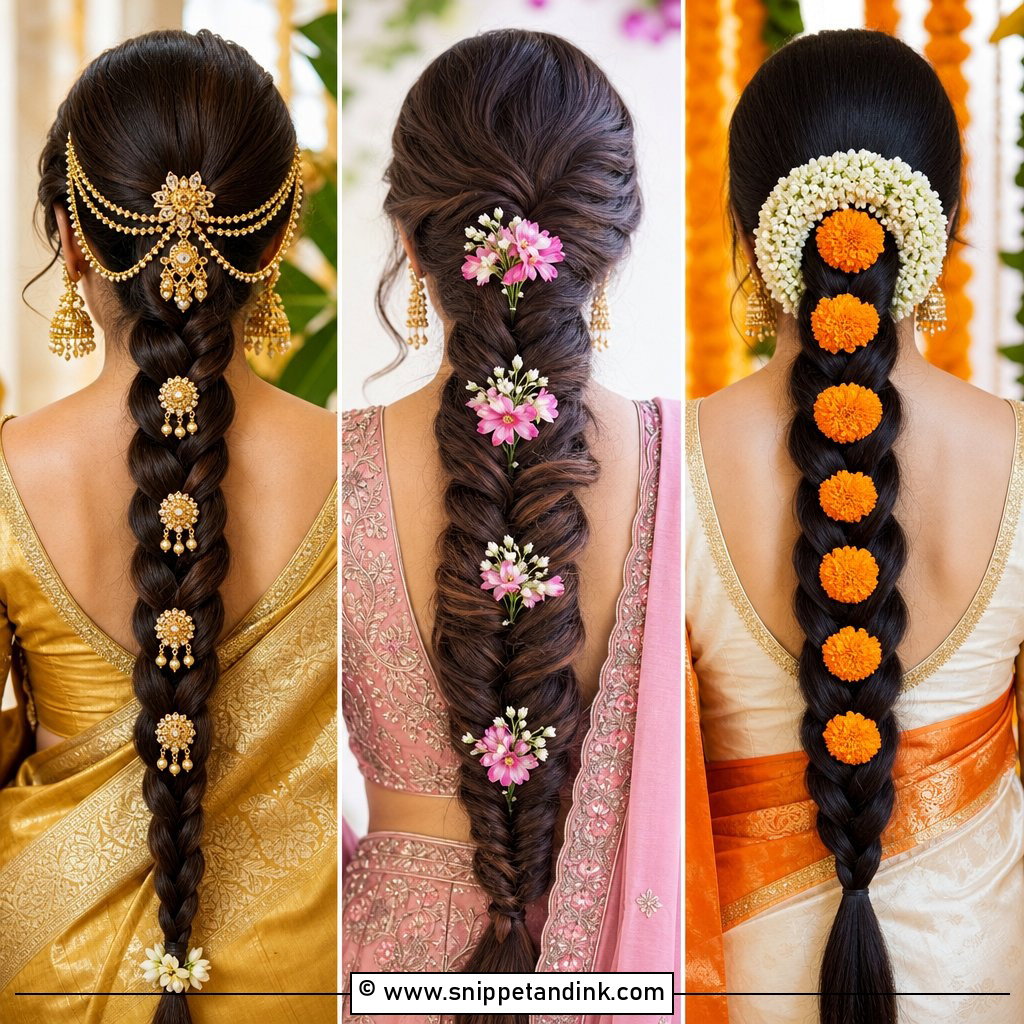

15. Curly Hairstyle With Jasmine Garland
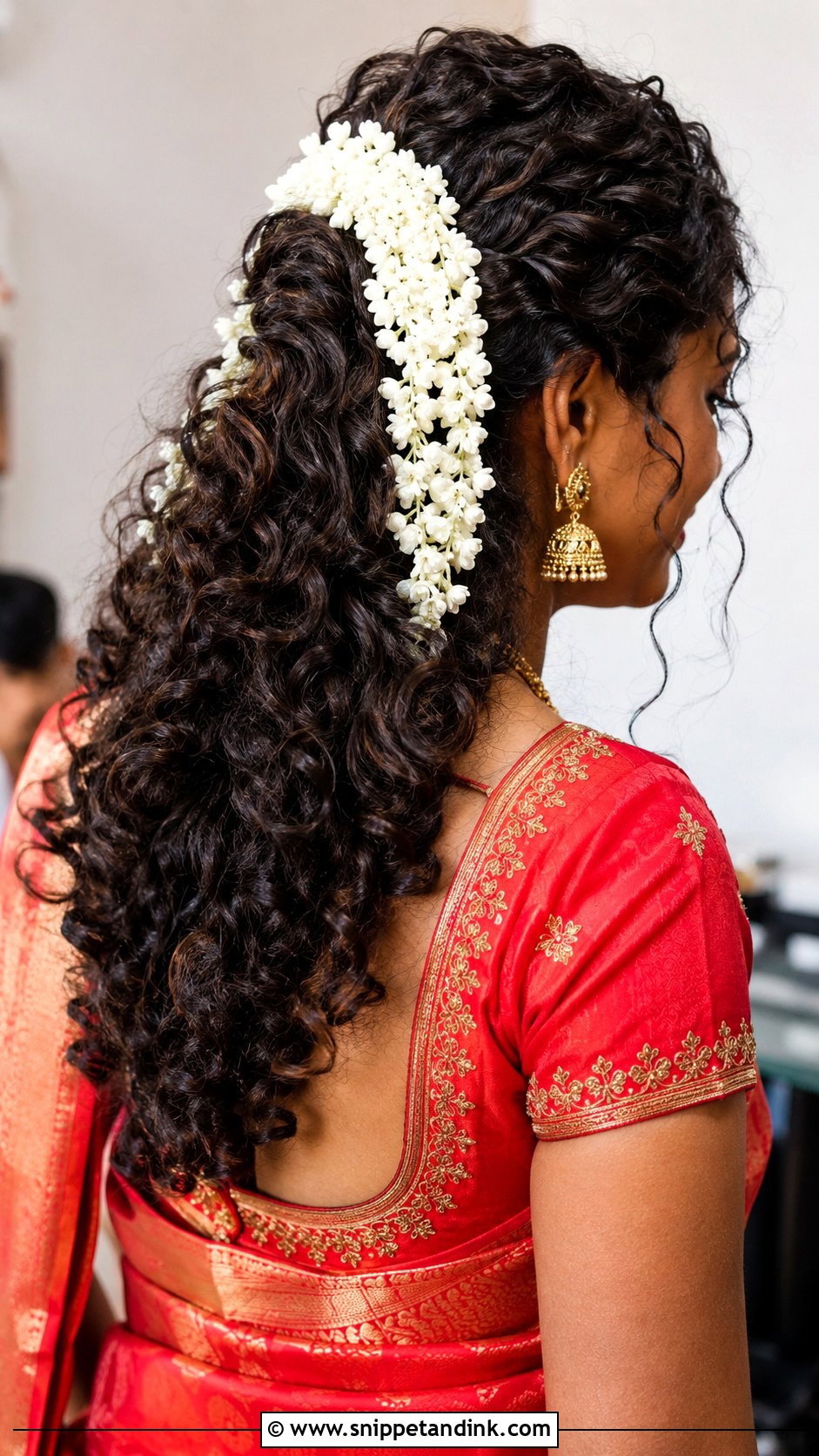
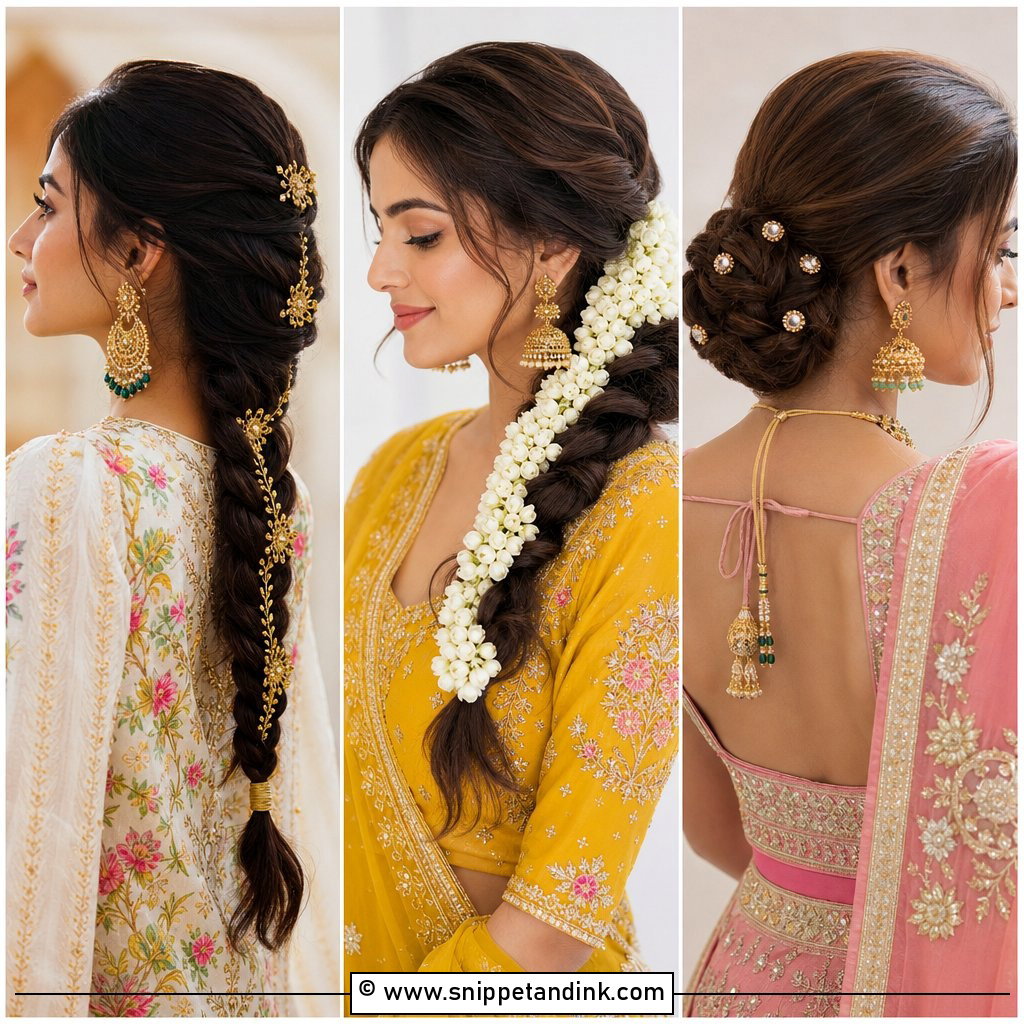
Naturally curly and wavy hair doesn’t need straightening for a jasmine look. Curls gathered loosely, often half-up, with a garland running through the volume. It’s a joyful look with a bright saree and bold earrings. Work with the curl pattern, not against it: I style curly hair while it’s damp with a cream, let it set, and lay the garland on top, pinning only through the gathered section. Brushing dry curls to fit flowers in just makes frizz.
16. Pearl And Jasmine Decorated Braid
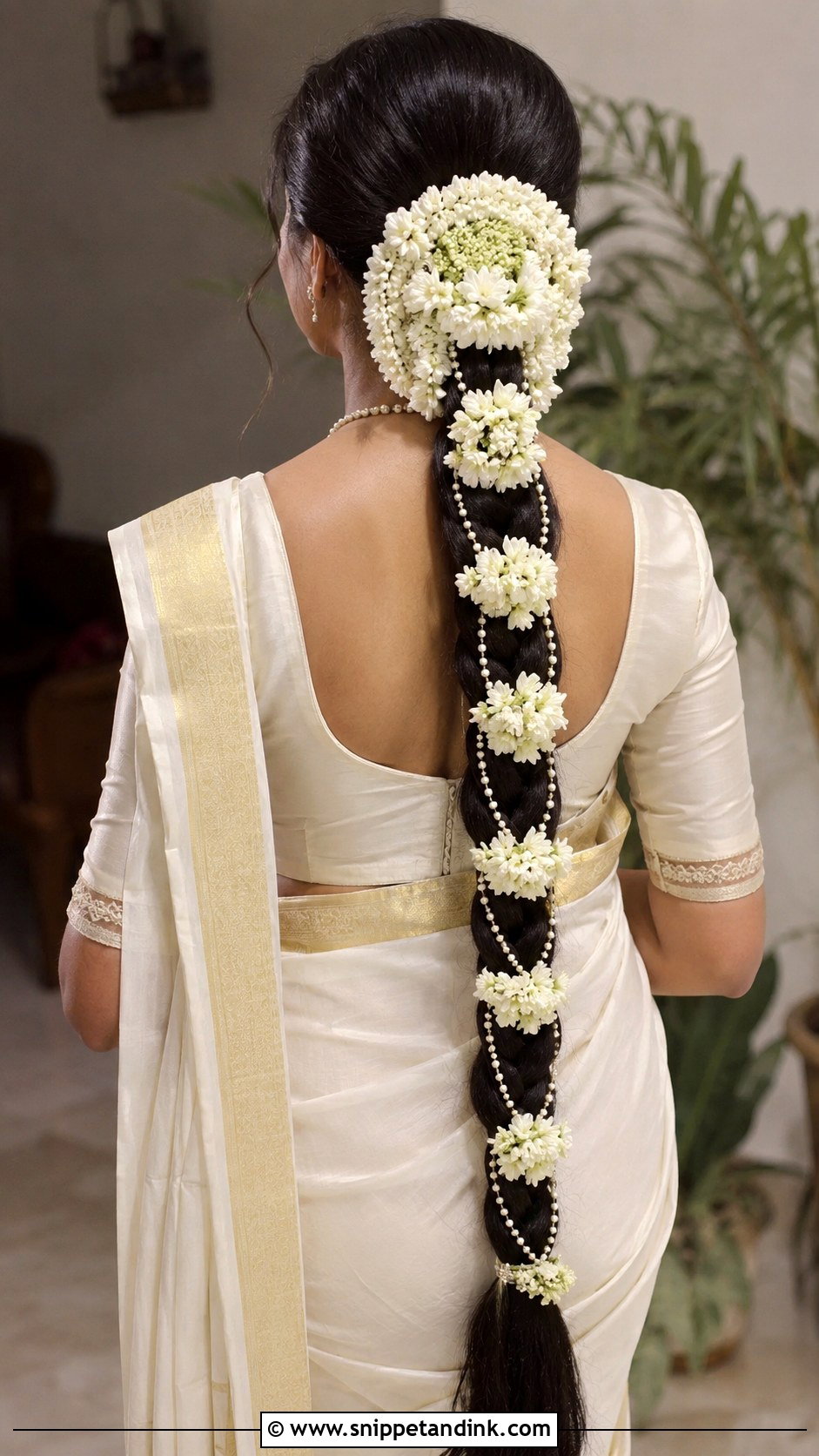
Strings of jasmine run down a long braid with fine pearl strands draped between the blooms, white on white. It suits pastel and cream silk sarees, pearl jewellery and daytime ceremonies. Real pearls and good faux ones are both heavier than jasmine, so I keep them to the upper two thirds of the braid. Too many at the tip make it swing when you walk.
17. Bridal Bun With Jasmine And Kanakambaram
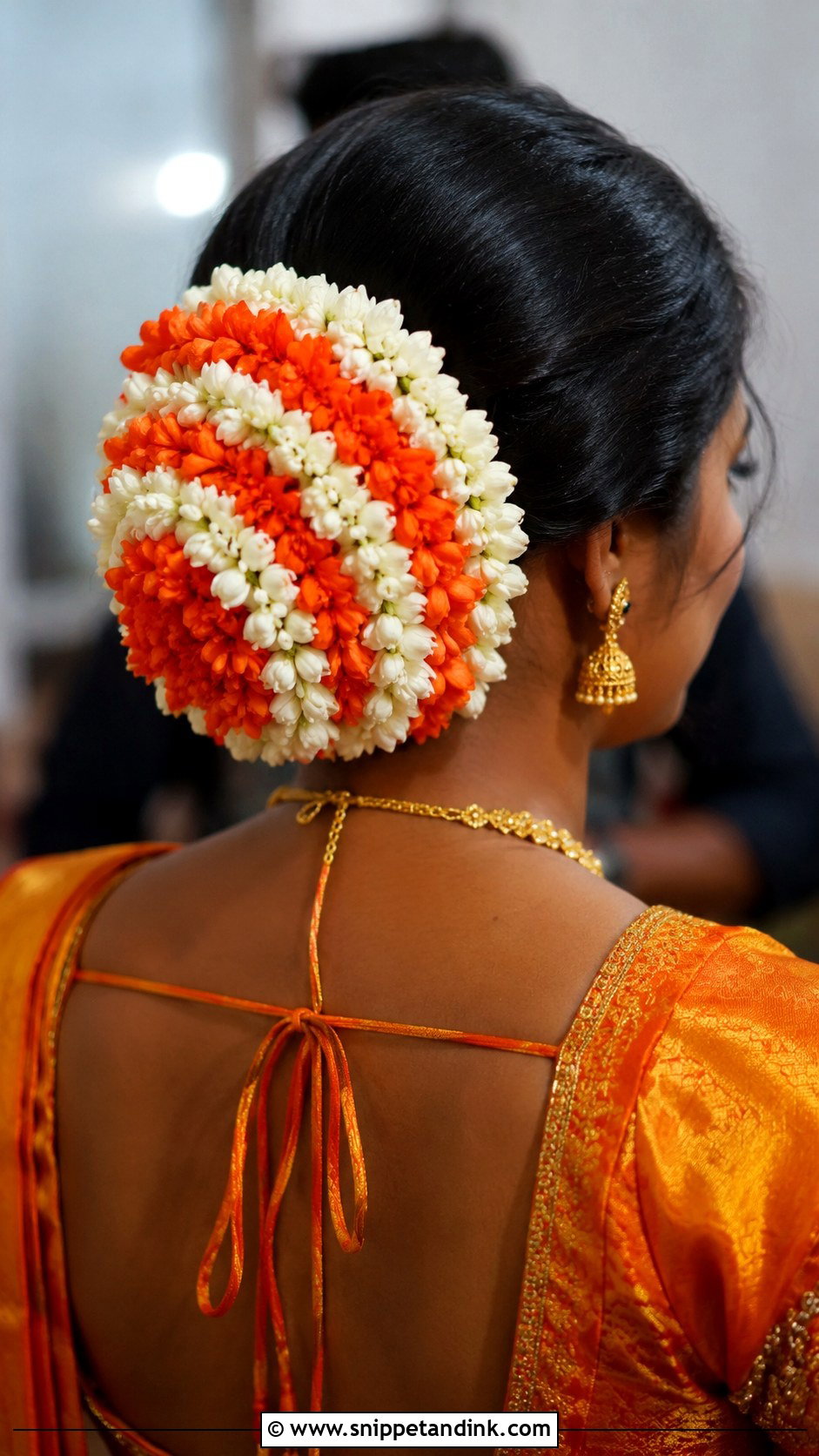
White jasmine and orange kanakambaram in alternating rows is one of the oldest pairings in South Indian bridal hair, and it looks right with a bright Kanjeevaram and gold temple jewellery. Kanakambaram has no real scent, but it keeps its colour and shape far longer than jasmine. That makes the jasmine-kanakambaram bun a practical choice for a hot day: by late afternoon, the orange rows still look crisp even as the white ones soften.
18. Twisted Updo With Jasmine
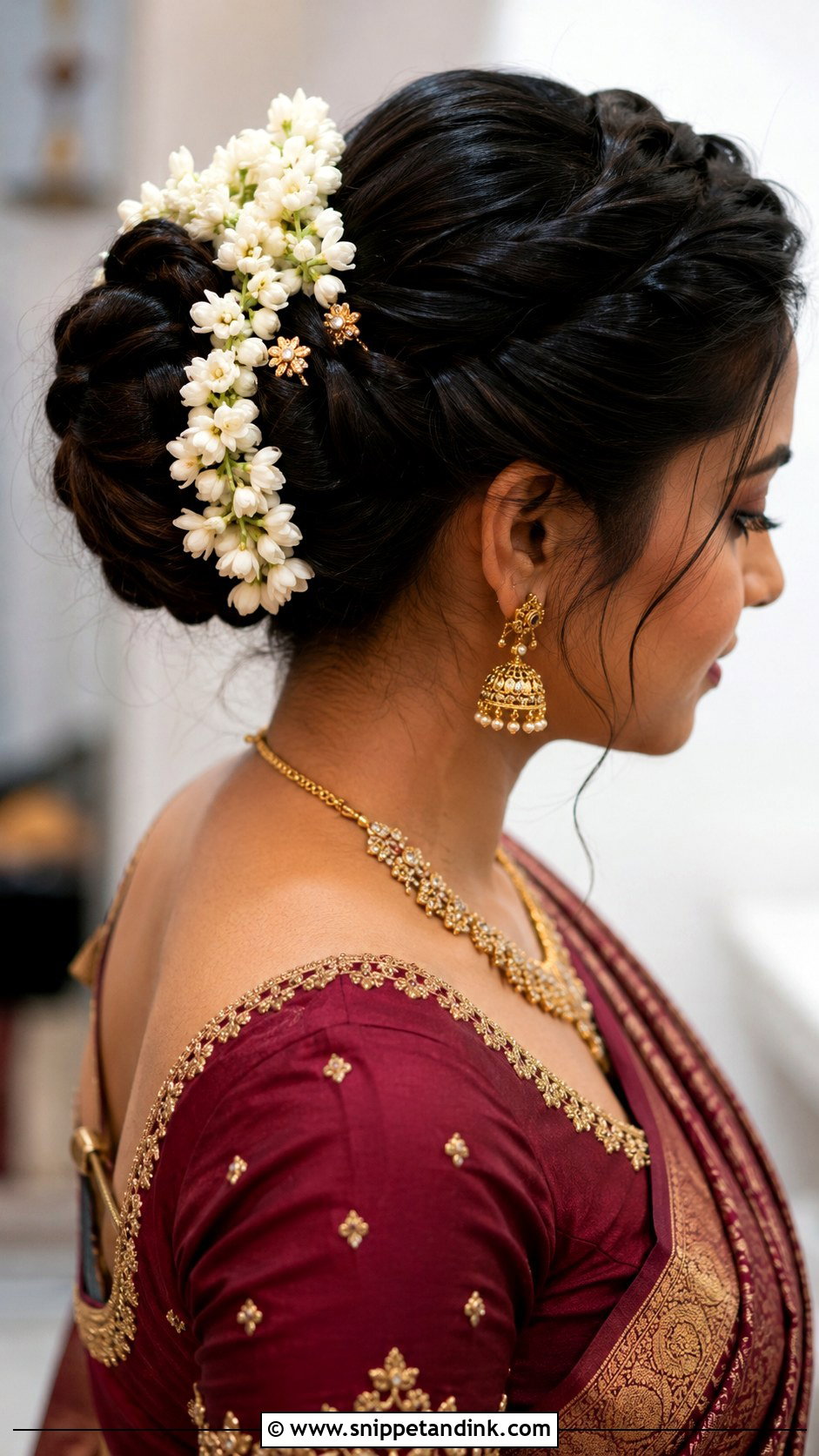
Twisted sections pinned into a sculpted shape, with jasmine set through the twists and a few gold pins. It’s polished but current, suited to receptions with gowns or designer sarees. Twists hold only as well as their pins. I set them in a zig-zag, crossing each other inside the twist, and only then add the jasmine, which would otherwise hide where the pins need to go.
19. Simple Ponytail With Jasmine Wrap
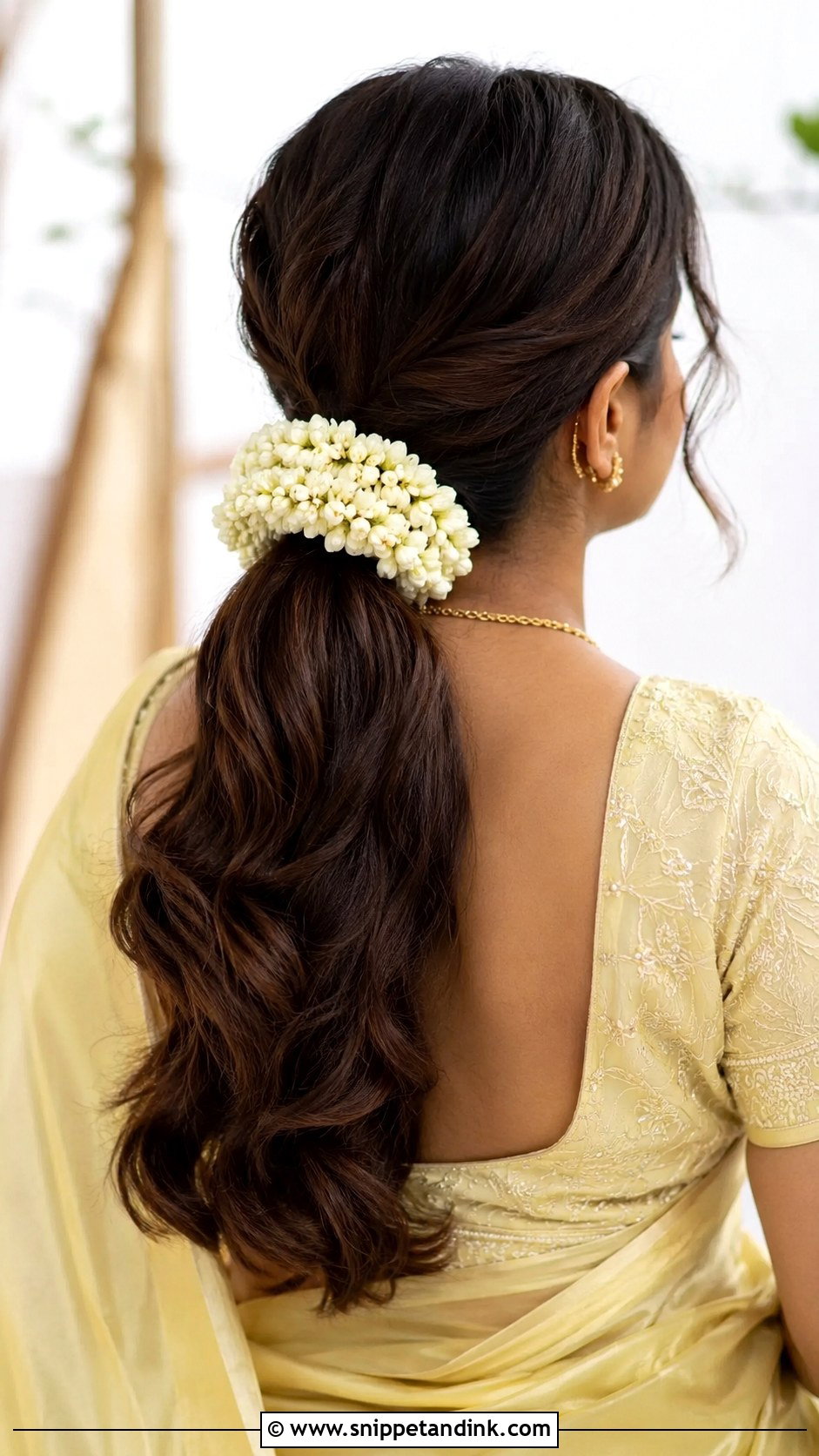
A low or mid ponytail with a jasmine gajra hiding the elastic, and the tail left straight, curled or braided. It’s light and quick, best for engagements, mehndi or a small ceremony with simple jewellery. Ponytails droop as the day wears on. I tease the base slightly and wrap a small piece of hair around the elastic before the gajra goes on, so the flowers sit on hair, not on a slipping band.
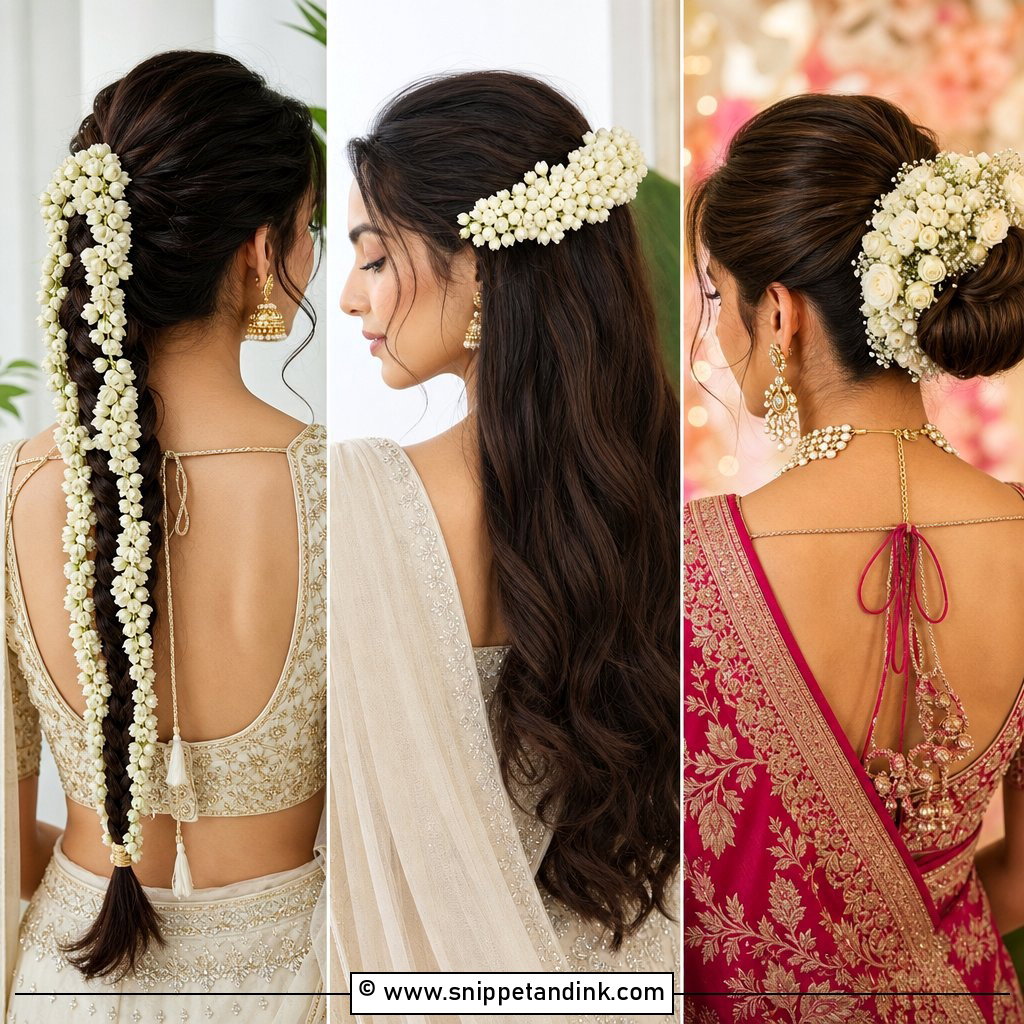
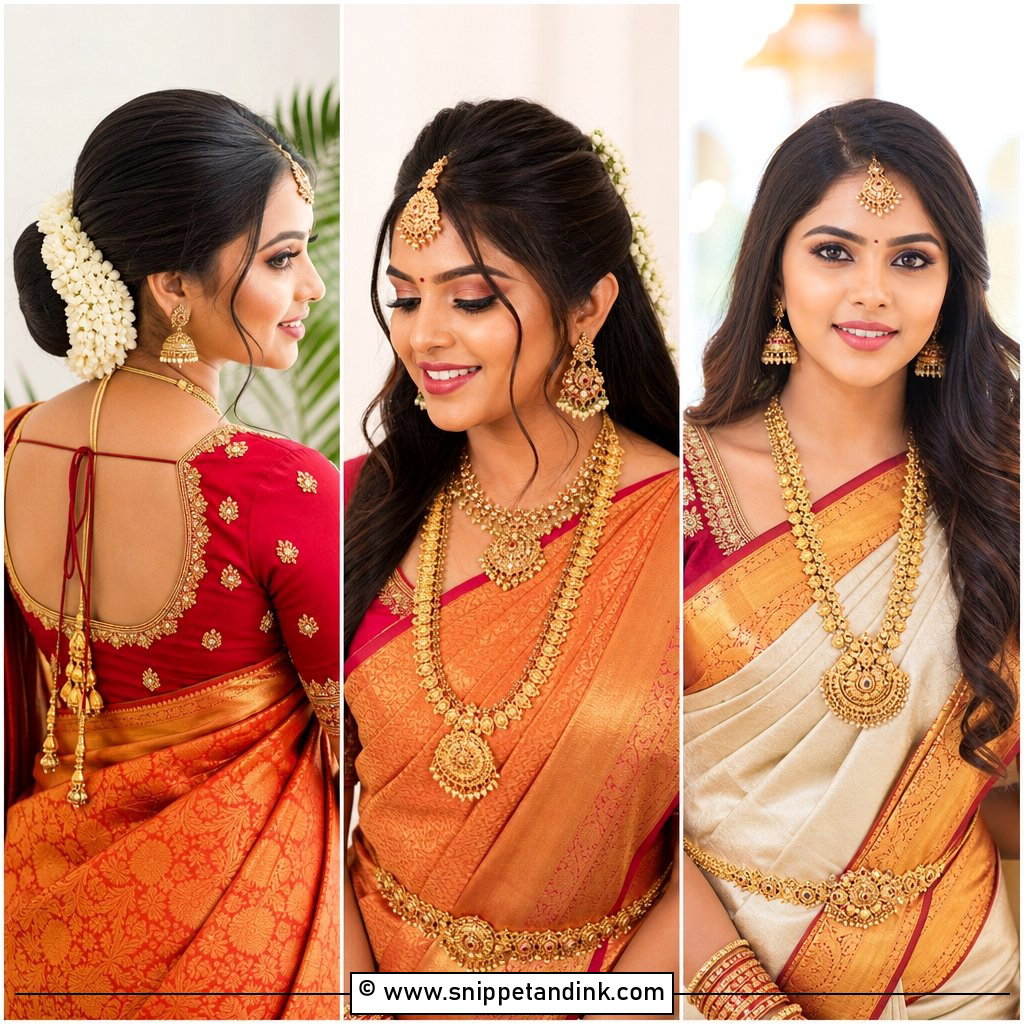
20. Floral Plait With Multiple Flowers
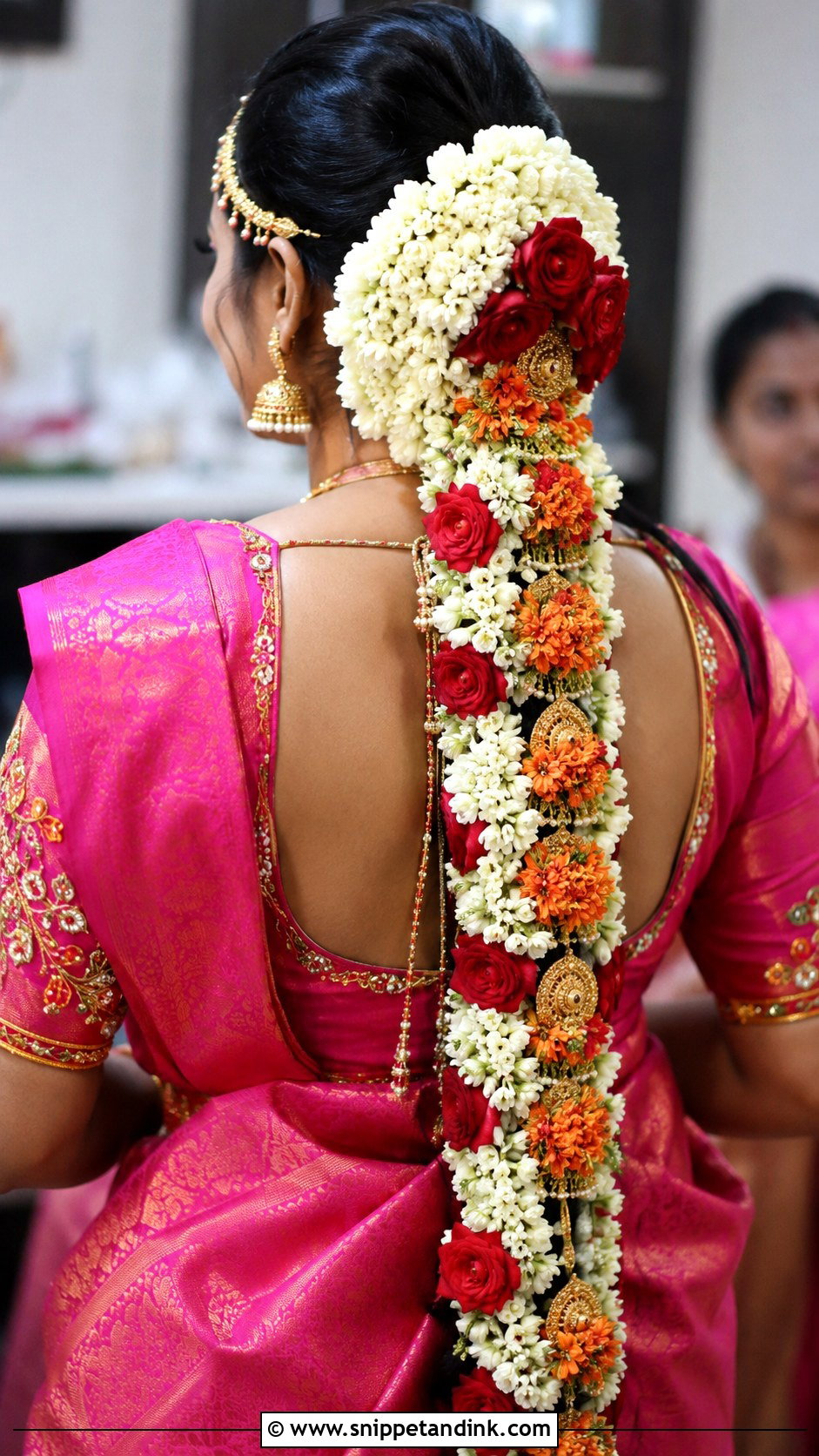
Here jasmine shares a thick braid with roses, marigolds and kanakambaram, from crown to tip, in layered colour and texture. It’s the maximalist option for the wedding day itself, with bright silk sarees and bold traditional jewellery. Mixing flowers means mixing weights and lifespans. Marigolds are bulky, roses bruise and jasmine softens first, so I put the sturdiest blooms at the top where the braid carries the most strain.
Protecting a Silk Saree From Wet Jasmine
Fresh flowers are kept moist, and silk marks easily where water dries on it. That’s a real risk with a long braid lying against a Kanjeevaram pallu all morning. I let the strings drain on a towel before they go in, and I never mist them once the saree is draped. If they look tired, a light mist on the flowers alone, with a hand cupped behind them, does the job.
- Put flowers on after any hair oil or serum has had time to absorb, so oil doesn’t wick into the fabric.
- A thin, clean muslin cloth tucked under the base of the braid during waiting time protects the blouse.
- Check the back of the blouse before photos. Pollen and crushed petals show on dark silk.
- If water does mark the silk, let it dry naturally and leave cleaning to a specialist; rubbing spreads it.
Jasmine Is the Constant; the Shape Around It Is Yours
Every style here is built around the same flower, and what changes is the structure underneath it: a firm braid, a well-pinned bun, a hidden anchor in open hair. Start with your hair’s length and texture, then your ceremony, then your saree and jewellery. Do your trial with real malli poo rather than a stand-in, wear it for a couple of hours, and notice how the scent and weight feel. That’s the version of the look you’ll actually wear on the day.
You'll Like These Ideas:






Leave a Reply