
A good South Indian bridal style looks just as neat in the last family blessing as in the first ceremony photo, and that’s harder than it sounds with flowers, gold and a heavy silk all pulling on the hair. Glossy centre partings, fresh jasmine, long decorated braids and temple jewellery are the classic ingredients. Which combination suits you depends on your saree drape, the weight of your jewellery, the ceremony time and how much you can comfortably wear. Below are twenty styles from Kerala, Tamil and Telugu traditions and from modern reception dressing, each with the practical notes I’d give a bride at her consultation.
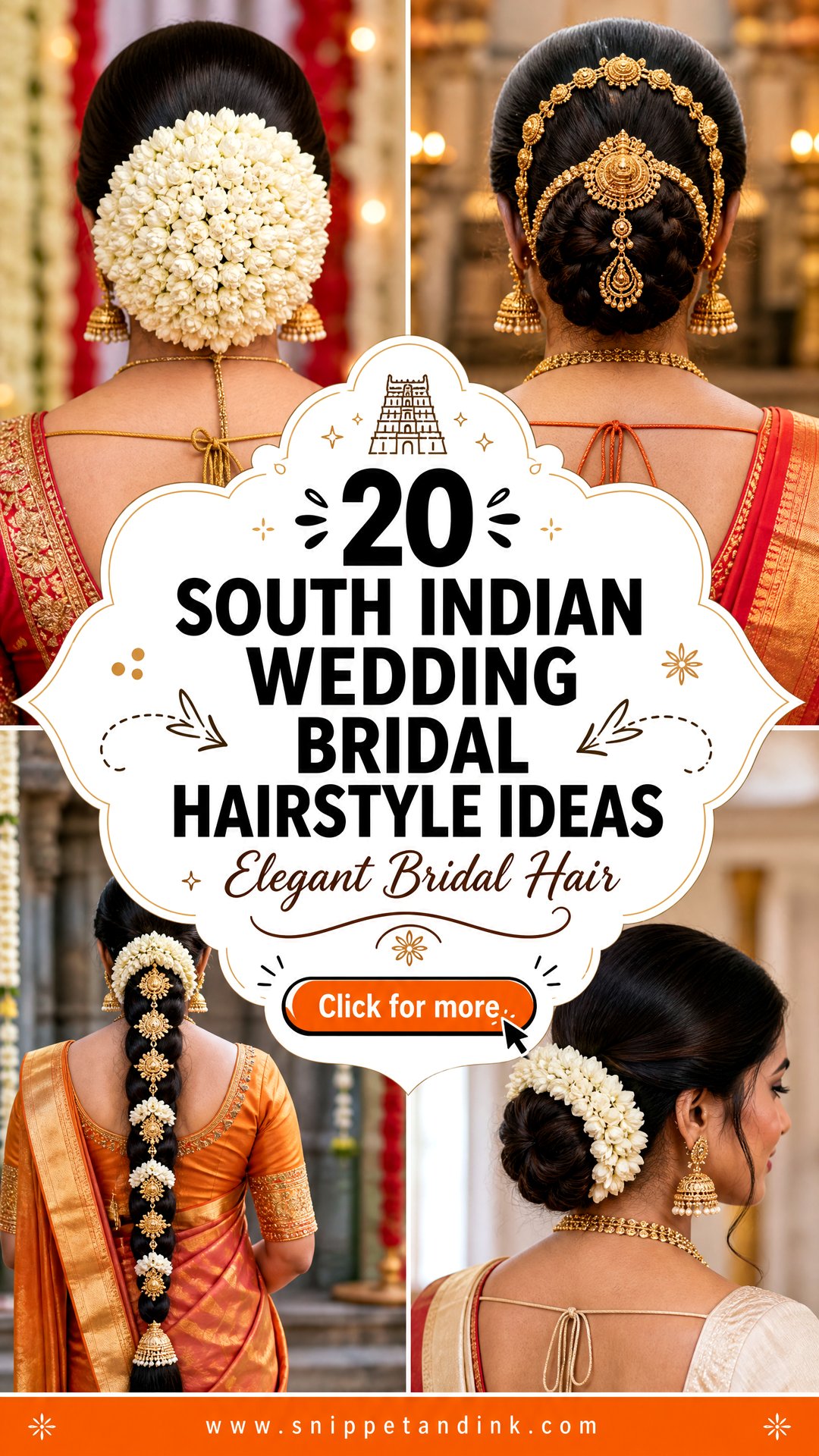
Kerala, Tamil and Telugu Brides Start From Different Places
South Indian bridal hair isn’t one tradition. The styles below come from several, and knowing which one your family expects saves a lot of back and forth at the consultation.
- Kerala Hindu weddings often lean minimal: a low bun or simple braid, plenty of jasmine, gold jewellery and a kasavu saree. Less ornament in the hair, more attention on the face.
- Tamil brides frequently wear a long braid or kondai with jasmine and jada pieces, matched to a Kanjivaram and full temple jewellery.
- Telugu weddings are where the poola jada is most often the centrepiece, with colourful flower panels and a decorated tassel.
These are tendencies, not rules. Families mix them, and plenty of brides wear one tradition’s look at the ceremony and another’s at the reception. I ask early which elders will be at the main ritual and what they’d expect to see, because that often settles the morning style before we even look at photos.
Bring the jewellery list to that conversation too. A full set of jada billalu, a rakodi and a nethichutti each need their own anchor points, and I plan the braid or bun around where those pieces will sit.
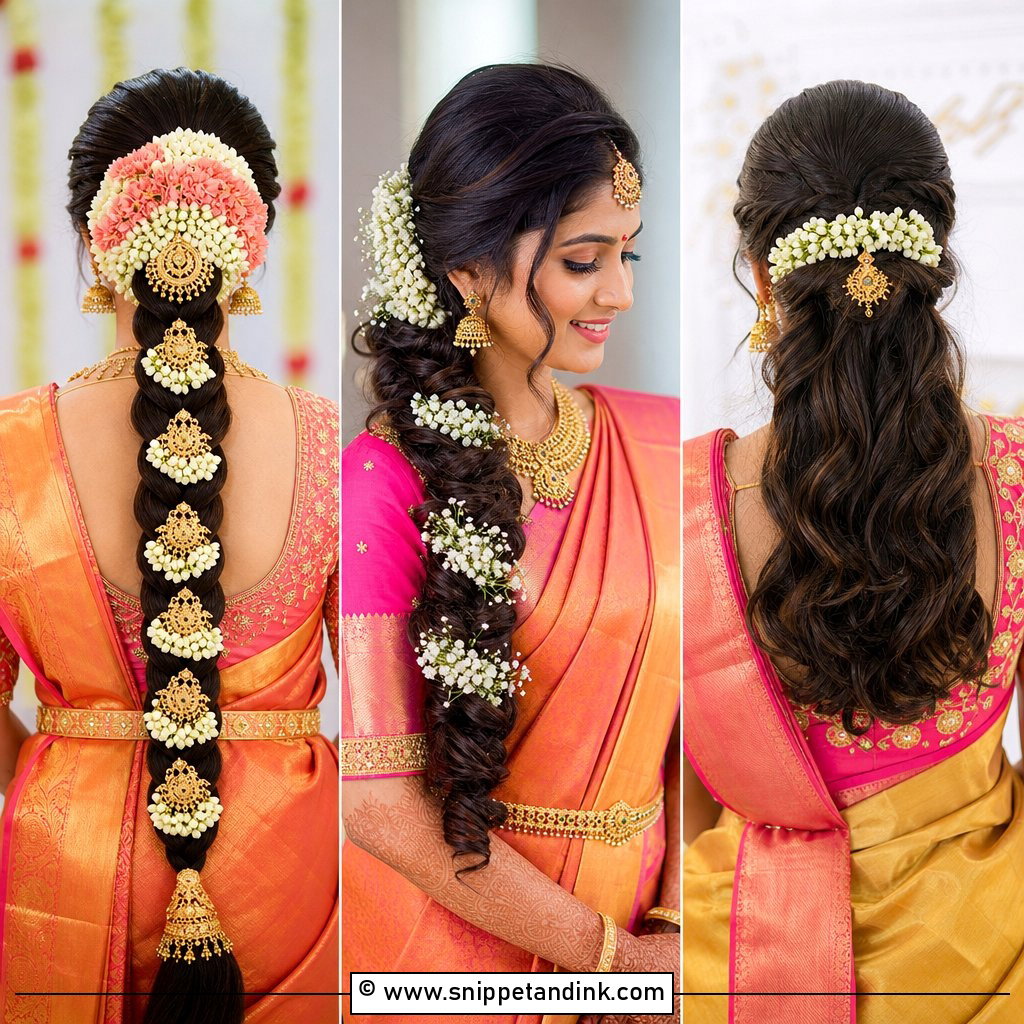
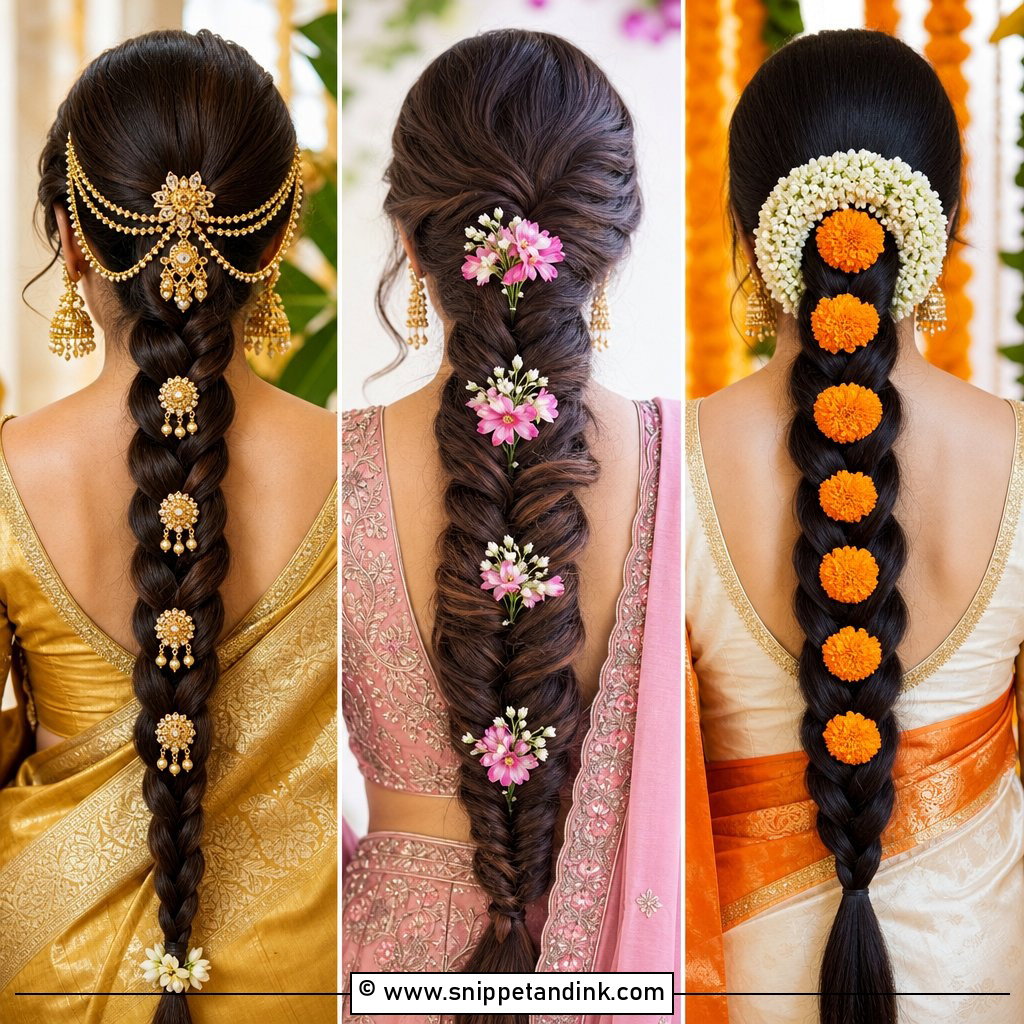
1. Classic South Indian Bridal Braid
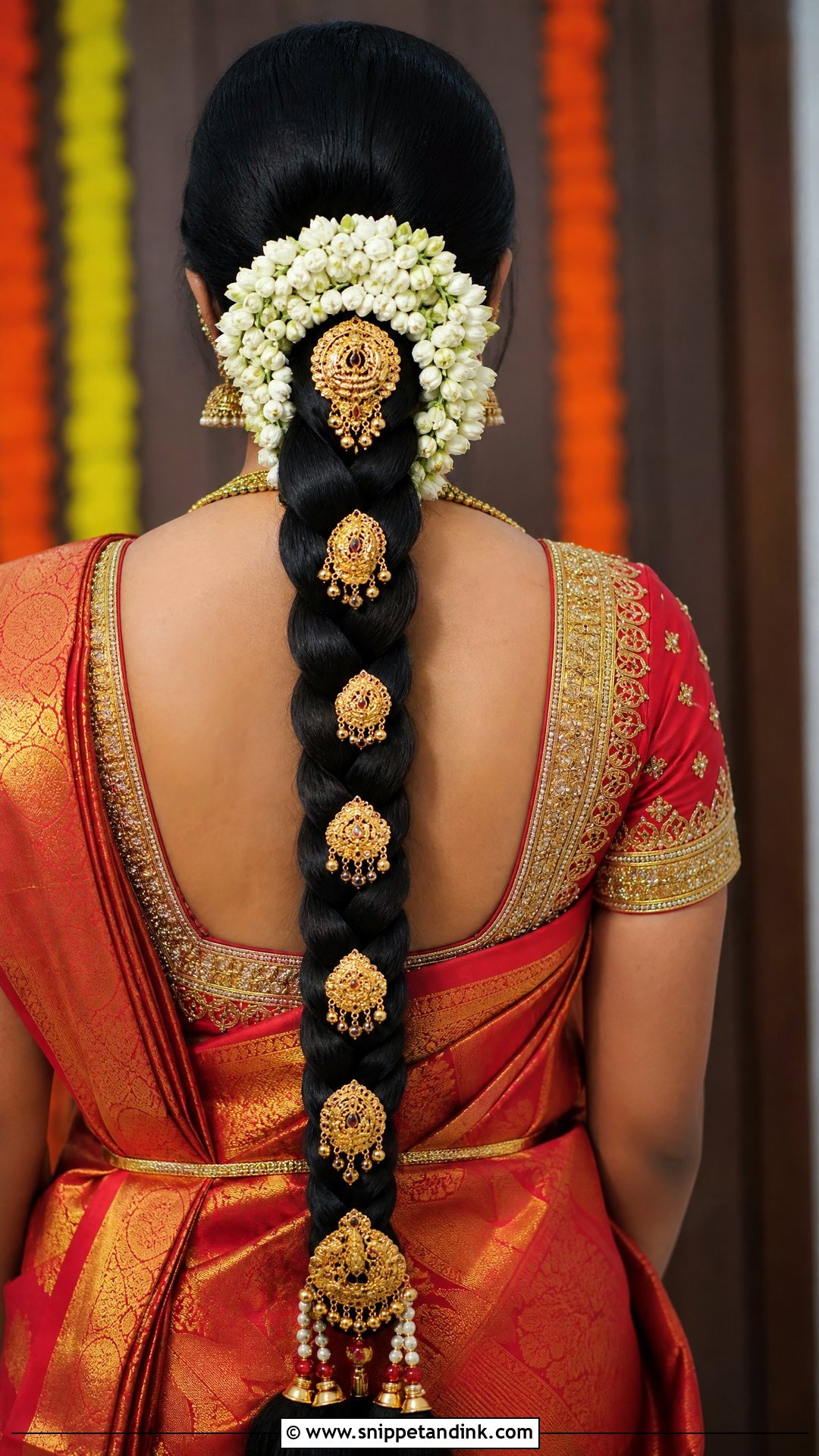
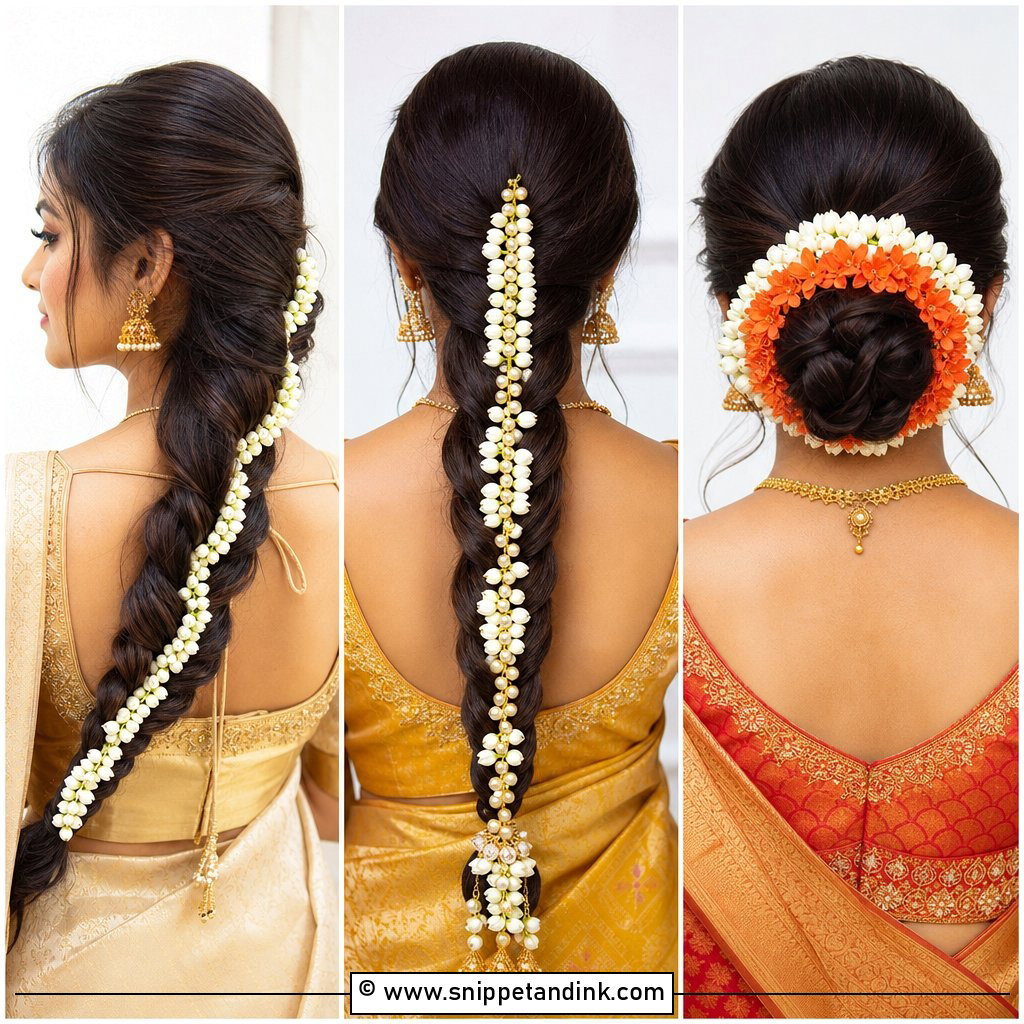
Centre parting, smooth crown, one long thick plait, finished with jasmine, gold jada pieces or fine pins from top to bottom. It keeps the neckline clear for layered harams and sits right with a heavy Kanjivaram and temple jewellery. Shorter hair can wear it with a clip-in braid. I join the extension a few inches below the nape and braid the bride’s own hair into it, so the transition hides inside the plait and the braid moves as one piece.
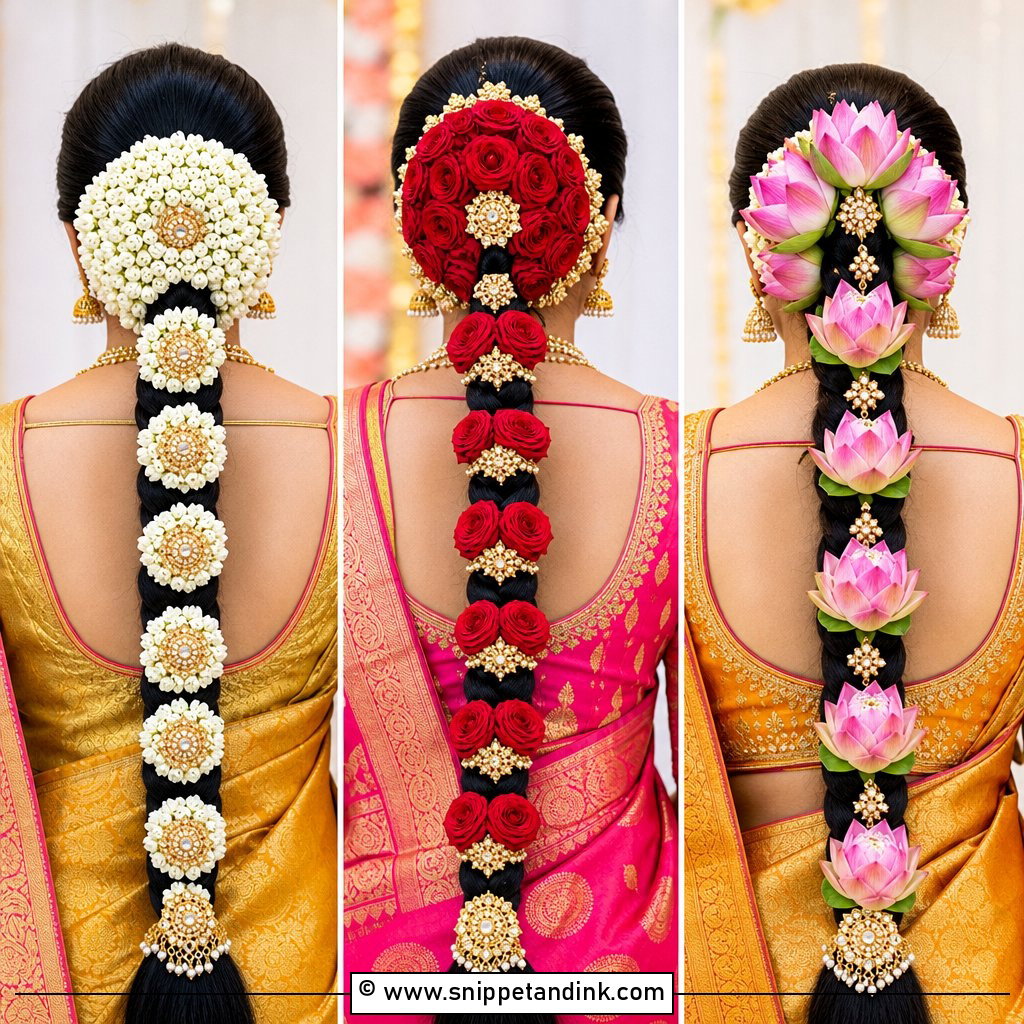
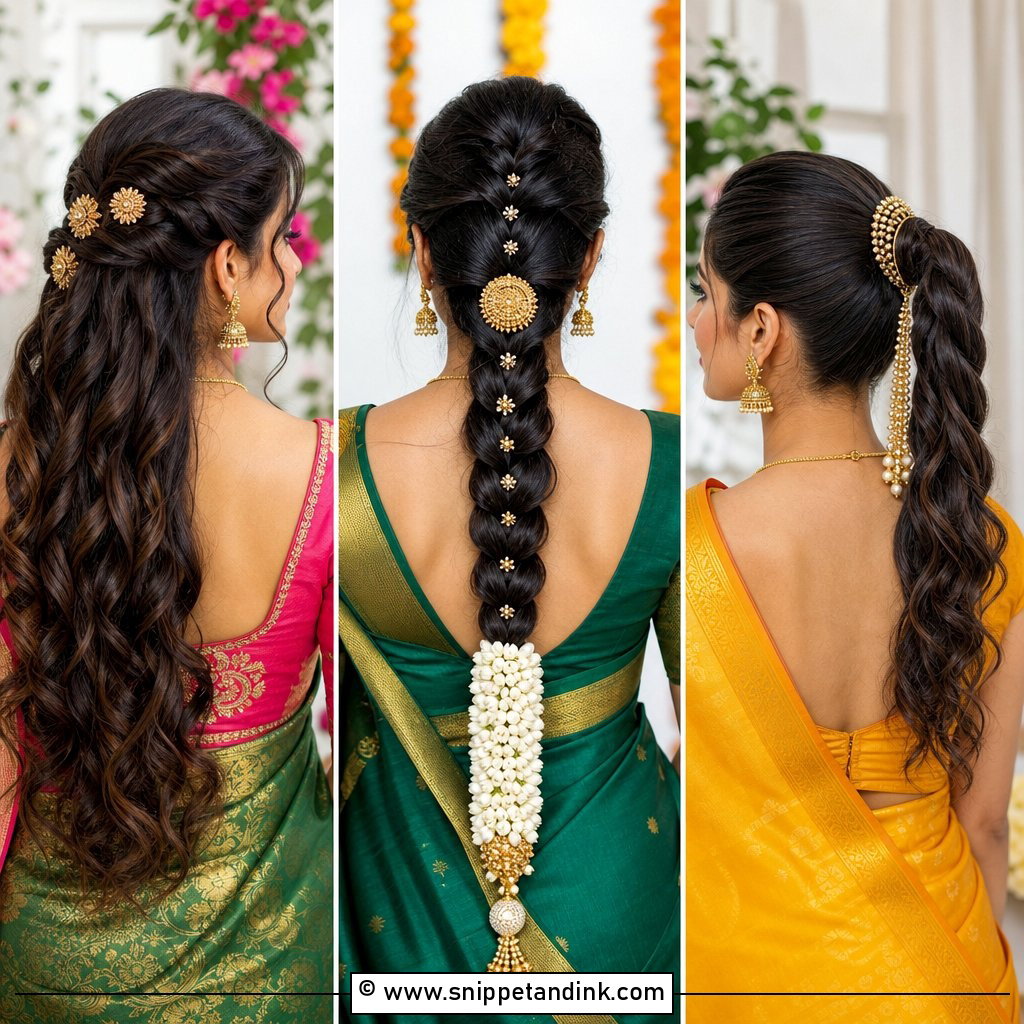
2. Poola Jada Bridal Hairstyle
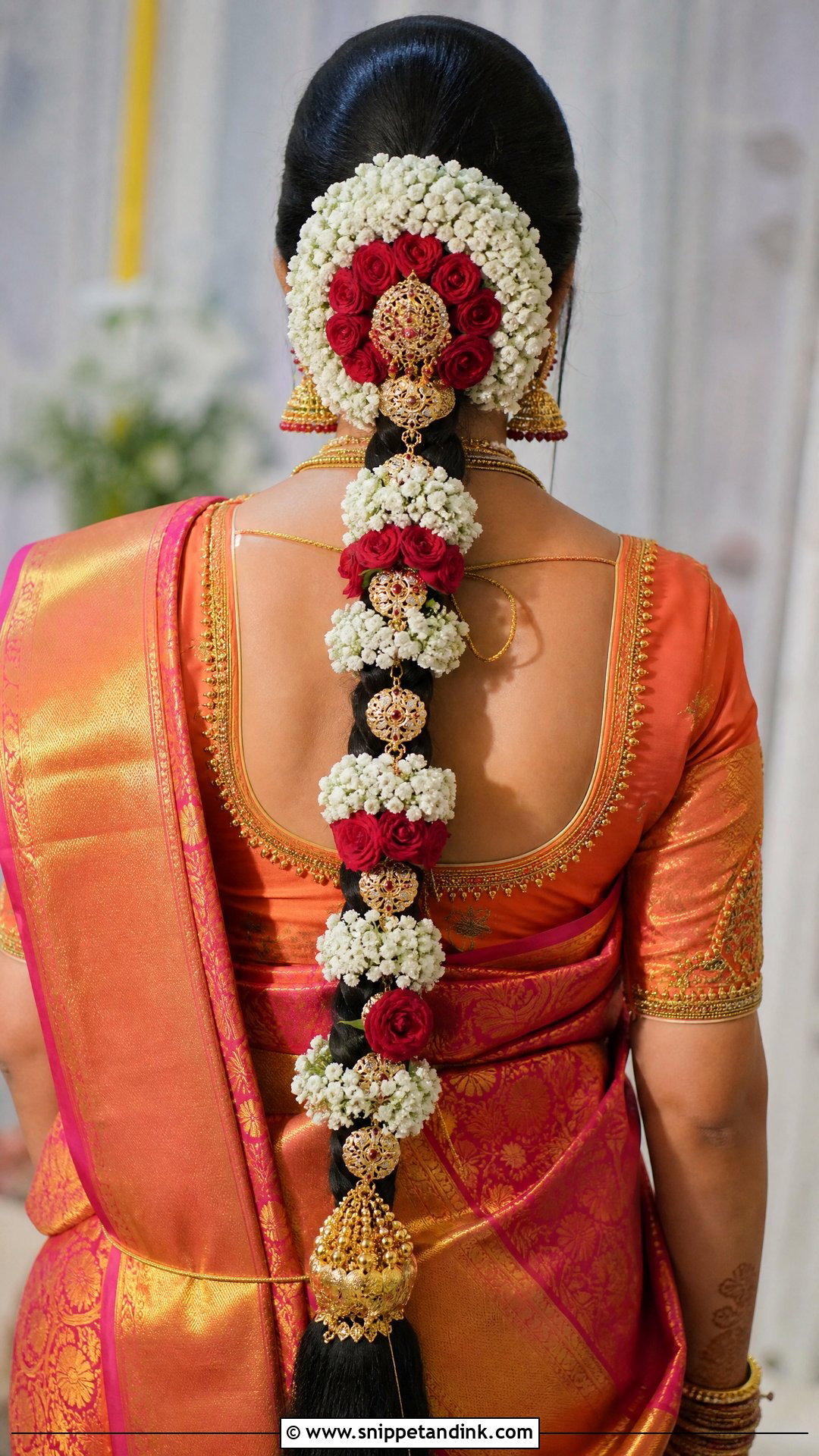
The Poola Jada bridal hairstyle turns the braid into a floral panel of jasmine, roses, orchids or a custom design, and it’s especially associated with Telugu and Tamil weddings, where so much of the ritual is seen from behind. You can match the flowers to the saree border. The comfort issue is weight distribution. Ask for the strings or panel to be fixed at several points along the braid, not hung from the top, or it drags steadily on the crown through every ritual.
3. Jasmine Flower Bridal Bun
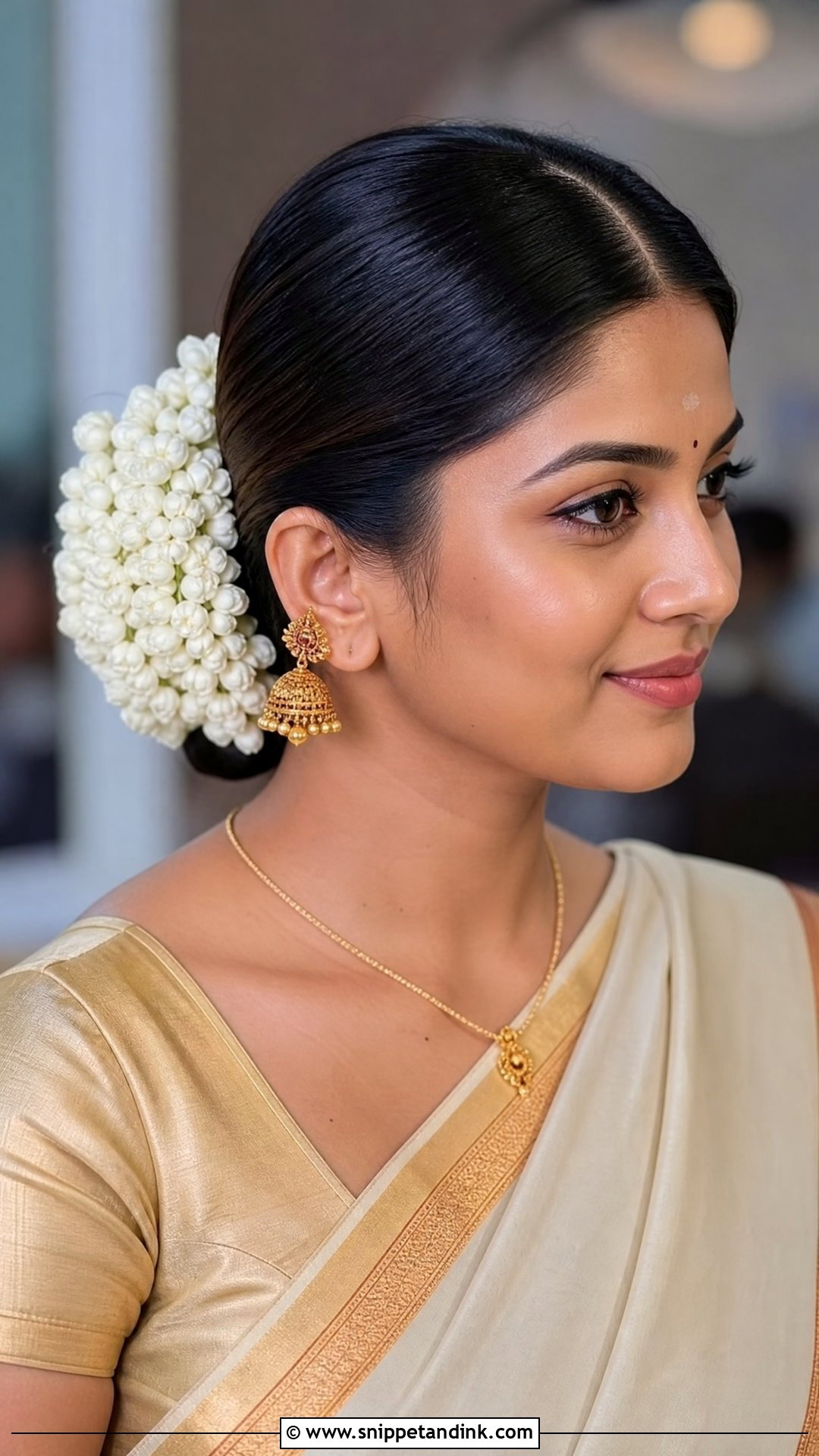
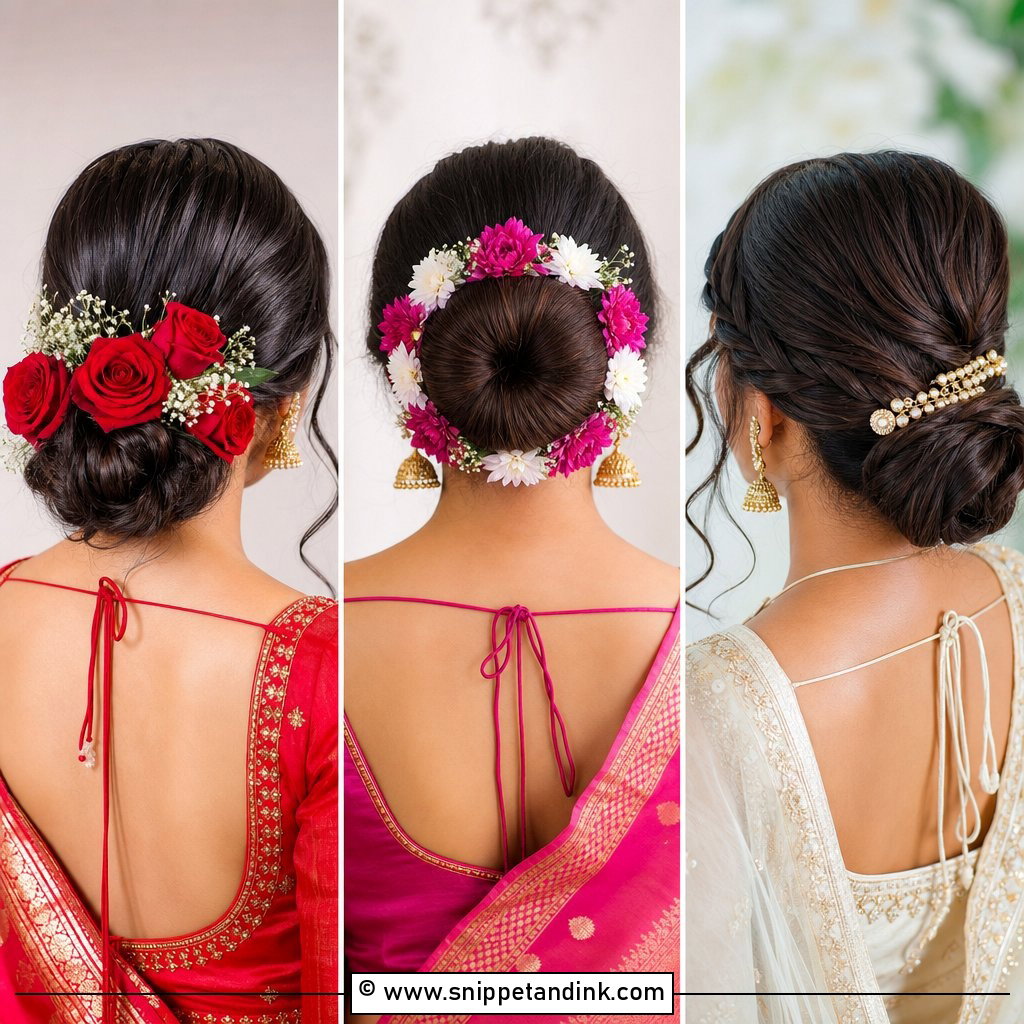
A clean centre part, a smooth low or mid bun and fresh jasmine wrapped around the base: this is the traditional option without a long braid. It stays compact under a dupatta or veil and leaves earrings, chokers and layered necklaces in clear view. A touch of height at the crown softens it. I’d say yes to this for anyone whose hair sits at shoulder length, as a filler makes a full bun easily and the jasmine hides the edges.
4. Temple Jewelry Bridal Bun
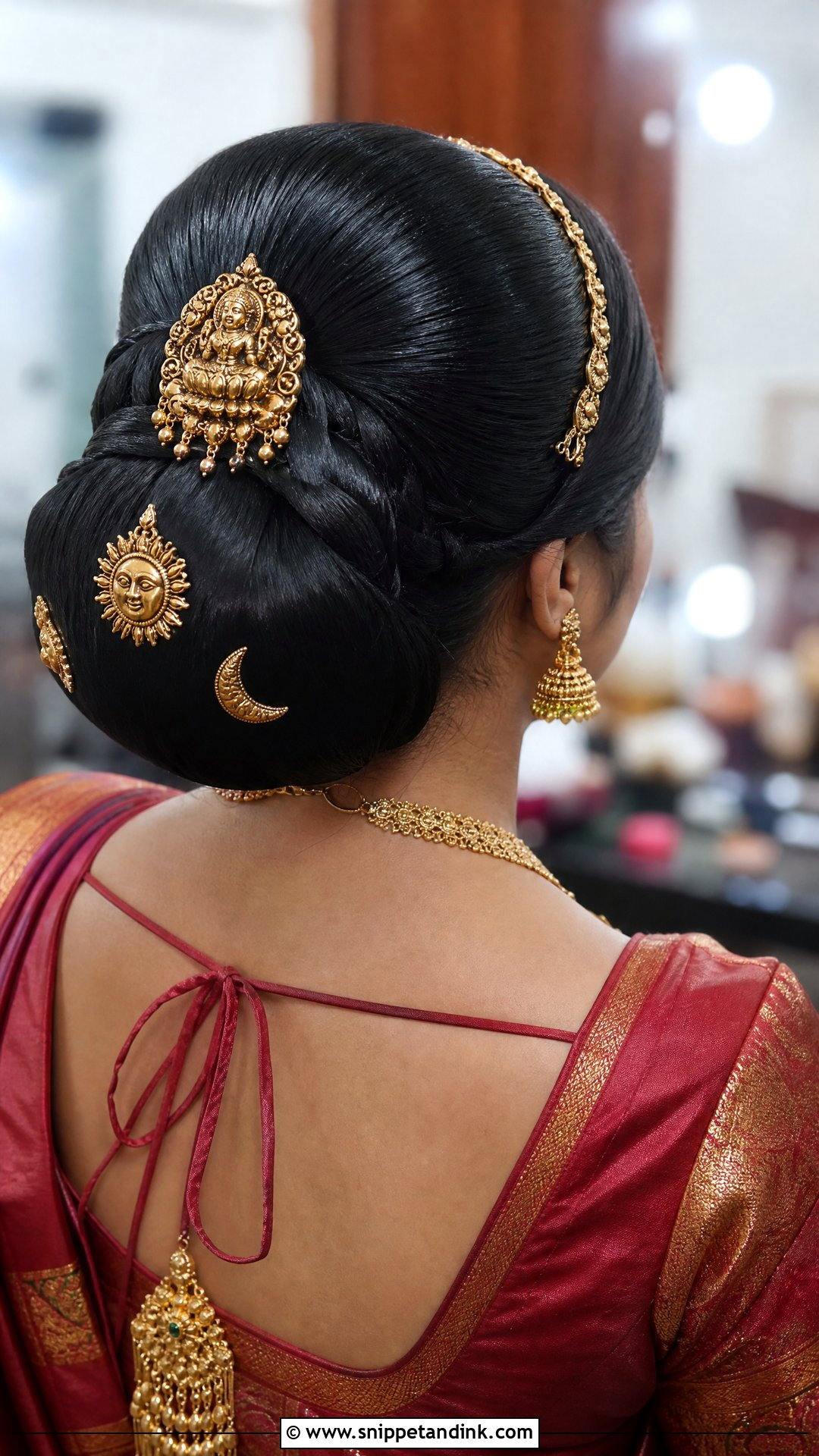
Sleek at the front and rounded at the back, the temple jewellery bun becomes a frame for gold: pins with Lakshmi motifs, antique combs, sun and moon pieces set around it. With kasu malas, vanki armlets and an oddiyanam, it reads as fully ceremonial, and it keeps a detailed blouse back on show. Antique combs need hair to bite into. I backcomb the bun lightly where each comb goes, otherwise heavy pieces slide down a sleek surface. Keep the makeup balanced so the gold leads.
5. Long Braid With Jada Billalu
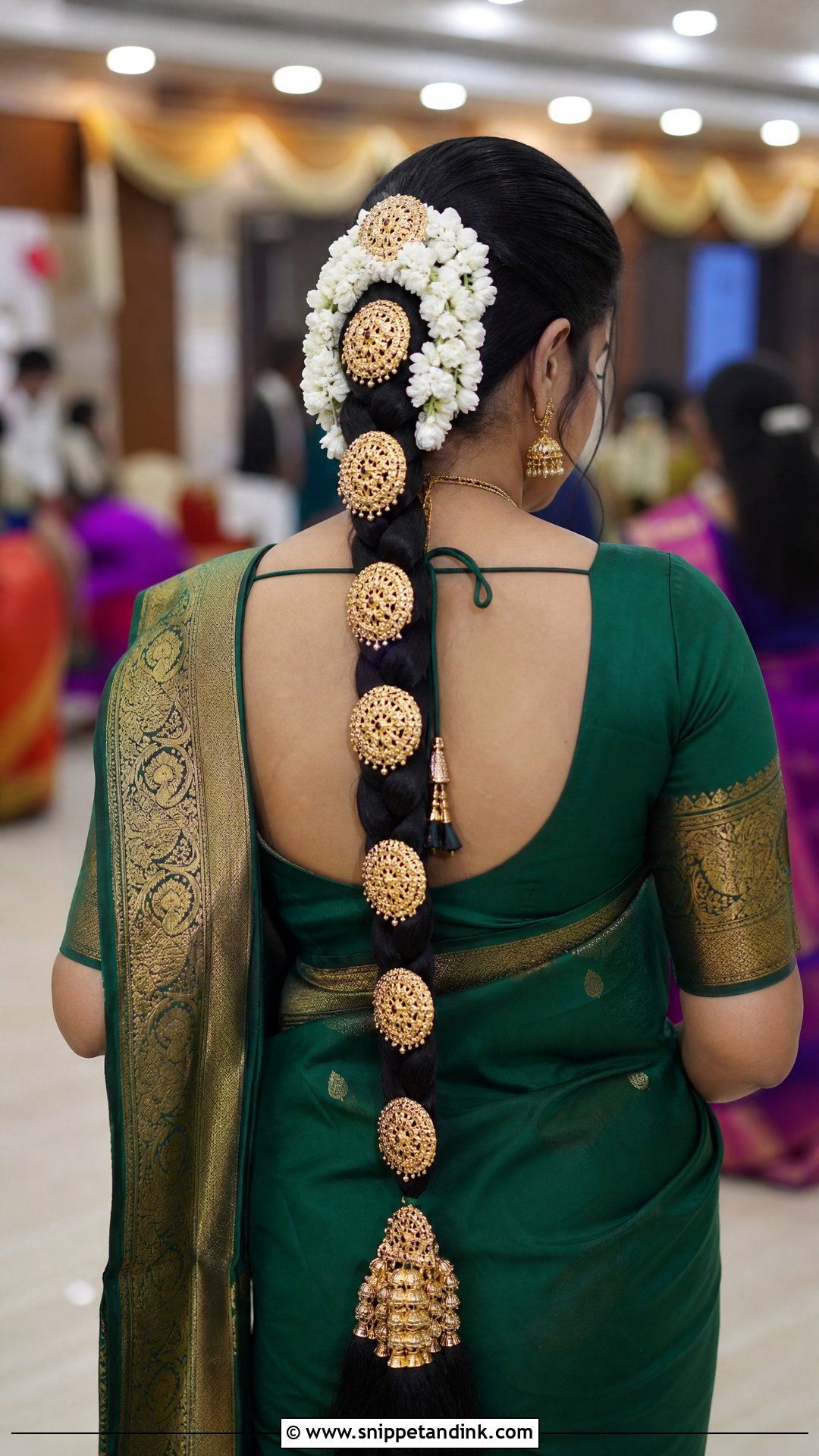
A long braid with jada billalu gives a strong, rhythmic line of ornaments down the back, in gold, pearl or antique finish, finishing in a kunjalam or flower tassel. It belongs at temple weddings and morning ceremonies, and back-view portraits are where it shows best. The braid needs to be full and smooth for the pieces to sit evenly, so extensions are common. I fix the billalu from the top down, checking each against the one above, because a single piece set crooked catches the eye in every photo.
6. Bridal Bun With Gajra
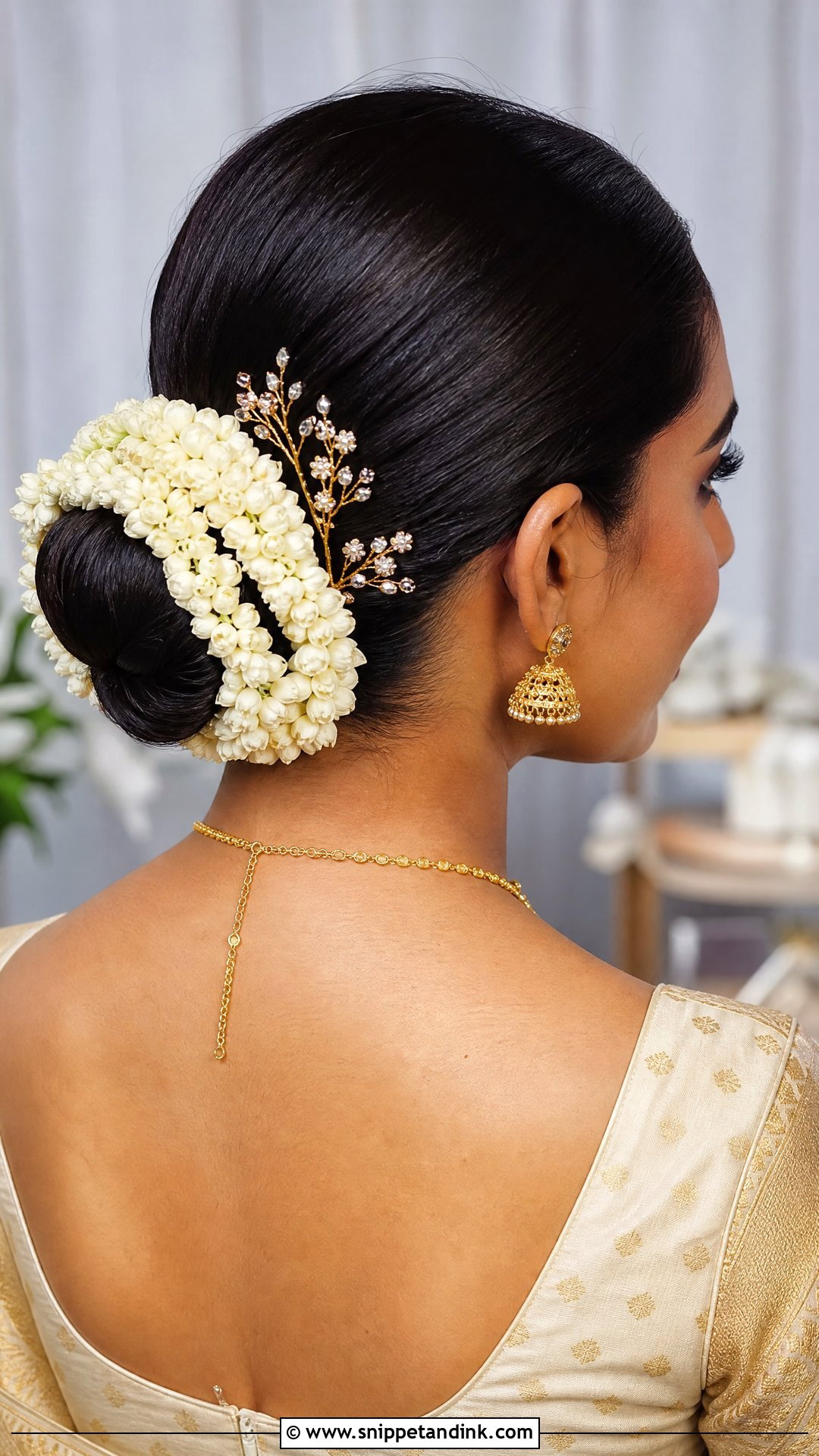
A low, side or rounded back bun with one or more rings of fresh jasmine is the easiest look to personalise. It suits pre-wedding functions, intimate ceremonies and brides who don’t want much weight on their heads. A sleek middle part keeps it traditional; soft face-framing pieces make it more modern. Gajra rings slide if they’re held by one pin, so I fix each ring at three or four points around the bun, especially when rituals run for hours.
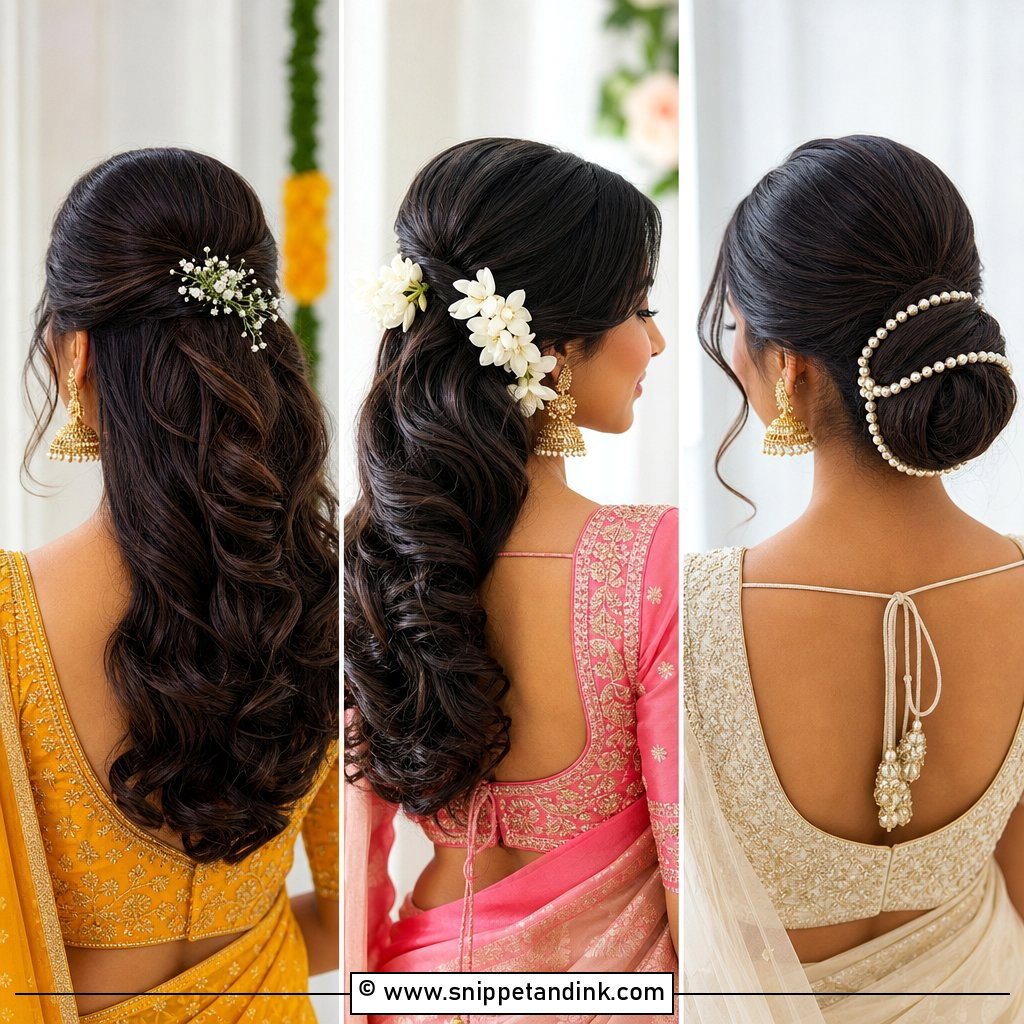
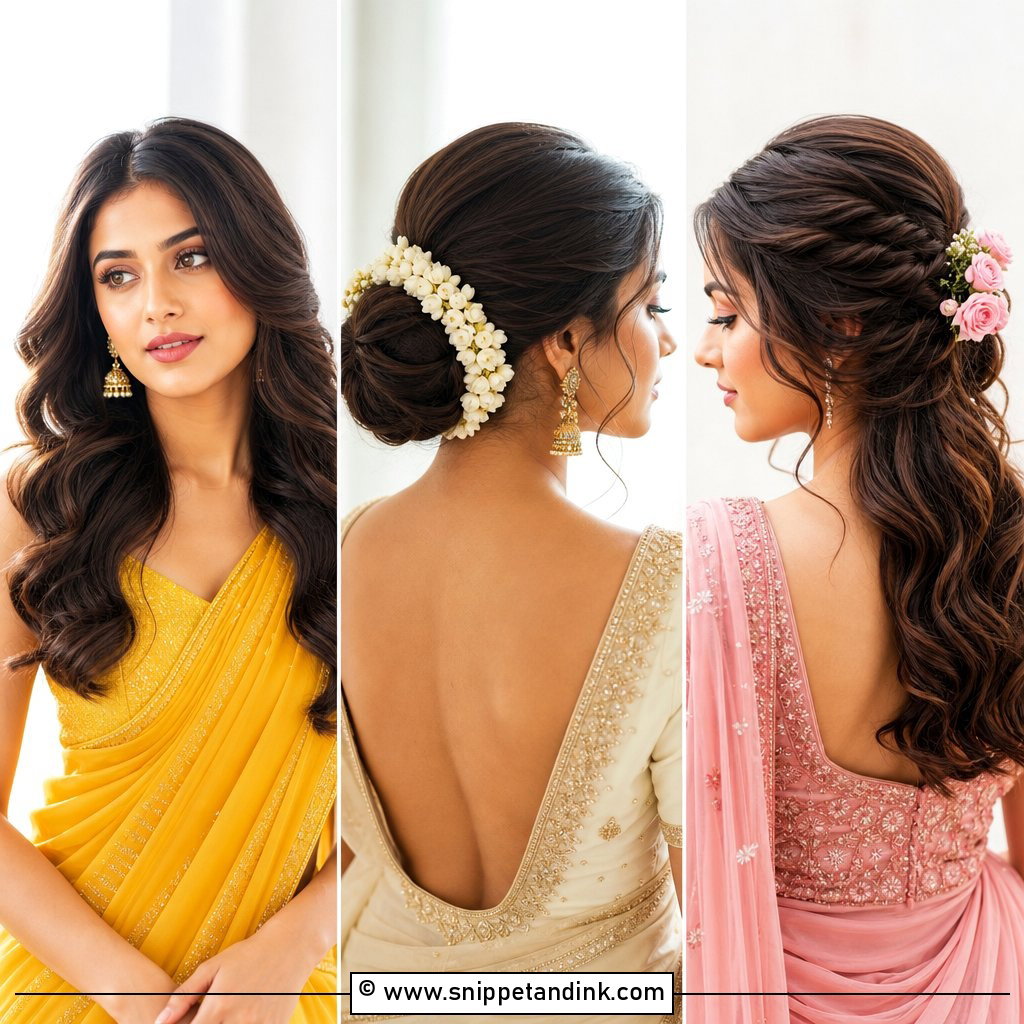
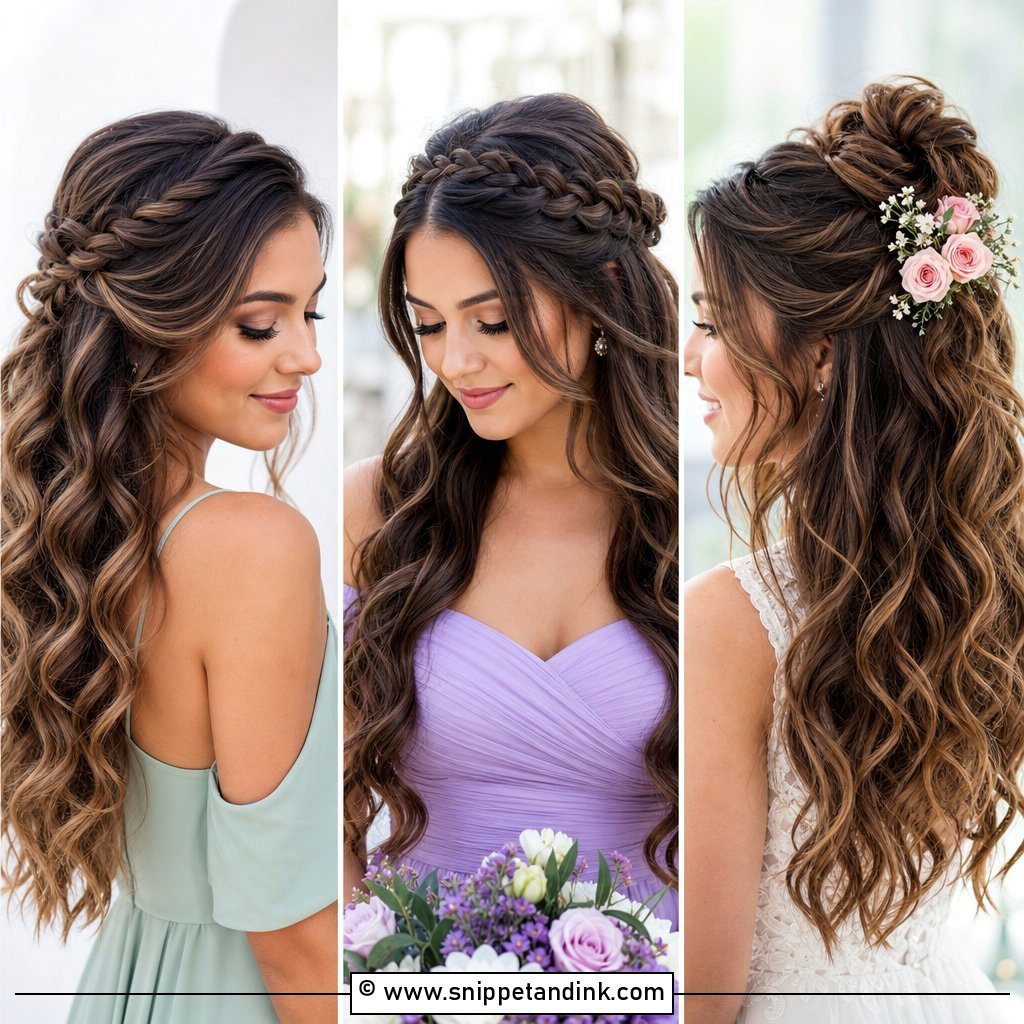
7. Half Up Bridal Hairstyle With Flowers
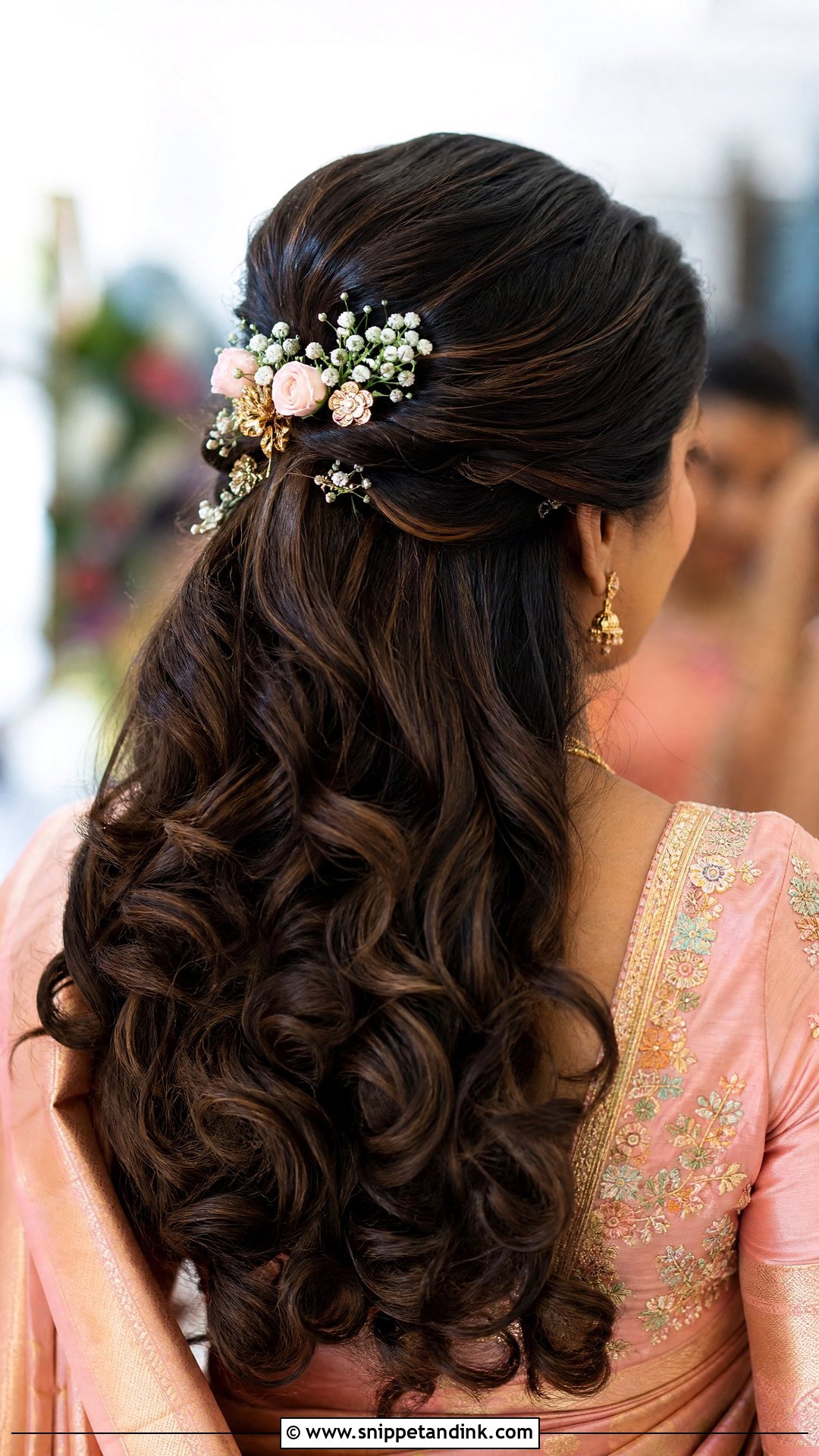
The top is pinned back neatly and the rest falls in waves or curls, with jasmine strings, baby’s breath, roses or gold pins where the section is secured. It’s a good choice for the engagement, nalangu, mehendi or the reception after the main rituals, and it shows off long hair without a full braid. Bridal half-up depends on control. A smooth crown and curls set firmly enough to last are what separate it from an everyday look.
8. South Indian Bridal Braid With Maang Tikka
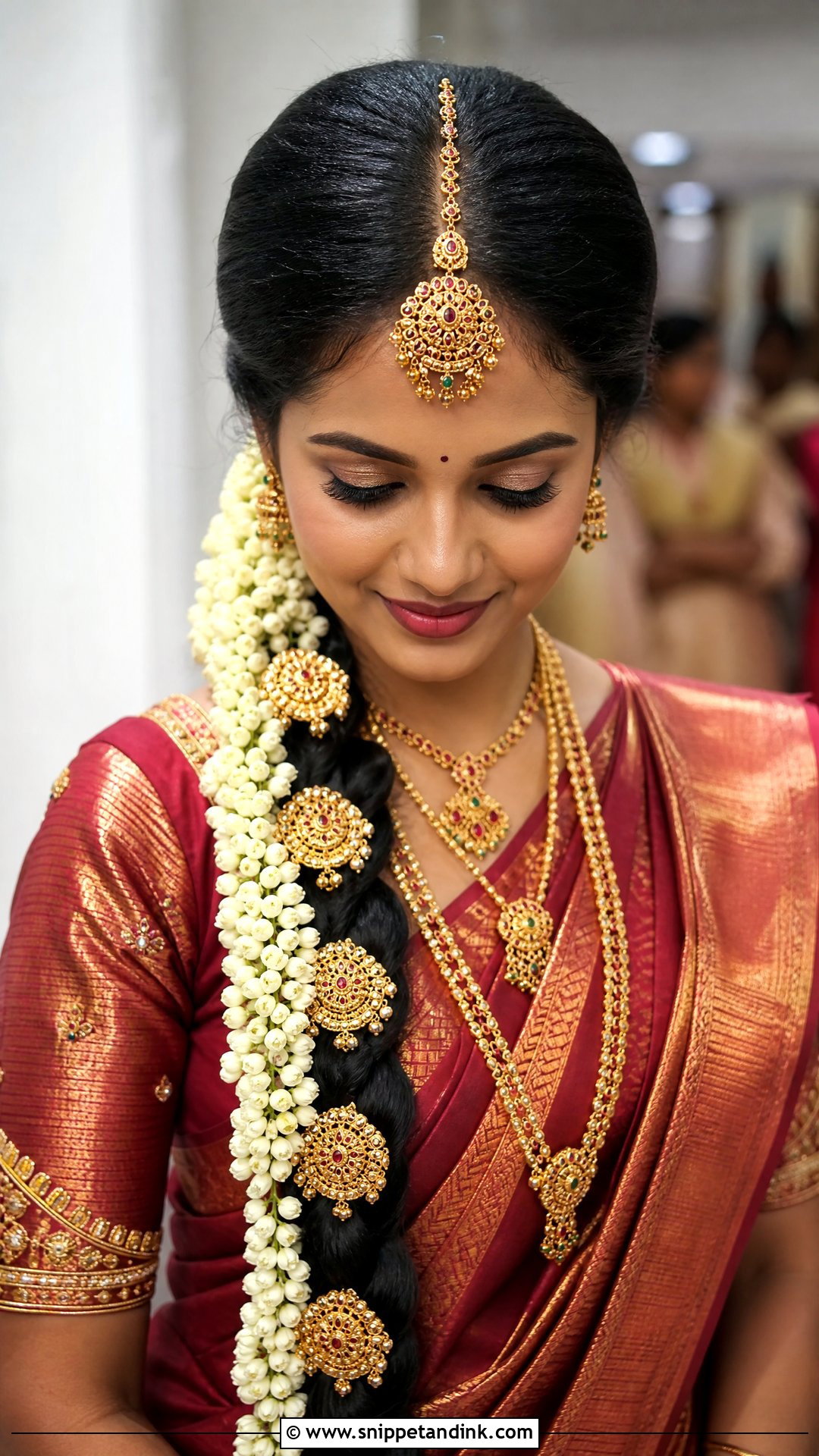
The centre part anchors the maang tikka, and the braid flows down the back with flowers, gold pins or jada pieces. Choose this when your set includes a strong forehead piece, a matha patti or a traditional head ornament. Balance is everything here: a heavy tikka wants a simpler braid, and a heavily decorated braid wants a finer tikka. I pin the tikka’s hook into the parting with a criss-cross of two pins under it, so the weight doesn’t pull the parting crooked.
9. Kanjivaram Saree Bridal Bun
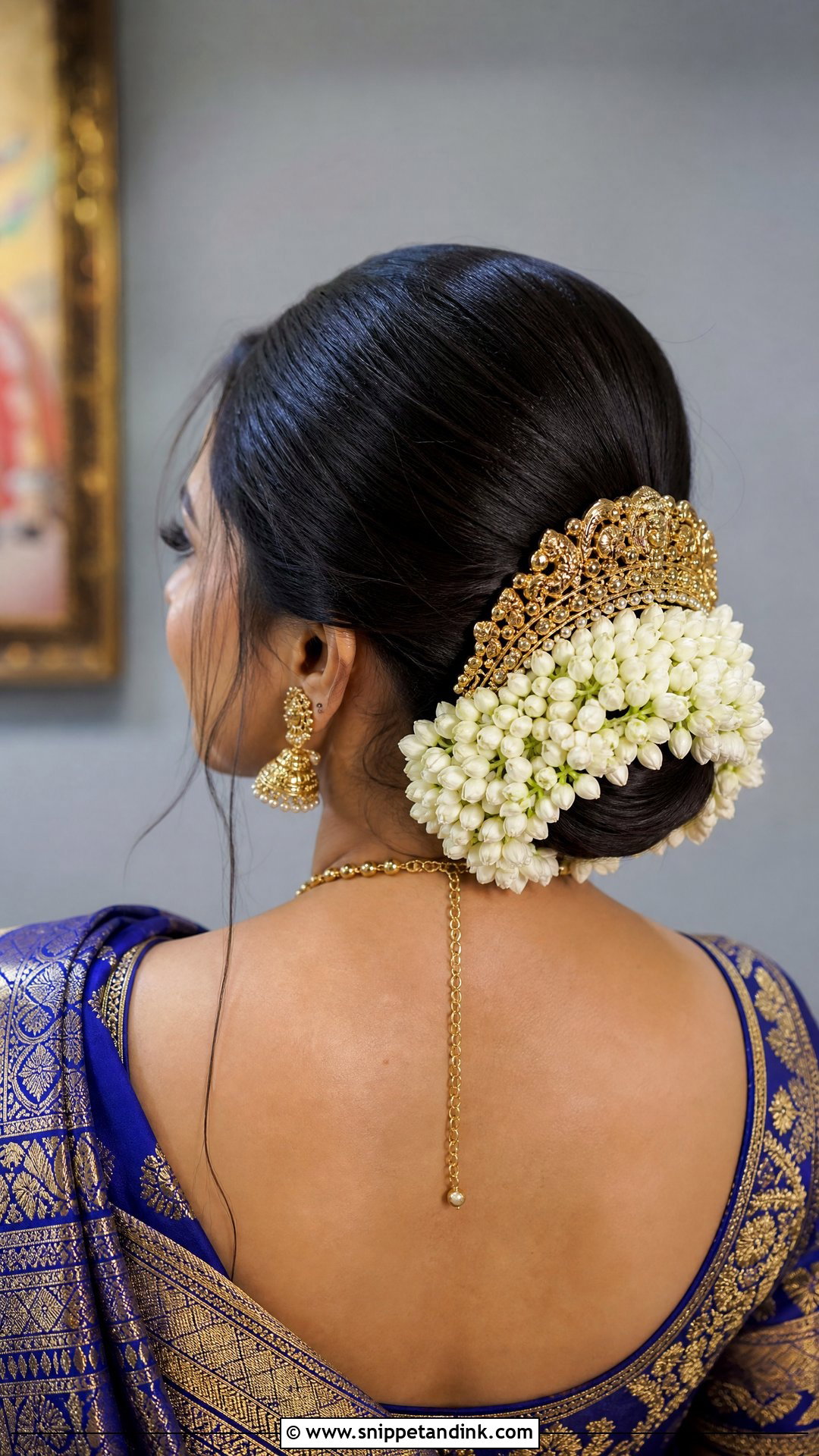
This bun sits low at the nape or a little higher, with a smooth centre part, a jasmine wrap and antique gold, and it lets the Kanjivaram and the jewellery shine together. High-neck blouses, heavy borders and grand temple jewellery all suit it, because the outline stays neat when the saree already carries so much colour and zari. Silk is stiff over the shoulders. I check the bun’s height with the pallu draped, since a bun too low gets pushed by the fabric whenever the bride moves her arm.
10. Kerala Bridal Bun With Jasmine
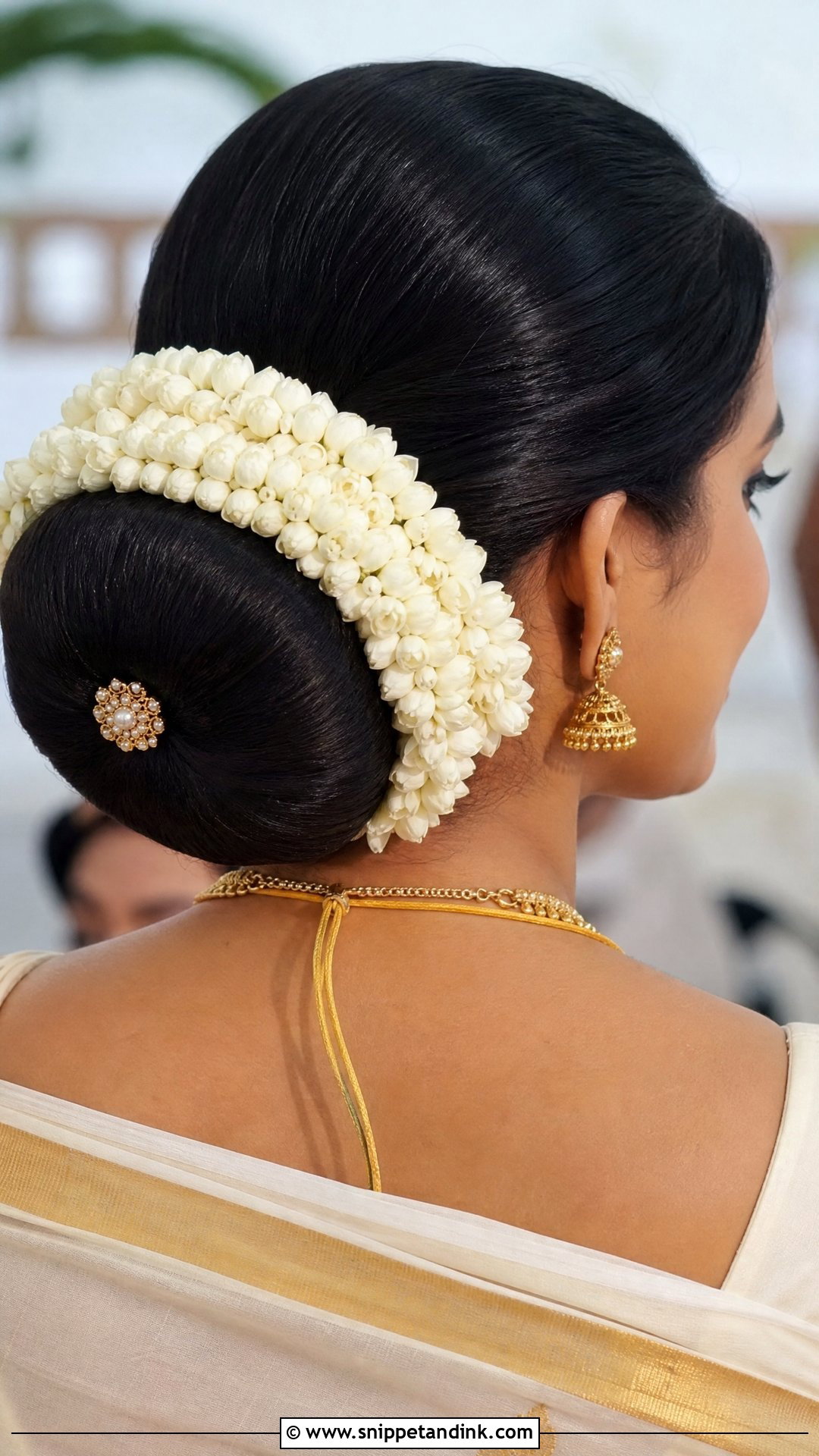
Sleek centre part, low rounded bun and a thick jasmine garland around the base: the Kerala bun is fresh and minimal. With an ivory, cream or gold kasavu saree, the white flowers repeat the palette, and gold jewellery does the rest. Kerala bridal styling tends to favour a natural finish, so I keep the hair smooth but not stiff, using a light serum for shine rather than a heavy gel. A single gold pin is plenty.
11. Telugu Bridal Poola Jada
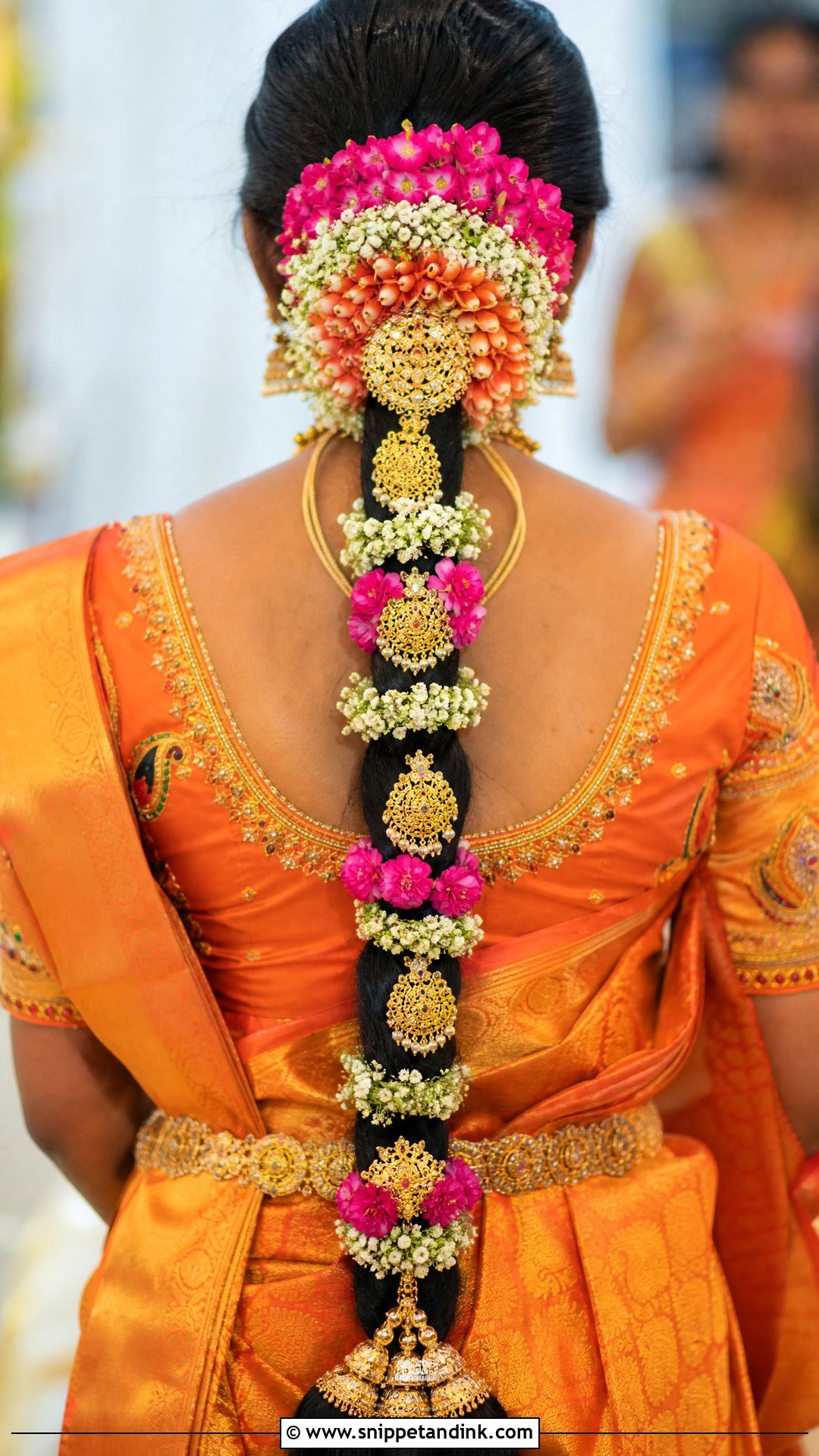
Bold and colourful, a Telugu bridal Poola Jada uses flower panels, jasmine strings, gold accessories and often a dramatic tassel at the end. The flowers can stay white or be customised in red, pink, yellow or orange to match the saree. All of that weight needs a strong base braid. I add padding or extensions not only for length but to give the panel something firm to sit on; on thin hair the decoration otherwise twists the braid sideways.
12. Tamil Bridal Long Braid
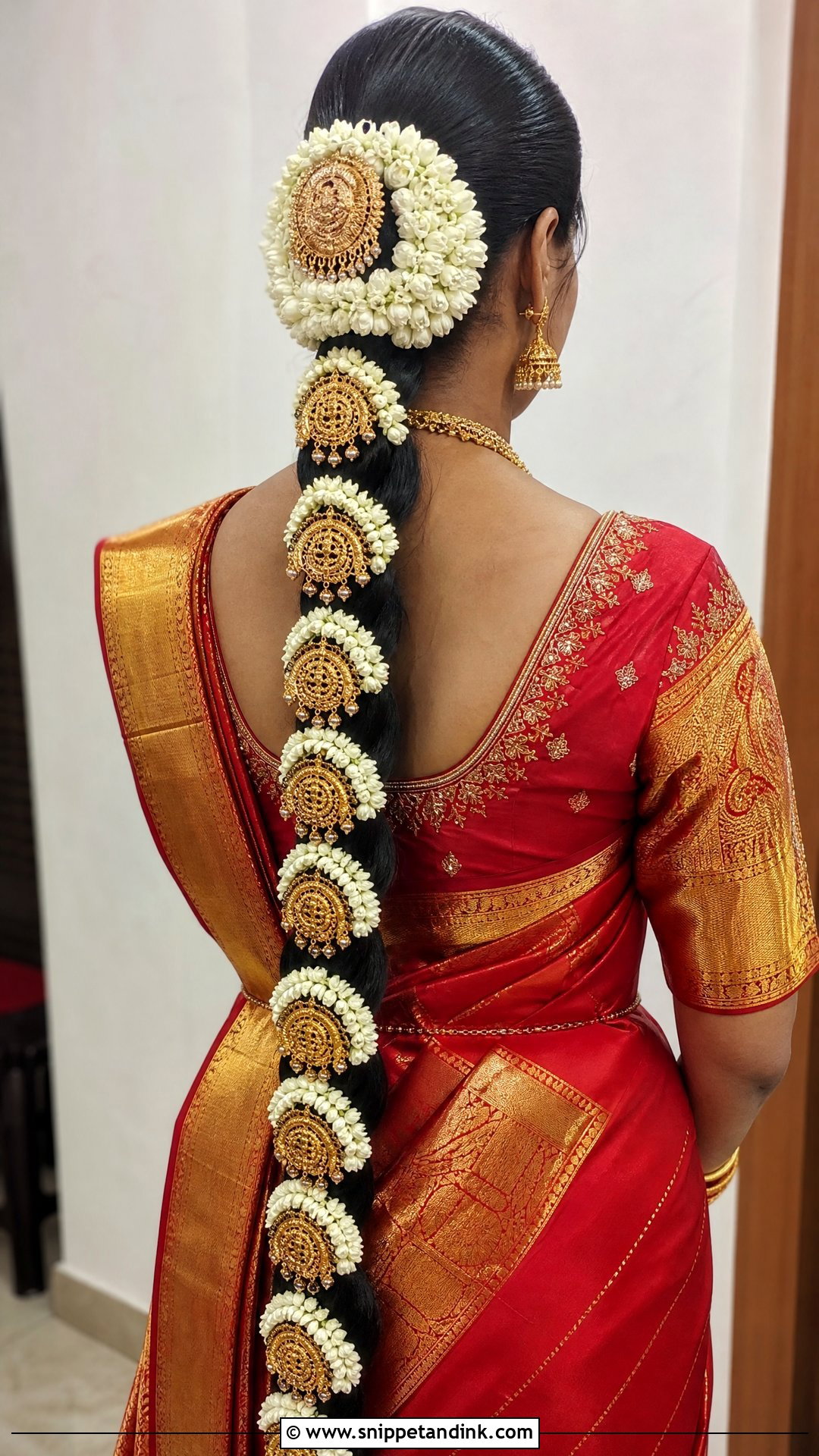
Sleek at the front with a centre part, the Tamil bridal long braid carries flowers, gold jada pieces or simple jasmine strands down the back, and it sits naturally with a Kanjivaram, temple jewellery and classic bridal makeup. It stays secure through blessings, photos and outfit changes. Choose a little volume at the crown for softness or keep everything glossy and close for a more traditional finish. On very fine hair I’d go glossy; volume at the crown on fine hair tends to show the scalp under flash.
13. Bridal Braid With Roses And Jasmine
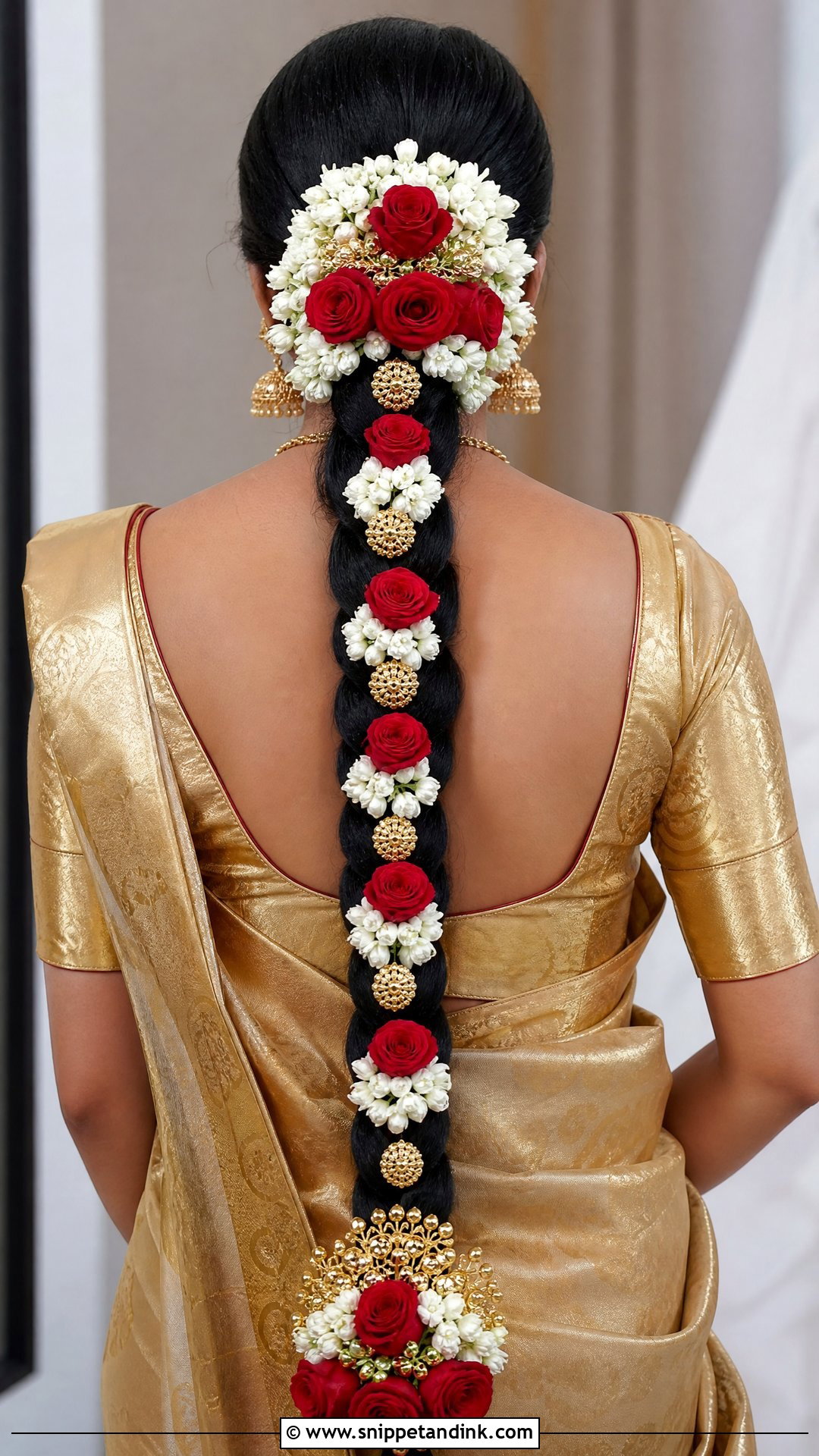
Jasmine gives the braid its classic South Indian base and roses add the colour: red with gold sarees, pink with pastel silks, yellow or orange for bright daytime ceremonies. The braid can be fully covered or decorated in sections so some hair shows through. I prefer sections for most brides. A fully covered braid of mixed flowers gets heavy quickly, and the gaps let the eye read the braid shape in back-view portraits. Keep the front simple.
14. Low Bun With Center Part
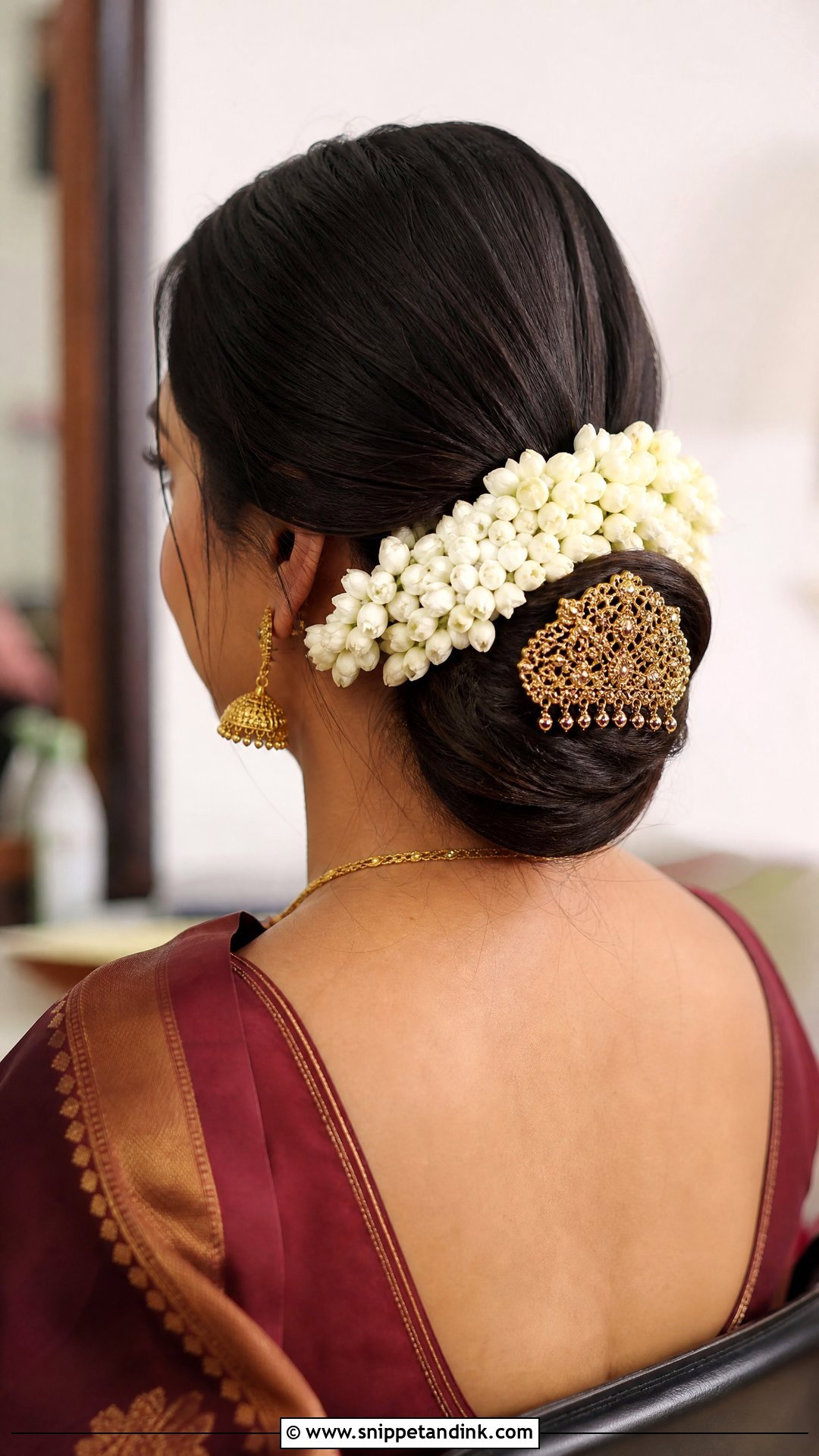
A centre part with a low bun at the nape is the calm option, finished with jasmine, roses, gold pins or a single antique comb. It’s comfortable for long ceremonies because it doesn’t pull much at the scalp, and it stays out of the way of heavy earrings and layered necklaces. For a rounder face I add a little height at the crown and one or two very fine pieces at the temples. Too many pieces drawn out, and it starts to look unfinished.
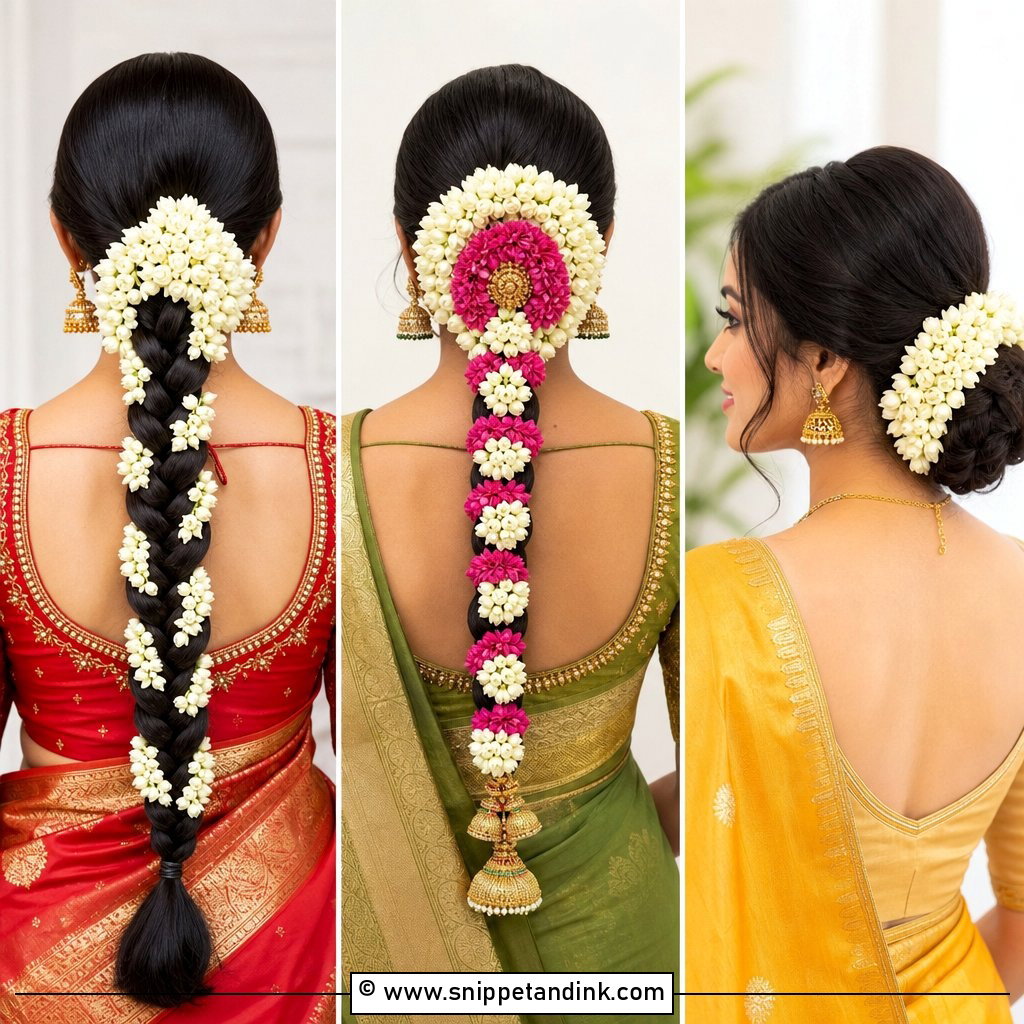
15. South Indian Reception Curls
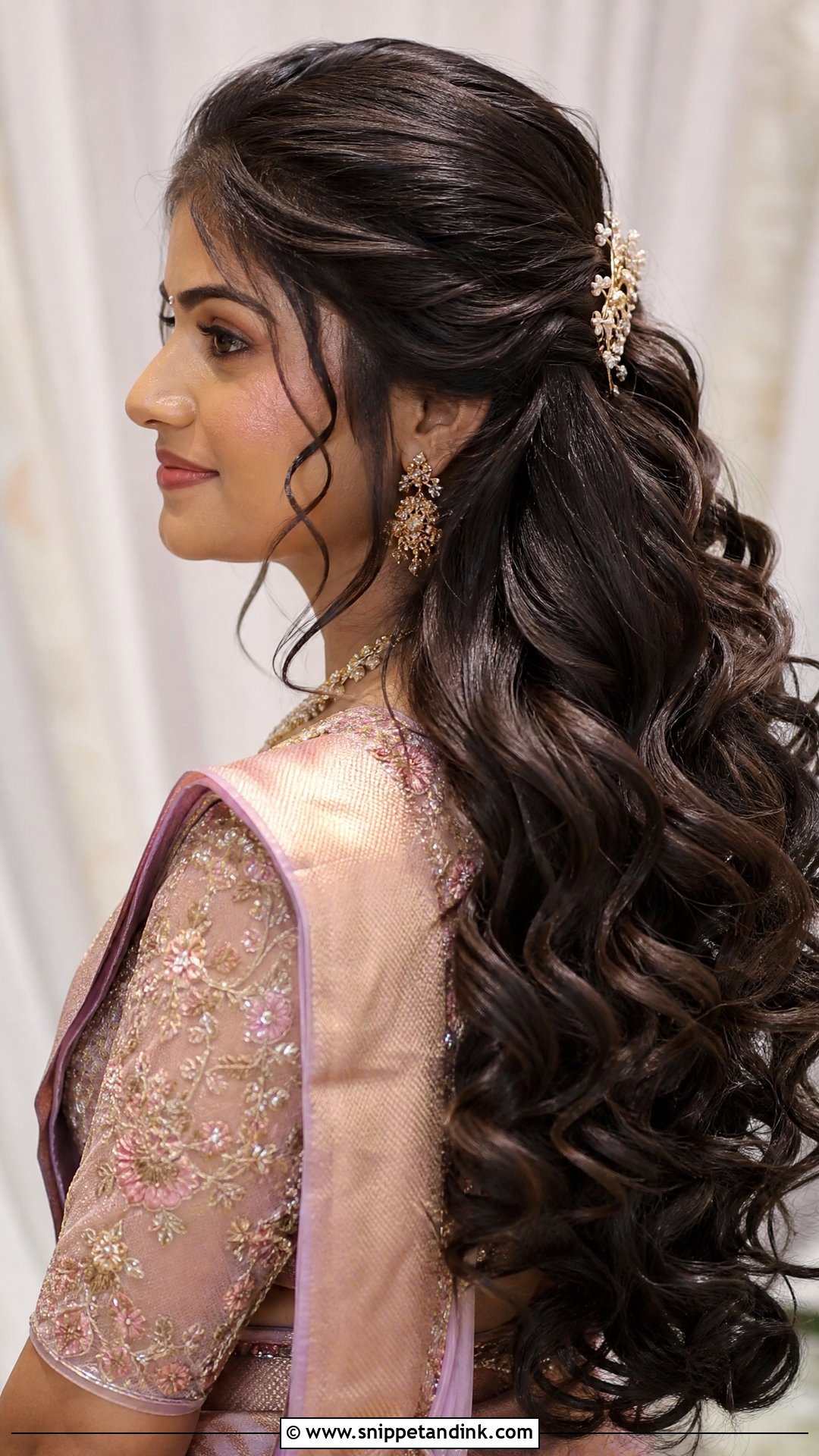
Curls are a welcome change after a morning of tight braids and pins. Polished curls fall around the shoulders or down the back, with a centre part, side part or pinned-back crown depending on the outfit and jewellery, plus a hair clip, flowers or gold pins. They go with reception sarees, lehengas, gowns and lighter silk. The curls should look defined rather than messy. Brushing out braid-crimped hair can make this transition harder, so I re-wet the lengths slightly and set fresh curls rather than working over the morning’s texture.
16. Braided Bun Bridal Hairstyle
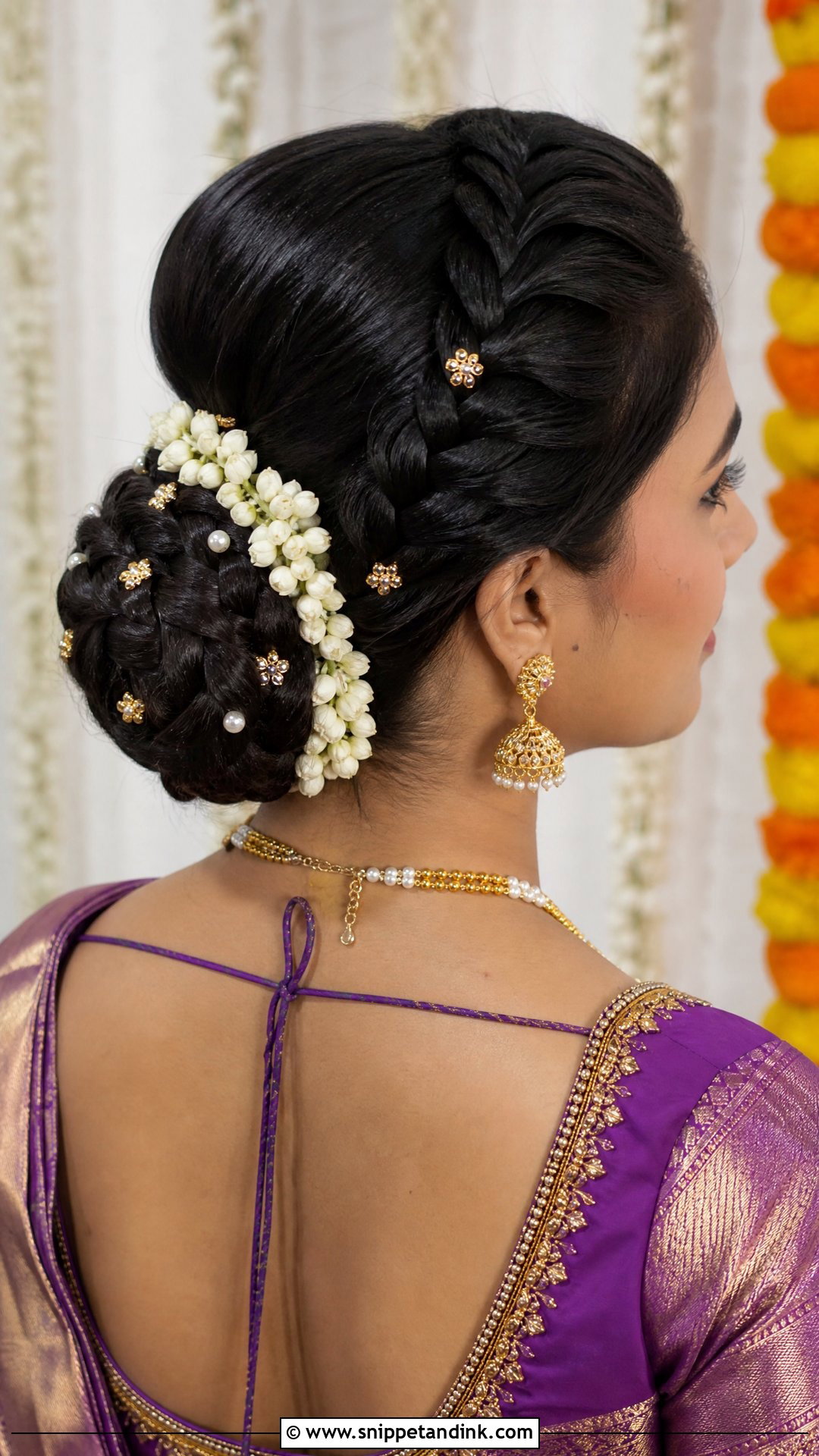
Side braids, crown braids or a braided base wrapping into a bun at the back give texture while keeping the style secure and compact. It sits between a plain bun and a full decorated braid in detail and weight. Jasmine, gold pins or pearl accents dress it, and it moves between the ceremony and the evening easily. Braided sections grip pins much better than smooth hair, which is why I trust this style on slippery or freshly coloured hair.
17. Side Braid Bridal Hairstyle
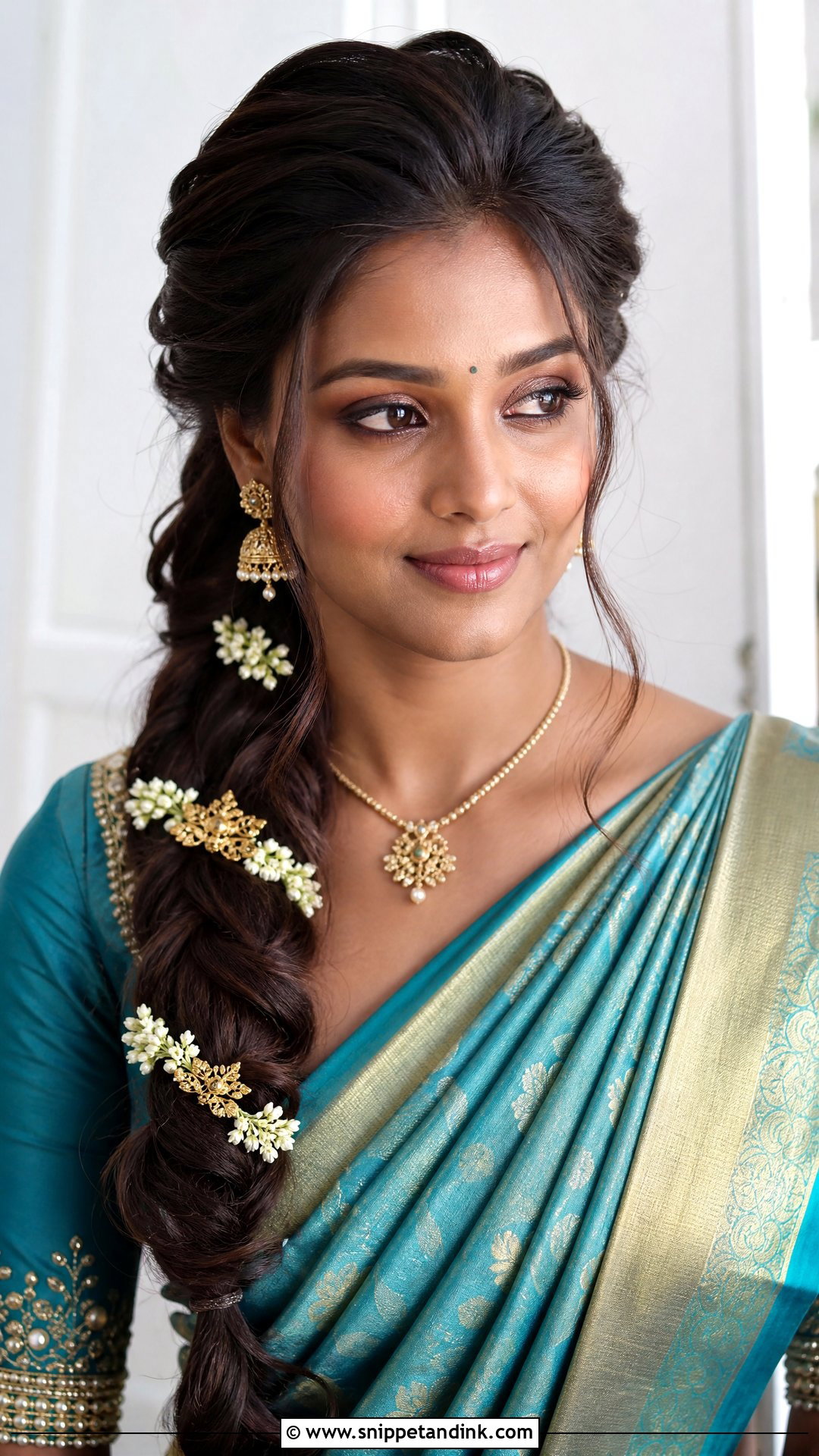
Resting over one shoulder, the side braid shows itself in front-facing photos, which suits pre-wedding functions, engagements and a lighter reception look. Small jasmine buds, roses, pearls or gold clips decorate it. Keep the top smooth and the braid full. Place it on the side opposite a detailed pallu or blouse panel, so the two don’t cover each other, and pin it behind the far ear so it stays in front.
18. Loose Waves With Bridal Hair Jewelry
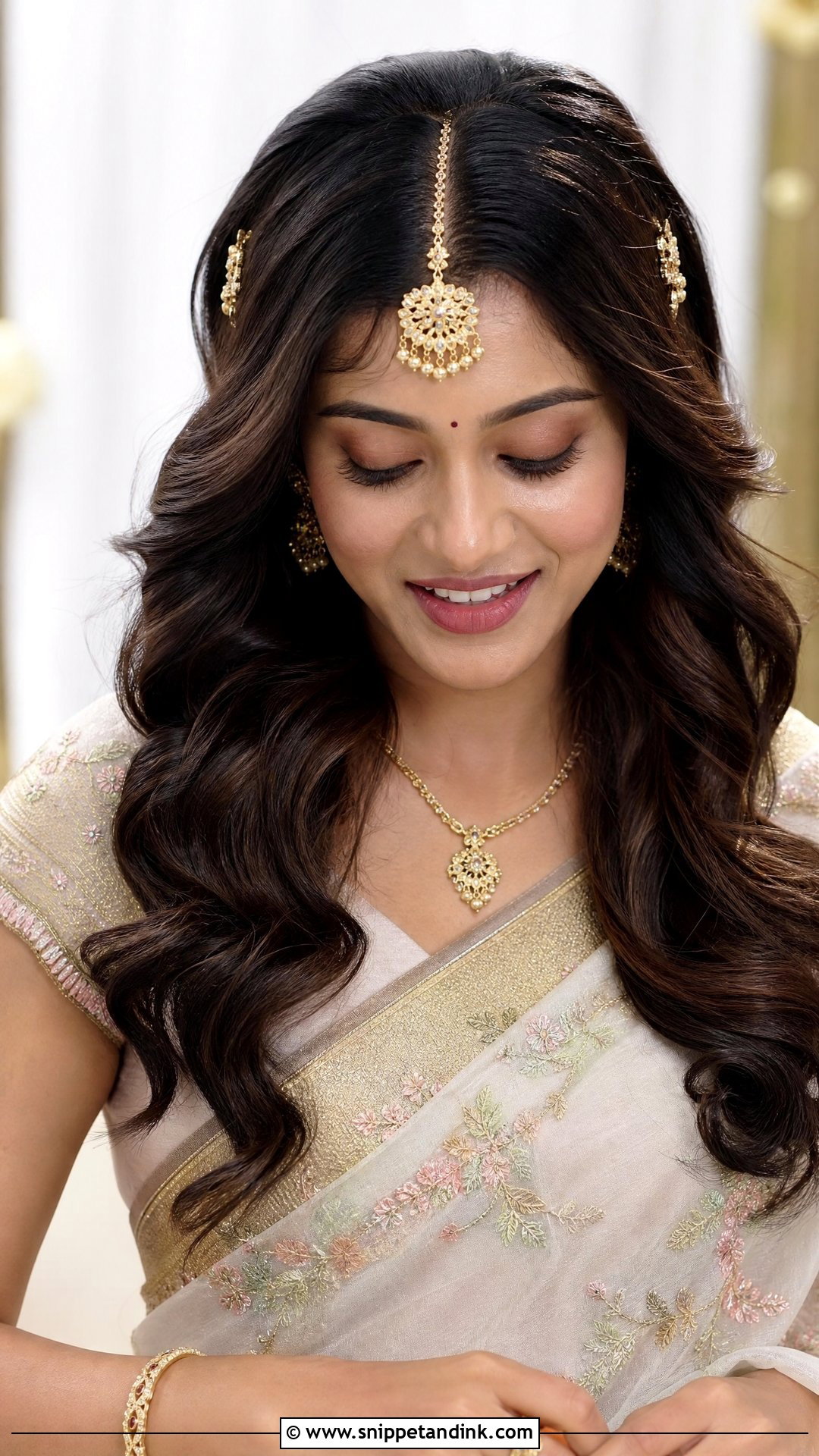
Hair worn down in glossy waves, with a maang tikka, side pins or a fine head chain at the front, gives a modern bride glamour with a cultural detail. It suits receptions, engagement parties and contemporary portraits, with lighter sarees, lehengas and fusion outfits. Skip the beachy texture; bridal waves should look smooth and healthy. A head chain needs anchoring at both sides under the hair. I hide two small sections twisted back at the temples and pin the chain to those.
19. Traditional Bridal Kondai Bun
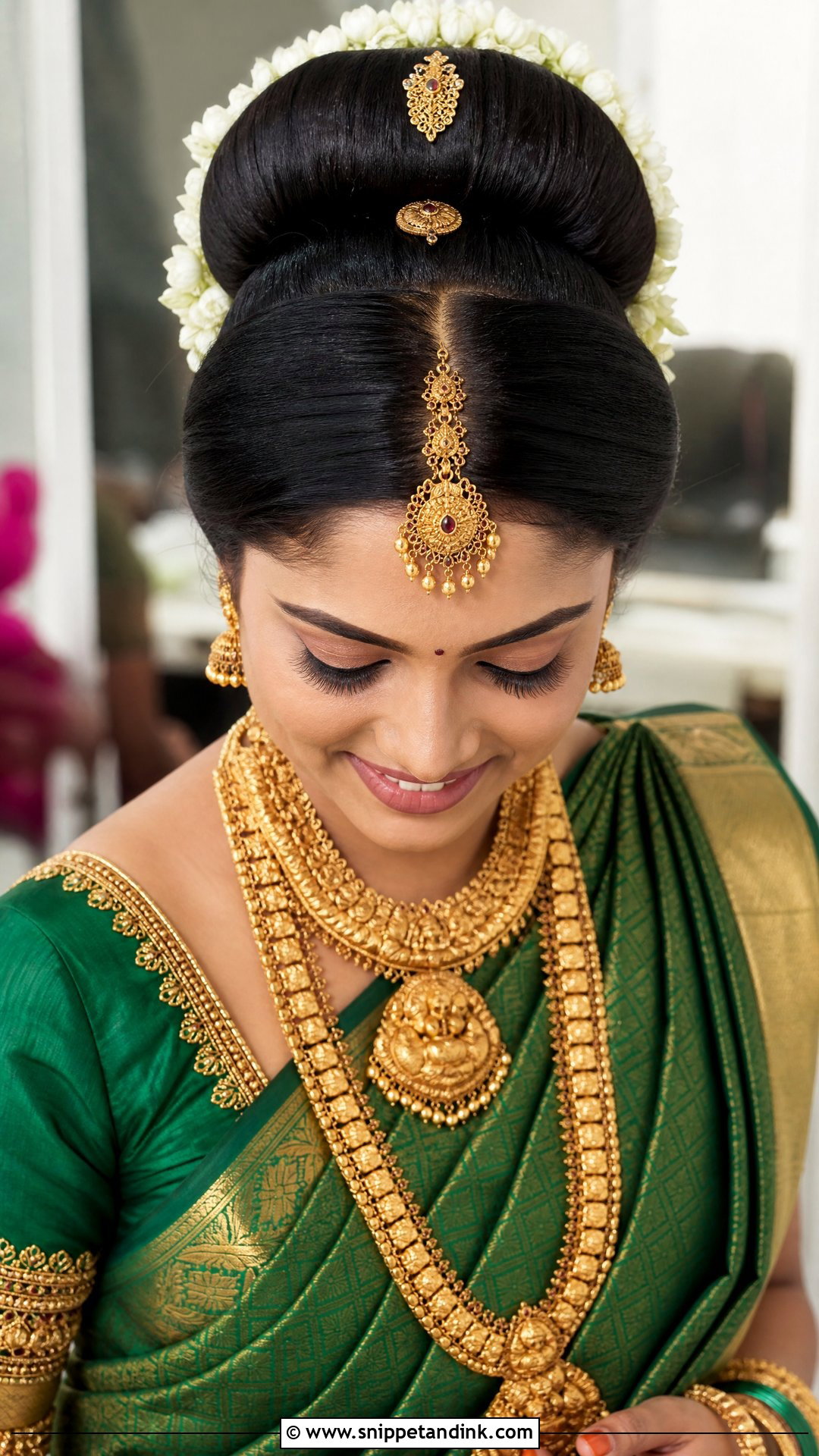
The traditional bridal kondai bun is gathered into a rounded shape, usually at the back, and decorated with jasmine, gold ornaments or classic hair pieces. It comes from heritage dressing and suits temple jewellery, silk sarees and traditional makeup. A kondai is one of the steadiest styles for long rituals. Padding gives it the full round shape, and I smooth the front with gel so the flowers carry the softness and fragrance.
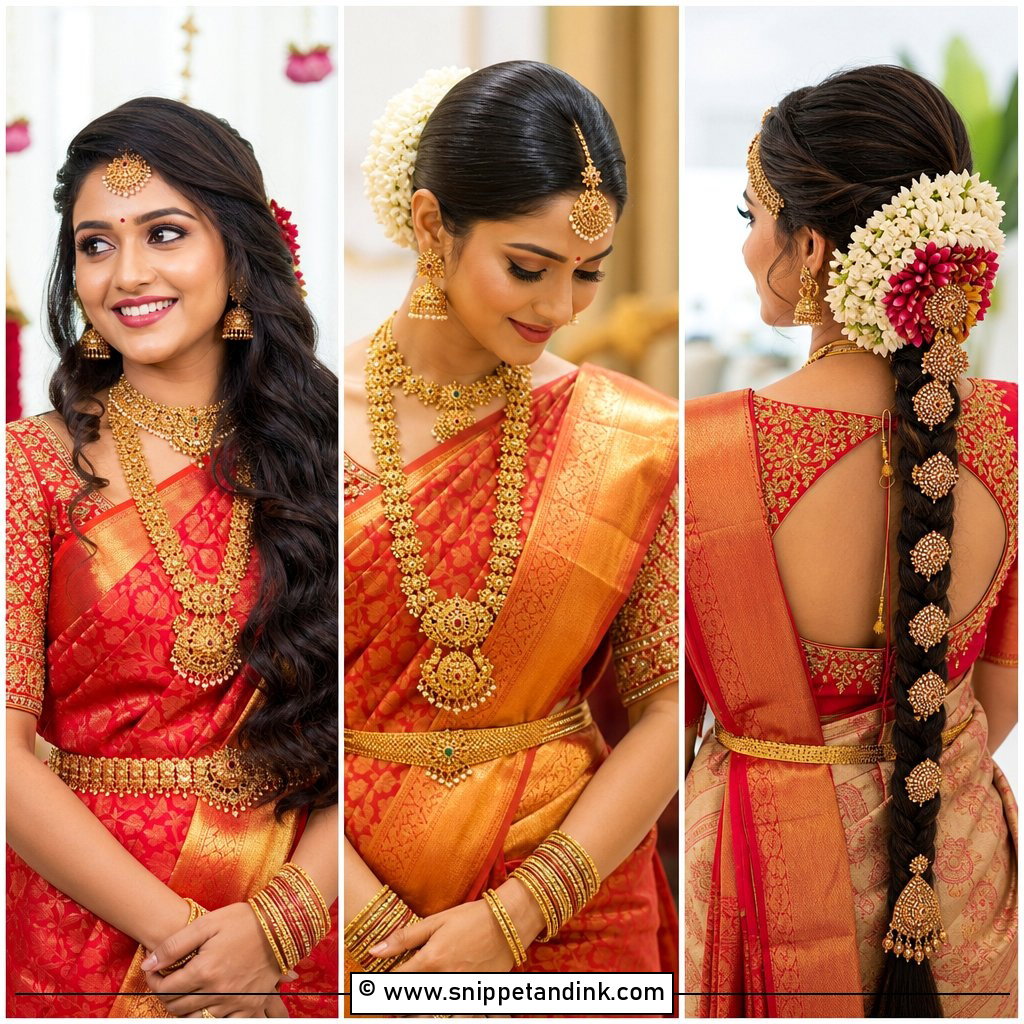

20. Modern South Indian Bridal Braid
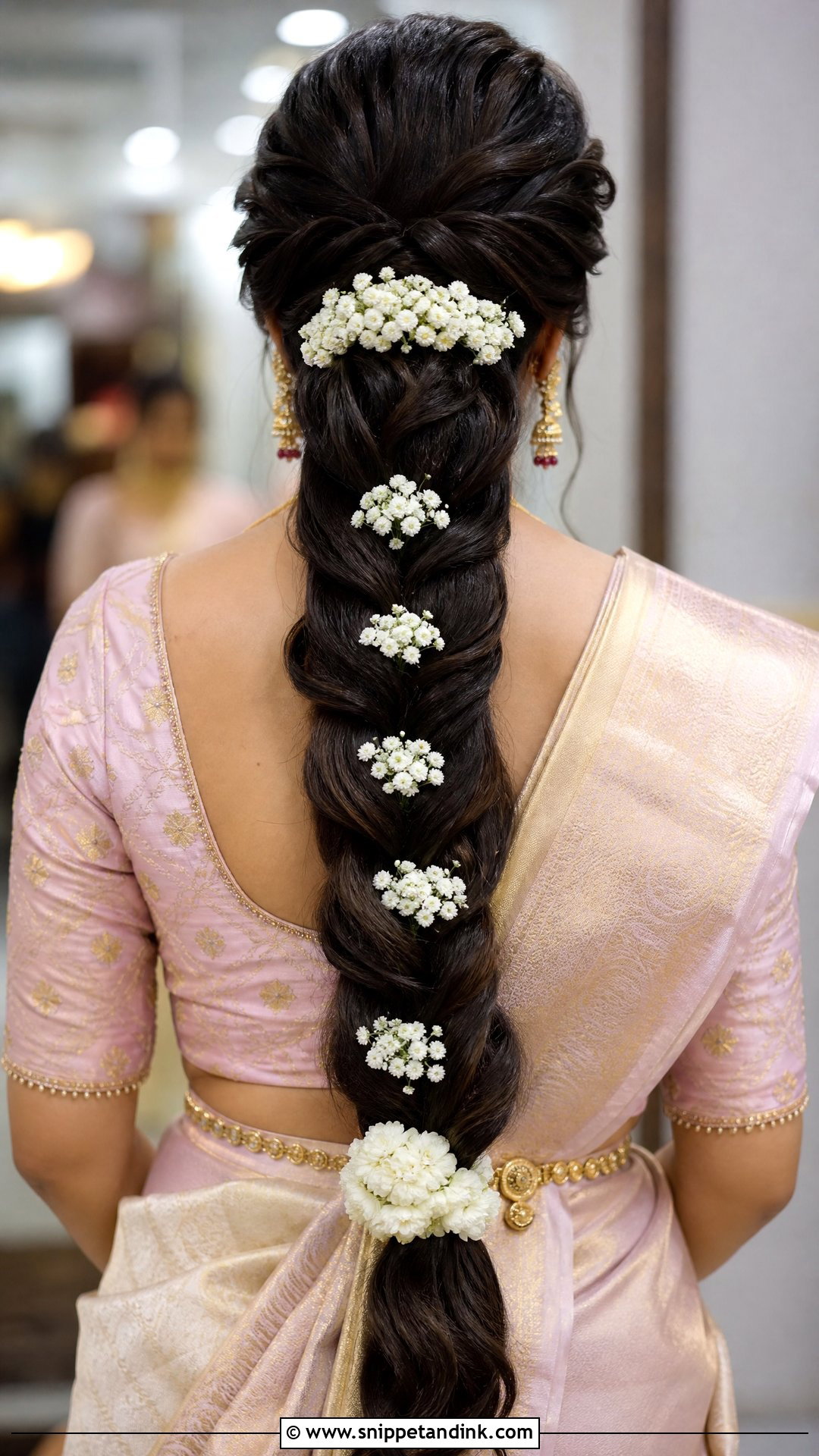
The modern braid keeps the traditional plait but changes the finish: fuller and slightly textured, with spaced-out flowers, a few gold pins or a clean floral end piece. It’s respectful enough for the rituals and works with pastel Kanjivarams, contrast blouses and modern temple sets. The front can stay sleek or have a little volume. Textured braids loosen faster than tight ones, so I pull the braid wider only after the flowers are fixed and set it with a firm spray.
Hair Oiling, Colour and Cuts in the Month Before
Regular oiling is a long-standing habit in many South Indian homes, and it’s good for the hair. The timing matters on the wedding morning, though. Heavily oiled hair can’t hold pins, gel or a smooth parting. I ask brides to oil no later than two nights before, then wash thoroughly with a regular shampoo, ideally twice, the evening before the wedding.
- Colour or gloss two to three weeks ahead, so it has settled and any surprise can be corrected.
- Trim a couple of weeks out, keeping length if you want a braid; never try a new cut in the final week.
- Avoid smoothing treatments right before the day. Very slippery hair is the hardest to pin.
- Do your trial with the same products and washing routine you’ll use on the morning.
If you’re using extensions, wash and match them before the trial too. Colour-matched clip-ins can look a shade off against freshly glossed hair, and it’s much easier to fix that a fortnight out than on the morning itself.
A Braid for the Muhurtham and Curls for the Reception?
Many brides answer that question with yes. A long decorated braid suits the rituals and the back-view photos; a jasmine bun gives you a clear neckline and comfort; reception curls, half-up hair and modern braids work for the other events. Think about your saree, your jewellery, your hair length, the weight of the flowers and how many hours the style must last. Then book a trial and wear the full look, jewellery included. That’s the only way to know how it feels at hour five.
You'll Like These Ideas:






Leave a Reply