
A South Indian bridal braid is closer to a construction project than a hairstyle. It carries flowers, gold and sometimes an extension, and it has to look the same at the end of the rituals as it did when the bride stood up from the chair. The Poolajada draped in jasmine is the obvious starting point, but there are lighter and more modern braids too, from fishtails to bubble braids threaded with flowers. Below are 25 I’d recommend, with what I’d tell you about each one at a consultation: what hair it needs, how heavy it gets, and where it can go wrong.
How a Poolajada Goes On, Layer by Layer
Brides often assume the flowers are woven in as the hair is braided. With a full floral jada, it usually works the other way round, and knowing the order helps you plan the morning and talk to your florist.
- The base braid. I braid tightly from the crown, often with an extension at the nape, and secure the end firmly. Everything else hangs from this.
- The floral jada. Most florists build it as a separate piece on a stitched base the length of the braid. Confirm the length with them; it should match your braid, not a standard size.
- Attaching it. The jada is tied or stitched to the braid at intervals, starting from the top, so it can’t twist or slide.
- Ornaments. Nagaram at the crown, billalu or gold jada pieces down the length, and a kunjalam tassel at the end go on last, so their weight sits on a secure base.
- A walk test. Before you leave, you sit down, stand up and turn your head. If anything shifts, it’s fixed now, not at the mandapam.
Ask your florist when they’ll deliver, and plan for the flowers to arrive before the stylist does. Jasmine strung as closed buds the evening before, kept cool and wrapped in damp cloth, opens slowly through the ceremony instead of wilting by the time the thali is tied.
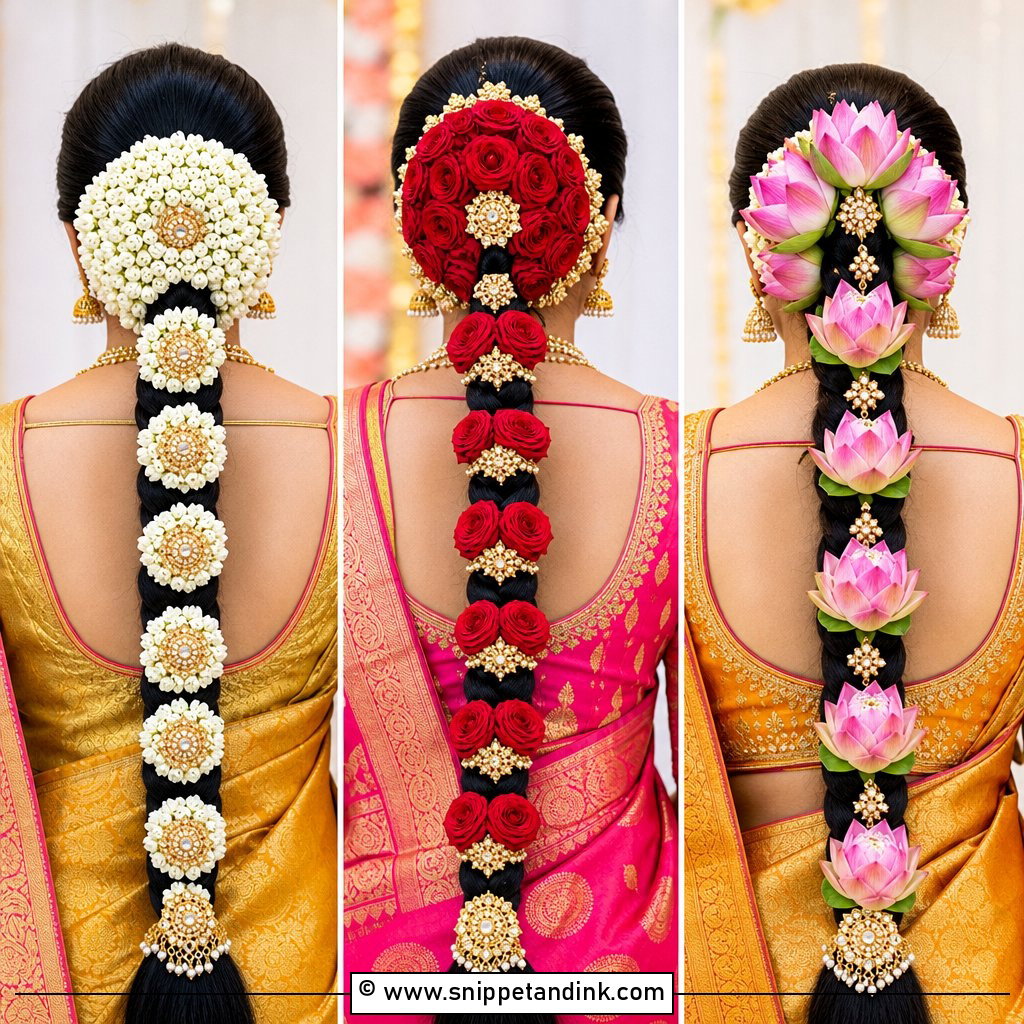
1. Traditional Poolajada Braid With Jasmine
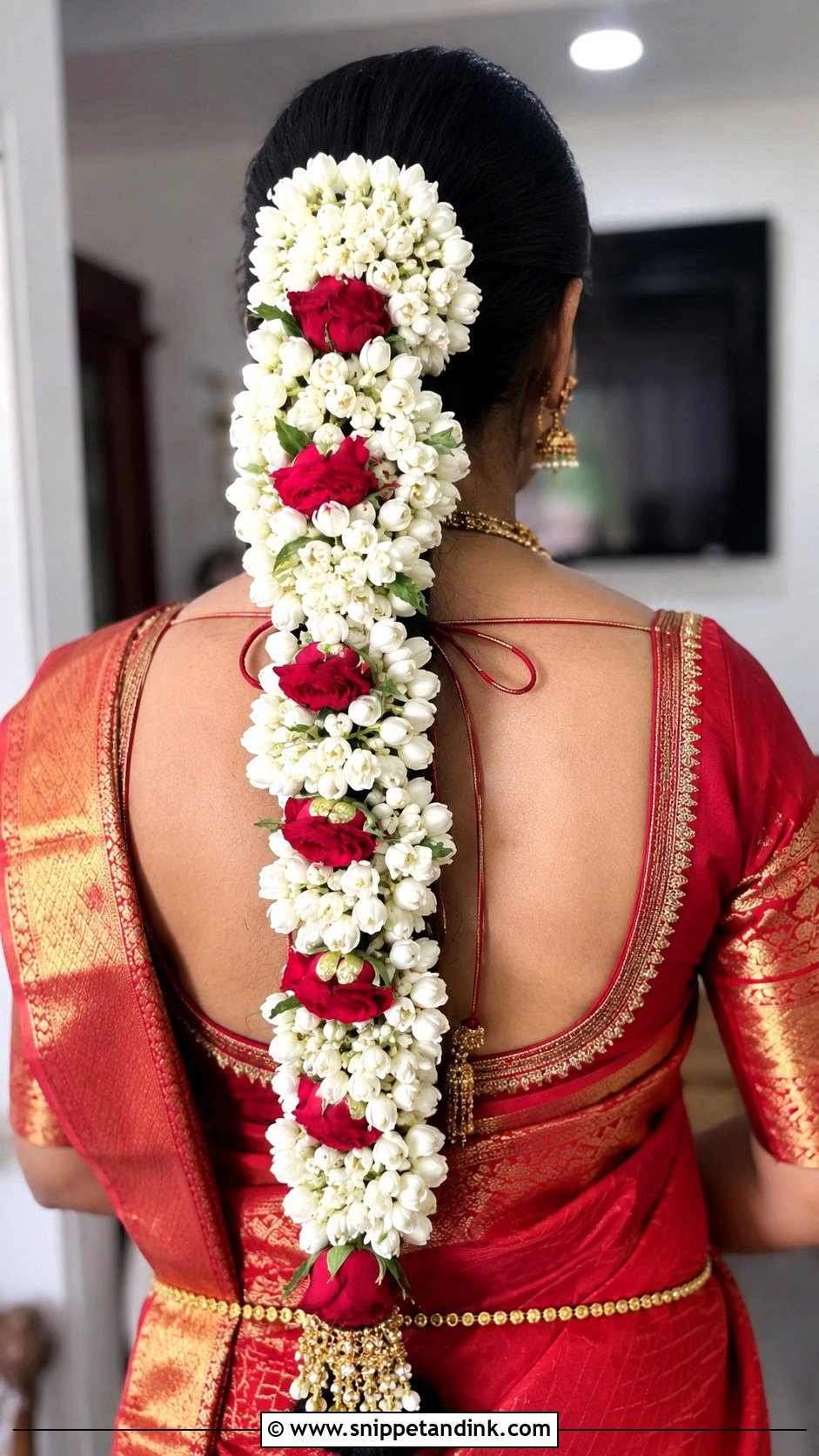
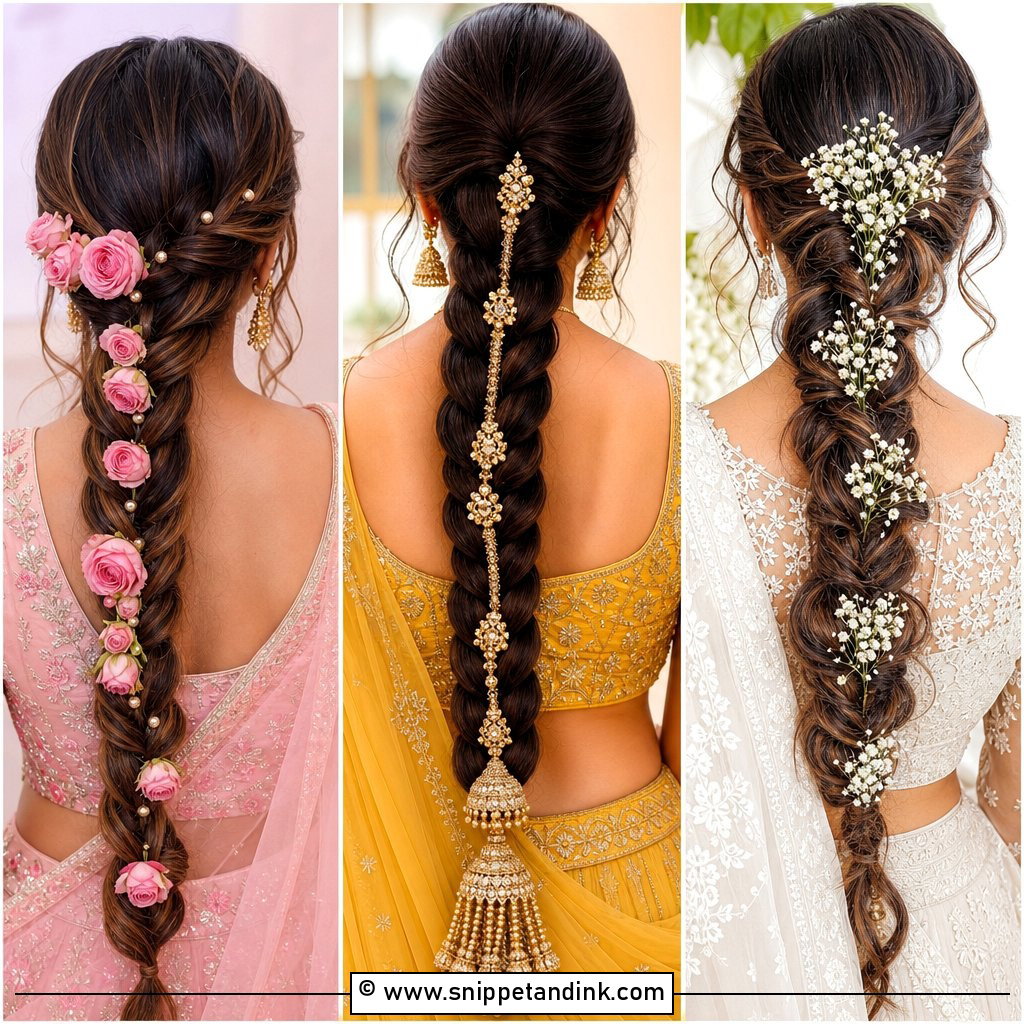
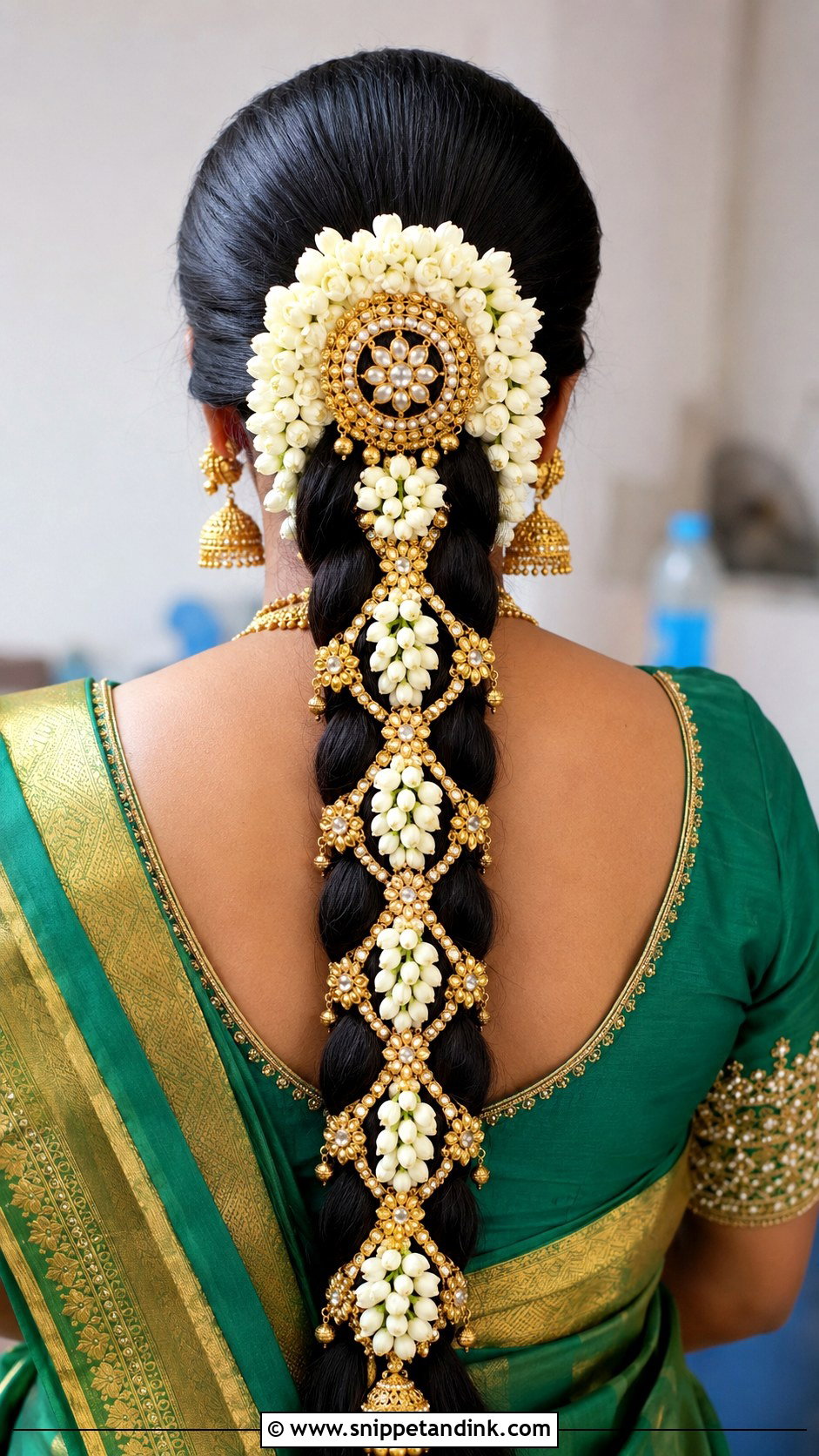
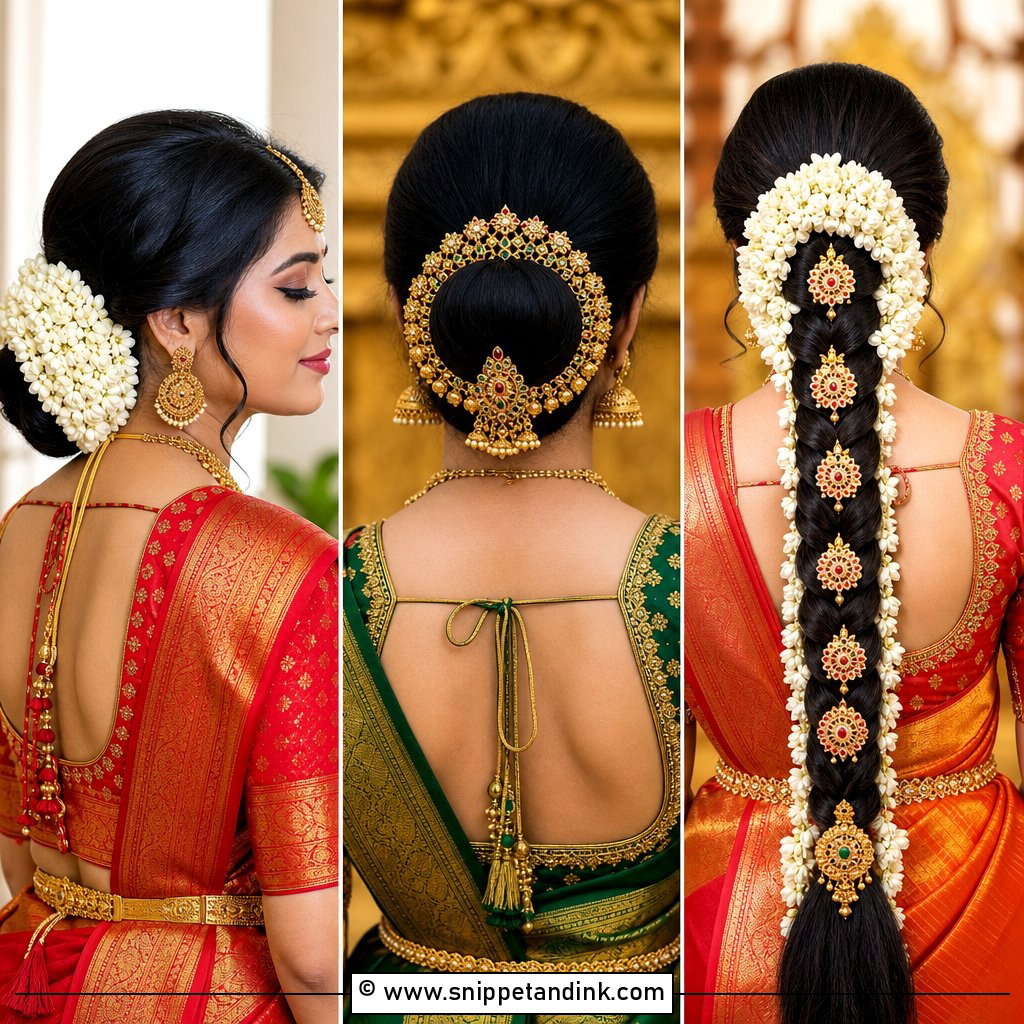
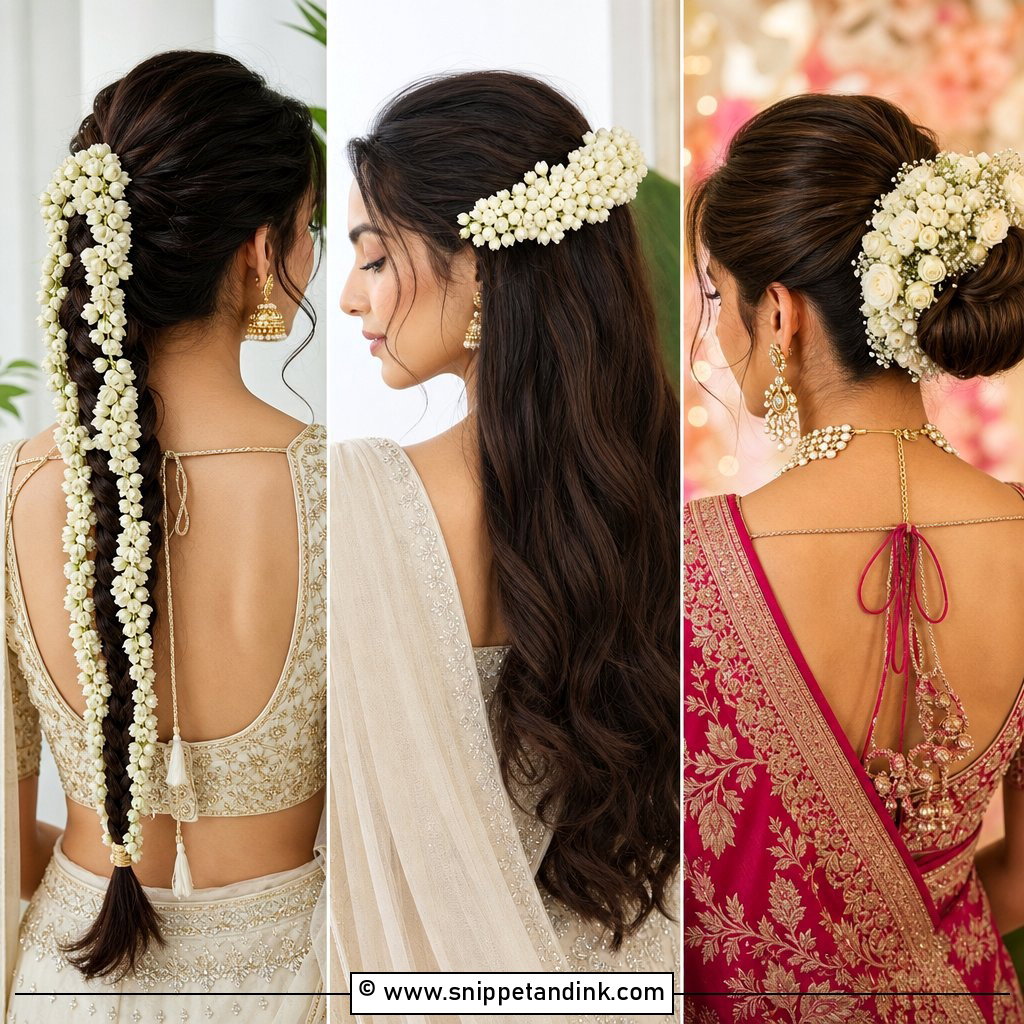
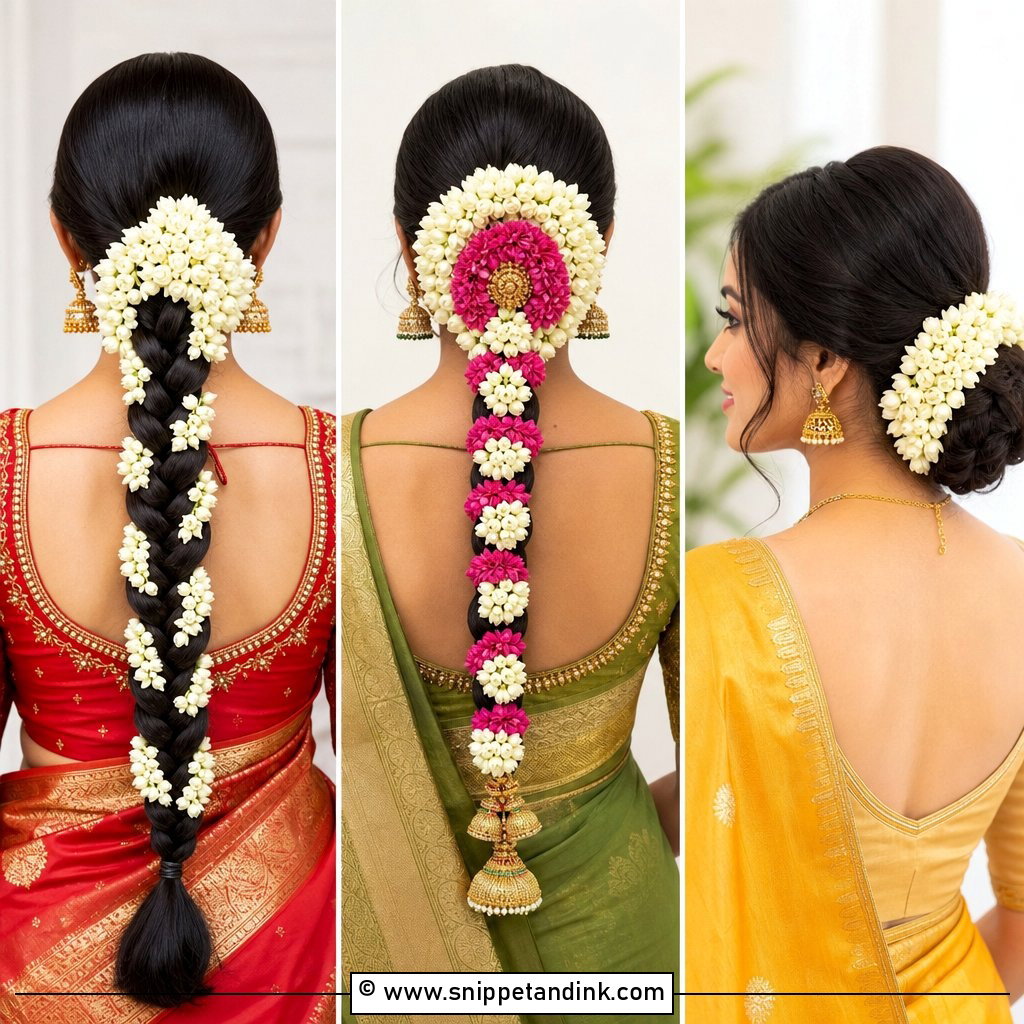
The Poolajada is the heart of South Indian bridal hair: one long braid covered from top to bottom in jasmine, roses and kanakambaram, often finished with a gold nagaram at the crown. Jasmine is associated with harmony in marriage, which is part of why families feel strongly about it. Most florists make the floral jada as a separate piece on a stitched base, and my job is fixing it to the braid so it doesn’t twist sideways when you sit. That’s why I braid tighter for a Poolajada than for any other style. Long, thick hair carries it naturally. For shorter hair, an extension gives the same length, and I’ll come back to that at number 25.
2. Gold Jada Braid With Temple Jewelry
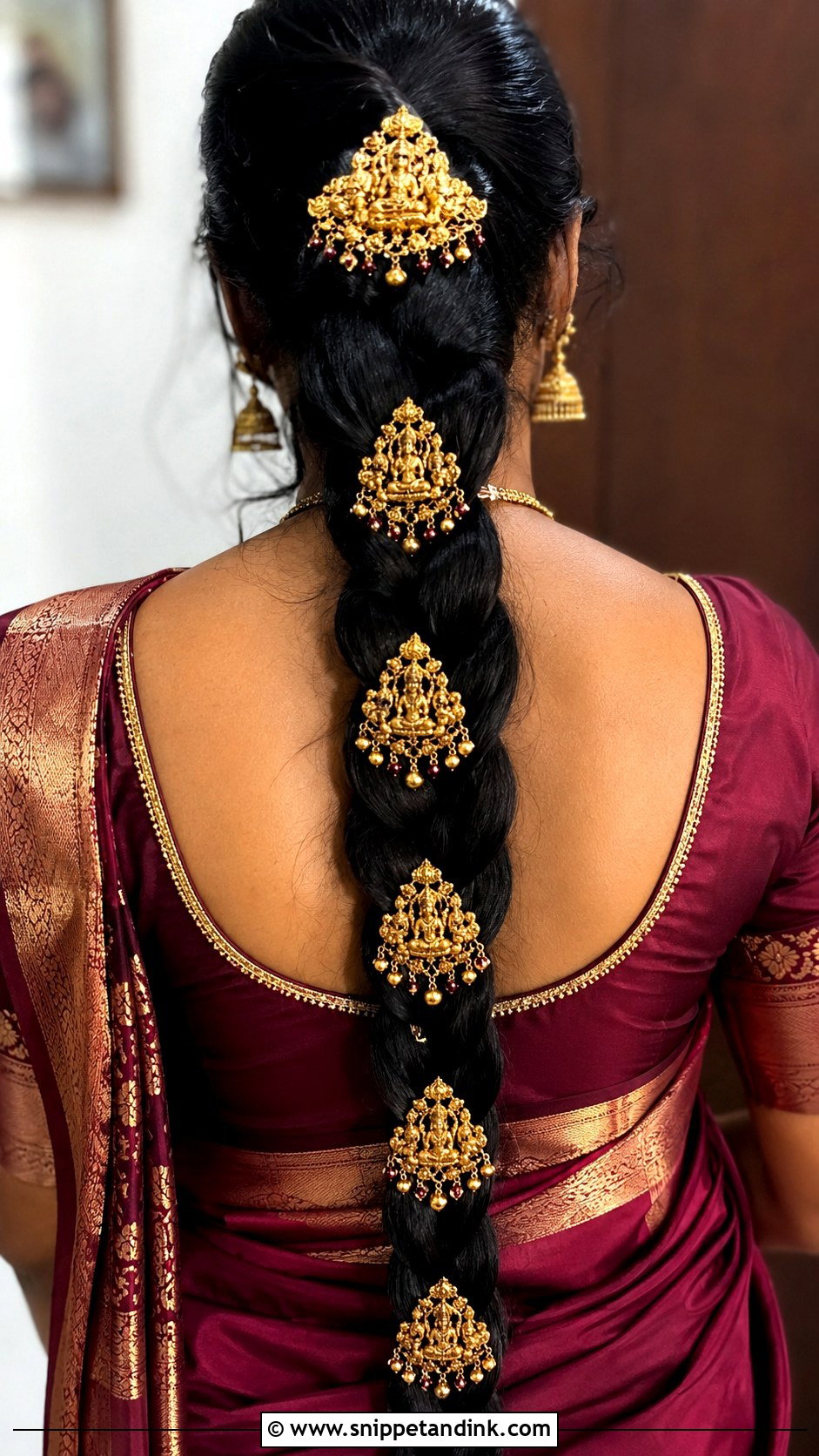
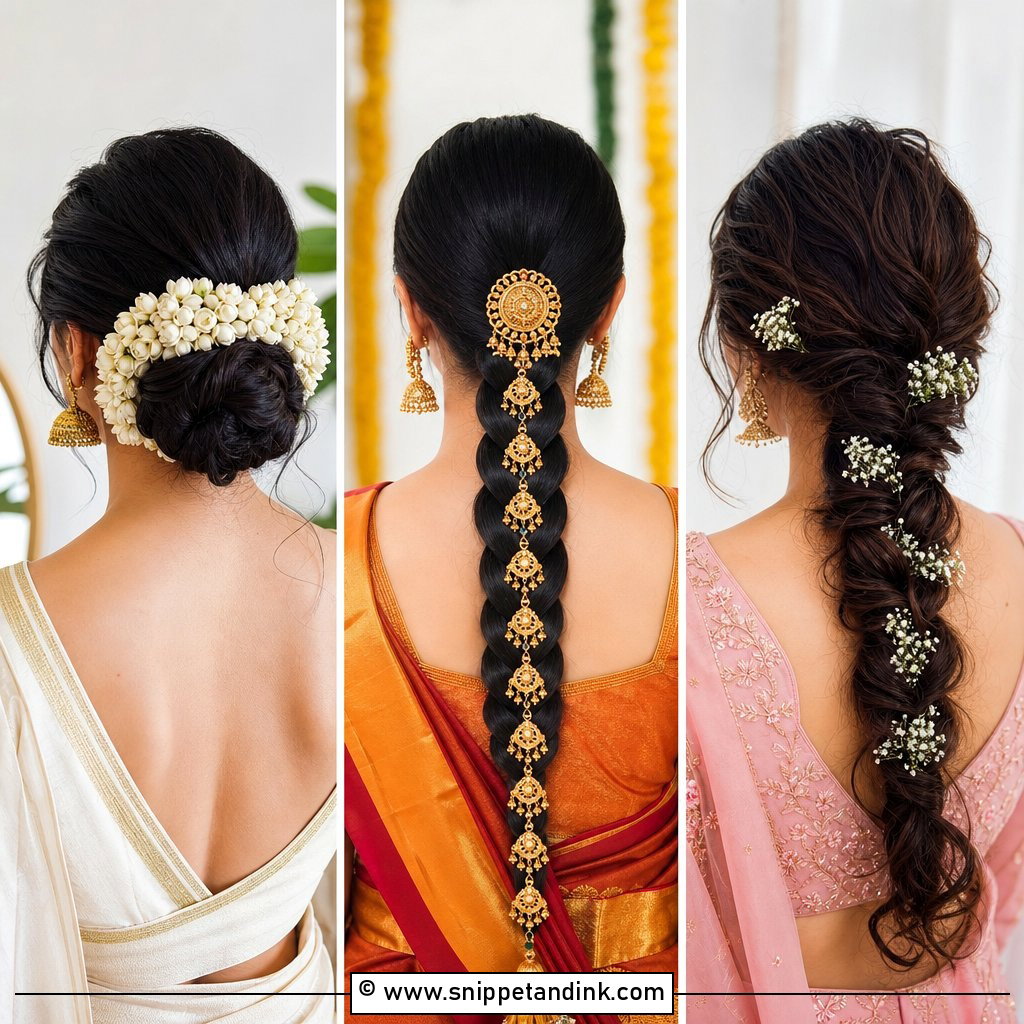
Ornate gold pieces run down the whole length of this braid, often with gods, peacocks or lotus motifs, and they catch the light every time you turn. Tamil and Telugu brides wear it with heavy Kanjeevarams and matching temple sets. The weight is the real story. A full gold jada is heavier than any flower arrangement, and it drags on the crown if it’s hooked only at the top. I tie it to the braid at several points down its length so the load is shared. If yours is a family heirloom, bring it to the trial; older pieces sometimes have worn hooks that need a jeweler before the wedding.
3. Jasmine Gajra Braid
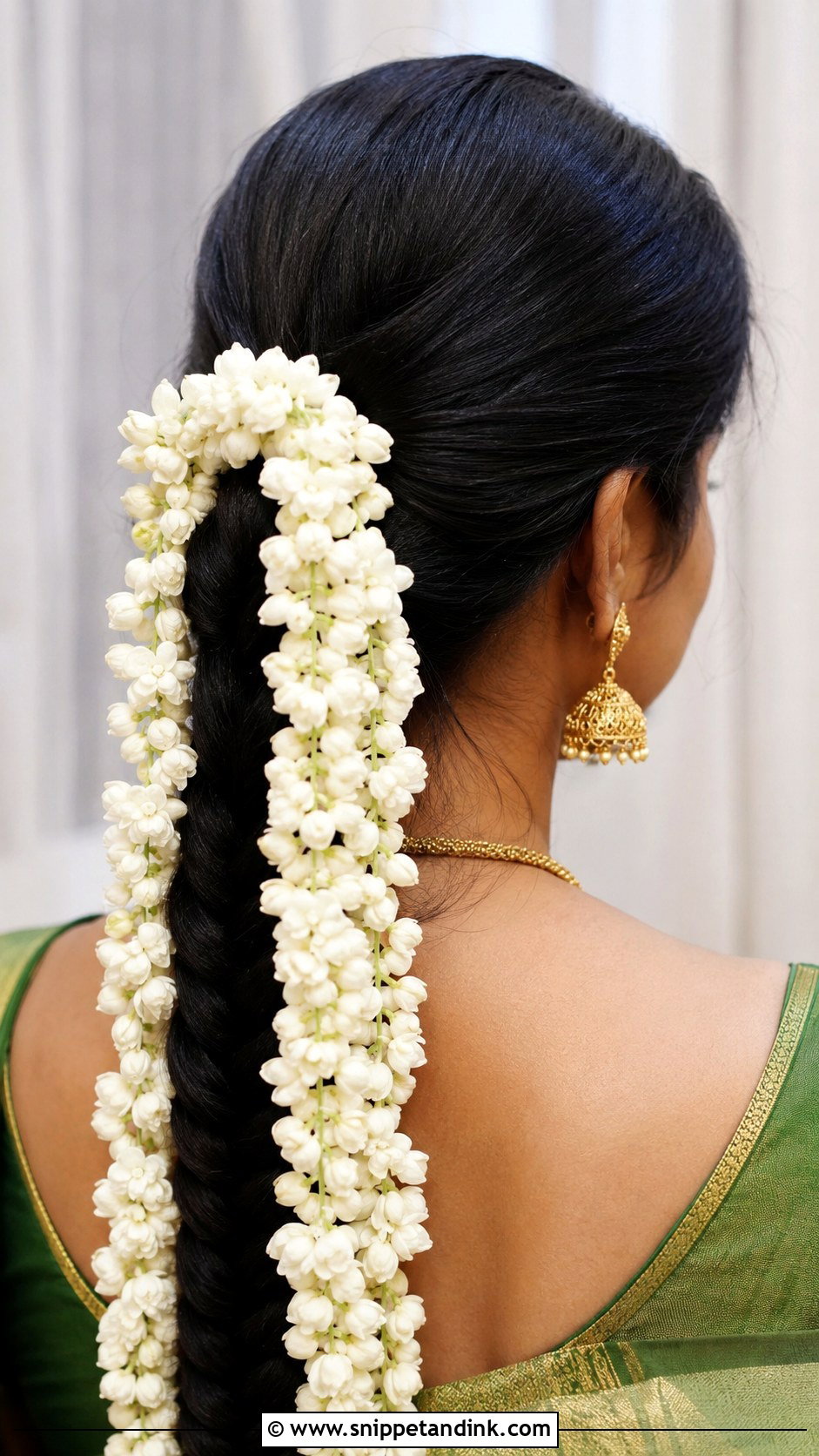
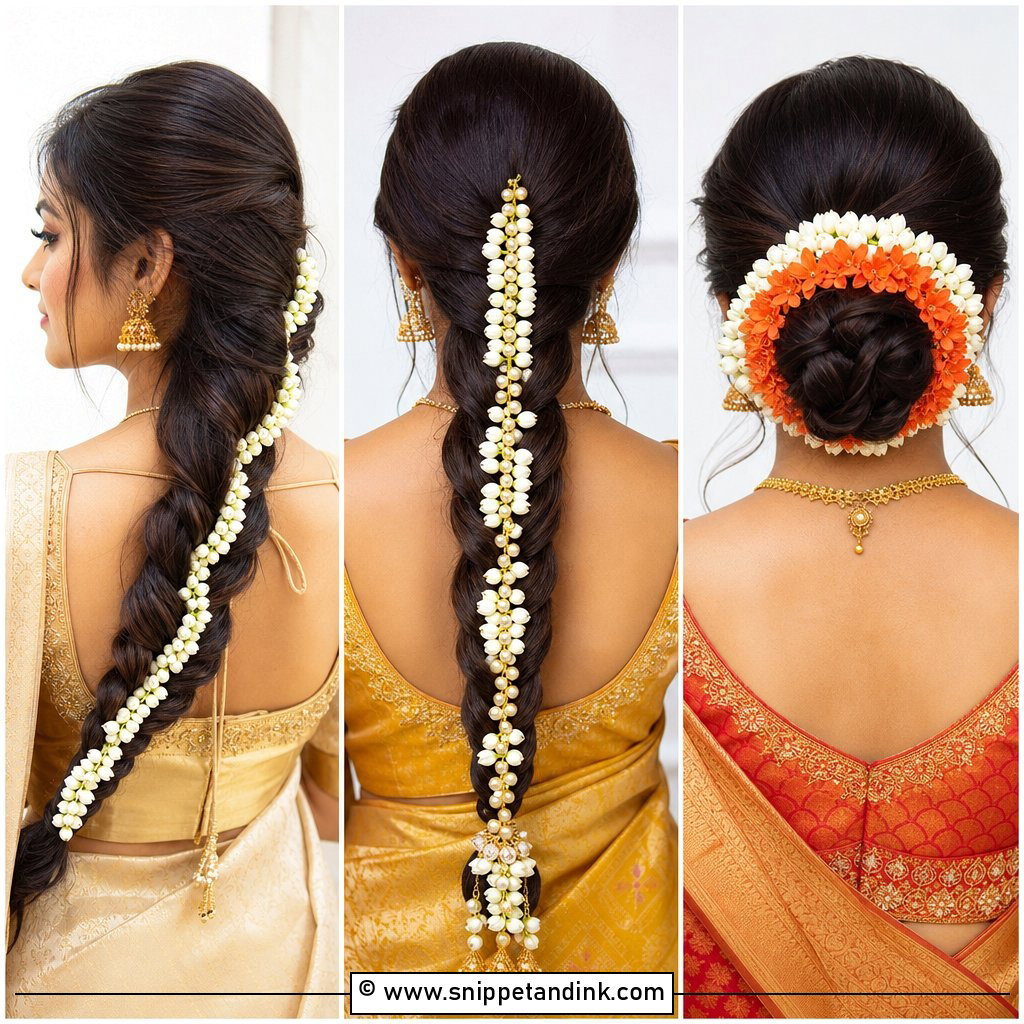
Fresh malli poo has a scent that fills a room, and on a wedding morning that matters more than people expect. The jasmine gajra braid wraps a thick string of it around a classic plait, white against dark hair. Wound tightly, it looks structured; wound loosely, it looks softer and lets more hair show. Some brides tuck in roses or kanakambaram for colour. It’s light enough to wear for pre-wedding functions as well as the ceremony, which is why I often suggest it to brides who find a full Poolajada too heavy.
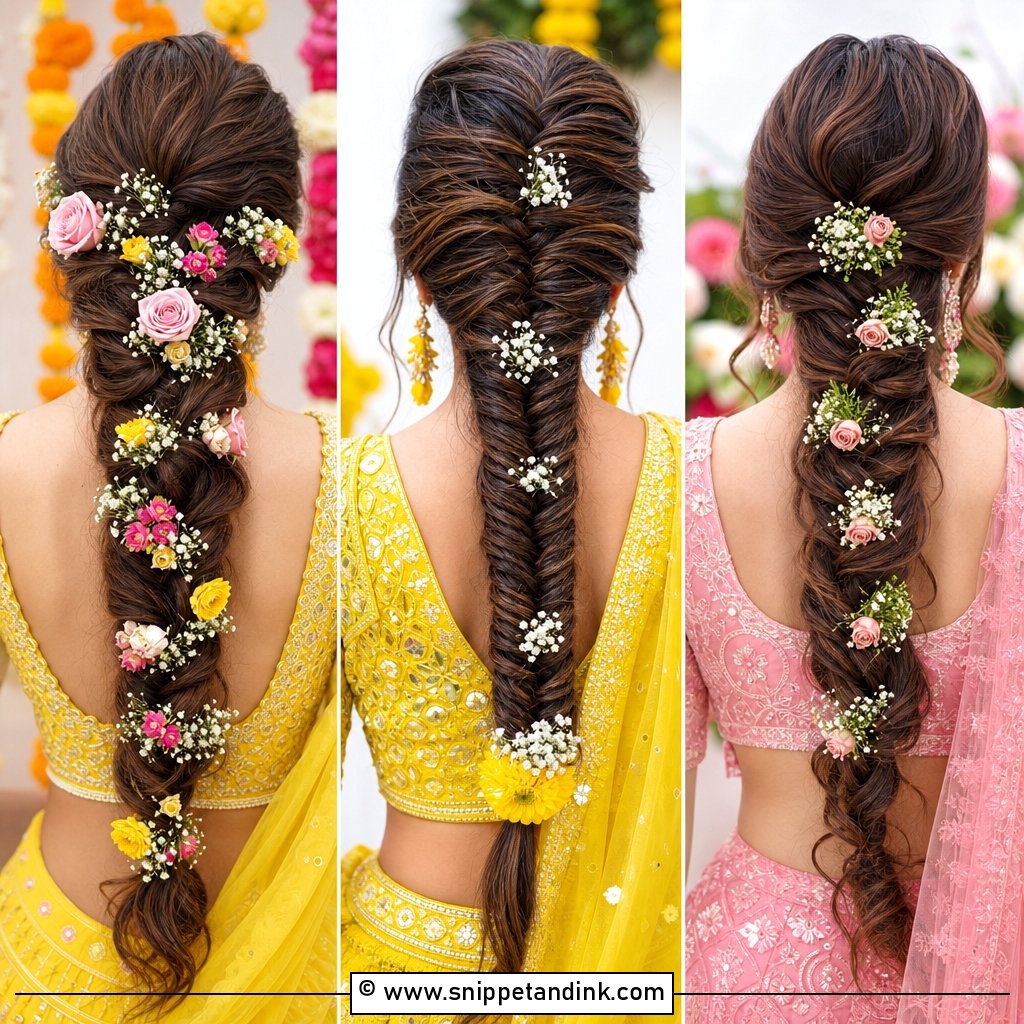
4. Fishtail Braid With Flowers
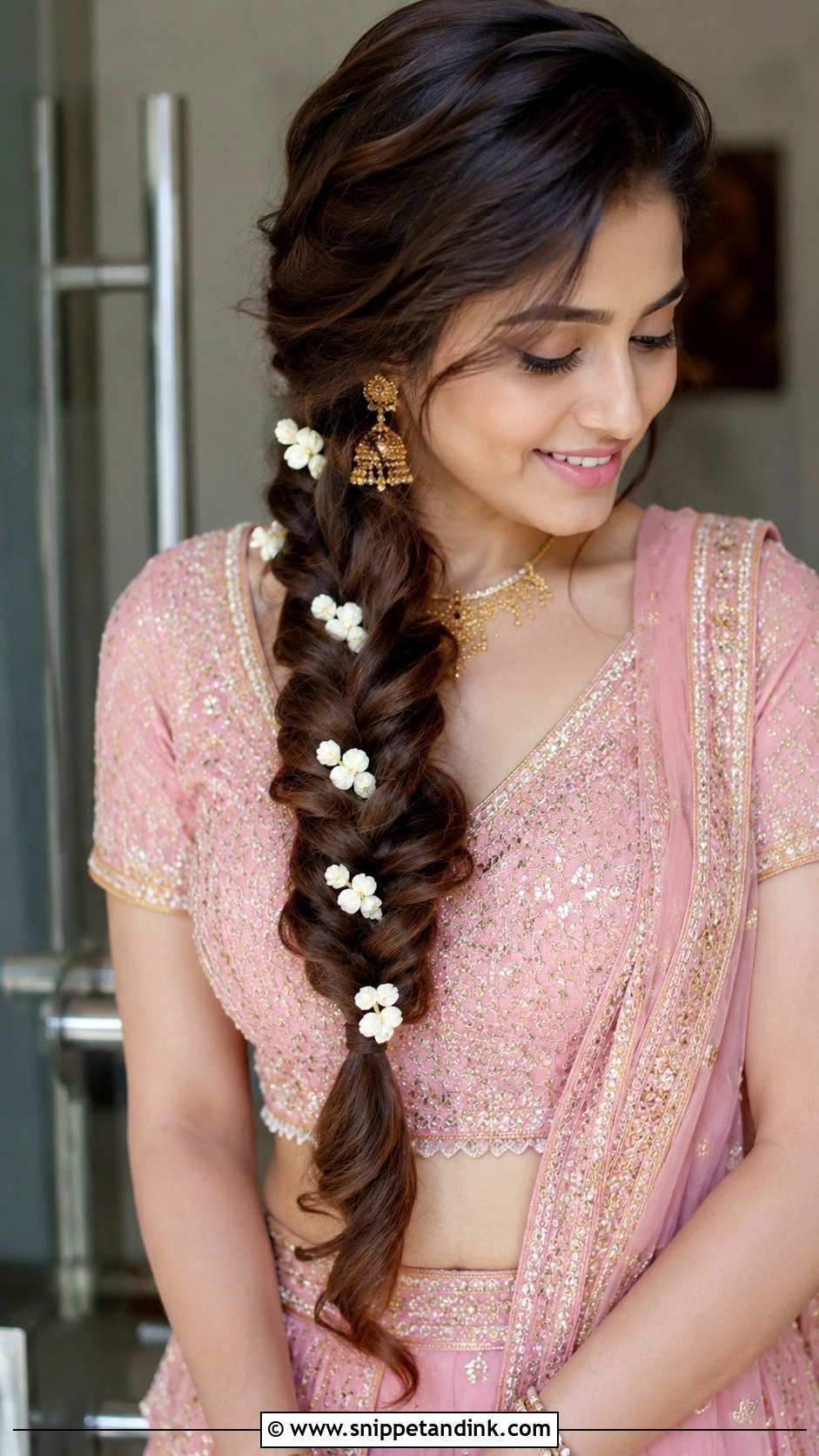
Neat three-strand braids are the South Indian norm, so a fishtail immediately reads as the modern option. The woven pattern is tight and textured, and jasmine buds slot into it neatly without needing a full gajra. I keep it over one shoulder for reception photos and tie it with a clear elastic hidden under a flower. Sarees and lehengas both suit it. Fine hair is the honest limitation: a fishtail in thin hair looks narrow, so I add a clip-in weft at the nape first and braid it in with your own hair.
5. Floral Bubble Braid
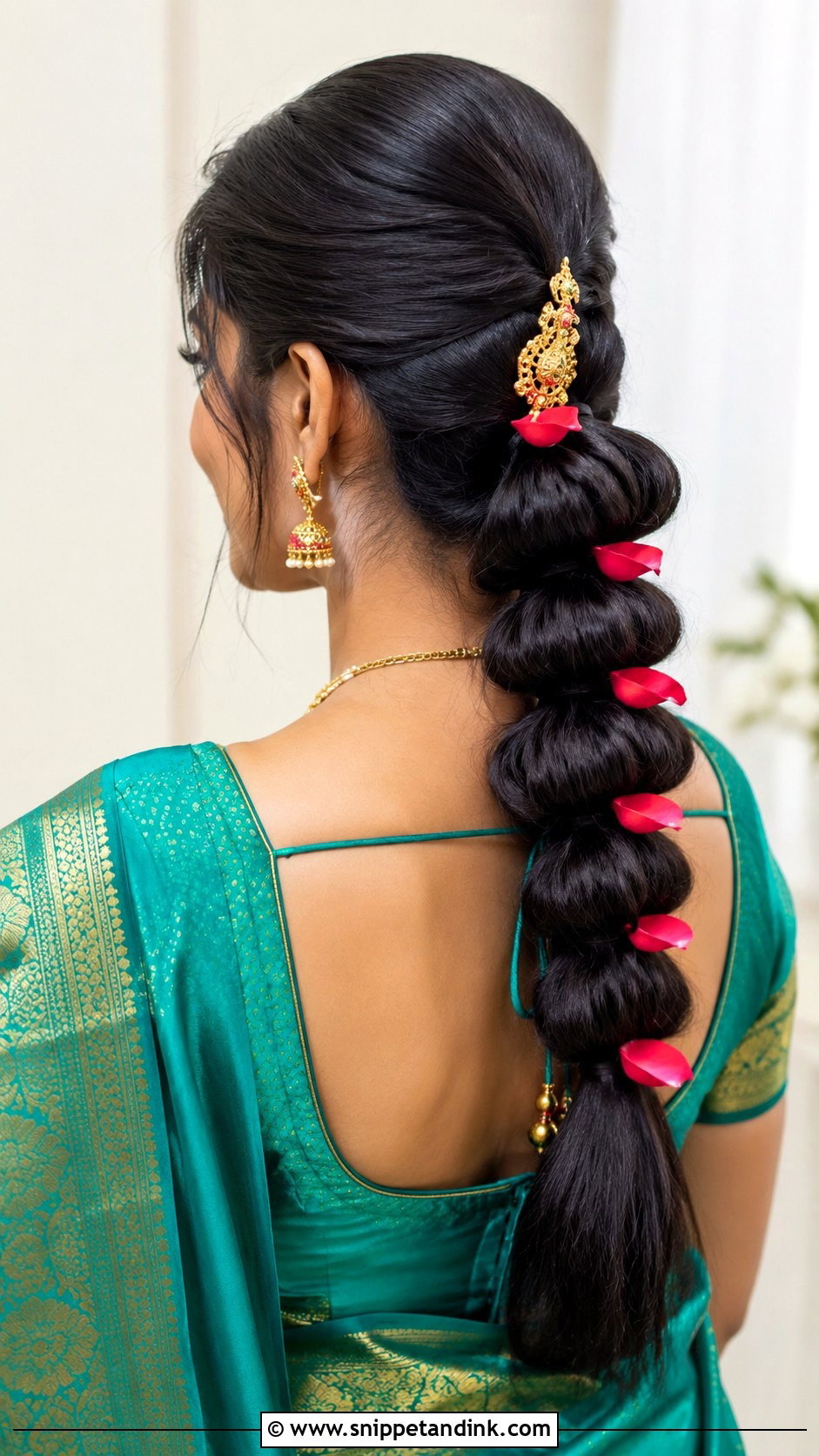
Bubble braids aren’t braids at all. The hair is sectioned with clear elastics and each section is gently pulled into a rounded bubble, with jasmine or rose petals tucked between them. That makes it quick to build and easy to adjust on the day. It suits younger brides and pre-wedding functions better than the muhurtham itself, where families usually expect a traditional plait. The weak point is the elastics. Clear ones can show in close-up photos, so I cover each join with a flower or a small gold clip.
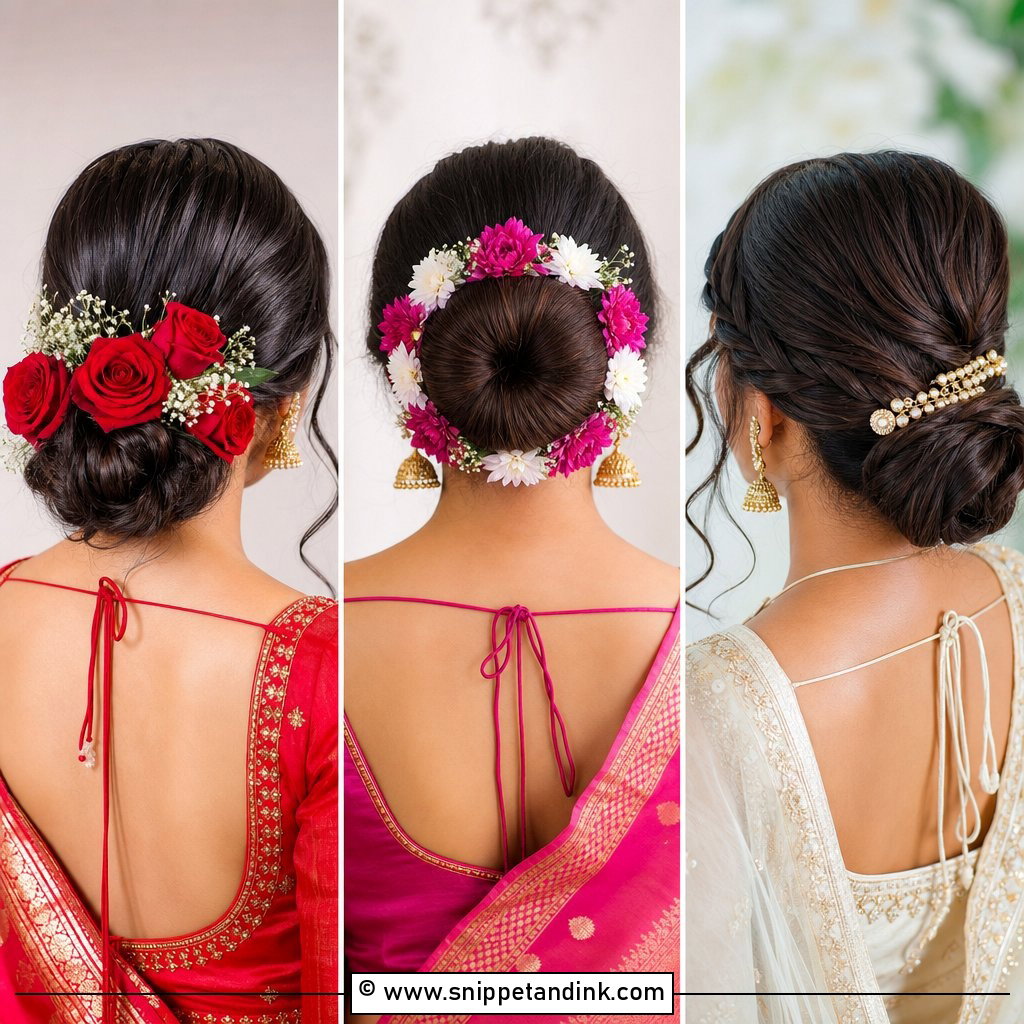
6. Veni Style Bun With Jasmine
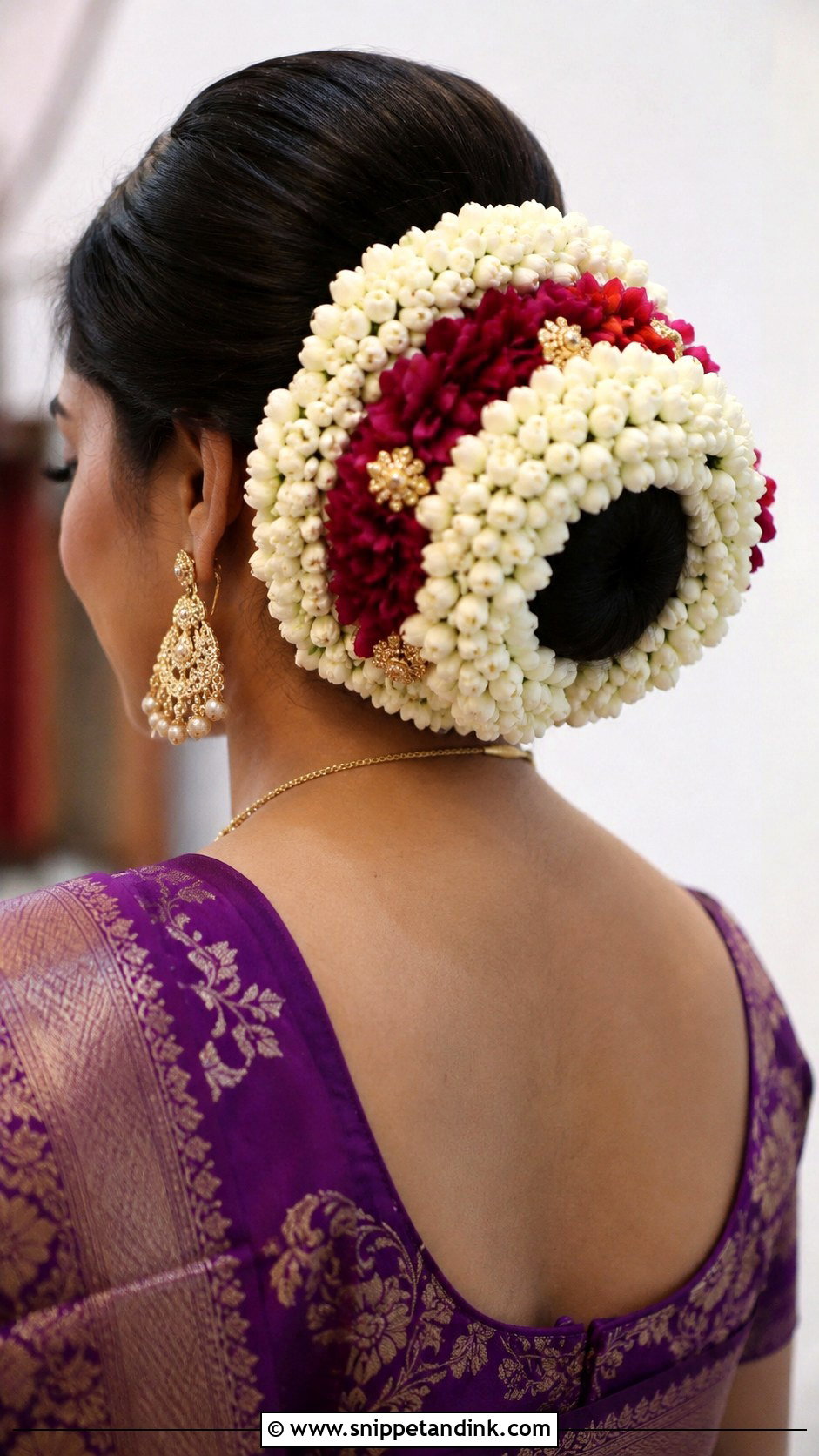
Not every bride wants a long braid, and a veni-covered bun is the classic alternative. The hair goes into a low circular bun at the nape, then thick jasmine and rose garlands wrap around it, held with gold pins or decorative brooches, often with a jewelled piece at the centre. Chandelier earrings and a maang tikka show off well because nothing hangs down the back. In practical terms, it’s easier to wear through long ceremonies than a full braid: you can lean back in a chair without crushing anything. I build the bun over a form so the garlands have a firm shape to sit on.
7. Crescent Moon Gajra Braid
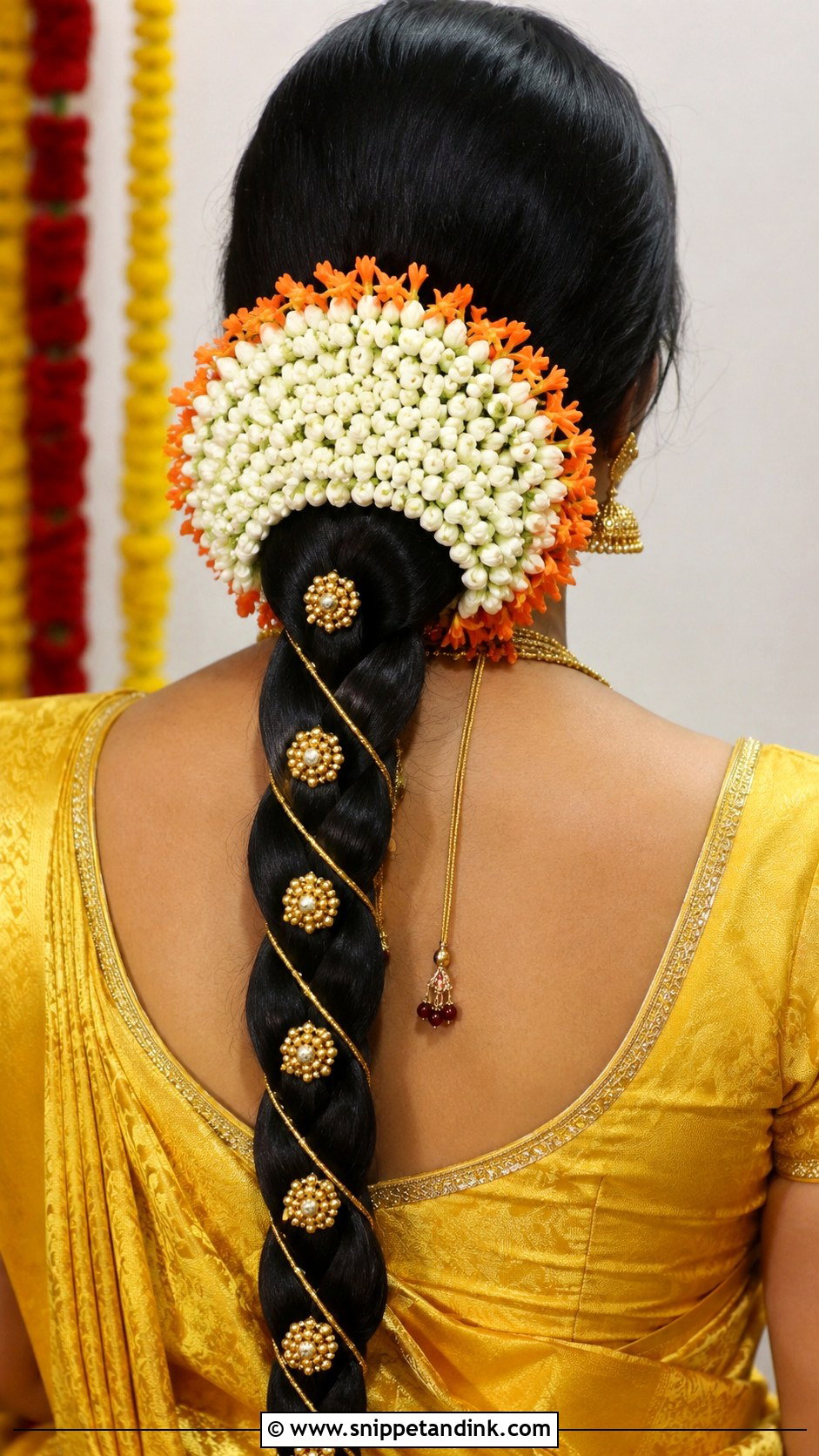
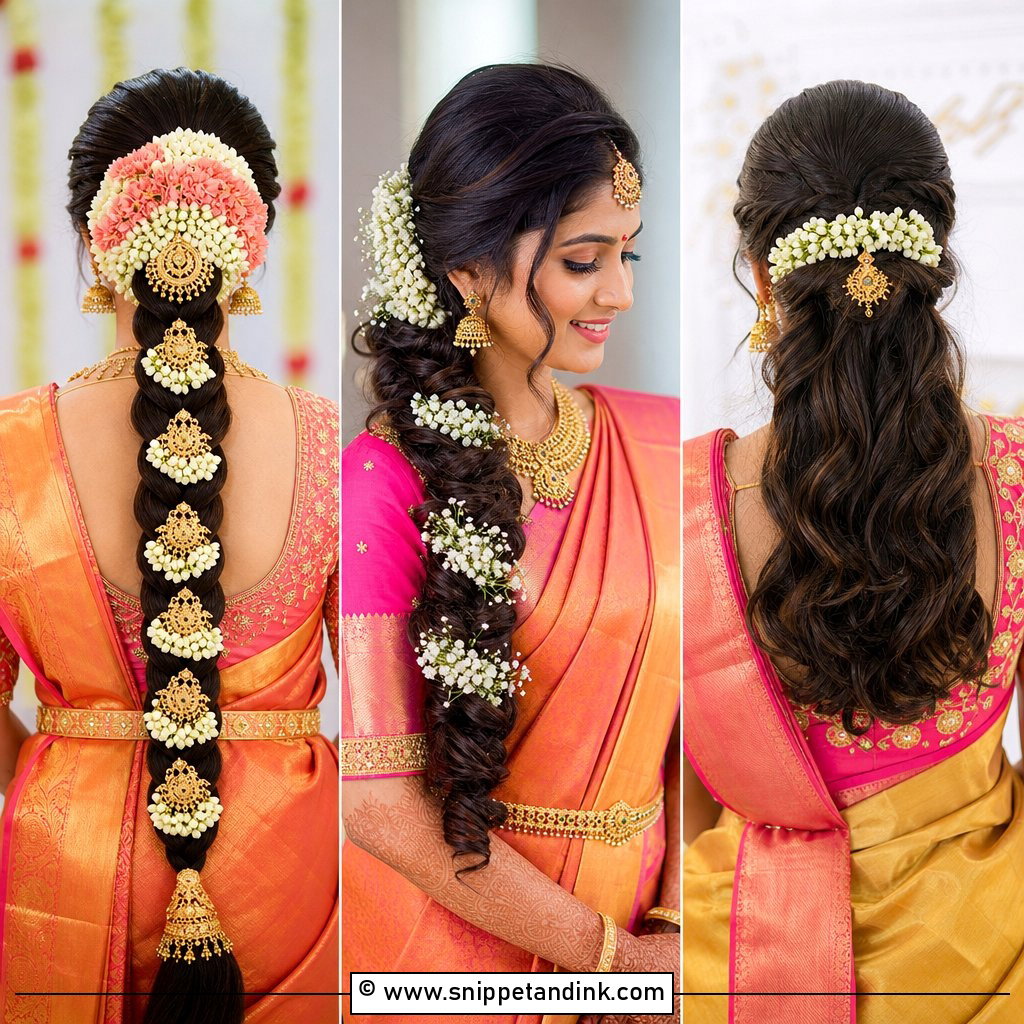
The crescent moon gajra is a tightly woven floral piece shaped like a half moon. Unlike a loose string, this structured veni gives clean, defined edges at the back of the head, usually white jasmine outlined with kanakambaram or roses. Because it’s stiff, it needs a flat, smooth surface to sit against. I smooth the crown and pin the veni at its two tips and centre, otherwise it lifts away from the head at the edges. It suits brides who want a sculpted shape and pairs well with heavy gold.
8. Kanakambaram And Jasmine Mixed Braid
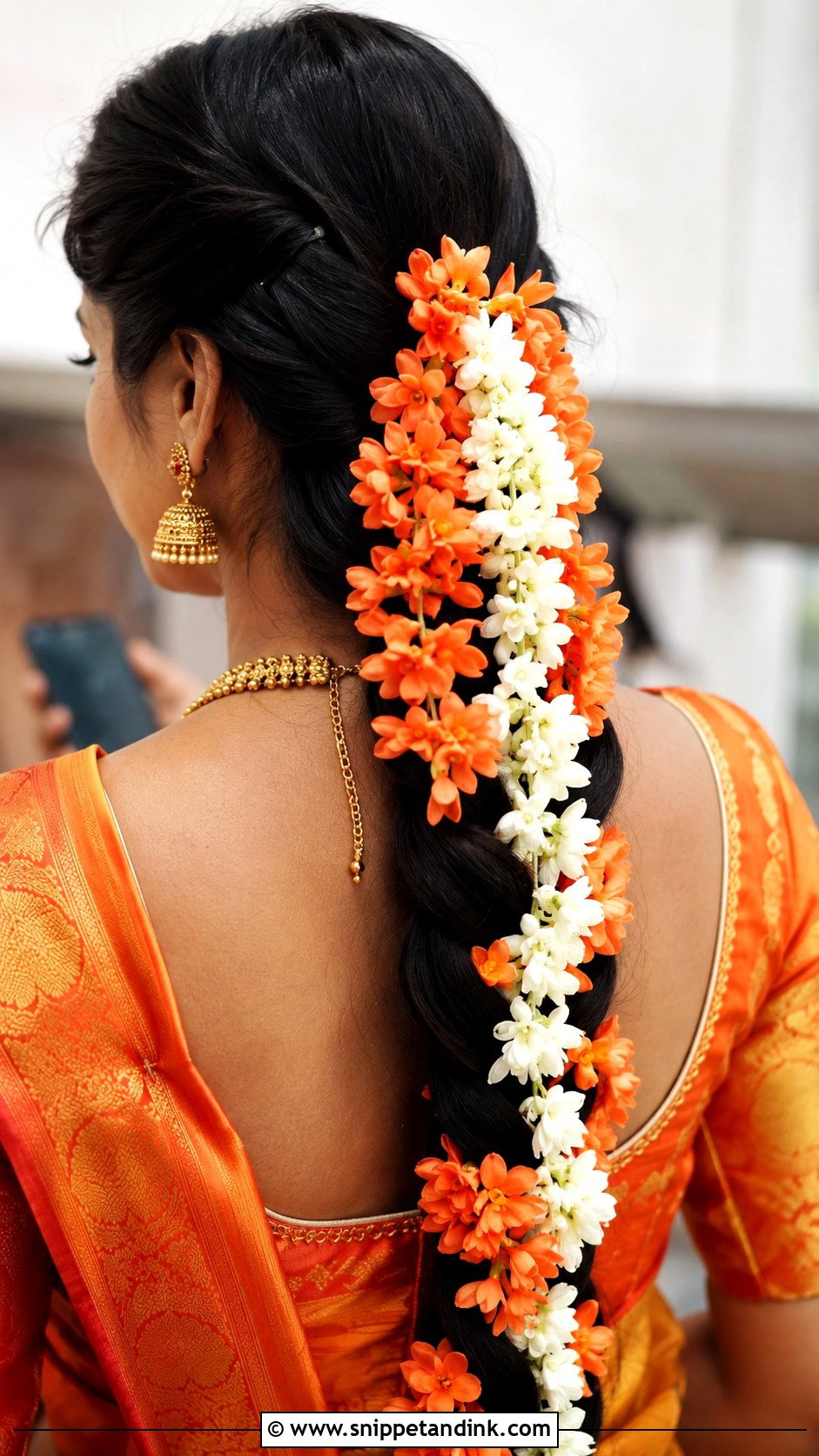
Orange kanakambaram against white jasmine is about as South Indian as a braid can look, and it’s a combination I’d recommend for heat. Kanakambaram is sturdier than jasmine and holds its colour well through a long, warm day, though it carries almost no scent, which is why the jasmine is there. The flowers are layered down a thick single braid from crown to tip. Red, orange and green silks take the colours best. It’s a traditional choice in Tamil Nadu and Andhra weddings, and it reads clearly even from the back of a large hall.
9. Rose And Jasmine Garland Braid
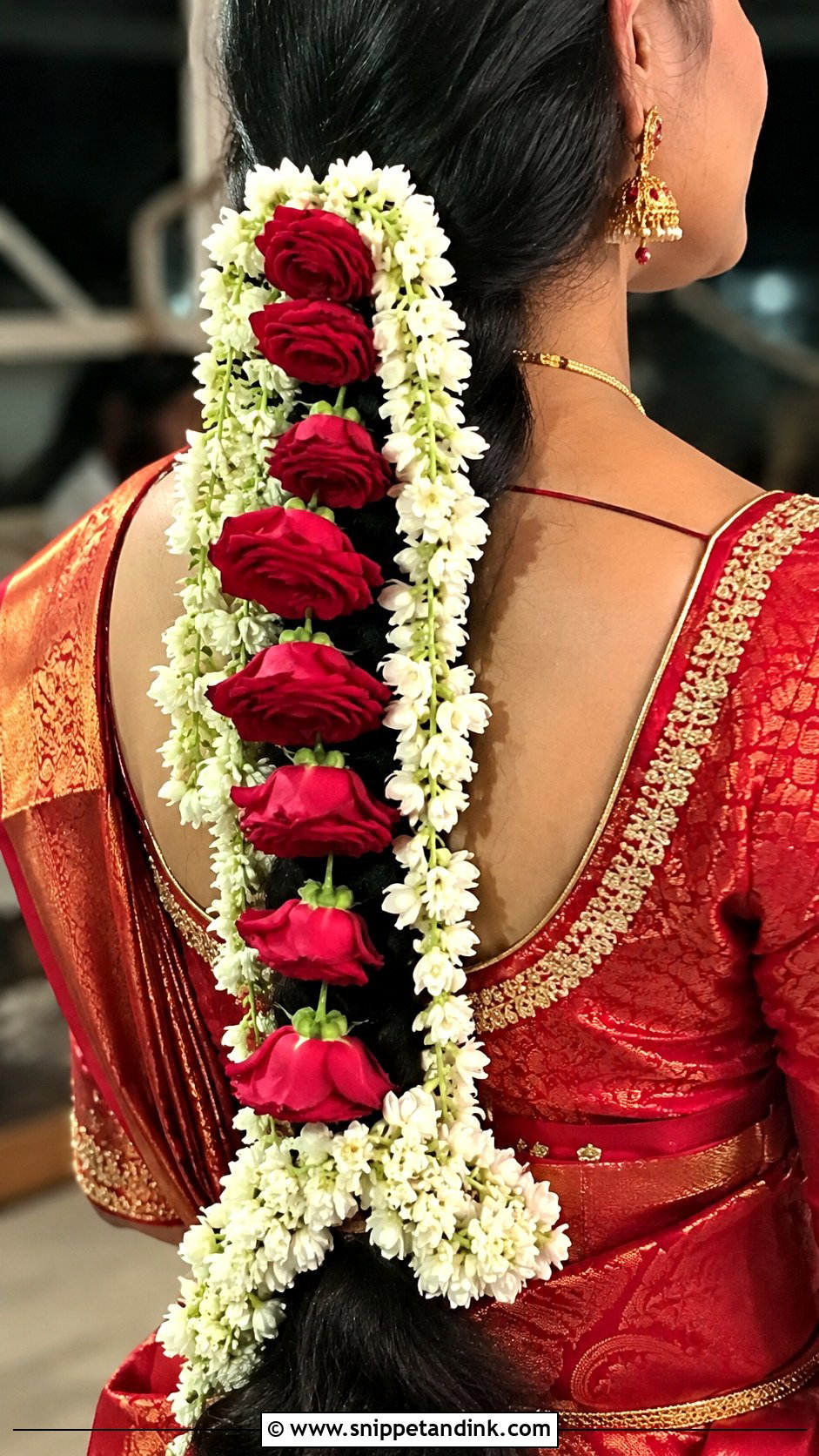
Full rose heads alongside jasmine strands give a lusher braid than jasmine alone. Roses bring colour and bulk; jasmine keeps the scent and fills the gaps. Red, pink or white can be matched to the saree. Roses are the fragile part here. Their petals bruise where they press against the shoulder and the back of a chair, so I keep the biggest blooms on the upper half of the braid and use smaller buds lower down. Matching floral jewelry can carry the theme to the neckline.
10. Maharashtrian Inspired Braid
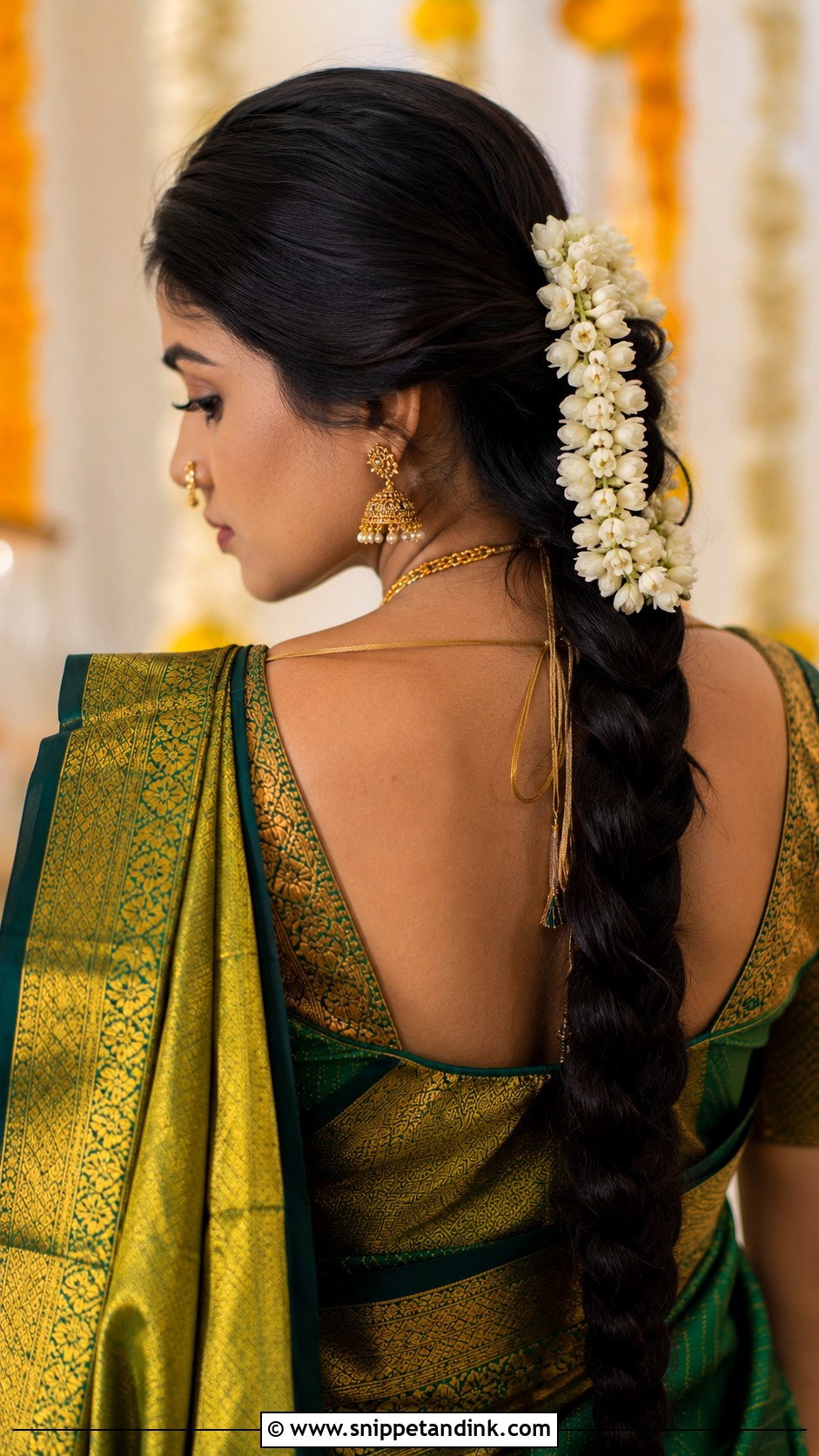
Some brides borrow from other regions, especially in mixed families. A Maharashtrian-inspired braid keeps the plait sleek and simple and adds one floral piece near the crown, with mogra wound around the upper part of the braid. Paired with a nath and gold ornaments, it becomes a fusion look that honours both sides. It’s much lighter than a Poolajada. I’d suggest it to brides who find heavy florals uncomfortable or who have a sensitive scalp.
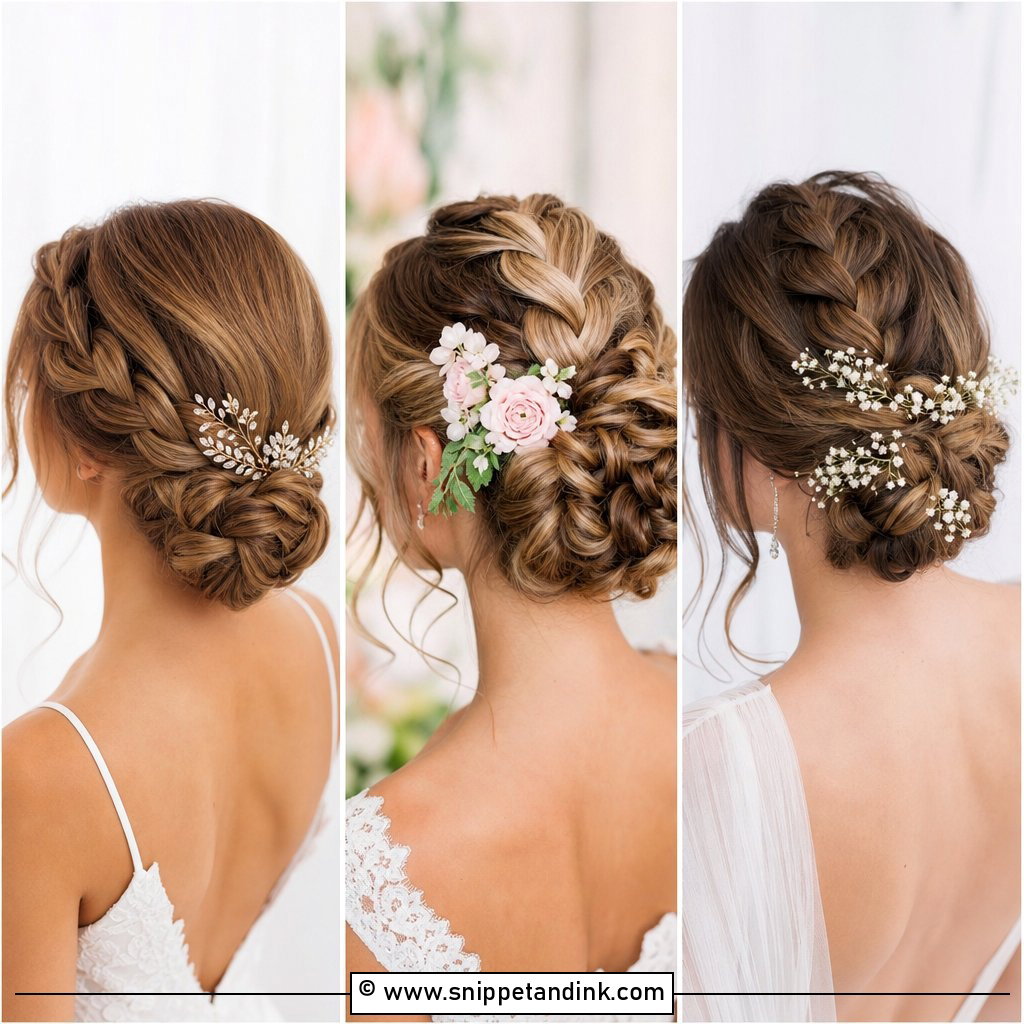
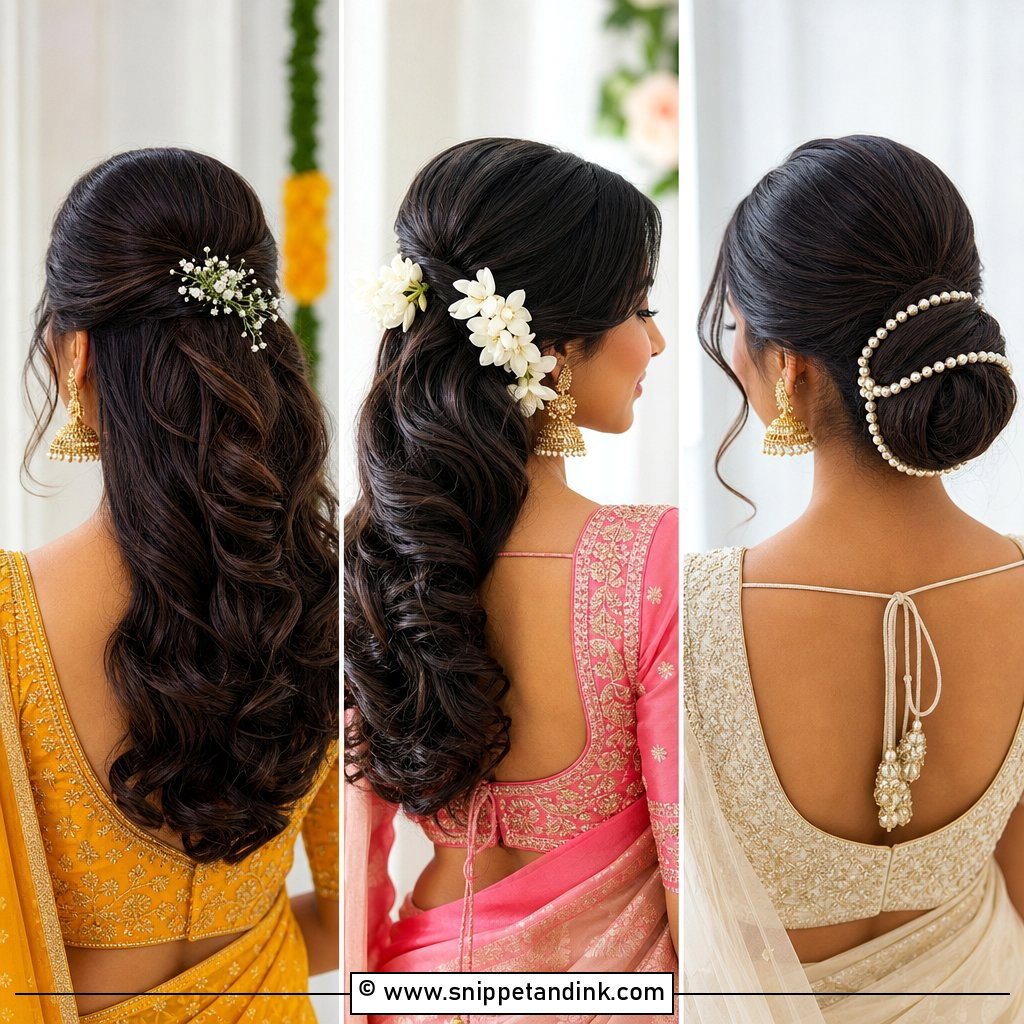
11. Pinned Up Braided Bun
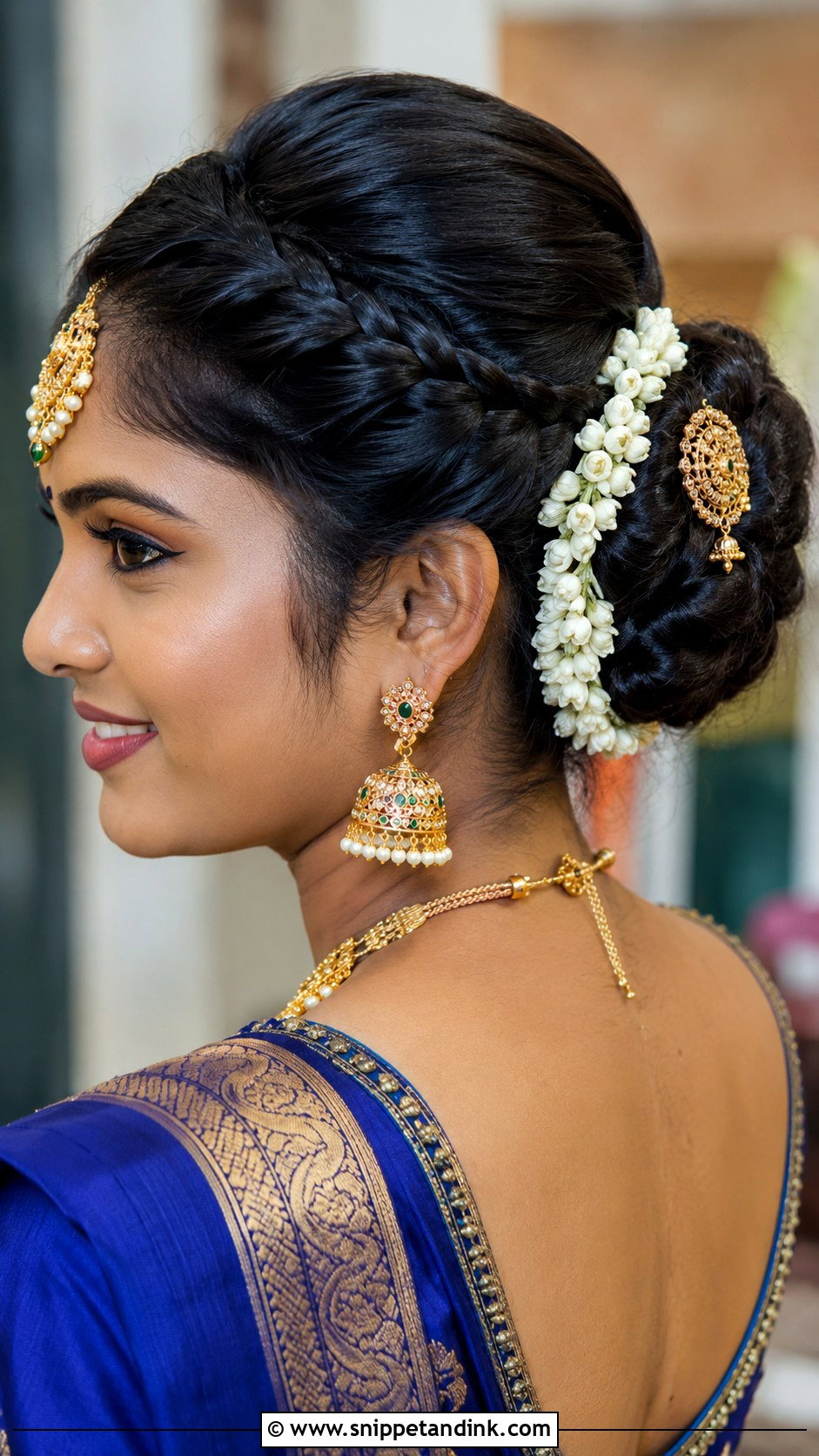
Braiding the hair first and then coiling it into a high bun gives you the texture of a braid with none of the length on your neck. Flowers and gold accessories decorate the coil, and jasmine wraps the base. It’s one of the most secure styles on this list; braided hair coiled on itself grips pins far better than smooth hair. In warm weather, it’s also the coolest. Heavy earrings and a statement maang tikka both have space.
12. Side Swept Braid With Flowers
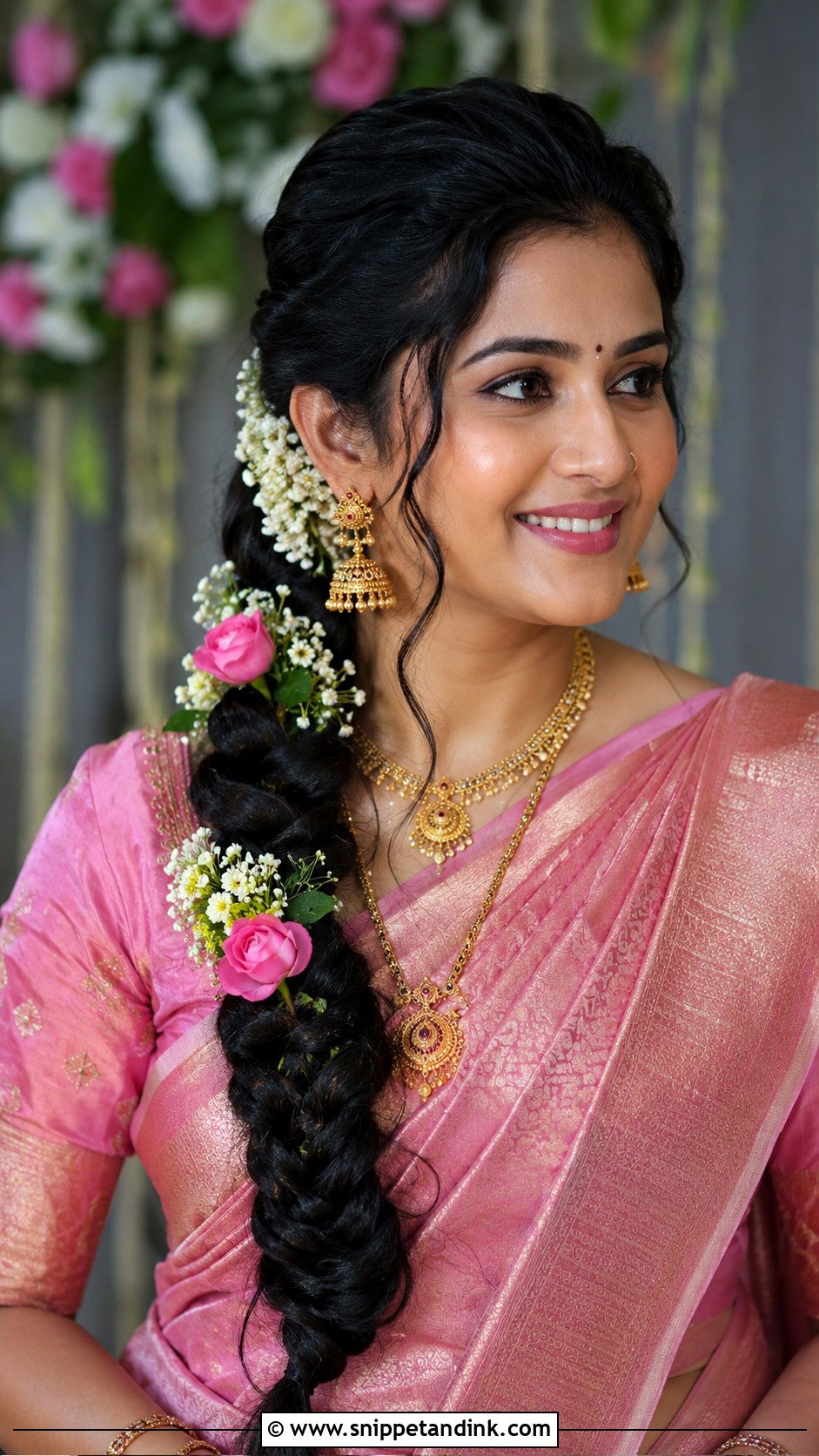
Asymmetry changes what people notice. Sweep the braid over one shoulder and the exposed side shows off your earring, while the braid itself becomes a frame for the face. Jasmine and roses decorate the length. I start the braid behind one ear rather than at the centre back, so it falls naturally forward without strain on the hairline. Receptions suit it more than the muhurtham. In the ceremony, a braid on the shoulder ends up under the garland.
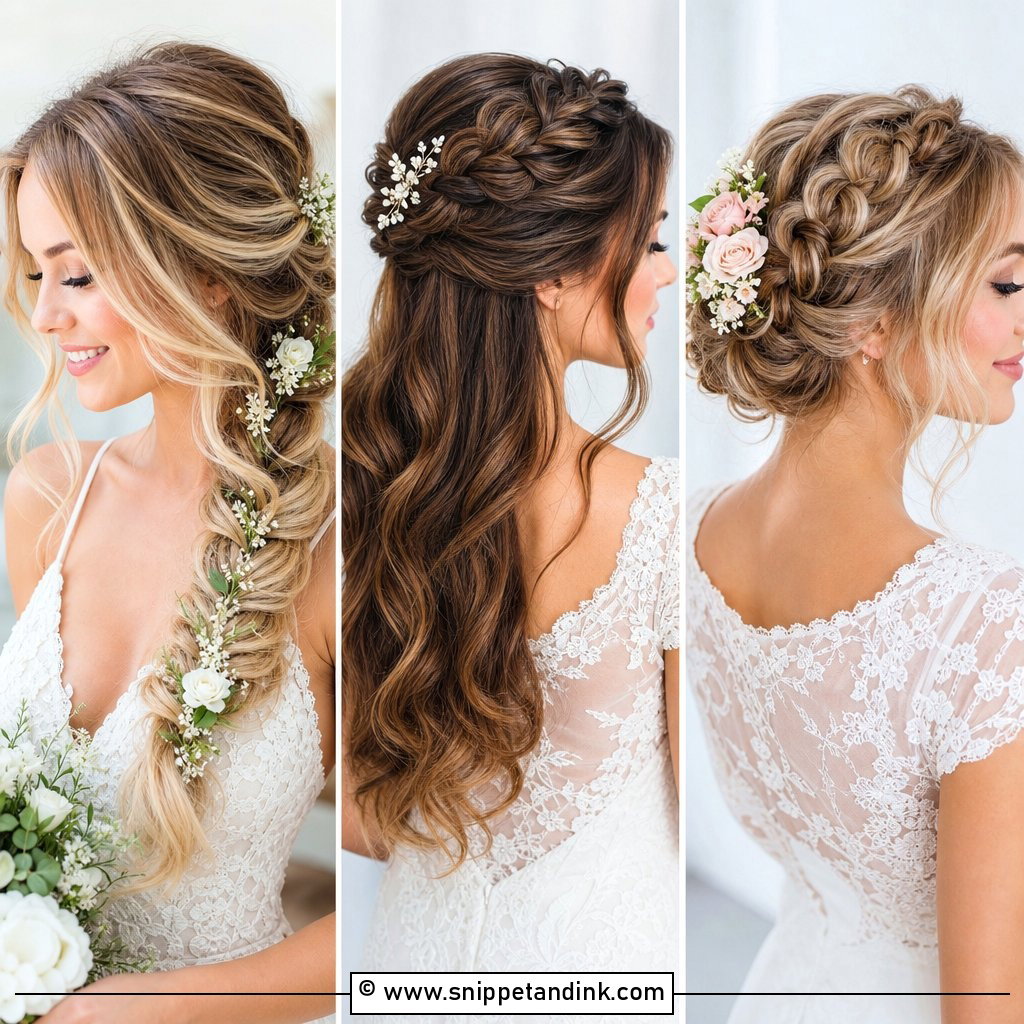
13. Half Up Braid With Floral Crown
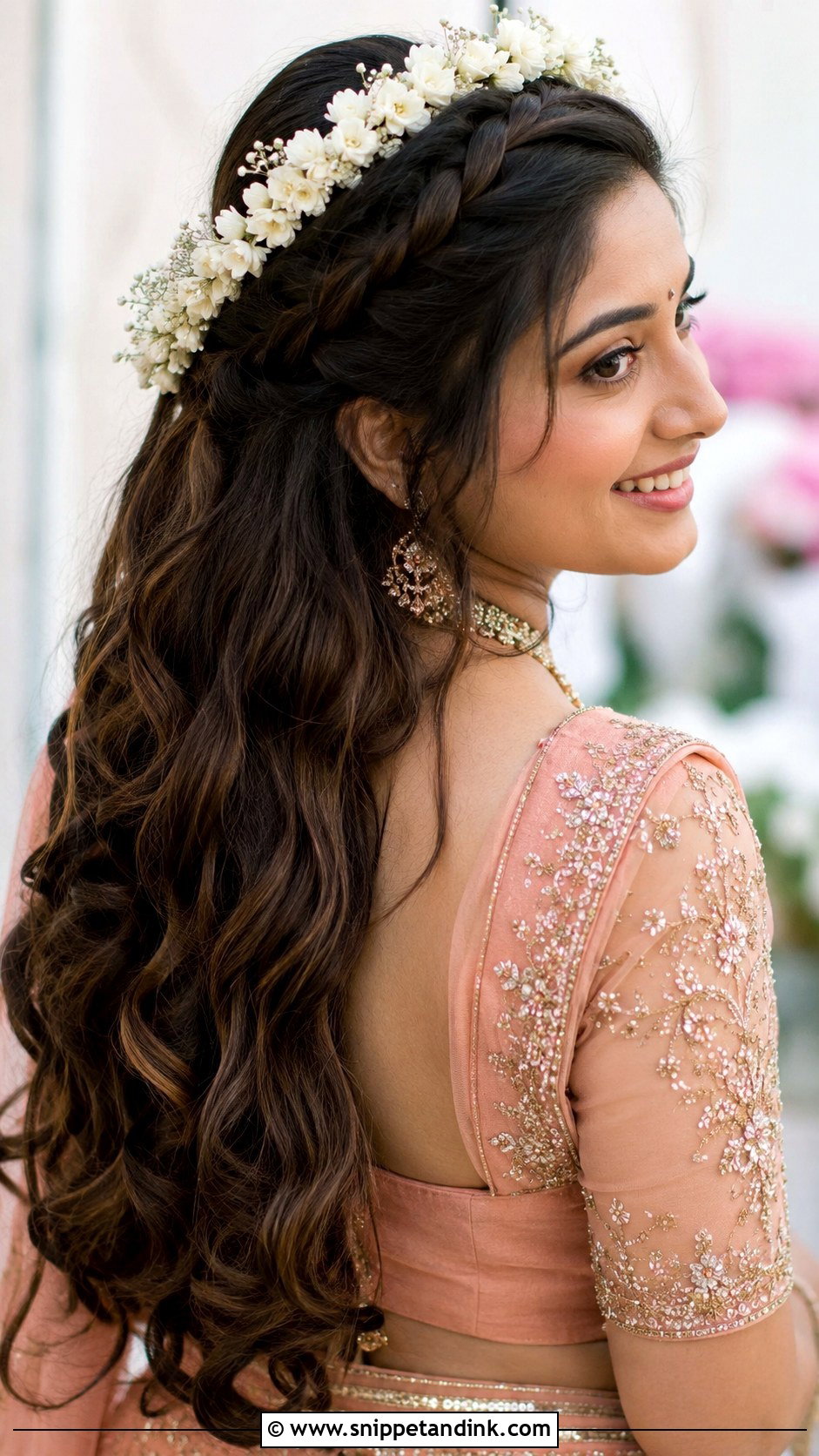
The top section is braided and secured while the rest flows free, with a floral crown of jasmine or small roses along the braided part. It’s youthful and a little bohemian, and it shows off length while keeping hair off the face. It suits engagement ceremonies and pre-wedding functions better than the main wedding. The loose lengths are the vulnerable bit: humidity takes the bend out of curls fast, so I set them with heat and hold spray, and leave delicate jewelry to carry the rest.
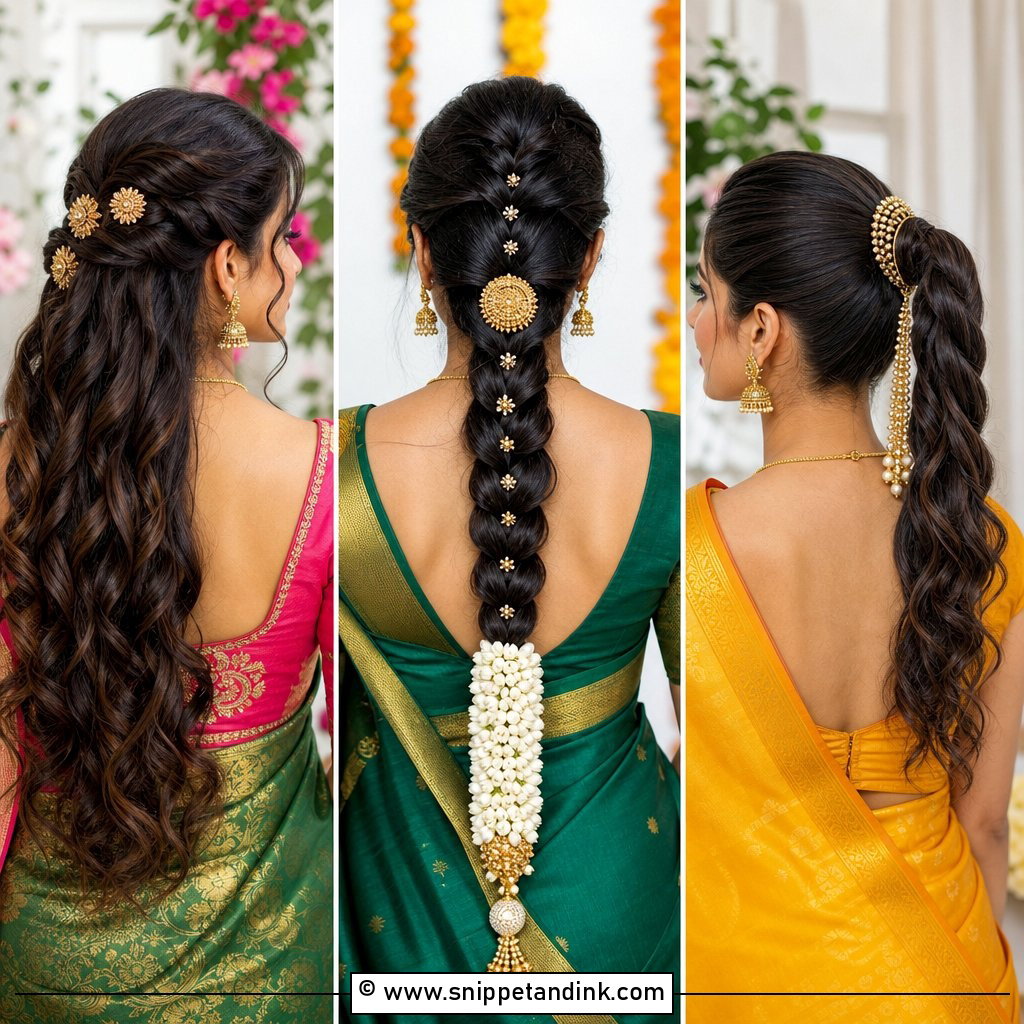
14. Thick Single Braid With Jada Billalu
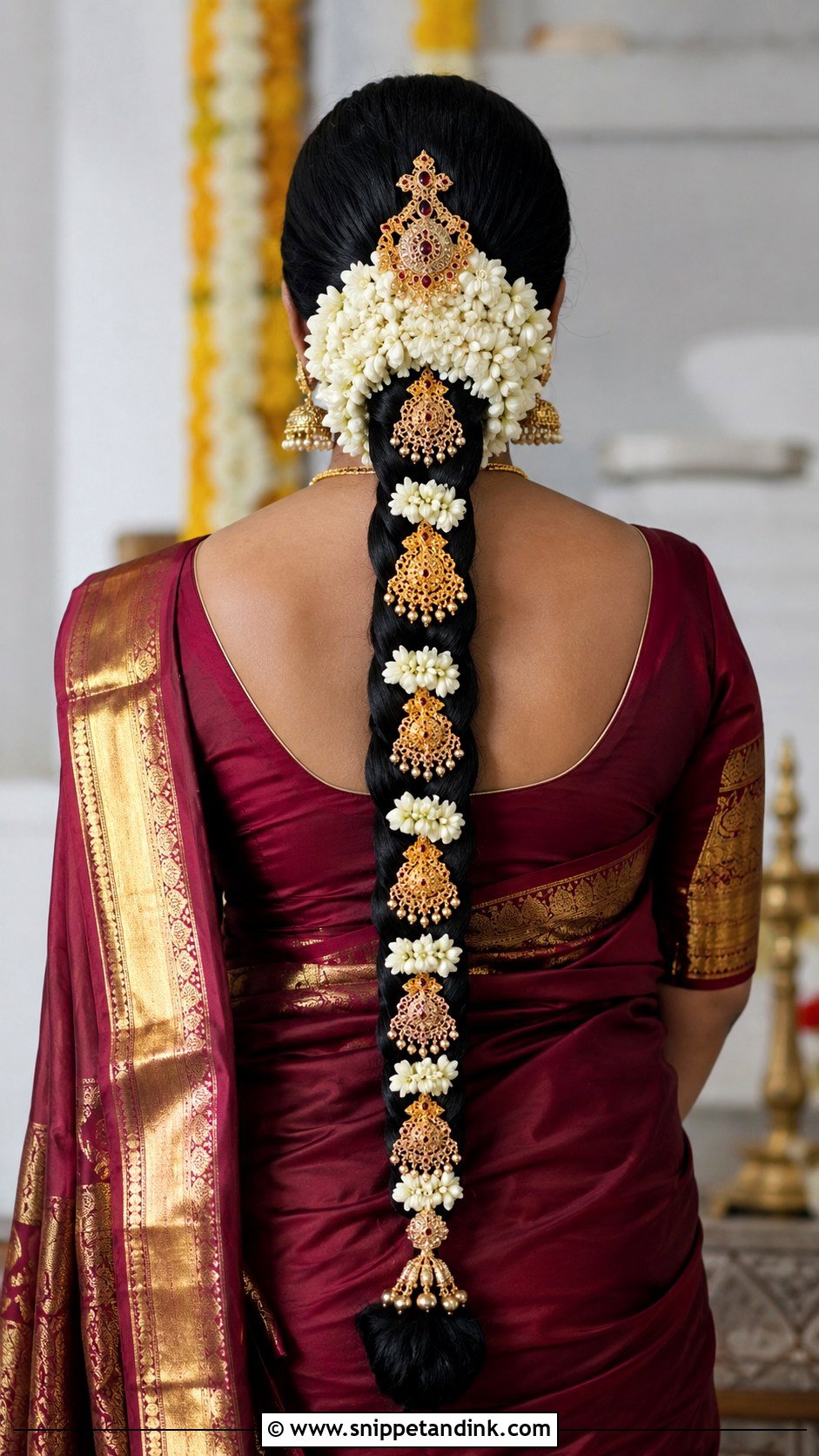
The jada billalu are round gold ornaments placed at the parting and down the braid, and together they make a line of gold from the crown to the tip. Flowers fill the spaces between. It’s a staple at Telugu and Tamil weddings and deeply tied to heritage. Spacing is what separates a good one from a cluttered one. I lay the billalu out on the table first, then mark where each sits on the braid at even intervals, before anything is pinned. Matching temple jewelry completes it.
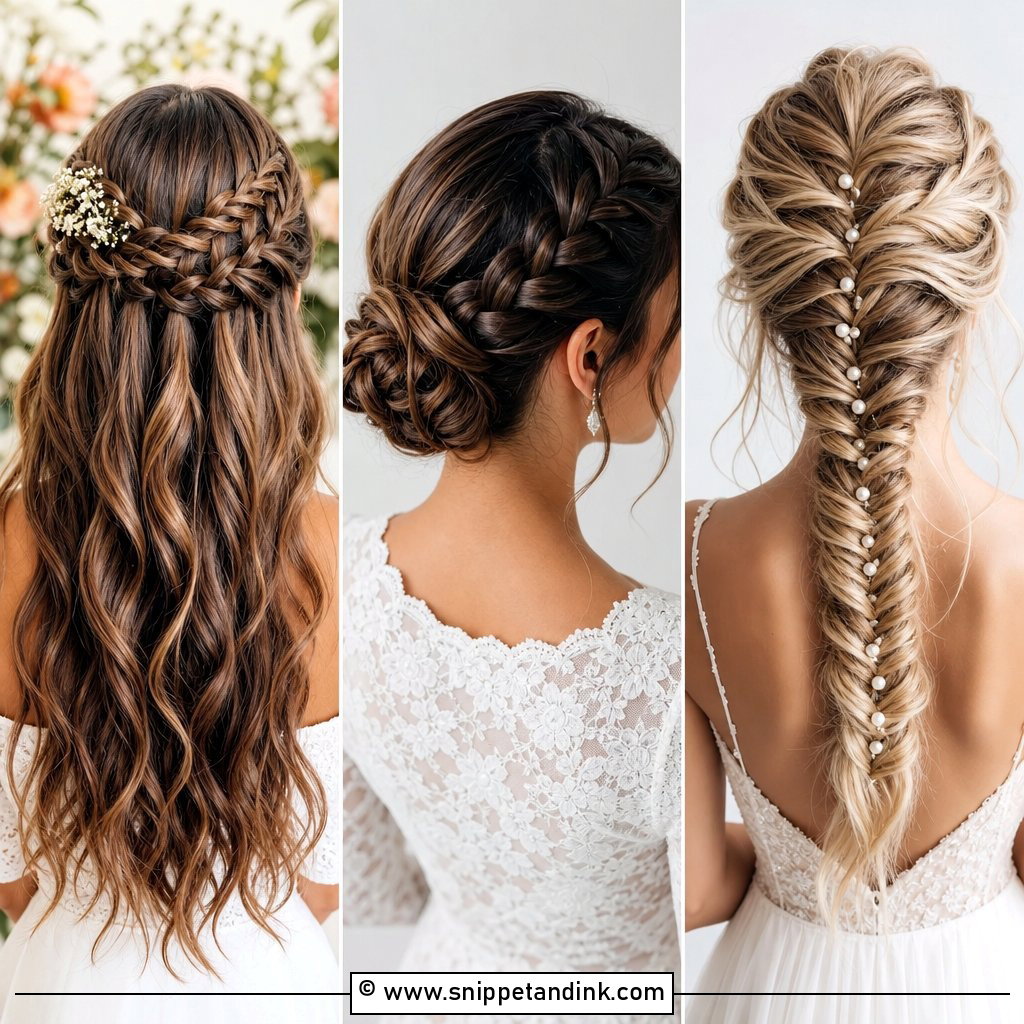
15. Messy Braid With Loose Tendrils
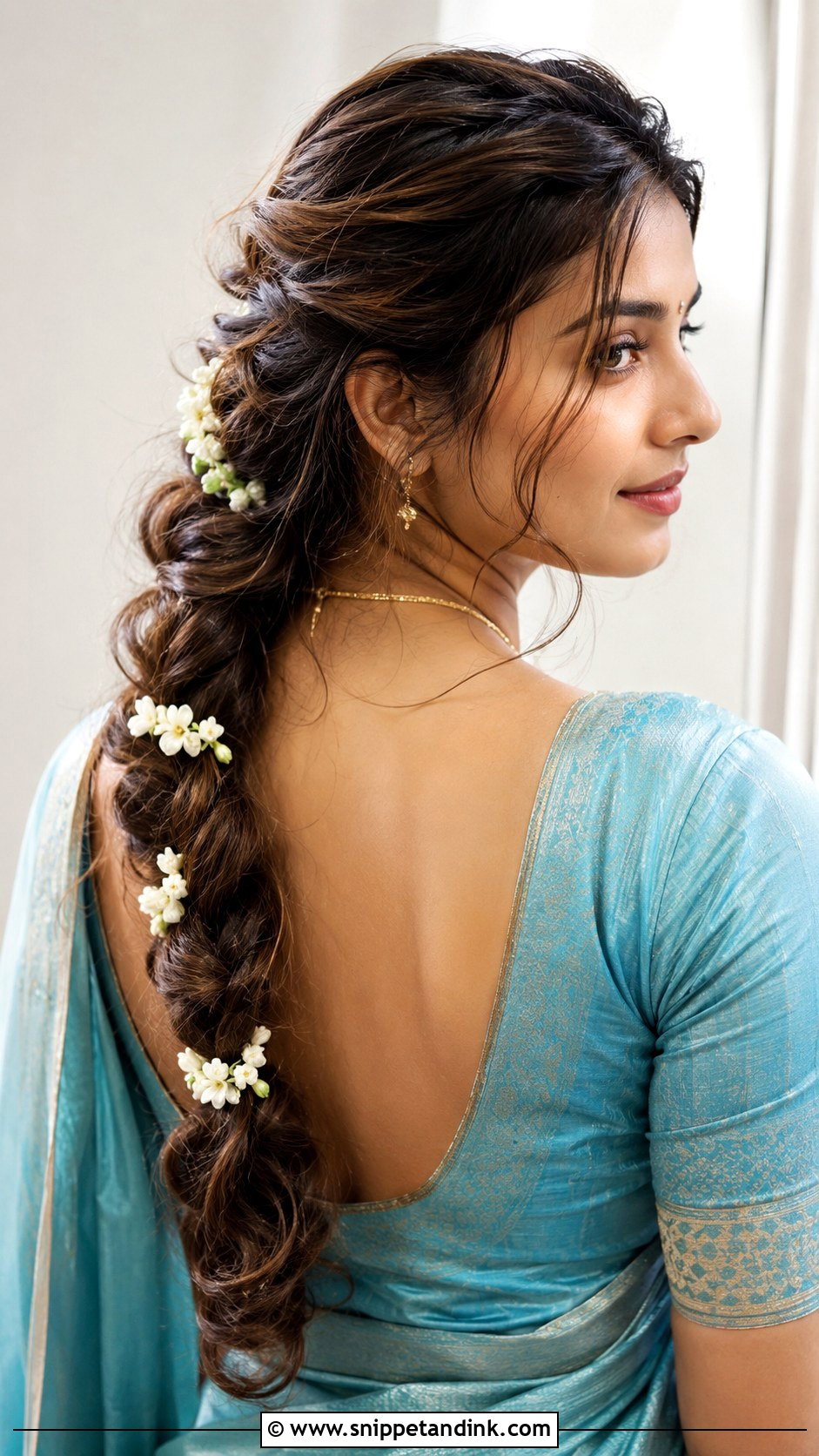
A slightly loose plait with tendrils at the face suits brides who want tradition without stiffness. Jasmine tucked throughout keeps it bridal. Outdoor and daytime ceremonies suit it, as do light sarees and minimal jewelry. The challenge is that loose braids loosen further as the day goes on. I braid it firmly first, secure it, and only then pull it apart a little, so the relaxed shape is set rather than accidental. Tendrils get a light curl so they don’t hang limp by evening.
16. Double Braid Bridal Style
Splitting the hair into two plaits, joined or worn separately, gives a different shape down the back. Both are decorated with jasmine and gold. Only very thick or very long hair carries two braids well; anything less and each one looks thin under the flowers. I’d suggest trying it at the trial and comparing it with a single braid in a photo from behind, which is where everyone will see it.
17. Braided Crown With Jasmine
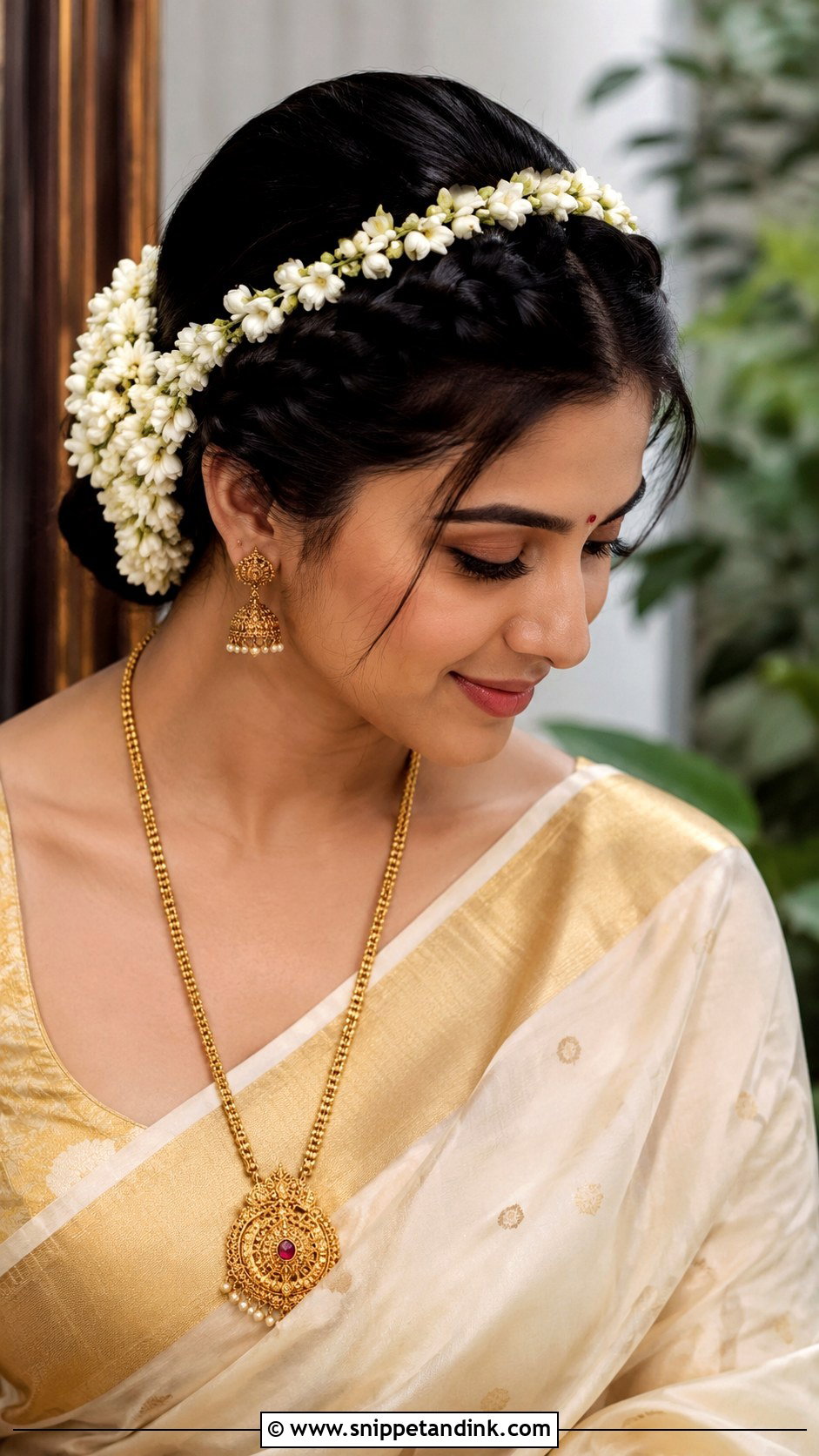
A braided crown wraps around the head like a halo, decorated with fresh jasmine, and the rest of the hair can flow or be tucked into a low bun. It draws all attention to the face and jewelry. I braid across from one side and pin as I go, keeping the braid flat, because a crown that sits proud of the head looks bulky in profile. It’s comfortable in heat and works for ceremony and reception alike.
18. Low Braided Bun With Gold Accessories
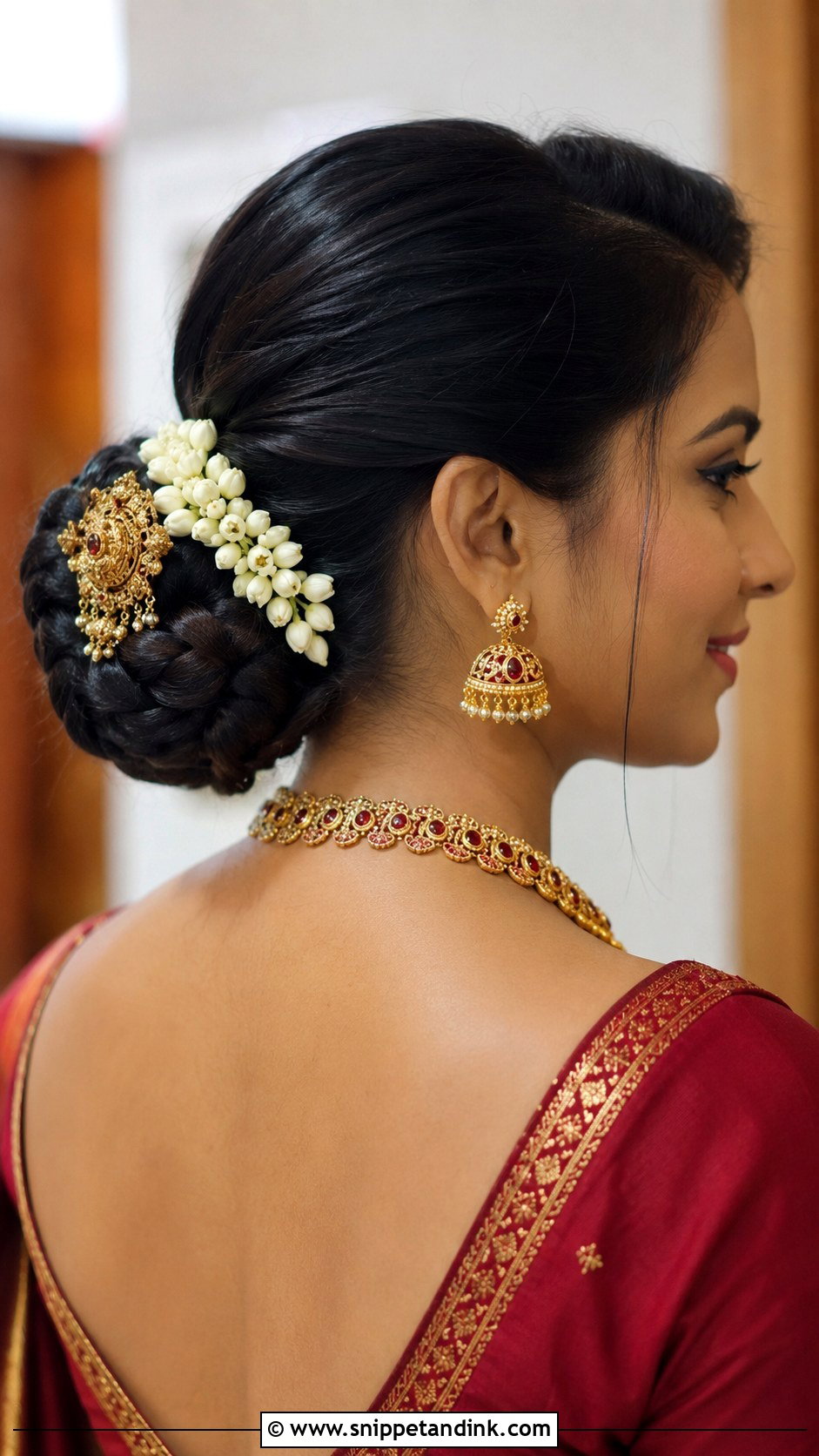
This one is the understated choice. The hair is braided, then coiled into a loose, textured bun at the nape, with gold accessories and jasmine tucked into the shape. It’s comfortable through long events and doesn’t feel heavy. The low placement leaves room for statement earrings and a long necklace. For brides who don’t want a towering floral arrangement, I’d point here first. It also comes down faster than most styles if you’re changing for a reception.
19. Floral Ponytail Braid
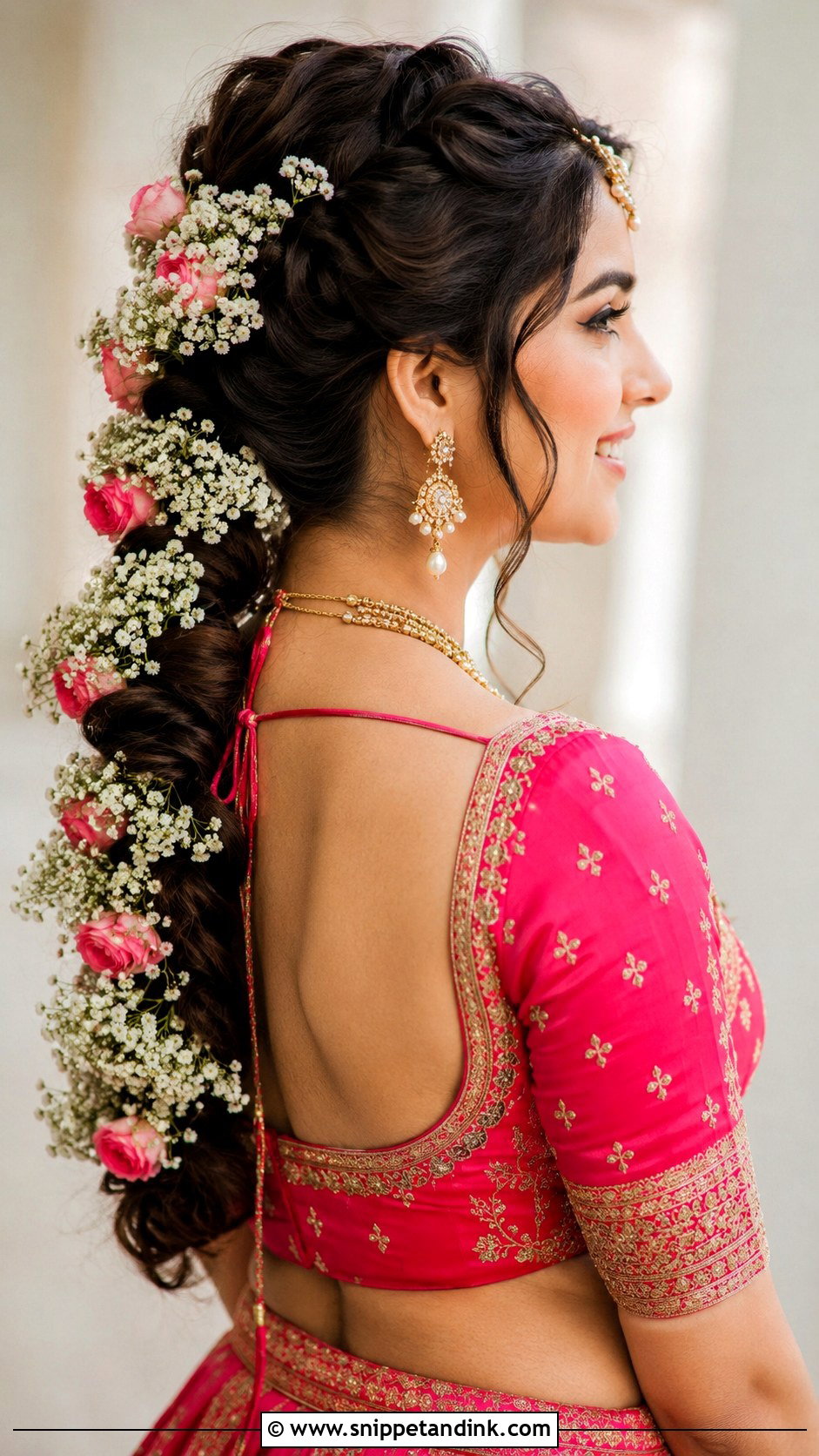
The hair is gathered into a high or mid ponytail, then braided down its length, with jasmine and roses at the base and along the plait. It shows movement and keeps hair off the neck, and it suits a sangeet better than the ceremony. The base needs a strong elastic and a few pins underneath, because the weight of a flower-covered braid will drag a ponytail down by evening. Brides with lighter hair density get the best result.
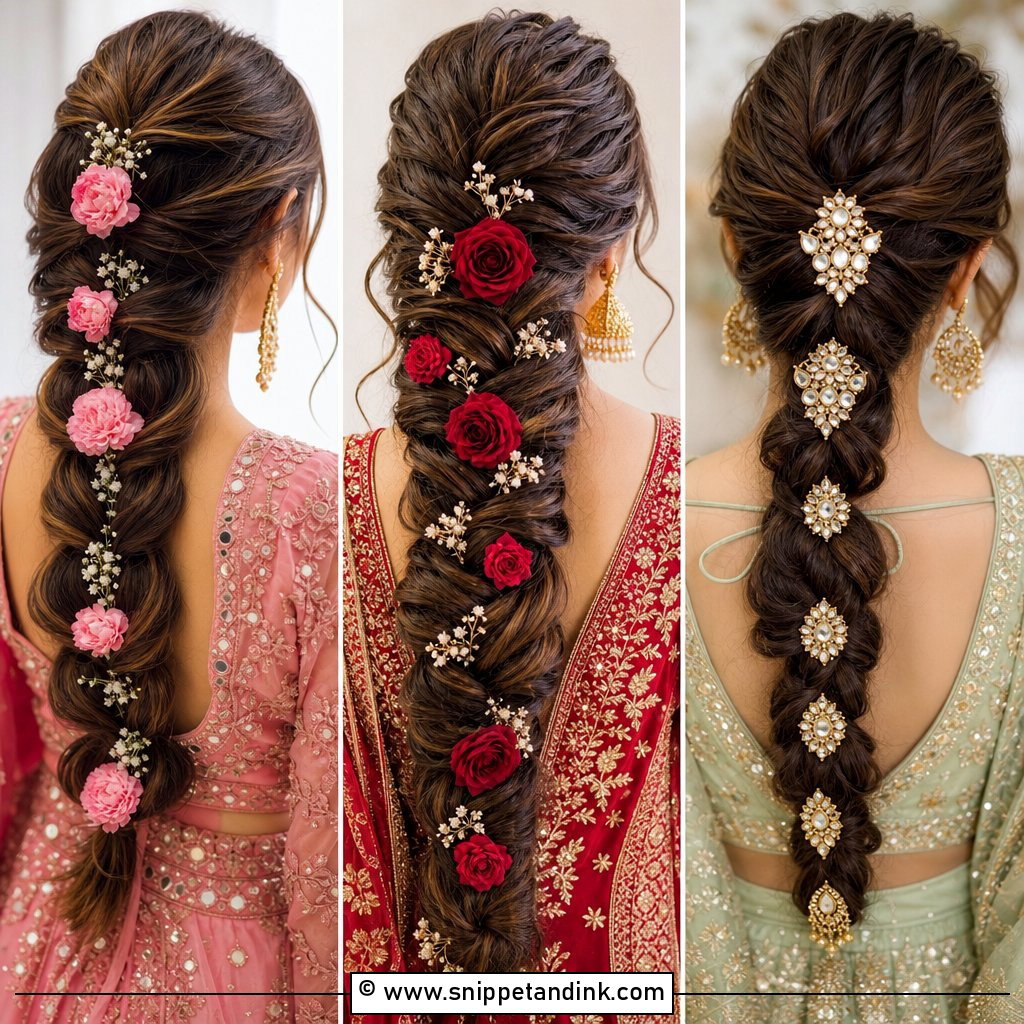


20. Pellipoolajada Decorated Braid
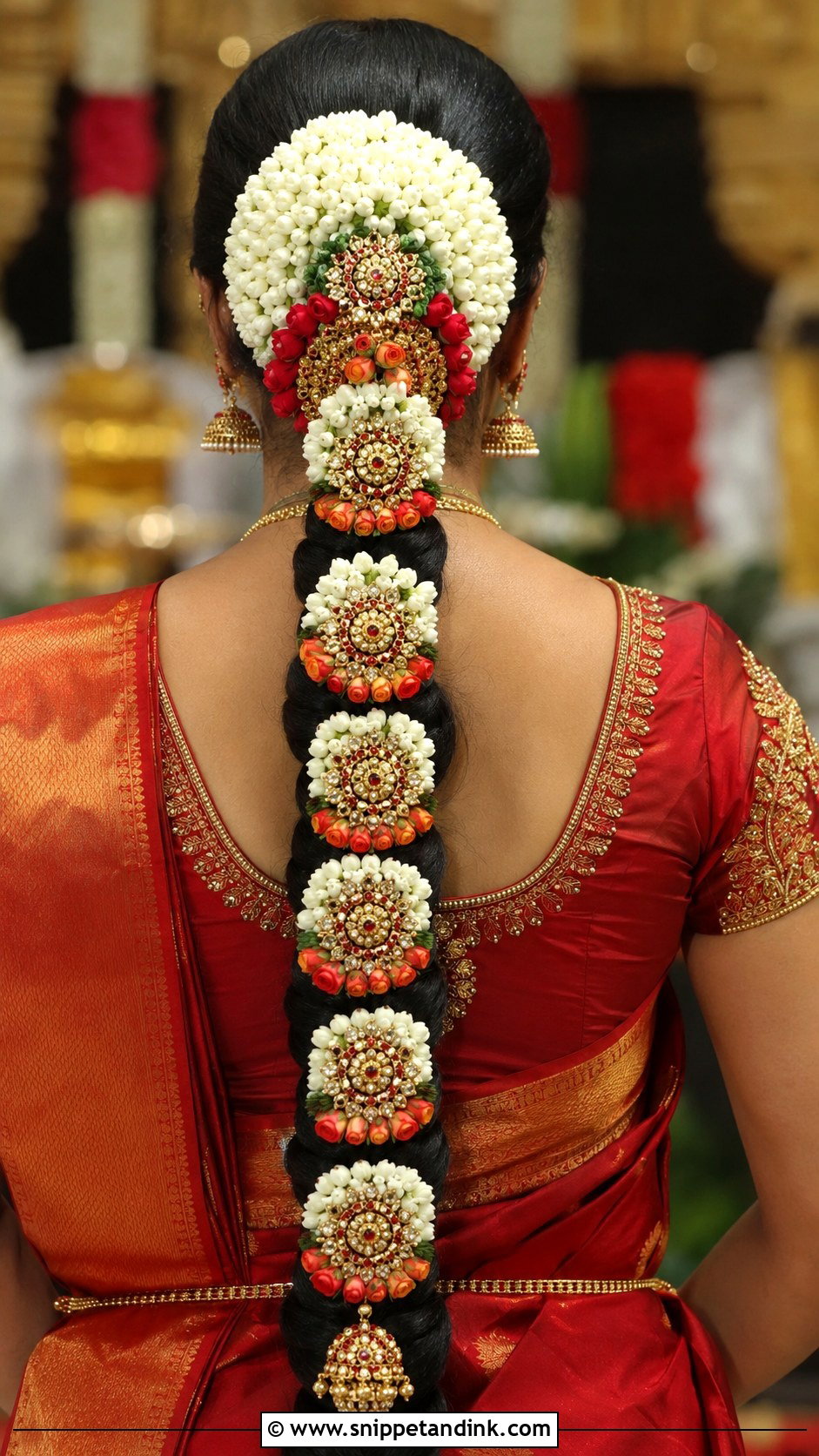
The Pellipoolajada is a beloved Telugu bridal braid tradition, with the entire plait covered in dense fresh flowers and gold ornaments. Jasmine, roses and kanakambaram are layered together, with gold pieces glinting between them. It’s made for the main ceremony with heavy silk and full temple jewelry, and it becomes the focal point of the whole look. It’s also the heaviest thing you might wear all day. I make sure the braid is tight at the crown and attached at several points, so the weight pulls on the whole braid and not on one spot of scalp.
21. Braid With Matching Hair Jewelry
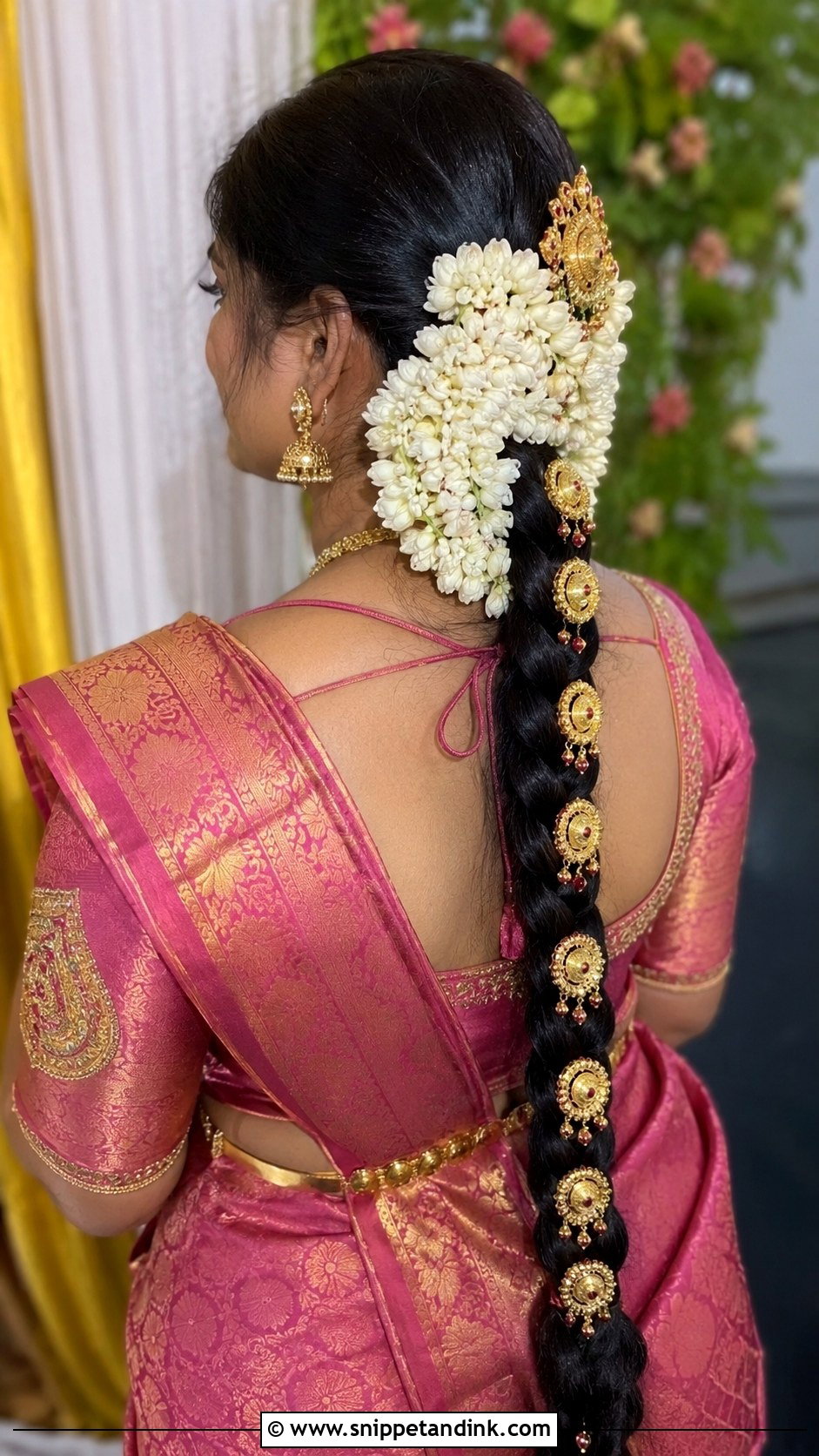
Coordination is the point here. The braid’s ornaments match your earrings and necklace, with jhumar pieces and a maang tikka joining it together, and fresh flowers fill the gaps. The effect is deliberate and complete. To do it well, bring every piece of jewelry to the trial, not just the hair ornaments, so the stylist can see how the gold tones match. Yellow gold and rose-tinted antique gold sitting side by side look mismatched up close.
22. Curly Braid For Natural Texture
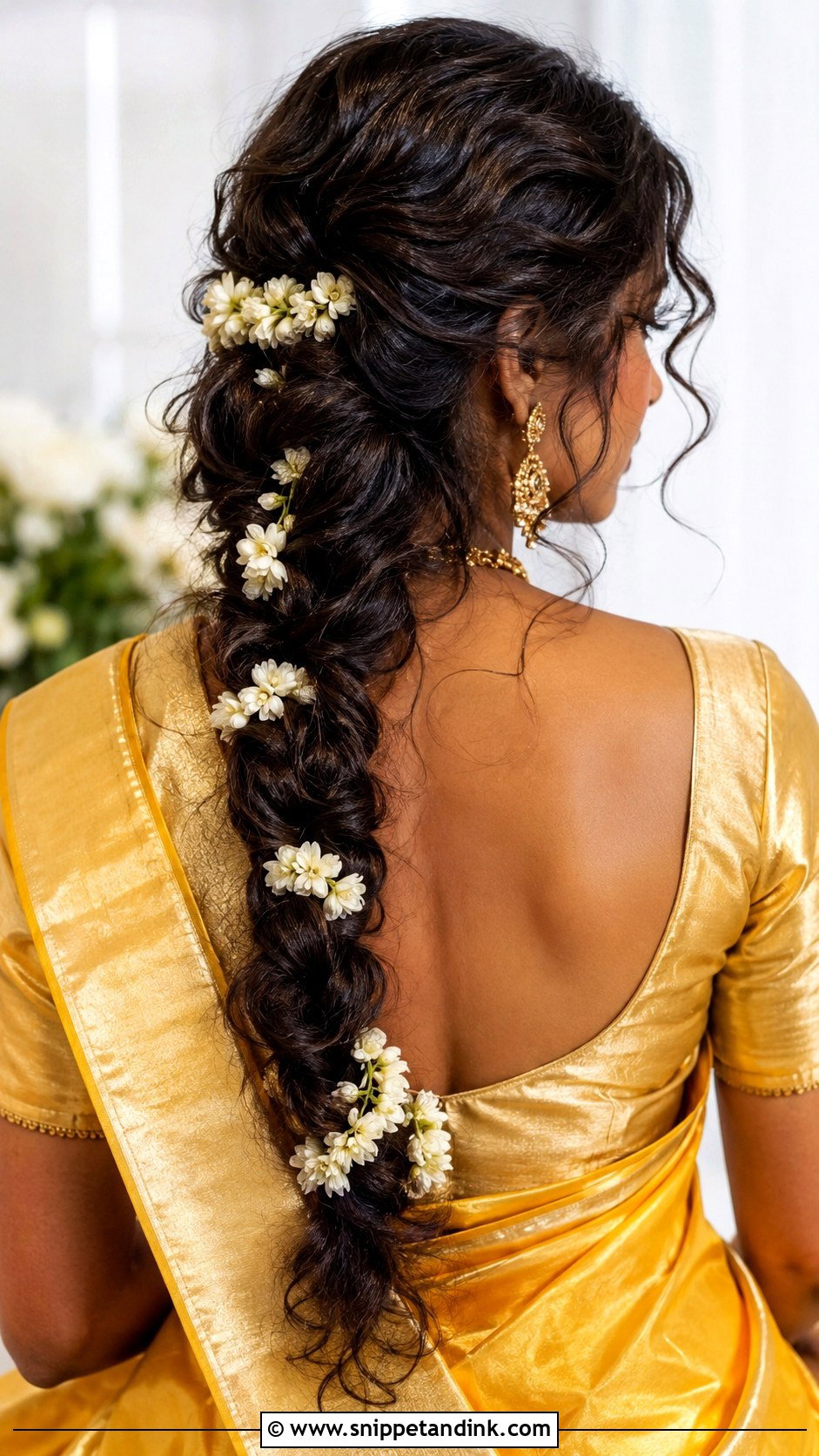
Natural waves and curls make a full, soft braid without any straightening. I keep the plait loose enough to show texture, tuck jasmine throughout, and leave a few curls at the face. Curly hair braids differently from straight hair; it shrinks as it’s woven, so the finished braid will be shorter than you expect. Moisturise the day before, not on the morning, and the braid holds its definition much longer. It’s comfortable and suits daytime or outdoor ceremonies.
23. Braid With Marigold Flowers
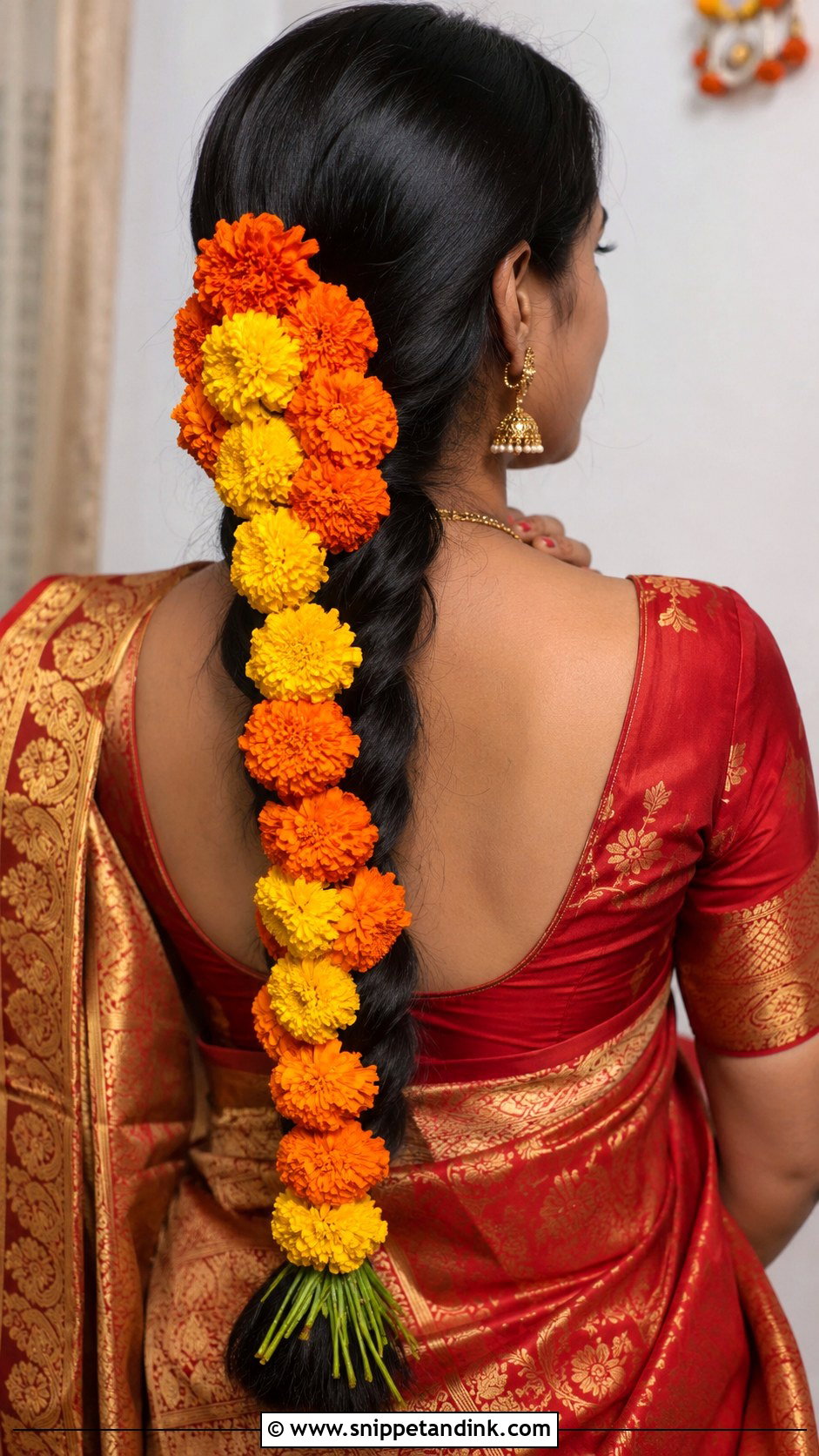
Marigolds are considered lucky in marriage, and bright orange and yellow heads layered along a thick plait make the braid look festive straight away. They go well with red and gold sarees and warm gold jewelry. Marigolds hold up better than many delicate flowers, which makes them good for haldi ceremonies and long outdoor events. They’re also bulkier, so I use smaller heads on the lower half of the braid and keep the large ones near the top.
24. Sleek Braid With Statement Hair Piece
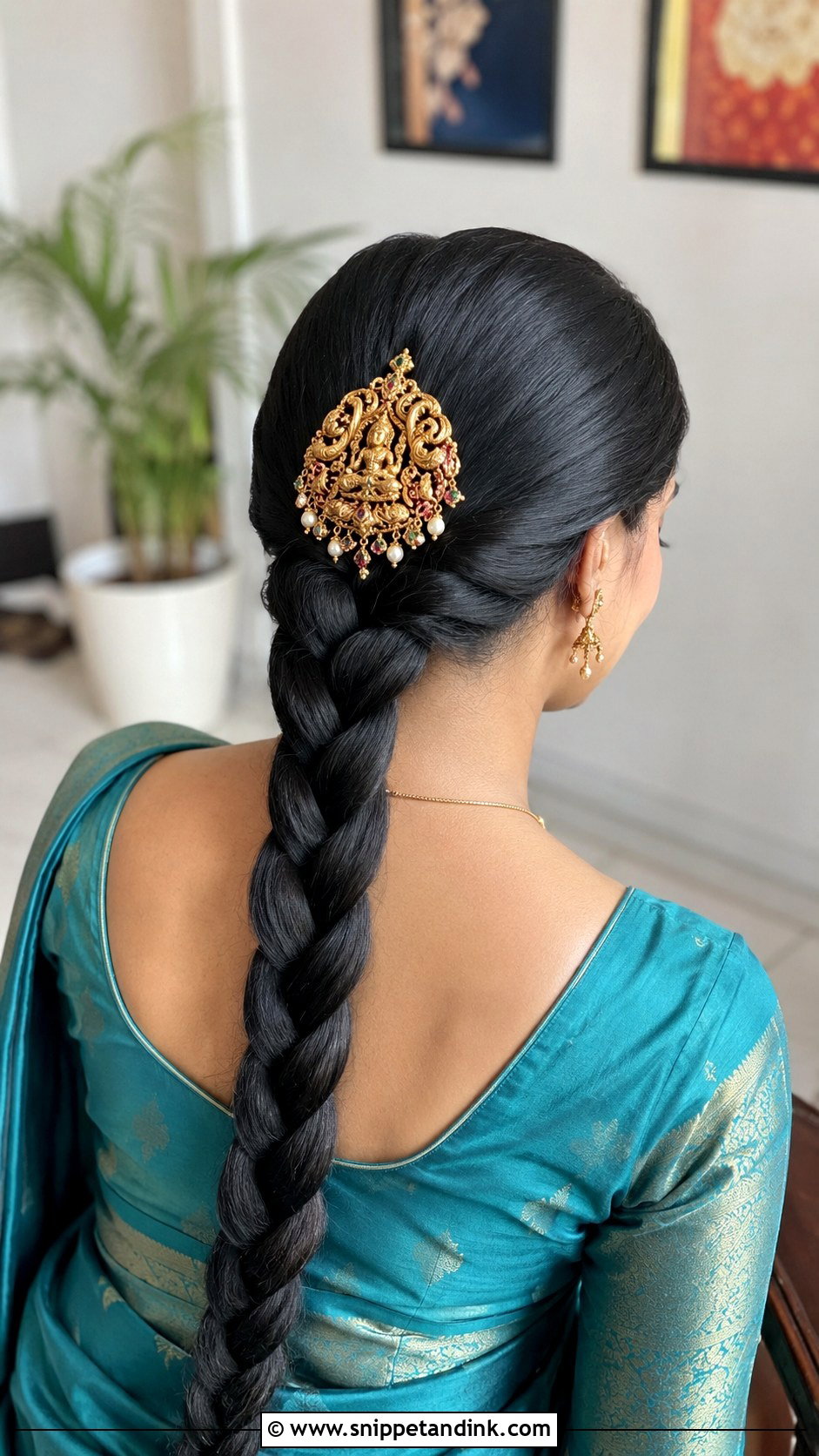
Less can be more. The plait is kept smooth and tight, with one statement piece at the crown or along the braid: a gold nagaram, a jewelled brooch or a small jasmine cluster. It suits brides who prefer clean styling and pairs well with contemporary sarees and minimal jewelry. A sleek braid needs the hair prepped properly. I use a smoothing cream and a fine-tooth comb so it stays glossy and neat under the lights, and I keep blotting papers for an oily scalp.
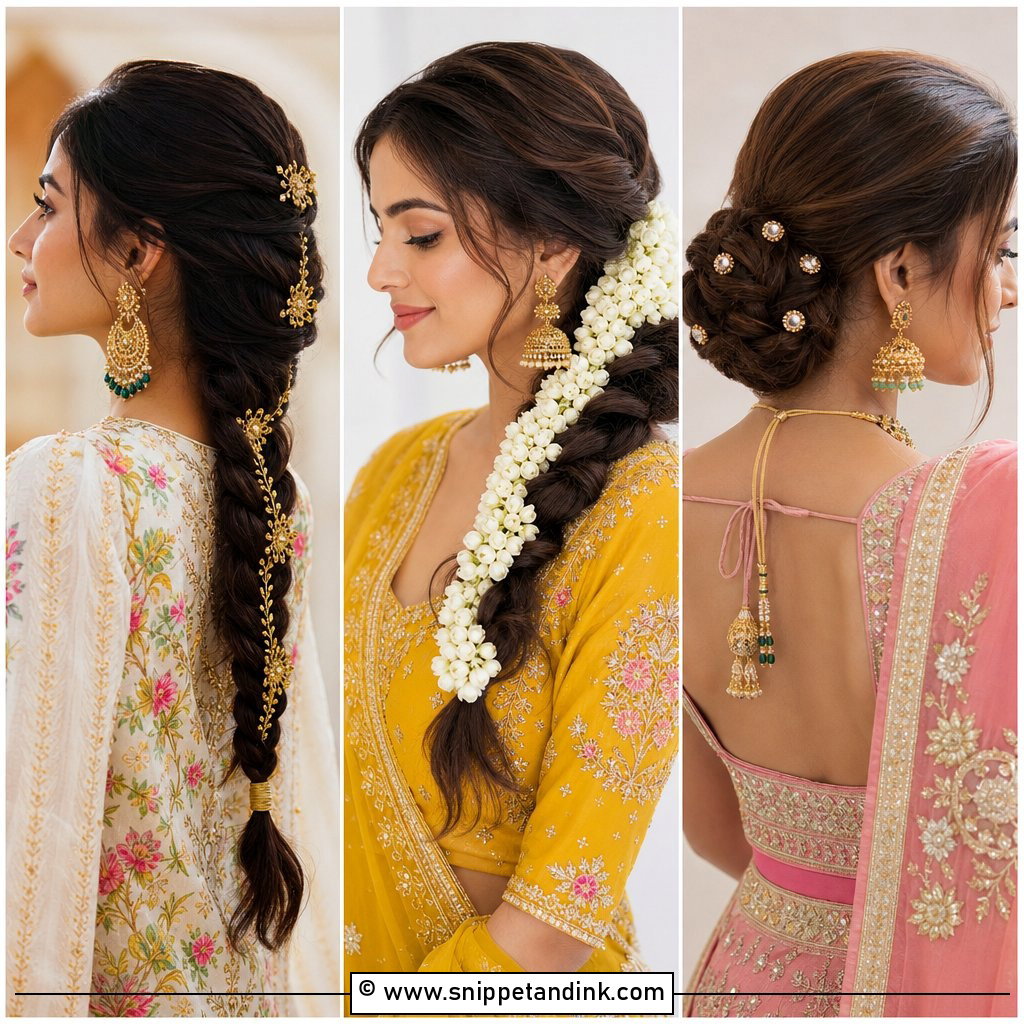
25. Extension Braid For Short Hair
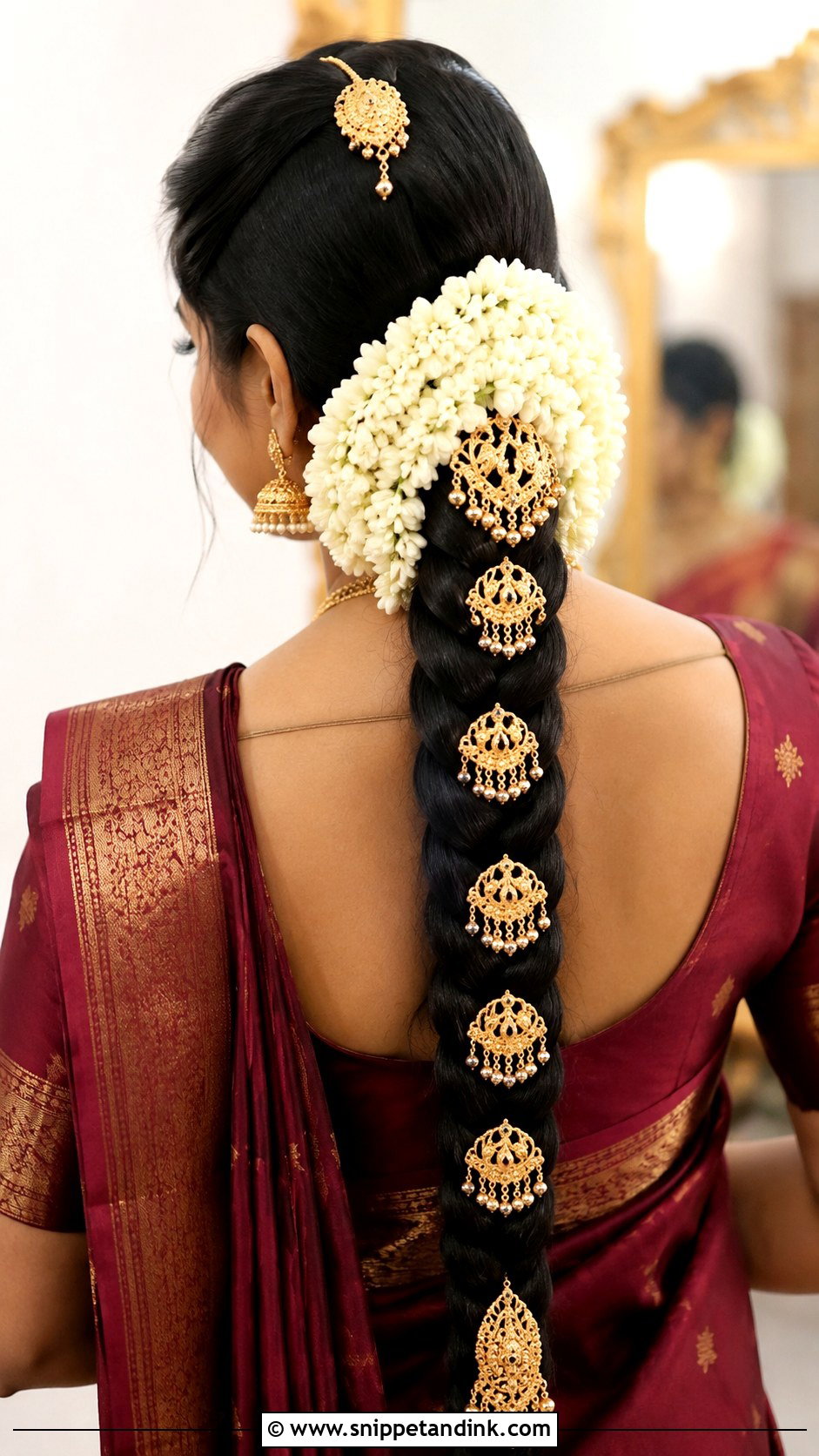
Short hair doesn’t rule out a long decorated braid. Extensions, padding and artificial braids create length and volume, and floral accessories, gajras and gold ornaments go on top. Done properly, nobody can tell. The key is colour and texture match. I attach the extension at the nape under a section of your own hair, so the join is hidden, and I braid the two together. Ask your stylist to source the extension before the trial so it can be tested and adjusted, not bought the week of the wedding.
Taking the Braid Down at Night Without Tearing Your Hair
Most of the damage I see after a wedding happens at midnight, when a tired bride and a cousin pull a decorated braid apart in a hurry. Pins, ornaments and flowers come out in the reverse order they went in, and that takes twenty minutes if you’re patient.
- Ornaments first. Unhook the kunjalam, billalu and nagaram and put them straight into a box, so gold doesn’t go missing in the flower pile.
- Then the floral jada. Snip the thread holding it to the braid rather than tugging, and lift it off in one piece.
- Find every pin before you undo the braid. Run fingers along the scalp in rows; a forgotten pin under a braid will snag and tear when you comb.
- Unbraid from the bottom up and comb out with your fingers first, then a wide-tooth comb, starting at the ends.
The Morning After
Hair that has held flowers, hold spray and a tight braid for a day feels stiff and the scalp can be tender where the weight pulled. A warm oil massage the night after, washed out with a mild shampoo the next morning, is the old-fashioned answer and still the right one. Skip heat styling for a day or two and let the scalp recover.
Start From Your Hair Length, Then Pick the Braid
Start from your hair’s length and thickness, then pick the braid. A Poolajada, Gold Jada or Pellipoolajada needs long, thick hair or a well-matched extension; bubble braids, fishtails and floral ponytails work with less. Fresh jasmine, roses, marigolds and gold ornaments carry fragrance, colour and meaning, so let the family weigh in on the flowers. Bring every piece of jewelry and the actual flowers, or close substitutes, to the trial, and wear the braid long enough to know how it feels.
You'll Like These Ideas:




Leave a Reply