
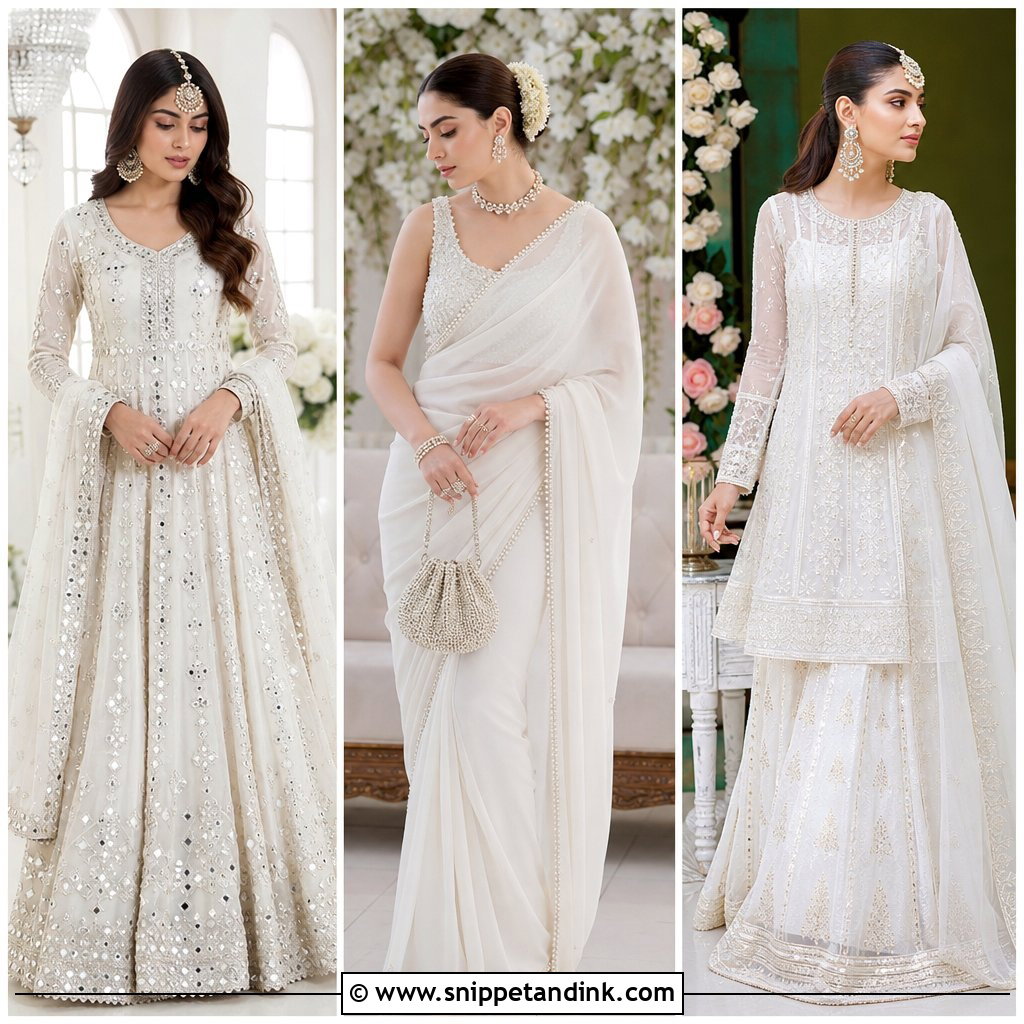
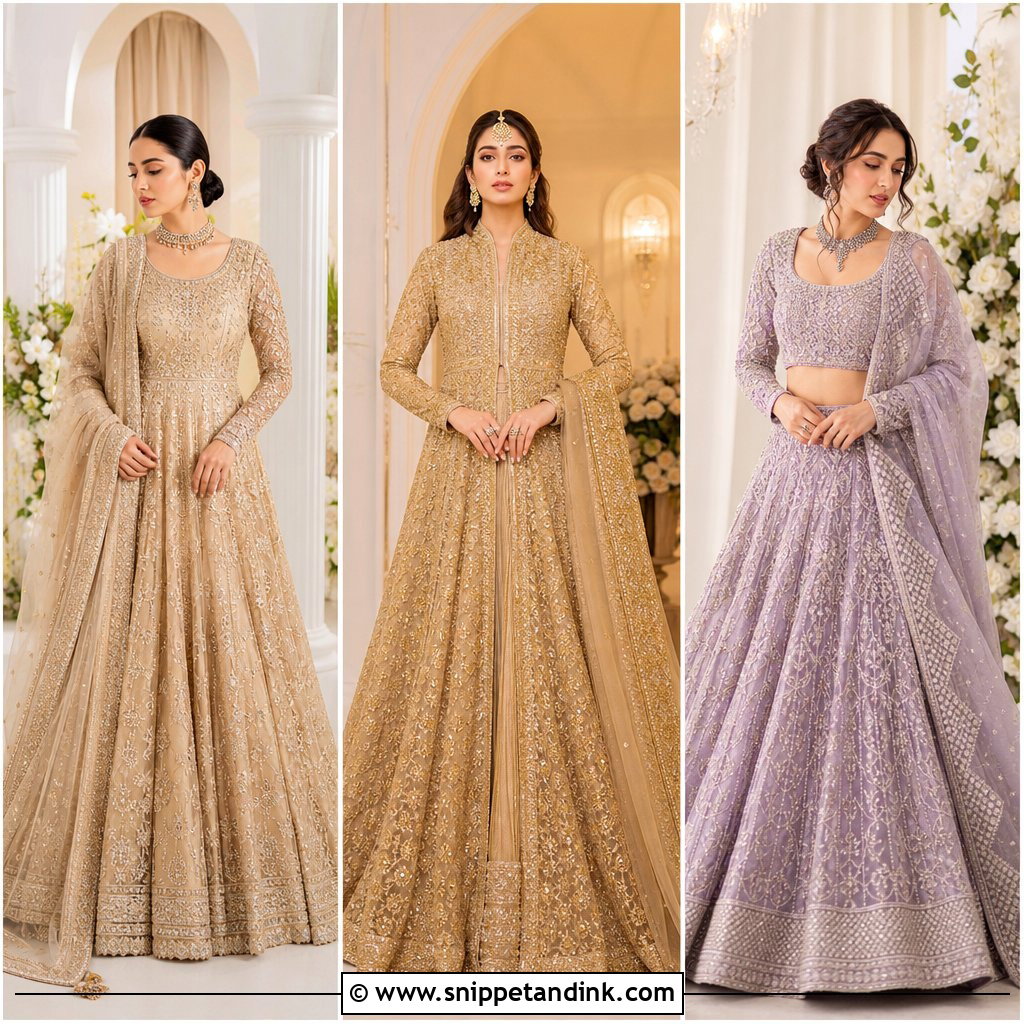
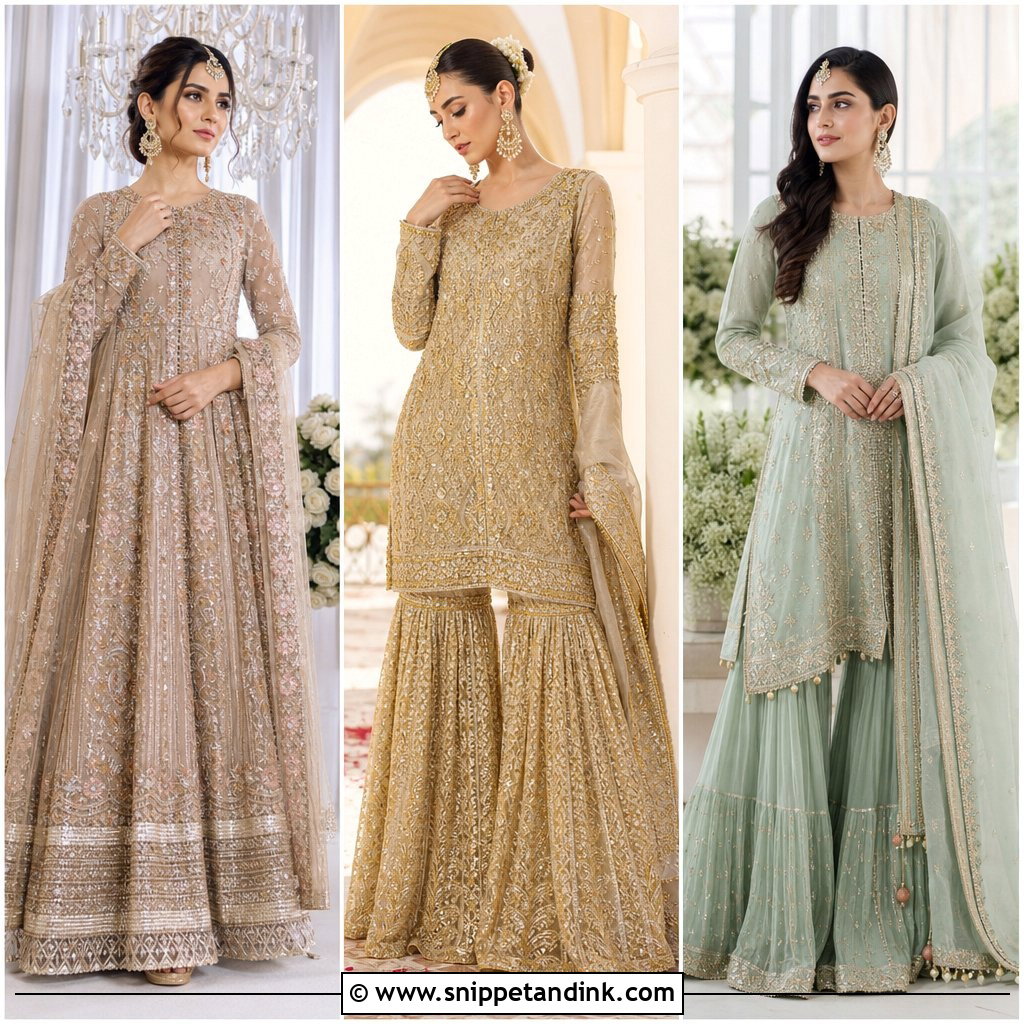
White for a Nikah sits comfortably between tradition, modesty and a modern taste. Ghararas, pishwas, lehengas, sarees and simple suits all come in white, and none of them have to look plain. Pearl embroidery, gold zardozi, silver kamdani, scalloped borders and layered fabrics are what make white read as bridal rather than everyday. Much of today’s Pakistani bridal inspiration leans on ivory palettes, organza and tonal work, and it suits the quieter mood of the Nikah well. When I plan a white outfit, the work goes into two things: keeping every layer the same shade of white, and placing the embroidery where it will show when you’re seated. The venue, your comfort and your jewelry should decide the rest. Here are twenty complete looks.
Optic White, Ivory or Pearl? Settle the Shade Before the Embroidery Starts
White comes in more shades than most brides expect, and the differences show the moment two layers sit side by side. Optic white is bright with a slight blue cast. Off-white is softer. Ivory and pearl lean warm, and raw silk or tissue often reads closer to cream.
- Ask the designer or tailor for swatches of every fabric in the outfit, including the dupatta net, lining and the trouser fabric, and compare them together outdoors in daylight.
- Match the embroidery to the base. Gold zardozi warms optic white; silver kamdani and crystals look cleaner on cooler whites. Antique gold sits best on ivory.
- Hold the swatch under your chin. Very bright white can make warm or deeper skin tones look grey on camera, and ivory usually flatters more people.
- Buy the shoes, hijab and clutch last, once the main fabric is fixed, and take a swatch with you when you shop.
I’d rather a bride wear one consistent ivory than mix a crisp white shirt with a cream dupatta. Mismatched whites are the detail that photographs worst, and they can’t be fixed once the work is done.
1. White Gharara Nikah Dress
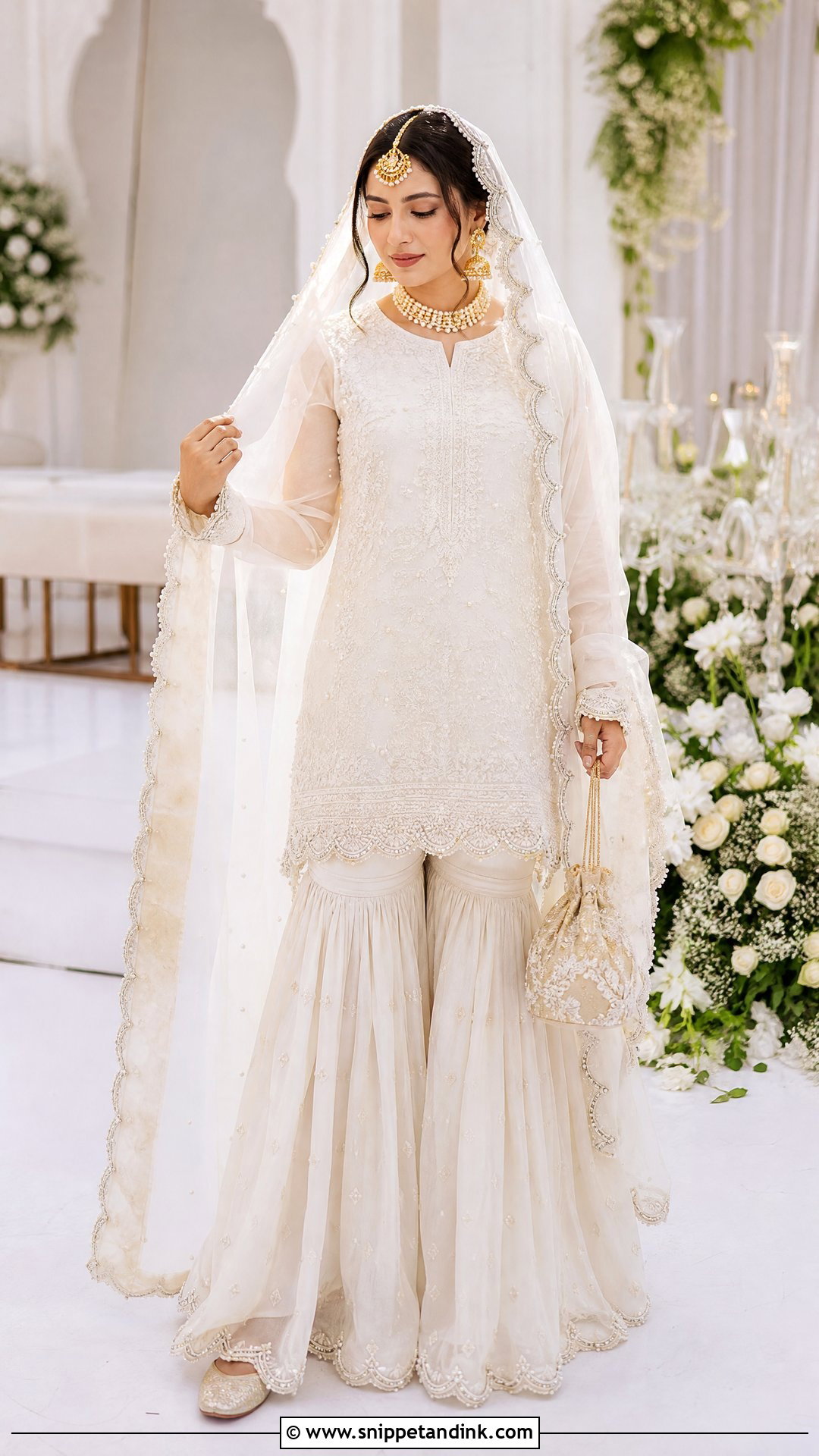
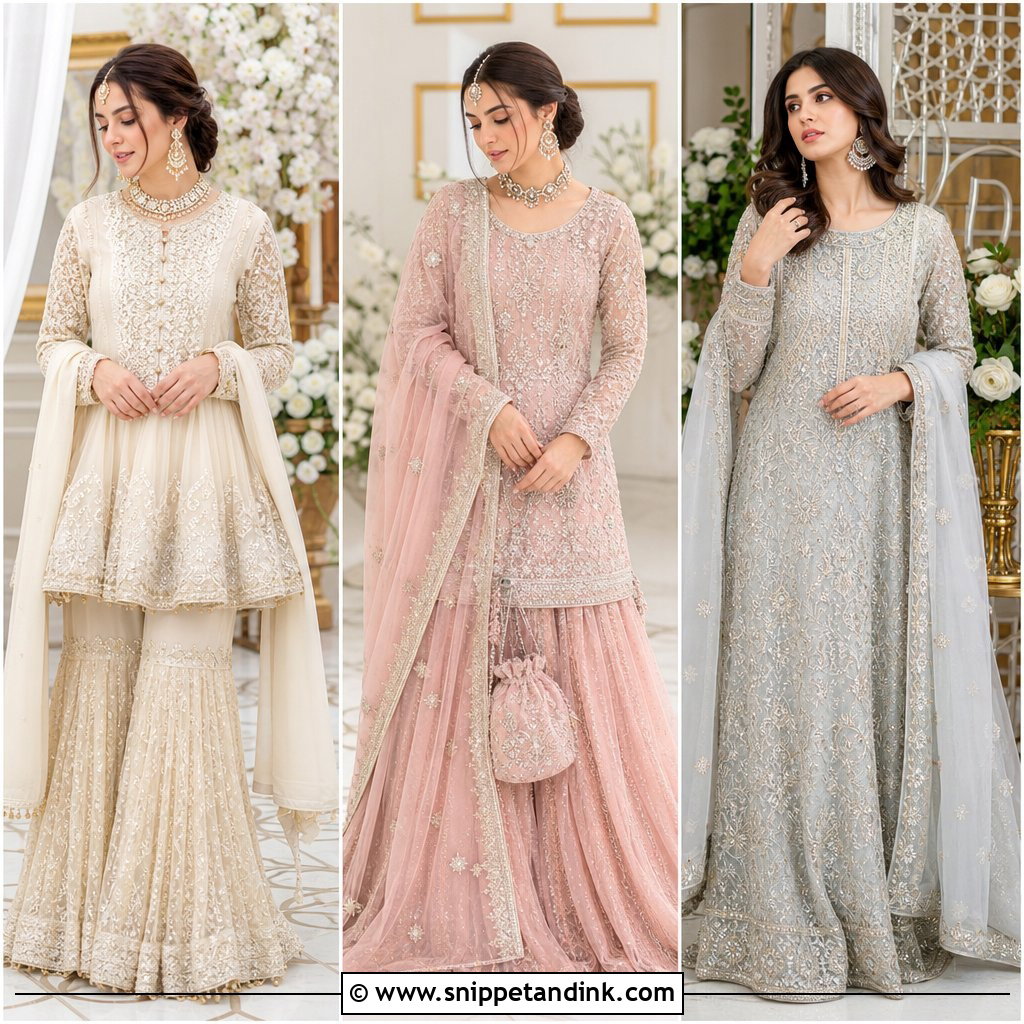
The gharara is the most traditional choice here, and the knee band is where it succeeds or fails. A fitted mid-length kameez with pearl, sequin or dabka work at the neck and cuffs sits over a gharara that flares below the knee from a neat embroidered band. I check that band at the fitting with the bride standing in her actual shoes; if it lands too low, the flare looks dropped and heavy. An organza dupatta with a scalloped edge goes over the head. Gold jhumkas, a pearl choker, a small tikka and a fine nath complete it, with ivory khussas. It suits a home or mosque Nikah when you want tradition without a lehenga’s weight.
2. White Sharara Nikah Dress
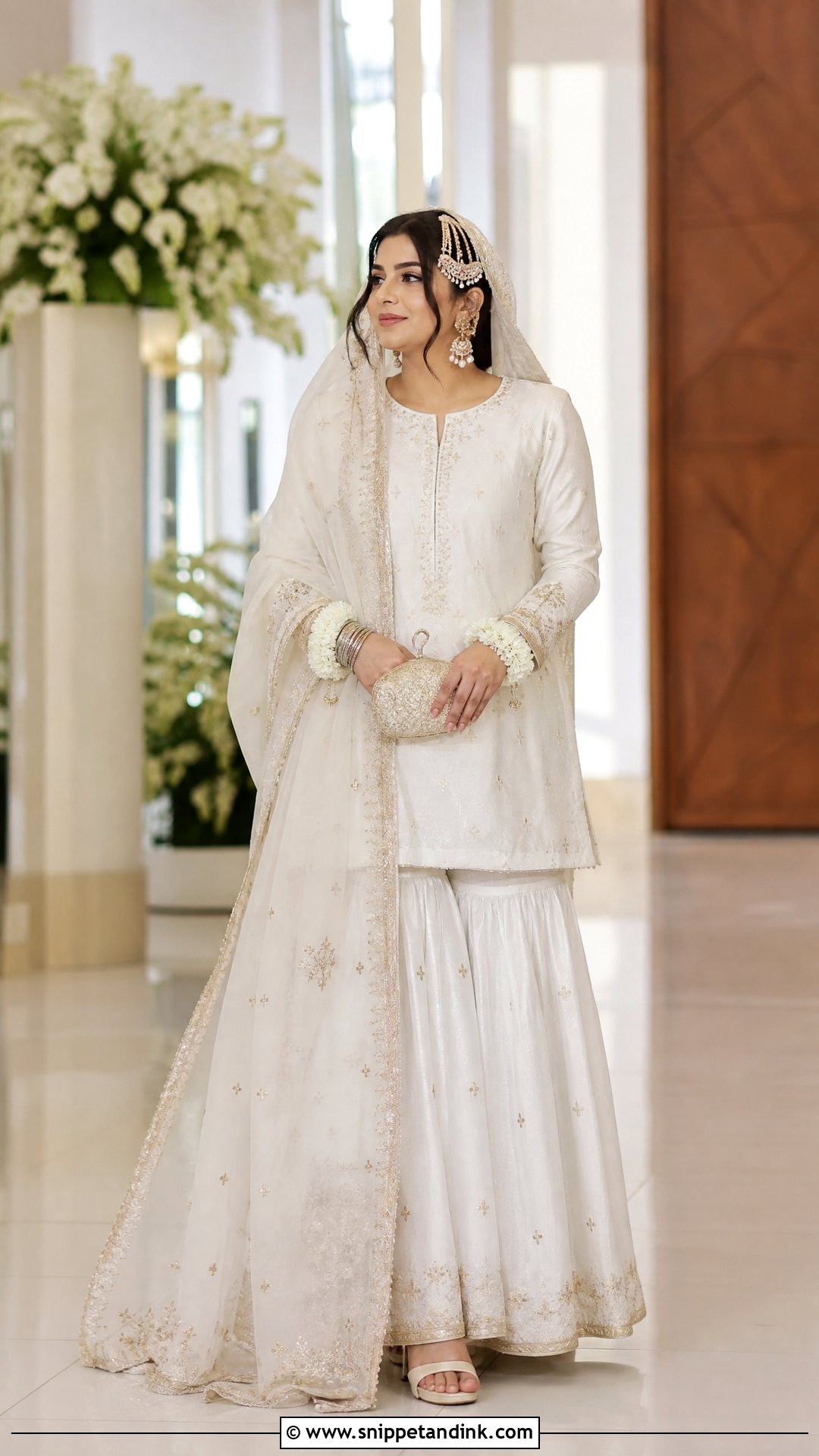
A sharara gives the movement of a skirt with the ease of trousers. Wide flowing sharara pants go with a structured short shirt in tonal threadwork, tiny pearls or a little gold. A chiffon or organza dupatta over one shoulder and the head leaves the shirt’s work visible. Pearl drops, stacked gold bangles, a passa and a small clutch finish it. White shararas show every mark at the hem, where they brush the floor, so I’d have the length set to just clear the shoe rather than pool. Ivory pumps or low block heels, rosy cheeks and a soft neutral lip suit it in a small gathering or a formal hall.
3. White Lehenga Nikah Dress
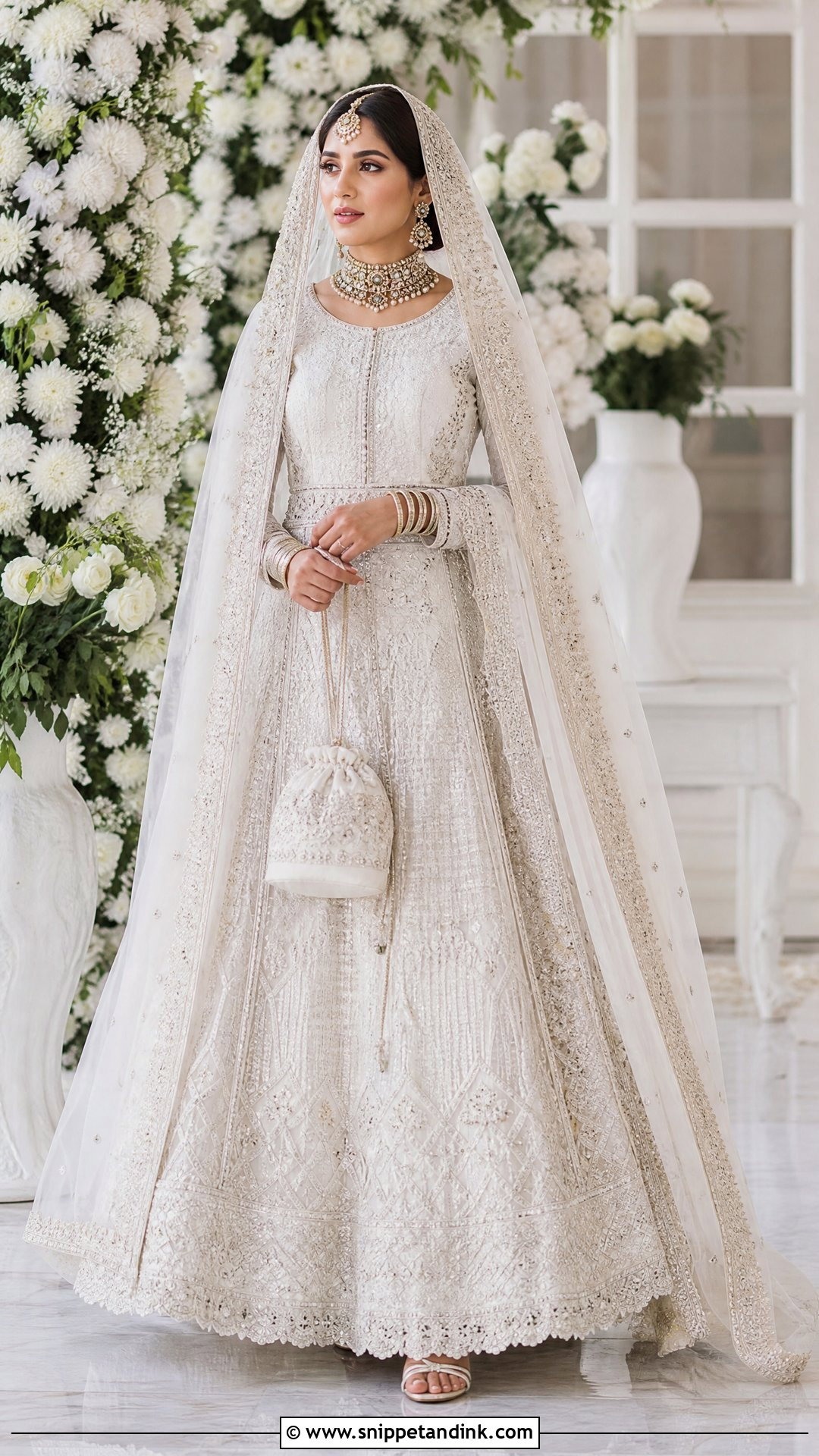
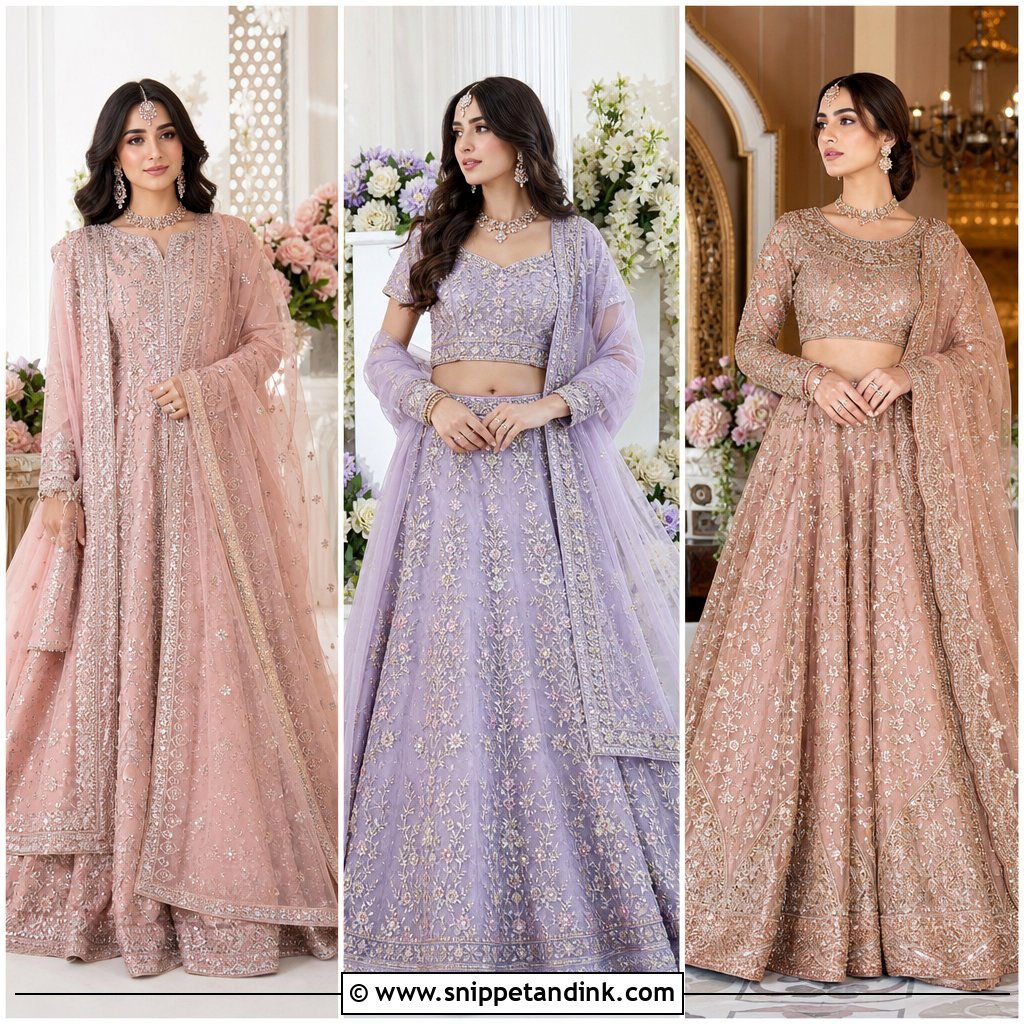
For a large ceremony with a stage and a photographer, a white lehenga gives the fullness people expect. A high-waisted skirt with floral embroidery, zardozi borders or pearl panels goes with a modest blouse with full sleeves and a higher neck; a longer blouse adds coverage without spoiling the shape. One wide dupatta over the head and a lighter second one across the shoulders give the formal layering. Two dupattas mean double the pinning, and on white organza the pins show, so ask for pearl-headed ones. A kundan choker, matching earrings, bangles and a centered tikka finish it, with metallic heels and a structured potli.
4. White Pishwas Nikah Dress
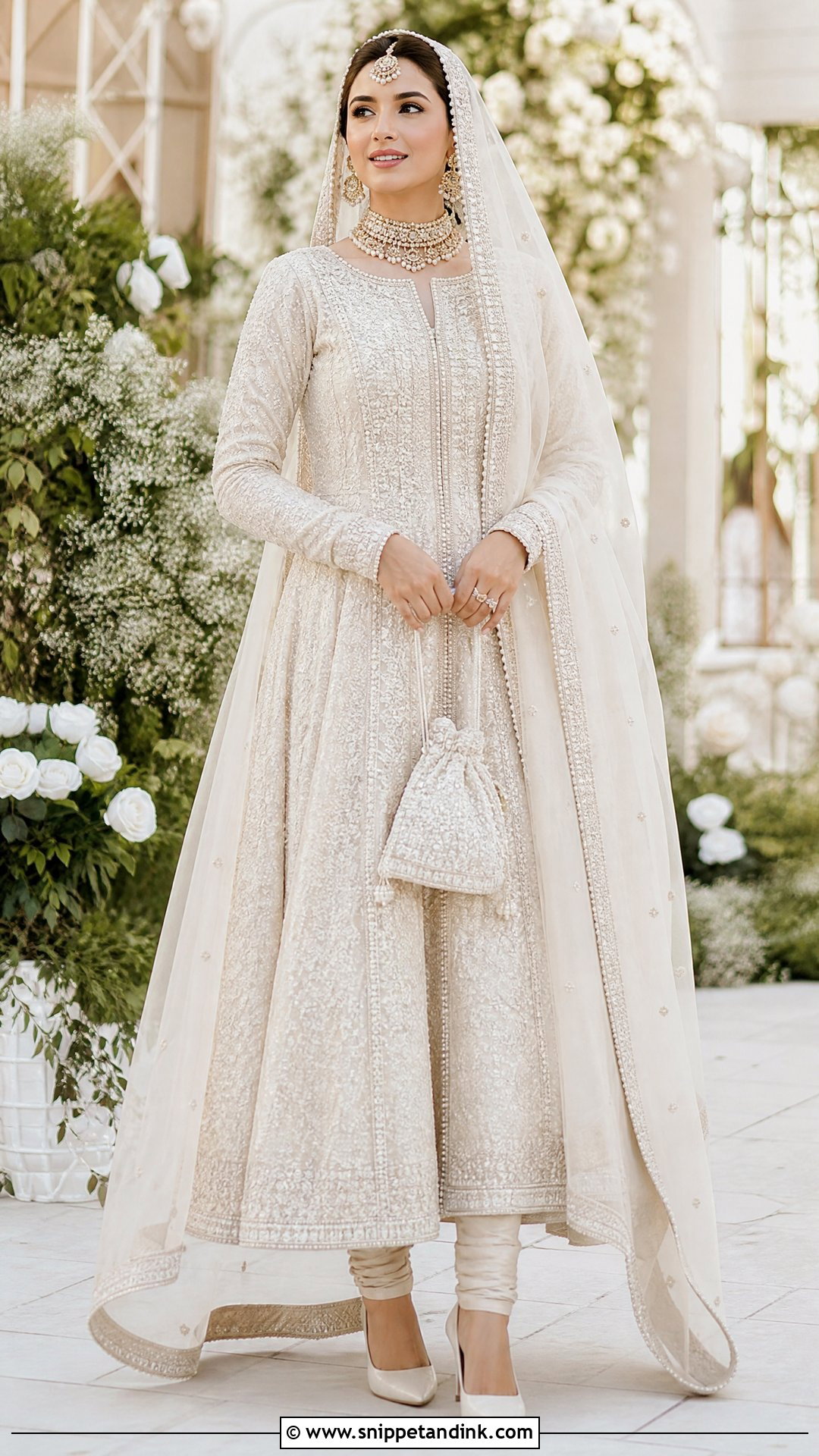
A white pishwas moves with every step, which is its whole charm. The fitted bodice and long panelled skirt look regal and keep the modest coverage of traditional formalwear. I’d keep the embroidery to the neck, sleeves, waist and hem rather than all over, because a fully worked pishwas gets heavy and loses the swing. A lightly worked churidar underneath adds comfort. A bordered organza dupatta over the head, with one side falling along the arm, frames it. Pearl and kundan jewelry, closed-toe heels and a small pearl potli complete it. It’s lovely in gardens and bright banquet rooms.
5. White Anarkali Nikah Dress
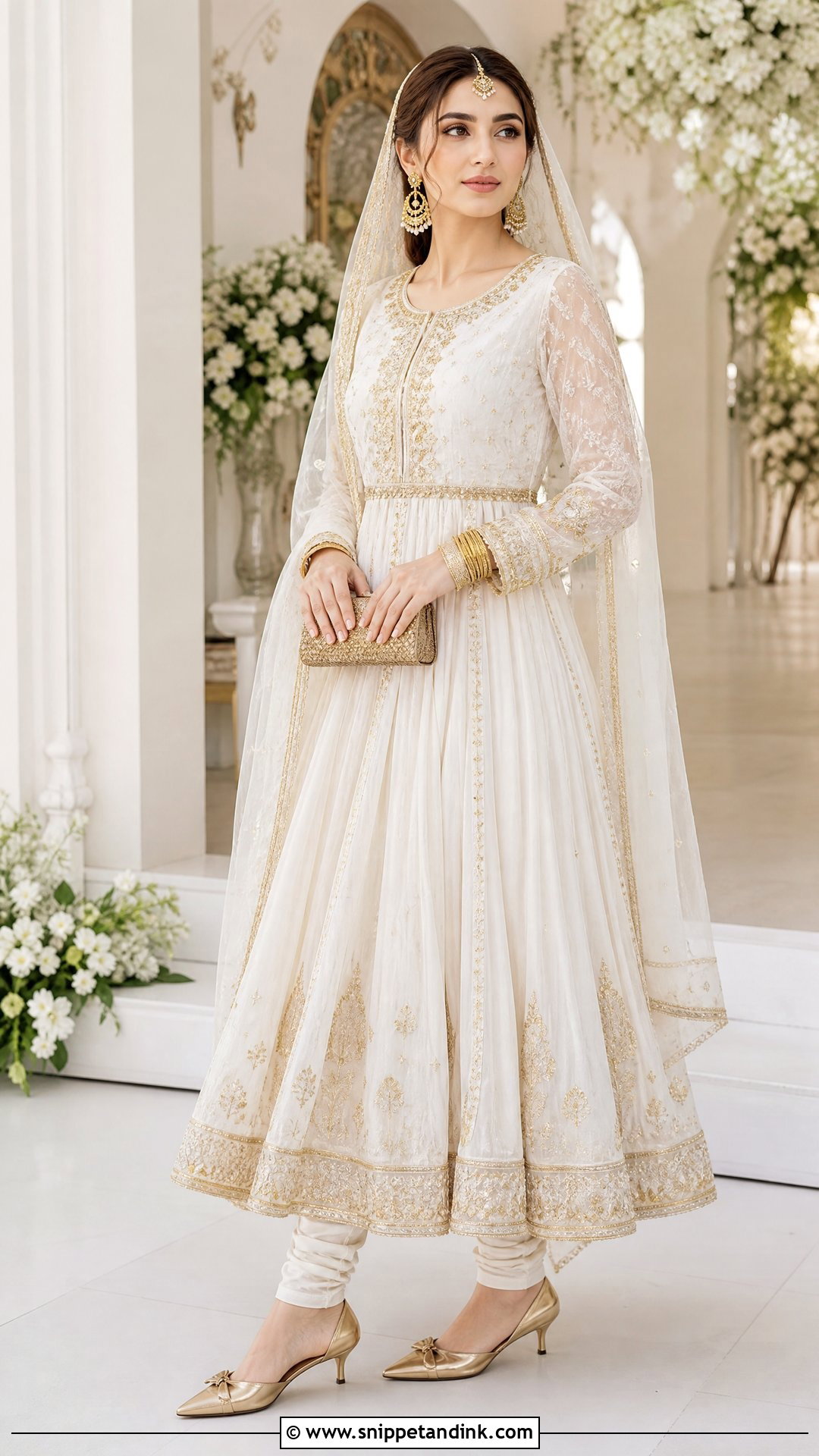
An Anarkali gives the bridal flare without a lehenga’s weight. Choose a floor-length cut with a defined waist, fitted sleeves and embroidery that follows the panels down. Gold gota feels festive, pearl vines softer, silver threadwork cooler. Straight pants or churidar go underneath depending on the flare. The waist seam on an Anarkali has to sit exactly at your natural waist; even a little low and the skirt looks long-waisted when you sit on the stage. A sheer bordered dupatta over the head, chandelier earrings, a slim tikka, a few bangles and metallic kitten heels finish it. A sleek bun keeps the neckline clear.
6. White Maxi Nikah Dress
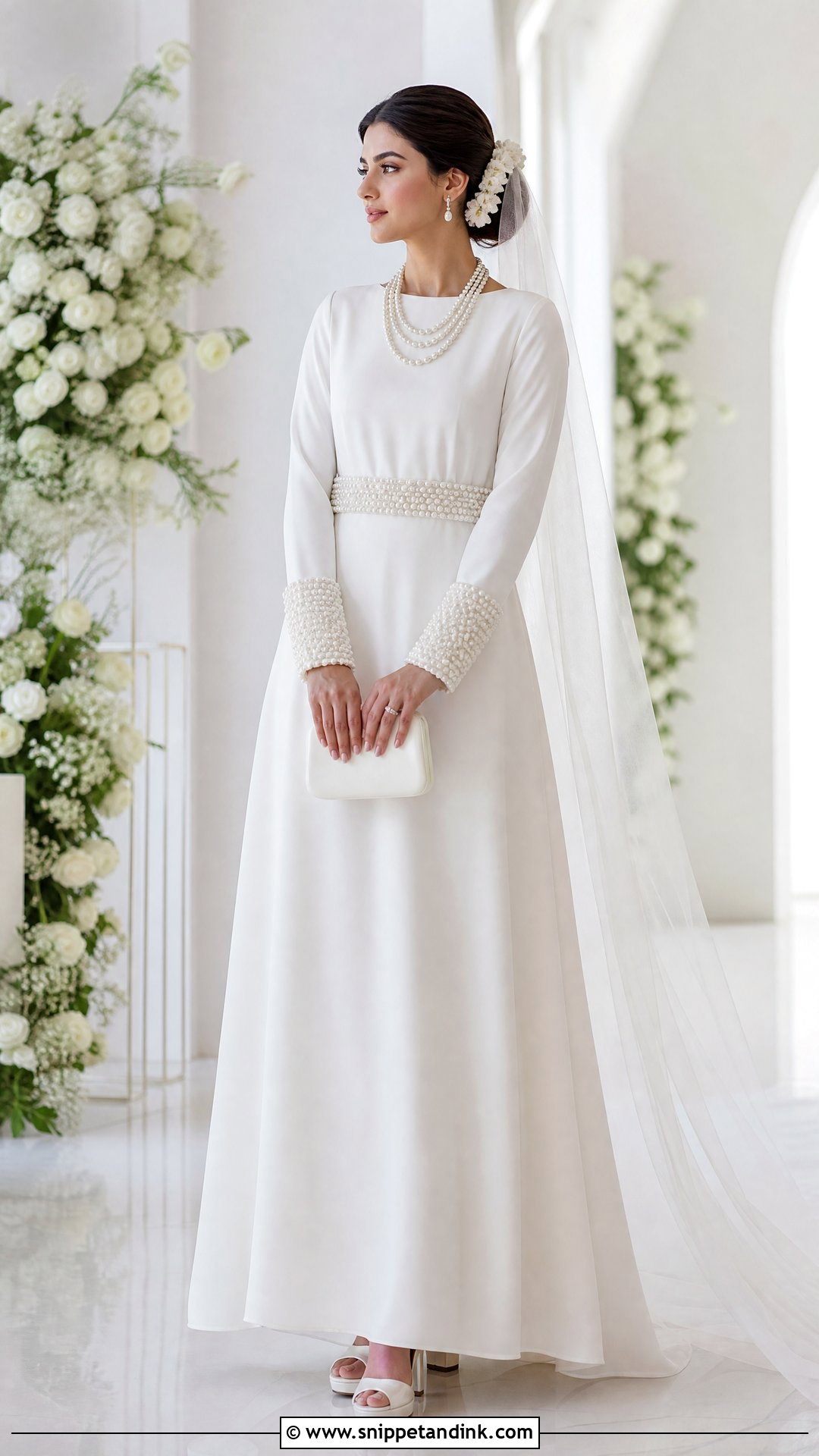
Clean lines can be just as bridal as heavy work, and a white Pakistani maxi shows it. A floor-length dress with a shaped bodice, modest neck, full sleeves and a soft flare is the base. Embroidered cuffs, a pearl waist or a worked hem add enough detail. A long organza veil or dupatta that trails slightly behind gives a train without the fuss. Pearl earrings, a layered necklace and a delicate headpiece suit the minimal mood. I’d hem the maxi in the exact platform heels you’ll wear, since a centimeter too long and you’ll tread on it every time you stand. Fresh white flowers in a low bun finish it.
7. White Angrakha Nikah Dress
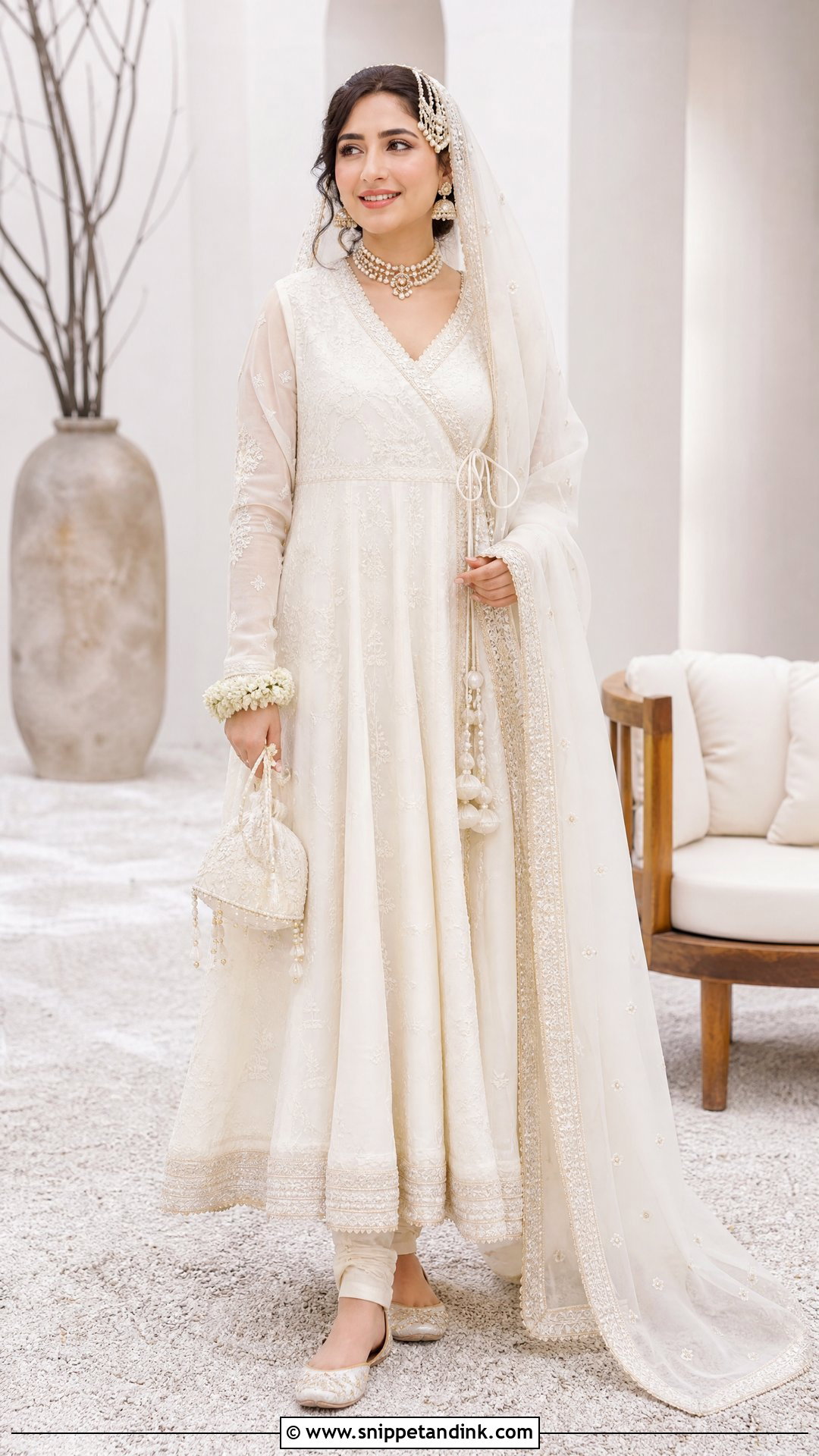
An angrakha gets its shape from the overlap, not from boning. A long angrakha with embroidered ties, a fitted upper section and a generous flare falls over matching trousers or churidar. Scalloped edges, tiny sequins and hand-finished borders draw the eye to the wrap. The ties hold the whole front, so I check they stay flat when you lean forward to sign the nikahnama. A sheer dupatta with scattered motifs worn loosely over the head, a pearl choker, jhumkas and a side passa complete it. Embroidered khussas suit its cultural roots and keep you comfortable. A soft bun and natural makeup finish it for a daytime or home ceremony.
8. White Peplum And Gharara Nikah Dress
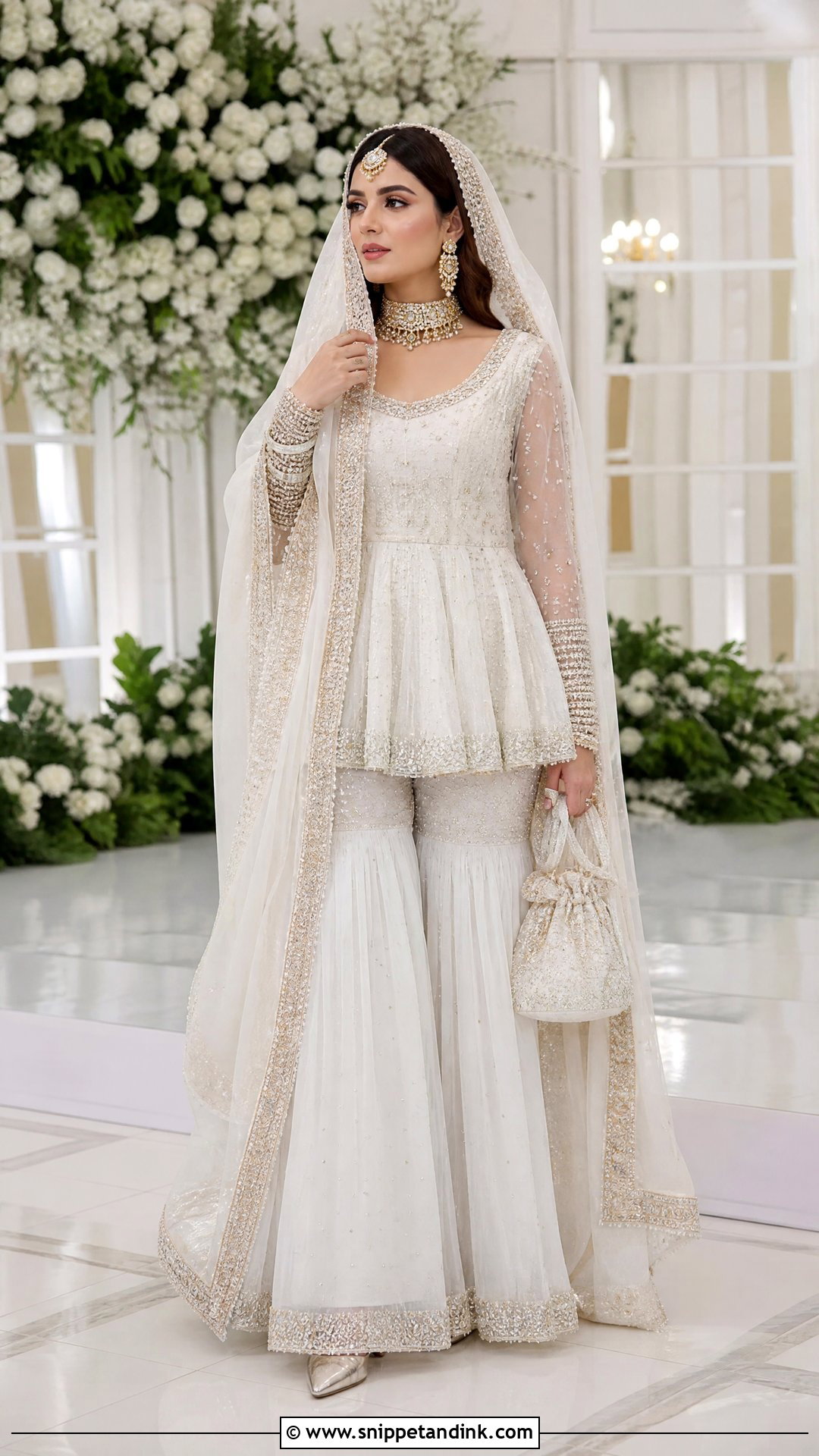
Peplum over gharara pairs modern structure with traditional volume. The peplum should sit neatly at the waist and open over the hips, with the gharara flaring below. Matching pearl work or fine gold on both pieces ties them together. Full sleeves and a slightly longer peplum keep coverage comfortable. A peplum that ends right at the widest part of the hip adds width, so I’d move it a few centimeters up or down depending on your shape. A light dupatta with a worked border goes over the head. A kundan choker, studs, a tikka, slim bangles, pointed metallic heels and a compact potli finish it.
9. White Long Shirt And Farshi Gharara Nikah Dress
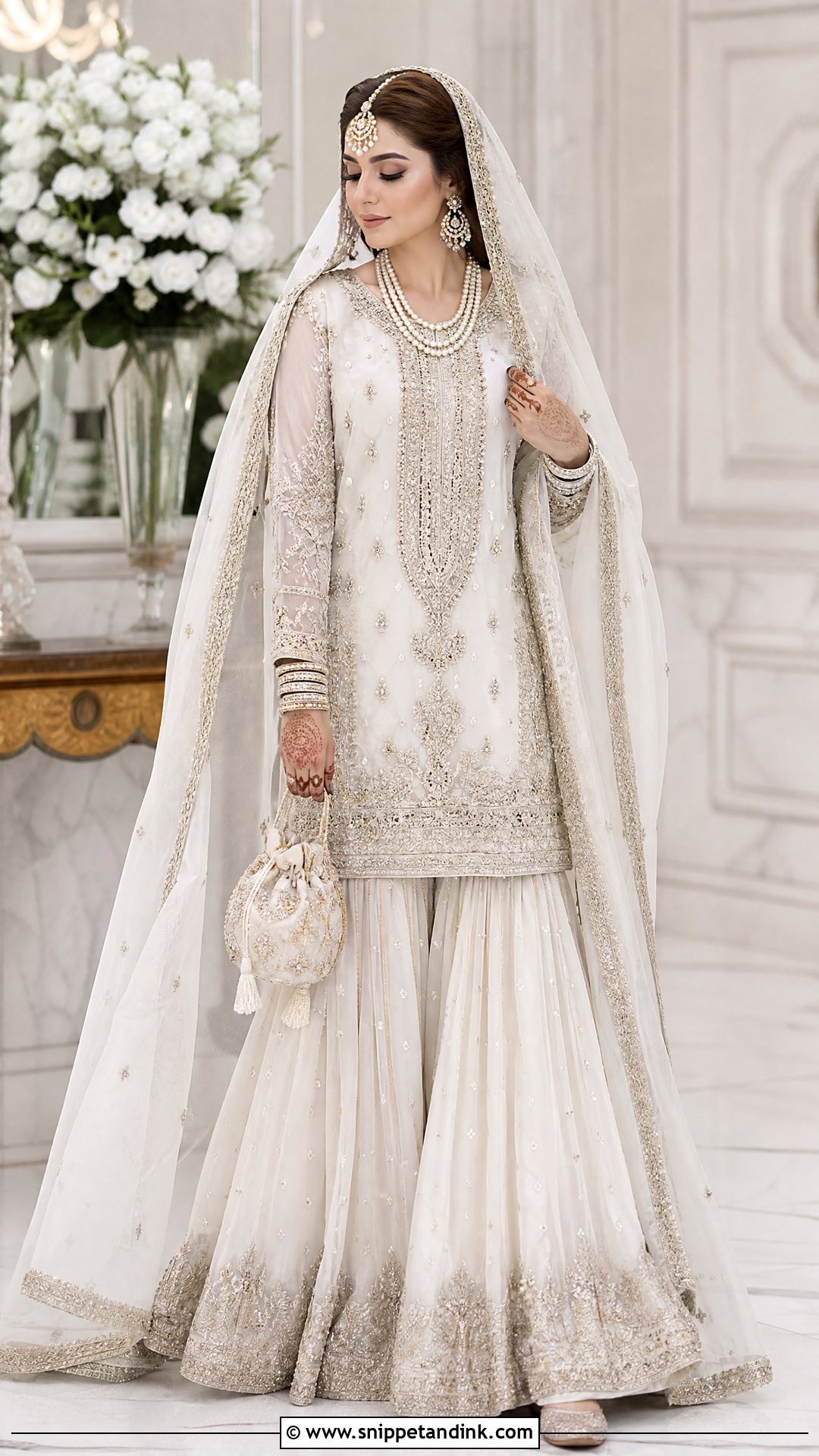
A farshi gharara is the most dramatic traditional option, and it needs the right venue. The extended hem pools on the floor, so the long shirt above should stay tailored and fairly straight. Embroidery at the neck, side slits, cuffs and borders frames it without weight. A wide organza dupatta with kiran trim or handworked edging goes over the head. Layered pearls, statement earrings, a passa and bangles complete it. Walking in a farshi takes practice: small steps, a light kick of the hem forward, and someone behind on stairs. Low heels or khussas give control. Save it for a formal indoor venue with smooth floors.
10. White Kurta And Straight Pants Nikah Dress
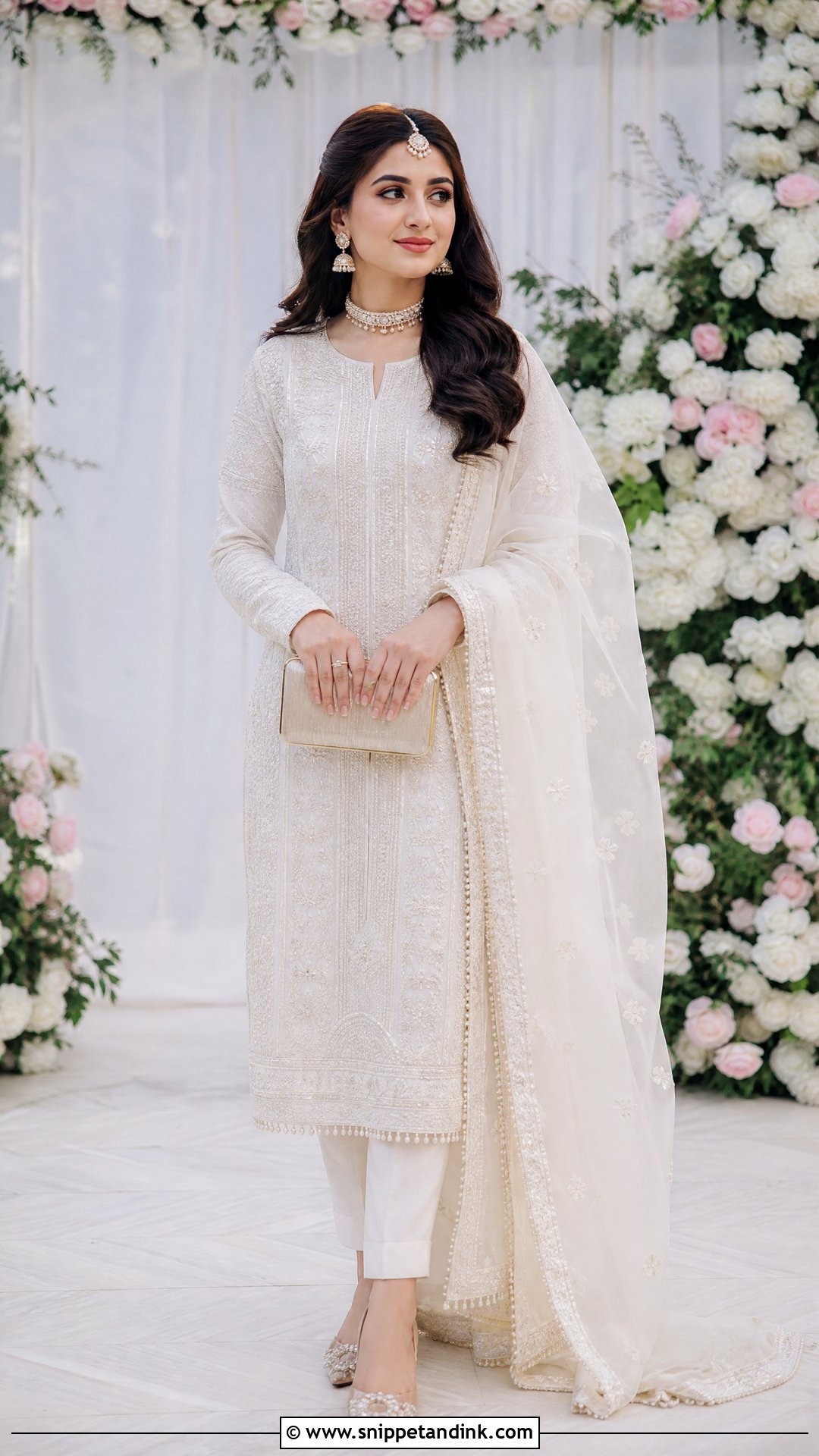
Not every bride wants a sweeping skirt, especially at a small Nikah at home. A white embroidered kurta with straight pants is understated and still special. Choose a longer kurta with a clean neckline, side slits, full sleeves and the work concentrated on the borders. Tailored cigarette pants give a sharp finish under the slightly loose top. The bridal detail comes from the dupatta here: organza worked with pearls, lace or florals. A pearl choker, medium jhumkas, a simple tikka, embellished slingbacks and a box clutch complete it. If you’ll sit on floor cushions, I’d make the pants a little wider through the knee.
11. White Bridal Saree Nikah Dress
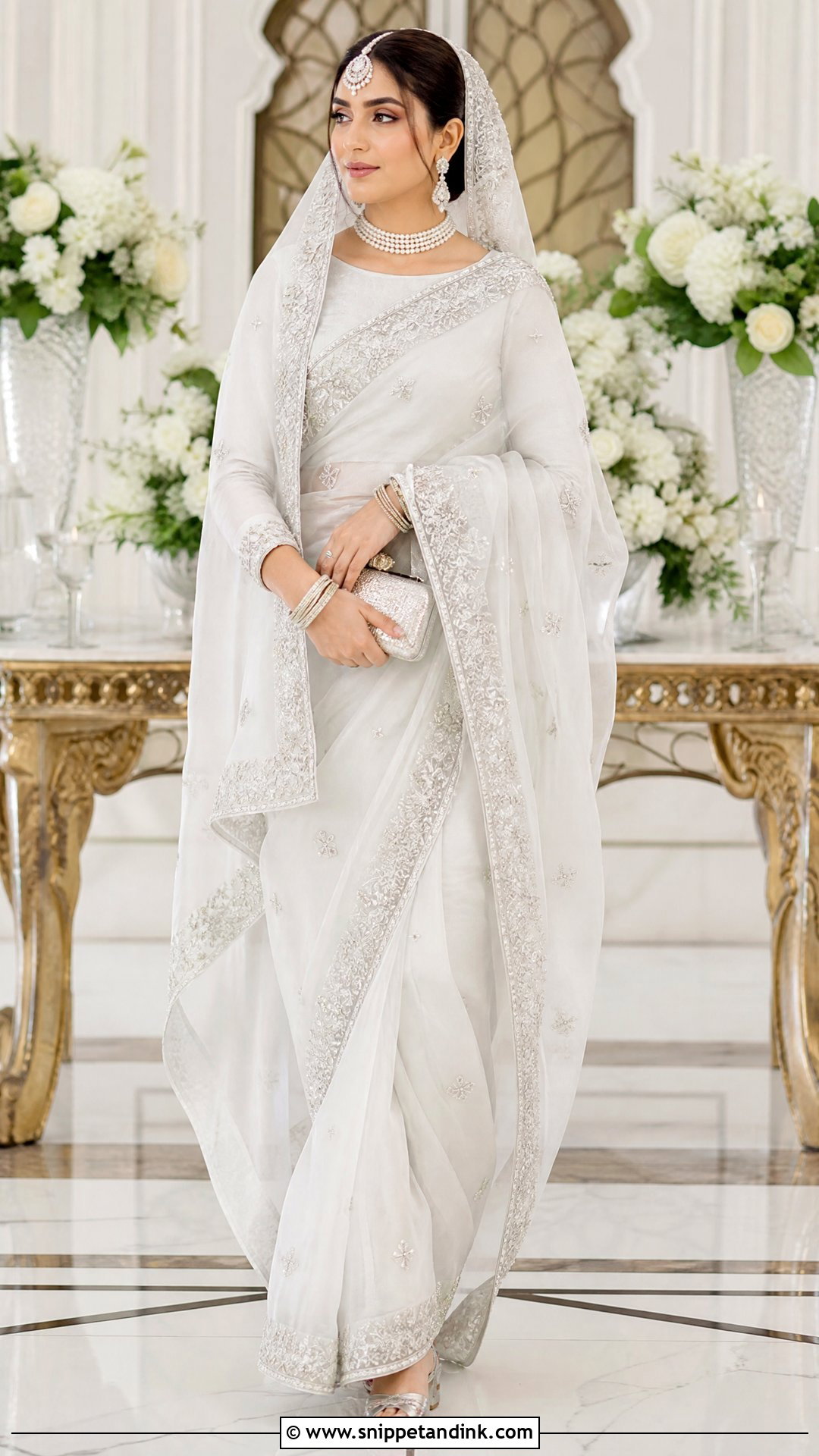
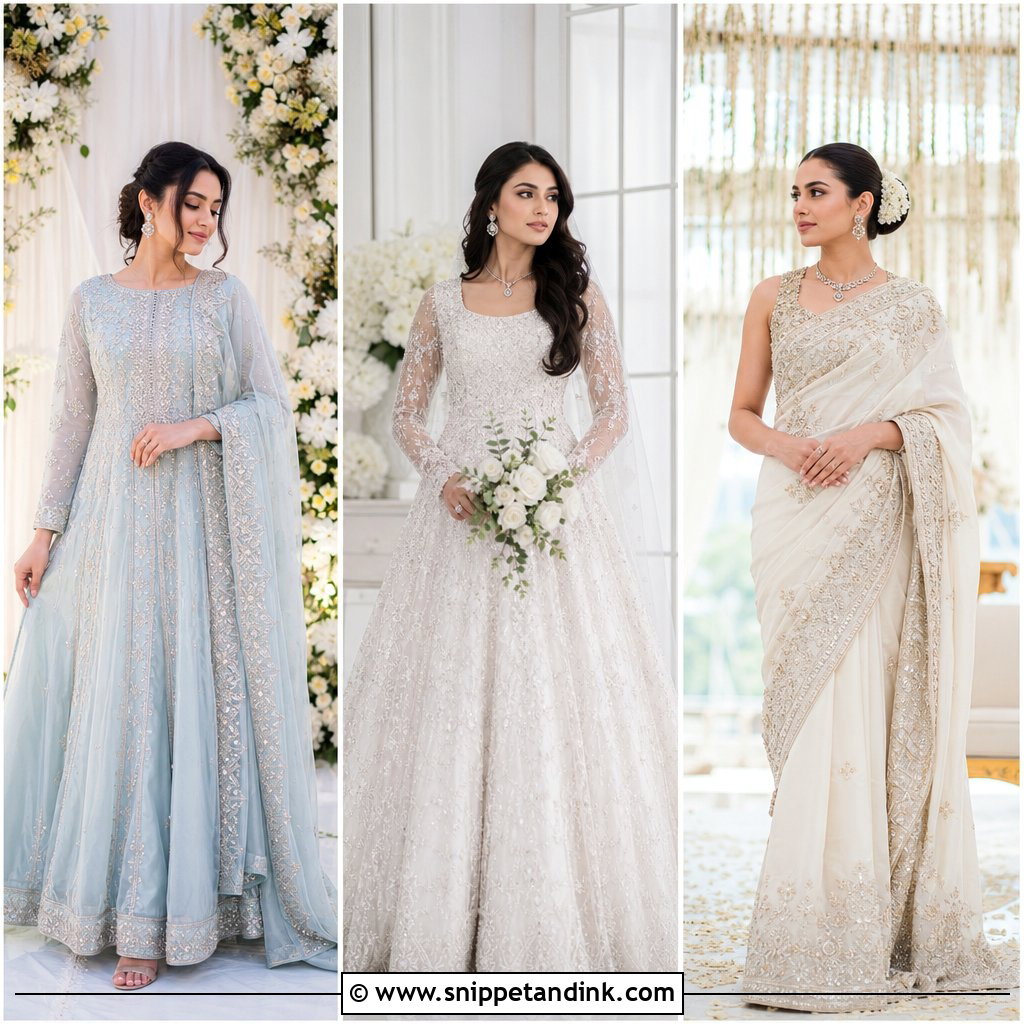
A white bridal saree gives a long, graceful line. Organza, tissue, chiffon or silk with an embroidered border and scattered pearl, sequin or kamdani work all suit a Nikah. The blouse should have full sleeves, a covered back and a neckline that supports the jewelry. The pallu can go over the head, or you can add a separate light veil for more coverage. Put on your heels before draping, never after, or the length will be wrong. Tissue is slippery, so the pleats need firm pinning to survive sitting. A pearl choker, long earrings, bangles, a small tikka and a low bun finish it.
12. White Front-Open Gown Nikah Dress
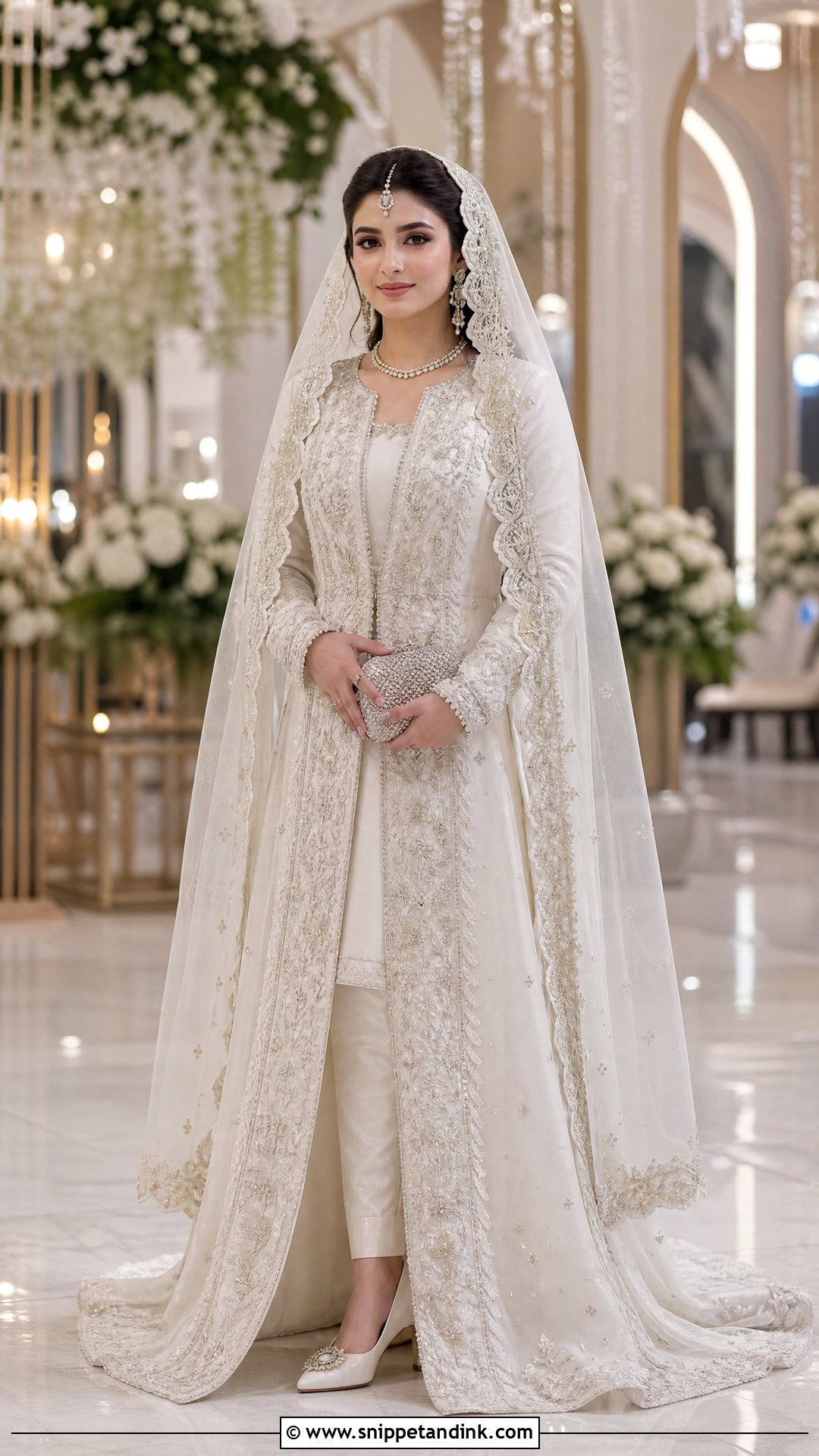
A front-open gown layers drama over familiar Pakistani separates. The embroidered gown goes over a matching inner shirt and straight trousers, and every layer must stay in one white or ivory family; three slightly different whites look unplanned in photos. A fitted top and flowing lower panels give shape while the open front shows the inner outfit. Add a long dupatta with a scalloped border placed gently over the hair. Crystal earrings, a pearl necklace, a slim tikka and a jeweled clutch suit the formality, and closed-toe heels keep the line long. It’s well suited to a hotel or evening Nikah.
13. White Cape Lehenga Nikah Dress
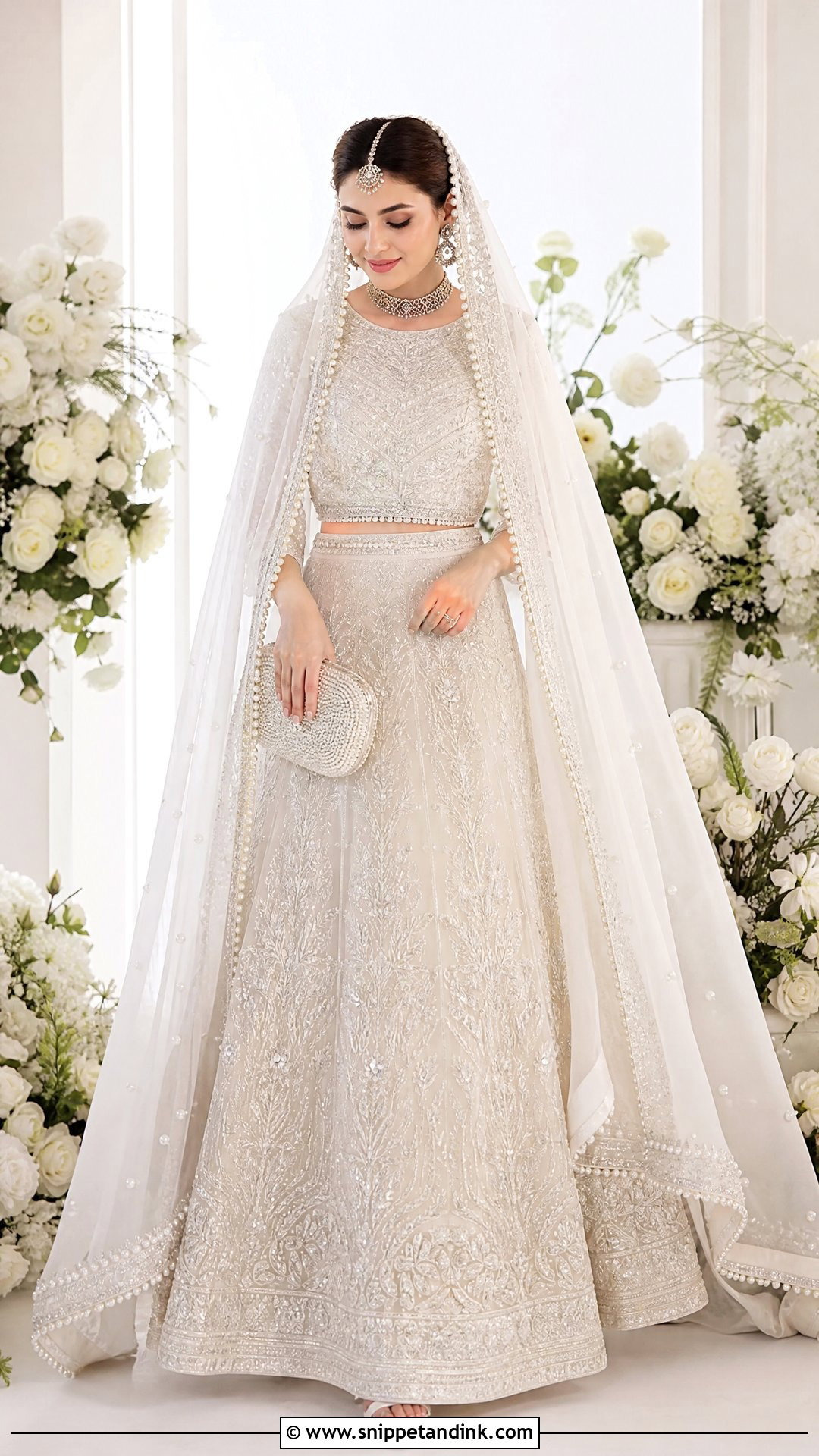
Prefer a cape to a draped dupatta? A sheer white cape over a lehenga gives coverage and movement in one layer. Pair a high-waisted embroidered skirt with a long modest blouse, then add a cape falling to the wrist or the floor. Pearl edging, floral appliqué or fine sequins make it stand out without overload. A cape can’t be pulled up over the head, so for the ceremony I’d add a separate light veil, pinned under the cape’s neckline. Keep jewelry focused: a choker, matching earrings and a centered tikka. Platform sandals and a pearl clutch finish it.
14. White Jacket Lehenga Nikah Dress
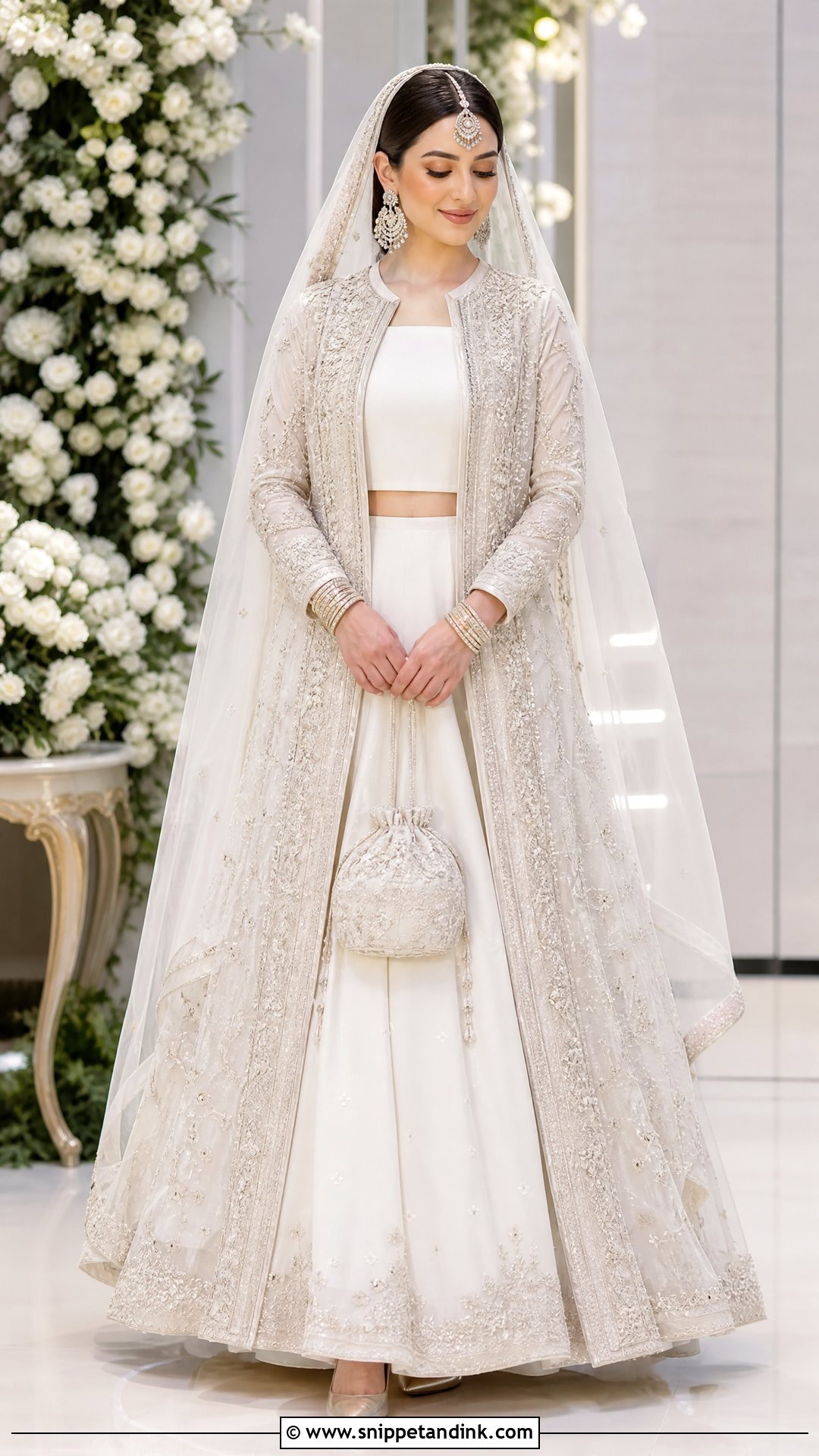
A long jacket over a lehenga adds structure, coverage and warmth. Start with a flowing skirt and simple inner blouse, then layer an embroidered jacket that closes at the waist or stays open down the front, ending below the knee for a long vertical line. Tonal threadwork and pearls keep it soft; gold detailing makes it regal. The jacket has to be fitted closely at the shoulder, otherwise it slides back and pulls the veil with it. Use a light veil rather than another heavy layer. Drop earrings, a statement ring, a small tikka and bangles, metallic pumps and a compact potli complete it. I’d reach for it in winter or a cold air-conditioned hall.
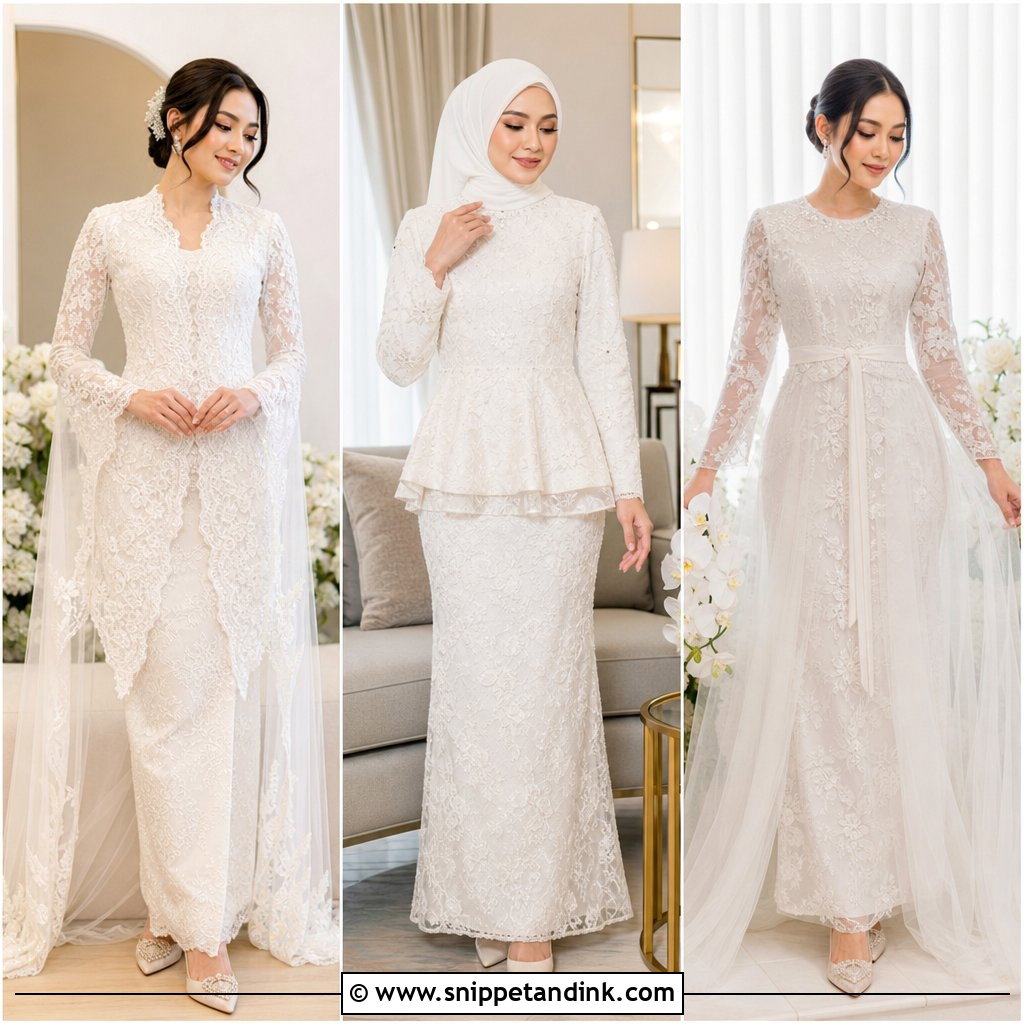
15. White Tissue Silk Gharara Nikah Dress
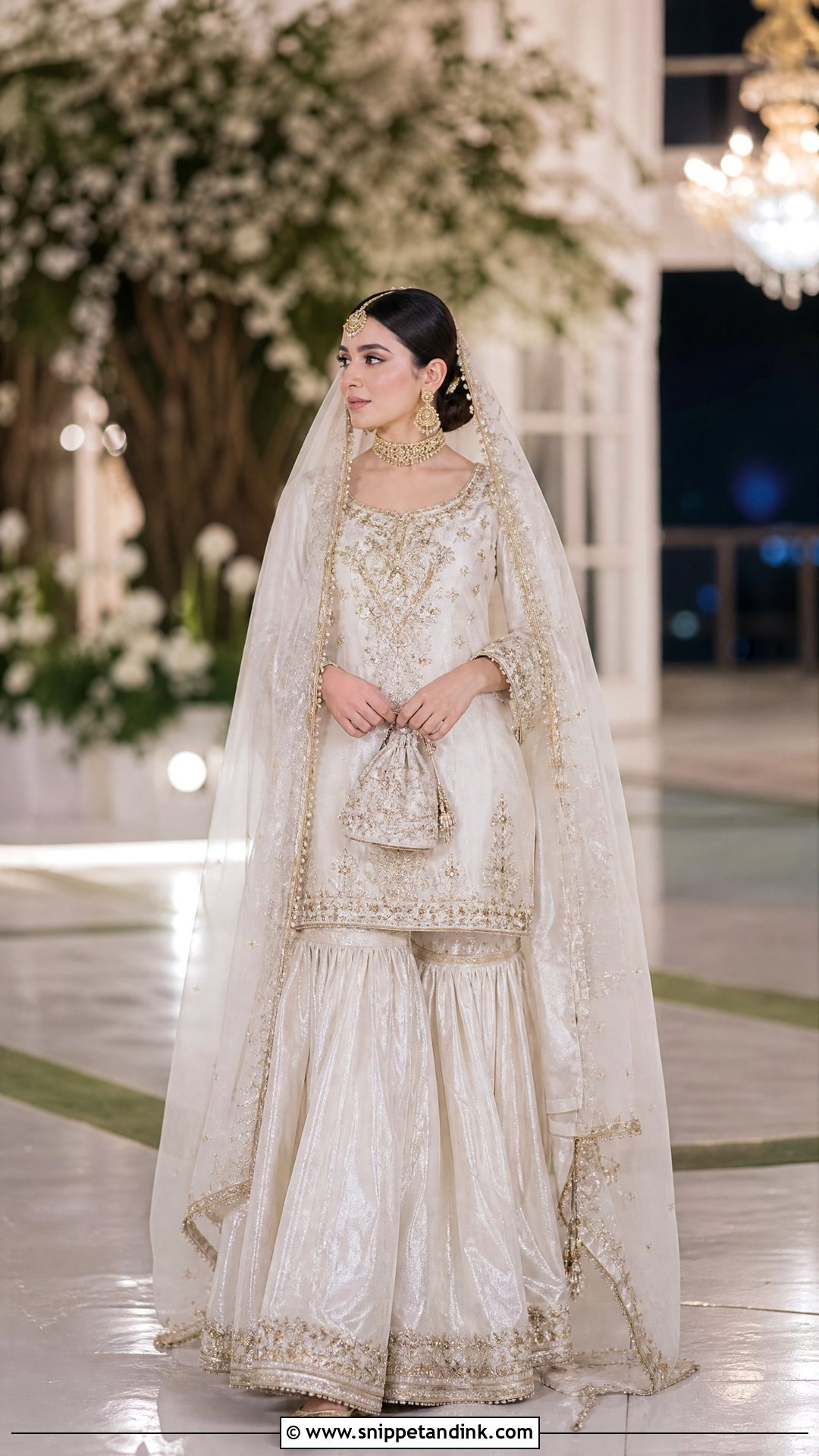
Tissue silk has a sheen that makes white glow without much embroidery. Pair a structured tissue silk gharara with a knee-length shirt in gold zardozi, resham flowers or carefully placed pearls, keeping the work at the neck, cuffs and lower borders since the fabric already shines. An organza dupatta softens the gloss. Tissue marks with water and creases sharply where you sit, so I’d steam it on the morning and avoid perfume near it. Antique gold jewelry, a choker, earrings and passa, plus gold khussas and an embroidered potli finish it, with a low bun and defined eyes.
16. White Organza Sharara Nikah Dress
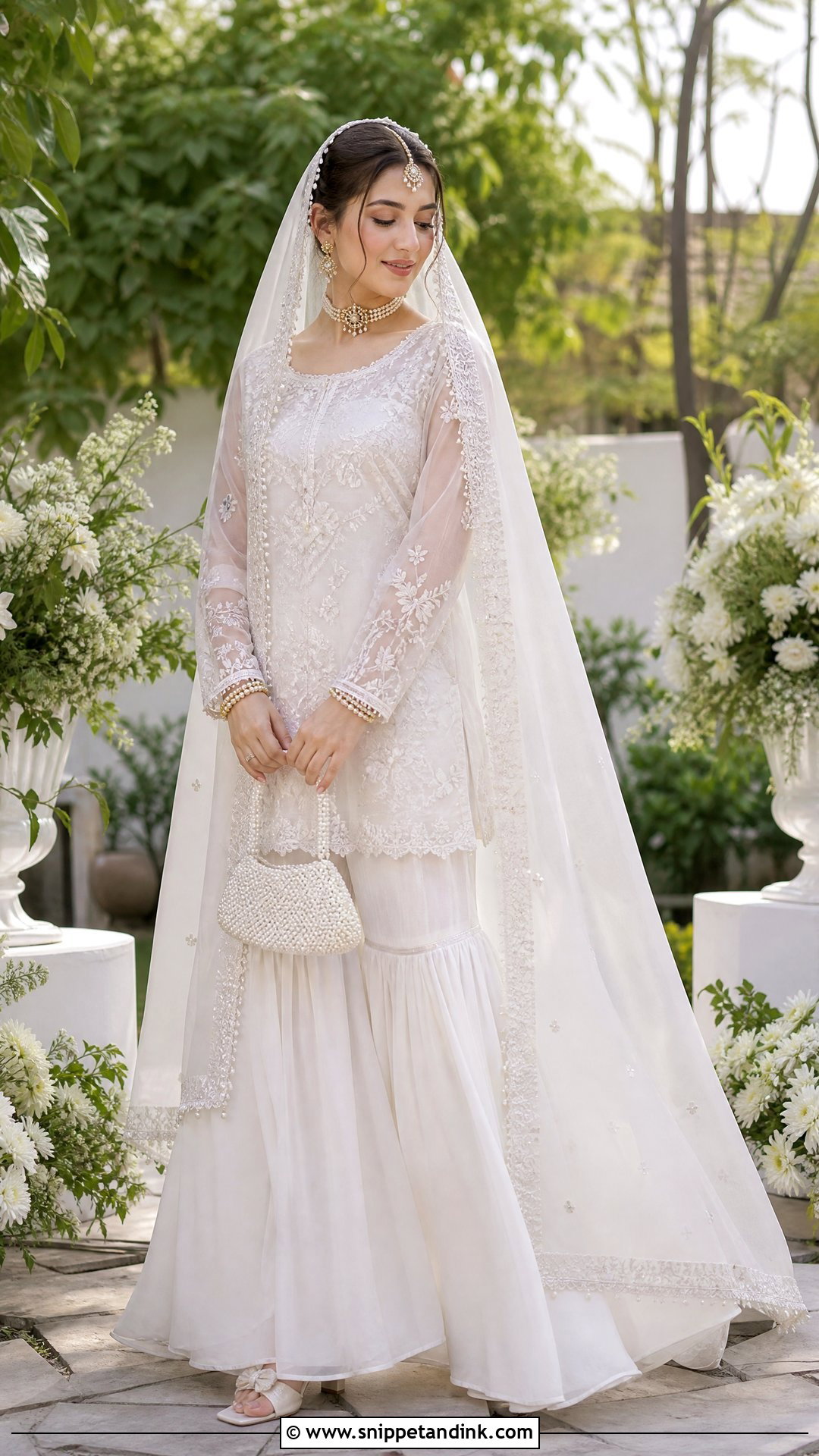
Organza gives a sharara airy layers that suit a bright daytime ceremony. Look for a lined, flowing sharara with a short or mid-length shirt in embroidered floral panels. Sheer sleeves can be lined where you want more coverage. A net or organza dupatta with a finished border stays in place over the head much better than a raw-edged one, because the border weight anchors it. Pearl earrings, a fine choker, a slim tikka and a few bracelets keep the palette light, with white or silver block heels and a pearl-handled bag. Organza crushes in a car, so travel with the dupatta on a hanger.
17. White Pearl Embroidered Nikah Dress
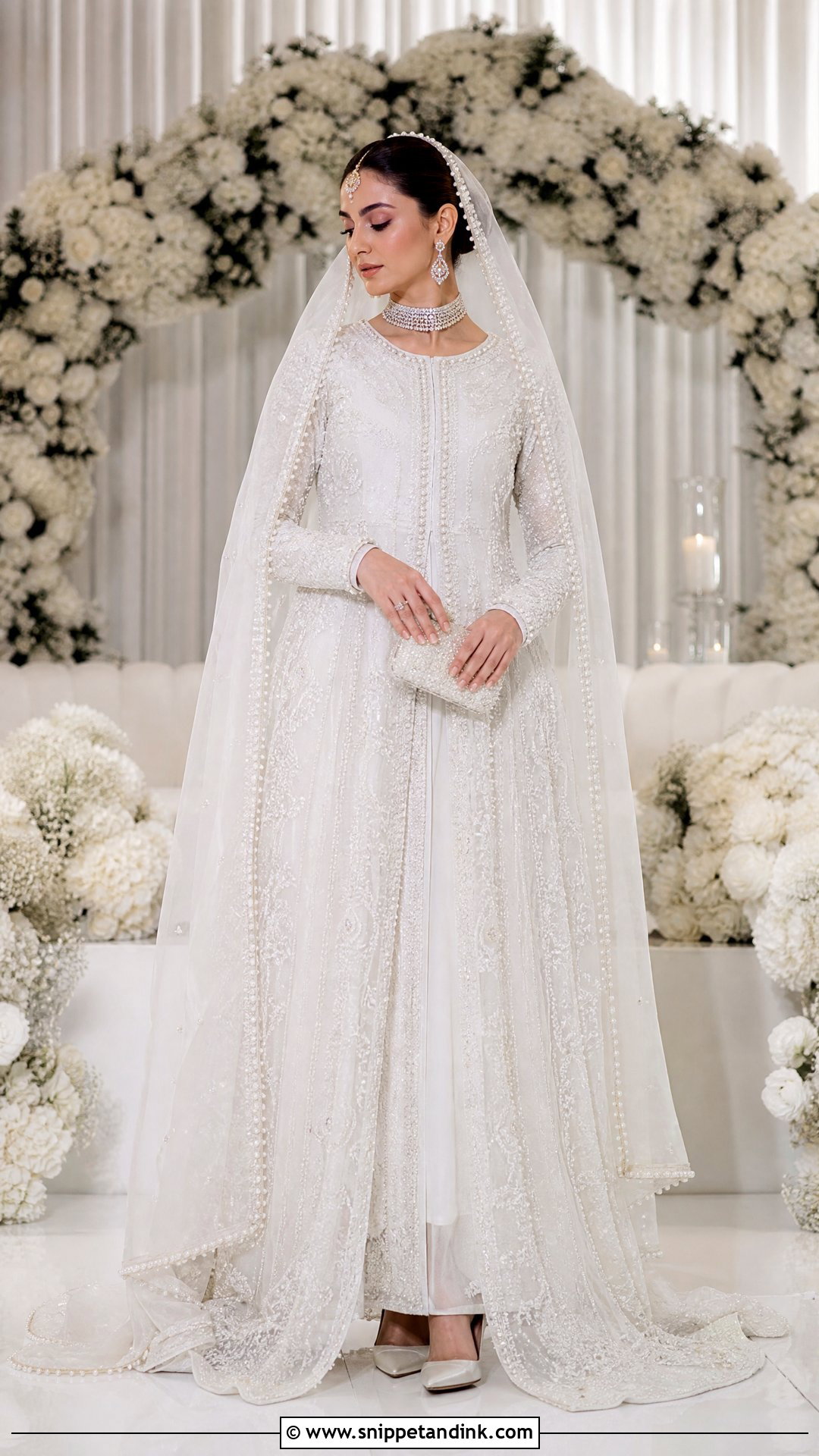
Pearl embroidery adds texture while keeping white quiet. A long pishwas, maxi or panelled gown with pearl vines along the bodice, sleeves and hem is the base; a few crystals or clear sequins add sparkle, but heavy beading everywhere adds real weight to the shoulders. A pearl-edged veil over the hair and shoulders, a pearl choker, studs or drops and a restrained tikka finish it. Satin heels and a beaded clutch keep it coordinated. Pearl beads on fine fabric pull threads if they catch on a bangle, so I’d keep bracelets smooth. A sleek bun keeps the neckline uncrowded.
18. White Gold Zardozi Nikah Dress
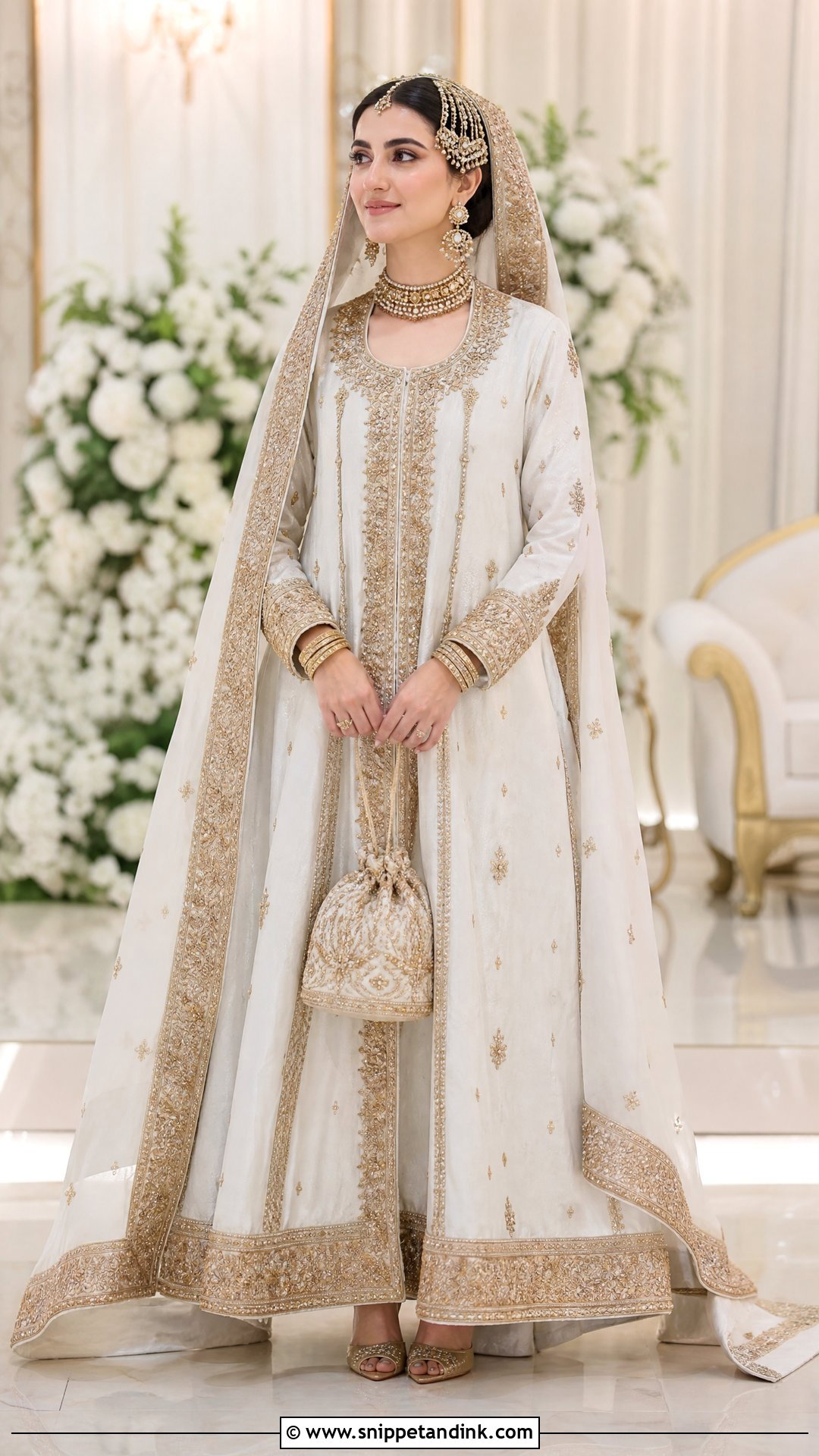
White and gold is the classic regal pairing, and it sits easily with traditional jewelry. Choose a lehenga, gharara, or pishwas with antique gold zardozi around the neck, sleeves, waist and lower border, leaving plain areas so the work can breathe. A dupatta with a wide gold edge and small motifs goes over the head. A kundan or polki choker, jhumkas, passa and bangles complete the jewelry. Match the jewelry’s gold to the zari: bright yellow gold beside antique zardozi makes both look off. Muted gold heels and an embroidered potli keep the palette to two colors, with defined eyes and a rose lip.
19. White Silver Kamdani Nikah Dress
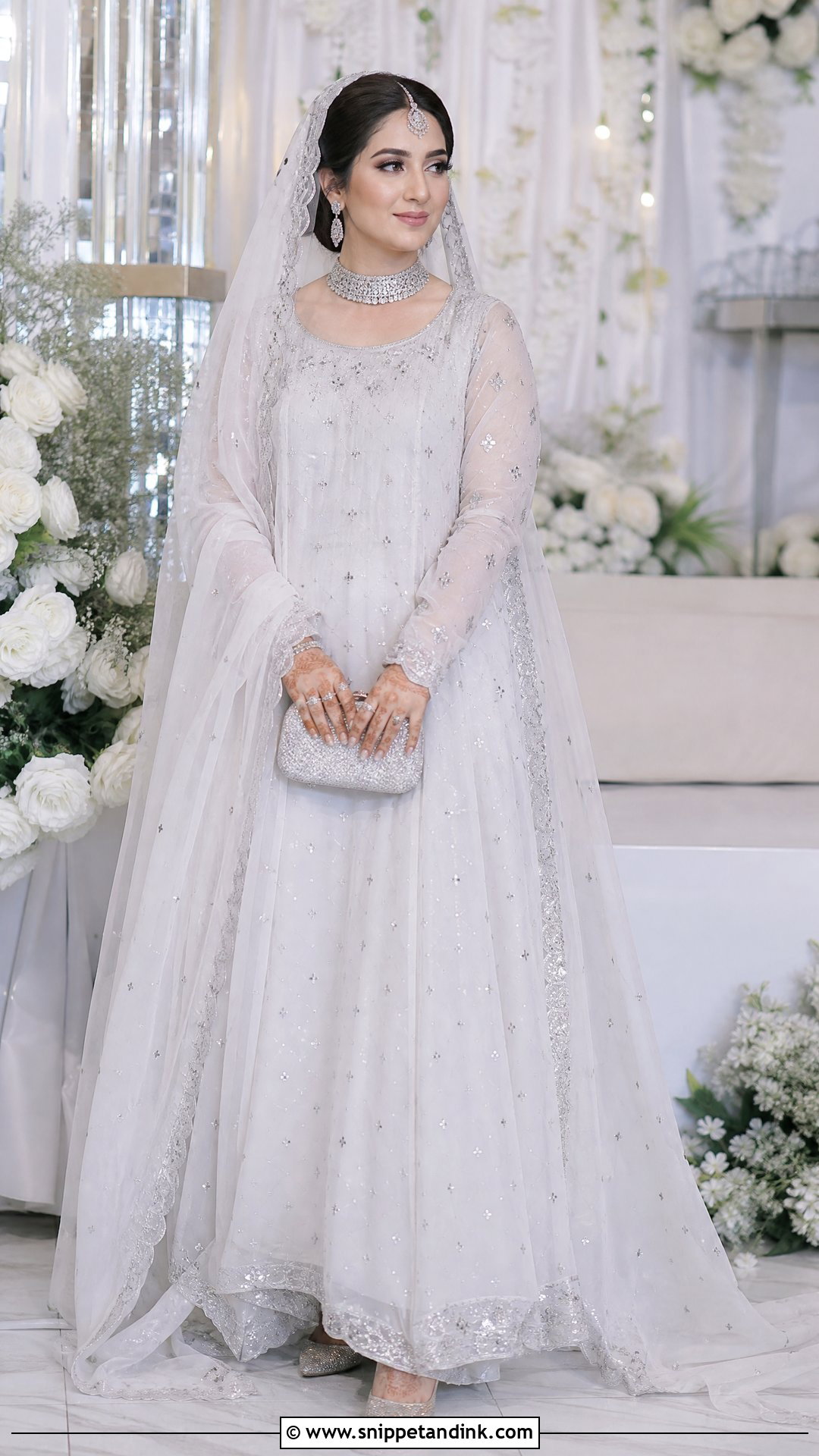
Kamdani is fine flattened metal wire worked into tiny motifs, and under ceremony lighting it shimmers rather than glitters. A flowing chiffon or organza pishwas with kamdani spread evenly across it and a silver embroidered border at the hem and sleeves stays light. A matching kamdani dupatta with a scalloped edge goes over the head. Crystal or diamond-look jewelry suits the cool tone: a choker, drops and a small forehead piece. Silver pointed heels and a crystal clutch finish it. Kamdani can scratch sensitive skin at the neck and inner arm, so I’d ask for the inside edges to be faced with soft fabric.
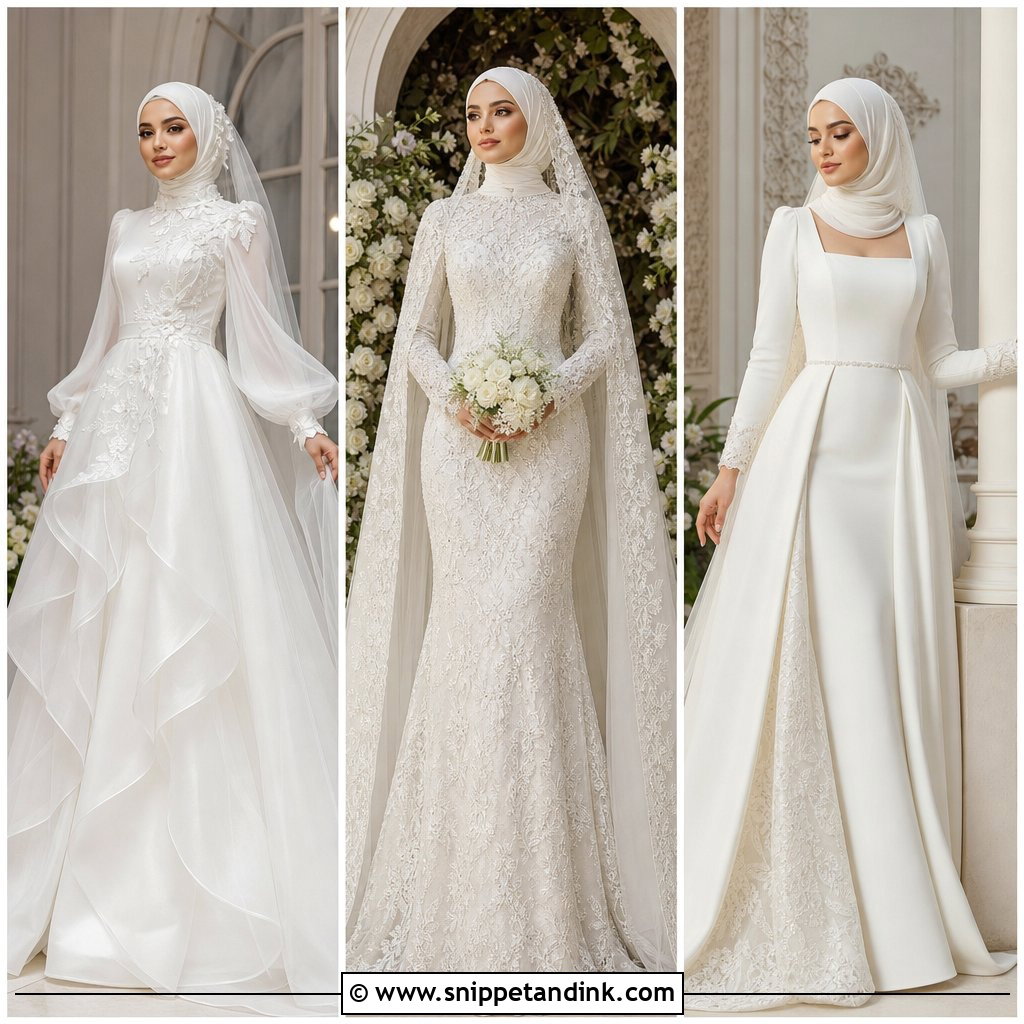
20. White Hijab Nikah Dress
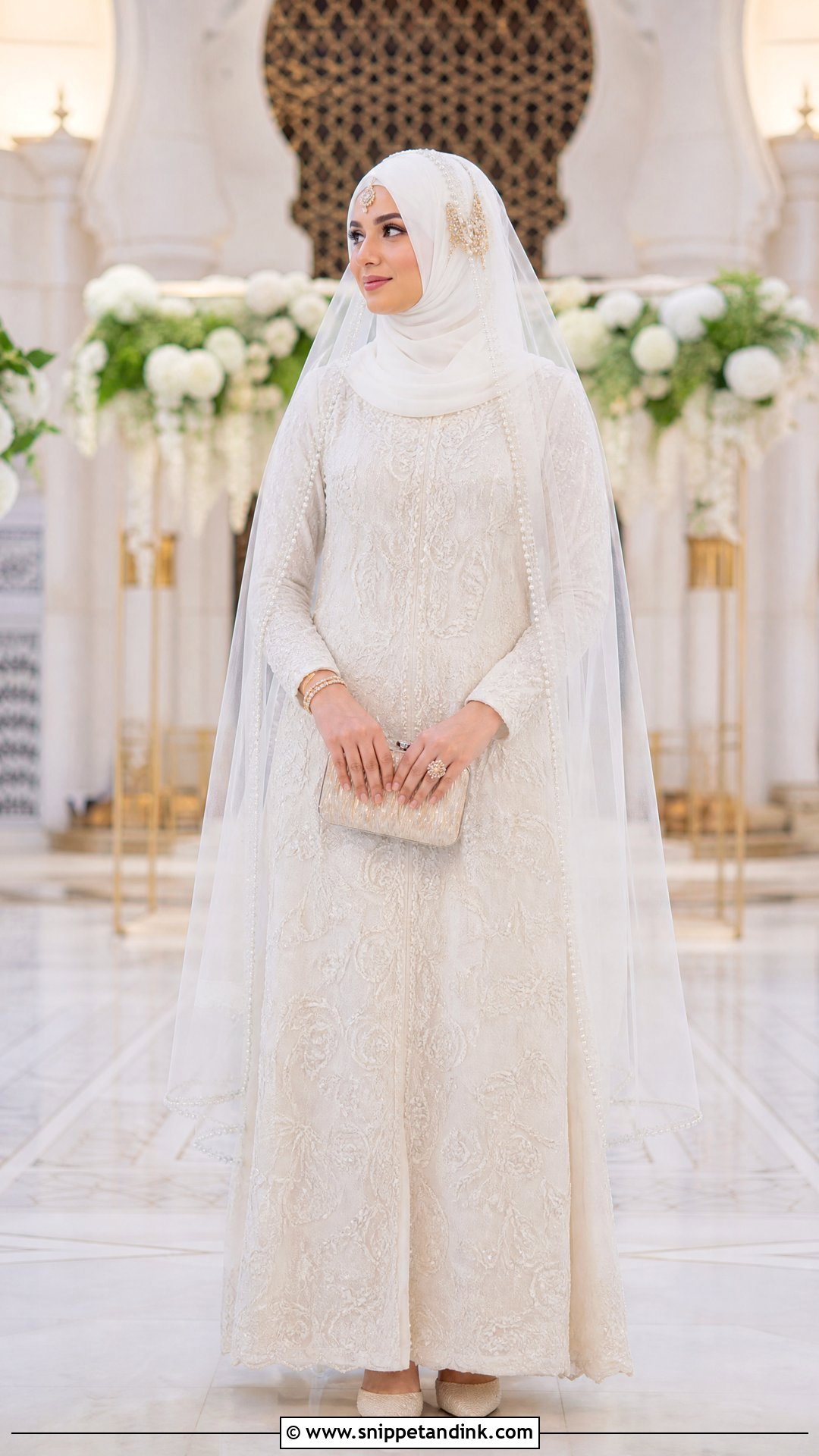
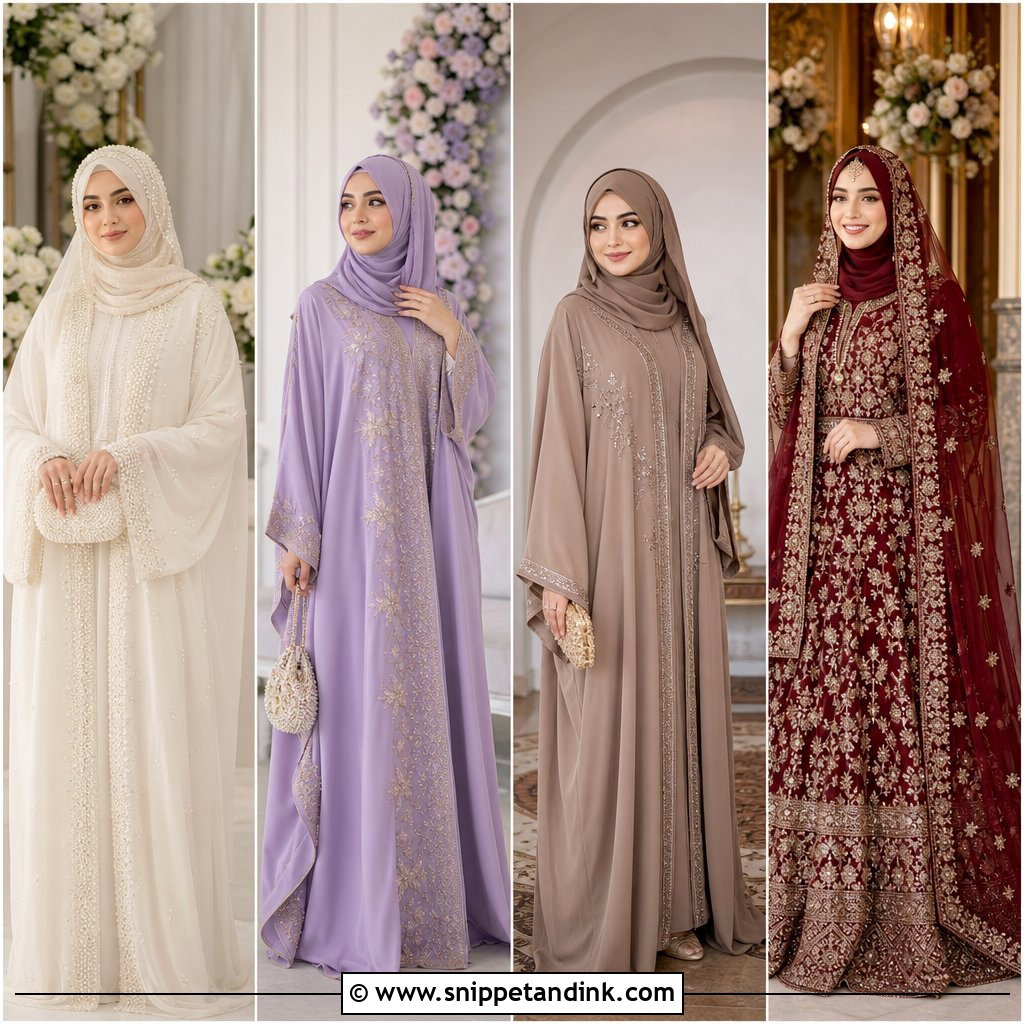
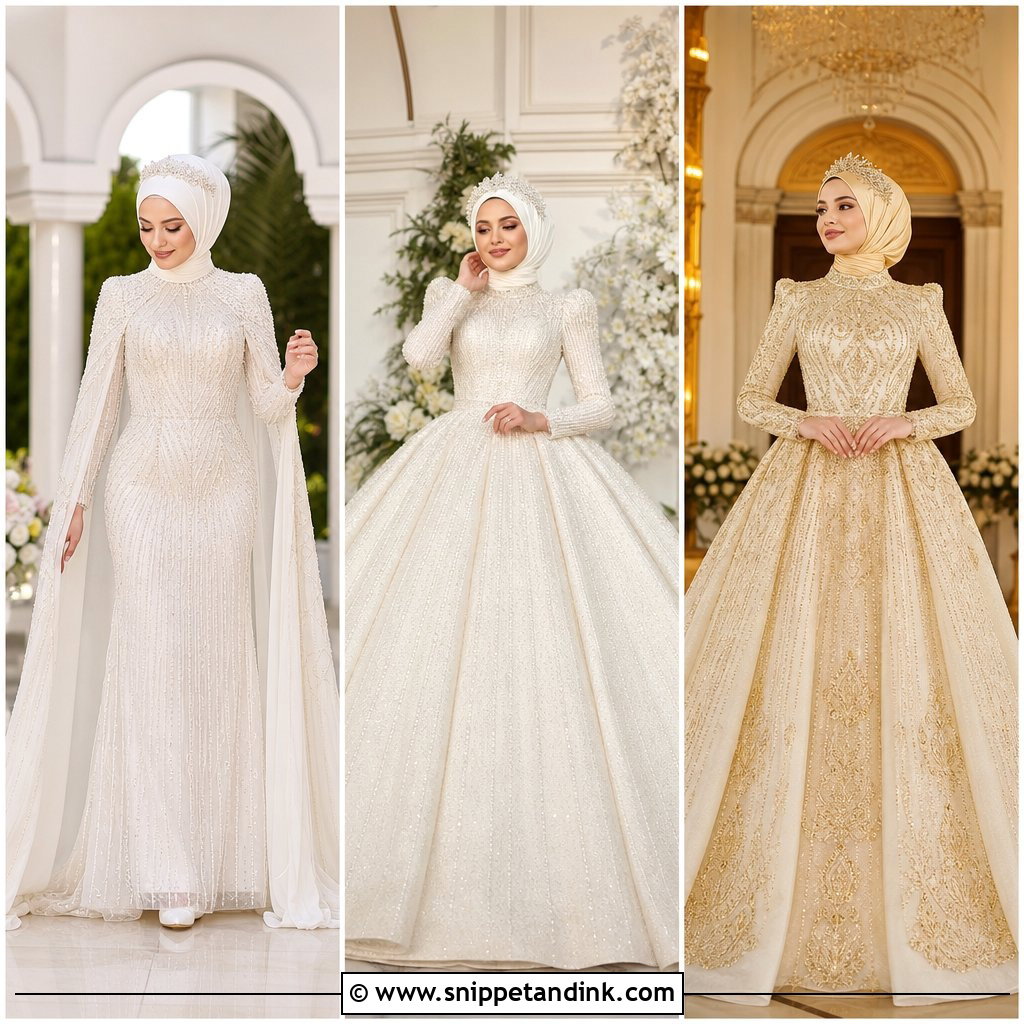
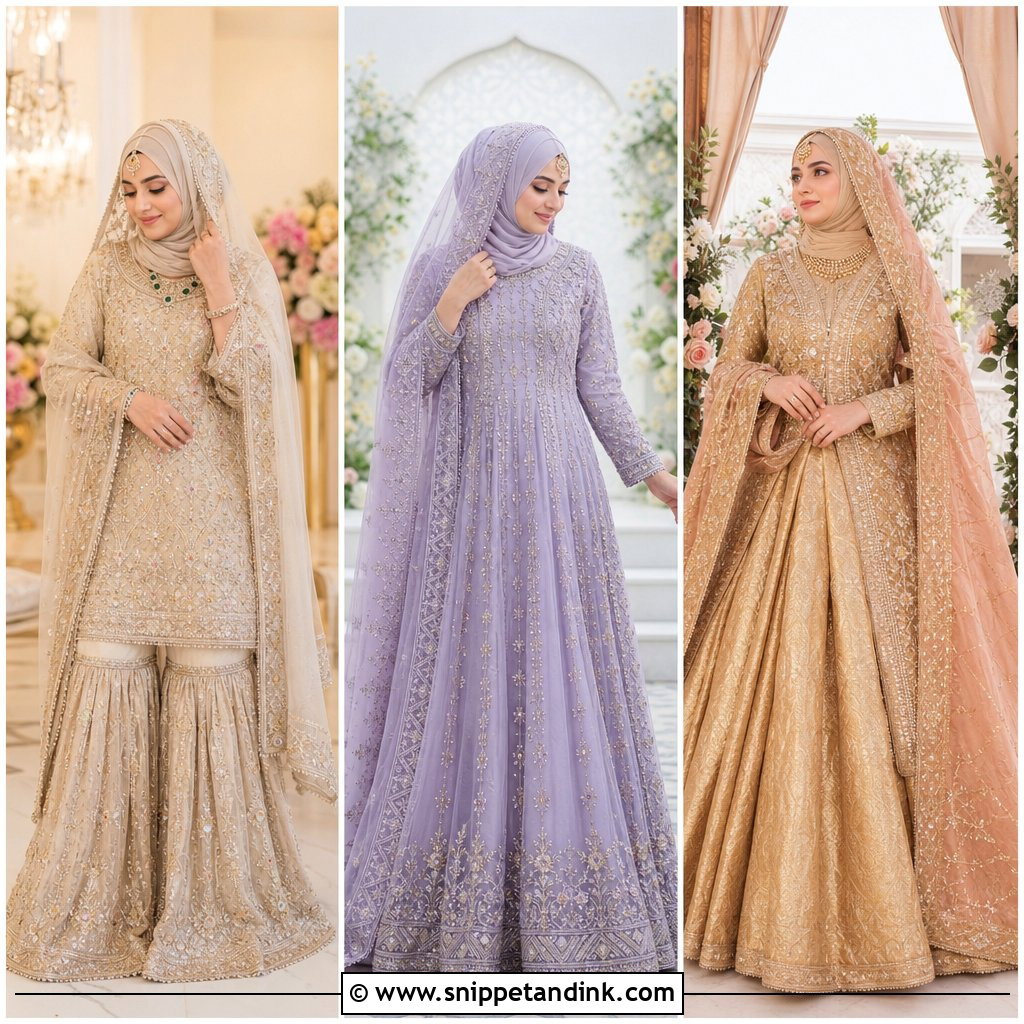
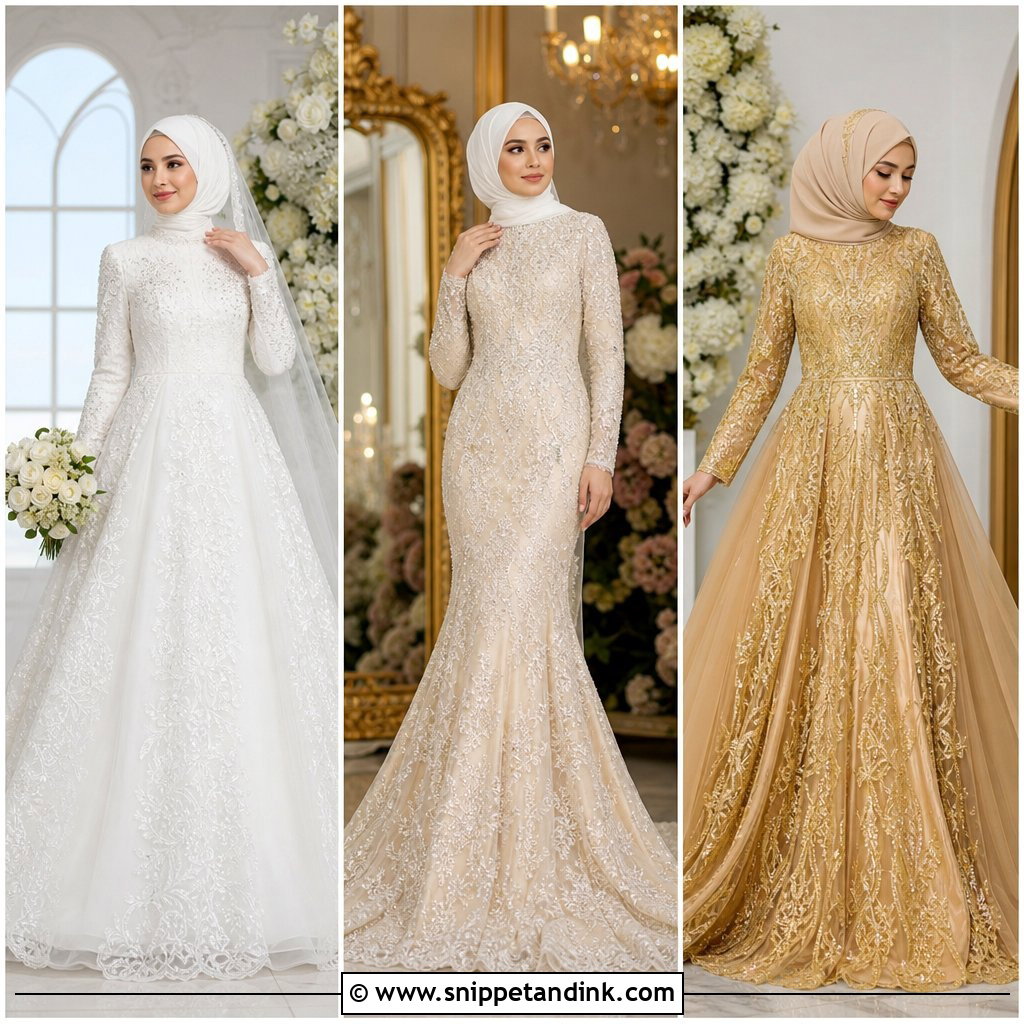
A white hijab can be part of the outfit’s design rather than an add-on. Start with a modest floor-length gown, pishwas or long-shirt suit with full sleeves and a covered neckline. Choose a soft chiffon hijab in the same white undertone as the dress, and secure it with hidden pins. Bring the hijab fabric to the final fitting so you can compare it against the outfit in daylight. A worked veil over the hijab lets the embroidered edges frame the shoulders. A forehead tikka, a jeweled side brooch, bracelets and a ring are enough without crowding the face. Closed-toe heels and a structured clutch complete it.
Hand Embroidery Takes Months: Plan the Order Around It
Zardozi, dabka, kamdani and dense pearl work are done by hand, and good karigars are booked up before wedding season. Lead times vary a lot by designer and the amount of work, but several months is normal for a custom bridal outfit, and more for heavy pieces.
The order of things
- Finalize the design, shade and measurements, and get the measurements taken by someone experienced rather than doing them yourself.
- Approve a sample of the embroidery on the actual fabric before the full piece is worked.
- Leave time for at least one fitting after the embroidery is done, since heavy work changes how fabric hangs.
- If the outfit is being made abroad, allow extra weeks for shipping and customs, and ask for it to travel folded in muslin, not plastic.
Keeping it white after the Nikah
White silk and organza yellow when stored in plastic or near light. Have the outfit dry cleaned by someone used to embroidered bridalwear, then wrap it in clean cotton or muslin and keep it flat in a box away from sunlight. Spray perfume before you dress, never onto the fabric, because perfume tarnishes metal thread and leaves marks on white silk.
One Shade of White, From Dupatta to Khussa
From traditional ghararas and pishwas to capes, gowns and tailored suits, white works for every kind of Nikah. Start with a silhouette that suits your venue, how you’ll move and how formal the day is. Then decide whether pearl, gold or silver embroidery matches your jewelry. Fabric matters too: organza is airy, tissue silk shines and chiffon moves softly. Above all, keep one undertone of white or ivory across the dress, dupatta, hijab, shoes and accessories. That single choice is what makes even a simple outfit look finished, in person and on camera.
You'll Like These Ideas:



Leave a Reply