
Chocolate and white is the pairing I get asked about most by couples who want a cake that looks traditional but doesn’t taste it. The contrast itself is easy. The hard part is getting a dark element and a pale one to sit side by side for hours without cocoa bleeding into the icing, ganache sweating or the white turning beige under warm lights. Below are 25 designs I’d happily build, from glossy ganache tiers to piped vintage borders and marble finishes, with notes on what each one asks of your venue and your baker.
Why Chocolate and White Icing Need Planning Together
Dark and pale finishes interfere with each other in ways a one-colour cake never does. Crumbs from chocolate sponge show through a thin white coat, soft cocoa buttercream bleeds into white piping if the two touch while warm, and an all-butter buttercream is naturally ivory, so it can look yellow beside bright white flowers. None of that is a reason to avoid the pairing. It’s a reason to plan the build before anyone picks a design.
- I crumb coat and chill every chocolate tier before the final white layer goes on, so no dark specks surface.
- Dark piping goes onto chilled white icing, never onto soft icing, so the lines stay sharp instead of smearing.
- If you want a true white rather than ivory, ask whether the buttercream can be whitened; bakers use different methods, and it is worth seeing a sample.
- I ask where the cake will stand, because the finish should match the room temperature, not only the mood board.
Matching the finish to the room
Ganache under fondant is the most heat-tolerant build I offer and the one I’d pick for a summer marquee. Ganache alone copes well indoors. Meringue-based buttercreams taste lighter but soften sooner, so they need a cool room and a shorter display time. A naked cake is the most fragile of all, since the sponge itself is exposed to the air.
1. Chocolate And White Tiered Wedding Cake
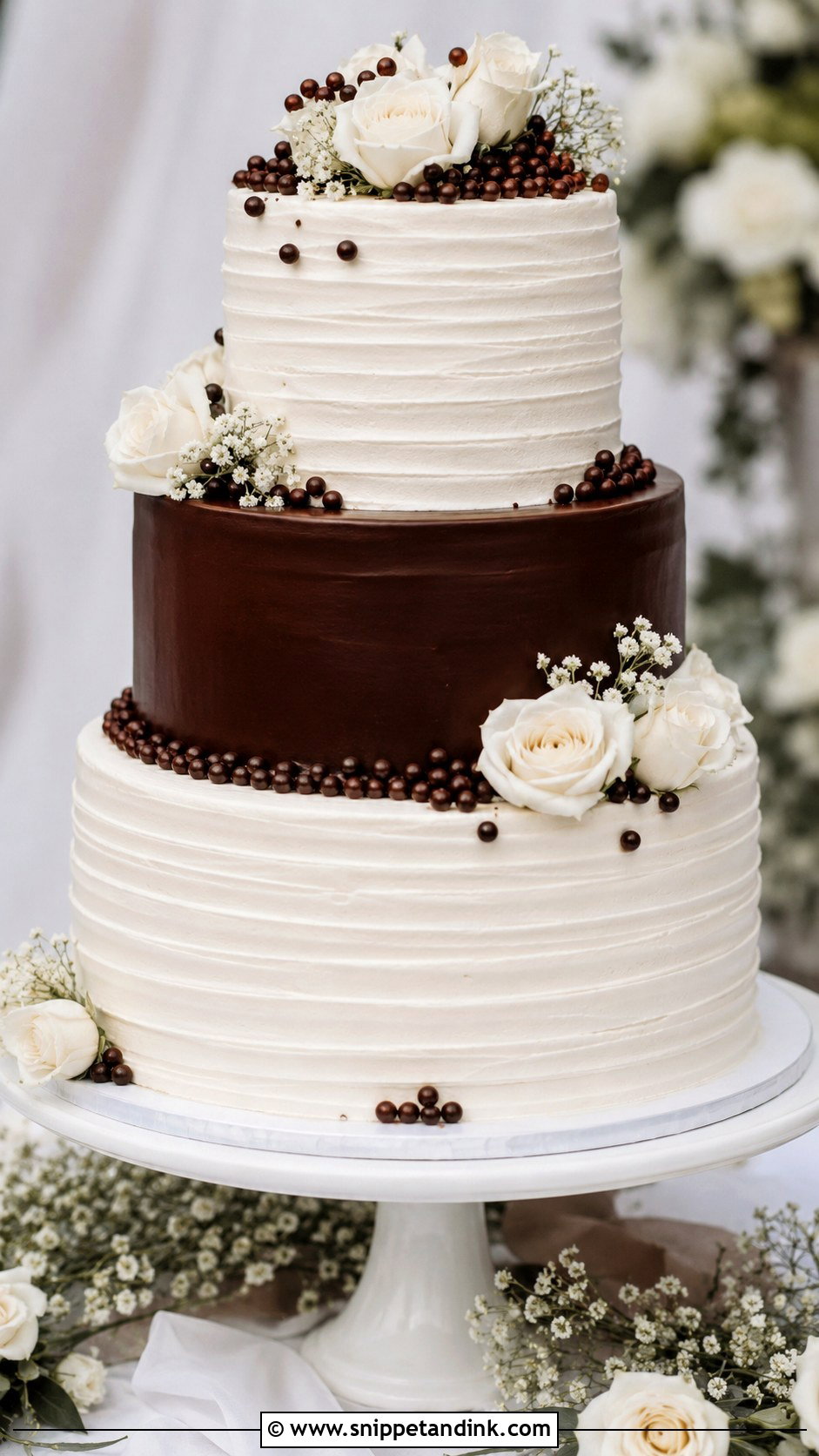
A chocolate and white tiered wedding cake usually means white buttercream or fondant on most tiers with one ganache tier for contrast. I put that dark tier in the middle or at the base, rarely on top, because a dark top tier makes the cake look heavy in photos taken from below. Edges matter more here than on an all-white cake: any wobble at a light and dark seam shows from across the room. A few white roses and a scatter of chocolate pearls are plenty.
2. Chocolate Ganache White Wedding Cake
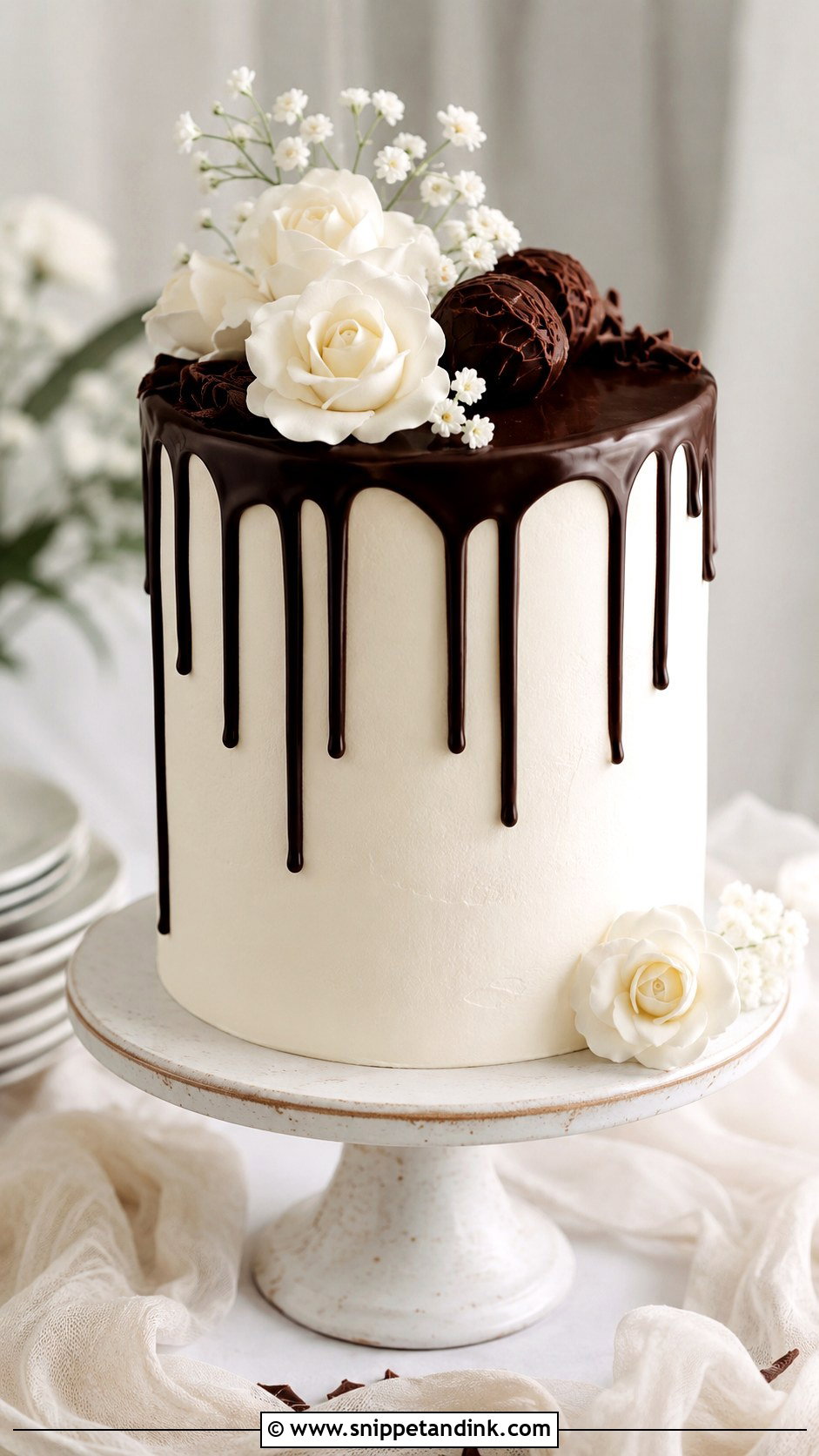
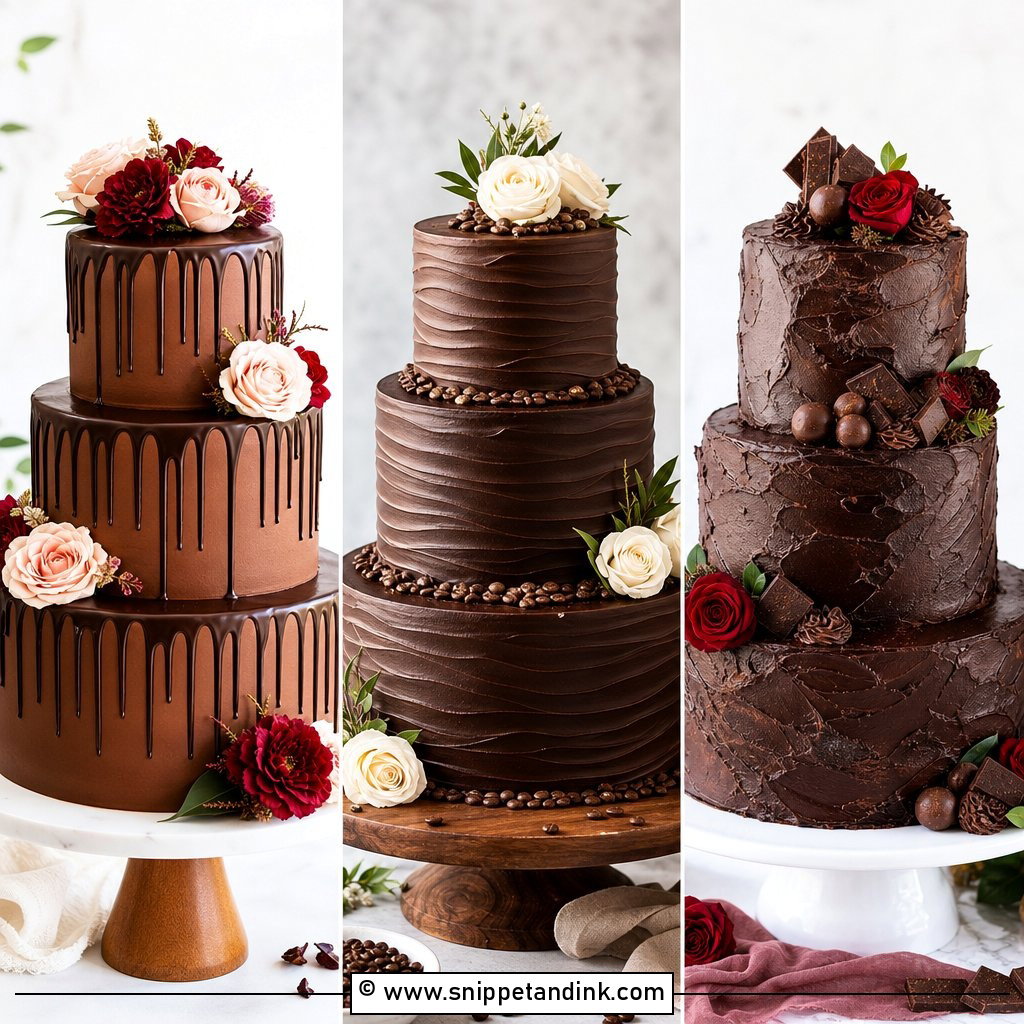
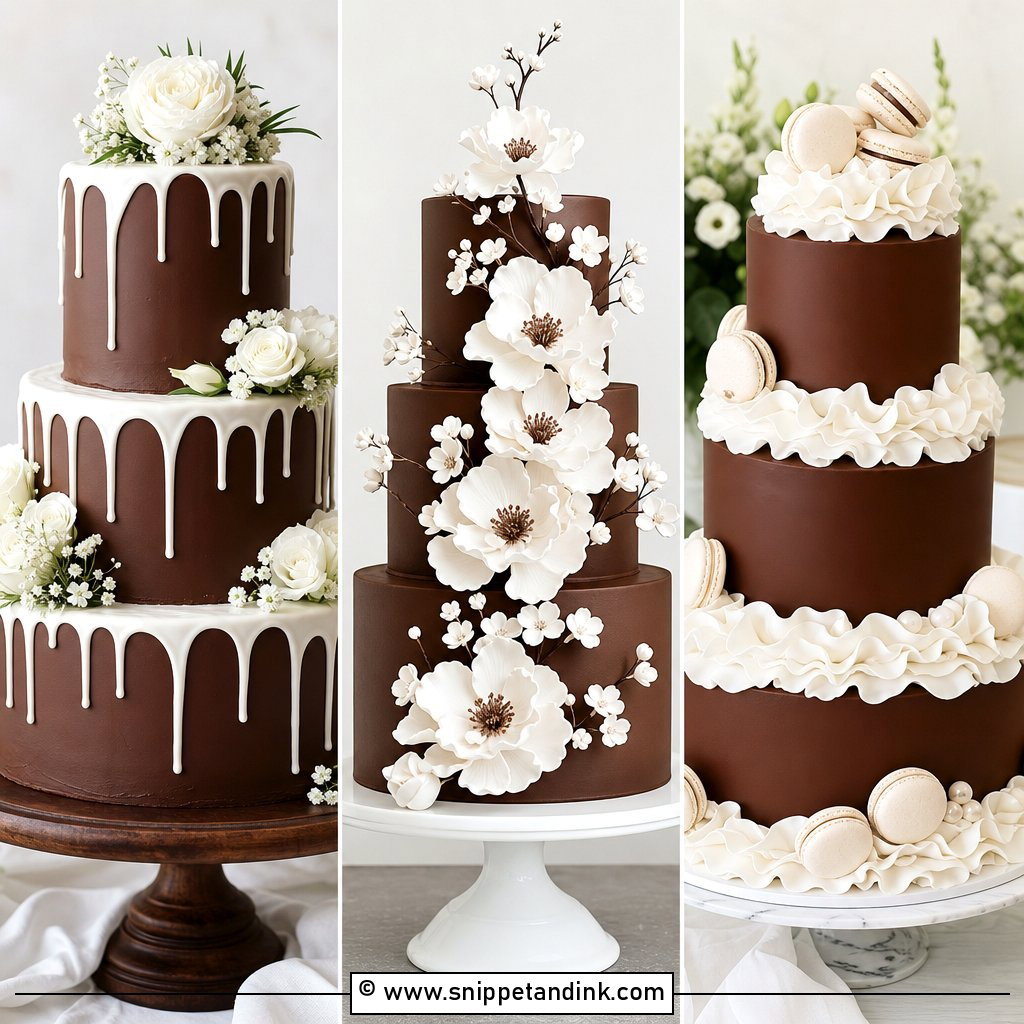
Ganache is the most forgiving finish I work with and also the one that needs the most respect in a hot room. Dark chocolate ganache made at roughly two parts chocolate to one part cream sets firm enough to take sharp edges, and it keeps the sponge from drying out. Use it as a thin drip, as a band between white tiers or as a full tier coat; the more coverage, the bolder the cake reads. Sugar orchids or piped ivory borders soften the dark areas, and it sits well on a white pedestal. Planning an outdoor summer reception? Tell your baker early, because a fully ganached tier wants shade.
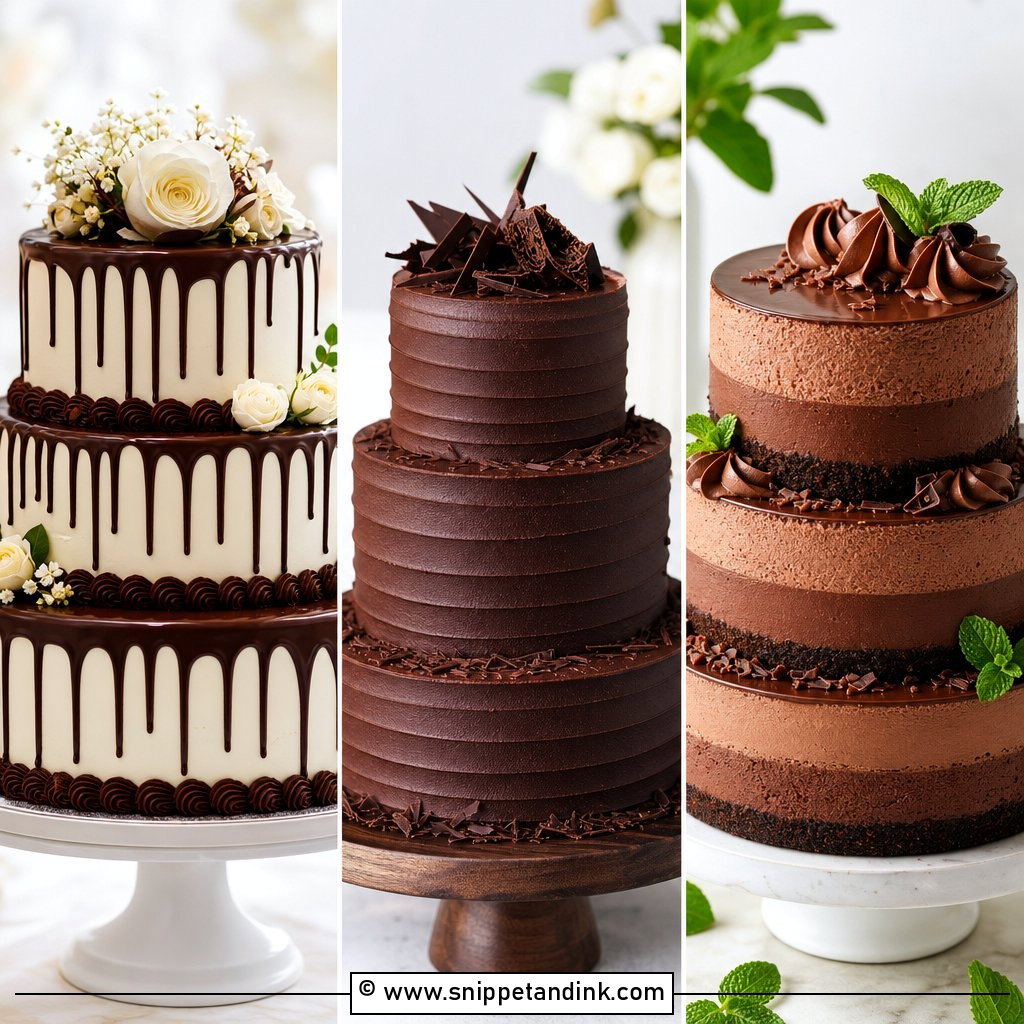
3. White Buttercream Chocolate Wedding Cake
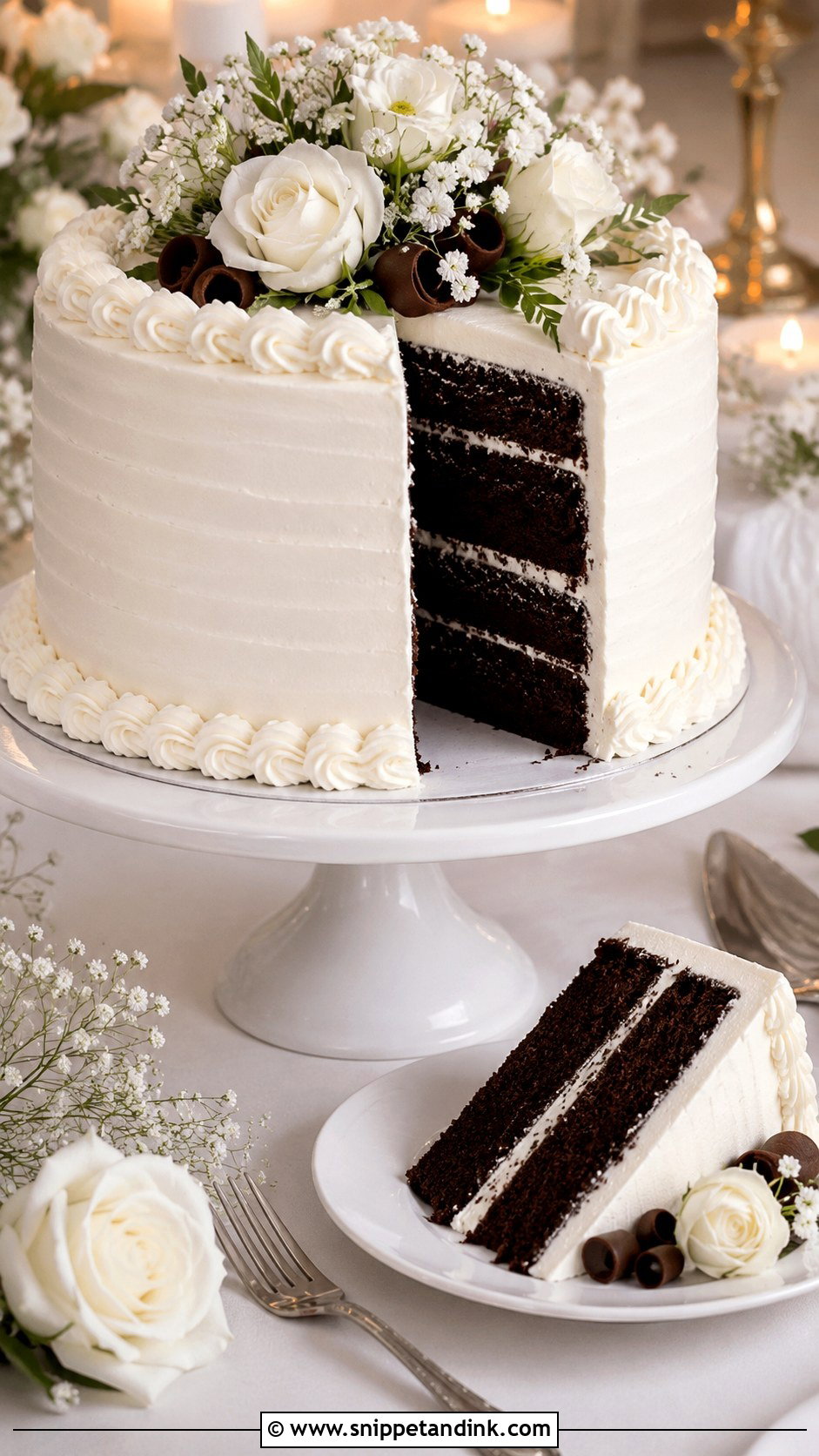
This is the cake I suggest when the family expects a white wedding cake and the couple wants chocolate. Nobody can tell from the outside, and the first slice always gets a reaction. I prefer a lightly textured spatula finish to glass-smooth here, partly because it looks relaxed and partly because it hides the faint grey shadow dark crumbs can cast through thin icing. Ask for a proper crumb coat and a chill before the final layer. That step is what keeps the outside truly white.
4. Chocolate Drip White Wedding Cake
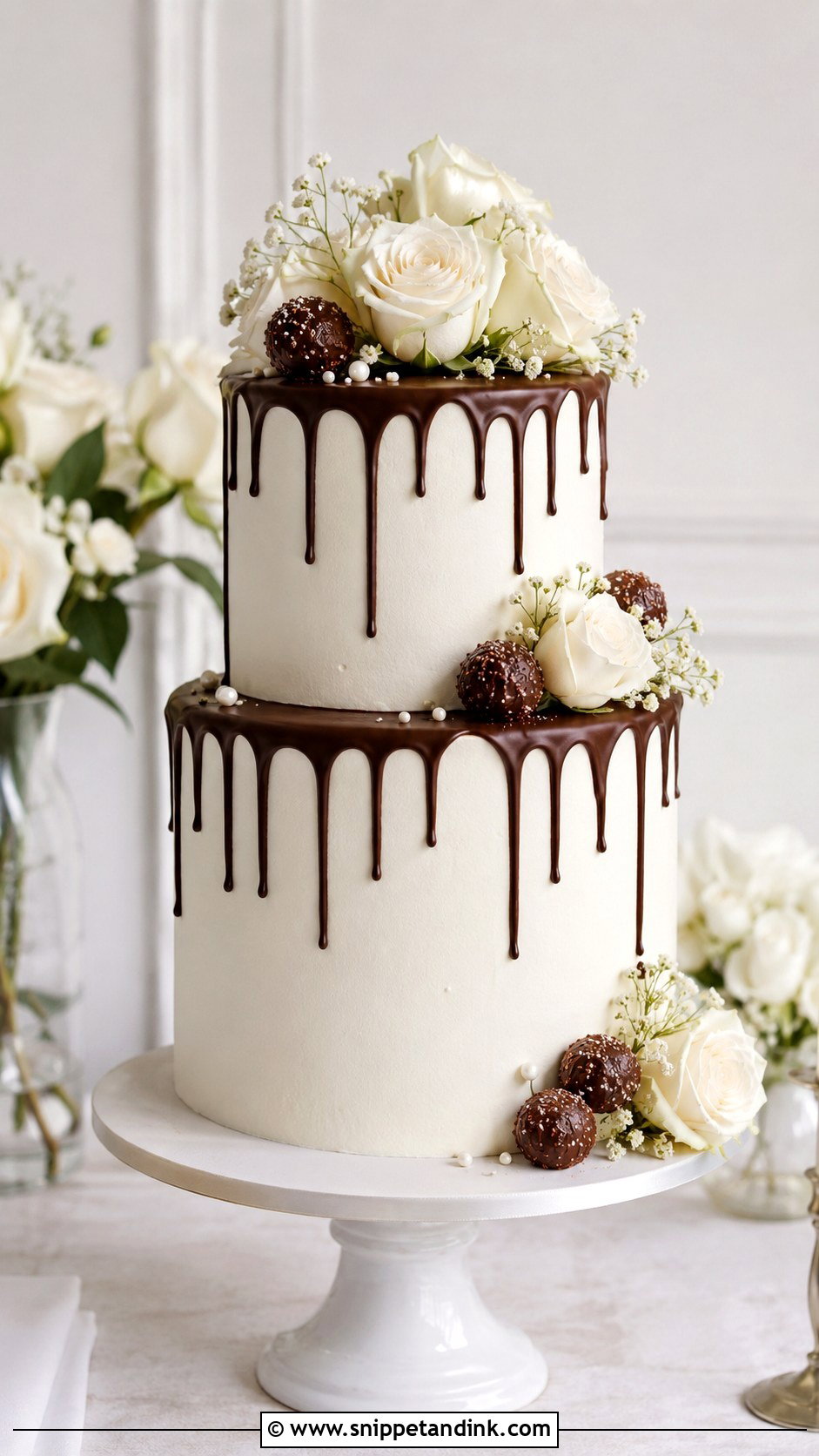
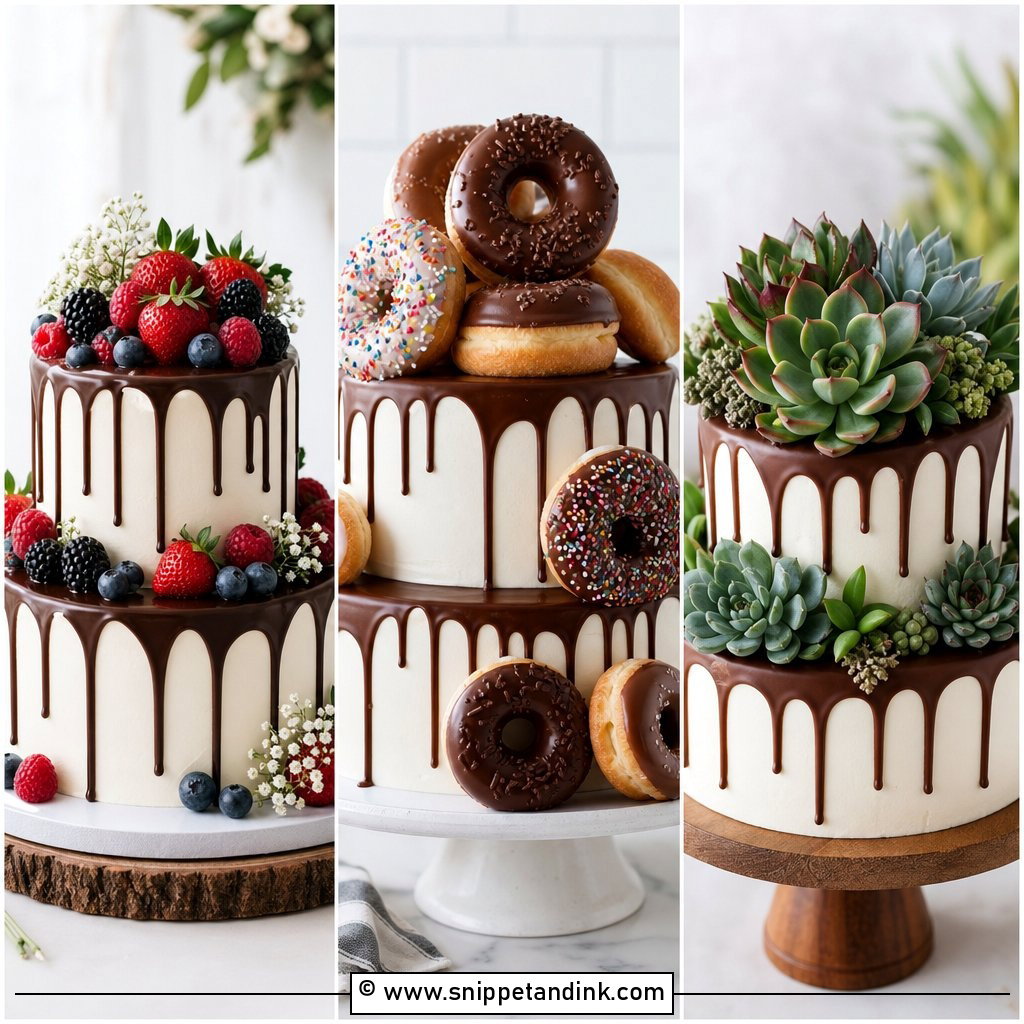
Drips are about temperature, not luck. Ganache that’s too warm runs straight to the board; too cool and it stops in stubby blobs. I test one drip down the back of the tier before touching the front, and I let them fall at uneven lengths on purpose so the edge doesn’t look stamped. Keep toppers small, a few white ranunculus or truffles, since the drip already gives the eye plenty to follow. Guests read the flavour from across the room, which makes it a natural anchor for a dessert table.
5. Black Chocolate And White Wedding Cake
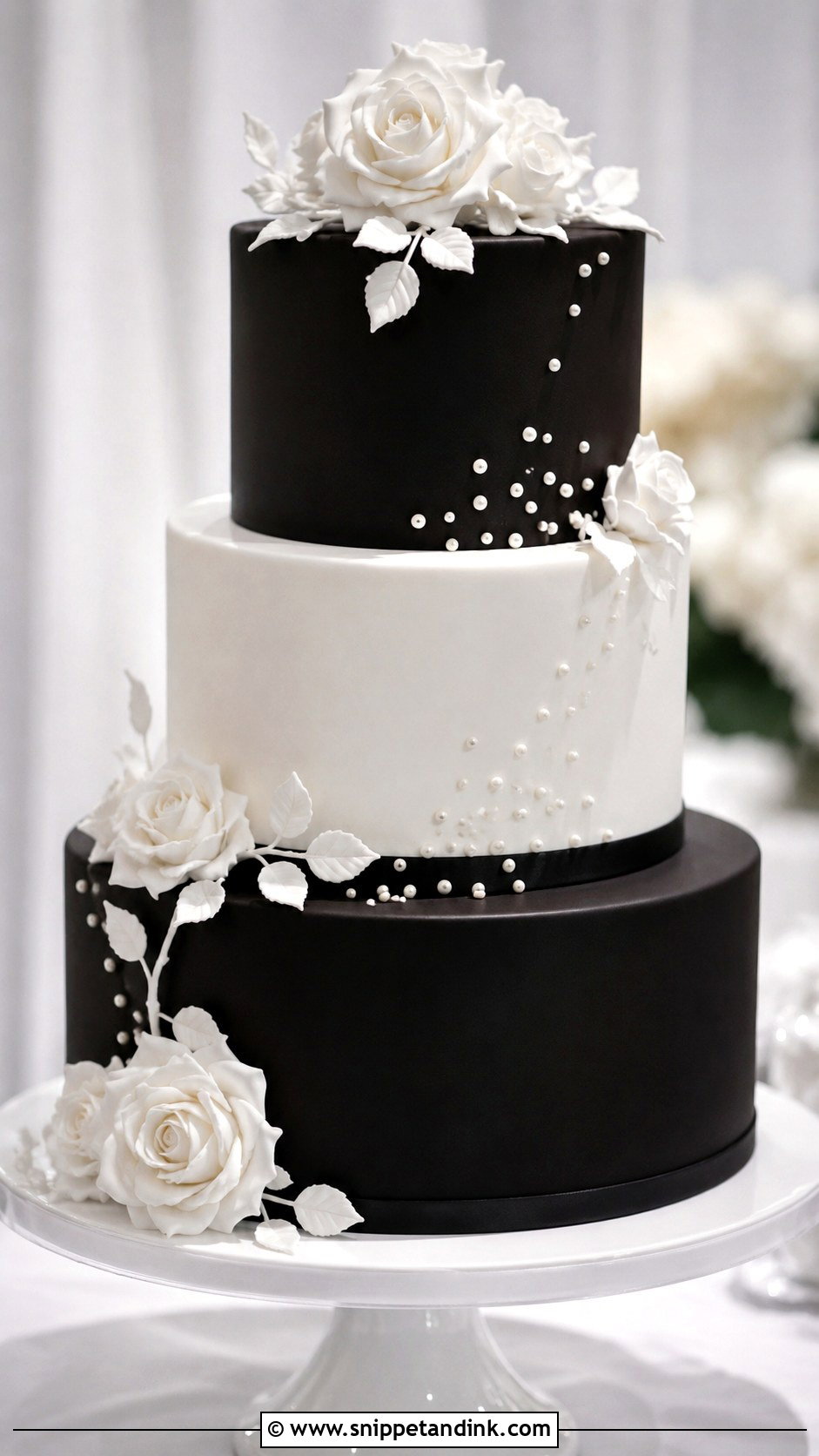
Black cocoa gives a deep, nearly matte finish, but I’m honest with couples about its taste: it’s bitter and very Oreo-like, so I use it in the buttercream or a single tier rather than through every layer of sponge. A truly black buttercream usually needs gel colour on top of the cocoa, and that’s what stains teeth. Built with sharp edges, white sugar roses and a plain ribbon at the base, it suits an evening reception with low warm light. I’d steer you away from it for a bright daylight garden party, where it can look like a hole in the photos.
6. Marble Chocolate And White Wedding Cake
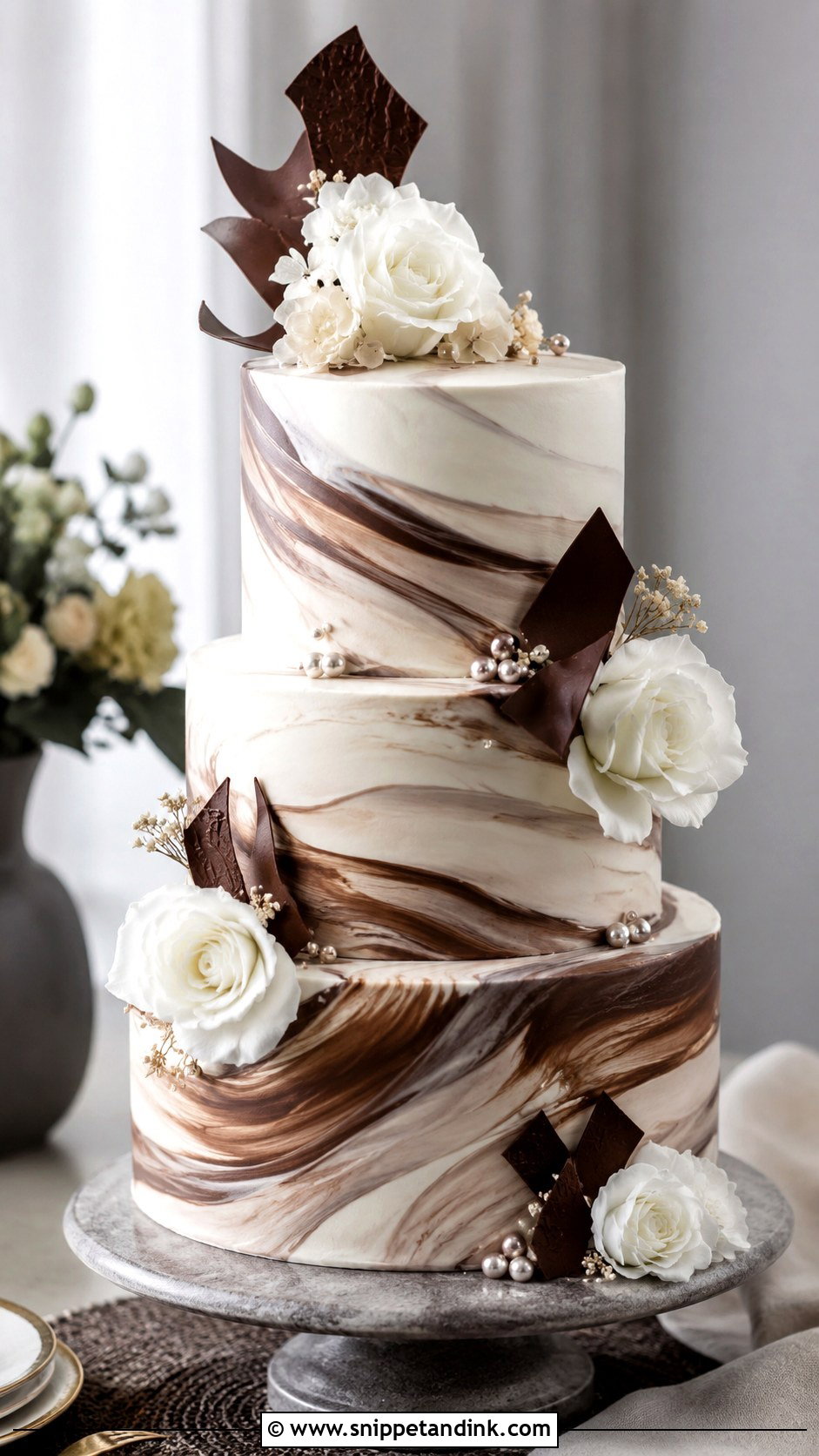
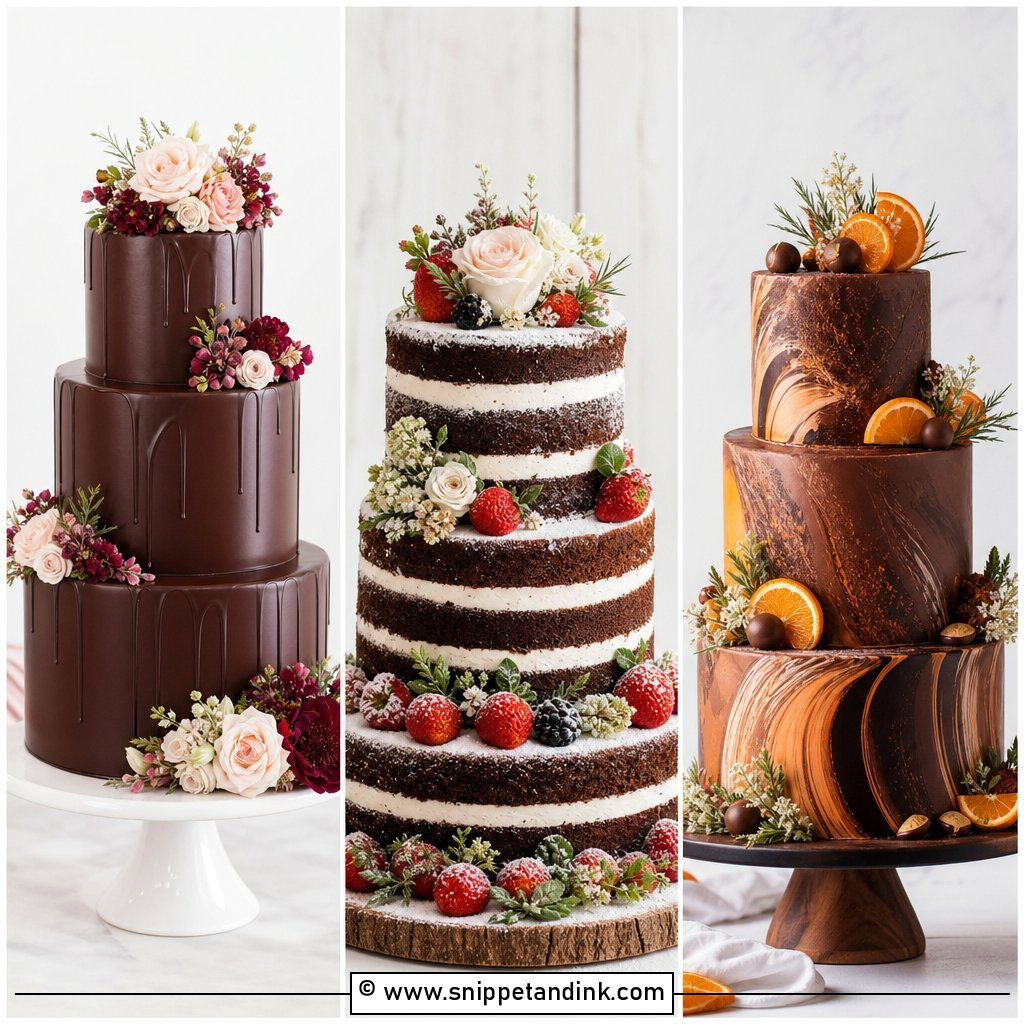
Marbling only looks natural when it’s done in one pass. With fondant, I twist plain and cocoa-tinted paste together loosely and roll it out once; overwork it and the veins blur into a muddy beige. Buttercream marble is softer and less predictable, so expect each tier to look slightly different. Keep the tier shape simple and stop at a few white flowers or chocolate shards so the veining stays the feature.
7. Chocolate And White Floral Wedding Cake
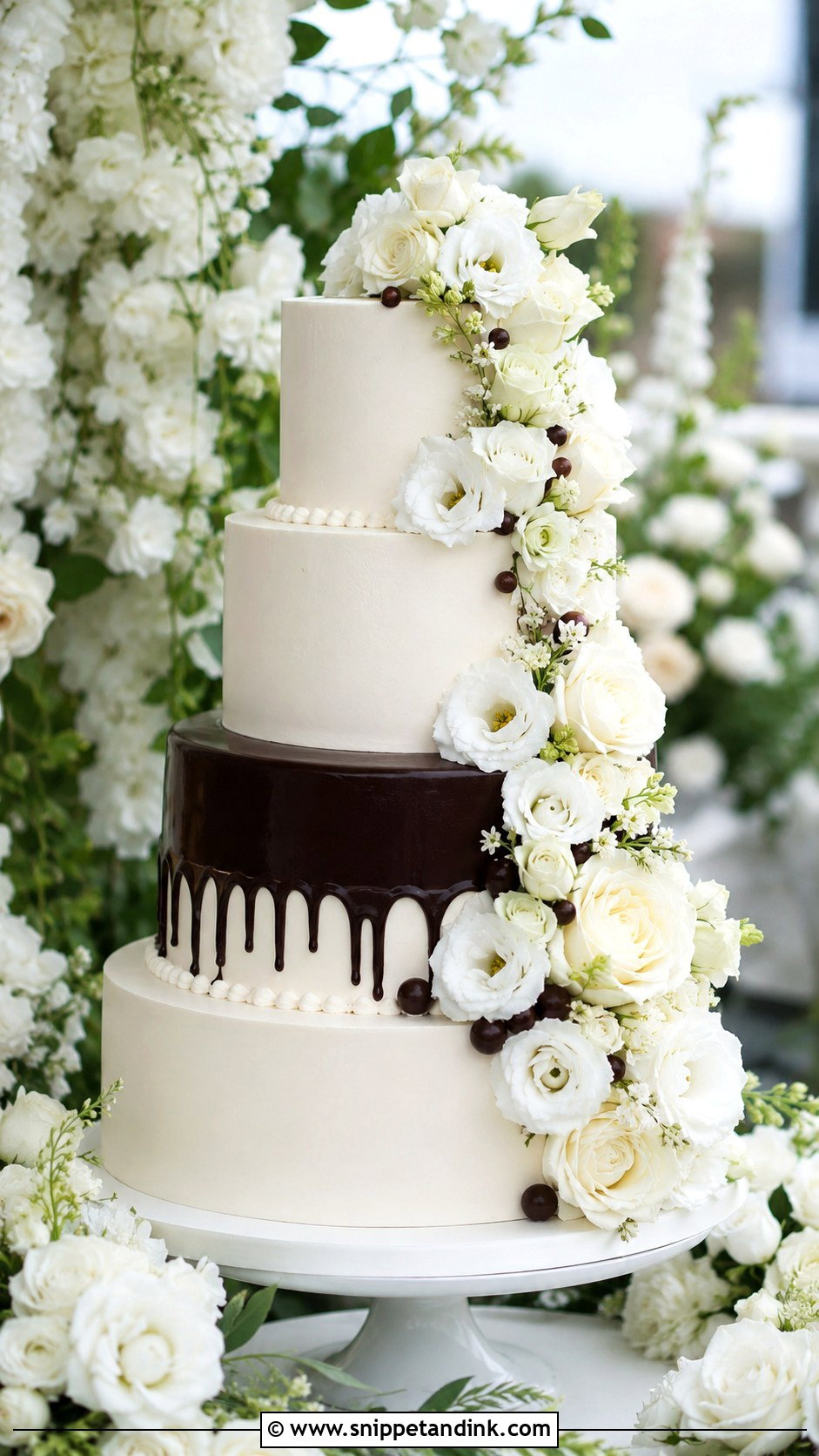
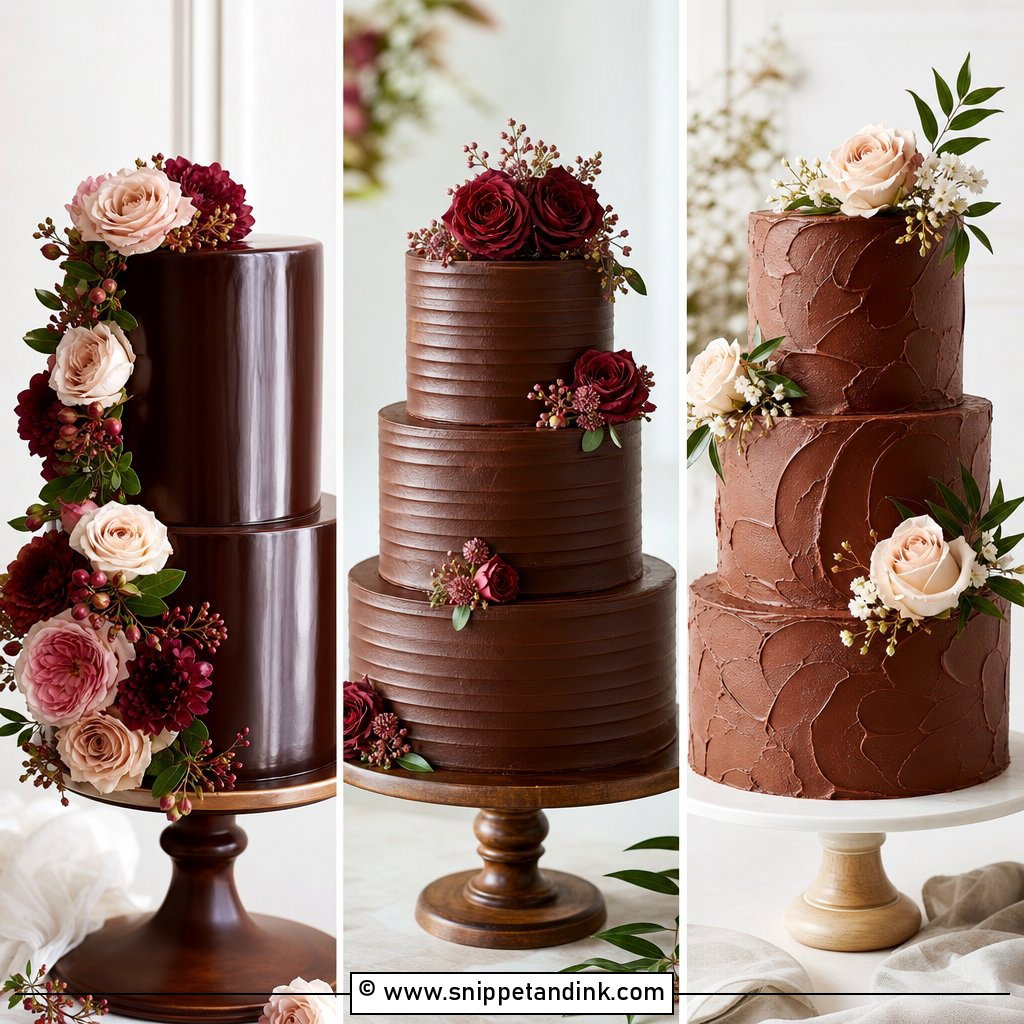
Flowers do most of the softening on a chocolate cake. Against dark ganache I reach for white roses, lisianthus or sugar orchids, set in a loose cascade down one side if you want movement, or grouped at the top and base for a tidier look. With fresh blooms, I ask the florist for unsprayed stems and I always wrap them or use a barrier so nothing pushes straight into the cake. No other single change takes chocolate from heavy to graceful as quickly.
8. Chocolate And White Naked Wedding Cake
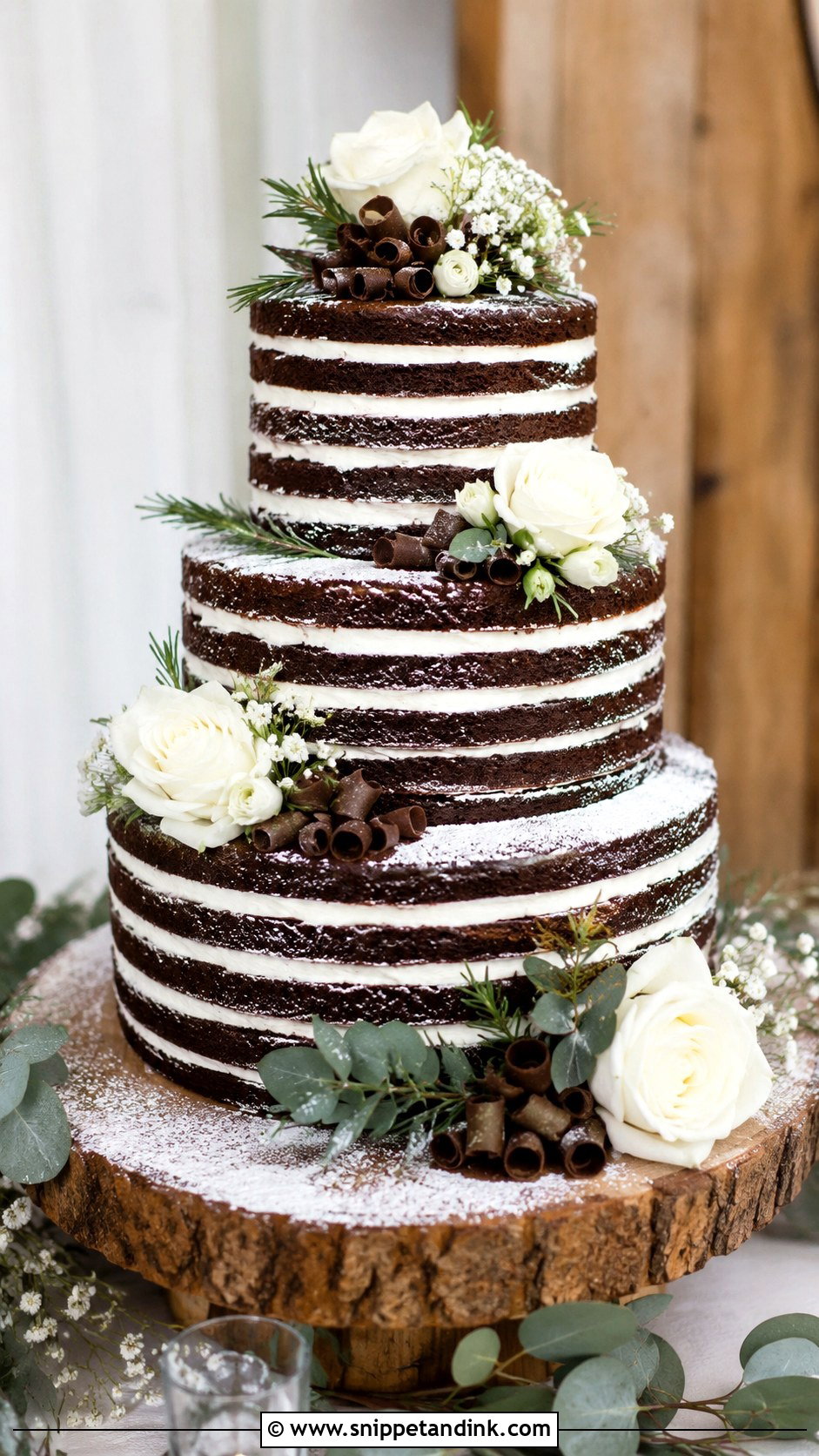
A naked cake is honest: every uneven layer shows. I bake the chocolate layers level and trim them so the white filling stripes look deliberate rather than accidental. Exposed sponge dries out faster than a coated one, so I keep it wrapped or boxed until shortly before guests arrive, and it should never sit in direct sun. Berries, chocolate curls or a dusting of icing sugar finish it without hiding the layers. Relaxed outdoor and rustic receptions suit it best.
9. Chocolate And White Semi Naked Wedding Cake
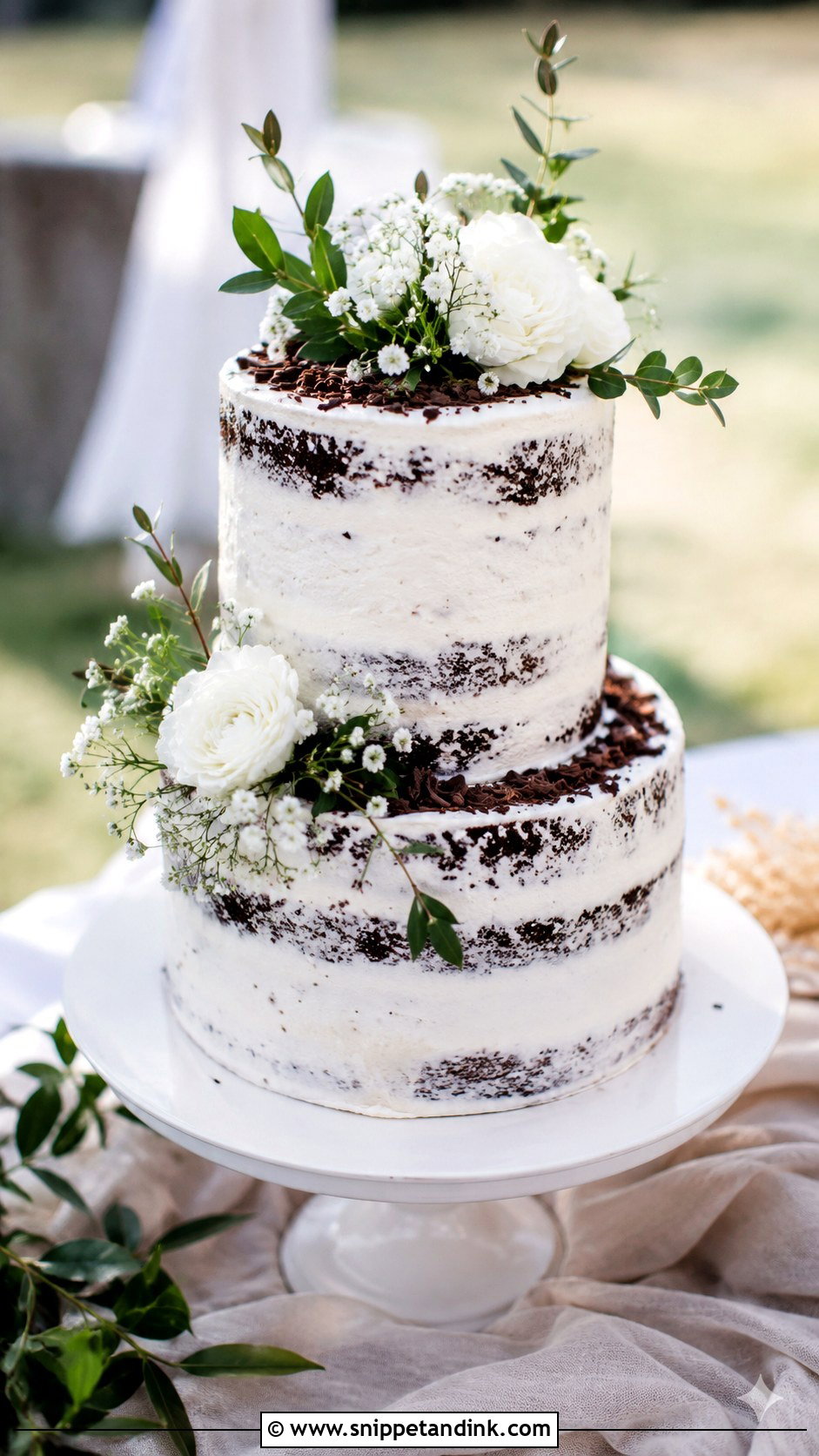
The semi naked finish is my usual compromise for couples who like the rustic look but worry a fully naked cake will dry out. A thin scrape of white buttercream seals the sponge while still letting chocolate peek through. The scrape is meant to look casual; the stacking isn’t, so ask for straight tiers and even edges. White blooms, a few chocolate shavings and some greenery are all it needs at a barn or backyard wedding.
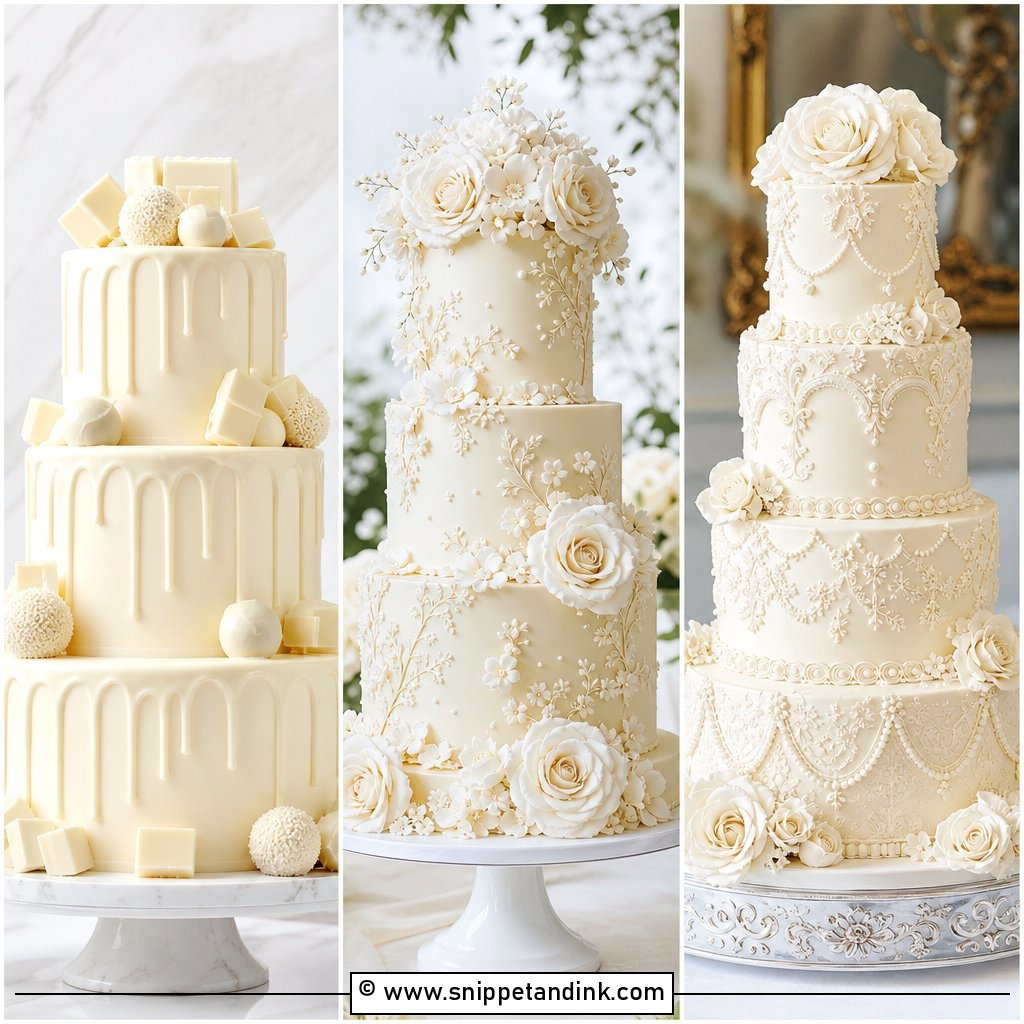
10. White Chocolate Wedding Cake With Chocolate Layers
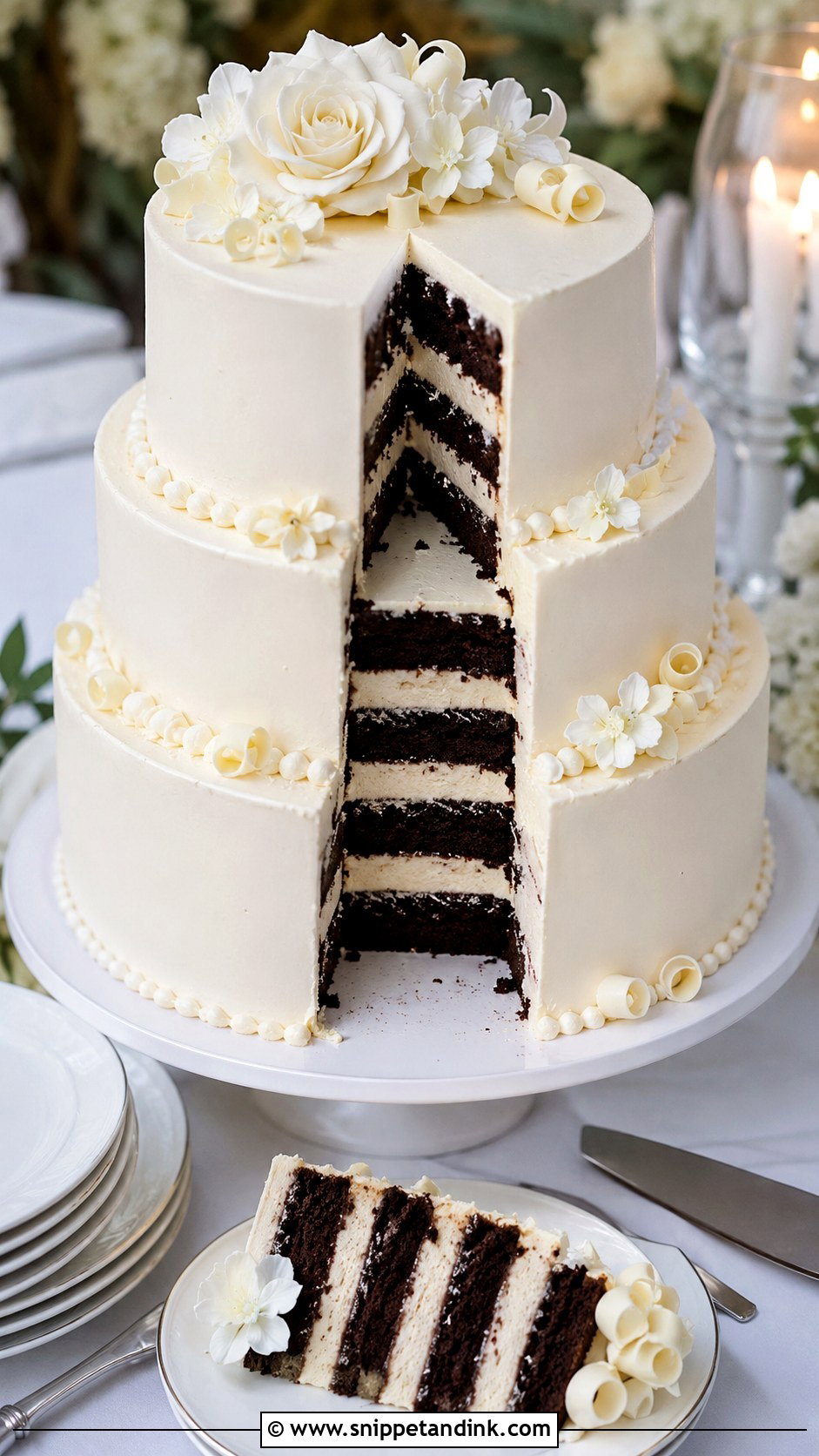
White chocolate ganache sets softer than dark, so I use a higher proportion of chocolate to get it firm enough to coat a tier. It also leans creamy ivory rather than bright white, which reads warmer next to pure white flowers. Inside, dark chocolate sponge with white chocolate filling gives each slice a strong stripe. White chocolate curls or piped buttercream pearls finish the outside. If you find very sweet desserts cloying, I’d pick a different option.
11. Chocolate And White Vintage Wedding Cake
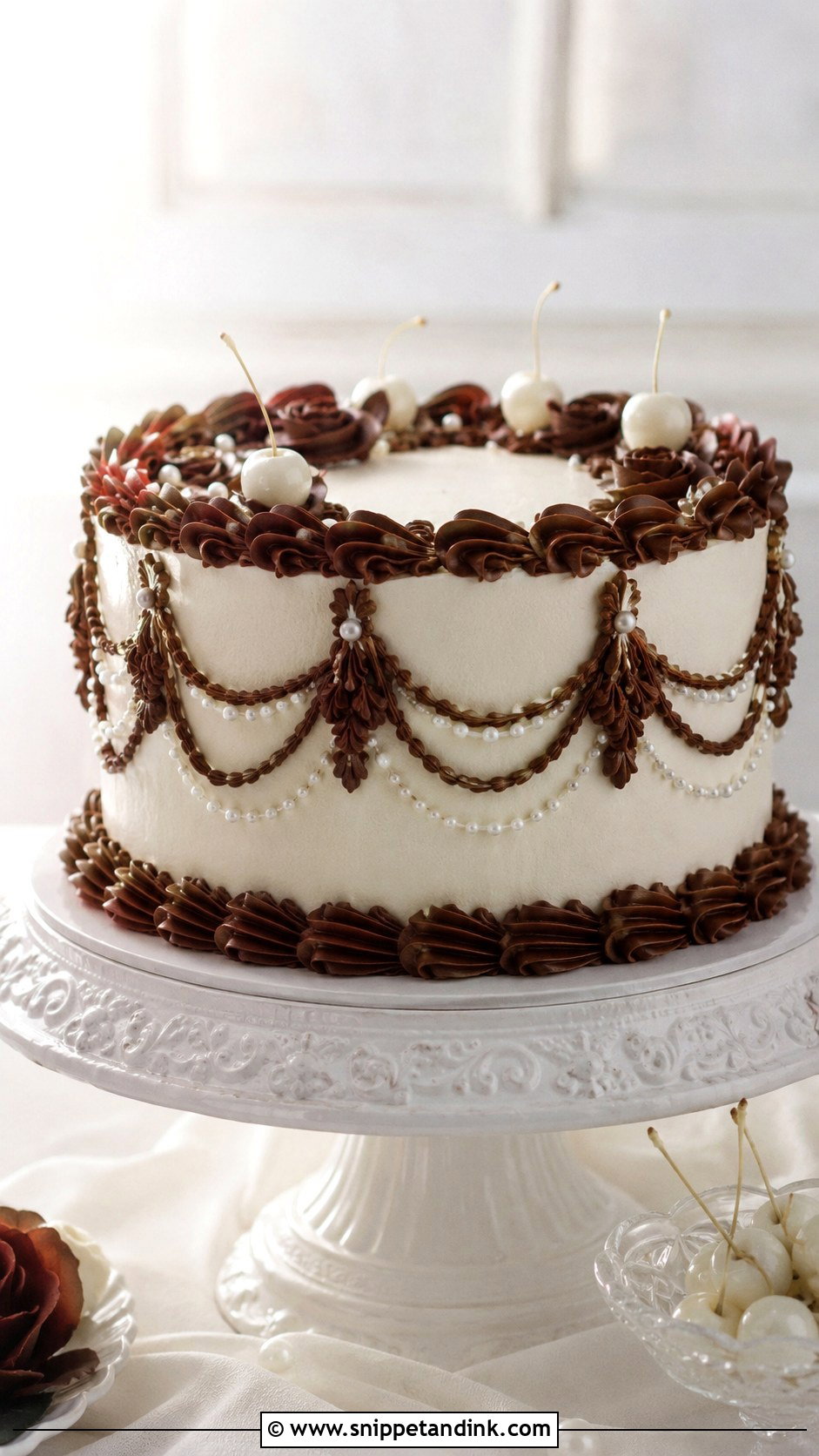
Chocolate piping on white is unforgiving, which is exactly why it looks so good when it’s neat. Every scallop and swag shows at full contrast, so the piped borders need even spacing all the way around. I mark the divisions with a cake divider before piping a single line. Add a few sugar cherries or pearl beads and stop there. One tier or several, it brings old-fashioned charm to a modern table.
12. Chocolate And White Lambeth Wedding Cake
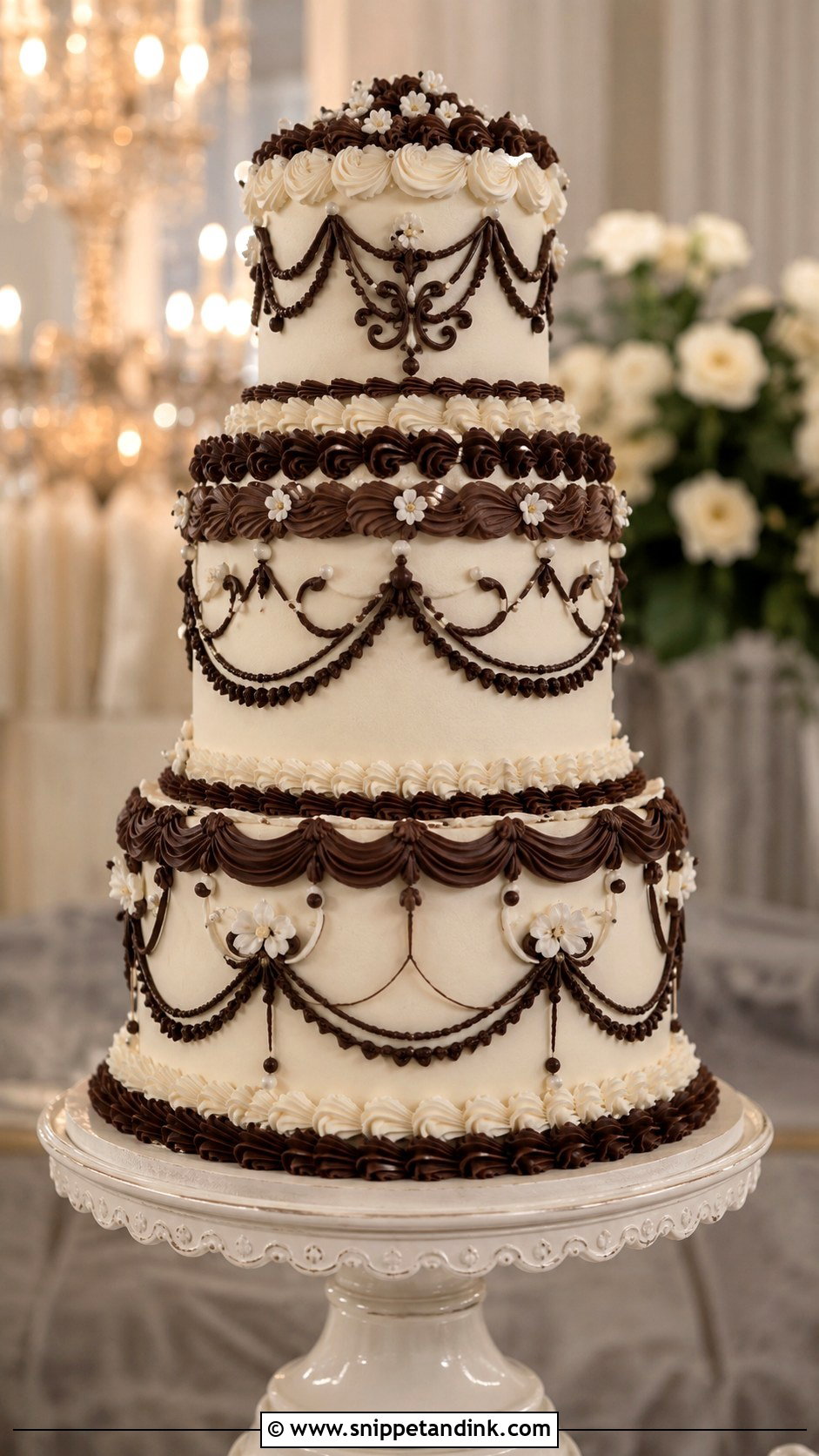
Lambeth is layered overpiping: borders built on borders until the tier looks carved. In chocolate and white the depth reads clearly, because every shadow line is a different colour. I’d pipe dark chocolate buttercream on a white base; reversing the colours looks bolder but is harder to keep clean, since white piping smudges easily on dark. The style needs tall tiers to carry the weight of the decoration, so even a two-tier version should have height. Pearl accents or tiny sugar flowers on top are enough. Budget for it honestly; this is slow hand-piped work and is usually priced that way.
13. Chocolate And White Fondant Wedding Cake
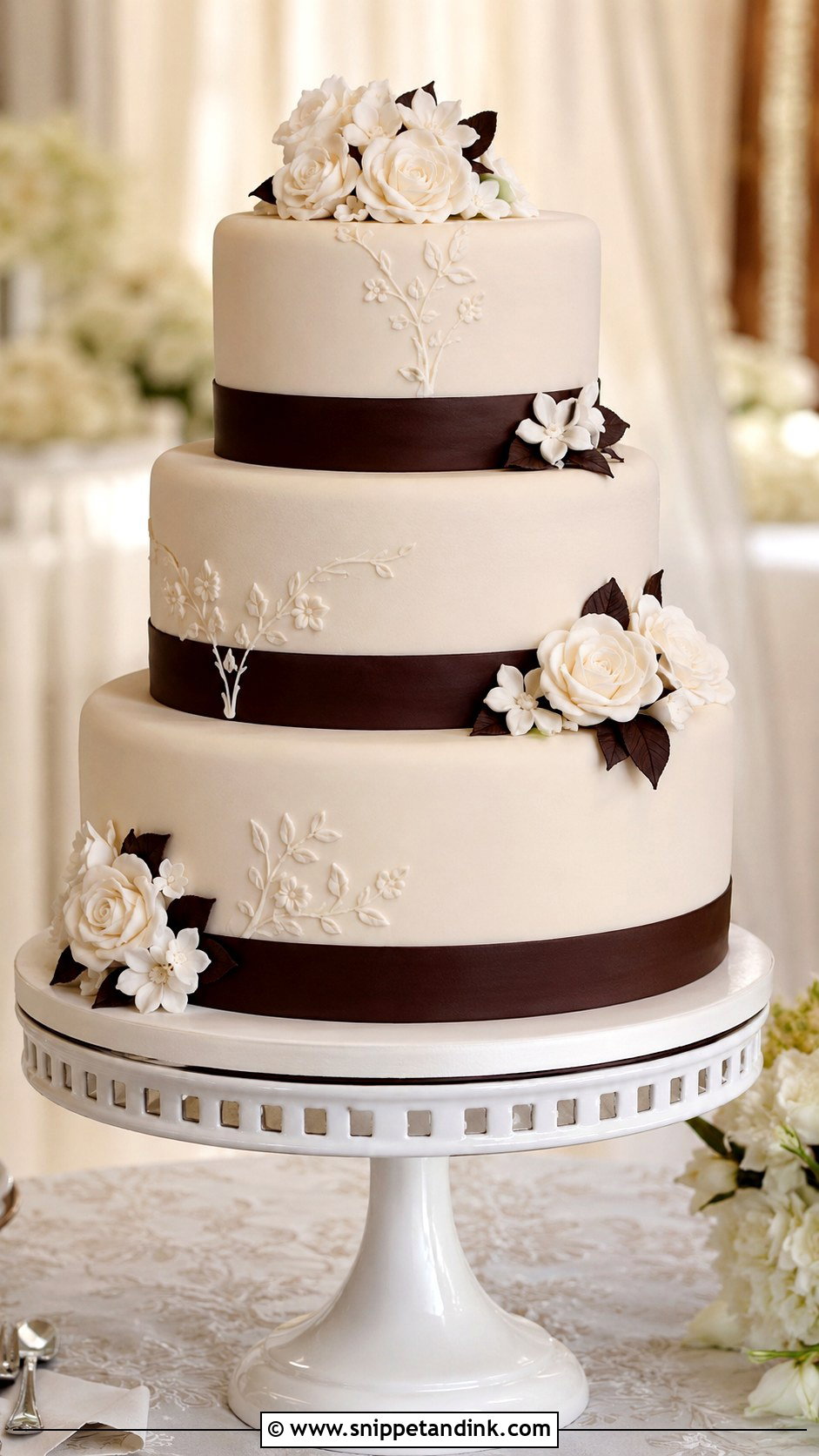
Fondant gives the sharpest edges and holds bows, panels and moulded flowers well. My one firm rule is ganache underneath rather than buttercream, because ganache sets into a solid shell the fondant can sit tight against. Chocolate fondant bands or lace-style panels on a white cover look tailored. Fondant does sweat if it moves straight from a cold fridge into a warm, humid room, so I let it come up to temperature in its box. Plenty of guests peel fondant off, which is why the flavour should live in the sponge and filling.
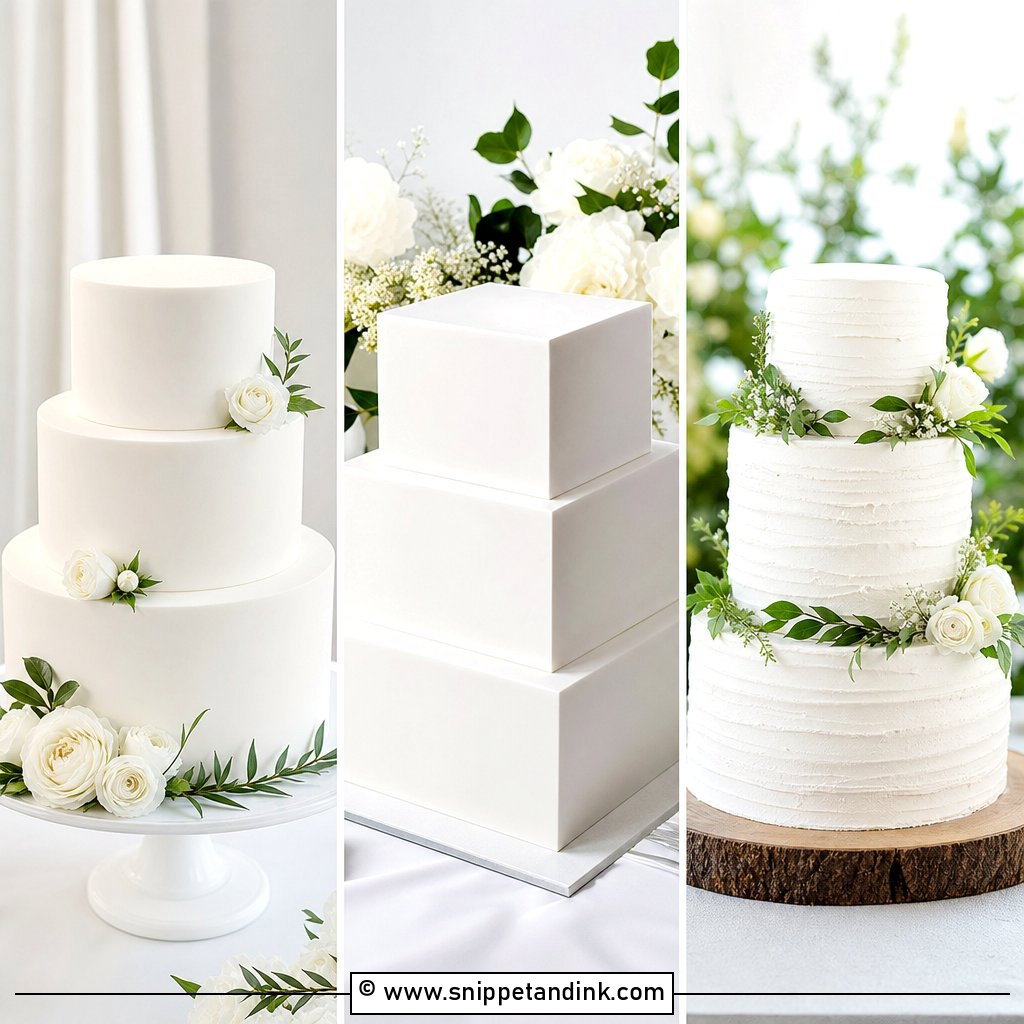
14. Chocolate And White Square Wedding Cake
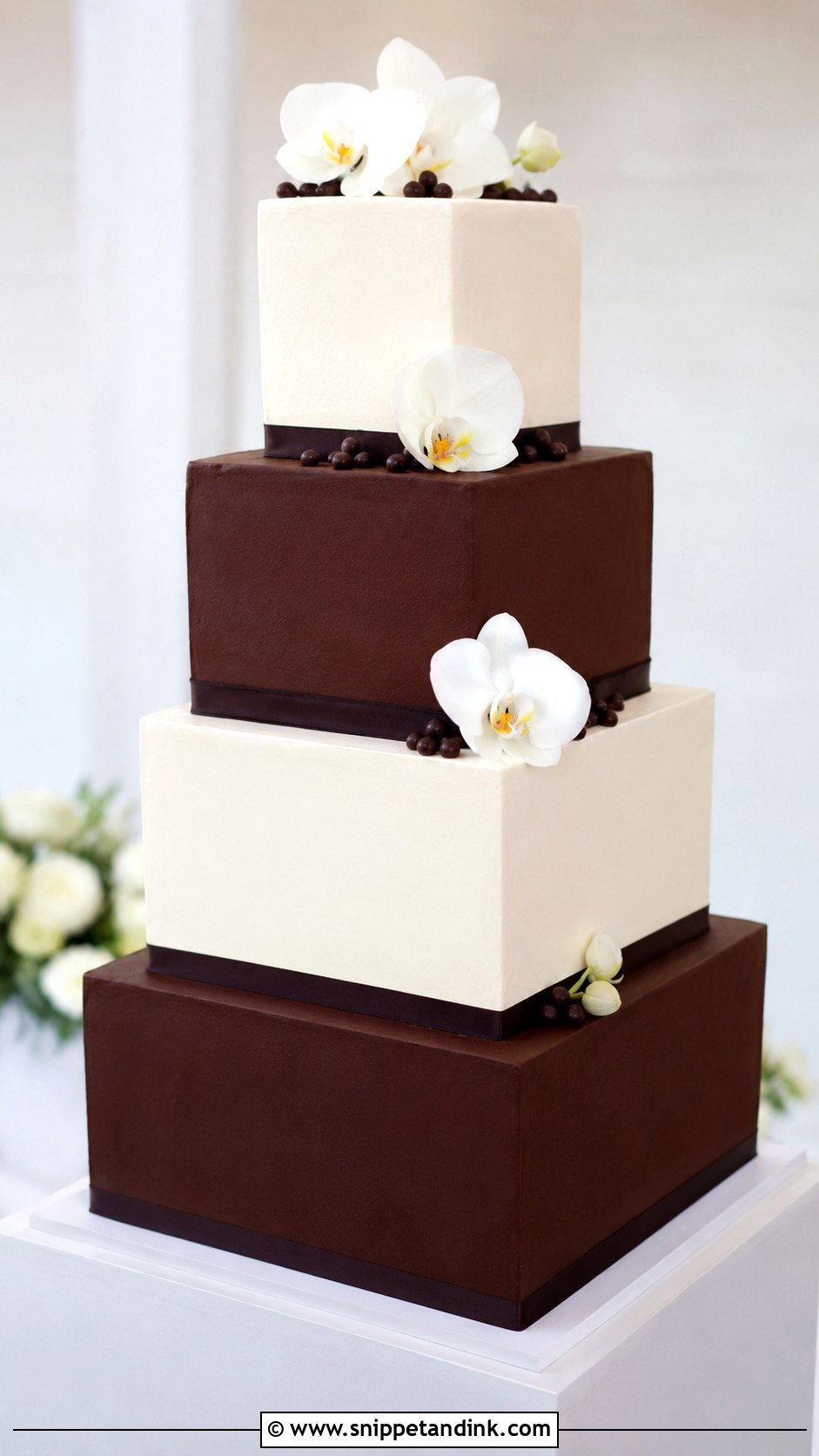
Square tiers are harder to ice than round ones: four corners, eight edges and nowhere to hide a dent. When they’re right, the chocolate and white contrast looks architectural. Alternate white buttercream and ganache tiers, or keep the cake white with chocolate ribbon bands. One orchid cluster softens all those straight lines. Square tiers also cut into more even portions, something caterers appreciate at larger receptions.

15. Chocolate And White Round Wedding Cake
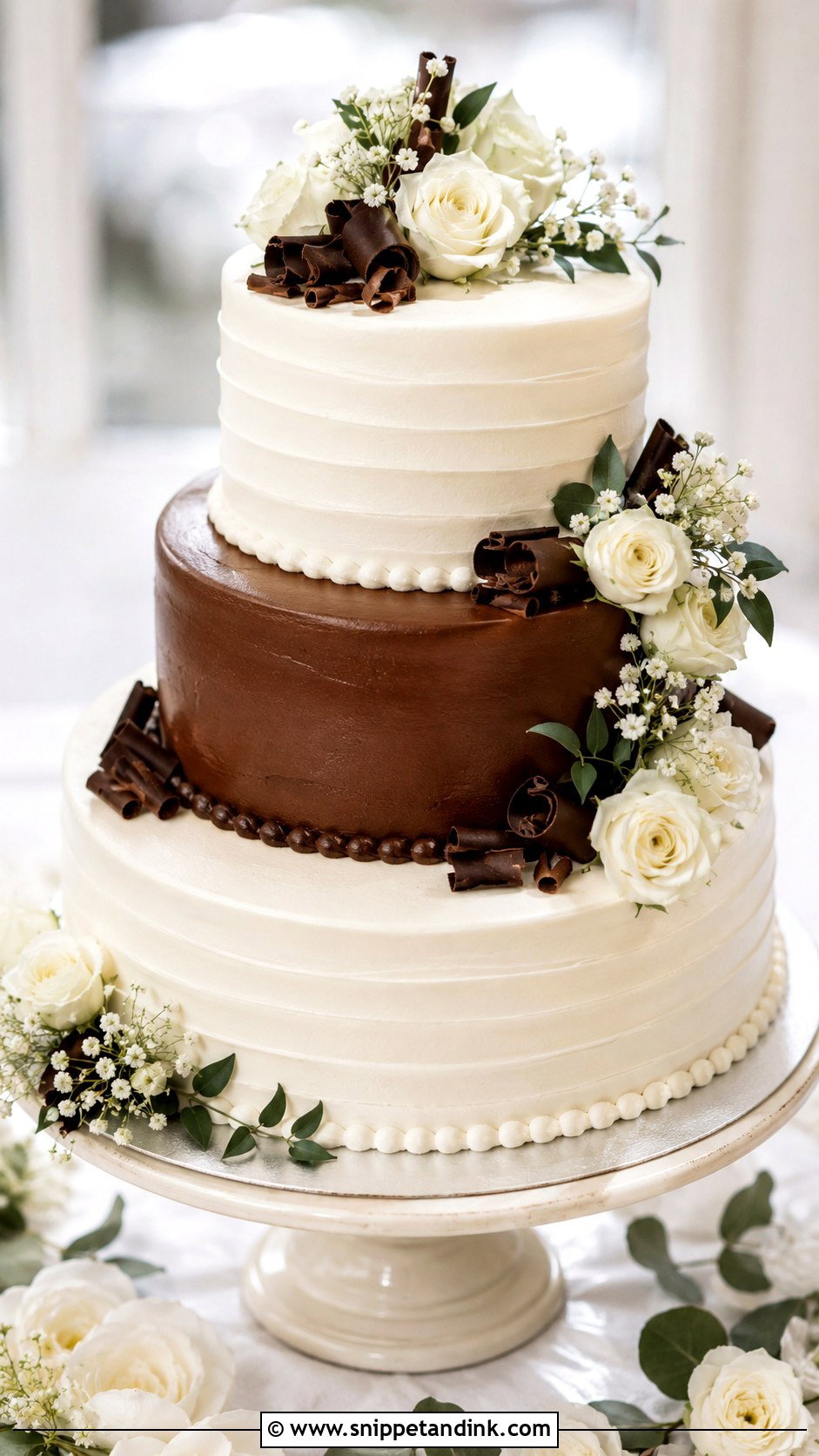
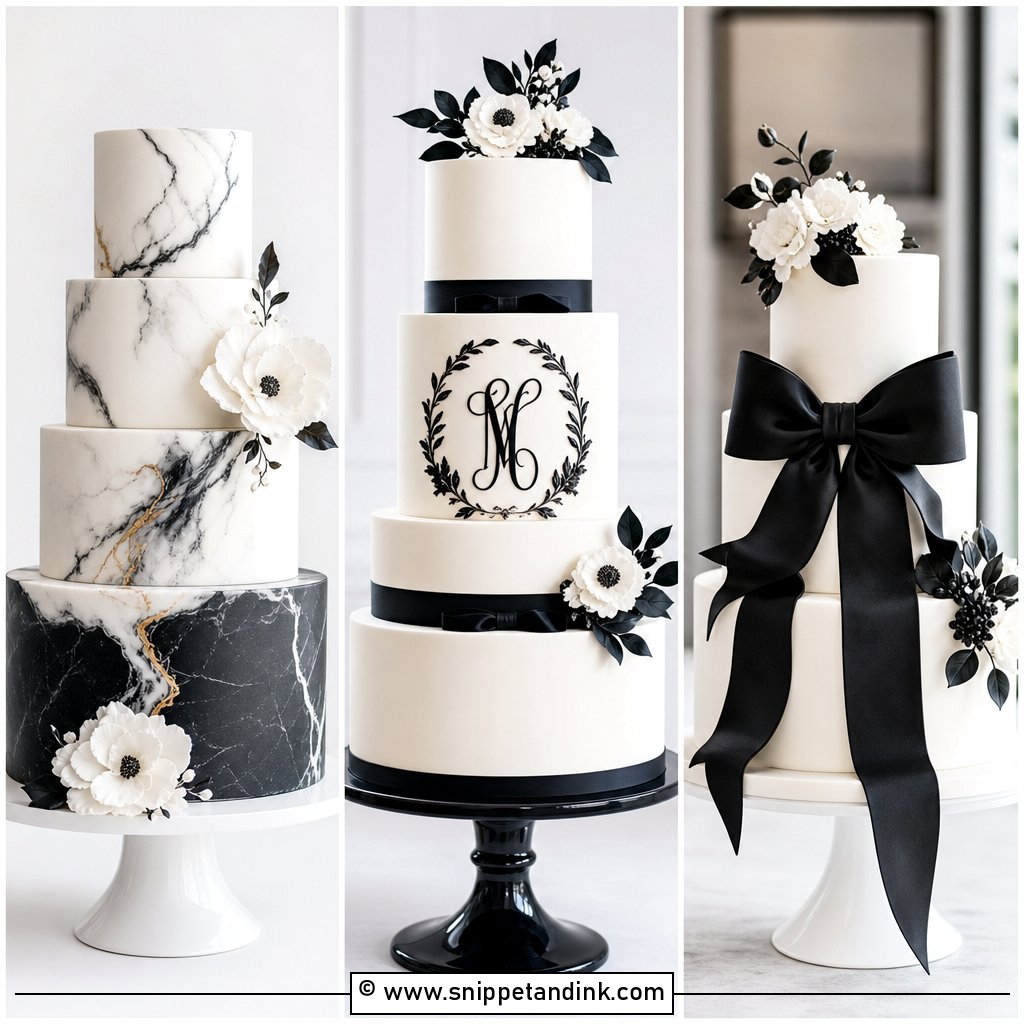
Round is the safest shape and the easiest to scale, since I can add or drop a tier without redesigning anything. What stops it looking generic is varying the finish tier by tier: one ganache, one smooth white, one piped or flowered. Round tiers also travel more steadily in a van and are simpler for venue staff to cut.
16. Chocolate And White Ruffle Wedding Cake
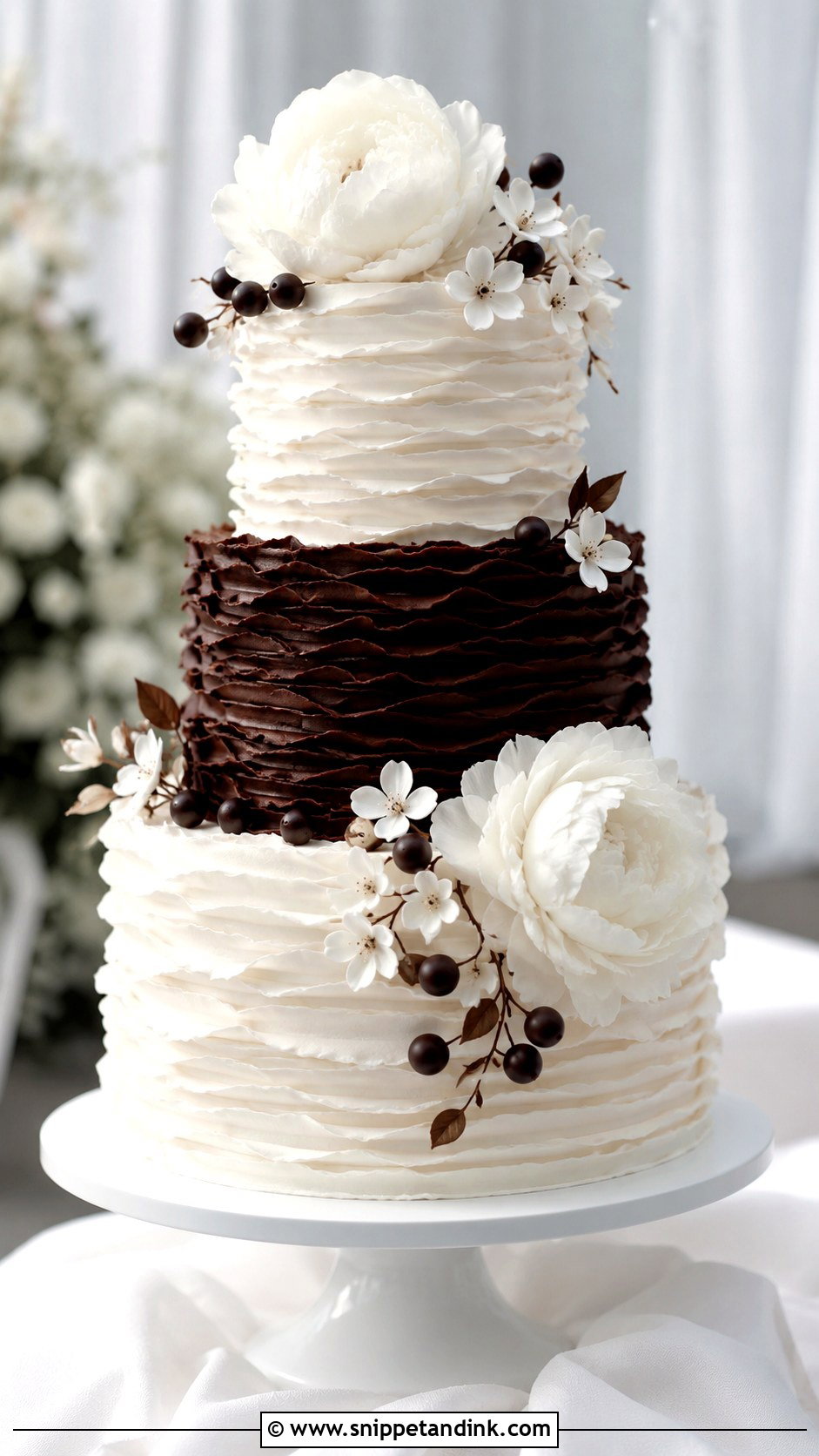
Ruffles wrap a tier like fabric and catch light along every fold. White buttercream ruffles are piped with a petal tip, while fondant ruffles are cut, thinned and layered by hand; the fondant version holds its shape better in a warm room. A single chocolate ruffle tier supplies the contrast. With that much texture already, I keep flowers to a few peonies or sugar blossoms at the top or base.
17. Chocolate And White Pearl Wedding Cake
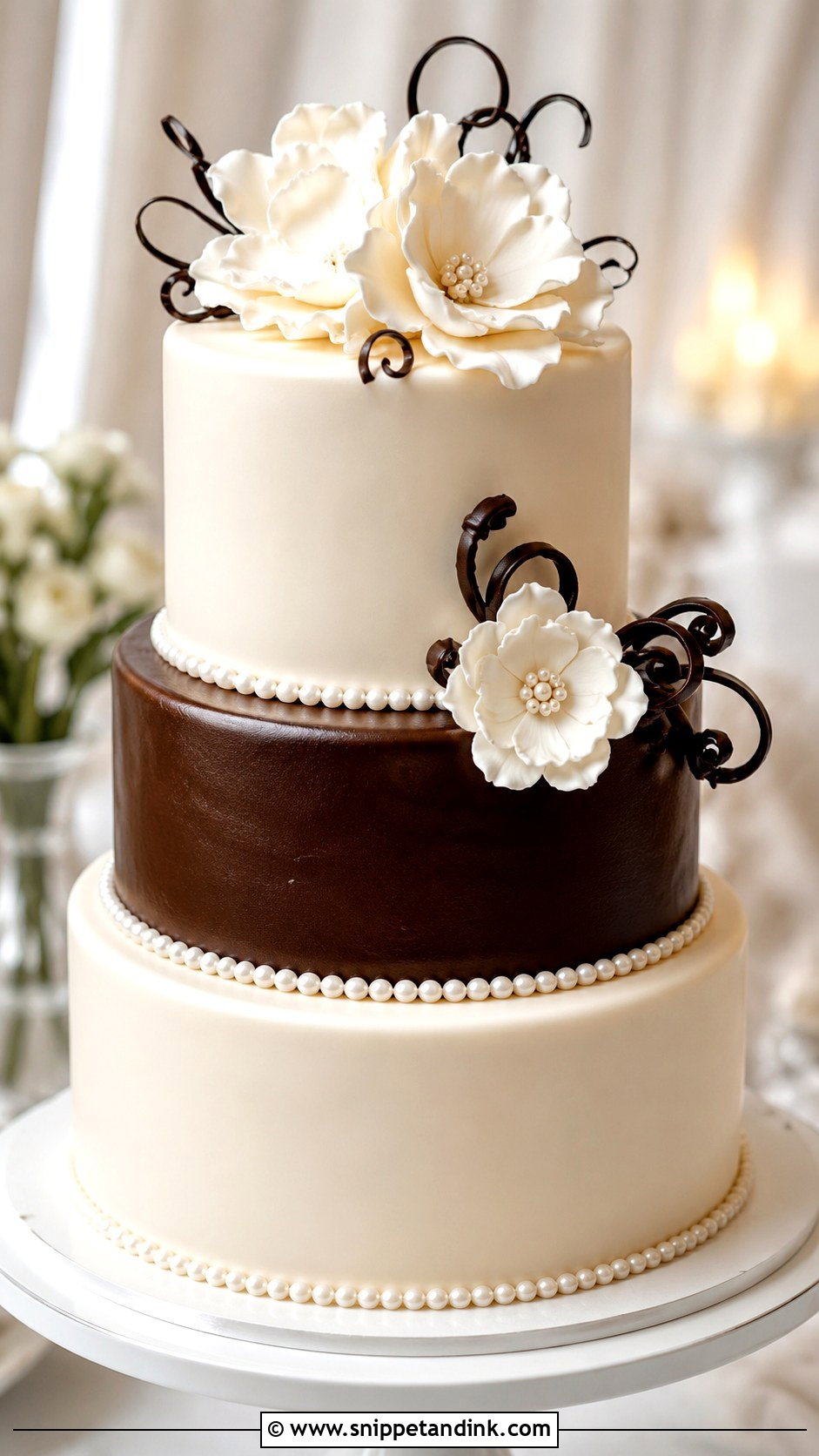
Edible pearls are small but noisy, and too many make a cake look like costume jewellery. I set them along tier seams or in a loose scatter on one side, then add a chocolate band so they stand out. Hard sugar dragees can be tough on teeth, so on cakes guests will bite straight into, I prefer soft fondant pearls. A white stand and neutral flowers around the base finish it.
18. Chocolate And White Rose Wedding Cake
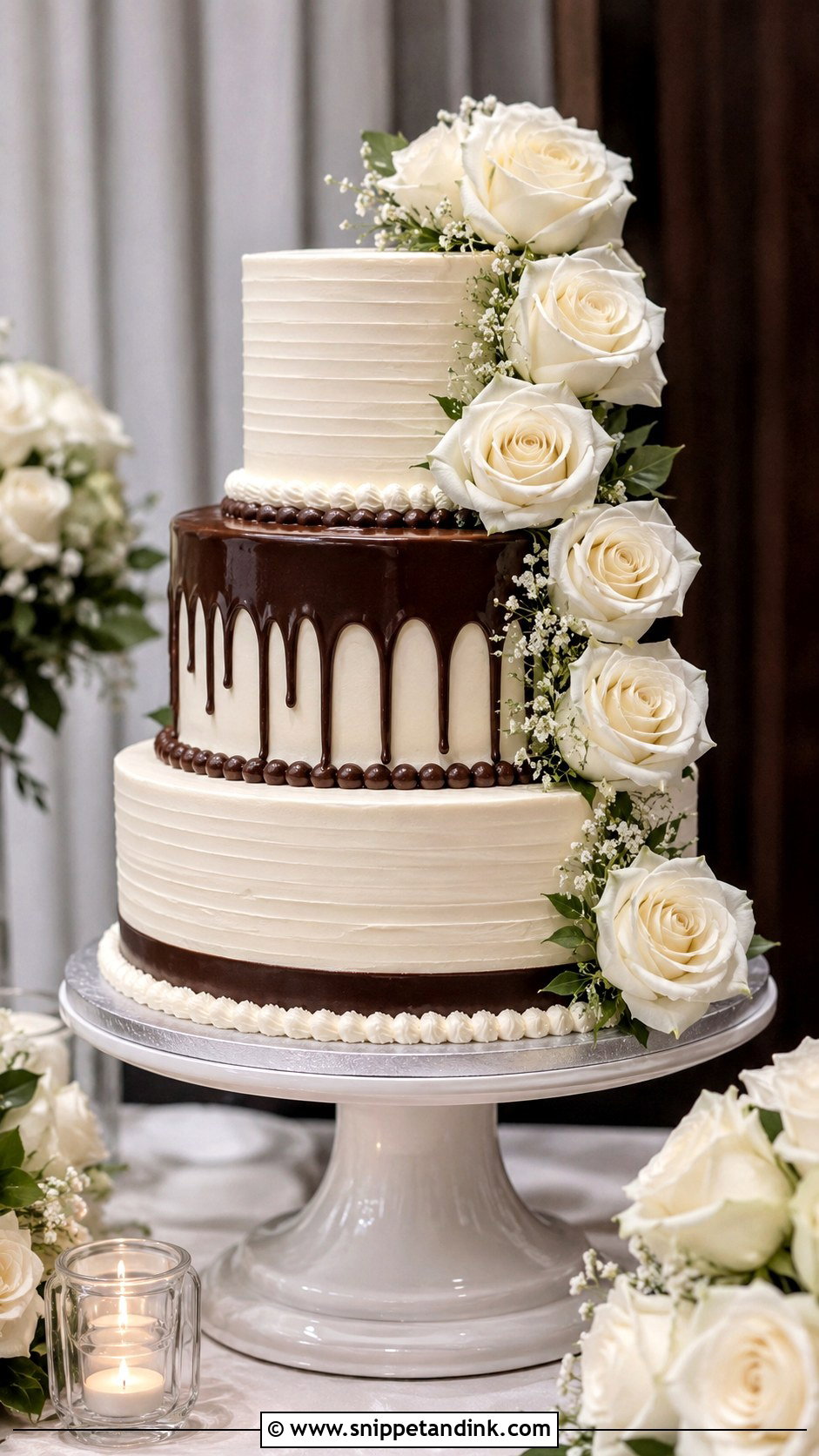
Roses are familiar, and that’s their strength. White roses look crisp against ganache; chocolate accents look warm against white icing. Sugar roses cost more than fresh but can be made weeks ahead and kept afterwards, while buttercream roses are the budget route. If you go fresh, check that your venue allows outside flowers on food. A cascade is dramatic, small clusters read quieter.
19. Chocolate And White Orchid Wedding Cake
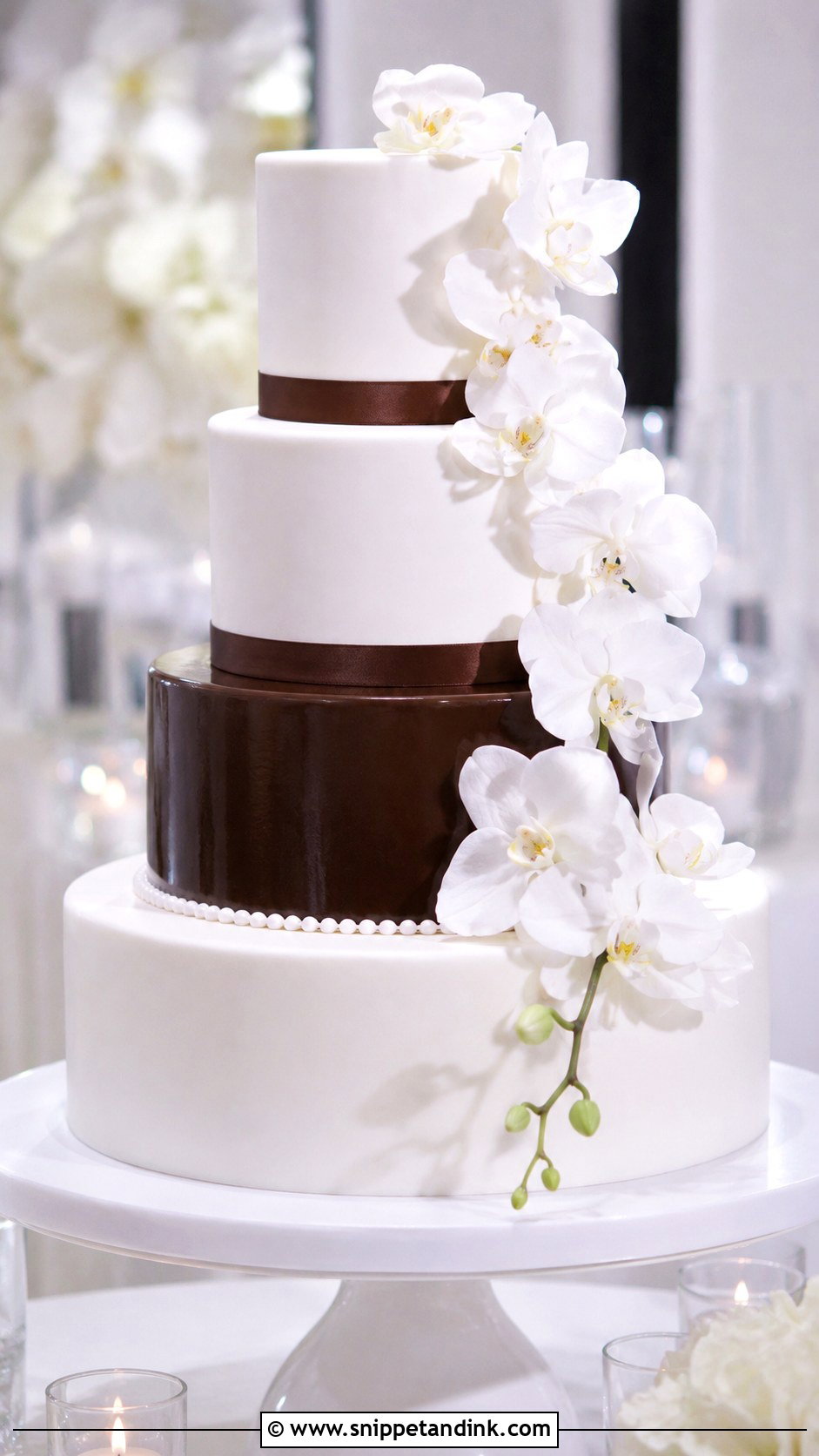
Orchids have clean lines and few petals, so they sit better on smooth fondant and glossy ganache than on textured buttercream. A white phalaenopsis spray trailing down a dark tier is about as simple as a strong design gets. I hold back on everything else, because the orchids carry it. Not every fresh orchid is food-safe, so the stems should sit on a barrier, or you can choose sugar orchids instead.
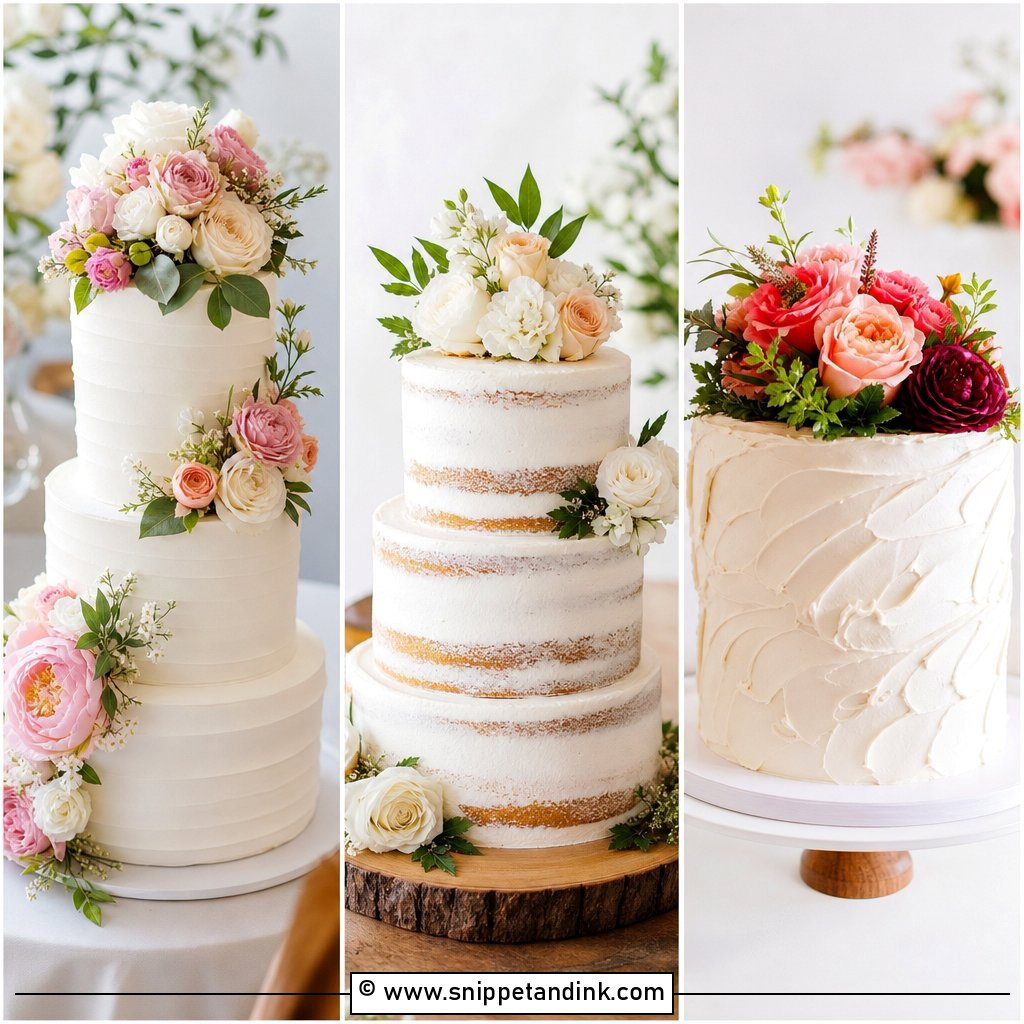
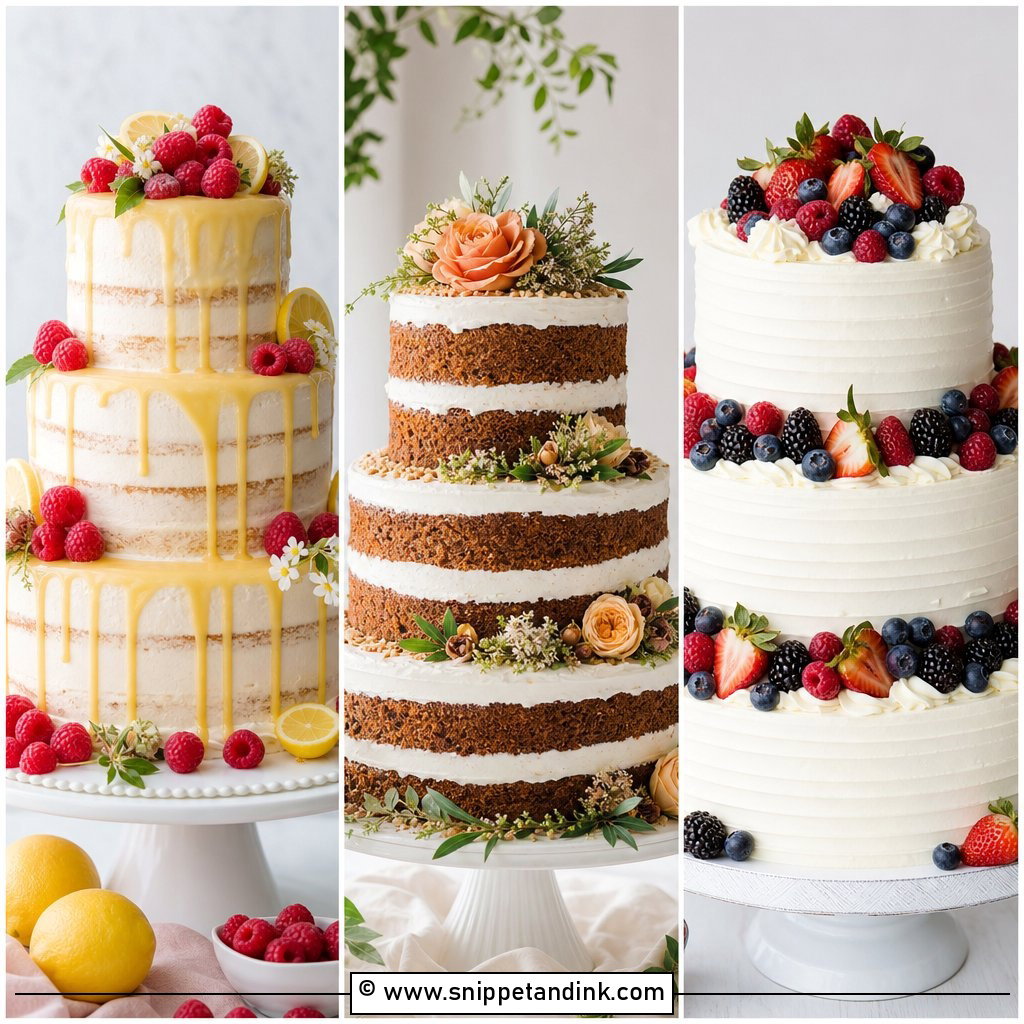


20. Chocolate And White Minimalist Wedding Cake
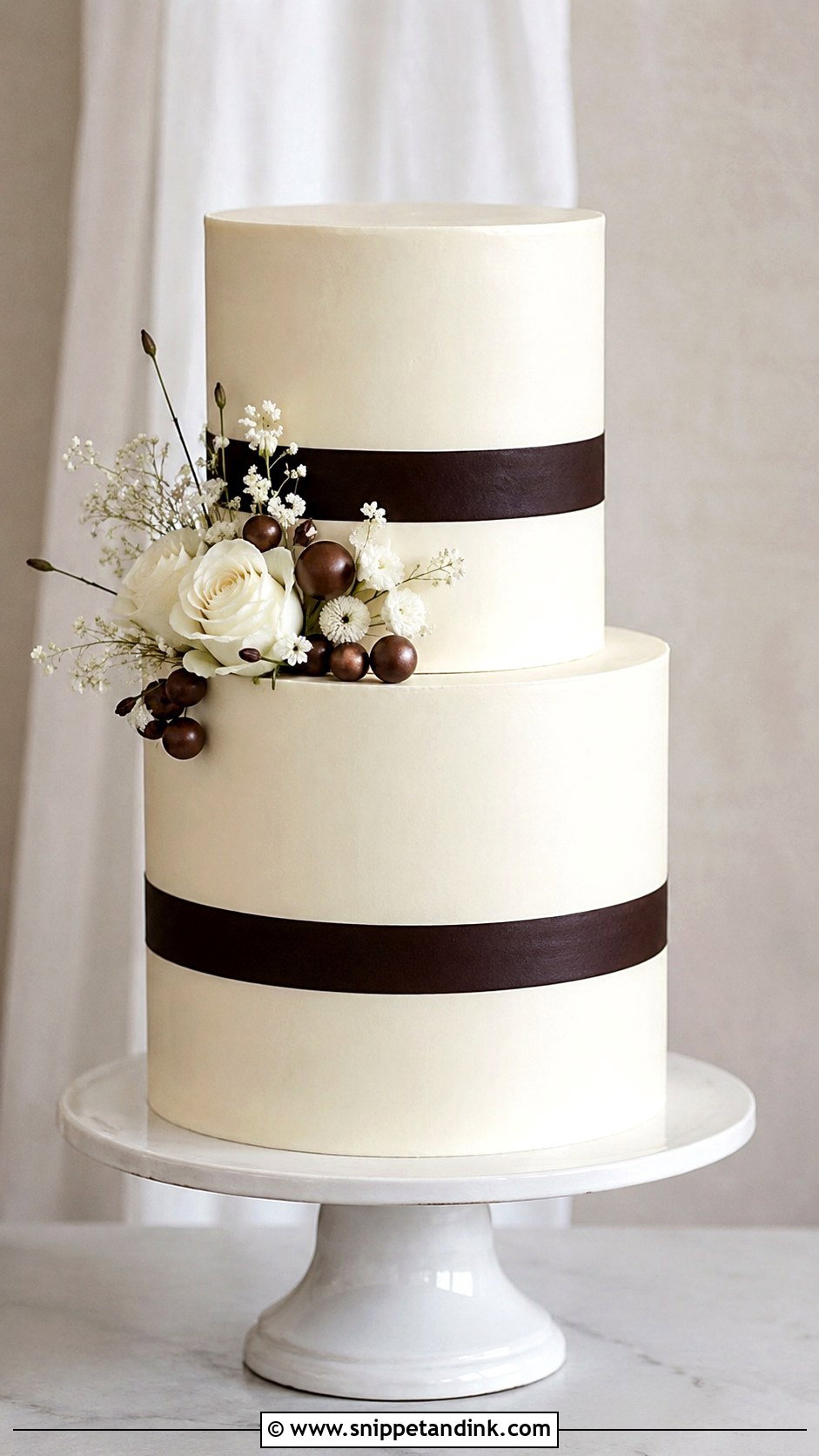
Minimal cakes show every flaw, so this is where I spend the most time smoothing and stacking. The whole design comes down to one contrast detail: a single ganache tier, a thin cocoa stripe or a short drip. Choose one finishing touch and leave it there. It scales down easily for small weddings.
21. Chocolate And White Rustic Wedding Cake
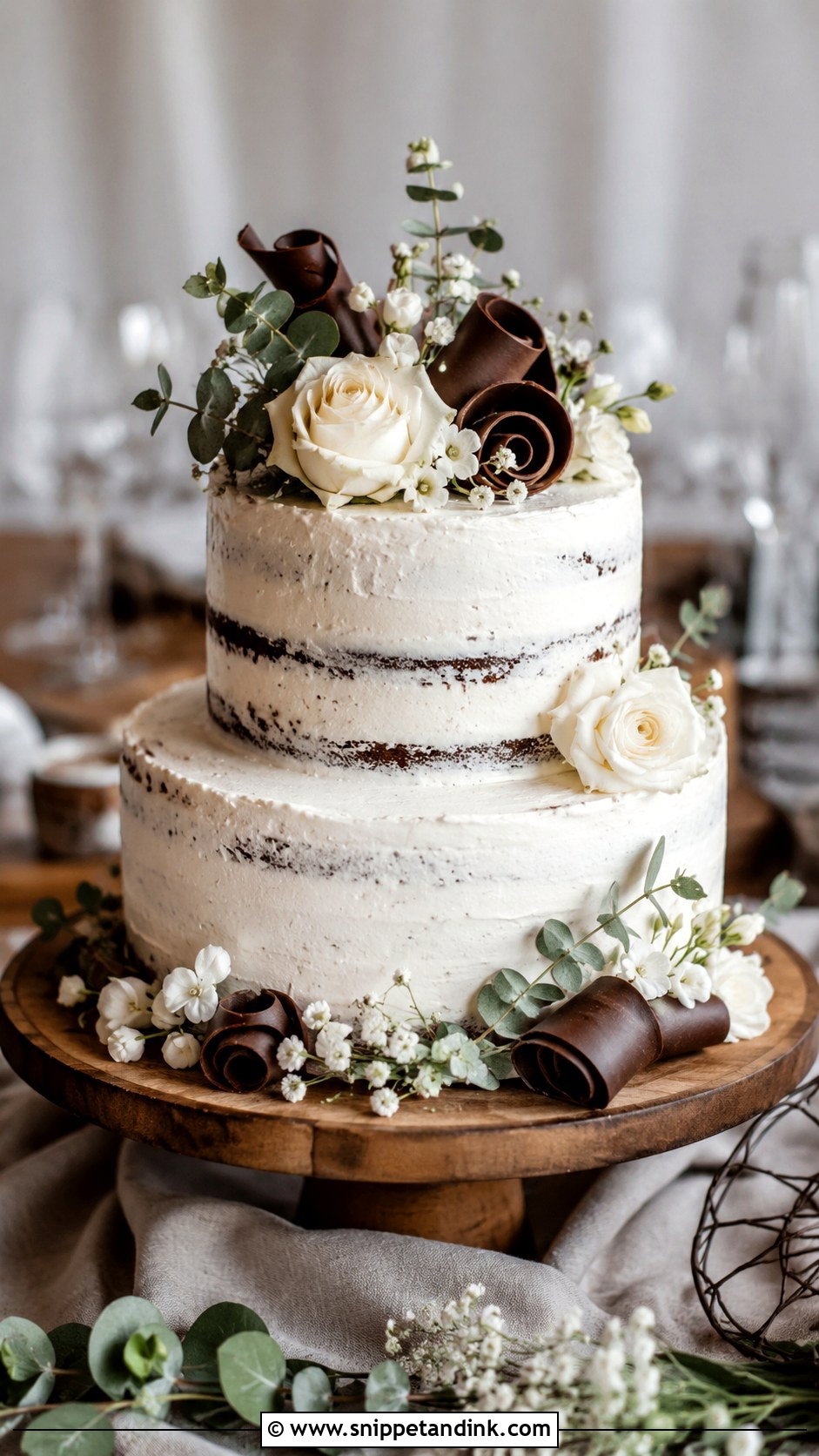
Rustic should look handmade, not unfinished. I use textured white buttercream with visible chocolate layers or a semi naked scrape, then soft white flowers, greenery or chocolate curls on a wooden stand. Slight texture is welcome, but leaning tiers are not, so it still gets doweled properly. Chocolate also copes better than fresh fruit and cream fillings in a warm barn, which matters more than people expect.
22. Chocolate And White Modern Wedding Cake
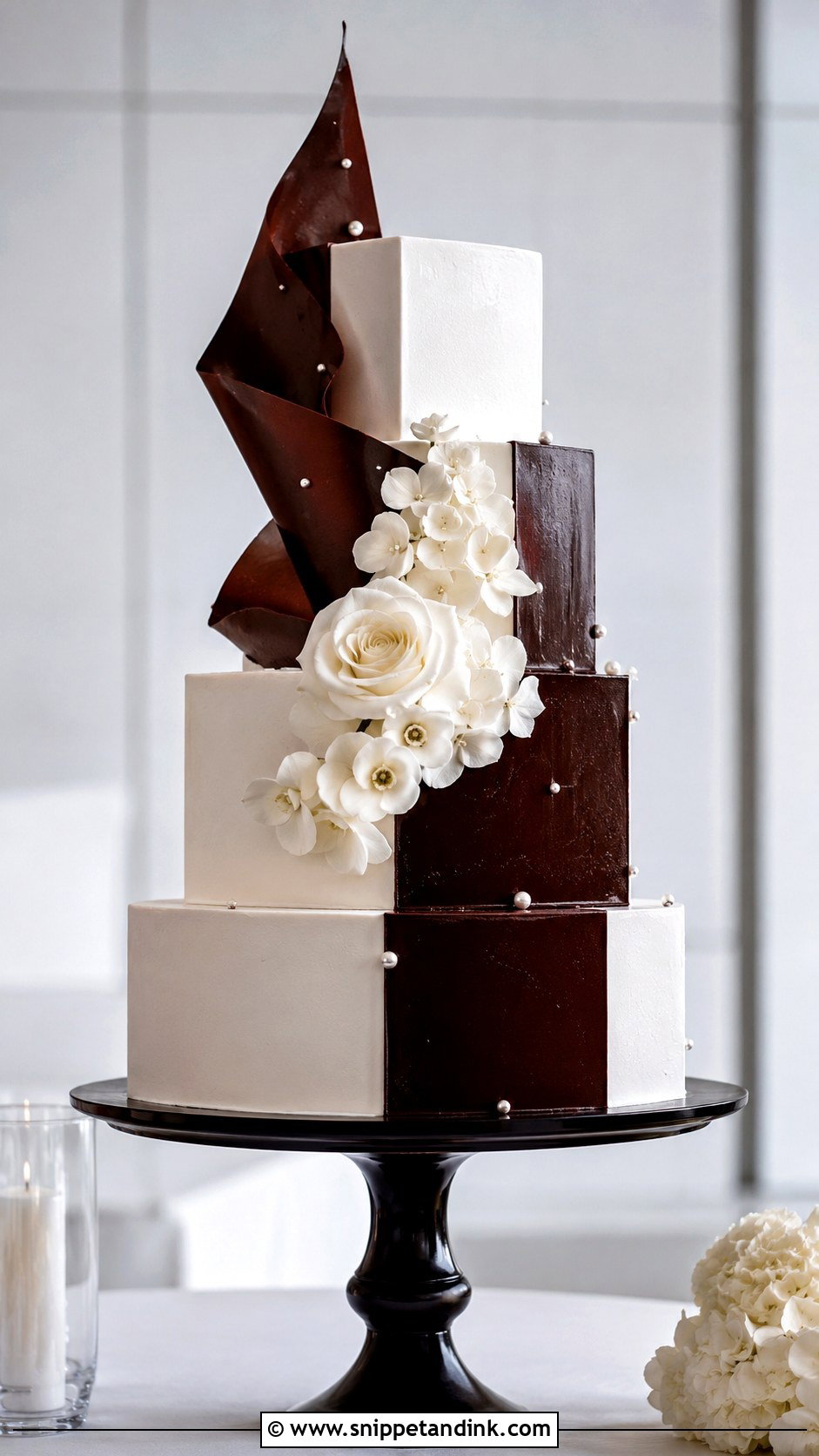
Modern chocolate and white cakes live or die on proportion. I’ll often make the tiers extra tall, set a dark ganache tier between two white ones, or apply geometric chocolate panels to a white surface. Chocolate sails, thin sheets of tempered chocolate set into the top tier, make a strong single feature, but they need properly tempered chocolate or they bend in a warm room. Pick one statement element and leave the rest bare.
23. Chocolate And White Small Wedding Cake
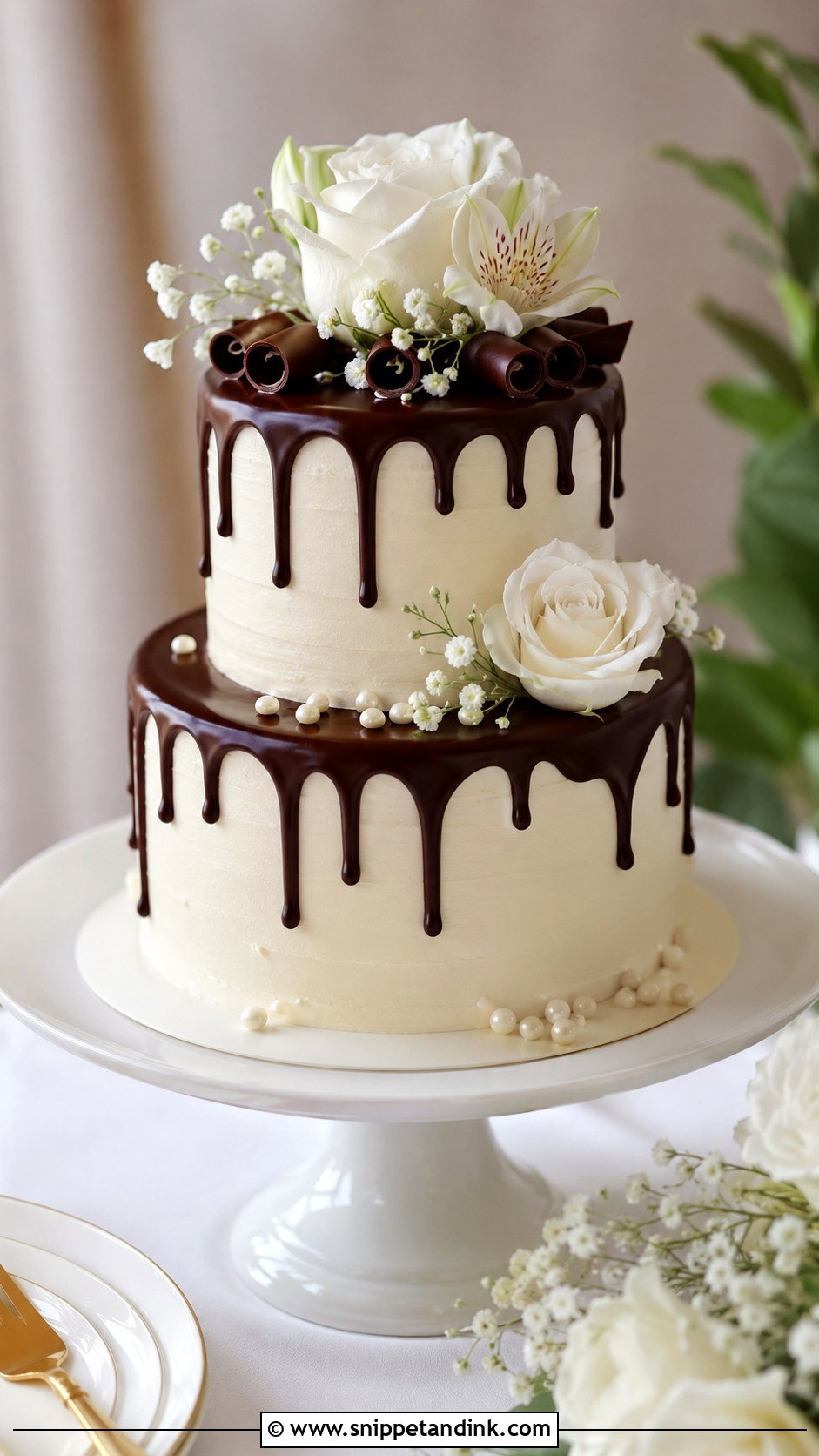
For an elopement or micro wedding, a single tall tier or a petite two-tier is plenty, and it’s far easier to carry in a car. I’d give it a white buttercream finish with ganache filling, or a dark base tier, plus some height from flowers or curls on top. Set it on a pedestal so it doesn’t disappear on the table. You still get the cutting moment without paying for servings nobody eats.
24. Chocolate And White Cupcake Wedding Cake
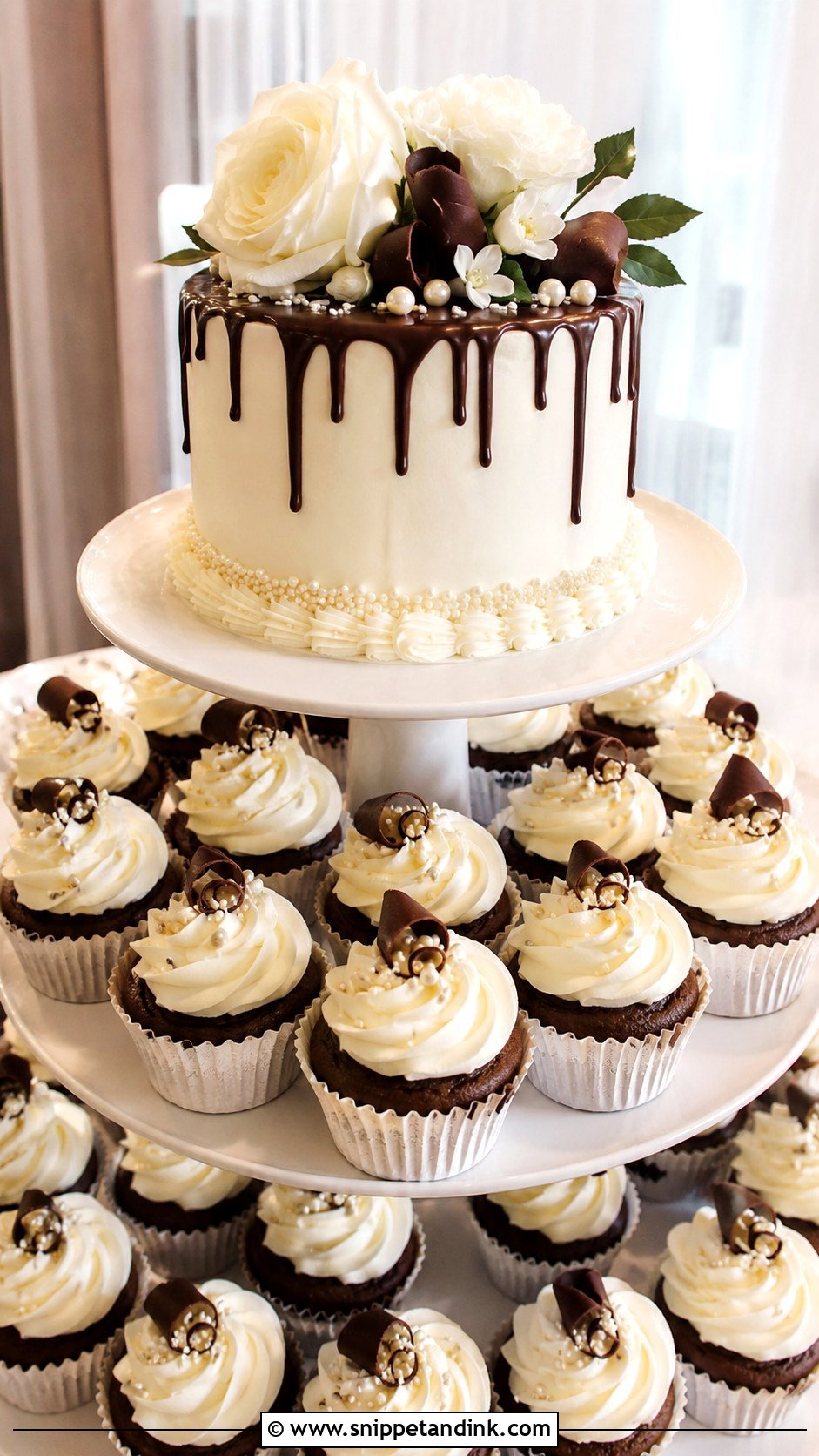
Cupcakes around a small cutting cake speed up service enormously, since there’s nothing to slice. I match the top cake to the cupcakes in frosting and decoration so the tower reads as one design. It’s also the simplest way to offer two flavours, such as chocolate sponge with vanilla buttercream next to white cake with chocolate filling. Stick to one liner colour throughout; mismatched liners are what make cupcake towers look improvised.


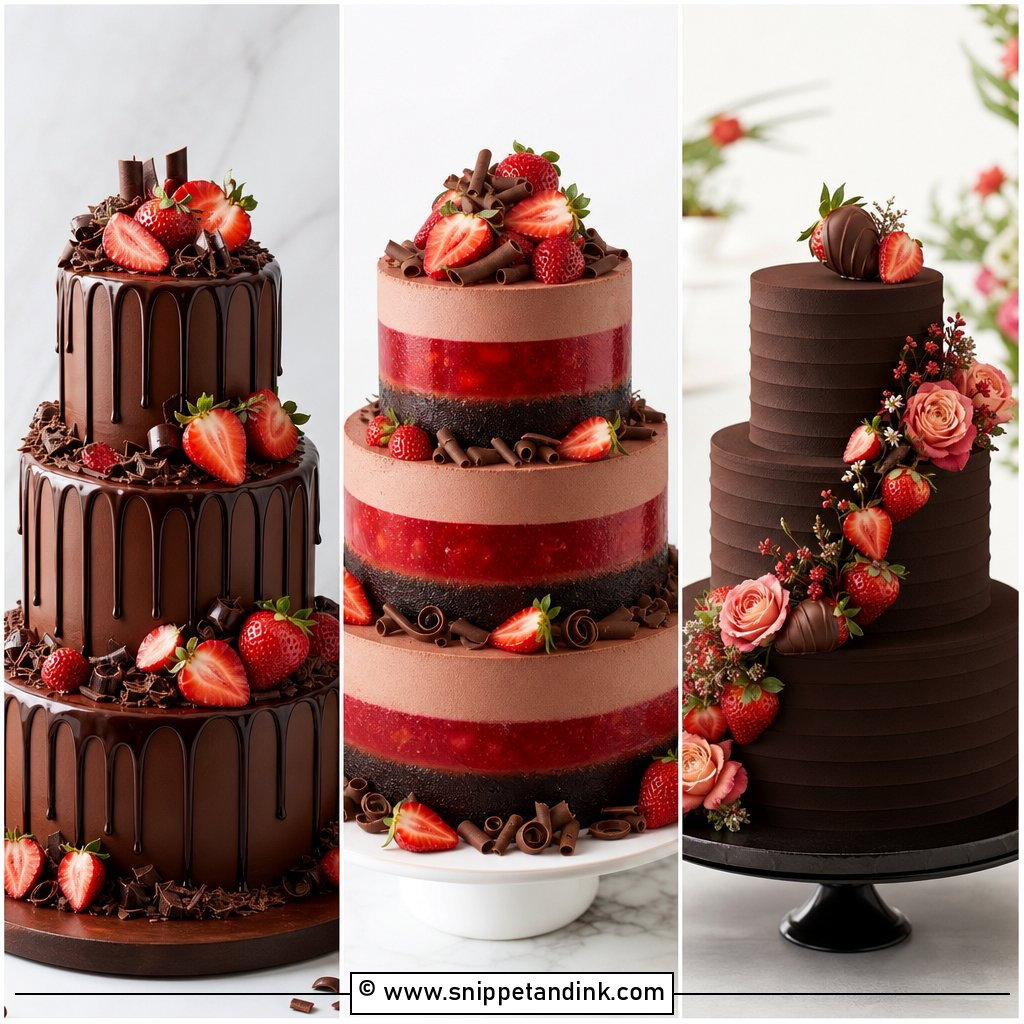
25. Chocolate And White Dessert Table Wedding Cake
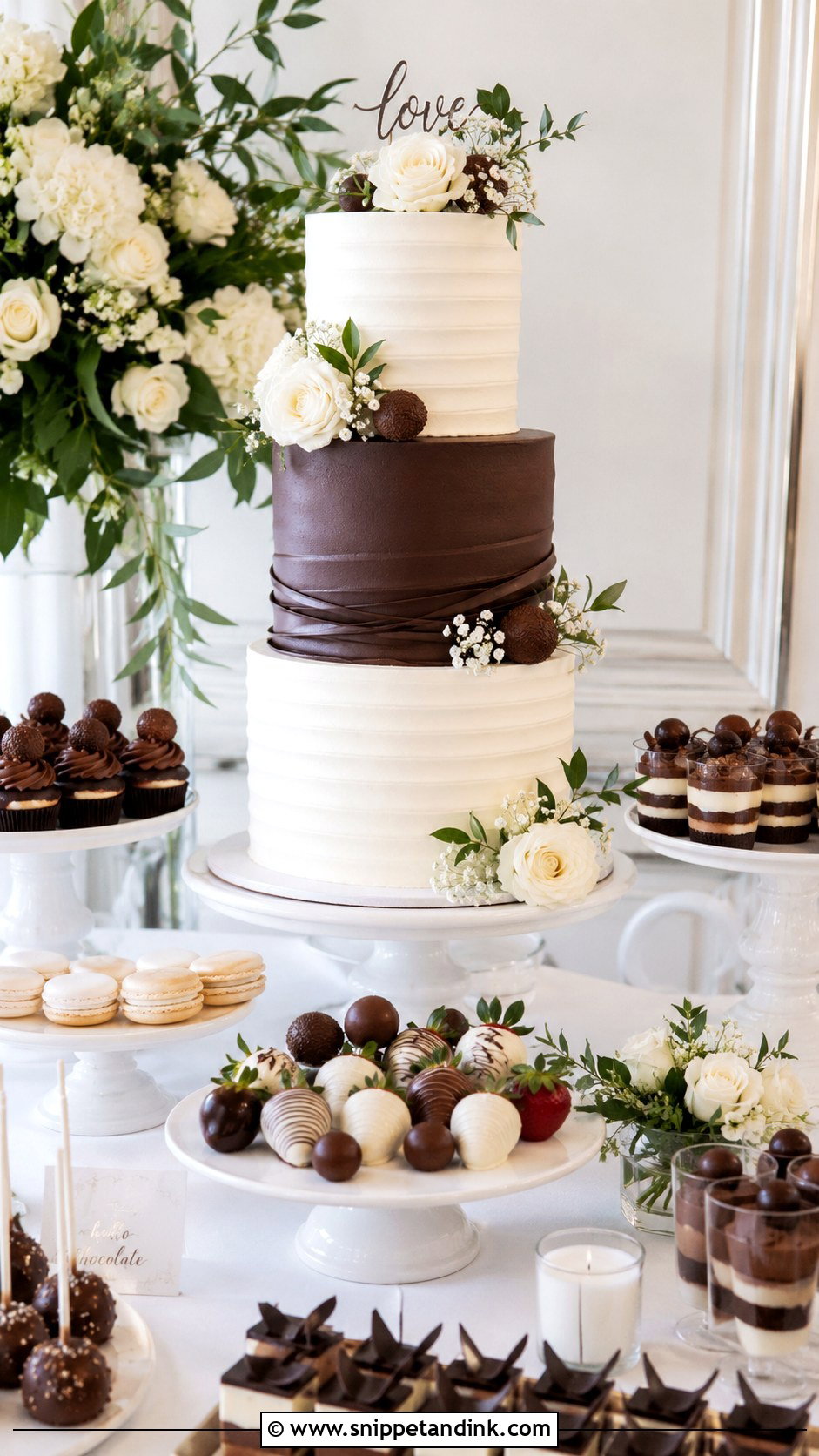
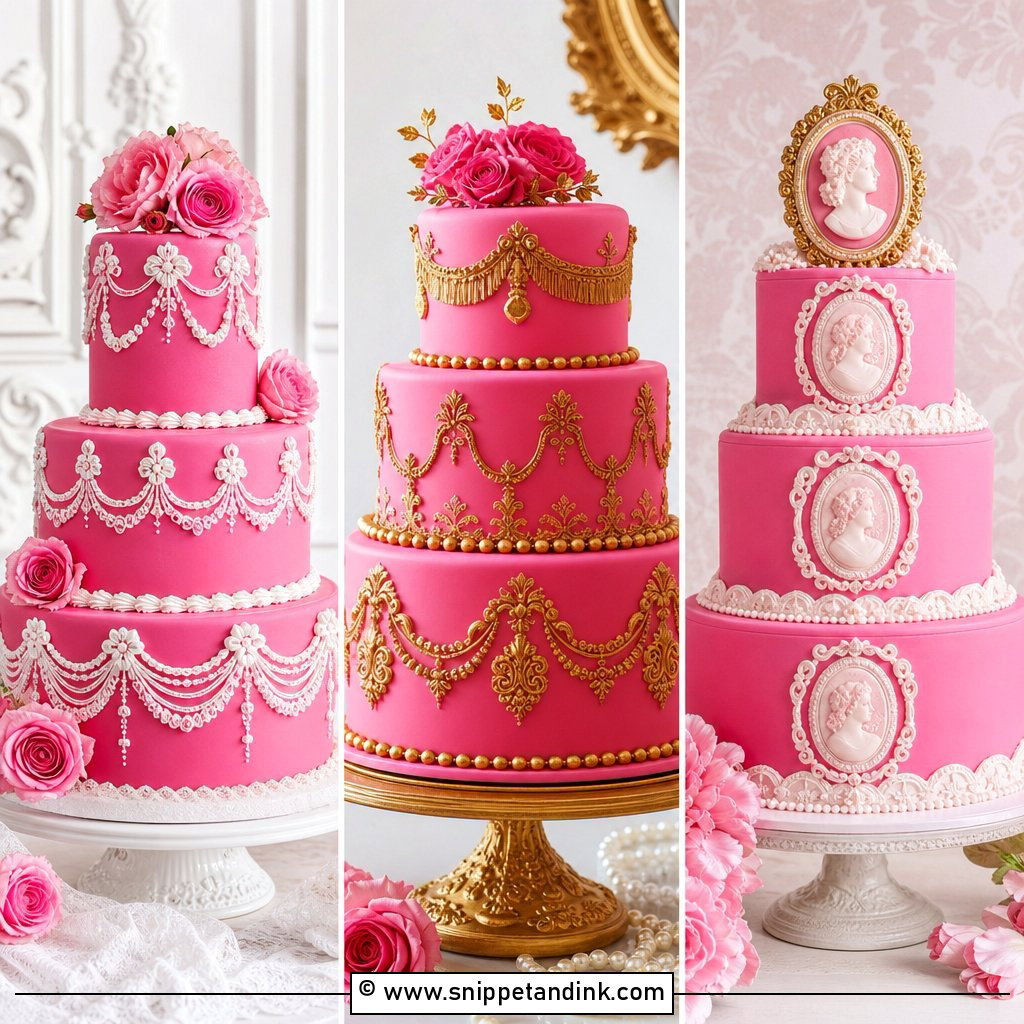
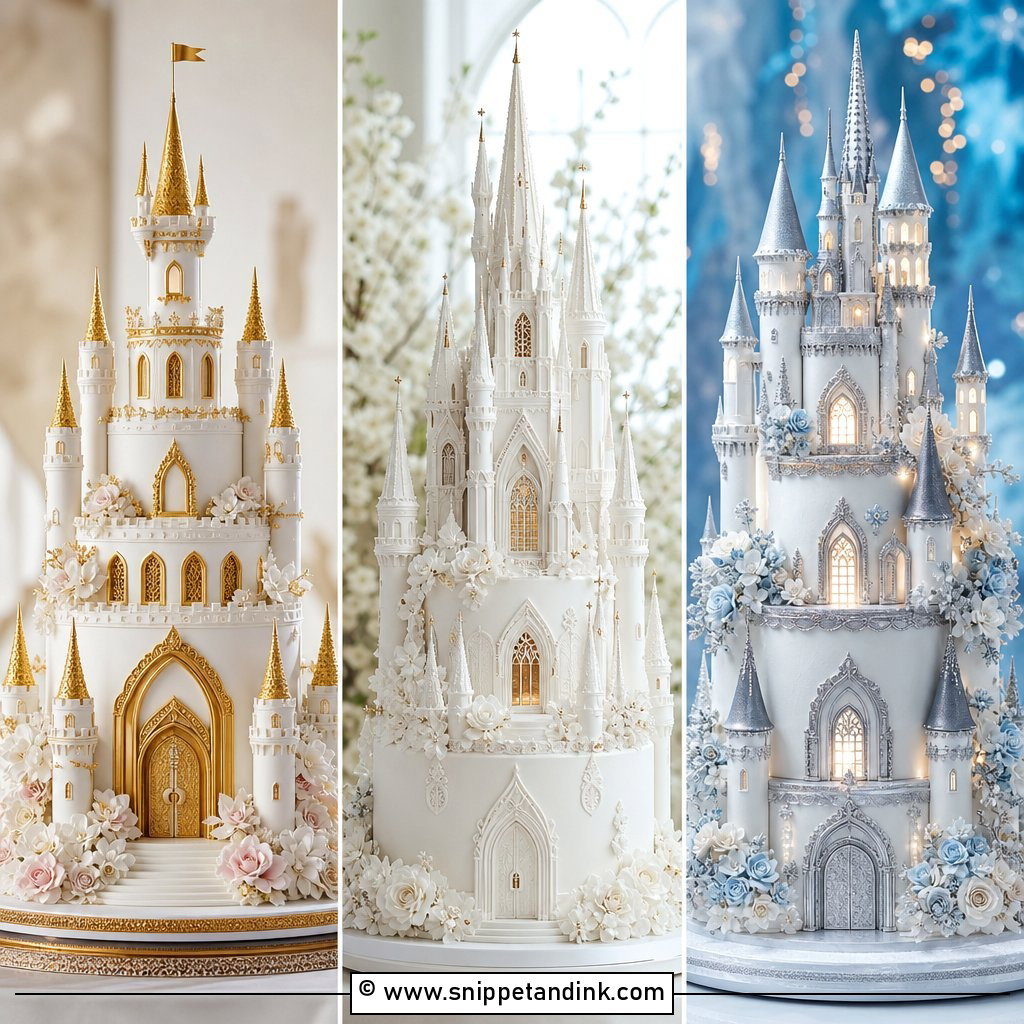
On a dessert table the main cake has to be the tallest or most detailed piece, or it gets lost among the minis. Around it I’d group cupcakes, truffles, macarons or chocolate-dipped strawberries in the same two colours. The strawberries are the one item I’d ask to have made on the day, because they weep once chilled and brought back to room temperature. White stands and a few flowers tie the pieces together.
From My Kitchen to Your Reception Table
Most couples think about the cake right up to the tasting and then stop. The part that decides whether it still looks right at nine in the evening happens later. Here is roughly how I schedule a chocolate and white cake, though every baker’s calendar differs.
- Sugar flowers and pearls are made first, often a week or more ahead, because they need time to dry hard.
- Sponges are baked a day or two before, then filled and ganached so the ganache can set overnight.
- Final icing, piping and drips go on the day before or the morning of, depending on the design.
- Taller cakes travel as separate tiers and are stacked at the venue. I want a flat, air-conditioned car floor, not a seat.
- On arrival, I set the cake away from windows, heaters and candles, and I check the table is level before the top tier goes on.
Cutting Slices That Show Off the Stripes
Half the fun of this pairing is the inside, so it’s worth telling the venue how you want it served. A slightly chilled cake cuts cleaner than a warm one, and a long knife dipped in hot water and wiped between cuts keeps dark crumbs off the white layers. Ask whether your servings are counted as narrow wedding fingers or wider dessert slices, because the same cake feeds noticeably fewer people at dessert size. If you are also serving cupcakes, smaller fingers are usually enough.
Dark Tier or Light Tier? Settling Your Own Version
What makes this pairing so useful is how much the finish changes it. White buttercream over chocolate sponge stays traditional, while ganache, black cocoa, marble or chocolate piping push it bolder. When you meet your baker, bring two or three photos you love and one you don’t, plus whether the reception is indoors or out and your guest count. With those three things, I can tell you quickly which of these designs will hold up on your day and which would struggle.
You'll Like These Ideas:



Leave a Reply