
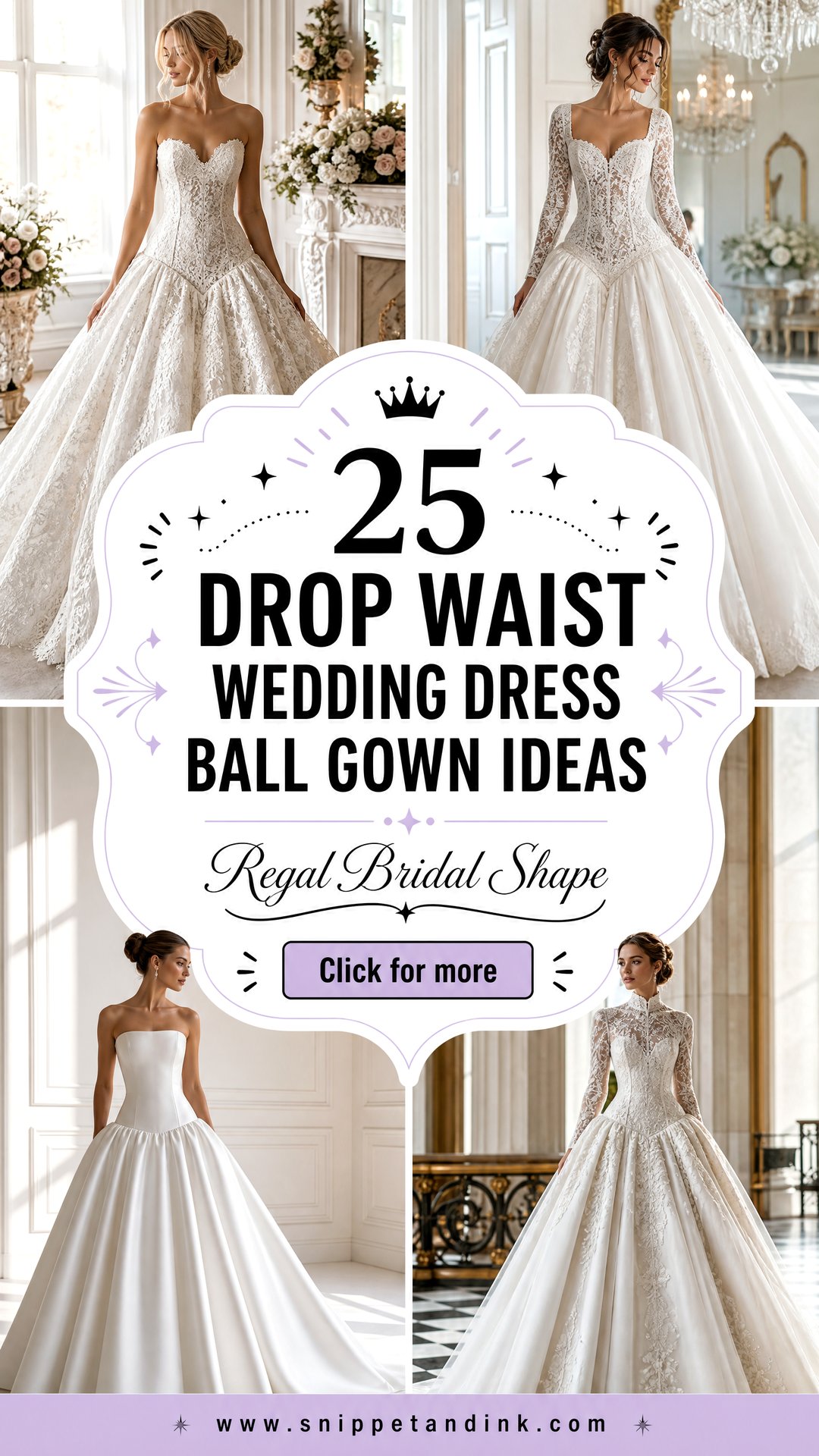
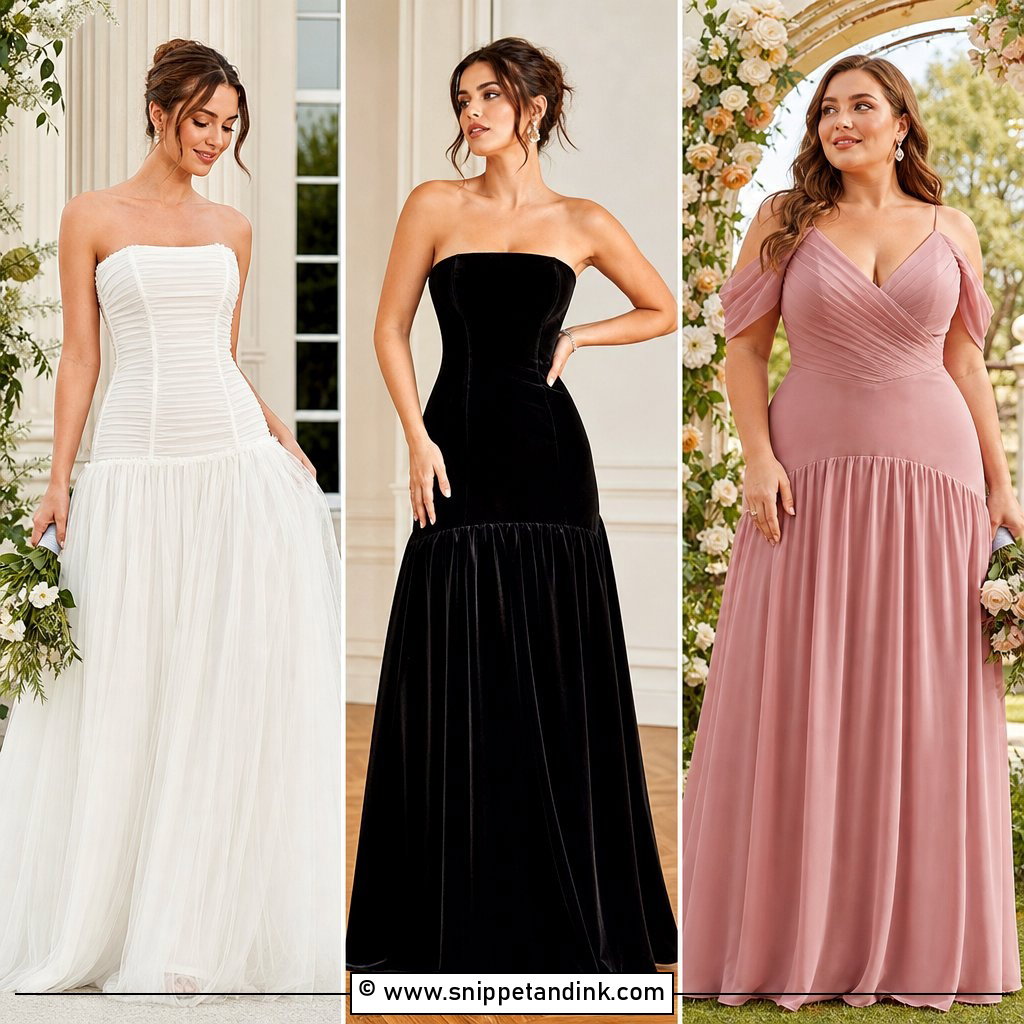
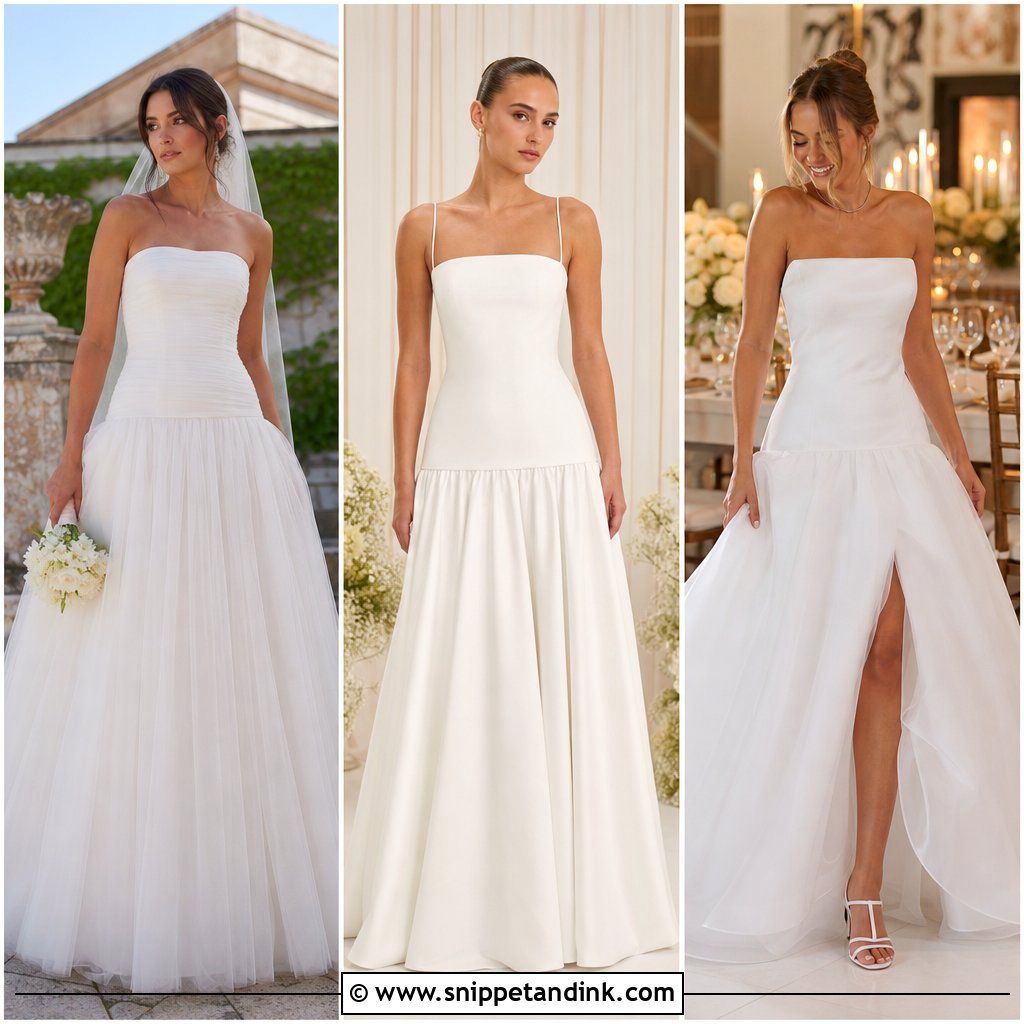
A drop waist ball gown does something no other full skirt does. It keeps the bodice close past the natural waist, down toward the high hip, and only then lets the skirt open into that elegant fairytale shape. When I pull these for a bride, the seam placement matters more than the fabric. Set it a little too high and it reads as an ordinary ball gown; set it too low and she can’t sit down comfortably. Below are 25 versions I’d happily bring into a fitting room, from plain satin and Mikado to pearls, bows and removable overskirts, with notes on how each one actually wears.
Where a Dropped Seam Should Sit on Your Body
Before I show a bride any of these gowns, I find her high hip. It’s the bony ledge a few inches below the natural waist, and on most bodies that’s where a drop waist seam looks intentional rather than accidental. Above it, the gown just looks like a long bodice. Much below it, the seam starts to cut across the fullest part of the hip and the skirt buckles when you sit.
Torso length changes everything. A long-waisted bride can carry a deep drop or a sharp basque point easily. A short-waisted bride, the kind whose ribs sit close to her hips, usually looks best with a shallower drop, because a very low seam leaves her legs looking short under all that skirt. Petite brides fall in the same camp, and I’d keep the skirt a little less wide for them too.
- In the shop, sit on a hard chair for a full minute. The seam should not dig into your thighs or push the bodice up into your bust.
- Climb a step or two. Full skirts hide the feet, and you need to feel where the hem catches.
- Raise both arms. If the bodice lifts away from the seam, it’s sized for a different torso length and will need more than a hem.
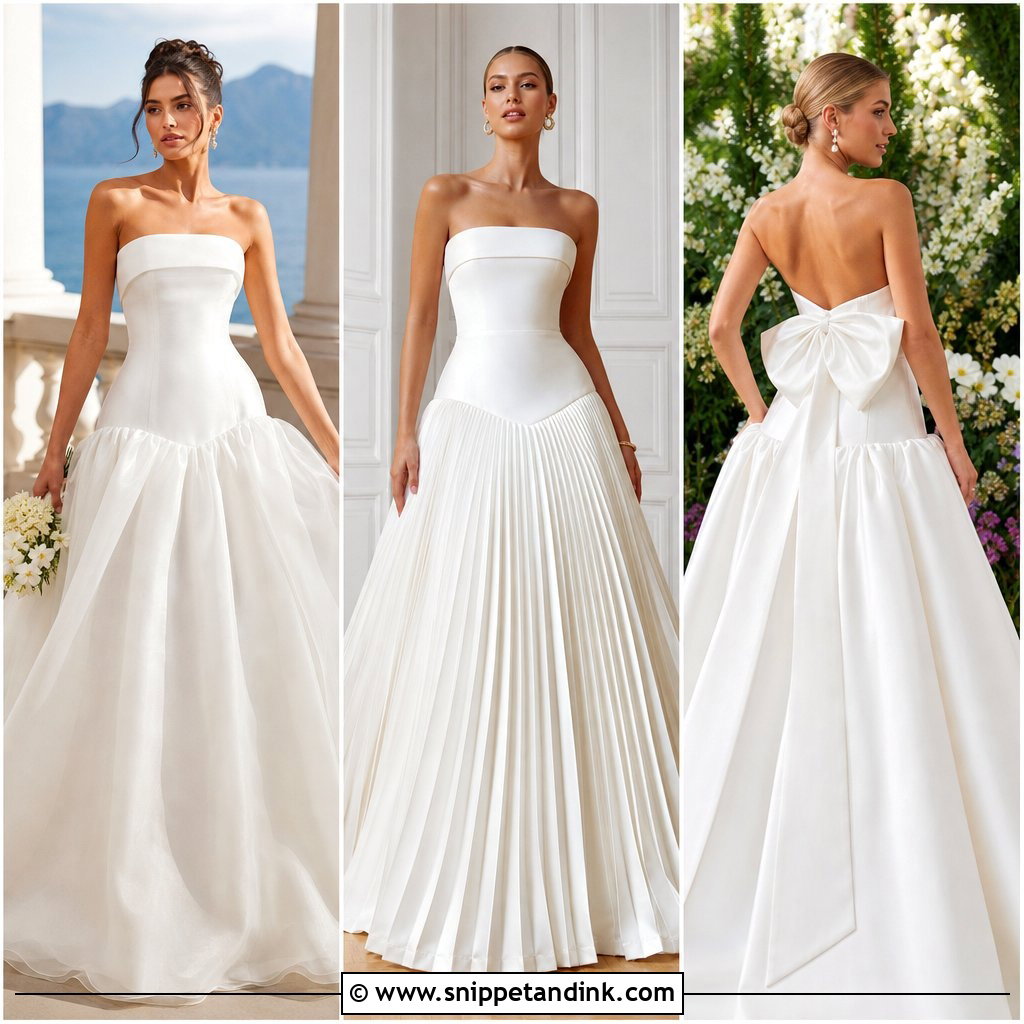
1. Strapless Satin Drop Waist Ball Gown Wedding Dress
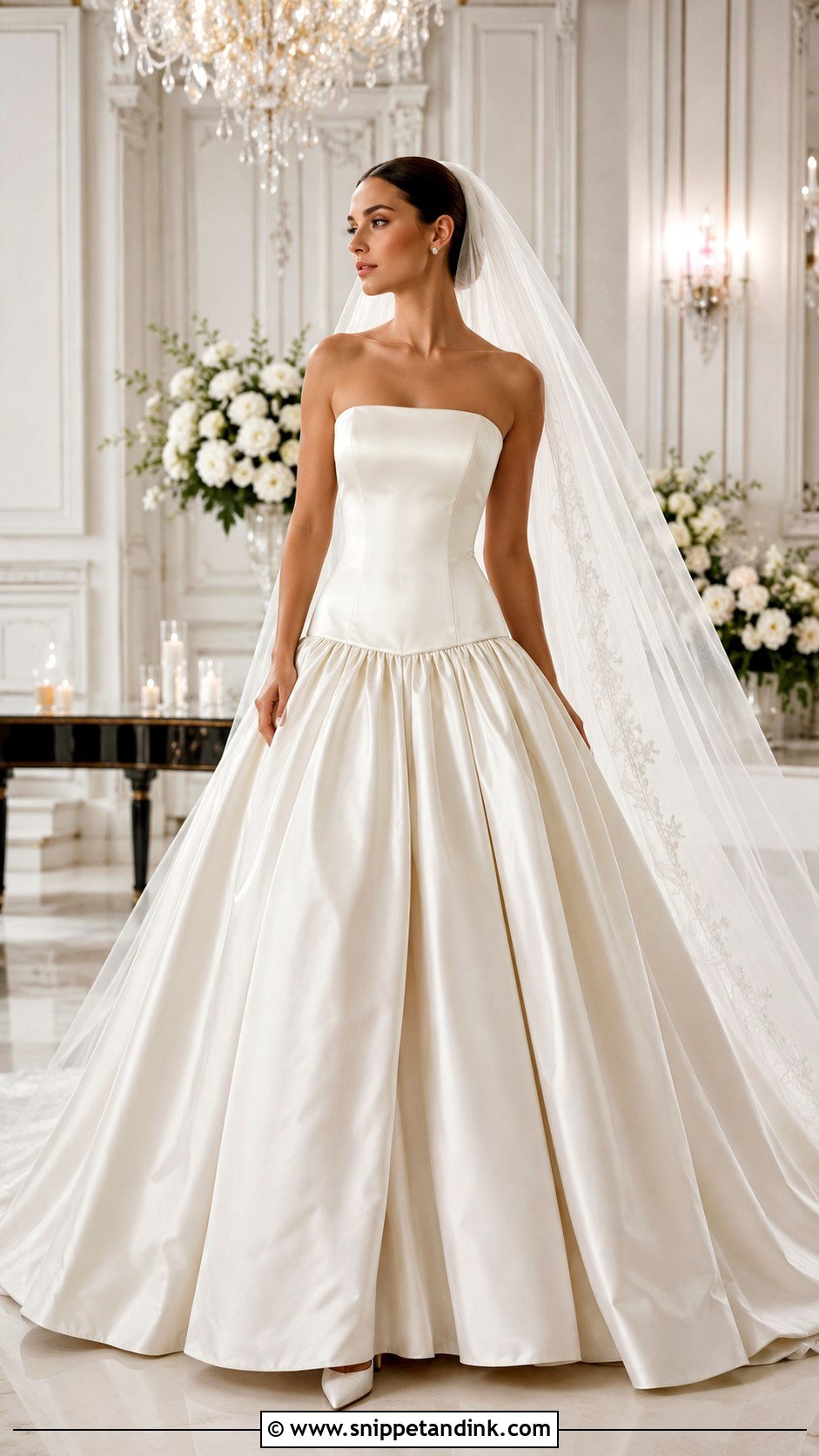
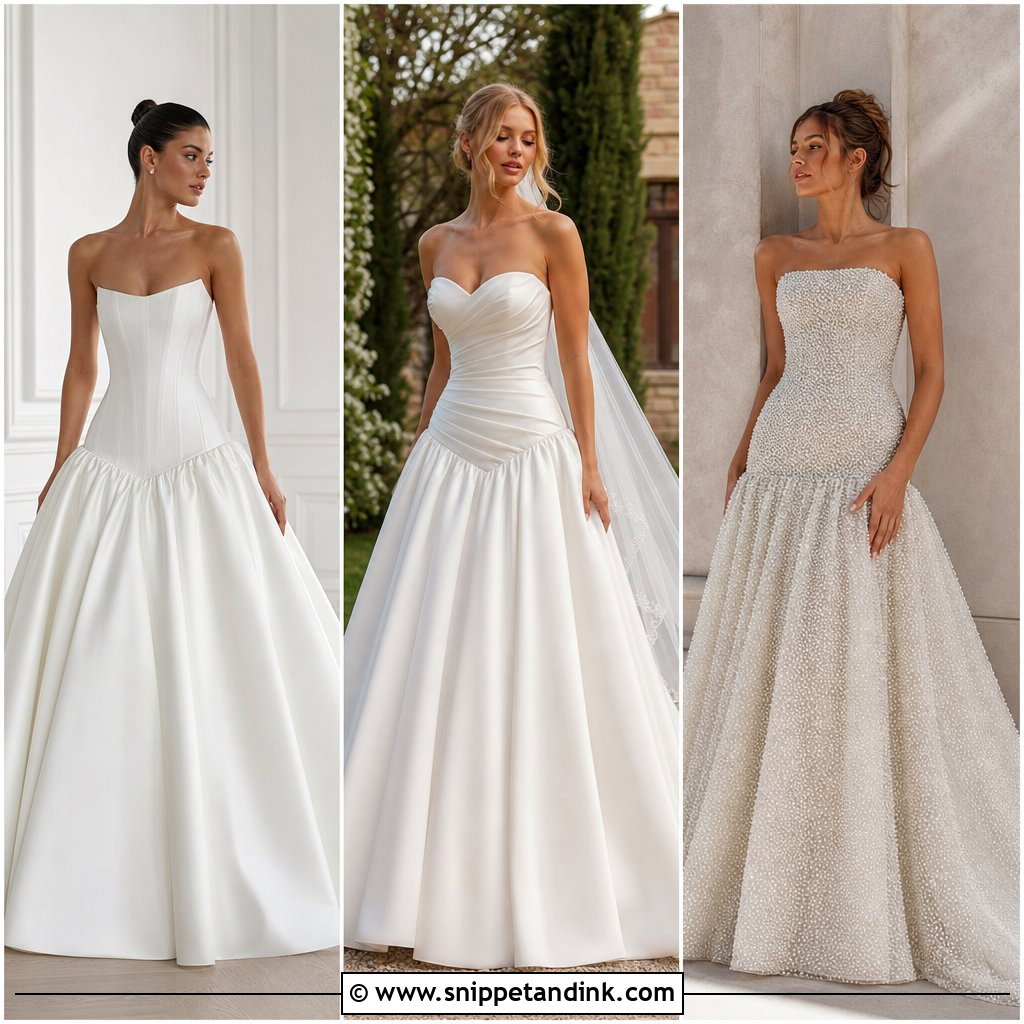
Satin is the most honest fabric for this silhouette, because every inch of the fitted bodice shows. In a fitting I look first at the seam where the skirt joins: on a well-made gown it lies flat, with no ripple when you breathe in. Strapless versions rely entirely on internal corsetry and a grip strip along the top edge, so I have the bride lift her arms as if hugging someone and watch whether the neckline slides. Pointed satin pumps, a plain cathedral veil and pearl or diamond studs are all it needs. Keep the bouquet rounded and fairly compact, since a trailing cascade fights the skirt’s outline. This is the gown I’d put in a ballroom or a grand hotel.
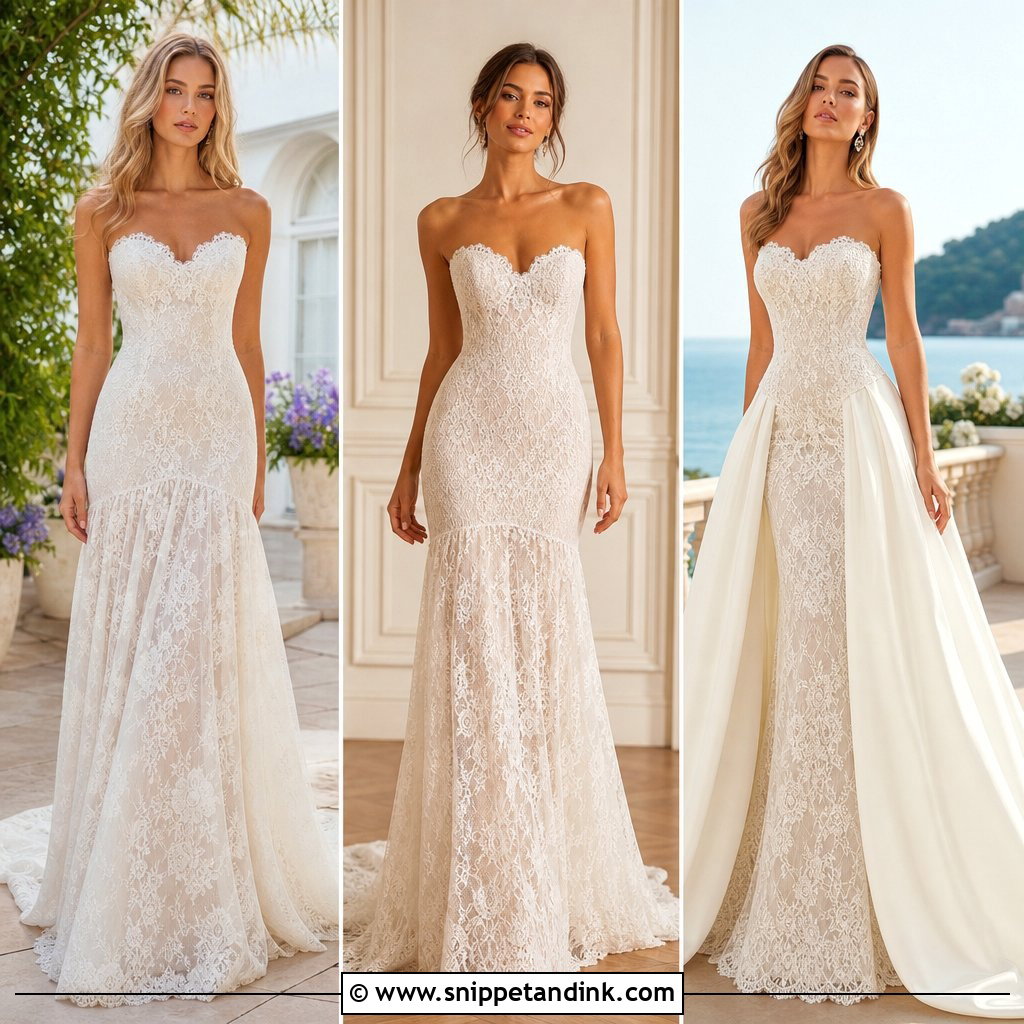
2. Lace Drop Waist Ball Gown Wedding Dress
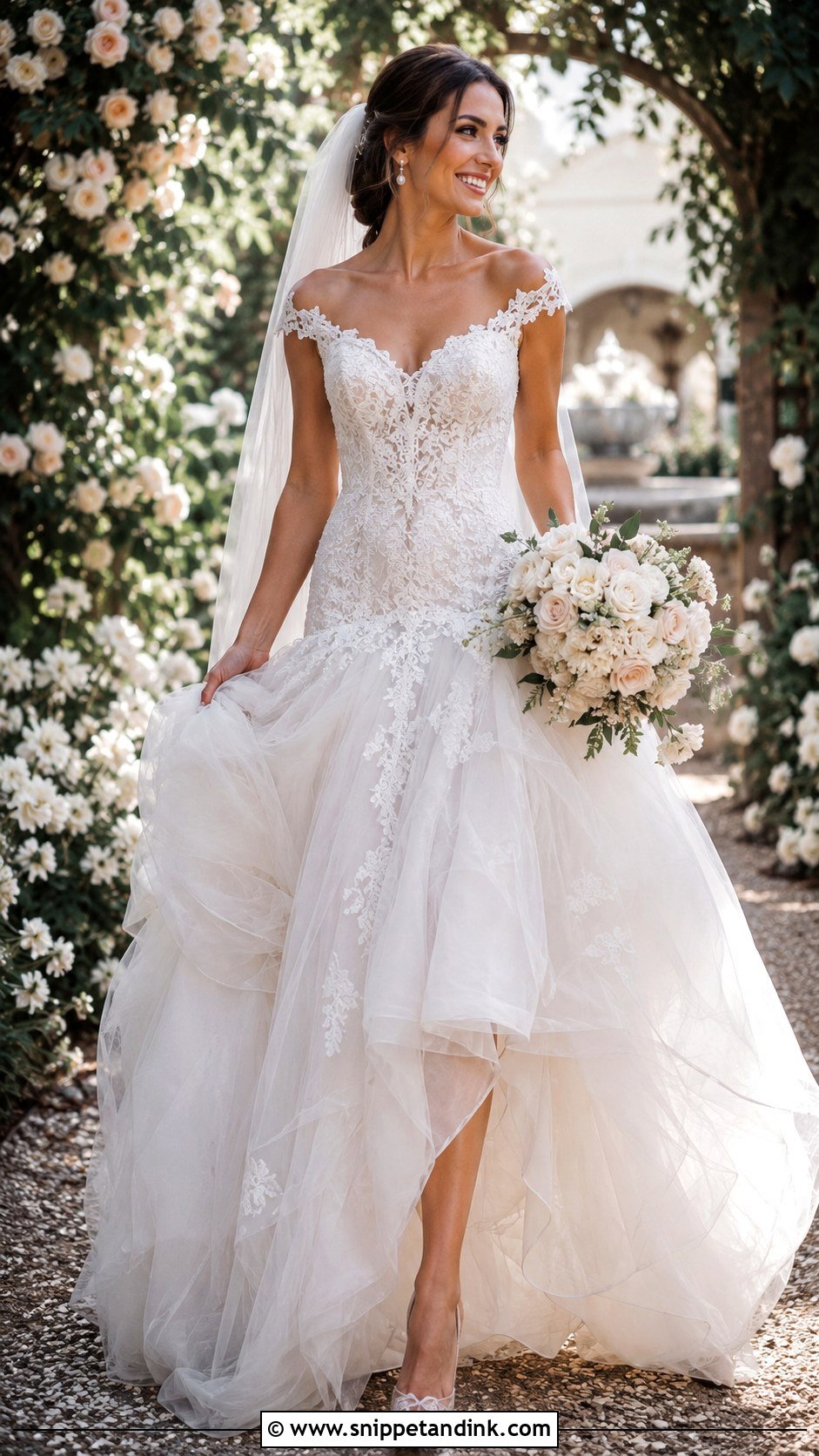
Lace changes how a drop waist reads. Because the bodice runs longer, there’s room for motifs to follow the waist and hip, and a skilled seamstress will cut around those motifs rather than straight through them, so the seam almost disappears. Ask about that hand-finishing; it’s the difference between lace that looks stuck on and lace that looks like it grew there. A nude or ivory lining makes the pattern show, while a stark white lining flattens it. Layered tulle underneath gives the skirt lift without the weight of a hoop. I keep accessories quiet with this one: lace-edged heels, a soft tulle veil, small pearl drops.
3. Basque Drop Waist Ball Gown Wedding Dress
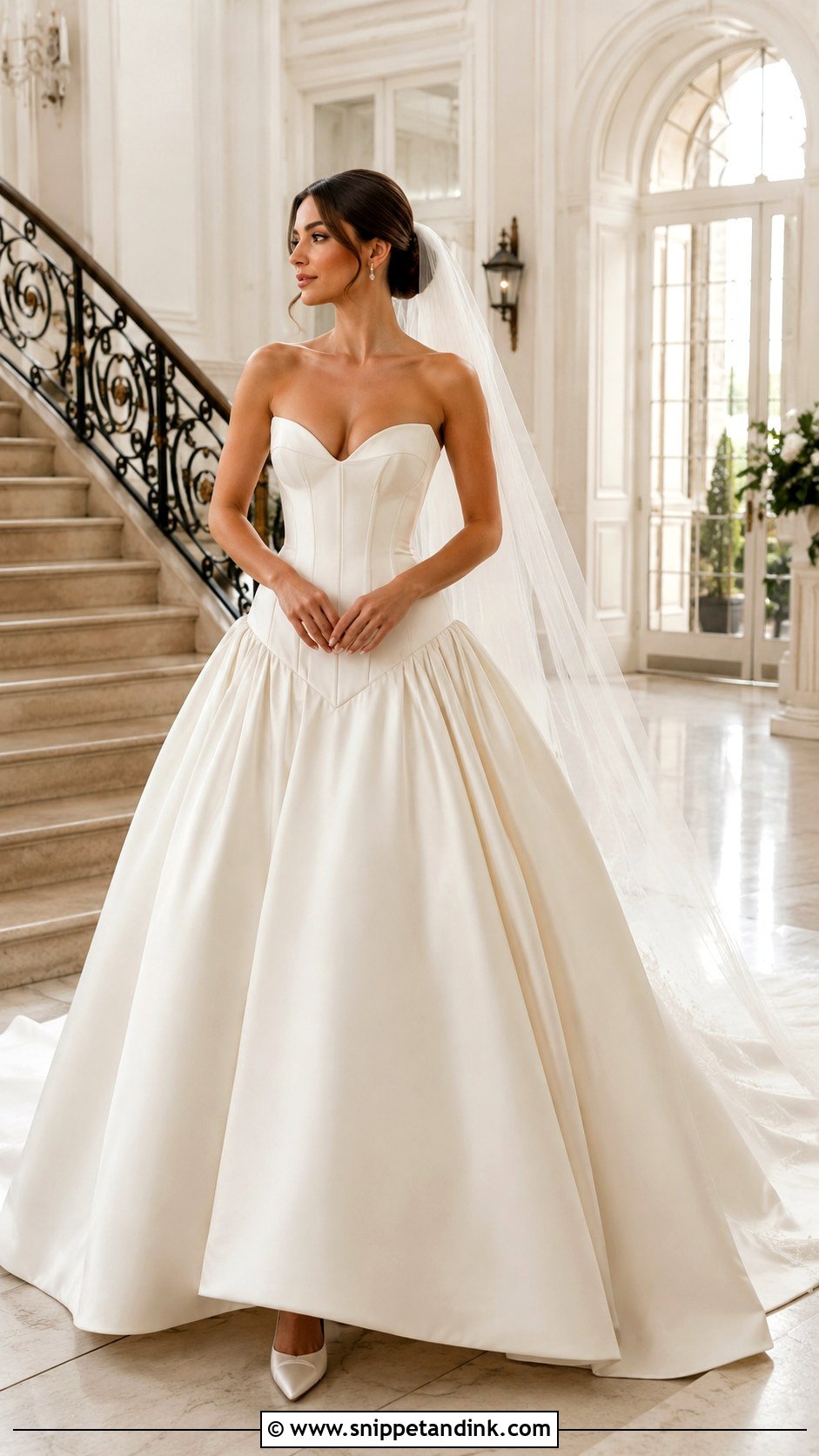
The basque point is the most flattering waistline I fit, and also the fussiest. That dip into a V pulls the eye downward and lengthens the torso, which is why it sits just as well under strapless, off-shoulder or long-sleeve bodices. Where it goes wrong is the hip. If the point lands even slightly too low, it drags across the front when you sit and leaves a crease that shows in every seated photo. At your fitting, sit, stand, and watch the point each time. Ivory heels, a long veil and earrings that echo the neckline finish it.
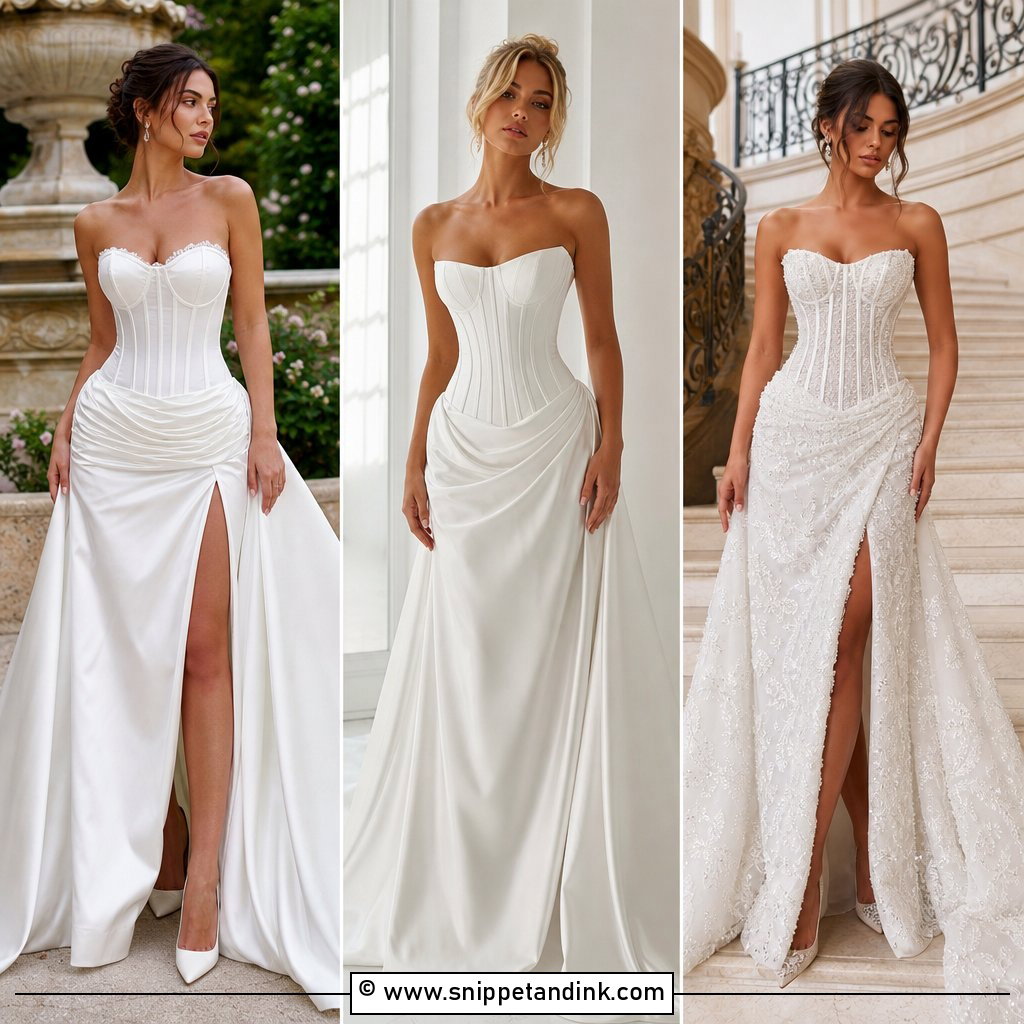
4. Corset Drop Waist Ball Gown Wedding Dress
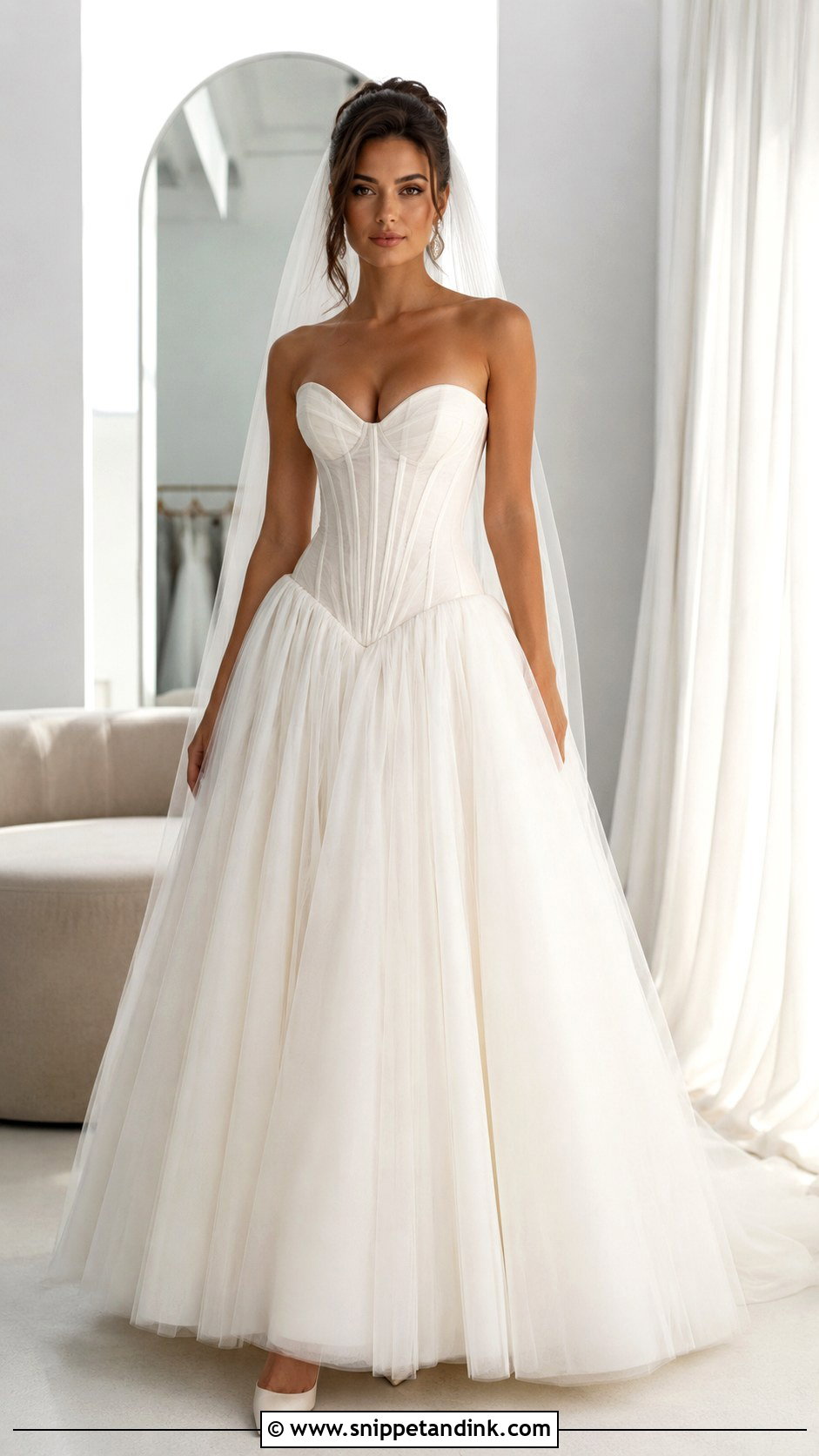
Visible structure is the whole idea behind a corset drop waist ball gown wedding dress. The boning supports bust and waist, and the dropped seam carries that support lower, so the torso looks long before the skirt expands. Exposed boning needs a properly full skirt in tulle, satin or organza to balance it; over a thin skirt it starts to look like lingerie. I ask brides to keep the corset laced for a full hour at a fitting. Steel boning holds a crisp shape but feels firm by dinner, while spiral boning flexes more when you sit. Smooth hair, a polished bun or soft waves, keeps attention on the shape.
5. Off The Shoulder Drop Waist Ball Gown Wedding Dress
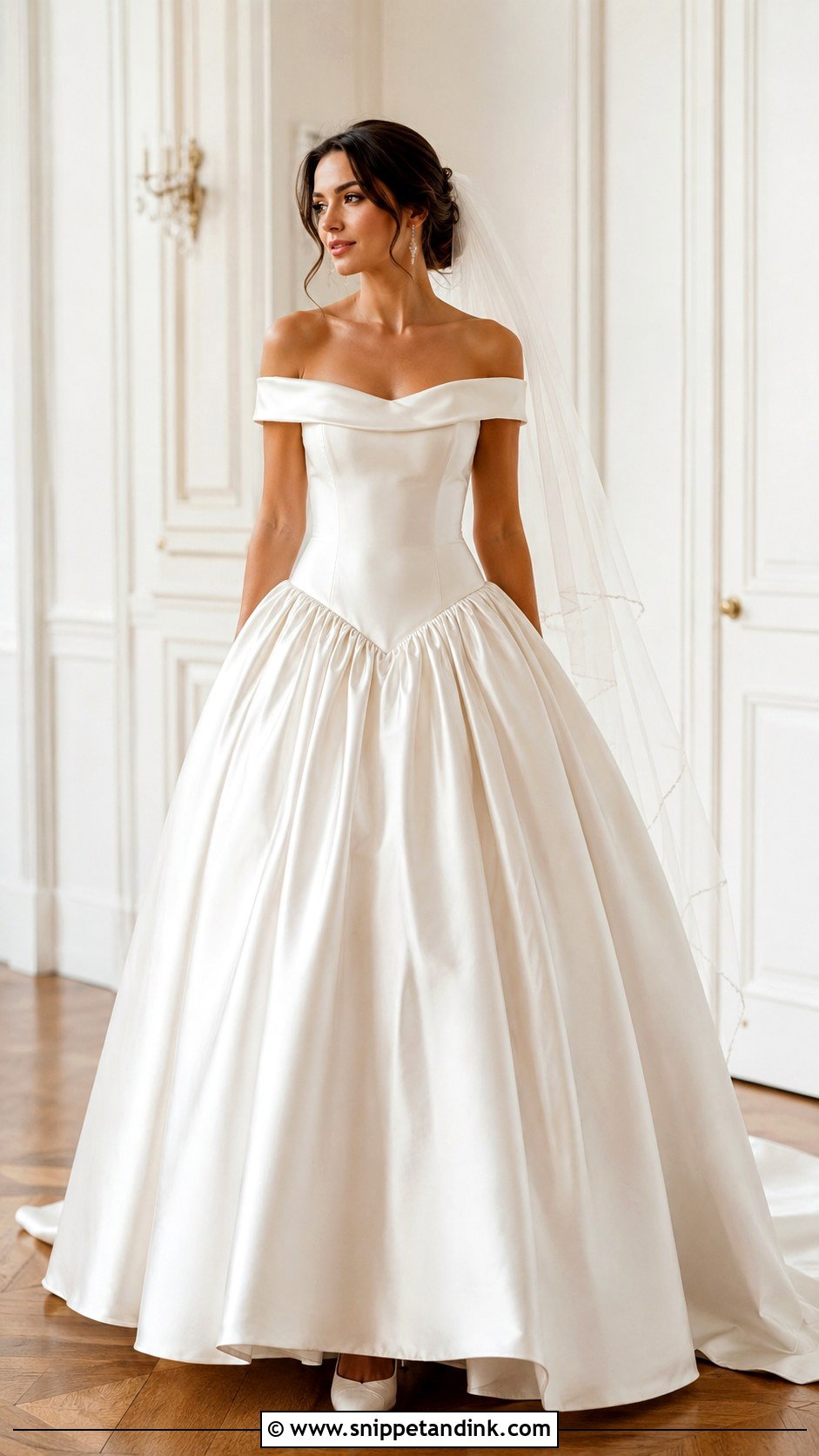
Off-shoulder necklines live or die on the bodice underneath them. The band across the upper arms has to be anchored by a firm bodice, or it creeps up toward the neck every time you raise your hands. I test it by having the bride reach forward as if she’s signing the register. Satin bands look crisp and lace looks softer, and either suits the long torso of a drop waist. Drop earrings fill the open neckline better than a necklace would. A sheer veil and closed-toe pumps keep it formal; a loose bouquet with plenty of greenery softens it.
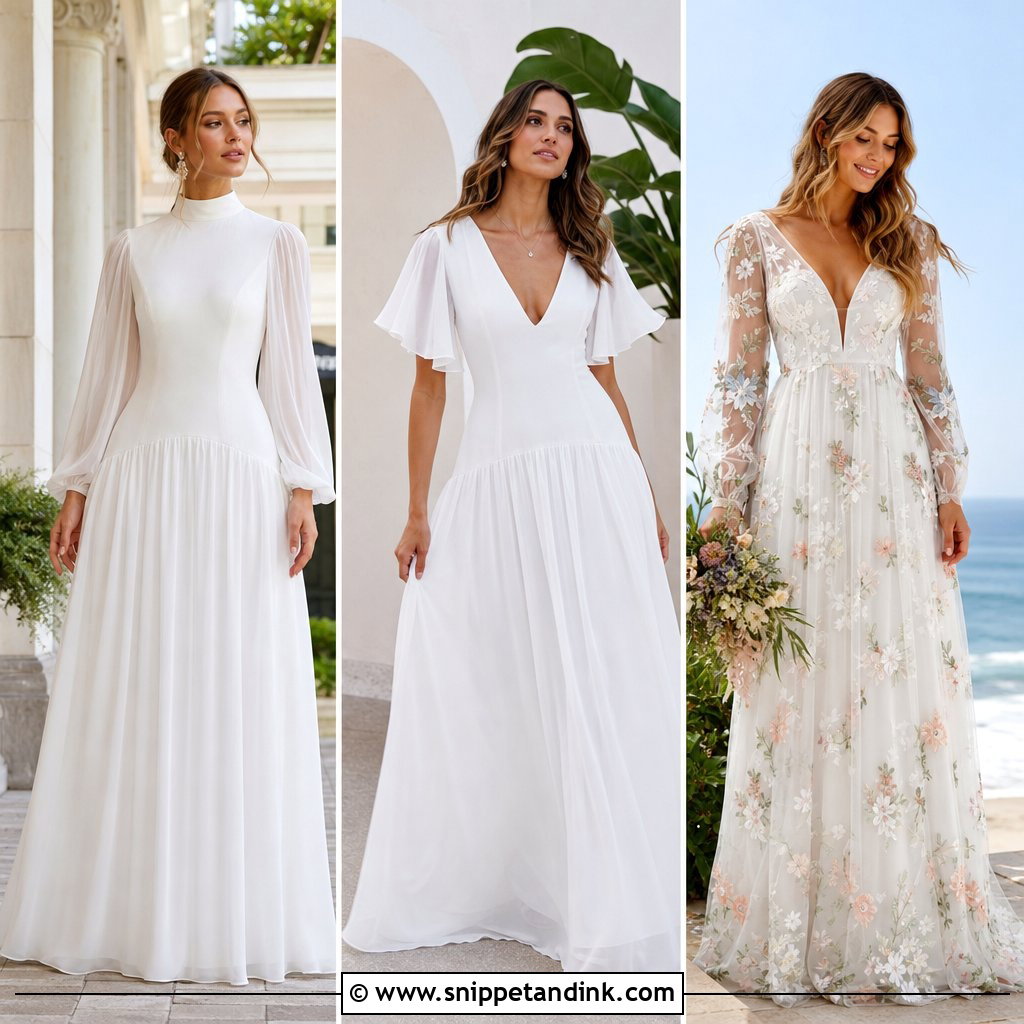
6. Long Sleeve Drop Waist Ball Gown Wedding Dress
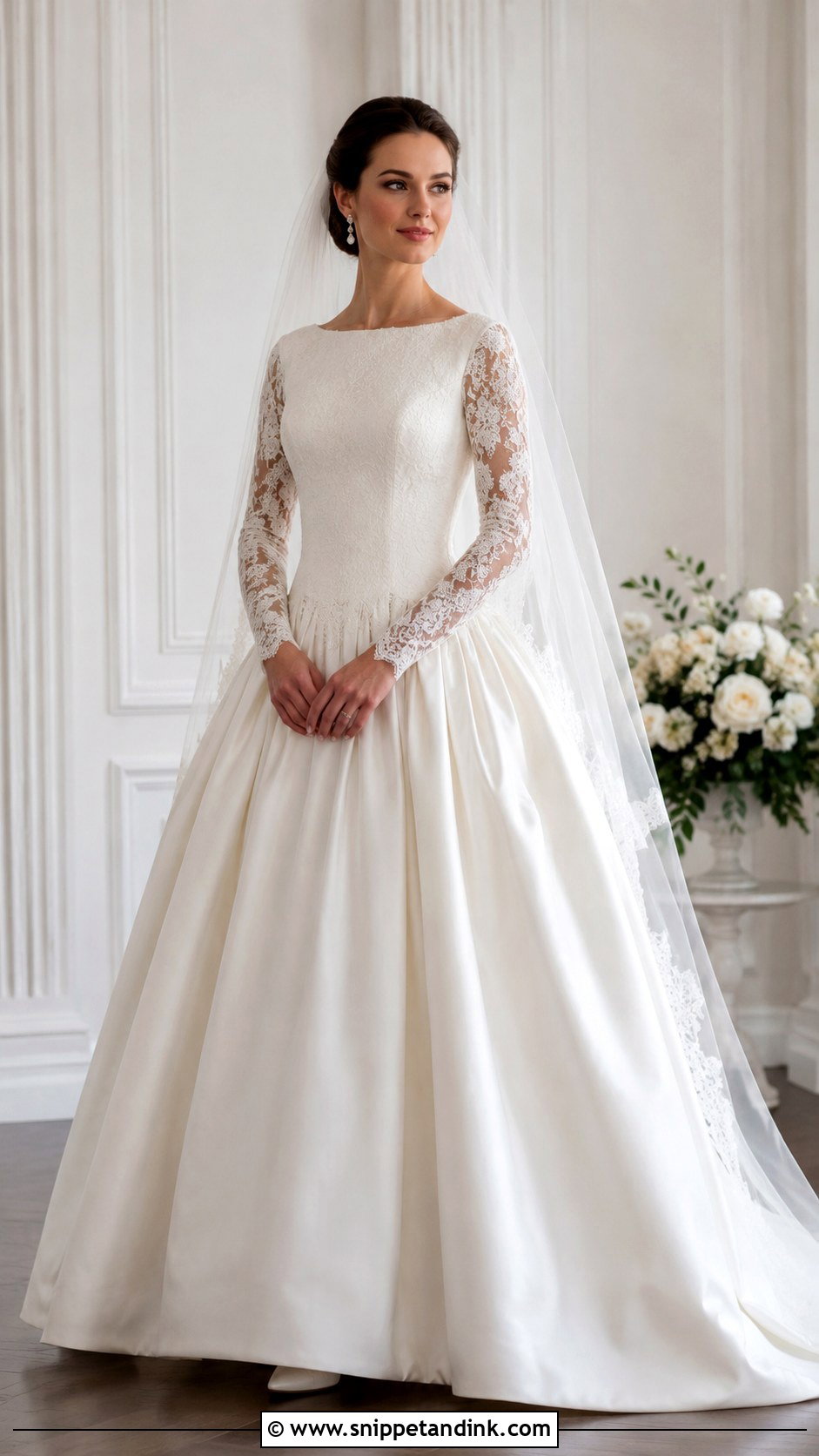
Sleeves bring coverage for cooler months, and the low waist stops all that fabric from looking heavy. What I test first is reach. A fitted sleeve set into a close bodice can stop you lifting your arms above shoulder height, which matters for the first dance and for hugging tall relatives. Ask whether the lining has stretch or whether an illusion gusset can go under the arm. Lace sleeves feel romantic; satin or crepe looks sleeker. If the cuffs are detailed, leave the bracelets at home.
7. Tulle Drop Waist Ball Gown Wedding Dress
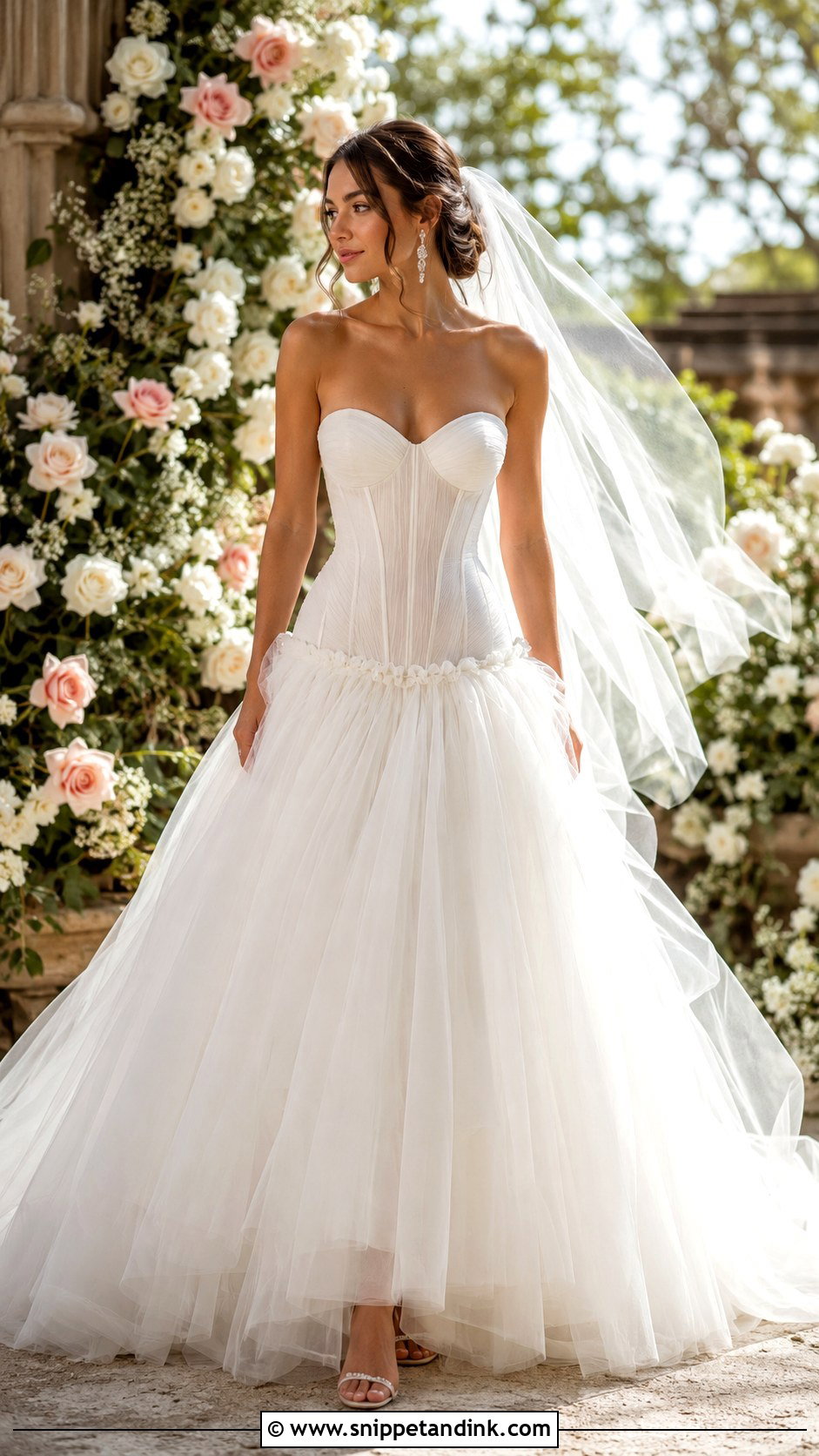
Tulle gives the most volume for the least weight, so it’s the fabric I steer brides toward for long summer days. The drop waist helps it too. On a natural-waist tulle gown the skirt can puff out right under the ribs, whereas starting the gathers at the hip makes the line from bodice to skirt smooth. Be warned that fine tulle snags on beaded shoes, bracelet clasps and gravel paths, so a good bustle and a careful walk outdoors are part of the deal. A little shimmer or a few floral appliqués add interest. Ballet-style heels or classic pumps both suit it.
8. Organza Drop Waist Ball Gown Wedding Dress
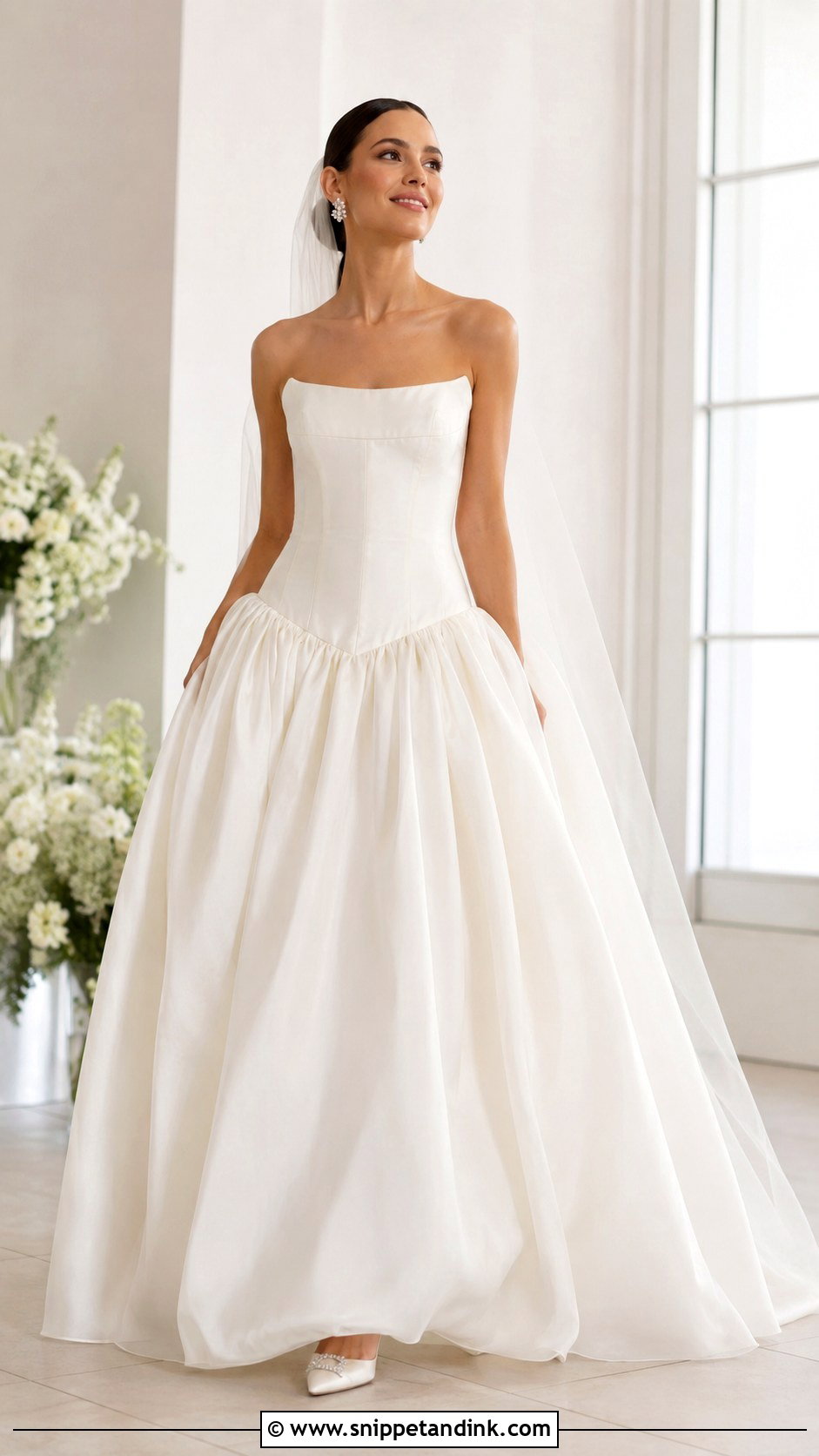
Organza is crisp rather than soft. It holds a full skirt out with less underlayer than satin needs, so the gown feels lighter on than it looks on the hanger. I like it for bright, open venues because it catches light along every fold. The trade-off is creasing: organza marks wherever you sit, and those creases show more in daylight than in a candlelit room. Have it steamed on the morning, not the night before. Pointed ivory shoes, a clean veil and small crystal earrings are plenty, and a simple bouquet stops the texture from feeling busy.
9. Mikado Drop Waist Ball Gown Wedding Dress
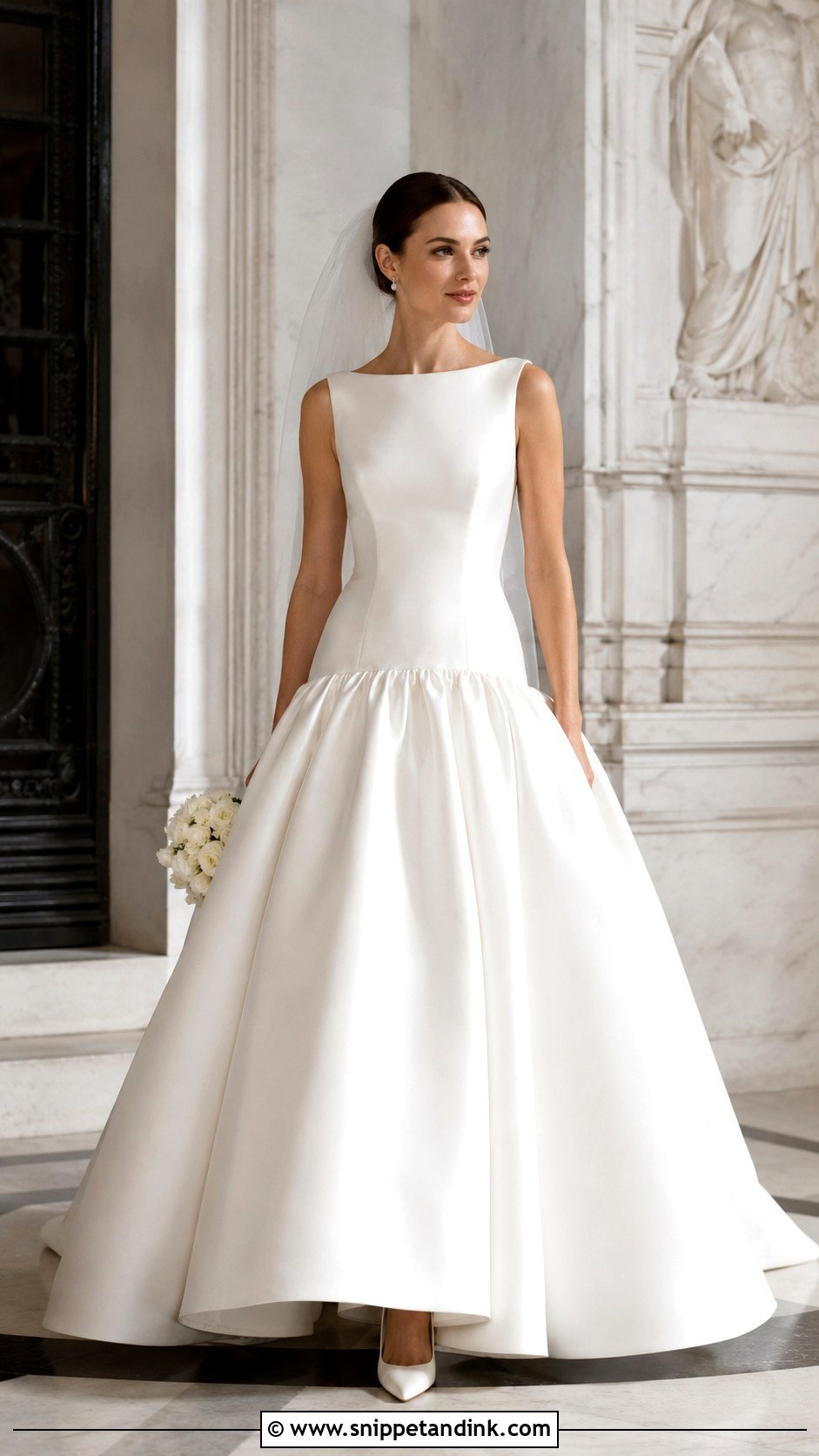
Mikado is what I reach for when a bride wants clean lines with a slight sheen. A Mikado drop waist ball gown holds its skirt with very little help, and the dense weave keeps the torso smooth. It does weigh more than tulle or organza, so a long Mikado train will feel heavy by evening; plan the bustle early. Strapless and square necklines match its crisp hand, and a bow, covered buttons or a short train add detail without clutter. It belongs in a formal indoor setting, a museum or a city hotel especially.
10. Sweetheart Drop Waist Ball Gown Wedding Dress
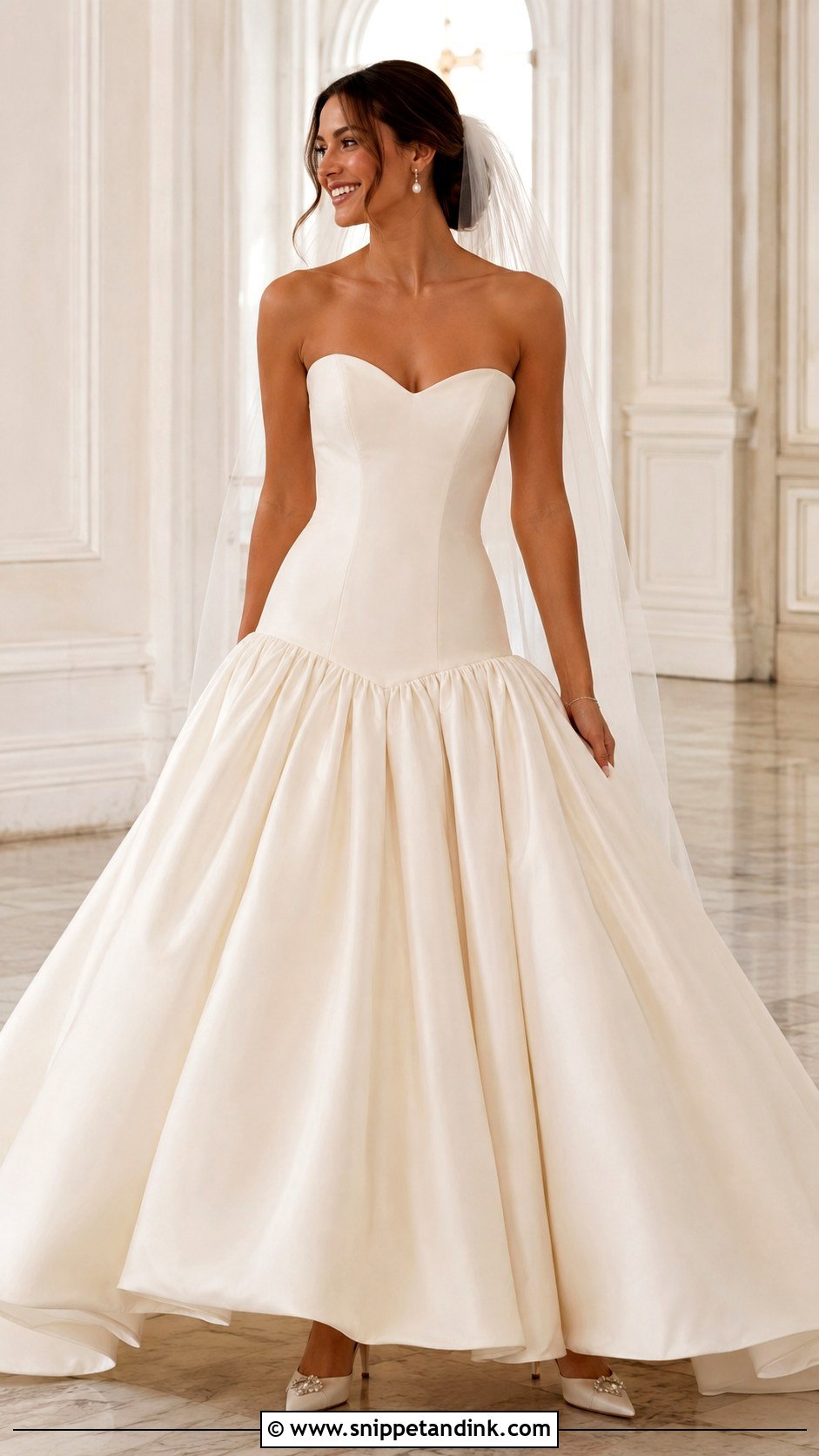
Most brides try a sweetheart first, and it’s easy to see why: the curve softens a structured drop waist bodice. All the support is internal, so look for boning through the cups and a secure back, either a zip with a hook at the top or lacing. I often prefer lacing because it gives the seamstress room if your weight shifts in the final months. The curve already frames the collarbones, so I’d skip a necklace and wear pearl earrings with a fingertip or cathedral veil. Satin keeps it classic; lace or beading makes it softer.
11. Square Neck Drop Waist Ball Gown Wedding Dress
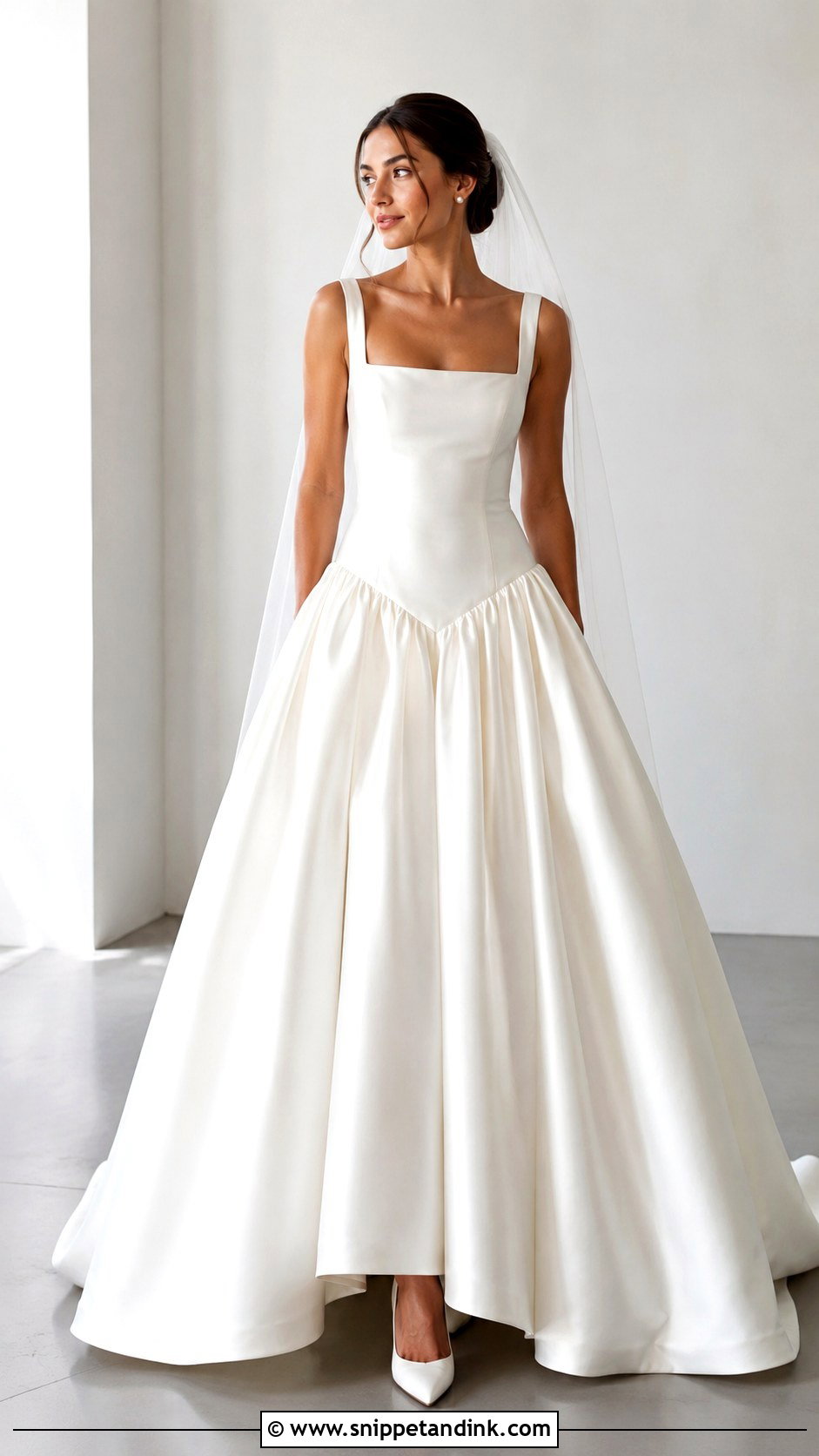
A square neckline needs a fabric that can hold a corner. Smooth satin, Mikado and structured crepe keep the line sharp, while soft lace rounds it off over the course of the day, which some brides actually prefer. The proportion I check is the space between neckline and drop seam. On a short torso, a deep square plus a low waist can leave very little bodice in between, and the dress starts to look chopped. Raising the neckline slightly at a fitting usually fixes it. Pearl studs, a plain veil and low or mid heels suit its modern feel.
12. Scoop Neck Drop Waist Ball Gown Wedding Dress
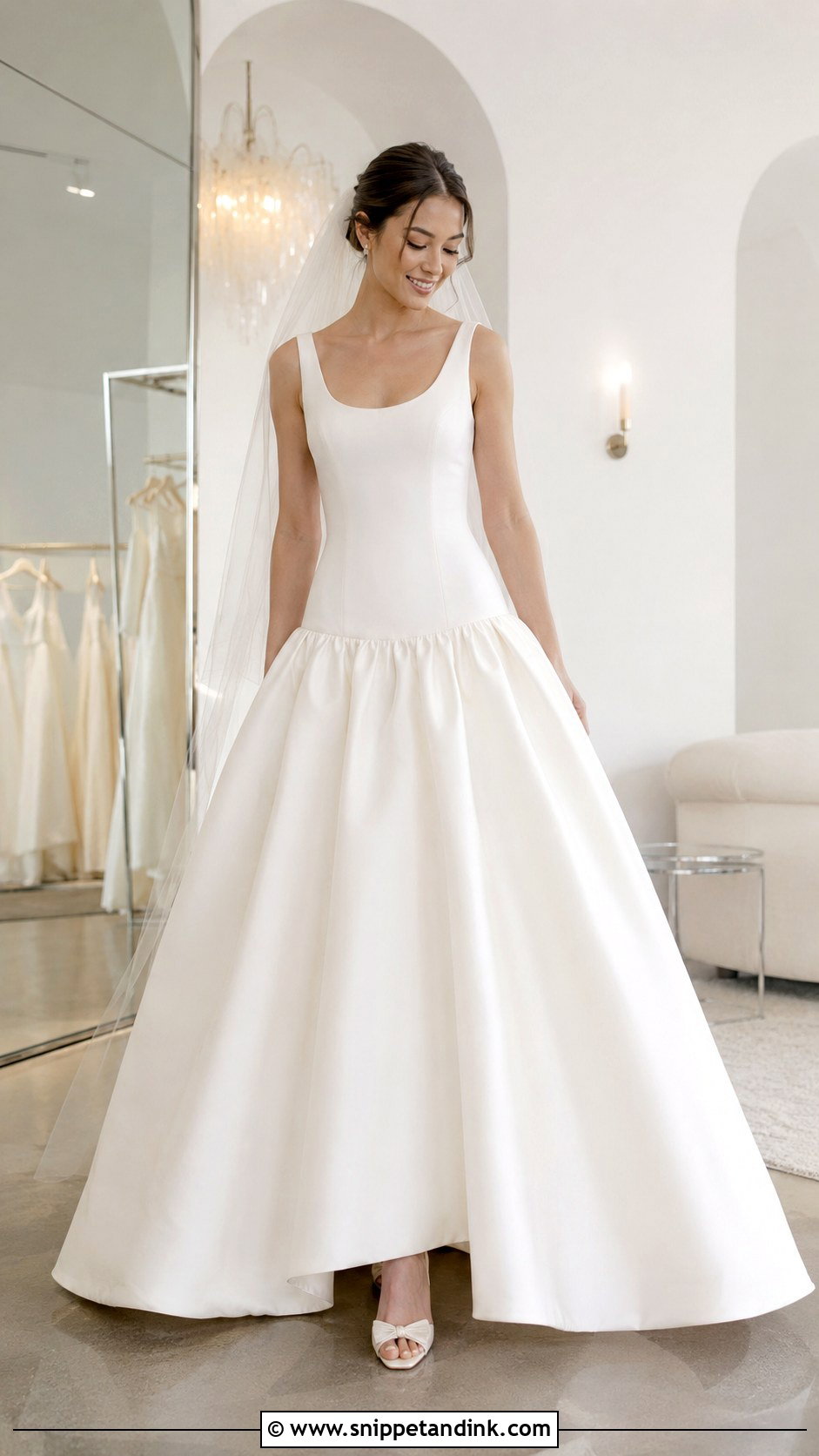
This is the gentlest neckline on the list, softer than a square and less dramatic than a sweetheart. Its weak spot is gaping. Because the curve sits away from the body at the centre, a scoop cut slightly too wide will stand off the chest whenever you lean forward. I pin it at the fitting while the bride bends as if picking up her bouquet from a table. Get that right and it’s comfortable all day in satin, lace or tulle. Delicate earrings, a sheer veil and low ivory heels match its quiet mood.
13. Halter Drop Waist Ball Gown Wedding Dress
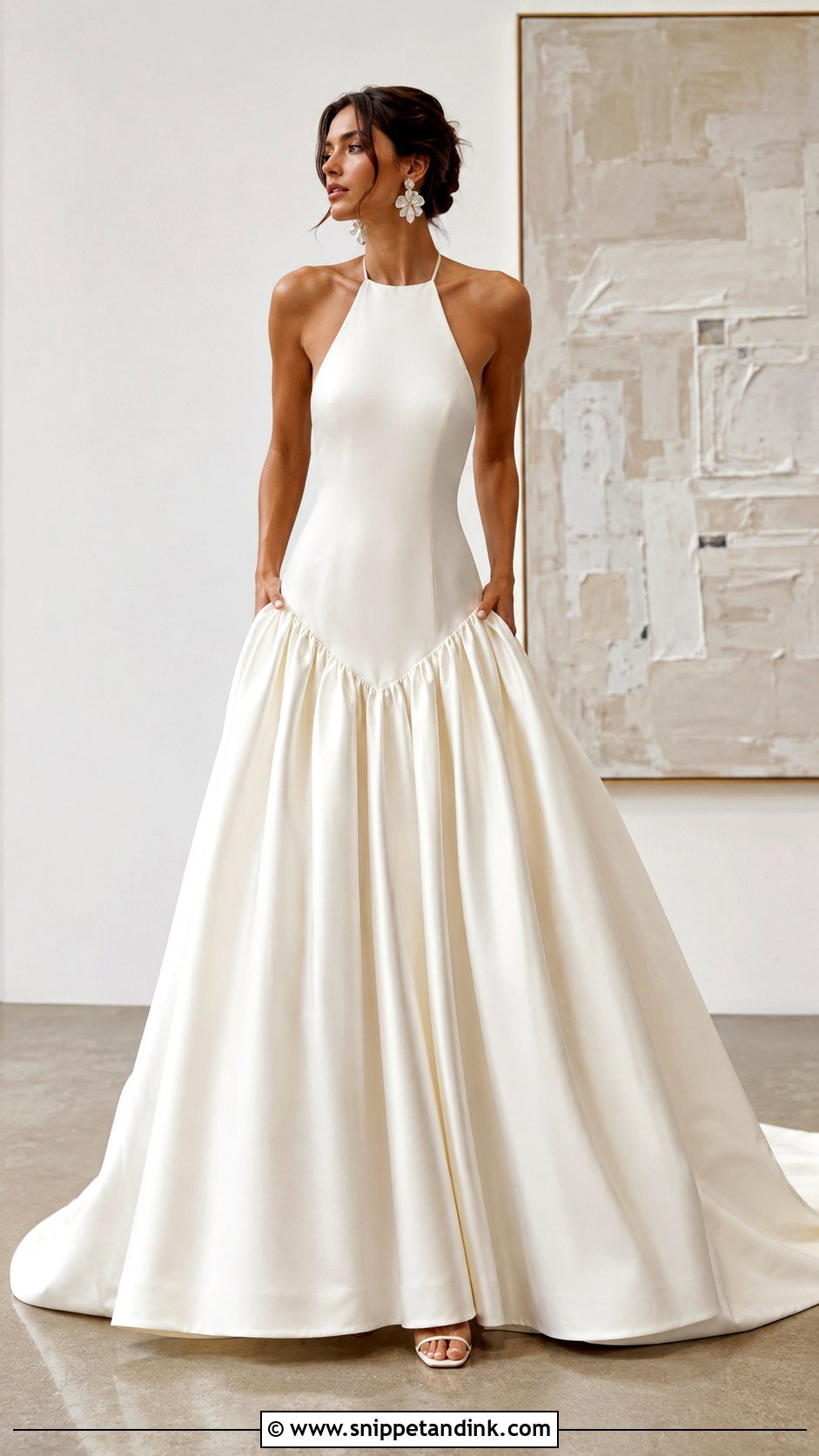
A halter drop waist ball gown draws attention up to the shoulders and face while the low waist keeps the body line long, so you get coverage at the front and plenty of drama in the skirt and train. The neck strap carries some of the bodice’s weight. Check it after an hour, because a heavily beaded skirt can make it dig in at the back of the neck. Wear your hair up so the neckline reads, skip the necklace and let sculptural earrings do the work. Satin looks sleek; a lace or beaded halter looks more detailed.
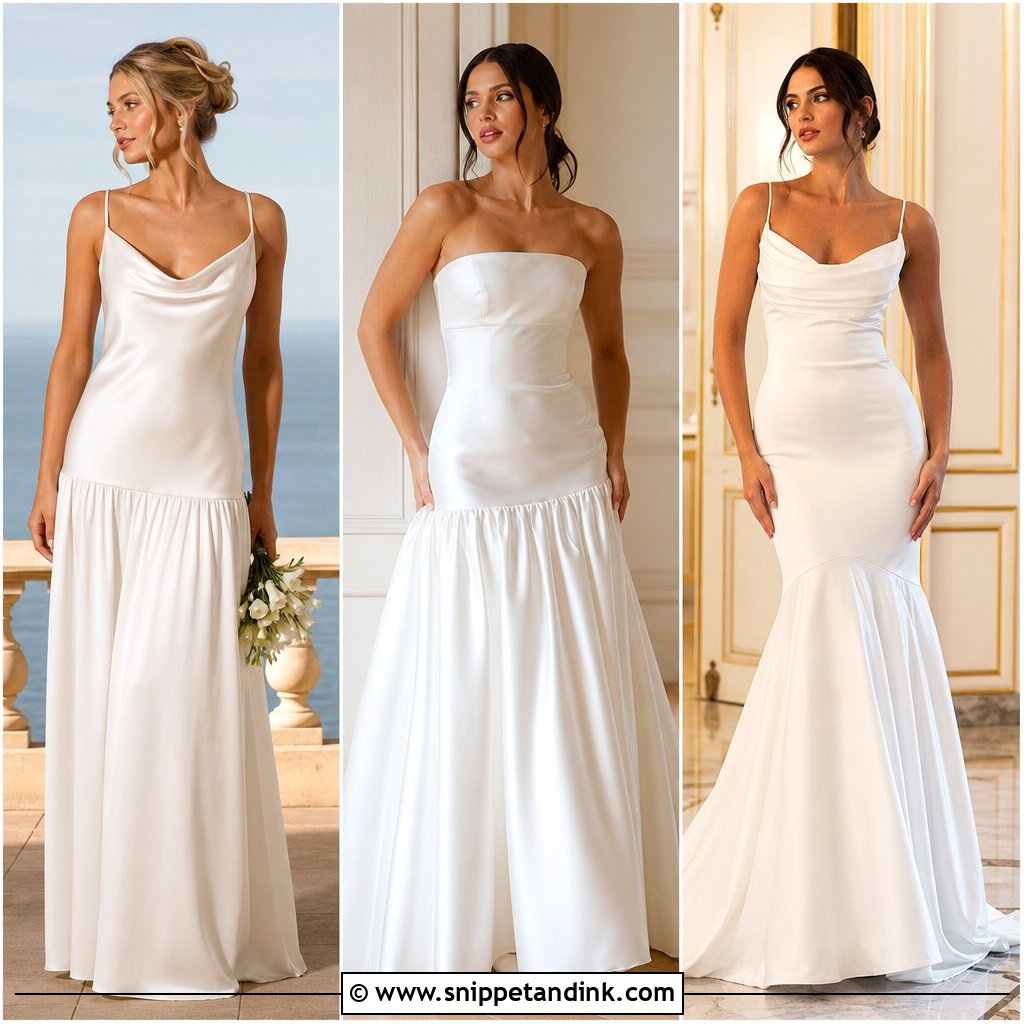
14. Spaghetti Strap Drop Waist Ball Gown Wedding Dress
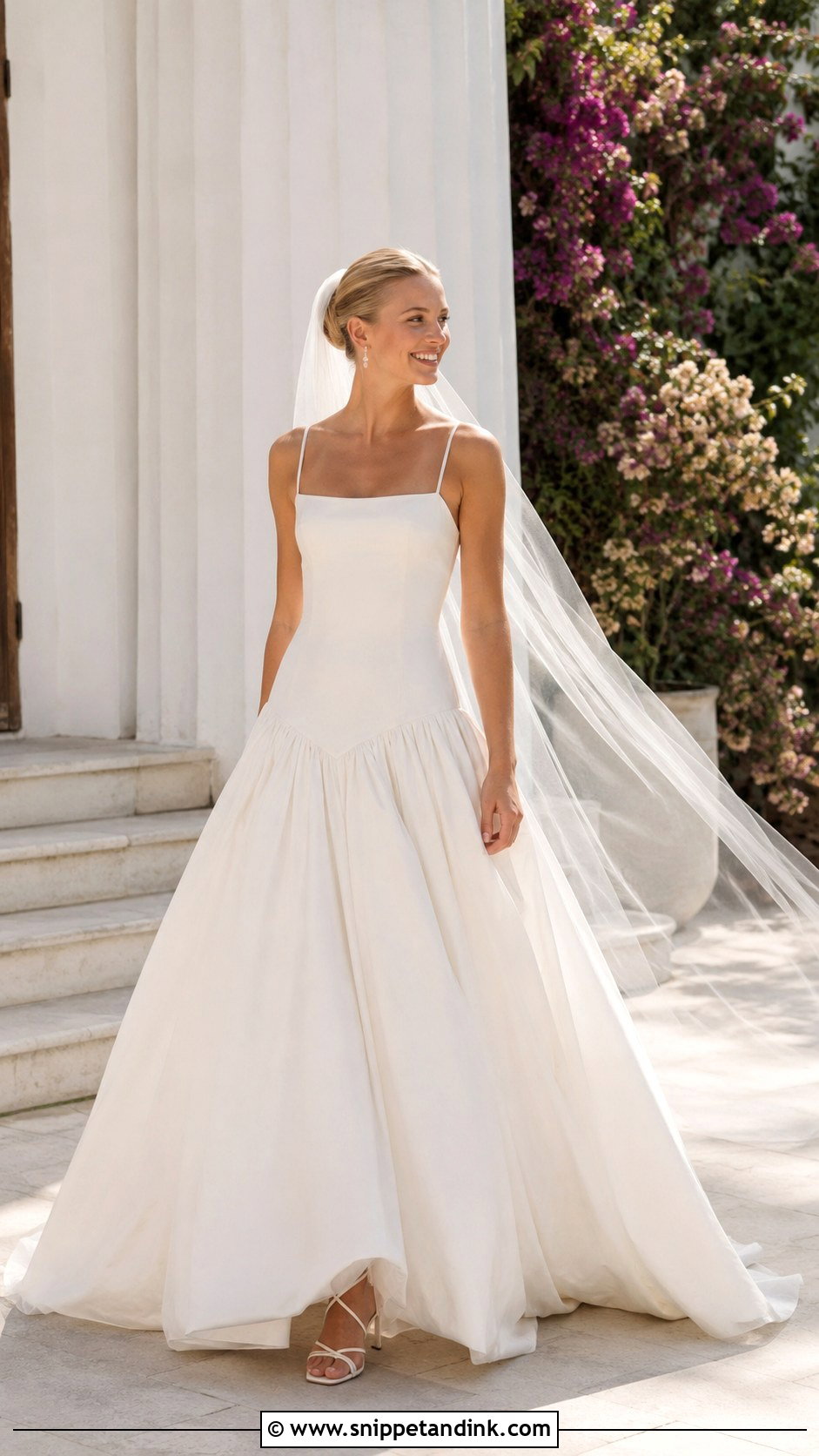
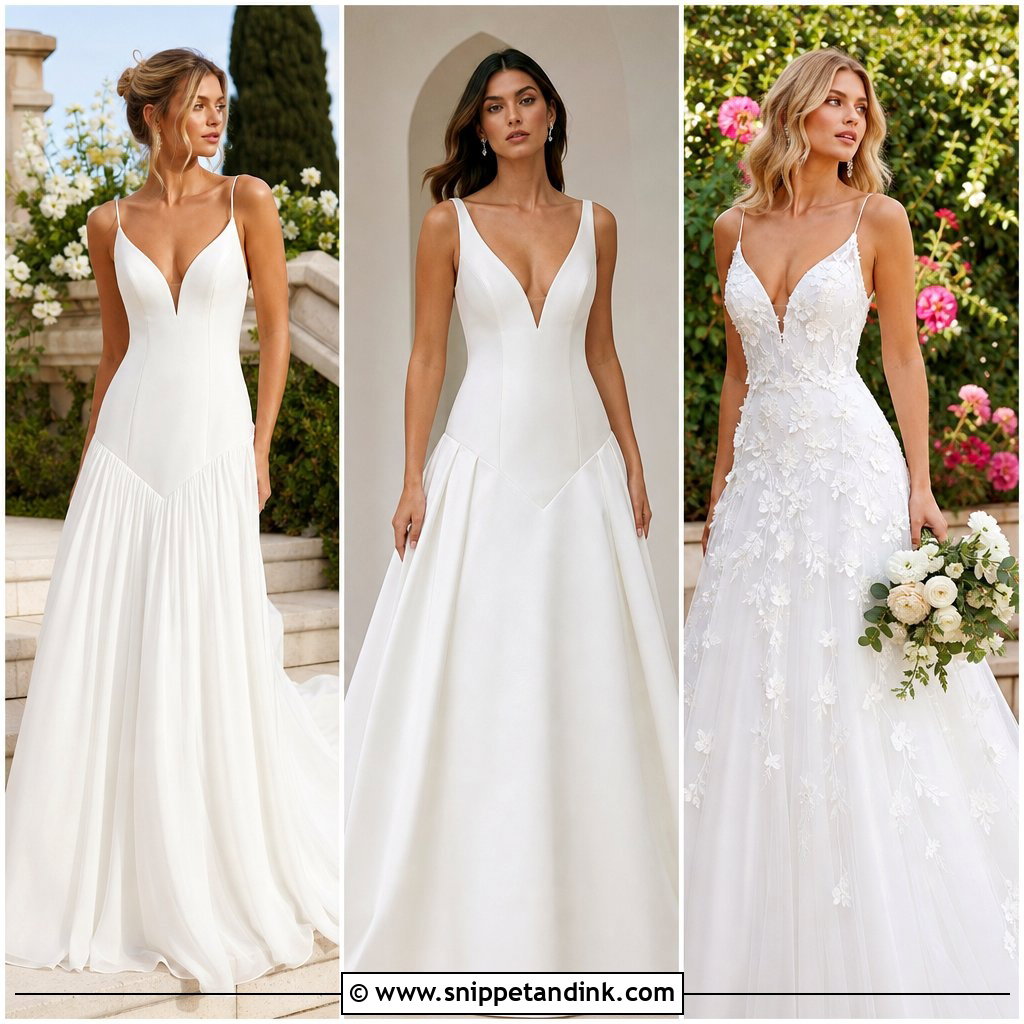
Thin straps make a full skirt look lighter on top, but they don’t hold the dress up. That job belongs to the bodice. I always check that a spaghetti-strap gown stays in place with the straps slipped off the shoulders; if it doesn’t, the straps will be cutting in by the reception. Smooth satin or Mikado gives a minimal finish, and lace or soft draping adds detail. Strappy heels, a sheer veil and small pearl or crystal earrings keep the upper half delicate.

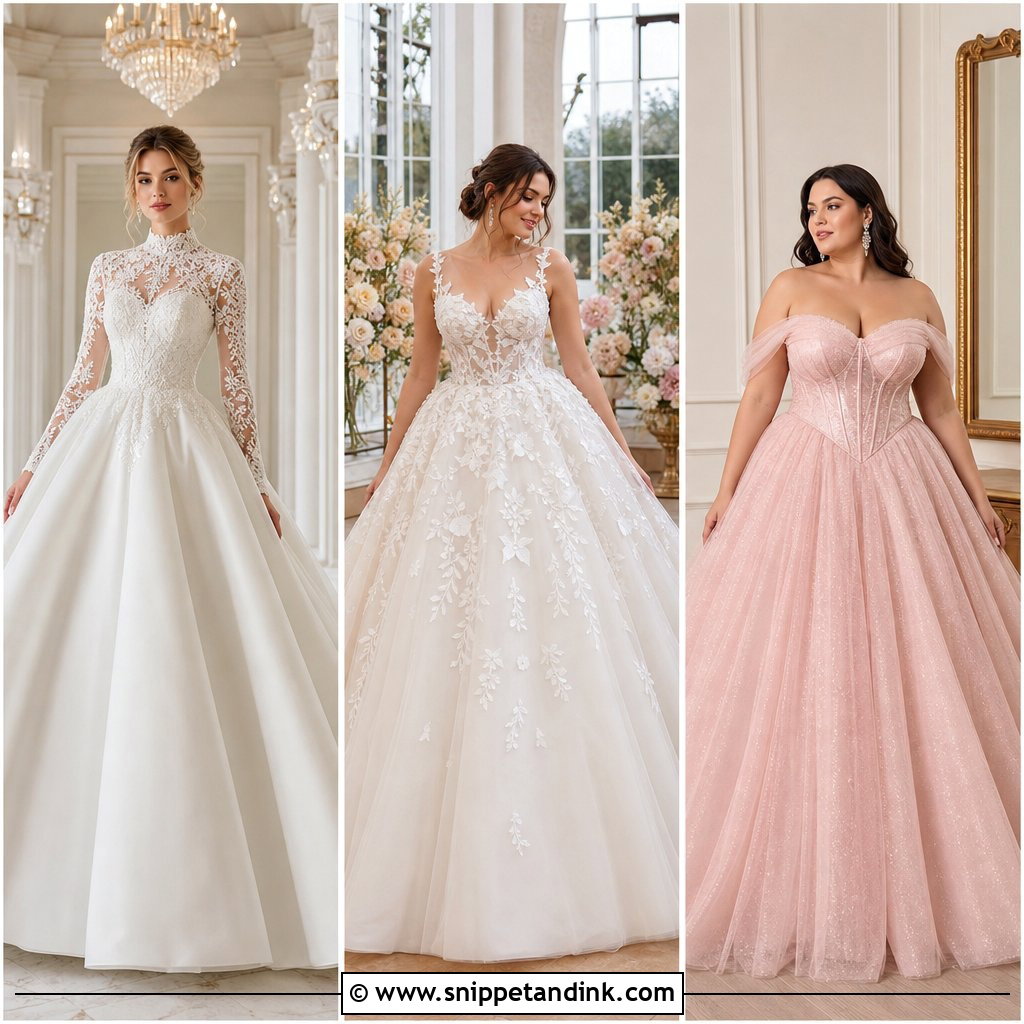

15. Beaded Drop Waist Ball Gown Wedding Dress
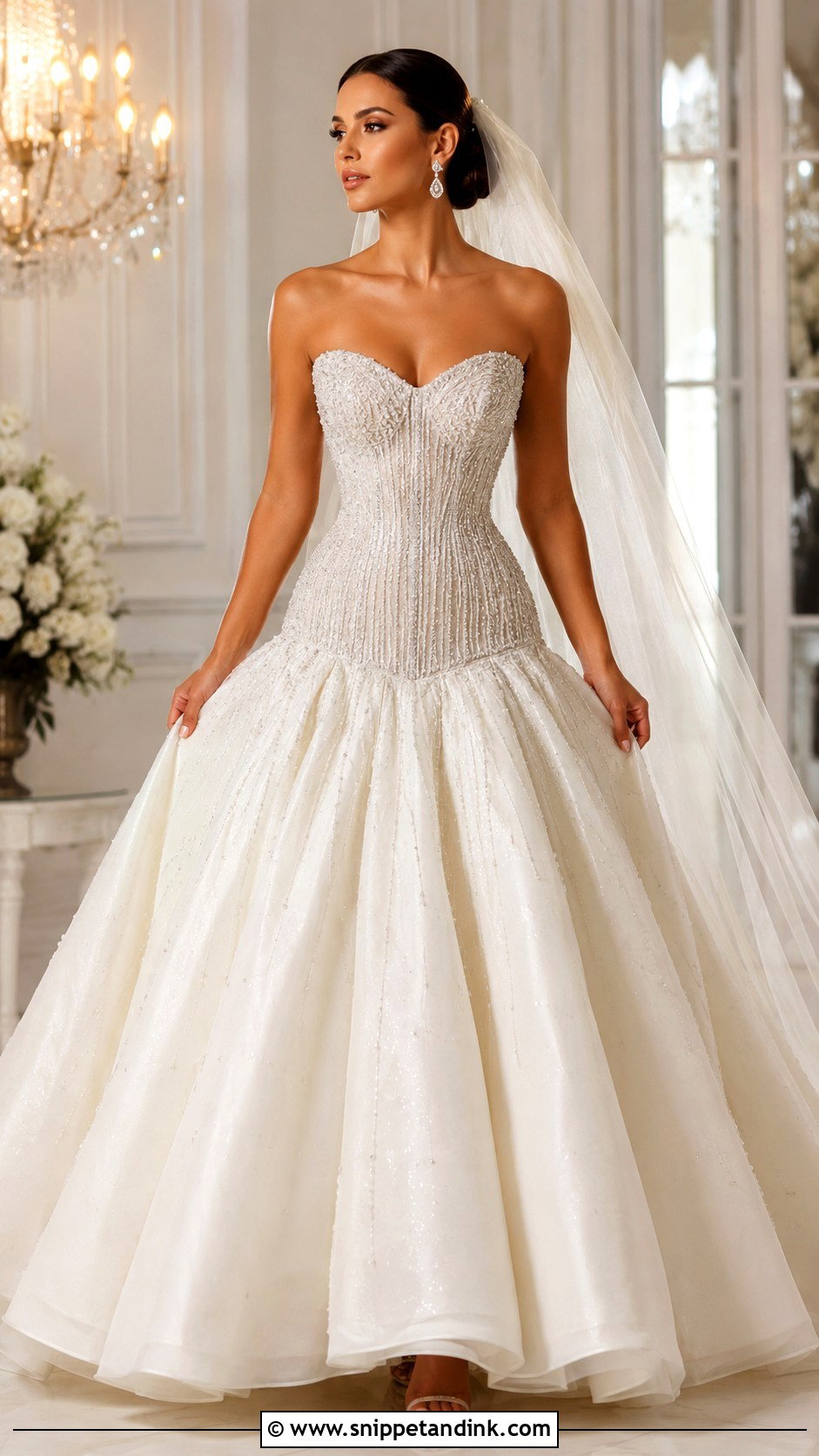
Beading has a long, flat surface to sit on here, and the best gowns use it to draw the waistline itself: dense along the seam, then thinning out into the skirt. Heavy beadwork adds real weight, so I ask how much the bodice weighs and whether there’s a waist stay inside to carry the skirt. Beads also catch on veils, which is why I’d pair this with a veil that has a plain cut edge and keep hair pieces small. Match your earrings to the tone of the beads, silver or gold, and keep the bouquet understated. It reads best at evening receptions under warm light.
16. Pearl Drop Waist Ball Gown Wedding Dress
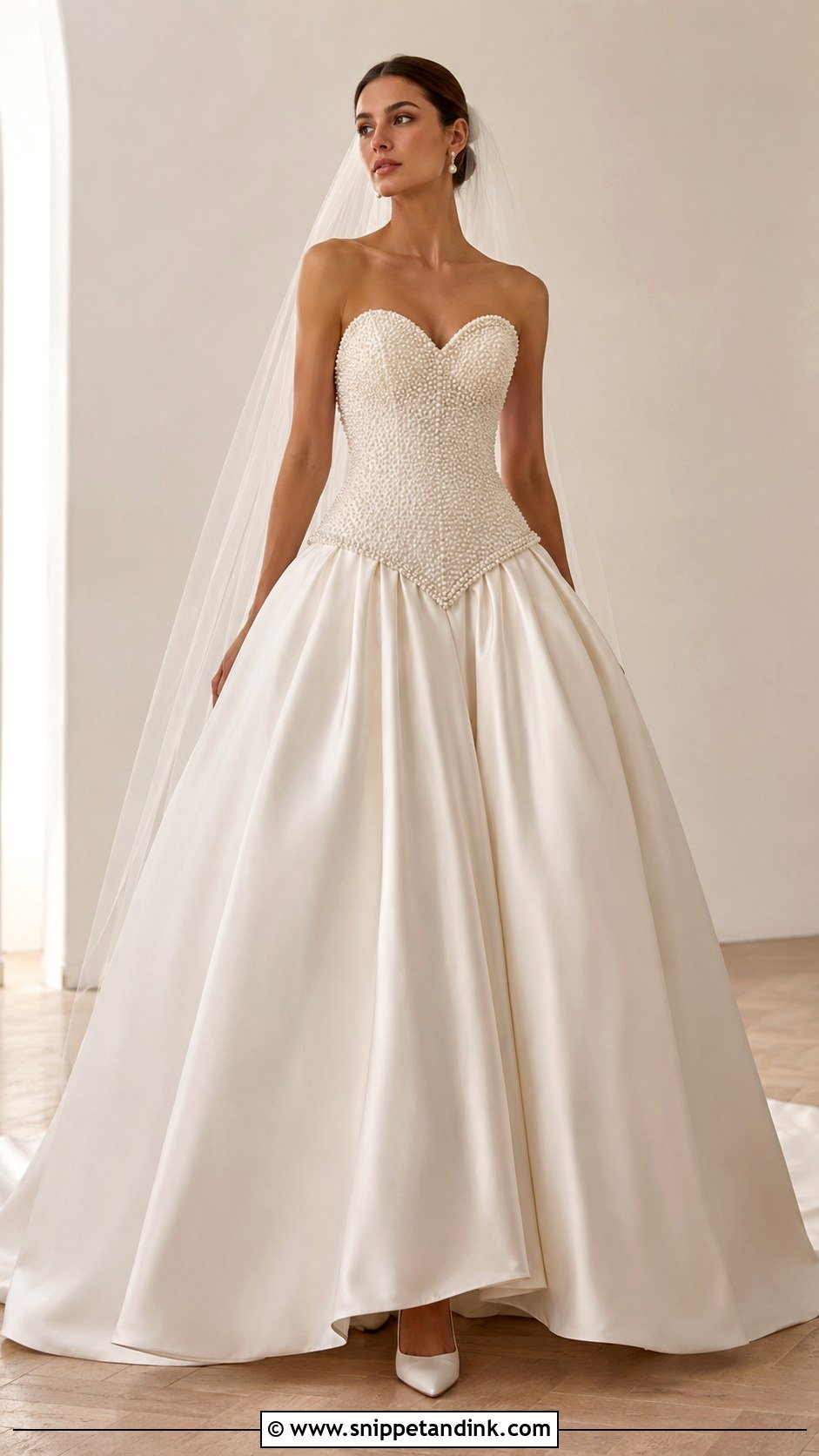
Pearls are the easiest embellishment to overdo. Scattered over the bodice or tracing the neckline, they already supply the shine, and the drop waist gives enough structure to stop them looking sweet. So I keep everything else plain: one pair of pearl earrings, satin pumps, a sheer veil with a simple edge. Sewn-on pearls can work loose during a long day, so ask the shop for a few spares and pack a needle and matching thread in your emergency kit. A smooth bun or soft waves finishes the look.
17. Floral Applique Drop Waist Ball Gown Wedding Dress
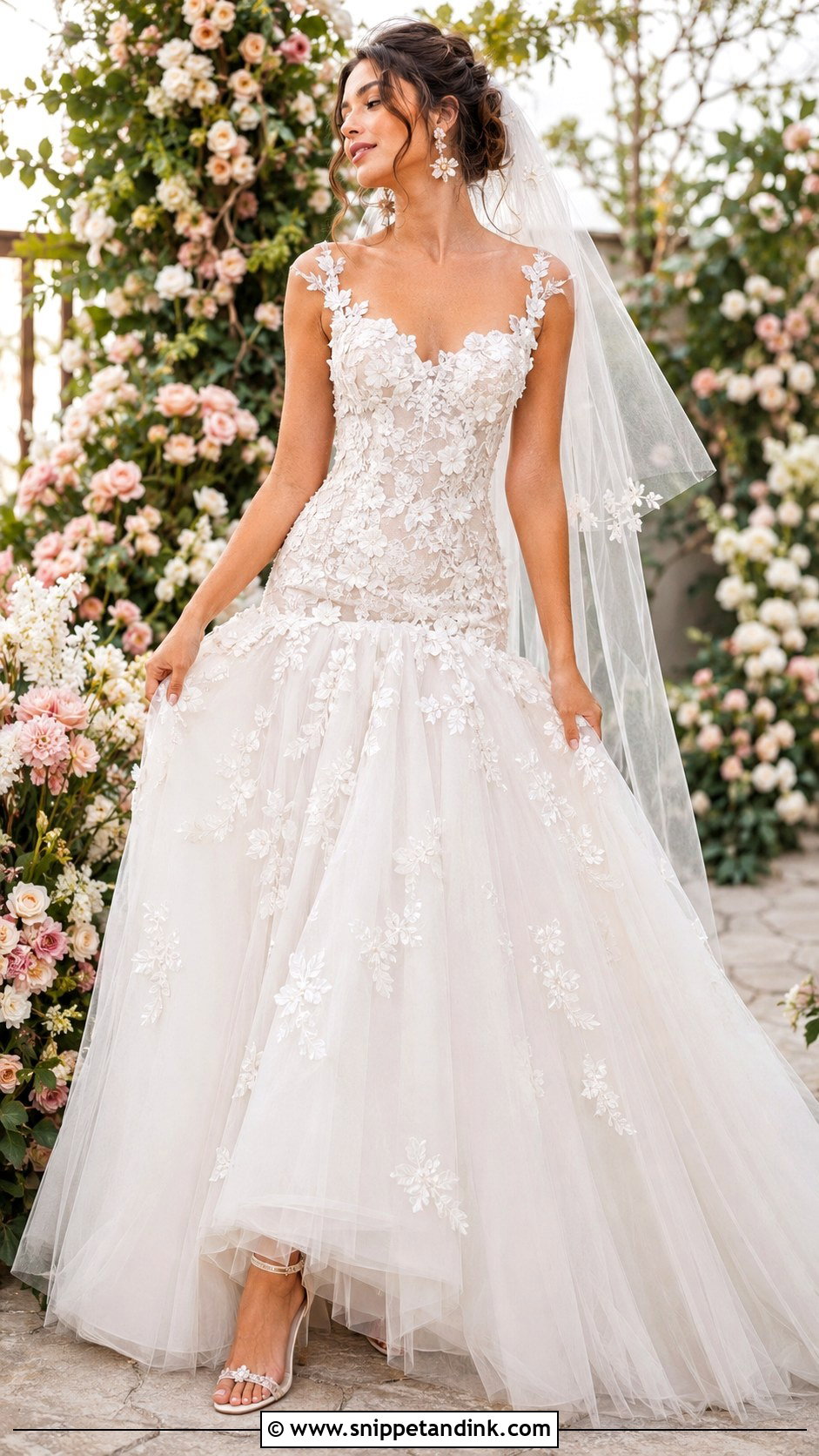
Appliqués need room, and a long bodice gives them more of it, so the flowers can climb from hip to neckline before the skirt starts. Large motifs read from the back of a ceremony; tiny ones only show up close, in detail shots. I always check how they’re attached. Hand-stitched edges lie flat, while glued or loosely tacked petals lift at the tips after a few hours of movement. Choose a veil that doesn’t hide the bodice, delicate heels and earrings with a floral hint. Garden and estate weddings suit it well.
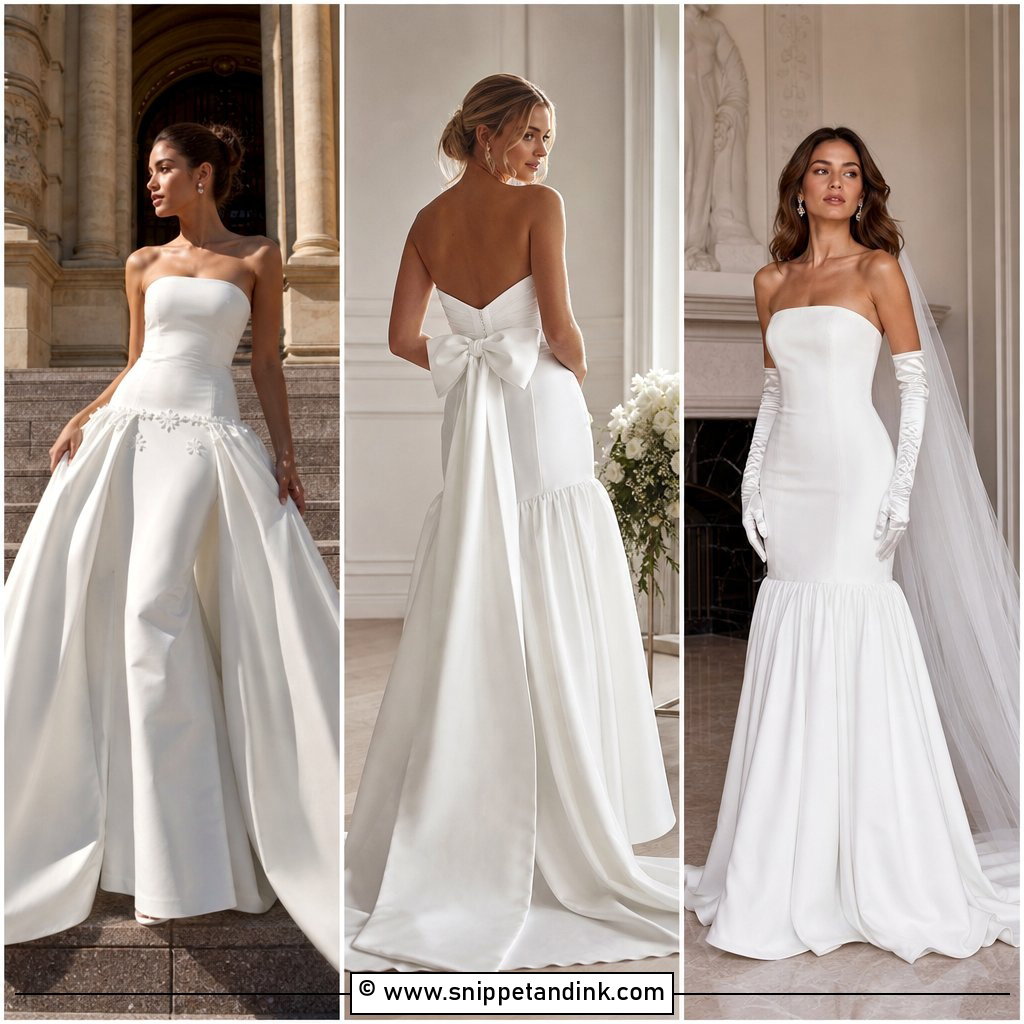
18. Bow Drop Waist Ball Gown Wedding Dress
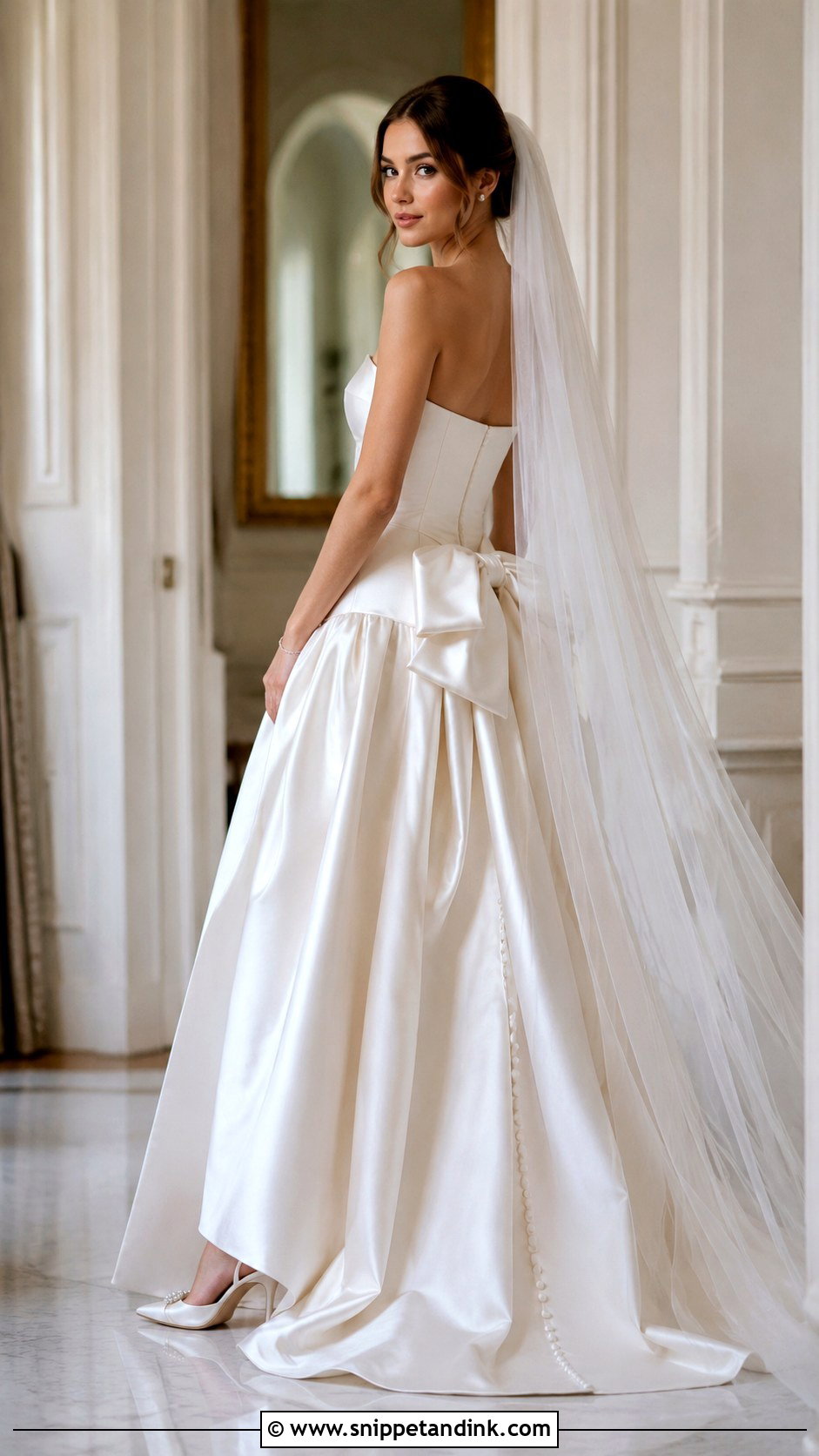
A bow is one detail, and I treat it as one. At the back, it’s covered by a long veil during the ceremony and becomes the focus once the veil comes off. At the hip, it marks the drop waist line directly. Satin and Mikado hold a crisp bow; softer fabrics droop by evening. A practical warning: a large back bow makes sitting in a chair awkward, so try the gown seated against a chair back before you commit. Keep shoes and jewelry simple so the bow looks deliberate.
19. Minimal Drop Waist Ball Gown Wedding Dress
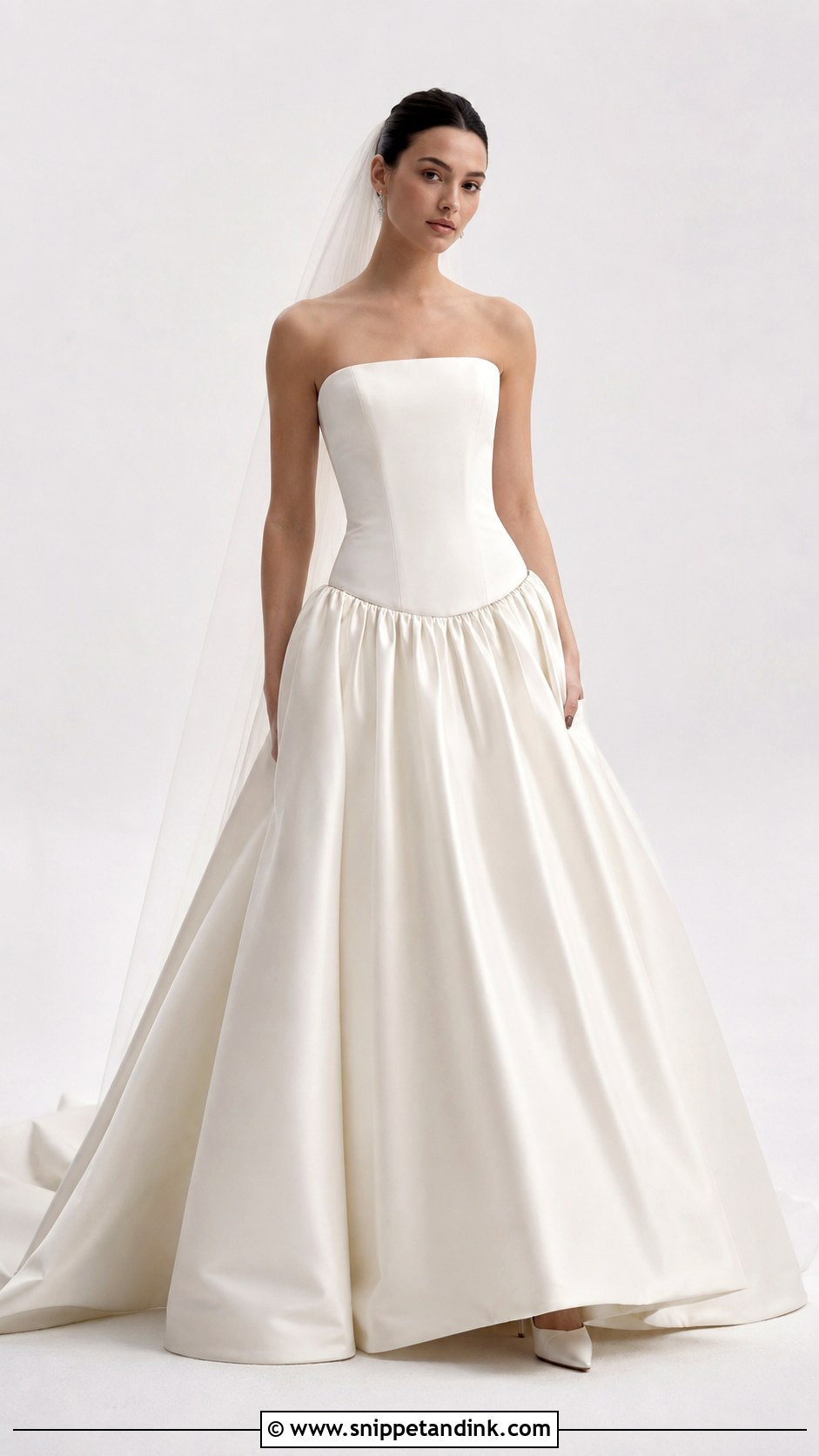
Minimal gowns hide nothing, so the fit has to be exact. With no lace or beading to distract, every pull line at the seam shows up in photos. Satin, Mikado and silk faille hold the shape best, and fabric quality matters more here than anywhere else in this list; cheaper satins show seat creases by the reception. If you want one detail, choose covered buttons down the back or a subtle train. Sleek pumps, a plain veil, refined earrings. Of everything here, this is the gown I expect to date least.
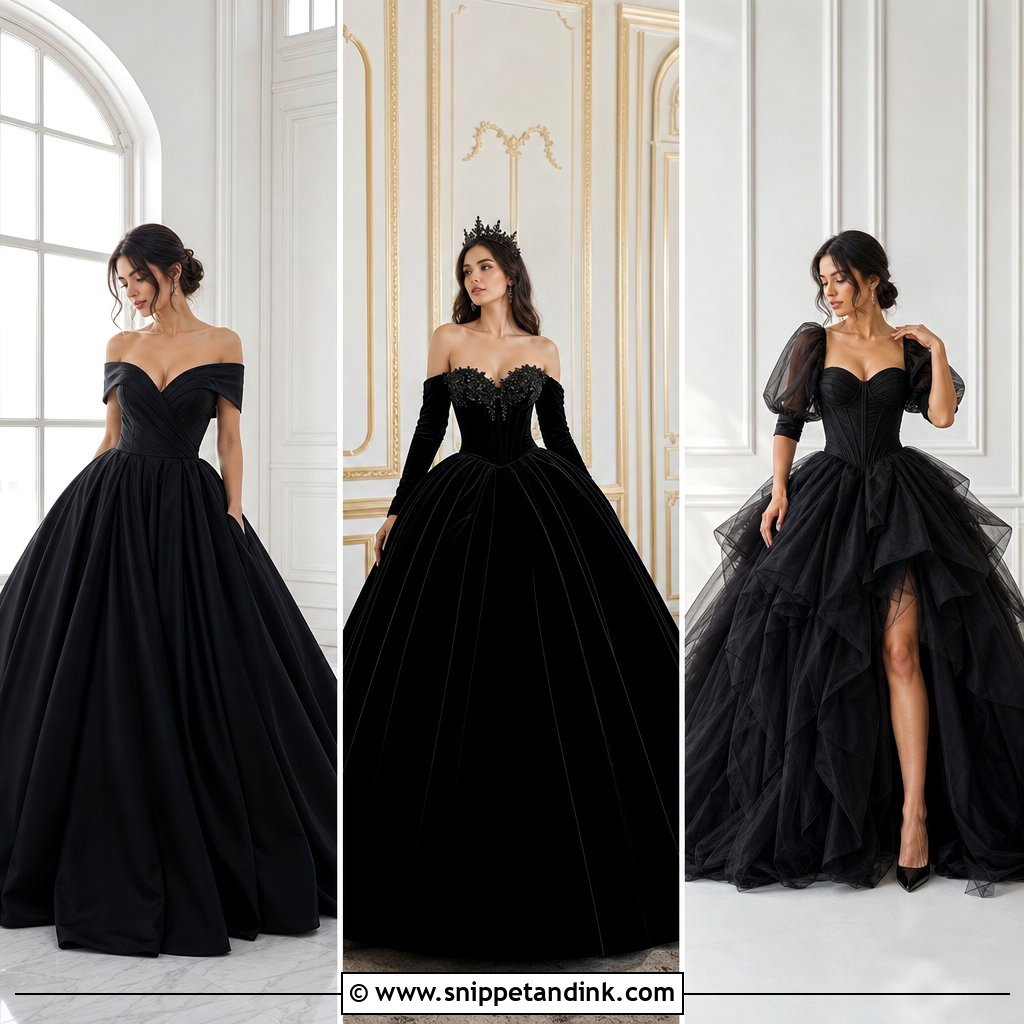

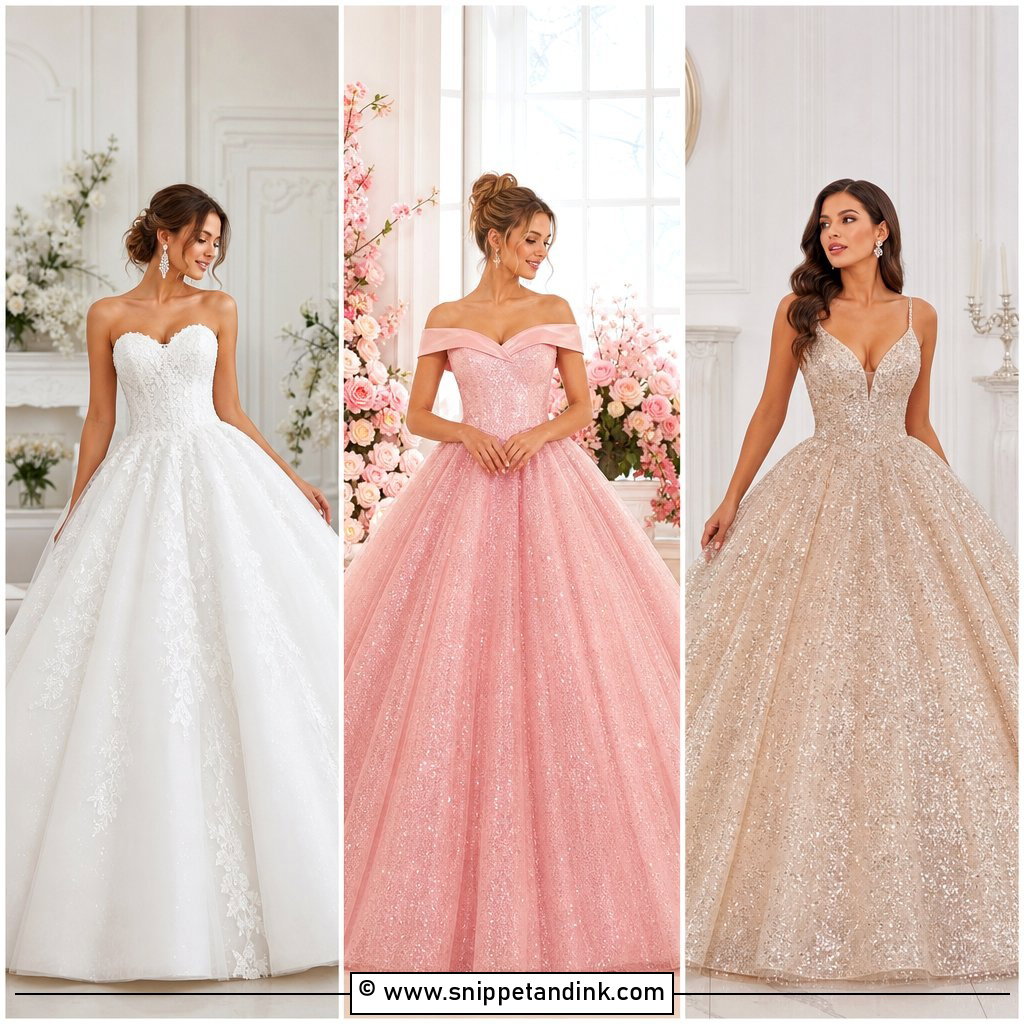
20. Draped Drop Waist Ball Gown Wedding Dress
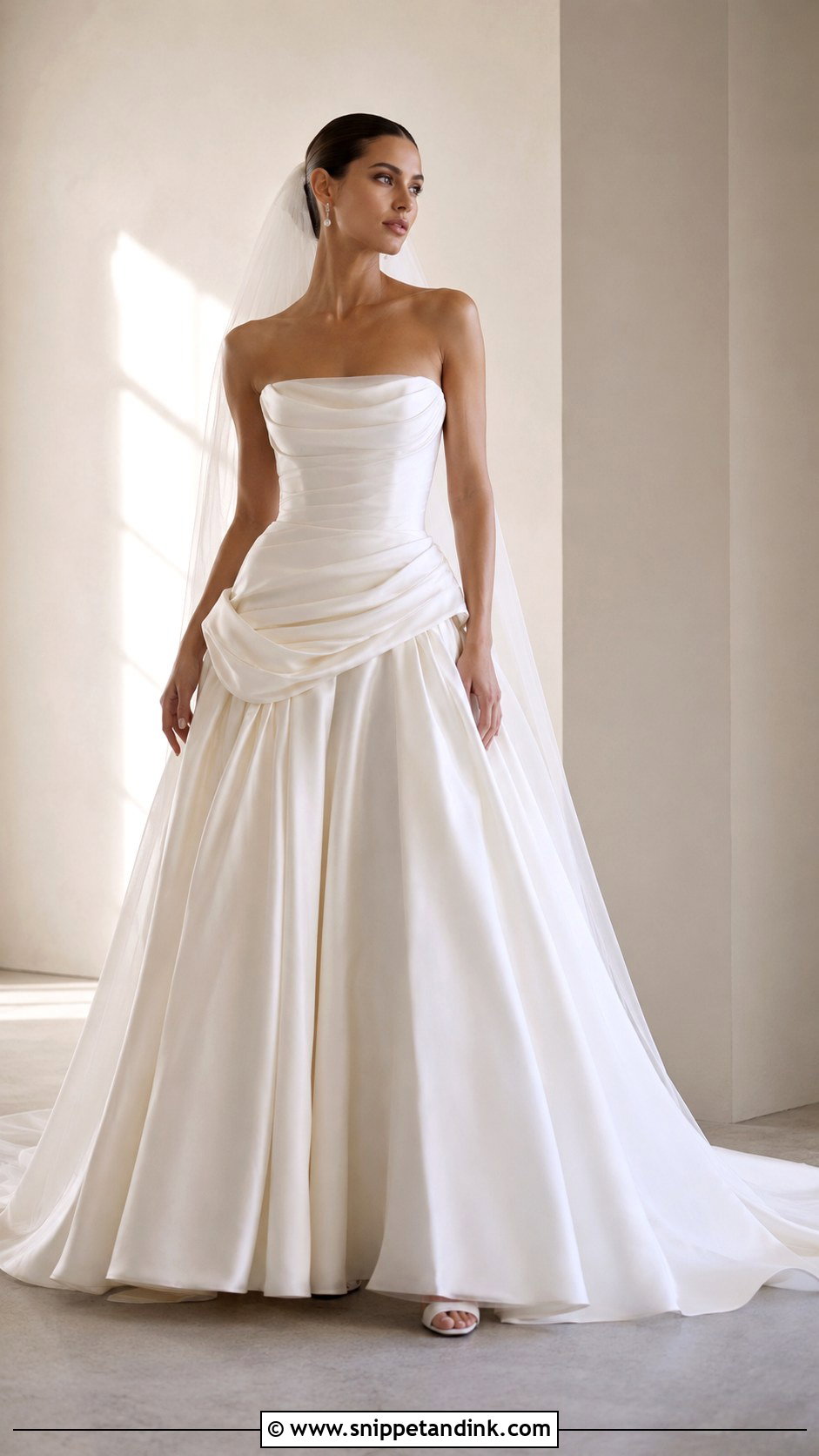
Draping softens structure, and the gathering point is where I look hardest. Fabric can wrap across the bodice, gather at the hip or sweep into the skirt, but a knot of gathers at the hip adds bulk exactly where a drop waist should look smooth. A good seamstress will move that point up or down until it sits at your narrowest line. Satin and taffeta show folds best. Simple heels, soft earrings and a flowing veil that follows the draped lines complete it.
21. Pleated Drop Waist Ball Gown Wedding Dress
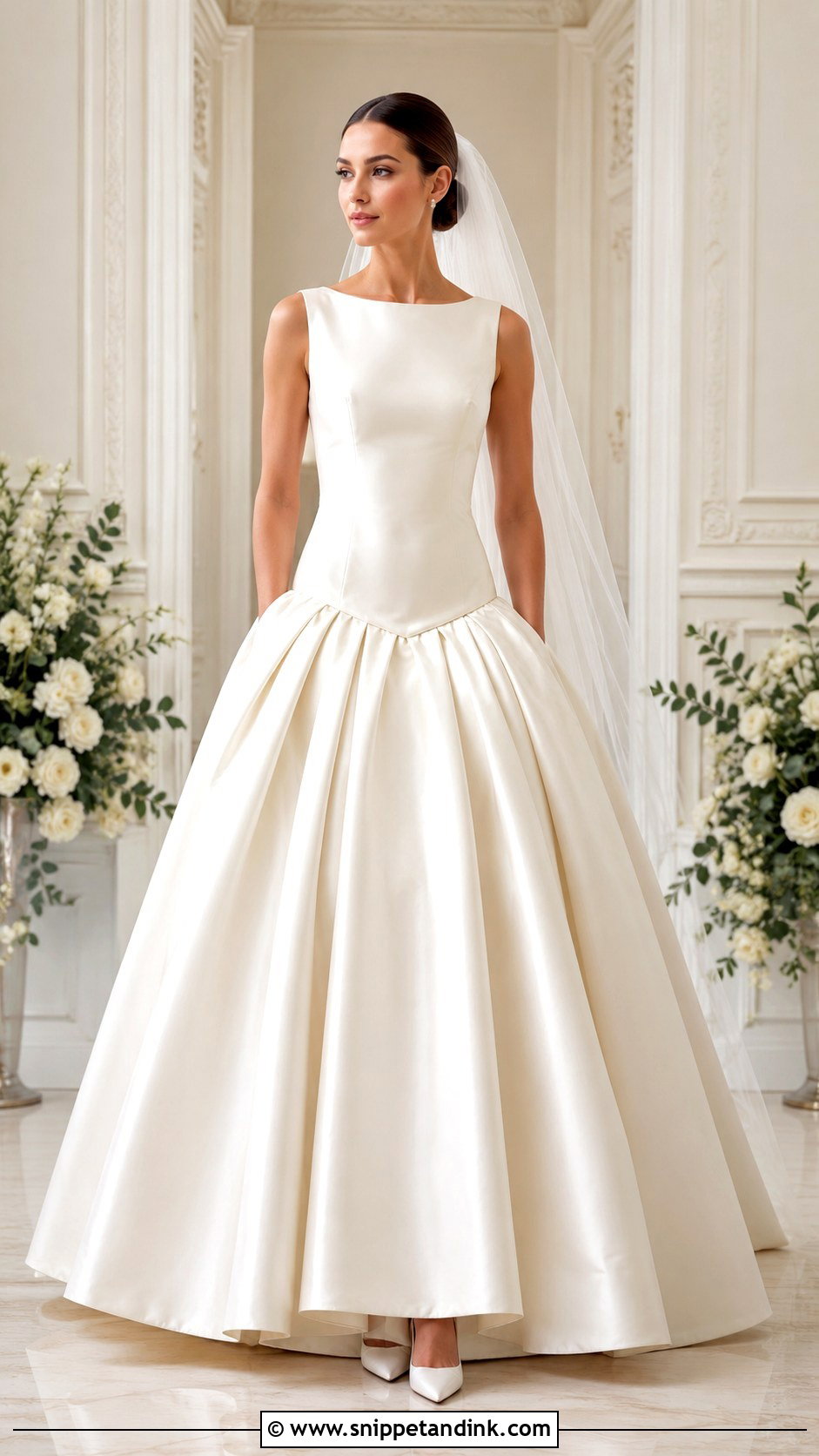
Pleats that start at the lowered seam open as you walk, so the skirt moves without needing heavy layers. Because they begin low on the body, the eye reads one long line from shoulder to hem. Satin, Mikado, organza and taffeta hold pressed lines; softer fabrics lose them within hours. Plan for a press on the morning, and know that box pleats can splay if you sit with your legs crossed for long. Ivory pumps, a clean veil and small earrings are enough. It shines in formal portraits, where those lines stay crisp.
22. Ruffle Drop Waist Ball Gown Wedding Dress
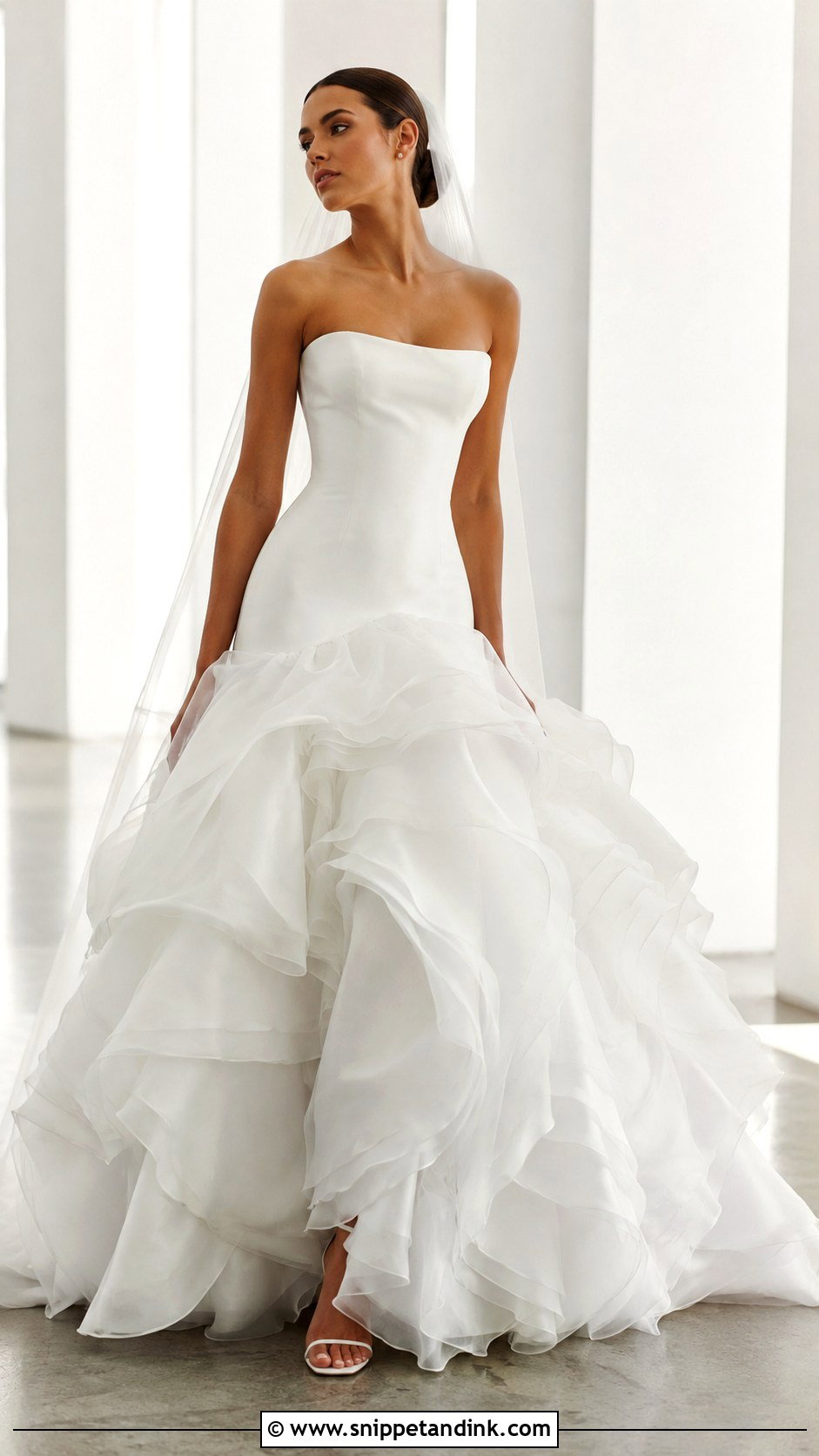
A ruffle drop waist ball gown wedding dress keeps the bodice sleek and builds its volume low on the body, so it’s bold without crowding your frame. Ruffles take up more floor than you expect and sweep up everything they pass over. For petite brides I’d go lighter, with fewer and softer organza or tulle tiers, because dense cascading ruffles can swallow a small frame. Taller brides can carry the bigger editorial version. Simple heels, minimal jewelry and a plain veil leave the skirt in charge.
23. High Neck Drop Waist Ball Gown Wedding Dress
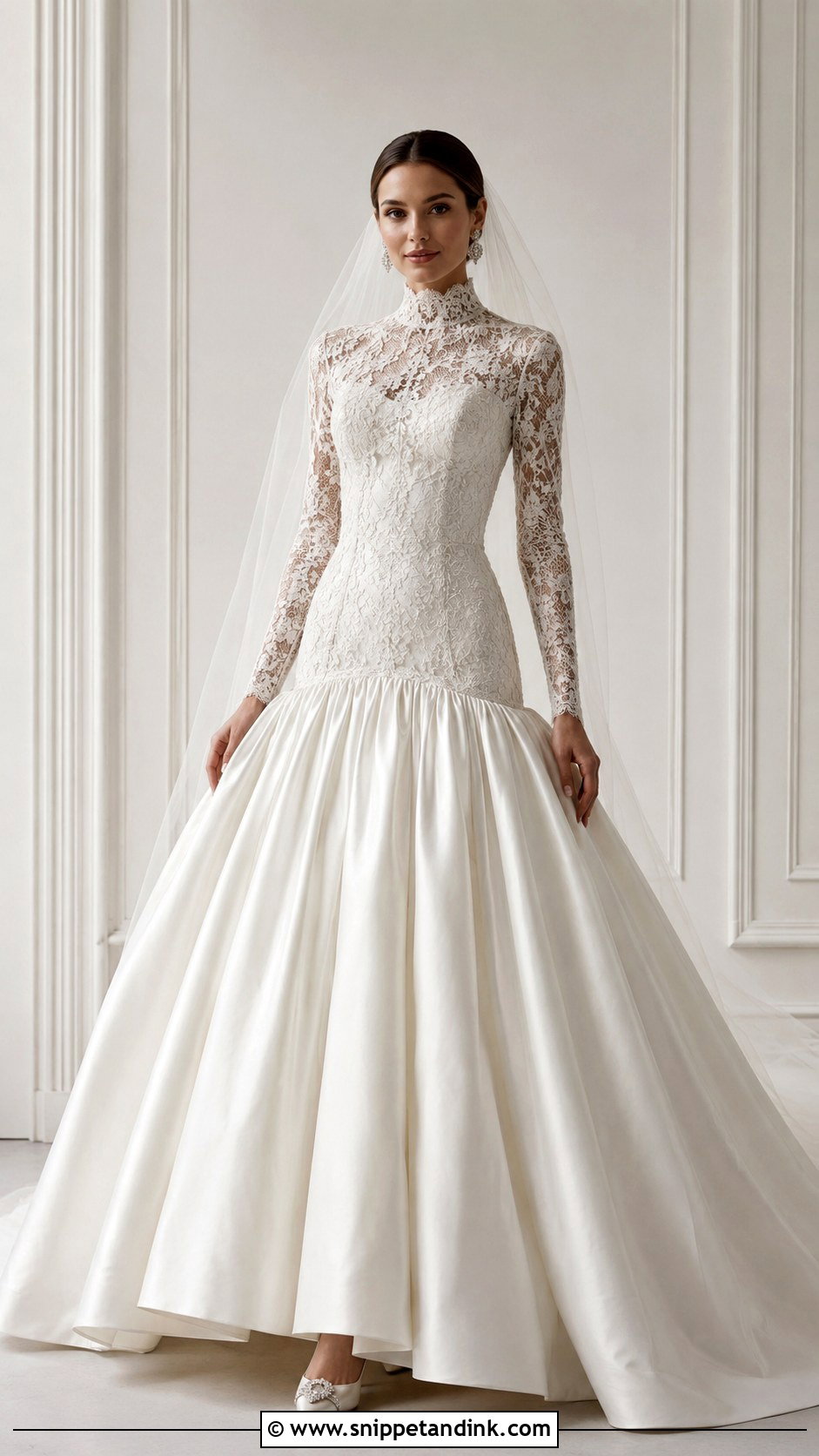
A high neckline brings coverage, and the drop waist stops the gown from looking buttoned-up. The collar should sit flat against the throat without pressing, and I test that seated, since it matters most after dinner. Lace or illusion mesh feels romantic; clean satin looks more architectural. Sweep your hair up so the neck shows, wear statement earrings, and keep the veil plain if the neckline is detailed. It’s a good answer for ceremonies where shoulders should stay covered.
24. Detachable Sleeve Drop Waist Ball Gown Wedding Dress
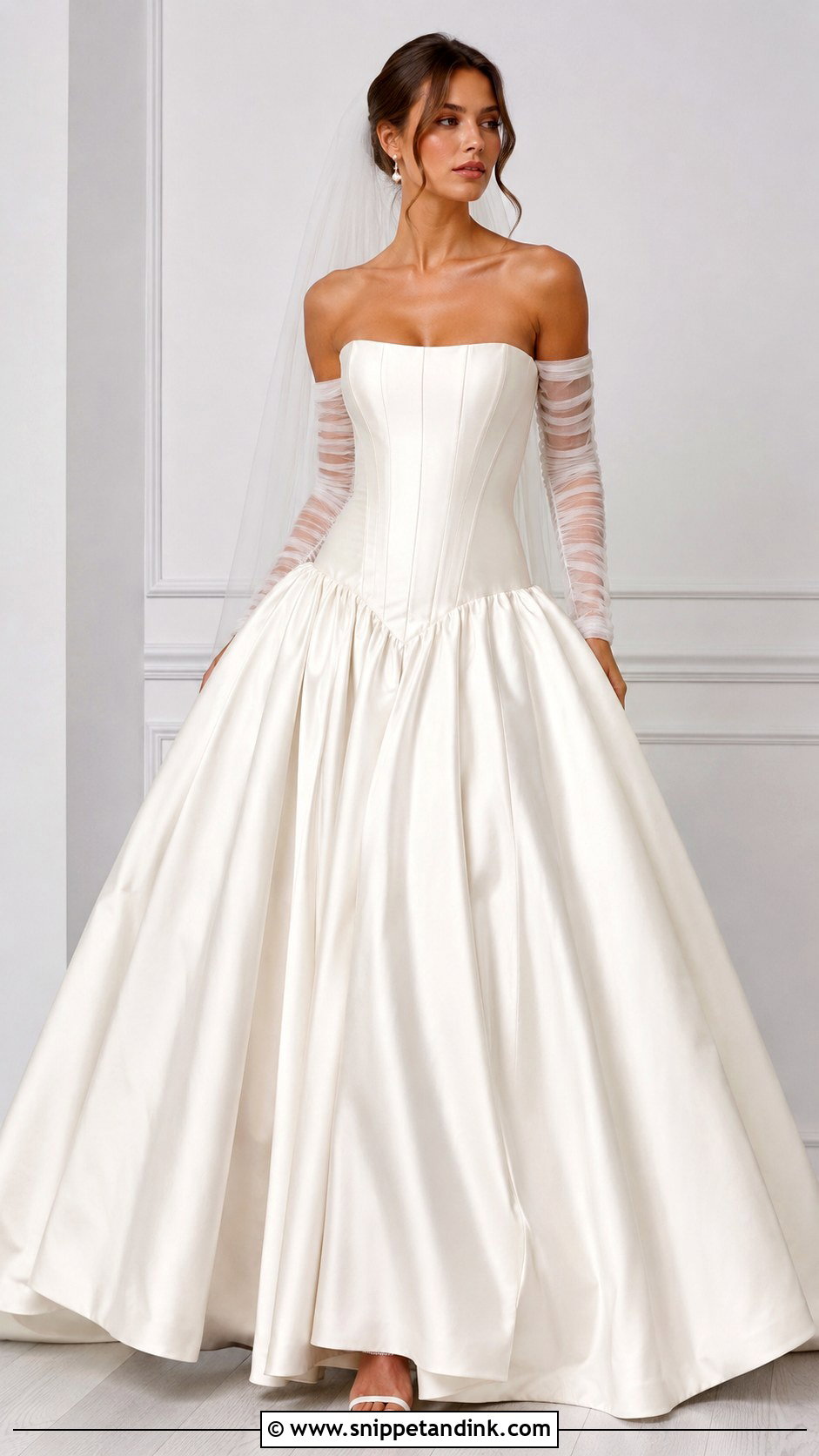
Detachable sleeves give you two looks without a dress change: covered for the ceremony, lighter for dancing. The attachment is what I check. Snaps or small hooks inside the armhole are reliable, while ties loosen, and anything that needs a second person to remove it means someone has to be on hand when you want to switch. Puff sleeves are the most dramatic option; slim satin ones look neater. Choose earrings that work with both versions, and wear the sleeves at every fitting so they’re adjusted along with the bodice.
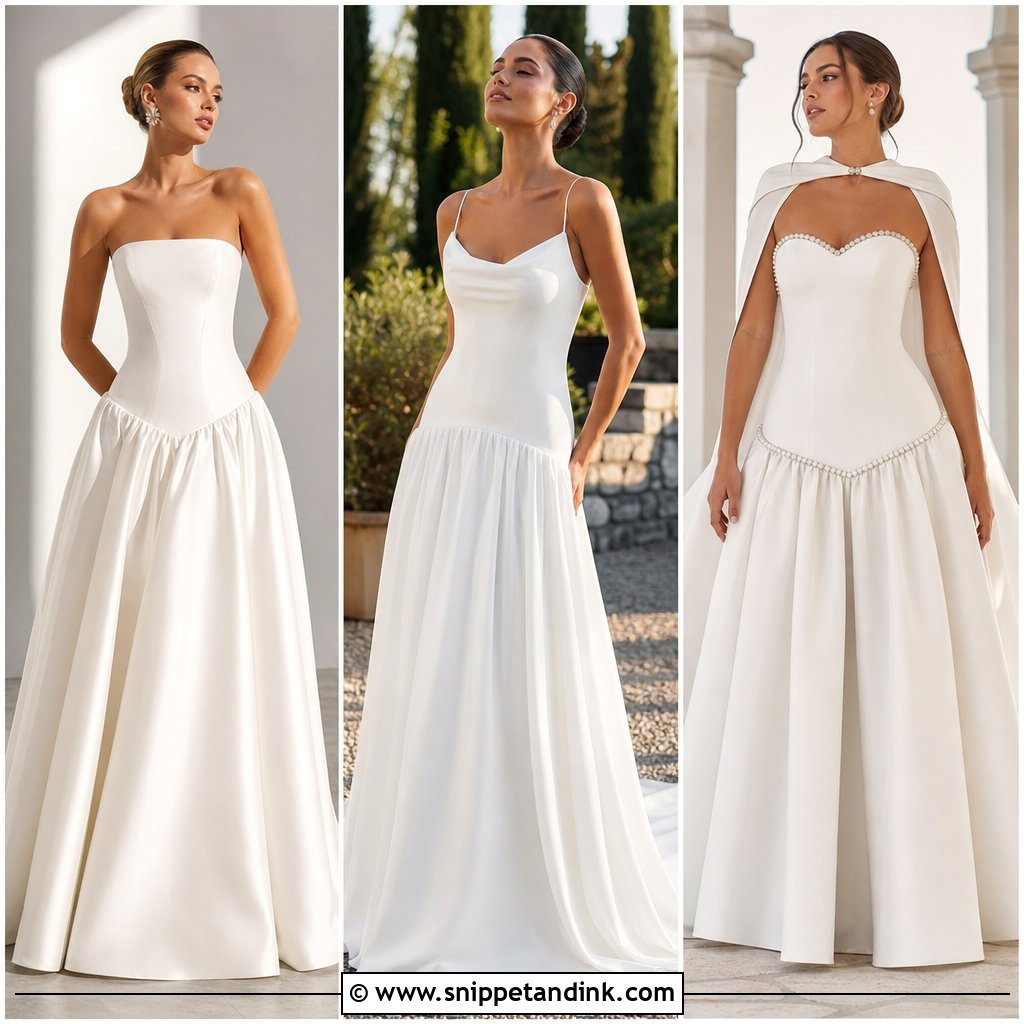
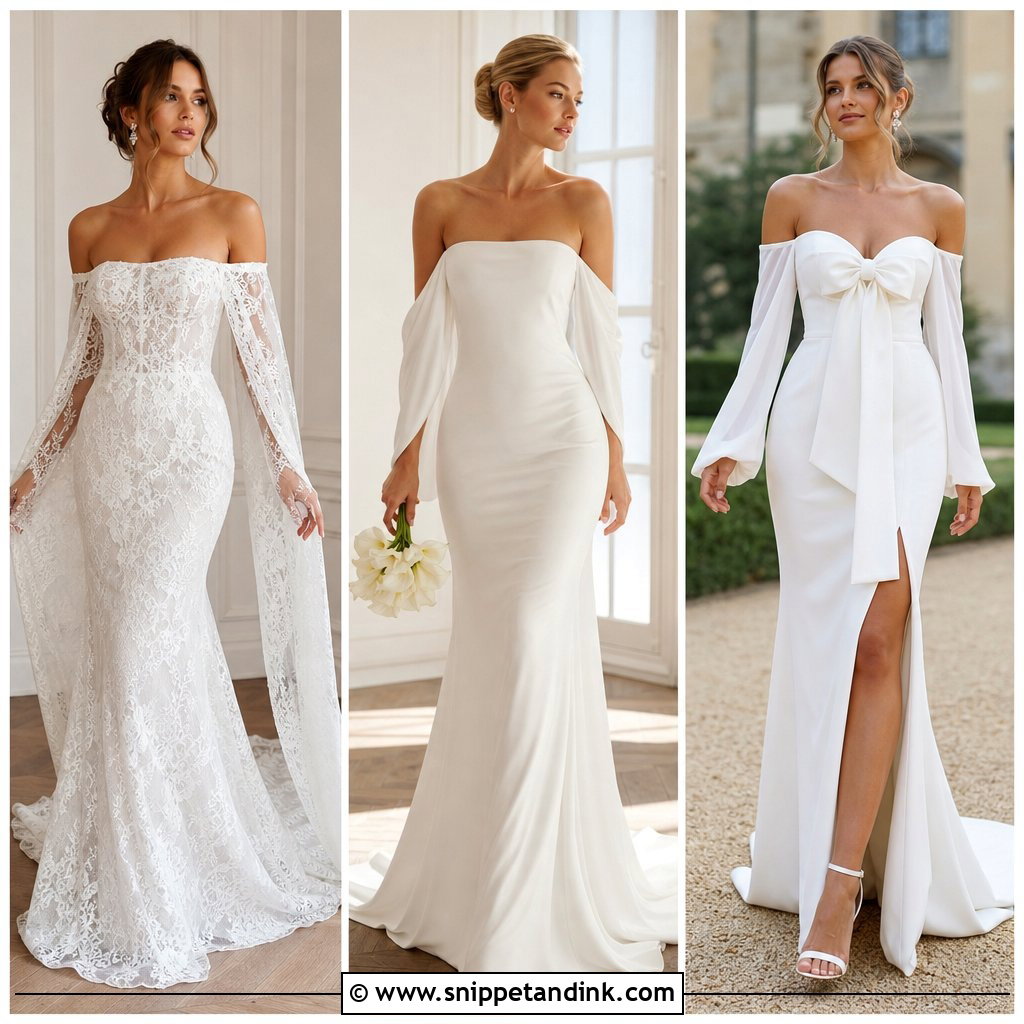


25. Overskirt Drop Waist Ball Gown Wedding Dress
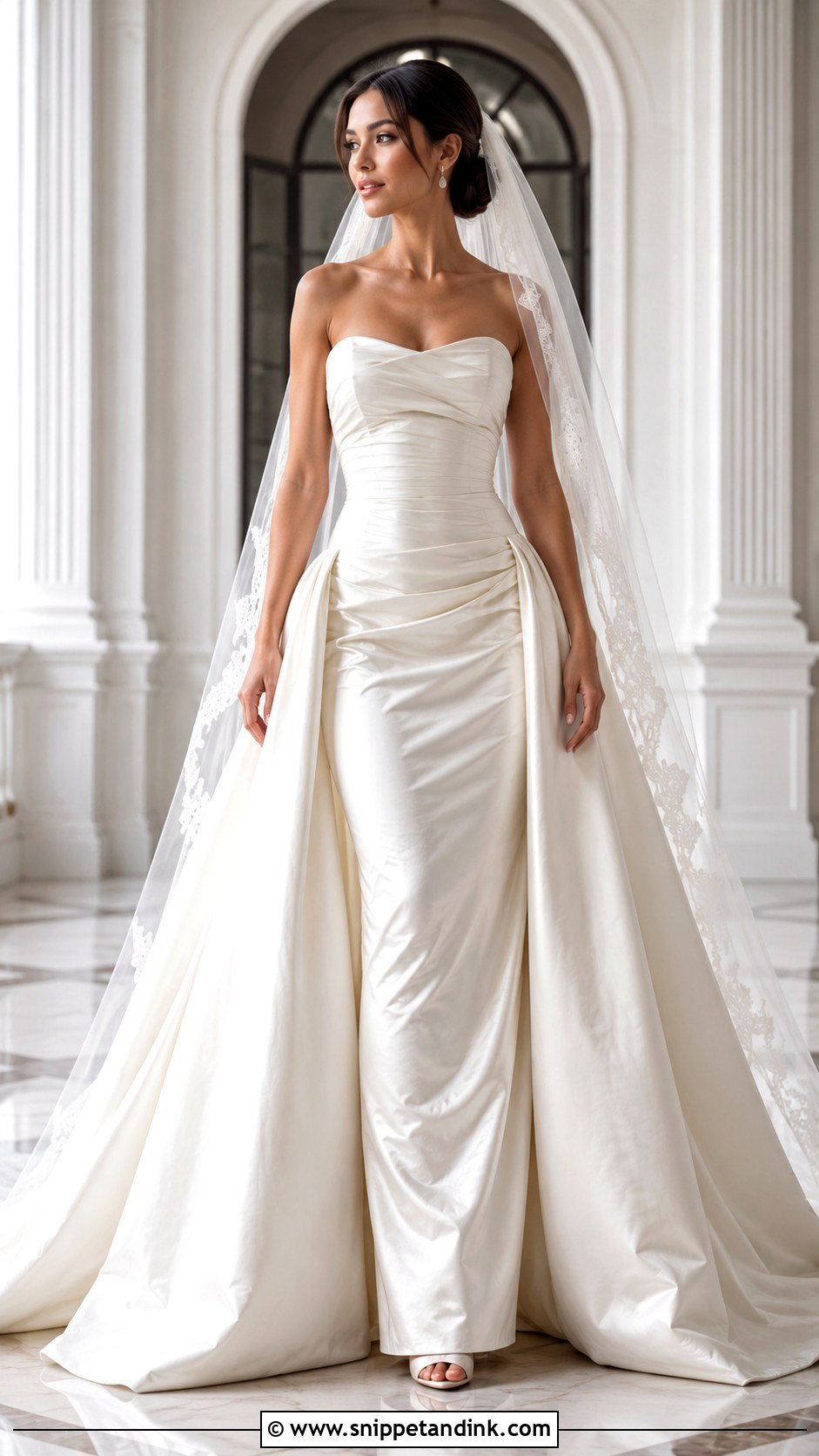
An overskirt drop waist ball gown is really two dresses. The fitted gown underneath goes to the reception on its own once the overskirt comes off, and the full volume is saved for the aisle. Matching fabrics give a clean change, while a sheer tulle overskirt over satin looks softer. Practise taking it off at your last fitting with whoever will help you on the day, because hidden hooks behave differently when you’re tired and the room is loud. Heels, a long veil and simple jewelry suit both halves.
Alterations, Hoops and Bustles for a Skirt This Full
Ball gowns usually take months to arrive once ordered, so I tell brides to start shopping close to a year out and to treat alterations as a separate stage. Fittings normally begin around two to three months before the wedding, with two or three appointments and a final check a week or two before. A drop waist adds work, because moving that seam even slightly means rebalancing the whole skirt, so leave margin in the schedule.
What holds the skirt out
Most of these gowns rely on built-in tulle or a separate petticoat. A hooped underskirt gives the widest, most even shape, but it swings when you sit and needs a gentle hand on the hoop to get through doorways. A soft layered petticoat is quieter and easier to dance in. Bring whichever you’ll wear to every fitting, because the hem is measured with it on, along with your actual shoes.
Bustling a heavy train
An over-bustle hooks the train up to the back of the skirt and shows off the fabric; an under, or French, bustle tucks it beneath and keeps the skirt looking clean. Mikado and heavy satin usually need several points to hold the weight. Ask your seamstress to teach the bustle to a bridesmaid at the final fitting, and have her film it on her phone.
Cars, Stairs and Toilets in a Wide Skirt
Nobody mentions these until the day, so I will. In a car, get in seat first, then gather the skirt in after you; a bridesmaid lifting the back stops it creasing under you for the whole drive. On stairs, lift the front of the skirt with both hands, not one, so the hem doesn’t catch under your toe. For the bathroom, the easiest trick with this much volume is to face the cistern and let a helper gather the skirt forward, or wear a light skirt-holding slip designed for it. Practise all three at home with the petticoat on, and the day will feel far less clumsy.
Seam Placement Decides the Rest of This Gown
Every gown here shares one line: a seam set low on the hip, with a full skirt opening below it. That line lengthens the torso and makes a ball gown feel current, whatever the fabric or trim. My order in a fitting room is always the same. Get the seam in the right place, make sure the bodice is secure enough to forget about, and only then choose the neckline and the detail. Your venue and season will narrow it down from there.
You'll Like These Ideas:




Leave a Reply