
A Filipiniana wedding dress carries more history than most gowns I style, and the brides who want one usually already know which detail matters to them: the sleeves their lola wore, the piña from a particular weaving town, the embroidery. Modern Filipiniana bridal fashion stretches from the classic terno with butterfly sleeves to piña gowns, barong-inspired dresses, detachable overskirts and pared-back reception looks. Below are thirty directions, each with what I’d check about the fabric, the sleeve and the heat before you commit.
Commissioning a Terno From a Dressmaker
Most Filipiniana wedding gowns are made to order, and that changes the timeline. Handwoven piña has to be sourced, and hand embroidery on it is slow work, so I’d start conversations with a couturier six months or more before the wedding. A simpler jusi or organza terno can come together faster, but leave room for at least two or three fittings either way.
At the first appointment, I’d settle these points:
- Fabric authenticity. Ask whether the piña is pure or a piña-silk blend, and ask to handle a swatch. Blends are softer and cheaper; pure piña is crisper and more fragile.
- How the sleeves are built. A butterfly sleeve stays upright because of interfacing or a stiffened inner layer. Ask what they use and how it handles humidity.
- Embroidery placement. Decide where it will show in photos, front, sleeves or train, and how long it adds to the schedule.
- Undergarments. Bring the bra or corset you’ll wear to every fitting, because it changes where the bodice seams fall.
Costs vary widely depending on the fabric and how much handwork is involved, so get a written quote that separates fabric, embroidery and labor.
1. Classic Terno Wedding Dress
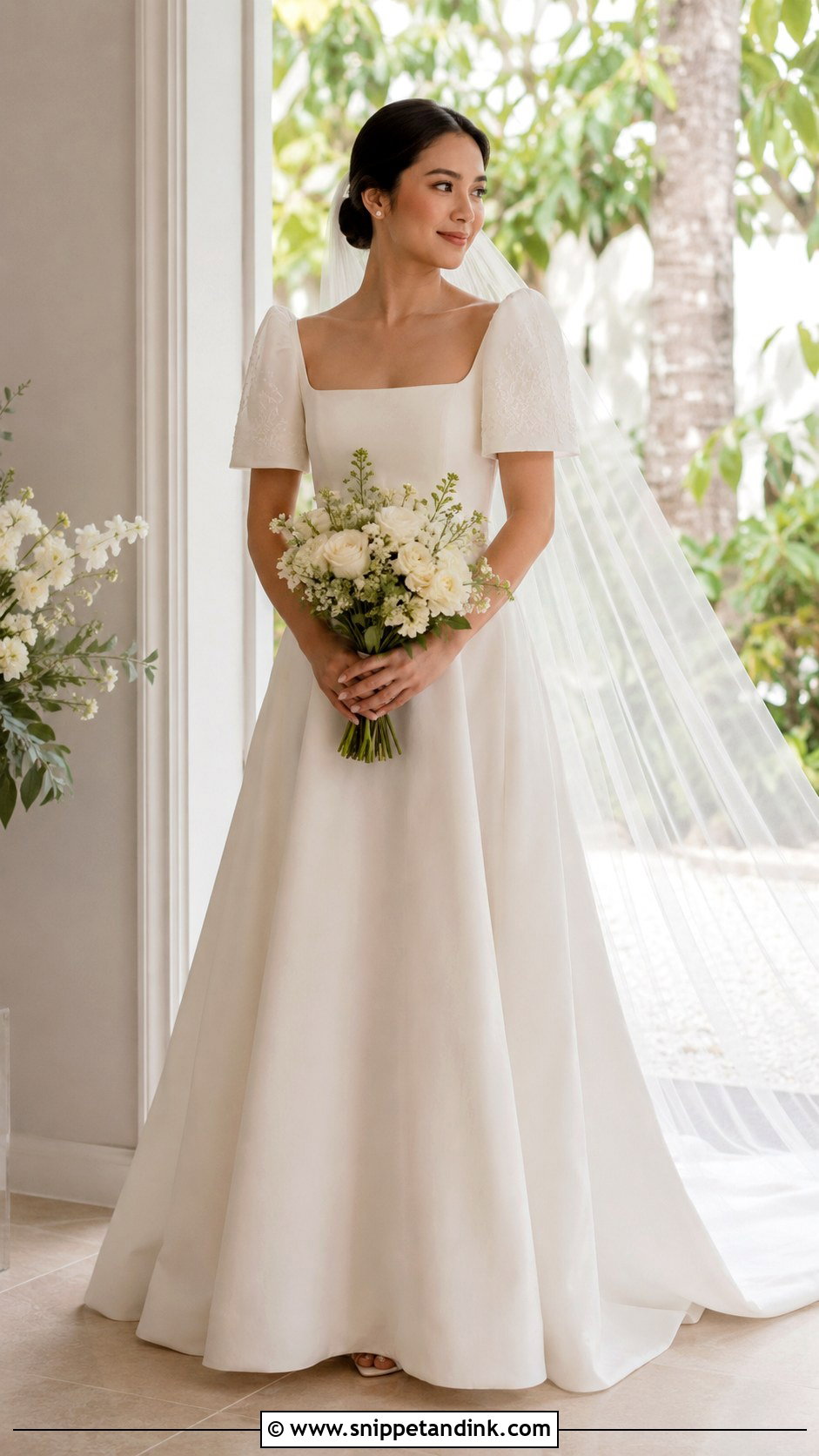
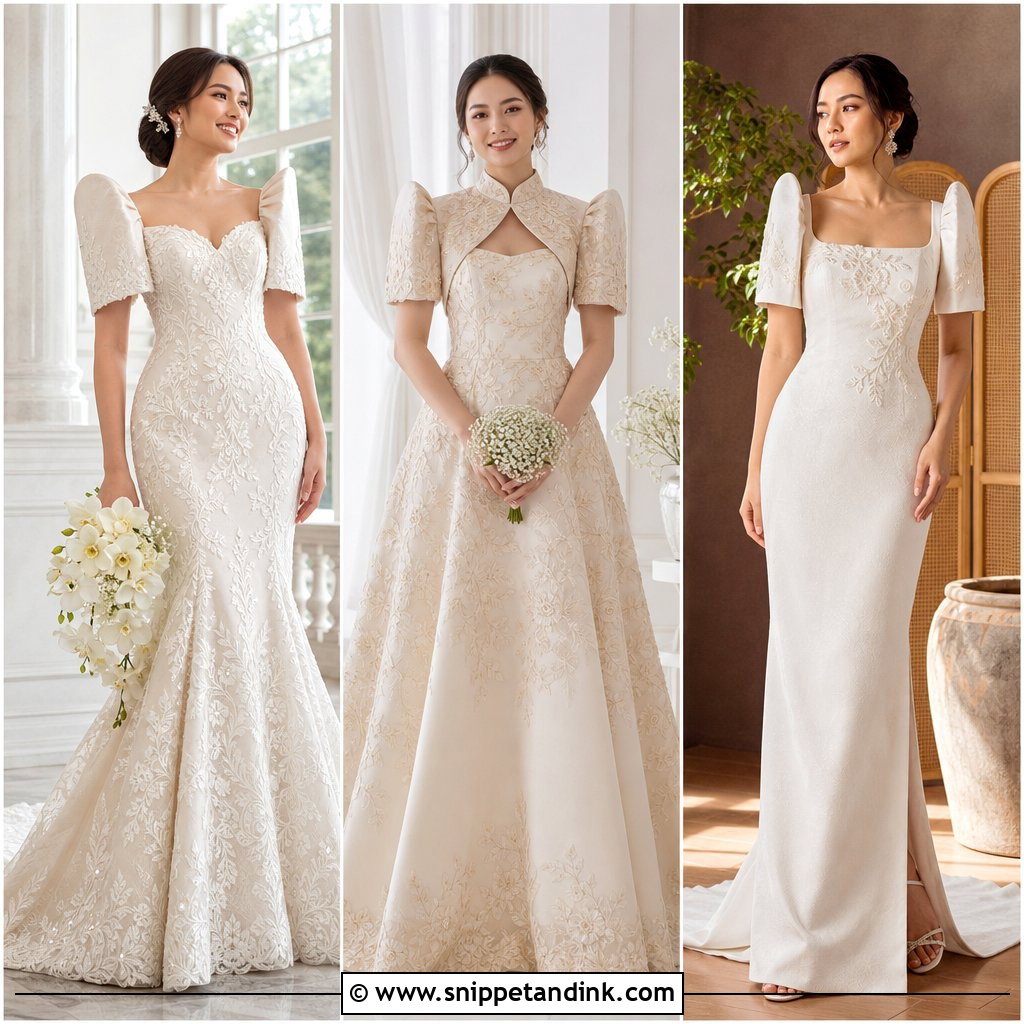
The butterfly sleeve is the whole identity of a classic terno wedding dress, so I start every terno fitting there. The sleeve should stand up from the shoulder on its own, which means it needs interfacing or a stiffened inner layer, not just crisp fabric. Below it, a fitted bodice, a defined waist and a full A-line or ball skirt. Piña, jusi, silk organza or satin all suit it. I keep styling simple: pearl earrings, a low bun that sits beneath the sleeve line, and ivory heels.
2. Modern Terno Wedding Gown
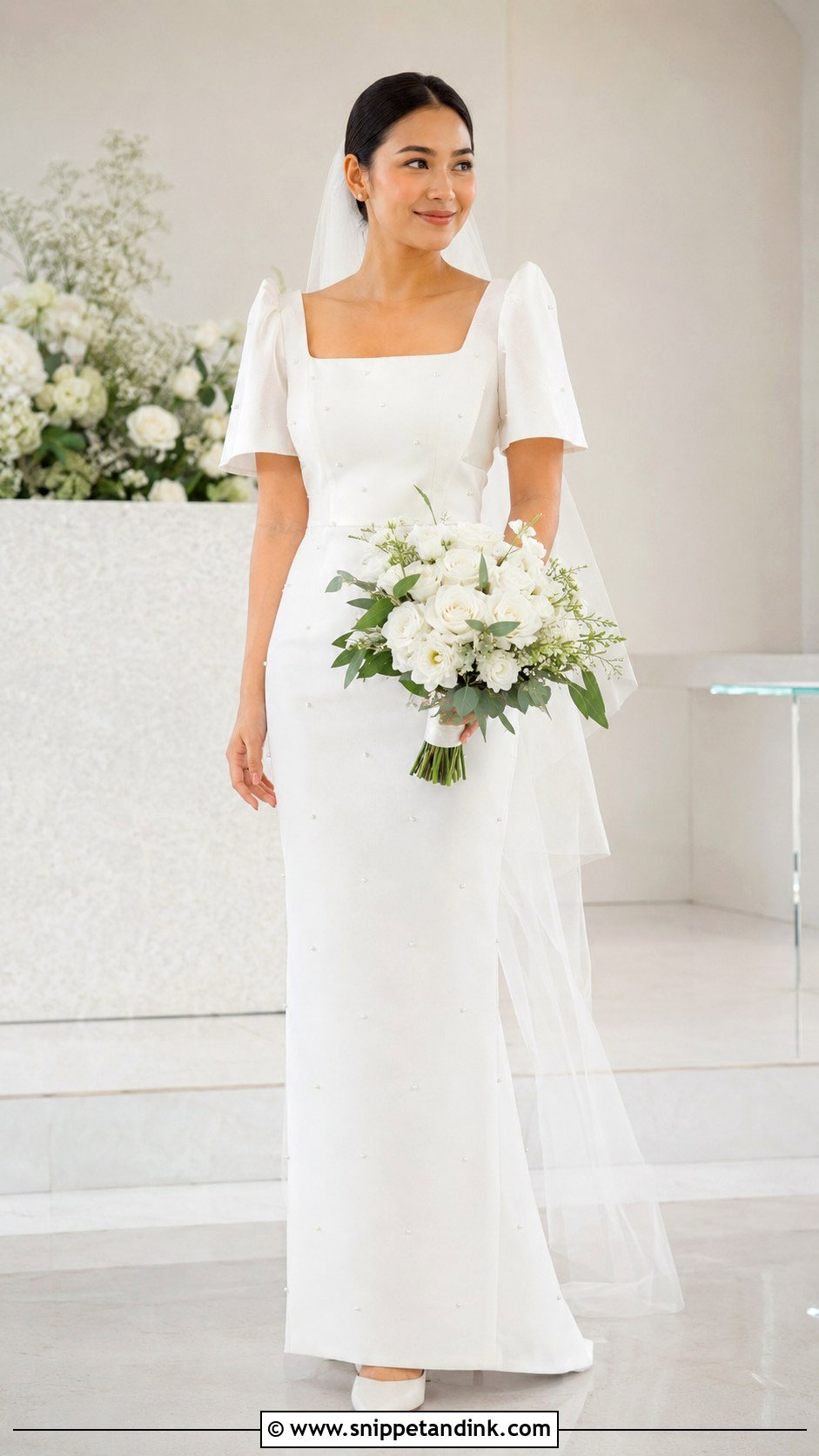
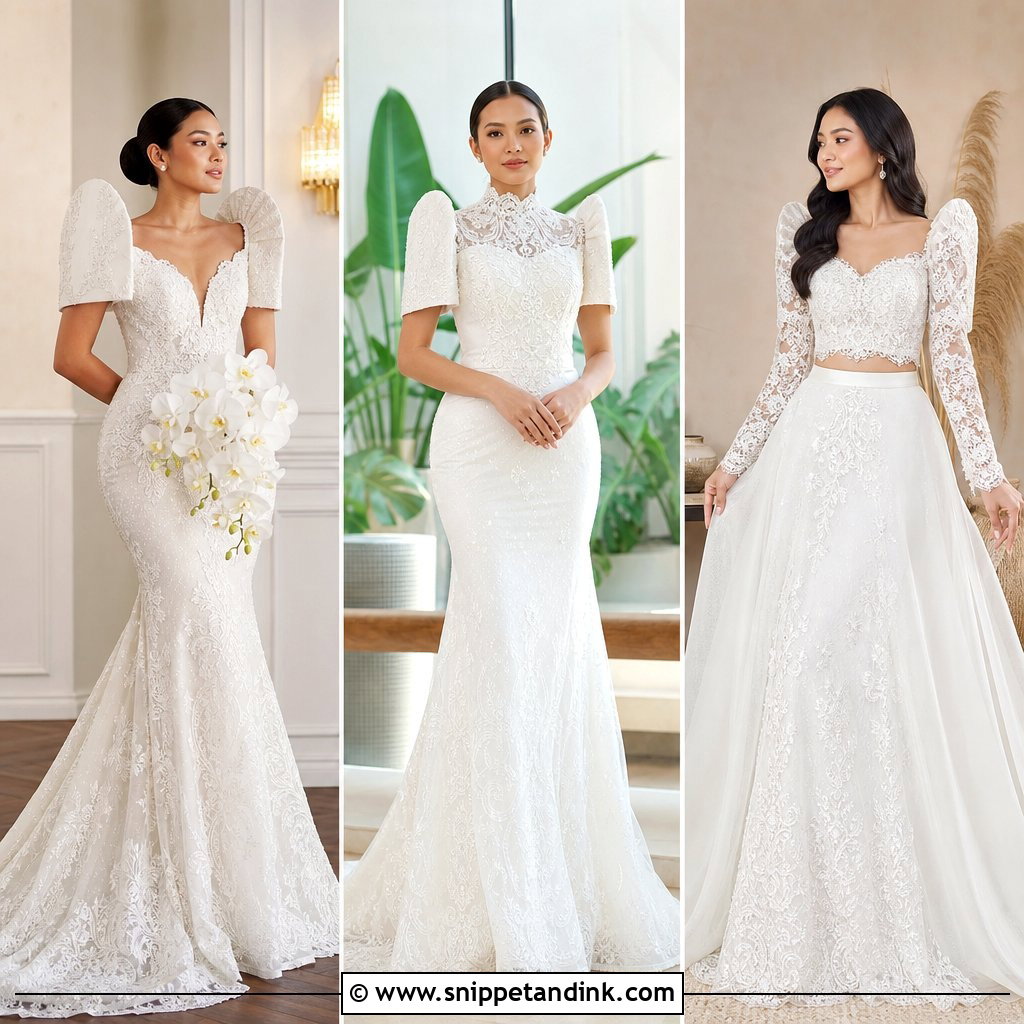
A modern terno keeps the sleeve but slims everything else down. The sleeve may be narrower, the neckline cleaner, the skirt a column, sheath or soft mermaid. The trick is proportion: once the skirt loses volume, a full-sized butterfly sleeve can look top-heavy, so I usually reduce it by a little. Tone-on-tone beadwork reads better than color here. Pointed heels and a plain veil that ends below the shoulder blades let the sleeve stay the focus at a hotel or city wedding.
3. Piña Filipiniana Wedding Dress
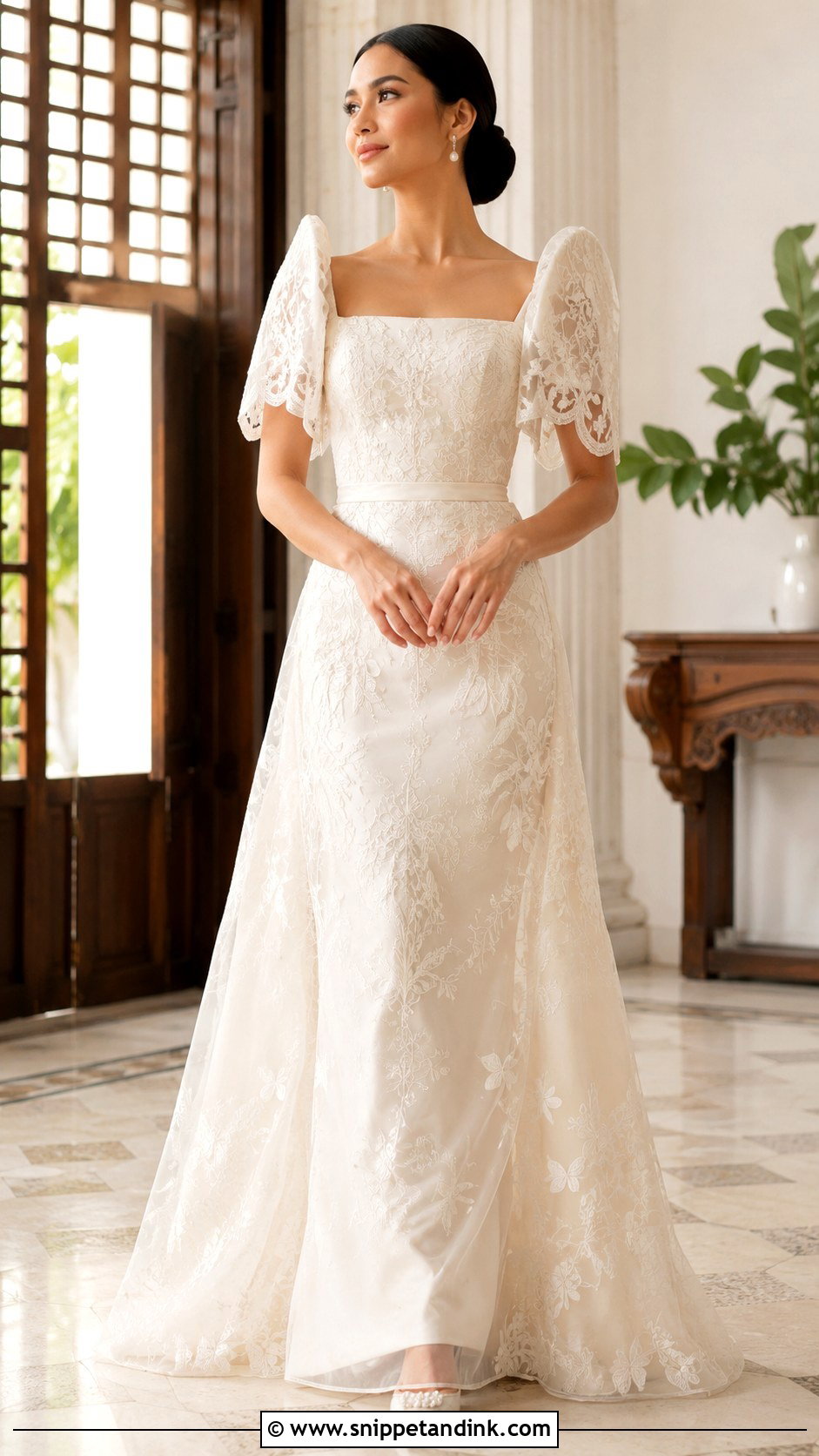
Real piña is woven by hand from pineapple leaf fiber, and it has a faint sheen and a slightly stiff hand that no synthetic copies. It is also fragile. It doesn’t forgive tight seams or heavy beading, so I use it as an overlay on the bodice, sleeves or skirt over a silk or satin lining that does the structural work. Keep the veil light and the styling quiet, with pearl drops and a neat chignon. Piña looks best when you can see the weave.
4. Jusi Filipiniana Wedding Gown
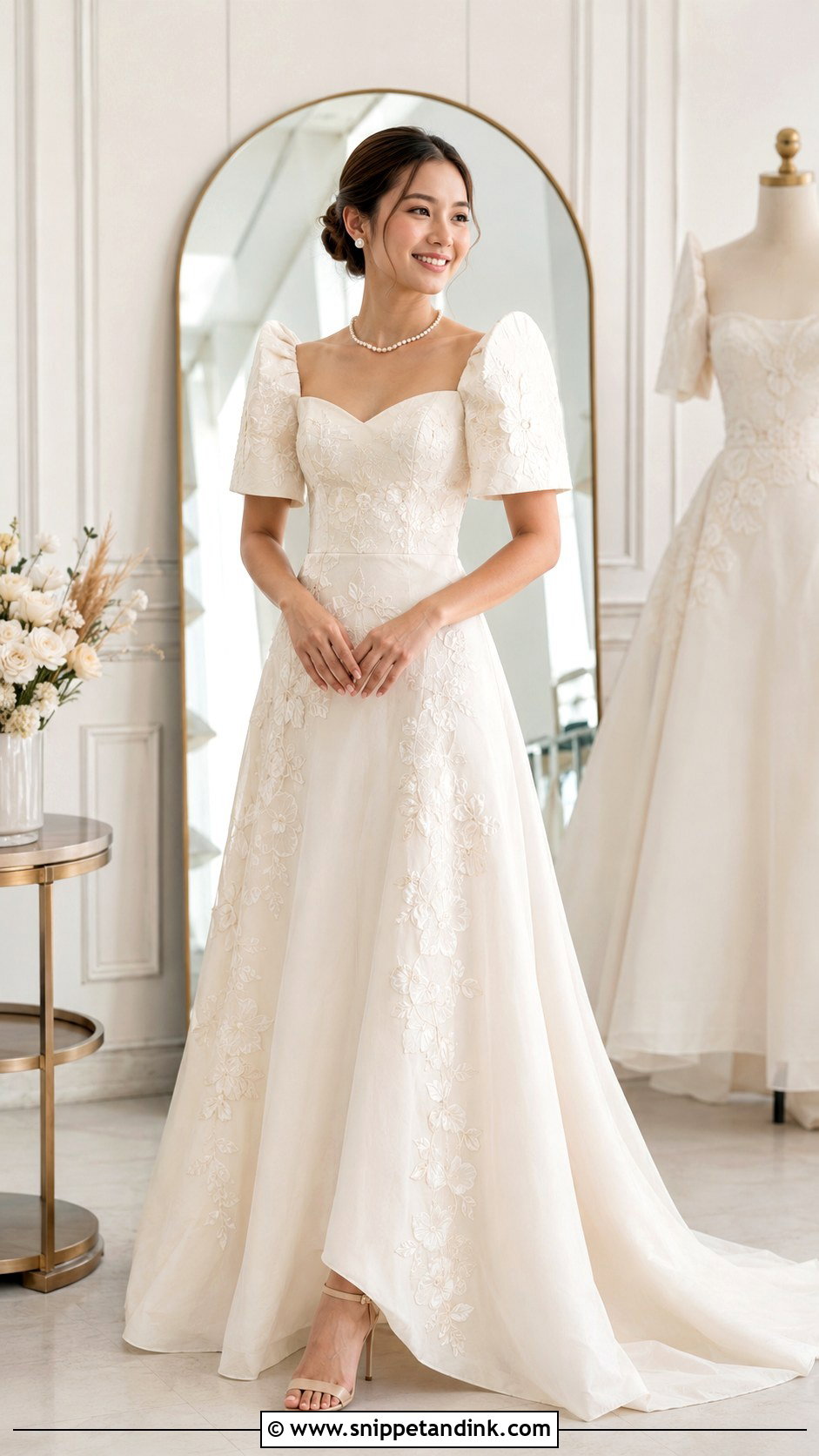
Jusi is lighter than piña and a little crisper, which makes it easier to shape into a structured butterfly sleeve. Much of what’s sold as jusi today is a blend or synthetic, so I ask for a swatch and look at how it creases in the hand before building a whole gown from it. A fitted bodice, butterfly sleeves and a soft A-line skirt balance well. It’s my first suggestion for a warm-weather ceremony where the bride still wants a formal finish.
5. Maria Clara Wedding Dress
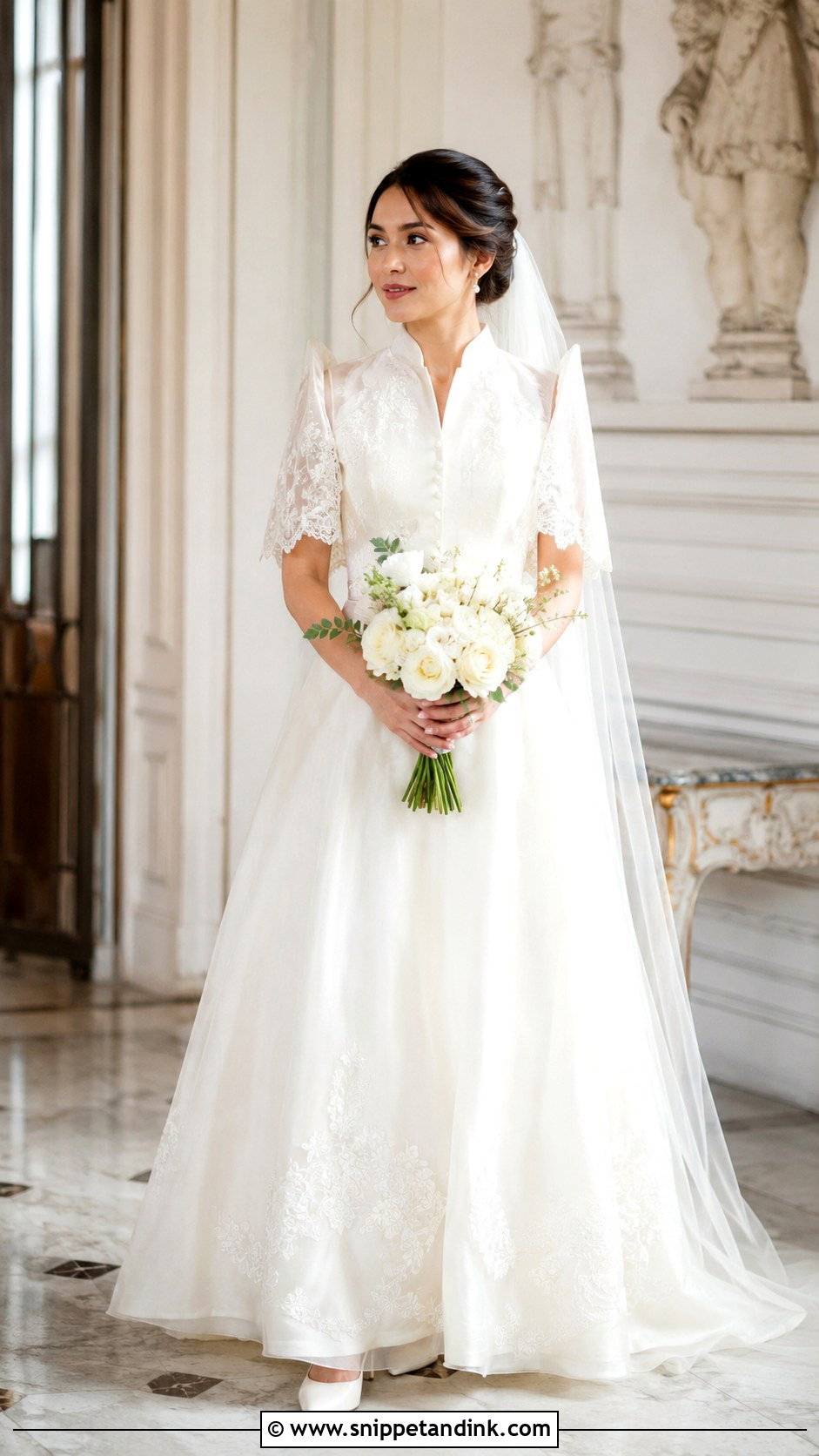
The Maria Clara wedding dress is built from separate pieces: a sheer camisa blouse, the pañuelo folded over the shoulders, and a long skirt, sometimes with a tapis wrapped over it. For a bride, I keep the palette in ivory, cream or champagne. The pañuelo is the part that needs attention on the day; it shifts every time you lift your arms, so I pin it discreetly at the back and at each shoulder. A low updo, small earrings, closed-toe heels and a classic veil complete it.
6. Baro’t Saya Wedding Dress
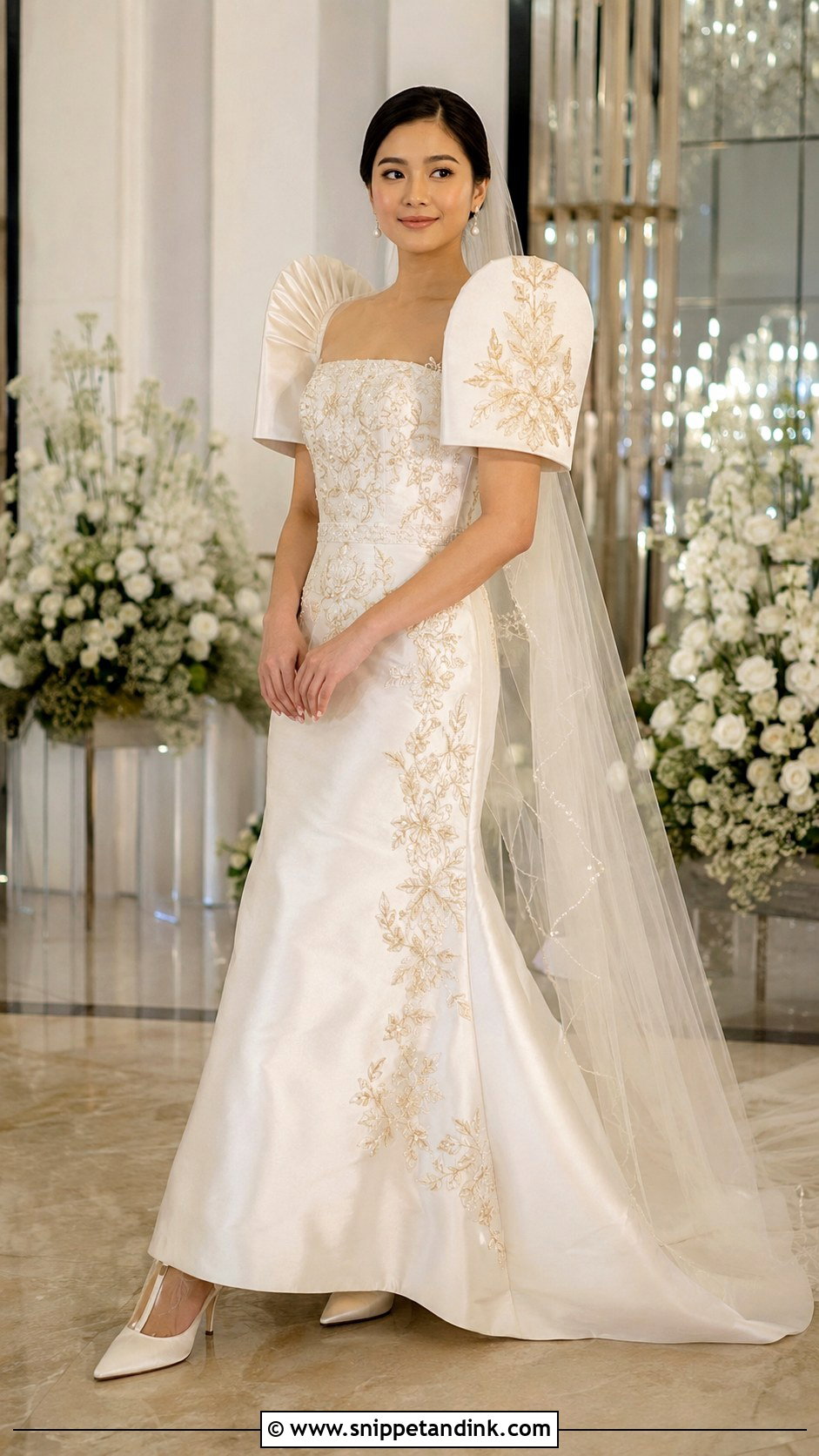
A baro’t saya wedding dress is a blouse and skirt by origin, and I like treating it as a true two-piece for a bride. A structured top over a sweeping skirt lets the dressmaker fit each half separately, which helps brides whose top and bottom sizes differ. Soft ivory, delicate embroidery and a defined waist keep it formal. A sheer pañuelo across the shoulders brings it closer to tradition. Finish with pearls and a smooth hairstyle.
7. Mestiza Wedding Gown
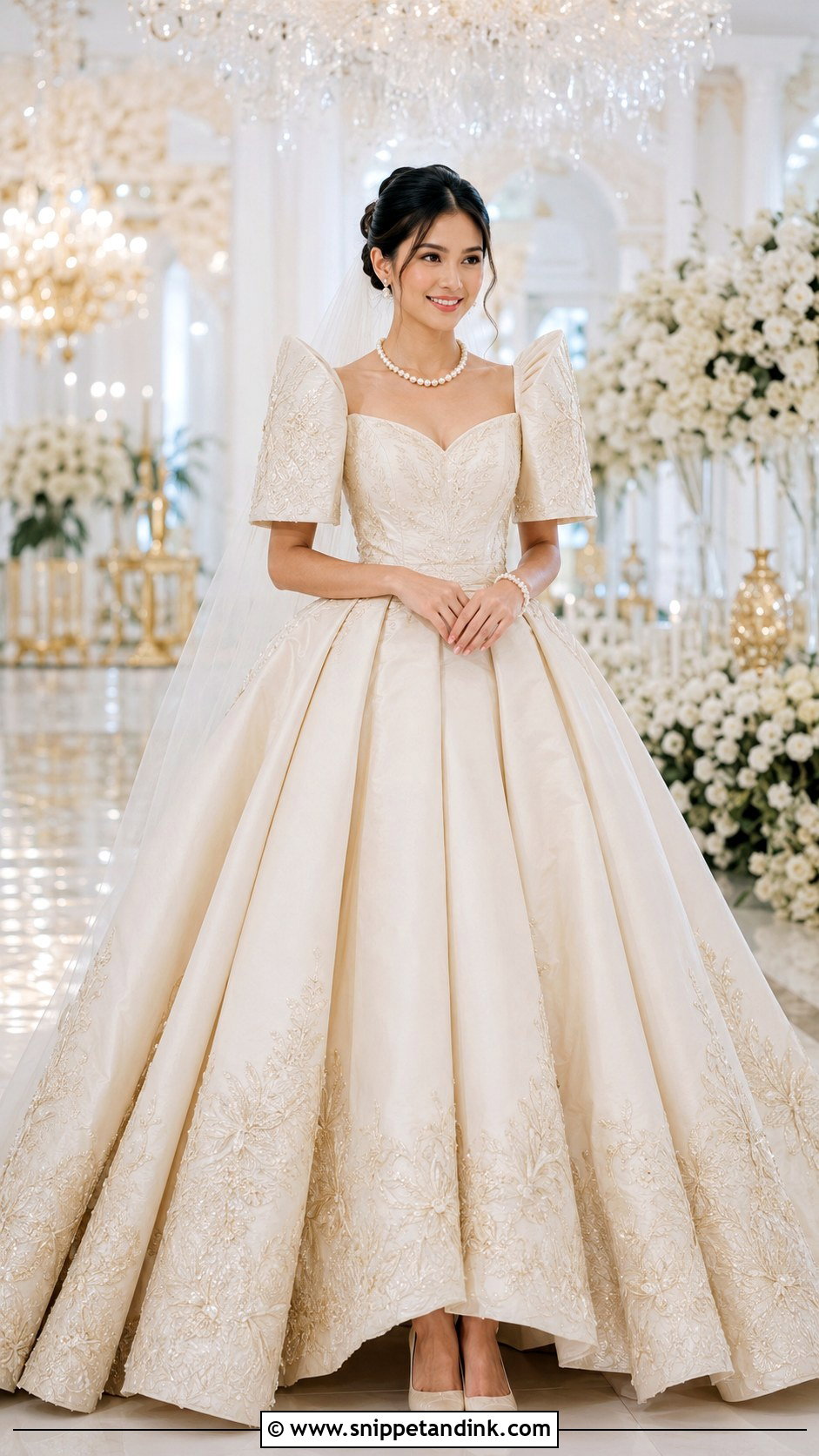
Mestiza gowns are where the butterfly sleeve gets its most dramatic treatment, with a fitted waist and a long, elegant skirt underneath. Ivory keeps it classic; gold embroidery warms it up for evening. My one caution is the veil. A dense veil flattens the sleeves and hides their outline, so I choose a sheer tulle and attach it at the crown, behind and below the sleeve height. Satin pumps and a clean bouquet suit grand venues and formal receptions.
8. Filipiniana Ball Gown
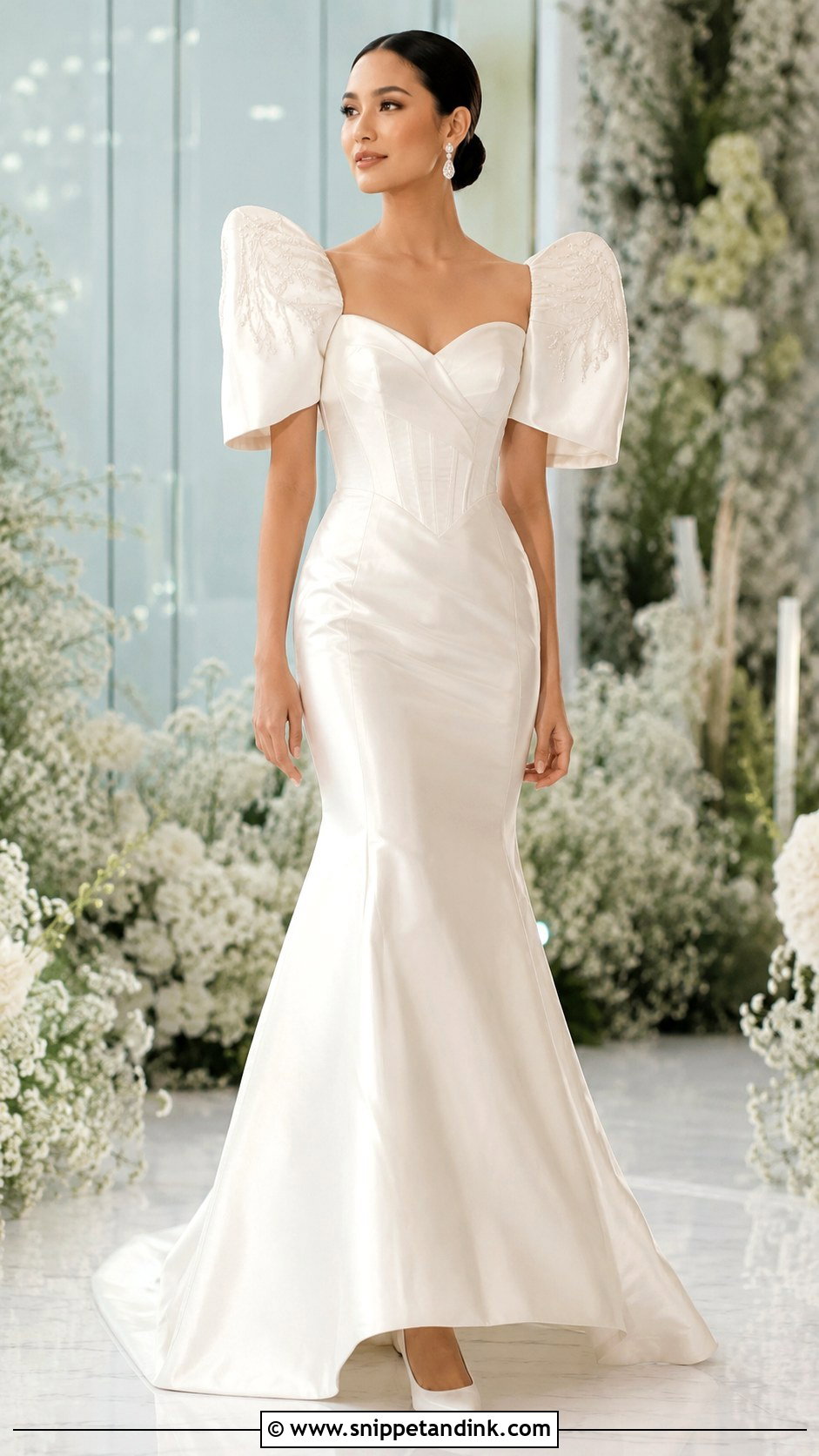
For a grand entrance in a large hall, a Filipiniana ball gown does exactly what you’d hope. The risk is too much volume at both ends. When the skirt is full, I keep the bodice fitted and plain near the shoulders so the butterfly sleeves have space, and I move embroidery to the hem or the train. A tiara or a hair comb, pearl earrings and ivory heels are plenty. Plan for the weight of the skirt: a proper petticoat and a hoop if needed, so the dress doesn’t drag you down by the first dance.
9. Filipiniana Mermaid Wedding Dress
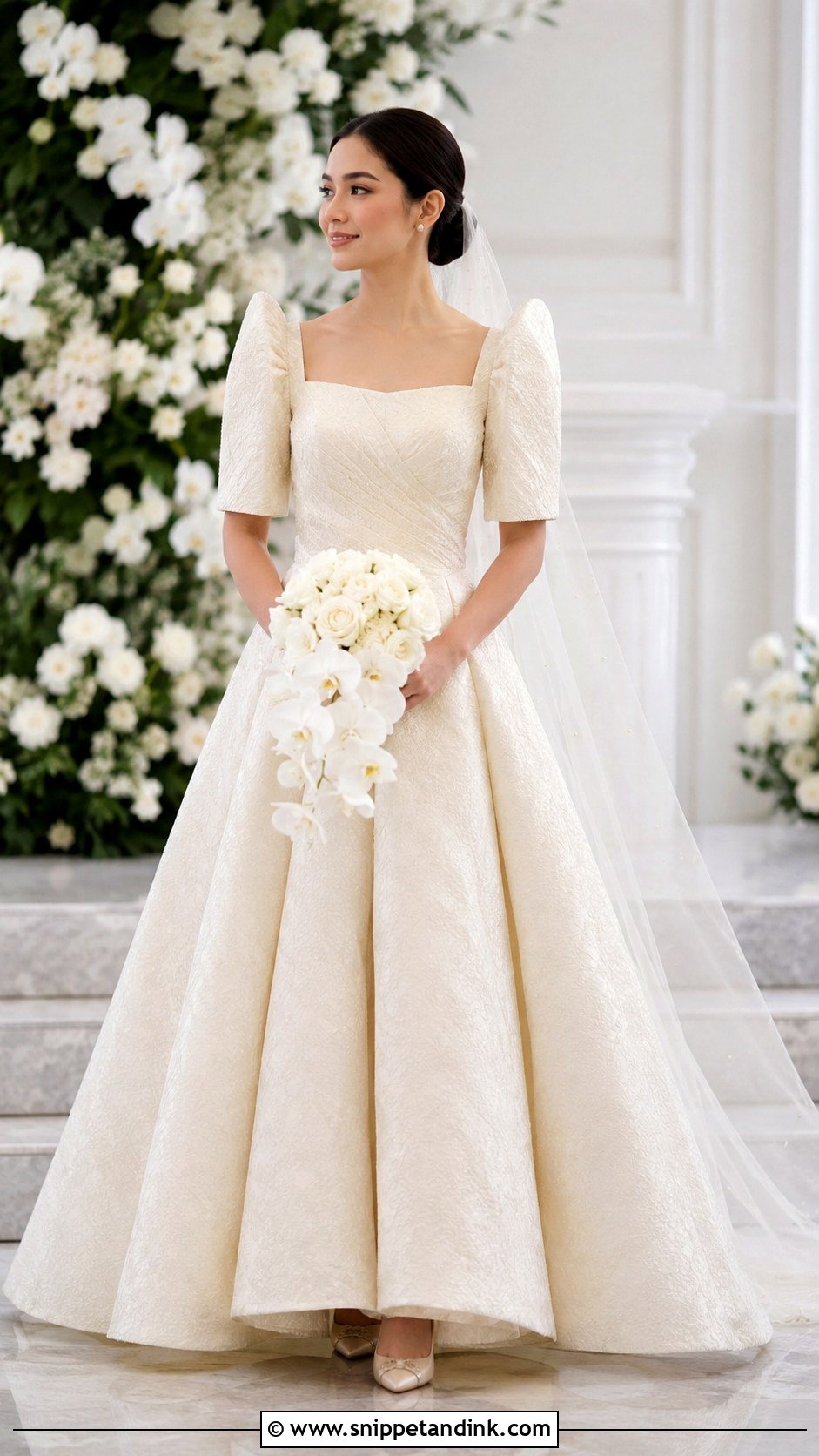
A mermaid cut with terno sleeves is glamorous, and it is also the least comfortable shape on this list for a long day. Satin, mikado or lined lace hold the sculpted line through the hips. I always ask brides to sit, climb a step and walk quickly in the fitting, because a flare set too high limits stride. Ask for a flare that starts just above the knee and a hidden bustle for the train. Keep the sleeves crisp but proportionate, and pair with sleek hair and pointed heels.
10. Filipiniana A Line Wedding Dress
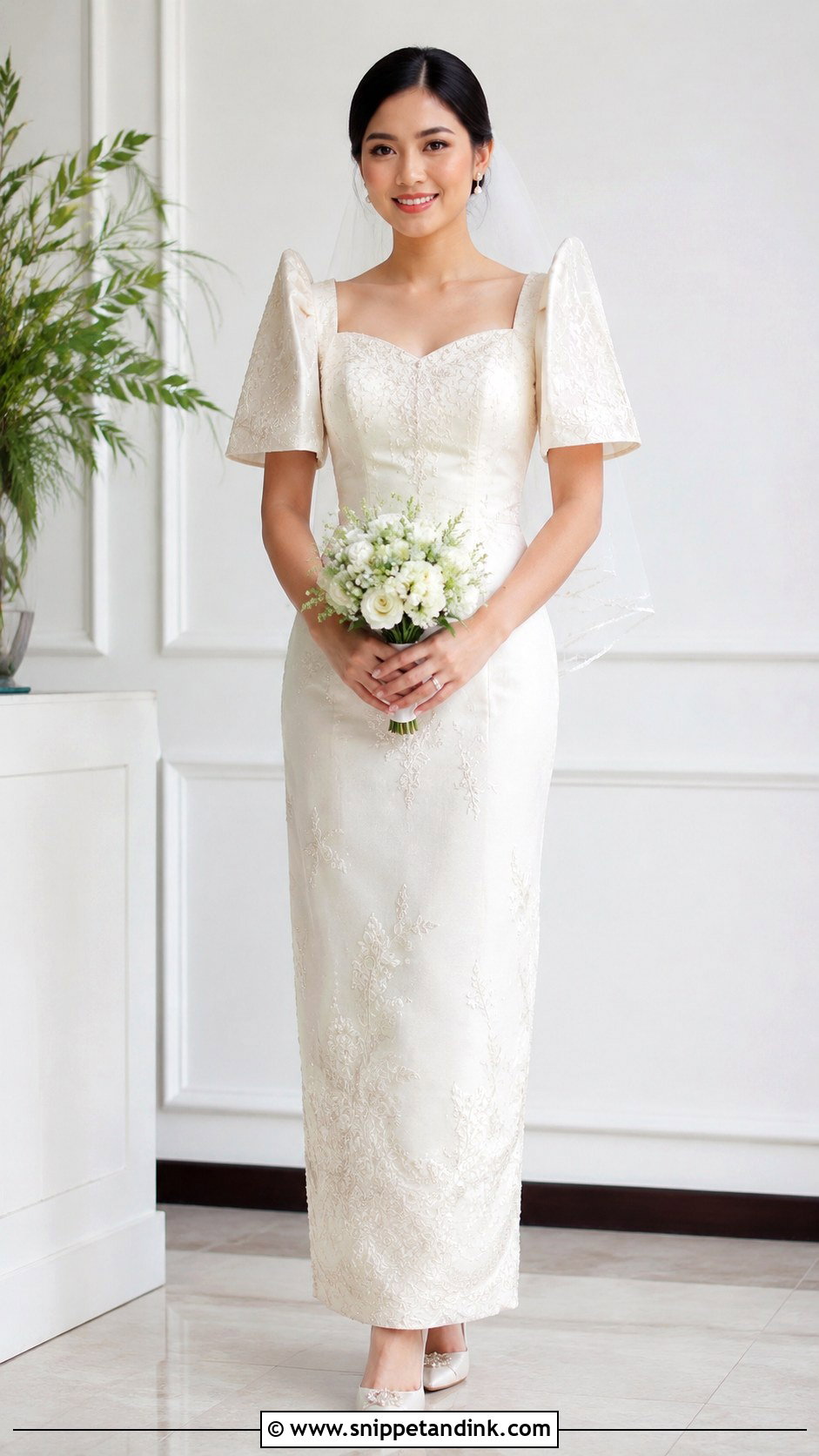
The A-line is the shape I suggest most for a first Filipiniana fitting, because it suits nearly every body and lets you move. The skirt falls from the waist without clinging, and a clean neckline keeps the butterfly sleeves fresh. It works in piña, jusi, lace, satin or organza. If you’ll be standing through a long Catholic mass, choose low or mid heels; the skirt covers them anyway. It travels and adapts well to indoor, outdoor and destination weddings.
11. Filipiniana Sheath Wedding Dress
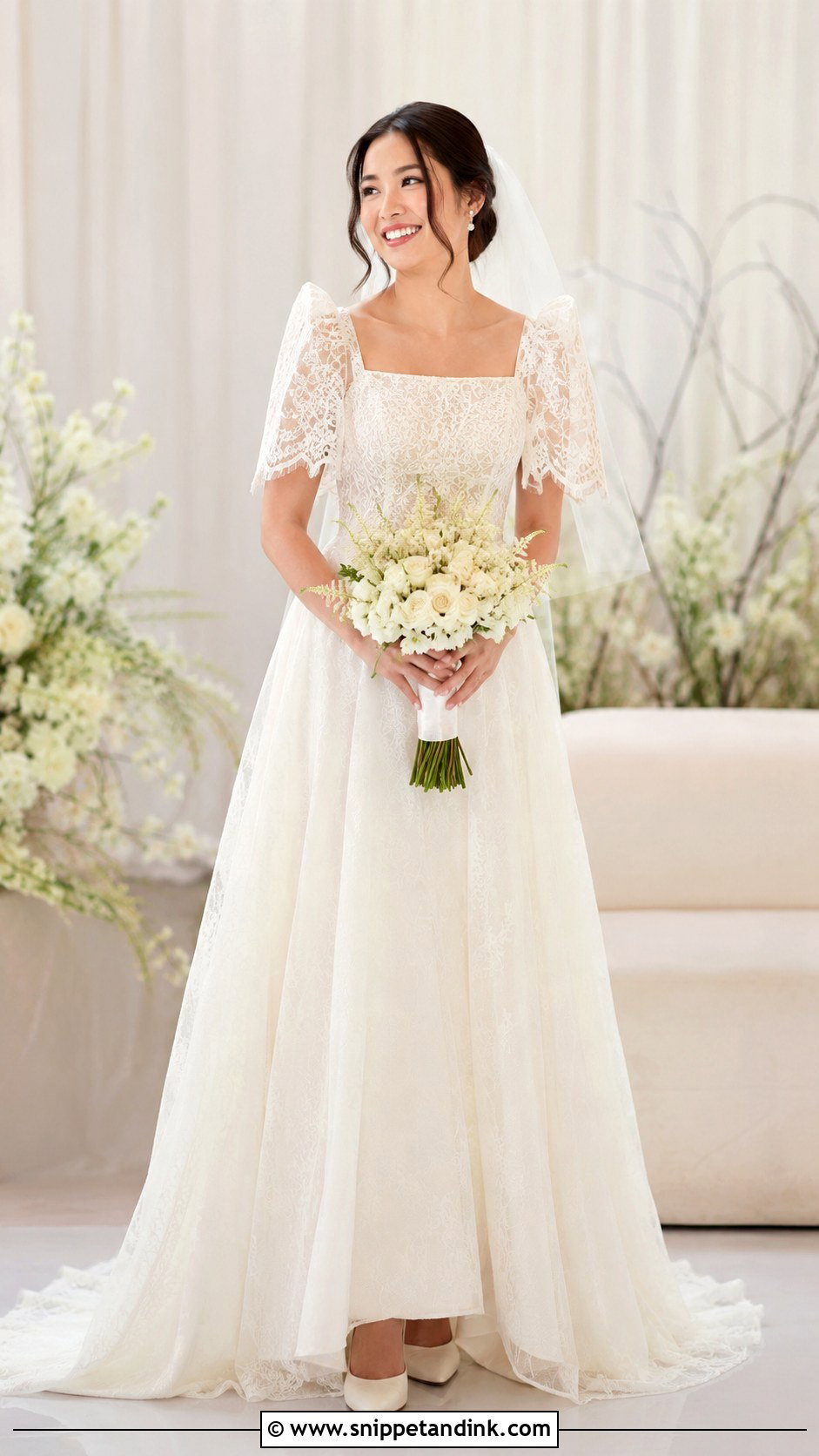
A sheath is quiet and close to the body, without the volume of a ball gown, so I steer brides toward it for intimate weddings and civil ceremonies. Because there’s so little to the skirt, the Filipiniana identity has to come from the top half: butterfly sleeves, light embroidery or a sheer overlay. I’d keep everything else plain. Pearl earrings, a neat bun and a short veil or comb. Sheaths show every pull line, so I ask for the lining to be fitted as carefully as the outer layer.
12. Filipiniana Lace Wedding Dress
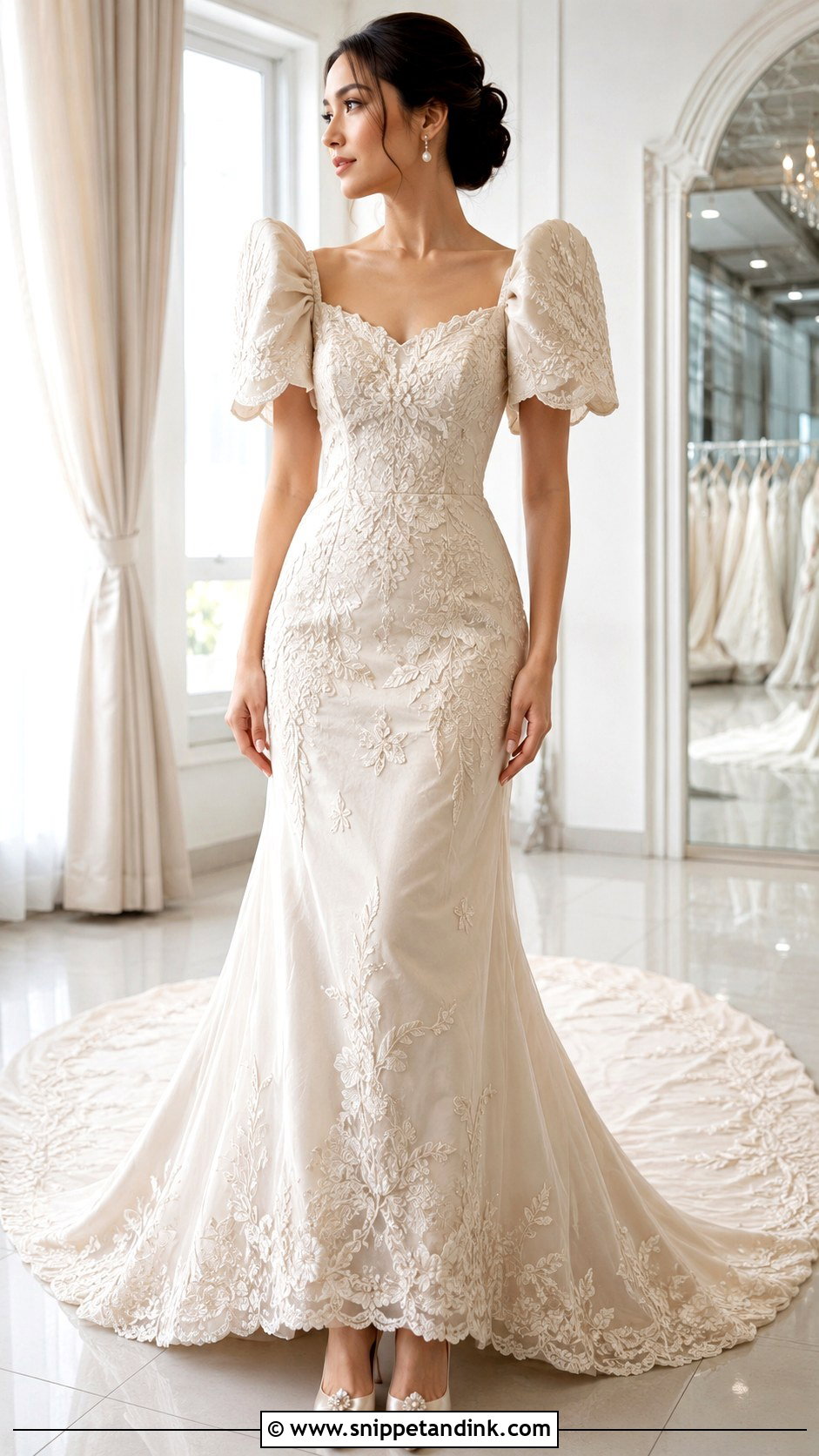
Sheer lace butterfly sleeves have a delicate look, but lace doesn’t stand up by itself, so the dressmaker has to add a fine net or interfacing inside. Without it, the sleeve collapses in the first hour. Lace can cover the bodice, the sleeves or the full gown depending on how ornate you want it. When the lace is detailed, I keep the bouquet and jewelry spare. The overall feel is slightly vintage while still clearly Filipiniana.
13. Embroidered Filipiniana Wedding Dress
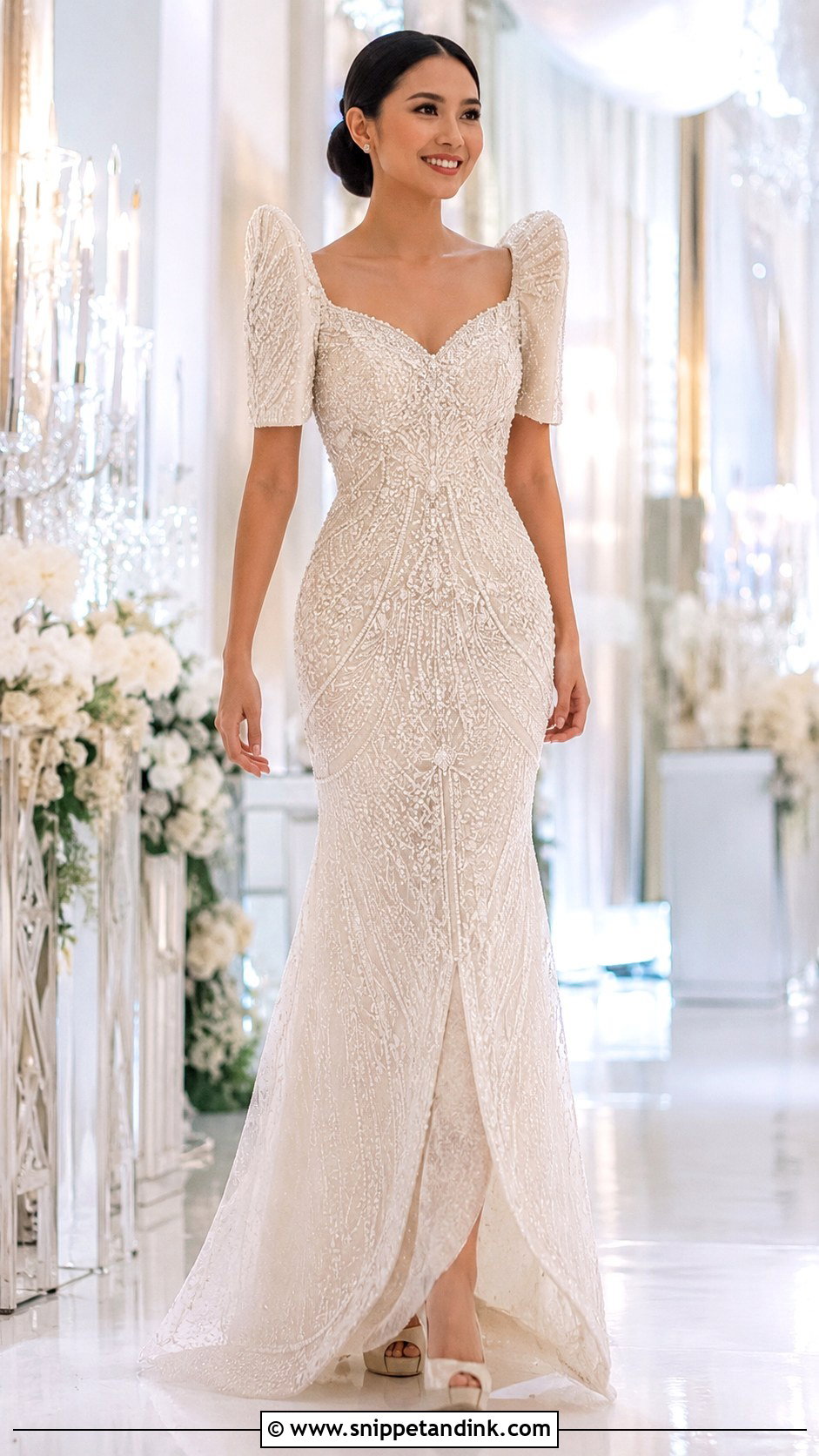
Hand embroidery is what makes a Filipiniana gown feel like yours. Floral, vine and sunray motifs placed on the sleeves, bodice, train or hem can be planned around how you’ll be photographed. Tone-on-tone thread is understated, while gold or champagne thread adds warmth. I’d keep the cut simple so the needlework stays the focus. Hand-worked embroidery on piña takes time, so this is the option where I’d have you order earliest. Close-up detail shots reward it more than any other gown here.
14. Beaded Filipiniana Wedding Gown
Beading needs restraint. My rule is one beaded zone: if the bodice carries the beads, the skirt stays soft, and if the sleeves are beaded, the jewelry stays small. Ivory, pearl, crystal or champagne beads suit Filipiniana fabrics. Beads also add weight, which matters on a butterfly sleeve, so I ask the dressmaker how the sleeve is reinforced before choosing heavy work there. Evening and ballroom lighting is where beading earns its cost.


15. Minimalist Filipiniana Wedding Dress
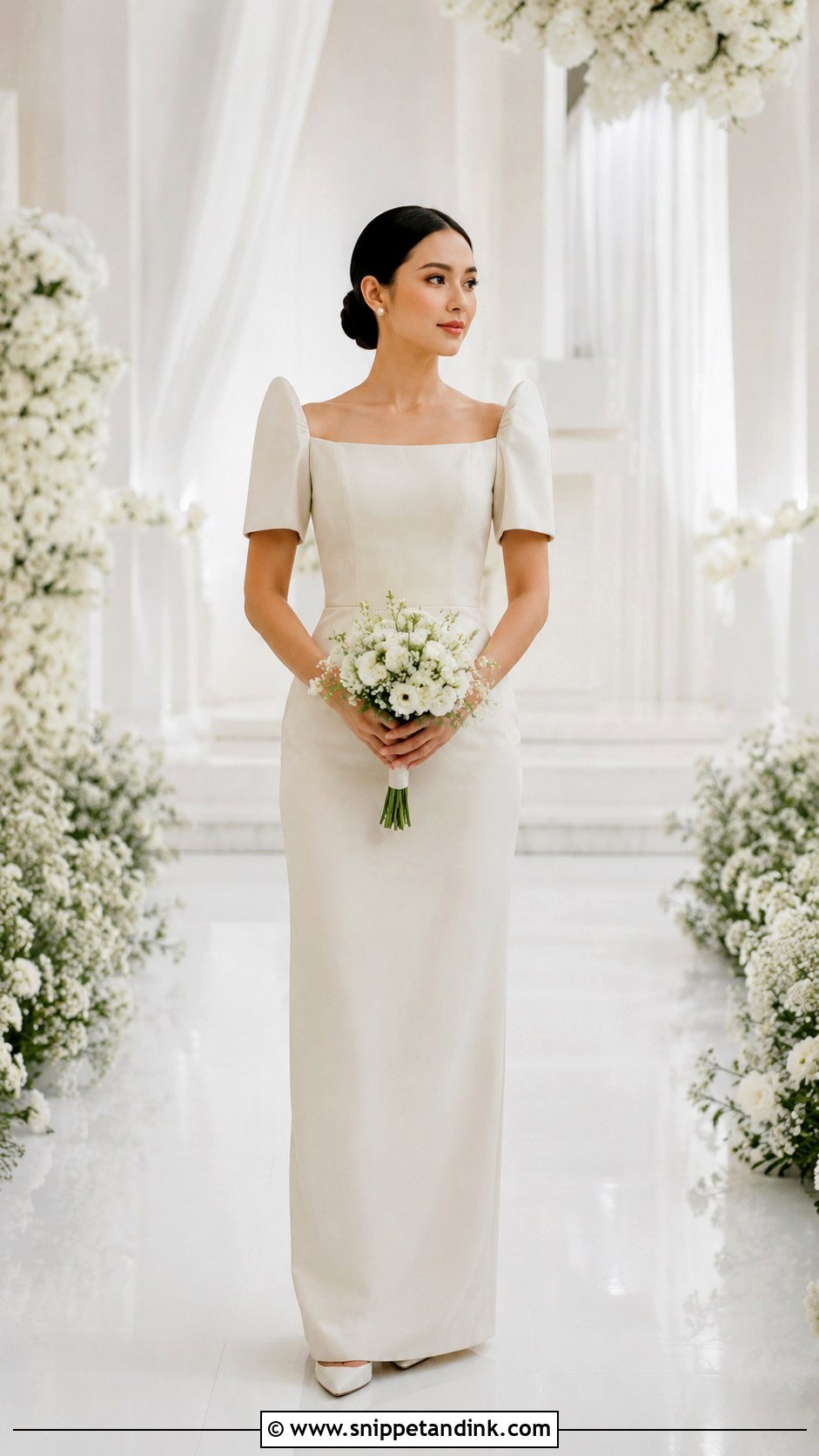
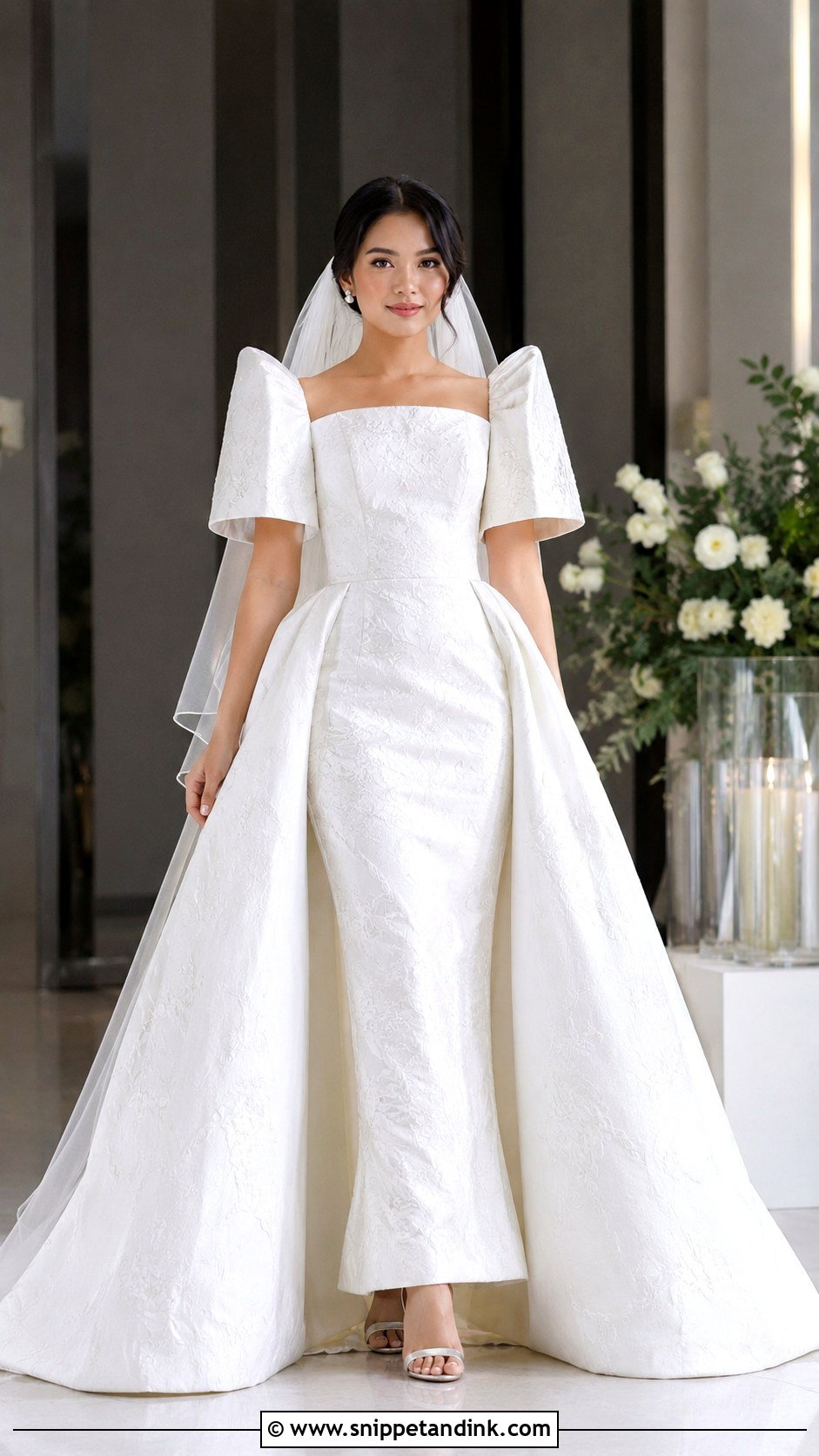
A minimalist terno relies on cut alone, so there’s nothing to hide behind. Sharp butterfly sleeves, a tailored bodice and a plain column or A-line skirt in smooth ivory fabric. Skip the beadwork. The pressing matters more than usual here: a creased sleeve on a plain gown is the first thing you’ll see in photos, so I’d have a steamer at the venue. Pearl studs, light makeup, a sleek bun and pointed heels suit city venues and civil weddings.
16. Off Shoulder Filipiniana Wedding Dress
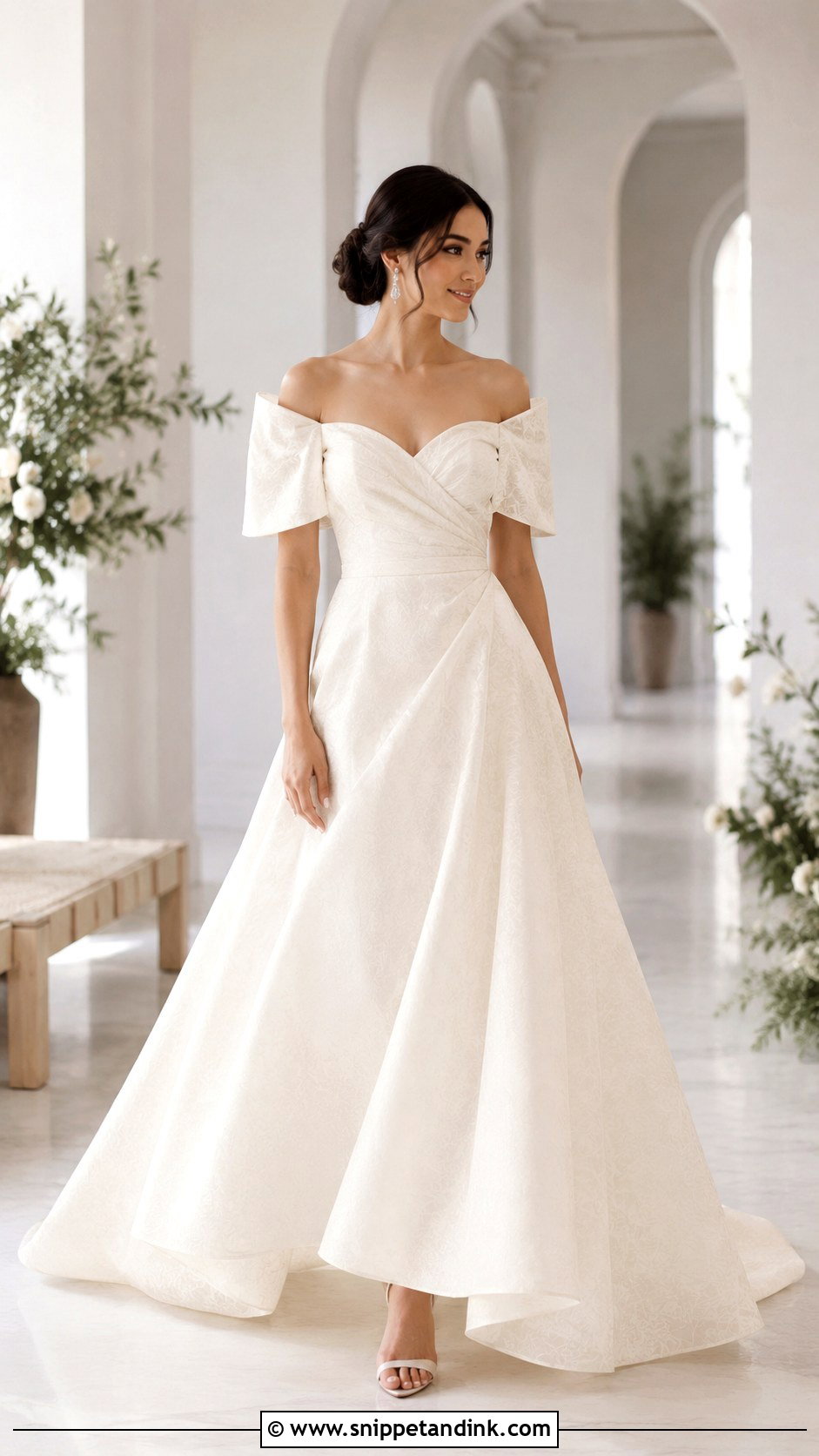
Off-shoulder and butterfly sleeves seem to contradict each other, but they can work if the sleeve is attached to the bodice at the upper arm and sits away from the shoulder. Lace, satin and organza all hold it, and the skirt can be A-line, mermaid or sheath. I check one thing at every fitting: whether you can raise your arms without the neckline sliding. Skip the necklace, wear drop earrings and a low bun, and the neckline stays clean.
17. High Neck Filipiniana Wedding Gown
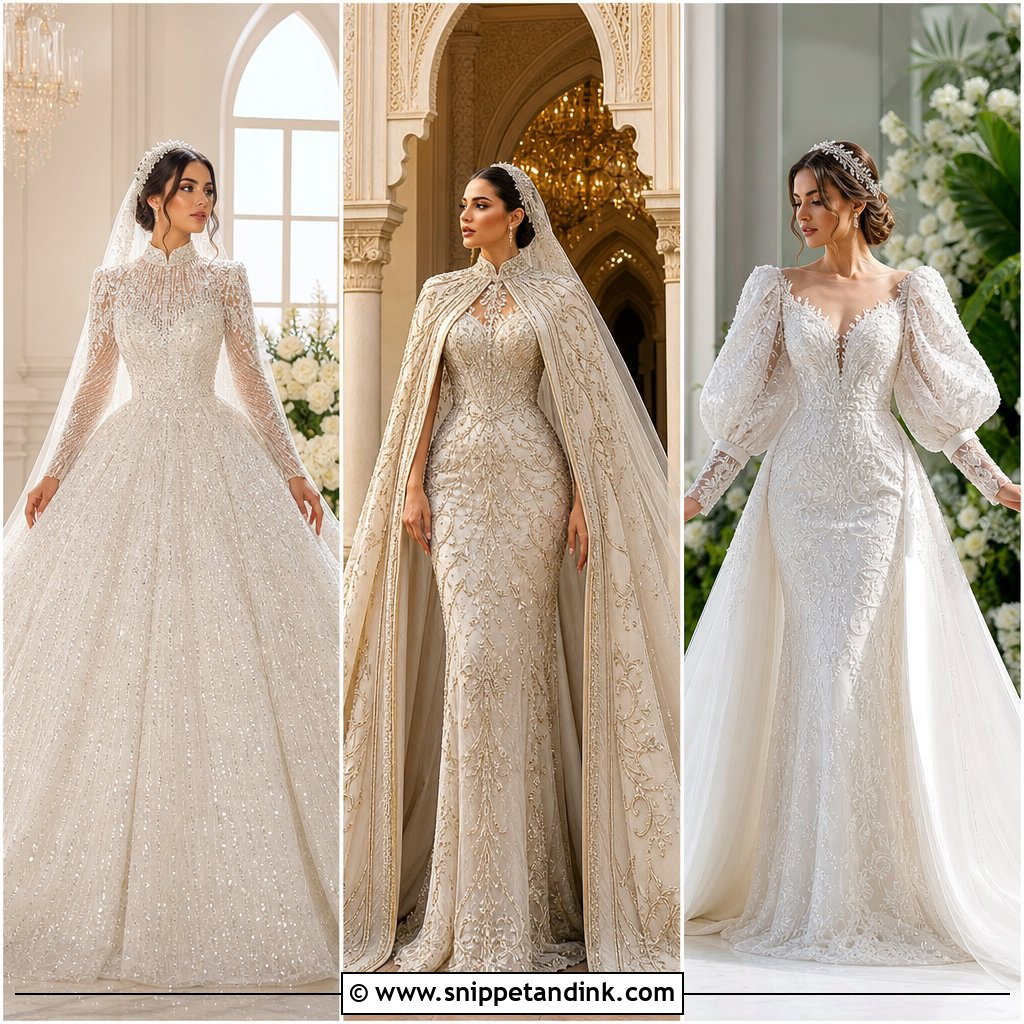
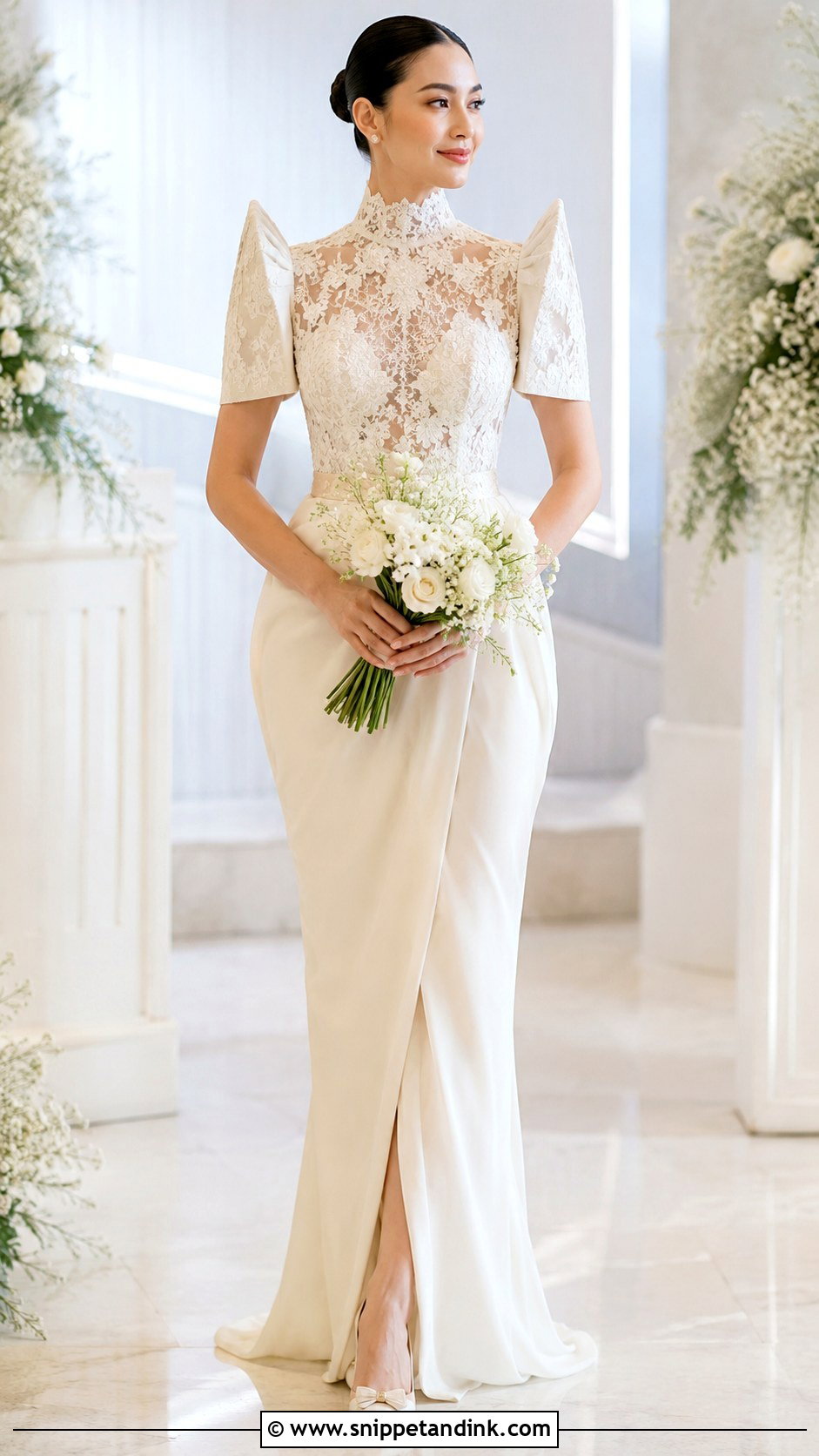
High necks give coverage and a regal line, and they suit brides who prefer a modest gown for a church ceremony. To keep it from feeling heavy, I build the high neck from sheer lace, embroidered piña or soft organza rather than solid fabric. Balance it with structured butterfly sleeves and a slim or A-line skirt. No necklace; earrings only. A low bun or tucked style frames the face and keeps hair off the collar. It is cooler-weather friendly, but in tropical heat, a sheer neck is kinder.
18. Filipiniana Wedding Dress With Train
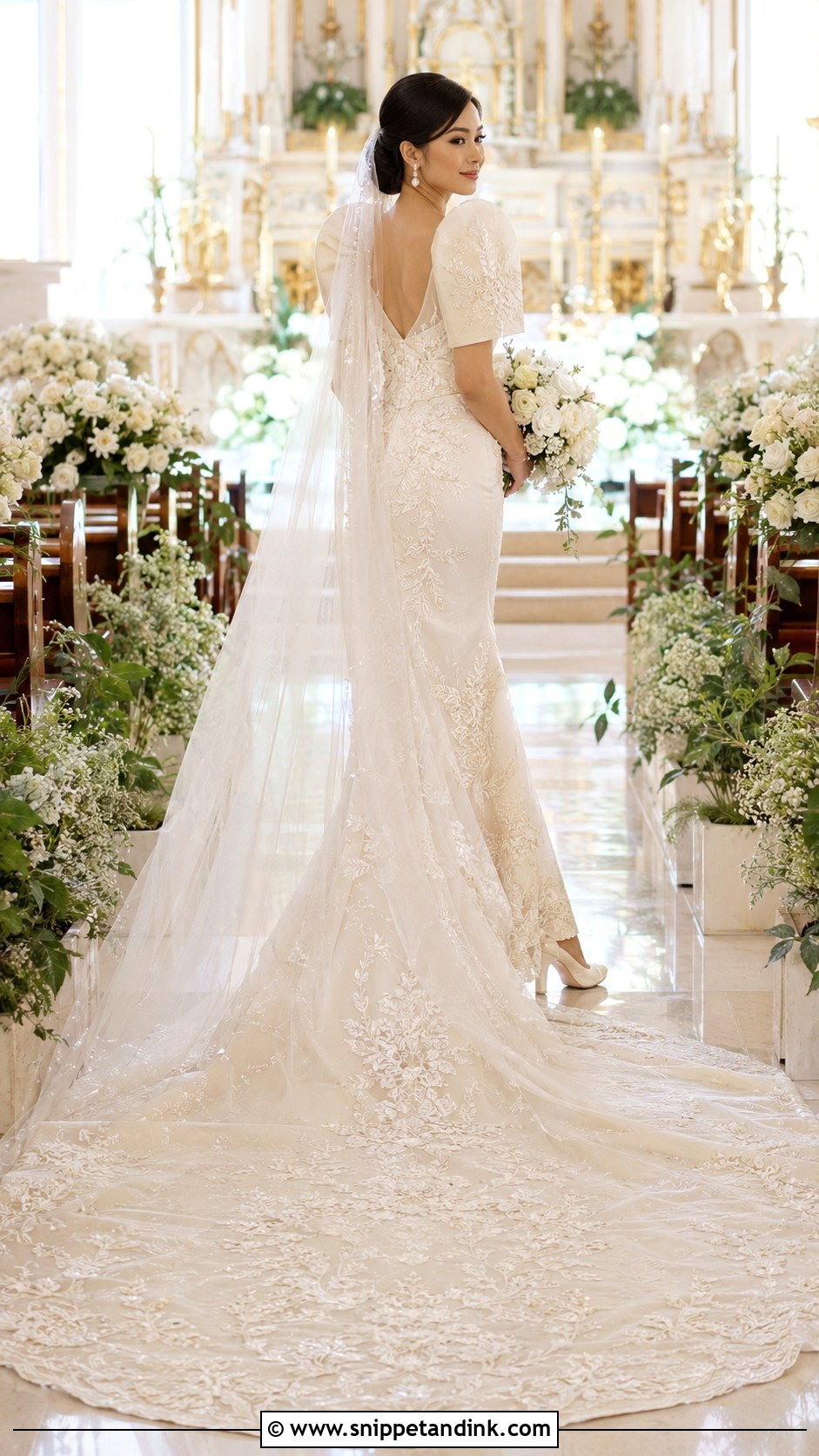
Trains range from a short sweep to a full cathedral length, and I match the length to the aisle and the floor. Long trains on old church tiles are fine; on grass, they pick up everything. Pair a train with butterfly sleeves and a fitted bodice for structure and movement. Embroidery along the train is a quiet surprise in back-view photos. The bustle is the detail I check twice; it should hold through the reception and be simple enough for a bridesmaid to fasten.
19. Filipiniana Wedding Dress With Detachable Overskirt
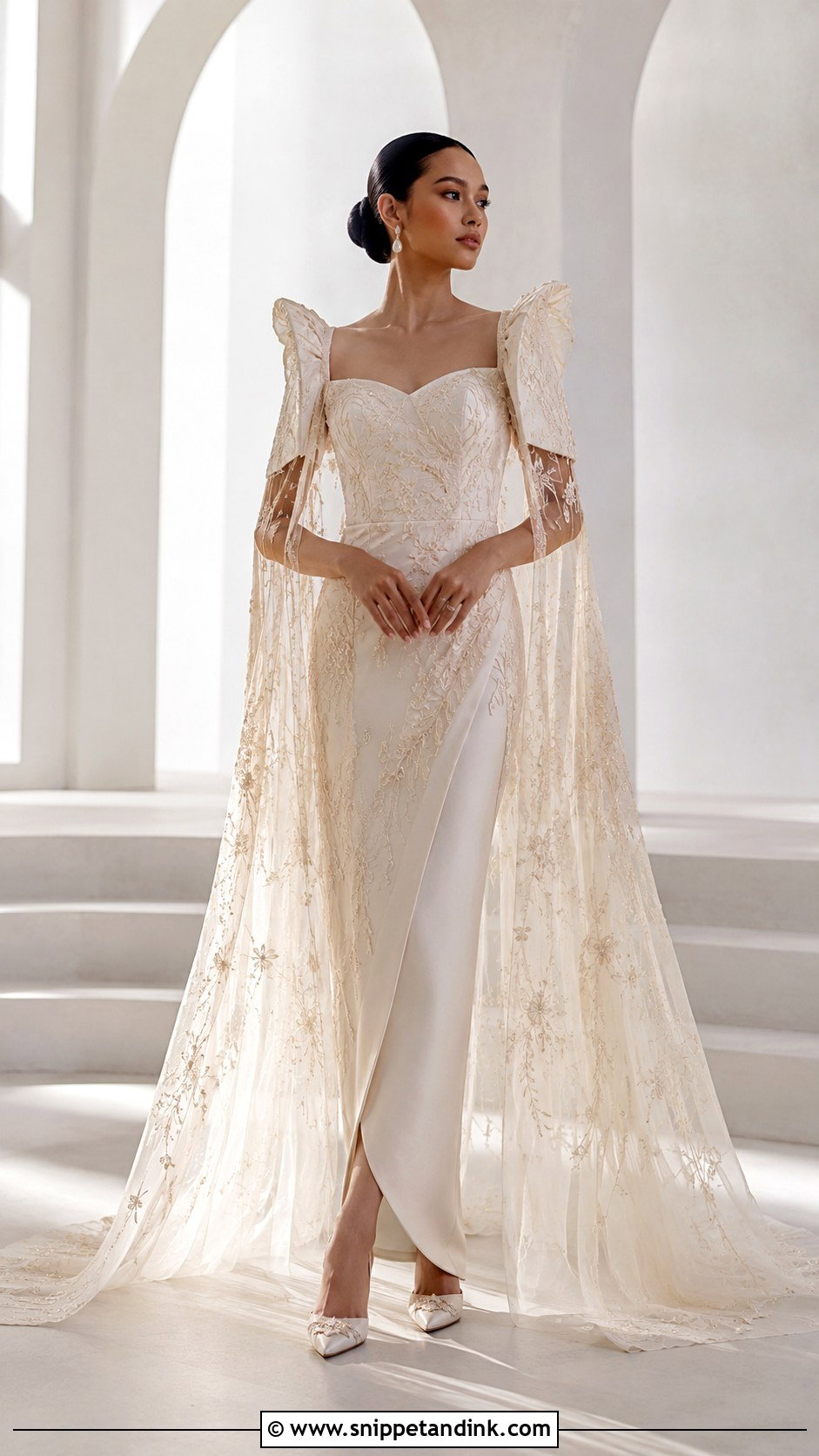
A detachable overskirt gives you two gowns for one fitting schedule. You wear the full overskirt for the ceremony, then unclip it for the reception and dance in the slimmer dress underneath. The butterfly sleeves tie both versions together. I recommend a light but structured fabric for the overskirt, and I always test the fastening with the bride doing it herself, then with a bridesmaid, because hidden hooks are easy to miss in a crowded room.


20. Filipiniana Wedding Dress With Cape
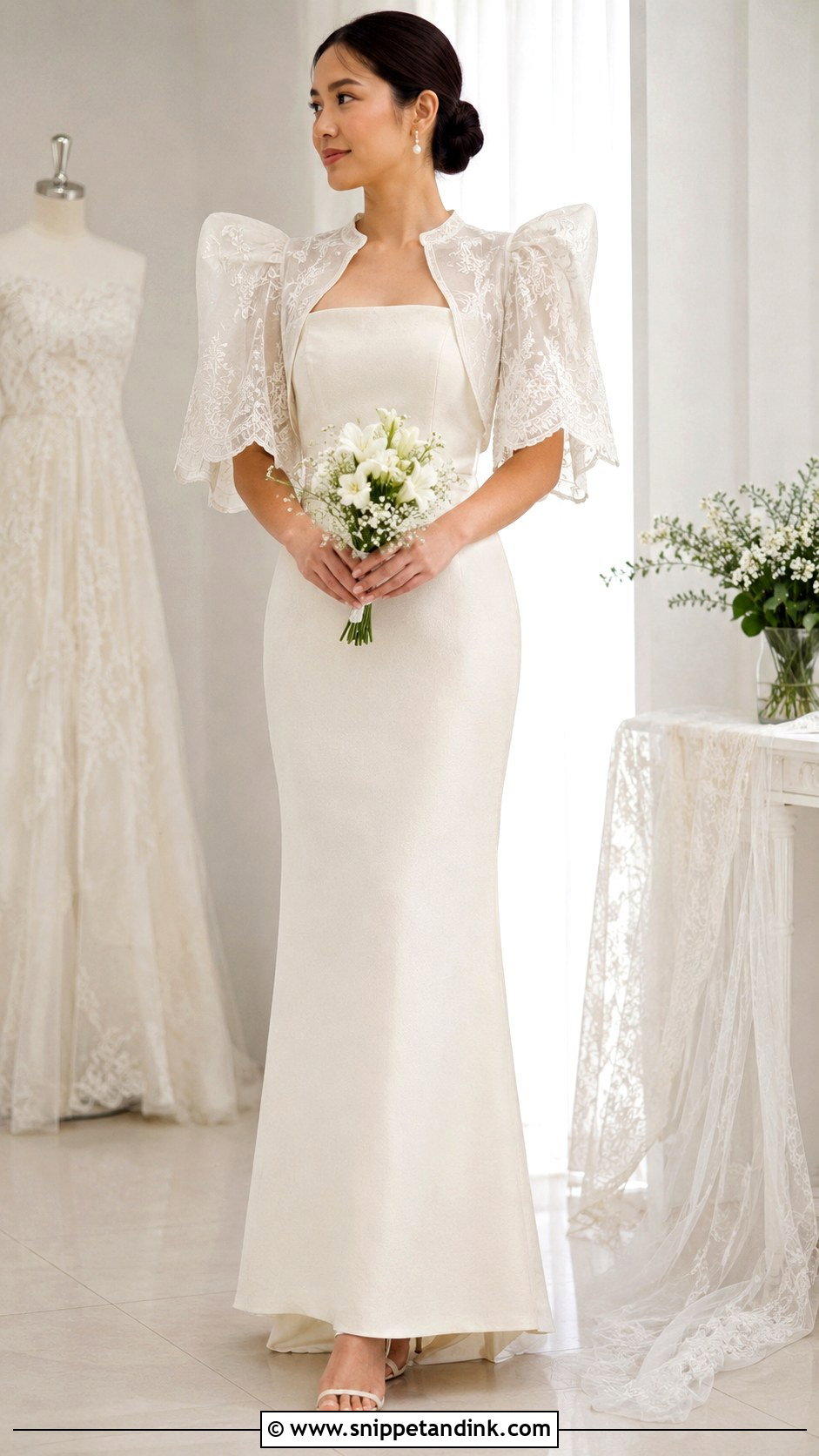
A cape works when you want movement and coverage without a long veil. Sheer organza, embroidered piña or soft tulle all fall well. The sleeves can be built into the gown or suggested by a structured cape shoulder. The one practical issue is wind; an outdoor cape becomes a sail, so I add small weights at the hem or a discreet loop at each wrist. Sleek hair, minimal jewelry and clean heels keep the line simple. Back views are where a cape shines.
21. Filipiniana Wedding Dress With Bolero
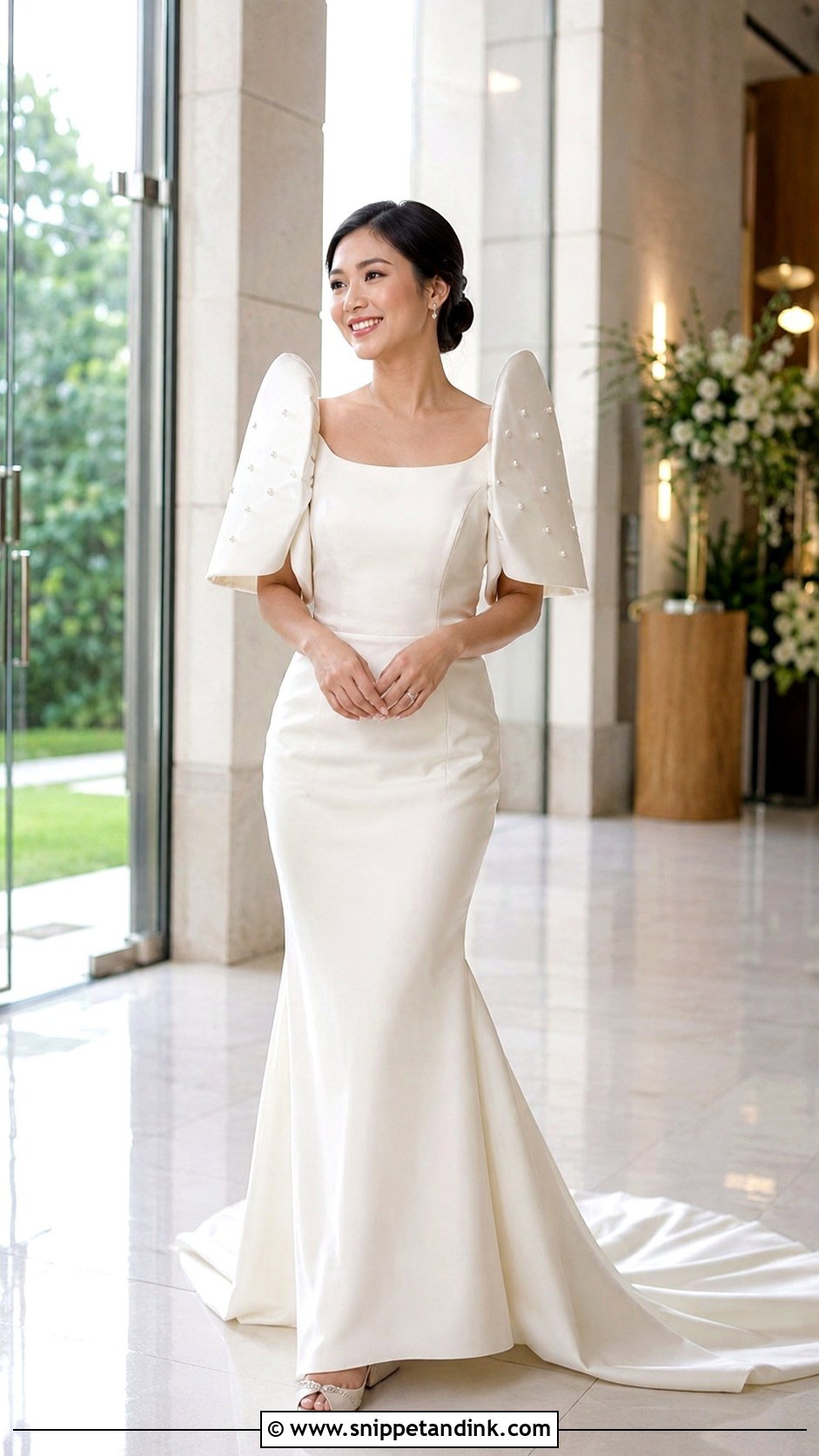
A butterfly-sleeve bolero over a plain gown gives you flexibility for the day. You wear it for the ceremony, the portraits and family traditions, then take it off for a lighter reception look. Piña, lace, jusi or organza boleros add texture without changing the dress underneath. Keep the base simple: a sheath, a slip or an A-line. The bolero must be fitted to your shoulders exactly, or it slides backward when you hug guests, so I fit it over the finished gown rather than separately.
22. Filipiniana Wedding Dress With Detachable Sleeves
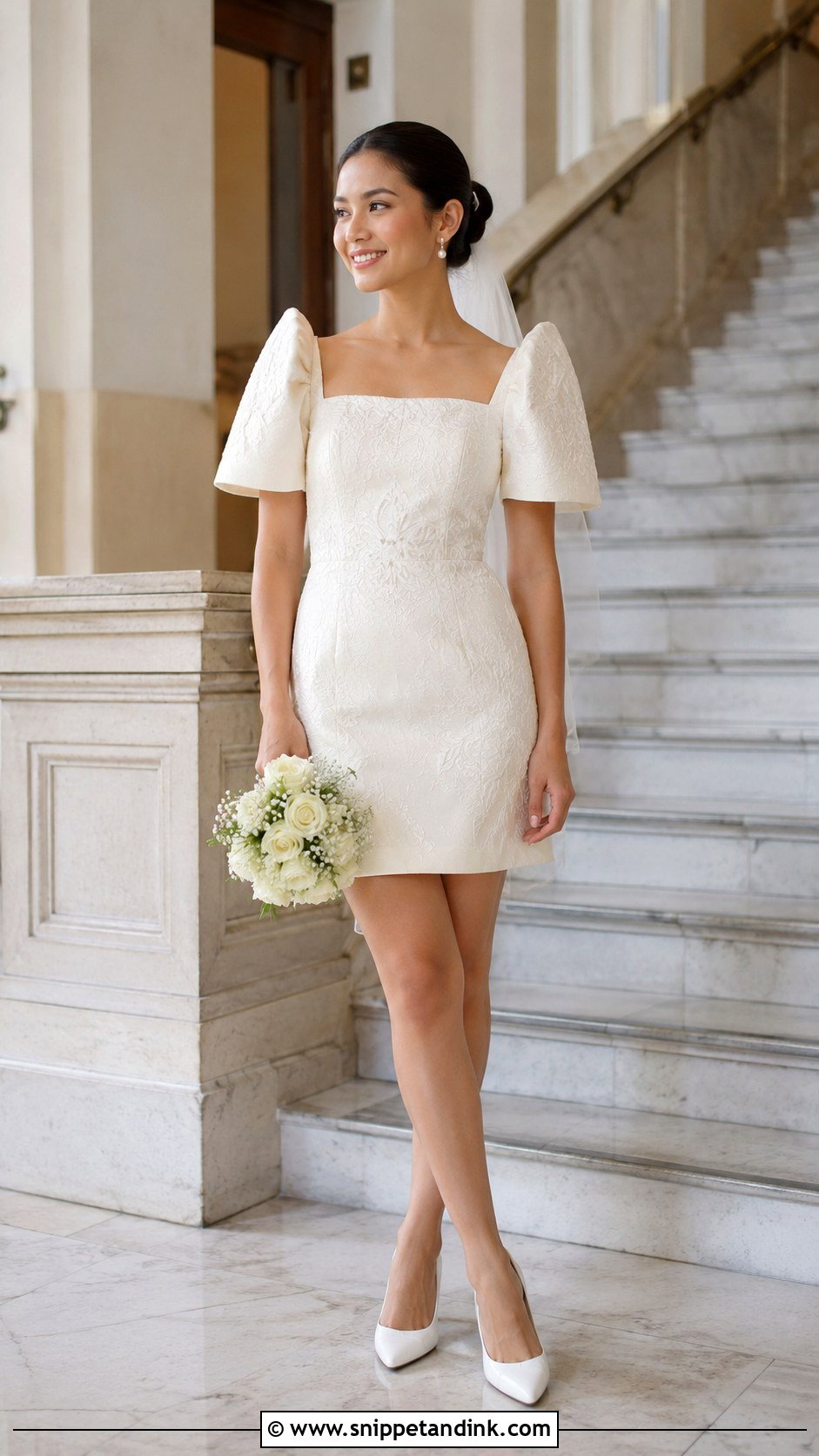
Detachable sleeves let the ceremony gown become a sleeveless, strapless or cap-sleeved reception dress. They are the best answer I know for heat and dancing. The weak point is attachment. Snaps alone can pop; I prefer a combination of hooks and a hidden ribbon tie, and I ask brides to swing their arms during the fitting to test it. Simple accessories and polished hair let the sleeves change the look without anything else needing to change.
23. Short Filipiniana Wedding Dress
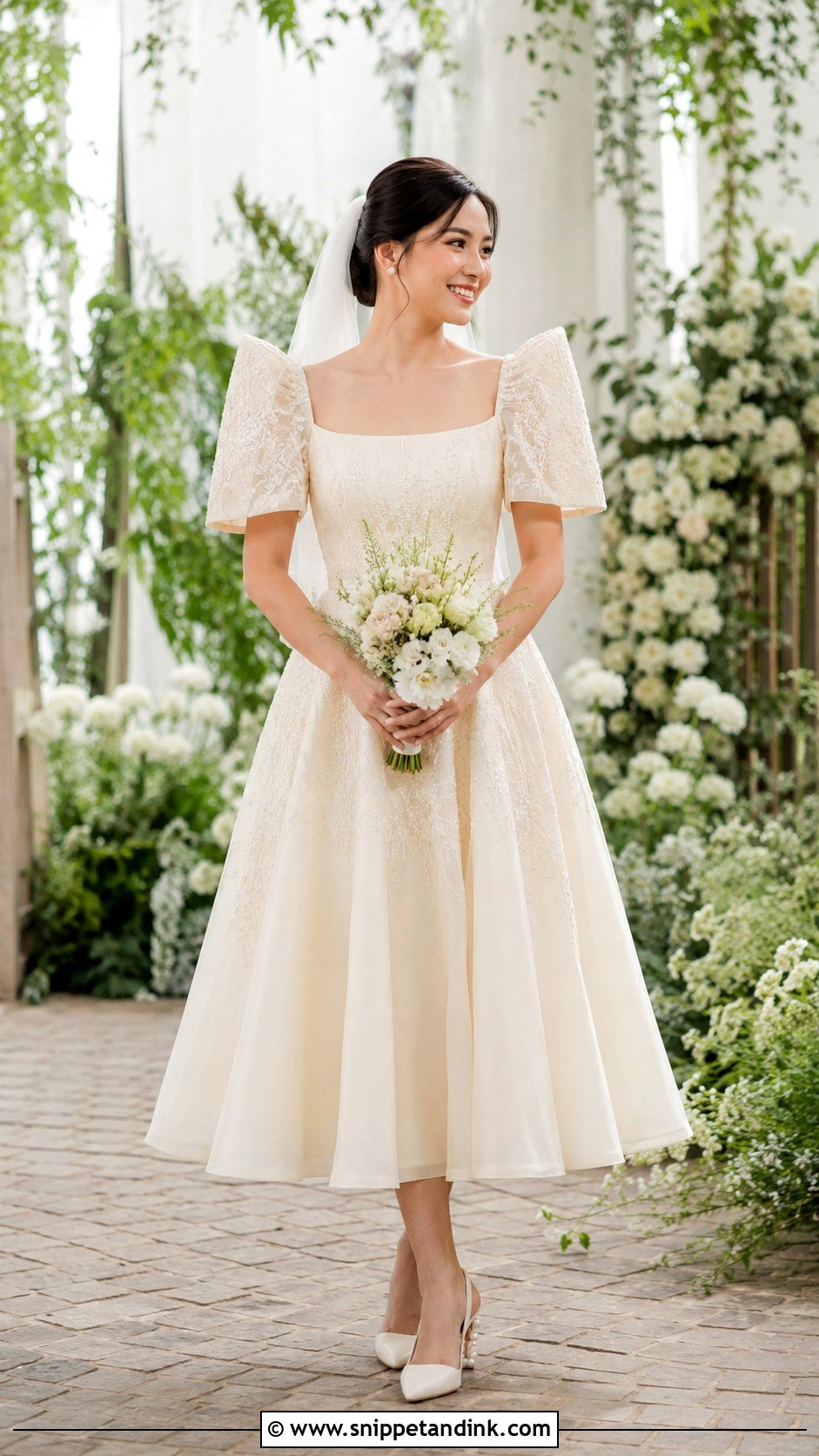
Short Filipiniana dresses are joyful, and I see them most at civil weddings, receptions and after-parties. Ivory fabric and properly structured butterfly sleeves keep a mini, knee-length or tea-length skirt bridal. Add pointed pumps, pearl earrings and a short veil or bow. It also makes a good second dress after a formal ceremony gown. Because the skirt is short, the sleeves have to carry the whole look, so I’d go for a fuller sleeve here than on a long gown.
24. Tea Length Filipiniana Wedding Dress
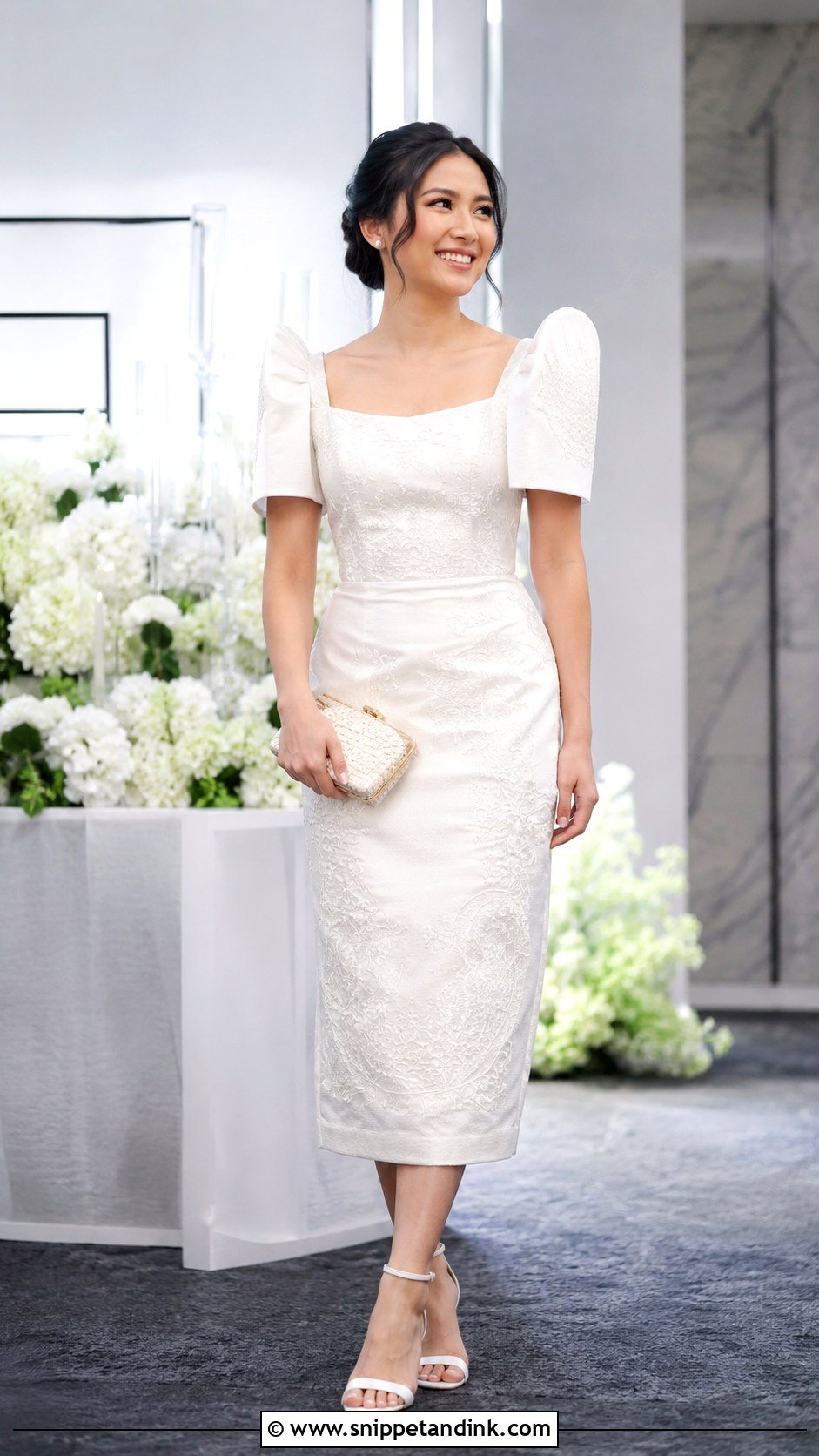
Tea length falls between the knee and ankle, so your shoes are part of the look. That’s the main reason I’d choose it: pearl pumps, slingbacks or satin heels finally get seen. A fitted waist, butterfly sleeves and a softly flared skirt keep the shape balanced, and a short veil with a neat updo finishes it. It feels vintage and suits intimate weddings and garden venues. The hem needs to be level, which I check with the bride standing in her actual wedding shoes.

25. Filipiniana Reception Wedding Dress
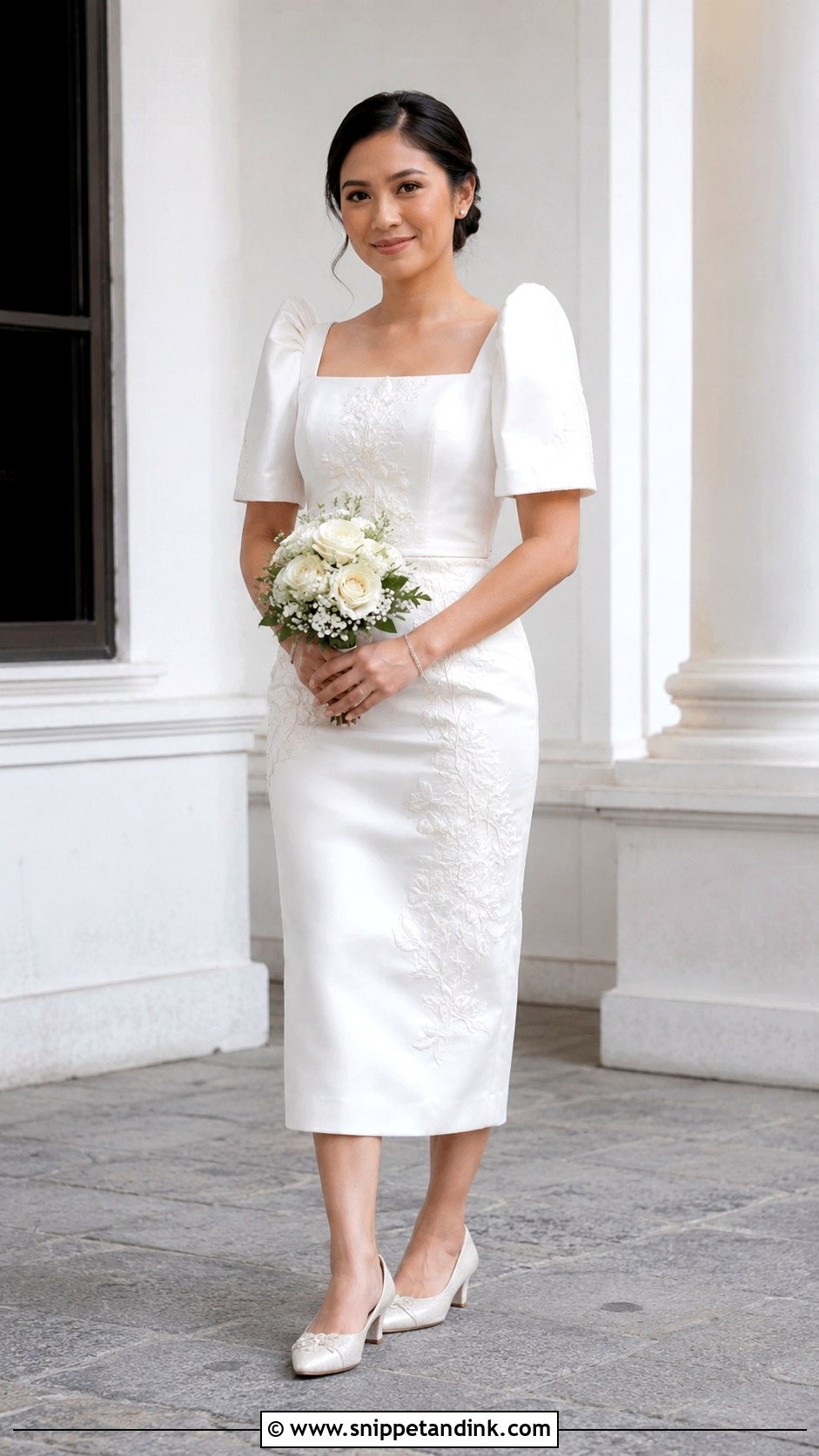
For the reception, I look for a dress you can sit, greet and dance in without thinking about it. A sleek terno midi, a short sheath with butterfly sleeves or a simple column with embroidery all work. Use fewer layers and a breathable fabric. It doesn’t need the drama of the ceremony gown, but it should still look connected to it, so I’d repeat one element, such as the same embroidery motif or sleeve shape. Comfortable heels, pearl earrings and a small bag.
26. Filipiniana Civil Wedding Dress
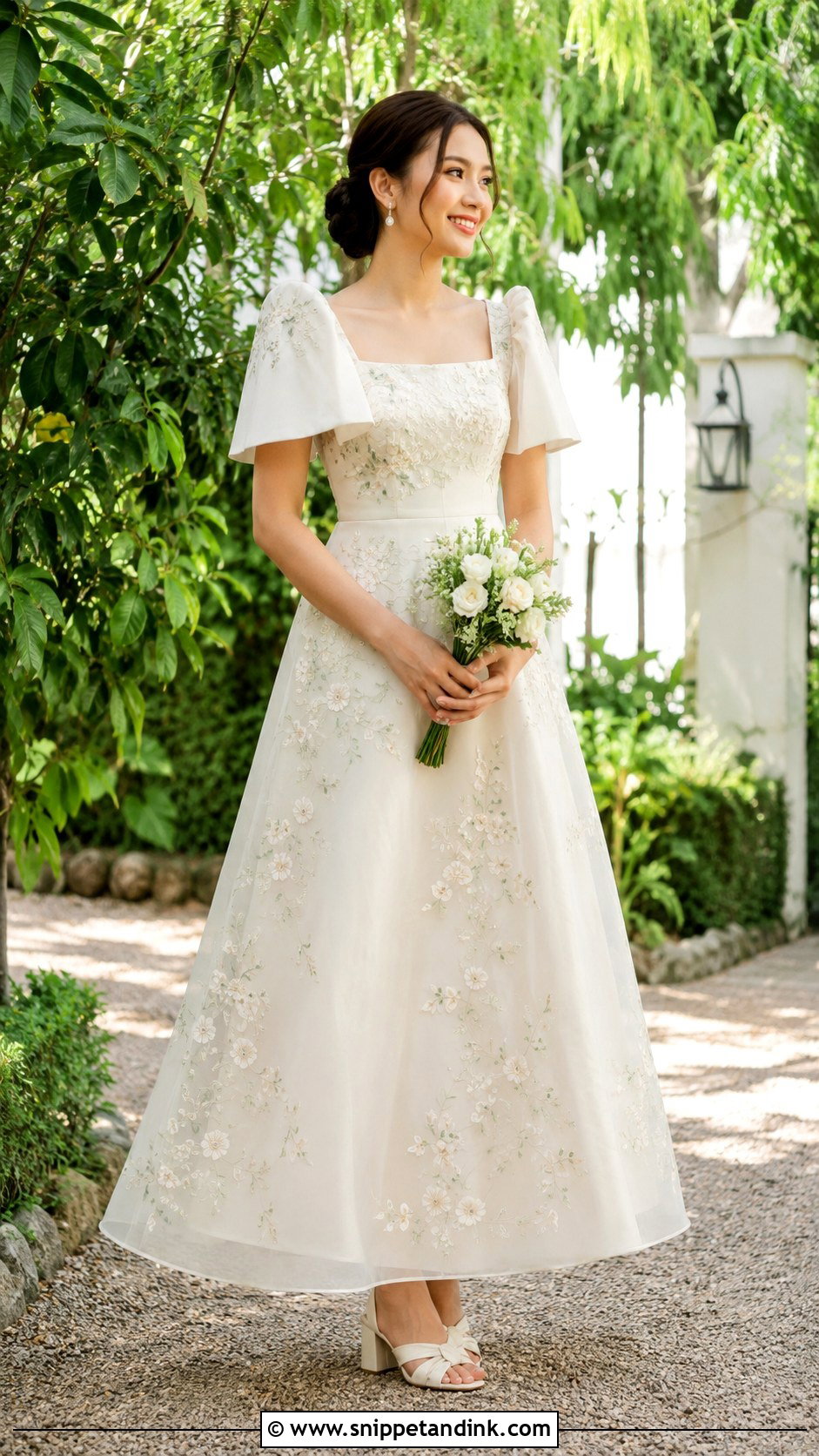
A civil ceremony doesn’t need a train or a heavy skirt. A white terno midi, a sheath or a tailored two-piece looks right for courthouse or city hall ceremonies. Clean fabric, subtle embroidery and structured sleeves give it a finished look. Low heels, pearl studs, a small bouquet and soft makeup complete it. If the larger celebration is later, I’d make this dress simpler than the main gown so the two don’t compete in your photos.
27. Filipiniana Garden Wedding Dress
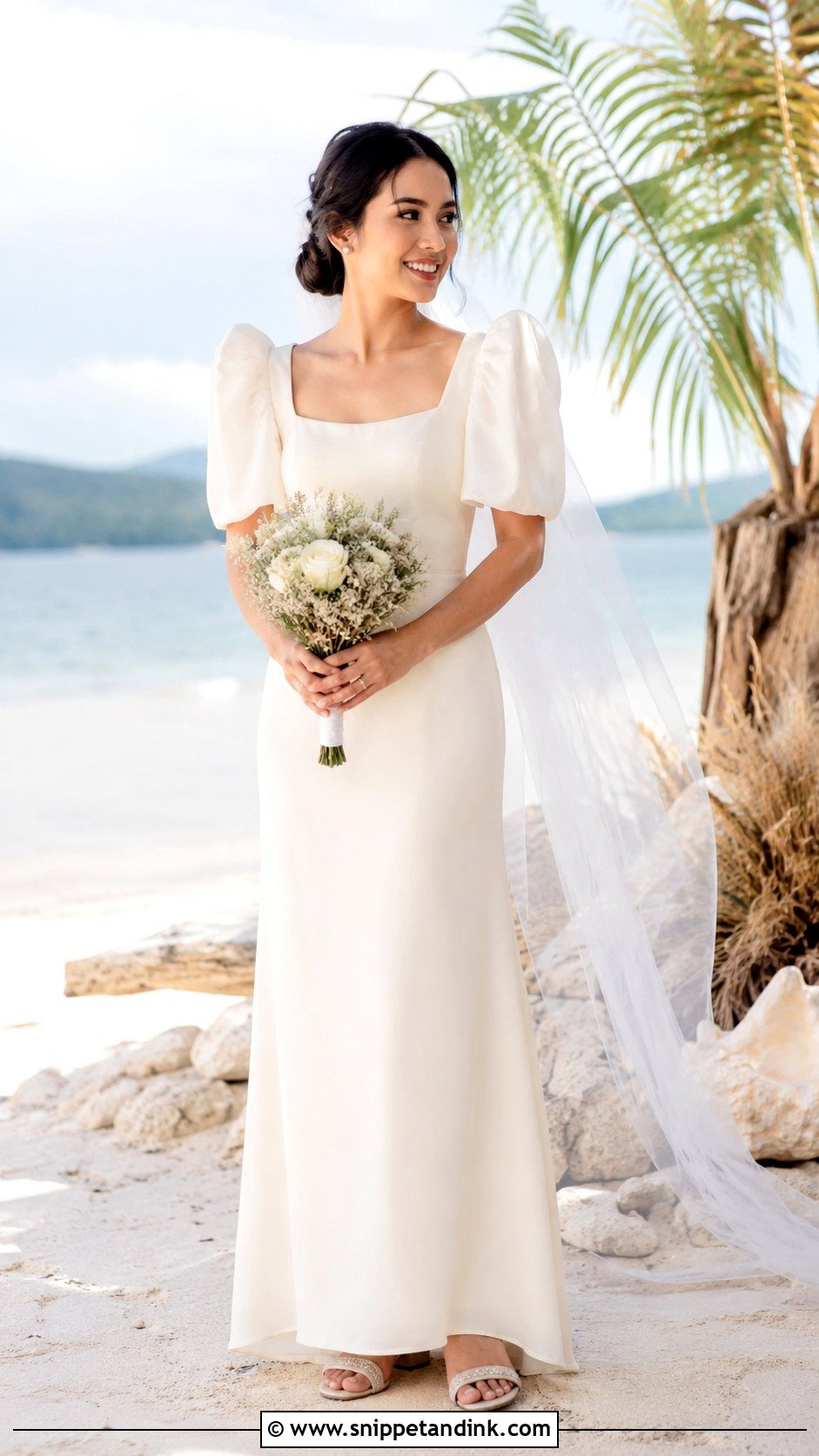
Garden weddings are hard on long skirts and fine heels. Soft organza, lace, jusi or a piña overlay all behave well outdoors, and an A-line or tea-length silhouette keeps the hem off the grass. Floral embroidery can echo the setting. Block heels won’t sink into lawns. I avoid heavy trains unless the venue has paved paths. For hair, a relaxed updo that already has some movement in it survives a breeze better than a polished one.
28. Filipiniana Beach Wedding Dress
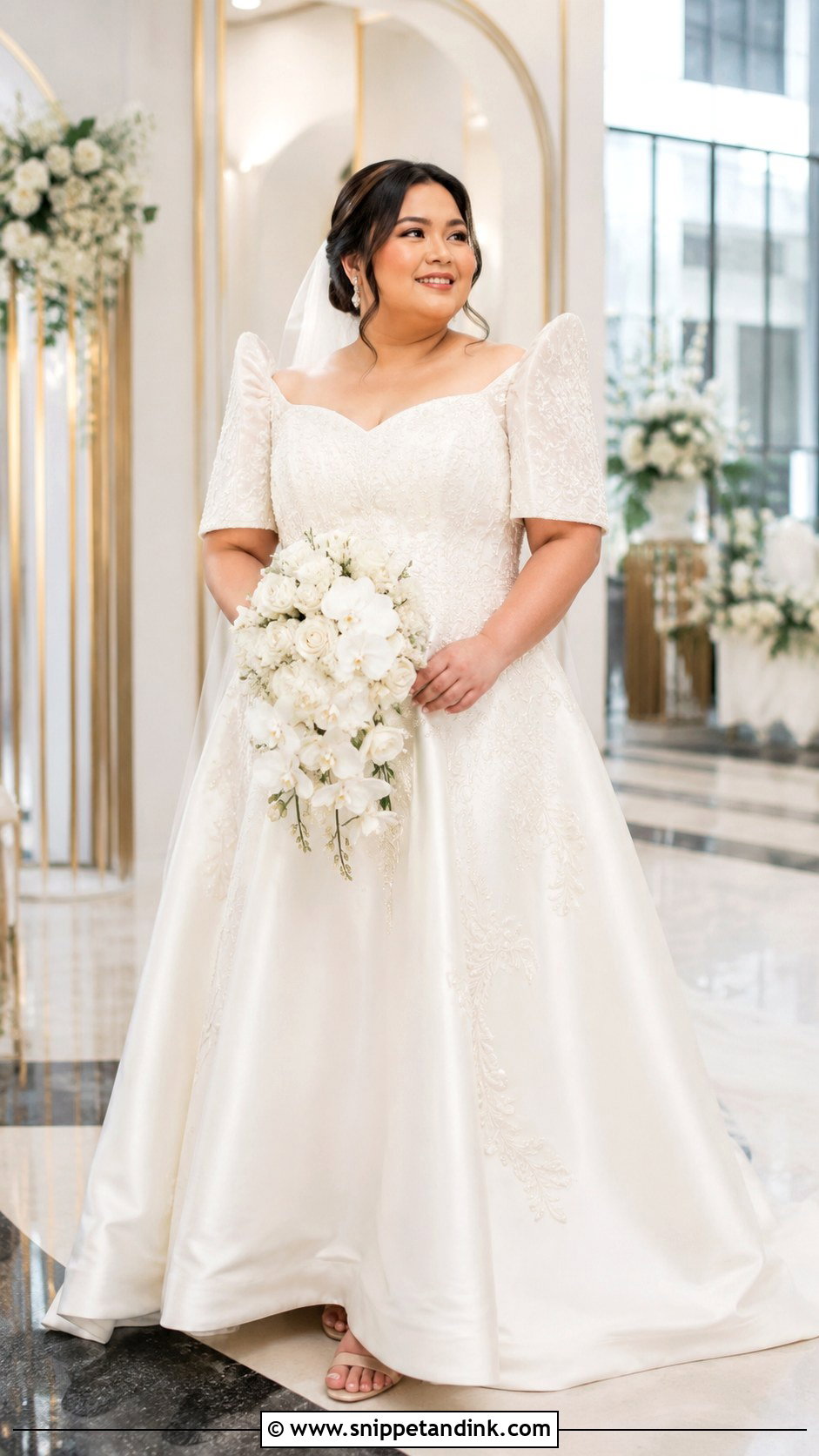
On a beach, weight and heat are the problems. I choose organza, chiffon or a light jusi-style fabric, and a simple sheath or A-line with butterfly sleeves. Long heavy trains don’t belong on sand; they drag and fill with it. Flat sandals, low block heels or dressy barefoot sandals depending on the setting. Salt air and humidity make stiffened sleeves droop, so I’d ask the dressmaker for a slightly firmer interfacing in a beach gown. A loose bun, pearl studs and a small bouquet keep it fresh.
29. Plus Size Filipiniana Wedding Dress
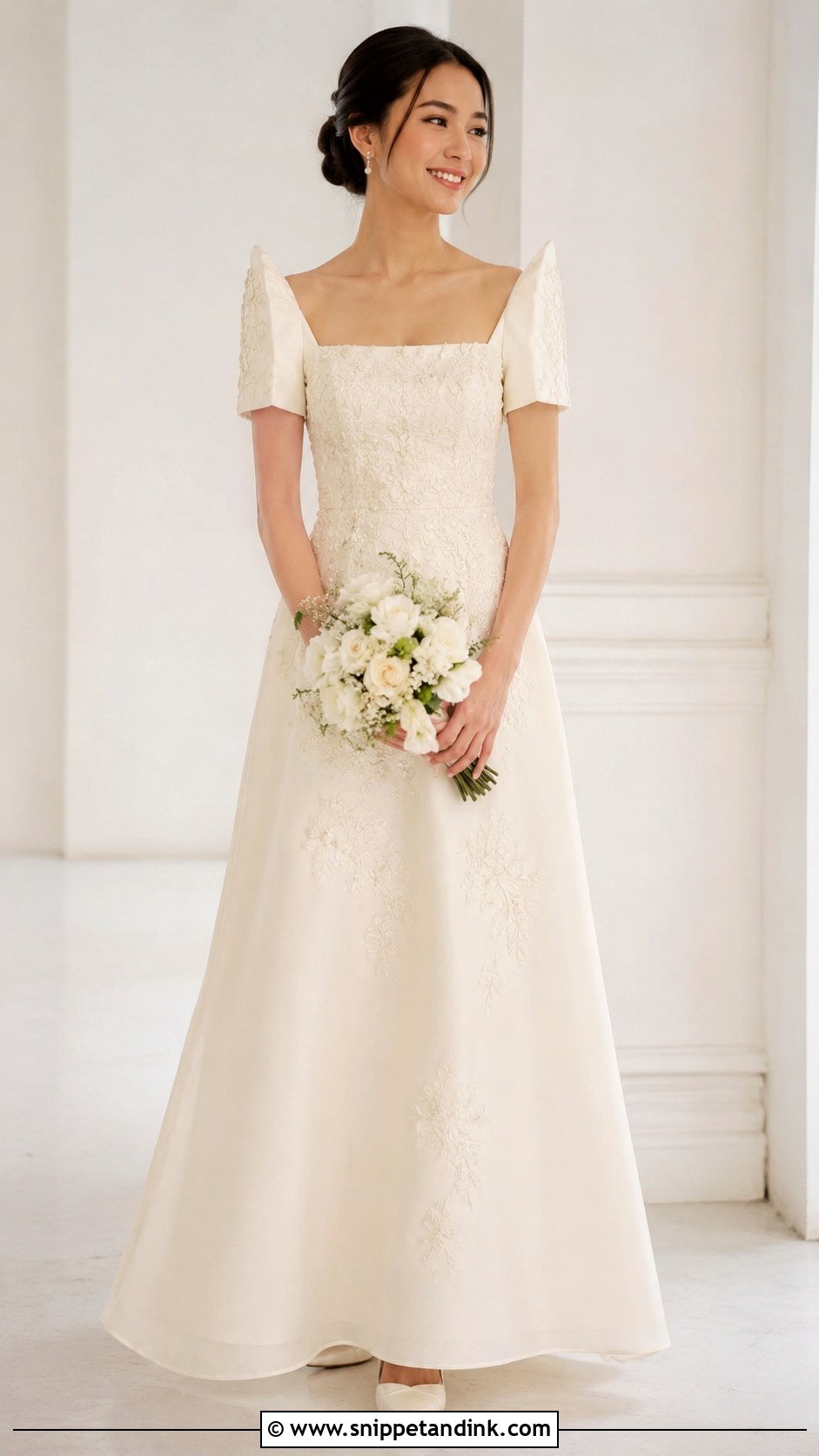
For plus size brides, the butterfly sleeve needs scaling, not removing. When the sleeve is cut to your shoulders and arm width rather than taken from a standard pattern, it looks proportioned and confident instead of stiff. An A-line, a soft ball gown or a structured empire waist all give movement and support. Quality lining and a secure bodice with boning matter more than any decoration. Supportive heels and a veil that complements the gown. Tailoring of the waist, sleeves and neckline is what makes it work.
30. Petite Filipiniana Wedding Dress
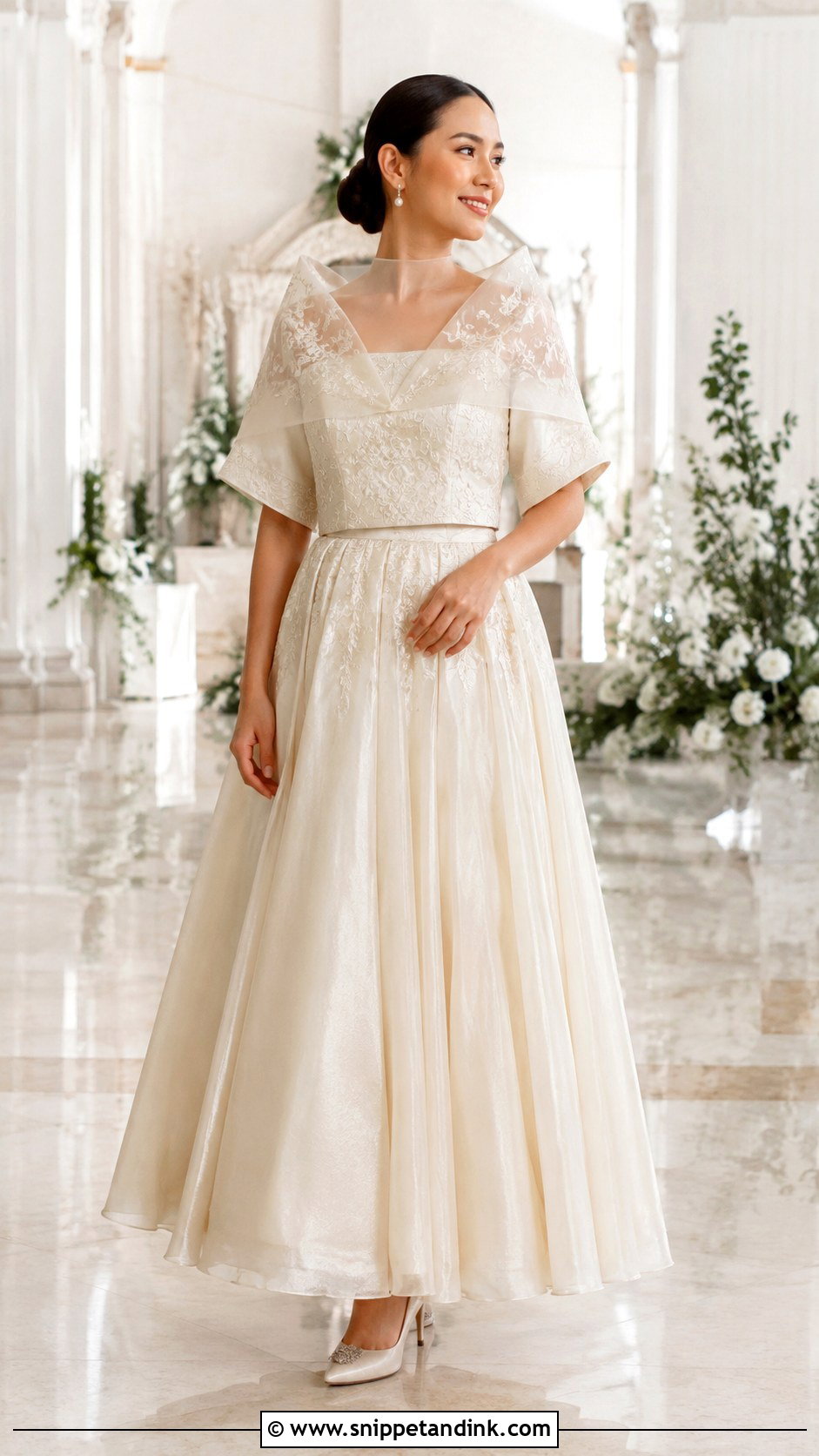
Petite brides can get lost in a full terno, so I scale everything down. Slimmer butterfly sleeves, a slightly higher waistline and a clean skirt that doesn’t overwhelm the frame. A sheath, A-line or tea-length gown suits. Vertical embroidery, a soft V-neck or a plain column visually lengthens the body. I would skip very wide sleeves and heavy trains unless the gown is custom balanced. Pointed heels, delicate earrings and a neat hairstyle keep the whole look in proportion.
Will Butterfly Sleeves Survive a Humid Afternoon?
Heat and humidity are the biggest enemies of a terno sleeve. Stiffened fabric absorbs moisture and softens, so by late afternoon the sleeve can start to fold. I keep a handheld steamer and a few safety pins in my kit for this reason. A quick pass of steam from inside the sleeve, then a minute in front of a fan, brings most of the shape back.
Hugs are the other hazard. Every guest who embraces you presses the sleeve flat. I show brides how to offer a slightly sideways hug, leading with the shoulder, during the receiving line. For the dance, detachable sleeves or a bolero you can remove are worth considering.
Storing Piña as a Family Heirloom
Piña can last generations if it’s kept properly, and many families pass these gowns down. After the wedding, have it professionally cleaned by someone who handles delicate natural fibers, because perspiration and makeup stains yellow over time.
- Store it flat or loosely rolled in acid-free tissue, not on a hanger, which stretches the shoulders.
- Keep it out of plastic bags. Natural fiber needs air, and plastic traps moisture that leads to mildew.
- Avoid direct sunlight and damp cupboards. A cool, dry, dark shelf is best.
- Refold it along different lines every few months so permanent creases don’t form.
Heritage, Fit and the Sleeve That Holds Its Shape
A Filipiniana gown should look like it belongs to you. A classic terno, a romantic Maria Clara gown, a modern reception dress or a detachable design that changes through the day can all carry that feeling. Spend your attention on the sleeve structure, the weight of the fabric and the tailoring, then let accessories support the dress rather than fight it. Formal, intimate, outdoor or abroad, a well-fitted Filipiniana gown carries your family’s story down the aisle.
You'll Like These Ideas:





Leave a Reply