
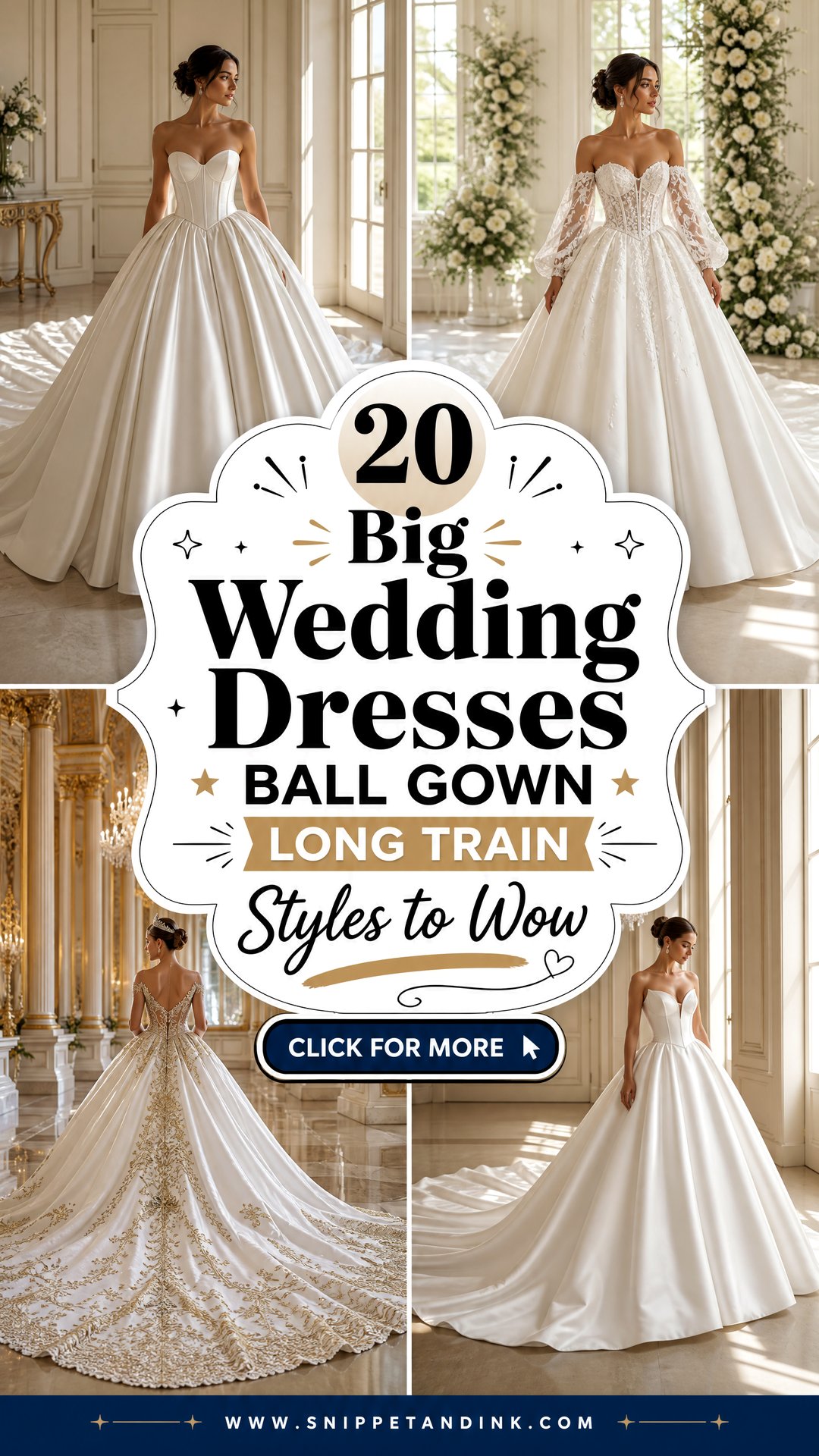
A full ball gown with a long train changes how you walk, sit, hug and even get through a doorway, so I treat it as a whole outfit with its own logistics rather than a pretty picture. The twenty gowns below cover satin, lace, tulle, pearls and crystal, with the veil, shoes, hair and flowers I’d put with each. Under every one I’ve added what I actually check in the fitting room: where the weight sits, how the fabric behaves when you sit down, and what the bustle has to hold once the dancing starts.
What a Ball Gown Weighs, and Why That Changes How You Shop
A full satin or beaded ball gown with a petticoat and long train can feel surprisingly heavy, and most of that weight hangs from your waist and hips rather than your shoulders. When a bride tells me she loves a sample but feels tired after ten minutes, I believe her. That tiredness does not improve on the day.
Here is how I set up a shopping appointment for this silhouette:
- Wear or bring a strapless bra or bodysuit close to what you’ll wear on the day, plus shoes near your planned heel height. Pinning a hem on bare feet gives a false length.
- Ask the consultant to put the correct petticoat under the sample. A ball gown tried without one looks limp and tells you nothing about volume.
- Sit on a normal chair for a full minute. Watch whether the bodice digs in at the top and whether the hoop or petticoat pushes the skirt into your face.
- Ask the salon how long the gown takes to arrive. Made-to-order gowns often need several months, and alterations on a big skirt usually take two or three fittings on top of that, so starting early gives you room.
Tulle is the lightest route to volume. Satin and Mikado hold shape better but add weight and warmth, and heavy beading adds the most. If the wedding is outdoors in summer, I usually steer brides toward layered tulle with a lighter lining.
1. Strapless Sweetheart Ball Gown Wedding Dress With Long Train
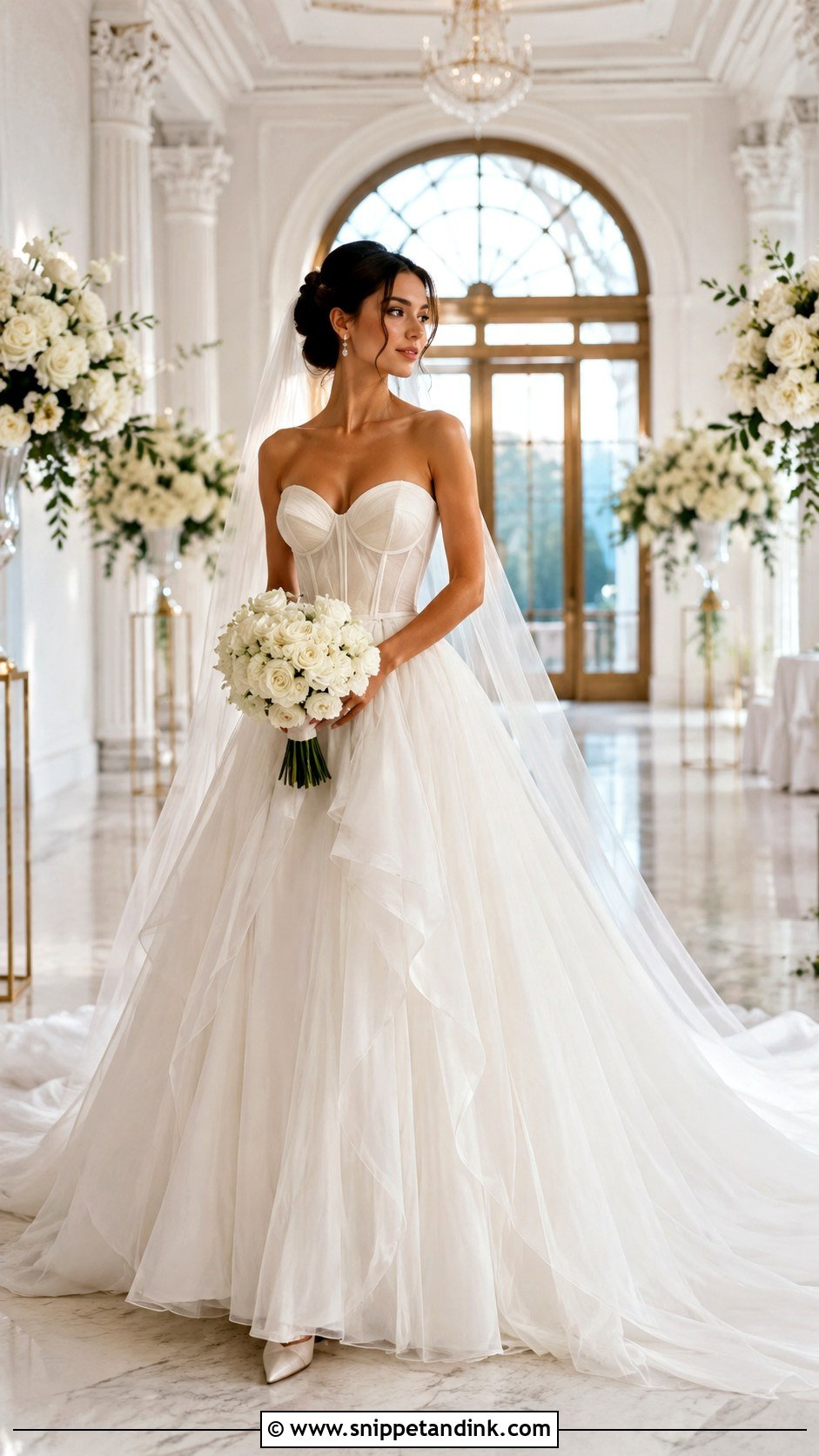
The sweetheart neckline is the one I see slip most, and it is almost never the neckline’s fault. A strapless bodice holds you up through internal boning and a waist stay, a grosgrain band sewn inside at the natural waist that hooks closed before the zip; if the gown has no waist stay, I ask the seamstress to add one. Over layered tulle and a lace-trimmed cathedral train, I keep the rest classic: a fingertip or cathedral veil set below a low chignon, small drops, pointed ivory pumps and round white roses. A removable sheer wrap covers the shoulders for a church ceremony. Ask for a multi-point bustle, because one hook will not carry that much tulle.
2. Long Sleeve Lace Ball Gown Wedding Dress With Long Train
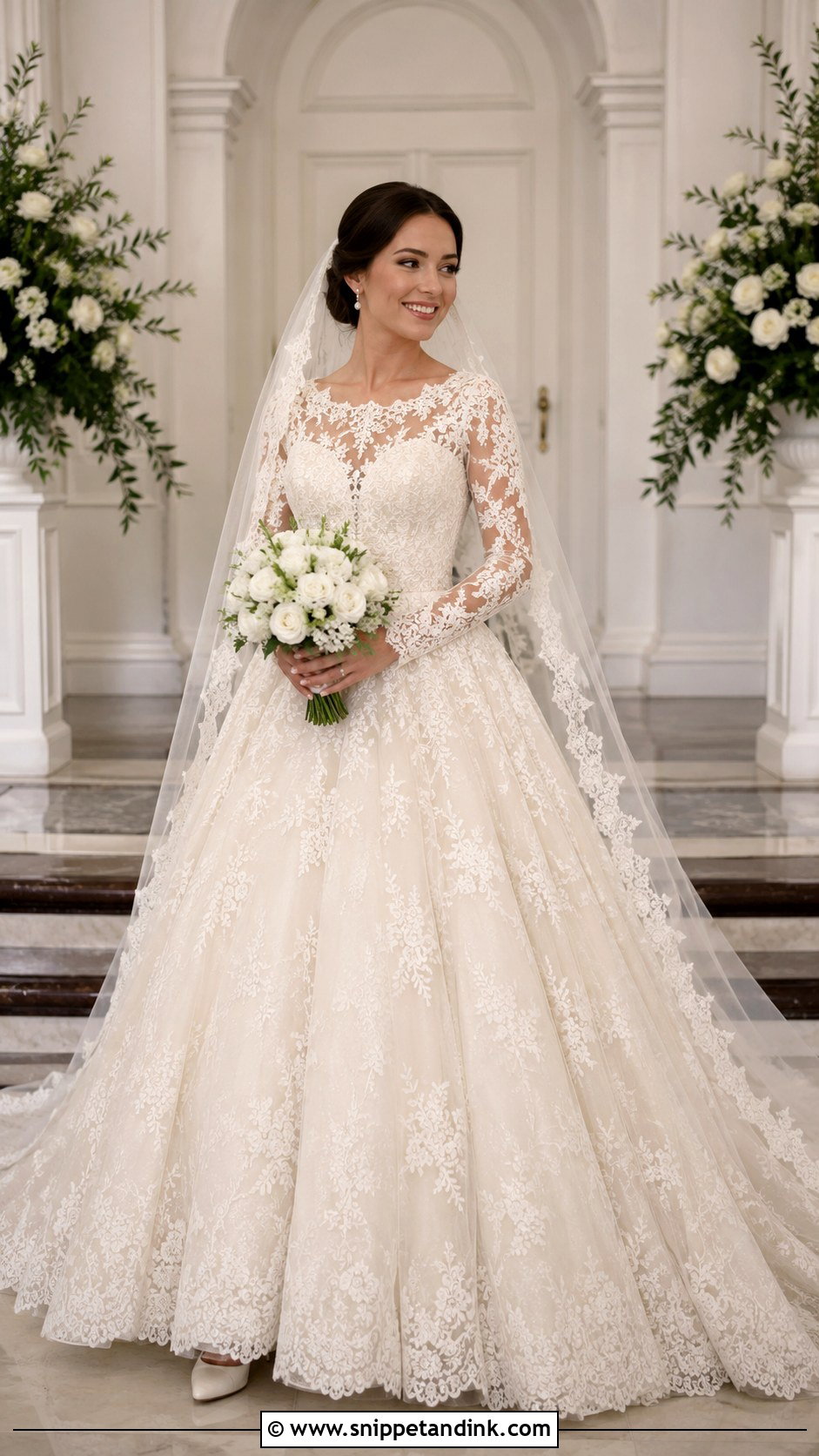
Lace sleeves give coverage, but they also decide how high you can lift your arms. An illusion-lined bodice with appliqués running from the neckline onto the sleeves and skirt reads as one continuous piece, and a defined waist keeps the full skirt from swallowing you. The scalloped cathedral train shows the lace from behind. I style it with a low bun, pearl studs, a sheer veil with a narrow lace edge, closed ivory heels and a loose bouquet of white flowers and greenery. At every fitting I make the bride hug me, raise both arms and sit. A sleeve set too tight at the armhole pulls the whole bodice up, and that has to be fixed before the lace is finished.
3. Off Shoulder Satin Ball Gown Wedding Dress With Long Train
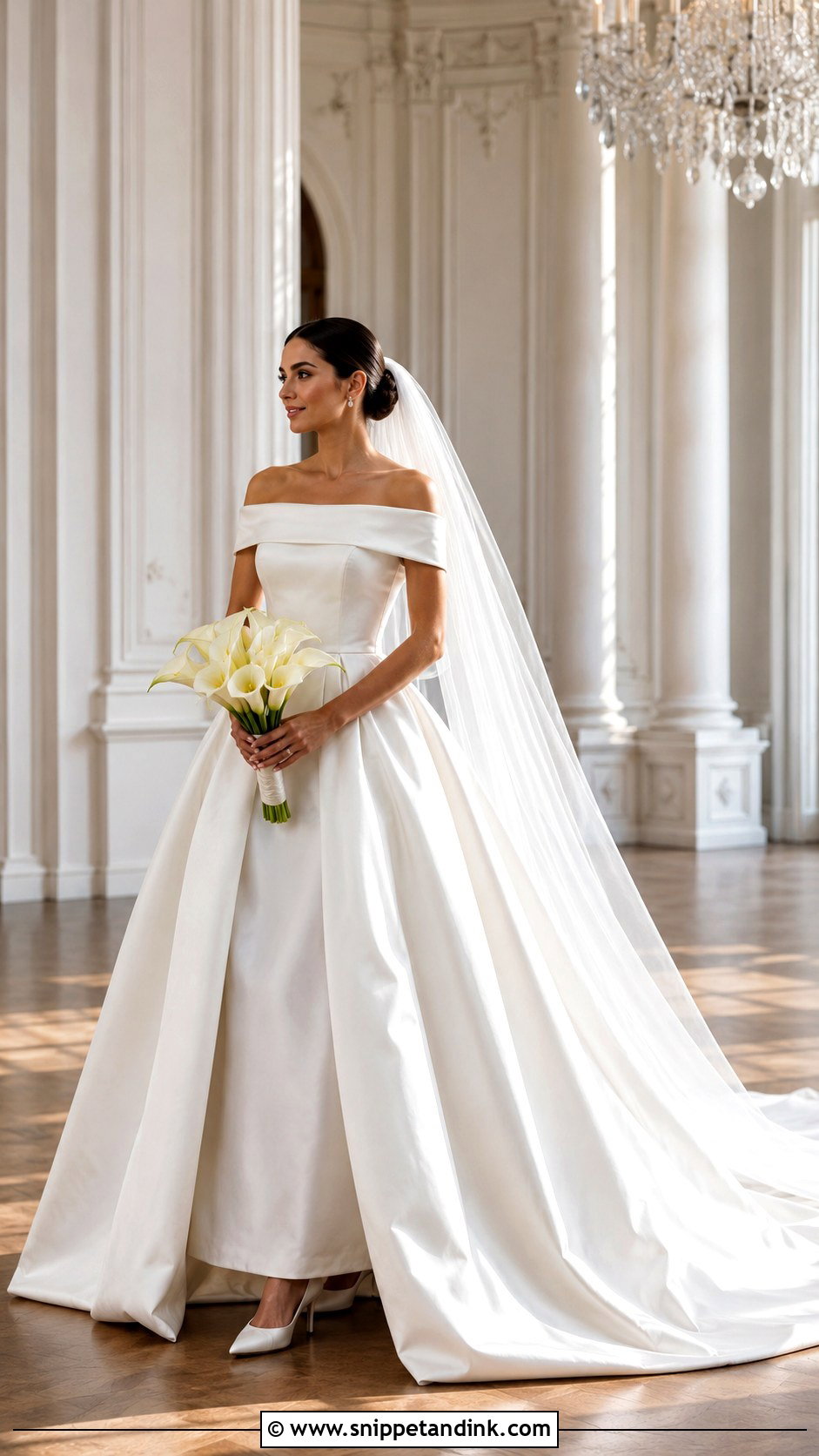
Heavy satin is honest fabric: it shows every seam and every wrinkle, which is why it looks so clean when the fit is right. The folded off-shoulder neckline frames the collarbones, and a fitted bodice with a natural waist balances the big skirt. I pick a heavier satin when the bride wants crisp pleats that hold their shape after hours of sitting. Keep the train at chapel or cathedral length and the veil plain, with a sleek bun, small studs, satin pumps and calla lilies or structured white roses. Off-shoulder bands can dig into the upper arm when you reach forward, so I have them fitted with the arms moving, not resting. Hidden hand loops in the skirt make walking easier before the train is bustled.
4. Corset Bodice Tulle Ball Gown Wedding Dress With Long Train
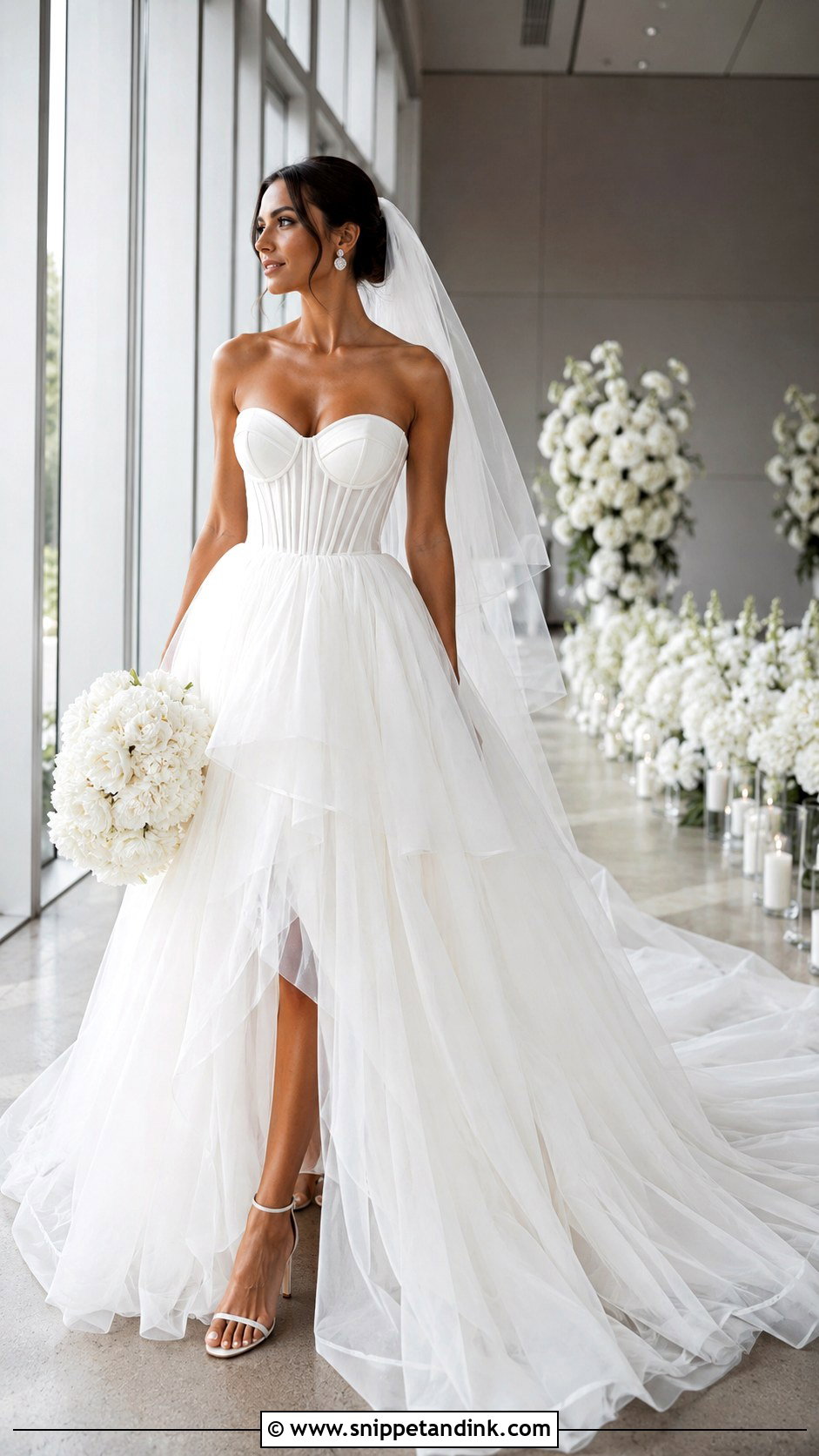
Visible boning gives a tulle gown a modern edge, but it is also working underwear, so the fit has to be exact. A corset that is right supports the bust without the top edge cutting into the side of the chest when you sit. The tulle skirt stays airy because it is layered rather than stiffened, and the top layers float into a soft cathedral train. I pair it with a simple veil, sparkling studs, ankle-strap heels that stay hidden, and a textured white bouquet that will not compete with the bodice. If the back is laced, ask whoever dresses you to tighten from the middle outward. Tightened top-down, the lacing pinches at the waist and gapes at the shoulder blades.
5. Beaded Crystal Ball Gown Wedding Dress With Long Train
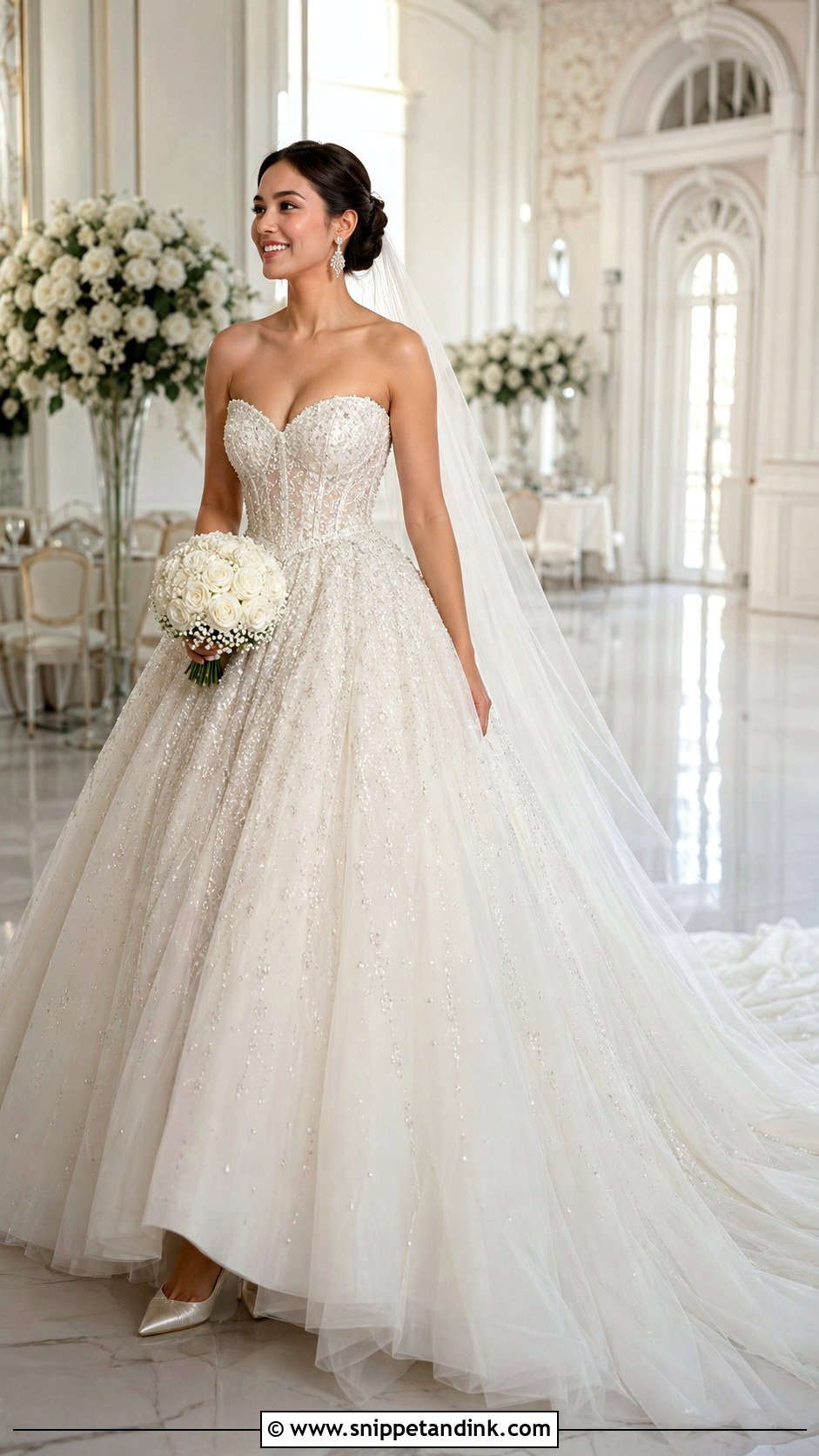
Crystal beading is heavy, often far heavier than brides expect when they first lift the skirt. I prefer the stones concentrated on the bodice and scattered more thinly down the skirt and train, which gives shimmer under ceremony lights without making the whole gown sag. A scoop, sweetheart or modest V suits beadwork. Choose a plain veil, because a veil with an edge will catch on raised crystals every time you turn; crystal earrings, a clean updo, silver or ivory pumps and a compact bouquet finish it. That weight is the reason I insist on supportive straps or a firmly built inner corset, and on bustle points reinforced with extra fabric behind them so the train cannot tear them loose.
6. Square Neck Mikado Ball Gown Wedding Dress With Long Train
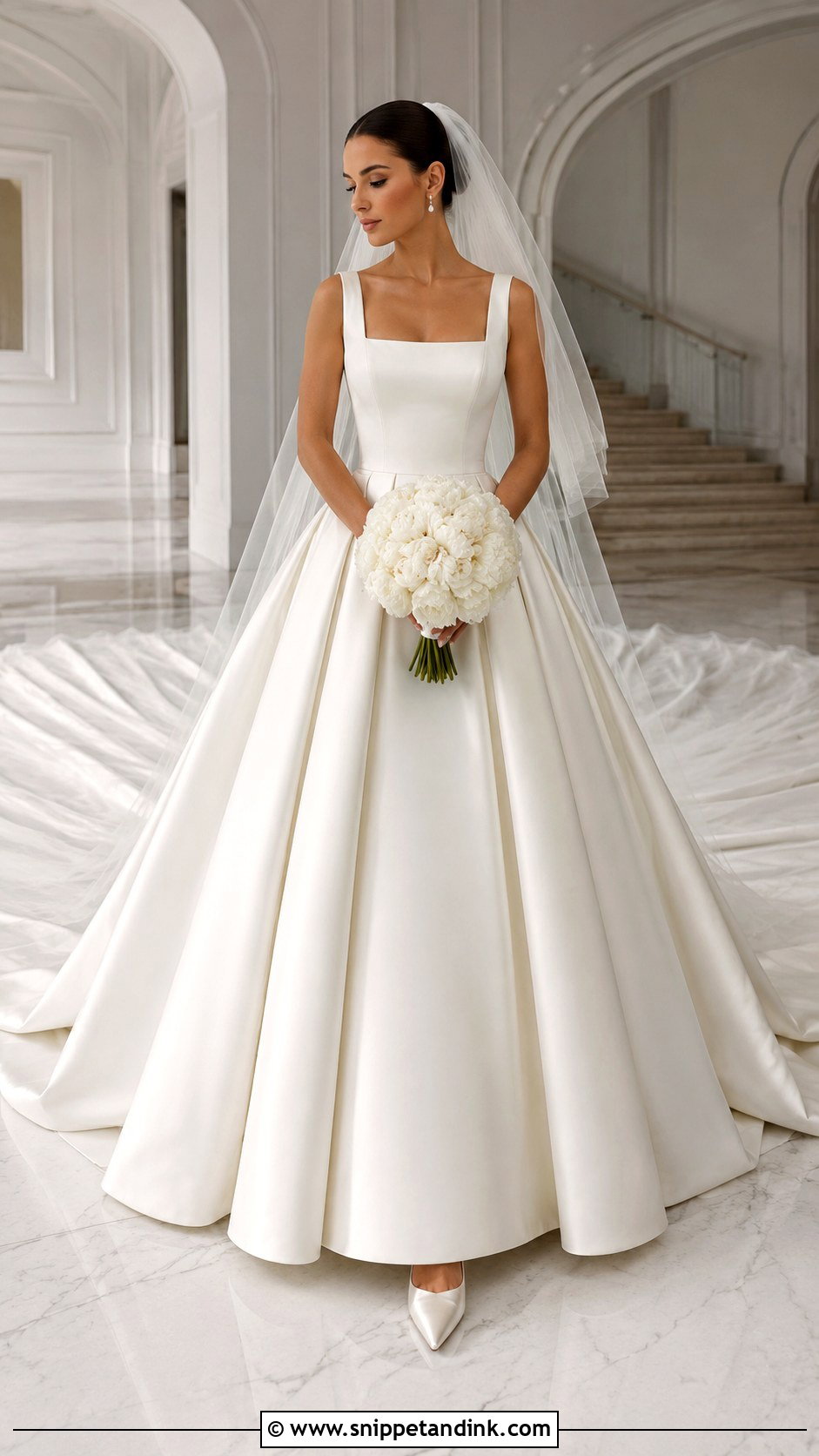
Mikado has body. It is a stiff, slightly lustrous silk-blend weave that holds box pleats on its own, so a square-neck gown in it stays architectural without layers of ruffles. The wide straps and square neckline give more coverage than strapless and let precise seaming do the shaping at the bust and waist. The crisp fabric spreads into a wide cathedral train that lies flat in photos. I’d add a centre-parted bun, pearl drops, a smooth cathedral veil, pointed satin heels and compact white peonies. The trade-off is warmth. Mikado does not breathe like tulle, so for a summer venue I ask for a breathable lining and a petticoat sized to the skirt rather than an extra one for volume.
7. High Neck Lace Ball Gown Wedding Dress With Long Train
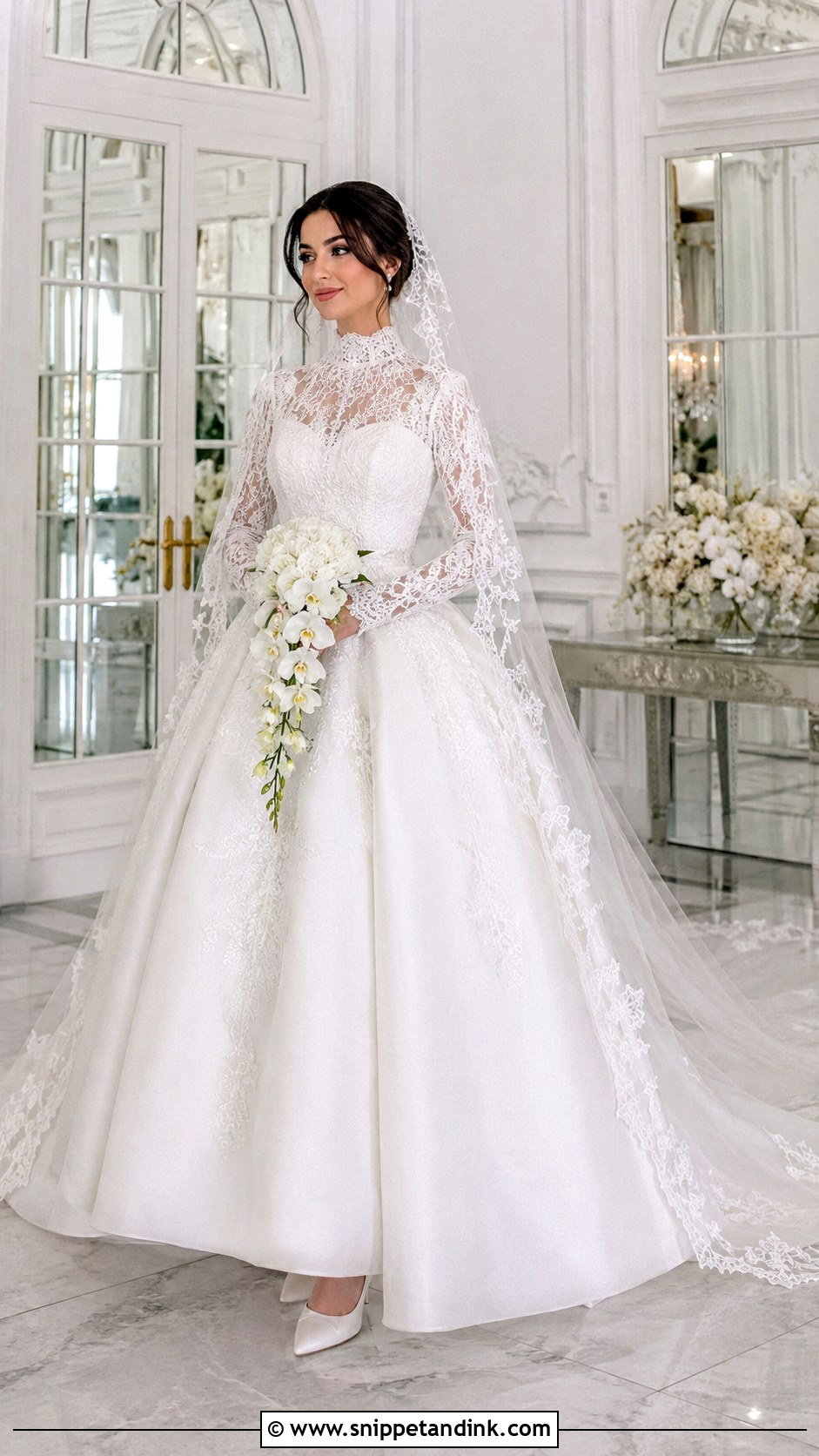
A high lace neck covers a lot, so everything else should do less. Sheer illusion at the throat lets the floral lace look as if it rests on the skin, and the fitted bodice opens into a full tulle or organza skirt with motifs that frame the cathedral train. I skip the necklace entirely here and choose small pearl or crystal earrings, a low bun that keeps the collar visible, closed pumps, a lace-edged veil and a slim bouquet. The collar is where comfort goes wrong. I ask brides to turn their head fully both ways and to look down at their bouquet; if the lace scratches or presses, it will feel ten times worse by the speeches.
8. Pearl Embellished Ball Gown Wedding Dress With Long Train
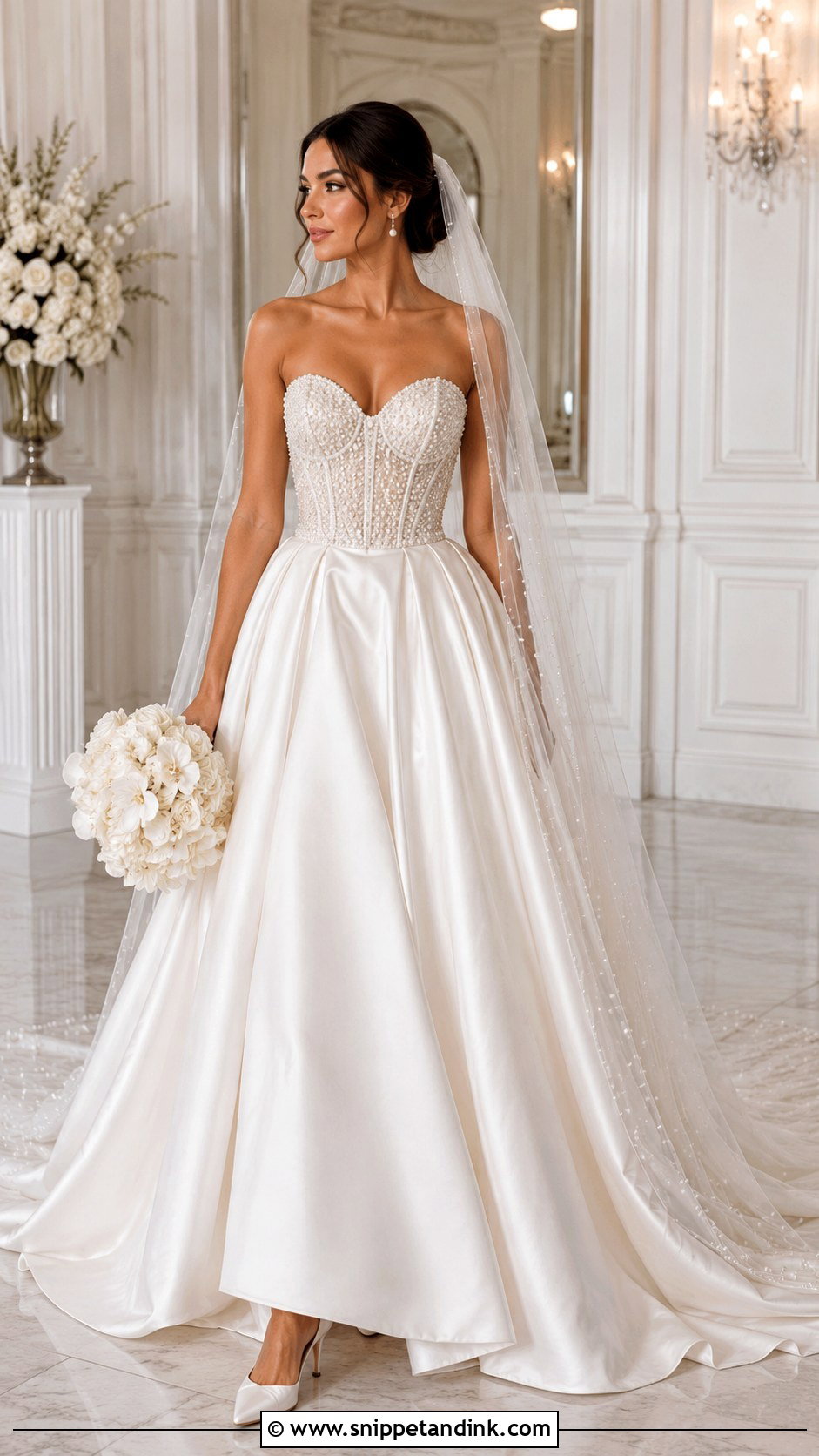
Pearls soften a big gown in a way crystal doesn’t, because they glow rather than flash. Scattered over a fitted corset above a plain satin or tulle skirt, they keep the look rich without going ornate, and a light trail down the back onto the cathedral train adds drama from behind. I keep the accessories in the same family: pearl earrings, ivory satin shoes, a sheer veil with a few pearls, a smooth bun or soft waves, and white flowers with very little greenery. Before buying, I tug gently at a few pearls on the sample. Many are glued rather than hand-sewn, and the glued ones pop off during bustling, so a small repair kit with matching pearls and clear thread is worth packing.
9. Floral Appliqué Ball Gown Wedding Dress With Long Train
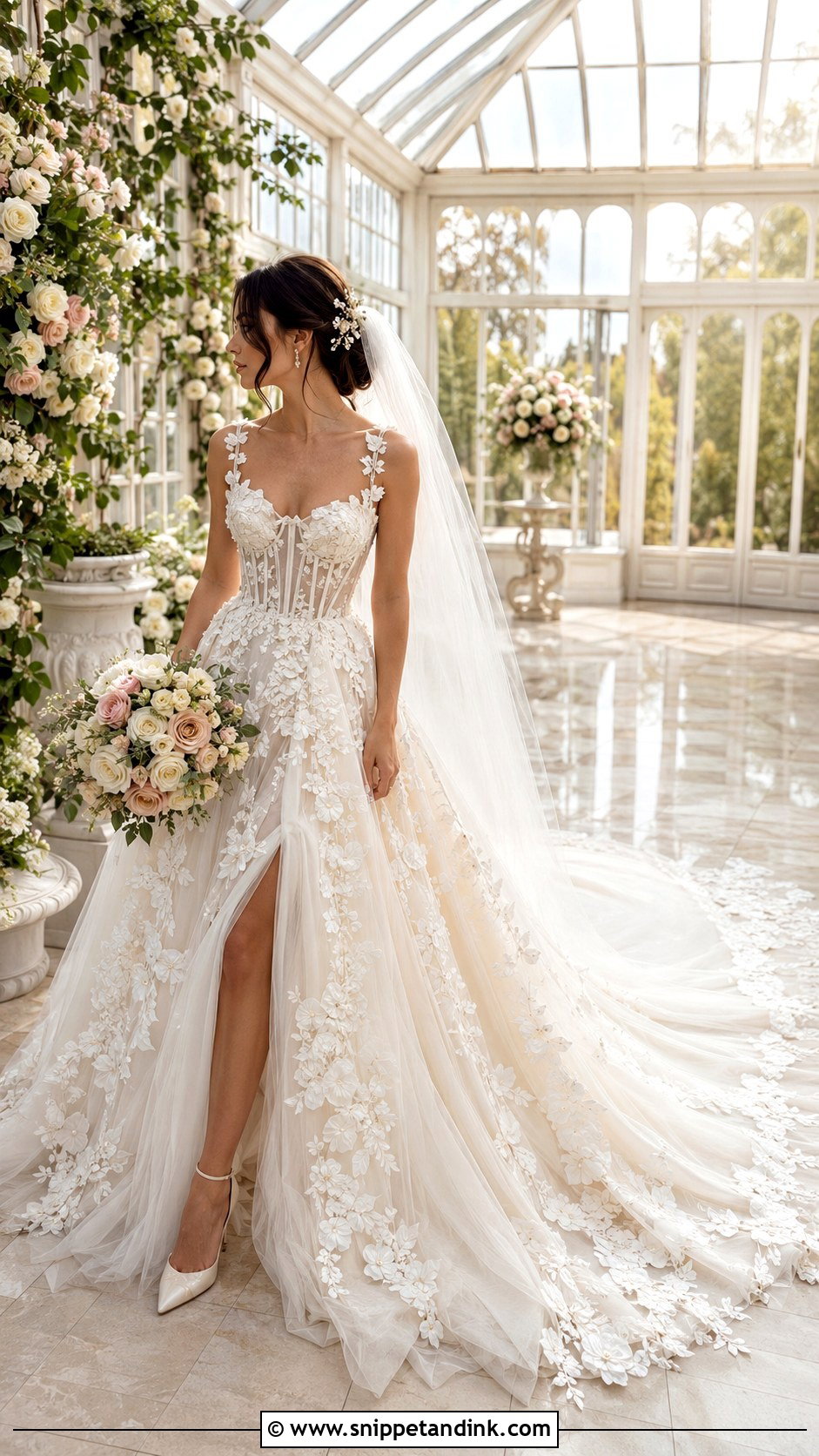
Dimensional appliqués look best when they thin out as they travel down the skirt, so the eye moves instead of stopping at one busy patch. On a sheer corset base the flowers seem to float; a nude or ivory lining behind them adds coverage. Bordering the cathedral train with the same flowers finishes the back view. I keep the veil unembellished and the earrings small, add floral pins in the hair, ivory heels and loose garden roses. Bracelets and rough-edged clutches catch on raised petals, so I leave them off. When a gown is taken in, the side seams cut through the pattern, and a good seamstress lifts the appliqués and re-stitches them over the new seam so nothing looks chopped.
10. Ruffled Tulle Ball Gown Wedding Dress With Long Train
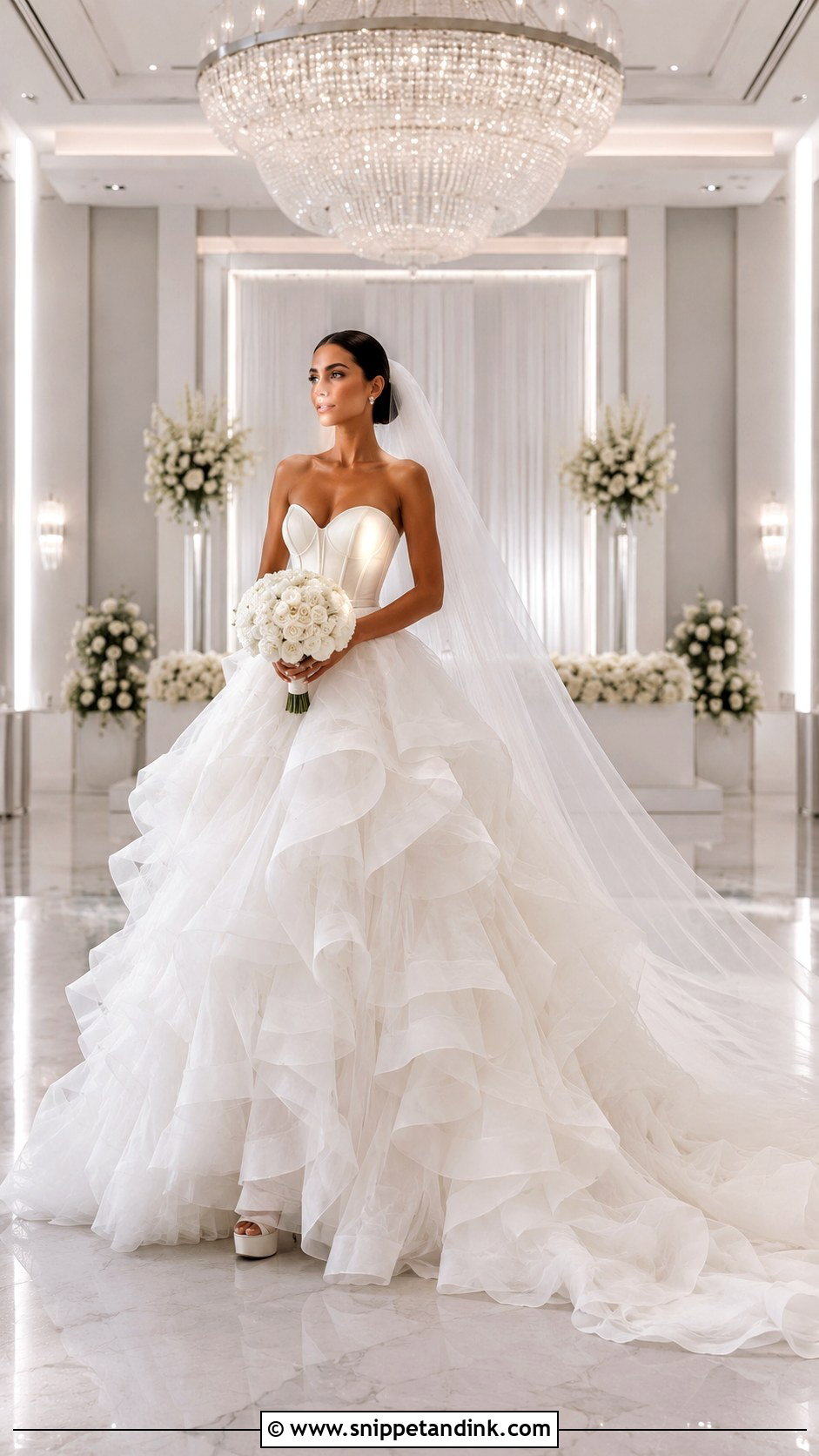
Ruffled tulle gives the biggest silhouette on this list and the most movement. Tiers that start below a fitted bodice keep the waist readable. Softly gathered ruffles read romantic, while tiers finished with horsehair braid at the edge stand out in a more sculptural shape. The layers carry on into a long train. With this much going on below, I keep the top plain: a smooth veil, studs and a clean bun, plus a compact white bouquet. Platform heels help with height and balance. Walk and turn in your actual shoes before the hem is set, because the bottom ruffle catches a heel that is even slightly too low.
11. Basque Waist Satin Ball Gown Wedding Dress With Long Train
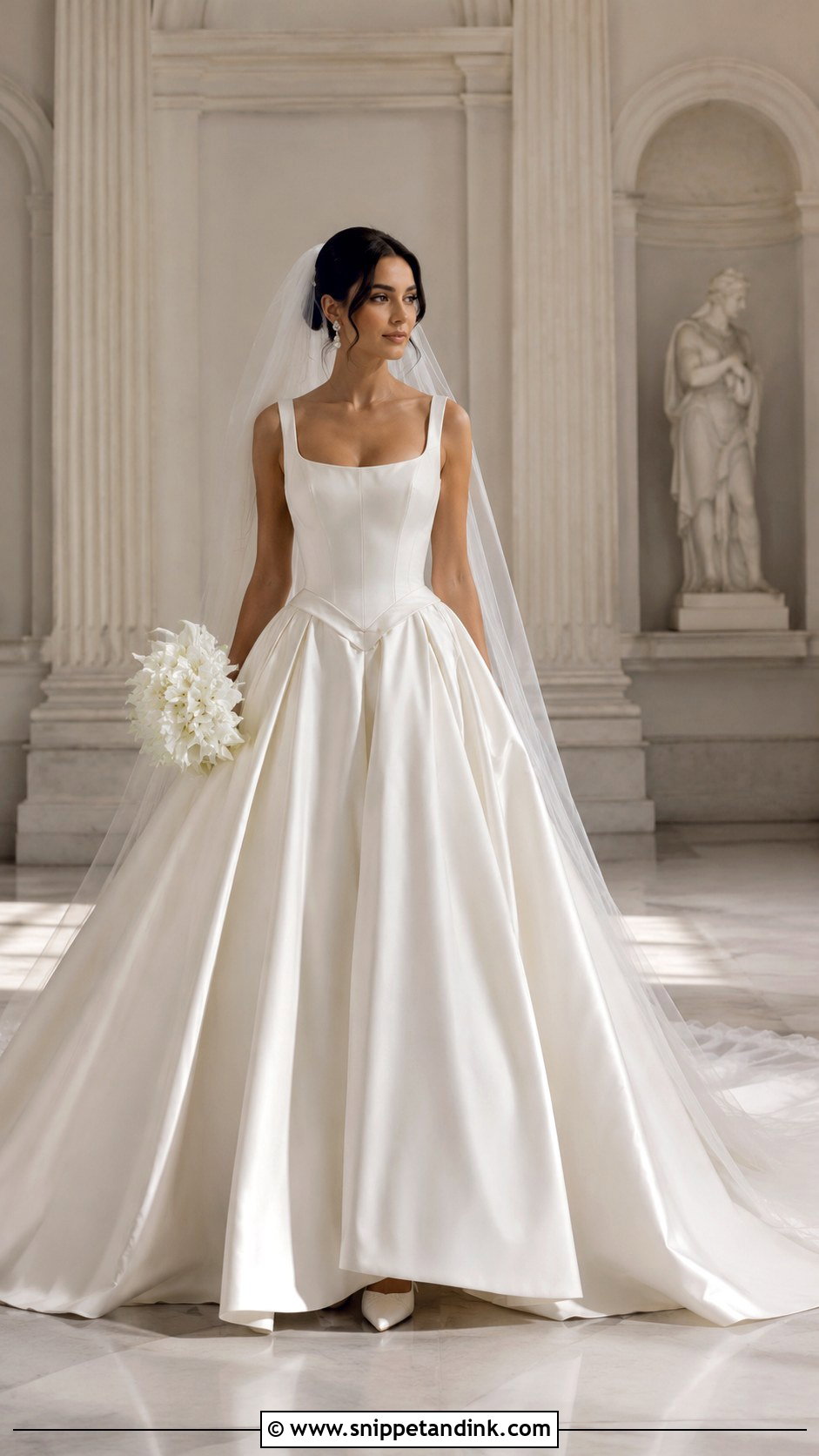
A basque waist dips into a shallow point at the front, which lengthens the torso above a very full skirt. Satin shows that construction clearly, so I pair it with a fitted corset in scoop or strapless and deep skirt pleats that fall neatly into a broad cathedral train. Styling stays formal: a plain long veil, drop earrings, a polished bun, ivory pumps and a structured bouquet. The point of the basque is the part I watch at fittings. If it is set even a little low, it presses into the hip bones when you sit and folds upward in every seated photo, so sit, stand and walk several times before the seam is finished.
12. Detachable Sleeve Ball Gown Wedding Dress With Long Train
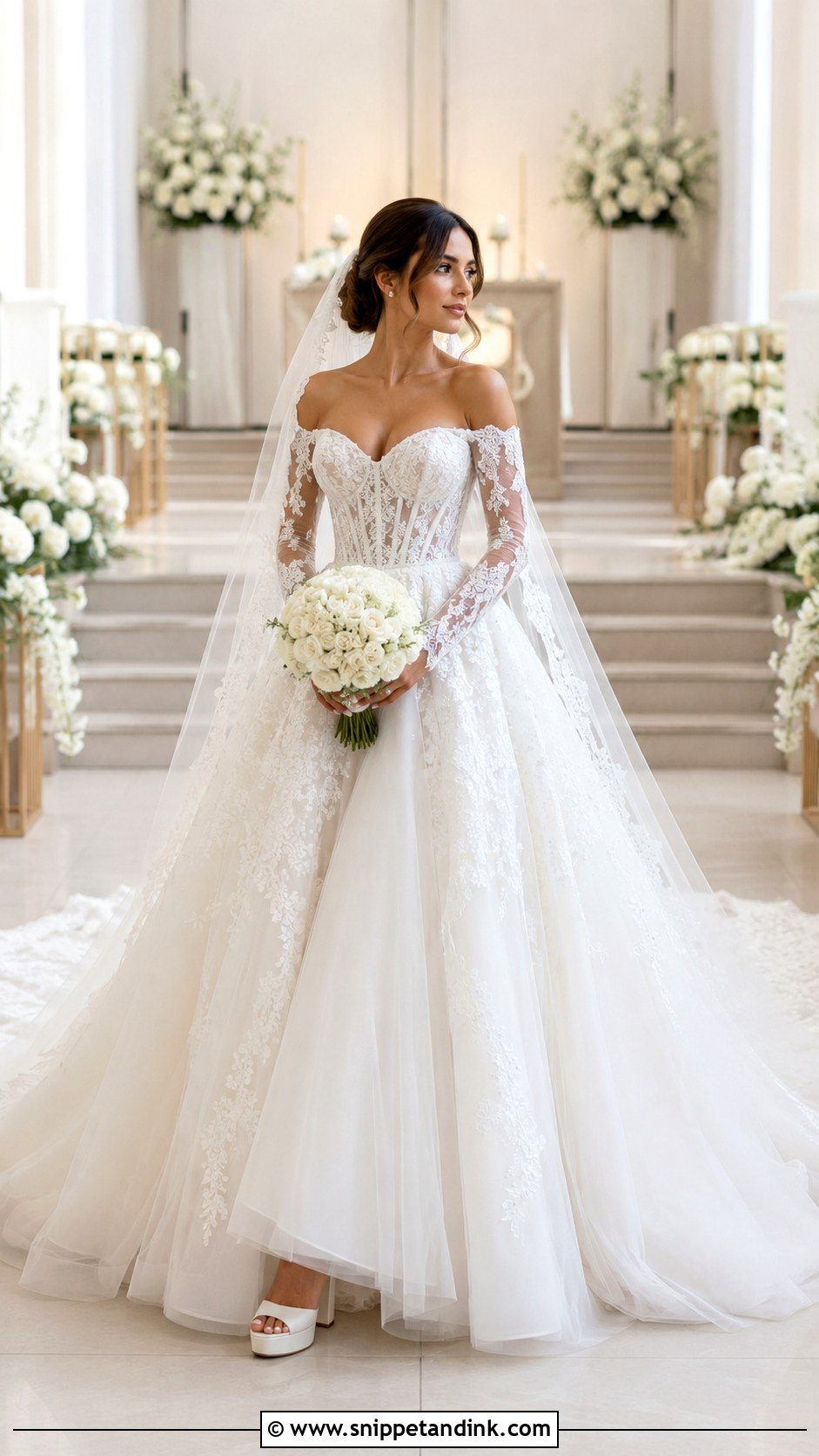
Detachable sleeves are the most practical way to get two looks from one gown without a second dress fitting. Fitted lace, sheer bishop sleeves or off-shoulder drapes go on for the ceremony and come off for a strapless or sleeveless reception, while the tulle skirt and lace train carry both versions. I style the ceremony with a cathedral veil, pearl earrings and a low updo, then swap to bolder earrings or a hair accessory once the sleeves are off. Block heels make the long hours bearable. Ask how the sleeves attach. Hidden snaps or a small hook-and-loop strip are quick; tiny buttons need a second pair of hands. Bag and label them so they are not lost in the venue.
13. Cathedral Train Ball Gown Wedding Dress With Lace Hem
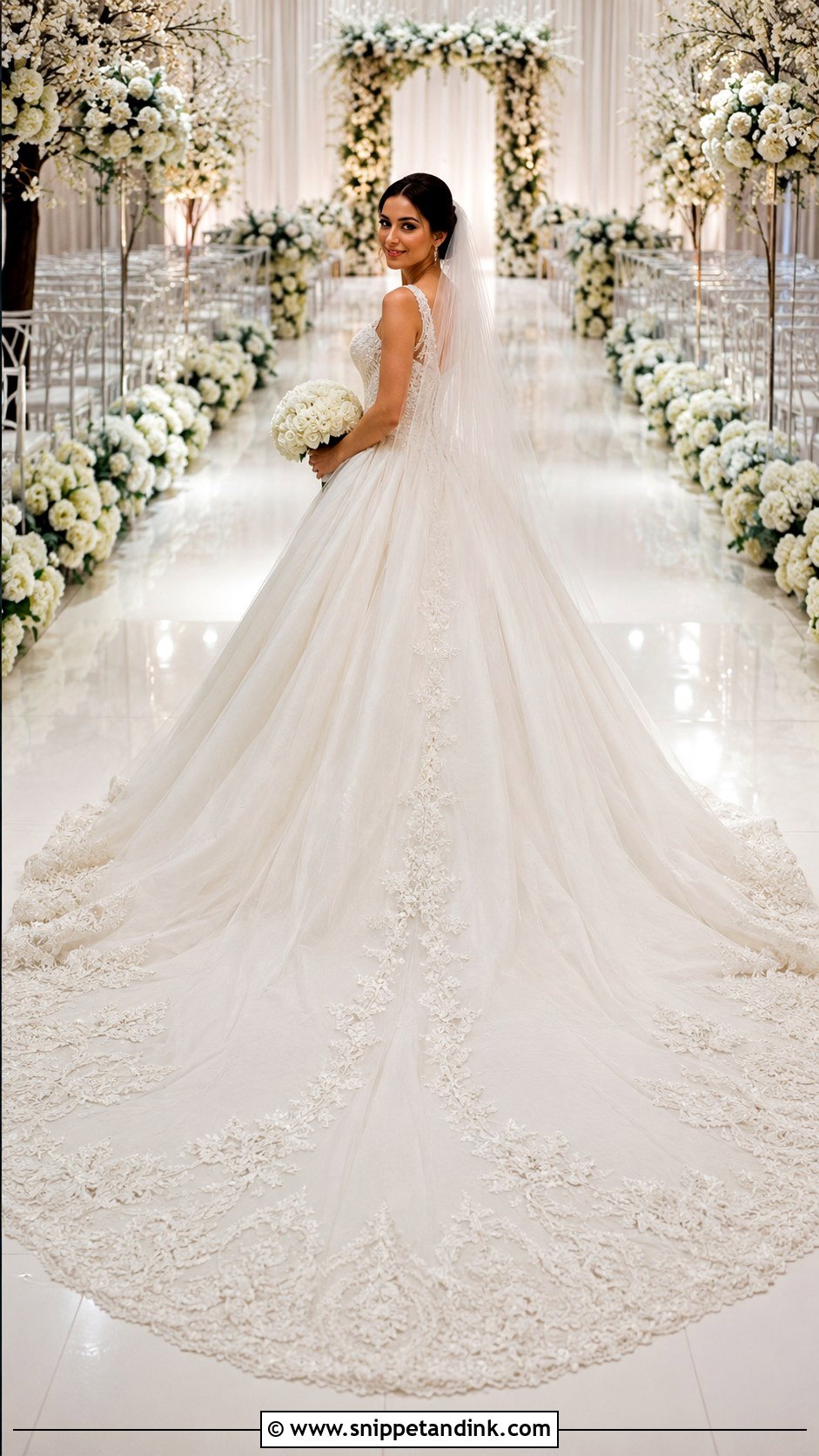
A cathedral train makes a commanding aisle moment without the problems of a royal length. On a satin or tulle ball gown, lace appliqués concentrated at the hem outline the skirt when the train is spread. A fitted bodice and defined waist stop the gown from overwhelming smaller frames. I usually suggest a sheer cathedral veil that ends at the train or just past it, classic pumps, understated earrings and a round white bouquet. Someone should straighten the train before you walk and again before portraits. A clearly marked multi-point bustle matters most here; I tie a small coloured thread at each matching hook and loop so your attendants can find them quickly in a dim room.
14. Royal Train Ball Gown Wedding Dress With Embroidery
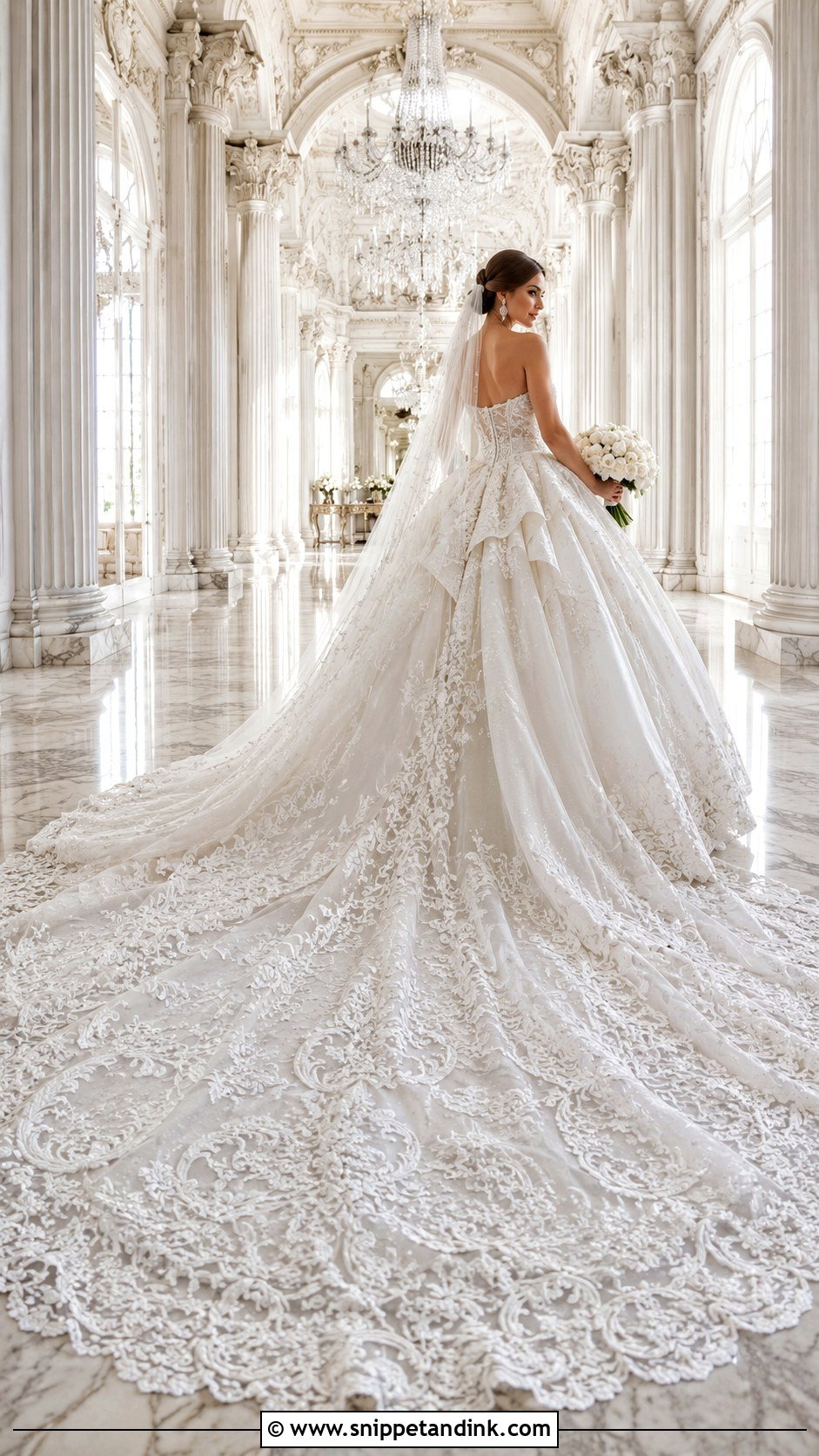
A royal train is a production, and I only recommend it when the room can hold it. The extra length needs width and detail to look connected to the skirt, so embroidered lace, scrolling motifs or placed beadwork should lead the eye from the bodice to the far edge. A fitted neckline and a firm internal corset keep the top balanced against all that fabric. Choose a veil that lets the embroidery show, plus a sleek updo, refined earrings, satin heels and a formal white bouquet. Before you commit, measure the aisle and ask about the car, the stairs and where the photographer will stand. Plan for several bustle points and two attendants who know how to lift the train from underneath.
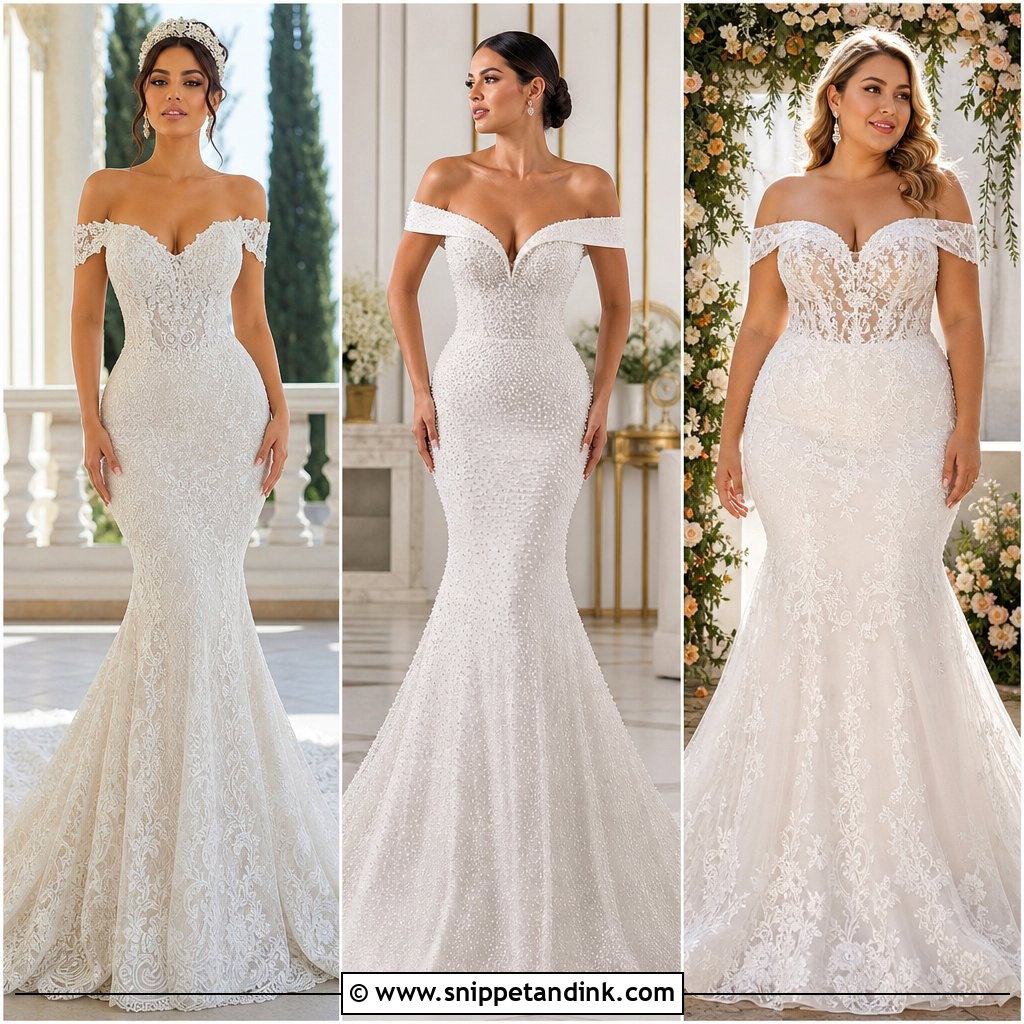
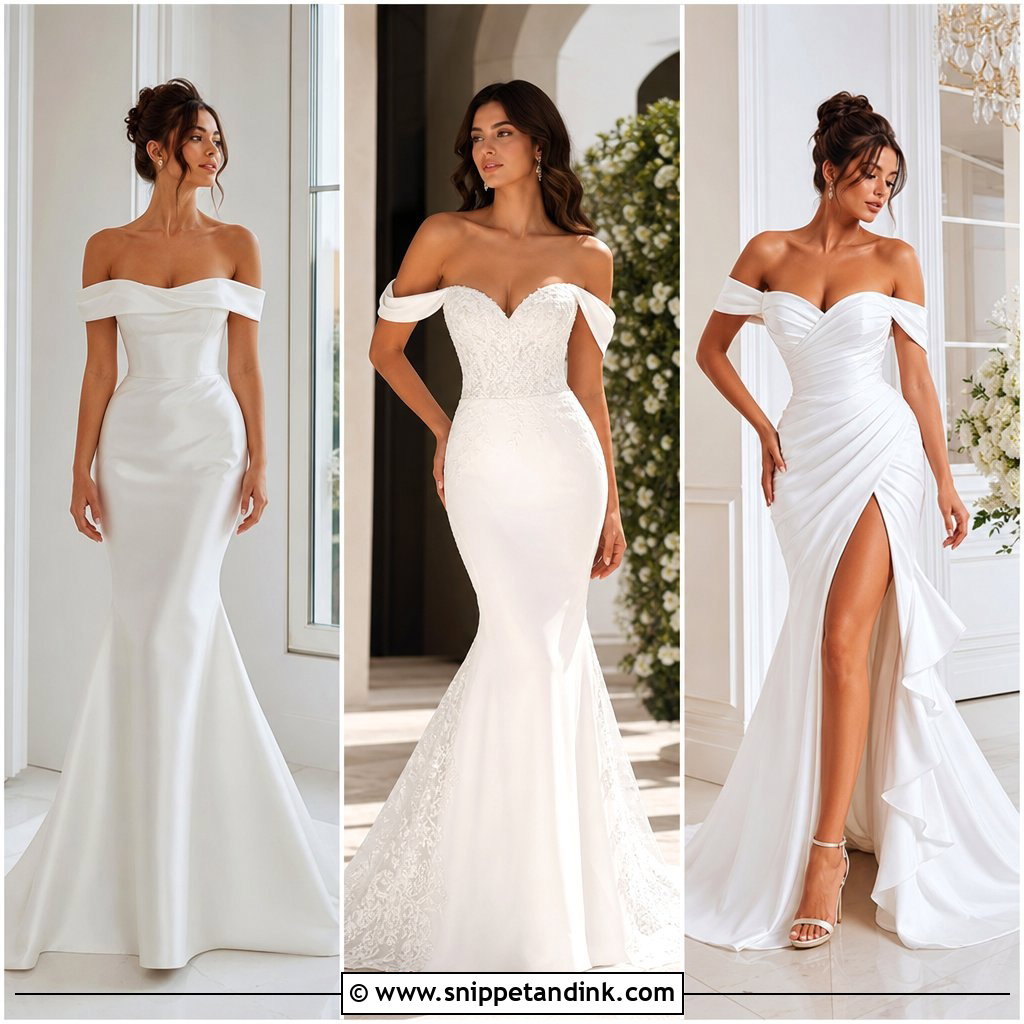
15. Plus Size Corset Ball Gown Wedding Dress With Long Train
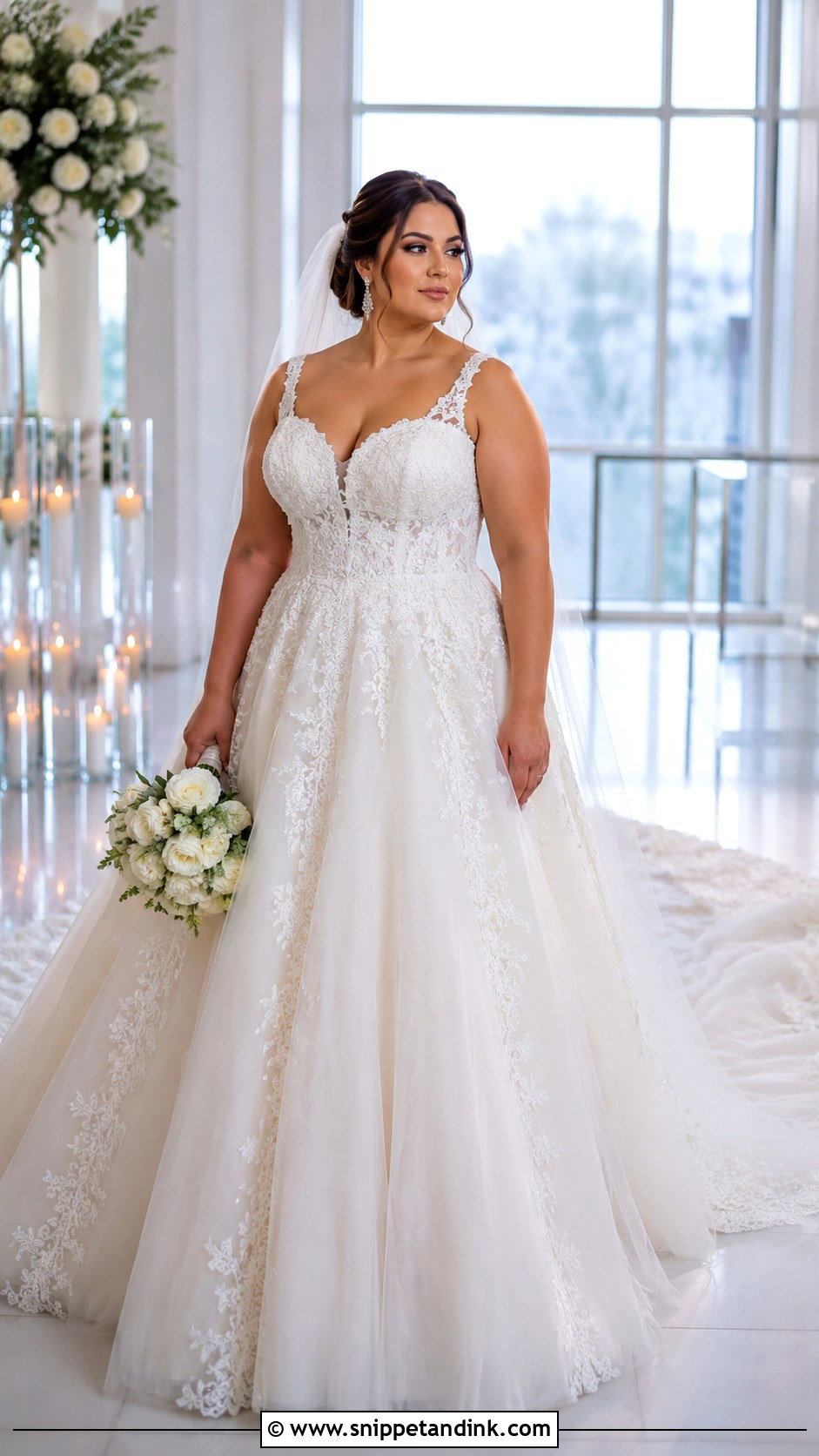
For a plus-size bride the first thing I look at is the inside of the bodice, not the decoration. Flexible spiral boning, a bust cup that actually fits and straps set wide enough not to cut in make the difference between holding you up and squeezing you. A tulle or lighter satin skirt gives volume without bulk at the midsection, and lace or beading placed vertically down the bodice and train lengthens the line. Supportive block heels, drop earrings, a secure updo and a bouquet scaled to the gown complete it, with a fingertip or cathedral veil for height. Order from your current measurements. Taking a gown in is routine; letting one out depends on seam allowance that may not exist.
16. Minimalist Satin Ball Gown Wedding Dress With Long Train
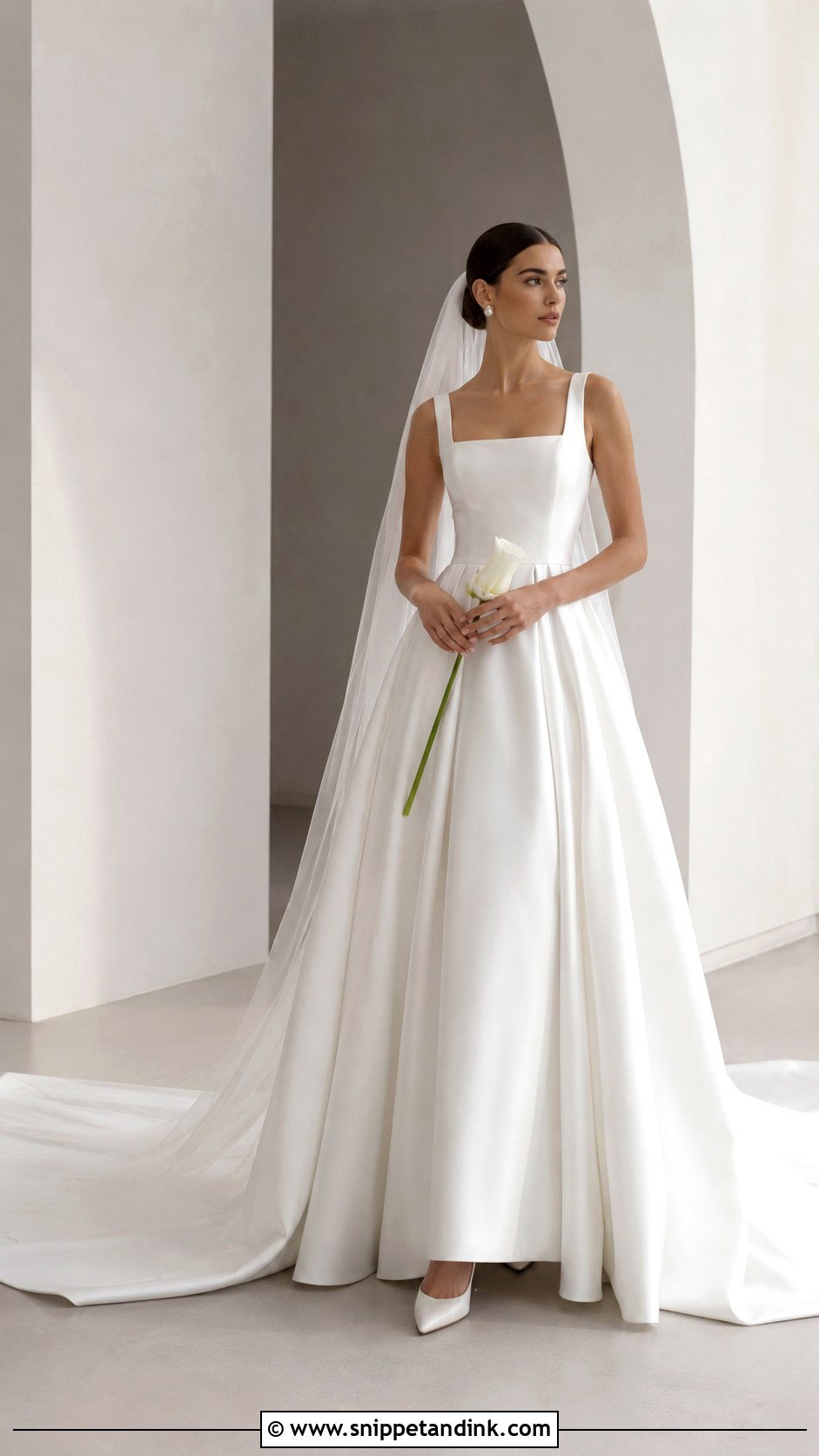
Plain satin is where a ball gown has nowhere to hide. With no lace to cover a seam, the quality of the fabric and the cut carry everything: a strapless, scoop or square bodice, then deep pleats that give generous volume below the waist and run into a broad, unbroken train. I keep the accessories sculptural and few: pearl earrings, a sleek bun, a plain cathedral veil, pointed satin pumps and a single-variety bouquet. Satin marks easily, so the gown needs professional steaming close to the day, and smooth undergarments are not optional. Ask to see the bustle done up at the last fitting; a clumsy fold leaves lumps across the back that every guest sees.
17. Sparkle Tulle Ball Gown Wedding Dress With Long Train
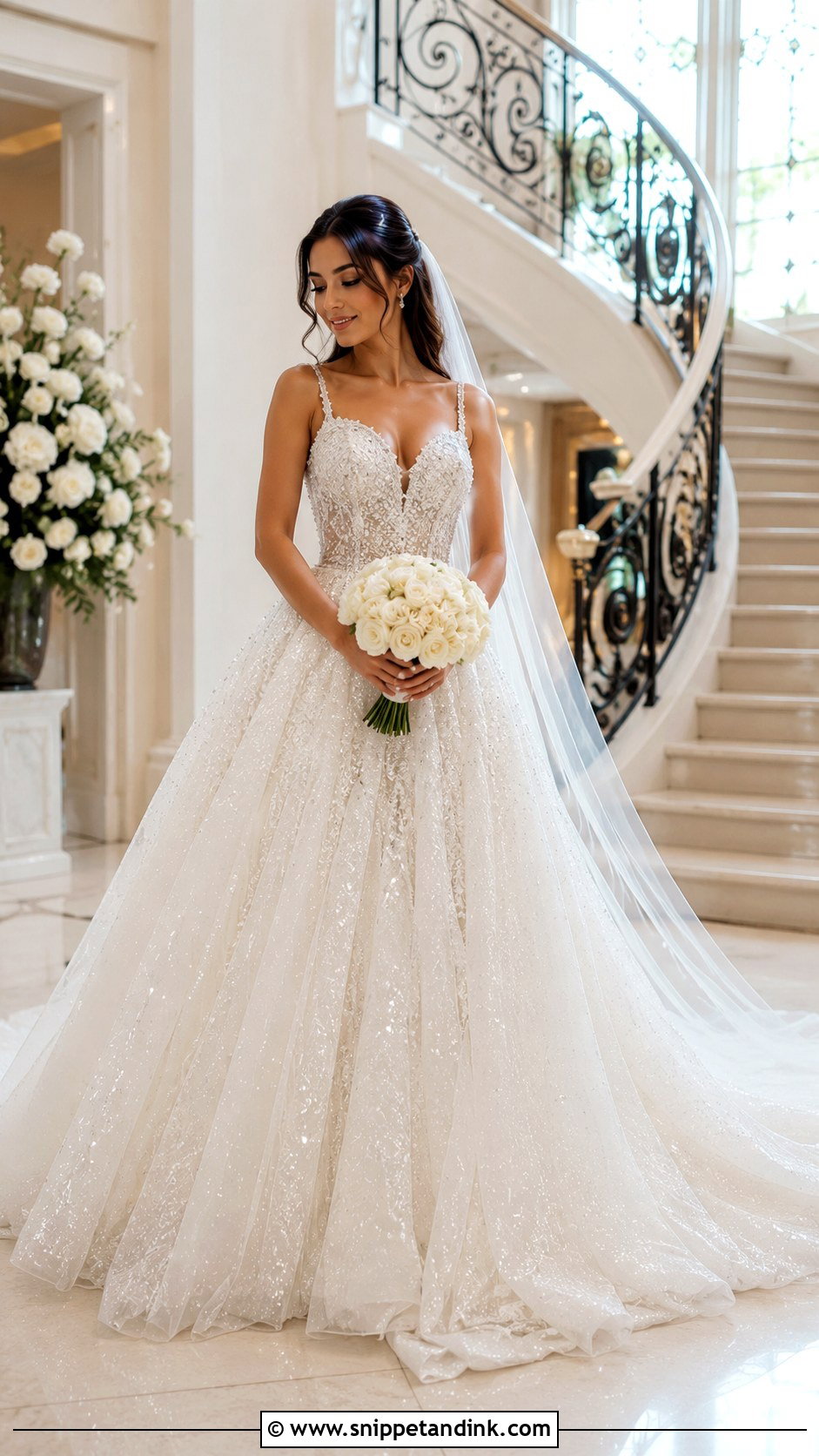
Sparkle tulle glows rather than glitters when it is made properly, with the shimmer woven or bonded into the net. Loose surface glitter sheds on your partner’s suit and every chair you sit on, which is why I check the sample by rubbing it on a dark sleeve. A fitted bodice with light beading ties the top to the skirt, and the top layer of tulle runs into a cathedral train. I’d keep the rest calm: crystal studs, a simple veil, an updo or soft half-up, ivory pumps and white roses. Look at the fabric by daylight and under warm lamps, and ask your photographer to test a flash frame at a fitting, because direct flash can make it read far brighter than in person.
18. Bow Back Ball Gown Wedding Dress With Long Train
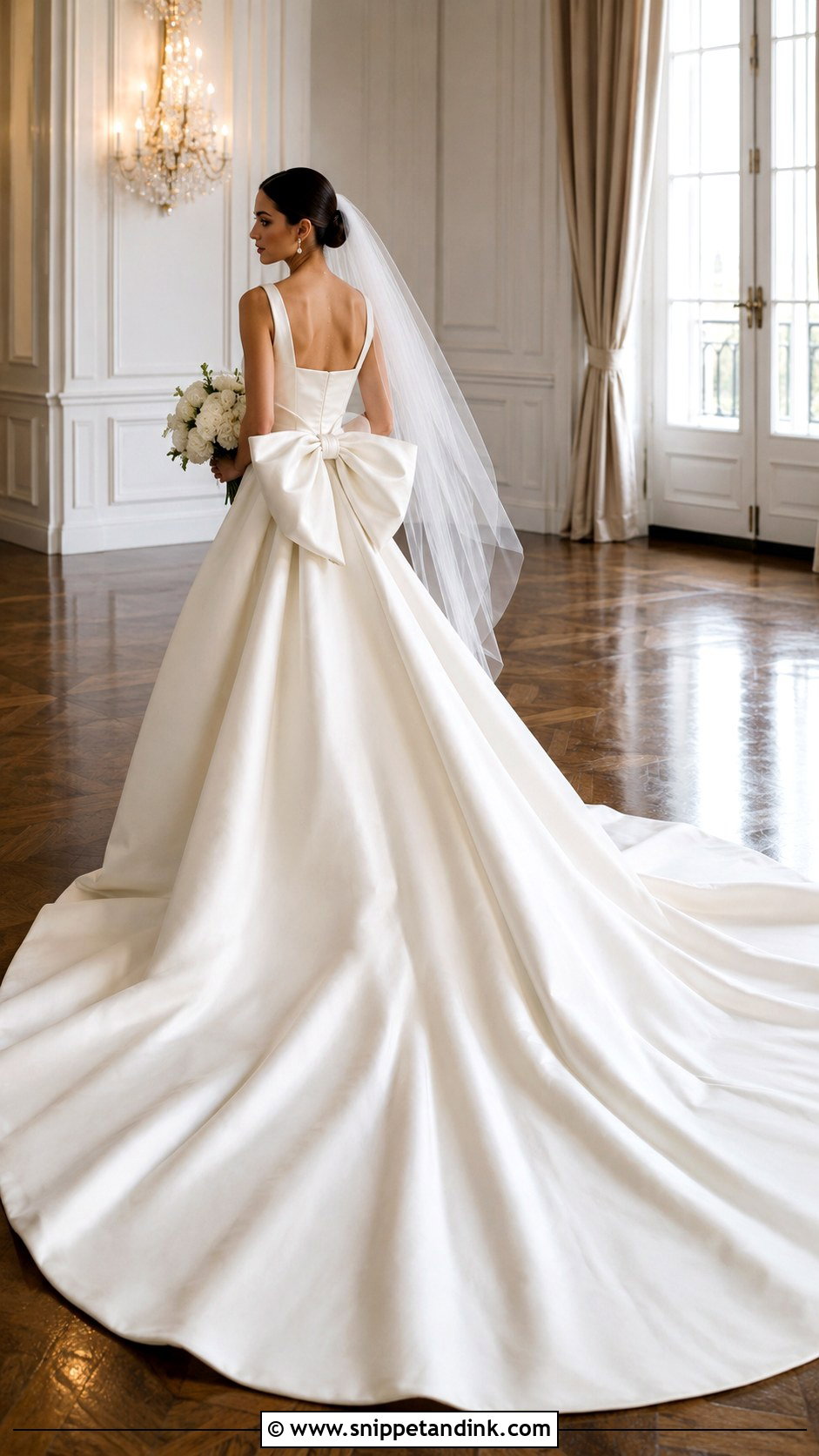
A big bow at the back is a surprise, so the front stays quiet. Crisp satin or Mikado holds the loops upright; soft crepe lets them droop within an hour. I like a clean strapless or square-neck bodice with the bow tails running into a chapel or cathedral train. Set the veil comb above the bow, or choose a shorter veil that leaves it fully on show, then add pearl earrings, a neat bun, satin heels and a structured bouquet. Find out how the bow behaves when the train is bustled. If it is sewn to the gown, the bustle points have to sit around it, which is something your seamstress should plan rather than discover the week of the wedding.
19. Illusion Neckline Ball Gown Wedding Dress With Long Train
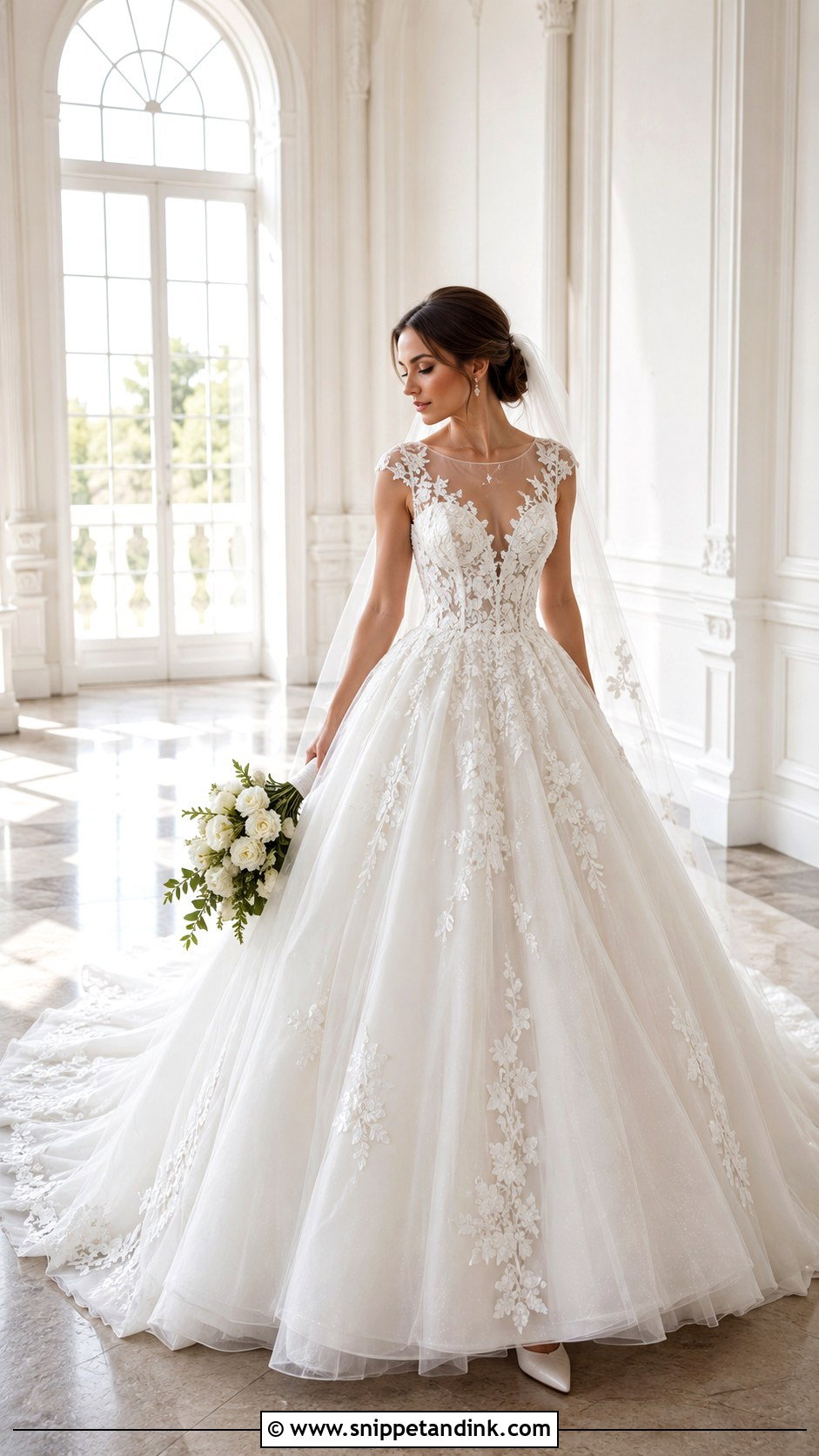
Illusion mesh only disappears if it matches your skin, so I bring swatches in several tones to the fitting rather than accepting the default. Used well, a sheer panel supports a plunging neckline, forms cap sleeves or rises into a high neck with no visual weight. Matching appliqués on the bodice and long train tie the gown together over a full tulle skirt. Style it with a low bun, small earrings, a light veil set under the hair, closed ivory heels and a loose white bouquet. The mesh edge should be trimmed close and fitted flat. When it is left loose, it gapes when you lean forward and catches light in photos.
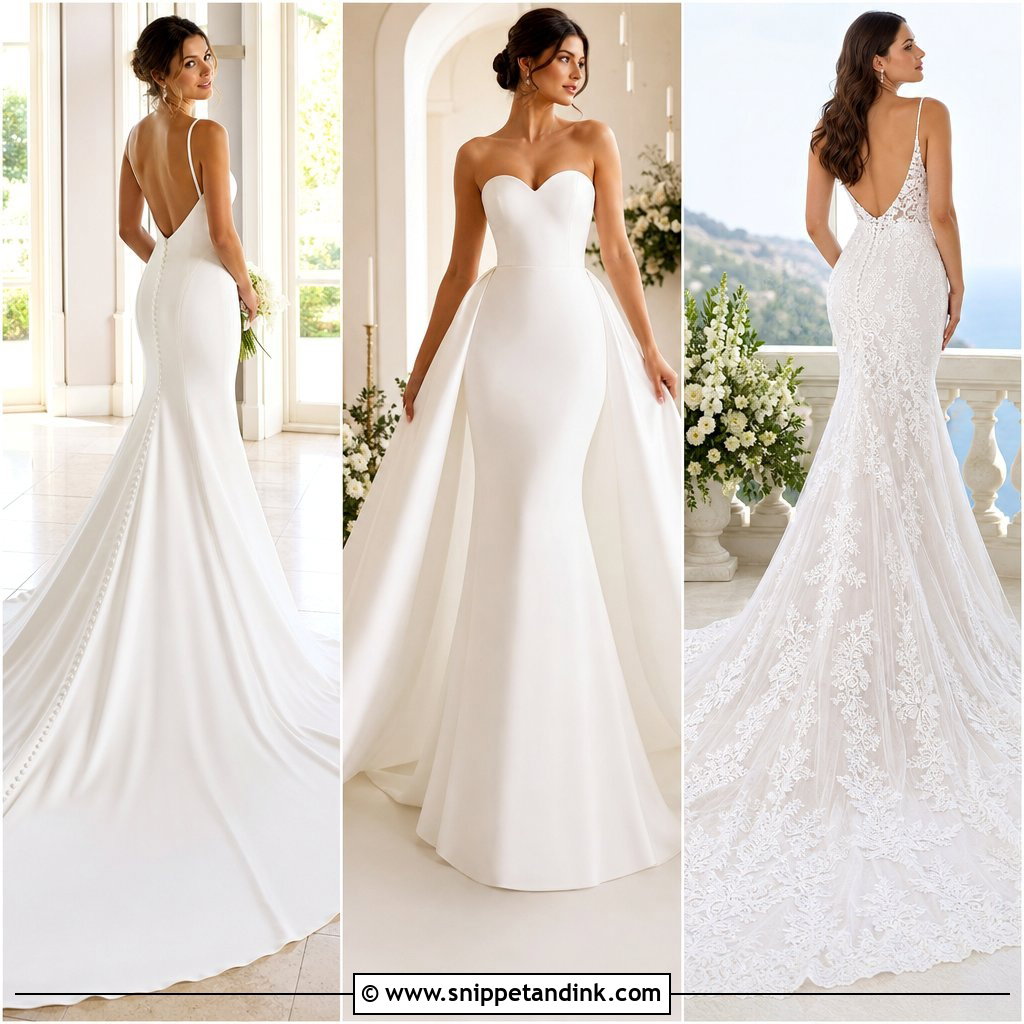
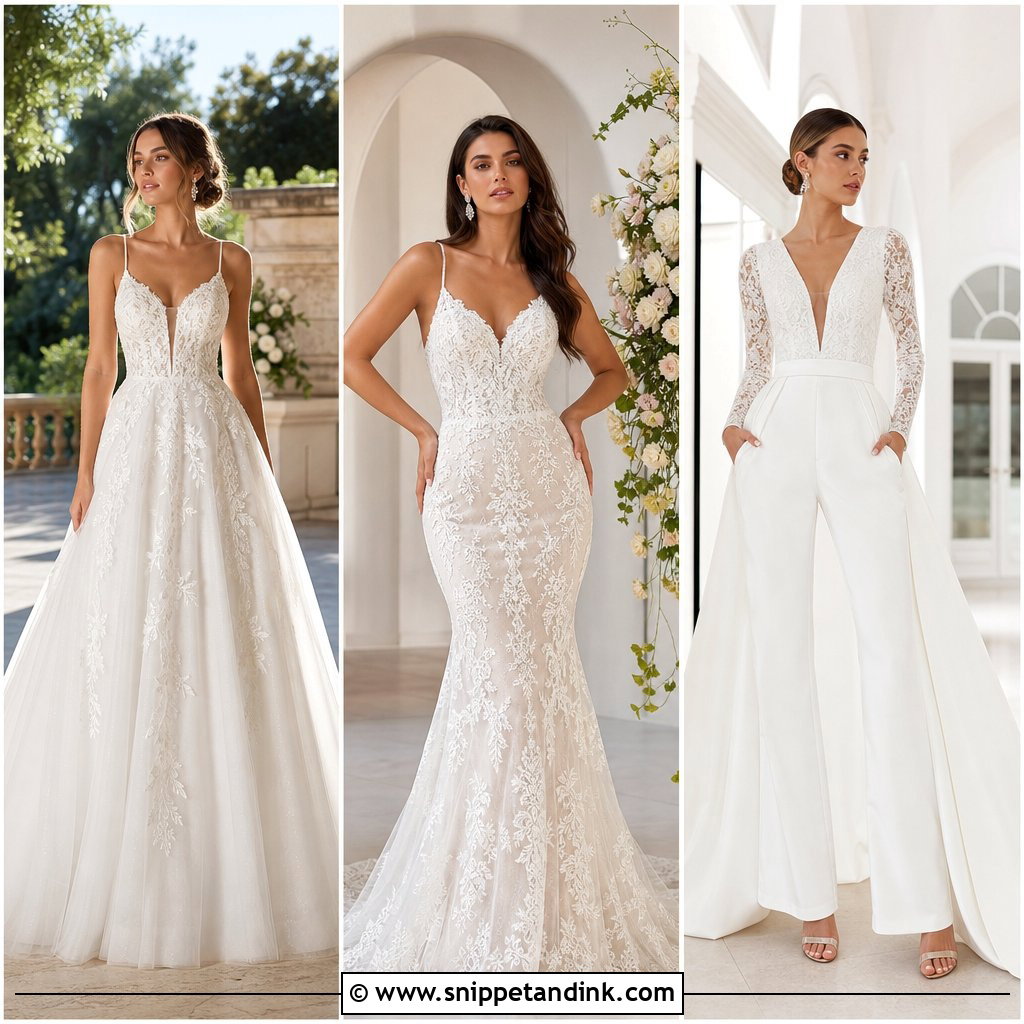


20. Vintage Lace Ball Gown Wedding Dress With Long Train
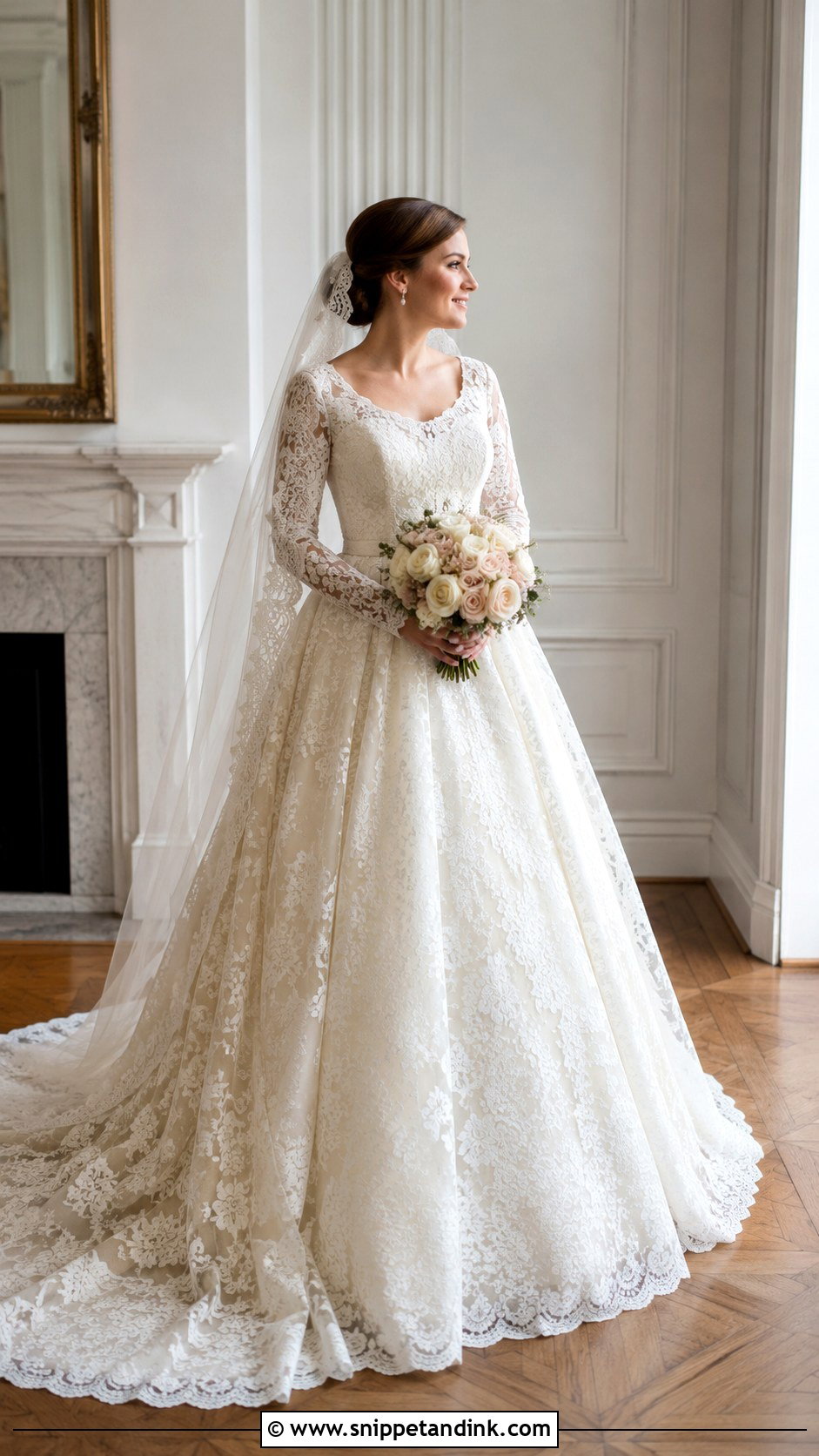
Vintage-style lace looks its best with a modest cut: a scoop neck, covered buttons down the back and three-quarter or full sleeves. Floral or scrolling lace over a soft ivory lining shows the pattern, a structured petticoat holds the wide skirt, and a scalloped train finishes the back. A lace-edged veil, pearl earrings, ivory pumps, a low chignon and white roses with a little greenery suit the mood without looking like a costume. Heavy corded lace snags on bracelets and claw-set rings, so I keep the wrists bare. Covered buttons take time, often ten minutes or more to close, which is worth knowing when you plan the dressing schedule.
French, American or Ballroom: Getting the Bustle Right
Every long train on this list needs a bustle for the reception, and the style changes how the back of the gown looks for the rest of the night.
Over bustle
Also called an American bustle, the train is hooked up onto the outside of the skirt in one or several points. It is quick and strong, and it suits lace or beaded trains because the decoration stays visible in soft swags.
Under bustle
The French or Victorian style tucks the train under the skirt with ribbons tied inside. It gives a full, layered back and works well on plain satin and tulle, but the ties are colour-coded and take practice.
Ballroom bustle
This one lifts the train so the hem looks almost even all the way round, which is the cleanest look for dancing. It needs the most points, and on a cathedral or royal train it can take a while to fasten.
I ask the seamstress to show the person who will do it on the day at the final fitting, and I have that person do it twice while I watch. Take a quick phone video too. In a dark corner of a venue with music playing, nobody remembers which ribbon goes where.
Cars, Stairs and the Bathroom in a Cathedral Train
The aisle is the easy part. The rest of the day is where a big skirt needs a plan.
- Getting in the car: sit first with your back to the seat, then swing your legs in while someone gathers the skirt and train onto your lap. A clean sheet on the seat protects ivory satin from dust.
- Stairs: lift the front of the skirt with both hands and let an attendant carry the train behind you. Going down, look at your feet, not the camera.
- Outdoor ground: grass stains and damp gravel mark a train quickly. Keep it bustled or carried until the moment you walk.
- The bathroom: step into the stall backwards and have a friend hold the skirt up in a bundle, or wear a slip-style skirt holder under the gown that gathers the petticoat for you.
- Small kit: safety pins, a few spare hooks, white chalk for marks on satin, clear thread and a needle, and fashion tape for a neckline that lifts.
None of this is difficult, but rehearsing it once at home in the gown removes most of the stress.
Is the Biggest Gown Right for Your Room?
The gown people remember is rarely the widest one; it is the one the bride could move in all night. Look back at the necklines, fabrics, sleeves and train lengths above and notice which details you kept returning to, then think about how the veil, shoes and hair will support that one choice. Give yourself enough time for alterations, and practise walking, sitting, turning and doing the bustle before the day. A long train is a lot of fabric to manage, but with a good fit and a rehearsed bustle it stays a pleasure to wear from the aisle to the last dance.
You'll Like These Ideas:






Leave a Reply