
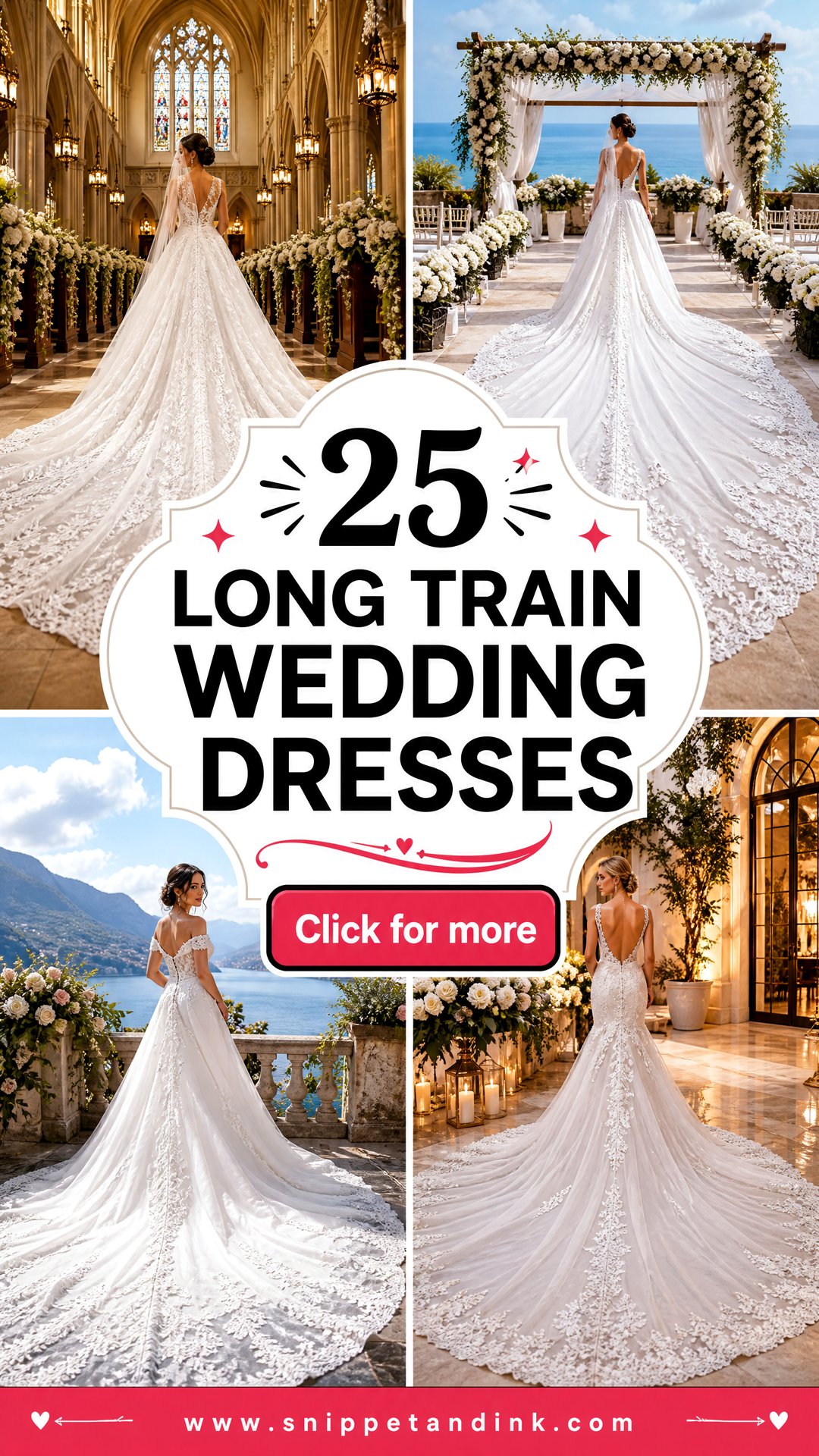
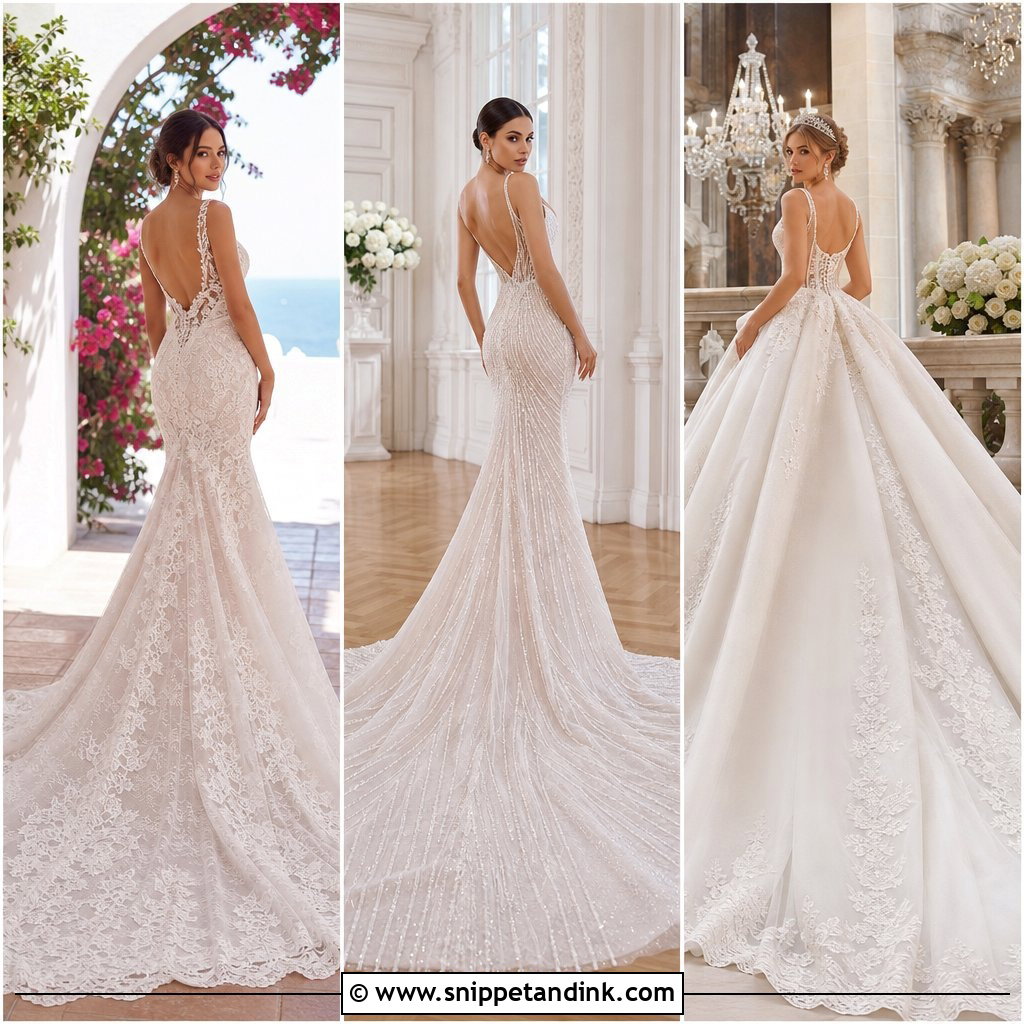
Long train wedding dresses ask more of a bride than most gowns, and that’s exactly why I enjoy fitting them. A train changes how you walk, how you turn at the altar, how you get into a car and how you sit down to dinner. Get it right and the fabric follows you down the aisle as if it were poured there. Get it wrong and you spend the reception stepping on it. Below are 25 trains I’d genuinely consider, with notes on what each fabric and silhouette does once you’re actually moving in it.
Train Lengths Named the Way a Seamstress Uses Them
Train names aren’t standardized between designers, so I treat them as a rough scale rather than fixed measurements. From shortest to longest, this is how they usually run:
- Sweep or brush: grazes the floor just behind you and is easy all day.
- Court: a short extension, roughly a foot past the hem.
- Chapel: the most common long train, trailing a few feet from the waist.
- Cathedral: noticeably longer and meant for a long aisle.
- Royal or monarch: well beyond cathedral, and always needs a helper.
When I’m helping a bride decide, I ask her to pace out the aisle and the route from the getting-ready room to the ceremony. A cathedral train on a short aisle never fully extends before you’ve arrived. Order early as well. Salon gowns often take several months to arrive, and alterations on a long train with a multi-point bustle usually need two or three fittings spread across the final couple of months.
Bring your wedding shoes to the very first fitting. The hem is set to that heel height, and switching to flats later means the front of the dress drags.
1. Cathedral Train Wedding Dress
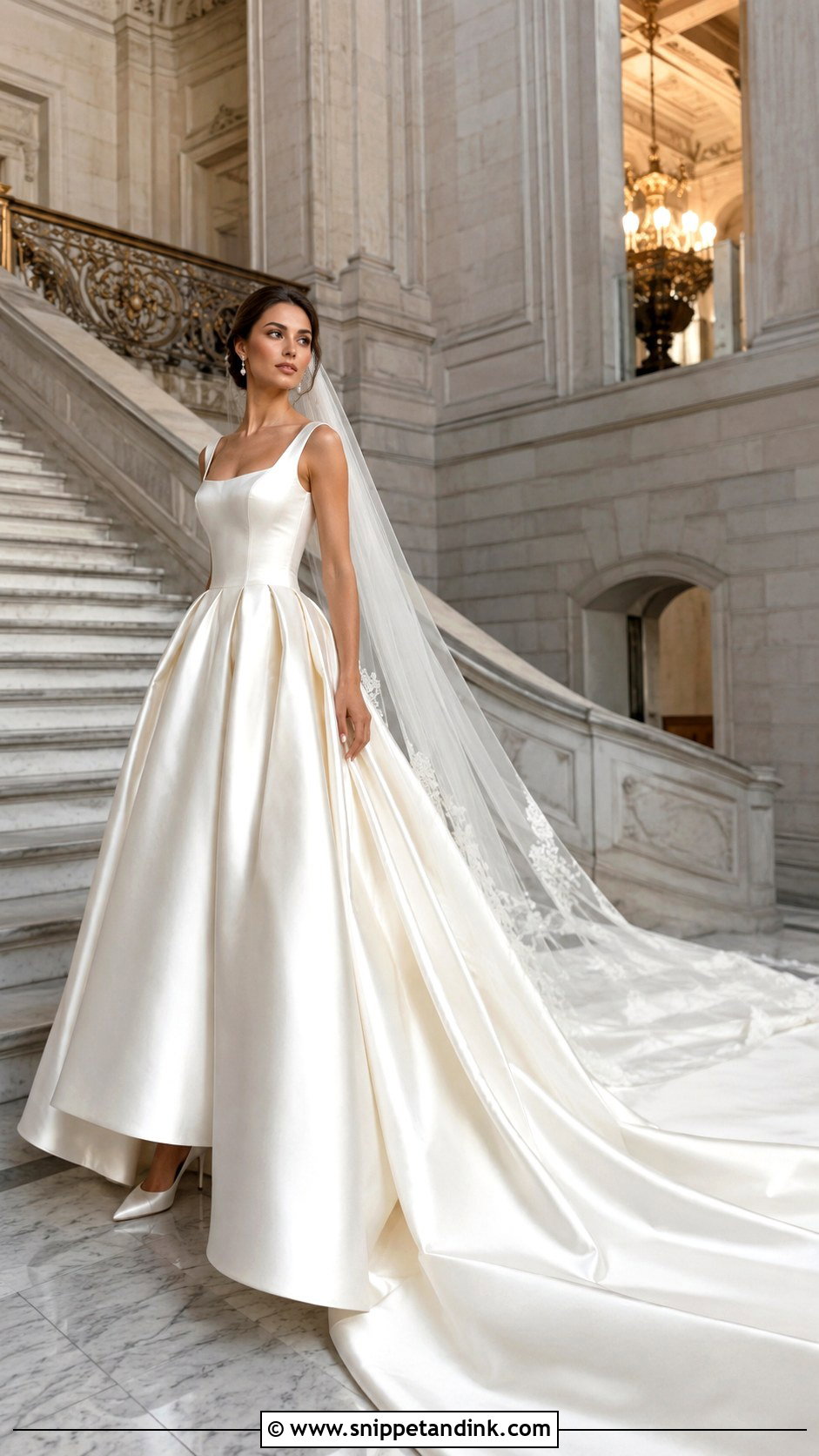
Cathedral length is made for a long aisle. In a short registry room the fabric piles up behind you before it ever has a chance to spread, so I always ask brides to pace out the route first. I fit this length on ball gowns, A-lines and fit-and-flare shapes, because those skirts have somewhere for the extra fabric to come from. With this much going on behind you, keep the veil plain and the jewelry small. And ask your seamstress for a bustle with enough pick-up points. A cathedral train hooked up on two points tends to sag before the first dance.
2. Chapel Train Wedding Dress
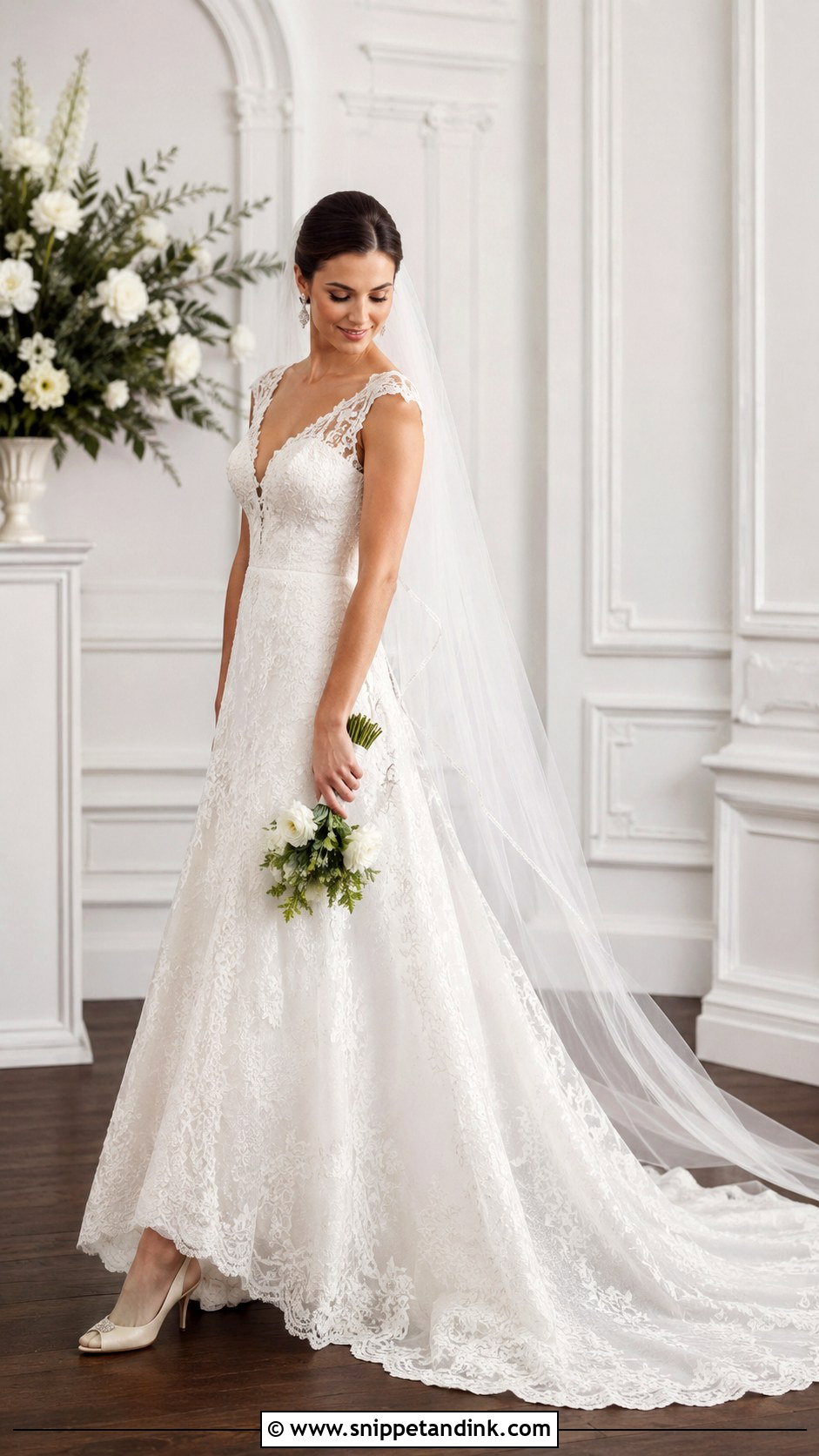
A chapel train wedding dress is the length I point most brides toward first. It trails behind you enough to look deliberate in a processional photo, yet it won’t fight you on a staircase or at cocktail hour. On lace A-lines and satin fit-and-flare gowns it hangs cleanly. I like a veil that ends at or just past the train hem so the two lines don’t cut across each other. If your route crosses grass or stone, bring the shoes you’ll actually wear to every fitting, because the hem is set to that heel height.
3. Royal Train Wedding Dress
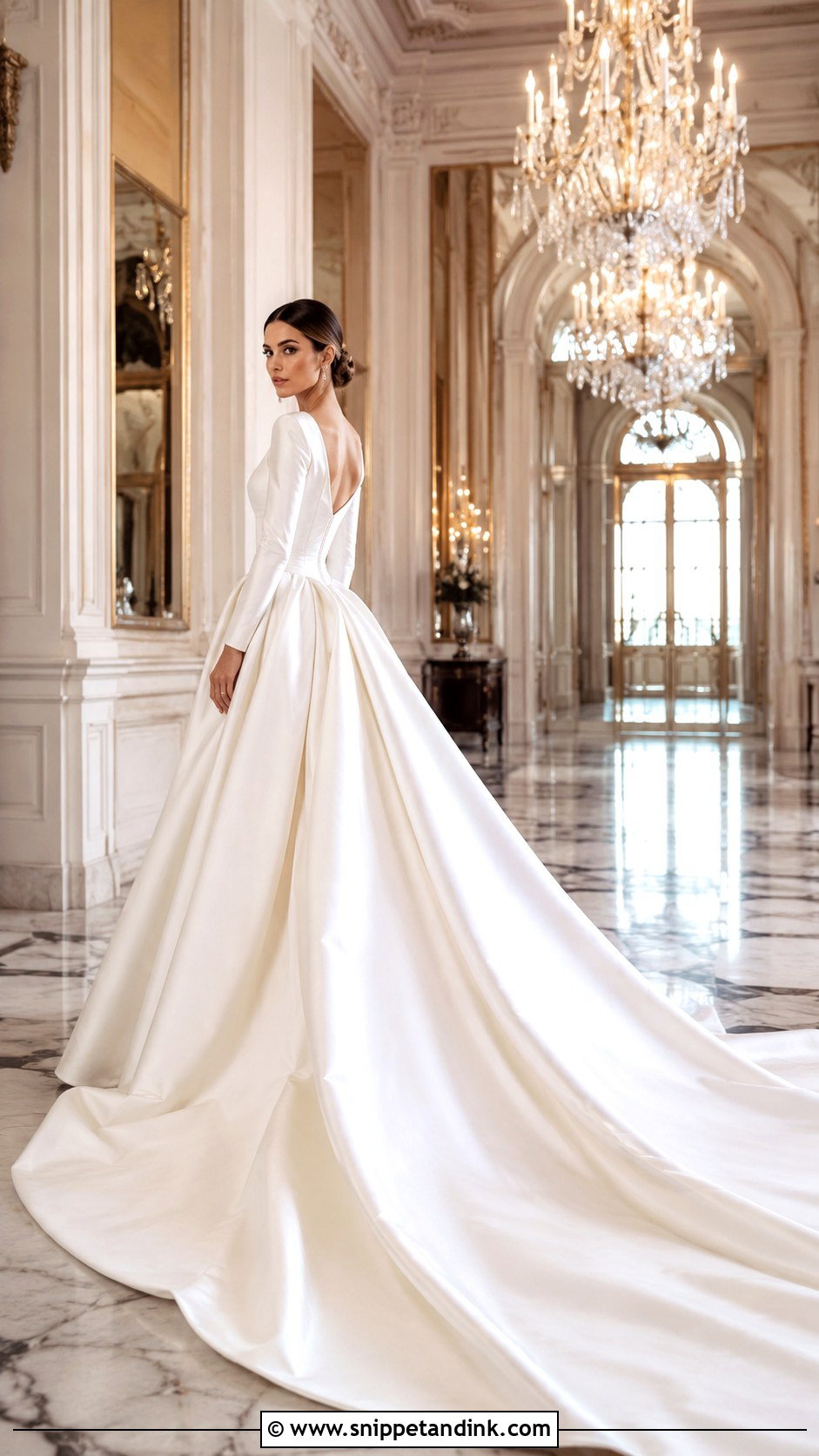
Royal trains are the longest on this list, and they are not a solo job. Several feet of fabric need someone to lay them out before you walk, again before portraits, and again every time you turn around. I only recommend them for wide aisles, grand staircases and venues where guests aren’t seated tight against the runner. Mikado, heavy satin and organza hold their shape; softer fabrics simply drag. Keep the bodice quieter than the train. Then assign one attendant, by name, as the person who looks after the fabric all day.
4. Lace Long Train Wedding Dress
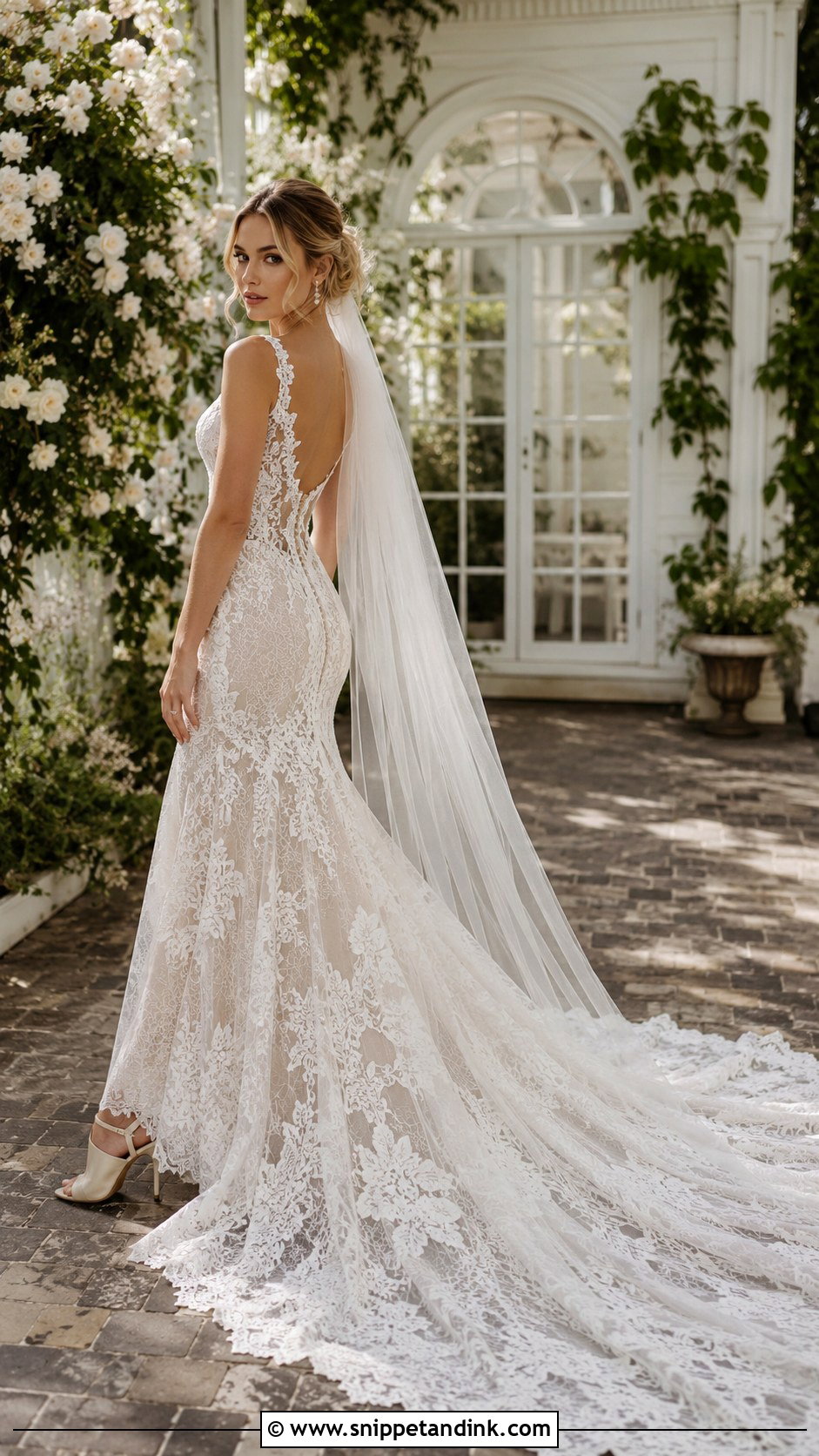
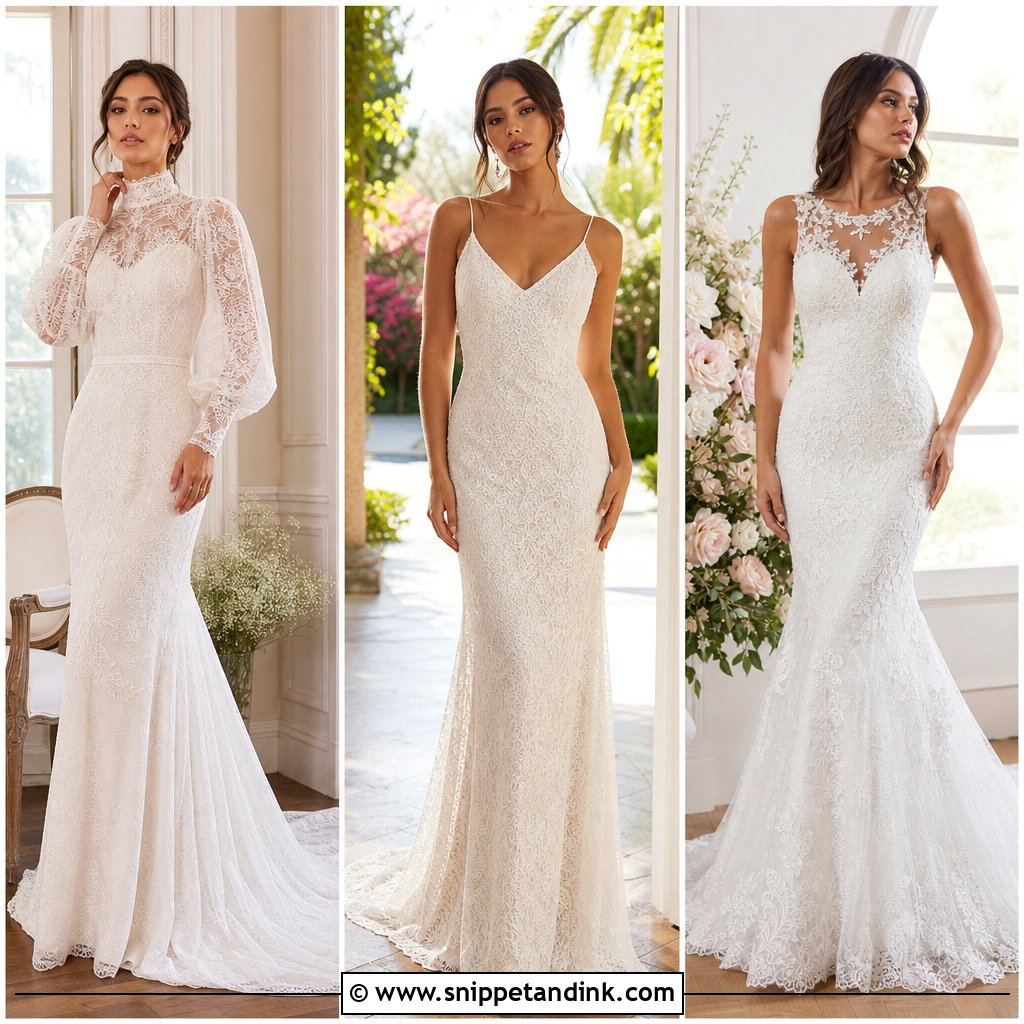
Lace has one quality other train fabrics don’t: the pattern actually reads once it’s spread flat behind you, which is why a back-view shot of a lace train so often ends up framed. Floral lace leans garden, geometric lace looks sharper. I always check where the scalloped border sits, because a well-made gown finishes the train with that lace edge rather than a raw cut. If the lace is busy, go with a plain veil or none at all. Lining colour matters more than brides expect. Nude lining pushes the pattern forward, while ivory lining blurs it gently.
5. Satin Long Train Wedding Dress
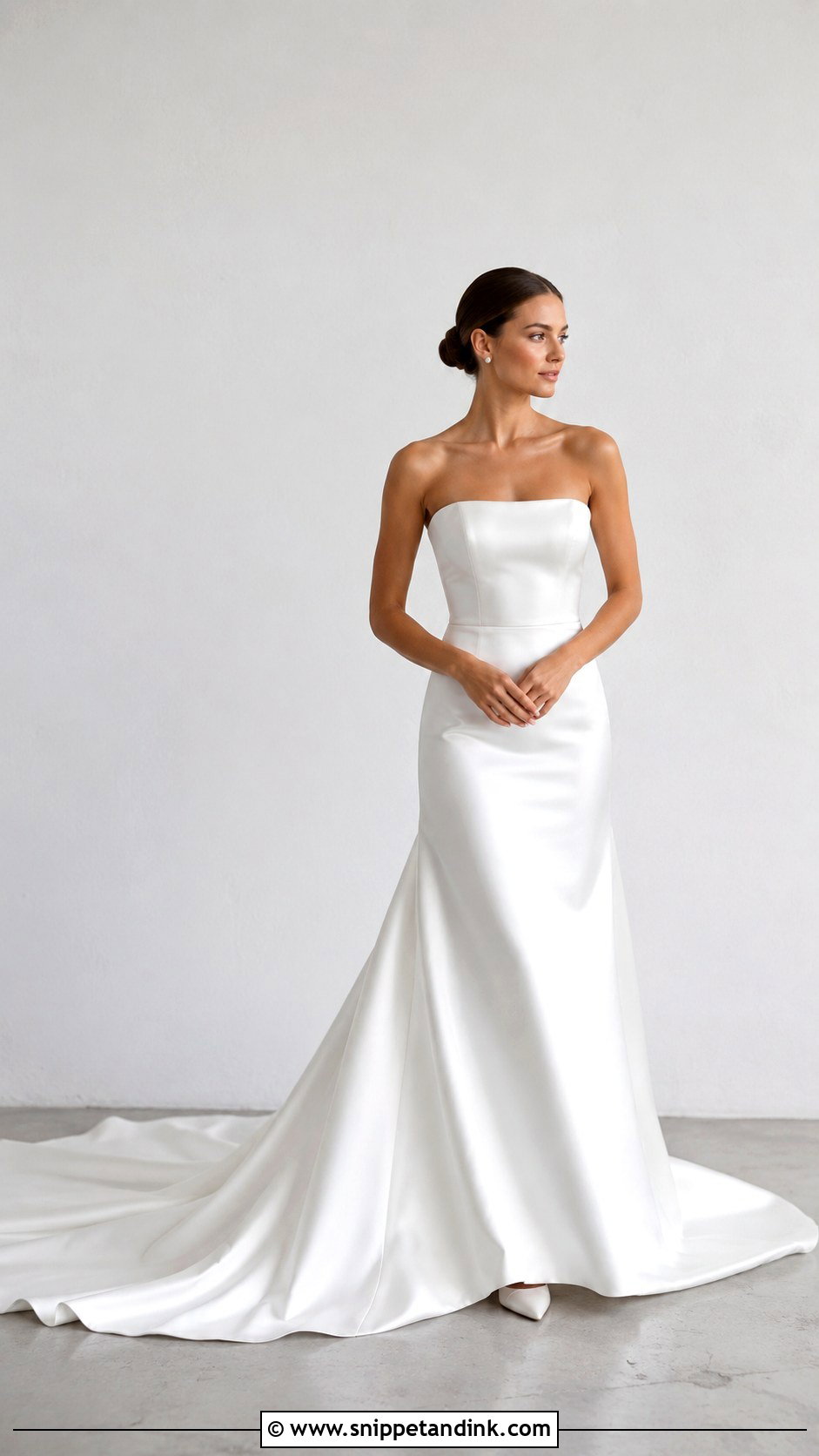
Satin is the most honest fabric in bridal. It reflects light, so the train looks rich in a church aisle, and it shows every crease, so a car ride spent sitting on the skirt shows up in the photos. I have satin gowns steamed at the venue rather than at home, and I ask brides to stay standing between steaming and the aisle where they can. Strapless, square and off-the-shoulder bodices all sit cleanly on a satin skirt. Styling can stay spare: a sleek bun, pointed shoes, one pair of good earrings.
6. Tulle Long Train Wedding Dress
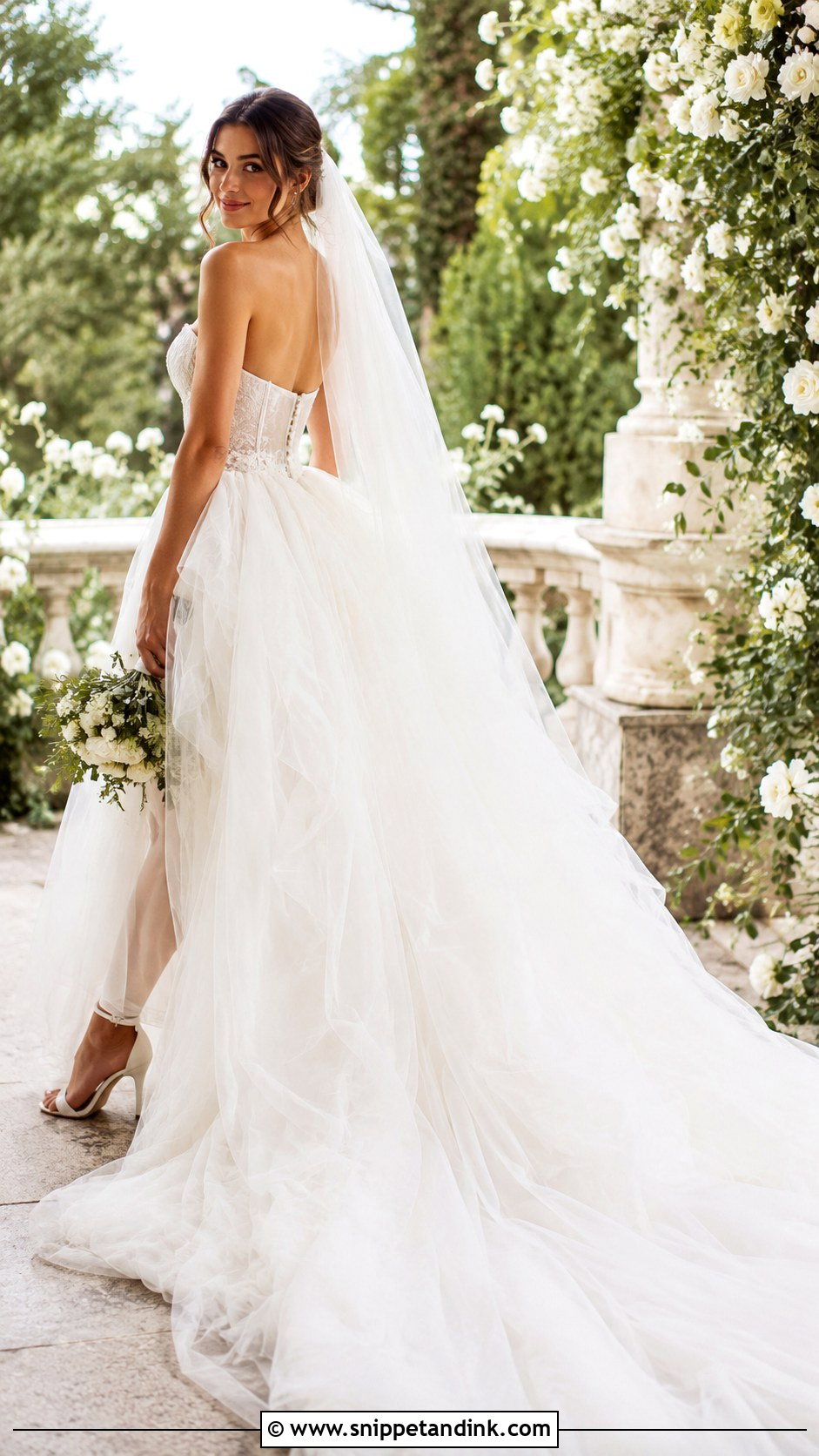
Tulle gives you volume for almost no weight, which makes a tulle train the easiest long train to walk in. Several layers float as you move and look full in outdoor portraits. It’s the fabric I suggest when a bride wants a fairy-tale shape without feeling like she’s hauling a duvet. The trade-off is snagging. Tulle catches on rough stone, rose bushes, bark mulch and sequined bridesmaid dresses. A fitted bodice stops the volume from swallowing you, and a veil plainer than the skirt keeps the two sheer layers from merging into one blur.
7. Ball Gown Wedding Dress With Long Train
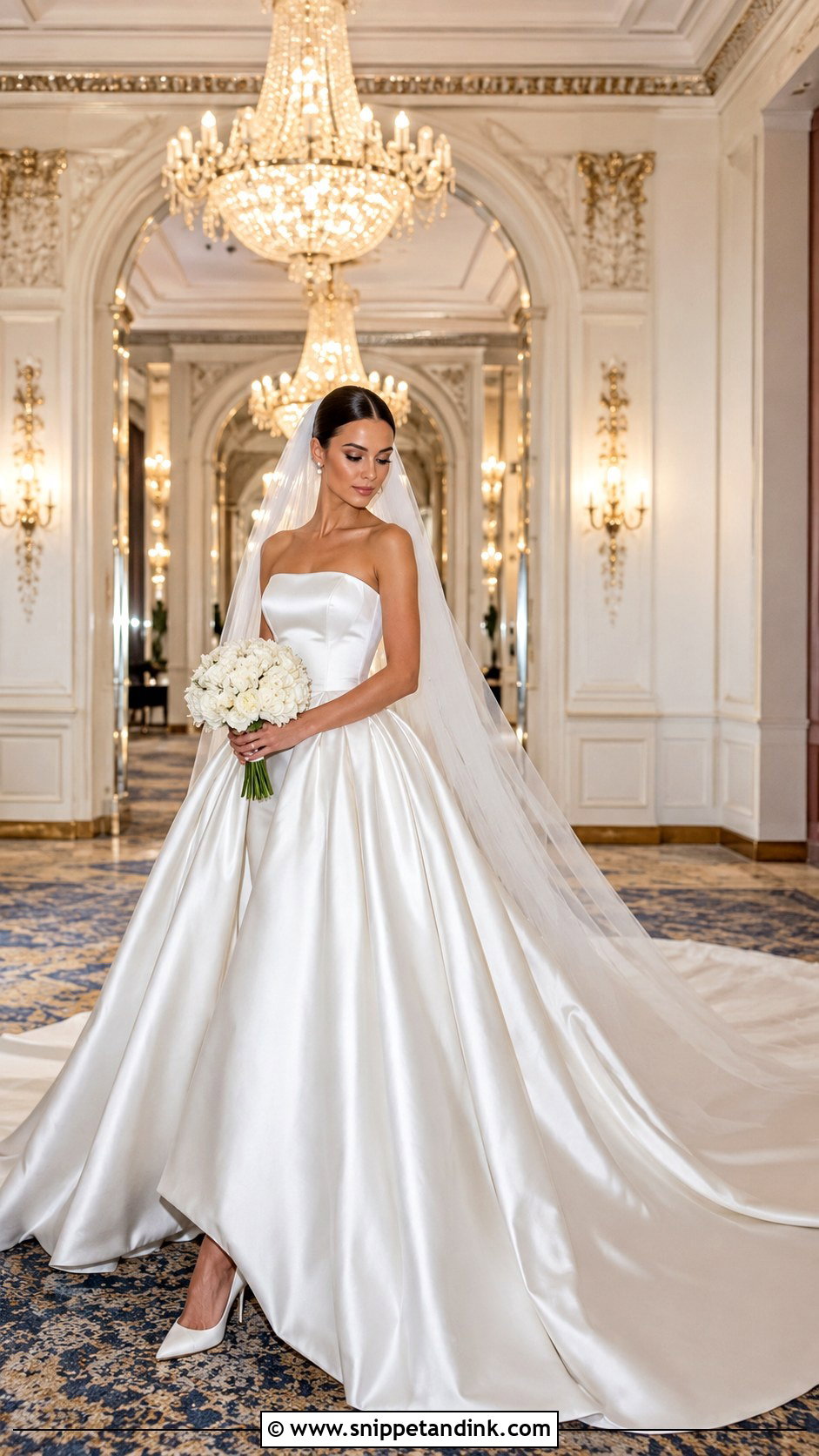
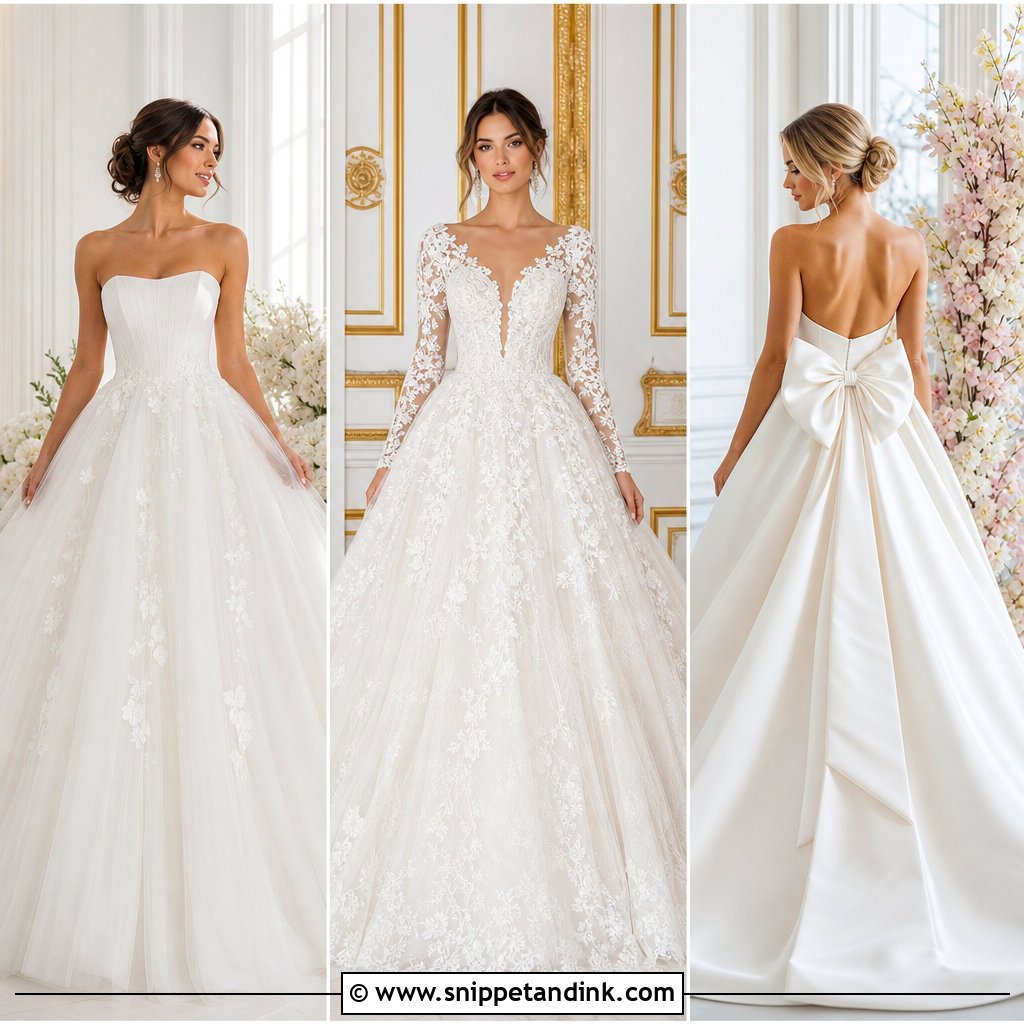
A ball gown with a long train carries more fabric than any other silhouette here, so I start the bustle conversation at the first fitting, not the last. The fitted bodice and full skirt already give you a strong shape; the train makes it formal. Satin keeps the shape architectural, while tulle softens it. Since the skirt is doing so much, keep jewelry fine and hair neat. Expect your seamstress to suggest several bustle points. A heavy satin train pulled up on too few hooks tends to droop or tear at the attachment.
8. A Line Wedding Dress With Long Train
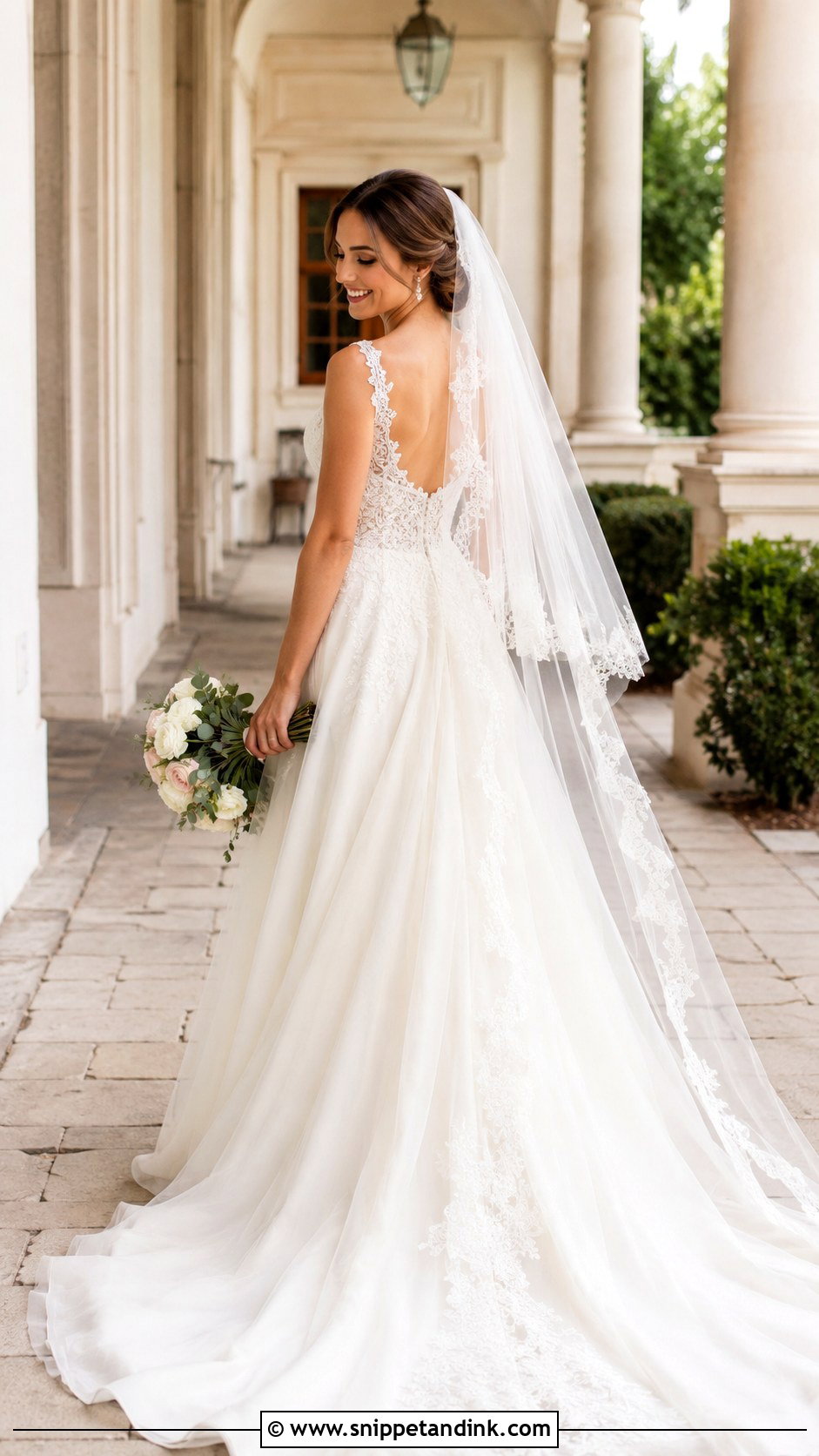
Across very different body shapes, A-line is the silhouette I see work most often. The skirt leaves the waist gradually, so it neither clings nor balloons, and a long train extends that line without adding bulk at the hips. Chiffon versions move the most and suit warmer venues. Match the veil length to the train for one continuous line from head to hem. Ask about inner structure as well: a light corset or boning in the bodice means the gown stays in place without you tugging at it all evening.
9. Mermaid Wedding Dress With Long Train
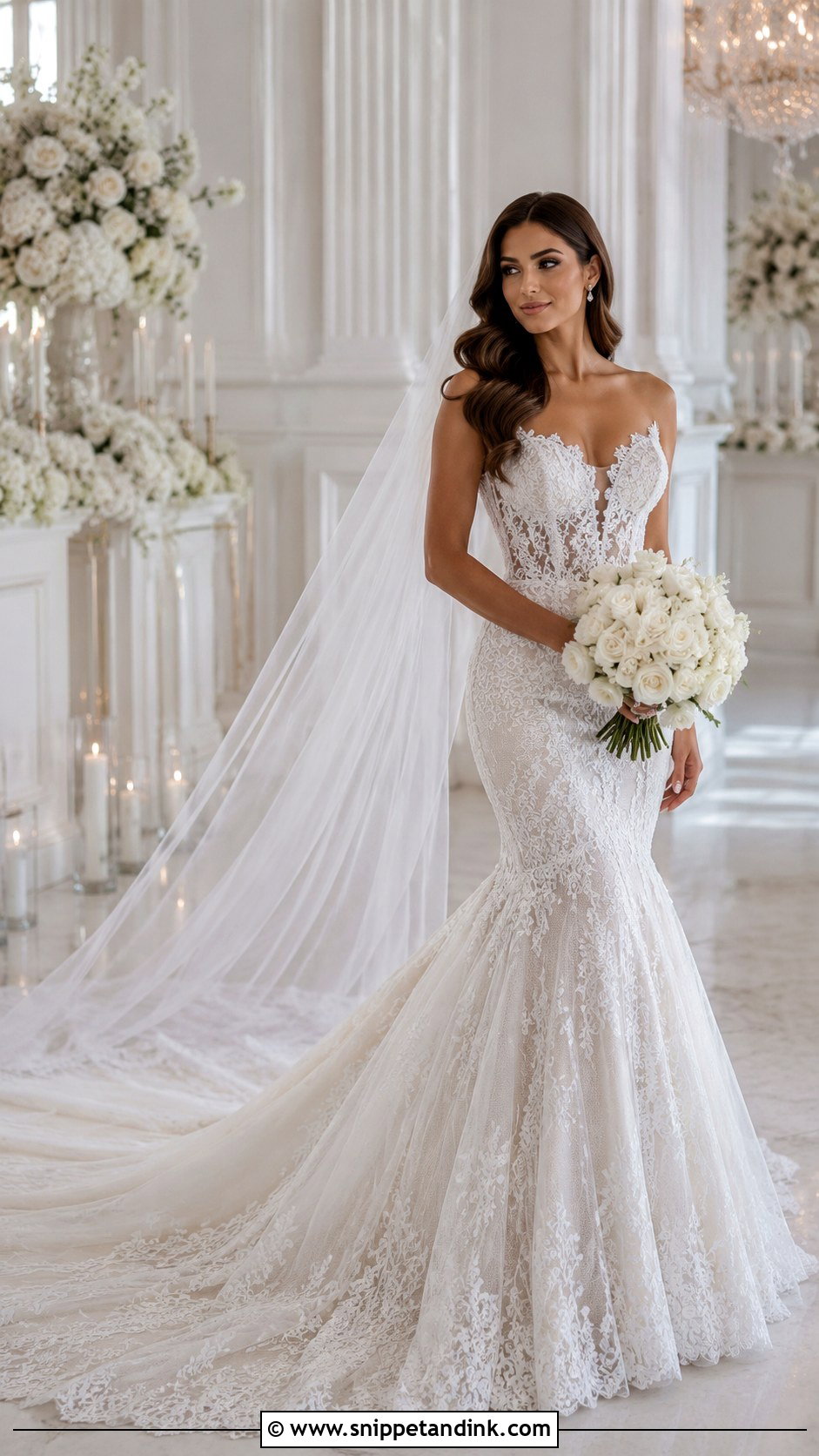
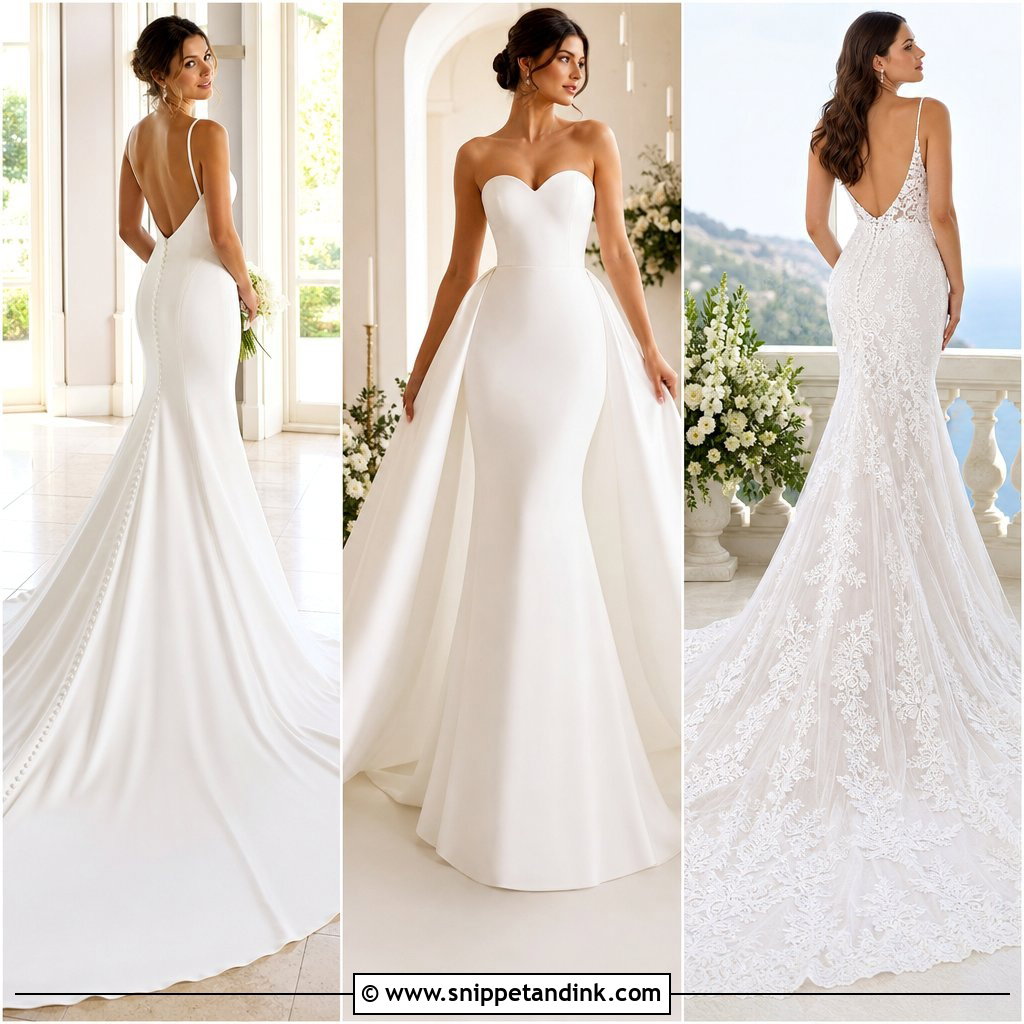
Mermaid gowns hug the body to the knee or just above, then flare, and the train sits behind that flare like a fishtail. From the back it’s dramatic. It also shortens your stride more than any other gown on this list, so at fittings I have brides walk, take a stair, sit on a chair and try a few dance steps before anything is finalized. Where the flare starts matters most. Set it too low and you’ll shuffle. Lace, crepe, satin and beaded fabrics all suit the shape, and a bustle or detachable overskirt makes the reception far easier.
10. Fit And Flare Wedding Dress With Long Train
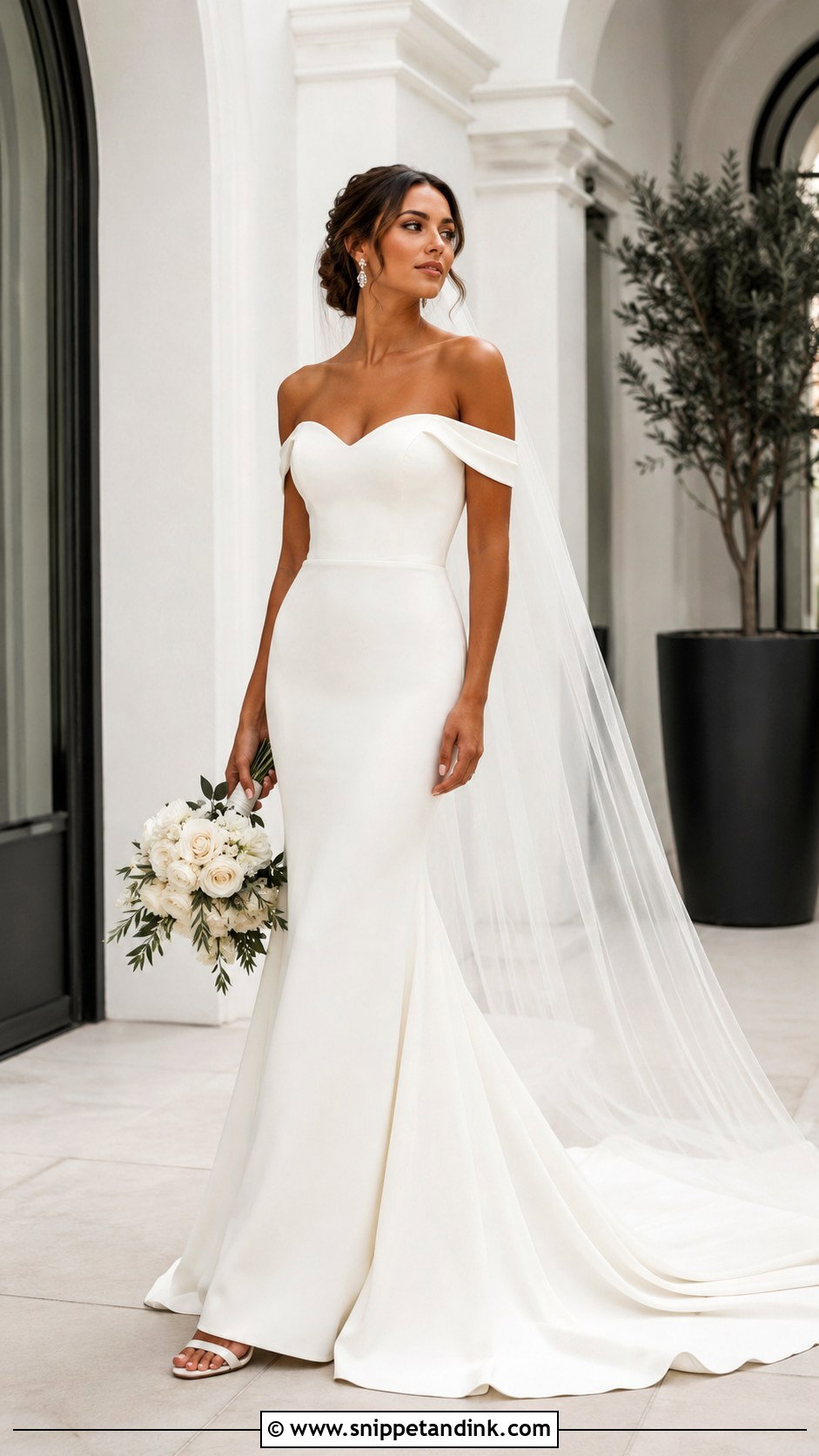
Think of fit-and-flare as the mermaid’s more forgiving cousin. It follows the body to the hip, then opens higher up the leg, so you can take a normal step. The train gives you a back view without much added weight. Crepe reads smooth and modern, and lace softens it. Most necklines work here, so pick based on what you’d like to show. I usually pair this shape with a mid-length veil, since a cathedral veil over a fitted silhouette can look as if it belongs to a different dress.
11. Off Shoulder Long Train Wedding Dress
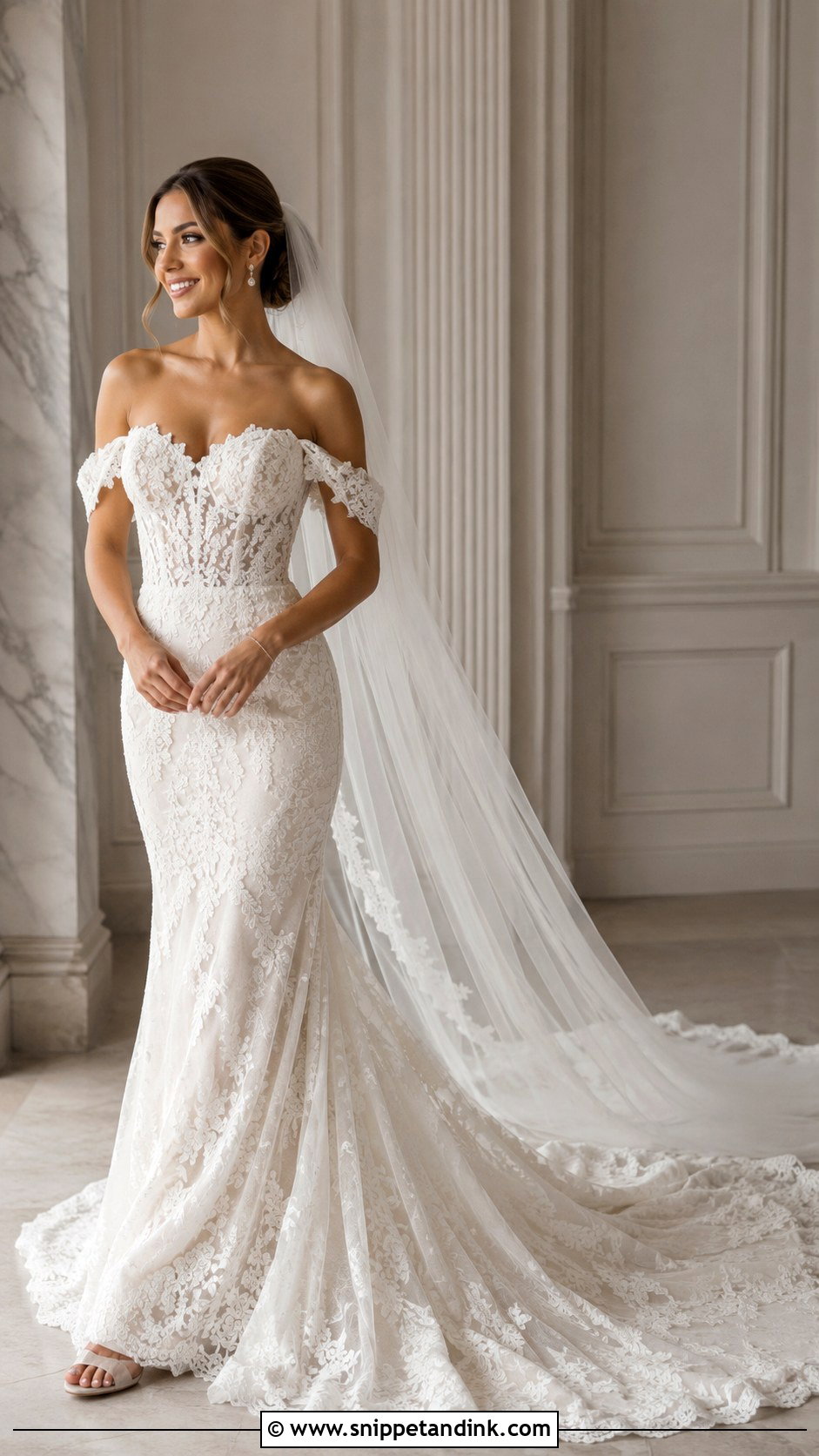
An off-the-shoulder neckline frames the collarbones, and it’s lovely with a long train because both draw the eye outward and down. The catch is movement. If the dress has off-shoulder sleeves or straps, raise your arms at the fitting as if you’re hugging someone. Plenty of brides discover they can’t, and a small adjustment fixes it. Satin, lace, tulle and mikado all work. I attach the veil low, beneath an updo, so it falls behind the shoulders instead of covering them.
12. Strapless Long Train Wedding Dress
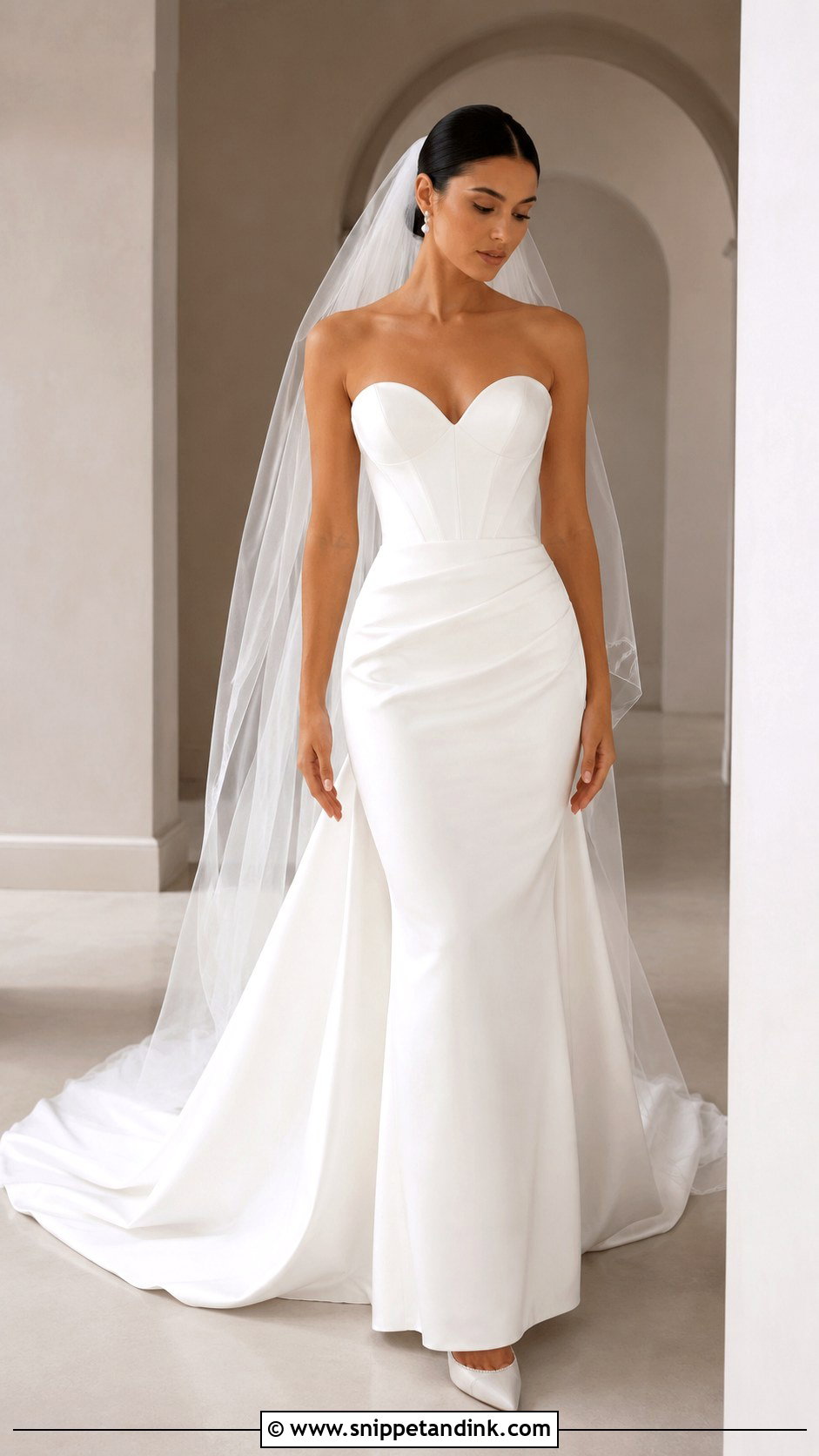
A strapless bodice stays up because of fit and internal boning, nothing else, so alterations make or break this dress. It should feel snug when you exhale and still let you breathe and sit. If it slides when you lift your arms, it needs taking in. Once the fit is right, the clean neckline becomes a blank canvas for a choker, pearl studs or bigger earrings. Satin keeps the look sleek. The long train is what stops a simple strapless gown from reading as a formal evening dress.
13. Long Sleeve Wedding Dress With Long Train
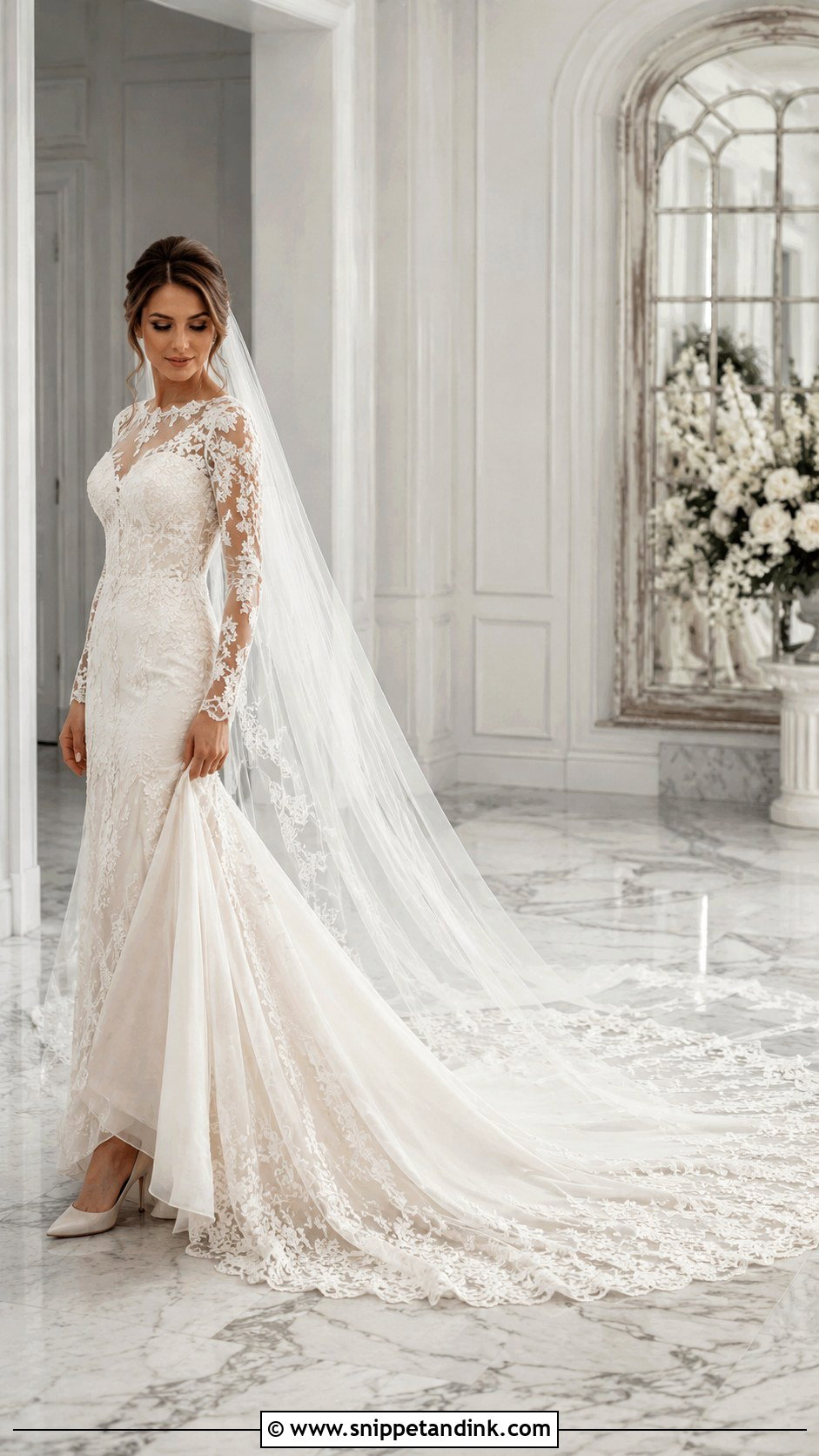
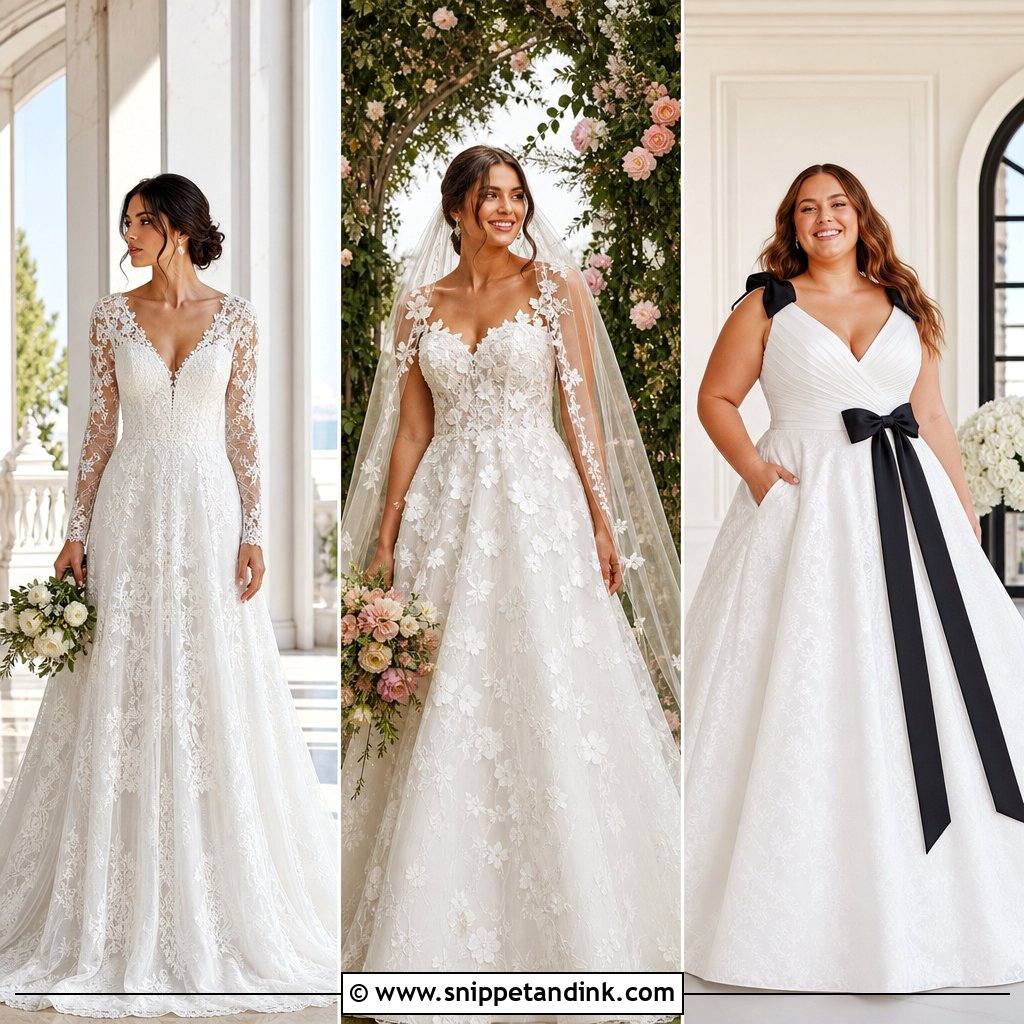
Sleeves and a long train balance each other well: covered arms up top, length behind. Sheer lace or illusion sleeves keep this wearable in warmer weather, and fitted crepe or satin sleeves suit fall and winter indoor weddings. What I watch for is the sleeve at the wrist when the arm bends. Sleeves cut for a straight arm ride up the moment you hold a bouquet. Floral lace that runs from sleeve to train looks cohesive. Keep the hair low, a soft bun or loose waves, so the sleeve detail has room.
14. Square Neck Long Train Wedding Dress
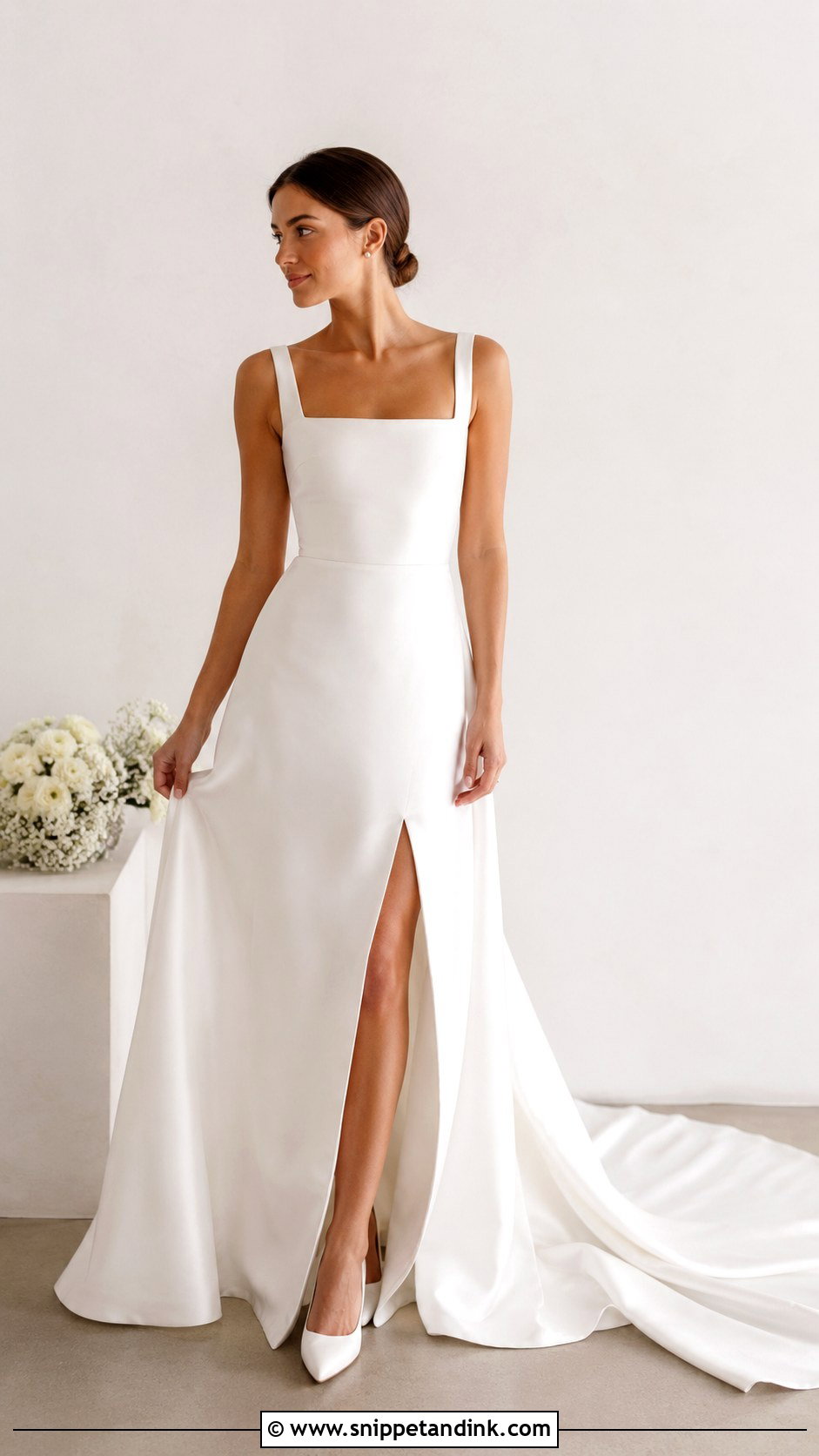
A square neckline is structural, so it depends on a firm bodice. With a fuller bust, ask about built-in cups and boning before anything else. Without them, the straight edge bows outward and the neckline loses its crisp line by the speeches. Satin, mikado and crepe suit the minimalist version, and lace softens the corners. The long train is a welcome counterpoint to all those straight lines. Styling stays simple: a sleek veil, small earrings, pointed shoes.

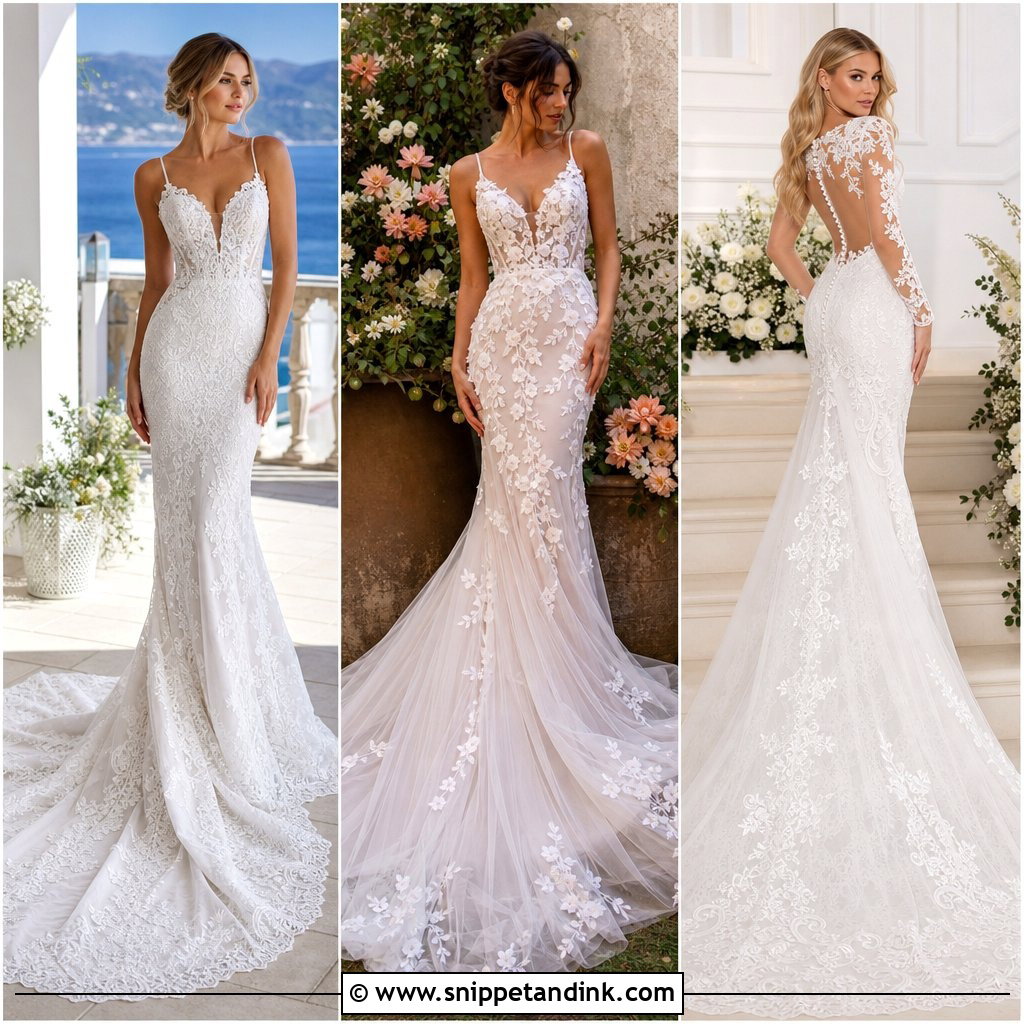
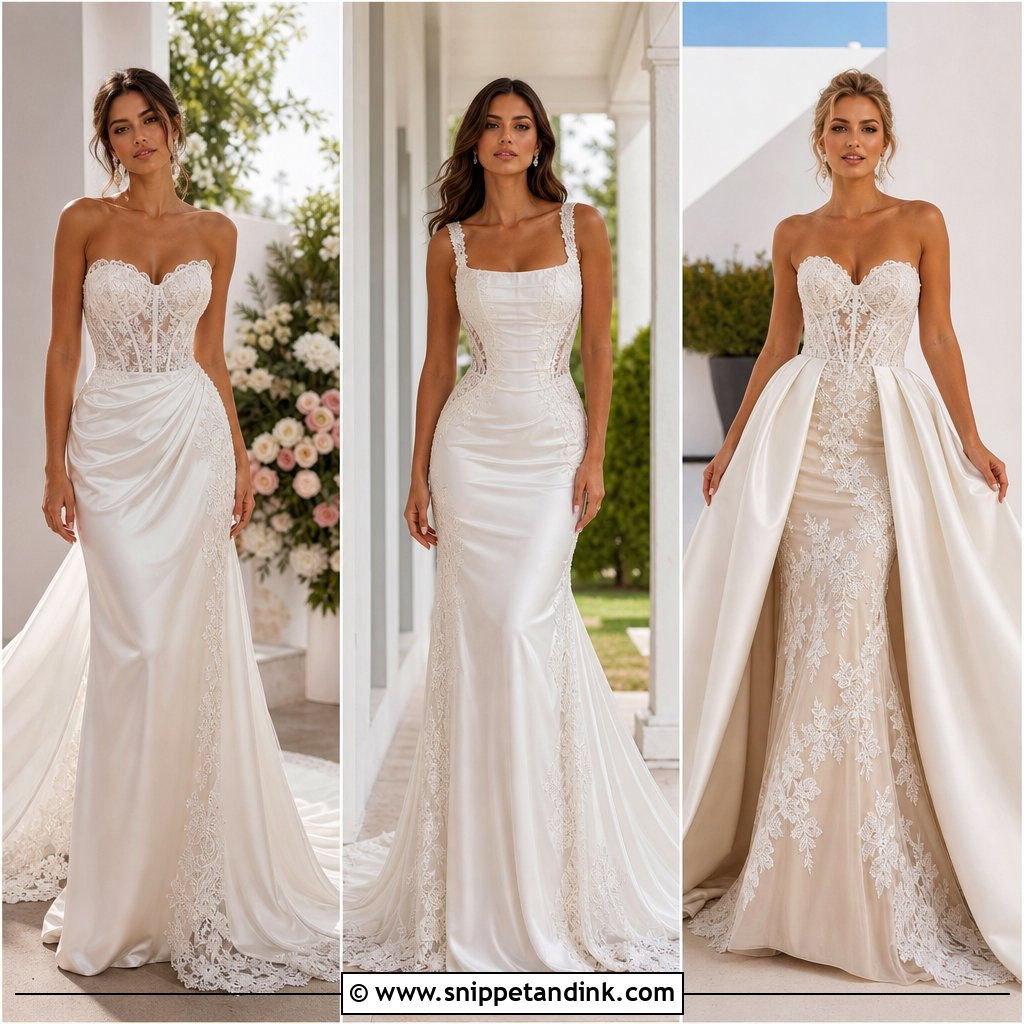
15. Sweetheart Long Train Wedding Dress
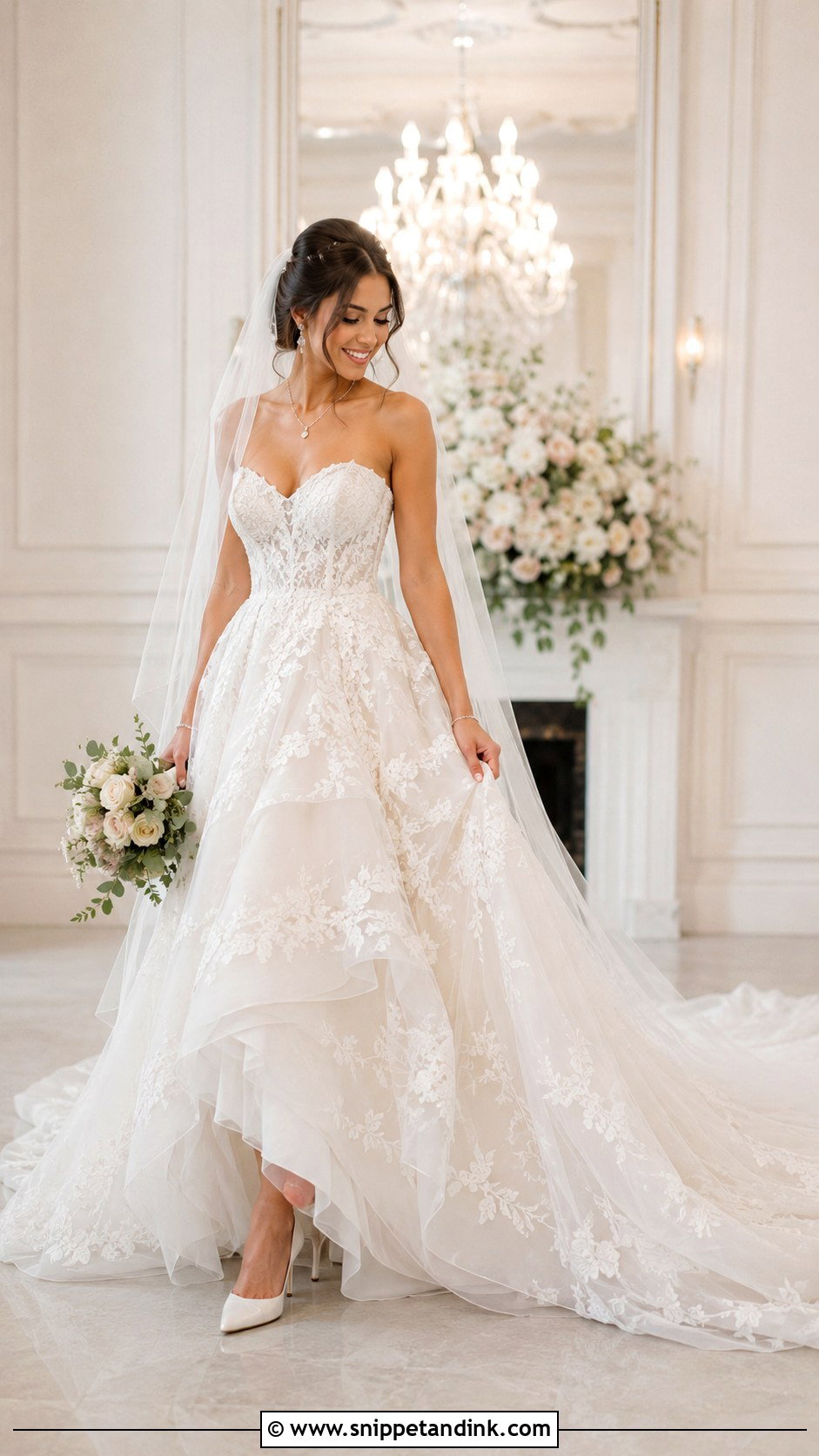
Brides keep coming back to the sweetheart long train wedding dress for a reason. The curved neckline softens the bodice on almost any frame, and it turns up on strapless gowns, corset bodices and dresses with removable sleeves. My jewelry rule here is short. If the bodice is embellished, skip the necklace and wear earrings. If it’s plain, a fine pendant sits nicely inside the curve. Soft curls and a sheer veil finish it.
16. Corset Wedding Dress With Long Train
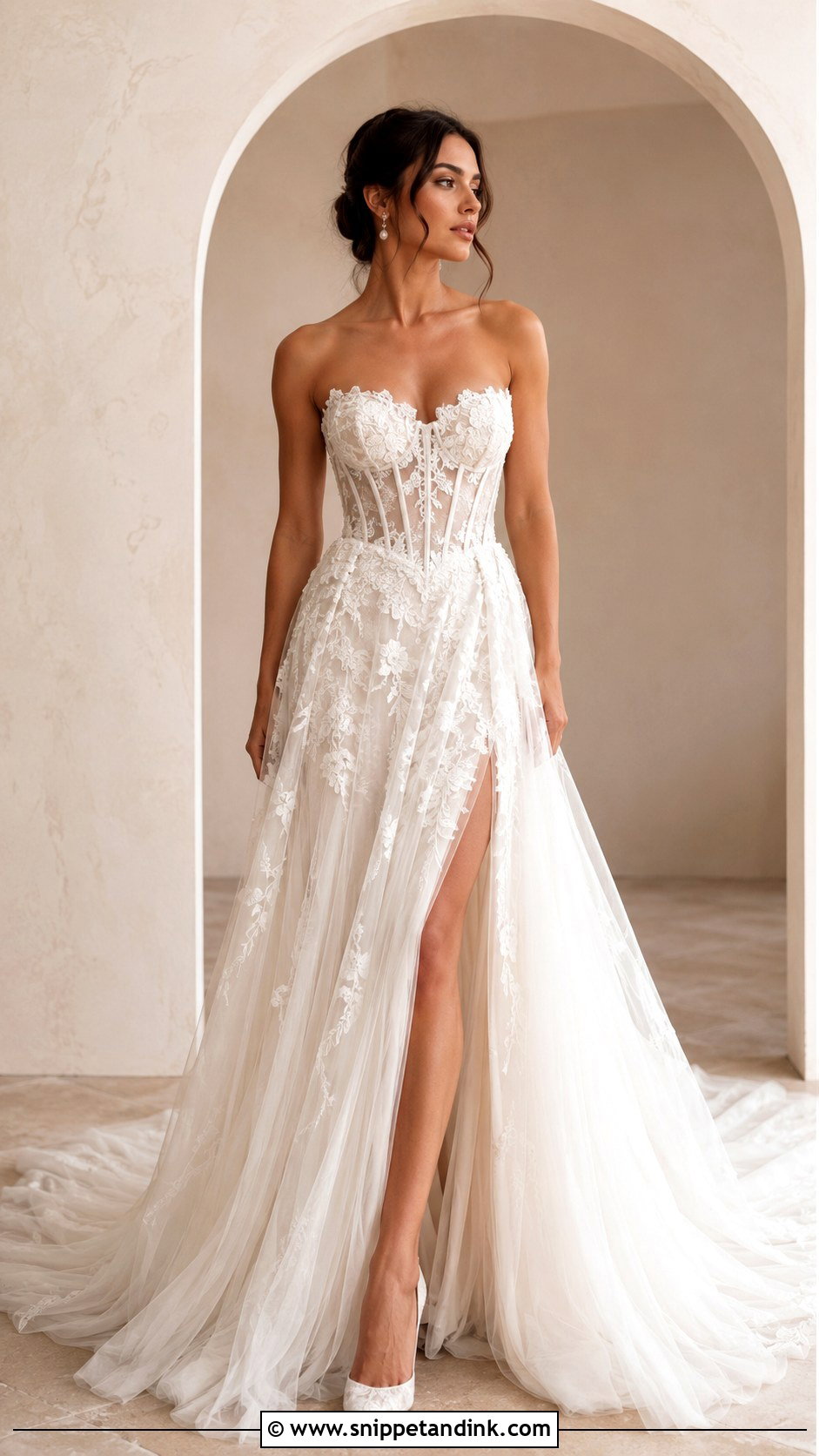
Corset bodices shape and support at the same time, which is why they’ve stayed popular. Visible boning feels fashion-led; boning hidden under smooth fabric looks more classic. The structured top plays well against a soft long train. When fitting, I check two things: can you breathe fully, and can you sit without the bottom of the boning digging into your hips? A lace-up back gives some room if your weight shifts before the wedding, while a zip gives a cleaner line. Place the veil so it doesn’t hide the corset seams.
17. Beaded Long Train Wedding Dress
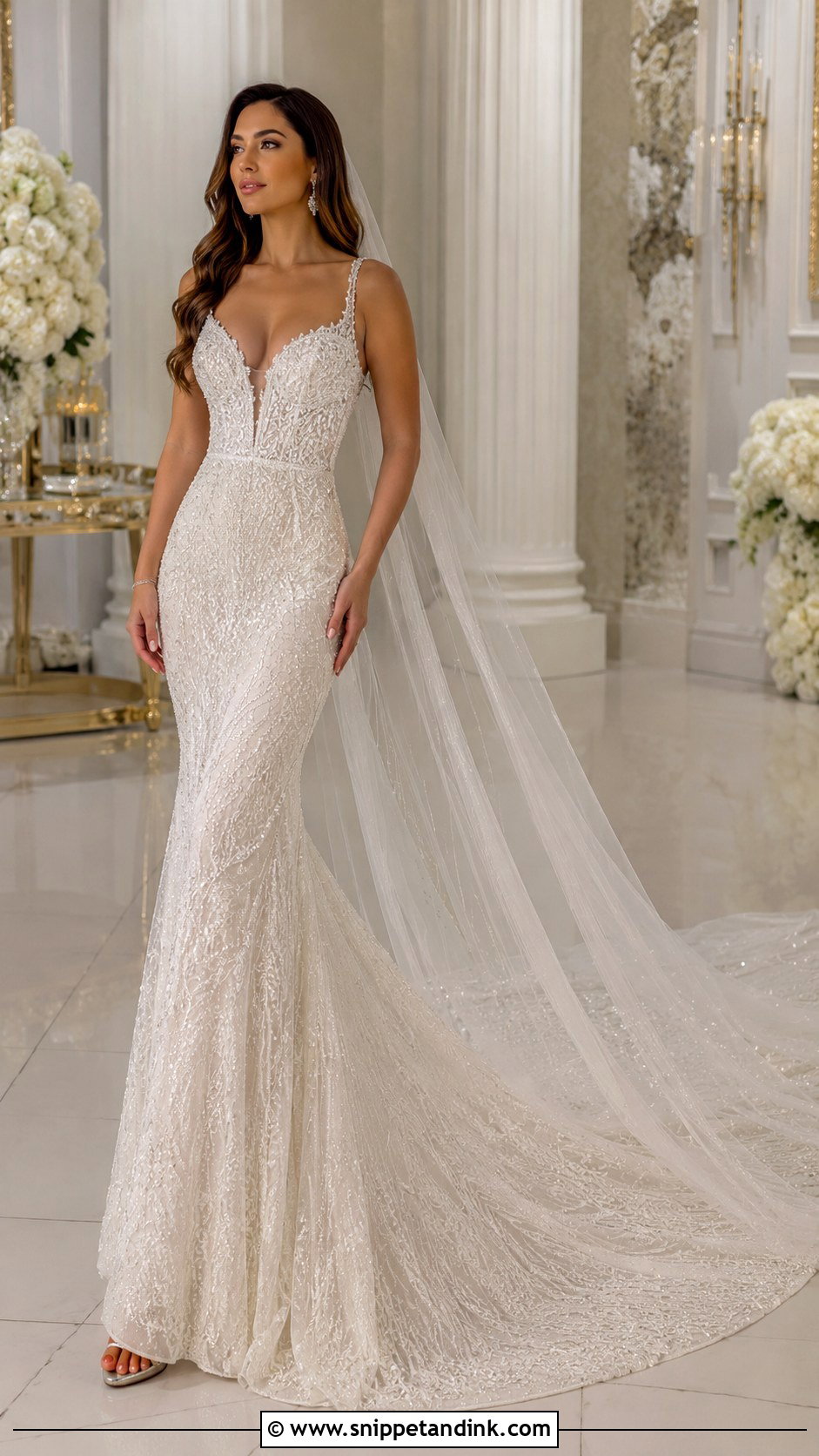
Beading catches light, but it also adds real weight, and most of it sits in the train, where you’ll feel it pulling at your shoulders by evening. Walk in the dress for several minutes before committing. Bustle points on a beaded train need reinforcing because those hooks carry the load all night. With this much sparkle, keep shoes and jewelry plain and hair smooth. Daylight shows beadwork texture far better than flash, so plan a few portraits outdoors or beside a window.
18. Floral Applique Long Train Wedding Dress
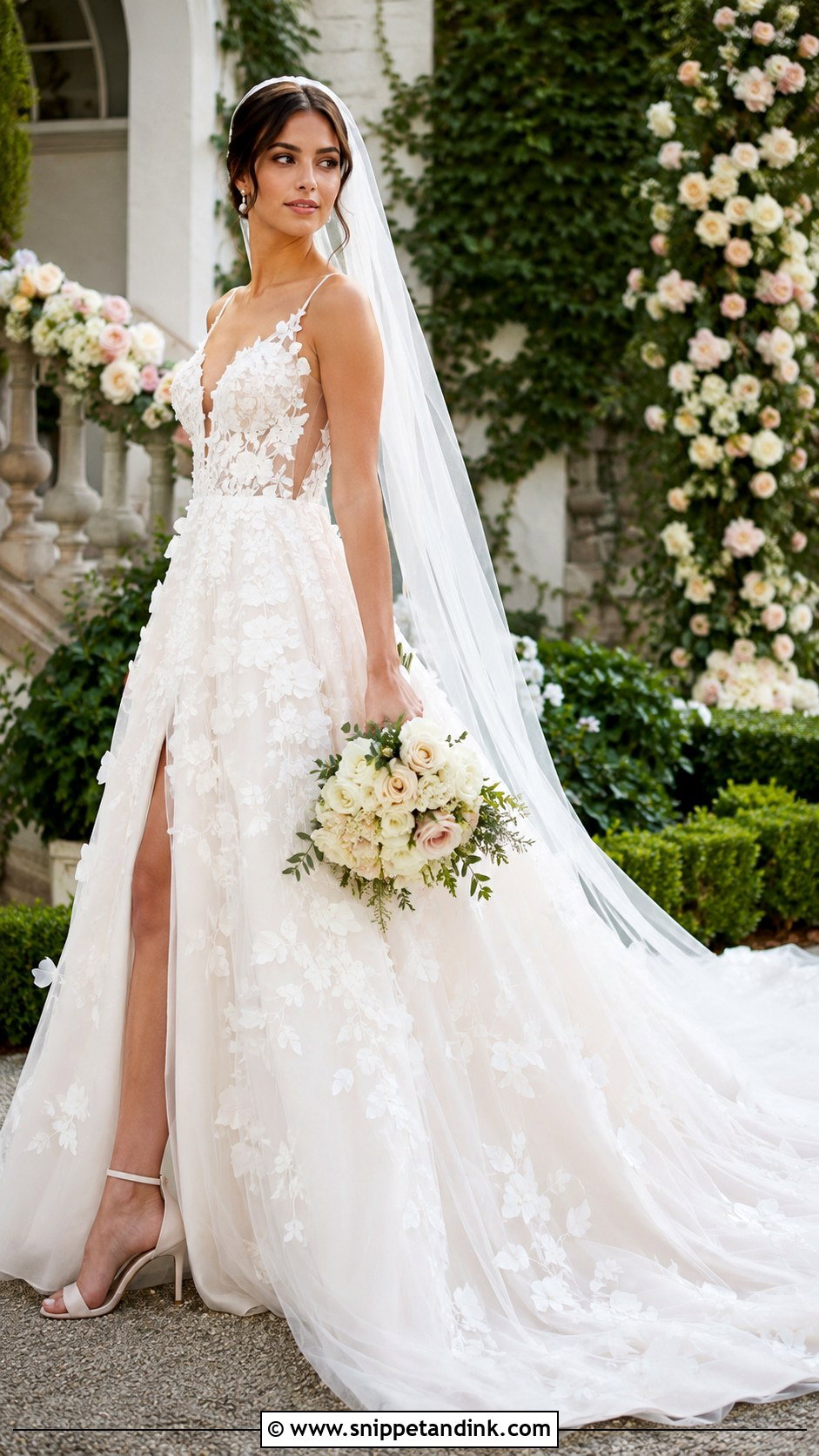
Appliqués can lie flat or stand up off the tulle, and the raised kind photographs with more shadow and depth. When they continue onto the train, the back becomes the focal point. Garden and estate weddings suit them best, though they hold up indoors too. One practical note from fittings: raised flowers catch on veil edges and on each other when the train is bustled, so I prefer a plain veil and a bustle planned around where the appliqués sit. Pearl earrings and quiet makeup keep the outfit from getting busy.
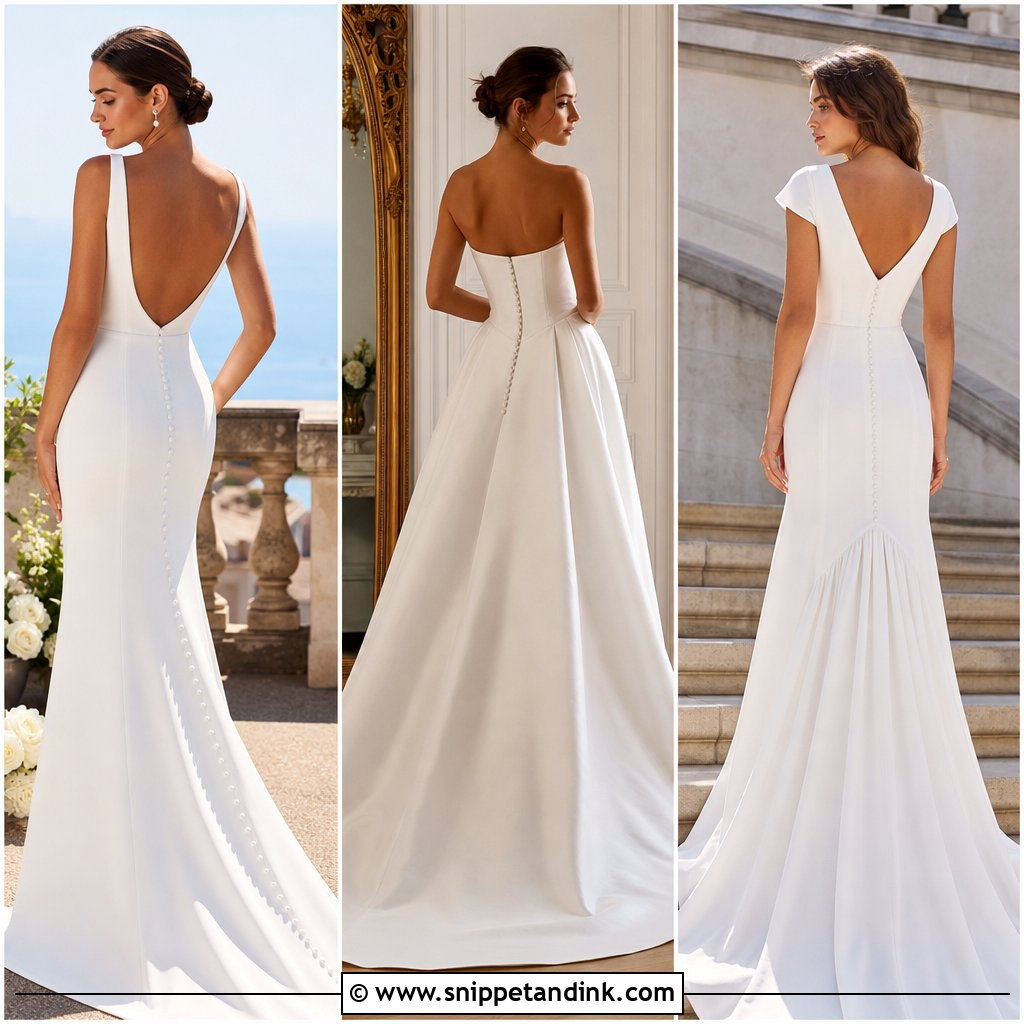
19. Simple Long Train Wedding Dress
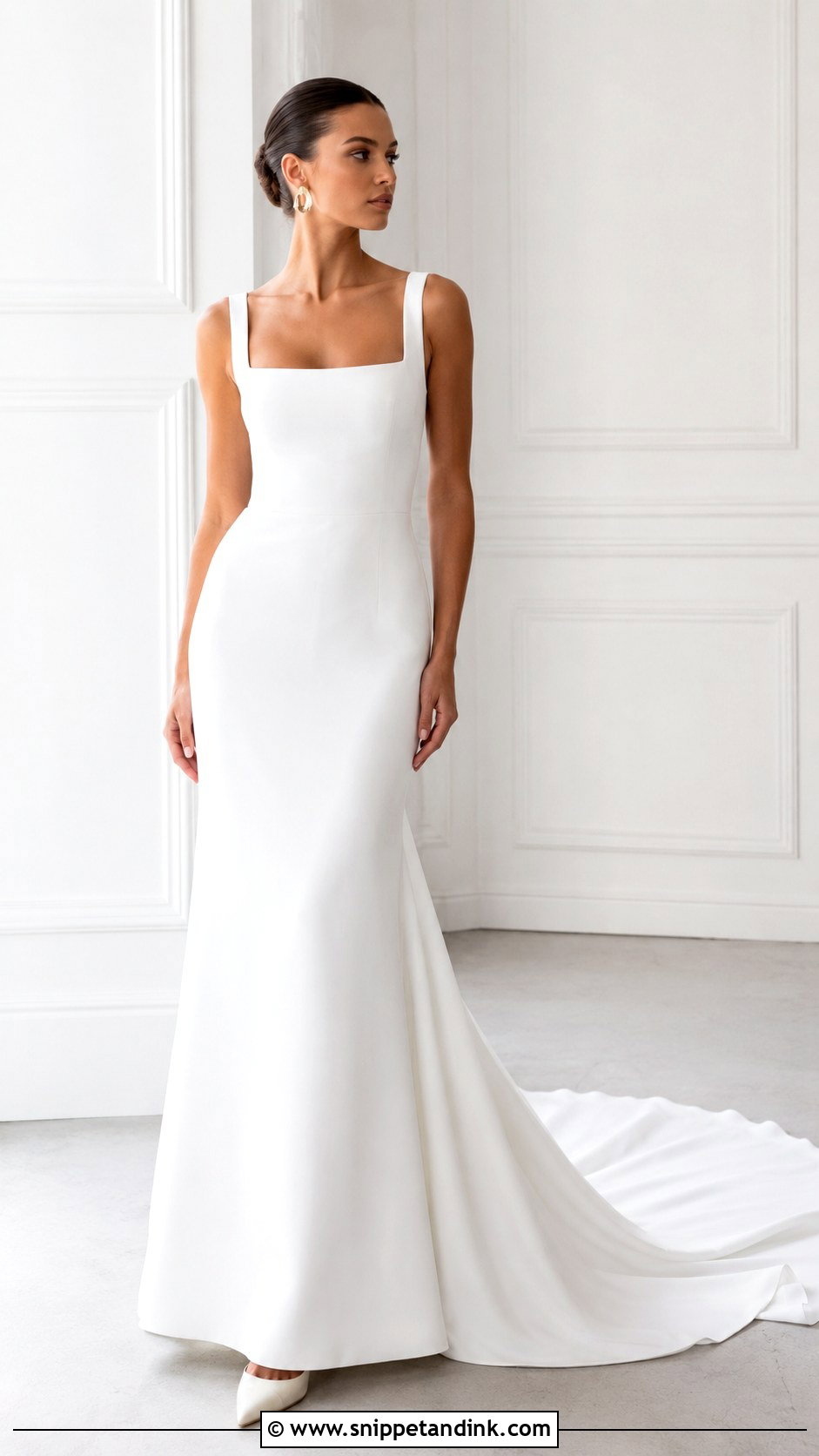
A plain gown with a long train is the hardest dress here to get right, because there’s nothing to hide behind. Fit and fabric carry everything. Satin, crepe, mikado and silk blends hold a clean line, while a thin polyester satin shows pulled seams and puckering. A straight or square neckline keeps it modern. I’d add one point of interest only, maybe a long veil or sculptural earrings, and let the train do the talking in back-view photos.
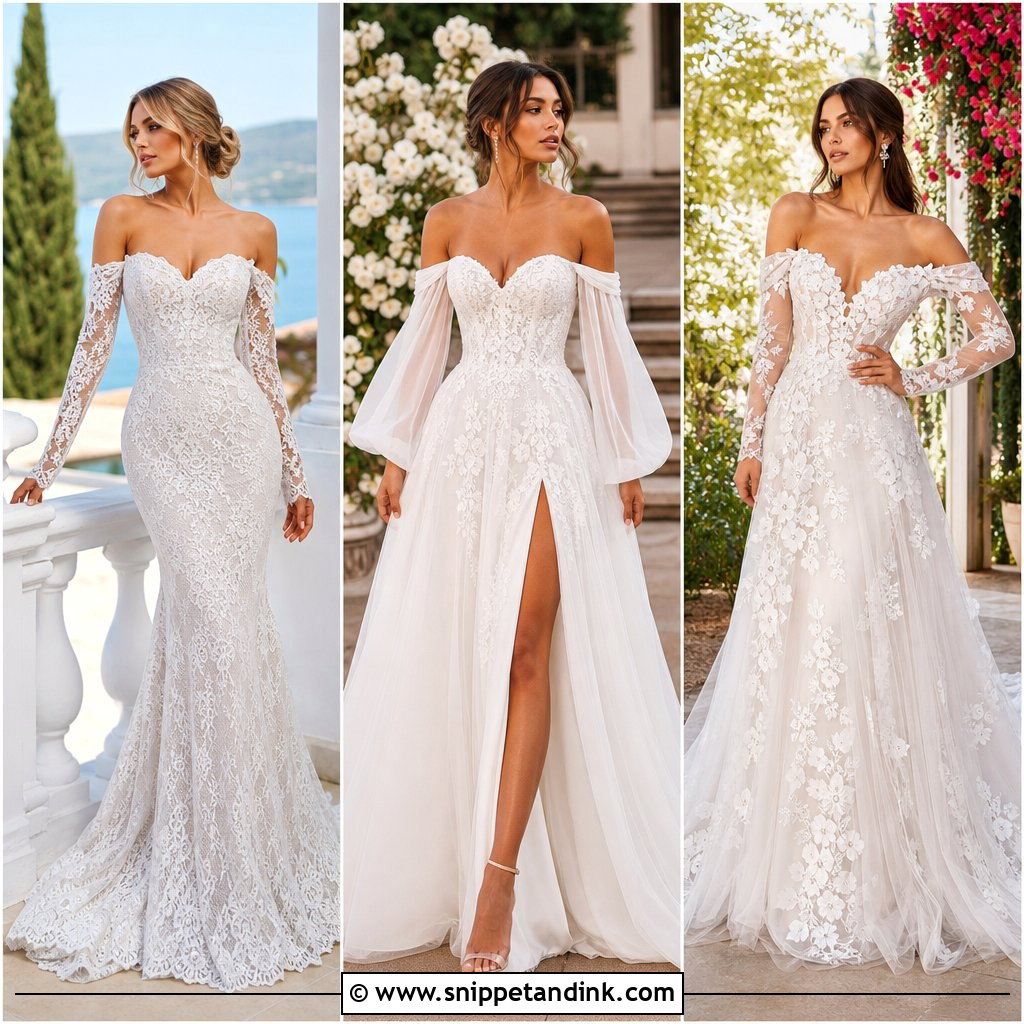
20. Boho Long Train Wedding Dress
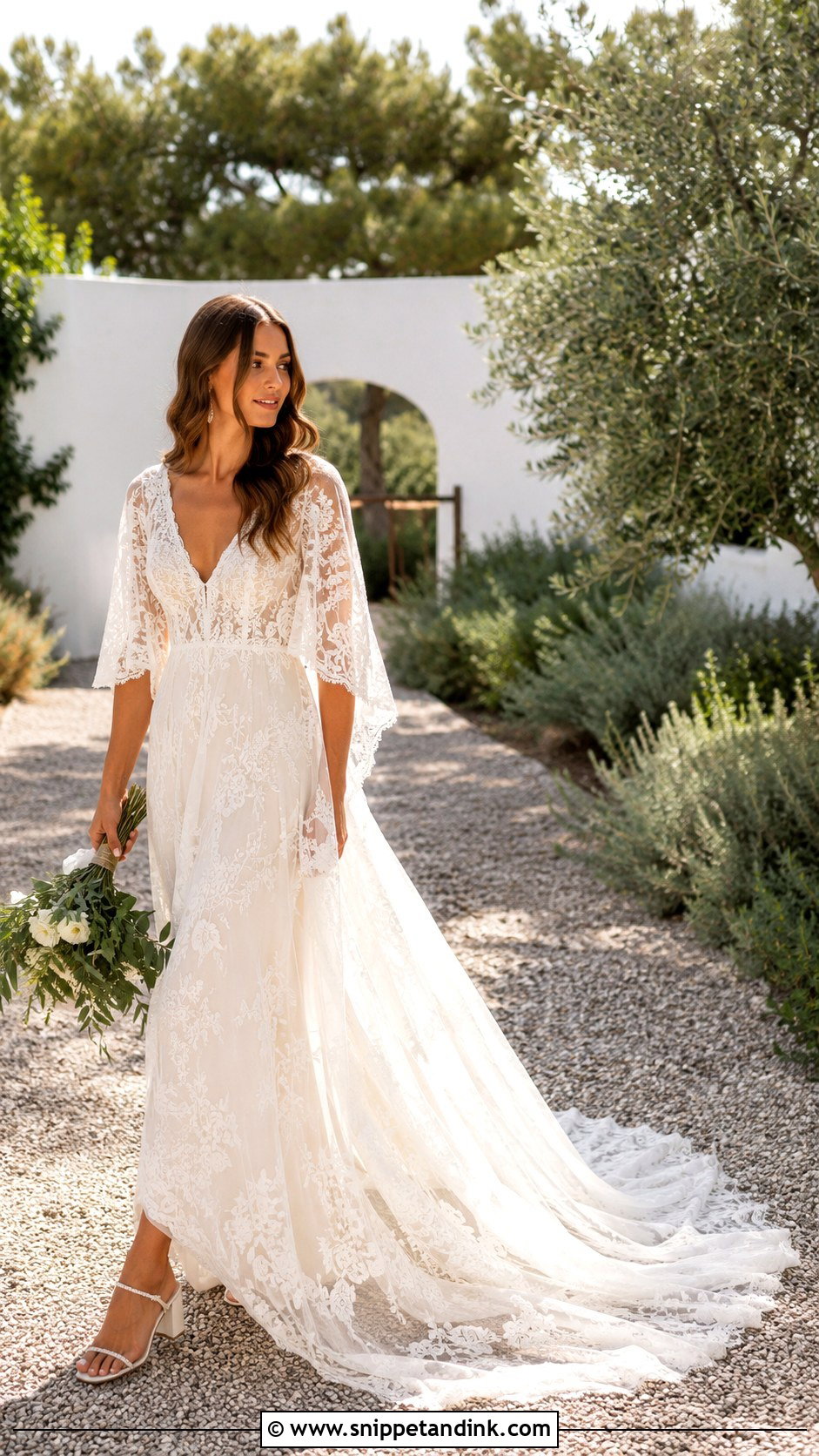
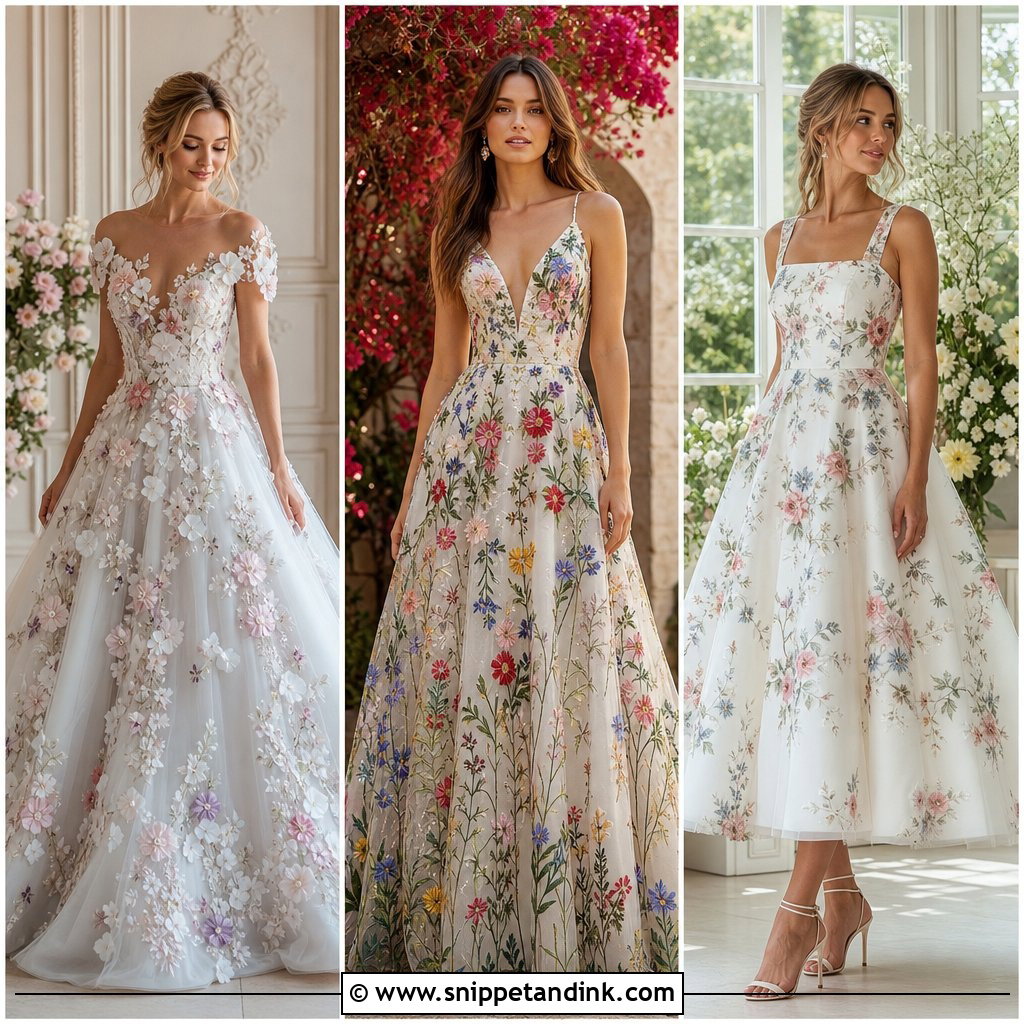
Boho trains are usually light, often lace or chiffon, so they move in the wind and over rough ground better than heavy satin does. That’s why they suit outdoor, desert and rustic venues. Look for airy sleeves, an open back and a train that’s long but not built up. On dirt, sand or grass, a light hem picks up debris, so I tell brides to either accept a dusty hem as part of the look or bustle straight after the ceremony. Sandals or low heels and soft waves fit the mood. A lace-edged veil works if the gown itself is fairly plain.
21. Modern Long Train Wedding Dress
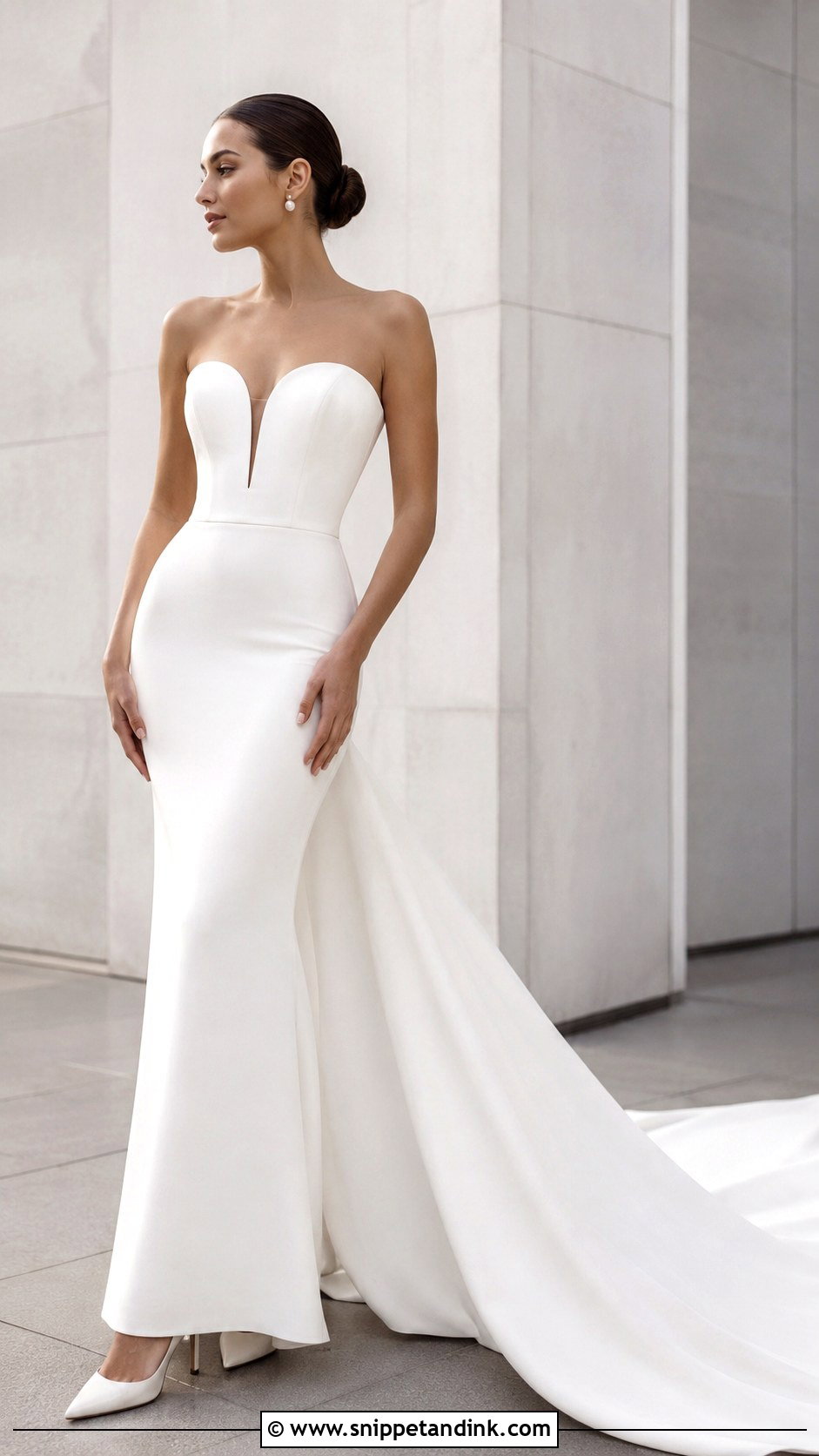
Modern long train gowns rely on cut rather than decoration: sculpted bodices, architectural seams, sometimes a high slit. Crepe, mikado and stretch satin hold those lines. Because the design is spare, any wrinkle or uneven seam stands out, so pressing and fit matter more than usual. A slick bun and a structured bouquet suit it. If you like the idea of two looks, a detachable train or overskirt gives you formal drama for the ceremony and a streamlined dress for dancing.
22. Vintage Long Train Wedding Dress
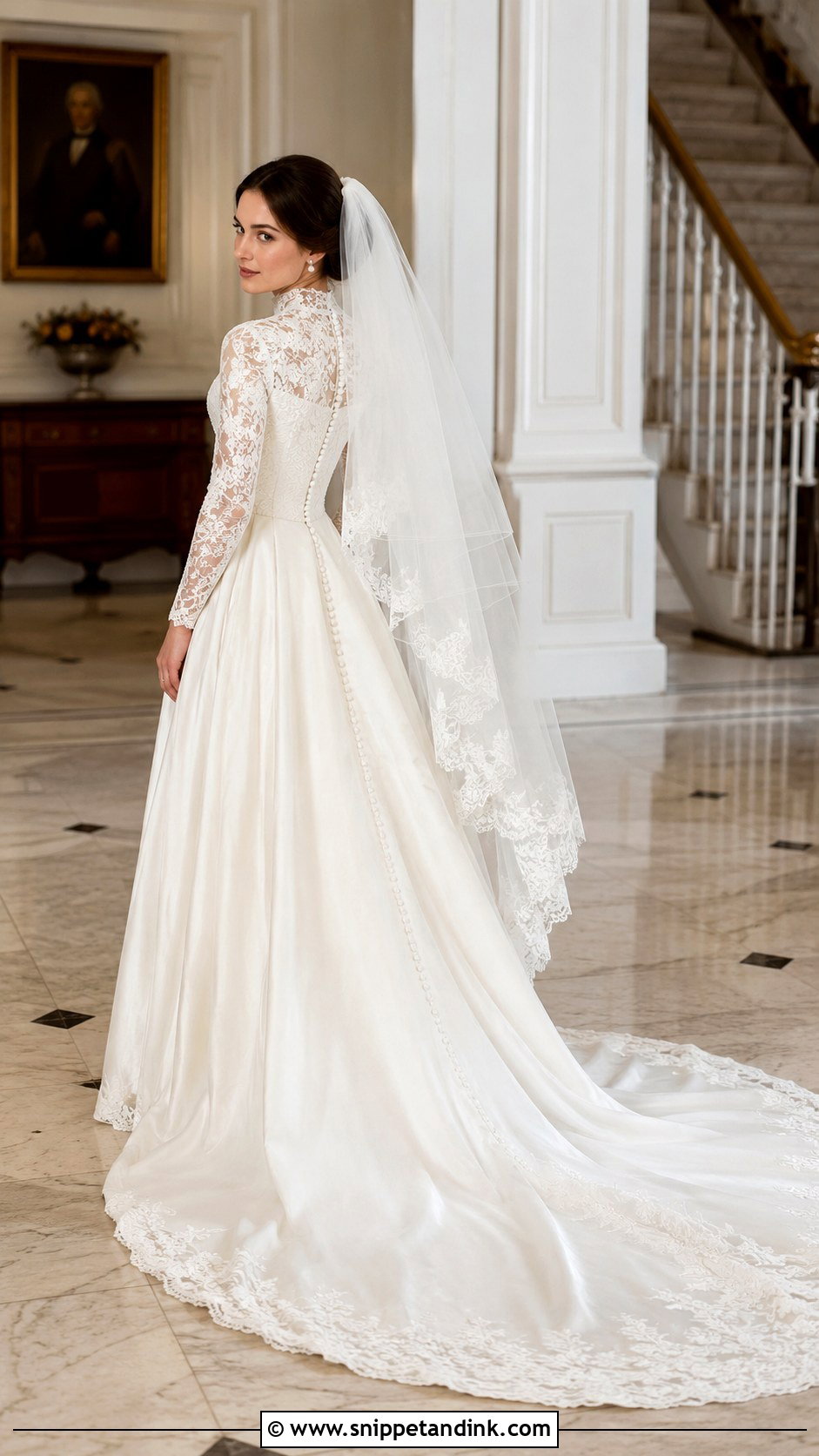
Vintage styling covers a lot of decades: lace sleeves, high necklines, covered buttons, basque waists and embroidery all show up. A 1920s mood leans on beading and a softer, lower-waisted line, while a 1950s mood wants a fitted bodice and fuller skirt. Covered buttons down the back look wonderful and take ages to fasten, so I always budget extra minutes when dressing a bride in one. If you’re wearing a real heirloom gown, have a specialist check the train fabric before alterations, because older silk can be fragile. Pearl earrings and satin shoes support the mood without tipping into costume.
23. Detachable Train Wedding Dress
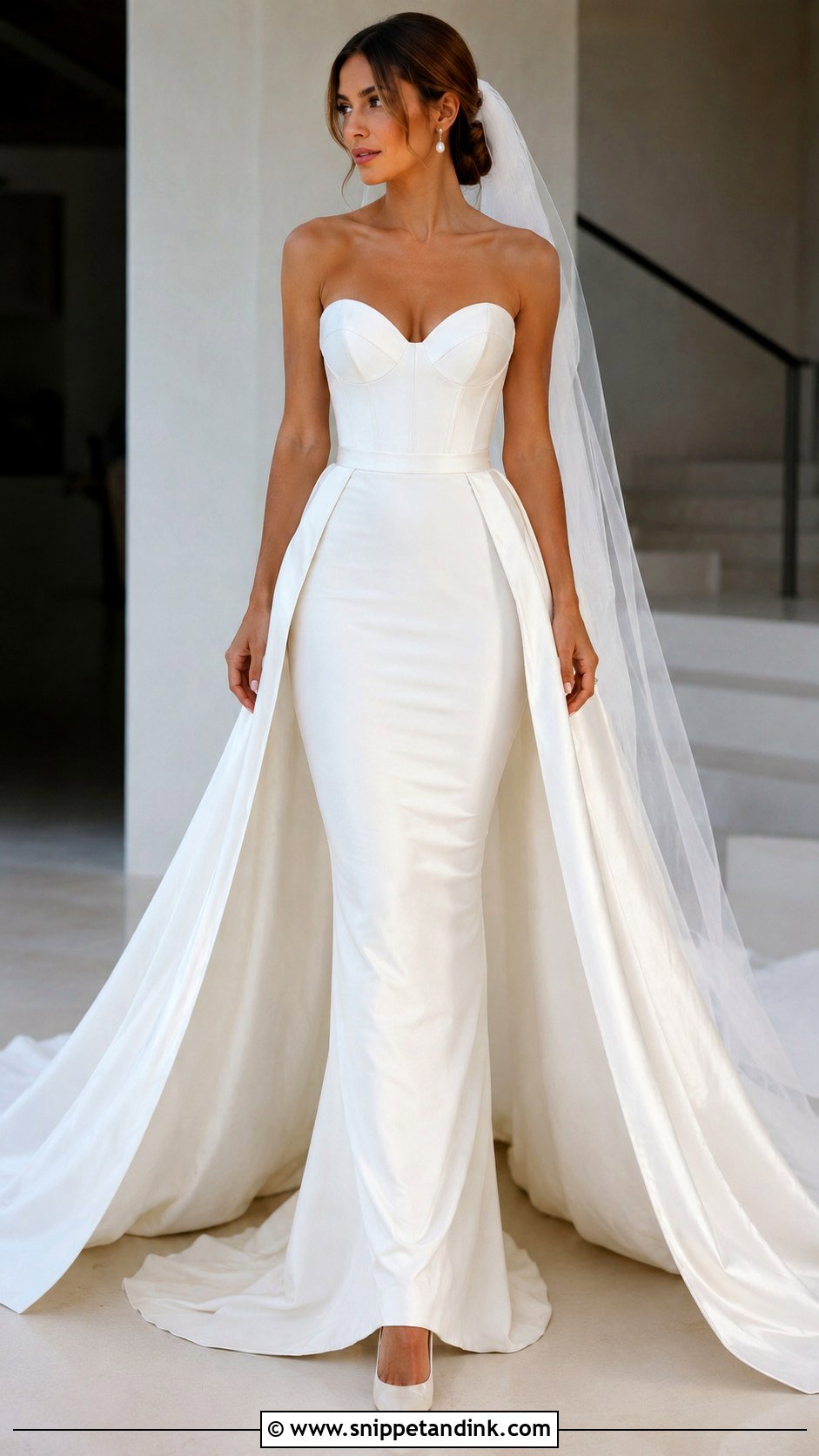
A detachable train gives you two dresses: the full ceremony version and a lighter gown for dancing. Trains attach at the waist, the lower back, the shoulders or as a whole overskirt. The fastening is what I inspect closely. Hooks, snaps or buttons should hide under a seam or a bow so nothing shows once the train is off. At the last fitting, show your maid of honor how to remove it and let her practise once while you’re wearing it. Fumbling with tiny snaps under reception lighting is no fun.
24. Open Back Wedding Dress With Long Train
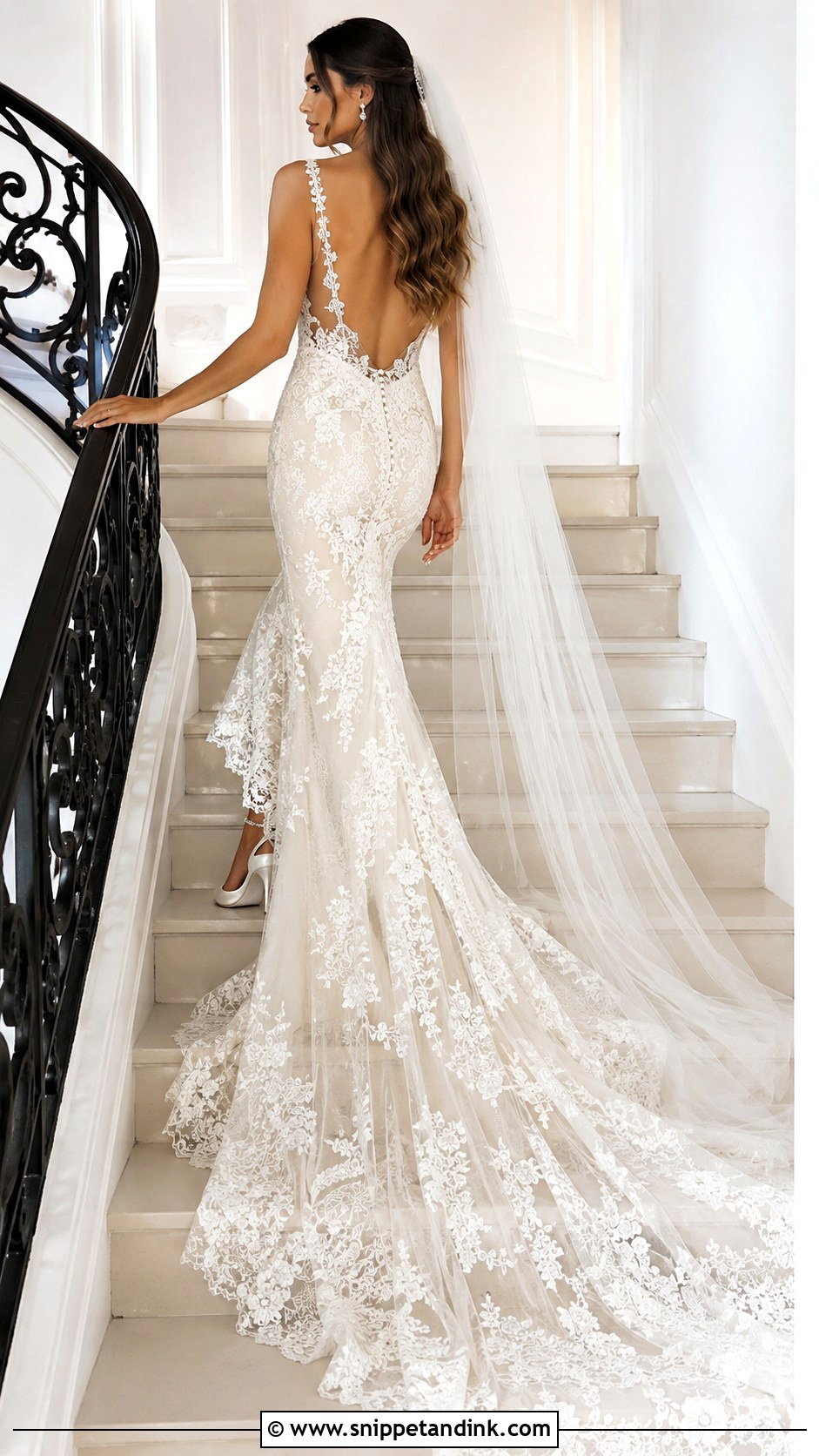
An open back wedding dress with a long train makes the walk away from your guests the moment that counts. Low backs read modern, keyhole backs more classic. The practical challenge is support. Most open-back gowns need built-in cups or a solution sewn in during alterations, since an ordinary bra won’t work with the cut. Bring the undergarments you plan to wear to every fitting. Wear the veil low or skip it so the cutout stays visible.


25. Plus Size Long Train Wedding Dress
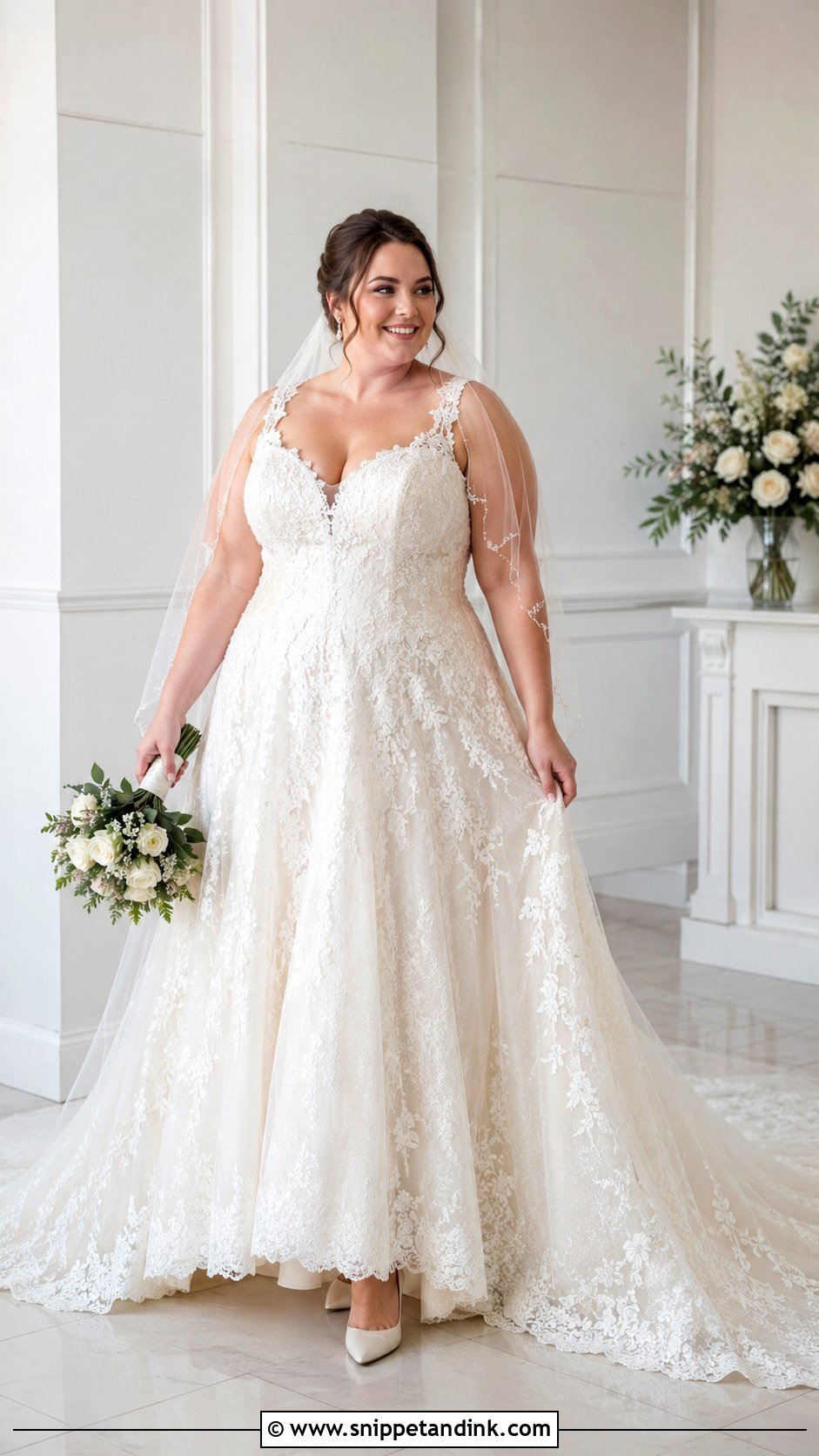
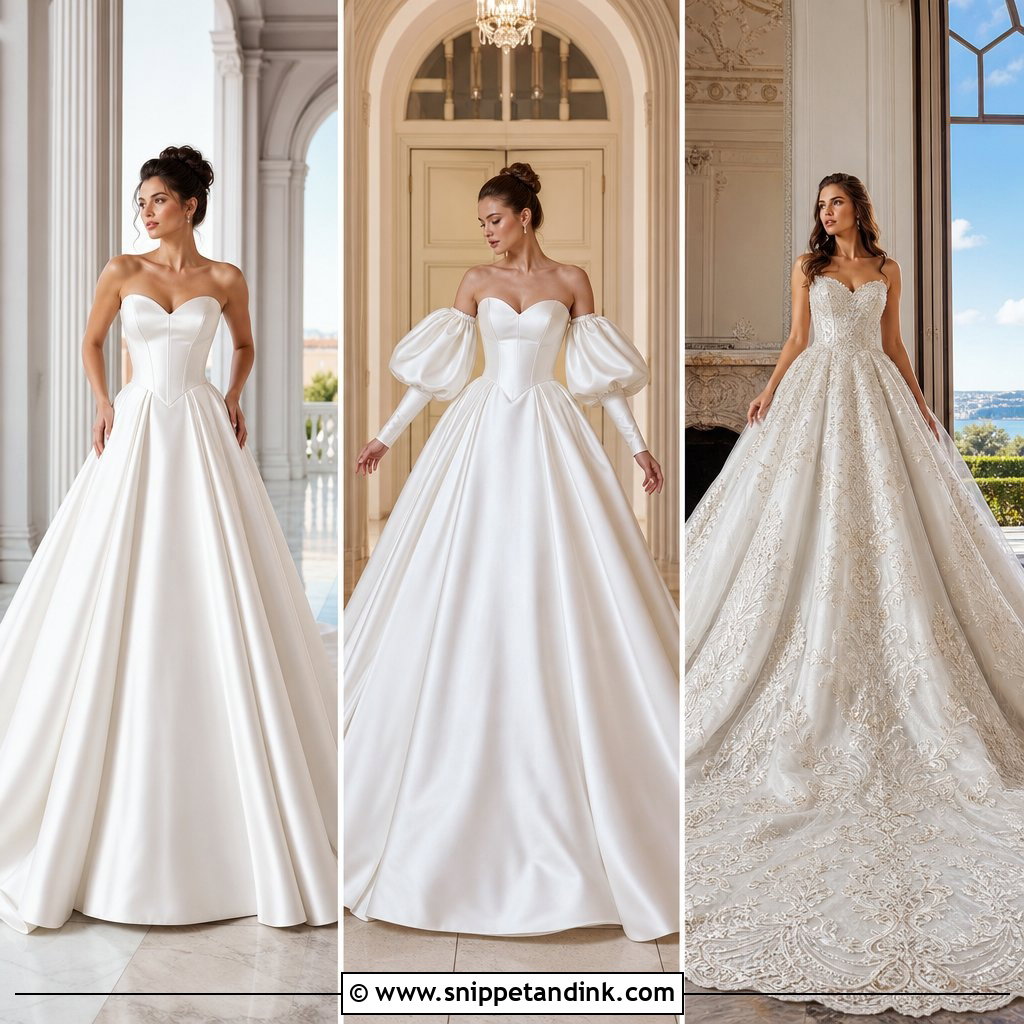
For plus size brides, the gown that works is the one with serious construction inside: good lining, boning, and seams that lie flat. A-line, ball gown, fit-and-flare and corset styles can all carry a long train well. The first question I ask is where you want support and where you want ease, because that decides the silhouette faster than any trend does. Tulle adds volume without weight, and satin gives a smooth finish. During fittings, walk, turn and sit. A well-placed bustle and comfortable shoes make the evening far more enjoyable.
Over, French or Ballroom: Matching the Bustle to the Train
A bustle lifts the train off the floor after the ceremony using hooks, buttons or ribbon ties hidden in the skirt. Your seamstress adds it during alterations, and I let the fabric decide the style.
Over bustle
The train hooks up onto the outside of the skirt at one or more points. It’s quick to do and drapes neatly on satin and crepe, though on a heavy beaded train it can strain the waist seam.
French or under bustle
The train folds under itself and ties inside the skirt with numbered or coloured ribbons. It suits full skirts and lace trains because nothing hangs off the outside. It takes longer, so a bridesmaid should practise it at the final fitting.
Ballroom bustle
The train is lifted all around so the hem looks almost even, as though the dress never had a train. It’s the best choice for a long dancing reception and the most work to sew.
Stairs, Cars and Dinner Chairs in Several Feet of Fabric
- At the top of the aisle, someone fluffs and straightens the train. Give that job to your coordinator or one named bridesmaid.
- Going down stairs, gather the train over your forearm. Going up, let it trail and have someone lift it from the bottom step.
- In the car, sit on a clean sheet and bring the train onto your lap so the door can’t crush it.
- Bustle before you sit for dinner. Sitting on a loose train creases satin and pulls at seams.
- After the wedding, get the dress professionally cleaned within a few weeks. Hems pick up grass, makeup and sugary drink spills, and sugar can turn into yellow marks later even when you can’t see it now.
Is a Long Train Right for Your Aisle and Your Evening?
A long train gives you presence, but only when the dress, the venue and the day’s schedule are planned around it. From chapel trains to royal trains, each length sets a different mood, and each fabric behaves differently once you’re moving. Before you commit, picture the whole day: the aisle, the stairs, the car, the dinner chair and the dance floor. If the train still makes sense through all of that, with a solid bustle and someone assigned to help, it’s the right one for you.
You'll Like These Ideas:








Leave a Reply