
Most of the modest brides I dress arrive with the same worry: that full coverage will make the outfit feel heavy or plain. It doesn’t have to. Below are twenty directions I’d happily put a bride in, from white lace gowns and embroidered lehengas to loose abayas, kaftans and pared-back nikah dresses, with notes on where each one tends to go wrong. Modesty standards and family traditions differ a lot, so read every idea as a starting point that tailoring, lining, layering or a change in hijab placement can adjust.
Treat the Hijab as Part of the Gown, Not an Accessory
The most common problem I fix late in the process is a neckline that was fitted without the hijab on. A high neck that looks right alone can bunch, gape or push the hijab forward once the fabric is tucked in. So from the very first fitting, I ask brides to wear the exact hijab and undercap they plan to wear on the day.
What I check with the hijab on
- Where the hijab ends on the chest, so embroidery or beading isn’t hidden underneath it.
- Whether the neckline should be lowered slightly or finished with a band so the two layers lie flat together.
- Pin points: I mark where the veil will anchor so the seamstress can add a discreet loop or reinforce the fabric there.
- Color match in daylight. White hijabs come in many shades, and a cool white beside a warm ivory gown looks grey in photographs.
Fabric pairing matters too. Jersey grips and stays put under a heavy veil, while chiffon drapes more softly but needs more pins. If your hijab stylist and your dress fitter are different people, send each of them photos of the other’s work before the final appointment.
1. White Lace Hijab Wedding Dress
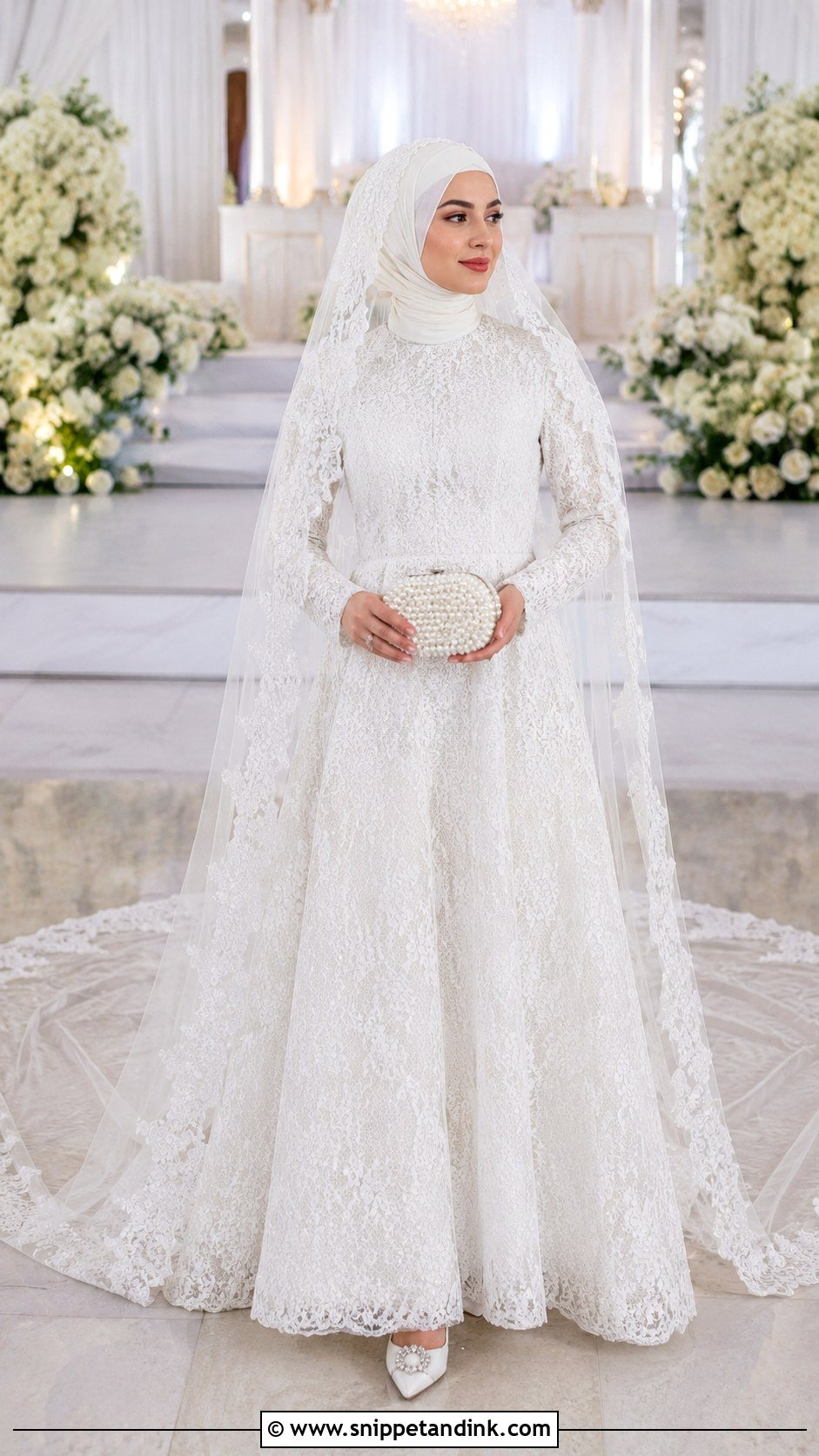
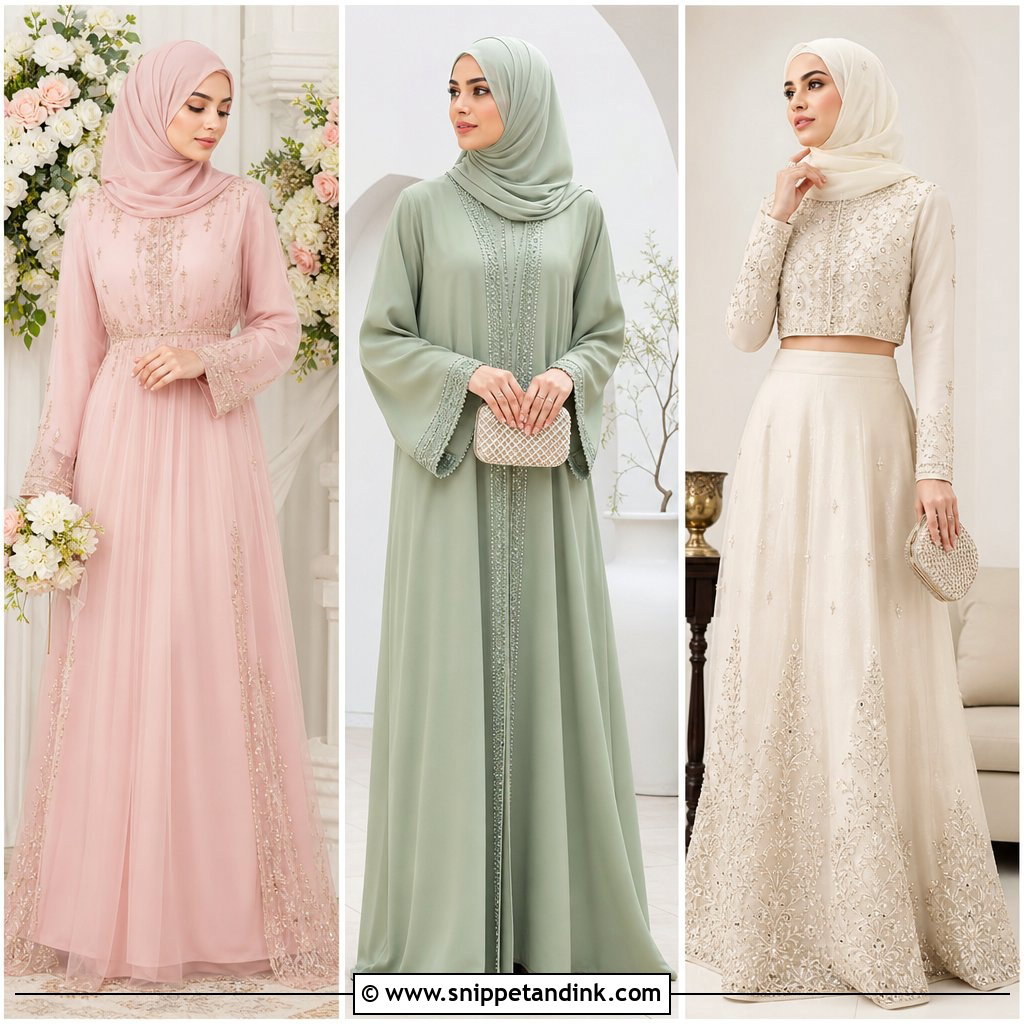
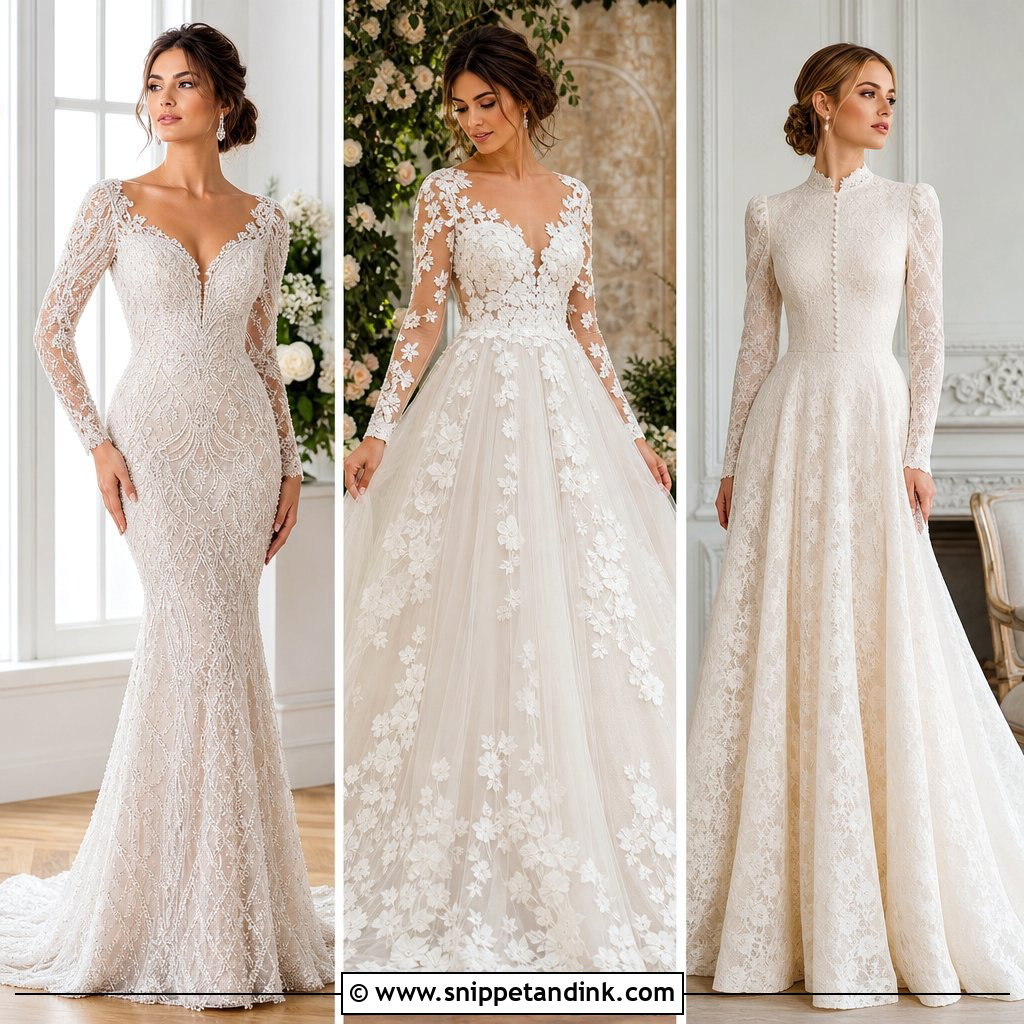
Lace over an opaque base is the most requested modest gown I see, and the base matters more than the lace. I always ask for satin or crepe underneath rather than a thin slip, because fine lace over a light lining turns see-through under a photographer’s flash even when it looked fine in the shop. An A-line with long lined sleeves, a high neck and a gently defined waist keeps the shape polished without clinging. A smooth ivory hijab sits better under a cathedral lace veil than a textured one, which grabs the tulle. If the hijab covers the ears, skip earrings entirely and put that sparkle into a jeweled hijab pin or a small brooch. Pointed satin flats or a low block heel finish it.
2. Satin A-Line Muslim Wedding Dress
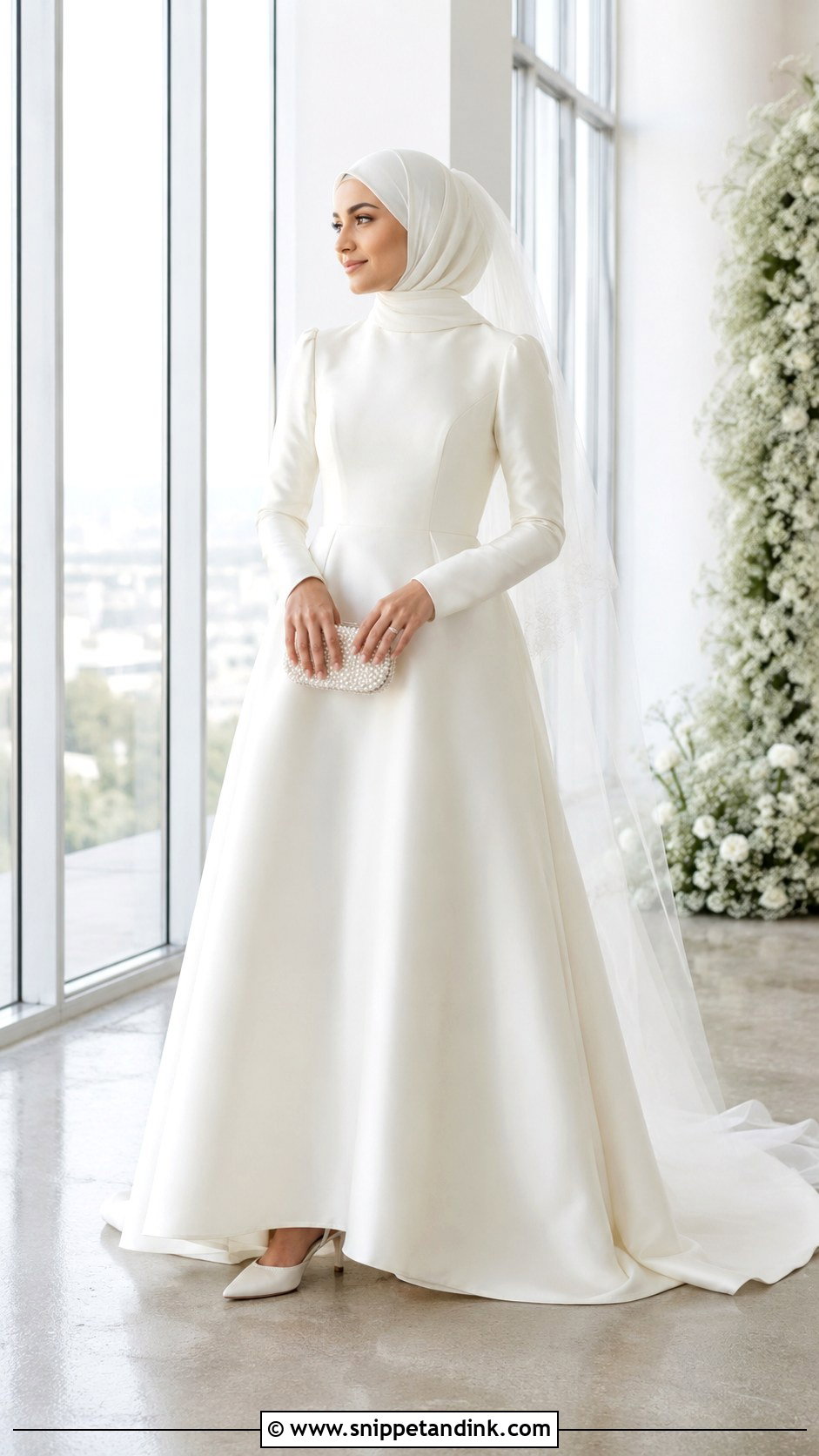
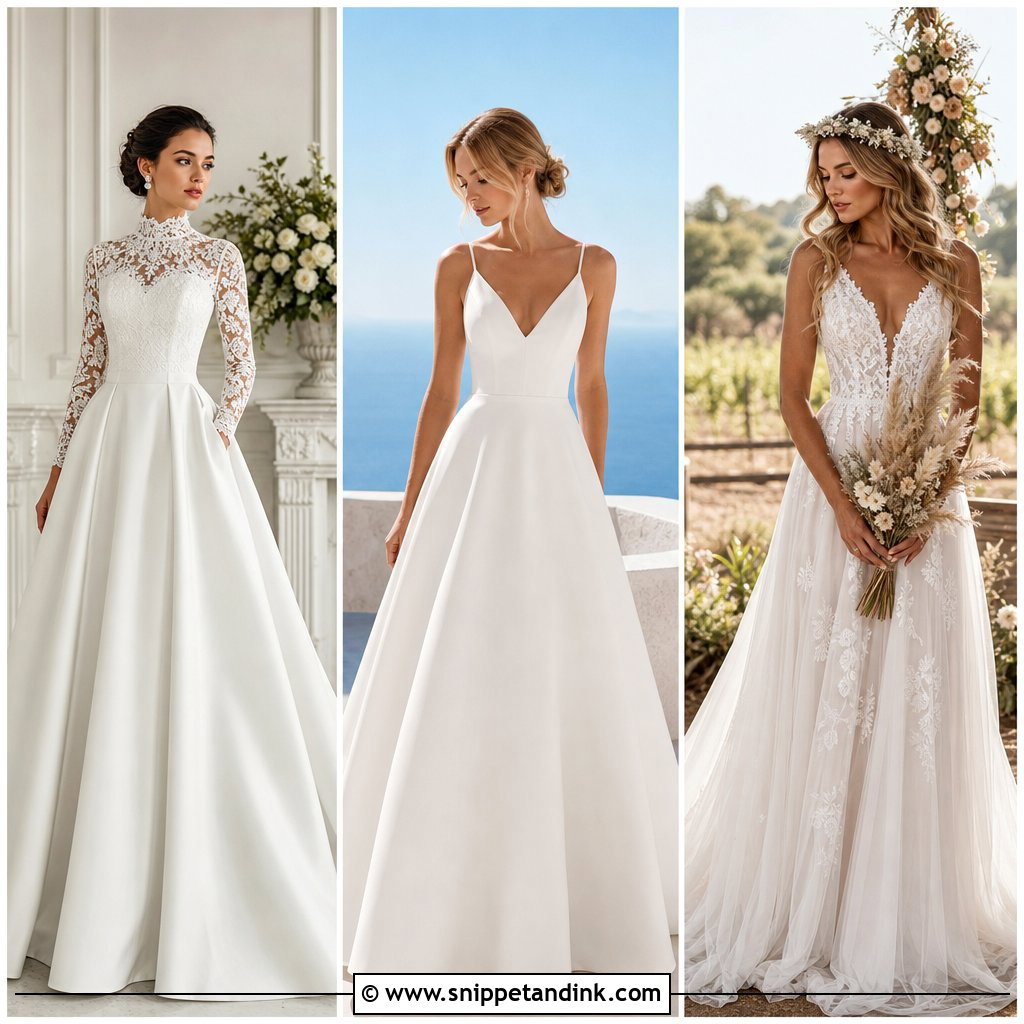
Satin is the fabric I’m most careful with on modest brides, because it shows everything underneath it. A heavier duchess or crepe-back satin cut as an A-line Muslim wedding dress falls away from the body; a thin, cheap satin traces every seam of your shapewear. Choose a high neck, full sleeves and a skirt that releases loosely from the waist, then put a matte chiffon hijab against the sheen so the two textures don’t compete. Ivory and pearl tones need no beading here. Ask your tailor about soft pleats at the waist, which give more room to walk and sit.
3. Pearl Beaded Islamic Wedding Dress
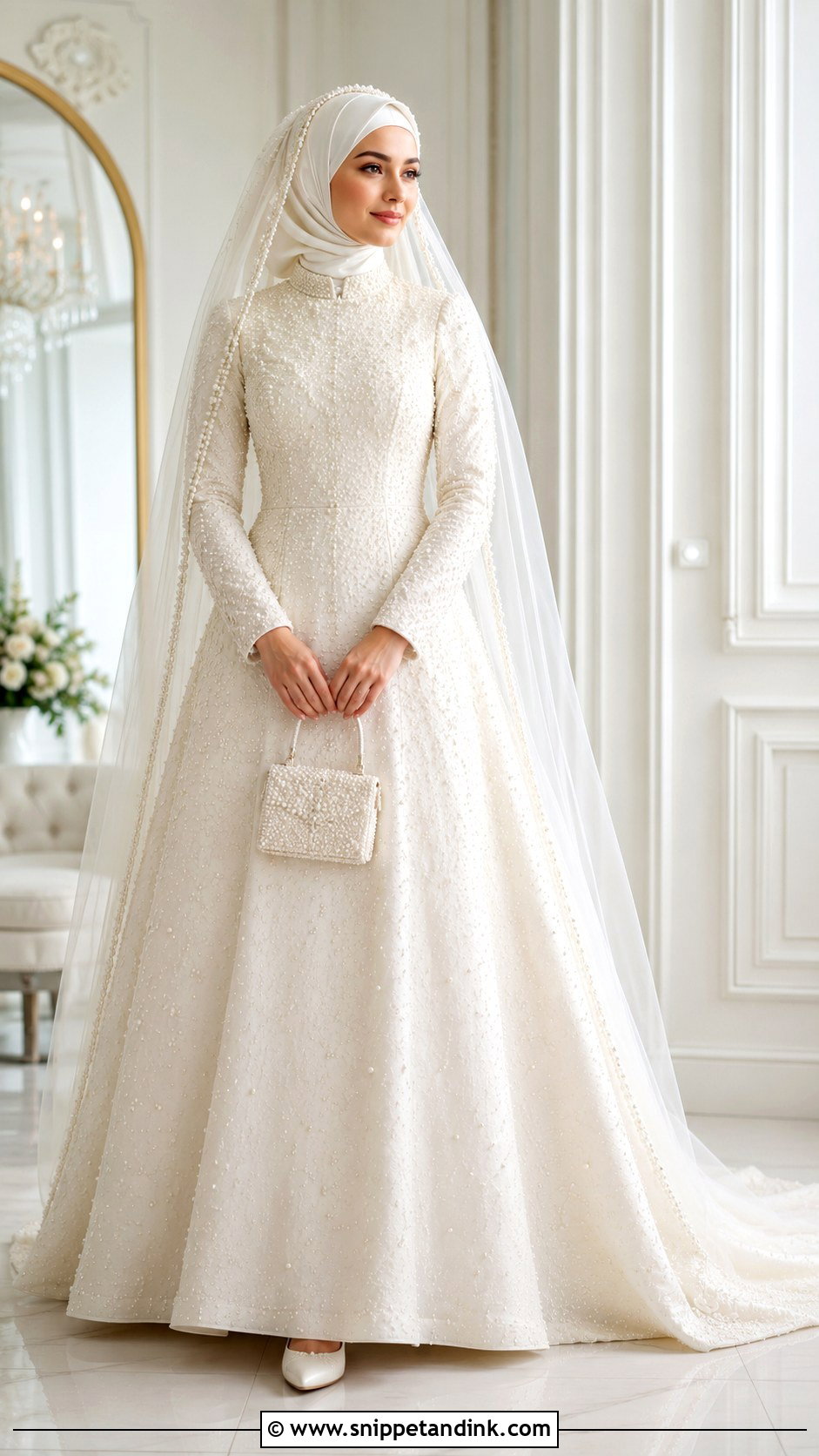
Pearls placed only at the neckline, cuffs, shoulders and upper skirt give an Islamic wedding dress detail without the weight of an all-over beaded bodice. Watch the sleeves: beading is often stitched onto illusion mesh, so I insist on a full lining there or the arms show through. Keep the hijab plain satin and let a pearl-edged veil carry the theme. Raised pearls are notorious for snagging tulle, so at the fitting I have the bride sit, stand and hug someone while wearing the veil. If you dislike weight, ask for scattered pearls rather than dense clusters, and check that each one is stitched on individually, not glued.
4. Cape Sleeve Muslim Wedding Dress
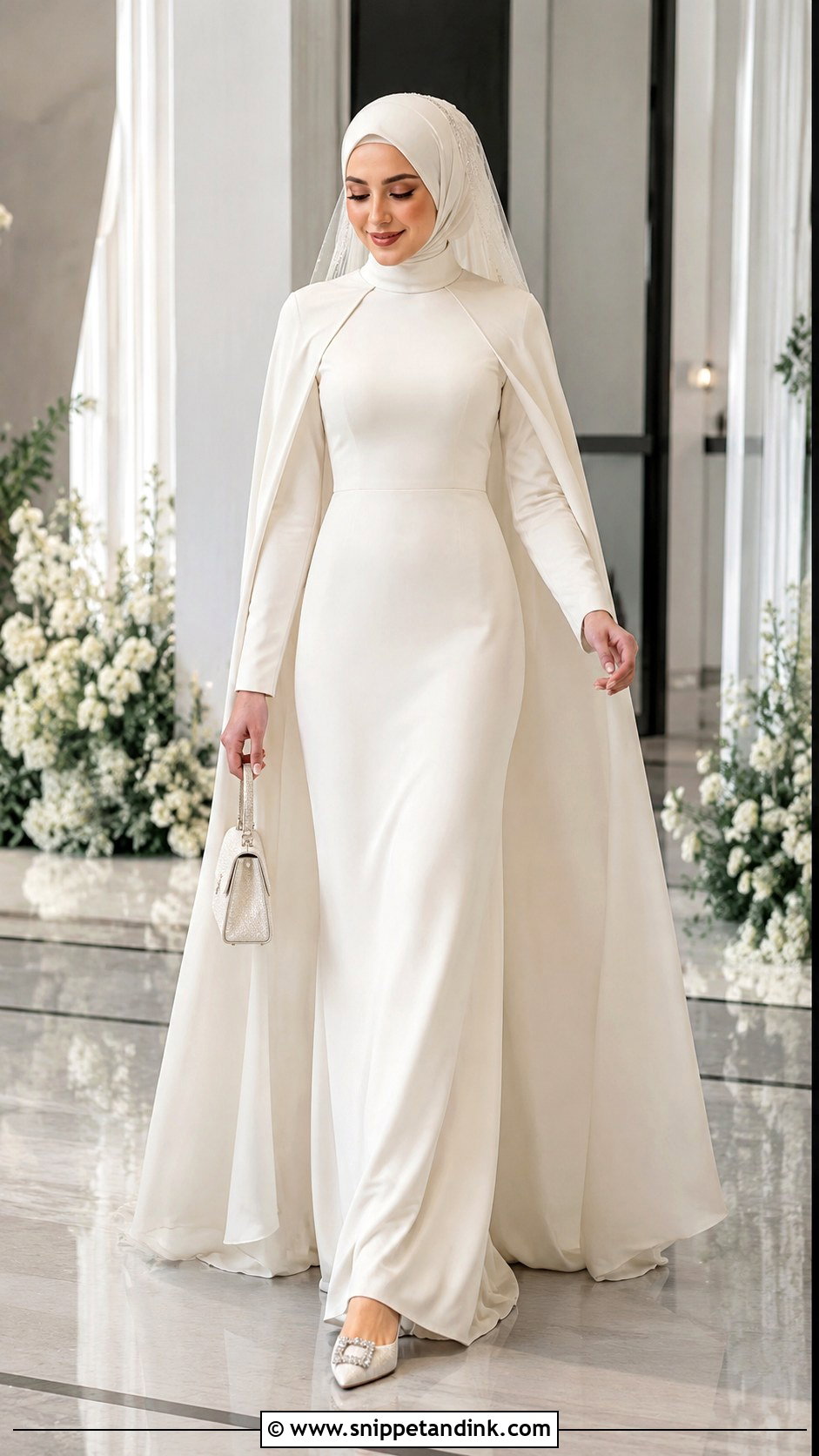
A cape gives you all the movement of a dramatic gown with none of the embellishment. The opaque crepe or satin dress underneath carries fitted inner sleeves, and a lightweight chiffon cape falls from the shoulders or upper back, sometimes to the floor, where it reads almost like a second veil. Because the cape is already the statement, I keep jewelry minimal and the hijab matching. The fitting issue I see most is a cape that drags the shoulder seams backward once the bride lifts her arms. Hem it so it clears your shoes, and add small wrist loops if it’s floor length so you can gather it for photographs.
5. Abaya Muslim Wedding Dress
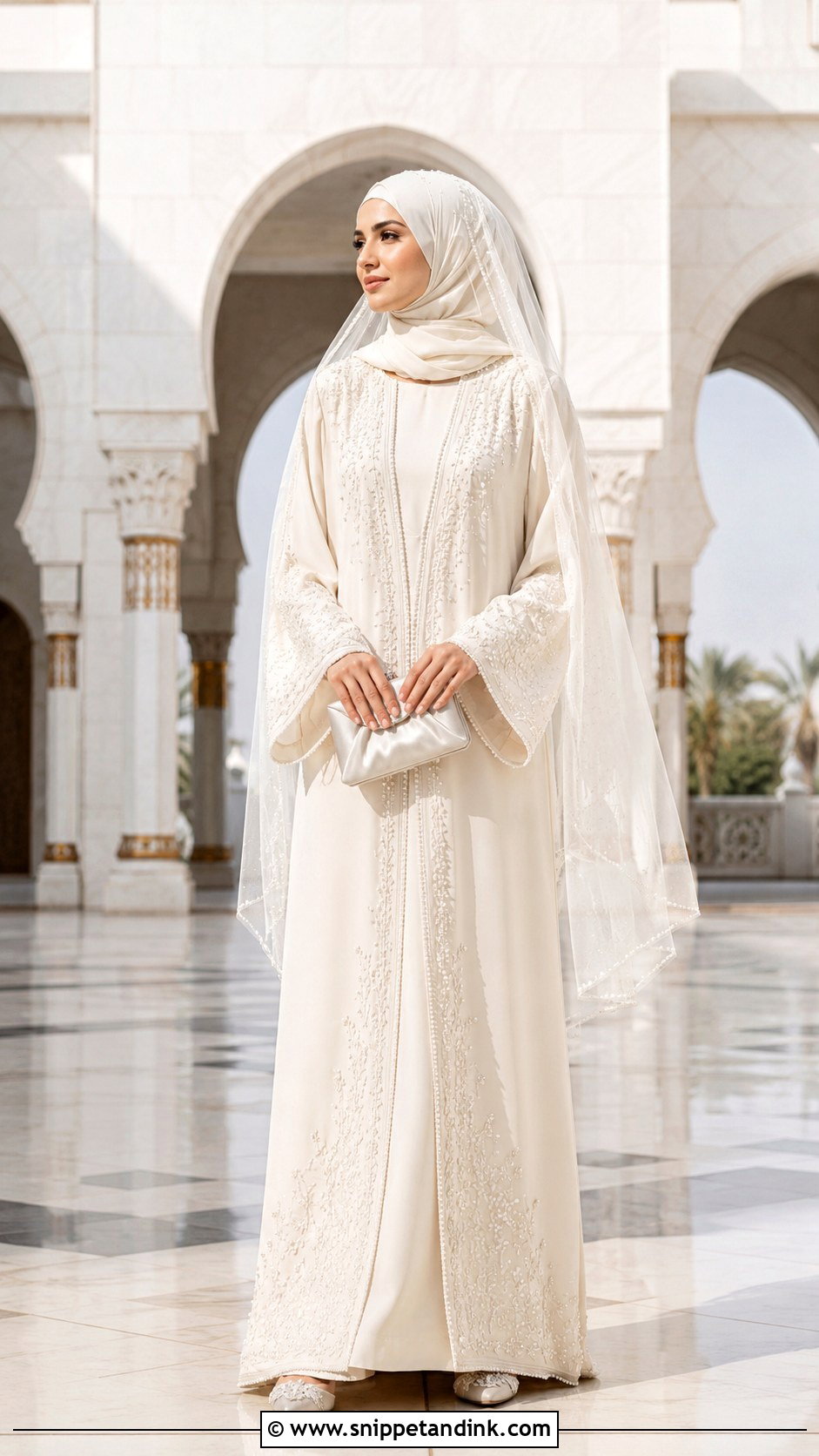
For a mosque nikah or a small family ceremony, an abaya is often the most comfortable thing a bride can wear. I look for ivory crepe, a silk blend or lined chiffon, with embroidery kept to the front panel, cuffs and hem, and a closed front so nothing opens when you kneel or sit. An inner slip in the same tone stops the fabric going transparent in daylight. A loose pearl belt gives a hint of waist if that suits your own standard of modesty; leave it off if not. Practice sitting on the floor in it at home, since that’s where an overlong hem usually trips brides.
6. White Bridal Kaftan With Hijab
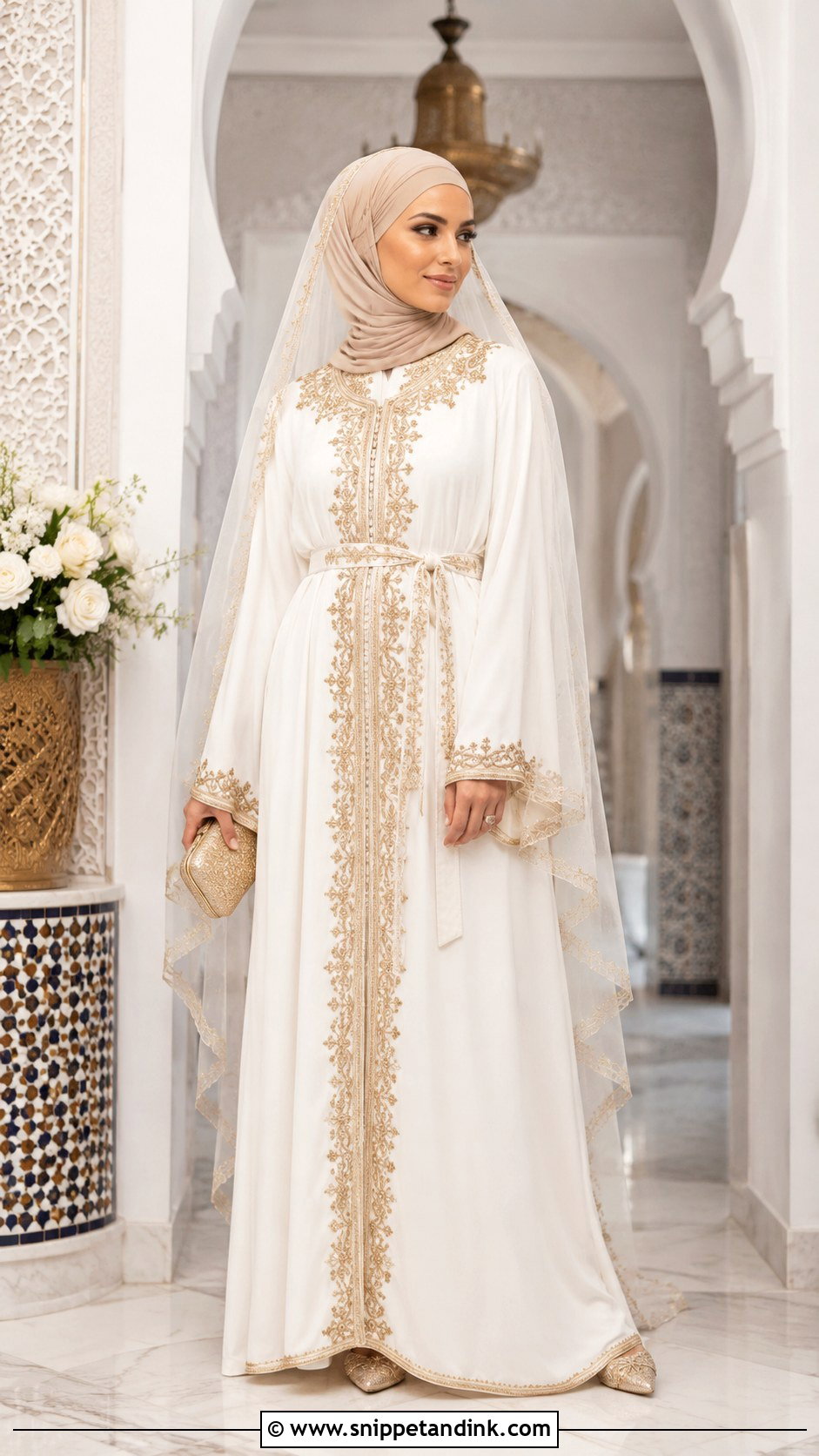
Vertical metallic threadwork down the front is what gives a white bridal kaftan with hijab its ceremonial look, drawing on North African and Middle Eastern dress. Choose a floor-length kaftan with full sleeves and an opaque inner layer, softly shaped rather than boxy. Place the sheer veil behind the embroidery near the face so it doesn’t hide the work. My honest caution is weight: a densely beaded kaftan over two layers can feel like wearing a coat by the third hour of a long celebration. Lift it on the hanger before you commit, and tie any belt loosely.
7. Red Bridal Lehenga With Hijab
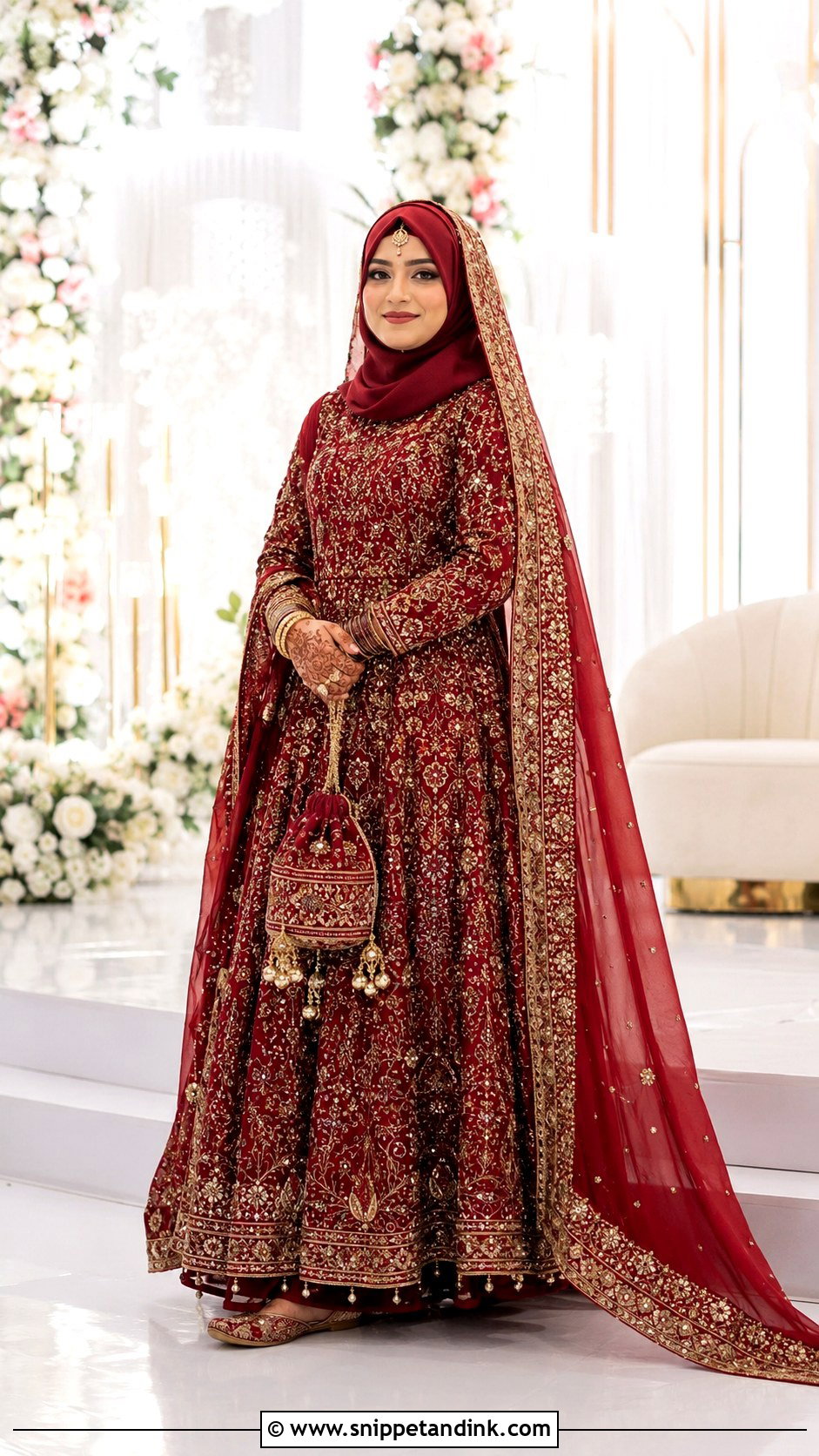
Coverage in a red bridal lehenga with hijab comes down to one measurement: blouse length. I have the choli cut long enough to overlap the skirt waistband by a few inches, because when you raise your arms for a garland or a hug, a standard cropped blouse leaves a gap. Wrap a matching satin hijab first, then drape the dupatta over the head and one shoulder; pinning the dupatta into the hijab rather than the hair keeps it from sliding. Deep red, ruby and maroon all sit well with antique gold. Ask the tailor to spread heavy embroidery evenly so the skirt doesn’t swing to one side as you walk.
8. Champagne Bridal Sharara With Dupatta
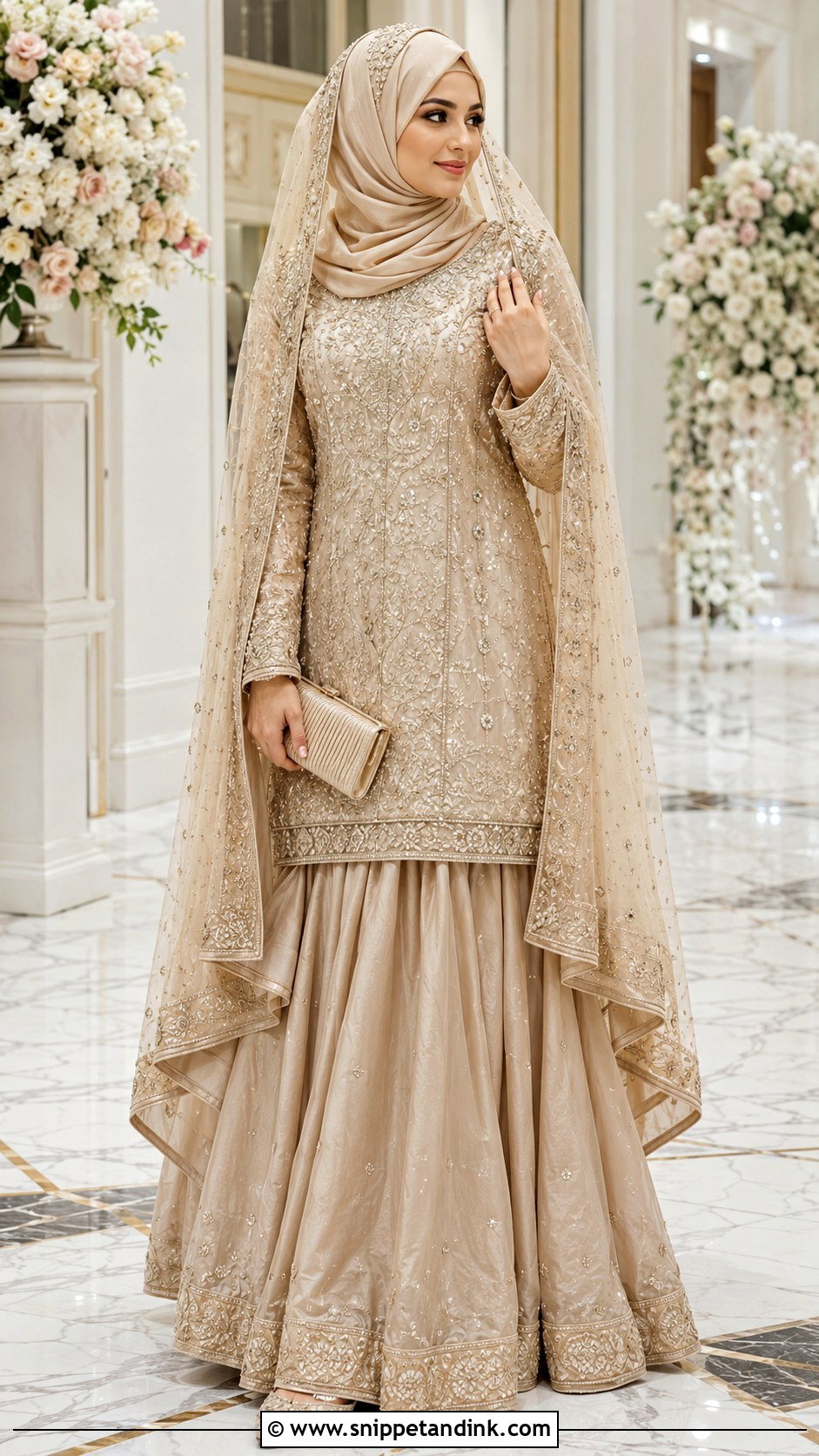
A champagne sharara is one of the lightest-feeling nikah outfits I style. Wide, flowing sharara pants, a long full-sleeved tunic and an opaque lining make up the set, with gold embroidery or tonal threadwork giving it depth against such a soft color. A champagne hijab disappears neatly under a dupatta draped over the head and down the back. The tunic needs to cover the hips from every angle, front and back, so check it in a side mirror. Those wide legs hold a surprising amount of fabric, and stairs are where it catches, so walk a staircase in your actual shoes before the hem is finalized.
9. Ivory Nikah Dress With Hijab
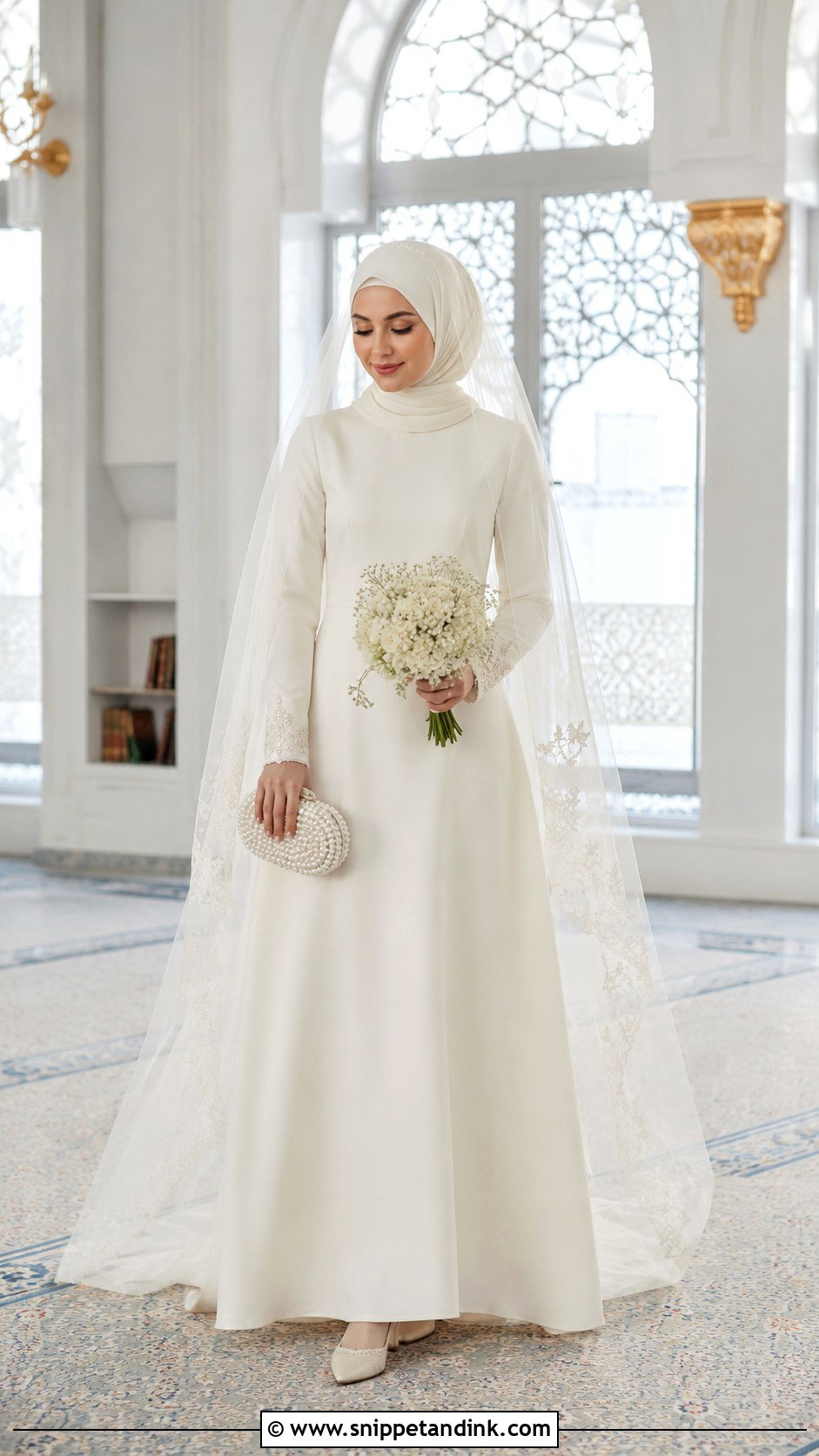
Matte crepe is what I reach for in a quiet ivory nikah dress, because it drapes cleanly and doesn’t flash under ceremony lights. A loose A-line or empire waist, full sleeves, a high neckline and a little embroidery at the cuffs is enough. Add an ivory chiffon hijab, a fingertip veil and a small bouquet. For a mosque ceremony, the skirt needs width to sit cross-legged or kneel comfortably. Check the shade outdoors as well as in the shop: some ivories photograph yellow in daylight, and lighter weights can turn translucent against a window.
10. Blush Organza Muslim Wedding Dress
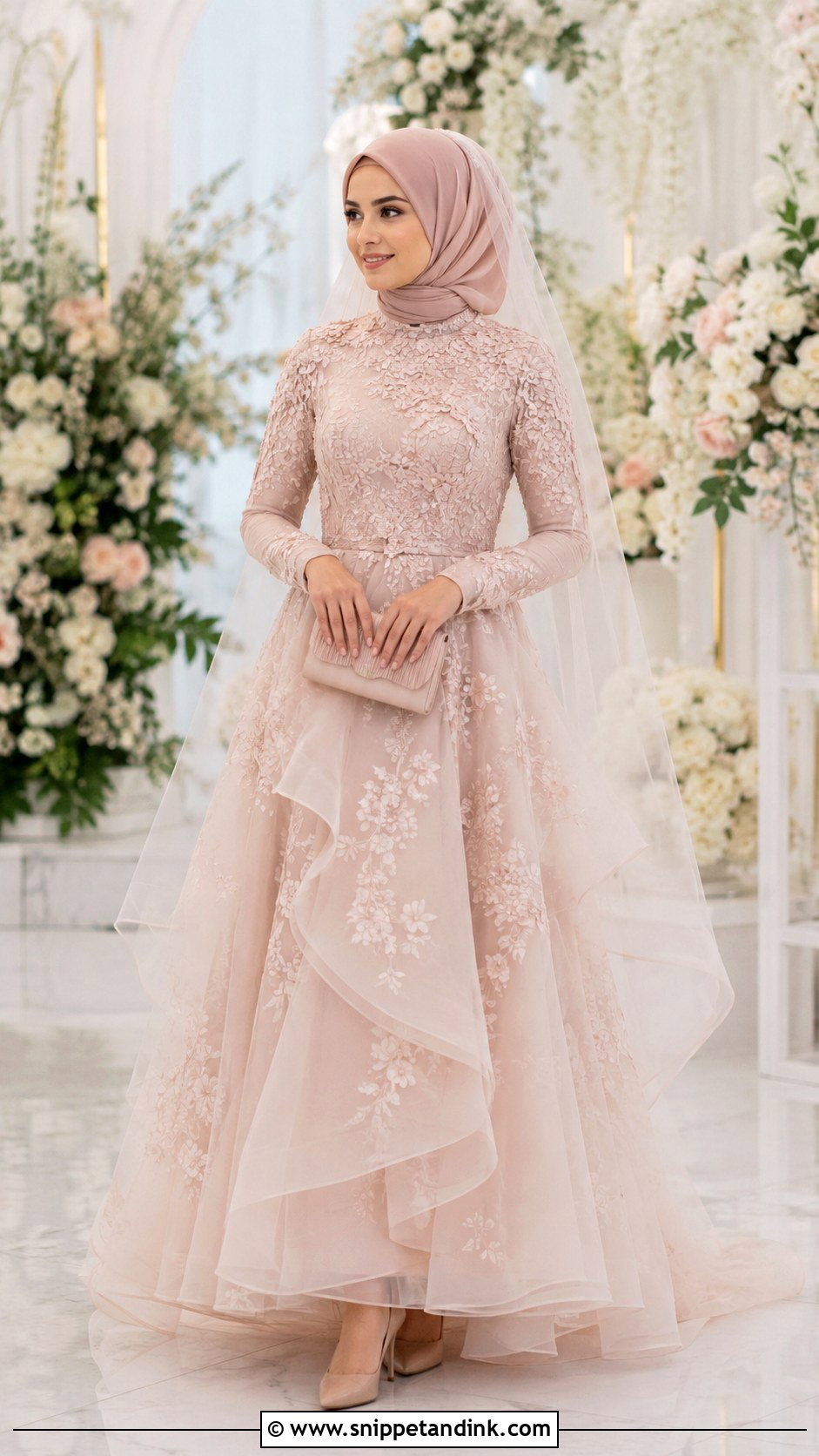
Blush organza gives volume without heavy decoration, though it isn’t the softest fabric against skin. I ask the seamstress to face the wrists and neckline with something smooth, since organza edges can scratch over a full day. Choose a fully lined A-line with long sleeves and a high neck, and let scattered flowers, tiny pearls or tonal appliqués do the decorating. A dusty blush hijab and a matching veil worn behind the shoulders keep the bodice detail visible. Use a light underskirt rather than stiff petticoats to hold the shape.
11. Emerald Velvet Muslim Wedding Dress
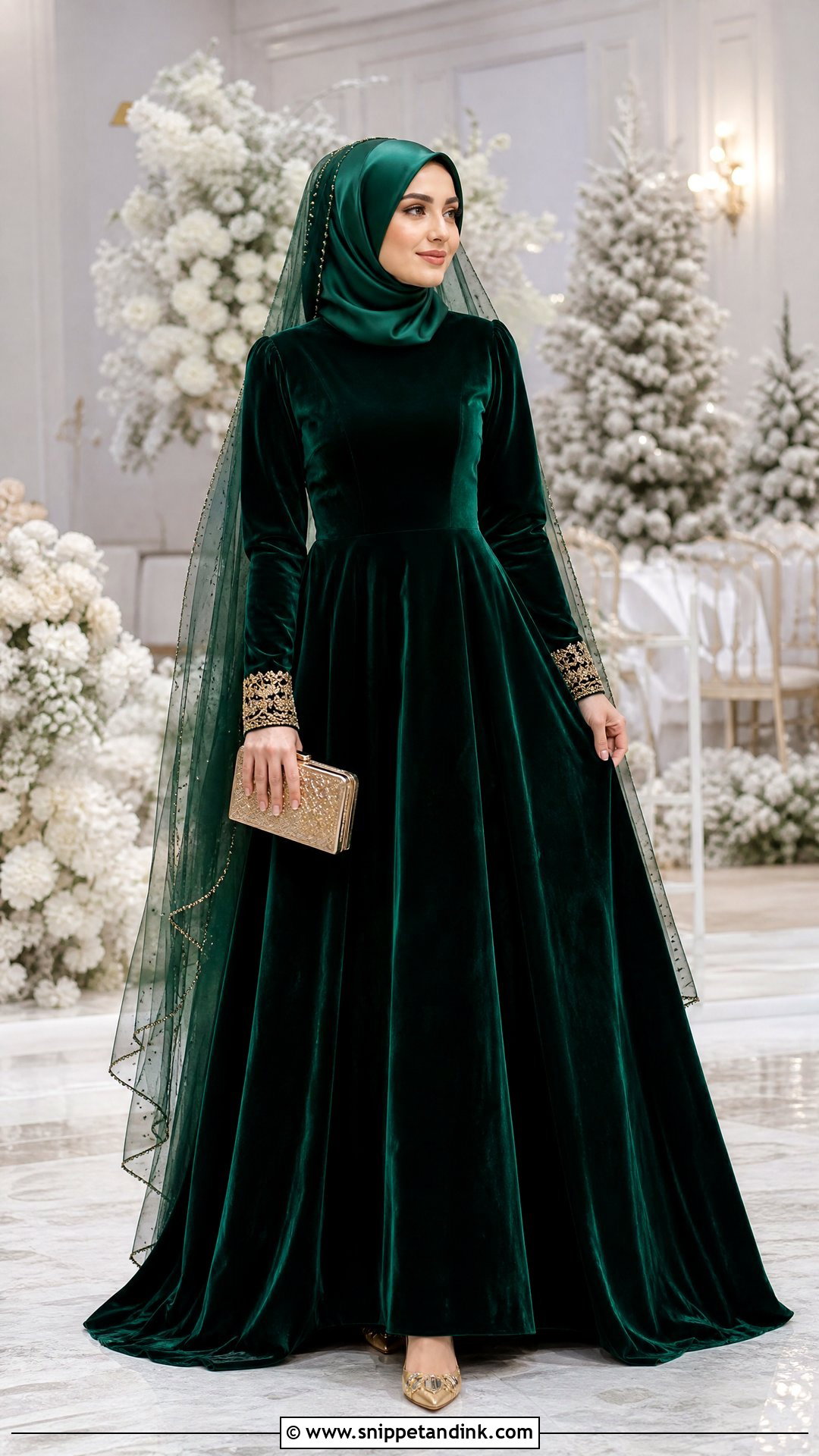
Emerald velvet suits an autumn or winter wedding, and it’s warm enough to stand in for a coat in some venues. Pick a loose princess cut or A-line with long sleeves, a raised neck and satin lining, and keep gold embroidery to the cuffs, shoulders and hem; velvet already has so much depth that all-over beading looks crowded. An emerald hijab is the safe pairing, while muted gold gives contrast. Never let anyone iron velvet flat. I send these gowns for professional steaming, because pressing crushes the pile and leaves shiny patches that show in every photo.
12. High Neck Ball Gown With Hijab
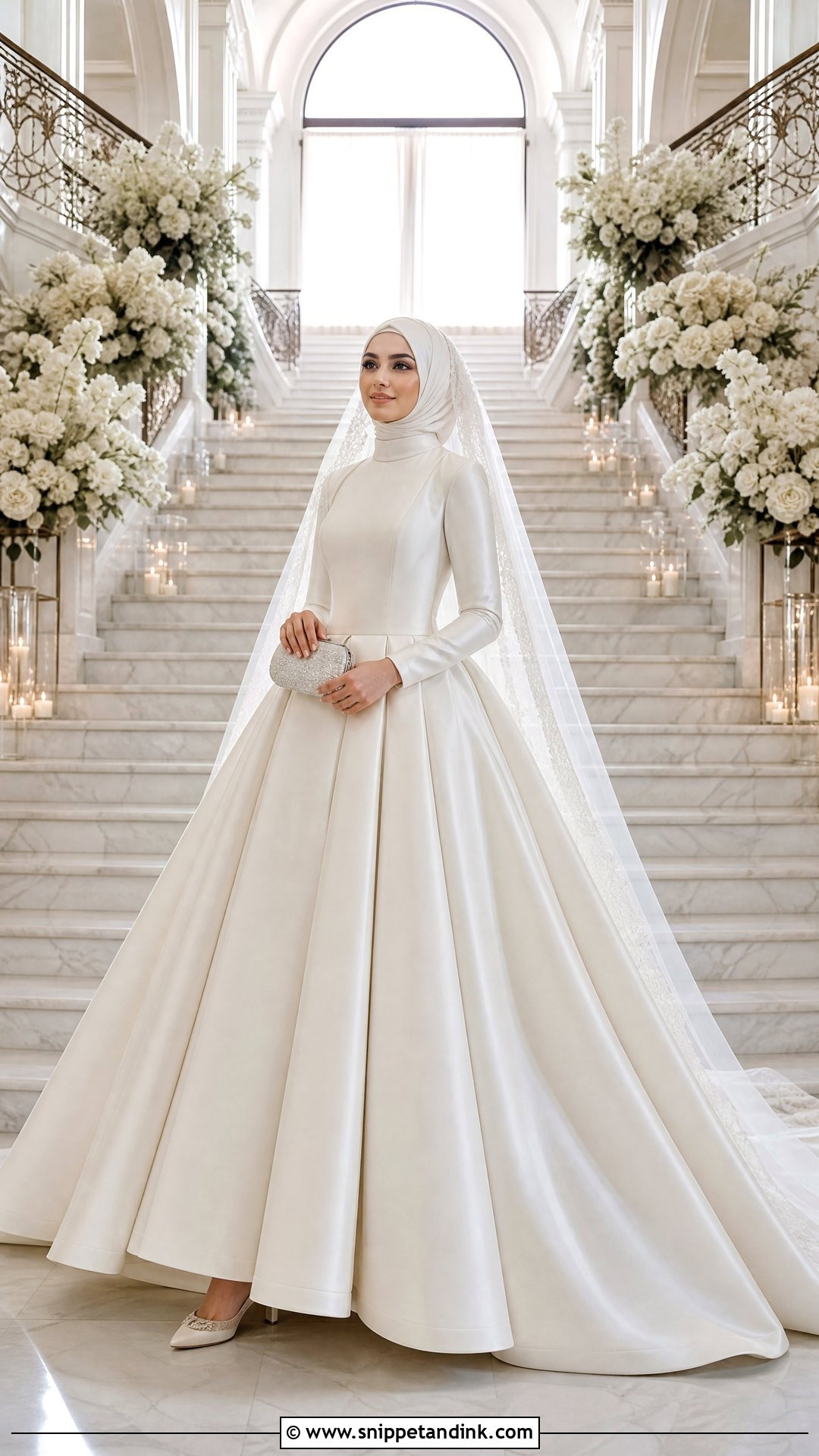
A ball gown with a high neck and lined sleeves is the grandest silhouette on this list, and the one that needs the most support underneath. Satin reads regal; tulle reads softer. Match the hijab exactly to the gown and anchor a long veil behind the crown so it trails over the train. I always ask brides to bring their real shoes and hijab to every fitting, because the hijab changes how the neckline sits and the shoes set the hem. The front should just clear the floor so you don’t step on it while the back keeps its length. Block heels handle the weight of the skirt better than stilettos.
13. Minimal Crepe Nikah Dress
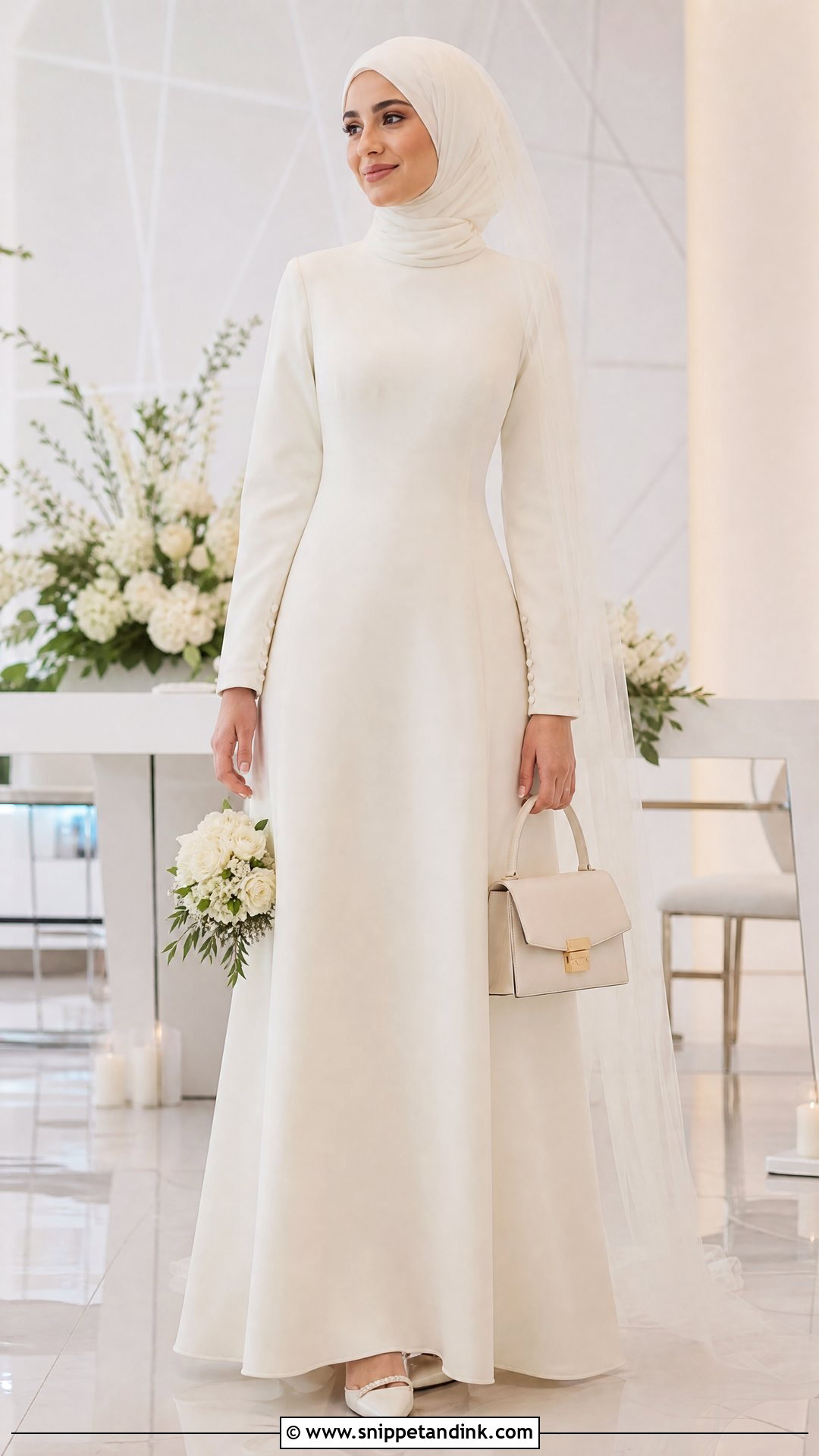
With no beading to hide behind, a minimal crepe nikah dress lives or dies on fabric quality and tailoring. Thin crepe clings and shows the layers under it, so I’d rather a bride spends on a heavier crepe and a smooth full lining than on embellishment. A high neck, straight full sleeves and a relaxed column or A-line, with covered buttons at the cuffs and back, is all the detail needed. Pockets in the side seams are a small luxury brides always thank me for. Get the shoulders and hem fitted precisely; that precision is what separates a bridal dress from a white maxi.
14. Layered Tulle Muslim Wedding Dress
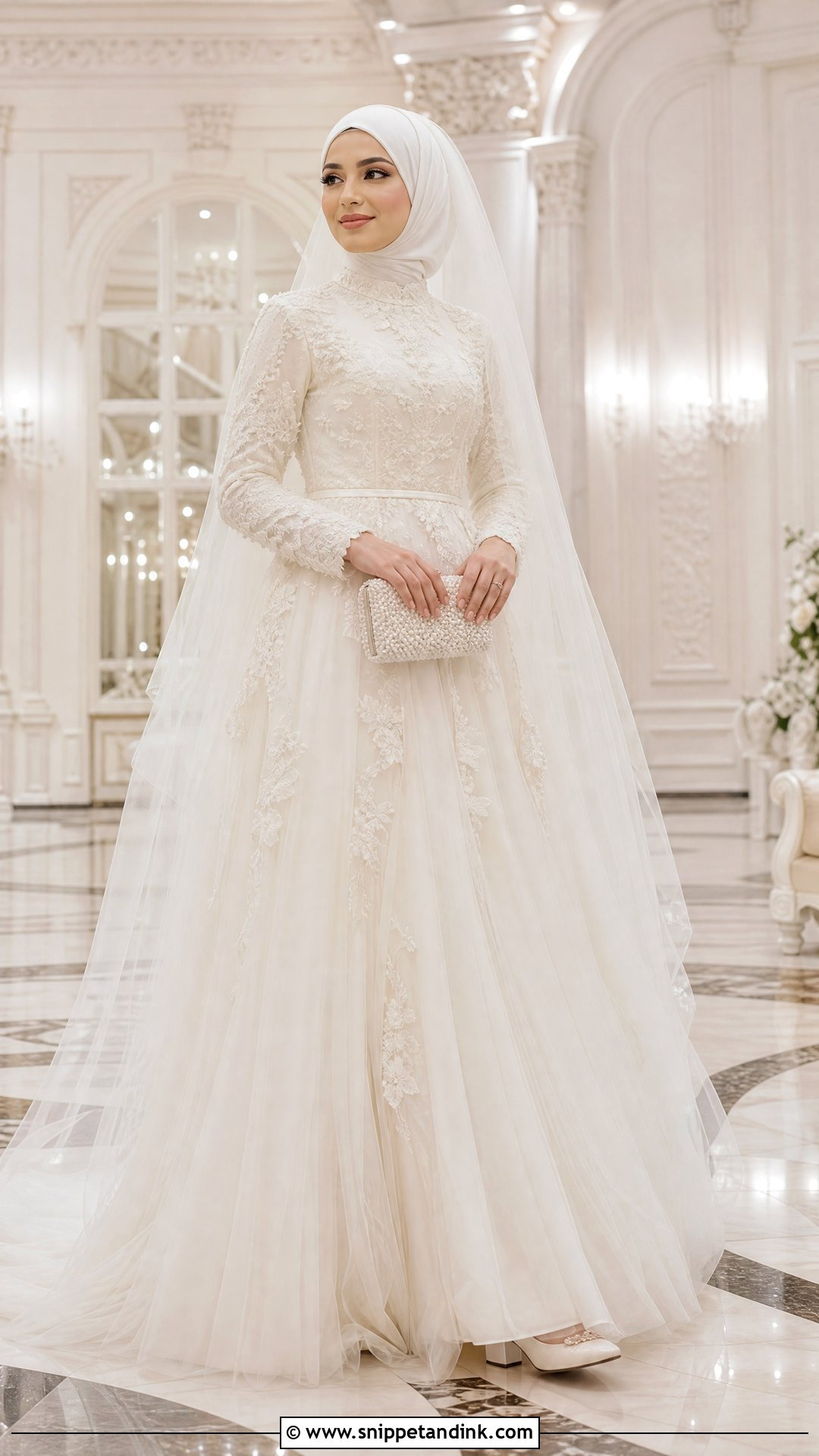
Layered tulle brings airy volume, but stiff netting can make a gown bulky and itchy at the knees. Ask for soft bridal tulle, several layers over an opaque lining, with lace appliqués concentrated at the bodice and spaced out toward the hem. If the appliqués sit on mesh sleeves, the lining has to run through the sleeves too. A matte jersey hijab stays smooth under a tulle veil far better than slippery chiffon. Plan a bustle or wrist loop for after the formal portraits, because a tulle train collects everything on a reception floor.
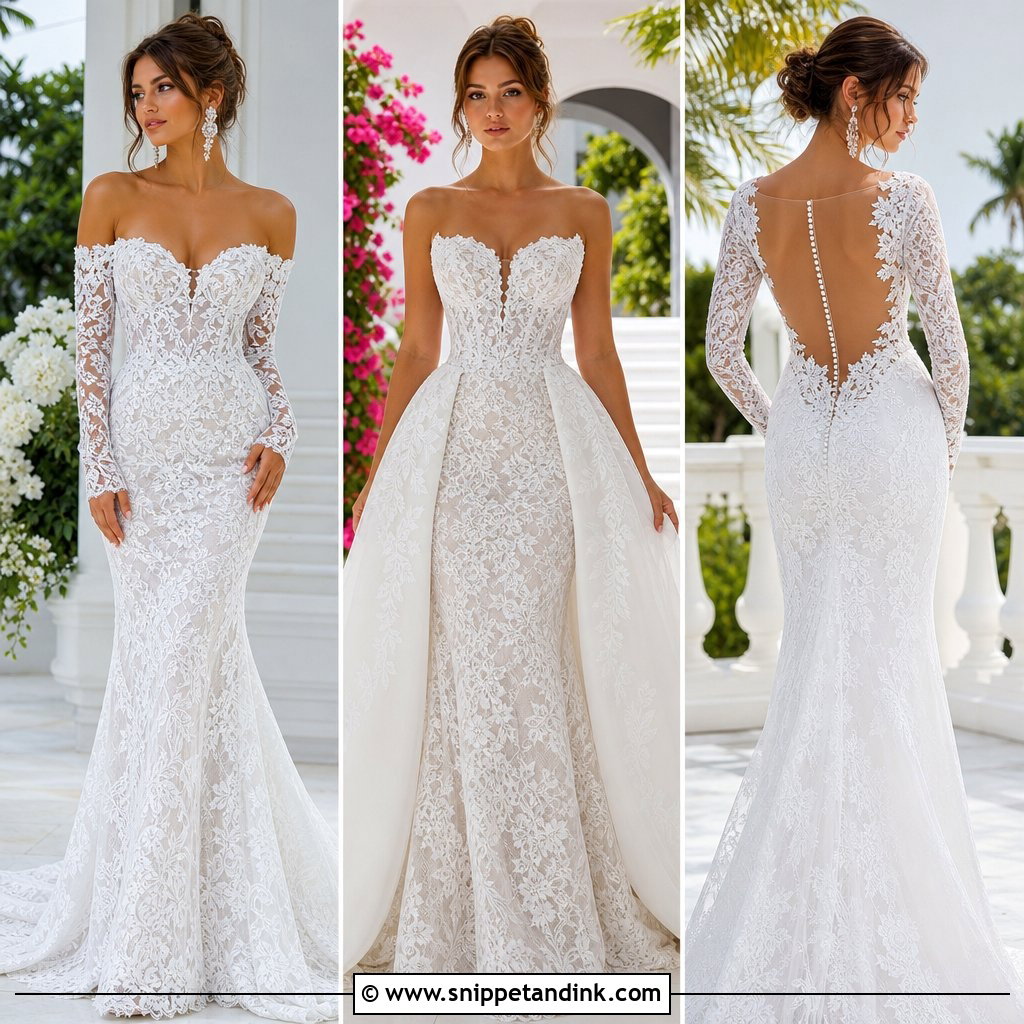


15. Floral Embroidered Muslim Wedding Dress
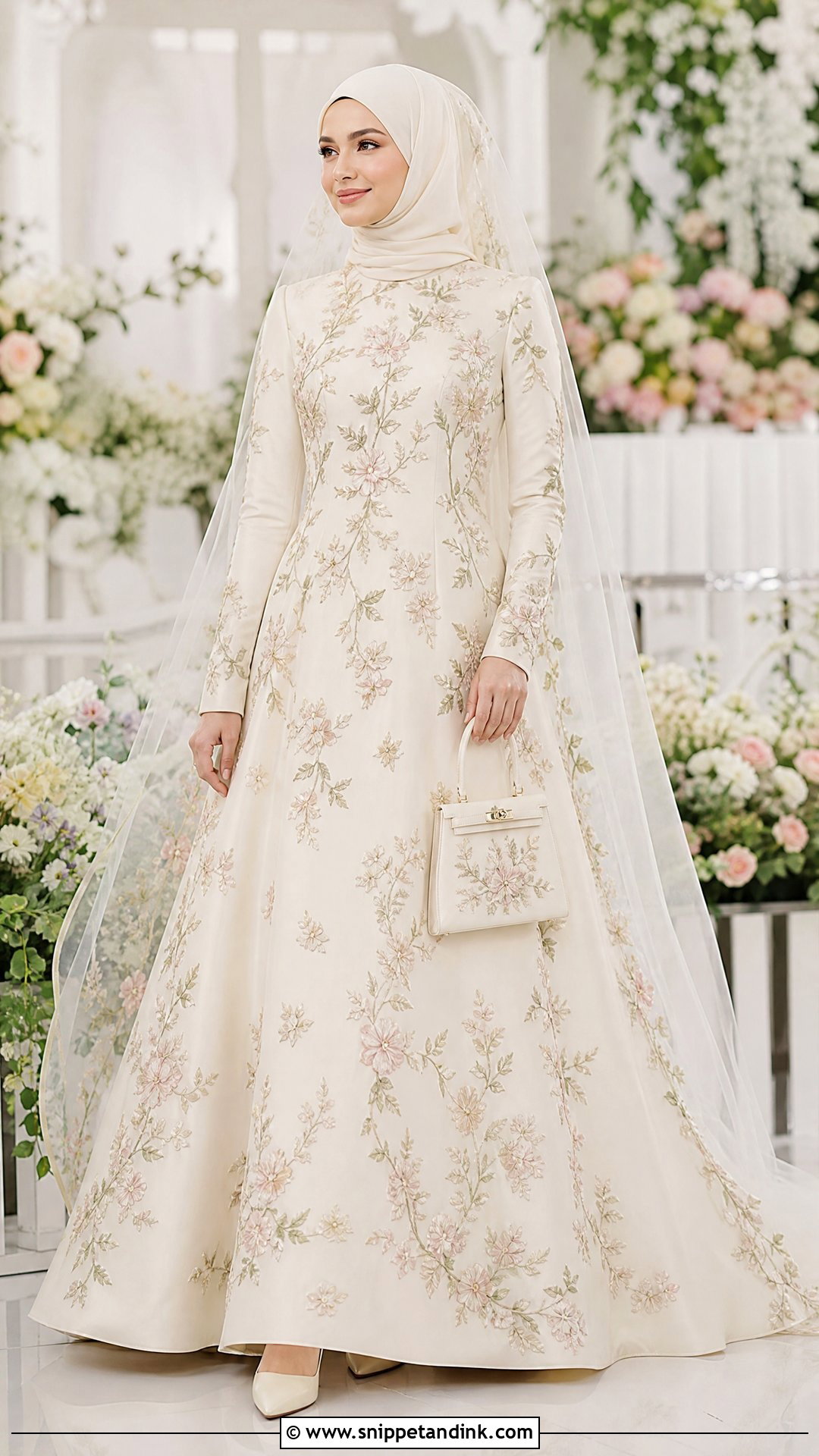
Floral embroidery makes a gown feel personal, especially when the colors are chosen by the bride. On an ivory A-line with full sleeves, a high neck and opaque lining, white-on-white embroidery is classic, while muted blush, sage or soft blue introduces color quietly. Scale matters: I keep larger motifs on the skirt and smaller ones near the face, so the eye isn’t pulled away from you. A plain hijab lets the pattern lead. Turn the bodice inside out before you buy; rough thread knots and appliqué edges can rub raw patches on the neck and wrists by evening.
16. Plus Size Muslim Wedding Dress With Hijab
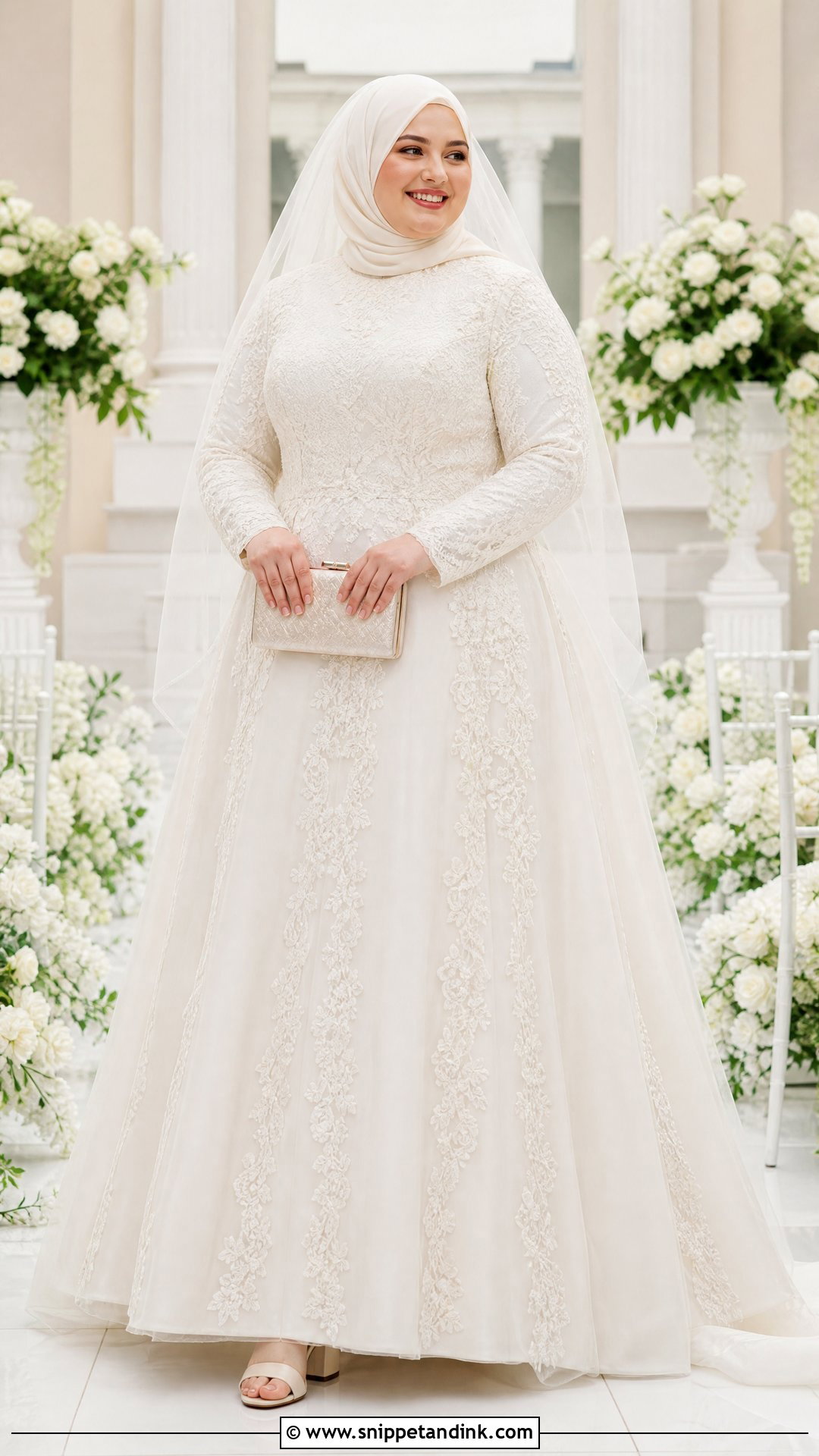
Tailoring does more for a plus size bride than any particular style. An A-line or softly pleated skirt flows without catching at the hips, while a supported, lined bodice and a high neck sitting flat under the hijab do most of the work up top. I check sleeve and armhole room carefully, since a sleeve cut for a smaller pattern pulls when you reach to hug someone. Vertical lace or a central line of embroidery draws the eye lengthwise. The mistake I steer brides away from is sizing up just for coverage; the extra fabric buries the design and actually restricts movement. Alter the shoulders, bust and hem to your body instead.
17. Petite Muslim Wedding Dress With Hijab
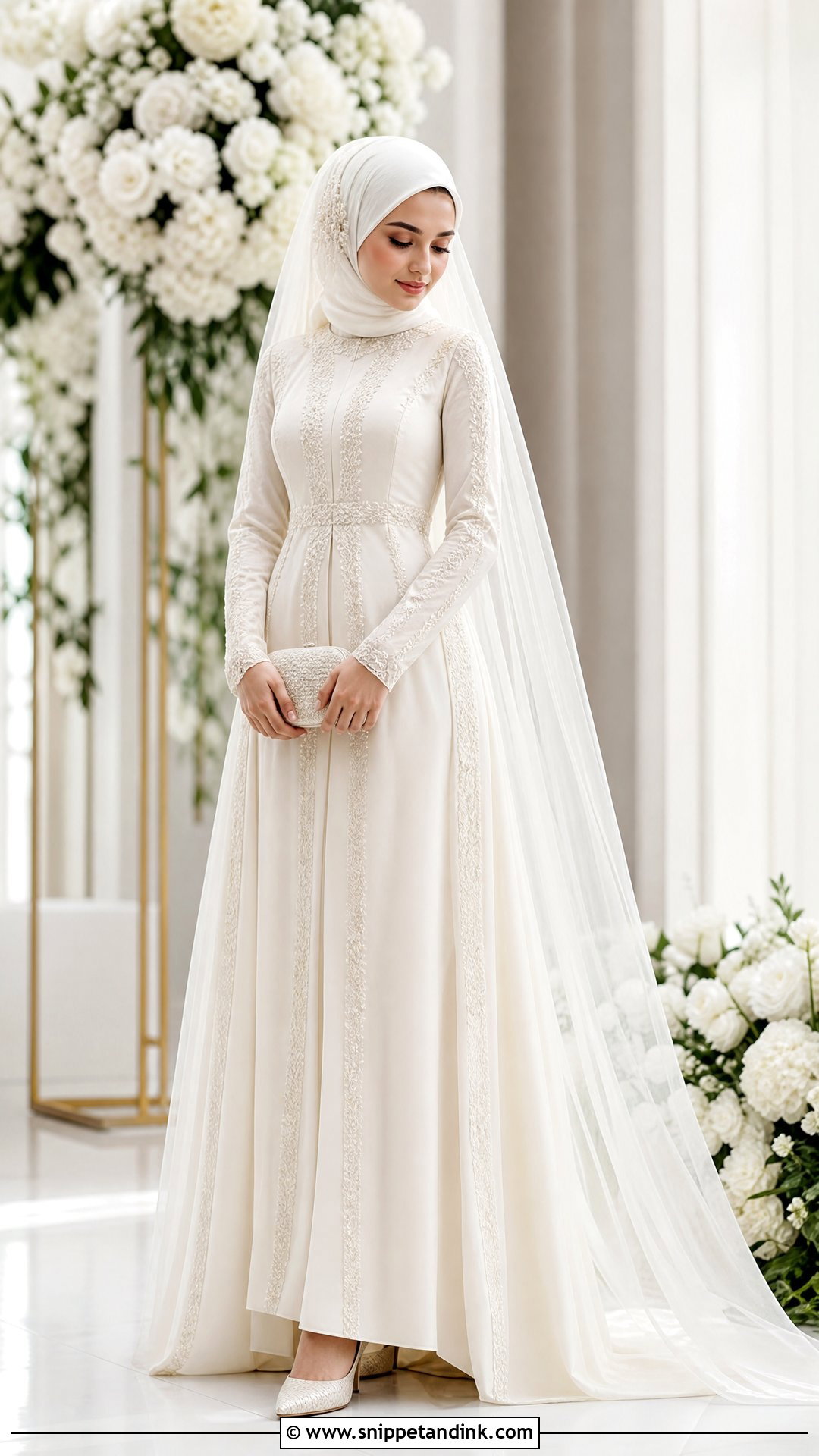
Proportion is everything when a petite bride wears full coverage. A petite Muslim wedding dress works best with a slightly raised waist, vertical seam lines and a skirt with only a light flare. Keep sleeves streamlined and embroidery narrow, running down the center or along the cuffs rather than across the chest. Wrap the hijab neatly and choose a veil that falls straight down instead of spreading at the shoulders. When I shorten these gowns, the sleeves, lining, outer skirt and train all get taken up in proportion; trimming only the hem leaves the waist and sleeves sitting in the wrong place.
18. Winter Muslim Wedding Dress With Hijab
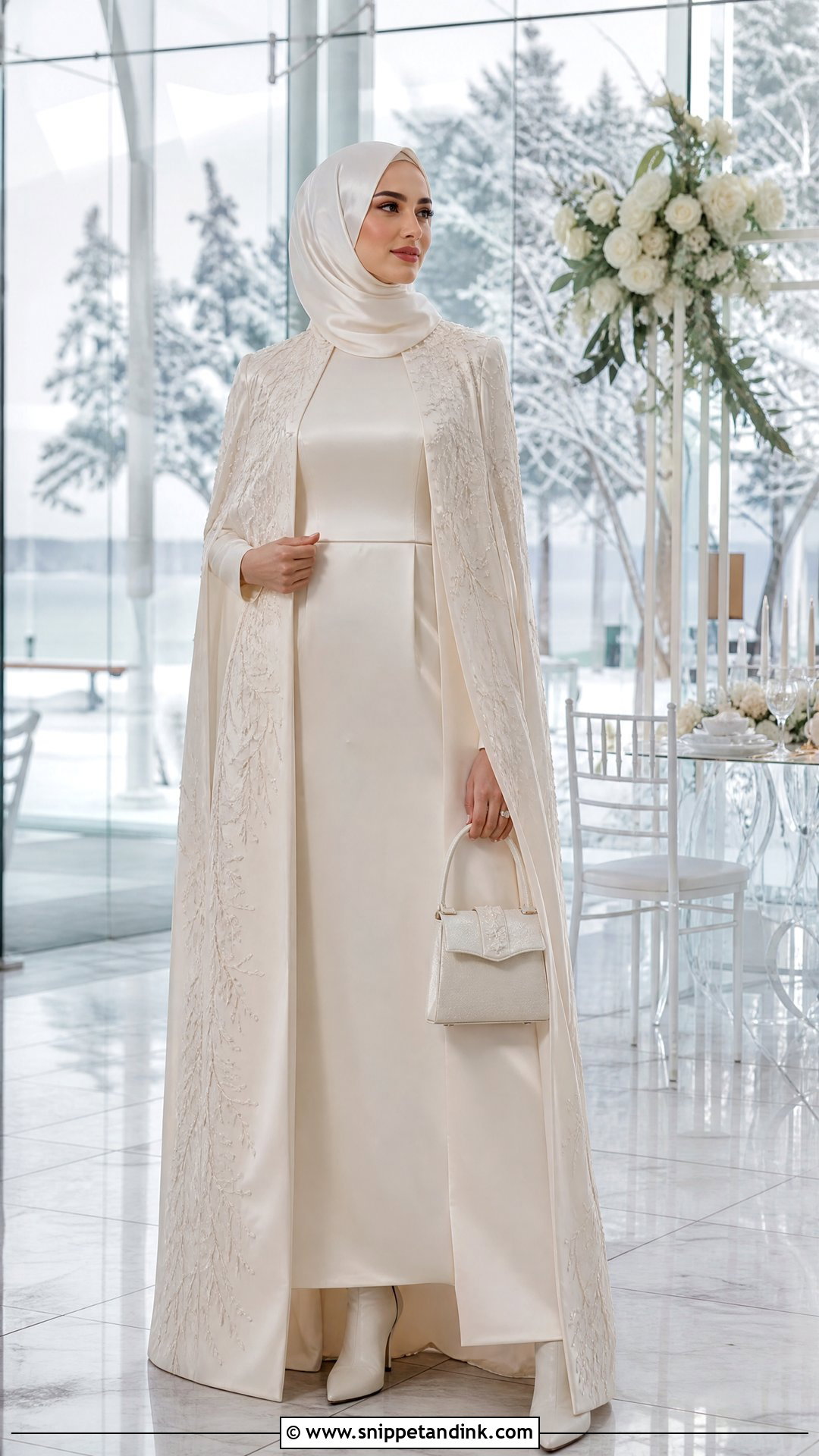
Winter brides tend to over-layer, and that changes how the gown fits. A long-sleeved satin or velvet dress with opaque lining and a full A-line skirt already holds warmth; add a detachable embroidered cape or a structured bridal coat for outdoor photos and the drive between venues. A satin-lined hijab blocks wind better than light chiffon, and a snug undercap keeps it from shifting. Thin thermal base layers designed to sit flat under formal wear are fine. Then stand in a heated room in the full outfit for twenty minutes, because reception halls are usually far warmer than the walk to the car.
19. Summer Chiffon Muslim Wedding Dress
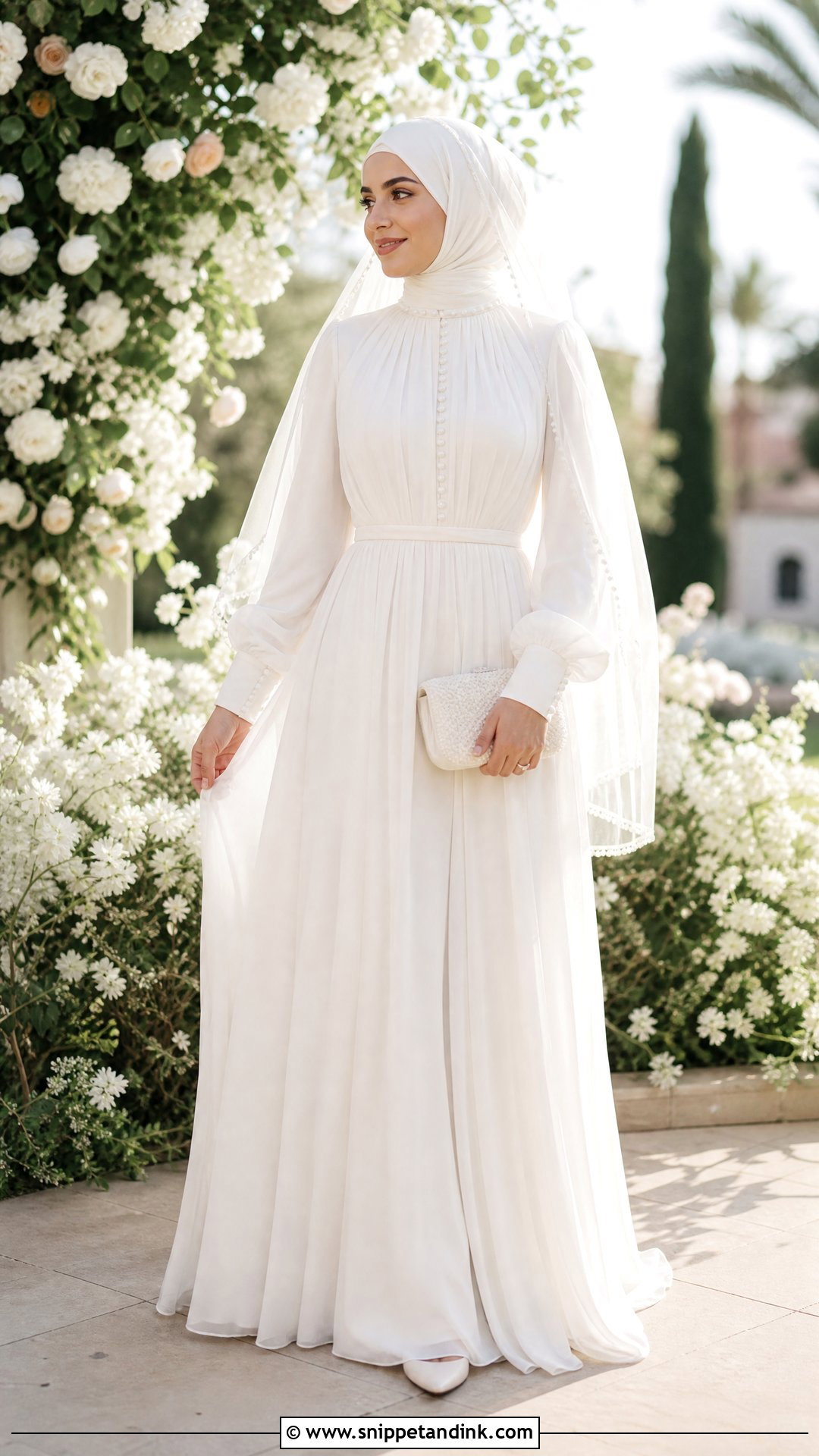
Chiffon is the summer fabric I’d choose, though it is naturally sheer and needs proper lining. Pick a loose A-line with full bishop sleeves and a high neck, and keep detail to small pearls, covered buttons or fine embroidery so the weight stays low. Pair it with a light chiffon hijab, a single-layer veil and closed-toe flats or low heels. I take every chiffon gown to a window or outside to check each panel against direct sun, which shows far more than shop lighting. Choose a breathable lining like cotton voile rather than polyester, and limit the skirt to a few layers for an outdoor ceremony.


20. Two Piece Muslim Bridal Outfit
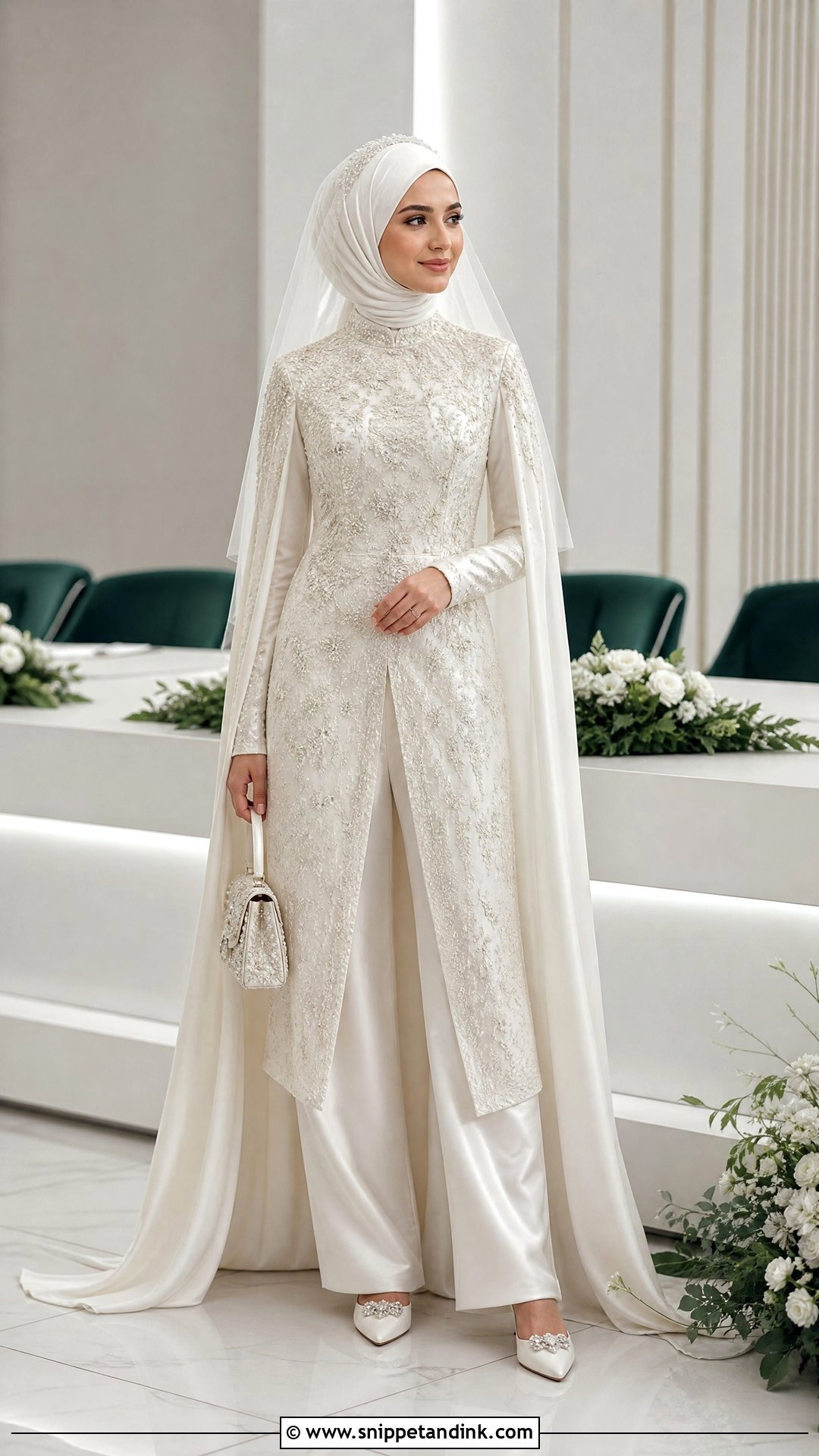
A two piece Muslim bridal outfit moves easily from a civil ceremony to a mosque nikah to a modern reception. Pair a long structured tunic with a full satin skirt or wide palazzo pants in exactly the same ivory, and give the tunic enough length to overlap the waistband securely. Different whites that match in the shop often separate in photos, so I insist both pieces come from the same fabric bolt. Discreet snaps between top and skirt stop any gap when you sit or bend. Afterwards, each piece can be worn separately at other formal events.
Can You Pray, Kneel and Do Wudu in It?
A nikah day often includes prayer, and that’s something a typical bridal salon never tests for. If you expect to pray in your outfit, plan for it at the design stage rather than discovering the problem in the mosque.
- Sleeves: fitted sleeves with buttons or a hidden zip at the cuff can be opened for wudu. Tight lace sleeves with no opening usually can’t be pushed up without damage.
- Skirt width: practice sujood at home. A narrow column skirt or a stiff ball gown can make it hard to kneel and rise gracefully.
- Shoes: most mosques ask you to remove them, so the hem should be measured for both shod and barefoot height, or settle on flats that sit close to floor level.
- Trains: a long train collects dust on carpets and gets stepped on in a crowded prayer hall. A detachable train solves this neatly.
Sheerness Shows Up in Photos Before You Notice It in a Mirror
Shop lighting is soft and comes from above, while camera flash and low evening sun come straight through fabric. Before the final fitting I run a simple check: stand in front of a bright window, then have someone photograph you with a phone flash from about two meters away. Any panel that shows skin or the outline of your undergarments in those photos needs another layer of lining.
Undergarment color is part of the same test. Skin-toned underlayers vanish under white fabric far better than white ones do, which surprises nearly everyone. For lace, organza and chiffon, I’d also bring the shapewear you’ll actually wear, because seams and edges can show through lightweight fabric even when the color is right.
The Last Fitting Should Feel Like the Wedding Day
Whichever silhouette you love, the gown should support your values and let you move freely all day. Opaque fabric, secure layering and good alterations matter more than any trend among these twenty ideas. Bring your hijab, veil and shoes to fittings so they’re planned together, not added at the end. And before the day, walk, sit, kneel and lift your arms in the complete outfit; that rehearsal reveals almost every problem while there’s still time to fix it.
You'll Like These Ideas:





Leave a Reply