
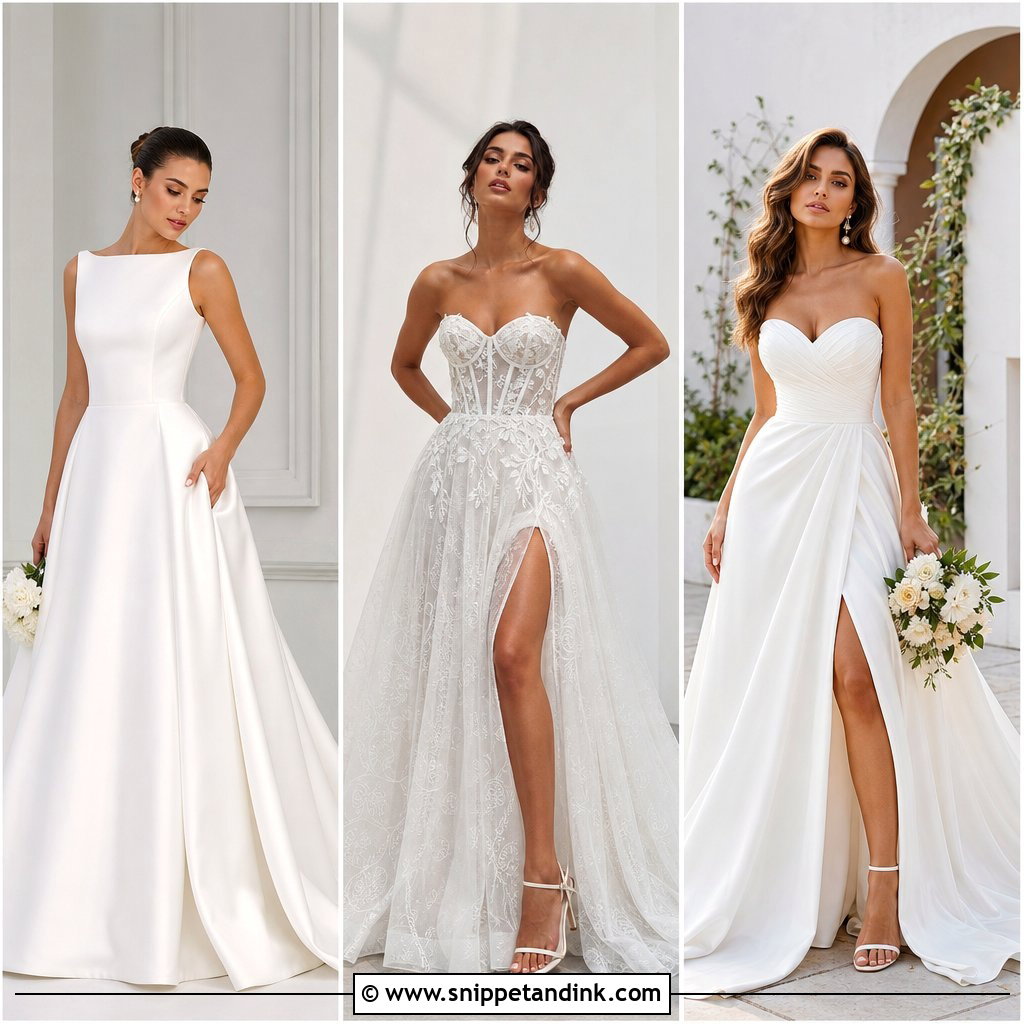
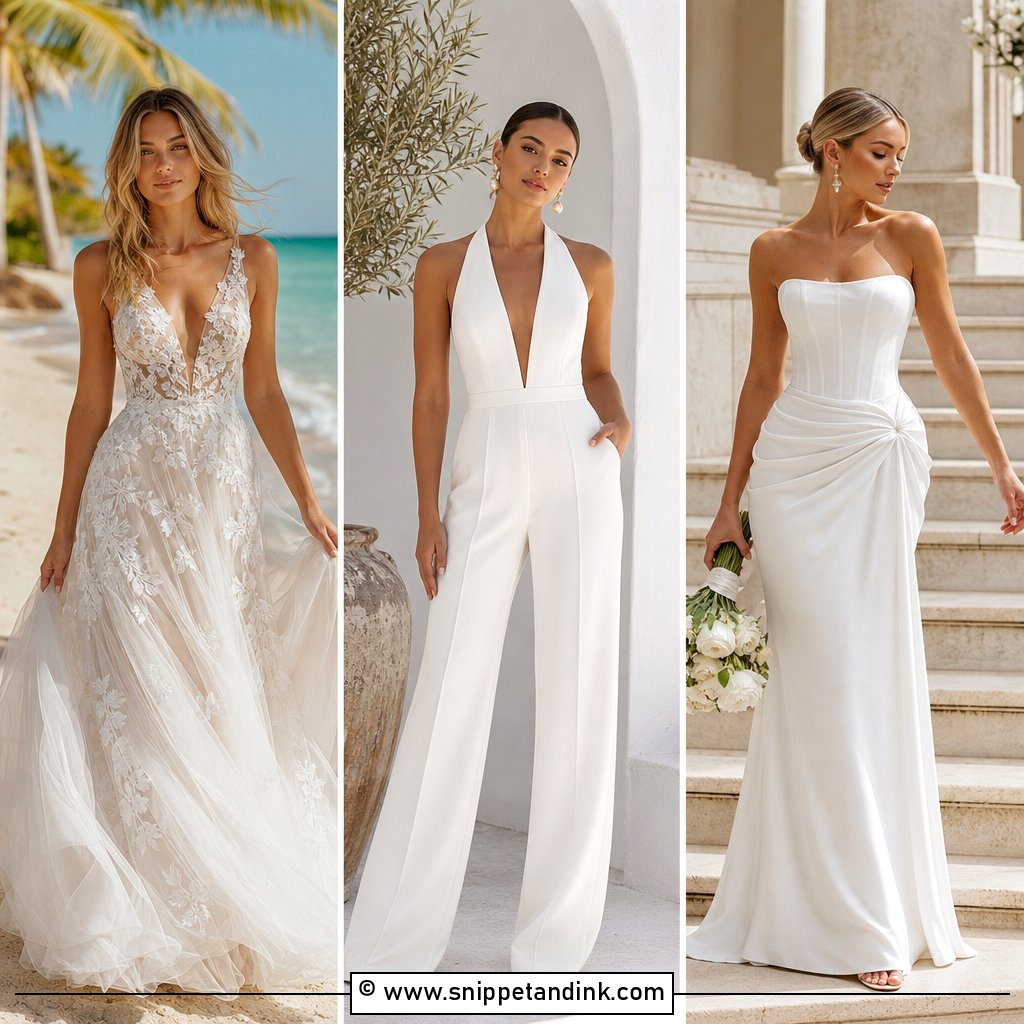
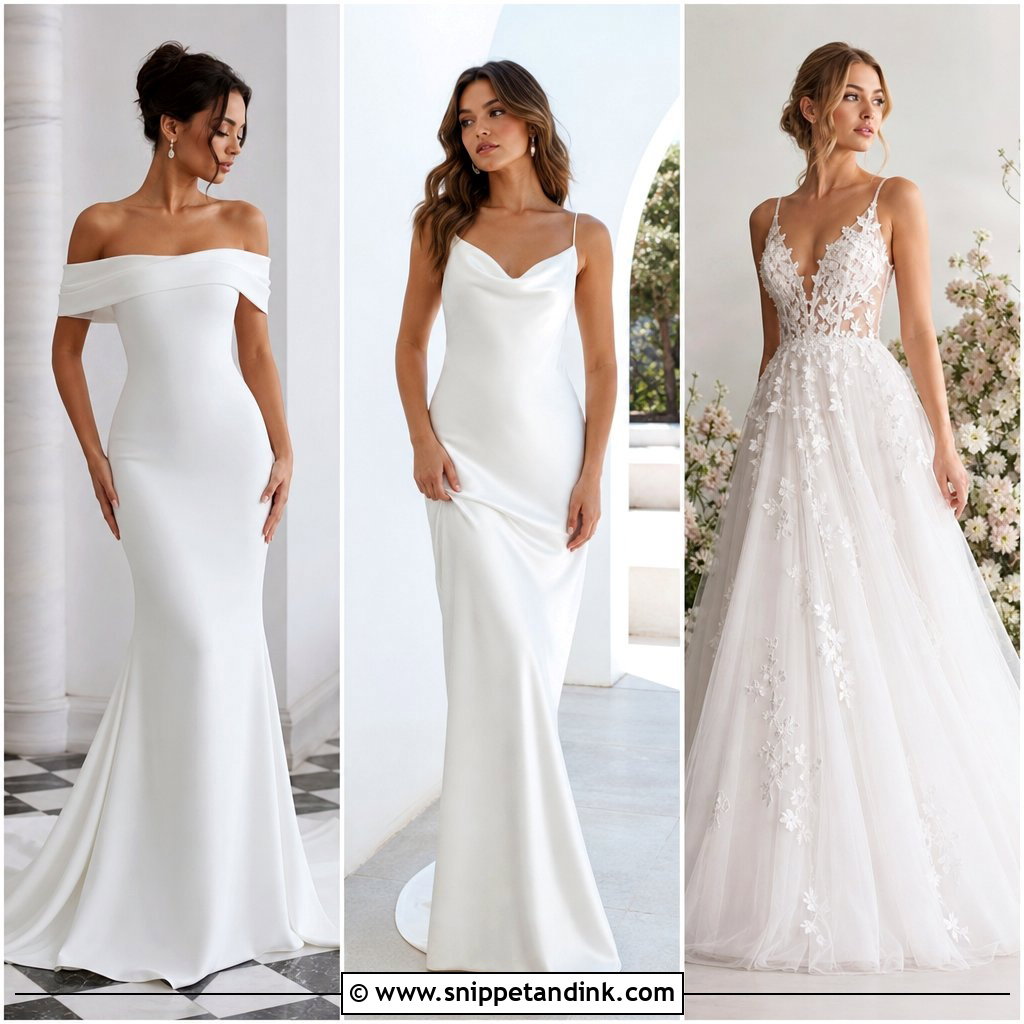
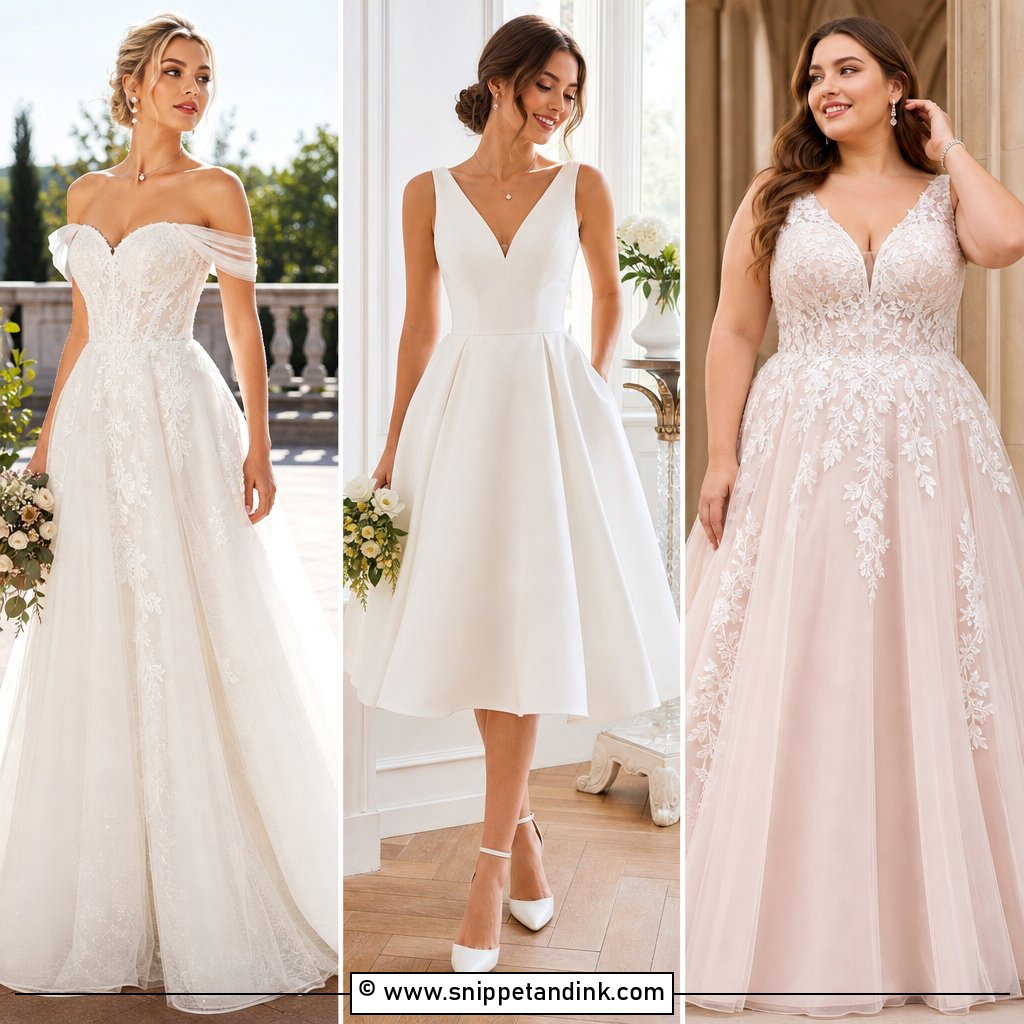
Lace is the one bridal fabric that changes character completely depending on the shape it’s cut into. On a ball gown it looks traditional; on a sheath it looks modern; on a column with crochet textures it looks like a beach at sunset. Fine Chantilly, corseted bodices and layered gowns are all showing up in new collections. When a bride brings me a lace photo, I look past the pattern and ask about the neckline, the lining colour, the train and where she’s getting married, because those decide whether the dress works. Below are twenty complete looks, from classic gowns to reception minis, to help you sort out what you’re drawn to.
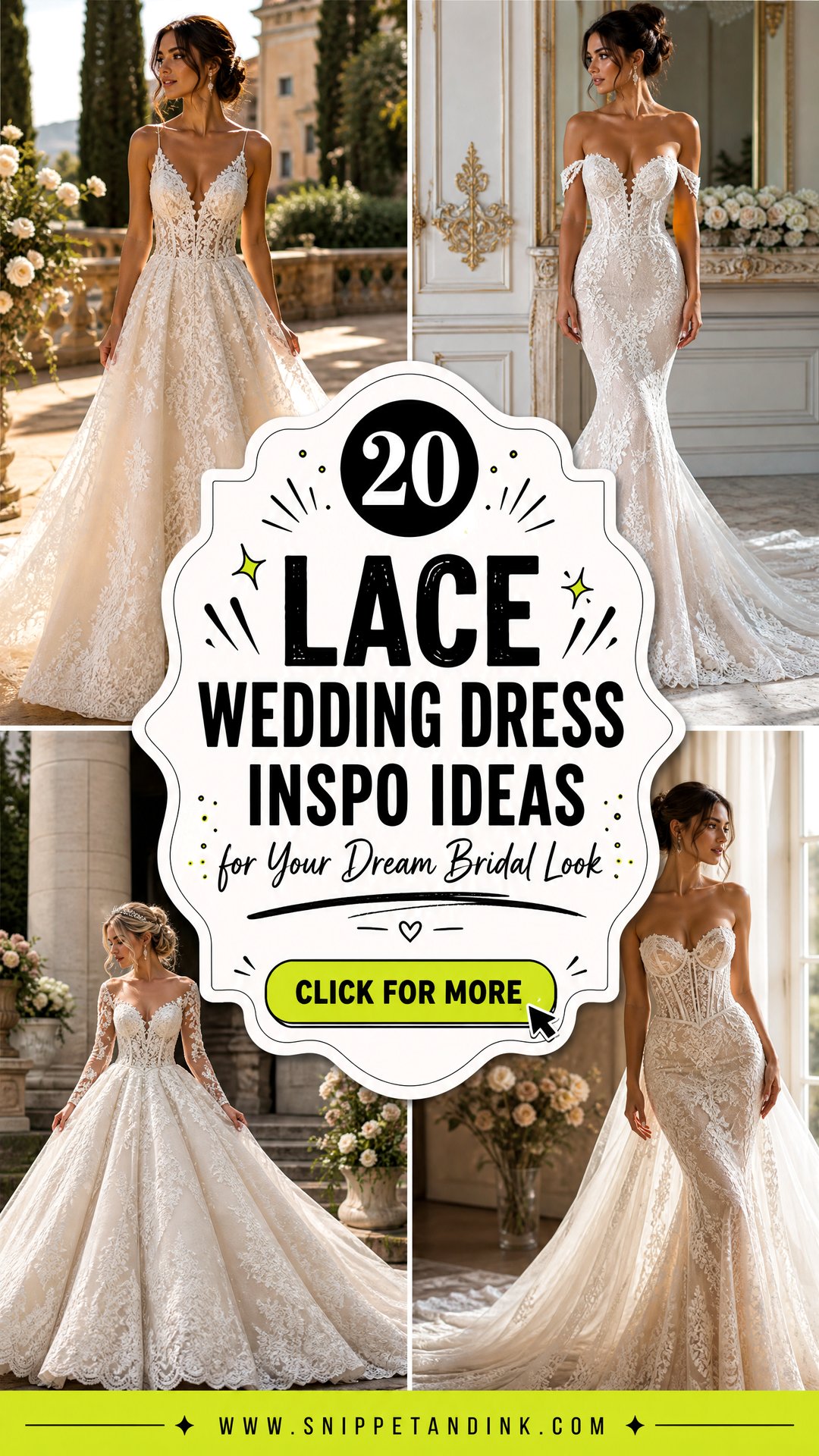
White, Ivory or Champagne? Testing Lace Shades Against Your Skin
The colour names on bridal swatches are vague, and they vary from one designer to the next. One label’s ivory can look close to another’s white. What matters is how the shade looks on you, and the lining under the lace matters as much as the lace itself.
When I test colour with a bride, I hold the swatches right under her jaw near a window, without makeup if possible. Bright white can make some skin look sallow or grey. Ivory is softer and suits most people. Champagne, nude and blush linings warm the whole dress and make lace motifs pop, but they can look almost beige on very fair or very warm skin. If your venue is lit by candles or warm bulbs, everything will shift a little toward gold, so a warm white often looks cleaner there than a deep ivory.
- Ask to see the lace over two different linings before you decide.
- Take a photo of each with and without flash.
- Match your veil to the gown’s lace, not to the lining, or the veil can look stark beside it.
1. A-Line Lace Wedding Dress
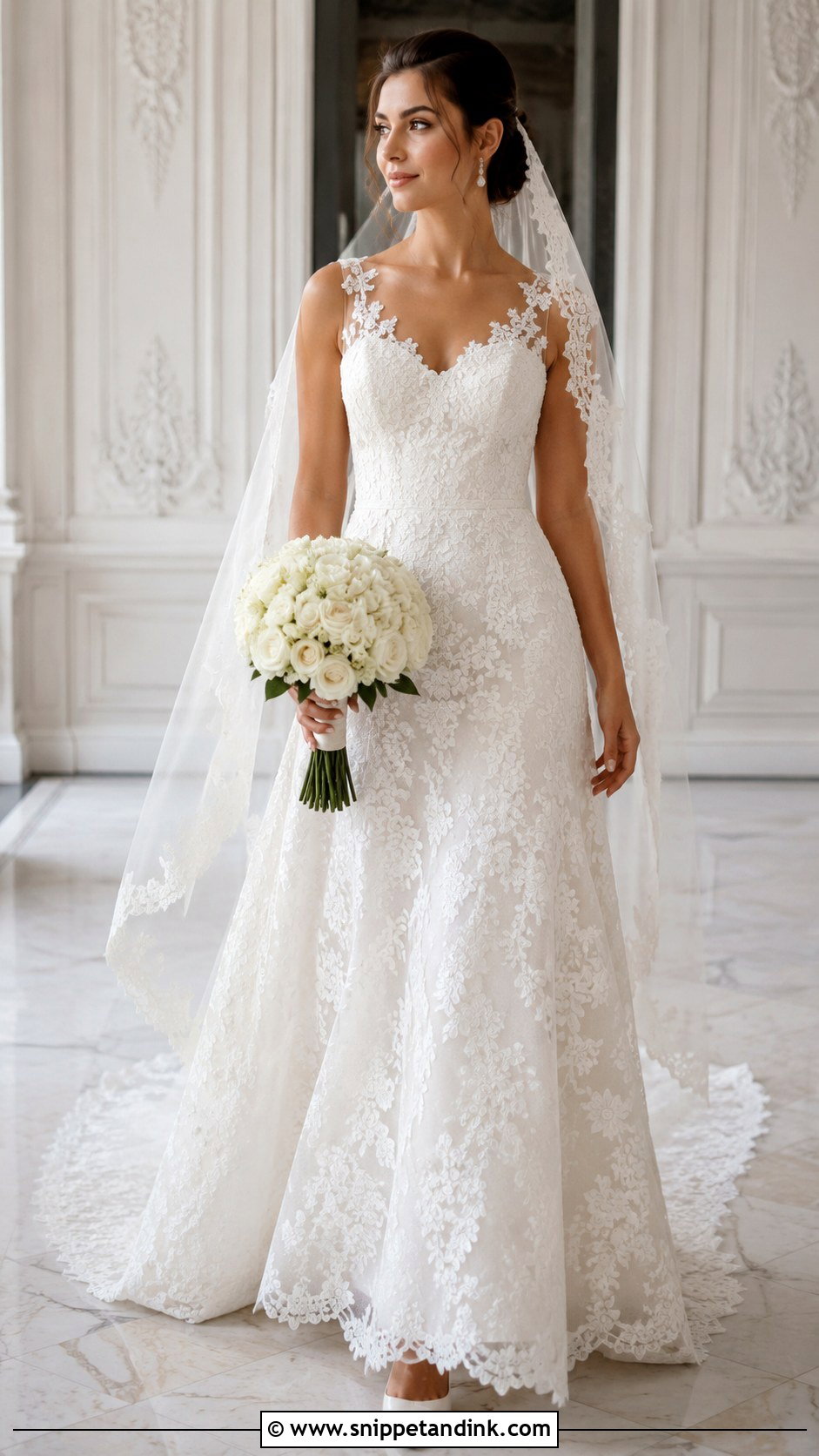
If you’ve never tried on a wedding dress, start here. The A-line tells me in two minutes whether a bride likes a fitted waist and a moving skirt, and almost everyone does. I like floral lace that’s dense at the bodice and thins as it reaches the skirt. Lining colour changes everything: light ivory looks traditional, while a champagne underlayer pushes the lace pattern forward so it reads from across a room. Pointed ivory pumps, pearl drops and a fingertip veil with matching lace edging complete it, with white roses and greenery in a structured bouquet. Keep hair low or in soft waves so the neckline stays clear.
2. Mermaid Lace Wedding Dress
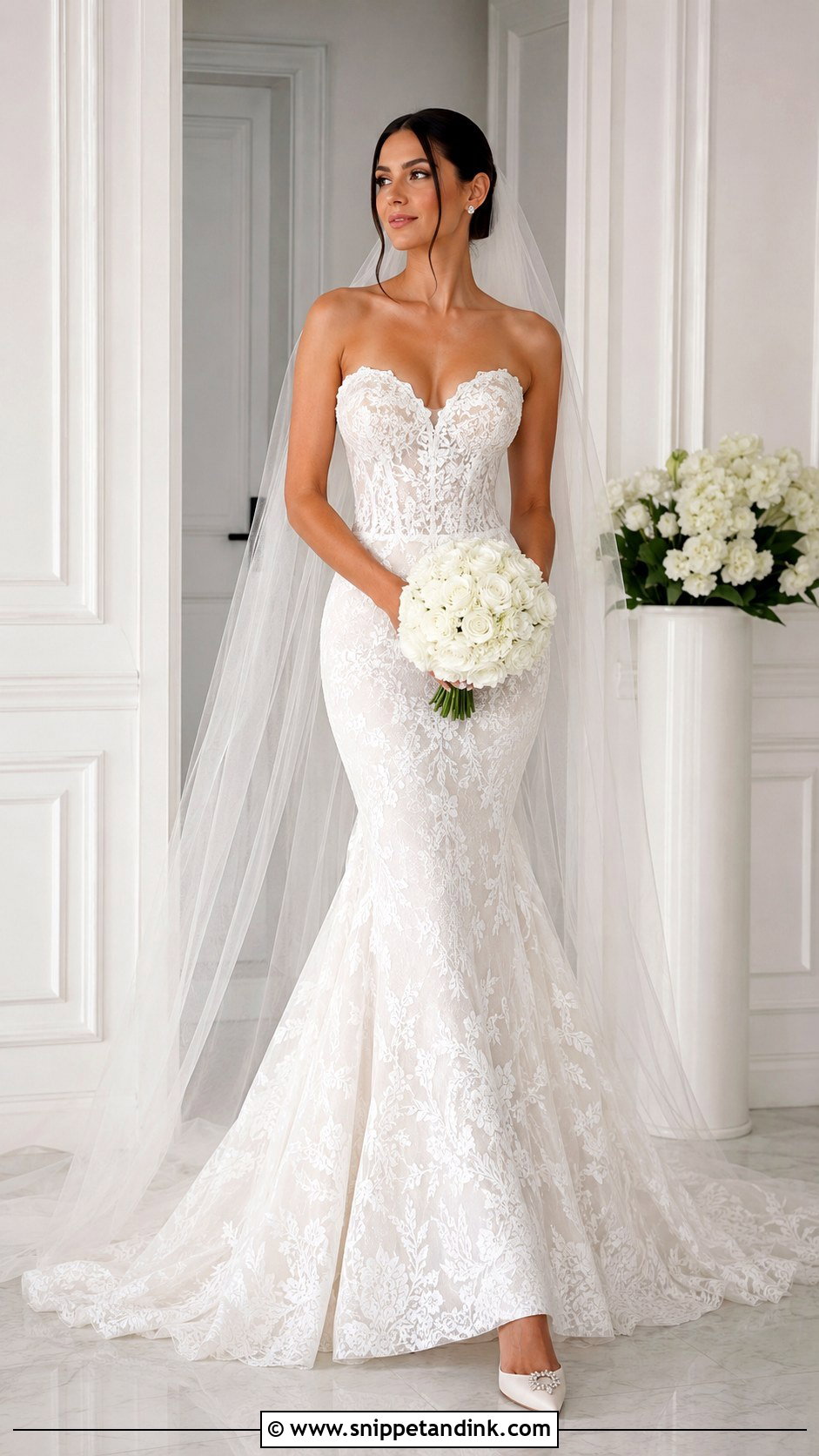
Mermaid gowns are fitted to the knee and flare from there, so the first question isn’t how it looks but whether you can walk. Medium-scale floral lace with subtle beading shows off the shape; tiny lace disappears on a fitted body and huge motifs get cut awkwardly by the seams. Look for a flexible lining and solid internal structure, and get the bustle sorted early. A long plain tulle veil, crystal studs and sleek pointed heels keep the focus on the lace. Sweep your hair back if the neckline is strapless or sweetheart. A compact white bouquet and one fine bracelet are plenty.
3. Lace Ball Gown Wedding Dress
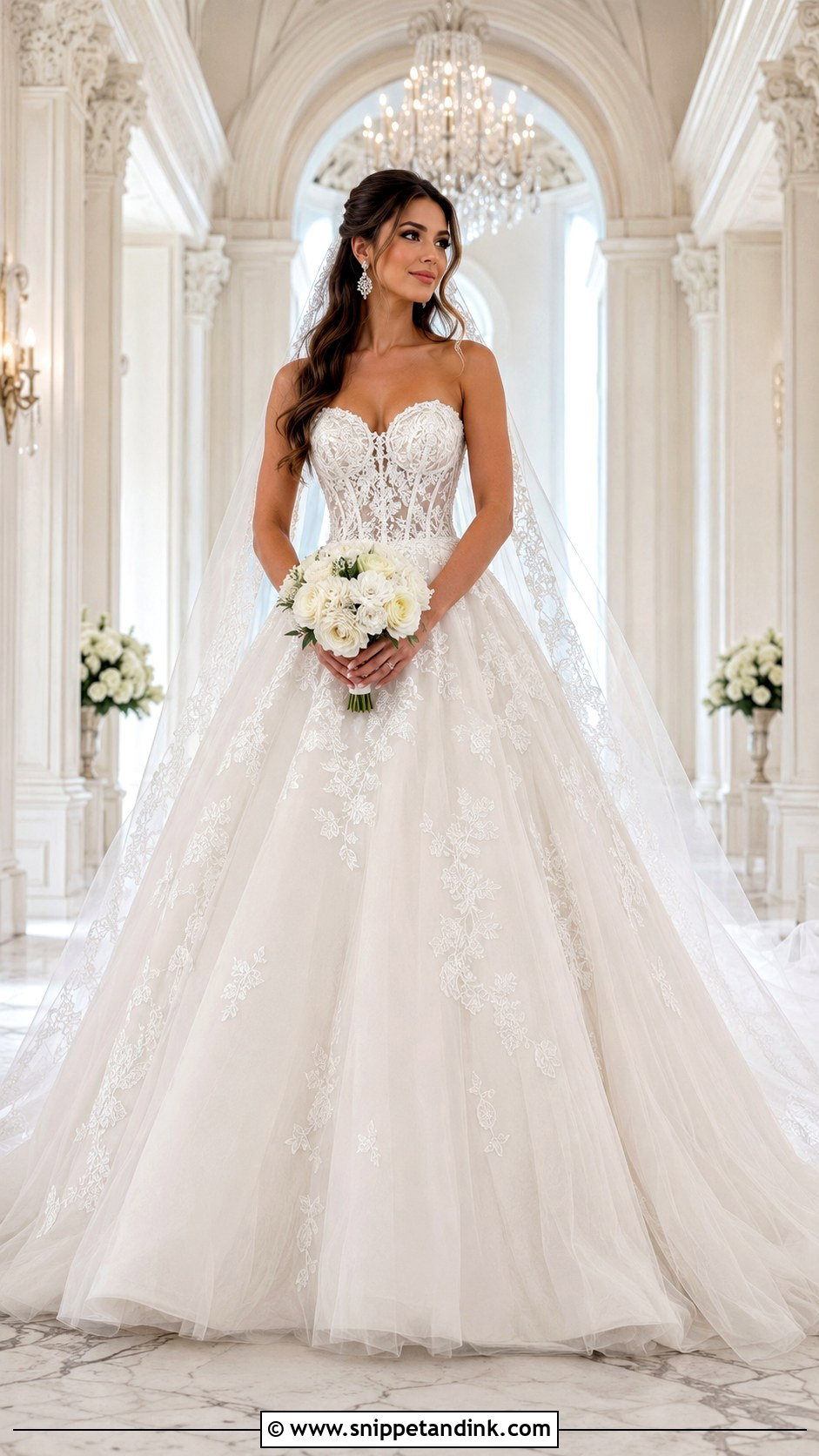
Ball gowns are about scale, and the venue has to hold it. In a room with high ceilings and wide aisles this is the dress that makes the entrance; in a small restaurant it fills the room. Appliqués scattered over tulle layers, dense at the bodice and lighter toward the hem, keep the skirt from looking heavy. Nobody sees your feet, so I always suggest block-heel pumps you can stand in. Add a cathedral veil and small diamond or crystal studs, with a smooth bun or a polished half-up style. A medium bouquet with a clean outline suits the volume. If the neckline has embroidery or illusion edging, leave the necklace off.
4. Long Sleeve Lace Wedding Dress
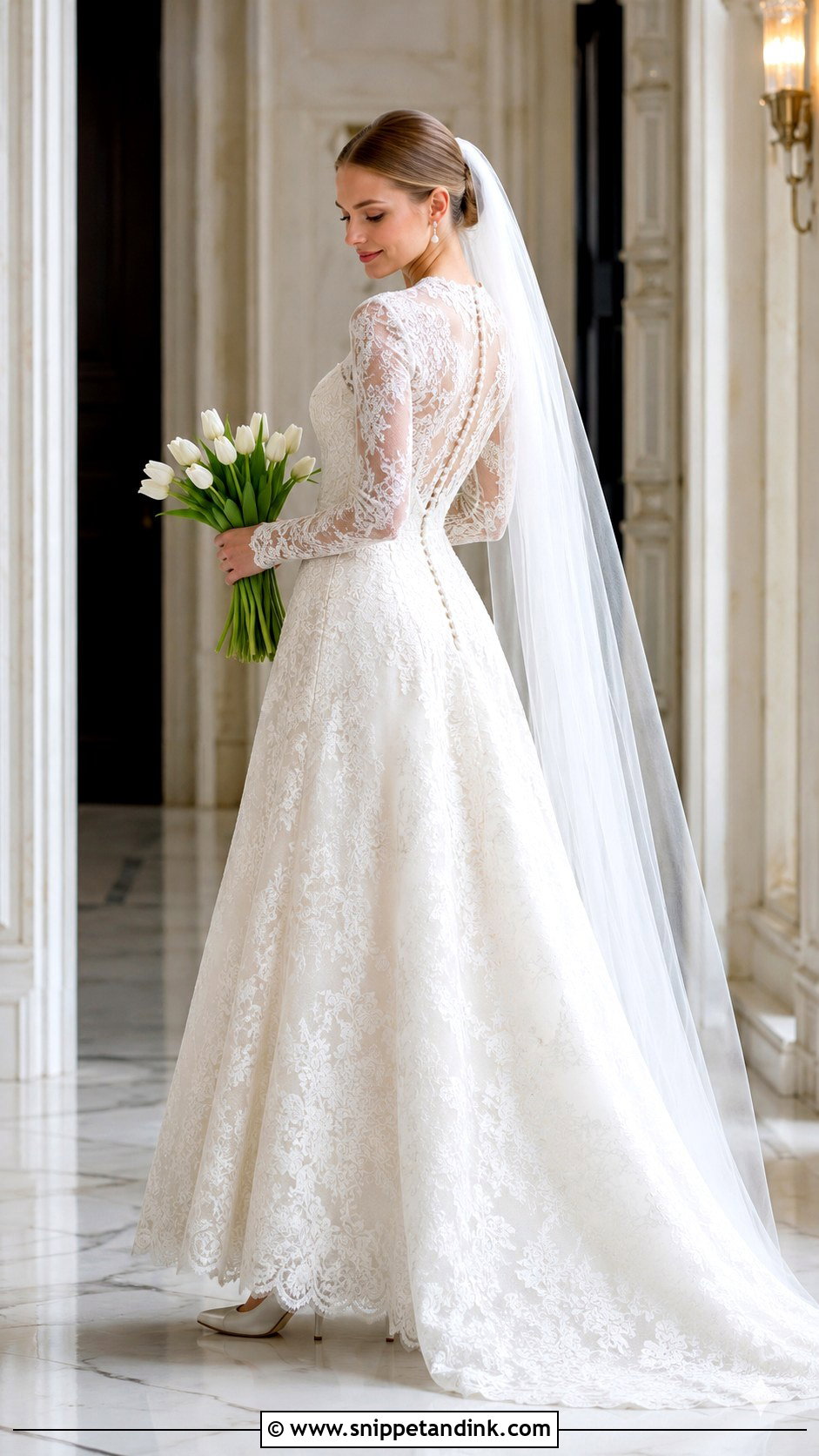
Illusion sleeves with lace motifs placed along the arm look lighter than solid lace sleeves, and they show the arm’s shape rather than covering it. Pair them with a softly structured A-line or a sheath. At every fitting, I make brides reach forward as if hugging someone and bend the elbow as if holding a glass. Sleeves cut without ease will pull at the shoulder seams. Closed-toe ivory heels, pearl earrings and a chapel veil suit it. A low chignon shows off the sleeves and back; a loose updo is more relaxed. With ornate lace, keep the bouquet simple: white tulips, roses or callas.
5. Strapless Corset Lace Wedding Dress
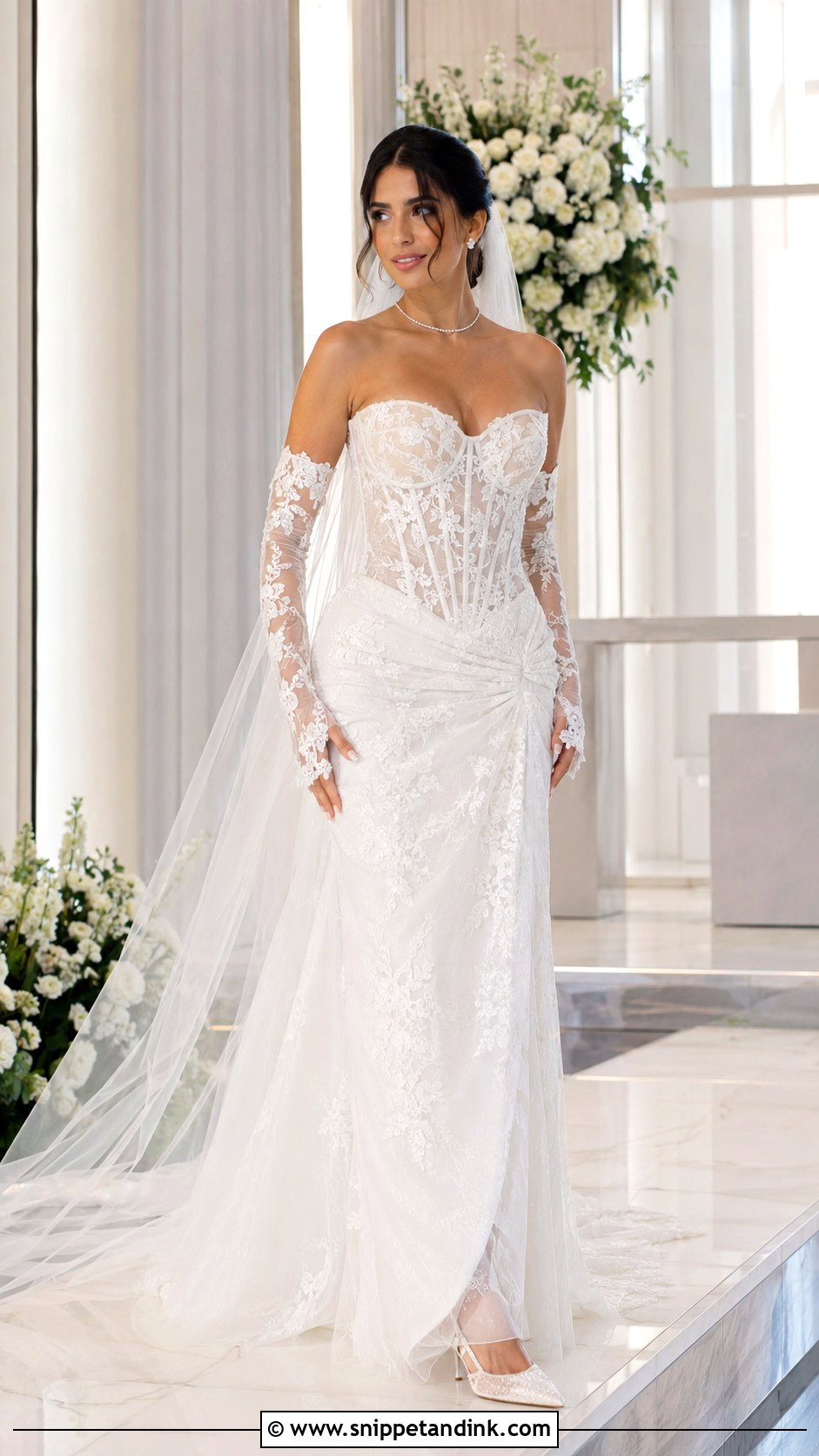
Visible boning gives a corset bodice its modern edge, and lace over an ivory or light nude base makes every flower stand out. This is the shape I suggest to brides who want real support without straps. The skirt can go A-line, drop-waist or softly gathered. A tennis necklace sits nicely on a curved strapless neckline; add small earrings, pointed slingbacks and a sheer veil without heavy trim. For a covered ceremony, a lace bolero or removable sleeves come off for the party. Sit, breathe deeply and dance a few steps at the final fitting. A corset that only works when you stand still isn’t fitted right.
6. Square Neck Lace Wedding Dress
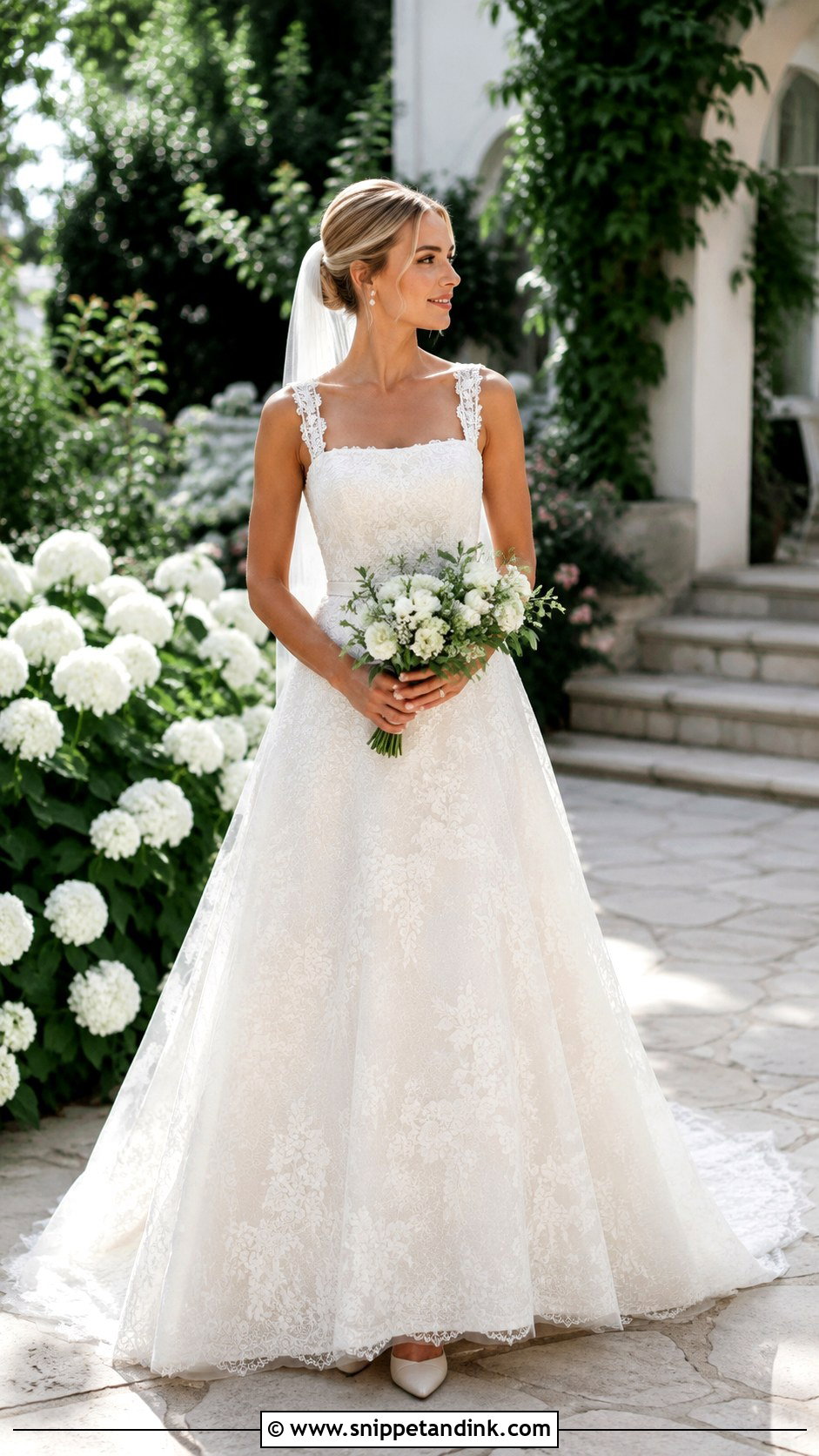
Square necklines frame the collarbone with a straight edge, and that geometry is what keeps lace from looking fussy. Wide straps give support, and the shape works with either a flowing A-line or a slim column. I’d add detail at the back rather than the front: lace-covered buttons down the spine or a lightly scalloped hem. Pearl studs, low ivory heels and a light veil set under a neat bun keep it clean, with a small bouquet of white flowers and green stems. No necklace; the neckline is already drawing a frame.
7. High Neck Lace Wedding Dress
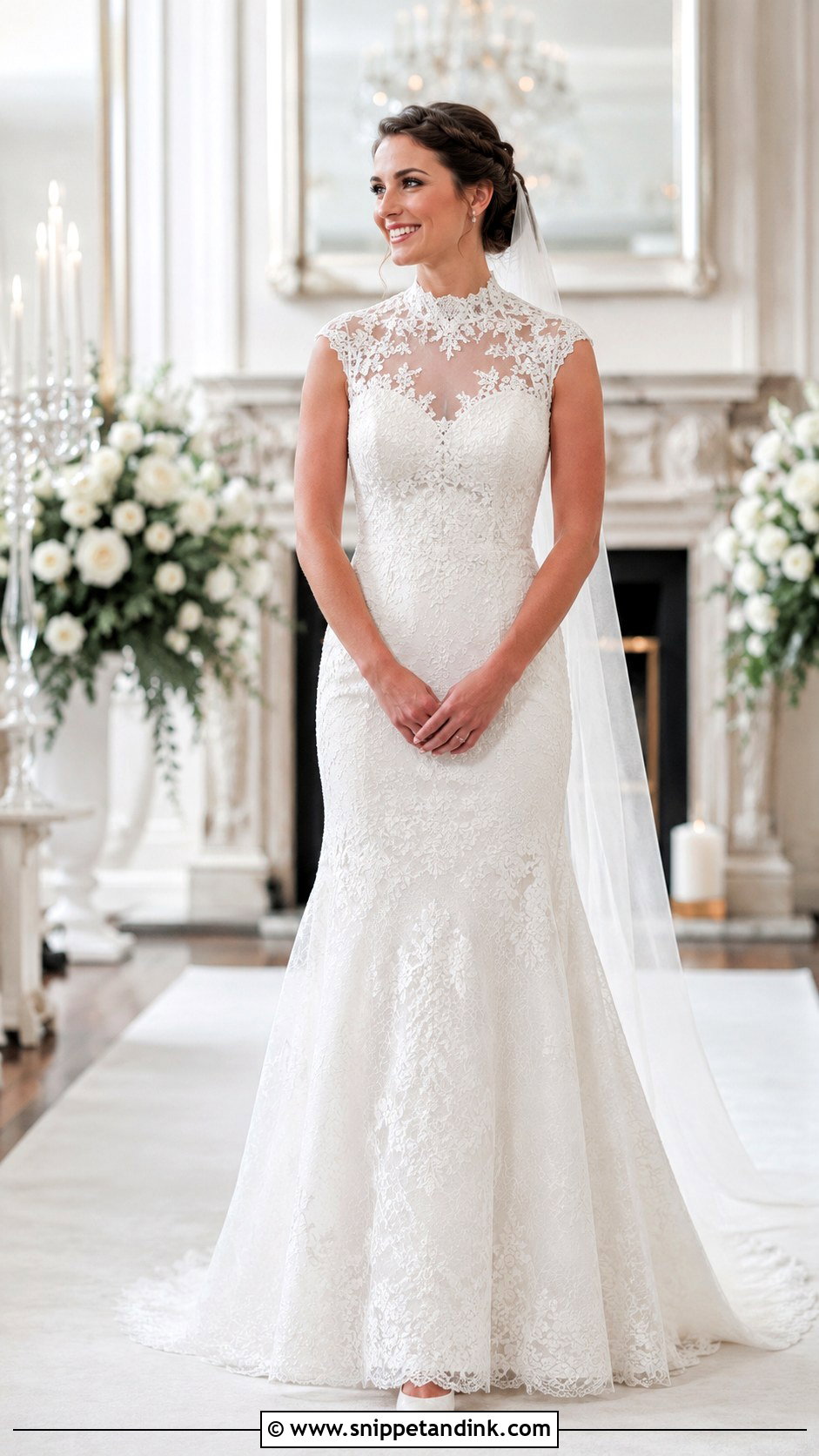
On a high neck, I’d always rather see sheer illusion tulle with lace placed over it than a fully opaque collar, which can feel heavy and close up the face. Covered buttons down the back give the gown some interest from behind. Armholes deserve as much attention as the collar. If they’re cut low or loose, they chafe and gape when you lift your arms. Wear a low bun, braided updo or sleek ponytail so the neckline is visible, with small pearl earrings and a plain veil placed below the hair. A narrow bouquet of white orchids or seasonal stems keeps the long line going.
8. Off Shoulder Lace Wedding Dress
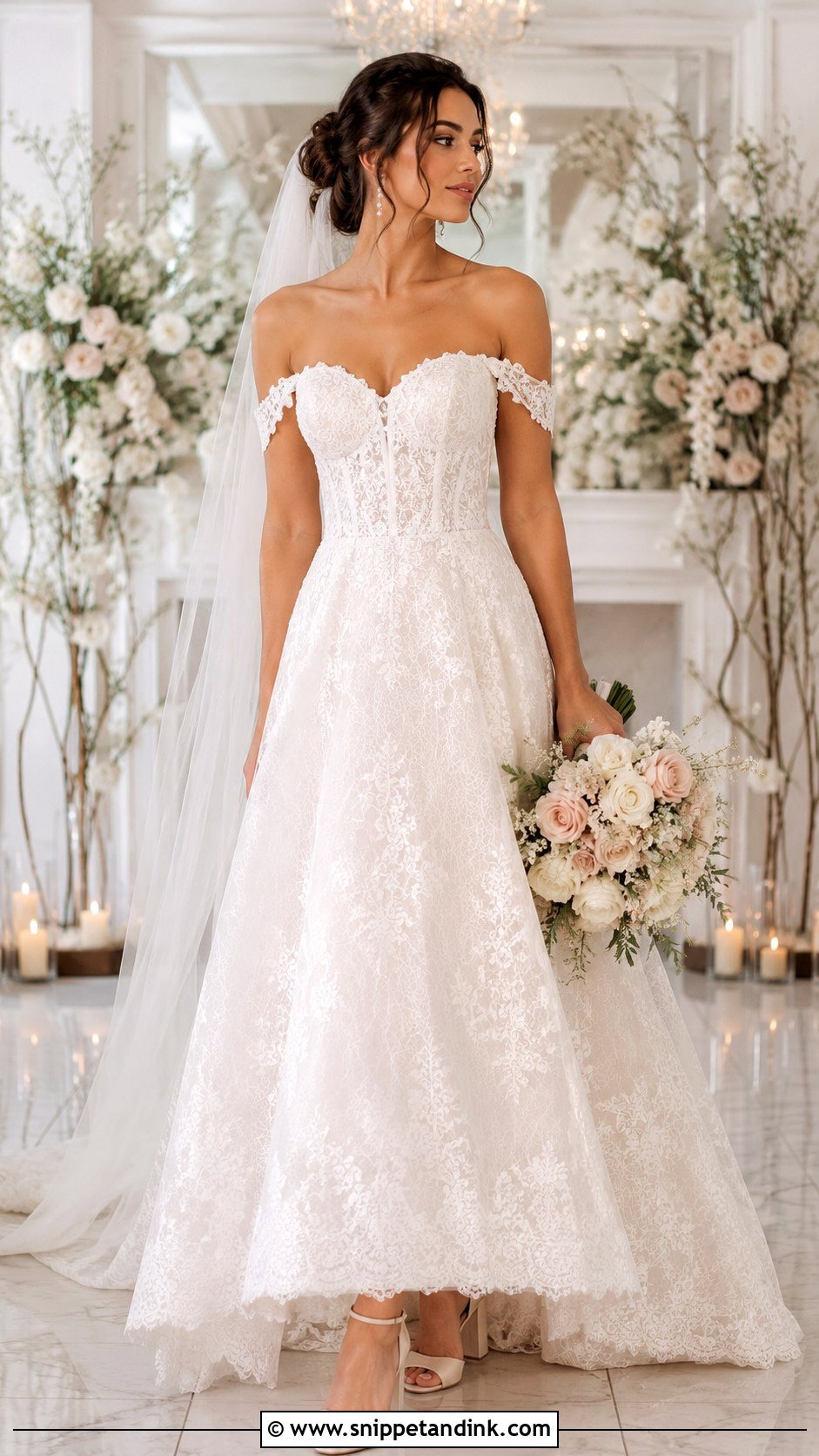
Off-shoulder lace frames the face, but it limits how high you can raise your arms, and that’s worth knowing before you fall for it. A folded lace neckline, fitted lace sleeves or detachable straps across the upper arm all work, provided the bodice underneath is structured enough to stop everything sliding. Pearl drops, a fine bracelet and ivory pumps or block heels suit it. A loose updo with a few face-framing pieces leaves the shoulders visible. Choose a plain veil or one with lace only on the lower edge. A white and pale blush bouquet adds a touch of colour.
9. Cap Sleeve Lace Wedding Dress
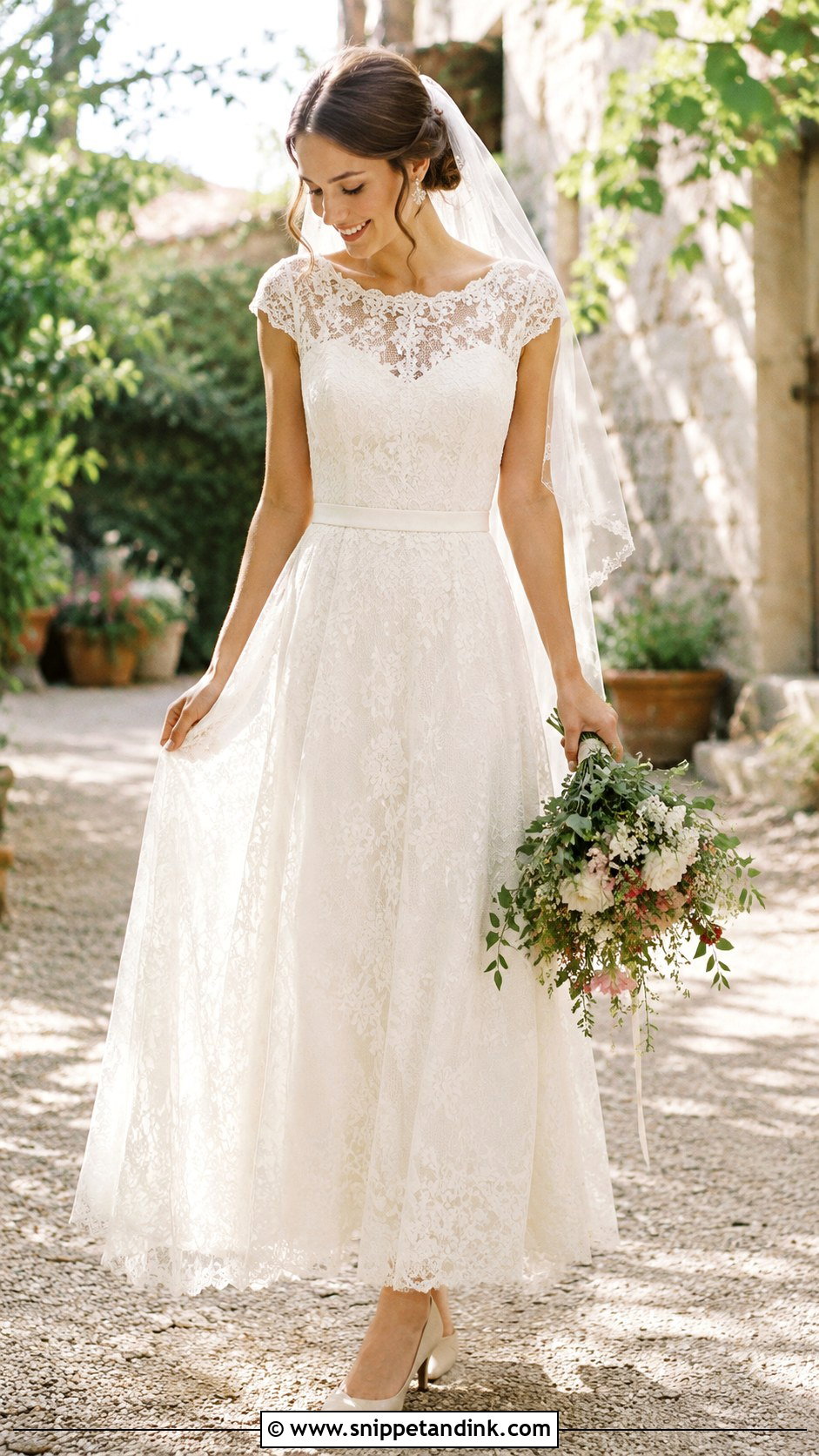
Cap sleeves give the shoulders a little coverage without committing to a sleeve. They suit an illusion neckline, a V-neck or a soft scoop. I check two things: that the lace runs from the bodice onto the sleeve without a visible break, and that the sleeve edge doesn’t dig into the upper arm when you lift it. A cap that’s too tight leaves a red line by dinner. Pearl or floral earrings, kitten heels, a fingertip veil and a half-up style suit it. Carry a loose garden bouquet outdoors or a compact white one indoors.
10. Backless Lace Wedding Dress
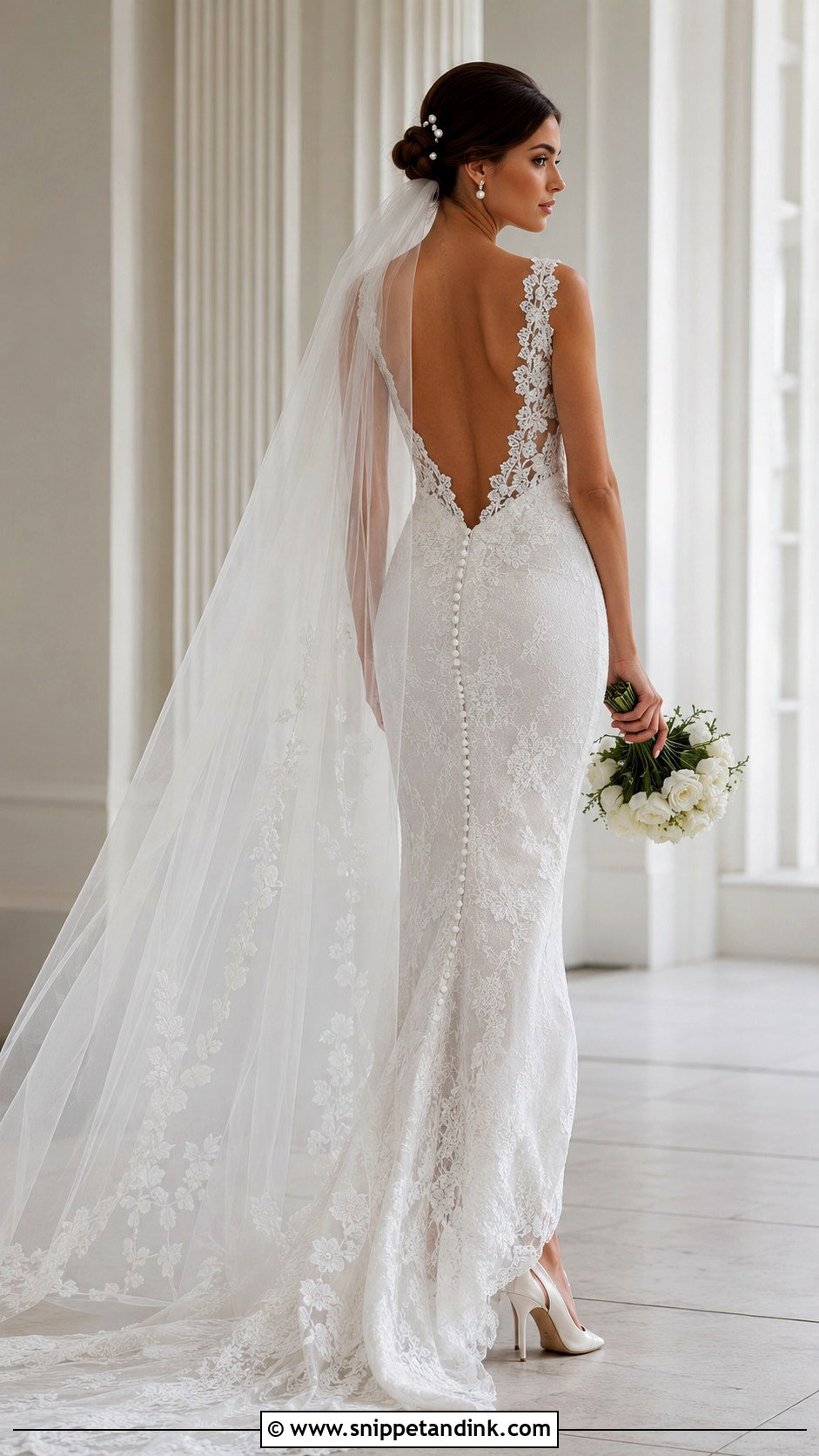
From the front, a backless gown can look almost demure, which is exactly the surprise. Lace edging should clearly trace the shape of the opening, and sheer panels or internal support can make it feel more secure without closing it up. Skip the standard bra; ask about built-in cups or support added during alterations. A long row of covered buttons below the opening is a nice traditional touch. Wear a removable veil for the ceremony and take it off afterwards, with a low bun and pearl pins. A back necklace is optional and best kept fine.
11. Basque Waist Lace Wedding Dress
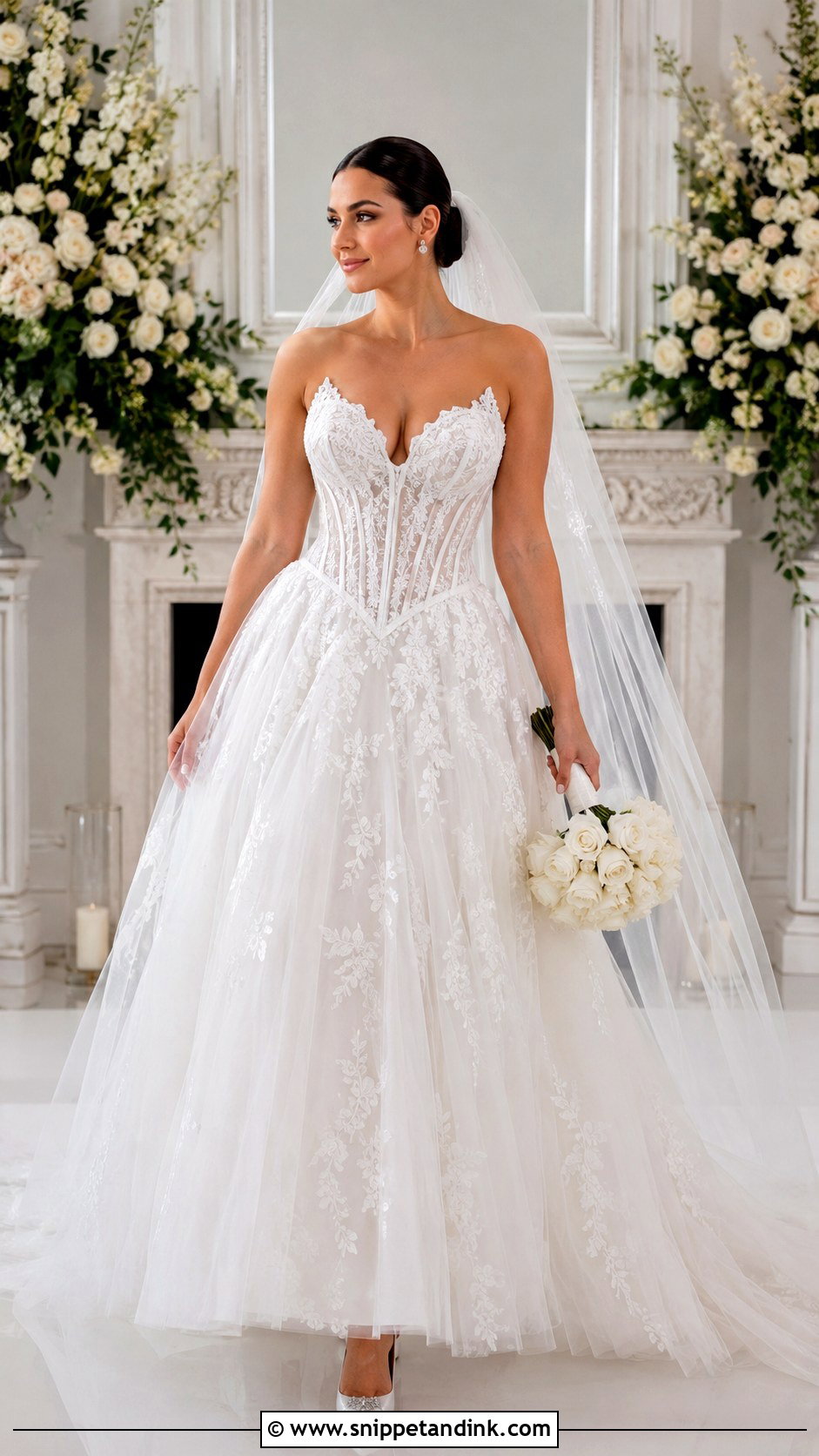
The basque V dips below the natural waist and pulls the eye downward, which lengthens the torso. It’s most dramatic on a corseted top with a full skirt. Appliqués should follow the bodice seams so the V stays crisp. A belt or a statement necklace would interrupt it, so keep both off. When you sit, the point of a long basque can fold or press into the stomach; I always have brides sit in it at the first fitting so the seamstress can adjust the depth while there’s still time. Pointed pumps, crystal studs, a long sheer veil and a rounded bouquet of roses or peonies finish the look.
12. Sheath Lace Wedding Dress
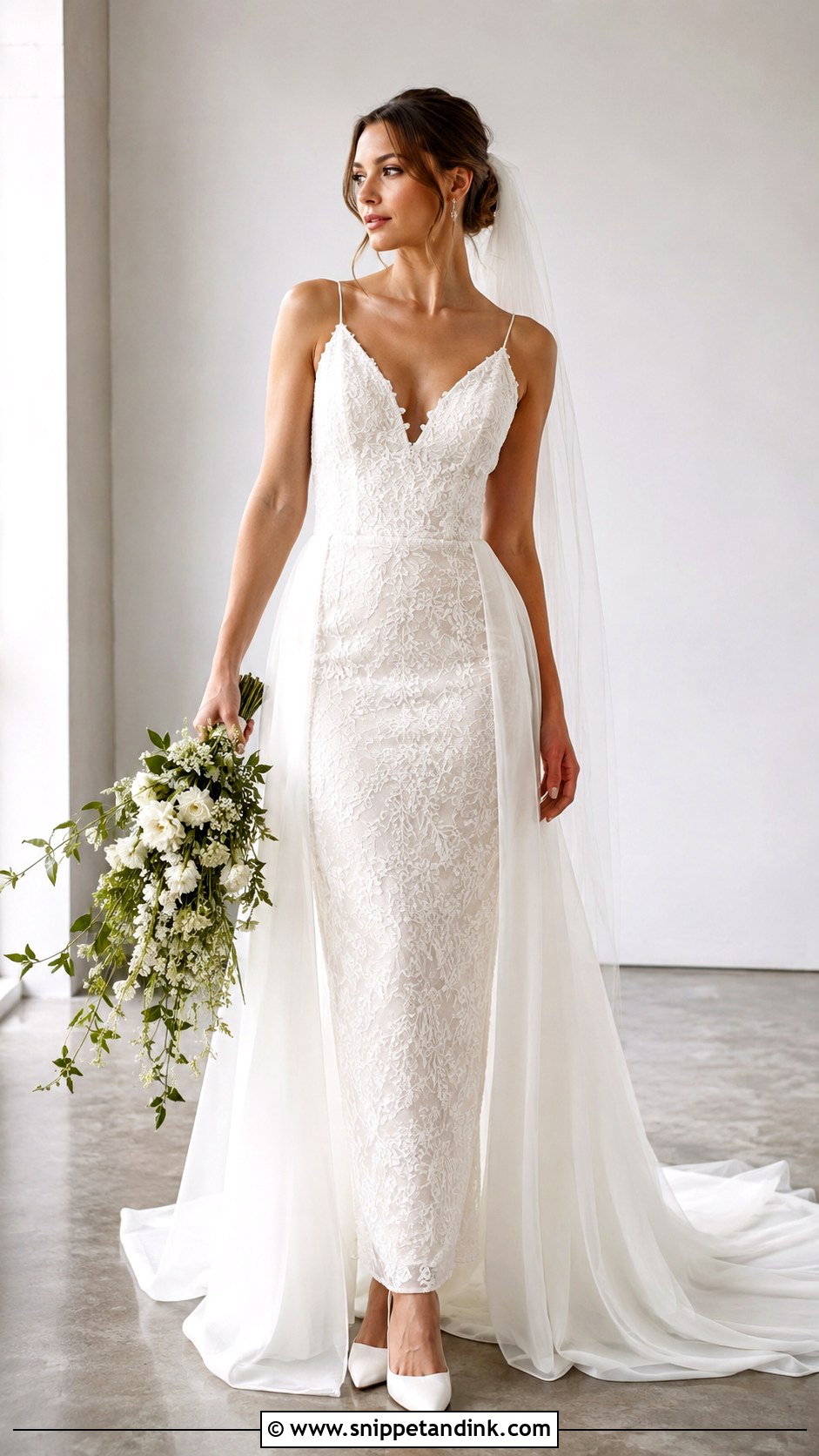
A sheath lace wedding dress skims the body with very little volume, so it’s honest about every pull and wrinkle. Choose lightweight lace over a smooth lining so it moves rather than stands stiffly. V-necks, bateau necklines and slim straps all keep the line long. I ask for room through the hips and knees, enough to sit and dance; a sheath that’s fitted too tight will ride up every time you sit. Pointed slingbacks, small diamond studs and a narrow chapel veil suit it, with a sleek bun or glossy waves. A detachable overskirt can add volume for the ceremony if you want it.
13. Boho Crochet Lace Wedding Dress
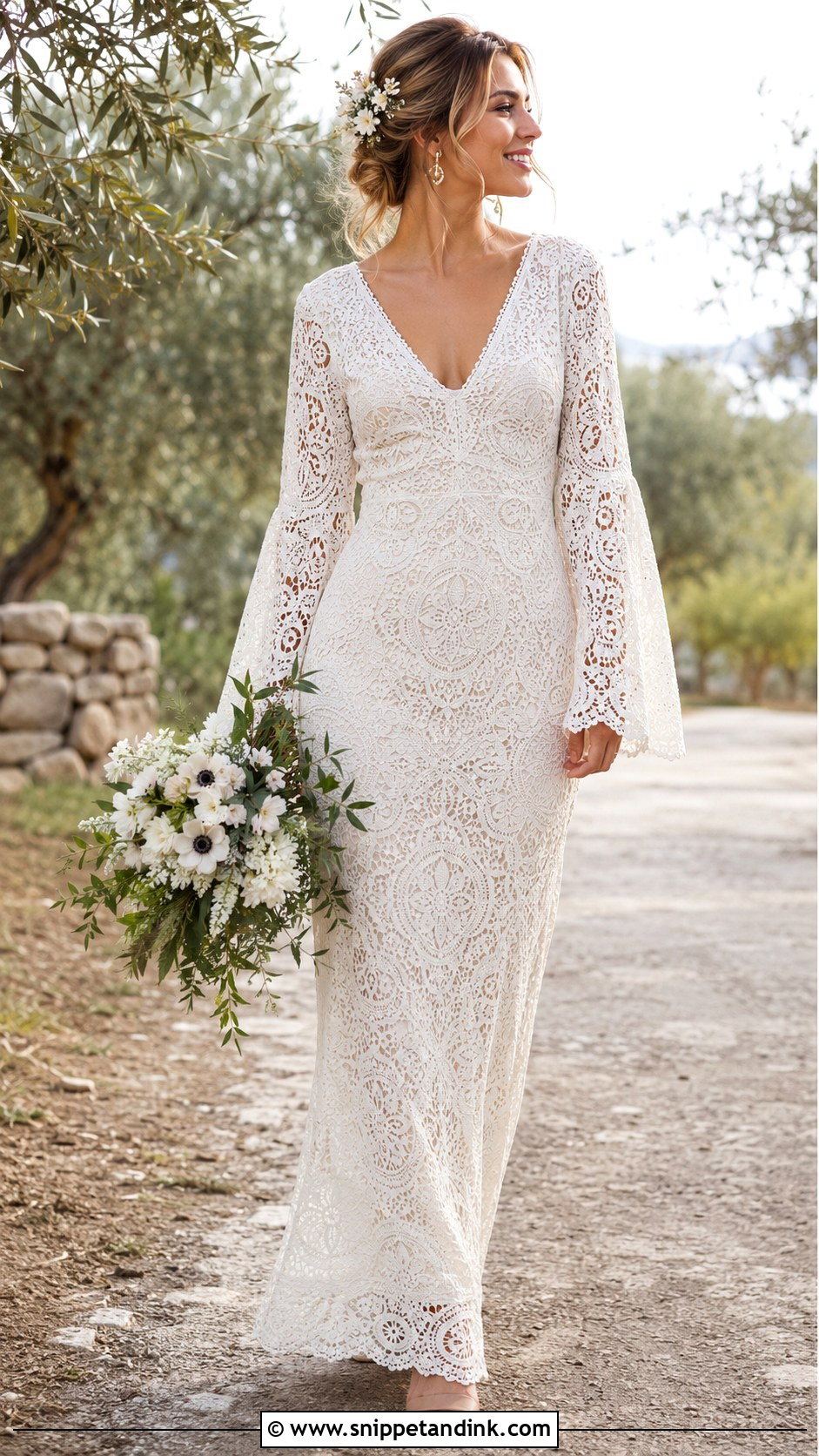
Crochet lace has larger openings than other laces, so lining is the first thing I look at. Check it in daylight and under warm indoor light, because those gaps can show more in photos than in the mirror. An easy column or gentle A-line with graphic crochet patterns and a lightweight skirt suits outdoor and destination weddings. Bell sleeves, a low back or a modest V-neck add character without tipping into costume. Neutral block-heel sandals, small gold earrings and a simple veil or floral comb work, along with loose waves or a textured braid.
14. Vintage Tea Length Lace Wedding Dress
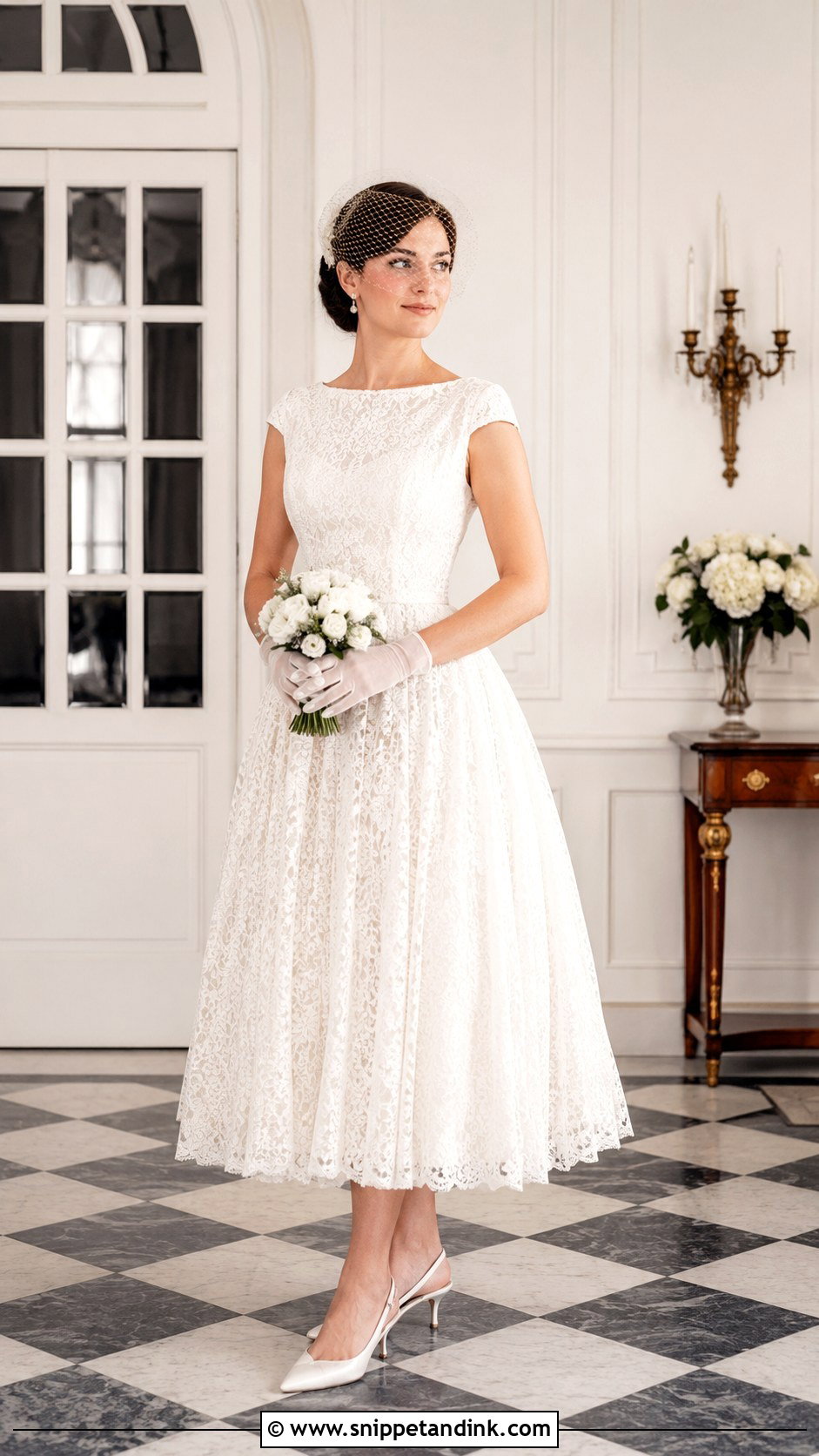
Tea length ends somewhere between knee and ankle, and suddenly your shoes, waist and hemline are all on show. A bateau or sweetheart neckline with a fitted bodice suits the era. Fine floral lace over a structured lining keeps the skirt’s shape while still moving. Your shoes deserve as much thought as the dress; choose a pair you can stand in and bring them to every fitting so the hem is set correctly. Pearl earrings, short gloves and a birdcage veil lean into the vintage feel. Keep the bouquet small so it doesn’t overpower the shorter length. It’s an easy dress for small venues and lively receptions.
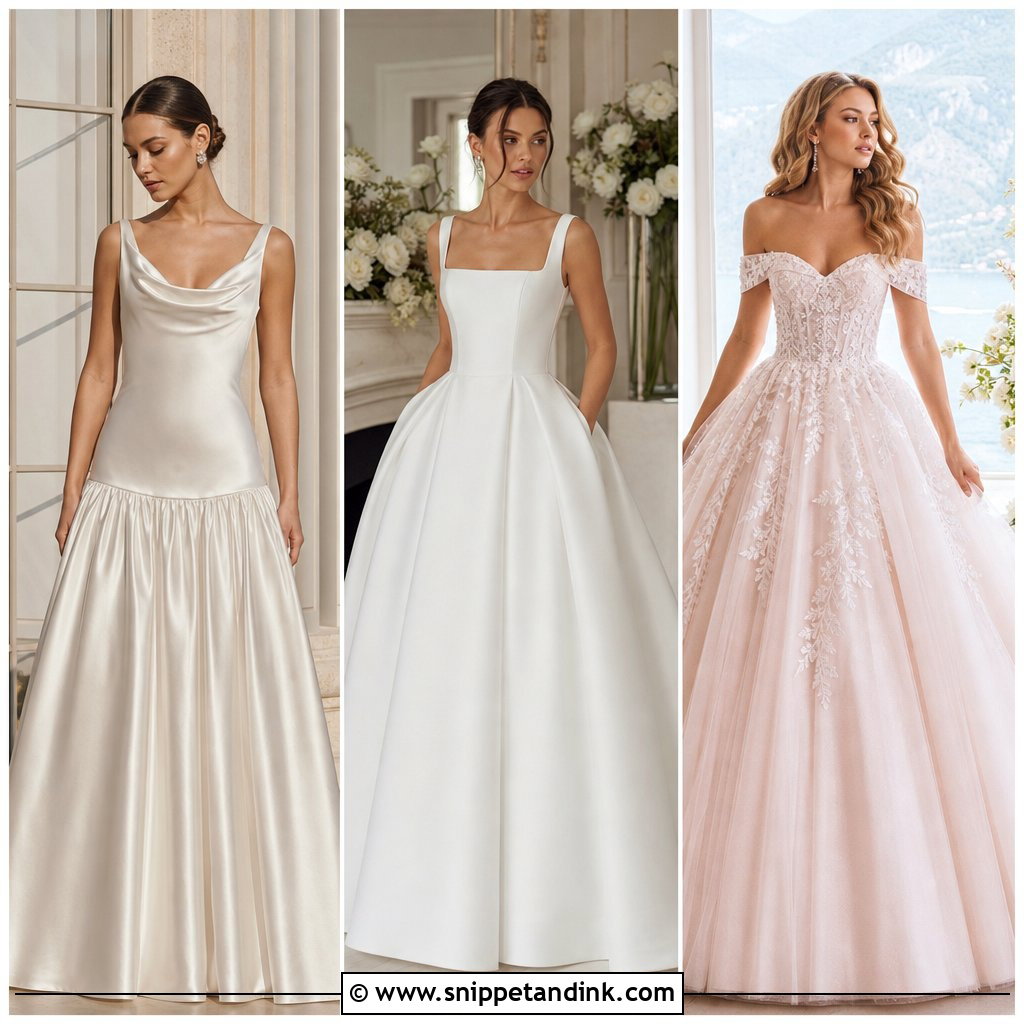
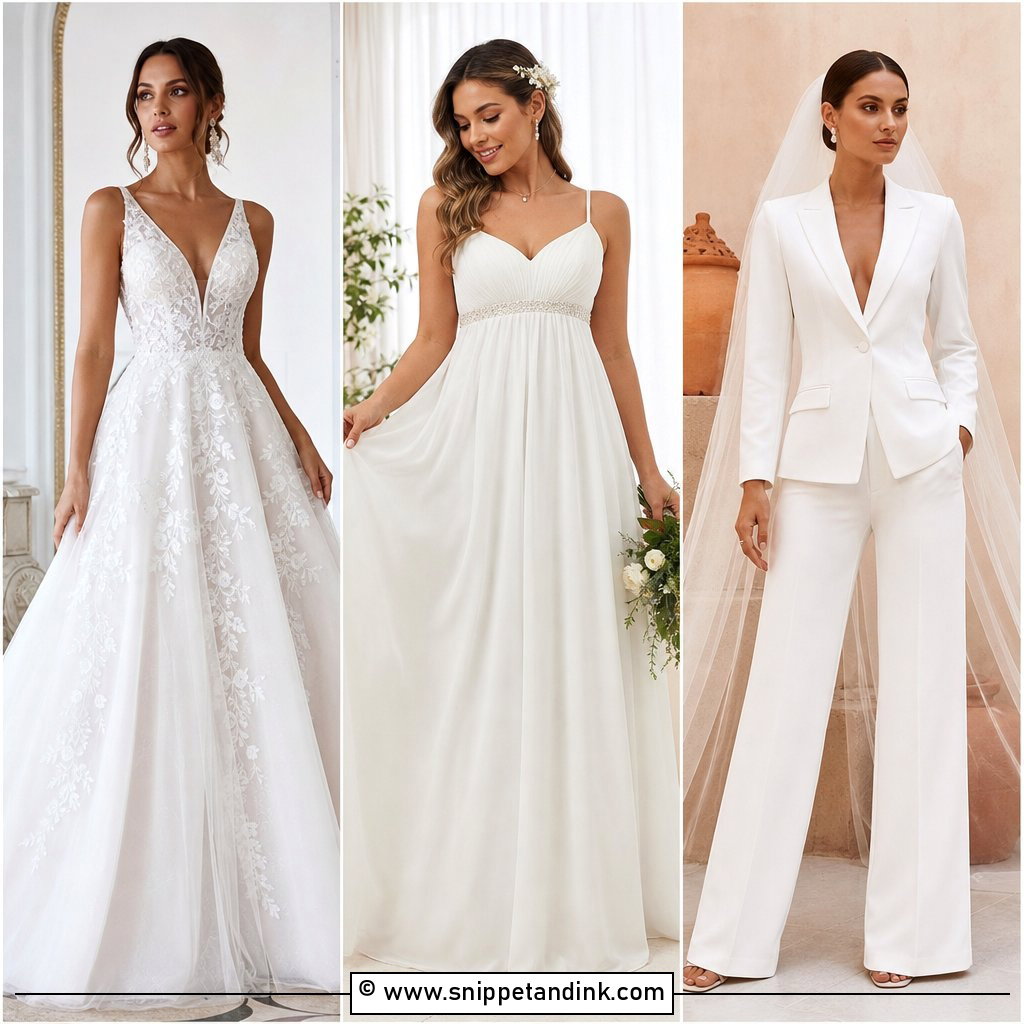
15. Lace Mini Wedding Dress
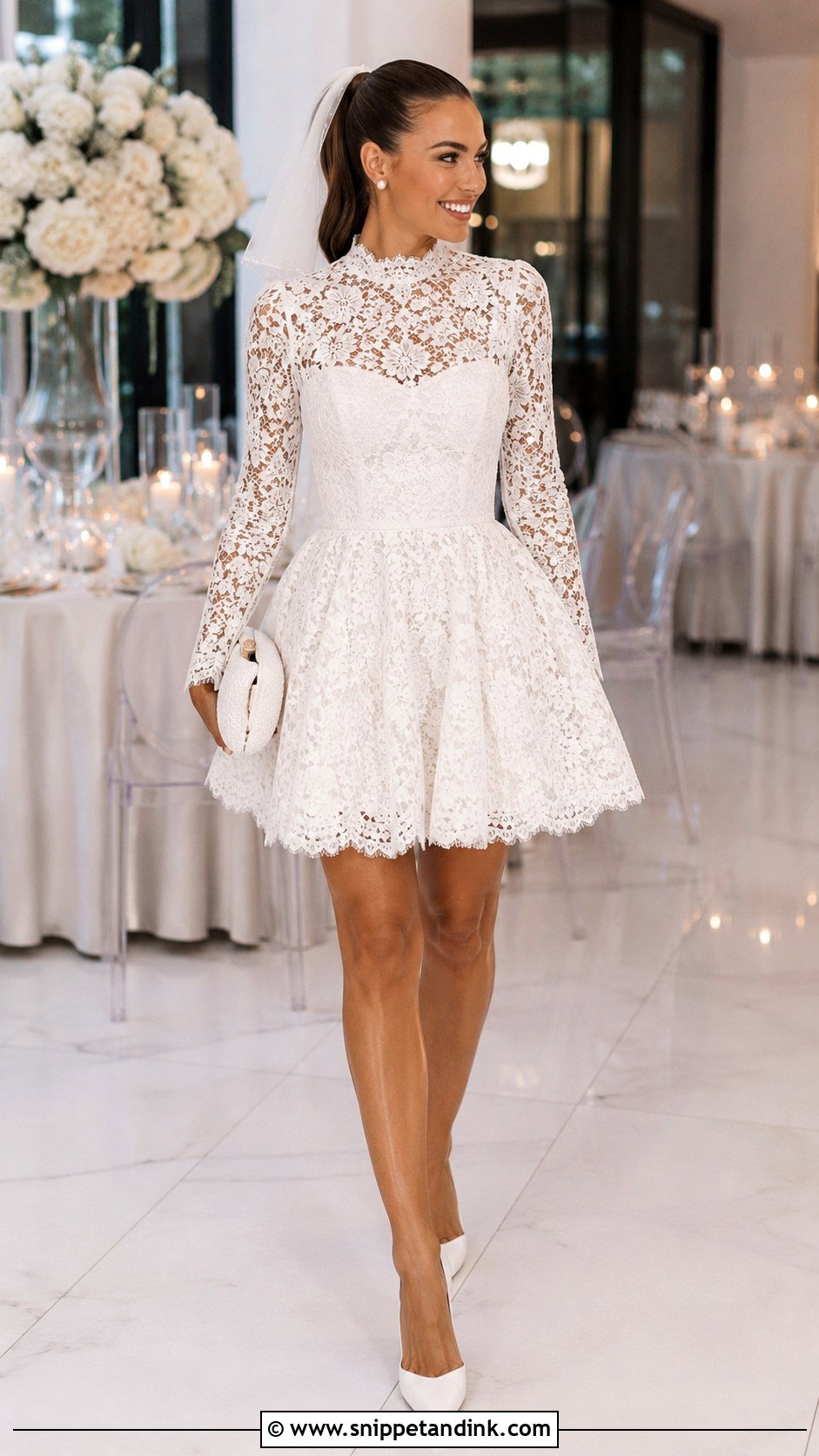
Minis are fun for a civil ceremony, a welcome party or a reception change. A tailored shift, a fitted sheath or a flared mini all work if the lining is secure and the hem sits at a length you’re happy with when seated. I always have brides sit on a low sofa in a mini; what looks right standing can rise a long way. Long lace sleeves balance the short skirt, and strapless looks sharper. Pointed pumps, slingbacks or ankle-strap heels, pearl studs, a small clutch and a short veil or bow complete it.
16. Lace Two Piece Wedding Dress
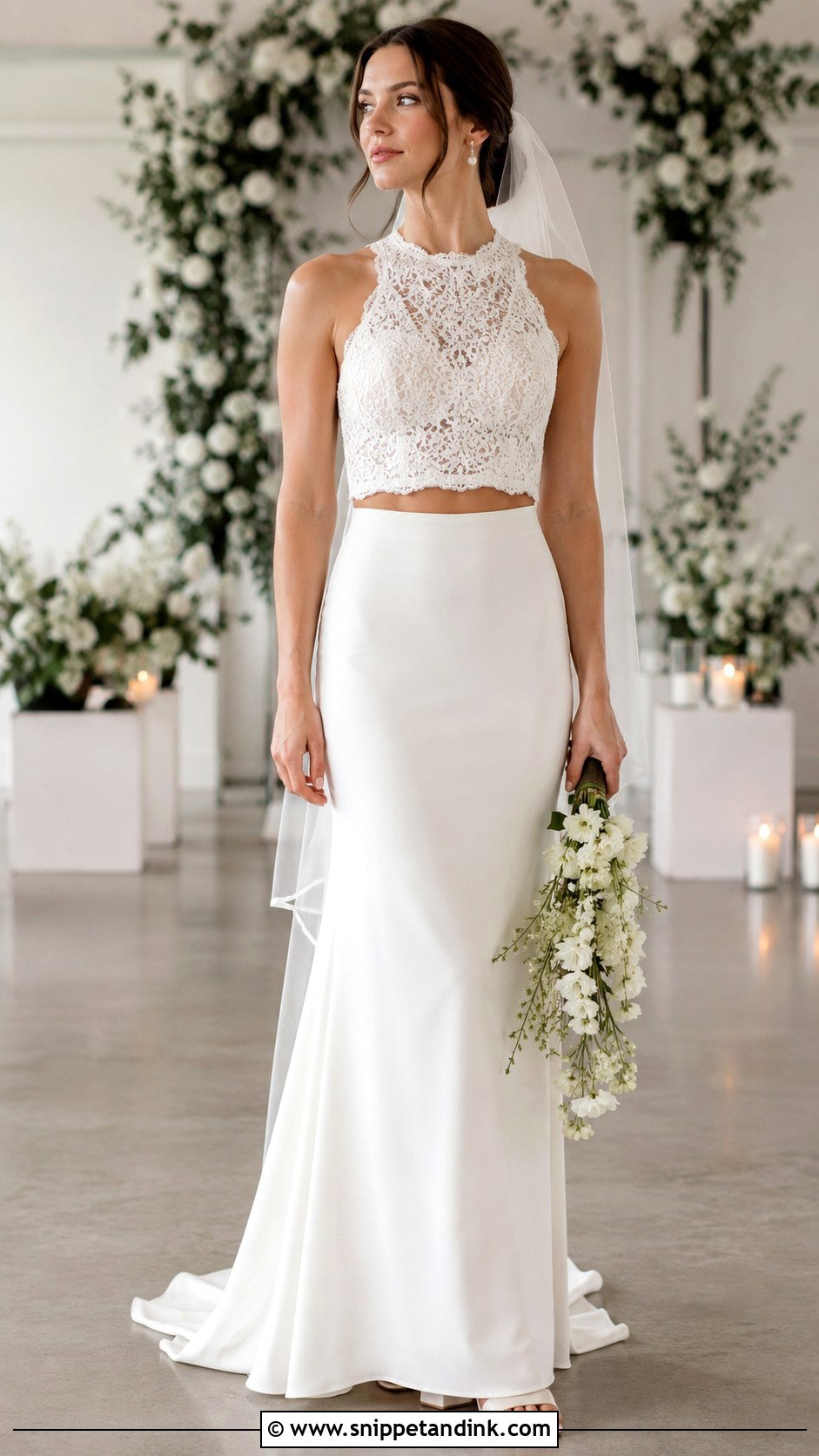
Separates let you mix textures, and a lace two piece wedding dress is a good way to get lace on top with a cleaner skirt below. A fitted lace top over a high-waisted crepe skirt looks modern; a cropped bodice over chiffon or tulle reads more romantic. Matching ivory tones on both pieces looks unified. Lift your arms and sit down in a shop before you commit; if the gap between top and skirt opens, ask for a longer top or a higher waist. A narrow ribbon belt can link the two. Low block heels, pearl earrings and a simple veil suit it.
17. Blush Lace Wedding Dress
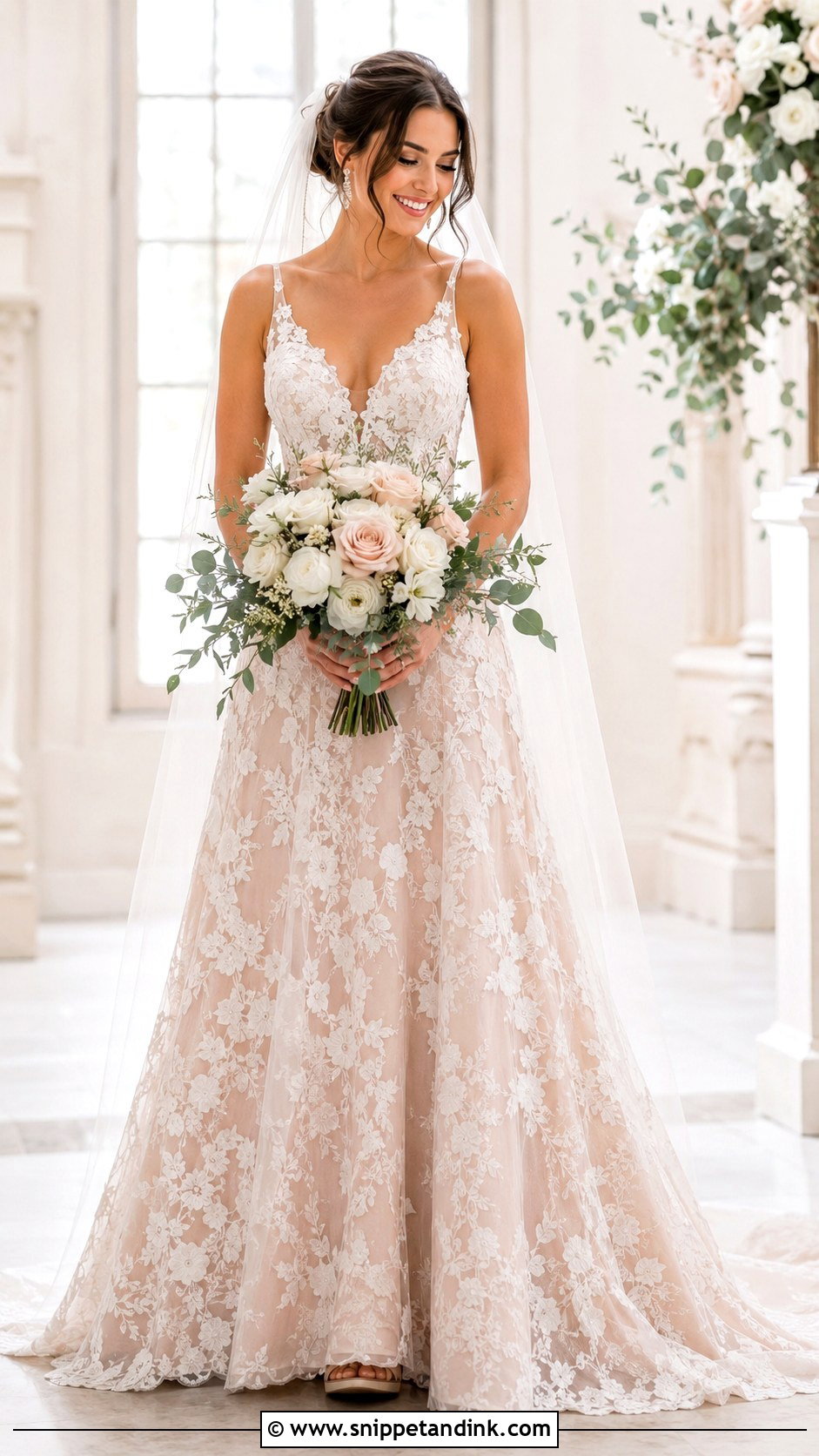
Blush is the easiest way to add colour without stepping away from bridal. White or ivory lace over a blush, pale rose or nude lining gives depth and makes the motifs easier to see in photos. A larger A-line or ball gown skirt shows the colour gradually; a sheath reads more modern. The shade must suit your skin tone, so compare linings in natural light, not under shop spotlights, which warm everything up. Ivory shoes, rose-gold or pearl earrings and a sheer ivory veil work, with a bouquet of white, blush and muted green.
18. Cathedral Train Lace Wedding Dress
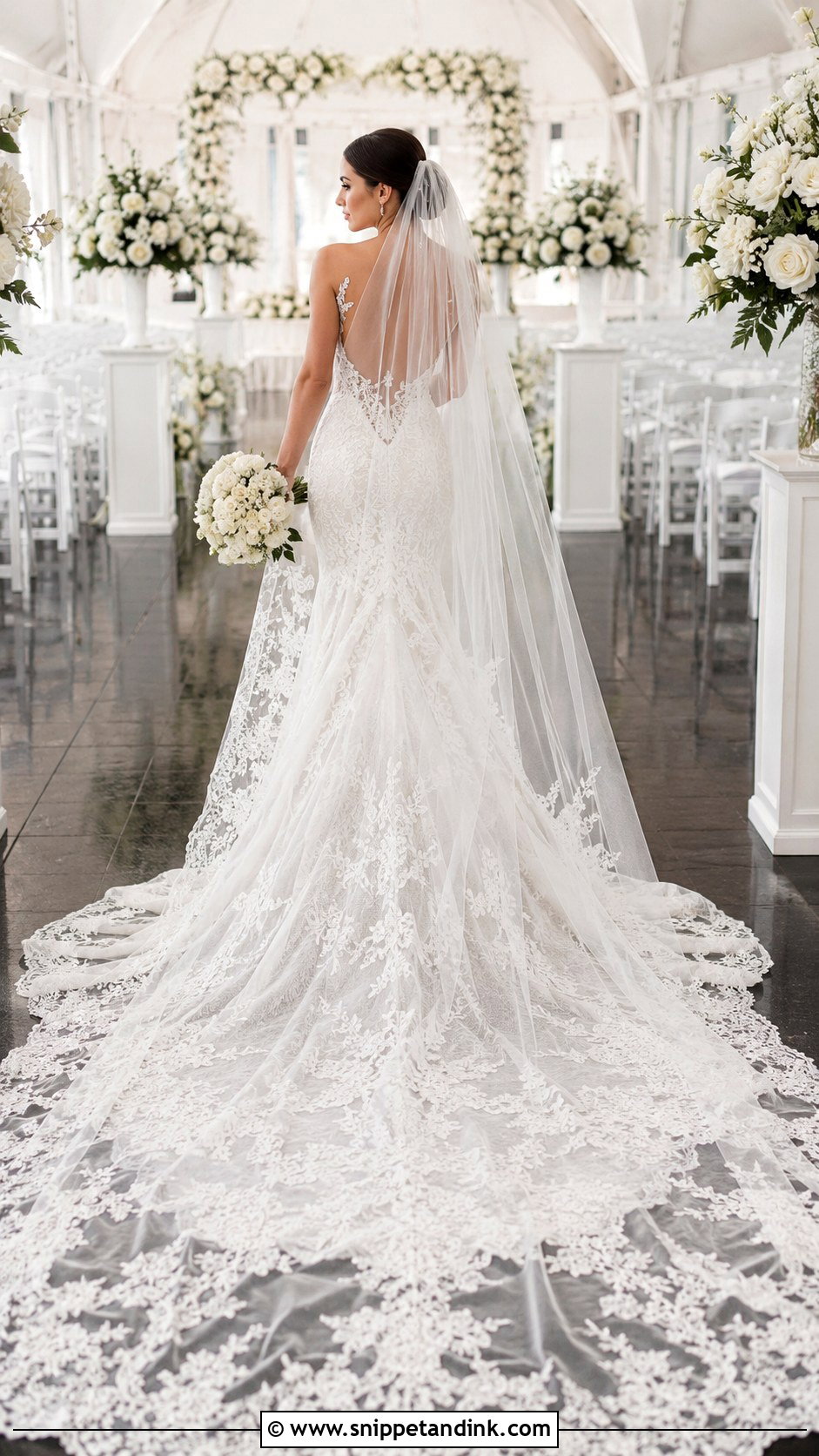
With a cathedral train, place the lace where it’ll actually be seen, which is along the outer edge of the train in full-length photos. A coordinating veil adds impact, but keep it sheer enough that the gown shows through. Practise walking, turning and setting the train with whoever will help you on the day, and agree how they’ll fan it out before the aisle photo. Ask for a strong bustle; long lace trains are heavy and weak bustle loops tend to give way. Supportive heels, small earrings, a polished updo and a medium white bouquet finish the ceremony look.
19. Lace Wedding Dress With Cape
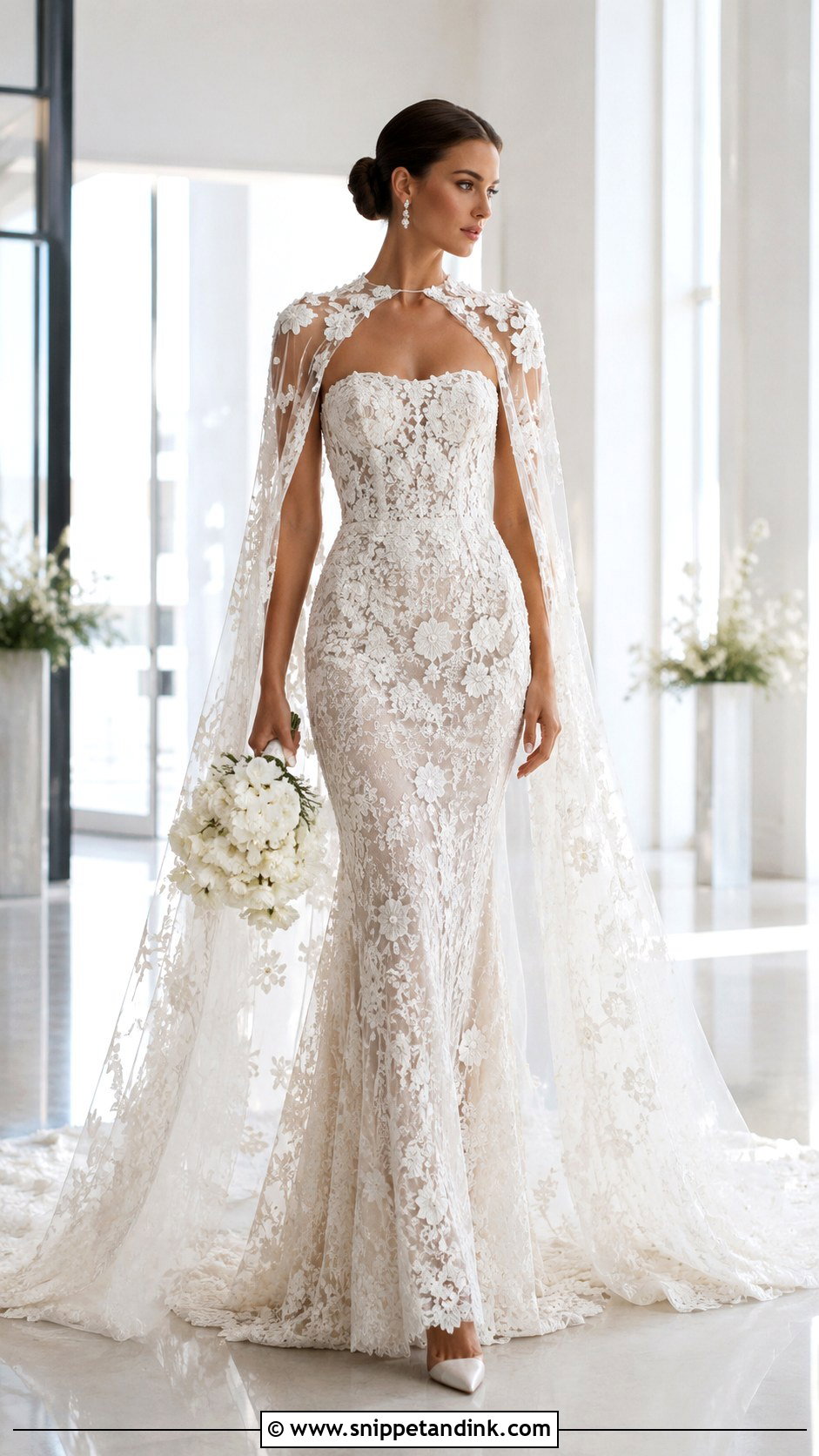
A cape gives coverage without sleeves, and it has more movement than most brides expect. Start with a simple fitted, A-line or strapless lace gown and add a sheer tulle cape with scattered appliqués or a lace edge. It should attach at the shoulders and fall without hiding the waist. If the cape runs into a train, skip the veil; two long sheer layers tangle. Test the closures by walking and turning briskly, since a cape that slips to one side pulls the whole neckline with it. Pointed pumps, small crystal earrings and a sleek bun suit it, plus a clean white bouquet.





20. Plus Size Lace A-Line Wedding Dress
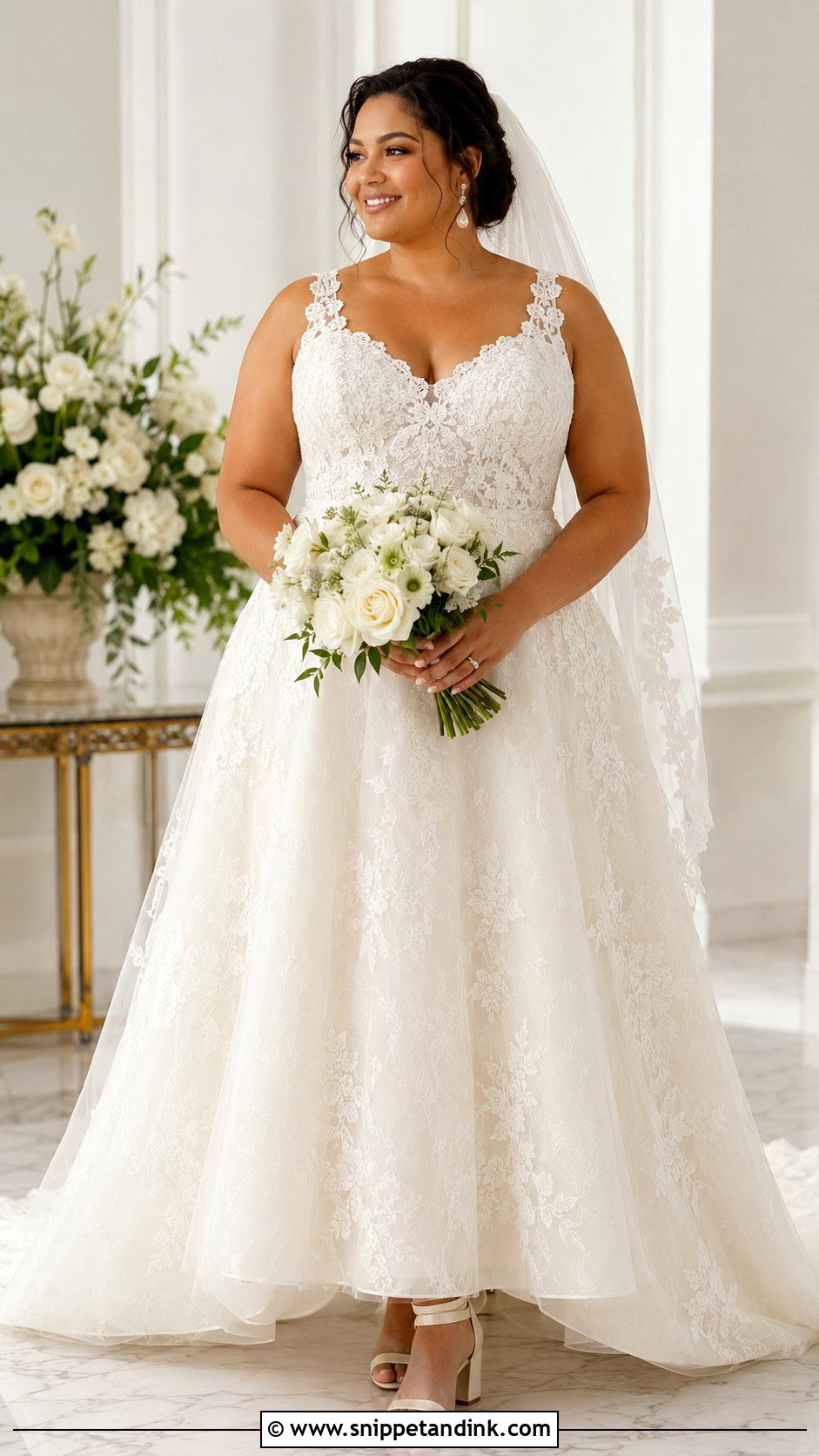
For plus size brides, the A-line remains one of the most comfortable lace shapes because the skirt falls from the waist rather than clinging to the hips. A structured bodice with wide straps, internal boning or supportive off-shoulder sleeves holds the gown in place. Medium-scale motifs stay visible across the whole dress, especially over a softly contrasting lining. One habit I’d break: don’t size up for comfort. A gown that fits at the bust and is altered at the waist, sleeves and hem will be both more comfortable and more flattering. Stable block heels, pearl drops, a chapel veil and a bouquet you can carry easily finish it.
A Snag, a Wine Spill, a Torn Bustle Loop: What to Pack for Lace
Lace is more robust than it looks, but it catches. Bracelets, prong-set rings, the hooks on a bouquet wrap, a guest’s watch during a hug: any of them can pull a thread. Give one bridesmaid a small pouch with the following.
- A fine needle and thread in the gown’s colour, plus a few small safety pins.
- Clear nail polish for a stray thread end, used only on the underside and only as a last resort.
- White chalk or a white stain stick for small marks on the hem.
- Plain white cloth and still water for blotting spills, never rubbing.
- Spare bustle hooks or a length of ribbon, in case a loop pulls loose.
If a thread does pull, don’t cut it. Ease it back to the wrong side with the needle, or tuck it under a nearby motif. Snipping a loose thread can start the lace running.
After the Party: Getting Lace Clean Before Marks Set
Sugar from champagne and cake is often invisible at first and turns yellow later, which is why I tell brides not to leave a gown in its bag for months. Take it to a cleaner who handles bridal wear within a few weeks and point out every spill you remember. Beaded or glued embellishment needs telling about too, as some solvents can loosen it. For storage, I’d use acid-free tissue in the folds and a breathable cotton bag rather than plastic, kept somewhere cool, dark and dry.
Your Shortlist Should Fit in One Hand
Pretty lace is everywhere, so it’s rarely what decides the dress. Support, venue fit and how freely you can move matter more. Start with silhouette, neckline, coverage and how much drama you want, then compare lace scale, lining colour, train length and accessories. Try each finalist with similar shoes, the right underwear, jewellery and a veil, so you’re judging the whole look and not just the gown on a hanger. Good alterations can change how a dress looks and feels more than most brides realise. Narrow down to three or four from these ideas and book appointments with those in mind.
You'll Like These Ideas:






Leave a Reply