
Sunflower wedding cakes are among the friendliest designs I make. The flower carries so much color on its own that the frosting can stay plain, and it suits barns, gardens, summer lawns and autumn harvest tables alike. It also changes character depending on what surrounds it: with burlap and a wood slice it reads country, with smooth ivory and a touch of gold it reads formal. Below are 30 designs I like, with notes on how each one is actually built and where it can go wrong, so you walk into your tasting knowing what to ask for.
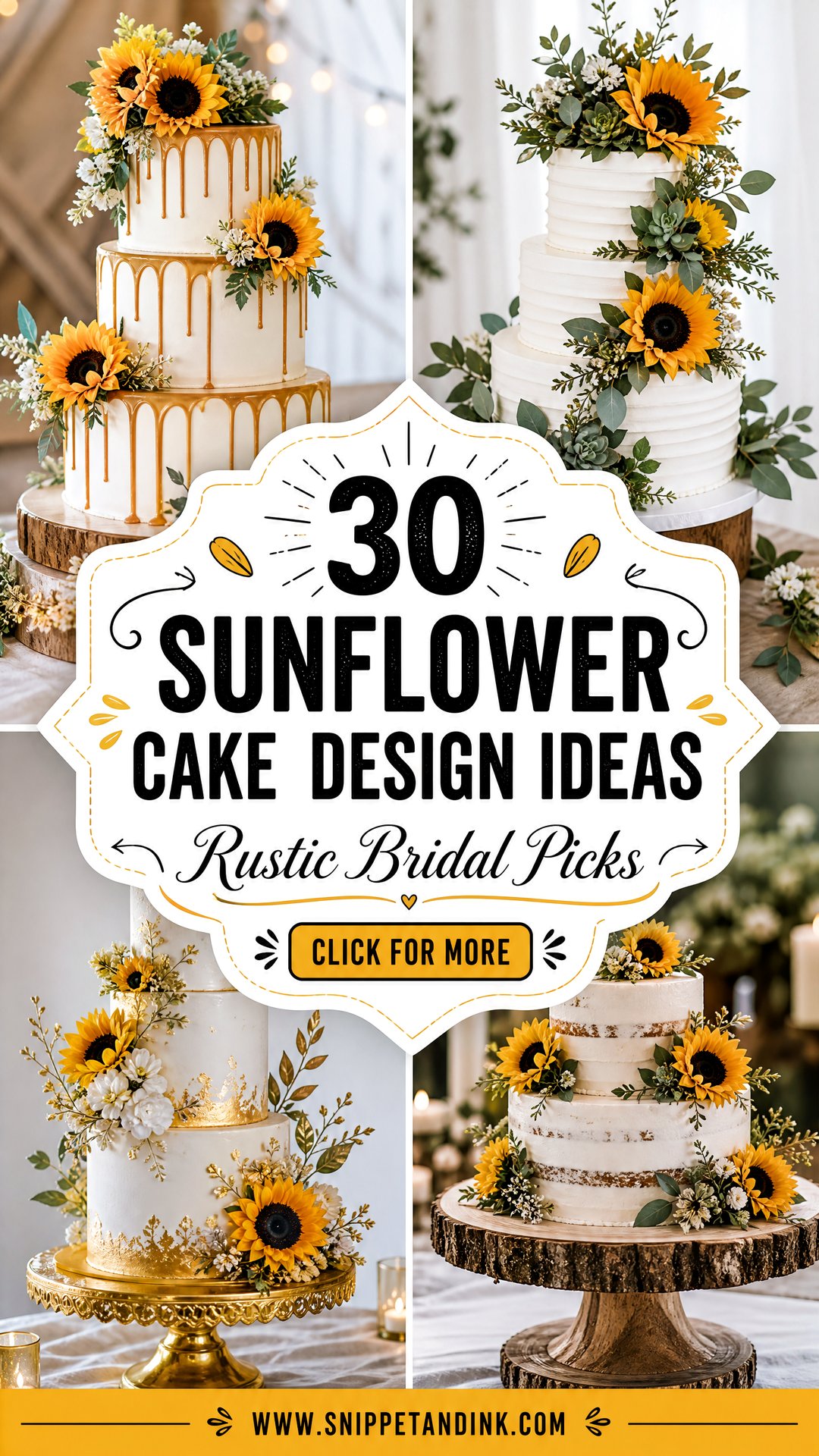
Real Petals, Sugar Petals or Wafer Paper on a Sunflower Cake
The first decision I go through with couples is not the frosting but the flower itself. Each option behaves very differently on the day.
Fresh sunflowers
They are cheaper and look alive, but they need care. Florists usually supply pollen-free varieties for weddings, which matters on a cake, since loose pollen drops yellow dust onto white frosting. The stems should never go straight into the sponge. I wrap them in floral tape or slide them into food-safe picks or straws, and I ask that flowers for the cake are grown or sourced without pesticides. Sunflower heads are heavy and turn toward light, so they are best sitting on tier ledges rather than pinned to vertical sides.
Sugar sunflowers
These are made petal by petal and can be prepared weeks before the wedding. They never wilt, so they suit outdoor summer receptions and cakes that will be displayed for hours. The downsides are time, which shows in the price, and fragility: sugar petals snap if knocked and soften in humid air. Many couples keep them afterwards as a memento.
Wafer paper flowers
Wafer paper is lighter and less expensive than sugar paste and gives a softer, papery look. It reacts badly to moisture, though, and can curl or melt against damp buttercream, so I only use it on firmer frostings or fondant.
1. Rustic Sunflower Wedding Cake
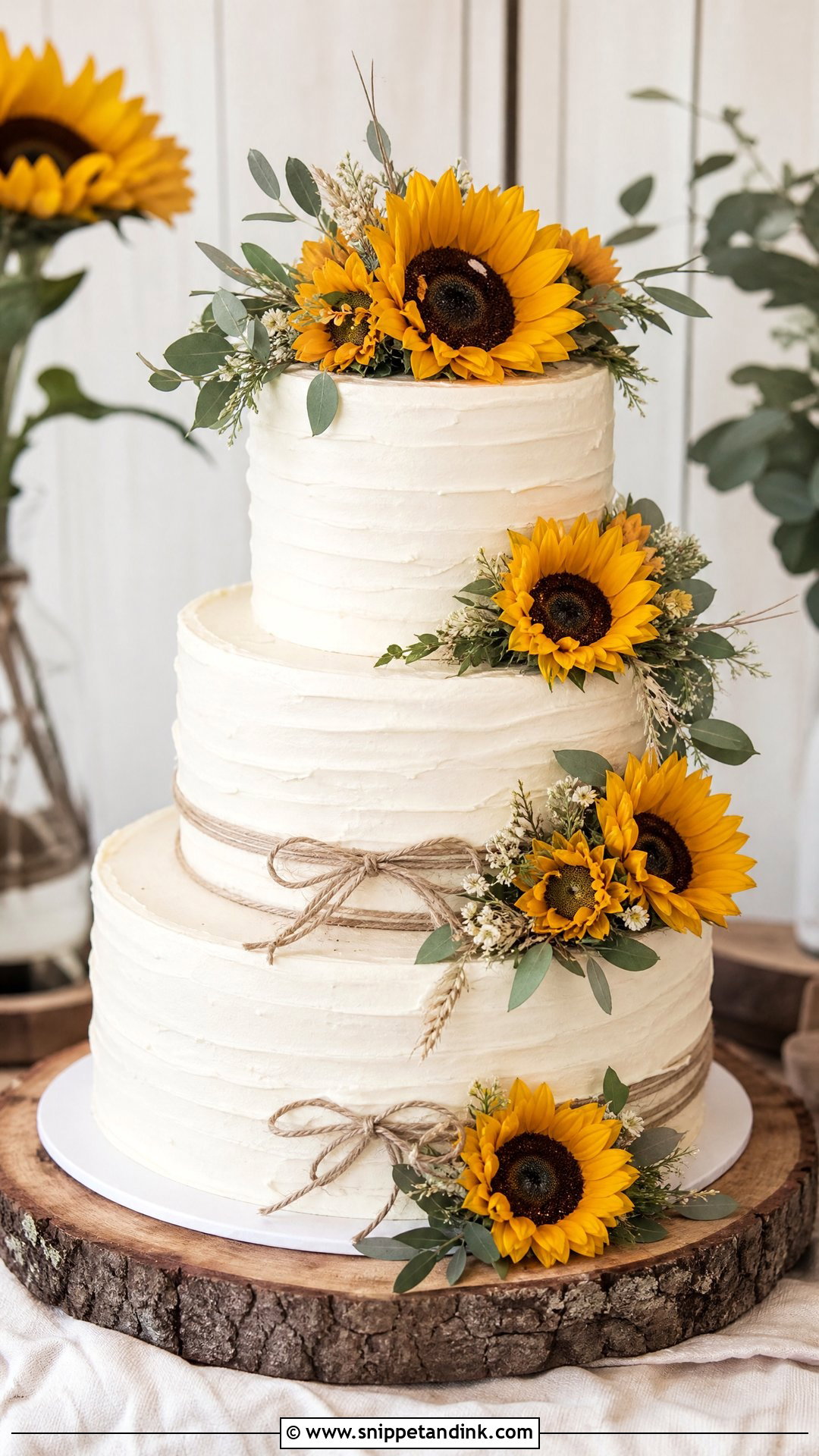
This is the design most couples picture first: ivory buttercream or a semi-naked finish, sunflowers at the base and between the tiers, a wooden stand and a little twine. The detail that separates handmade from messy is the grouping. I place blooms in uneven clusters of three or five and turn some faces slightly sideways, the way they grow in a field, rather than lining them up in a ring. Barn and farm receptions suit it best.
2. Sunflower Naked Wedding Cake
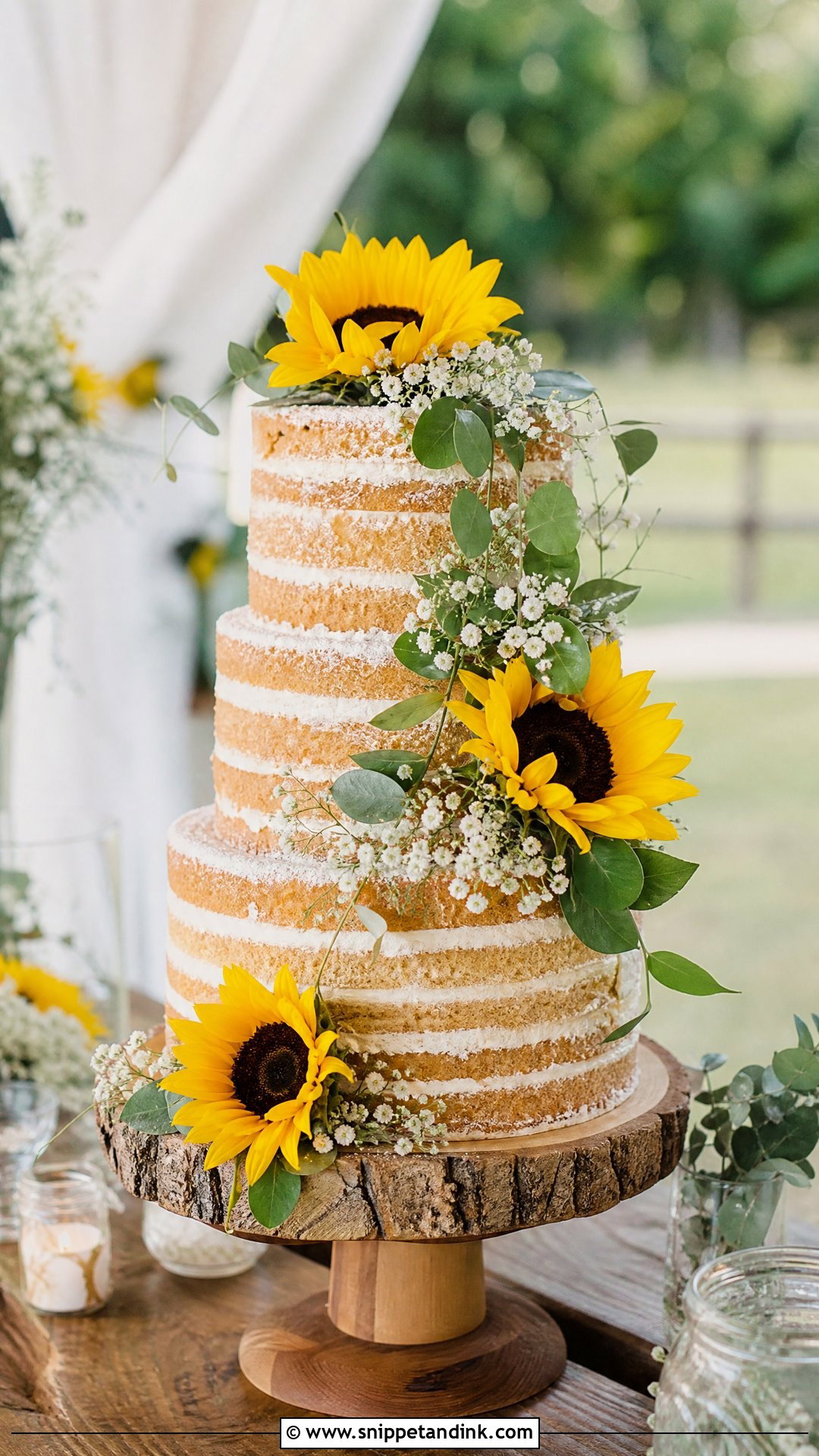
A naked cake has only a thin scrape of frosting, so the layers show through. That exposure is also the weakness: bare sponge dries out faster than a fully frosted cake, so I brush every layer with a light syrup and finish the cake as close to delivery as I can. Honey, lemon, vanilla and spice sponges all sit well beside sunflowers. Tuck in eucalyptus or small white blooms, and set it on a wood slice or a plain white pedestal.
3. Sunflower Buttercream Wedding Cake
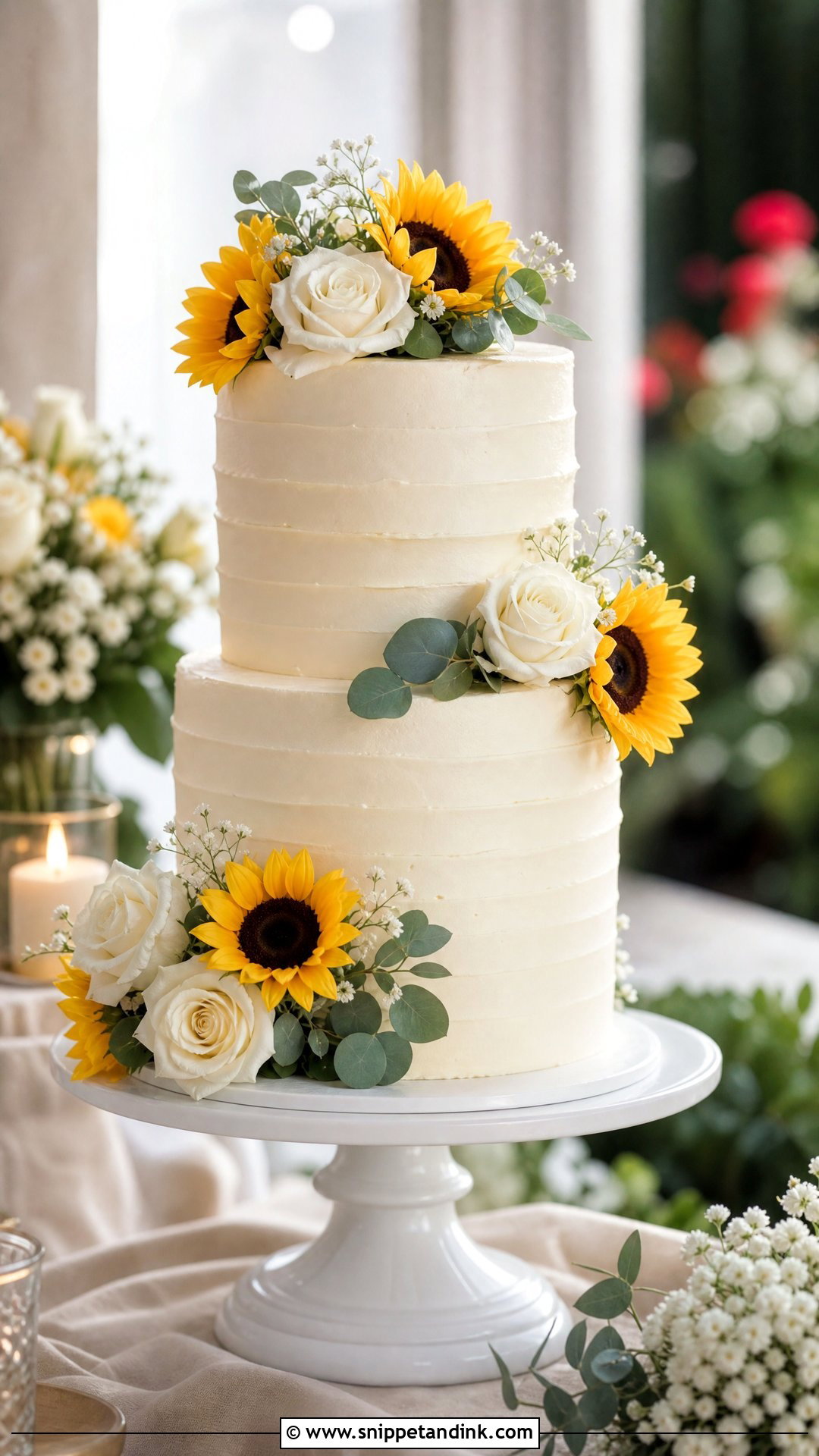
Buttercream gives you two very different cakes depending on finish. Smooth ivory is a clean backdrop for one large sunflower cluster on top and smaller ones below; a combed or palette-knife texture makes the same flowers look farmhouse. Adding white roses or pale yellow buds softens the sunflower’s graphic face. I’d steer outdoor summer couples toward a firmer buttercream recipe, since a soft meringue style can start to slump in direct heat.
4. Sunflower Tiered Wedding Cake
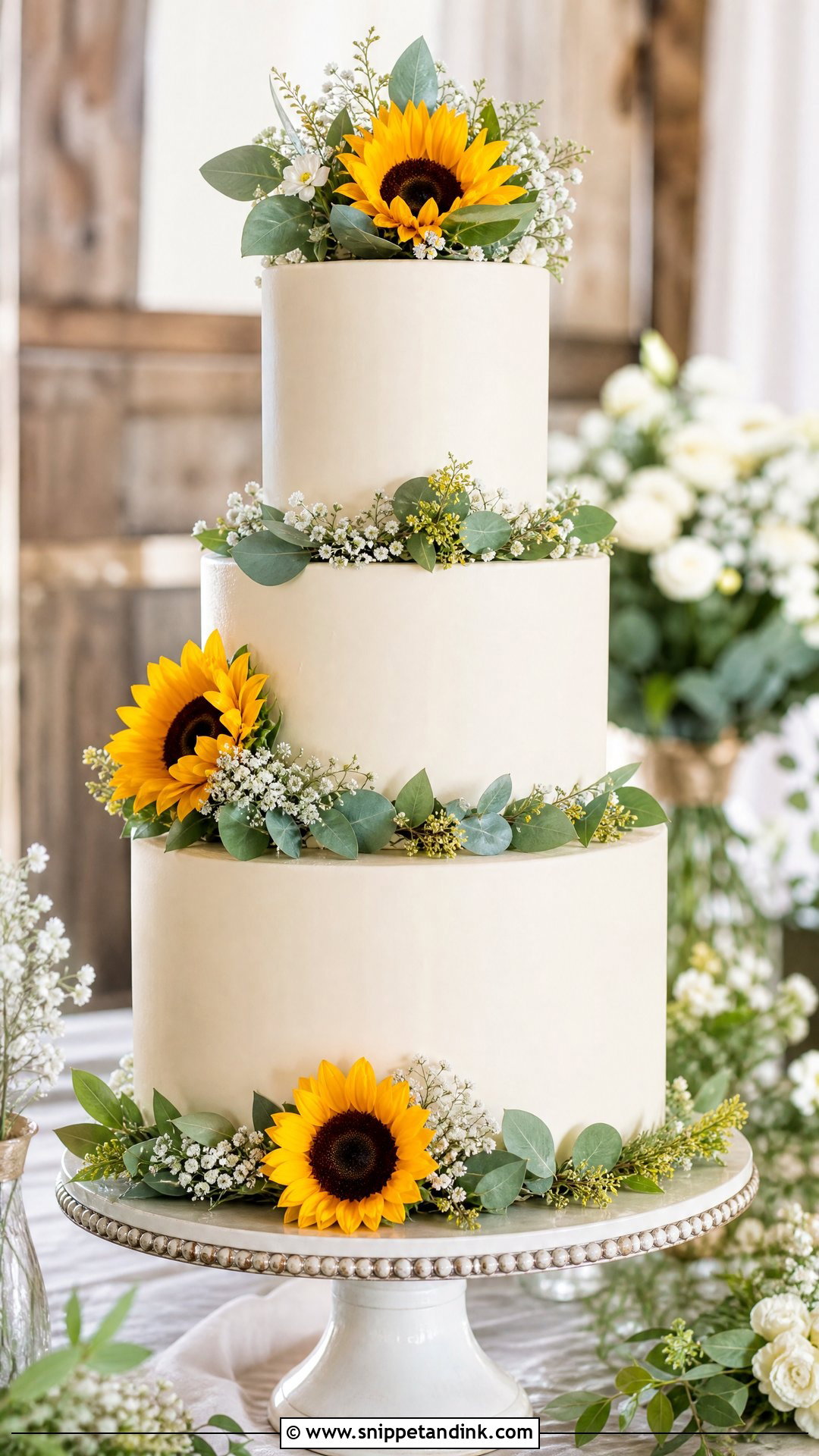
Three tiers is the size I’m asked for most, because it gives the florals room to step down the cake without the whole thing looking top-heavy. Behind the scenes, every tier sits on its own board with dowels underneath, which is what lets me tuck flowers between the tiers without them being crushed. Textured buttercream leans rustic; smooth fondant or sharp-edged buttercream leans formal. Keep the frosting ivory and let the blooms bring the color.
5. Sunflower And Rose Wedding Cake
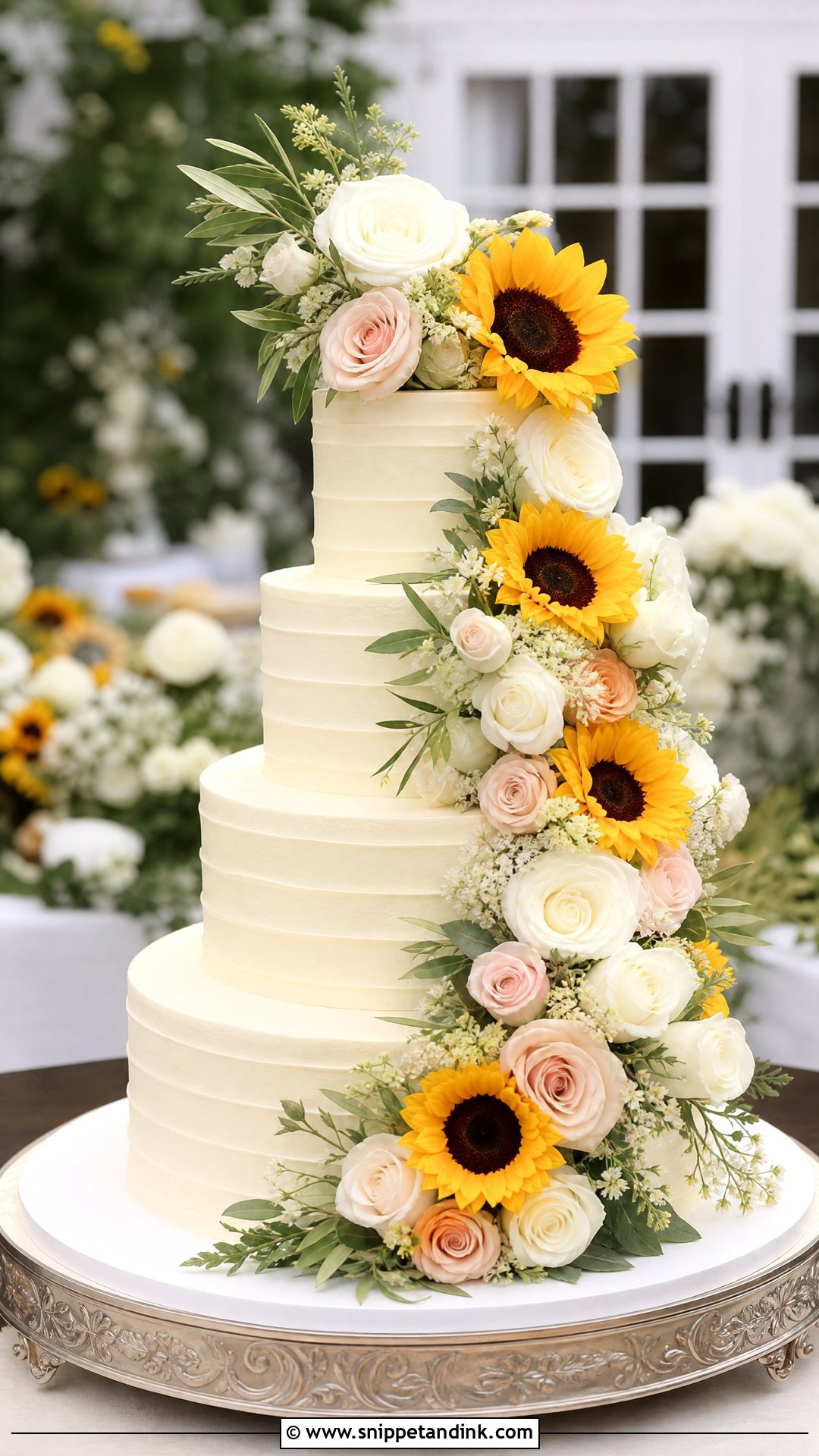
Roses soften what a sunflower does loudly. White roses keep it classic, blush roses push it toward a warmer garden feel. The arrangement works best when sunflowers lead and roses support, so I usually use two or three sunflowers and fill the gaps with roses running diagonally down one side. Small greenery sprigs connect the clusters. Summer and early autumn are the natural seasons for this pairing.
6. Sunflower And Baby Breath Wedding Cake
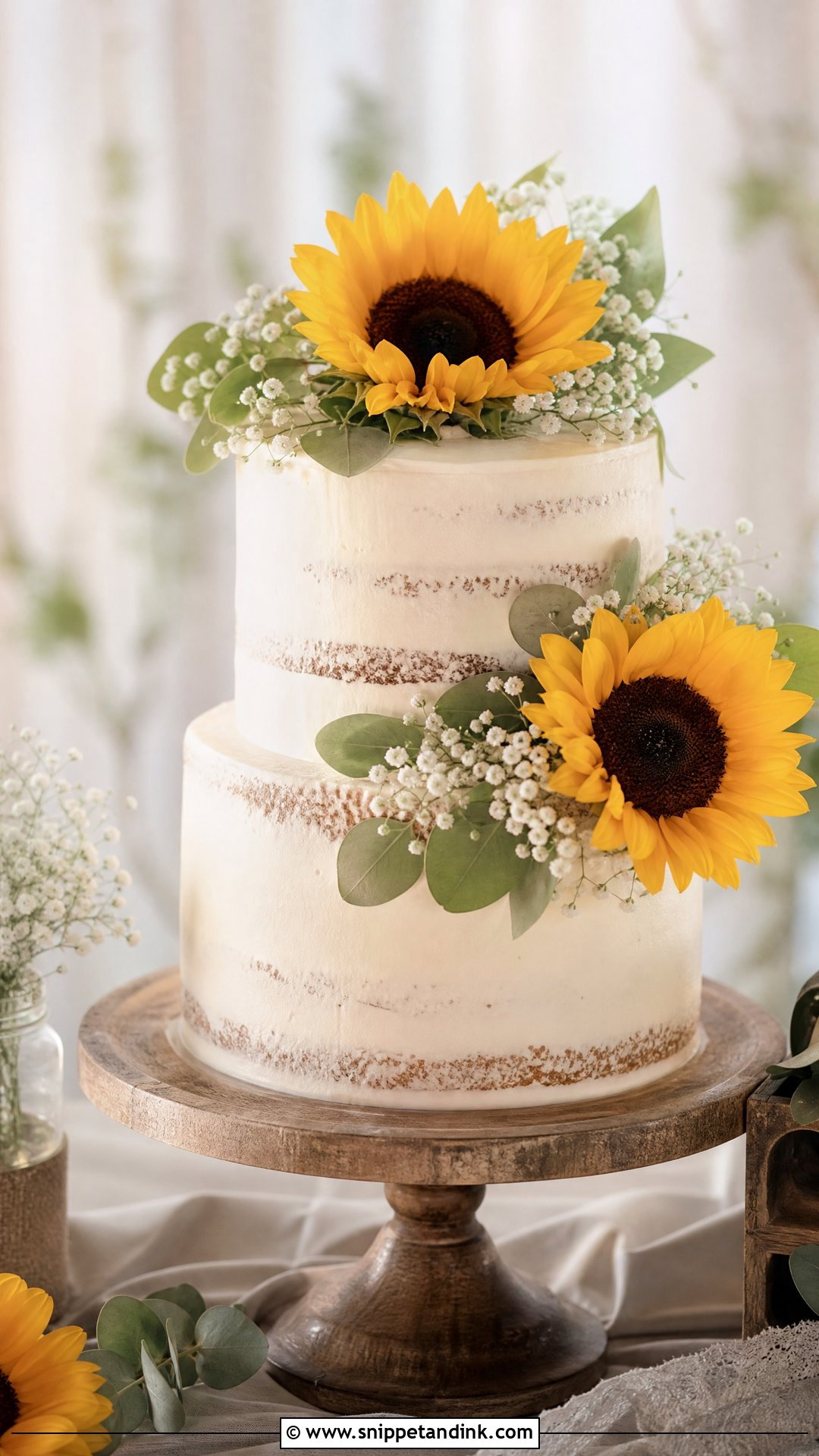
Baby’s breath around sunflowers lightens the bold shapes and gives a delicate, rustic finish. It suits a semi-naked cake especially well. One practical note from the kitchen: gypsophila is one of the flowers I never let touch the cake directly, as it is considered mildly toxic, so I place it on picks or wrap the stems before it goes in. Keep the topper simple or skip it, and leave enough frosting showing that the cake doesn’t look crowded.
7. Sunflower And Eucalyptus Wedding Cake
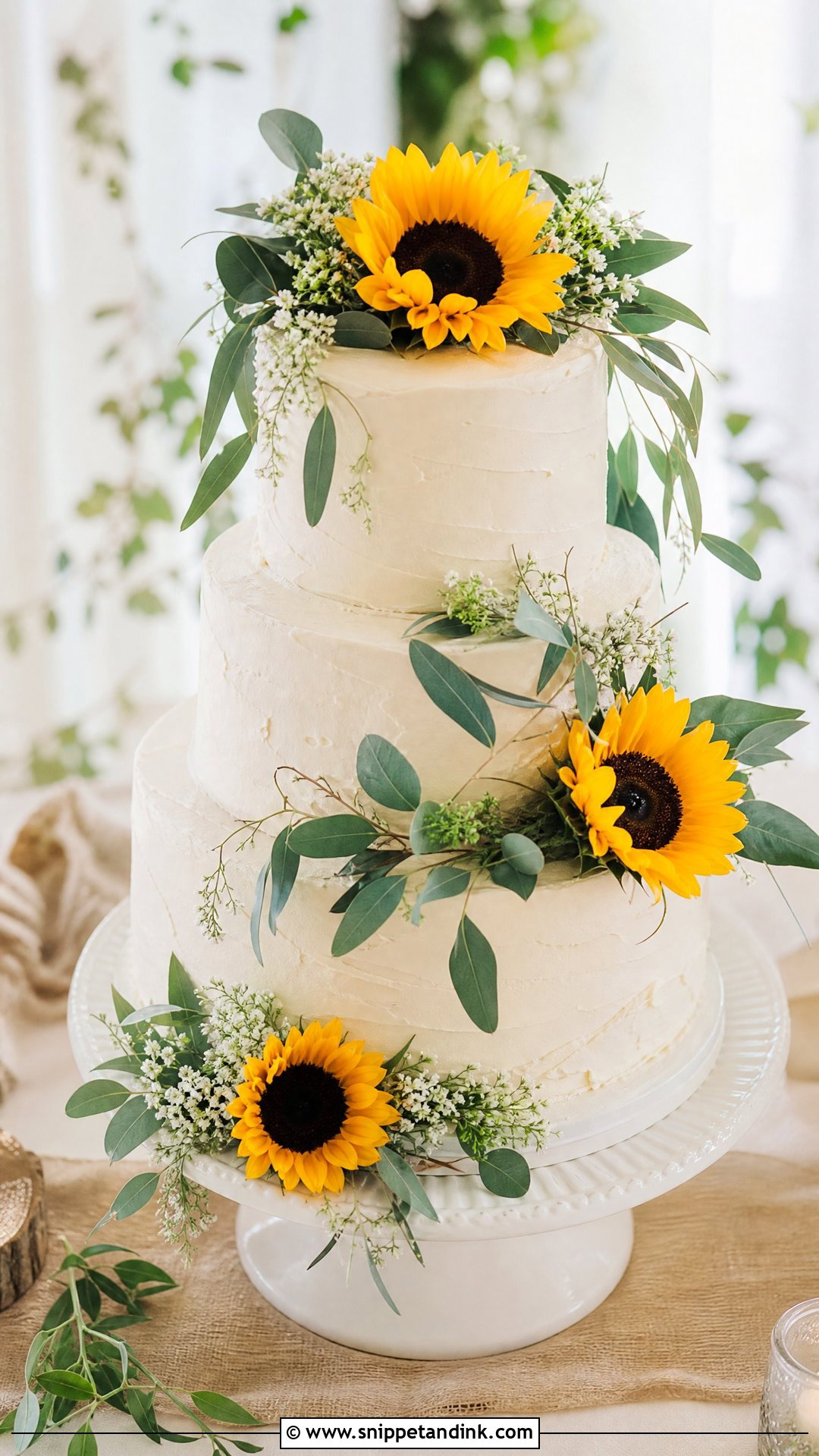
Eucalyptus brings a dusty, blue-green tone that calms the bright yellow. Let it trail loosely around the tiers rather than wrapping tightly; tight wraps look like a garland, not a plant. Eucalyptus has a strong scent and oils of its own, so like most greenery it should be on wrapped stems or sit against a barrier rather than pressed into buttercream. Smooth finishes look modern, textured ones rustic, and boho garden receptions suit both.
8. Sunflower And Burlap Wedding Cake
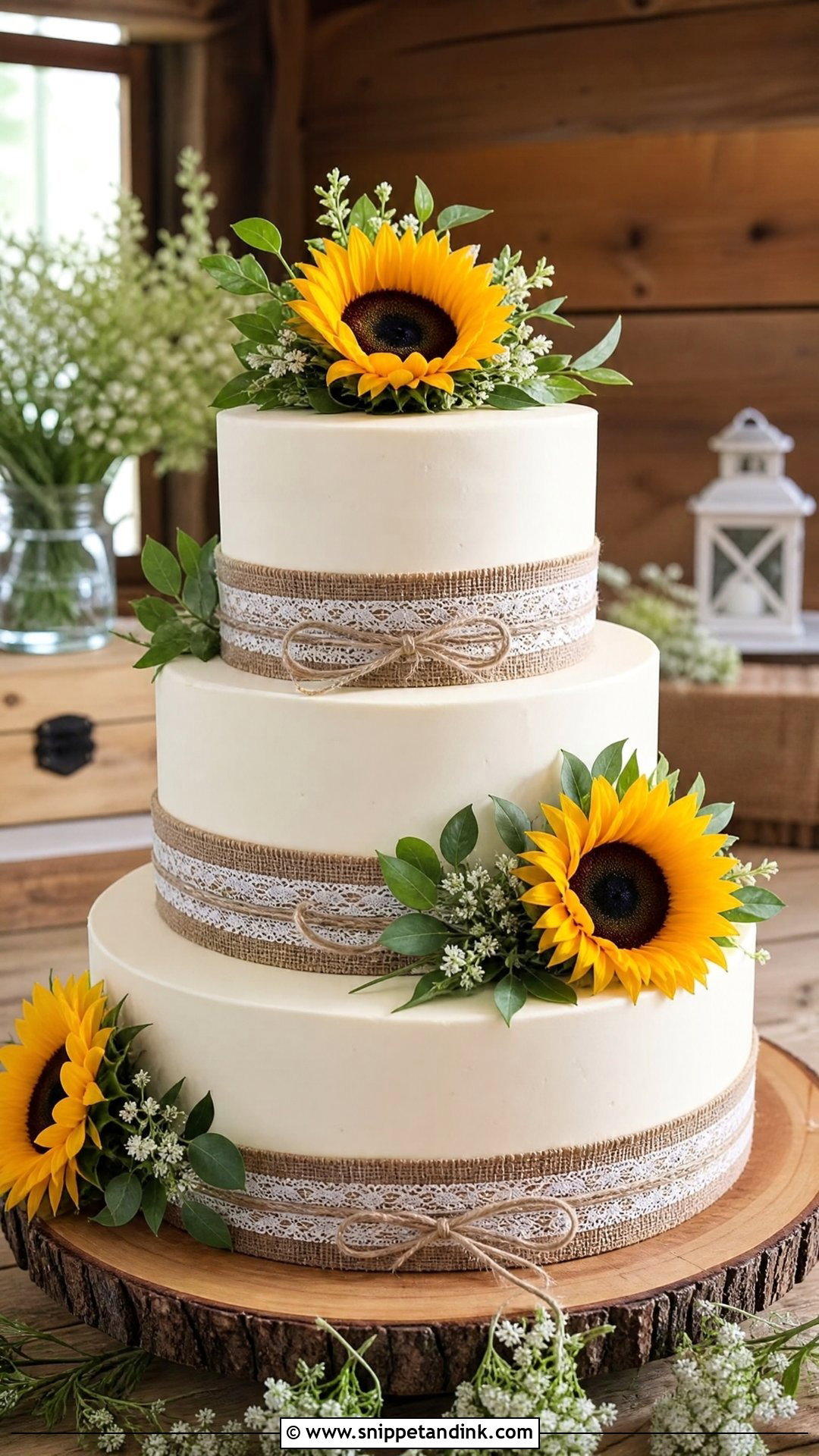
A sunflower and burlap wedding cake belongs at a ranch, barn or country venue. Burlap is fabric, not food, so I always back the ribbon with a strip of parchment or acetate before wrapping a tier; otherwise butter seeps into the weave and leaves greasy spots that show in photos. A layer of lace on top softens it. Keep the frosting simple and finish on a wooden stand with a little twine.
9. Sunflower Drip Wedding Cake
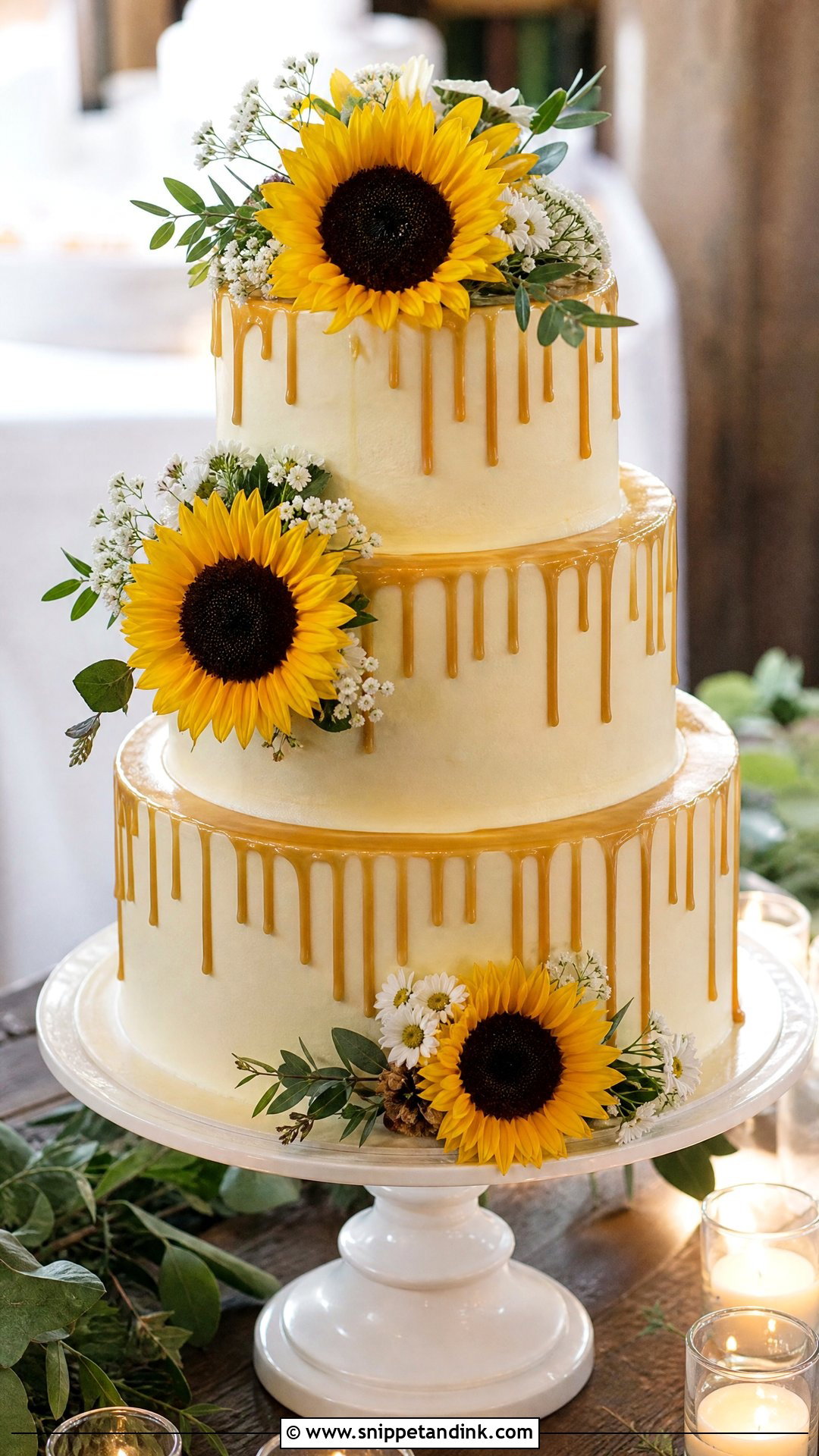
A drip cake reads more playful than a classic tiered design, and I keep the drip thin when the cake is for a wedding. White chocolate, caramel or a gold-painted drip all work over ivory or pale yellow buttercream. The cake has to be well chilled before the drip goes on, or it runs to the board. Add sunflowers on top and down one side. In a hot venue I’d skip this one, since chocolate drips soften quickly.
10. Sunflower Square Wedding Cake
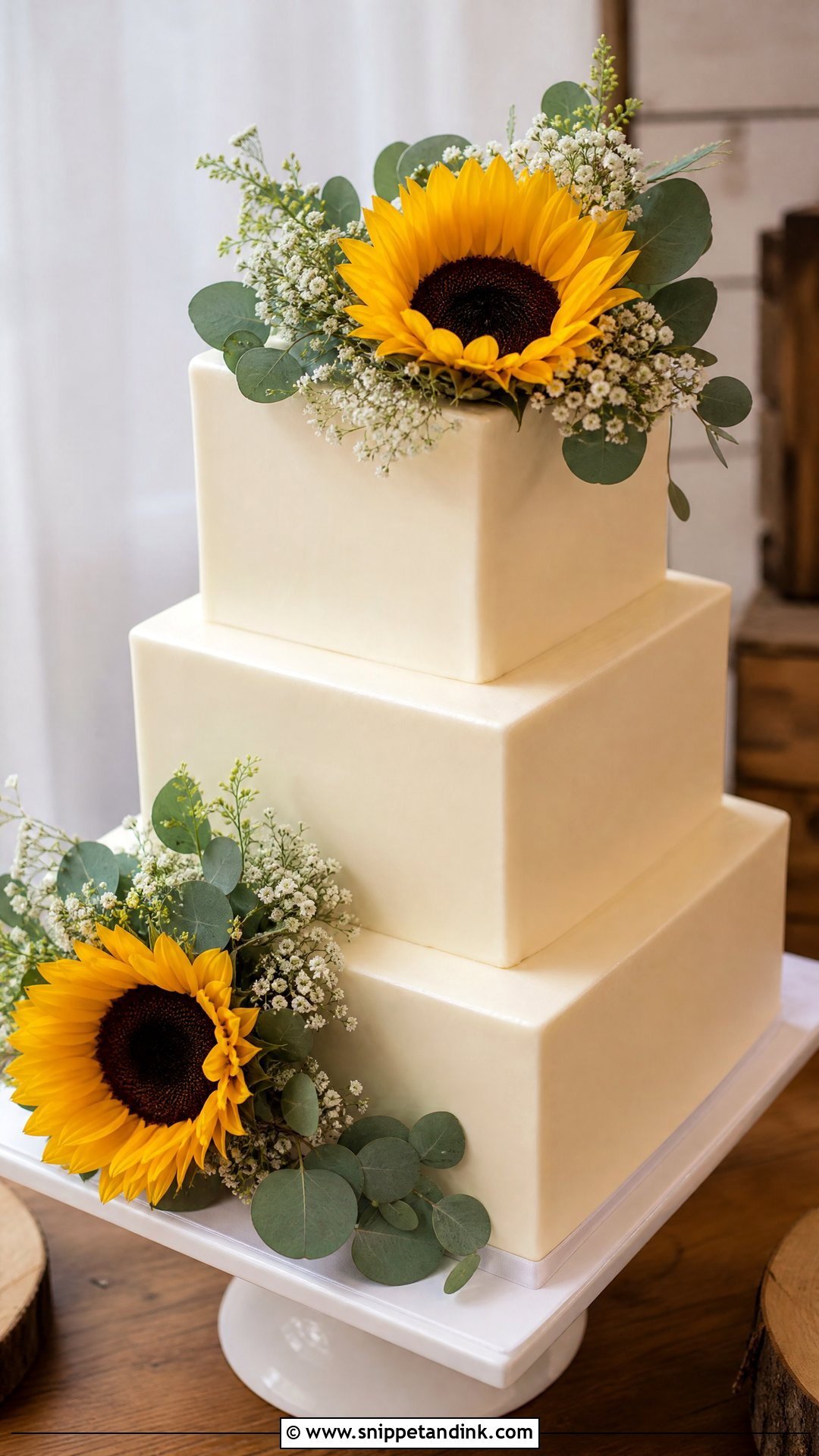
Square tiers look modern and give sunflowers sharp edges to play against. They are also harder to make than round tiers: getting crisp corners in buttercream takes time, and the corners are where damage shows first in transport. Smooth buttercream or fondant suits the shape. Place flowers at opposite corners or in one cascade, and keep the stand plain so the outline stays crisp.
11. Sunflower Cupcake Wedding Cake
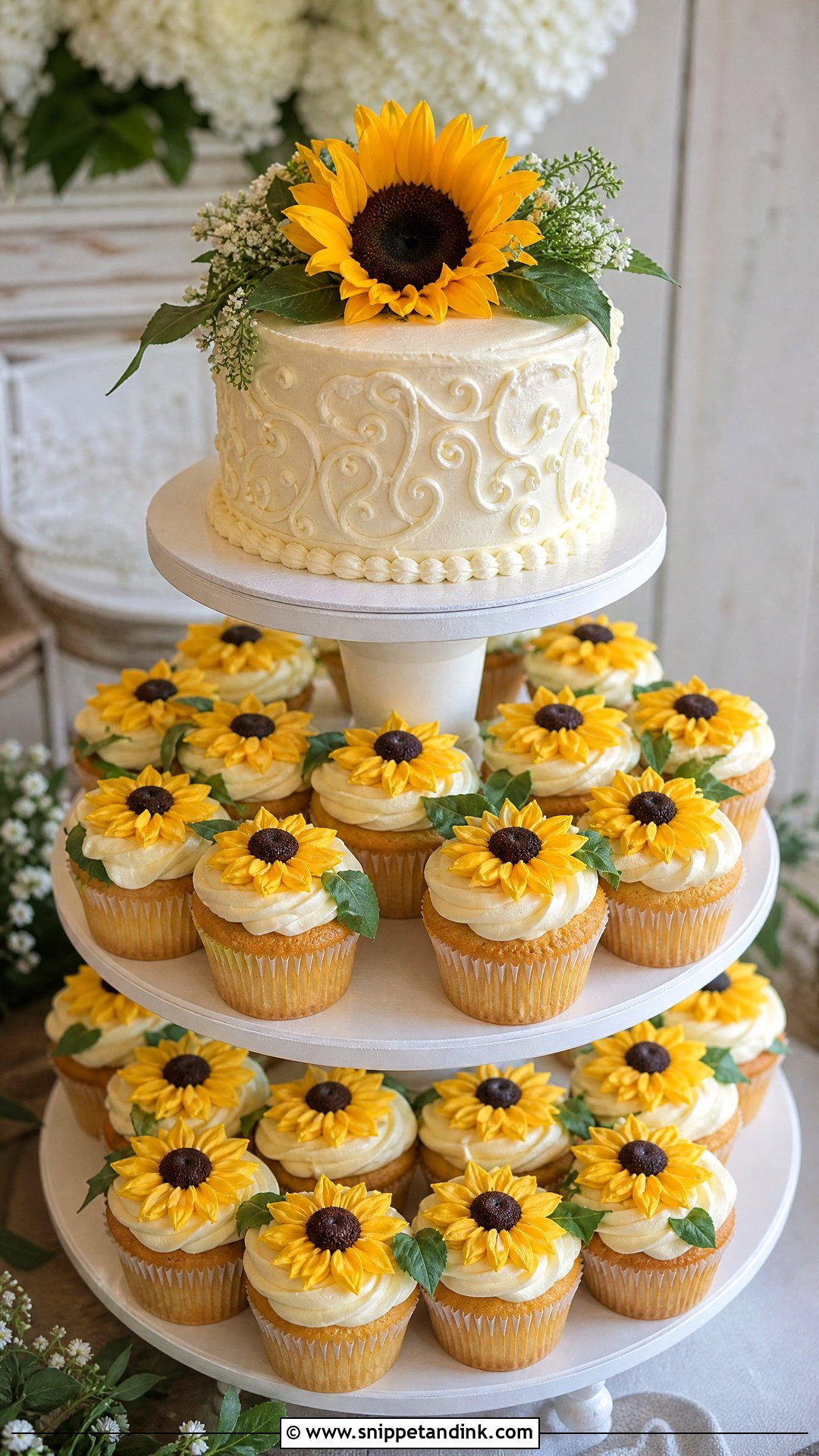
Cupcakes around a small cutting cake are a practical choice: no slicing service, and guests can help themselves. I pipe some cupcakes with sunflower petals using a leaf tip in two shades of yellow, and finish the rest with simple ivory swirls so the display doesn’t feel busy. Top the cutting cake with a real or sugar sunflower. Keep everything in yellow, ivory and green so the table reads as one design.
12. Sunflower Sheet Wedding Cake
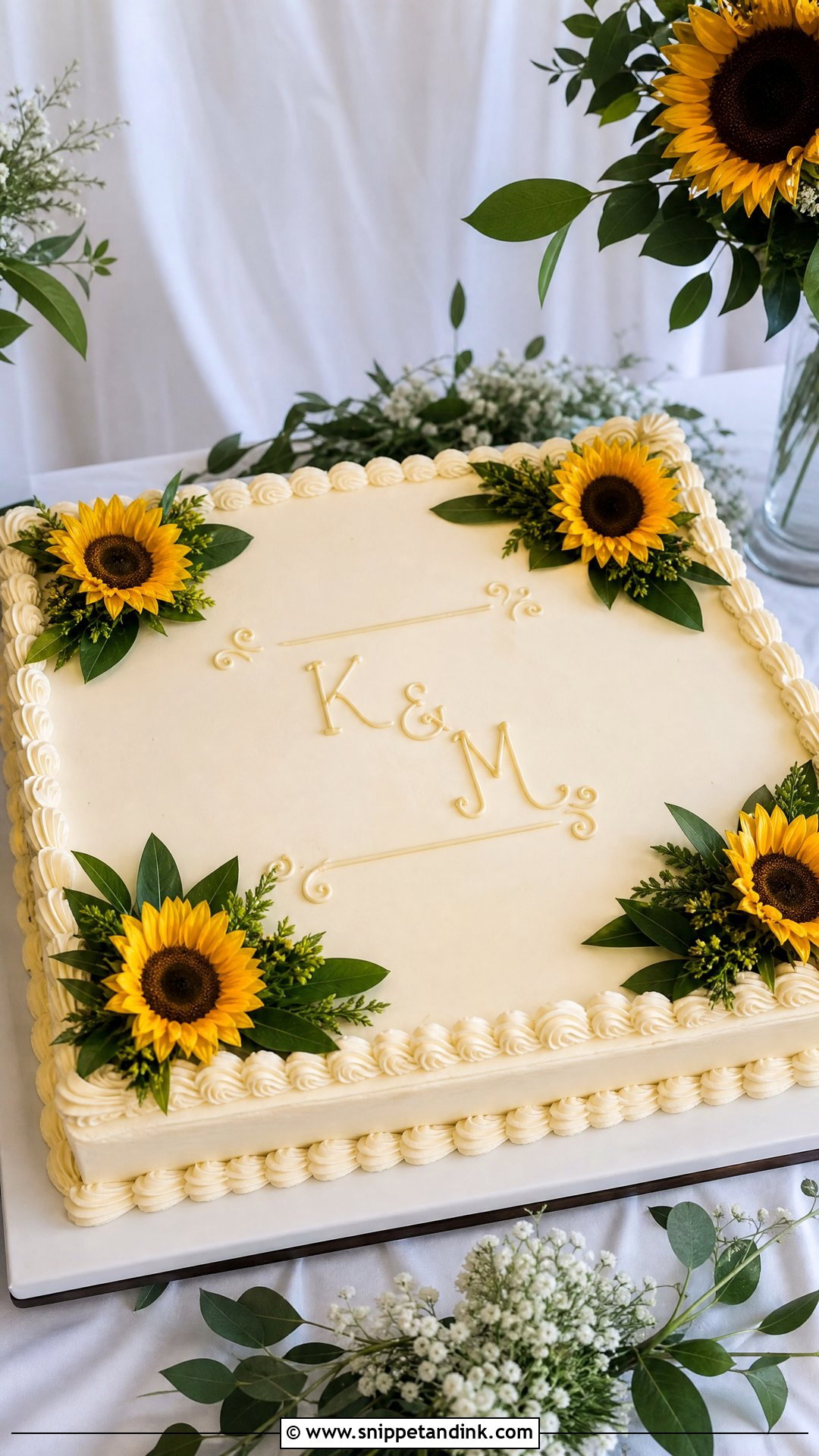
A sheet cake, decorated with care, feeds a large guest list for less. Many couples order a small display cake for the cutting and a kitchen sheet cake for serving, which saves a lot of decorating time. On the sheet, piped sunflower borders or fresh clusters look good, and the rectangle gives room for initials or a date. If it is being displayed, keep the layout balanced and the frosting smooth.
13. Sunflower Fondant Wedding Cake
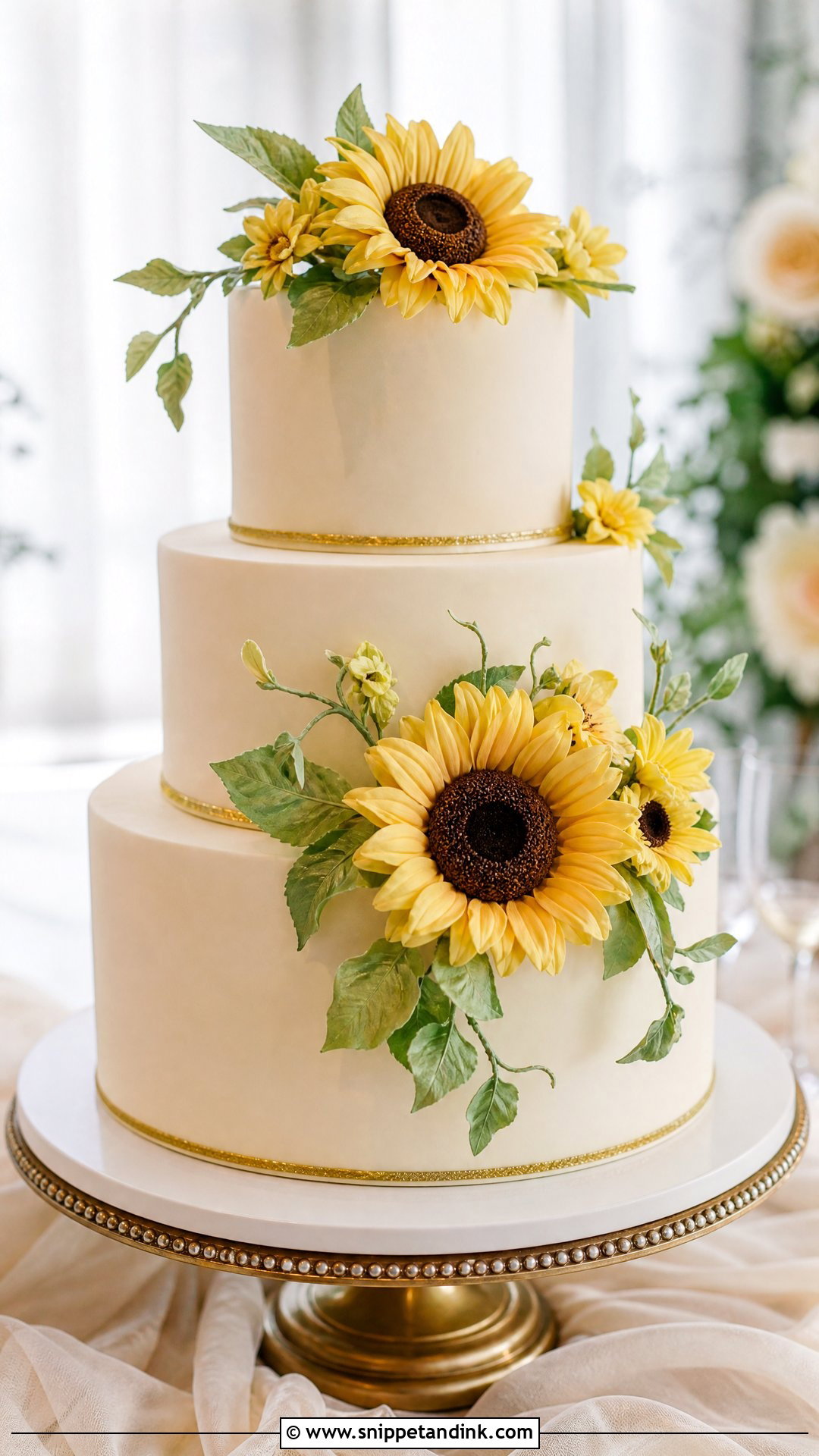
Fondant gives you the cleanest tiers and the sharpest backdrop for handmade sugar sunflowers with textured brown centers. I make sugar flowers well in advance, and they need to be kept dry: humidity softens the petals and they can droop or crack. Ivory, white or pale cream fondant works. Cluster the flowers at the base or let them cascade, and add gold trim or a monogram for a formal reception.
14. Sunflower Cascade Wedding Cake
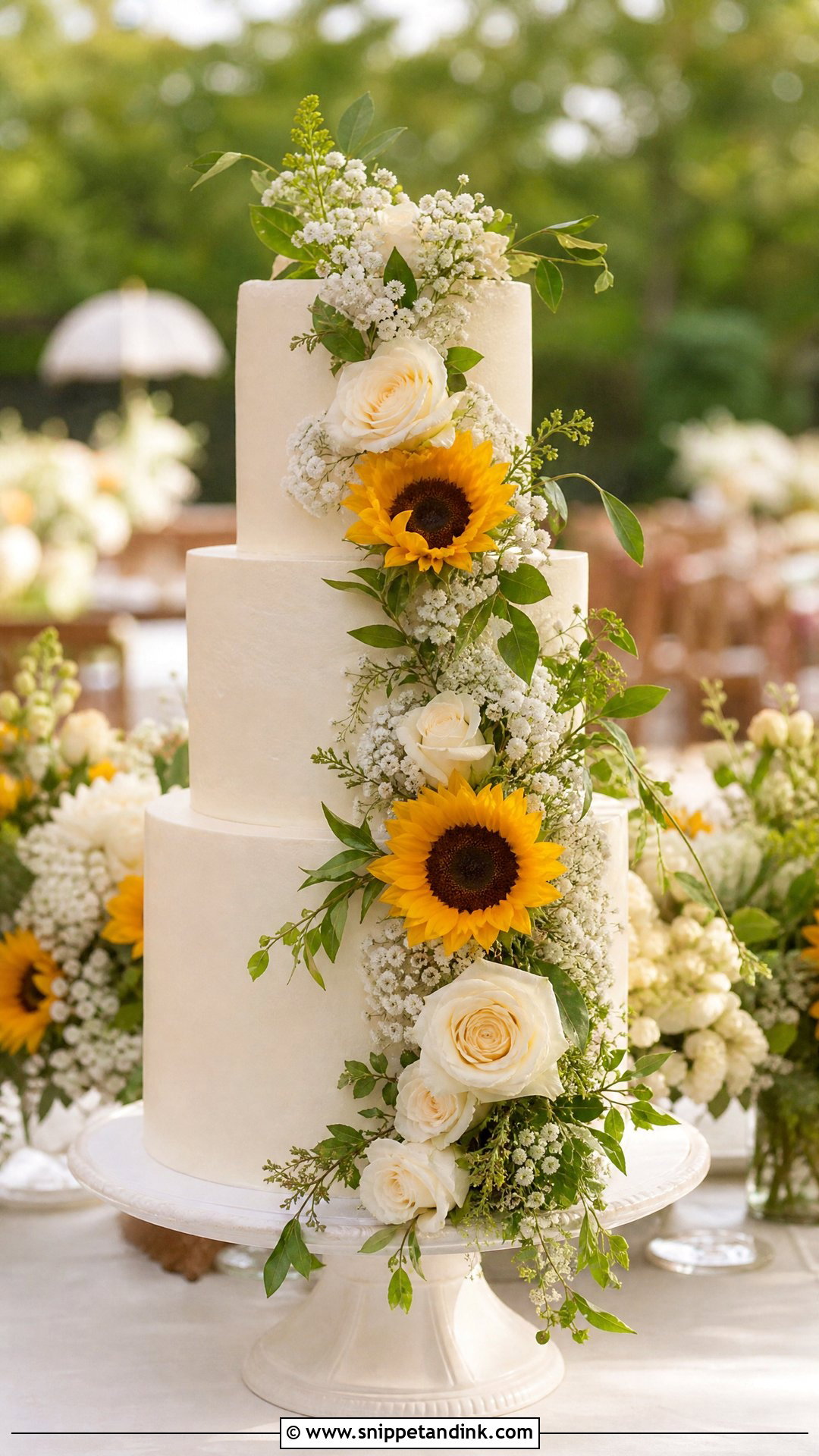
A cascade gives the cake movement from top to bottom without needing other decoration. On a white or ivory base, sunflowers mixed with greenery, small white flowers or soft roses look natural. The trick is weight. Sunflower heads are heavy, so I anchor the larger ones on the ledges between tiers and use smaller blooms on the vertical sides, where they can only be held by picks. Three or four tiers carry a cascade best.
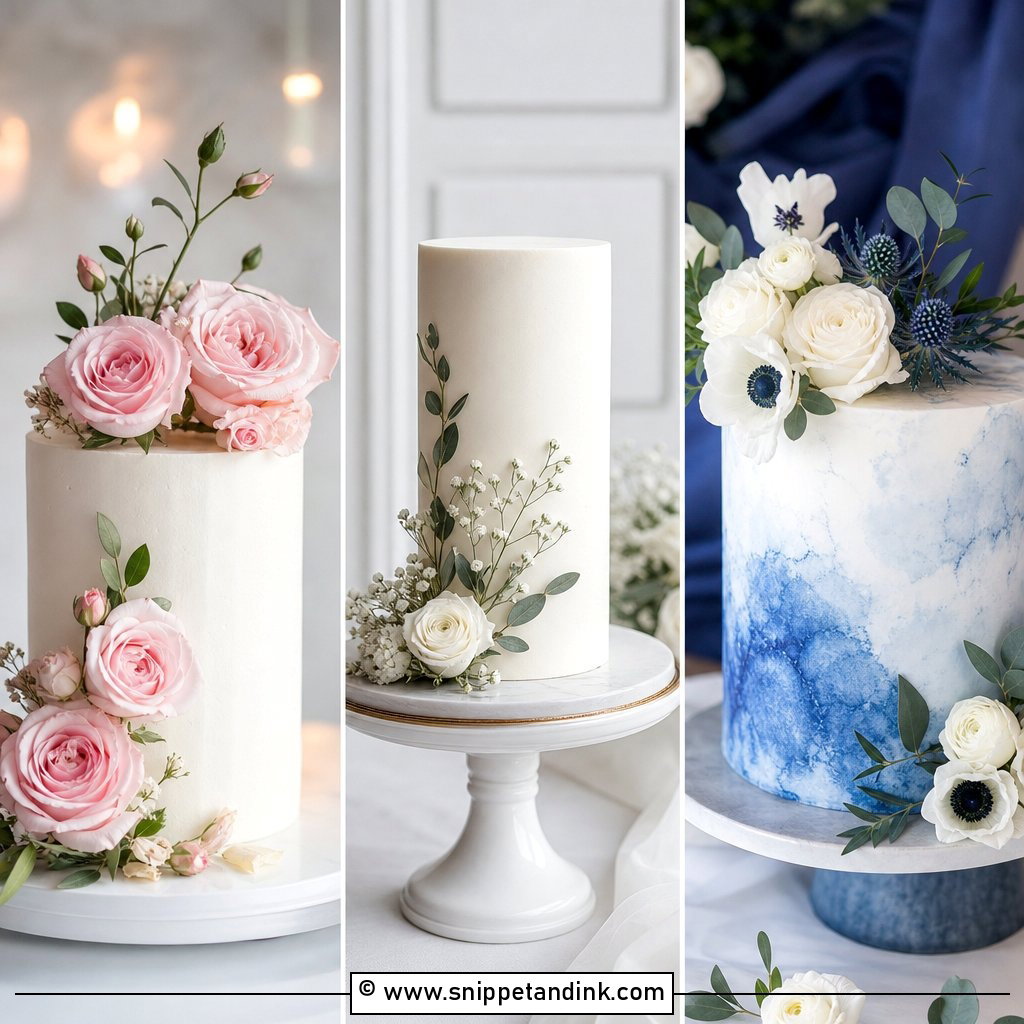
15. Sunflower Single Tier Wedding Cake
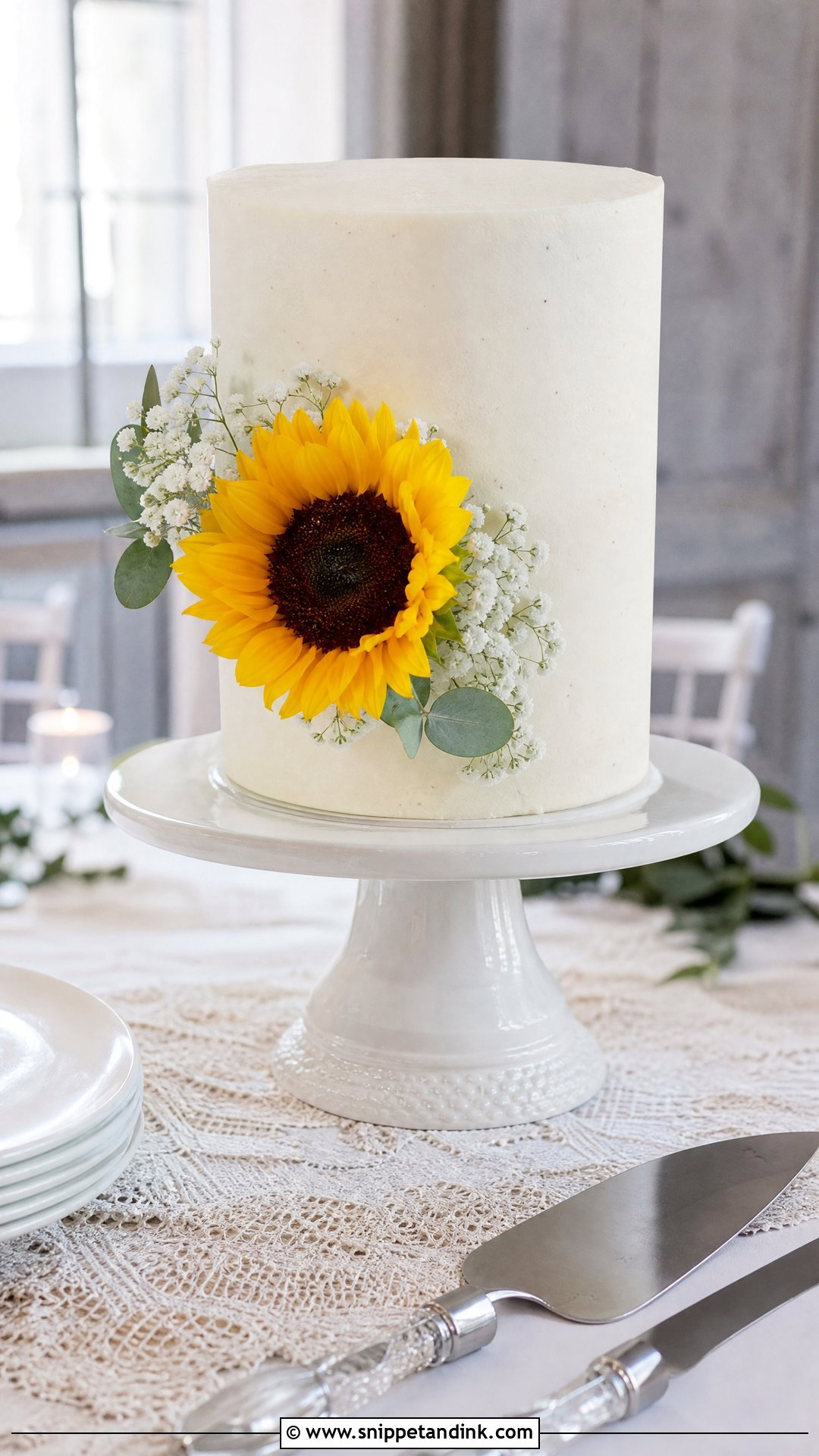
A sunflower single tier wedding cake is my usual suggestion for elopements, micro weddings and backyard ceremonies. Proportion matters more than size here. A tall single tier, often a double-height cake built with an internal board, looks far more like a wedding cake than a short, wide one. One bold sunflower on top or a small cluster to one side, a few leaves, and a ceramic stand or wooden board is all it needs.
16. Sunflower Two Tier Wedding Cake
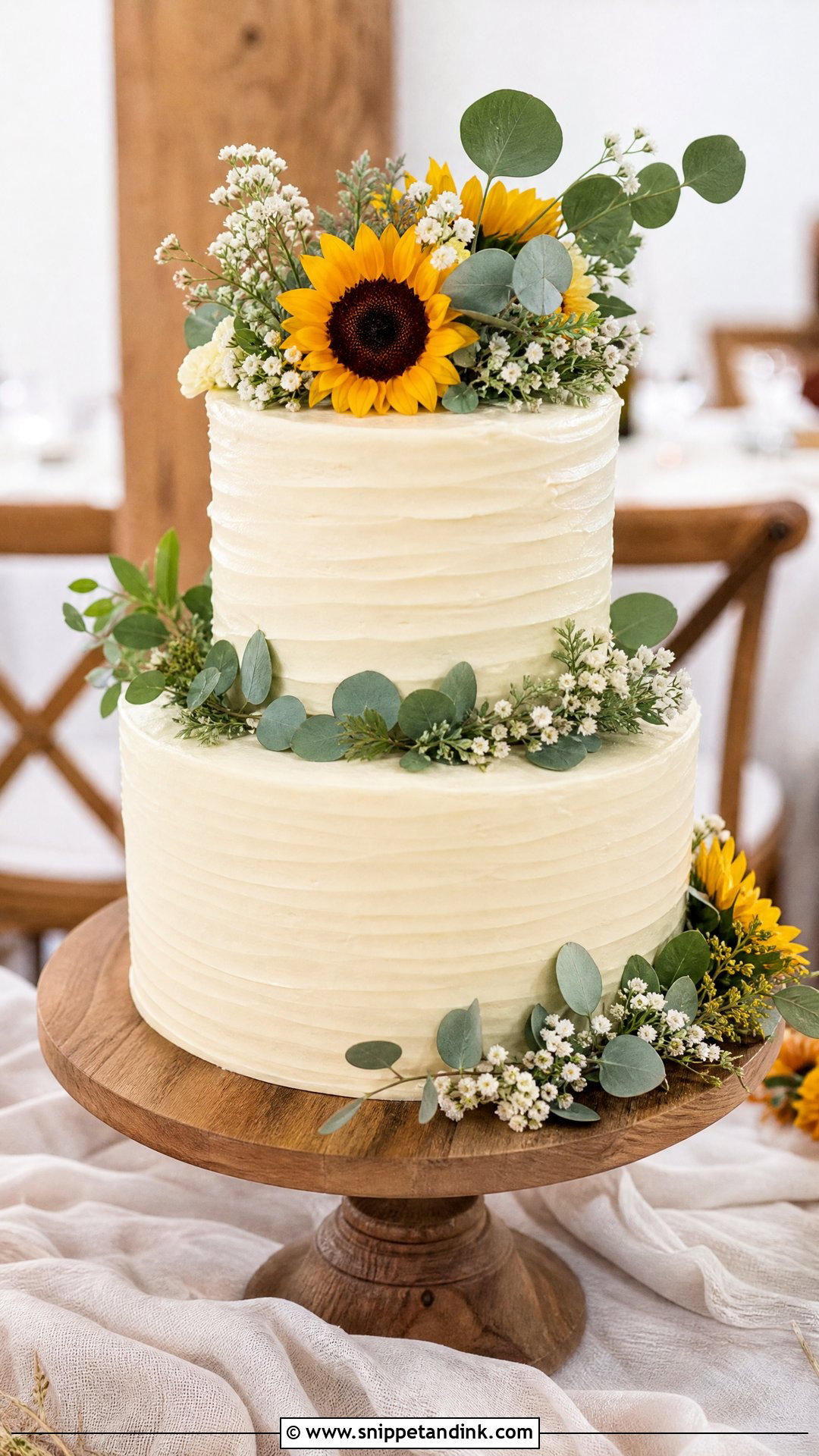
Two tiers suit medium celebrations and intimate receptions. I like texture on the bottom tier, such as combed ridges, and a smooth top tier for contrast. Sunflowers go where the tiers meet, with a small cluster on top, which looks full from the front. Lemon, vanilla and honey sponges all fit the sunny theme.
17. Sunflower Three Tier Wedding Cake
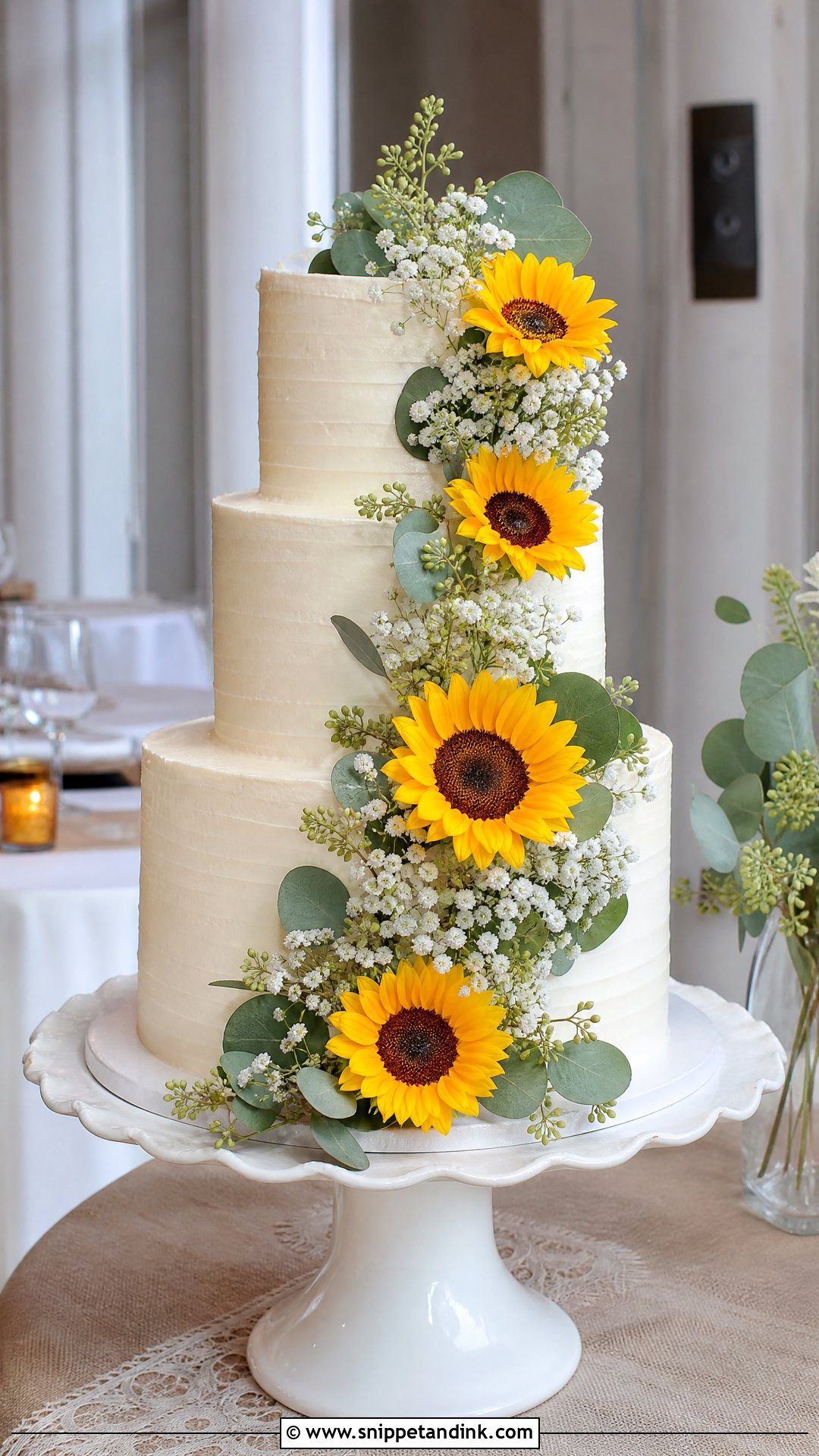
Three tiers in all-ivory with a diagonal sunflower line feels grand but still relaxed. Clusters between the tiers soften the look; greenery adds depth and a few white flowers keep it from going too yellow. For a tall cake at a venue some distance away, I often transport tiers separately and stack on site, which is safer than driving a fully assembled cake. A tall pedestal sets it off beside wood or linen styling.
18. Sunflower Wedding Cake With Daisies
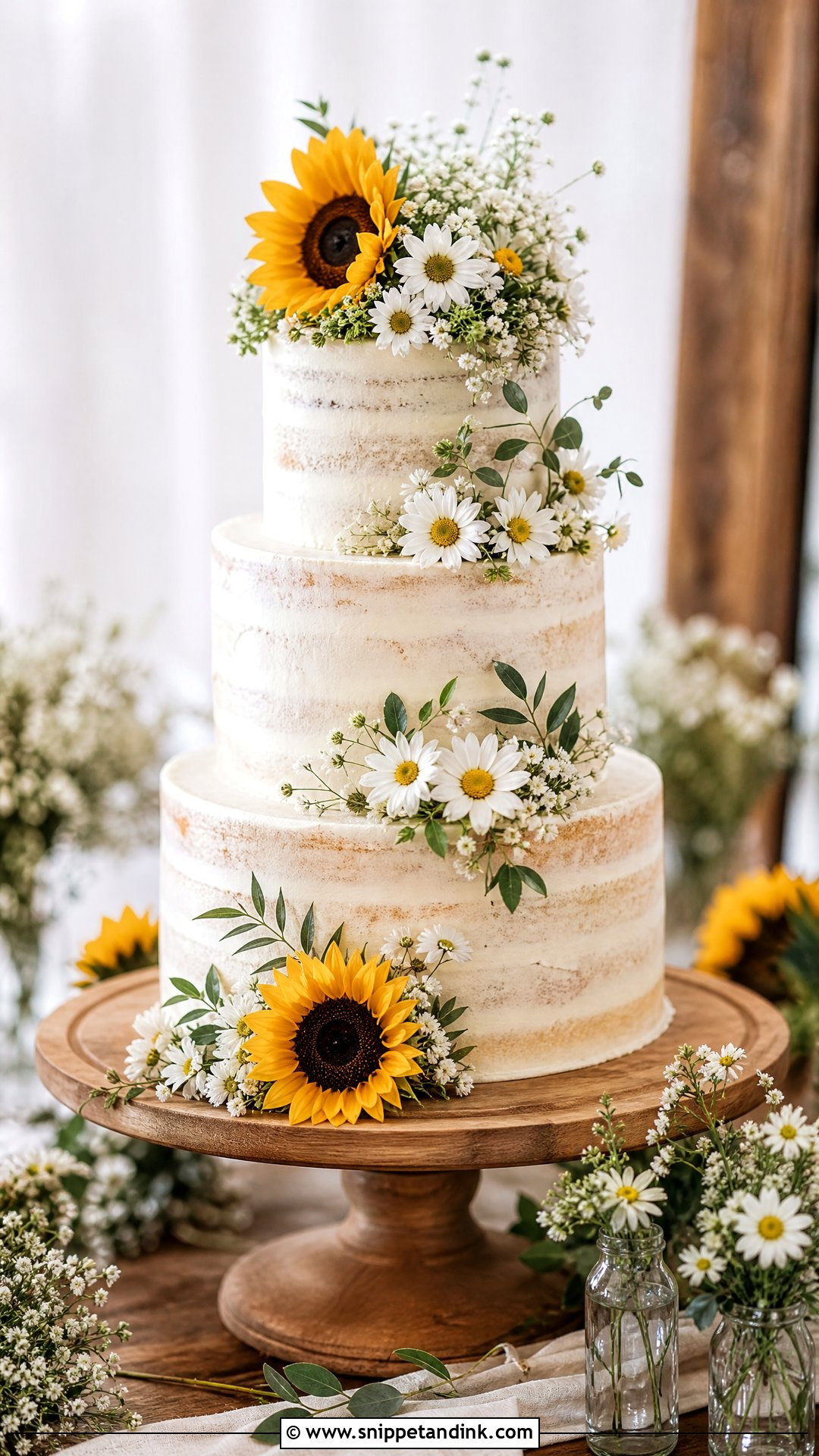
Daisies lighten the sunflower’s heavy face and turn the design into a meadow-inspired wedding cake. Scatter both in loose clusters over a smooth or semi-naked finish. Daisies wilt faster than sunflowers out of water, so I add them last, after the cake is set up. Keep the palette to ivory, yellow, white and green, and it sits comfortably beside wildflower centerpieces.
19. Sunflower Wedding Cake With Greenery
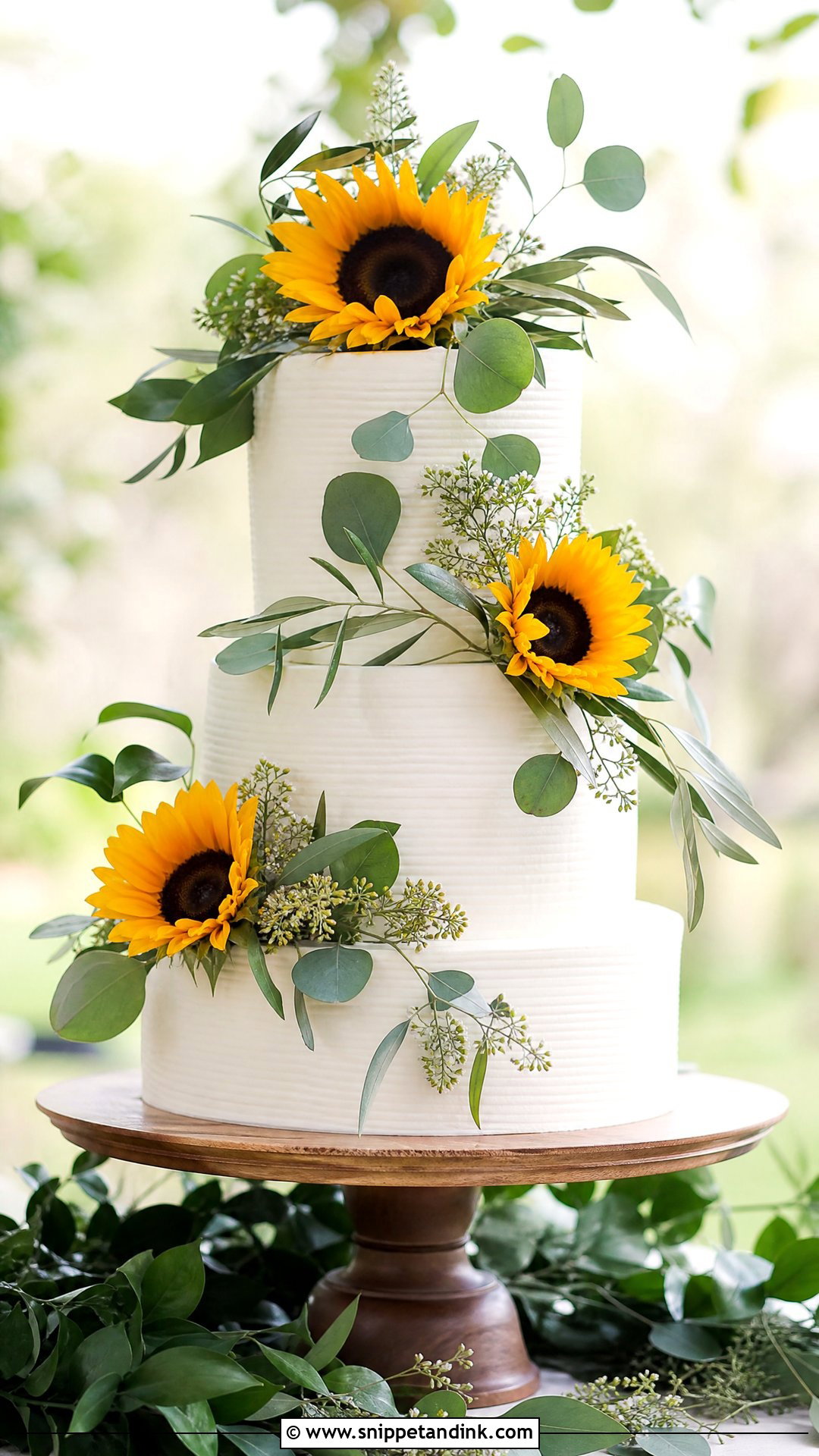
Greenery keeps a sunflower cake from looking too bright. Eucalyptus, ruscus, olive leaves and ferns all work, and olive is my favorite because it holds up well out of water and has a soft silver tone. Place it around the base, between tiers or trailing down one side, but let plenty of frosting show. A smooth finish looks refined; semi-naked looks rustic.
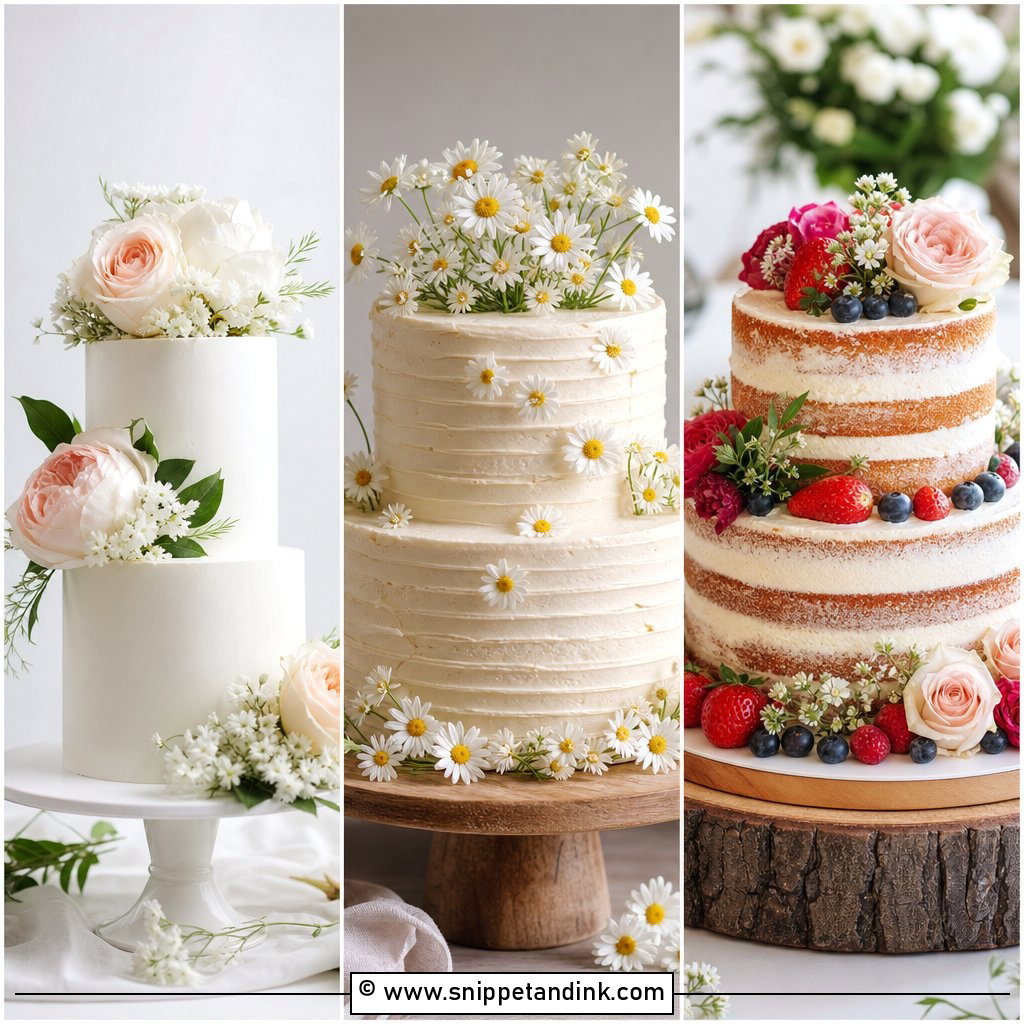
20. Sunflower Wedding Cake With Gold
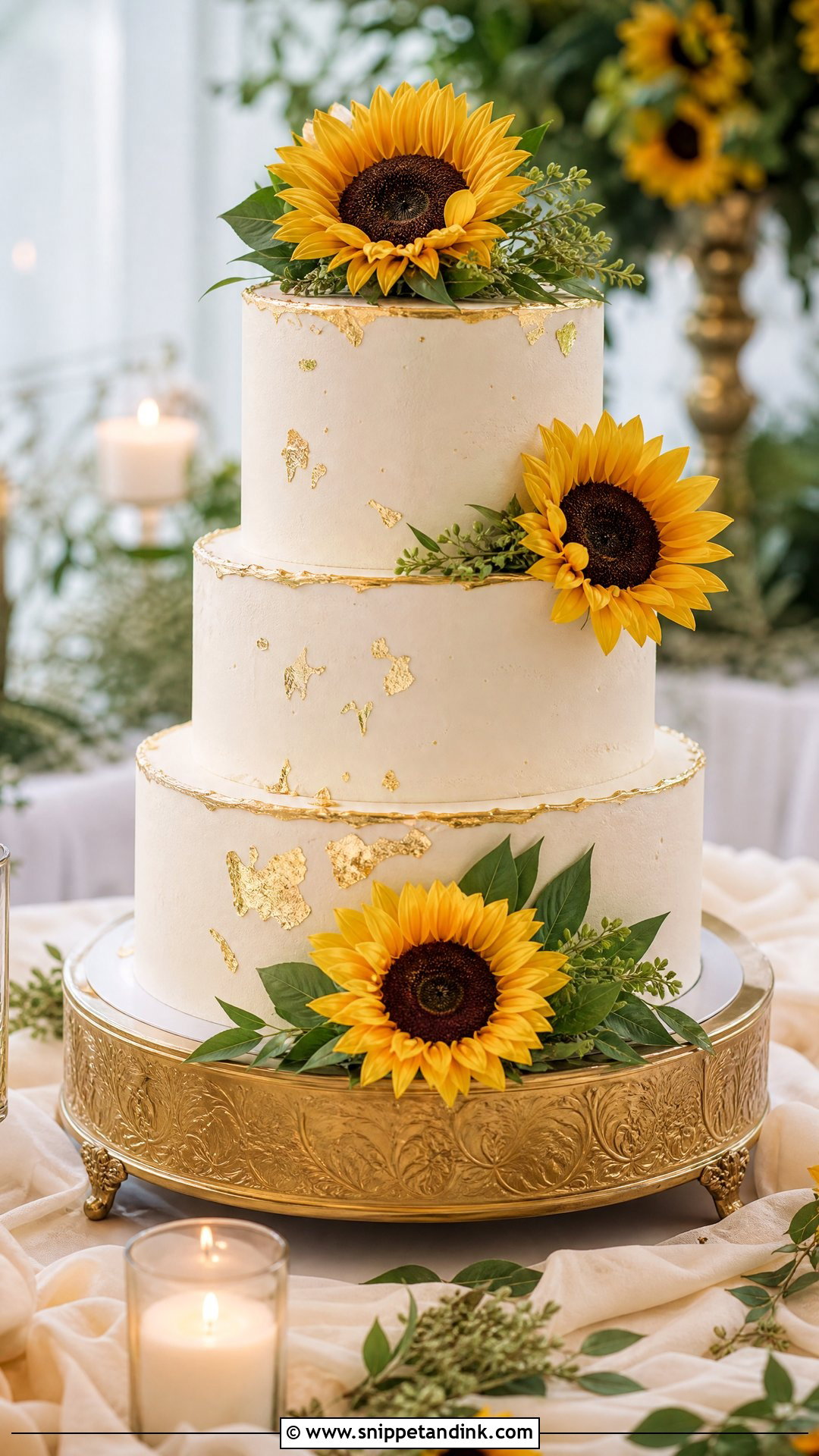
Gold works with sunflowers if it stays a supporting detail. A thin gold rim, a few gold leaf flakes or a gold monogram look polished against ivory. Gold leaf is very fine and sticks to anything, so I apply it with a soft brush and keep it away from areas the florist will handle later. A gold stand, warm candles and cream linens pull the table together.
21. Sunflower Wedding Cake With White Roses
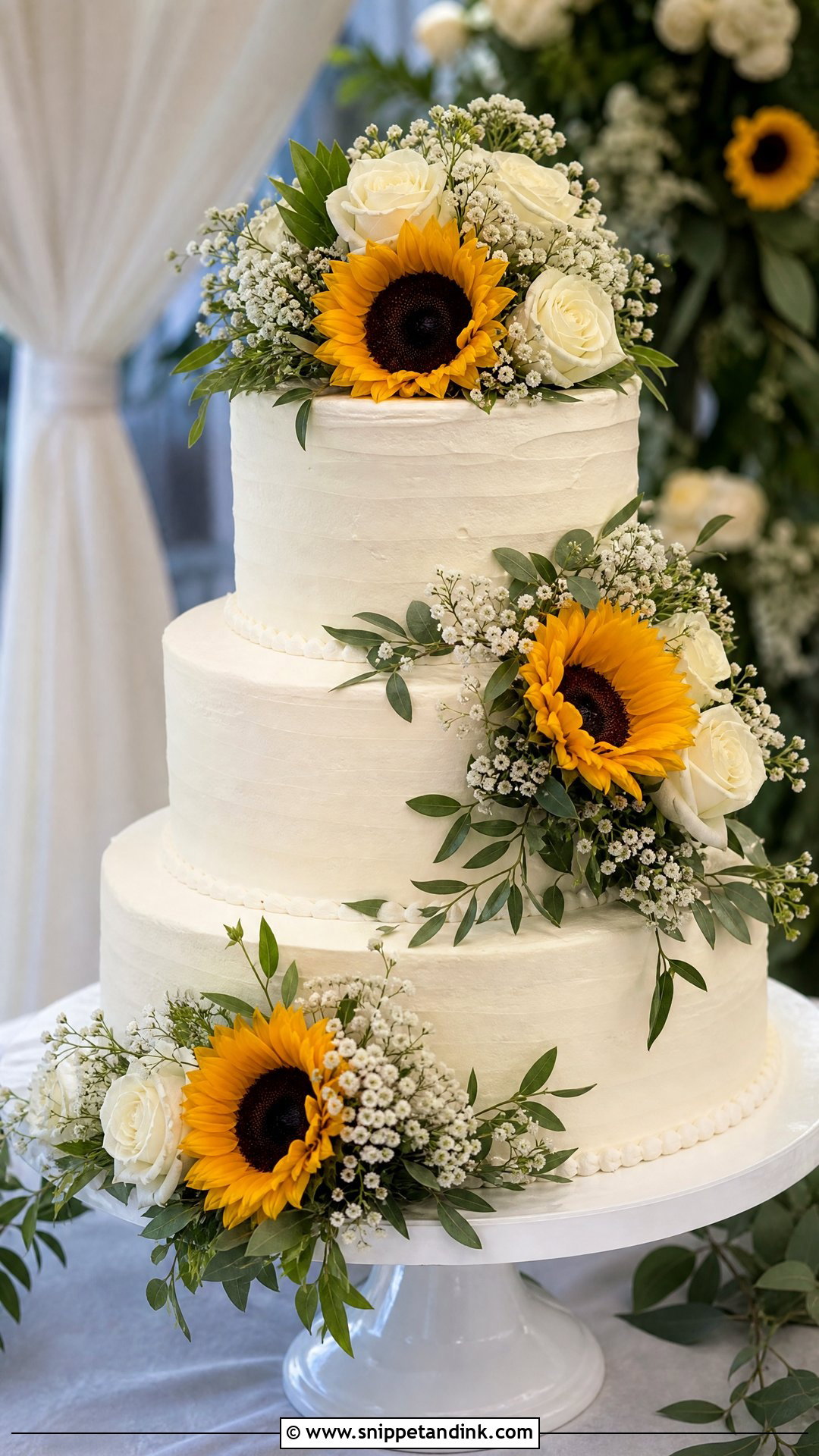
White roses with sunflowers is one of the easiest pairings to match with a bridal bouquet. The roses fill the gaps between big sunflower heads so the arrangement looks lush without going too yellow. I put clusters at the top, middle and base, then add small greenery sprigs. Church weddings, garden receptions and rustic venues all suit it.
22. Sunflower Wedding Cake With Lace
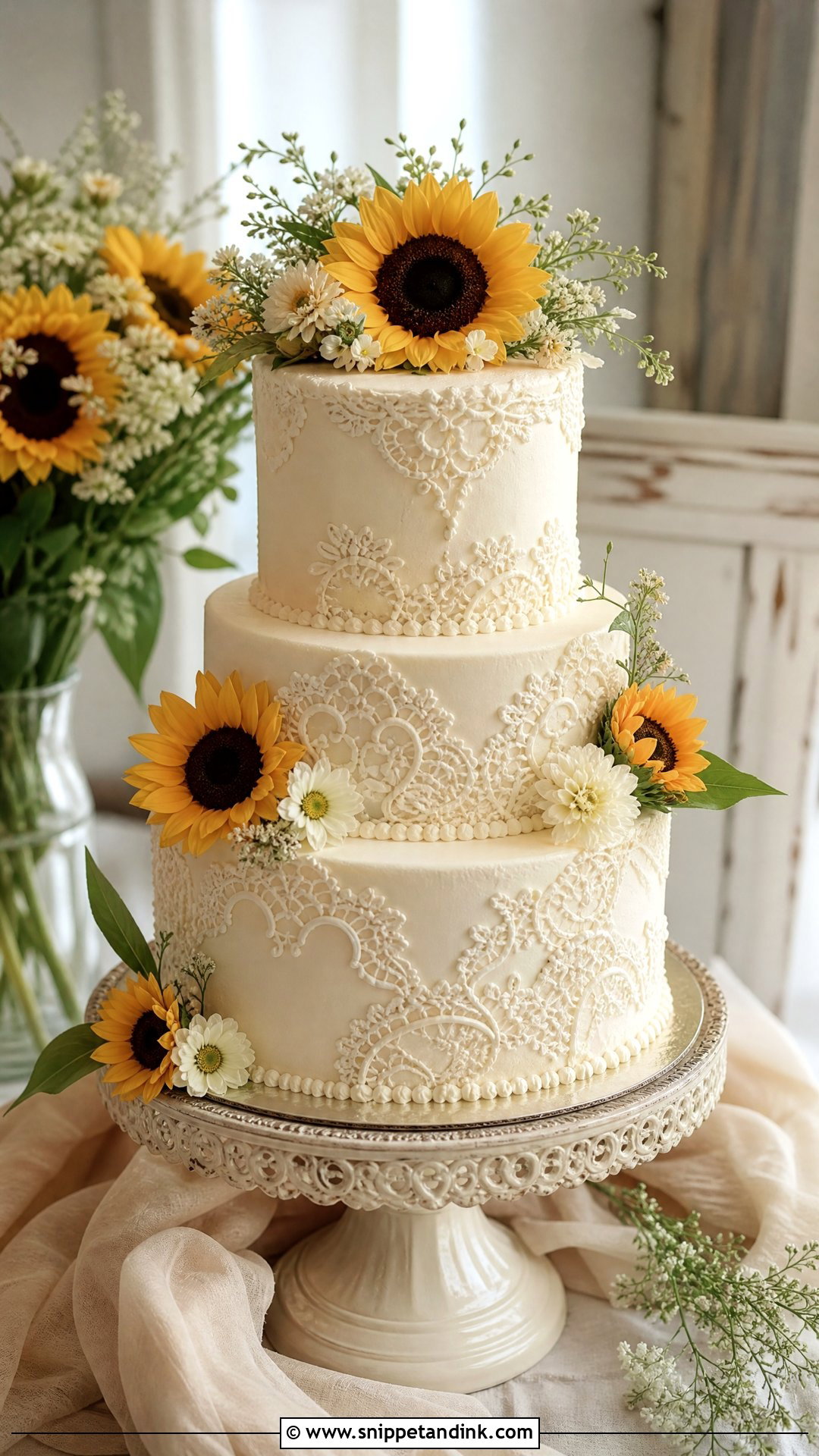
Lace can be edible fondant, piped buttercream or a silicone-mat lace, each with a different look. Piped lace is softest; mat lace gives the sharpest detail but needs fondant to sit on. Ivory frosting lets both lace and sunflowers stand out. Add small pearls or greenery if you want, but keep it gentle. Vintage-style barn and outdoor weddings suit this one.
23. Sunflower Wedding Cake With Wood Stand
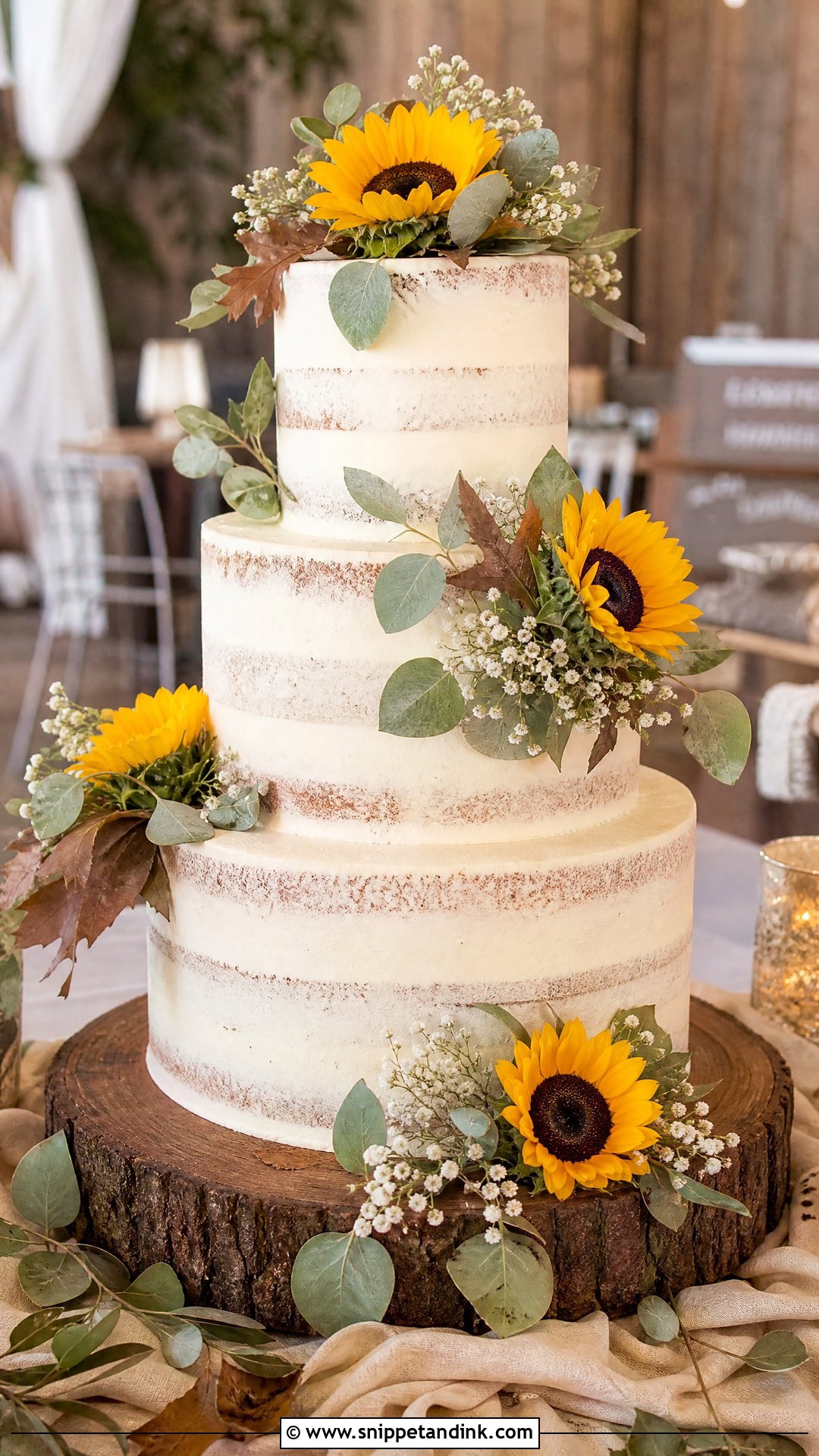
A wood stand becomes part of the cake design, especially at barn, farm, forest and backyard weddings. A semi-naked cake is a natural fit, although smooth buttercream works too. Raw wood slices can crack and are not food-safe on their own, so I always put a cake board or a sealed round between the wood and the cake. Sunflowers at the base connect the cake and the stand visually.
24. Sunflower Wedding Cake With Monogram
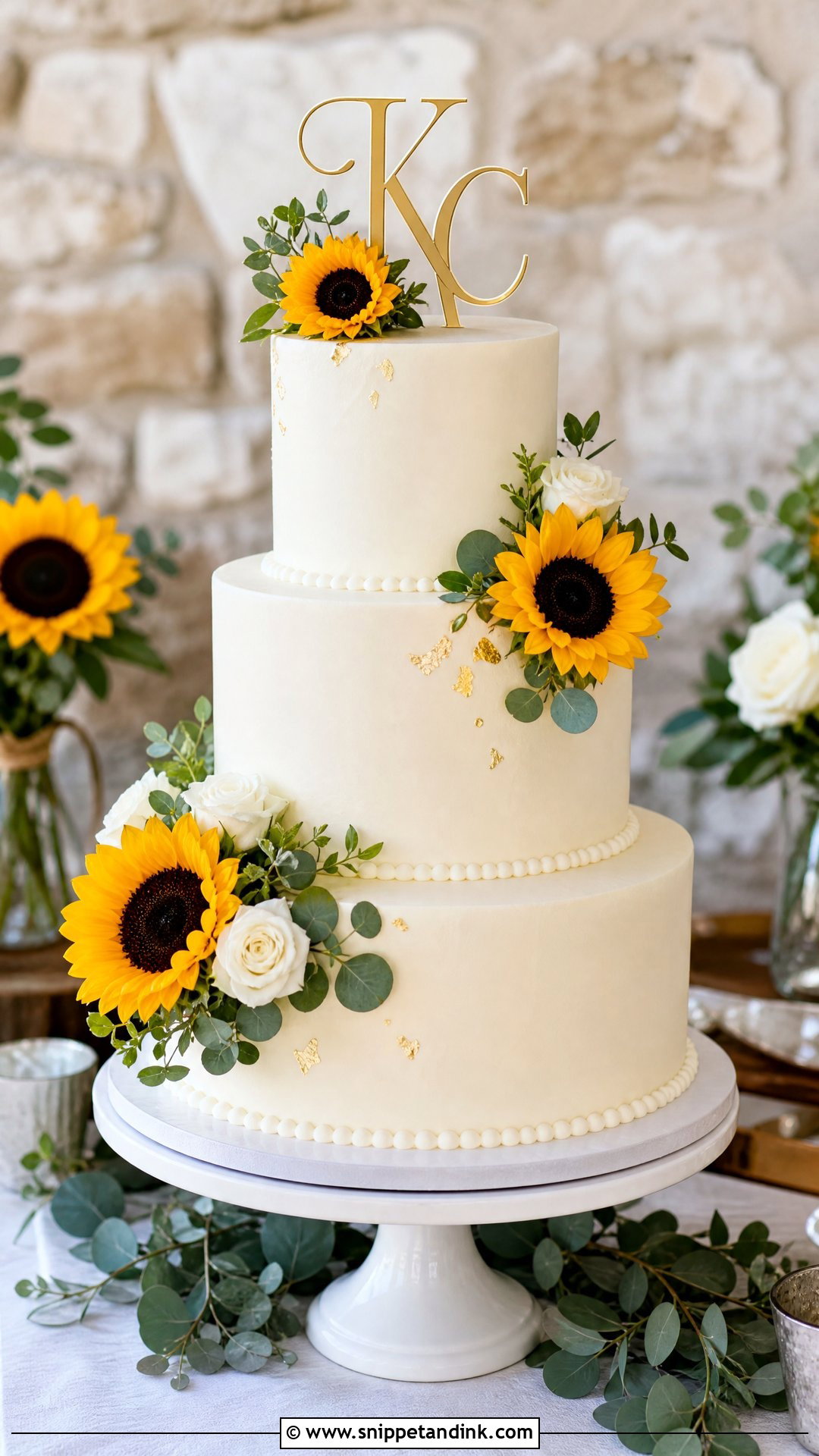
A monogram topper adds meaning without clutter. Gold, wood and acrylic all work, surrounded by a small sunflower cluster. Keep blooms out of the way of the letters so the initials read in cake-cutting photos. Acrylic toppers are light, but wooden ones can be heavy, so I ask for the topper ahead of time to check it won’t sink into the top tier.




25. Sunflower Wedding Cake With Sunflower Topper
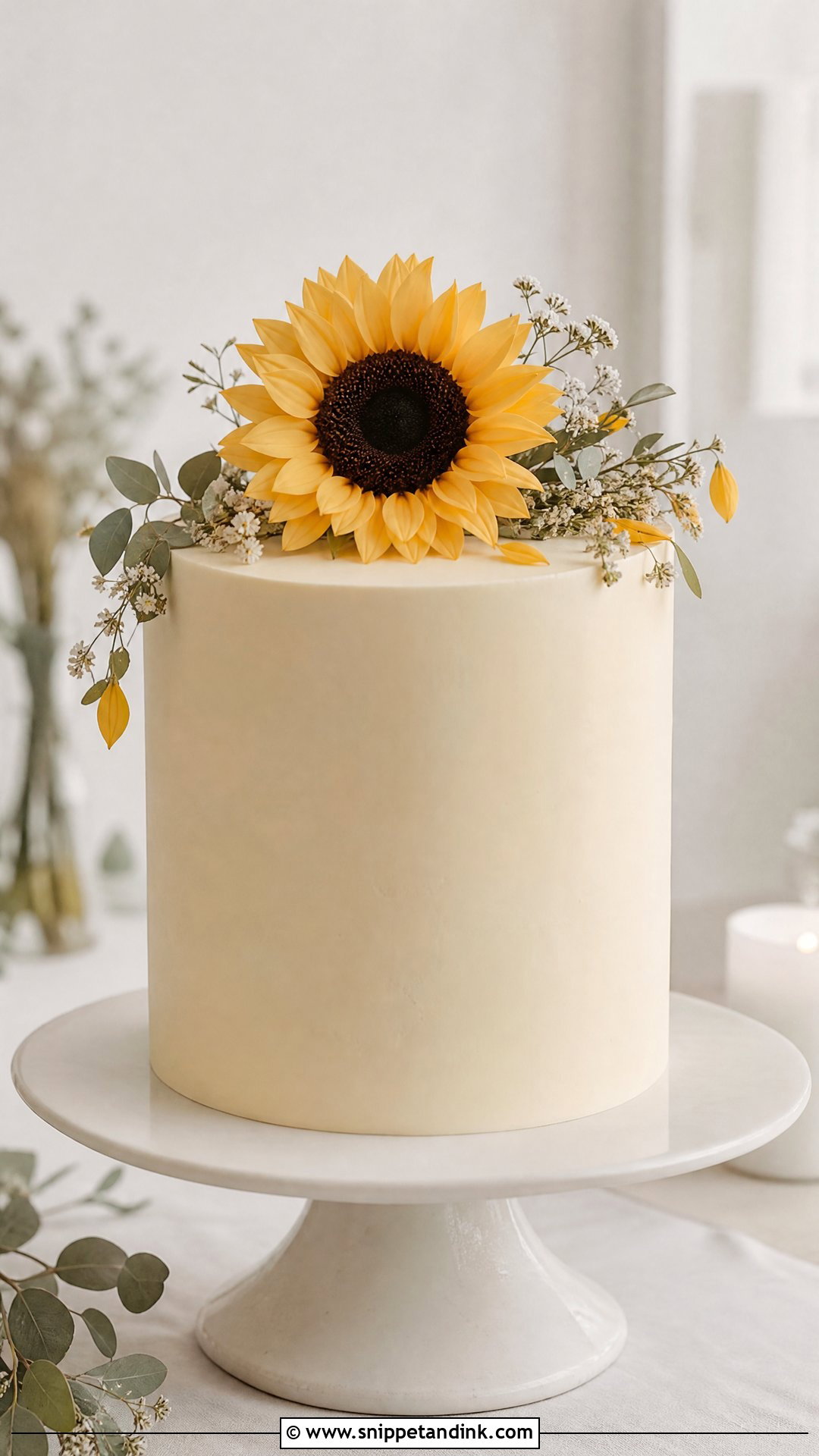
One big sunflower on the top tier is about as simple as a wedding cake gets, and it suits small cakes and minimalist styling. I usually make that bloom in sugar so it can’t wilt, then add a few yellow petals, leaves or buttercream dots on the sides. The flower has to look placed, not dropped, which means angling it slightly toward the guests. Tall single and two-tier cakes carry it best.
26. Sunflower Wedding Cake With Wildflowers
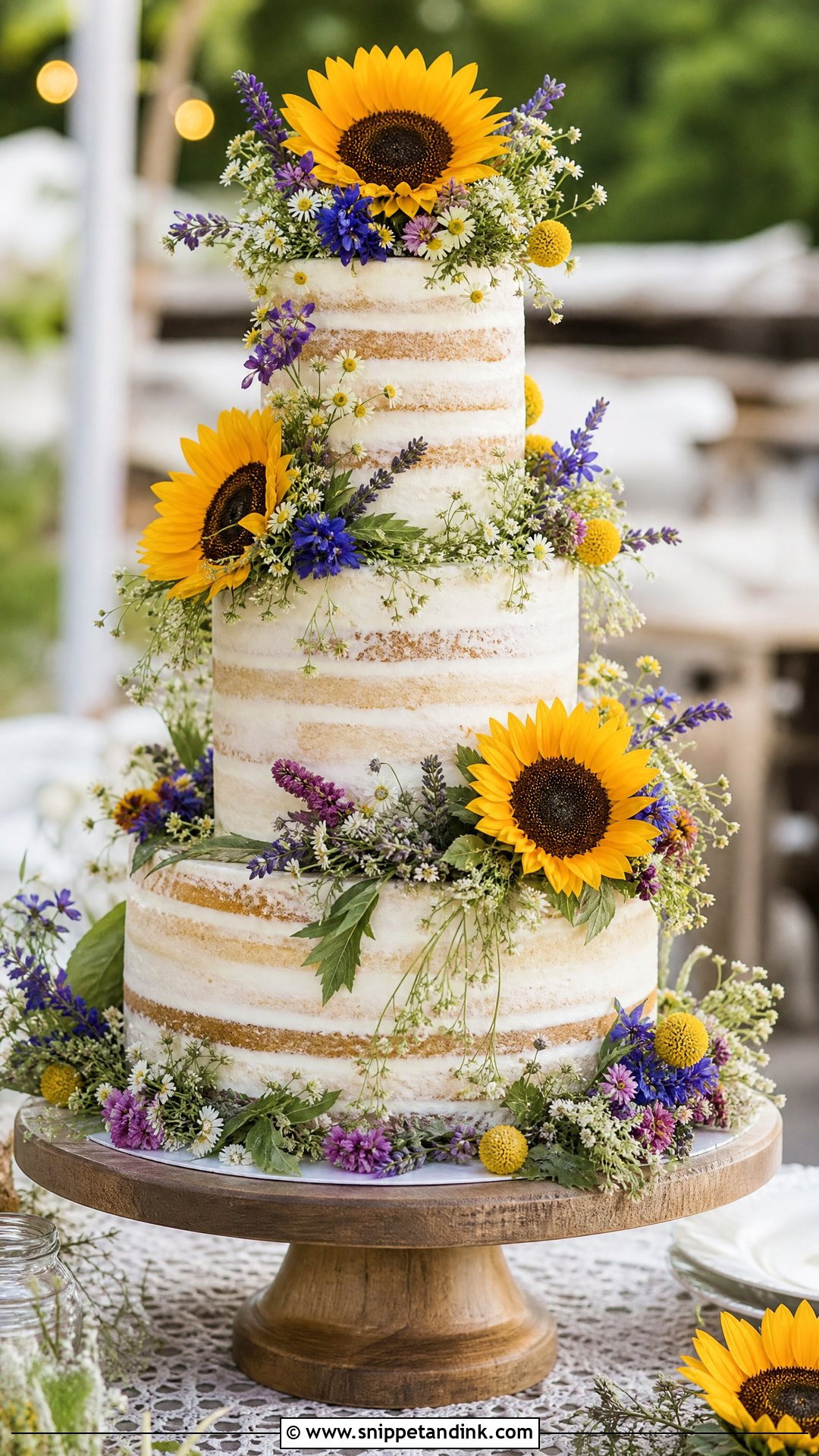
Wildflowers around sunflowers make the cake look picked from a meadow. Sunflowers lead; small flowers add movement. Small white, blue, lavender or yellow blooms work in small amounts. Not every wildflower is safe near food, so I check every variety with the florist and keep stems wrapped. Ivory buttercream or a light naked finish, plus loose table arrangements, completes it.
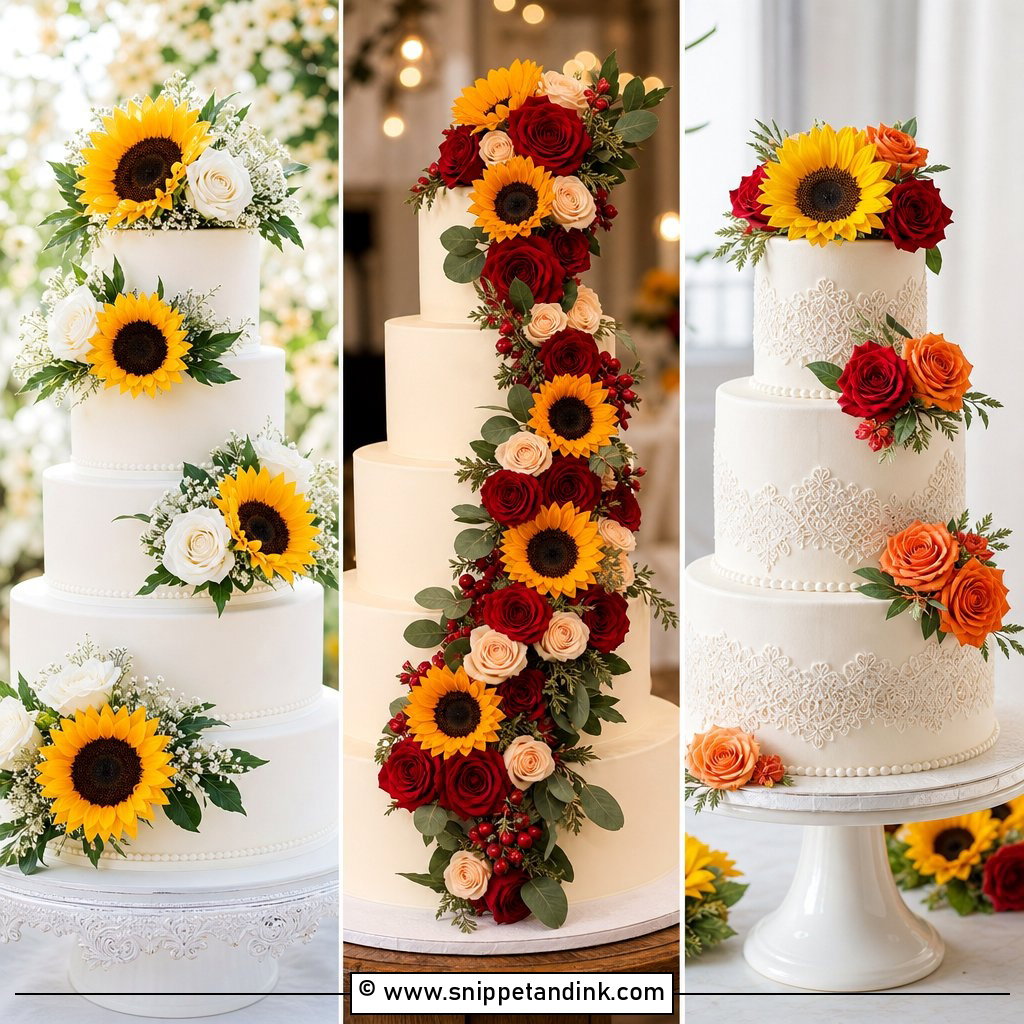
27. Sunflower Wedding Cake With Fall Colors
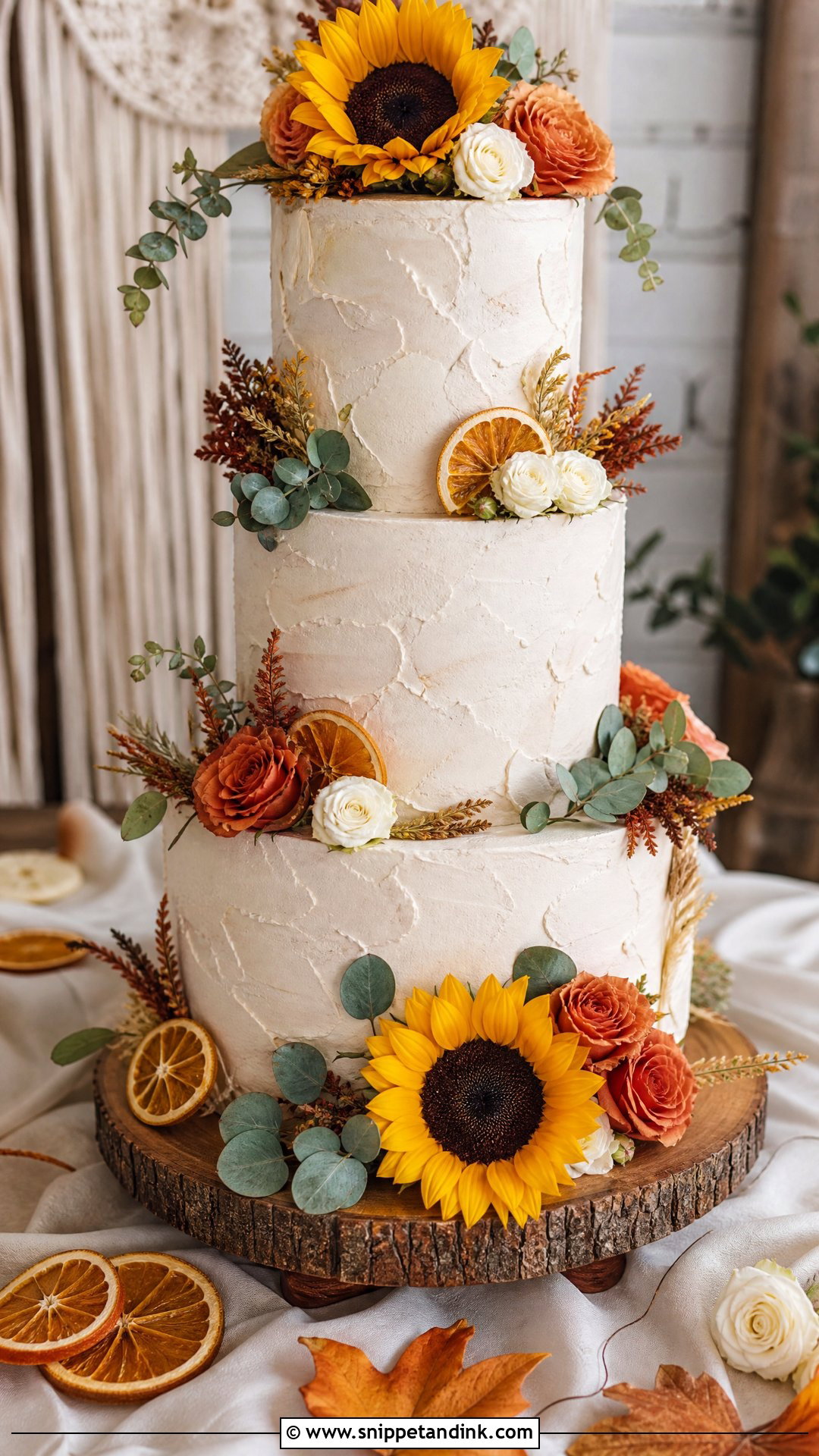
A sunflower wedding cake with fall colors mixes yellow with burnt orange, deep red, cream and brown. Spice, pumpkin, carrot and vanilla sponges all fit autumn. Dried orange slices are one of my favorite accents here: they hold color for weeks, add texture and don’t wilt. Keep the decoration restrained, use textured ivory buttercream and set it on a wood stand with candles and neutral linens.
28. Sunflower Wedding Cake With Navy Blue
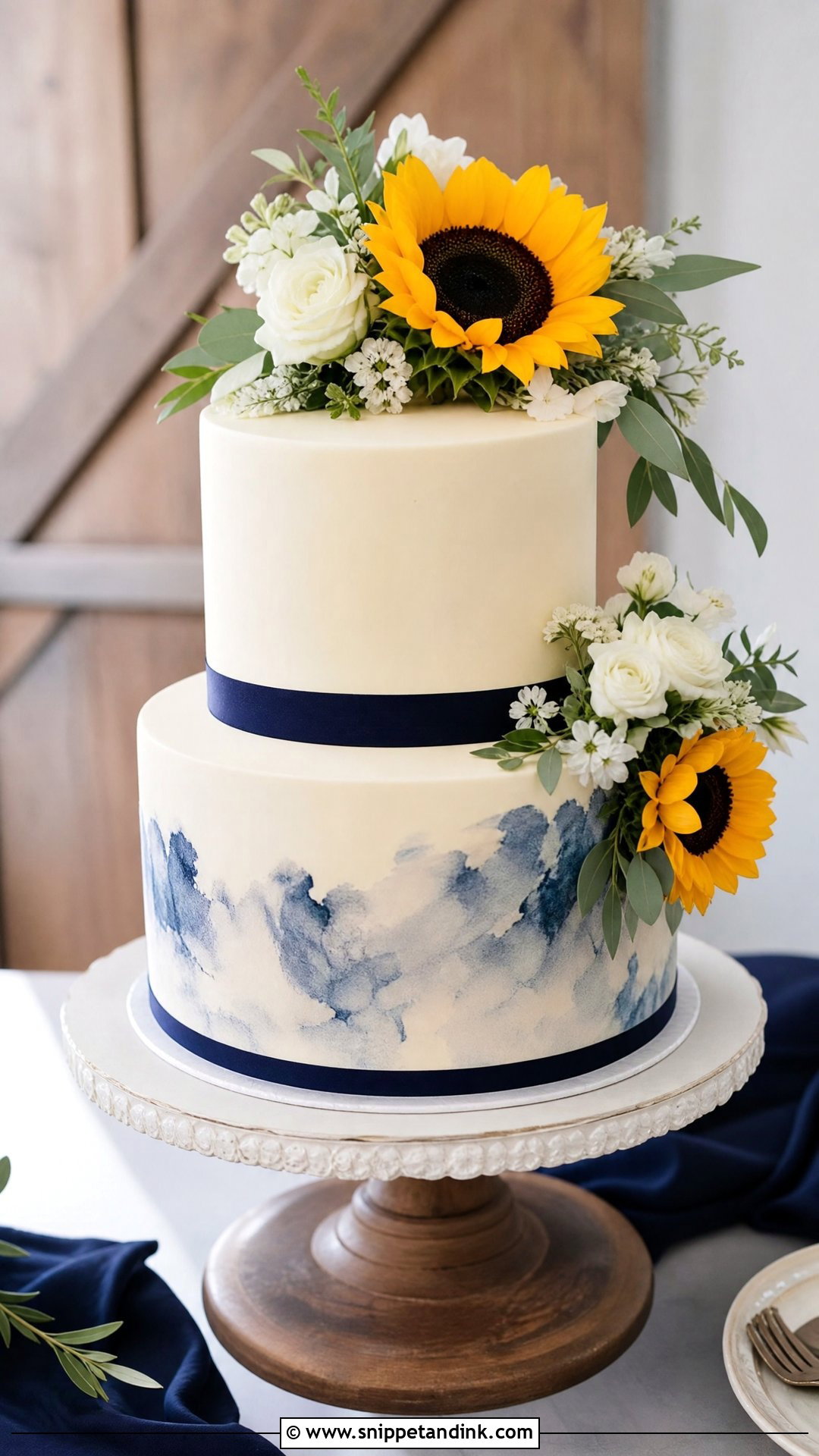
Navy makes yellow petals look brighter, and ivory frosting stops the cake feeling dark. Navy ribbon, watercolor detail or one navy fondant tier between ivory ones all work. Deep colors in buttercream need a lot of coloring, which can taste bitter and stain mouths, so for a fully navy tier I’d use fondant instead. Keep sunflowers in clean clusters. Late summer and couples with navy bridesmaid dresses suit it.
29. Sunflower Wedding Cake With Sage Green
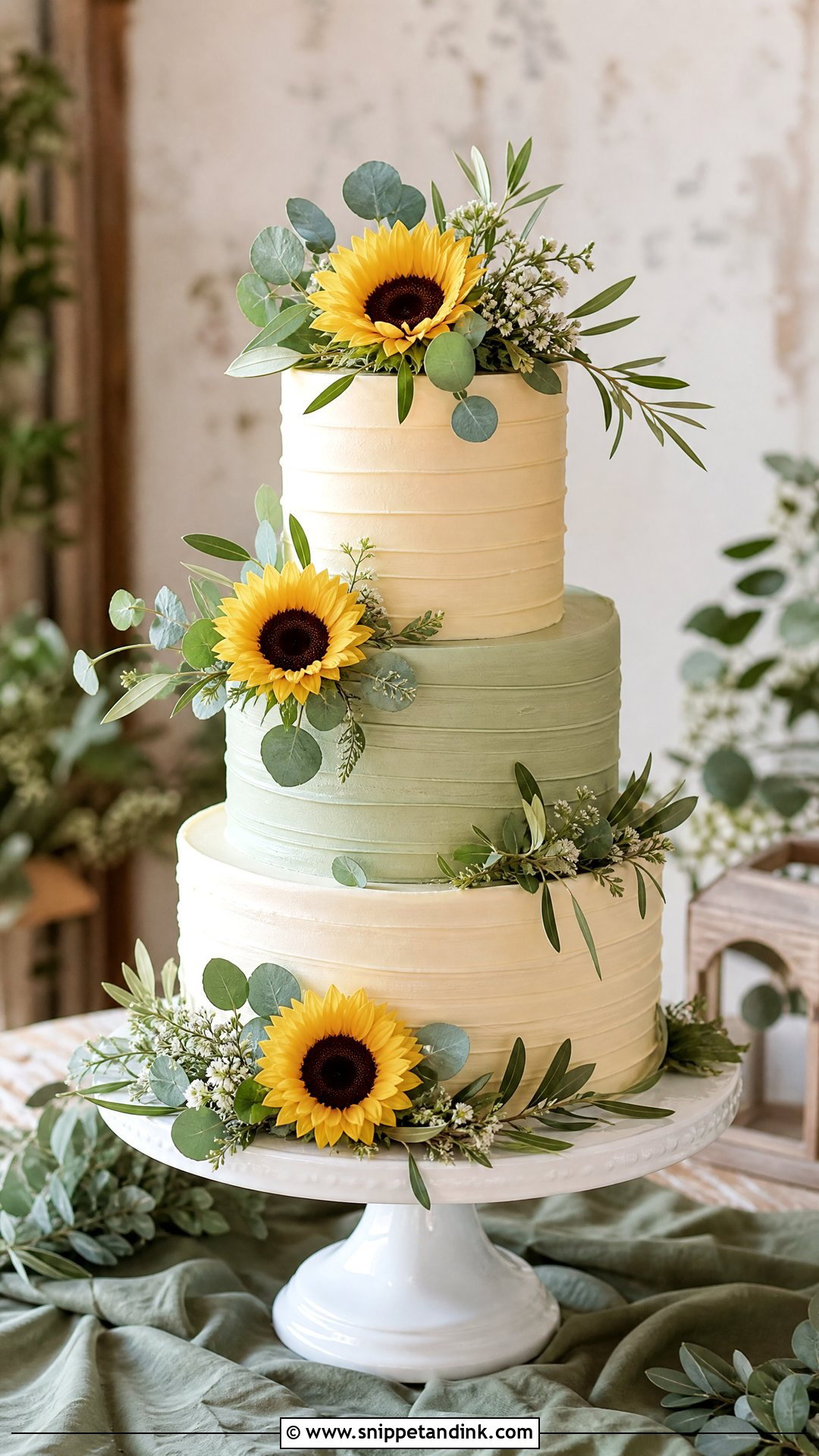
Sage gives a calmer, modern garden mood. Sage ribbon, watercolor accents or a soft green lower tier under ivory tiers work. Sunflowers with eucalyptus or olive leaves connect the palette. Sage is easy to tint too far toward mint, so I always match it to a fabric swatch from the wedding rather than to a screen color. Smooth or lightly textured finishes both work.
30. Sunflower Wedding Cake With Lemon Flavor
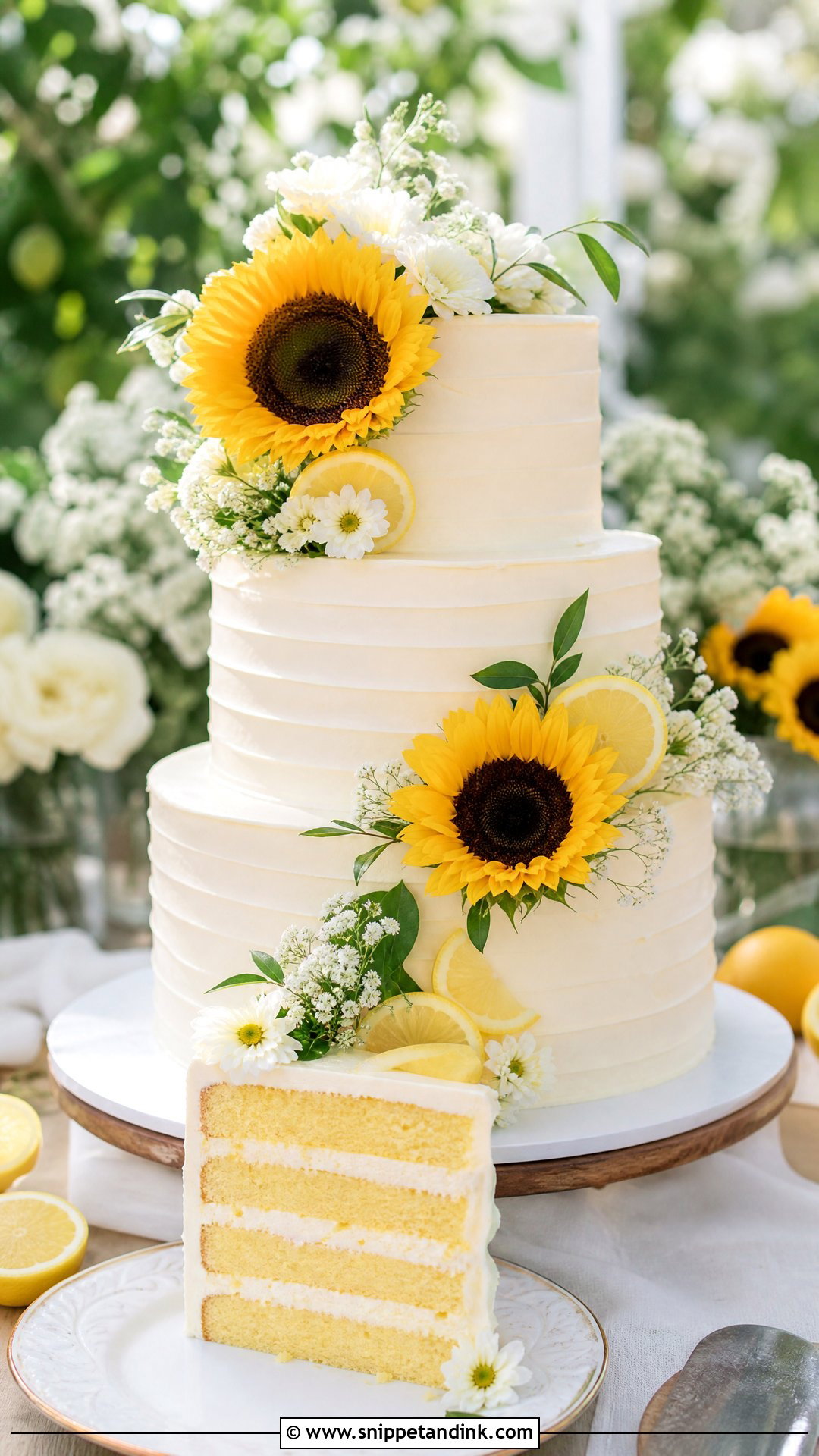
Lemon tastes the way a sunflower looks, which is why I suggest it so often for this design. Pale yellow sponge with lemon buttercream, or vanilla buttercream for balance, keeps it light after a heavy meal. Outside, ivory frosting, sunflowers, a few lemon slices and green leaves. Fresh lemon slices weep juice onto buttercream after a few hours, so I use candied or dried slices for display. Spring and summer outdoor receptions suit it.
A Yellow Cake at an August Barn Wedding
Sunflower weddings tend to happen in the hottest months, often outdoors or in a barn without air conditioning. Heat affects cake more than anything else on the day, and a few decisions early on prevent most problems.
- Ask your baker which frosting holds up best in the heat. Buttercreams made partly with shortening or a ganache under fondant hold their shape far better than soft meringue styles.
- Plan the cake table out of direct sun and away from a wall that bakes in the afternoon. A shaded corner can feel several degrees cooler.
- Keep the display time short. If the cake does not need to be out for the cocktail hour, have it set up just before the reception starts.
- Agree on who places the fresh flowers and when. If your florist adds them, they should arrive at the venue after the cake does, not before.
I’d also ask about delivery. Tall cakes are usually stacked on site, and gravel driveways or long walks across a field are worth mentioning in advance, since they affect how the cake is carried in. A barn floor that slopes slightly is another quiet hazard: check the cake table is level before the cake arrives.
Let the Sunflowers Carry the Color
Sunflowers bring so much color that the cake underneath can stay quiet. Match the finish to the venue: burlap, wood and semi-naked frosting for a barn; roses, daisies and soft buttercream for a garden; fondant and gold for a formal ballroom. Then bring your florist and your baker into the same conversation early, decide who places the flowers, and plan where the cake will stand on the day. Get those three things right and the rest is the fun part.
You'll Like These Ideas:





Leave a Reply