
A Nikkah cake usually sits at the centre of a smaller, more personal ceremony, often in a family living room or a mosque hall, so guests see it up close and the details carry more weight than height. When couples come to me for one, the brief is nearly always the same: calm colour, a clean finish, nothing that competes with the ceremony itself, and a kitchen that can confirm every ingredient is halal. Textured buttercream, pearl work, fresh flowers and personal writing all suit that brief. The ideas below show how each one actually behaves on a real cake, at home, in a hall or in a garden setup.
Halal Questions a Baker May Not Raise Unprompted
Most bakers know to leave out alcohol. Fewer think through every component, and a tiered cake can contain a dozen bought-in ingredients. When I quote a Nikkah cake, these are the things I check line by line, and you’re entitled to ask any baker the same.
- Vanilla: standard vanilla extract is made with alcohol. Ask for an alcohol-free vanilla, vanilla powder or scraped pods.
- Gelatin: it hides in marshmallow fondant, some ready-made fondants, mousse fillings, mirror glazes and chewy decorations. Ask for halal-certified gelatin or agar.
- Red and pink colouring: some uses carmine, which comes from insects and which many families avoid. Most gel colours are synthetic, but ask to see the label.
- Soaking syrups and ganache: some bakers brush sponges with liqueur or flavour fillings with it. Plain sugar syrup keeps a sponge just as moist.
- Bought-in decorations: sugar flowers, macarons and sprinkles often come from another supplier with its own ingredient list.
If a baker can’t tell you what’s in a component, that is an answer in itself. A kitchen with halal certification is the simplest route. Otherwise, ask for the ingredients to be confirmed in writing on the order, so nobody has to guess on the morning of the ceremony.
1. White Nikkah Cake
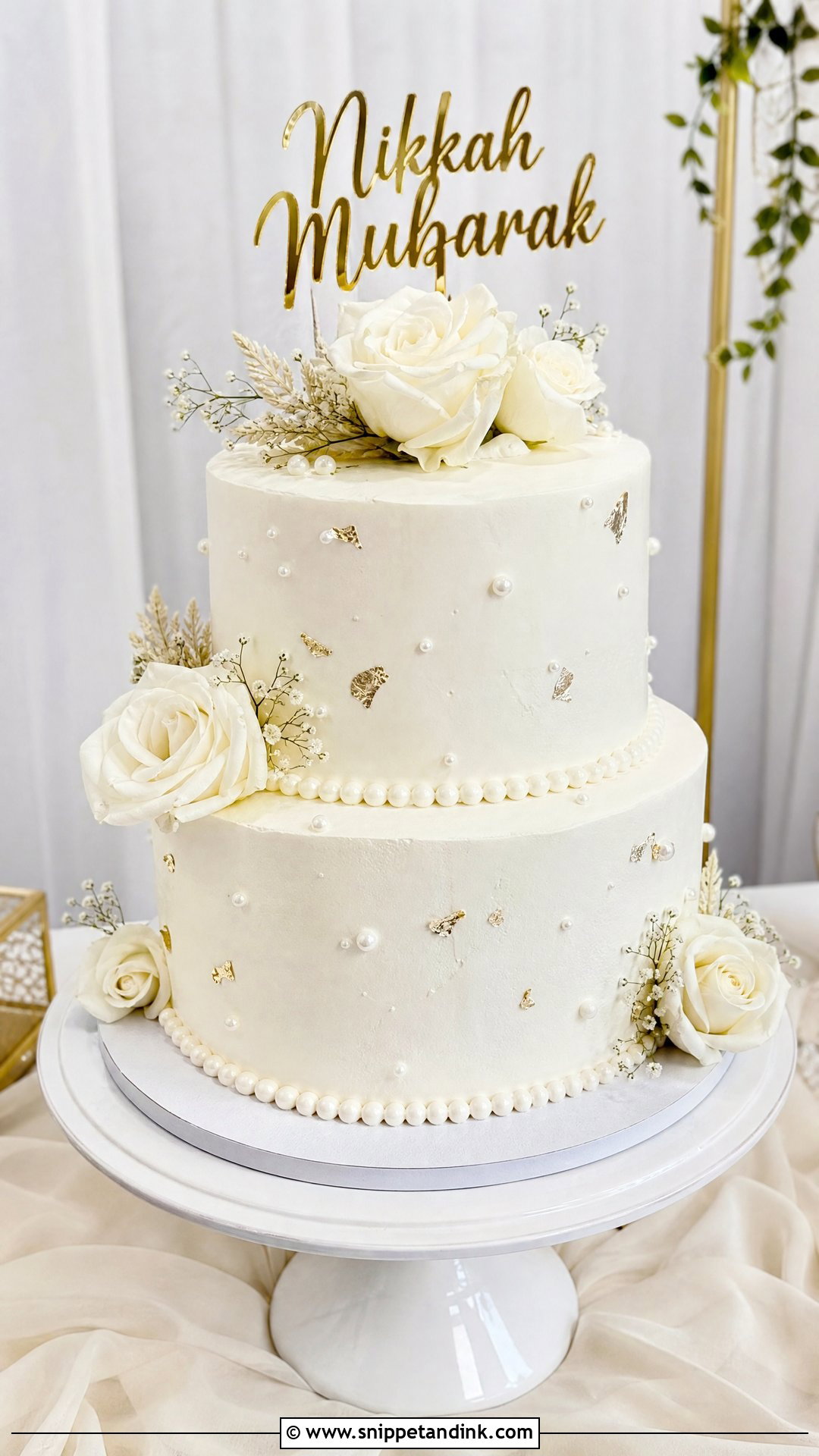
White is the hardest colour to fake, which is partly why I like it. A true white buttercream needs the butter beaten long enough to pale, sometimes with a speck of violet to cancel the yellow, while fondant comes out bright straight from the packet. Vanilla, almond or white chocolate sponge keeps the flavour light enough for an afternoon ceremony. On a single tier, “Nikkah Mubarak” in gold is often all the decoration it needs. Two or three tiers add height for a hall, but resist adding a new detail on every tier.
2. Gold Nikkah Cake
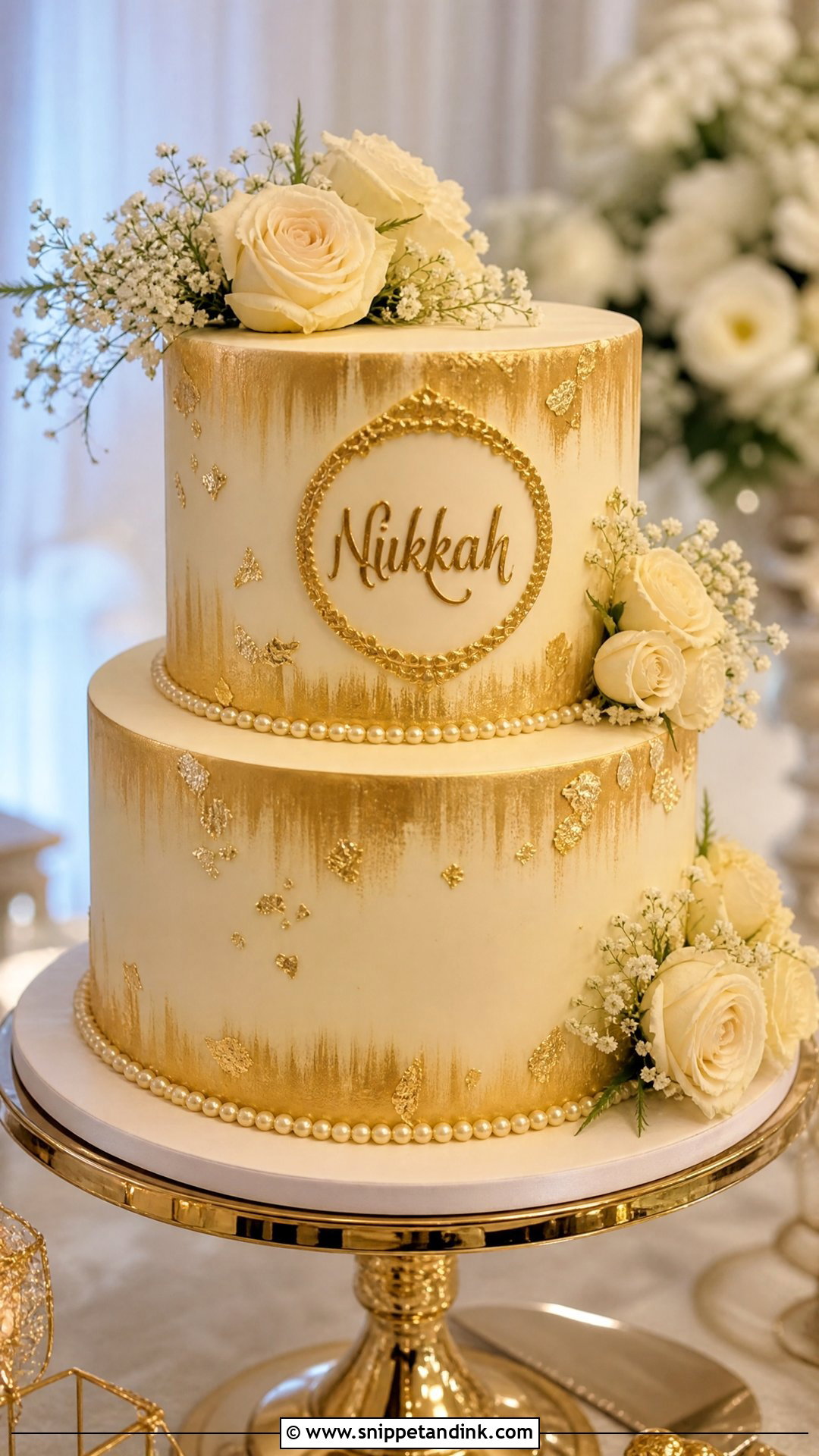
Gold works best used like jewellery, not like paint. I’d rather brush leaf onto one tier or stencil a pattern on ivory than spray the whole cake, because a fully metallic finish shows every bump in the icing and can look flat under hall lighting. Edible gold leaf is fragile and creases if it goes on before the icing has set, so it is the last thing I apply. Inside, vanilla bean or pistachio is plenty. A plain stand and a few fresh stems keep the table from tipping into loud.
3. Floral Nikkah Cake
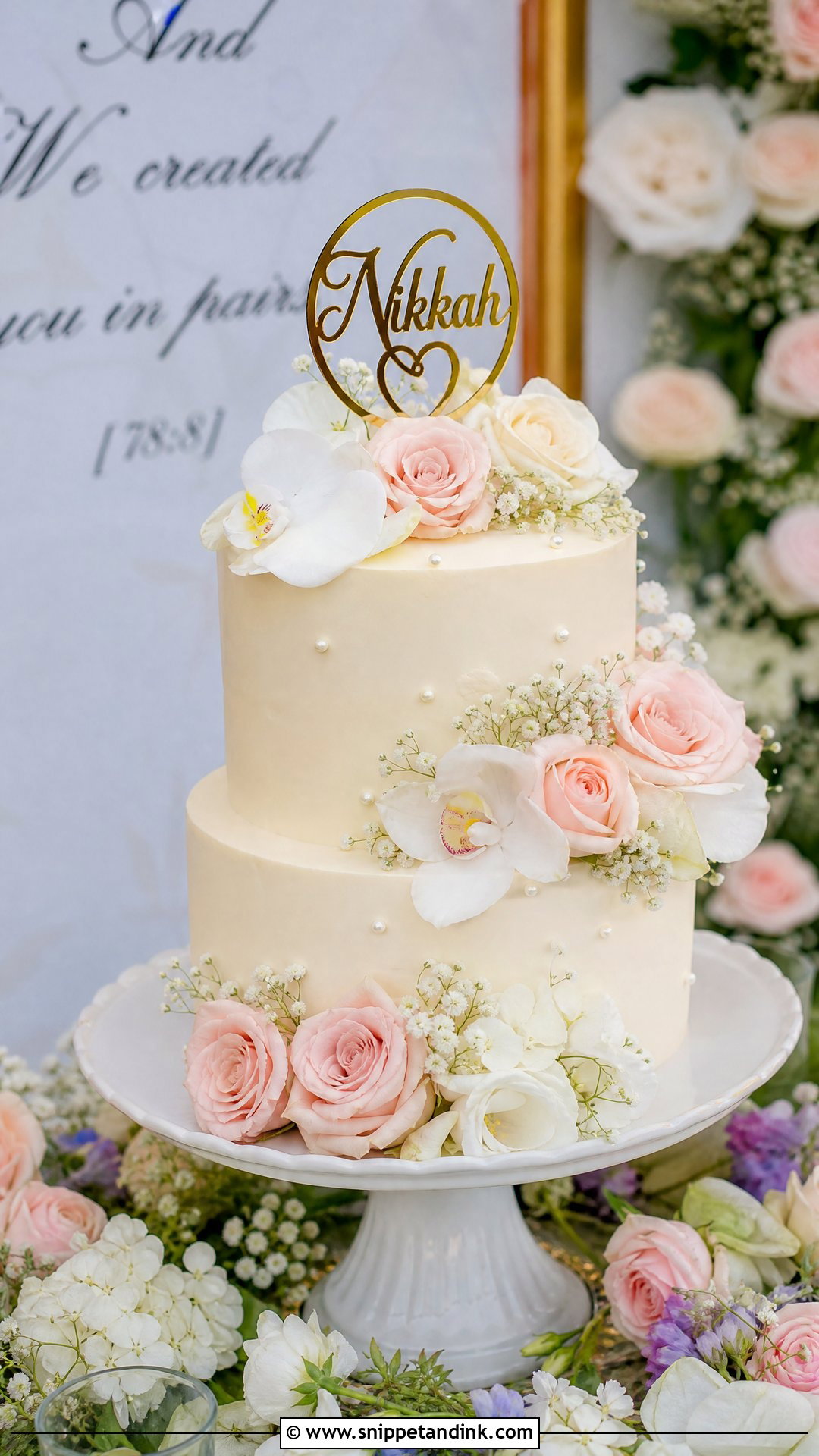
Fresh flowers are where I see the most avoidable risk. Several popular wedding blooms aren’t safe near food, and anything sprayed by a grower shouldn’t sit on icing at all. I wrap each stem in floral tape and push it into a food-safe pick so sap never meets the cake, or I swap in sugar flowers for the pieces that sit directly on top. Roses, ranunculus and orchids hold up well against buttercream. A crescent sweep down one side reads far more deliberate than blooms scattered across every tier.
4. Green Nikkah Cake
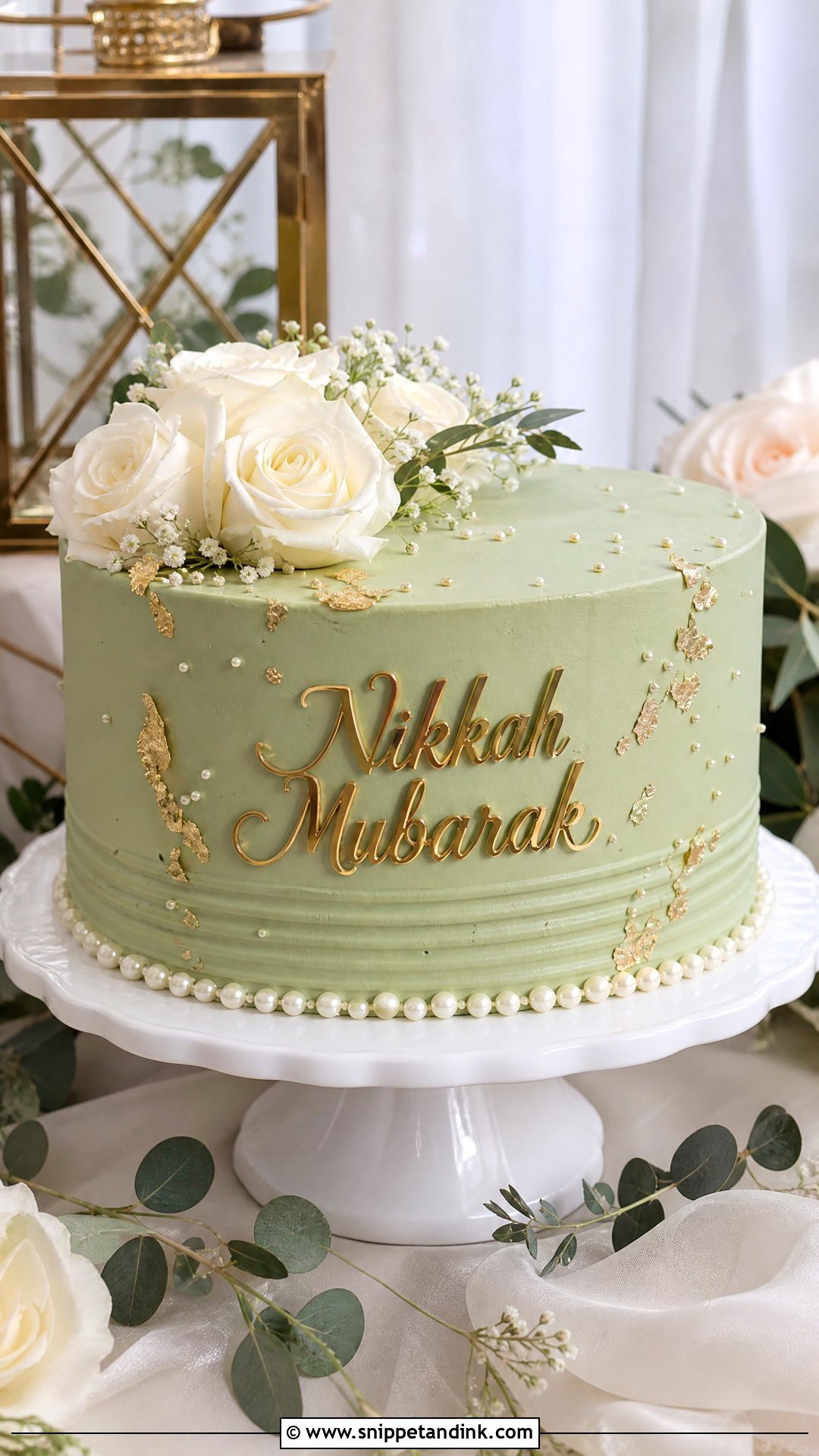
Pistachio sponge under green buttercream is the pairing I’d suggest first, because the flavour echoes the colour. A true green needs gel colour rather than liquid, and deep shades keep darkening as they rest, so I mix them a day ahead and judge them the next morning. Sage reads soft and modern; emerald reads formal. Both take gold writing or a geometric stencil well. Cardamom or almond sponge also sits nicely under green if pistachio isn’t to everyone’s taste.
5. Pearl Nikkah Cake
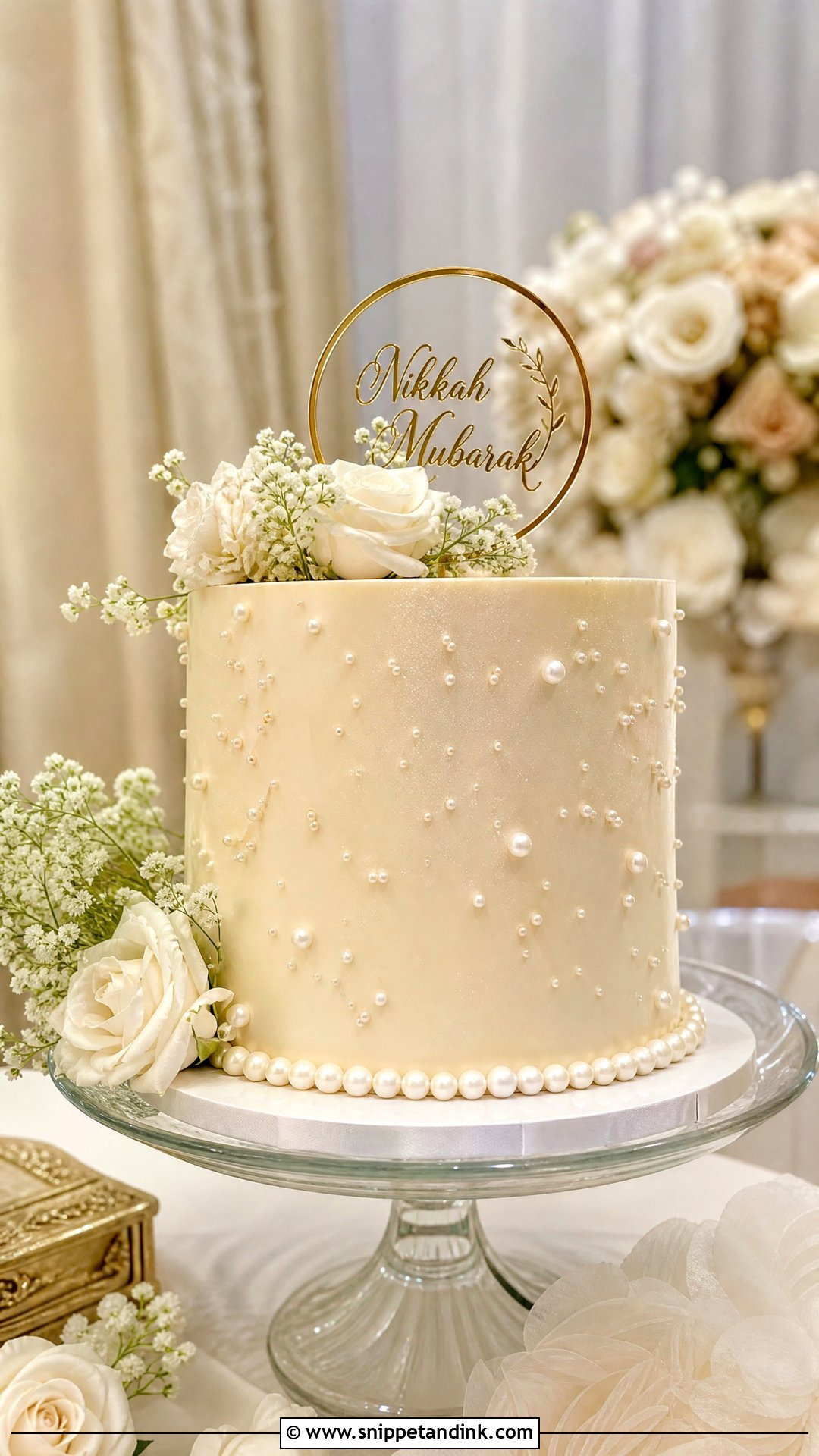
Pearls look delicate, but placing them takes patience. Sugar pearls are pressed into fresh buttercream with tweezers before the surface crusts; once it sets, they bounce off or leave a dent. I keep them to the base border and a light scatter on one tier, never everywhere. This one pairs naturally with a bride wearing pearl jewellery or embroidery. Vanilla, coconut or white chocolate sponge matches the light look, and a small “Nikkah Mubarak” topper finishes it.
6. Simple Nikkah Cake
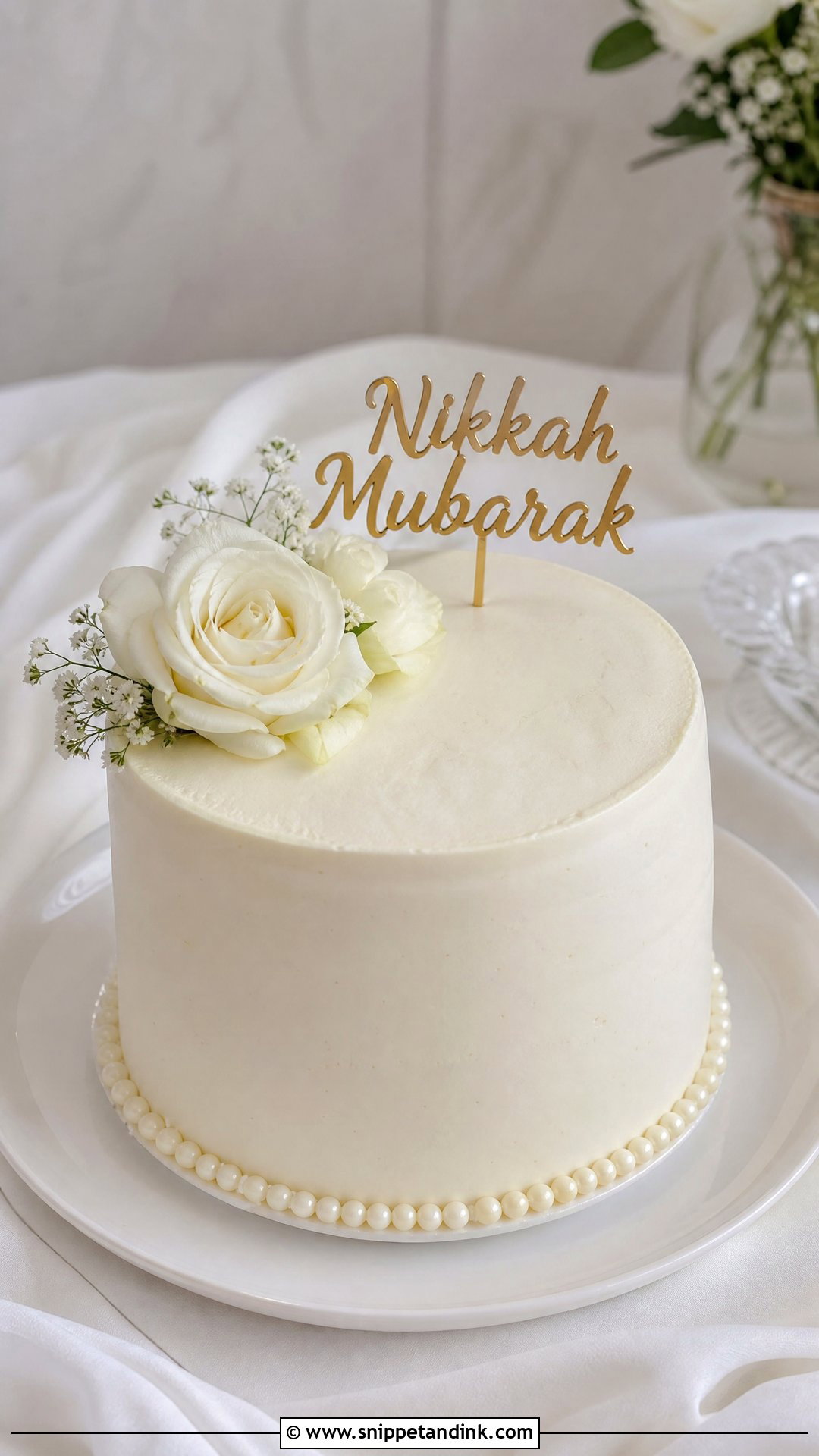
A simple cake is the one where nothing hides. One or two tiers, smooth sides, soft colour and a small topper or written message means the baker’s finishing has to be clean, so ask to see photos of their plain cakes, not only the decorated ones. A classic vanilla, chocolate, or red velvet sponge serves easily at a home ceremony. One floral cluster or a thin gold border is enough detail. Plain isn’t the aim. Calm is.
7. Two Tier Nikkah Cake
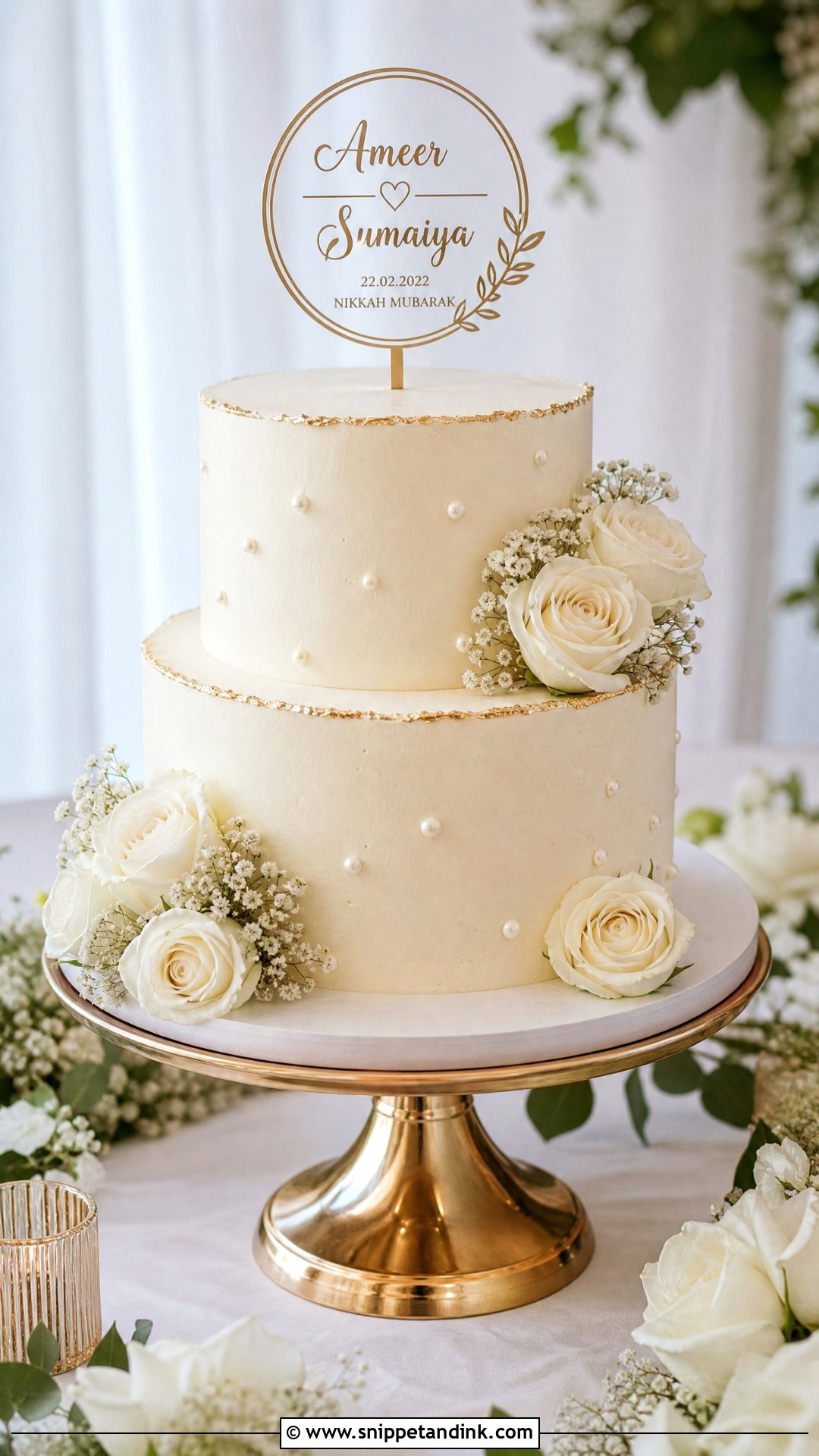
Two tiers gives you wedding-cake presence without a cake that dwarfs a living-room table. I usually put texture on the bottom tier and keep the top smooth, so the topper or initials have a clean backdrop. You can split flavours, vanilla below and chocolate above, which gives guests a choice. Just make sure whoever cuts it knows which tier is which; I write it on the board underneath. Repeat at least one detail on both tiers so they read as a single design.
8. Three Tier Nikkah Cake
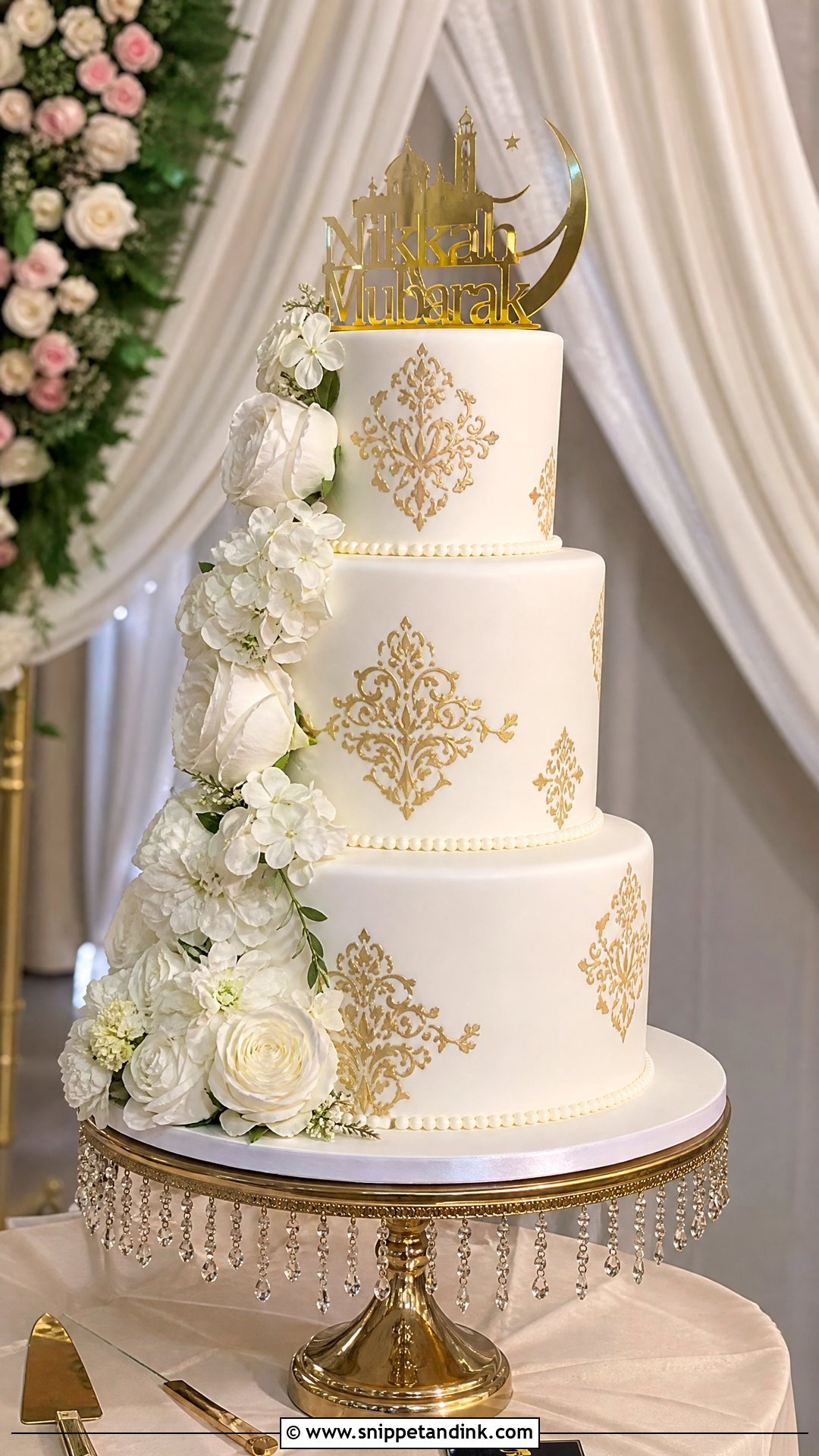
Three tiers needs structure most people never see: dowels or straws in each lower tier and a board under each upper one, otherwise the weight sinks the bottom tier within hours. For a long ceremony in a warm hall I often stack on site instead of travelling fully assembled. Visually, pick one detail and repeat it on all three, gold trim for instance, or a single stencil. Pistachio, vanilla and chocolate by tier works well. A tall stand and draped fabric behind give it the height it was built for, so don’t crowd every tier.
9. Nikkah Mubarak Cake
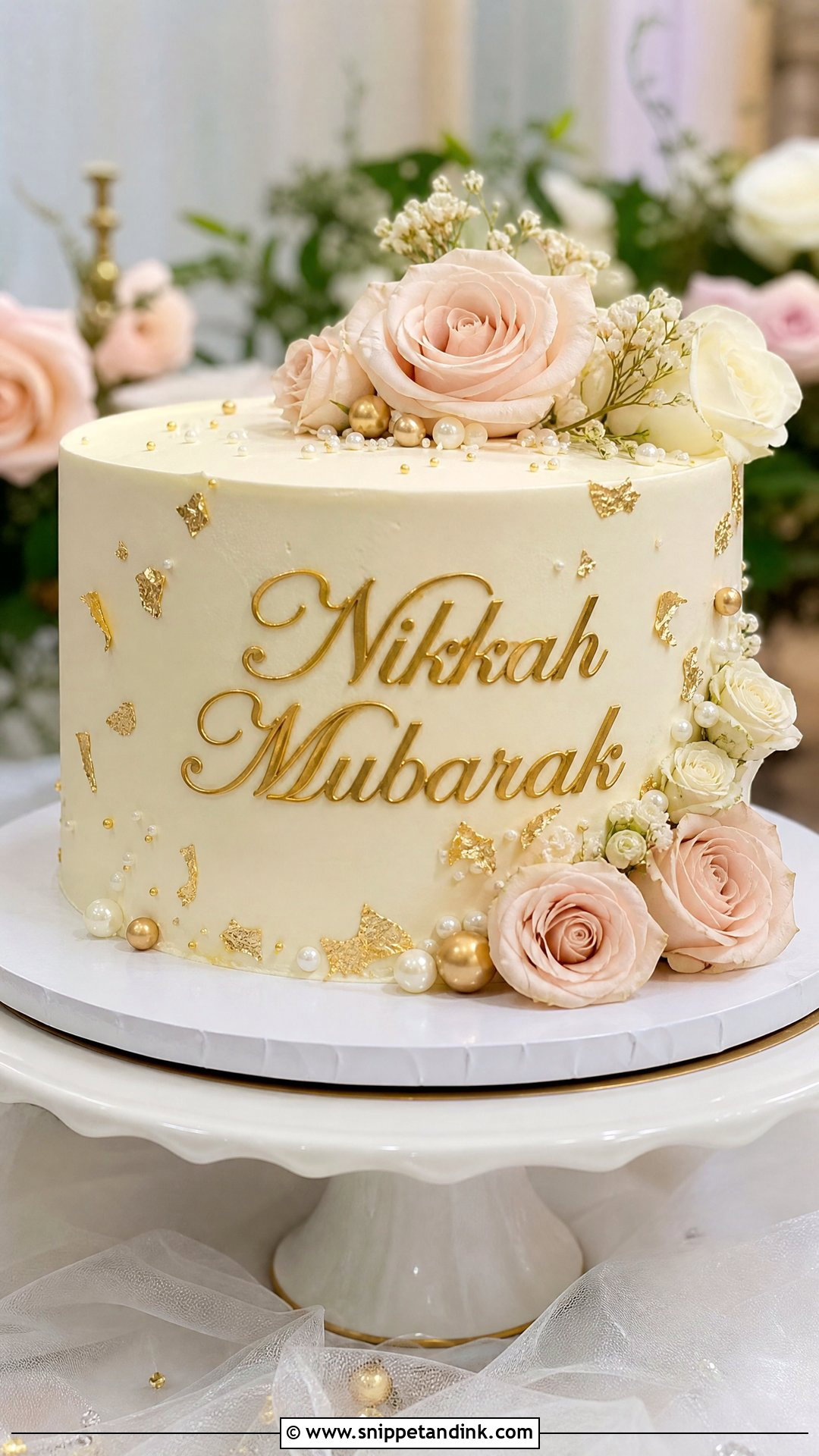
When the words are the design, the lettering decides everything. Hand-piped script on buttercream looks personal but wobbles unless the surface is chilled and firm. An acrylic topper is crisp and reusable, and painted gold lettering on fondant sits somewhere between the two. I always confirm the exact spelling, and whether the family wants Arabic or English script, because the order form is where these mistakes start. White, ivory and sage give the writing contrast. Keep the rest of the cake quiet.
10. Islamic Pattern Nikkah Cake
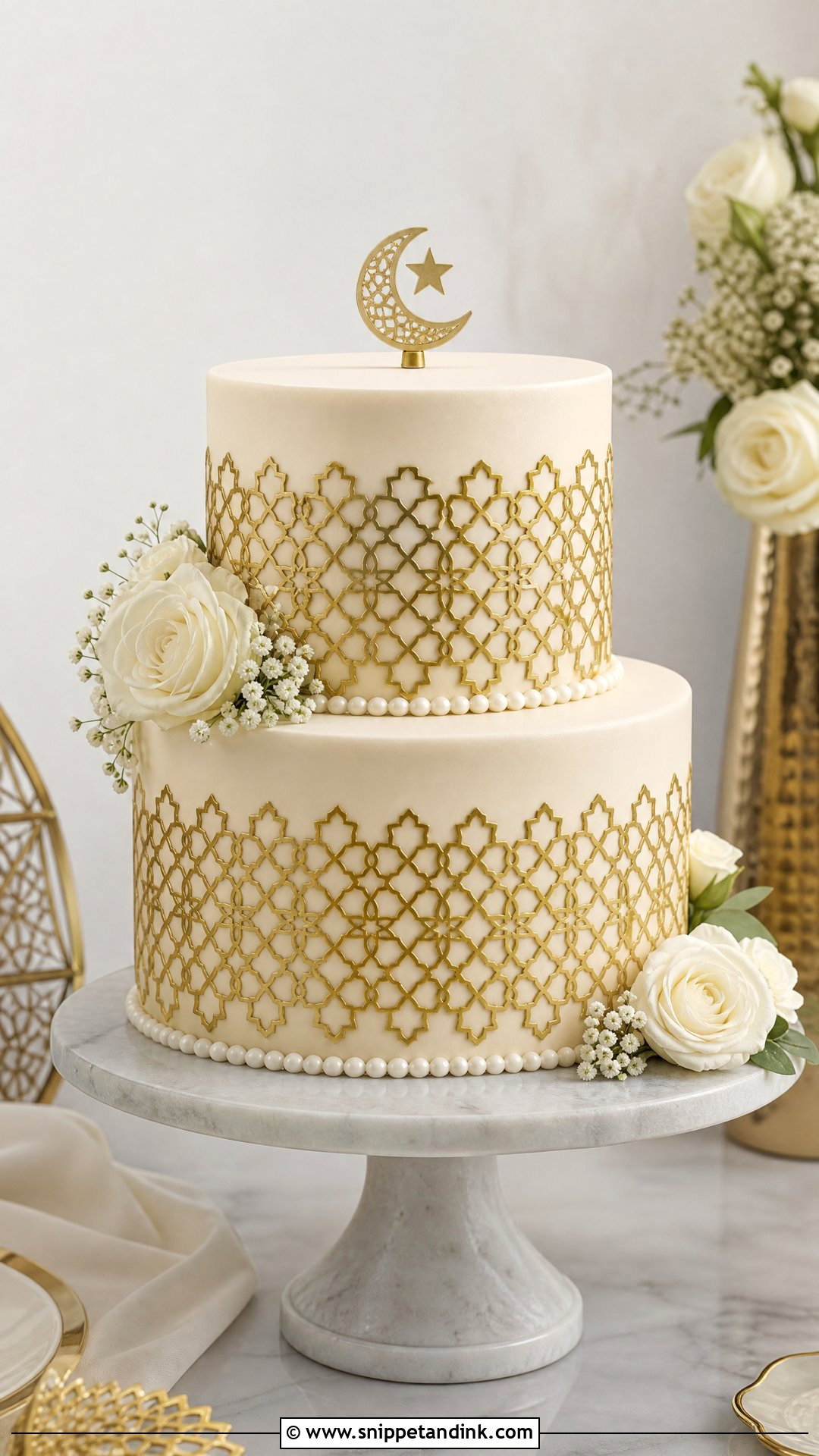
Geometric patterns are unforgiving: a stencil that slips half a millimetre shows across the whole tier. On buttercream I chill the cake hard first, press the stencil flat and apply royal icing or gold lustre in one pass. Fondant gives a smoother canvas, so it’s my usual choice for this design. Tone-on-tone white is subtle, while gold over emerald or navy is dramatic. Almond, cardamom, rose or pistachio suits the mood. Keep the topper small so it isn’t fighting the pattern.
11. Mosque Dome Nikkah Cake
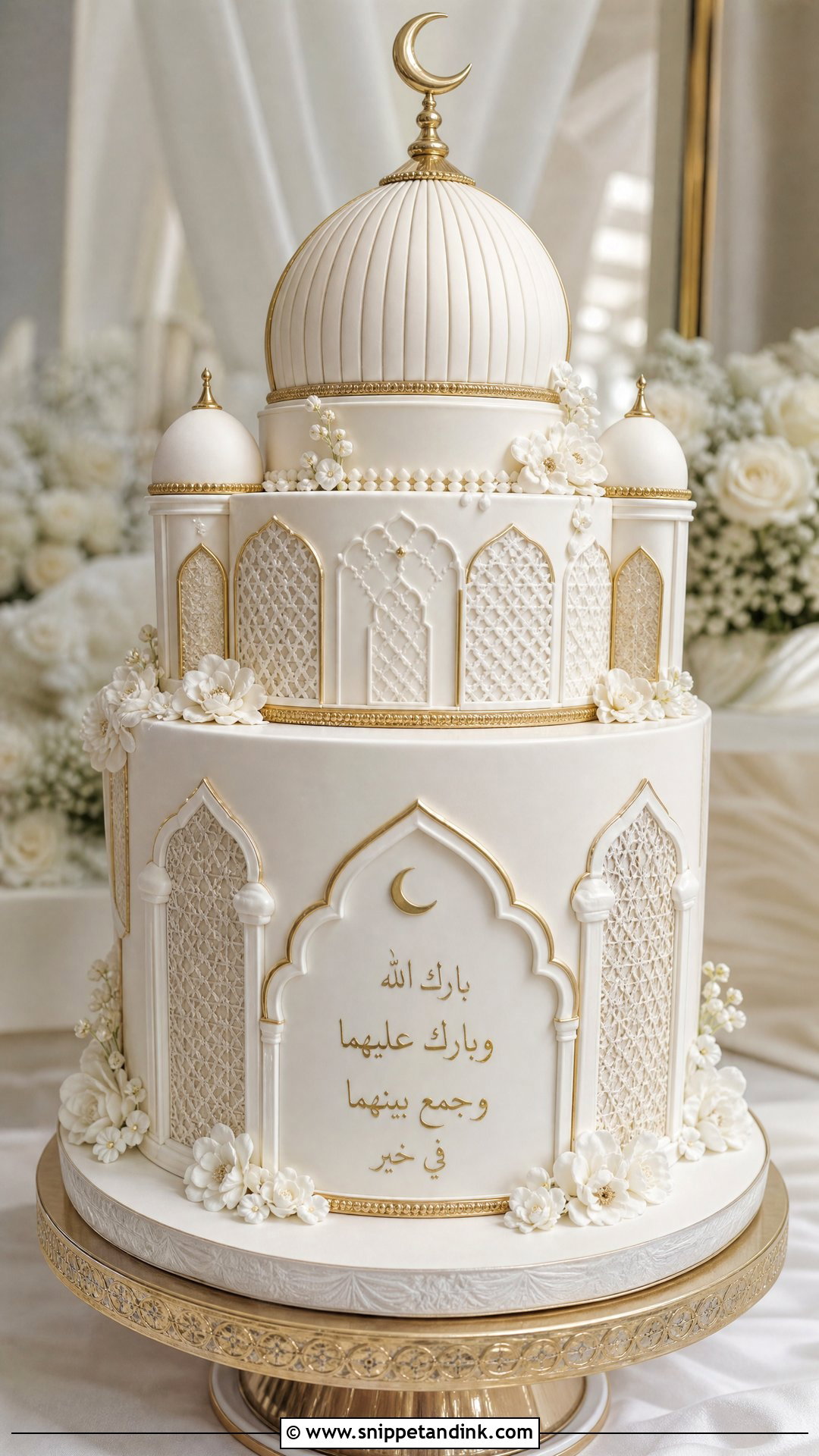
Dome shapes are carved from sponge or built over a support, so a dense cake is essential; a light, airy sponge collapses under fondant. Vanilla, almond or chocolate baked firm holds the curve. I keep the architecture to clean outlines, an arched topper, a crescent, a gold line, because too many windows and minarets start to look like a novelty cake. Ivory, emerald and soft gold suit it, with pearls or flowers at the base to soften the edges. Some families feel a mosque shape shouldn’t be cut and eaten, so talk it through at home before you order.
12. Crescent Moon Nikkah Cake
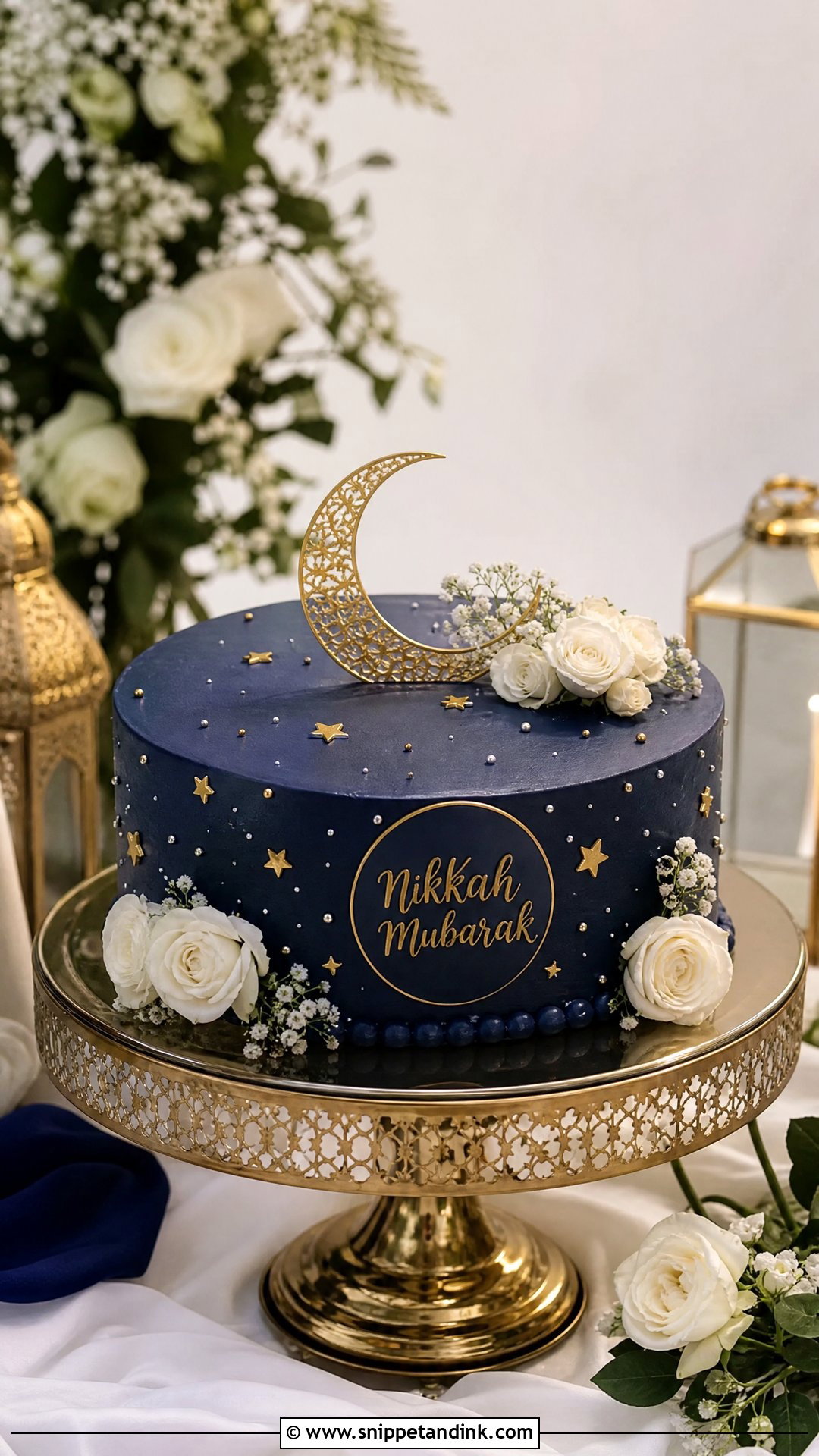
A crescent is easiest as a separate topper in sugar paste, acrylic or wire, set in on the day so it can’t droop overnight. On navy or emerald, gold moon and star details catch evening light; on white they read gentler. Tiny pearl stars and white flowers keep it soft. Vanilla, chocolate or pistachio all suit. Dark navy buttercream can stain lips and fingers, so I colour only the outer coat and keep the filling pale.
13. Blush Pink Nikkah Cake
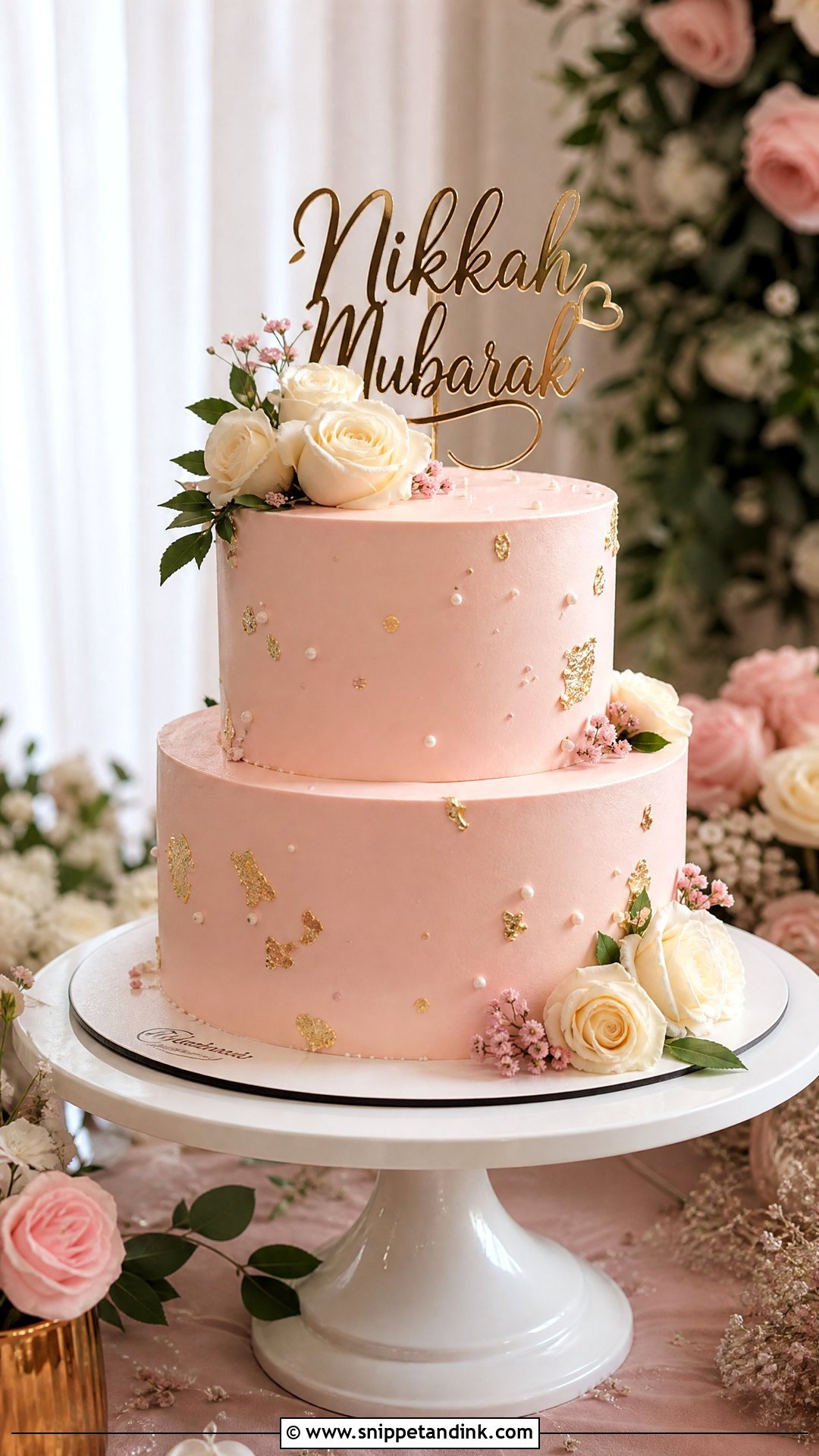
Blush is easy to overshoot. A drop too much colour and it turns bubblegum, so I mix it a shade lighter than the swatch, knowing buttercream deepens as it sits. Ivory flowers, gold writing and fine piping pair well with it. Strawberry, vanilla rose or raspberry fillings suit the colour, though fresh fruit fillings make a cake more heat-sensitive and need refrigeration until close to serving. One tier for a small gathering, two for something more formal.
14. Ivory Nikkah Cake
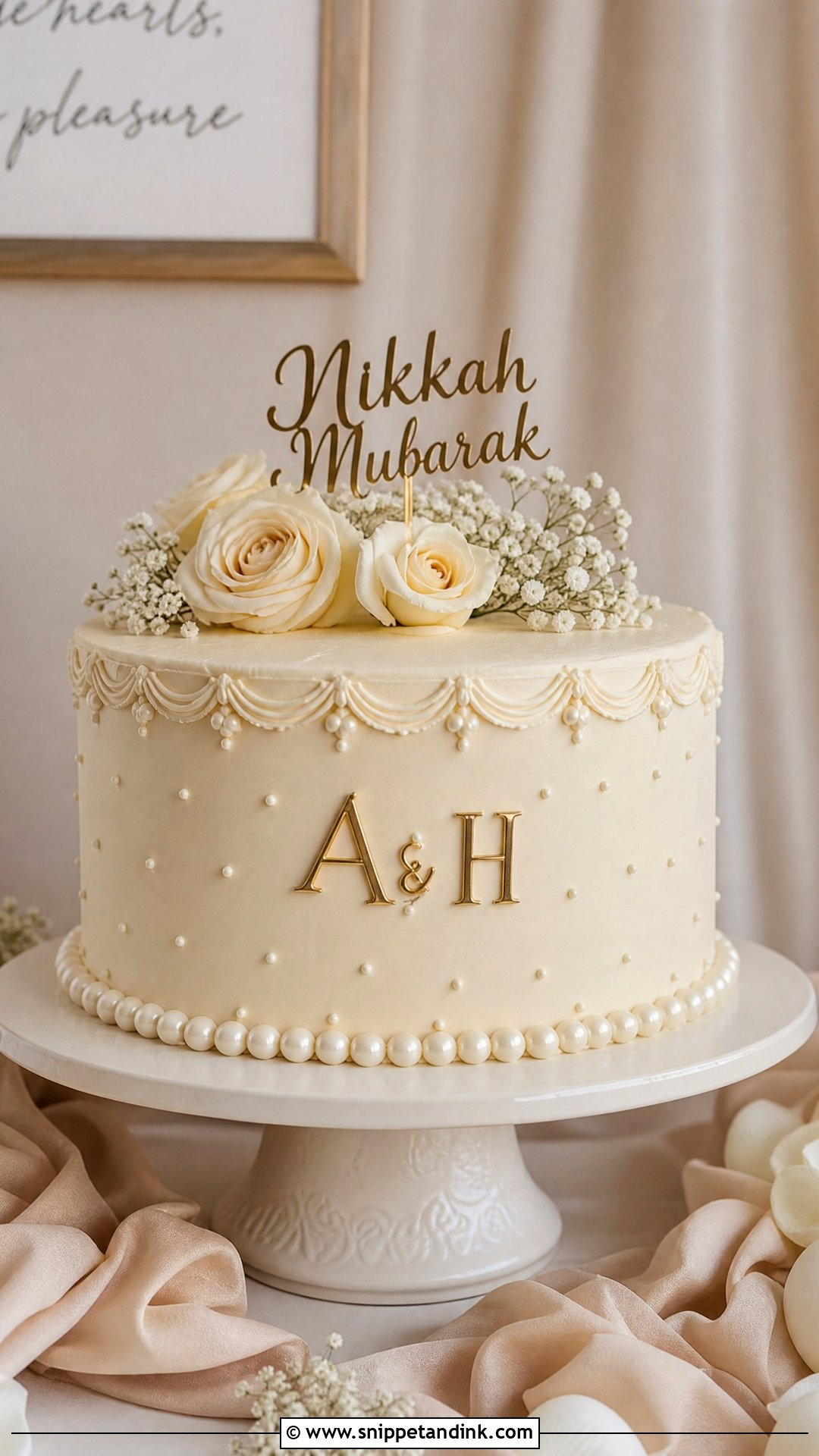
Ivory is my answer for anyone whose outfit is cream, champagne or gold rather than pure white, because bright white icing beside an ivory outfit can make the fabric look yellowed in photos. It also lets real butter keep its natural colour, so the buttercream tastes richer. Smooth, lightly textured or edged with pearls, it suits traditional and modern ceremonies equally. Vanilla bean, honey or cardamom sponge matches the warmth. Small gold initials are enough.
15. Emerald Nikkah Cake
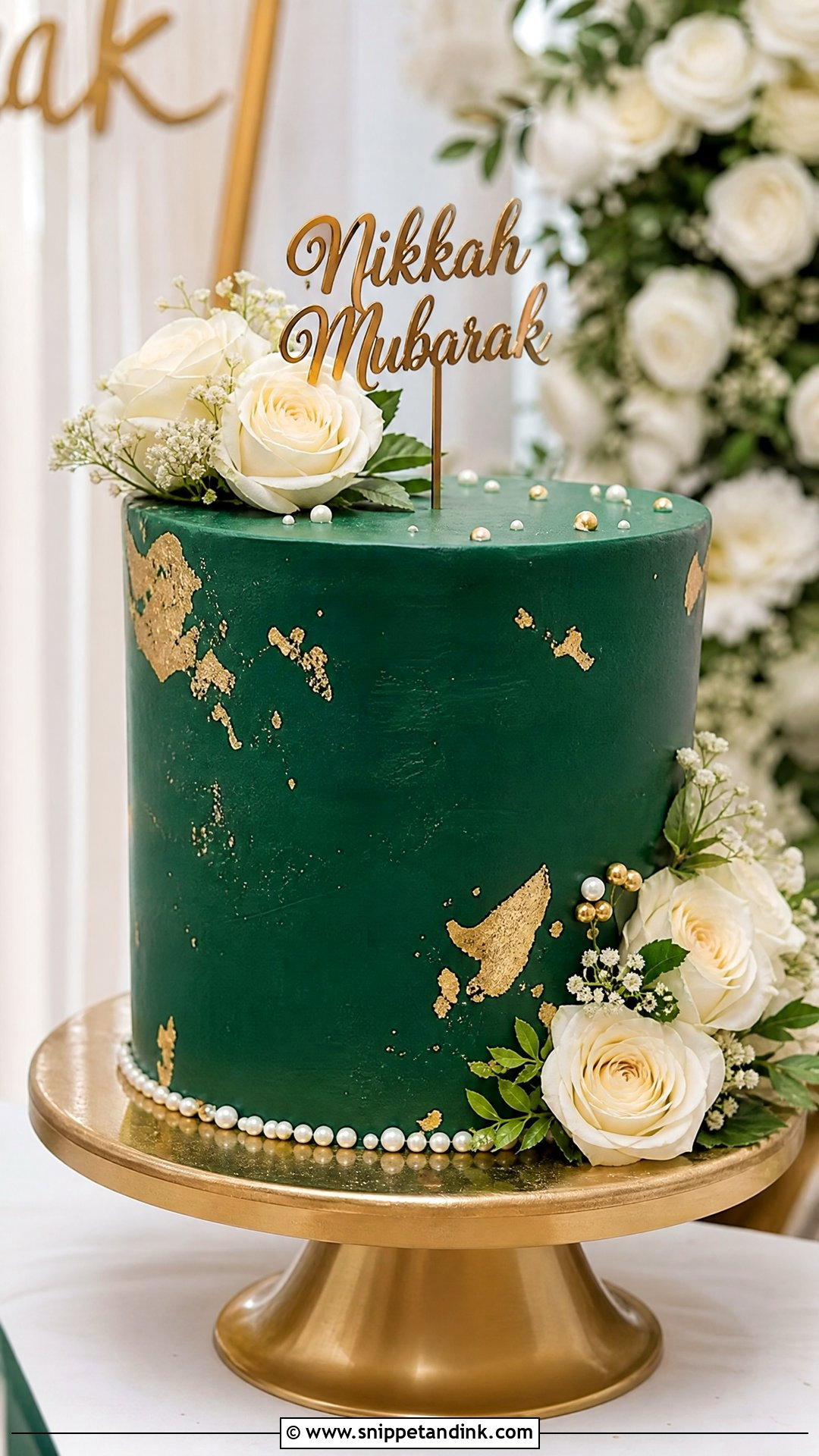
Emerald is the colour I handle most carefully. Deep green buttercream takes a lot of gel colour and can taste slightly bitter if it’s overdone, so I usually suggest fondant for full coverage, or emerald on one tier only. Gold leaf, ivory flowers and pearl details all stand out against it, which means the shape itself should stay clean. Pistachio sponge is the natural match, with cardamom close behind. On a gold stand under evening lights it looks rich, and it suits a formal hall far better than a small home setup.
16. Sage Green Nikkah Cake
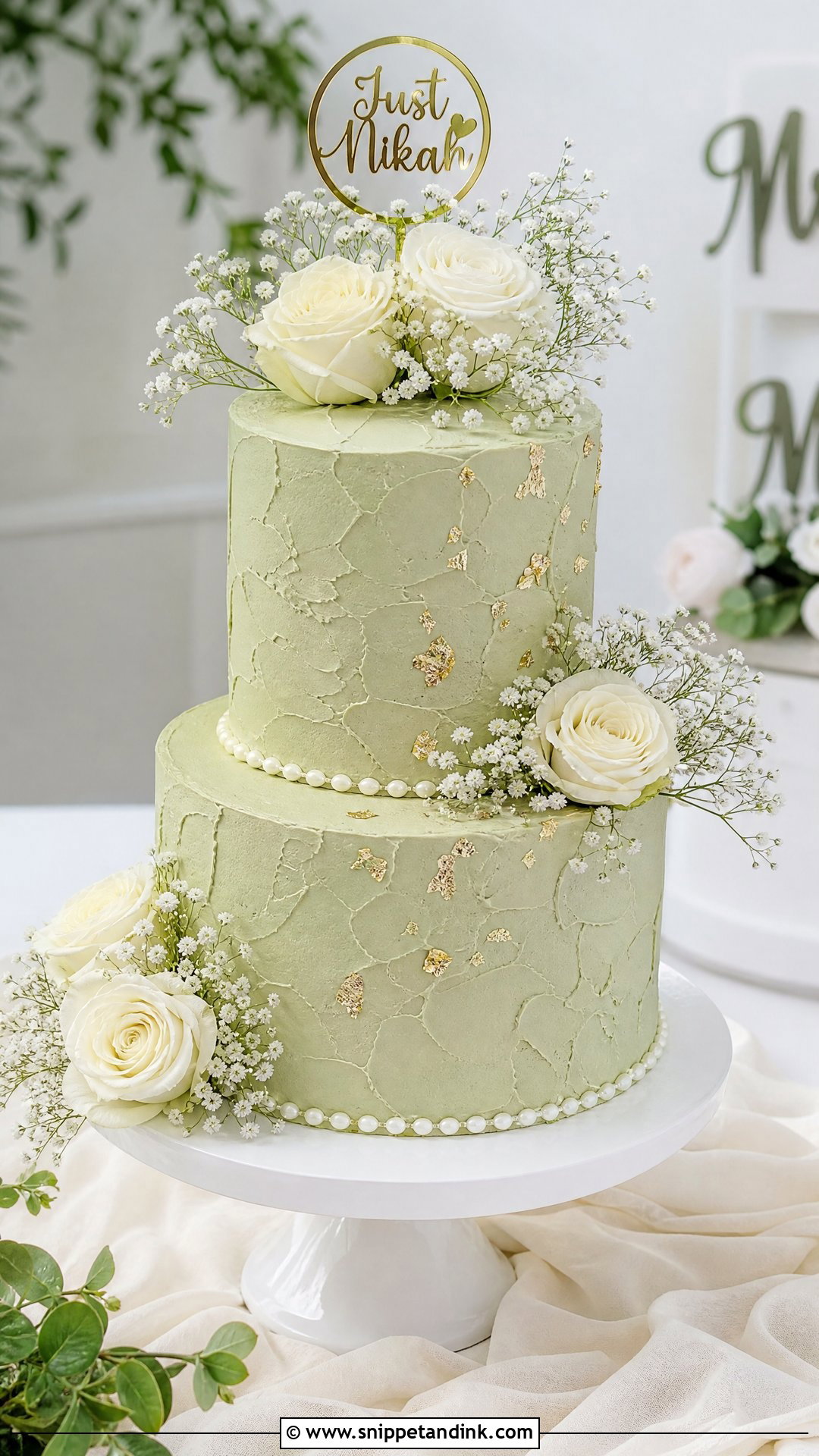
Sage has become the colour couples ask for when they want something fresh without going fully green. It sits easily beside white roses, baby’s breath and pearls. A sage green Nikkah cake fits garden ceremonies and home setups especially well. I tint sage with a touch of grey or brown alongside the green; without it, the shade drifts towards mint. Pistachio, matcha or almond sponge suits it. Smooth sides look minimal, while palette-knife texture looks handmade and forgives small marks.
17. Minimal Nikkah Cake
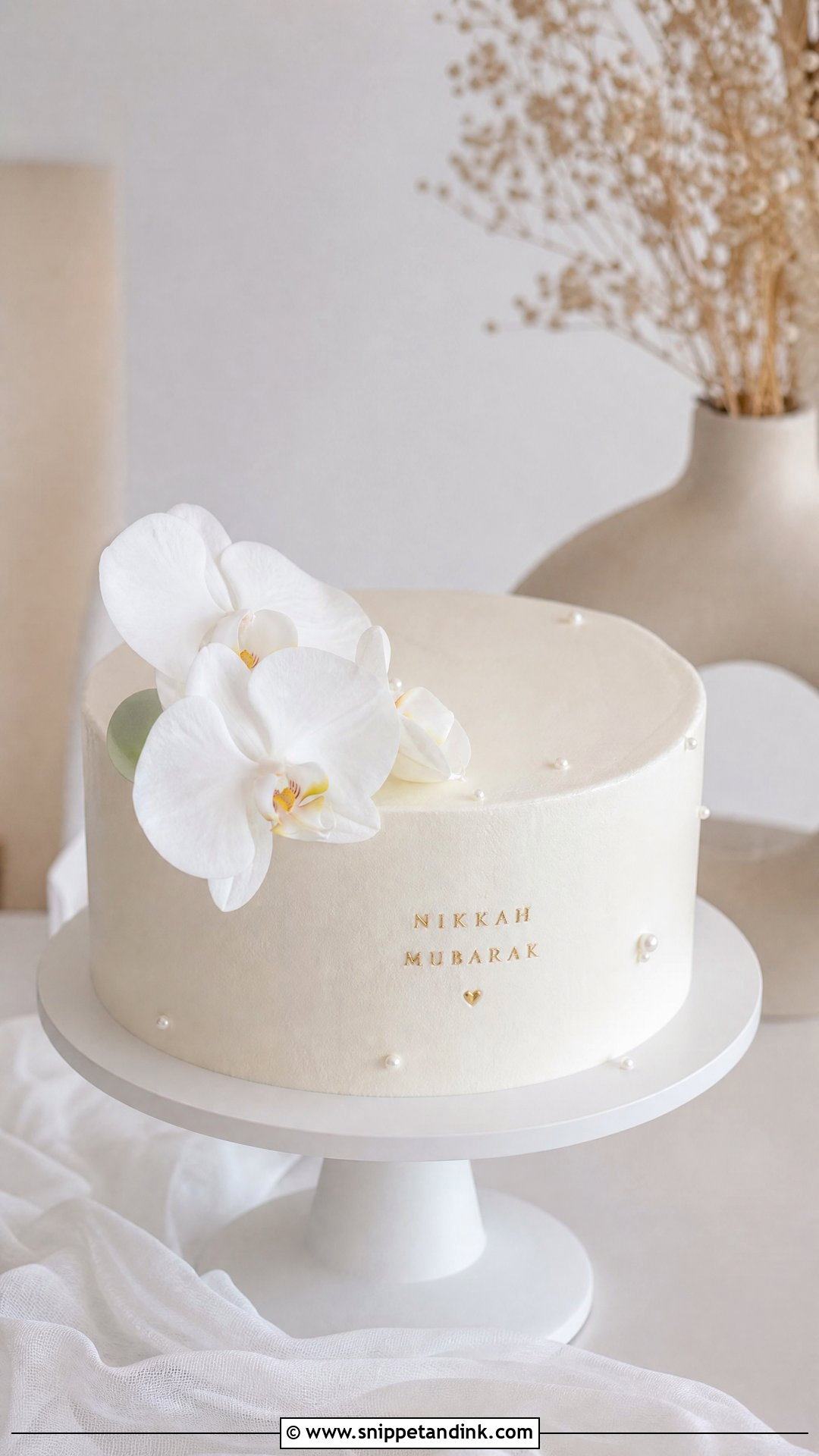
Minimal cakes take more skill than people expect, because sharp edges and centred writing are pure technique with nothing to cover a slip. I get those edges with a warmed scraper and a cake chilled between coats. One flower cluster and a small gold message are the whole design. A single tier, or a slim double-height tier, adds height without more decoration. If a baker’s plain-cake photos show bulging sides or uneven tops, choose a textured style instead.
18. Buttercream Nikkah Cake
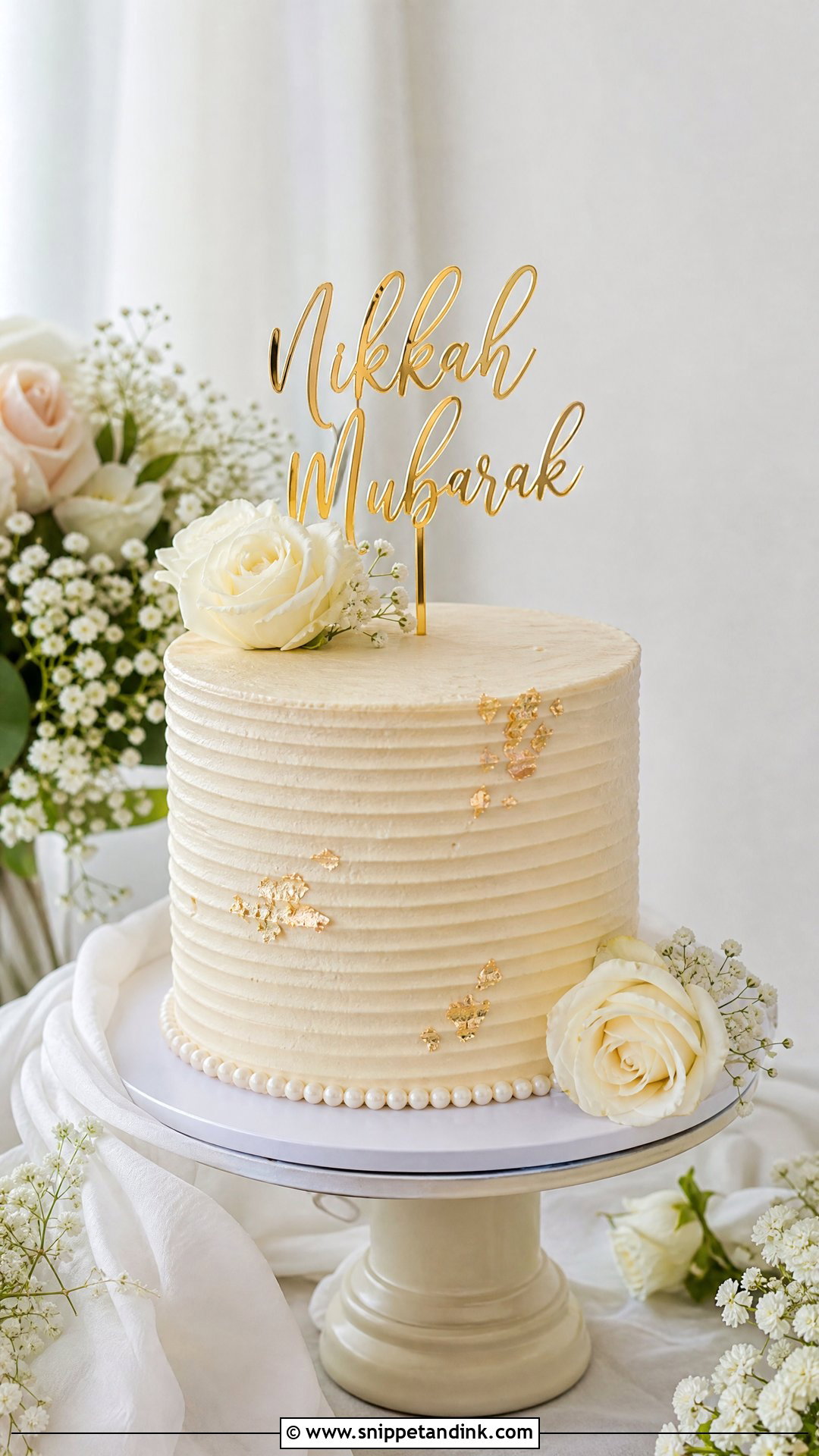
Buttercream is what I steer most couples towards, simply because guests eat it. Smooth, ribbed or ruffled, it adapts to almost any styling and cuts cleanly without anyone peeling icing off a plate. The trade-off is heat. A crusting American buttercream holds up better in a warm room; Swiss meringue tastes lighter but softens sooner. If your hall has weak air conditioning in summer, ask which one your baker uses. Vanilla, chocolate, pistachio and lemon all pair well.
19. Fondant Nikkah Cake
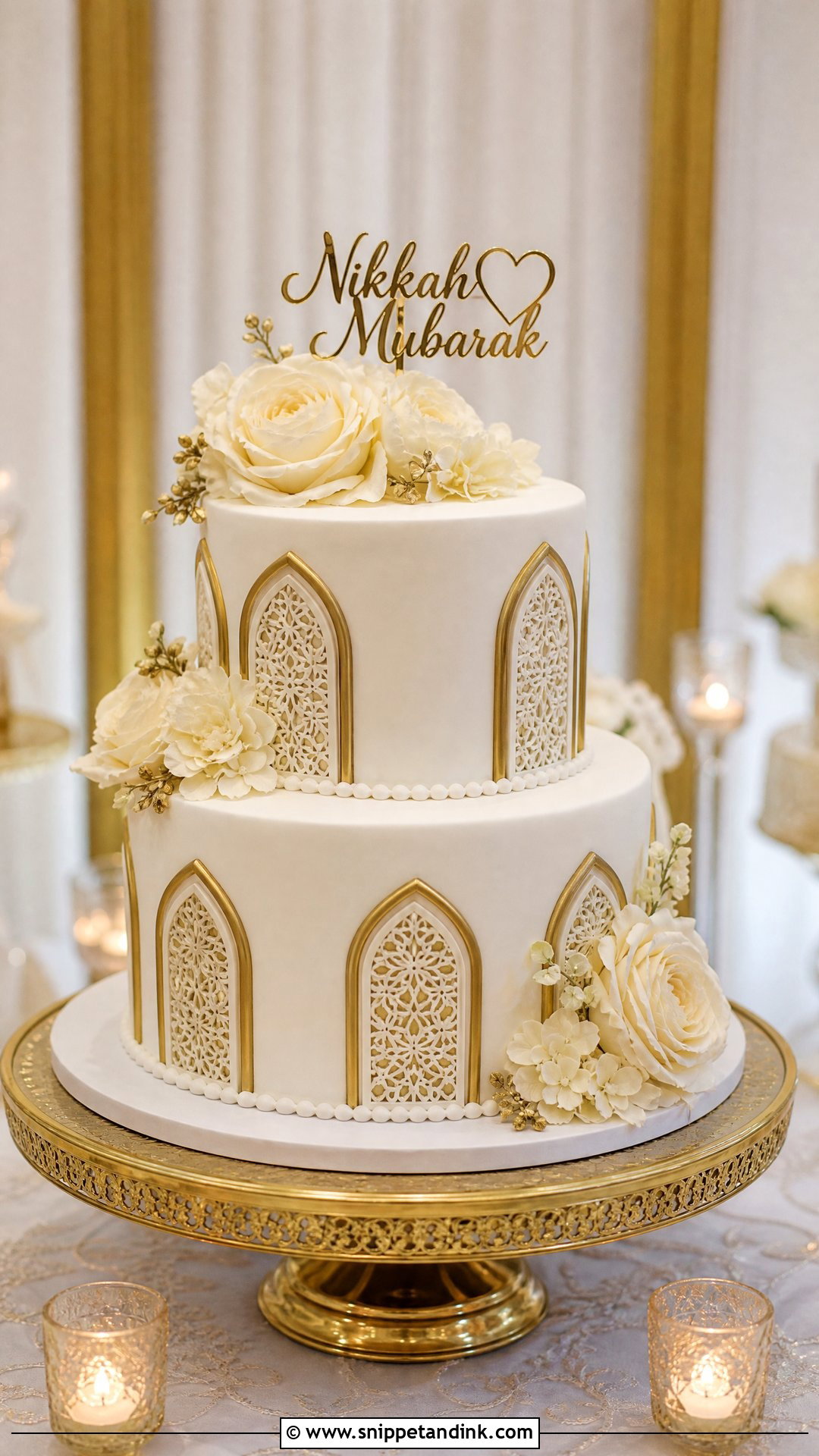
Fondant earns its place for crisp tiers, bows, plaques and detailed stencil work that buttercream can’t hold. It also seals the sponge, so the cake stays moist through a long display. Ask for a thin layer over buttercream rather than a thick one; guests are far more likely to eat it. One thing to check: some ready-made and marshmallow fondants contain gelatin, so confirm the source. White, ivory, emerald and navy all suit the sharp finish.


20. Square Nikkah Cake
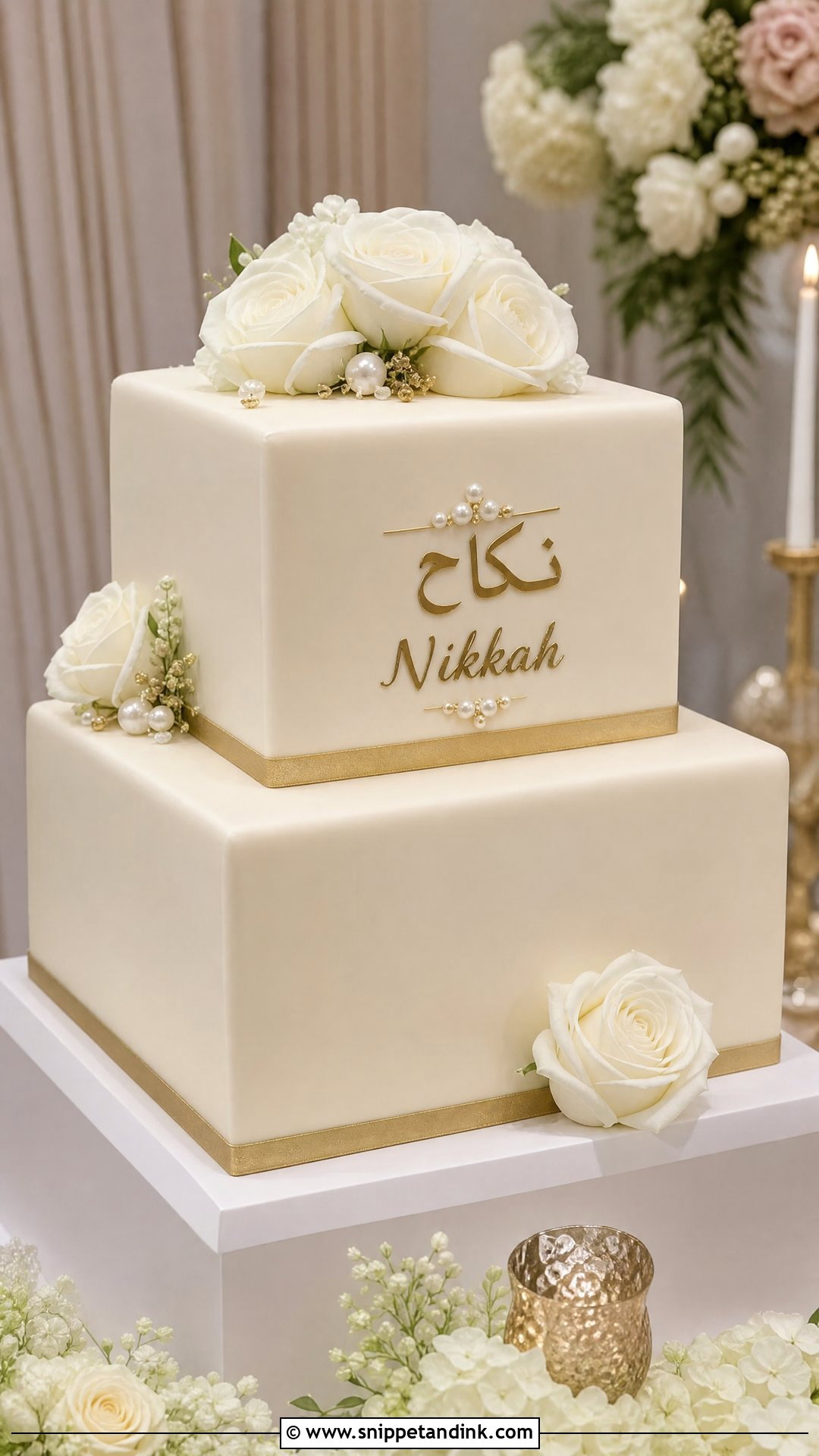
Square cakes look modern, but the corners are the hardest part to finish. Buttercream corners need very careful scraping, and fondant can tear at a corner if it’s rolled too thin, so for a square I prefer a firm ganache coat underneath. One tier works for a small ceremony; two stacked feel more formal. White and gold is classic, sage with ivory softer. A square also cuts into more even portions than a round, which helps with a long guest list.
21. Heart Nikkah Cake
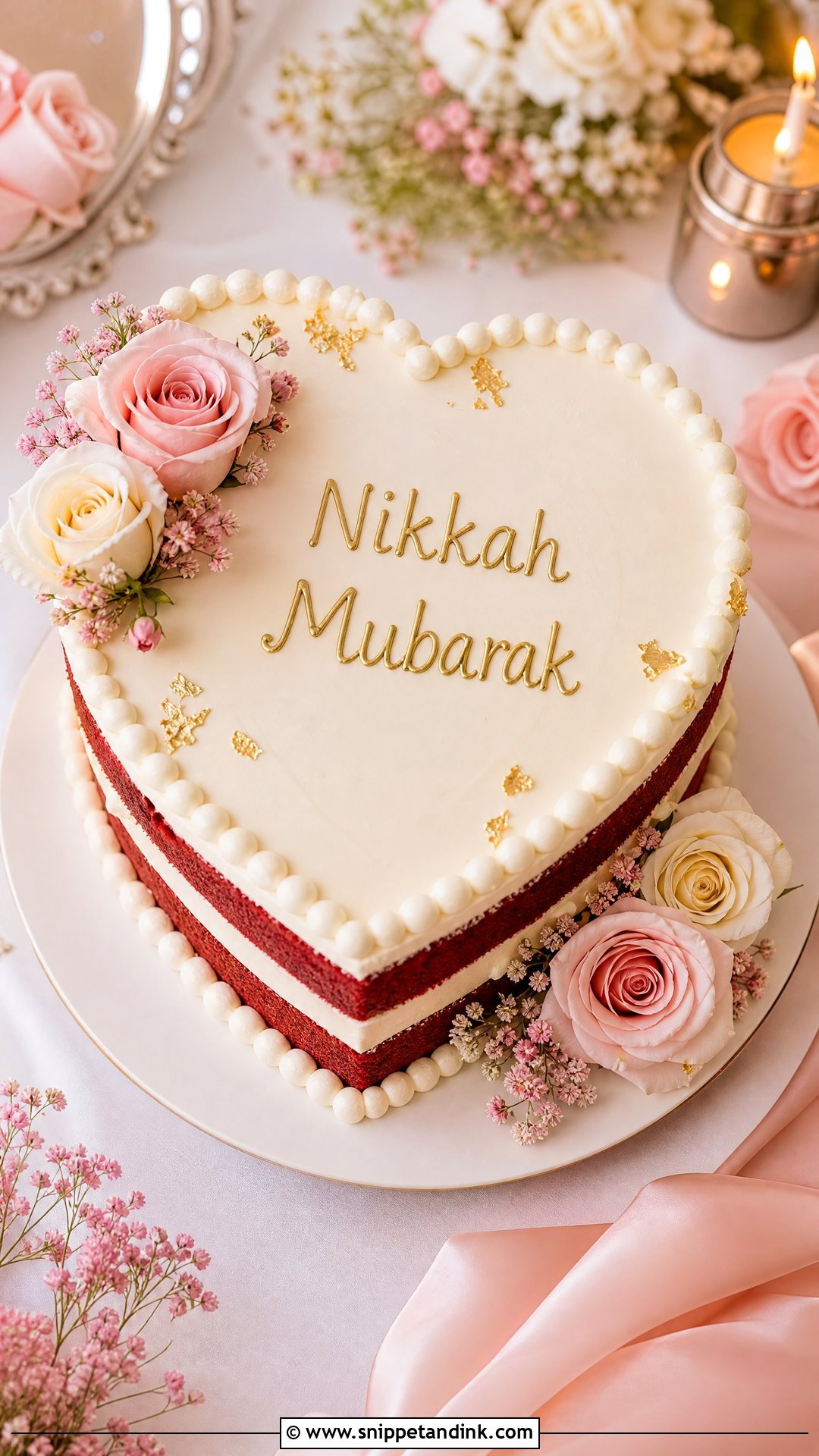
A heart can tip into Valentine’s territory fast, so I keep the palette bridal: ivory buttercream, a pearl border, gold writing and a few small flowers. Blush, champagne or sage calms it further. Strawberry vanilla, raspberry or red velvet suit the shape. It feels most at home at intimate home Nikkah ceremonies where the cake sits close to the family. Ask whether yours will be baked in a heart tin or carved, because a carved heart has more cut edges that need a crumb coat.
22. Sheet Nikkah Cake
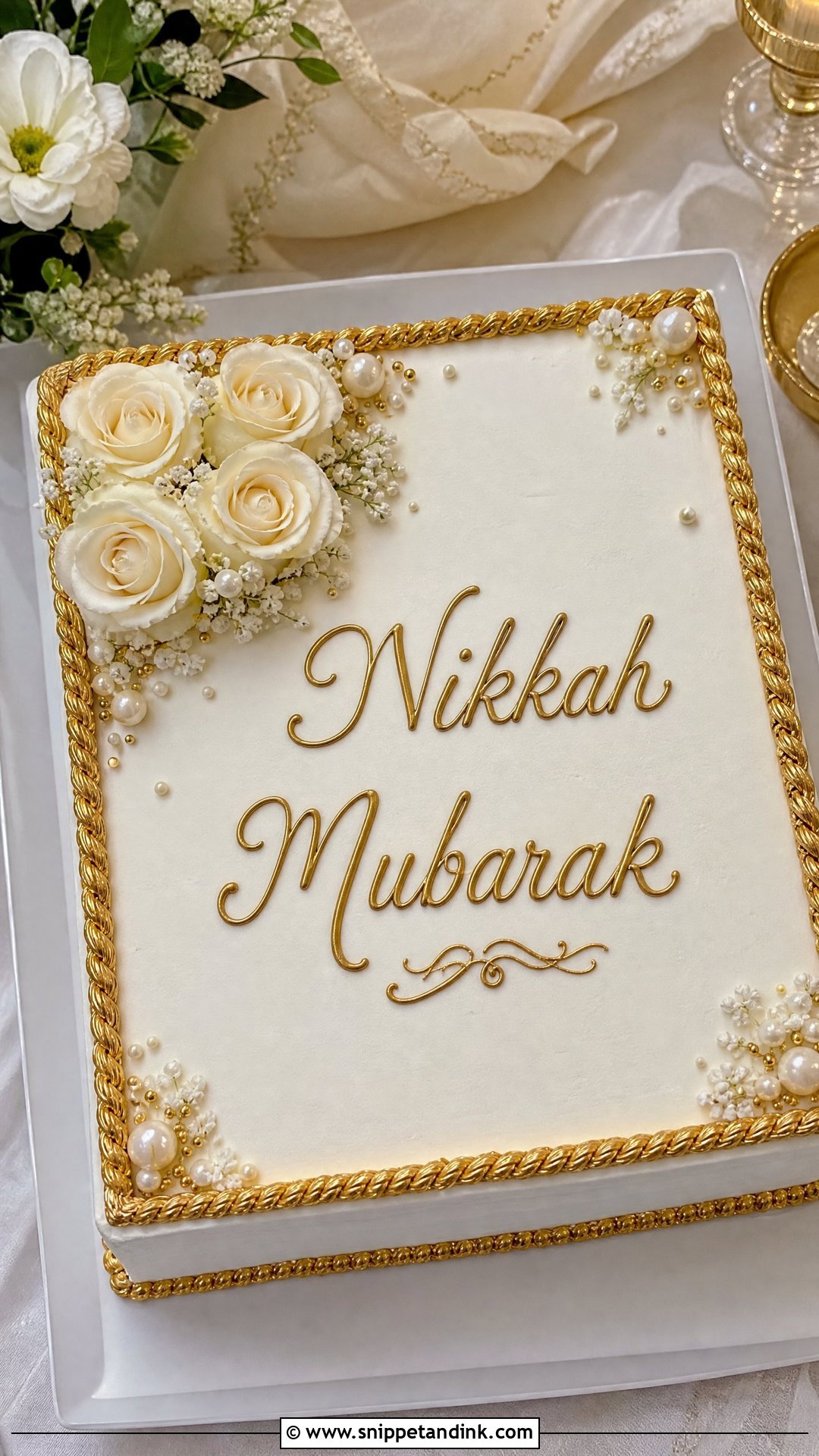
Sheet cakes are the honest workhorse. They serve a crowd for far less cost and labour per slice, and plenty of couples display one decorated tier while sheet cake is cut in the kitchen. Finished properly, with smooth frosting, a piped border, a few flowers and gold writing, a sheet cake on display doesn’t look casual. The rectangle leaves room for names and the date. Vanilla, chocolate, red velvet and pistachio are the safe crowd flavours. Keep the colours restrained so it looks planned.
23. Cupcake Nikkah Cake
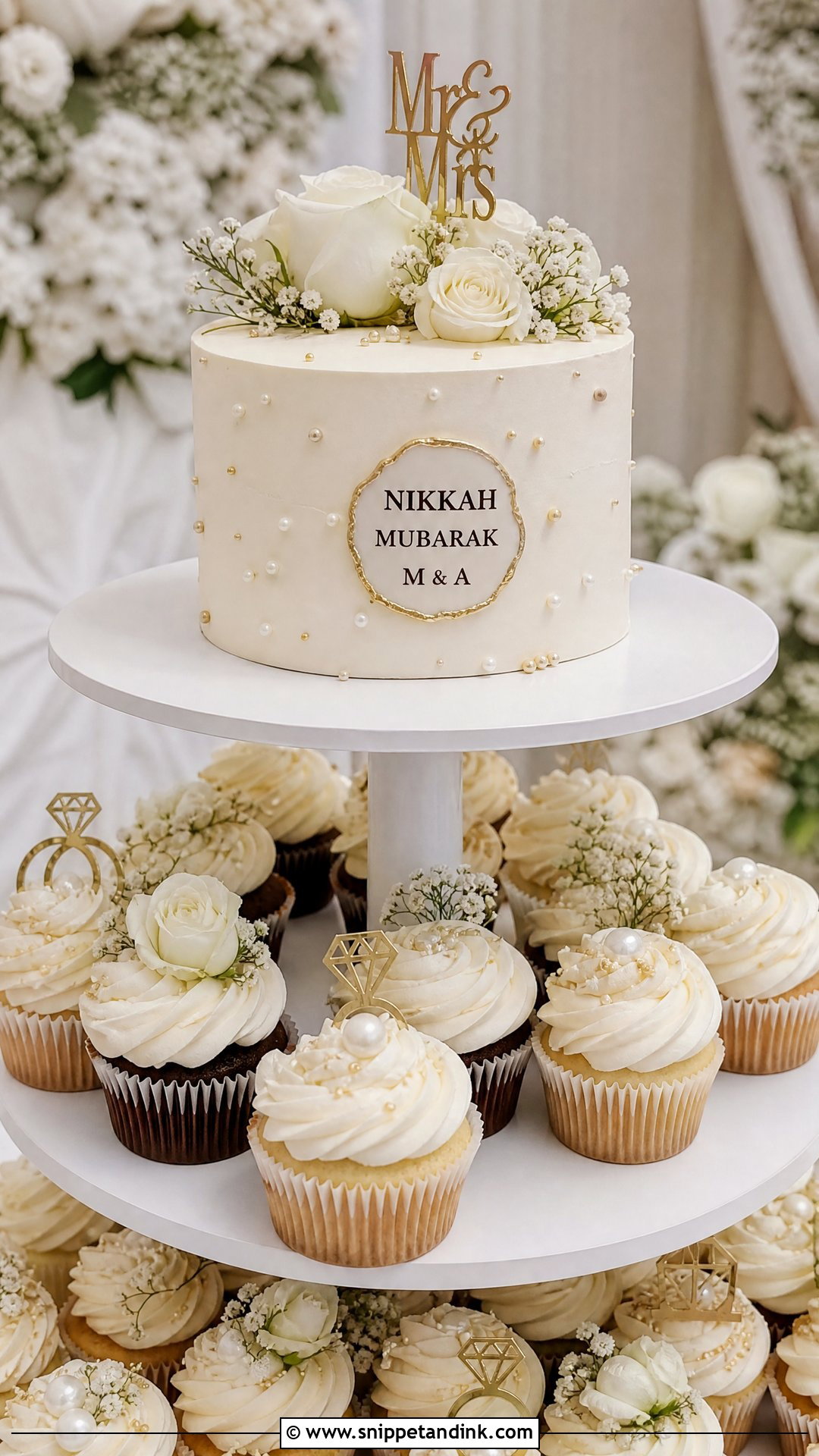
A cupcake Nikkah cake solves the cutting problem: a small cake on top for the couple, matching cupcakes on the tiers below for guests. Keep to one colour so it reads as a single display. My main warning is the stand. Cupcake towers have to be level and stable, and in a crowded home one child brushing past can take out a row, so set it away from walkways. Buttercream swirls hold far better than whipped cream if the room is warm.
24. Macaron Nikkah Cake
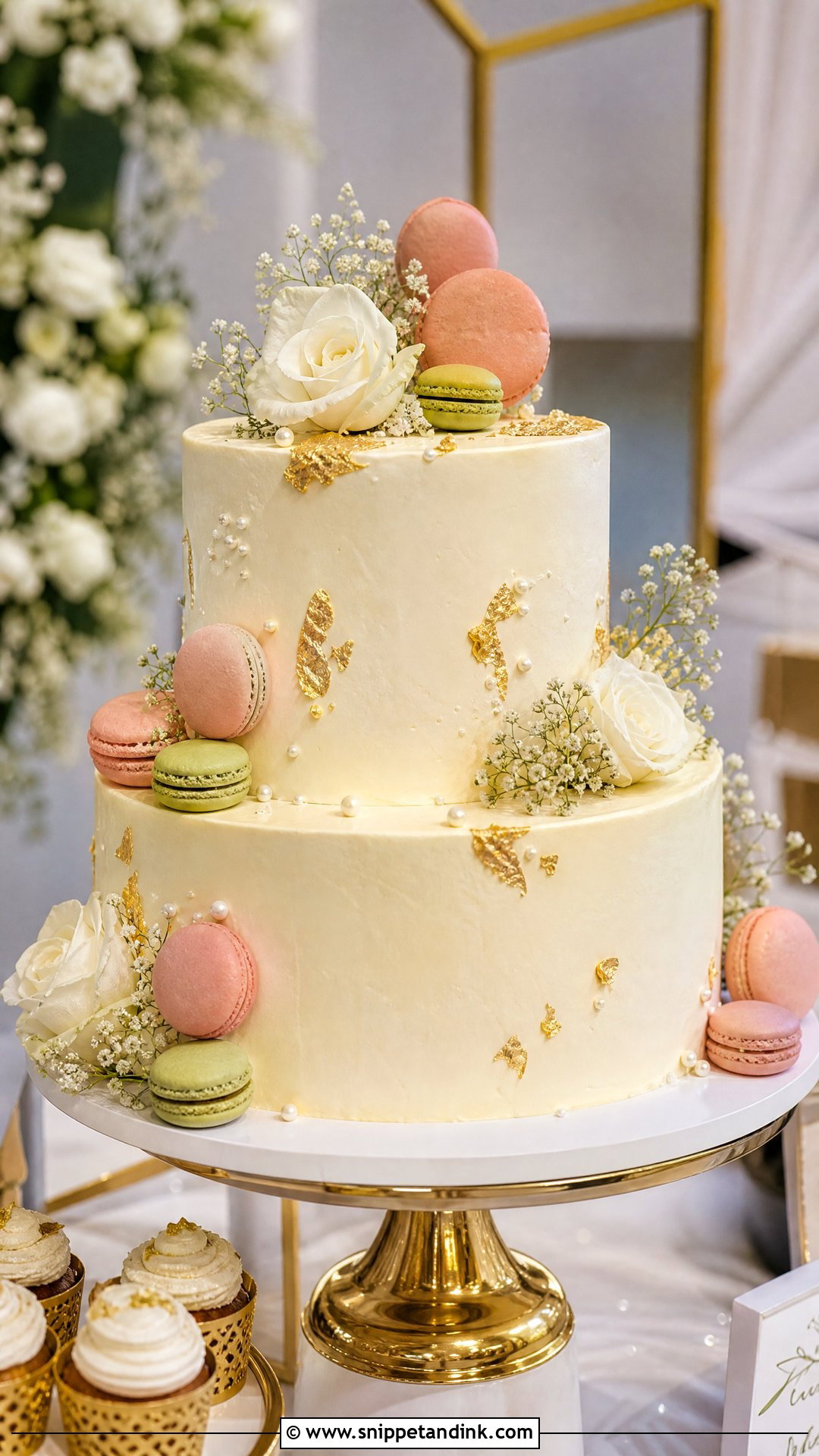
Macarons add texture and a second treat, but they don’t like humidity. In a damp room the shells soften and colour can bleed into the buttercream, so I attach them on site with a small dab of icing rather than pressing them in at the bakery. Pair flavours deliberately, vanilla cake with pistachio macarons, or rose with raspberry. Run them along one tier or cascade them down a side, and leave gaps so the cake still looks like a cake.

25. Dessert Table Nikkah Cake
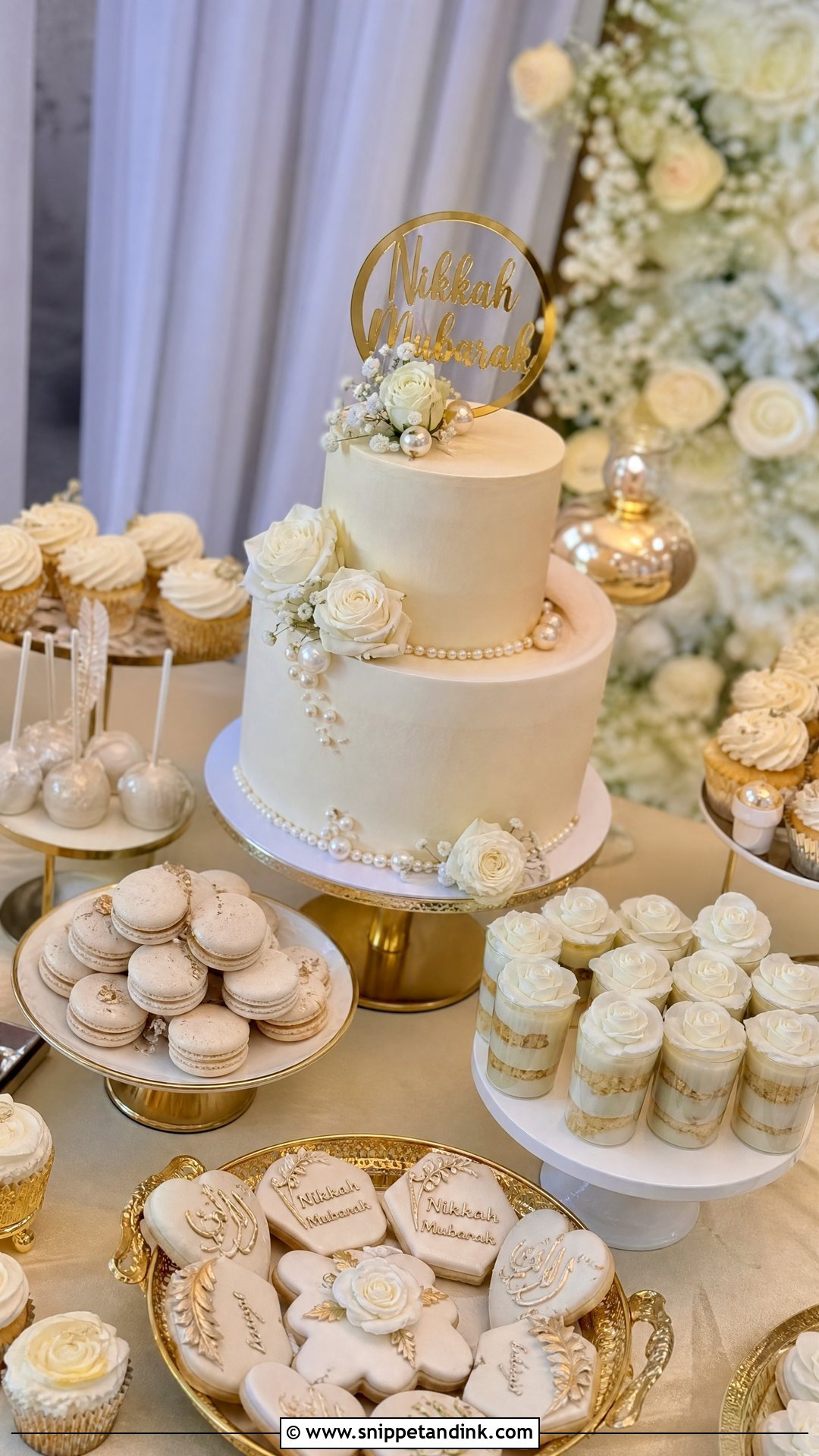
A dessert table Nikkah cake lets the cake be the tallest piece in a wider spread of cupcakes, macarons, cake pops and mini tarts. One palette across everything keeps the table organised, and the main cake still needs a single feature that sets it apart, a topper or a floral cluster. Because each item may come from a different kitchen, label the flavours and check every one is alcohol-free and halal, including bought-in macarons and anything with gelatin.
Moving a Tiered Cake Between Home, Mosque and Hall
Nikkah days often split across places: the ceremony at home or at a mosque, the meal somewhere else. Every move is a risk, and nearly every cake disaster happens in transit rather than on the table.
The car journey
A chilled cake is firm and travels well; a soft one slides. I deliver cold, on a non-slip mat on a flat boot floor or footwell, never on a seat or a lap, which tilts. Air conditioning on, sunny windows avoided. Fondant brought from a cold van into a warm, humid room may bead with condensation for a while. Leave it alone and it dries; wiping it leaves marks.
Who receives it, and when
Have the cake delivered to wherever it will be served, an hour or two before guests arrive, and name one person to receive it and check the order. If it has to move again after the ceremony, keep it boxed until the last moment and ask your baker whether the tiers should travel separately and be stacked on arrival.
Ordering enough servings
Bakers quote in servings, and a wedding serving is a narrow finger of cake, smaller than a party slice. If the cake is the only dessert, order for the full guest list. If mithai or a dessert table sits alongside it, many couples order fewer servings and keep a plain sheet cake in the kitchen for top-ups. Ask how your baker defines a serving before you compare quotes, because the numbers rarely mean the same thing.
Settle the Order Form, Then Enjoy the Cake
Some families want three tiers and gold leaf; others want one buttercream tier with soft flowers and a short message. Both are right if they match the feeling of the ceremony. Whatever you pick, the order form is where it all gets fixed: servings, flavours, confirmed halal ingredients, flower safety, delivery time and the exact wording on the topper. Settle those early and the cake becomes one of the calmest parts of the day instead of one more thing to chase.
You'll Like These Ideas:










Leave a Reply