
Heat, humidity and sea air are the three things a tropical wedding cake has to survive, and they shape every design decision long before anyone picks a flower. The prettiest island cakes I’ve built are the restrained ones: clean tiers, one strong botanical element, and flavours that taste of the place, like mango, coconut, lime or passion fruit. Below are 25 designs, from white orchids on ivory buttercream to black fondant with palm leaves, with notes on what holds up in a warm room and what to ask your baker.
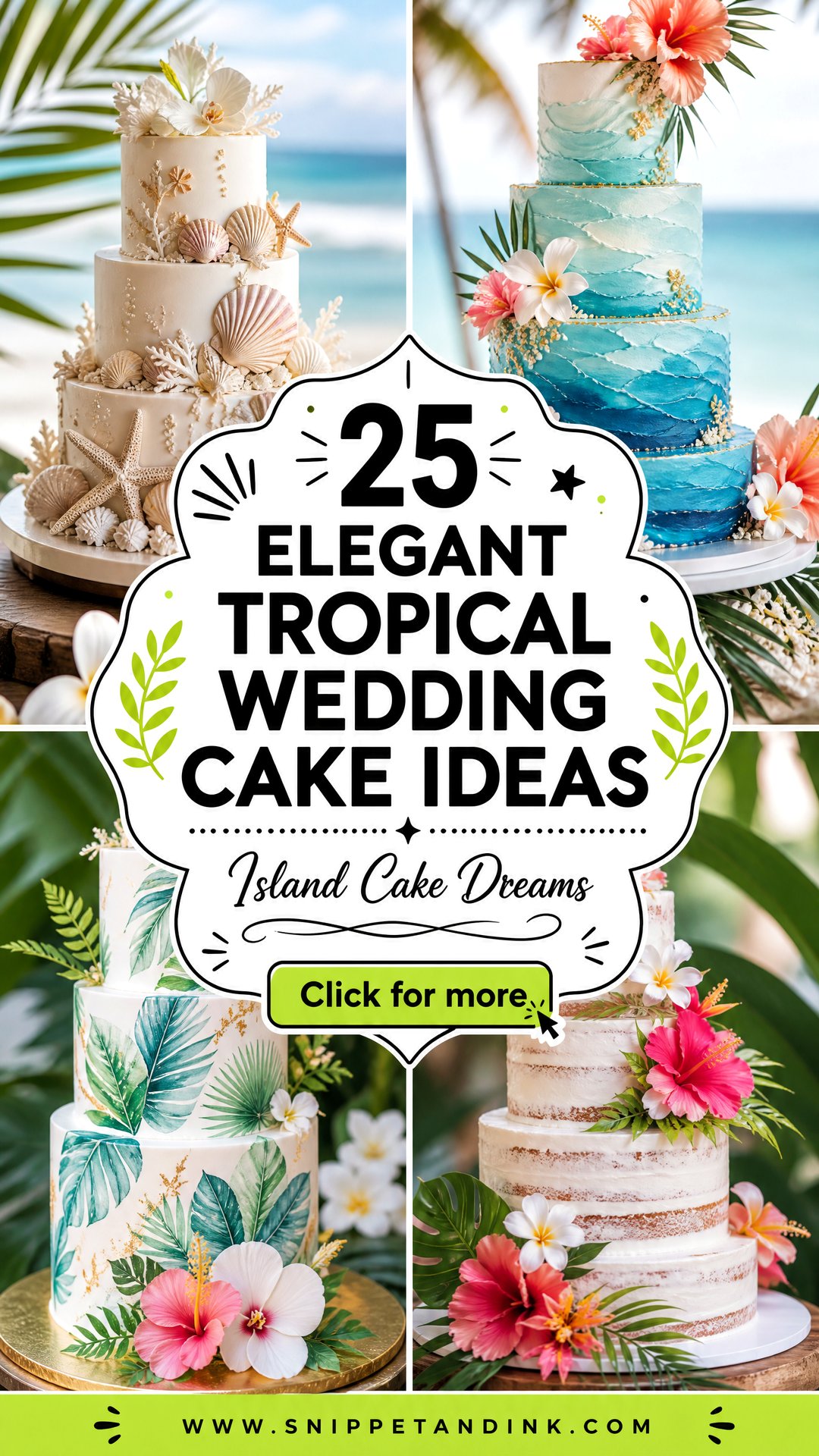
Pineapple, Kiwi and Papaya Need Cooking Before They Go Between Layers
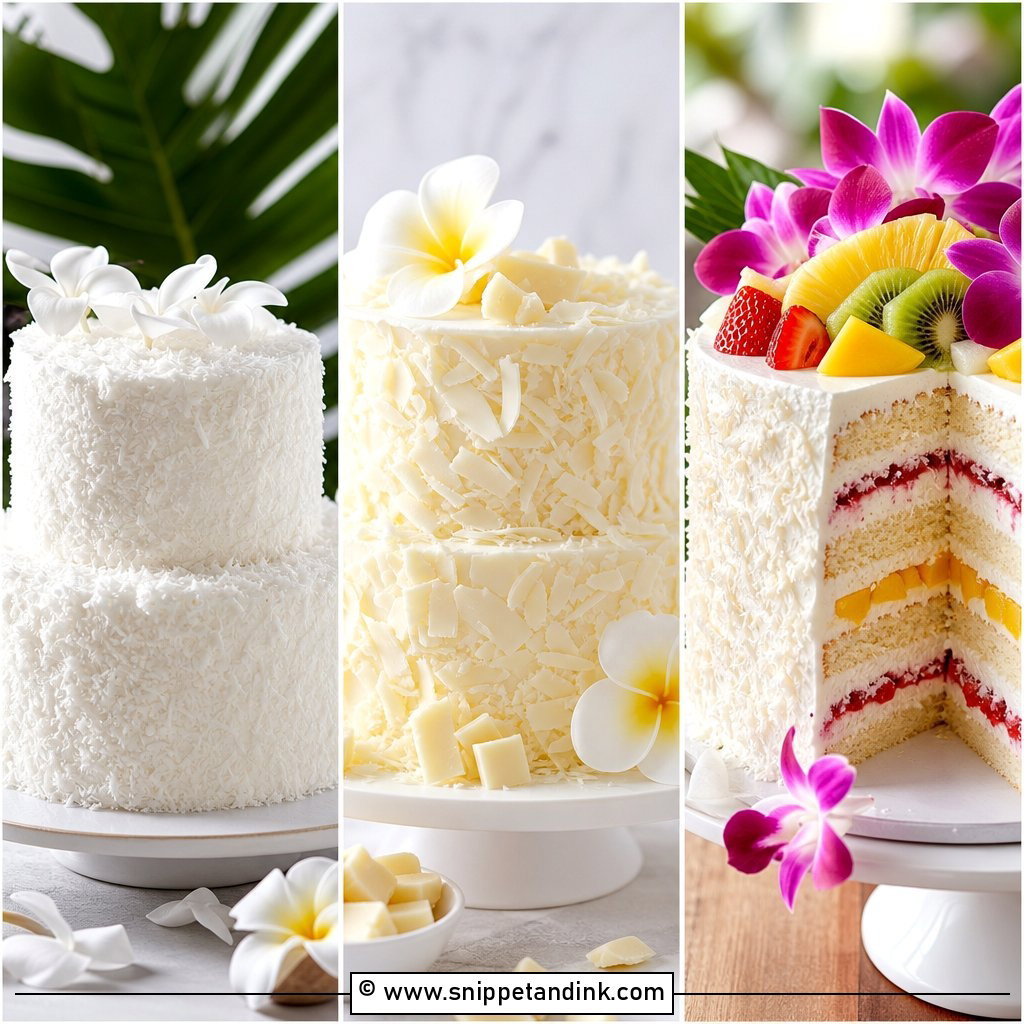
Some of the most popular tropical fruits fight with the ingredients of a wedding cake. Fresh pineapple, kiwi and papaya contain enzymes that break down proteins. Put them raw into a whipped cream or gelatine-set mousse filling, and within hours the filling can turn runny, and dairy can taste bitter.
Cooking the fruit switches those enzymes off. That’s why I make tropical fillings as curds, compotes or jams rather than layering fresh fruit inside the tiers.
- Pineapple: cook it into a compote or curd. Tinned pineapple has already been heated, so it behaves.
- Kiwi and papaya: cook them, or keep them on top as a decoration rather than inside.
- Mango: purée is very wet, so I thicken it into a curd or set it with a little starch so it doesn’t soak the sponge.
- Passion fruit: the most stable choice. Its curd sets firm and its acidity balances the sweetness.
When you meet your baker, ask how they handle fruit fillings in a tiered cake. A good answer mentions cooking, a buttercream dam around each layer to hold the filling in, and how long the cake can sit out.
1. Tropical Wedding Cake With Orchids
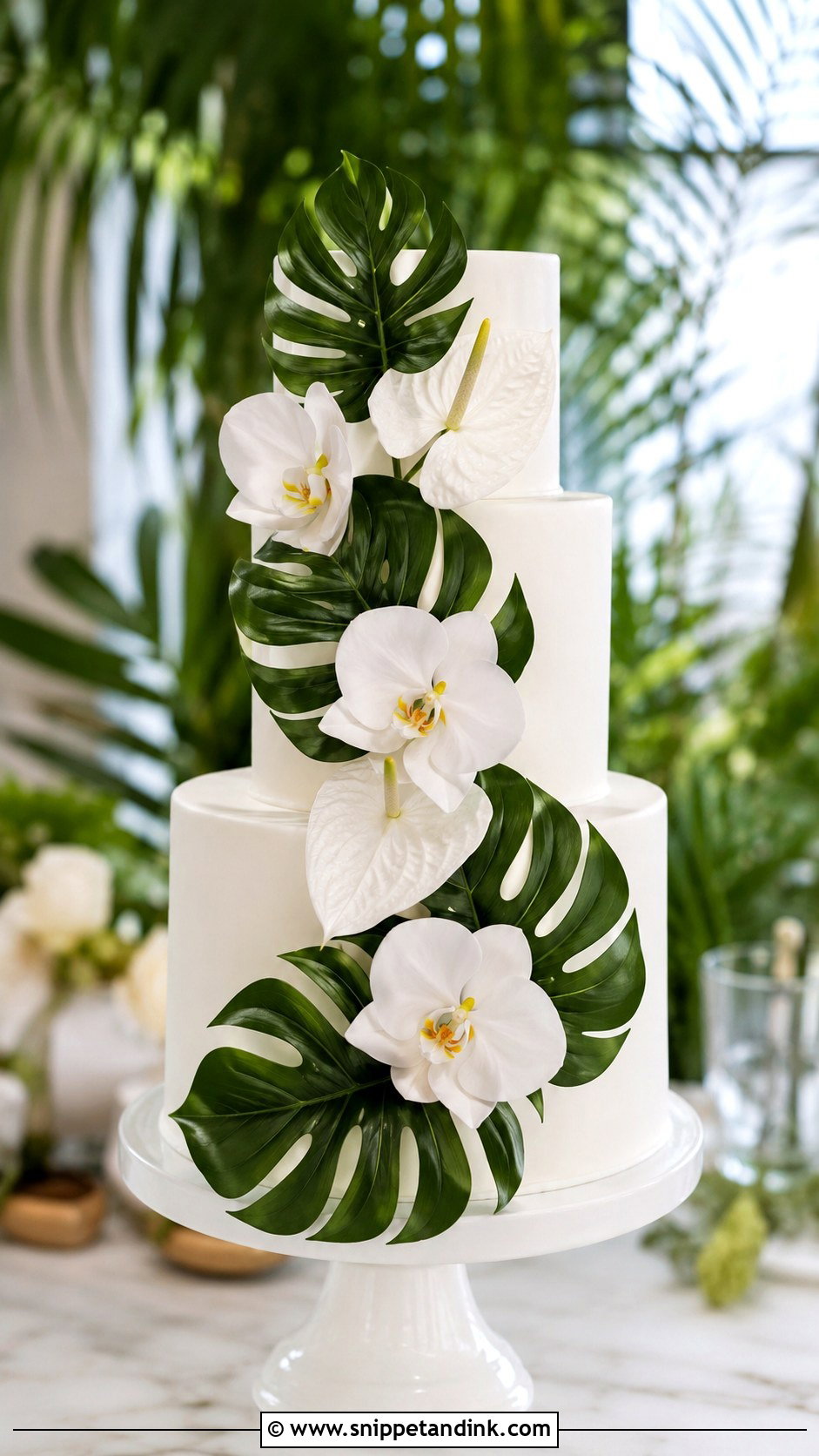
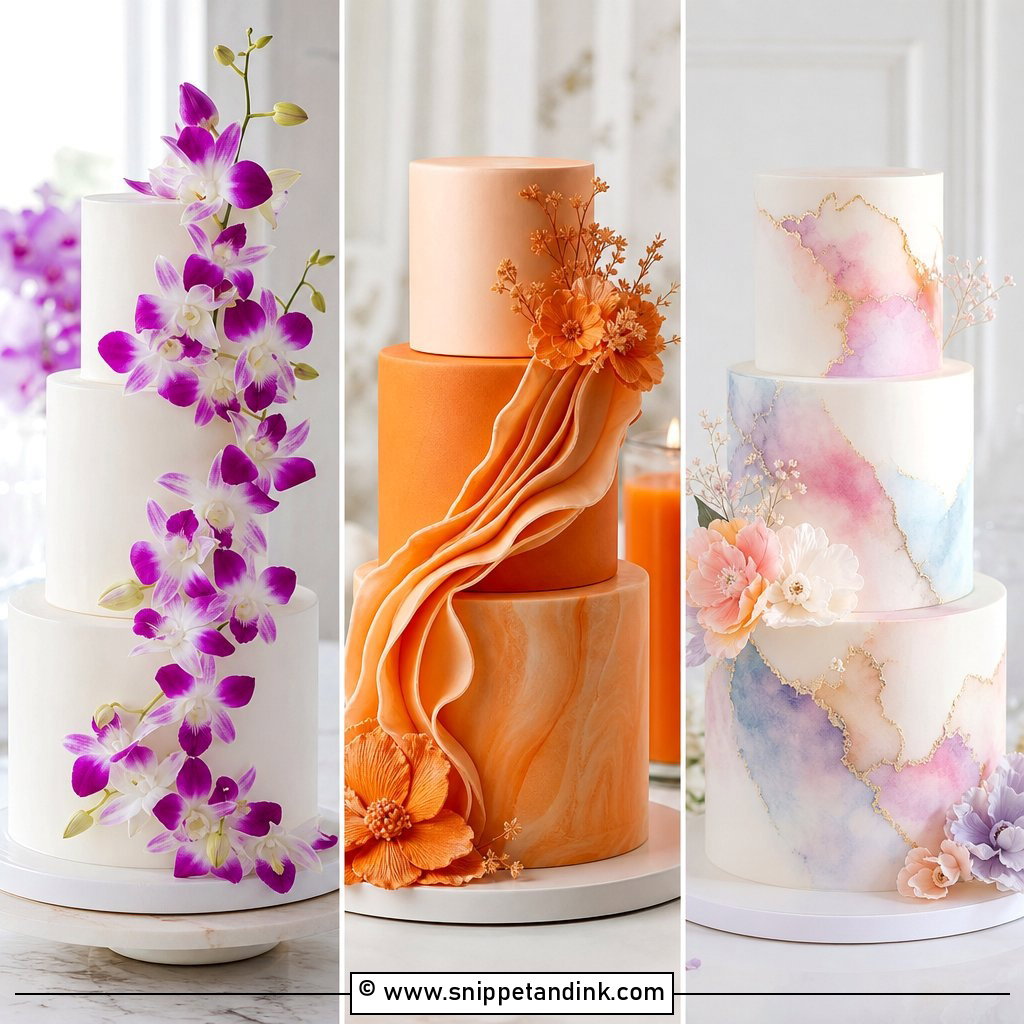
Orchids are the flower I reach for first on a warm-weather cake, because they’re sculptural and they hold their shape. Sugar orchids are fully edible and never wilt; fresh ones look natural but must sit on a barrier, never pushed into the icing. White or blush blooms on ivory frosting with a few dark leaves give the softest version. Coral, fuchsia or yellow in a light cascade turns it brighter. Coconut or vanilla bean sponge with passion fruit filling suits it. A plain stand keeps the attention on the flowers.
2. Tropical Wedding Cake With Palm Leaves
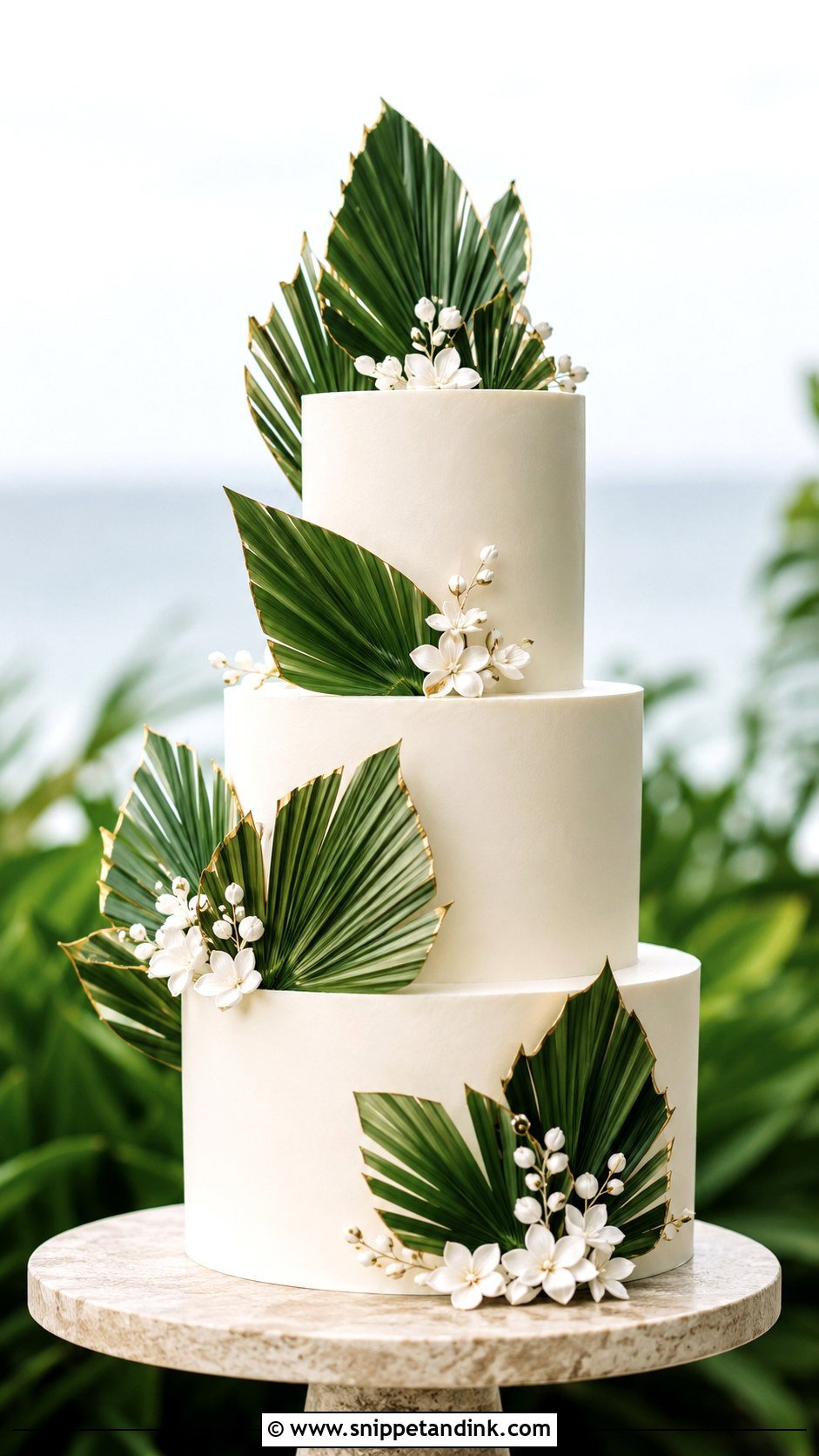
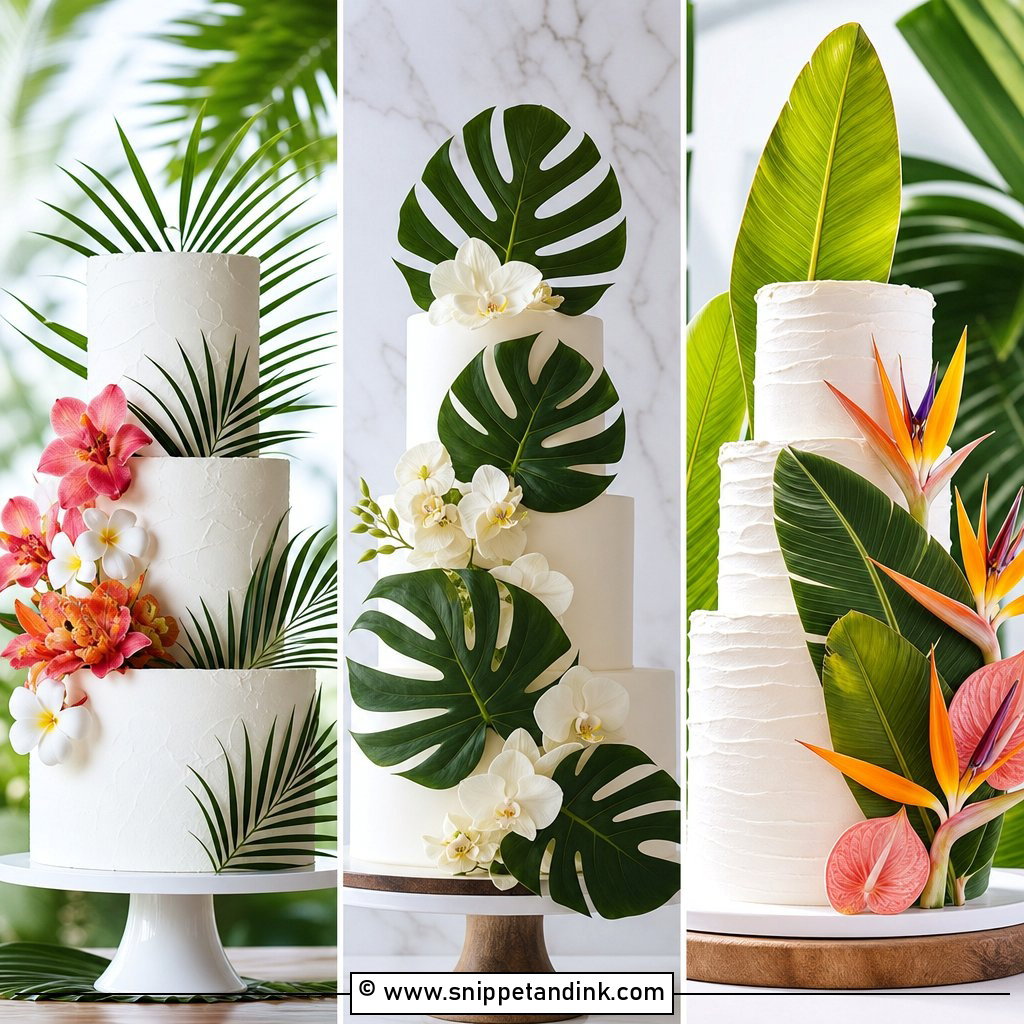
Palm leaves do most of the decorating on their own. One large frond behind a white three-tier cake gives height without crowding the tiers; small leaves tucked between tiers or painted onto fondant give a quieter version. Real fronds should be washed, dried and kept on a barrier, because they aren’t meant to touch food. Coconut buttercream, lime curd, mango filling or pineapple cream all suit it. For a formal reception, gold edging or pearl piping keeps it from reading too casual.
3. Tropical Wedding Cake With Hibiscus Flowers
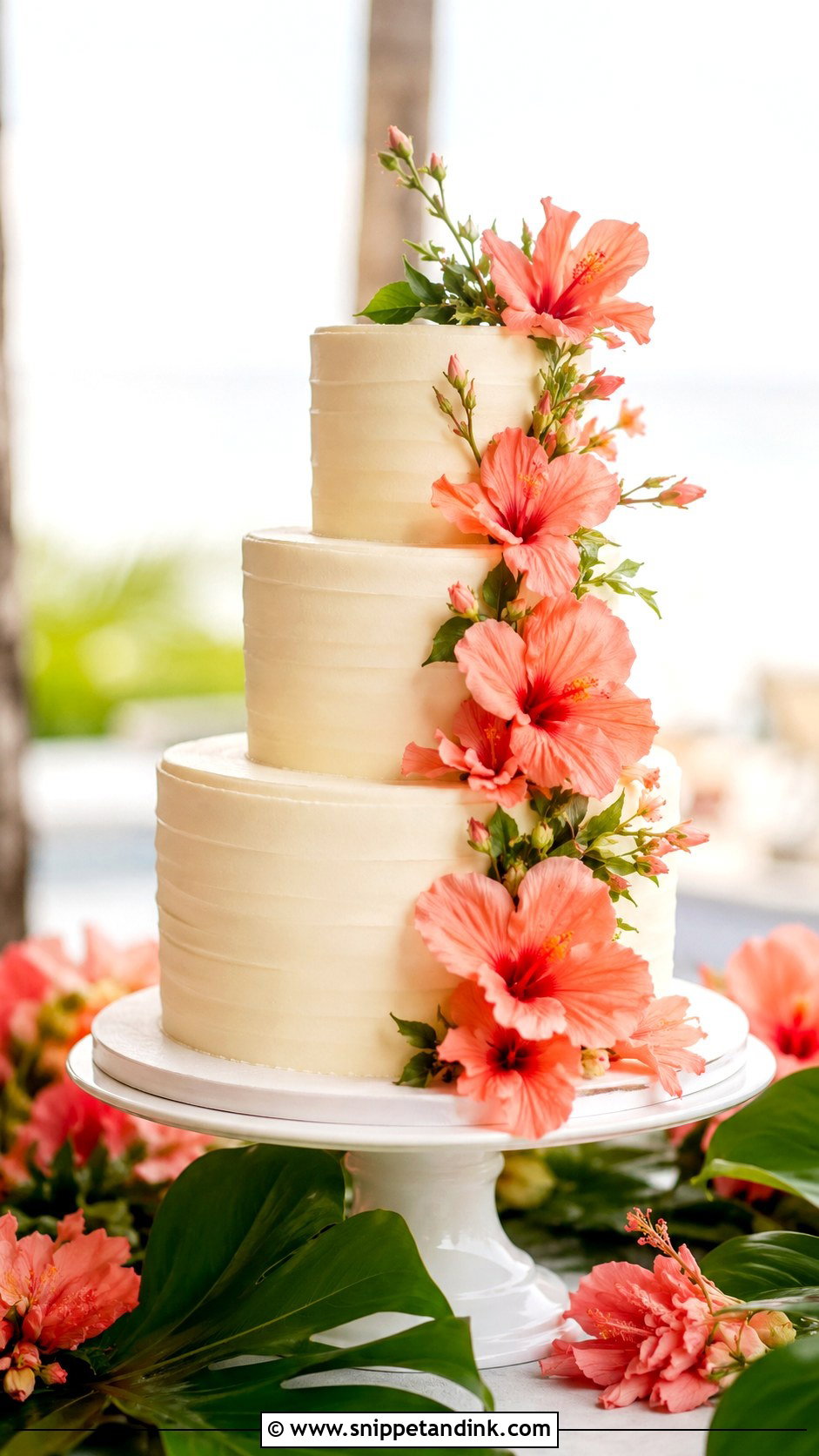
Hibiscus is the flower everyone associates with the islands, and it’s easy to overdo. I’d place a few large sugar blooms along one side of a smooth white cake, with small leaves and buds trailing off them. Fresh hibiscus flowers wilt within hours of cutting, so for a cake that has to look right all evening, sugar is the practical choice. Coral, soft pink and creamy yellow read romantic rather than loud. Coconut cake with mango filling, or vanilla with passion fruit curd, carries the theme inside.
4. Tropical Wedding Cake With Monstera Leaves
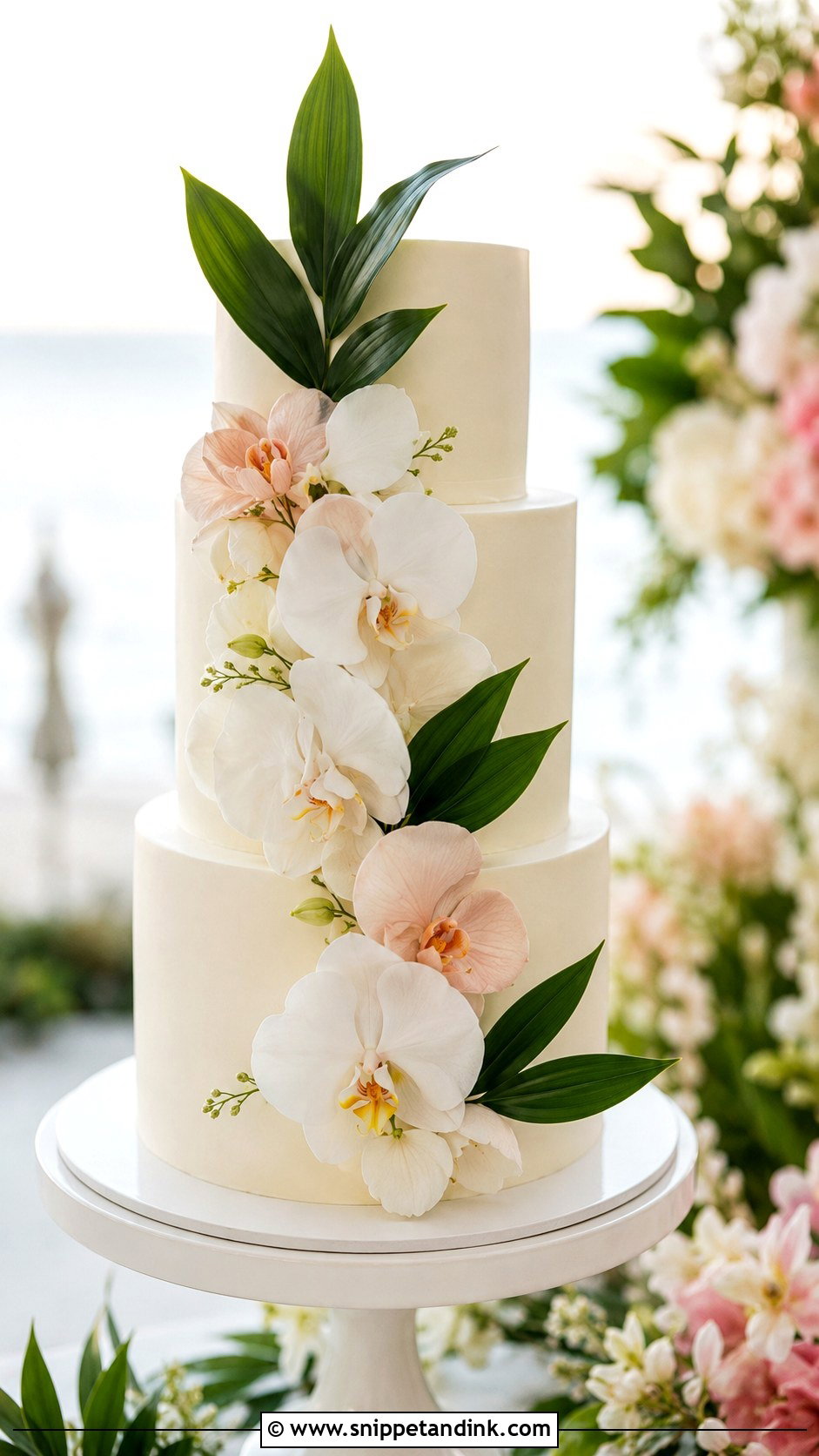
The cutout shape of a monstera leaf gives even a plain white cake a graphic look. Real monstera isn’t edible and shouldn’t touch the icing, so I make sugar or wafer-paper versions for the tiers, or paint the leaves directly onto fondant for a flat modern finish. A soft green watercolour wash behind them works well. Keep flowers limited to orchids or small white blooms. Coconut, pandan, lime or vanilla flavours support the look.
5. Tropical Wedding Cake With Pineapple Flowers
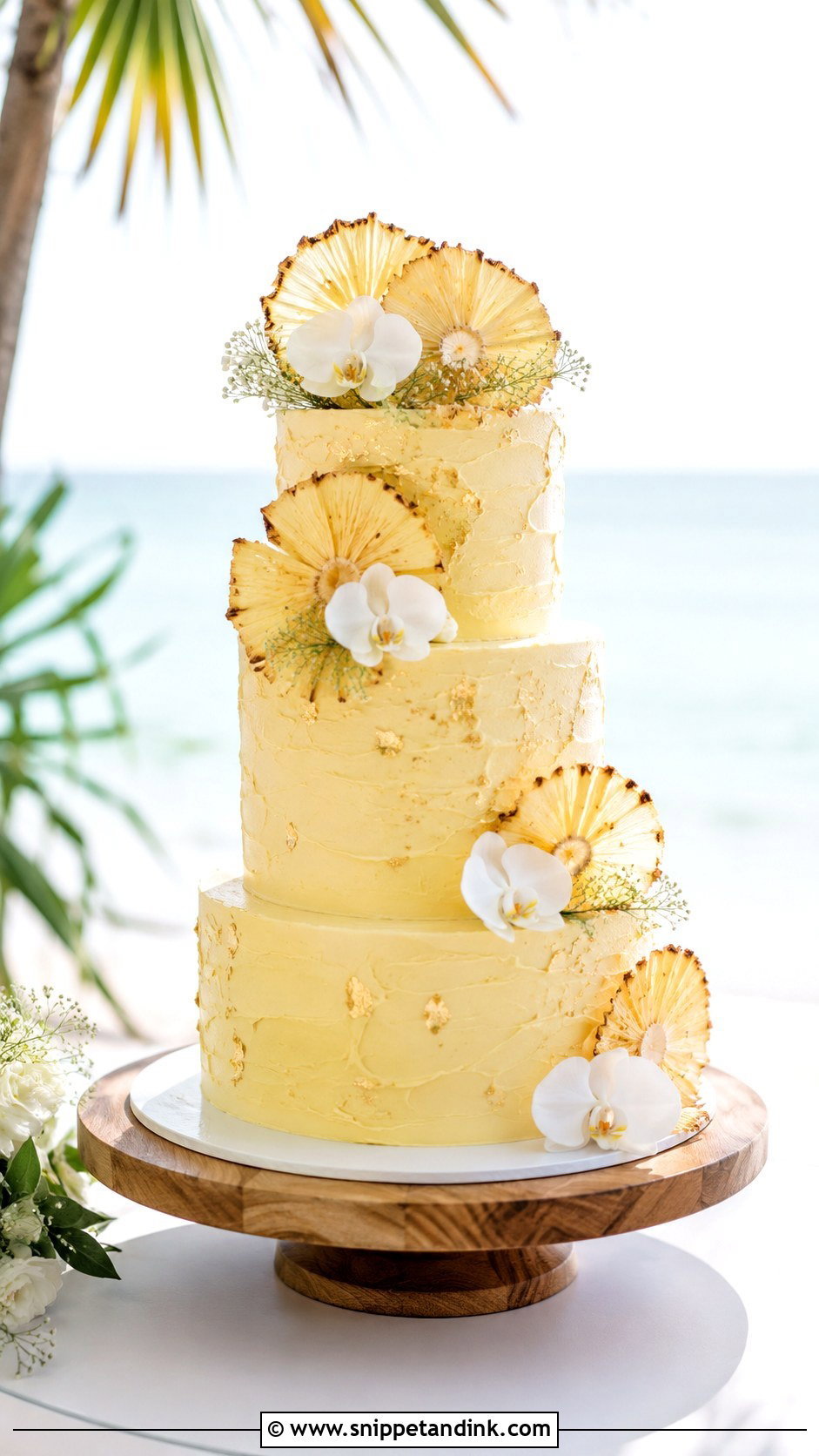
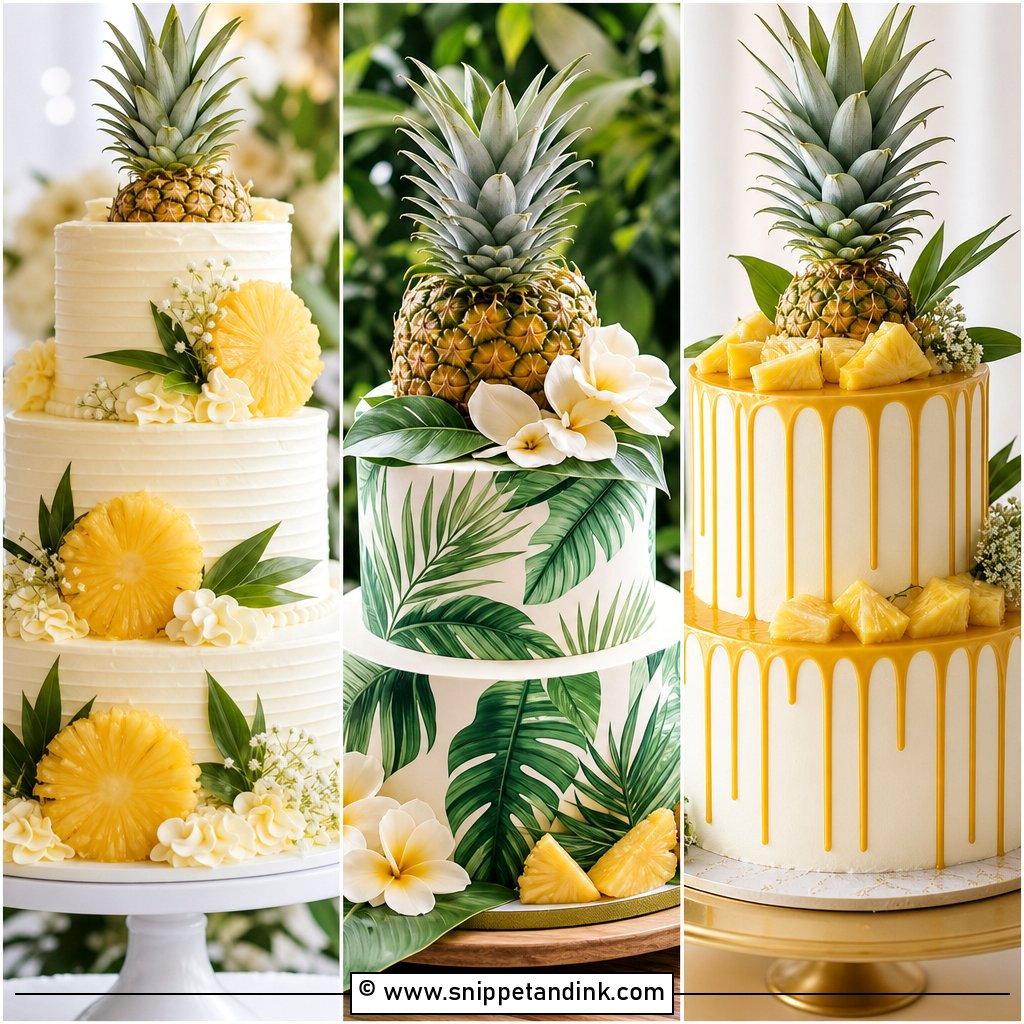
Dried pineapple flowers are thin slices baked low and slow until the edges curl and dry, and they look like little golden blooms. They’re cheap, edible and hold their shape far better in humidity than fresh fruit. Thin slices dry better; thick ones stay chewy and droop. They sit well on smooth ivory buttercream, semi-naked frosting or textured coconut frosting. A few white orchids or gold accents finish the design. Pineapple coconut cake or vanilla with pineapple curd ties the inside to the outside.
6. Tropical Wedding Cake With Mango Filling
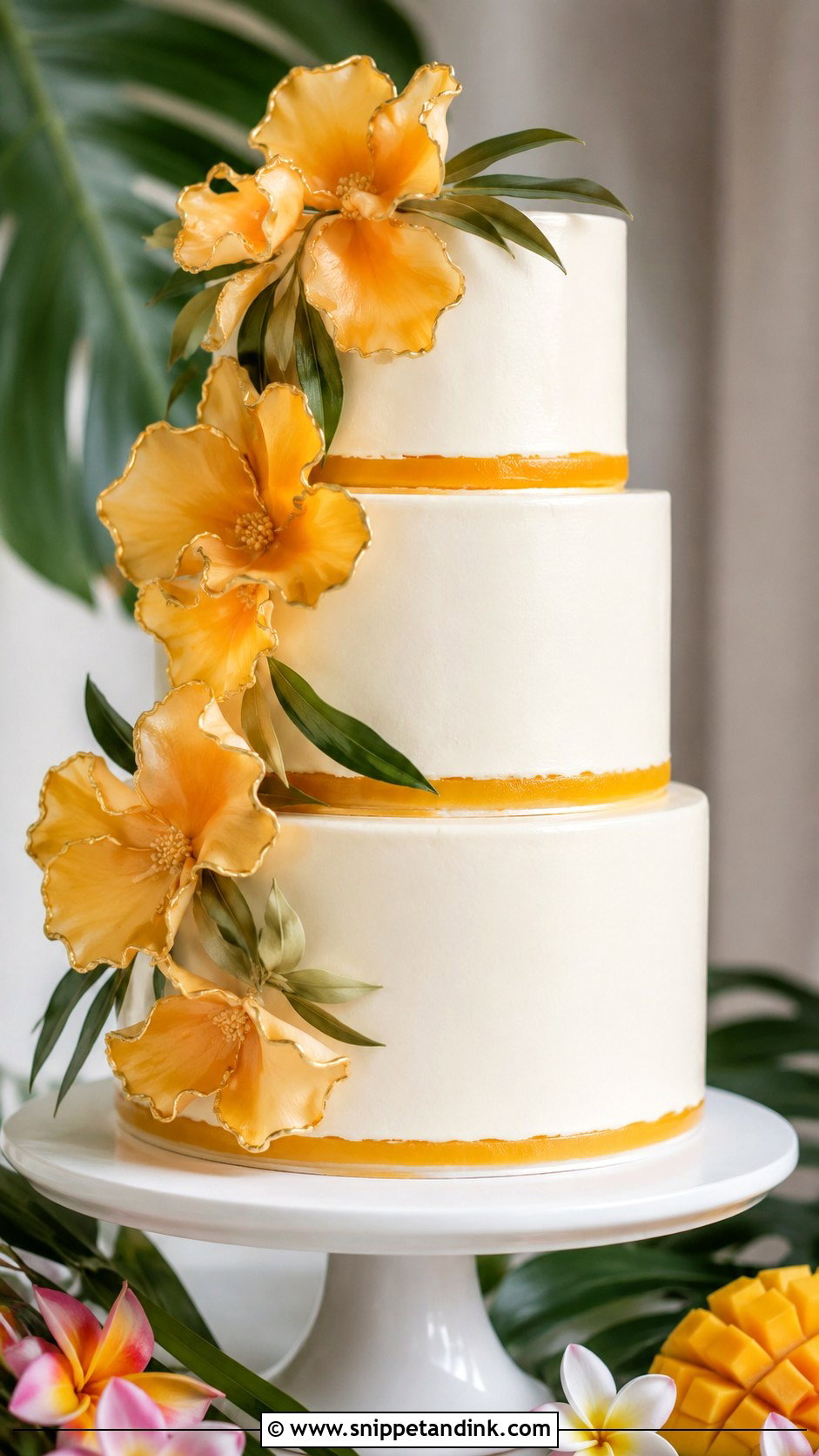
Mango filling is where the flavour does the talking. It pairs with vanilla, coconut, almond and lime sponges. I cook the mango into a curd or a thickened compote so it doesn’t seep into the cake layers; raw mango puree can make the sponge soggy by the next day. Outside, smooth white buttercream, a pale yellow ombré or a thin gold rim between tiers keeps it bridal. Sugar flowers in mango, ivory and coral tones hint at the filling better than fresh slices, which brown quickly.
7. Tropical Wedding Cake With Coconut Frosting
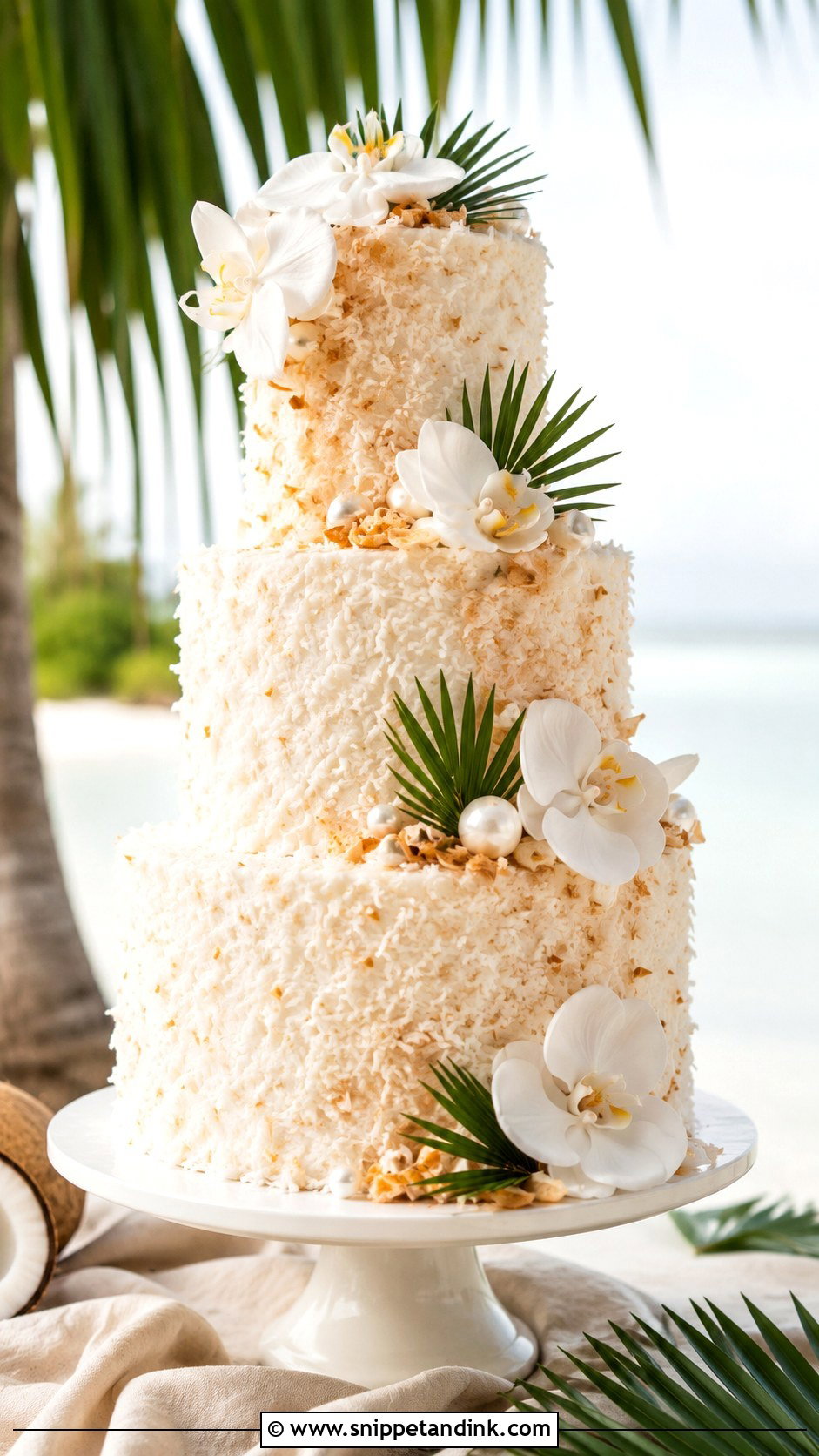
Coconut frosting gives a tropical feel without any bold colour. It can be smooth, whipped, or pressed with fine toasted coconut for texture. White coconut buttercream on tall tiers, with orchids or palm leaves and a little gold, looks classic. Coconut cake pairs with passion fruit, mango, pineapple, lime or raspberry fillings. Coconut oil in the frosting softens at a lower temperature than butter, so in a hot venue I’d use a coconut-flavoured meringue buttercream instead.
8. Tropical Wedding Cake With Passion Fruit Curd
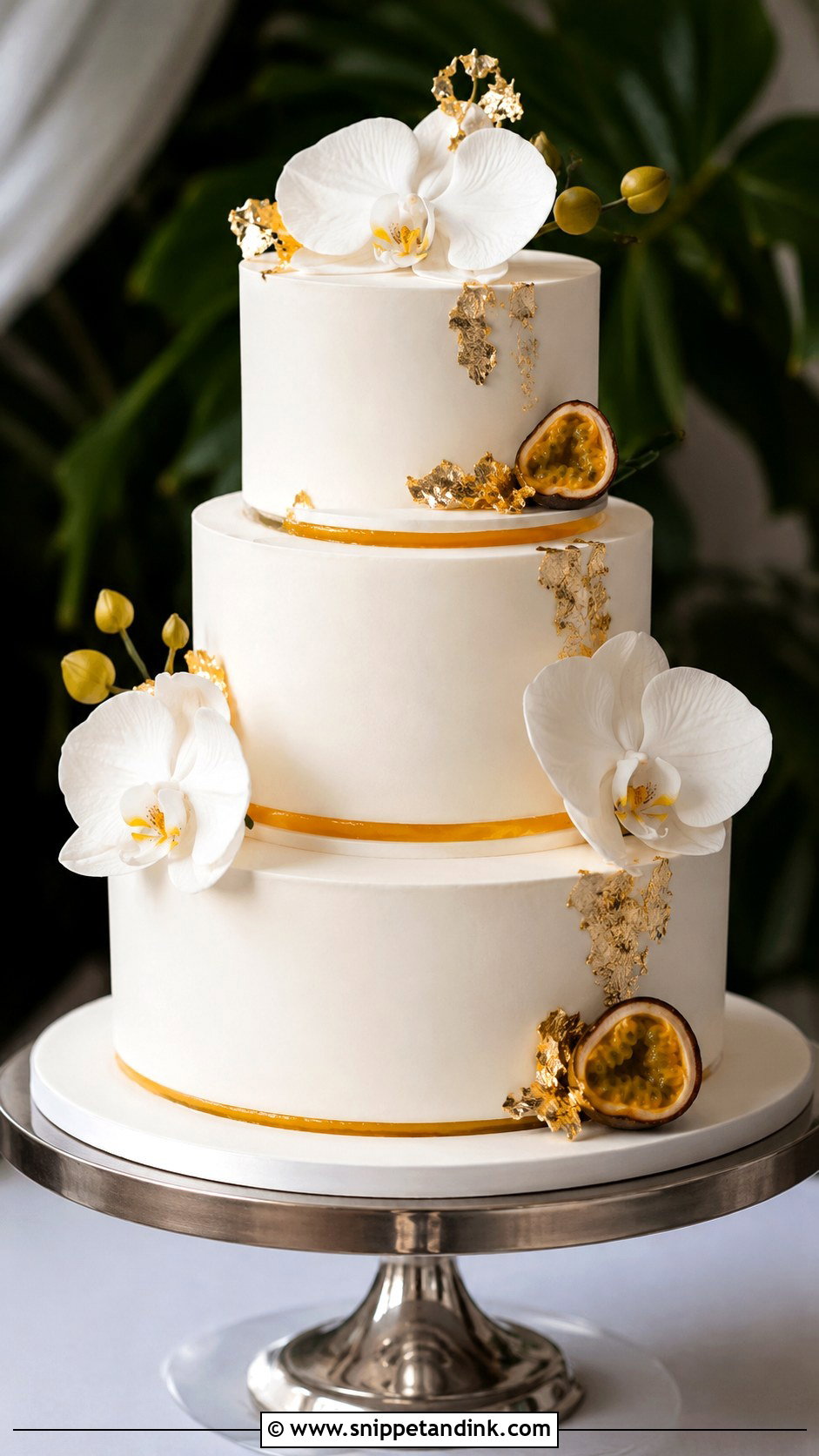
Passion fruit curd cuts through sweetness better than any other tropical filling, and its tang makes each slice taste lighter. It’s also one of the most stable fruit fillings, as the cooked curd sets firm. Because the flavour is so strong, the outside can stay quiet: ivory buttercream, smooth fondant, soft watercolour in yellow and peach, a few orchids or gold leaf. Vanilla bean, coconut and almond sponges all work. I strain the seeds out of the curd for a wedding cake, and add a few back on top for colour.
9. Tropical Wedding Cake With Banana Leaves
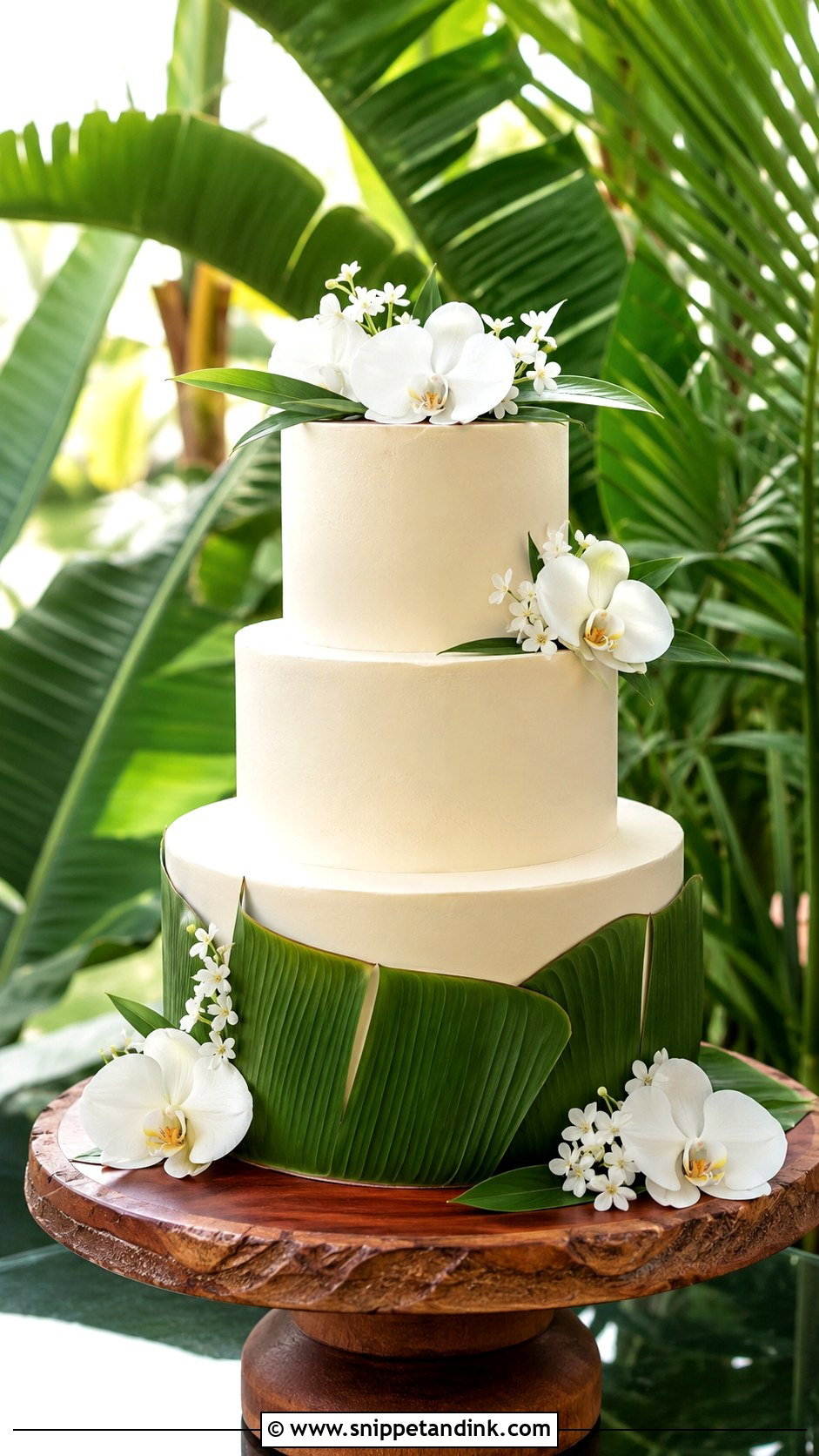
Banana leaves are among the few large tropical leaves that are safe around food; they’ve been used to wrap and cook food for generations. They can wrap the base tier, sit underneath the cake or frame white flowers. Clean tiers let the leaf texture show. Smooth ivory frosting, coconut buttercream or pale green fondant all suit them, with white orchids or cream anthuriums. Inside, banana cake layers, coconut cream, pineapple filling or mango curd all match the theme. Wipe the leaves with a little oil so they keep their gloss under lights.
10. Tropical Wedding Cake With Anthurium Flowers
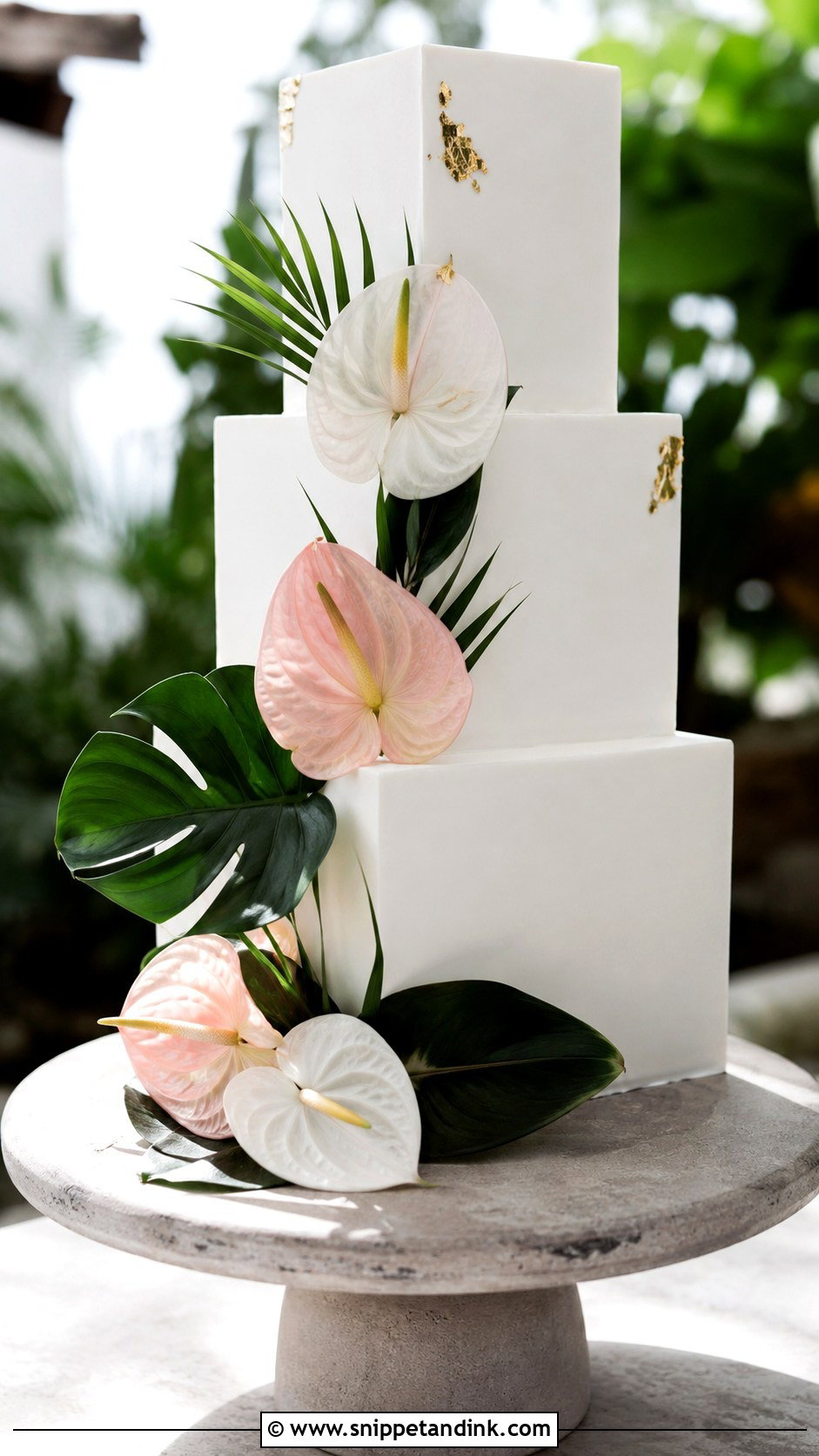
Anthuriums have a glossy, almost plastic shape that looks very modern on a tall, sharp-edged cake. White, blush, coral or deep red each change the mood. I’d pair one strong cluster with very little greenery. Fresh anthuriums aren’t edible, so they go on a barrier or are replaced with sugar versions. Coconut, lime, vanilla or passion fruit flavours sit underneath the polished outside.
11. Tropical Wedding Cake With Sugar Flowers
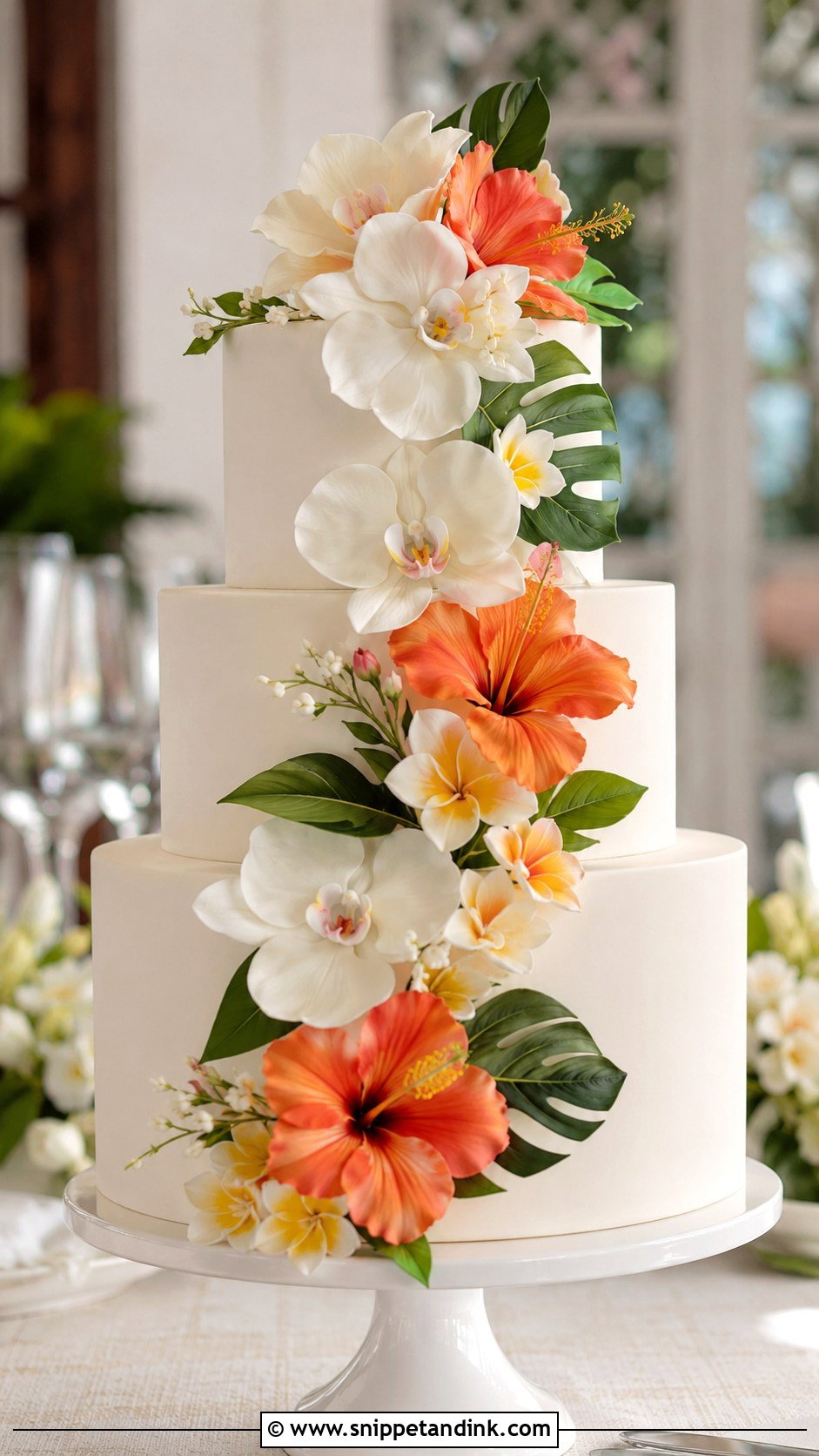
Sugar flowers give complete control over colour, shape and placement, and they’re the reason I can promise a tropical cake will still look right at the end of a hot reception. Orchids, hibiscus, plumeria and anthuriums all hold up as sugar. I’d choose two or three types rather than mixing many. A loose cascade, a side cluster or a ring around each tier all work. Note that sugar flowers soften in high humidity, so they’re added as close to the event as possible and kept out of fridges, where condensation damages them.
12. Tropical Wedding Cake With Plumeria Flowers
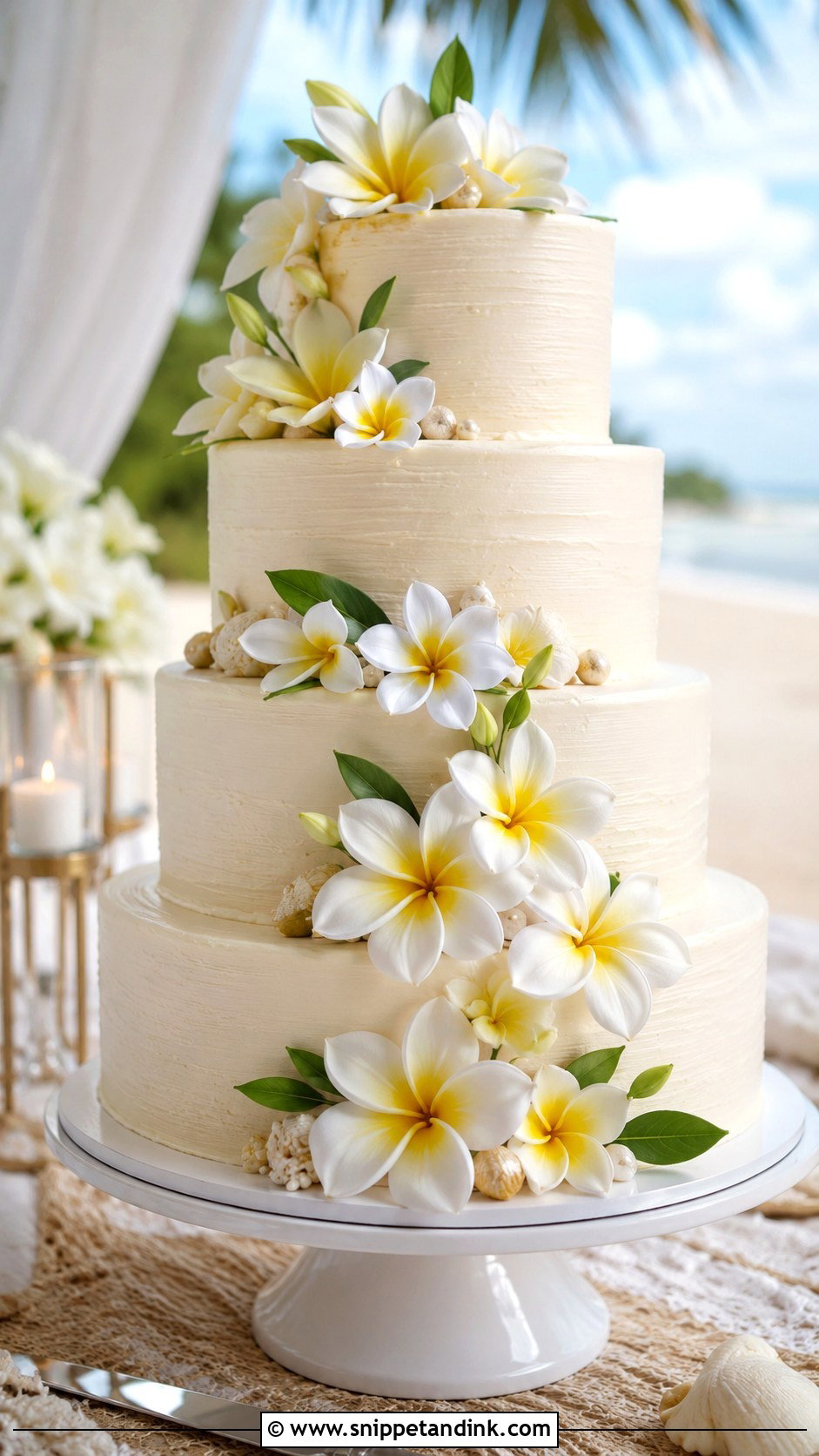
Plumeria has round petals and a soft yellow centre that read romantic on white frosting. A small trail across two or three tiers is enough. White and yellow are classic; blush is softer. Fresh plumeria has a milky sap, so I’d use sugar versions or keep fresh ones on a barrier. Coconut, vanilla, lime and mango cream all suit the look. It fits beach ceremonies and garden weddings in particular.
13. Tropical Wedding Cake With Coral Flowers
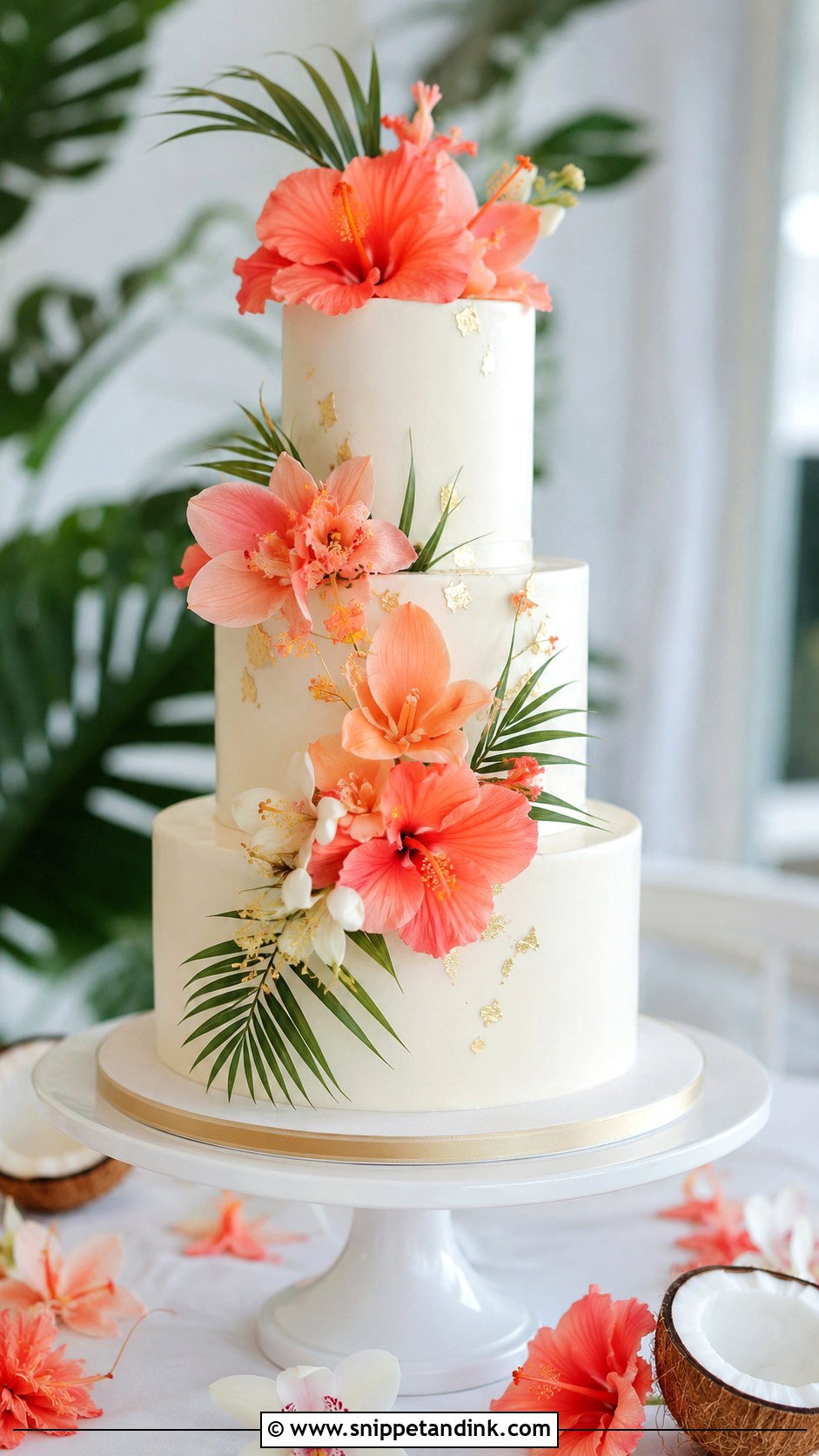
Coral brings warmth without overpowering a bridal palette. It looks best on ivory buttercream, white fondant or a pale peach ombré. Coral orchids, hibiscus, roses or sugar plumeria, balanced with palm or monstera leaves, keep it tropical. Keep everything else on the cake plain. Coconut with mango, vanilla with passion fruit curd, or pineapple cake with cream cheese frosting all match. Coral is a hard colour to mix consistently, so ask your baker to match a swatch from your florist.
14. Tropical Wedding Cake With Gold Leaf
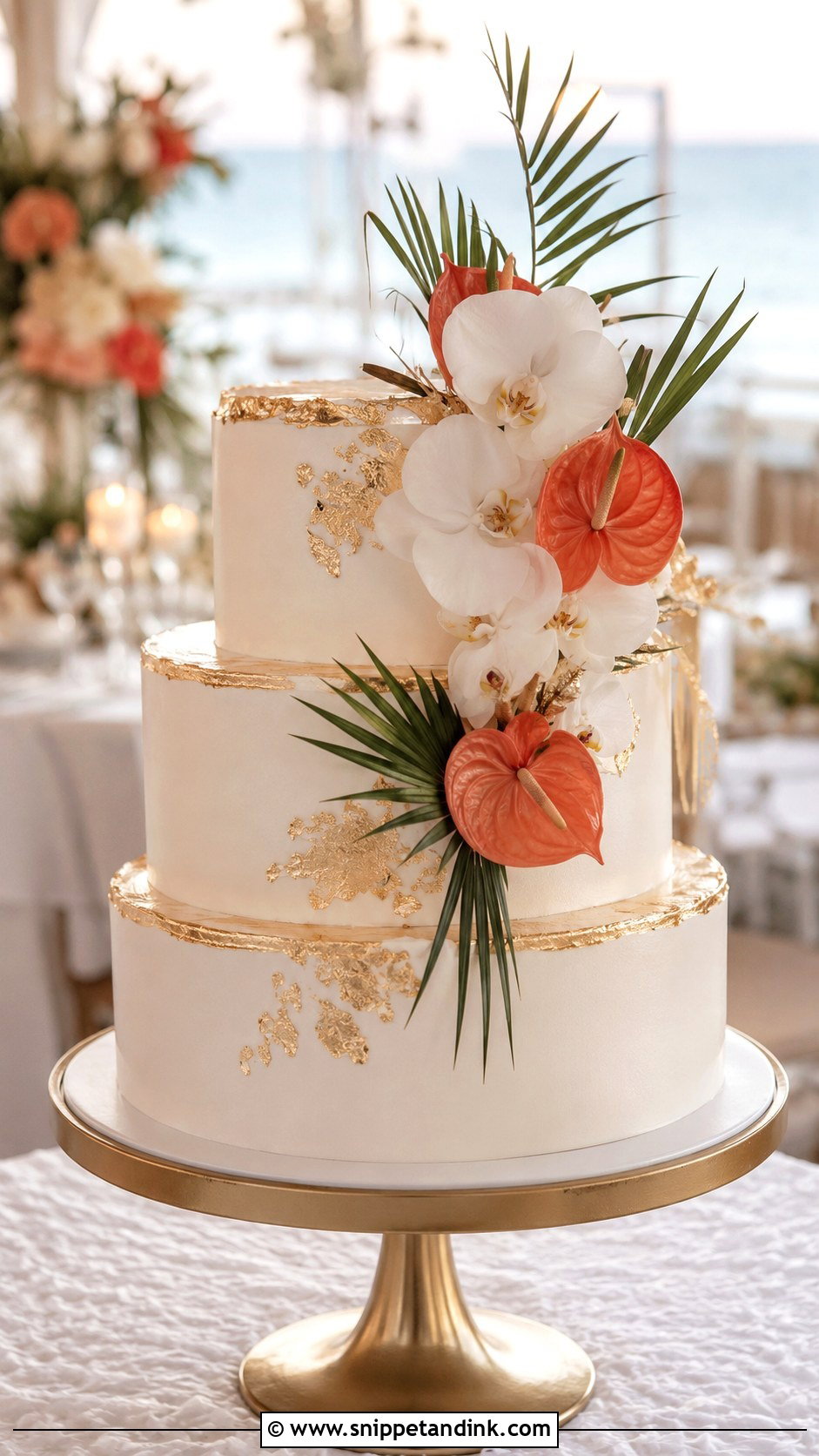
Gold leaf is used lightly here: scattered along one side, brushed on tier edges or placed beside a flower cluster. It looks beach-luxe on white buttercream, ivory fondant or a sand-coloured finish, and it turns orchids, anthuriums and hibiscus more formal. Real edible gold leaf is so thin that it sticks to fingers, so it’s applied with a dry brush. Coconut, mango, passion fruit or lime keep the inside bright. It reads well indoors and out.
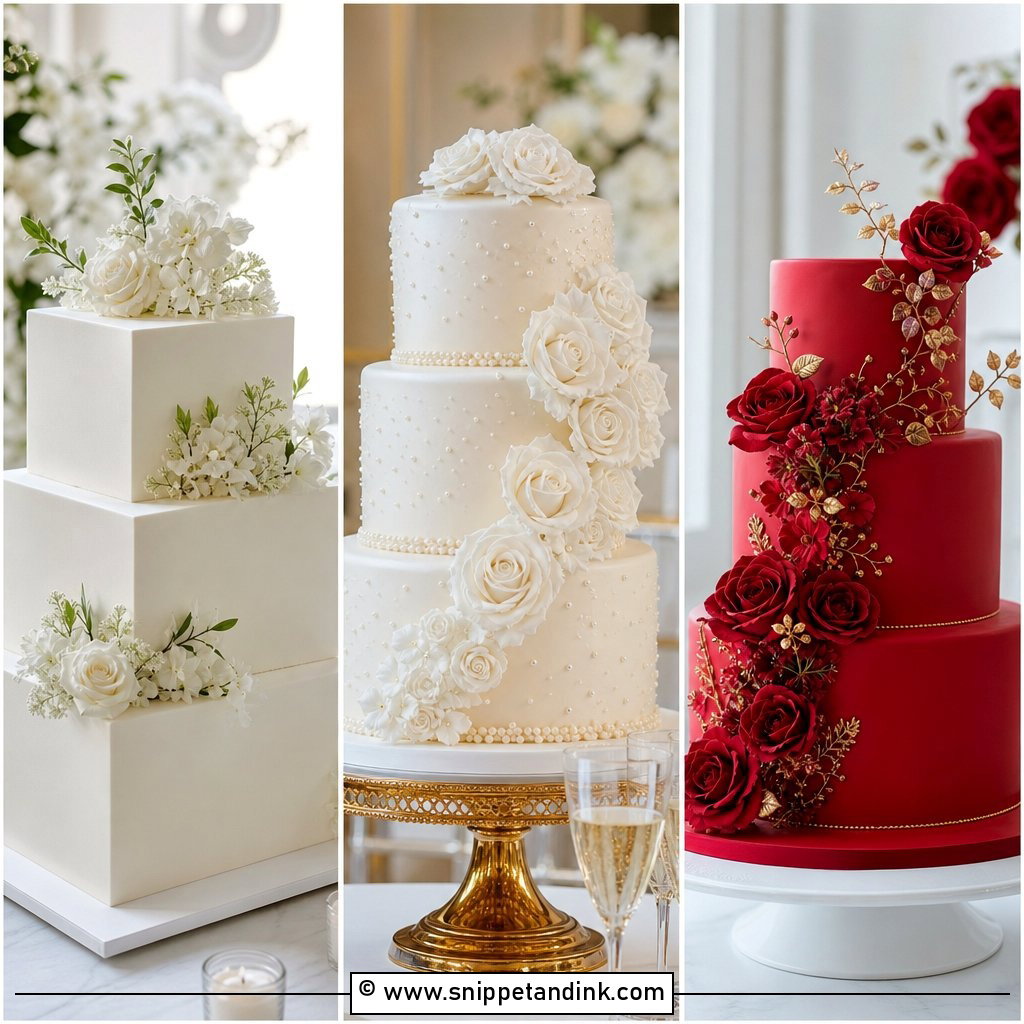
15. Tropical Wedding Cake With Seashells
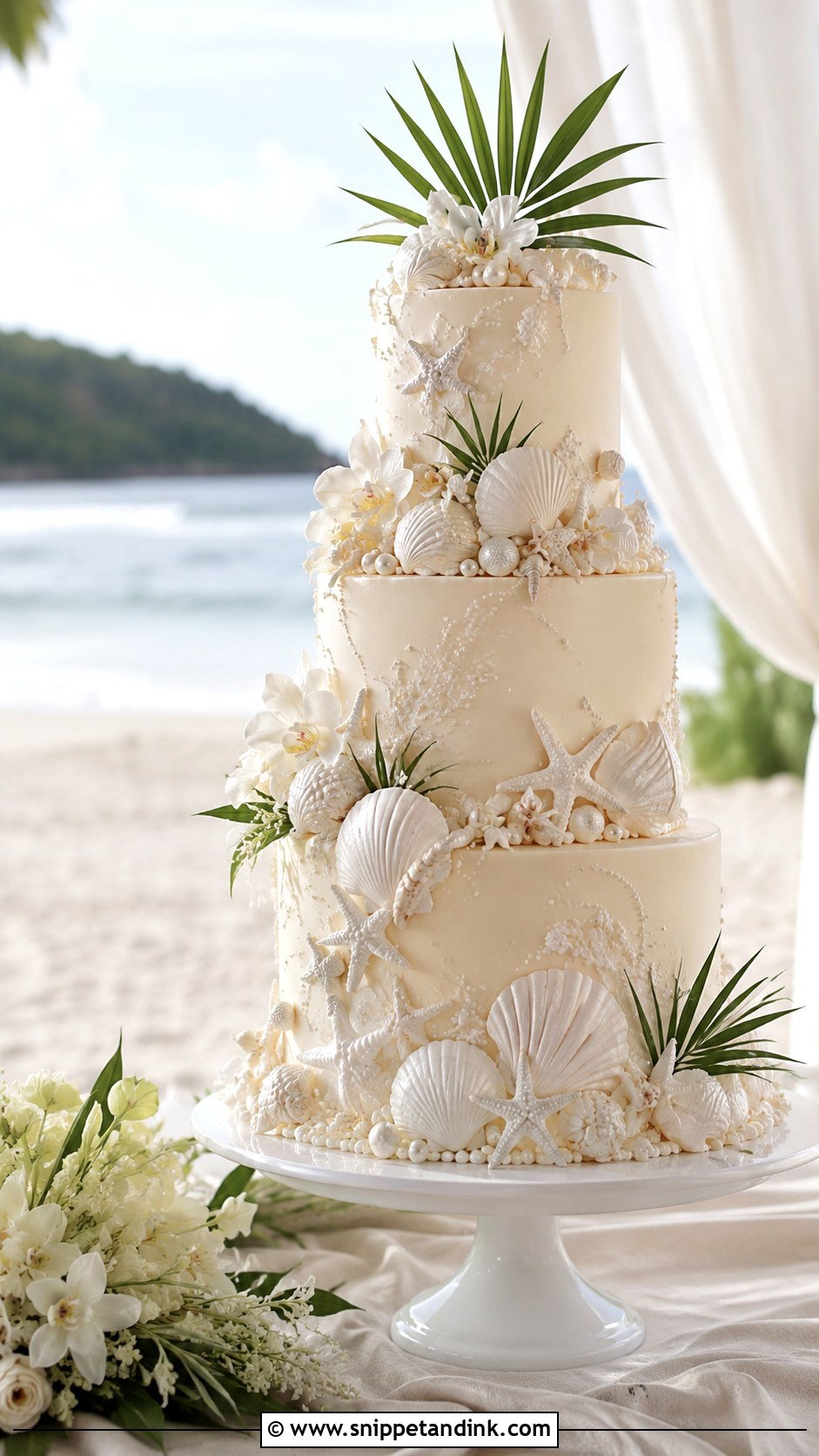
Seashells look elegant in white sugar, with pearls and a sand-coloured frosting, and childish in bright colours. I mould them from white modelling chocolate or fondant and dust them with pearl lustre. A few small tropical flowers or palm leaves keep the link to the island theme. Smooth buttercream, fondant or a lightly textured finish all suit it. Coconut with pineapple, vanilla with lime curd or almond with passion fruit cream fit. Brown sugar or crushed biscuits make a convincing edible sand at the base.
16. Tropical Wedding Cake With Ocean Blue Buttercream
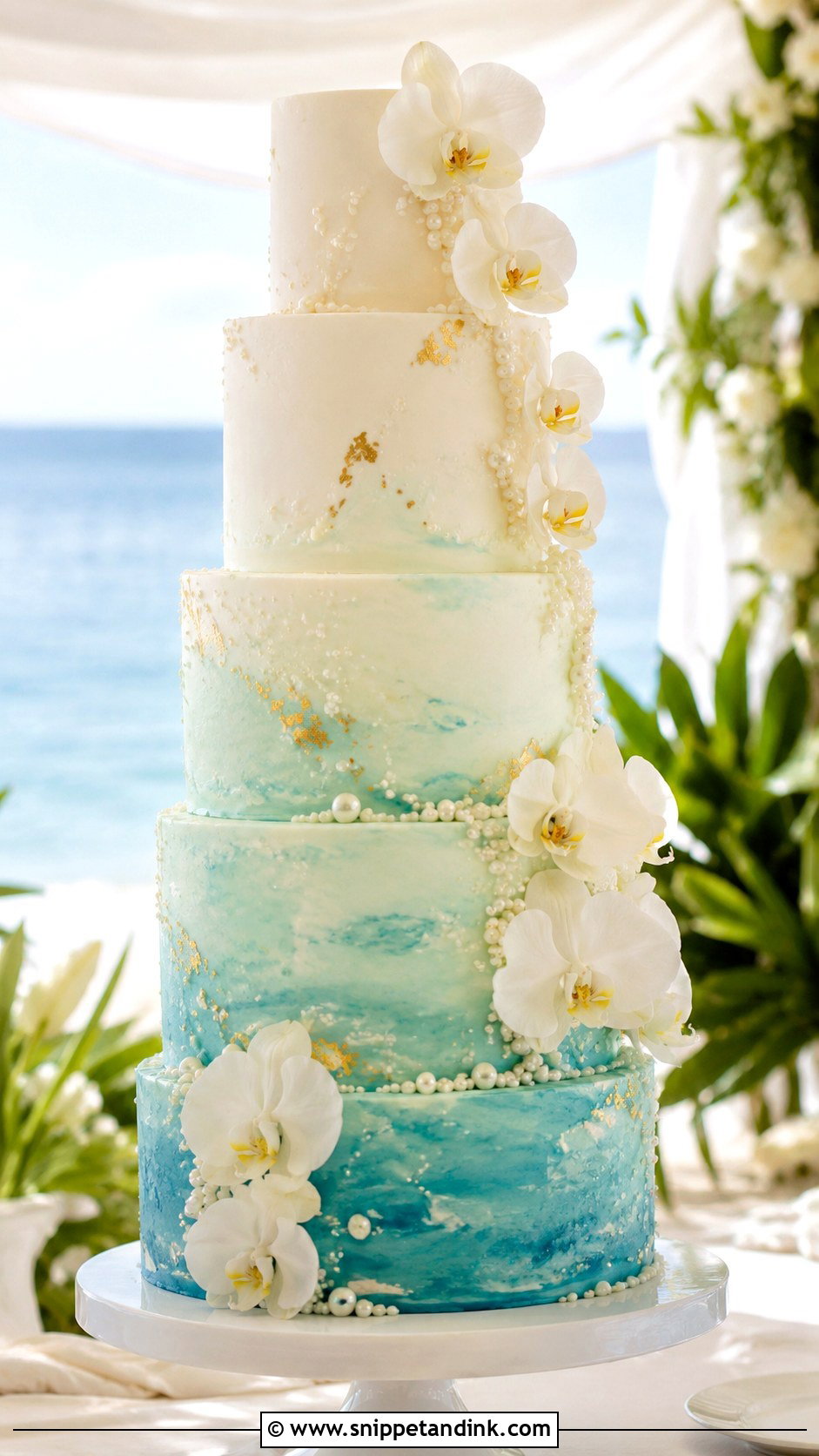
Ocean blue buttercream is at its most elegant when it’s soft watercolour rather than solid bright blue: pale aqua, seafoam and misty blue blended into white. I apply the colours in patches and smooth them together with a scraper so they blur. Subtle wave texture from a spatula is optional. White orchids, pearls or gold leaf make it bridal. Coconut, vanilla, lemon or passion fruit suit it. Blue buttercream can shift green in yellow evening light, so check the shade under similar lighting.
17. Tropical Wedding Cake With Watercolor Leaves
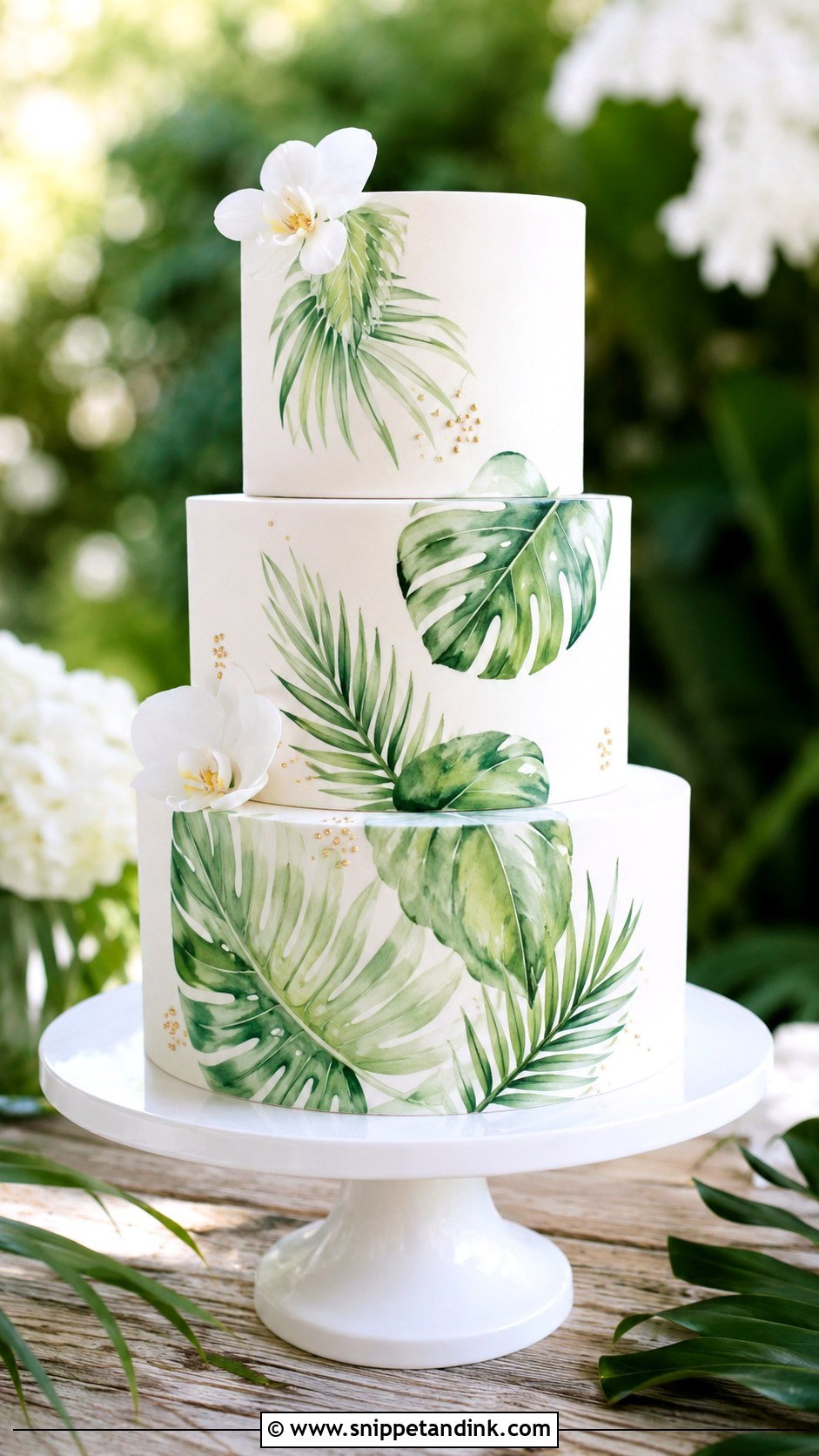
Painted leaves give a tropical cake a softer, artistic look than real ones. Palm, banana or monstera shapes are painted in green, sage and soft teal on smooth white fondant, using food colour diluted with a clear alcohol that evaporates. Light washes look watercolour; heavy ones look flat. A few sugar orchids add dimension. Lime coconut, vanilla with mango filling or passion fruit sponge match it. It suits garden and destination weddings.
18. Tropical Wedding Cake With Fresh Fruit
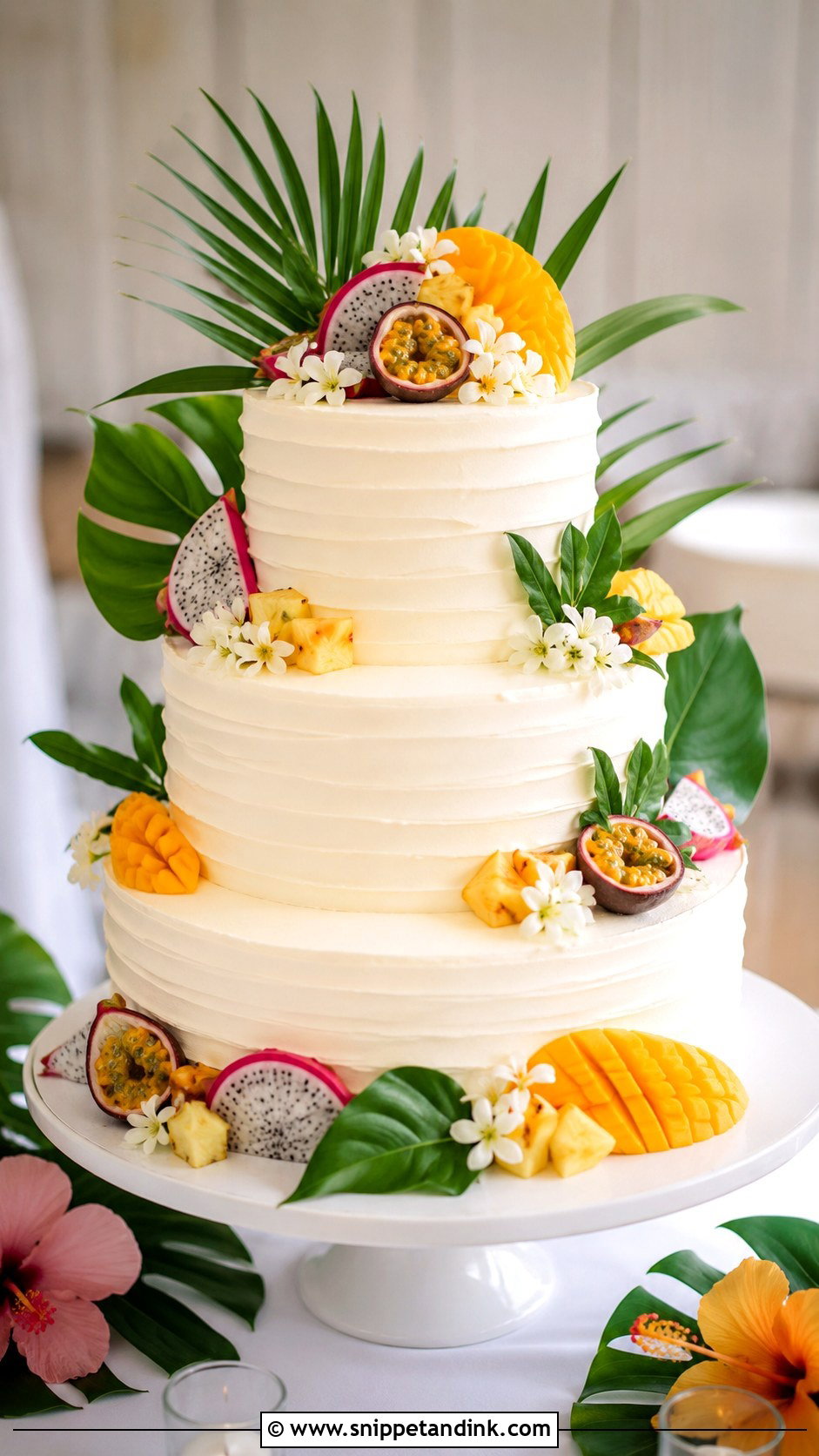
Fresh fruit looks vibrant and tastes bright, but it’s the least stable decoration in this list. Mango, pineapple, kiwi, passion fruit, dragon fruit and berries all work as an accent, not a covering. Cut fruit weeps juice that marks frosting, so I place it at the venue and glaze it lightly to slow browning. A semi-naked, smooth white or coconut-frosted base gives it a clean background. Coconut, vanilla, lime or almond sponges pair with tropical fillings.
19. Tropical Wedding Cake With Dragon Fruit
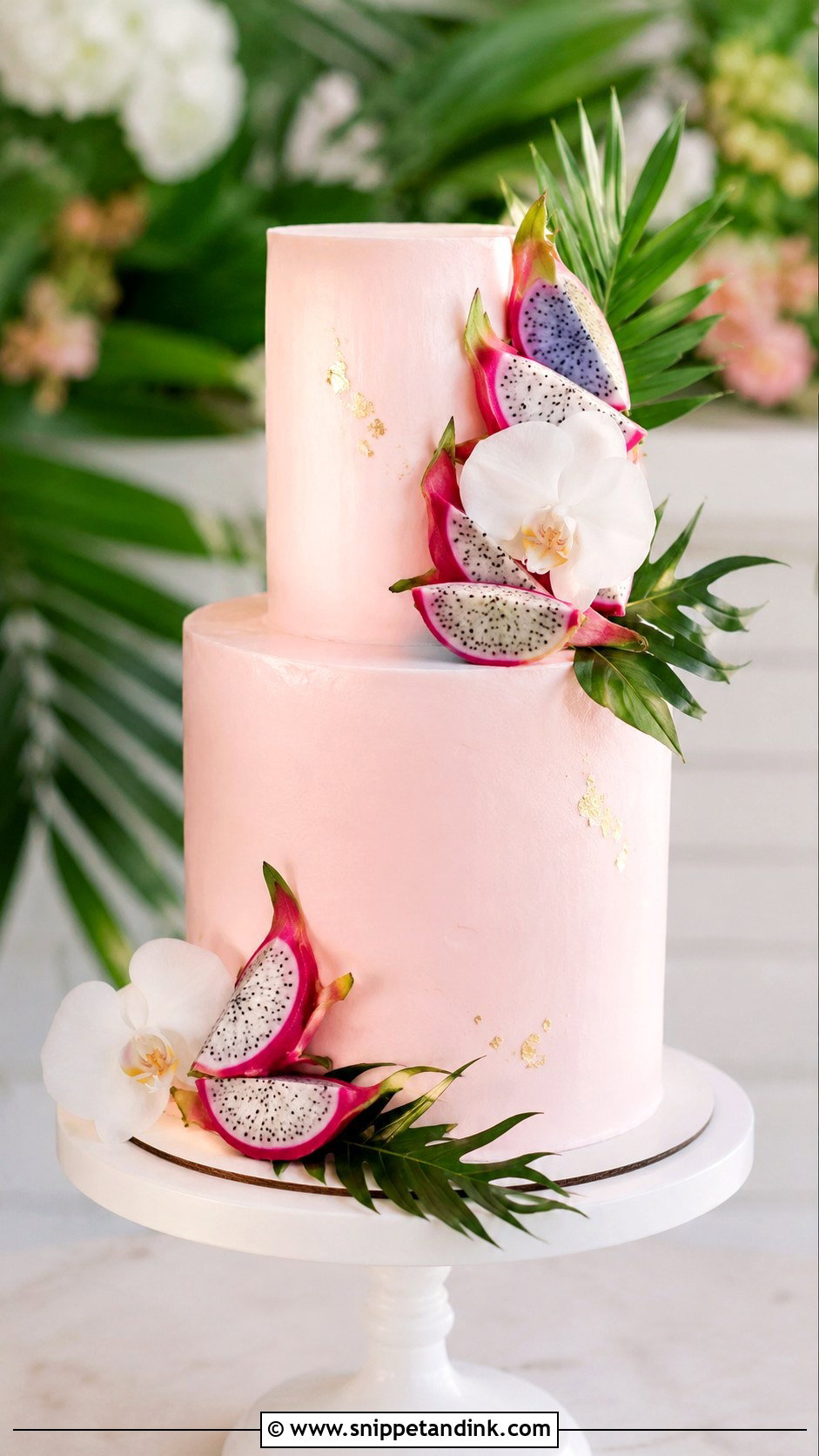
Dragon fruit has bright pink skin and a speckled white or magenta centre that looks unusual and modern. I use it as a controlled accent: a few slices at the base, with sugar flowers and palm leaves adding height. Ivory, pale pink or white fondant suits it. The flesh is mild, so the cake flavour comes from vanilla, coconut, lime or berry with a tropical filling. Slices go on last, as they soften quickly.




20. Tropical Wedding Cake With Lime
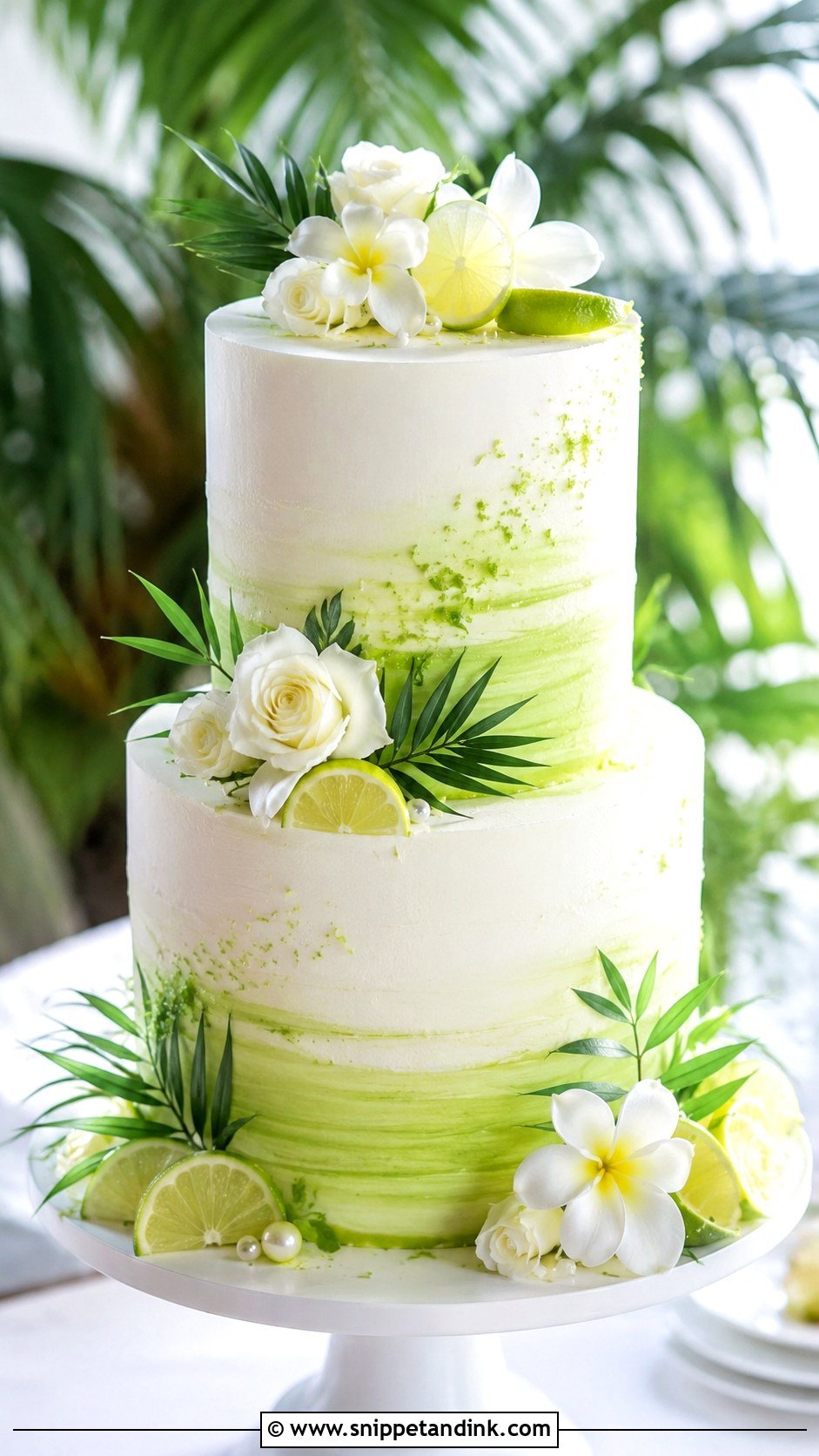
Lime is the flavour I’d suggest to a couple worried that their cake will feel heavy in the heat. It works as a curd, a buttercream flavour, zest or a glaze between coconut or vanilla layers. White or pale green frosting with simple greenery and small white flowers keeps the design clean. Smooth finishes feel formal; light texture feels beachy. Gold leaf or pearls suit an upscale reception. Lime curd needs refrigeration, so it’s best in a frosting that can go back into the fridge until close to serving.
21. Tropical Wedding Cake With Pineapple Filling
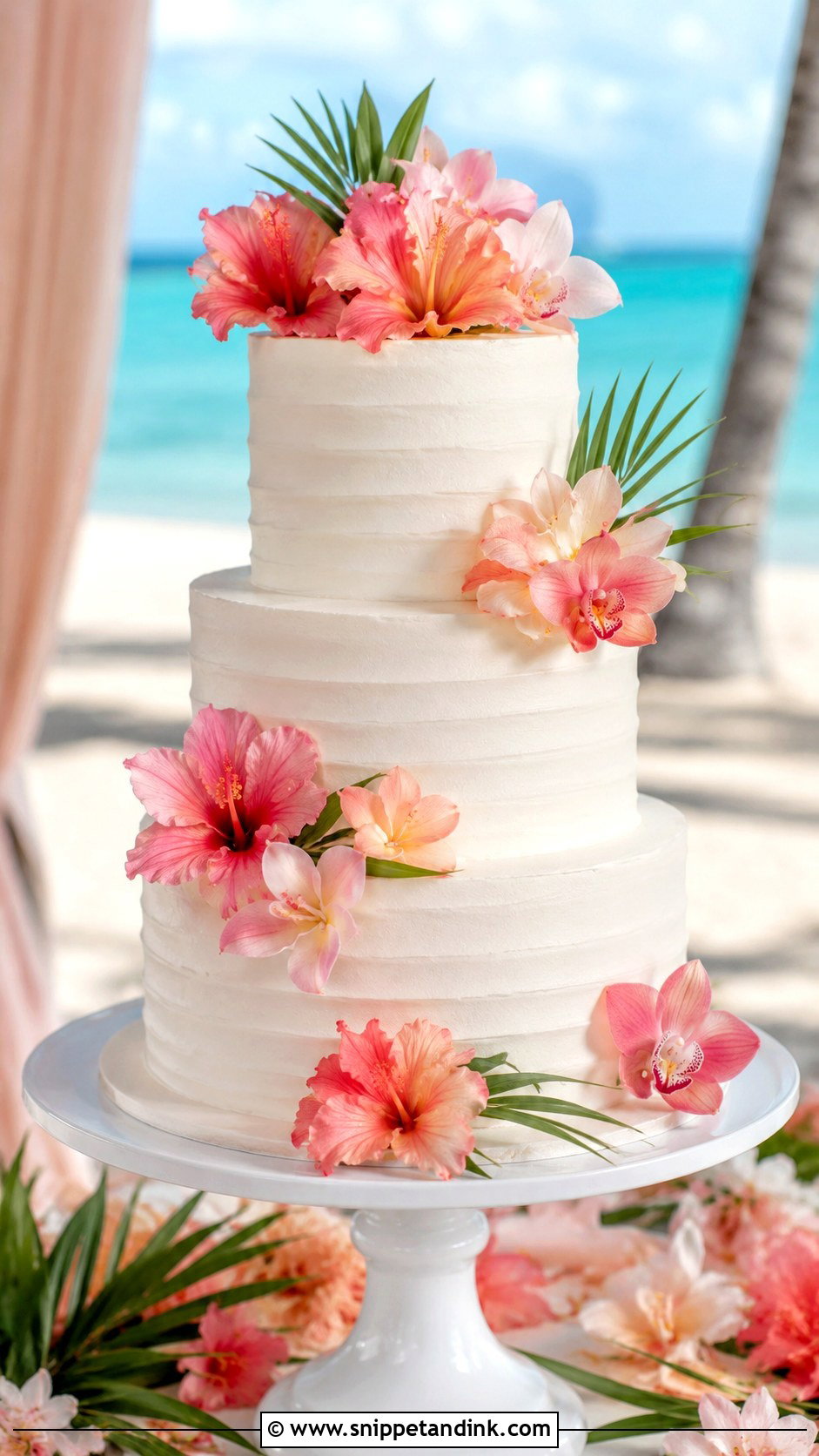
Pineapple filling is sunny and sweet, and pairs with coconut, vanilla, spice or almond cake. Outside, smooth ivory buttercream or white fondant keeps it refined. Pineapple flowers, white orchids, palm leaves or a soft yellow ombré hint at the filling. I’d skip large pineapple props. A thin gold edge on each tier is a nice finishing detail. Fresh pineapple must be cooked before it goes into the filling; raw pineapple contains an enzyme that breaks down cream and makes it runny or bitter.
22. Tropical Wedding Cake With Greenery
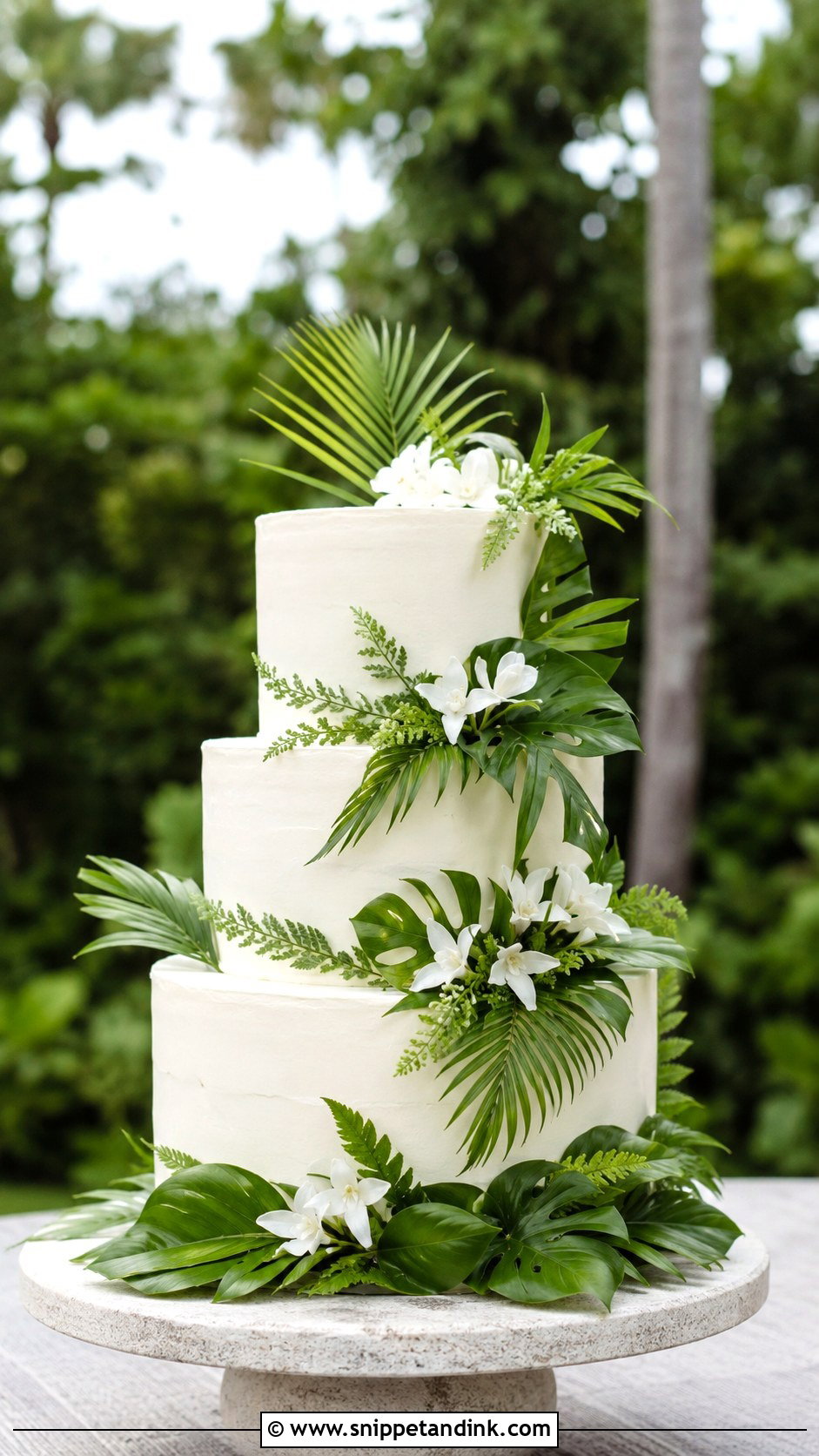
Greenery alone can carry a tropical cake if you’d rather skip bright flowers. Palm, monstera, fern and banana leaves frame a white buttercream or ivory fondant cake, adding height. A small cluster of white orchids is optional. Coconut, vanilla with lime filling or mango cream support the theme. I keep leaves to one side or the back; covering every tier hides the cake. Real leaves need washing and a barrier, or I use sugar and wafer-paper versions.
23. Tropical Wedding Cake With Pink Flowers
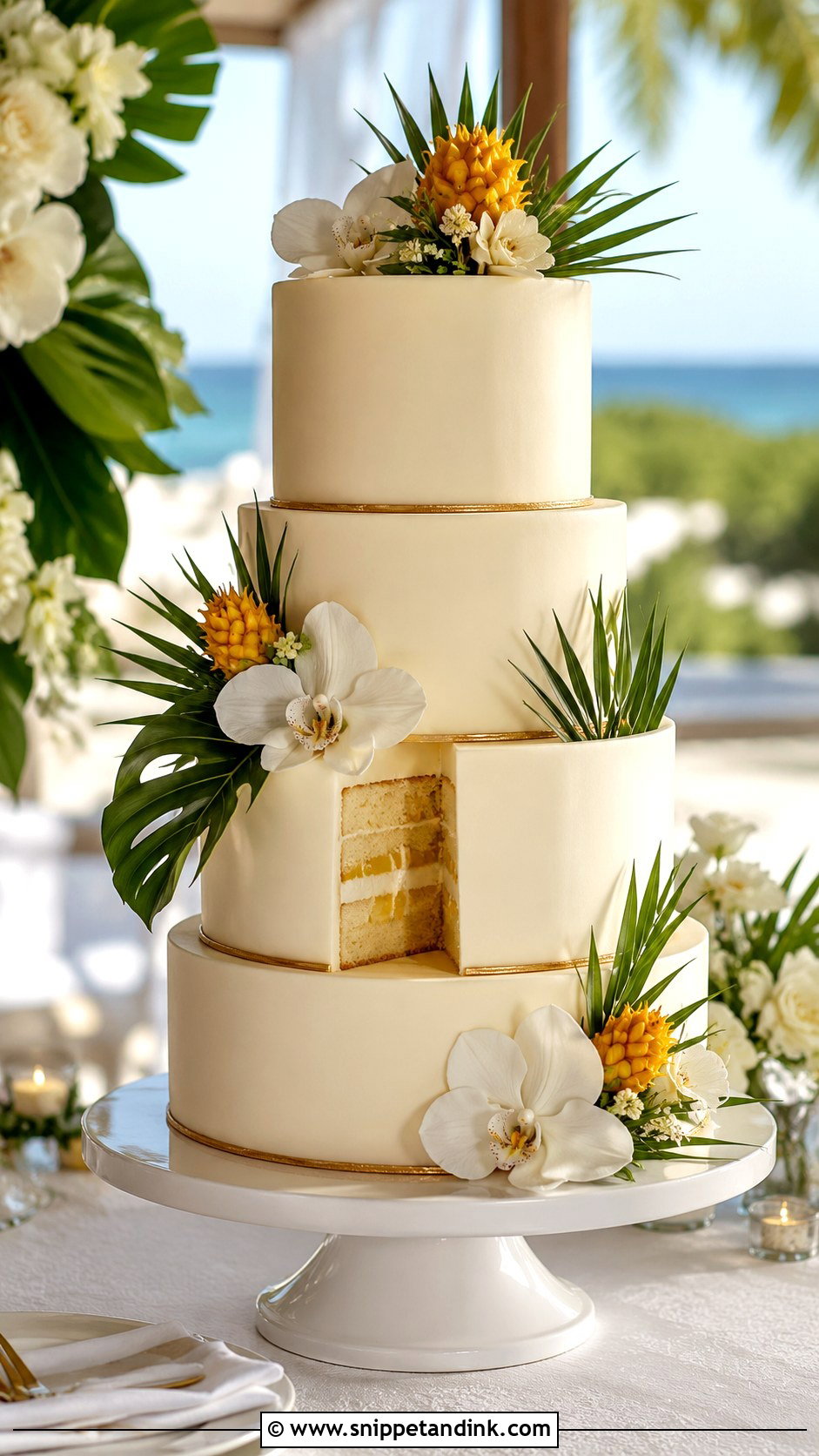
Pink flowers bring a joyful, romantic note. Soft pink orchids, blush hibiscus, coral plumeria or pink anthuriums look good on clean white tiers. Choose one main flower and repeat it in a simple cascade. A few palm or monstera leaves add contrast. Coconut with raspberry, vanilla with mango or passion fruit with almond pair well. Pale pink sugar flowers can fade under strong sunlight, so keep the cake table out of direct sun.
24. Tropical Wedding Cake With Black Fondant
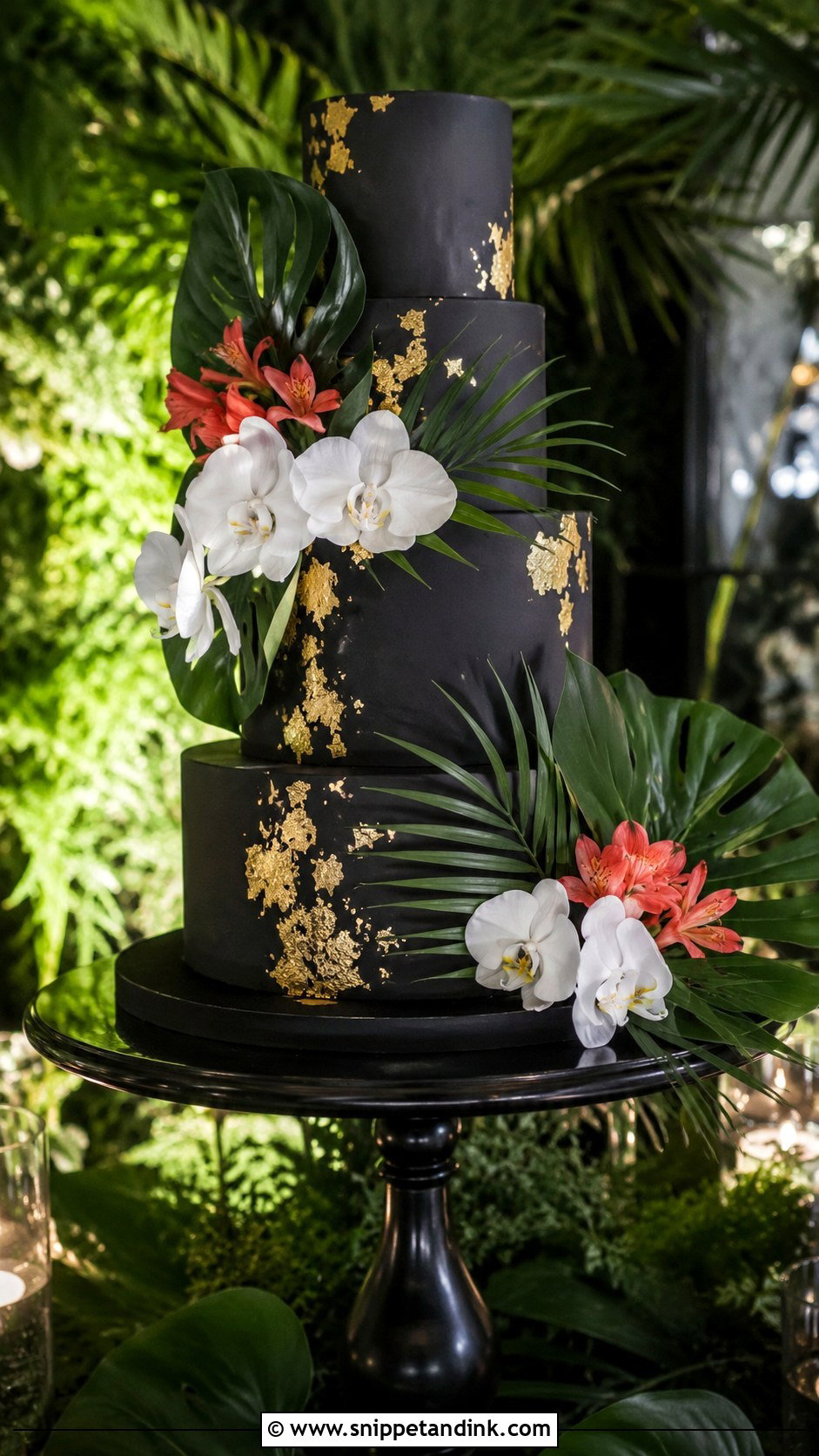
Black fondant is the unexpected choice for a tropical wedding, and it works best at night. Green palm leaves, white orchids, gold leaf and coral flowers all look brighter against it. Keep the tiers smooth and the decoration focused. Evening receptions at upscale resorts suit it. Chocolate with coconut, vanilla with passion fruit curd or dark cocoa with mango cream match. Dark fondant absorbs heat in sunlight and softens faster, so it should never sit outdoors before sunset.

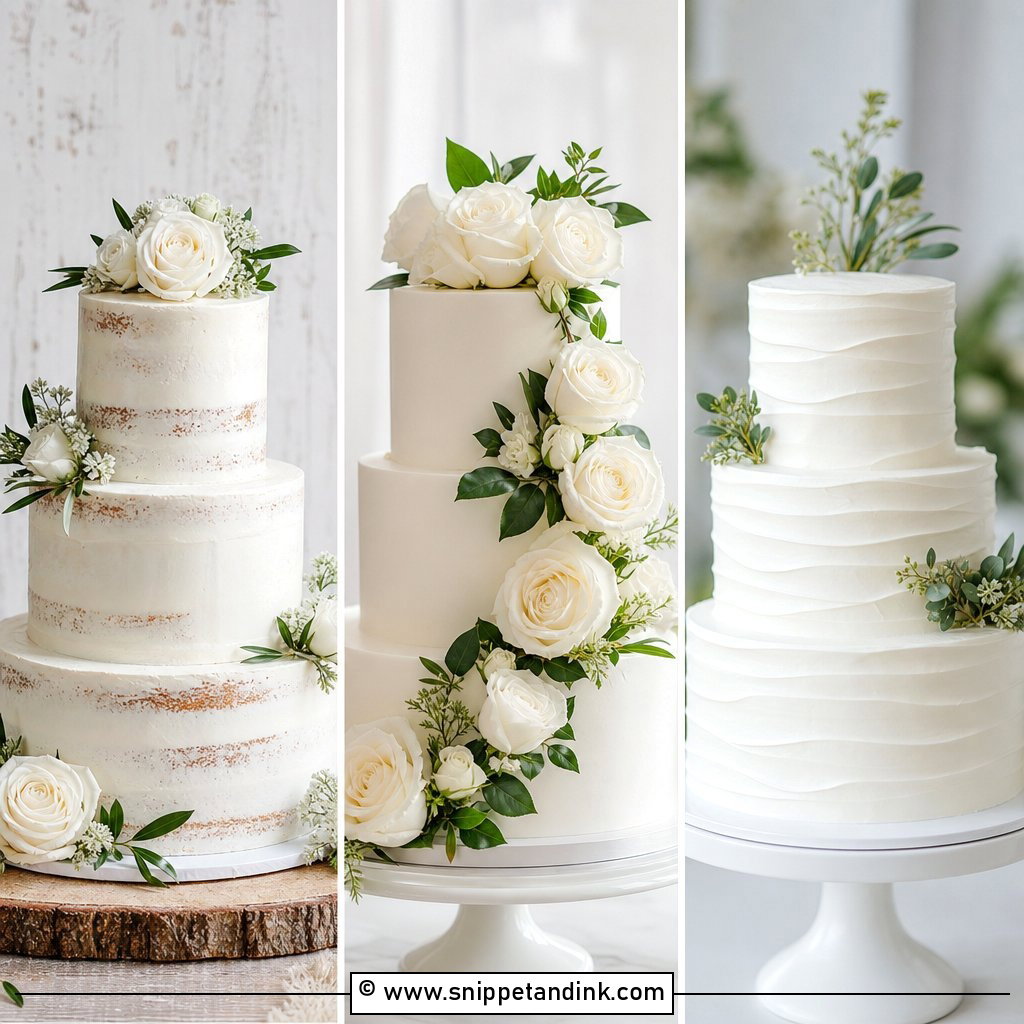
25. Tropical Wedding Cake With Semi Naked Frosting
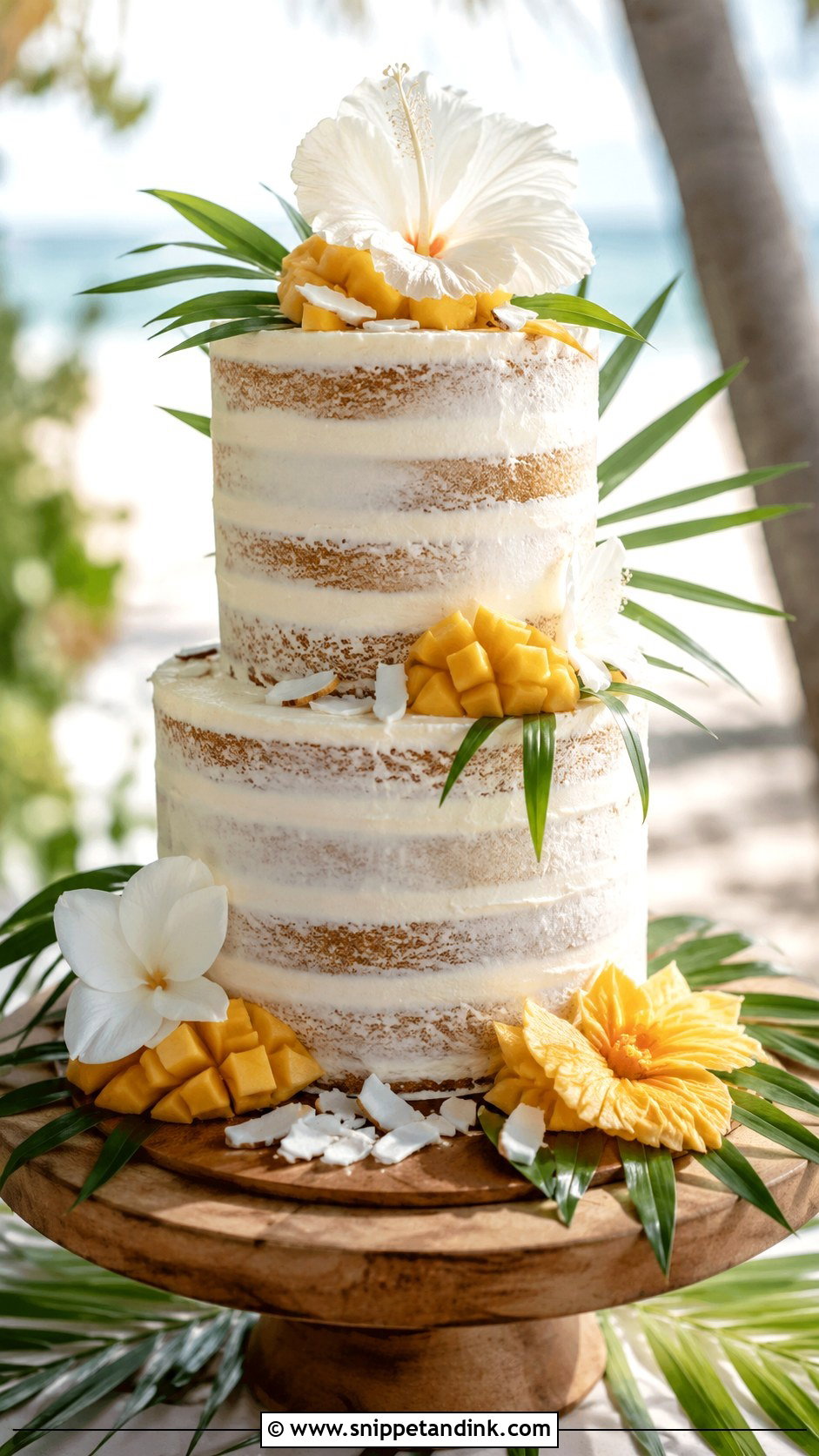
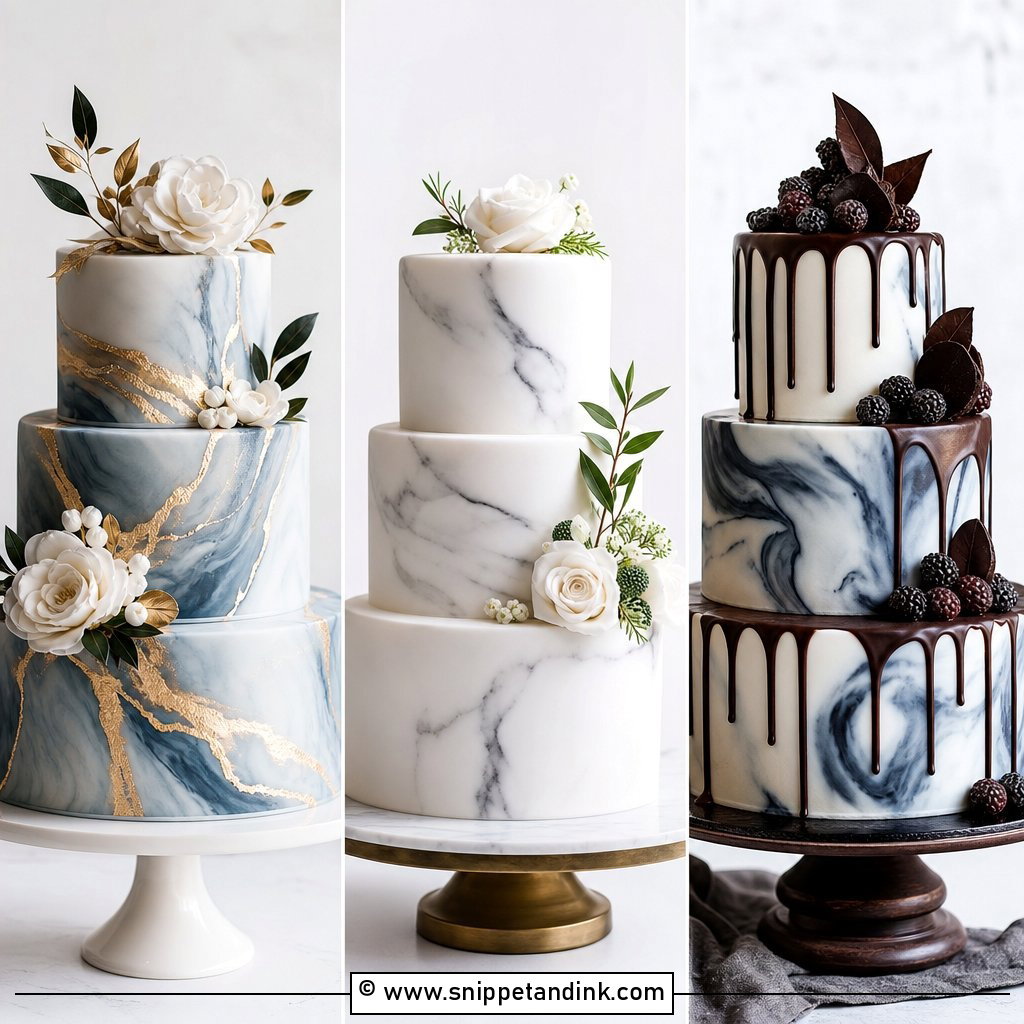
A semi-naked cake has a thin scraped coat of frosting that lets the sponge show through, warm and handmade in feel. Tropical flowers, palm leaves, fresh mango, pineapple flowers or coconut flakes finish it. Coconut, vanilla, banana or lime sponges suit it. Because so much sponge is exposed, it dries out faster in warm air, so I brush the layers with a light syrup and ask the venue to keep it covered until it goes out. Wood stands look beachy; a white pedestal is more formal.
Sun, Sand and Sea Breeze: Getting Tiers Through a Beach Reception
Every tropical design above will suffer if the cake sits in afternoon sun. A few rules I give couples before we finalise anything:
- Choose the frosting for the climate. Swiss or Italian meringue buttercream and ganache hold their shape far longer in heat than American buttercream or whipped cream.
- Keep the cake indoors and cool until shortly before it’s needed, then serve it within about an hour of going outside.
- Put the cake table in full shade, out of the wind, and away from sand being kicked up by guests.
- Tall, narrow tiers can lean in wind. A wider, shorter cake is more stable on an open beach.
- Ask about dowels and a central rod for any cake over two tiers, since warm frosting slides more easily.
Flying to an island wedding
A tiered cake rarely survives a flight. For a destination wedding, I’d book a baker local to the venue who knows the climate and the drive, and send them your design ideas and flavour notes. A small tasting, even by courier, helps you trust the result.
Let the Fruit Lead and the Flowers Follow
The best tropical cakes start from flavour: decide whether you want coconut, mango, lime, passion fruit or pineapple to lead, then let the decoration follow. Orchids and plumeria are soft, monstera and black fondant are bold, seashells and blue buttercream are beachy. Match the design to your venue, flowers and dress code. For outdoor or warm-climate weddings, ask your baker early about heat-stable frosting, safe flowers and chilled transport, and plan when the cake will be cut.
You'll Like These Ideas:





Leave a Reply