
Teal sits between blue and green, and that in-between quality is exactly what makes it tricky on a cake. Done well, a deep teal tier looks rich and polished next to ivory, gold, copper, black or blush, and it can lean coastal, celestial, vintage or sleek depending on the finish. Done carelessly, it drifts towards swimming-pool turquoise or murky green. Couples ask me for it because it photographs with real depth, and because it can be dressed up for a ballroom or down for a barn. Below are the designs I’d make in this colour, with what each one needs from the baker.
Why Teal Frosting Turns Green, and How to Brief Your Baker
Teal is the colour I see go wrong most often between a mood board and a finished cake, and it is rarely the baker’s carelessness. It comes down to chemistry and light.
Butter is yellow. American buttercream and Swiss meringue buttercream both carry that warmth, and blue plus yellow is green, so teal mixed into a standard buttercream leans greener than the same gel mixed into white fondant. I whiten the base first, sometimes with a tiny touch of violet to cancel the yellow, before any teal goes in. Then the colour rests, because dark shades keep developing for hours.
To get the teal you actually want, give your baker:
- A physical sample: a ribbon, a paint chip or a piece of the bridesmaid fabric. Screens are unreliable with blue-greens.
- A clear direction. Tell them whether the shade should lean towards peacock blue or towards spruce green, since “teal” covers both.
- The lighting. Warm candlelight pulls teal towards green; cool daylight and white LEDs pull it towards blue.
- The finish. If the colour has to be exact, fondant or a coloured ganache gives a more even result than buttercream.
I always pipe a test swatch and look at it in daylight and under warm bulbs before the final batch. Ask to see one at your tasting.
1. Dark Teal And Gold Wedding Cake
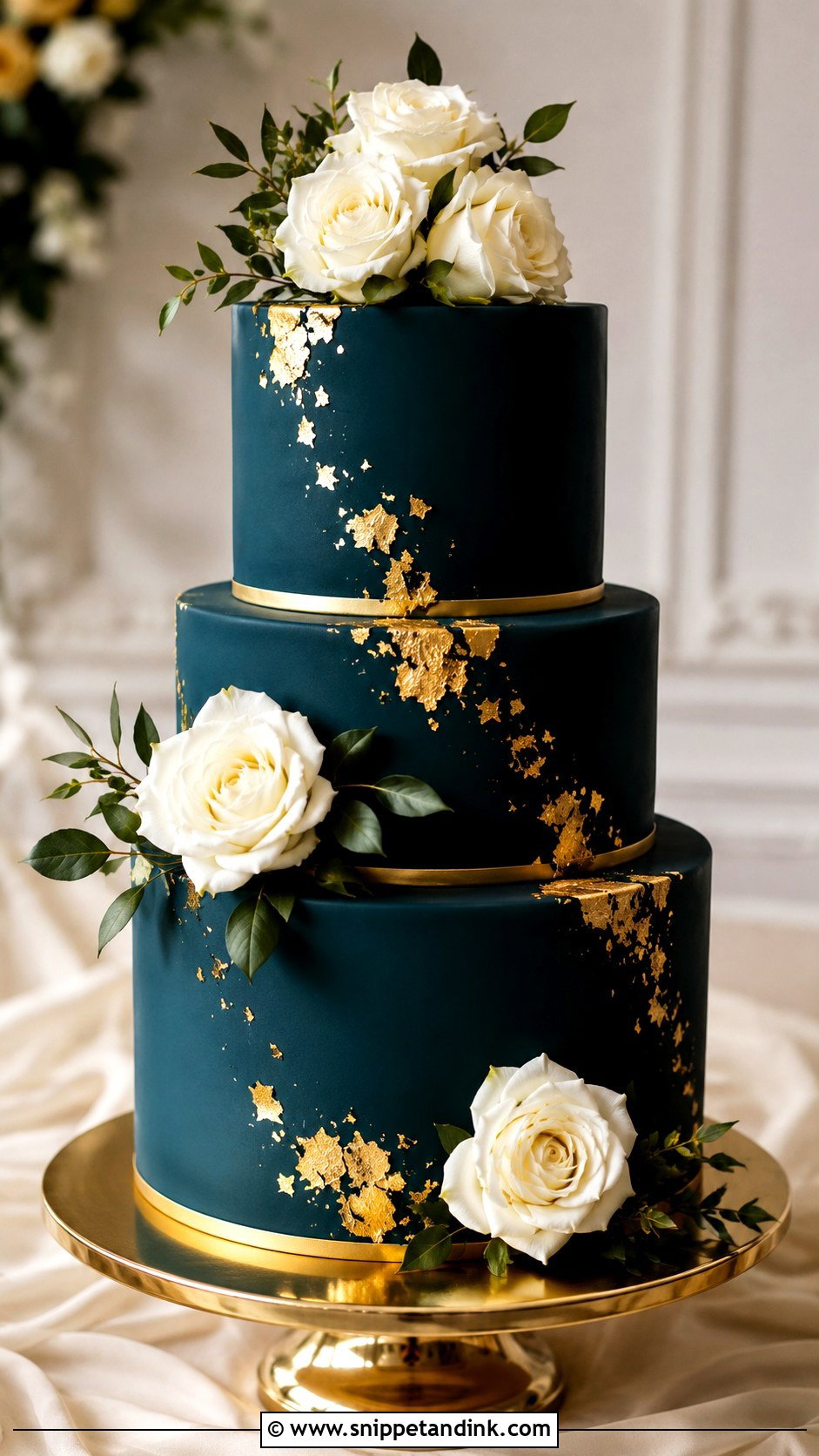
Gold is the quickest way to make teal look expensive. A deep teal base with gold leaf, painted edges or slim metallic bands gives warmth against a cool colour. I place gold sparingly, on one edge or in patches, so it reads as a highlight rather than a coating. Ivory flowers or white roses lift the whole cake. It suits evening receptions, ballrooms and autumn weddings. Vanilla almond, chocolate and pistachio all work underneath; pistachio in particular picks up the green side of the teal when the cake is cut.
2. Dark Teal Buttercream Wedding Cake
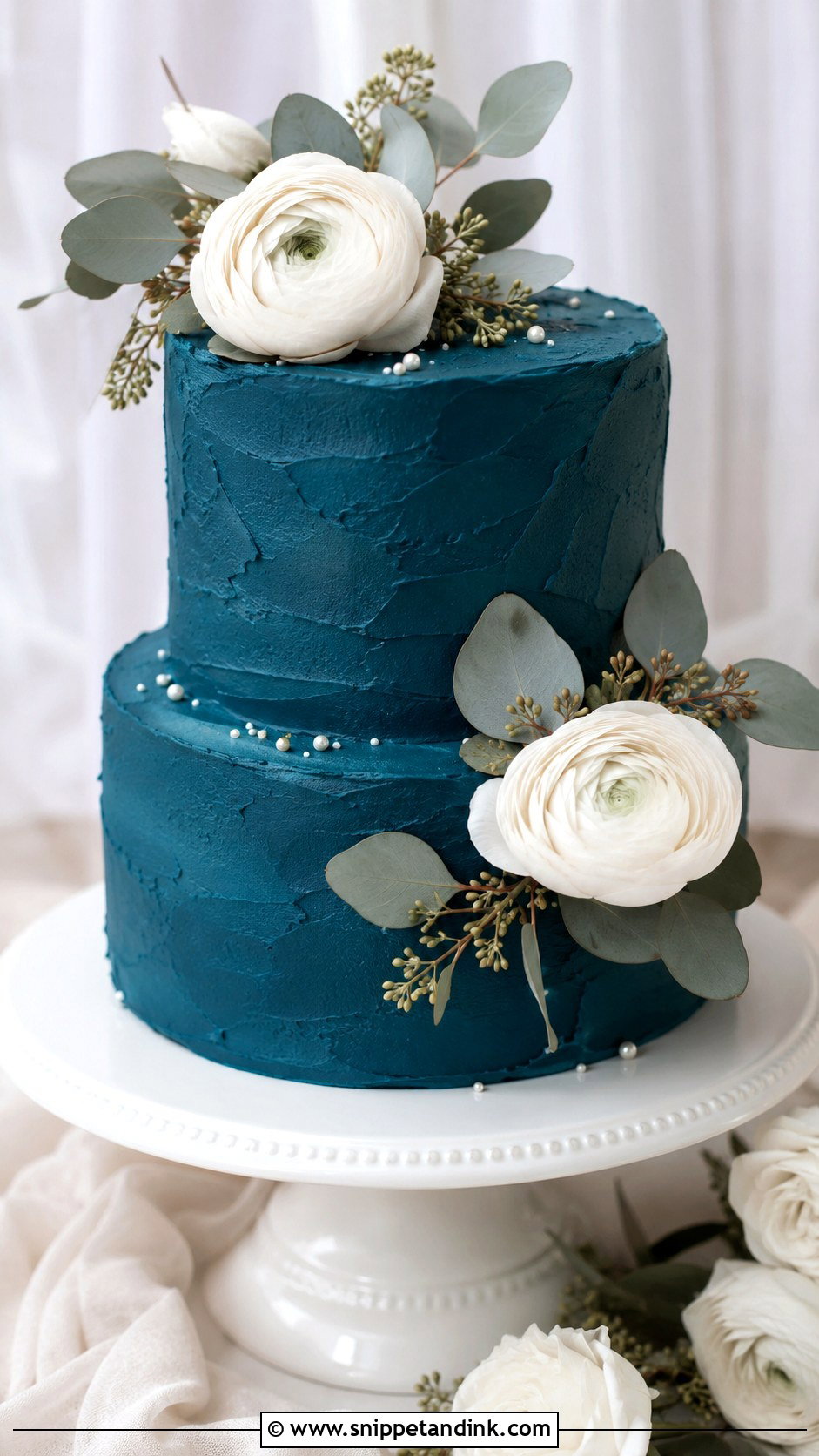
Buttercream gives teal a softer, more handmade look than fondant, smooth and polished or with visible spatula marks. My caution is the colour itself. Butter is naturally yellow, and yellow plus blue makes green, so a teal mixed into an all-butter frosting often turns out greener than the swatch. I whiten the base first and test the shade, then let it rest, because dark colours deepen as they sit. Fresh flowers, pearls, berries and greenery all sit well on it, and a plain white stand keeps the teal looking clean.
3. Dark Teal Ombre Wedding Cake
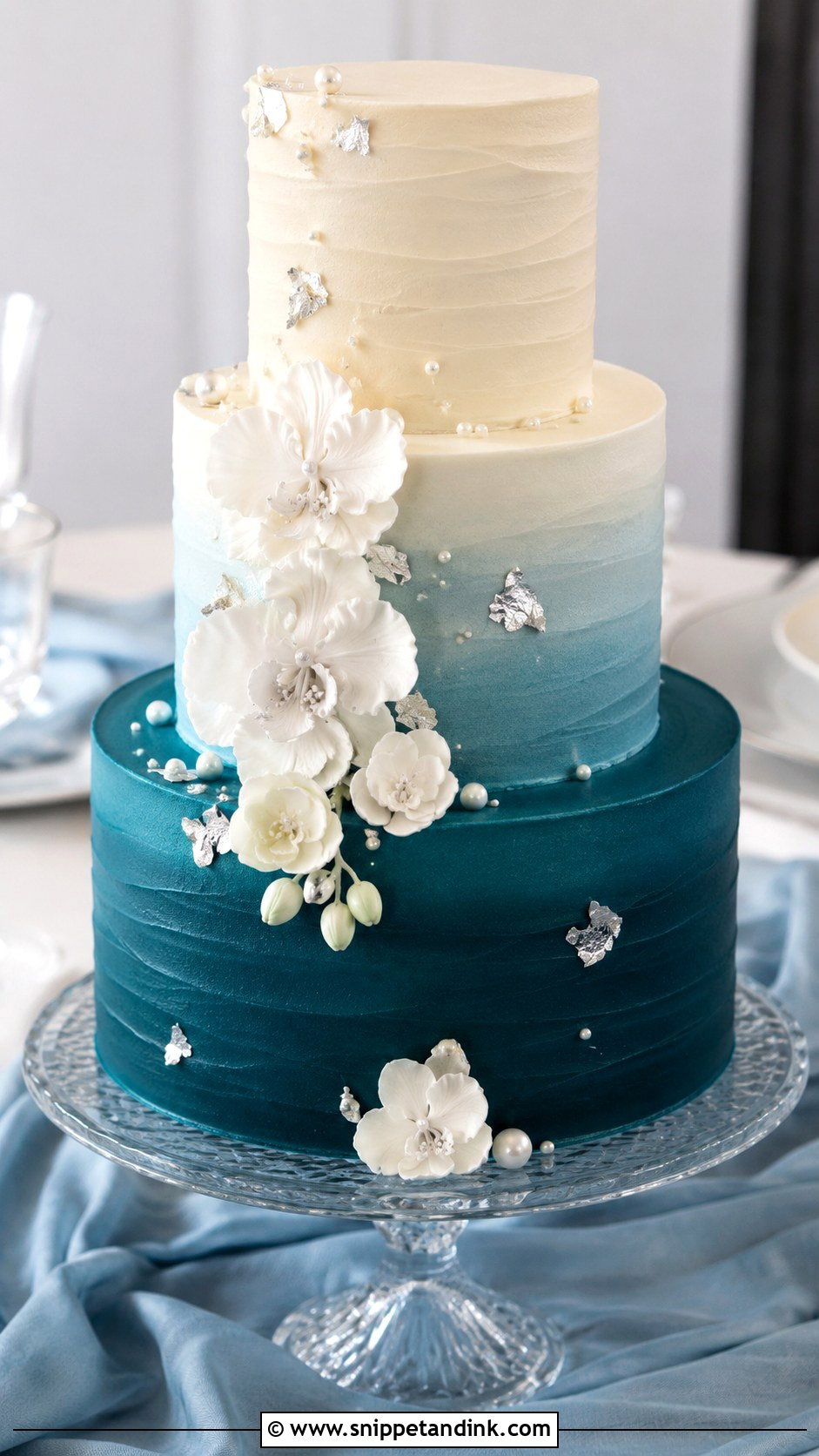
A dark teal ombre wedding cake keeps the colour from feeling heavy, because only the bottom tier carries the full depth. I usually fade from ivory or pale aqua at the top to deep teal at the base. Starting from one dark batch and lightening it for each tier keeps every step in the same colour family. Smooth buttercream blends softest; fondant gives clean bands. The gradient has an ocean feel without shells or sand, which is why I suggest it for waterfront weddings that want to stay formal. Silver leaf, pearls or small white sugar flowers finish it.
4. Dark Teal Marble Wedding Cake
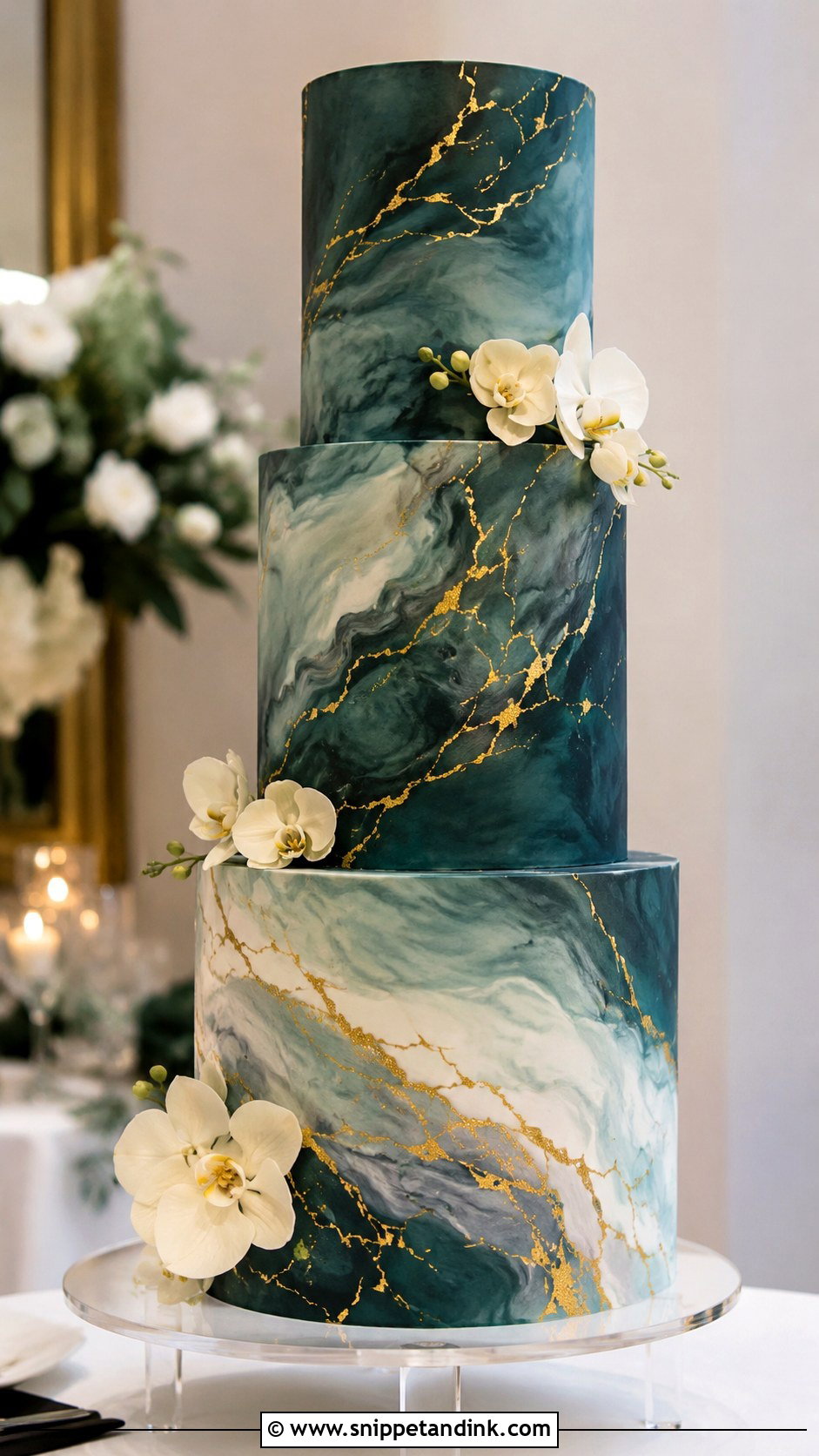
Marbling looks artistic but is easy to overdo. Teal can be swirled with white, grey, black or a vein of gold for a stone effect. I almost never marble every tier; one or two marbled tiers next to smooth ones is far stronger. On fondant the veins stay crisp, while on buttercream they can smear if worked too much. Gold veining adds polish and a cluster of white flowers softens it. Gallery venues, hotels and couples tired of floral cakes tend to choose this one, often on an acrylic or geometric stand.
5. Dark Teal Floral Wedding Cake
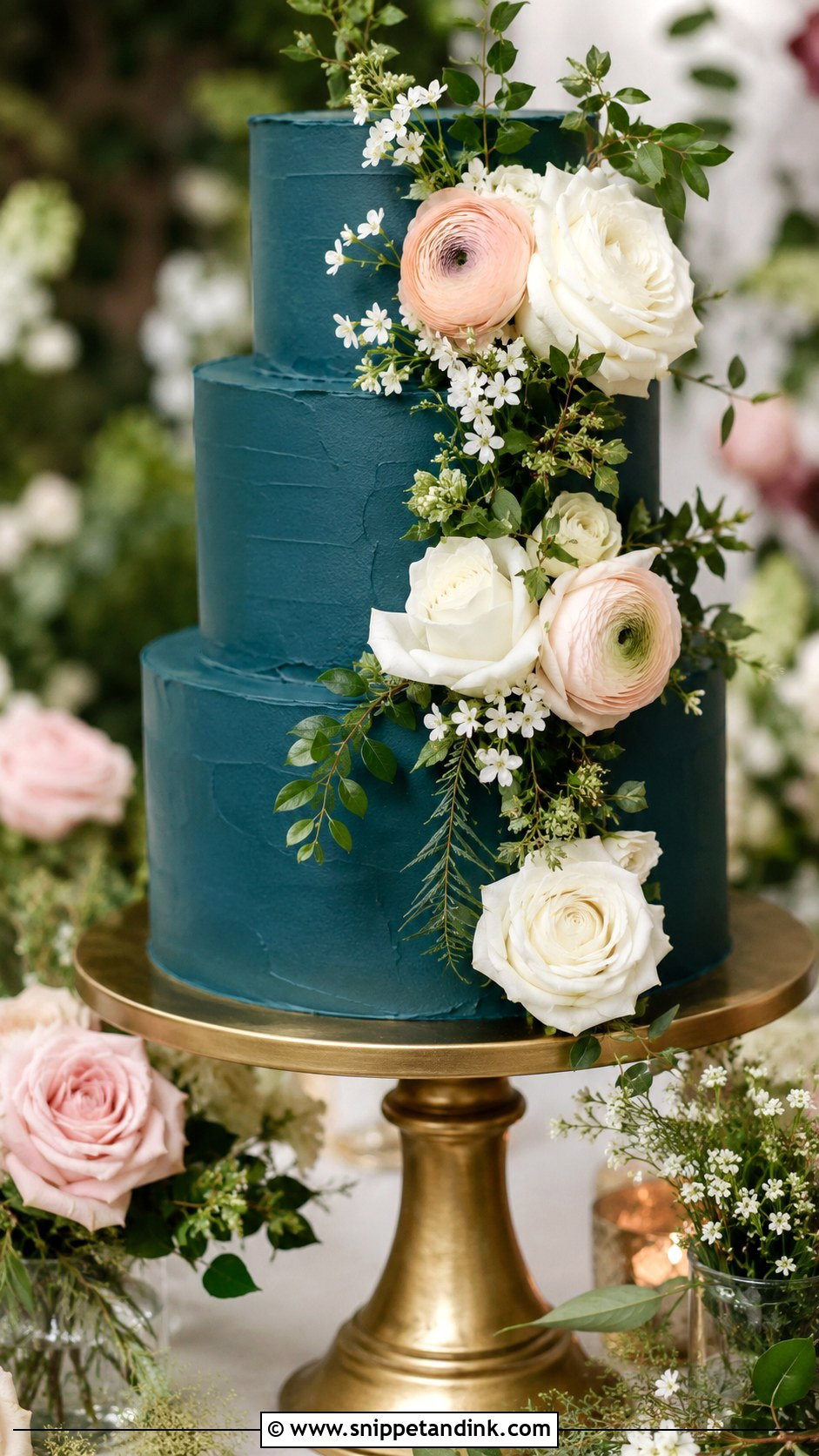
Flowers bring romance to a colour that can otherwise feel cool. On a teal base, white, blush, peach, burgundy and ivory blooms all stand out clearly. Roses, ranunculus, orchids and dahlias are the reliable choices. For a softer look I cluster flowers on one side or let them cascade; for a fuller one I add a ring between every tier. Greenery links the cake to the tables. Any fresh stem near the frosting should be pesticide-free and wrapped or placed in a pick, and the baker and florist need to agree who does it.
6. Dark Teal And White Wedding Cake
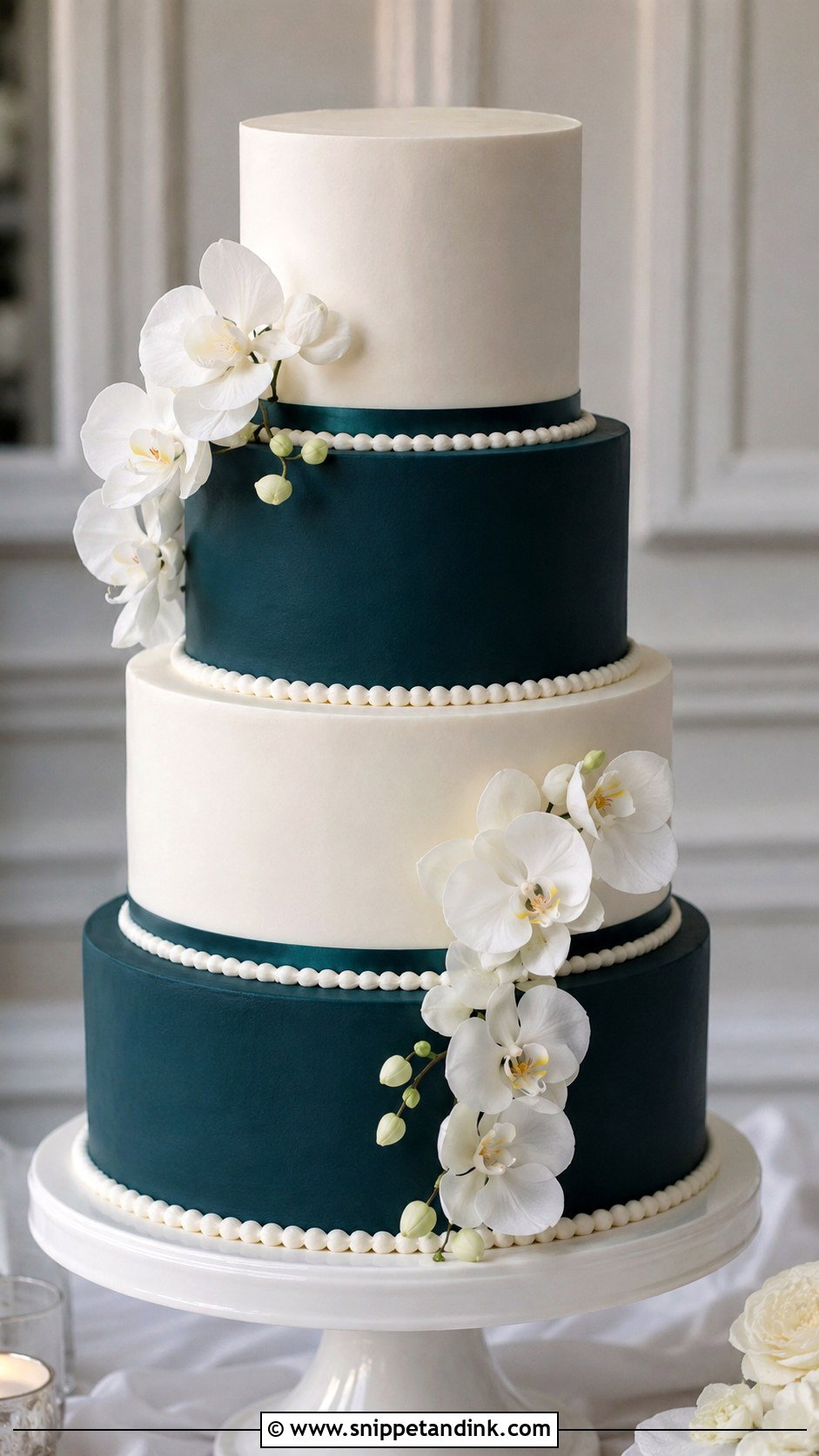
White and teal is the classic way in. Most of the cake stays white, with teal arriving through a ribbon, painted flowers, piping or one accent tier. The reverse works too: a teal cake with white floral details. I’d watch the join between colours, since deep teal buttercream can bleed into white in a warm room, so I pipe white details last and keep the cake chilled between steps. White roses, orchids and pearl borders keep it bridal in garden venues and banquet halls alike.
7. Dark Teal And Black Wedding Cake
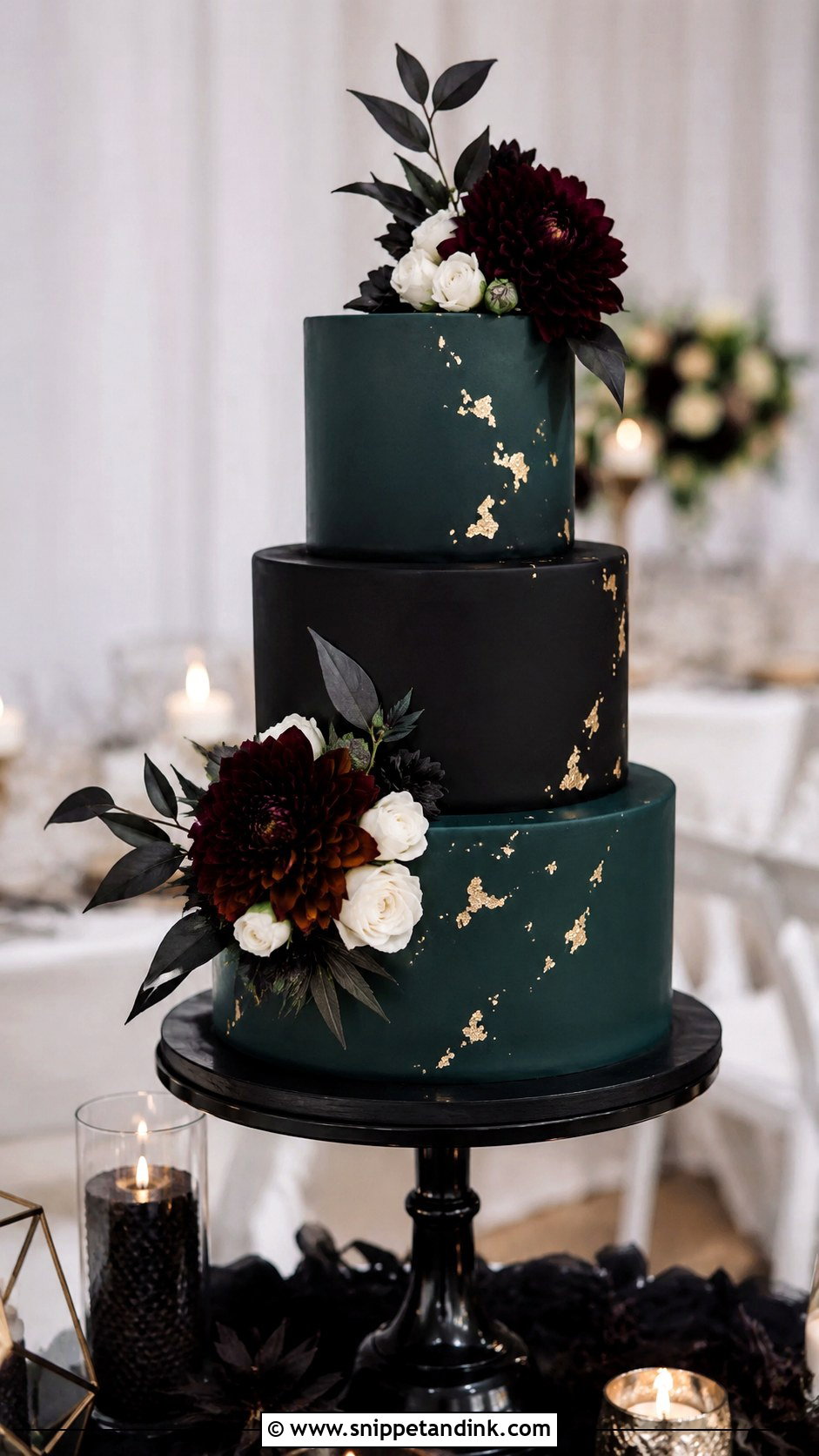
A dark teal and black wedding cake needs careful layering or it goes from dramatic to heavy. My usual approach is a black base tier, a teal upper tier and a small gold or silver accent. Matte finishes make both colours look velvety, which suits this pairing. Black frosting stains mouths, so I prefer black fondant or a black tier that is mostly for display. White flowers add contrast; burgundy ones deepen the mood. It suits evening weddings and industrial or modern venues.
8. Dark Teal Vintage Wedding Cake
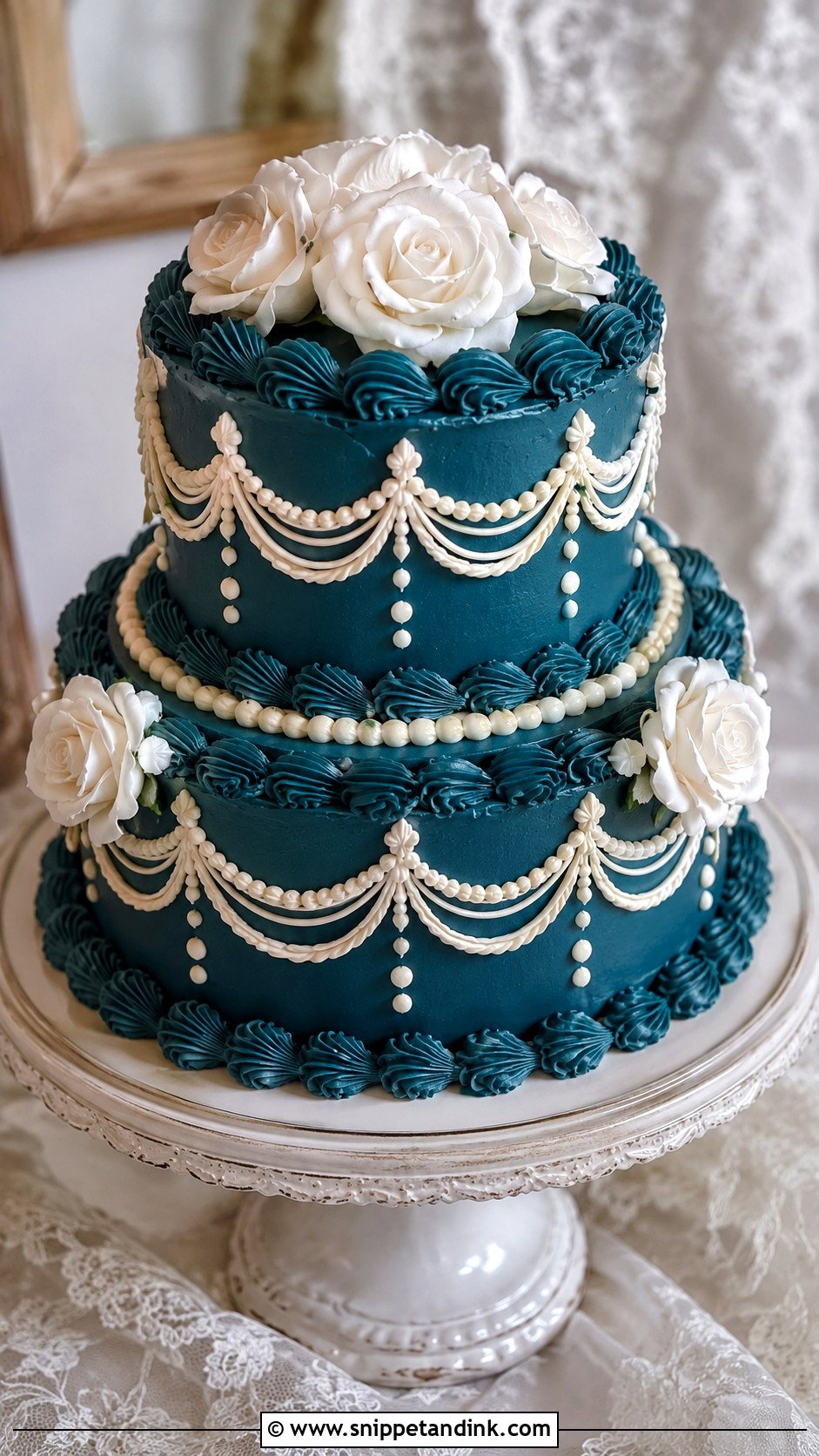
Vintage piping on a deep teal surface looks fresher than the same work on white. I’d use Lambeth-style borders, shell piping, swags, pearl dots and ruffled edges. Ivory piping gives a classic look, while teal-on-teal piping is the more editorial version, where the shadows in the piping create the pattern. It can be one tier for a small wedding or stacked high. Cherries only make sense if the whole wedding leans retro; otherwise sugar pearls and white flowers keep it bridal. Fine piping slumps in heat, so I’d keep this one indoors.
9. Dark Teal Fondant Wedding Cake
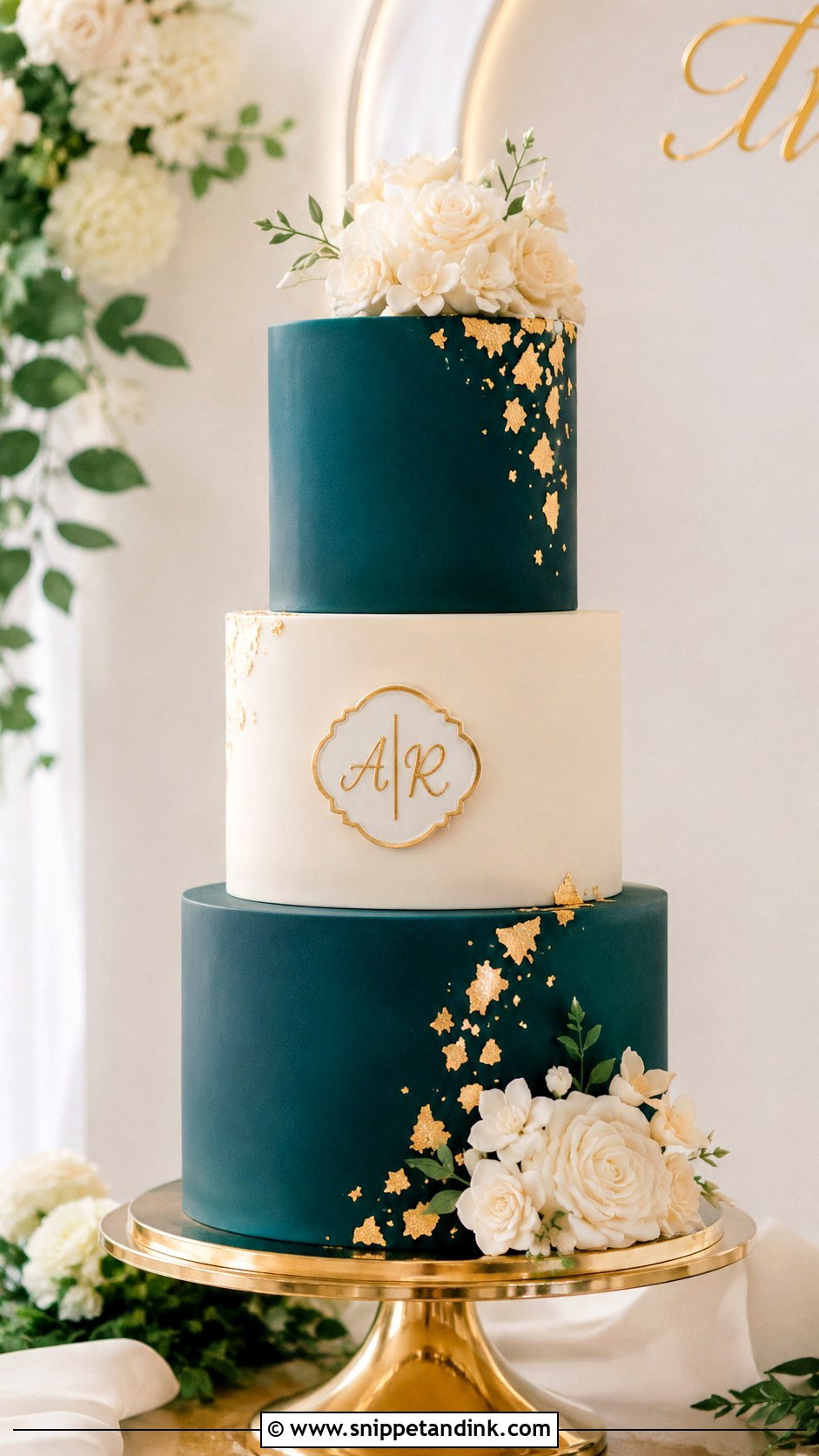
Fondant is the best way to get a precise, even teal, because I can colour the paste in one batch and avoid the faint streaks that dark buttercream sometimes shows. It suits sharp edges, structured tiers, painted details and metallic finishes, along with gold leaf, sugar flowers, embossing, monograms or a single floral spray. Formal venues with clean architecture suit it well. Because many guests peel fondant off, I put a good layer of buttercream underneath and choose a moist filling so the slice is worth eating.
10. Dark Teal Square Wedding Cake
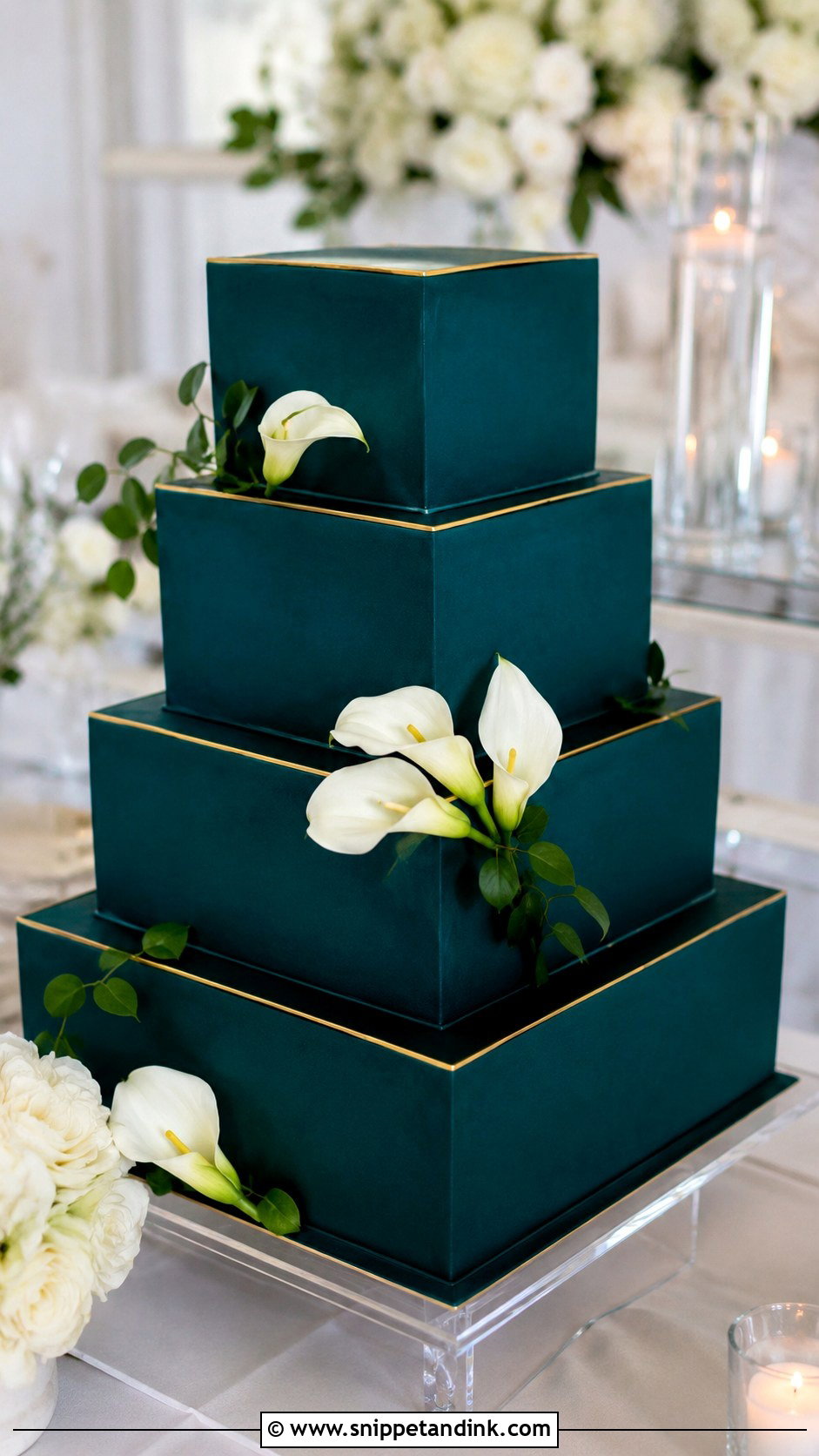
Square tiers make teal look architectural. Straight edges suit smooth fondant best; buttercream square corners are possible but soften faster in a warm room. I stack them evenly for a clean look, or turn each tier a few degrees for a more sculptural effect. Gold trim, white flowers and black details all fit the shape. One practical bonus: a square tier gives more servings than a round one of the same width. Keep decoration light so the shape and colour lead.
11. Dark Teal Three Tier Wedding Cake
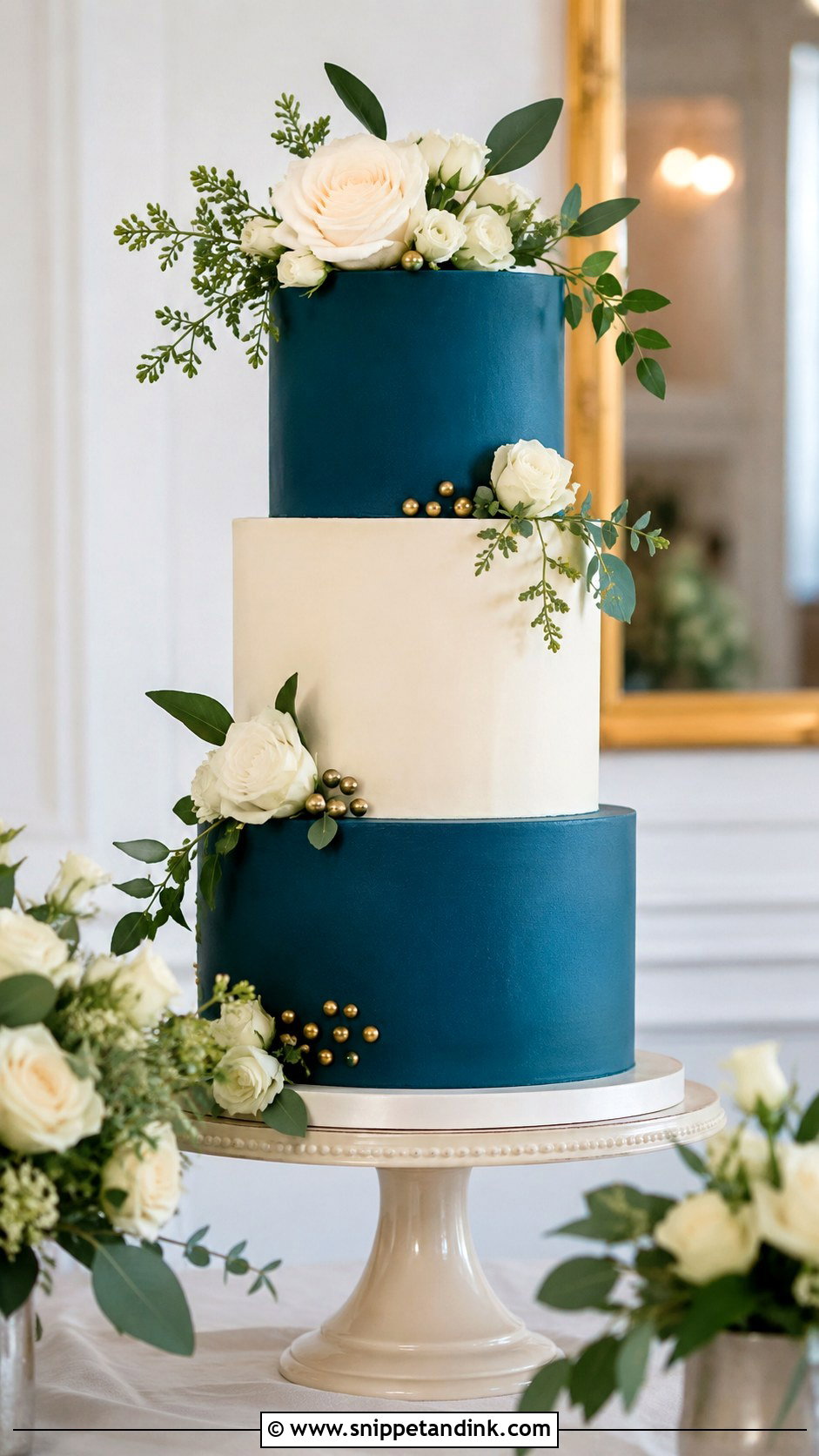
Three tiers give enough height for drama and suit most medium-sized weddings. A layout I like is teal on the bottom, ivory in the middle and teal again on top, which stops the colour feeling heavy; all-teal tiers with soft flowers is the bolder option. Three tiers also mean three flavours, such as vanilla bean, chocolate and lemon. I’d keep the decoration consistent from top to bottom so it reads as one cake, and put it on a raised stand to give it presence.
12. Dark Teal Drip Wedding Cake
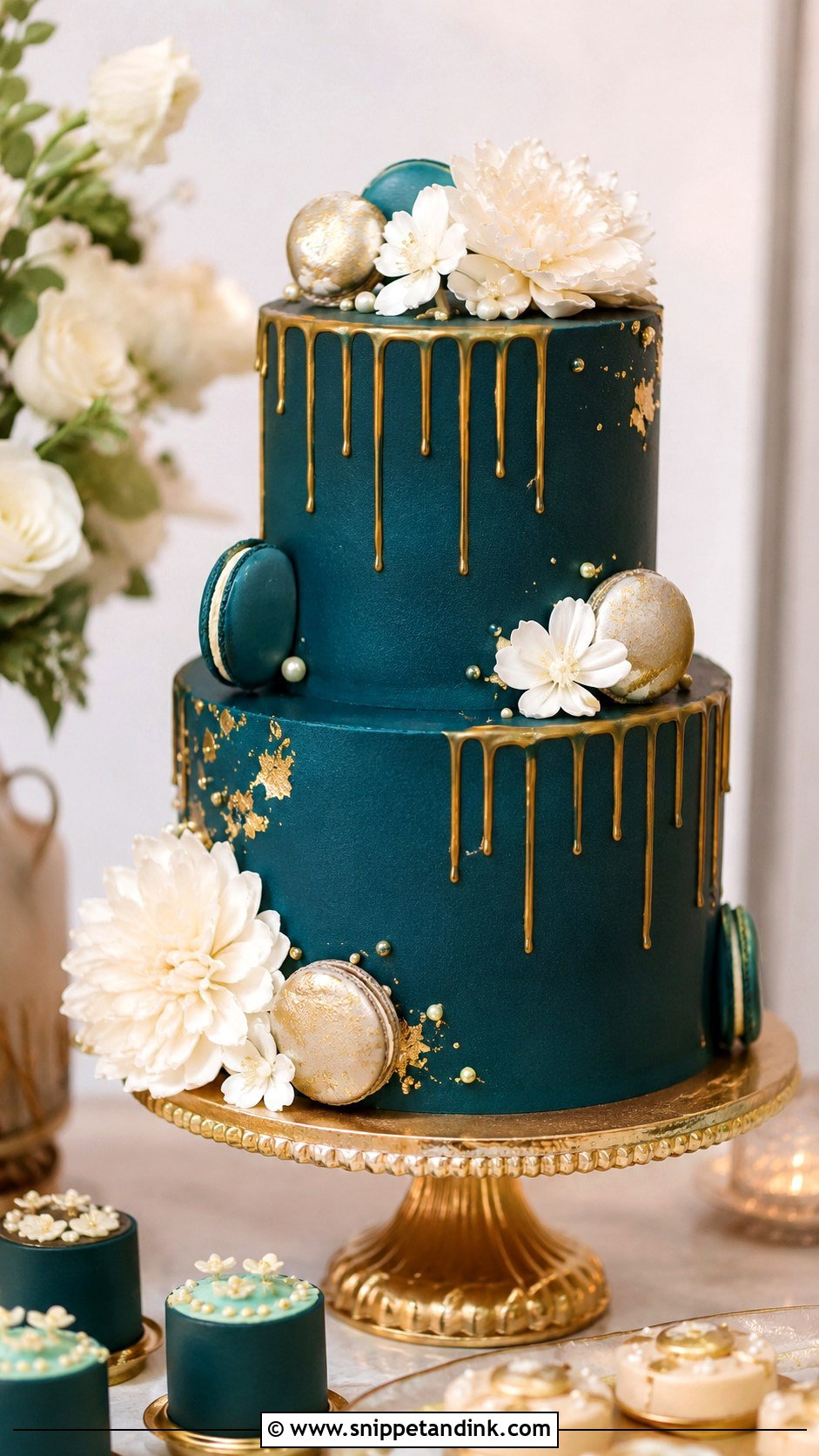
Drips are the most playful design here, so I keep them disciplined for weddings: short, evenly spaced and glossy. The drip can be teal over ivory, gold over teal, white chocolate over teal or black ganache over teal for a moodier result. Getting it right depends on temperature; ganache that’s too warm runs to the board, and too cool it sits in lumps. Macarons, sugar flowers or edible gold on top finish it. It sits naturally among dessert tables with cupcakes, cookies or mini cakes with matching teal touches.
13. Dark Teal And Blush Wedding Cake
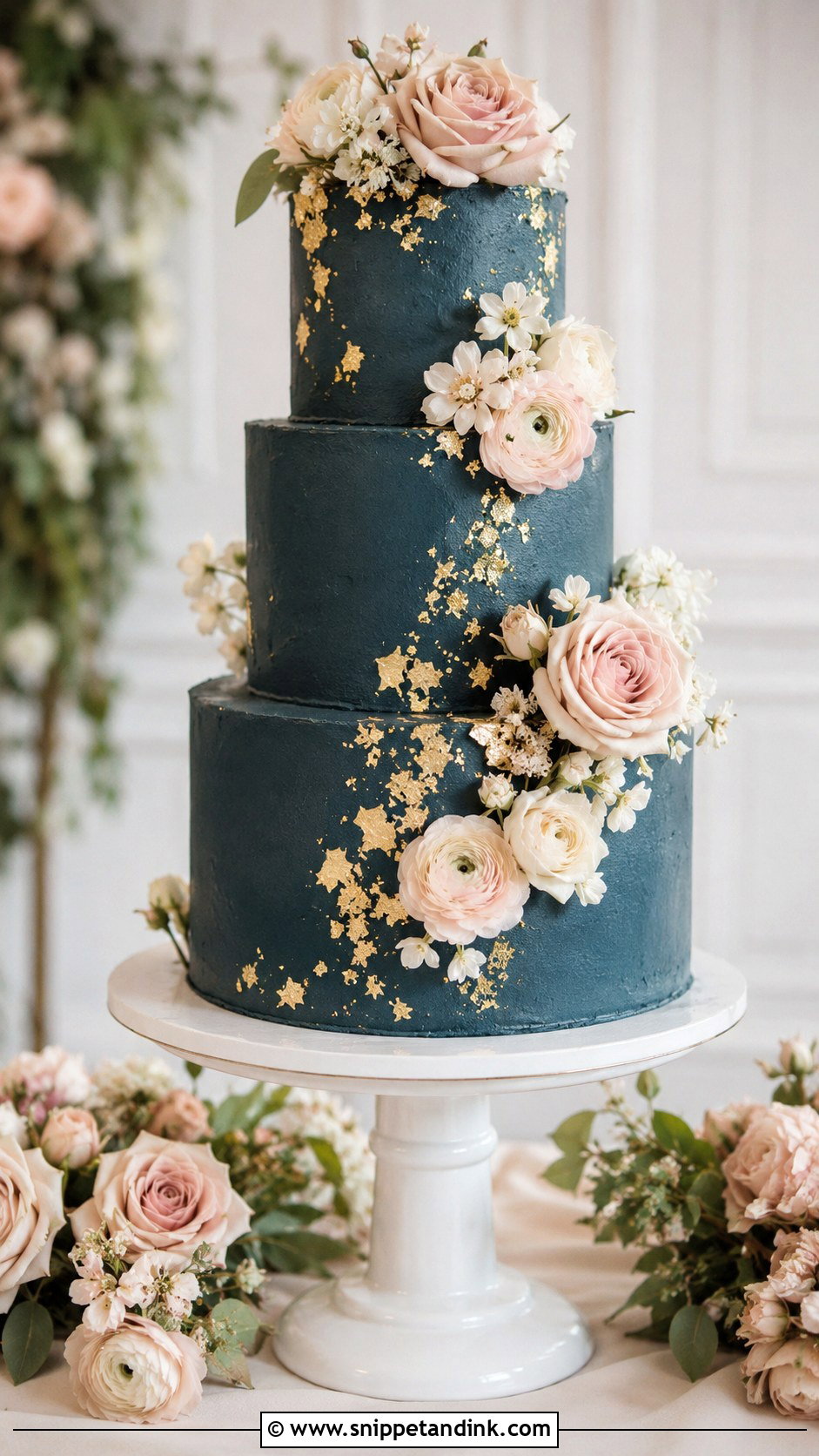
Blush softens teal more than any other colour I use with it. The teal gives depth and the blush flowers make it romantic. I place blush roses, peonies, ranunculus or sugar flowers against a teal buttercream or fondant base, and add an ivory tier if the contrast feels too strong. Gold is optional. This pairing suits spring weddings and elegant indoor rooms. Inside, vanilla raspberry, almond or white chocolate with strawberry filling continues the soft side of the palette.
14. Dark Teal And Burgundy Wedding Cake
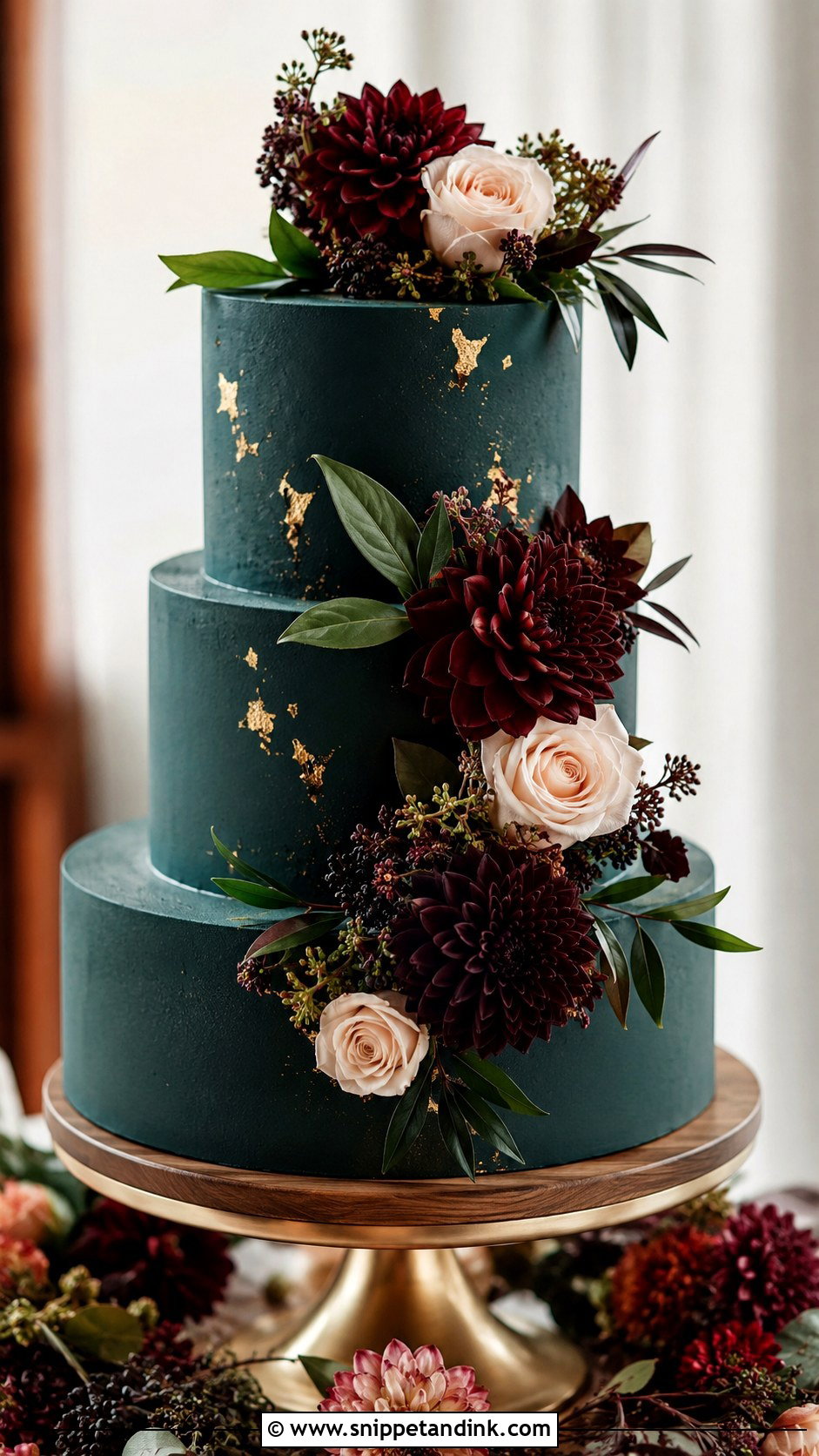
A dark teal and burgundy wedding cake feels rich and seasonal without looking like a Christmas cake, provided the design stays clean. Burgundy flowers stand out against teal frosting, especially mixed with ivory blooms and dark greenery. A smooth teal tier with one burgundy floral cascade is usually enough. In dim candlelight both colours darken, so I always add some ivory to keep the cake readable. Chocolate, red velvet, spice cake and dark berry fillings match its depth, and velvet linens and wood tables suit the room.

15. Dark Teal Beach Wedding Cake
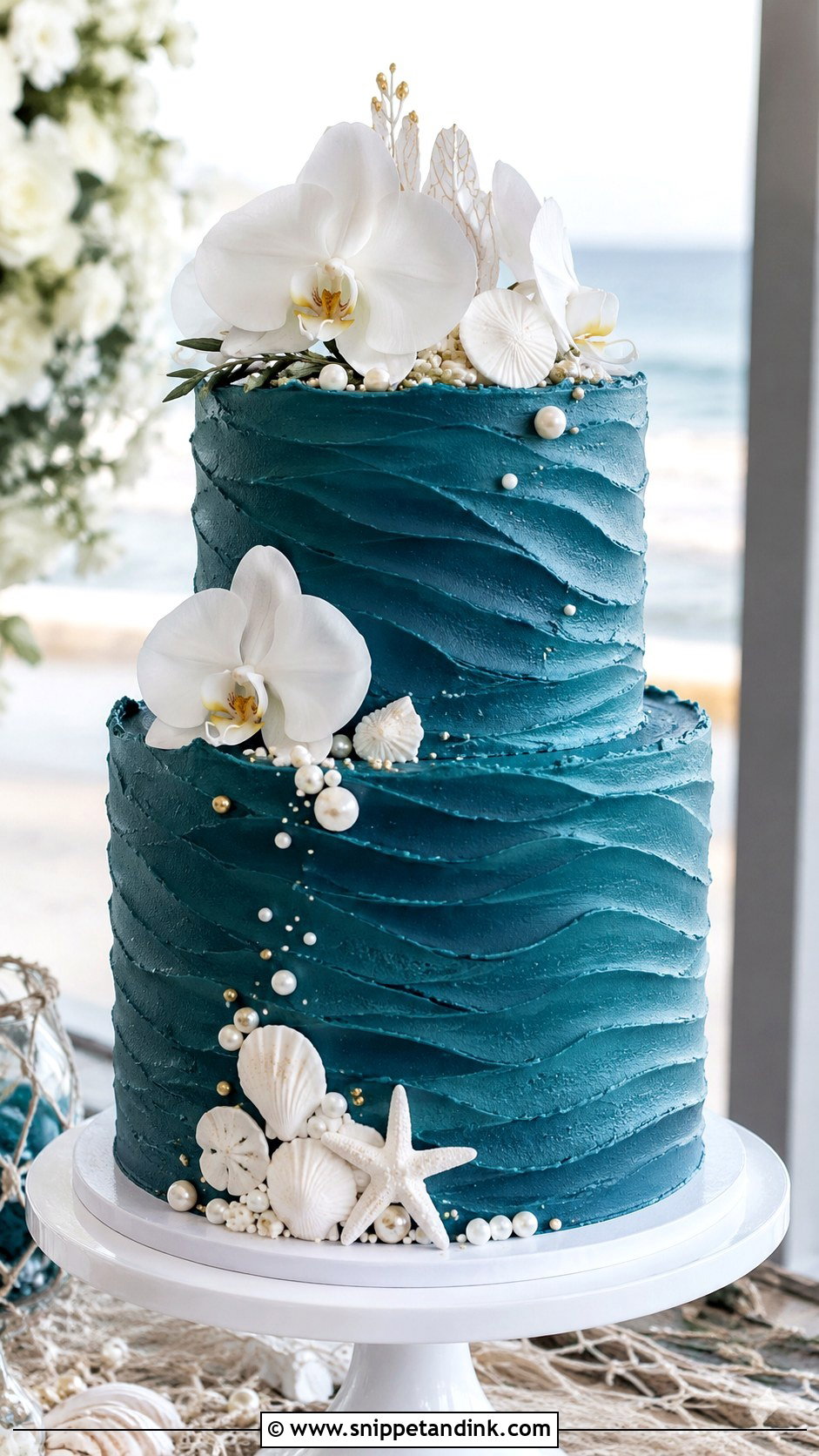
Coastal cakes go childish fast, and deep teal is my way of keeping them grown-up. Instead of bright turquoise, I use an ocean teal with ivory, pearl, sand or soft gold. Textured buttercream can suggest gentle waves, and edible pearls or smooth white shells add a hint of the sea. One or two shell details is plenty; a cake covered in starfish looks like a party favour. White orchids or sugar shells keep it refined. Beach venues are often hot and windy, so I’d use a sturdier finish and keep the cake under cover.
16. Dark Teal Watercolor Wedding Cake
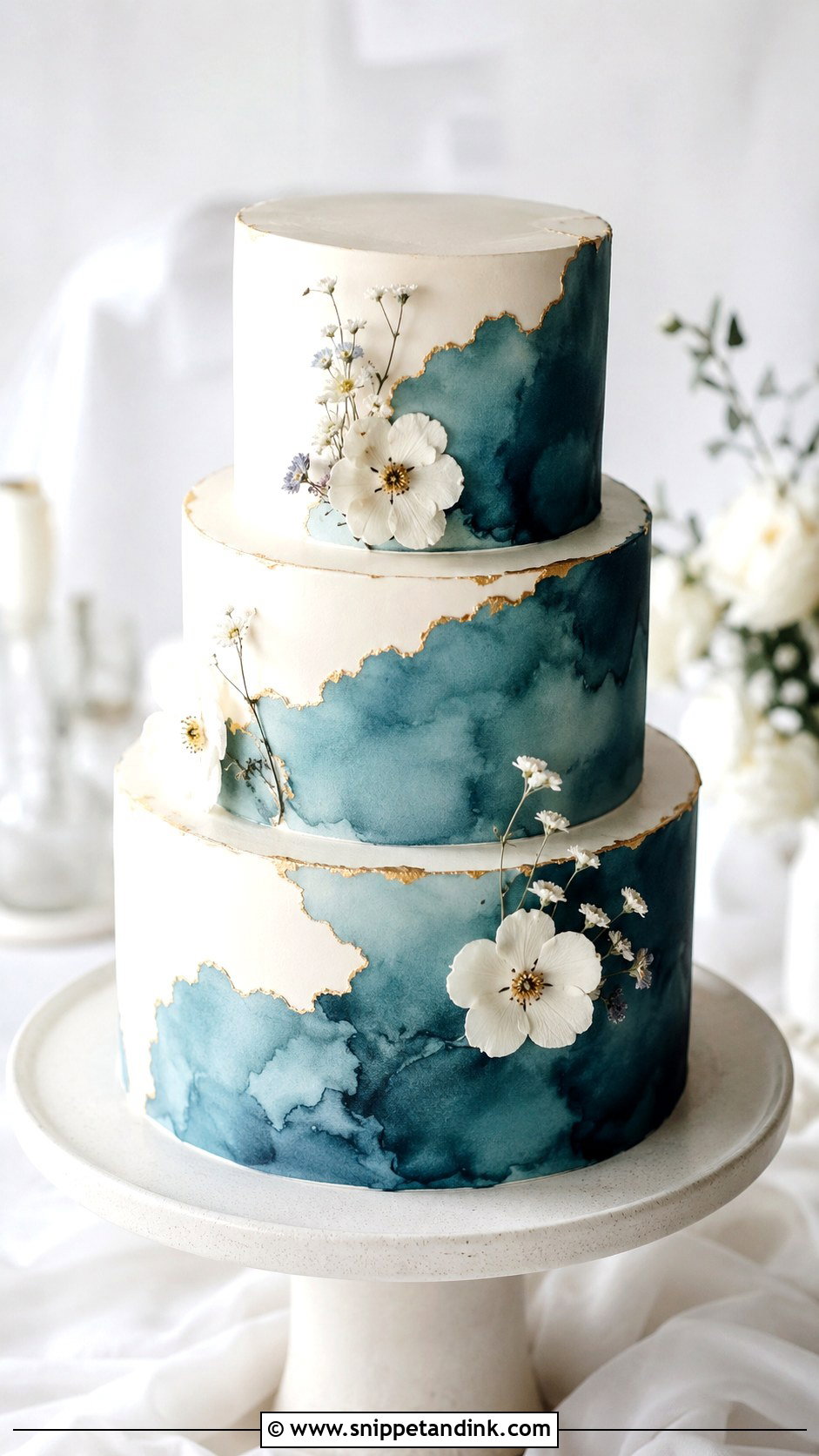
A dark teal watercolor wedding cake uses colour in washes rather than full coverage, so it feels lighter than a solid teal tier. I blend teal with pale blue, sage, grey or a hint of gold across ivory buttercream with a palette knife, or paint thinned colour onto fondant. Each one comes out differently, so look at your baker’s previous watercolour cakes before committing. Minimal flowers, pressed botanicals or a thin gold rim finish it. It suits art-inspired receptions and couples who want colour without weight.
17. Dark Teal Celestial Wedding Cake
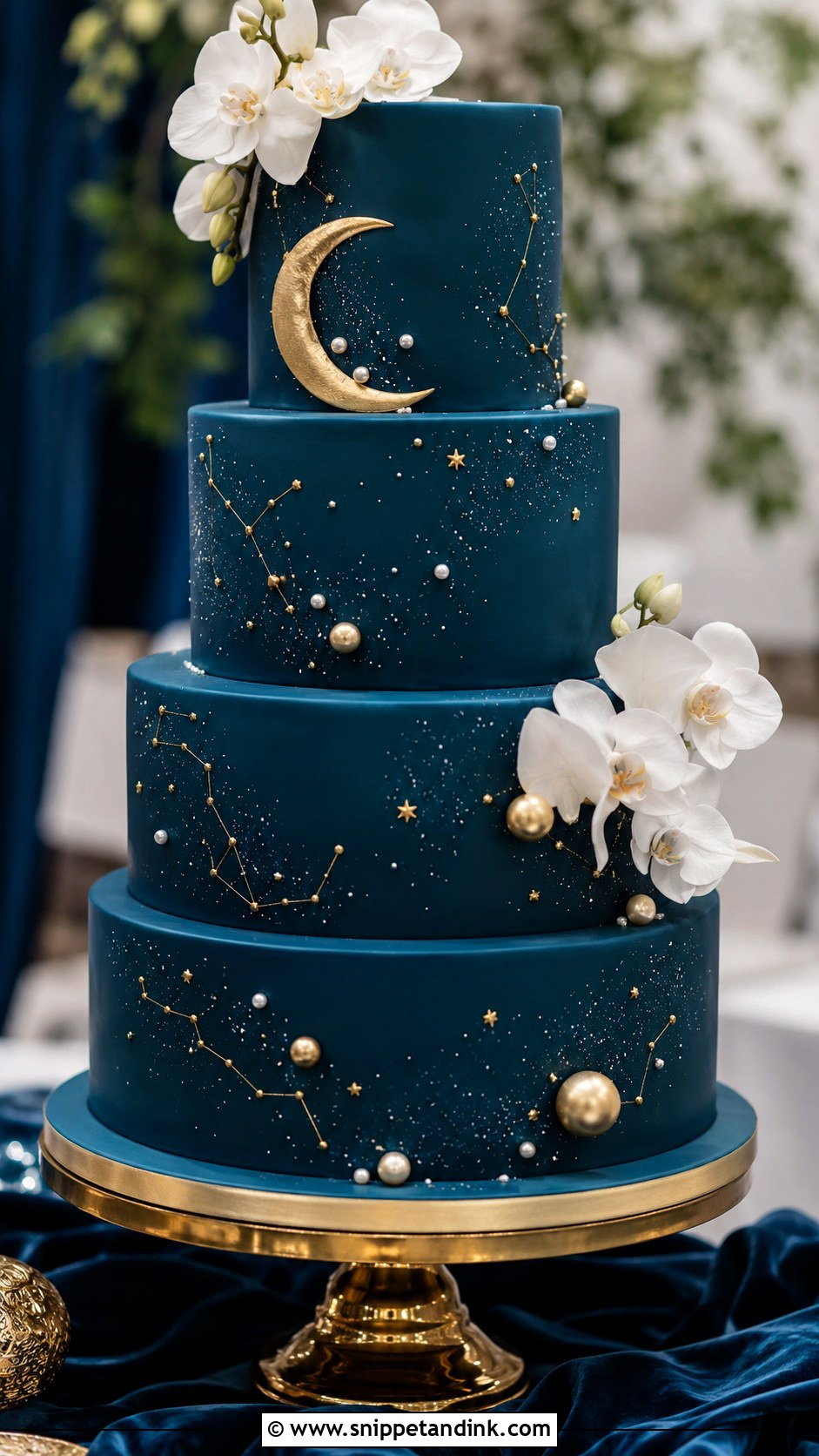
Deep teal makes a convincing night sky. I add tiny white stars, gold moons or fine constellation lines, sometimes with a sphere-shaped element among round tiers. The detail has to stay fine, because chunky stars quickly make a wedding cake look like a child’s birthday cake. Hand-painted gold lines take a steady hand and time, which is worth knowing when comparing quotes. White orchids or ivory roses soften the cosmic theme. It suits night-time and starry-themed weddings.
18. Dark Teal Geode Wedding Cake
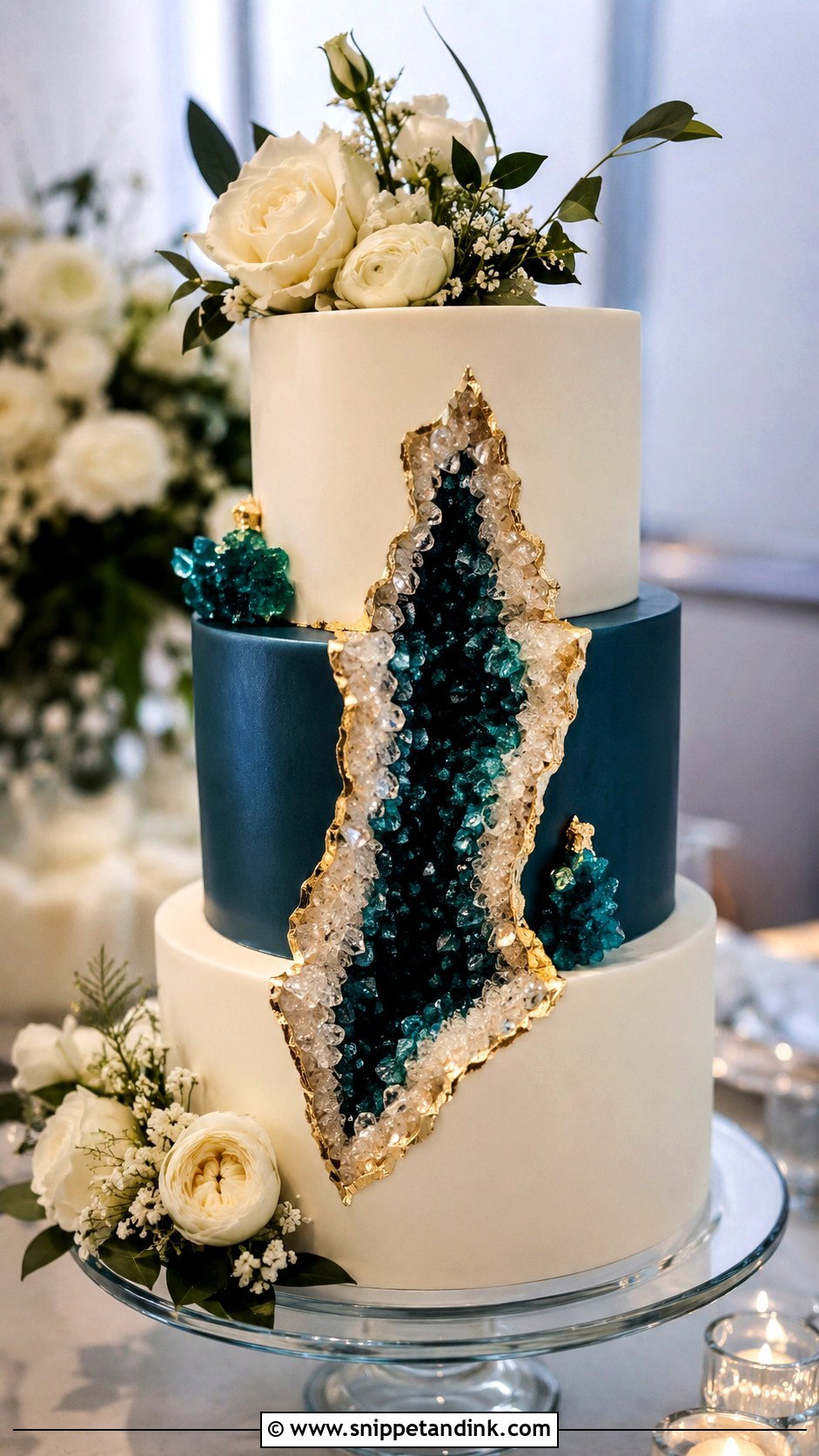
A geode is carved into the side of the cake and filled with rock candy, sugar crystals or isomalt gems in teal, white, clear or gold. The outside should stay smooth and simple so the crystal section is the focus. I’d warn guests, or the catering team, that rock candy is very hard; I usually carve the geode into a display tier so the crystals don’t end up on dessert plates. Clean crystal placement matters more than quantity. Pairing a white or ivory tier with the teal one makes the geode easier to see.
19. Dark Teal Lace Wedding Cake
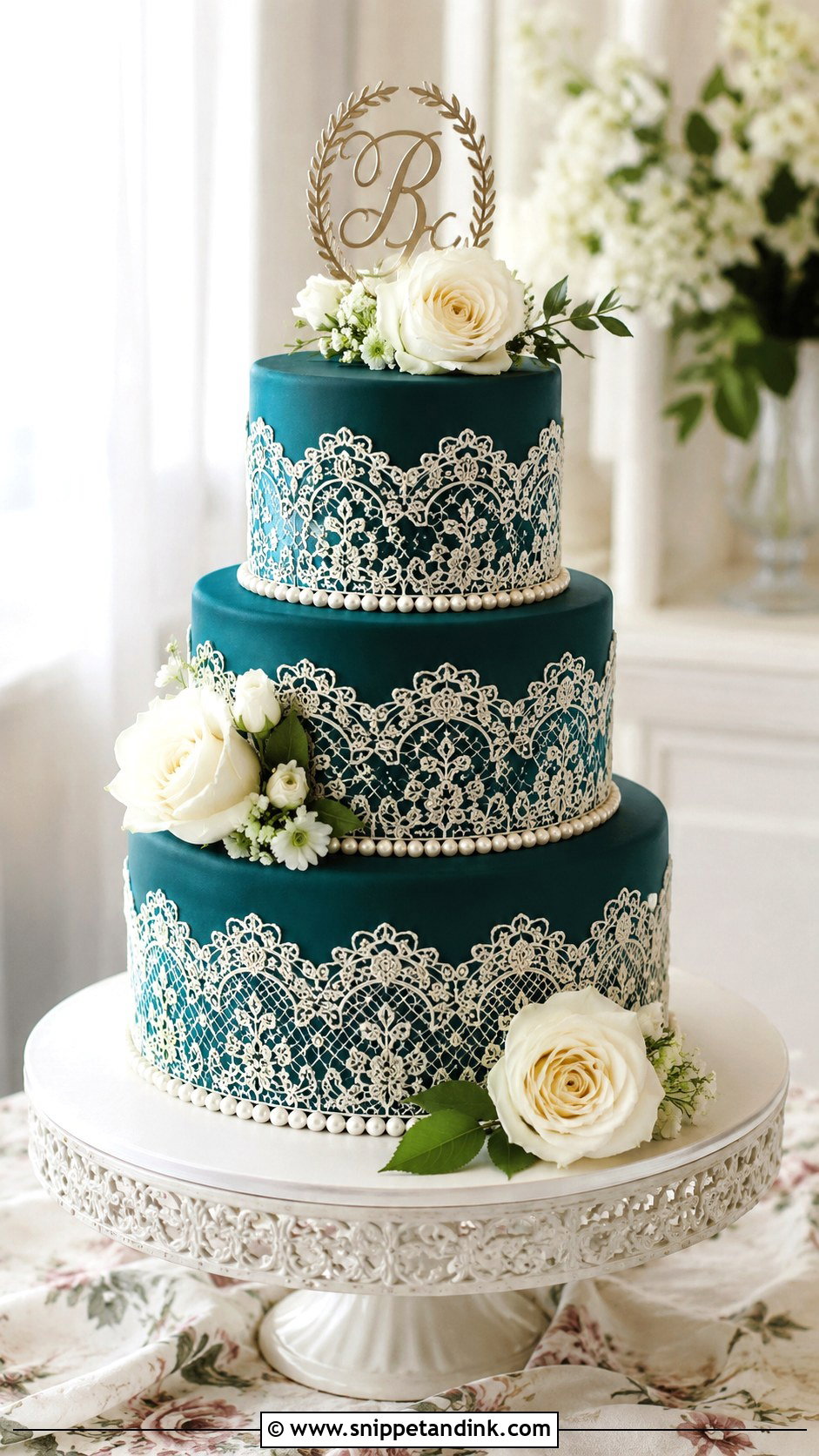
Deep teal is one of the best backgrounds for lace, because ivory detail stands out sharply against it. Lace can be piped by hand, stencilled with edible paint or made as flexible sugar lace. Stencilling gives the crispest repeat pattern; piping looks softer and more handmade. I’d use it with intention, either one full lace tier or a narrow band around each one, not lace everywhere. White flowers, pearls or a small monogram finish it. Vintage venues and classic ballrooms suit it, and it can echo the lace on a dress.


20. Dark Teal Rustic Wedding Cake
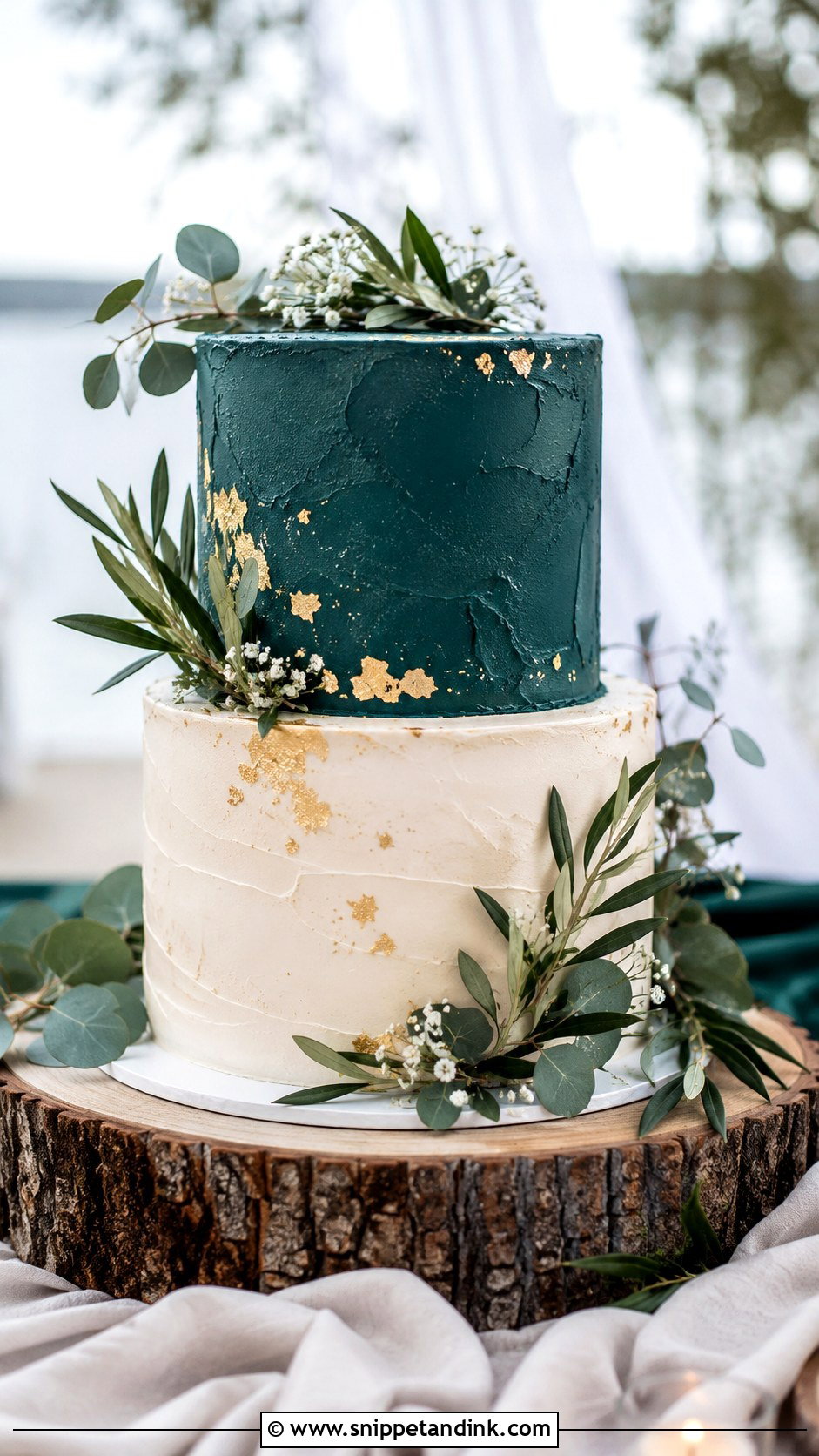
For rustic venues, teal works best as a supporting colour: textured buttercream, painted edges or a single accent tier next to ivory ones. Olive branches, eucalyptus, dried grasses and small white blooms keep it natural. I avoid shiny finishes here because gloss fights the rustic mood; a semi-smooth buttercream and a wooden stand ground the colour. Dried grasses shed, so they sit on a barrier and come off before cutting. Barns, mountain venues and autumn weddings suit this style.
21. Dark Teal Minimalist Wedding Cake
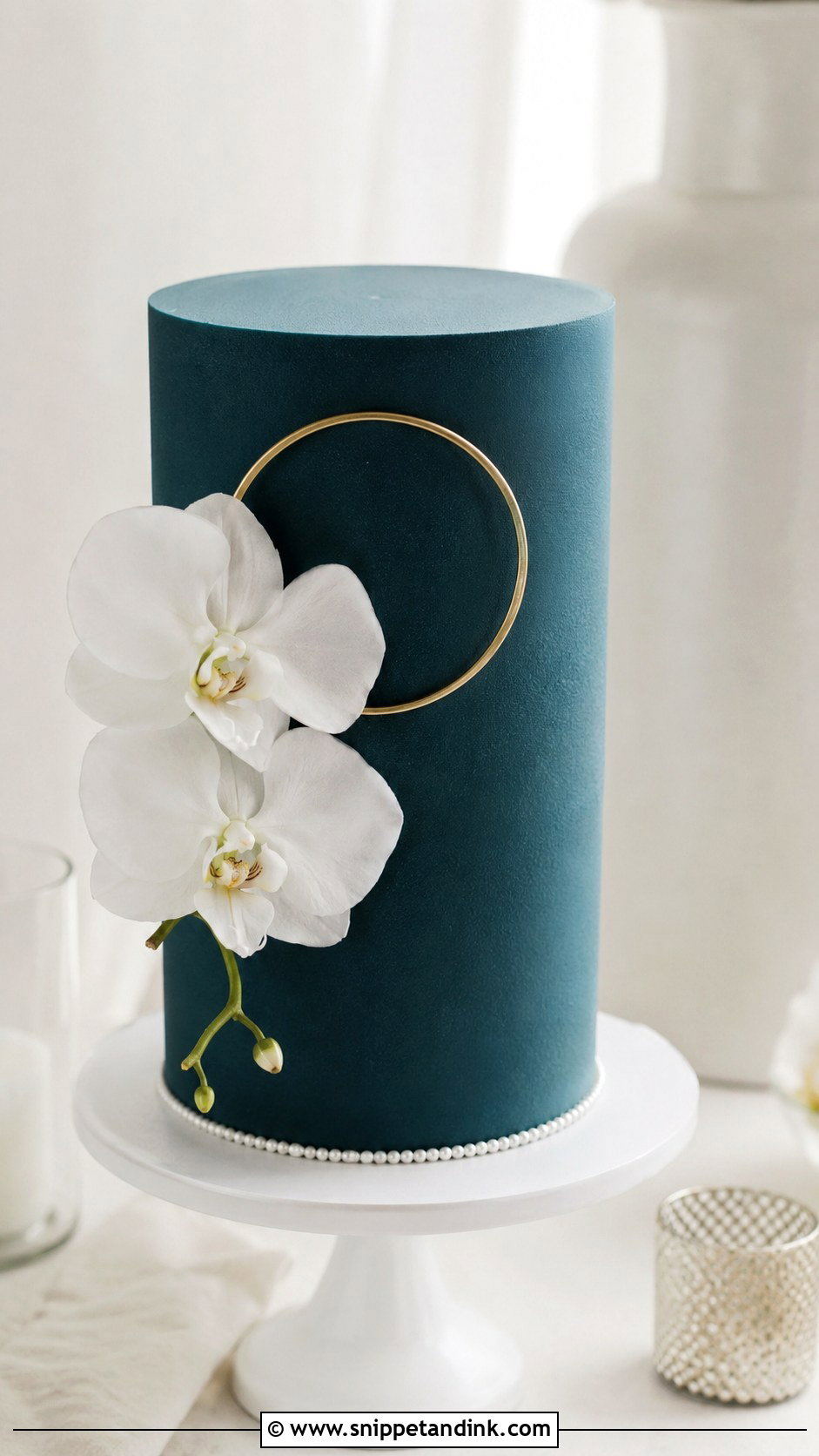
Strong colour needs very little decoration. A smooth teal finish, clean edges and one detail, such as a single white orchid, a thin gold line, a pearl border or a modern topper, can be enough. The difficulty is precision. With nothing to hide behind, the frosting must be perfectly smooth and the colour even all the way round, which is why I often do minimalist teal cakes in fondant or with a ganache base under the buttercream. A neutral backdrop and a matching stand suit it best.
22. Dark Teal Ruffle Wedding Cake
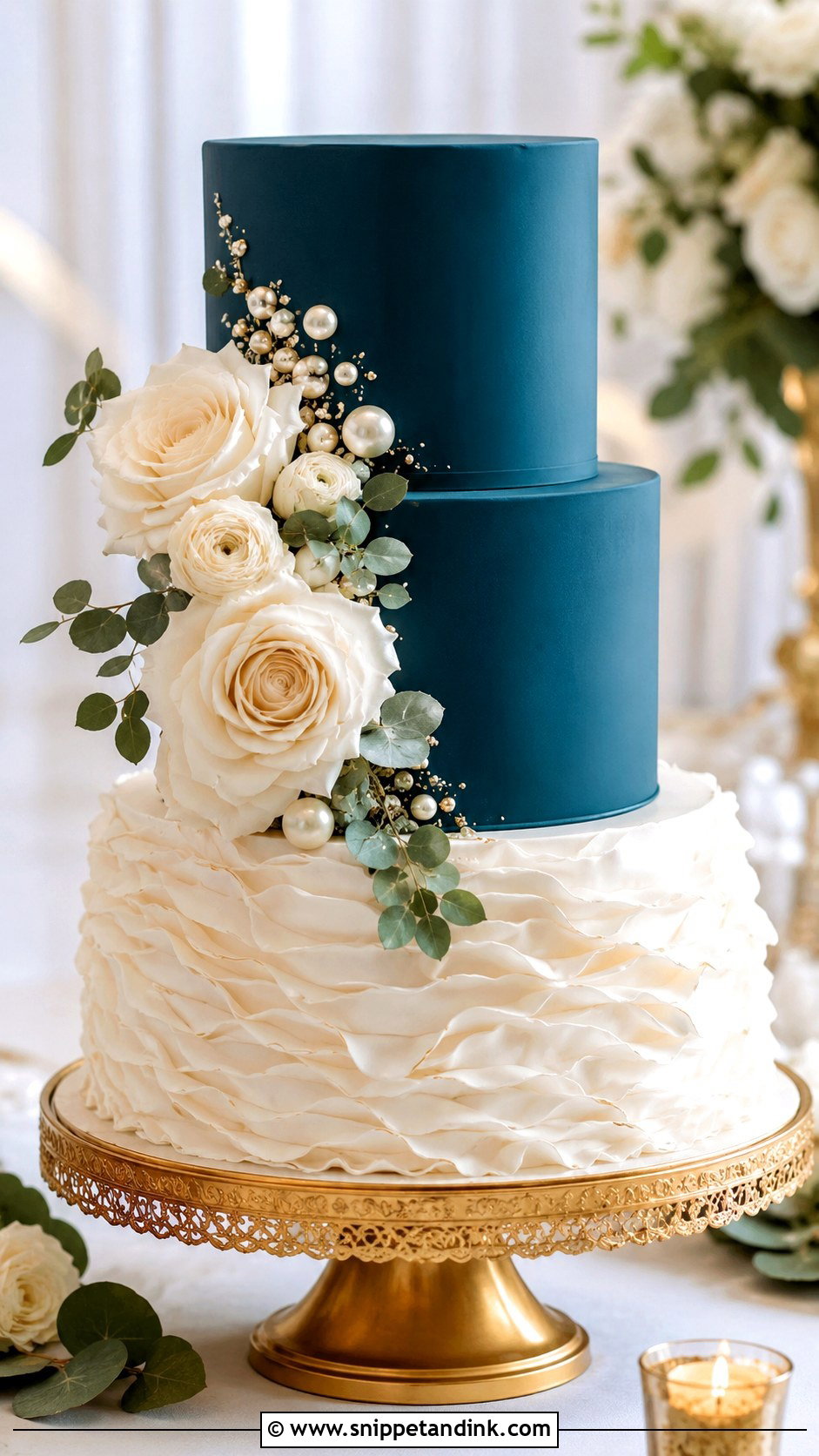
Ruffles add texture that catches the light, which stops a dark colour from looking flat. They can be buttercream, wafer paper or fondant. Buttercream ruffles are the softest to eat but droop in heat, wafer paper is feather-light though it wilts in humidity, and fondant holds its shape best. I’d ruffle one tier and keep the others smooth, or commit to a fully textured cake for a fashion-led wedding. Ivory flowers, pearls and a simple stand keep it graceful.
23. Dark Teal Pressed Flower Wedding Cake
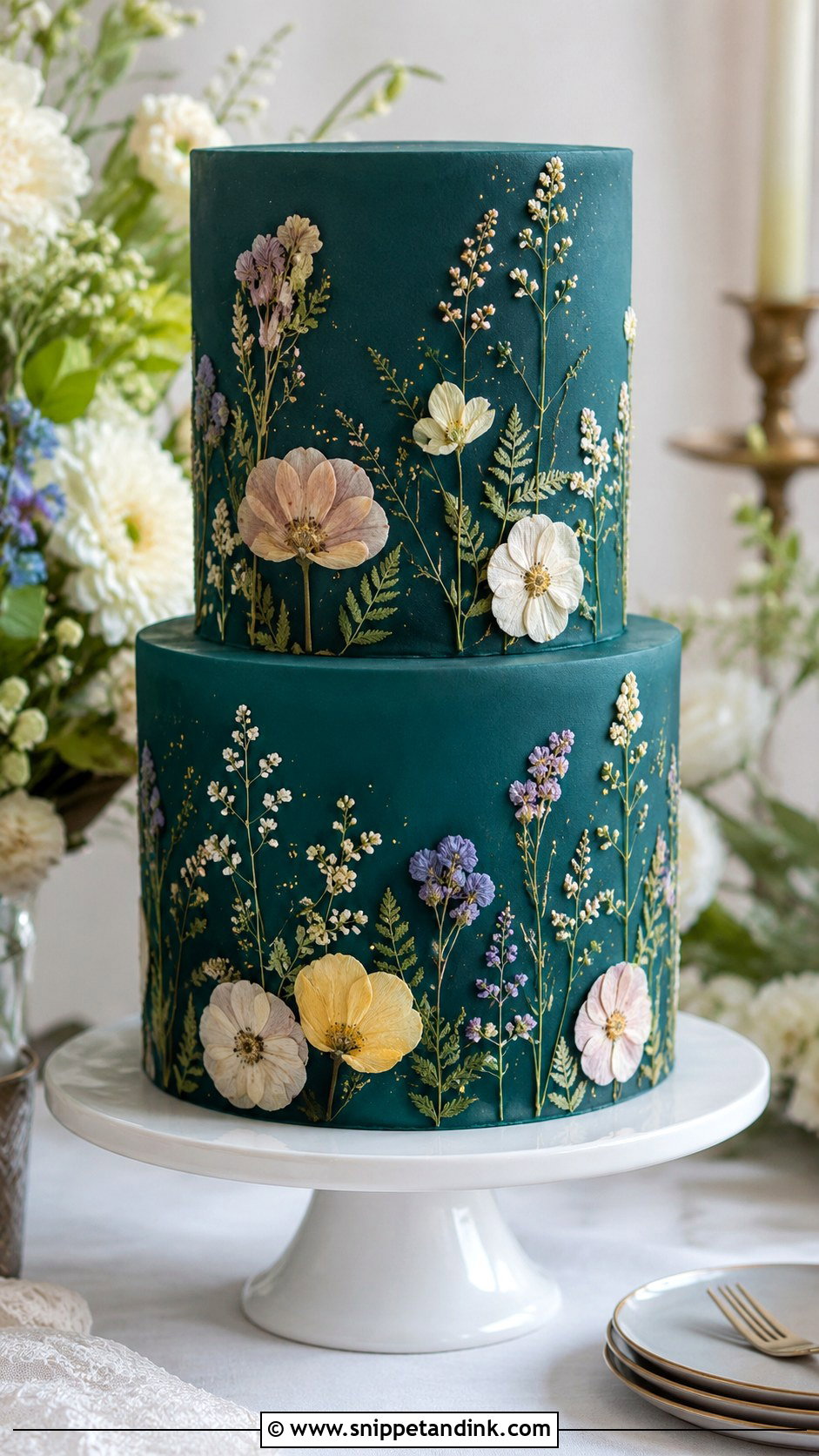
Pale pressed petals glow against deep teal. I use edible pressed flowers, or dried botanicals sold for cake work, placed with space between them so each one reads clearly. Ivory, blush, pale yellow, lavender and soft peach blooms brighten the dark base best; darker petals disappear into it. Smooth buttercream holds them flat and clean, and I apply them on the day because pressed petals can darken on moist frosting overnight. It suits garden and botanical venues and couples who like handmade details.
24. Dark Teal Pearl Wedding Cake
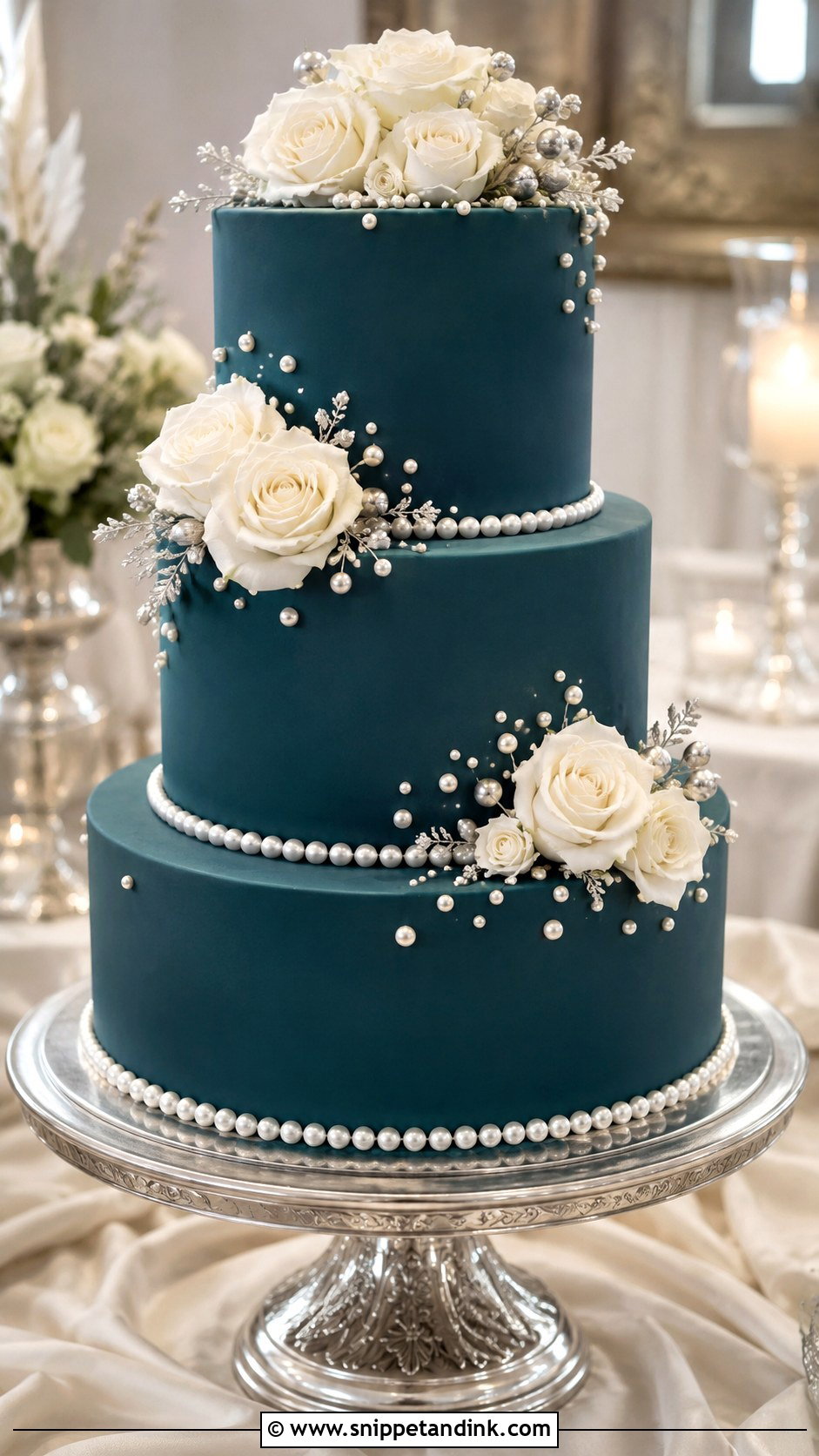
Pearls look brighter against dark teal than against white, because the contrast makes them catch the light. I use fine pearl borders, scattered pearls, dragées or a fully pearled tier. Hard dragées can be rough on teeth, so on tiers guests eat I prefer soft piped pearls and keep the dragées for display. Keep the palette to ivory, white, silver or soft gold, and choose one focal point; pearls plus flowers plus metallics competes. A pearl topper, white roses or satin ribbon is enough to finish it.

25. Dark Teal Small Wedding Cake
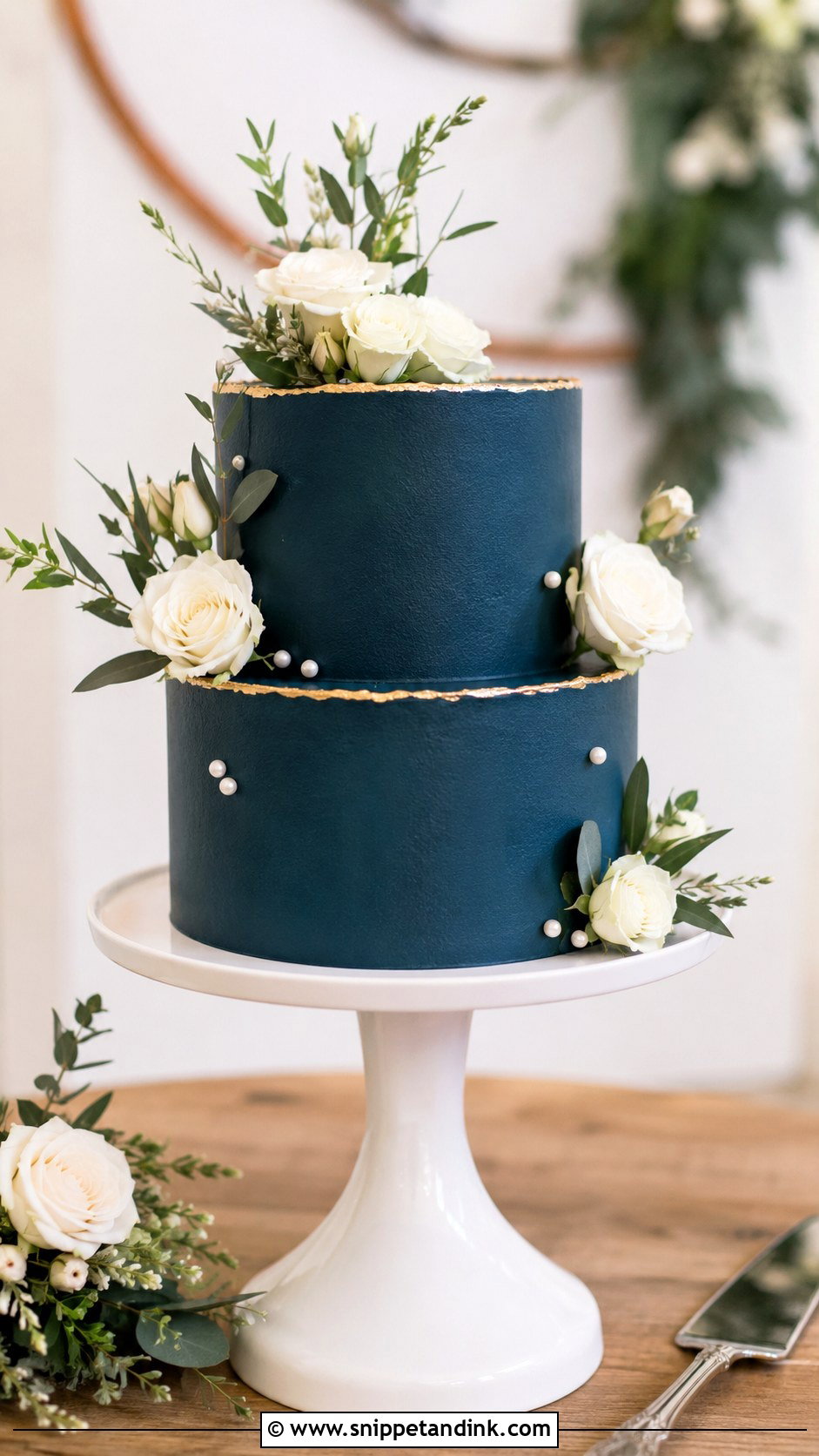
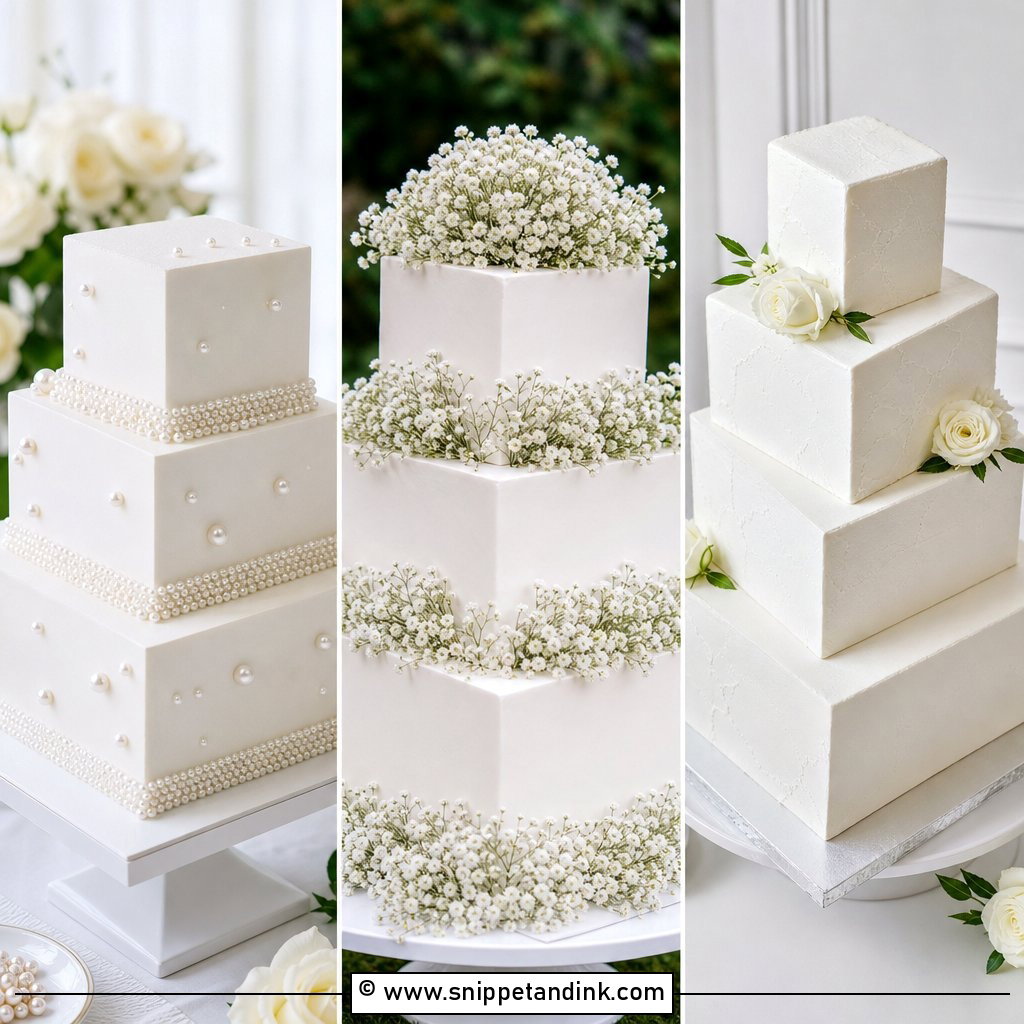
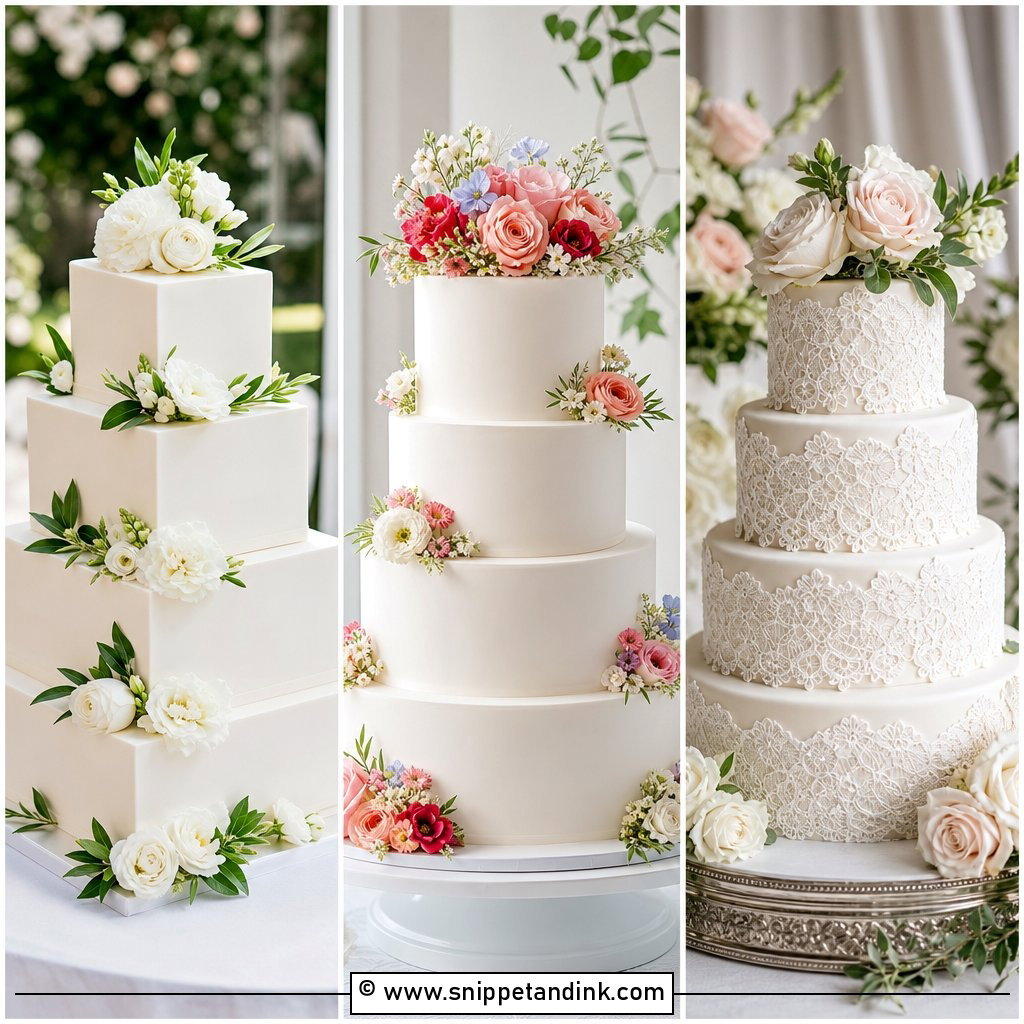
A one- or two-tier teal cake suits intimate weddings, courthouse celebrations, elopements and couples who are serving a larger dessert table anyway. Small cakes take bold colour well, since there is less of it to dominate the room. I’d finish it with smooth dark teal buttercream, a gold edge, white flowers or a tiny floral cascade, and raise it on a tall stand for presence. Keep decorations scaled down; oversized flowers swallow a small tier. Flavour can be personal, perhaps lemon blueberry, chocolate raspberry, vanilla bean or almond.
What Guests Actually Eat Under the Teal
Dark cakes are design-heavy, and a fair amount of what makes them look good is not meant to be eaten. That’s fine, as long as everyone knows which parts come off before the cake is cut.
Edible, but not always pleasant
Fondant is edible, but plenty of guests peel it off, so the buttercream and filling underneath carry the flavour. Rock candy in a geode is edible and very hard. Dragées are edible and can be tough on teeth. Heavily coloured buttercream can tint lips and tongues for a while, which is worth remembering if you plan to feed each other a bite for photos; cut that first slice from a pale-filled tier.
Decoration only
Wired sugar flowers, dried grasses, ribbons, most metallic dusts labelled “non-toxic” rather than edible, and fresh flowers all come off before slicing. I give the catering team a short note listing every non-edible piece and where it sits on the cake.
The inside can be lighter
A deep teal outside doesn’t need a teal inside. Most couples prefer a classic sponge and filling, and a pale interior makes the cut slice look appetising on the plate. If you love the idea of colour inside, one tinted layer is plenty; a fully teal sponge tends to look odd next to coffee.
Teal That Reads Blue in the Room and in Photos
Teal moves in many directions: classic with white flowers, modern with sharp fondant, romantic with blush blooms, dramatic with black and gold. The cakes that work best have contrast, some texture and a clear plan. Bring your baker a physical sample of the exact shade, such as a paint chip, ribbon or bridesmaid fabric, since teal shifts towards blue or green under different light and in different frostings. Tell them about the flowers, linens, venue lighting and stand too, so the cake is designed for the room it will actually stand in.
You'll Like These Ideas:










Leave a Reply