
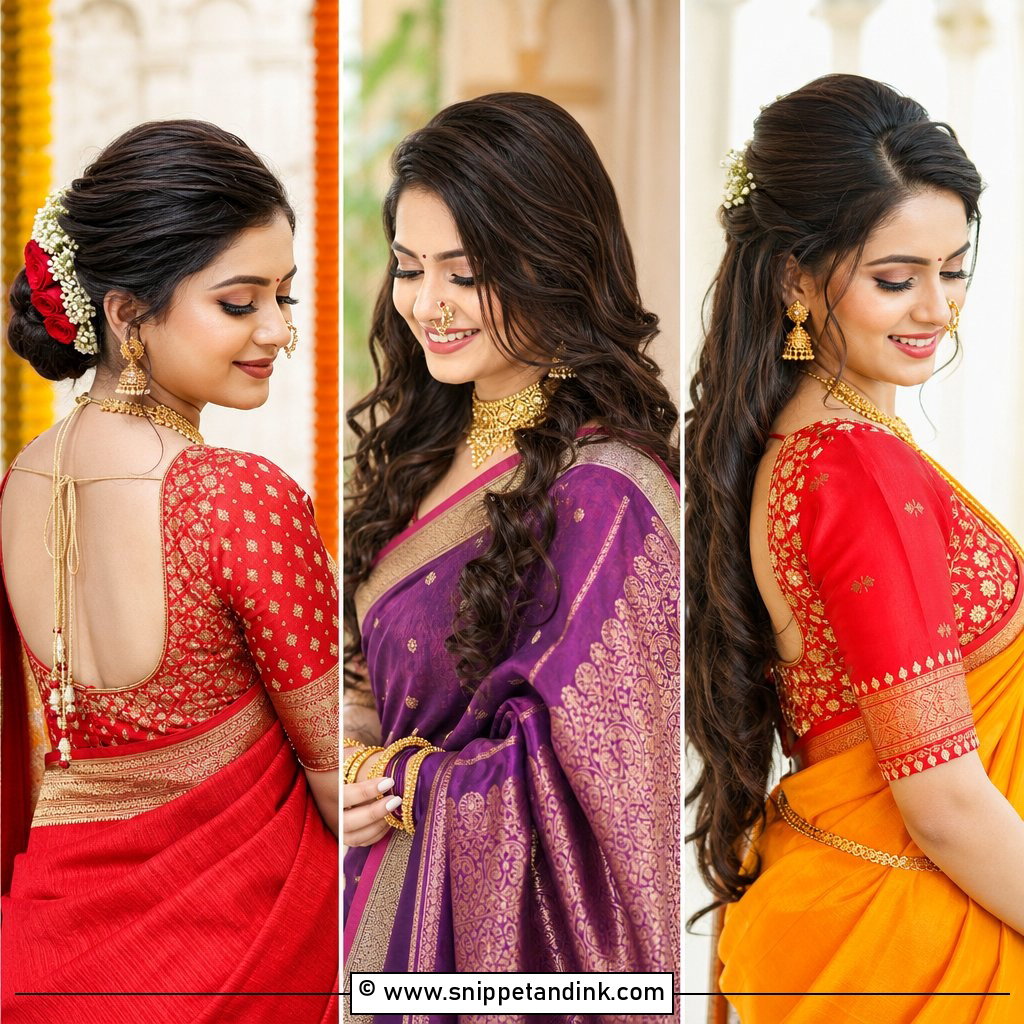
A Telugu bride’s hair carries more than flowers. It carries gold, weight, and hours of sitting through the muhurtham, the talambralu and the photographs that follow. I’ve set poola jadas, jadakuppulu braids, gajra buns and reception curls, and the styles below cover all of that ground: the ceremonial braids for the muhurtham, quieter buns for the morning functions, and softer open looks for the evening. Some need waist-length hair or a savaram extension; others work on a bob. I’ve noted which is which, and what I watch for when I build each one.
What Sits Under a Poola Jada, and Why the Base Braid Matters
Every floral or gold braid in this list rests on a plain plait, and that plait decides how the day goes. If it is loose, the flowers sag and the gold pulls the braid into a thin tail by noon. If it starts too high, the weight hangs off your crown and you feel it through the whole ceremony.
When I set a jada, I brush the hair back from a straight centre parting, tie it low at the nape with a firm elastic, and braid it tightly to the end. On hair shorter than mid-back, I attach a savaram (a matching hair extension braid) at the elastic so the finished jada reaches the right length. Only then do the flower base, the jadabillalu and the jadakuppulu go on, each tied or stitched as well as pinned.
- Wash your hair the day before, not the morning of. Freshly washed hair is slippery and the base braid loosens.
- Bring your own savaram to the trial if you have one, so the colour and thickness can be checked against your hair in daylight.
- Ask for the jada to be fastened at the crown and at the nape. Two anchor points spread the weight.
- If you have a sensitive scalp, say so early. I can braid slightly softer and use more pins instead of tension.
1. Traditional Poola Jada Braid
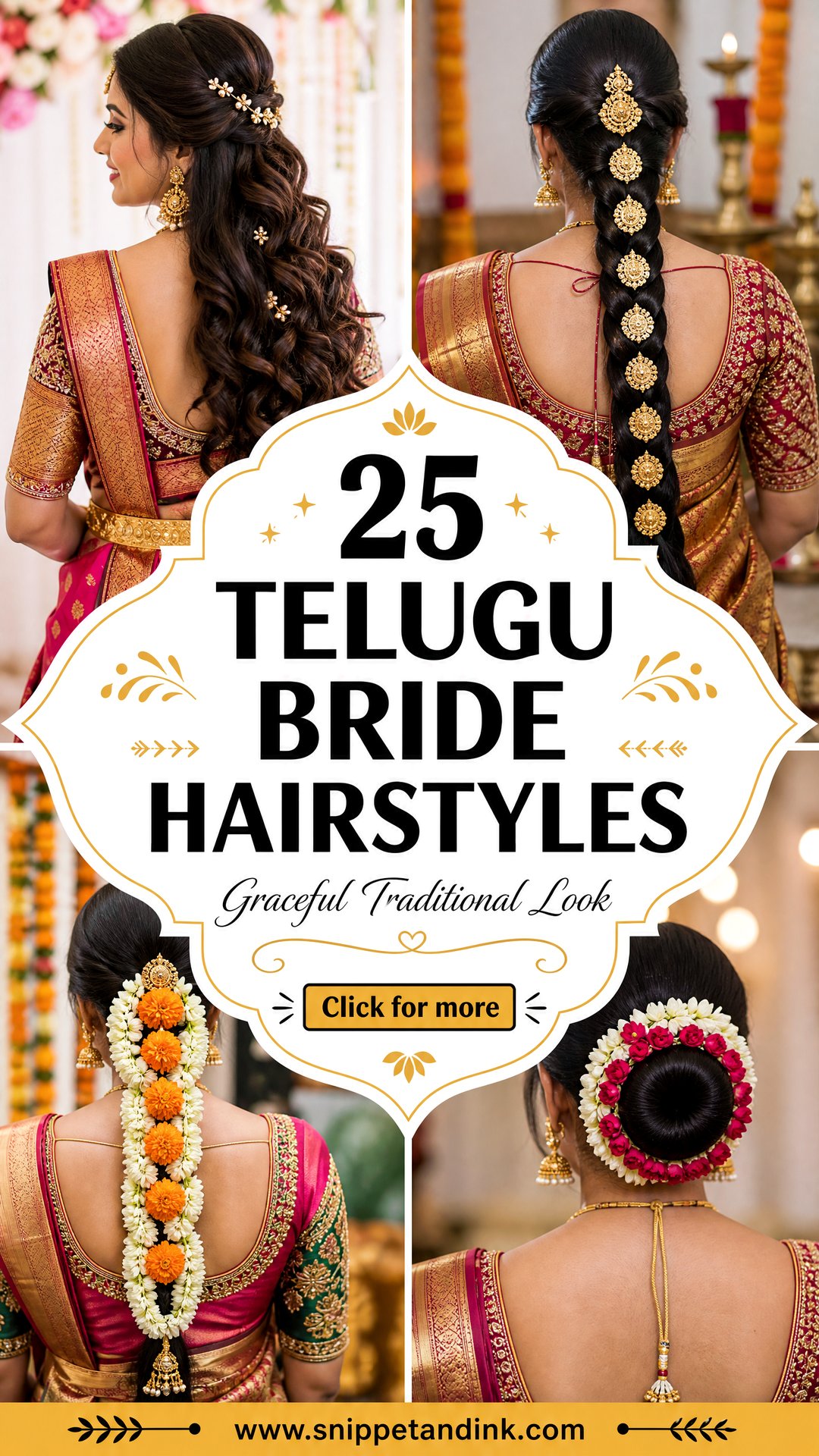
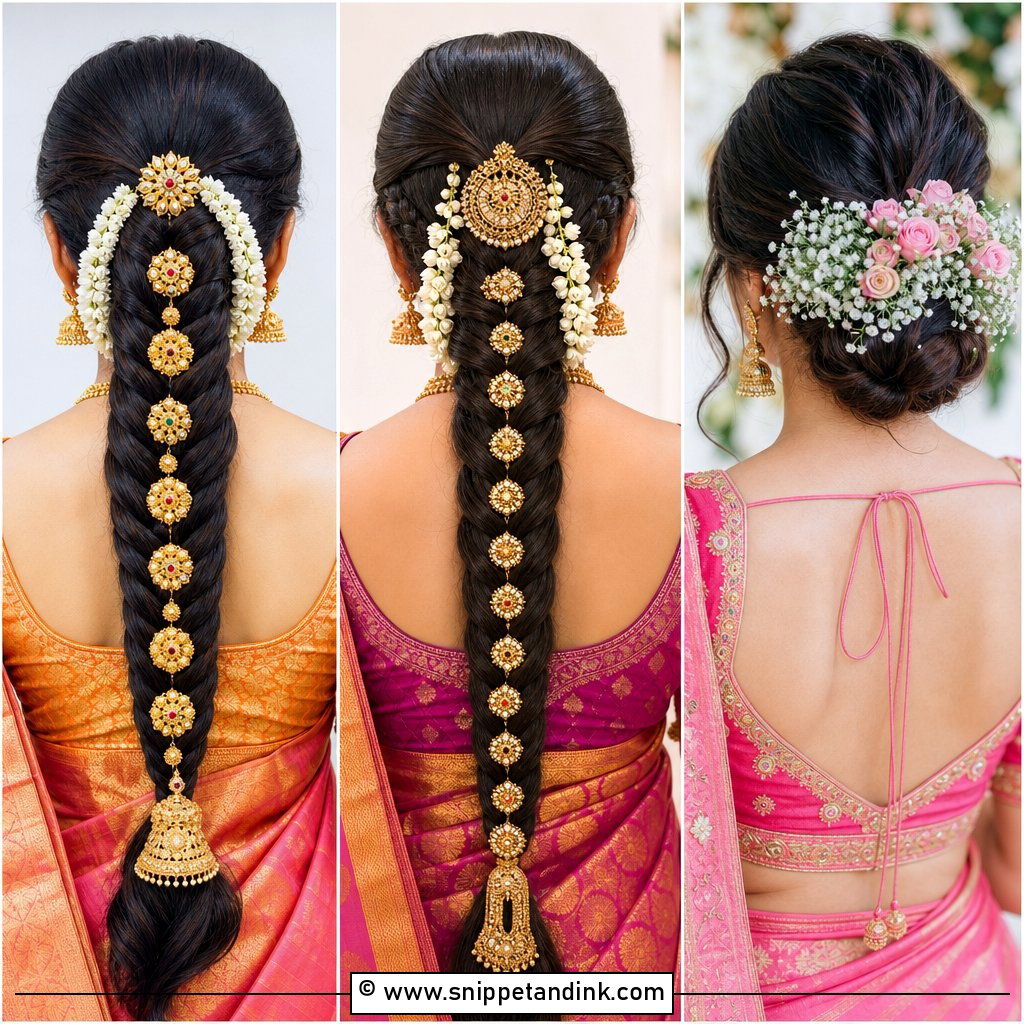
The poola jada is the anchor of most Telugu bridal look plans, and it is heavier than it looks. Underneath the jasmine, roses and kanakambaram there is a plain three-strand braid, and the flowers are usually stitched onto a separate base that I pin and tie onto it. Gold jadabillalu go on last, spaced so they sit between the flower rows instead of crushing them. I always secure the top of the jada at the crown with several crossed pins, because a loose start is what makes the whole length drag and pull at the scalp by the end of the muhurtham.
2. Sleek Low Bun With Gajra
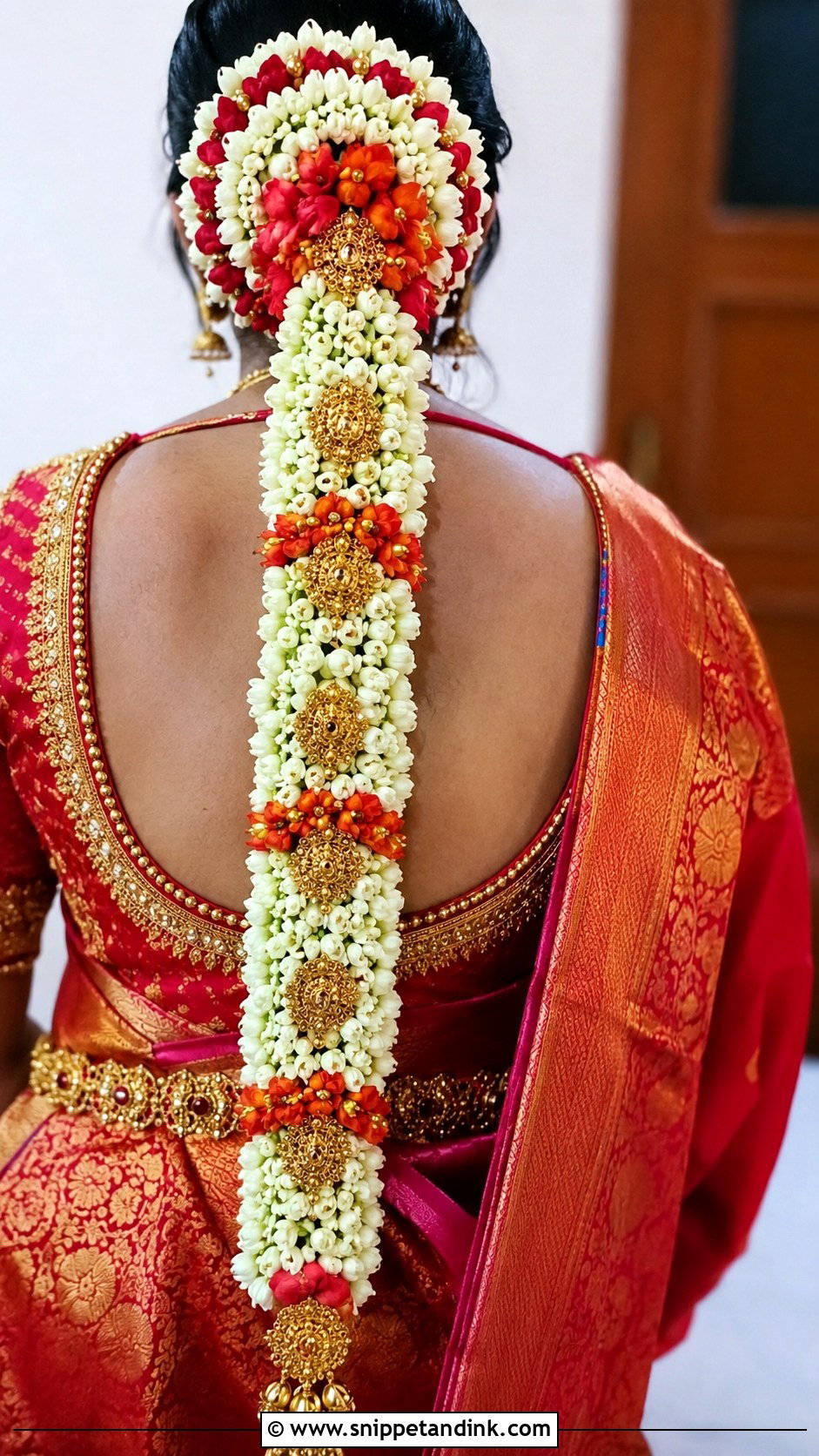
A sleek low bun is the style I suggest to brides who get headaches from weight. The hair is brushed back and smoothed with a little serum, tied at the nape, and wound into a round bun over a small donut or padding. Then a thick veni of jasmine goes around it and is pinned at four points so it doesn’t slide when you bend for rituals. Because nothing sits on top of the head, your maang tikka and earrings get all the attention. It suits receptions and engagement functions, and it is the easiest look on this list to redo if the morning runs late.
3. Jadakuppulu Decorated Braid
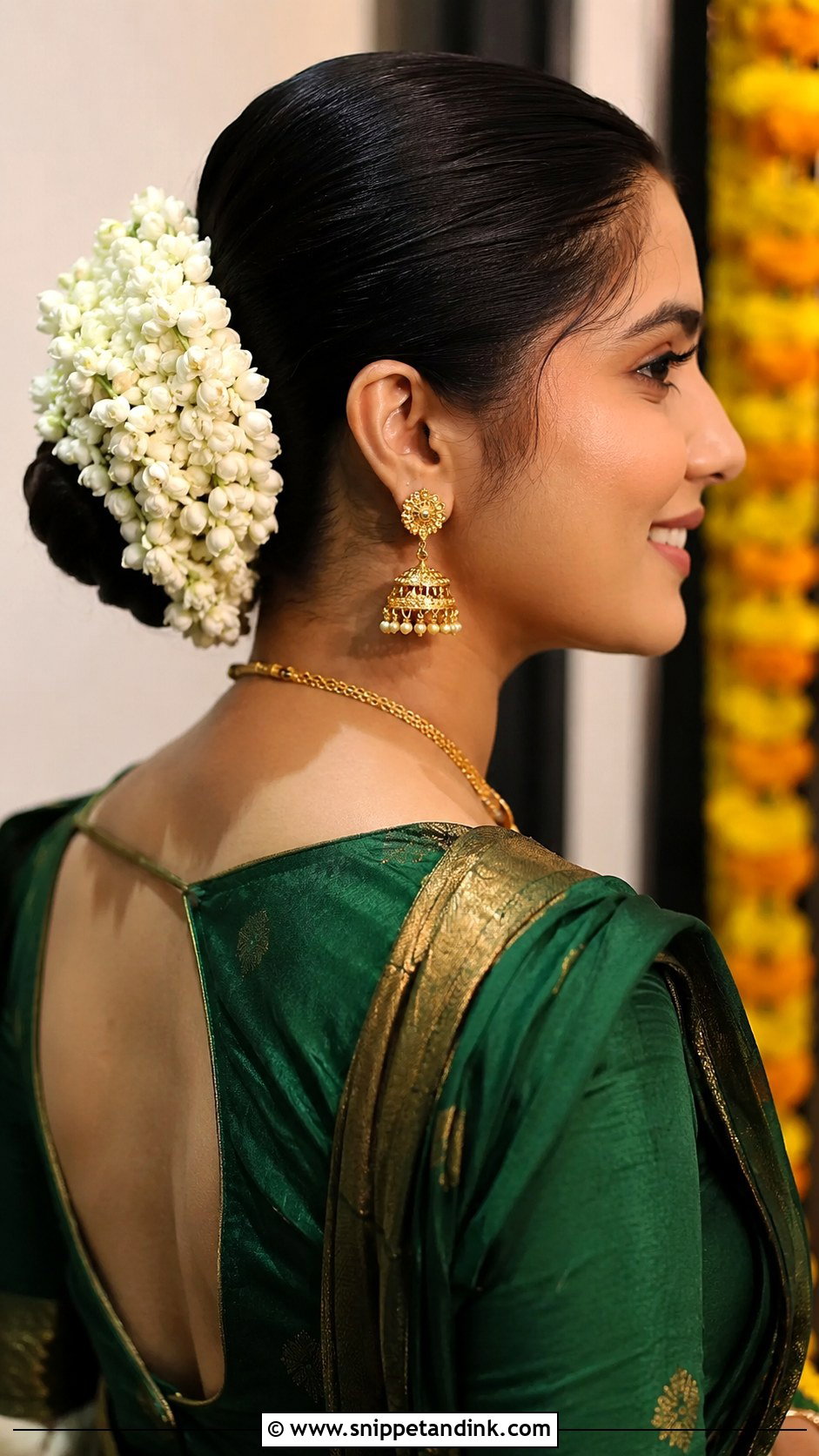
Jadakuppulu are the three gold balls tied at the tail of the braid, and most brides I work with want them at least once. The plait has to be firm and evenly tight from top to bottom, otherwise the gold pulls it into a thin, wavy tail. Fresh flowers fill the gaps between the gold pieces. On shoulder-length hair I add a savaram so the kuppulu hang where they should, around the hip, instead of halfway up the back. Paired with temple jewelry and a bright silk saree, the swing as you walk is half the effect.
4. Jasmine Cascade Hairstyle
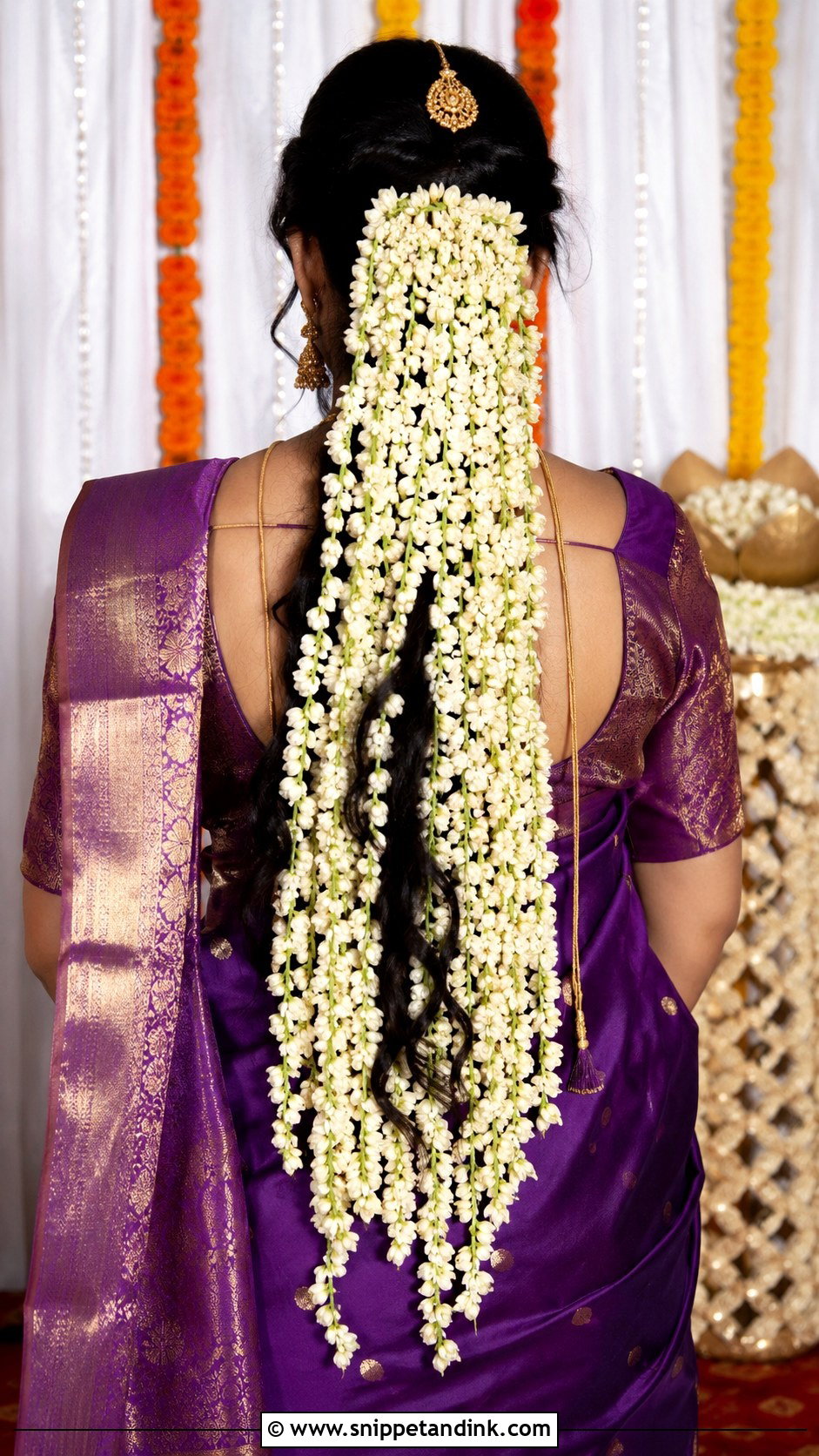
A jasmine cascade uses loose strings of malli poo falling freely over the back of the saree, so the flowers become almost a veil. It moves and smells wonderful, but it is fragile. Strings tangle when you sit against a chair back, and jasmine bruises brown where it is pressed. I anchor the strings to a bun or a short braid at the crown rather than letting them hang from pins alone. I’d keep this one for an evening reception or an outdoor function, with a gold maang tikka and jhumkas, and not for a long seated muhurtham.
5. Veni Style Bun With Roses
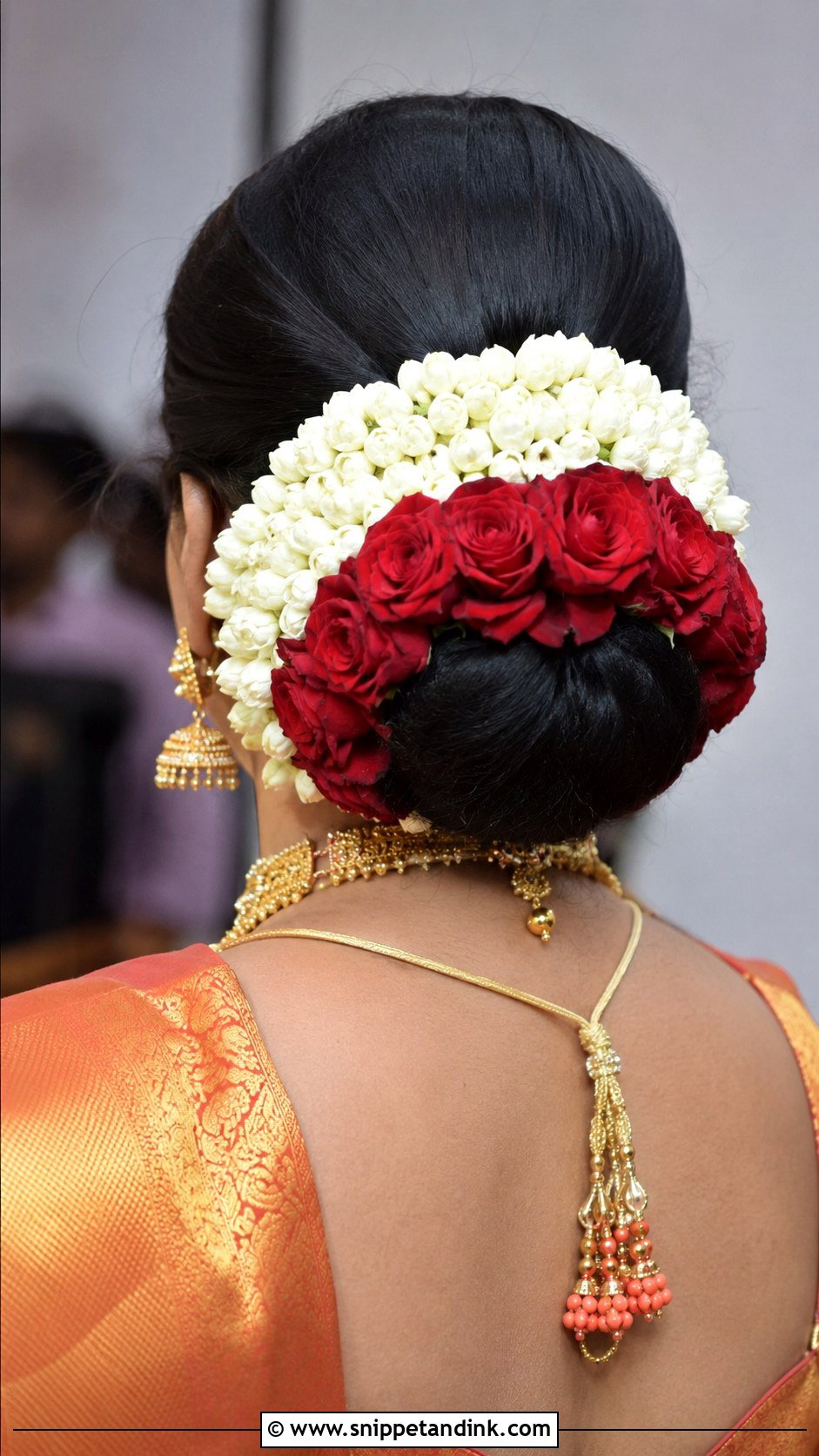
Twisting the hair into a low rounded bun and wrapping it with a mixed veni of jasmine and red roses gives you strong colour without the weight of a full jada. The roses are heavier than jasmine, so I pin them on wire picks into the bun itself rather than trusting the string to hold them. It stays put through long ceremony hours and sits nicely against heavy bridal jewelry. Round and oval faces carry it well, and from behind it reads clearly against a Kanjeevaram drape.
6. Fishtail Braid With Flowers
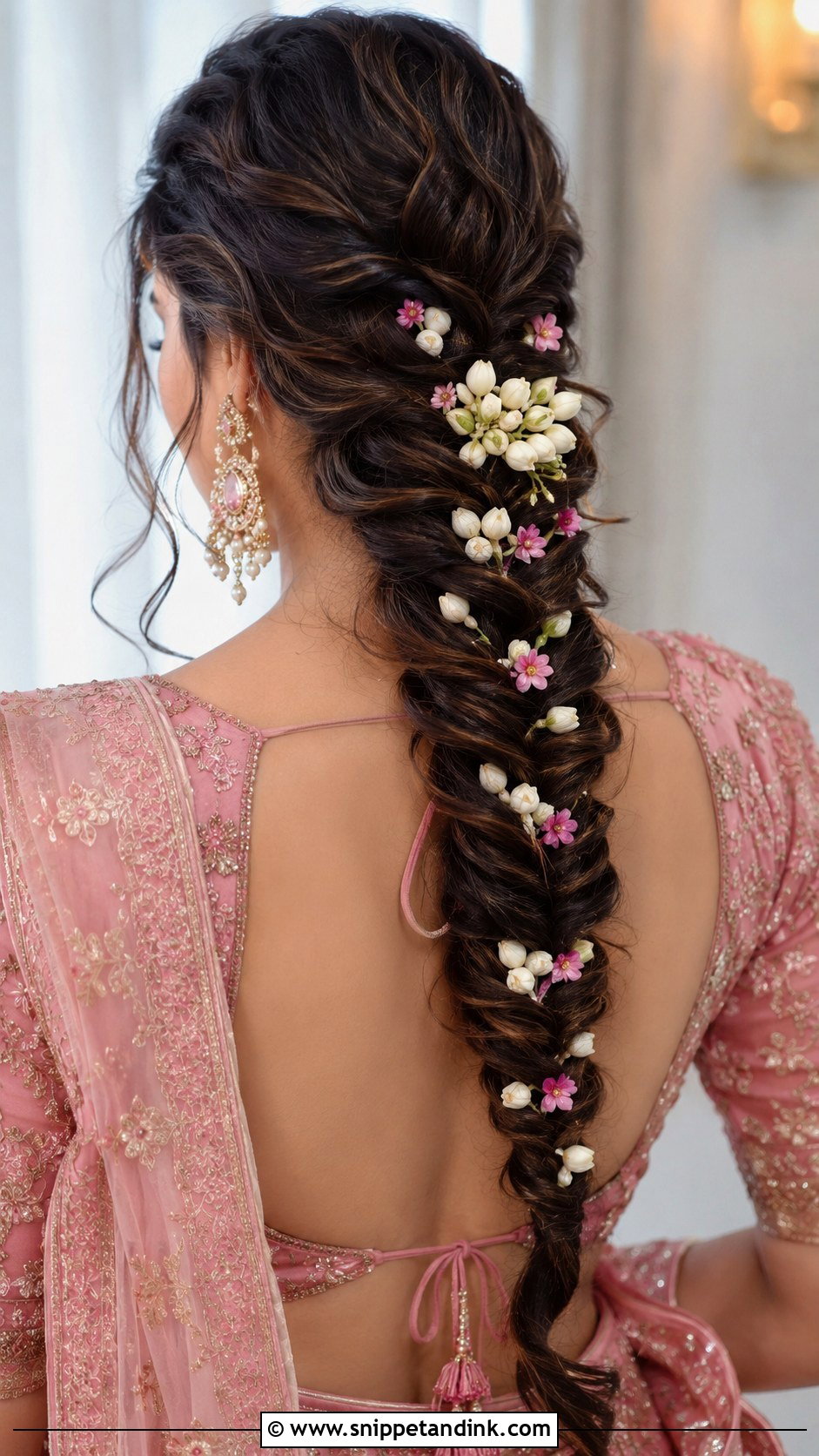
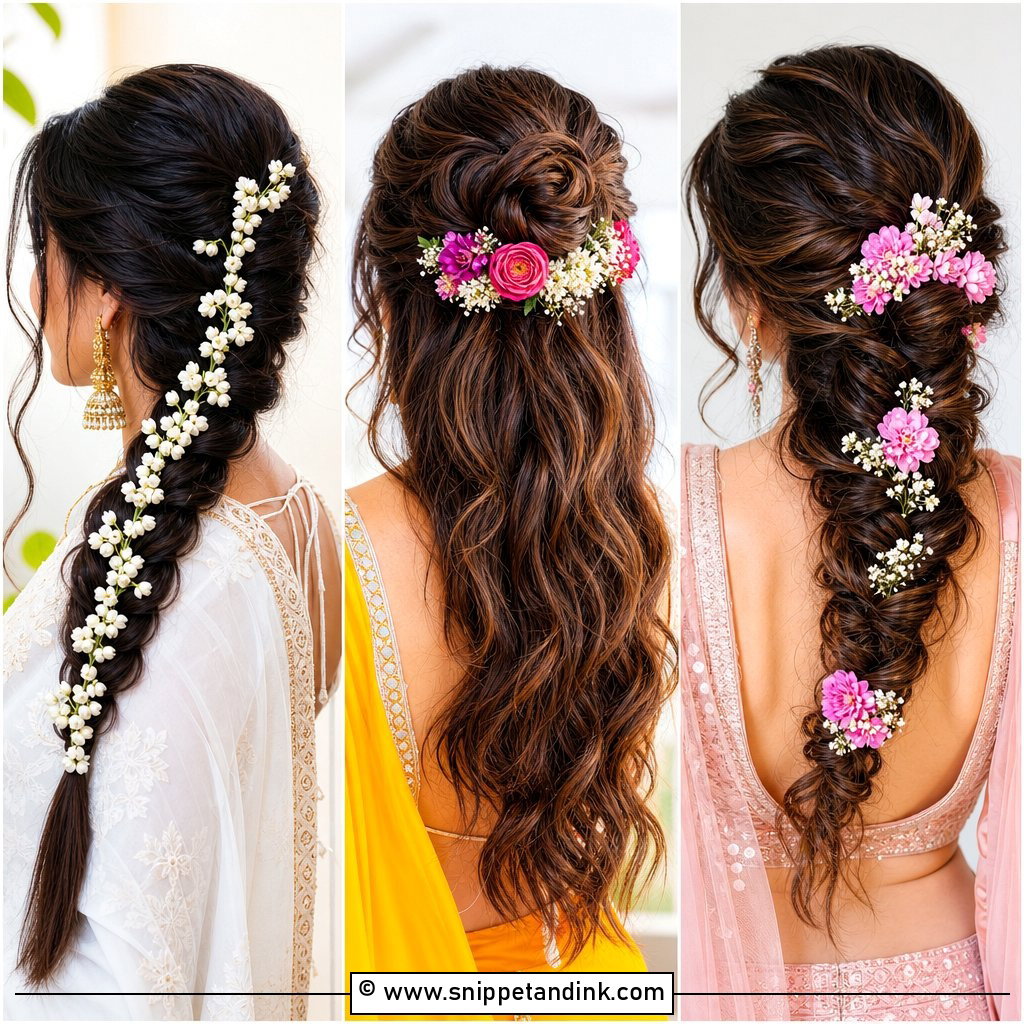
Fishtail plaits look more modern than a three-strand braid because the weave is finer and flatter. I pancake them slightly, pulling the edges loose so tiny jasmine buds and rose petals can be tucked in between the sections. The catch: on very fine or layered hair, short ends poke out of a fishtail all evening, so I’d only do it on hair that’s mostly one length. It’s a good choice for the engagement or sangeet, finished with statement earrings and a light maang tikka.
7. Half Up Half Down Bridal Look
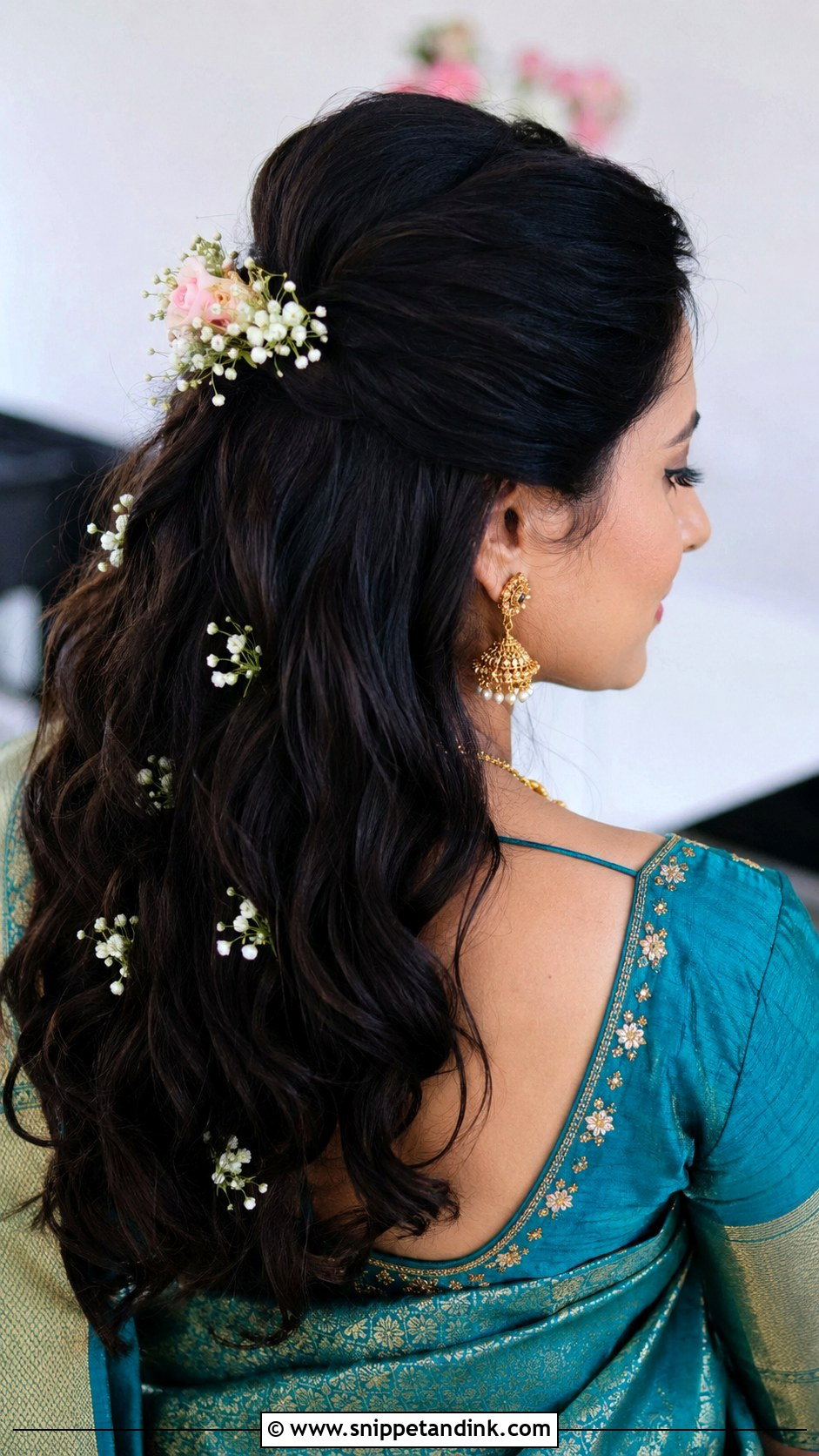
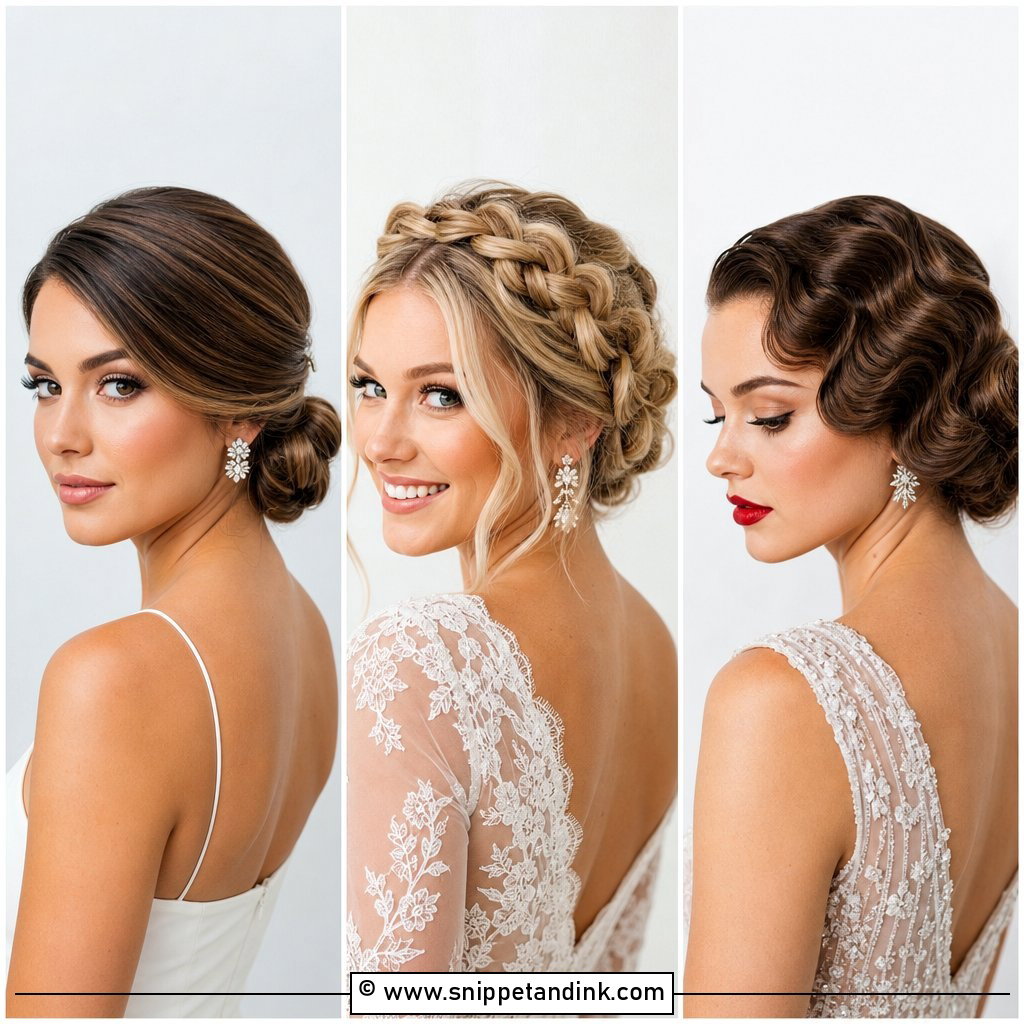
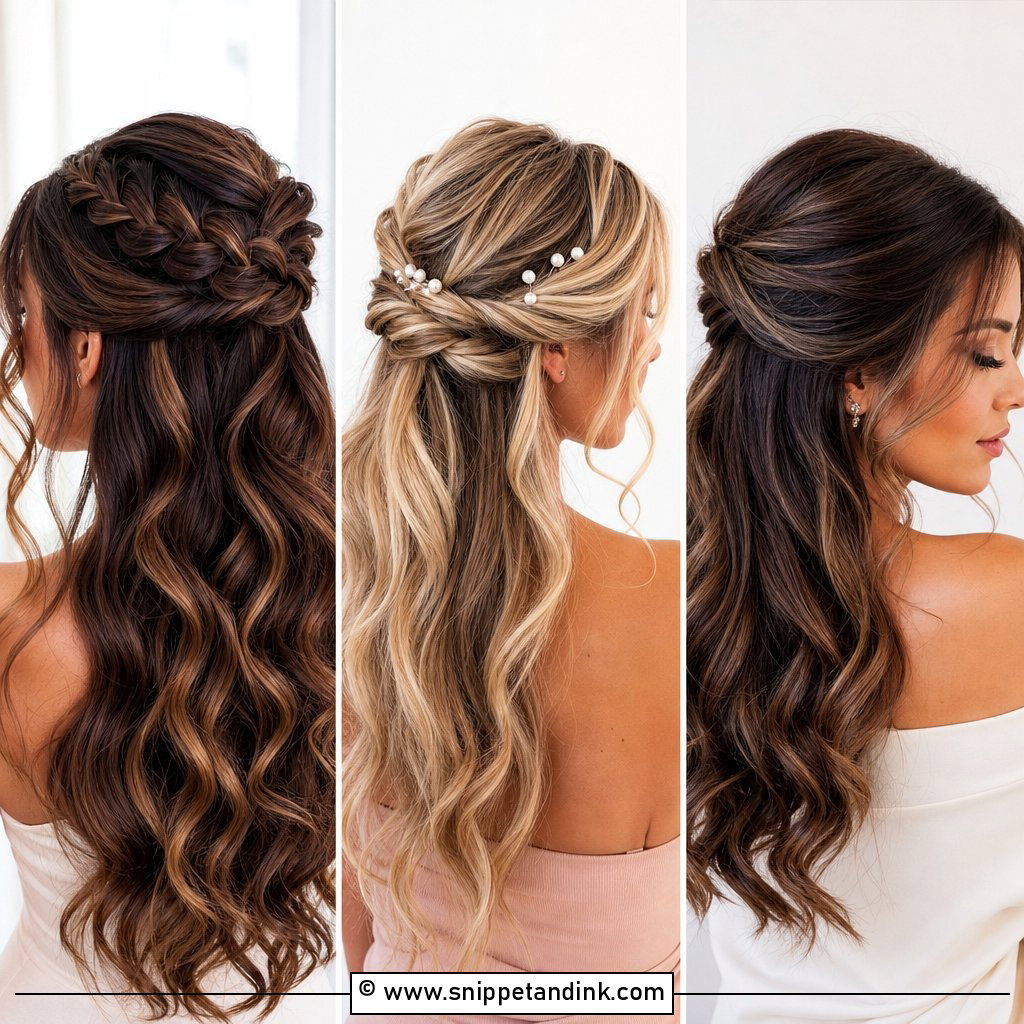
Half up, half down pins the crown section back, usually with a small floral piece or a gold clip, and leaves the rest flowing in soft waves or a loose braid. I curl the lengths first and pin the top second, because curling after pinning loosens the crown. In humid weather the waves drop within a couple of hours unless the hair is set and cooled properly, so I warn brides with very straight hair about that at the trial. A few jasmine sprigs at the crown keep it traditional enough for a reception or cocktail function.
8. Maang Tikka Centered Bun Look
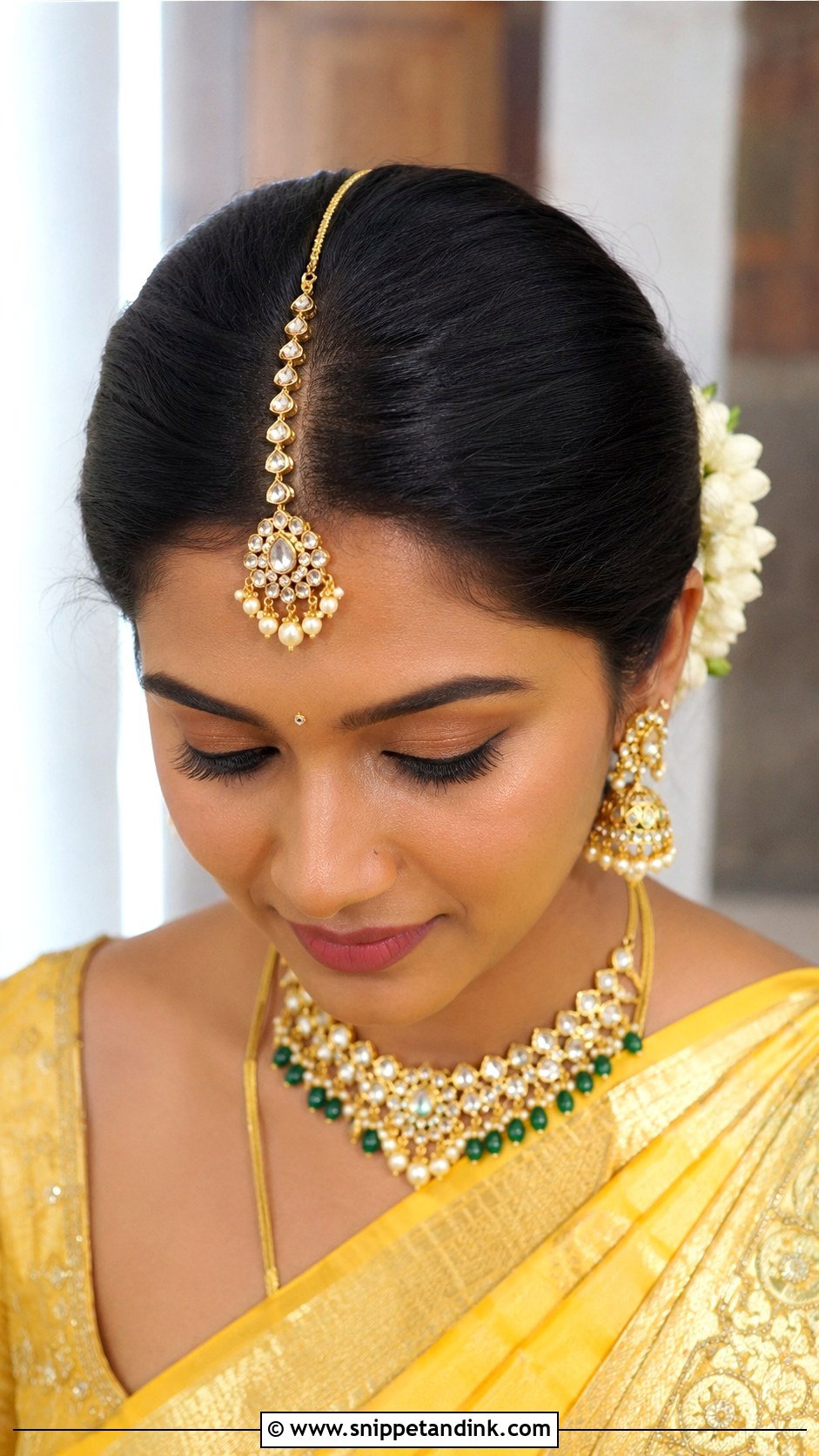
Sometimes the jewelry leads and the hair simply supports it. Here a neat, low bun sits behind a gold or kundan maang tikka at the centre parting, and the clean lines keep attention on the ornament and your face. The parting has to be perfectly straight, so I set it before anything else and pin the tikka chain under the hair rather than on top, where it slips. A small gajra around the bun keeps the floral element. I’d steer anyone with a strong cowlick at the front toward a softer side parting instead.
9. Long Braid With Gold Jada Billalu
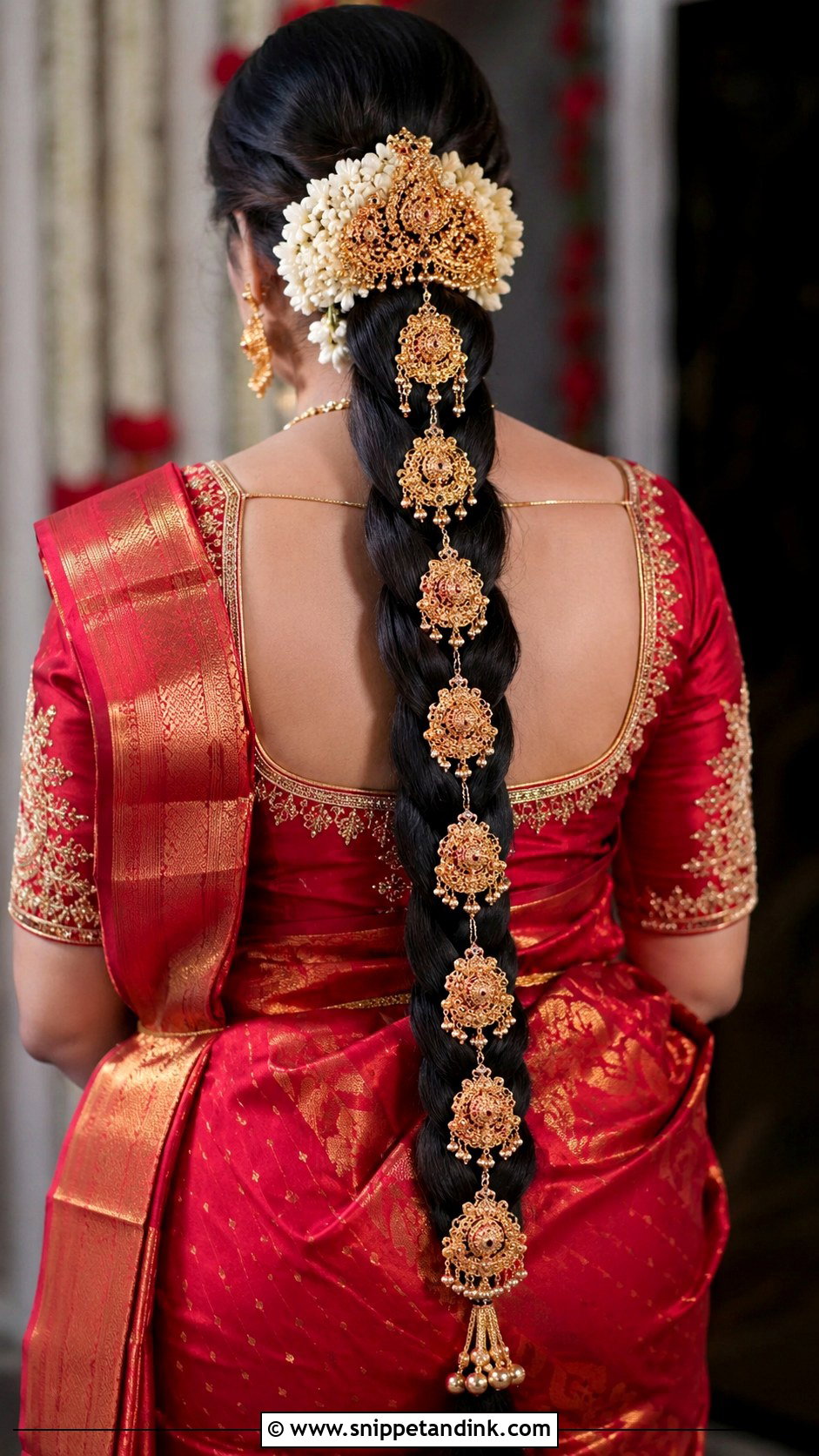
The gold jada billalu braid is the classic picture of Telugu bridal grandeur. A thick plait carries gold pieces from crown to tip, often with goddess, peacock or floral motifs, and jasmine fills the spaces between them. Real gold sets get heavy fast, so I stitch or tie each billa to the braid with thread as well as pinning it; pins alone let the lower pieces slide down. Matched to temple jewelry, the gold catches the light from the ceremony lamps and the photographer’s flash.
10. Side Swept Curls With Gajra
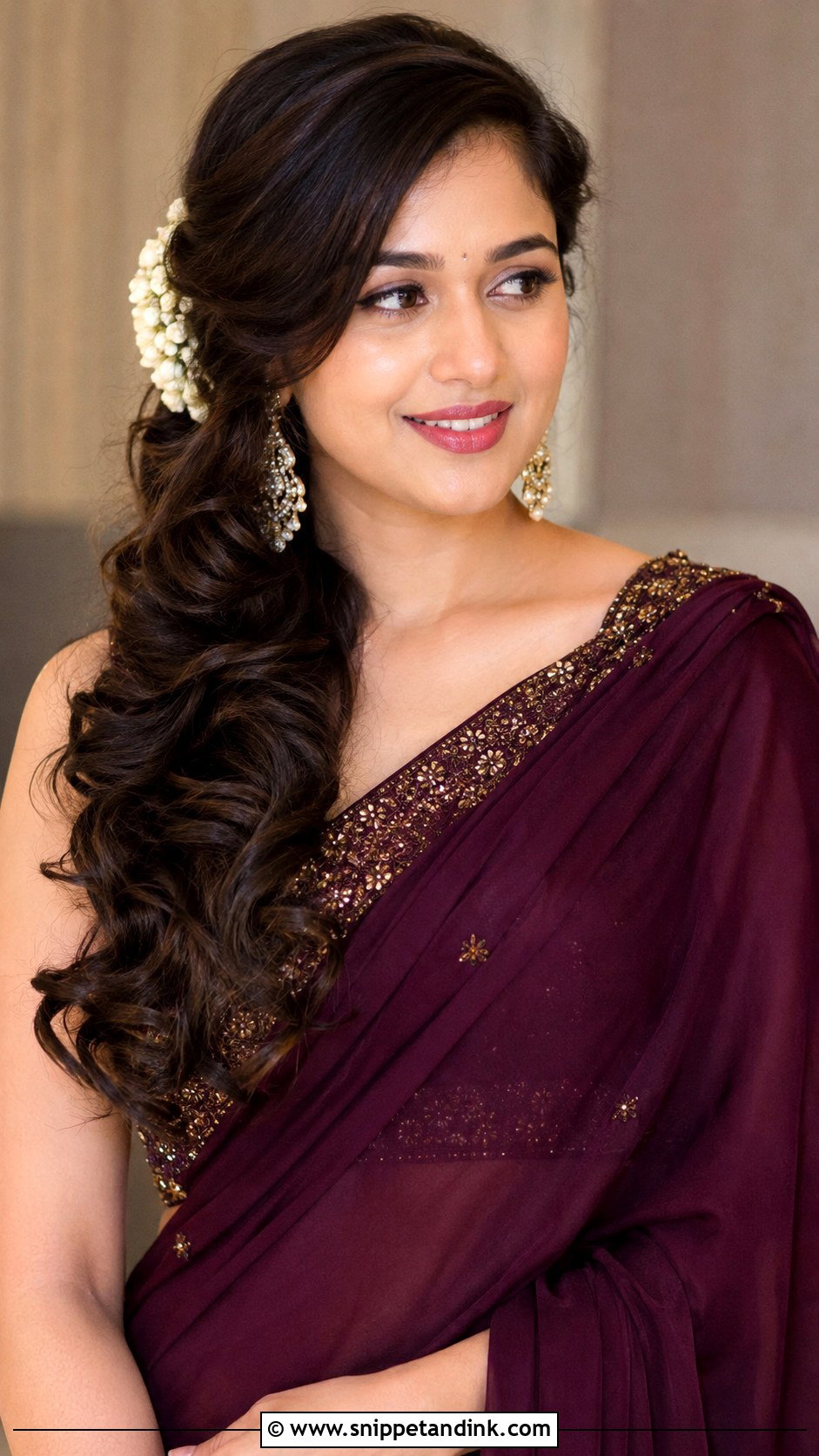
Side swept curls give a softer evening look. The hair is curled in loose sections and brushed over one shoulder, with a strand of gajra pinned along the side parting. I build a hidden anchor of pins behind the opposite ear first, because without it the curls slowly slide back to the middle as you turn your head. It shows off length and adds fullness around the face, which helps narrow and oval faces most. Add chandelier earrings and a light maang tikka and it sits somewhere between film glamour and South Indian tradition.
11. Bun With Pelli Poola Jada Crown
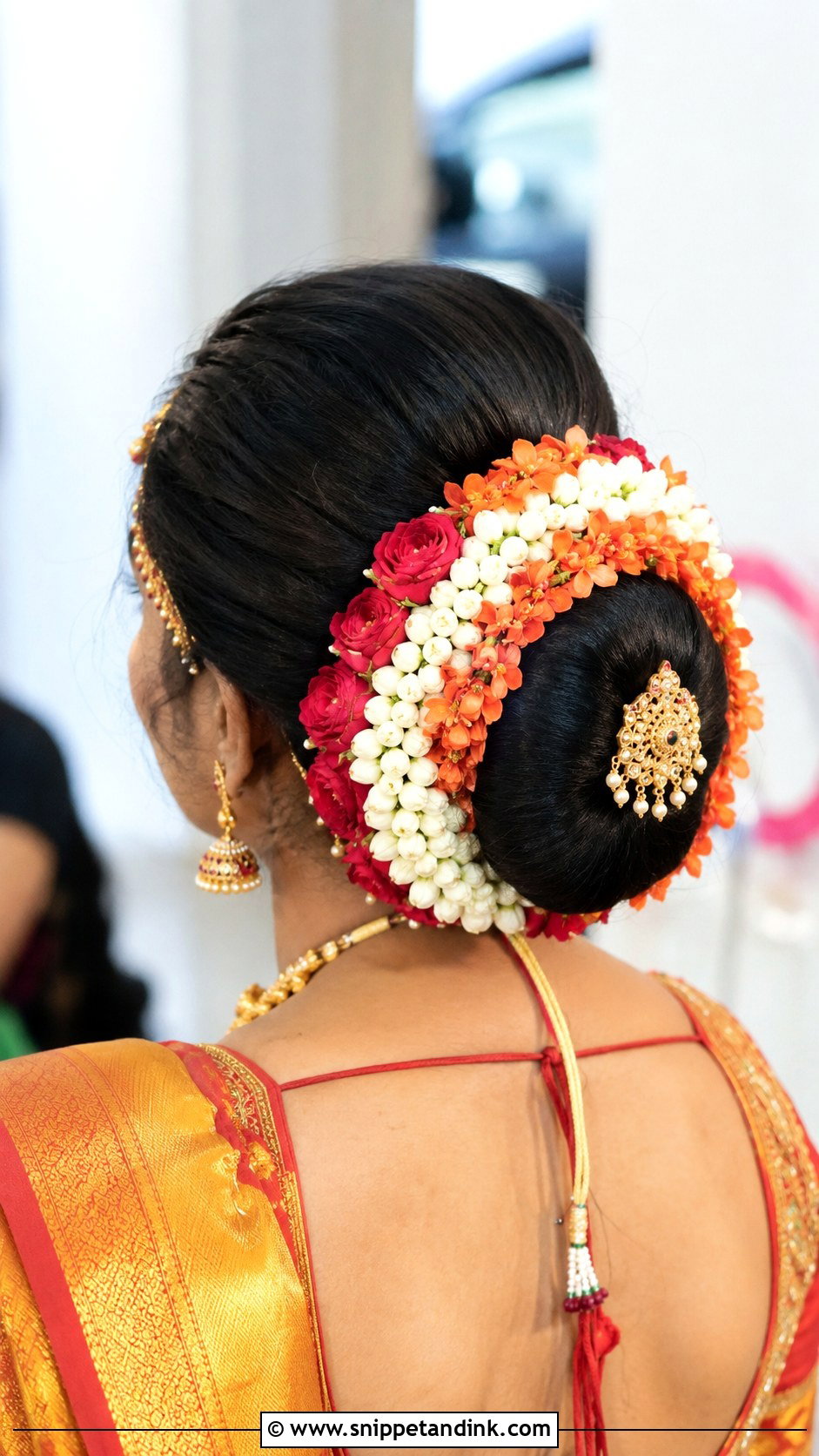
This one pairs a structured bun with a pelli poola jada arranged as a crown around it, so jasmine, kanakambaram and roses sit in circular rows like a halo at the back of the head. It works well on shorter hair, since the bun can be padded and the flowers do most of the work. I build the bun slightly higher than a normal nape bun so the floral rows don’t push your saree pallu out of place. With heavy temple necklaces and a nethichutti, it holds its own at the muhurtham.
12. Loose Wavy Open Hair Look
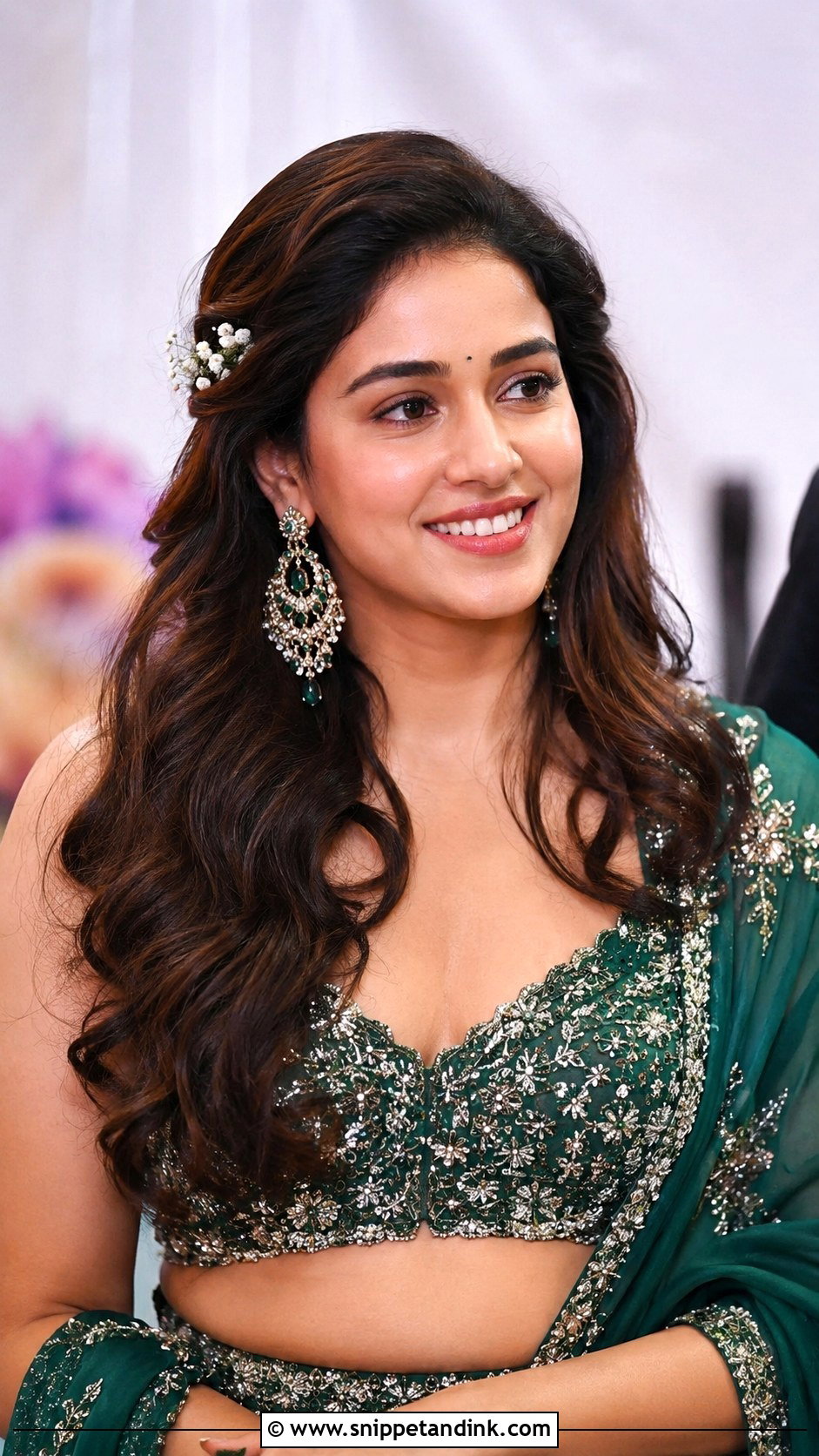
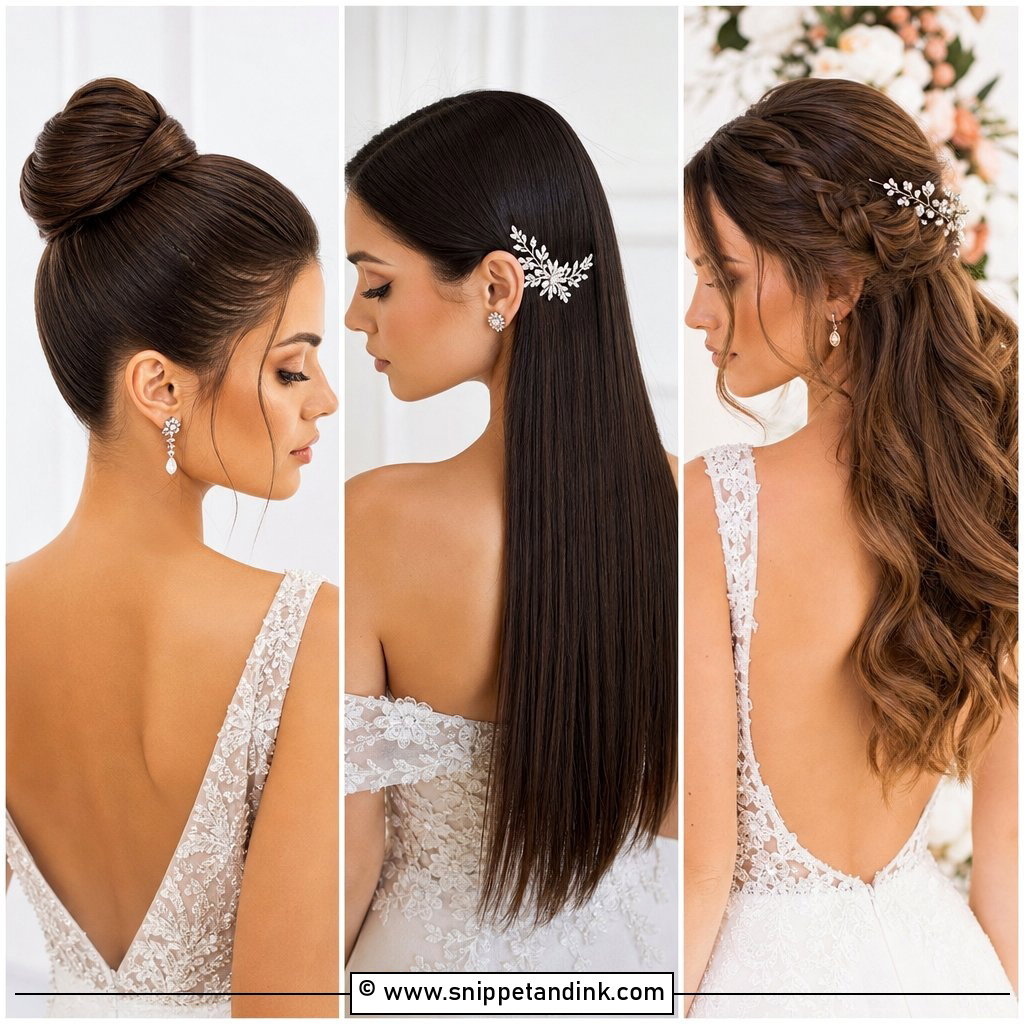
Plenty of brides want their hair open for the reception after a morning of braids and pins. I set soft waves with a curling wand, leave them to cool before brushing, and pin a small floral clip or side gajra just above the ear. Open hair is the most comfortable option on a long night, but it frizzes fastest in a hot hall, so I’d skip it if your hair turns fluffy in humidity. Statement earrings and a sleek gown or lehenga suit the softer shape.
13. Braided Bun With Floral Accents
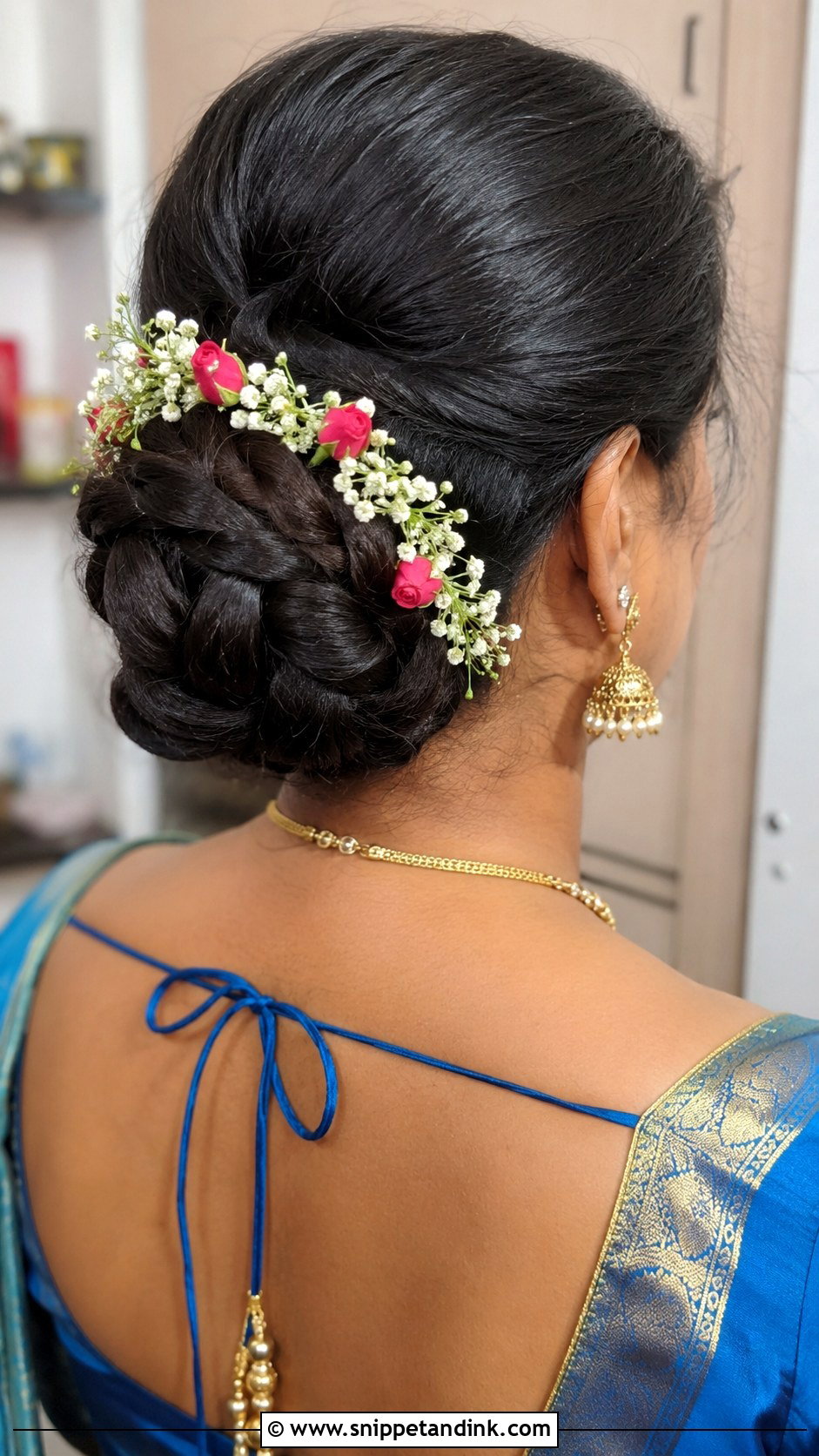
For a braided bun, I plait the lengths first, then coil the braid at the nape and pin it flat, which gives woven texture without much bulk. Jasmine buds and small roses go into the gaps of the coil. It is one of the most secure styles I do, because every section is locked inside the braid before it is pinned, so it suits brides who’ll be bending, sitting and standing for hours. It sits between a plain bun and a full jada, and jhumkas with a maang tikka are enough to finish it.
14. Pinned Up Look For Short Hair
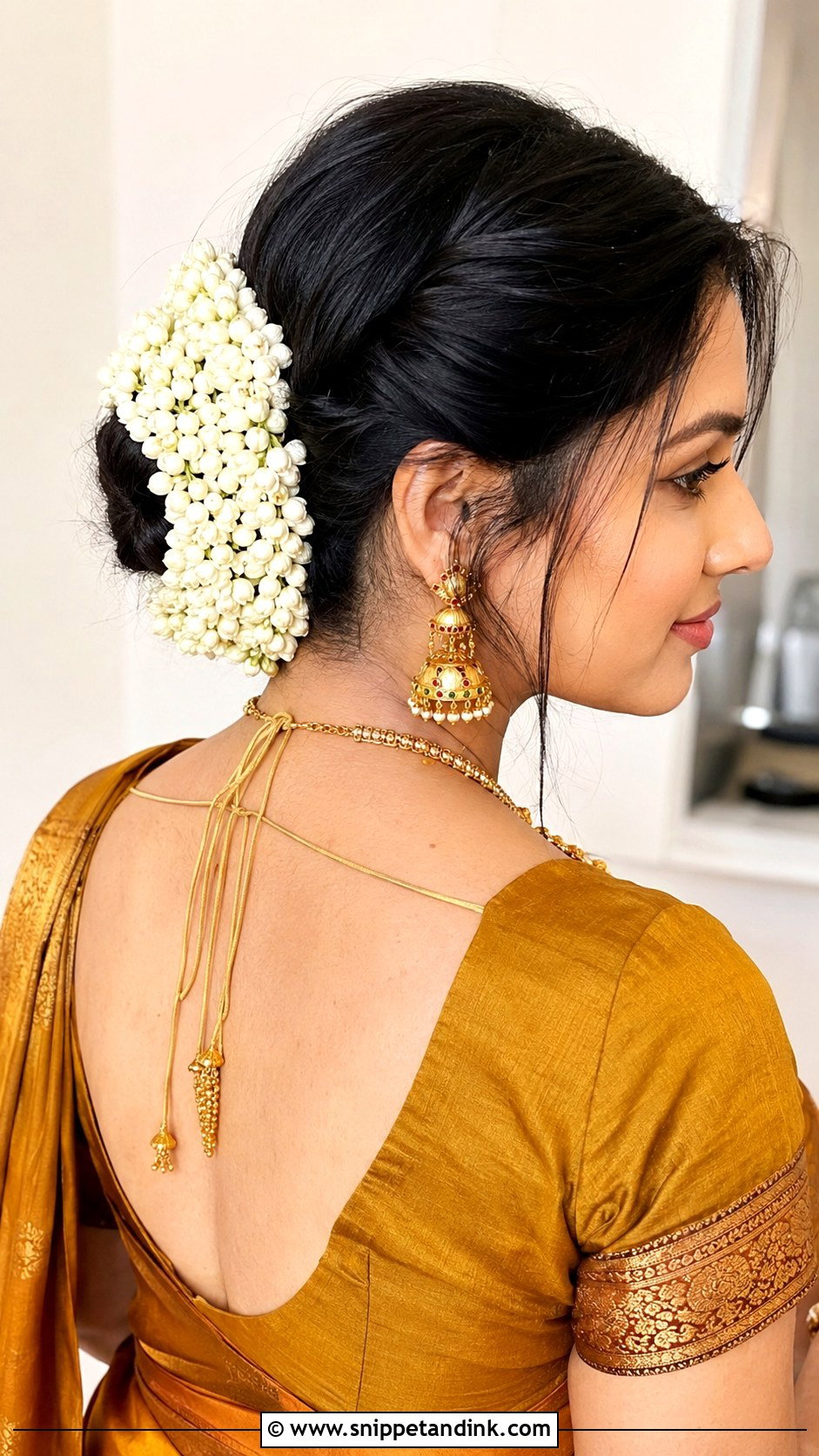
Short hair is not a barrier to a traditional look. I sweep the hair back into a faux bun at the nape, padding it with a small donut or a matching hair piece, and wrap a thick gajra or veni around it to make it look fuller. The real work is at the back of the neck: short nape hairs escape, so I tuck them with flat pins before the flowers go on. It holds well with temple jewelry and a silk saree, and a maang tikka adds the symmetry at the front.
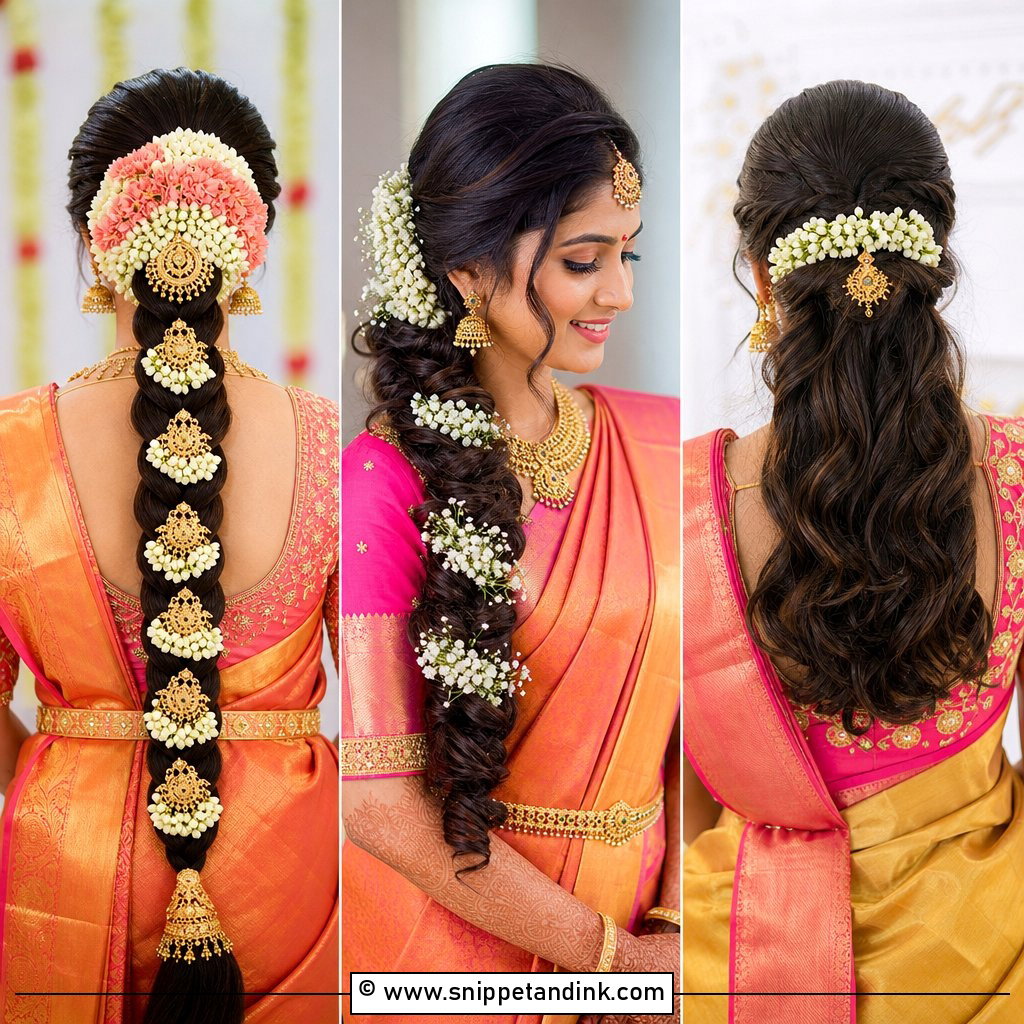
15. Jasmine And Marigold Mixed Braid
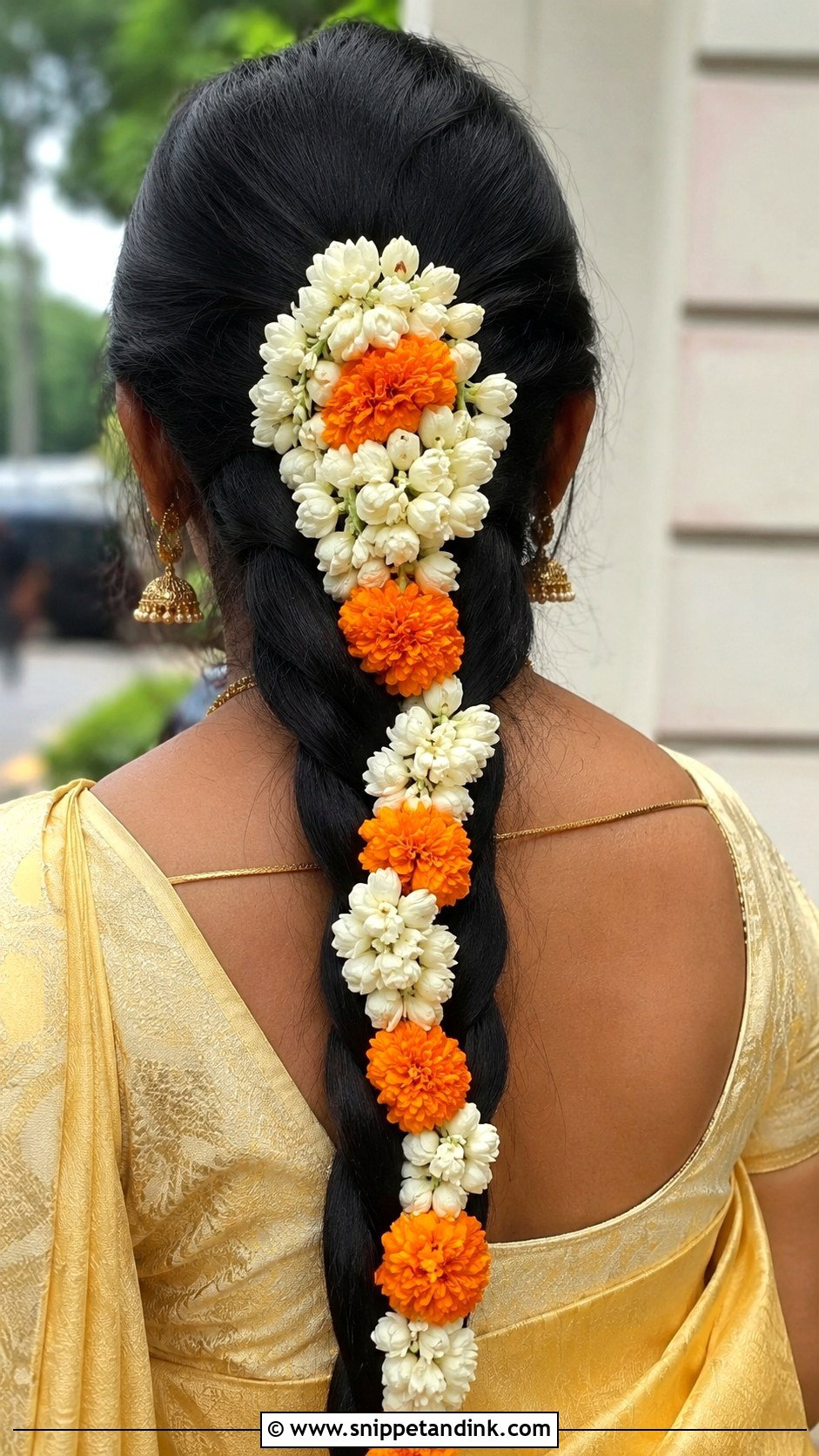
Jasmine and marigold together give the boldest colour on this list, white against bright orange along a thick plait. Marigold is far sturdier than jasmine, so it keeps its shape through a hot haldi while the jasmine softens. I wire the marigold heads rather than threading them, because their weight drags a single string. It belongs at haldi, pellikuthuru, or pre-wedding ceremonies, and simple gold jewelry lets the flowers carry the look. Expect turmeric to stain the white blooms during haldi; that’s part of the ritual, not a problem.
16. Reception Bun With Side Flowers
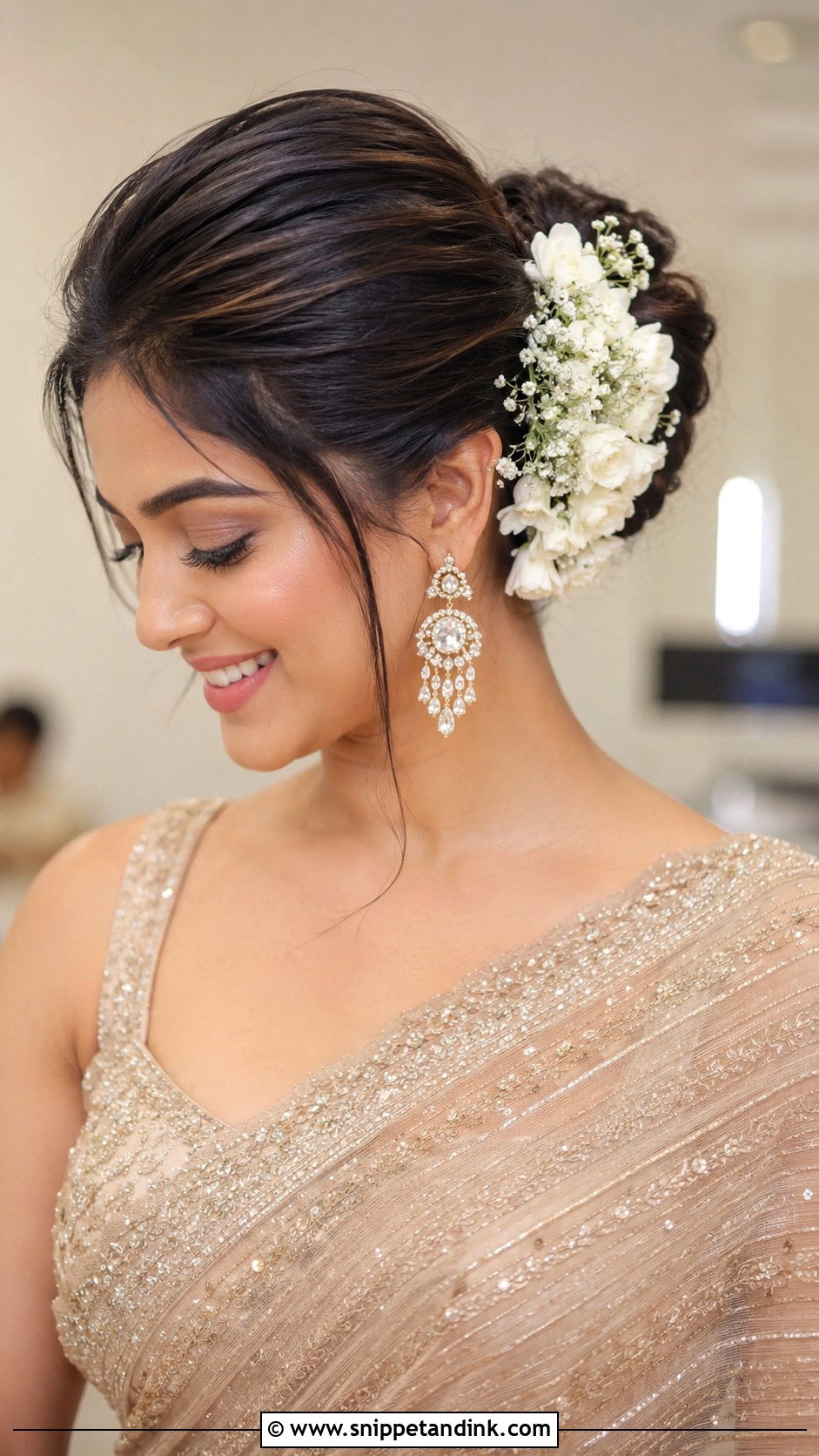
A reception bun can sit high or low, and I decide by the neckline: high for a boat neck or gown, low for a heavy saree blouse with a deep back. The hair is smoothed and padded for volume, and a cluster of flowers goes asymmetrically on one side. That side placement softens the face and leaves the other ear clear for a statement earring. It suits a designer saree or gown and stays neat all evening, which matters when you are greeting guests for hours.
17. Thick Single Braid With Kunjalam
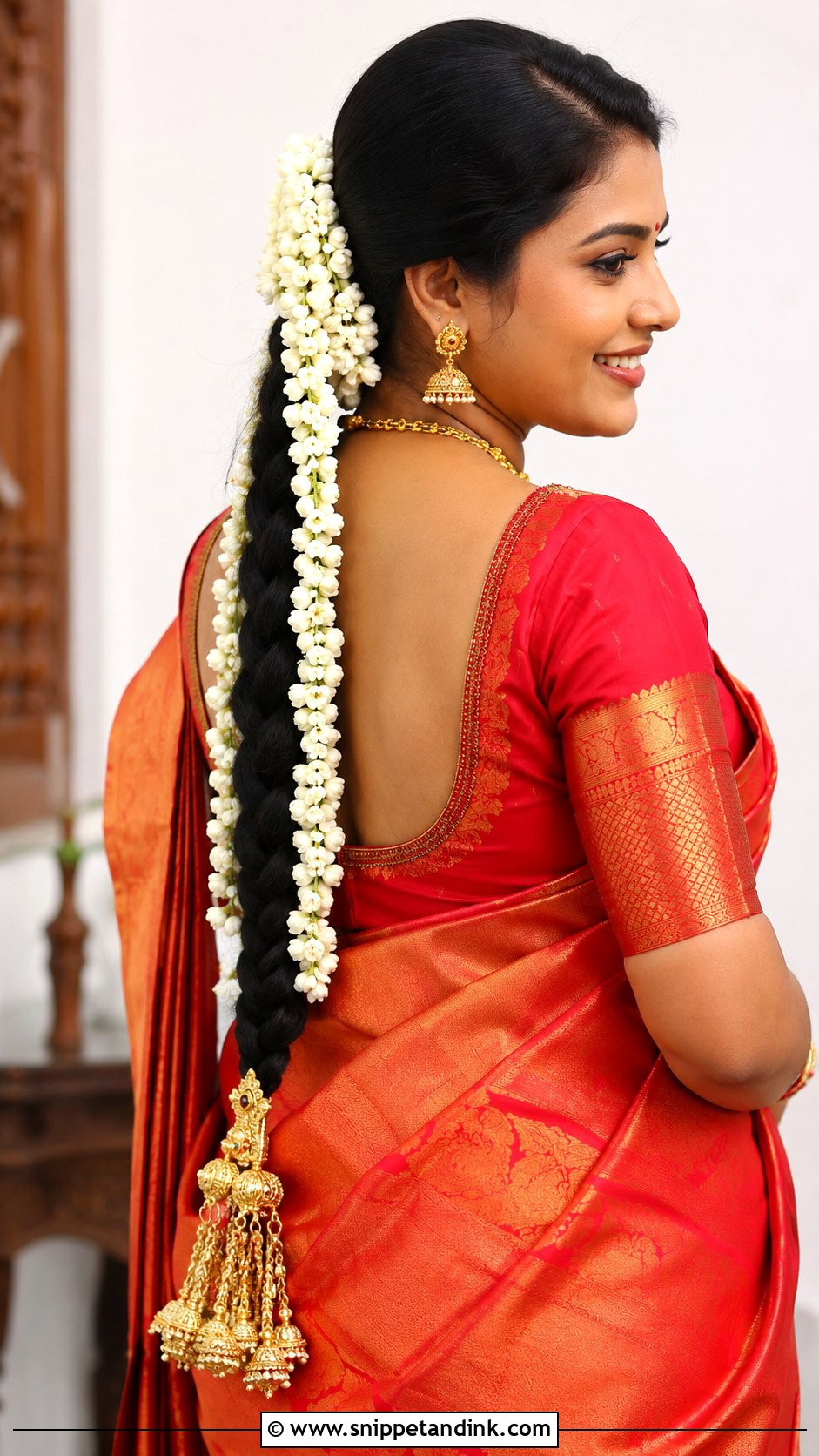
Kunjalam are the decorative tassels tied at the end of the braid, and they change a simple plait completely. The braid needs to be smooth and thick, so on finer hair I almost always add a savaram to give the tassels enough weight to hang straight. Jasmine usually lines the braid. I tie the kunjalam with the braid’s own elastic and then wrap thread over it, since the tassels swing hard during rituals and a pinned tassel can drop. With temple jewelry and a Kanjeevaram saree it is a classic for the muhurtham moment.
18. Floral Bun With Pearl Strings
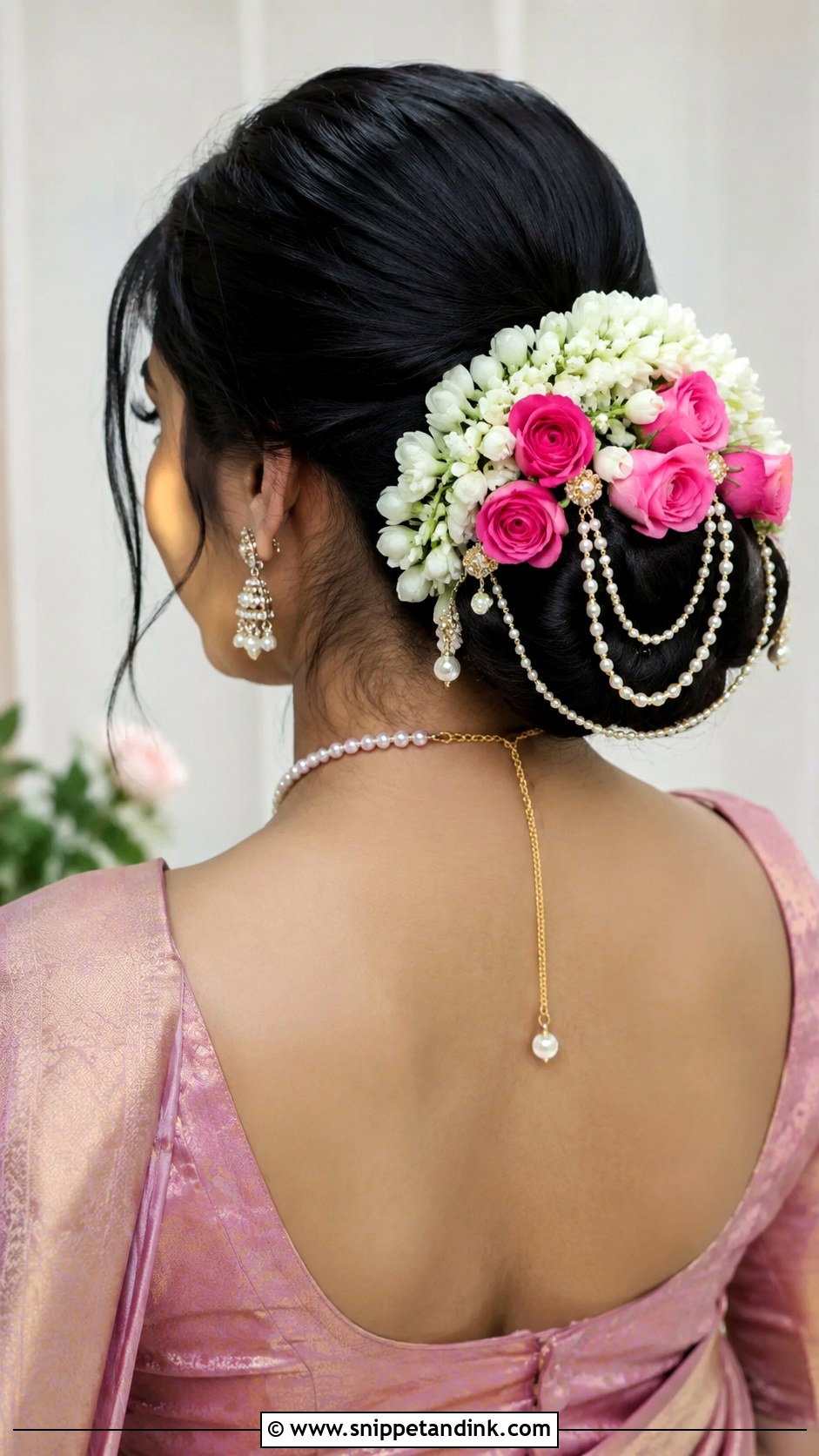
Pearl strings draped through jasmine and roses add a quiet shimmer to a floral bun. I use pearls on fine wire or on a hair chain with hooks, because loose strands slide off a bun within an hour. The pearls also help where the flowers wilt, so the shape still reads in late photos. It suits engagements and reception evenings, and matching pearl jewelry keeps it cohesive. Avoid very large pearls with small buns; the proportion looks off.
19. Crown Braid With Jasmine
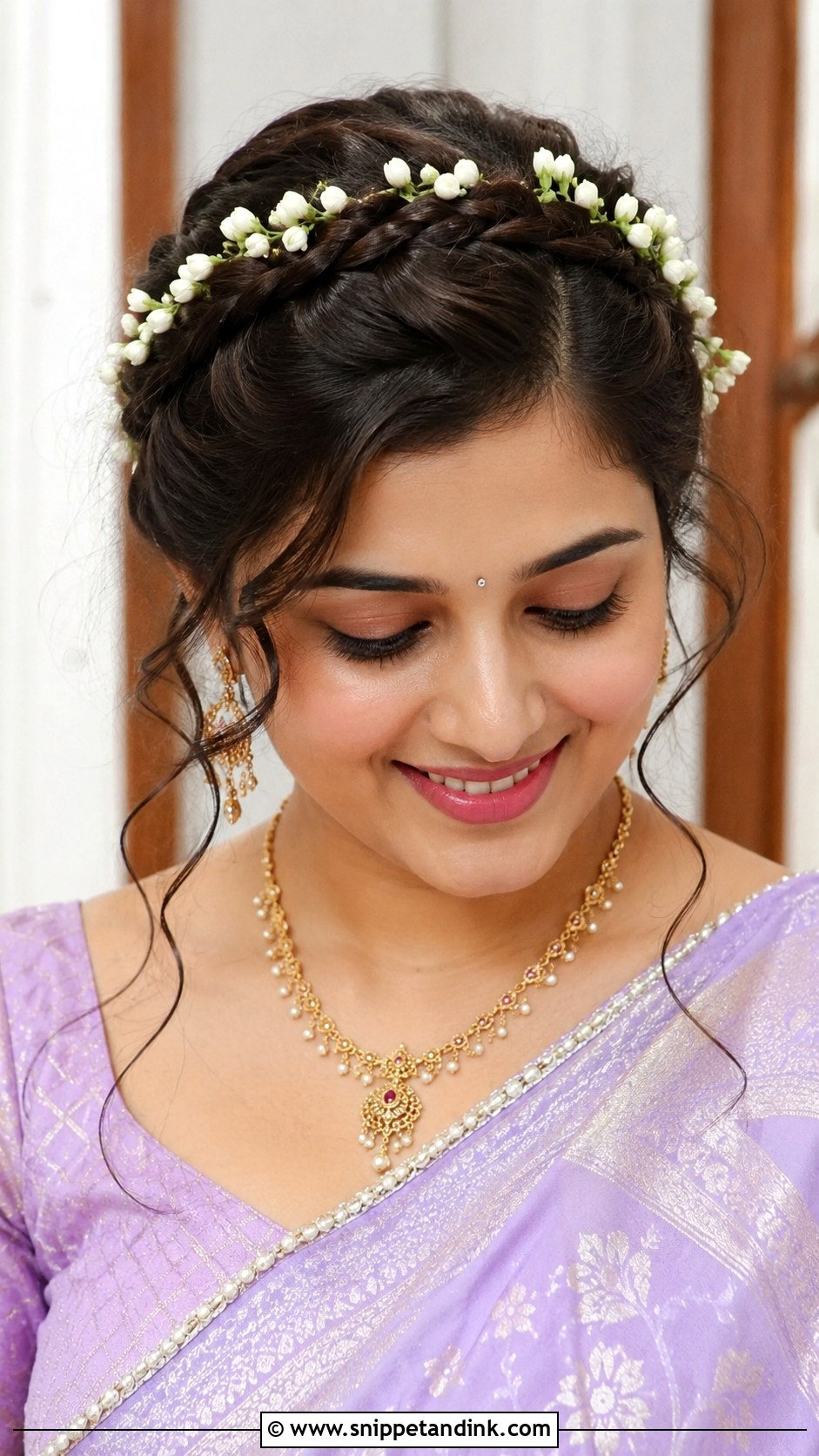
A crown braid wraps across the top of the head, then gets dotted with jasmine buds. It frames the face and adds a little height, which helps petite brides. Mid-length hair works best; very long hair makes the crown too thick, and very short hair won’t reach around. I pin it every few centimetres along the underside so it doesn’t slip back over the day. I’d keep it for haldi, pre-wedding functions or a small ceremony, with simple jewelry so the braid stays the focus.
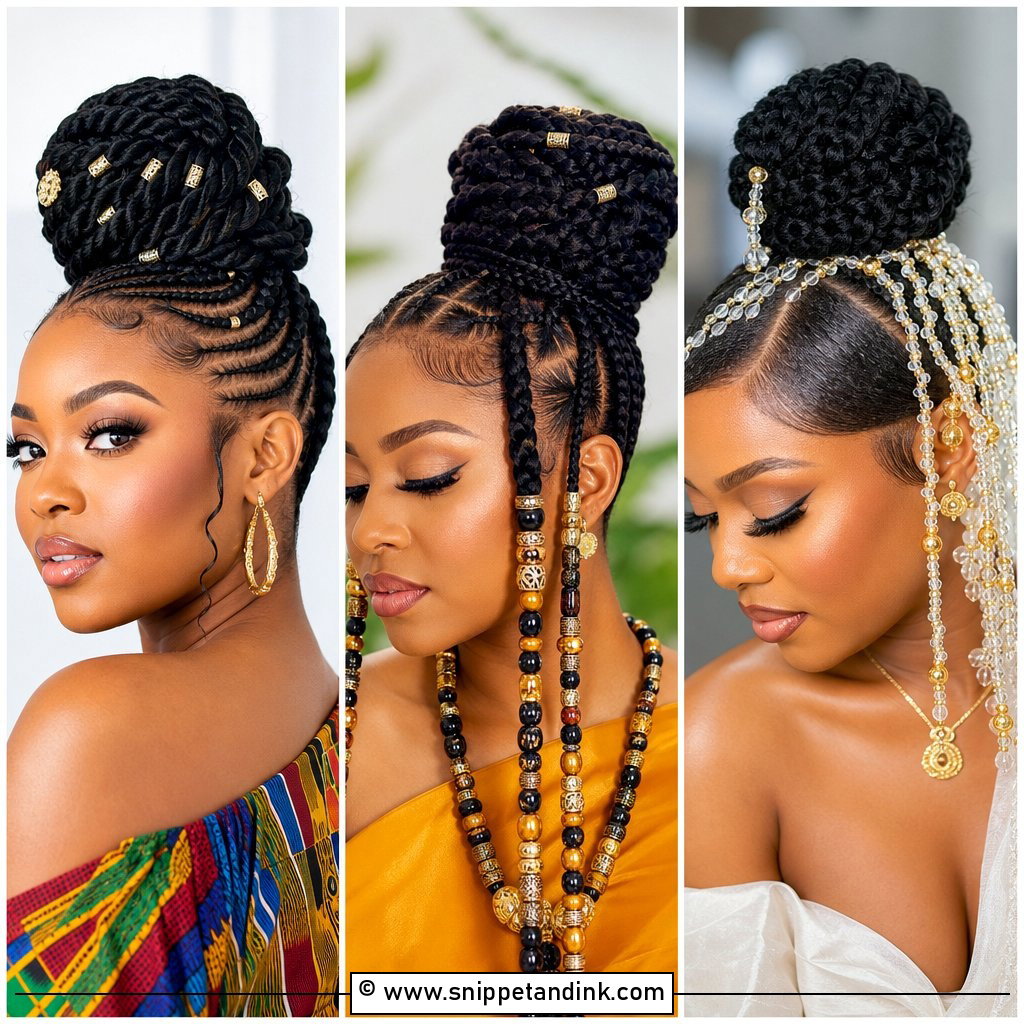
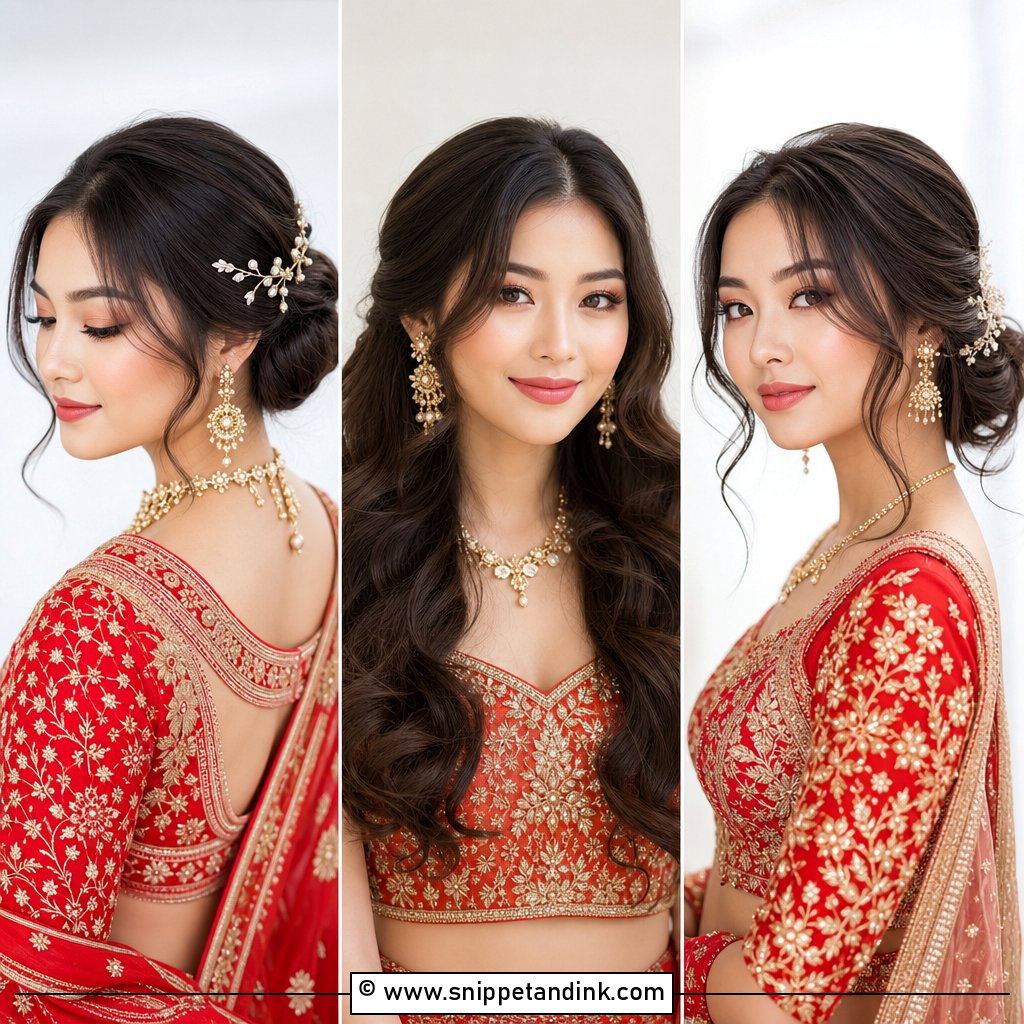
20. Low Bun With Nethichutti
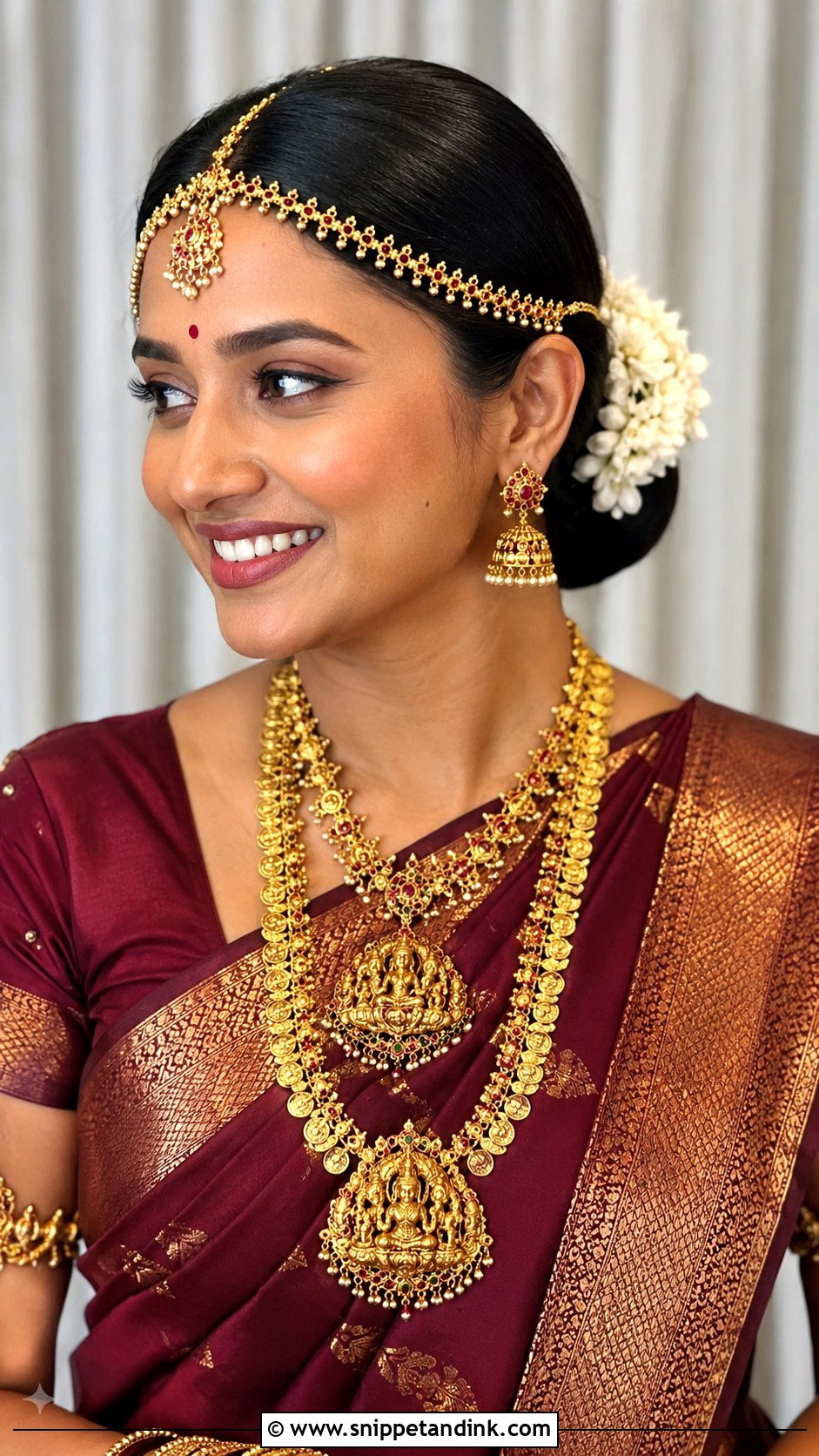
The nethichutti runs across the hairline, and it is the one ornament where the hair has to be planned around the jewelry. I keep the hair sleek and gathered into a clean low bun so nothing competes with it, and I pin the nethichutti’s side chains into the hair behind the ears so it sits level. A modest gajra wraps the bun. It is the natural pairing when you’re wearing full temple jewelry sets for the muhurtham, and it’s comfortable enough to wear for hours.
21. Messy Braided Updo For Sangeet
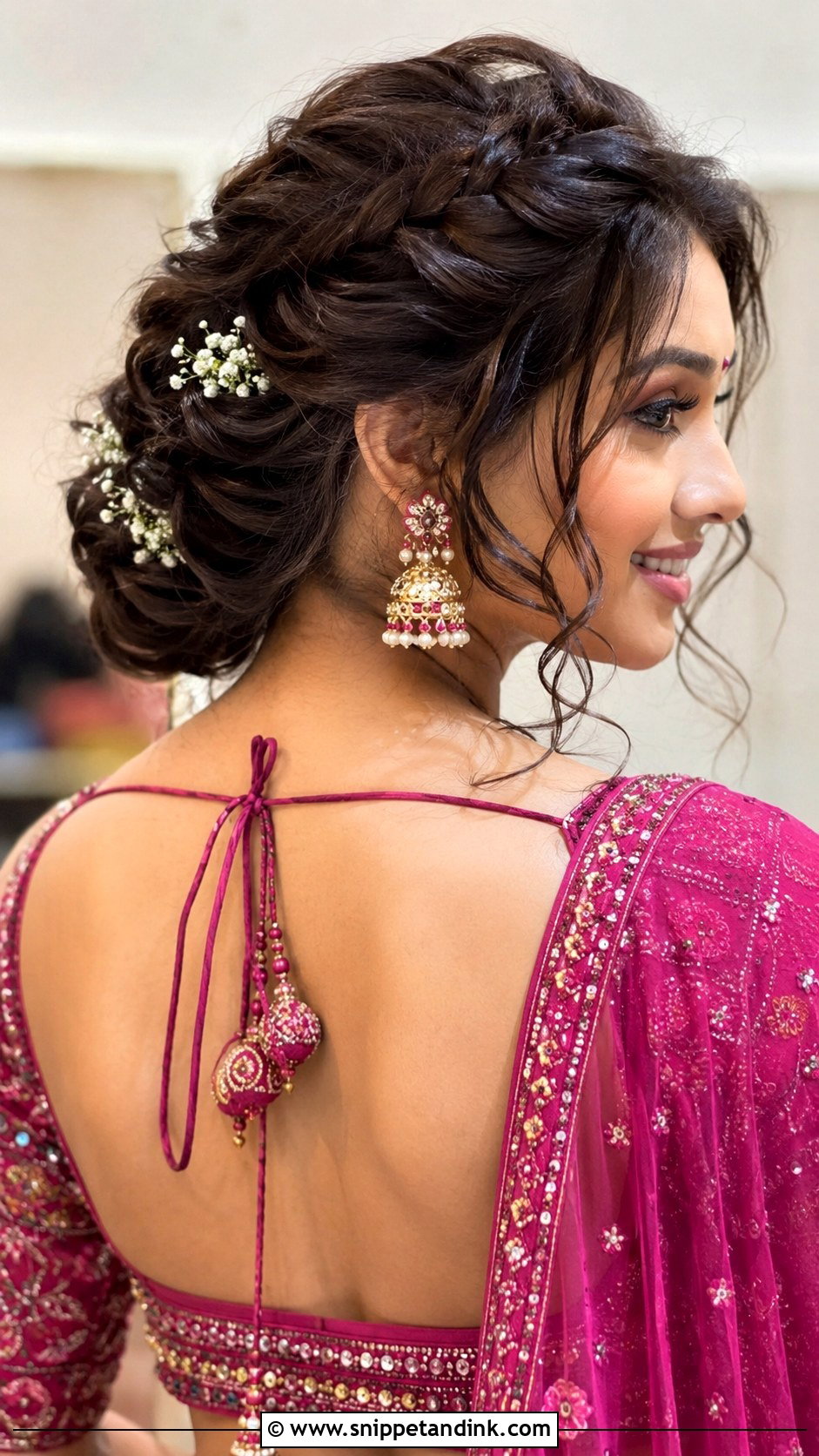
For the sangeet I loosen things up. Loosely braided sections are gathered into a soft, textured updo, with a few wisps left out around the face and small flowers or a thin hair vine tucked in. Messy styles still need structure underneath, so I start with a firm base pony and pin the braids to it; otherwise dancing takes it apart. Round and heart-shaped faces suit the softness. Jhumkas and a bright lehenga finish it, and you can dance without worrying about it.
22. Donut Bun With Flower Border
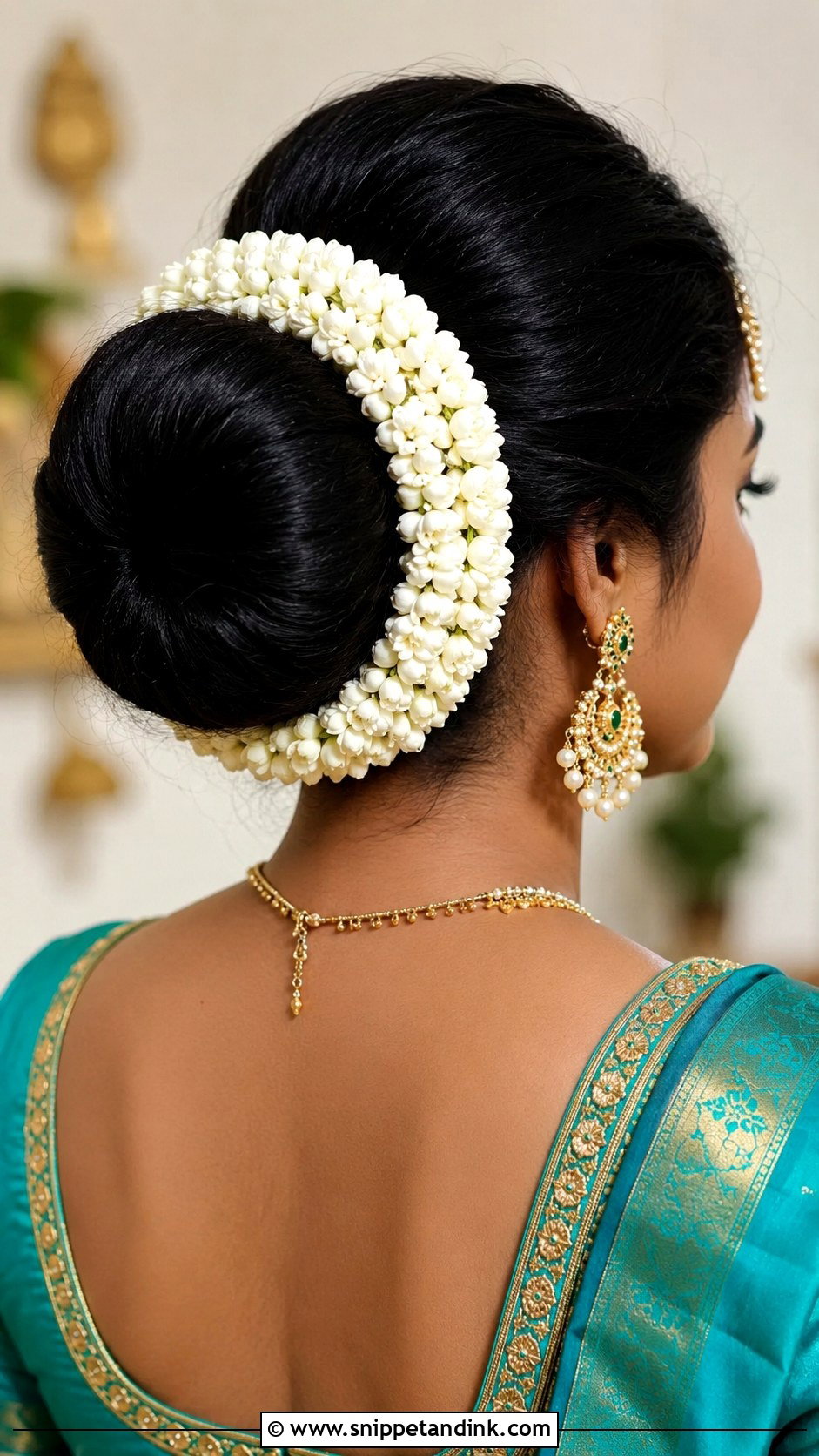
A donut bun gives a perfectly round, full shape. The hair is wrapped around a foam ring, and a neat ring of jasmine frames it like a small wreath. I match the ring’s colour to the hair, because on lighter or thinner hair a dark foam ring shows through the strands. It gives volume where hair is thin, which is why I reach for it often, and it pairs well with heavy earrings and a maang tikka for either the ceremony or the reception.
23. Open Curls With Floral Tiara
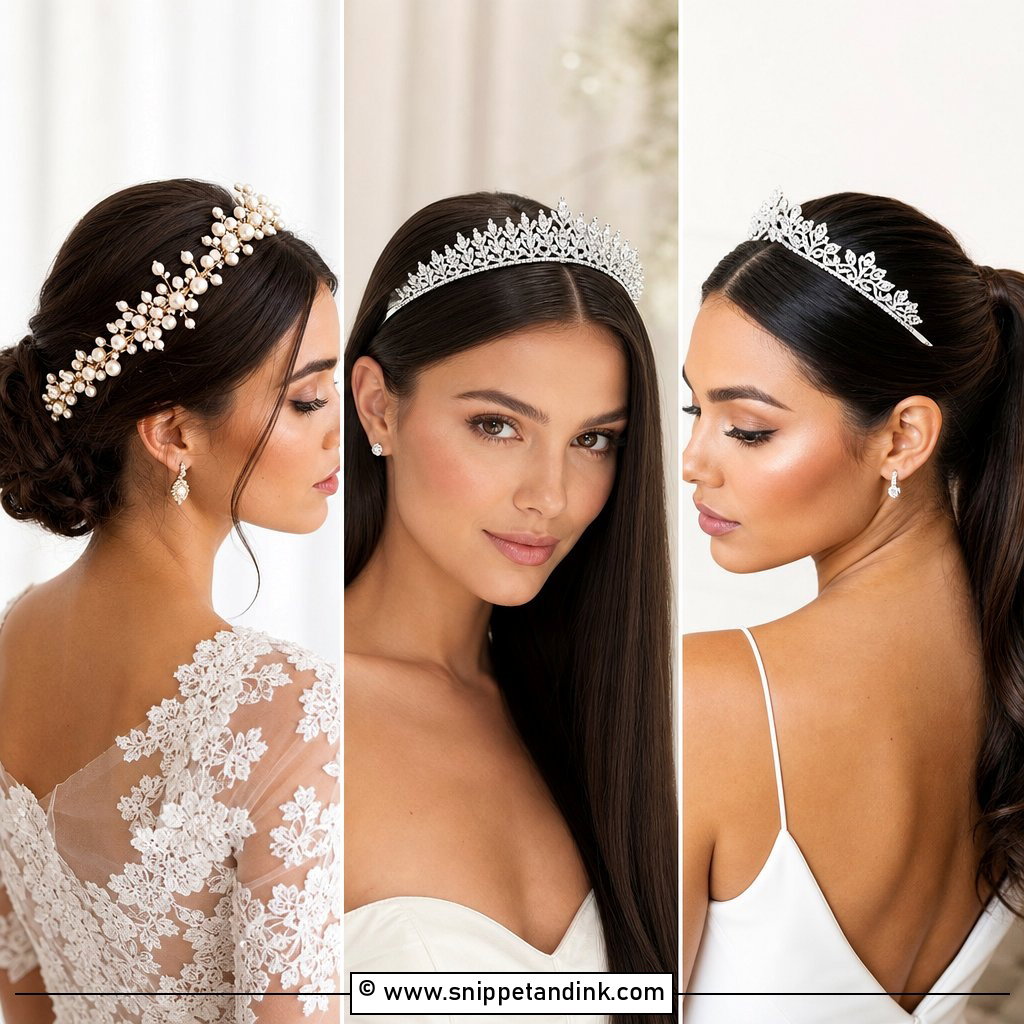
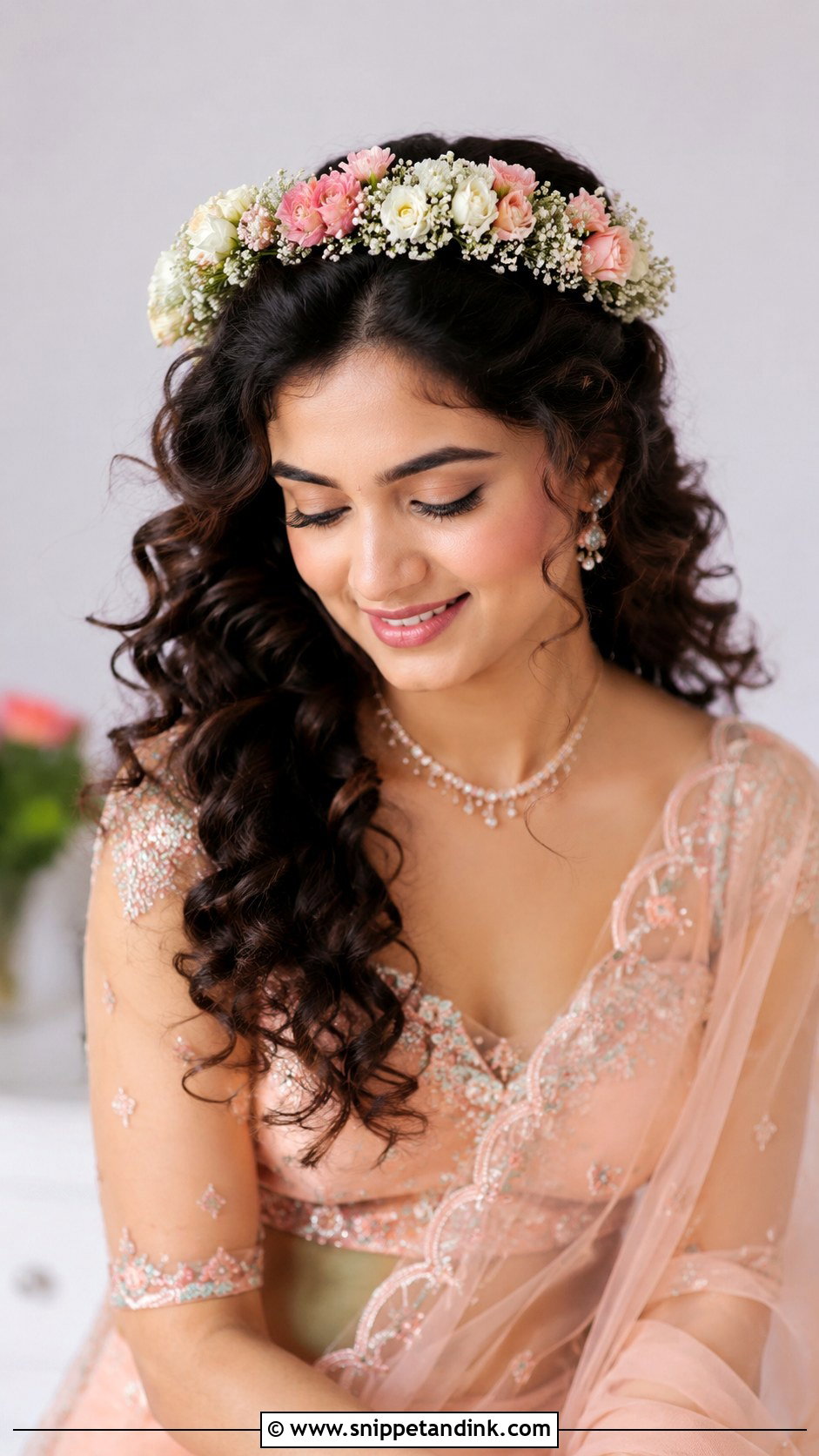
Open curls with a floral tiara mix Western bridal styling with South Indian flowers. The hair is curled into loose, full curls, and a band of fresh flowers sits across the crown. I attach the floral band to two small pinned sections at the sides, never just balanced on the head, or it tilts the moment you look down. I’d save it for the reception evening or a pre-wedding shoot, with delicate jewelry and a flowing gown or lehenga. Oval and heart-shaped faces wear it most easily.
24. Twisted Side Braid With Gajra
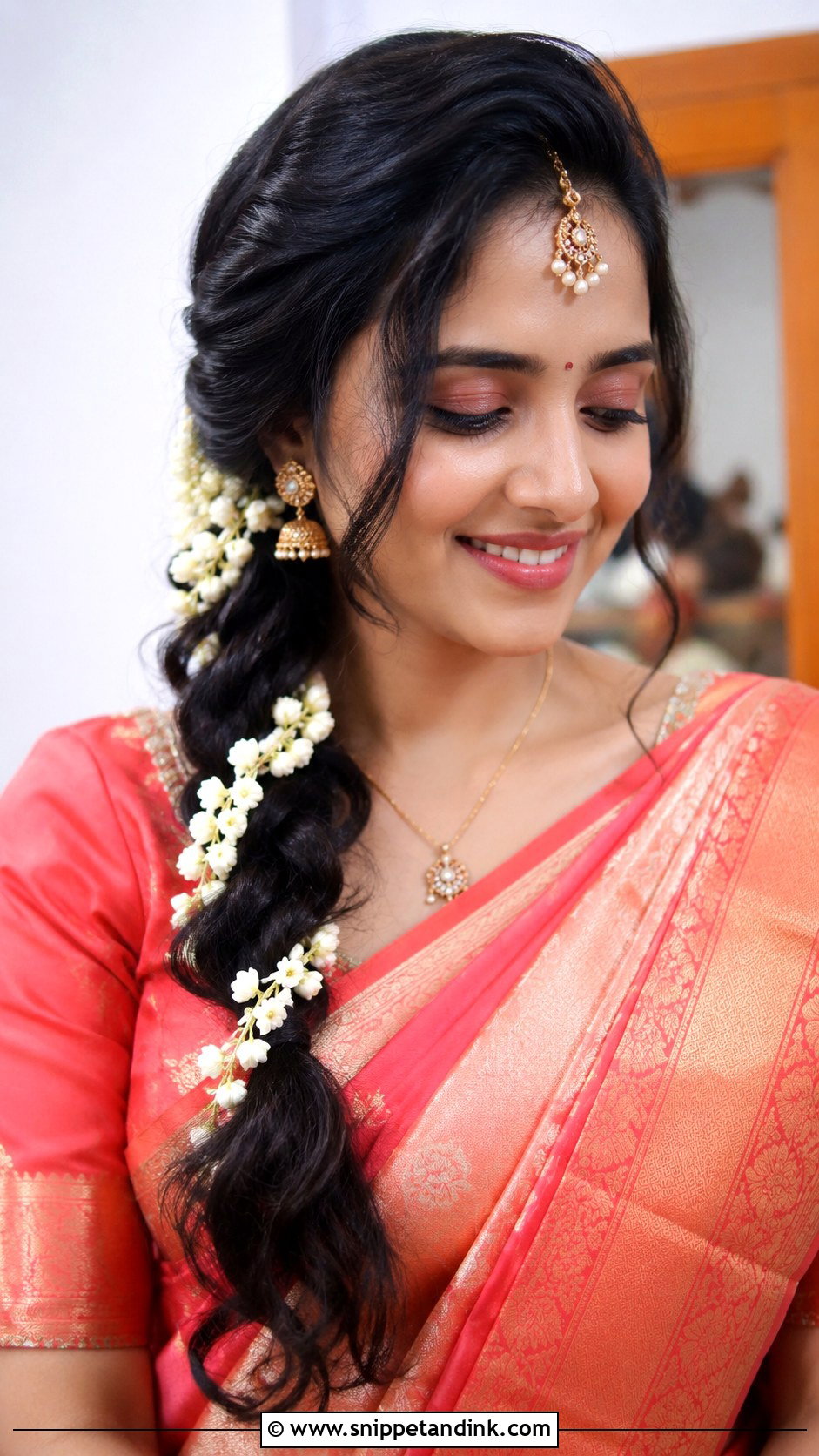
A twisted side braid falls over one shoulder, with gajra woven through it or pinned along it. I twist the sections before braiding so the plait looks fuller without adding hair. It keeps your hair visible and soft rather than pulled back tight, and the side placement shows off the jawline and a statement earring. One honest warning: a side braid shifts every time you turn, so it is better for receptions and pre-wedding functions than for a ceremony where you sit for long stretches. A light maang tikka balances it.

25. Grand Floral Jada For Muhurtham
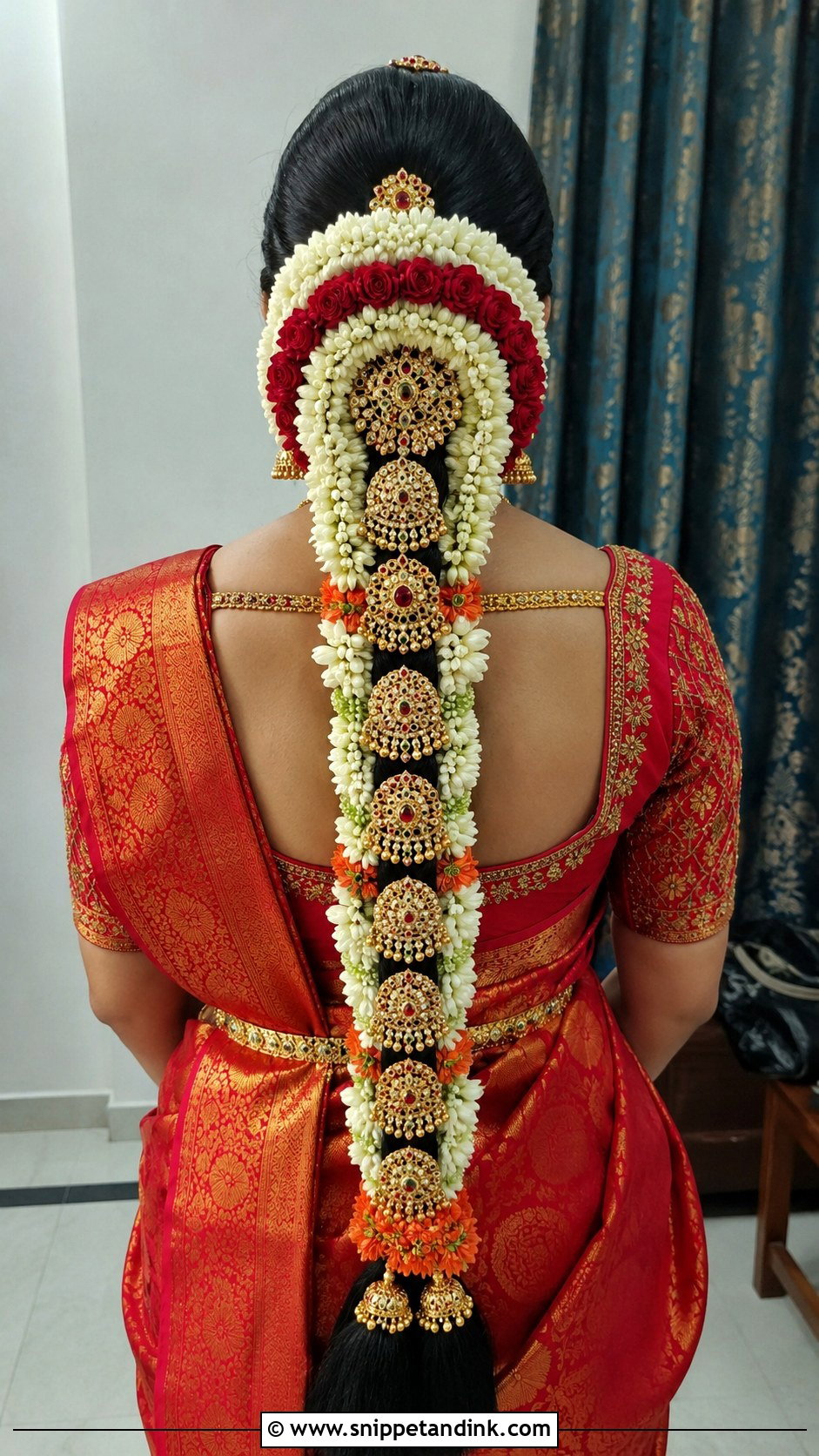
The grand floral jada is the full ceremonial version: jasmine, roses, kanakambaram and gold accessories layered from crown to tip, with jadakuppulu and kunjalam swinging at the end. It is the heaviest style I set, so I tell brides to wear a practice version for an hour at the trial. If your neck aches after that, I lighten the base or use fewer gold pieces. With temple jewelry, a nethichutti and a rich Kanjeevaram saree, it is the look most families picture for the muhurtham.
Ordering Jasmine and Kanakambaram So They Last Until the Talambralu
Jasmine is a living flower, and it behaves like one. The buds open in the evening and start browning within a day, faster in heat and wherever they are touched. For an early muhurtham, I ask families to collect the strung jasmine the evening before, wrap it loosely in a damp cotton cloth, and keep it somewhere cool but not freezing; very cold storage browns the petals as well.
Kanakambaram has no scent but holds its colour much longer, which is why it often fills the rows between jasmine on a poola jada. Roses are the heaviest of the three and need to be wired or pinned individually. If your florist is making a ready poola jada on a base, confirm the length with your actual braid measured from the nape, not a guess.
If the flowers wilt mid-ceremony
Keep one spare veni of jasmine in a cool bag with whoever is helping you. Swapping the top string on a bun or the upper rows of a jada takes a few minutes and covers the browned buds that show most in close-up photos.
Going From a Heavy Jada to Reception Hair the Same Day
Many Telugu weddings run the muhurtham and the reception on the same day, and the change of hair is where time disappears. Taking down a gold and flower jada properly means removing each thread and pin by hand, then dealing with hair that has been braided tight for hours and is kinked from root to tip.
- Plan for the reception style to work with braid waves: a low bun, a side braid or a half up look, rather than sleek straight hair.
- Have someone untie the gold pieces and hand them to a family member immediately, so nothing goes missing in the rush.
- Allow at least an hour between the end of the ceremony and when you need to be dressed again.
- Brush out gently from the ends upward; pulling a brush down from the crown after a tight braid snaps hair.
I’d rather a bride wear a simple, polished bun to her reception than rush a complicated curl set on hair that has just come out of a jada.
Your Muhurtham Braid Sets the Plan for Every Other Function
Start with the ceremony: which braid or bun you’ll wear for the muhurtham decides how much hair, how many flowers and how much time you need, and everything else is easier to plan around it. Then look at your hair length, your face, the neckline of each outfit and how many hours you’ll be sitting. Mixing a traditional jada in the morning with soft open curls at night is common and works well. Bring the photos you like to your trial, ask your stylist to set the heaviest look first, and go into your special day knowing it will hold.
You'll Like These Ideas:


Leave a Reply